Samacheer Kalvi 11th Computer Science Solutions Chapter 13 Introduction to Object-Oriented Programming Techniques

Students can Download Computer Science Chapter 13 Introduction to Object-Oriented Programming Techniques Questions and Answers, Notes Pdf, Samacheer Kalvi 11th Computer Science Book Solutions Guide Pdf helps you to revise the complete Tamilnadu State Board New Syllabus and score more marks in your examinations.

Tamilnadu Samacheer Kalvi 11th Computer Science Solutions Chapter 13 Introduction to Object-Oriented Programming Techniques

Samacheer Kalvi 11th Computer Science Introduction to Object-Oriented Programming Techniques Text Book Back Questions and Answers

PART – 1
I. Choose The Correct Answer

Question 1.
The term is used to describe a programming approach based on classes and objects is ……………….
(a) OOP
(b) POP
(c) ADT
(d) SOP
Answer:
(a) OOP

Question 2.
The paradigm which aims more at procedures ……………….
(a) Object Oriented Programming
(b) Procedural programming
(c) Modular programming
(d) Structural programming
Answer:
(b) Procedural programming

Samacheer Kalvi 11th Computer Science Solutions Chapter 13 Introduction to Object-Oriented Programming Techniques

Question 3.
Which of the following is a user defined data type?
(a) class
(b) float
(c) int
(d) object
Answer:
(a) class

Question 4.
The identifiable entity with some characteristics and behaviour is ……………….
(a) class
(b) object
(c) structure
(d) member
Answer:
(b) object

Question 5.
The mechanism by which the data and functions are bound together into a single unit is known as ……………….
(a) Inheritance
(b) Encapsulation
(c) Polymorphism
(d) Abstraction
Answer:
(b) Encapsulation

Question 6.
Insulation of the data from direct access by the program is called as ……………….
(a) Data hiding
(b) Encapsulation
(c) Polymorphism
(d) Abstraction
Answer:
(a) Data hiding

Question 7.
Which of the following concept encapsulate all the essential properties of the object that are to be created?
(a) Class
(b) Encapsulation
(c) Polymorphism
(d) Abstraction
Answer:
(d) Abstraction

Question 8.
Which of the following is the most important advantage of inheritance?
(a) data hiding
(b) code reusability
(c) code modification
(d) accessibility
Answer:
(b) code reusability

Samacheer Kalvi 11th Computer Science Solutions Chapter 13 Introduction to Object-Oriented Programming Techniques

Question 9.
“Write once and use it multiple time” can be achieved by ……………….
(a) redundancy
(b) reusability
(c) modification
(d) composition
Answer:
(b) reusability

Question 10.
Which of the following supports the transitive nature of data?
(a) Inheritance
(b) Encapsulation
(c) Polymorphism
(d) Abstraction
Answer:
(a) Inheritance

PART – 2
II. Answers to all the questions

Question 1.
How is modular programming different from procedural programming paradigm?
Answer:
Modular programming:

  • Emphasis on algorithm rather than data.
  • Programs are divided into individual modules.
  • Each modules are independent of each other and have their own local data.
  • Modules can work with its own data as well as with the data passed to it.

Procedural programming:

  • Programs are organized in the form of subroutines or sub programs.
  • All data items are global.
  • Suitable for small sized software application.
  • Difficult to maintain and enhance the program code as any change in data type needs to be propagated to all subroutines that use the same data type.

Question 2.
Differentiate classes and objects.
Answer:
Class:

  • Class is a blue print or template from which objects are created.
  • Class doesn’t allocate memory when it is created.
  • Class is a logical entity.

Object:

  • Object is an instance of a class.
  • Objects allocate memory when it is created.
  • Object is a physical entity.

Samacheer Kalvi 11th Computer Science Solutions Chapter 13 Introduction to Object-Oriented Programming Techniques

Question 3.
What is polymorphism?
Answer:
Polymorphism is the ability of a message or function to be displayed in more than one form.

Question 4.
How is encapsulation and abstraction are interrelated?
Answer:
Abstraction means giving only essential things and hiding unnecessary details. Encapsulation is the binding of data members and methods together in a capsule to avoid accidental changes to data from external users, i.e., encapsulation is the bundling of related algorithms and data.

Question 5.
Write the disadvantages of OOP.
Answer:

  1. Size: Object Oriented Programs are much larger than other programs.
  2. Effort: Object Oriented Programs require a lot of work to create.
  3. Speed: Object Oriented Programs are slower than other programs, because of their size.

PART – 3
III. Answers to all the questions

Question 1.
What is paradigm? Mention the different types of paradigm.
Answer:
Paradigm means organizing principle of a program. It is an approach to programming. There are different approaches available for problem solving using computer. They are Procedural programming, Modular Programming and Object Oriented Programming.

Question 2.
Write a note on the features of procedural programming.
Answer:
Important features of procedural programming

  1. Programs are organized in the form of subroutines or sub programs
  2. All data items are global
  3. Suitable for small sized software application
  4. Difficult to maintain and enhance the program code as any change in data type needs to be propagated to all subroutines that use the same data type. This is time consuming.
  5. Example: FORTRAN and COBOL.

Samacheer Kalvi 11th Computer Science Solutions Chapter 13 Introduction to Object-Oriented Programming Techniques

Question 3.
List some of the features of modular programming.
Answer:
Important features of Modular programming:

  1. Emphasis on algorithm rather than data
  2. Programs are divided into individual modules
  3. Each modules are independent of each other and have their own local data
  4. Modules can work with its own data as well as with the data passed to it.
  5. Example: Pascal and C.

Question 4.
What do you mean by modularization and software reuse?
Answer:

  1. Modularization : where the program can be decomposed into modules.
  2. Software re – use : where a program can be composed from existing and new modules.

Question 5.
Define information hiding.
Answer:
Encapsulation is the most striking feature of a class. The data is not accessible to the outside world, and only those functions which are wrapped in the class can access it. This encapsulation of data from direct access by the program is called data hiding or information hiding.

PART – 4
IV. Answers to all the questions

Question 1.
Write the differences between Object Oriented Programming and Procedural Programming
Answer:
Object Oriented Programming:

  • Emphasizes on data rather than algorithm.
  • Data abstraction is introduced in addition to procedural abstraction.
  • Data and its associated operations are grouped in to single unit.
  • Programs are designed around the data being operated.
  • Example: C++, Java, VB.Net, Python

Procedural Programming:

  • Programs are organized in the form of subroutines or sub programs.
  • All data items are global.
  • Suitable for small sized software application.
  • Difficult to maintain and enhance the program code as any change in data type needs to be propagated to all subroutines that use the same data type.
  • Example: FORTRAN and COBOL

Question 2.
What are the advantages of OOPs?
Answer:
Re – usability : “Write once and use it multiple times” you can achieve this by using class. Redundancy: Inheritance is the good feature for data redundancy. If you need a same functionality in multiple class you can write a common class for the same functionality and inherit that class to sub class.

Easy Maintenance : It is easy to maintain and modify existing code as new objects can be created with small differences to existing ones.

Security : Using data hiding and abstraction only necessary data will be provided thus maintains the security of data.

Samacheer Kalvi 11th Computer Science Solutions Chapter 13 Introduction to Object-Oriented Programming Techniques

Question 3.
Write a note on the basic concepts that supports OOPs?
Answer:
The Object Oriented Programming has been developed to overcome the drawbacks of procedural and modular programming. It is widely accepted that object – oriented programming is the most important and powerful way of creating software.

The Object – Oriented Programming approach mainly encourages:

  1. Modularization: where the program can be decomposed into modules.
  2. Software re – use: where a program can be composed from existing and new modules.

Main Features of Object Oriented Programming:

  1. Data Abstraction.
  2. Encapsulation.
  3. Modularity.
  4. Inheritance.
  5. Polymorphism.

Encapsulation:
The mechanism by which the data and functions are bound together into a single unit is known as Encapsulation. It implements abstraction. Encapsulation is about binding the data variables and functions together in class. It can also be called data binding. Encapsulation is the most striking feature of a class.

The data is not accessible to the outside world, and only those functions which are wrapped in the class can access it. These functions provide the interface between the object’s data and the program. This encapsulation of data from direct access by the program is called data hiding or information hiding.

Data Abstraction:
Abstraction refers to showing only the essential features without revealing background details. Classes use the concept of abstraction to define a list of abstract attributes and function which operate on these attributes. They encapsulate all the essential properties of the object that are to be created. The attributes are called data members because they hold information. The functions that operate on these data are called methods or member function.

Modularity:
Modularity is designing a system that is divided into a set of functional units (named modules) that can be composed into a larger application.

Inheritance:
Inheritance is the technique of building new classes (derived class) from an existing Class (base class). The most important advantage of inheritance is code reusability.

Polymorphism:
Polymorphism is the ability of a message or function to be displayed in more than one form.
Samacheer kalvi 11th Computer Science Introduction to Object-Oriented Programming Techniques Additional Questions and Answers

PART – 1
I. Choose the correct answer

Question 1.
In procedural programming all data items are ……………….
(a) Cobol
(b) global
(c) fortan
(d) class
Answer:
(b) global

Question 2.
Class represents a group of similar ……………….
(a) objects
(b) modules
(c) arrays
(d) data
Answer:
(a) objects

Samacheer Kalvi 11th Computer Science Solutions Chapter 13 Introduction to Object-Oriented Programming Techniques

Question 3.
………………. is an example of object oriented programming.
(a) Python
(b) Java
(c) VB.Net
(d) All the above
Answer:
(d) All the above

Question 4.
………………. refers to showing only the essential features without revealing background details.
(a) Redundancy
(b) Encapsulation
(c) Abstraction
(d) Inheritance
Answer:
(c) Abstraction

Question 5.
………………. is about binding the data variables and functions together in class.
(a) Data abstraction
(b) Modularization
(c) Redundancy
(d) Encapsulation
Answer:
(d) Encapsulation

PART – 2
II. Very Short Answers

Question 1.
What is procedural programming?
Answer:
Procedural means a list of instructions were given to the computer to do something. Procedural programming aims more at procedures. This emphasis on doing things.

Question 2.
What is a class?
Answer:
A Class is a construct in C++ which is used to bind data and its associated function together into a single unit using the encapsulation concept. Class is a user defined data type. Class represents a group of similar objects.

Samacheer Kalvi 11th Computer Science Solutions Chapter 13 Introduction to Object-Oriented Programming Techniques

Question 3.
What is modularity?
Answer:
Modularity is designing a system that is divided into a set of functional units (named modules) that can be composed into a larger application.

Question 4.
What are the main features of OOP?
Answer:
Main Features of Object Oriented Programming:

  1. Data Abstraction
  2. Encapsulation
  3. Modularity
  4. Inheritance
  5. Polymorphism

Question 5.
What is redundancy?
Answer:
Inheritance is the good feature for data redundancy. If you need a same functionality in multiple class you can write a common class for the same functionality and inherit that class to sub class.

PART – 3
III. Short Answers

Question 1.
Write about objects.
Answer:
Objects: Represents data and its associated function together into a single unit. Objects are the basic unit of OOP. Basically an object is created from a class. They are instances of class also called as class variables. An identifiable entity with some characteristics and behaviour is called object.

Samacheer Kalvi 11th Computer Science Solutions Chapter 13 Introduction to Object-Oriented Programming Techniques

Question 2.
What is Encapsulation and data binding?
Answer:
The mechanism by which the data and functions are bound together into a single unit is known as Encapsulation. Encapsulation is the most striking feature of a class. The data is not accessible to the outside world, and only those functions which are wrapped in the class can access it. These functions provide the interface between the object’s data and the program. This encapsulation of data from direct access by the program is called data hiding or information hiding.

PART – 4
IV. Explain in Detail

Question 1.
Explain about features of object oriented programming.
Answer:
Main Features of Object Oriented Programming

  1. Data Abstraction
  2. Encapsulation
  3. Modularity
  4. Inheritance
  5. Polymorphism

Encapsulation:
1. The mechanism by which the data and functions are bound together into a single unit is known as Encapsulation. It implements abstraction.

2. Encapsulation is about binding the data variables and functions together in class. It can also be called data binding.

3.. Encapsulation is the most striking feature of a class. The data is not accessible to the outside world, and only those functions which are wrapped in the class can access it. These functions provide the interface between the object’s data and the program. This encapsulation of data from direct access by the program is called data hiding or information hiding.

Data Abstraction:
Abstraction refers to showing only the essential features without revealing background details. Classes use the concept of abstraction to define a list of abstract attributes and function which operate on these attributes.

They encapsulate all the essential properties of the object that are to be created. The attributes are called data members because they hold information. The functions that operate on these data are called methods or member function.

Modularity:
Modularity is designing a system that is divided into a set of functional units (named modules) that can be composed into a larger application.

Inheritance:
Inheritance is the technique of building new classes (derived class) from an existing Class (base class). The most important advantage of inheritance is code reusability.

Polymorphism:
Polymorphism is the ability of a message or function to be displayed in more than one form.
Tamil Nadu 11th Accountancy Previous Year Question Paper March 2019 English Medium

Students can Download Tamil Nadu 11th Accountancy Previous Year Question Paper March 2019 English Medium Pdf, Tamil Nadu 11th Accountancy Model Question Papers helps you to revise the complete Tamilnadu State Board New Syllabus and score more marks in your examinations.

TN State Board 11th Accountancy Previous Year Question Paper March 2019 English Medium

General Instructions:

  1. The question paper comprises of four parts.
  2. You are to attempt all the parts. An internal choice of questions is provided wherever applicable.
  3. All questions of Part I, II, III, and IV are to be attempted separately.
  4. Question numbers 1 to 20 in Part I are Multiple Choice Questions of one mark each.
    These are to be answered by choosing the most suitable answer from the given four alternatives and writing the option code and the corresponding answer.
  5. Question numbers 21 to 30 in Part II are two-mark questions. These are to be answered in about one or two sentences.
  6. Question numbers 31 to 40 in Part III are three-mark questions. These are to be answered in above three to five short sentences.
  7. Question numbers 41 to 47 in Part IV are five-mark questions. These are to be answered in detail Draw diagrams wherever necessary.

Time: 2.30 Hours
Maximum Marks: 90

Part – I

Answer all the questions. Choose the correct answer: [20 x 1 = 20]

Question 1.
The root of financial accounting system is ______.
(a) Management accounting
(b) Responsibility accounting
(c) Social accounting
(d) Stewardship accounting
Answer:
(d) Stewardship accounting

Question 2.
The business is liable to the proprietor of the business in respect of capital introduced by the person according to _________.
(a) Business entity concept
(b) Dual aspect concept
(c) Money measurement concept
(d) Cost concept
Answer:
(a) Business entity concept

Question 3.
A firm has assets of ₹ 1,00,000 and the external liabilities of ₹ 60,000. Its capital would be _______.
(a) ₹ 1,00,000
(b) ₹ 40,000
(c) ₹ 1,60,000
(d) ₹ 60,000
Answer:
(b) ₹ 40,000

Question 4.
The amount brought into the business by the proprietor should be credited to ________.
(a) Capital Account
(b) Suspense Account
(c) Cash Account
(d) Drawings Account
Answer:
(a) Capital Account

Tamil Nadu 11th Accountancy Previous Year Question Paper March 2019 English Medium

Question 5.
The difference of totals of both debit and credit side of trial balance is transferred to _______.
(a) Suspense Account
(b) Miscellaneous account
(c) Trading account
(d) Difference account
Answer:
(a) Suspense Account

Question 6.
The Cash book records _______.
(a) All cash payments
(b) All credit transactions
(c) All cash receipts and cash payments
(d) All cash receipts
Answer:
(c) All cash receipts and cash payments

Question 7.
A bank reconciliation statement is prepared with the help of ________.
(a) Bank statement and bank column of the cash book
(b) Petty cash book
(c) Bank statement
(d) Cash book
Answer:
(a) Bank statement and bank column of the cash book

Question 8.
Errors of principle arises when:
(a) Distinction is not made between capital and revenue items
(b) There are wrong postings and wrong castings
(c) There is complete omission of a transaction
(d) There is partial omission of a transaction
Answer:
(a) Distinction is not made between capital and revenue items

Question 9.
The following error becomes unavoidable in computerised accounting:
(a) Error of partial omission
(b) Error in carrying forward
(c) Casting error
(d) Error of duplication
Answer:
(d) Error of duplication

Question 10.
Residual value of an asset means the amount that it can fetch on sale at the _______ of its useful life.
(a) Middle
(b) Beginning
(c) End
(d) None of these
Answer:
(c) End

Question 11.
Expenditure incurred ₹ 20,000 for trial run of a newly installed machinery will be _________.
(a) Capital Expenditure
(b) Deferred Revenue Expenditure
(c) Preliminary Expenditure
(d) Revenue Expenditure
Answer:
(a) Capital Expenditure

Question 12.
Huge amount spent on advertisement by Mr.Ravi for his business promotion is ________.
(a) Revenue Receipts
(b) Deferred Revenue Expenditure
(c) Capital Expenditure
(d) Revenue Expenditure
Answer:
(b) Deferred Revenue Expenditure

Tamil Nadu 11th Accountancy Previous Year Question Paper March 2019 English Medium

Question 13.
Choose the correct pair:
(i) Capital Expenditure – It increases the profit earning capacity of the business
(ii) Revenue Expenditure – To get benefit for certain years
(iii) Deferred revenue expenditure – It is recurring in nature
(a) (iii) correct
(b) (i),(ii),(iii) all are correct
(c) (i) correct
(d) (ii) correct
Answer:
(c) (i) correct

Question 14.
Balance sheet shows the _______ of the business.
(a) Financial position
(b) Purchases
(c) Profitability
(d) Sales
Answer:
(a) Financial position

Question 15.
Net profit is ________.
(a) Debited to Drawing A/c
(b) Credited to Drawing A/c
(c) Debited to Capital A/c
(d) Credited to Capital A/c
Answer:
(d) Credited to Capital A/c

Question 16.
Which one is not a component of computer system?
(a) Data
(b) Central processing unit
(c) Input unit
(d) Output unit
Answer:
(a) Data

Question 17.
An example of output device is ________.
(a) Mouse
(b) Keyboard
(c) Optical scanner
(d) Printer
Answer:
(d) Printer

Question 18.
Tally is an example of:
(a) Inbuilt accounting system
(b) Readymade accounting software
(c) Tailor made accounting software
(d) Customised accounting software
Answer:
(b) Readymade accounting software

Question 19.
The source document or voucher used for recording entries in sales book is ________.
(a) Invoice
(b) Cash receipt
(c) Debit note
(d) Credit note
Answer:
(a) Invoice

Tamil Nadu 11th Accountancy Previous Year Question Paper March 2019 English Medium

Question 20.
Purchases of fixed assets on credit basis is recorded in ________.
(a) Purchase return book
(b) Journal proper
(c) Purchase book
(d) Sales book
Answer:
(b) Journal proper

Part – II

Answer any seven questions in which question No. 30 is compulsory: [7 x 2 = 14]

Question 21.
List any two functions of accounting.
Answer:
The main functions of accounting:

  1. Measurement
  2. Forecasting

1. Measurement: The main function of accounting is to keep, systematic record of transactions, post them in the ledger and ultimately prepare the final accounts.
2. Forecasting: With the help of the various tools of accounting, future performance and financial position of the business enterprises can be forecasted.

Question 22.
Define book-keeping.
Answer:
“Book-keeping is an art of recording business dealings in a set of books”. – J.R.Batlibai. “Book-keeping is the science and art of recording correctly in the books of account all those business transactions of money or money’s worth”. – R.N.Carter.

Question 23.
Give the golden rules of double entry accounting system.
Answer:
The consistency convention implies that

Personal accountDebit the receiverCredit the giver
Real accountDebit what comes inCredits what goes out
Nominal accountDebit all expenses and lossesCredit all incomes and gains

Tamil Nadu 11th Accountancy Previous Year Question Paper March 2019 English Medium

Question 24.
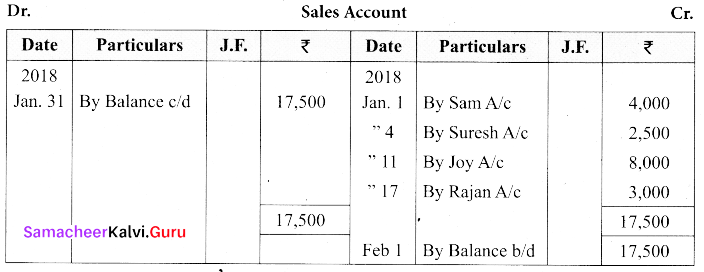
Prepare a Sales account from the following transactions.
Tamil Nadu 11th Accountancy Previous Year Question Paper March 2019 English Medium 1
Answer:
Tamil Nadu 11th Accountancy Previous Year Question Paper March 2019 English Medium 2

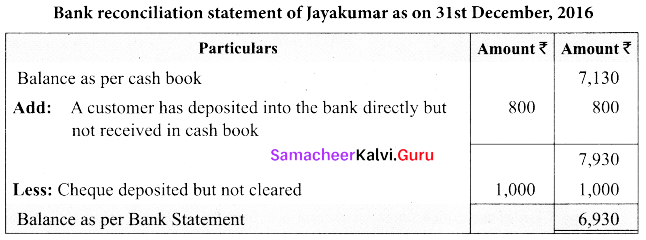
Question 25.
From the following particulars prepare a bank Reconciliation Statement of Mr. Kumar as on 31.12.2016.
(a) Balance as per cash book ₹ 7,130
(b) Cheque deposited but not cleared ₹ 1,000
(c) A customer has deposited ₹ 800 into the hank directly
Answer:
Tamil Nadu 11th Accountancy Previous Year Question Paper March 2019 English Medium 3

Question 26.
What are compensating errors?
Answer:
The errors that make up for each other or neutralize each other are known as compensating errors. These errors may occur in related or unrelated accounts. Thus, excess debit or credit in one account may be compensated by excess credit or debit in some other account. These are also known as offsetting errors.

Tamil Nadu 11th Accountancy Previous Year Question Paper March 2019 English Medium

Question 27.
Calculate the amount of depreciation under Straight Line Method.
Cost of the Asset ₹ 1,00,000
Estimated Residual Value ₹ 5,000
Expected useful life 5 years.
Answer:
Tamil Nadu 11th Accountancy Previous Year Question Paper March 2019 English Medium 4

Question 28.
Name any two direct expenses.
Answer:
Direct expenses:

  1. Carriage inwards or freight inwards
  2. Wages

Question 29.
What are adjusting entries?
Answer:
Adjustment entries are the journal entries made at the end of the accounting period to account for items which are omitted in trial balance and to make adjustments for outstanding and prepaid expenses and revenues accrued and received in advance.

Question 30.
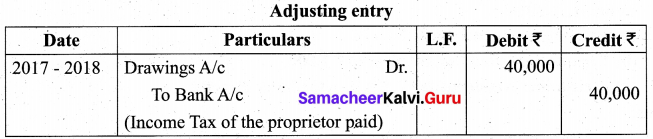
Mr. Babu, a sole proprietor whose Income Tax for the year 2017 – 2018 ₹ 40,000 is paid by the business. Give adjusting entry.
Answer:
Tamil Nadu 11th Accountancy Previous Year Question Paper March 2019 English Medium 5

Part – III

Answer any seven questions in which question No. 40 is compulsory: [7 x 3 = 21]

Question 31.
Enumerate the importance of accounting.
Answer:
The importance of accounting is:

  • Systematic records: All the transactions of an enterprise which are financial in nature are recorded in a systematic way in the books of accounts.
  • Preparation of financial statements: Results of business operations and the financial position of the concern can be ascertained from accounting periodically through the preparation of financial statements.
  • Assessment of progress: Analysis and interpretation of financial data can be done to assess the progress made in different areas and to identify the areas of weaknesses.

Tamil Nadu 11th Accountancy Previous Year Question Paper March 2019 English Medium

Question 32.
Write short notes on:
(i) Business Entity Concept
(ii) Going Concern Concept
Answer:
(i) Business Entity Concept
This concept implies that a business unit is separate and distinct from the owner or owners, that is, the persons who supply capital to it. Based on this concept, accounts are prepared from the point of view of the business and not from the owner’s point of view. Hence, the business is liable to the owner for the capital contributed by him/her.

(ii) Going Concern Concept
It is the basic assumption that business is a going concern and will continue its operations for a foreseeable future. Going concern concept influences accounting practices in relation to valuation of assets and liabilities, depreciation of the fixed assets, treatment of outstanding and prepaid expenses and accrued and unearned revenues.

Question 33.
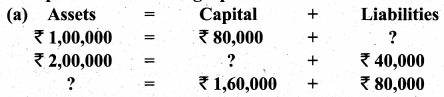
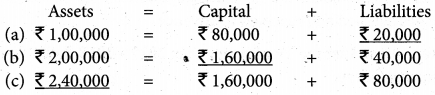
Complete the accounting equation
Tamil Nadu 11th Accountancy Previous Year Question Paper March 2019 English Medium 6
Answer:
Tamil Nadu 11th Accountancy Previous Year Question Paper March 2019 English Medium 43

Question 34.
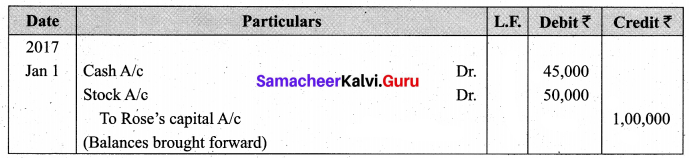
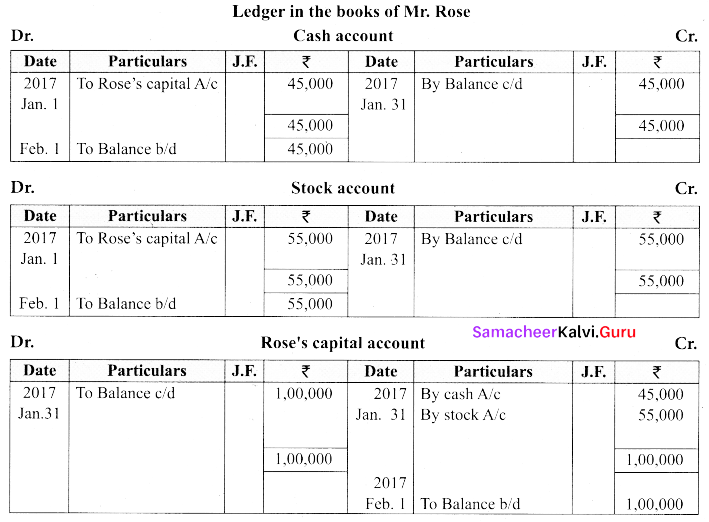
Prepare necessary Ledger accounts in the books of Mr. Rose from the following opening entry.
Tamil Nadu 11th Accountancy Previous Year Question Paper March 2019 English Medium 7
Answer:
Tamil Nadu 11th Accountancy Previous Year Question Paper March 2019 English Medium 8

Tamil Nadu 11th Accountancy Previous Year Question Paper March 2019 English Medium

Question 35.
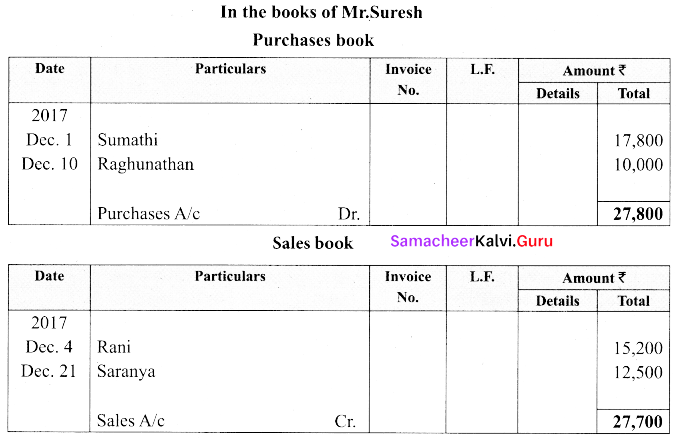
Enter the following transactions in the purchases and sales books of Mr. Suresh, an automobile dealer, for the month of December, 2017.

2017
Dec. 1Bought from Sumathi on credit17,800
Dec. 4Sold goods to Rani on credit15,200
Dec. 10Purchased goods on credit from Raghunathan10,000
Dec. 21Sold goods on credit to Saranya12,500
Dec. 26Sold goods to Shyam for cash3,000

Answer:
Tamil Nadu 11th Accountancy Previous Year Question Paper March 2019 English Medium 9

Question 36.
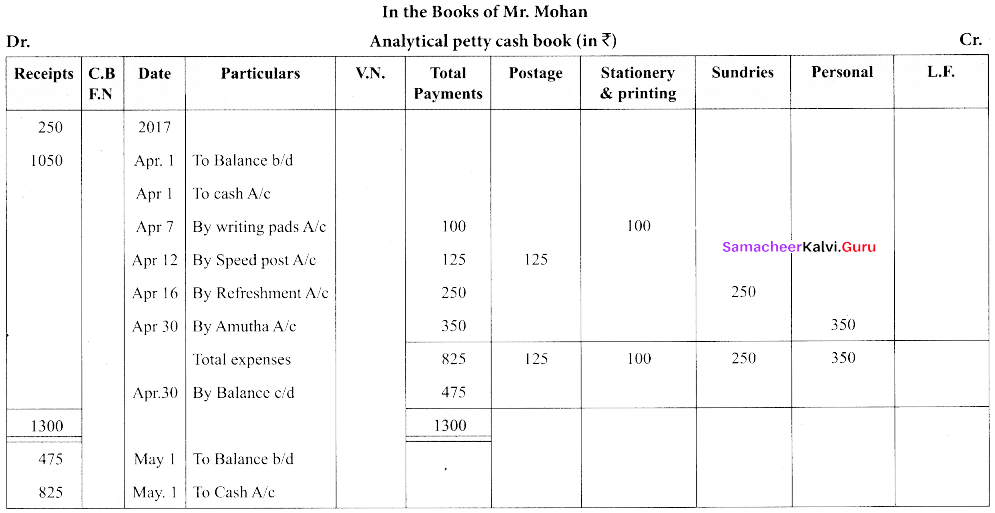
Prepare an analytical petty cash book of Mr. Mohan from the following particulars under imprest system:

2017

April. 1Balance on hand250
April. 1Cash received from chief cashier1,050
April. 7Paid for writing pads and registers100
April. 12Paid for speed post125
April. 16Refreshment expenses250
April. 30Paid to Amutha on account350

Answer:
Tamil Nadu 11th Accountancy Previous Year Question Paper March 2019 English Medium 10

Tamil Nadu 11th Accountancy Previous Year Question Paper March 2019 English Medium

Question 37.
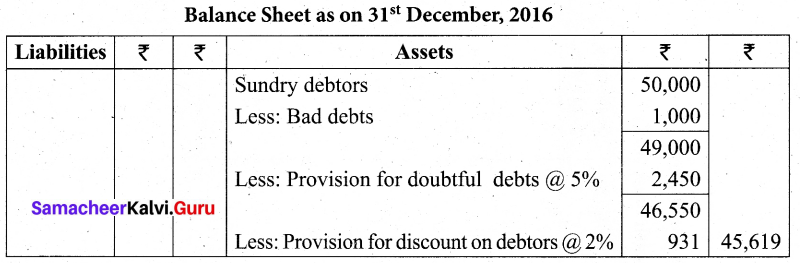
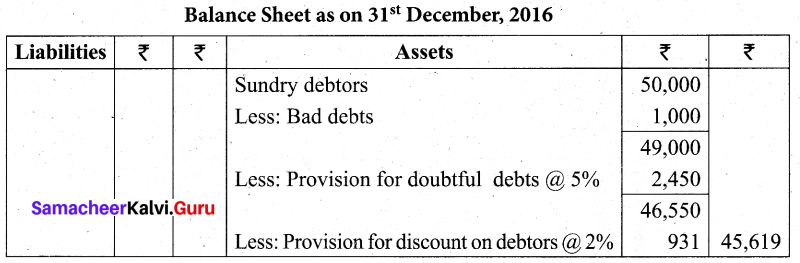
The trial balance of a trader on 31st December, 2016 shows sundry debtors as ₹ 50,000. Adjustments:
(a) Write off ₹ 1,000 as bad debts
(b) Provide 5% for doubtful debts
(c) Provide 2% for discount on debtors
Show how these items will appear in the profit and loss A/c and balance sheet of the trader.
Answer:
Tamil Nadu 11th Accountancy Previous Year Question Paper March 2019 English Medium 11
Tamil Nadu 11th Accountancy Previous Year Question Paper March 2019 English Medium 12

Question 38.
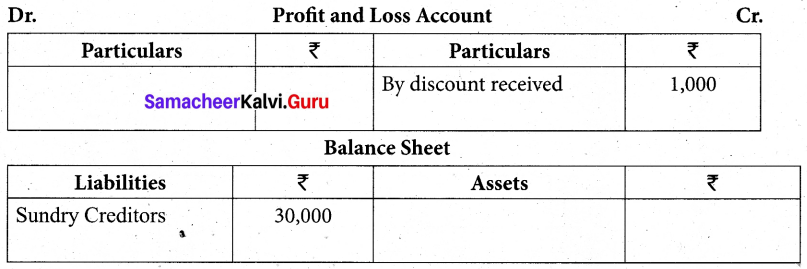
The following are the extracts from the trial balance:

ParticularsDebit
Credit
Sundry Creditors30,000
Discount received1,000

Answer:
Tamil Nadu 11th Accountancy Previous Year Question Paper March 2019 English Medium 13

Question 39.
Write short notes on:
(i) Hardware
(ii) Software
Answer:
(i) Hardware: The physical components of a computer constitute its hardware. Hardware . consists of input devices and output devices that make a complete computer system.
(ii) Software: A set of programs that form an interface between the hardware and the user of a computer system are referred to as software.

Tamil Nadu 11th Accountancy Previous Year Question Paper March 2019 English Medium

Question 40.
A textile business unit sells some part of its unused land and received the amount.
(i) Can it be considered as normal sale?
(ii) State whether the transaction is of capital or revenue nature and explain.
Answer:
(i) No, it cannot be considered as normal sale because this is capital receipts for that business.
(ii) The transaction is capital receipt because he does a textile business. These some part of its unused land sold and he received the amount for that land. So this is not considered as normal sale.

Part – IV

Answer all the questions: [7 x 5 = 35]

Question 41.
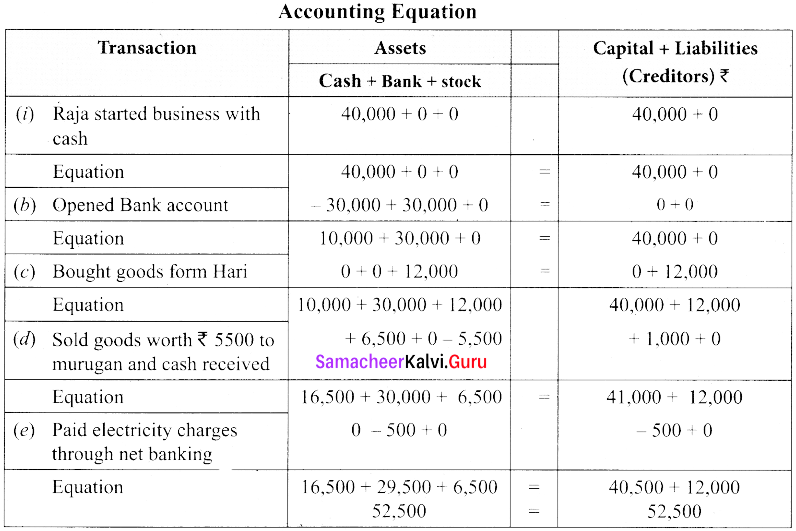
(a) For the following transactions, show the effect on accounting equation.
(i) Raja started business with cash – ₹ 40,000
(ii) Opened bank account with a deposit of – ₹ 30,000
(iii) Bought goods from Hari on credit for – ₹ 12,000
(iv) Sold goods worth ₹ 5,500 to Murugan and cash received – ₹ 16,500
(v) Paid electricity charges through net banking – ₹ 500
Answer:
Tamil Nadu 11th Accountancy Previous Year Question Paper March 2019 English Medium 14

[OR]

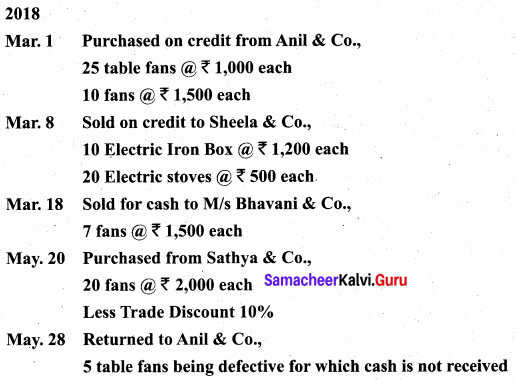
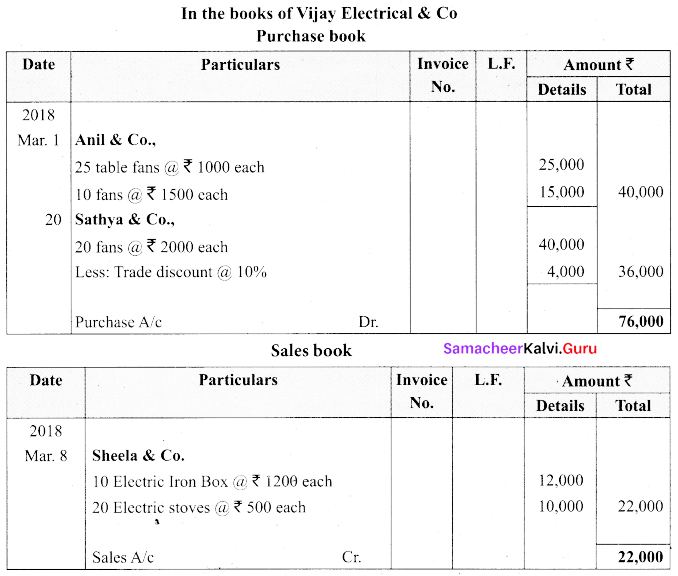
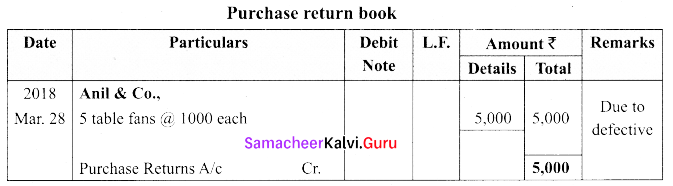
(b) Record the following transactions of Vijay Electrical & Co, in its subsidiary books.
Tamil Nadu 11th Accountancy Previous Year Question Paper March 2019 English Medium 15
Answer:
Tamil Nadu 11th Accountancy Previous Year Question Paper March 2019 English Medium 16
Tamil Nadu 11th Accountancy Previous Year Question Paper March 2019 English Medium 17
Note: March 18, Cash transaction so it can not be taken into account.

Tamil Nadu 11th Accountancy Previous Year Question Paper March 2019 English Medium

Question 42.
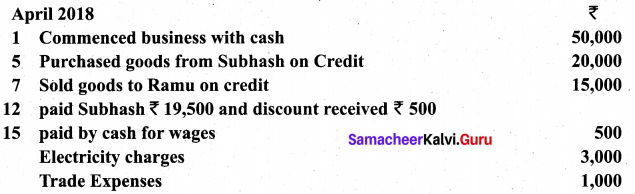
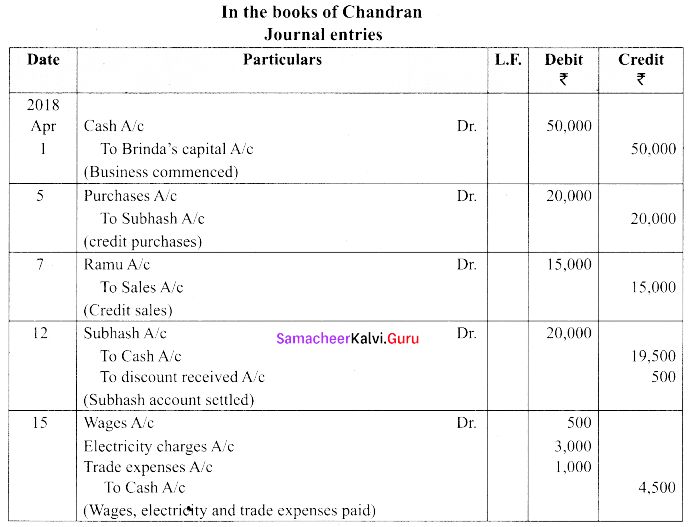
(a) Pass Journal entries in the books of Brinda who is a dealer in sport materials.
Tamil Nadu 11th Accountancy Previous Year Question Paper March 2019 English Medium 18
Answer:
Tamil Nadu 11th Accountancy Previous Year Question Paper March 2019 English Medium 19

[OR]

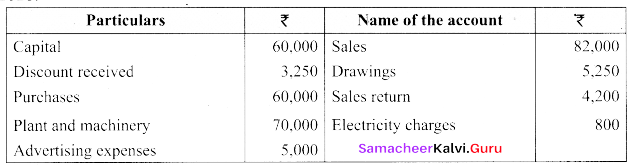
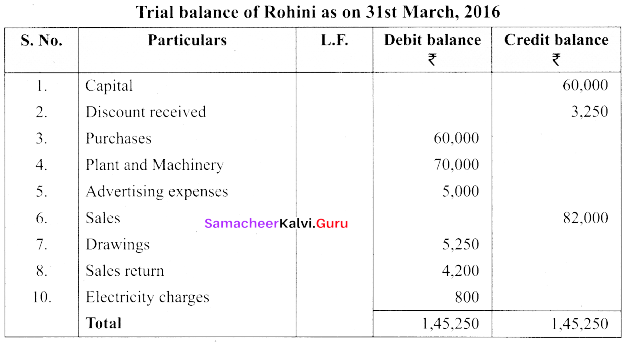
(b) From the following balances of Rohini, prepare the trial balance as on 31st March, 2018.
Tamil Nadu 11th Accountancy Previous Year Question Paper March 2019 English Medium 20
Answer:
Tamil Nadu 11th Accountancy Previous Year Question Paper March 2019 English Medium 21

Question 43.
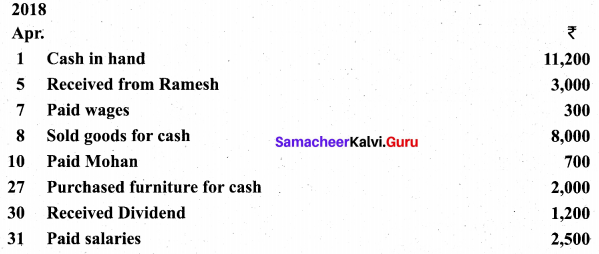
(a) Enter the following transactions in a simple cash book of Kunal:
Tamil Nadu 11th Accountancy Previous Year Question Paper March 2019 English Medium 22
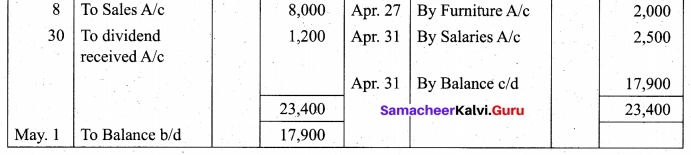
Answer:
Tamil Nadu 11th Accountancy Previous Year Question Paper March 2019 English Medium 23
Tamil Nadu 11th Accountancy Previous Year Question Paper March 2019 English Medium 24

[OR]

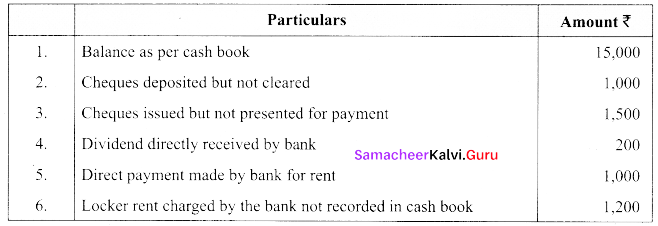
(b) From the following information, prepare bank reconciliation statement to find out the bank statement balance as on 31st December, 2017.
Tamil Nadu 11th Accountancy Previous Year Question Paper March 2019 English Medium 25
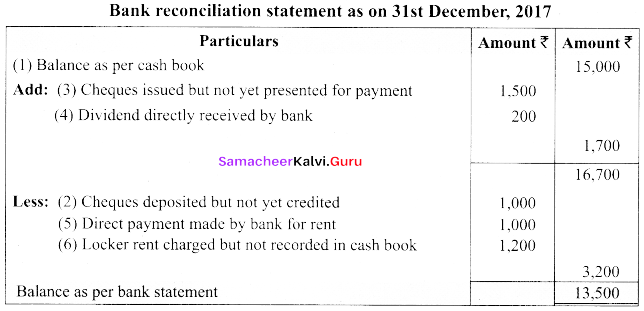
Answer:
Tamil Nadu 11th Accountancy Previous Year Question Paper March 2019 English Medium 26

Tamil Nadu 11th Accountancy Previous Year Question Paper March 2019 English Medium

Question 44.
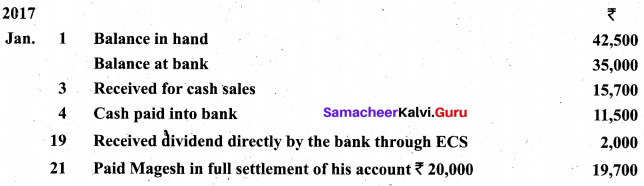
(a) Enter the following transactions in the three column cash book of Sundaram
Tamil Nadu 11th Accountancy Previous Year Question Paper March 2019 English Medium 27
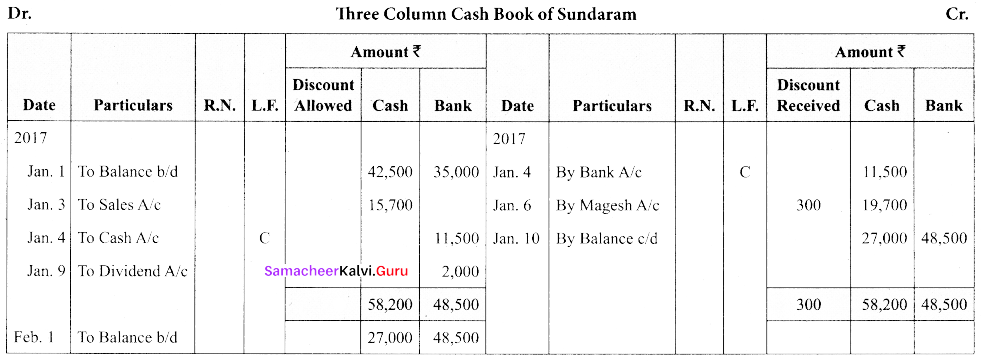
Answer:
Tamil Nadu 11th Accountancy Previous Year Question Paper March 2019 English Medium 28

[OR]

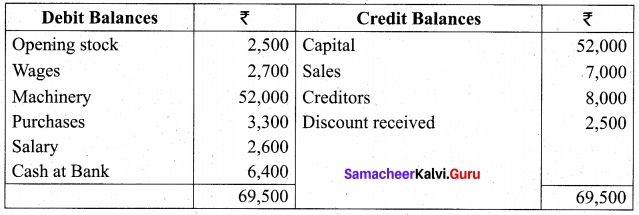
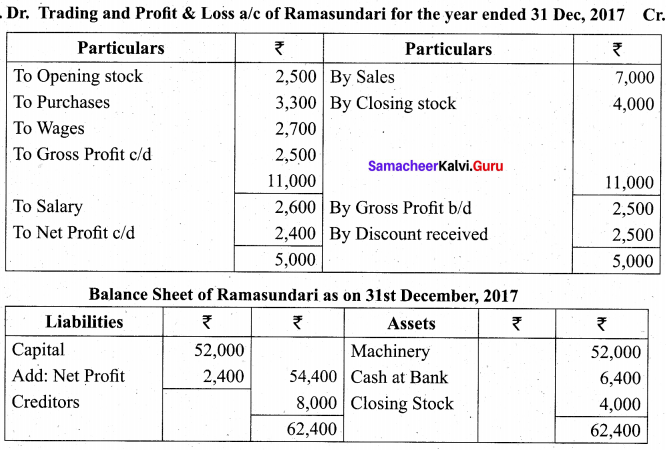
(b) Prepare trading and profit and loss account in the books of Smt. Ramasundari for the year ended 31st December, 2017 and balance sheet as on that date from the following information:
Tamil Nadu 11th Accountancy Previous Year Question Paper March 2019 English Medium 29
Answer:
Tamil Nadu 11th Accountancy Previous Year Question Paper March 2019 English Medium 30

Question 45.
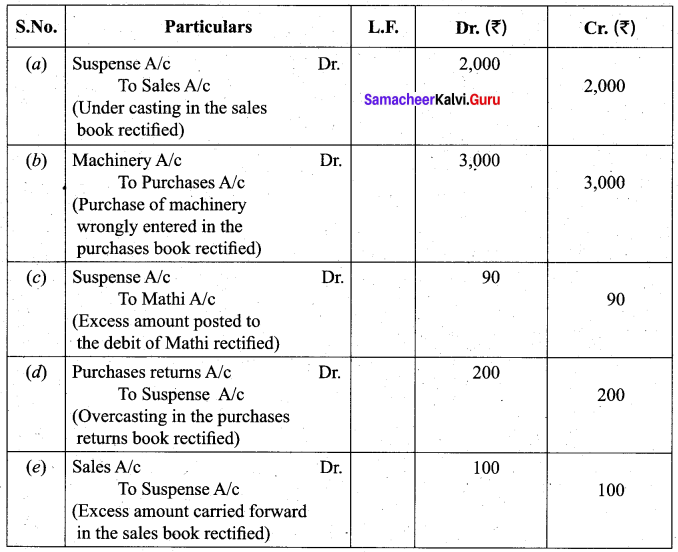
(a) Pass journal entries to rectify the following errors located after the preparation of the trial balance. Assume that there exists a suspense account.
(a) The total of sales book was undercast by ₹ 2,000.
(b) The purchase of machinery for ₹ 3,000 was entered in the purchases book.
(c) A credit sale of goods for ₹ 450 to Mathi was posted in his account as ₹ 540.
(d) The purchases returns book was overcast by ₹ 200.
(e) The total of sales book ₹ 1,122 were wrongly posted in the ledger as ₹ 1,222.
Answer:
Tamil Nadu 11th Accountancy Previous Year Question Paper March 2019 English Medium 31

[OR]

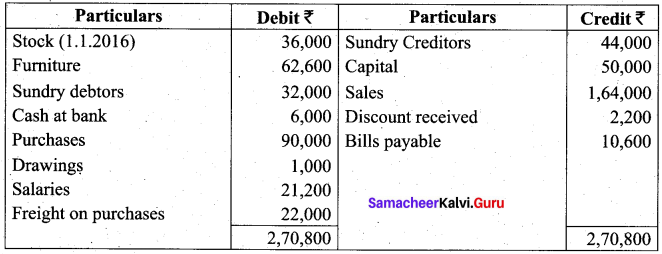
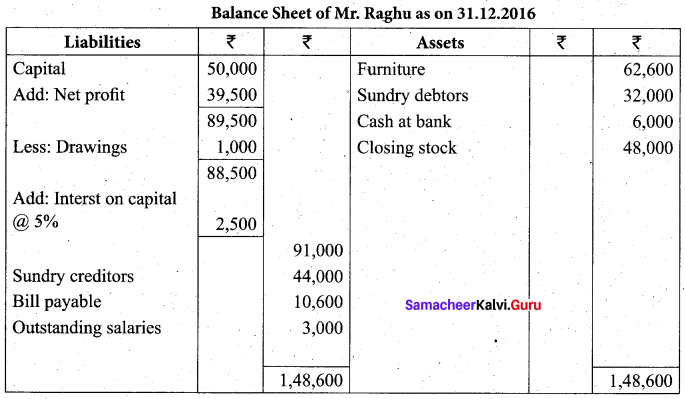
(b) From the following Trial balance of Mr. Raghu, prepare his trading and profit and loss A/c and the balance sheet as 31.12.2016.
Tamil Nadu 11th Accountancy Previous Year Question Paper March 2019 English Medium 32
Following adjustments are to be made:
(a) Outstanding salaries ₹ 3,000
(b) Closing stock; was valued at ₹ 48,000
(c) Provide, for 5% interest on Capital
Answer:
Tamil Nadu 11th Accountancy Previous Year Question Paper March 2019 English Medium 33
Tamil Nadu 11th Accountancy Previous Year Question Paper March 2019 English Medium 34

Tamil Nadu 11th Accountancy Previous Year Question Paper March 2019 English Medium

Question 46.
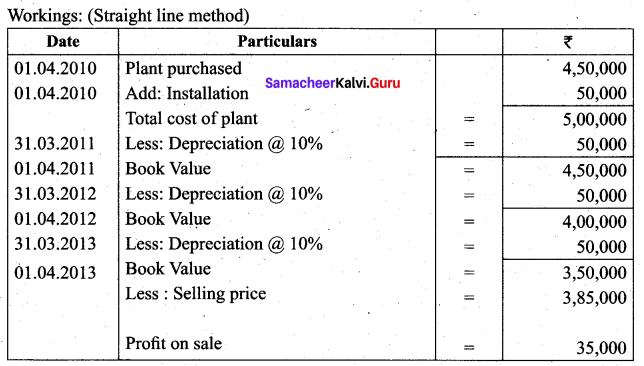
(a) Sudha manufacturing Company purchased on 1 April 2010, a plant for ₹ 4,50,000 and spent ₹ 50,000 on its installation. After having used it for three years, it was sold for ₹ 3,85,000. Depreciation is to provided every year at the rate of 10% per annum straight line method. Accounts are closed on 31st March every year. Show machinery account.
Answer:
Tamil Nadu 11th Accountancy Previous Year Question Paper March 2019 English Medium 35
Tamil Nadu 11th Accountancy Previous Year Question Paper March 2019 English Medium 36

[OR]

(b) From the following details, prepare profit and loss account.
Tamil Nadu 11th Accountancy Previous Year Question Paper March 2019 English Medium 37
Answer:
Tamil Nadu 11th Accountancy Previous Year Question Paper March 2019 English Medium 38

Tamil Nadu 11th Accountancy Previous Year Question Paper March 2019 English Medium

Question 47.
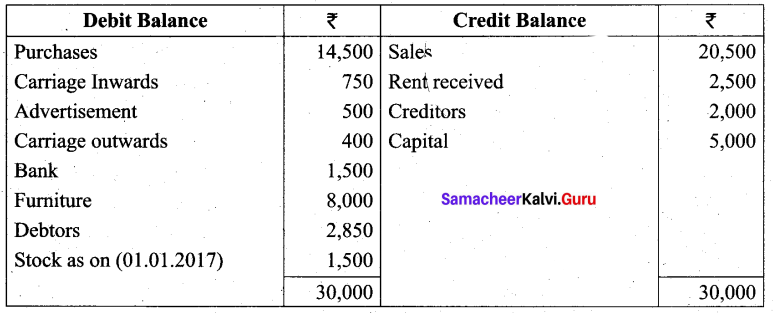
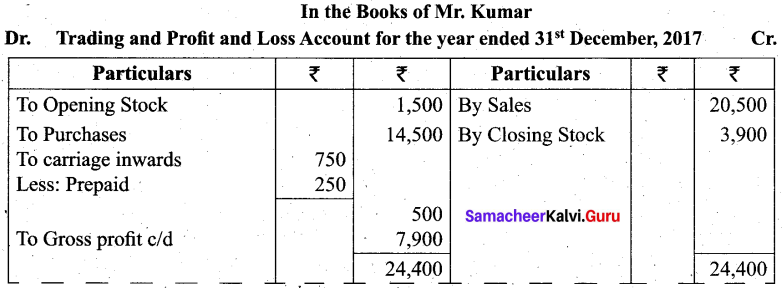
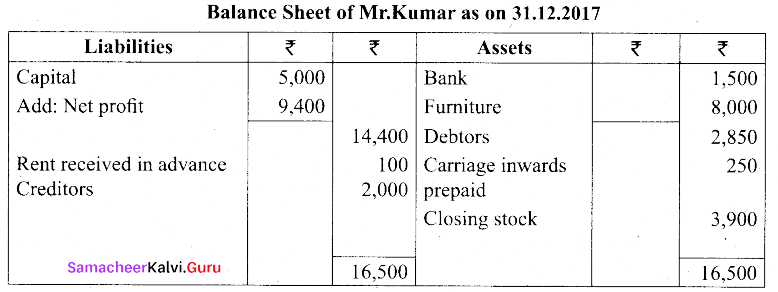
(a) From the following information, prepare Trading & Profit & Loss A/c and Balance sheet of Mr. Kumar for the year ending 31st December, 2017.
Tamil Nadu 11th Accountancy Previous Year Question Paper March 2019 English Medium 39
Adjustments:
(a) Closing stock was valued at ₹ 3,900
(b) Carriage inwards prepaid ₹ 250
(c) Rent received in advance ₹ 100
Answer:
Tamil Nadu 11th Accountancy Previous Year Question Paper March 2019 English Medium 40
Tamil Nadu 11th Accountancy Previous Year Question Paper March 2019 English Medium 41
Tamil Nadu 11th Accountancy Previous Year Question Paper March 2019 English Medium 42

[OR]

(b) Explain the three methods of codification with examples.
Answer:
Methods of codification :
(a) Sequential codes:
In sequential code, numbers and/or letters are assigned in consecutive order. These codes are applied primarily to source documents such as cheques, invoices, etc. A sequential code can facilitate document search. For example:

CodeAccounts
CL001ABC LTD
CL002XYZ LTD
CL003SCERT

(b) Block codes:
In a block code, a range of numbers is partitioned into a desired number of sub-ranges and each sub-range is allotted to a specific group. In most of the cases of block codes, numbers within a sub-range follow sequential coding scheme, i.e., the numbers increase consecutively. For example:

CodeDealer type
100 – 199Small pumps
200 – 299Medium pumps
300 – 399Pipes
400 – 499Motors

(c) Mnemonic codes
A mnemonic code consists of alphabets or abbreviations as symbols to codify a piece of information. For example:

CodeInformation
SJSales Journals
HQHead Quarter

Samacheer Kalvi 11th Computer Applications Solutions Chapter 11 HTML – Formatting Text, Creating Tables, List and Links

Students can Download Computer Applications Chapter 11 HTML – Formatting Text, Creating Tables, List and Links Questions and Answers, Notes Pdf, Samacheer Kalvi 11th Computer Applications Book Solutions Guide Pdf helps you to revise the complete Tamilnadu State Board New Syllabus and score more marks in your examinations.

Tamilnadu Samacheer Kalvi 11th Computer Applications Solutions Chapter 11 HTML – Formatting Text, Creating Tables, List and Links

Samacheer Kalvi 11th Computer Applications HTML – Formatting Text, Creating Tables, List and Links Text Book Back Questions and Answers

I. Choose The Correct Answer

Question 1.
Which of the following tags are called as physical style tags?
(a) <html>, <b>, <br>
(h) <b>, <br>, <u>
(c) <A>, <b>, <i>
(d) <b>, <i>, <u>
Answer:
(d) <b>, <i>, <u>

Question 2.
Which feature is used to call attention to the reader?
(a) Highlight
(b) Bold
(c) Italics
(d) Underline
Answer:
(a) Highlight

Samacheer Kalvi 11th Computer Applications Solutions Chapter 11 HTML - Formatting Text, Creating Tables, List and Links

Question 3.
The tags <sub> and <sup> used for:
(a) Subject and Super
(b) Subscript and Super
(c) Subject and Superscript
(d) Subscript and Superscript
Answer:
(d) Subscript and Superscript

Question 4.
A named set of certain style of character and number is:
(a) Style
(b) Character
(c) Font
(d) List
Answer:
(a) Style

Samacheer Kalvi 11th Computer Applications Solutions Chapter 11 HTML - Formatting Text, Creating Tables, List and Links

Question 5.
Pick odd one from the list:
(a) <tr>
(b) <th>
(c) <dh>
(d)<td>
Answer:
(c) <dh>

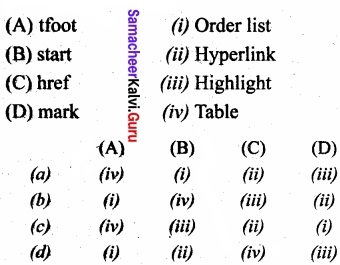
Question 6.
Match the following:
Samacheer Kalvi 11th Computer Applications Solutions Chapter 11 HTML - Formatting Text, Creating Tables, List and Links
Answer:
(d) (i) (ii) (iv) (iii)

Question 7.
Definition list has how many parts?
(a) 5
(b) 4
(c) 3
(d) 2
Answer:
(d) 2

Question 8.
A list block can be defined inside another – list Is:
(a) inner List
(b) nested List
(c) outer List
(d) listing List
Answer:
(b) nested List

Samacheer Kalvi 11th Computer Applications Solutions Chapter 11 HTML - Formatting Text, Creating Tables, List and Links

Question 9.
Read the following statement and choose the correct statement(s):

  1. Link in HTML is used to create hyperlinks to web content.
  2. IL HREF is abbreviated as Hypertext Markup File.

(a) I is correct
(b) II is correct
(c) I and II is correct
(d) Both are wrong
Answer:
(a) I is correct

Samacheer Kalvi 11th Computer Applications Solutions Chapter 11 HTML - Formatting Text, Creating Tables, List and Links

Question 10.
To create internal link, which of the following attribute should be used?
(a) Link
(b) Name
(c) Local
(d) Inter
Answer:
(b) Name

II. Answer To The Following Questions

Question 1.
Write a short note on

  1. <strong>
  2. <em>. <strong> Important text:

Answer:
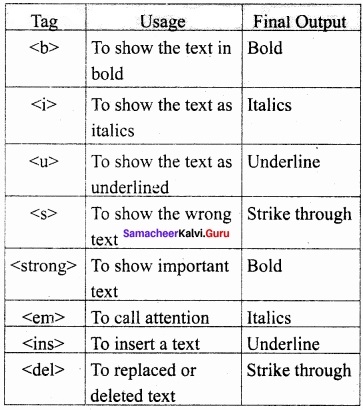
The <strong> tag is a phrase tag. It is used to define important text. This tag displays the text as bold.

<em> – Emphasized text:
The <em> tag is used to emphasize the text. That means, when you use this tag, the text will be in italics.

Samacheer Kalvi 11th Computer Applications Solutions Chapter 11 HTML - Formatting Text, Creating Tables, List and Links

Question 2.
What is the use of <mark> tag?
Answer:
The <mark> tag is used to highlight the text in HTML. This is also a container tag. Whatever the text given between <mark> and </mark> will be displayed as highlighting with default color (mostly yellow).

Question 3.
Write the following equation as HTML notation: Pd = 25 – Q2
Answer:
Pd = 25 – Q<sub>2</sub>
(or)
<html>
<head>
<title>
The HTML equation is
Pd = 25 – Q<sub>2 </sub>
<body>
</html>

Samacheer Kalvi 11th Computer Applications Solutions Chapter 11 HTML - Formatting Text, Creating Tables, List and Links

Question 4.
Write about any two attributes of font tag?
Answer:

  1. The face is an attribute to set different font style. The name of a font has multiple words it should be specified within double quote.
  2. The size attribute is used to set size of the text. The size can have an absolute value from 1 to 7. These predefined sizes are known as virtual size. Each virtual size is successively 20% larger than the previous one.

Question 5.
What is thematic break?
Answer:
The <hr> (Horizontal Rules) tag, which is known as “Thematic Breaks” separate sections of an HTML document visually. It produces a horizontal line spread across the width of the browser. This is an empty tag, which me the tag has no closing tag.

Question 6.
What is pixel?
Answer:
A pixel is one of the tiny dots that make up the display on computer. Generally, 72 pixels equal to an inch. Pixel is usually referred as points. For example: The code <hr size = 72> display a horizontal line with 1 inch thickness. The default size is 3 pixels.

Samacheer Kalvi 11th Computer Applications Solutions Chapter 11 HTML - Formatting Text, Creating Tables, List and Links

Question 7.
What are the types of list in HTML?
Answer:
HTML supports three types of lists viz., numbered, unnumbered and definition. These lists are called as Ordered List, Unordered List and Definition List respectively.

Question 8.
How will you define numbered list?
Answer:
Numbered list is created within the tag pair <OL> ….. </QL> tag. The tag <LI> is used to present the list item in the list. Ordered list displays items in a numerical or alphabetical order. Both <OL> and <LI> tags are container tags. But the usual the practice, closing tag </LI> never be used.

III. Answer To The Following Questions

Question 1.
Write an HTML code to display the following text in exactly the same way as given below:
I am studying Computer Science Application.
Answer:
<html>
<head>
<title>HTML CODE in, </Title>
</head>
<body bg color = Blue>
I am studying computer
Science Application
</body>
</html>

Samacheer Kalvi 11th Computer Applications Solutions Chapter 11 HTML - Formatting Text, Creating Tables, List and Links

Question 2.
Briefly explain the attributes of <hr> tag?
Answer:
The <hr> tag having four attributes viz. size, width, noshade and color. These attributes are used to set size, width, 3D appearance and color to the horizontal line respectively. The general syntax of <hr> tag with attributes: <hr size=value width=value noshade, color=color_name/code>

Size:
Thickness of the horizontal line can be changed with size attribute. The size is given in terms of pixels. A pixel is one of the tiny dots that make up the display on computer. Generally, 72 pixels equal to an inch. Pixel is usually referred as points.

Eg: The code <hr size = 72> display a horizontal line with 1 inch thickness. The default size is 3 pixels.

Width:
The width attribute specifies the horizontal width of the rule line. The default rule is drawn across the full width of the browser. The value of the width attribute may be the exact width of the rule in pixel or a certain percentage. Usually, the value of the width is specified as percentage. 100% is the default width.

Eg:
<hr width = 50%> display an half of a horizontal rule line on the browser window. Noshade: The default view of a horizontal rule line is 3D. So, no need to specify the term “noshade” as an attribute with <hr> tag. If you specify the attribute “noshade” turn off 3D view, turns on 2D view. Noshade is a Boolean type attribute.

Color:
The horizontal line is displayed in gray color by default. The color attribute is used to change is default color to desired color. As you learnt already, the value of color either is a color name or color code.

Samacheer Kalvi 11th Computer Applications Solutions Chapter 11 HTML - Formatting Text, Creating Tables, List and Links

Question 3.
What are the core tags used to create table in HTML?
Answer:
There are five core tags are used to create a . table in HTML. They are,

  1. <table> tag is used to create a table.
  2. <tr> tag defines table rows
  3. <th> tag defined table columns
  4. <td> tag is used to specify the data in a cell
  5. <caption> tag defines title for the table
  6. Apart from these five core tags, <tbody>, <thead> and <tfoot> tags are also used to define and control whole sections of table. All the above tags are container tags.

Question 4.
Write an HTML code to provide hyperlink to https://www.w3schools.com?
Answer:
<html>
<head>
<title> hyperlink </title>
</head>
<body>
<A href = “http://WWW.
W3schools.com”>W3school</A>
</body>
</html>

Samacheer Kalvi 11th Computer Applications Solutions Chapter 11 HTML - Formatting Text, Creating Tables, List and Links

Question 5.
Difference between <UL> and <OL> tags?
Answer:
Unordered list/ Unordered List(UL):

  1. Unordered list is surrounded within
    <UL>….</UL>tags.
  2. Each element in the list is defined by <LI> tag.

Numbered List/Ordered List (OL)

  1. Ordered list is created within tag pair <OL> …. <OL> tag.
  2. The tag <LI> is used to present the list item in the list.

IV. Answer To The Following Questions

Question 1.
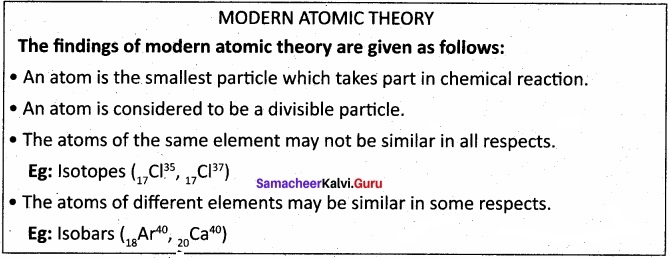
Write an HTML code the show the following text?
Answer:
Samacheer Kalvi 11th Computer Applications Solutions Chapter 11 HTML - Formatting Text, Creating Tables, List and Links
</head>
<body>
<font face = “Arial Black” size = 5 color = “blue”>
<Center> MODERN ATOMIC THEORY </font> </center> <br>
<font face = “Copper plate Gothic Bold” size = 3 color = “blue”>
The findings of modern atomic theory are given as follows: </font> <UL>
<LI> An atom is the smallest particle which takes part in chemical reaction
<LI> An atom is considered to be a divisible particle.
<LI> The atoms of the same element may not be similar in all respects

Eg:
Isotopes (<sub> 17. </sub> CL<sup> 35 </sup>, <sub> 17 </sub> CL <sup> 37 </sup>)
<LI> The atoms of different elements may be similar in some respects

Eg:
Isobars (<sub> 18 </sub> Ar <sup> 40 </sup>, <sub> 20</sub> CA <sup> 40 </sup>)
</UL>
</body>
</html>

Samacheer Kalvi 11th Computer Applications Solutions Chapter 11 HTML - Formatting Text, Creating Tables, List and Links

Question 2.
Explain the attributes used with <table> tag in HTML?
Answer:
Attributes of table:
The <table> is a container tag. There are several attributes to improve the layout of the table. They are listed below:

(i) Cellspacing:
It is used to set the space between cells in a table. The value should be in pixels

(ii) Cellpadding:
It is used to set the space between the contents of a cell and its border. The value should be in pixels.

(iii) Border:
Border attribute with <table> tag is used to specify the thickness of the border lines around the table. The value of the border attribute should be a non zero value in pixels. If its value is zero, HTML displays the table without border. The default value is Zero in most the browsers.

(iv) Bordercolor:
It is used to apply the colour to the border lines.

(v) Align:
It is used to set the position of the table within the browser window. Left is the default position. Right or center may be the value of align attribute.

(vi) BGcoter:
It is used to apply background colour to the table.

(vii) Height and Width:
These two attributes are used to specify the height and width of a table in terms of pixels or percentage.

Samacheer Kalvi 11th Computer Applications Solutions Chapter 11 HTML - Formatting Text, Creating Tables, List and Links

Question 3.
Explain the types of list with suitable HTML code?
Answer:
(i) Numbered List / Ordered List:
Numbered list is created within the tag pair <OL> </OL> tag. The tag <LI> is used to present the list item in the list. Ordered list displays items in a numerical or alphabetical order. Both <OL> and <LI> tags are container tags. But the usual the practice, closing tag </LI> never be used.
An HTML code to demonstrate
Numbered List
<html>
<head>
<title> Number List </title>
</head>
<body>

Un-numbered List / Unordered List:
Unordered lists are often referred as bulleted lists. Instead of numbers, each element in the list has prefixed with a special bullet symbol. Unordered list is surrounded within <UL>……………..</UL> tags. As discussed above, each list element is defined by <LI> tag.

An HTML code to demonstrate Unordered list
<html>
<head>
<title> Unordered List </title>
</head>
<body>
<UL>
<LI> Chennai Govt. Hr. Sec,School,Rotler Street, Chennai 600112.
<LI> Karnakata Sanga Hr. Sec. School, T. Nagar,Chennai 600017. <LI> S.M.B. Jain Hr. Sec. School, T. Nagar,Chennai 600017. <LI> Chennai G Hr. Sec. School, Nungambakkam, Chennai 600034.
<LI> Chennai G Hr. Sec. School, Saidapet West, Chennai 600015
<LI> Santhome Hr. Sec. School, Mylapore, Chennai 600004.
</UL>
</body>
</html>

(iii) Definition List:
Definition list is different from other two types of list. No bullet or number is provided for the list items. In this list type, the list element has two parts.

(a) A definition term
(b) The definition description
Definition list is surrounded within <DL> </DL> tags.
Definition term is presented in between <DT> </DT> tag and
Definition description should be surrounded within <DD> </DD> tag.
<html>
<head>
<title> Definition List </title>
</head>
<body>
<DL>
<DT> HTML: </DT>
<DD> Hyper Text Markup Language </DD>
<DT> Webpage:
<DD> A web page is a document that is suitable for the World Wide Web and web browsers. A web browser displays a web page on a monitor or mobile device. </DD>
</DL>
</body>
</html>

Samacheer Kalvi 11th Computer Applications Solutions Chapter 11 HTML - Formatting Text, Creating Tables, List and Links

Question 4.
What is Link and explain the types of links?
Answer:
Link in HTML is used to create hyperlinks to web content. Web content may be an HTML document or an external webpage or any multimedia content such as an image, video, audio, animation etc… or even a part of the current document.
(i) Internal Links:
Creating a link to a particular section of the same document is known as Internal Link. To create an internal like, the attribute Name is used along with <A> tag. The Name attribute of <A> tag establish the link to the content within the document.

(ii) External Link:
Establish link with an external web page in known as external linking. It is made possible by providing the URL of the external file in the HREF attribute of <A> tag of the current page.

Question 5.
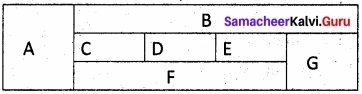
Write HTML code to create the following table?
Answer:
Samacheer Kalvi 11th Computer Applications Solutions Chapter 11 HTML - Formatting Text, Creating Tables, List and Links
<html>
<head>
<title> create a Table </title> </head>
<body>
ctable border align = center>
<tr align= center>
<th rowspan = 2>A</th>
<th> B</th>
</tr>
<tr>
<th> C </th>
<th> D </th>
<th> E </th>
</tr>
<tr>
<th rowspan = 2> F </th>
</tr>
<tr>
<th rowspan = 2> G </th>
</tr>
</table>
</body>
</html>

Samacheer Kalvi 11th Computer Applications HTML – Formatting Text, Creating Tables, List and Links Additional Questions and Answers

I. Choose The Correct Answer

Question 1.
Which is one of the following tag is a phrase tag?
(a) <strong>
(b) <em>
(c) <small>
(d) <big>
Answer:
(a) <strong>

Samacheer Kalvi 11th Computer Applications Solutions Chapter 11 HTML - Formatting Text, Creating Tables, List and Links

Question 2.
Which tag is used emphasized text?
(a) <strong>
(b) <em>
(c) <small>
(d) <big>
Answer:
(b) <em>

Question 3.
What is the similar tag of <b>?
(a) <strong>
(b) <em>
(c) <small>
(d) <big>
Answer:
(a) <strong>

Question 4.
What is the similar tag of <i>?
(a) <strong>
(b) <em>
(c) <small>
(d) <big>
Answer:
(b) <em>

Samacheer Kalvi 11th Computer Applications Solutions Chapter 11 HTML - Formatting Text, Creating Tables, List and Links

Question 5.
What is the highlight-and a container tag?
(a) <strong>
(b) <em>
(c) <small>
(d) <mark>
Answer:
(d) <mark>

Question 6.
What is the default colour displayed using <mark>tag?
(a) Red
(b) Black
(c) Yellow
(d) Green
Answer:
(c) Yellow

Samacheer Kalvi 11th Computer Applications Solutions Chapter 11 HTML - Formatting Text, Creating Tables, List and Links

Question 7.
Which tag can be used to show the text as strike through style?
(a) <s>…. </s>
(b) <b>…. </b>
(c) <del>…. </del>
(d) <ins>…. </ins>
Answer:
(a) <s>…. </s>

Question 8.
Which tag is used to replaced or deleted text?
(a) <strong>
(b) <em>
(c) <ins>
(d) <del>
Answer:
(d) <del>

Question 9.
Which tag is used non-paragraph text contents can be centered?
(a) <p>
(b) <center>
(c) <em>
(d) <ins>
Answer:
(b) <center>

Samacheer Kalvi 11th Computer Applications Solutions Chapter 11 HTML - Formatting Text, Creating Tables, List and Links

Question 10.
Which tag is used to change the style, size and colour of text?
(a) <colour>
(b) <size>
(c) <font>
(d) <style>
Answer:
(c) <font>

Question 11.
Which font is usually used for office documents?
(a) Arial
(b) Times New Roman
(c) Arial Black
(d) Bookman Old Style
Answer:
(b) Times New Roman

Samacheer Kalvi 11th Computer Applications Solutions Chapter 11 HTML - Formatting Text, Creating Tables, List and Links

Question 12.
Which font is generally used for publishing work?
(a) Arial
(b) Times New Roman
(c) Arial Black
(d) Bookman Old Style
Answer:
(a) Arial

Question 13.
Which attribute is used to set different font style?
(a) Colour
(b) Style
(c) Face
(d) Size
Answer:
(c) Face

Question 14.
Which tag is used as thematic breaks?
(a) <font>
(b) <br>
(c) <hr>
(d) <p>
Answer:
(c) <hr>

Samacheer Kalvi 11th Computer Applications Solutions Chapter 11 HTML - Formatting Text, Creating Tables, List and Links

Question 15.
How many pixel is equal to an inch?
(a) 62
(b) 72
(c) 82
(d) 92
Answer:
(b) 72

Question 16.
What is the default size of the pixel?
(a) 1
(b) 2
(c) 3
(d) 4
Answer:
(c) 3

Question 17.
The default view of a horizontal rule line is:
(a) 2D
(b) 3D
(c) no shade
(d) normal
Answer:
(b) 3D

Samacheer Kalvi 11th Computer Applications Solutions Chapter 11 HTML - Formatting Text, Creating Tables, List and Links

Question 18.
What is the default colour by horizontal line?
(a) Blue
(b) Yellow
(c) Gray
(d) Black
Answer:
(c) Gray

Question 19.
The grid of rows and columns are:
(a) row
(b) column
(c) table
(d) cell
Answer:
(c) table

Question 20.
Which tag is used to define table column?
(a) <tr>
(b) <th>
(c) <td>
(d) <br>
Answer:
(b) <th>

Question 21.
Which tag is used to specify the data in a cell?
(a) <tr>
(b) <th>
(c) <td>
(d) <br>
Answer:
(c) <td>

Samacheer Kalvi 11th Computer Applications Solutions Chapter 11 HTML - Formatting Text, Creating Tables, List and Links

Question 22.
Which attribute is used to specify the horizontal alignment of content within a cell?
(a) Width
(b) Align
(c) VAlign
(d) Rowspan
Answer:
(b) Align

Question 23.
Which attribute is used to specify the vertical alignment of the contents within a cell?
(a) Width
(b) Align
(c) VAlign
(d) <Rowspan>
Answer:
(c) VAlign

Question 24.
Which attribute is used to specify the width of a cell in terms of pixels or percentage?
(a) Width
(b) Align
(c) VAlign
(d) <Rowspan>
Answer:
(a) Width

Samacheer Kalvi 11th Computer Applications Solutions Chapter 11 HTML - Formatting Text, Creating Tables, List and Links

Question 25.
Which attribute is used to apply a particular colour to the background of a cell?
(a) Width
(b) VAlign
(c) BG Color
(d) Background
Answer:
(c) BG Color

Question 26.
Which attribute is used to apply an image or picture as background of a cell?
(a) Width
(b) BG Color
(c) Background
(d) Rowspan
Answer:
(c) Background

Question 27.
Which attribute is used to merge two or more cells in a row as a single cell?
(a) Rowspan
(b) Colspan
(c) VAlign
(d) Align
Answer:
(a) Rowspan

Samacheer Kalvi 11th Computer Applications Solutions Chapter 11 HTML - Formatting Text, Creating Tables, List and Links

Question 28.
Which attribute is used to merge to two or more cells in a column as a single cell?
(a) Rowspan
(b) Colspan
(c) VAlign
(d) Align
Answer:
(b) Colspan

Question 29.
Which attribute is used to set the space between the contents of a cell and its border?
(a) Cellspacing
(b) Cellpading
(c) Align
(d) Height
Answer:
(b) Cellpading

Question 30.
Numbered list is created, the list item is:
(a) Numerical
(b) alphabetical
(c) both (a) & (b)
(d) None of these
Answer:
(c) both (a) & (b)

Samacheer Kalvi 11th Computer Applications Solutions Chapter 11 HTML - Formatting Text, Creating Tables, List and Links

Question 31.
Unordered lists are often referred as:
(a) numerical
(b) alphabetical
(c) bullet symbol
(d) images
Answer:
(c) bullet symbol

Question 32.
Default of bullet style unordered list of elements are:
(a) solid circle
(b) solid square
(c) solid symbol
(d) None of these
Answer:
(a) solid circle

Question 33.
A list block can be defined inside another list is called:
(a) nested list
(b) bulleted list
(c) numerical list
(d) symbol list
Answer:
(a) nested list

Samacheer Kalvi 11th Computer Applications Solutions Chapter 11 HTML - Formatting Text, Creating Tables, List and Links

Question 34.
Which tag is used to create links along with HREF attributes?
(a) <URL>
(b) <A>
(c) <BR>
(d)<L>
Answer:
(b) <A>

Question 35.
HREF is abbreviated as:
(a) Hypertext Reference
(b) Highertext Reference
(c) Hyper markable Reference
(d) Higher Structure Reference
Answer:
(a) Hypertext Reference

Samacheer Kalvi 11th Computer Applications Solutions Chapter 11 HTML - Formatting Text, Creating Tables, List and Links

Question 36.
Creating a link to a particular section of the same document is known as:
(a) internal link
(b) external link
(c) URL
(d) HREF
Answer:
(a) internal link

II. Answer The Following Questions

Question 1.
Define the <big> and <small> tags?
Answer:

  1. The <big> tag is used to define the text bigger in size than the normal size. It is often used to call attention a text.
  2. The <small> tag is used to define the text smaller than the current size.
  3. These two tags are container tags.

Question 2.
Define the <dei> and <ins> tags?
Answer:
The text what you see on browser cannot delete or insert. But you can show a text as deleted or inserted. <del> and <ins> tags are used to markup a segment of text as deleted or inserted respectively. These two tags are container tags. The text what you specify between <del> and </del> will be displayed as strike through. The ‘text you specify between <ins> and </ins> will be shown as underlined.

Samacheer Kalvi 11th Computer Applications Solutions Chapter 11 HTML - Formatting Text, Creating Tables, List and Links

Question 3.
Define strike through as wrong text?
Answer:
To display a text as wrong text, the <s> tag can be used to show the text as strike through style. The <s> and <del> tags are display the text in similar way. This is also a container tag. The text you specify between <s> and </s> will be display in strike through style.

Question 4.
What is the difference of the Rowspan and Colspan?
Answer:
Rowspan:
Rowspan attribute is used to merge two or more cells in a row as a single cell.

Colspan:
Colspan attribute is used to merge to two or more cells in a column as a single cell.

Samacheer Kalvi 11th Computer Applications Solutions Chapter 11 HTML - Formatting Text, Creating Tables, List and Links

Question 5.
What is the purpose of center tag?
Answer:
Paragraphs can be centered with Align attribute with <p> tag. But for non-paragraph text contents can be centered with <center> tag. The <center> tag is used to centralize a segment of text. It is a container tag. That means, what you type between <center> and </cenfer> will be displayed in the center of the browser.

III. Answer The Following Questions

Question 1.
Explain subscript and superscript?
Answer:
Subscript:
A Subscript is a way to display a character or a number below the normal line of type. For example: The scientific notation for water is H2O. It should be written as H2O.
Here, 2 is appearing below the normal line. This is called subscript.

Superscript:
A Superscript is also a way to show a character or a number above the normal line of type. For example: The familiar algebra equation “a plus b the whole square” should be written as (a+b)2. Here, the square value 2 is appearing above the normal line. This is called superscript. Usually, the subscript and the superscript character or number is smaller than the rest of the text.

In HTML, the <sub> and <sup> tags are used to create subscript and superscripts respectively. As like as other formatting tags, this is also a container tag.

Samacheer Kalvi 11th Computer Applications Solutions Chapter 11 HTML - Formatting Text, Creating Tables, List and Links

Question 2.
Tabulate the usage of the following tags. <b>, <\>, <u>, <s>, <strong>, <em>, <ins> and <del>?
Answer:
Samacheer Kalvi 11th Computer Applications Solutions Chapter 11 HTML - Formatting Text, Creating Tables, List and Links

Question 3.
What is the use of <font> tag? Explain?
Answer:
The <font> tag is used to change the style, size and color of text. It is also a container tag. It is generally used for changing the appearance of a short segment of text. Before using <font>, you should have the knowledge about fonts.

A font is a named set of certain style of character and number. Each font looks different from other fonts. Generally some fonts are used for specific purpose. For example, Times New Roman is a style of font usually used for preparing office documents.

Arial is another font style which is used for publishing work. Variety of fonts available in internet at free of cost. Generally, a browser shows the contents as default system font setting. Every system has different font setting with another system. The general form of <font> tag with attributes:
<font face= “font_name”
size=value col.or=color_ name / color_code>
Text to be displayed </font>

Samacheer Kalvi 11th Computer Applications Solutions Chapter 11 HTML - Formatting Text, Creating Tables, List and Links

Question 4.
Write the attributes of ordered list?
Answer:
There are two attributes can be used to customize ordered list, they are

  1. Type – changing numbering style
  2. Start – changing numbering order.

Type is used to change the number style. The default number style is standard Arabic numerals (1,2,3, …..).

Type value:
1

Numbering style:
Standard Arabic Numerals 1, 2, 3, 4.

Samacheer Kalvi 11th Computer Applications Solutions Chapter 11 HTML - Formatting Text, Creating Tables, List and Links

Question 6.
Write a html code using sub and sup for H2O and (a + b)2 = a2 + 2ab + b2?
Answer:
<html>
<head>
<title> Subscript and Superscript </title>
</head>
<body>
The scientific notation of Water is H<sub>2</sub> 0 <br>
(a+b)<sup>2</sup>=a<sup>2</sup>+2ab+b<sup>2</sup>
</body>
</html>

Question 7.
Write a html program for center the text?
Answer:
<html>
<head>
<title> Center the text</title>
</head>
<body>
<hl align = center> Thiruvallur </hl>
<center> Thiruvallur was originally known as Thiruvallur which specifies the sleeping position of the holy lord <b> “Balaji” <b>, in the
<b> <u> Veeraragava swamy temple of Thiruvallur.
</b> </u> </center>
</body>
</html>

Samacheer Kalvi 11th Computer Applications Solutions Chapter 11 HTML - Formatting Text, Creating Tables, List and Links

Question 8.
Write a html program code to change the different font properties?
Answer:
<html>
<head>
<title> Changing Font Properties </title>
</head>
<body>
<font face=”Arial Black” size=l color=red> Font Size l</font><br>
<font face=”Arial Black” size=2 color=blue> Font Size 2 </font><br>
<font face=”Arial Black” size=3 color=green> Font Size 3 </font> <br>
<font face=”Arial Black” size=4 color=yellow> Font Size 4 </font> <br>
<font face=”Arial Black” size=5 color=pink> Font Size 5 </font> <br>
<font face=”Arial Black” size=6 color=red> Font Size 6 </font> <br>
<font face=”Arial Black” size=7 color=blue> Font Size 7 </font> <br>
</body>
</html>

Question 9.
Write a html code using OL tag?
Answer:
<html>
<head>
<title> Attribute of OL tag </title>
</head>
<body>
<0L type=i start=5>
<LI> Physics
<LI> Chemistry
<LI> Biology
<LI> Botany
<LI> Zoology
</OL>
</body>
</html>

Samacheer Kalvi 11th Computer Applications Solutions Chapter 11 HTML - Formatting Text, Creating Tables, List and Links

Question 10.
Write an html code using Linking with an external website?
Answer:
<html>
<head>
<title> Links </title>
</head>
<body>
<h1 align=center>
Welcome to <br>
<A href = “http://www.tnscert.org”>
State Council of Educational Research and Training;, Tamilnadu </A>
</h1>
</body>
</html>

IV. Answer The Following Questions

Question 1.
Write a html program to creating a table?
Answer:
<html>
<head>
<title> Creating Table </title>
</head>
<body bgcolor=”PaleGoldenRod”>
<Table border=1>
<Caption> Books and Authors </Caption>

<TR>
<TH> Book </TH>
<TH> Author </TH>
<TH> Publisher </TH>

</TR>
<TR>
<TD> Foxpro 2.5 </TD>
<TD> R.K. Taxali </TD>
<TD> BPB Publications </TD>

</TR>
<TR>
<TD> Visual Basic .NET </TD>
<TD> Jeffrey R. Shapiro </TD>
<TD> Tata McGraw Hill </TD>

</TR>
<TR>
<TD> Core Java Vol 1 </TD>
<TD> Horstmann Cornell </TD>
<TD> Pearson </TD>
</TR>
</Table>
</body>
<html>

Samacheer Kalvi 11th Computer Applications Solutions Chapter 11 HTML - Formatting Text, Creating Tables, List and Links

Question 2.
Write a html coding using table attributes?
Answer:
<html>
<head>
<title> Table with Attribute </title>
</head>
<body>
<table cellspacing=5 cellpadding=15 border=4 bordercolor=blue
align=center bgcolor=yellow>
<TR>
<TH> Class </TH>
<TH> Boys </TH>
<TH> Girls </TH></TR>

<TR>
<TD> VI </TD>
<TD> 150 </TD>
<TD> 165 </TD></TR>

<TR>
<TD> VII </TD>
<TD> 146 </TD>
<TD> 151 </TD></TR>

<TR>
<TD> VIII </TD>
<TD> 107 </TD>
<TD> 110 </TD></TR>
</table>
</body>
</html>
<th> Science </th>
<td> 75 </td>
<td> 82 </td>
<td> 65</td>
<td> 96 </td>

</tr>
<tr align=center>
<th> Commerce </th>
<td> 125 </td>
<td> 147 </td>
<td> 118 </td>
<td> 163 </td></tr>
<tr align=center>
<th rowspan=2> XII </th>
<th> Science </th>
<td> 86</td>
<td> 97 </td>
<td> 71</td>
<td> 106 </td></tr>
<tr align=center>
<th> Commerce </th>
<td> 145 </td>
<td> 186 </td>
<td> 130 </td>
<td> 198 </td>
</tr>
</table>
</body>
</html>

Samacheer Kalvi 11th Computer Applications Solutions Chapter 11 HTML - Formatting Text, Creating Tables, List and Links

Question 3.
What are the attributes of <TD>, <TH> and <TR> tags?
Answer:
(i) Align:
Used to specify the horizontal alignment of content within a cell. Left is the default alignment. Possible values are Right and Center.

(ii) VAlign:
Used to specify the vertical alignment of the contents within a cell. Bottom is the default alignment. Possible values are Top and Middle

(iii) width:
Used to specify the width of a cell in terms of pixels or percentage.

(iv) BGcolor and Background:
Bgcolor attribute is used to apply a particular colour to the background of a cell.Background attribute is used to apply an image or picture as background of a cell.

(v) Rowspan and Colspan:
Rowspan attribute is used to merge two or more cells in a row as a single cell. Colspan attribute is used to merge to two or more cells in a column as a single cell.

Samacheer Kalvi 11th Computer Applications Solutions Chapter 11 HTML - Formatting Text, Creating Tables, List and Links

Question 4.
Write a suitable html code of the attributes <tr>, <th> and <td> tags?
Answer:
<html>
<head>
<title> Attributes of td, tr and th tags </title>
</,head>
<body>
<table border align=center>
<Caption> Govt. Hr. Sec. School, Mullai Nagar, Thiruvallur
<tr>
<th colspan=6> Boys and Girls Strength during 2016-17 and 2017-18 </th>
</tr>
<tr align=center>
<th rowspan=2> Class </th>
<th rowspan=2> Group </th>
<th colspan=2 bgcolor=silver> 2016 – 17 </th>
<th colspan=2 bgcolor=gray> 2017 – 18 </th>
</tr>
<tr>
<th bgcolor=yellow> Boys </th>
<th bgcolor=pink> Girls </th>
<th bgcolor=yellow> Boys </th>
<th bgcolor=pink> Girls </th>
</tr>
<tr align=center>
<th rowspan=2> XI </th>
<th> Science </th>
<td> 75 </td>
<td> 82 </td>
<td> 65</td>
<td> 96 </td>
</tr>
<tr align=center>
<th> Commerce </th>
<td> 125 </td>
<td> 147 </td>
<td> 118 </td>
<td> 163 </td>
</tr>
<tr align=center>
<th rowspan=2> XII </th>
<th> Science </th>
<td> 86</td>
<td> 97 </td>
<td> 71</td>
<td> 106 </td>
</tr>
<tr align=center>
<th> Commerce </th>
<td> 145 </td>
<td> 186 </td>
<td> 130 </td>
<td> 198 </td>
</tr>
</table>
</body>
</html>

Samacheer Kalvi 11th Computer Applications Solutions Chapter 11 HTML - Formatting Text, Creating Tables, List and Links

Question 5.
Write an html code to nested lists?
Answer:
<html>
<head>
<title> Nested List </title>
</head>
<body>
<OL>
<LI> Districts of Tamilnadu <UL type=A>
<LI> Chennai <LI> Madurai <LI>
Coimbatore
</UL>
<LI> District of Kerala <UL type=A>
<LI> Thiruvananthapuram <LI> Palakkad <LI> Idukki
<UL>
</OL>
<body>
<html>

Samacheer Kalvi 11th Computer Applications Solutions Chapter 11 HTML - Formatting Text, Creating Tables, List and Links

Question 6.
Write an html code to linking with multiple pages?
Answer:
<html>
<head>
<title> Linking two pages </ title>
</head>
<body>
<h2> Applications of OpenOffice </h2>
<ul>
<LI> <A href=writer. htm> OpenOffice Writer </A>
<LI> <A href=calc.htm> OpenOffice Calc </A>
<LI> <A href=impress. htm> OpenOffice Impress </A> </ul>
</body>
</html>

Samacheer Kalvi 11th Computer Science Solutions Chapter 12 Arrays and Structures

Students can Download Computer Science Chapter 12 Arrays and Structures Questions and Answers, Notes Pdf, Samacheer Kalvi 11th Computer Science Book Solutions Guide Pdf helps you to revise the complete Tamilnadu State Board New Syllabus and score more marks in your examinations.

Tamilnadu Samacheer Kalvi 11th Computer Science Solutions Chapter 12 Arrays and Structures

Samacheer Kalvi 11th Computer Science Arrays and Structures Text Book Back Questions and Answers

PART – 1
I. Choose The Correct Answer

Question 1.
Which of the following is the collection of variables of the same type that an referenced by a common name?
(a) int
(b) float
(c) Array
(d) class
Answer:
(c) Array

Question 2.
Array subscripts always starts with which number?
(a) – 1
(b) 0
(c) 2
(d) 3
Answer:
(b) 0

Samacheer Kalvi 11th Computer Science Solutions Chapter 12 Arrays and Structures

Question 3.
int age[ ]={6, 90, 20, 18, 2}; How many elements are there in this array?
(a) 2
(b) 5
(c) 6
(d) 4
Answer:
(b) 5

Question 4.
cin >> n[3]; To which element does this statement accepts the value?
(a) 2
(b) 3
(c) 4
(d) 5
Answer:
(c) 4

Question 5.
By default, a string ends with which character?
(a) \o
(b) \t
(c) \n
(d) \b
Answer:
(a) \o

PART – 2
II. Answers to all the questions

Question 1.
What is Traversal in an Array?
Answer:
Accessing each element of an array at least once to perform any operation is known as “Traversal”. Displaying all the elements in an array is an example of “traversal”.

Question 2.
What is Strings?
Answer:
A string is defined as a sequence of characters where each character may be a letter, number or a symbol. Each element occupies one byte of memory. Every string is terminated by a null (‘\0’, ASCII code 0) character which must be appended at the end of the string.

Samacheer Kalvi 11th Computer Science Solutions Chapter 12 Arrays and Structures

Question 3.
What is the syntax to declare two – dimensional array.
Answer:
The declaration of a 2 – D array is
data – type array_name[row – size] [col – size];
In the above declaration, data-type refers to any valid C++ data – type, array _ name refers to the name of the 2 – D array, row – size refers to the number of rows and col-size refers to the number of columns in the 2 – D array.

PART – 3
III. Answers to all the questions

Question 1.
Define an Array. What are the types?
Answer:
“An array is a collection of variables of the same type that are referenced by a common name”. An array is also a derived datatype in C++.
There are different types of arrays used in C++. They are:

  1. One – dimensional arrays
  2. Two – dimensional arrays
  3. Multi – dimensional arrays

Question 2.
Write a note on Array of strings.
Answer:
An array of strings is a two – dimensional character array. The size of the first Index (rows) denotes the number of strings and the size of the second index (columns) denotes the maximum length of each string. Usually, array of strings are declared in such a way to accommodate the null character at the end of each string. For example, the 2 – D array has the declaration:
char name [7][10];
In the above declaration,
No. of rows = 7;
No. of columns =10;
We can store 7 strings each of maximum length 10 characters.

Samacheer Kalvi 11th Computer Science Solutions Chapter 12 Arrays and Structures

Question 3.
Write a C++ program to accept and print your name.
Answer:
#include
using namespace std;
int main()
{
charname[5];
cout<< “Enter your name:”; cin >>name;
cout<< “My name is”<< name;
}
Output:
Enter your name: PRIYA
My name is PRIYA

PART – 4
IV. Answers to all the questions 

Question 1.
Write a C++ program to find the difference between two matrix.
Answer:
Samacheer Kalvi 11th Computer Science Solutions Chapter 12 Arrays and Structures 1

Output
Enter 3*3 Array 1 Elements :
10 11 12
13 14 15
16 17 18

Enter 3*3 Array 2 Elements :
123
456
789

Subtracting array (array1 – array2)
Result of Array 1 – Array2 is :
9 9 9
9 9 9
9 9 9

Question 2.
How will you pass two dimensional array to a function explain with example.
Answer:
Passing 2”D array to a function
Samacheer Kalvi 11th Computer Science Solutions Chapter 12 Arrays and Structures 2

Output:
Displaying Values
3 4
9 5
7 1

PART – 1
I. Choose the correct answer

Question 1.
The data elements in the structure are also known as ………………..
(a) objects
(b) members
(c) data
(d) records
Answer:
(a) objects

Question 2.
Structure definition is terminated by
(a) :
(b) }
(c) ;
(d) ::
Answer:
(c) ;

Samacheer Kalvi 11th Computer Science Solutions Chapter 12 Arrays and Structures

Question 3.
What will happen when the structure is declared?
(a) it will not allocate any memory
(b) it will allocate the memory
(c) it will be declared and initialized
(d) it will be only declared
Answer:
(b) it will allocate the memory

Question 4.
What is the output of this program?
Answer:
#include
#include
using namespace std;
int main()
{

struct student
{
int n;
char name[10];
};
student s;
s.n = 123;
strcpy(s.name, “Balu”);
cout <<s.n;
cout<< s.name << endl;

return 0; }
(a) 123Balu
(b) BaluBalu
(c) Balul23
(d) 123 Balu
Answer:
(d) 123 Balu

Question 5.
A structure declaration is given below,
struct Time
{
int hours;
int minutes;
int seconds;
} t;
Using above declaration which of the following refers to seconds.
(a) Time.seconds
(b) Time::seconds
(c) seconds
(d) t. seconds
Answer:
(d) t. seconds

Question 6.
What will be the output of this program?
#include
using namespace std;
struct Shoe Type
{
string name;
double price;
};
int main()
{
ShoeType shoel, shoe2;
shoe 1.name = “Adidas”;
shoel.price = 9.99;
cout << shoel.name << “#” << shoel.price<<endl;
shoe2 – shoel;
shoe2.price = shoe2.price / 9;
cout << shoe2.name << “#”<< shoe2.price;
return 0;
(a) Adidas # 9.99; Adidas # 1.11
(b) Adidas # 9.99; Adidas # 9.11
(c) Adidas # 9.99; Adidas # 11.11
(d) Adidas # 9.11; Adidas # 11.11
Answer:
(a) Adidas # 9.99; Adidas # 1.11

Samacheer Kalvi 11th Computer Science Solutions Chapter 12 Arrays and Structures

Question 7.
Which of the following is a properly defined structure?
(a) struct {int num;}
(b) struct sum {int num;}
(c) struct sum int sum;
(d) struct sum {int num;};
Answer:
(d) struct sum {int num;};

Question 8.
A structure declaration is given below,
struct employee
{
int empno;
char ename[10];
} e[5];
Using above declaration which of the following statement is correct?
(a) cout << e[0].empno << e[0].ename;
(b) cout << e[0].empno << ename;
(c) cout << e[0]->empno << e[0] → ename;
(d) cout << e.empno << e.ename;
Answer:
(a) cout << e[0].empno << e[0].ename;

Question 9.
Which of the following cannot be a structure member?
(a) Another structure
(b) Function
(c) Array
(d) variable of double datatype
Answer:
(b) Function

Question 10.
When accessing a structure member, the identifier to the left of the dot operator is the name of …………………
(a) structure variable
(b) structure tag
(c) structure member
(d) structure function
Answer:
(c) structure member

PART – 2
II. Answer to all the questions

Question 1.
Define structure. What is its use?
Answer:
Structure is a user – defined which has the combination of data items with different data types. This allows to group of variables of mixed data types together into a single unit. The structure provides a facility to store different data types as a part of the same logical element in one memory chunk adjacent to each other.

Question 2.
To store 100 integer number which of the following is good to use?
Array or Structure. State the reason.
Answer:
Array is good to use.
Reasons:

  1. All 100 numbers are integer type.
  2. Array index helps to access the numbers quickly.

Samacheer Kalvi 11th Computer Science Solutions Chapter 12 Arrays and Structures

Question 3.
What is the error in the following structure definition?
struct employee {inteno ;chamame [20] ;char dept;}
Employee e1,e2;
Answer:
Errors:

  1. ‘i’ is missing.
  2. Spaces are missing at two places
  3. Structure name given wrongly.

Corrected structure:
struct employee {int eno; char ename [20];

char dept;}
employee e, e2;

Question 4.
Write a structure definition for the structure student containing examno, name and an array for storing five subject marks.
Answer:
struct student
{
long examno;
char name [50];
int marks [5];
};

Samacheer Kalvi 11th Computer Science Solutions Chapter 12 Arrays and Structures

Question 5.
Why for pacing a structure to a function call by reference is advisable to us?
Answer:
In this method of passing the structures to functions, the address of a structure variable /object is passed to the function using address of(&) operator. So any change made to the contents of structure variable inside the function are reflected back to the calling function.

PART – 3
III. Answer to all the questions

Question 1.
How will you pass a structure to a function?
Answer:
A structure variable can be passed to a function in a similar way of passing any argument that is of built – in data type.
If the structure itself is an argument, then it is called “call by value”. If the reference of the structure is passed as an argument then it is called, “call by reference”.

Samacheer Kalvi 11th Computer Science Solutions Chapter 12 Arrays and Structures

Question 2.
The following code sums up the total of all students name starting with ‘S’ and display it. Fill in the blanks with required statements.
Answer:
struct student {int exam no, lang, eng, phy, che, mat, csc, total; char name[15];};
int main()
{
student s[20];
for(int i = 0;i<20;i++)
{
………………….. //accept student details
}
for(int i=0;i<20;i++)
{
………………….. //check for name starts with letter “S”
………………….. // display the detail of the checked name
}
return 0;
}
Answer:
Samacheer Kalvi 11th Computer Science Solutions Chapter 12 Arrays and Structures 3

Question 3.
How to access members of a structure? Give example.
Answer:
Once objects of a structure type are declared, their members can be accessed directly. The syntax for that is using a dot(.) between the object name and the member name.
Example: student.name;
if the members are a pointer type, then is used to access the members.
Let name be a character pointer in student like char*name
It can be accessed student → name,
struct
{

long rollno;
int age;
float weight;
student;

}
The student can be referred as reference name to the above structure and the elements can be accessed like student.roll no, student.age, and student.weight.

Question 4.
Write the syntax and an example for structure.
Answer:
Structure is declared using the keyword ‘struct’. The syntax of creating a structure is given below.
struct structure_name {

type member_name 1;
type member_name2;

} reference_name;
An optional field reference_name can be used to declare objects of the structure type directly.
Example:
struct Student
{

long rollno;
int age;
float weight;

};

Samacheer Kalvi 11th Computer Science Solutions Chapter 12 Arrays and Structures

Question 5.
What is called anonymous structure? Give an example.
Answer:
A structure without a name/tag is called anonymous structure.
Example:
struct
{
long rollno;
int age;
float weight;
};
The student can be referred as reference name to the above structure and the elements can be accessed like student.rollno, student.age and student.weight.

PART – 4
IV. Answer to all the questions

Question 1.
Explain array of structures with example.
Answer:
A class may contain many students. So, the definition of structure for one student can also be extended to all the students. If the class has 20 students, then 20 individual structures are required. For this purpose, an array of structures can be used. An array of structures is declared in the same way as declaring an array with built – in data types like int or char.
Program that reads the details of 20 students and prints the same.
Samacheer Kalvi 11th Computer Science Solutions Chapter 12 Arrays and Structures 4

Output:
Enter the details of 20 students
Enter the details for student 1

Enter the age:
18
Enter the height:
160.5
Enter the weight:
46.5
Enter the details for student2
Enter the age:
18

Question 2.
Explain call by value with respect to structure.
Answer:
When a structure is passed as argument to a function using call by value method, any change made to the contents of the structure variable inside the function to which it is passed do not affect the structure variable used as an argument.
#include
using namespace std;
struct Employee
{
char name[50];
int age;
float salary;
};
void printData(Employee); // Function declaration
int main()
{

Employee p;
cout << “Enter Full name:”; cin >> p.name;
cout << “Enter age:”; cin >> p.age;
cout << “Enter salary:”; cin >> p.salary;
// Function call with structure variable as an argument
printData(p);
return 0;

}
void printData(Employee q)
{

cout << “\nDisplaying Information.” << endl;
cout << “Name:” << q.name << endl;
cout <<”Age:” << q.age << endl;
cout << “Salary:” << q.salary;

}

Output:
Enter Full name: Kumar
Enter age : 55
Enter salary : 34233.4
Displaying Information.
Name : Kumar
Age : 55
Salary : 34233.4
In the above example, a structure named Employee is declared and used. The values that are entered into the structure are name, age and salary of a Employee are displayed using a function named printData(). The argument for the above function is the structure Employee. The input can be received through a function named readData().

Samacheer Kalvi 11th Computer Science Solutions Chapter 12 Arrays and Structures

Question 3.
Write a C++ program to add two distances using the following structure definition, struct Distance!
int feet;
float inch;
}d1, d2, sum;
Answer:
int main()
{

cout << “Enter 1st distance:” << end1;
cout << “Enter feet:”; cin >> d1.feet;
cout << “Enter inch:”; cin >> d1.inch;
cout << “\n information for 2nd distance:” << end1;
cout << “Enter feet:”; cin >> d2.feet;
cout << “Enter inch:”; cin >> d2.inch;
sum.feet = d1 . feet + d2.feet;
sum.inch = d1.inch + d2.inch;
if (sum.inch > 12)
{
++ sum.feet;
sum.inch = 12;
}
cout << end1; “Sum of distance =” << sum.feet << “feet” << sum.inch << “inches”;
return 0;

}

Output:
Enter 1 st distance
Enter feet: 6
Enter inch: 3.4
Enter 2nd distance
Enter feet: 5
Enter inch: 10.2
Sum of distances = 12 feet 1.6 inches

Question 4.
Write a C++ program to declare and accept an array of professors. Display the details of the department= “COMP.SCI” and the name of the professors start with ‘A’. The structure “college” should contain the following members.
prof id as integer
name and Department as character array
Answer:
Samacheer Kalvi 11th Computer Science Solutions Chapter 12 Arrays and Structures 5
Output
Professor 1
Enter id of professor: 100
Enter name of the professor: John
Enter name of the department: CS

Professor 2
Enter id of professor: 101
Enter name of the professor: Janardhan
Enter name of the department: ECE

Professor 3
Enter id of professor: 102
Enter name of the professor: Albert
Enter name of the department: CS

Professor 4
Enter id of professor: 103
Enter name of the professor: Asha
Enter name of the department: CS

Professor 5
Enter id of professor: 104
Enter name of the professor: Han
Enter name of the department: EEE

Name of the professor starting with A
Professor 1
Enter id of professor: 102
Enter name of the professor: Albert
Enter name of the department: CS

Professor 2.
Enter id of professor: 103
Enter name of the professor: Asha
Enter name of the department: CS

Samacheer Kalvi 11th Computer Science Solutions Chapter 12 Arrays and Structures

Question 5.
Write the output of the following C++ program
Answer:
#include
#include
#include
#include
using namespace std;
struct books {
char name[20], author[20];
}a[50];
int main()
Samacheer Kalvi 11th Computer Science Solutions Chapter 12 Arrays and Structures 6
Output:
Details of Book No. 1
Book name : Programming
Book author : Dromy
Details of Book No. 2
Book Name : C++ Programming
Book Author : Bjame Stroustrup
1 Iprogrammingl Dromy
2| C++ Programming | Bjame Stroustmp

Question 6.
Write the output of the following C++ program
Answer:
Samacheer Kalvi 11th Computer Science Solutions Chapter 12 Arrays and Structures 7
Output
First student
roll no : 1
name : Brown
Phone no. : 123443
Second Student
roll no : 2
name : Sam
Phone no. : 1234567
Third Student
roll no : 3
name : Addy
Phone no. : 1234597844

Question 7.
Debug the error in the following program
Answer:
Samacheer Kalvi 11th Computer Science Solutions Chapter 12 Arrays and Structures 8
Corrected Program:
Samacheer Kalvi 11th Computer Science Solutions Chapter 12 Arrays and Structures 9

Samacheer kalvi 11th Computer Science Arrays and Structures Additional Questions and Answers

PART – 1
I. Choose the correct answer

Question 1.
The size of the array is referred to as its ………………..
(a) dimension
(b) direction
(c) location
(d) space
Answer:
(a) dimension

Question 2.
The subscript in bracket can be a variable, a constant or an expression to ………………..
(a) character
(b) integer
(c) long double
(d) float
Answer:
(b) integer

Samacheer Kalvi 11th Computer Science Solutions Chapter 12 Arrays and Structures

Question 3.
Displaying all the elements in an array is an example of ………………..
(a) memory allocation
(b) call by reference
(c) traversal
(d) none of these
Answer:
(c) traversal

Question 4.
Syntax of character array declaration is ………………..
(a) int array char name [size];
(b) char array [ ];
(c) char_name[size];
(d) char array – name[size];
Answer:
(d) char array – name[size];

Question 5.
During ……………….. the array of elements cannot be initialized more than its size.
(a) declaration
(b) initialization
(c) assigning
(d) execution
Answer:
(b) initialization

Question 6.
2 – D array memory representation have ……………….. types.
(a) 2
(b) 3
(c) 4
(d) only 1
Answer:
(a) 2

Question 7.
Pass an array to a function in C++, the function needs the array name as ………………..
(a) a function
(b) an argument
(c) global object
(d) string
Answer:
(b) an argument

Samacheer Kalvi 11th Computer Science Solutions Chapter 12 Arrays and Structures

Question 8.
Objects declared along with structure definition are called ………………..
(a) structure
(b) nested structure
(c) global objects
(d) memory
Answer:
(c) global objects

Question 9.
A structure without a name tag is called ………………..
(a) homogenous structure
(b) anonymous structure
(c) array of structure
(d) dynamic memory
Answer:
(b) anonymous structure

Question 10.
Array of structure is declared in the same way as declaring an array with ………………..
(a) built – in data type
(b) data type
(c) undefined
(d) none of these
Answer:
(a) built – in data type

PART – 2
II. Very Short Answers

Question 1.
What is the formula to calculate memory space allocated for an array?
Answer:
Number of bytes allocated for type of array x Number of elements.

Question 2.
Write a C++ program to check palindrome or not using array.
Answer:
Program to check palindrome or not
Samacheer Kalvi 11th Computer Science Solutions Chapter 12 Arrays and Structures 10
Output:
Enter a string : madam The String is palindrome

Question 3.
Write about returning structures from functions.
Answer:
A structure can be passed to a function through its object. Therefore, passing a structure to a function or passing a structure object to a function is the same because structure object represents the structure. Like a normal variable, structure variable(structure object) can be passed by value or by references / addresses. Similar to built-in data types, structures also can be returned from a function.

Question 4.
What is the output of the following program?
Answer:
Samacheer Kalvi 11th Computer Science Solutions Chapter 12 Arrays and Structures 11
Output:
Enter a string: welcome to C++ programming
You entered char array: welcome to C++ programming

Question 5.
What is global object?
Answer:
Objects declared along with structure definition are called global objects.

Samacheer Kalvi 11th Computer Science Solutions Chapter 12 Arrays and Structures

Question 6.
What is the condition of structure assignments?
Answer:
Structure assignment is possible only if both structure variables/objects are same type.

Question 7.
Why structures are usually passed by reference method?
Answer:
Structures are usually passed by reference method because it saves the memory space and executes faster.

Question 8.
What is the size of the following highlighted variable in terms of byte if it is compiled in dev C++?
Answer:
struct A{ float f[3]; char ch[5];long double d;};
struct B{Aa; int arr[2][3];}b[3]
Samacheer Kalvi 11th Computer Science Solutions Chapter 12 Arrays and Structures 12

Question 9.
Is the following snippet is fully correct. If not identify the error.
Answer:
struct suml{ int n1,n2;}s1;
struct sum2{int n1,n2}s2;
cin >> s1.n1 >> s1.n2; s2=s1;
Samacheer Kalvi 11th Computer Science Solutions Chapter 12 Arrays and Structures 13

Question 10.
Differentiate array and structure.
Answer:
Array:

  • An array is a collection of variables of same data type.
  • Array data are accessed using index.
  • Array allocates static memory
  • Array element access takes lesser time.

Structure:

  • A structure is a collection of variables of different data type.
  • Structure elements are accessed using operator.
  • Structures allocate dynamic memory.
  • Structure elements takes more time.

Samacheer Kalvi 11th Computer Science Solutions Chapter 12 Arrays and Structures

Question 11.
What are the different ways to initialize the structure members?
Answer:
Values can be assigned to structure elements similar to assigning values to variables.
Example
balu.rollno= “702016”;
balu.age= 18;
balu.weight= 48.5;
Also, values can be assigned directly as similar to assigning values to Arrays.
balu={702016, 18, 48.5};

Question 12.
What is wrong with the following C++ declarations?
Answer:
A. struct point (double x, y )
B. struct point { double x, double y };
C. struct point { double x; double y }
D. struct point { double x; double y;};
E. struct point { double x; double y;}
Samacheer Kalvi 11th Computer Science Solutions Chapter 12 Arrays and Structures 14

PART – 3
III. Short Answers

Question 1.
Write about initialization of 2 – D array.
Answer:
The array can be initialized in more than one way at the time of 2-D array declaration.
For example
int matrix[4][3] = {
{10,20,30},// Initializes row 0
{40,50,60},// Initializes row 1
{70,80,90},// Initializes row 2
{100,110,120}// Initializes row 3
}; .
int matrix[4][3] = {10, 20, 30, 40, 50, 60, 70, 80, 90, 100, 110, 120};
Array’s row size is optional but column size is compulsory.

Question 2.
What is row major order and column major order?
Answer:
In row – major order, all the elements are stored row by row in continuous memory locations, that is, all the elements in first row, then in the second row and so on. The memory representation of row major order is as shown below;
Row major order:
Samacheer Kalvi 11th Computer Science Solutions Chapter 12 Arrays and Structures 15
Column major order:
Samacheer Kalvi 11th Computer Science Solutions Chapter 12 Arrays and Structures 16

Question 3.
What is array of strings?
Answer:
An array of strings is a two – dimensional character array. The size of the first index (rows) denotes the number of strings and the size of the second index (columns) denotes the maximum length of each string. Usually, array of strings are declared in such a way to accommodate the null character at the end of each string. For example, the 2 – D array has the declaration: char Name[6][10];
In the above declaration, the 2 – D array has two indices which refer to the row size and column size, that is 6 refers to the number of rows and 10 refers to the number of columns.

Samacheer Kalvi 11th Computer Science Solutions Chapter 12 Arrays and Structures

Question 4.
Write a C++ program to access array elements using pointer with sample output.
Answer:
#include
using namespace std;
int main()
{

int data [5];
cout << “Enter elements:”;
for(int i = 0; i <5; ++i) cin >> data [i];
cout << “You entered:”;
for (int i = 0; i < 5;++i)
cout << endl << *(data +i);

}
return 0;
Output:
Enter elements:
1
2
3
5
4
You entered:
1
2
3
5
3

Question 5.
Write a program to assign data to members of a structure variable and display the contents.
Answer:
C++ Program that assigns data to members of a structure variable and displays the contents
Samacheer Kalvi 11th Computer Science Solutions Chapter 12 Arrays and Structures 17
Output:
Enter Full name:
Ezhil Enter age:
27
Enter salary:
40000.00
Displaying Information.
Name: Ezhil
Age: 27
Salary: 40000.00

Samacheer Kalvi 11th Computer Science Solutions Chapter 12 Arrays and Structures

Question 6.
What is called nested structure? Give example.
Answer:
The structure declared within another structure is called a nested structure. Nested structures act as members of another structure and the members of the child structure can be accessed as parent structure name. Child structure name. Member name, struct dob
{
int date;
char month[3];
int year;
} ;
Values can be assigned to this structure as follows.
dob = {25, “DEC”, 2017}

Question 7.
Rewrite the following program after removing the syntactical error(s),if any. Underline each, correction.
Answer:
Samacheer Kalvi 11th Computer Science Solutions Chapter 12 Arrays and Structures 18

Question 8.
What is the difference among the following two programs?
Answer:
(a) #include
struct point { double x; double y;};
int main() {
struct point test;
test.x = .25; testy = .75;
cout << test.x << test.y;
return 0;
}

(b) #include
struct { double x; double y;} Point;
int main(void) {
Point test={.25,.75};
return 0;
}

(a) Output

  1. 0.250.75
  2. Named structure point is created.

(b)

  1. No output: Error
  2. Anonymous structure point is created.

Question 9.
For the following structure definition write the user defined function to accept data through keyboard.
struct date{ int dd,mm,yy};
struct item {int item id;char name[10];float price;date datemanif;}
Answer:
void accept (item & i)
{

cout << “\n Enter the Item id”; cin >> i.id;
cout << “\n Enter the item name:”; cin >> i.name;
cout << “\n Enter the item price:”; cin >> i.price;
cout << “\n Enter the item manufacturing day:”; cin >> i.date.dd;
cout << “\n Enter the item manufacturing month:”; cin >> i.date.mm;
cout << “\n Enter the item manufacturing year:”; cin >> i.date.yy;

}

Samacheer Kalvi 11th Computer Science Solutions Chapter 12 Arrays and Structures

Question 10.
Write a user defined function to return the structure after accepting value through keyboard. The structure definition is as follows: struct Item{int item no;float price;};
Answer:
item accept (item i)
{

cout << “\n Enter the Item No:”; cin >> i.no;
cout << “\n Enter the Item Price:”; cin >> i.price;
return i;

}

PART – 4
IV. Explain in Detail

Question 1.
Write C++ program to find transpose of a matrix.
Answer:
C++ Program to find transpose of a matrix
Samacheer Kalvi 11th Computer Science Solutions Chapter 12 Arrays and Structures 19
Output:
Enter rows and columns of matrix:
2 3
Enter elements of matrix
Enter elements of a1 1 = 1
Enter elements of a1 2 = 2
Enter elements of a1 3 = 9
Enter elements of a2 1 = 0
Enter elements of a2 2 = 4
Enter elements of a2 3 = 7
Entered matrix:
1 2 9 0 4 7
Transpose of matrix:
10 2 4 9 7

Question 2.
Write C++ program to sort words in dictionary order.
C++ Program to find transpose of a matrix
Answer:
Samacheer Kalvi 11th Computer Science Solutions Chapter 12 Arrays and Structures 20
Output:
Enter 10 words:
Kalai
Artqueen
Visalatchi
Jaya
Dhanush
In lexicographical order:
Artqueen
Dhanush
Jaya
Kalai
Visalatchi

Question 3.
Explain memory representation of 2 – D array.
Answer:
Normally, the two – dimensional array can be viewed as a matrix. The conceptual view of a 2 – D array is shown below:
int A[4][3];
Samacheer Kalvi 11th Computer Science Solutions Chapter 12 Arrays and Structures 21
In the above example, the 2 – D array name A has 4 rows and 3 columns.
Like one – dimensional, the 2 – D array elements are stored in continuous memory. There are two types of 2 – D array memory representations. They are:

  1. Row – Major order
  2. Column – Major order

For example
intA[4][3] = {

{8,6,5},
{2,1,9},
{3,6,4},
{4,3,2},

Row major:
Samacheer Kalvi 11th Computer Science Solutions Chapter 12 Arrays and Structures 22
Column major order
Samacheer Kalvi 11th Computer Science Solutions Chapter 12 Arrays and Structures 23
Question 4.
Let an organisation have three employees. If we want to read and print all their details, write a C++program for the following structure definition
struct Employee
{

char name [50];
int age;
float salary;

};
Answer:
Samacheer Kalvi 11th Computer Science Solutions Chapter 12 Arrays and Structures 24

Output:
Enter the details of 3 employees:
Enter the details of Employee 1
Enter name:
Lilly

Enter age:
42

Enter salary:
40000.00

Enter the details of Employee 2
Enter name:
Aster

Enter age:
38

Enter salary:
60000.00

Enter the details of Employee 3
Enter name:
Jasmine

Enter age:
45

Enter salary:
80000.00

Displaying Information:
The details of Employee 1
Name : Lilly
Age : 42
Salary : 40000.00

The details of Employee 2
Name : Aster
Age : 38
Salary : 60000.00

The details of Employee 3
Name : Jasmine
Age : 45
Salary : 80000.00

Question 5.
Explain returning structures from functions with an example.
Answer:
A structure can be passed to a function through its object. Therefore, passing a structure to a function or passing a structure object to a function is the same because structure object represents the structure. Like a normal variable, structure variable (structure object) can be passed by value or by references / addresses. Similar to built – in data types, structures also can be returned from a function.
Samacheer Kalvi 11th Computer Science Solutions Chapter 12 Arrays and Structures 25
Output:
Enter Employee Id : 10
Enter Employee Name : Ajay
Enter Employee Age : 25
Enter Employee Salary : 15000
Employee Id : 10
Employee Name : Ajay
Employee Age : 25
Employee Salary : 15000

Question 6.
Write output of the following program.
Answer:
Samacheer Kalvi 11th Computer Science Solutions Chapter 12 Arrays and Structures 26Output:
Enter the age:
18
Enter the height:
160.5
Enter the weight:
46.5
The Date of birth Enter the day:
25
Enter the month:
NOV
Enter the year:
2017
The values entered for Age, height and weight are
18 160.5 46.5
His date of Birth is:
25 – NOV – 2017

Tamil Nadu 11th Biology Model Question Paper 5 English Medium

Students can Download Tamil Nadu 11th Biology Model Question Paper 5 English Medium Pdf, Tamil Nadu 11th Biology Model Question Papers helps you to revise the complete Tamilnadu State Board New Syllabus and score more marks in your examinations.

TN State Board 11th Biology Model Question Paper 5 English Medium

Instructions:

  1. The question paper comprises of four parts Questions for Botany and Zoology are asked separately.
  2. You are to attempt all the parts. An internal choice of questions is provided wherever applicable.
  3. All questions of Part I, II, III, and IV are to be attempted separately.
  4. Question numbers 1 to 8 in Part I are Multiple Choice Questions of one mark each. These are to be answered by choosing the most suitable answer from the given four alternatives and Writing the option code and the Corresponding answer.
  5. Question numbers 9 to  4 in Part II are two-marks questions. This also is answered in about one or list sentences.
  6. Question numbers 15 to 19 in Part III are three-marks questions These are to be answered in about three to five short sentences.
  7. Question numbers 20 and 21 in Part  IV are five-marks questions. These are to be answered in detail Draw diagrams wherever necessary.

Time: 3 Hours
Maximum Marks: 70

Bio-Botany [Maximum Marks: 35]

Part – I

Answer all the questions. Choose the correct answer.  [8 × 1 = 8]

Question 1.
Which of the following is a coprophilous fungi?
(a) Albugo
(b) Entomophthora
(c) Rhizopus
(d) Pilobolus
Answer:
(d) Pilobolus

Tamil Nadu 11th Biology Model Question Paper 5 English Medium

Question 2.
Which one of the following statements is wrong?
(a) Cyanobacteria are also called blue-green algae
(b) Golden algae are also called desmids
(c) Eubacteria are also called false bacteria
(d) Phycomycetes are also called algal fungi
Answer:
(c) Eubacteria are also called false bacteria

Question 3.
After fertilization……………….. modifies into seed.
(a) ovary
(b) ovule
(c) carpel
(d) stigma
Answer:
(b) ovule

Question 4.
DNA bar coding was introduced by………………..
(a) Stebbins
(b) Hebert
(c) Camp & Gilly
(d) Darwin
Answer:
(b) Hebert

Tamil Nadu 11th Biology Model Question Paper 5 English Medium

Question 5.
Which is the largest of the internal membranes?
(a) Golgi bodies
(b) Endoplasmic reticulum
(c) Tonoplast
(d) Nuclear membrane
Answer:
(b) Endoplasmic reticulum

Question 6.
The chlorophyll pigment found in xanthophycean algae is………………..
(a) Chlorophyll b
(b) Chlorophyll c
(c) Chlorophyll d
(d) Chlorophyll e
Answer:
(d) Chlorophyll e

Question 7.
The term Auxin was first used by ………………..
(a) Kogl.Smith
(b) Darwin
(c) F.W. Went
(d) Kurosawa
Answer:
(c) F.W. Went

Question 8.
ABA stands for ………………..
(a) Abscisic acid
(b) Ascorbic acid
(c) Acetyl Butyric Acid
(d) Acetic acid
Answer:
(a) Abscisic acid

Tamil Nadu 11th Biology Model Question Paper 5 English Medium

Part – II

Answer any four of the following questions. [4 × 2 = 8]

Question 9.
What do you understand by “pinning” of phage?
Answer:
Once the contact is established between tail fibres of phase and bacterial cell, tail fibres bend to anchor the pins and base plate to the cell surface. This step is called pinning.

Question 10.
Which is responsible for pigmentation of Brown algae?
Answer:
A golden brown pigment called fucoxanthin is present and it gives shades of colour from olive green to brown to the algal members of Phaeophyceae.

Question 11.
Compare the stem nature of Corm and Rhizome.
Answer:
Corm

  1. Stem is succulent underground.
  2. Presence of erect growing tips.

Rhizome

  1. Stem is horizontal underground.
  2. Presence of lateral growing tips.

Question 12.
What are axial parenchyma & Ray parenchyma?
Answer:
Parenchyma arranged longitudinally along the long axis is called axial parenchyma. Ray parenchyma is arranged in radial rows.

Tamil Nadu 11th Biology Model Question Paper 5 English Medium

Question 13.
State the “Law of minimum” proposed by Liebig.
Answer:
The “law of minimum” states that productivity of soil depends on amount of essential elements present in minimum quantity.

Question 14.
What is homoiomerous and heteromerous?
Answer:
In homoiomerous (algal cells evenly distributed in the thallus) and heteromerous (a distinct layer of algae and fungi present).

Tamil Nadu 11th Biology Model Question Paper 5 English Medium

Part – III

Answer any three questions in which question number 19 is compulsory. [3 × 3 = 9]

Question 15.
Distinguish between Prokaryotes and Eukaryotes.
Answer:
Prokaryotes :

  1. Unicellular
  2. Lack membrane bound nuclei
  3. Membrane bound organelles are absent Ex: Bacteria Membrane bound organelles are present Ex: Amoeba

Eukaryotes :

  1. Unicellular or multicellular
  2. Possess well defined nucleus
  3. Membrane bound organelles are present Ex: Amoeba

Question 16.
Which types of plants develop tendril? How does it helps the plant?
Answer:
In some plants Stem is very weak and hence they have some special organs for attachment to the support. So some leaves are partially or wholly modified into tendril. Tendril is a slender wiry coiled structure which helps in climbing the support.

Question 17.
Linnaeus classification is also called sexual system of classification. Why?
Answer:
Linnaeus classification is mostly based on sexual characters like number, union, length and distribution of stamens and also on carpel characters. Hence it is called sexual system of classification.

Tamil Nadu 11th Biology Model Question Paper 5 English Medium

Question 18.
Draw a labeled diagram of T.S. of Dicot leaf.
Answer:
Tamil Nadu 11th Biology Model Question Paper 5 English Medium - 1

Question 19.
Why TCA cycle is called so?
Answer:
TCA cycle starts with condensation of acetyl CoA with oxaloacetate in the presence of water to yield citrate or citric acid. Therefore, it is also known as CitricAcid Cycle (CAC) or Tri Carboxylic Acid (TCA) cycle.

Part – IV

Answer all the questions. [2 × 5 = 10]

Question 20.
Draw a flow chart depicting the classification of fruits.
Tamil Nadu 11th Biology Model Question Paper 5 English Medium - 2

[OR]

Draw & describe the structure of Nucleus
Answer:
Tamil Nadu 11th Biology Model Question Paper 5 English Medium - 3

Nucleus is an important unit of cell which control all activities of the cell. Nucleus holds the hereditary information. It is the largest among all cell organelles.lt may be spherical, cuboidal, ellipsoidal or discoidal. It is surrounded by a double membrane structure called nuclear envelope,which has the inner and outer membrane.

The inner membrane is smooth without ribosomes and the outer membrane is rough by the presence of ribosomes and is continues with irregular and infrequent intervals with the endoplasmic reticulum. The membrane is perforated by pores known as nuclear pores which allows materials such as mRNA, ribosomal units, proteins and other macromolecules to pass in and out of the nucleus.

The pores enclosed by circular structures called annuli. The pore and annuli forms the pore complex. The space between two membranes is called perinuclear space. Nuclear space is filled with nucleoplasm, a gelatinous, matrix has uncondensed chromatin network and a conspicuous nucleoli. The chromatin network is the uncoiled, indistinct and remain thread like during the interphase. It has little amount of RNA and DNA bound to histone proteins in eukaryotic cells.

Tamil Nadu 11th Biology Model Question Paper 5 English Medium

Question 21.
Explain Ganong’s Potometer experiment and its purpose.
Answer:
Ganongs potometer is used to measure the rate of transpiration indirectly. In this, the amount of water absorbed is measured and assumed that this amount is equal to the amount of water transpired.

Apparatus consists of a horizontal graduated tube which is bent in opposite directions at the ends. One bent end is wide and the other is narrow. A reservoir is fixed to the horizontal tube near the wider end. The reservoir has a stopcock to regulate water flow. The apparatus is filled with water from reservoir. A twig or a small plant is fixed to the wider arm through a split cock.

The other bent end of the horizontal tube is dipped into a beaker containing coloured water. An air bubble is introduced into the graduated tube at the narrow end keep this apparatus in bright sunlight and observe. As transpiration takes place, the air bubble will move towards the twig. The loss is compensated by water absorption through the xylem portion of the twig. Thus, the rate of water absorption is equal to the rate of transpiration.
Tamil Nadu 11th Biology Model Question Paper 5 English Medium - 4

[OR]

Write in detail about functions, mode of absorption and deficiency symptoms of any five macronutrients.
Answer:
Tamil Nadu 11th Biology Model Question Paper 5 English Medium - 5
Tamil Nadu 11th Biology Model Question Paper 5 English Medium - 6

Bio-Zoology[Maximum Marks: 35]

Part – A

Answer all the questions. Choose the correct answer. [8 × 1 = 8]

Question 1.
Which class of protozoa is totally parasitic?
(a) Sporozoa
(b) Mastigophora
(c) Ciliate
(d) Sarcodina
Answer:
(a) Sporozoa

Tamil Nadu 11th Biology Model Question Paper 5 English Medium

Question 2.
Linmulus belongs to class ………………
(a) Orychophora
(b) Insect
(c) Merostomata
(d) Crustacea
Answer:
(c) Merostomata

Question 3.
Match the List I and List II:
Tamil Nadu 11th Biology Model Question Paper 5 English Medium - 7
(a) 1 – (iv), 2 – (i), 3 – (ii), 4 – (iii)
(b) 1 – (i), 2 – (iii), 3 – (iv), 4 – (ii)
(c) 1 – (iv), 2 – (iii), 3 – (i), 4 – (ii)
(d) 1 – (i), 2 – (ii), 3 – (iv), 4 – (iii)
Answer:
(a) 1 – (iv), 2 – (i), 3 – (ii), 4 – (iii)

Question 4.
EDV stands for ……………………
(a) End digestion volume
(b) End diastolic volume
(c) End decrease volume
(d) End digestion valve
Answer:
(b) End diastolic volume

Tamil Nadu 11th Biology Model Question Paper 5 English Medium

Question 5.
Which of the following is an correct statement?
(a) Vascular disease – A portion of the aortic wall weakens and balloons out, forming an areurysm.
(b) Arrhythmia is a condition in which the heart beats irregularly.
(c) Coronoray heart disease – An inflammation of one or more layers of the pericardium a thin membrane that lines the heart.
(d) Heart failure – blocked or clogged arteries linut blood flow to the heart.
Answer:
(b) Arrhythmia is a condition in which the heart beats irregularly.

Question 6.
Which of the following is an incorrect statement?
(a) The excretory cells of platyhelminthes is solenocytes.
(b) Metanephridia are the tubular excretory structures in annelids and molluscs.
(c) Malphighian tubules are the excretory structures in most insects.
(d) Nematodes have rencttc cells.
Answer:
(a) The excretory cells of platyhelminthes is solenocytes.

Question 7.
What is formed by the bones of pectoral girdle, pelvic girdle and limbs?
(a) Body skeleton
(b) External skeleton
(c) Axial skeleton
(d) Appendicular skeleton
Answer:
(d) Appendicular skeleton

Tamil Nadu 11th Biology Model Question Paper 5 English Medium

Question 8.
Ca+ metabolism is regulated by …………….
(a) ACTH
(b) Thyroxine
(c) Parathormone
(d) Epinephrine
Answer:
(c) Parathormone

Part – II

Answer any four of the following questions. [4 × 2 = 8]

Question 9.
Why are molecular tools used now to study taxonomy?
Answer:
Molecular tools are accurate and authentic. Hence they are used to study taxonomy.

Question 10.
What is bilateral symmetry?
Answer:
The symmetry in which the animals have to similar halves on either side of the central place in bilateral symmetry’, eg. Flatworms, annelids.

Question 11.
What are urochordates?
Answer:
The Chordates which have notochord only in the tail region of the larval stage are called urochordates. eg. Axidian.

Tamil Nadu 11th Biology Model Question Paper 5 English Medium

Question 12.
Define Assimilation.
Answer:
The conversion of absorbed food materials into components of cells is called assimilation.

Question 13.
Draw the diagram of Acoelomate flatworms.
Answer:
Tamil Nadu 11th Biology Model Question Paper 5 English Medium - 8

Question 14.
What is amoeboid movement?
Answer:
The movement of cells by streaming movements of the cytoplasm forming pseudo-podia is known as amoeboid movement, e.g. Macrophages.

Tamil Nadu 11th Biology Model Question Paper 5 English Medium

Part – III

Answer any three questions in which question number 19 is compulsory. [3 × 3 = 9]

Question 15.
What are the characteristics of platyhelminthes?
Answer:
They have a dorsoventrally flattened body and hence called flatworms. These animals are bilaterally symmetrical, triploblastic, acoelomate with organ system level of organisation. They show moderate cephalization and unidirectional movement. They are, mostly endoparasites of animals including human beings. Hooks and suckers are present in the parasitic forms and serve as organs of attachment. Their body is not segmented, but some exhibit pseudosegmentation.

Question 16.
Distinguish between true ribs and false ribs.
Answer:
True ribs : The first seven pairs of ribs are called ‘true ribs’ or vertebro-stemal ribs. Dorsally they are attached to the thoracic vertebrae and ventrally connected to the sternum with the help of hyaline cartilages.
False ribs: The 8th, 9th and 10th pairs of ribs do not articulate directly with the sternum but joined with the cartilaginous (hyaline cartilage) part of the seventh rib. These are called ‘false ribs’ or vertebro-chondral ribs.

Question 17.
Explain palmaris muscle.
Answer:
Palmaris muscle is a long narrow muscle runs from the elbow to the wrist and is important for hanging and climbing in primates. It is a muscle visible as a small tendon between the ” flexor carpi radialis and the flexor carpi ulnaris, although it is not always present. It is one of five muscles that act at the wrist joint.

Question 18.
What are the types of cultivable fish.
Answer:
Cultivable fish are of 3 types

  1. Indigenous or native fresh water fishes (Major carps, Catla, Labeo, Clarias).
  2. Salt water fishes acclimatized for fresh water (Chanos, Mullet).
  3. Exotic fishes are imported from other counties (Common carps).

Tamil Nadu 11th Biology Model Question Paper 5 English Medium

Question 19.
Draw the diagram of metamorphosis of frog.
Answer:
Tamil Nadu 11th Biology Model Question Paper 5 English Medium - 9

Part – IV

Answer all the questions. [2 x 5 = 10]

Question 20.
Explain the three domains of life.
Answer:
Three domain classification was proposed by Carl Woese (1977) and his co-workers.They classified organisms based on the difference in 16S rRNA genes. The three domain system adds the taxon ‘domain’ (ugher than the kingdom. This system emphasizes the separation of Prokaryotes into two domains, Bacteria and Arachaea, and all the eukaryotes are placed into the domain Eukarya.

Archaea appears to have more in common with the Eukarya than the Bacteria. Archaea differ from bacteria in cell wall composition and differs from bacteria and eukaryotes in membrane composition and rRNA types.

1. Domain Archaea
This domain includes single celled organisms, the prokaryotes which have the ability to grow in extreme conditions like volcano vents, hot springs and polar ice caps, hence are also called extremophiles. They are capable of synthesizing their food without sunlight and oxygen by utilizing hydrogen sulphide and other chemicals from the volcanic vents. Some of the them produced methane (methanogens), few live in salty environments (Halophiles) and are thermoacidophiles which thrive in acidic environments and at high temperatures.

2. Domain Bacteria
Bacteria are prokaryotic, their cells have no definite nucleus and DNA exists as a circular chromosomes and do not have histones associated with it. They do not possess membrane bound organelles except for ribosome (70S type). Their cell wall contains peptidoglycans. Many are decomposers, some are photo-synthesizers and few cause diseases.

There are beneficial probiotic bacteria and harmful pathogenic bacteria which are diversely populated. Cyanobacteria are photosynthetic blue green algae which produce oxygen. These had played a key role in the changes of atmospheric oxygen levels from anaerobic to aerobic during the early geologic periods.

3. Domain Eukarya (Eukaryotes)
Eukaryotes are animals which have true nucleus and membrane bound organelles.DNA in the nucleus is arranged as a linear chromosome with histone proteins, ribosomes of 80S type in the cytosol and 70S type in the chloroplast and mitochondria.Animals in this domain are classified under kingdoms, namely, Protista, Fungi, Plantae and Animalia.

Tamil Nadu 11th Biology Model Question Paper 5 English Medium

[OR]

Write an essay on Neural tissue. Draw the diagram and label the parts.
Answer:
Nervous tissue exerts the greatest control over the body’s responsiveness to changing conditions. Neurons, the unit of neural system are excitable cells.The neuroglial cells which constitute the rest of the neural system protect and support the neurons. Neuroglia makes up more than one-half of the volume of neural tissue in our body.

When a neuron is suitably stimulated, an electrical disturbance is generated which swiftly travels along its plasma membrane. Arrival of the disturbance at the neuron’s endings, or output zone, triggers events that may cause stimulation or inhibition of adjacent neurons and other cells.
Tamil Nadu 11th Biology Model Question Paper 5 English Medium - 10

Question 21.
What are joints? Explain the types of joints.
Answer:
Joints are essential for all types of movements performed by the bony parts of the body. The joints are points of contact between bones.
Sometimes they are playing a protective role in the process. Force generated by the muscles are used to carry out the movement through joints which helps human functional activity of daily living and ambulation. The joint acts as a fulcrum of a lever.
(i) Fibrous joints or Synarthroses:
They are immovable fixed joints in which no movement between the bones is possible. Sutures of the flat skull bones are fibrous joints.

(ii) Cartilaginous joints or Amphiarthroses:
They are slightly movable joints in which the joint surfaces are separated by a cartilage and slight movement is only possible. E.g., Joints of adjacent vertebrae of the vertebral column.

(iii) Synovial joints or Diarthroses joints:
They are freely movable joints, the articulating bones are separated by a cavity which is filled with synovial fluid. Examples,
Pivot joint – between atlas and axis
Plane/gliding joint – between the carpals
Saddle joint – between the carpal and metacarpal
Ball and socket joint – between humerus and pectoral girdle
Hinge joint – knee joint
Condyloid or Angular or Ellipsoid -joint between radius and carpal.

Tamil Nadu 11th Biology Model Question Paper 5 English Medium

[OR]

Tabulate the major hypothalamic hormones and their functions.
The major hypothalamic hormones and their functions:

S.No.HormonesFunctions
1.Thyrotropin releasing hormone (TRH)Stimulates the secretion of TSH
2.Gonadotropin releasing hormone(GnRH)Stimulates the secretion of FSH
3.Corticotropin releasing hormone (CRH)Stimulates the secretion of ACTH
4.Growth hormone releasing hormone (GHRH)Stimulates the secretion of GH
5.Prolactin releasing hormone (PRH)Stimulates the secretion of Prolactin
6..Luteinizing hormone releasing hormone (LHRH)Stimulates the secretion of LH
7.MSH releasing hormoneStimulates the secretion of MSH
8.Growth hormone-inhibiting hormone (GHIH)Inhibits the secretion of GH
9.Prolactin inhibiting hormone (PIH)Inhibits the secretion of Prolactin
10.MSH inhibiting hormoneInhibits the secretion of MSH.


Tamil Nadu 11th Biology Model Question Paper 4 English Medium

Students can Download Tamil Nadu 11th Biology Model Question Paper 4 English Medium Pdf, Tamil Nadu 11th Biology Model Question Papers helps you to revise the complete Tamilnadu State Board New Syllabus and score more marks in your examinations.

TN State Board 11th Biology Model Question Paper 4 English Medium

Instructions:

  1. The question paper comprises of four parts Questions for Botany and Zoology are asked separately.
  2. You are to attempt all the parts. An internal choice of questions is provided wherever applicable.
  3. All questions of Part I, II, III, and IV are to be attempted separately.
  4. Question numbers 1 to 8 in Part I are Multiple Choice Questions of one mark each. These are to be answered by choosing the most suitable answer from the given four alternatives and Writing the option code and the Corresponding answer.
  5. Question numbers 9 to  4 in Part II are two-marks questions. This also is answered in about one or list sentences.
  6. Question numbers 15 to 19 in Part III are three-marks questions These are to be answered in about three to five short sentences.
  7. Question numbers 20 and 21 in Part  IV are five-marks questions. These are to be answered in detail Draw diagrams wherever necessary.

Time: 3 Hours
Maximum Marks: 70

Bio-Botany [Maximum Marks: 35]

Part – I

Answer all the questions. Choose the correct answer.  [8 × 1 = 8]

Question 1.
Six kingdom classification was proposed by ………………………
(a) Haeckel
(b) Copeland
(c) Woese
(d) Cavalier-Smith
Answer:
(d) Cavalier-Smith

Tamil Nadu 11th Biology Model Question Paper 4 English Medium

Question 2.
Clasping roots are also called as ………….
(a) pillar
(b) stilt
(c) clinging
(d) buttress
Answer:
(c) clinging

Question 3.
The coconut water and the edible part of coconut are equivalent to ………………………
(a) endosperm
(b) endocarp
(c) mesocarp
(d) embryo
Answer:
(a) endosperm

Question 4.
The first botanical garden was established and maintained by………………………
(a) Linnaeus
(b) Babylonians
(c) Theophrastus
(d) Stebbins
Answer:
(c) Theophrastus

Tamil Nadu 11th Biology Model Question Paper 4 English Medium

Question 5.
The DNA protein complex present in the centromere is………………………
(a) Cyclin
(b) Kinesis
(c) MPF
(d) Kinetochore
Answer:
(d) Kinetochore

Question 6.
In cucurbitaceae, the vascular bundles are………………………
(a) Bicollateral
(b) Collateral closed
(c) Concentric
(d) Radial
Answer:
(a) Bicollateral

Question 7.
Which of the following performs anaerobic photosynthesis?
(a) Green sulphur bacteria
(b) Cyanobacteria
(c) Purple sulphur bacteria
(d) Green filamentous bacteria
Answer:
(b) Cyanobacteria

Tamil Nadu 11th Biology Model Question Paper 4 English Medium

Question 8.
Identify the day neutral plants.
(a) Pea
(b) Wheat
(c) Tomato
(d) Soyabean
Answer:
(c) Tomato

Part – II

Answer any four of the following questions. [4 × 2 = 8]

Question 9.
What are Archaebacteria?
Answer:
Archaebacteria are primitive prokaryotes and are adapted to thrive in extreme environments like hot springs, high salinity and low pH. e.g., Thermoplasma.

Question 10.
What is root cap? Mention its role.
Answer:
Root tip is covered by a dome shaped parenchymatous cells called root cap. It protects the meristematic cells in the apex.

Question 11.
What do you understand by the term “Pomology”?
Answer:
The branch of horticulture that deals with the study of fruits and their cultivation is called pomology.
Classify plastids based on storage & mention their storage component.

Tamil Nadu 11th Biology Model Question Paper 4 English Medium

Question 12.
Classify plastids based on storage & mention their storage component.
Answer:

S.No.PlastidsStorage Content
1.AmyloplastStarch
2.ElaiplastLipids/Oils
3.Aleuroplast or ProteoplastProtein

Question 13.
Which meristem is responsible for secondary growth in dicots? Mention its types.
Answer:
Secondary growth in dicots is the responsibility of lateral meristems. They are vascular cambium and cork cambium.

Question 14.
Give an account of Xanthophylls.
Answer:
Yellow (C40H56O2) pigments are like carotenes but contain oxygen. Lutein is responsible for yellow colour change of leaves during autumn season. Examples: Lutein, Violaxanthin and Fucoxanthin.

Part – III

Answer any three questions in which question number 19 is compulsory. [3 x 3 = 9]

Question 15.
Point out the demerits of five kingdom classification.
Answer:

  • The kingdom Monera and Protista accommodate both autotrophic and heterotrophic organisms, cell wall lacking and cell wall bearing organisms thus making these two groups more heterogeneous.
  • Viruses were not included in the system.

Question 16.
How the leaf hooks helps the Bignonia plant?
Answer:
In cat’s nail (Bignonia unguiscati) an elegant climber, the terminal leaflets become modified into three, very sharp, stiff and curved hooks, very much like the nails of a cat. These hooks cling to the bark of a tree and act as organs of support for climbing.

Tamil Nadu 11th Biology Model Question Paper 4 English Medium

Question 17.
List out the properties of Water.
Properties of Water :

  • Adhesion and cohesion property
  • High latent heat of vaporisation
  • High melting and boiling point
  • Universal solvent
  • Specific heat capacity

Question 18.
Draw the stoma with dumb-bell shaped guard cell.
Answer:
Tamil Nadu 11th Biology Model Question Paper 4 English Medium - 1

Tamil Nadu 11th Biology Model Question Paper 4 English Medium

Question 19.
Define the term “Translocation of organic solutes”.
Answer:
The phenomenon of food transportation from the site of synthesis to the site of utilization is known as translocation of organic solutes. The term solute denotes food material that moves in a solution.

Part – IV

Answer all the questions. [2 × 5 = 10]

Question 20.
Describe the salient features of Phaeophyceae members.
Answer:

  1. Phaeophyceae commonly called as Brown algae.
  2. Majority are marine habitats. Pleurocladia is a fresh water form.
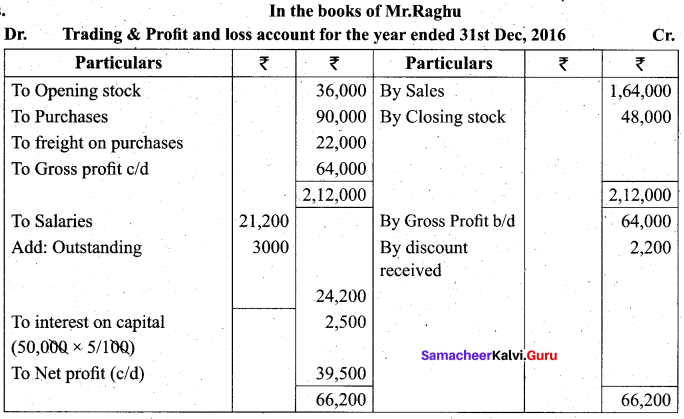
  3. Thallus may be filamentous, frond-like or giant kelps.
  4. Thallus is differentiated into photosynthetic part-frond, stalk-like structure-stipe and a holdfast for attachment.
  5. Chlorophyll ‘a’ and ‘c’, carotenoids and Xanthophylls are photosynthetic pigments.
  6. A golden brown fucoxanthin pigment gives olive green to brown colour.
  7. Mannitol and Laminarin starch is the storage material.
  8. Motile spores with unequal flagella (one whiplash and one tinsel) are present.
  9. Oogamous is the major type of sexual reproduction. Isogamy is also seen.
  10.  Alternation of generation is seen. Example: Sargassum, Fucus, Laminaria and Dictyota.

[OR]

Compare Transmission Electron Microscope with Scanning Electron Microscope.
Answer:
Tamil Nadu 11th Biology Model Question Paper 4 English Medium - 2

Tamil Nadu 11th Biology Model Question Paper 4 English Medium

Question 21.
Compare photosynthesis in plants & bacteria.
Answer:
Photosynthesis in Plants :

  1. Cyclic and non-cyclic phosphorylation takes place.
  2. Photosystem I and II involved.
  3. Electron donor is water.
  4. Oxygen is evolved.
  5. Reaction centres are P700 and P680.
  6. Reducing agent is NADPH + H+.
  7. PAR is 400 to 700 nm.
  8. Chlorophyll, carotenoid and xanthophyll.
  9. Photosynthetic apparatus – chloroplast.

Photosynthesis in Bacteria :

  1. Only cyclic phosphorylation takes place.
  2. Photosystem I only involved.
  3. Electron donor is H2S.
  4. Oxygen is not evolved.
  5. Reaction centre is P870.
  6. Reducing agent is NADPH + H+.
  7. PAR is above 700 nm.
  8. Bacterio chlorophyll and bacterio viridin.
  9. It is chlorosomes and chromatophores.

[OR]

Explain the physiological effect of Ethylene.
Answer:

  • Ethylene stimulates respiration and ripening in fruits.
  • It stimulates radial growth in stem and root and inhibits linear growth.
  • It breaks the dormancy of buds, seeds and storage organs.
  • It stimulates formation of abscission zone in leaves, flowers and fruits. This makes the leaves to shed prematurely.
  • Inhibition of stem elongation (shortening the intemode).
  • In low concentration, ethylene helps in root initiation.
  • Growth of lateral roots and root hairs. This increases the absorption surface of the plant roots.
  • The growth of fruits is stimulated by ethylene in some plants. It is more marked in climacteric fruits.
  • Ethylene causes epinasty.

Bio-Zoology

Part – I

Answer all the questions. Choose the correct answer.  [8 × 1 = 8]

Question 1.
Uricotelisum is found in ……….
(a) Mammals and birds
(b) Birds, reptiles and insects
(c) Fishes and fresh water protozons
(d) Frogs and toads
Answer:
(b) Birds, reptiles and insects

Question 2.
Bone cells are called as …………..
(a) Neurons
(b) Osteoblasts
(c) Epithelial cells
(d) Chondrocytes
Answer:
(b) Osteoblasts

Tamil Nadu 11th Biology Model Question Paper 4 English Medium

Question 3.
SA-node stands for ………………
(a) Sinoatrial node
(b) Systolic atrial node
(c) Systemic atrial node
(d) Sino aorta node
Answer:
(a) Sinoatrial node

Question 4.
Match the List I and List II:
Tamil Nadu 11th Biology Model Question Paper 4 English Medium - 3
(a) 1 – (i), 2 – (ii), 3 – (iii), 4 – (iv)
(b) 1 – (ii), 2 – (i), 3 – (iv), 4 – (iii)
(c) 1 – (iv), 2 – (iii), 3 – (ii), 4 – (i)
(c) 1 – (iv), 2 – (iii), 3 – (ii), 4 – (iii)
Answer:
(b) 1 – (ii), 2 – (i), 3 – (iv), 4 – (iii)

Question 5.
Which of the following statement is correct?
(a) Polyp forms are free living
(b) Medusa forms are sessile
(c) Medusa produces gametes
(d) Polyp reproduces sexually
Answer:
(c) Medusa produces gametes

Tamil Nadu 11th Biology Model Question Paper 4 English Medium

Question 6.
Which of the following statement is in incorrect with regard to ecosystem?
(a) It includes living and non-living things
(b) It shows interrelationship among living things
(c) It shows interrelationship among living and non-living things
(d) It has a large number of species
Answer:
(b) It shows interrelationship among living things

Question 7.
What is Nissl’s granule consist of ?
(a) DNA
(b) RNA
(c ) Protein
(d) Lipid
Answer:
(c ) Protein

Question 8.
Ranikhet, coccidiosis and Fowl pox are ………………..
(a) Chicken breeds
(b) Types of poultry forming
(c) Poultry diseases
(d) Types of breeding methods
Answer:
(c) Poultry diseases

Part – II

Answer any four of the following questions. [4 × 2 = 8]

Question 9.
What are diploblastic animals?
Answer:
The animals in which the cells are arranged in two embryonic layers, the ectoderm and endoderm are called diploblastic animals.

Question 10.
Define Hermaphrodite.
Answer:
Hermaphrodite are animals with both male and female reproductive organs.

Question 11.
Difference between skeletal muscle and cardiac muscle.
Answer:
Skeletal muscle:

  1. Skeletal muscle are voluntary muscles
  2. Skeletal muscle are attached to the skeleton

Cardiac muscle :

  1. Cardiac muscle are involuntary muscles
  2. Cardiac muscles are attached to the heart.

Question 12.
How do we calculate BMI?
Answer:
Degree of obesity is assessed by body mass index (BMI). A normal BMI range for adult is 19-25; above 25 is considered as obese. BMI is calculated as body weight in Kg, divided by the square of body height in meters. For example, a 50 Kg person with a height of 160 cms would have a BMI of 19.5.
That is BMI = 50/1.62 = 19.5

Tamil Nadu 11th Biology Model Question Paper 4 English Medium

Question 13.
Draw the diagram of Rana hexadactyla.
Answer:
Tamil Nadu 11th Biology Model Question Paper 4 English Medium - 4

Question 14.
What are the functions of frontal lobe?
Answer:
The frontal lobe governs the Behaviour, Intelligence, Memory and Movement.

Part – III

Answer any three questions in which question number 19 is compulsory. [3 × 3 = 9]

Question 15.
Define five kingdom classification of Whittaker.
Answer:
R.H. Whittaker (1969) proposed the five kingdom classification. They included Monera, Protista, Fungi, Plantae and Animalia. He classified organisms based on cell structure, nutrition, reproduction and phylogenetic relationships.

Question 16.
Distinguish between Oviparous and Viviparous animals.
Question
Oviparous animals

  1. The egg laying animals are known as Oviparous animals.
  2. They make contain yolk for embryonic development, eg.

Viviparous animals

  1. The animals which give birth to young ones are called Viviparous animals.
  2. Birds The developing embryo derives nutrients from the parent, eg. Man

Tamil Nadu 11th Biology Model Question Paper 4 English Medium

Question 17.
Label the given diagram.
Answer:
Tamil Nadu 11th Biology Model Question Paper 4 English Medium - 5

Question 18.
Define Isinglass.
Answer:
Isinglass is a high-grade collagen produced from dried air bladder or swim bladder of certain fishes. Viz. Catfish and carps. The processed bladder which is dissolved in hot water forms a gelatin having adhesive property. It is primarily used for classification of wine, beer and vinegar.

Question 19.
Write the symptoms of cretinism.
Answer:
Cretinism is caused due to hypothyrodisim in infants. A cretin child shows the following symptoms:

  1. Retarded skeletal growth
  2. Absence of sexual maturity
  3. Retarded mental ability
  4. Thick and short limbs
  5. Bloated face

Part – IV

Answer all the questions. [2 × 5 = 10]

Question 20.
Explain the classification of animal tissues.
Answer:
Tamil Nadu 11th Biology Model Question Paper 4 English Medium - 6

Tamil Nadu 11th Biology Model Question Paper 4 English Medium

[OR]

What are the disorders of the respiratory system?
Answer:
Respiratory system is highly affected by environmental, occupational, personal and social factors. These factors may be responsible for a number of respiratory disorders. Some of the disorders are discussed here.

Asthma-It is characterized by narrowing and inflammation of bronchi and bronchioles and difficulty in breathing.Common allergens for asthma are dust, drugs, pollen grains, certain food items like fish, prawn and certain fruits etc.

Emphysema- Emphysema is chronic breathlessness caused by gradual breakdown of the thin walls of the alveoli decreasing the total surface area of a gaseous exchange, i.e., widening of the alveoli is called emphysema. The major cause for this disease is cigarette smoking, which reduces the respiratory surface of the alveolar walls.

Bronchitis-The branch? when it gets inflated due to pollution smoke and cigarette smoking, causes bronchitis. The symptoms are cough, shortness of breath and sputum in the lungs.

Pneumonia-Inflammation of the lungs due to infection caused by bacteria or vims is called pneumonia. The common symptoms are sputum production, nasal congestion, shortness of breath, sore throat, etc.

Tuberculosis-Tuberculosis is caused by Mycobacterium tuberculae. This infection mainly occurs in the lungs and bones.Collection of fluid between the lungs and the chest wall is the main complication of this disease.

Occupational respiratory disorders-The disorders due to one’s occupation of working in industries like grinding or stone breaking, construction sites, cotton industries, etc. Dust produced affects the respiratory tracts.

Long exposure can give rise to inflammation leading to fibrosis. Silicosis and asbestosis are „ occupational respiratory diseases resulting from inhalation of particle of silica from sand grinding ‘ and asbestos into the respiratory tract. Workers, working in such industries must wear protective masks.

Tamil Nadu 11th Biology Model Question Paper 4 English Medium

Question 21.
Explain the mechanism of muscle contraction.
Answer:
Mechanism of muscle contraction:
Sliding filament theory in 1954, Andrew F.Huxley and Rolf Niedergerke proposed the sliding- filament theory to explain muscle contraction. According to this theory, overlapping actin and myosin filaments of fixed length slide past one another in an energy requiring process, resulting in muscle contraction. The contraction of muscle fibre is a remarkable process that helps in creating a force to move or to resist a load.

The force which is created by the contracting muscle is called muscle tension. The load is a weight or force that opposes contraction of a muscle. Contraction is the creation of tension in the muscle which is an active process and relaxation is the release of tension created by contraction. Muscle contraction is initiated by a nerve impulse sents by the central nervous system (CNS) through a motor neuron.

The junction between the motor neuron and the sarcolemma of the muscle fibre is called the neuromuscular junction or motor end plate. When nerve impulse reaches a neuromuscular junction, acetylcholine is released. It initiates the opening of multiple gated channels in sarcolemma. The action potential travels along the T-tubules and triggers the release of calcium ions from the sarcoplasmic reticulum.

The released calcium ions bind to troponin on thin filaments. The tropomyosin uncovers the myosinbinding sites on thin filaments. Now the active sites are exposed to the heads of myosin to form a cross-bridge. During cross-bridge formation actin and myosin form a protein complex called actomyosin.

Utilizing the energy released from hydrolysis of ATP, the myosin head rotates until it forms a 90° angle with the long axis of the filament. In this position myosin binds to an actin and activates a contraction – relaxation cycle which is followed by a power stroke.

The power stroke (cross-bridge tilting) begins after the myosin head and hinge region tilt from a 90° angle to a 45° angle. The cross-bridge transforms into strong, high-force bond which allows the myosin head to swivel. When the myosin head swivels it pulls the attached actin filament towards the centre of the A-band.
The myosin returns back to its relaxed state and releases ADP and phosphate ion. A new ATP molecule then binds to the head of the myosin and the cross-bridge is broken.

At the end of each power stroke, each myosin head detaches from actin, then swivels back and binds to a new actin molecule to start another contraction cycle. This movement is similar to the motion of an oar on a boat. At the end of each power stroke, each myosin head detaches from actin, then swivels back and binds to a new actin molecule to start another contraction cycle. The power stroke repeats many times until a muscle fibre contracts. The myosin heads bind, push and release actin molecules over and over as the thin filaments move toward the centre of the sarcomere.

The repeatedly formation of cross-bridge cycles cause the sliding of the filaments only but there is no change in the lengths of either the thick or thin filaments. The Z- discs attached to the actin filaments are also pulled inwards from both the sides, causing the shortening of the sarcomere (i.e. contraction). This process continues as long as the muscle receives the stimuli and a steady flow of calcium ions.

When motor impulse stops, the calcium ions are pumped back into the sarcoplasmic reticulum, results in the masking of the active sites of the actin filaments. The myosin head fails to bind with the active sites of actin and these changes cause the return of Z – discs back to their original position, i.e. relaxation.

Tamil Nadu 11th Biology Model Question Paper 4 English Medium

[OR]

Describe the central nervous system.
Answer:
Central neural system (CNS): The CNS includes the brain and the spinal cord, which are protected by the bones of the skull and vertebral column. During its embtyonic development, CNS develops from the ectoderm.
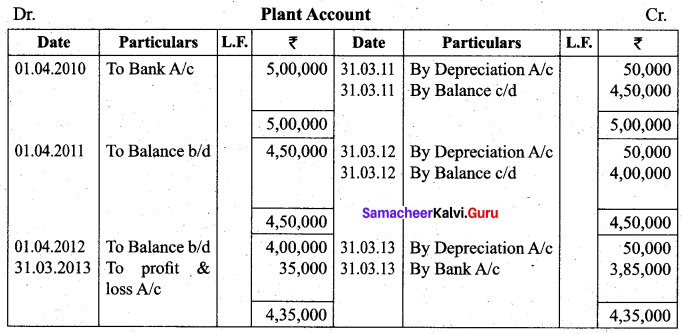
Brain: The brain acts as the command and control system. It is the site of information processing. It is located in the cranial cavity and is covered by three cranial meninges. The outer thick layer is Duramater which line? the inner surface of the cranial cavity; the median thin layer is Arachnoid mater which is separated from the duramater by a narrow subdural space.
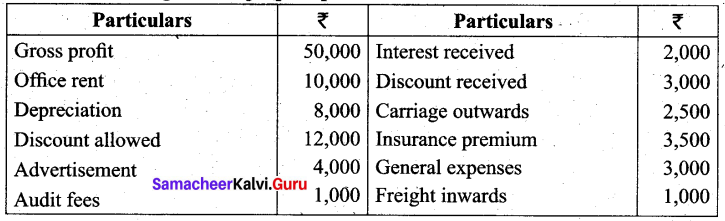
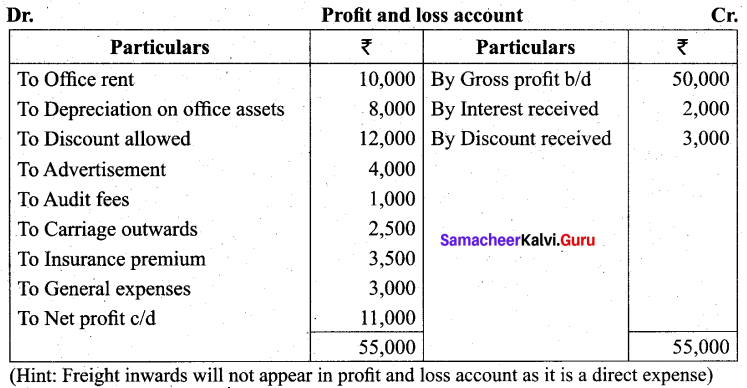
The innermost layer is Piamater which is closely adhered to the brain but separated from the arachnoid mater by the subarachnoid space. The brain is divided into three major regions: Forebrain, Midbrain and Hindbrain.

Fore Brain: It comprises the following regions: Cerebrum and Diencephalon. Cerebrum is the ‘seat of intelligence and forms the major part of the brain. The cerebrum consists of an outer cortex, inner medulla and basal nuclei. The superficial region of the cerebrum is called cerebral cortex, which looks grey due to the presence of unmyelinated nerve cells. Cerebral cortex consists of neuronal cell body, dendrites, associated glial and blood vessels. The surface of the cerebrum shows many convolutions (folds) and grooves.

The folds are called gyri (singular gyrus); the shallow grooves between the gyri are called sulci (singular sulcus) and deep grooves are called fissures. These sulci and gyri increase the surface area of the cerebral cortex. Several sulci divide the cerebrum into eight lobes: a pair of frontals, parietals, temporals and occipital lobes.

Mid brain: The mid brain is located between the diencephalon and the pons. The lower portion of the midbrain consists of a pair of longitudinal bands of nervous tissue called cerebral peduncles which relay impulses back and forth between cerebrum, cerebellum, pons and medulla. The dorsal portion of the midbrain consists of four rounded bodies called corpora quadrigemina which acts as a reflex centre for vision and hearing.

Hind brain: Rhombencephalon forms the hind brain. It comprises of cerebellum, pons varolii and medulla oblongata. Cerebellum is the second largest part of the brain. It consists of two cerebellar hemispheres and central worm shaped part, the vermis. The cerebellum controls and coordinates muscular movements and body equilibrium. Any damage to cerebellum often results in uncoordinated voluntary muscle movements.

Pons varoli: It lies infront of the cerebellum between the midbrain and the medulla oblongata. The nerve fibres in the pons varolii form a bridge between the two cerebellar hemispheres and connect the medulla oblongata with the other region of the brain. The respiratory nuclei found in the pons cooperate with the medulla to control respiration.
Medulla oblongata: It forms the posterior most part of the brain. It connects the spinal cord with various parts of the brain. It receives and integrates signals from spinal cord and sends it to the cerebellum and thalamuj. Medulla contains vital centres that control cardio vascular reflexes, respiration and gastric secretions.

Tamil Nadu 11th Chemistry Previous Year Question Paper March 2019 English Medium

Students can Download Tamil Nadu 11th Chemistry Previous Year Question Paper March 2019 English Medium Pdf, Tamil Nadu 11th Chemistry Model Question Papers helps you to revise the complete Tamilnadu State Board New Syllabus and score more marks in your examinations.

TN State Board 11th Chemistry Previous Year Question Paper March 2019 English Medium

Tamil Nadu 11th Chemistry Previous Year Question Paper March 2019 English Medium

Time: 2½ Hours
Total Score: 90 Marks

General Instructions:

  1. The question paper comprises of four parts.
  2. You are to attempt all the parts. An internal choice of questions is provided wherever applicable.
  3. All questions of Part I. II, III and IV are to be attempted separately.
  4. Question numbers 1 to 15 in Part I are Multiple Choice Questions of one mark each. These are to be answered by choosing the most suitable answer from the given four alternatives and writing the option code and the corresponding answer.
  5. Question numbers 16 to 24 in Part II are two-mark questions. These are to be answered in about one or two sentences.
  6. Question numbers 25 to 33 in Part III are three-mark questions. These are to be answered in about three to five short sentences.
  7. Question numbers 34 to 38 in Part IV are five-mark questions. These are to be answered in detail. Draw diagrams wherever necessary.

Tamil Nadu 11th Chemistry Previous Year Question Paper March 2019 English Medium

Part- I

Answer all the Questions. [Answers are in Bold] [15 x 1 = 15]

Choose the most appropriate answer from the given four alternatives and write the option code and the corresponding answer.

Question 1.
Many of the organic compounds are inflammable because of its
(a) Vander Waal’s force
(b) Co-ordinate nature
(c) Covalent nature
(d) Ionic nature
Answer:
(c) Covalent nature

Question 2.
When Ang is negative in chemical equilibrium reaction, then ..
(a) Kp < Kc
(b) Kp = 1 /Kc
(c) Kp = Kc (RT)-vc
(d) Kp > Kc
Answer:
(c) Kp = Kc (RT)-vc

Tamil Nadu 11th Chemistry Previous Year Question Paper March 2019 English Medium

Question 3.
Find A in the following equation.
\(\mathrm{CaO}+3 \mathrm{C} \stackrel{3273 \mathrm{K}}{\longrightarrow} \mathrm{A}+\mathrm{CO}\)
(a) CaC2
(b) CO2
(c) Ca
(d) Ca2O
Answer:
(d) Ca2O

Question 4.
Splitting of spectral lines in an electric field is called
(a) Compton effect
(b) Stark effect
(c) Zeeman effect
(d) Shielding effect
Answer:
(a) Compton effect

Tamil Nadu 11th Chemistry Previous Year Question Paper March 2019 English Medium

Question 5.
Which of the following species does not exert a resonance effect?
(a) C6H5NH2
(b) C6H5NH3
(c) C6H5OH
(d) C6H5CI
Answer:
(b) C6H5NH3

Question 6.
Match the following:
Compound – Uses
1. Chloro picrin (i) Detection of primary amine
2. Methyl Isocyanide (ii) DDT
3. Chloro benzene (iii) Paint remover
4. Methylene chloride (iv) Soil sterilizer
(a) 1- (iv), 2 – (iii), 3 – (ii), 4 – (i)
(b) 1- (Hi), 2 – (iv), 3 – (ii), 4 – (i)
(c) 1- (i), 2 – (ii), 3 – (iv), 4 – (iii)
(d) 1- (iv), 2 – (i), 3 – (ii), 4 – (iii)
Answer:
(d) 1 – (iv), 2 – (i), 3 – (ii), 4 – (iii)

Question 7.
Use of hot air balloon in the meteorological observatory is an application of
(a) Kelvin’s Law
(b) Brown’s Law
(c) Boyle’s Law
(d) Newton’s Law
Answer:
(b) Brown’s Law

Tamil Nadu 11th Chemistry Previous Year Question Paper March 2019 English Medium

Question 8.
What is the pH of rain water?
(a) 5.6
(b) 4.6
(c) 6.5
(d) 7.5
Answer:
(a) 5.6

Question 9.
Which compound is named as “Blue John” among the following compounds?
(a) Ca3(PO4)2
(b) CaO
(c) CaH2
(d) CaF2
Answer:
(d) CaF2

Question 10.
The element with positive electron gain enthalpy is ………………………… .
(a) Argon
(b) Fluorine
(c) Hydrogen
(d) Sodium
Answer:
(d) Sodium

Tamil Nadu 11th Chemistry Previous Year Question Paper March 2019 English Medium

Question 11.
Which of the following mMecule does not contain n bond?
(a) CO2
(b) H2O
(c) SO2
(d) NO2
Answer:
(c) SO2

Question 12.
Which of the following compound has same percentage of Carbon as that of ethylene (C2H4)?
(a) benzene
(b) ethane
(c) propene
(d) ethyne
Answer:
(a) benzene

Question 13.
The SI unit of Molar heat capacity is
(a) JK-1 mol-1
(b) kJ mol+1
(c) kJ mol-1
(d) cm
Answer:
(c) kJ mol-1

Question 14.
What percentage of solution of H202 is called as “100-Volume” H202?
(a) 15%
(b) 50%
(c) 20%
(d) 30%
Answer:
(a) 15%

Tamil Nadu 11th Chemistry Previous Year Question Paper March 2019 English Medium

Question 15.
Osmotic pressure (n) of a solution is given by the relation
(a) πRT = n
(b) V = πnRT
(c) π = nRT
(d) πV = nRT
Answer:
(b) V = πnRT

Part-II

Answer any six of the following questions. Question no. 24 is compulsory. [6 x 2 = 12]

Question 16.
State and explain Pauli’s Exclusion Principle.
Answer:
Pauli’s exclusion principle states that “No two electrons in an atom can have the same set of values of all four quantum numbers”.
Illustration: H(Z = 1) Is1.

One electron is present in hydrogen atom, the four quantum numbers are n = 1, l = 0, m = 0 and s = + ½. For helium Z = 2. He: Is2. In this one electron has the quantum number same as that of hydrogen, n = 1, l = 0 m = 0 and s = + ½. For other electron, fourth quantum number is different, i.e. n = 1, l = 0, m = 0 and s = – ½.

Question 17.
Define – Valency.
Answer:
The valency of an element may be defined as the combining capacities of elements. The electrons present in the outermost shell are called valence electrons and these electrons determine the valency of the atom.

Tamil Nadu 11th Chemistry Previous Year Question Paper March 2019 English Medium

Question 18.
What are ideal gases?
Answer:

  • A gas that follows Boyle’s law, Charles’ law and Avogadro law strictly is called an ideal gas. It is assumed that intermolecular forces are not present between the molecules of an ideal gas.
  • Ideal gases are the gases that obey gas laws or gas equation PV = nRT.
  • Real gases do not obey gas equation. PV = nRT.
  • The deviation of real gases from ideal behaviour is measure in terms of a ratio of PV to PV nRT. This is termed as compression factor (Z). Z = \(\frac{P V}{n R T}\)

Question 19.
State the third law of Thermodynamics.
Answer:
It states that the entropy of pure crystalline substance at absolute zero is zero, (or)

It can be stated as “it is impossible to lower the temperature of an object to absolute zero in a finite number of steps”. Mathematically \(\lim _{T \rightarrow 0} S=0\)

Tamil Nadu 11th Chemistry Previous Year Question Paper March 2019 English Medium

Question 20.
What is called Bond Length? Name the techniques through which the length of a bond can be determined.
Answer:
The distance between thS nuclei of two covalently bonded atoms is called bond length. For e.g„ in a covalent molecule A – B, the bond length is equal to the sum of the radii of bonded atoms, i.e., γA + γB = bond length.

The length of a bond can be determined by spectroscopic, x-ray diffraction and electron- diffraction techniques.

Question 21.
Describe the reaction involved in the detection of Nitrogen in an organic compound by Lassaigne Method.
Answer:
Detection of Nitrogen: The following reactions are involved in the detection of nitrogen with formation of prussian blue precipitate conforming the presence of nitrogen in an organic compound.
Tamil Nadu 11th Chemistry Previous Year Question Paper March 2019 English Medium 1

Tamil Nadu 11th Chemistry Previous Year Question Paper March 2019 English Medium

Question 22.
How is Alkane prepared from Grignard reagent?
Answer:
CH3MgX + HOH → CH4 + Mg(OH)X.
Water would protonate the grignard reagent and destroy the grignard reagent, because the grignard carbon atom is highly nucleophilic. This would form a hydrocarbon. Therefore to make a grignard solution, only ether is the best solvent and water or alcohol are not used for that purpose.

Question 23.
Define – Acid rain.
Answer:
Rain water has a pH of 5.6 due to the dissolution of CO2 into it. Oxides of sulphur and nitrogen in the atmosphere may be absorbed by droplets of water that make up the clouds and get chemically converted into sulphuric acid and nitric acid. Due to this the pH of rain water drops below the level of 5.6. Hence it is called acid rain.

Question 24.
Which is the suitable method for detection of Nitrogen present in food and fertilizers?
Answer:
Kjeldahl’s method is the suitable for detection of nitrogen present in food and fertilizers.

Tamil Nadu 11th Chemistry Previous Year Question Paper March 2019 English Medium

Part-III

Answer any six of the following questions. Question No. 33 is compulsory. [6 x 3 = 18]

Question 25.
Calculate the equivalent mass of H2SO4.
Sulphuric acid = H2SO4
Molar mass of Sulphuric acid = 2 + 32 + 64 = 98
Basicity of Sulphuric acid = 2
Equivalent mass of acid =
\(=\frac{\text { Molar mass of an acid }}{\text { Basicity }}\)
\(=\frac{98}{2}=49 \mathrm{geq}^{-1}\)

Question 26.
Explain diagonal relationship.
Answer:

  • On moving diagonally across the periodic table, the second and the third period elements show certain similarities.
  • Even though the similarity is not same as we see in a group, it is quite pronounced in the following pair of elements.
  • Tamil Nadu 11th Chemistry Previous Year Question Paper March 2019 English Medium 2
  • The similarity in properties existing between the diagonally placed elements is called “diagonal relationship”.

Tamil Nadu 11th Chemistry Previous Year Question Paper March 2019 English Medium

Question 27.
How is Tritium prepared?
Answer:
It occurs naturally as a result of nuclear reactions induced by cosmic rays in the upper atmosphere.
Tamil Nadu 11th Chemistry Previous Year Question Paper March 2019 English Medium 3

Question 28.
Define – Le-Chatelier principle.
Answer:
It states that “If a system at equilibrium is disturbed, then the system shifts itself in a direction that nullifies the effect of that disturbance.

Question 29.
State the term “Isotonic solution”.
Answer:

  1. Two solutions having same osmotic pressure at a given temperature are called isotonic solutions.
  2. When such solutions are separated by a semipermeable membrane, solvent flow between one to the other on either direction is same, i.e., the net solvent flow between two isotonic solutions is zero.

Tamil Nadu 11th Chemistry Previous Year Question Paper March 2019 English Medium

Question 30.
Both C2H2 and CO2 have the same structure. Explain why.
Answer:
H – C = C – H and O = C = O
Both has,
Linear- Molecular geometry
Zero – Dipole moment
sp – Hybridization of C in C2H2 and CO2. Hence C2H2 and CO2 have the same structure.

Question 31.
Write note on Williamson’s Synthesis.
Answer:
Williamson’s synthesis: Haloalkanes, when boiled with sodium alkoxide, gives the corresponding ether.
Tamil Nadu 11th Chemistry Previous Year Question Paper March 2019 English Medium 4

Question 32.
Explain why Ca(OH)2 is used in white washing.
Answer:
(i) Ca(OH)2 used in white washing, this is due to disinfectant nature.
(if) Calcium hydroxide reacts with CO2 in air to form thin layer of calcium carbonate on the walls. It gives a shiny finish to the walls.

Tamil Nadu 11th Chemistry Previous Year Question Paper March 2019 English Medium

Question 33.
Give the structural formula for the following compounds.
(a) m – dinitrobenzene
(b) p – dichlorobenzene
(c) 1,3, 5, Tri-methyl Benzene
Answer:
Tamil Nadu 11th Chemistry Previous Year Question Paper March 2019 English Medium 5

Part – IV

Answer all the questions.

Question 34.
(a) (i) Calculate oxidation number of oxygen in H2O2.
(ii) Write the de-Broglie equation.
[OR]
(b) (i) State and explain Dobereiner’s “Triad”.
(ii) Complete the following equation.
(a)
Tamil Nadu 11th Chemistry Previous Year Question Paper March 2019 English Medium 6
Therefore oxidation number of ‘O’ in H2O2 is -1.

Tamil Nadu 11th Chemistry Previous Year Question Paper March 2019 English Medium

(ii) 1. Louis de Broglie extended the concept of dual nature of light to all forms of matter. To quantify this relation, he derived an equation for the wavelength of a matter wave.
2. He combined the following two equations of energy of which one represents wave character (ho) and the other represents the particle nature (mc2).
Planck’s quantum hypothesis:
E = hv …………………………. (1)
Einsteins mass-energy relationship:
E = mc2 ………………………….. (2)
From (1) and (2)
hv = mc2
h/λ = mc2
∴ λ = \(\frac{h}{m c}\) ……………………………….. (3)

The equation (3) represents the wavelength of photons whose momentum is given by. me. (Photons have zero rest mass).

3. For a particle of matter with mass m and moving with a velocity v, the equation (3) can be written as λ = \(\frac{h}{m c}\) ……………………………….. (3)

[OR]

Tamil Nadu 11th Chemistry Previous Year Question Paper March 2019 English Medium

(b) (i) Johann Dobereiner noted that elements with similar properties occur in groups of three which he called triads. It was seen that invariably, the atomic weight of the middle number of the triad was nearly equal to the arithmetic mean of the weights of the other two numbers of the triad. For e.g.,
Tamil Nadu 11th Chemistry Previous Year Question Paper March 2019 English Medium 7

Question 35.
(a) (i) Among the alkaline earth metals BeO is insoluble in water but other oxides are soluble. Why?
(ii) State Diffusion Law.
[OR]
(b) (i) Calculate the entropy change during the melting of one mole of ice into water at 0°C. Enthalpy of fusion of ice is 6008 J mol-1.
(ii) Write the balanced chemical equation for Kc = \(\frac{\left[\mathbf{C a O}_{(\mathbf{s})}\right]\left[\mathbf{C O}_{2(\mathbf{g})}\right]}{\left[\mathbf{C a C O}_{3(\mathbf{(})}\right]}\)
(a) (i) Lattice energy of BeO is comparatively higher than the hydrogen energy. Therefore it is almost insoluble in water. Whereas other alkaline earth metals oxides have high hydration energy. Hence they are soluble in water.

Tamil Nadu 11th Chemistry Previous Year Question Paper March 2019 English Medium

(ii) Diffusion is the spreading of molecules of a substance throughout a space or a second substance. Diffusion refers to the ability of the gases to mix with each other. E.g., Spreading of something such as brown tea liquid spreading through the water in a tea cup.

[OR]

(b)
Tamil Nadu 11th Chemistry Previous Year Question Paper March 2019 English Medium 8
Tamil Nadu 11th Chemistry Previous Year Question Paper March 2019 English Medium 9

Question 36.
(a) (i) NH3 and HC1 do not obey Henry’s law. Why?
(ii) Write the structure of the following compunds. (A) NH3 (B) BF3

[OR]

(b) (i) Identify the cis and trans isomers for the following compounds.
Tamil Nadu 11th Chemistry Previous Year Question Paper March 2019 English Medium 10
(ii) Explain with example the Positive Mesomeric Effect.
Answer:
(a) (i) Only the less soluble gases obeys Henry’s law. NH3 and HC1 react with (or soluble) water and hence does not obey Henry’s law.
Tamil Nadu 11th Chemistry Previous Year Question Paper March 2019 English Medium 11

(b)
Tamil Nadu 11th Chemistry Previous Year Question Paper March 2019 English Medium 12

Tamil Nadu 11th Chemistry Previous Year Question Paper March 2019 English Medium

(ii)

  1. Positive mesomeric effect occurs, when the electrons move away from substituent attached to the conjugated system.
  2. It occurs, if the electron releasing substituents are attached to the conjugated system.
  3. The attached group has a tendency to release electrons through resonance, these electron releasing groups are usually denoted as +R or +M groups
  4. Examples: —OH, —SH, —OR, —SR, —NH2 etc.

Question 37.
(a) (i) Write the IUPAC name for the following compound.
Tamil Nadu 11th Chemistry Previous Year Question Paper March 2019 English Medium 13
(ii) What are Nucleophiles and Electrophiles? Give one example each.

[OR]

(b) (i) How will you get the following products with the given reactants?
(A) Acetylene → Benzene
(B) Phenol → Benzene
(C) Benzene → Toluene
(ii) Write any two different components you get during fractional distillation of Coal Tar at any two different temperatures.
Answer:
(a)
Tamil Nadu 11th Chemistry Previous Year Question Paper March 2019 English Medium 14
Tamil Nadu 11th Chemistry Previous Year Question Paper March 2019 English Medium 15

Tamil Nadu 11th Chemistry Previous Year Question Paper March 2019 English Medium
(ii) Electrophiles: Electrophiles are reagents that are attracted towards negative charge or electron rich center. They are either positively charged ions or electron deficient neutral molecules.
Example, CO2, AlCl3, BF3, FeCl3, N0+, NO2+, etc.

Nucleophiles: Nucleophiles are reagents that has high affinity for electropositive centers. They possess an atom has a unshared pair of electrons. They are usually negatively charged ions or electron rich neutral molecules.
Example: NH3, R-NH2, R-SH, H2O, R-OH, CN, OH etc.

[OR]

(b)
Tamil Nadu 11th Chemistry Previous Year Question Paper March 2019 English Medium 16
(ii) Coal tar is a viscous liquid obtained by the pyrolysis of coal. During fractional distillation, coal tar is heated and distills away its volatile compounds, namely, benzene, toluene, xylene in the temperature range of 350 K to 443 K. These vapours are. collected at the upper part of the fractionating column.

Name of the fractionTemperature RangeName of the component
Crude light oil350- 443 KBenzene, Toluene, Xylene
Middle oil443 – 503 KPhenol, Naphthalene
Heavy oil503 – 543 KNaphthalene, Cresol
Green oil543 – 633 KAnthracene
Pitch oil633 KResidue

Question 38.
(a) (i) A compound having the empirical formula C6H6O has the vapour density 47. Find its Molecular formula.
(ii) The Simple Aromatic Hydrocarbon compound (A) reacts with Bromine to give (B). Compound (A) reacts with Raney Ni and gives (C). Identify (A), (B) and (C).

Tamil Nadu 11th Chemistry Previous Year Question Paper March 2019 English Medium

[OR]

(b) (i) C(s) + O2(g) → CO2(g)
Calculate the standard entropy change for the above reaction. Given the standard entropies of CO(s) + C(s), O2(g) are 213.6, 5.740 and 205 JK-1 respectively.
(ii) Identify the compound (A) and (B).
Tamil Nadu 11th Chemistry Previous Year Question Paper March 2019 English Medium 17

(a) (i) Empirical formula = C6H6O
Empirical formula mass
= (6 x 12) + (6 x 1) + (16 x 1)
= 72 + 6+16
= 94
Vapour density =47
Molecular mass = 2 x Vapour density
= 2 x 47
= 94
Molecular formula = n x Empirical formula
\($\mathrm{n}=\frac{\text { Molecular mass }}{\text { Empirical formula mass }}$\)
n = 94/94 ⇒ n = 1
Molecular formula = 1 x C6H6O
= c6H6O

Tamil Nadu 11th Chemistry Previous Year Question Paper March 2019 English Medium 18
[OR]

Tamil Nadu 11th Chemistry Previous Year Question Paper March 2019 English Medium 19

Tamil Nadu 11th Chemistry Previous Year Question Paper March 2019 English Medium

Tamil Nadu 11th Biology Previous Year Question Paper June 2019 English Medium

Students can Download Tamil Nadu 11th Biology Previous Year Question Paper June 2019 English Medium Pdf, Tamil Nadu 11th Biology Model Question Papers helps you to revise the complete Tamilnadu State Board New Syllabus and score more marks in your examinations.

TN State Board 11th Biology Previous Year Question Paper June 2019 English Medium

Instructions:

  1. The question paper comprises of four parts Questions for Botany and Zoology are asked separately.
  2. You are to attempt all the parts. An internal choice of questions is provided wherever applicable.
  3. All questions of Part I, II, III, and IV are to be attempted separately.
  4. Question numbers 1 to 8 in Part I are Multiple Choice Questions of one mark each. These are to be answered by choosing the most suitable answer from the given four alternatives and Writing the option code and the Corresponding answer.
  5. Question numbers 9 to  4 in Part II are two-marks questions. This also is answered in about one or list sentences.
  6. Question numbers 15 to 19 in Part III are three-marks questions These are to be answered in about three to five short sentences.
  7. Question numbers 20 and 21 in Part  IV are five-marks questions. These are to be answered in detail Draw diagrams wherever necessary.

Time: 3 Hours
Maximum Marks: 70

Bio-Botany [Maximum Marks: 35]

Part – I

Answer all the questions. Choose the correct answer.  [8 × 1 = 8]

Choose the most appropriate answer from the given four alternative and write the option code and the corresponding answer.

Question 1.
The book of “The structure and reproduction of the Algae” was published by …………………….
(a) F.E. Fritch
(b) F.E. Round
(c) R.E. Lee
(d) M.S. Randhawa
Answer:
(a) F.E. Fritch

Tamil Nadu 11th Biology Previous Year Question Paper June 2019 English Medium

Question 2.
More than one locule ovaries are called ………………………..
(a) Plurilocular
(b) Unilocular
(c) Bilocular
(d) Trilocular
Answer:
(a) Plurilocular

Question 3.
The two subunits of ribosomes remain united at critical ion level of ………………….
(a) Magnesium
(b) Calcium
(c) Sodium
(d) Ferrous
Answer:
(a) Magnesium

Tamil Nadu 11th Biology Previous Year Question Paper June 2019 English Medium

Question 4.
The structure of Glycine ammo acid is …………………………
Tamil Nadu 11th Biology Previous Year Question Paper June 2019 English Medium - 1
Answer:
Tamil Nadu 11th Biology Previous Year Question Paper June 2019 English Medium - 2

Question 5.
Polyderm is found in the roots and underground stems of family is ………………………
(a) Magnesium
(b) Fabaceae
(c) Solanaceae
(d) Lilliaceae
Answer:
(a) Magnesium

Tamil Nadu 11th Biology Previous Year Question Paper June 2019 English Medium

Question 6.
In a fully turgid cell: …………………
(a) DPD = 10 atm; OP = 5 atm; TP = 10 atm.
(b) DPD = 0 atm; OP = 10 atm; TP = 10 atm.
(c) DPD = 0 atm; OP = 5 atm; TP = 10 atm.
(d) DPD = 20 atm; OP = 20 atm; TP = 10 atm.
Answer:
(d) DPD = 20 atm; OP = 20 atm; TP = 10 atm.

Question 7.
Who proposed the “Theory of photosynthesis in guard cells” ?
(a) Von Mohl
(b) Sayre
(c) Levit
(d) Steward
Answer:
(a) Von Mohl

Question 8.
Which prevents flow of electrons from NADH + H+ /FADH2 to CoQ?
(a) Cyanide
(b) Oligomycin
(a) Von Mohl
(d) 2,4 DNP
Answer:
(a) Von Mohl

Part – II

Answer any four of the following questions. [4 × 2 = 8]

Question 9.
We are using perfume to our body. Write the name of the plant and their product.
Answer:
Name of the perfume yielding plant – Santalum album. Product – Sandal oil.

Tamil Nadu 11th Biology Previous Year Question Paper June 2019 English Medium

Question 10.
Write the floral formulafof Phyllanthus amarus.
Answer:
Floral formula: Tamil Nadu 11th Biology Previous Year Question Paper June 2019 English Medium - 3

Question 11.
Draw the diagram of conjoint, bicollateral and open of vascular system.
Answer:
Tamil Nadu 11th Biology Previous Year Question Paper June 2019 English Medium - 4

Question 12.
How does the trees increase their girth ?
Answer:
In plants, the increase in the thickness (girth) of stem and root is by means of secondary growth or longitudinal growth.

Question 13.
Define the Theory of Electro Osmosis.
Answer:
Electro-Osmotic theory: The theory of electro osmosis was proposed by Fenson (1957) and Spanner (1958). According to this, an electricpotential across the sieve plate causes the movement of water along with solutes. This theory fails to explain several problems concerning translocation.

Question 14.
Respiratory Quotient is zero in succulent plants. Why?
Answer:
In some succulent plants like Opuntia, Bryophyllum carbohydrates are partially oxidised to organic acid, particularly malic acid without corresponding release of CO2 but O2 is consumed hence the RQ value will be zero.

Tamil Nadu 11th Biology Previous Year Question Paper June 2019 English Medium

Part – III

Answer any 3 questions. Question No. 19 is compulsory. [3 × 3 = 9]

Question 15.
Do you agree that virus is living organism? If you say yes, justify your answer.
Answer:
Yes. Viruses have the characters of living organisms because

  • They possess nucleic acid and protein
  • Ability to multiply inside a. living cell
  • Ability to inject and cause disease
  • Capable of mutation
  • Show irritability
  • Hosts specific.

Question 16.
You are looking like your father or mother in externally. Why? Explain the reason.
Answer:
Externally, we resemble our father or mother upto a certain degree, because the characters of our parents are inherited to us through their genes present in the chromosome of egg (mother) and sperm (father).

Question 17.
Write any three significance of mitosis.
Answer:

  1. Genetic stability – daughter cells are genetically identical to parent cells.
  2. Growth – as multicellular organisms grow, the number of cells making up their tissue increases. The new cells must be identical to the existing ones.
  3. Repair of tissues – damaged cells must be replaced by identical new cells by mitosis.

Question 18.
Which is determined you parental character? Describe about the structure.
Answer:
The parental characters are determined by the chromosome.
The four important features of the chromosome are:

  • The shape of the chromosome is specific: The long, thin, lengthy structured chromosome contains a short, constricted region called centromere.
  • The number of chromosomes per species is fixed: Example: Mouse has 40 chromosomes, Onion has 16 and Human have 46.
  • Chromosomes occur in pairs: Chromosomes of a cell occur in pairs, called homologous pairs. Each of a pair come originally from each parent. Example, human has 46 chromosomes, 23 coming originally from each parent in the process of sexual reproduction.

Question 19.
Write the role of nitrogenase enzyme in nitrogen fixation.
Answer:
Fixation of atmospheric nitrogen: Nitrogen fixation process requires Nitrogenase enzyme . complex, Minerals (Mo, Fe and S), anaerobic condition, ATP, electron and glucose 6 phosphate as H+ donor. Nitrogenase enzyme is active only in anaerobic condition. To create this anaerobic condition a pigment known as leghaemoglobin is synthesized in the nodules which acts as oxygen scavenger and removes the oxygen. Nitrogen fixing bacteria in root nodules appears pinkish due to the presence of this leghaemoglobin pigment.
Overall equation: N2 + 8e + 8H+ + 16 ATP → 2NH3+ + H2 + 16 ADP + 16 Pi

Tamil Nadu 11th Biology Previous Year Question Paper June 2019 English Medium

Part – IV

Answer all the questions. [2 × 5 = 10]

Question 20.
Explain the Aerial modification of stern with an example.
Answer:
Aerial modification of stem:
1. Creepers: These are plants growing closer (horizontally) to the ground and produces roots at each node. e.g., Cynodon dactylon, Oxalis, Centella

2. Trailers (Stragglers): It is a weak stem that spreads over the surface of the ground without rooting at nodes. They are divided into 3 types,

  • Prostrate (Procumbent): A stem that grows flat on the ground, e.g., Evolvulus alsinoides, Indigofera prostrata.
  • Decumbent: A stem that grows flat but becomes erect during reproductive stage. e.g., Portulaca, Tridax, Lindenbergia
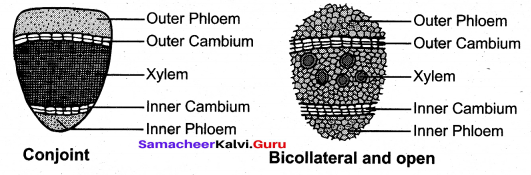
  • Diffuse: A trailing stem with spreading branches, e.g., Boerhaavia diffusa, Merremia
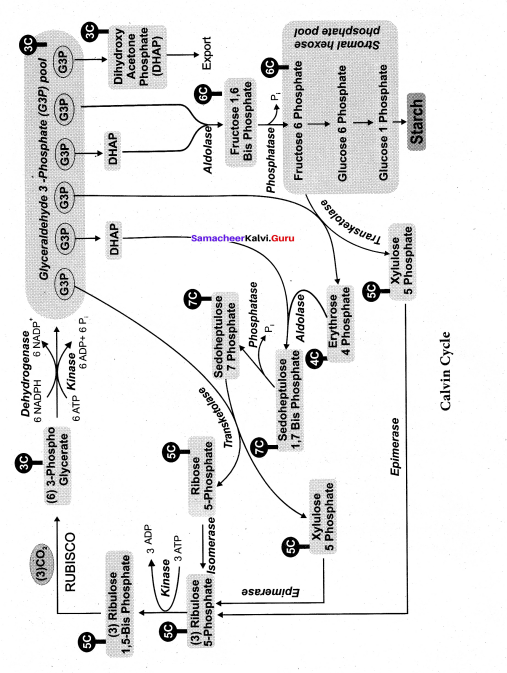
    tridentata

3. Climbers: These plants have long weak stem and produce special organs for attachment , for climbing over a support. Climbing helps to display the leaves towards sunlight and to
position the flower for effective pollination.

i. Root climbers: Plants climbing with the help of adventitious roots (arise from nodes) as in species of Piper betel, Piper nigrum, Hedera helix, Pothos, Hoy a.

ii. Stem climbers (twiners): These climbers lack specialised structure for climbing and the stem itself coils around the support, e.g., Ipomoea, Convolvulus, Dolichos, Clitoria, Quisqualis.
Stem climbers may coil around the support clockwise or anti-clockwise. Clockwise coiling climbers are called dextrose. Example: Dioscorea alata. Anti-clockwise coiling climbers are called sinistrose. e.g., Dioscorea bulbifera.

iii. Hook climbers: These plants produce specialized hook like structures which are the modification of various organs of the plant. In Artabotrys inflorescence axis is modified into hook. In calamus (curved hook) leaf tip is modified into hook. In Bignonia unguis- cati the leaflets are modified into curved hook. In Hugonia the axillary buds modified into hook.

iv. Thorn climbers: Climbing or reclining on the support with the help of thorns as in Bougainvillea and Carissa.

v. Lianas (woody stem climber): Woody perennial climbers found in tropical forests are lianas. They twine themselves around tall trees to get light, e.g., Hiptage benghalensis, Bauhinia vahlii, Entada pursaetha.

vi. Tendril climbers: Tendrils are thread-like coiling structures which help the plants in climbing. Tendrils may be modifications of Stem – as in Passiflora, Vitis and Cissus quadrangularis; Inflorescence axis – Antigonon; Leaf – Lathyrus, Leaflets – Pisum sativum; Petiole – Clematis; Leaftip – Gloriosa; Stipules – Smilax. In pitcher plant (Nepenthes) the midrib of the leaf often coils around a support like a tendril and holds the pitcher in a vertical position.

[OR]

The plants also having the hormones like human being. What are they? Explain the physiological effect of any one.
Answer:
The plants also having the hormones like human being. They are called Phylohormones.
Example: Giberillin, Auxin, Cytokinin, ethylene, Abscissic acid.
Physiological effect of of Cytokinins:

  • Cytokinin promotes cell division in the presence of auxin (IAA).
  • Induces cell enlargement associated with IAA and gibberellins.
  • Cytokinin can break the dormancy of certain light-sensitive seeds like tobacco and induces seed germination.
  • Cytokinin promotes the growth of lateral bud in the presence of apical bud.
  • Application of cytokinin delays the process of aging by nutrient mobilization. It is known as Richmond Lang effect.
  • Cytokinin (i) increases rate protein synthesis (ii) induces the formation of inter-fascicular cambium, (iii) Overcomes apical dominance  (iv) induces formation of new leaves, chloroplast and lateral shoots.
  • Plants accumulate solutes very actively with the help of cytokinins.

Question 21.
Explain the Calvin Cycle (Flow chart only).
Answer:
Tamil Nadu 11th Biology Previous Year Question Paper June 2019 English Medium - 5

[OR]

Draw the outline of Bentham & Hooker classification.
Answer:
Tamil Nadu 11th Biology Previous Year Question Paper June 2019 English Medium - 6

Bio-Zoology[Maximum Marks: 35]

Part – I

Answer all the questions. [8 x 1 = 8]

Choose the most appropriate answer from the given four alternative and write the option code and the corresponding answer.

Question 1.
Every unit of classification regardless of its rank is ………………
(a) Taxon
(b) Variety
(c) Species
(d) Strain
Answer:
(a) Taxon

Question 2.
The zoological name of National Bird is ……………..
(a) Pavo Cristatus
(b) Zoothera Salimalii
(c) Columba livia
(d) Chalcophaps indiva
Answer:
(a) Pavo Cristatus

Question 3.
Which one of the following is not true to simple epithelial tissue?
(a) It is composed of a single layer of cells.
(b) Squamous epithelium is a type of simple epithelium which has flattened cells.
(c) Simple epithelium covers dry surface of the skin.
(d) Pseudo-stratified is a type of simple epithelium which lines the epididymis.
Answer:
(d) Pseudo-stratified is a type of simple epithelium which lines the epididymis.

Question 4.
Which plasma protein is involved in the coagulation of blood ?
(a) Globulin
(b) Fibrinogen
(c) Albumin
(d) Serum amylase
Answer:
(b) Fibrinogen

Question 5.
Match Column-I with Column-II and choose the correct option.
Tamil Nadu 11th Biology Previous Year Question Paper June 2019 English Medium - 7
Tamil Nadu 11th Biology Previous Year Question Paper June 2019 English Medium - 8
Answer:
(c) p – (iv), Q – (iii), R – (ii),  S – (i)

Question 6.
Which one of the following diseases is caused due to our own body antibodies act against our own body substance?
(a) Tetany
(b) Osteoporosis
(c) Myasthenia gravis
(d) Gout
Answer:
(c) Myasthenia gravis

Question 7.
Silk is obtained from ………………
(a) Laccifer lacca
(b) Nosema bombycis
(c) Attacus ricini
(d) Attacus mvlitta
Answer:
(d) Attacus mvlitta

Question 8.
The good egg layers and delicious breed is ………………..
(a) Chittagong
(b) Leghorn
(c) Plymouth
(d) Aseel
Answer:
(a) Chittagong

Part – II

Answer any four of the following questions. [4 × 2 = 8]

Question 9.
Differentiate between closed type and open type of circulatory system.
Answer:
Closed circulatory system :

  1. The circulation in which lood is present inside the blood vessels is called closed circulatory system
  2. It is found in higher organisms. e.g. annelids. cephalochordates and vertebrates.

Open circulatory system

  1. The circulation in which blood remains filled in tissue spaces due to the absence of blood vessels is called open circulatory system
  2. It is found in lower organisms. e.g. arthropods, molluscsand echinoderms

Question 10.
How does gall stones are formed?
Answer:
Any alteration in the composition of the bile can cause the formation of stones in the gall bladder. The stones are mostly formed of crystallized cholesterol in the bile. The gall stone causes obstruction in the cystic duct, hepatic duct and also hepato-pancreatic duct causing pain, jaundice and pancreatitis.

Question 11.
At Tuticorin region, the pearl oyster diving people have some changes in their blood. State the reasons for it.
Answer:
When a person descends deep into the sea, the pressure in the surrounding water increases which causes the lungs to decrease in volume. This decrease in volume increases the partial pressure of the gases within the lungs. This effect can be beneficial, because it tends to drive additional oxygen into the circulation, but this benefit also has a risk, the increased pressure can also drive nitrogen gas into the circulation.

This increase in blood nitrogen content can lead to a condition called nitrogen narcosis. When the diver ascends to the surface too quickly a condition called ‘bends’ or decompression sickness occurs and nitrogen comes out of solution while stilUin the blood forming bubbles. Small bubbles in the blood are not harmful, but large bubbles can lodge in small capillaries, blocking blood flow or can press on nerve endings.

Decompression sickness is associated with pain in joints and muscles and neurological problems including stroke. The risk of nitrogen narcosis and bends is common in scuba divers.

Question 12.
Depolarization means reversal of polarity. Mention the iconic charge of both sides of axolemma.
Answer:
Depolarization – Reversal of polarity
When a nerve fibre is stimulated, sodium voltage-gate opens and makes the axolemma permeable to Na+ ions; meanwhile the potassium voltage gate closes. As a result, the rate of flow of Na+ ions into the axoplasm exceeds the rate of flow of K+ ions to the outside fluid [ECF], Therefore, the axolemma becomes positively charged inside and negatively charged outside. This reversal of electrical charge is called Depolarization.

Question 13.
Expand the word SMGA and write its uses.
Answer:
Skeletal Muscle Glycogen Analysis (SMGA) – Used to measure an Athlete’s sporting performance by taking muscle biopsies. It is a standard method to measure muscle glycogen. Muscle glycogen provides the main source of energy during anaerobic exercise. Furthermore, total glycogen stores within the body also contribute significantly to energy metabolism in endurance-type events lasting longer in duration. A single glycogen molecule may contain 5000 glucose units compared to that of 5000 individual glucose molecules.

Question 14.
In your class various height of students over there. Why so? Write the reason.
Answer:
Students in the class are of different heights because of the secretion of growth hormone. Those students who are of maximum height secrete more growth hormone and those students , with low secretion of growth hormone are dwarf or reduced in growth, because growth hormone promotes the growth of all tissue and metabolic processes of body.

Part – III

Answer any three questions in which question number 19 is compulsory. [3 × 3 = 9]

Question 15.
Hemichordates posses the characters of echinoderms and chordates. Write any 3 characters of echinoderms as well as chordates seen in hemichordates.
Answer:
Three character of echinoderms seen in hemichordates.

  1. Hemichordates are marine habitats.
  2. Circulatory system is open type.
  3. External fertilization.

Three character of chordates seen in hemichordates.

  1. Sexes are separate.
  2. Triploblastic animals.
  3. Coelomate animals.

Question 16.
Name the visual units of compound eyes of cockroach.
Answer:
Ommatidium (simple eye) is the visual unit of compound eye of cockroach. Each eye of cockroach has 2000 simple eys or ommatidia.

Question 17.
Give an examples for stenohaline and euryhaline.
Answer:
Example of stenohaline animal is Gold fish.
Example for euryhaline animals is Salmon.

Question 18.
Brain is the chief organ of our body. It controls endocrine function by a special structure. What is the name of it ? How does it control ?
Answer:
Brain controls the endocrine system of our body by a special structure called hypothalamus. Hypothalamus is a small cone shaped structure that projects downward from the brain ending into the pituitary stalk. It interlinks both the nervous system and endocrine system.

Though pituitary gland is known as master endocrine glands that controls the other endocrine glands, but it is, in turn controlled by the hypothalamus. Hypothalamus contains groups of neurosecretary cells. It produces neurotransmitters which regulate the secretions of the pituitary. The hormones produced by the hypothalamus acts either as a releasing hormone or as a inhibitory hormone.

Question 19.
Write the different types of silkworm in our country.
Answer:
Different types of silkworm in our country are,

  1. Bombyx mori
  2. Antheraea assamensis
  3. Antheraea mylitta
  4. Attacus ricini

Part – IV

Answer all the questions. [2 × 5 = 10]

Question 20.
Write a short note on buccal cavity of Frog.
Answer:
The alimentary canal consists of the buccal cavity, pharynx, oesophagus, duodenum, ileum and the rectum which leads to the cloaca and opens outside by the cloacal aperture. The wide mouth opens into the buccal cavity. On the floor of the buccal cavity lies a large muscular sticky tongue. The tongue is attached in front and free behind. The free edge is forked. When the frog sights an insect it flicks out its tongue and the insect gets glued to the sticky tongue. The tongue is immediately withdrawn and the mouth closes.

A row of small and pointed maxillary teeth is found on the inner region of the upper jaw. In addition vomerine teeth are also present as two groups, one on each side of the internal nostrils. The lower jaw is devoid of teeth. The mouth opens into the buccal cavity that leads to the oesophagus through the pharynx.
Tamil Nadu 11th Biology Previous Year Question Paper June 2019 English Medium - 9

[OR]

Explain the refractive errors of eye.
Answer:
Refractive errors of eye:
Myopia (near sightedness): The affected person can see the nearby objects but not the distant objects. This condition may result due to an elongated eyeball or thickened lens; so that the image of distant object is formed in front of the yellow spot. This error can be corrected using concave lens that diverge the entering light rays and focuses it on the retina.

Hypermetropia (long sightedness): the affected person can see only the distant objects clearly but not the objects nearby. This condition results due to a shortened eyeball and thin lens; so the image of closest object is converged behind the retina. This defect can be overcome by using convex lens that converge the entering light rays on the retina.

Presbyopia: Due to aging, the lens loses elasticity and the power of accommodation. Convex lenses are used to correct this defect.
Astigmatism is due to the rough (irregular) curvature of cornea or lens. Cylindrical glasses are used to correct this error.
Cataract: Due to the changes in nature of protein, the lens becomes opaque. It can be corrected by surgical procedures.
Tamil Nadu 11th Biology Previous Year Question Paper June 2019 English Medium - 10

Question 21.
Kidney functioning is regulated by hormonal feedback control mechanism. Explain this mechanism.
Answer:
Antidiuretic hormone or Vasopressin, juxtaglomerular apparatus and atrial natriuretic factor regulate the kidney function.

Antidiuretic hormone or Vasopressin: When there is excessive loss of fluid from the body or when there is an increase in the blood pressure, the osmoreceptors of the hypothalamus stimulates the neurohypophysis to secrete the antidiuretic hormone or vasopressin. It facilitates reabsorption of water by increasing the number of aquaporins on the cell surface membrane of the distal convoluted tubule and collecting duct.

When the water loss from the body is less or when you drink excess amount of juice, osmoreceptors stop secreting ADH and the aquaporins of the collecting ducts move into the cytoplasm. Hence dilute urine is produced to maintain the blood volume.

Renin angiotensin: Juxtaglomerular apparatus (JGA) is a specialized tissue in the afferent arteriole of the nephron. It consists of macula densa and granular cells. The macula dcnsa cells sense distal tubular flow and affect afferent arteriole diameter. The granular cells secrete an enzyme called renin. A fall in glomerular blood flow, glomerular blood pressure and glomerular filtration rate, can activate JG cells to release renin. This converts angiotensinogen into angiotensin-I. Angiotensin converting enzyme converts angiotensin-I to angiotensin-II.

Angiotensin-II stimulates Na+ reabsorption in the proximal convoluted tubule by vasoconstriction of the blood vessels and increases the glomerular blood pressure. Angiotensin-II stimulate adrenal cortex to secrete aldosterone that causes reabsorption of Na+, K+ excretion and absorption of water from the distal convoluted tubule and collecting duct. This increases the glomerular blood pressure and glomerular filtration rate. This complex mechanism is generally known as Renin-Angiotensin-Aldosterone System (RAAS).
Tamil Nadu 11th Biology Previous Year Question Paper June 2019 English Medium - 11

Atrial natriuretic factor: Excessive stretch of cardiac atrial cells cause an increase in blood flow to the atria of the heart and release Atrial Natriuretic Peptide or Factor (ANF). It travels to the kidney where it increases Na+ excretion and increases the blood flow to the glomerulus, acting as vasodilator on the afferent glomerular arterioles and as a vasoconstrictor on efferent arterioles.

It decreases aldosterone release from the adrenal cortex and decreases release of renin, thereby decreasing angiotensin-II. ANF acts antagonistically to the renin-angiotensin system, aldosterone and vasopressin.

[OR]

Explain, how the combination of aquaculture and hydroponics techniques can be successfully executed in our homes.
Aquaponics is a technique which is a combination of aquaculture (growing fish) and hydroponics (growing plants in non-soil media and nutrient-laden water). Aquaponics may also prevent toxic water runoff. It also maintains ecosystem balance by recycling the waste and excretory products produced by the fish. In India, aquaponics was started in 2013. Some primary methods of aquaponic gardening that are in use nowadays are as follows:

1. Deep water culture is otherwise known as raft based method. In this method a raft floats in water. Plants are kept in the holes of raft and the roots float in water. This method is applicable for larger commercial scale system. By this method fast growing plants are cultivated.

2. Media based method involves growing plants in inert planting media like clay pellets or shales. This method is applicable for home and hobby scale system. Larger number of fruiting plants, leafy green plants, herbs and other varieties of plants can be cultivated.

3. Nutrient Film technique involves the passage of nutrient rich water through a narrow trough or PVC pipe. Plants are kept in the holes of the pipe to allow the roots to be in free contact with in the water stream.

4. Aqua vertica is otherwise known as vertical aquaponics. Plants are stacked on the top of each other in tower systems. Water flows in through the top of the tower. This method is suitable for growing leafy greens, strawberries and other crops that do not need supporting solid substratum to grow.

Advantages of Aquaponic gardening Water conservation: No need of water discharge and recharge as the water is maintained by recycling process.

Soil: Bottom soil may be loaded with freshwater. Microbes in water can convert the waste materials into usable forms like ammonia into nitrates which are used by the plants. Thus the soil fertility is maintained.

Pesticides: In this system use of pesticides is avoided and hence it is ecofriendly.
Weeds: Since the plants are cultured in confined conditions, growth of weeds is completely absent. The utilization of nutrient by plants is high in this method.

Artificial food for fishes: In this system plant waste and decays are utilized by fishes as food. So, the need for the use of supplementary feed can be minimized.

Fertilizer usage: Artificial or chemical fertilizers is not required for this system since the plants in the aquaponics utilize the nutrients from the fish wastes dissolved in water. Cultivable fishes like tilapia, trout, koi, gold fish, bass etc., are cultured in aquaponics. Common cultivable plants like tomato, pepper, lettuce, cucumber, and rose are co-cultivated in this method.

Tamil Nadu 11th Biology Previous Year Question Paper March 2019 English Medium

Students can Download Tamil Nadu 11th Biology Previous Year Question Paper March 2019 English Medium Pdf, Tamil Nadu 11th Biology Model Question Papers helps you to revise the complete Tamilnadu State Board New Syllabus and score more marks in your examinations.

TN State Board 11th Biology Previous Year Question Paper March 2019 English Medium

Instructions:

  1. The question paper comprises of four parts Questions for Botany and Zoology are asked separately.
  2. You are to attempt all the parts. An internal choice of questions is provided wherever applicable.
  3. All questions of Part I, II, III, and IV are to be attempted separately.
  4. Question numbers 1 to 8 in Part I are Multiple Choice Questions of one mark each. These are to be answered by choosing the most suitable answer from the given four alternatives and Writing the option code and the Corresponding answer.
  5. Question numbers 9 to  4 in Part II are two-marks questions. This also is answered in about one or list sentences.
  6. Question numbers 15 to 19 in Part III are three-marks questions These are to be answered in about three to five short sentences.
  7. Question numbers 20 and 21 in Part  IV are five-marks questions. These are to be answered in detail Draw diagrams wherever necessary.

Time: 3 Hours
Maximum Marks: 70

Bio-Botany [Maximum Marks: 35]

Part – I

Answer all the questions. Choose the correct answer.  [8 × 1 = 8]

Choose the most appropriate answer from the given four alternative and write the option code and the corresponding answer.

Question 1.
For every CO2 molecule entering the C3 cycle, the number of ATP and NADPH required is ………………….
(a) 3 ATP + 2 NADPH
(b) 3 ATP + 3 NADPH
(c) 2 ATP + 2 NADPH
(d) 2 ATP + 3 NADPH
Answer:
(a) 3 ATP + 2 NADPH

Tamil Nadu 11th Biology Previous Year Question Paper March 2019 English Medium

Question 2.
If the haploid number of chromosomes for an angiosperm is 14, then the number of chromosome in its endosperm would be………………….
(a) 42
(b) 28
(c) 7
(d) 14
Answer:
(a) 42

Question 3.
Vexillary aestivation is characteristic feature of ……………….family.
(a) Solanaceae
(b) Brassicaceae
(c) Fabaceae
(d) Asteraceae
Answer:
(c) Fabaceae

Tamil Nadu 11th Biology Previous Year Question Paper March 2019 English Medium

Question 4.
Which of the following represents symport?
Tamil Nadu 11th Biology Previous Year Question Paper March 2019 English Medium - 1
Answer:
Tamil Nadu 11th Biology Previous Year Question Paper March 2019 English Medium - 2

Question 5.
Tamil Nadu 11th Biology Previous Year Question Paper March 2019 English Medium - 3
Answer:
The above structure represents a …………………..
(a) Polynucleotide
(b) Amino acid
(c) Nucleoside
(d) Nucleotide
Answer:
(d) Nucleotide

Question 6.
The pairing of Homologous chromosomes on Meiosis is known as …………………..
(a) Disjunction
(b) Synergids
(c) Bivalent
(d) Synapsis
Answer:
(d) Synapsis

Tamil Nadu 11th Biology Previous Year Question Paper March 2019 English Medium

Question 7.
Photosynthetic roots are seen in …………………..
(a) Vanda
(b) Tinospora
(c) Cuscuta
(d) Viscum
Answer:
(b) Tinospora

Question 8.
Match:
Tamil Nadu 11th Biology Previous Year Question Paper March 2019 English Medium - 4
(a) (1 )-(iii), (2)-(iv), (3)-(ii), (4)-(i)
(b) (1)-(iii), (2)-(ii), (3)-(i), (4)-(iv)
(c) (1)-(iv), (2)-(ii), (3)-(iii), (4)-(i)
(d) (1)-(i), (2)-(iv), (3)-(iii), (4)-(ii)
Answer:
(a) (1 )-(iii), (2)-(iv), (3)-(ii), (4)-(i)

Part – II

Answer any four of the following questions. [4 × 2 = 8]

Question 9.
(a) What is Plectostele? Give an example.
(b) Mention any one character shared by gymnosperms and angiosperms.
Answer:
(a) Plectostele: Xylem plates alternates with phloem plates, e.g., Lycopodium clavatum.

(b) Gymnosperms :

  1. Vessels are absent (except Gnetales)
  2. Phloem lacks companion cells

Angiosperms :

  1. Vessels are present
  2. Companion cells are present

Question 10.
List the primary ftmctions of Leaf.
Answer:
Primary functions of the leaf:

  1. Photosynthesis
  2. Transpiration
  3. Gaseous exchange
  4. Protection of buds
  5. Conduction of water and dissolved solutes

Tamil Nadu 11th Biology Previous Year Question Paper March 2019 English Medium

Question 11.
A series of events leading to the formation of new cell is known as Cell Cycle. Give the diagrammatic view of Cell Cycle.
Answer:
Tamil Nadu 11th Biology Previous Year Question Paper March 2019 English Medium - 5

Question 12.
Name the following diagrams.
Answer:
Tamil Nadu 11th Biology Previous Year Question Paper March 2019 English Medium - 6

Question 13.
Mention the different types of plasmolysis seen in plant cells.
Answer:

  1. Incipient plasmolysis
  2. Evident plasmolysis and
  3. Final plasmolysis.

Tamil Nadu 11th Biology Previous Year Question Paper March 2019 English Medium

Question 14.
Tabulate any two differences between Cyclic and Non-Cyclic photophosphorylation.
Answer:
Differences between Cyclic Photophosphorylation and Non-Cyclic Photophosphorylation:

Cyclic Photophosphorylation :

  1. PS I only involved.
  2. Photolysis of water does not take place.

Non-Cyclic Photophosphorylation :

  1. PS I and PS II involved.
  2. Photolysis of water takes place.

Tamil Nadu 11th Biology Previous Year Question Paper March 2019 English Medium

Part – III

Answer any 3 questions. Question No. 19 is compulsory. [3 × 3 = 9]

Question 15.
Explain the different types of placentation with example.
Answer:

  • Marginal placentation: It is with the placentae along the margin of a unicarpellate ovary. e.g., Fabaceae.
  • Axile placentation: The placentae arises from the column in a compound ovary with septa. e.g., Hibiscus, tomato and lemon.
  • Superficial placentation: Ovules arise from the surface of the septa, e.g., Nyrhphaeceae.
  • Parietal: It is the placentae on the ovary walls or upon intruding partitions of a unilocular, compound ovary, e.g., Mustard, argemone and cucumber.
  • Free-central placentation: It is with the placentae along the column in a compound ovary without septa, e.g., Caryophyllaceae, Dianthus and primrose.
  • Basal: It is the placenta at the base of the ovary, e.g, Sunflower (Asteraceae) Marigold.

Question 16.
(a) Draw and label the structure of Mitochondria.
(b) Why Mitochondria is called as ‘the power house of a cell’?
Answer:
(a) Structure of Mitochondrion:
Tamil Nadu 11th Biology Previous Year Question Paper March 2019 English Medium - 7
(b) Since huge amount of energy is generated in mitochondria in the form of ATP molecules they are called ‘power house of the cell’.

Question 17.
A transverse section of the trunk of a tree shows concentric rings which are known as growth rings. What are the significances of studying about these rings ?
Answer:

  • Age of wood can be calculated
  • The quality of timber can be ascertained
  • Radio-Carbon dating can be verified
  • Past climate and archaeological dating can be made.
  • Provides evidence in forensic investigation

Tamil Nadu 11th Biology Previous Year Question Paper March 2019 English Medium

Question 18.
(a) What is the formula for Respiratory Quotient?
(b) Write any two significances of Pentose Phosphate Pathway.
Answer:
(a) Formula for Respiratory Quotient:
Tamil Nadu 11th Biology Previous Year Question Paper March 2019 English Medium - 8

(b) Significances of Pentose Phosphate Pathway:

  • HMP shunt is associated with the generation of two important products, NADPH and pentose sugars, which play a vital role in anabolic reactions.
  • Coenzyme NADPH generated is used for reductive biosynthesis and counter damaging the effects of oxygen free radicals

Question 19.
(a) The equations given below represent the different stages of Nitrogen Cycle in plants.
Tamil Nadu 11th Biology Previous Year Question Paper March 2019 English Medium - 9
In the above equations [A], [B], [C] indicate the bacteria which is responsible for the reaction. Name them.
(b) Define Denitrification.
(c) Which enzyme is required for Nitrogen fixation?
Answer:
(a) (i) A – Nitrosomonas
(ii) B – Nitrobacter
(iii) C – Pseudomonas
(b) Denitrification: Nitrates in the soil are converted back into atmospheric nitrogen by a process called denitrification. Bacteria involved in this process are Pseudomonas, Thiobacillus and Bacillus subtilis.
Tamil Nadu 11th Biology Previous Year Question Paper March 2019 English Medium - 10
(c) Enzyme required for Nitrogen fixation: Nitrate Reductase, Nitrite Reductase

Tamil Nadu 11th Biology Previous Year Question Paper March 2019 English Medium

Part – IV

Answer all the questions. [2 × 5 = 10]

Question 20.
(a) (i) A Danish Physician, Christian Gram developed a staining procedure to differentiate bacteria. List the various steps involved in that procedure.
(ii) Distinguish between Deoxy viruses and Ribo viruses with example.
[OR]
(b) Describe the Floral characters of Allium Cepa with a neat floral diagram.
Answer:
(a) (i) Gram staining Techniques :

  1. Prepare a smear of bacterial culture.
  2. Stain with crystal violet for 30 seconds
  3. Rinse in distilled water for 2 seconds
  4. Grams Iodine for 1 minute
  5. Rinse in distilled water
  6. Wash in 95% ethanol or acetone for 10 to 30 seconds
  7. Rinse in distilled water
  8. Safranin for 30-60seconds
  9. Rinse in distilled water and blot
  10. Observe under microscope

(ii) Deoxy viruses
Viruses having DNA are called deoxyviruses. E.g. Animal viruses except HIV

Ribo viruses :
Viruses having RNA are called riboviruses. E.g. Plant viruses except cauliflower mosaic vims (CMV)

Tamil Nadu 11th Biology Previous Year Question Paper March 2019 English Medium

[OR]

(b) Floral Characters of Allium cepa:
Answer:

  • Habit: Perennial herb with bulb.
  • Root: Fibrous adventitious root system
  • Stem: Underground bulb
  • Leaf: A cluster of radical leaves emerges from the underground bulb, cylindrical and fleshy having sheathy leaf bases with parallel venation.
  • Inflorescence: Scapigerous i.e. the inflorescence axis (peduncle) arising from the ground bearing a cluster of flowers at its apex. Pedicels are of equal length, arising from the apex of the peduncle which brings all flowers at the same level.
  • Flower: Small, white, bracteate, bracteolate, pedicellate, complete, trimerous, actinomorphic and hypogynous. Flowers are protandrous.
  • Perianth: Tepals 6, white, arranged in two whorls of three each, syntepalous showing valvate aestivation.
  • Androecium: Stamens 6, arranged in two whorls of three each, epitepalous, apostamenous / free and opposite to tepals. Anthers dithecous, basifixed, introse and dehiscing longitudinally.
  • Gynoecium: Tricarpellary and syncarpous. Ovary superior, trilocular with two ovules in each locule on axile placentation. Style simple, slender with simple stigma.
  • Fruit: A loculicidal capsule.
  • Seed: Endospermous .
  • Floral Formula:
    Tamil Nadu 11th Biology Previous Year Question Paper March 2019 English Medium - 11
    Tamil Nadu 11th Biology Previous Year Question Paper March 2019 English Medium - 12

Question 21.
(a) (i) Draw and label the internal structure of Nerium leaf
(ii) Name the following Vascular Bundle.
Answer:
Tamil Nadu 11th Biology Previous Year Question Paper March 2019 English Medium - 13

(b) (i) Write any four points regarding Physiological effects of cytokinins.
(ii) Define Vernalisation.
Tamil Nadu 11th Biology Previous Year Question Paper March 2019 English Medium - 14
In the above representation, what does Pr and Pfr stand for?
Answer:
(a) (i) Internal structure of Nerium leaf:
Tamil Nadu 11th Biology Previous Year Question Paper March 2019 English Medium - 15

(ii) Vascular Bundle :
(A) Concentric Amphivasal vascular bundle
(B) Radial arrangement

Tamil Nadu 11th Biology Previous Year Question Paper March 2019 English Medium

[OR]

(b) (i) Physiological effects of cytokinins:

  • Cytokinin promotes cell division in the presence of auxin (IAA)
  • Cytokinin can break the dormancy of certain light-sensitive seeds like tobacco and induces seed germination
  • Cytokinin promotes the growth of lateral bud in the presence of apical bud
  • Cytokinin (i) increases rate of protein synthesis (ii) induces the formation of inter-fascicular cambium (iii) overcomes apical dominance (iv) induces formation of new leaves, chloroplast and lateral shoots.

(ii) Vernalisation: Many species of biennials and perennials are induced to flower by low temperature exposure (0°C to 5°C). This process is called vernalization. The term vernalization was first used by T.D. Lysenko (1938).

(iii) Pr – Phytochrome red (660 nm)
Pfr– Phytochrome far red(730 nm)

Bio-Zoology[Maximum Marks: 35]

Part – I

Answer all the questions. [8 × 1 = 8]

Choose the most appropriate answer from the given four alternative and write the option code and the corresponding answer.

Question 1.
Vital Capacity is ………………………………
(a) RV + ERV
(b) TV + IRV + ERV
(c) TV + IRV
(d) TV + ERV
Answer:
(b) TV + IRV + ERV

Question 2.
When a cockroach tries to enter into the ear of a sleeping person, which one of the following process will start ?
(a) Stimulation of negative feedback mechanism
(b) Neuromuscular fatigue
(c) Unconditioned reflex
(d) Conditioned reflex
Answer:
(c) Unconditioned reflex

Tamil Nadu 11th Biology Previous Year Question Paper March 2019 English Medium

Question 3.
Which one of the following is correct pair ?
(a) Exotic breed – Cyprinus Carpio
(b) Apiculture – Reeling
(c) Sericulture – Propolis
(d) Milch breed – Malvi
Answer:
(a) Exotic breed – Cyprinus Carpio

Question 4.
If Henle ’s Loop were absent from mammalian nephron, which one of the following is to be expected ?
(a) The urine will be more concentrated
(b) The urine will be more diluted
(c) There will be no urine formation
(d) There will be hardly any change in the quality and quantity of urine formed
Answer:
(b) The urine will be more diluted

Question 5.
The cytoplasm of the muscle fibre is called …………………….
(a) Myofibril
(b) Sarcoplasm
(c) Sarcomere
(d) Sarcolemma
Answer:
(b) Sarcoplasm

Question 6.
Three domain classification was proposed by
(a) Cavalier Smith
(b) R.H. Whittaker
(c) Carolus Linnaeus
(d) Carl Woese
Answer:
(d) Carl Woese

Tamil Nadu 11th Biology Previous Year Question Paper March 2019 English Medium

Question 7.
Which of the statements regarding lac insect is True ?
(i) Microscopic resinous crawling scale insect.
(ii) Inserts its proboscis into plant tissue, suck juices and grows.
(iii) Secretes lac from the hind end of the body.
(iv) The male lac insect is responsible for large scale production of lac.
(a) (ii), (i) and (iv) are correct
(b) (i), (iii) and (iv) are correct
(c) (i), (ii) and (iii) are correct
(d) (ii), (iii) and (iv) are correct
Answer:
(c) (i), (ii) and (iii) are correct

Question 8.
Which of the following is not present in the same rank ?
(a) Diptera
(b) Insecta
(c) Primata
(d) Orthoptera
Answer:
(c) Primata

Tamil Nadu 11th Biology Previous Year Question Paper March 2019 English Medium

Part – II

Answer any four of the following questions. [4 × 2 = 8]

Question 9.
Classify the animals based on the body cavity.
Answer:
The cavity between the body wall and the gut wall is called coelom. In some animals, the body cavity is not fully lined by the mesodermal epithelium. The mesoderm is formed as scattered pouches between the ectoderm and endoderm. Such a body cavity is called a pseudocoel. The animals which have pseudocoel e.g. round worms.

If the coelom develops within the mesoderm and is lined by mesodermal epithelium it is called eucoelom. The animals which have true coelom are called eucoelomates. If the body cavity is formed by splitting of mesoderm, the animals are called schizocoelomates. e.g., Annelids, arthropods and molluscs. If the body cavity is formed from the mesodermal pouches of archenteron, the animals are called enterocoelomate animals, e.g., echinoderms, hemichordates and chordates.

Question 10.
Name the layers found in Human Blood Vessels.
Answer:

  • The blood vessels in humans are composed of three layers, tunica intima, tunica media and tunica externa.
  • The inner layer, tunica intima or tunica interna supports the vascular endothelium, the middle layer.
  • Tunica media is composed of smooth muscles and an extra cellular matrix which contains a protein, elastin.
  • The outer layer, tunica externa or tunica adventitia is composed of collagen fibres.

Question 11.
We are not consuming urea. But in our body urea is produced. Why?
Answer:
If too much of protein is consumed, the body cannot store the excess amino acids formed from the digestion of proteins. The liver breaks down the excess amino acids and produces urea.

Tamil Nadu 11th Biology Previous Year Question Paper March 2019 English Medium

Question 12.
List the disorders of muscular system.
Answer:
Myasthenia gravis, tetany, muscle fatigue, atrophy, muscle pull and muscular dystrophy are the disorders of muscular system.

Question 13.
Do you know your lower limb segments ? Write the 3 segments of lower limb.
Answer:

  • Hinge joint which is the knee joint
  • Gliding joint is between the tarsals
  • Ball and socket joint which is between femur and hip bone
  • Saddle joint is between the tarsal and metatarsal

Question 14.
Name the three zones which are present in Adrenal gland.
Answer:

  • Zona glomerulosa : The outer thin layer constitutes about 15% of adrenal cortex, and secretes mineralocorticoids.
  • Zona fasciculata: The middle widest layer constitutes about 75% of adrenal cortex and secretes glucocorticoids such as cortisol, corticosterone and trace amounts of adrenal androgen and oestrogen.
  • Zona reticularis: The inner zone of adrenal cortex constitute about 10% of adrenal cortex and secretes the adrenal androgen, trace amount of oestrogen and glucocorticoids.

Part – III

Answer any three questions in which question number 19 is compulsory. [3 × 3 = 9]

Question 15.
Compare the anatomical features between Phylum Annelida and Arthropoda.
Answer:
Tamil Nadu 11th Biology Previous Year Question Paper March 2019 English Medium - 16

Question 16.
Why do we call cockroach a vector ?
Answer:
Cockroaches carry with them harmful germs of various bacterial diseases like cholera, diarrhoea, tuberculosis, and typhoid and hence are known as “Vectors”.

Question 17.
Why, villi present in the intestine, are not present in the stomach?
Answer:
In small intestine digestion gets completed and the absorption of digested food materials like glucose, amino acids, fatty acids and glycerol takes place. The food materials are to be retained in the intestine by increasing the surface area. Hence villi are present in the intestine. Stomach is the temporary storing organ of food. In the stomach, HCl pepsin, renin and lipase are secreted. These are concerned with digestion. Hence villi are not present in the stomach.

Tamil Nadu 11th Biology Previous Year Question Paper March 2019 English Medium

Question 18.
Enumerate the benefits of Poultry Farming.
Answer:
Benefits of Poultry farming are:

  • It does not require high capital for construction and maintenance of the poultry farming.
  • It does not require a big space.
  • It ensures high return of investment within a very short period of time.
  • It provides fresh and nutritious food and has a huge global demand.
  • It provides employment opportunities for the people.

Question 19.
Pituitary gland is commonly called “master gland” of the body. Why?
Answer:
Pituitary gland is commonly called the master gland” of the body because it regulates the activity of other endocrine glands such as adrenal gland, thyroid gland, testis and ovary.

Part – IV

Answer all the questions. [2 × 5 = 10]

Question 20.
Write the kingdom, phylum and class for Pigeon. Write the characteristics of birds that are suitable for flying.
Answer:

  • Kigdom : Animalia
  • Phylum: chordata
  • Class : Aves
  • The forelimbs are modified into wings,
  • The hind limbs are adapted for walking, running, and swimming and perching.
  • The endoskeleton is fully ossified (bony) and the long bones are hollow with air cavities.
  • The pectoral muscles of flight (pectoralis major and pectoralis minor) are well developed.
  • The skin is dry and devoid of glands except the oil gland or preen gland at the base of the tail.
  • The exoskeleton consists of epidermal feathers, scales, claws on legs and the homy covering on the beak.
  • Respiration is by compact, elastic, spongy lungs that are continuous with air sacs to supplement respiration.
  • The heart is four chambered. Aves are homeothermic.
  • Urinary bladder is absent.

Tamil Nadu 11th Biology Previous Year Question Paper March 2019 English Medium

[OR]

In our heart, all the four chambers are completely partitioned. It results in non-mixing of oxygenated blood with deoxygenated blood. Explain the double circulation related to it.
Answer:

  • Circulation of the blood was first described by William Harvey in 1628. There are two types of blood circulation in vertebrates, single circulation and double circulation.
  • The blood circulates twice through the heart first on the right side then on the left side to complete one cardiac cycle.
  • The complete double blood circulation is more prominent in mammals because of the complete partition of all the chambers (Auricles and ventricles) in the heart.
  • In systemic circulation, the oxygenated blood entering the aorta from the left ventricle is carried by a network of arteries, arterioles and capillaries to the tissues. The deoxygenated blood from the tissue.
  • This increases the diffusion distance and reduces the efficiency of the gas exchange.
  • In contrast high pressure is required to force blood through the long systemic circuits.
  • Hence the arteries close to the heart have increased pressure than the arteries away from the heart.
  • Completely separated circuits (pulmonary and systemic) allow these two different demands
    to be met with. ‘

Question 21.
Differentiate between sympathetic and parasympathetic Neural system.
Answer:
Sympathetic Neural system (SNS)

  1. SNS originates in the thoracic and lumbar region of the spinal cord.
  2. Sympathetic ganglia are linked up to form a chain.
  3. Preganglionic fibres are short and the postganglionic fibres are long.
  4. Noradrenaline is produced at the terminal ends of the postganglionic fibres at the effector organs. Hence the system is adrenergic.
  5. Active during stressful conditions preparing the body to face them.
  6. The overall effect is excitatory and stimulating.
  7. It is considered as the flight or fight system.

Parasympathetic Neural system (PNS) :

  1. PNS originates in the cranial region of the brain and the sacral region of the spinal cord.
  2. Its ganglia remain isolated.
  3. Preganglionic fibres are long and the postganglionic fibres are short.
  4. Acetylcholine is produced at the terminal ends of the postganglionic fibres at the effector organs. Hence the system is cholinergic.
  5. Active during relaxing times restoring normal activity after a stress.
  6. The overall effect is inhibitory.
  7. It is considered as ‘The Rest and Digest System’ or ‘The Feed and Breed System’.

Tamil Nadu 11th Biology Previous Year Question Paper March 2019 English Medium

[OR]

Discuss the various techniques adopted in cattle breeding.
Answer:
There are two methods of animal breeding, namely inbreeding and outbreeding

1. Inbreeding: Breeding between animals of the same breed for 4-6 generations is called inbreeding. Inbreeding increases homozygosity and exposes the harmful recessive genes. Continuous inbreeding reduces fertility and even productivity, resulting in “inbreeding depression”. This c^n be avoided by breeding selected animals of the breeding population and they should be mated with superior animals of the same breed but unrelated to the
breeding population. It helps to restore fertility and yield.

2. Outbreeding: The breeding between unrelated animals is called outbreeding. Individuals produced do not have common ancestors for 4-6 generations. Outbreeding helps to produce new and favourable traits, to produce hybrids with superior qualities and helps to create new breeds. New and favourable genes can be introduced into a population through outbreeding.

Out crossing: It is the breeding between unrelated animals of the same breed but having no common ancestry. The offspring of such a cross is called outcross. This method is suitable for breeding animals below average in productivity.

Cross breeding: Breeding between a superior male of one breed with a superior female of another breed. The cross bred progeny has superior traitsfhybrid vigour or heterosis.)

Interspecific hybridization: In this method of breeding mating is between male and female of two different species. The progeny obtained from such crosses are different from their parents, and may possess the desirable traits of the parents. Have you heard about Mule? It was produced by the process of interspecific hybridization between a male donkey and a female horse.

3. Artificial insemination: Artificial insemination is a technique in which the semen collected from the male is injected to the reproductive tract of the selected female. Artificial insemination is economical measure where fewer bulls are required and maximum use can be made of the best sire.

4. Multiple ovulation embryo transfer technology (MOET) : It is another method of propagation of animals with desirable traits. This method is applied when the success rate of crossing is low even after artificial insemination. In this method Follicle stimulating hormone (FSH) is administered to cows for inducing follicular maturation and super ovulation. Instead of one egg per cycle, 6-8 eggs can be produced by this technology.

Tamil Nadu 11th Biology Model Question Paper 3 English Medium

Students can Download Tamil Nadu 11th Biology Model Question Paper 3 English Medium Pdf, Tamil Nadu 11th Biology Model Question Papers helps you to revise the complete Tamilnadu State Board New Syllabus and score more marks in your examinations.

TN State Board 11th Biology Model Question Paper 3 English Medium

Instructions:

  1. The question paper comprises of four parts Questions for Botany and Zoology are asked separately.
  2. You are to attempt all the parts. An internal choice of questions is provided wherever applicable.
  3. All questions of Part I, II, III, and IV are to be attempted separately.
  4. Question numbers 1 to 8 in Part I are Multiple Choice Questions of one mark each. These are to be answered by choosing the most suitable answer from the given four alternatives and Writing the option code and the Corresponding answer.
  5. Question numbers 9 to  4 in Part II are two-marks questions. This also is answered in about one or list sentences.
  6. Question numbers 15 to 19 in Part III are three-marks questions These are to be answered in about three to five short sentences.
  7. Question numbers 20 and 21 in Part  IV are five-marks questions. These are to be answered in detail Draw diagrams wherever necessary.


Time: 3 Hours
Maximum Marks: 70

Bio-Botany [Maximum Marks: 35]

Part – I

Answer all the questions. Choose the correct answer.  [8 × 1 = 8]

Question 1.
Identify the Archaebacterium.
(a) Acetobacter
(b) Erwinia
(c) Treponema
(d) Methanobacterium
Answer:
(d) Methanobacterium

Tamil Nadu 11th Biology Model Question Paper 3 English Medium

Question 2.
Endosperm in gymnosperm is formed ……………….
(a) at the time of fertilization
(b) before fertilization
(c) after fertilization
(d) along with the development of embryo
Answer:
(b) before fertilization

Question 3.
A true fruit is the one, where
(a) only ovary of the flower develops into fruit
(b) ovary and calyx of the flower develops into fruit
(c) ovary, calyx and thalamus of the flower develops into fruit
(d) all floral whorls of the flower develops into fruit
Answer:
(a) only ovary of the flower develops into fruit

Question 4.
Which of the following electron opaque chemical is used in Electron microscope?
(a) Strontium
(b) Deuterium
(c) Palladium
(d) Uranium
Answer:
(c) Palladium

Tamil Nadu 11th Biology Model Question Paper 3 English Medium

Question 5.
In S phase of the cell cycle………………..
(a) Amount of DNA doubles in each cell
(b) Amount of DNA remains same in each cell
(c) Chromosome number is increased
(d) Amount of DNA is reduced to half in each cell
Answer:
(a) Amount of DNA doubles in each cell

Question 6.
Rolling & unrolling of leaves due to whether change are controlled by………………..
(a) Sensory cells
(b) Motor cells
(c) Subsidory cells
(d) Trichomes
Answer:
(b) Motor cells

Question 7.
The inhibitory effect of oxygen in photosynthesis was first discovered by ……………………….
(a) Warburg
(b) Van Helmont
(c) Dutrochet
(d) Desaussure
Answer:
(a) Warburg

Tamil Nadu 11th Biology Model Question Paper 3 English Medium

Question 8.
The most widely occuring cytokinin in plants is ………………
(a) Iso propyl adenine
(b) Iso pentenyl adenine
(c) Indole propionic acid
(d) Iso propionic adenine
Answer:
(b) Iso pentenyl adenine

Part – II

Answer any four of the following questions. [4 × 2 = 8]

Question 9.
Define bacteria and bacteriology.
Answer:
Bacteria are prokaryotic, unicellular, ubiquitous, microscopic organisms. The study of bacteria is called bacteriology.

Question 10.
Why do we use the term ‘form genera’ for fossil plants?
Answer:
The term ‘form genera’ is used to name the fossil plants because the whole plant is not recovered as fossils instead organs or parts of the extinct plants are obtained in fragments.

Question 11.
Where does the inflorescence axis arise in cauliflorous type of inflorescence?
Answer:
In cauliflorous type, inflorescence developed directly from a woody trunk.
Example: Theobroma cocoa.

Question 12.
Compare pinnate (or) unicostate venation and palmate (or) multicostate venation.
Answer:
Pinnate (or) unicostate venation
In pinnate (or) unicostate there is only one prominent midrib.

Palmate (or) multicostate venation
In palmate (or) multicostate there are many midribs running parallel to each other.

Tamil Nadu 11th Biology Model Question Paper 3 English Medium

Question 3.
Draw and label (a) Branchysclereids (b) Osteoclereids
Answer:
Tamil Nadu 11th Biology Model Question Paper 3 English Medium - 1

Question 14.
Nitrogen is a Macronutrient – Justify.
Answer:
Nitrogen (N) is required by the plants in greatest amount. It is an essential component of proteins, nucleic acids, amino acids, vitamins, hormones, alkaloids, chlorophyll and cytochrome.

Part – III

Answer any three questions in which question number 19 is compulsory. [3 × 3 = 9]

Question 15.
How the vascular plants dominate the Earth?
Answer:
The success and dominance of vascular plants is due to the development of,

  • Extensive root system.
  • Efficient conducting tissues.
  • Cuticle to prevent desiccation.
  • Stomata for effective gaseous exchange.

Tamil Nadu 11th Biology Model Question Paper 3 English Medium

Question 16.
Explain the three different types of trailers with an example.
Types of Trailers:

  1. Prostrate (Procumbent): A stem that grows flat on the ground, e.g., Evolvulus alsinoides, Indigofera prostrata.
  2. Decumbent: A stem that grows flat but becomes erect during reproductive stage. e.g., Portulaca, Tridax, Lindenbergia.
  3. Diffuse: A trailing stem with spreading branches, e.g., Boerhaavia diffusa, Merremia tridentata.

Question 17.
Name any three synthetic auxins.
Answer:

  1. 2,4-Dichloro Phenoxy Acetic Acid (2,4-D)
  2. 2,4,5-Trichloro Phenoxy Acetic Acid (2,4,5-T)
  3. Napthalene Acetic Acid (NAA)

Question 18.
Compare the Gynoecium of Pisum sativum and Datura metal.
Answer:
Gynoecium of Pisum sativum :

  1. Mono Carpellary
  2. Unilocular
  3. Ovules on marginal placentation
  4. Feathery stigma

Gynoecium of Datura metal :

  1. Bicarpellary
  2. Tetralocular
  3. Ovules on axile placentation
  4. Bilobed stigma

Question 19.
Draw the diagram representing oxygen evolving complex.
Answer:
Tamil Nadu 11th Biology Model Question Paper 3 English Medium - 2

Tamil Nadu 11th Biology Model Question Paper 3 English Medium

Part – IV

Answer all the questions. [2 × 5 = 10]

Question 20.
Tabulate the differences between Gram positive and Gram negative bacteria.
Answer:
Tamil Nadu 11th Biology Model Question Paper 3 English Medium - 3
Tamil Nadu 11th Biology Model Question Paper 3 English Medium - 4

[OR]

Explain Allium cepa in botanical terms. Draw floral diagram.
Answer:
Botanical description of Allium, cepa:

  • Habit: Perennial herb with bulb.
  • Root: Fibrous adventitious root system
  • Stem: Underground bulb
  • Leaf: A cluster of radical leaves emerges from the underground bulb, cylindrical and fleshy having sheathy leaf bases with parallel venation.
  • Inflorescence: Scapigerous i.e. the inflorescence axis (peduncle) arising from the ground
    bearing a cluster of flowers at its apex. Pedicels are of equal length, arising from the apex of the peduncle which brings all flowers at the same level.
  • Flower: Small, white, bracteate, ebrcteolate, pedicellate, complete, trimerous, actinomorphic and hypogynous, Flowers are protandrous.
  • Perianth: Tepals 6, white, arranged in two whorls of three each, syntepalous showing valvate aestivation.
  • Androecium: Stamens 6, arranged in two whorls of three each, epitepalous, apostamenous free and opposite to tepals. Anthers dithecous, basifixed, introse and dehiscing longitudinally.
  • Gynoecium: Tricarpellary and syncarpous. Ovary superior, trilocular with two ovules in
    each locule on axile placentation. Style simple, slender with simple stigma.
  • Fruit: A loculicidal capsule.
  • Seed: Endospennous
  • Floral Formula:
    Tamil Nadu 11th Biology Model Question Paper 3 English Medium - 5

Tamil Nadu 11th Biology Model Question Paper 3 English Medium - 6

Question 21.
Differentiate between C3 & C4 plants.
Answer:
Differences between C3 and C4 plants
C3 Plants:

  1. CO2 fixation takes place in mesophyll cells only.
  2. CO2 acceptor is RUBP only.
  3. First product is 3C- PGA.
  4. Kranz anatomy is not present.
  5. Granum is present in mesophyll cells.
  6. Normal Chloroplast.
  7. Optimum temperature 20° to 25°C.
  8. Fixation of CO2 at 50 ppm.
  9. Less efficient due to higher photorespiration. ,
  10. RUBP carboxylase enzyme used for fixation.
  11. 18 ATPs used to synthesize one glucose.
  12. Efficient at low CO2.
  13. Example: Paddy, Wheat, Potato and so on. –

C4 Plants :

  1. CO2 fixation takes place mesophyll and bundle sheath.
  2. PEP in mesophyll and RUBP in bundle sheath cells.
  3. First product is 4C- OAA.
  4. Kranz anatomy is present.
  5. Granum present in mesophyll cells and absent in bundle sheath.
  6. Dimorphic chloroplast.
  7. Optimum temperature 30° to 45°C.
  8. Fixation of CO2 even less than 10 ppm.
  9. More efficient due to less photorespiration.
  10. PEP carboxylase and RUBP carboxylase used.
  11. Consumes 30 ATPs to produce one glucose.
  12. Efficient at higher CO2.
  13. Example: Sugar cane, Maize, Sorghum, Amaranthus and so on.

[OR]

Classify and explain the plants based on photoperiodism.
Answer:

  • Long day plants: The plants that require long critical day length for flowering are called long day plants or short night plants. Example: Pea, Barley and Oats.
  • Short long day plants: These are long day plants but should be exposed to short day lengths during early period of growth for flowering. Example: Wheat and Rye.
  • Short day plants: The plants that require a short critical day length for flowering are called short day plants or long night plants. Example: Tobacco, Cocklebur, Soybean, Rice and Chrysanthemum.
  • Long short day plants: These are actually short-day plants but they have to be exposed to long days during their early periods of growth for flowering. Example: Some species of Bryophyllum and Night jasmine.
  • Intermediate day plants: These require a photoperiod between long day and short day for flowering. Example: Sugarcane and Coleus.
  • Day neutral plants: There are a number of plants which can flower in all possible photoperiods. They are also called photo neutrals or indeterminate plants. Example: Potato. Rhododendron, Tomato and Cotton.

Tamil Nadu 11th Biology Model Question Paper 3 English Medium

Bio-Zoology[Maximum Marks: 35]

Part – I

Answer all the questions. Choose the correct answer. [1 × 8 = 8]

Question 1.
True species are ………………….
(a) Interbreeding
(b) Sharing the same niche
(c) Feeding on the same food
(d) Reproductively isolated
Answer:
(d) Reproductively isolated

Question 2.
Which of the following snakes is non-poisonous?
(a) Cobra
(b) Krait
(c) Viper
(d) Python
Answer:
(d) Python

Tamil Nadu 11th Biology Model Question Paper 3 English Medium

Question 3.
Match the List I and List II:
Tamil Nadu 11th Biology Model Question Paper 3 English Medium - 7
(a) 1 – (iv) 2 – (i), 3 – (ii), 4 – (Hi)
(b) 1 – (ii), 2 – (i), 3 – (iv), 4 – (iii)
(c) 1 – (iv), 2 – (ii), 3 – (i), 4 – (iii)
(d) 1 – (ii), 2 – (iv), 3 – (iii), 4 – (i)
Answer:

Question 4.
JMV stands for …………….
(a) Juxta medullary nephrons
(b) Juxta memory nephrons
(c) Juxta medullary neuron
(d) Juxta memory neuron
Answer:
(a) Juxta medullary nephrons

Question 5.
Which of the following is an correct statement?
(a) Tuberculosis is a condition in which the pleura becomes inflammed.
(b) Pulmonary embolism is a blood clot that occurs in the lungs.
(c) Asthma is an infectious disease caused due to mycobacterium tuberculosis.
(d) Lung cancer is an inflammation of the lining of your bronchial tubes.
Answer:
(b) Pulmonary embolism is a blood clot that occurs in the lungs.

Question 6.
Which of the following is an incorrect statement?
(a) Axial skeleton contains 80 bones.
(b) Appendicular skeleton contains 126 bones.
(c) Skull contains 28 bones.
(d) Vertebral column contains 26 bones in adults.
Answer:
(c) Skull contains 28 bones

Question 7.
Visual area is located in …………….
(a) Occipital lobe
(b) Parietal lobe
(c) Frontal lobe
(d) Temporal lobe
Answer:
(a) Occipital lobe

Tamil Nadu 11th Biology Model Question Paper 3 English Medium

Question 8.
It is the parathyroid gland.
(a) Decreases blood Ca+2 level
(b) Increases blood Ca+2 level
(c) Promotes collagen synthesis by osteoblasts
(d) All of the above
Answer:
(a) Decreases blood Ca+2 level

Part – II

Answer any four of the following questions. [4 x 2 = 8]

Question 9.
What is cladogram?
Answer:
A tree diagram which represents the evolutionary relationship among organisms in known as cladogram.

Question 10.
Distinguish between radiate and bilateria.
Answer:
Radiata

  1. These include radially symmetrical animals.
  2. These are diploblastic eg. Cnidarians, Ctenophores

Bilateria :

  1. These include bilaterally symmetrical animals.
  2. These are triploblastic eg. flat-worms.

Question 11.
Draw the diagram of Balanoglossus and label the parts.
Answer:
Tamil Nadu 11th Biology Model Question Paper 3 English Medium - 8

Question 12.
What are the components of food?
Answer:
The components of food are carbohydrates, proteins, lipids, vitamins, minerals, fibre and water.

Tamil Nadu 11th Biology Model Question Paper 3 English Medium

Question 13.
What is Osmotic regulation?
Answer:
Osmotic regulation is the control of tissue osmotic pressure which acts as a driving force for movement of water across biololgical membranes.

Question 14.
What is periosteum?
Answer:
The external surface of the bone is covered by a double layered membrane called periosteum.

Tamil Nadu 11th Biology Model Question Paper 3 English Medium

Part – III

Answer any three questions in which question number 19 is compulsory. [3 × 3 = 9]

Question 15.
What are the three domains of life?
Answer:
Three domain classification was proposed by Carl Woese (1977) and his co-workers. They classified organisms based on the difference in 16s rRNA genes. This adds the taxon domain higher than the kingdom. In this system, prokaryotes are divided into two domains-bacteria and Arachaea. All eukaryotes are placed under the domain Eukarya. Archae appears to have common features with Eukarya. Archaea differ from bacteria in cell wall composition and differ from bacteria and eukaryotes in membrane composition and rRNA types.

Question 16.
Define typhlosole.
Answer:
The dorsal wall of the ftitestine of earthworm is folded into the cavity as the typhlosole.
This fold contains blood vessels and increases the absorptive area of the intestine.

Question 17.
Differentiate parazoa and eumetazoa.
Parazoa :
These include multicellular animals whose cells are loosely arranged without the formation of tissues or organs, e.g. sponges

Eumetazoa :
These include multicellular animals with well defined tissues, organs and organ systems.

Tamil Nadu 11th Biology Model Question Paper 3 English Medium

Question 18.
Draw the diagram and label the parts of neuron.
Tamil Nadu 11th Biology Model Question Paper 3 English Medium - 9

Question 19.
What are the different types of silk worms?
Answer:
Tamil Nadu 11th Biology Model Question Paper 3 English Medium - 10

Part – IV

Answer all the questions. [2 × 5 = 10]

Question 20.
Describe class Mammalia.
Answer:
(L. Mamma – Breast)
They are found in a variety of habitats.Their body is covered by hair, a unique feature of mammals. Some of them are adapted to fly or live in water. Presence of mammary glands is the most unique feature of mammals. They have two pairs of limbs adapted for walking, running, climbing, burrowing, swimming and flying.

Their skin is glandular in nature, consisting of sweat glands, scent glands and sebaceous glands.Exoskeleton includes homy epidermal horns, spines, scales, claws, nails, hooves and bony dermal plates. Teeth are thecodont,heterodont and diphyodont. External ears or pinnae are present.

The heart is four chambered and possess a left systematic arch. Mature RBCs are circular, biconcave and non nucleated. Mammals have a large brain when compared to other animals They show greatest intelligence among all animals. Their kidneys are metanephric and are ureotelic. All are homeothermic, sexes are separate and fertilization is internal.

Examples: Oviparous- Ornithorhynchus (Platypus), Viviparous- Macropus (Kangaroo), Pteropus (Flying fox), Macaca (Monkey), Cams (Dog), Felis (Cat), Elephas (Elephant), Equus (Horse), Delphinus (Common dolphin) Balaenoptera (Blue whale), Panthera tigris (Tiger), Panther leo (Lion), Homo sapiens (Human), Bos (Cattle).

[OR]

Explain the disorders of the respiratory system of Man.
Answer:
Respiratory system is highly affected by environmental, occupational, personal and social factors. These factors may be responsible for a number of respiratory disorders. Some of the disorders are discussed here.

Asthma-It is characterized by narrowing and inflammation of bronchi and bronchioles and difficulty in breathing.Common allergens for asthma are dust, drugs, pollen grains, certain food items like fish, prawn and certain fruits etc.

Emphysema- Emphysema is chronic breathlessness caused by gradual breakdown of the thin walls of the alveoli decreasing the total surface area of a gaseous exchange, i.e., widening of the alveoli is called emphysema. The major cause for this disease is cigarette smoking, which reduces the respiratory surface of the alveolar walls.

Bronchitis-The bronchi when it gets inflated due to pollution smoke and cigarette smoking, causes bronchitis. The symptoms are cough, shortness of breath and sputum in the lungs.

Pneumonia-Inflammation of the lungs due to infection caused by bacteria or virus is called pneumonia. The common symptoms are sputum production, nasal congestion, shortness of breath, sore throat, etc.

Tuberculosis-Tuberculosis is caused by Mycobacterium tuberculate. This infection mainly occurs in the lungs and bones. Collection of fluid between the lungs and the chest wall is the main complication of this disease.

Occupational respiratory disorders-The disorders due to one’s occupation of working in industries like grinding or stone breaking, construction sites, cotton industries, etc. Dust produced affects the respiratory tracts.

Long exposure can give rise to inflammation leading to fibrosis. Silicosis and asbestosis are occupational respiratory diseases resulting from inhalation of particle of silica from sand grinding and asbestos unto the respiratory tract. Workers, working in such industries must wear protective masks.

Question 21.
Explain the Refractive errors of eye or defects of human eye.
Answer:
Refractive errors of eye :
Myopia (near sightedness): The affected person can see the nearby objects but not the distant objects. This condition may result due to an elongated eyeball or thickened lens; so that the image of distant object is formed in front of the yellow spot. This error can be corrected using concave lens that diverge the entering light rays and focuses it on the retina.

Hypermetropia (long sightedness): The affected person can see only the distant objects clearly but not the objects nearby.This condition results due to a shortened eyeball and thin lens; so the image of closest object is converged behind the retina. This defect can be _ overcome by using convex lens that converge the entering light rays on the retina.

Presbyopia: Due to aging, the lens loses elasticity and the power of accommodation. Convex lenses are used to correct this defect.
Astigmatism is due to the rough (irregular) curvature of cornea or lens.Cylindrical glasses are used to correct this error.

Cataract: Due to the changes in nature of protein, the lens becomes opaque. It can be corrected by surgical procedures.
Tamil Nadu 11th Biology Model Question Paper 3 English Medium - 11

[OR]

Tamil Nadu 11th Biology Model Question Paper 3 English Medium

Briefly explain the structure of thyroid gland.
Answer:
The butterfly shaped thyroid gland is a bilobed gland located below the laryns on each side of upper trachea. It is the largest endocrine gland in the body. Its two lateral lobes are connected by a median tissue mass called isthmus. Each lobe is made up of many lobules.

The lobules consist of follicles called acini. Each acinus is lined with glandular, cuboidal or squamous epithelial cells. The lumen of acinus is filled with colloid, a thick glycoprotein mixture consisting of thyroglobulin molecules.

Hormones of the thyroid gland are often called the major metabolic hormones. The follicular cells of thyroid gland secrete two hormones namely tri-iodothyronine (T3) and thyroxine or tetra- iodothyronine (T4). The parafollicular cells or ‘C’ cells of thyroid gland secrete a hormone called thyrocalcitonin. Iodine is essential for the normal synthesis of thyroid hormones.

Thyroid releasing hormone from the hypothalamus stimulates the adenohypophysis to secrete TSH, which intum stimulates the thyroid gland to secrete the thyroid hormones. Thyroid hormones show a negative feedback effect on the hypothalamus and pituitary.
Tamil Nadu 11th Biology Model Question Paper 3 English Medium - 12