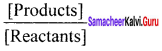
Samacheer Kalvi 11th Economics Solutions Chapter 8 Indian Economy Before and After Independence

Immediately get Chapter Wise Tamilnadu State Board Solutions for 11th Economics to gain more marks and start Quick Revision of all Chapters. All Chapters Pdf is provided along with the Questions and Answers. You Can Dowload Samacheer Kalvi 11th Economics Book Solutions Questions and Answers for Chapter wise are given with a clear explanation. Tamilnadu State Board Solutions for 11th Economics Chapter 8 Indian Economy Before and After Independence Questions and Answers is for free of cost.

Tamilnadu Samacheer Kalvi 11th Economics Solutions Chapter 8 Indian Economy Before and After Independence

Tamilnadu State Board Solutions for 11th Economics Chapter 8 Indian Economy Before and After Independence Questions and Answers PDF has all given in Chapter Wise Section. Check Out daily basis with Tamilnadu State Board Solutions 11th Economics PDF will help to improve your score. Improve your level of accuracy to answer a question by reading with Samacheer Kalvi 11th Economics Book Solutions Questions and Answers PDF.

Samacheer Kalvi 11th Economics Indian Economy Before and After Independence Text Book Back Questions and Answers

Part – A
Multiple Choice Questions

Question 1.
The arrival of Vasco da Gama in Calicut, India
(a) 1498
(b) 1948
(c) 1689
(d) 1849
Answer:
(a) 1498

Question 2.
In 1614 Sir Thomas Roe was successful in getting permission from
(a) Akbar
(b) Shajakan
(c) Jahangir
(d) Noorjakhan
Answer:
(c) Jahangir

Question 3.
The power for governance of India was transferred from the East India Company (EIC) to the British crown in
(a) 1758
(b) 1858
(c) 1958
(d) 1658
Answer:
(b) 1858

Question 4.
Ryotwari system was initially introduced in _______
(a) Kerala
(b) Bengal
(c) Tamil Nadu
(d) Maharastra
Answer:
(c) Tamil Nadu

Question 5.
First World War started in the year _______
(a) 1914
(b) 1814
(c) 1941
(d) 1841
Answer:
(a) 1914

Question 6.
When did the Government of India declared its first Industrial Policy ?
(a) 1956
(b) 1991
(c) 1948
(d) 2000
Answer:
(c) 1948

Question 7.
The objective of the Industrial Policy 1956 was
(a) Develop heavy industries
(b) Develop agricultural sector only
(c) Develop private sector only
(d) Develop cottage industries only
Answer:
(a) Develop heavy industries

Question 8.
The industry which was de-reserved in 1993 ?
(a) Railways
(b) Mining of copper and zinc
(c) Atomic energy
(d) Atomic minerals
Answer:
(b) Mining of copper and zinc

Question 9.
The father of Green Revolution in India was _______
(a) M.S. Swaminathan
(b) Gandhi
(c) Visweswaraiah
(d) N.R. Viswanathan
Answer:
(a) M.S. Swaminathan

Question 10.
How many commercial banks were nationalised in 1969 ?
(a) 10
(b) 12
(c) 14
(d) 16
Answer:
(c) 14

Question 11.
The main objective of nationalisation of banks was _______
(a) Private social welfare
(b) Social welfare
(c) To earn
(d) Industries monopoly
Answer:
(b) Social welfare

Question 12.
The Planning Commission was setup in the year _______
(a) 1950
(b) 1955
(c) 1960
(d) 1952
Answer:
(a) 1950

Question 13.
In the first five year plan, the top priority was given to _______ Sector.
(a) Service
(b) Industrial
(c) Agriculture
(d) Bank
Answer:
(c) Agriculture

Question 14.
Tenth Five year plan period was _______
(a) 1992-1997
(b) 2002-2007
(c) 2007-2012
(d) 1997-2002
Answer:
(b) 2002-2007

Question 15.
According to HDR (2016), India ranked _______ out of 188 countries.
(a) 130
(b) 131
(c) 135
(d) 145
Answer:
(b) 131

Question 16.
Annual Plans formed in the year _______
(a) 1989-1991
(b) 1990-1992
(c) 2000-2001
(d) 1981-1983
Answer:
(b) 1990-1992

Question 17.
The Oldest large scale industry in India ________
(a) cotton
(b) jute
(c) steel
(d) cement
Answer:
(a) cotton

Question 18.
Human development index (HDI) was developed _________
(a) Jawaharlal Nehru
(b) M.K.Gandhi
(c) Amartiya Sen
(d) Tagore
Answer:
(c) Amartiya Sen

Question 19.
The main theme of the Twelth Five Year Plan __________
(a) faster and more inclusive growth
(b) growth with social Justice
(c) socialistic pattern of society
(d) faster, more inclusive and sustainable growth
Answer:
(d) faster, more inclusive and sustainable growth

Question 20.
The PQLI was developed by _______
(a) Planning Commission
(b) Nehru
(c) Morris
(d) Morris
Answer:
(c) Morris

Part – B
Answer the following questions in one or two sentences

Question 21.
What are the Phases of colonial exploitation of India?
Answer:
The period of merchant capital, the period of industrial capital, the period of finance capital.

Question 22.
Name out the different types of land tenure existed in India before Independence.
Answer:

  1. Zamindari system
  2. Mahalwari system
  3. Ryotwari system

Question 23.
State the features that distinguish a land tenure system from other system.
Answer:
The land tenure system differs as

  1. Who owns the land ?
  2. Who cultivates the land ?
  3. Who is responsible for paying the land revenue to the government ?

Question 24.
List out the weaknesses on Green Revolution.
Answer:

  1. Indian agriculture was still a gamble of the monsoons.
  2. This strategy needed heavy investment.
  3. The income gap has increased
  4. Increased unemployment among agricultural labourers.
  5. Reduced the soil fertility and spoiled human wealth.

Question 25.
What are the objectives of Tenth five year plan ?
Answer:

  1. Double the per capita income in the next 10 years.
  2. Aimed to reduce the poverty ratio to 15% by 2012.
  3. Growth target was 8.0% but it achieved only 7.2%

Question 26.
What is the difference between HDI and PQLI ?
Answer:

  1. Human Development Index : It is constructed based on life expectancy index, Education index and GDP per capita.
  2. Physical quality of life index : The PQLI is a measure to calculate the quality of life.

Question 27.
Mention the indicators which are used to calculate HDI.
Answer:

  1. Life expectancy index.
  2. Educational index.
  3. GDP per capita.

Part – C
Answer the following questions in one Paragraph

Question 28.
Explain about the Period of Merchant Capital.
Answer:

  1. The period of merchant capital was from 1757 to 1813.
  2. The only aim of the East India company was to earn profit by establishing monopoly trade.
  3. During this period, India had been considered as the best hunting ground for capital
  4. The objective of monopoly trade was fulfilled by achieving political control.
  5. The company administration succeeded in generating huge surpluses which were repatriated to England.

Question 29.
The Handicrafts declined in India in British Period. Why?
Answer:

  1. Through discriminatory tariff policy, the British Government purposefully destroyed the handicrafts.
  2. With the disappearance of Nawabs and Kings, there was no one to protect Indian handicrafts.
  3. Indian products could not compete with machine made products.
  4. Introduction of railways in India increased the domestic market for the British goods.

Question 30.
Elucidate the different types of land tenure system in colonial India.
Answer:
The three types of land tenure system are Zamindari, Mahalwari and Ryotwari system.

1. Zamindari system or the land – lords : This system was created in 1793,after the introduction of permanent settlement act. Under this system the landlords were declared as the owners of the land. They were responsible to pay the land revenue. The share of the rent to government is fixed at 10/11th and the balance as zamindar’s remuneration.

2. Mahalwari system or communal farming : The ownership of the land was maintained by the collective body of villagers which served as a unit of management. They distribute the land and collect revenue and pay it to the state.

3. Ryotwari or the owner – cultivator system : The ownership rights of use and control of land were held by the tiller himself.

Question 31.
State the reasons for nationalization of commercial banks.
Answer:

  1. The main objective of the economic planning aimed at social welfare.
  2. Before independence commercial banks were in the private sector.
  3. These commercial banks failed in helping the government to achieve social objectives of planning.
  4. Therefore, the government decided to nationalize 14 major commercial banks on 1969

Question 32.
Write any three objectives of Industrial Policy 1991.
Answer:

  1. Ensuring rapid industrial development in a competitive environment.
  2. Enchancing support to the small scale sector.
  3. Providing more incentives for industrialisation of the backward areas.

Question 33.
Give a note on Twelfth Five Year Plan.
Answer:

  1. Twelfth five year plan (2012 – 17).
  2. Its main theme is “Faster more inclusive and sustainable growth”
  3. Its growth rate target is 8%

Question 34.
What is PQLI ?
Answer:
Morris D Morris developed the physical quality of life index (PQLI). The PQLI is a measure to calculate the quality of life.
PQLI includes three indicators life expectancy, infant mortality rate and literacy rate. A scale of each indicator ranges from the number 1 to 100. Represents the worst performance and 100 is the best performance.
HDI includes income while PQLI do not. PQLI has only the physical aspects of like.

Part – D
Answer the following questions in about a page

Question 35.
Discuss about the Indian economy during British Period.
Answer:
Britain had exploited India over a period of two centuries of its colonial rule. On the basis of the form of colonial exploitation, economic historians have divided the whole period into three phases namely the period of merchant capital, period of industrial capital and the period of finance capital.

1. Period of merchant capital (1757 to 1813):
The only aim of the East India company was to earn profit by establishing monopoly trade. India was considered as the best hunting ground for capital. By attaining political power the objective of monopoly trade was fulfilled. The company administration succeeded in generating huge surpluses which were repatriated to England.

2. Period of industrial capital (1813 to 1858):
India had become a market for British textiles. Indians were exploited by fixing low price for exports and high price for imports. India’s traditional handicrafts were thrown out of gear.

3. Period of financial capital (Late 19th century – 1947) : Finance imperialism began to entrench. Britain decided to make massive investments in various fields by plundering Indian capital.

4. The land tenure system in India : Land tenure refers to the system of land ownership and managements.
The Zamindari system, the Mahalwari system and the Ryotwari system were the systems of land tenure introduced by British.

5. Problems of British rule : Their profit motives led to drain of resources from India. The handicraft industries were collapsed.
The British rule stunted the growth of Indian enterprise. Capital formation in India were retarded.

Question 36.
Explain the role of SSIs in economic development?
Answer:

1. SSIs provide employment:

  • SSIs use labour intensive techniques thus reduce the problem of unemployment to a great extent.
  • They provide employment to people in villages and unorganized sectors.
  • The employment – capital ratio is high for the SSIs.

2. SSIs bring balanced regional development: SSIs remove regional disparities by industrializing rural and backward areas and bring balanced regional development.

3. Help in mobilization of local resources : SSIs help to mobilize and utilize local resources like small savings, entrepreneurial talent etc.,

4. Pave for optimization of capital: SSIs require less capital per unit of output. They function as a stabilizing force by providing output-capital ratio as well as high employment capital ratio.

5. Promote exports : SSIs earn valuable foreign exchange through exports from India.

6. Complement large scale industries : SSIs serve as ancillaries to large scale units.

7. Meet consumer demands : SSIs serves as an anti-inflationary force by providing goods of daily use.

8. Develop entrepreneurship : They promote self-employment and spirit of self-reliance in the society. They help to increase the per capita income. They help in distributing national income in more efficient and equitable manner.

Question 37.
Explain the objectives of nationalization of commercial banks.
Answer:

  1. The main objective of nationalization was to attain social welfare. Sectors such as agriculture, small and village industries were in need of funds for their expansion and further economic development.
  2. It helped to curb private monopolies in order to ensure a smooth supply of credit to socially desirable sections.
  3. To encourage the banking habit among the rural population.
  4. To reduce the regional imbalances where the banking facilities were not available.
  5. After nationalization, new bank branches were opened in both rural and urban areas, and they created credit facilities mainly to the agriculture sector and its allied activities.

Question 38.
Describe the performance of 12th five year plan in India.
Answer:
Economic planning is the process in which the limited natural resources are used skillfully so as to achieve the desired goals.

1. First five year plan (1951 – 56) : Main focus was on the agricultural development it achieved the growth rate of 3.6%.

2. Second five year plan (1956 – 61) : Focus was on the industrial development of the country and achieved the growth rate of 4.1%.

3. Third five year plan (1961 – 66): To make the economy independent and to reach take off.

4. Plan holiday (1966 – 69): Equal priority was given to agriculture, its allied sectors and the industrial sectors during annual plans.

5. Fourth five year plan (1969 – 74): Growth with stability and progressive achievement of self reliance was the goal but the plan failed.

6. Fifth five year plan (1975 – 79): A successful plan prioritized agriculture and then industry and mines.

7. Rolling plan : This plan was started with an annual plan for 1978-79.

8. Sixth five year plan (1980 – 85): Based on investment yojana, its objective was poverty eradication and technological self reliance.

9. Seventh five year plan (1985 – 90): Establishment of the self sufficient economy and opportunities for productive employment. Private sector got the priority over public sector.

10. Annual plans : Two annual plans were formed in 1990 – 91 & 1991 -92.

11. Eighth five year plan (1992 – 97): Priority was given to development of the human resources. New economic policy was introduced.

12. Ninth five year plan (1997 – 02):

  • Aimed to double the percapita income in the next 10 years.
  • Aimed to reduce the poverty ratio to 15% by 2012.

13. Tenth five year plan (2002 – 07): Growth with justice and equity was the focus but the plan failed with growth rate of 5.6%. Aimed to double the percapita income in the next 10 years. Aimed to reduce the poverty ratio to 15% by 2012.

14. Eleventh five year plan (2007 – 12): Main theme was faster and more inclusive growth.

15. Twelfth five year plan (2012 – 17): Main theme was faster more inclusive and sustainable growth. The five year plans played a’very prominent role in the economic development of the country. These plans had guided the government as to how it should utilise scarce resources so that maximum benefits can be gained.

Samacheer Kalvi 11th Economics Indian Economy Before and After Independence Additional Questions and Answers

Part – A
Choose the best options

Question 1.
Lord Cornwallis introduced “Permanent Settlement Act in” _______
(a) 1793
(b) 1794
(c) 1795
(d) 1796
Answer:
(a) 1793

Question 2.
In the year _______ green revolution started in India.
(a) 1950
(b) 1951
(c) 1948
(d) 1960
Answer:
(d) 1960

Question 3.
KGN. Daber established Mumbai’s spinning and weaving co. in _______
(a) 1810
(b) 1854
(c) 1845
(d) 1948
Answer:
(b) 1854

Question 4.
The oil well of Digboi, Assam was dug in.
(a) 1889
(b) 1898
(c) 1988
(d) 1810
Answer:
(a) 1889

Question 5.
The period of twelfth five year plan _______
(a) 2010 – 15
(b) 2011 – 16
(c) 2012 – 17
(d) 2013 – 18
Answer:
(c) 2012 – 17

Question 6.
NITI Aayog replaced the planning commission in _______
(a) 2013
(b) 2015
(c) 2014
(d) 2016
Answer:
(b) 2015

Question 7.
Human development index is _______
(a) HDI
(b) UNDP
(c) PQLI
(d) HID
Answer:
(a) HDI

Question 8.
Physical Quality of Life Index (PQLI) was developed by _______
(a) HDI
(b) PQLI
(c) UNDP
(d) HID
Answer:
(c) UNDP

Question 9.
In _______ system the ownership rights of use and control of land were held by the tiller himself.
(a) Zamindari
(b) Mahalwari
(c) Ryotwari
(d) Green revolution
Answer:
(c) Ryotwari

Question 10.
The period of industrial capital is _______
(a) 1757 – 1813
(b) 1813 – 1858
(c) 1757 – 1858
(d) 19 th century
Answer:
(b) 1813 – 1858

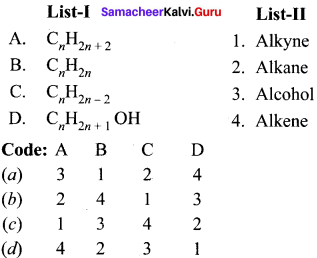
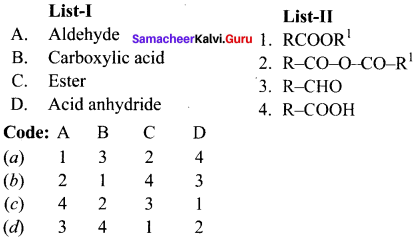
Match the following and choose the answer using the codes given below

Question 1.

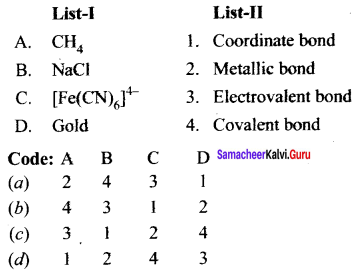
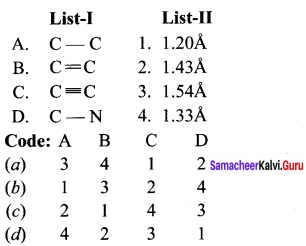
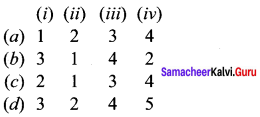
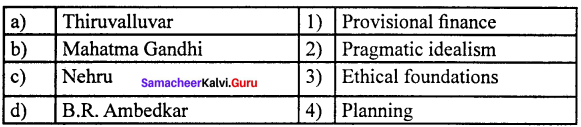
Samacheer Kalvi 11th Economics Solutions Chapter 8 Indian Economy Before and After Independence
(a) 12 3 4
(b) 2 4 3 1
(c) 2 3 1 4
(d) 4 3 2 1
Answer:
(c) 2 3 1 4

Question 2.
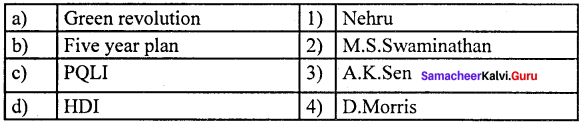
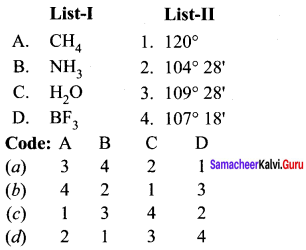
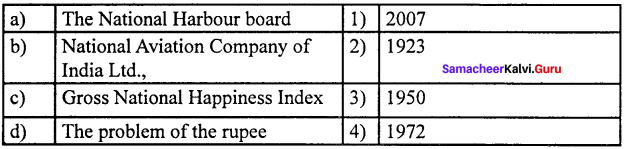
Samacheer Kalvi 11th Economics Solutions Chapter 8 Indian Economy Before and After Independence
(a) 12 3 4
(b) 2 1 4 3
(c) 4 3 2 1
(d) 2 3 1 4
Answer:
(b) 2 1 4 3

Choose the correct option

Question 3.
The period of merchant capital is _______
(a) 1842 – 1857
(b) 1918 – 1920
(c) 1757 – 181
(d) 1721 – 1838
Answer:
(c) 1757 – 181

Question 4.
How many types of land tenure system were there before independence ?
(a) 2
(b) 3
(c) 1
(d) 5
Answer:
(b) 3

Question 5.
The first Indian modernized cotton cloth mill was established _______
(a) Chennai
(b) Calcutta
(c) Mumbai
(d) Bengaluru
Answer:
(b) Calcutta

Fill in the blanks with suitable option given below

Question 6.
The plan holiday was _______
(a) 1951-53
(b) 1966-69
(c) 2001 -02
(d) 1976-79
Answer:
(b) 1966-69

Question 7.
The planning commission was replaced by _______
(a) NITI Aayog
(b) Planning group
(c) Finance commission
(d) None of the above
Answer:
(a) NITI Aayog

Question 8.
NITI Aayog was formed in _______
(a) 2001
(b) 2014
(c) 2015
(d) 2016
Answer:
(c) 2015

Choose the incorrect statement

Question 9.
(a) Ryotwari system was first established in Tamilnadu.
(b) Zamindari system was established by British East India Company
(c) Mahalwari system was also called as the owner – cultivator system
(d) Zamindari system was created in 1793
Answer:
(c) Mahalwari system was also called as the owner – cultivator system

Question 10.
(a) The investment of small service enterprises should be more than ? 10 lakhs.
(b) The investment of micro service enterprises should not exceed ?10 lakhs.
(c) The investment of medium service enterprises should be more than ?2 crores,
(d) The investment of medium service enterprises should not exceed ?10 crores.
Answer:
(d) The investment of medium service enterprises should not exceed ?10 crores.

Choose the incorrect pair

Question 11.
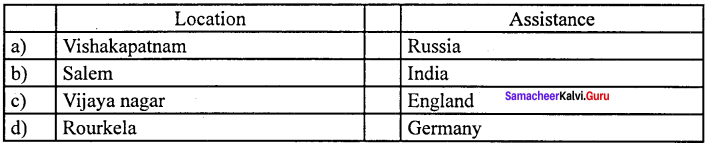
Samacheer Kalvi 11th Economics Solutions Chapter 8 Indian Economy Before and After Independence
Answer:
(c) Vijaya nagar (iii) England

Question 12.

Samacheer Kalvi 11th Economics Solutions Chapter 8 Indian Economy Before and After Independence
Answer:
(c) Serampur (iii) Iron and steel

Chooose the correct pair

Question 13.

Samacheer Kalvi 11th Economics Solutions Chapter 8 Indian Economy Before and After Independence
Answer:
(a) Industrial policy (i) 1948

Question 14.

Samacheer Kalvi 11th Economics Solutions Chapter 8 Indian Economy Before and After Independence
Answer:
(d) White revolution (iv) Milk

Analyse the reason for the following

Question 15.
Assertion (A) : Before the advent of the British, Indian economy was self sufficient.
Reason (R) : Before the advent of the British, India lived in village.
(a) Both (A) and (R) are true
(b) (A) is true (R) is false
(c) Both (A) and (R) are false.
(d) (A) is false (R) is true.
Answer:
(a) Both (A) and (R) are true

Choose the incorrect statement

Question 16.
(a) The industrial policy resolutions in India ushered a socialistic economy
(b) The high yielding varieties programme was called as pilot project of green revolution
(c) The aim of seventh five year plan is ‘Garibi Hatao’
(d) Finance commission replaced the planning commission.
Answer:
(b) The high yielding varieties programme was called as pilot project of green revolution

Question 17.
(a) Switzerland ranks first in HDI.
(b) PQLI includes income whereas HDI excludes income
(c) The process of transforming private assets to government ownership is called privatization
(d) The third plan was called as ‘Gadgil plan’.
Answer:
(d) The third plan was called as ‘Gadgil plan’.

Pick the odd one out

Question 18.
(a) The period of revenue capital
(b) The period of industrial capital
(c) The period of merchant capital
(d) The period of financial capital
Answer:
(c) The period of merchant capital

Question 19.
(a) Investment system
(b) Zamindari system
(c) Mahalwari system
(d) Ryotwari system
Answer:
(a) Investment system

Question 20.
(a) Black revolution
(b) Red revolution
(c) White revolution
(d) Violet revolution
Answer:
(d) Violet revolution

Part – B
Answer the following questions in one or two sentences

Question 1.
Name the classification of industries in India?
Answer:

  1. Public sector
  2. Public-cum-private sector
  3. Controlled private sector
  4. Private and co-operative sectors.

Question 2.
What is the resolution of industrial policy 1948 ?
Answer:
The first industrial policy was declared on 6th April 1948. Its main importance was introducing the system of mixed economy in India.

Question 3.
What is the resolution of industrial policy 1956 ?
Answer:
The policy was shaped by the mahalanobis model of growth with emphasis on heavy industries which would lead to higher growth path.

Question 4.
Write a note on micro manufacturing enterprises.
Answer:
In micro enterprises, the investment in plant and machinery does not exceed Rs. 25 lakhs.

Question 5.
Write a note on small manufacturing enterprises
Answer:
The investment in plant and machinery is more than twenty five lakh rupees but does not exceed Rs. 5 crores.

Question 6.
Write a note on medium manufacturing enterprises.
Answer:
The investment in plant and machinery is more than Rs. 5 crores but not exceeding Rs. 10 crores.

Question 7.
Name the classification of public sector banks.
Answer:

  1. Nationalised Banks.
  2. State Bank and its associates

Part – C
Answer the following questions in one Paragraph

Question 1.
Describe the problems of British rule in Indian economy ?
Answer:

  1. The British rule stunted the growth of Indian enterprise. It retarded the capital formation in India.
  2. The drain of wealth financed capital development in Britain.
  3. Indian agricultural sector became stagnant and deteriorated.
  4. Indian handicraft industries were collapsed.
  5. The system of capitalist firms with profit motives led to drain of resources from India.

Question 2.
Mention the achievements of green revolution.
Answer:

  1. The production of major cereals wheat and rice were boosted. India became food surplus exporting food grains to European countries.
  2. It was confined to high yielding variety cereals.
  3. Production of commercial crops were increased.
  4. Per hectare productivity of all crops had increased due to better seeds.
  5. The revolution had positive effect on development of industries manufacturing agricultural tools.
  6. It brought prosperity to rural people.
  7. Demand for labour increased.
  8. Financial resources were provided by banks and co-operative societies.

Question 3.
Examine the requirements of second green revolution.
Answer:

  1. Introduction of genetically modified (GM) seeds which double the per average production.
  2. Contribution of private sector to market the usage of GM foods.
  3. Government can play a key role in expediting irrigation schemes and managing water resources.
  4. Linking of rivers to transfer surplus water to deficient areas.

Question 4.
Write a note on iron and steel industry.
Answer:

  1. First steel industry at Kulti, near Jharia, West Bengal – Bengal iron works company in 1870.
  2. First large scale steel plant TISCO at Jamshedpur in 1907.
  3. Steel authority of India Ltd. (SAIL) was established in 1974 and was made responsible for the development of the steel industry.
  4. India is the eighth largest steel producing country in the world.

Question 5.
Write a note on petrol and natural gas.
Answer:

  1. First successful oil well was dug in India in 1889 at Digboi, Assam.
  2. At present a number of regions with oil reserves have been identified and oil is being extracted in these regions.
  3. For exploration purpose, Oil and Natural Gas Commission (ONGC) was established in 1956 at Dehradun, Uttarakhand.

If you need some more information about Tamilnadu State Board Solutions for 11th Economics Chapter 8 Indian Economy Before and After Independence Questions and Answers then visit our site frequently and get all the resources that you look for. Also, share this page with your friends and make them learn all the concepts thoroughly before the exams.

Samacheer Kalvi 11th Economics Solutions Chapter 7 Indian Economy

Immediately get Chapter Wise Tamilnadu State Board Solutions for 11th Economics to gain more marks and start Quick Revision of all Chapters. All Chapters Pdf is provided along with the Questions and Answers. You Can Dowload Samacheer Kalvi 11th Economics Book Solutions Questions and Answers for Chapter wise are given with a clear explanation. Tamilnadu State Board Solutions for 11th Economics Chapter 7 Indian Economy Questions and Answers is for free of cost.

Tamilnadu Samacheer Kalvi 11th Economics Solutions Chapter 7 Indian Economy

Tamilnadu State Board Solutions for 11th Economics Chapter 7 Indian Economy Questions and Answers PDF has all given in Chapter Wise Section. Check Out daily basis with Tamilnadu State Board Solutions 11th Economics PDF will help to improve your score. Improve your level of accuracy to answer a question by reading with Samacheer Kalvi 11th Economics Book Solutions Questions and Answers PDF.

Samacheer Kalvi 11th Economics Indian Economy Text Book Back Questions and Answers

Part – A
Multiple Choice Questions

Question 1.
The main gold mine region in Karnataka is _________
(a) Kolar
(b) Ramgiri
(c) Anantpur
(d) Cochin
Answer:
(a) Kolar

Question 2.
Economic growth of a country is measured by national income indicated by _________
(a) GNP
(b) GDP
(c) NNP
(d) Per capital income
Answer:
(b) GDP

Question 3.
Which one of the following is a developed nations ?
(a) Mexico
(b) Ghana
(c) France
(d) SriLanka
Answer:
(c) France

Question 4.
The position of Indian Economy among the other strongest economies in the world is _______
(a) Fourth
(b) Seventh
(c) Fifth
(d) Tenth
Answer:
(b) Seventh

Question 5.
Mixed economy means _________
(a) Private sectors and banks
(b) Co-existence of Public and Private sectors
(c) Public sectors and banks
(d) Public sectors only
Answer:
(b) Co-existence of Public and Private sectors

Question 6.
The weakness of Indian Economy is _________
(a) Economic disparities
(b) Mixed economy
(c) Urbanisation
(d) Adequate employment opportunities
Answer:
(a) Economic disparities

Question 7.
A scientific study of the characteristics of population is _________
(a) Topography
(b) Demography
(c) Geography
(d) Philosophy
Answer:
(b) Demography

Question 8.
The year 1961 is known as _________
(a) Year of small divide
(b) Year of Population Explosion
(c) Year of Urbanisation
(d) Year of Great Divide
Answer:
(b) Year of Population Explosion

Question 9.
In which year the population of India crossed one billion mark ?
(a) 2000
(b) 2001
(c) 2005
(d) 1991
Answer:
(b) 2001

Question 10.
The number of deaths per thousand population is called as ________
(a) Crude Death Rate
(b) Crude Birth Rate
(c) Crude Infant Rate
(d) Maternal Mortality Rate
Answer:
(a) Crude Death Rate

Question 11.
The number of births per thousand population is called as _________
(a) Crude death rate
(b) Mortality rate
(c) Morbidity rate
(d) Crude Birth Rate
Answer:
(d) Crude Birth Rate

Question 12.
Density of population = _________
(a) Land area / Total Population
(b) Land area / Employment
(c) Total Population / Land area of the region
(d) Total Population
Answer:
(c) Total Population / Land area of the region

Question 13.
Who introduced the National Development Council in India?
(a) Ambedkar
(b) Jawaharlal Nehru
(c) Radhakrishanan
(d) V.K.R.V. Rao
Answer:
(b) Jawaharlal Nehru

Question 14.
Who among the following propagated Gandhian Ecomomic thinkings.
(a) Jawaharlar Nehru
(b) VKRV Rao
(c) JC Kumarappa
(d) A.K.Sen
Answer:
(c) JC Kumarappa

Question 15.
The advocate of democratic socialism was
(a) Jawaharlal Nehru
(b) P.C. Mahalanobis
(c) Dr. Rajendra Prasad
(d) Indira Gandhi
Answer:
(a) Jawaharlal Nehru

Question 16.
Ambedkar the problem studied by in the context of Indian Economy is ________
(a) Small land holdings and their remedies
(b) Problem of Indian Currency
(c) Economics of socialism
(d) All of them
Answer:
(b) Problem of Indian Currency

Question 17.
Gandhian Economics is based on the Principle _________
(a) Socialistic idea
(b) Ethical foundation
(c) Gopala Krishna Gokhale
(d) Dadabhai Naoroji
Answer:
(b) Ethical foundation

Question 18.
V.K.R.V Rao was a student of _________
(a) J.M. Keynes
(b) Colin Clark
(c) Adam smith
(d) Alfred Marshal
Answer:
(a) J.M. Keynes

Question 19.
Amartya Kumara Sen received the Nobel prize in Economics in the year.
(a) 1998
(b) 2000
(c) 2008
(d) 2010
Answer:
(a) 1998

Question 20.
Thiruvalluvar economic ideas mainly dealt with _________
(a) Wealth
(b) Poverty is the curse in the society
(c) Agriculture
(d) All of them
Answer:
(d) All of them

Part – B
Answer the following questions in one or two sentences

Question 21.
Write the meaning of Economic Growth.
Answer:
A country’s economic growth is usually indicated by Gross Domestic Product (GDP). The GDP is the total monetary value of the goods and services produced by that country over a specific period of time, usually one year.

Question 22.
State any two features of developed economy.
Answer:

  1. High National Income
  2. High per capital Income

Question 23.
Write the short note on natural resources
Answer:
Natural resources are stock or reserve that can be drawn from nature. The major natural resources are land, forest, water, mineral and energy.

Question 24.
Point out any one feature of Indian Economy
Answer:
Indian economy is a mixed economy. In India both the private and public sectors coexist.

Question 25.
Give the meaning of non-renewable energy
Answer:
The sources of energy which cannot be renewed or re-used are called non-renewable energy.
(Eg.) Coal, Oil, Gas etc.

Question 26.
Give a short note on Sen’s ‘Choice of Technique’.
Answer:
In a labour surplus economy, generation of employment cannot be increased at the initial stage by the adaptation of capital intensive technique whatsen called as choice of technique.

Question 27.
List out the reasons for low per capital income as given by V.K.R.V. Rao.
Answer:

  1. Uneconomic holdings.
  2. Low levels of water availability for crops.
  3. Excess population pressure on agriculture due to the absence of a large industrial sector.
  4. Absence of capital.
  5. Absence of autonomy in currency policy.

Part – C
Answer the following questions in one Paragraph

Question 28.
Define Economic Development.
Answer:
The level economic development is indicated not just by GDP, but by an increase in citizen’s quality of life or well-being. The quality of life is being assessed by several indices such as Human Development Index (HDI), Physical Quality of Life Index (PQLI) and Gross National Happiness Index (GNHI)

Question 29.
State Ambedkar’s Economic ideas on agricultural economics.
Answer:
Dr. B.R.Ambedkar was a versatile personality. In 1918, he published a paper “Small holding in India and their remedies” citing Adam Smith’s “Wealth of Nations”, he made a fine distinction between “Consolidation of holdings” and “Enlargement of holdings”.

Question 30.
Write on short note on village sarvodhaya.
Answer:
Village sarvodhaya is the concept of Gandhiji on the development of villages. To Gandhi India lives in villages. He was interested in developing the villages as self – sufficient units.

According to him, “Real India was to be found in villages and not in towns or cities”.
So he suggested the development of self-suffficient, self dependent villages.

Question 31.
Write the strategy of Jawahar lal Nehru in India’s planning.
Answer:

  1. Jawahar lal Nehru was responsible for the introduction of planning in our country.
  2. To Nehru, the plan was essentially an integrated approach for development.
  3. He said the essence of planning is to find the best way to utilize all resources of manpower, of money and so on.
  4. Planning for Nehru was essentially linked up with industrialization and eventual self reliance for the country’s economic growth on a self-accelerating growth.
  5. Nehru carried through this basic strategy of planned development.

Question 32.
Write the V.K.R.V.Rao’s contribution on multiplier concept.
Answer:

  1. Rao’s examination of the “interrelation between investment, income and multiplier in an under developed economy (1952)” was his major contribution to macroeconomic theory.
  2. In it he asserts that keynesian multiplier principle remains inoperative in underdeveloped countries.
  3. V.K.R.V. Rao was the best equipped of all keynes’ pupils.

Question 33.
Write a short note on Welfare Economics given by Amartya Sen.
Answer:

  1. Amartya Sen was awarded the nobel prize for his contributions to welfare economics.
  2. Sen’s major point has been that the distribution of income / consumption among the persons below the poverty line is to be taken into account.
  3. Sen has focused on the poor, viewing them not as objects of pity requiring charitable hand-outs, but as disempowered folk needing empowerment in all aspects.

Question 34.
Explain Social infrastructure.
Answer:

  1. Social infrastructure refers to those structures which are improving the quality of man power and contribute indirectly towards the growth of an economy.
  2. These structures are outside the system of production and distribution.
  3. The development of these social structures help in increasing the efficiency and productivity of man power.
    (Eg.) Schools, Colleges, Hospitals

Part – D
Answer the following questions in about a page

Question 35.
Explain strong features Indian economy
Answer:

  1. India has a mixed economy : In India both private and public sectors coexist.
  2. Agriculture plays the key role : Around 60% of the people in India depend upon agriculture for their livelihood.
  3. An emerging market: India has a high potential for prospective growth which attracts FDI and FII.
  4. Emerging economy : As a result of rapid economic growth Indian economy has a place among the G20 countries.
  5. Fast growing economy : India has emerged as the world’s fastest growing economy in 2016-17 with 7.1% GDP next to China.
  6. Fast growing service sector : The service sector, contributes a lion’s share of the GDP in India.
  7. Large domestic consumption : Due to large domestic consumption the standard of living has considerably improved and life style has changed.
  8. paid growth of urban areas : Improved connectivity in transport and communication, education and health have speeded up the pace of urbanization.
  9. Stable macro economy : The current year’s economic survey represents the Indian economy to be a heaven of macroeconomic stability, resilence and optimism.
  10. Demographic dividend : India is a pride owner of the maximum percentage of youth. This has invited foreign investments to the country and outsourcing opportunities.

Question 36.
Write the importance of mineral resources in India.
Answer:

  1. Iron-ore : Hematite iron is mainly found in Chattisgarh, Jharkhand, Odisha, Goa and Karnataka. Magnetite is found in Western Coast of Karnataka. Some deposits of iron ore are also found in Kerala, Tamil Nadu and Andhra Pradesh.
  2. Coal and Lignite : India ranks third in the coal production. The main centres are West-Bengal, Bihar, Madhya Pradesh, Maharashtra, Odisha and Andhra Pradesh. Bulk production comes from Bengal-Jharkhand coal fields. Lignite is found in Neyveli in Tamil Nadu.
  3. Bauxite : Bauxite is a main source of aluminium. Major reserves are found in Odisha and Andhra Pradesh.
  4. Mica : India stand first in sheet mica production. Andhra Pradesh, Jharkhand, Bihar and Rajasthan are major reserves.
  5. Crude Oil : Oil is being explored in India at many places of Assam and Gujarat.
  6. Gold : India possesses only a limited gold reserve.
  7. Diamond : The total reserves of diamond is estimated at around 4582 carats.

Question 37.
Bring out Jawharlal Nehru’s contribution to the idea of economic development.
Answer:
Jawahar Lal Nehru was one of the Chief builders of modem India. He was a great patriot, thinker and statesman. His ideas of economic development are :

1. Democracy : He was a firm believer in democracy. He believed in free speech, civil liberty, adult franchise and the rule of law and parliamentary democracy.

2. Secularism : Secularism is another signal contribution of Nehru to India. There are so many religions in India but there is no domination by religious majority.

3. Planning : Nehru was responsible for the introduction of planning in our country. The plan was essentially an integrated approach for development. Planning for Nehru was essentially linked up with industrialization and eventual self-reliance for the country’s economic growth on a self-accelerating growth.

4. Advancement of Science : Nehru made a great contribution to the advancement of Science, research, technology and industrial development. In his period, many IITs and research institutions were established. He always insisted on scientific temper.

5. Democratic socialism : Nehru put the country on the road towards a socialistic pattern of society. Nehru’s socialism is democratic socialism.

Question 38.
Write a brief note on the Gandhian economic ideas.
Answer:
Gandhian economics is based on ethical foundations.
Salient features of Gandhian economic thought:

  1. Village republics : Gandhi was interested in developing the villages as self-sufficient units.
  2. On machinery : Gandhi described machinery as ‘Great Sin’.
  3. Industrialism : Gandhi considered industrialism as a curse on mankind.
  4. Decentralization : He advocated a decentralized economy.
  5. Village sarvodaya : Gandhi suggested the development of self-sufficient, self-dependent villages.
  6. Bread labour: Gandhi realized the dignity of human labour. Bread labour or body labour was the expression that Gandhi used to mean manual labour.
  7. The doctrine of trusteeship : Trusteeship provides a means of transforming the present capitalist society into an egalitarian one.
  8. On the food problem : Gandhi was against any sort of food controls. Food controls only create artificial scarcity.
  9. On population : Gandhi was in favour of birth control through brahmacharya or self-control.
  10. On prohibition : Gandhi advocated cent per cent prohibition.

Samacheer Kalvi 11th Economics Indian Economy Additional Questions and Answers

Part -A
Choose the best options

Question 1.
Third world country __________
(a) India
(b) China
(c) Bangladesh
(d) Srilanka
Answer:
(c) Bangladesh

Question 2.
__________ is the year of great divide.
(a) 1921
(b) 1918
(c) 1943
(d) 1969
Answer:
(a) 1921

Question 3.
__________ are BIMARU States.
(a) Tamil Nadu, Kerala, Karnataka, Madhya Pradesh
(b) Bihar, Madhya Pradesh, Rajasthan, Uttarpradesh
(c) West Bengal, Himalchalpradesh, Punjab, Delhi
(d) Andhra Pradesh, Odisa, Gujarat, Chattisgarh
Answer:
(b) Bihar, Madhya Pradesh, Rajasthan, Uttarpradesh

Question 4.
In India, Lignite is found in.
(a) New Delhi
(b) Kolkatta
(c) Ranji
(d) Neyveli
Answer:
(d) Neyveli

Question 5.
Indian educational system comprises of __________ stages.
(a) 6
(b) 12
(c) 3
(d) 4
Answer:
(a) 6

Question 6.
__________ is considered as the best pupil of J.M. Keynes
(a) A.K. Sen
(b) J.C.Kumarappa
(c) V.K.R.V. Rao
(d) Manmohan Singh
Answer:
(c) V.K.R.V. Rao

Question 7.
Indian Railways introduced first wifi facility in __________
(a) Chennai
(b) Calcutta
(c) Bengaluru
(d) Hyderabad
Answer:
(c) Bengaluru

Question 8.
National Harbour board was set up in __________
(a) 1947
(b) 1950
(c) 1948
(d) 1951
Answer:
(b) 1950

Question 9.
A study on poverty and famines and concept of entitlements and capability development was done by __________
(a) Adamsmith
(b) A.K.Sen
(c) Marshall
(d) V.K.R.V. Rao
Answer:
(b) A.K.Sen

Question 10.
Percapital income is __________
(a) National income / output
(b) National income / population
(c) National income / percapital output
(d) National income / male population
Answer:
(b) National income / population

Question 11.
‘India lives in villages’ said by __________
(a) V.K.R.V. Rao
(b) J.C. Kumarappa
(c) Mahatma Gandhi
(d) Jawaharlal Nehru
Answer:
(c) Mahatma Gandhi

Match the following and choose the answer using the codes given below

Question 1.
Samacheer Kalvi 11th Economics Solutions Chapter 7 Indian Economy
(a) 1 2 3 4
(b) 3 4 2 1
(c) 1 3 4 2
(d) 2 4 3 1
Answer:
(b) 3 4 2 1

Question 2.
Samacheer Kalvi 11th Economics Solutions Chapter 7 Indian Economy
(a) 4 1 2 3
(b) 3 4 2 1
(c) 2 4 3 1
(d) 1 2 4 3
Answer:
(a) 4 1 2 3

Question 3.
Samacheer Kalvi 11th Economics Solutions Chapter 7 Indian Economy
(a) 4 1 2 3
(b) 1 2 3 4
(c) 4 3 2 1
(d) 2 4 1 3
Answer:
(d) 2 4 1 3

Choose the odd one out

Question 4.
(a) Poverty and famine
(b) Choice of technique
(c) Economics of caste
(d) Concept of capability
Answer:
(c) Economics of caste

Question 5.
(a) Budget by assignment
(b) Budget by assigned revenue
(c) Budget by shared revenues
(d) Budget by fiscal revenues
Answer:
(d) Budget by fiscal revenues

Question 6.
(a) Net Domestic Product (NDP)
(b) Human Development Index (HDI)
(c) Physical Quality of Life Index (PQLI)
(d) Gross National Happiness Index (GNHI)
Answer:
(a) Net Domestic Product (NDP)

Choose the correct statement

Question 7.
(a) Indian economy is the seventh largest in the world
(b) Indian economy is a mixed economy
(c) India ranks third in terms of purchasing power parity
(d) The human capital of India is old
Answer:
(d) The human capital of India is old

Question 8.
(a) The annual addition of population in India equals the total population of Australia.
(b) There exists a huge economic disparity in the Indian economy
(c) Kerala has the highest birth rate
(d) Every 6th person in the world is an Indian
Answer:
(c) Kerala has the highest birth rate

Choose the incorrect statement

Question 9.
Samacheer Kalvi 11th Economics Solutions Chapter 7 Indian Economy
Answer:
(b) Demographic transition – (ii) 2001

Question 10.
Samacheer Kalvi 11th Economics Solutions Chapter 7 Indian Economy
Answer:
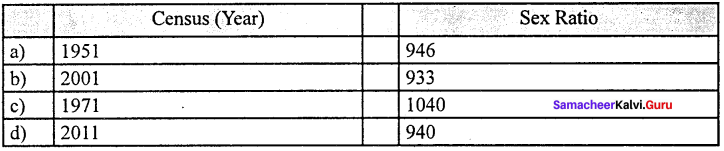
(c) 1971 – (iii) 1040

Choose the correct statement

Question 11.
(a) Nehru always insisted on scientific temper
(b) Gandhi advocated a centralized economy
(c) Valluvar has recommended an unbalanced budget
(d) V.K.R.V. Rao’s economic thought is coined as Gandhian Economics.
Answer:
(a) Nehru always insisted on scientific temper

Question 12.
(a) Until 1979, Education in India was in state list
(b) Education in India follows the 10+3 pattern
(c) Sex ratio refers to the number of females per 1000 males.
(d) India ranks fourth in coal production of the world.
Answer:
(c) Sex ratio refers to the number of females per 1000 males.

Analyse the reason for the following 

Question 13.
Assertion (A) : There exist a huge economic disparity in the Indian economy.
Reason (R) : The proportion of income and assets owned by top 10% of Indians goes on increasing.
(a) Both (A) and (R) are true, (R) is the correct explanation of (A)
(b) Both (A) and (R) are true, (R) is the not correct explanation of (A)
(c) (A) is true and (R) are false.
(d) (A) is false, but (R) is true.
Answer:
(a) Both (A) and (R) are true, (R) is the correct explanation of (A)

Question 14.
Assertion (A) : In Kerala the adult sex ratio is 1084 as on 2011.
Reason (R) : Kerala provides better status to women as compared to other states.
(a) Both (A) and (R) are true, (R) is not the correct explanation of (A)
(b) Both (A) and (R) are true, (R) is the correct explanation of (A)
(c) Both (A) and (R) are false.
(d) None of the above
Answer:
(b) Both (A) and (R) are true, (R) is the correct explanation of (A)

Fill in the blanks with suitable option given below

Question 15.
In India, Lignite is found in _____
(a) New Delhi
(b) kolkata
(c) Ranji
(d) Neyveli
Answer:
(d) Neyveli

Question 16.
Indian educational system comprises of _____ stages
(a) 12
(b) 3
(c) 6
(d) 4
Answer:
(c) 6

Question 17.
Indian railways introduced first wifi facility in _____
(a) Chennai
(b) Bengaluru
(c) Calcutta
(d) Hyderabad
Answer:
(b) Bengaluru

Choose the best option 

Question 18.
_____ is considered as the best pupil of J.M. Keynes
(a) A.K. Sen
(b) J.C.Kumarappa
(c) V.K.R.V.Rao
(d) Nehru
Answer:
(c) V.K.R.V.Rao

Question 19.
Third world country is _____
(a) India
(b) China
(c) Srilanka
(d) Bangladesh
Answer:
(d) Bangladesh

Question 20.
Per capital income is _____
(a) National income / output
(b) National income / population
(c) National income / per capital output
(d) National income / male population
Answer:
(b) National income / population

Part – B
Answer the following questions in one or two sentences 

Question 1.
What is Gross National Happiness Index?
Answer:
GNHI is an indicator of progress, which measures sustainable development, environmental conservation, promotion of culture and good governance.

Question 2.
State any two weakness of Indian Economy.
Answer:

  1. Large population.
  2. Inequality and poverty.

Question 3.
What is sex ratio ?
Answer:
Sex ratio refers to the number of females per 1,000 males.

Question 4.
Explain economic infrastructure.
Answer:
Economic infrastructure is the support system which helps in facilitating production

Question 5.
What is Gandhian Economics ?
Answer:
J.C. Kumarappa developed economic theories based on Gandhism. He developed a school of economic thought coined as Gandhian Economics.

Question 6.
Which are “BIMARU” states ?
Answer:

  1. Bihar
  2. Madhya Pradesh
  3. Rajasthan
  4. Uttarpradesh

Question 7.
What is year of small divide ?
Answer:
In 1951, population growth rate has come down from 1.33% to 1.25%. Hence it is known as year of small divide.

Part – C
Answer the following questions in one Paragraph

Question 1.
What are the aspects of demographic trends in India ?
Answer:

  1. Size of population
  2. Rate of growth.
  3. Birth and death rates
  4. Density of population
  5. Sex – ratio
  6. Life – expectancy at birth
  7. Literacy ratio.

Question 2.
Explain Thiruvalluvar’s ideas on agriculture.
Answer:
According to Thiruvalluvar, agriculture is the most fundamental economic activity. They are the axle-pin of the world, for on their prosperity revolves prosperity of other sectors of other sectors of the economy. He says, ploughmen alone is the freemen of the soil. He believes that agriculture is superior to all other occupation.

Question 3.
Write short note on Birth rate and Death rate.
Answer:
Short Note On Birth Rate And Death Rate:

  1. Birth Rate : It refers to the number of births per thousand of population.
  2. Death Rate : It refers to the number of deaths per thousand of population.

Kerala has the lowest birth rate and Uttarpradesh has the highest birth rate. West Bengal has the lowest and Orissa has the highest death rates.

Part – D
Answer the following questions in about a page

Question 1.
Explain about health in India.
Answer:
Health in India is a state government responsibility. The central council of health and welfare formulates the various health care projects and health department reform policies. The administration of health industry is the responsibility of the ministry of health and welfare.

Health care in India has many forms. But, all medical systems are under one ministry AYUSH.
Health status is better in Kerala as compared to other states. India’s health status is poor compared to Sri Lanka.

Question 2.
Explain Thiruvalluvar’s economic ideas.
Answer:
The economic ideas of Thiruvalluvar are found in his immortal work, Thirukkural in its second part porutpal.

  1. Factors of production : Thiruvalluvar has made many passing references about the factors of production, land, labour, capital, organisation.
  2. Agriculture : Agriculture is the most fundamental economic activity. The prosperity of other sectors depends on the prosperity of agriculture. Valluvar believes that agriculture is superior to all other occupation.
  3. Public finance : He elaborately explained public finance under the headings public revenue, financial administration and public expenditure.
  4. Public expenditure : Valluvar has recommended a balanced budget. He advocates
    1. Defence
    2.  Public works
    3. Social Services
  5. External assistance : Valluvar was against seeking external assistance. He advocated a self-sufficient economy.
  6. Poverty and begging : According to him ‘poverty is the root cause of all other evils which would lead to ever-lasting sufferings.
  7. Wealth: Valluvar has regarded wealth as only a means and not an end.
  8. Welfare state : The important elements of a welfare state are
    1. Perfect health of the people without disease
    2. Abundant wealth
    3. Good crop
    4. Prosperity and happiness
    5. Full security for the people.

If you need some more information about Tamilnadu State Board Solutions for 11th Economics Chapter 7 Indian Economy Questions and Answers then visit our site frequently and get all the resources that you look for. Also, share this page with your friends and make them learn all the concepts thoroughly before the exams.
Samacheer Kalvi 11th Economics Solutions Chapter 6 Distribution Analysis

Immediately get Chapter Wise Tamilnadu State Board Solutions for 11th Economics to gain more marks and start Quick Revision of all Chapters. All Chapters Pdf is provided along with the Questions and Answers. You Can Dowload Samacheer Kalvi 11th Economics Book Solutions Questions and Answers for Chapter wise are given with a clear explanation. Tamilnadu State Board Solutions for 11th Economics Chapter 6 Distribution Analysis Questions and Answers is for free of cost.

Tamilnadu Samacheer Kalvi 11th Economics Solutions Chapter 6 Distribution Analysis

Tamilnadu State Board Solutions for 11th Economics Chapter 6 Distribution Analysis Questions and Answers PDF has all given in Chapter Wise Section. Check Out daily basis with Tamilnadu State Board Solutions 11th Economics PDF will help to improve your score. Improve your level of accuracy to answer a question by reading with Samacheer Kalvi 11th Economics Book Solutions Questions and Answers PDF.

Samacheer Kalvi 11th Economics Distribution Analysis Text Book Back Questions and Answers

Part – A
Multiple Choice Questions

Question 1.
In Economics, distribution of income is among the
(a) factors of production
(b) individual
(c) firms
(d) traders
Answer:
(a) factors of production

Question 2.
Theory of distribution is popularly known as ………………………..
(a) Theory of product – pricing
(b) Theory of factor – pricing
(c) Theory of wages
(d) Theory of Interest
Answer:
(b) Theory of factor-pricing

Question 3.
Rent is the reward for the use of
(a) capital
(b) labour
(c) land
(d) organization
Answer:
(c) land

Question 4.
The concept of ‘Quasi – Rent’ is associated with ………………………
(a) Ricardo
(b) Keynes
(c) Walker
(d) Marshall
Answer:
(d) Marshall

Question 5.
The Classical Theory of Rent was propounded by
(a) Ricardo
(b) Keynes
(c) Marshall
(d) Walker
Answer:
(a) Ricardo

Question 6.
‘Original and indestructible powers of the soil’ is the term used by ……………………….
(a) J.S.Mill
(b) Walker
(c) Clark
(d) Ricardo
Answer:
(d) Ricardo

Question 7.
The reward for labour is
(a) rent
(b) wage
(c) profit
(d) interest
Answer:
(b) wage

Question 8.
Money wages are also known as ……………………….
(a) Real wages
(b) Nominal wages
(c) Original wages
(d) Transfer wages
Answer:
(b) Nominal wages

Question 9.
Residual Claimant Theory is propounded by
(a) Keynes
(b) Walker
(c) Hawley
(d) Knight
Answer:
(b) Walker

Question 10.
The reward is given for the use of capital ………………………
(a) Rent
(b) Wage
(c) Interest
(d) Profit
Answer:
(c) Interest

Question 11.
Keynesian Theory of interest is popularly known as
(a) Abstinence Theory
(b) Liquidity Preference Theory
(c) Loanable Funds Theory
(d) Agio Theory
Answer:
(b) Liquidity Preference Theory

Question 12.
According to the Loanable Funds Theory, supply of loanable funds is equal to …………………………
(a) S + BC + DH + DI
(b) I + DS + DH + BM
(c) S+ DS + BM+ DI
(d) S + BM + DH + DS
Answer:
(a) S + BC + DH + DI

Question 13.
The concept of meeting unexpected expenditure according to Keynes is
(a) Transaction motive
(b) Precautionary motive
(c) Speculative motive
(d) Personal motive
Answer:
(b) Precautionary motive

Question 14.
The distribution of income or wealth of a country among the individuals are ………………………….
(a) Functional distribution
(b) Personal distribution
(c) Goods distribution
(d) Services distribution
Answer:
(b) Personal distribution

Question 15.
Profit is the reward for
(a) land
(b) organization
(c) capital
(d) labour
Answer:
(b) organization

Question 16.
Innovation Theory of profit was given by …………………………..
(a) Hawley
(b) Schumpeter
(c) Keynes
(d) Knight
Answer:
(b) Schumpeter

Question 17.
Quasi-rent arises in
(a) Man-made appliances
(b) Homemade items
(c) Imported items
(d) None of these
Answer:
(a) Man-made appliances

Question 18.
“Wages as a sum of money are paid under contract by an employer to a worker for service rendered”- Who said this?
(a) Benham
(b) Marshall
(c) Walker
(d) J.S.Mill
Answer:
(a) Benham

Question 19.
Abstinence Theory of Interest was propounded by
(a) Alfred Marshall
(b) N.W Senior
(c) Bohm-Bawerk
(d) Knut Wicksell
Answer:
(b) N.W Senior

Question 20.
Loanable Funds Theory of Interest is called as …………………………
(a) Classical Theory
(b) Modem Theory
(c) Traditional Theory
(d) Neo-Classical Theory
Answer:
(d) Neo-Classical Theory

Part – B
Answer the following questions in one or two sentences

Question 21.
What is meant by distribution?
Answer:
Distribution means division of income among the four factors of production as rent, wage, interest and profit.

Question 22.
Mention the types of distribution?
Answer:
Personal Distribution: Personal Distribution is the distribution of national income among the individuals.
Functional Distribution: Functional Distribution means the distribution of income among the four factors of production namely land, labour, capital and organization for their services in production process.

Question 23.
Define ‘Rent’.
Answer:
Rent is that part of payment made by a tenant to his landlords for the use of land only.

Question 24.
Distinguish between real and money wages.
Answer:
Real wages :
Wages paid in terms of goods and services. It refers to the purchasing power of money wages.

Money wages :
Nominal wages are referred to as wages paid in terms of money.

Question 25.
What do you mean by interest?
Answer:

  1. Interest is the reward paid by the borrower to the lender for the use of capital.
  2. Interest is the price paid for the use of capital in any market.
  3. Generally speaking, interest is a payment made by a borrower to the lender for the money borrowed.

Question 26.
What is profit?
Answer:
Profit is the amount left with the entrepreneur after he has made payments for all the other factors of production.

Question 27.
State the meaning of liquidity preference?
Answer:

  1. Liquidity preference means the preference of the people to hold wealth in the form of liquid cash rather than in other non – liquid assets like bonds, securities, bills of exchange, land, building, gold etc.
  2. “ Liquidity Preference is the preference to have an amount of cash rather than of claims against others”.

Part – C
Answer the following questions in One Paragraph

Question 28.
What are the motives of demand for money?
Answer:
1. Transaction motive :
It relates to the desire of the people to hold cash for the current transactions.
Mt=f (y)

2. Precautionary motive :
It relates to the desire of the people to hold cash to meet unexpected or unforeseen expenditures.
Mp = f (y)

3. Speculative motive :
It relates to the desire of the people to hold cash in order to take advantage of market movements regarding future changes in the price of bonds and securities in the capital market.
Ms = f (i)

Question 29.
List out the kinds of wages:
Answer:
Wages are divided into four types.

  1. Nominal Wages or Money Wages: Nominal wages are referred to the wages paid in terms of money.
  2. Real Wages: Real wages are the wages paid in terms of goods and services. Hence, real wages are the purchasing power of money wages.
  3. Piece Wages: Wages that are paid on the basis of quantum of work done.
  4. Time Wages: Wages that are paid on the basis of the amount of time that the worker works.

Question 30.
Distinguish between rent and quasi-rent
Answer:
Rent:

  1. Rent accrues to land
  2. The supply of land is fixed forever
  3. It enters into price

Quasi – rent:

  1. Quasi-rent accrues to man-made appliances
  2. The supply of man made appliances is fixed for a short period only
  3. It does not enter into price.

Question 31.
Briefly explain the Subsistence Theory of Wages?
Answer:
The subsistence theory of wages:

  1. Subsistence theory of wages is one of the oldest theories of wages.
  2. According to this theory, wage must be equal to the subsistence level of the labourer and his family.
  3. Subsistence means the minimum amount of food, clothing and shelter which workers and their family require for existence.
  4. If workers are paid higher wages than the subsistence level, the workers would be better off and they will have large families.
  5. Hence, the population would increase.
  6. When the population increases, the supply of labourer would increase and therefore, wages will come down.
  7. If wages are lower than the subsistence level, there would be a reduction in population and thereby the supply of labour falls and wages increase to the subsistence level.

Question 32.
State the Dynamic Theory of Profit.
Answer:

  • J.B. Clark propounded this theory in 1900. To him, profit is the difference between price and cost of production of the commodity.
  • Profit is the reward for dynamic changes in society. He points out that, profit cannot arise in a static society. In static society everything remains stationary.
  • The following changes take place in a dynamic society.
    1. Population is increasing.
    2. Volume of capital is increasing.
    3. Methods of production are improving.
    4. Forms of industrial organization are changing.
    5. The wants of consumer are multiplying.

Question 33.
Describe briefly the Innovation Theory of Profit?
Answer:
Innovation Theory of Profit:

  1. The innovation theory of profit was propounded by Joesph. A.Schumpeter.
  2. Schumpeter says an entrepreneur is not only an undertaker of a business but also an innovator in the process of production.
  3. Profit is the reward for “innovation”.
  4. According to Schumpeter, an innovation may consist of the following:
    • Introduction of a new product.
    • Introduction of a new method of production.
    • Opening up of a new market.
    • Discovery of new raw materials
    • Reorganization of an industry / firm.

When any one of these innovations is introduced by an entrepreneur, it leads to reduction in the cost of production and thereby brings profit to an entrepreneur. To obtain profit continuously, the innovator needs to innovate continuously. The real innovators do so. Imitative entrepreneurs cannot innovate.

Question 34.
Write a note on the Risk-bearing Theory of Profit.
Answer:

  • Risk – the bearing theory was propounded by F.B.Hawley in 1907.
  • Profit is the reward for “risk-taking” in business.
  • Every business involves some risks. So risk-taking is an essential function of the entrepreneur and is the basis of profit.
  • Higher the risks, the greater are the profit.
  • Profit induces entrepreneurs to undertake risks.

Part – D
Answer the following questions in about a page

Question 35.
Explain the Marginal Productivity Theory of Distribution.
Answer:
Marginal productivity theory of distribution was developed by Clark, Wickseed and Walras. This theory explains how the prices of various factors of production are determined. This theory is also known as “General theory of distribution” or “National dividend theory of distribution”.
Assumptions:

  1. All the factors of production are homogenous and can be substituted for each other.
  2. There is perfect competition in both factor and product market.
  3. There is perfect mobility and full employment of factors of production.
  4. This theory is applicable only in the long-run.
  5. The entrepreneurs aim at profit maximization.
  6. There is no government intervention and no technological change.

Explanation of the theory :
Each factor is rewarded according to its marginal productivity.

Marginal product:
The marginal product of a factor of production means the addition made to the total product by employment of an additional unit of that factor.

Marginal physical product (MPP) :
The MPP of a factor is the increment in the total product obtained by the employment of an additional unit of that factor.

Value of marginal product (VMP):
VMP = MPP x price

Statement of the theory:

  1. The price of a factor of production depends upon its productivity.
  2. The price of a factor is determined by and will be equal to marginal revenue product of that factor.
  3. Under certain conditions, the price of a factor will be equal to both average and marginal products of that factor.

Marginal productivity under perfect competition:
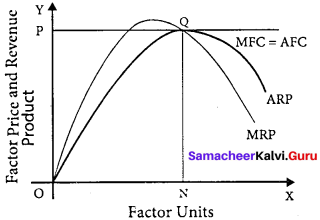
Samacheer Kalvi 11th Economics Solutions Chapter 6 Distribution Analysis 1
X- axis represents factor units and Y-axis represents the factor price and revenue product.
MRP – Marginal Revenue Product Curve
ARP – Average Revenue Product Curve
AFC – Average Factor cost Curve
MFC – Marginal Factor cost Curve
AFC – is horizontal under perfect competition and MFC coincides with it.
When there is perfect competition in the factor market, the firm is in equilibrium only when MFC = MRP
At the point Q by employing ON units of factors and paying OP price (NQ) where MFC = MRP
At Q, MRP = ARP
Price of the factor (NQ) = Marginal revenue
Product (NQ) = Average revenue product (NQ)
There is no exploitation of factors under perfect competition.
Beyond the point Q the price paid to the factor is more than marginal revenue product and average revenue product, so employer do not employ the factors.

Question 36.
Illustrate the Ricardian Theory of Rent.
Answer:
The classical theory of rent is called “Ricardian theory of rent”.
Definition :
Rent is that portion of the produce of the earth which is paid to the landlord for the use of the original and indestructible powers of the soil.

Assumptions :

  1. Land differs in fertility.
  2. The law of diminishing returns operates in agriculture.
  3. Rent depends upon fertility and location of land.
  4. Theory assumes perfect competition and long period.
  5. There is existence of marginal land or no-rent land.
  6. Land has certain “Original and indestructible powers”.
  7. Land, is used for cultivation only.
  8. Most fertile lands are cultivated first.

Statement of the theory with illustration :
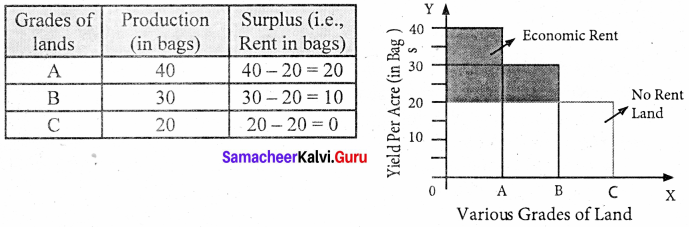
Assume that some people settle in newly discovered island. People will first cultivate the most fertile ‘A’ grade land. They produce 40 bags of paddy.

Suppose after some time if another group of people settle down in the same island. They cultivate ‘B’ grade land which produce 30 bags of paddy. Suppose yet another group of people settle down there they cultivate ‘C’ grade land. It produce 20 bags of paddy.

This surplus of ‘A’ grade land is now raised to 20 bags (40 – 20) and it is the ‘Economic Rent’ of ‘A’ grade land. The surplus of ‘B’ grade land is 10 bags (30 – 20). In ‘C’ grade land cost of production is equal to the price of its produce and it does not yield any rent (20 – 20). Hence ‘C’ grade land is called ‘no-rent land’ or marginal land.

The land which yields rent is called “intra-marginal land”.
Rent indicates the differential advantage of the superior land over the marginal land.
Ricardian Theory’ of Rent :

Samacheer Kalvi 11th Economics Solutions Chapter 6 Distribution Analysis 2
Diagrammatic illustration :
X – axis represents various grades of land and Y axis yield per acre (in bags). OA, AB and BC are the ‘A’, ‘B’, ‘C’ grade lands respectively.

The ‘C’ grade land is the no-rent land. A and B grade lands are “intra-marginal lands. The economic rent yielded by ‘A’ and ‘B’ grade lands is equal to the shaded area of their respective rectangles.

Criticisms :

  1. The order of cultivation from most fertile to least fertile lands is historically wrong.
  2. This theory assumes that rent does not enter into price. But in reality, rent enters into price.

Question 37.
Elucidate the Loanable Funds Theory of Interest.
Answer:

  1. The loanable funds theory, also known as the “Neoclassical theory”. This theory was developed by Swedish economists like Wicksell, Bertilohlin, Viner, Gunnarmyrdal and others.
  2. Interest is the price paid for the use of loanable funds.
  3. The rate of interest is determined by the equilibrium between demand for and supply of loanable funds in the credit market.

Demand for loanable funds :

  1. Demand for Investment (I)
  2. Demand for Consumption (C)
  3. Demand for Hoarding (H)

Supply of loanable funds :
1. Savings (S) :
Savings may be of two types, namely.

  1. Savings planned by individuals are “ex-ante savings”. (Eg.) LIC premium
  2. Unplanned savings are called “ex-post savings”

2. Bank credit:
Commercial banks create credit and supply loan able funds to the investors.

3. Dishoarding (DH) :
Dishoarding means bringing out the hoarded money into use and thus it constitutes a source of supply of loanable funds.

4. Disinvestment (DI):
Disinvestment is the opposite of investment. It means not providing sufficient funds for depreciation of equipment.

Equilibrium :
The rate of interest is determined by the equilibrium between the total demand for and the total supply of loanable funds.
Supply of loanable funds = S + BC + DH + DI
Demand for loanable funds = I + C + H
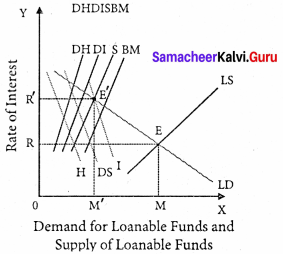
Samacheer Kalvi 11th Economics Solutions Chapter 6 Distribution Analysis 3

Explanation :
X-axis represents the demand for and supply of loanable funds, Y axis represents the rate of interest. The LS curve represents the total supply curve ofloanable funds. The LD curve represents the total demand for loanable funds. The LD and LS curves, intersect each other at the point “E” the equilibrium point. At this point OR rate of interest and OM is the amount ofloanable funds.

Criticisms :

  1. Many factors have been included in this theory’. Still there are many more factors like
    • Asymmetric information
    • Moral Hazard.
  2. It is very difficult to combine real factors with monetary factors.

Question 38.
Explain the Keynesian Theory of Interest.
Answer:
According to Keynes, interest is the reward for parting with liquidity’ for a specified period of time.
Meaning of liquidity preference:
Liquidity preference means the preference of the people to hold wealth in the form of liquid cash rather than in other non-liquid assets.
Motives of demand for money:
The three motives of liquidity preference are.

  1. The transaction motive Mt = f (y)
  2. The precautionary motive Mp = f (y)
  3. The speculative motive Ms = f (i)

Determination of Rate of Interest:
According to Keynes, the rate of interest is determined by the demand for and the supply of money. The demand for money is liquidity preference. The supply of money is determined by the policies of the government and the central bank.

Equilibrium between demand and supply of money:
The equilibrium between liquidity preference and demand for money determine the rate of interest. In short-run, the supply of money is assumed to be constant.
Samacheer Kalvi 11th Economics Solutions Chapter 6 Distribution Analysis 4

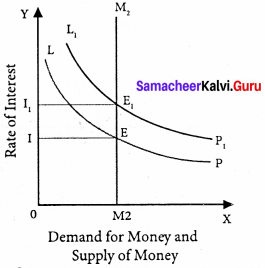
LP is the liquidity preference curve. M2 shows the supply curve of money to satisfy speculative motive. Both curves intersect at the point E which is the equilibrium. Here, rate of interest is I.

If liquidity preference increases from LP to L1 P1 the supply of money remains constant, the rate of interest increase from OI to OI1
Samacheer Kalvi 11th Economics Solutions Chapter 6 Distribution Analysis 5

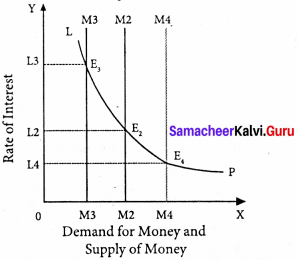
Suppose LP remains constant. If the supply of money is OM2, the interest is OI2 and if the supply of money is reduced from OM2 to OM2, the interest would increase from OM2 to OM4. If the supply of money is increased from OM2 to OM4 the interest would decrease from OI2 to Ol4

Criticisms :
1. This theory does not explain the existence of different interest rates prevailing in the market at the same time.
2. It explains interest rate only in the short – run.

Samacheer Kalvi 11th Economics Distribution Analysis Additional Questions and Answers

Part -A
Choose the best options

Question 1.
Marginal Productivity theory is the …………………….. theory of distribution.
(a) Average
(b) Marginal
(c) Liquidity preference theory
(d) General
Answer:
(d) General

Question 2.
“Interest is the price paid for the use of capital in any market” is said by_______
(a) Adam Smith
(b) Torrance
(c) Walker
(d) Marshall
Answer:
(d) Marshall

Question 3.
The standard of living of workers in a country depends upon the ……………………… wages.
(a) Real
(b) Effective
(c) Direct
(d) Elastic
Answer:
(a) Real

Question 4.
The author of agio-theory of interest.
(a) N.W. Senior
(b) Bohm Bawerk
(c) Walker
(d) Marshall
Answer:
(b) Bohm Bawerk

Question 5.
Who propounded the risk bearing theory of profit?
(a) Bohm – Bawerk
(b) F.B Hawley
(c) Marshall
(d) Walker
Answer:
(b) F.B Hawley

Question 6.
Dynamic theory of profit was propounded by_______
(a) Marshall
(b) J.B.Clark
(c) J.M. Keynes
(d) Walker
Answer:
(b) J.B.Clark

Question 7.
What is meant by MPS?
(a) Marginal production supply
(b) Marginal production sale
(c) Marginal production service
(d) Marginal propensity to save
Answer:
(d) Marginal propensity to save

Question 8.
Time preference theory was given by_______
(a) John Ray
(b) Bohm Bawerk
(c) F.B. Hawley
(d) Irving Fisher
Answer:
(d) Irving Fisher

Question 9.
The demand for labour is ………………………
(a) Effective demand
(b) Direct demand
(c) Derived demand
(d) Elastic demand
Answer:
(c) Derived demand

Question 10.
_______ is the author of modern theory of rent
(a) Joan Robinson
(b) Boulding
(c) Both
(d) None
Answer:
(c) Both

Match the following and choose the answer using the codes given below

Question 1.
Samacheer Kalvi 11th Economics Solutions Chapter 6 Distribution Analysis 6
(a) 3 4 2 1
(b) 4 3 1 2
(c) 1 2 3 4
(d) 2 3 4 1
Answer:
(c) 1 2 3 4

Question 2.
Samacheer Kalvi 11th Economics Solutions Chapter 6 Distribution Analysis 7
(a) 2 1 4 3
(b) 1 4 2 3
(c) 1 2 3 4
(d) 4 1 3 2
Answer:
(a) 2 1 4 3

Choose the incorrect pair

Question 3.
Samacheer Kalvi 11th Economics Solutions Chapter 6 Distribution Analysis 8
Answer:
(d) Total demand for money (iv) Mt + Mp

Question 4.
Samacheer Kalvi 11th Economics Solutions Chapter 6 Distribution Analysis 9
Answer:
(b) Wage is the residual portion (ii) J.S. Mill

Choose the correct statement

Question 5.
(a) The supply of land is fixed forever
(b) Quasi-rent accrues to land
(c) The supply of man-made appliances are fixed
(d) Quasi-rent enters price
Answer:
(a) The supply of land is fixed forever

Question 6.
(a) Rent is the reward for labour
(b) Profit is the reward for labour
(c) Wages are the reward for labour
(d) Interest is the reward for organisation
Answer:
(b) Profit is the reward for labour

Choose the odd one out

Question 7.
(a) Bank credit
(b) Hoarding
(c) Dishoarding
(d) Disinvestment
Answer:
(b) Hoarding

Question 8.
(a) Monopoly profit
(b) Wind fall profit
(c) Functional reward
(d) Reward for labourer
Answer:
(d) Reward for labourer

Question 9.
(a) Nominal wages
(b) Real wages
(c) Direct wages
(d) Piece wages
Answer:
(c) Direct wages

Question 10.
(a) Abstinence theory
(b) Loanable funds theory
(c) Liquidity preference theory
(d) Risk bearing theory
Answer:
(b) Loanable funds theory

Analyse the reason for the following

Question 11.
Assertion (A) : Demand for loanable funds depends on investment, consumption and hoarding.
Reason (R) : Supply of loanable funds depends on hoarding and investment.
(a) (A) and (R) are true, (R) is not the correct explanation of (A)
(b) (A) and (R) are true, (R) is the correct explanation of (A)
(c) (A) is true (R) are false.
(d) (A) is false (R) is true.
Answer:
(c) (A) is true (R) are false.

Question 12.
Assertion (A) : The rate of interest is determined by the demand for money and the supply of money.
Reason (R) : The demand for money is liquidity preference.
(a) Both (A) and (R) are true, (R) is not the correct explanation of (A)
(b) Both (A) and (R) are correct, (R) is the correct explanation of (A)
(c) Both (A) and (R) are false.
(d) (A) is false and (R) is true.
Answer:
(a) Both (A) and (R) are true, (R) is not the correct explanation of (A)

Question 13.
Assertion (A) : Only superior land get rent
Reason (R) : Rent arose on account of differences in the fertility of land.
(a) Both (A) and (R) are true
(b) Both (A) and (R) are false correct explanation of (A)
(c) (A) is true and (R) are false.
(d) (A) is false and (R) is true.
Answer:
(a) Both (A) and (R) are true

Choose the incorrect pair

Question 14.
Samacheer Kalvi 11th Economics Solutions Chapter 6 Distribution Analysis 10
Answer:
(d) Wage fund theory (iv) J.S. Mill

Question 15.
Samacheer Kalvi 11th Economics Solutions Chapter 6 Distribution Analysis 11
Answer:
(b) Wages (ii) Labour

Fill in the blanks with suitable option given below

Question 16.
F.A. Walker wrote a book ______ in 1875.
(a) Political economy
(b) Social economy
(c) Principles of economics
(d) Wealth of nations
Answer:
(a) Political economy

Question 17.
The author of Agio theory of interest______
(a) N.W. Seniors
(b) Bohm-Bawerk
(c) Walker
(d) Marshall
Answer:
(b) Bohm-Bawerk

Question 18.
______ is the produced means of production.
(a) Land
(b) Labour
(c) Capital
(d) Organisation
Answer:
(c) Capital

Choose the best option

Question 19.
The theory of factor prices is popularly known as the theory of
(a) Distribution
(b) Exchange
(c) Wages
(d) Profit
Answer:
(a) Distribution

Question 20.
______ is the author of the modern theory of rent
(a) Joan Robinson
(b) Boulding
(c) Both
(d) None
Answer:
(c) Both

Part – B
Answer the following questions in one or two sentences

Question 1.
What is the theory of distribution?
Answer:
The theory of factor prices is popularly known as the theory of distribution.

Question 2.
Define VMP?
Answer:

  1. VMP – means Value of Marginal Product.
  2. The Value of Marginal Product is obtained by multiplying the Marginal Physical Product of the factor by the price of product. Symbolically, VMP = MPP x Price.

Question 3.
Define : Marginal productivity theory of distribution.
Answer:
The theory states that price or the reward for any factor of production is equal to the marginal productivity of that factor.

Question 4.
What is marginal product ? Define marginal physical product ?
Answer:
The addition made to the total product by employment of an additional unit of that factor.

Question 5.
Define modern theory of rent.
Answer:
Rent is the difference between the actual earnings of a factor of production and its transfer earning.
Rent = Actual earning – Transfer earning

Question 6.
What is “Wage Fund“.
Answer:
According to Mill, “Every employer will keep a given amount of capital for payment to the workers”. It is known as “Wage Fund”.

Question 7.
Define Quasi Rent.
Answer:
“Quasi rent is the income derived from machines and other appliances made by man
QR = Total revenue – Total variable cost

Part – C
Answer the following questions in one Paragraph

Question 1.
Explain the types of distribution.
Answer:
1. Personal distribution :
It is the distribution of national income among individuals.

2. Functional distribution :
It means the distribution of income among the four factors of production for their services in the production process.

Question 2.
Explain the standard of living theory of wages.
Answer:
This theory of wages was developed by Torrance is an improved version of the subsistence theory of wage. According to this theory, the wage is equal to the standard of living of the workers. If the standard of living is high, wages will be high and vice versa. The standard of a living wage means the amount necessary to maintain the labourer in the standard of life to which he is accustomed.

Question 3.
Briefly explain the Abstinence theory or waiting theory?
Answer:

  1. This theory was propounded by N.W.Senior.
  2. According to Senior, capital is the result of saving.
  3. Saving involves “ abstinence ” or “ Sacrifice
  4. It is possible to save only if one abstains from present consumption.
  5. Interest is the reward or compensation paid to the saver (capitalist) for his “ abstinence ” or “ sacrifice”.
  6. Marshall accepted the Abstinence theory of interest.
  7. According to him, interest is a reward for waiting.
  8. Saving involves waiting.
  9. Therefore, interest is the reward paid to the saver for his “ waiting ”.

Question 4.
State the theories of interest.
Answer:

  1. Abstinence theory or waiting theory.
  2. Agio theory or the psychological theory.
  3. Loanable funds theory or the neoclassical theory.
  4. Liquidity preference theory or the monetary theory.

Question 5.
What are the four sources of loanable funds.
Answer:
The supply of loanable funds depends upon the following four sources.

  1. Savings (S)
  2. Bank Credit (BC)
  3. Dishoarding (DH)
  4. Disinvestment (DI)

Question 6.
What are the kinds of profit.
Answer:
1. Monopoly profit:
Profit earned by the firm because of its monopoly control.

2. Windfall profit:
Some times, profit arises due to changes in price level. Profit is due to unforeseen factors.

3. Profit as functional reward :
Just like rent, wage and interest, profit is earned by the entrepreneur for his entrepreneurial function.

Question 7.
State the residual claimant theory of wage.
Answer:
This theory was propounded by the American economist F.A. Walkar in 1875, in his book political economy. According to this theory, wage is the residual portion after paying the remuneration of all the other three factors namely land capital and organization.

Criticisms :

  1. This theory does not explain the role of trade unions can secure higher wage for workers.
  2. Demand side of labour in the determination of wages needs to be considered.

If you need some more information about Tamilnadu State Board Solutions for 11th Economics Chapter 6 Distribution Analysis Questions and Answers then visit our site frequently and get all the resources that you look for. Also, share this page with your friends and make them learn all the concepts thoroughly before the exams.

Samacheer Kalvi 11th Chemistry Solutions Chapter 12 Basic Concepts of Organic Reactions

Enhance your subject knowledge with Tamilnadu State Board for Chapter 12 Basic Concepts of Organic Reactions and learn all the underlying concepts easily. Make sure to Download Samacheer Kalvi 11th Chemistry Book Solutions Basic Concepts of Organic Reactions, Notes Pdf Chapter 12 Basic Concepts of Organic Reactions Questions and Answers PDF on a day to day basis and score well in your exams. Are given after enormous research by people having high subject knowledge. You can rely on them and prepare any topic of Chemistry as per your convenience easily.
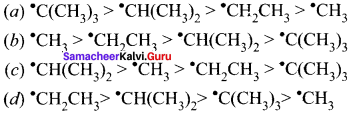
Tamilnadu Samacheer Kalvi 11th Chemistry Solutions Chapter 12 Basic Concepts of Organic Reactions

Students looking for Chapter 12 Basic Concepts of Organic Reactions Concepts can find them all in one place from our Tamilnadu State Board Basic Concepts of Organic Reactions. Simply click on the links available to prepare the corresponding topics of Chemistry easily. Samacheer Kalvi 11th Chemistry Chapter wise Questions and Answers are given to you after sample research and as per the latest edition textbooks. Clarify all your queries and solve different questions to be familiar with the kind of questions appearing in the exam. Thus, you can increase your speed and accuracy in the final exam.

Samacheer Kalvi 11th Chemistry Basic Concepts of Organic Reactions Textual Evaluation Solved

I. Choose The Best Answer:

Question 1.
For the Following reactions –
(A) CH3 CH2 CH2 Br + KOH → CH3 – CH + KBr + H2O
(B) (CH3 )3 CBr + KOH → (CH3 )3 COH + KBr
(C) Samacheer Kalvi 11th Chemistry Solutions Chapter 12 Basic Concepts of Organic Reactions
Which of the following statement is correct’?
(a) (A) is elimination, (B) and (C) are substitution
(b) (A) is substitution, (B) and (C) are elimination
(c) (A) and (B) are elimination and (C) is addition reaction
(d) (A) is elimination, B is substitution and (C) is addition reaction.
Answer:
(d) (A) is elimination, B is substitution and (C) is addition reaction.

Question 2.
What is the hybridisation state of benzyl carbonium ion?
(a) sp2
(b) spd2
(c) sp3
(d) sp2d
Answer:
(a) sp2

Question 3.
Decreasing order of nucleophilicity is –
(a) OH> RNH2 > OCH3> RNH2
(b) NH2> OH> OCH3> RNH2
(c) NH,> CH3O >OH> RNH2
(d) CH3O> NH2> OH> RNH2
Answer:
(b) NH2> OH> OCH3> RNH2+

Question 4.
Which of the tòllowing species is not eLectrophilic in nature?
(a) Cl+
(b) BH3
(c) H3O+
(d) +NO2
Answer:
(c) H3O+

Question 5.
Homolytic fission of covalent bond leads to the formation of –
(a) electrophile
(b) nucicophile
(c) Carbocation
(d) free radical
Answer:
(d) free radical

Question 6.
Hyper Conjugation is also known as –
(a) no bond resonance
(b) Baker – nathan effect
(c) both (a) and (b)
(d) none of these
Answer:
(c) both (a) and (b)

Question 7.
Which of the group has highest +I effect?
(a) CH3
(b) CH3CH2
(c) (CH3)2 -CH-
(d) (CH3)3-C-
Answer:
(d) (CH3)3-C-

Question 8.
Which of the following species does not exert a resonance effect?
(a) C6H5OH
(b) C6H5Cl
(c) C6H5NH2
(d) C6H5NH3
Answer:
(d) C6H5NH3

Question 9.
-I effect is shown by –
(a) -Cl
(b) -Br
(c) both (a) and (b)
(d) -CH3
Answer:
(c) both (a) and (b)

Question 10.
Which of the following carbocation will be most stable?
(a) \({ PH }_{ 3 }\overset { + }{ C- } \)
(b) CH3–\(\overset { + }{ C{ H }_{ 2 } } \)
(c) (CH3)2–\(\overset { + }{ C{ H } } \)
(d) CH2 = CH-CH3
Answer:
(a) \({ PH }_{ 3 }\overset { + }{ C- } \)

Question 11.
Assertion : Tertiary Carbocations are generally formed more easily than primary Carbocations.
Reason : Hyper conjugation as well as inductive effect due to additional alkyl group stabilize tertiary carbonium ions.
(a) both assertion and reason arc true and reason is the correct explanation of assertion.
(b) both assertion and reason are true but reason is not the correct explanation of assertion.
(c) Assertion is true but reason is false
(d) Both assertion and reason are false
Answer:
(a) both assertion and reason are true and reason is the correct explanation of assertion.

Question 12.
Heterolytic fission of C-C bond results in the formation of –
(a) free radical
(b) Carbanion
(c) Carbocation
(d) Carbanion and Carbocation
Answer:
(e) Carbocation

Question 13.
Which of the following represent a set of nucleophiles?
(a) BF3, H2O, NH2-
(b) AlCl3, BF3, NH3
(c) CN, RCH2, ROH
(d) H+, RNH+2, CCl2
Answer:
(c) CN, RCH2, ROH

Question 14.
Which of the following species does not acts as a nucleophile?
(a) ROH
(b) ROR
(c) PCl3
(d) BF3
Answer:
(d) BF3

Question 15.
The geometrical shape of carbocation is
(a) Linear
(b) tetrahedral
(c) Planar
(d) Pyramidal
Answer:
(c) Planar

II. Write brief answer to the following questions.

Question 16.
Write short notes on:
(a) Resonance
(b) Hyper conjugation
Answer:
(a) Resonance:
1. Certain organic compounds can be represented by more than one structure and they differ only in the position of bonding and lone pair of electrons. Such structures are called resonance structure and this phenomenon is called as resonance. This phenomenon is also called as mesomerism or mesomeric effect.

2. For example, the structure of aromatic compounds such as benzene and conjugated system like 1,3 butadiene cannot be represent by a single structure and their observed properties can be explained on the base of a resonance hybrid.

3. Resonance structure of benzene.
Samacheer Kalvi 11th Chemistry Solutions Chapter 12 Basic Concepts of Organic Reactions
(I) and (II) are called as resonance hybridš of benzcnc.

4. For 1,3 butadiene:
Samacheer Kalvi 11th Chemistry Solutions Chapter 12 Basic Concepts of Organic Reactions

(I), (II) and (III) are called as resonance hybrids of 1,3 butadiene.

(b) Hyper conjugation:
1. The denationalization of electrons of σ bond is called as hyper conjugation. it is a special stabilizing effect that results due to the interaction of electrons of a σ bond with the adjacent empty non-bonding P-orbitais resulting in an extended molecular orbital.

2. Hyper conjugation is a permanent effect.

3. For example, in propane. the σ- electrons of C-H bond of methyl group can be delocalised into the it- orbital of doubly bonded carbon as represented below.
Samacheer Kalvi 11th Chemistry Solutions Chapter 12 Basic Concepts of Organic Reactions

Question 17.
What are electrophiles and nucleophiles? Give suitable examples for each.
Answer:
Electrophiles:
Electrophiles are reagents that are attracted towards negative charge or electron rich center. They are either positively charged ions or electron deficient neutral molecules.
Example:
CO2, AlCl3, BF3, FeCl3, NO+, NO+2,, etc.

Nucleophiles:
Nucleophiles are reagents that has high affinity for electropositive centers. They possess an atom has a unshared pair of electrons. They are usually negatively charged ions or electron rich neutral molecules.
Example.
NH3, R-NH2, R-SH, H2O, R-OH, CN. OH etc.

Question 18.
Show the heterolysis of covalent bond by using curved arrow notation and complete the following equations. Identify the nucleophile In each case.
1. CH3-Br+KOH →
2. CH3-OCH3+HI →
Answer:
Samacheer Kalvi 11th Chemistry Solutions Chapter 12 Basic Concepts of Organic Reactions
In this case, \(\overset { \ominus }{ Br } \) and \(\overset { \ominus }{ OH } \) are nucleophiles.

Another mechanism:
Step – I
Samacheer Kalvi 11th Chemistry Solutions Chapter 12 Basic Concepts of Organic Reactions
Step-II
Samacheer Kalvi 11th Chemistry Solutions Chapter 12 Basic Concepts of Organic Reactions

In this case, OCH3 and -I are nucleophiles
Another mechanism:
Step – I
Samacheer Kalvi 11th Chemistry Solutions Chapter 12 Basic Concepts of Organic Reactions

Step – II

Samacheer Kalvi 11th Chemistry Solutions Chapter 12 Basic Concepts of Organic Reactions

Question 19.
Explain inductive effect with suitable example.
Inductive effect:
Answer:
1. it is defined as the change ¡n the polarization of a covalent bond due to the presence of adjacent bonded atoms or groups in the molecule. It is denoted as I-effect.

2. Atoms or groups which lose electron towards a carbon atom are said to have a +I effect.
Example:
CH3-,(CH3)2 CH-,(CH3)2 C- etc.

3. Atoms or groups which draw electrons away from a carbon atom are said to have a -I effect.
Example:
-NO2. -I, -Br, -OH, C6H5 etc.

4. For example, consider ethane and ethyl chloride. The C-C bond in ethane is non polar while the C-C bond in ethyl chloride is polar. We know that chlorine is more electronegative than carbon and hence it attracts the shared pair of electrons between C-Cl in ethyl chloride towards it self.
Samacheer Kalvi 11th Chemistry Solutions Chapter 12 Basic Concepts of Organic Reactions
This develops a slight negative charge on chlorine and a slight positive charge on carbon to which chlorine is attached. To compensate it, the C1 draws the shared pair of electron between itself and C2. This polarization effect is called inductive effect.

Question 20.
Explain electromeric effect.
Electromeric effect:
Answer:
1. The electromeric effect refers to the polarity produced in a multiple bonded the compound when it is attacked by a reagent when a double or a triple bond is exposed to an attack by an electrophile the two π electrons which from the π bond are completely transferred to one atom or the other.

2. When a nucleophile approaches the carbonyl compound, the π-electrons between C and O is instantaneously shifted to the more electronegative oxygen. This make the carbon electron deficient and thus facilitating the formation of a new bond between the incoming nucleophile and the carbonyl carbon atom.
Samacheer Kalvi 11th Chemistry Solutions Chapter 12 Basic Concepts of Organic Reactions

3. When an electrophile such as H approaches an alkene molecule their electrons are instantaneously shifted to the electrophiie and a new bond is formed between carbon and hydrogen. This makes the other carbon electron deficient and hence it acquires a positive charge.
Samacheer Kalvi 11th Chemistry Solutions Chapter 12 Basic Concepts of Organic Reactions

4. This effect denotes as E-effect.

Question 21.
Give examples for the following types of organic reactions
1. – elimination
2. Electrophilic substitution.
Answer:
1. β-eIimination:
Elimination reactions involve the cleavage of a a bond and tórmation of air bond. A nucleophilic pair of electrons heads into a new it bond as a leaving group departs. This process is called 3-elimination because the bond Í to the nucleophilic pair of electrons breaks.
Example:
(a) n-propyl bromide on reaction with alcoholic KOH give propene. in this reaction hydrogen and Br are eliminated.
Samacheer Kalvi 11th Chemistry Solutions Chapter 12 Basic Concepts of Organic Reactions

(b) Acid-catalysed dehydration of alcohols
Samacheer Kalvi 11th Chemistry Solutions Chapter 12 Basic Concepts of Organic Reactions

2. Electrophilic substitution:
Substitution reactions when are brought about by electrophiles are called electrophilic substitution reaction.
Example:
(a) Nitration of benzene
Samacheer Kalvi 11th Chemistry Solutions Chapter 12 Basic Concepts of Organic Reactions

(b) Bromination of benzene:
Samacheer Kalvi 11th Chemistry Solutions Chapter 12 Basic Concepts of Organic Reactions

Samacheer Kalvi 11th Chemistry Basic Concepts of Organic ReactionsAdditional Questions Solved

I. Choose The Correct Answer.

Question 1.
Statement-I: All the organic molecules contain covalent bonds.
Statement-II: Organic molecules are formed by the mutual sharing of electrons between atoms.
(a) Statement-I and II are correct and statement-II is correct explanation of statement-I.
(b) Statement-I and II are correct but Statement-II is not correct explanation of statement-I.
(c) Statement-I is correct but statement-II is wrong.
(d) Statement-I is wrong but statement-II is correct.
Answer:
(a) Statement-I and II are correct and statement-II is correct explanation of statement-I.

Question 2.
Statement-I : Homolytic cleavage is symmetrical one.
Statement-II : A single covalent bond breaks and each of the bonded atoms retains one electron.
(a) Statement-I and II are correct and statement-II is correct explanation of statement-I.
(b) Statement-I and II are correct but statement-II is not correct explanation of statement-I.
(c) Statement-I is correct but statement-II is wrong.
(d) Statement-I is wrong but statement-II is correct.
Answer:
(a) Statement-I and II are correct and statement-Il is correct explanation of statement-I.

Question 3.
Which one of the following is an example for free radical initiators?
(a) Benzoyl peroxide
(b) Benzyl alcohol
(c) Benzyl acetate
(d) Benzaldehyde.
Answer:
(a) Benzoyl peroxide.

Question 4.
Which one of the following ¡s correct order of stability of alkyl free radicals?
Samacheer Kalvi 11th Chemistry Solutions Chapter 12 Basic Concepts of Organic Reactions
Answer:
Samacheer Kalvi 11th Chemistry Solutions Chapter 12 Basic Concepts of Organic Reactions

Question 5.
Statement-I: Ileterolytic cleavage is unsymmetrical one.
Statement-II: A covalent bond breaks and one of the bonded atom retains the bond pair of electrons.
(a) Statement-I and II are correct and statement-II is correct explanation of statement-I.
(b) Statement-I and II are correct but statement-II is not correct explanation of statement-I.
(c) Statement-I is correct but statement-II is wrong.
(d) Statement-I is wrong but statement-II is correct
Answer:
(a) Statement-I and II are correct and statement-II is correct explanation of statement-I.

Question 6.
Which of the following is correct order of the stability of carbocations?
(a) +CH3 > +CH2 CH3> +CH(CH3)2 > +C(CH3)3
(b) +CH2CH3 > +CH3 >+ CH(CH3)2 > +C(CH3)3
(c) +C(CH3)3 > +CH(CH3)2 >+CH2CH3CH3
(d) +CH(CH3)2 > +CH3 > +CH2CH3 > +C(CH3)3
Answer:
(c) +C(CH3)3 > +CH(CH3)2 >+CH2CH3CH3

Question 7.
Which one of the following is correct order of the stability of carbanions?
(a) C(CH3)3> CH(CH3)2> CH2-CH3> CH3
(b) CH3> CH2-CH3> CH(CH3)2> C(CH3)3
(c) CH(CH3), > CH3> CH2-CH3 > C(CH3)3
(d) CH2-CH3 > CH(CH3)2> CH3> C(CH3)3
Answer:
(b) CH3> CH2-CH3> CH(CH3)2> C(CH3)3

Question 8.
Which one of the following is not electrophile’?
(a) NH3
(b) AlCl3
(c) FeCl3
(d) R-X
Answer:
(a) NH3

Question 9.
Which one of the following is not nucleophile
(a) H2O
(b) NH3
(c) R-OH
(d) FeCl3
Answer:
(d) FeCl3

Question 10.
Which one of the following is positively charged electrophiles?
(a) CO2
(b) AlCl3
(c) BF3
(d) RX
Answer:
(d) RX

Question 11.
Which one of the following is nucleophile?
(a) BF3
(b) AlCl3
(c) CO2
(d) R-SH
Answer:
(d) R-SH

Question 12.
Which one of the following species has tendency to show-I effect?
(a) -CH3
(b) -CH2-CH3
(c) -CH(CH3)2
(d) -C6H5
Answer:
(d) -C6H5

Question 13.
Which one of the following species has tendency to show +I effect?
(a) -NH2
(b) -Cl
(c) -C6H5
(d) -CH3
Answer:
(d) -CH3

Question 14.
Which one of the following has strongest acidic character?
(a) HCOOH
(b) CH3COOH
(c) CH2ClCOOH
(d) CCl3COOH
Answer:
(d) CCl3COOH

Question 15.
Which one of the following has least acidic character?
(a) HCOOH
(b) CH3COOH
(c) CH2ClCOOH
(d) CCl3COOH
Answer:
(b) CH3COOH

Question 16.
Pick out the correct order of acid strength.
(a) CH3-CH2-COOH > CH3COOH > CH2CICOOH
(b) CH3COOH > CH3-CH2-COOH >CH2CICOOH
(c) CH2ClCOOH > CH3COOH > CH3-CH2-COOH
(d) CH2ClCOOH > CH3-CH2-COOH > CH3COOH
Answer:
(c) CH2ClCOOH > CH3COOH > CH3—CH2-COOH

Question 17.
Statement-I: Fluoro acetic acid is stronger acid than acetic acid
Statement-II: Fluorine has high electronegativity and it is facilitate to dissociate the OH bond easily.
(a) Statement-I and II are correct and statement-II is correct explanation of statement-I.
(b) Statement-I and II are correct but statement-II is not correct explanation of statement-I.
(c) Statement-I is correct but statement-II is wrong.
(d) Statement-I is wrong but statement-Il is correct
Answer:
(a) Statement-I and II are correct and statement-II is correct explanation of statement-I.

Question 18.
Which one of the following is an example for negative mesomeric effect?
(a) -SH
(b) -SR
(c) -NH2
(d) -NO2
Answer:
(d) -NO2

Question 19.
Which one of the following electrophile used for nitration of benzene?
(a) \({ Br }^{ \oplus }\)
(b) \({ { NO }_{ 2 }^{ \ominus } }\)
(c) -NH2
(d) \({ NO }^{ \ominus }\)
Answer:
(b) \({ { NO }_{ 2 }^{ \ominus } }\)

Question 20.
Identify the one which does not come under the organic addition reaction
(a) Hydration
(b) Dehydration
(c) Halogenation
(d) Hydro halogenation
Answer:
(b) Dehydration

Question 21.
Primary alcohols undergo which type of reaction to form alkenes?
(a) Elimination
(b) Oxidation
(c) Reduction
(d) Hydrolysis
Answer:
(a) Elimination

Question 22.
Samacheer Kalvi 11th Chemistry Solutions Chapter 12 Basic Concepts of Organic Reactions Identify the type of reaction
(a) Addition reaction
(b) Elimination reaction
(c) Reduction reaction
(d) Oxidation reaction
Answer:
(d) Oxidation reaction

II. Match the following.
Samacheer Kalvi 11th Chemistry Solutions Chapter 12 Basic Concepts of Organic Reactions
Answer:
Samacheer Kalvi 11th Chemistry Chapter 11 Fundamentals of Organic Chemistry

III. Fill in the blanks.
Question 1.
The slowest step in the mechanism determines ………..
Answer:
Rate of reaction

Question 2.
Homolytic cleavage occurs under the conditions of ………….
Answer:
High temperature.

Question 3.
During the cleavage of Azobisisobutyronitrile produces species ……….
Answer:
Free radical

Question 4.
The cleavage of C-Br bond in tert-butyl bromide leads to formation of ………..
Answer:
Carbocation

Question 5.
The cleavage of C-H bond in aldehydes Leads to formation of ………….
Answer:
Carbanion

Question 6.
Electron displacement occurring in saturated compounds along a carbon chain is termed as …………
Answer:
Inductive effect

Question 7.
The addition of H to alkene is an example of effect ……….
Answer:
+E

Question 8.
Example for positive mesomeric effect is ………..
Answer:
-OH

Question 9.
Acidity of phenol was explained by …………
Answer:
R-effect

Question 10.
Hydrolysis of alkyl halide is an example for ……….
Answer:
Nucleophilic substitution

Question 11.
4-hydroxy phenol reacts with acidified potassium dichromate to gives
Answer:
p-Benzoquinone

Question 12.
Enzyme present in apple is
Answer:
Poly phenol oxidase

Question 13.
Benzene reacts with H2 in the presence of Pt to give
Answer:
Cyclohexane

Question 14.
Alcohol on refluxing with K2Cr2O7 gives……..
Answer:
Carboxylic acid

Question 15.
Carbonyl compounds especially ketones undergo reduction to form ………..
Answer:
Secondary alcohols

Question 16.
Ethane undergo thrombolytic cleavage to form ………..
Answer:
Methyl free radical

IV. Choose the odd one out.
Question 1.
(a) NH3
(b) H2O
(c) CN
(d) RSH
Answer:
(c) CN It is a negatively charged nucleophile whereas others are neutral nucleophiles.

Question 2.
(a) CO2
(b) RX
(c) MCl3
(d) FeCl3
Answer:
(b) RX. It is a positive charged electrophiles whereas others are neutral clectrophiles.

Question 3.
(a) -F
(b) – Cl
(c) – COOH
(d) CH3O
Answer:
(d) CH3O. It is a group carrying negative charge one electron donating (or) +I group whereas others are -I group.

Question 4.
(a) – C(CH3)3
(b) – COOK
(c) – CH(CH3)2
(d) – COO
Answer:
(b) – COOH. It has -I effect whereas other have +I effect.

Question 5.
(a) -OH
(b) -NH2
(c) -SH
(d) -COOH
Answer:
(d) – COOH. It has negative mesomeric effect whereas others have positive mesomeric effect.

V. Choose the correct pair.
Question 1.
(a) Homolytic clevage : carbocation
(b) Homolytic clevage : carbanion
(c) Homolytic clevage : free radicals
(d) Heterolytic clevage : free radicals
Answer:
(c) Homolytic clevage : free radicals

Question 2.
(a) + C(CH3)3 > +CH(CH3)2> +CH2-CH3 > +CH3 : Relative stability of carbocations.
(b) – C(CH3)3 > CH(CH3)2 > CH2-CH3 > CH3 : Relative stability of carbanion.
(c) OH,RO, RCOO : Neutral nucleophile
(d) AlCl3, BF3, FeCl3 : Positively charged nucleophile
Answer:
(a) + C(CH3)3 > +CH(CH3)2> +CH2-CH3 > +CH3 : Relative stability of carbocations.

Question 3.
(a) CH3 – CH2 – CH2Br + Alcoholic KOH : Substitution reaction
(b) CH3 – CH2 – CH2Br + Alcoholic KOH : Elimination reaction
(c) CH3CHO + Acidic dichromate : Reduction reaction
(d) Benzene + Pt + H2 : Oxidation reaction
Answer:
(b) CH3 – CH2 – CH2Br + Alcoholic KOH : Elimination reaction

VI. Choose the incorrect pair.
Question 1.
(a) – OH,- SH, -NH2 : Positive mesometic effect
(b) – NO2 >CO, – COOH : Negative mesomeric effect
(c) – F, – Cl, – NO2 : Electron withdrawing group
(d) – C(CH3)3, – CH(CH3)3 – CH2 – CH3 : Electron withdrawing group
Answer:
(c) – F, – Cl, – NO2 : Electron withdrawing group

Question 2.
(a) NH3 andAmines : Neutral nucleophile
(b) OH and RCOO : Negative nucleophile
(c) RX and H3O3 : Positive electrophile
(d) MCl3, BF3 : Negative electrophile
Answer:
(d) AlCl3, BF3 : Negative electrophile

Question 3.
Samacheer Kalvi 11th Chemistry Solutions Chapter 12 Basic Concepts of Organic Reactions
Answer:
Samacheer Kalvi 11th Chemistry Solutions Chapter 12 Basic Concepts of Organic Reactions

VII. Assertion and Reason.
Question 1.
Assertion (A) : Neutral molecule SnCl4 can act as an electrophile.
Reason (R) : it has vaccant ‘d’ orbitais which can accommadate the electrons from others.
(a) Both (A) and (R) are correct and (R) is the correct explanation of (A).
(b) Both (A) and (R) are correct but (R) is not the correct explanation of (A).
(c) (A) is correct but (R) is wrong.
(d) (A) is wrong but (R) is correct.
Answer:
(a) Both (A) and (R) are correct and (R) is the correct explanation of (A).

Question 2.
Assertion (A) : The C-C bond in ethane is non-polar while the C-C bond in ethyl chloride is polar.
Reason (R) : Chlorine is more electronegative than carbon and hence it attracts the shared pair of electron between C-C in ethyl chloride and it develops a negative charge on Cl and positive charge on Carbon.
(a) Both (A) and (R) are correct but (R) is not the correct explanation of (A).
(b) Both (A) and (R) are correct and (R) is the correct explanation of (A).
(c) (A) is correct but (R) is wrong.
(d) (A) is wrong but (R) is correct.
Answer:
(b) Both (A) and (R) are correct and (R) is the correct explanation of (A).

Question 3.
Assertion (A): Phenol is more acidic than aliphatic alcohols.
Reason (R): The phenoxide ion is more stabilized than phenol by resonance effect and hence resonance favours ionization of phenol to form H and shows acidity.
(a) Both (A) and (R) are correct and (R) is the correct explanation of(A).
(b) Both (A) and (R) are correct but (R) is not the correct explanation of(A).
(c) (A) is correct but (R) is wrong.
(d) (A) is wrong but (R) is correct.
Answer:
(a) Both (A) and (R) are correct and (R) is the correct explanation of(A).

Question 4.
Assertion (A): The cut apple turns brown.
Reason (R): Cut apple exposes its cells to atmospheric oxygen and the oxidizes the phenolic compound present in it. Due to this enzymatic browning, the cut apple turns brown.
(a) Both (A) and (R) are correct but (R) is not the correct explanation of (A).
(b) Both (A) and (R) are correct and (R) is the correct explanation of (A).
(c) (A) is correct but (R) is wrong.
(d) (A) is wrong but (R) is correct.
Answer:
(b) Both (A) and (R) are correct and (R) is the correct explanation of (A).

Samacheer Kalvi 11th Chemistry Basic Concepts of Organic Reactions 2 Marks Question and Answers

II. Answer briefly.

Question 1.
What are organic reactions?
Answer:
Substrate is an organic molecule reacts with reagent, which may be an organic, inorganic or any agent like heat, photon etc, that brings about the chemical change to form a product, this is known as organic reactions.

Question 2.
What is mechanism of the reaction?
Answer:
In the organic reactions, that series of simple steps which collectively represent the chemical change, from substrate to product, this is called as the mechanism of the reaction. The slowest step in the mechanism determines the overall rate of the reaction.

Question 3.
Mention the types of fission of a covalent bond?
Answer:
There are three types of fission of a covalent bond. They are,

  • Homolytic cleavage
  • Heterolytic cleavage

Question 4.
Explain the homolytic fission of a covalent bond?
Answer:

  • Homolytic cleavage is the process in which a covalent bond breaks symmetrically in such way that each of the bonded atoms retains one electron.
  • This type of cleavage occurs under high temperature or in the presence of UV light.
  • in a compound containing non-polar covalent bond formed between atoms of similar electronegativity, in such molecules the cleavage of bonds results into free radicals.
  • For example, ethane undergo homolytic fission to produce, two methyl free radicals.
    Samacheer Kalvi 11th Chemistry Solutions Chapter 12 Basic Concepts of Organic Reactions

Question 5.
What are free radical initiators?
Answer:
The types of reagents that promote homolytic cleavage in substrate are called as free radical initiators. They are short lived and are highly reactive.

Question 6.
Mention any two examples for free radical initiators?
Answer:
Two examples for free radical initiators

  • Azobisisobutyronitnie (AIBN)
  • Benzoyl peroxide

Question 7.
Explain the heterolytic fission of a covalent bond?
Answer:

  • Heterolytic cleavage is the process in which a covalent bond breaks unsymmetrically such that one of the bonded atom retains the bond pair of electron.
  • It results in the formation of a cation and an anion of the two bonded atoms the most electronegative.
  • For example in tert-butyibromide, the C-Br bond is polar as bromine is more electronegative than carbon. Hence the C-Br undergoes heterolytic cleavage to form a terl-butyl carbocation and bromide anion.
    Samacheer Kalvi 11th Chemistry Solutions Chapter 12 Basic Concepts of Organic Reactions

Question 8.
What are carbocations?
Answer:
1. Let us consider the heterolytic fission of the bond C-X present in organic molecule. If the atom X has greater electronegativity than the carbon atom, the former takes away the bonding electron pair and becomes negatively charged while the carbon will lose its electron and thus acquire a positive charge.
2. Such a cationic species carrying a positive charge on carbon are known as carbocation or carhonitim ion.
Samacheer Kalvi 11th Chemistry Solutions Chapter 12 Basic Concepts of Organic Reactions

Question 9.
What are carbanions?
Answer:
Let us consider the heterolytic fission of the bond C-X present in an organic molecule. if the carbon atom has greater electronegativity than the atom X, the former takes away the bonding electron pair and acquires a negative charge. The resulting carbon anion is known as carbanion.
Samacheer Kalvi 11th Chemistry Solutions Chapter 12 Basic Concepts of Organic Reactions

Question 10.
Differentiate the carbocation and carbanion
Answer:
Carbocation:

  • In a carbocation carbon bearing positive charge.
  • Carbon bearing positive charge has sp2 hybridization.
  • It has a planar structure.
  • Example:
    CH3+ (CH3)2\({ C }^{ \ominus }\)H, (CH3)3C+ etc.

Carbanion:

  • In a carbanion carbon bearing negative charge.
  • Carbon bearing negative charge has sp3 hybridization.
  • It has a pyramidal structure.
  • Example:
    CH3–\({ C }^{ \ominus }\)H2, CH3-CHO, (CH3)2\({ C }^{ \ominus }\)H etc.

Question 11.
Identify which of the following are electrophiles and nucleophiles?

  1. NH3
  2. AlCl3
  3. R-SH
  4. R-X
  5. R-O-R
  6. BF3

Answer:
Samacheer Kalvi 11th Chemistry Solutions Chapter 12 Basic Concepts of Organic Reactions

Question 12.
How will you distinguish between electrophiles and nucleophiles?
Answer:
Electrophiles:

  • They are electron deficient.
  • They are cations.
  • They are lewis acids.
  • Accept an electron pair.
  • Attack on electron rich sites.

Nucleophites:

  • They are electron rich.
  • They are anions.
  • They are lewis bases.
  • Donate an electron pair.
  • Attack on electron deficient sites.

Question 13.
What are all the sources for human body that produces free radicals?
Answer:
Sources for human body produces free radicals,

  • Human body is exposed to X-rays.
  • Cigarette smoke.
  • Industrial chemicals.
  • Air pollutants.

Question 14.
In what way free radical affect the human body?
Answer:

  • Free radicals can disrupt cell membranes.
  • Increase the risk of many forms of cancer.
  • Damage the interior lining of blood vessels.
  • leads to a high risk of heart disease and stroke.

Question 15.
How to reduce the effect of free radicals?
Answer:

  • Use vitamins and minerals to counter the effects of free radicals.
  • Fruits contains antioxidants which decrease the effects of free radicals.

Question 16.
Identify which of the following shows +I and -I effect?

  1. -NO2
  2. -SO2H
  3. -I
  4. -OH
  5. CH2O-
  6. CH2

Answer:
Samacheer Kalvi 11th Chemistry Solutions Chapter 12 Basic Concepts of Organic Reactions

Question 17.
Why chloro acetic acid is stronger acid than acetic acid?
Chioro acetic acid:
Answer:
Samacheer Kalvi 11th Chemistry Solutions Chapter 12 Basic Concepts of Organic Reactions

Chioro acetic acid has Cl-group and it has high electronegativity and shows -I effect. Therefore Cl-atom to faciLitate the dissociation of O-H bond very fastly, whereas in the case of acetic acid, has CH3 group and it shows +I effect, theretòre dissociation of O-H bond will be more difficult. Thus chloro acetic acid is stronger acid than acetic acid.

Question 18.
Explain the positive and negative electromeric effects?
Answer:
1. When an electrophile such as W approaches an alkene molecule, the π electrons are instantaneously shifted to the electrophile and a new bond is formed between carbon and hydrogen. This makes the other carbon electron deficient and hence it acquires a positive charge.
Samacheer Kalvi 11th Chemistry Solutions Chapter 12 Basic Concepts of Organic Reactions
2. When the it electron is transferred towards the attacking reagent, it is called positive electromeric (+E) effect.
Samacheer Kalvi 11th Chemistry Solutions Chapter 12 Basic Concepts of Organic Reactions
3. Whèn the t electron is transferred away from the attacking reagent it is called negative electromenc (-E) effect.
Samacheer Kalvi 11th Chemistry Solutions Chapter 12 Basic Concepts of Organic Reactions
For example : The attack of C\({ N }^{ \ominus }\) on a carbonyl carbon.
Samacheer Kalvi 11th Chemistry Chapter 11 Fundamentals of Organic Chemistry

Question 19.
Write a short notes on positive mesomeric effect?
Answer:

  • Positive mesomeric effect occurs, when the electrons move away from substituent attached
    to the conjugated system.
  • It occurs, if the electron releasing substituents are attached to the conjugated system.
  • The attached group has a tendency to release electrons through resonance, these electron
    releasing groups are usually denoted as +R or +M groups
  • Examples: -OH, -SH, -OR, -SR, -NH2 etc.

Question 20.
Write a short notes on negative mesomeric effect?
Answer:

  • Negative mesomeric effect occurs, when the electrons move towards the substituent attached to the conjugated system.
  • It occurs if the electron withdrawing substituents are attached to the conjugated system.
    The attached group has a tendency to withdraw electrons through resonance, these electron withdrawing groups are usually denoted as -R or -M groups.
  • Examples:
    Samacheer Kalvi 11th Chemistry Solutions Chapter 12 Basic Concepts of Organic Reactions

Question 21.
What are addition reactions? Give an example.
Answer:
All organic compounds having double or triple bond adopt addition reactions in which two substances unite to form a single compound. During the addition reaction the hybridization of the substrate changes as only one bond breaks and two new bonds are formed.
Example:

Samacheer Kalvi 11th Chemistry Solutions Chapter 12 Basic Concepts of Organic Reactions

Question 22.
What are elimination reaction? Give an example.
Answer:
In these reactions, two atoms or groups are removed from a molecule without being substituted by other atoms or groups. A new C-C double bond is formed between the carbon atoms to which the eliminated atoms or groups are previously attached. It is always accompanied with change in hybridization.
Example:
Samacheer Kalvi 11th Chemistry Solutions Chapter 12 Basic Concepts of Organic Reactions

Question 23.
What are organic oxidation reactions? Give an example.
Answer:
Most of the oxidation reaction of organic compounds involves gain of oxygen or loss of hydrogen.
Example:
Samacheer Kalvi 11th Chemistry Solutions Chapter 12 Basic Concepts of Organic Reactions

Question 24.
What are organic reduction reactions? Give an example.
Answer:
Most of the reduction reaction of organic compounds involves gain of hydrogen or loss of oxygen.
Example:
Samacheer Kalvi 11th Chemistry Solutions Chapter 12 Basic Concepts of Organic Reactions

Question 25.
Why cut apple turns a brown colour?
Answer:

  • Apples contains an enzyme called polyphenol oxidase (PPO) also known as tyrosinase.
  • Cutting an apple exposes its cells to the atmospheric oxygen and oxidizes the phenolic compounds present in apples. This is called the “enzymatic browning” that turns a cut apple brown.
  • In addition to apples, enzymatic browning is also evident in bananas, pears, avocados and even potatoes.

Question 26.
What are functional group inter conversions?
Answer:
Organic synthesis involves functional group inter conversions. A particular functional group can be converted into other functional group by reacting it with suitable reagents. For example, the carboxylic acid group (-COOH) present in organic acids can be transformed into -COCl by treating the acid with SOCl2 reagent..

Question 27.
How will you convert alcohol into aldehyde?
Answer:
When primary alcohol reacts with acidified potassium dichromate to gives aldehyde.
Samacheer Kalvi 11th Chemistry Solutions Chapter 12 Basic Concepts of Organic Reactions

Question 28.
What happen when nitrile undergoes acid hydrolysis?
Answer:
When alkyl nitrile undergoes acid hydrolysis to give amide, which on further hydrolysis to give carboxylic acid.
Samacheer Kalvi 11th Chemistry Solutions Chapter 12 Basic Concepts of Organic Reactions

Question 29.
Complete the following reactions and identify the products?
Answer:
Samacheer Kalvi 11th Chemistry Solutions Chapter 12 Basic Concepts of Organic Reactions

Question 30.
Predict the product for the following reaction.
Answer:
Samacheer Kalvi 11th Chemistry Solutions Chapter 12 Basic Concepts of Organic Reactions
Answer:
Samacheer Kalvi 11th Chemistry Solutions Chapter 12 Basic Concepts of Organic Reactions

Question 31.
How will you convert benzene into cyclohexane?
Answer:
Benzene undergo catalytic hydrogenation in presence of platinum to give cyclohexane.
Samacheer Kalvi 11th Chemistry Solutions Chapter 12 Basic Concepts of Organic Reactions

Question 32.
Complete the reaction and name the product
Samacheer Kalvi 11th Chemistry Solutions Chapter 12 Basic Concepts of Organic Reactions
Answer:
Samacheer Kalvi 11th Chemistry Solutions Chapter 12 Basic Concepts of Organic Reactions

Question 33.
Identify the product and mention the type of organic reaction.
Answer:
Samacheer Kalvi 11th Chemistry Solutions Chapter 12 Basic Concepts of Organic Reactions
This is one of the elimination reaction.

Question 34.
Complete the following reaction and identify the product.
Answer:
Samacheer Kalvi 11th Chemistry Solutions Chapter 12 Basic Concepts of Organic Reactions

Question 35.
What are substitution reaction?
Answer:
In this reaction an atom or a group of atoms attached to a carbon atom is replaced by a new atom or a group of atoms.
Samacheer Kalvi 11th Chemistry Solutions Chapter 12 Basic Concepts of Organic Reactions
Here, -Br is replaced by -OH group.

Question 36.
How will substitution reactions are classified?
Answer:
Substitution reactions can be classified as,

  • Nucleophilic substitution reaction.
  • Electrophilic substitution reaction.
  • Free radical substitution reaction.

Question 37.
Draw the resonance structures for the following compounds?
Samacheer Kalvi 11th Chemistry Solutions Chapter 12 Basic Concepts of Organic Reactions
Answer:
Samacheer Kalvi 11th Chemistry Solutions Chapter 12 Basic Concepts of Organic Reactions

Question 38.
Identify the reagents shown in box in the following equations as nucleophiles or electrophiles.
Answer:
Samacheer Kalvi 11th Chemistry Solutions Chapter 12 Basic Concepts of Organic Reactions
In (a) \(\overset { \ominus }{ OH } \) is nucleophile
In (b) \(\overset { \ominus }{ CN } \) is nucleophile
In (c) CH3\(\overset { \ominus }{ CO } \) is electrophile

Question 39.
Classify the following reactions in one of the reaction type of organic reaction.
Answer:
(a) CH3CH2Br + \({ SH }^{ \ominus }\) → CH3CH2SH + \({ Br }^{ \ominus }\)
(b) (CH3)2C = CH2 + HCI (CH3)2CCl – CH3
(c) CH3CH2Br + \({ OH }^{ \ominus }\) → CH2 = CH2 + H2O + \({ Br }^{ \ominus }\)
(a) Nucleophilic substitution reaction.
(b) Electrophilic addition reaction.
(c) Elimination reaction.

Question 40.
Which electron displacement effect explain the following correct orders of acidity of the carboxylic acids?
Answer:
CH3CH2COOH > (CH3)2 CHCOOH > (CH3)3C COOH
As the number of alkyl group increases, +I effect increases and it strengthen the O-H bond. i.e., O-H bond dissociation is very difficult.
Samacheer Kalvi 11th Chemistry Solutions Chapter 12 Basic Concepts of Organic Reactions
Therefore +I effect explain the correct orders of acidity of the carboxylic acids.

Question 41.
Which of the two, NO2CH2CH2\({O}^{ \ominus }\) or CH3CH2\({O}^{ \ominus }\) is expected to be more stable and why?
Answer:
v
(I) is more stable than (II) because NO2 group has -I effect and hence it tends to disperse the -ve charge on the 0-atom. In contrast., CH3CH, has +I effect. It therefore, tends to intensify the -ve charge and hence destabilizes it.

Samacheer Kalvi 11th Chemistry Basic Concepts of Organic Reactions 5 Marks Questions and Answers

Question 1.
Explain electron movement in organic reactions.
Answer:
All organic reactions can be understood by following the electron movements.

  • Lone pair becomes a bonding pair.
  • Bonding pair becomes a lone pair.
  • A bond breaks and becomes another bond.

The electron movement depends on the nature of the substrate, reagent and the prevailing conditions.
Type – 1.
A lone Pair to a bonding pair
v
Type – 2.
A bonding pair to a lone Pair
Samacheer Kalvi 11th Chemistry Solutions Chapter 12 Basic Concepts of Organic Reactions

Type – 3.
A bonding pair to an another bonding pair
Samacheer Kalvi 11th Chemistry Solutions Chapter 12 Basic Concepts of Organic Reactions

Question 2.
How does inductive effect influence the reactivity and acidity of carboxylic acids?
Answer:
(a) Reactivity:

  • When a highly electronegative atom such as halogen is attached to a carbon then it makes the C—X bond polar.
  • In such cases the -I effect of halogen facilitates the attack of an incoming nucleophile at the polarized carbon and hence increases the reactivity.
    Samacheer Kalvi 11th Chemistry Solutions Chapter 12 Basic Concepts of Organic Reactions
  • If a -I group is attacher neared to a carbonyl carbon, it decreases the availability of electron density on the carbonyl carbon and hence increases the rate of the nucleophilic addition reaction.

(b) Acidity of carboxylic acid:

  • When a halogen atom is attached to the carbon which is neared to the carboxylic acid group, its -I effect withdraws the bonded electrons towards itself and makes the ionization of H+ easy.
  • The acidity of various chioro acetic acid is in the following order. Cl3C-COOH > Cl2CHCOOH > ClCH2COOH The strength of the acid increases with increase in the effect of the group attached to the carboxyl group.
  • Similarly the following order of acidity in the carboxylic acids is due to the +1 effect of alkyl group. (CH3)3CCOOH < (CH3)2CHCOOH <CH3COOH

Question 3.
Explain the acidic nature of phenol.
Answer:

  • Resonance is useful in explaining certain properties such as acidic of phenol.
  • The phenoxide ion is more stabilized than phenol by resonance effect.
  • The resonance favours ionisation of phenol to form H+ and shows acidity.
    Samacheer Kalvi 11th Chemistry Solutions Chapter 12 Basic Concepts of Organic Reactions
    phenoxide ion resonance structures.
    Samacheer Kalvi 11th Chemistry Solutions Chapter 12 Basic Concepts of Organic Reactions
  • The above structures shows that there is a charge separation in the resonance structure of phenol which needs energy whereas there is no such hybrid structures in the case of phenoxide ion. This increases stability accounts for the acidic character of phenol.

Question 4.
How does hyper conjugation effect explain the stability of alkenes?
Answer:

  • The relative stability of various classes of carhonium ions may be explained by the number of no bond resonance structures that can be written for them.
  • Such structures are arrived by shifting the bonding electrons from an adjacent C-H bond to the electron deficient carbon.
  • in this way, the positive charge originally on carbon is dispersed to the hydrogen. This manner of electron release by assuming no bond character in the adjacent C-H bond is called hyper conjugation or Baker- Nathan effect.
  • The greater the hyper conjugation, the greater will be the stability of the compound. The increasing order of stability can be shown as:
    Samacheer Kalvi 11th Chemistry Solutions Chapter 12 Basic Concepts of Organic Reactions
  • Alkyl group increases in the C=C double bond carbon, hyper conjugation increases and stability of that organic compound also increases.

Question 5.
Explain the types of addition reactions?
Answer:
Addition reactions are classified into three types. They are,

  1. Electrophi lic addition reaction
  2. Nucleoph lije addition reaction
  3. Free radical addition reaction

1. Electrophilic addition reaction:
An electrophilic addition reaction can be described as an addition reaction in which a reactant with multiple bonds as in a double or triple bond undergoes has it air bond broken and two new a bond are formed.
Samacheer Kalvi 11th Chemistry Solutions Chapter 12 Basic Concepts of Organic Reactions
2. Nucleophilic addition reaction:
A nucleophilic addition reaction is an addition reaction where a chemical compound with an electron deficient or electrophilic double or triple bond, a it bond, reacts with a nucleophilic which is an electron rich reactant with the disappearance of the double bond and creation of two new single or a bonds.
Samacheer Kalvi 11th Chemistry Solutions Chapter 12 Basic Concepts of Organic Reactions

3. Free radical addition reaction:
it is an addition reaction in organic chemistry involving free radicals. The addition may occur between a radical and a non radical or between two radicals.
Samacheer Kalvi 11th Chemistry Solutions Chapter 12 Basic Concepts of Organic Reactions

Question 6.
Explain the types of substitution reaction?
Answer:
Substitution reactions are classified into three types. They are,

  1. Nucleophilic substitution reaction.
  2. Electrophilic substitution reaction.
  3. Free radical substitution reaction.

1. Nucleophilic substitution reaction:
A nucleophilic substitution reaction in organic chemistry is a type of reaction where a nucleophilic gets attached to the positive charged atoms or molecules of the other substance. A good example of a nucleophilic substitution reaction is the hydrolysis of alkyl bromide, under the basic conditions where in the nucleophile is nothing but the base H. whereas the leaving group is the Br°. The reaction for the following is as give below.
Samacheer Kalvi 11th Chemistry Solutions Chapter 12 Basic Concepts of Organic Reactions

2. Electrophilic substitution reaction:
The electrophilic substitution reaction involves the electrophiles. The electrophilic reactions occur mostly with the aromatic compounds. This types of substitution reaction arc basically defined as those chemical reactions where the electrophile replaces the functional group in a compound but not the hydrogen atom, sometimes hydrogen atom can be also replaced by electrophiles.
For example:
Samacheer Kalvi 11th Chemistry Solutions Chapter 12 Basic Concepts of Organic Reactions

3. Free radical substitution reaction:
Free radical substitution reaction involving free radicals arc a reactive intermediate.
A – X + Y → A – Y + X
CH4 + Cl → CH + HCl
CH3 + Cl → CH3Cl (methyl chloride)

Question 7.
For the following bond cleavages use curved-arrows to show the electron flow and classify each as homolytic or heterolytic fission. Identify reactive intermediate produced as free radical,, carbocation and carbanion?
Samacheer Kalvi 11th Chemistry Solutions Chapter 12 Basic Concepts of Organic Reactions
Answer:
Samacheer Kalvi 11th Chemistry Solutions Chapter 12 Basic Concepts of Organic Reactions
Question 8.
An organic compound (A) has a molecular formula C2H6O it is one of the primary alcohol. A reacts with acidified potassium dichromate to give B. B on further undergoes to oxidation reaction to give C. C on reacts with SOCl3 to give D which ¡s chlorinated product. Identify A,B,C and D, explain with equation.
Answer:
1. C2H6O is CH3-CH2-OH which is a primary alcohol (A)
2. CH3-CH2-OH (A) reacts with H+/ K2Cr2O7 to give acetaldehyde (B)
Samacheer Kalvi 11th Chemistry Solutions Chapter 12 Basic Concepts of Organic Reactions
3. CH3CHO (B) which on further oxidation to give acetic acid (C).
Samacheer Kalvi 11th Chemistry Solutions Chapter 12 Basic Concepts of Organic Reactions
4. Acetic acid reacts with SOCl2 to give acetyl chloride (D).
Samacheer Kalvi 11th Chemistry Solutions Chapter 12 Basic Concepts of Organic Reactions

Question 9.
An organic compound (A) of a molecular formula C2H4 which is a simple alkene. A reacts with dil H2S04 to give B. A again reacts with Cl2 to give C. Identify AB and C and write the equations.
Answer:
1. C2H2 is CH2=CH2 is a simple alkene. A is ethylene.
2. Ethylene (A) reacts with dii H2SO4 to give ethanol (B)
Samacheer Kalvi 11th Chemistry Solutions Chapter 12 Basic Concepts of Organic Reactions
3. Ethylene (A) reacts with Cl, to give 1.2 dichloro ethane (C)
Samacheer Kalvi 11th Chemistry Solutions Chapter 12 Basic Concepts of Organic Reactions

Question 10.
Complete the reactions and identify the products.
Answer:
Samacheer Kalvi 11th Chemistry Solutions Chapter 12 Basic Concepts of Organic Reactions

We as a team believe the information prevailing regarding the Samacheer Kalvi Basic Concepts of Organic Reactions for 11th Chemistry Chapter 12 Basic Concepts of Organic Reactions has been helpful in clearing your doubts to the fullest. For any other help do leave us your suggestions and we will look into them. Stay in touch to get the latest updates on Tamilnadu State Board Basic Concepts of Organic Reactions for different subjects in the blink of an eye.

Samacheer Kalvi 11th Chemistry Solutions Chapter 11 Fundamentals of Organic Chemistry

Enhance your subject knowledge with Tamilnadu State Board for Chapter 11 Fundamentals of Organic Chemistry and learn all the underlying concepts easily. Make sure to Download Samacheer Kalvi 11th Chemistry Book Solutions Fundamentals of Organic Chemistry, Notes Pdf Chapter 11 Fundamentals of Organic Chemistry Questions and Answers PDF on a day to day basis and score well in your exams. Are given after enormous research by people having high subject knowledge. You can rely on them and prepare any topic of Chemistry as per your convenience easily.

Tamilnadu Samacheer Kalvi 11th Chemistry Solutions Chapter 11 Fundamentals of Organic Chemistry

Students looking for Chapter 11 Fundamentals of Organic Chemistry Concepts can find them all in one place from our Tamilnadu State Board Fundamentals of Organic Chemistry. Simply click on the links available to prepare the corresponding topics of Chemistry easily. Samacheer Kalvi 11th Chemistry Chapter wise Questions and Answers are given to you after sample research and as per the latest edition textbooks. Clarify all your queries and solve different questions to be familiar with the kind of questions appearing in the exam. Thus, you can increase your speed and accuracy in the final exam.

Samacheer Kalvi 11th Chemistry Fundamentals of Organic Chemistry Textual Evaluation Solved

Samacheer Kalvi 11th Chemistry Fundamentals of Organic Chemistry Multiple Choice Questions

Question 1.
Select the molecule which has only one ir bond.
(a) CH3-CH=CH-CH3
(b) CH3-CH=CH-CHO
(c) CH3-CH=CH-COOH
(d) All of these
Answer:
(a) CH3-CH=CH-CH3

Question 2.
In the hydrocarbon Samacheer Kalvi 11th Chemistry Solutions Chapter 11 Fundamentals of Organic Chemistrythe state of hybridisation of carbon 1,2,3,4 and 7 are in the following sequence.
(a) sp, sp, sp3, sp2, sp3
(b) sp2, sp, sp3, sp2, sp3
(c) sp, sp, sp2, sp, sp3
(d) none of these
Answer:
(a) sp, sp, sp3, sp2, sp3

Question 3.
The general formula for alkadiene is ……….
(a) CnH2n
(b) CnH2n-1
(c) CnH2n-2
(d) CnHn-2
Answer:
(c) CnH2n-2

Question 4.
Structure of the compound whose IUPAC name is 5, 6 – dimethylhept-2-ene is ……….
Samacheer Kalvi 11th Chemistry Solutions Chapter 11 Fundamentals of Organic Chemistry
Answer:
Samacheer Kalvi 11th Chemistry Solutions Chapter 11 Fundamentals of Organic Chemistry

Question 5.
The IUPAC name of the compound is …………
Samacheer Kalvi 11th Chemistry Solutions Chapter 11 Fundamentals of Organic Chemistry
(a) 2,3 – Diemethyiheptane
(b) 3 – Methyl – 4 – ethyloctane
(c) 5 – ethyl – 6 – methyloctanc
(d) 4 – Ethyl -3 – methyloctane.
Answer:
(d) 4 – Ethyl – 3 – methyloctane.

Question 6.
Which one of the following names does not fit a real name?
(a) 3 – Methyl – 3 – hexanone
(b) 4- Methyl – 3 – hexanone
(c) 3 – Methyl – 3 – hexanol
(d) 2 – Methyl cyclo hexanone.
Answer:
(a) 3 – Methyl – 3 – hexanone

Question 7.
The TUPAC name of the compound CH3— CII = CH -C CH is ……………
(a) Pent – 4 – yn – 2 – ene
(b) Pent -3-en – 1- yne
(c) pent – 2 – en – 4 – yne
(d) Pent – 1 – yn – 3 – ene
Answer:
(b) Pent -3-en – 1- yne

Question 8.
IUPAC name of Samacheer Kalvi 11th Chemistry Solutions Chapter 11 Fundamentals of Organic Chemistry is ……….
(a) 3, 4, 4 – Trimethylheptane
(b) 2 – Ethyl – 3, 3 – dimethyl heptane
(c) 3, 4, 4 – Trimethyloctane
(d) 2 Butyl – 2 -methyl – 3 – ethyl-butane.
Answer:
(c) 3, 4, 4 – Trimethyloctane

Question 9.
The IUPAC name of Samacheer Kalvi 11th Chemistry Solutions Chapter 11 Fundamentals of Organic Chemistry is ………
(a) 2 – Hydroxypropionic acid
(b) 2, 4. 4 – Trimethylpent -3-ene
(c) Propan – 2 – ol 1 – oie acid
(d) 2, 2, 4 – Trimethylpent -2-ene
Answer:
(b) 2 – Hydroxy Propanoic acid

Question 10.
The IUPAC name of the compound Samacheer Kalvi 11th Chemistry Solutions Chapter 11 Fundamentals of Organic Chemistry is ………
(a) 3 – Ethyl – 2- hexene
(b) 3 – Propyl – 3. hexene
(c) 4 – Ethyl – 4 – hexene
(d) 3 – Propyl -2-hexenc
Answer:
(a) 3 – Ethyl – 2- hexene

Question 11.
The IUPAC name of the compound Samacheer Kalvi 11th Chemistry Solutions Chapter 11 Fundamentals of Organic Chemistry is ……..
(a) 2 – Hydroxypropionic acid
(b) 2 – Hydroxy Propanoic acid
(c) Propan 2 – ol – 1 – oic acid
(d) 1 – Carboxyethanol.
Answer:
(b) 2 – Hydroxy Propanoic acid

Question 12.
The IUPAC name of Samacheer Kalvi 11th Chemistry Solutions Chapter 11 Fundamentals of Organic Chemistry is ………
(a) 2 – Bromo – 3 – methylbutanoic acid
(b) 2 – methyl – 3 – bromobutanoic acid
(c) 3 – Bromo – 2 – methylbutanoic acid
(d) 3 – Bromo – 2. 3 – dimethyl propanoic acid.
Answer:
(c) 3 – Bromo – 2 – methylbutanoic acid

Question 13.
The structure of isobutyl group in an organic compound is ………
Samacheer Kalvi 11th Chemistry Solutions Chapter 11 Fundamentals of Organic Chemistry
Answer:
Samacheer Kalvi 11th Chemistry Solutions Chapter 11 Fundamentals of Organic Chemistry

Question 14.
The number of stereoisomers of 1, 2-dihydroxycyclopentane is ……..
(a) 1
(b) 2
(c) 3
(d) 4
Answer:
(c) 3

Question 15.
Which of the following is optically active?
(a) 3 – Chioropentane
(b) 2 – Chioropropane
(c) Meso – tat-tat-ic acid
(d) Glucose
Answer:
(d) Glucose

Question 16.
The isomer of ethanol is ……….
(a) acetaldehyde
(b) dimethylether
(c) acetone
(d) methyl carbinol
Answer:
(b) dimethylether

Question 17.
How many cyclic and acyclic isomers are possible for the molecular formula C3H6O?
(a) 4
(b) 5
(c) 9
(d) 10
Answer:
(c) 9

Question 18.
Which one of the following shows functional isomerism?
(a) ethylene
(b) Propane
(c) ethanol
(d) CH2Cl2
Answer:
(c) ethanol

Question 19.
Samacheer Kalvi 11th Chemistry Solutions Chapter 11 Fundamentals of Organic Chemistry are ………
(a) resonating structure
(b) taulomers
(c) optical isomers
(d) conformers
Answer:
(b) tautomers

Question 20.
Nitrogen detection in an organic compound is earned out by Lassaigne’s test. The blue colour formed is due to the formation of ………….
(a) Fe3[Fe(CN)6]2
(b) Fe4[Fe(CN)6]3
(c) Fe4[Fe(CN)6]2
(d) Fe3[Fe(CN)6]3
Answer:
(b) Fe4[Fe(CN)6]3

Question 21.
Lassaigne’s test for the detection of nitrogen fails in ………..
(a) H2N -CO – NH. NH2. HCl
(b) NH2 – NH2. HCl
(c) C6H5 – NH – NH2. HCl
(d) C6H5CONH2
Answer:
(c) C6H5 – NH – NH2. HCl

Question 22.
Connect pair of compounds which give blue colouration/precipitate and white precipitate respectively, when their Lassaigne’s test is separately done.
(a) NH2NH2HCl and CICH2 – CHO
(b) NH2CS NH2 and CH3 – CH2Cl
(c) NH2CH2 COOH and NH2CONH2
(d) C6H5NH2 and ClCH2 – CHO
Answer:
(d) C6H5NH2 and ClCH2 – CHO

Question 23.
Sodium nitropruside reacts with suiphide ion to give a purple colour due to the formation of ………..
(a) [Fe(CN)5N0]3-
(b) [Fe(NO)5CN]+
(c) [Fe(CN)5NOS]4-
(d) [Fe(CN)5NOS]3-
Answer:
(c) [Fe(CN)5NOS]4-

Question 24.
An organic compound weighing 0.15 g gave on carius estimation, 0.12 g of silver bromide. The percentage of bromine in the compound will be close to ……….
(a) 46%
(b) 34%
(c) 3.4%
(d) 4.6%
Answer:
(b) 34%

Question 25.
A sample of 0.5g of an organic compound was treated according to Kjeldahl’s method. The ammonia evolved was absorbed in 50 mL of 0.5M H2SO4. The remaining acid after neutralisation by ammonia consumed 80 mL of 0.5 M NaOH, The percentage of nitrogen in the organic compound is ……….
(a) 14%
(b) 28%
(c) 42%
(d) 56%
Answer:
(b)28%

Question 26.
In an organm compound, phosphorus is estimated as ……….
(a) Mg2P2O7
(b) Mg3(PO4)2
(c) H3PO4
(d) P2O5
Answer:
(a) Mg2P2O7

Question 27.
Ortho and para-nitro phenol can be separated by ………….
(a) azeotropic distillation
(b) destructive distillation
(c) steam distillation
(d) cannot be separated
Answer:
(c) steam distillation

Question 28.
The purity of an organic compound is determined by …………
(a) Chromatography
(b) Crystallisation
(c) melting or boiling point
(d) both (a) and (c)
Answer:
(d) both (a) and (c)

Question 29.
A liquid which decomposes at its boiling point can be purified by …………
(a) distillation at atmospheric pressure
(b) distillation under reduced pressure
(c) fractional distillation
(d) steam distillation
Answer:
(b) distillation under reduced pressure

Question 30.
Assertion: Samacheer Kalvi 11th Chemistry Solutions Chapter 11 Fundamentals of Organic Chemistry is 3-carbethoxy -2- butenoicacid.
Reason: The principal functional group gets lowest number followed by double bond (or) triple bond.
(a) both the assertion and reason are true and the reason is the correct explanation of assertion.
(b) both assertion and reason are true and the reason is not the correct explanation of assertion.
(c) assertion is true but reason is false
(d both the assertion and reason are false.
Answer:
(a) both the assertion and reason are true and the reason is the correct explanation of assertion.

Samacheer Kalvi 11th Chemistry Fundamentals of Organic Chemistry Short Answer Questions

Question 31.
Give the general characteristics of organic compounds.
Answer:

  • All organic compounds are covalent compounds of carbon and are insoluble in water and soluble in organic solvents.
  • They are inflammable (except CCl4).
  • They possess low boiling and melting points due to their covalent nature.
  • They are characterised by functional groups.
  • They exhibit isomerism.

Question 32.
Describe the classification of organic compounds based on their structure.
classification of organic compounds based on the structure
Answer:
Samacheer Kalvi 11th Chemistry Solutions Chapter 11 Fundamentals of Organic Chemistry

Question 33.
Write a note on homologous series.
Answer:

  • A series of organic compounds each containing a characteristic functional group and the successive members differ from each other in molecular formula by a CH2 group is called homologous series.
  • e.g., Alkanes, Methane (CH4) ethane (C2H6), Propane (C3H8) etc.
  • Compounds of the homologous series are represented by a general formula. e.g., Alkanes: C2H2nAlkene: CnH2n
  • They can be prepared by general methods.
  • They show regular gradation in physical properties but have almost similar chemical properties.

Question 34.
What is meant by a functional group? Identify the functional group in the following compounds.
(a) acetaldehyde
(b) oxalic acid
(c) dimethyl ether
(d) methylamine
Answer:
1. A functional group ¡s an atom or a specific combination of bonded atoms that react in a characteristic way, irrespective of the organic molecule in which it is present.
Samacheer Kalvi 11th Chemistry Solutions Chapter 11 Fundamentals of Organic Chemistry

Question 35.
Give the general formula for the following classes of organic compounds
(a) Aliphatic monohydric alcohol
(b) Aliphatic ketones
(c) Aliphatic amines.
Answer:
(a) Aliphatic monohydric alcohol – CnH2n+1 + OH
(b) Aliphatic ketones – CnH2nO
(c) Aliphatic amines – C2H2n+1NH2

Question 36.
Write the molecular formula of the first six members of homologous series of nitro – alkanes.
Nitroalkanes:
Answer:

  • CH2NO2 Nitromethane
  • CH2-CH2NO2 Nitroethane
  • CH3-CH2-CH2NO2 1- nitropropane
  • CH3-CH2-CH2-CH2-NO2 1- nitrobutane
  • CH3-CH2-CH2-CH2-CH2-NO2 1 – nitropentane
  • CH2-CH2-CH2-CH2-CH2-CH2-CH2-NO2 1- nitrohexane

Question 37.
Write the molecular and possible structural formula of the first four members of homologous series of carhoxylic acids.
Answer:
Samacheer Kalvi 11th Chemistry Solutions Chapter 11 Fundamentals of Organic Chemistry

Question 38.
Give the IUPAC names of the following compounds.
Answer:
Samacheer Kalvi 11th Chemistry Solutions Chapter 11 Fundamentals of Organic Chemistry
(i) 2,3,5-tnmethylhexane
(ii) 2-bromo-3-methylbutane
(iii) methoxymethane
(iv) 2-hydroxybutanal
(v) buta-1,3-diene
(vi) 4-chioropent-2-yne
(vii) 1 -bromobut-2-ene
(viii) 5-oxohexanoic acid
(ix) 3-ethyl-4-ethenylheptane
(x) 2, 4, 4-trimethylpent-2-ene
(xi) 2- methyl-I -phenyipropan- I -amine
(xii) 2,2- dimethyl-4-oxopentanenitrile
(xiii) 2-ethoxypropane
(xiv) I -fluoro-4-methyl-2-nitrobenzene
(xv) 3-bromo-2-methylpentanal

Question 39.
Give the structure for the following compound.
Answer:
(i) 3 – ethyl – 2 methyl -1 – pentene
(ii) 1, 3, 5 – Tnmethyl cyclohex – 1 – ene
(iii) tertiary butyl iodide
(iv) 3 – Chlorobutanal
(y) 3 – Chlorobutanol .
(vi) 2 – Chloro – 2 – methyl propane
(vii) 2, 2-dimethyl- 1 – chioropropane
(viii) 3 – methylbut – 1 – ene
(ix) Butan – 2, 2 – diol
(x) Octane – 1 ,3 – diene
(xi) 1 ,5 – Dimethylcyclohexane
(xii) 2 – Chlorobut – 3 – ene
(xiii) 2 – methylbutan – 3 – ol
(xiv) acetaldehyde

Samacheer Kalvi 11th Chemistry Solutions Chapter 11 Fundamentals of Organic Chemistry

Samacheer Kalvi 11th Chemistry Solutions Chapter 11 Fundamentals of Organic Chemistry

Samacheer Kalvi 11th Chemistry Solutions Chapter 11 Fundamentals of Organic Chemistry

Question 40.
Describe the reactions involved in the detection of nitrogen in an organic compound by Lassaigne method.
Answer:
Detection of Nitrogen:
The following reactions are involved in the detection of nitrogen with formation of prussian blue precipitate conforming the presence of nitrogen in an organic compound.
Samacheer Kalvi 11th Chemistry Solutions Chapter 11 Fundamentals of Organic Chemistry

Question 41.
Give the principle involved in the estimation of halogen in an organic compound by Carius method.
Estimation of halogens:
Answer:
carius method:
1. A known mass of the organic compound is heated with fuming HNO3 and AgNO3.
2. C, H and S gets oxidised to CO2, H2O and SO2 and halogen combines with AgNO3 to form a precipitate of silver halide
Samacheer Kalvi 11th Chemistry Solutions Chapter 11 Fundamentals of Organic Chemistry
3. The precipitate AgX is filtered, washed, dried and weighed.
4. From the mass of AgX and the mass of organic compound taken, the percentage of halogens are calculated.
Samacheer Kalvi 11th Chemistry Solutions Chapter 11 Fundamentals of Organic Chemistry

Question 42.
Give a brief description of the principles of:
1. Fractional distillation
2. Column Chromatography
Answer:
1. Fractional distillation:
This method is used to purify and separate liquids present in the mixture having their boiling point close to each other. The process of separation of the components in liquid mixture at their respective boiling points in the form of vapours and the subsequent condensation of those vapours is called fractional distillation. This method is applied in distillation of petroleum. coal tar and crude oil.

2. Column chromatography:
(a) The principle behind chromatography is selective distribution of mixture of organic substances between two phases a stationary phase and a moving phase. The stationary phase can be a solid or liquid, while the moving phase is a liquid or a gas. when the stationary phase is a solid, the moving phase is a liquid or gas.

(b) If the stationary phase is solid, the basis is adsorption, and when it is a liquid, the basis is partition.

(c) Chromatography is defined as a technique for the separation of a mixture brought about by differential movement of the individual component through porous medium under the influence of moving solvent.

(d) In column chromatography, the above principle is carried out in a long glass column.

Question 43.
Explain paper chromatography.
Answer:
Paper chromatography:
1. It is an example of partition chromatography. A strip of paper acts as an adsorbent. This method involves continues differential partioning of components of a mixture between stationary and mobile phase. In paper chromatography, a special quality paper known as chromatographic paper is used. This paper act as a stationary phase.

2. A strip of chromatographic paper spotted at the base with the solution of the mixture is suspended in a suitable solvent which acts as the mobile phase. The solvent rises up and flows over the spot. The paper selectivity retains different components according to their different partition in the two phases where a chromatograrn is developed.

3. The spots of the separated coloured components are visible at different heights from the position of initial spots on the chromatogram. The spots of the separated colourless compounds may be observed either under ultraviolet light or by the use of an appropriate spray reagent.

Question 44.
Explain various types of constitutional isomerism (structural isomerism) in organic compounds.
Answer:
Constitutional isomers:
These isomers having the same molecular formula but differ in their bonding sequence. It is classified into 6 types:
1. Chain (or) nuclear (or) skeletal isomerism:
The phenomenon in which the isomers have similar molecular formula but differ in the nature of carbon skeleton (i.e., straight (or)
branched)
e.g., C5H12:
Samacheer Kalvi 11th Chemistry Solutions Chapter 11 Fundamentals of Organic Chemistry

2. Position isomerism:
If different compounds belonging to same homologous series with the same molecular formula and carbon skeleton but differ in the position of substituent or functional group or an unsaturated linkage are said to exhibit position isomerism.
e.g., C5H10:
Samacheer Kalvi 11th Chemistry Solutions Chapter 11 Fundamentals of Organic Chemistry

3. Functional isomerism:
Different compounds having same molecular formula but different functional groups are said to exhibit functional isomerism.
e.g., C3H6O:
(i) CH3-CH2-CH2-CH=CH2 propanal (Aldehyde group)
Samacheer Kalvi 11th Chemistry Solutions Chapter 11 Fundamentals of Organic Chemistry

4. Metamerism:
This isomerism anses due to the unequal distribution of carbon atoms on either side of the functional group or different alkyl groups attached to either side of the same functional group and having same molecular formula.
e.g., C4H10O:
Samacheer Kalvi 11th Chemistry Solutions Chapter 11 Fundamentals of Organic Chemistry

5. Tautomerism:
It is an isomerism in which a single compound exists in two readily inter convertible structures that differ markedly in the relative position of atleast one atomic nucleus generally hydrogen.
e.g., C2H4O:
Samacheer Kalvi 11th Chemistry Solutions Chapter 11 Fundamentals of Organic Chemistry

6. Ring chain isomerism:
It is an isomerism in which compounds having same molecular formula but differ in terms of bonding of carbon atom to form open chain and cyclic structures.
e.g., C2H6:
Samacheer Kalvi 11th Chemistry Solutions Chapter 11 Fundamentals of Organic Chemistry

Question 45.
Describe optical isomerism with suitable example.
Answer:
Optical isomerism:
1. Compounds having same physical and chemical property but differ only in the rotation of plane of polarised light are known as optical isomers and the phenomenon is known as optical isomerism.

2. Glucose have the ability to rotate the plane of plane polarised light and it is said to be an optically active compound and this property of any compound is called optical activity.

3. The optical isomer which rotates the plane of plane polarised light to the right or in clockwise direction is said to be dextrorotatory and is denoted by the sign (+).

4. The optical isomer which rotates the plane of plane polarised light to the left or in anti- clockwise direction is said to be laveo rotatory and is denoted by the sign (-).

5. Dextrorotatory compounds are represented as ‘d’ (or) by (+) sign and leave rotatory compounds are represented as l (or) by (-) sign.

6. The optical isomers which are non-superimposible mirror images of each other are called enantiomers.

Question 46.
Briefly explain geometrical isomerism in alkenes by considering 2- butene as an example.
Answer:
2-butene: Geometrical isomerism : CH3  -CH = CH – CH3

1. Geometrical isomers are the stereoisomers which have different arrangement of groups or atoms around a rigid framework of double bonds. This type of isomerism occurs due to restricted rotation of double bonds or about single bonds in cyclic compounds.

2. In 2-butene, the carbon-carbon double bond is sp2 hybridised. The carbon-carbon double bond consists of a a bond and a it bond. The presence of it bond lock the molecule in one position. Hence, rotation around C = C bond is not possible.
Samacheer Kalvi 11th Chemistry Solutions Chapter 11 Fundamentals of Organic Chemistry
4. These two compounds are termed as geometrical isomers and are termed as cis and trans form.

5. The cis-isomer is the one in which two similar groups arc on the same side otthe double bond. The trans-isomer is that in which two similar groups are on the opposite side of the double bond. Hence, this type of isomerism is called cis-Irans isomerism.

Question 47.
0.30 g of a substance gives 0.88 g of carbon dioxide and 0.54 g of water calculate the percentage of carbon and hydrogen in it.
Answer:
Weight of organic compound = 0.30 g
Weight of carbon-dioxide = 0.88 g
Weight of water = 0.54 g
Percentage of hydrogen:
18 g of water contains 2 g of hydrogen
0.54 g of water contain = \(\frac {2}{18}\) × 0.54 g of hydrogen
% of hydrogen = \(\frac {2}{18}\) × \(\frac {0.54}{0.30}\) × 100 = \(\frac {2}{18}\) × \(\frac {54}{0.3}\)
% of H = 0.111 × 180 = 19.888 ≈ 20%

Percentage of carbon:
44 g of CO2 contains 12 g of carbon
0.88 g of CO2 contains = \(\frac {12}{44}\) × 0.88 g of carbon
% of carbon = \(\frac {12}{44}\) × \(\frac {0.88}{0.30}\) × 100 = \(\frac {12}{44}\) × \(\frac {88}{0.3}\) = \(\frac {24}{0.3}\)
% of carbon = 80 % .

Question 48.
The ammonia evolved form 0.20 g of an organic compound by kjeldahl method neutralised 15m1 of N/20 Sulphuric acid solution. Calculate the percentage of Nitrogen.
Answer:
Weight of organic compound = 0.20 g
Volume of sulphuric acid taken = 15 ml
Strength of sulphuric acid taken = \(\frac {N}{20}\) = 0.05 N
Percentage of nitrogen = \(\frac{14 \times \mathrm{NV}}{1000 \times 10} \times 100\)
= \(\frac{14 \times 0.05 \times 15}{1000 \times 0.20} \times 100\)
= \(\frac {1050}{200}\) = 5.25
% of nitrogen = 5.25%

Question 49.
0.32 g of an organic compound. after heating with fuming nitric acid and barium nitrate crystals is a scaled tube gave 0.466 g of barium sulphate. Determine the percentage of sulphur in the compound.
Answer:
Weight of organic compound = 0.32 g
Weight of BaSO4 formed = 0.466 g
233 g of BaSO4 contains = 32 g of sulphate
0.466 g of l3aSO4 contain = \(\frac {32}{233}\) x \(\frac {0.466}{2.32}\) x 100
= \(\frac {32}{233}\) x \(\frac {46.6}{0.32}\) = 19.999 g of sulphur
% of sulphur = 20 %

Question 50.
024 g of an organic compound gave 0.287 g of silver chloride in the carius method. Calculate the percentage of chlorine in the compound.
Answer:
Weight of organic compound = 0.24 g
Weight of silver chloride = 0.287 g
143.5 g of AgCl contains = 35.5 g of Cl
0.287 g of AgCl contains = \(\frac {35.5}{143.5}\) x 0.287 g of Cl
% of chlorine = \(\frac {35.5}{143.5}\) x \(\frac {0.287}{0.24}\) x 100 = 29.58 %

Question 51.
In the estimation of nitrogen present in an organic compound by Dumas method 0.35 g yielded 20.7 mL of nitrogen at 15°C and 760 mm Hg pressure. Calculate the percentage of nitrogen ¡n the compound.
Answer:
Weight of organic compound = 0.35 g
Volume of moist nitrogen (V1) = 20.7 ml = 20.7 x 10⁻³ L
Temperature = T1 = 15°C = 273 + 15°C = 288K
Pressure of moist nitrogen P1 = 760 mmHg
Samacheer Kalvi 11th Chemistry Solutions Chapter 11 Fundamentals of Organic Chemistry
V0 = 19.62 x 10⁻³L
Percentage of nitrogen = \(\frac {28}{22.4}\) x \(\frac{\mathrm{V}_{0}}{\mathrm{W}}\) x 100
= \(\frac {28}{22.4}\) x \(\frac{19.62 \times 10^{-3}}{0.35}\) x 100
= \(\frac {28}{22.4}\) x = \(\frac {19.62}{0.35}\) x 10-1
= 56.05 x 10-3 x 100 = 7.007%
Percentage of nitrogen = 7.007%

In Text Questions – Evaluate Yourself

Question 1.
Give two examples for each of the following type of organic compounds.
1. non-benzonoid aromatic
2. aromatic heterocyclic
3.  alicycic
4. aliphatic open chain.
Answer:
1. Non benzenoid aromatic compounds
Samacheer Kalvi 11th Chemistry Solutions Chapter 11 Fundamentals of Organic Chemistry

2. Aromatic heterocyclic compounds
Samacheer Kalvi 11th Chemistry Solutions Chapter 11 Fundamentals of Organic Chemistry

3. Alicyclic compounds
Samacheer Kalvi 11th Chemistry Solutions Chapter 11 Fundamentals of Organic Chemistry

4. Aliphatic open chain compounds

  • CH3-CH2-CH2-CH2-CH3 n-pentane
  • CH3-CH2-CH2OH 1-propanol

Question 2.
Write structural formula for the following compounds
1. Cyclohexa-1, 4-diene
2. Ethynykyclohexane
Samacheer Kalvi 11th Chemistry Solutions Chapter 11 Fundamentals of Organic Chemistry

Question 3.
Write structural formula for the following compounds
1. m – dinitrobenzene
2. p-dichlorobenzene
3. 1, 3, S- Trimethytbeuzene
Answer:
Samacheer Kalvi 11th Chemistry Solutions Chapter 11 Fundamentals of Organic Chemistry

Question 4.
Write all the possible isomers of molecular formula C4H10O and identify the isomerisms found in them.
Answer:
C4H10O isomers:
Samacheer Kalvi 11th Chemistry Solutions Chapter 11 Fundamentals of Organic Chemistry

Question 5.
0.2346 g of an organic compound containing C, H & O, o comhution giweb 0.2754 g of H2O and 0.4488 g CO2. Calculate the % composition of C, H & O in the organic compound.
Answer:
Weight of organic substance (w) = 0.2346 g
Weight of water (x) = 0.2754 g
Weight of CO2 (y) = 0.4488 g
Percentage of carbon = \(\frac {12}{44}\)  x  \(\frac {y}{w}\) x 100
= \(\frac {12}{44}\) – \(\frac {0.4488}{0.2346}\) x 100 = 52.17%
Percentage of hydrogen = \(\frac {2}{18}\) x \(\frac {y}{w}\) x 100
= \(\frac {2}{18}\) x \(\frac {0.2754}{0.2346}\) x 100 = 13.04%
Percentage of oxygen = [100- (52.17 +13.04)] = 100 – 65.21 = 34.79%

Question 6.
0.16 g of an organic compound was heated in a carlus tube and H2SO4 acid formed was precipitated with BaCl4. The mass of BaSO4 was 0.35 g. Find the percentage of sulphur.
Answer:
Weight of organic substance (w) = 0.16 g
Weight of Barium sulphate (x) = 0.35 g
Percentage of Sulphur = \(\frac {32}{233}\) x \(\frac {x}{w}\) x 100
= \(\frac {32}{233}\) x \(\frac {0.35}{0.16}\) x 100 = 30.04%

Question 7.
0.185 g of an organic compound when treated with Conc. HNO3 and silver nitrate gave 0.320 g of silver bromide. Calculate the % of bromine in the compound.
Answer:
Weight of organic substance (w) 0.185 g ;
Weight of silver bromide (x) = 0.320 g
Percentage of bromine = \(\frac {80}{188}\) x \(\frac {x}{w}\) x 100 = \(\frac {80}{188}\) x \(\frac {0.32}{0.185}\) x 100 = 73.6%

Question 8.
0.40 g of an iodo-substituted organic compound gave 0.235 g of Agi by carius method. Calculate the percentage of iodine in the compound. (Ag = 108, I = 127).
Answer:
Weight of organic substance (w) = 0.40 g
Weight of silver iodide (x) = 0.235 g
127 x 127 0.235
Percentage of iodine = \(\frac {127}{235}\) x \(\frac {x}{w}\) x 100
= \(\frac {x}{w}\) x \(\frac {0.235}{0.40}\) x 100 = 31.75%

Question 9.
0.33 g of an organic compound containing phosphorous gave 0.397 g of Mg2P2O7 by the analysis. Calculate the percentage of P in the compound.
Answer:
Weight of organic compound = 0.33g ;
Weight of Mg,P,07 = 0.397g
222 g of Mg2P2O7 contains 62 g of phosphorous.
0.397 g of Mg2P2O7 will contain \(\frac {62}{222}\) x 0.397 g of P.
0.33 g of organic compound contains \(\frac {62}{222}\) x 0.397 g of P
100 g of organic compound will contain \(\frac {62}{222}\) x \(\frac {0.397}{0.33}\) x 100
= \(\frac {2,461.4}{73.26}\) = 33.59 %
Percentage of phosphorous = 33.59 %

Question 10.
0.3 g of an organic compound on Kjeldahl’s analysis gave enough ammonia to just neutralise 30 mL of 0.1N H2SO4. Calculate the percentage of nitrogen in the compound.
Answer:
Weight of organic compound (w) = 0.3 g
Strength of sulphuric acid used (N) = 0.1 N
Volume of sulphuric acid used (V) = 30 mL
30 ml of 0.1 N sulphuric acid 30 ml of 0.1 N ammonia
Percentage of nitrogen = \(\left(\frac{14 \times \mathrm{NV}}{1000 \times w}\right)\) x 100
= \(\left(\frac{14 \times 0.1 \times 30}{1000 \times 0.3}\right)\) x 100 = 14%

Example Problems

Question 1.
Classify the following compounds based on the structure
1. CH≡C-CH2-C≡CH
2. CH3-CH2-CH2-CH2-CH3
Samacheer Kalvi 11th Chemistry Solutions Chapter 11 Fundamentals of Organic Chemistry
Answer:

  1. Unsaturated open chain compound
  2. Saturated open chain compound
  3. Aromatic benzenoid compound
  4. Alicyclic compound

Question 2.
0.26 g of an organic compound gave 0.039 g of water and 0.245 g of carbon dioxide on combustion. Calculate the percentage of C & H.
Answer:
Weight of organic compound = 0.26 g
Weight of water = 0.039 g
Weight of CO2 = 0.245 g
Percentage of hydrogen:
18 g of water contains 2 g of hydrogen
0.039 g of water contains = \(\frac {2}{18}\) x \(\frac {0.039}{0.26}\) of H
% of hydrogen = \(\frac {0.039}{0.26}\) x \(\frac {2}{18}\) x 100 = 1.66%
Percentage of carbon:
44 g of CO2 contains 12 g of C
0.245 g of CO2 contains = \(\frac {12}{44}\) x \(\frac {0.245}{0.26}\) g of C
% of Carbon = \(\frac {12}{44}\) x \(\frac {0.245}{0.26}\) x 100 = 25.69%

Question 3.
In an estimation of sulphur by Carius method, 0.2 175 g of the substance gave 0.5825 g of BaSO4, calculate the percentage composition of S ¡n the compound.
Answer:
Weight of organic compound = 0.2 175 g
Weight of BaSO4 = 0.5825 g
233 g of BaSO4 contains = 32 g of S
0.5825 g of BaSO4 contains = \(\frac {32}{233}\) x \(\frac {0.5825}{0.2175}\) g of S
Percentage of S = \(\frac {32}{233}\) x \(\frac {0.5825}{0.2175}\) x 100 = 36.78%

Question 4.
0.284 g of an organic substance gave 0.287 g AgCl in Carius method for the estimation of halogen. Find the percentage of Cl in the compound.
Answer:
Weight of the organic substance = 0.284 g
Weight of AgCl = 0.287 g
143.5 g of AgCl contains 35.5 g of chlorine
0.287 g of AgCl Contains = \(\frac {35.5}{143.5}\) x \(\frac {0.287}{0.284}\)
% of chlorine = \(\frac {35.5}{143.5}\) x \(\frac {0.287}{0.284}\) x 100 = 24.98%

Question 5.
0.24 g of organic compound containing phosphorous gave 0.66 g of Mg2P2O7 by the usual analysis. Calculate the percentage of phosphorous ¡n the compound
Answer:
Weight of an organic compound = 0.24 g
Weight of Mg2P2O7 = 0.66 g
222 g of Mg2P2O7 contains = 62 g of P
o. 66 g contains = \(\frac {62}{222}\) x 0.66 g of P
Percentage of P = \(\frac {62}{222}\) x \(\frac {0.66}{0.24}\) x 100 = 76.80%

Question 6.
0.1688 g when analysed by the Dumas method yield 31.7 mL of moist nitrogen measured at 14°C and 758mm mercury pressure. Determine the % of N in the substance (Aqueous tension at 14°C =12 mm of Hg).
Answer:
Weight of Organic compound = 0.168 g
Volume of moist nitrogen (V1) = 31.7 ml. = 31.7 x 10⁻³ L
Temperature (T1) = 14°C = 14 + 273 = 287 K
Pressure of Moist nitrogen (P) = 758 mm Hg
Aqueous tension at 14°C = 12 mm of Hg
\(\frac{P_{1} V_{1}}{T_{1}}=\frac{P_{0} V_{0}}{T_{0}}\)
V0 = \(\frac{746 \times 31.7 \times 10^{-3}}{287} \times \frac{273}{760}\)
V0 = 29.58 x 10⁻³ L
Percentage of nitrogen:
Samacheer Kalvi 11th Chemistry Solutions Chapter 11 Fundamentals of Organic Chemistry
= 21.90 %

Question 7.
0.6 g of an organic compound was Kjeldhalised and NH3 evolved was absorbed into 50 mL of semi-normal solution of H2SO4. The residual acid solution ws diluted with distilled water and the volume made up to 150 mL. 20 mL of this diluted solution required 35 mL of \(\frac {N}{2}\) NaOH solution for complete neutralisation. Calculate the % of N in the compound.
Answer:
Weight of Organic compound = 0.6 g
Volume of sulphuric acid taken = 50 mL
Strength of sulphuric acid taken = 0.5 N
20 ml of diluted solution of unreacted sulphuric acid was neutralised by 35 mL of 0.05 N Sodium hydroxide
Strength of the diluted sulphuric acid = \(\frac {35 x 0.05}{20}\) = 0.0875 N
Volume of the sulphuric acid remaining after reaction with ammonia = V1 mL
Strength of H2SO4 = 0.5 N
Volume of the diluted H2SO4 = 150 mL
Strength of the diluted sulphuric acid = 0.0875 N
V1 = \(\frac {150 x 0.087}{0.5}\) = 26.25 mL
Volume of H2SO2consumed by ammonia = 50 – 26.25 = 23.75 mL
23.75 mL of 0.5 N H2SO4 = 23.75 mL of 0.5N NH3
The amount of Nitrogen present in the 0.6 g of organic compound
= \(\frac{14 \mathrm{g}}{1000 \mathrm{mL} \times 1 \mathrm{N}}\) x 23.75 x 0.5 N = 0.166 g
Percentage of Nitrogen \(\frac {0.166}{0.6}\) x 100 = 27.66%

Samacheer Kalvi 11th Chemistry Fundamentals of Organic Chemistry Additional Questions Solved

I. Choose the correct answer.
Question 1.
Statement 1. The tendency of an atom to form a chain of bonds with the atoms of the same element is called catenation.
Statement 2. The high strength of C-C bond is responsible for its catenation property.
(a) Statement 1 & 2 are correct and statement 2 is the correct explanation of statement 1.
(b) Statement 1 & 2 arc correct but statement 215 not the correct explanation of statement 1.
(c) Statement 1 is correct but statement 2 is wrong.
(d) Statement 1 is wrong but statement 2 is correct.
Answer:
(a) Statement 1 & 2 are correct and statement 2 is the correct explanation of statement 1.

Question 2.
Which of the following is not an organic compound?
(a) DNA
(b) Lipid
(c) Glycogen
(d) Bronze
Answer:
(d) Bronze
Solution:
It is an alloy and a mixture of metals and all other are organic compounds.

Question 3.
Which of the following is an example of an organic reaction?
(a) Rusting of iron
(b) Combustion of magnesium
(c) Biochemical reactions
(d) All the above
Answer:
(c) Biochemical reactions

Question 4.
Which of the following is an example of heterocylic aromatic compound?
(a) THF
(b) Cyclopropane
(c) Pyridine
(d) Azulene
Answer:
(c) Pyridine

Question 5.
Which of the following is an example of non-benzenoid aromatic compound?
(a) Tolucnc
(b) Phenol
(c) Benzyl alcohol
(cl) azulene
Answer:
(d) azulene

Question 6.
Which of the following pair is an example of aromatic compounds?
(a) Benzene, Toluene
(b) Cyclopropane, Cyclobuane
(c) Pyridine, Pyrrole
(d) Propane, Butane
Answer:
(a) Benzene, Toluene

Question 7.
Which of the following is an example of carbocyclic alicyclic compound?
(a) Pyrrole
(b) Thiophene
(c) Cyclopropane
(d) Phenol
Answer:
(c) Cyclopropane

Question 8.
Which one of the following is the functional group of ketone?
(a)-CHO
Samacheer Kalvi 11th Chemistry Solutions Chapter 11 Fundamentals of Organic Chemistry
(c) -O-
(d)-OH
Answer:
Samacheer Kalvi 11th Chemistry Solutions Chapter 11 Fundamentals of Organic Chemistry

Question 9.
Which one of the following indicates isothiocyanate functional group?
(a) -NC
(b) -NCS
(c) -SCN
(d) -NCO
Answer:
(b) -NCS

Question 10.
Which of the following represent thiol?
(a) -SH
(b) -OH
(c) -SR
(d) -SCN
Answer:
(a) -SH

Question 11.
Which structure ¡s named as 3-chlorocyclobut-1-ene?
Samacheer Kalvi 11th Chemistry Solutions Chapter 11 Fundamentals of Organic Chemistry
Answer:
Samacheer Kalvi 11th Chemistry Solutions Chapter 11 Fundamentals of Organic Chemistry-

Question 12.
Which one of the following is called 2-cyclobutyipropanal?
Samacheer Kalvi 11th Chemistry Solutions Chapter 11 Fundamentals of Organic Chemistry
Answer:
Samacheer Kalvi 11th Chemistry Solutions Chapter 11 Fundamentals of Organic Chemistry

Question 13.
Which one of the following is called cyclopentylbenzene’?
Samacheer Kalvi 11th Chemistry Solutions Chapter 11 Fundamentals of Organic Chemistry
Answer:
Samacheer Kalvi 11th Chemistry Solutions Chapter 11 Fundamentals of Organic Chemistry

Question 14.
Which one of the following is commonly called mesitylene?
Samacheer Kalvi 11th Chemistry Solutions Chapter 11 Fundamentals of Organic Chemistry
Answer:
Samacheer Kalvi 11th Chemistry Solutions Chapter 11 Fundamentals of Organic Chemistry

Question 15.
Which one of the following is called benzylchloride?
(a) C6H5CH2Cl
(b) C6H5CHCl2
(c) C6H5CCl3
(d) C6H5Cl
Answer:
(a) C6H5CH2Cl

Question 16.
Which of the following pair are called functional isomers?
(a) methyl propyl ether and diethyl ether
(b) 2-pentanone & 3-pentanone
(c) propanoic acid and methyl acetate
(d) I -butanol and 2-butanol
Answer:
(c) propanoic acid and methyl acetate

Question 17.
Which of the following does not show optical isomerism’?
(a) Glucose
(b) Tartane acid
(c) Lactic acid
(d) Methane
Answer:
(d) Methane

Question 18.
Which metal is used to prepare Lassaigne’s extract?
(a) Copper
(b) Sodium
(c) Aluminium
(d) Iron
Answer:
(b) Sodium

Question 19.
Which colour is formed in the Lassaigne’s test for nitrogen?
(a) Purple
(b) Black
(c) Prussian blue
(d) Violet
Answer:
(c) Prussian blue

Question 20.
Which one of the following is called feme ferrocyanide?
(a) Na4[Fe(CN)6]
(b) Na4[Fe(CN)6]3
(c) Fe4[Fe(CN)6]
(d) Fe4[Fe(CN)6]3
Answer:
(d) Fe4[Fe(CN)6]3

Question 21.
What is the colour formed in Lassaigne’s test of an organic compound containing N and S?
(a) Prussian blue colour
(b) Blood red colour
(c) Purple colour
(d) Canary yellow colour
Answer:
(b) Blood red colour

Question 22.
Which one of the following is the formula of sodium nitroprusside?
(a) Na4[Fe(CN)5N05]
(b) Na4[Fe(CN)5SON]
(c) Na4[Fe(CN)6]
(d) Fe4[Fe(CN)6]3
Answer;
(a) Na4[Fe(CN)5N05]

Question 23.
Identify the colour formed when Lassigne’s extract of sulphur containing organic compound is mixed with sodium nitroprusside solution?
(a) Prussian blue
(b) Black
(c) Green
(d) Purple
Answer:
(d) Purple

Question 24.
Which one of the following solutions are added to Lassaigne’s extract to identify halogens?
(a) Acetic acid + Lead acetate
(b) dil HNO3 + AgNO3
(c) Fe(OH)2 + FeCl3
(d) Na2CO3 + KNO3
Answer:
(b) dil HNO3 + AgNO3

Question 25.
Which one of the following is not identified by Lassaigne’s test?
(a) nitrogen
(b) sulphur
(c) halogens
(d) phosphorous
Answer:
(d) phosphorous

Question 26.
Which one of the following test is used to detect phosphorous in an organic compound?
(a) Silver nitrate test
(b) Copper oxide test
(c) Ammonium molybdate test
(d) Lassaigne’s test
Answer:
(c) Ammonium molybdate test

Question 27.
Identify the colour formed in the test kr phosphorous using ammonium molybciate.
(a) Crimson red colour
(b) Deep violet colour
(c) Prussian blue colour
(d) Canary yellow colour
Answer:
(d) Canary yellow colour

Question 28.
Which of the following will absorb CO2?
(a) Conc. H2SO4
(b) KOH
(c) HCl
(d) Copper
Answer:
(b) KOH

Question 29.
Which of the following is used as moisture absorbent?
(a) Potash
(b) Soda
(c) Conc. H2SO4
(d) Na3CO4
Answer:
(c) Conc. H2SO4

Question 30.
Which method is used to estimate sulphur?
(a) Lassaigne’s test
(b) Oxide test
(c) Carius method
(d) Kjedahl’s method
Answer:
(c) Cari us method

Question 31.
Which method is used to estimate nitrogen?
(a) Dumas method and Kjeldahl’s method
(b) Carius method & Oxide method
(c) Lassaignes test & Copper oxide test
(d) Ammonium molybdate test & Silver nitrate test
Answer:
(a) Dumas method and Kjeldahl’s method

Question 32.
Which of the following is not purified by sublimation method?
(a) Camphor
(b) Benzoic acid
(c) Naphthalene
(d) Nitrobenzene
Answer:
(d) nitrobenzene

Question 33.
Which of the following is used to decolourise the organic compounds?
(a) Chlorine
(b) Bleaching powder
(c) Animal charcoal
(d) Iodine
Answer:
(c) Animal charcoal

Question 34.
Which method is used to extract essential oils from plants and flowers?
(a) Crystallization
(b) Sublimation
(c) Steam distillation
(d) Differential extraction
Answer:
(c) Steam distillation

Question 35.
Which of the following is used as adsorbent?
(a) silica gel and alumina
(b) glass wool and cotton
(c) glass plate and paper
(d) glucose and fructose
Answer:
(a) silica gel and alumina

Question 36.
Which of the following compounds gives prussian blue colour in Lassaigne’s test?
(a) CH4 and CH3OH
(b) CH3NH2 and CH3NO2
(c) CH3Cl and CHCl3
(d) CH3CHO and CH3COCH3
Answer:
(b) CH3NH2 and CH3NO2

Question 37.
Which of the following compounds gives curdy white precipitate in Lassaigne’s test?
(a) CH3Br
(b) C2H5I
(c) CH3Cl
(d) C6H5NO2
Answer:
(c) CH3Cl

Question 38.
Which one of the following is not used as air adsorbent in chromatography?
(a) Alumina
(b) Silica gel
(c) Magnesia
(d) Sucrose
Answer:
(d) Sucrose

Question 39.
The IUPAC name of Samacheer Kalvi 11th Chemistry Solutions Chapter 11 Fundamentals of Organic Chemistry ……..
(a) 2-methyl butanal
(b) butan-2-aldehyde
(c) 2-ethyipropanal
(d) 3-methyl isobutraldehyde
Answer:
(c) 2-ethyipropanal

Question 40.
Which of the following compounds will exhibit cis-trans isomerism?
Answer:
(a) 2-Buiene
(b) 2-Butyne
(c) 1-Butene
(d) 2-Butanol
Answer:
(a) 2-Butene

Question 41.
Which of the following sodium fusion extract of organic compound gives brilliant violet colour with sodium nitroprusside solution?
(a) Urea
(b) Thiourea
(c) Benzoic acid
(d) Aniline
Answer:
(b) Thiourea

Question 42.
Which of the following reagent is used to distinguish between halogens (Cl, Br, I) in an organic compound?
(a) NaOH
(b) FeCl3
(c) H2SO4
(d) NH4OH
Answer:
(d) NH4OH

Question 43.
In which of the following, functional group isomerism is not possible?
(a) Alcohols
(b) Aldehydes
(c) Alkyl halides
(d) Cyanides
Answer:
(c) Alkyl halides

Question 44.
Which one of the following is used as a column in the separation of pigments of chlorophyll by chromatography technique?
(a) Petroleum ether
(b) CaCO3
(c) Activated charcoal
(d) Ethanoic acid
Answer:
(b) CaCO3

Question 45.
Which one of the following compound does not give Prussian blue colour in Lassaigne’s test?
(a) C6H5NH2
Samacheer Kalvi 11th Chemistry Solutions Chapter 11 Fundamentals of Organic Chemistry
(c) C6H5CONH2
(d) C6H5COCl
Answer:
(d) C6H5COCl

Question 46.
Which one of the following shows geometrical isomerism?
(a) n-Butane
(b) 1-butene
(c) 2-butene
(d) butyne
Answer:
(c) 2-butene

Question 47.
Which one of the following shows functional group isomerism?
(a) Ethene
(b) Acetone
(c) Ethane
(a) Propane
Answer:
(b) Acetone

Question 48.
Which of the following pair gives curdy white precipitate and yellow precipitate respectivety in their Lassaignes test?
(a) C2H5I and C2H5Br
(b) C2H5NO2 and C2H5NH2
(c) C6H5Cl and CH3
(d) CH4 and CH3OH
Answer:
(c) C6H5Cl and CH3

II. Match the following.

Question 1.
Samacheer Kalvi 11th Chemistry Solutions Chapter 11 Fundamentals of Organic Chemistry
Answer:
Samacheer Kalvi 11th Chemistry Solutions Chapter 11 Fundamentals of Organic Chemistry

Question 2.
Samacheer Kalvi 11th Chemistry Solutions Chapter 11 Fundamentals of Organic Chemistry
Answer:
Samacheer Kalvi 11th Chemistry Solutions Chapter 11 Fundamentals of Organic Chemistry

Question 3.
Samacheer Kalvi 11th Chemistry Solutions Chapter 11 Fundamentals of Organic Chemistry
Answer:
Samacheer Kalvi 11th Chemistry Solutions Chapter 11 Fundamentals of Organic Chemistry

Question 4.
Samacheer Kalvi 11th Chemistry Solutions Chapter 11 Fundamentals of Organic Chemistry
Answer:
Samacheer Kalvi 11th Chemistry Solutions Chapter 11 Fundamentals of Organic Chemistry

Question 5.
Samacheer Kalvi 11th Chemistry Solutions Chapter 11 Fundamentals of Organic Chemistry
Answer:
Samacheer Kalvi 11th Chemistry Solutions Chapter 11 Fundamentals of Organic Chemistry

Question 6.
Samacheer Kalvi 11th Chemistry Solutions Chapter 11 Fundamentals of Organic Chemistry
Answer:
Samacheer Kalvi 11th Chemistry Solutions Chapter 11 Fundamentals of Organic Chemistry

Question 7.
Samacheer Kalvi 11th Chemistry Solutions Chapter 11 Fundamentals of Organic Chemistry
Answer:
Samacheer Kalvi 11th Chemistry Solutions Chapter 11 Fundamentals of Organic Chemistry

Question 8.
Samacheer Kalvi 11th Chemistry Solutions Chapter 11 Fundamentals of Organic Chemistry
Answer:
Samacheer Kalvi 11th Chemistry Solutions Chapter 11 Fundamentals of Organic Chemistry

III. Fill in the blanks.

Question 1.
The property catenation is possible in ……..
Answer:
Carbon.

Question 2.
Acetic acid was synthesised by ………
Answer:
Kolbe

Question 3.
Methane was synthesised in laboratory by ………
Answer:
Berthiot
CH3

Question 4.
Samacheer Kalvi 11th Chemistry Solutions Chapter 11 Fundamentals of Organic Chemistry is an example of ………
Answer:
aromatic benzenoid compound

Question 5.
2-butene is an example of compound.
Answer:
unsaturated open chain

Question 6.
The IUPAC name of Samacheer Kalvi 11th Chemistry Solutions Chapter 11 Fundamentals of Organic Chemistryis …….
Answer:
2, 2, 5-trimethyl heptane

Question 7.
The IUPAC name of Samacheer Kalvi 11th Chemistry Solutions Chapter 11 Fundamentals of Organic Chemistryis ……..
Answer:
3, 4-diethyl, 4-methyiheptane

Question 8.
The name of Samacheer Kalvi 11th Chemistry Solutions Chapter 11 Fundamentals of Organic Chemistryis ……….
Answer:
1-cyclobutyl-2-cyclopropylethene

Question 9.
The name of Samacheer Kalvi 11th Chemistry Solutions Chapter 11 Fundamentals of Organic Chemistry
Answer:
2-(cyclobut-2-en-1-yl)-propanal

Question 10.
The name ofSamacheer Kalvi 11th Chemistry Solutions Chapter 11 Fundamentals of Organic Chemistryis …………
Answer:
2-cyclopentyipropanal

Question 11.
Esopentane and neopentane are the examples for ………
Answer:
chain isomerism

Question 12.
Samacheer Kalvi 11th Chemistry Solutions Chapter 11 Fundamentals of Organic Chemistry are called ……….
Answer:
functional isomers

Question 13.
Copper oxide test is used to detect ………..
Answer:
Carbon & Hydrogen

Question 14.
The formula of feme suiphocyanide is ………
Answer:
Fe(CNS)3

Question 15.
In Lassaigne’s test for halogens, if colour of the precipitate is curdy white, the halogen present is ……….
Answer:
chlorine

Question 16.
The formula of ammonium phospho molybate is ……….
Answer:
(NH4)3.PO4. MO3

Question 17.
Silver nitrate test is used to detect the presence of ……….
Answer:
Halogens

Question 18.
During the estimation of carbon and hydrogen, presence of nitrogen can be avoided by using ………
Answer:
a spiral of copper

Question 19.
In Carius method, the sulphur in an organic compound is oxidised to ……….
Answer:
H2SO4

Question 20.
The method used to estimate nitrogen in foods and fertilisers is ………
Answer:
Kjeidahl’s method

Question 21.
The mixture of diethyl ether and ethanol can he purified by ………
Answer:
simple distillation

Question 22.
The method used to purify petroleum. coal-tar and crude oil is ………
Answer:
fractional distillation

Question 23.
The method used in the manufacture of aniline and turpentine is ……….
Answer:
steam distilation

Question 24.
The mixture of exhanol and water are separated by ………..
Answer:
azeotropic distillation

Question 25.
The different coloured constituents of chlorophyll are separated by ………
Answer:
chromatography

Question 26.
The large number of organic compounds is due to of carbon ………..
Answer:
catenation

Question 27.
The IUPAC name of the compound shown below is:
Samacheer Kalvi 11th Chemistry Solutions Chapter 11 Fundamentals of Organic Chemistry

Answer:
1, 1-dichloropropane

Question 28.
Samacheer Kalvi 11th Chemistry Solutions Chapter 11 Fundamentals of Organic Chemistryname of this compound is ………..
Answer:
2-chloro-3-ethyl- 1, 4-pentadiene

Question 29.
Carboxylic acids are isomenc with ……….
Answer:
esters

Question 30.
Alcohols are isomeric with ……….
Answer:
ethers

Question 31.
The correct IUPAC name for the following structure is ……….
Samacheer Kalvi 11th Chemistry Solutions Chapter 11 Fundamentals of Organic Chemistry
Answer:
5-hex-i -en-3-ol

Question 32.
The Prussian blue colour confirms the presence of nitrogen in an organic compound is due to the formation of ………
Answer:
Fe4[Fe(CN)6]I

Question 33.
The principle involved in paper chromatography is ……….
Answer:
partition

Question 34.
Steam distillation is used for the extraction of ……..
Answer:
essential oils

Question 35.
In chromatography, if the stationary phase is solid, the basis is ……….
Answer:
adsorption

Question 36.
In chromatography, if the stationary phase is liquid, the basis is ………
Answer:
partition

Question 37.
The isomer of acetaldehyde is ……….
Answer:
acetone

Question 38.
The general formula of alkyne is ……….
Answer:
CnH2n-2

Question 39.
The IUPAC name of (CH3)2CH-CH2-CH(CH3)2-CH(CH3)2 is ……..
Answer:
2, 3, 5-trimethyl hexane

IV. Choose the odd one out.

Question 1.
(a) THF
(b) Pyridine
(c) Phenol
(d) Thiophen
Answer:
(c) Phenol. ft is a homocyclic compound whereas others are heterocyclic compounds.

Question 2.
Samacheer Kalvi 11th Chemistry Solutions Chapter 11 Fundamentals of Organic Chemistry
Answer:
Samacheer Kalvi 11th Chemistry Solutions Chapter 11 Fundamentals of Organic Chemistry

Question 3.
(a) Azulene
(b) Propane
(c) Butane
(d) Ethene
Answer:
(a) Azulene. It is a non benzenoid aromatic homocyclic compound whereas others are aliphatic compounds.

Question 4.
(a) Dyes
(b) Polymers
(c) Cosmetics
(d) Common salt
Answer:
(d) Common salt. It is an inorganic compound whereas others are organic compound.

Question 5.
(a) Renzene
(b) Water
(c) Ether
(d) Chloroform
Answer:
(b) Water. It is a polar solvent whereas others are non-polar solvents.

V Choose the correct pair.

Question 1.
(a) Benzene : Aliphatic compound
(b) Propane : Aromatic compound
(c) Pyridine : Heterocyclic compound
(d) Cyclohexane : Polycyclic compound
(c) Pyridine : Heterocyclic compound

Question 2.
(a)-OH : Ketone
(b)-CHO : Carboxylic acid
Samacheer Kalvi 11th Chemistry Solutions Chapter 11 Fundamentals of Organic Chemistry
(d)-NO2 : Amine
Answer:
Samacheer Kalvi 11th Chemistry Solutions Chapter 11 Fundamentals of Organic Chemistry

Question 3.
(a) Organic compounds : inflammable
(b) Organic compounds : ionic compound
(c) Organic compounds : high boiling point and high melting point
(d) Organic compounds : soluble in water
Answer:
(a) Organic compounds : inflammable

Question 4.
(a) CnH2n+2 : C2H4
(b) CnH2n : C3H6
(c) CnH2n-2 : C2H6
(d) CnH2n+2 : C3H4
Answer:
(b) CnH2n : C3H6

Question 5.
Samacheer Kalvi 11th Chemistry Solutions Chapter 11 Fundamentals of Organic Chemistry
Answer:
Samacheer Kalvi 11th Chemistry Solutions Chapter 11 Fundamentals of Organic Chemistry

Question 6.
(a) n-pentane and iso pentane : position isomerism
(b) neopentane and n-pentane : chain isomerism
(c) propanal and propanone : position isomerism
(d) propañoic acid and methyl acetate : chain isomerism
Answer:
(b) neopentane and n-pentane : chain isomerism

VI. Choose The incorrect pair.

Question 1.
(a) Dumas method : Estimation of nitrogen
(b) Kjeldahls method : Estimation of nitrogen
(c) Carius method : Estimation of halogens
(d) Dumas method : Estimation of sulphur
Answer:
(d) Dumas method : Estimation of sulphur

Question 2.
(a)-CHO : Aldehyde
(b)-COOH : Carboxylic acid
(c)-NH2 : Nitro group
(d)-O- : Ether
Answer:
(c)-NH2 : Nitro group

Question 3.
(a) Benzene and nitro benzene : Distillation
(b) Coal tar and crude oil : Fractional distillation
(c) Aniline and turpentine : Steam distillation
(d) Naphthalcne and benzoic acid : Crystallization
Answer:
(d) Naphthalene and benzoic acid: Crystallization

Question 4.
(a) BaSO4 : White colour precipitate
(b) Ag2S : Black colour precipitate
(c) Fe(CNS)3 : Prussian blue colour
(d) PbS : Black colour precipitate
Answer:
(c) Fe(CNS)3 : Prussian blue colour

Question 5.
(a) propanal and propropane : Functional isomerism
(b) Nitrite fòrrn and nitro form : Tautomerism
(c) Pent- 1-ene and pcnt-2-ene : Chain isomerism
(d) Propanoic acid and methyl acetate: Functional isomerism
Answer:
(c) Pent-1-ene and pent-2-ene : Chain isomerism

VII. Assertion & Reason.

Question 1.
Assertion (A) : Carbon cannot form ionic bond.
Reason (R) : It is not possible for the carbon to form either C4t or C ions, as it requires large amount of energy.
(a) Both A and R are correct and R is the correct explanation of A.
(b) Both A and R are correct hut R is not the correct explanation of A.
(c) A is.correct but R is wrong.
(d) A is wrong but Ris correct.
Answer:
(a) Both A and R are correct and R is the correct explanation of A.

Question 2.
Assertion (A) : Simple distillation can help in separating a mixture of propan-1-ol (boiling point 97°C) and propanone (boiling point 56°C).
Reason (R) : Liquids with a dîftèrence of more than 30°C in their boiling points can be separated by simple distillation.
(a) Both Assertion and Reason are correct and Reason is the correct explanation of Assertion.
(b) Both Assertion and Reason are correct but Reason is not the correct explanation of Assertion.
(c) Assertion is correct but Reason is wrong.
(d) Assertion is wrong but Reason is correct.
Answer:
(a) Both Assertion and Reason are correct and Reason is the correct explanation of Assertion.

Question 3.
Assertion (A) : Pent-1 -ene and pent-2-ene are position isomers.
Reason (R) : Position isomers ditTer in the position of functional group or substituent.
(a) Both assertion and reason are correct and reason is the correct explanation of assertion.
(b) Both assertion and reason are correct but reason is not the correct explanation of assertion.
(c) Assertion is correct but reason is wrong.
(d) Assertion is wrong but reason is correct.
Answer:
(a) Both assertion and reason are correct and reason is the correct explanation of assertion.

VIII. Choose the correct statement.

Question 1.
(a) All organic compounds are ionic compounds.
(b) All organic compounds have high boiling point and high melting point.
(c) Many of the organic compounds are inflammable.
(d) Organic compounds are mostly soluble in water.
Answer:
(c) Many of the organic compounds are inflammable.

Question 2.
(a) Propane is heterocyclic compound.
(b) Azulene is a non benzenoid and aromatic homocyclic compound.
(c) Pyridine is a homocyc lic compound.
(d) Cyclopropane is an aromatic compound.
Answer:
(b) Azulene is a non henzenoid and aromatic homocyclic compound.

Question 3.
(a) CH≡CH-CH2-C≡CH is a saturated open chain compound.
(b) CH3-CH2-CH2-CH2-CH3 is an aromatic benzenoid compound.
Samacheer Kalvi 11th Chemistry Solutions Chapter 11 Fundamentals of Organic Chemistryis an aromatic benzenoid compound.
Answer:
Samacheer Kalvi 11th Chemistry Solutions Chapter 11 Fundamentals of Organic Chemistryis an aromatic benzenoid compound.

Question 4.
(a) Organic compounds are covalent and generally insoluble in water.
(b) Organic compounds are ionic but generally soluble in water.
(c) Organic compounds non-inflammable
(d) Organic compounds do not show catenation.
Answer:
(a) Organic compounds are covalent and generally insoluble in water.

Question 5.
(a) Fe4[Fe(CN)6] is prussian blue precipitate.
(b) Ag2S is a white precipitate.
(c) PbS is a blood red colour precipitate.
(d) BaSO4 is a black colour precipitate.
Answer:
(a) Fe4[Fe(CN)6] is prussian blue precipitate.

Samacheer Kalvi 11th Chemistry Fundamentals of Organic Chemistry 2 Mark Question and answers

Write brief answer to the following questions:

Question 1.
What is catenation?
Answer:
The tendency of an atom to form a chain of bonds with the atoms of the same element is called catenation. The high strength of C-C bond is responsible for its catenation property.

Question 2.
Almost all compounds of carbon form covalent bonds. Give reason.
Answer:
Carbon (Z = 6) have electronic configuration of is2 2s2 2p2. It is not possible for the carbon to form either C4+ or C4- ions to attain the nearest noble gas configuration as it requires large amount of energy. This implies that carbon cannot form ionic bond. So almost in all compounds of carbon, it form four covalent bonds.

Question 3.
What is meant by functional group? Give two example.
Answer:
A functional group is an atom or a specific combination of bonded atoms that react in a characteristic way. irrespective of organic molecule in which it is present. The reaction of an organic compound takes place at the functional group.
e.g.. Alcohol -OH group
Ether -O- group

Question 4.
Classify the following compounds based on the structure.
(i) CH2=CH-CH=CH2
(ii) CH3-CH2-CH2-CH2-CH2-CH2-CH3
Samacheer Kalvi 11th Chemistry Solutions Chapter 11 Fundamentals of Organic Chemistry

Samacheer Kalvi 11th Chemistry Solutions Chapter 11 Fundamentals of Organic Chemistry
Answer:
(i) Unsaturated open chain compound
(ii) Saturated open chain compound
(iii) Aromatic benzenoid compound
(iv) Alicylic compound

Question 5.
Give one example for each of the following type of organic compounds.

  1. Non-benzeoid
  2. Aromatic heterocclic
  3. Alicyclic
  4. Aliphatic open chain

Answer:
1. Non-benzenoid aromatic compound
Samacheer Kalvi 11th Chemistry Solutions Chapter 11 Fundamentals of Organic Chemistry

2. Alicyclic compound
Samacheer Kalvi 11th Chemistry Solutions Chapter 11 Fundamentals of Organic Chemistry

3. Aromatic heterocyclic Compound
Samacheer Kalvi 11th Chemistry Solutions Chapter 11 Fundamentals of Organic Chemistry

4. Atiphatic open chain compound
Samacheer Kalvi 11th Chemistry Solutions Chapter 11 Fundamentals of Organic Chemistry

Question 6.
Give two examples for each of the following type of organic compounds.

  1. Aromatic bomocyclic compound
  2. Aromatic heterocyclic compound

Answer:
1. Aromatic homocyclic compound
Samacheer Kalvi 11th Chemistry Solutions Chapter 11 Fundamentals of Organic Chemistry

2. Aromatic heterocyclic compound
Samacheer Kalvi 11th Chemistry Solutions Chapter 11 Fundamentals of Organic Chemistry

Question 7.
Write the functional group of the following compounds

  1. Aldehyde
  2. Ester
  3. Ether
  4. alcohol

Answer:
Samacheer Kalvi 11th Chemistry Solutions Chapter 11 Fundamentals of Organic Chemistry

Question 8.
Write the functional group of –

  1. cyanide
  2. socyanide
  3. cyanate
  4. isocyanate

Answer:

  1. cyanide -CN
  2. isocyanide -NC
  3. cyanate -CNO
  4. isocyanate -NCO

Question 9.
Write the functional group of –

  1. thiocyanate
  2. isothiocyanate
  3. thiols
  4. thioether

Answer:

  1. Thio cyanale -SCN
  2. Isothiocyanate -NCS
  3. thiols -SH
  4. thicethers -S-

Question 10.
Write the IUPAC names of the following compounds.
Samacheer Kalvi 11th Chemistry Solutions Chapter 11 Fundamentals of Organic Chemistry

Answer:

  1. 3-methylpentane
  2. 2, 2, 5-trimethylheptane

Question 11.
Write the IUPAC names of the following compounds.
Samacheer Kalvi 11th Chemistry Solutions Chapter 11 Fundamentals of Organic Chemistry

Samacheer Kalvi 11th Chemistry Solutions Chapter 11 Fundamentals of Organic Chemistry
Answer:

  1. 3-ethyl-2-methyl pentane
  2. 2-methylbutanal

Question 12.
What are the IUPAC names of the following compounds?
Samacheer Kalvi 11th Chemistry Solutions Chapter 11 Fundamentals of Organic Chemistry
Answer:

  1. 2-ethyl-but-4-ene-oic acid
  2. 2, 2-dimethyl-hexanoic acid

Question 13.
Write the IUPAC names of the following compounds.
Samacheer Kalvi 11th Chemistry Solutions Chapter 11 Fundamentals of Organic Chemistry
Answer:

  1. 2-ethyl-3-propyl pentane-dioic acid
  2. 3-methy-1 hexane

Question 14.
Predict the IUPAC names of the following compounds
Samacheer Kalvi 11th Chemistry Solutions Chapter 11 Fundamentals of Organic Chemistry
Answer:

  1. cyclo butane
  2. cyclo pentane
  3. cyclo hutene
  4. cyclo octane

Question 15.
Samacheer Kalvi 11th Chemistry Solutions Chapter 11 Fundamentals of Organic Chemistry
Answer:

  1. Ethyl cyclobutanc
  2. Methyl cyclohexane
  3. Cyclo hexanol

Question 16.
Write the ¡UPAC names of the following compounds.
Samacheer Kalvi 11th Chemistry Solutions Chapter 11 Fundamentals of Organic Chemistry
Answer:

  1. 2-cyclobutyl propanol
  2. 3-cyclohexyl pentan-2-one

Question 17.
Write the structural formula for the following compounds.
(i) cyclohexa- 1, 3-diene
(ii) methyl cyclopentane
Answer:
Samacheer Kalvi 11th Chemistry Solutions Chapter 11 Fundamentals of Organic Chemistry

Question 18.
Draw the structures of –
(i) o-xylene
(ii) m-xylene
(iii) p-xylene
Answer:
Samacheer Kalvi 11th Chemistry Solutions Chapter 11 Fundamentals of Organic Chemistry

Question 19.
Draw the structure of –
(i) Mesitylene
(ii) 1,2, 3-trimethyl benzene
Answer:
Samacheer Kalvi 11th Chemistry Solutions Chapter 11 Fundamentals of Organic Chemistry

Question 20.
Write the structure of –
(i) p-dinitrobenzene
(ii) o-dichlorobenzene
Answer:
Samacheer Kalvi 11th Chemistry Solutions Chapter 11 Fundamentals of Organic Chemistry

Question 21.
Draw the structure of –
(i) 2-cyclopentyl propanal
(ii) 2-(cyclo-but-cnyl) propanal
Answer:
Samacheer Kalvi 11th Chemistry Solutions Chapter 11 Fundamentals of Organic Chemistry

Question 22.
Samacheer Kalvi 11th Chemistry Solutions Chapter 11 Fundamentals of Organic Chemistry
Answer:

  1. N, N-dimethylbenzene amine
  2. N-ethyl-N-methylpropan-I-amine

Question 23.
Draw the structure of 4-hydroxy-3(2-hydroxy ethyl) hexanoic acid.
Answer:
Samacheer Kalvi 11th Chemistry Solutions Chapter 11 Fundamentals of Organic Chemistry

Question 24.
Explain about dash line structure with a suitable example.
Answer:
The line bond structure is obtained by representing the two electron covalent bond by a dash or line (-) in a lewis structure. A single line or dash represents a single covalent bond.
e.g., n- propanal:
Samacheer Kalvi 11th Chemistry Solutions Chapter 11 Fundamentals of Organic Chemistry

Question 25.
What ¡s meant by condensed structure? Explain with an example.
Answer:
The bond line structure can be further abbreviated by omitting all these dashes representing covalent bonds and by indicating the number of identical groups attached to an atom by a subscript. The resulting expression of the compound is called a condensed structural formula.
e.g., 1, 3-butadiene.
Samacheer Kalvi 11th Chemistry Solutions Chapter 11 Fundamentals of Organic Chemistry

Question 26.
What are bond line structures? Give one example.
Answer:
Condensed structural formula is simplified in which only lines are used. In this type of representation of organic compounds, carbon and hydrogen atoms are not shown and the lines representing carbon-carbon bond are shown in zig zag fashion. The only atoms specially written are oxygen, chlorine, nitrogen etc. Example, Ten. butyl chloride
condensed structure
Samacheer Kalvi 11th Chemistry Solutions Chapter 11 Fundamentals of Organic Chemistry
bond line structure
Samacheer Kalvi 11th Chemistry Solutions Chapter 11 Fundamentals of Organic Chemistry

Question 27.
Define isomerism. Give example.
Answer:
Isomerism represents the existence of two or more compounds with the same molecular formula but different structure and properties. Compounds exhibiting this isomerism are called isomers.
e.g., C2H6O:

  1. CH3-CH2OH Ethanol
  2. CH3-O-CH3 Methoxyrnethane

Question 28.
Write the possible isomers for the formula C5H10 with their name and type of isomerism present in it.
Answer:
C5H10:

  1. CH3-CH2-CH2-CH = CH2 (Pent-1-ene)
  2. CH3-CH2-CH=CH-CH3 (Pent-2-ene)
    The type of isomerism present above is position isomerism.

Question 29.
Write the possible isomers for the formula C5H10O with their name indicating position isomerism.
Answer:
Samacheer Kalvi 11th Chemistry Solutions Chapter 11 Fundamentals of Organic Chemistry
Question 30.
Draw the functional isomers for the formula C3H6O2 with their names.
Answer:
C3H6O2:

  1. CH3-CH2-COOH (Propanoic acid)
  2. CH3-COOCH2 (Methyl acetate)

Question 31.
What is metamerism? Give an example.
Answer:
Metamerism is one kind of structural isomerism which arises due to the unequal distribution of carbon atoms on either side of the functional group or diffèrent alkyl groups attached to the either side of the same functional group and having the same molecular formula.
e.g., C4H10O:
Samacheer Kalvi 11th Chemistry Solutions Chapter 11 Fundamentals of Organic Chemistry

Question 32.
What is tautomerism?
Answer:
It is a special type of functional isomerism in which single compound exists in two readily interconvertible structures that differ markedly in the relative position of atleast one atomic hydrogen. The two different structures are known as tautomers.

Question 33.
What ¡s meant by dyad system? Explain with example.
Answer:
In this system, hydrogen atom oscillates between two directly linked polyvalent atoms.
Samacheer Kalvi 11th Chemistry Solutions Chapter 11 Fundamentals of Organic Chemistry

Question 34.
What is triad system? Give example.
Answer:
1. In this system hydrogen atom oscillates between three polyvalent atoms. It involves 1. 3-migration of hydrogen atom from one polyvalent atom to other with in the molecule.
2. The most important type of triad system is keto-enol tautomerism and the two groups of tautomers are keto form and enol form.
Samacheer Kalvi 11th Chemistry Solutions Chapter 11 Fundamentals of Organic Chemistry

Question 35.
What is enolisation? What is labile form?
Answer:
Enolisation is a process in which keto form is converted into eno! form. Both tautomeric forms are equally stable. The less stable form is known as labile form.

Question 36.
Give the structures of Nitro-aci tautomerism.
Answer:
Samacheer Kalvi 11th Chemistry Solutions Chapter 11 Fundamentals of Organic Chemistry

Question 37.
Explain ring chain isomerism with the formula C4H8.
Answer:
In ring chain isomerism, compounds have the same molecular formula but differ in terms of bonding of carbon atoms to form open chain and cyclic structures.
C4H8:
Samacheer Kalvi 11th Chemistry Solutions Chapter 11 Fundamentals of Organic Chemistry

Question 38.
Define stereo-isomerism.
Answer:
The isomers which have same bond connectivity but different arrangement of groups or atoms in space are known as stereoisomers. This phenomenon is known as stereoisomerism.

Question 39.
Define geometrical isomerism with an example.
Answer:
Geometrical isomers are the stereoisomers which have different arrangement of groups or atoms around a rigid framework of double bonds. This type of isomerism occurs due to restricted rotation of double bonds or about single bonds in cyclic compounds.
Samacheer Kalvi 11th Chemistry Solutions Chapter 11 Fundamentals of Organic Chemistry

Question 40.
Trans isomer is more stable than cis isomer. Justify this statement.
Answer:
Trans isomer is more stable than cis isomer. This is because in the cis isomer, the bulky groups are on the same side of the double bond. The steric repulsion of the groups makes the cis isomers less stable than the trans isomers in which bulky groups are on the opposite side.

Question 41.
Draw the cis, trans isomeric structures of 1, 3-butadiene.
Answer:
Samacheer Kalvi 11th Chemistry Solutions Chapter 11 Fundamentals of Organic Chemistry

Question 42.
What are the condition for optical isomerism (or) enantiomerism.
Answer:
1. A carbon atom whose tetravalency in satisfied by four different substituents (atoms (or) groups) is called asymmetric carbon (or) chiral carbon. The optical isomer should have one or more chiral carbon to show optical activity.

2. The molecule possessing chiral carbon atom and is non-superimposable its own mirror image is said to be chiral ntolecule and the property is called chirality or dissymmetry.
Samacheer Kalvi 11th Chemistry Solutions Chapter 11 Fundamentals of Organic Chemistry

Question 43.
How will you prepare Lassaigne’s extract?
Lassagine’s extract preparation:
Answer:

  • A small piece of Na dried by pressing between the folds of filter paper is taken in a fusion tube and it is gently heated. When it melts to a shining globule, a pinch of organic compound is added.
  • The tube is heated till reaction ceases arid become red hot. Then it is plunged in 50 ml of distilled water taken in a china dish and the bottom of the tube is broken by striking it against the dish.
  • The contents of the dish is boiled for 10 minutes and then it is filtered. The filtrate is known as Lassaigne’s extract.

Question 44.
What Is the need for purification of organic compounds?
Answer:
In order to study the structure, physical properties, chemical properties and biological properties of organic compounds, they must be in the pure state. So organic compounds must be purified.

Question 45.
Define sublimation. Give two examples.
Answer:
The process of conversion of solid to vapour without melting or heating and on cooling the vapours getting back solids, such phenomenon is known as sublimation.
e.g., Naphthalene, Camphor.

Question 46.
Explain the process of chromatography in chlorophyll.
Answer:
The separation of different coloured constituents of chlorophyll is done by chromatography by M.S. Tswelt. He achieved it by passing a petroleum ether solution of chlorophyll present in leaves through a column of CaCO3 firmly packed into a narrow glass tube. Different components of the pigments got separated and lands to form zones of different colours.

Question 47.
Draw the first six members of the carboxylic acid homologous series.
Answer:

  1. HCOOH
  2. CH3COOH
  3. CH3-CH2-COOH
  4. CH3-CH2-CH2-COOH
  5. CH3-CH2-CH2-CH2COOH
  6. CH3-CH2-CH2-CH2-CH2-COOH

Question 48.
Give the condensed formula and bond line formula of 2, 2,4- trimethylpentane.
Answer:
2, 2, 4 –  irimethylpentane
(CH3)3CCH2CH(CH3)2-Condensed formula
Samacheer Kalvi 11th Chemistry Solutions Chapter 11 Fundamentals of Organic Chemistry

Question 49.
Differentiate between the principle of estimation of nitrogen in an organic compound by

  1. Dumas method
  2. Kjeldahl’s method.

Answer:
1. Dumas method:
The organic compound is heated strongly with excess of CuO (Cupic Oxide) in an atmosphere of CO2 where free nitrogen, CO2 and H2O are obtained.

2. Kjeldahl’s method:
A known mass of the organic compound is heated strongly with conc. H2SO4, a little amount of potassium sulphate and a little amount of mercury (as catalyst). As a result of reaction, the nitrogen present in the organic compound is converted to ammonium sulphate.

Question 50.
Explain the principle of paper chromatography.
Answer:
This is the simplest form of chromatography. Here a strip of paper acts as an adsorbent. It is based on the principle which is partly adsorption. The paper is made of cellulose fibres with molecules of water adsorbed on them. This acts as stationary phase. The mobile phase is the mixture of the components to be identified whose solution is prepared in a suitable solvent.

Question 51.
Explain the reason for the fusion of an organic compound with metallic sodium for testing nitrogen, sulphur and halogens.
Answer:
Organic compound is fused with sodium metal so as to convert organic compounds into NaCN, Na2S, NaX and Na3PO4. Since these are ionic compounds and become more reactive and thus can be easily tested by suitable reagents.

Question 52.
Name a suitable technique of separation of the components from a mixture of calcium, sulphate and camphor.
Answer:
Sublimation. Because camphor can sublime whereas CaSO4 does not.

Question 53.
Explain, why an organic liquid vapourises at a temperature below its boiling point on steam distillation?
Answer:
It is because in steam distillation the sum of vapour pressure of organic compound and steam should be equal to atmospheric pressure.

Question 54.
Will CCl4give white precipitate of AgCl on heating it with silver nitrate? Give reason for your answer.
Answer:
No. CCl4 is a completely non-polar covalent compound whereas AgNO3 is ionic in nature. Therefore they are not expected to react and thus a white ppt. of silver chloride will not be formed.

Question 55.
Why is a solution of potassium hydroxide used to absorb carbon dioxide evolved during the estimation of carbon present in an organic compound?
Answer:
CO2 is acidic in nature and therefore it reacts with the strong base KOH to form K2CO3:
2KOH + CO2 – K2CO2 + H2O

Question 56.
Why is it necessary to use acetic acid and not sulphuric acid for acidification of sodium extract for testing sulphur by lead acetate test?
Answer:
Sulphur sodium extract is acidified with acetic acid because lead acetate is soluble and does not interfere with the test.
Pb(OCOCH3)2 + H2SO4 → PbSO4-+ 2CH3COOH

Question 57.
Why is an organic compound fused with sodium for testing nitrogen, halogens and sulphur?
Answer:
On Ilising with sodium metal the clements present in an organic compound are converted into sodium salts which are water soluble which can be filtered and detected by the respective tests.

Question 58.
Under what conditions can the process of team distillation is used?
Answer:
Steam distillation is used to purify the Liquids which are steam volatile and not miscible with water.

Question 59.
Samacheer Kalvi 11th Chemistry Solutions Chapter 11 Fundamentals of Organic Chemistry
Answer:
1, 2-dichloropropane

Question 60.
Write bond-line formulas for: Isopropyl alcohol, 2, 3-dimethvlbutanal, Heptan-4-one.
Answer:
Samacheer Kalvi 11th Chemistry Solutions Chapter 11 Fundamentals of Organic Chemistry

Samacheer Kalvi 11th Chemistry Fundamentals of Organic Chemistry 3-Mark Questions

Question 1.
Write the functional group of the following comopounds:
(i) carboxylic acid
(ii) Acid anhydride
(iii) Acyichioride
(iv) Amide
(v) imines
(vi) Nitroso compound
Answer:
Samacheer Kalvi 11th Chemistry Solutions Chapter 11 Fundamentals of Organic Chemistry

Question 2.
What are the general molecular formula and functional group of the following compounds?
Answer:
(i) Ilydrazines
(ii) Hydrazo compound
(iii) Imide
(iv) Phenols
(v) Amine
(vi) Nitroalkane
Answer:
Samacheer Kalvi 11th Chemistry Solutions Chapter 11 Fundamentals of Organic Chemistry

Question 3.
Write the tUPAC names of the following compounds.
Samacheer Kalvi 11th Chemistry Solutions Chapter 11 Fundamentals of Organic Chemistry
Answer:
(i) Pentan-2a1
(ii) Pentan-(2-ene-2-propyl)- i -oic acid
(iii) 4-methyl-i -cyanohexane

Question 4.
Samacheer Kalvi 11th Chemistry Solutions Chapter 11 Fundamentals of Organic Chemistry
Answer:
(I) Hex-4-ene-2-oI
(ii) 3-ethyl-5-methyl heptane

Question 5.
Draw the structure of
(i) 1-ethyl-2-methyl cyclopentane
(ii) 1-ethyl-2, 3-dimethyl cyclohexane
(iii) 5-ethyl-2-methylcyclohcx- I -ene
Answer:
Samacheer Kalvi 11th Chemistry Solutions Chapter 11 Fundamentals of Organic Chemistry

Question 6.
Draw the structures of:
(i) 2-cyclobutyl propane
(ii) 2-cyctopropyl butane
(iii) chiorocyclo but-2-eue
Answer:
Samacheer Kalvi 11th Chemistry Solutions Chapter 11 Fundamentals of Organic Chemistry

Question 7.
Give the IUPAC name of the following compounds:
Samacheer Kalvi 11th Chemistry Solutions Chapter 11 Fundamentals of Organic Chemistry
Answer:
(i) 2-(cyclo but-2-en-1-yl)-propanal
(ii) 4-(cyclopent-3-en- 1-yl )-3-methylbutanoic acid
(iii) 3-(3-nitro cyclopenryl)-prop-2-enoic acid

Question 8.
Write the IUPAC names of the following compounds
Samacheer Kalvi 11th Chemistry Solutions Chapter 11 Fundamentals of Organic Chemistry
Answer:
(I) 2-(2-hydroxypropyl) cyclohexan- 1-01
(ii) CyclopentyÍ benzene
(iii) Cyclohexane carboxyl Ic acid

Question 9.
Draw the structure
(i) 1-(cyclo bytyl)-2 (cylopropyl) ethane
(ii) 2-carbamyl cyclobutane-1-carboxylic acid
Answer:
Samacheer Kalvi 11th Chemistry Solutions Chapter 11 Fundamentals of Organic Chemistry

Question 10.
Draw the structures of:
(i) Bromohenzene
(ii) 1, 2-dichlorobenzene
(iii) 1-chloro-3-methvlbenzene
Answer:
Samacheer Kalvi 11th Chemistry Solutions Chapter 11 Fundamentals of Organic Chemistry

Question 11.
Draw the structures of –
(i) Benzvl chloride
(ii) Benzal dichloride
(iii) Benzotrichloride
Answer:
Samacheer Kalvi 11th Chemistry Solutions Chapter 11 Fundamentals of Organic Chemistry

Question 12.
Write the IUPAC names of the following compounds.
Samacheer Kalvi 11th Chemistry Solutions Chapter 11 Fundamentals of Organic Chemistry
Answer:
(i) 3-methylpentane
(ii) 2, 2. 5-trimethylheptane
(iii) 2-methylbutanal

Question 13.
Write the IUPAC names of the following compounds.
Samacheer Kalvi 11th Chemistry Solutions Chapter 11 Fundamentals of Organic Chemistry
Answer:
(i) 3-ethyl-2-methylpentane
(ii) 2-ethyl but-3-enoic acid
(iii) 2-forrnyl-2-methylheptanoic acid

Question 14.
Draw the structures of
(i) 3-methylpentanal
(ii) 5-hydroxy 2,2-dimethyl heptanoic acid
(iii) 2-ethyl-4-propy Ipentane-d ioic acid
Answer:
Samacheer Kalvi 11th Chemistry Solutions Chapter 11 Fundamentals of Organic Chemistry

Question 15.
Samacheer Kalvi 11th Chemistry Solutions Chapter 11 Fundamentals of Organic Chemistry
Answer:
(i) 3-methylhexane
(ii) 2-methylbutanal
(iii) 2-ethylbut-3-enoic acid

Question 16.
Give the IUPAC name Of –
Samacheer Kalvi 11th Chemistry Solutions Chapter 11 Fundamentals of Organic Chemistry
Answer:
(i) 4-methyl/hexanenitrite
(ii) 2-methyl but-3-en-amide
(iii) I-Iex-4-en-2-ol

Question 17.
Draw the structures of –
(i) 3-ethyl-5-methylheptane
(ii) 3-ethyl-2-methylhexane
(iii) 2, 4-dimethylpent-2-ene
Answer:
Samacheer Kalvi 11th Chemistry Solutions Chapter 11 Fundamentals of Organic Chemistry

Question 18.
Draw the structures of:
(i) 3-methylhcpta 1, 3, 5-triene
(ii) pent-1-yne
(iii) 2-methylpropan-2-oI
Answer:
Samacheer Kalvi 11th Chemistry Solutions Chapter 11 Fundamentals of Organic Chemistry

Question 19.
Give the IUPAC name of the following compounds.
Samacheer Kalvi 11th Chemistry Solutions Chapter 11 Fundamentals of Organic Chemistry
Answer:
(i) 4-mcthylpcntan-1-ol
(ii) 2, 2-dimethylpropan-1-ol
(iii) Propanoic acid

Question 20.
Draw the structural formula of:
(i) 4-methylpent-3-en-2rone
(ii) pent-I-yne-3-one
Answer:
Samacheer Kalvi 11th Chemistry Solutions Chapter 11 Fundamentals of Organic Chemistry

Question 21.
Write the IUPAC names of the following compounds.
CH3-CH2-CH2-NH-CH3

Samacheer Kalvi 11th Chemistry Solutions Chapter 11 Fundamentals of Organic Chemistry
Answer:
(i) N-methylpropan- 1 -amine
(ii) N-rnethylpropan-2-amine
(iii) N, N-dimethylpropan- 1-amine

Question 22.
Draw the structurai formula of the following compounds.
(i) N-cthyl-N-methylpropan-1-amine
(ii) N, N-dimethyl benzenamine
Answer:
Samacheer Kalvi 11th Chemistry Solutions Chapter 11 Fundamentals of Organic Chemistry

Question 23.
Draw the complete structural formula, condensed structure and bond line structure of
(i) n-propanol
(ii) 1, 3-butadiene.
Answer:
Samacheer Kalvi 11th Chemistry Solutions Chapter 11 Fundamentals of Organic Chemistry

Question 24.
Draw the dash line structure, condensed structure and bond line structure of 1, 3-dimethyl cyclopentane.
Answer:
Samacheer Kalvi 11th Chemistry Solutions Chapter 11 Fundamentals of Organic Chemistry

Question 25.
What is wedge formula? Explain with suitable example.
Answer:
1. The simplest convention is solid and dashed wedge formula in which 3-D image of a molecule can be perceived from two dimensional picture.

2. In this representation, a tetrahedral molecule with four atoms or groups a, b, e and d bonded to it can be represented by wedge formula as follows.

3. A solid wedge Samacheer Kalvi 11th Chemistry Solutions Chapter 11 Fundamentals of Organic Chemistry
or a heavy line is used to indicate a bond projecting above the plane of the paper and dashed wedge Samacheer Kalvi 11th Chemistry Solutions Chapter 11 Fundamentals of Organic Chemistry
or a dashed line is used to depict the bond below the plane. The bonds lying in the plane of the paper are shown by normal lines.
Samacheer Kalvi 11th Chemistry Solutions Chapter 11 Fundamentals of Organic Chemistry

Question 26.
Draw the fisher projection formula for tartaric acid.
Answer:
Samacheer Kalvi 11th Chemistry Solutions Chapter 11 Fundamentals of Organic Chemistry

Question 27.
Explain the advantage of sawhorse projection formula over the fisher projection formula with an example.
Answer:
1. The fisher projection fonnula inadequately portrays the spatial relationship between ligands attached to the atoms. The sawhorse projection attempts to clarify the relative location of the groups.

2. In sawhorse projection formula, the bond between two carbon atoms ¡s drawn diagonally and slightly elongated. The lower left hand carbon is considered lying towards the front and the upper right hand carbon towards the back.
Samacheer Kalvi 11th Chemistry Solutions Chapter 11 Fundamentals of Organic Chemistry

Question 28.
Explain about the Newmann projection formula with an example.
Answer:
1. In this method, the molecules are viewed from the front along the carbon-carbon bond axis.

2. The two carbon atom forming the G bond is represented by two circles. One behind the other so that only the front carbon is seen. The front carbon atom is shown by a point where as the carbon lying farther from the eye is represented by the origin of the circle.

3. Therefore the C-H bonds of the front carbon are depicted from the circle while the C H bonds of the back carbon are drawn from the circumferance of the circle with an angle of 120 to each other.
Samacheer Kalvi 11th Chemistry Solutions Chapter 11 Fundamentals of Organic Chemistry

Question 29.
Write the possible isomers for the formula C5H12 with their names and structures.
Answer:
Samacheer Kalvi 11th Chemistry Solutions Chapter 11 Fundamentals of Organic Chemistry
(i), (ii) and (iii) are chain isomers.

Question 30.
What are the possible isomers for the formula C4H9Cl? Give their structures and IUPAC names.
Answer:
C4H9Cl:
Samacheer Kalvi 11th Chemistry Solutions Chapter 11 Fundamentals of Organic Chemistry

Question 31.
Write the metamers for the formula C5H10O with their IUPAC names.
Answer:
Samacheer Kalvi 11th Chemistry Solutions Chapter 11 Fundamentals of Organic Chemistry

Question 32.
Explain about the geometrical isomerism possible in oximes.
Answer:
1. Restricted rotation around C = N (oximes) gives rise to geometrical isomerism in oximes. Here syn and anti are used instead of cis and trans respectively.

2. In the syn isomer the H atom of a doubly bonded carbon and OH group of doubly bonded nitrogen lie on the same side of the double bond, while in the anti isomer, they lie on the opposite side of the double bond.

3. for e.g.,
Samacheer Kalvi 11th Chemistry Solutions Chapter 11 Fundamentals of Organic Chemistry

Question 33.
What are enantiomers?
Answer:
1. An optically active substance may exist in two or more isomeric forms which have same physical and chemical properties but diflèr in terms of direction of rotation of plane polarised light, such optical isomers which rotate the plane polarised light with equal angle but in opposite directions are known as enantiomers and (he phenomenon is known as enantiomerism.

2. Isomers which are non-super impossible mirror images of each other are called enantiomers.

Question 34.
How would you detect sulphur?
Answer:
1. To a portion of the Lassaigne’s extract, freshly prepared sodium nitroprusside solution is added. If deep violet or purple colour is formed, the presence of sulphur is confirmed.
Samacheer Kalvi 11th Chemistry Solutions Chapter 11 Fundamentals of Organic Chemistry

2. To another portion of Lassaignes extract, acetic acid and lead acetate solution are added. If black precipitate is formed, sulphur presence is confirmed.
Samacheer Kalvi 11th Chemistry Solutions Chapter 11 Fundamentals of Organic Chemistry

Question 35.
Explain about the oxidation test for sulphur.
Answer:
1. Oxidation test:
The organic substances are fused with a mixture of KNO3 and Na2CO3. The sulphur if present is oxidised to sulphate.
Na2CO3 + S + 3(O) Na2SO4 + CO2

2. The fused mass is extracted with water, acidified with HCl and the BaCl2 solution is added to it. A while precipitate indicates the presence of sulphur.
Samacheer Kalvi 11th Chemistry Solutions Chapter 11 Fundamentals of Organic Chemistry

Question 36.
How would you detect the halogens in an organic compound?
Answer:

  • To a portion of the Lassaigne’s filtrate. dii. HNO3 is added, warmed gently and AgNO3 solution is added.
  • Appearance of curdy white precipitate soluble in ammonia solution indicates the presence of chlorine.
  • Appearance of pale yellow precipitate sparingly soluble in ammonia solution indicates the presence of bromine.
  • Appearance of yellow precipitate insoluble in ammonia solution indicates the presence of iodine.
    Samacheer Kalvi 11th Chemistry Solutions Chapter 11 Fundamentals of Organic Chemistry

Question 37.
Why nitric acid is added in the Lassaigne’s test for halogens?
Answer:
1. if N (or) S is present in the organic compound along with the halogen, we might obtain Na2S and NaCN in the solution which interfere with the detection of the halogen in the AgNO3 test.

2. Therefore we boil the Lassiagne’s extract with HNO3 which decomposes NaCN and Na2 S as follows:
Samacheer Kalvi 11th Chemistry Solutions Chapter 11 Fundamentals of Organic Chemistry

Question 38.
Explain about the test for phosphorous in an organic compound.
Answer:

  • A solid organic compound is strongly heated with a mixture of Na2CO3 and KNO3. Phosphorous present in the compound is oxidised to sodium phosphate.
  • The residue is extracted with water and boiled with cone. HNO3. A solution of ammonium molyixiate is added to this solution.
  • A canary yellow precipitate shows the presence of phosphorous.

Question 39.
Explain about principle and reactions involved in carius method of estimation of sulphur. Carius method:
Answer:
1. Principle:
A known mass of the organic substance is heated strongly with fuming HNO3. C and H get oxidized to CO2. and H2O while sulphur is oxidised to sulphuric acid as follows.
Samacheer Kalvi 11th Chemistry Solutions Chapter 11 Fundamentals of Organic Chemistry

2. The resulting solution is treated with excess of BaCl2 solution, H2SO4 present in the solution is converted into BaSO4. From the mass of BaSO4, the percentage of sulphur can be calculated.

Question 40.
Explain about the procedure and calculation behind the carius method of estimation of sulphur.
Answer:
Carius method:
(I) Procedure:
A known mass of the organic compound is taken in a clean carius tube and few mL of fuming HNO3 is added and then the tube is sealed. It is then placed in an iron tube and bcatcd for 5 hours. The tube is allowed to cool and a hole is made to allow gases to escape. The carius tube is broken and the content collected in a beaker. Excess of BaCl, is added to the beaker. BaSO4 furmed is converted to BaSO4 (white ppt.) The precipitate is filtered. washed, dried and weight. From the mass of BaSO4, percentage of S is calculated.

(ii) Calculation:
Mass of organic compound = Wg
Mass of BaSO4 formed = r g
233 g of BaSO4 contains 32 g of sulphur
∴ x g of BaSO4 contain \(\frac {32}{233}\) x x g of sulphur
Samacheer Kalvi 11th Chemistry Solutions Chapter 11 Fundamentals of Organic Chemistry

Question 41.
How are naphthalene and camphor purified?
Answer:
1. Naphthalcne, camphor and benzoic acid when heated, pass directly from solid to vapour without melting. On cooling the vapours will give back solid. This phenomenon is known as sublimation. This technique is used to purify naphthalene, camphor from non volatile impurities.

2. Substances to he purified is taken in a beaker. It is covered with a watch glass. The beaker is heated for a while and the resuJting vapours condense on the bottom of the watch glass. Then the watch glass is removed and the crystals are collected.

Question 42.
Explain how nitrobenzene and benzenc arc separated and purified. (or) How will you separate the mixture of diethyl ether and ethanol?
Answer:
Distillation:

  • The process of distillation involves the impure liquid when boiled gives out vapour and the vapour so formed is collected and condensed to give back the pure liquid in the receiver.
  • This method ¡s to purify liquids from non-volatile impurities and used for separating the constituents of a liquid mixture which differ in their boiling points.
  • In this simple distillation process, liquids with large difference in boiling point (about 40K) and do not decompose under ordinary pressure can be purified.
  • e.g., the mixture of C6H5NO2 nitrohenzene (h.p. 484 K) and C6H6 benzene (b.p. 354 K) can be urified and separated. Similarly the mixture of diethyL ether (b.p. 308K) and ethyl alcohol (h.p. 351 K) can he purified and separated.

Question 43.
Explain about differential extraction.
Answer:

  • The process of removing a substance from its aqueous solution by shaking with a suitable organic solvent is termed extraction.
  • When an organic substance present as solution in water can be recovered from the solution by means of a separating funnel.
  • The aqueous solution is taken in a separating funnel with little quantity of ether or chloroform (CHCl3). The organic solvent immiscible with water will form a separate layer and the contents are shaken gently.
  • The solute being more soluble in the organic solvent is transferred to it.
  • The solvent layer is then separated by opening the tap of separating funnel and the substance is recovered.

Question 44.
Explain about the principle involved in chromatography. Give its types.
Answer:

  1. The principle behind chromatography is selective distribution of the mixture of organic substances between two phases-a stationary phase and a moving phase. The stationary phase can be a solid or liquid while the moving phase is a liquid or a gas.
  2. if the stationary phase is solid, the basis is adsorption and when it is a liquid, the basis is partition.
  3. Chromatography is defined as technique for the separation of a mixture brought about by differential movement of the individual compound through porous medium under the influence of moving solvent.
  4. The various methods of chromatography are:
    • Column chromatography (CC)
    • Thin layer chromatography (TLC)
    • Paper chromatography (PC)
    • Gas liquid chromatography (GLC)
    • Ion exchange chromatography

Question 45.
Describe about adsorption chromatography.
Answer:

  • The principle involved is different compounds are adsorbed on an adsorbent to different degree.
  • Silica gel and alumina are the commonly used adsorbent. The components of the mixture move by varying distances over the stationary phase.

Question 46.
What are hybridisation states of each carbon atom ¡n the following compounds?
Answer:
Samacheer Kalvi 11th Chemistry Solutions Chapter 11 Fundamentals of Organic Chemistry

Question 47.
Give the IUPAC names of the following compounds.
Samacheer Kalvi 11th Chemistry Solutions Chapter 11 Fundamentals of Organic Chemistry
Answer:
(a) Propylbenzene
(b) Methylpentanenitrile
(c) 2, 5-Dimethyllieptanc
(d) 3-Bromo-3-chloroheptane
(e) 3-Chioropropanal
(f) 2, 2-Dichloroethanol

Question 48.
Write the formulas for the first five members of each homologous series beginning with the following compound. CH3COCH3
Answer:
CH3COCH3
CH3COCH2CH2CH3
CH3COCH2CH2CH2CH3
CH3COCH2CH2CH2CH3
CH3CO(CH2)4CH3

Question 49.
Write the formulas for the first five members of each homologous series beginning with the following compound: H-CH=CH2
Answer:
H-CH=CH2
CH3CH=CH2
CH3CH2CH=CH2
CH3CH2CH2CH=CH2
CH3CH2CH2CH2CH=CH2

Question 50.
Identify the functional groups ¡n the following compounds.
Answer:
Samacheer Kalvi 11th Chemistry Solutions Chapter 11 Fundamentals of Organic Chemistry

Question 51.
What is the difference between distillation, distillation under reduced pressure and steam distillation?
Answer:
Distillation:
it is used in case of volatiLe liquid mixed with a non-volatile impurities.

Distillation under reduced pressure:
This method is used to purify such liquids which have very high boiling points and which decompose at or below their boiling points.

Steam distillation:
it is used to purify steam volatile liquids associated with water immiscible impurities.

Question 52.
(a) What is Lassaigne’s extract? Will NaCN give a positive Lassaigne’s test for nitrogen?
(b) Which colour will appear in the Lassaigne’s test if the compound contains both nitrogen and sulphur.
(c) Why is Lassaigne’s extract prepared in distilled water? Can we detect oxygen iii a compound by Lassaigne’s test?
Answer:
(a) When organic compounds is fused with sodium metal and then extracted by water it is called Lassaigne’s extract. Yes.
(b) Blood red colour.
(c) Lassaigne’s extract is prepared in distilled water since ta water contains Cl’ ions. No, oxygen cannot be detected by Lassaigne’s test.

Question 53.
0.3780 g of an organic compound gave 0.5740 g of silver chloride in Carius estimation. Calculate the percentage of chlorine in the compound.
Answer:
Mass of the compound = 0.3780
Mass of silver chloride 0.5740 g
Samacheer Kalvi 11th Chemistry Solutions Chapter 11 Fundamentals of Organic Chemistry

Question 54.
In an estimation of sulphur by Carius method, 0.468 of an organic sulphur compound gave 0.668 g of barium sulphate. Find the percentage of sulphur in the compound.
Answer:
Percentage of sulphur
Samacheer Kalvi 11th Chemistry Solutions Chapter 11 Fundamentals of Organic Chemistry

Samacheer Kalvi 11th Chemistry Fundamentals of Organic Chemistry 5 marks Questions and Answers

Question 1.
Explain about the steps involved in naming an organic compound as per IUPAC nomenclature.
Answer:
The following steps should be followed for naming an organic compound as per IUPAC nomenclature.

  • Choose the longest carbon chain (Root word). Consider all other groups attached to this chain as substituents.
  • Numbering of the longest carbon chain.
  • Naming the substituents (prefixes) or (suffixes).
  • Arrange the substituents in the alphabetical order.
  • Write the name of the compound as below.

Prefix + Root word Primary suffix + r Secondary suffix

Question 2.
How will you detect the presence of carbon and hydrogen in an organic compound?
Answer:
Copper oxide test:
1. The organic substance is mixed with three times its weight of dry copper oxide by grinding. The mixture is placed in a hard glass test rube fitted with a bent delivery tube. The other end of which is dipping into lime water in an another test tube. The mixture is heated strongly.

2. 2CuO + C → CO2 + 2Cu
CuO + 2H → H2O + Cu

3. Thus if carbon is present, it is oxidized to CO2 which turns lime water milky. If hydrogen is also present, it will be oxidized to water and condenses in small droplets on the cooler wall of the test tube and inside the bulb. Water is collected on white anhydrous CuSO4 which turns blue.

4. This confirms the presence of C and H in the compound.

Question 3.
Explain about lassaigne’s test for detection of nitrogen ¡n an organic compound.
Answer:
I step:
Preparation of sodium fusion extract:
A small piece of Na dried by pressing between the folds of filter paper is taken in a fusion tube and it is heated. When it melts to a shining globule, a pinch of organic compound is added to it. The tube is then heated till the reaction ceases and becomes red hot.

Then the test tube is plunged in about 50 ml of distilled water taken in a china dish and break the bottom of the tube by striking against the dish. The contents of the dish is boiled for about 10 minutes and then filtered. This filtrate is known as lassaigne’s extract (or) sodium fusion extract.

II step :
Test for Nitrogen:
If Nitrogen is present, it gets converted to sodium cyanide which reacts with freshly prepared ferrous sulphate and ferric ion followed by cone. HCl and gives a Prussian blue colour (or) green coloured precipitate, it confirms the presence of nitrogen. HCl is added to dissolve the greenish precipitate of ferrous hydroxide produced by the action of NaOH on FeSO4 which would otherwise mark the Prussian blue precipitate.

Reactions involved:
Na + C + N → NaCN
FeSO4 + 2NaOH → Fe(OH)2 + Na2SO4
Samacheer Kalvi 11th Chemistry Solutions Chapter 11 Fundamentals of Organic Chemistry
if both N & S are present. a blood red colour is obtained due to the following reactions
Samacheer Kalvi 11th Chemistry Solutions Chapter 11 Fundamentals of Organic Chemistry

Question 4.
Explain about the estimation of carbon and hydrogen.
1. Principle:
A known weigIt of organic substance is brunt in excess of oxygen and the carbon and hydrogen present in it are oxidised to CO2 and H2O respectively.
Samacheer Kalvi 11th Chemistry Solutions Chapter 11 Fundamentals of Organic Chemistry
The weight of carbon dioxide and water thus formed are determined and the amount of carbon and hydrogen in the organic substance are calculated.

2. Description of the apparatus:
Samacheer Kalvi 11th Chemistry Solutions Chapter 11 Fundamentals of Organic Chemistry
(a) The oxygen supply (b) combustion tube (c) Absorption tube

Oxygen supply:
To remove the moisture from oxygen. it is allowed to bubble through sulphuric acid and then passed through a U-tube containing sodalime to remove CO2. The oxygen gas free from moisture and CO2 enters the combustion tube.

Combustion tube:
A hard glass tube open at both ends used for the combustion. It contains (i) an oxidized copper gauze to prevent the backward diffusion of the products of combustion (ii) a porcelain boat containing a known weight of the organic substance (iii) coarse copper oxide on either side and (iv) an oxidized copper gauze placed towards the end of the combustion tube. The combustion tube is heated by a gas burner.

Absorption apparatus:
The combustion products containing moisture and CO2 are then passed through the absorption apparatus which consists of(i) a weighed U-tube packed with pumice soaked in conc. H2SO4 to absorb water (ii) a set of bulbs containing a Strong solution of KOH to absorb CO2 and finally (iii) a guard tube filled with anhydrous CaCl2 to prevent the entry of moisture from atmosphere.

3. Procedure:
The combustion tube is heated strongly to dry its content. It is then cooled and connected to absorption apparatus. The other end of the combustion tube is open for a while and the boat containing weighed organic substance is introduced. The tube is again heated strongly till all the substance in the boat is burnt away. This takes about 2 hours. Finally a strong current of oxygen is passed. Then the U-tube and potash bulbs are then
detached and increase in weight of each of them is determined.

4. Calculation:
Weight of organic substance = W g
Increase in weight of H2O = x g
Increase in weight of CO2 = y g
18g of H2O contains 2 g of hydrogen
∴ x g of H2O contain \(\frac {1}{2}\) × x g of hydrogen.
∴ Percentage of hydrogen = (\(\frac {2}{18}\) x \(\frac {x}{w}\) x 100
44g of CO2 contains 12 g of carbon
∴ y g of CO2 contain \(\frac {12}{44}\) × y g of carbon
∴ Percentage of carbon = (\(\frac {12}{44}\) × \(\frac {12}{44}\) × 100)%

Question 5.
Explain about the estimation of halogens by carius method.
Answer:
Carius method:
A known mass of the substance is taken along with fuming HNO3 and AgNO3 taken in a clean carius tube. The open end of the carius tube is sealed and placed in a iron tube for 5 hours in a range at 530 to 540 K. Then the tube is allowed to cool and a small hole is inade in the tube to allow the gases to excape. The tube is broken and the precipitate is filtered, washed, dried and weighed. From the mass of AgX produced percentage of halogen in the organic compound is calculated.
Samacheer Kalvi 11th Chemistry Solutions Chapter 11 Fundamentals of Organic Chemistry
Calculation:
Weight of the organic compound = Wg
Weight of AgCl = a g
143.5 g AgCl contains 35.5g of Cl
a g of AgCl contain \(\frac {35}{143.5}\) x 9 g of Cl
Wg of organic compound contains \(\frac {35}{143.5}\) × 9 g of Cl
% of chlorine = (\(\frac {35}{143.5}\) × \(\frac {a}{w}\) × 100)%
Weight of silver bromide = b g
188 g of AgBr contains 80 g of Br
b g of AgBr contain = \(\frac {80}{188}\) × b g of Br
% of Bromine = (\(\frac {80}{188}\) × \(\frac {b}{w}\) × 100)
Weight of silver iodide = c g
235 g of AgI contains 127 g of I
c g of AgI contain = \(\frac {80}{188}\) × c g of I
% of Iodine = (\(\frac {80}{188}\) × \(\frac {c}{w}\) × 100)

Question 6.
How will you estimate phosphorous in an organic compound?
Answer:
Carius method:
Procedure:
A known mass of organic compound (wg) containing phosphorus is heated with fuming HNO3 in a sealed tube where C is converted into CO2 and H to H2O. Phosphorous present in the organic compound is oxidised to phosphoric acid which is precipitated as ammonium phospho molybdate by heating with conc. HNO3 and by adding ammonium molybdate.
Samacheer Kalvi 11th Chemistry Solutions Chapter 11 Fundamentals of Organic Chemistry
The precipitate of ammonium phrospho molybdate is filtered, washed, dried and weighed.

Calculation:
Mass of organic compound = Wg
Mass of ammonium phospho molybdate = x g
Molar mass of ammonium phospho molybdate 1877 g
1877 g of ammonium phospho molybdate contains 31 g of phosphorous
x g of ammonium phospho molybdate contain = \(\frac {31}{1877}\) × x g of phosphorous
% of phosphorous = (\(\frac {31}{1877}\) × \(\frac {x}{w}\) × 100)% of phosphorous
In an alternate method, phosphoric acid is precipitated as magnesium-ammoniumphosphate by adding magnesia mixture. The ppt. is washed dried and ignited to get magnesium pyrophosphate which is washed, dried and weighed.

Weight of magnesium pyrophosphate = y g
Molar mass of magnesium pyrophosphate = 222 g
222 g of magnesium pyrophosphate contains 62 g of P
y g of magnesium pyrophosphate contain = \(\frac {62}{222}\) × y g of P
% of phosphorous = (\(\frac {31}{1877}\) × \(\frac {y}{w}\) × 100)%

Question 7.
Explain Dumas method of estimation of nitrogen.
Answer:
Dumas method:
Principle:
This method is based on the fact that nitrogeneous compound when heated with cupric oxide in an atmosphere of CO2 yields free nitrogen.
Traces of nitrogen are reduced to elemental nitrogen by passing over heated copper spiral.
Description of the apparatus:
Samacheer Kalvi 11th Chemistry Solutions Chapter 11 Fundamentals of Organic Chemistry
CO2 Generator:
CO2 needed in this process’is prepared by heating magnetite or sodium bicarbonate contained in a hard glass tube (or) by the action of dil. HCl on marble in a kipps apparatus. The gas is passed through the combustion tube after dried by bubbling through cone. H2SO4.

Combustion tube:
The combustion tube is heated in a furnace is charged with (a) A roll of oxidised copper gauze to prevent the back diffusion of products of combustion and to heat the organic substance mixed with CuO by radiation (b) a weighed amount of organic substance mixed with excess of CuO (c) a layer of CitO packed in about 2/3 length of the tube and kept in position by loose asbestos plug on either side and (d) a reduced copper piral which reduces any oxides of nitrogen formed during combustion of nitrogen.

Schiff’s nitromctc:
The nitrogen gas obtained by the decomposition of the substance in the combustion tube is mixed with considerable excess of CO2. It is estimated by passing nitro meter when CO2 is absorbed by KOH and the nitrogen gas gets collected in the upper part of the graduated tube.
Samacheer Kalvi 11th Chemistry Solutions Chapter 11 Fundamentals of Organic Chemistry
Calculation:
Weight of the substance taken Wg
Volume of nitrogen = V1L
Room temperature = T1K
Atmospheric pressure = p mm Hg
Aqueous tension al room temperature P’ nun of Hg
Pressure of dry nitrogen = P—P’ = P’1 mm Fig
P0, V0 and T0 be the pressure, volume and temperature respectively of dry nitrogen at S.T.P.
Then, \(\frac{P_{0} V_{0}}{T_{0}}=\frac{P_{1} V_{1}}{T_{1}}\)
V0 = \(\frac{P_{1} V_{1}}{T_{1}} \times \frac{T_{0}}{P_{0}}\)
V0 = \(\frac{P_{1} V_{1}}{T_{1}} \times \frac{273 \mathrm{K}}{760 \mathrm{mm} \mathrm{Hg}}\)
22.4 L of N2 at STP weigh 28 g of N2
V0L of N2 at STP weigh \(\frac {28}{22.4}\) x V0
W g of organic compound contain \(\frac {28}{22.4}\) x V0 g of N2
100 g of organic contain \(\frac {28}{22.4}\) x \(\frac{V_{o}}{w}\) x 100 = % of Nitrogen

Question 8.
Explain Kjeldahl’s method.
Answer:
Principle:
This method is based on the fact that an organic compound containing nitrogen is heated with cone. H2SO4. the nitrogen is conerted Lo ammonium sulphate. The resultant liquid is heated with excess of alkali and then liberated ammonia gas is absorbed in excess of standard acid. The amount of ammonia (nitrogen) is determined by finding the amount of acid neutralised by back titration with same standard alkali.

Procedure:
A weighed quantity of the substance 0.3 to 0.5g is placed in a special long necked Kjeldahl flask made of pyrex glass. About 25 ml of cone. H2SO4 together with a little K2SO4 and CuSO4 [catalyst] are added to il. the flask is loosely stoppered by a glass bulb and heated gently in an inclined position.

The heating is continued till the brown colour of the liquid disappears leaving the content clear as before. At this point all the nitrogen is converted to ammonium sulphate. The kjeldahl flask is cooled aiid its contents are diluted with distilled water and carefully transferred into a I litre round bottom flask. An excess NaOH is poured down the side of the flask and it is filled with a kjeldhals trap and a water condenser.

The lower end of the condenser dips in a measured volume of excess of \(\frac {N}{20}\) H2SO4 solution. The liquid in the round bottom flask is heated and liberated ammonia is distilled to sulphuric acid. When no more ammonia passes over (test the distillate with red litmus) the receiver is removed. The excess of acid is then determined by titration with alkali, using phenolphthalein as the indicator.
Samacheer Kalvi 11th Chemistry Solutions Chapter 11 Fundamentals of Organic Chemistry

Calculation:
Weight of the substance = Wg
Volume of H2SO4 required for the complete neutralisation of evolved NH3 = V ml
Strength H2SO4 used to neutralise NH3 = N.
Let the volume and strength of NH3 formed are V1 and N1 respectively.
V1N1 = VN
The amount of nitrogen present in W g of organic compound = \(\frac{14 \times \mathrm{NV}}{1 \times 1000 \times w}}\)
Percentage of nitrogen = \(\frac{14 \times \mathrm{NV}}{1000 \times w} \times 100\) = \(\frac {1.4NV}{w}\) %

Question 9.
Explain the various steps involved in crystallization method.
Answer:
Most solid organic compounds are purified by crystallization method. This process is carried out by the following steps.
1. Selection of solvent:
rganic substances being covalent do not dissolve in water, hence selection of suitable solvent becomes necessary. Hence the powdered organic substance is taken in a test tube and the solvent is added little by little with constant stirring and heating, till the amount added is sufficient to dissolve the organic compound.

If the solid dissolves upon heating and throws out maximum crystals on cooling, then the solvent is suitable. This process is repeated with benzene, ether, acetone and alcohol various solvent. till the most suitable one is sorted out.

2. Preparation of solution:
The organic compound is dissolved in minimum quantity of suitable solvent small amount of animal charcoal can he added to decolonize any colored substance. The solution may be prepared by heating over a wire gauze or water bath.

3. Filtration of hot solution:
The hot solution so obtained is filtered through a fluted filter paper placed in a funnel.

4. Crystallization:
The hot filtrate is then allowed to cool. Most of the impurities are removed on the filter paper. the pure solid substance separate as crystal. If the rate of crystallization slow, it is induced either by scratching the walls of the beaker with a glass rod or by adding a few crystals of pure compounds to the solution.

5. Isolation and drying of crystals:
The crystals are separated from the mother liquor by filtration is done under reduced pressure using a Buchner funnel. Finally the crystals are washed with small amount of pure cold solvent and dried.

Question 10.
Explain about steam distillation (or) How is essential oils are recovered from plants and flowers.
Steam distillation:
This method is applicable for solids and liquids. If the compound to be steam distilled and it should not decompose at any steam temperature should have a fairly high vapour pressure at 273 K, it should be insoluble in water and the impurities present should be non-volatile.

The impure liquid along with little water is taken in a round bottomed flask which is connected to a boiler on one side and water condenser on the other side, the flask is kept in a slanting position so that no droplets of the mixture will enter into the condenser on the brisk boiling and bubbling of steam.
Samacheer Kalvi 11th Chemistry Solutions Chapter 11 Fundamentals of Organic Chemistry
The mixture in the flask is heated and then a current of steam passed into it. The vapours of the compound mix up with the steam and escape into the condenser. The condensate obtained is a mixture of water and organic compound which can be separated. This method is used to recover essential oils from plants and flowers also in the manufacture of aniline and turpentine oil.

Question 11.
Explain about azeotropic distillation.
Answer:
The mixture of liquids that cannot be separated by fractional distillation can be purified by azeotropic distillation. The mixture are called azeotropes. These azeotropes are constant boiling mixture which distill as a single component at a fixed temperature for example ethanol and water in the ratio of 95.87: 4.13. In this method, the presence of a third component C6H6, CCl4, ether, glycol glycerol which act as dehydrating agent depress the partial pressure of one component of azeotropic mixture and raises the boiling point of that component and thus the other component will distil over. Substance like C6H6, CCl4 have low b.pt. and reduce the partial vapour pressure of alcohol more than that of water while substance like glycerol and glycol have high boiling point and reduce the partial vapour pressure of water more than that of alcohol.

Question 12.
Explain about thin layer chromatography.
Answer:
A sheet of glass is coated with a thin layer of adsorbent (cellulose, silica gel (or) Alumina). This sheet of glass is called chromplate or thin layer chromatography plate. After drying the plate, a drop of the mixture is placed just above one edge and the plate is then placed in a closed jar containing eluant (solvent) .

The eluant is drawn up the adsorbent layer by capillary action. The components of the mixture move up along with the eluent to different distances depending upon their degree of adsorption of each component of the mixture. It is expressed in terms of its retention factor (Rf) value.
Samacheer Kalvi 11th Chemistry Solutions Chapter 11 Fundamentals of Organic Chemistry

The spots of coloured compounds are visible on TLC plate due to their original colour. The colourless compounds are viewed under Uy light or in another method using Iodine crystals or by using appropriate reagent.

Question 13.
An organic compound contains 69% carbon and 4.9% hydrogen, the remainder being oxygen. Calculate the masses of carbon dioxide and water produced when 0.20 g of this compound is subjected to complete combustion.
Answer:
Step I.
Calculation of mass of CO2 produced
Mass of compound = 0.20 g
Percentage of carbon = 69 g
Samacheer Kalvi 11th Chemistry Solutions Chapter 11 Fundamentals of Organic Chemistry
Mass of CO2 formed = \(\frac{69 \times 44 \times(0.20 \mathrm{g})}{12 \times 100}\) = 0.506g

Step II.
Calculation of mass of H2O produced
Mass of compound = 0.20 g
Percentage of hydrogen = 4.8%
Samacheer Kalvi 11th Chemistry Solutions Chapter 11 Fundamentals of Organic Chemistry
Mass of H2O formed = \(\frac{4.8 \times 18 \times(0.20 \mathrm{g})}{2 \times 100}\) = 0.0864 g

Question 14.
0.50 g of an organic compound was Kjeldahlished. The ammonia eolved was passed in 50cm3 of IN H2SO2. The residual acid required 60 cm3 of N/2 NaOH solution. Calculate the percentage of nitrogen in the compound.
Answer:
Step 1.
Calculation of volume of unused acid
Volume of NaOli solution required = 60 cm3
Normality of NaOH solution = \(\frac {1}{2}\) N
Normality of H2SO4 solution = \(\frac {1}{N}\)
Volume of unused acid can be calculated by applying normality equation
Samacheer Kalvi 11th Chemistry Solutions Chapter 11 Fundamentals of Organic Chemistry
1 x V = \(\frac {1}{2}\) x 60 = 30cm3

Step II.
Calculation of volume of acid used
Volume of acid added = 50 cm3
Volume of unused acid = 30 cm3
Volume of acid used = (50 – 30) = 20 cm3

Step III.
Calculation of percentage of nitrogen
mass of compound = 0.05 g
Volume of acid used = 20 cm3
Normality of acid used = 1 N
Samacheer Kalvi 11th Chemistry Solutions Chapter 11 Fundamentals of Organic Chemistry
percentage of nitrogen = \(\frac{1.4 \times 20 \times 1}{0.50}=56 \%\)

Question 15.
In a Dumas nitrogen estimation method, 0.30 g of an organic compound gave 50 cm3 of N2 collected at 300 K and 715 mm Hg pressure. Calculate the percentage composition of nitrogen ¡n the compound. (‘apour pressure of water at 300 K is 15 mm Hg)
Answer:
P1 = 715 – 15 = 700mm Hg, P1 = 760 mm Hg
\(\frac{P_{1} V_{1}}{T_{1}}=\frac{P_{2} V_{2}}{T_{2}}\)
T1 = 300 K, T2 = 273K, V1 = 50 cm3, V2 = ?
V2 = \(\frac{700 \times 50 \times 273}{300 \times 760}\) = 41.9 cm3
% of N = \(\frac {28}{22400}\) x 41.9 x \(\frac {100}{W}\) = 17.46%

We as a team believe the information prevailing regarding the Samacheer Kalvi Fundamentals of Organic Chemistry for 11th Chemistry Chapter 11 Fundamentals of Organic Chemistry has been helpful in clearing your doubts to the fullest. For any other help do leave us your suggestions and we will look into them. Stay in touch to get the latest updates on Tamilnadu State Board Fundamentals of Organic Chemistry for different subjects in the blink of an eye.

Samacheer Kalvi 11th Chemistry Solutions Chapter 10 Chemical Bonding

Enhance your subject knowledge with Tamilnadu State Board for Chapter 10 Chemical Bonding and learn all the underlying concepts easily. Make sure to Download Samacheer Kalvi 11th Chemistry Book Solutions Notes Pdf Chapter 10 Chemical Bonding Questions and Answers PDF on a day to day basis and score well in your exams. Are given after enormous research by people having high subject knowledge. You can rely on them and prepare any topic of Chemistry as per your convenience easily.

Tamilnadu Samacheer Kalvi 11th Chemistry Solutions Chapter 10 Chemical Bonding

Students looking for Chapter 10 Chemical Bonding Concepts can find them all in one place from our Tamilnadu State Board Chemical Bonding. Simply click on the links available to prepare the corresponding topics of Chemistry easily. Samacheer Kalvi 11th Chemistry Chapter wise Questions and Answers are given to you after sample research and as per the latest edition textbooks. Clarify all your queries and solve different questions to be familiar with the kind of questions appearing in the exam. Thus, you can increase your speed and accuracy in the final exam.

Samacheer Kalvi 11th Chemistry Chapter 10 Chemical Bonding Textual Evaluation Solved

Samacheer Kalvi 11th Chemistry Chemical Bonding Multiple Choice Questions

Question 1.
In which of the following compounds does the central atom obey the octet rule?
(a) XeF4
(b) AICI3
(c) SF6
(d) SO2
Answer:
(d) SCl2
Solution:
Samacheer Kalvi 11th Chemistry Solutions Chapter 10 Chemical Bonding-1
Hence in (d) SCl2 octet rule is followed

Question 2.
In the molecule OA = C = OB the formal charge on OA, C and OB are respectively.
(a) – 1, 0, +1
(b) +1, 0, – 1
(c) – 2, 0, +2
(d) 0, 0, 0
Answer:
(d) 0, 0, 0
Samacheer Kalvi 11th Chemistry Solutions Chapter 10 Chemical Bonding-2
Formal charge of Samacheer Kalvi 11th Chemistry Solutions Chapter 10 Chemical Bonding-3
Formal charge of C = 4 – \(\left( 0+\frac { 8 }{ 2 } \right)\) = 4 – 4 = 0

Question 3.
Which of the following is electron deficient?
(a) PH3
(b) (CH3)2
(c) BH3
(d) NH3
Answer:
(c) BH3
Solution:
Samacheer Kalvi 11th Chemistry Solutions Chapter 10 Chemical Bonding-3 – electron rich,
CH3 – CH3 – Covalent neutral molecule,
BH3 – electron deficient

Question 4.
Which of the following molecule contain no π bond?
(a) SO2
(b) NO2
(c) CO2
(d) H2O
Answer:
(d) H2O
Solution:
Samacheer Kalvi 11th Chemistry Solutions Chapter 10 Chemical Bonding-5
Water (H2O) contains only σ bonds and no π bonds.

Question 5.
The ratio of number of sigma (σ) and pi (π) bonds in 2- butynal is …………..
(a) 8/3
(b) 5/3
(c) 8/2
(d) 9/2
Answer:
(d) 9/2
Solution:
Samacheer Kalvi 11th Chemistry Solutions Chapter 10 Chemical Bonding-6
no. of σ bonds = 8 [4C – H; 3C – C; 1C— O]
no.of π bonds = 3 [2C – C; 1C – O]
∴ratio = \(\frac { 8 }{ 3 }\)

Question 6.
Which one of the following is the likely bond angles of sulphur tetrafluoride molecule?
(a) 120°, 80°
(b) 109°. 28
(c) 90°
(d) 89°, 117°
Answer:
(d) 89°, 117°
Samacheer Kalvi 11th Chemistry Solutions Chapter 10 Chemical Bonding-7
Solution:
Normal bond angle in regular trigonal bipyramidal are 90° and 120°. Due to l.p – b.p repulsion, bond angle is reduced to 89°, 117° option (d).

Question 7.
Assertion: Oxygen molecule is paramagnetic.
Reason: It has two unpaired electron in its bonding molecular orbital.
(a) both assertion and reason are true and reason is the correct explanation of assertion
(b) both assertion and reason are true but reason is not the correct explanation of assertion
(c) assertion is true but reason is false
(d) Both assertion and reason are false
Answer:
(c) assertion is true but reason is false
Correct statement: Oxygen molecule is paramagnetic
Correct Reason: It has two unpaired electrons in its antibonding molecular orbital.

Question 8.
According to Valence bond theory, a bond between two atoms is formed when ……………….
(a) fully filled atomic orbitals overlap
(b) half filled atomic orbitals overlap
(c) non-bonding atomic orbitals overlap
(d) empty atomic orbitals overlap
Answer:
(b) half filled atomic orbitals overlap

Question 9.
In CIF3, NF3 and BF3 molecules the chlorine, nitrogen and boron atoms are …………………….
(a) sp3 hybridised
(b) sp3, sp3 and sp2 respectively
(c) sp2 hybridised
(d) sp3d, sp3 and sp2 hybridised respectively
Answer:
(d) sp3d, sp3 and sp2 hybridised respectively
Solution:
CIF3 – sp3d hybridisation
NF3 – sp3 hybridisation
BF3 – sp2 hybridisation

Question 10.
When one s and three p orbitais hybridise,
(a) four equivalent orbitais at 900 to each other will be formed
(b) four equivalent orbitais at 1090 28’ to each other will be formed.
(c) four equivalent orbitals, that are lying the same plane will be formed
(d) none of these
Answer:
(b) four equivalent orbitals at 109° 28′ to each other will be formed.

Question 11.
Which of these represents the correct order of their increasing bond order?
(a) C2 < C22- < O2
(b) C22- < C2+ < O2 < O22-
(c) O22- < O2+ < O2 < C22-
(d) O22- < C2+ < O2 < C22-
Answer:
(d) O22- < C2+ < O2 < C22-
Solution:
bond order = (nb – na)
bond order of O22- = \(\frac { 1 }{ 2 }\) (8 – 6) = 1
bond order of C2+ = \(\frac { 1 }{ 2 }\) (5 – 2) = 1.5
bond order of O2 = \(\frac { 1 }{ 2 }\) (8 – 4) = 2
bond order of C22- = \(\frac { 1 }{ 2 }\) (8 – 2) = 3

Question 12.
Hybridisation of central atom in PCl5 involves the mixing of orbitais.
(a) s, px, py, dx2, dx2-y2
(b) s, px, py, pxy, dx2-y2
(c) s, px, py, pz, dx2-y2
(d) px, py, pxy, dx2-y2
Answer:
(c) s, px, py, pz, dx2-y2
Solution:
PCl5 – sp3d hybridisation s, px, py, pz, dx2-y2

Question 13.
The correct order of O – O bond length in hydrogen peroxide, ozone and oxygen is ……………..
(a) H2O2 > O3 > O2
(b) O2 > O3 > H2O
(c) O2 > H2O2 > O3
(d) O3 > O2 > H2O2
Answer:
(b) O2 > O3 > H2O2
Solution:
The bond order for O2, O3 and H2O2 decreases in the order 2 > 1.5 > 1

Question 14.
Which one of the following is diamagnetic?
(a) O2
(b) O22-
(c) O22+
(d) None of these
Answer:
(b) O22-
Solution:
O22- is diamagnetic. Additional two electrons are paired in anti-bonding molecular orbits π*2py and π*2pz

Question 15.
Bond order of a species is 2.5 and the number of electrons are in its bonding molecular orbital is found to be 8. The no. of electrons in its anti-bonding molecular orbital is ………………….
(a) three
(b) four
(c) zero
(d) cannot be calculated form the given information.
Answer:
(a) three
Solution:
Bond order = \(\frac { 1 }{ 2 }\) (nb – na)
2.5 = \(\frac { 1 }{ 2 }\) (8 – na)
⇒ 5 = 8
⇒ na = 8 – 5 = 3

Question 16.
Shape and hybridisation of IF5 are ………….
(a) Trigonal bipyramidal, sp3d2
(b) Trigonal bipyramidal, sp3d
(c) Squai2e pyramidal, sp3d2
(d) Octahedral, sp3d2
Answer:
(c) Square pyramidal, sp3d2
Solution:
IF5 – 5 bond pair + 1 lone pair
∴ hybridisation sp3d2
Samacheer Kalvi 11th Chemistry Solutions Chapter 10 Chemical Bonding-10

Question 17.
Pick out the incorrect statement from the following.
(a) sp3 hybrid orbitais are equivalent and are at an angle of 1 09°28’ with each other.
(b) dsp2 hybrid orbitais are equivalent and bond angle between any two of them is 900.
(c) All five sp3d hybrid orbitais arc not equivalent. Out of these five sp3d hybrid orbitais, three are at an angle of 120°, remaining two are perpendicular to the plane containing the other three
(d) none of these
Answer:
(c) All five sp3d hybrid orbitals are not equivalent. Out of these five sp3d hybrid orbitals, three are at an angle of 120° remaining two are perpendicular to the plane containing the other three.

Question 18.
The molecules having same hybridisation, shape and number of lone pairs of electrons are ………………..
(a) SeF4, XeO2F2
(b) SF4, XeF2
(c) XeOF4, TeF4
(d) SeCI4, XeF4
Answer:
(a) SeF4, XeO2F2
Solution:
SeF4, XeO2F2 – sp3d hybridisation
T – shaped, one lone pair on central atom.

Question 19.
In which of the following molecules / ions BF3, NO2, H2O the centrai atom is sp2 hybridised?
(a) NO2 and H2O
(b) NO2 and H2O
(c) BF3 and NO2
(d) BF3 and NH2
Answer:
(c) BF3 and NO2
Solution:
H2O – Central atom sp3 hybridised
NO2 – Central atom sp2 hybridised
BF3 – Central atom sp2 hybridised
NH2  – Central atom sp3 hybridised

Question 20.
Some of the following properties of two species, NO3 and H3O+ are described below. Which one of them is correct?
(a) dissimilar in hybridisation for the central atom with different structure.
(b) isostnictural with same hybridisation for the Central atom.
(c) different hybridisation for the central atom with same structure
(d) none of these
Answer:
(a) dissimilar in hybridisation for the central atom with different structure.
Solution:
NO3 – sp2 hybridisation, planar
H3O+ – sp3 hybridisation, pyramidal

Question 21.
The types of hybridisation on the five carbon atom from right to left in the, 2,3 pentadiene.
(a) sp3, sp2, sp, sp2, sp3
(b) sp3, sp, sp, sp, sp3
(c) sp2, sp, sp2, sp , sp3
(d) sp3, sp3, sp2, sp3, sp3
Answer:
(a) sp3, sp2, sp, sp2, sp3
Solution:
Samacheer Kalvi 11th Chemistry Solutions Chapter 10 Chemical Bonding-11

Question 22.
XeF2 is isostructural with ………..
(a) SbCl2
(b) BaCl2
(c) TeF2
(d) ICl2
Answer:
(d) ICl2
Solution:
XeF2 is isostructural with ICI2

Question 23.
The percentage of s-character of the hybrid orbitais in methane, ethane, ethene and ethyne are respectively ………………..
(a) 25, 25, 33.3, 50
(b) 50, 50, 33.3, 25
(c) 50, 25, 33.3, 50
(d) 50, 25, 25. 50
Answer:
(a) 25, 25, 33.3, 50
Solution:
Samacheer Kalvi 11th Chemistry Solutions Chapter 10 Chemical Bonding-12

Question 24.
Of the following molecules, which have shape similar to carbon dioxide?
(a) SnCI2
(b) NO2
(c) C2H2
(d) All of these
Answer:
(c) C2H2
Solution:
CO2 – Linear
C2H2 – Linear

Question 25.
According to VSEPR theory, the repulsion between different parts of electrons obey the order …………………
(a) l.p – l.p > b.p – b.p > l.p – b.p
(b) b.p – b.p > b.p – 1.p > l.p – b.p
(c) l.p – l.p > b.p – l.p > b.p – b.p
(d) b.p – b.p > l.p – l.p > b.p – l.p
Answer:
(c) l.p – l.p > b.p – l.p > b.p – b.p

Question 26.
Shape of CIF3 is ……………………..
(a) Planar triangular
(b) Pyramidal
(c) ‘T’ Shaped
(d) none of these
Answer:
(c) ‘T’ Shaped
Solution:
dF3 – sp3d hybridisation

Question 27.
Non- Zero dipole moment is shown by …………………
(a) CO2
(b) p – dichlorobenzene
(c) carbon tetrachloride
(d) water
Answer:
(d) water
Solution:
Samacheer Kalvi 11th Chemistry Solutions Chapter 10 Chemical Bonding-13

Question 28.
Which of the following conditions is not correct for resonating structures?
(a) the contributing structure must have the same number of unpaired electrons.
(b) the contributing structures should have similar energies.
(c) the resonance hybrid should have higher energy than any of the contributing structure.
(d) none of these
Answer:
(c) the resonance hybrid should have higher energy than any of the contributing structure.
Solution:
Correct statement is – the resonance hybrid should have lower energy than any of the contributing structure.

Question 29.
Among the following, the compound that contains, ionic, covalent and coordinate linkage is …………………
(a) NH4Cl
(b) NH3
(c) NaCl
(d) none of these
Answer:
(a) NH4Cl

Question 30.
CaO and NaCl have the same crystal structure and approximately the same radii. If U is the lattice energy of NaCl, the approximate lattice energy of CaO is ………….
(a) U
(b) 2U
(c) U/2
(d) 4U
Answer:
(d) 4U

Samacheer Kalvi 11th Chemistry Chemical Bonding Short Answer Questions.

Question 31.
Define the following

  1. Bond order
  2. Hybridisation
  3. a- bond

Answer:
1. Bond order:
Bond orderSamacheer Kalvi 11th Chemistry Solutions Chapter 10 Chemical Bonding-14
The number of bonds formed between the two bonded atoms in a molecule is called bond order.

2. Hybridisation:
It is a process of mixing of atomic orbitais of the same atom with. comparable energy to form equal number of new equivalent orbitais with same energy. The resultant orbitais are called hybridised orbitais and they possess maximum symmetry and definite orientation in space so as to minimise the force of repulsion between their electrons.

3. σ – bond:
When two atomic orbitais overlap linearly along the axis, the resultant bond is called sigma (σ) bond.

Question 32.
What is a pi bond?
Answer:
Pi – bond:
When two atomic orbitals overlap sideways, the resultant covalent bond is called a pi (π) bond.

Question 33.
In CH4, NH3 and H2O, the central atom undergoes sp3 hybridisation-yet their bond angles are different, why?
Answer:
1. In CH4, NH3 and H2O the central atom undergoes sp3 hybridisation. But their bond angles are different due to the presence of lone pair of electrons.

2. It can be explained by VSEPR theory. According to this theory, even though the hybridisation is same, the repulsive force between the bond pairs and lone pairs arc not same.

3. Bond pair-Bond pair < Bond pair – Lone pair < Lone pair – Lone pair So due to the varying repulsive force the bond pairs and lone pairs are distorted from regular geometry and organise themselves in such a way that repulsion will be minimum and stability will be maximum.

4. In case of CH4, there are 4 bond pairs and no lone pair of electrons. So it remains in its regular geometry. i.e., tetrahedral with bond angle 109° 28’.

5. H2O has 2 bond pairs and 2 lone pairs. There is large repulsion between lp – lp. Again repulsion between lp – bp is more than that of 2 bond pairs. So 2 bonds are more restricted to form inverted V shape (or) bent shape molecule with a bond angle of 104° 35’.

6. NH3 has 3 bond pairs and 1 lone pair. There is repulsion between lp – bp. So 3 bonds are more restricted to form pyramidal shape with bond angle equal to 107° 18’.

Question 34.
Explain sp2 hybridisation in BF3
Answer:
1. sp2 hybridisation in boron trifluoride – Boron atom – B. Electronic configuration [H2]2s22p2.
Samacheer Kalvi 11th Chemistry Solutions Chapter 10 Chemical Bonding-15

2. In boron, the s orbital and two p orbitals in the valence shell hybridises to generate three equivalent sp2 orbitais. These 3 orbitaIs lie in the same xy plane and the angle between any two orbitals is equal to 120°.

3. The 3 sp2 hybridised orbitais of boron now overlap with the 2pz orbitais of fluorine (3 atoms). This overlap takes place along the axis.
Samacheer Kalvi 11th Chemistry Solutions Chapter 10 Chemical Bonding-16
Samacheer Kalvi 11th Chemistry Solutions Chapter 10 Chemical Bonding-17

Question 35.
Draw the M.O diagram for oxygen molecule and calculate its bond order and show that O2 is paramagnetic.
Answer:
Samacheer Kalvi 11th Chemistry Solutions Chapter 10 Chemical Bonding-18

  1. Electronic configuration of O atom is is 1s2 2s2 2P4
  2. Electronic configuration of O, molecule is
    Samacheer Kalvi 11th Chemistry Solutions Chapter 10 Chemical Bonding-19
  3. Bond order = Samacheer Kalvi 11th Chemistry Solutions Chapter 10 Chemical Bonding-20
  4. Molecule has two unpaired electrons, hence it is paramagnetic.

Question 36.
Draw MO diagram of CO and calculate its bond order.
Answer:
Samacheer Kalvi 11th Chemistry Solutions Chapter 10 Chemical Bonding-21

  1. Electronic configuration of C atom: 1s2 2s2 2p2
    Electronic configuration of O atom: 1s2 2s2 2p4
  2. Electronic configuration of CO molecule is: σ1s2 σ*1s2 σ2s2 σ*22 π2py2 π2pz2 σ2px2
  3. Bond order Samacheer Kalvi 11th Chemistry Solutions Chapter 10 Chemical Bonding-22
  4. Molecule has no unpaired electron, hence it is diamagnetic.

Question 37.
What do you understand by Linear combination of atomic orbitais in MO theory.
Answer:
Linear combination of atomic orbitais (LCAO):
1. The wave functions for the molecular orbitais can be obtained by solving Schrodinger wave equation for the molecule. Since solving Schrodinger wave equation is too complex, a most common method linear combination of atomic orbitais (LCAO) is used to obtain wave function for molecular orbitals.

2. Atomic orbitais are represented by wave functions ψ. Consider two atomic orbitals represented by the wave functions ψA and ψB with comparable energy that combines to form two molecular orbitals.

3. One is bonding molecular orbitai (ψ bonding) and the other is anti-bonding molecular orbital (ψ anti-bonding).

4. The wave function for molecular orbitais, ψA and ψB can be obtained by the LCAO as shown below:
ψbonding = ψA + ψB
ψanti-bonding = ψA – ψB

5. The formation of bonding molecular orbital can be considered as the result of constructive interference of the atomic orbitais and the formation of anti-bonding molecular orbital can be the result of the destructive interference of the atomic orbitais.

6. The formation of two molecular orbitals from two is orbitals is show below.

Constructive interaction:
The two is orbitals are in phase and have the same signs.
Samacheer Kalvi 11th Chemistry Solutions Chapter 10 Chemical Bonding-23

Destructive interaction:
The two is orbitals are out of phase and have opposite signs
Samacheer Kalvi 11th Chemistry Solutions Chapter 10 Chemical Bonding-24
Samacheer Kalvi 11th Chemistry Solutions Chapter 10 Chemical Bonding-25

Question 38.
Discuss the formation of N2 molecule using MO Theory.
Answer:
Samacheer Kalvi 11th Chemistry Solutions Chapter 10 Chemical Bonding-26

  1. Electronic configuration of N atom 1s2 2s2 2p3.
  2. Electronic configuration of N, molecule is: σ1s2 σ*1s2 σ2s2 σ*22 π2py2 π2pz2 σ2px2
  3. Bond order Samacheer Kalvi 11th Chemistry Solutions Chapter 10 Chemical Bonding-27
  4. Molecule has no unpaired electrons hence, it is diamagnetic.

Question 39.
What is dipole moment?
Answer:
1. The polarity of a covalent bond can be measured in terms of dipole moment which is defined as: µ = q x 2d, where µ is the dipole moment, q is the charge, 2d is the distance between the two charges.

2. The dipole moment is a vector quantity and the direction of the dipole moment points from the negative charge to positive charge.

3. The unit of dipole moment is Coulomb metre (C m). It is usually expressed in Debye unit (D).

4. 1 Debye = 3.336 x 10⁻³⁰ Cm

Question 40.
Linear form of carbon dioxide molecule has two polar bonds. yet the molecule has zero dipole moment, why?
Answer:

  1. The linear form of carbon dioxide has zero dipole moment, even though it has two polar bonds.
  2. In CO2, there are two polar bonds [C = O], which have dipole moments that are equal in magnitude but have opposite direction.
  3. Hence the net dipole moment of the CO2 is µ = µ1 + µ2 = µ1 +( – µ1) = 0
  4. Samacheer Kalvi 11th Chemistry Solutions Chapter 10 Chemical Bonding-28
  5. In this case Samacheer Kalvi 11th Chemistry Solutions Chapter 10 Chemical Bonding-187

Question 41.
Draw the Lewis structures for the following species.

  1. NO3
  2. SO42-
  3. HNO3
  4. O3

Answer:
1. NO3
Samacheer Kalvi 11th Chemistry Solutions Chapter 10 Chemical Bonding-29

2. SO42-
Samacheer Kalvi 11th Chemistry Solutions Chapter 10 Chemical Bonding-30

3. HNO3
Samacheer Kalvi 11th Chemistry Solutions Chapter 10 Chemical Bonding-31
4. O3
Samacheer Kalvi 11th Chemistry Solutions Chapter 10 Chemical Bonding-32

Question 42.
Explain the bond formation in BeCl2 and MgCl2. BeCl2 bond formation:
Answer:
1. Electronic confiuration of Be(Z = 4) is 1s2 2s2 and electronic configuration of Cl (Z = 17) is 1s2 2s2 2p6 3s2 3p5.

2. Beryllium has 2 electrons in its valence shell and chlorine atoms (2) have 7 electrons in their valence shell.

3. By losing two electrons, Beryllium attains the inert gas configuration of Helium and becomes a dipositive cation, Be2+ and each chlorine atom accepts one electron to become (Cl) uninegative anion and attains the stable electronic configuration of Argon.

4. Then Be2+ combine with 2Cl ions to form an ionic crystal in which they are held together by electrostatic attractive forces.

5. During the formation of 1 mole of BeCl2, the amount of energy released is – 468 kJ/mol. This favours the formation of BeCl, and its stabilisation.

MgCI2 bond formation:
1. Electronic configuration of Mg (z = 12) is 1s2 2s2 2p6 3s2.
Electronic configuration of Cl (z = 17) is 1s2 2p6 3p6 3p5

2. Magnesium has 2 electrons in its valence shell and chlorine has 7 electrons in its valence shell.

3. By losing two electrons, magnesium attains the inert gas configuration of Neon and becomes a dipositive cation (Mg2+) and two chlorine atoms accept these electrons to become two uninegative anions [2Cl] by attaining the stable inert gas configuration of Argon.

4. These ions, Mg2+ and 2Cl combine to form an ionic crystal in which they are held together by electrostatic attractive forces.

5. The energy released during the formation of 1 mole of MgCl2 is – 783 kJ/mole. This favours the formation of MgCI2 and its stabilisation.

Question 43.
Which bond is stronger or π? Why?
Answer:
1. Sigma bonds (σ) are stronger than Pi bonds (π). Because, sigma bonds are formed from bonding orbitals directly between the nuclei of the bonding atoms, resulting in greater overlap and a strong sigma bond (axial overlapping).

2. π bonds results from overlap of atomic orbitals that are in contact through two areas of overlap (lateral overlapping). Pi bonds are more diffused bonds than sigma bonds.

Question 44.
Define bond energy.
Answer:
Bond energy:
Bond energy (or) Bond enthalpy is defined as the minimum amount of energy required to break one mole of a bond in molecules in their gaseous state. The unit of bond energy is kJ mol-1

Question 45.
Hydrogen gas is diatomic whereas inert gases are monoatormic – explain on the basis of MO theory.
Answer:
1. Hydrogen gas is diatomic. According to MO theory. which is based on quantum mechanics H2 molecule can be represented in terms of the following diagram called M.O. diagram.
Samacheer Kalvi 11th Chemistry Solutions Chapter 10 Chemical Bonding-33
H – H. i.e.. H2 molecule has two atoms which are connected by 1 σ bond. So it is diatomic.

2. But in the case of inert gases. the valence shell is fully filled i.e.. an octet (8 electrons) (or) duplet (2 electrons) in case of Helium, due to which they are in monoatomic state and remain stable. So they do not combine with any atom (neither of same or of different elements). Due to this they do no exist in diatomic state and always exist in mono – atomic state.

Question 46.
What is Polar Covalent bond? Explain with example.
Answer:
1. If a covalent bound is formed between atoms having different electronegativities. the atom with higher electronegativity will have greater tendency to attract the shared pair of electrons towards itself than the other atom. As a result, the cloud of shared electron pair gets distorted and polar covalent bond is formed.

2. Example – HF – Hydrogen fluoride:
The electronegativities of hydrogen and fluorine on Pauling’s scale are 2.1 and 4 respectively. It means that fluorine attract the shared pair of

electrons approximately twice as much as hydrogen which leads to partial negative charge on fluorine atom and partial positive charge on hydrogen atom. Hence, the H – F bond is said to be a polar covalent bond.

Question 47.
Considering x-axis as molecular axis, which out of the following will form a sigma bond.

  1. 1s and 2py
  2. 2px and 2px
  3. 2px and 2pz
  4. 1s and 2Pz

Answer:
Along X-axis as molecular axis, only 2p and 2p can form a sigma bond
Samacheer Kalvi 11th Chemistry Solutions Chapter 10 Chemical Bonding-34

Question 48
Explain resonance with reference to carbonate ion
Samacheer Kalvi 11th Chemistry Solutions Chapter 10 Chemical Bonding-35
1. For the above structure, we can draw two additional lewis structures by moving the lone pairs from the other two oxygen atoms OB and OC. and thus creating three similar structures in which the relative positive of the atoms are same.
Samacheer Kalvi 11th Chemistry Solutions Chapter 10 Chemical Bonding-36

2. They only differ in the position of bonding and lone pair of electrons. Such structures are called resonance structures and this phenomenon is called resonance.

3. It is evident from the experimental results that all carbon-oxygen bonds in carbonate ion are equivalent. The actual structure of the molecule is said to be a resonance hybrid, an average of these 3 resonance forms. The following structure gives a qualitative idea about the correct structure of CO32- (carbonate) ion.
Samacheer Kalvi 11th Chemistry Solutions Chapter 10 Chemical Bonding-37

Question 49.
Explain the bond formation in ethylene and acetylene.
Answer:
Bonding in Ethylene, C2H4
1. Bonding in ethylene can he explained by hybridisation concept.

2. The valency of carbon is 4. The electronic configuration of carbon is 1s2 2s2 2px1 2py1 2pz0. One electron from 2s orbital is promoted to 2pz. orbital in the excited state to satisfy the valency of carbon.
Samacheer Kalvi 11th Chemistry Solutions Chapter 10 Chemical Bonding-38

3. In ethylene both the carbon atoms undergo sp2 hybridisation involving 2s, 2px and spy orbitals resulting in 3 equivalent sp2 hybridised orbitals lying in the XY plane at an angle of 1200 to each other. The unhybridised 2pz orbital lies perpendicular to the xy plane.
Samacheer Kalvi 11th Chemistry Solutions Chapter 10 Chemical Bonding-39

4. One of the sp2 hybndised orbitals of each carbon atoms lying along the X – axis linearly overlaps with each other resulting in the formation of C – C sigma bond. The other two sp2 hybridised orbitals of both carbon atom linearly overlap with the four is orbitals of four hydrogen atoms leading to the formation of two C – H sigma bonds on each carbon atom.

5. The unhybridised 2pz orbital of both carbon atoms can overlap only sideways as they are not in the molecular axis. This lateral overlap results in the formation of a pi bond between the two carbon atoms.

Bonding in acetylene (C2H2):
1. The electronic configuration of valence shell of carbon atom in the ground state is [He] 2s2 2px1 2pz0. One electron from 2s orbital is promoted to 2pz orbital in the excited state to satisfy the valency of carbon.

2. In acetylene molecule, both the carbon atoms are in sp hybridised state. The 2s and 2px orbitals resulting in two equivalent sp hybridised orbitals are formed lying in a straight line along the X – axis. The unhybridised 2py, and 2pz orbitais lie perpendicular to the X-axis.
Samacheer Kalvi 11th Chemistry Solutions Chapter 10 Chemical Bonding-41
Samacheer Kalvi 11th Chemistry Solutions Chapter 10 Chemical Bonding-42
Samacheer Kalvi 11th Chemistry Solutions Chapter 10 Chemical Bonding-43

3. One of the two sp hybridised orbitals of each carbon atom linearly overlaps with each other resulting in the formation of a C – C sigma bond. The other sp hybridised orbital of both carbon atoms linearly overlap with the two is orbitals of two hydrogen atoms leading to the formation of one C – H sigma bond on each carbon atom.

4. The unhybridised 2py and 2pz orbitals of each carbon atom overlap sideways. This lateral overlap results in the formation of two pi bonds. (py – py) and (pz – pz) between the two carbon atoms.

Question 50.
What type of hybridisations are possible ¡n the following geometeries?

  1. octahedral
  2. tetrahedral
  3. square planar.

Answer:

  1. Octahedral geometry is possible by sp3d2 (or) d2sp3 hybridisation.
  2. Tetrahedral geometry is possible by sp3 hybridisation.
  3. Square planar geometry is possible by dsp2 hybridisation.

Question 51.
Explain VSEPR theory. Applying this theory to predict the shapes of F7 and SF6.
Answer:
VSEPR theory:
1. The shape of the molecules depend on the number of valence shell electron pair around the central atom.

2. There are two types of electron pairs namely, bond pairs and lone pairs.

3. Each pair of valence electrons around the central atom repel each other and hence they are located as far away as possible in three dimensional space to minimise the repulsion between them.

4. The repulsive interaction between the different types of electron pairs is in the following
order:
Samacheer Kalvi 11th Chemistry Solutions Chapter 10 Chemical Bonding-44

5. The lone pair of electrons are localised only on the central atom and interact with only one nucleus whereas the bond pairs are shared between two atoms and they interact with two nuclei. Because of this, the lone pairs occupy more space and have greater repulsive power than the bond pairs in a molecule.

IF7:
It is an AB7 type molecule. This molecule has 7 bond pair of electrons and no lone pair of electrons. Due to bond pair-bond pair interaction of electrons, IF7 has pentagonal bipyramidal shape.
Samacheer Kalvi 11th Chemistry Solutions Chapter 10 Chemical Bonding-45

SF6:
It is an AB6 type molecule. This molecule has 6 bond pairs of electrons and no lone pair of electrons. Due to bond pair-bond pair interaction of electrons, SF6 has octahedral shape.
Samacheer Kalvi 11th Chemistry Solutions Chapter 10 Chemical Bonding-46

Question 52.
CO2 and H2O both are triatomic molecules but their dipole moment values are different. Why?
Answer:
1. Linear form of carbon dioxide has zero dipole moment. In CO2 the dipole moment of two polar bonds are equal in magiitude but have opposite direction. Hence, the net dipole moment of the CO2 molecule is
µ = µ1 + µ2
µ = µ1 + (- µ1) = 0
Samacheer Kalvi 11th Chemistry Solutions Chapter 10 Chemical Bonding-47
In this caseSamacheer Kalvi 11th Chemistry Solutions Chapter 10 Chemical Bonding-48

2. But in the case of water, net dipole moment is the vector sum µ1 + µ2 as follows:
Samacheer Kalvi 11th Chemistry Solutions Chapter 10 Chemical Bonding-49
Dipole moment in water is found to be 1.85 D.

3. CO2 and H2O both are triatomic molecules but their dipole moment values are zero and 1.85 D respectively.

Question 53.
Which one of the following has highest bond order? N2, N2+ or N2 ?
Answer:
N2 (14 electrons)
Bond order = 3, Samacheer Kalvi 11th Chemistry Solutions Chapter 10 Chemical Bonding-50
N2+ (13 electrons)
Bond order = 2.5, Samacheer Kalvi 11th Chemistry Solutions Chapter 10 Chemical Bonding-51
N2(15 electrons)

Samacheer Kalvi 11th Chemistry Solutions Chapter 10 Chemical Bonding-52
So N2 has the highest bond order.

Question 54.
Explain the covalent character in ionic bond.
Answer:
1. Ionic compounds like lithium chloride shows covalent character and it is soluble in organic solvents such as ethanol.

2. The partial covalent character in ionic compounds can be explained on the basis of a phenomenon called polarisation.

3. In an ionic compound, there is an electrostatic attractive force between the cation and anion. The positively charged cation attract the valence electrons of anion while repelling the nucleus.

This cause a distortion in the electron cloud of the anion and its electron density drills towards the cation, which results in some sharing of valence electrons between these ions. Thus, a partial covalent character is developed between them. This phenomenon is called polarisation.

4. Thus due to polarisation, ionic compounds shows covalent character.

Question 55.
Describe Fajan’s rule.
Answer:
1. The ability of a cation to polarise an anion is called its polarising ability and the tendency of an anion to get polarised is called its polarisibility. The extent of polarisation in an ionic compound is given by the Fajans rule.

2. To show greater covalent character, both the cation and anion should have high charge on them. Higher the positive charge on the Cation greater will be the attraction on the electron cloud of the anion.

Similarly higher the magnitude of negative charge on anion, greater is its polansability. For example, Na+ < Mg2+ < Al3+, the covalent character also follows the order – NaCI < MgCl2 < AICI3

3. The smaller cation and larger anion show greater covalent character due to the greater extent of polarisation. e.g., LiCl is more covalent than NaCI.

4. Cation having ns2np6nd10 configuration shows greater polarising power than the cations with ns2np6 configuration. e.g., CuCI is more covalent than NaCl.

Samacheer Kalvi 11th Chemistry Chemical Bonding In Text Questions Evaluate yourself

Question 1.
Draw the lewis structures for

  1. Nitrous acid (HNO2)
  2. Phosphoric acid
  3. Sulphur troxide (SO3)

Answer:
1. Nitrous acid (HNO2)
Samacheer Kalvi 11th Chemistry Solutions Chapter 10 Chemical Bonding-53

2. Phosphoric acid
Samacheer Kalvi 11th Chemistry Solutions Chapter 10 Chemical Bonding-54

3. Sulphur troxide (SO3)
Samacheer Kalvi 11th Chemistry Solutions Chapter 10 Chemical Bonding-55

Question 2.
Calculate the formal charge on each atom of carbonyl chloride (COCl2)
Answer:
Formal charge  Samacheer Kalvi 11th Chemistry Solutions Chapter 10 Chemical Bonding-188
Carbonyl chloride COCl2
Samacheer Kalvi 11th Chemistry Solutions Chapter 10 Chemical Bonding-56
Formal charge on carbon atom = 4 – \(\left[ 0+\frac { 8 }{ 2 } \right]\) = 4 – 4 = 0
Formal charge on chlorine atom = 7 – \(\left[ 6+\frac { 2 }{ 2 } \right]\) = 7 – 7 = 0
Formal charge on oxygen atom = 6 – \(\left[ 4+\frac { 4 }{ 2 } \right]\) = 6 – 6 = 0

Question 3.
Explain the ionic bond formation in MgO and CaF2
Magnesium oxide (MgO):
Answer:
Electronic configuration of Mg – 1s2 2s2 2p5 3s2
Electronic configuration of O – 1s2 2s2 2p6 3s6 3p4.
1. Magnesium has two electrons in its valence shell and oxygen has six electrons in its valence shell.

2. By losing two electrons, Mg acquires the inert gas configuration of Neon and becomes a dipositive cation Mg2+
Mg → Mg2+ + 2e

3. Oxygen accepts the two electrons to become a dinegative oxide anion, O2- thereby attaining the inert gas configuration of Neon.
O + 2e → O2-

4. These two ions, Mg2+ and O2- combine to form an ionic crystal in which they are held together by electrostatic attractive forces.

5. During the formation of magnesium oxide crystal 601.6 kJ mol-1 energy is released . This favours the formation of magnesium oxide (MgO) and its stabilisation.

CaF2, Calcium fluoride
1.  Calcium, Ca: [Ar] 4s2, Fluorine F: [He] 2s2 2p5

2. Calcium has two electrons in its valence shell and fluorine has seven electrons in its valence shell.

3. By losing two electrons, calcium attains the inert gas configuration ofArgon and becomes a dipositive cation, Ca2+.

4. Two fluorine atoms, each one accepts one electron to become two unincgative fluoride ions (F) thereby attaining the stable configuration of Neon.

5. These three ions combine to form an ionic crystal in which they are held together by electrostatic attractive force.

6. During the formation of calcium fluoride crystal 1225.91 kJ mol-1 of energy is released. This favours the formation of calcium fluoride, CaF2 and its stabilisation.

Question 4.
Write the resonance structures for

  1. Ozone molecule
  2. N2O

Answer:
1. Ozone molecule, O3
Samacheer Kalvi 11th Chemistry Solutions Chapter 10 Chemical Bonding-57

2. Nitrous oxide, N2O
Samacheer Kalvi 11th Chemistry Solutions Chapter 10 Chemical Bonding-58

Question 5.
Of the two molecules OCS and CS2 which one has higher dipole moment value? Why?
Answer:
OCS and CS2
Samacheer Kalvi 11th Chemistry Solutions Chapter 10 Chemical Bonding-59

The dipole moment µOCS = 0.7 149 ± 0.0003 Debye.
CS2:
S = C = S
In CS2, the bond dipoles of 2C = S have same values and bond dipoles cancel each other so dipole moment of CS2 is zero. Among OCS and CS2, OCS has a higher dipole moment because in OCS oxygen is more electronegative than sulphur and C = S and C = O bonds in OCS molecules do not cancel each other.

On the other hand CS2, due to linear structure, the bond dipole of two C = S bonds cancel each other. On the other hand, CS2 due to linear structure, the bond dipoles of two C = S bonds cancel each other and thc recultant dipo’c moment value is zero. So OCS has a higher dipole moment than CS2.

Question 6.
Arrange the following in the decreasing order of Bond angle

  1. CH4, H2O, NH3
  2. C2H2, BF3, CCl4

Answer:
1. CH4, H2O, NH3:
NH3 = 107°, Water= 104.5°, CH4 = 109.5°
Decreasing order of bond angle: H2O < NH3 < CH4

2. C2H2, BF3, CCl4:
C2H2 = 1800, BF3 = 120°, CCl4 = 109.5°
Decreasing order of bond angle: CCl4 < BF3 < C2H2

Question 7.
Bond angle in PH4+ is higher than in PH3. Why?
Answer:
Phosphorous in both PH3 and PH4+ is sp3 hybridised. Due to the absence of lone pair – bond pair repulsion and presence of four identical bond pair – bond pair interactions, PH4+ assumes tetrahedral geometry with a bond angle of 109° 28’.

But PH3 has three bond pairs and one lone pair around P. Due to greater lone pair-bond pair repulsion than bond pair-bond pair repulsion, the tetrahedral angle decreases from 109° 28’ to 93.6°. As a result PH3 is pyramidal.
PH3 – Pyramidal with bond angle of 93.6°. PH4+ Tetrahedral with bond angle of 109° 28’.

Question 8.
Explain the bond formation in SF4 and CCl4 using hybridisation concept.
Answer:
In SF4, the central atom is sp3d hybridised.
1. The molecule SF3 will have a total 34 valence electron 6 form sulphur, 7 each from four fluorine atoms.

2. Sulphur atom will from 4 single bonds with fluorine atoms. These bonds account for the 8 electrons out of the 34 valence electrons. Each fluorine atom will have 3 lone pair of electrons in order to have a complete octet structure.

These lone pairs will use up 24 valence electrons. So the total used valence electrons, are 32. The remaining 2 electrons will be placed on the sulphur atom as a lone pair. Sulphur atom gets a total of 10 electrons 8 from the bonds and 2 as lone pair.

3. This is quite Sulphur atom gets a total of 10 electrons 8 from the bonds and 2 as lone pair. This is quite possible for sulphur because it has easy access to its 3d orbital which means that it can expand its octet and accommodate more than 8 electrons.

4. Sulphur forms 4 single bonds and has 1 lone pair which means that its steric number is equal to 5. In this case sulphur will use five hybrid orbitais, such as one 3s orbital three 3p orbitais and one 3d orbital. So the central atom is sp3d hybridised.
Samacheer Kalvi 11th Chemistry Solutions Chapter 10 Chemical Bonding-60

CCl4:
1. It is not necessary to invoke hybridisation especially in CCl4. It must be invoked for all tetrahedral bonds of carbon and other atoms.

2. The electronic configuration of an isolated carbon atom in its ground state is 1s2 s2 2p2.

3. CCl4 is a tetrahedral molecule comprising of four single bonds known as a bonds between the carbon atom and the chlorine atoms. In this type of bonding, the 2s orbital and three 2p orbitals of carbon atoms are mixed to produce four identical orbitals, a process known as sp3 hybridisation.
Samacheer Kalvi 11th Chemistry Solutions Chapter 10 Chemical Bonding-61

Question 9.
The observed bond length of N2+ is larger than N2 while the bond length in NO+ is less than in NO. Why?
Answer:
(a)
(1) By molecular orbital theory, the bond order of both N2+ is 2.5 whereas N2 is 3.

2. N2 has 5e in the antibonding molecular orbital whereas N2+ has 4e in the antibonding molecular orbital. So N2+ will make a stronger and shorter bond length.

3. More the bond order and bond strength, and lesser will be the bond length.

4. So we can easily conclude N2 has more bond length than N2
Bond order in Samacheer Kalvi 11th Chemistry Solutions Chapter 10 Chemical Bonding-62
Bond order inSamacheer Kalvi 11th Chemistry Solutions Chapter 10 Chemical Bonding-63
So, N2 is more stable than N2+. But bond length N2+ is greater than N2.

(b) NO+ & NO
Bond order of NO = 2.5
Bond order of NO+ = 3
Due to lesser bond order in NO, the bond length is greater than NO+ So, NO+ bond length is shorter than NO bond length.

Question 10.
Draw the MO diagram for acetylide ion C22- and calculate its bond order.
Answer:
Acetylide ion, C22- in acetylene
Samacheer Kalvi 11th Chemistry Solutions Chapter 10 Chemical Bonding-64
Electronic configuration of C2 ion is:
σ1s2 σ*1s2 σ1s2 π2px2 π2py2
Samacheer Kalvi 11th Chemistry Solutions Chapter 10 Chemical Bonding-65
Bond order
Samacheer Kalvi 11th Chemistry Solutions Chapter 10 Chemical Bonding-66

Samacheer Kalvi 11th Chemistry Chemical Bonding Additional Questions Solved

Samacheer Kalvi 11th Chemistry Chemical Bonding 1 Mark Questions and Answer:

I. Choose the correct answer.

Question 1.
Which is the correct Lewis structure of Helium?
Samacheer Kalvi 11th Chemistry Solutions Chapter 10 Chemical Bonding-67
Answer:
Samacheer Kalvi 11th Chemistry Solutions Chapter 10 Chemical Bonding-68
Solution:
Helium has only two electrons in its valence shell which is represented as a pair of dots (duplet).

Question 2.
Which one of the following form only covalent bonds?
(a) Alkali metals
(b) Metals
(c) Non metals
(d) Metalloids
Answer:
(c) Non metals

Question 3.
In which one of the following molecule triple bond is present?
(a) O2
(b) H2
(c) CO2
(d) N2
Answer:
(d) N2
Solution:
N ≡ N

Question 4.
Which of the following is the lewis structure of water?
Samacheer Kalvi 11th Chemistry Solutions Chapter 10 Chemical Bonding-69
Answer:
Samacheer Kalvi 11th Chemistry Solutions Chapter 10 Chemical Bonding-70

Question 5.
Which one of the following element forms only one bond?
(a) Carbon
(b) Oxygen
(c) Fluorine
(d) Nitrogen
Answer:
(c) Fluorine

Question 6.
Which one is the preferred structure of CO2?
Samacheer Kalvi 11th Chemistry Solutions Chapter 10 Chemical Bonding-71
Answer:
Samacheer Kalvi 11th Chemistry Solutions Chapter 10 Chemical Bonding-189

Question 7.
Which is the correct lewis structure of BF3?
Samacheer Kalvi 11th Chemistry Solutions Chapter 10 Chemical Bonding-72
Answer:
Samacheer Kalvi 11th Chemistry Solutions Chapter 10 Chemical Bonding-73

Question 8.
Statement I: In sulphur hexafluoride, the central atom has more than eight valence electrons.
Statement II: The central atom can accommodate additional electron pairs by using outer vacant d orbitals.
(a) Statements I and II are correct and statement II is the correct explanation of statement I.
(b) Statements I and II are correct but statement II is not the correct explanation of statement I.
(c) Statement I is correct but statement II is wrong.
(d) Statement I is wrong but statement II is correct.
Answer:
(a) Statements I and II are correct and statement II is the correct explanation of statement I.

Question 9.
Which one of the following molecule has complete octet?
(a) BF3
(b) BeCl2
(c) BCl3
(d) CCI4
Answer:
(d) CCI4

Question 10.
Which one of the following does not have electrovalent bond?
(a) KCI
(b) NaI
(c) MgO
(d) CCI4
Answer:
(d) CCI4

Question 11.
Which one of the following has an ionic bond?
(a) CO2
(b) CH4
(c) CaF2
(d) BeCI2
Answer:
(c) CaF2

Question 12.
During the formation of 1 mole of KCI crystal, the amount of energy released is ………….
(a) 418.81 kJ
(b) 348.56 kJ
(c) 718 kJ
(d) 70.25 kJ
Answer:
(c) 718 kJ

Question 13.
Which one of the following has coordinate covalent bond?
(a) CaF2
(b) MgO
(c) [Fe(CN)6]4-
(d) KCI
Answer:
(c) [Fe(CN)6]4-

Question 14.
The distance between the nuclei of the two covalently bonded atoms is called …………….
(a) bond order
(b) bond length
(c) bond angle
(d) bond enthalpy
Answer:
(b) bond length

Question 15.
The length of a bond can be determined by ……………
(a) spectroscopic method
(b) x – ray diffraction method
(c) electron-diffraction method
(d) all the above
Answer:
(d) all the above

Question 16.
The value of carbon-carbon single bond length is ………..
(a) 1.43A
(b) 1.54Å
(c) 1.33A
(d) 1.20A
Answer:
(b) 1.54Å

Question 17.
The value of carbon – carbon double bond length is …………..
(a) 1.43Å
(b) 1.20Å
(c) 1.54A
(d) 1.33A
Answer:
(d) l.33A

Question 18.
The value of carbon – carbon triple bond length is ……………..
(a) 1.33A
(b) l.20Å
(C) 1.54A
(d) 1.43A
Answer:
(b) 1.20Å

Question 19.
Among the following which one has bond order as 3?
(a) N2
(b) O2
(c) HCHO
(d) CH4
Answer:
(a) N2

Question 20.
Which one of the flowing has bond order as 2?
(a) N2
(b) C2 – H4
(c) CH4
(d) HCN
Answer:
(b) C2H4

Question 21.
Identify the molecule with bond order 1.
(a) N2
(b) O2
(c) H2
(d) C2H4
Answer:
(c) H2

Question 22.
Which one of the following has zero dipole moment?
(a) HF
(b) H2
(c) CO
(d) NO
Answer:
(b) H2

Question 23.
Which one of the following is called polar molecule?
(a) H3
(b) O2
(c) F2
(d) NO
Answer:
(d) NO

Question 24.
Statement I: CuCl is more covalent than NaCI.
Statement II: As compared to Na+. Cu+ is small and have 3s2 3p6 3d10 configuration and show greater polarisation.
(a) Statement I & II are correct and II is the correct explanation of I
(b) Statement I & II are correct but II is not the correct explanation of I
(c) Statement I & II are correct but II is wrong
(d) Statement I & II are wrong and II is the correct.
Answer:
(a) Statement I & II are correct and II is the correct explanation of I

Question 25.
Which of the following has see saw shape?
(a) PCl5
(b) IO2F2
(c) SOF4
(d) ClO33
Answer:
(b) IO2F2

Question 26.
Which one of the following has trigonal bipyramidal shape?
(a) SF6
(b) IF4+
(c) AsF5
(d) SF4
Answer:
(c) AsF5

Question 27.
Which one of the following does not have tetrahedral shape?
(a) NH4+
(b) ClO4
(c) HCHO
(d) CH4
Answer:
(c) HCHO

Question 28.
Which one of the following has linear shape?
(a) O3
(b) CO32-
(c) NO3
(d) BCl3
Answer:
(a) O3

Question 29.
Which of the following has linear shape?
(a) PCI5
(b) SnBr2
(c) BeCl2
(d) CCl2F2
Answer:
(c) BeCl2

Question 30.
Which one of the following has tetrahedral shape?
(a) HCHO
(b) BeCl2
(c) PbCl2
(d) CF2Cl2
Answer:
(d) CF2CI2

Question 31.
Which one of the following pair has T – shapcd structure?
(a) BrF3, CIF3
(b) SF4, IF4+
(c) PCl5, AsF5
(d) NH3, PF3
Answer:
(a) BrF3, CIF3

Question 32.
Which one of the following has pentagonal bipyramidal shape?
(a) XeF4
(b) XeOF4
(c) IF7
(d) IOF5
Answer:
(c) IF7

Question 33.
Which one of the following has linear shape?
(a) I3
(b) ICI4
(c) BrF5
(d) IOF5
Answer:
(a) I3

Question 34.
Which one of the following is the correct increasing order of bond angle?
(a) H2O < CH4 < BF3 < BeCI2
(b) BeCI2 < BF3 < CH4 < H2O
(c) BF3 < CH4 < BeCI2 < H2O
(d) CH4 < BeCI2 < H2O < BF3
Answer:
(a) H2O < CH4 < BF3 < BeCI2

Question 35.
Which one of the following hybridisation takes place in the formation of BeCI2?
(a) sp2
(b) sp
(c) sp3
(d) dsp2
Answer:
(b) sp

Question 36.
Which hybridisation is possible in BF3?
(a) sp2
(b) sp
(c) sp3
(d) sp3d
Answer:
(a) sp2

Question 37.
Which one of the following has bond order as 2.5?
(a) O2
(b) NO
(c) CO
(d) H2
Answer:
(b) NO

Question 38.
Which one of the following is an electron deficient compound?
(a) Al2Cl6
(b) AlBr3
(c) SF6
(d) BF3
Answer:
(d) BF3

Question 39.
Apply the VSEPR model to XeF4, which of the following molecular shape is consistent with the model?
(a) Square planar
(b) Tetrahedral
(c) Square pyramidal
(d) Octahedral
Answer:
(a) Square planar

Question 40.
On the basis of molecular orbital theory, select the most appropriate option.
(a) The bond order of O2 is 2.5 and it is paramagnetic
(b) The bond order of O2 is 1.5 and it is paramagnetic
(c) The bond order of O2 is 2 and it is diamagnetic
(d) The bond order of O2 is 2 and it is paramagnetic
Answer:
(d) The bond order of O2 is 2 and it is paramagnetic

Question 41.
Which of the following molecule does not exist due to its zero bond order?
(a) H2
(b) He2+
(c) He2
(d) H2+
Answer:
(c) He2

Question 42.
Which of the following molecules have bond order equal to 1?
(a) NO, HF, HCl, Li2, CO
(b) H2, Li2, HF, Br2, HCI
(c) Li2, B2, CO, NO, He2+
(d) B2, CO, He2+, NO, HF
Answer:
(b) H2, Li2, HF, Br2, HCI
Solution:
Bond order of He2+ = 0.5
Bond order of NO = 2.5
Bond order of CO = 3

Question 43.
Arrange the following molecules in decreasing order of bond length.
(a) O2 >O2 > O2+ > O22-
(b) O22- > O2 > O2 > O2
(c) O22- > O2 > O2+ > O2
(d) O2+ > O2+ > O22- > O2
Answer:
(b) O22- > O2 > O2 > O2
Solution: Since the bond length is inversely proportional to the bond order so option ‘b’ is correct.

Question 44.
Among the following which shows the maximum covalent character?
(a) MgCI2
(b) FeCI2
(c) SnCI2
(d) AICI3
Answer:
(d) AICI3

Question 45.
Which of the following has maximum number of lone pairs associated with Xe?
(a) XeF2
(b) XeO3
(c) XeF4
(d) XeF6
Answer:
(a) XeF2

Question 46.
During the formation of a chemical bond …………………
(a) energy decreases
(b) energy increases
(c) energy remains zero
(d) energy remains constant
Answer:
(a) energy decreases

Question 47.
Using MO theory, predict which of the following species has the shortest bond length?
(a) O2+
(b) O2
(c) C22-
(d) O22+
Answer:
(d) O22+

Question 48.
Identify the incorrect statement regarding the molecule XeO4.
(a) XeO4 molecule is tetrahedral
(b) XeO4 molecule is square planar
(c) There are four pπ – dπ bonds
(d) There are four sp3 – p, s bonds
Answer:
(b) XeO4 molecule is square planar

Question 49.
Which of the following contains maximum number of lone pairs on the central atom?
(a) ClO3
(b) XeF4
(c) SF4
(d) I3
Answer:
(d) I3

Question 50.
Which one of the following is a correct set?
(a) H2O, sp3, bent
(b) H2O, sp2, linear
(c) NH4+, dsp2, square planar
(d) CH4+, dsp2 tetrahedal
Answwer:
(a) H2O, sp3, bent

II. Match the following

Question 1.
Samacheer Kalvi 11th Chemistry Solutions Chapter 10 Chemical Bonding-76
Answer:
(b) 4 3 1 2

Question 2.
Samacheer Kalvi 11th Chemistry Solutions Chapter 10 Chemical Bonding-77
Answer:
(a) 3 4 1 2

Question 3.
Samacheer Kalvi 11th Chemistry Solutions Chapter 10 Chemical Bonding-78
Answer:
(a) 3 4 2 1

Question 4.
Samacheer Kalvi 11th Chemistry Solutions Chapter 10 Chemical Bonding-79
Answer:
(b) 3 4 1 2

Question 5.
Samacheer Kalvi 11th Chemistry Solutions Chapter 10 Chemical Bonding-80
Samacheer Kalvi 11th Chemistry Solutions Chapter 10 Chemical Bonding-80.1
Answer:
(c) 2 3 4 1

Question 6.
Samacheer Kalvi 11th Chemistry Solutions Chapter 10 Chemical Bonding-81
Answer:
(b) 2 4 1 3

Question 7.
Samacheer Kalvi 11th Chemistry Solutions Chapter 10 Chemical Bonding-82
Answer:
(c) 4 3 1 2

Question 8.
Samacheer Kalvi 11th Chemistry Solutions Chapter 10 Chemical Bonding-83
Answer:
(d) 2 3 4 1

Question 9.
Samacheer Kalvi 11th Chemistry Solutions Chapter 10 Chemical Bonding-84
Answer:
(a) 2 4 1 3

Question 10.
Samacheer Kalvi 11th Chemistry Solutions Chapter 10 Chemical Bonding-85
Answer:
(a) 4 3 2 1

Question 11.
Samacheer Kalvi 11th Chemistry Solutions Chapter 10 Chemical Bonding-86
Answer:
(a) 4 1 2 3

III. Fill in the blanks.

Question 1.
The electrovalent bond is present in ………..
Answer:
NaCI
Solution:
Na+ cation and Cl anion are held together by electrostatic attractive forces and this is called electrovalent bond.

Question 2.
The structure (or) shape of water molecule is …………
Answer:
inverted ‘V’ shape
Solution:
Samacheer Kalvi 11th Chemistry Solutions Chapter 10 Chemical Bonding-87

Question 3.
The structure of CO2 is ………..
Answer:
linear
Solution:
Samacheer Kalvi 11th Chemistry Solutions Chapter 10 Chemical Bonding-88

Question 4.
In the formation of a chemical bond between Na and C[, they attain the stable configuration of …………….
Answer:
Ne, Ar
Solution:
Na+: 1s2 2s2 2p6 = [Ne]
Cl: 1s2 2s2 3s2 3p6 = [Ar]

Question 5.
The mutual sharing of one or more pair of electrons between the two combining atoms results in the formation of …………..
Answer:
Covalent bond

Question 6.
Formal charge of an atom can be calculated by the formula ………….
Answer:
Samacheer Kalvi 11th Chemistry Solutions Chapter 10 Chemical Bonding-89

Question 7.
The formal charge on the carbon atom in the following structure
Samacheer Kalvi 11th Chemistry Solutions Chapter 10 Chemical Bonding-90 is …………………
Answer:
zero
Solution:
Formal charge on carbon atom
Samacheer Kalvi 11th Chemistry Solutions Chapter 10 Chemical Bonding-91

Question 8.
The formal charge on both oxygen atoms in the structure
Samacheer Kalvi 11th Chemistry Solutions Chapter 10 Chemical Bonding-92 is …………..
Answer:
0
Solution:
Formal charge on oxygen
Samacheer Kalvi 11th Chemistry Solutions Chapter 10 Chemical Bonding-93

Question 9.
The formal charge on singly bonded oxygen atom in the structure
Samacheer Kalvi 11th Chemistry Solutions Chapter 10 Chemical Bonding-94 is …………..
Answer:
-1
Solution:
Formal charge on singly bonded oxygen atom
Samacheer Kalvi 11th Chemistry Solutions Chapter 10 Chemical Bonding-95

Question 10.
The formal charge on the triply bonded oxygen atom in the structure
Samacheer Kalvi 11th Chemistry Solutions Chapter 10 Chemical Bonding-96 is …………
Answer:
+ 1
Solution:
Formal charge on triply bonded oxygen atom
Samacheer Kalvi 11th Chemistry Solutions Chapter 10 Chemical Bonding-97

Question 11.
The complete transfer of one or more valence electron from one atom to another leads to the formation of ………….
Answer:
Ionic bond

Question 12.
The shape of the molecule is determined approximately by ……………
Answer:
bond angle

Question 13.
The unit of bond enthalpy is …………..
Answer:
kJ mol-1

Question 14.
The electronegativity of hydrogen and fluorine on Pauling’s scale are …………..
Answer:
2.1 and 4

Question 15.
The unit of dipole moment is ……………
Answer:
Coulomb-1 m2

Question 16.
The dipole moment of CO2 is ……………
Answer:
0
Solution:
Samacheer Kalvi 11th Chemistry Solutions Chapter 10 Chemical Bonding-98

Question 17.
The shape of sulphur hexafluoride is …………
Answer:
Octahedral

Question 18.
The type of hybridisation takes place in methane is ………………
Answer:
sp3

Question 19.
The type of hybridisation takes place in SF6 is …………..
Answer:
sp3d2

Question 20.
The number of lone pair of electrons on C – atom present in CO2 are …………
Answer:
4

Qustion 21.
In SF6, the bond angle is …………….
Answer:
900

Question 22.
The ions have noble gas electronic configuration was suggested by ……………….
Answer:
Kossel

Question 23.
Tetrachlorornethane is a molecule …………..
Answer:
non polar

Question 24.
In C2H4, type of bonds present are ……………
Answer:
Covalent bonds only

Question 25.
Molecule with bond of shape trigonal pyramid is …………..
Answer:
BF3

Question 26.
When magnesium reacts with oxygen, nature of bond formed is …………….
Answer:
ionic

Question 27.
The number of lone pair of electrons in water molecule is …………..
Answer:
2

Question 28.
Double bonds as compared to single bonds are ……………….
Answer:
Shorter

Question 29.
Number of chlorine atoms which form equatorial bonds in PCI5 molecule are/is ………..
Answer:
3

Question 30.
The hybridisation of B in BF3 is ……………
Answer:
sp2

Question 31.
Bond order of O2, F3, N2 respectively are ……………
Answer:
2, 1, 3

Question 32.
Hybridisation which takes place in acetylene is …………….
Answer:
sp

Question 33.
Bond order of O2, F2, N2 respectively are ………….
Answer:
2, 1,3

Question 34.
Hybridisation which takes place in acetylene is …………..
Answer:
sp

Question 35.
The hybndisation of orbitais of N atom in NO3, NO3+ and NH4+ are respectively ……………….
Answer:
sp2, sp, sp3

Question 36.
Malleability and ductility of metals can be accounted due to the capacity of layers of …………………. to slide over one another.
Answer:
metal ions

Question 37.
For a stable molecule, the value of bond order must be ……………
Answer:
positive

Question 38.
In acetylene molecule between the carbon atoms there are ………….. σ and ……………. bonds.
Answer:
one, two

IV. Choose the odd one out.

Question 1.
(a) Hydrogen
(b) Chlorine
(c) Neon
(d) Argon
Answer:
(c) Neon. It is mono atomic whereas others are diatomic.

Question 2.
(a) NaCl
(b) CO2
(c) LiF
(d) MgO
Answer:
(b) CO2. It contains covalent bond whereas others have ionic bond.

Question 3.
(a) Methane
(b) Ceasium chloride
(c) Ammonia
(d) Boron trifluoride
Answer:
(b) Ceasium chloride. It is an ionic compound whereas others are covalent compounds.

Question 4.
(a) H2
(b) O2
(c) Cl2
(d) F2
Answer:
(b) O2. It’s bond order is 2 whereas in others bond order is 1.

Question 5.
(a) BeCI2
(b) CS2
(c) BF3
(d) HCN
Answer:
(c) BF3. It is AB3 type whereas others are AB2 type.

Question 6.
(a) XeO2F2
(b) PCI5
(c) AsF5
(d) SOF4
Answer:
(a) XeO2F2. It is AB4L type whereas others are AB5 type.

V. Choose the correct pair.

Question 1.
(a) NaCI – ionic compound
(b) NH3 – coordinate compound
(c) BF3 – ionic compound
(d) H2 – ionic compound
Answer:
(a) NaCl – ionic compound

Question 2.
(a) O2 – Bond order 3
(b) H2 – Bond order 2
(c) N2 – Bond order 3
(d) Cl2 – Bond order 2
Answer:
(c) N2 – Bond order 3
[N = N] Bond order is 3.

Question 3.
(a) CH4 – ionic bond
(b) BF3 – dative bond
(c) NH3 – metallic bond
(d) CCI4 – covalent bond
Answer:
(d) CCI4 – covalent bond

Question 4.
(a) CH4 – 107° 18’
(b) H2O – 109°28’
(c) NH3 – 104°35’
(d) BF3 – 120°
Answer:
(d) BF3 – 120°

Question 5.
(a) AB3 – Linear
(b) AB3 – V-shape(or)bent
(c) AB4 – Trigonal planar
(d) AB5 – T-shape
Answer:
(a) AB3 – Linear

VI. Choose the incorrect pair.

Question 1.
(a) CS2 – Linear
(b) BF1 – Trigonal planar
(c) CH4 – T-shape
(d)NH3 – Pyramidal
Answer:
(c) CH4 – T-shape

Question 2.
(a) AB3 – Trigonal planar
(b) AB3L2 – T-shape
(c) AB5 – Trigonal bipyramidal
(d) AB3L – Bent
Answer:
(a) AB3L : Bent.
Actually AB3L is pyramidal.

Question 3.
(a) AB7 – IF7
(b) AB4L2 – ICI4
(c) AB6 – XeOF4
(d) AB5L – IF5
Ans.
(c) AB6 – XeOF4
Actually XeOF4 is AB5L type.

Question 4.
(a) Fluorine – Bond order 1
(b) Oxygen – Bond order 2
(c) Nitrogen – Bond order 2
(d) Cyanide – Bond order 3
Answer:
(c) Nitrogen – Bond order 2.
Actually N = N bond order is 3.

Question 5.
(a) CH4 – sp3
(b) PCI5 – sp3d
(c) BeCl2 – sp
(d) BF3 – sp3d2
Answer:
(d) BF3 – sp3d2
Actually BF4 is sp2 hybridised.

VII. Assertion and Reason.

Question 1.
Assertion (A): Diatomic molecules such as H2, O2, F2 are non-polar molecules.
Reason (R): H2, O2, F2 have zero dipole moment.
(a) Both (A) and (R) are correct and (R) is the correct explanation of (A).
(b) Both (A) and (R) are correct but (R) is not the correct explanation of (A).
(c) (A) is correct but (R) is wrong.
(d) (A) is wrong but (R) is correct.
Answer:
(a) Both (A) and (R) are correct and (R) is the correct explanation of (A).

Question 2.
Assertion (A): HF, HCl, CO and No are polar molecules.
Reason (R): They have non zero dipole moments and so they are polar molecules.
(a) Both (A) and (R) are correct and (R) is the correct explanation of(A).
(b) Both (A) and (R) are correct but (R) is not the correct explanation of(A).
(c) (A) is correct but (R) is wrong.
(d) (A) is wrong but (R) is correct.
Answer:
(a) Both (A) and (R) are correct and (R) is the correct explanation of(A).

Question 3.
Assertion (A): H2, Li2, C2, N2 are diamagnetic.
Reason (R): All have no unpaired electrons and so they are diamagnetic.
(a) Both (A) and (R) are correct and (R) is the correct explanation of(A).
(b) Both (A) and (R) are correct but (R) is not the correct explanation of(A).
(c) (A) is correct but (R) is wrong.
(d) (A) is wrong but (R) is correct.
Answer:
(a) Both (A) and (R) are correct and (R) is the correct explanation of (A).

Question 4.
Assertion (A): B2, O2, NO are paramagnetic in nature.
Reason (R): They have unpaired electrons and are paramagnetic.
(a) Both (A) and (R) are correct but (R) is not the correct explanation of(A).
(b) Both (A) and (R) are correct and (R) is the correct explanation of(A).
(c) (A) is correct but (R) is wrong.
(d) (A) is wrong but (R) is correct.
Answer:
(b) Both (A) and (R) are correct and (R) is the correct explanation of (A).

Question 5.
Assertion (A): Metals have high thermal conductivity.
Reason (R): Absence of bond gap is the main reason for high thermal conductivity.
(a) Both (A) and (R) are correct and (R) is the correct explanation of(A).
(b) Both (A) and (R) are correct but (R) is not the correct explanation of(A).
(c) (A) is correct but (R) is wrong.
(d) (A) is wrong but (R) is correct.
Answer:
(b) Both (A) and (R) are correct but (R) is not the correct explanation of(A).

Question 6.
Assertion (A): Metals have high thermal conductivity.
Reason (R): Due to thermal excitation of many electrons from the valence band to the conductance band, metals have high thermal conductivity.
(a) Both (A) and (R) are correct and (R) is the correct explanation of(A).
(b) Both (A) and (R) are correct but (R) is not the correct explanation of(A).
(c) (A) is wrong but (R) is correct.
(d) (A) is correct but (R) is wrong.
Answer:
(a) Both (A) and (R) are correct and (R) is the correct explanation of(A).

VIII. Choose the correct statement.

Question 1.
(a) The metallic luster is due to reflection of light by the electron cloud.
(b) Metals have low inciting point and low boiling point.
(c) Metals have low thermal conductivity.
(d) Electrical conductivity of metals is low.
Answer:
(a) The metallic luster is due to reflection of light by the electron cloud.

Question 2.
(a) NO molecules is diamagnetic
(b) O2 molecules is paramagnetic
(c) N2 molecules is paramagnetic
(d) Li2 molecules is paramagnetic
Answer:
(b) O2 molecules is paramagnetic

Question 3.
(a) BeCl2 undergoes sp3 hybridisation
(b) 8F3 undergoes sp3d hybridisation
(c) CH4 undergoes sp3d2 hybridisation
(d) PCl5 undergoes sp3d hybridisation
Answer:
(d) PCl5 undergoes sp3d hybridisation

Samacheer Kalvi 11th Chemistry Chemical Bonding 2 Mark Questions and Answers

I. Write brief answer to the following questions.

Question 1.
What are chemical bonds?
Answer:
The interatomic attractive forces which holds the constituent atoms/ions together in a molecule are called chemical bonds.

Question 2.
State octet rule.
Answer:
The atoms transfer or share electrons so that all the atoms involved in chemical bonding obtain eight electrons in their outer shell (valence shell). It is called octet rule.

Question 3.
What is meant by covalent bond?
Answer:
The mutual sharing of one or more pair of electrons between two combining atoms results in the formation of a chemical bond called a covalent bond.

Question 4.
Draw the lewis structure of

  1. H2O
  2. SO3.

Answer:
Samacheer Kalvi 11th Chemistry Solutions Chapter 10 Chemical Bonding-99

Question 5.
Calculate the formal charge on the carbon atom and oxygen atom in the structure
Samacheer Kalvi 11th Chemistry Solutions Chapter 10 Chemical Bonding-100
Answer:
Formal charge on carbon
Samacheer Kalvi 11th Chemistry Solutions Chapter 10 Chemical Bonding-101
Formal charge on oxygen
Samacheer Kalvi 11th Chemistry Solutions Chapter 10 Chemical Bonding-102

Question 6.
Calculate the formal charge on the carbon atom and oxygen atom in the structure
Samacheer Kalvi 11th Chemistry Solutions Chapter 10 Chemical Bonding-103
Answer:
Formal charge on carbon
Samacheer Kalvi 11th Chemistry Solutions Chapter 10 Chemical Bonding-104
Formal charge on singly bonded oxygen
Samacheer Kalvi 11th Chemistry Solutions Chapter 10 Chemical Bonding-105
Formal charge on triply bonded oxygen
Samacheer Kalvi 11th Chemistry Solutions Chapter 10 Chemical Bonding-106

Question 7.
AmongSamacheer Kalvi 11th Chemistry Solutions Chapter 10 Chemical Bonding-107 and Samacheer Kalvi 11th Chemistry Solutions Chapter 10 Chemical Bonding-108 which is a preferable structure for CO2 molecule why?
Answer:
Structure I of Samacheer Kalvi 11th Chemistry Solutions Chapter 10 Chemical Bonding-109
Formal charge on carbon
Samacheer Kalvi 11th Chemistry Solutions Chapter 10 Chemical Bonding-110
Formal charge on oxygen
Samacheer Kalvi 11th Chemistry Solutions Chapter 10 Chemical Bonding-111

Structure II of Samacheer Kalvi 11th Chemistry Solutions Chapter 10 Chemical Bonding-112
Formal charge on carbon
Samacheer Kalvi 11th Chemistry Solutions Chapter 10 Chemical Bonding-113
Formal charge on singly bonded oxygen
Samacheer Kalvi 11th Chemistry Solutions Chapter 10 Chemical Bonding-114
Formal charge on triply bonded oxygen
Samacheer Kalvi 11th Chemistry Solutions Chapter 10 Chemical Bonding-115
A structure in which all formal charges are zero is preferred over the one with non – zero charges. In case of CO2 structure , structure I is preferred over the structure II as it has zero formal charge for all the atoms.

Question 8.
Draw the lewis structures of a few molecules containing odd electrons.
Answer:
Few molecules have a central atom with an odd number of valence electrons. For example, in nitrogen dioxide and nitric oxide all the atoms does not have octet configuration.
Samacheer Kalvi 11th Chemistry Solutions Chapter 10 Chemical Bonding-116

Question 9.
Draw the lewis structure of PCl5 and SF6
Answer:
Samacheer Kalvi 11th Chemistry Solutions Chapter 10 Chemical Bonding-117

Question 10.
Define bond length.
Answer:
The distance between the nuclei of two covalently bonded atoms is called bond length. For e.g., in a covalent molecule A – B. the bond length is equal to the sum of the radii of bonded atoms. i.e., rA + rß = bond length.

Question 11.
Prove that bond order is inversely proportional to bond length.
Answer:
1. Bond order ∝ Samacheer Kalvi 11th Chemistry Solutions Chapter 10 Chemical Bonding-118

2. An example for illustrating the above equation is Carbon – carbon single bond length (I .54Å) is longer than the carbon-carbon double bond length (1 .34Å) and the carbon- carbon triple bond length (1 .20Å).

Question 12.
Define Bond angle.
Answer:
Covalent bonds are directional in nature and are oriented in specific direction in space. This directional nature creates a fixed angle between two covalent bonds in a molecule and this angle is termed as bond angle.

Question 13.
Define Resonance.
Answer:
The similar structures in which the relative position of the atoms are same but they differ in the position of bonding and lone pair of electrons are called resonance structures and this phenomenon is called resonance.

Question 14.
What are polar and non-polar molecules?
Answer:
1. Diatomic molecules such as H2, O2, F2 have zero dipole moment and are called non polar molecules.

2. Molecules such as HF, HCl, CO, NO have non zero dipole moment values and are called polar molecules.

Question 15.
What is meant by polarisaion?
Answer:
The ability of a cation to polarise an anion is called its polarising ability and the tendency of the anion to get polarised is called its polarisability. This phenomenon is known as polarisation.

Question 16.
Among NaCI, MgCI2 and AICI3 which shows more covalent character? Why?
Answer:
Among, the ionic compounds NaCI, MgCl2 and AICI3 the charge of the cation increases in the order Na+ < Mg2+ < Al3+, thus the covalent character also follows the same order NaCl < MgCI2 < AlCI3. So AICI3 shows more covalent character.

Question 17.
Lithium chloride is more covalent than sodium chloride. Justify this statement.
Answer:
1. The smaller cation and larger anion shows greater covalent character due to greater extent of polarisation.

2. The size of Li+ ion is smaller than Na+ ion and hence the polarising power of Li+ ion is more. So lithium chloride is more covalent than sodium chloride.

Question 18.
Lithium iodide is more covalent than Lithium chloride. Give reason.
Answer:
Lithium iodide is more covalent than Lithium chloride as the size of I ion is larger than Cl ion. Hence I ion will be more polarised than Cl ion by the cation Li+. So LiI is more covalent than LiCl.

Question 19.
Draw the structure of AB4L and AB3L2 type of molecules with example.
Answer:
AB4L:
Bond pairs = 4
Lone pair = 1
Shape = see saw
e.g., SF4 Strucutre

Samacheer Kalvi 11th Chemistry Solutions Chapter 10 Chemical Bonding-119

AB3L2:
Bond pairs = 3
Lone pair = 2
Shape = T shaped
e.g., CIF3 Strucutre
Samacheer Kalvi 11th Chemistry Solutions Chapter 10 Chemical Bonding-120

Question 20.
Draw the structure of AB4L2 and AB7 type of molecules with example
Answer:
1. AB4L2:
Bond pairs = 4
Lone pairs = 2
Shape = Square planare.g., XeF4
Samacheer Kalvi 11th Chemistry Solutions Chapter 10 Chemical Bonding-121

2. AB7:
Bond pairs = 7
Lone pairs = Nil
Shape = pentagonal bipyramidal
e.g., IF7
Samacheer Kalvi 11th Chemistry Solutions Chapter 10 Chemical Bonding-122

Question 21.
Explain the bond formation of hydrogen molecule.
Answer:
1. Electronic configuration of hydrogen atom is 1s1.

2. During the formation of H2 molecule, the 1 s orbitais of two hydrogen atoms containing one unpaired electron with opposite spin overlaps with each other along the internuclear axis.

This overlap is called s – s overlap. Such axial overlap results in the formation of a sigma (σ) covalent bond.
Samacheer Kalvi 11th Chemistry Solutions Chapter 10 Chemical Bonding-123

Question 22.
Explain the bond formation of fluorine molecule.
Answer:
1. Valence shell electronic confIguration of fluorine atom is 2s2 2px2 2py2 2pz1

2. When the half filled pz orbitais of two fluorine atoms overlap along the z – axis, a σ covalent bond is formed between them.
Samacheer Kalvi 11th Chemistry Solutions Chapter 10 Chemical Bonding-124

Question 23.
How is HF molecule formed?
Answer:

  1. Electronic configuration of hydrogen atom is 1s1.
  2. Valence shell electronic configuration of fluorine atom is 2s2 2px2 2py2 2pz1.
  3. When half filled is orbital of hydrogen linearly overlaps with a halt filled 2pz orbital of fluorine, a σ covalent bond is formed between hydrogen and fluorine.

Samacheer Kalvi 11th Chemistry Solutions Chapter 10 Chemical Bonding-125

Question 24.
What is meant by metallic bond?
Answer:
The forces that keep the atoms of the metal so closely in a metallic crystal constitute what is generally known as the metallic bond.

Question 25.
Why metallic bonding is referred as electronic bonding?
Answer:
1. Metallic crystals are an assemblage of positive ions immersed in a gas of free electrons. The free electrons are due to the ionisation of the valence electrons of the atom of the metal.

2. As the valence electrons of the atoms are freely shared by all the ions in the crystal, the metallic bonding is also referred to as electronic bonding.

Question 26.
Metals have high density. Give reason.
Answer:
The electrostatic attraction between the metal ions and the free electrons yields a three dimensional close packed crystal with a large number of nearest metal ions. So metals have high density.

Question 27.
Metals are ductile in nature. why?
Answer:
In the close packed structure of metallic crystal. it contains many slip planes along which movement can occur during mechanical loading, so the metal acquires ductility.

Question 28.
Give reason behind the lustrous nature, high melting point and boiling point of metals?
Answer:
1. The metallic lustre is due to the reflection of light by the electron cloud.

2. As the metallic bond is strong enough. the metal atoms are reluctant to break apart into a liquid or gas, so the metals have high melting and boiling points.

Question 29.
Metals are very good electrical conductors. Why?
Answer:
1. The bonding in metal is explained by molecular orbital theory. As per this theory. the atomic orbitals of large number of atoms in a crystal overlap to form numerous bonding and anti-bonding molecular orbitals without any band gap.

2. The bonding molecular orbitals are completely filled with an electron pair in each, and the anti-bonding molecular orbitals are empty.

3. Absence of band gap accounts for high electrical conductivity of metals.

Question 30.
Metals have high thermal conductivity. Give reason.
Answer:
High thermal conductivity of metals is due to thermal excitation of many electrons from the valence band to the conduction band.

Question 31.
Except Cu, Ag and Au, most metals are black. Why?
Answer:
Most metals are black except copper, silver and gold. It is due to the absorption of light of all wavelengths. Absorption of light of all wavelengths is due to the absence of band gap in metals.

Question 32.
Write the favourable factors for the formation of ionic bond.
Answer:

  1. Low ionisation enthalpy of metal atoms.
  2. High electron gain enthalpy of non-metal atoms.
  3. High lattice enthalpy of compound formed.

Question 33.
Although geometries of NH3 and H2O molecules are distorted tetrahedral, bond angle in water is less than that of ammonia. Discuss.
Answer:
Samacheer Kalvi 11th Chemistry Solutions Chapter 10 Chemical Bonding-126
Because of two lone pair of electrons on O – atom, repulsion on bond pairs is greater in H2O in comparison to NH3. Thus, the bond angle is less in H2O molecules.

Question 34.
Write the significance/applications of dipole moment.
Answer:

  1. In predicting the nature of the molecules: Molecules with specific dipole moments are polar in nature and those with zero dipole moments are non-polar in nature.
  2. In the determination of shapes of molecules.
  3. In calculating the percentage of ionic character.

Question 35.
Although both CO2 and H2O are triatomic molecules, the shape of H2O molecule is bent while that of CO2 is linear. Explain this on the basis of dipole moment.
Answer:
In CO2, there are two C = O bonds. Each C = O bond is a polar bond. The net dipole moment of CO2 moleculc is zero. This is possible only if CO2 is a linear molecule. (O = C = O). The bond dipoles of two C = O bonds cancels the dipole moment of each other.

Whereas, H2O molecule has a net dipole moment (1.84 D). H2O molecule has a bent structure because here the O – H bonds are oriented at an angle of 104.5° and do not cancel the bond dipole moments of each other.

Question 36.
What is the total number of sigma and pi bonds in the following molecules?

  1. C2H2
  2. C2H4

Answer:

1. H – C = C – H
Sigma bond = 3
π bond = 2

2.Samacheer Kalvi 11th Chemistry Solutions Chapter 10 Chemical Bonding-127
Sigma bond = 5
π bond = 1

Question 37.
Use molecular orbital theory to explain why the Be2 molecule does not exist
Answer:
E.C of Be = 1 s2 2s2
M.O.E.C of Be2 = σ1s2 σ2s2 σ*2s2
Bond order = \(\frac { 1 }{ 2 }\) (4 – 4) = 0
Hence, Be2

Question 38.
Compare the relative stabililty of the following species and indicate their magnetic properties O2, O2+, O2 (superoxide), O22-(peroxide)
Answer:
O2 – Bond order = 2 paramagnetic
O2+ – Bond order = 2.5, paramagnetic
O2 – Bond order = 1.5, paramagnetic
O22- – Bond order = 1, diagmagnetic
Order of relative stability is:
Samacheer Kalvi 11th Chemistry Solutions Chapter 10 Chemical Bonding-128

Question 39.
Account for the following:

  1. Water is a liquid while H2S is a gas
  2. NH3 has higher boiling point than PH3.

Answer:

  1. In case of water, hydrogen bonding causes association of the H2O molecules. There is no such hydrogen bonding in H2S, that is why it is a gas.
  2. There is hydrogen bonding in NH3 but not in PH3.

Question 40.
Why B2 is paramagnetic in nature while C2 is not?
Answer:
The molecular orbital electronic configuration of both B2 and C2 are:
B2:
Samacheer Kalvi 11th Chemistry Solutions Chapter 10 Chemical Bonding-129
C2:
Samacheer Kalvi 11th Chemistry Solutions Chapter 10 Chemical Bonding-130
Since, B2 has two unpaired electrons, therefore, B2 is paramagnetic C2 has no unpaired electron, therefore, C2 is diamagnetic.

Samacheer Kalvi 11th Chemistry Chemical Bonding 3 Mark Questions and Answers

Question 1.
Draw the lewis structure of

  1. Nitrogen
  2. Carbon
  3. Oxygen

Answer:
Samacheer Kalvi 11th Chemistry Solutions Chapter 10 Chemical Bonding-131
Samacheer Kalvi 11th Chemistry Solutions Chapter 10 Chemical Bonding-132

Question 2.
Draw the lewis structure of

  1. Ammonia
  2. Methane
  3. Dinitrogen pentoxide.

Answer:
Lewis dot structures of Molecules
Samacheer Kalvi 11th Chemistry Solutions Chapter 10 Chemical Bonding-133

Question 3.
Calculate the bond enthalpy of OH bond in water.
Answer:
1. In the case of polyatomic molecules with two or more same bond types, the arithmetic mean of the bond energy value of the same type of bonds is considered as average bond enthalpy.

2. For e.g., in water, there are two OH bonds present and the energy needed to break them are not same.

3. H2O(g) → H(g) + OH(g)
∆H1 = 502 kJ mol-1
OH(g) → H(g) + O(g)
∆H = 427 kJ mol
The average bond enthalpy of OH bond in water = \(\frac { 502 + 427 }{ 2 }\) = 464.5 kJ mol-1

Question 4.
Explain how the ionic character in a covalent bond is related to electronegativity?
Answer:
1. The extent of ionic character in a covalent bond can be related to the electronegativity difference of the bonded atoms.

2. In a typical polar molecule Aδ- – Bδ+ the electronegativity difference (XA – XB) can be used to predict the percentage of the ionic character as follows

3. If the electronegativity difference XA – XB is equal to 1.7, then the bond A – B has 50% ionic character.

4. If it is greater than 1.7, then the bond XA – XB has more than 50% ionic character.

5. If it is greater than 1.7, then the bond A – B has more than 50% ionic character.

6. If it is lesser than 1.7, then the bond A – B has less than 50% ionic character.

Question 5.
CuCI is more covalent than NaCl. Give reason.
Answer:
1. Cations having ns2np6nd10 configuration show greater polansing power than the cations with ns2 np6 configuration. Hence they show greater covalent character.

2. CuCI is more covalent than NaCI. As compared to Na+ (1.13Å), Cu+(0.6Å)is small and has 3s23p63d10 configuration.

3. Electronic configuration of Cu+: [Ar] 3d10
Electronic configuration of Na+: [He] 2s22p6
So CuCI is more covalent than NaCI

Question 6.
Draw the structure of AB2, AB3, AB3L type of molecules with example.
Answer:
1. AB2
Number of bond pairs = 2
Shape = Linear
Example – BeCl2
Samacheer Kalvi 11th Chemistry Solutions Chapter 10 Chemical Bonding-134

2. AB3
Number of bond pairs = 3
Shape = Tirgonal planar
Example – BF3
Samacheer Kalvi 11th Chemistry Solutions Chapter 10 Chemical Bonding-135

3. AB2L
Number of bond pairs = 2
Number of lone pairs = 1
Shape = Bent (or) inverted V shape
Example – O3
Samacheer Kalvi 11th Chemistry Solutions Chapter 10 Chemical Bonding-136

Question 7.
Give example and structure of

  1. AB3L
  2. AB5
  3. AB2L2

type of molecules with example.
Answer:
1. AB3L
Number of bond pairs = 3
Number of lone pairs = 1
Shape = Pyramidal
Example – NH3
Samacheer Kalvi 11th Chemistry Solutions Chapter 10 Chemical Bonding-137

2. AB5
Number of bond pairs = 5
Number of lone pairs = 0
Shape = Trigonal bipyramidal
Example = PCIC5
Samacheer Kalvi 11th Chemistry Solutions Chapter 10 Chemical Bonding-138

3. AB2L2
Number of bond pairs = 2
Number of lone pairs = 2
Shape = Bent
Example – H2O
Samacheer Kalvi 11th Chemistry Solutions Chapter 10 Chemical Bonding-139

Question 8.
Draw the shape of

  1. XeF2
  2. IOF5
  3. XeOF4

Answer:
1. XeF2
Samacheer Kalvi 11th Chemistry Solutions Chapter 10 Chemical Bonding-140

2. IOF5
Samacheer Kalvi 11th Chemistry Solutions Chapter 10 Chemical Bonding-141

3. XeOF4
Samacheer Kalvi 11th Chemistry Solutions Chapter 10 Chemical Bonding-142

Question 9.
Explain the bonding in oxygen molecule.
Answer:
1. Valence shell electronic configuration of oxygen atom is
2s2 2px2 2py12pz1
Samacheer Kalvi 11th Chemistry Solutions Chapter 10 Chemical Bonding-143

2. When the half filled pz orbitaIs of two oxygen atoms overlap along the z – axis a σ covalent bond is formed between them. Other two hail filled py orbitais of two oxygen atoms overlap laterally to form a π – cova1ent bond between the oxygen atoms.

3. Thus in oxygen molecule, two oxygen atoms are connected by two covalent bonds (double bond). The other two pair of electrons present in the 2s and 2px orbital do not involve in bonding and remains as lone pair on the respective oxygen atoms.
Samacheer Kalvi 11th Chemistry Solutions Chapter 10 Chemical Bonding-144

Question 10.
Explain about the molecular orbital diagram of hydrogen molecule.
Answer:
Samacheer Kalvi 11th Chemistry Solutions Chapter 10 Chemical Bonding-145

  1. Electronic configuration of H atom 1s1
  2. Electronic configuration of H, molecule – σ1s1
    Bond order Samacheer Kalvi 11th Chemistry Solutions Chapter 10 Chemical Bonding-146
  3. Molecule (H2) has no unpaired electrons, hence it is diamagnetic.

Question 11.
Draw and explain the M.O. diagram of lithium molecule.
Answer:
Samacheer Kalvi 11th Chemistry Solutions Chapter 10 Chemical Bonding-147

  1. Electronic configuration of Li atom – 1s1
  2. Electronic configuration of Li2 molecule is ais2 σ*1s2 σ*1s2 σs2
  3. Bondorder = Nb – Nb/2 = 4 – 2/2
  4. Li2 molecule has no unpaired electrons, hence it is diamagnetic.

Question 12.
Draw and explain the M.O. diagram of Boron molecule.
Samacheer Kalvi 11th Chemistry Solutions Chapter 10 Chemical Bonding-148
Answer:

  1. Electronic configuration of B = 1s2 2s2 2p3
  2. Electronic configuration of B, = σ1s2 σ*1s2σ2s2 σ*2s2 π2px1 π 2pz1
  3. Bond order Samacheer Kalvi 11th Chemistry Solutions Chapter 10 Chemical Bonding-149
  4. B2 molecule has two unpaired electrons hence it is paramagnetic.

Question 13.
Draw and explain the molecular orbital diagram of carbon molecule.
Answer:
Samacheer Kalvi 11th Chemistry Solutions Chapter 10 Chemical Bonding-150

  1. Electronic configuration of C atom – 1s2 2s2 2p2
  2. Electronic configuration of C2 molecule is σ1s2 σ*1s2 σ*2s2 σ*2s2 π 2px2 π 2py2
  3. Bond orderSamacheer Kalvi 11th Chemistry Solutions Chapter 10 Chemical Bonding-151

Question 14.
Write Lewis dot symbols for atoms of the following elements: Mgq Naq B O, N, Br.
Answer:
Samacheer Kalvi 11th Chemistry Solutions Chapter 10 Chemical Bonding-152

Question 15.
write Lewis symbols for the following atoms and ions: S and S2-; Al and Al3+; H and OH
Answer:
Samacheer Kalvi 11th Chemistry Solutions Chapter 10 Chemical Bonding-153

Question 16.
Draw the Lewis structures for the following molecules and ions H2S, SiCl4, BeF2, CO32-, HCOOH
Answer:
Samacheer Kalvi 11th Chemistry Solutions Chapter 10 Chemical Bonding-154

Question 17.
Define Octet rule. Write its significance and limitations.
Answer:
Octet rule:
Atoms of elements combine with each other in order to complete their respective octet so as to acquire the stable nearest noble gas configuration.

Significance:
It helps to explain why dilfferent atoms combine with each other to form ionic compounds or covalent compounds.

Limitations of Octet rule:
1. According to octet rule, atoms take part in chemical combination to achieve the configuration of nearest noble gas elements.

However, some of noble gas elements like Xenon have formed compounds with fluorine and oxygen. For example: XeF2, XeF4, XeO3 etc. Therefore, validity of the octet rule has been challenged.

2. This theory does not account for the shapes of molecules.

Question 18.
Write the resonance structure for SO3, NO2 and NO3
Answer:
Samacheer Kalvi 11th Chemistry Solutions Chapter 10 Chemical Bonding-155

Question 19.
What do you understand by bond pairs and lone pairs of electrons? Illustrate by giving one example of each type.
Answer:
The electron pair involved in sharing between two atoms during covalent bonding is called shared pair or bond pair. At the same time, the electron pair which is not involved in sharing is called lone pair of electrons.
For example, in Samacheer Kalvi 11th Chemistry Solutions Chapter 10 Chemical Bonding-156
there are only 4 bond pairs, but in Samacheer Kalvi 11th Chemistry Solutions Chapter 10 Chemical Bonding-157 there are two bond pairs and two lone pairs.

Question 20.
Distinguish between a sigma bond and a pi bond
Answer:
Sigma (σ) Bond

  1. σ – bond is formed by the axial overlap of the atomic orbitais.
  2. The bond is quite strong.
  3. Only one lobe ofthep-orbitals is involved in the overlap.
  4. Electron cloud of the molecular orbital is symmetrkal around the internuclear axis.

Pi (π) Bond

  1. π – bonnd is formed by the sidewise overlap of atomic orbitais.
  2. It is comparatively a weaker bond.
  3. Both lobes of the p-orbitais are involved in the overlap.
  4. The electron cloud is not symmetrical.

Question 21.
Write the Important conditions required for the linear combination of atomic orbitals to form molecular orbitals.
Answer:
1. The combining atomic orbitals should have comparable energies. For example, is orbital of one atom can combine with 1s atomic orbital of another atom, 2s orbitai can combine with 2s orbital and so on.

2. The combining atomic orbitals must have proper orientations so that they are able to overlap to a considerable extent.

3. The extent of overlapping should be large.

Question 22.
What are Lewis structures? Write the Lewis structure of H2, BeF2 and H2O.
Answer:
The outer shell electrons are shown as dots surrounding the symbol of the atom. These symbols are known as Lewis symbols or Lewis structures. The Lewis structure of
Samacheer Kalvi 11th Chemistry Solutions Chapter 10 Chemical Bonding-158

Question 23.
What are the main postulates of Valence Shell Electron Pair Repulsion (VSEPR) theory?
Answer:

  1. The shape of a molecule depends upon the no. of electron pairs around the central atom.
  2. There is a repulsive force between the electron pairs, which tend to repel one another.
  3. The electron pairs in space tend to occupy such positions that they arc at maximum distance, so that the repulsive force will be minimum.
  4. A multiple bond is treated as lilt is a single bond and the remaining electron pairs which constitute the bond may be regarded as single super pair.

Question 24.
Apart from tetrahedral geometry, another possible geometry for CH4 is square planar with four H atoms at the corners of the square and C atom at its centre. Explain why CH4 is not square planar?
Answer:
Electronic configuration of carbon atom: C: σ1s22s22p2.
in the excited state, the orbital picture of carbon can be represented as:
Samacheer Kalvi 11th Chemistry Solutions Chapter 10 Chemical Bonding-159
Hence, carbon atom undergoes sp3 hybridisation in CH4 molecule and takes tetrahedral shape.
Samacheer Kalvi 11th Chemistry Solutions Chapter 10 Chemical Bonding-160
For a square planar shape, the hybridisation of the central atom has to be dsp3. However, an atom of carbon does not have d – orbitals to undergo dsp3 hybridisation. Hence, the structure of CH4 is tetrahedral.

Question 25.
Explain why BeH2 molecule has a zero dipole moment although the Be – H bonds are polar.
Answer:
The Lewis structure for BeH2 molecule is as follows:Samacheer Kalvi 11th Chemistry Solutions Chapter 10 Chemical Bonding-161. There is no lone pair at the central atom (Be) and there are two bond pairs. Hence, BeH2, is of the type AB2. It has a linear structure.
Samacheer Kalvi 11th Chemistry Solutions Chapter 10 Chemical Bonding-162
Dipole moments of each Be – H bond are equal and opposite in direction. Therefore, they nullify each other. Hence, BeH2 has a net zero dipole moment.

IV. Answer the following questions in detail:

Question 1.
Explain about Kossel-Lewis approach to chemical bonding.
Answer:
1. Kossel and Lewis approach to chemical bonding is based on the inertness of the noble gases which have little or no tendency to combine with other atoms.

2. They proposed that noble gases are stable due to their completely filled outer electronic configuration.

3. Elements other than noble gases try to attain the completely filled outer electronic configuration by losing, gaining or sharing one or more electrons from their outer shell.

4. For e.g., sodium loses one electron to form Na ion and chlorine accepts that electron to give chloride ion, Cl.These two ions are held together by electrostatic attractive forces, a bond known as an electrovalent bond.
Samacheer Kalvi 11th Chemistry Solutions Chapter 10 Chemical Bonding-163

5. In diatomic molecules such as nitrogen and oxygen, they achieve the stable noble gas electronic configuration by mutual sharing of electrons.

6. Lewis introduced a scheme to represent the chemical bond and the electrons present in the outer shell of the atom called Lewis dot structure.
Samacheer Kalvi 11th Chemistry Solutions Chapter 10 Chemical Bonding-164

7. For example, the electronic configuration of nitrogen is 1s22s22p3. It has 5 electrons in its outer shell. The lewis structure of nitrogen isSamacheer Kalvi 11th Chemistry Solutions Chapter 10 Chemical Bonding-165

8. In N, molecule, equal sharing of 3 electrons from each nitrogen atom takes place as fol lows
Samacheer Kalvi 11th Chemistry Solutions Chapter 10 Chemical Bonding-166

Question 2.
What is meant by covalent bond?
Explain the covalent bonding in H2, O2, N2.
Answer:
1. Mutual sharing of one or more pair of electrons between two combining atoms results in the formation of a chemical bond called a covalent bond.

2. If two atoms share just one pair of electron, a single covalent bond is formed as in the çase of hydrogen molecule (H2).

3. If two or three electron pairs are shared benveen the two combining atoms, then the covalent bond is called double bond and triple bond respectively, as in the case of O2 and N2 molecules respectively.
Samacheer Kalvi 11th Chemistry Solutions Chapter 10 Chemical Bonding-167

Question 3.
What is an ionic bond?
Explain about the formation of ionic bond with a suitable example.
Answer:
1. The complete transfer of electrons leads to the fomiation of a cation and an anion. Both these ions are held together by electrostatic attractive forces which is known as ionic bond.

2. KCl: Potassium chloride
Electronic configuration of K [Ar] 4s
Eleçtronic configuration of Cl = [Ne] 3s2 3p5

3. Potassium has 1 electron in its valence shell and chlorine has 7 electrons in its valence shell.

4. By losing one electron potassium attains the nearest inert gas configuration of Argon and becomes a unipositive cation (K) and chlorine accepts this electron to become uninegative chloride ion (CI) to attain the stable configuration of nearest noble gas, Argon.

5. These two ions combine to form an ionic crystal in which they are held together by electrostatic attractive forces.

6. During the formation of one mole of potassium chloride crystal from its constituent ions, 718 kJ of energy is released. This favours the formation of KCl and its stabilisation.

Question 4.
Define coordinate covalent bond. Illustrate the formation of coordinate covalent bond with a suitable example.
Answer:
1. In the bond formation, one of the combining atoms donates a pair of electrons i.e., two electrons which are necessary for the covalent bond formation and these electrons are shared by both the combining atoms, and the bond formed is called coordinate covalent bond.

2. The combining atom which donates the pair of electron is called the donor atom and the other atom is called the acceptor atom. This bond is denoted by an arrow starting from the donor atom pointing towards the acceptor atom.

3. For example, in ferricyanide ion [Fe(CN)6]4- each cyanide ion (CN) donates a pair of electrons to form a coordinate bond with iron (Fe2+) and these electrons are shared by Fe2+ and CN ions.

4. Samacheer Kalvi 11th Chemistry Solutions Chapter 10 Chemical Bonding-168

5. Ammonia having a lone pair of electrons donates its pair to an electron deficient molecule such as BF3 to form a coordinate covalent bond
Samacheer Kalvi 11th Chemistry Solutions Chapter 10 Chemical Bonding-169

Question 5.
Explain about valence bound theory for the formation of H2 molecule.
Answer:
1. Two hydrogen atoms Ha and Hb are separated by infinite distance. At this stage, there is no interaction between these two atoms and the potential energy of this system is arbitrarly taken as zero.

2. As these two atoms approach each other, in addition to electrostatic attractive forces between the nucleus and its own electrons, the following new forces begins to operate
Samacheer Kalvi 11th Chemistry Solutions Chapter 10 Chemical Bonding-170

3. The new attractive forces Samacheer Kalvi 11th Chemistry Solutions Chapter 10 Chemical Bonding-171 arise between:

  • nucleus of Ha and valence electron of Hb
  • nucleus of Hb and the valence electron of Ha

4. The new repulsive forces Samacheer Kalvi 11th Chemistry Solutions Chapter 10 Chemical Bonding-172 arise between:

  • the nucleus Of Ha and Hb
  • the valence electrons of Ha and Hb

5. The attractive forces tend to bring Ha and Hb together whereas the repulsive forces tends to push them apart.

6. At the initial stage, as the two hydrogen atoms approach each other, the attractive forces are stronger than repulsive forces and the potential energy decreases.

7. A stage is reached where the net attractive forces are exactly balanced by repulsive forces and the potential energy of the system acquires a minimum energy.

8. At this stage, there is a maximum overlap between the atomic orbitals of Ha and Hb and atoms Ha and Hb are now said to be bonded together by a covalent bond.

Question 6.
What arc the salient features of Valence Bond (VB) theory?
Answer:
1. When half filled orbitals of two atoms overlap, a covalent bond will be formed between them.

2. The resultant overlapping orbitals are occupied by the two electrons with opposite spins. For example when H2 is formed, the two is electron of two hydrogen atoms get paired up and occupy the overlapped orbitals.

3. The strength of a covalent bond depends upon the extent of overlap of atomic orbitals. Greater the overlap, larger is the energy released and stronger will be the bond formed.

4. Each atomic orbital has a specific direction (excepts-orbital which is spherical) and hence orbital overlap takes place in the direction that maximises overlap.

5. Depending upon the nature of overlap, the bonds are classified as σ covalent bond and π it covalent bond.

6. When two atomic orbitals overlap linearly along the axis, the resultant bend is called a sigma (σ) bond. This overlap is also called or “axial overlap”.

7. When two atomic orbitals overlap sideways the resultant covalent bond is called a pi (π) bond.

Question 7.
Explain about sp hybridisation with suitable example.
Answer:

  1. bond rormation in Beryllium chloride takes place by sp hybridisation.
  2. The valence shell of Beryllium has the electronic configuration as follows:

Samacheer Kalvi 11th Chemistry Solutions Chapter 10 Chemical Bonding-173

3. In BeCl2, both the Be – Cl bonds are equivalent and it was observed that the molecule is linear. VB theory explains this observed behaviour by sp hybridisation. One of the paired electrons in the 2s orbital gets excited to 2p orbital.

4. Now the 2s and 2p orbitals hybridise and produce two equivalent sp hybridised orbitals which have 50% s-character and 50% p-character. These sp hybridised orbitals are oriented in opposite direction.

5. Each of the sp hybridised orbitals linearly overlap with p orbital of the chlorine to form a covalent bond between Be and Cl atoms as follow:
Samacheer Kalvi 11th Chemistry Solutions Chapter 10 Chemical Bonding-174

Question 8.
Explain the formation of methane using VB theory?
Answer:
1. Methane is formed by sp3 hybridisation. In CH4 molecule, the central carbon atom is bounded to four hydrogen atoms.

2. The ground state valence shell electronic configuration of carbon is [He] 2s22px2 2py1 2px0

3. En order to form four covalent bonds with the four hydrogen atoms, one of the paired electrons in 2s orbital of carbon is promoted to its 2Pz orbital in the excited state.

4. The one 2s orbital and three 2p orbitals of carbon atom mixes to give four equivalent sp3 hybridised orbitals. The angle between any of the two sp3 hybridised orbitals is 109°•28’
Samacheer Kalvi 11th Chemistry Solutions Chapter 10 Chemical Bonding-175

5. The Is orbital of the four hydrogen atoms overlap linearly with the four sp3 hybridised orbitais of carbon to form four C – H σ bonds in the methane molecule as follows
Samacheer Kalvi 11th Chemistry Solutions Chapter 10 Chemical Bonding-176

Question 9.
Explain sp3d hybridisation with a suitable example.
Answer:
1. In the PCl5 molecule, the central atom phosphorous is covalently bonded to five chlorine atoms. Here the atomic orbitals of phosphorous undergoes sp3d2 hybridisation which involves its one 3s orbital, three 3p orbitals and one vacant 3d orbital (dz2)

2. The ground state electronic configuration of phosphorous is [Ne] 3s23px23py13pz1
Samacheer Kalvi 11th Chemistry Solutions Chapter 10 Chemical Bonding-177

3. One of the paired electrons in the 3s orbital of phosphorous ¡s promoted to one of its vacant 3d orbital (dz2) in the excited state.
Samacheer Kalvi 11th Chemistry Solutions Chapter 10 Chemical Bonding-178

4. The 3pz orbitals of the five chlorine atoms linearly overlap along the axis with the five sp3d hybridised orbitals of phosphorous to form the five P – CI bonds as follows.
Samacheer Kalvi 11th Chemistry Solutions Chapter 10 Chemical Bonding-179

Question 10.
Explain about. sp3d2 hybridisation with an example.
Answer:
1. In sulphur hexafluoride SF6, the central atom sulphur extend its octet to undergo sp3d hybridisation to generate six sp3d2 hybridised orbitals which accounts for six equivalent S – F bonds.

2. The ground state electronic configuration of sulphur is [Ne] 3s23px13py13pz1
Samacheer Kalvi 11th Chemistry Solutions Chapter 10 Chemical Bonding-180

3. One electron each form 3s orbital and 3p orbital of sulphur is promoted to its two vacant 3d orbitals dz2 and dx2-y2 in the excited state.
Samacheer Kalvi 11th Chemistry Solutions Chapter 10 Chemical Bonding-181

4. A total of six valence orbitals from sulphur (one 3s orbital, three 3p orbitals and two 3d orbitals) (dx2 and dx2-y2) which mixes to give six equivalent sp3d2 hybridised orbitals. The orbital geometry is octahedral.

5. The six sp3d2 hybridised orbitals of sulphur overlaps linearly with 2pz orbital of six fluorine atoms to form the six S – F bonds in sulphur hexa fluoride.
Samacheer Kalvi 11th Chemistry Solutions Chapter 10 Chemical Bonding-182

Question 11.
Explain about the salient features of molecular orbital theory.
Answer:
1. When atoms combine to form molecules, their individual atomic orbitals lose their identity and form new orbitals called molecular orbitals.

2. The shape of molecular orbitals depend upon the shapes of combining atomic orbitals.

3. The number of molecular orbitals formed is the same as the number of combining atomic orbitals. half the number of molecular orbitals formed will have lower energy and are called bonding orbitals, while the remaining half molecular orbitals will have higher energy and are called anti-bonding molecular orbitals.

4. The bonding molecular orbitals are represented as σ (sigma), π (pi), δ (delta) and the corresponding anti-bonding orbitals are called σ*, π* and δ*.

5. The electrons in the molecule are accommodated in the newly formed molecular orbitals. The filling of electrons in these orbitals follow Autbau’s Principle, Pauli’s exclusion principle and Hund’s rule as in the case of filling of electrons in the atomic orbitals.

6. Bond order gives the number of covalent bonds between the two combining atoms. The bond order of a molecule can be calculated using
the foLlowing equation:
Samacheer Kalvi 11th Chemistry Solutions Chapter 10 Chemical Bonding-183
Nb = Number of electrons in bonding molecular orbitals.
Na = Number of electrons in anti-bonding molecular orbitals.

7. A bond order of zero value indicates that the molecule does not exist.

Question 12.
Explain the MO diagram for NO molecule.
Samacheer Kalvi 11th Chemistry Solutions Chapter 10 Chemical Bonding-184
Answer:

  1. Electronic configuration of N atom is 1s2 2s2 2p3
  2. Electronic configuration of O atom is 1s2 2s2 2p4
  3. Electronic configuration of NO molecule is
    Samacheer Kalvi 11th Chemistry Solutions Chapter 10 Chemical Bonding-185
  4. Bond order Samacheer Kalvi 11th Chemistry Solutions Chapter 10 Chemical Bonding-186
  5. NO molecule has one unpaired electron, hence it is paramagnetic.

Question 13.
Explain about metallic bonding.
Answer:
1. The forces that keep the atoms of the metal so closely in a metallic crystal constitute what is known as metallic bond.

2. According to Drude and Lorentz, metallic crystal is an assemblage of positive ions immersed in a gas of free electrons. The free electrons are due to ionisation of the valence electrons of the atoms of the metal.

3. As the valence electrons of the atoms are freely shared by all the ions in the crystal, the metallic bonding is referred to as electronic bonding.

4. The electrostatic attraction between the metal ions and the free electrons yield a three dimensional close packed crystal with a large number of nearest metal ions. So metals have high density.

5. As the close packed structure contains many slip planes along which movement can occur during mechanical loading, metal acquires ductility.

6. As metal ion is surrounded by electron cloud in all directions, the metallic bonding has no and thermal conductivity. The metallic lustre is due to the reflection of light by the electron cloud.As the metallic bond is strong enough, the metal atoms are reluctant to break apart into a liquid or gas, so the metals have high melting and boiling points.

7. High thermal conductivity of metals is due. to thermal excitation of many electrons from the valence bond to the conduction band.

Question 14.
Explain about the bonding in metals by molecular orbital theory.
Answer:
1. According to molecular orbital theory the atomic orbitals of large number of atoms in a crystal overlap to form numerous bonding and anti-bonding molecular orbitals without any band gap.

2. The bonding molecular orbitals are completely filled with an electron pair in each and the anti-bonding molecular orbitals are empty.

3. Absence of band gap accounts for high electrical conductivity of metals.

4. High thermal conductivity is due to thermal excitation of many electrons from the valence band to the conduction band.

5. With an increase in temperature, the electrical conductivity decreases due to vigorous thermal motion of lattice ions that disrupts the uniform lattice structure. that is required for free motion of electrons within the crystal.

Common Errors

  1. The number of bonds formed by elements may go wrong.
  2. When writing Lewis structure, electrons may be written in an irregular way.
  3. Coordinate covalent bond should not be written as a line

Rectifications

  1. Always hydrogen and fluorine form 1 bond Oxygen 2 bonds, Nitrogen 3 bonds, Carbon 4 bonds
  2. When writing lewis structure, each atom should be surrounded by eight electrons in such a way as 4 pairs of electrons.
  3. Coordinate covalent bond should be written from donor atom to acceptor atom as an arrow mark Donor→ Acceptor

We as a team believe the information prevailing regarding the Samacheer Kalvi Chemical Bonding for 11th Chemistry Chapter 10 Chemical Bonding has been helpful in clearing your doubts to the fullest. For any other help do leave us your suggestions and we will look into them. Stay in touch to get the latest updates on Tamilnadu State Board Chemical Bonding for different subjects in the blink of an eye.

Samacheer Kalvi 11th Chemistry Solutions Chapter 9 Solutions

Enhance your subject knowledge with Tamilnadu State Board for Chapter 9 Solutions and learn all the underlying concepts easily. Make sure to Download Samacheer Kalvi 11th Chemistry Book Solutions, Notes Pdf Chapter 9 Solutions Questions and Answers PDF on a day to day basis and score well in your exams. Are given after enormous research by people having high subject knowledge. You can rely on them and prepare any topic of Chemistry as per your convenience easily.

Tamilnadu Samacheer Kalvi 11th Chemistry Solutions Chapter 9 Solutions

Students looking for Chapter 9 Solutions Concepts can find them all in one place from our Tamilnadu State Board Solutions. Simply click on the links available to prepare the corresponding topics of Chemistry easily. Samacheer Kalvi 11th Chemistry Chapter wise Questions and Answers are given to you after sample research and as per the latest edition textbooks. Clarify all your queries and solve different questions to be familiar with the kind of questions appearing in the exam. Thus, you can increase your speed and accuracy in the final exam.

Samacheer Kalvi 11th Chemistry Chapter 9 Solutions Textual Evaluation Solved

Samacheer Kalvi 11th Chemistry Solutions Multiple Choice Questions

Question 1.
The molality of a solution containing 1 .8g of glucose dissolved in 250g of water is …………
(a) 0.2 M
(b) 0.01 M
(c) 0.02 M
(d) 0.04 M
Answer:
(d) 0.04 M
Solution:
Samacheer Kalvi 11th Chemistry Solutions Chapter 9 Solutions-1

Question 2.
Which of the following concentration terms is/are independent of temperature?
(a) molality
(b) molarity
(c) mole fraction
(d) (a) and (c)
Answer:
(d) (a) and (c)
Solution:
Molality and mole fraction are independent of temperature.

Question 3.
Stomach acid, a dilute solution of HCI can be neutralised by reaction with Aluminium hydroxide
Al(OH)3 + 3HCl(aq) → AlCl3 + 3H2O
How many millilitres of 0.1 M Al(OH)3 solution are needed to neutralise 21 mL of 0.1 M HCl
(a) 14 mL
(b) 7 mL
(c) 21 mL
(d) none of these
Answer:
(b) 7 mL
Solution:
M1 x V1 = M2 x V2
∵ 0.1 M Al(OH)3 gives 3 x 0.1 = 0.3 M OH ions .
0.3 x V1 = 0.1 x 21
V1= \(\frac { 0.1 x 21 }{ 0.3 }\) = 7ml

Question 4.
The partial pressure of nitrogen in air is 0.76 atm and its Henry’s law constant is 7.6 x 10⁴ atm at 300K. What is the mole fraction of nitrogen gas in the solution obtained when air is bubbled through water at 300K?
(a) 1 x 10⁻⁴
(b) 1 x 10⁻⁶
(c) 2 x 10⁻⁵
(d) 1 x 10⁻⁵
Answer:
(d) 1 x 10⁻⁵
Solution:
PN2 = 0.76atm
KH = 7.6 x 10⁴
x = ?
PN2 = KH . x
0.76 = 7.6 x 10⁴x x
x = \(\frac { 0.76 }{ 7.6\times { 10 }^{ 4 } }\) = 1 x 10⁻⁵

Question 5.
The Henry’s law constant for the solubility of Nitrogen gas in water at 350K is 8 x 10⁴ atm. The mole fraction of nitrogen in air is 0.5. The number of moles of Nitrogen from air dissolved in 10 moles of water at 350K and 4 atm pressure is ………….
(a) 4 x 10⁻⁴
(b) 4 x 10⁴
(c) 2 x 10⁻²
(d) 2.5 x 10⁻⁴
Answer:
(d) 2.5 x 10⁻⁴
Solution:
KH = 8 x 10⁴
(xN2 )in air = 0.5
Total pressure = 4 atm
Partial pressure of nitrogen = Mole fraction Total pressure
= O.5 x 4 = 2
Samacheer Kalvi 11th Chemistry Solutions Chapter 9 Solutions-3

Question 6.
Which one of the following is incorrect for ideal solution?
(a) ∆Hmix = 0
(b) ∆Umix = o
(c) ∆P = PObserved – PCalculated by raoults law = 0
(d) ∆Gmix = 0
Answer:
(d) ∆Gmix = 0
Solution:
For an ideal solution, ∆Smix \(\neq\) 0; Hence ∆Gmix \(\neq\) 0
∴ Incorrect is ∆Gmix = 0

Question 7.
Which one of the following gases has the lowest value of Henry’s law constant?
(a) N2
(b) He
(c) CO2
(d) H2
Answer:
(c) CO2
Solution:
Carbon dioxide; most stable gas and has lowest value of Henry’s Law constant.

Question 8.
P1 and P2 are the vapour pressures of pure liquid components, 1 and 2 respectively of an ideal binary solution if x1 represents the mole fraction of component 1, the total pressure of the solution formed by 1 and 2 will be ………
(a) P1 + x1(P2 – P1)
(b) P2 – x1(P2 + P1)
(c) P1 – x2(P1 – P2)
(d) P1 + x2(P1 – P2)
Answer:
(c) P1 – x2(P1 – P2)
Solution:
Ptotal = P1 + P2
= P1 x1 + P2x2
= P1(1 – x2) + P2x2
= P1 – P1x2 + P2x2 = P1 – x2(P1 – P2)
[∵x1 + x2 = 1
x1 = 1 – x2]

Question 9.
Osomotic pressure (π) of a solution is given by the relation ……………
(a) π = nRT
(b) πV = nRT
(c) πRT = n
(d) none of these
Answer:
(b) πV = nRT
Solution:
n = CRT
n = \(\frac { n }{ V }\)
π V = nRT

Question 10.
Which one of the following binary liquid mixtures exhibits positive deviation from Raoults law?
(a) Acetone + chloroform
(b) Water + nitric acid
(c) HCI + water
(d) ethanol + water
Answer:
(d) ethanol + water

Question 11.
The Henry’s law constants for two gases A and B are x and y respectively. The ratio of mole fractions of A to B is 0.2. The ratio of mole fraction of B and A dissolved in water will be …………
(a) \(\frac { 2x }{ y }\)
(b) \(\frac { y }{ 0.2x }\)
(c) \(\frac { 0.2x }{ y }\)
(d) \(\frac { 5x }{ y }\)
Answer:
(d) \(\frac { 5x }{ y }\)
Solution:
Given,
Samacheer Kalvi 11th Chemistry Solutions Chapter 9 Solutions-4

Question 12.
At 100°C the vapour pressure of a solution containing 6.5g a solute in 100g water is 732mm. If Kb = 0.52, the boiling point of this solution will be …………..
(a) 102°C
(b) 100°C
(c) 101°C
(d) 100.52°C
Answer:
(c) 101°C
Solution:
\(\frac { ΔP }{ P° }\) = \(\frac { { n }_{ 2 } }{ { n }_{ 1 } }\)
W2 = 6.5g
W1 = 100g
Kb = 0.52
Samacheer Kalvi 11th Chemistry Solutions Chapter 9 Solutions-5
Samacheer Kalvi 11th Chemistry Solutions Chapter 9 Solutions-6

Question 13.
According to Raoults law, the relative Lowering of vapour pressure for a solution is equal to….
(a) molefraction of solvent
(b) mole fraction of solute
(c) number of moles of solute
(d) number of moles of solvent
Answer:
(b) mole fraction of solute
Solution:
\(\frac { ∆P }{ P° }\) = x2 (Mole fraction of the solute)

Question 14.
At same temperature. which pair of the following solutions are isotonic?
(a) 0.2 M BaCl2 and 0.2M urea
(b) 0.1 M glucose and 0.2 M urea
(c) 0.1 MNaCl and 0.1 MK2SO4
(d) 0.1 MBa(NO3)2 and 0.1 MNa2 SO4
Answer:
(d) 0.1 M Ba (NO3)2 and 0.1 M Na2 SO4
Solution:
0.1 x 3 ion [Ba2 + 2NO3], 0.1 x 3 ion [2Na+, SO4]

Question 15.
The empirical formula of a non-electrolyte(X) is CH2O. A solution containing six gram of X exerts the same osmotic pressure as that of 0.025 M glucose solution at the same temperature. The molecular formula of X is
(a) C2H4O2
(b) C8H16O8
(c) C4H8O4
(d) CH2O
Answer:
(b) C8H16O8
Solution:
1)non electrolute = (π2)glucose
C1RT = C2RT
Samacheer Kalvi 11th Chemistry Solutions Chapter 9 Solutions-7
\(\frac { 6 }{ n(30) }\) = 0.025
n = \(\frac { 6 }{ 0.025 x 30 }\) = 30
∴ Molecular formula C8H16O8

Question 16.
The KH for the solution of oxygen dissolved in water is 4 x 10⁴ atm at a given temperature. If the partial pressure of oxygen in air is 0.4 atm, the mole fraction of oxygen in solution is …………..
(a) 4.6 x 10³
(b) 1.6 x 10⁴
(c) 1 x 10⁻⁵
(d) 1 x 10⁵
Answer:
(c) 1 x 10⁻⁵
Solution:
KH = 4 x 10⁴ atm,
(PO2)air = 0.4 atm,
(xo2)in solution = ?
air – in solution
(PO2)air = KH(xo2)in solution
0.4 = 4 x 10⁴(xo2)in solution
(xo2)in solution = \(\frac { 0.4 }{ 4\times { 10 }^{ 4 } }\) = 1 x 10⁻⁵

Question 17.
Normality of 1.25M sulphuric acid is …………
(a) 1.25 N
(b) 3.75 N
(c) 2.5 N
(d) 2.25 N
Answer:
(c) 2.5 N
Solution:
Normality of H2SO4 = (No. of replacable H+) x M = 2 x 1.25 = 2.5 N

Question 18.
Two liquids X and Y on mixing gives a warm solution. The solution is …………..
(a) ideal
(b) non-ideal and shows positive deviation from Raoults law
(c) ideal and shows negative deviation from Raoults Law
(d) non – ideal and shows negative deviation from Raoults Law
Answer:
(d) non – ideal and shows negative deviation from Raoults Law
Solution:
∆Hmix is negative and show negative deviation from Raoults law.

Question 19.
The relative lowering of vapour pressure of a sugar solution in water is 3.5 x 10⁻³. The mole fraction of water in that solution is …………
(a) 0.0035
(b) 0.35
(c) 0.0035/18
(d) 0.9965
Answer:
(d) 0.9965
Solution:
Samacheer Kalvi 11th Chemistry Solutions Chapter 9 Solutions-9

Question 20.
The mass of a non-volatile solute (molar mass 80 g mol-1) which should be dissolved in 92g of toluene to reduce its vapour pressure to 90% ………..
(a) 10g
(b) 20g
(c) 9.2 g
(d) 8.89g
Answer:
(d) 8.89g
Solution:
Samacheer Kalvi 11th Chemistry Solutions Chapter 9 Solutions-10
Samacheer Kalvi 11th Chemistry Solutions Chapter 9 Solutions-11

Question 21.
For a solution, the plot of osmotic pressure (π) verses the concentration (e in mol L-1) gives a straight line with slope 310 R where ‘R’ is the gas constant. The temperature at which osmotic pressure measured is ………..
(a) 310 x 0.082 K
(b) 3 10°C
(c) 37°C
(d) \(\frac { 310 }{ 20.082}\)
Answer:
(c) 37°C
Solution:
π = CRT
y = x(m)
m = RT
310 R = RT
T = 310 K
= 37°C

Question 22.
200 ml of an aqueous solution of a protein contains 1 .26g of protein. At 300K, the osmotic pressure of this solution is found to be 2.52 x 10⁻³ bar. The molar mass of protein will be (R =0.083 Lhar mol-1 K-1) ……………
(a) 62.22 Kg mol-1
(b) 12444 g mol-1
(c) 300g mol-1
(d) none of these
Answer:
(a) 62.22 Kg mol-1
Solution:
π = CRT
M = \(\frac { WRT }{ π1 }\) = \(\frac { 1.26\times 0.083\times 300 }{ 2.52\times { 10 }^{ -3 }\times 0.2 }\) = 62.22Kg mol-1

Question 23.
The Van’t Hoff factor (i) for a dilute aqueous solution of the strong electrolyte barium hydroxide is ………..
(a) 0
(b) 1
(c) 2
(d) 3
Answer:
(b) 1
Solution:
Ba(OH)2 dissociates to form Ba2+ and 2OH-1 ion
α = \(\frac { (i – 1) }{ (n – 1) }\)
i = α (n – 1) + 1
n = i = 3 ( for Ba (OH)2, α = 1 )

Question 24.
What is the molality of a 10% w/w aqueous sodium hydroxide solution?
(a) 2.778
(b) 2.5
(c) 10
(a) 0.4
Answer:
(b) 2.5
Solution:
100% \(\frac { w }{ w }\) aqueous NaOH solution means that 10 g of sodium hydroxide in 100g solution.
Samacheer Kalvi 11th Chemistry Solutions Chapter 9 Solutions-13

Question 25.
The correct equation for the degree of an associating solute, ‘n’ molecules of which undergoes association in solution, is ………
(a) α = \(\frac { n(i – 1) }{ n – 1 }\)
(b) α2 = \(\frac { n(1 – i) }{ n – 1 }\)
(c) α = \(\frac { n(i – 1) }{ 1 – n }\)
(d) α = \(\frac { n(1 – i) }{ n(1 – i) }\)
Answer:
(c) α = \(\frac { n(i – 1) }{ 1 – n }\)
Solution:
α = \(\frac { (i – 1)n }{ (n – 1) }\) (or) \(\frac { n(i – 1) }{ (1 – n) }\)

Question 26.
Which of the following aqueous solutions has the highest boiling point?
(a) 0.1 M KNO3
(b) 0.1 M Na3PO4
(c) 0.1 M BaCl2
(d) 0.1 M K2SO4
Answer:
(a) 0.1 M KNO3
Solution:
Elevation of boiling point is more in the case of Na3PO4(no. of ions 4; 3 Na+, PO43-)

Question 27.
The freezing point depression constant for water is 1.86° k kg mo1-1 . If 5g Na2SO4 is dissolved in 45g water, the depression in freezing point is 3.64°C. The van’t Hoff factor for Na2SO4 is ……..
(a) 2.50
(b) 2.63
(c) 3.64
(d) 5.50
Answer:
(a) 2.50
Solution:
Kf = 1.86
W2 = 5g
∆Tf = 3.64
M2 = 142
W1 = 45g
ΔTf = i x Kf
Samacheer Kalvi 11th Chemistry Solutions Chapter 9 Solutions-14

Question 28.
Equimolal aqueous solutions of NaCI and KCI are prepared. If the freezing point of NaCI is – 2°C, the freezing point of KCI solution is expected to be ………
(a) – 2°C
(b) – 4°C
(c) – 1°C
(d) 0°C
Answer:
(a) – 2°C
(b) – 4°C
(c) – 1°C
(d) 0°C
Solution:
Equimolal aqueous solution of KCI also shows 2° C depression in freezing point.

Question 29.
Phenol dimerises in henzene having van’t Hoff factor 0.54. What is the degree of association?
(a) 0.46
(b) 92
(c) 46
(d) 0.92
Answer:
(d) 0.92
Solution:
α = \(\frac { (1-i)n }{ (n-1) }\) = \(\frac { (1 – 0.54)2 }{ (2 – 1) }\) = 0.46 x 2 = 0.92
Question 30.
Assertion : An ideal solution obeys Raoults Law
Reason : In an ideal solution, solvent-solvent as well as solute-solute interactions are similar to solute-solvent interactions.
(a) both assertion and reason are true and reason is the correct explanation of assertion
(b) both assertion and reason are true but reason is not the correct explanation of assertion
(c) assertion is true but reason is false
(d) both assertion and reason are false
Answer:
(a) both assertion and reason are true and reason is the correct explanation of assertion

Samacheer Kalvi 11th Chemistry Solutions Short Answer Questions

Question 31.
Define

  1. Molality
  2. Normality

Answer:
1. Molality (m):
It is defined as the number of moles of the solute present in 1 kg of the solvent
Samacheer Kalvi 11th Chemistry Solutions Chapter 9 Solutions-15

2. Normality (N):
It is defined as the number of gram equivalents of solute in I litre of the solution.
Samacheer Kalvi 11th Chemistry Solutions Chapter 9 Solutions-16

Question 32.
What is a vapour pressure of liquid? What is relative lowering of vapour pressure?
Answer:
1. The pressure of the vapour in equilibrium with its liquid ¡s called vapour pressure of the liquid at the given temperature.

2. The relative lowering of vapour pressure is defined as the ratio of lowering of vapour. pressure to vapour pressure of pure solvent. Relative lowering of vapour pressure
Samacheer Kalvi 11th Chemistry Solutions Chapter 9 Solutions-17

Question 33.
State and explain Henry’s law.
Answer:
Henry’s law:
This law states “that the partial pressure of the gas in vapour phase is directly proportional to the mole fraction (x) of the gaseous solute in the solution at low concentrations.”
Psolute ∝ xsolute in solution
Psolute = KH. xsolute in solution
xsolute = mole fraction of solute in the solution
KH = empirical constant.
Psolute = Vapour pressure of the solute (or) the partial pressure of the gas in vapour state. The value of KH depends on the nature of the gaseous solute and solvent.

Question 34.
State Raoult law and obtain expression for lowering of apour pressure when nonvolatile solute is dissolved in solvent.
Answer:
Raoult’s law:
This law states that “in the case of a solution of volatile liquids the partial vapour pressure of each component (A & B) of the solution is directly proportional to its mole fraction.
PA ∝ x A
when xA = 1,
then k = P°A
(P°A = vapour pressure of pure component)
PA = P°A . xa
PB = P°B . xb
when a non volatile is dissolved in pure water, the vapour pressure of the pure solvent will decrease. In such solution, the vapours pressure of the solution will depend only on the solvent molecules as the solute is non-volatile.
Psolution ∝ xA
Psolution = k . xA
xA = 1, k = P°solvent
solution = P°solvent – Psolution
Lowering of vapour pressure = P°solvent – Psolution
Relative lowering of vapour pressure = \(\frac { P° – P }{ P° }\) = xB
where xB = Mole fraction of solute.

Question 35.
What is molal depression constant? Does it depend on nature of the solute?
Answer:
Kf = molar freezing point depression constant or cryoscopic constant.
∆Tf = Kf . m,
where
∆Tf = depression in freezing point.
m = molality of the solution
Kf = cryoscopic constant
If m = I
∆Tf = Kf
i.e., cryoscopic constant is equal to the depression in freezing point for 1 molal solution cryoscopic constant depends on the molar concentration of the solute particles. Kf is directly proportional to the molal concentration of the solute particles.
Samacheer Kalvi 11th Chemistry Solutions Chapter 9 Solutions-18
WB = mass of the solute
WA = mass of solvent
MB = molecular mass of the solute.

Question 36.
What is osmosis?
Answer:
Osmosis is a spontaneous process by which the solvent molecules pass through a semipermeable membrane from a solution of lower concentration to the solution of higher concentration.

Question 37.
Define the term bisotonic
Answer:
1. Two solutions having same osmotic pressure at a given temperature are called isotonic solutions.

2. When such solutions arc separated by a semipermeable membrane, solvent flow between one to the other on either direction is same. i.e.. the net solvent flow between two isotonic solutions is zero.

Samacheer Kalvi 11th Chemistry Solutions Long Answer Questions

Question 38.
You are provided with a solid ‘A’ and three solutions of A dissolved in water – one saturated, one unsaturated, and one super saturated. How would you determine each solution?
Answer:
1. Saturated solution:
When maximum amount of solute is dissolved in a solvent, any more addition of solute will result in precipitation at a given temperature and pressure. Such a solution is called a saturated solution.

2. Unsaturated solution:
When minimum amount of solute is dissolved in a solvent at a given temperature and pressure is called an unsaturated solution.

3. Super saturated solution:
It is a solution that holds more solute than it normally could in its saturated form.

Example:

  1. A saturated solution where the addition of more compound would not dissolve in the solution. 359 g of NaCI in 1 litre of watcr at 25°C.
  2. An unsaturated solution has the capacity to dissolve more of the compound. 36 g of NaCI in 1 litre of water at 25°C.
  3. A super saturated solution is the solution in which crystals can start growing. 500 g of NaCI in 1 litre of water at 25°C.

Question 39.
Explain the effect of pressure on the solubility.
Answer:
1. The change in pressure does not have any significant effect in the solubility of solids and liquids as they are not compressible. However the solubility of gases generally increases with increase of pressure.

2. According to Le – chatlier’s principle, the increase in pressure will shift the equilibrium in the direction which will reduce the pressure. Therefore, more number of gaseous molecules dissolves in the solvent.

3. If pressure increases, solubility of gas also increases.

Question 40.
A sample of 12 M Concentrated hydrochloric acid has a density 1.2 gL-1. Calculate the molality.
Answer:
Given:
Molarity = 12 M HCI
Density of the solution = 1.2 g L-1
In 12 M HCl solution, there are 12 moles of HCl in 1 litre of the solution.
Samacheer Kalvi 11th Chemistry Solutions Chapter 9 Solutions-19
Calculate mass of water (solvent)
Mass of 1 litre HCI solution = density x volume
= 1.2gmL-1 x 1000 mL = 1200g
Mass of LICI = No. of moles of HCI x molar mass of HCI
= 12mol x 36.5 g mol-1 = 438g
Mass of waler = mass of HCI solution – mass of HCI
Mass of waler = 1200 – 438 = 762 g
Molalily =\(\frac { 12 }{ 0.762 }\) = 15.75m

Question 41.
A 0.25 M glucose solution at 370.28 K has approximately the pressure as blood. What is the osmotic pressure of blood?
Solution.
C = 0.25 M
T = 37O.28 K
(π)gIucose = CRT
(π) = 0.25 mol L-1 x 0.082 L atm K-1 morl-1 x 370.28K
= 7.59 atm

Question 42.
Calculate the molality of a solution containing 7.5g of glycine (NH2 – CH2 – COOH) dissolved in 500g of water.
Solution:
Samacheer Kalvi 11th Chemistry Solutions Chapter 9 Solutions-20

Question 43.
Which solution has the lower freezing point? 10g of methanol (CH3OH) in 100g of water (or) 20g of ethanol (C2H5HO) In 200g of water.
Solution:
∆Tf = Kf . m i.e. ∆Tf ∝ m
Samacheer Kalvi 11th Chemistry Solutions Chapter 9 Solutions-21
∴ Depression in freezing point is more in methanol solution and it will have lower freezing point.

Question 44.
How many moles of solute particles are present in one litre of 10-4 M potassium sulphate?
Solution:
In 10-4M K2SO4 solution, there are 10-4 moles of potassium sulphate.
K2SO4 molecule contains 3 ions (2 K+ and 1SO42-)
1 mole of K2SO4 contains 3 x 6.023 x 1023 ions
10 mole of K2SO4 contains 3 x 6.023 x 102 x 10-4 ions = 18.069 x 10¹⁹

Question 45.
Henry’s law constant for solubility of methane in benzene is 4.2 x 10⁻⁵ mm Hg at a particular constant temperature. At this temperature, calculate the solubiiitv of methane at

  1. 75O mm Hg
  2. 84OnimHg

Solution:
(KH)Benzene = 4.2 x 10⁻⁵ mm Hg. Solubility of methane = ? P = 750 mm Hg, p = 840 mm Hg
According to Henry’s Law,
P = KH . xsolution
750 mm Hg = 4.2 x 10⁻⁵ mm Hg . xsolution
Samacheer Kalvi 11th Chemistry Solutions Chapter 9 Solutions-24

Question 46.
The observed depression in freezing point of water for a particular solution is 0.093°C. Calculate the concentration of the solution in molality. Given that molal depression constant for water is 1.86 K kg mol-1.
Solution:
T1= 0.093°C = 0.093K
m = ?
Kf = 1.86K kg mol-1
∆Tf = kf . m
Samacheer Kalvi 11th Chemistry Solutions Chapter 9 Solutions-24

Question 47.
The vapour pressure of pure henzene (C6H6) at a given temperature is 640 mm Hg. 2.2 g of non – volatile solute is added to 40 g of benzene. The vapour pressure of the solution is 600 mm Hg. Calculate the molar mass of the solute?
Solution:
P0C6H6 = 640 mm Hg
W2 = 2.2 g (non volatile solute)
W1 = 40 g (benzene)
Psolution = 600 mm Hg
M2 = ?
Samacheer Kalvi 11th Chemistry Solutions Chapter 9 Solutions-25

Samacheer Kalvi 11th Chemistry Solutions In Text Questions – Evaluate Yourself

Question 1.
If 5.6 g of KOH is present in (a) 500 mL and (b) I litre of solution, calculate the molarity of each of these solutions.
Solution.
Mass of KOH = 5.6g
No. of moles = \(\frac { 5.6 }{ 5.6 }\) = 0.1 mol
1. Volume of the solution = 500 ml = 0.5 L

2. Volume of the solution = IL
Samacheer Kalvi 11th Chemistry Solutions Chapter 9 Solutions-26

3. Volume of the solution = IL
Molarity = \(\frac { 0.1 }{ 1 }\) M

Question 2.
2.82 g of glucose is dissolved in 30 g of water. Calculate the mole fraction of glucose and water.
Solution:
Mass of glucose = 2.82 g
No. of moles of glucose = \(\frac { 2.82 }{ 180 }\) = 0.0 16
Mass of water = 30g = \(\frac { 30 }{ 18 }\) = 1.67
xH2O = \(\frac { 1.67 }{ 1.67 + 0.016 }\) = \(\frac { 1.67 }{ 1.686 }\) = 0.99
xH2O + xglucose = 1
0.99 + xglucose = 1
xglucose = 1 – 0.99 = 0.01

Question 3.
The antiseptic solution of iodopovidone for the use of external application contains 10% w/v of iodopovidone. Calculate the amount of iodopovidone present in a typical dose of 1.5 mL.
Solution:
10% \(\frac { w }{ v }\) means that 10 g of solute in 100 ml solution
∴ Amount of iodopovidone in 1.5 ml = \(\frac { 10g }{ 100ml }\) x 1.5 ml = 0.15 g

Question 4.
A litre of sea water weighing about 1.05 kg contains 5 mg of dissohed oxygen (O2). Express the concentration of dissolved oxygen in ppm.
Solution:
Samacheer Kalvi 11th Chemistry Solutions Chapter 9 Solutions-28

Question 5.
Describe how would you prepare the following solution from pure solute and solvent

  1. 1 L of aqueous solution of 1.5 M COCI2.
  2. 500 mL of 6.0 % (v/v) aqueous methanol solution.

Solution:

  1. mass of 1.5 moles of COCI2 = 1.5 x 129.9 = 194.85g
  2. 194.85g anhydrous cobalt chloride is dissolved in water and the solution is make up to one litre in a standard flask.

Question 6.
How much volume of 6 M solution of NaOH is required to prepare 500 mL of 0.250 M NaOH solution.
Solution:
6% \(\frac { v }{ v }\) aqueous solution contains 6g of methanol in 100 ml solution. To prepare 500 ml of 6% v/v solution of methanol 30g methanol is taken in a 500 ml standard flask and required quantity of water is added to make up the solution to 500 ml.

Question 7.
Calculate the proportion of O2 and N2 dissolved in water at 298 K. When air containing 20% O2 and 80% N2 by volume is in equilibrium with water at 1 atm pressure. Henry’s law constants for two gases are KH(O2) = 4.6 x atm and KH (N2) 8.5 x 10⁴ atm.
Solution:
C1V1 = C2V2
6M (V1) = 0.25M x 500 ml
V1 = \(\frac { 0.25 x 500 }{ 6 }\)
V1 = 20.3 mL

Question 8.
Explain why the aquatic species are more comfortable in cold water during winter season rather than warm water during the summer.
Solution:
Total pressure = 1 atm
PN2 = \((\frac { 80 }{ 100 })\) x Total pressure = \(\frac { 80 }{ 100 }\) x 1 atm = 0.8 atm
PO2 = \((\frac { 20 }{ 100 })\) x 1 = 0.2 atm
According to Henry’s Law
Psolute = KH x solute in solution
PN2 = (KH)Nitrogen x Mole fraction of Nitrogen in solution
Samacheer Kalvi 11th Chemistry Solutions Chapter 9 Solutions-29

Question 9.
Calculate the mole fractions of benzene and naphthalene in the vapour phase when an ideal liquid solution is formed by mixing 128 g of naphthalene with 39g of benzene. It is given that the vapour pressure of pure benzene is 50.71 mm Hg and the vapour pressure of pure naphthalene is 32.06 mm Hg at 300 K.
Solution:
P0pure benzene = 50.71 mm Hg
P0nepthalene = 32.06 mm Hg
Number of moles of benzene = \(\frac { 39 }{ 78 }\) = 0.5 mol
Number of moles of naphthalcne = \(\frac { 128 }{ 128 }\) =1 mol
Mole fraction of benzene = \(\frac { 0.5 }{ 1.5 }\) = 0.33
Mole fraction of naphthalene = 1 – 0.33 = 0.67
Partial vapour pressure of benzene =P0benzene x Mole fraction of benzene
= 50.71 x 0.33 = 16.73 mm Hg
Partial vapour pressure of naphthalene = 32.06 x 0.67 = 21.48mm Hg
Mole fraction of benzene in vapour phase = \(\frac { 16.73 }{ 16.73 + 21.48 }\) = \(\frac { 16.73 }{ 38.21 }\) = 0.44
Mole fraction of naphthalene in vapour phase = 1 – 0.44 = 0.56

Question 10.
Vapour pressure of a pure liquid A is 10.0 torr at 27°C. The vapour pressure is lowered to 9.0 torr on dissolving one grani of B in 20g of A. If the molar mass of A is 200 g mol-1 then calculate the molar mass of B.
Solution:
P0A = 10 torr
Psolution = 9 torr
WA = 20 g
WB = 1 g
MA = 200 g mol-1
MB = ?
Samacheer Kalvi 11th Chemistry Solutions Chapter 9 Solutions-30

Question 11.
2.56g of Sulphur is dissolved in 100g of carbon disuiphide. The solution boils at 319.692K. What is the molecular formula ofSulphur in solution? The boiling pointof CS2 is 319. 450K. Given that Kb for CS2 = 2.42 K kg mol-1
Solution:
W2 = 2.56g
W1 = 100g
T = 319.692 K
Kb = 2.42 K kg mol-1
∆Tb = (319.692 – 319.450) K = 0.242 K
Samacheer Kalvi 11th Chemistry Solutions Chapter 9 Solutions-31
M2 = 256g mol-1
Molecular mass of sulphur in solulion = 256 g mol-1
Atomic mass of one mole of sulphur atom = 32
No. of atoms in a molecule of sulphur = \(\frac { 256 }{ 32 }\) = 8
Hence, molecular tòrmula of sulphur is S8.

Question 12.
2g of a non electrolyte solute dissolved in 75g of benzene lowered the freezing point of benzene by 0.20 K. The freezing point depression constant of benzene is 5.12 K Kg mol-1. Find the molar mass of the solute.
Solution:
W2 = 2g
W1 = 75g
∆Tf = 0.2 K
kf = 5.12 K kg mol-1
M2 = ?
Samacheer Kalvi 11th Chemistry Solutions Chapter 9 Solutions-32

Question 13.
What is the mass of glucose (C6H12O6) in it one litre solution is isotonic with 6g L-1 of urea (NH2CONH2)?
Solution:
Osmotic pressure of urea solution (π1) = CRT
\(\frac { { W }_{ 2 } }{ { M }_{ 2 }V }\)RT = \(\frac { 6 }{ 60 x 1 }\) x RT
Osmotic pressure of glucose solution
2) \(\frac { { W }_{ 2 } }{ 180\times 1 }\) x RT
For isotonic solution, π1 = π2
\(\frac { 6 }{ 60 }\) = \(\frac { { W }_{ 2 } }{ 180\times 1 }\) RT ⇒ W2 = \(\frac { 6 }{ 60 }\) x 180
W2 = 18 g

Question 14.
0.2m aqueous solution of KCI freezes at – 0.68°C calculate van’t Hoff factor. Kf for water is 1.86 K kg mol-1.
Solution:
Samacheer Kalvi 11th Chemistry Solutions Chapter 9 Solutions-36
Given,
∆Tf = 0.680 K
m = 0.2 m,
∆Tf (observed) = 0.680K
∆Tf(Calculated) = kf
m = 1.86 K kg mol-1 x 0.2 mol kg-1 = 0.372K
Samacheer Kalvi 11th Chemistry Solutions Chapter 9 Solutions-37

Samacheer Kalvi 11th Chemistry Solutions Example problems Solved

Question 1.
What volume of 4M HCI and 2M HCI should be mixed to get 500 mL of 2.SM HCI?
Solution:
Let the volume of 4M HCl required to prepare 500 mL of 2.5 M HCI = x mL
Therefore, the required volume of 2M HCI = (500 – x) mL
We know from the equation x = \(\frac { 250 }{ 2 }\) = 125 mL
Hence, volume of 4M HCI required = 125 mL
Volume of 2M HCl required = (500 – 125) mL = 375 mL

Question 2.
0.24g of a gas dissolves in 1 L of water at 1.5 atm pressure. Calculate the amount of dissolved gas when the pressure is raised to 6.0 atm at constant temperature.
Solution:
Psolute = KH xsolute in solution
At pressure 1.5 atm, p1 = KH x1 ………..(1)
At pressure 6.0 atm, p2 = KHx2 …………..(2)
Dividing equation (1) by (2)
Weget
\(\frac { { P }_{ 1 } }{ { P }_{ 2 } }\) = \(\frac { { x }_{ 1 } }{ { x }_{ 2 } }\)
\(\frac { 1.5 }{ 6.0 }\) = \(\frac { { 0.24 } }{ { x }_{ 2 } }\)
Therefore
x2 = \(\frac { 0.24×6.0 }{ 1.5 }\) = 0.96 g/L

Question 3.
An aqueous solution of 2% nonvolatile solute exerts a pressure of 1.004 bar at the boiling point of the solvent. What is the molar mass of the solute when PA° is 1.013 bar?
Solution:
Samacheer Kalvi 11th Chemistry Solutions Chapter 9 Solutions-38
In a 2% solution weight of the solute is 2g and solvent is 98g
ΔP = PA0 – Psolution = 1.013 – 1.004 bar = 0.009 bar
Samacheer Kalvi 11th Chemistry Solutions Chapter 9 Solutions-39

Question 4.
0.75 g of an unknown substance is dissolved in 200 g solvent. If the elevation of boiling point is 0.15 K and molal elevation constant is 7.5K kg more then, calculate the molar mass of unknown substance.
Solution:
∆Tb = Kb m = Kb x W2 x 1000/M2 x W1
M2 = Kb x W2 x 1000/∆Tb x W1
= 7.5 x 0.75 x 1000/0.15 x 200 = 187.5g mol-1

Question 5.
Ethylene glycol (C2H6O2) can be used as an antifreeze in the radiator of a car. Calculate the temperature when ice will begin to separate from a mixture with 20 mass percent of glycol in water used in the car radiator. Kf for water = 1.86 K kg mol-1 and molar mass of ethylene glycol is 62g mol-1.
Solution:
Weight of solute (W2) = 20 mass percent of solution means 20g of ethylene glycol
Weight of solvent (water) W1 = 100 – 20 = 80g
Samacheer Kalvi 11th Chemistry Solutions Chapter 9 Solutions-40
The temperature at which the ice will begin to separate is the freezing of water after the addition of solute i.e. 7.5 K lower than the normal freezing point of water (273 – 7.5)K = 265.5K

Question 6.
At 400K 1.5 g of an unknown substance is dissolved in solvent and the solution is made to 1.5 L. Its osmotic pressure is found to be 0.3 bar. Calculate the molar mass of the unknown substance.
Solution:
Samacheer Kalvi 11th Chemistry Solutions Chapter 9 Solutions-41

Question 7.
The depression in freezing point is 0.24K obtained by dissolving 1g NaCI in 200g water. Calculate van’t – Hoff factor. The molal depression constant is 1.86 K kg mol-1.
Solution:
Sol. Molar mass of solute
Samacheer Kalvi 11th Chemistry Solutions Chapter 9 Solutions-42

Samacheer Kalvi 11th Chemistry Solutions Additional Questions Solved

Samacheer Kalvi 11th Chemistry Solutions 1 Mark Questions and Answers

I. Choose the correct answer.

Question 1.
Among the following, which one is mostly present in sea water?
(a) NaCI
(b) Nal
(c) KCI
(d) MgBr2
Answer:
(a) NaCI

Question 2.
Statement I: The most common property of sea water and air is homogeneity.
Statement II: The homogeneity implies uniform distribution of their constituents through the mixture.
(a) Statements I and II arc correct and II is the correct explanation of I.
(b) Statements I and II are correct but II is not the correct explanation of I.
(c) Statement I is correct but II is wrong.
(d) Statement I is wrong but II is correct.
Answer:
(a) StatementI I and II are correct and II is the correct explanation I.

3. Which one of the following is a homogeneous mixture?
(a) Sea water
(b) Air
(c) Alloys
(d) All the above
Answer:
(d) All the above

Question 4.
Statement I: Salt solution is an aqueous solution.
Statement II: If water is used as the solvent, the resultant solution is called an aqueous solution.
(a) Statements I and II are correct but II is not the correct explanation of I.
(b) Statements I and II are correct and II is the correct explanation of I.
(c) Statement I is correct but statement II is wrong.
(d) Statement I is wrong but statement II is correct.
Answer:
(b) Statements I and II are correct and II is the correct explanation of I.

Question 5.
Statement I: The dissolution of ammonium nitrate increases steeply with increase in temperature.
Statement II: The dissolution process of ammonium nitrate is endothermic in nature.
(a) Statement I and II are correct and statement II is the correct explanation of statement I.
(b) Statement I and II are correct but II is not the correct explanation of I.
(c) Statement I is correct but II is wrong.
(d) Statement I is wrong but II is correct.
Answer:
(a) Statement I and II are correct and statement II is the correct explanation of statement I.

Question 6.
In which of the following compound the solubility decreases with increase of temperature?
(a) sodium chloride
(b) ammonium nitrate
(c) cerie sulphate
(d) calcium chloride
Answer:
(c) ceric sulphate

Question 7.
Which of the following is not an ideal solution?
(a) Benzene & toluene
(b) n – Hexane & n – Heptane
(c) Ethyliodide & ethyl bromide
(d) Ethanol and water
Answer:
(d) Ethanol and water

Question 8.
Which one of the following shows positive deviation from Raoult’s law?
(a) Ethyliodide and Ethyl bromide
(b) Ethyl alcohol and cyclohexane
(c) Chioro benzene & bromo benzene
(d) Benzene & toluenc
Answer:
(b) Ethyl alcohol and cyclohexane

Question 9.
Which one of the following is not an non-ideal solution showing positive deviation?
(a) Benzene & acetone
(b) CCl4 & CHCI3
(c) Acetone & ethyl alcohol
(d) Benzene and toluene
Answer:
(d) Benzene and toluene

Question 10.
Which of the following shows negative deviation from Raoults law?
(a) Phenol and aniline
(b) Benzene and toluene
(c) Acetone and ethanol
(d) Bcnzene and acetone
Answer:
(a) Phenol and aniline

Question 11.
Which of the following is not an non-ideal solution showing negative deviation?
(a) Phenol and aniline
(b) Ethanol and water
(c) Acetone + Chlorotorm
(d) n – Heptane and n – Hexane
Answer:
(d) n – Heptanc and n – Hexane

Question 12.
Statement I: A solution of potassium chloride in water deviates from ideal behavior.
Statement II: The solute dissociates to give K and Cl ion which form strong ion dipole interaction with water molecules.
(a) Statement I & II are correct and II is the correct explanation of I
(b) Statement I & II are correct but II is not correct explanation of I
(c) Statement I is correct but statement II is wrong.
(d) Statement I is wrong but statement II is correct.
Answer:
(a) Statement I & II are correct and II is the correct explanation of I

Question 13.
Statement I: Acetic acid deviates from ideal behaviour.
Statement II: Acetic acid exists as a dimer by forming inter molecular hence deviates from Raoults law.
(a) Statement I & II are correct and II is the correct explanation of I.
(b) Statement I & II are correct but II is not the correct explanation of I.
(c) Statement I is true but II is wrong.
(d) Statement I is wrong but II is correct.
Answer:
(a) Statement I & II are correct but II is the correct explanation of I.

Question 14.
Which one of the following has found to have abnormal molar mass? hydrogen bonds and
(a) NaCl
(b) KCI
(c) Acetic acid
(d) all the above
Answer:
(d) All the above

Question 15.
What would be the value of van’t Hoff factor for a dilute solution of K2SO4 in water.
(a) 3
(b) 2
(c) 1
(d) 4
Answer:
(a) 3
Solution:
ions produced = n = 3
Since
K2SO4 → 2K+ + SO42-
K2SO4 is completely dissociated so
∝ = \(\frac { i – 1 }{ n – 1 }\) = \(\frac { i – 1 }{ 3 – 1 }\) = 1
i – 1 = 1 x 2
i – 1 = 2
i = 2+1 = 3

Question 16.
In the determination of molar mass of AB using a colligative property, what may be the value of van’t Hoff factor if the solute is 50% dissociates?
(a) 0.5
(b) 1.5
(c) 2.5
(d) 1
Answer:
(b) 1.5
Solution:
∝ = \(\frac { i – 1 }{ n – 1 }\) = 0.5
\(\frac { i – 1 }{ 2 – 1 }\) = 0.5
i – 1 = 0.5
i = 0.5 + 1 = 1.5

Question 17.
Which of the following solution has the highest boiling point?
(a) 5.85% solution of NaCI
(b) 18.0% solution of glucose
(c) 6.0% solution of urea
(d) All have same boiling point
Answer:
(a) 5.85% solution of NaCl

Question 18.
Which one of the following pair is called an ideal solution?
(a) nicotine – water
(b) water – ether
(c) water – alcohol
(d) Chiorobenzene – bromobenzene
Answer:
(d) Chiorobenzene – bromobenzene

Question 19.
Which of the following is not a colligative property?
(a) optical activity
(b) osmotic pressure
(c) elevation boiling point
(d) depression in freezing point
Answer:
(a) optical activity

Question 20.
On dissolving sugar in water at room temperature solution feels cool to touch. Under which of the following cases dissolution of sugar will be most rapid?
(a) Sugar crystals in cold water
(b) Sugar crystals in hot water
(c) powdered sugar in cold water
(d) powdered sugar in hot water
Answer:
(d) powdered sugar in hot water

II. Match the following.
Question 1.
Samacheer Kalvi 11th Chemistry Solutions Chapter 9 Solutions-43
Answer:
(a) 3 4 1 2

Question 2.
Samacheer Kalvi 11th Chemistry Solutions Chapter 9 Solutions-44
Answer:
(d) 3 4 2 1

Question 3.
Samacheer Kalvi 11th Chemistry Solutions Chapter 9 Solutions-45
Answer:
(c) 2 4 1 3

Question 4.
Samacheer Kalvi 11th Chemistry Solutions Chapter 9 Solutions-46
Answer:
(a) 4 3 1 2

Question 5.
Samacheer Kalvi 11th Chemistry Solutions Chapter 9 Solutions-47
Answer:
(b) 2 4 1 3

III. Fill in the blanks.

Question 1.
……… covers more than 70% of the earth’s surface.
Answer:
Seawater

Question 2.
……… is an important naturally occurring solution.
Answer:
Air

Question 3.
An example of solid homogeneous mixture is ……….
Answer:
Brass

Question 4.
A mixture of N2, O2, CO2 and other traces of gases is known as ………
Answer:
Air

Question 5
……… a non – aqueous solution.
Answer:
Br2 in CCl4

Question 6.
……… is an example for gaseous solution.
Answer:
Camphor in nitrogen gas

Question 7 .
……… is used for dental filling.
Answer:
Amalgam of potassium

Question 8.
Carbonated water is an example for ………
Answer:
Liquid solution

Question 9.
Humid oxygen is an example of ………
Answer:
Gaseous solution

Question 10.
The concentration of commercially available H2O2 is ………
Answer:
3%

Question 11.
The molality of the solution containing 45g of glucose dissolved in 2kg of water is ………
Answer:
0.125m
Samacheer Kalvi 11th Chemistry Solutions Chapter 9 Solutions-48

Question 12.
5.845 g of NaCl is dissolved in water and the solution was made up to 500 mL using a standard flask. The strength of the solution in molarity is ………
Answer:
0.2 M
Solution:
Samacheer Kalvi 11th Chemistry Solutions Chapter 9 Solutions-49

Question 13.
3.15 g of oxalic acid dihydrate is dissolved in water and the solution was made up to 100 ml using a standard flask. The strength of the solution in normality is ………
Answer:
0.5N
Solution:
Samacheer Kalvi 11th Chemistry Solutions Chapter 9 Solutions-50

Question 14.
5.85 g of NaCI is dissolved in water and the solution was made upto 500 ml using a standard flask. The strength of the solution in formality is ………
Answer:
0.2 F
Solution:
Samacheer Kalvi 11th Chemistry Solutions Chapter 9 Solutions-51

Question 15.
Neomycin, amino glycoside antibiotic cream contains 300 mg of neomycin sulphate the active ingredient in 30 g of oinment base. The mass percentage of neomycin is ………
Answer:
1%
Solution:
The mass percentage of neomycin
Samacheer Kalvi 11th Chemistry Solutions Chapter 9 Solutions-52

Question 16.
0.5 mole of ethanol is mixed with 1.5 mole of water. Then the mole fraction of ethanol and water are ……….
Answer:
0.25, 0.75
Solution:
Samacheer Kalvi 11th Chemistry Solutions Chapter 9 Solutions-53
= \(\frac { 0.5 }{ 1.5 + 0.5 }\) = \(\frac { 0.5 }{ 2.0 }\) = 0.25
Mole fraction of water = \(\frac { 1.5 }{ 2.0 }\) = 0.75

Question 17.
50 mL of tincture of benzoin, an antiseptic solution contains 10 ml of benzoin. The volume percentage of benzoin is ……….
Answer:
20%
Solution:
Volume percentage of benzoin
Samacheer Kalvi 11th Chemistry Solutions Chapter 9 Solutions-54
= \(\frac { 10 }{ 50 }\) x 100 = 20%

Question 18.
A 60 ml of paracetamol pediatric oral suspension contains 3g of paracetamol. The mass percentage of paracciamol is …………
Answer:
5%
Solution:
Mass percentage of paracetamol =
Samacheer Kalvi 11th Chemistry Solutions Chapter 9 Solutions-55
= \(\frac { 3 }{ 60 }\) x 100 = 5%

Question 19.
50 ml of tap water contains 20 mg of dissolved solids. The TDS value in ppm is ………..
Answer:
400 ppm
Solution:
Samacheer Kalvi 11th Chemistry Solutions Chapter 9 Solutions-56

Question 20.
The concentration term used in the neutralisation reactions is …………
Answer:
Normality

Question 21.
The concentration term is used in the calculation of vapour pressure of solution is …………..
Answer:
Mole fraction

Question 22.
The term used to express the active ingredients present in therapeutics is ………
Answer:
Percentage units

Question 23.
When maximum amount of solute is dissolved in a solvent at a given temperature, the solution is called ………..
Answer:
Saturated solution

Question 24.
The solvent in which sodium chloride readily dissolves is …………
Answer:
Water

Question 25.
………… is used by deep-sea divers.
Answer:
Helium, nitrogen and oxygen

Question 26.
The mathematical expression of Raoult’s law is ………..
Answer:
PA = PA0 . XA

Question 27.
……….. is an ideal solution?
Answer:
Chloro benzene & bromo benzene

Question 28.
………….. is important in some vital biological systems.
Answer:
osmotic pressure

Question 29.
………. is not a colligative property.
Answer:
vapour pressure

Question 30.
According to van’t Hoff equation. the value of osmotic pressure t is equal to …………
Answer:
π = CRT

Question 31.
The osmotic pressure of the blood cells is approximately equal to at 37°C.
Answer:
7 atm.

Question 32.
Which one of the following is applied in water purification?
Answer:
reverse osmosis

Question 33.
In commercial reverse osmosis process, the semi permeable membrane used is ………..
Answer:
cellulose acetate

Question 34.
The degree of dissociation α is equal to ……….
Answer:
\(\frac { i – 1 }{ n – 1 }\)

Question 35.
The degree of association a is equal to ……….
Answer:
\(\frac { (i – 1)n }{ n – 1 }\)

Question 36.
The estimated vantt Hoff factor for acetic acid solution in benzene is ………..
Answer:
0.5

Question 37.
The estimated van’t Hoff factor for sodium chloride in water is ………..
Answer:
2

Question 38.
Number of moles of the solute dissolved per dm3 of solution is ……….
Answer:
molarity

Question 39.
Molarity of pure water is ………….
Answer:
55.55
Solution:
Samacheer Kalvi 11th Chemistry Solutions Chapter 9 Solutions-57
Question 40.
18 g of glucose is dissolved in 90 g of water. The relative lowering of vapour pressure is equal to ………..
Answer:
0.1
Solution:
\(\frac { P° – P }{ P° }\) = x2
x2 = No. of moles of glucose
\(\frac { 18 }{ 180 }\) = 0.1
\(\frac { P° – P }{ P° }\) = 0.1

Question 41.
When NaCl is dissolved in water, boiling point ………..
Answer:
increases

Question 42.
Use of glycol as antifreezer in automobile is an important application of …………….
Answer:
Colligative property

Question 43.
Ethylene glycol is mixed with water and used as antifreezer in radiators because …………..
Answer:
it lowers the freezing point of water

Question 44.
Colligative properties of a solution depend on ………… present in it.
Answer:
Number of solute particles

Question 45.
Low concentration of oxygen in the blood and tissues of people living at high altitude is due to ………….
Answer:
low atmospheric pressure

IV. Choose the odd one out.

Question 1.
(a) Air
(b) Camphor in nitrogen gas
(c) Humid oxygen
(d) Salt water
Answer:
(d) Salt water.
a, b and e are gaseous solution whereas d is a liquid solution.

Question 2.
(a) CO2 dissolve in water
(b) Salt water
(c) Solution of H2 in palladium
(d) Ethanol dissolved in water
Answer:
(c) Solution of H2 in palladium
a, b and d are liquid solutions whereas c is a solid solution.

Question 3.
(a) Amalgam of potassium
(b) Camphor in nitrogen gas
(c) Solution of H2 in palladium
(d) Gold alloy
Answer:
(b) Camphor in nitrogen gas
a, b and d arc solid solutions whereas b is gaseous solution.

Question 4.
(a) Vapour pressure
(b) Lowering ofvapour pressure
(c) Osmotic pressure
(d) Elevation of boiling point
Answer:
(a) Vapour pressure
b, e and dare colligative properties whereas a is a physical property.

Question 5.
(a) Benzene and tolucne
(b) Chlorobenzene and Bromobenzene
(c) Benzene and acetone
(d) n – hexane and n – heptane
Answer:
(a) Benzene and acetone
a, b and dare ideal solutions whereas c is a non-ideal solution.

Question 6.
(a) Ethyl alcohol and cyclohexane
(b) Ethyl bromide and ethyl iodide
(c) Acetone and ethyl alcohol
(d) Benzene and acetone
Answer:
(a) Ethyl bromide and ethyl iodide
a, e and dare non-ideal solutions whereas b is an ideal solution.

V. Choose the correct pair.

Question 1.
(a) Humid oxygen – Liquid solution
(b) Gold alloy – Solid solution
(c) Salt water – Gaseous solution
(d) Solution of H2 in palladium – Gaseous solution
Answer:
(b) Gold alloy – Solid solution

Question 2.
(a) Air – Gaseous solution
(b) Amalgam of potassium – Liquid solution
(c) Salt water – Solid solution
(d) Carbonated water – Solid solution
Answer:
(a) Air – Gaseous solution

Question 3.
(a) Benzene and toluene – Non-ideal solution
(b) Benzcnc and acetone – Non-ideal solution
(c) Chlorobenzene and bromo henzene – Non-ideal solution
(d) Carbon tetrachloride and Chloroform – ideal solution
Answer:
(b) Benzene and acetone – Non-ideal solution

Question 4.
(a) Benzene and toluene – Ideal solution
(b) n-hexane and n-heptane – Non-ideal solution
(c) Ethyl iodide and ethyl bromide – Non-ideal solution
(d) Chiorobenzene and bromo benzene – Non-ideal solution
Answer:
(a) Benzene and toluene – Ideal solution

VI. Choose the incorrect pair.
Question 1.
Samacheer Kalvi 11th Chemistry Solutions Chapter 9 Solutions-59
Answer:
Samacheer Kalvi 11th Chemistry Solutions Chapter 9 Solutions-60

Question 2.
(a) Benzene and acetone – Ideal solution
(b) Ethyl alcohol and cyclohexane – Non-ideal solution
(C) n-hexane and n-heptanc – Ideal solution
(d) Chioro benzene – Ideal solution
Answer:
(a) Benzene and acetone – Ideal solution

VII Assertion & Reason.

Question 1.
Assertion (A) : When NaCI is added to water, a depression in freezing point is observed.
Reason (R): The lowering of vapour pressure of a solution causes the depression in freezing poi nl.
(a) Assertion and Reason are correct and R is the correct explanation of A.
(b) Both A and R are correct but R is not the correct explanation of A.
(c) A is correct but R is wrong
(d) A is wrong but R is correct
Answer:
(a) Assertion and Reason are correct and R is the correct explanation of A.

Question 2.
Assertion (A): Ammonia reacts with water does not obey Henry’s law.
Reason (R): The gases reacting with the solvent does not obey Henry’s law.
(a) Both (A) and (R) are correct and (R) is the correct explanation of (A).
(b) Both (A) and (R) are correct but (R) is not the correct explanation of (A).
(c) (A) is correct hut (R) is wrong.
(d) (A) is wrong but (R) is correct.
Answer:
(a) Both (A) and (R) are correct and (R) is the correct explanation of (A).

Question 3.
Assertion (A): Acetic acid solution deviates from Raoult’s law.
Reason (R): Association of solute molecules exists as a dimer by forming intermolecular. hydrogen bonds and hence deviates from Raoult’s law.
(a) Both (A) and (R) arc wrong.
(b) Both (A) and (R) are correct and (R) is the correct explanation of (A).
(c) (A) is correct but (R) is wrong.
(d) (A) is wrong but (R) is correct.
Answer:
(b) Both (A) and (R) are correct and (R) is the correct explanation of (A).

VIII. Choose the correct statement.

Question 1.
(a) Raoult’s law is applicable to volatile solid solute in liquid solvent
(b) Henry’s law is applicable to solution containing solid solute in liquid solvent
(c) For very dilute solutions, the solvent obeys Raoult’s law and the solute obeys Henry’s law.
(d) For saturated solution containing volatile solid solute in liquid solvent both laws are obeyed.
Answer:
(c) For very dilute solutions. the solvent obeys Raoult’s law and the solute obeys LIenrys law.

Samacheer Kalvi 11th Chemistry Solutions 2 Marks Questions and Answers

I. Write brief answer to the following questions:

Question 1.
What is the common property observed in naturally existing solution? Explain it.
Answer:

  1. Sea water, air are the naturally existing homogeneous mixture. The common property observed in these is homogeneity.
  2. The homogeneity implies uniform distribution of their constituents or components through out the mixture.

Question 2.
Define solution with an example.
Answer:
1. A solution is a homogeneous mixture of two or more substances consisting of atoms. ions or molecules.

2. For example, when a small amount of NaCl is dissolved in water, a homogeneous solution is obtained. In this solution, Na+ and C ions are uniformly distributed in water. Here NaCI is the solute and water is the solvent.

Question 3.
What are aqueous and non aqueous solution? Give example.
Answer:

  1. If the solute is dissolved in the solvent water, the resultant solution is called as an aqueous solution. e.g., salt in water.
  2. If the solute is dissolved in the solvent other than water such as benzene, ether, CCl4 etc, the resultant solution is called a non aqueous solution. e.g., Br, in CCI4.

Question 4.
Define molality.
Answer:
Molality is defined as the number of moles of solute present in 1 kg of the solvent.
Samacheer Kalvi 11th Chemistry Solutions Chapter 9 Solutions-61

Question 5.
Define molaritv.
Answer:
Molarity is defined as the number of moles of solute present in 1 litre of the solution.
Samacheer Kalvi 11th Chemistry Solutions Chapter 9 Solutions-62

Question 6.
Define normality.
Answer:
Normality is deflncd as the number of gram equivalents of solute present in 1 litre of the solution.
Samacheer Kalvi 11th Chemistry Solutions Chapter 9 Solutions-63

Question 7.
Define forniality.
Answer:
Formality (F) is defined as the number of formula weight of solute present in 1 litre of the solution.
Samacheer Kalvi 11th Chemistry Solutions Chapter 9 Solutions-64

Question 8.
Define mole fraction.
Answer:
Mole fraction of a component is the ratio of number of moles of the component to the total number of moles of all components present in the solution.
Samacheer Kalvi 11th Chemistry Solutions Chapter 9 Solutions-65

Question 9.
Show that the sum of mole fraction of a solution is equal to one.
Answer:
Consider a solution containing two components A and 13 whose mole fractions are xA and xB respectively. Let the number of moles of two components A and B are nA and nB respectively.
Samacheer Kalvi 11th Chemistry Solutions Chapter 9 Solutions-66

Question 10.
Define mass percentage.
Answer:
Mass percentage is defined as the ratio of the mass of the solute in g to the mass of solution in g multiplied by 100.
Samacheer Kalvi 11th Chemistry Solutions Chapter 9 Solutions-67

Question 11.
Define volume percentage.
Answer:
Volume percentage is defined as the ratio of volume of solute in mL to the volume of solution in ml multiplied by 100.
Samacheer Kalvi 11th Chemistry Solutions Chapter 9 Solutions-68

Question 12.
Define mass by volume percentage.
Answer:
It is defined as the ratio of the mass of the solute in g to the volume of the solution in ml multiplied by 100.
Samacheer Kalvi 11th Chemistry Solutions Chapter 9 Solutions-69

Question 13.
What is meant by ppm? Where is it used?
Answer:
1. part per million =
Samacheer Kalvi 11th Chemistry Solutions Chapter 9 Solutions-70

2. ppm is used to express the quantity of solutes present in small amounts in solutions.

Question 14.
What is meant by stock solution (or) standard solution? What is meant by working standard?
Answer:
1. A standard solution or a stock solution is a solution whose concentration is accurately known.

2. At the time of experiment, the solution with required concentration is prepared by diluting the stock solution. This diluted solution is called working standard.

Question 15.
Define solubilitv.
Answer:
The solubility of a substance is defined as the amount of the solute that can be dissolved in loo g of the solvent at a given temperature to form a saturated solution.

Question 16.
Ammonia is more soluble than oxygen in water. Why?
Answer:
Ammonia forms hydrogen bonding with water molecules, this intermolecular bonds arc very strong and thus the ammonia is more soluble in water. Ammonia is strongly interact with water to form ammonium hydroxide. But oxygen is more electronegative it is not able to interact with water more. So NH3 is more soluble than O2 in water.

Question 17.
Solubility of a solid solute in a liquid solvent increases with increase in temperature. Justify this statement.
Answer:
When the temperature is increased,the average kinetic energy of the molecules of the solute and the solvent increases. The increase in the kinetic energy facilitates the solvent molecules to break the intermolecular attractive forces that keep the solute molecules together and hence the solubility increases.

Question 18.
Dissolution of ammonium nitrate increases with increase in temperature. Why?
Answer:
The dissolution process of ammonium nitrate is endothermic. So the solubility increases with increase in temperature.

Question 19.
What is the relationship between the solubility of eerie sulphate with temperature?
Answer:
The dissolution of eerie sulphate is exothermic and the solubility decreases with the increase in temperature.

Question 20.
Why in the dissolution of CaCl2, the solubilit increases moderately with high temperature?
Answer:
Even though the dissolution of CaCI2, is cxothcrmic, the soluhility increases moderately with increase in temperature. Here the entropy factor plays a significant role in deciding the position of equilibrium.

Question 21.
Why the carbonated drinks are stored in pressurized container?
Answer:
1. The carbonated beverages contain CO2 dissolved in them. To dissolve the CO2 in these drinks, CO2 gas is bubbled through them under high pressure.

2. These containers are sealed to maintain the pressure. When we open these containers at atmospheric pressure, the pressure of the CO2 drops to the atmospheric pressure level and hence bubbles of CO2 rapidly escape from the solution and show effervescence.

Question 22.
Define

  1. Evaporation
  2. Condensation.

Answer:
1. Evaporation:
If the kinetic energy of molecules in the liquid state overcomes the intermolecular force of attraction between them, then the molecules will escape from the liquid state. This process in called evaporation.

2. Condensation:
The vapour molecules are in random motion during which they collide with each other and also with the walls of the container. As the collision is inelastic, they lose their energy and as a result the vapour returns back to liquid state. This process is called as condensation.

Question 23.
State Dalton’s law of partial pressure.
Answer:
According to Dalton’s law of partial pressure, the total pressure in a closed vessel will be equal to the sum of the partial pressure of the individual components.
Ptotal = PA + PB

Question 24.
Give the reason behind the lowering of vapour pressure in the dissolution of NaCl in water?
Answer:
NaCI is a non volatile solute. When a non volatile solute is dissolved in pure solvent, the vapour pressure of pure solvent will decrease. In such solution, vapour pressure of the solution will depend only on the solvent molecules as the solute is non-volatile.

Question 25.
What are ideal solution? Give example.
Answer:
An ideal solution is a solution in which each component i.e., the solute as well as the solvent obeys the Raoult’s law over the entire range of concentration.

Question 26.
What are non-ideal solution? Give example.
Answer:

  1. The solutions which do not obey Raoult’s law over the entire range of concentration are called non-ideal solutions.
  2. The deviation of the non-ideal solution from the Raoult’s law may be positive (or) negative.
  3. Example, Ethyl alcohol and cyclohexane.

Question 27.
What are colligative properties? Give example.
Answer:
The properties which do not depend on the chemical nature of the solute but depends only on the number of solute particles present in the solution are called colligative properties. e.g.,

  1. Relative lowering of vapour pressure – \(\frac { P° – P}{ P° }\)
  2. Osmotic pressure – π
  3. Elevation of boiling point – ∆Tb
  4. Depression in freezing point – ∆Tf

Question 28.
What is meant by elevation of boiling point?
Answer:
1. The boiling point of a liquid is the temperature at which its vapour pressure becomes equal to the atmospheric pressure.

2. When a non-volatile solute is added to pure solvent at its boiling point, the vapour pressure of the solution is lowered below 1 atm. To bring the vapour pressure again to 1 atm, the temperature of the solution has to be increased.

3. As a result, the solution boils at a higher temperature (Tb) then the boiling point of pure solvent (Tb°). This increase in the boiling point is known as elevation of boiling point.

Question 29.
Define ebullioscopic constant.
Answer:
Ebullioscopic constant kb, is equal to the elevation in boiling point for 1 molal solution.
Samacheer Kalvi 11th Chemistry Solutions Chapter 9 Solutions-71

Question 30.
Define osmotic pressure.
Answer:
Osmotic pressure can be defined as the pressure that must be applied to the solution to stop the influx of the solvent (to stop osmosis) through the semipermeable membrane.

Question 31.
Write the Van’t Hoff equation of osmotic pressure.
Answer:
Van’t Hoff equation states that for dilute solutions, the osmotic pressure is directly proportional to the molar concentration of the solute and the temperature of the solution.
π = CRT
where
π = Osmotic pressure
C = concentration
T = Temperature
R = gas constant

Question 32.
Define Van’t Hoff factor.
Answer:
van’t Hoff factor (I) is defined as the ratin of the actual molar mass to the abnormal molar mass of the solute.
Samacheer Kalvi 11th Chemistry Solutions Chapter 9 Solutions-72

Question 33.
How is degree of dissociation and degree of association are related with van’t Hoff factor?
Answer:
The degree of dissociation or association can be related to van’t Hoff factor
1. using the following relationship

  • αdissociation = \(\frac { i – 1 }{ n – 1 }\)
  • αassociation = \(\frac { (1 – i)n }{ n – 1 }\)

where n = number of solute particles

Question 34.
Give an example of a solid solution ¡n which the solute is a gas.
Answer:
Solution of hydrogen in palladium.

Question 35.
What role does the molecular interaction play in solution of alcohol and water?
Answer:
There is strong hydrogen bonding in alcohol molecules as well as water molecules. The intermolecular forces both in alcohol and water are H-bonds. When alcohol and water are mixed,

they form solution because of formation of H-bonds between alcohol and H2O molecules hut these interactions are weaker and less extensive than those in pure water. Hence, they show positive deviation from ideal behaviour.

Question 36.
Why do gases always tend to be less soluble in liquids as the temperature is raised?
Answer:
Mostly dissolution of gases in liquid is an exothermic process. it is because the fact that this process involves decrease of entropy. Thus, increase of temperature tends to push the equilibrium towards backward direction as a result of which solubility of the gas decrease with rise in temperature.
(Gas + Solvent \(\rightleftharpoons\) Solution + Heat)

Question 37.
Why is the freezing point depression of 0.1 M NaCl solution nearly twice that of 0.1M glucose solution?
Answer:
NaCl is an electrolyte and it dissociates completely whereas glucose being a non-electrolyte does not dissociate. Hence, the number of particles in 0.1 M NaCl solution is nearly double for NaCI solution than that for glucose solution of same molarity.

Therefore depression in freezing point being a colligative property ¡s nearly twice for NaCl solution than that for glucose solution of same molarity.

Question 38.
Why a person suffering from high blood pressure is advised to take minimum quantity of common salt?
Answer:
Osmotic pressure is directly proportional to the concentration of solutes. Our body fluid contains a number of solutes. On taking large amount of salt, ions entering into the body fluid thereby raises the concentration of solutes. As a result, osmotic pressure increases which may rupture the blood cells.

Samacheer Kalvi 11th Chemistry Solutions 3 Marks Questions and Answers

Question 1.
What are gaseous solution ? Give its various types with example
Answer:
Samacheer Kalvi 11th Chemistry Solutions Chapter 9 Solutions-73

Question 2.
What are liquid solutions ? Explain with example
Answer:
Samacheer Kalvi 11th Chemistry Solutions Chapter 9 Solutions-74

Question 3.
What are solid solution? Give example.
Answer:
Samacheer Kalvi 11th Chemistry Solutions Chapter 9 Solutions-75

Question 4.
How will you prepare a standard solution?
Answer:

  1. A standard solution or a stock solution is a solution whose concentration is accurately known.
  2. A standard solution of required concentration can be prepared by dissolving a required amount of a solute in a suitable amount of solvent.
  3. It is done by transforming a known amount of solute to a standard flask of definite volume. A small amount of water is added lo the flask and shaken well to dissolve the salt.
  4. Then water is added to the flask to bring the solution level lo the mark indicated at the top end of the flask.
  5. The flask is stoppered and shaken well to make concentration uniform.

Question 5.
What are the advantages of standard solution.
Answer:
1. The error due to weighing the solute can be minimised by using concentrated stock solution that requires large quantities of solute.

2. We can prepare working standards of different concentrations by diluting the stock solution which is more efficient since consistency is maintained.

3. Some of the concentrated solutions are more stable and are less likely to support microbial growth than working standards used in the experiments.

Question 6.
Explain the solubilities of ammonium nitrate, calcium chloride, ceric sulphate and sodium chloride in water at different temperature with a graph.
Answer:
1. The solubility of sodium chloride does not vary appreciably as the maximum solubility is achieved at normal temperature. In fact, there is only 10% increase in solubility between 0°C to 100°C.

2. The dissolution process of ammonium nitrate is endothermic, the solubility increases with

3. In the case of eerie sulphate. the dissolution is exothermic and the solubility decreases with increase in temperature.

4. Even though the dissolution of calcium chloride is exothermic, the solubility increases moderately with increase in temperature. Here the entropy factor also plays a significant role in deciding the position of equilibrium.
Samacheer Kalvi 11th Chemistry Solutions Chapter 9 Solutions-76

Question 7.
Explain the effect of temperature gaseous solute ¡n liquid solvent.
Answer:
1. In the case of gaseous solute in liquid solvent, the solubility decreases with increase in temperature.

2. When a gaseous solute dissolves in a liquid solvent, its molecules interact with solvent molecules with weak inter molecular forces when the temperature increases, the average. kinetic energy of the molecules present in the solution also increases.

3. The increase in kinetic energy breaks (he weak inter molecular forces between the gaseous solute and liquid solvent with results in the release of the dissolved gas molecules to gaseous state.

4. The dissolution of most of the gases in Liquid solvents is an endothermic process, the increase in temperature decreases the dissolution of gaseous molecules.

Question 8.
Give reason why aquatic species are less sustained in hot water?
Answer:
There will be decrease in solubility of gases in solution with increase in temperature. During summer, in hot water rivers, due to high temperature. the availability of dissolved oxygen decreases. So the aquatic species are less sustained in hot water.

Question 9.
Deep – sea divers use air diluted with helium gas in their tanks. Why? (or) Justify this statement.
Answer:
1. Deep-sea divers carry a compressed air tank for breathing at high pressure under water. This air tank contains nitrogen and oxygen which are not very soluble in blood and other body fluids at normal pressure.

2. As the pressure at the depth is far greater than the surface atmospheric pressure, more nitrogen dissolves in the blood when the diver breathes from tank.

3. When the divers ascends to the surface, the pressure decreases, the dissolved nitrogen comes out of the blood quickly forming bubbles in the blood stream.

These bubbles restrict blood flow, affect the transmission of nerve impulses and can even burst the capillaries or block them. This condition is called “the bends” which are painful and dangerous to life.

4. To avoid such dangerous condition they use air diluted with helium gas (11.7 % helium, 56.2% nitrogen and 32.1% oxygen) of lower solubility of helium in the blood than nitrogen.

Question 10.
What are the limitations of Henry’s law?
Answer:

  1. Henry’s law is applicable at moderate temperature and pressure only.
  2. Only the less soLuble gases obey Henry’s law.
  3. The gases reacting with solvent do not obey Henry’s law.
  4. The gases obeying Henrys law should not associated or dissociated while dissolving in the solvent.

Question 11.
Explain how benzene in toluene obeys Raoult’s law.
Samacheer Kalvi 11th Chemistry Solutions Chapter 9 Solutions-77
Answer:
The variation of vapour pressure of pure benzene and toluenc with its mole fraction is given in the graph.
1. The vapour pressure of pure toluene and pure benzene are 22.3 and 74.7 mm Hg respectively.

2. The graph shows the partial vapour pressure of pure components increases linearly with the increase of the mole fraction of the respective components. The total pressure at any composition of the solute and solvent is given by the straight line.

3. Psolution = P0toluene + xbenzene (P0benzene – P0toluene)

Question 12.
Derive the relationship between the relative lowering of vapour pressure and mole fraction of the solute.
Answer:
Psolution ∝ xA by Raoult’s law. where xA is the mole fraction of the solvent.
Psolution = k . xA
When
xA = 1
k = P0solvent
P0solvent = partial pressure of pure solvent
Psolution = P0solvent . xA
Samacheer Kalvi 11th Chemistry Solutions Chapter 9 Solutions-78
where
xB = mole fraction of the solute
xA + xB = 1
xB = 1 – xA
Samacheer Kalvi 11th Chemistry Solutions Chapter 9 Solutions-79

Question 13.
How would you compare Raoult’s law and Henry’s law.
Answer:
1. According to Raou It’s law, for a solution containing a non volatile solute.
Psolution = P0solvent . xsolute

2. According to henry’s law, Psolution = KH . xsolute in solution

3. The difference between the above two laws is the proportionality constant P° (Raoult’s law) and KH (Heniys law).

4. henry’s law is applicable to solution containing gaseous solute in liquid solvent, while Raoult’s law is applicable to non volatile solid solute in the liquid solvent.

5. If the solute is non volatile then the Henry’s law constant will become equal to the vapour pressure of pure solvent Po. thus Raoult’s law becomes a special case of Henry’s law.

6. For very dilute solutions, the solvent obeys Raoult’s law and the solute obeys Henry’s law.

Question 14.
What are the necessary conditions for an ideal solution? Give two example. For an ideal solution
1. There is no change in volume on mixing two components (solute and solvent)
∆Vmixing = O

2. There is no exchange of heat when the solute is dissolved in solvent (∆Hmixing = 0)

3. Escaping tendency of the solute and the solvent present in it should be same as in pure liquids.

4. Examples – For ideal solution: Benzene and toluene, n-Hexane and n-Heptane, ethyl bromide and ethyl iodide, chlorobenzene and bromo benzene.

Question 15.
Explain how non-ideal solutions shows positive deviation from Raoult’s law.
Answer:

  1. Let us consider the positive deviation shown by a solution of ethyl alcohol and water.
  2. In this solution, the hydrogen bonding interaction between ethanol and water is weaker than those hydrogen bonding interactions amongst themselves (ethyl alcohol-ethyl alcohol and water-water interaction).
  3. This results in the increased evaporation of both componeins from the aqueous solution of ethanol.
  4. Consequently, the vapour pressure of the solution is greater than the vapour pressure predicted by Raoult’s law.
  5. Here, the mixing OCCSS is endothermic i.e., (∆Hmixing > O) and there will be a slight increase in volume (∆Vmixing > O)

Samacheer Kalvi 11th Chemistry Solutions Chapter 9 Solutions-80

Question 16.
Explain with suitable example about negative deviation from law.
Answer:
1. Let us consider a solution of phenol and aniline. Both phenol and aniline form hydrogen bonding interactions amongst themselves.

2. When mixed with aniline, the phenol molecule forms hydrogen bonding interactions with aniline, which are Stronger than the hydrogen bonds formed amongst themselves.

3. Formation of new hydrogen bonds considerably reduce the escaping tendency of phenol and aniline from the solution.

4. Asa result, the vapour pressure of the solution is less and there is a slight decrease in volume (∆Vmixing < 0) on mixing.

5. During this process evolution of heat takes place i.e., ∆Vmixing < 0 (exothermic).

6. Examples – Acetone + Chloroform, Chloroform + Diethyl ether
Samacheer Kalvi 11th Chemistry Solutions Chapter 9 Solutions-81

Question 17.
The vapour pressure of a solution containing a non volatile, non-electrolyte solute is always lower than that of pure solvent. Give reason.
Answer:
1. The vapour pressure of a solution (P) containing flOfl volatile solute is lower than that of pure solvent (P°).

2. Consider a closed system is which a pure solvent is in equilibrium with its vapour. At equilibrium the molar Gibbs free energies of solvent in a liquid and gaseous phase are equal (∆G = O).

3. When a solute is added to this solvent the dissolution takes place and its free energy (G) decreases due to increase in entropy.

4. In order to maintain the equilibrium, the free energy of the vapour phase must also decrease.

5. At a given temperature, the only way to lower the free energy of the vapour is to reduce its pressure.

6. Thus the vapour pressure of the solution must decrease to maintain the equilibrium.

Question 18.
Show that relative lowering of vapour pressure is a colligative property.
Answer:
According to Raoult’s law,
Psolution xA, where xA = mole fraction of solvent.
Psolution = k . xA, where k = proportionality constant
For a pure solvent,
Vapour pressure = P°, xA = 1
solution = k x 1 = k
Substituting P°solvent in Raoult’s law
Psolution = P°solvent . xA
Relative lowenng of vapour pressure
Samacheer Kalvi 11th Chemistry Solutions Chapter 9 Solutions-82
substituting Psolution as P°xB in the above eaquation
Relative lowering of vapour pressure
Samacheer Kalvi 11th Chemistry Solutions Chapter 9 Solutions-83
xA + xB = I
where xB = mole fraction of solute. It is clear that the relative lowering of vapour pressure depends only on the mole fraction ofthe solute (xB) and is independent of its nature. Therefore relative lowering of vapour pressure is a colligative property.

Question 19.
Explain why boiling point of solution is greater than that of pure solvent?
Answer:
When a non volatile solute is added to a pure solvent at its boiling point, the vapour pressure of the solution is lowered below 1 atm. To bring the vapour pressure again to I atm the temperature of the solution has to be increased.

As a result, the solution boils at a higher temperature (Tb) than the boiling point of the pure solvent (T°b). This increase in the boiling point is known as elevation of boiling point ∆Tb = Tb – T°b.

Question 20.
Graphically prove that Tb ¡s greater than T°b.
Answer:
Samacheer Kalvi 11th Chemistry Solutions Chapter 9 Solutions-84
1. The vapour pressure of the solution increases with increase in temperature. The variation of vapour pressure with respect to temperature of pure water is given by the curve – A.

2. At 100°C, the vapour pressure of water is equal to I atm. Hence, the boiling point of water is 100°C (T°b).

3. When a solute is added to water, the vapour pressure of the resultant solution is lowered. The variation of vapour pressure with respect to temperature for the solution is given by curve-B.

4. From the graph, it is evident that the vapour pressure of the solution is equal to 1 atm. pressure at the temperature Tb which is greater than T°b. The difference between these two temperatures (Tb – T°b) gives the elevation of boiling point.
∆Tb = Tbb.

Question 21.
Derive the relationship between the elevation of boiling point and molar mass of non volatile solute.
Answer:
The elevation of boiling point ∆Tb = Tbb.
∆Tb is directly proportional to the concentration of the solute particles.
∆Tb ∝ m, (m = molaLiiy)
∆Tb = kb. m, where kb = ebullioscopic constant
Samacheer Kalvi 11th Chemistry Solutions Chapter 9 Solutions-85

Question 22.
Define

  1. freezing point
  2. Depression in freezing point.

Explain with graph.
Answer:
Samacheer Kalvi 11th Chemistry Solutions Chapter 9 Solutions-86
1. Freezing point is defined as the temperature at which the solid and the liquid states of the substances have the same vapour pressure.

2. When a non volatile solute is added to water at its freezing point, the freezing point of water is lowered from 0°C. The lowering of freezing point of the solvent when a solute is added is called depression in freezing point AT1..

3. ∆Tf = T0f – Tf

Question 23.
Define

  1. cryoscopic constant
  2. ebullioscopic constant

Answer:

1. ∆Tf = kf. m, where kf = cryoscopic constant. If m = 1. then ATf = kf
kf is defined as depression in freezing point for 1 molal solution.

2. ∆Tf = kf. m where kf ebullioscopic constant. If m = 1 then ATf = kf
kb is defined as elevation in boiling point for 1 molal solution.

Question 24.
What are the significances of osmotic pressure over other colligative properties ?
Answer:
1. Unlike elevation of boiling point and the depression in freezing point, the magnitude of osmotic pressure is large.

2. The osmotic pressure can be measured at room temperature enables to determine the molecular mass of biomolecules which are unstable at higher temperature.

3. Even for a very dilute solution, the osmotic pressure is large.

Question 25.
What is haemolysis ? intravenous fluid are isotonic to blood?
Answer:
1. The osmotic pressure of the blood cells is approximately equal to 7 atm at 37°C.

2. The intravenous injections should have saine osmotic pressure as that of the blood (isotonic vith blood).

3. If the intravenous solutions are too dilute that is hypotonie, the solvent from outside of the cells flow into the cell to normalise the osmotic pressure and this process is called haernolysis causes the cells to burst.

4. On the other hand, if the solution is too concentrated, that is hypertonic. the solvent molecules will flow out of the cells,which causes the cells to shrink and die.

5. For this reason, the intravenous fluids are prepared such that they are isotonic to blood (0.9% mass/volume sodium chloride solution).

Question 26.
Explain reverse osmosis.
Answer:
1. The pure water moves through the semipermeable membrane to the NaCl solution due to osmosis.

2. This process can be reversed by applying pressure greater than the osmotic pressure to the solution side. Now the pure water moves from the solution side to the solvent side and this process is called reverse osmosis.

3. Reverse osmosis can be defined as a process in which a solvent passes through a semipermeable membrane in the opposite direction of osmosis, when subjected to a hydrostatic pressure greater than the osmotic pressure.

Question 27.
Explain about the application of reverse osmosis in water purification.
Answer:
1. Reverse osmosis is used in the desalination of sea water and also in the purification of drinking water.

2. When a pressure higher than the osmotic pressure is applied on the solution side (sea water) the water molecules moves from solution side to the solvent side through semi permeable membrane (opposite to osmotic flow). The pure water can be collected.

3. Cellulose acetate (or) polyamide membranes are commonly used in commercial system.
Samacheer Kalvi 11th Chemistry Solutions Chapter 9 Solutions-87

Question 28.
Acetic acid is found to have molar mass as 120 g mol-1. Prove it.
Answer:
1. In certain solvent, solute molecules associate to form a dimer. This reduces the total number of molecules formed in solution and as a result the calculated molar mass will be higher than the actual molar mass.

2. Acetic acid in benzene exist as a dimer
Samacheer Kalvi 11th Chemistry Solutions Chapter 9 Solutions-88

3. The molar mass of acetic acid calculate using colligative properties is found to be around 120 g mol-1 is two times of the actual molar mass 60 g mol-1.

Question 29.
Depression in freezing point of NaCI is twice that of in urea. Why?
Answer:
1. The electrolyte NaCI dissociates completely into its constituent ions in their aqueous solution. This causes an increase in the total number olparticles present in the solution.

2. When we dissolve 1 mole of NaCI in water it. dissociates and gives 1 mole of Na+ and 1 mole of Cl. Hence the solution will have 2 moles of particles.

But when we dissolve 1 mole of urea (non electrolyte) in water it appears as 1 mole only. So the colligative property value would be double in NaCl than in urea.

Question 30.
What is van’t Hoff factor? Calculate the van’t Hoff factor value for

  1. acetic acid
  2. NaCl

Answer:
1. van’t Hoff factor is defined as the ratio ofthe actual molar mass to the abnormal (calculated) molar mass of the solute.

2.
Samacheer Kalvi 11th Chemistry Solutions Chapter 9 Solutions-89
van’t Hoff factor (1) for acetic acid = \(\frac { 60 }{ 120 }\) = 0.5

3. van’t Hoff factor (2) for NaCl = \(\frac { 117 }{ 58.5 }\) = 2

Question 31.
Differentiate between ideal solution and non-ideal solution.
Answer:
Ideal solution
An ideal solution is a solution in which each component obeys the Raoult’s law over the entire range of concentration.
For an ideal solution,

  • ∆Hmixing = 0
  • ∆Vmixing = 0

Example: Benzenc and toluene n – Hexane and n – Heptane

Non-ideal solution
The solutions which do not obey Raoult’slaw over the entire range of concentrationsare called non-ideal solution.
For a non-ideal solution.

  • ∆Hmixing \(\quad \neq\) 0
  • ∆Vmixing \(\quad \neq\) 0

Example: Ethyl alcohol and Cyclo hexane, Benzene and acetone .

Question 32.
Explain the factors when i = 1, i < 1 and i >1 ?
Answer:
1. For a solute that does not dissociate or associate the vant’s hoff factor is equal to 1 (i = 1) and the molar mass will be close to the actual molar mass.

2. For that solute that associate to form higher oligomers in solution, the van’t Hoff factor will be less than 1 (i < 1) and the observed molar mass will be greater than the actual molar mass.

3. For solutes that dissociates into their constituent ions the van’t Hoff factor will be more than one (i > 1) and the observed molar mass will be less than the normal molar mass.

Question 33.
State Henry’s law and mention some of its important applications.
Answer:
Henry’s law: The solubility of a gas in a liquid is directly proportional to the pressure of the gas.
Application of Henry’s law:

  1. In the production of carbonated beverages
    (as solubility of CO2 increase at high pressure).
  2. In the deep sea diving.
  3. In the function of lungs.
  4. For climbers or people living at high altitudes,

Question 34.
What type of non – idealities are exhibited by cyclohexane – ethanol and acetone – chloroform mixture? Give reason for your answer.
Answer:
Ideal solutions are those which obey Raoult’s law over extreme range of concentration. Ideal solutions have another important properties:

  • ∆Hmix = 0
  • ∆Vmix = 0

Here-forces of attraction between A – A. B – B and A – B are of the same order. Non ideal solutions do not obey Raoult’s law over the entire range of concentration.
∆Hmixing\(\quad \neq\) 0 and ∆Vmixing\(\quad \neq\) 0

Cyclohexane – ethanol mixture shows positive deviation from Raoult’s law because forces of attraction between cyclohexane and ethanol are less than in between pure cyclohexane as well as pure ethanol.

Acetone-Chloroform mixture shows negative deviation from Raoults law because forces of attraction between acetone and chloroform are higher than that in between pure acetone and pure chloroform molecules.

Question 35.
Given below is the sketch of a plant for carrying out a process.
Samacheer Kalvi 11th Chemistry Solutions Chapter 9 Solutions-90

  1. Name the process occurring in the above plant.
  2. To which container does the net flow of solvent take place?
  3. Name one SPM which can he used in this plant.
  4. Give one practical use of the plant.

Answer:

  1. Reverse osmosis
  2. In fresh water container from salt water container.
  3. Cellulose acetate is semipermeable membrane (SPM)
  4. Purification of water

Question 36.
Define the term osmotic pressure. Describe how the molecular mass of a substance can be determined by a method based on measurement of osmotic pressure?
Answer:
π = CRT
π = \(\frac { n }{ V }\)RT
πV = nRT
Samacheer Kalvi 11th Chemistry Solutions Chapter 9 Solutions-91
Osmotic pressure is inversely proportional to the molecular mass of the soLute.

Question 37.
1. Menthol is a crystalline substance with peppermint taste. A 6.2% solution of menthol in cyclohexane freezes at – 1.95°C.

Determine the formula mass of menthol. The freezing point and molal depression constant of cyclohexane are 6.5°C and 20.2 K m-1, respectively.

2. State Henry’s Law and mention its two important applications.

3. Which of the following has higher boiling point and why? 0.1 M NaCl or 0.1 M Glucose
Answer:
1.
Samacheer Kalvi 11th Chemistry Solutions Chapter 9 Solutions-92
MB = 158 g mol-1

2. Henry’s Law:
The solubility of a gas in a liquid is directly proportional to the pressure of the gas.
Applications:

  • Solubility of CO2 is increased at high pressure.
  • Mixture of He and O2 are used by deep sea divers because he is less soluble than nitrogen.

3. 0.1 M NaCI, because it dissociates in solution and furnishes greater number of particles per unit volume while glucose being a non-electrolyte does not dissociate.

Question 38.
Water is a universal solvent. But alcohol also dissolves most of the substances soluble in water and also many more. Boiling point of water is 100°C and that of alcohol is 80°C. The specific heat of water is much higher than the specific heat of alcohol.

  1. List out three possible differences if instead of water as the liquid ¡n our body we had alcohol.
  2. What value can you derive from this special property of water and its innumerable uses in sustaining life on earth?

Answer:
1.
(i) Even a small rise in temperature in the surroundings will raise the temperature of’ the body because the specific heat of alcoholis much less than the specific heat of water. So, in order to cool the body, more sweating will take place.

(ii) As there is less H bonding in alcohol, it will gel evaporated faster. The alcohol will be evaporated at such a faster rate that the liquid has to be ingested all the time.

(iii) Ice which floats on water helps aquatic life to exist even in winter as water insulates the heat from liquid below it to go back to the surroundings. Solid alcohol does not have such special properties.

2. Praise is to the almighty that has so thoughtfully given such special properties to water and made it a liquid that could sustain life on earth.

Question 39.
State Henry’s law for solubility of a gas in a liquid. Explain the significance of Henry’s law constant (KH). At the same temperature, hydrogen is more soluble in water than helium. Which of theni will have a higher value of KH and Why?
Answer:
Henry’s law states that the solubility of a gas in liquid at a given temperature is directly proportional to the partial pressure of the gas.
P = KH x
where P is the pressure of the gas, x is the mole fraction of the gas in the solution and KH is the Henry’s law constant. KH is a function of the nature oIgas.

Higher the value of KH at a given temperature. lower is the solubility of the gas in the liquid. As helium is less soluble in water, so it has a higher value of KH than hydrogen.

Henry’s Law:
As dissolution of agar in liquid is an exothermic process, therefore, the solubility should decrease with in increase in temperature.

Question 40.
What is meant by positive and negative deviations from Raoult’s law and how is the sign ∆Hmix of related to positive and negative deviations from Raoult’s law?
Answer:
Negative deviations:
In these type of deviations, the partial vapour pressure of each component A and B of solution is higher than the vapour pressure calculated from Raoult’s law. For example -Water and ethanol, chloroform and water.

Positive deviations:
In case of positive deviation A – B interactions are weaker than those between A – A or B – B. This means that in such solutions molecules or A (or B) will find it easier to positive deviation from Raoult’s law.

Samacheer Kalvi 11th Chemistry Solutions 5 Marks Questions and Answers

II. Answer the following questions in detail:

Question 1.

  1. Define solution.
  2. Explain the types of solutions with suitable example.

Answer:
1. A solution is a homogeneous mixture of two or more substances, consisting of atoms. ions or molecules.

2. Types and examples of solution.
Samacheer Kalvi 11th Chemistry Solutions Chapter 9 Solutions-93

Question 2.

  1. Define Solubility
  2. Explain about the factors that influences the solubility

Answer:

1. The solubility of a substance at a given temperature is defined as the amount of the solute that can be dissolved in 100 g of the solvent at a given temperature to form a saturated solution.

2. Factors influencing solubility
(a) Nature of solute and solvent: Sodium chloride, an ionic compound readily dissolves in polar solvent such as water but it does not dissolve in non polar solvent such as benzene. Most of the organic compounds dissolve in organic solvent and do not dissolve in water.

(b) Effect of temperature: Generally, the solubility of a solid solute in a liquid solvent increases with increase in temperature. The dissolution of NaCl does not vary as the maximum solubility is achieved at normal temperature.

The dissolution of ammonium nitrate is endothermic, the solubility increases with increase in temperature. The dissolution of eerie sulphate is exothermic and the solubility decreases with increase of temperature. In the case of gaseous solute in liquid solvent the soluhility decreases with increase in temperature.

Effect of pressure:
Generally the change in pressure does not have any significant effect in the solubility of solids and l?quids as they are not compressible. However, the solubility of gases generally increases with increase of pressure.

Question 3.
Explain about the factors that are responsible for deviation from Raoult’s law.
Answer:
1. Solute-solvent interactions:
For an ideal solution, the interaction between the solvent molecules (A – A), the solute molecules (B – B) and between the solvent and solute molecules (A – B) are expected to be similar. if these interactions are dissimilar, there will be a deviation from ideal behaviour.

2. Dissolution of solute:
When a solute present in a solution dissociates to give its constituent ions, the resultant ions interact strongly with the solvent and causes deviation from Raoult’s law. e.g., KCI in water deviates from ideal behaviour due to dissociation as K+ and Cl ion which form strong ion-dipole interaction with water molecules.

3. Association of solute:
Association of solute molecules can also cause deviation from ideal behaviour. For example in solution acetic acid exists as a dimer by forming intermolecular hydrogen bonds and hence deviates from Raoult’s law.

4. Temperature:
An increase in temperature of the solution increases the average kinetic energy of the molecules present in the solution which cause decrease in the attractive force between them. As result, the solution deviates from Raoult’s law.

5. Pressure:
At high pressure, the molecules tends to stay close to each other and therefore there will be an increase in their intermolecular attraction. Thus a solution deviates from Raoult’s law at high pressure.

6. Concentration:
When the concentration is increased by adding solute, the solvent-solute interaction becomes significant. This causes deviation from Raoult’s law.

Question 4.
How would you determine molar mass from relative lowering of vapour pressure.
Answer:
1. The measurement of relative lowering of vapour pressure can be used to determine the molar mass of a non-volatile solute.

2. A known mass of the solute is dissolved in a known quantity of solvent. The relative lowering of vapour pressure is measured experimentally.

3. According to Raoult’s law, the relative lowering of vapour pressure is
Samacheer Kalvi 11th Chemistry Solutions Chapter 9 Solutions-94
WA = weight of solvent
WB = weight of solute
MA = Molar mass of solvent
MB = molar mass of solute
Samacheer Kalvi 11th Chemistry Solutions Chapter 9 Solutions-95
where nA = number of moles of solvent
nB = number of moles of solute.
For dilute solution, nA > > nB, nA + nB = nA
Then, Samacheer Kalvi 11th Chemistry Solutions Chapter 9 Solutions-96
Number of moles of solvent and solute arc
Samacheer Kalvi 11th Chemistry Solutions Chapter 9 Solutions-97
Samacheer Kalvi 11th Chemistry Solutions Chapter 9 Solutions-98
From the above equation, molar mass of the solute MB can be calculated using the known values of WA, WB, MA and the measured relative lowering of vapour pressure.

Question 5.
How would you determine the molar mass from osmotic pressure.
Answer:
According to van’t Hoff equation
π = CRT
C = \(\frac { n }{ V }\)
Here n = number of moles of solute dissolved in ‘V’ litre of the solution.
π = \(\frac { n }{ V }\) . RT = πV = nRT
If the solution is prepared by dissolving WB of the non-volatile solute in WA g of solvent, then the number of moles of ‘n’ is
Samacheer Kalvi 11th Chemistry Solutions Chapter 9 Solutions-99
where
MB = molar mass of the solute
Substituting n value, we get
Samacheer Kalvi 11th Chemistry Solutions Chapter 9 Solutions-100
From the above equation, we can calculate the molar mass of the solute.

Question 6.
What are ideal and non-ideal solutions? Explain with suitable diagram the behaviour of ideal solutions.
Answer:
Ideal solutions:
The solutions which obey Raoult’s law over the entire range of concentration are known as ideal solutions. Ideal solutions are formed by mixing the two components which are identical in molecular size, in structure and have almost identical intermolecular forces.

Examples:

  1. Benzene and toluene
  2. n – Hexane and n-Heptane
  3. Chiorobenzene and bromobenzene.

Characteristics:

  1. They must obey Raoult’s law.
  2. ∆H mixing should be zero.
  3. ∆W mixing should be zero, i.e. volume change on mixing is zero.

Non – ideal solutions:
The solutions which do not obey Raoult’s law are called non-ideal solutions. In case of non – ideal solutions there is a change in volume and heat energy when the two components are mixed.
Samacheer Kalvi 11th Chemistry Solutions Chapter 9 Solutions-101

Characteristics:

  1. They does not obey Raoult’s law.
  2. ∆Vmix \(\quad \neq\) 0
  3. ∆Hmix \(\quad \neq\) 0

Behaviour of Ideal Solutions:
A plot of P1 or P2 versus the mole fraction x1 and x2 for an ideal solution gives a linear plot. These Lines (I and II)pass through the points and respectively whenx1 and x2 is equal to unity.

Similarly the plot (Line III) of Ptotal versus x2 is also linear. The minimum value of is P1° and the maximum value is P2°, assuming that component 1 is less volatile than component 2, i.e. P1° < P20.

Question 7.
Explain with a suitable diagram and appropriate example, why some non-ideal solution shows positive deviation from Raou It’s law.
Answer:
Some non-ideal solutions show positive deviation from Raoult’s law. Consider a solution of two components A and B.  If A-B interactions in the solution are weaker than the A – A and B – B interactions in the two liquids forming the solution, then the escaping tendency of molecules A and B from the solution become more than in pure liquids.

The total vapour pressure will be greater than the corresponding vapour pressure as expected on the basis of Raoult’s law. This type of behaviour of solution is called positive deviation from Raoult’s law. The boiling point of such solutions are lowered. Mathematically,
PA < PA0 xA
PB < PB0 xB
The total vapour pressure is less than PA + PB
P < PA + PB
P < P°A x xA + P°B xB
Hence
P1 = PA
P2 = PB
Examples of solutions showing positive deviations

  1. Ethyl alcohol and water
  2. Benzene and acetone
  3. Ethyl alcohol and cyclohcxanc
  4. Carbon tetrachloride and chloroform.

Samacheer Kalvi 11th Chemistry Solutions Chapter 9 Solutions-102

Question 8.

  1. What is Osmotic pressure and how is it related to the molecular mass of a non volatile substances?
  2. What advantage the osmotic pressure method has over the elevation of boiling point method for determining the molecular mass?

Answer:
1. Osmotic pressure:
It is the pressure of the solution column that can prevent the entry of solvent molecules through a semi-permeable membrane, when the solution and the solvent are separated by the same. It is denoted by π. Its unit is mm 11g or atmosphere.
We know that, π = CRT
where π is the osmotic pressure and R is the gas constant
π = \(\frac { { n }_{ 2 } }{ V }\) RT
where V is volume of solution per litre containing n2 moles of solute.
Samacheer Kalvi 11th Chemistry Solutions Chapter 9 Solutions-103
By the above relation molar mass of solute can be calculated.

2. The osmotic pressure method has the advantage over other methods as pressure measurement is around the room temperature and molarity of the solution is used instead of molality.

The technique of osmotic pressure for determination of molar mass of solutes is particularly useful for biomolecules as they are generally not stable at higher temperature and polymers have poor solubility.

III. Numerical Problems

Question 1.
Calculate the mole fraction of benzene ¡n solution containing 30% by mass in carbon tetrachioride.
Solution:
30% of benzene in carbon tetrachloride by mass means that Mass of benzene in the solution = 30g
Mass of solution = 100g
Mass of carbon tetrachloride = 100g – 30g = 70g
Molar mass of benzene (C6H6) = 78 g mol-1
Molar mass of CCl4 = 12 + (4 x 35.5) 154g mol-1
Samacheer Kalvi 11th Chemistry Solutions Chapter 9 Solutions-104

Question 2.
Calculate (he molarity of each of the following solutions:
Solution:

  1. 30 g of CO(NO3)2. 6H2O = in 4.3 L of solution
  2. 30 mL of 0.5 M H2SO4 diluted to 500 mL.

1. Molar mass of CO(NO3)2. 6H2O = 58.7 + 2(14 + 48) + (6 x 8)g mol-1
= 58.7 + 124 + 108g mol-1 = 290.7 gmol-1
Samacheer Kalvi 11th Chemistry Solutions Chapter 9 Solutions-105
Volume of solution = 4.3 L
Samacheer Kalvi 11th Chemistry Solutions Chapter 9 Solutions-106

2. 1000 mL of 0.5 M H2SO4 Contain H2SO4 = 0.5 moles
30 mL of 0.5 M H2SO4 contain H2SO4 = \(\frac { 0.5 }{ 1000 }\) x 30 mole = 0.015 mole
Volume of solution = 500 mL = 0.500 L
Samacheer Kalvi 11th Chemistry Solutions Chapter 9 Solutions-107

Question 3.
Calculate the mass of urea (NH2CONH2) required in making 2.5 kg of 0.25 molal aqueous solution.
Solution:
0.25 molal aqueous solution means that
Moles of urea = 0.25 mole
Mass of solvent (water) = 1 kg = 1000 g
Molar mass of urea = 14 + 2 + 12 + 16 + 14 + 2 = 6Og mol-1
0.25 mole of urea = 60 x 0.25 mole = 15 g
Total mass of the solution = 1000 + 15 g = 1015 g = 1.015 g
Thus, 1.015 kg of solution contain urea = 15 g
2.5 kg of solution will require urea = \(\frac { 15 }{ 1.015 }\) x 2.5 kg = 37g

Question 4.
H2S, a toxic gas with rotten egg like smell is used for the qualitative analysis. 1f the solubility of H2S in water at STP is 0.195 m. Calculate Henrvs law constant.
Solution:
Solubility of H2S gas = 0.195 m
= 0.195 mole in 1 kg of the Solvent (water)
1 kg of the solvent (water) = 1000 g Samacheer Kalvi 11th Chemistry Solutions Chapter 9 Solutions-108
Mole fraction of H2S gas in the solution (x) = \(\frac { 0.195 }{ 0.195 + 55.55 }\) = 0.0035
Pressure at STP = 0.98 7 bar
Applying Henry’s law
PH2S = KH x xH2S
Samacheer Kalvi 11th Chemistry Solutions Chapter 9 Solutions-109

Question 5.
Vapour pressure of pure water at 298 K is 23.8 mm Hg. 50 g of urea (NH2CONH2) is dissolved in 850 g of water. Calculate the vapour pressure of water for this solution and its relative lowering.
Solution:
Here
1 = 23.8 mm
W2 = 50g
M2 (urea) = 60g mol-1
W1 = 850g
M1(Water) = 18g mol-1
Here we have to calculate Ps
Applying Raoult’s law,
Samacheer Kalvi 11th Chemistry Solutions Chapter 9 Solutions-110
Thus, relative lowering of vapour pressure = 0.017
Substituting P° = 23.8 mm Hg
Samacheer Kalvi 11th Chemistry Solutions Chapter 9 Solutions-111
We get,
23.8 – Ps = 0.017 Ps
Ps = 23.4 mm Hg
Thus, vapour pressure of water in the solution = 23.4 mm Hg

Question 6.
Boiling point of water at 750 mm Hg is 99.63°C. How much sucrose is to be added to 500g of water such that it boils at 100°C? .
Solution:
Elevation in boiling point required, ∆Tb = 100 – 99.63° = 0.37°
Mass of solvent (water) W1 = 500g
Mass of solute, C12H22O11 = 342 g mol-1
Molar mass of solvent M1 = 18 g mol-1
Applying the formula,
Samacheer Kalvi 11th Chemistry Solutions Chapter 9 Solutions-112

Question 7.
Concentrated nitric acid used in laboratory work is 68% nitric acid by mass in aqueous solution. What should be the molarity of such a sample of the acid if the density of the solution is 1.504g mL-1?
Solution:
68% nitric acid by mass means that
Mass of nitric acid = 68 g
Mass of solution = 100 g
Molar mass of HNO3 = 63g mol-1
68g HNO3 = mole = 1.079 mole
Density of solution = 1.504 g mL-1
Volume of solution = \(\frac { 100 }{ 1.504 }\) mL = 66.5 mL = 0.0665 L
Samacheer Kalvi 11th Chemistry Solutions Chapter 9 Solutions-113

Question 8.
A solution is obtained by mixing 300 g of 25% solution and 400 g of 40% solution by mass. Calculate tile mass percentage of the resulting solution.
Solution:
300 g of 25% solution contains solute = 75g
400g of 40% solution contains solute = 160 g
Total mass of solute = 160 + 75 = 235 g
Total mass oÍ’ solution = 300 + 400 = 700 g
% of solute in the final solution = \(\frac { 235 }{ 700 }\) x 1oo = 33.5%
% of water in the finaI solution = 100 – 33.5 = 66.5%

Question 9.
A sample of drinking water was found to be severely contaminated with chloroform (CHCI3) supposed to be a carcinogen. The level of contamination was 15 ppm (by mass)

  1. express this in percentage by mass
  2. determine the molality of chloroform in the water sample.

Solution:
1. 15 ppm means 15 parts in million (106) parts by mass in the solution
% of mass = \(\frac { 15 }{ { 10 }^{ 6 } }\) x 100 = 1.5 x 10⁻⁴

2. Taking 15g chloroform in 106g of the solution
Mass of the solvent = 106 g
Molar mass of CHCl3 = 12 + 1 + (3 x 35.5) = 119.5 g mol-1
Samacheer Kalvi 11th Chemistry Solutions Chapter 9 Solutions-114

Question 10.
An aqueous solution of 2% non-volatile solute exerts a pressure of 1.004 bar at normal boiling point of the solvent. What is the molar mass of the solute?
Solution:
Vapour pressure of pure water at the boiling point
(P°) = 1 atm 1.013 bar
Vapour pressure of solution Ps = 1.004 bar
M1 = 18 g mol-1
M2 = ?
Mass of solute = W2 = 2g
Mass of solution = 100g
Mass of solvent W1 = 98 g
Applying Raoult’s law for dilute solution
Samacheer Kalvi 11th Chemistry Solutions Chapter 9 Solutions-115

Question 11.
A 5% solution (by mass) of cane sugar in water has freezing point of 271 K. Calculate the freezing point of 5% glucose in water if freezing point of pure water is 273.15K.
Solution:
Molar mass of cane sugar
C12H22O11 = 342 g mol-1
Molality of sugar = \(\frac { 5 x 1000 }{ 342 x 100 }\) = 0.146
∆T2 for sugar solution = 273.15 – 271 = 2.15°
∆Tf = Kf x m
Kf = \(\frac { 2.15 }{ 0.146 }\)
Molality of glucose solution = \(\frac { 5 }{ 180 }\) x \(\frac { 1000 }{ 100 }\) = 0.278 m
∆Tf (Glucose) = \(\frac { 2.15 }{ 0.146 }\) x 0.278 = 4.09°K
Freezing point of glucose solution = 273.15 – 4.09 = 269.06 K

Question 12.
Calculate the amount of benzoic acid (C6HCOOH) required for preparing 250 mL of 0.15 M solution in methanol.
Solution:
0.15 M solution means that 0.15 moles of C6H5COOH is present in IL
= 1000 mL of the solution
Molar mass of C6H5COOH = 72 + 5 + 12 + 32 + 1 = 122 g mol-1
Thus, 1000 mL of solution contains benzoic acid = 18.3g
250 mL of solution will contain benzoic acid
= \(\frac { 18.3 }{ 1000 }\) x 250 = 4.575 g

Question 13.
A solution containing 8 g of a substance in 100 g of diethyl ether boils at 36.86°C, whereas pure ether boils at 35.60 °C. Determine the molecular mass of the solute (For ether Kb 2.02 K kg mol-1)
Solution:
We have, mass of solute, W2 = 8 g
Mass of solvent, W1 = 100 g
Elevation of boiling point
∆Tb = 36.86 – 35.60 = 1.260C
Kb = 2.02
Molecular mass of the solute
Samacheer Kalvi 11th Chemistry Solutions Chapter 9 Solutions-116
= 128.25g mol-1

Question 14.
Ethylene glycol (molar mass = 62 g mol-1) is a common automobile antifreeze. Calculate the freezing point of a solution containing 12.4 of this substance in 100 g of water. Would it be advisable to keep this substance ¡n the car radiator during summer? (Kf for water = 1.86 k kg/mol-1) (Kb for water = 0.512 K kg/mol-1)
Solution:
Samacheer Kalvi 11th Chemistry Solutions Chapter 9 Solutions-117
Since water boils at 100°C, so a solution containing ethylene glycol will boil at 101.024 °C, SO it is advisable to keep this substance in car radiator during summer.

Question 15.
15.0 g of an unknown molecular material is dissolved in 450g of water. The resulting solution freezes at – 0.34°C. What is the molar mass of the material? Kf for water = 1.86 K kg mol-1.
Solution:
W(solute) = 1 5.0 g
W(solvent) = 450 g
∆Tf = T°f – Tf = 0 – ( – 0.34) = 0.34 °C
∆Tf = kf m
0.34 = 1.86 x \(\frac { 15 }{ M }\) x \(\frac { 1000 }{ 450 }\)
M = \(\frac { 1.86 x 15 x 1000 }{ 0.34 x 450 }\) = 182.35 g mol-1

Common Errors
Common Errors:

  1. Students are writing solute, solvent, students get confused to write A (or) B, 1 (or)2.
  2. Mole, mole fraction may be confused.
  3. In writing osmosis definition Students get confused in mentioning concentration terms.
  4. van’t Hoff factor I formula may be con fused.
  5. Students may get contused rhen they write solute and solvent.
  6. Mole and mole fraction may be confused by students.
  7. Standard solutions must be known.
  8. When students write Raoult’s law, they get confused with solute and solvent.
  9. When they write the definition of osmosis, the conc. term may be little con fused.
  10. van’t Hoff equation may be written wrongly.

Rectifications:

  1. Always solvent is first so it is denoted as A (or) 1 solute is second so, it is denoted as B (or)2.
  2. Mole = n ; Mole fraction x
  3. Osmosis-movenient of solvent from low concentration to high concentration through a semipermeable membrane.
  4. Samacheer Kalvi 11th Chemistry Solutions Chapter 9 Solutions-118
  5. For e.g.. solid in liquid means solid is the solute and liquid is the solvent.
  6. Samacheer Kalvi 11th Chemistry Solutions Chapter 9 Solutions-119
  7. 1 N = 1 normal solution, 0.1 N Decinormal solution, 0.01 N = Centinormal solution
  8. In Raoult’s law, “A” is always solvent and “B” is always solute.
  9. In osmosis, always solvent rnoes through semi permeable membrane from low concentration to high concentration.
  10. van’t Hoff factory = i
    Samacheer Kalvi 11th Chemistry Solutions Chapter 9 Solutions-120

We as a team believe the information prevailing regarding the Samacheer Kalvi Solutions for 11th Chemistry Chapter 9 Solutions has been helpful in clearing your doubts to the fullest. For any other help do leave us your suggestions and we will look into them. Stay in touch to get the latest updates on Tamilnadu State Board Solutions for different subjects in the blink of an eye.

Samacheer Kalvi 11th Chemistry Solutions Chapter 8 Physical and Chemical Equilibrium

Enhance your subject knowledge with Tamilnadu State Board for Chapter 8 Physical and Chemical Equilibrium and learn all the underlying concepts easily. Make sure to Download Samacheer Kalvi 11th Chemistry Book Solutions, Notes Pdf Chapter 8 Physical and Chemical Equilibrium Questions and Answers PDF on a day to day basis and score well in your exams. Are given after enormous research by people having high subject knowledge. You can rely on them and prepare any topic of Chemistry as per your convenience easily.

Tamilnadu Samacheer Kalvi 11th Chemistry Solutions Chapter 8 Physical and Chemical Equilibrium

Students looking for Chapter 8 Physical and Chemical Equilibrium Concepts can find them all in one place from our Tamilnadu State Board Solutions. Simply click on the links available to prepare the corresponding topics of Chemistry easily. Samacheer Kalvi 11th Chemistry Chapter wise Questions and Answers are given to you after sample research and as per the latest edition textbooks. Clarify all your queries and solve different questions to be familiar with the kind of questions appearing in the exam. Thus, you can increase your speed and accuracy in the final exam.

Samacheer Kalvi 11th Chemistry Chapter 8 Physical and Chemical Equilibrium Textual Evaluation Solved

Samacheer Kalvi 11th Chemistry Physical and Chemical Equilibrium Multiple Choice Questions

Question 1.
If Kb and Kf for a reversible reactions are 0.8 x 10⁻⁵ and 1.6 x 10⁻⁴ respectively, the value of the equilibrium constant is
(a) 20
(b) 0.2 x 10⁻¹
(c) 0.05
(d) None of these
Answer:
(a) 20
Solution:
Samacheer Kalvi 11th Chemistry Solutions Chapter 8 Physical and Chemical Equilibrium-110

Question 2.
At a given temperature and pressure, the equilibrium constant values for the equilibria
Samacheer Kalvi 11th Chemistry Solutions Chapter 8 Physical and Chemical Equilibrium-111
The relation between K1 and K2 is
Samacheer Kalvi 11th Chemistry Solutions Chapter 8 Physical and Chemical Equilibrium-112
Answer:
Samacheer Kalvi 11th Chemistry Solutions Chapter 8 Physical and Chemical Equilibrium-113
Solution:
Samacheer Kalvi 11th Chemistry Solutions Chapter 8 Physical and Chemical Equilibrium-114

Question 3.
The equilibrium constant for a reaction at room temperature is K1 and that at 700 K is K2. If K1 > K2 then
(a) The forward reaction is exothermic
(b) The forward reaction is endothermic
(c) The reaction does not attain equilibrium
(d) The reverse reaction is exothermic
Answer:
(a) The forward reaction is exothermic
Solution:
T1 = 25 + 273 = 298 K, T2 = 700 K
Samacheer Kalvi 11th Chemistry Solutions Chapter 8 Physical and Chemical Equilibrium-115
In this case, T2 > T1 and K1 > K2
Samacheer Kalvi 11th Chemistry Solutions Chapter 8 Physical and Chemical Equilibrium-116
ΔH° is – ve i.e., forward reaction is exothermic.

Question 4.
The formation of ammonia from N2(g) and H2(g) is a reversible reaction
N2(g) + 3H2(g) \(\rightleftharpoons\) 2NH3(g) + Heat
What is the effect of increase of temperature on this equilibrium reaction
(a) equilibrium is unaltered
(b) formation of ammonia is favoured
(c) equilibrium is shifted to the left
(d) reaction rate does not change
Answer:
(c) equilibrium is shifted to the left
Solution:
Increase in temperature, favours the endothermic reaction, given that formation of NH3 is exothermic i.e., the reverse reaction is endothermic.
∴ Increase in temperature, shift the equilibrium to left

Question 5.
Solubility of carbon dioxide gas in cold water can be increased by ………….
(a) increase in pressure
(b) decrease in pressure
(c) increase in volume
(d) none of these
Answer:
(a) increase in pressure
Solution:
Samacheer Kalvi 11th Chemistry Solutions Chapter 8 Physical and Chemical Equilibrium-117
increase in pressure, favours the forward reaction.

Question 6.
Which one of the following is incorrect statement?
(a) for a system at equilibrium, Q is always less than the equilibrium constant
(b) equilibrium can be attained from either side of the reaction
(c) presence of catalyst affects both the forward reaction and reverse reaction to the same extent
(d) Equilibrium constant varied with temperature
Answer:
(a) for a system at equilibrium, Q is always less than the equilibrium constant
Solution:
Correct statement is, for a system at equilibrium, Q = Keq

Question 7.
K1 and K2 are the equilibrium constants for the reactions respectively.
Samacheer Kalvi 11th Chemistry Solutions Chapter 8 Physical and Chemical Equilibrium-118
What is the equilibrium constant for the reaction NO2(g) \(\rightleftharpoons\) \(\frac { 1 }{ 2 }\)N2(g) + O2(g)
Samacheer Kalvi 11th Chemistry Solutions Chapter 8 Physical and Chemical Equilibrium-119
Answer:
Samacheer Kalvi 11th Chemistry Solutions Chapter 8 Physical and Chemical Equilibrium-120
Solution:
Let equilibrium constant for the required reaction be K. Then,
Samacheer Kalvi 11th Chemistry Solutions Chapter 8 Physical and Chemical Equilibrium-121

Question 8.
In the equilibrium, 2A(g) \(\rightleftharpoons\) 2B(g) + C2(g) the equilibrium concentrations of A, B and C, at 400 K are 1 x 10⁴ M, 2.0 x 10⁻³ M, 1.5 x 10⁻⁴ M respectively. The value of Kc. for the equilibrium at 400 K is
(a) 0.06
(b) 0.09
(c) 0.62
(d) 3 x 10⁻²
Answer:
(a) 0.06
Solution:
[A] = 1 x 10⁻⁴ M
[B] = 2 x 10⁻³ M
[C] = 1.5 x 10⁻⁴ M
Samacheer Kalvi 11th Chemistry Solutions Chapter 8 Physical and Chemical Equilibrium-122

Question 9.
An equilibrium constant of 3.2 x 10⁻⁶ for a reaction means, the equilibrium is ………
(a) largely towards forward direction
(b) largely towards reverse direction
(c) never established
(d) none of these
Answer:
(b) largely towards reverse direction
Solution:
Samacheer Kalvi 11th Chemistry Solutions Chapter 8 Physical and Chemical Equilibrium-123

Question 10.
\(\frac { { K }_{ c } }{ { K }_{ p } }\) for the reaction, N2(g) + 3H2(g) \(\rightleftharpoons\) 2NH3(g) is ………
(a) \(\frac { 1 }{ RT }\)
(b) \(g\sqrt { RT } \)
(c) RT
(d) (RT)2
Answer:
(d) (RT)2
Solution:
N2(g) + 3H2(g) \(\rightleftharpoons\) 2NH3(g)
∆ng = 2 – 4 = – 2
Kp = Kc (RT)-2
\(\frac { { K }_{ c } }{ { K }_{ p } }\) = (RT)2

Question 11.
For the reaction, AB(g) \(\rightleftharpoons\) A(g) + B(g), at equilibrium, AB is 20% dissociated at a total pressure of R The equilibrium constant K is related to the total pressure by the expression ………..
(a) P = 24 Kp
(b) P = 8 Kp
(c) 24 p = Kp
(d) none of these
Answer:
(a) P =24 Kp
Solution:
Samacheer Kalvi 11th Chemistry Solutions Chapter 8 Physical and Chemical Equilibrium-125

Question 12.
In which of the following equilibrium, K and K are not equal?
(a) 2NO(g) \(\rightleftharpoons\) N2(g) + O2(g)
(b) SO2(g) + NO2(g) \(\rightleftharpoons\) SO3(g) + NO(g)
(c) H2(g) + I2(g) \(\rightleftharpoons\) 2HI(g)
(d) PCI5(g) \(\rightleftharpoons\) PCl3(g) + Cl2(g)
Answer:
(d) PCI5(g) \(\rightleftharpoons\) PCl3(g) + Cl2(g)
Solution:
For reactions given in options (a), (b) and (c) ∆ng = 0
For option (d) ∆ng = 2 – 1 = 1
∴ Kp = Kc (RT)

Question 13.
If x is the fraction of PCI5 dissociated at equilibrium in the reaction,
PCl5 \(\rightleftharpoons\) PCl3 + Cl2
then starting with 0.5 moIe of PCI5 the total number of moles of reactants and products at equilibrium is
(a) 0.5 – x
(b) x + 0.5
(e) 2x + 0.5
(d) x ± 1
Answer:
(b) x + 0.5
Solution:
Samacheer Kalvi 11th Chemistry Solutions Chapter 8 Physical and Chemical Equilibrium-126
Total no. of moles at equilibrium = 0.5 – x + x + x = 0.5 + x

Question 14.
The values of Kp1 and Kp2 for the reactions X \(\rightleftharpoons\) Y + Z and A \(\rightleftharpoons\) 2B are in the ratio 9 : 1 if degree of dissociation and initial concentration of X and A be equal then total pressure at equilibrium P1, and P2 are in the ratio
(a) 36 : 1
(b) 1: 1
(c) 3 : 1
(d) 1: 9
Answer:
(a) 36: 1
Solution:
Samacheer Kalvi 11th Chemistry Solutions Chapter 8 Physical and Chemical Equilibrium-127
Samacheer Kalvi 11th Chemistry Solutions Chapter 8 Physical and Chemical Equilibrium-128

Question 15.
In the reaction, Fe(OH)3(s) \(\rightleftharpoons\) Fe3+(aq) + 3OH(aq), if the concentration of OH ions is decreased by ¼ times, then the equilibrium concentration of Fe3+ will …………
(a) not changed
(b) also decreased by ¼ times
(c) increase by 4 times
(d) increase by 64 times
Answer:
(d) increase by 64 times
Solution:
Samacheer Kalvi 11th Chemistry Solutions Chapter 8 Physical and Chemical Equilibrium-129
[∵ Concentration of solids is constant)
When concentration of OH ions decreased by \(\frac { 1 }{ 4 }\) times, then
Samacheer Kalvi 11th Chemistry Solutions Chapter 8 Physical and Chemical Equilibrium-130
To maintain KC as constant, concentration of Fe3+ will increase by 64 times.

Question 16.
Consider the reaction where Kp = 0.5 at a particular temperature
PCI5(g) \(\rightleftharpoons\) PCI3(g) + Cl2(g) if the three gases are mixed in a container so that the partial pressure of each gas is initially 1 atm, then which one of the following is true?
(a) more PCI3 will be produced
(b) more Cl2 will be produced
(c) more PCI5 will be produced
(d) none of these
Answer:
(c) more PCI5 will be produced .
Solution:
Kp = 0.5
Samacheer Kalvi 11th Chemistry Solutions Chapter 8 Physical and Chemical Equilibrium-131
Q = \(\frac { 1 x 1 }{ 1 }\)
Q > Kp
∴Reverse reaction is favoured; i.e., more PCI5 will be produced.

Question 17.
Equimolar concentrations of H2 and I2 are heated to equilibrium in a 1 litre flask. What percentage of initial concentration of H2 has reacted at equilibrium if rate constant for both forward and reverse reactions are equal
(a) 33%
(b) 66%
(c)(33)2 0/0
(d) 16.5%
Answer:
(a) 33%
Solution:
Samacheer Kalvi 11th Chemistry Solutions Chapter 8 Physical and Chemical Equilibrium-132
As degree of dissociation cannot be negative. Therefore, degree of dissociation
= \(\frac { a }{ 3 }\) x 100 = 33.33%

Question 18.
In a chemical equilibrium, the rate constant for the forward reaction is 2.5 x 1 and the equilibrium constant is 50. The rate constant for the reverse reaction is ……….
(a) 11.5
(b) 5
(c) 2 x 10²
(d) 2 x 10³
Answer:
(b) 5
Solution:
Samacheer Kalvi 11th Chemistry Solutions Chapter 8 Physical and Chemical Equilibrium-133

Question 19.
Which of the following is not a general characteristic of equilibrium involving physical process
(a) Equilibrium is possible only in a closed system at a given temperature
(b) The opposing processes occur at the same rate and there is a dynamic but stable condition
(c) All the physical processes stop at equilibrium
(d) All measurable properties of the system remains constant
Answer:
(c) All the physical processes stop at equilibrium
Solution:
Correct statement – Physical processes occurs at the same rate at equilibrium.

Question 20.
For the fórmation of two moles of SO3(g) from SO2 and O2, the equilibrium constant is K1. The equilibrium constant for the dissociation of one mole of SO3 into SO2 and O2 is …………
Samacheer Kalvi 11th Chemistry Solutions Chapter 8 Physical and Chemical Equilibrium-134
Answer:
Samacheer Kalvi 11th Chemistry Solutions Chapter 8 Physical and Chemical Equilibrium-135
Solution:
2SO2 +O2 \(\rightleftharpoons\) 2SO3
Samacheer Kalvi 11th Chemistry Solutions Chapter 8 Physical and Chemical Equilibrium-136
Dissociation of 1 mole of 2SO3
Samacheer Kalvi 11th Chemistry Solutions Chapter 8 Physical and Chemical Equilibrium-137

Question 21.
Match the equilibria with the corresponding conditions …………
(i) Liquid \(\rightleftharpoons\) Vapour – 1. Melting point
(ii) Solid \(\rightleftharpoons\) Liquid – 2. Saturated solution
(iii) Solid \(\rightleftharpoons\) Vapour – 3. Boiling point
(iv) Solute (s) \(\rightleftharpoons\) Solute (Solution) – 4. Sublimation point
5. Unsaturated solution
Samacheer Kalvi 11th Chemistry Solutions Chapter 8 Physical and Chemical Equilibrium-138
Answer:
(b) 3, 1, 4, 2

Question 22.
Consider the following reversible reaction at equilibrium, A + B \(\rightleftharpoons\) C, if the concentration of the reactants A and B are doubled, then the equilibrium constant will ………
(a) be doubled
(b) become one fourth
(c) be halved
(d) remain the same
Answer:
(d) remain the same
Solution:
A + B \(\rightleftharpoons\) C
KC = \(\frac { [C] }{ [A] [B] }\)
If [A] and [B] are doubled, [C] increases 4 times to maintain KC as constant.
∴ Equilibrium constant will remain the same.

Question 23.
[CO(H2O)6]2+ (aq) (pink) + 4C (aq) \(\rightleftharpoons\) [COCI4]2- (aq) (blue) + 6H2O (1) In the above reaction at equilibrium, the reaction mixture is blue in colour at room temperature. On cooling this mixture, it becomes pink in colour. On the basis of this information, which one
of the following is true?
(a) ∆H > 0 for the forward reaction
(b) ∆H = 0 for the reverse reaction
(c) ∆H < 0 for the forward reaction
(d) Sign of the ∆H cannot be predicted based on this information.
Answer: (a) ∆H > 0 for the forward reaction
Solution:
On cooling, reverse reaction predominates and the solution is pink in colour. Decrease in temperature, favours the reverse reaction i.e. reverse reaction is exothermic (∆H < 0)and for the forward reaction is endothermic (∆H > 0).

Question 24.
The equilibrium constants of the following reactions are:
N2 + 3H2 \(\rightleftharpoons\) 2NH3 ; K1
N2 + O2 \(\rightleftharpoons\) 2NO ; K2
H2+ \(\frac { 1 }{ 2 }\)O2 \(\rightleftharpoons\) H2O ; K3
The equilibrium constant (K) for the reaction; Samacheer Kalvi 11th Chemistry Solutions Chapter 8 Physical and Chemical Equilibrium-140 will be
Samacheer Kalvi 11th Chemistry Solutions Chapter 8 Physical and Chemical Equilibrium-141
Answer:
Samacheer Kalvi 11th Chemistry Solutions Chapter 8 Physical and Chemical Equilibrium-167
Solution:
Samacheer Kalvi 11th Chemistry Solutions Chapter 8 Physical and Chemical Equilibrium-143

Question 25.
A 20 litre container at 400 K contains CO2(g) at pressure 0.4 atm and an excess of SrO (neglect the volume of solid SrO). The volume of the container is now decreased by moving the movable piston fitted in the container. The maximum volume of the container, when pressure of CO2 attains its maximum value will be.
Given that: SrCO3(s) \(\rightleftharpoons\) SrO(s) + CO2(g)
(a) 2 litre
(b) 5 litre
(c) 10 Litre
(d) 4 litre
Answer:
(b) 5 litre
Solution:
Given that Kp = 1.6 atm
V1 = 20 L
V2 = ?
T1 = 400 K
T2 = 400 K
Kp = Pco2
Pco2 = 1.6 atm
P1 = 0.4 atm
P2 = 1.6 atm
Samacheer Kalvi 11th Chemistry Solutions Chapter 8 Physical and Chemical Equilibrium-144

Samacheer Kalvi 11th Chemistry Physical and Chemical Equilibrium Short Answer Questions

Question 26.
If there is no change in concentration, why is the equilibrium state considered dynamic?
Answer:
At chemical equilibrium the rate of two opposing reactions are equal and the concentration of. reactants and products do not change with time. This condition is not static and is dynamic, because both the forward and reverse reactions are still occurring with the same rate and no macroscopic change is observed. So chemical equilibrium is in a state of dynamic equilibrium.

Question 27.
For a given reaction at a particular temperature, the equilibrium constant has constant value. Is the value of Q also constant? Explain.
Answer:
In the chemical reaction, as the reaction proceeds, there is a continuous change in the concentration of reactants and products and also the Q value until the reaction reaches the equilibrium. So even at particular temperature, Q is not constant. Even once the equilibrium is achieved then change in concentration of reactants or products, pressure, volume will change the value of Q.

Question 28.
What is the relation between Kp and KC. Give one example for which Kp is equal to KC.
Answer:
The relation between Kp and Kc is Kp = KC (RT)∆ng
Kp = equilibrium constant is terms of partial pressure.
Kc = equilibrium constant is terms of concentration.
R = gas constant
T = Temperature.
∆ng = Difference between the sum of the number of moles of products and the sum of number of moles of reactants in the gas phase. When ∆ng = 0
Kp = KC(RT)0 = KC i.e., Kp = KC
Example: H2(g) + I2(g) \(\rightleftharpoons\) 2HI(g)
∆ng = 2 – 2 = 0
∴ Kp = KC for the synthesis of HI.

Question 29.
For a gaseous homogeneous reaction at equilibrium, number of moles of products are greater than the number of moles of reactants. Is KC is larger or smaller than Kp ?
Answer:
For a homogeneous reaction at equilibrium, number of moles of products (np) are greater than the number of moles of reactants (nR) then ∆ng = + ve
np > nR
∆ng = + ve
If ∆ng is ve, Kp value is greater than KC
Kp = KC. (RT)+ve
Kp > KC
Example: PCl5 \(\rightleftharpoons\) PCl3(g) + Cl2(g)
2 – 1 = 1
Kp = KC (RT)1
Kp > KC

Question 30.
When the numerical value of the reaction quotient (Q) is greater than the equilibrium constant (K), in which direction does the reaction proceed to reach equilibrium?
Answer:
When Q > KC the reaction will proceed in the reverse direction, i.e, formation of reactants.

Question 31.
For the reaction: A2(g) + B2(g) \(\rightleftharpoons\) 2AB(g); ∆H is – ve.
Answer:
The following molecular scenes represent different reaction mixture
(A – dark grey, B – light grey)
Samacheer Kalvi 11th Chemistry Solutions Chapter 8 Physical and Chemical Equilibrium-145

  1. Calculate the equilibrium constant Kp and KC
  2. For the reaction mixture represented by scene (x), (y) the reaction proceed in which directions?
  3. What is the effect of increase in pressure for the mixture at equilibrium?

Answer:
1. Samacheer Kalvi 11th Chemistry Solutions Chapter 8 Physical and Chemical Equilibrium-146
At equilibrium
Samacheer Kalvi 11th Chemistry Solutions Chapter 8 Physical and Chemical Equilibrium-147

2.
Samacheer Kalvi 11th Chemistry Solutions Chapter 8 Physical and Chemical Equilibrium-148

3.  Since ∆ng = 2 – 2 = 0, thus, pressure has no effect. So by increasing the pressure, equilibrium will not be affected.

Question 32.
State Le – Chatelier principle.
Answer:
It states that If a system at equilibrium is disturbed, then the system shifts itself in a direction that nullifies the effect of that disturbance.

Question 33.
Consider the following reactions

  1. H2(g) + l2(g) \(\rightleftharpoons\) 2HI(g)
  2. CaCO3(s) \(\rightleftharpoons\) CaO(s) + CO2(g)
  3. S(s) + 3F2(g) \(\rightleftharpoons\) SF6(g)

In each of the above reaction find out whether you have to increase (or) decrease the volume to increase the yield of the product.
Answer:
1.  H2(g) + l2(g) \(\rightleftharpoons\) 2HI(g)
In the above equilibrium reaction, volume of gaseous molecules is equal on both sides. So increase or decrease the volume will not affect the equilibrium and there will be no change in the yield of product.

2. Samacheer Kalvi 11th Chemistry Solutions Chapter 8 Physical and Chemical Equilibrium-149
Volume is greater in product side. By decreasing the pressure, volume will increase thus, to get more of product CO2, the pressure should be decreased or volume should be increased.

3. Samacheer Kalvi 11th Chemistry Solutions Chapter 8 Physical and Chemical Equilibrium-150
Volume is lesser in product side. So by increasing the pressure, equilibrium shifts to the product side.

Question 34.
State law of mass action.
Answer:
The law states that “At any instant, the rate of chemical reaction at a given temperature is directly proportional to the product of the active masses of the reactants at that instant.”

Question 35.
Explain how will you predict the direction of an equilibrium reaction.
Answer:

  1. A large value of KC indicates that the reaction reaches equilibrium with high product yield.
  2. A low value of KC indicate that the reaction reaches equilibrium with low product formed.
  3. In general, if the K is greater than I the reaction proceeds nearly to completion. If is less than 10-3, the reaction rarely proceeds.
  4. If K < 10-3, reverse reaction is favoured. If Kc > 103, forward reaction is favoured.

Samacheer Kalvi 11th Chemistry Physical and Chemical Equilibrium Long Answer Questions

Question 36.
Derive a general expression for the equilibrium constant Kp and KC for the reaction.
3H2(g) + N2(g) \(\rightleftharpoons\) 2NH3(g)
Answer:
In the formation of ammonia, ‘a’ moles of Nitrogen and ‘b’ moles of hydrogen gas are allowed to react in a container of volume of ‘V’. Let ‘x’ moles of nitrogen react with 3x moles of hydrogen to give 2x moles of ammonia.
N2(g) + 3H2(g) \(\rightleftharpoons\) 2NH3(g)
Samacheer Kalvi 11th Chemistry Solutions Chapter 8 Physical and Chemical Equilibrium-151
Applying law of mass action
Samacheer Kalvi 11th Chemistry Solutions Chapter 8 Physical and Chemical Equilibrium-152
Total number of moles at equilibrium n = a – x + b -3x + 2x = a + b – 2x
Samacheer Kalvi 11th Chemistry Solutions Chapter 8 Physical and Chemical Equilibrium-153
Total number of moles at equilibrium
n = a – x + b – 3x + 2x = a + b – 2x
Samacheer Kalvi 11th Chemistry Solutions Chapter 8 Physical and Chemical Equilibrium-154

Question 37.
Write a balanced chemical equation for an equilibrium reaction for which the equilibrium constant is given by expression?
Answer:
Samacheer Kalvi 11th Chemistry Solutions Chapter 8 Physical and Chemical Equilibrium-155

Question 38.
What is the effect of added inert gas on the reaction at equilibrium at constant volume?
Answer:
When an inert gas (i.e., a gas which does not react with any other species involved in equilibrium) is added to an equilibrium system at constant volume, the total number of moles. of gases present in the container increases, that is, the total pressure of gases increases, the partial pressure of the reactants and the products are unchanged. Hence at constant volume, addition of inert gas has no effect on equilibrium.

Question 39.
Derive the relation between Kp and KC.
Answer:
Consider a general reaction in which all reactants and products are ideal gases.
x A + y B \(\rightleftharpoons\)  lC+mD
The equilibrium constant KC is
Samacheer Kalvi 11th Chemistry Solutions Chapter 8 Physical and Chemical Equilibrium-156
The ideal gas equation is
PV = nRT or P = \(\frac { n }{ V }\) RT
Since,
Active mass = molar concentration = \(\frac { n }{ V }\)
P = Active mass x RT
Based on the above expression, the partial pressure of the reacants and products can be expressed as
Samacheer Kalvi 11th Chemistry Solutions Chapter 8 Physical and Chemical Equilibrium-157
On substitution in equation (2),
Samacheer Kalvi 11th Chemistry Solutions Chapter 8 Physical and Chemical Equilibrium-158
By comparing equation (1) and (4), we get
Kp = KC (RT) ∆ng
where ∆ng is the difference between the sum of number of moles of products and the sum of number of moles of reactants in the gas phase.
(i) If ∆ng = 0, Kb = KC(RT)0
Kp = KC
Example: H2(g) + I2 \(\rightleftharpoons\) 2HI(g)

(ii) where
∆ng = +Ve
Kp = KC (RT)+ve
Kp = KC
Example: 2NH3(g) N2(g) + 3H2(g)

(iii) When
∆ng = -Ve
Kp = KC (RT)-ve
Kp < KC
Example: 2SO2(g) +O2(g) \(\rightleftharpoons\) 2SO3(g)

Question 40.
One mole of PCl5 is heated in one litre closed container. If 0.6 mole of chlorine is found at equilibrium, calculate the value of equilibrium constant.
Answer:
Given that
Samacheer Kalvi 11th Chemistry Solutions Chapter 8 Physical and Chemical Equilibrium-159

Question 41.
For the reaction: SrCO2(s) \(\rightleftharpoons\) SrO (s) + CO2(g), the value of equilibrium constant Kp = 2.2 x 10⁻⁴ at 1002K. Calculate KC for the reaction.
Answer:
For the reaction, SrCO2(s) \(\rightleftharpoons\) SrO (s) + CO2(g)
∆ng = 1 – 0 = 1
Kp = Kp (RT)
2.2 x 10-4 = KC (0.0821)(1002)
Samacheer Kalvi 11th Chemistry Solutions Chapter 8 Physical and Chemical Equilibrium-160

Question 42.
To study the decomposition of hydrogen iodide, a student fills an evacuated 3 litre flask with 0.3 mol of HI gas and allows the reaction to proceed at 500°C. At equilibrium he found the concentration of HI which is equal to 0.05 M. Calculate Kp and KC for this reaction.
Answer:
Samacheer Kalvi 11th Chemistry Solutions Chapter 8 Physical and Chemical Equilibrium-161
Samacheer Kalvi 11th Chemistry Solutions Chapter 8 Physical and Chemical Equilibrium-162
Samacheer Kalvi 11th Chemistry Solutions Chapter 8 Physical and Chemical Equilibrium-168

Question 43.
Oxidation of nitrogen monoxide was studied at 200°C with initial pressures of 1 atm NO and 1 atm of O2. At equilibrium partial pressure of oxygen is found to be 0.52 atm. Calculate Kp value.
Answer:
2NO(g) + O2(g) \(\rightleftharpoons\) 2NO2(g)
Samacheer Kalvi 11th Chemistry Solutions Chapter 8 Physical and Chemical Equilibrium-164
Samacheer Kalvi 11th Chemistry Solutions Chapter 8 Physical and Chemical Equilibrium-165

Question 44.
1 mol of CH4, 1 mole of CS2 and 2 mol of H2S are 2 moI of H2 are mixed in a 500 mL flask. The equilibrium constant for the reaction KC = 4 x 10⁻² mol2 lit-2. In which direction will the reaction proceed to reach equilibrium?
Answer:
Samacheer Kalvi 11th Chemistry Solutions Chapter 8 Physical and Chemical Equilibrium-166
∴ The reaction will proceed in the reverse direction to reach the equilibrium.

Question 45.
At particular temperature KC = 4 x 10⁻² for the reaction
H2S(g) \(\rightleftharpoons\) 2H2(g) + \(\frac { 1 }{ 2 }\) S2(g). Calculate KC for each of the following reaction
(i). H2S(g) \(\rightleftharpoons\) 2H2(g) + S2(g)
(ii). 3H2S(g) \(\rightleftharpoons\) 3H2(g) + \(\frac { 3 }{ 2 }\) S2(g)
Answer:
KC = 4 x 10⁻² for the reaction
Samacheer Kalvi 11th Chemistry Solutions Chapter 8 Physical and Chemical Equilibrium-167
For the reaction 3H2S(g) \(\rightleftharpoons\) 3H2(g) + \(\frac { 3 }{ 2 }\) S2(g)
Samacheer Kalvi 11th Chemistry Solutions Chapter 8 Physical and Chemical Equilibrium-168

Question 46.
28 g of nitrogen and 6 g of hydrogen were mixed in a 1 litre closed container. At equilibrium 17g NH3 was produced. Calculate the weight of nitrogen, hydrogen at equilibrium.
Answer:
Given
Samacheer Kalvi 11th Chemistry Solutions Chapter 8 Physical and Chemical Equilibrium-169
[NH3] = \((\frac { 17 }{ 17 })\) = 1 mol = 2x
x = 0.5 mol
At equilibrium, [N2] = 1 – x = 0.5 mol
[H2] = 3 – 3x = 3 – 3 (0.5) = 1.5 mol
Weight of N2 (no. of moles of N2) x molar mass of N2 = 0.5 x 28 = 14g
Weight of H2 = (no. of moles of H2) x molar mass of H2= 1.5 x 2 = 3g

Question 47.
The equilibrium for the dissociation of XY2 is given as,
2XY2 (g) \(\rightleftharpoons\) 2XY (g) + Y2(g).
If the degree of dissociation x is so small compared to one. Show that 2 Kp = Px3 where P is the total pressure and K is the dissociation equilibrium constant of XY2.
Answer:
2XY2 (g) \(\rightleftharpoons\) 2XY (g) + Y2(g)
Samacheer Kalvi 11th Chemistry Solutions Chapter 8 Physical and Chemical Equilibrium-170
Samacheer Kalvi 11th Chemistry Solutions Chapter 8 Physical and Chemical Equilibrium-171
Question 48.
A sealed container was filled with I mol of A, (g), I mol B, (g) at 800 K and total pressure 1.00 bar. Calculate the amounts of the components in the mixture at equilibrium given that K = 1 for the reaction:
A2(g) + B2(g) \(\rightleftharpoons\) 2AB(g)
Answer:
A2(g) + B2(g) \(\rightleftharpoons\) 2AB(g)
Samacheer Kalvi 11th Chemistry Solutions Chapter 8 Physical and Chemical Equilibrium-172
Samacheer Kalvi 11th Chemistry Solutions Chapter 8 Physical and Chemical Equilibrium-173
[B2]eq = 1 – x = 1 – 0.33 = 0.667
[AB]2 = 2x = 2 x 0.33 = 0.66
Question 49.
Deduce the Vant Hoff equation.
Answer:
This equation gives the quantitative temperature dependance of equilibrium constant K. The relation between standard free energy change ∆G° and equilibrium constant is
∆G° = – RT ln K  …………(1)
We know that,
∆G° = ∆H° – T∆S°        ………….(2)
Substituting (1) in equation (2)
– RT lnK = ∆H° – T∆S°

Rearranging, ln K = \(\frac { – ∆H° }{ RT }\) + \(\frac { ∆S° }{ R }\)   ………….(4)
Differentiating equation (3) with respect to temperature
d(lnK) ∆H° \(\frac { d(lnK) }{ dT }\) = \(\frac { { \triangle H }^{ 0 } }{ { RT }^{ 2 } }\)
Equation (4) is known as differential form of van’t Hoff equation. On integrating the equation 4, between T1 and T2 with their respective equilibrium constants and K2
Samacheer Kalvi 11th Chemistry Solutions Chapter 8 Physical and Chemical Equilibrium-174
Equation is known as integrated form of van’t Hoff equation.

Question 50.
The equilibrium constant K for the reaction
N2(g) + 3H2(g) = 2NH3(g) is 8.19 x 10²
at 298 K and 4.6 x 10⁻¹ at 498 K. Calculate ∆H° for the reaction.
Answer:
Samacheer Kalvi 11th Chemistry Solutions Chapter 8 Physical and Chemical Equilibrium-175
Samacheer Kalvi 11th Chemistry Solutions Chapter 8 Physical and Chemical Equilibrium-176

Question 51.
The partial pressure of carbon dioxide in the reaction CaCO3(s) \(\rightleftharpoons\) CaO (s) + CO2(g) is 1.017 x 10⁻³ atm at 500° C. Calculate Kp, at 600° C for the reaction. ∆H for the reaction is 181 kJ mol-1 and does not change in the given range of temperature.
Answer:
Samacheer Kalvi 11th Chemistry Solutions Chapter 8 Physical and Chemical Equilibrium-177

Samacheer Kalvi 11th Chemistry Physical and Chemical Equilibrium In – Text problems Solved

Question 1.
Consider the following reaction
Fe3+(aq) + SCN(aq) [Fe(SCN)]2+(aq)
A solution is made with initial Fe3+, SCN concentration of 1 x 10⁻³ M and 8 x 10⁻⁴M respectively. At equilibrium [Fe(SCN)]2+ concentration is 2 x 10⁻⁴M. Calculate the value of equilibrium constant.
Answer:
Samacheer Kalvi 11th Chemistry Solutions Chapter 8 Physical and Chemical Equilibrium-1

Question 2.
The atmospheric oxidation of NO
2NO(g) + O2(g) \(\rightleftharpoons\) 2NO2(g)
was studied with initial pressure of 1 atm of NO and I atm of O2. At equilibrium, partial pressure of oxygen is 0.52 atm. Calculate Kp of the reaction.
Answer:
Samacheer Kalvi 11th Chemistry Solutions Chapter 8 Physical and Chemical Equilibrium-2
As,
1 – x = 0.52
x = 0. 48
= At equilibrium,
PNO = 1 – 2x = 1 – 2(0.48) = 0.04
PNO2 = 2x = 2(0.48) = 0.96
Samacheer Kalvi 11th Chemistry Solutions Chapter 8 Physical and Chemical Equilibrium-3

Question 3.
The following water gas shift reaction is an important industrial process for the production of hydrogen gas.
CO(g) + H2O(g) \(\rightleftharpoons\) CO2(g) + H2(g) At a given temperature Kp = 2.7.  If 0.13 moI of CO, 0.56 moI of water, 0.78 mol of CO2 and 0.28 mol of H2 are introduced into a 2L flask, find out in which direction must the reaction proceed to reach equilibrium.
Answer:
CO(g) + H2O(g) \(\rightleftharpoons\) CO2(g) + H2(g)
Given
Kp = 2.7
[CO] = 0.13 mol, [H2O] = 0.56 mol
[CO2] = 0.78 mol; [H2] = 0.28 mol
V = 2L
Kp = KC (RT)Δng
2.7 = KC(RT)°
KC = 2.7
Samacheer Kalvi 11th Chemistry Solutions Chapter 8 Physical and Chemical Equilibrium-1.2
Q = 3
Q > KC Hence, the reaction proceed in the reverse direction.

Question 4.
1 moI of PCl5, kept in a closed container of volume 1 dm3 and was allowed to attain equilibrium at 423 K. Calculate the equilibrium composition of reaction mixture. (The KC value for PCl5 dissociation at 423 K is 2)
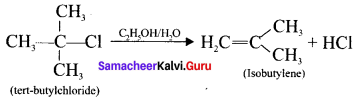
Answer:
PCl5 \(\rightleftharpoons\) PCL3 + Cl2
Given that [PCl5]initial = 1 mol
V = 1 dm3
KC = 2
Samacheer Kalvi 11th Chemistry Solutions Chapter 8 Physical and Chemical Equilibrium-4
∴ Equilibrium concentration of
[PCl5]eq = \(\frac { 1-x }{ 1 }\) = 1 – 0.732 = 0.268 M
[PCl3]eq = \(\frac { x }{ 1 }\) = \(\frac { 0.732 }{ 1 }\) = 0.732
[Cl2]eq = \(\frac { x }{ 1 }\) = \(\frac { 0.732 }{ 1 }\) = 0.732

Question 5.
The equilibrium constant for the following reaction is 0.15 at 298 K and 1 atm pressure.
Answer:
N2O4(g) \(\rightleftharpoons\) 2NO2(g)
T1 = 298 K
Kp1 = 0.15
T2 = 1000C = 100 + 273 = 373 K
Kp2 = ?
Samacheer Kalvi 11th Chemistry Solutions Chapter 8 Physical and Chemical Equilibrium-5

Samacheer Kalvi 11th Chemistry Physical and Chemical Equilibrium In – Text problems Solved

Question 1.
One mole of H2 and one mole of I2 are allowed to attain equilibrium in 1 lit container. If the equilibrium mixture contains 0.4 mole of HI. Calculate the equilibrium constant.
Answer:
Given data: [H2] = I mole, [I2] = 1 mole
At equilibrium, [HI] = 0.4 mole, KC = ?
H2(g) + I2(g) \(\rightleftharpoons\) 2HI(g)
Samacheer Kalvi 11th Chemistry Solutions Chapter 8 Physical and Chemical Equilibrium-6

Question 2.
The equilibrium concentrations of NH3, N2 and H2 are 1.8 x 10² M, 1.2 x 10⁻² M and 3 x 10⁻² M respectively. Calculate the equilibrium constant for the formation of NH3 from N2 and H2. [Hint: M = mol lit-1]
Answer:
Given data:
[NH3] 1.8 x 10⁻² M, [N2] = 1.2 x 10⁻²M, [H2] 3 x 10⁻² M, KC = ?
Samacheer Kalvi 11th Chemistry Solutions Chapter 8 Physical and Chemical Equilibrium-7

Question 3.
The equilibrium constant at 298 K for a reaction is 100.
A+ B \(\rightleftharpoons\) C + D
If the initial concentration of all the four species is 1 M, the equilibrium concentration of D (in mol lit-1) will be
Answer:
Given data: [A] = [B] = [C] = [D] = 1 M, KC = 100, [D]eq = ?
Let x be the number of moles reactants reacted
Samacheer Kalvi 11th Chemistry Solutions Chapter 8 Physical and Chemical Equilibrium-8

Question 4.
For an equilibrium reaction Kp = 0.0260 at 25° C and ?H = 32.4 kJ mor-1. Calculate Kp at 37° C.
Answer:
T1 = 25 + 273 = 298 K
T2 = 37 + 273 = 310 K
ΔH = 32.4 kJ mor-1 = 32400 J mol-1
R = 8.314 JK-1 mol-1
Kp1 = 0.0260
Kp2 = ?
Samacheer Kalvi 11th Chemistry Solutions Chapter 8 Physical and Chemical Equilibrium-9
Samacheer Kalvi 11th Chemistry Solutions Chapter 8 Physical and Chemical Equilibrium-10

Samacheer Kalvi 11th Chemistry Physical and Chemical Equilibrium Additional Questions 

I. Choose the correct answer.

Question 1.
Which of the following represents physical equilibrium?
(a) PCl5(g) \(\rightleftharpoons\) PCl3(g) + Cl2(g)
(b) H2(g) + I2(g) \(\rightleftharpoons\) 2HI(g)
(c) H2O(l) \(\rightleftharpoons\) H2O(g)
(d) N2(g) + 3H2(g) \(\rightleftharpoons\) 2NH3(g)
Answer:
(c) H2O(l) \(\rightleftharpoons\) H2O(g)
Solution:
Physical states arc in equilibrium i.e., liquid – vapour equilibrium.

Question 2.
Which one of the following is an example of chemical equilibrium?
(a) 2NO(g) + O2(g) \(\rightleftharpoons\) 2NO2(g)
(b) I2(s) \(\rightleftharpoons\) I2(g)
(c) H2O(s) \(\rightleftharpoons\) H2O(1)
(d) NH2CI(s) \(\rightleftharpoons\) NH4CI(g)
Answer:
(a) 2NO(g) + O2(g) \(\rightleftharpoons\) 2NO2(g)
Solution:
All the other three are physical equilibrium. Only (a) is chemical equilibrium.

Question 3.
Which one of the following does not undergo sublimation?
(a) Iodine
(b) water
(c) Camphor
(d) Ammonium chloride
Answer:
(b) Water

Question 4.
At chemical equilibrium,
(a) rate of forward reaction = rate of backward reaction
(b) rate of forward reaction > rate of backward reaction
(c) rate of forward reaction < rate of backward reaction
(d) rate of forward reaction = rate of backward reaction
Answer:
(a) rate of forward reaction = rate of backward reaction

Question 5.
Which of the following is an example of homogeneous equilibrium?
(a) H2O(1) \(\rightleftharpoons\) H2O(g)
(b) CaCO3(s) \(\rightleftharpoons\) CaO(s) + CO(g)
(c) H2(g) + I2(g) \(\rightleftharpoons\) 2HI(g)
(d) 2CO(g) \(\rightleftharpoons\) CO2(g) + C(s)
Answer:
(c) H2(g) + I2(g) \(\rightleftharpoons\) 2HI(g)
Solution:
Here all reactants and products are in same phase i.e., gaseous phase.

Question 6.
Which of the following is an example of heterogeneous equilibrium?
(a) Synthesis of HI
(b) Dissociation of PCI5
(c) Acid hydrolysis of ester
(d) Decomposition of limestone
Answer:
(d) Decomposition of limestone
Solution:
CaCO3(s) → CaO(s) + CO2(g)
Here CO2 is in gaseous state while CaCO3 and CaO are in solid state.

Question 7.
Statement I: In dissociation of PCI5 to PCI3 and CI2, Kp > KC
Statement II: In dissociation of PCI5, Δng = – ve and so Kp > KC.
(a) Statement I & II are correct and statement II is the correct explanation of statement I.
(b) Statement I & II are correct but statement II is not the correct explanation of statement I.
(c) Statement I is correct but statement II is wrong.
(d) Statement I is wrong but statement II is correct.
Answer:
(c) Statement I is correct but statement II is wrong.
Solution:
Δng = 2 – 1 = 1 = +ve

Question 8.
In the reaction, 2NH3(g) \(\rightleftharpoons\) N2(g) + 3H2(g)
(a) Kp = KC
(b) Kp < KC
(c) Kp > KC
(d) Kp = \(\frac { 1 }{ { K }_{ C } }\)
Answer:
(c) Kp > KC
Solution:
Kp = KC (RT)Δng and Δng = 4 – 2 = 2
∴ Kp = KC (RT)2 = Kp > KC

Question 9.
In which of the following reaction, Kp is equal to KC ?
(a) N2(g) ± O2(g) \(\rightleftharpoons\) 2NO(g)
(b) 2NH3(g) \(\rightleftharpoons\) N2(g) + 3H2(g)
(c) 2H2(g) + O2(g) \(\rightleftharpoons\) 2H2O(g)
(d) PCI5(g) \(\rightleftharpoons\) PCI3(g) + CI2
Answer:
(a) N2(g) ± O2(g) \(\rightleftharpoons\) 2NO(g)
Solution:
KC (RT)Δng when Δng = 0 then K = K for option (a), Δng = 2 – 2 = 0

Question 10.
In the equilibrium reaction CaCO3(s) \(\rightleftharpoons\) CaO(s) + CO2(g) whose concentration remains constant at a given temperature?
(a) CaO
(b) CO2
(e) CaCO3
(d) Both (a) and (c)
Answer:
(d) Both (a) and (c)
Solution:
Concentration of solids remains constant at a particular temperature.

Question 11.
Consider the following equilibrium reaction and relate their equilibrium constants
(i) N2 + O2 \(\rightleftharpoons\) 2NO; K1
(ii) 2NO + O2 \(\rightleftharpoons\) 2NO2; K2
(iii) N2 + 2O2 \(\rightleftharpoons\) 2NO2; K3
(a) K3 = K2 = K1
(b) K1 x K3 = K2
(c) K1 x K2 = K3
(d) \(\frac { { K }_{ 1 } }{ { K }_{ 2 } }\) = K3
Answer:
(c) K1 x K2 = K3
Solution:
Samacheer Kalvi 11th Chemistry Solutions Chapter 8 Physical and Chemical Equilibrium-11

Question 12.
Statement I: A pure solid in an equilibrium reaction has the same concentration at a given temperature.
Statement II: The solid does not expand to fill its container and it has same number of moles of its volume.
(a) Statement I and II are correct and statement II is the correct explanation of statement of I.
(b) Statement I and II are correct but II is not the correct explanation of!.
(c) Statement I and II are not correct.
(d) Statement I is wrong but 11 is correct.
Answer:
(a) Statement I and II are correct and statement II is the correct explanation of statement of I.

Question 13.
Find the Q value of the reaction H2(g) + I2(g) \(\rightleftharpoons\) 2HI(g) at an instant where concentration of H2, I2 and HI are found to be 0.2 moI L-1, 0.2 mol L-1, and 0.6 moI L-1 respectively.
(a) 48
(b) 9
(c) 0.9
(d) 90
Answer:
(b) 9
Solution:
Samacheer Kalvi 11th Chemistry Solutions Chapter 8 Physical and Chemical Equilibrium-12

Question 14.
For the reaction N2O4(g) \(\rightleftharpoons\) 2NO2(g) KC = 0.21 at 373 K. The concentrations of N2O4 and NO2 are found to be 0.125 mol dm-3 and 0.5 mol dm-3 respectively at a given temperature. Predict the direction of the reaction.
(a) At equilibrium
(b) reverse direction
(c) forward direction
(d) Both reverse and forward direction
Answer:
(b) reverse direction
Solution:
Samacheer Kalvi 11th Chemistry Solutions Chapter 8 Physical and Chemical Equilibrium-13
KC = 0.21
Q = 2
Q > KC
Hence the reaction will proced in the reverse direction

Question 15.
Which of the following does not alter the equilibrium?
(a) catalyst
(b) concentration
(c) temperature
(d) pressure
Answer:
(a) catalyst

Question 16.
Statement I. In Haber’s process, NH3 is liquefied and removed.
Statement II. In manufacture of NH3, liquefied and removal of NH3, keeps the reaction moving in forward direction.
(a) Statement I and II are correct and II is the correct explanation of I.
(b) Statement I and II are correct but II is not the correct explanation of I.
(c) Statement I is wrong but statement II is correct.
(d) Statement I is correct but statement II is wrong.
Answer:
(a) Statement I and II are correct and II is the correct explanation of I.
Solution:
Removal of NH3 will decrease its concentration which favours the production of NH3 according to the Le – Chatelier’s principle.

Question 17.
In which of the following reaction, pressure has no effect?
(a) N2 + 3N2 \(\rightleftharpoons\) 2NH3(g)
(b) 2SO2(g) + O2(g) \(\rightleftharpoons\) 2SO3(g)
(c) N2O4(g) \(\rightleftharpoons\) 2NO2(g)
(d) H2(g) + I2(g) \(\rightleftharpoons\) 2HI(g)
Answer:
(d) H2(g) + I2(g) \(\rightleftharpoons\) 2HI(g)
Solution:
In the reaction H2(g) + I2(g) \(\rightleftharpoons\) 2HI(g) the volumes are equal on both sides and so pressure has no effect.

Question 18.
Among the following reactions which one has Kp = KC
(a) N2O4 \(\rightleftharpoons\) 2NO(g)
(b) 2SO2(g) + O2(g) \(\rightleftharpoons\) 2SO3(g)
(c) N2(g) + O2(g) \(\rightleftharpoons\) 2NO(g)
(d) N2(g) + 3H2(g) \(\rightleftharpoons\) 2NH3(g)
Answer:
(c) N2(g) + O2(g) \(\rightleftharpoons\) 2NO(g)
Solution:
Kp = KC. RTΔng
In equation N2(g) + O2(g) \(\rightleftharpoons\) 2NO(g)
Δng = 0
Kp = KC. RT°
Kp = KC

Question 19.
Statement I. Addition of an inert gas at constant volume has no effect on equilibrium.
Statement II. When an inert gas is added, the total number of moles of gases present in the container increases and total pressure also increases, the partial pressure of the products and reactants are unchanged.
(a) Statement I and II are correct but statement II is not the correct explanation of I.
(b) Statement I and II are correct and statement II is the correct explanation of 1.
(c) Statement I is correct but statement II is not correct.
(d) Statement I is wrong but statement II is correct.
Answer:
(b) Statement I and II are correct and statement II is the correct explanation of I.

Question 20.
Which one of the following equation is not correct?
(a) ΔG° = – RTInK
(b) ΔG° = ΔH° – TΔS°
(c) – RTInK = ΔH° – TΔS°
(d) In k = \(\frac { ΔH° }{ T }\) – \(\frac { ΔS° }{ R }\)
Answer:
(d) In k = \(\frac { ΔH° }{ T }\) – \(\frac { ΔS° }{ R }\)

Question 21.
The equilibrium expression, KC = [CO2] represents the reaction.
(a) C(s) + O2(g) \(\rightleftharpoons\) CO2(g)
(b) CaCO3(s) \(\rightleftharpoons\) CaO(s) + CO2(g)
(c) 2CO(g) + O2(g) \(\rightleftharpoons\) 2CO2(g)
(d) CaO(s) + CO2(g) \(\rightleftharpoons\) CaCO3(s)
Answer:
(b) CaCO3(s) \(\rightleftharpoons\) CaO(s) + CO2(g)

Question 22.
Hydrogen molecule (H2) can be dissociated into hydrogen atoms (H). Which one of the following changes will not increase the number of atoms present at equilibrium?
(a) adding H atoms
(b) increasing the temperature
(c) increasing the total pressure
(d) increasing the volume of the container
Answer:
(d) increasing the total pressure container
Solution:
It favours backward reaction i.e., formation of H2 molecule.

Question 23.
What is the expression for Keq for the reaction, 2N2O(g) + O2(g) \(\rightleftharpoons\) 4NO(g)?
Samacheer Kalvi 11th Chemistry Solutions Chapter 8 Physical and Chemical Equilibrium-14
Answer:
Samacheer Kalvi 11th Chemistry Solutions Chapter 8 Physical and Chemical Equilibrium-15

Question 24.
What is the correct expression for the representation of the solubility product constant of Ag2CrO4 ?
(a) [Ag+]2 [CrO42-]
(b) [2Ag+] [CrO42-]
(c) [Ag+] [CrO42-]
(d) [2Ag+]2 [CrO42-]
Answer:
(a) [Ag+]2 [CrO42-]

Question 25.
H2 + S \(\rightleftharpoons\) H2S + energy. In this reversible reaction, select the factor which will shift the equilibrium to the right.
(a) adding heat
(b) adding H2S
(c) blocking hydrogen gas reaction
(d) removing hydrogen suiphide gas
Answer:
(a) removing hydrogen suiphide gas

Question 26.
What effect does a catalyst have on the equilibrium position of a reaction?
(a) a catalyst favours the formation of products
(b) a catalyst favours the formation of reactants
(c) a catalyst does not change the equilibrium position of a reaction
(d) a catalyst may favour reactants or product formation, depending upon the direction in which the reaction is written.
Answer:
(c) a catalyst does not change the equilibrium position of a reaction

Question 27.
A chemist dissolves an excess of BaSO4 in pure water at 25°C if its Ksp = 1 x 10⁻¹⁰. What is the concentration of barium in the water?
(a) 10-4 M
(b) 10-5 M
(c) 10-15 M
(a) 10-6 M
Answer:
(c) 10-15 M
Solution:
Ksp = [Ba2+] [SO42-]
1 x 10-10 = (x) (x)
10-5 = x

Question 28.
If in a mixture where Q = K, then what happens?
(a) the reaction shift towards products
(b) the reaction shift towards reactants
(c) nothing appears to happen, but forward and reverse reactions are continuing at the same rate
(d) nothing happens
Answer:
(c) nothing appears to happen, but forward and reverse reactions are continuing at the same rate

Question 29.
If dissociation for reaction PCI5 \(\rightleftharpoons\) PCI3 + Cl2 is 20% at 1 atm pressure. Calculate the value of KC.
(a) 0.04
(b) 0.05
(c) 0.07
(d) 0.06
Answer:
(d) 0.05
Solution:
Samacheer Kalvi 11th Chemistry Solutions Chapter 8 Physical and Chemical Equilibrium-18

Question 30.
What would be the value of Δng for the reaction NH4CI(s) \(\rightleftharpoons\) NH2(g) + HCI(g)?
(a) 1
(b) 0.5
(c) 2
(d) 1.5
Answer:
(c) 2
Solution:
Δng = np – nr = 2 – 0 = 2

Question 31.
Which of the following is not a general characteristic of equilibria involving physical processes?
(a) Equilibrium is possible only in a close system at a given temperature
(b) All measurable properties of the system remain constant
(c) All the physical processes stop at equilibrium
(d) The opposing processes occur at the same rate and there is dynamic but stable condition
Answer:
(c) All the physical processes stop at equilibrium

Question 32.
At 500K, equilibrium constant KC for the following reaction is 5, \(\frac { 1 }{ 2 }\)H2(g) + \(\frac { 1 }{ 2 }\)I2(g) \(\rightleftharpoons\) HI(g) what would be the equilibrium constant KC. for the reaction 2HI(g) \(\rightleftharpoons\) H2(g) + I2(g)
(a) 0.44
(b) 0.04
(c) 25
(d) 2.5
Answer:
(b) 0.04
Solution:
Samacheer Kalvi 11th Chemistry Solutions Chapter 8 Physical and Chemical Equilibrium-19

Question 33.
For the reaction 2NO2(g) \(\rightleftharpoons\) 2NO(g) + O2 (g), KC = 1.8 x 10⁻⁶ at 1850C. At the same temperature the value of KC for the reaction. NO(g) + \(\frac { 1 }{ 2 }\)O2 \(\rightleftharpoons\) NO2(g) is ……….
(a) 0.9 x 10⁶
(b) 7.5 x 10²
(c) 1.95 x 10⁻³
(d) 1.95 x 10³
Answer:
(b) 7.5 x 10²
Solution:
The reaction is reversed and halved.
Samacheer Kalvi 11th Chemistry Solutions Chapter 8 Physical and Chemical Equilibrium-20

Question 34.
Which of the following reaction will be favoured at low pressure?
(a) N2 + O2 \(\rightleftharpoons\) 2NO
(b) H2 ± I2 \(\rightleftharpoons\) 2HI
(c) PCI5 \(\rightleftharpoons\) PCI3 + Cl2
(d) N2 + 3H2 \(\rightleftharpoons\) 2NH3
Answer:
(c) PCI5 \(\rightleftharpoons\) PCI3 + Cl2

Question 35.
Consider the reaction CaCO3(s) \(\rightleftharpoons\) CaO(s) + CO2(g) is a closed container at equilibrium. What would be the effect of addition of CaCO3 on the equilibrium?
(a) increases
(b) remains unaffected
(c) decreases
(d) unpredictable
Answer:
(b) remains unaffected

Question 36.
For the reaction PCI5(g) \(\rightleftharpoons\) PCI3(g) + Cl2(g) the forward reaction at constant temperature is favoured by …………………
(a) introducing an inert gas at constant volume
(b) introducing PCl3(g) at constant volume
(c) introducing PCl5(g) at constant volume
(d) introducing CI2(g) at constant volume
Answer:
(c) introducing PCI5(g) at constant volume

Question 37.
The equilibrium of the reaction N2(g) + 3H2(g) \(\rightleftharpoons\) 2NH3(g) will shift to product side when….
(a) Kp > 1
(b) Q < Kp
(c) Q = Kp
(d) Q = 2Kp
Answer:
(b) Q < Kp

Question 38.
NO2 is involved in the formation of smog and acid rain. A reaction that is important in the formation of NO2 is O3(g) + NO(g) \(\rightleftharpoons\) O2(g) + NO2(g) KC = 6.0 x 1034. If the air over a section of New Delhi contained 1.0 x 10⁻⁶ M of O3, 1.0 x 10⁻⁵ M of NO, 2.5 x 10⁻⁴ M of NO2 and 8.2 x 10⁻³ of O2, what can we conclude?
(a) there will be a tendency to form more NO and O2
(b) there will be a tendency to form more NO2 and O2
(c) there will be a tendency to form more NO2 and O3
(d) there will no tendency for change because the reaction is at equilibrium
Answer:
(b) there will be a tendency to form more NO2 and O2
Solution:
Samacheer Kalvi 11th Chemistry Solutions Chapter 8 Physical and Chemical Equilibrium-21
As Q < KC the reaction will hive a tendency to move forward.

Question 39.
Haemoglobin (Hb) forms bond with oxygen and given oxyhaemoglobin (HbO2). This process is partially regulated by the concentration of H3O+ and dissolved CO2 in blood as HbO2 +H3O+ + CO2 \(\rightleftharpoons\) H+ – Hb – CO2 + O2 + H2O. If there is production of lactic acid and CO2 during a muscular exercise, then
(a) more HbO2 is formed
(b) more O2 is released
(c) CO2 is released
(d) both (b) and (c)
Answer:
(b) more O2 is released

Question 40.
In the reaction N2 + 3H2 \(\rightleftharpoons\) 2NH3 + x k Cal, one mole of N2 reacts with. 3 moles of H2 at equilibrium. Then the value of a (degree of dissociation) is approximately ……………… P is the pressure at equilibrium
Samacheer Kalvi 11th Chemistry Solutions Chapter 8 Physical and Chemical Equilibrium-22
Answer:
Samacheer Kalvi 11th Chemistry Solutions Chapter 8 Physical and Chemical Equilibrium-23
Solution:
Samacheer Kalvi 11th Chemistry Solutions Chapter 8 Physical and Chemical Equilibrium-24

II. Match the following.

Question 1.
Samacheer Kalvi 11th Chemistry Solutions Chapter 8 Physical and Chemical Equilibrium-25
Answer:
(a) 2, 1, 4, 3

Question 2.
Samacheer Kalvi 11th Chemistry Solutions Chapter 8 Physical and Chemical Equilibrium-26
Answer:
(b) 2, 3, 4, 1

Question 3.
Samacheer Kalvi 11th Chemistry Solutions Chapter 8 Physical and Chemical Equilibrium-27
Answer:
(a) 4, 1, 2, 3

Question 4.
Samacheer Kalvi 11th Chemistry Solutions Chapter 8 Physical and Chemical Equilibrium-28
Answer:
(a) 3, 4, 1, 2

Question 5.
Samacheer Kalvi 11th Chemistry Solutions Chapter 8 Physical and Chemical Equilibrium-29
Answer:
(b) 2, 3, 4, 1

III. Fill in the blanks.

Question 1.
Transport of oxygen by Hemoglobin in our body is ………… a reaction.
Answer:
reversible

Question 2.
The temperature at which the solid and liquid phases of a substance are at equilibrium is called …………
Answer:
Freezing point

Question 3.
Thejemperature at which the liquid and vapour phases are at equilibrium is called …………
Answer:
Condensation point

Question 4.
………… law is used to explain gas-solution equilibrium processes.
Answer:
Henry’ law

Question 5.
In the reaction 2H2(g) + O2(g) \(\rightleftharpoons\) 2H2O(g), the Kp value is equal to ………
Answer:
< KC
Solution:
Δng = 2 – 3 = -1
Samacheer Kalvi 11th Chemistry Solutions Chapter 8 Physical and Chemical Equilibrium-30

Qustion 6.
The expression of K for the reaction CO2(g) + H2O(l) \(\rightleftharpoons\) H+(aq) + HCO3(aq) is equal to …………..
Answer:
Samacheer Kalvi 11th Chemistry Solutions Chapter 8 Physical and Chemical Equilibrium-31

Question 7.
The expression of K for the reversible reaction 2CO(g) \(\rightleftharpoons\) CO2(g) + C(s)
Answer:
Samacheer Kalvi 11th Chemistry Solutions Chapter 8 Physical and Chemical Equilibrium-32

Question 8.
The Ang value for the reaction 2NO(g) + O2(g) \(\rightleftharpoons\) 2NO2(g) is …………….
Answer:
– 1
Solution:
Δng = np – nr = 2 – 3 = -1

Question 9.
The correct differential form of van’t Hoff equation is ………….
Answer:
Samacheer Kalvi 11th Chemistry Solutions Chapter 8 Physical and Chemical Equilibrium-33

Question 10.
For the reaction H2(g) + I2(g) \(\rightleftharpoons\) 2HI(g), the equilibrium constant K is
Answer:
Samacheer Kalvi 11th Chemistry Solutions Chapter 8 Physical and Chemical Equilibrium-34

Question 11.
PCI5 is kept in a closed container at a temperature of 250K the equilibrium concentrations of PCI5, PCl3 and Cl2 are 0.045 moles L-1, 0.096 moles L-1, 0.096 moles L-1 respectively. The value of equilibrium constant for the reaction PCI5(g) \(\rightleftharpoons\) PCl3(g) + Cl2(g) will be ……………………
Answer:
0.205
Solution:
Samacheer Kalvi 11th Chemistry Solutions Chapter 8 Physical and Chemical Equilibrium-35

Question 12.
Equilibrium constant changes with ………………..
Answer:
Both temperature and pressure

Question 13.
For the reaction 2HI(g) \(\rightleftharpoons\) H2(g) + I2(g) at 720 K, the equilibrium constant value is 50. The equilibrium constant for the reaction H2(g) + I2(g) \(\rightleftharpoons\) 2HI(g) at the same temperature will be ………..
Answer:
0.02
Solution:
Forward reaction equilibrium constant K1 = 50
Reverse reaction equilibrium constant K2 = ?
K2 = \(\frac { 1 }{ { K }_{ 1 } }\) = \(\frac { 1 }{ 50 }\) = 0.02

Question 14.
If equilibrium constant for the reaction N2(g) + 3H2(g) \(\rightleftharpoons\) 2NH3(g) at 298 K is 2.54, the value of equilibrium constant for the reaction \(\frac { 1 }{ 2 }\)N2 + \(\frac { 3 }{ 2 }\)H2 \(\rightleftharpoons\) NH3 will be ………….
Answer:
1.59
Solution:
Samacheer Kalvi 11th Chemistry Solutions Chapter 8 Physical and Chemical Equilibrium-37

Question 15.
The chemical system at equilibrium is not affected by addition of ……………..
Answer:
catalyst

Question 16.
A catalyst will increase the rate of a chemical reaction by lowering the ……………
Answer:
activation energy

Question 17.
In a closed system, A(s) \(\rightleftharpoons\) 3B(g) + 3C(g) If partial pressure of C is doubled, then partial pressure of B will be ………….. times the original value.
Answer:
\(\frac { 1 }{ 2\sqrt { 2 } }\)

Question 18.
Consider the following gaseous equilibria with equilibrium constants K1 and K2 respectively
SO2 + \(\frac { 1 }{ 2 }\)O2(g) \(\rightleftharpoons\) SO3(g) – K1
2SO3(g) \(\rightleftharpoons\) 2SO2(g) + O2(g) – K2
The equilibrium constants are related as ………….
Answer:
Samacheer Kalvi 11th Chemistry Solutions Chapter 8 Physical and Chemical Equilibrium-39.1
Solution:
Samacheer Kalvi 11th Chemistry Solutions Chapter 8 Physical and Chemical Equilibrium-39

Question 19.
K2 for the following reaction at 700 K is 1.3 x 10⁻³ atm-1. The K at same temperature for the reaction 2SO2(g) + O2(g) \(\rightleftharpoons\) 2SO3(g) will be ………….
Answer:
7.4 x 10⁻²
Solution:
Samacheer Kalvi 11th Chemistry Solutions Chapter 8 Physical and Chemical Equilibrium-40

Question 20.
For the reaction PCI23(g) + CI2(g) \(\rightleftharpoons\) PCI5(g) at 250°C, the value of KC is 26 then the value of Kp on the same temperature will be ……………
Answer:
0.61
Solution:
Samacheer Kalvi 11th Chemistry Solutions Chapter 8 Physical and Chemical Equilibrium-41

Question 21.
In the reaction N2(g) + 3H2(g) \(\rightleftharpoons\) 2NH3(g), the value of the equilibrium constant depends on ………………
Answer:
the temperature

Question 22.
K1 and K2 are velocity constant o forward and backward reactions. The equilibrium constant KC of the reaction is …………
Answer:
\(\frac { { K }_{ 1 } }{ { K }_{ 2 } }\)

Question 23.
The equilibrium constant of the reaction 3C2H2 \(\rightleftharpoons\) C6H6 is 4.0 at a temperature of T K. If the equilibrium concentration of C2H2 is 0.5 molesL-1, the concentration of C6H6 is …………..
Answer:
Samacheer Kalvi 11th Chemistry Solutions Chapter 8 Physical and Chemical Equilibrium-42

Question 24.
In an equilibrium reaction for which ΔG0 = 0, the equilibrium constant K should be = ……………
Answer:
1

Question 25.
The equilibrium constant for the reaction 2SO2(g) + O2(g) \(\rightleftharpoons\) 2SO3(g) is 5. If the equilibrium constant mixture contains equal moles of SO3 and SO2, the equilibrium partial pressure of O2,
gas is ……………..
Answer:
0.2 atm
Solution:
Samacheer Kalvi 11th Chemistry Solutions Chapter 8 Physical and Chemical Equilibrium-43

Question 26.
In the reaction NH4CI(s) \(\rightleftharpoons\) NH3(g) + HCI(g) the value Offlg is Δng ………………….
Answer:
2
Solution:
Δng = np(g) – nr(g) = 2 – 0 = 2

IV. Choose the odd one out.

Question 1.
(a) see – saw
(b) tug – of – war
(c) sublimation of camphor
(d) Acid hydrolysis of an ester
Answer:
(d) Acid hydrolysis of an ester Acid hydrolysis of an ester is a chemical equilibrium.
Samacheer Kalvi 11th Chemistry Solutions Chapter 8 Physical and Chemical Equilibrium-44
Whereas a, b, c are examples of physical equilibrium.

Question 2.
(a) Synthesis of hydrogen iodide
(b) Decomposition of calcium carbonate
(c) Sublimation of iodine
(d) Dissociation of PCl5
Answer:
(c) Sublimation of iodine Sublimation of iodine I2(s) \(\rightleftharpoons\) I2(g) is an example of physical equilibrium, whereas a, b and dare examples of chemical equilibrium.

Question 3.
(a) Synthesis of HI
(b) Dissociation of PCl5
(e) Synthesis of NH3
(d) Decomposition of CaCO3
Answer:
(a) Decomposition of CaCO3
Decomposition of CaCO3 is an example of heterogeneous equilibrium.
CaCO3(s) \(\rightleftharpoons\) CaO(s) + CO2(g)
Where as a, b, c are examples of homogeneous equilibrium.

Question 4.
Samacheer Kalvi 11th Chemistry Solutions Chapter 8 Physical and Chemical Equilibrium-46
Answer:
Samacheer Kalvi 11th Chemistry Solutions Chapter 8 Physical and Chemical Equilibrium-47
Synthesis of SO3 is an example of homogeneous equilibrium whereas the others a, b and d are heterogeneous equilibrium.

Question 5.
Samacheer Kalvi 11th Chemistry Solutions Chapter 8 Physical and Chemical Equilibrium-48
Answer:
Samacheer Kalvi 11th Chemistry Solutions Chapter 8 Physical and Chemical Equilibrium-49
(b) is an example of heterogeneous equilibrium whereas the others a, c and d are homogeneous equilibrium.

V. Choose the correct pair.

Question 1.
(a) Q = KC : Reaction is in equilibrium state
(b) Q < KC : Reaction proceed in reverse direction
(c) Q > KC : Reaction proceed in ftrward direction
(d) Q = KC : Reaction proceed in both directions
Answer:
(a) Q = KC : Reaction is in equilibrium state

Question 2.
Samacheer Kalvi 11th Chemistry Solutions Chapter 8 Physical and Chemical Equilibrium-50
Answer:
Samacheer Kalvi 11th Chemistry Solutions Chapter 8 Physical and Chemical Equilibrium-51

Question 3.
(a) Kp = KC : Synthesis of HI
(b) Kp > KC : Dissociation of PCl5
(c) Kp < KC : Synthesis of SO3
(d) Kp = KC : Synthesis of HI
Answer:
(a) Kp = KC : Synthesis of HI
H2(g) + I2(g) \(\rightleftharpoons\) 2HI(g) : Δng = 2 – 2 = 0
ΔKp = KC

VI. Choose the incorrect pair.

Question 1.
(a) Acid hydrolysis of an ester – Homogeneous equilibrium
(b) Synthesis of Ammonia – Homogeneous equilibrium
(c) Decomposition of CaCO3 – Homogeneous equilibrium
(d) Synthesis of HI – Homogeneous equilibrium
Ans.
(c) Decomposition of CaCO3: Homogeneous equilibrium It is a heterogeneous equilibrium.

Question 2.
Samacheer Kalvi 11th Chemistry Solutions Chapter 8 Physical and Chemical Equilibrium-52
Answer:
Samacheer Kalvi 11th Chemistry Solutions Chapter 8 Physical and Chemical Equilibrium-53

VII. Assertion and Reason.

Question 1.
Assertion (A): Chemical equilibrium is in a state of dynamic equilibrium.
Reason (R): At equilibrium the forward and backward reactions are proceeding at the same rate and no macroscopic change is observed.
(a) Both (A) and (R) are correct and (R) is the correct explanation of(A).
(b) Both (A) and (R) are correct but (R) is not the correct explanation of(A).
(c) (A) is correct but (R) is wrong.
(d) (A) is wrong but (R) is correct.
Answer:
(a) Both (A) and (R) are correct and (R) is the correct explanation of(A).

Question 2.
Assertion (A): In Haber’s process, NH3 is liquefied and removed.
Reason (R): Because of the reaction keeps moving in the backward direction.
(a) Both (A) and (R) are correct but (R) is not the correct explanation of(A).
(b) Both (A) and (R) are correct and (R) is the correct explanation of(A).
(c) (A) is correct but (R) is wrong.
(d) (A) is wrong but (R) is correct.
Answer:
(b) Both (A) and (R) are correct and (R) is the correct explanation of(A).

Question 3.
Assertion (A): In the dissociation of PCI5 at constant pressure and temperature addition of helium at equilibrium increases the dissociation of PCl5.
Reason (R): Helium removes CI, from the field of action.
(a) Both A and R are true and R is the correct explanation of A.
(b) Both A and R are true but R is the not the correct explanation of A.
(c) A is true but R is false
(d) Both A and R are false
Answer:
(d) Both A and R are false

VIII. Choose the incorrect statement.

Question 1.
(a) In equilibrium mixture of ice and water kept in perfectly insulted flask, mass of ice and water does not change with time.
(b) The intensity of red colour increases when oxalic acid is added to a solution containing iron (III) nitrate and potassium thiocyanate
(c) On addition of catalyst the equilibrium constant value is not affected
(d) Equilibrium constant for a reaction with negative .H value decreases as the temperature increases.
Answer:
(b) The intensity of red colour increases when oxalic acid is added to a solution containing iron (III) nitrate and potassium thiocyanate

Solution:
Oxalate ions of oxalic acid form complex with ferric ions thus decrease its concentration thus, concentration of red complex in product decreases.

Samacheer Kalvi 11th Chemistry Physical and Chemical Equilibrium 2 Mark Questions and Answers.

I. Write brief answer to the following questions:

Question 1.
Define the state of equilibrium.
Answer:
At a particular stage, the rate of the reverse reaction is equal to that of the forward reaction indicating a state of equilibrium.

Question 2.
What are the different types of equilibrium? Explain with example?
Answer:
1. Physical equilibrium:
A system in which the amount of matter constituting different phases does not change with time is said to be in physical equilibrium.
H2O(s) \(\rightleftharpoons\) H2O(1). Solid-liquid equilibrium.

2. Chemical equilibrium:
Chemical reactions in which the forward and backward reactions are proceeding at the same rate and no macroscopic change is observed is said to be in chemical equilibrium. H2(g) + I2(g) \(\rightleftharpoons\) 2HI(g)

Question 3.
Explain about the equilibrium involving dissolution of solid in liquid with suitable example.
Answer:
When sugar is added to water at a particular temperature. it dissolves to form sugar solution. When more sugar is added to that solution, a particular stage sugar remains as solid and results in the formation of saturated solution. Here a dynamic equilibrium is established between the solute molecules ii the solid phase and in the solution phase.
Samacheer Kalvi 11th Chemistry Solutions Chapter 8 Physical and Chemical Equilibrium-54

Question 4.
How is a gas – solution equilibrium exist?
Answer:
When a gas dissolves in a liquid under a given pressure, there will be an equilibrium between gas molecuLes in the gaseous state and those dissolved in the liquid. Example – In carbonate beverages the following equilibrium exists.
CO2(g) \(\rightleftharpoons\)  CO2 (Solution)

Question 5.
What is meant by active mass? Give its unit.
Answer:
The active mass represents the molar concentration of the reactants (or) products.
Samacheer Kalvi 11th Chemistry Solutions Chapter 8 Physical and Chemical Equilibrium-55

Question 6.
Show that Kp = KC with two example
Answer:
Samacheer Kalvi 11th Chemistry Solutions Chapter 8 Physical and Chemical Equilibrium-56

Question 7.
Give two examples of equilibrium reactions where Kp > KC.
Answer:
Samacheer Kalvi 11th Chemistry Solutions Chapter 8 Physical and Chemical Equilibrium-57

Question 8.
When will be Kp < KC? Give two example.
Answer:
Samacheer Kalvi 11th Chemistry Solutions Chapter 8 Physical and Chemical Equilibrium-58

Question 9.
Write the KC for the reaction CO2(g) + H2O(l) \(\rightleftharpoons\) H+(aq) + HCO3(aq)
Answer:
H2O(l) is a pure liquid and its concentration remains constant.
Solution:
Samacheer Kalvi 11th Chemistry Solutions Chapter 8 Physical and Chemical Equilibrium-59

Question 10.
Samacheer Kalvi 11th Chemistry Solutions Chapter 8 Physical and Chemical Equilibrium-60 What is the value of K4 in A \(\rightleftharpoons\) D
Answer:
Samacheer Kalvi 11th Chemistry Solutions Chapter 8 Physical and Chemical Equilibrium-61

Question 11.
Write the Kp and KC for the following reactions
(i) 2SO2(g) + O2(g) \(\rightleftharpoons\) 2SO3(g)
(ii)2CO(g) \(\rightleftharpoons\) CO2(g) + C(s)
Answer:
Samacheer Kalvi 11th Chemistry Solutions Chapter 8 Physical and Chemical Equilibrium-62

Question 12.
Explain how the equilibrium constant K. predict the extent of a reaction.
Answer:
1. The value of equilibrium constant KC tells us the extent of the reaction i.e., it indicates how far the reaction has proceeded towards product formation at a given temperature.

2. A large value of KC indicates that the reaction reaches equilibrium with high product yield on the other hand, lower value of KC indicates that the reaction reaches equilibrium with low product yield.

3. If KC > 103 the reaction proceeds nearly to completion.

4. If KC < 10-3 the reaction rarely proceeds.

5. If the KC is in the range 10-3 to 103 significant amount of both reactants and products are present at equilibrium.

Question 13.
Samacheer Kalvi 11th Chemistry Solutions Chapter 8 Physical and Chemical Equilibrium-63
Predict the extent of the above two reactions.
Answer:
In the reactions, decomposition of water at 500 K and oxidation 01 nitrogen at 1000 K, the value of KC is very less KC < 10-3. So reverse reaction is favoured.
∴ Products << reactants

Question 14.
Explain about the extent of reaction of dissociation of bromine mono chloride at 1000 K.
Answer:
2BrCl(g) \(\rightleftharpoons\) Br2(g) + Cl2(g) KC = 5
10-3 <  KC <  103
both forward and backward reaction make significant progress. Neither forward nor reverse reaction predominates.

Question 15.
What is the KC value for formation of HCl at 700 K? Predict the extent of the reaction?
Answer:
H2(g) + I2(g) \(\rightleftharpoons\) 2HI(g) at 700 K
KC = 57.0
10-3 <KC <103
So both forward and backward reaction make significant progress. Neither forward nor reverse reaction predominates.

Question 16.
What is the KC value of formation of HCI at 300 K? Explain it.
Answer:
H2(g) – Cl2(g) \(\rightleftharpoons\) 2HCI(g) at 300 K
K2 = 4 x 1031
KC > 103 So[products] >> [Reactant]
Reaction nearly goes to completion. So forward reaction is favoured.

Question 17.
2CO(g) + O2(g) \(\rightleftharpoons\) 2CO2(g) at 1000 K. What is the Kc this reaction? Predict the extent of this reaction.
Answer:
2CO(g) + O2(g) \(\rightleftharpoons\) 2CO2(g) at 1000 K
KC = 2.2 x 10²²
KC > 103.
So [Products] >> [Reactants]
Reaction nearly goes to completion and forward reaction is favoured.

Question 18.
Define Q value for a chemical equilibrium reaction.
Answer:
Consider a homogeneous reversible reaction xA + yB \(\rightleftharpoons\) lC + mD For the above reaction under non-equilibrium conditions, reaction quotient Q is defined as the ratio of the product of active masses of reaction products raised to the respective stoichiometric coefficients in the balanced chemical equation to that of the reactants. Under non equilibrium conditions,
Q = \(\frac { d(Ink) }{ dt }\) ΔH° = \(\frac { { \triangle H }^{ 0 } }{ { RT }^{ 2 } }\)

Question 19.
Explain the diagrammatic expression about the direction of reaction.
Answer:
Samacheer Kalvi 11th Chemistry Solutions Chapter 8 Physical and Chemical Equilibrium-65
In (i) Q < KC, the reaction will proceed in forward direction.
In (ii) Q = KC, the reaction is in equilibrium state.
In (iii) Q> KC, the reaction will proceed in the reverse direction.
Question 20.
Explain about the effect of catalyst in an equilibrium reaction?
Answer:
Addition of catalyst does not affect the state of equilibrium. The catalyst increases the rate of both the forward and reverse reactions to the same extent. Hence it does not change the equilibrium composition of the reaction mixture.

Question 21.
For the following equilibrium. KC = 6.3 x 10¹⁴ at 1000K
NO(g) + O3(g) \(\rightleftharpoons\) NO2(g) + O2(g)
Both the forward and reverse reactions in the equilibrium are elementary bimolecular reactions what is KC for the reverse reaction?
Answer:
For the reverse reaction Samacheer Kalvi 11th Chemistry Solutions Chapter 8 Physical and Chemical Equilibrium-66
Question 22.
Explain why pure liquids and solids can be ignored while writing the value of equilibrium constants.
Answer:
This is because molar concentration of a pure solid or liquid is independent of the amount present.
Samacheer Kalvi 11th Chemistry Solutions Chapter 8 Physical and Chemical Equilibrium-67
Since density of pure liquid or solid is fixed and molar mass is also fixed, therefore molar concentration are constant.
Question 23.

A sample of Hl(g) is placed in a flask at a pressure of 0.2 atm. At equilibrium partial pressure of HI(g) is 0.04 atm. What is Kp for the given equilibrium?
2HI(g) \(\rightleftharpoons\) H2 (g) + I2(g)
Answer:
pHI = 0.04 atm. pH2 = 0.08 atm; pl2 = 0.08 atm
Samacheer Kalvi 11th Chemistry Solutions Chapter 8 Physical and Chemical Equilibrium-68

Question 24.
The equilibrium constant expression for a gas reaction is.
Samacheer Kalvi 11th Chemistry Solutions Chapter 8 Physical and Chemical Equilibrium-69
Write the balanced chemical equation corresponding to this expression.
Answer:
Balanced chemical equation for the reaction is
4 NO(g) + 6 H2O(g) \(\rightleftharpoons\) 4NH3(g) + 5O2(g)

Question 25.
Predict which of the following will have appreciable concentration of reactions and products:
Samacheer Kalvi 11th Chemistry Solutions Chapter 8 Physical and Chemical Equilibrium-70
Answer:
Following conclusion can be drawn from the values of
(a) Since the value of K is very small, this means that the molar concentration of the products is very small as compared to that of the reactants.
(b) Since the value of K is quite large, this means that the molar concentration of the products is very large as compared to that of the reactants.
(c) Since the value of K is 1.8, this means that both the products and reactants have appreciable concentrations.

Question 26.
Write the equilibrium constant (KC) expression for the following reactions.
Samacheer Kalvi 11th Chemistry Solutions Chapter 8 Physical and Chemical Equilibrium-71
Answer:
Samacheer Kalvi 11th Chemistry Solutions Chapter 8 Physical and Chemical Equilibrium-72

Question 27.
For the equilibrium 2NOCI(g) \(\rightleftharpoons\) 2NO(g) + CI2(g) the value of the equilibrium constant KC is 3.75 x at 1069 K. Calculate the Kp for the reaction at this temperature?
Answer:
We know that Kp = Kc(RT)∆ng
For the above reaction, ∆ng = (2 + 1) – 2 = 1
Kp = 3.75 x 10⁻⁶ (0.0831 x 1069) = 3.3 x 10⁻⁴

Question 28.
The value of Kc for the reaction 2A \(\rightleftharpoons\) B + C is 2 x 10⁻³. At a given time, the composition of reaction mixture is [A] [B] [C] = 3 x 10⁻⁴ M. In which direction the reaction will proceed?
Answer:
For the reaction, the reaction quotient Q is given by QC = [B] [C]/[A]2
as [A] = [B] = [C] = 3 x 10⁻⁴ M
Qc (3 x 10⁻⁴)(3 x 10⁻⁴)/(3 x 10-4)2 = l
as QC > KC so, the reaction will proceed in the reverse direction.

Question 29.
Dihydrogen gas is obtained from natural gas by partial oxidation with steam as per following endothermic reaction:
CH4(g) + H2O(g) \(\rightleftharpoons\) CO(g) + 3H2(g)
(a) Write an expression for Kp for the above reaction.
(b) How will the values of Kp and composition of equilibrium mixture be affected by
(i) increasing the pressure
(ii) increasing the temperature
(iii) using a catalyst
Answer:
Samacheer Kalvi 11th Chemistry Solutions Chapter 8 Physical and Chemical Equilibrium-73
(b) (I) value of Kp will not change, equilibrium will shift in backward direction.
(ii) value of Kp will increase and reaction will proceed in forward direction.
(iii) no effect.

II. Answer the following questions:

Question 1.
Explain about the formation of solid-liquid equilibrium with suitable example.
Answer:
1. Consider melting of ice in a closed container at 273 K. This system reach a state of physical equilibrium in which the amount of water in the solid phase and liquid phase does not change with time.

2. In this process. the total number of water molecules leaving from and returning to the solid phase at any instant are equal.

3. If some ice cubes and water are placed in a thermos flask (at 273K and I atm) then there will be no change in the mass of ice and water.

4. At equilibrium: Rate of melting of ice Rate of freezing of water
H2O(l) \(\rightleftharpoons\) H2O(g)

Question 2.
How is liquid – vapour equilibrium exist?
Answer:
1. Liquid water is in equilibrium with vapour at 373 K and I atm pressure in a closed vessel

2. Rate of evaporation = Rate of condensation

Question 3.
What is meant by boiling point and condensation point of the liquid?
Answer:
The temperature at which the liquid and vapour phases are at equilibrium is called the boiling point and condensation point of the liquid.

Question 4.
Define melting point (or) freezing point of the substance.
Answer:
The temperature at which the solid and liquid phases of a substance are at equilibrium is called the melting point or freezing point of substance.

Question 5.
Illustrate the formation of solid – vapour equilibrium with suitable example.
Answer:
1. Consider a system in which the solid sublimes to vapour. e.g., I, (or) camphor.
2. When solid iodine is placed in a closed transparent vessel, after sometime, the vessel gets filled up with violet vapour due to sublimation of iodine.
3. Initially the intensity of the violet colour increases, after some time it decreases and finally it becomes constant as the following equilibrium is attained.
I2(s) \(\rightleftharpoons\) I2 (g)

Question 6.
Give three examples for solid vapour equilibrium.
Answer:
I2(s) \(\rightleftharpoons\) I2 (g)
Camphor (s) \(\rightleftharpoons\) Camphor (g)
NH4CI(s) \(\rightleftharpoons\) NH4CI(g)

Question 7.
Explain the following diagrams.
Diagram – 1
Samacheer Kalvi 11th Chemistry Solutions Chapter 8 Physical and Chemical Equilibrium-74
Answer:

  1. As the concentration of the products increases, more products collide and react in the backward direction.
  2. As the rate of the reverse reaction increases, the rate of the forward reaction decreases.
  3. Eventually the rate of both reactions becomes equal.

Diagram-II
Samacheer Kalvi 11th Chemistry Solutions Chapter 8 Physical and Chemical Equilibrium-75

  1. Concentration of reactants decreases with time initially and concentration of products increases with time.
  2. After sometime, equilibrium is reached i.e., concentration of reactants and products remains constant.

Question 8.
What are the types of chemical equilibrium? Explain with suitable example.
Answer:

  1. Chemical equilibrium is of two types:
    • Homogeneous equilibrium
    • Heterogeneous equilibrium.
  2. In a homogeneous equilibrium, all the reactants and products are in the same phase
    H2(g) + I2(g) \(\rightleftharpoons\) 2HI(g)
    In the above equilibrium H2, I2 and HI are in the gaseous state.
  3. If the reactants and products of a reaction in equilibrium are in different phases, then it is calLed heterogeneous equilibrium.
    e.g., CaCO3(s) \(\rightleftharpoons\) CaO(s) + CO3(g)

Question 9.
Write the value of K and K equation for CaCO3(s) \(\rightleftharpoons\) CaO(s) + CO2(g)
Answer:
A pure solid always has the same concentration at a given temperature, as it does not expand to fill its container i.e., it has the same no. of moles of its volume. Therefore the concentration of pure solid is a constant. So the expression if K and K is K [CO2], K = PCO2

Question 10.
Consider the following equilibrium reaction and relate their equilibrium constants

  1. N2 + O2 \(\rightleftharpoons\) 2NO, K1
  2. 2NO + O2 \(\rightleftharpoons\) 2NO2, K1
  3. N2 + 2O2 \(\rightleftharpoons\) 2NO2, K3

Answer:
Samacheer Kalvi 11th Chemistry Solutions Chapter 8 Physical and Chemical Equilibrium-77

Question 11.
Explain the effect of concentration in an equilibrium state?
Answer:
At equilibrium, the concentration of the reactants and products does not change. The addition of more reactants or products to the reacting system at equilibrium causes an increase in their respective concentration.

According to Le – Chatelier’s principle, the effect of increase in concentration of a substance is to shift the equilibrium in a direction that consumes the added substance. For example,
H2(g) + I2(g) \(\rightleftharpoons\) 2HI(g)

The addition of H2 or I2 to the equilibrium mixture, disturbs the equilibrium. In order to minimize the stress, the system shifts the reaction in a direction where H2 and I2 are consumed i.e., formation of additional HI would balance the effect of added reactant.

Hence the equilibrium shifts to the right (forward direction). i.e., the equilibrium is re – established. Similarly, removal of HI (Product) also favours forward reaction. If HI is added to the equilibrium mixture, the concentration of HI is increased and system proceeds in the reverse direction to nullify the effect of increase in concentration of HI.

Question 12.
Consider the reaction, N2(g) + 3H2(g) \(\rightleftharpoons\) 2NH3(g). Explain the effect of pressure on this equilibrium reaction.
Answer:
N2(g) + 3H2(g) \(\rightleftharpoons\) 2NH3(g)
In the above equilibrium, if the pressure is increased, the volume wiLl decreases. The system responds to this effect by reducing the number of gas molecules. i.e., it favours the formation of ammonia. If the pressure is reduced, the volume will increases. It favours the decomposition of ammonia.

Question 13.
Why pressure has no effect on the synthesis of HI?
Answer:
(i) When the total number of moles of gaseous reactants and gaseous products are equal, the change in pressure has no effect on system at equilibrium.
H2(g) + I2(g) \(\rightleftharpoons\) 2HI(g)
Here the number of moles of reactants and products are equal. So the pressure has no effect on such equilibrium with ∆ng = O.

Question 14.
Explain the effect of temperature on the following equilibrium reaction.
N2(g) + 3H2(g) \(\rightleftharpoons\) 2NH3(g) ∆H = – 92.2 kJ.
Answer:
In this equilibrium, N2(g) + 3H2(g) \(\rightleftharpoons\) 2NH3(g) ∆H = – 92.2 kJ.

Forward reaction is exothermic while the reverse reaction is endothermic. If the temperature of the system increased, the system responds by decomposing some of ammonia molecules to nitrogen and hydrogen by absorbing the supplied heat energy.

Similarly, the system responds to a drop in the temperature by forming more ammonia molecule from nitrogen and hydrogen which release heat energy.

Question 15.
How does oxygen exchanges between maternal and fetal blood in a pregnant woman?
Answer:
1. In a pregnant women, the oxygen supply for the fetus is provided by the maternal blood in the placenta where the blood vessels of both mother and fetus arc in close proximity. Both fetal and maternal hemoglobin binds tO oxygen reversibly as follows.
Samacheer Kalvi 11th Chemistry Solutions Chapter 8 Physical and Chemical Equilibrium-78

2. In the above two equilibrium, the equilibrium constant value for the oxygenation of fetal hemoglobin is higher which is due to its higher affinity for oxygen compared to adult hemoglobin. Hence in placenta, the oxygen from the mother’s blood s effectively transferred to fetal hemoglobin.

Question 16.
What is K for the following reaction in state of equilibrium?
2SO2(g) + O2 \(\rightleftharpoons\) 2SO3(g)
(Given:[SO2] = 0.6 M; [O2] = 0.82 M; and [SO3] = 1.90 M
Answer:
2SO2(g) + O2 \(\rightleftharpoons\) 2SO3(g)
Samacheer Kalvi 11th Chemistry Solutions Chapter 8 Physical and Chemical Equilibrium-79

Question 17.
At a certain temperature and total pressure of 105Pa, iodine vapours contain 40% by volume of iodine atoms in the equilibrium 12(g) \(\rightleftharpoons\) 2I(g). Calculate Kp for the equilibrium.
Answer:
According to available data:
Total pressure of equilibrium mixture = 105 Pa
Partial pressure of iodine atoms (1) = \(\frac { 40 }{ 100 }\) x (105 Pa) = 0.4 x 10⁵ Pa
Partial pressure of iodine molecules (I2) = \(\frac { 60 }{ 100 }\) x (105 Pa) = 0.6 X 10⁵ Pa
Samacheer Kalvi 11th Chemistry Solutions Chapter 8 Physical and Chemical Equilibrium-80

Question 18.
A mixture of 1.57 mol of N2, 1.92 mol of H2 and 8.13 mol of NH3 is introduced into a 20 L reaction vessel at 500 K. At this temperature, the equilibrium constant KC for the reaction
N2(g) + 3H2(g) \(\rightleftharpoons\) 2NH3(g) is 1.7 x 10⁻²
Is this reaction at equilibrium? if not. what is the direction of net rection?
Answer:
The reaction is: N2(g) + 3H2(g) \(\rightleftharpoons\) 2NH3(g)
Concentration quotient (Q ) =
Samacheer Kalvi 11th Chemistry Solutions Chapter 8 Physical and Chemical Equilibrium-81
The equilibrium constant (Kr) for the reaction = 1.7 x 10⁻²
As QC \(\neq\) KC; this means that the reaction is not in a state of equilibrium.

Question 19.
What is the effect of:

  1. addition of H2
  2. addition of CH3OH
  3. removal of CO
  4. removal of CH3OH

On the equilibrium 2H2(g) + CO(g) \(\rightleftharpoons\) CH3OH(g)
Answer:

  1. Equilibrium will be shifted in the forward direction.
  2. Equilibrium will be shifted in the backward direction.
  3. Equilibrium will be shifted in the backward direction.
  4. Equilibrium will be shifted in the forward direction.

Question 20.
At 473 K, the equilibrium constant Kc for the decomposition of phosphorus pentachioride (PCl5) is 8.3 x 10⁻³ . If decomposition proceeds as:
Answer:
PCI5(g) \(\rightleftharpoons\) PCI3(g) + Cl2(g);
∆H = + 124.0 kJ mol-1

  1. Write an expression for K. for the reaction.
  2. What is the value of K for the reverse reaction at the same temperature.
  3. What would be the effect on KC if
    • More of PCI5 is added
    • Temperature is increased.

Answer:
1. The expression for Samacheer Kalvi 11th Chemistry Solutions Chapter 8 Physical and Chemical Equilibrium-82
2.  For reverse reaction Samacheer Kalvi 11th Chemistry Solutions Chapter 8 Physical and Chemical Equilibrium-83
3.
(I) By adding more of PCI5, value of Kc will remain constant because there is no change in temperature.
(ii) By increasing the temperature the forward reaction will be favoured since it is endotherniic in nature. Therefore, the value of equilibrium constant will increase.

Question 21.
Dihydrogen gas used in Haher’s process is produced by reacting methane from natural gas with high temperature stam. The first stage of two stage reaction involves the formation of CO and H2. In second stage, CO formed in first stage is reacted with more steam in water gas shift reaction.
Answer:
CO(g) + H2O(g) \(\rightleftharpoons\) CO2(g) + H2(g)
If a reaction vessel at 400°C is charged with an equimolar mixture of CO and steam so that PCO = PH2O = 4.0 bar., what will be the partial pressure of 2 at equilibrium? Kp = 0.1 at 400°C.
Answer:
Let the partial pressure of hydrogen (H2) at equilibrium point p bar
Samacheer Kalvi 11th Chemistry Solutions Chapter 8 Physical and Chemical Equilibrium-84

Question 22.
The value of KC for the reaction 3O2(g) \(\rightleftharpoons\) 2O3(g) is 2.0 x 10-50 So at 25°C. If equilibrium concentration of 0, in 25°C is 1.6 x 10² what is the concentration of O3?
Answer:
3O2(g) \(\rightleftharpoons\) 2O3(g)
Samacheer Kalvi 11th Chemistry Solutions Chapter 8 Physical and Chemical Equilibrium-85

Question 23.
The reaction CO(g) + 3H2(g) \(\rightleftharpoons\) CH4(g) + H2O(g) is at equilibrium at 1300 K in a 1K flask. It also contain 0.30 mol of CO, 0.10 mol of H2 and 0.02 mol of H2O and an unknown amount of CH4 in the flask. Determine the concentration of CH4 in the mixture. The equilibrium constant, KC for the reaction at the given temperature is 3.90.
Answer:
Samacheer Kalvi 11th Chemistry Solutions Chapter 8 Physical and Chemical Equilibrium-86

Question 24.
The following concentration were obtained for the formation of NH3 from N2 and H2 at equilibrium at 500 K.

  • [N2(g)] 1.5 x 10⁻² M
  • [H2(g)] = 3.0 x 10⁻² M
  • [NH3]= 1.2 x 10⁻²M.

Calculate equilibrium constant.
Answer:
N2(g) + 3H2(g) \(\rightleftharpoons\) 2NH3(g)
Calculate equilibrium constant
Answer:
Samacheer Kalvi 11th Chemistry Solutions Chapter 8 Physical and Chemical Equilibrium-87

Question 25.

  1. In the reaction A+ B → C + D, what will happen to the equilibrium if concentration of A is increased?
  2. The equilibrium constant for a reaction is 2 x 10-23 at 25°C and 2 x 10⁻² at 50°C. Is the reaction endothermic or exothermic?
  3. Mention at least three ways by which the concentration of SO3 can be increased in the following reaction in a state of equilibrium. 2SO2(g) + O2(g) \(\rightleftharpoons\) 2SO3(g)

Answer:

  1. The reaction will shift in the forward direction.
  2. Endothermic
  3. following reaction
    • increasing concentration of SO2
    • increasing pressure.
    • increasing concentration of oxygen.

Samacheer Kalvi 11th Chemistry Chapter 8 Physical and Chemical Equilibrium

Question 26.
PCI5, PCI3 and CI2 are at equilibrium at 500 K and having concentration I.59M PCl3, l.59M
CI2 and 1.41M PCI5. Calculate K. for the reaction PCl5 \(\rightleftharpoons\) PCl3 + Cl2
Answer:
The equilibrium constant K. for the above reaction can be written as:
Samacheer Kalvi 11th Chemistry Solutions Chapter 8 Physical and Chemical Equilibrium-88

Question 27.
Given the equilibrium
N2O4(g) \(\rightleftharpoons\) 2NO2(g) with Kp = 0.15 atm at 298 K
(a) What is Kp using pressure in torr?
(b) What is KC using units of moles per litre.
Answer:
Samacheer Kalvi 11th Chemistry Solutions Chapter 8 Physical and Chemical Equilibrium-89

III. Answer the following questions in detail:

1. Derive the values of equilibrium constants Kp and KC for a general reaction
x A + y B \(\rightleftharpoons\) lC + mD
Answer:
Let us consider a reversible reaction x A + y B \(\rightleftharpoons\) lC + mD
where A, B are the reactants C and D are the product and x, y. l and m are the stoichiometric coefficients of A. B, C and D respectively. Applying the law of mass action the rate of forward reaction.
rf ∝ [A]x [B]y or rf Kf [A]x [B]y
Similarly the rate of backward reaction
rb ∝ [C]l [D]m or rb = Kb [C]l [D]m
where Kf and Kb are proportionality constants.
At equilibrium, Rate of forward reaction (rf) = Rate of backward reaction (rb)
Samacheer Kalvi 11th Chemistry Solutions Chapter 8 Physical and Chemical Equilibrium-90
where KC is the equilibrium constant in terms of concentration. At a given temperature, the ratio of the product of active masses of reaction products raised to the respective stoichiometric coefficients in the balanced chemical equation to that of the reactants is a constant known as equilibrium constant.

If the reactants and products of the above reaction are in gas phase, then the equilibrium constant can be written in terms of partial pressures
Samacheer Kalvi 11th Chemistry Solutions Chapter 8 Physical and Chemical Equilibrium-91
where PA, PB, PC and PD are the partial pressure of gases A, B, C and D respectively.

Question 2.
Derive the values of K and K for the synthesis of HI.
Answer:
H2(g) + I2(g) \(\rightleftharpoons\) 2HI(g)
Let us consider the formation of HI in which ‘a’ moles of hydrogen, ‘b’ moles of iodine gas are allowed to react in an container of volume ‘V’. Let ‘x’ moles of each of H2, and I2, react together to form 2x moles of HI.
Samacheer Kalvi 11th Chemistry Solutions Chapter 8 Physical and Chemical Equilibrium-92

Question 3.
Derive the values of K and K for dissociation of PCI5.
Answer:
Consider that ‘a’ moles of PCl5 is taken in container of volume ‘V’ Let x moles of PCI5 be dissociated into x moles of PCI3 and x moles of Cl2.
Samacheer Kalvi 11th Chemistry Solutions Chapter 8 Physical and Chemical Equilibrium-93
Applying law of mass action
Samacheer Kalvi 11th Chemistry Solutions Chapter 8 Physical and Chemical Equilibrium-94
Where ‘n’ is the total number of moles at equilibrium
Samacheer Kalvi 11th Chemistry Solutions Chapter 8 Physical and Chemical Equilibrium-95

Question 4.
At certain temperature and under a pressure of 4 atm, PCl5 is 10% dissociated. Calculate the pressure at which PCI5 will be 20% dissociated at temperature remaining constant.
Calculation of Kp
Samacheer Kalvi 11th Chemistry Solutions Chapter 8 Physical and Chemical Equilibrium-96
Total no. of moles in the equilibrium mixture = 1 – α + α + α = (1 + α) mol.
Let the total pressure of equilibrium mixture = ρ atm
Samacheer Kalvi 11th Chemistry Solutions Chapter 8 Physical and Chemical Equilibrium-97
Samacheer Kalvi 11th Chemistry Solutions Chapter 8 Physical and Chemical Equilibrium-98
Samacheer Kalvi 11th Chemistry Solutions Chapter 8 Physical and Chemical Equilibrium-99
calculation of P under new condition
Samacheer Kalvi 11th Chemistry Solutions Chapter 8 Physical and Chemical Equilibrium-100

IV. Numerical Problems

Question 1.
Find the value of K for each of the following equlibria from the value of K
(a) 2NOCI(g) \(\rightleftharpoons\) 2NO(g) + Cl2(g); Kp= 1.8 x 10² atm at 500 K
(b) CaCO3(s) \(\rightleftharpoons\) CaO(s) + CO2(g): Kp = 167 atm at 1073 K.
Answer:
Samacheer Kalvi 11th Chemistry Solutions Chapter 8 Physical and Chemical Equilibrium-102

Question 2.
What is the equilibrium concentration of each of the substances in the equilibrium when the initial concentration of ICI was 0.78 M?
2ICI(g) \(\rightleftharpoons\) I2(g) + CI2(g); KC = 0.14
Answer:
Suppose at equilibrium, the molar concentration of both I2(g) and Cl2(g) is x mol L-1.
Samacheer Kalvi 11th Chemistry Solutions Chapter 8 Physical and Chemical Equilibrium-103

Question 3.
Equilibrium constant K for the reaction. N2(g) + 3H2(g) \(\rightleftharpoons\) 2NH3(g) at 500 K is 0.061. At particular time, the analysis shows that the composition of the reaction mixture is 3.0 mol L-1 of N2; 2.0 mol L-1 of H2; 0.50 moI L-1 of NH3. Is the reaction at equilibrium?
Answer:
The given reaction is: N2(g) + 3H2(g) \(\rightleftharpoons\) 2NH3(g)
According to available data
Samacheer Kalvi 11th Chemistry Solutions Chapter 8 Physical and Chemical Equilibrium-104

Common Errors

  1. In writing Kp, KC values from the equations, students may confuse to write whether products or reactants in the numerator or in the denominator
  2. When Kp = KC.(RT)0 students may confuse.
  3. In writing An values, students will consider all reactants and products.
  4. Students are confused to understand the concept of Q value and KC value.
  5. In writing chemical equilibrium reaction, you may miss the physical states of reactants and products.
  6. ∆ngvalue calculation will go wrong if you consider all the reactants and products.
  7. Equilibrium constant value is calculated under equilibrium condition and reaction quotient value defined at sometimes at equilibrium condition wrongly by the students.
  8. Chemical equilibrium condition must be known. Students may wrongly write in an open vessel, the equilibrium take place.
  9. Equilibrium symbol, students may wrongly write as =

Rectifications

  1. Always we have to write Kp & KC as Samacheer Kalvi 11th Chemistry Solutions Chapter 8 Physical and Chemical Equilibrium-105
  2. (Anything)° = 1. So Kp = KC.
  3. Only they have to consider gaseous reactants and gaseous products. Since solid and liquid are constant in their concentration.
  4. Q value is calculated under non equilibrium conditions. KC value is calculated under equilibrium condition.
  5. Physical states of reactants and products must be written as a subscript by the words s, l, g. (solid, liquid, gas)
  6. ∆ng = ngp – ngr You should consider only gaseous products and gaseous reactants.
  7. Reaction quotient Q value is calculated only under non-equilibrium conditions.
  8. Chemical equilibrium reactions are always take place at closed vessel only.
  9. Equilibrium reaction symbol is ⇔.

We as a team believe the information prevailing regarding the Samacheer Kalvi Solutions for 11th Chemistry Chapter 8 Physical and Chemical Equilibrium has been helpful in clearing your doubts to the fullest. For any other help do leave us your suggestions and we will look into them. Stay in touch to get the latest updates on Tamilnadu State Board Solutions for different subjects in the blink of an eye.

Samacheer Kalvi 11th English Letter Writing

Students who are interested in learning of 11th English Writing Letter Writing Questions and Answers can use Tamilnadu State Board Solutions of 11th English Chapter Wise Pdf. First check in which chapter you are lagging and then Download Samacheer Kalvi 11th English Book Solutions Questions and Answers Summary, Activity, Notes Chapter Wise. Students can build self confidence by solving the solutions with the help of Tamilnadu State Board English Solutions. English is the scoring subject if you improve your grammar skills. Because most of the students will lose marks by writing grammar mistakes. So, we suggest you to Download Tamilnadu State Board 11th English Solutions according to the chapters.

Tamilnadu Samacheer Kalvi 11th English Letter Writing

Check out the topics covered in Writing Letter Writing Questions and Answers before you start your preparation. Improve your grammar skills with the help of Samacheer Kalvi 11th English Book Solutions Questions and Answers pdf links. The solutions for Tamilnadu State Board 11th English Textbook are prepared by the English experts. So, if you follow Tamilnadu State Board Solutions 11th English Textbook Solutions you can cover all the topics in Writing Letter Writing Questons and Answers. This helps to improve your communication skills.

Letters are the most common forms of written communication. Writing letters is an art and it is mastered through practice. We write letters to friends and relatives to maintain contacts with them. However, in the present times with the boom in methods of communication, many of us don’t have the time or the inclination, or the temperament and the art to write letters. So telephone, fax and e-mail have replaced personal (informal) letters.


However, formal letters are still in vogue. Commerce, trade, official correspondence, public representation, complaints and other dealings, transactions and communication with the people are still conducted through letters. Students are therefore advised to cultivate the art and skill of letter writing. It must be remembered that different kinds of letters follow different conventions. . So, the format should suit the type.

Informal Letters
These are ordinary personal letters and informal invitations written to relatives, friends and acquaintances. The main characteristics of informal letters are:

  • These letters are first/second person presentations.
  • Personal feelings and emotions find an. expression.
  • The writer’s address is given in the usual place.
  • The salutation is usually ‘Dear’ plus ‘Name’.
  • The date of writing is given, but the year is generally omitted.
  • The style and tone are relaxed and informal.
  • Different tenses are used as the sense demands.
  • The complimentary close is: ‘Yours lovingly’ or ‘Yours truly’.


Formal Letters

A formal letter is different from a personal letter in tone and content. These letters are written for official purposes or commercial correspondence, so they must be systematic, specific in content and formalin the treatment of the’subject. The main features of formal letters are:

  • The matter is brief, clear and to the point.
  • There are separate paragraphs for separate topics.
  • The first paragraph indicates the theme of the letter.
  • The facts are stated in simple and direct language.
  • Long and high sounding words are avoided.
  • Even while lodging a complaint or making criticism, the tone should be polite.
  • Clumsy expressions should not be used.
  • The complimentary close is: ‘Yours sincerely’, or ‘Yours faithfully’.


Format/Layout Of A Formal Letter

08th March, 20XX

From
XXX
Sender’s Address & Phone No.

To
THE DIRECTOR
Addressee’s Address
………………………………
………………………………

Respected Sir/Madam,
SUB: For the post of a Senior Accountant
REF: The Hindu dated 06/03/20XX

With reference to your advertisement dated 6th March, 20XX in The Hindu, I hereby wish to apply for the post of a Senior Accountant in your esteemed organization.

If given an opportunity I assure you of my sincere service to the satisfaction of my superiors.

Please find enclosed my Bio-data for your kind perusal and looking forward to a positive reply at the earliest.


Thank you,
Yours sincerely,
XXX

To
The Director
………………………………
………………………………

Note: There is no punctuation after From and To
Thank you has been used instead of Thanking you

Types Of Formal Letters

A. Business Letters

  • Making enquiries/asking for information
  • Replying to enquiries/giving information
  • Placing orders and sending replies
  • Cancelling orders
  • Letters of complaints

B. Official Letters

  • Registering complaints regarding civic amenities, law & order, etc.
  • Making enquiries pertaining to deveopmental projects, health facilities, etc.
  • Making requests/appeals


C. Letter To The Editor

  • Giving suggestions on an issue (usually of public interest)
  • Expressing views on an issue already raised in an article/write-up/in a published letter

D. Letter Of Application

  • Applications for jobs

What Is A Bio-Data?
The application for a job is sometimes accompanied by a bio-data of the applicant. The bio-data is also called a resume or curriculum vitae (C.V.). It contains the following information about the candidate:

  • Personal information, e.g., age, health, sex, etc.
  • Educational/professional qualifications
  • Experience/suitability for the job


Bio-Data
Name: Xxx
Date Of Birth: 8th May, 1986
Marital Status: Married.
Husband’S Name: Mr. Shandy Rajeevan
Address For ComMUNICATION: YYY
Contact Number – MOBILE: 9988776655
Residence: 01222445566
Mother Tongue: Tamil
Language Known: English and Tamil, Hindi And Malayalam (to speak)
Passport Number: A7265511

Educational BacKGROUND : (In reverse chronological order)
Samacheer Kalvi 11th English Letter Writing 1
Professional ExPERIENCE : (In reverse chronological order)
Samacheer Kalvi 11th English Letter Writing 2


Hobbies: Photography, Gardening, Reading, Travelling
Expected Salary: Rs 35,000/per month
Salary Drawn: Rs 32,000/ per month
Reference: (1) Mr. Ravi (XYZ Pvt. Ltd.) 9998887777, (2) Mrs. Rani (Raj Enterprises) 9900000222

Declaration
I hereby declare that the above given information is true to my knowledge.
Station: YYY
Date: 08.03.20XX

XXX
SIGNATURE OF THE APPLICANT

Solved Questions
(i) Write a letter to your father seeking his permission to join the swimming class.
Answer:
Chennai
01.05.17

Dear father,

I’m fine. I hope all are fine at home. I wish to join a swimming class. Mr. Rakesh is the coach. The charges are only two hundred rupees per month. The classes start next Monday. Please give me permission.

Thank you,

Yours lovingly,
XYZ


To
Mr. Somu,
12,” Railway Station Road,
Thirunelveli

(ii) As Sports Secretary of your school, write a letter to the Secretary of the Sports Authority of India, Delhi requesting him for details regarding the sports scholarships that are available for students.
Answer:
20 April, 20XX
S. Narula
St. John’s School
Ramapuram
Chennai

The Secretary
Sports Authority of India
New Delhi

Sir,
Sub: Information regarding sports scholarship
I have come to know from my friend in Hyderabad that the Sports Authority of India awards scholarships to sports persons and athletes who distinguish themselves in various sports disciplines during their school days. The tenure of these sports scholarships varies from three to five years.


Some of our athletes have topped at the district level and have been selected for national events. They are keen to know the availability of sports scholarships awarded under your benign guidance. The specific conditions and eligibility criteria may please be intimated to us.

I hope you will provide the necessary information at the earliest.

Yours faithfully

S. Narula
Sports Secretary

To
The Secretary
Sports Authority of India
New Delhi


(iii) Ravi Mohan of 59 Adarsh Nagar, Secunderabad, a Class XII student of the Commerce stream sees this advertisement.
Coaching in Commerce Stream
Sure Shot Institute
14-A Lancer Barracks, Secunderabad
The best choice to ensure success in the exams
Hurry! Join our classes! Limited seats

He writes a letter to the institute seeking information about the subjects taught, the timings of the classes, class size and fees. Write his letter.
Answer:
16 July, 20XX
Ravi Mohan
59, Adarsh Nagar
Secunderabad
The Director
Sure Shot Institute
14 A, Lancer Barracks
Secunderabad Sir,


Sub: Coaching in Commerce stream
Kindly refer to your advertisement in the Deccan Times dated 15 July. I would like more information and details about the courses the institute offers, facilities available, timings, fee structure and size of classes/groups. I need coaching in Accountancy, Advanced Mathematics, and Statistics. Please let me know if coaching is available in all these subjects and what is the schedule. Does your institute cater to individual difficulties or do you discuss and resolve general problems?

Kindly enlighten me on all the above points. In case you have a detailed information booklet, do send it to my address given above.

Yours faithfully
Ravi Mohan

To
The Director
Sure Shot Institute
14 A, Lancer Barracks
Secunderabad


(iv) Write a letter to the Police Commissioner (Traffic) about the inadequate parking facilities in the commercial area of Nungambakkam, which is causing a lot of inconvenience to the people. You may also offer your suggestions to solve it. You are Rakesh/Radhika, No. 12, Nungambakkam, Chennai. (Word limit: 150 words) .
Answer:
12 March, 20XX
Radhika
No. 12, Nungambakkam
Chennai

The Police Commissioner (Traffic)
Chennai
Sir,

Sub: Inadequate parking facilities


I wish to draw your attention towards the lack of an essential civic amenity which causes trouble not only to the vehicle users but also to the general public. The inadequate parking facilities in the commercial street area of Nungambakkam has caused a sea of chaos, confusion and disorder. Most of the vehicles are parked on roads blocking the passages to and from the parking spaces. The problem gets worse during the evening hours. People are stranded as they can’t park their vehicles at places earmarked for parking. Nor can they move out easily towards the road from the parking spaces.
I would like to offer some practical suggestions:

(i) Vehicles with even number should be allowed on even days, i.e., (Tuesday, Thursday F and Saturday) while those with odd ones be used on odd days (Monday, Wednesday, Friday). This will cut the number of vehicles by 50%.

(ii) The parking lots should be controlled by the police so that entry/exit is not blocked.
I hope my suggestions will be implemented for public benefit.

Thank you,
Yours faithfully
Radhika

To
The Police Commissioner (Traffic)
Chennai


(v) As the Regional Manager of a leading XYZ Textile Company, Madurai, write a letter to the American Textile Company, Chennai offering two of your products for bulk sale.
15 April, 20XX
Xyz Textile Company
24 Temple Road
Madurai

The Senior Purchase Manager ,
The American Textile Company
14 Tank Bund Road
Chennai
Sir,
Sub: Offer of Products for Bulk Sale
Ref. STC/20/78

We are one of the leading manufacturers of textile products in India and our products are equally popular at home and abroad. We have received an enquiry from your branch office at Chennai regarding terms for bulk purchase.

We wish to inform you that we grant 30% trade discount to commercial/bulk purchases on an order for not less than one lakh at a time. We allow further discount of 5% to buyers whose orders exceed Five lakh per year.

Our latest price list and illustrated catalogue along with specimen of textiles are enclosed for your kind perusal and approval.
An early reply will be appreciated.


Yours sincerely
A. G. George Sales
Manager

To
The Senior Purchase Manager
The American Textile Company
14 Tank Bund Road
Chennai

(iv) You have placed an order for a few books with City Central Book Shop, Chennai. You have not received the books so far. Write a letter to the bookshop complaining about the non-compliance of your order.
Answer:
25 March, 20XX
A. Shanmugan
Globe Sr. Sec. School
Adambakkam
Chennai

City Central Book Shop
3rd Street
Mount Road
Chennai


Sir,
Sub: Non-compliance of the order No. 11/RS

This is with reference to our order No. 11/RS dated 4th March, 20XX regarding the delivery of a few books for our school library.

In this respect, I regret to state that despite repeated reminders on the phone, the books have not yet been delivered to the library so far. The new session has started and the books are required urgently for reference work by the students. I am quite upset about the non-compliance and negligent attitude shown by your shop towards our order. If the specified books don’t reach us within three days from the receipt of this letter, we will conclude that you are not interested in fulfilling this order. In that case, we’ll be compelled to place the order elsewhere. A list of

books ordered is being enclosed herewith. Kindly do the needful at the earliest.

Yours truly
A. Shanmugan
(Librarian)
Enel.—Photocopy of the book-list.

To
City Central Book Shop
3rd Street
Mount Road
Chennai


(vii) You are Vasanthi, a resident of Ayanavaram, Chennai. The residents feel inconvenience due to the frequent digging up of roads by various departments such as electricity, water supply, sewage, telephone, etc. Write a letter to the Editor, The Times of India, Chennai, highlighting the problem and suggesting remedial measures.
Answer:
25 July 20XX
Vasanthi
No. 2/8, Ayanavaram

The Editor
The Times of India
Chennai

Sir,
Sub: Frequent Digging up of Roads

I would like to highlight the problems faced by the residents of Ayanavaram due to the frequent digging up of roads by various departments, such as electricity, water supply, sewage, telephones, etc. We have to put up with traffic diversions almost every fortnight. The dug roads remain unrepaired and cause traffic hazards as well as accidents.

We have written to the Development Authority many times, but our repeated efforts have failed to bear any fruit. I hope the publication of the letter in your newspaper will draw the attention of the authorities to our plight and motivate them to expedite the repair work.


Yours faithfully
Vasanthi

To
The Editor
The Times of India,
Chennai

(viii) Ready Assurance Company, Coimbatore has given an advertisement in ‘The Hindu’ for recruitment of management trainees to be groomed as managers of their company. Apply for the same, giving your detailed bio-data (curriculum vitae). You are Asokan/ Adithi, 5th Main Road, T. Nagar, Chennai.
Answer:
10 March 20XX
Asokan
5th Main Road, T. Nagar
Chennai

The Personnel Manager
Ready Assurance Company
Coimbatore

Sir,
Sub: Recruitment of Management Trainee


With reference to your advertisement in The Hindu dated 5th March 20XX for management trainees to be groomed as managers for your company, I would like to be considered for the said post.

My Bio-data is enclosed for your perusal and consideration. If I am found suitable, I can appear for the interview at any time suitable to you. In case of selection, I assure you of my unstinted cooperation and devotion in the discharge of my duties.

Yours faithfully,
Asokan

To
The Personnel Manager
Ready Assurance Company
Coimbatore

Bio-Data
Name : Asokan Rajan
Father’s Name : Prof. S. Rajan
Address : 5th Main Road, T. Nagar, Chennai
Date of Birth : 7th August 1987
Educational Qualifications : 1. B.Com., Madras University, 2. MBA from Madurai
Experience : 2 years
Present Employment : Working with Global Management, Chennai
Marital Status : Unmarried
Personal Details : Age 29 years, Height : 5.5, Weight : 60 kg
Languages known : Tamil, English, Hindi, French
Hobbies : Reading, Listening to music, Painting
Reference : Professor Suresh Mohan, Madras University


Declaration
I hereby declare that the above given information is true to my knowledge.
Station : YYY
Date : 10.03.20XX

Asokan

(ix) You are Sunil/Sujatha Kannan, parent of a student of class XI. Write a letter to the Principal, Brilliant Public School, Dharmapuri, drawing his attention to the disorderliness, non-availability of books and lack of cooperation from the library staff and suggesting some improvements in the functioning of the school library.
Answer:
25 March 20XX
Sujatha Kannan
37, Dharmapuri
Tamil Nadu

The Principal
Brilliant Public School
Dharmapuri
Sir,


Sub: Improvements in School Library

During my visit to your school in connection with P.T.A. meeting, I happened to go to the library. I would like to draw your attention to the malfunctioning of the library. I sincerely feel that it can prove more useful to the students if few steps are taken to tone it up.

I was shocked at the disorderliness in the library. Books were lying in heaps and were not restored to the proper shelves. No wonder the book which the library has is reported to be non-available by the library staff. The lack of co-operation from the library staff makes the situation worse. You may take steps to make them alert and willing workers. The shortage/ non-availability of books, if any, may be made up by buying more copies of the volumes more in demand. The old and broken tables and chairs may be repaired if not replaced.
I hope that during our next meeting we shall find the library cosy, spick and span.
Yours faithfully
Sujatha Kannan

To
The Principal
Brilliant Public School
Dharmapuri

(x) Write a letter to the Headmaster of your school requesting him to issue your Transfer Certificate.
Answer:
26 July 20XX
S. Aran
12, Nehru Street
Alanganallur
The Headmaster
Government Boy’s Hr. Sec. School
Alanganallur


Sir,
Sub: Request to issue Transfer Certificate
I completed my Std X examination recently. My Roll No. was 18.1 studied in ‘B’ section. I am going to apply for ITI course pending the publication for SSLC results. Kindly issue me my Transfer Certificate.

Thank you,
Yours sincerely
S. Arun

To
The Headmaster
Government Boy’s Hr. Sec. School
Alanganallur


The main aim is to share the knowledge and help the students of 11th English to secure the best score in their final exams. Use the concepts of Samacheer Kalvi 11th English Book Solutions Writing Letter Writing Questions and Answers in Real time to enhance your skills. If you have any doubts you can post your comments in the comment section, We will clarify your doubts as soon as possible without any delay.

Samacheer Kalvi 11th English Narrative Writing

Students who are interested in learning of 11th English Writing Narrative Writing Questions and Answers can use Tamilnadu State Board Solutions of 11th English Chapter Wise Pdf. First check in which chapter you are lagging and then Download Samacheer Kalvi 11th English Book Solutions Questions and Answers Summary, Activity, Notes Chapter Wise. Students can build self confidence by solving the solutions with the help of Tamilnadu State Board English Solutions. English is the scoring subject if you improve your grammar skills. Because most of the students will lose marks by writing grammar mistakes. So, we suggest you to Download Tamilnadu State Board 11th English Solutions according to the chapters.

Tamilnadu Samacheer Kalvi 11th English Narrative Writing

Check out the topics covered in Writing Narrative Writing Questions and Answers before you start your preparation. Improve your grammar skills with the help of Samacheer Kalvi 11th English Book Solutions Questions and Answers pdf links. The solutions for Tamilnadu State Board 11th English Textbook are prepared by the English experts. So, if you follow Tamilnadu State Board Solutions 11th English Textbook Solutions you can cover all the topics in Writing Narrative Writing Questons and Answers. This helps to improve your communication skills.

Under this head you may be asked to recount an event/incident that you have experienced. It is a first-person account of the event or incident.


Format: Heading Writer’s name and class
Language: Should be semi-formal. Try to be simple but attractive and appealing. Avoid displaying your linguistic ability.

Content :

– factual information about incident/experience
– date, time, venue of the incident/experience
– sequence of actions/incidents
– reaction to the incident

Solved Questions
(i) Your grandmother completed eighty years of her age on August 16, 2017. Celebrating her 80th birthday was an event for the family.

Describe the event in your words (150-200 words) mentioning the following points:


– preparations for the occasion
– people who gathered
– honour given to the grandmother
– her reactions to the occasion
– her personality
– smart, witty, etc.
– your reactions

Answer:

Grandma Turns Eighty
[Naren, XI A]

Sixteenth August was a grand occasion for our family. My grandmother had turned eighty that day. We organised a family get-together. Messages had been sent to all my uncles, aunts and cousins. The ancestral home was decorated with flowers. A puja was performed in the temple. Then the main function began in the sitting room. It was a very cheerful occasion. All my uncles, aunts and cousins gathered under one roof. She was seated in a high arm chair. My uncle honoured her with a beautiful shawl. Then my parents presented her an almond coloured silk saree. Then came the turn of youngsters.


She appreciated all the gifts presented to her and blessed us. She is still smart, witty and energetic. Words of wit and wisdom dropped like honey from her lips. Dressed in her usual orange coloured dress, she appeared like a divine personality. Since I was the youngest member of the family, I received love and . affection from everyone. Sometimes I felt it was my birthday.

(ii) During the summer vacation Magesh visited his grandfather living in his native village Perambalur – Peraiyur. It was a very pleasant yet unusual experience for him. Thinking you are Magesh, write about such experiences in 150-200 words.
Answer:

Native Village Revisited
[by Magesh]

I had been to my native village five years ago and had very faint memories. But when I visited my grandfather during this summer vacation, all the earlier experiences were revived. What a contrast the village presented. Instead of bullocks, I saw tractors ploughing the fields. Electric motors were drawing water to irrigate fields which were full of tall and green maize plants. Many trees were planted on the boundaries of the farm.

However, the scene at the village pond remained more or less unchanged. I could still notice buffaloes lying in water, a boy riding one of them and rural women washing clothes there. What shocked me was that filthy water from drains was being carried to the pond. The old habits of villagers still persisted. Heaps of rubbish and dung were lying here and there. Stray dogs and pigs were wallowing in the dirt and mud. I beat a hasty retreat to my farmhouse as I could not stand the filth and nauseating smell.


 

The main aim is to share the knowledge and help the students of 11th English to secure the best score in their final exams. Use the concepts of Samacheer Kalvi 11th English Book Solutions Writing Narrative Writing Questions and Answers in Real time to enhance your skills. If you have any doubts you can post your comments in the comment section, We will clarify your doubts as soon as possible without any delay.