Samacheer Kalvi 11th Commerce Solutions Chapter 20 International Finance

Students can find the most related topics which helps them to analyse the concepts if they practice according to the chapter-wise page. It is necessary for the students to practice more Questions and Answers for Tamilnadu State Board Solutions of 11th Commerce are given in the pdf format in chapter 20 International Finance Questions and Answers so that students can prepare in both online and offline modes. So, Download Samacheer Kalvi 11th Commerce Book Solutions Questions and Answers, Notes Pdf, to score good marks.

Samacheer Kalvi 11th Commerce Solutions Chapter 20 International Finance

Get the Questions and Answers, in Tamilnadu State Board 11th Commerce Solutions for Chapter 20 International Finance. Learn the concepts of 11th Commerce Chapter-Wise by referring to the Tamilnadu State Board Solutions for Chapter 20 International Finance Questions and Answers. Hence we suggest the students to Download Samacheer Kalvi 11th Commerce Book Solutions Questions and Answers pdf to enhance your knowledge.

Samacheer Kalvi 11th Commerce International Finance Textbook Exercise Questions and Answers

I. Choose the Correct Answer

Question 1.
An instrument representing ownership interest in securities of a foreign issuer is called …………….
(a) an ownership certificate
(b) a depositary receipt
(c) an ownership receipt
(d) None of the above
Answer:
(b) a depositary receipt

Question 2.
Issuance of DRs is based on the increase of demand in the ……………
(a) International market
(b) Local market
(c) Existing shareholders
(d) All of the above
Answer:
(a) International market

Question 3.
ADRs are issued in …………….
(a) Canada
(b) China
(c) India
(d) The USA
Answer:
(d) The USA

Question 4.
Depositary receipts that are traded in an international market other than the United States are called …………….
(a) Global Depositary Receipts
(b) International Depositary Receipts
(c) Open Market Depositary Receipts
(d) Special Drawing Rights
Answer:
(a) Global Depositary Receipts

Question 5.
……………. bond is a special type of bond issued in the currency other than the home currency.
(a) Government Bonds
(b) Foreign Currency Convertible Bond
(c) Corporate Bonds
(d) Investment Bonds
Answer:
(b) Foreign Currency Convertible Bond

II. Very Short Answer Questions

Question 1.
Who are Foreign Institutional Investors?
Answer:
The Foreign Institutional Investors (FI1) can be defined as an investment made by a Non – resident in equity of domestic company without intention of acquiring management control.

Question 2.
What is a Depository Receipt?
Answer:
A depository receipt is a negotiable financial instrument issued by a bank to represent a foreign company’s equity shares or securities. They are issued to attract a greater amount of investment from other countries.

Question 3.
What is a GDR (Global Depository Receipt)?
Answer:
GDR is an instrument issued abroad by a company to raise funds in some foreign currencies and is listed and traded on a foreign stock exchange.

Question 4.
What is an American Depositary Receipt (ADR)?
Answer:
ADR is a dollar denominated negotiable certificate representing a non-US company in US market which allows the US citizens to invest in overseas securities.

Question 5.
What is a Foreign Currency Convertible Bond?
Answer:
Foreign currency convertible bond is a special type of bond issued in the currency other than the home currency. In other words, companies issue foreign currency convertible bonds to raise money in foreign currency

III. Short Answer Questions

Question 1.
Explain the importance of international finance.
Answer:

  1. International finance helps in calculating exchange rates of various currencies of nations and the relative worth of each and every nation in terms thereof.
  2. It helps in comparing the inflation rates and getting an idea about investing in international debt securities.
  3. It helps in ascertaining the.economic status of the various countries and in judging the foreign market.

Question 2.
What are Foreign Currency Convertible Bonds?
Answer:
Foreign currency convertible bond is a special type of bond issued in the currency other than the home currency. In other words, companies issue foreign currency convertible bonds to raise money in foreign currency.

Question 3.
Explain any three disadvantages of FDI.
Answer:
1. Exploiting Natural Resources : The FDI Companies deplete natural resources like water, forest, mines etc. As a result such resources are not available for the usage of common man in the host country.

2. Heavy Outflow of capital : Foreign companies are said to take away huge tunes in the form of dividend, royalty fees etc. This causes a huge outflow of capital from the host country.

3. Not Transferring Technology : Some foreign enterprises do not transfer the technology to developing countries. They mostly transfer second hand technology to the host country.

Question 4.
State any three features of ADR.
Answer:

  1. ADRs are denominated only in US dollars.
  2. They are issued only to investors who are American residents.
  3. The depository bank should be located in US.

Question 5.
State any three features of GDR.
Answer:

  1. It is a negotiable instrument and can be traded freely like any other security.
  2. GDRs are issued to investors across the country. It is denominated in any acceptable freely convertible currency.
  3. GDR is denominated in any foreign currency but the underlying shares would be denominated in local currency of the issuer.

IV. Long Answer Questions

Question 1.
Describe the importance of international finance?
Answer:

  1. International finance helps in calculating exchange rates of various currencies of nations and the relative worth of each and every nation in terms thereof
  2. It helps in comparing the inflation rates and getting an idea about investing in international debt securities.
  3. It helps in ascertaining the economic status of the various countries and in judging the foreign market.
  4. International Financial Reporting System (IFRS) facilitates comparison of financial statements made by various countries.
  5. It helps in understanding the basics of international organisations and maintaining the balance among them.

Question 2.
Distinguish between GDR and ADR.
Answer:
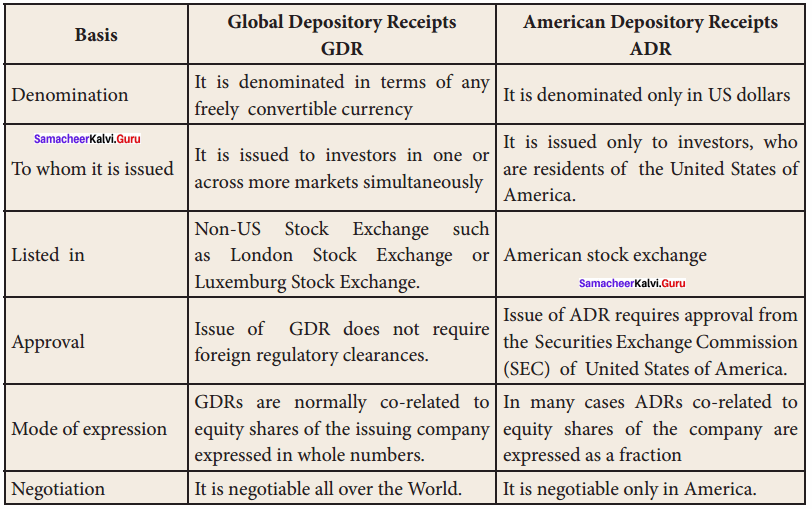
Samacheer Kalvi 11th Commerce Solutions Chapter 20 International Finance

Question 3.
State any five features of FCCB.
Answer:

  1. FCCB is issued by an Indian company in foreign currency.
  2. These are listed and traded in foreign stock exchange and similar to the debenture.
  3. It is a convertible debt instrument. It carries interest coupon. It is unsecured.
  4. It gives its holders the right to convert for a fixed numbers of shares at a pre – determined price.
  5. It can be converted into equity or depository receipt after a certain period.

Question 4.
Explain any five advantages of FDI.
Answer:
1. Achieving Higher Growth in National Income Developing countries get much needed capital through FDI to achieve higher rate of growth in national income.
International Finance

2. Help in Addressing BOP Crisis FDI provides inflow of foreign exchange resources into a country. This helps the country to solve adverse balance of payment position.

3. Faster Economic Development FDI brings technology, management and marketing skills along with it. These are crucial for achieving faster economic development of developing countries.

4. Generating Employment Opportunities: FDI generates a lot of employment opportunities in developing countries, especially in high skill areas.

5. Encouraging Competition in Host Countries Entry of FDI into developing country promotes healthy competition therein. This leads to enterprise in developing countries operating efficiently and effectively in the market. Consumers get a variety of products of good quality at market determined price which usually benefits the customers.

Samacheer Kalvi 11th Commerce International Finance Additional Questions and Answers

I. Choose the Correct Answer

Question 1.
…………….. is a section of financial economics that deals with the monetary interactions that occur between two or more countries.
(a) International finance
(b) Business finance
(c) DR
(d) GDR
Answer:
(a) International finance

Question 2.
From …………….., Foreign International Investors have been allowed to invest in all securities traded on the primary and secondary markets.
(a) 1992
(b) 1991
(c) 1995
(d) 1996
Answer:
(a) 1992

Question 3.
………………. is an instrument issued abroad by a company to raise funds in some foreign currencies and is listed and traded on a foreign stock exchange.
(a) GDR
(b) DR
(c) FDI
(d) FII
Answer:
(a) GDR

II. Very Short Answer Questions

Question 1.
Define Foreign Direct Investment (FDI).
Answer:
Foreign direct investment (FDI) is an investment made by a company or an individual in one country with business interests in another country, in the form of either establishing business operations or acquiring business assets in the other country, such as ownership or controlling interest in a foreign company.

Question 2.
What are Commercial Banks?
Answer:
Most of the commercial banks extend foreign currency loans for promoting business opportunities. The loans and services of various types, provided by banks differ from country to country.

Question 3.
What is International capital markets?
Answer:
Modem organisations including multinational companies depend upon sizeable borrowings in rupees as well as in foreign currencies. Prominent financial instruments used for this purpose are Depository Receipts.

Share this Tamilnadu State Board Solutions for 11th Commerce Chapter 20 International Finance Questions and Answers with your friends to help them to overcome the issues in exams. Keep visiting this site Tamilnadu State Board Solutions frequently to get the latest information on different subjects. Clarify your doubts by posting the comments and get the answers in an easy manner.

Samacheer Kalvi 11th Commerce Solutions Chapter 19 Sources of Business Finance

Students can find the most related topics which helps them to analyse the concepts if they practice according to the chapter-wise page. It is necessary for the students to practice more Questions and Answers for Tamilnadu State Board Solutions of 11th Commerce are given in the pdf format in chapter 19 Sources of Business Finance Questions and Answers so that students can prepare in both online and offline modes. So, Download Samacheer Kalvi 11th Commerce Book Solutions Questions and Answers, Notes Pdf, to score good marks.

Samacheer Kalvi 11th Commerce Solutions Chapter 19 Sources of Business Finance

Get the Questions and Answers, in Tamilnadu State Board 11th Commerce Solutions for Chapter 19 Sources of Business Finance. Learn the concepts of 11th Commerce Chapter-Wise by referring to the Tamilnadu State Board Solutions for Chapter 19 Sources of Business Finance Questions and Answers. Hence we suggest the students to Download Samacheer Kalvi 11th Commerce Book Solutions Questions and Answers pdf to enhance your knowledge.

Samacheer Kalvi 11th Commerce Sources of Business Finance Textbook Exercise Questions and Answers

I. Choose the Correct Answer
Question 1.
What is defined as the provision of money at the time when it is required?
(a) Finance
(b) Bank
(c) Cash management
(d) None of these
Answer:
(a) Finance

Question 2.
Internal sources of capital are those that are ……………..
(a) a generated through outsiders such as suppliers
(b) generated through loans from commercial banks
(c) generated through issue of shares
(d) generated within the business
Answer:
(d) generated within the business

Question 3.
Debenture holders are entitled to a fixed rate of ……………..
(a) Dividend
(b) Profits
(c) Interest
(d) Ratios
Answer:
(c) Interest

Question 4.
Public deposits are the deposits which are raised directly from ……………..
(a) the public
(b) the directors
(c) the auditors
(d) the owners
Answer:
(a) the public

Question 5.
Equity shareholders are the …………….. of a company.
(a) Creditors
(b) Owners
(c) Debtors
(d) Employees
Answer:
(b) Owners

Question 6.
Funds required for purchasing current assets is an example for ……………..
(a) Fixed Capital Requirement
(b) Ploughing Back of Profits
(c) Working Capital Requirement
(d) Lease Financing
Answer:
(c) Working Capital Requirement

Question 7.
Which of the following holder is given voting right?
(a) Debentures
(b) Preference Shares
(c) Equity shares
(d) Bonds
Answer:
(c) Equity shares

Question 8.
It may be wise to finance fixed assets through ………………
(a) Creditors
(b) Long term debts
(c) Bank Overdraft
(d) Bills Discounting
Answer:
(b) Long term debts

II. Very Short Answer Questions

Question 1.
Write a short notes on debentures.
Answer:
Debentures are an important instrument for raising long term debt capital. A company can raise funds through issue of debentures which bear a fixed rate of interest.

Question 2.
What do you mean by public deposits?
Answer:
Debentures are an important instrument for raising long term debt capital. A company can raise funds through issue of debentures which bear a fixed rate of interest.

Question 3.
Name any two sources of funds classified under borrowed funds.
Answer:

  1. Debentures
  2. Loan from banks

Question 4.
Name any two internal sources of business finance.
Answer:

  1. Retained earnings
  2. Collections form receivables

Question 5.
State any two factors that affect the choice of source of finance.
Answer:

  1. Cost
  2. Financial capacity to the firms

III. Short Answer Questions

Question 1.
Define Business finance.
Answer:
“Finance is that business activity which is concerned with the acquisition and conservation of capital fund in meeting the financial needs and overall objectives of business enterprises.” – B.O. Wheeler

Question 2.
What is pledge?
Answer:
A customer transfers the possession of an article with the creditor (banker) and receives loan. Till the repayment of loan, the article is under the custody of the borrower. If the debtor fails to refund the loan, creditor (banker) will auction the article pawned and adjust the outstanding loan from the sale proceeds.

Question 3.
List sources of raising long – term and short – term finance.
Answer:
Sources of Short Term Finance:

  1. Loans and Advances
  2. Bank Overdraft
  3. Discounting Bills of Exchange
  4. Trade Credit
  5. Pledge
  6. Hypothecation
  7. Mortgage
  8. Loans Against the Securities
  9. Clean Loan
  10. Commercial Paper (CP)
  11. Hire Purchase Finance
  12. Factoring

Sources of Long Term Finance:

  1. Shares (i) Equity Shares (ii) Preference Shares
  2. Debentures
  3. Retained Earnings
  4. Public Deposits
  5. Long Term Loan from Commercial Banks
  6. The Loans from Financial Institutions

Question 4.
For which purpose fixed capital is needed in business?
Answer:
Business enterprises need finance for fixed and working capital requirement. Fixed capital requirements include purchase of plant, machinery, furniture, fixtures, vehicles, and so on.

Question 5.
What do you mean by working capital requirement of business?
Answer:
Working capital requirements include purchase of raw materials, payment of salary and. wages, incurring operating expenses like telephone bills, carriage inward and outward, electricity charges, premium, stationery, etc.

IV. Long Answer Questions

Question 1.
List out the various sources of financing.
Answer:
The various sources of business finance can be classified into three categories on the basis of
(i) period basis
(ii) ownership basis
(iii) source of generation basis.

On the basis of period:

  1. Short term finance
  2. Medium term finance
  3. Long term finance

Sources of Short Term Finance:

  1. Loans and Advances
  2. Bank Overdraft
  3. Discounting Bills of Exchange
  4. Trade Credit
  5. Pledge
  6. Hypothecation
  7. Mortgage
  8. Loans Against the Securities
  9. Clean Loan
  10. Commercial Paper (CP)
  11. Hire Purchase Finance
  12. Factoring

Sources of Medium Term Finance:

  1. Loans from Banks
  2. Loan from Financial Institutions
  3. Lease Financing

Sources of Long Term Finance:

  1. Shares (i) Equity Shares (ii) Preference Shares
  2. Debentures
  3. Retained Earnings
  4. Public Deposits
  5. Long Term Loan from Commercial Banks
  6. The Loans from Financial Institutions

On the Basis of Ownership:

  1. Owner’s Funds
  2. Borrowed Funds

On the Basis of Generation of Funds:

  1. Internal Sources
  2. External Sources

Question 2.
What are the different types of short term finances given by commercial banks?
Answer:
1. Loans and Advances:
Loan is a direct advance made in lump sum which is credited to a separate loan account in the name of borrower. The borrower can withdraw the entire amount in cash immediately.

2. Bank Overdraft:
Bank overdraft refers to an arrangement whereby the bank allows the customers to overdraw the required amount from its current deposit account within a specified limit.

3. Discounting Bills of Exchange:
When goods are sold on credit, the suppliers generally draw bills of exchange upon customers who are required to accept it.

4. Trade Credit:
Trade credit is the credit extended by one trader to another for the purpose of purchasing goods and sendees. Purchaser need not pay money immediately after the purchase.

5. Pledge:
A customer transfers the possession of an article with the creditor (banker) and receives loan. Till the repayment of loan, the article is under the custody of the borrower. If the debtor fails to refund the loan, creditor (banker) will auction the article pawned and adjust the outstanding loan from the sale proceeds.

6. Hypothecation:
This is loan taken by depositing document of title to the property with the banker. Of course the physical possession of asset property is with the borrower. If the borrower fails to repay the loan amount, the article hypothecated will be sold in auction by the banker concerned.

Question 3.
Write short notes on

  1. Retained Earnings
  2. Lease financing

Answer:
1. Retained Earnings:
Retained earnings refer to the process of retaining a part of net profit year after year and reinvesting them in the business. It is also termed as ploughing back of profit. An individual would like to save a portion of his/her income for meeting the contingencies and growth needs.

Similarly profit making company would retain a portion of the net profit in order to finance its growth and expansion in near future. It is described to be the most convenient and economical method of finance.

2. Lease Financing:
Lease financing denotes procurement of assets through lease. For many small and medium enterprises, acquisition of plant and equipment and other permanent assets will be difficult in the initial stages. In such a situation Leasing is helping them to a greater extent.

Leasing here refers to the owning of an asset by any individual or a corporate body which will be given for use to another needy business enterprise on a rental basis. The firm which owns the asset is called ‘Lessor’ and the business enterprise which hires the asset is called ‘Lessee’.

The contract is called ‘Lease’. The lessee pays a fixed rent on agreed basis to the lessor for the use of the asset. The terms and conditions like lease period, rent fixed, mode of payment and allocation of maintenance, are mentioned in the lease contract.

At the end of the lease period, the asset goes back to the lessor. Alternatively lessee can own the asset taken on lease by paying the balance of price of asset concerned to lessor. Hence lease finance is a popular method of medium term business finance.

Question 4.
Write short notes on

  1. Owner’s funds
  2. Borrowed funds

Answer:
1. Owner’s Funds:
Owner’s funds mean funds which are provided by the owner of the enterprises who may be an individual, or partners or shareholders of a company. The profits reinvested in the business (ploughing back of profit or retained earnings) come under owner’s funds.

These funds are not required to be refunded during the life time of business enterprise. It provides the owner the right to control the management of the enterprise.

2. Borrowed Funds:
The term ‘borrowed funds’ denotes the funds raised through loans or borrowings. For example debentures, loans from banks and financial institutions, public deposits, trade credit, lease financing, commercial papers, factoring, etc., represent borrowed funds.

These borrowed sources of funds provide specific period before which the fund is to be returned. Borrower is under legal obligation to pay interest at given rate at regular intervals to the lender. Generally borrowed funds are obtained on the security of certain assets like bonds, land, building, stock, vehicles, machinery, documents of title to the goods, and the like.

Question 5.
Explain any four personal investment avenues.
Answer:
1. Public Provident Fund (PPF):
It is the safest long – term investment option for the investors in India. It is totally tax – free. PPF account can be opened in bank or post office. The money deposited cannot be withdrawn before 15 years and an investor can earn compound interest from this account.

However the investor can extend the time frame for the next five years if the investor does not opt to withdraw the amount matured for payment at maturity date. PPF investor can take loan against PPF account when he/she experiences financial difficulties.

2. Mutual Funds:
An individual investor who wants to invest in equities and bond with a balance of risk and return generally can invest in mutual funds. Nowadays people invest in stock markets through a mutual fund. Systematic investment plan is one of the best investment options in India.

3. Direct Equity or Share Purchase:
An individual can opt for investment in shares. But he has to analyse the market price of various shares traded in stock exchange, reputation of the company, consistency in the payment of dividend, the nature of the project undertaken by the company, growth prospects of industry in which a company is operating, before investing in shares. If the investment is made for a long time, it may yield good return.

4. Real Estate Investment:
Real estate is one of the fastest growing sectors in India. Buying, a flat or plot is supposed to be the best decision amongst the investment options. The value of the real asset may increase substantially depending upon the area of location and other support facilities available therein.

Samacheer Kalvi 11th Commerce Sources of Business Finance Additional Questions and Answers

I. Choose the Correct Answer:

Question 1.
Long term finance ………………
(a) more than 5 years
(b) above I year but below 5 years
(c) more than one year but below 3 years
(d) within one year
Answer:
(a) more than 5 years

Question 2.
The various sources of business finance can be classified into ………………
(a) three
(b) two
(c) four
(d) five
Answer:
(a) three

Question 3.
Business people hypothecate goods or equipment to get ……………… type of loan. It is a loan taken on the security of movable asset.
(a) Hypothecation
(b) Pledge
(c) Trade credit
(d) Bank overdraft
Answer:
(a) Hypothecation

Question 4.
……………… is a type of loan taken form the bank by lodging with the bank title deeds of immovable assets like land and building.
(a) Hypothecation
(b) Mortgage
(c) Clean loan
(d) Factoring
Answer:
(b) Mortgage

Question 5.
Source of Medium Term Finance is ………………
(a) share
(b) debentures
(c) Bank overdraft
(d) lease finance
Answer:
(d) lease finance

Question 6.
Which one is the internal source?
(a) Retained earnings
(b) Shares
(c) Debentures
(d) Public deposits
Answer:
(a) Retained earnings

Question 7.
Which one is the owner’s funds?
(a) Debentures
(b) Loan from banks
(c) Equity shares
(d) Commercial papers
Answer:
(c) Equity shares

II. Very Short Answer Questions

Question 1.
What do you mean by Bonds?
Answer:
Bonds are one of the ideal investment options for those investors who would like to invest their hard earned money safely. Bonds are issued both by government and public and private sector companies and financial institutions.

Question 2.
What is Mutual Funds?
Answer:
An individual investor who wants to invest in equities and bond with a balance of risk and return generally can invest in mutual funds. Nowadays people invest in stock markets through a mutual fund.

Question 3.
What is Commercial Paper (CP)?
Answer:
Commercial paper (CP) is an unsecured money market instrument in the form of a promissory note. It was introduced in India in 1990 under Section 45 W of the Reserve Bank of India Act.

III. Short Answer Questions

Question 1.
Mention any three significance of business finance.
Answer:

  1. A firm with adequate business finance can easily start any business venture.
  2. Business finance helps the business organisation to purchase raw materials from the supplier easily to produce goods.
  3. The business firm can meet financial liabilities like prompt payment of salary and wages, expenses, etc., in time with the help of sound financial support.

Question 2.
What is meant by preference shares?
Answer:
The fund raised by issue of preference shares is called preference share capital. Preference shares are those shares which enjoy priority regarding payment of dividend at a fixed rate out of the net profits of the company. They will get their dividend every year before any dividend is paid to equity shareholders.

They will have a right to get their settlement before the claims of equity shareholder are settled at the time of liquidation of company. However they do not have voting rights.

Case Study

Gokul Steel Ltd is a large and creditworthy company that manufactures steel for the Indian market. It now wants to cater the Asian market and decides to invest in new hi-tech machines. Since the investment is large, it requires long term finance. It decides to raise funds by issuing equity shares. The issue of equity shares involves huge floatation cost. To meet the expenses of floatation cost, the company decides to tap money market.
(a) Name and explain the money – market instrument the company can use for the above purpose.
(b) What is the duration for which the company can get funds through the instrument?
(c) State any other purpose for which this instrument can be used.
Answer:
The company can issue equity shares with premium. If the shares issue at premium value, the share can be subsided easily because the company has already created a credit worthy less. So it can easily raise their capital and get more funds and solve the huge requirement of funds.

(a) NSE (National Stock Exchange) – Gokul Steel Ltd.
BSE (Business Stock Exchange) – Equity shares

(b) Equity share capital for long term source of the company. One year, two years or life time of the company.

(c) In the future the shares can be used to change the value of shares. In the future this investment can be surrendered and get back the cash also with dividends.

Share this Tamilnadu State Board Solutions for 11th Commerce Chapter 19 Sources of Business Finance Questions and Answers with your friends to help them to overcome the issues in exams. Keep visiting this site Tamilnadu State Board Solutions frequently to get the latest information on different subjects. Clarify your doubts by posting the comments and get the answers in an easy manner.

Samacheer Kalvi 11th Commerce Solutions Chapter 18 Business Ethics and Corporate Governance

Students can find the most related topics which helps them to analyse the concepts if they practice according to the chapter-wise page. It is necessary for the students to practice more Questions and Answers for Tamilnadu State Board Solutions of 11th Commerce are given in the pdf format in chapter 18 Business Ethics and Corporate Governance Questions and Answers so that students can prepare in both online and offline modes. So, Download Samacheer Kalvi 11th Commerce Book Solutions Questions and Answers, Notes Pdf, to score good marks.

Samacheer Kalvi 11th Commerce Solutions Chapter 18 Business Ethics and Corporate Governance

Get the Questions and Answers, in Tamilnadu State Board 11th Commerce Solutions for Chapter 18 Business Ethics and Corporate Governance. Learn the concepts of 11th Commerce Chapter-Wise by referring to the Tamilnadu State Board Solutions for Chapter 18 Business Ethics and Corporate Governance Questions and Answers. Hence we suggest the students to Download Samacheer Kalvi 11th Commerce Book Solutions Questions and Answers pdf to enhance your knowledge.

Samacheer Kalvi 11th Commerce Business Ethics and Corporate Governance Textbook Exercise Questions and Answers

I. Choose the Correct Answer

Question 1.
Which of the following helps in maximising sale of goods to society?
(a) Business success
(b) laws and regulations
(c) Ethics
(d) Professional management
Answer:
(c) Ethics

Question 2.
Ethics is important for …………….
(a) Top management
(b) Middle level managers
(c) Non – managerial employees
(d) All of them
Answer:
(d) All of them

Question 3.
Which of the following does not ensure effective ethical practices in a business enterprise?
(a) Publication of a code
(b) Involvement of employees
(c) Establishment of compliance mechanisms
(d) none of them
Answer:
(a) Publication of a code

Question 4.
The role of top management is to guide the entire organisation towards …………….
(a) General behaviour
(b) Organisation behaviour
(c) Ethically upright behaviour
(d) Individual behaviour
Answer:
(c) Ethically upright behaviour

Question 5.
The ethical conduct of employees leading to standard practices results in …………….
(a) Good behaviour
(b) Bad behaviour
(c) Ethical behaviour
(d) Correct decision making
Answer:
(d) Correct decision making

II. Very Short Answer Questions

Question 1.
What is ethics?
Answer:
Ethics is derived from the Greek word ‘ethos’ which means a person’s fundamental orientation towards life. It governs the behaviour, derived from the moral standards which help to determine right or wrong, good or evil.

Question 2.
What do you mean by code?
Answer:
The organisation principles are defined in the written document called code.

Question 3.
State two ways by which ethics influences behaviour.
Answer:
Ethical behaviour is the acts consistent with the moral standards or codes of conduct established by society.

Question 4.
What is need for Corporate Governance?
Answer:
Corporate Governance is the system by which businesses are directed and controlled in the best interests of all stakeholders.Good corporate governance enables corporate success and economic development.

Question 5.
What are MNCs?
Answer:
MNC is defined to be an enterprise operating in several countries but managed from one country. A Multinational corporation is an organization doing business in more than one country.

III. Short Answer Questions

Question 1.
Define business ethics.
Answer:
Business ethics may be defined as a set of moral standards to be followed by owners, managers and business people. These standards determine the conduct and behaviour of business people. Business ethics reflects the conduct in the context of business.

Question 2.
What do you mean by the concept of business ethics?
Answer:
Business exists to supply goods and services to the people from social point of view but from individual point of view, the primary objective of any business unit is to make profit. The individual objective should not be in conflict with societal objective. These two objectives normally contradict each other, as one business enterprise may be good in individual objective and bad at social objective and vice versa.

Question 3.
Why is ethics necessary in business?
Answer:
All business units have realized that ethics is vitally important for the existence and progress of the business as well as the society. It is very important as it improves public image, earns public confidence, and leads to greater success. Ethics and profits go together in the long run. It enhances the quality of life, standard of living and business.

Question 4.
What are the benefit of Corporate Governance to Share holders.
Answer:

  1. Good corporate governance enables corporate success and economic development.
  2. Ensures stable growth of organizations.
  3. Aligns the interests of various stakeholders.
  4. Improves investors confidence and enables raising of capital.
  5. Reduces the cost of capital for companies.
  6. Has a positive impact on the share price.

Question 5.
Illustrate with example the working of a MNC.
Answer:
Any company is referred to as a multinational company or corporation (M. N. C.) when that company manages its operation or production or service delivery from more than a single country. It has its Headquarter based in one country with several other operating branches in different other countries. IBM, Microsoft, Pepsi Co., Sony, etc. are the examples of MNC’s.

IV. Long Answer Questions

Question 1.
Explain the different key elements of business ethics.
Answer:
1. Top Management Coriimitment:
Top management has a very important role to guide the entire organization towards ethical behaviour. The top level personnel in any organisation should work openly and strongly committed towards ethical conducts and guide people working at middle and low level to follow ethical behaviour.

2. Establishment of Compliance Mechanism:
To make sure that actual decisions match with a firm’s ethical standards, suitable mechanism should be established..

3. Publication of a “Code”:
Generally organisations formulate their own ethical codes for the conduct of the enterprise; it should followed by the employees of the organisation. The organisation principles are defined in the written docunient called code.

4. Involving Employees at All Levels:
It is the employees at different levels who implement ethics policies to make ethical business a reality. Therefore, their involvement in ethics programmes becomes a must.

5. Measuring Results:
The organisations from time to time keep a check on ethical practise followed. Although it is difficult to accurately measure the end results of ethics programmes, the firms can certainly audit to monitor compliance with ethical standards.

Question 2.
Describe the code of business ethics.
Answer:
Code of ethics documents the generally accepted principles of ethical conduct. They are statements of values and principles which define the purpose of an organisation. It gives a clear picture of the standards that employees should follow. It guides them in decision making. The code of business ethics can include the following:

  1. To offer goods at fair prices.
  2. To supply goods of good quality and not to deal in spurious and sub standard products.
  3. To listen to consumer’s complaints and to reduce them.
  4. Not to raise the price of its products unjustifiably.
  5. Not to resort hoarding and lack marketing.
  6. Not to resort to price cutting with the sole aim of killing competition.
  7. Not to issue advertisement containing false information or exaggerated claims.
  8. To pay fair wages to its employees and not to exploit them.
  9. To provide congenial work atmosphere.
  10. To design production process in such a way as to reduce environmental pollution.
  11. To keep proper books of accounts and records.
  12. To pay taxes regularly.
  13. To complaint with various business loss and never to flout Government regulations.

Question 3.
Explain the significance of Corporate Governance from the point of Stakeholders.
Answer:
Balanced economic development is made possible through transparent management under corporate governance. All Stakeholders interests are protected and promoted through corporate governance. Some of the benefits of corporate governance are as follows.

  1. Good corporate governance enables corporate success and economic development.
  2. Ensures stable growth of organizations.
  3. Aligns the interests of various stakeholders.
  4. Improves investors’ confidence and enables raising of capital.
  5. Reduces the cost of capital for companies.
  6. Has a positive impact on the share price
  7. Provides incentive to managers to achieve organizational objectives.
  8. Eliminates wastages, corruption, risks and mismanagement.
  9. Improves the image of the company.
  10. The organization is managed to benefit the stakeholders.
  11. Ensures efficient allocation of resources
  12. Creates a strong brand as an ethical business.

Question 4.
Discuss the role of International Benchmarking on the working of Companies in India.
Answer:
Asia : Independent Directors are a requirement for listed companies in all Asian economies, where most require at least l/3rd of the Board to be independent.

USA : The Council of Institutional Investors (CII), Corporate Governance Policies state that at least 2/3rd of the directors should be independent.

Europe : European commission urges member states to have sufficient number of independent npn-executive or supervisory directors on Board.

G20 / OECD : The latest principles encourage the prominent role of independent Board members.

Japan : In early. 2014, Japanese Prime Minister announced the goal of increasing the percentage of women in executive positions at Japanese companies to 30% by 2020.

UK : UK businesses had voluntary targets first set in 2011 i.e. to have 25% women on FTSE 100 (The Financial Times Stock Exchange) Boards by 2015.

Canada : At the Federal level, two bills are currently being tabled which will impose a 40% quota for female Board members of public companies and other regulated entities such as banks and insurance companies.

Brazil : A bill pending in the Brazilian Senate would impose a 40% female quota on the Boards of state owned enterprises by 2022.

France : French parliament adopted a bill that requires public companies making at least 50 million Euros in turnover and employing more than 500 workers to have 40% female Board representation by 2017.

Question 5.
Describe the benefits of increasing the number of MNCs.
Answer:

  1. Considers opportunities throughout the globe though they do the business in a few countries.
  2. To invest considerable portion of their assets internationally.
  3. They are huge industrial / business organisation.
  4. It engages in international production and operates plants in a number of countries.
  5. They take managerial decisions on a global perspective.
  6. They produce in one or a few countries and sell them in most of the countries.
  7. Their international operations are integrated into the corporations overall business.

The entry of MNC’s into India have proved quite beneficial for the growth and development of Indian economy providing employment Opportunities for the young generation.

Samacheer Kalvi 11th Commerce Business Ethics and Corporate Governance Additional Questions and Answers

I. Choose the Correct Answer:

Question 1.
Ethics governs the ……………..
(a) Behaviour
(b) Ethos
(c) Life
(d) Payoffs
Answer:
(a) Behaviour

Question 2.
The organisation principles are defined in the written document called ……………..
(a) Code
(b) Law
(c) Behaviour
(d) Ethical
Answer:
(a) Code

Question 3.
…………….. has its Headquarters based in one country with several other operating branches in different other countries.
(a) MNC
(b) GDP
(c) Company
(d) Business
Answer:
(a) MNC

Question 4.
There are …………….. primary types of bench making.
(a) Two
(b) Three
(c) Four
(d) Five
Answer:
(c) Four

Question 5.
…………….. bench making is a direct competitor-to-competitor comparison of a product, service process or method.
(a) Internal
(b) Competitive
(c) Functional
(d) Generic
Answer:
(b) Competitive

Future Learning

Question a.
Money earning cannot be sole objective of business or life.
Answer:
Primary objective is to make profit. The individual objective should not be with societal objectives.

Question b.
The mind of students to accept that ethics and consideration for environment, law etc can lengthen the income earning of an individual or business
Answer:
All business units have realized that ethics is vitally important for the existence and progress of the business as well as the society. Ethics and profits go together in the long run. It enhances the quality of life, standard of living and business.

Share this Tamilnadu State Board Solutions for 11th Commerce Chapter 18 Business Ethics and Corporate Governance Questions and Answers with your friends to help them to overcome the issues in exams. Keep visiting this site Tamilnadu State Board Solutions frequently to get the latest information on different subjects. Clarify your doubts by posting the comments and get the answers in an easy manner.

Samacheer Kalvi 11th Commerce Solutions Chapter 17 Social Responsibility of Business and Business Ethics

Students can find the most related topics which helps them to analyse the concepts if they practice according to the chapter-wise page. It is necessary for the students to practice more Questions and Answers for Tamilnadu State Board Solutions of 11th Commerce are given in the pdf format in chapter 17 Social Responsibility of Business and Business Ethics Questions and Answers so that students can prepare in both online and offline modes. So, Download Samacheer Kalvi 11th Commerce Book Solutions Questions and Answers, Notes Pdf, to score good marks.

Samacheer Kalvi 11th Commerce Solutions Chapter 17 Social Responsibility of Business and Business Ethics

Get the Questions and Answers, in Tamilnadu State Board 11th Commerce Solutions for Chapter 17 Social Responsibility of Business and Business Ethics. Learn the concepts of 11th Commerce Chapter-Wise by referring to the Tamilnadu State Board Solutions for Chapter 17 Social Responsibility of Business and Business Ethics Questions and Answers. Hence we suggest the students to Download Samacheer Kalvi 11th Commerce Book Solutions Questions and Answers pdf to enhance your knowledge.

Samacheer Kalvi 11th Commerce Social Responsibility of Business and Business Ethics Textbook Exercise Questions and Answers

I. Choose the Correct Answer

Question 1.
Which type of Responsibility gives the benefit to the Society out of its profits earned?
(a) legal
(b) Ethical
(c) Moral
(d) Economic
Answer:
(c) Moral

Question 2.
The Stakeholders of Socially Responsible business units are except ……………..
(a) Share holders
(b) Employees
(c) Government
(d) Company
Answer:
(d) Company

Question 3.
Assuming Social Responsibility of business helps the enterprise in
(a) Increase profit
(b) Decrease profit
(c) Sustainability
(d) Equilibrium
Answer:
(c) Sustainability

Question 4.
Socially Responsible business provides goods at ……………..
(a) High price
(b) Low price
(c) Reasonable price
(d) Moderate price
Answer:
(c) Reasonable price

Question 5.
Social Responsibility towards employees represents the following except ……………..
(a) Reasonable remuneration
(b) Proper facilities
(c) Social security
(d) Exploitation
Answer:
(d) Exploitation

II. Very Short Answer Questions

Question 1.
What do you mean by Social Responsibility?
Answer:
The term social responsibility is defined in various ways. Every businessman earns prosperity from business and should give back the benefit of this prosperity to society.

Question 2.
Give the meaning of Social Power.
Answer:
Businessmen have considerable social power. Their decisions and actions affect the lives and fortunes of the society. Businessmen should’assume social obligations commensurate with their social power.

Question 3.
What is a free enterprise?
Answer:
A business enterprise which accepts and discharges social obligations enjoys greater freedom. Thus, social responsibilities are essential for avoiding governmental action against business. Such action will reduce the freedom of decision making in business.

Question 4.
Who are called Stakeholders?
Answer:
A business organisation is a coalition of several interest groups are called stakeholders. Example – shareholders, customers, employees, suppliers, etc. Business should, therefore, work for the interest of all of them rather than for the benefit of shareholders /owners alone.

Question 5.
What is ethical Responsibility?
Answer:
Ethical Responsibility includes the behaviour of the firm that is expected by society but not codified in law. For example, respecting the religious sentiments and dignity of people while advertising for a product. There is an element of voluntary action in performing this responsibility.

III. Short Answer Questions

Question 1.
Define the Concept of Social Responsibility?
Answer:
“Social Responsibility requires managers to consider whether their action is likely to promote the public good, to advance the basic beliefs of our society, to contribute to its stability, strength and harmony” – Peter F. Drucker.

Question 2.
Why you do think Social Responsibility of business is needed?
Answer:
1. Self – Interest : A business unit can sustain in the market for a longer period only by assuming some social obligations. Normally businessmen recognise that they can succeed better by fulfilling the demands and aspirations of society.

2. Creation of Society : Business is a creation of society and uses the resources of society. Therefore, it should fulfil its obligations to society.

Question 3.
What are the benefits derived by employees of a Socially Responsible business enterprise?
Answer:

  1. Timely and regular payment of wages and salaries.
  2. Proper working conditions and welfare amenities.
  3. Opportunity for better career prospects.
  4. Job security as well as social security like facilities of provident fund, group insurance, pension, retirement benefits, etc.

Question 4.
Enumerate the points relating to why business units are Socially Responsible?
Answer:

  1. Protection of Stakeholders Interest
  2. Promotion of Society
  3. Assessment of Social Impact

Question 5.
List the kinds of Social Responsibility.
Answer:

  1. Economic responsibility
  2. Legal responsibility
  3. Ethical responsibility
  4. Discretionary responsibility

IV. Long Answer Questions

Question 1.
Explain in detail the concept and need for Social Responsibility?
Answer:
The term social responsibility is defined in various ways. Every businessman earns prosperity from business and should give back the benefit of this prosperity to society. This is voluntary. This benefit is the moral responsibility of business. As this benefit is supposed to be passed on to society, it can be said to be social responsibility of business.

Need:
1. Self – Interest : A business unit can sustain in the market for a longer period only by assuming some social obligations. Normally businessmen recognise that they can succeed better by fulfilling the demands and aspirations of society.

2. Creation of Society : Business is a creation of society. Therefore, it should fulfil its obligations to society.

3. Social Power : Businessmen have considerable social power. Their decisions and actions affect the lives and fortunes of the society.

4. Image in the Society : A business can improve its image in public by assuming social obligations, good relations with workers, consumers and suppliers help in the success of business.

Question 2.
Answer:
Illustrate with examples the arguments for Social Responsibility?
Answer:
1. Protection of Stakeholders Interest : A business organisation is a coalition of several interest groups or stakeholders. Example – shareholders, customers, employees, suppliers, etc.

2. Promotion of Society : Business is a sub – system of society. It draws support and sustenance from society in the form of inputs. Socially responsible behaviour is essential to sustain this relationship between business and society.

3. Assessment of Social Impact : During the course of its functioning, a business enterprise makes several decisions and actions. Its activities exercise a strong influence on the interests and values of society.

4. Organised Social Power : Large corporations have acquired tremendous social power through their multifarious operations. Social power may be misused in the absence of social, responsibility.

5. Legitimacy : It is in the enlightened self-interest of business to assume social responsibility.

6. Competence : Business organisations and their managers have proved their competence and leadership in solving economic problems.

7. Professional Conduct : Professional managers are required to display a keen social sensitivity and serve the society as a whole.

8. Public Opinion : Adoption of social responsibility as an objective will help to improve the public opinion of business.

Question 3.
Discuss the different groups benefited out of Social Responsibility of business?
Answer:

1. Lack of Conceptual Clarity : The concept of Social responsibility is very vague and amenable to different interpretations.

2. Dilution of Economic Goals : By accepting social responsibility, business will compromise with economic goals.

3. Lack of Social Skill : Business organisations and their managers are not familiar with social affairs.

4. Burden on Consumers : If business deals with social problems, cost of doing business would increase.

5. Responsibility without Power : Business organisations possess only economic power and not social power. It is unjust to impose social responsibilities with social power.

6. Misuse of Responsibilities : Acceptance of social responsibilities will involve diversion of precious managerial time and talent on social action programmes.

7. Lack of Yard – stick : Profitability is the common criteria for decision – making in business.

8. Improper Role : The proper role of business is to use its resources and energies efficiently so as to earn the best possible return on investment within the confines of law and ethics.

9. Over Loading Responsibility : Business organisations are already serving society by providing goods and services, generating employment, developing technology and contributing to public exchequer through tax payments.

Question 4.
How do you classify Social Responsibility?
Answer:
1. Economic responsibility:
A business enterprise is basically an economic entity and, therefore, its primary social responsibility is economic i.e., produce goods and services that society wants and sell them at a profit.

2. Legal responsibility:
Every business has a responsibility to operate within the laws of the land. Since these laws are meant for the good of the society, a law abiding enterprise is a socially responsible enterprise as well.

3. Ethical responsibility:
This includes the behavior of the firm that is expected by society but not codified in law. For example, respecting the religious sentiments and dignity of people while advertising for a product. There is an element of voluntary action in performing this responsibility.

4. Discretionary responsibility:
This refers to purely voluntary obligation that an enterprise assumes, for instance, providing charitable contributions to educational institutions or helping the affected people during floods or earthquakes.

It is the responsibility of the company management to safeguard the capital investment by avoiding speculative activity and undertaking only healthy business ventures which give good returns on investment.

Samacheer Kalvi 11th Commerce Social Responsibility of Business and Business Ethics Additional Questions and Answers

I. Choose the Correct Answer:

Question 1.
Management of business enterprises is being
(a) Professionalism
(b) Law and order
(c) Free enterprise
(d) Public awareness
Answer:
(a) Professionalism

Question 2.
How many kinds of Social Relationship of business?
(a) Two
(b) Three
(c) Four
(d) Five
Answer:
(c) Four

II. Very Short Answer Questions

Question 1.
What is Legal responsibility?
Answer:
Every business has a responsibility to operate within the laws of the land. Since these laws are meant for the good of the society, a law abiding enterprise is a socially responsible enterprise as well.

Question 2.
What is Public awareness?
Answer:
Now – a – days consumers and workers are well informed about their rights. Consumers expect better quality products at reasonable prices. Similarly, workers desire fair wages and other benefits.

Share this Tamilnadu State Board Solutions for 11th Commerce Chapter 17 Social Responsibility of Business and Business Ethics Questions and Answers with your friends to help them to overcome the issues in exams. Keep visiting this site Tamilnadu State Board Solutions frequently to get the latest information on different subjects. Clarify your doubts by posting the comments and get the answers in an easy manner.

Samacheer Kalvi 11th Commerce Solutions Chapter 16 Emerging Service Business in India

Students can find the most related topics which helps them to analyse the concepts if they practice according to the chapter-wise page. It is necessary for the students to practice more Questions and Answers for Tamilnadu State Board Solutions of 11th Commerce are given in the pdf format in chapter 16 Emerging Service Business in India Questions and Answers so that students can prepare in both online and offline modes. So, Download Samacheer Kalvi 11th Commerce Book Solutions Questions and Answers, Notes Pdf, to score good marks.

Samacheer Kalvi 11th Commerce Solutions Chapter 16 Emerging Service Business in India

Get the Questions and Answers, in Tamilnadu State Board 11th Commerce Solutions for Chapter 16 Emerging Service Business in India. Learn the concepts of 11th Commerce Chapter-Wise by referring to the Tamilnadu State Board Solutions for Chapter 16 Emerging Service Business in India Questions and Answers. Hence we suggest the students to Download Samacheer Kalvi 11th Commerce Book Solutions Questions and Answers pdf to enhance your knowledge.

Samacheer Kalvi 11th Commerce Emerging Service Business in India Textbook Exercise Questions and Answers

I. Choose the Correct Answer

Question 1.
A continuing relationship which provides a licence privileges do business and provides training, merchandising for a consideration is called …………….
(a) Franchising
(b) Factoring
(c) supply chain management
(d) Exchange
Answer:
(a) Franchising

Question 2.
A condition were a factors agrees to provide complete set of services like financing, debt collection, consultancy is called …………….
(a) Maturity factoring
(b) National factoring
(c) Full service factoring
(d) Recourse factoring
Answer:
(c) Full service factoring

Question 3.
Buying and selling ofgoods through electronic network is known as …………….
(a) E – commerce
(b) Internet
(c) Website
(d) Trade
Answer:
(a) E – commerce

Question 4.
An organization carrying out activities to move goods from producer to consumer is …………….
(a) Transport
(b) Logistics
(c) Channels
(d) Marketing
Answer:
(a) Transport

Question 5.
The role of government in logistics management is through …………….
(a) Legislations
(b) Governance
(c) Transport
(d) Distribution
Answer:
(d) Distribution

Question 6.
The main benefit of Logistics is …………….
(a) productivity
(b) Cost minimisation
(c) Profitability
(d) Storage
Answer:
(b) Cost minimisation

Question 7.
What aims for an effective management response over the longer run …………….
(a) Logistics
(b) Supply Chain Management
(c) Demand
(d) Supply
Answer:
(a) Logistics

Question 8.
The model that identifies alternatives, criteria for decision making and analyse alternatives to arrive at the best choice is …………….
(a) Routing model
(b) Scheduling model
(c) Inventory model
(d) Alternative Analysis
Answer:
(b) Scheduling model

Question 9.
A company under outsourcing transfers activities which are …………….
(a) Core
(b) Non – Core
(c) Business
(d) Non – Business
Answer:
(b) Non – Core

Question 10.
Business units can reduce expenditure by outsourcing front office work like ……………..
(a) Paper work
(b) file work
(c) Billing
(d) manufacture
Answer:
(b) file work

Question 11.
The main benefit of outsourcing is …………….
(a) Productivity
(b) Cost reduction
(c) Skill
(d) Units
Answer:
(b) Cost reduction

Question 12.
Outsourcing job is given to developing countries specifically for …………….
(a) Cheap labour
(b) Land
(c) Capital
(d) Factors
Answer:
(a) Cheap labour

Question 13.
Outsourcing is carried out for the benefit of …………….
(a) Global village
(b) Transport
(c) Factory
(d) Time and money
Answer:
(d) Time and money

II. Very Short Answer Questions

Question 1.
Who is a franchisee?
Answer:
The individual who acquires the right to operate the business or use the trademark of the seller is known as tire franchisee.

Question 2.
State two disadvantages of franchising?
Answer:
Franchising fees: The initial franchising fee and the subsequent renewal fee can be very high in case of successful businesses. From the franchisee’s point of view, this may be a deterrent. Fixed royalty payment: The franchisee has to make payment of royalty to the franchiser on a regular basis. This considerably reduces the income of the franchisee.

Question 3.
Who is a factor?
Answer:
The factor is an agent who buys the accounts receivables (Debtors and Bills Receivables) of a firm and provides finance to a firm to meet its working capital requirements.

Question 4.
Define outsourcing.
Answer:
BPO refers to outsourcing the work.which is routine in nature, to an outside agency.

Question 5.
What is need for outsourcing?
Answer:

  1. To focus on key function
  2. Benefit of specialization / efficiency
  3. Cost cutting
  4. Economic growth and development
  5. Increasing profit
  6. Catering to the dynamic demand

Question 6.
State the importance of BPO.
Answer:
BPO means getting contractual services of external companies or group of companies to complete special work or process of a company. For example call centres, data entry etc. This reduces the expenditure by using cheap labour available in developing countries like India, China etc.

Question 7.
What are the benefits of KPO?
Answer:
In short, KPO firms get knowledge related, information related, work done from outside firm and it involves high value work carried highly skilled staff.

Question 8.
Define Logistics.
Answer:
Logistics can be viewed as a logical extension of transportation and related areas to achieve an efficient and effective goods distribution system.

Question 9.
What is the need for Logistics?
Answer:
Logistics Management is defined as ‘Design and operation of the physical, managerial, and informational systems needed to allow goods to overcome time and space (from the producer to the consumer)’.

Question 10.
Write about the importance of Logistics.
Answer:
Organisations taking proactive managerial attention in coordinating the actors in logistics leads to reduced logistics costs and improved customer service.

Question 11.
What are the types of Logistics Applications?
Answer:

  1. Decision – wise
  2. Actor – wise
  3. Inbound logistics
  4. Outbound logistics.

Question 12.
What do you mean by E – commerce?
Answer:
E – commerce or Electronic commerce is the buying and selling of goods and services through electronic networks like internet.

III. Short Answer Questions

Question 1.
What are the types of franchising?
Answer:

  1. Product /trade name franchising : In this type, the franchisee exclusively deals with a manufacture’s product, example Kidzee, French Loaf outlets.
  2. Business format franchising : When a franchisor awards rights covering all business aspects as a complete business package to the franchisee it is called as business format franchising, example McDonald’s, Pizza Hut.

Question 2.
List the steps in factoring process.
Answer:

  1. The firm enters into a factoring arrangement with a factor, which is generally a financial institution, for invoice purchasing.
  2. Whenever goods are sold on credit basis, an invoice is raised and a copy of the same is sent to the factor.
  3. The debt amount due to the firm is transferred to the factor through assignment and the same is intimated to the customer.

Question 3.
Describe the benefits of Logistics.
Answer:
Generally a good transportation, storage, handling and information infrastructure helps in efficient logistics management. All firms are viewed as a collection of primary and secondary activities,

Question 4.
Explain the points of differences between Logistics and Supply Chain Management.
Answer:
Logistics:
Logistics Management deals with the efficient management of a static gap between demand and supply.

Supply Chain Management:
Supply Chain Management tries to identify the dynamic nature of the value creation itself such as responsiveness, quality and design. Hence, it aims for an effective management response over the longer run.

Question 5.
What is the impact of e-commerce on buyers?
Answer:

  1. Buyers could have a global access to information about variety of products and services available in the market.
  2. They could buy the products/services round the clock from anywhere in world.
  3. The prices of products bought through e – commerce tend to be relatively lower than those purchased physically in the conventional shops due to offers, discount etc.

IV. Long Answer Questions

Question 1.
Enumerate the characteristics of franchising.
Answer:

  1. Franchise relationship is based on an agreement which lays down terms and conditions of this relationship.
  2. The term of franchise may be for 5 years or more. The franchise agreement may be renewed with the mutual consent of the parties.
  3. The franchisee gives an undertaking not to carry any other competing business during the term of the franchise; and the franchiser gives an undertaking not to terminate the franchise agreement before its expiry except under situations which may justify the termination of the franchise agreement.
  4. The franchisee agrees to pay specified royalty to the franchiser, as per terms of the franchise agreement.
  5. Franchise means selling the same product and maintaining a similar type of shop decor (i.e. style of interior decoration) for which franchiser provides assistance to franchisee in organising, merchandising and management.

Question 2.
Elucidate the features of factoring.
Answer:

  1. Maintenance of book – debts : A factor takes the responsibility of maintaining the accounts of debtors of a business institution.
  2. Credit coverage : The factor accepts the risk burden of loss of bad debts leaving the seller to concentrate on his core business
  3. Cash advances : Around eighty percent of the total amount of accounts receivables is paid, as advance cash to the client.
  4. Collection service : Issuing reminders, receiving part payments, collection of cheques from part of the factoring service.
  5. Advice to clients : From the past history of debtors, the factor is able to provide advises regarding the credit worthiness of customers, perception of customers about the products of the client, etc.

Question 3.
Describe the benefits of Outsourcing.
Answer:
1. Focusing on Core Activities : Companies can focus on their core competence, a few areas , where the company has distinct capability. The rest of the activities (non – core) can be outsource to outside agencies.

2. To Fillip Economic Development : Outsourcing stimulates entrepreneurship, encourages employment opportunities, expands exports, enables tremendous growth of the economy.

3. Encourages Employment Opportunities : Companies that are outsourcing their non core activities provide chances for other small business units to take up the activities. This paves way for more job opportunities and new employment avenues.

4. Reduction in Investment : Companies through outsourcing avails the services of outsiders which in turn reduces the investment requirements. The amount so available can be utilized productively and this increases the profits.

5. Quest for Excellence : Outsourcing enables the firms to pursue excellence in two ways namely excelling themselves in the activities they do and excel outsiders by extending their capabilities through contracting out.

Question 4.
Explain the points of differences between BPO and KPO.
Answer:
BPQ:

  • BPO means getting contractual services of external companies or group of companies to complete special work or process of a company.
  • For example call centres, data entry etc. This reduces the expenditure by using cheap labour available in developing countries like India, China, etc.
  • To focus on key function.
  • Benefit of specialization / efficiency.
  • Cost cutting.

KPO:

  • KPO refer to outsourcing of Knowledge based Process! It means obtaining high end knowledge work from outside the organization in order to run the business successfully and in cost effective manner.
  • In short KPO firms get knowledge related, information related, work done from outside firm and it involves high value work carried highly skilled staff.
  • Usage of best skills.
  • Ultimate use of knowledge.
  • Finding solution to complex problem.

Question 5.
Write a note on e – commerce models.
Answer:
1. Business to customers (B2C):
This is fastest growing segment in e – commerce spare. Under this model, business concern sells directly to consumers.

2. Business to Business (B2B):
Under the model, business concerns transact with one another through internet. For instance, Snapdeal, Flipkart, Alibaba, Indiamart, Tradelndia.com etc.

3. Consumer to consumer (C2C):
Under this model, customers sell directly to other customers through online classified advertisement or through auction or through mobile or through market places. Example, Indian ventures in C2C are Kraftly App (buying and selling anythings) which deals in handmade products of a wide range. Onceagainstore.com is a website that buys pre-owned women’s fashion products. Other players are Quikr, OLX, ebay, etc.

4. Customer to Business (C2B):
This model is reverse to auction model. Products like automobile, electronic items furniture and similar product are traded by customer through websites. Naukri.com and Monster.com are examples of Indian Companies operating in this domain.

5. Business to. Government (B2G):
This model envisages selling products and services by business consumer to Government organization. For instance TCS operates the passport application process for the Government of India as part off – line process.

Samacheer Kalvi 12th Commerce Emerging Service Business in India Additional Questions and Answers

I. Choose the Correct Answer:

Question 1.
There are …………….. parties to a franchising agreement.
(a) two
(b) Three
(c) Four
(d) Five
Answer:
(a) two

Question 2.
There are …………….. types of franchising primarily.
(a) One
(b) Two
(c) Three
(d) Four
Answer:
(b) Two

Question 3.
Factoring means ……………..
(a) to make or do
(b) to work
(c) for credit
(d) for debit
Answer:
(a) to make or do

Question 4.
…………….. focuses on profit maximization rather than cost minimizing.
(a) SMC
(b) LM
(c) Transportation
(d) GST
Answer:
(a) SMC

Question 5.
Recently a new type of business in service sector is called ……………..
(a) BPO
(b) core
(c) non – core
(d) gardening
Answer:
(a) BPO

Question 6.
Business to Business (B2B) ……………..
(a) Snapdeal
(b) Monster.com
(c) TCS
(d) ebay
Answer:
(a) Snapdeal

Question 7.
Customer to Business (C2B) ……………..
(a) Flipkart
(b) Indiamart
(c) Olx
(d) Naukri.com
Answer:
(d) Naukri.com

II. Very Short Answer Questions

Question 1.
What is E-Business?
Answer:
E – Business is a broader term which includes internal and external transaction of an organization across the internet.

Question 2.
What do you mean by Business to Customers (B2C)?
Answer:
This is faster growing segment in e – commerce spare. Under this model, business concern sells directly to customers.

Question 3.
Mention any two advantages of franchising.
Answer:

  1. Reduces risk
  2. Business expansion.

III. Short Answer Questions

Question 1.
What is the impact of e – commerce on vendors?
Answer:

  1. Vendors could have a wider access to customers across the globe.
  2. This helps minimize the cost of operating business due to direct distribution of goods to end consumers thanks to minimum invention of intermediaries.
  3. Vendor could interact with multiple buyers and sellers.

For Future Learning

Question a.
You are a small scale manufacturer of ignition coils for automobiles, located near Ranipet. Explain how will you avail of financial credits through factoring if you get orders from
a. Ford India, Chennai
b. Maruti Suzuki, Gurgaon
c. Kun Hyundai, Seoul

Answer:
a. I can show the sources of business to get credit.

b.

  • To identify the activities involved in the movement of goods – Trade
  • To analyse the benefits of Logistics – Transport
  • To evaluate the areas which need more focus relating to Logistics – Kinds of transport
  • To understand critically and analyse the impact of Logistics on Profitability – To reduce cost and improve customer service.

c.

  • To identify the core activities of any business – Companies can focus on their core competence.
  • To analyse the benefits of Outsourcing non – core items – Outsource to outside agents.
  • To evaluate the areas which needs KPO – KPO firm get knowledge related, information related work done from outside firm.
  • To understand critically and analyse the impact of call centers

Share this Tamilnadu State Board Solutions for 11th Commerce Chapter 16 Emerging Service Business in India Questions and Answers with your friends to help them to overcome the issues in exams. Keep visiting this site Tamilnadu State Board Solutions frequently to get the latest information on different subjects. Clarify your doubts by posting the comments and get the answers in an easy manner.

Samacheer Kalvi 11th Commerce Solutions Chapter 15 Insurance

Students can find the most related topics which helps them to analyse the concepts if they practice according to the chapter-wise page. It is necessary for the students to practice more Questions and Answers for Tamilnadu State Board Solutions of 11th Commerce are given in the pdf format in chapter 15 Insurance Questions and Answers so that students can prepare in both online and offline modes. So, Download Samacheer Kalvi 11th Commerce Book Solutions Questions and Answers, Notes Pdf, to score good marks.

Samacheer Kalvi 11th Commerce Solutions Chapter 15 Insurance

Get the Questions and Answers, in Tamilnadu State Board 11th Commerce Solutions for Chapter 15 Insurance. Learn the concepts of 11th Commerce Chapter-Wise by referring to the Tamilnadu State Board Solutions for Chapter 15 Insurance Questions and Answers. Hence we suggest the students to Download Samacheer Kalvi 11th Commerce Book Solutions Questions and Answers pdf to enhance your knowledge.

Samacheer Kalvi 11th Commerce Insurance Textbook Exercise Questions and Answers

I. Choose the Correct Answer

Question 1.
The basic principle of insurance is …………….
(a) Insurable Interest
(b) Co – operation
(c) Subrogation
(d) Proximate cause
Answer:
(a) Insurable Interest

Question 2.
……………. is not a type of general insurance.
(a) Marine Insurance
(b) Life Insurance
(c) Fidelity Insurance
(d) Fire Insurance
Answer:
(b) Life Insurance

Question 3.
Which of the following is not a function of insurance?
(a) Lending Funds
(b) Risk sharing
(c) Assist in capital formation
(d) Protection of life
Answer:
(d) Protection of life

Question 4.
Which of the following in not applicable in insurance contract?
(a) Unilateral contract
(b) Conditional contract
(c) Indemnity contract
(d) Inter – personal contract
Answer:
(c) Indemnity contract

Question 5.
Which one of the following is a type of marine insurance?
(a) Money back
(b) Mediclaim
(c) Hull insurance
(d) Cargo insurance
Answer:
(d) Cargo insurance

II. Very Short Answer Questions

Question 1.
List any five important type of policies.
Answer:

  1. Life Insurance
  2. General Insurance
  3. Fire Insurance
  4. Marine Insurance
  5. Health Insurance

Question 2.
What is health insurance?
Answer:
In mid 80’s, most of the hospitals in India were government owned and treatment was free of cost. With the advent of Private Medical Care, the need for Health Insurance was felt and various Insurance Companies introduced Health Insurance as a Product. Presently the health insurance exists primarily in the form of ‘Mediclaim policy’.

III. Short Answer Questions

Question 1.
Define Insurance.
Answer:
“Insurance is a plan by themselves which large number of people associate and transfer to the shoulders of all, risk that attacks to individuals” – According to John Merge.

Question 2.
Give the meaning of crop insurance.
This policy is to provide financial support to farmers in case of a crop failure due to drought or flood. It generally covers all risks of loss or damages relating to production of rice, wheat, millets, oil seeds and pulses etc.

Question 3.
Write a note on IRDAI.
IRDAI – Insurance Regulatory Development and Authority is the statutory, independent and apex body that govern and supervise the Insurance Industry in India. It was constituted in 2000 by Parliament of India Act called IRDAI Act, 1999. Presently IRDAI headquarters is in Hyderabad.

IV. Long Answer Questions

Question 1.
Explain the various types of Insurance.
Answer:
Insurance covers various types of risks. All. contract of insurance can be broadly classified as follows:

  1. Life Insurance (or) Life Assurance
  2. Non – life Insurance (or) General Insurance

It can be further classified into:

  1. Fire Insurance
  2. Marine Insurance
  3. Health Insurance and
  4. Miscellaneous Insurance.

1. Life Insurance:
Life Insurance may be defined as a contract in which the insurance company called insurer undertakes to insure the life of a person called assured in exchange of a sum of money called premium which may be paid in one lump sum or monthly, quarterly, half yearly or yearly and * promises to pay a certain sum of money either on the death of the assured or on expiry of certain period.

2. Non – Life Insurance or General insurance:
It refers as the insurance not related to human but related to properties.

3. Fire Insurance:
Fire insurance is a contract whereby the insurer, in consideration of the premium paid, undertakes to make good any loss or damage caused by a fire during a specified period upto the amount specified in the policy.

4. Marine Insurance:
Marine insurance is a contract of insurance under which the insurer undertakes to indemnify the insured in the manner and to the extent thereby agreed against marine losses. The insured . pays the premium in consideration of the insurer’s (underwriter’s) guarantee to make good the losses arising from marine perils or perils of the sea.

5. Health Insurance:
In mid 80’s, most of the hospitals in India were government owned and treatment was free of cost. With the advent of Private Medical Care, the need for Health Insurance was felt and various Insurance Companies introduced Health Insurance as a Product. Presently the health insurance exists primarily in the form of ‘Mediclaim policy’.

Question 2.
Explain the principles of insurance.
Answer:
1. Utmost Good Faith:
According to this principle, both insurer and insured should enter into contract in good faith. Insured should provide all the information that impacts the subject matter. Insurer should provide all the details regarding insurance contract.

2. Insurable Interest:
The insured must have an insurable interest in the subject matter of insurance. Insurable interest means some pecuniary interest in the subject matter of the insurance contract.

3. Indemnity:
Indemnity means security or compensation against loss or damages. In insurance, the insured would be compensated with the amount equivalent to the actual loss and not the amount exceeding the loss. This principle ensures that the insured does not make any profit out of the insurance. This principle of indemnity is applicable to property insurance alone.

4. Causa Proxima:
The word ‘Causa proxima’ means ‘nearest cause’. According to this principle, when the loss is the result of two or more cause, the proximate cause, i.e. the direct. The direct, the most dominant and most effective cause of loss should be taken into consideration. The insurance company is not liable for the remote cause.

5. Contribution:
The same subject matter may be insured with more than one insurer then it is known as ‘Double Insurance’. In such a case, the insurance claim to be paid to the insured must be shared on contributed by all insurers in proportion to the sum assured by each one of them.

6. Subrogation:
Subrogation means ‘stepping the shoes on others’. According to this principle, once the claim of the insured has been settled, the ownership right of the subject matter of insurance passes on to the insurer.

7. Mitigation:
In case of a mishap, the insured must take off all possible steps to reduce or mitigate the loss or damage to the subject matter of insurance.

Question 3.
Discuss the causes of risk.
Answer:
Business risk arises due to a variety of causes which are classified as follows:
1. Natural Causes:
Human beings have little control over natural calamities like flood, earthquake, lightning, heavy rains, famine, etc. These result in heavy loss of life, property, and income in business.

2. Human Causes:
Human causes include such unexpected events like dishonesty, carelessness or negligence of employees, stoppage of work due to power failure, strikes, riots, management inefficiency, etc.

3. Economic Causes:
These include uncertainties relating to demand for goods, competition, price, collection of dues from customers, change of technology or method of production, etc. Financial problems like rise in interest rate for borrowing, levy of higher taxes, etc., also come under this type of causes as they result in higher unexpected cost of operation of business.

4. Other Causes:
These are unforeseen events like political disturbances, mechanical failures such as the bursting of boiler, fluctuations in exchange rates, etc. which lead to the possibility of business risks.

Samacheer Kalvi 12th Commerce Insurance Additional Questions and Answers

I. Choose the Correct Answer:

Question 1.
Presently IRDAI head quarters is in ……………..
(a) Hyderabad
(b) Chennai
(c) Mumbai
(d) Delhi
Answer:
(a) Hyderabad

Question 2.
‘Stepping the shoes on others’ means ……………..
(a) Subrogation
(b) Contribution
(c) Nearest cause
(d) Indemnity
Answer:
(b) Contribution

II. Very Short Answer Questions

Question 1.
What do you mean by Cargo Insurance?
Answer:
When a marine insurance policy is taken by the cargo owner to be compensated for loss caused to his cargo during the journey, it is known as cargo insurance.

Question 2.
What is Hull or ship insurance?
Answer:
When a ship is insured against any type of danger, it is known as hull insurance. This policy is taken to indemnify the insured for losses caused by damage to ship.

III. Short Answer Questions

Question 1.
What are the objectives of IRDAI?
Answer:

  1. To promote the interest and rights of policy holders.
  2. To promote and ensure the growth of Insurance Industry.
  3. To ensure speedy settlement of genuine claims and to prevent frauds and malpractices.

Share this Tamilnadu State Board Solutions for 11th Commerce Chapter 15 Insurance Questions and Answers with your friends to help them to overcome the issues in exams. Keep visiting this site Tamilnadu State Board Solutions frequently to get the latest information on different subjects. Clarify your doubts by posting the comments and get the answers in an easy manner.

Samacheer Kalvi 11th Commerce Solutions Chapter 14 Transportation

Students can find the most related topics which helps them to analyse the concepts if they practice according to the chapter-wise page. It is necessary for the students to practice more Questions and Answers for Tamilnadu State Board Solutions of 11th Commerce are given in the pdf format in chapter 14 Transportation Questions and Answers so that students can prepare in both online and offline modes. So, Download Samacheer Kalvi 11th Commerce Book Solutions Questions and Answers, Notes Pdf, to score good marks.

Samacheer Kalvi 11th Commerce Solutions Chapter 14 Transportation

Get the Questions and Answers, in Tamilnadu State Board 11th Commerce Solutions for Chapter 14 Transportation. Learn the concepts of 11th Commerce Chapter-Wise by referring to the Tamilnadu State Board Solutions for Chapter 14 Transportation Questions and Answers. Hence we suggest the students to Download Samacheer Kalvi 11th Commerce Book Solutions Questions and Answers pdf to enhance your knowledge.

Samacheer Kalvi 11th Commerce Transportation Textbook Exercise Questions and Answers

I. Choose the Correct Answer

Question 1.
Transport removes the hindrance of ………………
(a) Time
(b) Place
(c) Person
(d) knowledge
Answer:
(b) Place

Question 2.
Air consignment note is prepared in ……………… forms.
(a) One
(b) Two
(c) Three
(d) Four
Answer:
(c) Three

Question 3.
……………… is a document acknowledging the receipt of goods by a carrier.
(a) Waybill
(b) Consignment note
(c) Charter
(d) Bill of lading
Answer:
(d) Bill of lading

Question 4.
Which is the fastest means of transport?
(a) Rail
(b) Road
(c) Sea
(d) Air
Answer:
(d) Air

II. Very Short Answer Questions

Question 1.
Define transport.
Answer:
According to KK Saxena, “the transport system acts with reference to the area it serves in the same way as a candle does in a dark room”.

Question 2.
State any two services rendered by transport.
Answer:

  1. It increases the efficiency of production.
  2. It stimulates wants by increasing quantity and variety of consumer goods.

Question 3.
Write any two advantages of water transport.
Answer:

  1. It is considered as the cheapest mode of transport among the other modes of transport.
  2. It is most suitable for heavy loads.

III. Short Answer Questions

Question 1.
What is bill of lading?
Bill of Lading is a document containing the terms and conditions of the contract of carriage. It is issued by the shipping company and signed by the captain of the ship. It acknowledges the receipt of the goods described in it on board the ship. It also serves as n official receipt of goods. It is a document of title of goods.

Question 2.
What is charter party?
Answer:
When goods are to be consigned in large quantity, it is advantageous to hire the whole or substantial part of the ship. The document through which this contract is made is known as ‘Charter Party’ may also be known as ‘Voyage Charter’ or ‘Time Charter’. The person who hires the ship is known as ‘Charter’. The charter becomes responsible to the third parties for the acts of the master and crew of the ship.

IV. Long Answer Questions

Question 1.
Explain different types of transport.
Answer:
Types of transport:
(a) Land Transport
(b) Water transport
(c) Air Transport

(a) Land Transport:
Transport of people and goods by land vehicles is known as Land transport. It is also called as ‘Surface Transport’.

1. Pack Animals : Animals like horse, mule, donkey, camel, elephant etc., are used for carrying small loads in backward areas, hilly traces, forest regions and deserts known as pack animals.

2. Bullock Carts : It constitutes the predominant form of rural road transport in India for goods traffic and to some extent for passengers’ traffic.

3. Road Transport : Road Transport is one of the most promising and potent means suitable for short and medium distances.

4. Motor lorries and Buses : From the dawn of civilization, people have been endeavoring to form roads and use wheeled vehicles to facilitate transport of men and materials.

5. Tramways : It made their appearance in the 19th century as a form of transport suitable for big cities. Tramways were initially horse drawn later steam – power and now electrically operated.

6. Railway Transport : The invention of steam engine by James Watt, revolutionized the mode of transport all over the world.

7. Recent Trends in Transport : Metro Rail, Monorail, Bullet train, Pipeline Transport, Conveyor Transport, Ropeway transport and Hyper loop transport.

(b) Water Transport:
“Water is a free gift of nature’. Human civilization through gradual application of science and technology, have utilized water resources for economic, political and military activities.

1. Inland Waterways : Inland Waterways comprise of rivers, canals and lakes. It is also known as internal water transport.

2. Ocean or Sea Transport : Ocean transport has been playing a significant role in development of economic, social and cultural relations among countries of the world.

(a) Coastal shipping
(b) Overseas shipping
(i) Liner (ii) Tramps

(c) Air Transport:
Air transport is the fastest and the costliest mode of transport. Commercial air transport is now one of the most prominent modes of overseas transport. Domestic and International flights are the air travels.

Question 2.
Discuss the advantages of transport.
Answer:
(a) Advantages of railway transport:

  1. Railways are well suited for carrying heavy and bulky goods over long distances.
  2. It can provide long distance travel throughout the day and night with unbroken services.

(b) Advantages of inland waterways:

  1. It is considered as the cheapest mode of transport among the other modes of transport.
  2. It is most suitable for heavy loads.

(c) Advantages of air transport:

  1. It provides a regular, convenient, efficient and quick service.
  2. Perishable goods like fruits, vegetables, egg, meat, etc., can be transported quickly.

Samacheer Kalvi 12th Commerce Transportation Additional Questions and Answers

I. Choose the Correct Answer:

Question 1.
Which one is not land transport?
(a) Pack animals
(b) Bullock cart
(c) Tramways
(d) Liner
Answer:
(d) Liner

Question 2.
Which one is not relevant?
Answer:
(a) Charter party
(b) Voyage charter
(c) Time charter
(d) Rail
Answer:
(d) Rail

Question 3.
Who is the inventor of steam engine?
(a) James Watt
(b) Haney
(c) Wheeler
(d) Thomas
Answer:
(a) James Watt

II. Very Short Answer Questions

Question 1.
Write any two disadvantages of air transport.
Answer:

  1. It is a very costly mode of transport. The rates and fares charged by which is beyond the reach of common people.
  2. Air craft are not quite suitable for carrying heavy loads and weights.

III. Short Answer Questions

Question 1.
What do you mean by common carrier?
Answer:
A common carrier is a person who is engaged in the business of carrying goods for hire indiscriminately for all persons. There are organizations transporting goods on designated routes according to a fixed regular schedule, offering to transport goods for hire for all people without discrimination.

For Future Learning

Question a.
Geographical separation between producer and consumer – Comment.
Answer:
Trade and transport connects the producer and customer.

Question b.
Importing Crude oil from foreign country to Petroleum refineries – transporting through Truck tankers or Pipelines – Suggest with reason.
Answer:
Pipelines are suggested because of lesser cost

Share this Tamilnadu State Board Solutions for 11th Commerce Chapter 14 Transportation Questions and Answers with your friends to help them to overcome the issues in exams. Keep visiting this site Tamilnadu State Board Solutions frequently to get the latest information on different subjects. Clarify your doubts by posting the comments and get the answers in an easy manner.

Samacheer Kalvi 11th Commerce Solutions Chapter 13 Warehousing

Students can find the most related topics which helps them to analyse the concepts if they practice according to the chapter-wise page. It is necessary for the students to practice more Questions and Answers for Tamilnadu State Board Solutions of 11th Commerce are given in the pdf format in chapter 13 Warehousing Questions and Answers so that students can prepare in both online and offline modes. So, Download Samacheer Kalvi 11th Commerce Book Solutions Questions and Answers, Notes Pdf, to score good marks.

Samacheer Kalvi 11th Commerce Solutions Chapter 13 Warehousing

Get the Questions and Answers, in Tamilnadu State Board 11th Commerce Solutions for Chapter 13 Warehousing. Learn the concepts of 11th Commerce Chapter-Wise by referring to the Tamilnadu State Board Solutions for Chapter 13 Warehousing Questions and Answers. Hence we suggest the students to Download Samacheer Kalvi 11th Commerce Book Solutions Questions and Answers pdf to enhance your knowledge.

Samacheer Kalvi 11th Commerce Warehousing Textbook Exercise Questions and Answers

I. Choose the Correct Answer

Question 1.
Warehouses removes the hindrance of ………………
(a) Person
(b) Time
(c) Risk
(d) Knowledge
Answer:
(b) Time

Question 2.
A warehouse holds goods as a ……………… center.
(a) Marketing
(b) Sorting
(c) Distribution
(d) Selling
Answer:
(c) Distribution

Question 3.
……………… can be given as a collateral security for getting financial assistance from bank.
(a) Dock warrant
(b) Warehouse receipt
(c) Dock receipt
(d) Warehouse warrant
Answer:
(d) Warehouse warrant

Question 4.
……………… warehouses are licensed by the government and are permitted to accept the goods on bond.
(a) Bonded
(b) Cold Storage
(c) Public
(d) None of these
Answer:
(d) None of these

Question 5.
……………… warehouses are used for storing perishable goods like fruits, vegetables etc.
(a) Bonded
(b) Private
(c) Cold storage
(d) Co – operative
Answer:
(c) Cold storage

Question 6.
The document which authorizes to deliver the goods either in part or full is called ………………
(a) Warehouse warrant
(b) Dock receipt
(c) Dock warrant
(d) None of these
Answer:
(c) Dock warrant

Question 7.
The Institutional warehouse started with the support of the government is ………………
(a) Bonded warehouse
(b) Public warehouse
(c) Food Corporation of India
(d) Custom bonded
Answer:
(c) Food Corporation of India

II. Very Short Answer Questions

Question 1.
What is Warehouse?
Answer:
It is a place where goods are stored for future use and act as distribution centres. Warehouses are designed depending upon the nature of the products to be stored.

Question 2.
List the various types of Warehouses.
Answer:

  1. On the Basis of Ownership – Private, Public
  2. On the Basis of Commodities stored – General

Question 3.
Give any three functions of Warehouses.
Answer:

  1. Storage
  2. Price stabilization
  3. Equalization of demand and supply.

Question 4.
Tabulate the three differences between warehouse warrant and warehouse receipt.
Answer:
Warehouse Warrant:

  • It is a document of title of goods.
  • It is not only an acknowledgement for the
  • receipt of goods but also gives an authority to get delivery of goods by the owner or by third party-
  • It can be negotiated or transferred to others.

Warehouse Receipt:

  • It is not a document of title of goods.
  • It is only an acknowledgement for the
  • receipt of goods.
  • It cannot be transferred to others.

Question 5.
Give a note on FCI.
Answer:
FCI provides storage facilities for good grains. FCI also hires storage capacity from other sources such as CWC, SWC and private parties.

III. Short Answer Questions

Question 1.
Differentiate the warehouse warrant from the warehouse receipt.
Answer:
Warehouse Warrant:

  • It is a document of title of goods.
  • It is not only an acknowledgement for the receipt of goods but also gives an authority to get delivery of goods by the
  • owner or by third party.
  • It can be negotiated or transferred to others.

Warehouse Receipt:

  • It is not a document of title of goods.
  • It is only an acknowledgement for the receipt of goods.
  • It cannot be transferred to others.

Question 2.
Comment on cold storage warehouse.
Answer:
Goods are transferred in refrigerated containers and stored in refrigerated warehouse. These warehouses are used for storing perishable goods like fruits, vegetables, eggs, butter, fish, meat, etc. Goods stored in cold storages without deterioration in quality, can be made available throughout the year.

IV. Long Answer Questions

Question 1.
Explain the different types of warehouses A. On the Basis of Ownership
Answer:
1. Private Warehouses : Private warehouses are built and owned by private business enterprises in order to store the products produced by them.

2. Government Warehouses : They are created and operated by the Government to implement the programmes of the Government.

3. Public Warehouse : It is open for public at large. Most of the business organisations, especially small and medium scale units cannot afford to have their own warehouses.

4. Co – operative Warehouses : There are warehouses owned and managed by the marketing co-operative societies or agricultural co-operative societies. They are setup to provide warehousing facilities to their members.

5. Bonded Warehouses : Bonded warehouses are those warehouses, which are licensed by the government to accept storage of imported goods which are not cleared due to non – payment of customs duty by the importer.

Question 2.
Explain the advantages of warehousing functions.
Answer:

  1. It safeguards the stock for the merchants who do not have storage place.
  2. Warehouses reduces the distribution cost of the traders by storing the goods in bulk and allow the trader to take the goods in small lots to his shop.
  3. It helps in selection of channel of distribution. The producer will prefer whether to a wholesaler or retailer.
  4. It assists in maintaining the continuous sale and avoid the possibilities of “Out of Stock”.
  5. It creates employment opportunities for both skilled and unskilled workers to improve their standard of living.

Samacheer Kalvi 12th Commerce Warehousing Additional Questions and Answers

I. Choose the Correct Answer:

Question 1.
NCDC is an example of ……………. warehouse.
(a) Private
(b) Government
(c) Public
(d) Co – operative
Answer:
(d) Co – operative

Question 2.
The FCI was setup under the Food Corporation Act,
(a) 1964
(b) 1985
(c) 1995
(d) 2013
Answer:
(a) 1964

Question 3.
CWC was established in
(a) 1964
(b) 1957
(c) 1956
(d) 1956
Answer:
(b) 1957

II. Very Short Answer Questions

Question 1.
Give a not on SWC.
Answer:
State Warehousing Corporation (SWC) : Every state government is given power to establish its own Warehousing Corporation after getting approval from the CWC. 50% of the capital is contributed by the CWC and the balance 50% contributed by State Government.

Question 2.
Write a note on TNWC.
Answer:
Tamil Nadu Warehousing Corporation (TNWC) : Tamil Nadu Warehousing Corporation was established in 1959. The available storage capacity of TNWC is 6.83 Lakh MT with 7 Regional offices and 256 Godowns across the state.

III. Long Answer Questions

Question 1.
Explain the warehousing in India.
Answer:
India is an agrarian country but the importance of warehousing was not felt till 1950. Agriculture contributes 16 percent of the overall GDP and accounts for employment of approximately 52 percent of the Indian population. It is estimated that more than 40 percent of our agricultural .productions wasted due to poor storage facilities.

On the recommendation of the All India Rural Credit Survey Committee, the Agricultural Produce (Development and warehousing) Corporation Act enacted in 1956, authorized the Government to setup National Co-operative Development and Warehousing Board to develop agricultural Co-operatives and warehousing.

For future Learning

Question a.
The warehouse of the future : How will it impact efficiency?
Answer:
From 2019, new technology could be revolutionary and improving efficiency in warehouse by Warehousing Management System (WMS). Technologies including artificial intelligence, 3D printing and self-driving vehicle could be more widely used in warehouses everywhere sooner than you think. By 2030, warehouses will be a part of initiative to achieve Zero net energy. Warehouse buildings will operate 24 x 7 x 365 and be designed with sustainability. By creating strategies, warehouse will save costs and prevent harmful emissions. Solar panels will become the main sources of energy for warehouses.

Share this Tamilnadu State Board Solutions for 11th Commerce Chapter 13 Warehousing Questions and Answers with your friends to help them to overcome the issues in exams. Keep visiting this site Tamilnadu State Board Solutions frequently to get the latest information on different subjects. Clarify your doubts by posting the comments and get the answers in an easy manner.

Samacheer Kalvi 11th Commerce Solutions Chapter 12 Functions of Commercial Banks

Students can find the most related topics which helps them to analyse the concepts if they practice according to the chapter-wise page. It is necessary for the students to practice more Questions and Answers for Tamilnadu State Board Solutions of 11th Commerce are given in the pdf format in chapter 12 Functions of Commercial Banks Questions and Answers so that students can prepare in both online and offline modes. So, Download Samacheer Kalvi 11th Commerce Book Solutions Questions and Answers, Notes Pdf, to score good marks.

Samacheer Kalvi 11th Commerce Solutions Chapter 12 Functions of Commercial Banks

Get the Questions and Answers, in Tamilnadu State Board 11th Commerce Solutions for Chapter 12 Functions of Commercial Banks. Learn the concepts of 11th Commerce Chapter-Wise by referring to the Tamilnadu State Board Solutions for Chapter 12 Functions of Commercial Banks Questions and Answers. Hence we suggest the students to Download Samacheer Kalvi 11th Commerce Book Solutions Questions and Answers pdf to enhance your knowledge.

Samacheer Kalvi 11th Commerce Functions of Commercial Banks Textbook Exercise Questions and Answers

I. Choose the Correct Answer
Question 1.
Electronic banking can be done through ………………
(a) Computers
(b) Mobile phones
(c) ATM
(d) All of the above
Answer:
(d) All of the above

Question 2.
Minimum how much amount can be transferred through RTGS?
(a) Any amount
(b) 50,000
(c) 2 lakh
(d) 5 lakh
Answer:
(c) 2 lakh

Question 3.
The largest commercial bank of India is ………………
(a) ICICI
(b) SBI
(c) PNB
(d) RBI
Answer:
(b) SBI

Question 4.
In which kind of account, it is compulsory to deposit certain amount at certain time?
(a) Saving deposit
(b) Fixed deposit
(c) Current deposit
(d) Recurring deposit
Answer:
(d) Recurring deposit

Question 5.
Which of the following is not a type of advance provided by commercial bank?
(a) Collecting and supplying business information
(b) Overdraft
(c) Cash credit
(d) Discounting of bills
Answer:
(a) Collecting and supplying business information

II. Very Short Answer Questions

Question 1.
What is Mobile Banking?
Answer:
Most of the commercial banks have designed computer programs called apps which can be downloaded in smartphones. With this app in the smartphone a customer can operate his account transactions from anywhere. This service is known as mobile banking.

Question 2.
Briefly explain the need for Debit card.
Answer:
ATM card is also called debit card. This card is more useful in purchase of goods and services anywhere in India if the shop maintains a swiping machine facility.

Question 3.
Briefly explain the term – Credit card.
Answer:
Banks issue credit cards to customers and other eligible persons. With this card, the holder can purchase goods and services on credit at any shop in India. .

Question 4.
What do you mean by ATM?
Answer:
ATM (Automated Teller Machine) card. A customer can withdraw money any time, anywhere in India from the ATM machine using the ATM card given by his / her bank.

Question 5.
Write a note on – ECS.
Answer:
Electronic Clearing Service (ECS) was launched by the RBI in 1995. It is an electronic method of fund transfer from a bank to another bank.

III. Short Answer Questions

Question 1.
What is E-Banking?
Answer:
E – Banking is a method of banking in which the customer conducts transactions electronically via the internet.

Question 2.
Write a short note on – RTGS.
Answer:
Real Time Gross Settlement Systems (RTGS) was launched by the RBI in 2013. The transactions are settled on real time basis. Gross settlement means the transaction is settled between one bank and another bank without adding any other transactions.

Question 3.
Briefly explain the Diversified banking services of commercial banks.
Answer:
Competition in the banking industry has reduced their profits. Therefore the commercial banks started identifying and offering new and diversified financial services. They are purely other than banking services. Providing all such banking and other financial services is also called universal banking. Such services are as follows: Bank Assurance, Merchant Banking, Retail Banking (Personal Banking), Housing Finance, Mutual Fund, Venture Capital Fund, Factoring.

Question 4.
Explain – NEFT.
Answer:
National Electronic Fund Transfer (NEFT) was launched by the RBI in 2005. Under this electronic funds transfer system, bulk transfer of transactions are settled in batches during specific timings across India. Individuals and institutions which maintain accounts with a NEFT enabled bank branch are eligible for using NEFT.

Question 5.
What do you mean by Core Banking Solutions?
Answer:
‘CORE’ stands for ‘Centralized Online Real time Exchange’. In the centralized server of the bank, all the details of all the accounts of all the branches of the bank are available. A customer can withdraw money through cheque at any branch of that bank throughout the world. Similarly anyone can deposit money into the account. Entry of the transactions is recorded in the centralized server of the bank in real time and can be seen in all the branches of the bank. This facility is called Core Banking Solutions.

IV. Long Answer Questions

Question 1.
Discuss the various primary functions performed by the commercial banks.
Answer:
The primary functions of a commercial bank are of three types. They are:

  1. Accepting Deposits
  2. Granting Loans and Advances
  3. Creation of Credit

1. Accepting Deposits : The basic deposit accounts offered by commercial banks are listed below. Broadly deposit accounts can be classified into demand deposits and time deposits.

A. Demand Deposits : These deposits are repayable on demand on any day. This consists of savings deposits and current deposits.

a. Savings Deposits: General public deposit their savings into this account. This account can be opened in one individual’s name or more than one name.
b. Current Deposits: This account is suitable for business institutions. Individuals too can open this account. A higher minimum balance should be kept in this account.

B. Time Deposits: These include fixed deposits and recurring deposits which are repayable after a period.

a. Fixed Deposits (FD): Certain amount is deposited for a fixed period for a fixed rate of interest.
b. Recurring Deposits (RD): Certain sum is deposited into the account every month for one year or five years or the agreed period. Interest rate is more than savings deposits and almost equal to fixed deposits.

Granting Loans and Advances : The second primary functions of commercial banks is lending money in order to earn interest income.

A. Advances
a. Overdraft: It is a credit facility extended mostly to current account holding business community customers.
b. Cash Credit: It is a secured credit facility given mostly to business institutions. Stock in hand, raw materials, other tangible assets, etc. are provided as collateral.
c. Discounting of Bills: Business customers approach banks to discount the commercial bills of exchanges and provide money.

B. Loans:
Short term and medium term loans are provided by commercial banks against eligible collaterals to business concerns.
a. Housing Loan
b. Consumer Loans
c. Vehicle Loans
d. Educational Loan
e. Jewel Loan

3. Creation of Credit : Apart from the currency money issued by the RBI, the credit money in circulation created by commercial banks influence economic activities of a country to a large extent. Credit money of commercial banks is far greater in volume than the currency money.

Question 2.
Explain the various secondary functions of commercial banks.
These services can be broadly classified into agency services and general utility services.

I. Agency Functions:
Banks act as agents of customers and provide certain services. They are called Agency Functions which are as follows:

1. Transfer of Funds: Banks issue demand drafts, bankers cheques, travelers’ cheques, ete. and help in transfer of funds from one place to another.

2. Periodic Payment of Premiums, Rent, etc.: After instruction from the customers, banks undertake the monthly payment of insurance premium, rent, telephone bills, etc. from the accounts of customers.

3. Collection and Payment of Cheques: On behalf of customers bank collect the cheques deposited into the accounts of customers from other banks and deposit cash in the customers’ accounts.

4. Acting as Executors, Trustees and Attorneys: Banks act as executors of will of the customers and implement their will after their death.

5. Conduct Share Market transactions: A Demat account should be opened with Depository Participant and that demat account should be linked with savings bank account by the customer.

6. Preparation of Income Tax Return: Banks prepare the annual income tax return on behalf of the customers and provide income tax related advice to them.

7. Dealing in Foreign Exchange: Banks buy and sell foreign currencies on behalf of customers.

8. Acting as Correspondent: Banks act as correspondent of customers and receive travel ticket, passport, etc.

II. General Utility Functions:

  1. Issue of Demand Drafts and Bankers’ Cheques
  2. Accepting Bills of Exchange on behalf of Customers
  3. Safety Lockers
  4. Letters of Credit
  5. Travellers Cheques
  6. Gift Cheques
  7. Reference Service

Samacheer Kalvi 11th Commerce Cooperative Organisation Additional Questions and Answers

I. Choose the Correct Answer:

Question 1.
The primary functions of a commercial bank are of ……………. types.
(a) One
(b) Two
(c) Three
(d) Four
Answer:
(c) Three

Question 2.
FD is also called ……………. deposit.
(a) RD
(b) Savings
(c) Term
(d) Current
Answer:
(c) Term

Question 3.
Overdraft facility is given ……………. account holders.
(a) Savings
(b) Current
(c) Fixed
(d) Recurring
Answer:
(b) Current

Question 4.
Electronic Clearing Services (ECS) was launched by the RBI in …………….
(a) 1995
(b) 1998
(c) 1990
(d) 1991
Answer:
(a) 1995

Question 5.
National Electronic Funds Transfer (NEFT) was launched by the RBI in …………….
(a) 1995
(b) 2000
(c) 2005
(d) 2010
Answer:
(c) 2005

II. Very Short Answer Questions

Question 1.
Give the features of Smart card.
Answer:
Now a days smart card is used for day to day purposes.

  1. Strong device security.
  2. Biometrics

Question 2.
What is Internet Banking?
Answer:
Internet banking refers to performing banking operations through internet, using computers and mobile phone.

Question 3.
What is Capital Formation?
Answer:
Banks encourage savings habit among people and accumulate their small dormant savings. These funds can be fruitfully channelized for productive purposes of the economy.

Case Study

Question 1.
A person forgot his password of Debit card, How to get password? Give guidelines to him.
Answer:
First step we ask his registered phone number in the bank. If he has given phone number, we can get onetime password though the registered phone number and get new password easily. Second step, he can get the password with the mobile in the ATM also. He has to insert the debit card in ATM machine. It will ask the password. If he has forgotten the password, it will ask the phone number. If he types the phone number, he can get new password from the bank through his mobile number.

Third step : He can ask the branch manager, who will guide him properly and help him get the new password.

Share this Tamilnadu State Board Solutions for 11th Commerce Chapter 12 Functions of Commercial Banks Questions and Answers with your friends to help them to overcome the issues in exams. Keep visiting this site Tamilnadu State Board Solutions frequently to get the latest information on different subjects. Clarify your doubts by posting the comments and get the answers in an easy manner.

Samacheer Kalvi 11th Commerce Solutions Chapter 11 Types of Banks

Students can find the most related topics which helps them to analyse the concepts if they practice according to the chapter-wise page. It is necessary for the students to practice more Questions and Answers for Tamilnadu State Board Solutions of 11th Commerce are given in the pdf format in chapter 11 Types of Banks Questions and Answers so that students can prepare in both online and offline modes. So, Download Samacheer Kalvi 11th Commerce Book Solutions Questions and Answers, Notes Pdf, to score good marks.

Samacheer Kalvi 11th Commerce Solutions Chapter 11 Types of Banks

Get the Questions and Answers, in Tamilnadu State Board 11th Commerce Solutions for Chapter 11 Types of Banks. Learn the concepts of 11th Commerce Chapter-Wise by referring to the Tamilnadu State Board Solutions for Chapter 11 Types of Banks Questions and Answers. Hence we suggest the students to Download Samacheer Kalvi 11th Commerce Book Solutions Questions and Answers pdf to enhance your knowledge.

Samacheer Kalvi 11th Commerce Types of Banks Textbook Exercise Questions and Answers

I. Choose the Correct Answer

Question 1.
Which bank is not a Industrial Bank?
(a) ICICI
(b) HSBC
(c) SIDBI
(d) IDBI
Answer:
(b) HSBC

Question 2.
The Local Area Banks are promoting
(a) Rural savings
(b) Business savings
(c) Industrial development
(d) Agricultural development
Answer:
(a) Rural savings

Question 3.
Foreign banks are begun their operation since
(a) 1978
(b) 1979
(c) 1980
(d) 1981
Answer:
(c) 1980

II. Very Short Answer Questions

Question 1.
Give the meaning of Commercial Banks.
Answer:
Banks which accept deposits from the public and grant loans to traders, individuals, agriculture, industries, transport etc., in order to earn profit.

Question 2.
What do you mean by Industrial Banks?
Answer:
Huge finance required for investment, expansion and modernisation of big industries and others are granted by a separate type of banks called development Banks. They are also called as industrial banks.

Question 3.
Briefly explain about Correspondent Banks?
Answer:
A bank in a country can appoint another bank in a foreign country to act as correspondent bank.

Question 4.
What are Foreign Banks?
Answer:
Banks which have registered office in a foreign country and branches in India are called foreign banks.

III. Short Answer Questions

Question 1.
Write a short note on Local Area Banks. Give two examples.
Answer:
Local Area Bank (LAB) scheme was introduced by the RBI in August 1996. LABs are small private sector banks established in rural and semi-urban areas. Each bank serves two or three adjoining districts only. Their main objective is to mobilise rural savings (accept deposits) and invest them in the same areas.

Examples:

  1. Coastal Local Area Bank, Vijayawada, Andhra Pradesh.
  2. Subhadra Local Area Bank Limited, Kolhapur, Maharashtra

Question 2.
Answer:
What are the objectives involved in Regional Rural Banks?
Answer:
Their objective is to develop rural economy and play supplementary role to cooperative societies. They mobilise deposits from the rural public and provide finance to rural artisans, small entrepreneurs and farmers and try to avoid their dependency on money lenders. As on 31.3.2016, there were 56 RRBs in India with 14,494 branches. They are regulated and supervised by NABARD.

Question 3.
Mention the purposes of Agricultural and Co – operative banks.
Answer:
Their foremost objective is providing service to its members for rural and agricultural development and not profit earning. They are set up in towns and villages rather than cities. Compared to the commercial banks they offer less variety of services as the bye laws do not permit all commercial bank activities.

IV. Long Answer Questions

Question 1.
Explain the various types of banks based on organization with examples.
Answer:
1. Commercial banks:
Banks which accept deposits from the public and grant loans to traders, individuals, agriculture, industries, transport, etc. in order to earn profit. Their lending is in comparatively small amounts and mostly for short and medium period. e.g.. State Bank of India

2. Development Banks:
Huge finance required for investment, expansion and modernisation of big industries and others are granted by a separate type of banks called development Banks. They are also called industrial banks, e.g., IFCI, SIDBl.

3. Cooperative Banks:
All cooperative banks in India are owned by its customers or members who are farmers, small traders and others. Cooperative banks in India are either urban based or rural based. example NAFED, Tamil Nadu State Apex Cooperative Bank – Head Office, Chennai.

4. Foreign Banks:
Banks which have registered office in a foreign country and branches in India.are called foreign banks, e.g., Bank of America – USA.

5. Regional Rural Banks (RRBs):
The RRBs were formed under the Regional Rural Bank Act 1976, jointly by the Central Government, State Government, and a sponsor bank, exsmple Pandian Grama Bank.

Question 2.
Explain the types of banks based on ownership pattern.
Answer:
Any bank in which not less than 51 percent of shares are owned by the Government are called Government banks or public sector commercial banks. All nationalized banks (19 banks, in 2017), SBI and IDBI Ltd. are public sector commercial banks. All of them are joint stock company type banks. There are corporation type banks. Each corporation type bank is established by a separate Act of Parliament and is fully owned by Government of India.

All banking companies owned by private people are called private sector commercial banks. All cooperative banks are owned by its members from the public.

  1. Nationalised banks: Indian bank, IOB, etc.
  2. Public sector banks: State Bank of India, IDBI Bank Ltd.
  3. Private sector banks: Lakshmi Vilas Bank, Karur Vysya Bank.

Samacheer Kalvi 11th Commerce Cooperative Organisation Additional Questions and Answers

I. Choose the Correct Answer:

Question 1.
Patru, Varavu, Selavu, Laabam, Nashtam which all,collectively known as ‘Iynthogai’ is otherwise called ……………..
(a) Trial Balance
(b) Ledger
(c) Journal
(d) Transaction
Answer:
(a) Trial Balance

Question 2.
Bank of Hindustan was the first bank in India established in ……………..
(a) 1771
(b) 1770
(c) 1932
(d) 1930
Answer:
(b) 1770

Question 3.
The General Bank of India was established in ……………..
(a) 1786
(b) 1796
(c) 1766
(d) 1787
Answer:
(a) 1786

Question 4.
Bank of Calcutta was the first joint stock bank established in
(a) 1806
(b) 1807
(c) 1805
(d) 1808
Answer:
(a) 1806

Question 5.
World bank otherwise called ……………..
(a) IBRD
(b) IMF
(c) RBI
(d) SBI
Answer:
(a) IBRD

Question 6.
International Monetary Fund (IMF) in which India became the member in ……………..
(a) 1947
(b) 1946
(c) 1945
(d) 1950
Answer:
(c) 1945

Question 7.
The state bank of India came into being in ……………..
(a) 1995
(b) 1945
(c) 1955
(d) 1965
Answer:
(c) 1955

II. Very Short Answer Questions:

Question 1.
What do you mean by Cooperative banks?
Answer:
All cooperative banks in India are owned by its customers or members who are farmers, small traders and others. Cooperative banks in India are either urban based or rural based.

Question 2.
What is Scheduled bank?
Answer:
All banks which satisfied the norms and included in the Second Schedule to the RBI Act, 1934 are called scheduled banks.

Case Study

Question 1.
You are the Agricultural bank manager; a farmer approaches you for loan from your bank for purchasing a tractor and other farm equipment. How would you sanction the loan?
Answer:
National Bank for Agriculture and Rural Development (NABARD) is such a bank National Cooperative Development Corporation (NCDC). These banks are giving bank loans for agriculture. If I were a bank manager, I ask the farmer the details of security. Land documents and other securities must be collected from the agriculturist. Then I check the productivity of his land.

How much earnings from that land in every year. If the regular incomes and yielding getting from that land, we can allow loan sanction for that farmer. Before that the terms and conditions of the loan sanction letter to be given. He has to read and put the signature in that credit letter.

Question 2.
Due to natural calamities, the farmer could not repay the loan. He has no other way to repay the loan. How to collect loan from the farmer?
Answer:
We can ask the Government, if any policy has been changed and sanctioned any compensations. Otherwise we can ask him whether insurance took the harvesting land. If he did the insurance policy, the Insurance company can give the compensations and we can collect from them, or we can give notice and give the auction on that land and recover money from that auction by the land document. The land was hypothecated by the bank and the loan was given. So we can have a chance to recover that loan.

Share this Tamilnadu State Board Solutions for 11th Commerce Chapter 11 Types of Banks Questions and Answers with your friends to help them to overcome the issues in exams. Keep visiting this site Tamilnadu State Board Solutions frequently to get the latest information on different subjects. Clarify your doubts by posting the comments and get the answers in an easy manner.