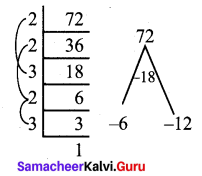
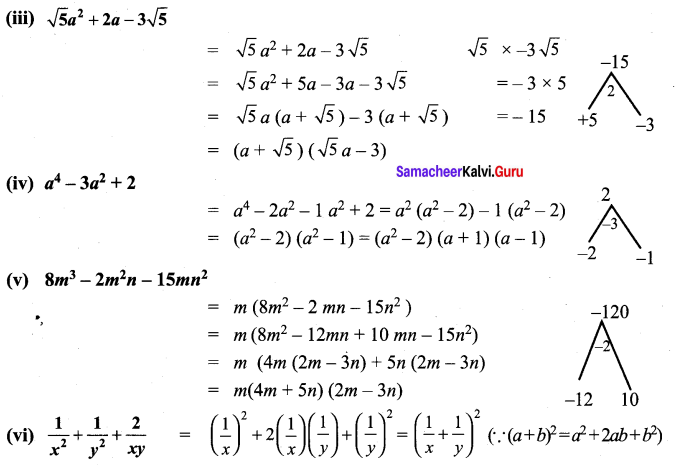
Samacheer Kalvi 10th Maths Solutions Chapter 2 Numbers and Sequences Ex 2.4

You can Download Samacheer Kalvi 10th Maths Book Solutions Guide Pdf, Tamilnadu State Board help you to revise the complete Syllabus and score more marks in your examinations.

Tamilnadu Samacheer Kalvi 10th Maths Solutions Chapter 2 Numbers and Sequences Ex 2.4

10th Maths Exercise 2.4 Samacheer Kalvi Question 1.
Find the next three terms of the following sequence.
(i) 8, 24, 72, …….
(ii) 5, 1, -3, …….
(iii) \(\frac { 1 }{ 4 } \),\(\frac { 2 }{ 9 } \),\(\frac { 3 }{ 16 } \)………..
Solution:
(i) 8, 24, 72…
In an arithmetic sequence a = 8,
d = t1 – t1 = t3 – t2
= 24 – 8       72 – 24
= 16 ≠ 48
So, it is not an arithmetic sequence. In a geometric sequence,
r = \(\frac{t_{2}}{t_{1}}=\frac{t_{3}}{t_{2}}\)
⇒ \(\frac{24}{8}=\frac{72}{24}\)
⇒ 3 = 3
∴ It is a geometric sequence
∴ The nth term of a G.P is tn = arn-1
∴ t4 = 8 × 34-1
= 8 × 33
= 8 × 27
= 216

t5 = 8 × 35-1
= 8 × 34
= 8 × 81
= 648

t6 = 8 × 36-1
= 8 × 35
= 8 × 243
= 1944
The next 3 terms are 8, 24, 72, 216, 648, 1944.

(ii) 5, 1, -3, …
d = t2 – t1 = t3 – t2
⇒ 1 – 5 = -3-1
-4 = -4 ∴ It is an A.P.
tn = a+(n – 1)d
t4 = 5 + 3 × – 4
= 5 – 12
= -7
15 = a + 4d
= 5 + 4 × -4
= 5 – 16
= -11
t6 = a + 5d
= 5 + 5 × – 4
= 5 – 20

= – 15
∴ The next three terms are 5, 1, -3, -7, -11, -15.

(iii) \(\frac { 1 }{ 4 } \),\(\frac { 2 }{ 9 } \),\(\frac { 3 }{ 16 } \),………..
Here an = Numerators are natural numbers and denominators are squares of the next numbers
\(\frac { 1 }{ 4 } \),\(\frac { 2 }{ 9 } \),\(\frac { 3 }{ 16 } \),\(\frac { 4 }{ 25 } \),\(\frac { 5 }{ 36 } \),\(\frac { 6 }{ 49 } \)………….

Ex 2.4 Class 10 Samacheer Question 2.
Find the first four terms of the sequences whose nth terms are given by

(i) an = n3 -2
Answer:
an = n3 – 2
a1 = 13 – 2 = 1 – 2 = -1
a2 = 23 – 2 = 8 – 2 = 6
a3 = 33 – 2 = 27 – 2 = 25
a4 = 43 – 2 = 64 – 2 = 62
The four terms are -1, 6, 25 and 62

(ii) an = (-1)n+1 n(n + 1)
Answer:
an = (-1)n+1 n(n + 1)
a1 = (-1)2 (1) (2) = 1 × 1 × 2 = 2
a2 = (-1)3 (2) (3) = -1 × 2 × 3 = -6
a3 = (-1)4 (3) (4) = 1 × 3 × 4 = 12
a4 = (-1)5 (4) (5) = -1 × 4 × 5 = -20
The four terms are 2, -6, 12 and -20

(iii) an = 2n2 – 6
Answer:
an = 2 n2 – 6
a1 = 2(1)2 – 6 = 2 – 6 = -4
a2 = 2(2)2 – 6 = 8 – 6 = 2
a3 = 2(3)2 – 6 = 18 – 6 = 12
a4 = 2(4)2 – 6 = 32 – 6 = 26
The four terms are -4, 2, 12, 26

10th Maths Exercise 2.4 Question 3.
Find the nth term of the following sequences
(i) 2, 5, 10, 17, ……….
(ii) 0, \(\frac { 1 }{ 2 } \), \(\frac { 2 }{ 3 } \),…..
(iii) 3, 8, 13, 18, ………
Solution:
(i) 2, 5, 10, 17
= 12 + 1, 22 + 1, 32 + 1, 42 + 1 ……….
∴ nth term is n2+1
(ii) 0, \(\frac { 1 }{ 2 } \),\(\frac { 2 }{ 3 } \),………….
= \(\frac { 1-1 }{ 1 } \),\(\frac { 2-1 }{ 2 } \),\(\frac { 3-1 }{ 3 } \)…..
⇒ \(\frac { n-1 }{ n } \)
∴ nth term is \(\frac { n-1 }{ n } \)
(iii) 3, 8, 13, 18
a = 3
d = 5
tn = a + (n – 1)d
= 3 + (n – 1)5
= 3 + 5n – 5
= 5n – 2
∴ nth term is 5n – 2

10th Maths 2.4 Exercise Question 4.
Find the indicated terms of the sequences whose nth terms are given by
(i) an = \(\frac { 5n }{ n+2 } \) ; a6 and a13
(ii) an = -(n2 – 4); a4 and a11
Solution:
10th Maths Exercise 2.4 Samacheer Kalvi Chapter 2 Numbers And Sequences

10th Maths Exercise 2.4 In Tamil Question 5.
Find a8 and a15 whose nth term is
Ex 2.4 Class 10 Samacheer Kalvi Solutions Chapter 2 Numbers And Sequences
Solution:
10th Maths Exercise 2.4 Samacheer Kalvi Solutions Chapter 2 Numbers And Sequences

Exercise 2.4 Class 10 Samacheer Kalvi Question 6.
If a1 = 1, a2 = 1 and an = 2an-1 + an-2 n > 3, n ∈ N. Then find the first six terms of the sequence.
Answer:
a1 = a2 = 1
an = 2an-1 + an-2
a3 = 2a3-1 + a3-2 = 2a2 + a1
= 2(1) + 1 = 3
a4 = 2a4-1 + a4-2
= 2a3 + a2
= 2(3) + 1 = 6 + 1 = 7
a5 = 2 a5-1 + a5-2
= 2a4 + a3
= 2(7) + 3 = 17
a6 = 2a6-1 + a6-2
= 2a5 + a4
= 2(17) + 7
= 34 + 7 = 41
The sequence is 1, 1, 3, 7, 17,41, …

Samacheer Kalvi 10th Science Solutions Chapter 15 Nervous System

Students who are preparing for the Science exam can download this Tamilnadu State Board Solutions for Class 10th Science Chapter 15 from here for free of cost. These Tamilnadu State Board Textbook Solutions PDF cover all 10th Science Nervous System Book Back Questions and Answers.

All these concepts of Chapter 15 Nervous System are explained very conceptually by the subject teachers in Tamilnadu State Board Solutions PDF as per the prescribed Syllabus & guidelines. You can download Samacheer Kalvi 10th Science Book Solutions Chapter 15 Nervous System State Board Pdf for free from the available links. Go ahead and get Tamilnadu State Board Class 10th Science Solutions of Chapter 1 Nervous System.

Tamilnadu Samacheer Kalvi 10th Science Solutions Chapter 15 Nervous System

Kickstart your preparation by using this Tamilnadu State Board Solutions for Class 15th Science Chapter 15 Nervous System Questions and Answers and get the max score in the exams. You can cover all the topics of Chapter 15 easily after studying the Tamilnadu State Board Class 15th Science Textbook solutions pdf. Download the Tamilnadu State Board Science Chapter 15 Nervous System solutions of Class 15th by accessing the links provided here and ace up your preparation.

Samacheer Kalvi 10th Science Nervous System Textual Evaluation Solved

I. Choose the Correct Answer.

Samacheer Kalvi Guru 10th Science Book Pdf Download Question 1.
Bipolar neurons are found in _______
(a) retina of eye
(b) cerebral cortex
(c) embryo
(d) respiratory epithelium
Answer:
(a) retina of eye

Samacheer Kalvi 10th Science Book Question 2.
Site for processing of vision, hearing,memory, speech, intelligence and thought is:
(a) kidney
(b) ear
(c) brain
(d) lungs
Answer:
(c) brain

You can Download Samacheer Kalvi 10th Science Guide PDF help you to revise the complete Syllabus and score more marks in your examinations.

Samacheer Kalvi Guru 10th Science Question 3.
In reflex action, the reflex arc is formed by _______
(a) brain, spinal cord, muscle
(b) receptor, muscle, spinal cord
(c) muscle, receptor, brain
(d) receptor, spinal cord, muscle
Answer:
(b) receptor, muscle, spinal cord

10th Samacheer Kalvi Science Question 4.
Dendrites transmit impulse ……cell body and axon transmit impulse …….. cell body.
(a) away from, away from
(b) towards, away from
(c) towards, towards
(d) away from, towards
Answer:
(b) towards, away from

Samacheer Kalvi Books 10th Science Question 5.
The outer most of the three cranial meninges is ______
(a) arachnoid membrane
(b) piamater
(c) duramater
(d) myelin sheath
Answer:
(c) duramater

10th Samacheer Kalvi Science Solutions Question 6.
There are ______ pairs of cranial nerves and ______ pairs of spinal nerves.
(a) 12, 31
(b) 31, 12
(c) 12, 13
(d) 12, 21
Answer:
(a) 12, 31

Class 10 Science Chapter 15 Solutions Question 7.
The neurons which carries impulse from the central nervous system to the muscle fibre:
(a) afferent neurons
(b) association neuron
(c) efferent neuron
(d) unipolar neuron
Answer:
(c) efferent neuron

Samacheer Kalvi Guru 10th Science Book Back Answers Question 8.
Which nervous band connects the two cerebral hemispheres of brain?
(a) thalamus
(b) hypothalamus
(c) corpus callosum
(d) pons
Answer:
(c) corpus callosum

Class 10 Science Samacheer Kalvi Question 9.
Node of Ranvier is found in ______
(a) muscles
(b) axons
(c) dendrites
(d) cyton
Answer:
(b) axons

Ch 15 Science Class 10 Question 10.
Vomiting centre is located in:
(a) medulla oblongata
(b) stomach
(c) cerebrum
(d) hypothalamus
Answer:
(a) medulla oblongata

Class 10 Chapter 15 Science Question 11.
Nerve cells do not possess _______
(a) neurilemma
(b) sarcolemma
(c) axon
(d) dendrites
Answer:
(b) sarcolemma

Nervous System Question 12.
A person who met with an accident lost control of body temperature, water balance, and hunger. Which of the following part of brain is supposed to be damaged?
(a) Medulla oblongata
(b) cerebrum
(c) pons
(d) hypothalamus
Answer:
(d) hypothalamus

II. Fill in the blanks.

Samacheerkalvi.Guru 10th Science Question 1.
______ is the longest cell in our body.
Answer:
Axon

10th Science Interior One Mark Questions Pdf Question 2.
Impulses travels rapidly in ______ neurons.
Answer:
Myelin sheath of

Class 10 Chapter 15 Science Pdf Question 3.
A change in the environment that causes an animal to react is called ______
Answer:
reactions or responses

Question 4.
_____ carries the impulse towards the cell body.
Answer:
Dendrites

Question 5.
The two antagonistic components of the autonomic nervous system are _____ and ______
Answer:
Sympathetic, Parasympathetic

Question 6.
A neuron contains all cell organelles except _______
Answer:
Golgi apparatus in axon

Question 7.
_____ maintains the constant pressure inside the cranium.
Answer:
Cerebrospinal fluid

Question 8.
______ and ______ increases the surface area of cerebrum.
Answer:
Gyri and Sulci

Question 9.
The part of the human brain which acts as a relay centre is _______
Answer:
Thalamus

III. State whether True or False, if false write the correct statement.

Question 1.
Dendrons are the longest fibres that conduct impulses away from the cell body.
Answer:
False
Correct Statement: Axons are the longest fibres that conduct impulses away from the cell body.

Question 2.
The sympathetic nervous system is a part of the central nervous system.
Answer:
False
Correct Statement: Sympathetic nervous system is a part of the autonomic nervous system.

Question 3.
Hypothalamus is the thermoregulatory centre of the human body.
Answer:
True

Question 4.
The cerebrum controls the voluntary actions of our body.
Answer:
True

Question 5.
In the central nervous system, myelinated fibres form the white matter.
Answer:
False
Correct Statement: In the central nervous system, two types of matter such as white matter or grey matter, is formed, with respect to the presence or absence of myelin sheath.

Question 6.
All the nerves in the body are covered and protected by meninges.
Answer:
False
Correct Statement: The brain is covered by three connective tissue membrane or meninges.

Question 7.
Cerebrospinal fluid provides nutrition to brain.
Answer:
True

Question 8.
Reflex arc allows the rapid response of the body to a stimulus.
Answer:
True

Question 9.
Pons helps in regulating respiration.
Answer:
True

IV. Match the following

Question 1.

1. Nissil’s granules(a) Forebrain
2. Hypothalamus(b) Peripheral Nervous system
3. Cerebellum(c) Cyton
4. Schwann cell(d) Hindbrain

Answer:
1. (c) Cyton
2. (a) Forebrain
3. (d) Hindbrain
4. (b) Peripheral Nervous system

V. Understand the assertion statement. Justify the reason given and choose the correct choice.

(a). Assertion is correct and Reason is wrong
(b). Reason is correct and the assertion is wrong
(c). Both assertion and reason are correct
(d). Both assertion and reason are wrong

Question 1.
Assertion: Cerebrospinal fluid is present throughout the central nervous system.
Reason: Cerebrospinal fluid has no such functions.
Answer:
(a) Assertion is correct and Reason is wrong

Question 2.
Assertion: Corpus callosum is present in space between the dura mater and pia mater. Reason: It serves to maintain constant intracranial pressure.
Answer:
(d) Both assertion and reason are wrong

VI. Short Answer Questions.

Question 1.
Define the stimulus.
Answer:
The changes in the environmental condition, that are detected by receptors present in the body are called stimulus.

Question 2.
Name the parts of the hind brain.
Answer:
Hind brain consists of cerebellum, pons and medulla oblongata.

Question 3.
What are the structures involved in the protection of the brain?
Answer:
The brain is covered by three connective tissue membrane or meninges.

  • Dura mater, which is the outermost thick fibrous membrane.
  • Arachnoid membrane, which is the middle thin vascular membrane providing a web-like cushion.
  • Pia mater, which is the innermost, thin delicate membrane richly supplied with blood. Meningeal membranes protect the brain from mechanical injury.

Question 4.
Give an example for conditioned reflexes.
Answer:
Common examples of conditioned reflexes are playing a musical instrument, tying shoelaces or the neck-tie without being attentive, watering of the mouth after seeing or smelling favourite food.

Question 5.
Which acts as a link between the nervous system and the endocrine system?
Answer:
The hypothalamus controls the secretion of hormones from the Anterior Pituitary gland and is an important link between the nervous system and the endocrine system.

Question 6.
Define reflex arc.
Answer:
The path along which the reflexive impulse travel is called reflex arc.
(OR)
The path way taken by nerve impulse to accomplish reflex action is called reflex arc.

VII. Differentiate between

Question 1.
Voluntary and involuntary actions.
Answer:

Voluntary ActionInvoluntary Action
1. The actions which are under the control of our will, eg. Eating, walking.1. The actions, which are not under our control, eg. Breathing, Heartbeat
2. Controlled by the brain.2. Controlled by the spinal cord.
3. Voluntary Action results in muscular action.3. Involuntary actions result in a muscular action or secretions of some glands.

Question 2.
Medullated and non-medullated nerve fibre.
Answer:

Medullated nerve fibreNon-medullated nerve fibre
1. Nerve fibre is covered by a protective sheath, called the Myelin sheath, which is covered by Neurilemma.1. Nerve fibre is covered by a single sheath, Neurilemma.
2. Nodes of Ranvier are present.2. Nodes of Ranvier are absent.
3. They appear white.3. They appear grey.
4. They carry nerve impulses, much faster than non-medullated nerve fibre.4. They carry nerve impulses, much slower than medullated nerve fibre.
5. They are present in the white matter of brain, spinal cord and in the cranial and spinal nerves.5. They are present in the grey matter of the brain and spinal cord and in the autonomic nerves.

VIII. Long Answer Questions.

Question 1.
With a neat labelled diagram explain the structure of a neuron
Answer:
Structure of Neuron: A neuron consists of three basic parts namely Cyton, Dendrites and Axon.
Samacheer Kalvi Guru 10th Science Book Pdf Download Chapter 15 Nervous System
(a) Cyton: Cyton is called cell body or perikaryon. It has a central nucleus with abundant cytoplasm called neuroplasm. The cytoplasm has a large granular body called Nissl’s granules and the other cell organelles like mitochondria, ribosomes, lysosomes, and endoplasmic reticulum. Neurons do not have the ability to divide. Several neurofibrils are present in the cytoplasm that help in the transmission of nerve impulses to and from the cell body.

(b) Dendrites: These are the numerous branched cytoplasmic processes, that project from the surface of the cell body. They conduct nerve impulses, towards the cyton. The branched projections increase the surface area for receiving the signals from other nerve cells.

(c) Axon: The axon is a single, elongated, slender projections. The end of axon terminates as fine branches, which terminate into knob like swellings called synaptic knob.

The plasma membrane of axon is called axolemma, while the cytoplasm is called axoplasm. It carries impulses away from the cyton. The axons may be covered by a protein sheath called myelin sheath, which is further covered by a layer of Schwann cells called neurilemma.

Myelin sheath breaks at intervals, by depressions called Nodes of Ranvier. The region between the nodes is called an internode. Myelin sheath acts as an insulator and ensures the rapid transmission of nerve impulses.
A junction between synaptic knob of the axon of one neuron and dendron of next neuron is called Synaptic Junction. Information from one neuron can pass to another neuron through these junctions, with the release of chemicals known as neurotransmitters, from the synaptic knob.

Question 2.
Illustrate the structure and functions of the brain.
Answer:
A human brain is formed of three main parts forebrain, midbrain and hindbrain.
1. Forebrain: The forebrain is formed of Cerebrum and Diencephalon. The diencephalon consists of dorsal thalamus and ventral hypothalamus.
(a) Cerebrum: It is the largest portion and nearly forms two-third of the brain. The cerebrum is longitudinally divided into two halves, as of right and left cerebral hemispheres by a deep – cleft called median cleft. The two cerebral hemispheres are interconnected by thick band of nerve fibres called corpus callosum. The outer portion of each cerebral hemisphere is formed of grey matter and is called cerebral cortex.

The inner or deeper part is formed of white matter and is called cerebral medulla. The cortex is extremely folded forming elevations called gyri, with depressions between them termed as sulci, that increase the surface area. Each cerebral hemisphere is divisible into a frontal lobe, a parietal lobe, a temporal lobe and an occipital lobe. These lobes are also known as cerebral lobes.

(b) Thalamus: Thalamus present in the cerebral medulla is a major conducting centre for sensory and motor signalling. It acts as a relay centre.

(c) Hypothalamus: It lies at the base of the thalamus. It controls the secretions of hormones from the anterior pituitary gland.

2. Midbrain: It is located between thalamus and Hindbrain. The dorsal portion of the midbrain consists of four rounded bodies called corporaquadrigemina, that control visual and auditory (hearing) reflexes.

3. Hindbrain: It is formed of three parts Cerebellum, Pons and Medulla Oblongata.

  • Cerebellum: It is the second-largest part of the brain formed of two large-sized hemispheres and middle vermis.
  • Pons: It is a bridge of nerve fibre that connects the lobes of the cerebellum. It relays signals between the cerebellum, spinal cord, midbrain and cerebrum.
  • Medulla Oblongata: It is the posterior-most part of the brain, that connects the spinal cord and various parts of the brain.

Functions of Brain:

StructureFunctions
1. Cerebral cortexSensory perception, Intelligence, consciousness, control of voluntary functions, language, thinking, memory, decision making, creativity, reasoning and will power.
2. ThalamusActs as Relay Station.
3. HypothalamusTemperature control, anger, thirst, hunger, urination, the important link between the nervous system and endocrine glands, sleep, sweating, sexual desire, fear, water balance, blood pressure.
4. MidbrainVisual and Auditory reflexes.
5. CerebellumMaintenance of posture and balance, and co-ordinate voluntary muscle activity.
6. PonsRespiration and Role in the sleep-wake cycle.
7. Medulla OblongataCardiovascular, respiratory and digestive control centres, vasomotor centres to control heartbeat, contraction of blood vessels. It also regulates vomiting and salivation.

Question 3.
What will you do if someone pricks your hand with a needle? Elucidate the pathway of response with a neat labelled diagram.
Answer:
Samacheer Kalvi 10th Science Book Solutions Chapter 15 Nervous System
The pathway taken by nerve impulse to accomplish reflex action is called the reflex arc.

  • When the hand is pricked by a needle, the stimulus is the prick (touch) pain, which is sensed by a receptor called touch or pain receptors in the skin in our hand. This stimulus in tum triggers an impulse in a sensory neuron.
  • The sensory neuron transmits or conveys the message to the spinal cord.
  • The spinal cord interprets the stimulus and the impulse is passed on to the relay neuron, which in tum transmits it to a motor neuron.
  • Motor neurons carry command from the spinal cord to our arm.
  • The muscle in our arm contracts and we withdraw our hand immediately from the needle prick. Muscle is the effector organ which has responded to the prick (pain).

Question 4.
Describe the structure of the spinal cord.
Answer:
The spinal cord is a cylindrical structure lying in the neural canal of the vertebral column. It is also covered by meninges. It extends from the lower end of medulla oblongata to the first lumbar vertebra. The posterior-most region of spinal cord tapers into a thin fibrous thread-like structure called Filum terminate.

Internally, the spinal cord contains a cerebrospinal fluid-filled cavity, known as the central canal. The grey matter of the spinal cord is ‘H’ shaped. The upper end of the letter, ‘H’ forms posterior horns and lower end forms anterior horns. A bundle of fibres pass into the posterior horn forming the dorsal or afferent root. Fibres pass outward, from the anterior horn forming the ventral or efferent root. These two roots joins to form spinal nerves. The white matter is external and has a bundle of nerve tracts. Spinal cord conducts sensory and motor impulses to and from the brain. It controls the reflex actions of the body.

Question 5.
How nerve impulses are transferred from one neuron to next neuron?
Answer:
All the information from the environment is detected by the receptors, located in the sense organs such as the eyes, nose, skin and etc. Information from the receptors is transmitted as electrical impulse and is received by the dendritic tips of the neuron. This impulse travels from the dendrite to the cell body and then along the axon to its terminal end. On reaching the axonal end, it causes the nerve endings to release a chemical (neurotransmitter) which diffuses across a synapse and starts a similar electrical impulse in the dendrites of the next neuron, then to their cell body to be carried along the axon.

The electrical signal reaches the brain or spinal cord. The response from the brain (or spinal cord) is similarly passed on to the effector organs such as the muscle or gland cell, that undergoes the desired response.

Question 6.
Classify neurons based on its structure.
Answer:
The neurons are classified, based on their structures:
Samacheer Kalvi Guru 10th Science Solutions Chapter 15 Nervous System
(a) Unipolar neurons: Only one nerve process arises from the cyton, which acts as both axon and dendron. It is found in early embryos, but not in the adult.

(b) Bipolar neurons: The cyton gives rise to two nerve processes, of which one acts as an axon, while another acts as a dendron. Bipolar neurons are found in the retina of the eye and olfactory epithelium of nasal chambers.

(c) Multipolar neurons: The cyton gives rise to many dendrons and an axon. Multipolar neurons found in the cerebral cortex of the brain.

IX. Higher Order Thinking Skills (HOTS) Questions

Question 1.
‘A’ is a cylindrical structure that begins from the lower end of medulla and extend downwards. It is enclosed in bony cage ‘B’ and covered by membranes ‘C’ As many as ‘D’ pairs of nerves arise from the structure ‘A’.

  1. What is A?
  2. Name (a) bony cage ‘B’ and (b) membranes ‘C’
  3. How much is D?

Answer:

  1. A is spinal cord.
  2. (a) Bony cage is Vertebral column
    (c) is Meninges
  3. D is 31 pairs of spinal nerve.

Question 2.
Our body contains a large number of cells ‘L’ which are the longest cells in the body. L has a long and short branch called as ‘M’ and ‘N’ respectively. There is a gap ‘O’ between two ‘L’ cells, through which nerve impulse transfer by the release of chemical substance ‘P’.

  1. Name the cells L
  2. What are M and N?
  3. What is gap O?
  4. Name the chemical substance P?

Answer:

  1. Neuron
  2. Axon and Dendrites
  3. Synaptic Junction (knob)
  4. Neurotransmitter (Acetylcholine)

Samacheer Kalvi 10th Science Nervous System Additional Questions Solved

I. Fill in the blanks.

Question 1.
The condition needed for the coordination between the various cells and organ for the diverse activities is called _____
Answer:
Homeostasis

Question 2.
A number of nerve fibres bundled up together to form _____
Answer:
Nerves

Question 3.
The other name for cyton is cell body or _____
Answer:
Perikaryon

Question 4.
______ is an important neurotransmitter released by neurons.
Answer:
Acetylcholine

Question 5.
_______ membranes protect the brain from mechanical injury.
Answer:
Meningeal

Question 6.
The four rounded bodies of the midbrain are called ______
Answer:
Corporaquadrigemina

Question 7.
The Posterior most region of spinal cord tapers into fibrous thread-like structures called _____
Answer:
Filum terminale

II. Choose the incorrect statement and Write it as a correct statement.

Question 1.
Responses refer to the changes in the environmental conditions, which are detected by receptors.
Answer:
Incorrect Statement
Correct Statement: Stimulus refer to the changes in the environmental conditions, which are detected by receptors. .

Question 2.
The brain is the controlling centre of all the body activities.
Answer:
Correct Statement

Question 3.
Axon carries impulses towards the cyton.
Answer:
Incorrect Statement
Correct Statement: Axon carries impulses away from the cyton.

Question 4.
CNS consists of all nerves, which connect the brain and spinal cord to all parts of the body.
Answer:
Incorrect Statement
Correct Statement: CNS consists of all nerves, which connect the brain and spinal cord to all parts of the body.

Question 5.
A receptor is a cell or group of cells that receive the stimuli.
Answer:
Correct Statement

III. Match the following.

Question 1.

1. Neuroglia(a) Conduct nerve impulses
2. Electrical impulse(b) Connects the lobe of the cerebellum
3. Pons(c) Cerebrospinal fluid
4. Brain(d) Do not conduct nerve impulses
5. Dendrites(e) Information from the receptor

Answer:
1. (d) Do not conduct nerve impulses
2. (e) Information from the receptor
3. (b) Connects the lobe of the cerebellum
4. (c) Cerebrospinal fluid
5. (a) Conduct nerve impulses

IV. Answer the following in a word or with a Sentence.

Question 1.
What are Spinal Reflexes?
Answer:
Most of the reflex actions are monitored and controlled by the spinal cord. So it is called Spinal Reflexes.

Question 2.
Name the two enlargement found in spinal cord.
Answer:
The spinal cord has two enlargements.
Cervical plexus – found in neck region
Lumbar plexus – in Lumbar region.

Question 3.
What is the function of Meningeai membranes in the brain?
Answer:
Meningeal membranes protect the brain from mechanical injury.

Question 4.
Write a function of glial cells.
Answer:
Glial cells or Neuroglia are non-exciting, supporting cells of nervous system.

Question 5.
Name the granules in the cytoplasm of Peyton.
Answer:
Nissl’s granules.

Question 6.
Which is the controlling centre of all body activities?
Answer:
Brain

Question 7.
In which fluid, is the brain suspended?
Answer:
The brain is suspended in the cerebrospinal fluid.

Question 8.
Name the four rounded bodies in the dorsal portion of midbrain.
Answer:
Corpora quadrigemina

Question 9.
Which is the longest cell of the human body?
Answer:
The longest cell of the human body is axon.

Question 10.
Name the tapered spinal cord into a thin thread-like structure present in the posterior-most region.
Answer:
Filum terminate.

V. Draw a neat labelled diagram of the following.

Question 1.
(a) Brain
(b) Structure of Spinal Cord
(c) Nerve impulse transmission
Answer:
(a) Brain
10th Samacheer Kalvi Science Solutions Chapter 15 Nervous System
(b) Structure of Spinal Cord
Samacheer Kalvi Books 10th Science Solutions Chapter 15 Nervous System
(c) Nerve impulse transmission
10th Samacheer Kalvi Science Solutions Chapter 15 Nervous System

VI. Answer the following briefly.

Question 1.
What is the synaptic transmission?
Answer:
The flow of nerve impulses from the axonal end of one neuron to the dendrite of another neuron through a synapse is called synaptic transmission.

Question 2.
What is homeostasis?
Answer:
The coordination between the various cells and organs is essential for their diverse activities to maintain physiological balance called Homeostasis.

Question 3.
What are Neurotransmitters? Give an example.
Answer:
Neurotransmitters are chemicals, which allow the transmission of a nerve impulse from the axon terminal of one neuron to the dendron of another neuron or to an effector organ. Acetylcholine is the neurotransmitter released by neurons.

Question 4.
Name the three connective tissue membrane of Meninges.
Answer:

  1. Duramater : Outermost thick fibrous membrane.
  2. Arachnoid membrane : Middle thin vascular membrane provide web like cushion.
  3. Piamater : Innermost thin oblicate membrane richly supplied with blood.

Question 5.
What are the types of nerve fibres?
Answer:
The two types of nerve fibres, based on the presence or absence of myelin sheath are

  • Myelinated nerve fibre: The axon is covered with a myelin sheath.
  • Non-myelinated nerve fibre: The axon is not covered by a myelin sheath.

Myelinated and non-myelinated nerve fibres from the white matter and grey matter of the brain.

Question 6.
Why is the Autonomic Nervous System called Visceral nervous system?
Answer:
The Autonomic Nervous System is also called Visceral Nervous System because it regulates the function of internal visceral organs of our body.

Question 7.
What are the cerebral lobes?
Answer:
Each cerebral hemisphere is divisible into a frontal lobe, a parietal lobe, a temporal lobe and an occipital lobe. These lobes are called cerebral lobes.

Question 8.
How are neurons categorized on the basis of functions?
Answer:
On the basis of functions the neurons are categorised as:

  • Sensory or afferent neurons, which carry impulses from the sense organ to the central nervous system.
  • Motor or efferent neurons, which carry impulses from the central nervous system to effector organs such as the muscle fibre and the gland.
  • Association neurons, which conduct impulses between sensory and motor neurons.

Question 9.
What is cerebrospinal fluid? What is its functions?
Answer:
The brain is suspended in a special fluid environment called cerebrospinal fluid (CSF).
Functions:

  • It acts as a shock-absorbing fluid and protects the brain from damage when it is subjected to a sudden jerk.
  • It supplies nutrients to the brain.
  • It collects and removes wastes from the brain.
  • It is responsible for maintaining a constant pressure inside the cranium.

Question 10.
Explain the Peripheral Nervous System.
Answer:
Peripheral Nervous System is formed, by the nerves arising from the brain and the spinal cord. The nerves arising from the brain are called cranial nerves. In man, there are 12 pairs of cranial nerves. Some of the cranial nerves are sensory.
Nerves arising from the spinal cord are called spinal nerves. In man, there are 31 pairs of spinal nerves. Each spinal nerve has a dorsal sensory root and the ventral motor root.

VI. Higher Order Thinking Skills (HOTS) Questions

Question 1.
Raju got an injury on the head during motorbike accident on the road. Later he faced a problem in maintaining balance of the body while walking or sitting. Which part of the brain do you think is affected?
Answer:
Cerebellum in the brain is affected as it maintains the body balance.

Question 2.
What is Electroencephalogram (EEG)?
Answer:
Electroencephalogram (EEG) is an instrument, which records the electrical impulses of the brain. An EEG can detect abnormalities in the brain waves and help in diagnoses of epilepsy, brain tumours and head injuries, etc.

Question 3.
Name a few brain diseases.
Answer:

  • Alzheimer’s disease (develop, as we age)
  • Parkinson’s disease
  • Amyotrophic Lateral Sclerosis (ALS)

Question 4.
What are brain injuries? Give examples.
Answer:
The damage of brain tissue, neurons and nerves. This damage affects our brain’s ability to communicate with the rest of our body. Examples of Brain injuries include blood clots, hematomas, swelling inside the skull, strokes and etc.

Question 5.
What are the symptoms of brain injury?
Answer:
Vomiting, Nausea, Speech difficulty, bleeding from the ear, Numbness and etc.

Believing that the Tamilnadu State Board Solutions for Class 15th Science Chapter 15 Nervous System Questions and Answers learning resource will definitely guide you at the time of preparation. For more details about Tamilnadu State Board Class 15th Science Chapter 15 textbook solutions, ask us in the below comments and we’ll revert back to you asap.

Samacheer Kalvi 11th Bio Zoology Solutions Chapter 1 The Living World

Students who are in search of 11th Bio Zoology exam can download this Tamilnadu State Board Solutions for 11th Bio Zoology Chapter 1 The Living World from here for free of cost. These cover all Chapter 1 The Living World Questions and Answers, PDF, Notes, Summary. Download the Samacheer Kalvi 11th Biology Book Solutions Questions and Answers by accessing the links provided here and ace up your preparation.

Tamilnadu Samacheer Kalvi 11th Bio Zoology Solutions Chapter 1 The Living World

Kickstart your preparation by using this Tamilnadu State Board Solutions for 11th Bio Zoology Chapter 1 The Living World Questions and Answers get the max score in the exams. You can cover all the topics of Chapter 1 The Living World Questions and Answers easily after studying the Tamilnadu State Board 11th Bio Zoology Textbook solutions pdf.

Samacheer Kalvi 11th Bio Zoology The Living World Text Book Back Questions and Answers

Multiple Choice Question and Answers
Choose the correct answer
Zoology 11th Class First Chapter Question 1.
A living organism is differentiated from non-living structure based on
(a) Reproduction
(b) Growth
(c) Metabolism
(d) AH the above
Answer:
(c) Metabolism

11th Zoology 1st Chapter Question 2.
A group of organisms having similar traits of a rank is
(a) Species
(b) Taxon
(c) Genus
(d) Family
Answer:
(a) Species

Samacheer Kalvi Guru 11th Zoology Question 3.
Every unit of classification regardless of its rank is
(a) Taxon
(b) Variety
(c) Species
(d) Strain
Answer:
(a) Taxon

Zoology Class 11 Chapter 1 Question 4.
Which of the following is not present in same rank?
(a) Primata
(b) Orthoptera
(c) Diptera
(d) Insecta
Answer:
(a) Primata

Zoology Chapter 1 Class 11 Question 5.
What taxonomie aid gives comprehensive information about a taxon?
(a) Taxonomic Key
(b) Herbarium
(c) Flora
(d) Monograph
Answer:
(a) Taxonomic Key

Samacheer Kalvi 11 Zoology Solutions Question 6.
Who coined the term biodiversity?
(a) Walter Rosen
(b) AG Tansley
(c) Aristotle
(d) AP de Candole
Answer:
(a) Walter Rosen

Samacheer Kalvi 11 Bio Zoology Solutions Question 7.
Cladogram considers the following characters –
(a) Physiological and Biochemical
(b) Evolutionary and Phylogenetic
(c) Taxonomie and systematic
(d) None of the above
Answer:
(b) Evolutionary and Phylogenetic

Samacheer Kalvi 11th Zoology Solutions Question 8.
Molecular taxonomic tool consists of –
(a) DNA and RNA
(b) Mitochondria and Endoplasmic reticulum
(c) Cell wall and Membrane proteins
(d) All the above
Answer:
(a) DNA and RNA

Samacheer Kalvi 11th Zoology Question 9.
Differentiate between probiotic and pathogenic bacteria.

Probiotic bacteriaPathogenic bacteria
1.Probiotic bacteria are beneficial bacteria.1.Pathogenic bacteria are harmful bacteria.
2.The bacteria which cause fermentation are examples of probiotic bacteria.                                         ‘2.The disease causing bacteria such as Mycobacterium tuberculosis are pathogenic.

Samacheer Kalvi Guru 11th Bio Zoology Question 10.
Why mule is sterile in nature?
Answer:
Mule gets one set of chromosomes (32) from male parent, horse and one set of chromosomes (31) from female parent, donkey. These two sets of chromosomes do not match with each other and cannot produce gametes by meiosis. Hence mule is sterile in nature.

Class 11 Zoology Chapter 1 Notes Question 11.
List any five salient features of the family Felidae.
Answer:

  • The species in the Felidae family are carnivores or omnivores.
  • Felids are generally solitary with a few exceptions.
  • They have sharp vision, hearing and a strong sense of smell.
  • They have short faces and their paws have toes in the 5 forefeet and 4 toes in the hind feet.
  • Most Felids live in the wild e.g. cat, tiger, lion, cheetah.

The Living World Class 11 Pdf Question 12.
What is the role of Charles Darwin in relation to concept of species?
Answer:
Charles Darwin’s book on Origin of Species explains the evolutionary connections of species by the process of natural selection.

Class 11 Zoology Chapter 1 Question 13.
Why elephants and other wild animals are entering into human living area?
Answer:
Elephants and other wild animals enter into human living area because of the loss of their habitat, deforestation, mono-culture vegetation by destroying forests

11th Bio Zoology Samacheer Kalvi Question 14.
What is the difference between a Zoo and wild life sanctuary?
Answer:

Zoo

Wild Life Sanctuary

1.Zoo is a place where animals and birds are in captivity of artificially created habitat.1.Wild life sanctuary is the natural habitat of wild animals and birds.
2.Public can have easy access to the zoo.2.Public does not have easy access to the wild life sanctuaries.
3.Zoo is based on commercial aspects.3.Sanctuaries are non-commercial.
4.Animals are caged and hence they are not free to roam about.4.In a sanctuary, animals can roam about freely.

Zoology Chapter 1 Question 15.
Can we use recent molecular tools to identify and classify organisms?
Answer:
The recent molecular taxonomical tools can be used to identify and classify the organism. The following molecular techniques and approaches are used in molecular tools.

(a) DNA bar coding – Short genetic marker in an organism’s DNA to identify whether it belongs to a particular species.

(b) DNA hybridization – Measures the degree of genetic similarity between pools of DNA sequences.

(c) DNA finger printing – to identify an individual from a sample of DNA by looking at unique patterns in their DNA.

(d) Restriction Fragment Length Polymorphism (RFLP) Analysis- difference in homologous DNA sequences can be detected by the presence of fragments of different lengths after digestion of DNA samples.

(e) Polymerase chain reaction (PCR) sequencing- to amplify a specific gene, or portion of gene.

Samacheer Kalvi 11th Bio Zoology Solutions Question 16.
Explain the role of Latin and Greek names in Biology.
Answer:
Aristotle (384 to 322 BC) was the first to classify all animals in his Historia Animalium in Latin. He classified the living organisms into plants and animals. Animals were classified as walking (terrestrial), flying (birds), and swimming (aquatic) based in their locomotion.

He classified the animals with red blood cells as Enaima and those without red blood cells as Anaima. Though his method of classification had limitation, his contribution to biology was remarkable. Theophrastus did his research on the classification of plants. He was known as the Father of Botany.

In-Text Questions Solved

11th Zoology Solutions Question 1.
If you find an animal with four legs, with two eyes, paired ear pinna, covered with fur, possessing mammary gland, which class will you position it? How will you give a binomial name, if you are the first person to discover and report that animal.
Answer:
Do it yourself.

Question 2.
What may be the reasons for the extinction of Dinosaurs? If you know the reasons for their extinction, why Sparrows are listed as endangered species?
Answer:
The extinction of the dinosaurs is an enigma that has captivated scientists for well over a century. We find the fossilized remains of giant reptiles all over the earth.

Yet we do not see any of the creatures alive today. If sparrows are not there the population of birds of prey may also be affected. Apart from this, every constitute of an ecosystem is important from an ant to an elephant. We are eliminating species by species which are important links which make the web of life. Today it’s these species which are getting extinct.

Textbook Activity Solved

The main objective of this activity is to check the students understanding about animals and its characteristics before learning the lesson. Observe the picture given below, identify the animals and classify them according to you own understanding write one character about each class of animals.

Take the students to the school ground and ask them to observe and identify few invertebrates (insects, earthworm, spiders etc). Ask the students to write few characteristics of each animal which they have observed.
Zoology 11th Class First Chapter The Living World Samacheer Kalvi

SI. NoName of the AnimalKnown CharacterClassHabitat

1

Elephant

TerrestrialMammaliaLand
2BirdFlyingAves

Aerial

3

CrocodileAmmotic eggReptilia

Water

4

FishCold bloodedPiscesSea

Entrance Examination Questions Solved
Choose the correct answer:
Question 1.
The smallest taxon among the following is ………. (PMT-94)
(a) class
(b) order
(c) species
(d) genus
Answer:
(c) species

Question 2.
Taxonomically a species is ……….. (PMT-94)
(a) A group of evolutionary related population
(b) A fundamental unit in the phylogeny of organisms
(c) Classical evolutionary taxonomy
(d) A community taken into consideration. An evolutionary base.
Answer:
(b) A fundamental unit in the phylogeny of organisms

Question 3.
Species is
(a) not related to evolution
(b) specific class of evolution
(c) specific unit of evolution
(d) fertile specific unit in the evolutionary history of a race
Answer:
(d) fertile specific unit in the evolutionary history of a race

Question 4.
Two words comprising the binomial nomenclature are ………… (DPMT-96)
(a) Family & genus
(b) order & family
(c) genus & species
(d) species & variety
Answer:
(c) genus & species

Question 5.
A group of plants or animals with similar traits of any rank is kept under ………. (PMT-96)
(a) species
(b) genus
(c) order
(d) taxon
Answer:
(d) taxon

Question 6.
Which of the following is the correct sequence in the increasing order of complexity? (PMT-97)
(a) molecules, tissues, community, population
(b) cell, tissues, community, population
(c) tissues, organisms, population, community
(d) molecules, tissues, community, cells
Answer:
(c) tissues, organisms, population, community

Question 7.
New systematic and the concept of life was given by ……….. (BHU-98)
(a) Huxley
(b) Odom
(c) Elton
(d) Linnaeus
Answer:
(c) Elton

Question 8.
Two organisms of same class but different families will be kept under the same ……… (CET-98)
(a) genera
(b) species
(c) order
(d) family
Answer:
(c) order

Question 9.
Which of the following will form a new species? (PMT-98)
(a) inter breeding
(b) variations
(c) differential reproduction
(d) none of the above
Answer:
(b) variations

Question 10.
A community includes ……….. (CET-98)
(a) a group of same genera
(b) a group of same population
(c) a group of individuals from same species
(d) different populations interacting with each other
Answer:
(d) different populations interacting with each other

Question 11.
Binomial nomenclature was given by …………(BHU-97)
(a) Huxley
(b) Ray
(c) Darwin
(d) Linnaeus
Answer:
(d) Linnaeus

Question 12.
In classification the category below the level of family is ……….. (CET-98)
(a) class
(b) species
(c) phylum
(d) genus
Answer:
(d) genus

Question 13.
Taxon is …………. (CET-2000)
(a) species
(b) unit of classification
(c) highest rank in classification
(d) group of closely related
Answer:
(b) unit of classification

Question 14.
One of the following includes most closely linked organisms ………… (PMT-2001)
(a) species
(b) genus
(c) family
(d) class
Answer:
(a) species

Question 15.
Which of the following taxons cover a greater number of organisms?(PMT-2001)
(a) order
(b) family
(c) genus
(d) phylum
Answer:
(d) phylum

Question 16.
Inbreeding is possible between two members of ………… (AMU-2005)
(a) order
(b) family
(c) genus
(d) species
Answer:
(d) species

Question 17.
Which of these is correct order of hierarchy? (WARDHA-2002)
(a) kingdom, division, phylum, genus & species
(b) phylum, division, genus & class
(c) kingdom, genus, class, phylum & division
(d) phylum, kingdom, genus, species &class
Answer:
(a) kingdom, division, phylum, genus & species

Question 18.
Which is not a unit of taxonomic category? (BVP-2002)
(a) series
(b) glumaceae
(c) class
(d) phylum
Answer:
(b) glum aceae

Question 19.
Which is the first step of taxonomy? (MGIMS-2002)
(a) nomenclature
(b) classification
(c) identification
(d) hierarchical arrangement
Answer:
(c) identification

Question 20.
The five kingdom classification was given by ………… (BYP-2002)
(a) Whittaker
(b) Linnacus
(c) Copeland
(d) Haeckel
Answer:
(a) Whittaker

Question 21.
Taxon includes ………… (PMT-2002)
(a) Genus and species
(b) kingdom and division
(c) all ranks of hierarchy
(d) none of the above
Answer:
(c) all ranks of hierarchy

Question 22.
Binomial nomenclature refers to …………. (CET – 2000)
(a) Two names of a species
(b) one specific and one local name of a species
(c) two words for the name of a species
(d) two life cycles of a organism
Answer:
(c) two words for the name of a species

Question 23.
Carl Linnaeus is famous for ………… (GGSPU-2002)
(a) coining the term ‘systematics’
(b) introducing binomial nomenclature
(c) giving all natural system of classification
(d) all of these
Answer:
(b) introducing binomial nomenclature

Question 24.
True species are …………
(a) interbreeding
(b) sharing the same niche
(c) feeding on the same food
(d) reproductively isolated
Answer:
(d) reproductively isolated

Question 25.
The smallest unit of classification is ………… (GGSPU-2002)
(a) species
(b) sub – species
(c) class
(d) genus
Answer:
(a) species

Question 26.
Who coined the term ‘taxonomy’? (BVP-2003)
(a) Candolle
(b) Waksman
(c) Leuwenhoek
(d) Louis Pasteur
Answer:
(a) Candolle

Question 27.
Basic unit of classification of organisms is ………… (CET-2003)
(a) species
(b) population
(c) class
(d) family
Answer:
(a) species

Question 28.
The unit of classification containing concrete biological entities is ……….. (WARDHA-2003)
(a) taxon
(b) species
(c) category
(d) order
Answer:
(a) taxon

Question 29.
Species are considered as …………..
(a) real basic units of classification
(b) the lowest units of classification
(c) artificial concept of human mind which cannot be defined in absolute terms
(d) real units of classification devised by taxonomists
Answer:
(a) real basic units of classification

Question 30.
The living organisms can be unexceptionally distinguished from the non-living things on the basis of their ability for …………
(a) interaction with the environment and progressive evolution
(b) reproduction
(c) growth and movement
(d) responsiveness to touch
Answer:
(b) reproduction

Question 31.
Taxonomic category arrange in descending order ……….. (MH-01)
(a) key
(b) hierarchy
(c) taxon
(d) taxonomic category
Answer:
(d) taxonomic category

Question 32.
In which of the animal dimorphic nucleus is found? (PMT 2002).
(a) Amoebaproteus
(b) Trypanosoma gambiense
(c) Plasmodium vivax
(d) Paramecium caudatum
Answer:
(d) Paramecium caudatum

Question 33.
When a fresh-water protozoan possessing a contractile vacuole, is placed in a glass containing marine water, the vacuole will ………. (PMT 2004)
(a) increase in number
(b) disappear
(c) increase in size
(d) decrease in size
Answer:
(d) decrease in size

Question 34.
Which form of reproduction is correctly matched? (AIIMS 2007)
(a) Euglena transvers binary fission
(b) Paramecium longitudinal binary fission
(c) Amoeba multiple fission
(d) Plasmodium binary fission
Answer:
(c) Amoeba multiple fission

Question 35.
The presence of two types of nuclei, a macronucleus and a micronucleus, is characteristic of protozoans are grouped under the class ……….. (BHU 1994, 1999)
(a) sporozoa
(b) flagellate
(c) sarcodina
(d) ciliata
Answer:
(d) ciliata

Question 36.
Which class of protozoa is totally parasitic? (BHU 1994)
(a) Sporozoa
(b) Mastigophora
(c) Ciliate
(d) Sarcodina
Answer:
(a) Sporozoa

Question 37.
Reproduction in Paramecium is controlled by ………. (BHU 1999).
(a) flagella
(b) cell wall
(c) micronucleus
(d) macronucleus
Answer:
(c) micronucleus

Question 38.
In the life cycle of Plasmodium exflagellation occurs in ……….. (BHU 2007)
(a) sporozoties
(b) microgametes
(c) macrogametes
(d) signet ring
Answer:
(b) microgametes

Question 39.
Excretion in Amoeba occurs through ………… (DPMT 1997)
(a) lobopodia
(b) plasma membrane
(c) uroid portion
(d) contractile vacuole
Answer:
(d) contractile vacuole

Question 40.
Method of dispersal in Amoeba is ……….. (DPMT 1995)
(a) locomotion
(b) encystment
(c) sporulation
(d) binary fission
Answer:
(b) encystment

Question 41.
Mode of feeding in free living protozoans is …………. (DPMT 2007).
(a) holozoic
(b) saprozoic
(c) both (a) and (b)
(d) none of these
Answer:
(c) both (a) and (b)

Question 42.
Infection of Entamoeba is caused ………… (UP- CPMT 1996, 1999).
(a) by kissing
(b) by wearing clothes of patient
(c) by contaminated food
(d) none of these
Answer:
(c) by contaminated food

Question 43.
Choose the correct statement.
(a) All reptiles have a three chambered heart.
(b) All Pisces have gills covered by a operculum
(c) All mammals are viviparous
(d) All cyclostomes do not posses jaws and paired fin
Answer:
(d) All cyclostomes do not posses jaws and paired fin

Question 44.
Which of the following characteristics is mainly responsible for diversification of insects on land?
(a) Segmentation
(b) Bilateral symmetry
(c) Exoskeleton
(d) Eyes
Answer:
(c) Exoskeleton

Question 45.
The primitive prokaryotes responsible for the production of biogas from the ruminant animals. Include the …………. (2016)
(a) Thermoacidophiles
(b) methanogens
(c) Eubacteria
(d) Halophiles.
Answer:
(b) methanogens

Question 46.
Methanogens belong to ………. (2016)
(a) Dinoflagellates
(b) Slime moulds
(c) Eubacteria
(d) Archaebacteria
Answer:
(d) Archaebacteria

Samacheer Kalvi 11th Bio Zoology The Living World Additional Questions Solved

Multiple Choice Questions
Choose the correct answer:
Question 1.
Which of the following is not correct with regard to ecosystem?
(a) It includes living and non-living things.
(b) It shows interrelationship among living things.
(c) It shows interrelationship among living and non-living things.
(d) It has a large number of species.
Answer:
(b) It shows interrelationship among living things.

Question 2.
Who was known as the father of Botany?
(a) Aristotle
(b) Carolus Linnaeus
(c) John Ray
(d) Theophrastus
Answer:
(d) Theophrastus

Question 3.
Who developed the scientific system of Taxonomy and Binomial nomenclature?
(a) R.H. Whittaker
(b) Carolus Linnaeus
(c) John Ray
(d) Charles Darwin
Answer:
(b) Carolus Linnaeus

Question 4.
The system of classification of organisms based on evolutionary and genetic relationship among organisms is called as –
(a) Natural system of classification
(b) Phylogenetic system of classification
(c) Binomial classification
(d) Trinomial classification
Answer:
(b) Phylogenetic system of classification

Question 5.
The bacteria which live in salty environment are called –
(a) Theromoacidophiles
(b) Methanogens
(c) Halophiles
(d) Pathogens
Answer:
(c) Halophiles

Question 6.
Which of the following is the characteristics of the domain Bacteria?
(a) They are eukaryotic organisms
(b) They have true nucleus and membrane bound organelles
(c) The ribosomes are of 80 s type in the cytoplasm
(d) They have membrane bound 70 s type ribosomes.
Answer:
(d) They have membrane bound 70 s type ribosomes.

Question 7.
Which of the following is not correct with regard to species?
(a) They have similar morphological features
(b) They are reproductively isolated
(c) They produce viable young ones
(d) They have similar anatomical features
Answer:
(b) They are reproductively isolated

Question 8.
The cross between male lion and female tiger results in the production of –
(a) Mule
(b) Tigon
(c) Liger
(d) Hinny
Answer:
(c) Liger

Question 9.
The related families constitute –
(a) Clans
(b) Phylum
(c) Genus
(d) Order
Answer:
(d) Order

Question 10.
Which of the following is not related to scientific names of organisms?
(a) There is only one name for a species.
(b) They are universally accepted.
(c) They are named based on the guidelines of the ICZN.
(d) They are not unique to an organism.
Answer:
(d) They are not unique to an organism.

Question 11.
Naja naja is the zoological name of –
(a) Indian house crow
(b) Indian cobra
(c) Emerald dove
(d) Indian pea fowl
Answer:
(b) Indian cobra

Question 12.
Origin of species is the book written by –
(a) John Ray
(b) Charles Darwin
(c) Linnaeus
(d) Aristotle
Answer:
(b) Charles Darwin

Question 13.
Taxonomical keys are useful to study –
(a) Similarities and dissimilarities of animals
(b) Preserved plants and animals
(c) Animals kept in protected environments
(d) Plant taxonomy
Answer:
(a) Similarities and dissimilarities of animals

Question 14.
DNA hybridization is helpful to –
(a) Identify an individual from a sample of DNA
(b) Detect difference in homologous DNA sequences
(c) Measure the degree of genetic similarity between pools of DNA sequences
(d) Amplify a specific gene
Answer:
(c) Measure the degree of genetic similarity between pools of DNA sequences

Question 15.
DAISY, the cyber tool is –
(a) Digital automated identification system
(b) Digital automated information system
(c) Direct automated identification system
(d) Digital automated identification science
Answer:
(a) Digital automated identification system

Question 16.
INOTAXA is an e-Taxonomic resource useful for –
(a) Studying electron microscopic images to study molecular structures of cell organelles.
(b) Digital images and description about the species.
(c) Studying behaviour of organisms
(d) Identifying digital resources of animals.
Answer:
(b) Digital images and description about the species.

II. Give Reasons

Question 1.
Classification of organisms is necessary.
Answer:
Classification of organisms is necessary to recognise, identify them and differentiate closely related species.

Question 2.
Extremophiles inhabiting volcanic vents prepare food.
Answer:
Extremophiles inhabiting volcanic vents prepare food without sunlight and oxygen by utilizing hydrogen peroxide and other chemicals through chemosynthesis.

Question 3.
The mating between difference species produces sterile off springs.
Answer:
The maternal and paternal chromosomes of the off springs produced by the mating between different species are not identical and hence gametes are not produced by meiotic division.

Question 4.
Nomenclature of organisms is necessary.
Answer:
The unique nomenclature for each organisms is necessary as it is uniform in all countries and in all languages. A scientific name refers to only one organism.

Question 5.
Why are molecular tools used now to study taxonomy?
Answer:
Molecular tools are accurate and authentic. Hence they are used to study taxonomy.

III. Match the following
Question 1.

1.Ecosystem(a) Walter Rosen
2.Taxonomy(b) Carolus Linnaeus
3.Biodiversity(c) AP de Candolle
4.Species(d) A.G. Tansley
5.Binomial nomenclature(e) John Ray

Answer:

  1. (d) A.G. Tansley
  2. (c) AP de Candolle
  3. (a) Walter Rosen
  4. (e) John Ray
  5. (b) Carolus Linnaeus

Question 2.

1.Extremophiles(a)  Beneficial
2.Probiotic bacteria(b)  70s type of ribosomes
3.Pathogenic bacteria(c)  membrane bound organelles
4.Eukarya(d)  Extreme conditions
5.Bacteria(e) disease causing
(f)  80s type of ribosomes

Answer:

  1. (d)  Extreme conditions
  2. (a)  Beneficial
  3. (e) disease causing
  4. (c)  membrane bound organelles
  5. (b)  70 s type of ribosomes

Question 3.

1.Felis margarita(a) Pea fowl
2.Chalcophaps indica(b) Red Panda
3.Pavo cristatus(c)  Tiger
4.Ailurus fulgens(d)  Jungle cat
5.Panthera Tigris(e) Emerald dove

Answer:

  1. (d)  Jungle cat
  2. (e) Emerald dove
  3. (a) Pea fowl
  4. (b) Red Panda
  5. (c)  Tiger

Question 4.

1.Historia Animalium(a)  Charles Darwin
2.Methodus plantarum(b) R.H. Whittaker
3Origin of species(c) John Ray
4Three Domain classification(d) Aristotle
5Five kingdom classification(e) Carl Woese

Answer:

  1. (d) Aristotle
  2. (c) John Ray
  3. (a)  Charles Darwin
  4. (e) Carl Woese
  5. (b) R.H. Whittaker

Question 5.

1.Museum(a) Analysis of DNA
2.Taxonomical keys(b) Similarities and dissimilarities of organisms.
3.Herbarium(c) Difference in homologous DNA sequence
4.RFLP Analysis(d) Preserved plants and animals
5.DNA fingerprinting(e) Plant Taxonomy

Answer:

  1. (d) Preserved plants and animals
  2. (b) Similarities and dissimilarities of organisms.
  3. (e) Plant Taxonomy
  4. (c) Difference in homologous DNA sequence
  5.  (a) Analysis of DNA

Short Answer Questions

Question 1.
Define ecosystem.
Answer:
Ecosystem is defined as a community of living organisms (plants and animals), non-living things (minerals, climate, soil, sunlight and water) and their interrelationships, e.g. Forest and grassland.

Question 2.
What is biodiversity?
Answer:
The presence of a large number of species in a particular ecosystem is called biodiversity.

Question 3.
Distinguish between living and non-living things.
Answer:

Living things

Non-living things

1.Living things exhibit life processes such as nutrition, respiration, excretion, metabolism, growth and movement.1.Non-living things do not exhibit life processes.
2.These are biotic component of ecosystem.2.These are abiotic component of ecosystem.

Question 4.
What is the need for classification?
Answer:
The basic need for classification are:

  • To identify and differentiate closely related species.
  • To know the variation among the species.
  • To understand the evolution of the species.
  • To create a phylogenetic tree among the different groups.
  • To conveniently study living organisms.

Question 5.
Define Taxonomy.
Answer:
It is the branch of science of identifying, describing, naming and classifying organisms.

Question 6.
What are the features of systematics?
Answer:

  • Identifying, describing, naming, arranging, preserving and documenting the organisms.
  • Investigating evolutionary history of the species, their adaptations to the environment and the interrelationship among species.

Question 7.
How did Aristotle classify organisms?
Answer:
Aristotle classified living organisms into plants and animals. Animals were classified into walking (terrestrial), flying (birds) and swimming (aquatic) based on their locomotion. Based on the presence or absence of red blood animals were classified into Enaima and Anaima.
11th Zoology 1st Chapter The Living World Samacheer Kalvi

Question 8.
What are the limitations of Aristotle’s classification?
Answer:
Many organisms were not fitting into his classification. Frogs have lungs and they are amphibians while their larva, tadpole is aquatic and respires through gills. It is difficult to classify frogs according to his method. All flying organisms such as birds, bats, flying insects were grouped together. Ostrich, emu and penguin are flightless birds and hence they cannot be classified by his method.

Question 9.
What is natural system of classification?
Answer:
Linnaeus considered a few characters of organisms for classifying them. Later many characters were considered for classifying organisms. Morphological, anatomical and embryological characters were considered.

Question 10.
What is numerical taxonomy?
Answer:
The evaluation of resemblances and differences of organisms through statistical methods followed by computer analysis to establish the numerical degree of relationship among them is known as numerical taxonomy.

Question 11.
What is phylogenetic classification or cladistics?
Answer:
The classification of organisms based on evolutionary and genetic relationship among them is known as phylogenetic classification.

Question 12.
What is cladogram?
Answer:
A tree diagram which represents the evolutionary relationship among organisms is known as cladogram.

Question 13.
What is cladistic classification?
Answer:
Cladistic classification is the method of classifying the organisms based on genetic differences among all species in a phylogenetic tree.

Question 14.
What is the significance of cladistic classification?
Answer:
Cladistic classification takes into account ancestral characters (traits commons for the entire group) and derived characters (traits whose structure and function differ from the ancestral characters). The accumulation of derived characters resulted in the formation of new subspecies.

Question 15.
Explain five kingdom classification of Whittaker.
Answer:
R.H. Whittaker (1969) proposed the Five kingdom classification. They included Monera, Protista, Fungi, Plantae and Animalia. He classified organisms based on cell structure, nutrition, reproduction and phylogenetic relationships.
Kinds of kingdom:
Samacheer Kalvi Guru 11th Zoology Solutions Chapter 1 The Living World

Question 16.
Describe three domain classification.
Answer:
Three domain classification was proposed by Carl Woese (1977) and his co-workers. They classified organisms based on the difference in 16s rRNA genes. This adds the taxon domain higher than the kingdom. In this system, prokaryotes are divided into two domains-bacteria and Arachaea.

All eukaryotes are placed under the domain Eukarya. Archae appears to have common features with Eukarya. Archaea differ from bacteria in cell wall composition and differ from bacteria and eukaryotes in membrane composition and RNA types.
Zoology Class 11 Chapter 1 The Living World Samacheer Kalvi

Question 17.
Distinguish Archaea, Bacteria and Eukarya.
Answer:
Zoology Chapter 1 Class 11 The Living World Samacheer Kalvi

Question 18.
Classify organisms on the basis of seven kingdom system.
Answer:
Samacheer Kalvi 11 Zoology Solutions Chapter 1 The Living World

Question 19.
Define species.
Answer:
Species is a group of organisms that have similar morphological and physiological characters which can interbreed to produce fertile off springs.

Question 20.
Show the mating with closely related species.
Answer:

  • Male Donkey – Female Horse – Mule
  • Male Horse – Female donkey – Hinny
  • Male lion – female tiger – Liger
  • Male tiger – Female lion – Tiger

Question 21.
Distinguish between species and genus.
Answer:
Species:

  • Species is a group of interbreeding population having similar characters.
  • It is the basic unit of classification e.g. Felis domestica, genus species.

Genus:

  • Genus is a group of related species.
  • It is the second level in classification, e.g., Felis margarita genus species.

Question 22.
Distinguish between Family and Order.
Answer:
Family:

  • Family is a group of related genera.
  • It is the lower taxon e.g. felidae

Order:

  • Order is a group of related families.
  • It is the higher taxon e.g. Carnivora

Question 23.
Distinguish between Class and Phylum.
Answer:
Class:

  1. The one or more related orders with some common characters is the class
  2. It is the lower taxon e.g. Mammalia.

Phylum:

  1. The related orders constitute the phylum.
  2. It is the higher taxon, e.g. Chordata.

Question 24
What are the advantages of assigning nomenclature to organisms?
Answer:
Assigning nomenclature or scientific name to organisms have advantages.

  • They are universally accepted.
  • Each organism has unique nomenclature.
  • It avoids confusion in naming the organisms.

Question 25.
What is binomial system of nomenclature?
Answer:
The system of naming the organism with two names, generic name and specific (species) name is known as binomial system of nomenclature, e.g. Pavo cristatus – Indian pea fowl.

Question 26.
What is trinomial system of nomenclature?
Answer:
The system of naming the organism with three names, generic name, specific name (species) and sub-species name is known as trinomial system of nomenclature, e.g. Corvus splendens -Indian house crow.

Question 27.
What are the rules to be followed in the nomenclature of organisms?
Answer:
The scientific name should be italicized in printed form and the generic name and specific name should be underlined separately if it is handwritten.

  • The first alphabet of the generic name should be of uppercase.
  • The specific name (species) should be in lower case letters.
  • The name or abbreviated name of the scientist who first published the scientific name may be written after the specific (species) name along with the year of publication, e.g. Felis Leo Linn., 1958.
  • If the specific (species) name is framed after any person’s name, the name of the species shall end with i, ii or ae. e.g. Ground – dwelling lizard Cyrtodactylus varadgirii

Question 28.
What are the taxonomical tools used for the study of plants and animals?
Answer:
Herbarium and Botanical garden may be used as tools for the plant taxonomy. Museum, Taxonomical keys and Zoological parks are classical tools for animal studies. Field visits, survey, identification, classification, preservation and documentation are the important components of taxonomical tools.

Question 29.
Explain the classical taxonomical tools.
Answer:
Taxonomical tools are the tools for the study of classification of organisms. They include- Taxonomical keys: Keys are based on comparative analysis of the similarities and dissimilarities of organisms. There are separate keys for different taxonomic categories. Museum: Biological Museums have collection of preserved plants and animals for study and ready reference. Specimens of both extinct and living organisms can be studied.

Zoological parks:
These are places where wild animals are kept in protected environments under human care. It enables us to study their food habits and behavior.

Marine parks:

  • Marine organisms are maintained in protected environments.
  • Printed taxonomical tools: It consist of identification cards, description, field guides and manuals.

Question 30.
Name some Automated species identification tools or cybertools.
Answer:
ALIS : Automated Leafhopper Identification System.
DAISY : Digital Automated Identification System.
ABIS : Automatic Bee Identification System.
SPIDA : Species Identified Automatically (spiders, wasp, bee wing characters).
Draw wing : Honey bee wing identification.

Question 31.
What are neo – taxonomical tools?
Answer:
The new taxonomical tools which are based on electron microscopic images to study the molecular structure of cell organelles are neo-taxonomical tools.

Question 32.
What is INOTAXA?
Answer:
INOTAXA is an electronic resource for digital images and description about species. It was developed by Natural History Museum, London. INOTAXA means Integrated Open Taxonomic Access.

Question 33.
Scientists and their contribution for taxonomy.
Answer:

  1. Ecosystem – A.G. Tansley, 1935
  2. Biodiversity – Walter Rosen, 1985
  3. Taxonomy – AP de Candolle
  4. Father of Taxonomy (classical) – Aristotle
  5. Father of modem taxonomy, Founder of modem systematics – Carolus Linnaeus
  6. Aristotle – Historia Animalium
  7. Theophrastus – Father of Botany
  8. Species – John Ray (1627 – 1708)
  9. Five kingdom classification – R.H. Whittaker (1969)
  10. Three domain classification – Carl Woese (1977)
  11. Seven kingdom classification – Cavalier- Smith (1987)
  12. Binomial nomenclature – Carolus Linnaeus
  13. John Ray – Methodus Plantarum Nova and Historia Generalis Plantarum
  14. Trinomial nomenclature – Huxley and Stricklandt
  15. Charles Darwin – Origin of species
  16. Ernst Haeckal – Cladogram

Question 34.
Distinguish between Monotypic genus and polytypic genus
Answer:

Monotypic genus:

  • If a genus has only one species, it is called a monotypic genus.
  • e.g. Ailurus fulgens (red panda)

Polytypic genus:

  • If a genus has more than one species, it is called polytypic genus.
  • e.g. Felis domestica Felis margarita

Believing that the Samacheer Kalvi 11th Biology Book Solutions Questions and Answers learning resource will definitely guide you at the time of preparation. For more details about Tamilnadu State 11th Bio Zoology Chapter 1 The Living World textbook solutions, ask us in the below comments and we’ll revert back to you asap.

Samacheer Kalvi 8th Tamil Solutions Chapter 6.5 புணர்ச்சி

Tamilnadu State Board New Syllabus Samacheer Kalvi 8th Tamil Book Solutions Guide Pdf Chapter 6.5 புணர்ச்சி Text Book Back Questions and Answers, Summary, Notes.

Tamilnadu Samacheer Kalvi 8th Tamil Solutions Chapter 6.5 புணர்ச்சி

கற்பவை கற்றபின்

Question 1.
இயல்பு, தோன்றல், திரிதல், கெடுதல் ஆகிய புணர்ச்சிகளுக்குரிய எடுத்துக்காட்டுகளைக் கொண்டு பட்டியல் ஒன்று உருவாக்குக.
Answer:
Samacheer Kalvi 8th Tamil Solutions Chapter 6.5 புணர்ச்சி 1
Samacheer Kalvi 8th Tamil Solutions Chapter 6.5 புணர்ச்சி 2

பாடநூல் வினாக்கள்

சரியான விடையைத் தேர்ந்தெடுத்து எழுதுக.

Question 1.
விகாரப் புணர்ச்சி …………….. வகைப்படும்.
அ) ஐந்து
ஆ) நான்கு
இ) மூன்று
ஈ) இரண்டு
Answer:
இ) மூன்று

Question 2.
‘பாலாடை’ – இச்சொல்லுக்குரிய புணர்ச்சி …………………….
அ) இயல்பு
ஆ) தோன்றல்
இ) திரிதல்
ஈ) கெடுதல்
Answer:
அ) இயல்பு

பொருத்துக

1. மட்பாண்டம் – அ) தோன்றல் விகாரம்
2. மரவேர் – ஆ) இயல்புப் புணர்ச்சி
3. மணிமுடி – இ) கெடுதல் விகாரம்
4. கடைத்தெரு – ஈ) திரிதல் விகாரம்
Answer:
1. ஈ
2. இ
3. ஆ
4. அ

சிறுவினா

Question 1.
இயல்பு புணர்ச்சியை எடுத்துக்காட்டுடன் விளக்குக.
Answer:
நிலைமொழியும் வருமொழியும் எவ்வித மாற்றமும் இன்றி இணைவது இயல்பு புணர்ச்சி ஆகும்.

சான்று: தாய் மொழி

தாய்+மொழி = தாய்மொழி இரு சொற்களிலும் எந்த மாற்றமும் நிகழவில்லை . எனவே இது இயல்பு புணர்ச்சி.

Question 2.
மரக்கட்டில் – இச்சொல்லைப் பிரித்து எழுதிப் புணர்ச்சியை விளக்குக.
Answer:
மரம் + கட்டில் – திரிதல் விகாரப்புணர்ச்சியின் படி ‘ம்’ என்பது ‘க்’ ஆகத் திரிந்து மரக்கட்டில் எனப் புணர்ந்தது. இரண்டு சொற்கள் இணையும்போது ஒன்றுக்கு மேற்பட்ட விகாரங்கள் நிகழ்வது உண்டு. கெடுதல் விகாரத்தின்படி நிலைமொழி ஈற்றில் உள்ள மகர மெய் மறைந்தது தோன்றல் விகாரத்தின் படி ‘க்’ என்ற மெய்யெழுத்து தோன்றியது.

மொழியை ஆள்வோம்

கேட்க.

நெசவுத்தொழில் குறித்த நாட்டுப்புறப் பாடல்களைக் கேட்டு மகிழ்க.

Samacheer Kalvi 8th Tamil Solutions Chapter 6.5 புணர்ச்சி 3
Samacheer Kalvi 8th Tamil Solutions Chapter 6.5 புணர்ச்சி 4

கீழ்க்காணும் தலைப்புகளுள் ஒன்று பற்றி இரண்டு நிமிடம் பேசுக..

1. உழவும் நெசவும்

என் உயிர் கொடுத்து இன்னுயிர் பேசவைத்த இறைவனுக்கும் என் தமிழ் தாய்க்கு முதற்கண் வணக்கத்தைத் தெரிவித்துக் கொள்கிறேன். உழவும் நெசவும் எனும் நல்லதொரு தலைப்பில் சில மணித்துளிகள் உங்களுடன் பேசுகின்றேன்.

‘உண்பது நாழி உடுப்பவை இரண்டே ‘ என்கிறது புறநானூறு. அதாவது ஒரு மனிதனுக்கு உணவும் உடையும் அவசியம் தேவை என்பதை அழகாகச் சொல்லி இருக்கிறது. அந்தப் புறநானூற்று வரிகள் உண்ணும் உணவும் உடுத்தும் உடையும் இல்லை என்றால் என்ன ஆகும்? என்று சற்று சிந்தித்துப் பாருங்கள்.

உணவு இல்லாமல் வறுமையில் வாடி மண்ணின் வாய்க்கு உணவாக நாம் போய் இருப்போம். ஆடை இல்லாமல் போனால் மானம் அழிந்து மண்ணுக்கு இறையாய் இருப்போம். எனவே உழவும் நெசவும் இரு கண்களாக நாம் நினைக்க வேண்டும்.

உணவுத்தொழிலுக்கு எந்த அளவுக்கு முக்கியத்துவம் கொடுக்கிறோமோ அதே அளவிற்கு நெசவுத் தொழிலுக்கு முக்கியத்துவத்தினை நாம் கொடுக்க வேண்டும்.

எதிர்கால பாரதத்தை உருவாக்கக்கூடிய இளைஞர்களாகிய நாம் உழவுத் தொழிலையும் நெசவுத் தொழிலையும் கற்று அவை மேன்மையடைய நாம் உழைக்க வேண்டும் என்று சொல்லி என் உரையை நிறைவு செய்கிறேன்.

நன்றி! வணக்கம்.

2. தொழில்கள் பலவிதம்

ஆண்டவனுக்கும், அன்னைத் தமிழுக்கும், என் வணக்கத்தை தெரிவித்துக்கொண்டு தொழில்கள் பலவிதம் என்னும் தலைப்பில் சில நிமிடங்கள் பேசுகின்றேன்.

உழவுத் தொழில், நெசவுத் தொழில், சிறு தொழில், குறுந்தொழில், பெருந்தொழில் என தொழில்கள் பல உள்ளன. உழவுக்கும் தொழிலுக்கும் வந்தனம் செய்வோம்’ என்றான் பாரதி. தொழில்களிலேயே முதன்மையான தொழில் உழவுத் தொழில் மற்றும் நெசவுத் தொழிலாகும். பிற தொழில்கள் அனைத்தும் இந்த இரு தொழில்கள் இடமிருந்து தான் தோன்றின.

சிறு முதலீடுகள் கொண்டு செய்யப்படும் தொழில்கள் சிறுதொழில் எனப்பட்டன. குறு முதலீடுகளைக் கொண்டு செய்யப்பட்ட தொழில்கள் குறுந்தொழில் எனப்பட்டன. ஏழை எளிய மக்கள் குடிசைத் தொழிலை மேற்கொண்டனர். ஏதாவது ஒரு தொழில் கற்றுப் பிழைக்க வேண்டும் என்பதுதான் இன்றைய காலத்தின் நிபந்தனை. எனவே தொழில் வகைகளை அறிந்து ஏதேனும் ஒரு தொழிலைக் கற்று நாம் வாழ்வில் உயர வேண்டும் என்றுச் சொல்லி என் உரையை நிறைவு செய்கிறேன்.

நன்றி! வணக்கம்.

சொல்லக் கேட்டு எழுதுக.

பூமிக்குள் புதைந்த தாவர இனங்களும் விலங்கினங்களும் அழுகி, மட்கிப் பழுப்பு நிலக்கரியாக மாறுகின்றன. இது மின் உலைகளிலும் ஊது உலைகளிலும் எரிபொருளாகப் பயன்படுகிறது. உலோக உருக்குத் தொழிலிலும் பயன்படுகிறது. தமிழ்நாட்டில் கடலூர் மாவட்டம் நெய்வேலியிலும் புதுச்சேரியின் சில பகுதிகளிலும் பழுப்பு நிலக்கரி கிடைக்கிறது. இது தஞ்சை, பெரம்பலூர், சிவகங்கை, நீலகிரி, திண்டுக்கல், திருவள்ளூர், கன்னியாகுமரி மாவட்டங்களிலும் குறைந்த அளவு காணப்படுகிறது. நெய்வேலியில் பழுப்பு நிலக்கரிச் சுரங்கம் உள்ளது. இங்குக் கிடைக்கும் நிலக்கரி அனல் மின்சாரம் தயாரிக்க உதவுகிறது.

பின்வரும் மரபுத்தொடர்களைப் பொருளோடு பொருத்துக.

1. ஆயிரங்காலத்துப் பயிர் – அ) இயலாத செயல்
2. கல்லில் நார் உரித்தல் – ஆ) ஆராய்ந்து பாராமல்
3. கம்பி நீட்டுதல் – இ) இருப்பதுபோல் தோன்றும் ஆனால் இருக்காது
4. கானல்நீர் – ஈ) நீண்டகாலமாக இருப்பது
5. கண்ணை மூடிக்கொண்டு – உ) விரைந்து வெளியேறுதல்
Answer:
1. ஈ
2. அ
3. உ
4. இ
5. ஆ

பின்வரும் மரபுத்தொடர்களைத் தொடரில் அமைத்து எழுதுக.

Question 1.
வாழையடி வாழையாக
Answer:
முகலாய மன்னர்கள் வாழையடி வாழையாக இந்தியாவை ஆட்சி செய்தனர்.

Question 2.
முதலைக்கண்ணீர்
Answer:
காவலரிடம் மாட்டிக்கொண்ட திருடன் தான் திருடவில்லை என்று முதலைக் கண்ணீர் வடித்தான்.

Question 3.
எடுப்பார் கைப்பிள்ளை
Answer:
ரகு சுயமாக யோசிக்காமல் எடுப்பார் கைப்பிள்ளை போலச் செயல்படுகிறான்.

கட்டுரை எழுதுக.

கைத்தொழில் ஒன்றைக் கற்றுக்கொள்

முன்னுரை :
பெற்ற பிள்ளை உன்னைக் கைவிட்டாலும், கற்ற கல்வி உன்னை கைவிட்டாலும், நீ பழகிய கைத்தொழில் உன்னைக் கைவிடாமல் காப்பாற்றும் என்பது ஆன்றோர் வாக்கு. கைத்தொழில் ஒன்றைக் கற்றுக் கொள்ள வேண்டும் என்பதை இக்கட்டுரை வலியுறுத்தி நிற்கிறது.

கைத்தொழிலின் அவசியம் :
ஏட்டுச் சுரைக்காய் கறிக்கு உதவாது என்பார்கள். புள்ளிக் கணக்கு வாழ்க்கைக்கு உதவாது என்பார்கள். அது உண்மையே நாம் கற்கும் கல்வியும் நம் எதிர்காலத்திற்கு ஒரு தொழில் கற்றுக் கொடுக்கிறதா என்றால் இல்லை. படித்து முடித்து பட்டம் பெற்று பின்னர் வேலை தேடும் போது தான் தெரியும். ஏதாவது ஒரு கைத்தொழிலாவது கற்று இருக்கலாமே என்று யோசிப்போம்.

கைத்தொழில் வகைகள் :
பாய் பின்னுதல், கூடை பின்னுதல், அலங்கார பொம்மைகள் செய்தல், கைவினைப் பொருட்கள் செய்தல், மின்னணு சாதனங்கள் பழுதுபார்த்தல், கைபேசி பழுது பார்த்தல் என பலவகைத் தொழில்கள் கைத்தொழிலில் உள்ளன.

கைத்தொழிலின் பயன்கள் :
கைத்தொழில் கற்றால் படித்து வேலை கிடைக்கவில்லையே என்று ஏங்கித் தவிக்கத் தேவையில்லை. கைத்தொழில் கற்ற உடன் வேலை தரும். வீட்டில் உள்ள பொருட்களை நாமே சரி செய்யலாம். கைத்தொழில்களை நாம் கற்றும் அதன் மூலம் பிறருக்கு அதனைக் கற்றுக் கொடுத்தும் பொருள் ஈட்டலாம். குறைந்த முதலீட்டில் அதிக லாபம் பெறலாம்.

கைத்தொழிலால் தோன்றிய கல்வி :
தொழிற்கல்வி, தொழில்நுட்பக் கல்வி, சிறுதொழில் கல்வி ஆகியவை எல்லாம் கைத்தொழில்களை அடிப்படையாகக் கொண்டே தொடங்கப்பட்டன. ஒவ்வொரு மாவட்டத்திலும் சிறுதொழில் பயிற்சி குறுந்தொழில் பயிற்சிக்காகக் கைத்தொழில்கள் பலவற்றை இன்று தொழிற்கல்வி நிலையங்களில் கற்றுக் கொடுக்கின்றனர்.

முடிவுரை :
வறுமையினால் பசி என்று வரக்கூடிய ஒருவனுக்கு ஒரு மீனைக் கொடுப்பதைவிட, மீன் பிடிக்கக் கற்றுக் கொடுத்து, ஒரு தூண்டிலை வாங்கிக் கொடுக்கலாம். அதுதான் அவருடைய வறுமையை நீண்டகாலம் போக்கும். இதுதான் கைத்தொழிலின் சிறப்பாகும்.

கைத்தொழில் கற்போம்!

கவலை இல்லாமல் வாழ்வோம்!!

மொழியோடு விளையாடு

ஊர்களையும் அவற்றின் சிறப்பு பெயர்களையும் அறிவோம்.

Samacheer Kalvi 8th Tamil Solutions Chapter 6.5 புணர்ச்சி 5

Samacheer Kalvi 8th Tamil Solutions Chapter 6.5 புணர்ச்சி 6

நிற்க அதற்குத் தக

என் பொறுப்புகள் :

கைத்தொழில் ஒன்றைக் கற்றுத் தெளிவேன்.
நெசவுத் தொழிலின் சிறப்பை அறிந்து போற்றுவேன்.

கலைச்சொல் அறிவோம்

1. நூல் – Thread
2. தறி – Loom
3. பால்பண்ணை – Dairy farm
4. தோல் பதனிடுதல் – Tanning
5. தையல் – Stitch
6. ஆலை – Factory
7. சாயம் ஏற்றுதல் – Dying
8. ஆயத்த ஆடை – Ready made

இணையத்தில் காண்க

குடிசைத் தொழில்களின் பட்டியல் இணையத்தில் தேடி எழுதுக.

Samacheer Kalvi 8th Tamil Solutions Chapter 6.5 புணர்ச்சி 7

கூடுதல் வினாக்கள்

சரியான விடையைத் தேர்ந்தெடுத்து எழுதுக.

Question 1.
தமிழ் அமுதம் என்பதில் தமிழ் ………………… மொழி.
அ) நிலை
ஆ) வரு
இ) தனி
ஈ) தொடர்
Answer:
அ) நிலை

Question 2.
தமிழ் அமுதம் என்பதில் அமுதம் ………………… மொழி.
அ) நிலை
ஆ) வரு
இ) தனி
ஈ) தொடர்
Answer:
ஆ) வரு

Question 3.
சிலை அழகு என்பது …………………. புணர்ச்சிக்குச் சான்றாகும்.
அ) உயிரீற்று
ஆ) மெய்யீற்று
இ) உயிர்முதல்
ஈ) மெய் முதல்
Answer:
அ) உயிரீற்று

Question 4.
மண்ணழகு என்பது ……………………… புணர்ச்சிக்குச் சான்றாகும்.
அ) உயிரீற்று
ஆ) மெய்யீற்று
இ) உயிர்முதல்
ஈ) மெய் முதல்
Answer:
ஆ) மெய்யீற்று

Question 5.
பொன்னுண்டு என்பது ……………………… புணர்ச்சிக்குச் சான்றாகும்.
அ) உயிரீற்று
ஆ) மெய்யீற்று
இ) உயிர்முதல்
ஈ) மெய் முதல்
Answer:
இ) உயிர்முதல்

Question 6.
பொற்சிலை என்பது …………………….. புணர்ச்சிக்குச் சான்றாகும்.
அ) உயிரீற்று
ஆ) மெய்யீற்று
இ) உயிர்முதல்
ஈ) மெய் முதல்
Answer:
ஈ) மெய்முதல்

Question 7.
தமிழ்த்தாய் என்பது ……………………. புணர்ச்சிக்குச் சான்றாகும்.
அ) இயல்பு
ஆ) திரிதல் விகாரம்
இ) தோன்றல் விகாரம்
ஈ) கெடுதல் விகாரம்
Answer:
இ) தோன்றல் விகாரம்

Question 8.
விற்கொடி என்பது ………………….. புணர்ச்சிக்குச் சான்றாகும்.
அ) இயல்பு
ஆ) திரிதல் விகாரம்
இ) தோன்றல் விகாரம்
ஈ) கெடுதல் விகாரம்
Answer:
ஆ) திரிதல் விகாரம்

Question 9.
மன மகிழ்ச்சி என்பது ………………….. புணர்ச்சிக்குச் சான்றாகும்.
அ) இயல்பு
ஆ) திரிதல் விகாரம்
இ) தோன்றல் விகாரம்
ஈ) கெடுதல் விகாரம்
Answer:
ஈ) கெடுதல் விகாரம்

குறுவினா

Question 1.
புணர்ச்சி என்றால் என்ன?
Answer:
நிலைமொழியின் இறுதி எழுத்தும் வருமொழியின் முதல் எழுத்தும் இணைவது புணர்ச்சி ஆகும்.

Question 2.
விகாரப் புணர்ச்சி என்றால் என்ன?
Answer:
நிலைமொழியும், வருமொழியும் இணையும் போது நிலை மொழியிலோ அல்லது வருமொழியிலோ அல்லது இரண்டுமோ மாற்றம் நிகழ்ந்தால் அது விகாரப் புணர்ச்சி எனப்படும்.

Question 3.
விகாரப் புணர்ச்சி எத்தனை வகைப்படும்? அவை யாவை?
Answer:
விகாரப் புணர்ச்சி மூன்று வகைப்படும். அவை: தோன்றல், திரிதல், கெடுதல் ஆகியனவாகும்.

Question 4.
உயிர்ரீற்றுப் புணர்ச்சி என்றால் என்ன? சான்று தருக.
Answer:
நிலைமொழியின் இறுதி எழுத்து உயிர் எழுத்தாக இருந்தால், அஃது உயிரீற்றுப் புணர்ச்சி எனப்படும்.
சான்று: சிலை + அழகு = சிலையழகு

Question 5.
மெய்யீற்றுப் புணர்ச்சி என்றால் என்ன? சான்று தருக.
Answer:
நிலைமொழியின் இறுதி எழுத்து மெய் எழுத்தாக இருந்தால், அது மெய்யீற்றுப் புணர்ச்சி எனப்படும்.
சான்று: மண் + அழகு = மண்ணழகு

Question 6.
உயிர் முதல் புணர்ச்சி என்றால் என்ன? சான்று தருக
Answer:
வருமொழியின் முதல் எழுத்து உயிர் எழுத்தாக இருந்தால், அது உயிர்முதல் புணர்ச்சி எனப்படும்.
சான்று: பொன் + உண்டு + பொன்னுண்டு

Question 7.
மெய் முதல் புணர்ச்சி என்றால் என்ன? சான்று தருக.
Answer:
வருமொழியின் முதல் எழுத்து மெய் எழுத்தாக இருந்தால், அது மெய் முதல் புணர்ச்சி எனப்படும்.
சான்று: பொன் + சிலை = பொற்சிலை

Samacheer Kalvi 7th Tamil Solutions Term 1 Chapter 2.5 நால்வகைக் குறுக்கங்கள்

Students can Download Tamil Chapter 2.5 நால்வகைக் குறுக்கங்கள் Questions and Answers, Summary, Notes Pdf, Samacheer Kalvi 7th Tamil Book Solutions Guide Pdf helps you to revise the complete Tamilnadu State Board New Syllabus and score more marks in your examinations.

Tamilnadu Samacheer Kalvi 7th Tamil Solutions Term 1 Chapter 2.5 நால்வகைக் குறுக்கங்கள்

மதிப்பீடு

சரியான விடையைத் தேர்ந்தெடுத்து எழுதுக.

Question 1.
‘வேட்கை’ என்னும் சொல்லில் ஐகாரக்குறுக்கம் பெறும் மாத்திரை அளவு ………
அ) அரை
ஆ) ஒன்று
இ) ஒன்றரை
ஈ) இரண்டு
Answer:
ஆ) ஒன்று

Question 2.
மகரக்குறுக்கம் இடம் பெறாத சொல் .
அ) போன்ம்
ஆ) மருண்ம்
இ) பழம் விழுந்தது
ஈ) பணம் கிடைத்தது
Answer:
ஈ) பணம் கிடைத்தது

Question 3.
சொல்லின் முதலில் மட்டுமே இடம் பெறுவது ……………..
அ) ஐகாரக் குறுக்கம்
ஆ) ஔகாரக் குறுக்கம்
இ) மகரக் குறுக்கம்
ஈ) ஆய்தக் குறுக்கம்
Answer:
ஆ) ஔகாரக் குறுக்கம்

குறுவினா

Question 1.
ஔகாரம் எப்பொழுது முழுமையாக ஒலிக்கும்?
Answer:
ஒள, வௌ என ஒளகார எழுத்து, தனித்து வரும் இடங்களில் தனக்குரிய இரண்டு மாத்திரை அளவில் முழுமையாக ஒலிக்கிறது.

Question 2.
சொல்லின் முதல், இடை, இறுதி ஆகிய இடங்களில் ஐகாரக்குறுக்கம் பெறும் மாத்திரை அளவு யாது?
Answer:

  • ஐகாரம் சொல்லின் முதலில் வரும்போது ஒன்றரை மாத்திரை அளவில் ஒலிக்கும்.
  • ஐகாரம் சொல்லின் இடையிலும் இறுதியிலும் வரும்போது ஒரு மாத்திரை அளவில் ஒலிக்கும்.

Question 3.
மகரக்குறுக்கத்துக்கு இரண்டு எடுத்துக்காட்டுகள் தருக.
Answer:
மகரக்குறுக்கம் என்பதன் விளக்கம் :

(i) மகரமெய் (ம்) 1/2 மாத்திரை அளவுடையது.
(ii) இம் மகர மெய்ண கர, னகர அதாவது ண, ன மெய்களின் பின்னும் வகரத்திற்கும்
அதாவது ‘வ’ என்னும் எழுத்திற்கு முன்னும் வரும்போது தன் 1/2 மாத்திரை அளவிலிருந்து குறைந்து 1/4 மாத்திரை அளவில் ஒலிக்கும். இதற்கு மகரக்குறுக்கம் என்று பெயர்.

எடுத்துக்காட்டு : மருண்ம், போனம், தரும் வளவன், பெரும் வள்ளல் ஆகியவை கால் மாத்திரை அளவில் ஒலிப்பன.

கற்பவை கற்றபின்

Question 1.
ஐகார, ஔகார, மகர, ஆய்தக் குறுக்கங்களுக்கு எடுத்துக்காட்டாக அமையும் சொற்களைத் தொகுத்து எழுதுக.
Answer:
(i) ஐகாரக்குறுக்கம் :
வையம், ம்பது, ந்து, சமையல், தலைவன், வளையல், பறவை, கடலை, திண்ணை

(ii) ஔகாரக்குறுக்கம் : ஔவை, வௌவால்

(iii) மகரக் குறுக்கம் :
வரும் வண்டி, போண்ம்
வலம் வந்தான், மருண்ம்

(iv) ஆய்தக்குறுக்கம் :
முள் + தீது – முஃடீது.
கல் + தீது – கஃறீது

கூடுதல் வினாக்கள்

சரியான விடையைத் தேர்ந்தெடுத்து எழுதுக:

Question 1.
வலம் வந்தான் என்பதில் மகர மெய்யெழுத்தை அடுத்து வகர எழுத்து வருவதால் மகர
மெய்யானது தனக்குரிய ………………… அளவில் இருந்து ………………. மாத்திரை அளவில் ஒலிக்கிறது.
அ) 1/2 மாத்திரை, 1/4 மாத்திரை
ஆ) 1 மாத்திரை 1/2 மாத்திரை
இ) 2 மாத்திரை 1 மாத்திரை
ஈ) 2 மாத்திரை 1 மாத்திரை
Answer:
அ) 1/2 மாத்திரை, 1/4 மாத்திரை

Question 2.
அம்மா, பாடம் படித்தான் ஆகிய சொற்களில் மகர மெய்யெழுத்து தனக்குரிய …………….
மாத்திரை அளவில் முழுமையாக ஒலிக்கிறது
அ) 1/2 மாத்திரை
ஆ) 1/4 மாத்திரை
இ) 1 மாத்திரை
ஈ) 11/2 மாத்திரை
Answer:
அ) 1/2 மாத்திரை

Question 3.
‘வௌவால்’ – இச் சொல்லில் பயின்று வரும் குறுக்கம் யாது?
அ) ஐகாரக்குறுக்கம்
ஆ) ஒளகாரக்குறுக்கம்
இ) மகரக்குறுக்கம்
ஈ) ஆய்தக்குறுக்கம்
Answer:
ஆ) ஔகாரக்குறுக்கம்

Question 4.
” சமையல்’ – இச்சொல்லில் ‘ஐகாரம்’ எத்தனை மாத்திரை அளவு குறைந்து
ஒலிக்கிறது?
அ) 1/2 மாத்திரை
ஆ) 1 மாத்திரை
இ) 11/2 மாத்திரை
ஈ) 2 மாத்திரை
Answer:
ஆ) 1 மாத்திரை

Question 5.
‘வையம்’ – இச் சொல்லில் பயின்று வரும் குறுக்கம் யாது?
அ) ஐகாரக்குறுக்கம்
ஆ) ஔகாரக்குறுக்கம்
இ) மகரக்குறுக்கம்
ஈ) ஆய்தக்குறுக்கம்
Answer:
அ) ஐகாரக்குறுக்கம்

Question 6.
பல் + தீது என்பது
அ) பஃறீது
ஆ) பல்தீது
இ) பலதீது
ஈ) இவை ஏதுமில்லை
Answer:
அ) பஃறீது

விடையளி :

Question 1.
குறுக்கம் என்றால் என்ன?
Answer:
சில எழுத்துகள் சில இடங்களில் தமக்கு உரிய கால அளவைவிடக் குறைவாக ஒலிக்கும்.
இவ்வாறு குறைந்து ஒலிக்கும் எழுத்துகளைக் குறுக்கங்கள் என்கிறோம்.

Question 2.
குறுக்கம் எத்தனை வகைப்படும்? அவை யாவை?
Answer:
குறுக்கம் நான்கு வகைப்படும். அவை :

  • ஐகாரக்குறுக்கம்
  • ஒளகாரக்குறுக்கம்
  • மகரக்குறுக்கம்
  • ஆய்தக்குறுக்கம்

Question 3.
ஔகாரக்குறுக்கம் என்றால் என்ன?
Answer:

  • ‘ஒள’ என்னும் உயிர்நெடில் தன்னைக் குறிக்கும் போது இரண்டு மாத்திரை அளவு ஒலிக்கும்.
  • சொல்லில் வரும்போது ஒரு மாத்திரை அளவே ஒலிக்கும்.
  • இங்ஙனம் குறுகுவதால் இதனை ஒளகாரக் குறுக்கம் என்பர்.
    எடுத்துக்காட்டு : ஒளவை, மௌவல், வௌவால்.
  • ஔகாரக்குறுக்கம் சொல்லின் முதலில் மட்டும் வரும்.

Question 4.
ஆய்தக்குறுக்கம் என்றால் என்ன?
Answer:

  • அஃது, எஃகு ஆகிய சொற்களில் ஆய்த எழுத்து, தனக்குரிய 1/2 மாத்திரை அளவில் முழுமையாக ஒலிக்கும்.
  • முள் + தீது – முஃடீது எனவும்
    அல் + திணை – அஃறிணை எனவும் சேரும்.
  • இச்சொற்களில் உள்ள ஆய்த எழுத்து, தனக்குரிய 1/2 மாத்திரை அளவிலிருந்து குறைந்து 1/4 மாத்திரை அளவில் ஒலிக்கிறது.
  • இவ்வாறு குறைந்து ஒலிக்கும் ஆய்தம் ஆய்தக்குறுக்கம் எனப்படும்.

மொழியை ஆள்வோம்

கேட்க

Question 1.
இயற்கை ஆர்வலர் ஒருவரது உரையைக் கேட்டு மகிழ்க.
Answer:
இயற்கை ஆர்வலர் ஒருவரது உரை:
ஓய்வறியா உழவன்

நெல் ஜெயராமன் தமிழகத்தின் பின்தங்கிய மாவட்டங்களில் ஒன்றான திருவாரூர் மாவட்டம், திருத்துறைப்பூண்டியில், கட்டிமேடு கிராமத்தில் பிறந்தவர். பள்ளிப் படிப்பை பாதியில் நிறுத்திக் கொண்டார். அவர் கவனம் இயற்கை வேளாண்மையின் பக்கம் திரும்பியது. நஞ்சில்லா உணவை வலியுறுத்தி நாடெங்கும் பயணம் செய்த இயற்கை வேளாண் விஞ்ஞானி நம்மாழ்வரின் அடிச்சுவட்டைப் பின்பற்றினார்.

நெல் வகைகளின் பாரம்பரியத்தையும் மருத்துவக்குணங்களையும் கேட்டறிந்த நம்மாழ்வார் ஏழுபாரம்பரிய நெல் விதைகளை நெல் ஜெயராமன் கைகளில் ஒப்படைத்தார். பதினைந்து ஆண்டுகள் பாரம்பரிய நெல் வகைகள் குறித்த தேடலைத் தொடர்ந்தார்.

தமிழகத்தில் 20 ஆயிரத்துக்கும் அதிகமாக இருந்த பாரம்பரிய நெல் ரகங்களும் பசுமைப் புரட்சி அளித்த ரசாயன உரங்களின் பயன்பாட்டால். அழிந்து போனதையும் பல நெல் ரகங்கள் அழிவின் விளிம்பில் இருப்பதையும் அறிந்தார்.

மருத்துவக் குணமிக்க நெல் ரகங்கள் தமிழகத்தில் ஏற்கனவே பயன்பாட்டில் இருந்ததையும் நம் முன்னோர்கள் நோய் நொடி இன்றி நெடுங்காலம் உயிர் வாழ்ந்தார்கள் என்பதனையும் அதற்கான காரணத்தையும் கண்டறிந்தார். அழிந்து போன நெல் ரகங்களை மீட்டெடுக்க உறுதிக் கொண்டார்.

அவர் மேற்கொண்ட பயணத்தில் சந்தித்த சவால்களும், அவமதிப்புக்களும் ஏராளம் அவற்றையெல்லாம் பொருட்படுத்தாமல் தம் அயராத முயற்சியால் அனைத்திலும் வெற்றி முத்திரையைப் பதித்தார்.

மாப்பிள்ளை சம்பா, சீரக சம்பா, மைசூர் மல்லி, கிச்சிலி சம்பா எனப் பல வகையான பாரம்பரிய நெல் ரகங்களை அவர் மீட்டெடுக்கத் தொடங்கினார். நம்மாழ்வார் அளித்த பாரம்பரிய ரக நெல் விதைகளையும், தன்னால் சேகரிக்கப்பட்ட பாரம்பரிய நெல் ரகங்களையும் பயிரிடத் தொடங்கினார்.

நெல் திருவிழாவில் பங்கேற்கும் விவசாயிகளுக்குப் பாரம்பரிய நெல் ரகங்களின் விதைகளை 2 கிலோ எடையில் இலவசமாக அளித்து, அதனை இயற்கை முறையில் மறு உற்பத்தி செய்து அடுத்த ஆண்டு திருவிழாவில் 4 கிலோ விதை நெல்லாகத் திருப்பி அளிக்க வேண்டும் என்றார். இதுவரை 174 பாரம்பரிய நெல் வகைகளை மீட்டுள்ளார்.

கீழ்க்காணும் தலைப்புகளுள் ஒன்றைப் பற்றி இரண்டு நிமிடம் பேசுக
Question 1.
காட்டு வளமே நாட்டு வளம்!
Answer:
அறிவுக் கண் திறந்த ஆசான்களுக்கும்! என்னை ஈன்ற பெற்றோருக்கும் என்னை மேடையில் பேச வைத்த அறிவு சார்ந்த சான்றோர்களுக்கும் ஆன்றோர்களுக்கும் என் சிரம் தாழ்ந்த வணக்கங்கள் பல.

ஐவகை நிலங்கள் பற்றி தமிழர்கள் அறிந்திருந்தனர். குறிஞ்சி, முல்லை , மருதம். நெய்தல், பாலை. இவற்றுள் முல்லை நிலத்தின் தன்மைப் பற்றி பேச வந்துள்ளேன். காடும் காடு சார்ந்த இடமும் முல்லைத் திணையாகும். ஒரு நாட்டின் வளம் அந்த நாட்டின் மொத்த நிலப்பரப்பில் அமைந்துள்ள காடுகளின் அளவைப் பொருத்தே மதிப்பிடப்படுகிறது. ‘காட்டின் வளமே நாட்டின் வளம்’ என்று அறிஞர்கள் கூறுகின்றனர்.

பல்லுயிர்களின் வாழ்விடம் காடாகும். இது பறவைகள், விலங்குகள், தாவரங்கள் வளர்வதற்கு வாழ்வாதாரமாக விளங்குகிறது. மனிதனின் முயற்சி இன்றி வளர்ந்த மரங்கள், செடிகள், கொடிகள், புல்வெளிகள், புதர்கள், பூச்சியினங்கள், பறவை இனங்கள். விலங்கினங்கள் போன்ற பல்லுயிர்களின் வாழ்விடம் தான் இக்காடு. இதன் இடையே காட்டாறுகளும், நீரோடைகளும் இருக்கும்.

யானை, புலி, சிறுத்தை, சிங்கம், மான், கரடி, காட்டு மாடு போன்ற அரிய விலங்குகள் இக்காட்டில் வாழ்கின்றன. காடுகள் நிழல் தருகின்றன; காய்கள் தருகின்றன; கனிகள் தருகின்றன.

இயற்கைத் தங்கும் இடம் இந்தக் காடுதான். சிங்கம், புலி, கரடி போன்ற விலங்குகள் எங்கும் அலைந்து திரியும்.

இக்காட்டினை மனிதர்கள் அழித்தால் மழைவளம் குறையும். மழைவளம் குறைந்தால் நாட்டில் பஞ்சம் ஏற்படும். காட்டில் உள்ள விலங்குகள் நாட்டில் உலா வரவேண்டிய அவல நிலை ஏற்படும். எனவே காட்டு வளமே நாட்டு வளம் என்றும் புது மொழிக்கு டுகளை அழிப்பதைத் தடுப்போம் ! மரங்களை வளர்ப்போம் ! காடுகளை பாதுகாப்போம்! மழை பெறுவோம்! மண்ணுயிர்க்கெல்லாம் புத்துயிர் கொடுப்போம்!

Question 2.
காட்டின் பயன்கள்
Answer:
இயற்கைக்கு முதல் வணக்கம் ! என்னை ஈன்ற பெற்றோருக்கு நெஞ்சார்ந்த வணக்கம் ! அவையோர் சபையோருக்கு என் சிரம் தாழ்ந்த வணக்கம் !

காட்டின் பயன்கள் என்ன என்பதனைப் பற்றி இங்கு பேச வந்துள்ளேன். காடு என்பதன் பொருள் என்ன? என்ற கேள்விக்கணை தொடுத்தால் உடன் பதில் வருவது வளம் நிறைந்த நிலம். மரம், செடி, கொடிகள், நல்ல நீர், தூய்மையான காற்று இவை அனைத்தும் நிரம்பியதுதான் காடு.

காடு பறவைகள் விலங்குகள், தாவரங்கள் போன்ற எண்ணற்ற உயிர் இனங்கள் வாழும் வாழ்விடமாகும். புலிதான் ஒரு காட்டின் வளத்தைக் குறிக்கும் குறியீடு. இயற்கை அன்னைத் தந்த அன்பு பரிசுதான் இந்தக் காடு. இயற்கையாக வளர்ந்த மரம், செடி, கொடிகள், புதர்கள், புல்வெளிகள் இவையாவும் மனிதர்களால் உருவாக்கப்பட்டவை அல்ல. மனிதர்களால் உருவாக்கப்படாத இக்காடுகளை அழிப்பதற்கு என்ன உரிமை இருக்கிறது? என்ன தகுதி இருக்கிறது? மனிதனின் உயிர் மூச்சு இந்தக் காடுதான். நாம் சுவாசிக்கின்ற காற்றும், நாம் பருகுகின்ற நல்ல நீரும் காடு கொடுத்த பரிசுதான்.

காடுகள் விலங்கினங்களுக்கு புகலிடம் அளிக்கின்றன. இயற்கை காய்கனிகள் தருகின்றன. நிழல் தருகின்றன. மழைவளம் பெருக மூலக் காரணமாக அமைகின்றன. காட்டுப்பகுதியில் மருத்துவக் குணம் கொண்ட தாவரங்கள், மரங்கள் இருக்கின்றன. வீடு கட்டுவதற்குத் தேவையான பொருட்களை நமக்கு அள்ளி வழங்குவதும் இந்தக் காடுகள் தான். மழைவளம் பெருகவும் மண் வளம் பெருகவும், நிலம் வளம் பெருகவும் முக்கியக் காரணமாக இருப்பதும் இந்தக் காடுகள் தான்.

வன விலங்குகளின் உறைவிடமாகவும், பறவைகளின் சரணாலயமாகவும் மனிதர்களின் வாழ்வாதாரமாகவும் விளங்குவது இந்தக் காடுகள் தான். எனவே காடுகளை பாதுகாப்போம் காட்டின் பயன்களை முழுமையாக பயன்படுத்துவோம். பலன் பெறுவோம்.

அறிந்து பயன்படுத்துவோம்

பால் ஐந்து வகைப்படும். அவை ஆண்பால், பெண்பால், பலர்பால், ஒன்றன்பால், பலவின் பால் ஆகியனவாகும்.

உயர்திணையில்,

  1. ஓர் ஆணைக் குறிப்பது ஆண்பால் (எ.கா.) மாணவன், செல்வன்.
  2. ஒரு பெண்ணைக் குறிப்பது பெண்பால் (எ.கா.) ஆதினி, மாணவி.
  3. ஒன்றுக்கு மேற்பட்டவர்களைக் குறிப்பது பலர்பால் (எ.கா.) மாணவர்கள், மக்கள்
    அஃறிணையில்,
  4. ஒன்றைக் குறிப்பது ஒன்றன் பால் (எ.கா) கல், பசு.
  5. ஒன்றுக்கு மேற்பட்டவற்றைக் குறிப்பது பலவின்பால் (எ.கா.) மண்புழுக்கள், பசுக்கள்.

எதிர்ப்பாலுக்குரிய பெயர்களை எழுதுக.Samacheer Kalvi 7th Tamil Solutions Term 1 Chapter 2.5 நால்வகைக் குறுக்கங்கள் - 01
Answer:

  1. மகளிர்  × ஆடவர்
  2. அரசன் × அரசி
  3. பெண் × ஆண்
  4. மாணவன் x மாணவி
  5. சிறுவன் × சிறுமி
  6. தோழி × தோழன்

படத்திற்குப் பொருத்தமான பாலை எழுதுகSamacheer Kalvi 7th Tamil Solutions Term 1 Chapter 2.5 நால்வகைக் குறுக்கங்கள் - 02
Answer:
Samacheer Kalvi 7th Tamil Solutions Term 1 Chapter 2.5 நால்வகைக் குறுக்கங்கள் - 1

பிழையைத் திருத்திச் சரியாக எழுதுக

(எ.கா.) கண்ணகி சிலம்பு அணிந்தான். – கண்ணகி சிலம்பு அணிந்தாள்.

1. கோவலன் சிலம்பு விற்கப் போனாள்
கோவலன் சிலம்பு விற்கப் போனான்.

2. அரசர்கள் நல்லாட்சி செய்தார்.
அரசர்கள் நல்லாட்சி செய்தனர்.

3. பசு கன்றை ஈன்றன.
பசு கன்றை ஈன்றது.

4. மேகங்கள் சூழ்ந்து கொண்டது.
மேகங்கள் சூழ்ந்து கொண்டன.

5. குழலி நடனம் ஆடியது.
குழலி நடனம் ஆடினாள்.

கடிதம் எழுதுக

நீங்கள் சென்று வந்த சுற்றுலா குறித்த உங்கள் நண்பனுக்குக் கடிதம் எழுதுக.

சென்னை
01.04.2019

அன்புள்ள தோழனுக்கு,
வணக்கம்,

நலம் நலமறிய ஆவல். உன் குடும்பத்தில் உள்ளவர்கள் நலமாக இருக்கின்றார்களா? சமீபத்தில் நான் சென்று வந்த இன்பச் சுற்றுலா குறித்து இக்கடிதத்தில் குறிப்பிடுகின்றேன். நேரம் கிடைத்தால் நீயும் உன் குடும்பத்தினரோடு இன்பச்சுற்றுலா சென்று வா. அந்த அனுபவம் புதுமையாக இருக்கும்.

காஞ்சி கயிலாசநாதர் கோயிலுக்குச் சென்றோம். அங்கு சுற்றுச் சுவர், சிற்பங்களின் கலைக்கூடமாகத் திகழ்கிறது. அதே போன்று காஞ்சி வைகுந்தப்பெருமாள் கோயிலிலும் பல்லவர் காலச் சிற்பங்கள் மிகுதியாக உள்ளன. தெய்வ உருவங்களும் பிற சிற்பங்களும் கோயிலின் உட்புறச் சுவரில் செதுக்கப்பட்டுள்ளன.

மாமல்லபுரம், காஞ்சிபுரம், திருச்சி மலைக்கோட்டை போன்ற இடங்களில் காணப்படும் பல்லவர் காலச் சிற்பங்கள் சிறந்த கலை நுட்பத்துடன் அமைந்துள்ளன. இவற்றை எல்லாம் சுற்றிப் பார்த்த எனக்கு இன்பச் சுற்றுலா பயன் உள்ளதாக இருந்தது.

என்றும் அன்புடன்.
முகிலன்

உறைமேல் முகவரி
ச. வளவன்
த/பெ. மதிமாறன்
37, எழில் நகர்
சென்னை .

மொழியோடு விளையாடு

வட்டத்திலுள்ள எழுத்துகளைப் பயன்படுத்திச் சொற்களை அமைக்க.Samacheer Kalvi 7th Tamil Solutions Term 1 Chapter 2.5 நால்வகைக் குறுக்கங்கள் - 03
Answer:
1. புதையல்
2. கடல்
3. கயல்
4. இயல்
5. தையல்
6. புயல்
7. புல்
8. இழை
9. இலை
10. கலை
11. கதை
12. இல்லை
Samacheer Kalvi 7th Tamil Solutions Term 1 Chapter 2.5 நால்வகைக் குறுக்கங்கள் - 2

சொற்களை இணைத்துப் புதிய சொற்கள் அமைக்க

(எ.கா.) வாழை + காய் = வாழைக்காய்
Samacheer Kalvi 7th Tamil Solutions Term 1 Chapter 2.5 நால்வகைக் குறுக்கங்கள் - 3
Answer:
(i) வாழை + பழம் = வாழைப்பழம்
(ii) குருவி + கூடு = குருவிக்கூடு
(iii) விளையாட்டு + போட்டி = விளையாட்டுப்போட்டி
(iv) தயிர் + சோறு = தயிர்ச்சோறு
(v) அவரை + காய் = அவரைக்காய்
(vi) விளையாட்டு + திடல் = விளையாட்டுத்திடல்
(vii) பாட்டு + போட்டி= பாட்டுப்போட்டி
(viii) கொய்யா + பழம் = கொய்யாப்பழம்

விடுகதைகளுக்கு விடை எழுதுக

1. மரம் விட்டு மரம் தாவுவேன்; குரங்கு அல்ல.
வளைந்த வாலுண்டு; புலி அல்ல.
கொட்டைகளைக் கொறிப்பேன்; கிளி அல்ல.
முதுகில் மூன்று கோடுகளை உடையவன். நான் யார்?…..
Answer:
அணில்

2. என் பெயர் மூன்று எழுத்துகளைக் கொண்டது.
முதலெழுத்தை நீக்கினால் மறைப்பேன்.
இரண்டாம் எழுத்தை நீக்கினால் குரைப்பேன்.
மூன்றாம் எழுத்தை நீக்கினால் குதிப்பேன். நான் யார்?….
Answer:
குதிரை

3. வெள்ளையாய் இருப்பேன்; பால் அல்ல.
மீன் பிடிப்பேன். தூண்டில் அல்ல
தவமிருப்பேன்; முனிவரல்ல நான் யார்?…..
Answer:
கொக்கு

நிற்க அதற்குத் தக

என் பொறுப்புகள்

1. என்னால் இயன்ற அளவு மரக்கன்றுகளை நட்டு வளர்ப்பேன்.
2. இயற்கைச் சமநிலையைப் பேணிப் பாதுகாப்பேன்.

கலைச்சொல் அறிவோம்
Samacheer Kalvi 7th Tamil Solutions Term 1 Chapter 2.5 நால்வகைக் குறுக்கங்கள் - 4

Samacheer Kalvi 12th Maths Solutions Chapter 6 Applications of Vector Algebra Ex 6.1

You can Download Samacheer Kalvi 12th Maths Book Solutions Guide Pdf, Tamilnadu State Board help you to revise the complete Syllabus and score more marks in your examinations.

Tamilnadu Samacheer Kalvi 12th Maths Solutions Chapter 6 Applications of Vector Algebra Ex 6.1

12th Maths 6th Chapter Solutions Question 1.
Prove by vector method that if a line is drawn from the centre of a circle of a circle to the midpoint of a chord, then the line is perpendicular to the chord.
Solution:
Let ‘C’ be the mid point of the chord AB
Take ‘O’ on the centre of the circle.
Since, OA = OB (Radii)
12th Maths 6th Chapter Solutions Applications Of Vector Algebra Ex 6.1 Samacheer Kalvi
12th Maths Exercise 6.1 Solutions Chapter 6 Applications Of Vector Algebra Samacheer Kalvi

12th Maths Exercise 6.1 Question 2.
Prove by vector method that the median to the base of an isosceles triangle is perpendicular to the base.
Solution:
Let OAB be an isosceles triangle with OA = OB
Let OC be the median to the base AB
C is the midpoint of AB
Take O as origin.
12th Maths 6th Chapter Applications Of Vector Algebra Samacheer Kalvi

12th Maths 6th Chapter Question 3.
Prove by vector method that an angle in a semi-circle is a right angle.
Solution:
Let AB be the diameter of the circle with centre ‘O’
Let P be any point on the semi-circle.
12th Maths Chapter 6 Exercise 6.1 Applications Of Vector Algebra Samacheer Kalvi
12 Maths Samacheer Kalvi Solutions Chapter 6 Applications Of Vector Algebra Ex 6.1
This gives ∠APB = 90°. Hence the result.

12th Maths Chapter 6 Exercise 6.1 Question 4.
Prove by vector method that the diagonals of a rhombus bisect each other at right angles.
Solution:
Let ABCD be a rhombus
12th Maths Chapter 6 Samacheer Kalvi Chapter 6 Applications Of Vector Algebra Ex 6.1

12 Maths Samacheer Kalvi Solutions Question 5.
Using vector method, prove that if the diagonals of a parallelogram are equal, then it is a rectangle.
Solution:
Let ABCD be a parallelogram
To prove ABCD be a rectangle provided the diagonals are equal.
Class 12 Maths Chapter 6 Exercise 6.1 Applications Of Vector Algebra Samacheer Kalvi
\(\overrightarrow{\mathrm{AB}}\) ⊥r to \(\overrightarrow{\mathrm{BC}}\)
⇒ ABCD is a rectangle.

12th Maths Chapter 6 Question 6.
Prove by vector method that the area of the quadrilateral ABCD having diagonals AC and BD is \(\frac{1}{2}|\overrightarrow{\mathrm{AC}} \times \overrightarrow{\mathrm{BD}}|\)
Solution:
Vector area of quadrilateral ABCD = {Vector area of ∆ABC} + {Vector area of ∆ ACD}
Samacheer Kalvi Guru 12th Maths Solutions Chapter 6 Applications Of Vector Algebra Ex 6.1

Class 12 Maths Chapter 6 Exercise 6.1 Question 7.
Prove by vector method that the parallelogram on the same base and between the same parallels are equal in area.
Solution:
Let ABCD and ABC’D’ be two parallelogram between the parallels with same base
To prove: Area of ABCD = Area of ABC’D’
Samacheer Kalvi 12 Maths Solutions Chapter 6 Applications Of Vector Algebra Ex 6.1
Samacheer Kalvi 12th Maths Guide Chapter 6 Applications Of Vector Algebra Ex 6.1

Samacheer Kalvi Guru 12th Maths Question 8.
If G is the centroid of a AABC, prove that.
(area of ∆GAB) = (area of ∆GBC) = (area of ∆GAC) = \(\frac{1}{3}\) [area of ∆ABC]
Solution:
Std 12 Maths Solutions Samacheer Kalvi Chapter 6 Applications Of Vector Algebra Ex 6.1
Samacheer Kalvi Class 12 Maths Solutions Chapter 6 Applications Of Vector Algebra Ex 6.1
Similarly we can prove
Area of ∆GBC = Area of ∆GAC = \(\frac{1}{3}\) [Area of ∆ABC]

Samacheer Kalvi 12 Maths Solutions Question 9.
Using vector method, prove that cos(α – β) = cos α cos β + sin α sin β.
Solution:
12 Maths Solutions Samacheer Kalvi Chapter 6 Applications Of Vector Algebra Ex 6.1
From (1) and (2), we get
cos(α + β) = cos α cos β + sin α sin β

Samacheer Kalvi 12th Maths Guide Question 10.
Prove by vector method that sin(α + β) = sin α cos β + cos α sin β.
Solution:
Take two points A and B on the unit circle with centre as origin ‘O’, so \(|\overrightarrow{\mathrm{OA}}|=|\overrightarrow{\mathrm{OB}}|\) = 1
Samacheer Kalvi Guru 12 Maths Solutions Chapter 6 Applications Of Vector Algebra Ex 6.1
12th Maths Solutions Samacheer Kalvi Chapter 6 Applications Of Vector Algebra Ex 6.1
From (1) & (2), we get
sin (α + β) = sin α cos β + cos α sin β

Std 12 Maths Solutions Samacheer Kalvi Question 11.
A particle acted on by constant forces \(8 \vec{i}+2 \vec{j}-6 \vec{k}\) and \(\overrightarrow{6 i}+2 \vec{j}-2 \vec{k}\) is displaced from the point (1, 2, 3) to the point (5, 4, 1). Find the total work done by the forces.
Solution:
Samacheer Kalvi.Guru 12th Maths Solutions Chapter 6 Applications Of Vector Algebra Ex 6.1
From (1) & (2), we get
Work done by the force = \(\overrightarrow{\mathrm{F}} \cdot \vec{d}\) = 56 + 8 + 16 = 80 units.

Samacheer Kalvi Class 12 Maths Solutions Question 12.
Forces of magnitude \(5 \sqrt{2}\) and \(10 \sqrt{2}\) units acting in the directions \((3 \vec{i}+4 \vec{j}+5 \vec{k})\) and \((10 \vec{i}+6 \vec{j}-8 \vec{k})\), respectively, act on a particle which is displaced from the point with position vector \((4 \vec{i}-3 \vec{j}-2 \vec{k})\) to the point with position vector \((\overrightarrow{6 i}+\vec{j}-3 \vec{k})\). Find the work done by the forces.
Solution:
12 Maths Solutions Pdf Samacheer Kalvi Chapter 6 Applications Of Vector Algebra Ex 6.1
Samacheer Kalvi 12 Maths Guide Chapter 6 Applications Of Vector Algebra Ex 6.1

12 Maths Solutions Samacheer Kalvi Question 13.
Find the magnitude and direction cosines of the torque of a force represented by \(3 \vec{i}+4 \vec{j}-5 \vec{k}\) about the point with position vector \(2 \vec{i}-3 \vec{j}+4 \vec{k}\) acting through a point whose position vector is \(\overrightarrow{4 i}+2 \vec{j}-3 \vec{k}\).
Solution:
Ch 6 Maths Class 12 Samacheer Kalvi Applications Of Vector Algebra Ex 6.1

Samacheer Kalvi Guru 12 Maths Question 14.
Find the torque of the resultant of the three forces represented by \(-3 \vec{i}+6 \vec{j}-3 \vec{k}\), \(\overrightarrow{4 i}-10 \vec{j}+12 \vec{k}\) and \(\overrightarrow{4 i}+7 \vec{j}\) acting at the point with position vector \(8 \vec{i}-\overrightarrow{6} \vec{j}-4 \vec{k}\), about the point with position vector \(18 \vec{i}+3 \vec{j}-9 \vec{k}\)
Solution:
Samacheer Kalvi 12th Maths Solutions Chapter 6 Applications of Vector Algebra Ex 6.1 20
Samacheer Kalvi 12th Maths Solutions Chapter 6 Applications of Vector Algebra Ex 6.1 21

Samacheer Kalvi 12th Maths Solutions Chapter 6 Applications of Vector Algebra Ex 6.1 Additional Problems

12th Maths Solutions Samacheer Kalvi Question 1.
The work done by the force \(\overrightarrow{\mathrm{F}}=a \vec{i}+\vec{j}+\vec{k}\) in moving the point of application from (1, 1, 1) to (2, 2, 2) along a straight line is given to be 5 units. Find the value of a.
Solution:
Samacheer Kalvi 12th Maths Solutions Chapter 6 Applications of Vector Algebra Ex 6.1 22

Samacheer Kalvi.Guru 12th Maths Question 2.
If the position vectors of three points A, B and C are respectively Samacheer Kalvi 12th Maths Solutions Chapter 6 Applications of Vector Algebra Ex 6.1 23 and \(7(\vec{i}+\vec{k})\). Find \(\overrightarrow{\mathrm{AB}} \times \overrightarrow{\mathrm{AC}}\). Interpret the result geometrically.
Solution:
Samacheer Kalvi 12th Maths Solutions Chapter 6 Applications of Vector Algebra Ex 6.1 24

12 Maths Solutions Pdf Samacheer Kalvi Question 3.
A force given by and \(3 \vec{i}+2 \vec{j}-4 \vec{k}\) is applied at the point (1, – 1, 2). Find the moment of the force about the point (2, – 1, 3).
Solution:
Samacheer Kalvi 12th Maths Solutions Chapter 6 Applications of Vector Algebra Ex 6.1 25

Samacheer Kalvi 12 Maths Guide Question 4.
Show that the area of a parallelogram having diagonals Samacheer Kalvi 12th Maths Solutions Chapter 6 Applications of Vector Algebra Ex 6.1 26 is \(5 \sqrt{3}\)
Solution:
Samacheer Kalvi 12th Maths Solutions Chapter 6 Applications of Vector Algebra Ex 6.1 27

Samacheer Kalvi 7th Tamil Solutions Term 2 Chapter 3.2 கீரைப்பாத்தியும் குதிரையும்

Students can Download Tamil Chapter 3.2 கீரைப்பாத்தியும் குதிரையும் Questions and Answers, Summary, Notes Pdf, Samacheer Kalvi 7th Tamil Book Solutions Guide Pdf helps you to revise the complete Tamilnadu State Board New Syllabus and score more marks in your examinations.

Tamilnadu Samacheer Kalvi 7th Tamil Solutions Term 2 Chapter 3.2 கீரைப்பாத்தியும் குதிரையும்

மதிப்பீடு

சரியான விடையைத் தேர்ந்தெடுத்து எழுதுக.

Question 1.
‘ஏறப் பரியாகுமே’ என்னும் தொடரில் பரி’ என்பதன் பொருள் ……………………
அ) யானை
ஆ) குதிரை
இ) மான்
ஈ) மாடு
Answer:
ஆ) குதிரை

Question 2.
பொருந்தாத ஓசை உடைய சொல் …………………….
அ) பாய்கையால்
ஆ) மேன்மையால்
இ) திரும்புகையில்
ஈ) அடிக்கையால்
Answer:
இ) திரும்புகையில்

Question 3.
‘வண்கீரை’ என்னும் சொல்லைப் பிரித்து எழுதக் கிடைப்பது ……………………
அ) வண் + கீரை
ஆ) வண்ண ம் + கீரை
இ) வளம் + கீரை
ஈ) வண்மை + கீரை
Answer:
ஈ) வண்மை + கீரை

Question 4.
கட்டி + அடித்தல் என்பதனைச் சேர்த்தெழுதக் கிடைக்கும் சொல் …………………….
அ) கட்டியிடுத்தல்
ஆ) கட்டியடித்தல்
இ) கட்டி அடித்தல்
ஈ) கட்டு அடித்தல்
Answer:
ஆ) கட்டியடித்தல்

சிறுவினா

கீரைப்பாத்தியும் குதிரையும் எக்காரணங்களால் ஒத்திருக்கின்றன?
Answer:
Samacheer Kalvi 7th Tamil Solutions Term 2 Chapter 3.2 கீரைப்பாத்தியும் குதிரையும் - 1
இக்காரணங்களால் கீரைப்பாத்தியும் ஏறிப் பயணம் செய்யும் குதிரையும் ஒன்றாகக் கருதப்படும்.

சிந்தனை வினா

நீங்கள் எவற்றைக் குதிரையோடு ஒப்பிடுவீர்கள்?
Answer:
நான் காளைமாடு, ஆறு ஆகியவற்றை குதிரையோடு ஒப்பிடுவேன்.

ஆறும் குதிரையும் :

  • ஆறு – வேகமாக ஓடும். மெதுவாகப் பாய்ந்து வயலை வளப்படுத்தும்.
  • குதிரை – வேகமாக ஓடும். பகைவரைத் தாக்கும். அன்புடன் தலை சாய்க்கும்.

காளையும் குதிரையும் :

  • காளை – வேகமாக ஓடும். வண்டி இழுக்கும் உரிமையாளரிடம் அன்போடு பழகும்.
  • குதிரை – வேகமாக ஓடும். வண்டி இழுக்கும் உரிமையாளரிடம் அன்போடு அமைதியாக நிற்கும்.

கற்பவை கற்றபின்

Question 1.
இருபொருள் தரும் சொற்கள் சிலவற்றை எழுதி, அவற்றின் இரு பொருள்களையும் எழுதுக.
Answer:
(எ.கா.) மாலை – மலர் மாலை, அந்திப் பொழுது
Samacheer Kalvi 7th Tamil Solutions Term 2 Chapter 3.2 கீரைப்பாத்தியும் குதிரையும் - 2
Samacheer Kalvi 7th Tamil Solutions Term 2 Chapter 3.2 கீரைப்பாத்தியும் குதிரையும் - 3

கூடுதல் வினாக்கள்

சொல்லும் பொருளும் :

1. வண்கீரை – வளமான கீரை
2. முட்டப் போய் – முழுதாகச் சென்று
3. மறித்தல் – தடுத்தல் (மண்ணை வெட்டித் தடுத்துப் பாத்தி கட்டுதல்) எதிரிகளைத் தடுத்துத் தாக்குதல்
4. பரி – குதிரை
5. கால் – வாய்க்கால், குதிரையின் கால்

நிரப்புக.

Question 1.
ஒரே பாடலில் இரண்டு பொருள் தோன்றும்படி பாடப்படுவது ………….. எனப்படும்.
Answer:
இரட்டுற மொழிதல்

Question 2.
இரட்டுற மொழிதலை ……………. என்றும் கூறுவர்.
Answer:
சிலேடை

Question 3.
பரி என்பதன் பொருள் ……………….
Answer:
குதிரை

Question 4.
வண்கீரை என்பதன் பொருள்
Answer:
வளமான கீரை

Question 5.
காளமேகப்புலவரின் இயற்பெயர் ……
Answer:
வரதன்

Question 6.
கீரைப்பாத்தியும் குதிரையும் ……………. என்னும் நூலில் இடம் பெற்றுள்ளன.
Answer:
தனிப்பாடல் திரட்டு

விடையளி :

Question 1.
இரட்டுற மொழிதல் என்றால் என்ன?
Answer:
ஒரே பாடலில் இரண்டு பொருள் தோன்றும்படி பாடப்படும் பாடல் இரட்டுறமொழிதல் ஆகும்.

Question 2.
காளமேகப்புலவர் எழுதிய நூல்கள் யாவை?
Answer:
திருவானைக்கா உலா, சரசுவதி மாலை, பரபிரம்ம விளக்கம், சித்திர மடல் ஆகிய நூல்களைக் காளமேகப்புலவர் எழுதியுள்ளார்.

பாடலின் பொருள்

கீரைப்பாத்தியில்
மண் கட்டிகளை அடித்துத் தூளாக்குவர். மண்ணை வெட்டித் தடுத்துப் பாத்திகளாக்கி வைத்திருப்பர். வாய்க்காலில் மாறி மாறி நீர் பாய்ச்சுவர். நீர் கடைமடையின் இறுதி வரை சென்று மாற்றி விடத் திரும்பும்.

குதிரை
வண்டிகளில் கட்டி, அடித்து ஓட்டப்படும், கால் மாறிமாறிப் பாய்ந்து செல்லும் ; எதிரிகளை மறித்துத் தாக்கும்; போக வேண்டிய இடம் முழுவதும் சென்று மீண்டும் திரும்பி வரும்.
இக்காரணங்களால் கீரைப் பாத்தியும், ஏறிப் பயணம் செய்யும் குதிரையும் ஒன்றாகக் கருதப்படும்.

Samacheer Kalvi 10th Social Science History Solutions Chapter 2 The World Between Two World Wars

Guys who are planning to learn and understand the topics of 10th Social Science History can grab this Tamilnadu State board solutions for Chapter 2 The World Between Two World Wars Questions and Answers from this page for free of cost. Make sure you use them as reference material at the time of preparation & score good grades in the final exams.

Students who feel tough to learn concepts can take help from this Samacheer Kalvi 10th Social Science Book Solutions Guide Pdf, all the Questions and Answers can easily refer in the exams. Go to the below sections and get 10th Social Science History Chapter 2 The World Between Two World Wars Tamilnadu State Board Solutions PDF.

Tamilnadu Samacheer Kalvi 10th Social Science History Solutions Chapter 2 The World Between Two World Wars

Do you feel scoring more marks in the 10th Social Science History Grammar sections and passage sections are so difficult? Then, you have the simplest way to understand the question from each concept & answer it in the examination. This can be only possible by reading the passages and topics involved in the 10th Social Science History Board solutions for Chapter 2 The World Between Two World Wars Questions and Answers. All the Solutions are covered as per the latest syllabus guidelines. Check out the links available here and download 10th Social Science History Chapter 2 textbook solutions for Tamilnadu State Board.

The World Between Two World Wars Textual Exercise

I. Choose the correct answer.

The World Between Two World Wars Question 1.
With whom of the following was the Lateran Treaty signed by Italy?
(a) Germany
(b) Russia
(c) Pope
(d) Spain
Answer:
(c) Pope

10th Social History 2nd Lesson Question 2.
With whose conquest did the Mexican civilization collapse?
(a) Hernan Cortes
(b) Francisco Pizarro
(c) Toussaint Louverture
(d) Pedro I
Answer:
(a) Hernan Cortes

The World Between Two World Wars Book Back Answers Question 3.
Who made Peru as part of their dominions?
(a) English
(b) Spaniards
(c) Russians
(d) French
Answer:
(b) Spaniards

The World Between Two World Wars In Tamil Question 4.
Which President of the USA pursued the “Good Neighbour” policy towards Latin America?
(a) Roosevelt
(b) Truman
(c) Woodrow Wilson
(d) Eisenhower
Answer:
(a) Roosevelt

World Between Two World Wars Question 5.
Which part of the world disliked dollar imperialism?
(a) Europe
(b) Latin America
(c) India
(d) China
Answer:
(b) Latin America

Class 10 Social Science History Chapter 2 Question 6.
Who was the brain behind the apartheid policy in South Africa?
(a) Verwoerd
(b) Smut
(c) Herzog
(d) Botha
Answer:
(a) Verwoerd

10th Social Science Samacheer Kalvi Question 7.
Which quickened the process of liberation in South America?
(a) Support of US
(b) Napoleonic Invasion
(c) Simon Bolivar’s involvement
(d) French Revolution
Answer:
(d) French Revolution

10th Social Samacheer Kalvi Question 8.
Name the President who made amendment to Munro doctrine to justify American intervention in the affairs of Latin America:
(a) Theodore Roosevelt
(b) Truman
(c) Eisenhower
(d) Woodrow Wilson
Answer:
(a) Theodore Roosevelt

II. Fill in the blanks.

1. The founder of the Social Democratic Party was ………
2. The Nazi Party’s propaganda was led by ………
3. The Vietnam Nationalist Party was formed in ………
4. The Secret State Police in Nazi Germany was known as ……..
5. The Union of South Africa came into being in May ………
6. The ANC leader Nelson Mandela was put behind the bars for ……. years
7. …….. were a military nation.
8. Boers were also known as ………
Answers:
1. Ferdinand Lassalle
2. Josef Goebbeels
3. 1927
4. Gestapo
5. 1910
6. 27
7. Aztecs
8. Afrikaners

III. Choose the correct statement.

Samacheer Kalvi 10th Social Question 1.
(i) During World War I the primary task of Italy was to keep the Austrians occupied on the Southern Front.
(ii) Germany took to Fascism much later than Italy.
(iii) The first huge market crash in the US occurred on 24 October 1929.
(iv) The ban on African National Congress was lifted in 1966.
(a) (i) and (ii) are correct
(b) (iii) is correct
(c) (iii) and (iv) are correct
(d) (i), (ii) and (iii) are correct
Answer:
(d) (i), (ii) and (iii) are correct

Samacheer Kalvi 10th Social Book Question 2.
Assertion: A new wave of economic nationalism which expressed itself in protectionism affected the world trade.
Reason: This was because the USA was not willing to provide economic aid to the debtor countries.
(a) Both A and R are correct
(b) A is right but R is not the correct explanation
(c) Both A and R are wrong
(d) R is right but it has no relevance to A
Answer:
(d) R is right but it has no relevance to A

Samacheer Kalvi 10th Social Science Book Back Answers Question 3.
Assertion : The Berlin Colonial Conference of 1884 – 85 had resolved that Africa should be divided into spheres of influence of various colonial powers.
Reason: The war between the British and Boers in South Africa, however, was in defiance of this resolution.
(a) Both A and R are right
(b) A is right but R is not the right reason
(c) Both A and R are wrong
(d) A is wrong and R has no relevance to A
Answer:
(b) A is right but R is not the right reason

IV. Match the following.

The World Between Two World Wars Samacheer Kalvi 10th Social Science History Solutions Chapter 2
Answers:
1. (d)
2. (e)
3. (a)
4. (b)
5. (c)

V. Answer briefly.

Samacheer Kalvi 10th Social Science Question 1.
What do you know of the White Terror in Indo-China?
Answer:
The period of Political repression in Indo-China starting in 1927 by the Republic of China government was called ‘White Terror’.

Samacheer Kalvi Social Science 10th Std Question 2.
Discuss the importance of Ottawa Economic Summit.
Answer:
When British trade was badly affected by the Great Depression of 1929, it transferred its effect on its colonies by signing a bilateral trade with them. This was called as Economic summit at Ottawa in 1932. It was agreed by the colonies that they will prefer only British goods and not any other goods.

Question 3.
Explain the Monroe Doctrine.
Answer:
The famous Monroe doctrine was brought by Monroe, the President of the USA. This doctrine declared that if Europeans inteferred anywhere in America, north or south, it would amount to waging a war against the United States. This threat frightened the European powers and kept them away from South America.

Question 4.
What was the result of Mussolini’s march on Rome?
Answer:
In 1919, Mussolini joined the Fascist party. He gathered support from all groups of people in the society and in October 1922, he organised a March to Rome. Impressed by the force behind Mussolini, king invited him to form the Government.

Question 5.
Point out the essence of the Berlin Colonial Conference, 1884 – 85.
Answer:
The Berlin Colonial Conference of 1884 – 85 had that Africa should be divided into spheres of influence of various colonial powers. The war between the British and Boers in South Africa, however, was in defiance of this resolution.

Question 6.
How did Great Depression impact on Indian agriculture?
Answer:
The impact of Great depression on Indian agriculture was very severe. The value of the agricultural produce reduced by half whereas the rent to be paid to the government remain the same. To compensate the loss, the farmers had to sell their gold and silver reserves.

Question 7.
Explain the reason for the Smuts-Herzog alliance.
Answer:
The world economic depression brought unemployment and bankruptcy to South Africa. In this context labour withdrew its support given to the National Party. Smuts believed that a coalition government was required to solve the country’s economic problems. Therefore, the South Africa party (led by Smuts) and the National Party (led by Herzog) united in 1934 to form the United South Africa National Party or United Party for short. However, the Smuts- Herzog alliance lasted until 1939.

Question 8.
Define “Dollar Imperialism.”
Answer:
It refers to the USA’s policy to maintain the distant lands and dominate them through their economic help and support in terms of their currency dollar.

VI. Answer the questions given under each caption.

Question 1.
Anti-Colonial Struggle in Indo-china

(a) Define the concept of decolonisation.
Answer:
Decolonization means the process of transferring the legal and – institutional control to the indigenous nationalist governments by the colonial powers.

(b) What were the three States that formed Indo-China?
Answer:
The Laos, Cambodia and Vietnam were the three states that formed inrio- China.

(c) How did Communist ideas heip in developing the spirit of anti-colonialism.
Answer:
Communist ideas helped to convince people that considerable wealth of Indo-China was beneficial only to the colonial power. This helped to develop anti-colonialism spirit in Indo-China.

(d) Which was the mainstream political party in Indo-China?
Answer:
Vietnam Nationalist party was the mainstream political party in Indo-China.

Question 2.
Ho Chi Minh
(a) Where was Ho Chi Minh born?
Answer:
Ho Chi Minh was bom in Tongking in 1890.

(b) How did Ho Chi Minh become a popular Vietnam Nationalist?
Answer:
Ho Chi Minh went to Europe at the age of twenty one. From London he went to Paris and in the Paris Peace conference, he lobbied for the independence of Vietnam. He wrote several articles in newspapers. His pamphlet, French Colonialism on Trial, made him well known as a Vietnam nationalist.

(c) What do you know of Ho Chi Minh’s Revolutionary Youth Movement?
Answer:
In 1925, when Ho Chi Minh was in canton, he founded the Revolutionary Youth Movement. It was an organisation for the training of Vietnamese nationalists.

(d) How was the League for Independence called in Indo-China?
Answer:
The League for Independence in Vietnam was called Viet Minh.

Question 3.
Political Developments In South America

(a) By which year did the whole of South America become free from European domination?
Answer:
By the year 1830, the whole of South America became free from European domination.

(b) How many republics came into being from Central America?
Answer:
Central America split into five republics namely Costa Rica, El Salvador, .Guatemala, Honduras and Nicaragua.

(c) In which year was Cuba occupied by the USA?
Answer:
In 1898, Cuba was occupied by the USA.

(d) What made oligarchic regimes unpopular in South America?
Answer:
The situation created by the great depression made Oligarchic regimes unpopular in South America.

VII. Answer in detail.

Question 1.
Trace the circumstances that led to the rise of Hitler in Germany.
Answer:
(i) In 1919, a group of seven men met in Munich and founded the National socialist German worker’s Party which later came to be known as Nazi Party. One of these men was Adolf Hitler.
(ii) In 1923, Hitler abortively attempted to capture power in Bavaria. But this proved a blunder. He was sent to prison. In the Presedential election of 1932, the communist party polled about 6,000,000 votes. This alarmed capitalists and property owners. Hitler exploited this opportunity to usurp powers.
(iii) In 1933, Hitler was made the Chancellor of Germany. Having acquired power, he brought an end to the parliamentary democracy established in Germany after the First World War.
(iv) He converted Germany into a highly centralised state. All political parties except the Nazi Party were declared illegal. The army of brown-shirted and jack-booted storm-troopers was expanded.
(v) Hitler Youth was created, and the Labour Front set up. Trade unions were abolished, their leaders were arrested and all workers were compelled to join the German Labour Front. Strikes were made illegal, wages were fixed by the government, and the Labour Front was used by the Nazis to control industry.
(vi) Total state control was extended over the press, theatre, cinema, radio and over education. The Nazi Party’s propaganda manipulated public opinion through planned propaganda.

Question 2.
Attempt a narrative account of how the process of decolonization happened in India during the inter-war period (1919-39).
Answer:

  1. It was the launch of the Swadeshi movement in 1905 that mark the beginning of the decolonization process in India.
  2. In 1919, the Government of India Act provided dyarchy in the provinces.
  3. The elected provincial assemblies and Indian ministers are permitted to hold certain portfolios in the Legislature.
  4. But the Indian National congress rejected dyarchy and decided to boycott the Legislature.
  5. In 1930, the Indian National Congress emerged as a mass militant movement.
  6. The Government of India Act of 1935 , made the British to appease the Indian nationalists and provided great power to the local governments.
  7. In 1937, British introduced direct elections and the congress won in most of the provinces.
  8. The process of decolonisation is very clear by the Montague declaration stating, Increasing association of Indians in every branch of the administration and gradual self-government in India is an integral part . of the British Empire.

Question 3.
Describe the rise and growth of nationalist politics in South Africa.
Answer:

  1. There were two major political parties in South Africa – the unionist party which was mainly British, and the South Africa Party which had largely Afrikaners (Boers).
  2. The first Prime Minister, Botha belonged to the South Africa Party. He ruled in cooperation with the British. But a militant section of the South Africa Party formed the National Party under Herzog.
  3. Herzog wanted a twin policy of supremacy of whites over Blacks and Afrikaners over British.
  4. In the 1920 elections, the National Party gained forty-four seats. The South Africa Party, now led by Smuts, secured forty-one seats.
  5. The British dominated Unionist Party now merged with the South Africa Party. This gave Smuts a majority over the militant Afrikaner-controlled National Party.

VIII. Activity

Question 1.
Each student may be asked to write an assignment on how each sector and each section of population in the USA came to be affected by the Stock Market Crash in 1929.
Answer:
The New York stock Market Crash occurred in 1929. As a result of this the price of shares in the stock market fell steeply. The investors and consumers got discouraged to such an extent that more and more people began to sell their shares and dispose of their stocks. But there were no buyers. This great crash and decline in investments was followed by the failure of American banks. The American financiers were forced to recall their own funds invested abroad.

Question 2.
A group project work on Vietnam War is desirable. An album or pictures, portraying the air attacks of the US on Vietnam and the brave resistance put up by the Vietnamese may be prepared.
Answer:
You can do this activity in the class by taking reference from internet, under the guidance of your teacher.

The World Between Two World Wars Additional Questions

I. Choose the correct answer:

Question 1.
The Great Economic Depression began in ……
(a) England
(b) USA
(c) France
Answer:
(b) USA

Question 2.
The secret police of Hitler were called as:
(a) Duce
(b) Gestapo
(c) Swastika
(d) Third Reich
Answer:
(b) Gestapo

Question 3.
The Great Depression in USA began on
(a) Oct 24, 1929
(b) Oct 24, 1930
(c) Oct 24, 1939
Answer:
(a) Oct 24, 1929

Question 4.
The discovery of ……………. in Transvaal, led to large number of Britishers settle in and around Johannesburg.
(a) Smuts
(b) Coal
(c) Gold
(d) Dutch
Answer:
(c) Gold

Question 5.
Mussolini provided a
(a) Democratic government
(b) stable government
(c) Republic government
Answer:
(b) stable government

Question 6.
……………. adopted ‘Good Neighbour’ policy in USA.
(a) Roosevelt
(b) Monroe
(c) Theodore
(d) None
Answer:
(a) Roosevelt

Question 7.
A democratic constitution with the federal structure was established by a National Assembly,
(a) Berlin
(b) Weimer
(c) Finland
Answer:
(b) Weimer

Question 8.
recognised the Vatican city as an independent state.
(a) Hitler
(b) FDR
(c) Mussolini
(d) Ho-Chi Minh
Answer:
(c) Mussolini

Question 9.
Hitler’s anti-Semitism grew to the extent of killing the
(a) Aryans
(b) Jews
(c) Mongolians
Answer:
(b) Jews

Question 10.
The Boer wars took place between the Boers and the:
(a) Germans
(b) Africans
(c) British
(d) Americans
Answer:
(c) British

Question 11.
In 1941, Hitler invaded
(a) Russia
(b) Prussia
(c) Persia
Answer:
(a) Russia

Question 12.
“Speak softly, but carry a big stick”- The attitude of US President Theodore Roosevelt to countries.
(a) European
(b) Imperialist
(c) Latin America
(d) Republican
Answer:
(c) Latin America

Question 13.
Mussolini left the League of Nations in …….
(a) 1931
(b) 1937
(c) 1932
Answer:
(b) 1937

II. Fill in the blanks:

1. The main cause of the depression was the collapse of ………
2. Franklin D.Roosevelt was commonly known as ………
3. The New Deal Policy includes ……… , ……… and ………
4. Mussolini was called by his followers as ………
5. The followers of Mussolini were called ………
6. Mussolini’s secret police was known as ………
7. ……… issued by Mussolini provided great relief to workers.
8. Benito Amilcale Andrea Mussolini was born on ………
9. Mussolini organised a groups of young persons or gangs called ………
10. The founder of the Nazist party was ………
11. Hitler’s secret police was ………
12. Hitler pulled Germany out of the League of Nation in ………
13. The Locarno Treaty was signed in ………
Answers:
1. American share market
2. FDR
3. Relief, Recovery and Reforms
4. Duce
5. Black shirts
6. OVRA
7. The Charter of Labour
8. 1883
9. Fasces
10. Hitler
11. Gastapo
12.1933
13.1925

III. Match the following:

10th Social History 2nd Lesson The World Between Two World Wars Samacheer Kalvi
Answers:
1. (e)
2. (a)
3. (f)
4. (b)
5. (c)

The World Between Two World Wars Book Back Answers Samacheer Kalvi 10th Social Science History Solutions Chapter 2
Answers:
1 .(c)
2. (d)
3. (a)
4. (b)
5. (e)

The World Between Two World Wars In Tamil Samacheer Kalvi 10th Social Science History Solutions Chapter 2
Answers:
1. (e)
2. (a)
3. (d)
4. (b)
5. (e)

IV. Answer briefly:

Question 1.
What were the causes for the Great Economic Depression?
Answer:

  1. The main cause for the Depression was the collapse of the American share market.
  2. It was due to speculation on borrowed money.

Question 2.
What is meant by Fascism?
Answer:
Fascism is a form of government which is characterized by one-party dictatorship, Forcible power, strict control on society and of the economy.

Question 3.
What does the term ‘Fascism” mean?
Answer:

  1. The term ‘Fascism” is derived from the Latin word ‘Fasces’.
  2. “Fasces” means a bundle or group.

Question 4.
What are the factors that led to the triumph of Fascism in Germany?
Answer:
Germany raised to great heights in economic, political and cultural accomplishments. Germany’s universities, its science, philosophy, music were known all over the world. Germany exceeded much more than Britain and the USA in the Industrial production.

Question 5.
Name the reasons for the rise of fascism.
Answer:

  1. Italy faced with a great economic crisis.
  2. There was social unrest and economic distress.
  3. The prices of essential goods shot up.
  4. Cost of living was very high.
  5. There was great dismay and frustration among the people.
  6. On account of the revolutionary ideas of the socialists, unrest and spread in Italy.
  7. This situation demanded a bold leadership. These conditions favoured the rise of Fascism.

Question 6.
Write a note on Nelson Mandela.
Answer:
Nelson Mandela was a South African revolutionary who fought against apartheid and joined the African National Congress (ANC). When the ANC was banned he was arrested, and was in prison for 27 years. In 1994, he became the first black president of South Africa.

Question 7.
Write any two achievements of Mussolini.
Answer:

  1. Mussolini established peace and order and he provided a stable government.
  2. Mussolini brought order and discipline in the industrial field.

Question 8.
What do you understand by the term ‘Inflation’?
Answer:
It refers to the general increase in the price level and a fall in the purchasing power of money.

Question 9.
Write a short note on the early life of Mussolini?
Answer:

  1. Mussolini was born on July 29, 1883 at Romagna in East – Central Italy.
  2. His father was a blacksmith and his mother was an elementary school teacher.
  3. Mussolini graduated in 1902 and became a school teacher.
  4. He learned Lenin’s ideology and became an editor of Italian socialist paper.

Question 10.
Write about the end of Mussolini.
Answer:

  1. The Allied forces heavily bombarded Sicily and landed in the island in 1943.
  2. Mussolini was shot dead by his own country men.
  3. Fascism died out along with the death of its founder Mussolini.

Question 11.
How did Hitler become a Chancellor of Germany?
Answer:
Under the inspiring leadership of Hitler, the nazi party grew in power and number.

  1. In the election of 1932, the Nazi party became the 2nd largest group in the German parliament.
  2. In 1933, the Nazists became the largest party in the German parliament and Hitler became the Chancellor and Hindenburg as president.
  3. On the death of President Hindenburg, he made himself as President and Chancellor.
  4. He abolished the Weimar Republic and himself became a dictator.

Question 12.
Write about the Nazi policy towards Jews?
Answer:

  1. The Jews were removed from government position, excluded from the universities and deprived of citizenship.
  2. Jewish business were closed down, and their establishments were attacked.
  3. Jews were interred and used as forced labour.
  4. Later they were turned into extermination camps, where industrial means of murder such as gas chambers were used to kill them.
  5. It is estimated that about 6 million Jews in Europe were killed, which the Nazis termed, as ‘The final solution’.

V. Answer all the questions given under each caption:

Question 1.
Position of America at the end of I world war

(a) What is the position of America, at the end of the world war I ?
Answer:
America was financially in a sound position.

(b) How did America help the European debtor countries?
Answer:
As the moneylender to the world, America encouraged the flow of capital into Europe, which helped the European debtor countries.

(c) What happened to the U.S economy in the meantime?
Answer:
A sudden fall in the U.S economy forced here to impose restrictions on the export of capital.

(d) What was the impact of it all over the world?
Answer:
This resulted in a steep decline in the volume and value of exports all over the world.

Question 2.
Adolf Hitler

(a) Where was Adolf Hitler born?
Answer:
Adolf Hitler was born in Austria.

(b) What was his father?
Answer:
His father was a customs officer.

(c) What did he organize?
Answer:
He organized group of men called the National socialists in 1919, which became the Nazist Party.

(d) Name the book written by Hitler.
Answer:
He wrote a book called, “Mein Kampf “ (My struggle).

Question 3.
Mayas and Aztecs

(a) What did the three centres of civilization exist even before the discovery of America?
Answer:
The Maya, the Inca and the Aztec were the three centers of civilizations.

(b) Which was the centre of Maya Civilization?
Answer:
The League of Mayapan was the centre of Maya civilization.

(c) Who conquered the Maya country?
Answer:
Aztecs from Mexico conquered the Maya country in the fourteenth century.

(d) What did Aztecs do?
Answer:
For nearly 200 years, Aztecs ruled their empire and founded their capital city of Tenochtitlan.

VI. Answer the following in detail:

Question 1.
What were the achievements of Fascism under Mussolini?
Answer:

  1. Mussolini wanted to make Italy a powerful nation. So he adopted various methods.
  2. He established peace and order. He provided a stable government.
  3. He brought order and discipline in the industrial field.
  4. For the welfare of the workers he issued the “Charter of Labour”
  5. By this charter industries were freed from the strike epidemic. He took several measures to increase production.
  6. Marshes were drained and canals were dug. Reclamation projects were launched.
  7. Hydroelectric schemes were undertaken.
  8. Railways and other means of transportation were improved.
  9. A fair degree of self-sufficiency was achieved.
  10. In 1929, Mussolini signed the Latern Treaty with Pope. The 60 years conflict between the Papacy and the Italian government came to an end by this treaty.

Question 2.
Explain the Anti-colonial movement that emerged in Indo-China and the influence of Ho-Chi-Minh.
Answer:

  1. Indo – china consists of today’s Cambodia, Laos and Vietnam.
  2. From the beginning, French occupation and communist ideas from China were a major influence in Indo-China.
  3. Considerable wealth of Indo-china was benefiting only these colonial powers.
  4. In 1916, there was a major anti-colonial revolt but was crushed brutally.
  5. Vietnam Nationalist Party was the main political party formed in 1927 in Indo-China.
  6. In 1925, Ho-Chi-Minh founded the Revolutionary youth movement. He led the peasant revolt in 1930 which was crushed. He left to Moscow thereafter.’
  7. When France was defeated by Germany in 1940, Ho-Chi-Minh and his followers used this to the favour of Vietnamese.
  8. In 1941, he organized the League for the independence of Vietnam which was called as Viet Minh.
  9. Vietnamese nationalism, thus renewed its importance with the help of Ho-Chi-Minh.

Question 3.
State the contribution of Ho Chi Minh in the freedom of Vietnam.
Answer:

  1. In February 1930, Ho Chi Minh brought together competing nationalist groups to establish the Vietnamese Communist Party. It was later renamed as the Indo-Chinese Communist Party.
  2. Ho chi minh was inspired by the militant demostrations of the European Communist Parties.
  3. In 1940, Japan occupied Vietnam, as part of its imperial drive to control Southeast Asia.
    The nationalists now had a fight against the Japanese as well as the French. The League for the Independence of Vietnam (Vietnam Doc Lap Dong Minh), which came to be known as the Vietminh fought the Japanese occupation and recaptured Hanoi in September 1945.
  4. The Democratic Republic of Vietnam was formed and Ho Chi Minh was made the chairman.

Question 4.
Write any three features of the Civil Disobedience Movement of 1930.
Answer:
The Civil Disobedience Movement was started under the leadership of Mahatma Gandhi, in the year 1930. It was an important milestone in the history of Indian nationalism. The main ideology behind the civil disobedience movement was to defy the laws made by the British. Three features of this movement were:

  1. Peasants refused to pay revenue and chaukidari taxes.
  2. In many places, forest people violated forest laws – going into reserved forests to collect wood and graze cattle.
  3. Women participated in the movement on a large scale.

World Between Two World Wars Samacheer Kalvi 10th Social Science History Solutions Chapter 2

We think the data given here clarify all your queries of Chapter 2 and make you feel confident to attempt all questions in the examination. So, practice more & more from Tamilnadu State Board solutions for 10th Social Science History Chapter 2 The World Between Two World Wars Questions and Answers & score well. Need any information regarding this then ask us through comments & we’ll give the best possible answers very soon.

Samacheer Kalvi 7th Tamil Solutions Term 1 Chapter 3.2 பாஞ்சை வளம்

Students can Download Tamil Chapter 3.2 பாஞ்சை வளம் Questions and Answers, Summary, Notes Pdf, Samacheer Kalvi 7th Tamil Book Solutions Guide Pdf helps you to revise the complete Tamilnadu State Board New Syllabus and score more marks in your examinations.

Tamilnadu Samacheer Kalvi 7th Tamil Solutions Term 1 Chapter 3.2 பாஞ்சை வளம்

மதிப்பீடு

சரியான விடையைத் தேர்ந்தெடுத்து எழுதுக.

Question 1.
ஊர்வலத்தின் முன்னால்……………….. அசைந்து வந்தது.
அ) தோரணம்
ஆ) வானரம்
இ) வாரணம்
ஈ) சந்தனம்
Answer:
இ) வாரணம்

Question 2.
பாஞ்சாலங்குறிச்சியில் ……………. நாயை விரட்டிடும்.
அ) முயல்
ஆ) நரி
இ) பரி
ஈ) புலி
Answer:
அ) முயல்

Question 3.
மெத்தை வீடு என்று குறிப்பிடப்படுவது ………………
அ) மெத்தை விரிக்கப்பட்ட வீடு
ஆ) படுக்கையறை உள்ள வீடு
இ) மேட்டுப் பகுதியில் உள்ள வீடு
ஈ) மாடி வீடு
Answer:
ஈ) மாடி வீடு

Question 4.
‘பூட்டுங்கதவுகள்’ என்னும் சொல்லைப் பிரித்து எழுதக் கிடைப்பது …
அ) பூட்டு + கதவுகள்
ஆ) பூட்டும் + கதவுகள்
இ) பூட்டின் + கதவுகள்
ஈ) பூட்டிய + கதவுகள்
Answer:
ஆ) பூட்டிய + கதவுகள்

Question 5.
‘தோரணமேடை’ என்னும் சொல்லைப் பிரித்து எழுதக் கிடைப்பது ………….
அ) தோரணம் + மேடை
ஆ) தோரண + மேடை
இ) தோரணம் + ஓடை
ஈ) தோரணம் + ஓடை
Answer:
அ) தோரணம் + மேடை

Question 6.
வாசல் + அலங்காரம் என்பதனைச் சேர்த்தெழுதக் கிடைக்கும் சொல்…………
அ) வாசல் அலங்காரம்
ஆ) வாசலங்காரம்
இ) வாசலலங்காரம்
ஈ) வாசலிங்காரம்
Answer:
இ) வாசலலங்காரம்

பொருத்துக

1. பொக்கிஷம் – அழக
2. சாஸ்தி – செல்வம்
3. விஸ்தாரம் – மிகுதி
4. சிங்காரம் – பெரும் பரப்பு
Answer:
1. பொக்கிஷம் – செல்வம்
2. சாஸ்தி – மிகுதி
3. விஸ்தாரம் – பெரும பரப்பு
4. சிங்காரம் – அழகு

குறுவினா

Question 1.
பாஞ்சாலங்குறிச்சியில் கோட்டைகள் பற்றிக் கூறுக.
Answer:
பாஞ்சாலங்குறிச்சி நகரில், பல சுற்றுகளாகக் கோட்டைகள் இருக்கும். அவை எல்லாம் மதில்களால் சூழப்பட்டவையாக மிகவும் வலிமையாகக் கட்டப்பட்டிருக்கும்.

Question 2.
பாஞ்சாலங்குறிச்சியின் இயற்கை வளம் எத்தகையது?
Answer:
பூஞ்சோலைகளும் சந்தன மரச் சோலைகளும் ஆறுகளும் நெல்வயல்களும் பாக்குத் தோப்புகளும் அந்நாட்டிற்கு அழகு சேர்க்கும் இயற்கை வளங்களாகும். சோலைகளில் குயில்கள் கூவும். மயில்கள் நாட்டின் வளத்தைக் கூறி விளையாடும்.

சிறுவினா

Question 1.
பாஞ்சாலங்குறிச்சியில் வீடுகள் எவ்வாறு இருக்கும்?
Answer:

  • பாஞ்சாலங்குறிச்சியிலுள்ள வீடுகள் தோறும் மணிகளால் அழகு செய்யப்பட்ட மேடைகள் இருக்கும்.
  • வீடுகள் எல்லாம் மதில்களால் சூழப்பட்ட மாடி வீடுகளாக இருக்கும்.
  • வீட்டுக் கதவுகள் மிகவும் நேர்த்தியாகவும் வீடுகள் செல்வம் நிறைந்தவையாகவும்  இருக்கும்.

Question 2.
பாஞ்சாலங்குறிச்சியின் வீரத்துக்குச் சான்றாகும் நிகழ்வுகள் பற்றி எழுதுக.
Answer:
வீரம் மிகுந்த நாடாகிய பாஞ்சாலங்குறிச்சியில் உள்ள முயலானது தன்னைப் பிடிக்க வரும் வேட்டை நாயை எதிர்த்து விரட்டி விடும். பசுவும் புலியும் நீர்நிலையின் ஒரே  துறையில் நின்று பால் போன்ற தண்ணீரைக் குடிக்கும்.

சிந்தனை வினா

Question 1.
நாட்டுப்புறக்கதைப் பாடல்களில் கட்டபொம்மன் பெரிதும் புகழப்படக் காரணம் என்ன?
Answer:
(i) நாட்டுப்புறக் கதைப் பாடல்கள் என்பது வாய்மொழி இலக்கியம் என்று கூறுவர்.
கட்டபொம்மன் வீரம் பற்றி உலகமே அறியும். நம் நாட்டிலுள்ள அரசர்கள், குறுநில மன்னர்கள் எல்லோரும் ஆங்கிலேய ஆட்சியாளர்களுக்குப் பயந்து வரி
செலுத்தினார்கள்.

(ii) ஆங்கிலேயர்களை எதிர்த்துப் போரிட்ட மன்னர்கள் சிலருள் கட்டபொம்மனும்
ஒருவர். அவர் ஆங்கிலேயர்களுக்கு வரி செலுத்தாமல் வரி கேட்க வந்தவர்களுடன் விவாதம் செய்து எதிர்த்து நின்றார்.

(iii) இந்த வீரம்தான் உலகளாவிய தமிழர்கள் கட்டபொம்மனை பெரிதும் மதிக்கக்
காரணமாகியது. கட்டபொம்மனை புகழ்ந்துப் பாடிய பாடல்தான் கட்டபொம்மன் கதைப் பாடல், ஆங்கிலேயர்களுக்கு முதன் முதலில் எதிர்ப்பு தெரிவித்த அரசன் என்பதால் அனைவரும் அவரைப் புகழ்ந்து பாராட்டினார்கள்.

(iv) தமிழர்களின் வீரத்தை உலகறிய செய்யும் வகையில் பாடப்பட்டு உள்ளதால்
கட்டபொம்மன் கதைப் பாடல் பெரிதும் புகழப்படுகிறது.

கற்பவை கற்றபின்

Question 1.
உங்கள் வீட்டில் உள்ள பெரியோரிடம் நாட்டுப்புறக்கதைப் பாடல்களைக் கேட்டு வந்து வகுப்பறையில் பகிர்க.
Answer:
நாட்டுப்புறக் கதைப் பாடல் :

பாடல் 1:
காட்டுப் பாதையில் ஓரன்பர்
கால்கள் கடுக்க நடந்திட்டார்
மேட்டுப் பகுதியில் ஓரிடத்தில்
மிகவள மாகவே பூசணியின்
கொடியில் பெரும்பெரும் காய்கள் பல
குண்டாய் அழகாய் இருந்தனவாம்
விடிந்தது முதலே நடந்ததனால்
வியர்த்தே அலுத்துப் போனராம்!
ஆல மரத்தின் நிழலினிலே
அயர்ந்தே படுத்துக் கொண்டாராம்
மேலே பார்த்தார் மரத்தினிலே
மெல்லிய சிறுசிறு பழங்களினை
எம்மாம் பெரிய ஆலமரம்
இதிலே சின்னஞ் சிறுபழங்கள்
அம்மாடி பூசணிக் கொடியினிலே
அடடா அளவில் பெரும்பழங்கள்
என்னே இயற்கையின் வஞ்சனைதான்
ஏனோ இந்த மாற்றங்கள்
எண்ணிய படியே தூங்கிவிட்டார்
இயல்பாய் குறட்டையும் விட்டாராம்!
பட்டென எதுவோ மூக்கின் மேல்
பட்டதும் திடுக்கிட் டெழுந்தாராம்!
பட்டது ஆலம் பழமென்று
பார்த்துப் புரிந்தே கொண்டாராம்!
அடடா ! இயற்கையின் அற்புதத்தை
அறியா மல்தான் நினைத்திட்டேன்
உச்சியி லிருந்தே பூசணிதான்
மூக்கில் விழுந்தால் என்னாகும்?
எது? எது? எப்படி எங்கேதான்
இருந்திட இயற்கை வகுத்த நெறி
அதுவே சரியென உணர்ந்தாராம்
எழுந்தே இயற்கையைத் தொழுதாராம்!

பாடல் 2:
பாட்டியின் வீட்டுப் பழம்பானை – அந்தப்
பானை ஒருபுறம் ஓட்டையடா!
ஓட்டை வழியொரு சுண்டெலியும் – அதன்
உள்ளே புகுந்து நெல் தின்றதடா !
உள்ளே புகுந்துநெல் தின்றுதின்று – வயிறு
ஊதிப் புடைத்துப் பருத்ததடா !
மெல்ல வெளியில் வருவதற்கும் – ஓட்டை
மெத்தச் சிறிதாகிப் போச்சுதடா!
பானையைக் காலை திறந்தவுடன் – அந்தப்
பாட்டியின் பக்கமாய் வந்த ஒரு
பூனை எலியினைக் கண்டதடா ! ஓடிப்
போய் அதைக் கவ்வியே சென்றதடா !
கள்ளவழியில் செல்பவரை – எமன்
காலடி பற்றித் தொடர்வானடா!
உள்ளபடியே நடப்பவர்க்குத் – தெய்வம்
உற்ற துணையாக நிற்குமடா!

கூடுதல் வினாக்கள்

சொல்லும் பொருளும் :

1. சூரன் – வீரன்
2. வாரணம் – யானை
3. பொக்கிஷம் – செல்வம்
4. பரி – குதிரை
5. சாஸ்தி – மிகுதி
6. சிங்காரம்- அழகு
7. கமுகு – பாக்கு

நிரப்புக :

Question 1. ……………… தொகுத்து வெளியிட்டுள்ள வீரபாண்டிய கட்டபொம்மு கதைப்பாடல் என்னும்
நூலில் இருந்து எடுக்கப்பட்டது.
Answer:
நா. வானமாமலை

Question 2.
மன்னன் ……………… பெயரைச் சொன்னால் கறந்து வைத்த பாலைக்கூடக் காகம் குடிக்காது.
Answer:
கட்டபொம்மனின்

Question 3.
கமுகு என்பதன் பொருள் ………………
Answer:
பாக்கு

பாடலின் பொருள்

குறையில்லாத வீரனாகிய கட்டபொம்மன் இருந்து ஆட்சி செய்யும் பாஞ்சாலங்குறிச்சியின் வளங்களைக் கூறுகின்றேன். அந்நாட்டின் வளத்தையும் பாஞ்சாலங்குறிச்சிக் கோட்டையின் வளத்தையும் கேளுங்கள். அந்நகரில் பல சுற்றுகளாகக் கோட்டைகள் இருக்கும். அவை மதில்களால் சூழப்பட்டவையாக மிகவும் வலிமையாகக் கட்டப்பட்டிருக்கும்.

வீடுகள் தோறும் மணிகளால் அழகுசெய்யப்பட்ட மேடைகள் இருக்கும். வீடுகள் எல்லாம் மதில்களால் சூழப்பட்ட மாடிவீடுகளாக இருக்கும். வீட்டுக் கதவுகள் மிகவும் நேர்த்தியாகவும் வீடுகள் செல்வம் நிறைந்தவையாகவும் இருக்கும். அரண்மனை வாயில் முறைப்படி அழகுப்படுத்தப்பட்டு இருக்கும். அழகு மிகுந்த அரசனாகிய கட்டபொம்மன் அரசவையில் வீற்றிருப்பான்.

புதுமையான தெருவீதிகளும் பெரும்பரப்பில் அமைந்த கடைகளும் இருக்கும். பூஞ்சோலைகளும் சந்தனமரச் சோலைகளும் ஆறுகளும் நெல்வயல்களும் பாக்குத் தோப்புகளும் அந்நாட்டிற்கு அழகு சேர்க்கும்.

யானைக்கூடமும் குதிரைக் கொட்டிலும் ஒருபுறம் இருக்கும். தோரணங்கள் கட்டப்பட்ட மேடையும் தாயம் ஆடுவதற்கான இடமும் ஒருபுறமும் இருக்கும். சோலைகளில் குயில்கள் கூவும். மயில்கள் நாட்டின்

வளத்தைக் கூறி விளையாடும். அன்பு வளரும் நாடாகிய பாஞ்சாலங்குறிச்சியில் நிகழும் சில விந்தைகளைச் சொல்கிறேன். வீரம் மிகுந்த நாடாகிய பாஞ்சாலங்குறிச்சியில் உள்ள முயலானது தன்னைப் பிடிக்க வரும் வேட்டை நாயை எதிர்த்து விரட்டிவிடும். பசுவும் புலியும் நீர்நிலையின் ஒரே துறையில் நின்று பால்போன்ற தண்ணீ ரைக் குடிக்கும்.

மன்னன் கட்டபொம்மனின் பெயரைச் சொன்னால் கறந்து வைத்த பாலைக்கூடக் காகம் குடிக்காது. சக்கமாதேவி பாஞ்சாலங்குறிச்சிக்குத் திருவாக்கு அருள்வாள்.

Samacheer Kalvi 9th Maths Solutions Chapter 5 Coordinate Geometry Ex 5.3

You can Download Samacheer Kalvi 9th Maths Book Solutions Guide Pdf, Tamilnadu State Board help you to revise the complete Syllabus and score more marks in your examinations.

Tamilnadu Samacheer Kalvi 9th Maths Solutions Chapter 5 Coordinate Geometry Ex 5.3

9th Maths Exercise 5.3 Solution Question 1.
Find the mid-points of the line segment joining the points
(i) (-2, 3) and (-6, -5)
(ii) (8, -2) and (-8, 0)
(iii) (a, b) and (a + 2b, 2a – b)
(iv) \(\left(\frac{1}{2},-\frac{3}{7}\right)\) and \(\left(\frac{3}{2}, \frac{-11}{7}\right)\)
Solution:
9th Maths Exercise 5.3 Solution Chapter 5 Coordinate Geometry Samacheer Kalvi
9th Maths Exercise 5.3 Solutions Chapter 5 Coordinate Geometry Samacheer Kalvi

9th Maths Exercise 5.3 Question 2.
The centre of a circle is (-4, 2). If one end of the diameter of the circle is (-3, 7) then find the other end.
Solution:
9th Maths Exercise 5.3 Samacheer Kalvi Chapter 5 Coordinate Geometry
∴ The other end is (-5, -3)

9th Maths Exercise 5.3 Samacheer Kalvi Question 3.
If the mid-point (x, y) of the line joining (3, 4) and (p, 7) lies on 2x + 2y + 1 = 0, then
what will be the value of p?
Solution:
9th Maths 5.3 Solutions Chapter 5 Coordinate Geometry Samacheer Kalvi

9th Maths 5.3 Question 4.
The midpoint of the sides of a triangle are (2, 4), (-2, 3) and (5, 2). Find the coordinates of the vertices of the triangle.
Solution:
Ex 5.3 Class 9 Samacheer Kalvi Maths Solutions Chapter 5 Coordinate Geometry
Coordinate Geometry Class 9 Exercise 5.3 Chapter 5 Samacheer Kalvi
Class 9 Maths Exercise 5.3 Solution Chapter 5 Coordinate Geometry Samacheer Kalvi
Ex 5.3 Class 9 Maths Solutions Chapter 5 Coordinate Geometry Samacheer Kalvi

Ex 5.3 Class 9 Samacheer Question 5.
O(0, 0) is the centre of a circle whose one chord is AB, where the points A and B are (8, 6) and (10, 0) respectively. OD is the perpendicular from the centre to the chord AB. Find the coordinates of the mid-point of OD.
Solution:
Class 9th Maths Chapter 5 Exercise 5.3 Coordinate Geometry Samacheer Kalvi

Coordinate Geometry Class 9 Exercise 5.3 Question 6.
The points A (-5, 4), B (-1, -2) and C(5, 2) are the vertices of an isosceles right¬angled triangle where the right angle is at B. Find the coordinates of D so that ABCD is a square.
Solution:
9th Class Math Exercise 5.3 Solution Chapter 5 Coordinate Geometry Samacheer Kalvi

Class 9 Maths Exercise 5.3 Solution Question 7.
The points A(-3, 6), B(0, 7) and C(1, 9) are the mid points of the sides DE, EF and FD of a triangle DEF. Show that the quadrilateral ABCD is a parallelogram.
Solution:
In a parallelogram diagonals bisect each other and diagonals are not equal.
Samacheer Kalvi 9th Maths Chapter 5 Coordinate Geometry Ex 5.3 11
Samacheer Kalvi 9th Maths Chapter 5 Coordinate Geometry Ex 5.3 12
Exercise 5.3 Class 9 Maths Solutions Chapter 5 Coordinate Geometry Samacheer Kalvi

Exercise 5.3 Class 10 Samacheer Kalvi Question 8.
A (-3, 2), B (3, 2) and C(-3, -2)are the vertices of the right triangle, right angled at A. Show that the mid point of the hypotenuse is equidistant from the vertices.
Solution:
9th Class Maths Exercise 5.3 Solution Chapter 5 Coordinate Geometry Samacheer Kalvi
Hence proved