Samacheer Kalvi 7th Tamil Solutions Term 1 Chapter 2.3 விலங்குகள் உலகம்

Students can Download Tamil Chapter 2.3 விலங்குகள் உலகம் Questions and Answers, Summary, Notes Pdf, Samacheer Kalvi 7th Tamil Book Solutions Guide Pdf helps you to revise the complete Tamilnadu State Board New Syllabus and score more marks in your examinations.

Tamilnadu Samacheer Kalvi 7th Tamil Solutions Term 1 Chapter 2.3 விலங்குகள் உலகம்

மதிப்பீடு

சரியான விடையைத் தேர்ந்தெடுத்து எழுதுக.

Question 1.
ஆசிய யானைகளில் ஆண் – பெண் யானைகளை வேறுபடுத்துவது ….
அ) காது
ஆ) தந்தம்
இ) கண்
ஈ) கால்கள்
Answer:
ஆ) தந்தம்

Question 2.
தமிழகத்தில் புலிகள் காப்பகம் அமைந்துள்ள இடம் ………..
அ) வேடந்தாங்கல்
ஆ) கோடியக்கரை
இ) முண்டந்துறை
ஈ) கூந்தன்குளம்
Answer:
இ) முண்டந்துறை

Question 3.
‘காட்டாறு’ என்னும் சொல்லைப் பிரித்து எழுதக் கிடைப்பது ………….
அ) காடு + ஆறு
ஆ) காட்டு + ஆறு
இ) காட் + ஆறு
ஈ) காட் + டாறு
Answer:
அ) காடு + ஆறு

Question 4.
‘அனைத்துண்ணி ’ என்னும் சொல்லைப் பிரித்து எழுதக் கிடைக்கும் சொல் ……………..
அ) அனைத்து + துண்ணி
ஆ) அனை + உண்ணி
இ) அனைத் + துண்ணி
ஈ) அனைத்து + உண்ணி
Answer:
ஈ) அனைத்து + உண்ணி

Question 5.
‘நேரம் + ஆகி’ என்பதனைச் சேர்த்தெழுதக் கிடைக்கும் சொல் ……….
அ) நேரமாகி
ஆ) நேராகி
இ) நேரம் ஆகி
ஈ) நேர் ஆகி
Answer:
அ) நேரமாகி

Question 6.
‘வேட்டை + ஆடிய’ என்பதனைச் சேர்த்தெழுதக் கிடைக்கும் சொல்
அ) வேட்டை ஆடிய
ஆ) வேட்டையாடிய
இ) வேட்டாடிய
ஈ) வேடாடிய
Answer:
ஆ) வேட்டையாடிய

கோடிட்ட இடத்தை நிரப்புக

Question 1.
‘காட்டின் வளத்தைக் குறிக்கும் குறியீடு’ – என்று அழைக்கப்படும் விலங்கு
Answer:
புலி

Question 2.
யானைக் கூட்டத்திற்கு ஒரு ……….. யானைதான் தலைமை தாங்கும்.
Answer:
பெண்

Question 3.
கரடிகளைத் தேனீக்களிடமிருந்து காப்பது அதன் ………
Answer:
அடர்ந்த முடிகள்

குறுவினா

Question 1.
காடு – வரையறு.
Answer:
வளம் நிறைந்த நிலம், அடர்ந்த மரம், செடி கொடிகள், நன்னீர், நறுங்காற்று என் அனைத்தும் நிரம்பியது காடாகும். இது பறவைகள், விலங்குகள், தாவரங்கள் போன்ற
பல்லுயிர்களின் வாழ்விடமாகும்.

Question 2.
யானைகள் மனிதர்களை ஏன் தாக்குகின்றன?
Answer:

  • பொதுவாக யானைகள் மனிதர்களைத் தாக்குவது இல்லை.
  • யானையின் வழித்தடங்களில் குறுக்கிடும் போது தான் மனிதர்களைத் தாக்குகின்றன.

Question 3.
கரடி ‘அனைத்துண்ணி ‘ என அழைக்கப்படுவது ஏன்?
Answer:
கரடி பழங்கள், தேன், உதிர்ந்த மலர்கள், காய்கள், கனிகள், புற்றீசல், கரையான் போன்ற வற்றை உணவாக உள்கொள்வதால் அனைத்துண்ணி என அழைக்கப்படுகின்றன.

Question 4.
மானின் வகைகள் சிலவற்றின் பெயர்களை எழுதுக.
Answer:
இந்தியாவில் சருகுமான், மிளாமான், வெளிமான் என்பவை மானின் வகைகள் ஆகும்.

சிறுவினா

Question 1.
புலிகள் குறித்து நீங்கள் அறிந்து கொண்ட செய்திகளைத் தொகுத்து எழுதுக.
Answer:

  • புலிகள் தனித்து வாழும் இயல்பு உடையவை. ஒரு குறிப்பிட்ட எல்லைக்குள் ஒரு புலி
    மட்டுமே வாழும். மற்ற புலிகள் அந்த எல்லைக்குள் செல்லாது.
  • கர்ப்பம் அடைந்த புலியானது 90 நாட்களில் இரண்டு அல்லது மூன்று குட்டிகள் ஈனும் (அல்லது) ஈன்றெடுக்கும். அந்தக் குட்டிகளை இரண்டு ஆண்டுகள் வரை வளர்த்து ஆளாக்கும்.
  • அப்புலிக்குட்டிகள் வேட்டையாடக் கற்றவுடன் அவற்றுக்கான எல்லைகளையும் பிரித்துத் தனியாக அனுப்பிவிடும். புலிதான் ஒரு காட்டின் வளத்தைக் குறிக்கும் குறியீடு.
  • புலி தனக்கான உணவை வேட்டையாடிய பின்பு வேறு எந்த விலங்கையும்
    வேட்டையாடுவதில்லை. எனவே இதனைப் பண்புள்ள விலங்கு என்று கூறுவர்.

சிந்தனை வினா

Question 1.
காடுகளை அழிப்பதால் ஏற்படும் விளைவுகளை பட்டியலிடுக.
Answer:
காடுகளை அழிப்பதால் ஏற்படும் விளைவுகள் :

(i) மரங்களை அழிப்பதால் கார்பன்-டை- ஆக்ஸைடு வாயுவின் அளவு அதிகரிக்கின்றது. இதனால் சுற்றுச்சூழல் பாதிக்கப்படுகிறது. பல உயிரினங்களின் வாழ்விடங்கள் அழிக்கப்படுகின்றன.

(ii) காடுகளை அழிப்பதன் விளைவாக மழை அளவு குறைகிறது. தட்ப வெப்பநிலை
மாற்றமடைகிறது. மண் அரிமானம் ஏற்படுகிறது.

(iii) புவி வெப்பமடைதல் நடைபெறுகிறது. இதன் விளைவாக தீயன உண்டாகின்றன.
மழைக் காலங்கள் மாறுபடுகின்றன. இயற்கைத் தாவரங்கள், மரங்கள் சட்டத்திற்குப் புறம்பாக அழிக்கப்படுகின்றன.

(iv) காடுகளை அழிப்பதால் காட்டில் வாழும் காட்டு விலங்கினங்கள் நாட்டுக்குள் புகுந்து பயிர்களை அழிக்கின்றன. மேலும் மனித உயிர்களை அச்சுறுத்திக் கொல்லுகின்றன. யானை, காட்டெருமை, புலி போன்ற விலங்குகள் கூட்டமாக உணவிற்காகவும் நீருக்காகவும் விளை நிலங்களுக்குள் வந்து அவற்றை அழிக்கின்றன.

(v) காடுகளை அழிப்பதாலும் மற்ற வெவ்வேறு காரணங்களாலும் பல்வேறு தாவர
இனங்கள் மற்றும் விலங்கினங்கள் அழிவுக்குத் தள்ளப்படுகின்றன.

கற்பவை கற்றபின்

Question 1.
விலங்குகள் தொடர்பான பழமொழிகளைத் திரட்டி வருக.
Answer:
(எ.கா) புலி பசித்தாலும் புல்லைத் தின்னாது.

  • கழுதைக் கெட்டா குட்டிச்சுவர்.
  • உள்ளூரில் ஓணான் பிடிக்காதவன், உடையார்பாளையம் போய் உடும்பு பிடிப்பானா?
  • நாய் வாலை நிமிர்த்த முடியாது.
  • கழுதைக்கு தெரியுமா கற்பூர வாசனை.

Question 2.
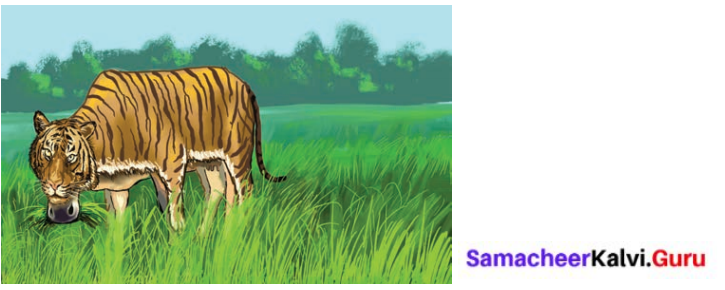
காட்டு விலங்குகளின் படங்களைத் திரட்டி படத்தொகுப்பினை உருவாக்குக.
Answer:
Samacheer Kalvi 7th Tamil Solutions Term 1 Chapter 2.3 விலங்குகள் உலகம் - 1
Samacheer Kalvi 7th Tamil Solutions Term 1 Chapter 2.3 விலங்குகள் உலகம் - 2

கூடுதல் வினாக்கள்

சரியான விடையைத் தேர்ந்தெடுத்து எழுதுக.

Question 1.
பண்புள்ள விலங்கு என்று எதனைக் குறிப்பிடுகிறோம்.
அ) புலி
ஆ) சிங்கம்
இ) கரடி
ஈ) மான்
Answer:
அ) புலி

Question 2.
‘காட்டுக்கு அரசன்’ என்று போற்றப்படும் விலங்கு எது?
அ) சிங்கம்
ஆ) சிறுத்தை
இ) புலி
ஈ) கரடி
Answer:
அ) சிங்கம்

Question 3.
யானை மிகுந்த நினைவாற்றல் கொண்ட விலங்கு .
அ) சரி
ஆ) இல்லை
இ) தவறு
ஈ) இவைகளில் ஏதுமில்லை
Answer:
அ) சரி

நீரப்புக :

Question 1.
இந்தியாவில் குஜராத் மாநிலத்தில் …….. சரணாலயத்தில் மட்டுமே ஆசிய சிங்கங்கள்
உள்ளன.
Answer:
கிர்

Question 2.
தமிழ்நாட்டில் வனக்கல்லூரி அமைந்துள்ள இடம் ………….
Answer:
மேட்டுப்பாளையம்

Question 3.
நன்கு வளர்ந்த கரடி ………. கிலோ எடை வரை இருக்கும்.
Answer:
160

விடையளி :

Question 1.
புலிகள் காப்பகம் எங்கு உள்ளது?
Answer:

  • புலிகள் காப்பகம் முண்டந்துறையில் உள்ளது.
  • முண்டந்துறை தமிழ்நாட்டில் உள்ளது.

Question 2.
பல்லுயிர்களின் வாழ்விடம் தான் இக்காடு-இக்கூற்றை மெய்ப்பிக்க.
Answer:

  • மனித முயற்சி இன்றி அதாவது மனித முயற்சி இல்லாமல் வளர்ந்த மரங்கள்,
    செடி, கொடிகள், புல், புதர்கள், பூச்சி இனங்கள், பறவைகள், விலங்குகள் போன்ற பல்லுயிர்களின் வாழ்விடம் தான் இந்தக் காடாகும்.
  • இந்தக் காட்டின் இடை இடையே காட்டாறுகளும் நீரோடைகளும் இருக்கும்.

Question 3.
முண்டந்துறை புலிகள் காப்பகம் – குறிப்பு வரைக.
Answer:

  • தமிழ்நாட்டில் இரண்டாவது மிகப்பெரிய காப்பகம் முண்டந்துறை புலிகள் காப்பகம் ஆகும்.
  • இது 895 சதுர கிலோ மீட்டர் பரப்பளவு கொண்டது.
  • இங்கு யானை, புலி, சிறுத்தை, மான், கரடி, காட்டு மாடு போன்ற அரிய விலங்குகள் வாழ்கின்றன.

Question 4.
உலகில் எத்தனை வகையான யானைகள் உள்ளன?
Answer:

  • உலகில் இரண்டு வகையான யானைகள் உள்ளன. ஆசிய யானை, ஆப்பிரிக்கா யானை.
  • ஆசிய யானைகளில் ஆண் யானைக்குத் தந்தம் உண்டு. பெண் யானைக்குத்
    தந்தம் இல்லை. ஆப்பிரிக்க யானைகளில் இரண்டுக்கும் தந்தம் உண்டு.


Question 5.
யானைகள் எப்போதும் கூட்டமாகத்தான் இருக்குமா? ஆம் எனில் விளக்கம் தருக.
Answer:

  • ஆம். யானைகள் எப்போதும் கூட்டமாகத்தான் வாழும். இந்தக் கூட்டத்திற்கு ஒரு பெண் யானைதான் தலைமை தாங்கும். யானைகள் தங்களுக்குத் தேவையான தண்ணீர் மற்றும் உணவு ஆகியவற்றிற்காக இடம் பெயர்ந்து கொண்டே இருக்கும்.
  • ஒரு யானை நாள் ஒன்றுக்கு 250 கிலோ புல், இலை தழைகளை உணவாக
    உட்கொள்ளும். அதற்குக் குடிக்க அறுபத்தைந்து லிட்டர் தண்ணீர் தேவைப்படும்.
  • யானை மிகுந்த நினைவாற்றல் கொண்ட பாசமிகு விலங்கு ஆகும்.

Question 6.
தமிழ்நாட்டில் வனக்கல்லூரி எங்கு அமைந்துள்ளது?
Answer:
தமிழ்நாட்டில் வனக்கல்லூரி கோவை மாவட்டத்தில் உள்ள மேட்டுப்பாளையத்தில் அமைந்துள்ளது.

Question 7.
தமிழ்நாடு வேளாண்மைப் பல்கலைக்கழகம் எங்கு உள்ளது?
Answer:

  • கோவையில் தமிழ்நாடு வேளாண்மைப் பல்கலைக் கழகம் உள்ளது.
  • இங்கு இளநிலை வனவியல், முதுநிலை வனவியல் ஆகிய படிப்புகள் உள்ளன.

Question 8.
கரடி தன் உடலை தேனீக்களிடமிருந்து எவ்வாறு பாதுகாத்துக் கொள்கிறது?
Answer:
கரடியின் உடலைப் போர்த்தி இருக்கும் அடர்ந்த முடிகள் தேனீக்களிடமிருந்து அதனைக் காப்பாற்றுகின்றன.

Question 9.
சிங்கம் பற்றி குறிப்பு வரைக.
Answer:
(i) உலகில் ஆசியச் சிங்கம். ஆப்பிரிக்கச் சிங்கம் என இரண்டு வகைச் சிங்கங்கள்
உள்ளன. இந்தியாவில் குஜராத் மாநிலத்தில் ‘கிர்’ சரணாலயத்தில் மட்டுமே ஆசியச் சிங்கங்கள் உள்ளன.

(ii) நீளம், உயரம், பருமன், எடை, பலம், வேட்டைத்திறன் ஆகிய அனைத்திலும் சிங்கத்தை விட புலியே உயர்ந்தது. எனவே புலியே காட்டுக்கு அரசன் என்கிறார்கள் இயற்கை விஞ்ஞானிகள்.

Samacheer Kalvi 12th Economics Solutions Chapter 1 Introduction to Macro Economics

Students of 12th can get the pdf links of Tamilnadu State Board Economics Solutions here. You can Download Samacheer Kalvi 12th Economics Book Solutions Chapter 1 Introduction to Macro Economics Questions and Answers, Notes Pdf, Guide Pdf helps you to revise the complete Tamilnadu State Board New Syllabus and score more marks in your examinations.

Tamilnadu Samacheer Kalvi 12th Economics Solutions Chapter 1 Introduction to Macro Economics

It is very important to put the textbook aside while preparing for the exams. So, if you follow Samacheer Kalvi 12th Economics Textbook Solutions you can cover all the topics in Chapter 1 Introduction to Macro Economics Questions and Answers. This helps to improve your communication skills.

Samacheer Kalvi 12th Economics Introduction to Macro Economics Text Book Back Questions and Answers

Part – A
Multiple Choice Questions

12th Economics 1st Chapter Question Answer Question 1.
The branches of the subject Economics is –
(a) Wealth and welfare
(b) production and consumption
(c) Demand and supply
(d) micro and macro
Answer:
(d) micro and macro

12th Economics Chapter 1 Question 2.
Who coined the word ‘Macro’?
(a) Adam Smith
(b) J M Keynes
(c) Ragnar Frisch
(d) Karl Matrix
Answer:
(c) Ragnar Frisch

12th Economics Chapter 1 Book Back Answers Question 3.
Who is regarded as Father of Modem Macro Economics?
(a) Adam Smith
(b) J M Keynes
(c) Ragnar Frisch
(d) Karl Matrix
Answer:
(b) J M Keynes

12th Economics 1st Chapter Question 4.
Identify the other name for Macro Economics?
(a) Price Theory
(b) Income Theory
(c) Market Theory
(d) Micro Theory
Answer:
(b) Income Theory

12th Economics Samacheer Kalvi Question 5.
Macro economics is a study of –
(a) individuals
(b) firms
(c) a nation
(d) aggregates
Answer:
(d) aggregates

12th Economics 1st Chapter Answer Question 6.
Indicate the contribution of JM Keynes to economics?
(a) Wealth of Nations
(b) General Theory
(c) Capital
(d) Public Finance
Answer:
(b) General Theory

Samacheer Kalvi 12th Economics Question 7.
A steady increase in general price level is termed as –
(a) Wholesale price index
(b) Business Cycle
(c) Inflation
(d) National Income
Answer:
(c) Inflation

Samacheer Kalvi Guru 12th Economics Question 8.
Identify the necessity of Economic policies?
(a) To solve the basic problems
(b) To overcome the obstacles
(c) To achieve growth
(d) All the above
Answer:
(d) All the above

Samacheer Kalvi Economics 12th Question 9.
Indicate the fundamental economic activities of an economy?
(a) Production and Distribution
(b) Production and Exchange
(c) Production and Consumption
(d) Production and Marketing
Answer:
(c) Production and Consumption

12 Economics Samacheer Kalvi Question 10.
An economy consists of –
(a) consumption sector
(b) Production sector
(c) Government sector
(d) All the above
Answer:
(d) All the above

12th Economics Question Answer Question 11.
Identify the economic system where only private ownership of production exists.
(a) Capitalistic Economy
(b) Socialistic Economy
(c) Globalisic Economy
(d) Mixed Economy
Answer:
(a) Capitalistic Economy

12th Economics Lesson 1 Question 12.
Economic system representing equality in distribution is –
(a) Capitalism
(b) Globalism
(c) Mixedism
(d) Socialism
Answer:
(d) Socialism

Samacheer Kalvi 12th Economics Book Question 13.
Who is referred as ‘Father of Capitalism’?
(a) Adam Smith
(b) Karl Marx
(c) Thackeray
(d) JM Keynes
Answer:
(a) Adam Smith

Economic 12th Chapter 1 Question 14.
The country following Capitalism is –
(a) Russia
(b) America
(c) India
(d) China
Answer:
(b) America

12th Economics Answer Pdf Question 15.
Identify The Father of Socialism?
(a) JM Keynes
(b) Karl Marx
(c) Adam Smith
Answer:
(b) Karl Marx

12th Economics 1st Lesson Question And Answer Question 16.
An economic system where the economic activities of a nation are done both by the private and public together is termed as –
(a) Capitalistic Economy
(b) Socialistic Economy
(c) Globalisic Economy
(d) Mixed Economy
Answer:
(b) Socialistic Economy

Economics Samacheer Kalvi Question 17.
Quantity of a commodity accumulated at a point of time is termed as –
(a) production
(b) stock
(c) variable
(d) flow
Answer:
(b) stock

Samacheer Kalvi 12th Economics Solution Book Question 18.
Identify the flow variable?
(a) money supply
(b) assests
(c) income
(d) foreign exchange reserves
Answer:
(c) income

Samacheer Kalvi 12th Economics Book Back Answers Question 19.
Identify the sectors of a Two Sector Model?
(a) Households and Firms
(b) Private and Public
(c) Internal and External
(d) Firms and Government
Answer:
(a) Households and Firms

12th Economics Question And Answer Question 20.
The Circular Flow Model that represents an open Economy?
(a) Two Sector Model
(b) Three Sector Model
(c) Four Sector Model
(d) All the above
Answer:
(c) Four Sector Model

Part – B
Answer The Following Questions In One or Two Sentences.

12th Economics 1st Lesson Question 1.
Define Macro Economics?
Answer:

  1. Macro Economics is the study of the economy as a whole.
  2. In other words, macro economics deals with aggregates such as national income, employment and output.
  3. Macro Economics is also known as ‘Income Theory’.

Economics 12th Class Chapter 1 Question 2.
Define the term ‘Inflation’?
Answer:

  1. Inflation refers to steady increase in general price level.
  2. Estimating the general price level by constructing various price index numbers such as wholesale Price.
  3. Index, Consumer Price Index, etc, are needed.

Samacheer Kalvi Economics Question 3.
What is meant by an ‘Economy’?
Answer:

  1. An economy is referred to any system or area where economic activities are carried out. Each economy has its own character. Accordingly, the functions or activities also vary.
  2. An economy, the fundamental economic activities are production and consumption.

Class 12 Economics Chapter 1 Question 4.
Classify the economies based on status of development?
Answer:
Status of Development:
Developed, underdeveloped, undeveloped and developing economies.

Question 5.
What do you mean by Capitalism?
Answer:

  1. Capitalism, is total freedom and private ownership of means of production.
  2. Capitalistic economy is also termed as a free economy (Laissez faire, in Latin) or market economy where the role of the government is minimum and market determines the economic activities.

Question 6.
Define ‘Economic Model’?
Answer:

  1. A model is a simplified representation of real situation.
  2. Economists use models to describe economic activities, their relationships and their behaviour.
  3. A model is an explanation of how the economy, or part of the economy, works.
  4. Most economic models are built with mathematics, graphs and equations, and attempt to explain relationships between economic variables.

Question 7.
‘Circular Flow of Income’ – Define?
Answer:

  1. The circular flow of income is a model of an economy showing connections between different sectors of an economy.
  2. It shows flows of income, goods and services and factors of production between economic agents such as firms, households, government and nations.
  3. The circular flow analysis is the basis of national accounts and macroeconomics.

Part – C
Answer The Following Questions In One Paragraph.

Question 1.
State the importance of Macro Economics?
Answer:
The importance and the need for introducing a macro outlook of an economy are given below:

  1. There is a need to understand the functioning of the economy at the aggregate level to evolve suitable strategies and to solve the basic problems prevailing in an economy.
  2. Understanding the future problems, needs and challenges of an economy as a whole is important to evolve precautionary measures.
  3. Macro economics provides ample opportunities to use scientific investigation to understand the reality.
  4. Macro economics helps to make meaningful comparison and analysis of economic indicators.
  5. Macro economics helps for better prediction about future and to formulate suitable policies to avoid economic crises, for which Nobel Prize in Economic Sciences is awarded.

Question 2.
Describe the different types of economic systems?
Answer:
There are three major types of economic systems. They are:

1. Capitalistic Economy (Capitalism):

  1. Capitalistic economy is also termed as a free economy (Laissez faire, in Latin) or market economy where the role of the government is minimum and market determines the economic activities.
  2. The means of production in a capitalistic economy are privately owned.
  3. Manufacturers produce goods and services with profit motive.
  4. The private individual has the freedom to undertake any occupation and develop any skill.
  5. The USA, West Germany, Australia and Japan are the best examples for capitalistic economies.
  6.  However, they do undertake large social welfare measures to safeguard the downtrodden people from the market forces.

2. Socialistic Economy (Socialism):

  1. The Father of Socialism is Karl Marx. Socialism refers to a system of total planning, public ownership and state control on economic activities.
  2. Socialism is defined as a way of organizing a society in which major industries are owned and controlled by the government.
  3. A Socialistic economy is also known as ‘Planned Economy’ or ‘Command Economy’.
  4. In a socialistic economy, all the resources are owned and operated by the government.
  5. Public welfare is the main motive behind all economic activities. It aims at equality in the distribution of income and wealth and equal opportunity for all.
  6. Russia, China, Vietnam, Poland and Cuba are the examples of socialist economies. But, now there are no absolutely socialist economies.

3. Mixed Economy (Mixedism):

  1. In a mixed economy system both private and public sectors co-exist and work together towards economic development.
  2. It is a combination of both capitalism and socialism. It tends to eliminate the evils of both capitalism and socialism.
  3. In these economies, resources are owned by individuals and the government.
  4. India, England, France and Brazil are the examples of mixed economy.

Question 3.
Outline the major merits of capitalism?
Answer:
Merits of Capitalism:

  1. Automatic Working:
    Without any government intervention, the economy works automatically.
  2. Efficient Use of Resources:
    All resources are put into optimum use.
  3. Incentives for Hard work:
    Hard work is encouraged and entrepreneurs get more profit for more efficiency.
  4. Economic Progress:
    Production and productivity levels are very high in capitalistic economies.
  5. Consumers Sovereignty:
    All production activities are aimed at satisfying the consumers.
  6. Higher Rates of Capital Formation:
    Increase in saving and investment leads to higher rates of capital formation.
  7. Development of New Technology:
    As profit is aimed at, producers invest on new technology and produce quality goods.

Question 4.
Indicate the demerits of socialism?
Answer:
Demerits of Socialism:
1. Red Tapism and Bureaucracy:
As decision are taken by government agencies, approval of many officials and movement of files from one table to other takes time and leads to red tapism.

2. Absence of Incentive:
The major limitation of socialism is that this system does not provide any incentive for efficiency. Therefore, productivity also suffers.

3. Limited Freedom of Choice:
Consumers do not enjoy freedom of choice over the consumption of goods and services.

4. Concentration of Power:
The State takes all major decisions. The private takes no initiative in making economic decisions. Hence, the State is more powerful and misuse of power can also take place.

Question 5.
Enumerate the features of mixed economy?
Answer:
Features of Mixed Economy:
1. Ownership of Property and Means of Production: The means of production and properties are owned by both private and public. Public and Private have the right to purchase, use or transfer their resources.

2. Coexistence of Public and Private Sectors:
In mixed economies, both private and public sectors coexist. Private industries undertake activities primarily for profit. Public sector firms are owned by the government with a view to maximize social welfare.

3. Economic Planning:
The central planning authority prepares the economic plans. National plans are drawn up by the Government and both private and public sectors abide. In general, all sectors of the economy function according to the objectives, priorities and targets laid down in the plan.

4. Solution to Economic Problems:
The basic problems of what to produce, how to produce, for whom to produce and how to distribute are solved through the price mechanism as well as state intervention.

5. Freedom and Control:
Though private has freedom to own resources, produce goods and ‘ services and distribute the same, the overall control on the economic activities rests with
the government.

Question 6.
Distinguish between Capitalism and Globalism?
Answer:
Capitalism:
The system where the means of production are privately owned and market determines the economic activities.

Globalism:
An economic system where the economic activities of a nation are inter connected and inter dependent on each other nation.

Question 7.
Briefly explain the two sector circular flow model?
Answer:
Circular Flow of Income in a Two-Sector Economy:
There are only two sectors namely, household sector and firm sector.

1. Household Sector:

  1. The household sector is the sole buyer of goods and services, and the sole supplier of factors of production, i.e., land, labour, capital and organisation.
  2. It spends its entire income on the purchase of goods and services produced by the business sector.
  3. The household sector receives income from firm sector by providing the factors of production owned by it.

2. Firms:

  1. The firm sector generates its revenue by selling goods and services to the household sector.
  2. It hires the factors of production, i.e., land, labour, capital and organisation, owned by the household sector.
  3. The firm sector sells the entire output to households.
  4. In a two – sector economy, production and sales are equal and there will be a circular flow of income and goods.
  5. The outer circle represents real flow (factors and goods) and the inner circle represents the monetary flow (factor prices and commodity prices).
  6. Real flow indicates the factor services flow from household sector to the business sector, and goods and services flow from business sector to the household.
  7. The basic identities of the two-sector economy are as under:

Y = C + 1
Where
Y is Income; C is Consumption; I is investment.

Part – D
Answer The Following Questions In One Page.

Question 1.
Discuss the scope of Macro Economics?
Answer:
The study of macro economics has wide scope and it covers the major areas as follows:
1. National Income:
Measurement of national income and its composition by sectors are the basic aspects of macroeconomic analysis. The trends in National Income and its composition provide a long term understanding of the growth process of an economy.

2. Inflation:
It refers to steady increase in general price level. Estimating the general price level by constructing various price index numbers such as Wholesale Price Index, Consumer Price Index, etc, are needed.

3. Business Cycle:
Almost all economies face the problem of business fluctuations and business cycle. The cyclical movements (boom, recession, depression and recovery) in the economy need to be carefully studied based on aggregate economic variables.

4. Poverty and Unemployment:
The major problems of most resource – rich nations are poverty and unemployment. This is one of the economic paradoxes. A clear understanding about the magnitude of poverty and unemployment facilitates allocation of resources and initiating corrective measures.

5. Economic Growth:
The growth and development of an economy and the factors determining them could be understood only through macro analysis.

6. Economic Policies:
Macro Economics is significant for evolving suitable economic policies. Economic policies are necessary to solve the basic problems, to overcome the obstacles and to achieve growth.

Question 2.
Illustrate the functioning of an economy based on its activities?
Answer:
An economy is referred to any system or area where economic activities are carried out. Each economy has its own character. Accordingly, the functions or activities also vary. The functioning of an economy by its activities is explained in flow chart.

  1. In an economy, the fundamental economic activities are production and consumption.
  2. These two activities are supported by several other activities.
  3. The ultimate aim of these activities is to achieve growth. The ‘exchange activity’ supports the production and consumption activities. These activities are influenced by several economic and non – economic activities.
  4. The major economic activities include transportation, banking, advertising, planning, government policy and others.
  5. The major non – economic activities are environment, health, education, entertainment, governance, regulations etc.
  6. In addition to these supporting activities, external activities from other economies such as import, export, international relations, emigration, immigration, foreign investment, foreign exchange earnings, etc. also influence the entire functioning of the economy.

12th Economics 1st Chapter Question Answer Introduction To Macro Economics Samacheer Kalvi

Question 3.
Compare the features of capitalism and socialism?
Answer:
Features of Capitalistic Economy:
1. Private Ownership of Property and Law of Inheritance:
The basic feature of capitalism is that all resources namely, land, capital, machines, mines etc. are owned by private individuals. The owner has the right to own, keep, sell or use these resources according to his will. The property can be transferred to heirs after death.

2. Freedom of Choice and Enterprise:
Each individual is free to carry out any occupation or trade at any place and produce any commodity. Similarly, consumers are free to buy any commodity as
per their choice.

3. Profit Motive:
Profit is the driving force behind all economic activities in a capitalistic economy. Each individual organization produce only those goods which ensure high profit. Advance technology, division of labour, and specialisation are followed. The golden rule for a producer under capitalism is ‘to maximize profit.’

4. Free Competition:
There is free competition in both product and factor market. The government or any authority cannot prevent firms from buying or selling in the market. There is competition between buyers and sellers.

5. Price Mechanism:
Price mechanism is the heart of any capitalistic economy. All economic activities are regulated through price mechanism i.e., market forces of demand and supply.

6. Role of Government:
As the price mechanism regulates economic activity, the government has a limited role in a capitalistic economy. The government provides basic services such as, defense, public health, education, etc.

7. Inequalities of Income:
A capitalist society is divided into two classes – ‘haves’ that is those who own property and ‘have-nots’ who do not own property and work for their living. The outcome of this situation is that the rich become richer and poor become poorer. Here, economic inequality goes on increasing.

Features of Socialism:

1. Public Ownership of Means of Production:
All resources are owned by the government. It means that all the factors of production are nationalized and managed by the public authority.

2. Central Planning:
Planning is an integral part of a socialistic economy. In this system, all decisions are undertaken by the central planning authority.

3. Maximum Social Benefit:
Social welfare is the guiding principle behind all economic activities. Investments are planned in such a way that the benefits are distributed to the society at large.

4. Non – existence of Competition:
Under the socialist economic system there is absence of competition in the market. The state has full control over production and distribution of goods and services. The consumers will have a limited choice.

5. Absence of Price Mechanism:
The pricing system works under the control and regulation of the central planning authority.

6. Equality of Income:
Another essential feature of socialism is the removal and reduction of economic inequalities. Under socialism private property and the law of inheritance do not exist.

7. Equality of Opportunity:
Socialism provides equal opportunity for all through free health, education and professional training.

8. Classless Society:
Under socialism, there is a classless society and so no class conflicts. In a true socialist society, everyone is equal as far as economic status is concerned.

Question 4.
Compare the feature among Capitalism, Secularism and Mixedism?
Answer:
12th Economics Chapter 1 Introduction To Macro Economics Samacheer Kalvi

Samacheer Kalvi 12th Economics Introduction to Macro Economics Addtional Questions and Answers

Part – A
I. Multiple Choice Questions.

Question 1.
John Maynard Keynes book “The General theory of Employment, Interest and Money” was published in –
(a) 1936
(b) 1946
(c) 1956
(d) 1966
Answer:
(a) 1936

Question 2.
The word ‘Macro’ is derived from the Greek word –
(a) Makros
(b) Macros
(c) Macrow
(d) Mac
Answer:
(a) Makros

Question 3.
………………….. is the driving force behind all economic activities in a capitalistic economy.
(a) Benefit
(b) Additional
(c) Profit
(d) Loss
Answer:
(c) Profit

Question 4.
Capitalism and Socialism are two extreme and ……………………… approaches.
(a) normal
(b) opposite
(c) upward
(d) downward
Answer:
(b) opposite

Question 5.
Capitalist Economy is also termed as a Economy.
(a) Free
(b) Costly
(c) Value
(d) Govt
Answer:
(a) Free

Question 6.
The USA, West Germany, Australia and Japan are the best examples for economies.
(a) Socialistic
(b) Capitalistic
(c) Mixed
(d) Profit
Answer:
(b) Capitalistic

Question 7.
In a ……………………… Economy, all the resources are owned and operated by the government.
(a) Capitalistic
(b) Globalistic
(c) Socialistic
(d) Mixed
Answer:
(c) Socialistic

Question 8.
…………………… are planned in such a way that the benefits are distributed to the society at large.
(a) Investment
(b) Production
(c) Distribution
(d) Services
Answer:
(a) Investment

Question 9.
Who promotes balanced growth of the economy?
(a) Capitalism
(b) Socialism
(c) Globalism
(d) Mixedism
Answer:
(d) Mixedism

Question 10.
In …………………….. economies both private and public sectors coexist.
(a) Capitalism
(b) Socialism
(c) Globalism
(d) Mixed
Answer:
(d) Mixed

Question 11.
…………………….. is considered as the Father of socialism.
(a) Adam Smith
(b) Keynes
(c) Karlmarx
(d) Marshall
Answer:
(c) Karlmarx

Question 12.
…………………………. is another name for economics.
(a) Political economy
(b) Socialist economy
(c) Capitalist economy
(d) Planned economy
Answer:
(a) Political economy

Question 13.
The socialist economy is also known as economy.
(a) Market
(b) Common
(c) Traditional
(d) Mixed
Answer:
(b) Common

Question 14.
Economics is a ……………………. science.
(a) Political
(b) Social
(c) Physical
(d) Natural
Answer:
(b) Social

Question 15.
In a ………………….. Economy there is no central co – ordinator.
(a) Mixed
(b) Capitalist
(c) Socialist
(d) Traditional
Answer:
(b) Capitalist

Question 16.
In a socialist economy, all decisions regarding production and distribution are taken by
(a) market forces
(b) central planning authority
(c) customs and traditions
(d) private sector
Answer:
(b) central planning authority

Question 17.
Co – existence of public and private sector is called economy.
(a) Mixed
(b) Socialist
(c) Capitalist
(d) Traditional
Answer:
(a) Mixed

Question 18.
The government has minimum role in …………………….. economy.
(a) Mixed
(b) Capitalist
(c) Socialist
(d) Traditional
Answer:
(b) Capitalist

Question 19.
Economic planning is an important feature of …………………… Economy.
(a) Mixed
(b) Capitalism
(c) Socialism
(d) Traditional
Answer:
(a) Mixed

Question 20.
Welfare is ignored in ……………………….. Economy.
(a) Mixidism
(b) Socialistic
(c) Capitalistic
(d) Traditional
Answer:
(c) Capitalistic

Question 21.
Free trade economy is otherwise called ……………………….. economy.
(a) Socialist
(b) Capitalist
(c) Traditionalist
(d) Mixidist
Answer:
(b) Capitalist

Question 22.
Extreme inequality is prevented in ……………………… system.
(a) Socialist
(b) Capitalist
(c) Mixidist
(d) Traditionalist
Answer:
(a) Socialist

Question 23.
Market forces have only a limited role to play in ………………………. economy.
(a) Mixidist
(b) Socialist
(c) Capitalist
(d) Traditionalist
Answer:
(b) Socialist

Question 24.
India is the best example for …………………………. economy.
(a) Capitalism
(b) Socialism
(c) Mixedism
(d) Traditionalism
Answer:
(c) Mixedism

Question 25.
What is main motive of capitalism?
(a) Profit
(b) Benefit
(c) Excess money
(d) Loss
Answer:
(a) Profit

II. Match the following and choose the correct answer by using codes given below

Question 1.
A. Father of Capitalism – (i) Adam Smith
B. Father of Socialism – (ii) Karl Marx
C. Net Economic Welfare – (iii) Samuelson
D. Father of Macro Economics – (iv) J.M. Keynes
Codes:
(a) A (i) B (ii) C (iii) D (iv)
(b) A (ii) B (iii) C (iv) D (i)
(c) A (iii) B (iv) C (ii) D (i)
(d) A (iv) B (iii) C (ii) D(i)
Answer:
(a) A (i) B (ii) C (iii) D (iv)

Question 2.
A. Mixed Economy – (i) Welfare Oriented
B. Socialist Economy – (ii) Subsistence Economy
C. Capitalist Economics – (iii) Economic Planning
D. Traditional Economy – (iv) Profit Motive
Codes:
(a) A (i) B (ii) C (iii) D (iv)
(b) A (ii) B (iii) C (iv) D (i)
(c) A (iii) B (i) C (iv) D (ii)
(d) A (iv) B (iii) C (ii) D (i)
Answer:
(c) A (iii) B (i) C (iv) D (ii)

Question 3.
A. Minimum Role of Government – (i) Freedom of choice
B. Absence of monopoly – (ii) Capitalism
C. Capitalist Economy – (iii) Socialism
D. Socialist Economy – (iv) Central planning
Codes:
(a) A (i) B (ii) C (iii) D (iv)
(b) A (ii) B (iii) C (iv) D (i)
(c) A (iii) B (i) C (iv) D (ii)
(d) A (ii) B (i) C (iii) D (iv)
Answer:
(b) A (ii) B (iii) C (i) D (iv)

Question 4.
A. Traditional Economy – (i) Socialism
B. Minimum Role of Government – (ii) Traditions and customs
C. Absence of Monopoly – (iii) Capitalism
D. Administered prices – (iv) Mixed Economy
Codes:
(a) A (i) B (ii) C (iii) D (iv)
(b) A (iv) B (iii) C (ii) D(i)
(c) A (ii) B (iii) C (i) D (iv)
(d) A (ii) B (iv) C (iii) D(i)
Answer:
(c) A (ii) B (iii) C (i) D (iv)

Question 5.
A. Private property – (i) Capitalist Economy
B. Bureaucratic expansion – (ii) Laissez Faire Economy
C. Market Economy – (iii) Socialism
D. Socialism – (iv) China and Cubs
Codes:
(a) A (i) B (ii) C (iii) D (iv)
(b) A (iv) B (iii) C (ii) D (i)
(c) A (ii) B (iii) C (i) D (iv)
(d) A (i) B (iii) C (ii) D (iv)
Answer:
(c) A (ii) B (iii) C (i) D (iv)

III. State whether the statements are true or false.

Question 1.
(i) In Mixed Economy, both public and private sector co-existence.
(ii) Mixed Economy followed by India.

(a) Both (i) and (ii) are true
(b) Both (0 and (ii) are false
(c) (i) is true but (ii) is false
(d) (i) is false but (ii) is true
Answer:
(a) Both (i) and (ii) are true

Question 2.
(i) Profit Motive of Capitalist Economy.
(ii) Basic problems are solved by customs and traditions.

(a) Both (i) and (ii) are true
(b) Both (i) and (ii) is false
(c) (i) is true but (ii) is false
(d) (i) is false but (ii) is true
Answer:
(i) is true but (ii) is false

Question 3.
(i) Father of Macro Economics – Adam Smith.
(ii) Father of Capitalism – Adam Smith

(a) Both (i) and (ii) are true
(b) Both (i) and (ii) are false
(c) (i) is true but (ii) is false
(d) (i) is false but (ii) is true
Answer:
(a) Both (i) and (ii) are true

Question 4.
(i) The Father of Socialism is Karl Marx.
(ii) Socialism is Profit Motive.

(a) Both (i) and (ii) are true
(b) Both (i) and (ii) are false
(c) (i) is true but (ii) is false
(d) (i) is false but (ii) is true
Answer:
(i) is true but (ii) is false

Question 5.
(i) Capitalism and Socialism are same approaches.
(ii) Capitalism and Socialism are two extreme and opposite approaches.

(a) Both (i) and (ii) are true
(b) Both (i) and (ii) are false
(c) (i) is true but (ii) is false
(d) (i) is false but (ii) is true
Answer:
(i) is false but (ii) is true

IV. Which of the following is correctly matched:

Question 1.
(a) One Sector Model – firm
(b) Two Sector Model – firm, government
(c) Three Sector Model – firm, household, government
(d) Four Sector Model – firm, household, government Industry
Answer:
(c) Three Sector Model – firm, household, government

Question 2.
(a) Capitalist Economy – USA, West Germany, Australia
(b) Socialist Economy – Japan, USSR
(c) Mixed Economy – Russia, Cuba
(d) Traditional Economy – India, China
Answer:
(a) Capitalist Economy – USA, West Germany, Australia

Question 3.
(a) Capitalism – Marshall
(b) Socialism – Karl Marx
(c) Mixidism – Adam Smith
(d) Traditionalism – Samuelson
Answer:
(b) Socialism – Karl Marx

Question 4.
(a) Macro – Greek word – Makros
(b) Macro – Latin word – Maker
(c) Macro – French word – Macro
(d) Macro – English word – Large
Answer:
(a) Macro – Greek word – Makros

Question 5.
(a) The first Noble Prize in Economic Science – Ragnar Frisch
(b) The General Theory of Employment – Adam Smith
(c) Planned Economy – J.M. Keynes
(d) Free Economy – Karl Marx
Answer:
(a) The first Noble Prize in Economic Science – Ragnar Frisch

V. Which of the following is not correctly matched:

Question 1.
(a) Equal opportunity – Mixidism
(b) Profit Motive – Capitalism
(c) Social Benefit – Socialism
(d) Traditional – Traditionalism
Answer:
(a) Equal opportunity – Mixidism

Question 2.
(a) Micro – small
(b) Macro – large
(c) Micro – very very small
(d) Macro – makros
Answer:
(c) Micro – very very small

Question 3.
(a) Traditional Economy – Subsistence Economy
(b) Economics is a – social science
(c) Economics other name – Political Economy
(d) Consumers Enjoy – Socialism
Answer:
(d) Consumers Enjoy – Socialism

Question 4.
(a) Private ownership – Capitalism
(b) Public ownership – Socialism
(c) Ownership of property – Mixidism
(d) Social welfare – Traditionalism
Answer:
(d) Social welfare – Traditionalism

Question 5.
(a) Traditional Government Involvement only
(b) Capatalist – Internal Regulation only
(c) Socilaistic – Complete Involvement
(d) Mixodistic – Limited Role Answers
Answer:
(a) Traditional Government Involvement only

VI. Pick the odd one out.

Question 1.
(a) Rapid Economic growth
(b) Balanced Economic growth
(c) Economic Equality
(d) Ineffeciency
Answer:
(d) Ineffeciency

Question 2.
(a) Public ownership
(b) Central planning
(c) Price Mechanism
(d) Maximum Social Benefit
Answer:
(c) Price Mechanism

Question 3.
(a) Households
(b) Firms
(c) Government
(d) Factories
Answer:
(d) Factories

Question 4.
(a) National Income
(b) Inflation
(c) Business cycle
(d) Non – Economic factor
Answer:
(d) Non – Economic factor

Question 5.
(a) Capitalism
(b) Socialism
(c) Globalism
(d) Mixidism
Answer:
(c) Globalism

VII. Assertion and Reason.

Question 1.
Assertion (A): Macro Economics is the study of the economy as a whole.
Reason (R): Macro Economics is also known as “Income theory”.

(a) Both ‘A’ and ‘R’ are true and ‘R’ is the correct explanation to ‘A’
(b) Both ‘A’ and ‘R’ are true but ‘R’ is not the correct explanation to ‘A’
(c) ‘A’ is true but ‘R’ is false
(d) ‘A’ is false but ‘R’ is true
Answer:
(a) Both ‘A’ and ‘R’ are true and ‘R’ is the correct explanation to ‘A’

Question 2.
Assertion (A): Inflation refers to steady increase in general price level.
Reason (R): Deflation refers to steady increase in general price level.

(a) Both ‘A’ and ‘R’ are true and ‘R’ is the correct explanation to ‘A’
(b) Both‘A’ and ‘R’ are true but ‘R’ is not the correct explanation to ‘A’
(c) ‘A’ is true but ‘R’ is false
(d) ‘A’ is false but ‘R’ is true
Answer:
(c) ‘A’ is true but ‘R’ is false

Question 3.
Assertion (A):
The major economic activities include transportation, banking, advertising.
Reason (R): The major economic activities include only Industrial development.

(a) Both ‘A’ and ‘R’ are true and ‘R’ is the correct explanation to ‘A’
(b) Both ‘A’ and ‘R’ are true but ‘R’ is not the correct explanation to ‘A’
(c) ‘A’ is true but ‘R’ is false
(d) ‘A’ is false but ‘R’ is true
Answer:
(b) Both ‘A’ and ‘R’ are true but ‘R’ is not the correct explanation to ‘A’

Question 4.
Assertion (A): Capitalistic Economy is Social Welfare Economy.
Reason (R): Capitalistic Economy is also free Economy or market Economy.

(a) Both ‘A’ and ‘R’ are true and ‘R’ is the correct explanation to ‘A’
(b) Both ‘A’ and ‘R’ are true but ‘R’ is not the correct explanation to ‘A’
(c) ‘A’ is true but ‘R’ is false
(d) ‘A’ is false but ‘R’ is true
Answer:
(d) ‘A’ is false but ‘R’ is true

PART – B
Answer The Following Questions In One or Two Sentences.

Question 1.
Define Globalism?
Answer:
Globalism:
The term coined by Manfred D Steger (2002) to denote the new market ideology of globalisation that connects nations together through international trade and aiming at global development. This ideology is also termed as ‘Extended Capitalism’.

Question 2.
Define Mixed Economy (or) Mixedism?
Answer:

  1. In a mixed economy system both private and public sectors co – exist and work together towards economic development.
  2. It is a combination of both capitalism and socialism. It tends to eliminate the evils of both capitalism and socialism.
  3. In these economies, resources are owned by individuals and the government. India, England, France and Brazil are the examples of mixed economy.

Question 3.
What is meant by Four Sector Economy?
Answer:

  • In a Four – sector economy, in addition to household, firms and government, a fourth sector namely, external sector is included.
  • In real life, only four – sector economy exists. This model is composed of four sectors namely,
    • Households
    • Firms
    • Government
    • External sector
  • In four – sector economy, expenditure for the entire economy include domestic expenditure (C + I + G) and net exports (X – M).

Question 4.
Define Profit Motive?
Answer:
Profit Motive:
Profit is the driving force behind all economic activities in a capitalistic economy. Each individual and organization produce only those goods which ensure high profit. Advance technology, division of labour, and specialisation are followed. The golden rule for a producer under capitalism is ‘to maximize profit. ’

PART – C
Answer The Following Questions In One Paragraph.

Question 1.
Discuss the limitations of Macro Economics?
Answer:
Macro economics suffers from certain limitations. They are:

  1. There is a danger of excessive generalisation of the economy as a whole.
  2. It assumes homogeneity among the individual units.
  3. There is a fallacy of composition. What is good of an individual need not be good for nation and vice versa. And, what is good for a country is not good for another country and at another time.
  4. Many non – economic factors determine economic activities; but they do not find place in the usual macroeconomic books.

Question 2.
Outline the Major Demerits of Capitalism?
Answer:

  1. Concentration of Wealth and Income:
    Capitalism causes concentration of wealth and income in a few hands and thereby increases inequalities of income.
  2. Wastage of Resources:
    Large amount of resources are wasted on competitive advertising and duplication of products.
  3. Class Struggle:
    Capitalism leads to class struggle as it divides the society into capitalists and workers.
  4. Business Cycle:
    Free market system leads to frequent violent economic fluctuations and crises.
  5. Production of non essential goods:
    Even the harmful goods are produced if there is possibility to make profit.

Question 3.
Indicates the Merits of Socialism?
Answer:

  1. Reduction in Inequalities:
    No one is allowed to own and use private property to exploit others.
  2. Rational Allocation of Resources:
    The central planning authority allocates the resources in a planned manner. Wastages are minimised and investments are made in a pre planned manner.
  3. Absence of Class Conflicts:
    As inequalities are minimum, there is no conflict between rich and poor class. Society functions in a harmonious manner.
  4. End of Trade Cycles:
    Planning authority takes control over production and distribution of goods and services. Therefore, economic fluctuations can be avoided.
  5. Promotes Social Welfare:
    Absence of exploitation, reduction in economic inequalities, avoidance of trade cycles and increase in productive efficiency help to promote social welfare.

PART – D
Answer The Following Questions In One Page.

Question 1.
State the Merits and Demerits of Mixed Economy?
Answer:
Merits of Mixed Economy:

1. Rapid Economic Growth:
The best advantage of mixed economy is that it promotes rapid economic growth. Thus, both public requirements and private needs are taken care of.

2. Balanced Economic Growth:
Mixedism promotes balanced growth of the economy. It promotes balanced growth between agriculture and industry, consumer goods and capital goods, rural and urban etc.

3. Proper Utilization of Resources:
In a mixed economy, the government can ensure proper utilization of resources. The government controls most of the important activities directly and the private sector indirectly.

4. Economic Equality:
The government uses progressive rates of taxation for levying income tax to bring about economic equality.

5. Special Advantages to the Society:
The government safeguards the interest of the workers and weaker sections by legislating on minimum wages, and rationing, establishing fair price shops and formulating social welfare measures.

Demerits of Mixed Economy

1. Lack of Coordination:
The greatest drawback of mixedism is lack of coordination between public sector and private sector. As both work with divergent motives, it creates many coordination related problems.

2. Competitive Attitude:
It is expected that both government and private should work with a complementary spirit towards the welfare of the society, but in reality they are competitive in their activities.

3. Inefficiency:
Most of the public sector enterprises remain inefficient due to lethargic bureaucracy, red tapism and lack of motivation.

4. Fear of Nationalization:
In a mixed economy, the fear of nationalization discourages the private entrepreneurs in their business operations and innovative initiatives.

5. Widening Inequality:
Ownership of resources, laws of inheritance and profit motive of people widens the gap between rich and poor. Ultimately the inequality of capitalism and inefficiency of socialism are found in mixed economies.

Question 2.
Classify the concepts of Macro Economics?
Answer:
The important concepts used in macro economics are presented below:

Stock and Flow Variables:
Variables used in economic analysis are classified as stock and flow. Both stock and flow variables may increase or decrease with time.

1. Stock refers to a quantity of a commodity measured at a point of time. In macro economics, money supply, unemployment level, foreign exchange reserves, capital etc are examples of stock variables.

2. Flow variables are measured over a period of time. National Income, imports, exports, consumption, production, investment etc are examples of flow variables.

3. Economic Models A model is a simplified representation of real situation. Economists use models to describe economic activities, their relationships and their behaviour. A model is an explanation of how the economy, or part of the economy, works. Most economic models are built with mathematics, graphs and equations, and attempt to explain relationships between economic variables. The commonly used economic models are the supply-demand models and circular flow models and Smith models.

Question 3.
Briefly explain circular flow of Income in a Three Sector Economy?
Answer:
Circular Flow of Income in a Three-Sector Economy:
Samacheer Kalvi 12th Economics Chapter 1 Introduction to Macro Economics Textbook Exercise Questions and Answers img 6

  • In addition to household and firms, inclusion of the government sector makes this model a three-sector model.
  • The government levies taxes on households and firms, purchases goods and services from firms, and receive factors of production from household sector.
  • On the other hand, the government also makes social transfers such as pension, relief, subsidies to the households.
  • Similarly, Government pays the firms for the purchases of goods and services. The Flow Chart illustrates three-sector economy model:
  • Under three sector model, national income (Y) is obtained by adding Consumption expenditure (C), Investment expenditure (I) and Government expenditure (G).
  • Therefore: Y = C + I + G.

Share this Tamilnadu State Board 12th Economics Solutions Chapter 1 Introduction to Macro Economics Questions and Answers with your friends to help them to overcome the grammar issues in exams. Keep visiting this site frequently to get the latest information on different subjects. Clarify your doubts by posting the comments and get the answers in an easy manner.

Samacheer Kalvi 11th Bio Zoology Solutions Chapter 2 Kingdom Animalia

Students who are in search of 11th Bio Zoology exam can download this Tamilnadu State Board Solutions for 11th Bio Zoology Chapter 2 Kingdom Animalia from here for free of cost. These cover all Chapter 2 Kingdom Animalia Questions and Answers, PDF, Notes, Summary. Download the Samacheer Kalvi 11th Biology Book Solutions Questions and Answers by accessing the links provided here and ace up your preparation.

Tamilnadu Samacheer Kalvi 11th Bio Zoology Solutions Chapter 2 Kingdom Animalia

Kickstart your preparation by using this Tamilnadu State Board Solutions for 11th Bio Zoology Chapter 2 Kingdom Animalia Questions and Answers get the max score in the exams. You can cover all the topics of Chapter 2 Kingdom Animalia Questions and Answers easily after studying the Tamilnadu State Board 11th Bio Zoology Textbook solutions pdf.

Samacheer Kalvi 11th Bio Zoology Kingdom Animalia Text Book Back Questions and Answers

I. Multiple Choice Questions
Choose the correct answer

Samacheer Kalvi Guru 11th Zoology Question 1.
The symmetry exhibited in cnidarians is –
(a) Radial
(b) Bilateral
(c) Pentamerous radial
(d) Asymmetrical
Answer:
(a) Radial

Class 11 Zoology Chapter 2 Notes Question 2.
Sea anemone belongs to phylum –
(a) Protozoa
(b) Porifera
(c) Coelenterata
(d) Echinodermata
Answer:
(c) Coelenterata

Samacheer Kalvi Guru 11th Biology Question 3.
The excretory cells that are found in platyhelminthes are –
(a) Protonephridia
(b) Flame cells
(c) Solenocytes
(d) All of these
Answer:
(d) All of these

Samacheer Kalvi 11 Zoology Solutions Question 4.
In which of the following organisms, self-fertilization is seen?
(a) Fish
(b) Round worm
(c) Earthworm
(d) Liver fluke
Answer:
(d) Liver fluke

Samacheer Kalvi 11th Zoology Solutions Question 5.
Nephridia of Earthworms are performing the same functions as –
(a) Gills of prawn
(b) Flame cells of Planaria
(c) Trachea of insects
(d) Nematoblasts of Hydra
Answer:
(b) Flame cells of Planaria

Zoology Class 11 Chapter 2 Question 6.
Which of the following animals has a true coelom?
(a) Ascaris
(b) Pheretima
(c) Sycon
(d) Taenia solium
Answer:
(b) Pheretima

Kingdom Zoology Question 7.
Metameric segmentation is the main feature of –
(a) Annelida
(b) Echinodermata
(c) Arthropoda
(d) Coelenterata
Answer:
(a) Annelida

11th Zoology Solutions Question 8.
In Pheretima locomotion occurs with help of –
(a) circular muscles
(b) longitudinal muscles and setae
(c) circular, longitudinal muscles and setae
(d) parapodia
Answer:
(c) circular, longitudinal muscles and setae

Samacheer Kalvi Guru 11th Bio Zoology Question 9.
Which of the following have the highest number of species in nature?
(a) Insects
(b) Birds
(c) Angiosperms
(d) Fungi
Answer:
(a) Insects

Kingdom Animalia Pdf Question 10.
Which of the following is a crustacean?
(a) Prawn
(b) Snail
(c) Sea anemone
(d) Hydra
Answer:
(a) Prawn

Zoology Kingdom Question 11.
The respiratory pigment in cockroach is –
(a) Haemoglobin
(b) Haemocyanin
(c) Haemoerythrin
(d) None of the above
Answer:
(c) Haemoerythrin

11th Zoology Samacheer Kalvi Question 12.
Exoskeleton of which phylum consists of chitinous cuticle?
(a) Annelida
(b) Porifera
(c) Arthropoda
(d) Echinodermata
Answer:
(a) Annelida

Question 13.
Lateral line sense organs occur in –
(a) Salamander
(b) Frog
(c) Water snake
(d) Fish
Answer:
(d) Fish

Question 14.
The limbless amphibian is –
(a) Icthyophis
(b) Hyla
(c) Rana
(d) Salamander
Answer:
(a) Icthyophis

Question 15.
Four chambered heart is present in –
(a) Lizard
(b) Snake
(c) Scorpion
(d) Crocodile
Answer:
(d) Crocodile

Question 16.
Which of the following is not correctly paired?
(a) Humans – Ureotelic
(b) Birds – Uricotelic
(c) Lizards – Uncotelic
(d) Whale – Ammonotelic
Answer:
(d) Whale – Ammonotelic

Question 17.
Which of the following is an egg laying mammal?
(a) Deiphinus
(b) Macropus
(c) Ornitho rhynchus
(d) Equus
Answer:
(c) Ornitho rhynchus

Question 18.
Pneumatic bones are seen in –
(a) Mammalia
(b) Aves
(c) Reptilia
(d) Sponges
Answer:
(b) Aves

Question 19.

Match the following columns and select the correct option.

Column -1

Column – II

(P) Pila

(i) Devil fish

(q) Dentalium

(ii) Chiton

(r) Chaetopleura

(iii) Apple snail

(s) Octopus

(iv) Tusk shell

(a) p – (ii), q – (i), r – (iii), s – (iv)
(b) p – (iii), q – (iv), r – (ii), s – (i)
(c) p – (ii), q – (iv), r – (i), s – (iii)
(d) p – (i), q – (ii), r – (iii), s – (iv)
Answer:
(b) p – (iii), q – (iv), r – (ii), s – (i)

Question 20.
In which of the following phyla, the adult shows radial symmetry but the larva shows bilateral symmetry?
(a) Mollusca
(b) Echinodermata
(c) Arthropoda
(d) Annelida
Answer:
(b) Echinodermata

Question 21.
Which of the following is correctly matched?
(a) Physalia – Portugese man of war
(b) Pennatula – Sea fan
(c) Adamsia – Sea pen
(d) Gorgonia – Sea anemone
Answer:
(a) Physalla – Portugese man of war

Question 22.
Why are spongin and spicutes important to a sponge?
Answer:
Spongin and spicules provide support and supports the soft body parts of the sponges. The spicules give the sponges rigidity and form to the sponges

Question 23.
What are the four characteristics common to most animals?
Answer:
The characteristics common to most animals are the arrangement of cell layers.

  • The levels of organization.
  • Nature of coelom.
  • The presence or absence of segmentation and notochord.
  • Organization of the organ system.

Question 24.
list the features that all vertebrates show at some point in their deelopnwnt.
Answer:
All vertebrates possess notochord during embryonic stay. li is repLaced by vertebra) column. All vertebrates possess pained appendages such as fins or lunits. Skin is covered by protective skeleton comprising of scales. fiathcrs hairs, claws, nails etc. Respiration is aerobic through gills, skin. buccopharyngeal cavity’ and lungs. All vertebrates have a muscular heart with two, three or four chambers and kidneys for excretion and osmoregulation.

Question 25.
Compare closed and opened circulatory system.
Answer:
Closed circulatory system:

  • The circulation in which blood is present inside the blood vessels is called closed circulatory’ system
  • It is found in higher organisms, e.g. annelids, cephalochordates and vertebrates.

Open circulatory system:

  • The circulation in which blood remains filled in tissue spaces due to the absence of blood vessels is called open circulatory system
  • It is found in lower organisms. e.g. arthropods, molluscs and echinoderms.

Question 26.
Compare schizocoelom with enterocoeloni.
Schizocoelom:

  • The coelom which is formed by splitting of Mesoderm is called schizocoelom.
  • It is found in lower invertebrates like annelids, arthropods and molluscs.

Enterocoeloni:

  • The coelom which is formed from the Mesodermal pouches of archenteron is called enteroceolem.
  • It is found in echinoderms, hemichordates and chordates.

Question 27.
Identify the structure that the archenteron becomes in a developing animal.
Answer:
The archenteron becomes the cavity of the digestive tract.

Question 28.
Observe the animal below and answer the following questions
(a) Identify the animal
(b) What type of symmetry does this animal exhibit?
(c) Is this animal Cephalized?
(d) How many germ layers does this animal have?
(e) How many openings does this animal’s digestive system have?
(f) Does this animal have neurons?
Samacheer Kalvi Guru 11th Zoology Solutions Chapter 2 Kingdom Animalia
Answer:
(a) Sea anemone (Adarnasia)
(b) Radial symmetry
(c) No
(d) Two (ectoderm and endoderm)
(e) One
(f) No.

Question 29.
Choose the term that does not belong in the following group and explain why it does not belong?
Answer:

  • Notochord, cephalisation, dorsal nerve cord and radial symmetry.
  • Notochord, cephalisation and dorsal nerve cord are the characteristic features of chordates. The radial symmetry is not a characteristic feature of chordate. It is the feature of cnidarian and adult echinoderms. Hence it does not belong to the group.

Question 30.
Why flat worms are called acoelomates?
Answer:
Flat worms are called acoelomate because they do not possess a body cavity.

Question 31.
What are flame cells?
Answer:
Flame cells are the specialized excretory cells in flat worms. They help in excretion and osmoregulation.

Question 32.
Concept Mapping – Use the following terms to create a concept map that shows the major characteristic features of the phylum nematoda: Round worms, pseudocoelomates, digestive tract, cuticle, parasite and sexual dimorphism.
Answer:
Class 11 Zoology Chapter 2 Notes Samacheer Kalvi Kingdom Animalia

Question 33.
In which phyla is the larva trochopore found?
Answer:
Annelida.

Question 34.
Which of the chordate characteristics do tunicates retain as adults?
Answer:
Ventral and tabular heart. Respiration is through gill slits.

Question 35.
List the characteristic features that distinguish cartilaginous fishes with living jawless fishes.
Answer:
Cartilaginous Fishes:

  • These have powerful jaws which help in predation.
  • These are free living predatory fishes.
  • These are advanced over jawless fishes.
  • These have a tough skin covered by dermal
  • Respiration is by lamelliform gills without operculum.
  • Paired fins are present.
  • Fertilization is internal
  • Viviparous e.g. Scoliodon

Living Jawless Fishes:

  • They do not have jaws and the mouth is circular and suctorial.
  • These are ectoparasites on fishes.
  • These are primitive over cartilaginous fishes.
  • The skin is soft and devoid of scales.
  • These have six to fifteen pair of gills slits.
  • Paired fins are absent.
  • Fertilization is external
  • Oviparous, e.g. Lamprey

Question 36.
List three features that characterise bony fishes.
Answer:

  • These fishes have bony endoskeleton.
  • The skin is covered by ganoid, cycloid or ctenoid scales.
  • Gills are covered by an operculum.
  • They are ammonotelic.
  • They have mesonephric kidneys.
  • External fertilization is seen.

Question 37.
List the functions of air bladder in fishes.
Answer:

  • Air bladder helps in gaseous exchange.
  • It helps in maintaining buoyancy.

Question 38.
Write the characteristics that contributes to the success of reptiles on land.
Answer:

  • The characteristics that contribute to the success of reptiles on land are as follows:
  • The presence of dry and comified skin with epidermal scales or scutes which prevent the loss of water.
  • The presence of metanephric kidney.
  • They are uricotelic (they excrete uric acid to prevent the loss of water).

Question 39.
List the unique features of bird’s endoskeleton.
Answer:

  • The endoskeleton of birds is bony
  • The long bones are hollow with air cavities (pneumatic)
  • The body is covered by feathers.

Question 40.
Could the number of eggs or young ones produced by an oviparous and viviparous female be equal? Why?
Answer:
No. The number of eggs or young ones produced by an oviparous and viviparous female cannot be equal. When the oviparous animals lay eggs in the external environment or in the medium, the chance of survival and successful development into the adults are not certain. But in case of viviparous animals, young ones are nurtured by the adult animals. Hence, oviparous animals lay more eggs if they are fertilized in the medium or in water.

Entrance Examination Questions Solved
Choose the correct answer
Question 1.
Classification of sponges is primarily based on the …………. (JCECE-2003)
(a) body organization
(b) body plan
(c) skeleton
(d) canal system
Answer:
(c) skeleton

Question 2.
Symmetry is cnidaria is …………. (AMU-2009)
(a) radial
(b) bilateral
(c) pentamerous
(d) spherical
Answer:
(a) radial

Question 3.
Cavity of coelenterates is called …………. (BHU-2008)
(a) coelenteron
(b) coelom
(c) cavity
(d) none of these
Answer:
(a) coelenteron

Question 4.
Sea anemone belongs to phylum …………. (BCECE-2005)
(a) protozoa
(b) porifera
(c) coelenterata
(d) echinodermata
Answer:
(c) coelenterata

Question 5.
Medusa is the reproductive organ of …………. (BHU-2008)
(a) Hydra
(b) Aurelia
(c) Obelia
(d) Sea anemone
Answer:
(b) Aurelia

Question 6.
The excretory cells, that are found in platyhelminthes …………. (J & K CET-2007)
(a) Protonephridia
(b) Flame cells
(c) Solenocytes
(d) All of these
Answer:
(b) Flame cells

Question 7.
In which of the following organisms, self-fertilization is seen? (CCET-2007)
(a) Fish
(b) Round worm
(c) Earthworm
(d) Liver fluke
Answer:
(d) Liver fluke

Question 8.
Nephridia of Earthworms are performing same function as …………. (J & KCET-2003)
(a) gills of prawn
(b) flame cells of Planaria
(c) trachea of insects
(d) nematoblasts of Hydra
Answer:
(b) flame cells of Planaria

Question 9.
Phylum of Taenia solium is …………. (BCECE-2004)
(a) Aschelminthes
(b) Annelids
(c) Platylelminthes
(d) Mollusca
Answer:
(c) Platylelminthes

Question 10.
Ascaris is found in …………. (RPMT-2004)
(a) body cavity
(b) lymph nodes
(c) tissue
(d) alimentary canal
Answer:
(d) alimentary canal

Question 11.
Which of the following animals has a true coelom? (J & K CET-2007)
(a) Ascaris
(b) Pheretima
(c) Sycon
(d) Taenia solium
Answer:
(b) Pheretima

Question 12.
Metameric segmentation is the main feature of ………….
(a) Annelida
(b) Echinodermata
(c) Arthropoda
(d) Coelenterata
Answer:
(a) Annelida

Question 13.
Body cavity lined by mesoderm is called …………. (J & T CET-2005)
(a) coelenteron
(b) pseudocoel
(c) coelom
(d) blastocoel
Answer:
(c) coelom

Question 14.
Which of the following have the highest number of species in nature? (AIPMT-2011)
(a) Insects
(b) Birds
(c) Angiosperms
(d) Fungi
Answer:
(a) Insects

Question 15.
Which of the following is a crustacean? (Guj-CET-2011)
(a) Prawn
(b) Snail
(c) Sea anemone
(d) Hydra
Answer:
(a) Prawn

Question 16.
The respiratory pigment present in cockroach is …………. (OJEE-2010)
(a) Haemoglobin
(b) Haemocyanin
(c) Oxyhaemoglobin
(d) None of these
Answer:
(d) None of these

Question 17.
Book lungs are respiratory organs in …………. (AMU-2008)
(a) Insects
(b) Arachnids
(c) Molluscans
(d) Echinoderms
Answer:
(b) Arachnids

Question 18.
The excretory organ in cockroach is …………. (Kerala-CEE-2007)
(a) Malpighian corpuscle
(b) Malpighian tubules
(c) Green gland
(d) Metanephridia
Answer:
(b) Malpighian tubules

Question 19.
Exoskeleton of which phylum consists of chitinous cuticle? (J & KCET-2007)
(a) Annelida
(b) Porifera
(c) Arthropoda
(d) Echinodermata
Answer:
(c) Arthropoda

Question 20.
In cockroach, vision is due to …………. (PMET-2005)
(a) one compound eye
(b) two compound eyes
(c) two simple eyes
(d) two compound and two simple eyes.
Answer:
(b) two compound eyes

Question 21.
Which of the following respires through gills? (J & K CET-2005)
(a) Whale
(b) Turtle
(c) Frog
(d) Prawns
Answer:
(d) Prawns

Question 22.
Animals active at night are called …………. (J & K CET-2004)
(a) diurnal
(b) nocturnal
(c) parasites
(d) nocto – diumal
Answer:
(b) nocturnal

Question 23.
Salient features of Arthropoda is ……….. (RPMT-2003)
(a) aquatic and free living
(b) chitinous exoskeleton and jointed appendages
(c) radulla
(d) none of those
Answer:
(b) chitinous exoskeleton and jointed appendages

Question 24.
The second largest number of species containing phylum in the animal kingdom is ……….. (J & K CET-2008)
(a) Annelida
(b) Arthropoda
(c) Mollusca
(d) Chordata
Answer:
(c) Mollusca

Question 25.
Mollusca is ………… (JCECE-2006)
(a) Triploblastic, acoelomate
(b) Triploblastic, coelomate
(c) Diploblastic, acoelomate
(d) Diploblastic, coelomate
Answer:
(b) Triploblastic, coelomate

Question 26.
Tube feet are the locomotory organs of ………….
(a) Platyhelminthes
(b) Echinodermata
(c) Mollusca
(d) Arthropoda
Answer:
(b) Echinodermata

Question 27.
Given below are four matchings of a animal and its kind of respiratory organ …………. (PMT 2003)
(A) Silver fish – Trachea
(B) Scorpion – Book lung
(C) Sea squirt – Pharyngeal gills
(D) Dolphin – Skin
The correct matchings are
(a) A and B
(b) A,B and C
(c) B and D
(d) C and D
Answer:
(b) A,B and C

Question 28.
Which one of the following is a matching pair of an animal and a certain phenomenon it exhibits? (PMT 2003)
(a) Pheretima – Sexual dimorphism
(b) Rana – Complete metamorphosis
(c) Chameleon – Mimicry
(d) Taenia – Polymorphism
Answer:
(b) Rana – Complete metamorphosis

Question 29.
Two common characters found in centipede, cockroach and crab …………. (PMT 2006)
(a) book lungs and antennae
(b) compound eyes and anal cerci
(c) joint legs and chitinous exoskeleton
(d) green gland and tracheae
Answer:
(c) joint legs and chitinous exoskeleton

Question 30.
Which one of the following groups of animals is bilaterally symmetrical and triploblastic? (PMT 2009)
(a) Aschelminthes (round worms)
(b) Ctenophores
(c) Sponges
(d) Coelenterates (cnidarians)
Answer:
(a) Aschelminthes (round worms)

Question 31.
Which one feature is common to leech, cockroach and scorpion? (AIIMS 2004)
(a) Nephridia
(b) Ventral nerve cord
(c) Cephalization
(d) Antennae
Answer:
(b) Ventral nerve cord

Question 32.
Which one of the following features is common in silverfish, scorpion, dragonfly and prawn?
(a) Three pairs of legs and segmented body
(b) Chitinous cuticle and two pairs of antennae
(c) Jointed appendages and chitinous exoskeleton
(d) Cephalothorax and trachea
Answer:
(c) Jointed appendages and chitinous exoskeleton

Question 33.
Peripatus is known as a connecting link, because it has the characters of both …………. (BHU 1993)
(a) Fishes & amphibians
(b) Reptiles & birds
(c) Aves & fishes
(d) Arthropoda & annelids
Answer:
(d) Arthropoda & annelids

Question 34.
Osphradium of Pila globosa is ………… (BHU 1994, 2000, 2007)
(a) thermoreceptor
(b) Pheretima
(c) chemoreceptor
(d) tangoreceptor
Answer:
(c) chemoreceptor

Question 35.
Green glands present in some arthropods help in …………. (BHU 1998, 2007)
(a) respiration
(b) excretion
(c) digestion
(d) none of these
Answer:
(b) excretion

Question 36.
Squid, cuttle fish and Octopus belongs to class of …………. (BHU 1998, 2001)
(a) decapoda
(b) scaphopoda
(c) cephalopoda
(d) apods
Answer:
(c) cephalopoda

Question 39.
The canal system is a characteristic feature of …………. (BHU 1999, 2002)
(a) sponges
(b) echinoderms
(c) helminthes
(d) coelenterates
Answer:
(a) sponges

Question 40.
Malpighian tubules are …………. (BHU 2006)
(a) excretory organs of insects
(b) excretory organs of frog
(c) respiratory organs of insects
(d) endocrine glands of insects
Answer:
(a) excretory organs of insects

Question 41.
Caterpillar and maggot are …………. (BHU 2007)
(a) larvae
(b) nymphs
(c) adults
(d) pupa
Answer:
(a) larvae

Question 42.
Excretory organ of platyhelminthes is …………. (BHU 2008)
(a) gills
(b) flame cells
(c) nephridia
(d) trachea
Answer:
(b) flame cells

Question 43.
Water vascular system is a characteristic of …………. (BHU 2008)
(a) ctenophore
(b) annelid
(c) echinodermata
(d) arthropoda
Answer:
(c) echinodermata

Question 44.
Tube feet are the characteristic structures of …………. (DPMT 1993, 2008)
(a) jellyfish
(b) starfish
(c) cuttlefish
(d) crayfish
Answer:
(b) starfish

Question 45.
Hormone, which helps in metamorphosis in insects is …………. (DPMT 1996)
(a) pheromone
(b) ecdysone
(c) thyroxine
(d) all of these
Answer:
(b) ecdysone

Question 46.
The muscles associated with the heart of insects are …………. (DPMT 1996, 2006)
(a) alary
(b) striped
(c) radial
(d) pericardial
Answer:
(a) alary

Question 47.
Which of the following organisms is pseudocoelomate? (DPMT 2001, 2006)
(a) Hookworm
(b) Liver fluke
(c) Jelly fish
(d) Leech
Answer:
(a) Hookworm

Question 48.
Which of the following is not reported to have any fresh water forms? (DPMT 2003)
(a) Mollusca
(b) Sponges
(c) Coelenterates
(d) Echinoderms
Answer:
(d) Echinoderms

Question 49.
Pseudocoelom is not found in ………… (DPMT 2004)
(a) Ascaris
(b) Ancylostoma
(c) Fasciola
(d) none of these
Answer:
(c) Fasciola

Question 50.
Animals devoid of respiratory, excretory and circulatory organs belong to phylum ………… (DPMT 2004)
(a) echinodermata
(b) platyhelminthes
(c) porifera
(d) mollusca
Answer:
(c) porifera

Question 51.
Cilia of gills of bivalve molluscs help in …………. (DPMT 2005)
(a) protection
(b) respiration
(c) excretion
(d) feeding
Answer:
(b) respiration

Question 52.
All flat worms differ from all round worms in having …………. (DPMT 2009)
(a) triploblastic body
(b) solid mesoderm
(c) bilateral symmetry
(d) metamorphosis in the life history
Answer:
(b) solid mesoderm

Question 53.
Parthenogenesis can be seen in …………. (UPCPMT 1995)
(a) frog
(b) honey bee
(c) moth
(d) all of these
Answer:
(b) honey bee

Question 54.
The endocrine gland of insects, which secretes the juvenile hormone, is …………. (UP-CPMT 1995)
(a) corpora allata
(b) corpora albicans
(c) corpora myecaena
(d) all of these
Answer:
(a) corpora allata

Question 55.
Malpighian tubules are …………. (UP – CPMT 1996, 2008)
(a) excretory organs of insects
(b) respiratory organs of insects
(c) excretory organs of frog
(d) endocrine glands of insects
Answer:
(a) excretory organs of insects

Question 56.
In mollusca, eye is present over a stalk called …………. (UP-CPMT 2000, 2007)
(a) osphradium
(b) ostracum
(c) ommatophore
(d) operculum
Answer:
(c) ommatophore

Question 57.
Which of the following symmetries is found in adult sea anemone? (UP – CPMT 2004)
(a) Radial
(b) Biradial
(c) Bilateral
(d) Spherical
Answer:
(a) Radial

Question 58.
Feeding in sponges takes place through …………. (UP-CPMT 2005)
(a) choanocytes
(b) nurse cells
(c) ostia
(d) osculum
Answer:
(a) choanocytes

Question 59.
Osphradium is meant for …………. (UP-CPMT 2005)
(a) excretion
(b) nutrition
(c) selection and rejection of food
(d) grinding of food
Answer;
(c) selection and rejection of food

Question 60.
Excretory product of spider is …………. (UPCPMT 2007)
(a) uric acid
(b) ammonia
(c) guanine
(d) none of these
Answer:
(c) guanine

Question 61.
Which of the following is not the character of Taenia soliuml …………. (UPCPMT 2007)
(a) Polysis
(b) Proglottid
(c) Metamerism
(d) Strobila
Answer:
(c) Metamerism

Question 62.
Daphnia is commonly known as …………. (UP-CPMT 2007)
(a) clam shrimp
(b) fairy shrimp
(c) water fleas
(d) tadpole shrimp
Answer:
(c) water fleas

Question 63.
Wuchereria is found in …………. (UP-CPMT 2007)
(a) lymph nodes
(b) lungs
(c) eye
(d) gonds
Answer:
(a) lymph nodes

Question 64.
“Turbellarians” are free living …………. (UP-CPMT 2008)
(a) flatworms
(b) trematodes
(c) nematodes
(d) cesrtodes
Answer:
(a) flatworms

Question 65.
Polyp phase is absent in …………. (UP-CPMT 2008)
(a) Physalia
(b) Obselia
(c) Hydra
(d) Aurelia
Answer:
(d) Aurelia

Question 66.
Animals having pseudocoelomate and triploblastic nature are present in phyla …………. (UP-CPMT 2008).
(a) annelida
(b) arthropoda
(c) aschelminthes
(d) platyhelminthes
Answer:
(c) aschelminthes

Question 67.
Primitive nervous system is formed in …………. (UP-CPMT 2009)
(a) sponge
(b) cnidaria (coelenterate)
(c) echinodermata
(d) annelida
Answer:
(b) cnidaria (coelenterate)

Question 68.
Tissues are absent in the body of …………. (UP-CPMT 2009)
(a) sponge
(b) annelida
(c) platyhelminthes
(d) arthropoda
Answer:
(a) sponge

Question 69.
Linmulus belongs to class ………….
(a) onychophora
(b) insect
(c) merostomata
(d) Crustacea
Answer:
(c) merostomata

Question 70.
Ambulacral system is mainly useful for ………….
(a) locomotion
(b) feeding
(c) circulation
(d) defence
Answer:
(b) feeding

Question 71.
Which of the following is a excretory organ in mollusca?
(a) Keber’s organ
(b) nephridia
(c) Malpighian organ
(d) Flame cells
Answer:
(a) Keber’s organ

Question 72.
Mouth parts of housefly are ………….
(a) Piercing and sucking type
(b) Biting and sucking type
(c) Sponging and sucking type
(d) biting and chewing type
Answer:
(c) Sponging and sucking type

Question 73.
Anus is absent in
(a) Periplaneta
(b) Unio
(c) Fasciola
(d) Pheretima
Answer:
(c) Fasciola

Question 74.
Asymmetry in gastropoda is due to ………….
(a) twisting
(b) torsion
(c) coiling
(d) none of these
Answer:
(b) torsion

Question 75.
The pigment haemocyanin is found in ………….
(a) mollusca
(b) chordate
(c) echinodermata
(d) annelida
Answer:
(a) mollusca

Question 76.
The development of adult characteristics in a moulting insect is promoted by ………….
(a) pheromone
(b) thyroxine
(c) juvenile hormone
(d) ecdysone
Answer:
(d) ecdysone

Question 77.
If you are given an insect, a spider, a Peripatus and a crab, based on which character you can identify an arachnid from others?
(a) one pair of legs
(b) sense organs
(c) four pairs of legs
(d) number of wings
Answer:
(c) four pairs of legs

Question 78.
Choanocytes perform ………….
(a) reproduction
(b) nutrition
(c) discretion of spicules
(d) excretion
Answer:
(b) nutrition

Question 79.
Common characteristics of cockroach, housefly and mosquito are ………….
(a) one pair each of wings and halters
(b) three pairs of legs and one pair of developed wings
(c) two pair of legs and two compound eye
(d) compound and simple eyes
Answer:
(a) one pair each of wings and halters

Question 80.
The secondary host of Taenia is ………….
(a) snail
(b) pig
(c) man
(d) dog
Answer:
(b) pig

Question 81.
The exoskeleton of insect is made up of ………….
(a) pectin
(b) lignin
(c) chitin
(d) suberin
Answer:
(c) chitin

Question 82.
Collar cells are found in ………….
(a) aschelminthes
(b) cnidaria
(c) arthropoda
(d) sponges
Answer:
(d) sponges

Question 83.
Ommatidia are the units that constitute the compound eyes in …………. (AMU 1995).
(a) Fish ‘
(b) Insects
(c) Mammals
(d) Birds
Answer:
(b) Insects

Question 84.
Which of the following animals possesses ink gland?(AMU 2003)
(a) Blue Whale
(b) Scorpion
(c) Sea Urchin
(d) Cuttle Fish
Answer:
(d) Cuttle Fish

Question 85.
Comb plates are present in …………. (AMU 2004)
(a) echinoderms
(b) ctenophores
(c) annelids
(d) molluscs
Answer:
(b) ctenophores

Question 86.
Which of the following does not belong to phylum cnidaria?(AMU 2004)
(a) Sea pen
(b) Sea lily
(c) Sea-fan
(d) Sea anemone
Answer:
(b) Sea lily

Question 87.
Protonephridia are the excretory structures present in …………. (AMU 2005)
(a) Planaria
(b) Roundworm
(c) Tapeworm
(d) Prawn
Answer:
(a) Planaria

Question 88.
Which of the following is not an annelid? (AMU 2007)
(a) Leech
(b) Earthworm
(c) Sea mouse
(d) Sea cucumbers
Answer:
(d) Sea cucumbers

Question 89.
Blood worms are the larvae of …………. (AMU 2007)
(a) Hirudinaria
(b) Chironomus
(c) Limulus
(d) Daphnia
Answer:
(b) Chironomus

Question 90.
Pick the odd pair …………. (AMU 2008)
(a) Porifera : spicules
(b) Scyphozoan : coral reef
(c) Nematode : pseudocoelomate
(d) Cestoda : proglottid
Answer:
(b) Scyphozoan : coral reef

Question 91.
Insect metamorphosis having larval stage is called …………. (AFMC 1994)
(a) Incomplete metamorphosis
(b) Retrogressive metamorphosis
(c) Heteromorphosis
(d) Complete metamorphosis
Answer:
(d) Complete metamorphosis

Question 92.
Which of the following is not an insect? (AFMC 1996)
(a) Cockroach
(b) Spider
(c) Mosquito
(d) Bedbug
Answer:
(b) Spider

Question 93.
Which of the following enters intestine by penetrating through skin? (AFMC 2003)
(a) Hook worm
(b) Ascaris
(c) Pin worm
(d) Filarialworm
Answer:
(a) Hook worm

Question 94.
In nemathelminthes the coelom is not lined by peritoneum is …………. (AFMC 2004)
(a) acoelom
(b) pseudocoelom
(c) enterocoelom
(d) haemocoel
Answer:
(b) pseudocoelom

Question 95.
Leech secretes which of the following anticoagulant? (AFMC 2004)
(a) Hirudin
(b) Heparin
(c) Serotonin
(d) Histamine
Answer:
(a) Hirudin

Question 96.
Canal system in porifera is not concerned with …………. (AFMC 2005)
(a) respiration
(b) nutrition
(c) sexual reproduction
(d) none of these
Answer:
(c) sexual reproduction

Question 97.
Johnston’s organ is present in …………. (AFMC 2007)
(a) antenna of insect
(b) head of cockroach
(c) abdomen of housefly
(d) abdomen of spider
Answer:
(a) antenna of insect

Question 98.
Which of the following is not an arachnid? (AFMC 2007)
(a) Spider
(b) Itchmite
(c) Louse
(d) Tick
Answer:
(c) Louse

Question 99.
Fasciola hepatica is …………. (AFMC 2007)
(a) hermaphrodite self fertilizing
(b) hermaphrodite, cross fertilizing
(c) unisexual
(d) both (a) and (b)
Answer:
(d) both (a) and (b)

Question 100.
Match the excretory organs listed under column I with the animals given under column II. Choose the answer which gives the correct combination of alphabets of the column.

Column I

Column II

A. Nephridia

p. Hydra

B. Malpighian tubules

q. Leech

C. protonephridia

r. Shark

D. kidneys

s. Round worms

t. Cockroach

(a) A – q; B -1; C – s; D – r
(b) A = s ; B= q; C= p; D= t
(c) A -1; B – q; C – s; D – r .
(d) A = q; B = s ; C =t; D= p
Answer:
(a) A – q; B -1; C- s; D – r

Question 101.
Entomology is concerned with the study of ………….
(a) formation and properties of soil
(b) agricultural practices
(c) various aspects of human life
(d) various aspects of insects.
Answer:
(d) various aspects of insects.

Question 102.
Which phylum of the animal kingdom is exclusively marine? (Orissa 2003, 2006)
(a) Porifera
(b) Arthropoda
(c) Echinodermata
(d) Molluscs
Answer:
(c) Echinodermata

Question 103.
Study of ticks and mites is ………….
(a) Acarology
(b) Entomology
(c) Malacology
(d) Carcinology
Answer:
(a) Acarology

Question 104.
Larva of mosquito is ………….
(a) maggot
(b) caterpillar
(c) grub
(d) none of these
Answer:
(d) none of these

Question 105.
Transparent hairs on catkins and caterpillars function to?
(a) Trap heat
(b) Trap moisture
(c) Reflect light
(d) Drink water
Answer:
(b) Trap moisture

Question 106.
Which of the following traits is not the characteristic of echinodermata?
(a) Water vascular system
(b) Trochophore larva
(c) Aristotle’s lantern
(d) Radial and indeterminate cleavage
Ans.
(b) Trochophore larva

Question 107.
Which of the following is pseudocoelomate?
(a) Nematode
(b) Chordate
(c) Echinodermata
(d) Arthropoda
Answer:
(a) Nematode

Question 108.
Which is not correct for sponges?
(a) Internal fertilization
(b) External fertilization
(c) Gemmule formation
(d) Gametes are formed from epidemial cells.
Answer:
(b) External fertilization

Question 109.
Triploblastic, schizocoelic and unsegmented soft bodied animals belongs to the phylum ……….. (J&K 1998)
(a) annelid
(b) mollusca
(c) nemathelminthes
(d) none of the above
Answer:
(b) mollusca

Question 110.
Which one of the following animals belongs to the phylum cnidaria? (J&K 1998)
(a) Silver fish
(b) Squid
(c) Jelly fish
(d) Echidna
Answer:
(c) Jelly fish

Question 111.
Palaemon (prawn) is a …………. (J & K 2000)
(a) fish
(b) insect
(c) soft shell mollusca
(d) crustacean
Answer:
(d) crustacean

Question 112.
Tapeworm occurs as a parasite in …………. (J&K 2001)
(a) liver
(b) stomach
(c) intestine
(d) all of these
Answer:
(c) intestine

Question 113.
What distinguishes an insect from crustacean? (J&K 2002. 2005)
(a) number of eyes
(b) arrangement of nerve cords
(c) number of appendages
(d) presence of wings.
Answer:
(c) number of appendages

Question 114.
Leeches are usually …………. (J&k 2005)
(a) herbivorous
(b) insectivorous
(c) carnivorous
(d) sanguvorous
Answer:
(d) sanguvorous

Question 115.
Wuchereria bancrofti is a common filarial worm. It belongs to the phylum …………. (J&K 2007)
(a) Platyhelminthes
(b) Nemathelminthes
(c) Annelid
(d) Coelenterate
Answer:
(b) Nemathelminthes

Question 116.
The dioecius animal is …………. (J&K 2008)
(a) Liver fluke
(b) Aurelia
(c) Tapeworm
(d) Earthworm
Answer:
(b) Aurelia

Question 117.
Malpighian tiihuies remove excretory products from ………….
(a) Mouth
(b) Haemolymph
(c) Oesophagus
(d) Alimentary canal
Answer:
(b) Haemolymph

Question 118.
Which of the following cell type is capable of giving rise to other ccli types in sponges?
(a) Pinacocytes
(b) Archaeocytes
(c) Thesocytes
(d) Collencytes
Answer:
(b) Archaeocytes

Question 119.
The infective stage of Entarnoeba histolytica is ………….
(a) cyst
(b) spore
(c) egg
(d) trophozoite
Answer;
(d) trophozoite

Question 120.
Gonads of Obelia occur in ………….
(a) on blastocyst
(b) in hydrula stage
(c) radial canals of medusa
(d) bases of entacies of medusa
Answer:
(c) radial canals of medusa

Question 121.
Which one of the following features is common to leech, cockroach and scorpion?
(a) nephridia
(b) ventral nerve cord
(c) cephalization
(d) antennae
Answer:
(b) ventral nerve cord

Question 122.
Excretory organs of flatworms are ………….
(a) Malpighian tubules
(b) Neprons
(c) Protonephridia
(d) Nnepridia
Answer:
(c) Protonephridia

Question 123.
Sea cucumbers belong to class ………….
(a) Echinoidea
(b) Ilolothuroidea
(c) Ophiuroidea
(d) Asteroidean
Answer:
(b) Holothuroidea

Question 124.
One of the following is a very unique feature of the mammals …………. (PMT2004, DPMT 1996. 1998)
(a) Homeothermy
(b) Presence of diaphragam
(c) Four chambered heart
(d) Rib cage
Answer:
(b) Presence of diaphragam

Question 125.
Uricotelisum is found in …………. (PMT 2004)
(a) Mammals and birds
(b) Fishes and fresh water protozoans
(c) Birds, reptiles and insects
(d) Frogs and toads
Answer:
(c) Birds, reptiles and insects

Question 126.
Which one of the following characters is not typical of the class mammalian? (PMT 2004)
(a) Thecodont dentition
(b) Alveolar lungs
(C) Ten pairs of cranial nerves
(d) Seven cervical vertebrate
Answer:
(c) Ten pairs of cranial nerves

Question 127.
Which one of the following in birds, indicates their reptilian ancestry? (PMT 2008)
(a) Two special chambers crop and gizzard in their digestive tract
(b) Eggs with a calcareous shell
(c) Scales on their hind limbs
(d) Four – chambered heart
Answer:
(e) Scales on their hind limbs

Question 128.
Which one of the following pairs of animals comprises ‘Jawless fishes’? (PMT2009)
(a) Mackerals and rohu
(b) Lampreys and hag fishes
(c) Guppies and hag fishes
(d) Lampreys and eels
Answer:
(b) Lampreys and hag fishes

Question 129.
Camouflage of chameleon is associated with …………. (AIIMS 1995)
(a) Chromoplast
(b) Chromosome
(c) Chromatophore
(d) Chromomere
Answer:
(c) Chromatophore

Question 130.
In fast swimming fishes, propulsion is due to …………. (A1IMS 2000)
(a) Pelvic fin
(b) Pectoral fin
(c) Dorsal fin
(d) Caudal fin
Answer:
(d) Caudal fin

Question 131.
Body temperature of cold blooded animals …………. (AIIMS 2000)
(a) Is constant
(b) Fluctuates with surrounding temperature
(c) Becomes very low (a) times
(d) Is very cold
Answer:
(b) Fluctuates with surrounding temperature

Question 132.
Which of the following is an egg laying mammal? (AUMS 2001)
(a) Kangaroo
(b) Platypus
(c) Penguin
(d) Whale
Answer:
(b) Platypus

Question 133.
Which of the following are uricotelic animals? (AIIMS 2002)
(a) rohu and frog
(b) camel
(c) lizard and crow
(d) earthworm and eagle
Answer:
(c) lizard and crow

Question 134.
Which of the following does not come under the class mammals? (AIIMS 2007)
(a) flying fox
(b) hedgehog
(c) manatee
(d) lamprey
Answer:
(d) lamprey

Question 135.
Which of the following is concerned with the formation of urea in rabbit? (BHU 1994,2007)
(a) spleen
(b) kidney
(c) blood
(d) liver
Answer:
(d) liver

Question 136.
Lateral line is present in …………. (BHU 1996)
(a) dog fish
(b) jelly fish
(c) star fish
(d) none of these
Answer:
(a) dog fish

Question 137.
The largest and heaviest mammals in the world is …………. (BHU 1994)
(a) blue whale
(b) elephant
(c) lion
(d) tiger
Answer:
(a) blue whale

Question 138.
Ichthyophis is a member of …………. (AIIMS 1997)
(a) amphibian
(b) mollusca
(c) reptilian
(d) annelid
Answer:
(a) amphibian

Question 139.
Renal portal system is absent in …………. (AIIMS 1998,2008)
(a) reptiles
(b) amphibians
(c) reptiles and amphibians
(d) birds
Answer:
(b) amphibian

Question 140.
Bone marrow is absent in …………. (AIIMS 2000)
(a) reptilian
(b) amphibian
(c) fishes
(d) birds
Answer:
(d) birds

Question 141.
Urea is formed in which organ of rabbit? (AIIMS 2001)
(a) liver
(b) kidney
(c) spleen
(d) lung
Answer:
(a) liver

Question 142.
Which of the following is not classified as amphibian? (AIIMS 2003)
(a) frog
(b) salamander
(c) tortoise
(d) ichthiophis
Answer:
(c) tortoise

Question 143.
The excretory material of bony fish is …………. (AIIMS 2004)
(a) urea
(b) protein
(c) ammonia
(d) amino acid
Answer:
(c) ammonia

Question 144.
Limbless amphibians belong to the order …………. (AIIMS 2007)
(a) anura
(b) urodela
(c) gymnophiona
(d) lissamphibia
Answer:
(c) gymnophiona

Question 145.
Which of the following snakes is non-poisonous?…………. (AIIMS 2007)
(a) cobra
(b) krait
(c) viper
(d) python
Answer:
(d) python

Question 146.
Placoid scales are found in …………. (AIIMS 2008)
(a) reptilia
(b) bony fishes
(c) cartilaginous fishes
(d) amphibians
Answer:
(c) cartilaginous fishes

Question 147.
Which of the following is a correct sequence of decreasing order of number of species? (AIIMS 2008)
(a) aves, pisces, reptiles, amphibians, mammals
(b) pisces, aves, reptiles, mammals, amphibians
(c) pisces, mammals, reptiles, amphibians, aves
(d) amphibians, aves, pisces, mammals, reptiles
Answer:
(b) pisces, aves, reptiles, mammals, amphibians

Question 148.
Excretory organ in Balanoglossus are …………. (DPMT 1991, 2008)
(a) nephridia
(b) antennary gland
(c) collar cord
(d) proboscis gland
Answer:
(d) proboscis gland

Question 149.
Reptiles share which of the following character with birds and mammals? (DPMT 1994)
(a) Amnion
(b) Homeothermy
(c) Diaphragm
(d) Hippie
Answer:
(a) Amnion

Question 150.
Cowper’s gland is present in …………. (DPMT 1996)
(a) Frog
(b) Earthworm
(c) Rabbit
(d) Cockroach
Answer:
(c) Rabbit

Question 151.
Which of the following pairs belong to the category of cold blooded animals? (DPMT 1998)
(a) bat & rat
(b) snakes & birds
(c) frog & snakes
(d) birds & monkey
Answer:
(c) frog & snakes

Question 152.
The character of birds without exception is …………. (UP-CPMT 1995)
(a) omnivorous
(b) beak without teeth
(c) flying wings
(d) lay eggs with calcareous shells
Answer:
(b) beak without teeth

Question 153.
Quill feathers (a) the base of quill wings are called …………. (UP-CPMT 1995)
(a) remiges
(b) coverts
(c) barbules
(d) down feathers
Answer:
(a) remiges

Question 154.
Which of the following pair of organisms are uricotelic? (UP-CPMT 2000)
(a) cartilaginous fishes and mammals
(b) reptiles and mammals
(c) birds and insects
(d) bony fishes and lizards
Answer:
(c) birds and insects

Question 155.
In the urinogenital organs of rabbit which one of following part is present in male but not in female? (UP-CPMT 2005)
(a) Urethra
(b) Fallopian tube
(c) Vagina
(d) Vas deferens
Answer:
(d) Vas deferens

Question 156.
Which one of the following features is present in some stage of the life history of all chordates? (UP-CPMT 2000)
(a) Blood flowing forward in dorsal blood vessel
(b) Pharyngeal gill slits
(c) A ventral hollow nerve cord
(d) Heart lying dorsally
Answer:
(b) Pharyngeal gill slits

Question 157.
Thoracic cage in rabbit is made up of …………. (UP-CPMT 2006)
(a) Ribs, vertebral column & diaphragm
(b) Ribs, diaphragm & sternum
(c) Vertebral column, diaphragm & sternum
(d) Ribs, vertebral column & sternum
Answer:
(d) Ribs, vertebral column & sternum

Question 158.
Which of the following has exoskeleton of scales and paired copulatory organ or penis? (UP-CPMT 2007)
(a) Sharks
(b) Lizards
(c) Urodela
(d) Urochordata
Answer:
(b) Lizards

Question 159.
Laterally compressed tail is found in ………….
(a) Fresh water snakes
(b) Terrestrial snakes
(c) Marine non-poisonous snakes
(d) Marine poisonous snakes
Answer:
(d) Marine poisonous snakes

Question 160.
Which of the following is characteristic feature of fishes?
(a) Tail and venous heart
(b) Epidermal scales and tail
(c) Venous heart and gills
(d) Epidcrmal scales and gills
Answer:
(c) Venous heart and gills

Question 161.
Similarity between fish and tadpole is ………….
(a) Scales
(b) Legs
(c) Lateral line
(d) Fins
Answer:
(c) Lateral line

Question 162.
Four-chambered heart is present in ………….
(a) frog
(b) crocodile
(c) shark
(d) lizard
Answer:
(b) crocodile

Question 163.
Right aortic arch is present in ………….
(a) reptiles only
(b) mammals only
(c) birds only
(d) both birds and mammals
Answer:
(c) birds only

Question 164.
Kidney of adult reptiles are …………. (AMU 1996)
(a) mesonephric
(b) metanephric
(c) pronephnc
(d) both (a) and (b)
Answer:
(b) metanephric

Question 165.
Marine fishes drink sea water to …………. (AMU 2001)
(a) meet their body salt requirements
(b) compensate loss of water from their body
(c) flush out nitrogenous wastes from their body
(d) achieve all of the above
Answer:
(d) achieve all of the above

Question 166.
In which of the following fishes the males have brood pouch, where eggs laid by the female remain till they hatch? (AMU 2002)
(a) Lung fish
(b) Climbing perch
(c) Salmon
(d) Sea horse
Answer:
(d) Sea horse

Question 167.
Match the names of branches of science listed under column-I with the field study given under column-II choose the choice which gives the correct combination of the alphabets …………. (AMU 2000)
Samacheer Kalvi 11 Zoology Solutions Chapter 2 Kingdom Animalia
(a) A – s, B – p, C – q, D – r
(b) A – q, B – s , C – r, D – q
(c) A – s, B – q, C – p, D – r
(d) A – p, B – s, C – r, D – q
Answer:
(a) A – s, B – p, C – q, D – r

Question 168.
Identify the edible fresh water teleosts …………. (AMU 2001)
(a) Sharks
(b) Rays and skates
(c) Hilsa ilisha
(d) Catla catla
Answer:
(d) Catla catla

Question 169.
Turtles are …………. (AMU 2002)
(a) Pisces
(b) Reptiles
(c) Molluscans
(d) Arthropods
Answer:
(b) Reptiles

Question 170.
Harversian systems are found in the bones of …………. (AMU 2002)
(a) Pigeon
(b) Panther
(c) Pipe fish
(d) Python
Answer:
(b) Panther

Question 171.
Choose the correct combination of alphabets which matches the zoological names given under column I with their common names given under column-II
Samacheer Kalvi 11th Zoology Solutions Chapter 2 Kingdom Animalia
(a) A – F,B – G,C – E,D – H
(b) A – G,B – E,C – H,D – F
(c) A – F,B – E,C – H,D – G
(d) A – F,B – E,C – G,D – H
Answer:
(c) A – F,B – E,C – H,D – G

Question 172.
Which of the following statements is true? (AMU 2003)
(a) All chordates are vertebrates
(b) All vertebrates are chordates
(c) Invertebrates possess a tubular nerve cord
(d) Non-chordates have a vertebral column
Answer:
(b) All vertebrates are chordates

Question 173.
Choose the cat fish from the following. (AMU 2004)
(a) Cirrhina mriga / a
(b) Wa / logo atiti
(c) Lobeo rohita
(d) Catia calla
Answer:
(b) Wallago allu

Question 174.
A four chambered heart is not found in …………. (AMU 2004)
(a) Mammals
(b) Birds
(c) Snake
(d) Crocodile
Answer:
(c) Snake

Question 175.
Calotes versicolor is a …………. (AMU 1997)
(a) House lizard
(b) Rock lizard
(c) Garden lizard
(d) Flying lizard
Answer:
(c) Garden lizard

Question 176.
Scientific name of king cobra is …………. (AMU 2002)
(a) Naja naja
(b) Amphibians
(c) Naja Hannah
(d) Vipera russelli
Answer:
(c) Naja Hannah

Question 177.
Branch of zoology dealing with the study of amphibians and reptiles is called …………. (AMU 2003)
(a) Ichthyology
(b) Ornithology
(c) Herpetology
(d) Malacology
Answer:
(c) Herpetology

Question 178.
Adaptation of colour vision is found in …………. (AMU 2006)
(a) Mammals
(b) Aves
(c) Reptiles
(d) All of these
Answer:
(d) All of these

Question 179.
Epidemial scale is the characteristic feature of class reptilian, which of the following class is without epidermal scale? (AMU 2006)
(a) Fish
(b) Aves
(c) Mammals
(d) Amphibians
Answer:
(d) Amphibians

Question 180.
Duck-billed platypus is a connecting link between …………. (AMU 2007)
(a) Reptile and bird
(b) Living and non-living
(c) Reptile and mammal
(d) Echinodermata and chordate
Answer:
(c) Reptile and mammal

Question 181.
Which of the following is a egg laying mammal? (J&K 2005)
(a) Dolphin
(b) Platypus
(c) Whale
(d) Walrus
Answer:
(b) Platypus

Question 182.
In sharks, one of the following is absent …………. (J&K 2008)
(a) Claspers
(b) Placoid scales
(c) Cartilaginous endoskeleton
(d) Air bladder
Answer:
(d) Air bladder

Question 183.
Which one of the following animals belongs to cyclostomata? (J&K2008)
(a) Channa
(b) Loris
(c) Dodo
(d) Pertomyzon
Answer:
(d) Pertomyzon

Question 184.
Which of the following is dominant in desert?
(a) Lizard
(b) Tiger
(c) Leopard
(d) Hyla
Answer:
(a) Lizard

Question 185.
Two examples in which the nitrogenous wastes are excreted from body in the form of uric acid are ………….
(a) birds and lizards
(b) insects and bony fishes
(c) mammals and molluscs
(d) frogs and cartilaginous fishes
Answer:
(a) birds and lizards

Question 186.
The arrangement of ear ossicles in mammalian ear is ………….
(a) stapes, malleus, incus
(b) malleus, incus, stapes
(c) incus, malleus, stapes
(d) columella, inatleus, incus
Answer:
(b) malleus, incus, stapes

Question 187.
Snake has ………….
(a) movable eyelids
(b) immovable eyelids
(c) no cyclids
(d) eyelids in pouches
Answer:
(b) immovable eyelids

Question 188.
Which among these is correct combination of aquatic mammals? (NEET 2017)
(a) Dolphins, Seals, Trygon
(b) Whales, Dolphin, Seals
(c) Trygon, Whales, Seals
(d) Seals, Dolphin, Sharks
Answer:
(b) Whales, Dolphin, Seals

Question 189.
In case of poriferance, the spongocoel is lined with flagellated cells called …………. (NEET 2017)
(a) Oscula
(b) Coenocytes
(c) Mesenchymal cells
(d) Ostia
Answer:
(b) Coenocytes

Question 190.
Which is the National Aquatic animal of India? (NEET 2016)
(a) River Dolphin
(b) Blue whale
(c) Sca horse
(d) Gangetic shark
Answer:
(a) River Dolphin

Question 191.
An important characteristic that Hernichordates share with chordates is …………. (NEET2O17)
(a) Ventral tubular nerve chord
(b) Pharynx with gill slits
(c) Pharynx without gill slits
(d) Absence of notochord
Answer:
(a) Ventral tubular nerve chord

Samacheer Kalvi 11th Bio Zoology Kingdom Animalia  Additional Questions & Answers

Multiple Choice Question And Answer
Choose the correct answer

Question 1.
Which of the following has loose aggregates of cells without tissues?
(a) cnidarians
(b) flatworms
(c) sponges
(d) echinodenns
Answer:
(c) sponges

Question 2.
Which of the following has open type of circulation?
(a) frogs
(b) garden lizard
(c) man
(d) cockroach
Answer:
(d) cockroach

Question 3.
Which of the following is advantageous for the animals in locomotion, food capture etc.?
(a) asymmetrical
(b) radially symmetrical
(c) biradially symmetrical
(d) bilaterally symmetrical
Answer:
(d) bilaterally symmetrical

Question 4.
Which of the following restricts the free movement of internal organs?
(a) acoelom
(b) pseudocoelom
(c) schizocoelom
(d) enterocoelom
Answer:
(a) acoelom

Question 5.
Radiata include
(a) Diploblastic and bilaterally symmetrical animals
(b) Triploblastic and radially symmetrical animals
(c) Diploblastic and radially symmetrical animals
(d) Triploblastic and bilaterally symmetrical animals
Answer:
(c) Diploblastic and radially symmetrical animals.

Question 6.
The minute pores on the body of sponges are called
(a) oseuliem
(b) ostia
(c) choanocytes
(d) spongocoel
Answer:
(b) ostia

Question 7.
Which of the following statements is correct?
(a) Polyp forms are free-living
(b) Medusa forms are sessile
(c) Medusa produces gametes
(d) Polyp reproduces sexually
Answer:
(c) Medusa produces gametes

Question 8.
Which of the following is the adaptation of flatworms for the endoparasitic mode of life?
(a) They are dorsoventrally flattened
(b) They have hooks, suckers or both
(c) Their body is not segmented
(d) They reproduce sexually
Answer:
(b) They have hooks, suckers or both

Question 9.
Sexual dimorphism is seen in –
(a) Sycon
(b) Hydra
(c) Liver flukes
(d) Ascaris
Answer:
(d) Ascaris

Question 10.
Which of the following shows metamerically segmented body?
(a) Aschelminthes
(b) Annelida
(c) Arthropoda
(d) Platyhelminthes
Answer:
(b) Annelida

Question 11.
Which of the following is the characteristic feature of the phylum Arthropoda?
(a) They have segmented legs
(b) They have collablasts for food capture
(c) They are end oparasites of animals
(d) They do not have chitinous exoskeleton
Answer:
(a) They have segmented legs

Question 12.
Which of the following is the rasping organ of molluscs found in the mouth?
(a) radula
(b) pallium
(c) misceral mass
(d) mantle
Answer;
(a) radula

Question 13.
Which of the following is bilaterally symmetrical in larval stages and radially symmetrical in adult?
(a) Molluscs
(b) Echinoderms
(c) Arthropods
(d) Annelids
Answer:
(b) Echinoderms

Question 14.
Which of the following has the anterior proboscis, collar and trunk?
(a) Ascidian
(b) Star fish
(c) Sea cucumber
(d) Balanoglossus
Answer:
(d) Balanoglossus

Question 15.
Urochordate means
(a) Chordates which have notochord in the head region
(b) Chordates which have notochord in the tail region of larval forms
(c) Chordates which have notochord in the tail region of adults
(d) Chordates which have no notochord
Answer:
(b) Chordates which have notochord in the tail region of larval forms.

Question 16.
Which of the following loses all the chordate characters in the adult stage?
(a) Cephalochordates
(b) Hemichordates
(c) Tunicates
(d) Chordates
Answer:
(c) Tunicates

Question 17.
Which of the following has cartilagenous endoskeleton with notochord?
(a) Exocoetus
(b) Labeo
(c) Hyla
(d) Scolidon
Answer:
(d) Scolidon

Question 18.
Which is the class of animals adapted for dual mode of life?
(a) Pisces
(b) Amphibia
(c) Reptilia
(d) Mammalia
Answer:
(b) Amphibia

Question 19.
Which of the following is the flight adaptation of birds?
(a) Pneumatic bones and strong flight muscles
(b) Homeothermic condition
(c) Migration to distant places
(d) Presence of homy covering on the beak
Answer:
(a) Pneumatic bones and strong flight muscles

Question 20.
Which of the following are truly terrestrial animals?
(a) Lung fishes
(b) Amphibians
(c) Mammals
(d) Reptiles
Answer:
(d) Reptiles

II Give Reasons
Question 1.
Closed type of circulation is advanced.
Answer:
Closed type of circulation is found in higher organisms like prochordates and vertebrates. The invertebrates have open type of circulation except annelids. The closed type of circulation is advanced because blood flows in blood vessels. There is a clear separation of oxygenated and deoxygenated blood.

Question 2.
Pseudocoelomates are more advanced than acoelomates.
Answer:
Acoelomates do not have body cavity. Their body is solid and hence the movement of internal organs is restricted. Pseudocoelomates have pseudocoelomic fluid in the pseudocoelom. It acts as a hydrostatic skeleton and allows free movement of visceral organs and circulation of nutrients.

Question 3.
Sponges are primitive animals.
Answer:
Sponges have cellular grade of organisation. Tissues are not formed. The cells are loosely arranged. The division of labour is found among the group of cells.

Question 4.
Bioluminence is advantageous to ctenophores.
Answer:
Ctenophores are exclusively marine. They emit light. It helps the animals in finding food, mate and escape from the predators.

Question 5.
Tape worm and liver fluke are not destroyed by the digestive juices secreted by human beings.
Answer:
The body of helminth parasites is covered by a thick covering called tegument. This protects the worms. They have hooks, suckers or both for attachment.

Question 6.
All vertebrates are chordates but all chordates are not vertebrates.
Answer:
All Vertebrates have notochord during embryonic development. Later it is replaced by the vertebral column. But in lower chordates like prochordates, vertebral column is not present. They have only notochord in the adult or larval stage. Hence it is said that all vertebrates are chordates but all chordates do not have vertebrate characters

Answer the following

Questions 1.
Distinguish invertebrates and chordates.
Answer:
Invertebrates:

  • The major group of animals which do not have notochord or vertebral column are Invertebrates.
  • These are lower animals.

Chordates:

  • The major group of animals which have notochord or vertebral column are chordates.
  • These are higher animals.

Question 2.
Distinguish between invertebrates and vertebrates.
Answer:
Invertebrates:

  • The major group of animals which do not have notochord or vertebral column are Invertebrates.
  • These are lower animals.

Vertebrates:

  • The major group of animals which have vertebral column are vertebrates
  • These are higher animals.

Question 3.
What are choanocytes?
Answer:
The inner layer of sponges have a special type of cells called choanocytes. These flagellated collar cells create and maintain water flow through the sponge. It helps in respiration and digestion.

Question 4.
Distinguish between open type of circulation and closed type of circulation.
Answer:
Open Type of circulation:

  • The circulation in which blood remains filled in tissue spaces is known as open type of circulation.
  • This is seen in lower organisms, e.g. arthropods, molluscs echinoderms and urochordates.

Closed type of circulation:

  • The circulation in which blood flows inside the blood vessels is known as closed type of circulation.
  • This is seen in higher organisms, e.g. Annelids, cephalochordates and vertebrates.

Question 5.
Distinguish between Diploblastic animals and triploblastic animals.
Answer:
Diploblastic animals:

  •  The animals in which the cells are arranged in two embryonic layers, the ectoderm and endoderm are called diploblastic animals.
  • These are lower organisms, e.g. Cnidaria and ctenophora

Triploblastic animals:

  • The animals in which the cells are arranged in three embryonic layers, the ectoderm, mesoderm and endoderm are called triploblastic animals.
  • These are higher organisms, e.g. Platyhelminthes to mammalia.

Question 6.
What are asymmetrical animals?
Answer:
The animals which lack a definite body plan and any plane passing through the center of the body does not divide them into two equal halves are known as asymmetrical animals, e.g. Sponges.

Question 7.
What is radial symmetry?
Answer:
When any plane passing through the central axis of the body divides an organism into two identical parts, it is called radial symmetry, e.g. Cnidarian.

Question 8.
What is bilateral symmetry?
Answer:
The symmetry in which the animals have two similar halves on either side of the central place is bilateral symmetry, e.g. Flatworms and annelids.

Question 9.
What is biradial symmetry?
Answer:
The symmetry in which the animals have two planes of symmetry, longitudinal and sagittal axis and longitudinal and transverse axis is biradial symmetry, e.g. Ctenophores.

Question 10.
What are the advantages of bilateral symmetrical animals?
Answer:
The bilaterally symmetrical animals can seek food, locate mates, escape from predators and move more efficiently. These animals have dorsal ventral sides and anterior, posterior ends, right and left sides. They exhibit cephalization with sense organs and brain at the anterior end of the animal.

Question 11.
What are acoelomates?
Answer:
The animals which do not possess a body cavity are called acoelomates. The body is solid without perivisceral cavity. These have restricted free movement of internal organs, e.g. Flatworms.

Question 12.
What are pseudocoelomates?
Answer:
The animals which have the body cavity that is not fully lined by the mesodermal epithelium are called pseudocoelomates. The pseudocoel is filled with pseudocoelomic fluid. It acts as a hydrostatic skeleton and allows free movement of visceral organs and circulation of nutrients e.g. Roundworms.

Question 13.
What are eucoelomates?
Answer:
Eucoelomates are the animals which have true coelom that develops with the mesoderm and is lined by mesodermal epithelium called peritonium.

Question 14.
Distinguish between schizocoelomates and enterocoelomates
Answer:
Schizocoelomates:
In schizocoelometes, the body cavity is formed by splitting of mesoderm, e.g. Annelids, arthropods and molluscs.

Enterocoelomates:
In enterocoelomates, the body cavity is formed from the mesodermal pouches of archenteron. e.g. Echinoderms, hemichordates and chordates.

Question 15.
Distinguish between parazoa and eunietazoa.
Answer:
Parazoa:
These include multicellular animals whose cells are loosely arranged without the formation of tissues or organs, e.g. Sponges

Eumetazoa:
These include multicellular animals with well defined tissues, organs and organ systems.

Question 16.
Distinguish between radiata and bilateria.
Answer:
Radiata:

  • These include radially symmetrical animals.
  • There are diploblastic e.g., Cnidarians and ctenophores

Bilateria:

  • These include bilaterally symmetrical animals.
  • There are triploblastic. e.g. Flat – worms

Question 17.
Distinguish between protostomia and deuterostomia.
Answer:
Protostomia:

  • These include the eumetazoans in which embryonic blastopores develops into mouth.
  • Acoelomata, pseudocoelomata and schizocoelomata are the three sub divisions of this division.

Deuterostomia:

  • These include the cutnetazoans in which embryonic blastopore develops into anus.
  • Enterocoelmata is the only one subdivision of this division.

Question 18.
What is canal system?
Answer:
The water transport system in sponges through which water enters through minute opores and goes out through the large opening called osculum. It helps in nutrition, circulation, respiration and excretion.

Question 19.
Distinguish between ostia and osculum.
Answer:
Ostia:

  • The minute pores lining the body wall of sponges are called ostia.
  • Water enters through ostia.

Osculum:

  • The large opening in sponges is called osculum.
  • Water goes out through osculum.

Question 20.
What spongocoel?
Answer:
The central cavity of the sponges is called spongocoel.

Question 21.
What are choanocytes?
Answer:
Choanocytes are the collar cells lining the spongocoel and the canals of sponges. These are helpful in creating water current in sponges.

Question 22.
Distinguish between asexual reproduction and sexual reproduction.
Answer:
Asexual Reproduction:

  • The reproduction without involvement of gametes is called Asexual Reproduction.
  • Zygote is not formed.

Sexual Reproduction:

  • The reproduction with the involvement of gametes is called sexual reproduction.
  • Zygote is formed by the process called fertilization.

Question 23.
Name the larvae of sponges.
Answer:
Parenchymula and amphiblastula.

Question 24.
What is indirect development?
Answer:
The development with different types of larval stages is called indirect development.

Question 25.
What is holozoic nutrition?
Answer:
The nutrition in which solid food materials are taken in by animals is called holozoic nutrition.

Question 26.
What are cnidocytes or cnidoblasts or nematocysts?
Answer:
The stinging cells found on the tentacles of cnidarians are called cnidocytes or cnidoblasts or nematocysts. They are useful for anchorage, defense and capturing prey.

Question 27.
What is coelenteron?
Answer:
The central visceral cavity of cnidarians is called coelenteron.

Question 28.
Distinguish between polyp and medusa.
Answer:
Polyp:

  • The sessile body form of cnidarians is called polyp.
  • It is the asexual generation

Medusa:

  • The free living body form of cnidarians is called medusa.
  • It is the asexual generation

Question 29.
What is metagenesis or Alternation of generation?
Answer:
The cnidarians exhibit sexual and asexual forms that alternate with each other. This is called metagenesis or Alternation of generation.

Question n 30.
Name the larva of cnidarians?
Answer:
Planula larva.

Question 31.
What are lasso cells or colloblasts?
Answer:
The special cells of ctenophores which helps in food capture are lasso cells or colloblasts.

Question 32.
Name the larva of ctenophores?
Answer:
Cydippid larva.

Question 33.
What are solanocytes?
Answer:
The specialized excretory cells of flatworms, flame cells are called solanocytes.

Question 34.
What are the larvae of flatworms?
Answer:
Miracidium, Sporocyst, redia, cercaria and metacercaria.

Question 35.
What is regeneration?
Answer:
The ability to regrow the lost parts is called regeneration, e.g. Planaria.

Question 36.
What is metamerism? –
Answer:
The body of annelids are divided into segments. This phenomenon is known as metamerism.

Question 37.
Name the respiratory pigments of annelids?
Answer:
Haemoglobin and chlorocruorin.

Question 38.
Name the larva of annelids.
Answer:
Trochophore larva.

Question 39.
What is moulting or ecdysis?
Answer:
The chitinous exoskeleton of arthropods is shed periodically. This process is known as moulting or ecdysis.

Question 40.
What are the respiratory organs of arthropods?
Answer:
Gills, Book gills, Book lungs and trachea.

Question 41.
Name the sensory organs of arthropods?
Answer:
Antennae, Simple and compound eyes and statocysts.

Question 42.
What are ctenidia?
Answer:
The feather like gills of molluscs are called ctenidia.

Question 43.
What is radula?
Answer:
The rasping organ found in the mouth of molluscs is called radula.

Question 44.
What is the function of ospharidium?
Answer:
Ospharidium are helpful to test the purity of water.

Question 45.
Name the respiratory pigment of molluscs.
Answer:
Haemocyanin, a copper containing pigment.

Question 46.
Name the larva of molluscs?
Answer:
Veliger larva.

Question 47.
What is water vascular system?
Answer:
The system which helps in nutrition and respiration in echinoderms is called water vascular system. Water enters into the body through special organs.

Question 48.
Name the larva of hemichordates?
Answer:
Tornaria larva.

Question 49.
What are urochordates?
Answer:
The chordates which have notochord only in the tail region of the larval stage are called urochordates e.g. Ascidian.

Question 50.
Distinguish between Agnatha and Gnathostomata.
Answer:
Agnatha:

  • These include jawless fish-like aquatic vertebrates.
  • They do not have paired appendages.

Gnathostomata:

  • These include jawed vertebrates.
  • They have paired appendages.

Question 51.
What are poikilothermic?
Answer:
The animals which change their body temperature according to the environment are called poikilothermic.

Question 52.
What is anadromous migration?
Answer:
The migration of marine fishes to fresh water body like rivers for spawning is known as anadromous migration.

Question 53.
Distinguish between oviparous and viviparous animals.
Answer:
Oviparous animals:

  • The egg laying animals are known as oviparous animals.
  • They lay eggs containing yolk for embryonic development e.g. birds.

Viviparous animals:

  • The animals which give birth to young ones are called viviparous animals.
  • The developing embryo derives nutrients from the parent, e.g. man

Question 54.
What are Ammonotelic animals?
Answer:
The animals which excrete ammonia dissolved in water are called ammonotelic animals. More water is spent, e.g. fishes.

Question 55.
What are ureotelic animals?
Answer:
The animals which excrete urea along with water are called ureotelic animals. Less water is spent e.g. man.

Question 56.
What are urecotelic animals?
Answer:
The animals which excrete uric acid in the form of pellets are called urecotelic animals. Very less water is spent e.g. birds.

Question 57.
Distinguish between hibernation and aestivation.
Answer:
Hibernation:

  • The dormancy period for animals during winter is called hibernation.
  • It is known as winter sleep.

Aestivation:

  • The dormancy period for animals during summer is called Aestivation.
  • It is know as summer sleep.

Question 58.
Distinguish between cleidoic eggs and non-cleidoic eggs.
Answer:
Cleidoic eggs:

  • The eggs which have a thick and hard outermost shell are cleidoic eggs.
  • This is a terrestrial adaptation, e.g., Reptiles and birds.

Non Cleidoic eggs:

  • The eggs Which do not have a protective shell are non – Cleidoic eggs
  • This is seen in aquatic animals, e.g., Fishes, amphibians.

Question 59.
What is rhamphotheca?
Answer:
The homy covering on the beak of birds is called rhamphotheca.

Question 60.
Name some flightless birds.
Answer:
Ostrich, kiwi and penguin.

Question 61.
Distinguish between poikilothermic and homeothermic.
Answer:
Poikilothermic:

  • The animals which change their body temperature according to the environment are called poikilothermic animals.
  • These cold blooded animals, e.g., fishes, amphibians and reptiles.

Homeothermic:

  • The animals which maintain constant body temperature irrespective of environmental changes are called homeothermic animals.
  • These are warm blooded animals, e.g., birds and mammals.

Question 62.
Explain various patterns of organisation in animals.
Answer:
Animals exhibit different patterns of organisation:
Cellular level of organisation :

  • Cells are loosely arranged without the formation of tissues.
  • There is division of labour among the cells, e.g., sponges.

Tissue level of organisation :

  • Cells which perform similar function are grouped into tissues.
  • The tissues perform a common function, e.g., cnidarians.

Organ level of organisation :
Different kinds of tissues aggregate to form an organ to perform a specific function e.g., flatworms and other hyper phyla.

Organ system level of organisation :

  • The tissues are organised to form organs and organ systems.
  • All the organ system function in a coordinated manner.

Question 63.
Explain symmetry in animals.
Answer:
Symmetry is the body arrangement in which parts lie on opposite side of the axis are identical. If the animals lack a definite body plane or irregular shaped and any plane passing through the center of the body does not divide them into two equal halves, these are known as asymmetrical, e.g., sponges, adult gastropods.

When any plane passing through the central axis of the body divides an organism into two equal parts, it is known as radial symmetry. They have a top and bottom side, e.g., cnidarians. Echinoderms have five planes of symmetry and show pentamerous radial symmetry. Animals which have two pairs of symmetrical sides are biradially symmetrical. Animal which have two similar halves on either side of the control plane show bilateral symmetry.

Question 64.
Classify animals based on coelom.
Answer:
The cavity between the body wall and the gut wall is called coelom. If the animals do not have coelom, they are called acoelomates. e.g., flatworms. In some animals, the body cavity is not fully lined by the mesodermal epithelium. The mesoderm is formed as scattered pouches between the ectoderm and endoderm. Such a body cavity is called a pseudocoel. The animals which have pseudocoel e.g. round worms.

If the coelom develops within the mesoderm and is lined by mesodermal epithelium it is called eucoelom. The animals which have true coelom are called eucoelomates. If the body cavity is formed by splitting of mesoderm, the animals are called schizocoelomates e.g., Annelids, arthropods and molluscs. If the body cavity is formed from the mesodermal ‘ pouches of archenteron, the animals are called enterocoelomate animals, e.g., echinoderms, hemichordates and chordates.

Question 65.
Classify the animal kingdom.
Answer:
Samacheer Kalvi 11th Bio Zoology Solutions Chapter 2 Kingdom Animalia

Question 66.
Write the general characters of the phylum porifera.
Answer:

  • They are aquatic, asymmetrical.
  • They have pores all over the body.
  • They are multicellular with cellular level of organisation. Tissues are not formed.
  • They have canal system for circulation of water.
  • They have skeleton made of calcareous or siliceous spicules.
  • Nutrition is holozoic and digestion intracellular.
  • Asexual reproduction by fragmentation and gemmule formation.
  • Indirect development with parenchymula and amphiblastula larvae, e.g., Sycon and Spongilla.

Question 67.
Write the general characters of the phylum cnidaria.
Answer:

  • The cnidaria are aquatic, radially symmetrical and diploblastic.
  • The tentacles have stinging cells called cnidocytes or cnidoblasts or nematocysts.
  • They exhibit tissue level of organisation.
  • They have a central gastrovascular cavity called coelenderon.
  • Digestion is by both extracellular and intracellular.
  • Alternation of generation is seen in cnidarians which have polyp and medusa forms.
  • Development is indirect with planula larva e.g. Physalia.

Question 68.
Write the general characters of the phylum ctenophora.
Answer:

  • The animals are marine, diploblastic and radially symmetrical.
  • They have eight external rows of ciliated comb plates which help in locomotion.
  • Bioluminescence is seen.
  • They lack nematocysts but have lasso cells which help in food capture.
  • Digestion is by both extracellular and intracellular.
  • Sexual reproduction is seen.
  • Fertilization is external and development is indirect.
  • Cydippid larva is seen, e.g., Pleurobrachia.

Question 69.
Write the general characters of flatworms.
Answer:

  • The flatworms are flat, bilaterally symmetrical, triploblastic animals.
  • These are acoelomates with organ system level of organisation.
  • They are endoparasites. They have hooks or suckers or both.
  • They show pseudosegmentation.
  • Flame cells or solanocytes are the excretory cells.
  • Sexes are not separate.
  • Fertilization is internal. Development is indirect with many larval stages like miracidium sporocyst, redia, cercaria and metacercaria. e.g., Taenia and liver fluke.

Question 70.
Write the general characters of the phylum aschelminthes.
Answer:

  • The body of these worms is circular.
  • They are free living or parasite.
  • They are triploblastic, pseudocoelomates with organ system level of organisation.
  • Body is covered by cuticle.
  • Digestive system is complete with mouth, pharynx and anus.
  • Excretory system consists of rennet glands.
  • Sexes are separate. Sexual dimorphism is seen.
  • Fertilization is internal.
  • Development may be direct or indirect, e.g., Ascaris.

Question 71.
Write the general characters of the phylum annelida.
Answer:

  • They are aquatic or terrestrials, free living or parasitic.
  • They are triploblastic, bilaterally symmetrical, schizocoelomates with organ system level of organisation.
  • The body is metamerically segmented.
  • Longitudinal and circular muscles help in locomotion.
  • Closed type of circulation is seen.
  • Respiratory pigments are present.
  • Sexual reproduction is seen. Development is direct or indirect with a trochophore larva e.g., earthworm.

Question 72.
Write the general characters of the phylum arthropoda.
Answer:

  • These are bilaterally symmetrical, triploblastic, schizocoelomate, segmented animals.
  • They have organ system grade of organisation.
  • They have jointed appendages.
  • Body is covered by chitinous exoskeleton. Body is divided into head, thorax and abdomen.
  • Body cavity is filled with colourless blood. It is called haemocoel.
  • Respiratory organs are gills, book gills, book lungs, trachea.
  • Open type circulation is seen.
  • Sense organs are present.
  • Fertilization is internal, e.g., Limulus and insects.

Question 73.
Write the general characters of the phylum mollusca.
Answer:

  • Molluscs are terrestrial or aquatic with organ system level of organisation.
  • They are triploblastic, bilaterally symmetrical, coelomate animals.
  • Body is divided into head, foot and visceral hump.
  • The digestive system is complete.
  • Nephridia are the excretory organs.
  • Open type of circulatory system is seen.
  • Blood contains copper containing respiratory pigment called hemocyanin.
  • They are oviparous.
  • Development is indirect with a veliger larva, e.g., Pila and Octopus.

Question 74.
Write the general characters of the phylum echinodermata.
Answer:

  • The adults are radially symmetrical but the larvae are bilaterally symmetrical.
  • They have mesodermal endoskeleton of calcareous ossicles called spines.
  • Water vascular system is present.
  • Tube feet are the organs of locomotion, respiration and capture of food.
  • The digestive system is complete with mouth on the ventral side and anus on the dorsal side.
  • Excretory organ are absent.
  • Open type of circulatory system is present.
  • Reproduction is by sexual method.
  • Fertilization is external.
  • Indirect development with bilaterally symmetrical larval forms, e.g., starfish.

Question 75.
Write the general characters of hemichordata.
Answer:

  • The Hemichordates have both invertebrate and vertebrate characters.
  • They are worm like, tubiculous animals.
  • They are bilaterally symmetrical, triploblastic coelomate animals with organ system level of organisation.
  • The body is divided into proboscis, collar and trunk.
  • They are ciliary feeders.
  • Circulatory system is simple and open.
  • Excretion is by a single proboscis gland or glomerulus situated in the proboscis.
  • Sexes are separate.
  • Fertilization is external.
  • Development is indirect with tomaria larva, e.g., Balanoglossus.

Question 76.
Write the general characters of urochordates or tunicates.
Answer:

  • They are marine, sessile, pelagic or free swimming.
  • Body is unsegmented and covered by a test or tunic.
  • Ault forms are sac like.
  • Coelom is absent.
  • Notochord is present only in the tail region of the larval stage.
  • Heart is ventral and tubular.
  • Nerve cord is present only in the larval stage.
  • They are hermaphrodites and development is indirect with a free swimming tadpole larva.
  • Retrogressive metamorphosis is seen e.g. Ascidia.

Question 77.
Write the general characters of cephalochordates.
Answer:

  • They are marine found in shallow waters.
  • They lead a burrowing mode of life.
  • They are fish like with notochord, nerve cord and pharyngeal gill slits throughout their life.
  • Closed type of circulatory system is seen without heart.
  • Excretion is by protonephridia.
  • Sexes are separate.
  • Fertilization is external.
  • Development is indirect with a larva e.g. Amphioxus.

Question 78.
Write the general character of the subphylum vertebrata.
Answer:

  • The vertebrates have notochord during embryonic stage. In adult, it is replaced by vertebral column. ,
  • They have paired appendages.
  • The skin is covered by protective skeleton like scales, feathers, hairs, claws, nails etc.
  • Respiration is by gills, skin, buccopharyngeal cavity and lungs.
  • They have a ventral heart with two, or three or four chambers.

Question 79.
Classify the subphylum Vertebrata.
Answer:
Samacheer Kalvi 11th Bio Zoology Solutions Chapter 2 Kingdom Animalia

Question 80.
Write the general characters of the class Cyclostomata.
Answer:

  • They are primitive, poikilothermic, jawless aquatic vertebrates.
  • Body is slender and eel-like with six to fifteen pairs of gill slips.
  • Mouth is circular without jaws and suctorial.
  • Heart is two chambered. Closed types of circulation is seen.
  • No paired appendages.
  • Cranium and vertebral column are cartilaginous, e.g. Petromyzon.

Question 81.
Write the general characters of the class chondrichthyes.
Answer:

  • They are cartilaginous marine fishes. .
  • Notochord is persistent throughout life.
  • The skin is covered by dermal placoid. scales.
  • Caudal fin is heterocercal.
  • Jaws are powerful.
  • Respiration is by lamelliform gills without operculum.
  • Mesonephric kidneys are present.
  • They have two chambered heart.
  • They are ureotelic.
  • They are poikilothermic and viviparous.
  • Sexes are separate and fertilization is internal, e.g., Scoliodon.

Question 82.
Write the general characters of the class osteichthyes.
Answer:

  • They are marine or freshwater fishes.
  • They have bony endoskeleton.
  • The body is spindle-shaped.
  • The skin is covered by ganoid, cycloid or ctenoid scales.
  • Respiration is by four pairs of gills covered by operculum.
  • Air bladder is present which helps in gaseous exchange (lung fishes) for maintaining buoyancy.
  • They have two chambered heart.
  • They have mesonephric kidneys and ammonotelic.
  • Lateral line sense organ is present.
  • External fertilization is seen and most forms are oviparous e.g. Labeo and Catla.

Question 83.
Write the general characters of the class Amphibia.
Answer:
Amphibians are adapted to live both in water and on land.

  • They are poikilothermic.
  • The body is divisible into head and trunk.
  • They have two pairs of limbs.
  • The skin is smooth or rough, moist, pigmented and glandular.
  • Eyes have eyelids.
  • Respiration is by gills, lungs and through the skin.
  • Heart is three chambered.
  • Kidneys are mesonephric and ureotelic.
  • Sexes are separate and fertilization is external.
  • They are oviparous and development is indirect, e.g. Bufo and Rana.

Question 84.
Write the general characters of the class Reptilia.
Answer:

  • They are mostly terrestrial.
  • The body is covered by dry and comified skin with scales.
  • They have three chambered heart.
  • They are poikilothermic.
  • They are oviparous and they lay cleidoic eggs.
  • They have metanephric kidney and are uricotelic.
  • Fertilization is internal, e.g. Chelone and Chameleon.

Question 85.
Write the general characters of the class Aves.
Answer:

  • They have feathers on the body.
  • The forelimbs are modified into wings. The hind limbs are adapted for walking, running, swimming and perching.
  • The skin has oil gland.
  • The exoskeleton consists of feathers, scales, claws on legs.
  • The bones are pneumatic.
  • Respiration is by lungs with air sacs.
  • The heart is four chambered with right systemic arch.
  • They are homeothermic.
  • Migration and parental care are seen.
  • Urinary bladder is absent.
  • Females have only left ovary.
  • They are oviparous. The eggs are cleidoic.

Question 86.
Write the general characters of the class Mammalia.
Answer:

  • The body is covered by hairs.
  • They have mammary glands.
  • They have two pairs of limbs adapted for walking, running, climbing, burrowing, swimming and flying.
  • The skin has sweat glands, scent glands and sebaceous glands.
  • Exoskeleton includes homy epidermal horns, spines, claws, nails, hooves and bony dermal plates.
  • They have thecodont, heterodont and diphyodont teeth.
  • External ears or pinnae are present.
  • Heart is four chambered with left systemic arch.
  • RBCs are non-nucleated.
  • They have metanephric kidneys and they are ureotelic.
  • They are homeothermic.
  • Sexes are separate and fertilization is internal e.g. Platypus, kangaroo, elephants and man.

Believing that the Samacheer Kalvi 11th Biology Book Solutions Questions and Answers learning resource will definitely guide you at the time of preparation. For more details about Tamilnadu State 11th Bio Zoology Chapter 2 Kingdom Animalia textbook solutions, ask us in the below comments and we’ll revert back to you asap.

Samacheer Kalvi 12th Computer Science Solutions Chapter 9 Lists, Tuples, Sets and Dictionary

Students can Download Computer Science Chapter 9 Lists, Tuples, Sets and Dictionary Questions and Answers, Notes Pdf, Samacheer Kalvi 12th Computer Science Book Solutions Guide Pdf helps you to revise the complete Tamilnadu State Board New Syllabus and score more marks in your examinations.

Tamilnadu Samacheer Kalvi 12th Computer Science Solutions Chapter 9 Lists, Tuples, Sets and Dictionary

Samacheer Kalvi 12th Computer Science Lists, Tuples, Sets and Dictionary Text Book Back Questions and Answers

PART – 1
1. Choose The Best Answer

12th Computer Science Chapter 9 Book Back Answers Question 1.
Pick odd one in connection with collection data type?
(a) List
(b) Tuple
(c) Dictionary
(d) Loop
Answer:
(d) Loop

Samacheer Kalvi Guru 12th Computer Science Question 2.
Let list1=[2 ,4, 6, 8, 10], then print (List1[-2]) will result in ……………………….
(a) 10
(b) 8
(c) 4
(d) 6
Answer:
(b) 8

Question 3.
Which of the following function is used to count the number of elements in a list?
(a) Count( )
(b) Find( )
(c) Len( )
(d) Index( )
Answer:
(c) Len( )

Question 4.
If List=[10, 20, 30, 40, 50] then List[2]=35 will result –
(a) [35, 10, 20, 30, 40, 50]
(b) [10, 20, 30, 40, 50, 35]
(c) [10, 20, 35, 40, 50]
(d) [10, 35, 30, 40, 50]
Answer:
(c) [10, 20, 35, 40, 50]

Question 5.
If List=[17, 23, 41, 10] then List.append (32) will result –
(a) [32, 17, 23, 41, 10]
(b) [17, 23, 41, 10, 32]
(c) [10, 17, 23, 32, 41]
(d) [41, 32, 23, 17, 10]
Answer:
(b) [17, 23, 41, 10, 32]

Question 6.
Which of the following Python function can be used to add more than one element within an existing list?
(a) append( )
(b) append_more( )
(c) extend( )
(d) more( )
Answer:
(c) extend( )

Question 7.
What will be the result of the following Python code?
S = [x**2 for x in range(5)]
print(S)
(a) [0, 1, 2, 4, 5]
(b) [0, 1, 4, 9, 16]
(c) [0, 1, 4, 9, 16, 25]
(d) [1, 4, 9, 16, 25]
Answer:
(b) [0, 1, 4, 9, 16]

Question 8.
What is the use of type( ) function in python?
(a) To create a Tuple
(b) To know the type of an element in tuple.
(c) To know the data type of python object.
(d) To create a list.
Answer:
(c) To know the data type of python object.

Question 9.
Which of the following statement is not correct?
(a) A list is mutable
(b) A tuple is immutable.
(c) The append( ) function is used to add an element.
(d) The extend( ) function is used in tuple to add elements in a list.
Answer:
(d) The extend( ) function is used in tuple to add elements in a list.

Question 10.
Let set A={3, 6, 9}, set B={1, 3, 9} What will be the result of the following snippet?
print (setA|setB)
(a) {3, 6, 9, 1, 3, 9}
(b) {3, 9}
(c) {1}
(d) {1, 3, 6, 9}
Answer:
(d) {1, 3, 6, 9}

Question 11.
Which of the following set operation includes all the elements that are in two sets but not the one that are common to two sets?
(a) Symmetric difference
(b) Difference
(c) Intersection
(d) Union
Answer:
(a) Symmetric difference

Question 12.
The keys in Python, dictionary is specified by …………………………
(a) =
(b) ;
(c) +
(d) :
Answer:
(d) :

PART – II
II. Answer The Following Questions

Question 1.
What is List in Python?
Answer:
A list in Python is known as a “sequence data type” like strings. It is an ordered collection of values enclosed within square brackets [ ]. Each value of a list is called as element.

Question 2.
How will you access the list elements in reverse order?
Answer:
12th Computer Science Chapter 9 Book Back Answers Lists, Tuples, Sets And Dictionary Samacheer Kalvi

Question 3.
What will be the value of x in following python code?
Answer:
List1=[2, 4, 6, [1, 3, 5]]
x=len(List1)
Ans: 4

Question 4.
Differentiate del with remove( ) function of List?
Answer:
There are two ways to delete an element from a list viz. del statement and remove( ) function, del statement is used to delete known elements whereas remove( ) function is used to delete elements of a list if its index is unknown. The del statement can also be used to delete entire list.

Question 5.
Write the syntax of creating a Tuple with n number of elements?
Answer:
# Tuple with n number elements
Tuple _ Name = (E1, E2, E2 ……………… En)
# Elements of a tuple without parenthesis
Tuple_Name = E1, E2, E3 …………………. En

Question 6.
What is set in Python?
Answer:
In python, a set is another type of collection data type. A Set is a mutable and an unordered collection of elements without duplicates. That means the elements within a set cannot be repeated. This feature used to include membership testing and eliminating duplicate elements.

PART – III
III. Answer The Following Questions

Question 1.
What are the advantages of Tuples over a list?
Answer:

  1. The elements of a list are changeable (mutable) whereas the elements of a tuple are unchangeable (immutable), this is the key difference between tuples and list.
  2. The elements of a list are enclosed within square brackets. But, the elements of a tuple are enclosed by paranthesis.
  3. Iterating tuples is faster than list.

Question 2.
Write a short note about sort( )?
Answer:
sort( ) function sorts the element in list.
Syntax:
List.sort (reverse = True/False, Key = myFunc)
Both arguments are optional

  • If reverse is set as True, list sorting is in descending order.
  • Ascending is default.
  • Key=myFunc; “myFunc” – the name of the user defined function that specifies the sorting criteria.

Example
My List=[‘Thilothamma’, ’Tharani’, ‘Anitha’, ‘SaiSree’, ‘Lavanya’]
MyList.sort( )
print(MyList)
Output:
[‘Anitha’, ‘Lavanya’, ‘SaiSree’, ‘Tharani’, ‘Thilothamma’]

Question 3.
What will be the output of the following code?
list=[2**x for x in range(5)
print(list)
[1, 2, 4, 8, 16]

Question 4.
Explain the difference between del and clear( ) in dictionary with an example?
Answer:
In Python dictionary, del keyword is used to delete a particular element. The clear( ) function is used to delete all the elements in a dictionary. To remove the dictionary, we can use del keyword with dictionary name.
Dict={‘Roll No’: 12001, ‘SName’: ‘Meena’, ‘Mark1’: 98, ‘Mar12’: 86}
print(“Dictionary elements before deletion: \n”, Dict)
del Dict[‘Mark1’] # Deleting a particular element
Dict.clear( ) # Deleting all elements

Question 5.
List out the set operations supported by python?
Answer:
(i) Union:
It includes all elements from two or more sets
Samacheer Kalvi Guru 12th Computer Science Solutions Chapter 9 Lists, Tuples, Sets And Dictionary
In python, the operator | is used to union of two sets. The function union( ) is also used to join two sets in python.

(ii) Intersection:
It includes the common elements in two sets
Samacheer Kalvi 12th Computer Science Solutions Chapter 9 Lists, Tuples, Sets and Dictionary
The operator & is used to intersect two sets in python. The function intersection( ) is also used to intersect two sets in python.

(iii) Difference:
It includes all elements that are in first set (say set A) but not in the second set (say set B)
Samacheer Kalvi 12th Computer Science Solutions Chapter 9 Lists, Tuples, Sets and Dictionary
The minus(-) operator is used to difference set operation in python. The function difference( ) is also used to difference operation.

(iv) Symmetric difference:
It includes all the elements that are in two sets (say sets A and B) but not the one that are common to two sets.
Samacheer Kalvi 12th Computer Science Solutions Chapter 9 Lists, Tuples, Sets and Dictionary
The caret (^) operator is used to symmetric difference set operation in python. The function symmetric_difference( ) is also used to do the same operation.

Question 6.
What are the difference between List and Dictionary?
Answer:
Difference between List and Dictionary

  1. List is an ordered set of elements. But, a dictionary is a data structure that is used for matching one element (Key) with another (Value).
  2. The index values can be used to access a particular element. But, in dictionary key represents index. Remember that, key may be a number of a string.
  3. Lists are used to look up a value whereas a dictionary is used to take one value and look up another value.

PART – IV
IV. Answer The Following Questions

Question 1.
What the different ways to insert an element in a list. Explain with suitable example. Inserting elements in a list?
Answer:
append( ) function in Python is used to add more elements in a list. But, it includes elements at the end of a list. If you want to include an element at your desired position, you can use insert () function is used to insert an element at any position of a list.
Syntax:
List, insert (position index, element)
Example:
>>> MyList=[34,98,47, ‘Kannan’, ‘Gowrisankar’, ‘Lenin’, ‘Sreenivasan’ ]
>>> print(MyList)
[34, 98, 47, ‘Kannan’, ‘Gowrisankar’, ‘Lenin’, ‘Sreenivasan’]
>>> MyList.insert(3, ‘Ramakrishnan’)
>>> print(MyList)
[34, 98, 47, ‘Ramakrishnan’, ‘Kannan’, ‘Gowrisankar’, ‘Lenin’, ‘Sreenivasan’]
In the above example, insertf) function inserts a new element ‘Ramakrishnan’ at the index value 3, ie. at the 4th position. While inserting a new element in between the existing elements, at a particular location, the existing elements shifts one position to the right.

Question 2.
What is the purpose of range( )? Explain with an example?
Answer:
(i) The range( ) is a function used to generate a series of values in Python. Using range( ) function, you can create list with series of values. The range( ) function has three arguments.
Syntax of range( ) function:
range (start value, end value, step value)
where,

  • start value – beginning value of series. Zero is the default beginning value.
  • end value – upper limit of series. Python takes the ending value as upper limit – 1.
  • step value – It is an optional argument, which is used to generate different interval of values.

Example: Generating whole numbers upto 10
for x in range (1, 11):
print(x)
Output
1
2
3
4
5
6
7
8
9
10

(ii) Creating a list with series of values
Using the range( ) function, you can create a list with series of values. To convert the result of range( ) function into list, we need one more function called list( ). The list( ) function makes the result of range( ) as a list.
Syntax:
List_Varibale = list ( range ( ) )
Note
The list( ) function is all so used to create list in python.
Example
>>> Even_List = list(range(2,11,2))
>>> print(Even_List)
[2, 4, 6, 8, 10]
In the above code, list( ) function takes the result of range( ) as Even List elements. Thus, Even _List list has the elements of first five even numbers.

(iii) We can create any series of values using range( ) function. The following example explains how to create a list with squares of first 10 natural numbers.
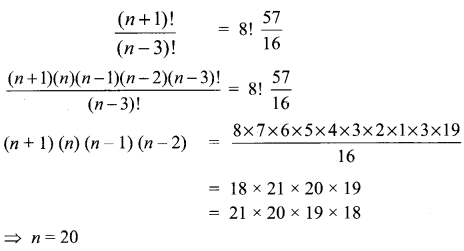
Example: Generating squares of first 10 natural numbers
squares = [ ]
for x in range(1,11):
s = x ** 2
squares.append(s)
print (squares)
Output
[1, 4, 9, 16, 25, 36, 49, 64, 81, 100]

Question 3.
What is nested tuple? Explain with an example.?
Answer:
In Python, a tuple can be defined inside another tuple; called Nested tuple. In a nested tuple, each tuple is considered as an element. The for loop will be useful to access all the elements in a nested tuple.
Example:
Toppers = ((“Vinodini”, “XII-F”, 98.7), (“Soundarya”, “XII-H”, 97.5),
(“Tharani”, “XII-F”, 95.3), (“Saisri”, “XII-G”, 93.8))
for i in Toppers:
print(i)
Output:
(‘Vinodini’, ‘XII-F’, 98.7)
(‘Soundarya’, ‘XII-H’, 97.5)
(‘Tharani’, ‘XII-F’, 95.3)
(‘Saisri’, ‘XII-G’, 93.8)

Question 4.
Explain the different set operations supported by python with suitable example?
Answer:
Set Operations:
As you leamt in mathematics, the python is also supports the set operations such as Union, Intersection, difference and Symmetric difference.
(i) Union:
It includes all elements from two or more sets
Samacheer Kalvi 12th Computer Science Solutions Chapter 9 Lists, Tuples, Sets and Dictionary
In python, the operator | is used to union of two sets. The function union( ) is also used to join two sets in python.
Example: Program to Join (Union) two sets using union operator
set_A={2,4,6,8}
set_B={‘A’, ’B’, ‘C, ‘D’}
U_set=set_A|set_B
print(U_set)
Output:
{’D’, 2, 4, 6, 8, ‘B’, ’C, A’}

(ii) Intersection:
It includes the common elements in two sets
Samacheer Kalvi 12th Computer Science Solutions Chapter 9 Lists, Tuples, Sets and Dictionary
The operator & is used to intersect two sets in python. The function intersection ) is also used to intersect two sets in python.
Example: Program to insect two sets using intersection operator
set_A={A’, 2, 4, ‘D’}
set_B={A’, ‘B’, ‘C’, ‘D’}
print(set_A & set_B)
Output:
{’A, ‘D’}
Example: Program to insect two sets using intersection operator
set_A={‘A’, 2, 4, ’D’}
set_B={A’, ‘B’, ‘C’, ‘D’}
print(set_A.intersection(set_B))
{‘A’, ‘D’}

(iii) Difference:
It includes all elements that are in first set (say set A) but not in the second set (say set B)
Samacheer Kalvi 12th Computer Science Solutions Chapter 9 Lists, Tuples, Sets and Dictionary
The minus (-) operator is used to difference set operation in python. The function difference() is also used to difference operation.
Example: Program to difference of two sets using minus operator
set_A={‘A’, 2, 4, ‘D’} set_B={‘A’, ‘B’, ‘C, ‘D’} print(set_A – set_B)
Output:
{2,4}
Example: Program to difference of two sets using difference function
set_A={‘A’, 2, 4, TV} set_B={‘A’, ’B’, ’C, ’D’} print(set_A.difference(set_B))
Output:
{2,4}

(iv) Symmetric difference:
It includes all the elements that are in two sets (say sets A and B) but not the one that are common to two sets.
Samacheer Kalvi 12th Computer Science Solutions Chapter 9 Lists, Tuples, Sets and Dictionary

The caret (^) operator is used to symmetric difference set operation in python. The function symmetric_difference( ) is also used to do the same operation.
Example: Program to symmetric difference of two sets using caret operator
set_A={‘A’, 2, 4, ‘D’}
set_B={‘A’, ‘B’, ‘C, ‘D’}
print(set_A^A set_B)
Output:
{2, 4, ‘B’, ‘C’}
Example: Program to difference of two sets using symmetric difference function
set_A={‘A’, 2, 4, ‘D’}
set_B={‘A’, ‘B’, ‘C’, ‘D’}
print(set_A. symmetric_difference(set_B))
Output:
{2, 4, ‘B’, ‘C’}

Practice Programs

Question 1.
Write a program to remove duplicates from a list.
Method I:
mylist = [2,4,6,8,8,4,10]
myset = set(mylist)
print(myset)
Output:
{2, 4, 6, 8, 10}
Method II:
def remove(duplicate):
final_list=[ ]
for num in duplicate:
if num not in final_list:
final_list.append(num)
return final_list
duplicate = [2, 4, 10, 20, 5, 2, 20, 4]
print(remove(duplicate))
Output:
[2, 4, 10, 20, 5]

Question 2.
Write a program that prints the maximum value in a Tuple?
Answer:
tuple = (456, 700, 200)
print(“max value : “, max(tuple))
Output:
max value : 700

Question 3.
Write a program that finds the sum of all the numbers in a Tuples using while loop?
Answer:
tuple = (1, 5, 12)
s = 0
i = 0
while(i < len (tuple)):
s = s + tuple[i]
i+ = 1
print(“Sum of elements in tuple is “, s)
Output:
Sum of elements in tuple is 18

Question 4.
Write a program that finds sum of all even numbers in a list?
Answer:
numlist = [ ]
evensum = 0
number = int(input(“Please enter the total no of list elements”))
for i in range(1, number +1):
value = int(input(“Please enter the value “))
numlist.append(value)
for j in range(number):
if(numlist[j]% 2 == 0):
even_sum = even_sum + numlist[j]
print(“Sum of even no. in this list = “, even_sum)
Output:
Please enter the total no of list elements : 5
Please enter the value : 10
Please enter the value : 11
Please enter the value : 12
Please enter the value : 13
Please enter the value : 14
The sum of even no. in this list = 60

Question 5.
Write a program that reverse a list using a loop?
Answer:
def reverse(list):
list.reverse( )
return list
list = [10, 11, 12, 13, 14, 15]
print(reverse(list))
Output:
15, 14, 13, 12, 11, 10

Question 6.
Write a program to insert a value in a list at the specified location?
Answer:
vowel = [‘a’, ‘e’, ‘i’, ‘u’]
vowel.insert(3, ‘o’)
print(‘updated list’, vowel)
Output:
updated list [‘a’, ‘e’, ‘i’, ‘o’, ‘u’]

Question 7.
Write a program that creates a list of numbers from 1 to 50 that are either divisible by 3 or divisible by 6?
Answer:
n = [ ]
s = [ ]
for x in range(1, 51):
n.append(x)
for x in range(1, 51):
if(x%3 == 0) or (x % 6 == 0):
s.append(x)
print(“The numbers divisible by 3 or 6 is “, s)
Output:
The numbers divisible by 3 or 6 is
[3, 6, 9, 12, 15, 18, 21, 24, 27, 30, 33, 36, 39, 42, 45, 48]

Question 8.
Write a program to create a list of numbers in the range 1 to 20. Then delete all the numbers from the list that are divisible by 3?
Answer:
num = [ ]
for x in range(1, 21):
num.append(x)
print(“The list of numbers from 1 to 20 =”, num)
for index, i in enumerate(num):
if(i % 3 == 0)
del num[index]
print(“The list after deleting numbers”, num)
Output:
The list of numbers from 1 to 20 = [1,2,3,4… 20]
The list after deleting numbers[1, 2, 4, 5, 7, 8, 10, 11, 13, 14, 16, 17, 19, 20]

Question 9.
Write a program that counts the number of times a value appears in the list. Use a loop to do the same?
Answer:
a = [ ]
n = int(input”Enter number of elements :”))
for i in range(l, n+1):
b = int(input(“Enter element”))
a.append(b)
k = 0
num = int(input(“Enter the number to be counted : “))
for j in a:
if(j == num):
k = k+1
print(“Number of times”, num, “appears is”, k)
Output:
Enter number of elements : 4
Enter element: 23
Enter element: 45
Enter element: 23
Enter element: 67
Enter the number to be counted : 23
Number of times 23 appears is 2

Question 10.
Write a program that prints the maximum and minimum value in a dictionary?
Answer:
my_dict = {‘x’: 500, ‘y’: 5874, ‘z’: 560}
val = my_dict.values( )
print(‘max value’, max(val))
print(‘min value’, min(val))
Output:
max value 5874
min value 500

Samacheer kalvi 12th Computer Science Lists, Tuples, Sets and Dictionary Additional Questions and Answers

PART – 1
I. Choose The Correct Answer

Question 1.
A list in python is denoted by ………………………..
(a) [ ]
(b) { }
(c) <>
(d) #
Answer:
(a) [ ]

Question 2.
A ………………………… is a sequence data type like strings.
(a) List
(b) Tuples
(c) Set
(d) Dictionary
Answer:
(a) List

Question 3.
Each value of a list is called as –
(a) Set
(b) Dictionary
(c) Element
(d) Strings
Answer:
(c) Element

Question 4.
The position of an element is indexed with numbers beginning with …………………………….
(a) n
(b) n-1
(c) 0
(d) 1
Answer:
(c) 0

Question 5.
(1) mylist[ ] – (i) tuple
(2) mylist[10,[2,4,6]] – (ii) Empty tuple
(3) t=(23,56,89) – (iii) Nested list
(4) lis=( ) – (iv) empty list
(a) 1-(iv), 2-(iii), 3-(i), 4-(ii)
(b) 1-(i), 2-(ii), 3-(iii), 4-(iv)
(c) 1-(iv), 2-(ii), 3-(i), 4-(iii)
(d) 1-(i), 2-(iii), 3-(iv), 4-(ii)
Answer:
(a) 1-(iv), 2-(iii), 3-(i), 4-(ii)

Question 6.
………………………… is used to access an element in a list
(a) element
(b) i
(c) index
(d) tuple
Answer:
(c) index

Question 7.
Index value can be positive or negative in the list.
True / false
Answer:
True

Question 8.
To access the list elements in reverse order, ……………………. value have to be given
(a) 0
(b) positive
(c) imaginery
(d) negative
Answer:
(d) negative

Question 9.
………………………. are used to access all elements from a list.
(a) If
(b) loop
(c) array
(d) tuple
Answer:
(b) loop

Question 10.
Find the Output:
marks = [10, 23, 41, 75]
i = -1
while i >= – 4:
print(marks[i])
i = i + – 1
(o) 1 2 3 4
(b) 10, 23, 41, 75
(c) 75, 41, 23, 10
(d) 0, 41, 23, 0
Answer:
(c) 75, 41, 23, 10

Question 11.
…………………….. operator is used to change the list of elements
(a) =
(b) +
(c) +=
(d) *=
Answer:
(a) =

Question 12.
In changing list elements, …………………………. is the upper limit of this range.
(a) Index from
(b) Index to
(c) Index with
(d) Index
Answer:
(b) Index to

Question 13.
If the range is specified as [1 : 5], it will update the elements from …………………………..
(a) 2 to 4
(b) 1 to 5
(c) 1 to 4
(d) 2 to 5
Answer:
(c) 1 to 4

Question 14.
……………………….. function is used to add a single element in the list.
Answer:
append( )

Question 15.
Write the output,
list = [34, 45, 48]
list.append(90)
(a) [34, 45, 48, 90]
(b) [90, 34, 45, 48]
(c) [34, 90, 45, 48]
(d) [34, 45, 90, 48]
Answer:
(a) [34, 45, 48, 90]

Question 16.
list = [34, 45, 48]
list.extend([71, 32, 29]) results in ………………………….
Answer:
[35, 45, 48, 71, 32, 29]

Question 17.
………………………… function is used to insert an element at any position of a list.
Answer:
insert( )

Question 18.
Find the correct statement from the following
(a) when new element is inserted in the list, the existing elements shift one position to the right
(b) when a new element is inserted in the list, the existing element shifts one position to the left.
Answer:
(a) when new element is inserted in the list, the existing elements shift one position to the right

Question 19.
How many ways of deleting the elements from a list are there?
(a) 1
(b) 2
(c) 3
(d) 4
Answer:
(b) 2

Question 20.
The two ways of deleting elements from a list are ……………………….. and …………………………
Answer:
del and remove( )

Question 21.
Which function is used to delete elements of a list if its index is unknown?
(a) del
(b) delete
(c) remove( )
(d) backspace
Answer:
(c) remove( )

Question 22.
Which statement is used to delete known elements?
(a) del
(b) delete
(c) remove
(d) rem
Answer:
(a) del

Question 23.
………………………… statement deletes the entire list.
Answer:
del

Question 24.
…………………….. function deletes the element using the given index value.
Answer:
pop( )

Question 25.
When you try to print the list which is already cleared, ……………………….. is display without any elements
Answer:
[ ] or empty square bracket

Question 26.
…………………………… function is used to generate a series of values in python
(a) range
(b) series
(c) Fill series
(d) Auto fill
Answer:
(a) range

Question 27.
The range( ) function has ………………………. arguments.
(a) 1
(b) 2
(c) 3
(d) 4
Answer:
(c) 3

Question 28.
Which is an optional argument in range( ) function …………………………..
(a) start value
(b) end value
(c) step value
(d) default
Answer:
(c) step value

Question 29.
The ……………………… function is used to create list in python
Answer:
list( )

Question 30.
……………………… is a simplest way of creating sequence of elements that satisfy a certain conditions returns copy of the list.
Answer:
List comprehension

Question 31.
……………….. returns copy of the list
Answer:
copy( )

Question 32.
x = mylist = [36, 12, 12]
x = mylist.count(12)
print(x) gives the vlaue as
(a) 2
(b) 3
(c) 0
(d) 1
Answer:
(a) 2

Question 33.
………………….. returns the index value of the first recurring element.
Answer:
index( )

Question 34.
How many arguments are there in the sort( ) function?
(a) 1
(b) 2
(c) 3
(d) 4
Answer:
(b) 2

Question 35.
……………………… consists of a number of values separated by comma and enclosed within parenthesis
(a) list
(b) tuples
(c) dictionary
(d) sets
Answer:
(b) tuples

Question 36.
The term ………………………. in latin represents an abstraction of the sequence of numbers.
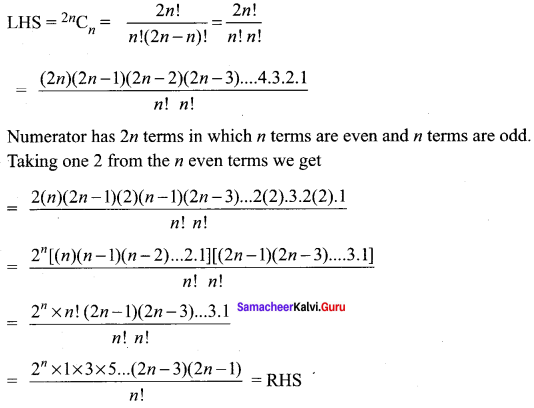
(a) list
(b) tuples
(c) set
(d) dictionary
Answer:
(b) tuples

Question 37.
Identify the wrong statement from the following:
(a) The elements of the tuple are enclosed by parenthesis.
(b) The elements of a tuple can be even defined without parenthesis
(c) The list elements have to be given in square brackets
(d) Iterating list is faster than tuples.
Answer:
(d) Iterating list is faster than tuples.

Question 38.
The …………………….. function is used to create tuples from a list.
Answer:
tuple( )

Question 39.
Creating a tuple with one element is called ……………………….. tuple.
Answer:
Singleton

Question 40.
Find the wrong tuple.
(a) mytup = (10)
(b) mytup = (10)
(c) print(tup[: ])
(d) tup(10, 20)
Answer:
(d) tup(10, 20)

Question 41.
To delete an entire tuple, …………………….. command is used.
(a) del
(b) delete
(c) clear
(d) remove
Answer:
(a) del

Question 42.
Which operator is used to join two tuples?
(a) –
(b) _
(c) +
(d) +:
Answer:
(c) +

Question 43.
…………………….. assignment is a powerful feature in python.
Answer:
Tuple

Question 44.
(x, y) = (3**2, 15%2)
print(x,y) gives the answer
(a) 6 1
(b) 6 7
(c) 9 1
(d) 9 7
Answer:
(c) 9 1

Question 45.
Which one of the following is the tuple assignment operator?
(a) +=
(b) =
(c) ==
(d) *=
Answer:
(b) =

Question 46.
How many values can be returned by the functions in python?
(a) 1
(b) 2
(c) 3
(d) many
Answer:
(d) many

Question 47.
A tuple defined in another tuple is called as ……………………….
Answer:
Nested tuple

Question 48.
…………………………. feature is used to include membership testing and eliminate duplicate elements.
Answer:
Set

Question 49.
A …………………………… is a mutable and an unordered collection of elements without duplicates.
Answer:
Set

Question 50.
Which is true related to sets?
(a) mutable
(b) unordered
(c) No duplicates
(d) All are true
Answer:
(d) All are true

Question 51.
A list or tuples can be converted as set by using …………………………. function?
(a) set
(b) create set
(c) change
(d) alter
Answer:
(a) set

Question 52.
Which operator joins two sets?
(a) +
(b) |
(c) ||
(d) &
Answer:
(b) |

Question 53.
Join is called as ……………………… in sets
(a) union
(b) intersection
(c) difference
(d) symmetric difference
Answer:
(a) union

Question 54.
Identify the intersection operator.
(a) +
(b) –
(c) .
(d) &
Answer:
(d) &

Question 55.
Which operator is used to do difference in set?
(a) +
(b) –
(c) :
(d) &
Answer:
(b) –

Question 56.
Which is the symmetric difference operator?
(a) +
(b) –
(c) ^
(d) &
Answer:
(c) ^

Question 57.
………………………. is used to separate the elements in the dictionary
Answer:
Comma

Question 58.
The key value pairs are enclosed with ……………………………
(a) <>
(b) [ ]
(c) { }
(d) ( )
Answer:
(c) { }

Question 59.
The mixed collection of elements are called as ………………………….
(a) list
(b) tuples
(c) sets
(d) dictionary
Answer:
(d) dictionary

Question 60.
Identify the correct statement.
(a) The dictionary type stores a index along with its element
(b) The dictionary type stores a key along with its element
Answer:
(a) The dictionary type stores a index along with its element

Question 61.
Which part is optional in dictionary comprehension?
(a) If
(b) expression
(c) var
(d) sequences
Answer:
(a) If

Question 62.
Find the statement which is wrong. When you assign a value to the key
(a) it will be appended
(b) it will overwrite the old data
Answer:
(a) it will be appended

Question 63.
Pick odd one with including elements in list.
(a) append( )
(b) extend( )
(c) insert( )
(d) include
Answer:
(d) include

Question 64.
Pick the odd one with deleting elements from a list.
(a) del
(b) remove( )
(c) pop( )
(d) clear
Answer:
(d) clear

PART – II
II. Answer The Following Questions

Question 1.
Write note on nested list?
Answer:
Mylist = [ “Welcome”, 3.14, 10, [2, 4, 6] ]
In the above example, Mylist contains another list as an element. Nested list is a list containing another list as an element.

Question 2.
Fill the table
Answer:
marks = [10, 23, 41, 75]
Samacheer Kalvi 12th Computer Science Solutions Chapter 9 Lists, Tuples, Sets and Dictionary
Example
Marks [10, 23, 41, 75]
Samacheer kalvi 12th Computer Science Solutions Chapter 9 Lists, Tuples, Sets and Dictionary

Question 3.
Give the syntax to access an element from a list?
Answer:
To access an element from a list, write the name of the list, followed by the index of the element enclosed within square brackets.
Syntax:
List_Variable = [El, E2, E3 …………….. En]
print (List_Variable [index ofa element])

Question 4.
What is meant by Reverse Indexing?
Answer:
Python enables reverse or negative indexing for the list elements. Thus, python lists index in opposite order. The python sets -1 as the index value for the last element in list and -2 for the preceding element and so on. This is called as Reverse Indexing.

Question 5.
Give the syntax for changing list elements?
Answer:
Syntax:
List_Variable [index of an element] = Value to be changed
List_Variable [index from : index to] = Values to changed
Where, index from is the beginning index of the range; index to is the upper limit of the range which is excluded in the range.

Question 6.
Give the syntax for append, extend and insert?
Answer:
Syntax:
List.append (element to be added)
List, extend ( [elements to be added])
List, insert (position index, element)

Question 7.
Differentiate clear( ) and del in list?
Answer:
The function clear( ) is used to delete all the elements in list, it deletes only the elements and retains the list. Remember that, the del statement deletes entire list.

Question 8.
How will you create a list with series of value?
Answer:
Using the range( ) function, you can create a list with series of values. To convert the result of range( ) function into list, we need one more function called list( ). The list( ) function makes the result of range( ) as a list.
Syntax:
List_Varibale = list (range ( ))

Question 9.
Write note on list comprehensions?
Answer:
List comprehensions:
List comprehension is a simplest way of creating sequence of elements that satisfy a certain condition.
Syntax:
List = [expression for variable in range]

Question 10.
Define singleton tuple?
Answer:
While creating a tuple with a single element, add a comma at the end of the element. In the absence of a comma, Python will consider the element as an ordinary data type; not a tuple. Creating a Tuple with one element is called “Singleton” tuple.
MyTup5 = (10,)

Question 11.
Write note on dictionary comprehensions?
Answer:
In Python, comprehension is another way of creating dictionary. The following is the syntax of creating such dictionary.
Syntax
Diet = { expression for variable in sequence [if condition] }

PART – III
III. Answer The Following Questions

Question 1.
How will you create a list in python? Explain with syntax and examples?
Answer:
In python, a list is simply created by using square bracket. The elements of list should be specified within square brackets. The following syntax explains the creation of list.
Syntax:
Variable = [element – 1, element – 2, element – 3 element – n]
Example:
Marks = [10, 23, 41, 75]

Question 2.
How will you find the length of the list. Give example?
Answer:
The len( ) function in Python is used to find the length of a list, (i.e., the number of elements in a list). Usually, the len( ) function is used to set the upper limit in a loop to read all the elements of a list. If a list contains another list as an element, len( ) returns that inner list as a single element.
Example :Accessing single element
>>> MySubject = [“Tamil”, “English”, “Comp. Science”, “Maths”]
>>> len(MySubject)
4

Question 3.
Give the 3 different syntax formats for deleting the elements from a list?
Answer:
Syntax:
del List [index of an element]
# to delete a particular element del List [index from : index to]
# to delete multiple elements
del List
# to delete entire list

Question 4.
Give the syntax for remove, pop and clear?
Answer:
Syntax:
List.remove(element) # to delete a particular element
List.pop(index of an element)
List, clear( )

Question 5.
Write a program that creates a list of numbers from 1 to 20 that are divisible by 4. Program to create a list of numbers from 1 to 20 that are divisible by 4
Answer:
divBy4=[ ]
for i in range(21):
if (i%4= =0):
divBy4.append(i)
print(divBy4)
Output
[0, 4, 8, 12, 16, 20]

Question 6.
Write a program to join two tuple assignment?
Answer:
# Program to join two tuples
Tup 1 = (2,4,6,8,10)
Tup2 = (1,3,5,7,9)
Tup3 = Tup1 + Tup2
print(Tup3)
Output
(2,4,6,8,10,1,3,5,7,9)

Question 7.
Write note on tuple assignment?
Answer:
Tuple assignment is a powerful feature in Python. It allows a tuple variable on the left of the assignment operator to be assigned to the values on the right side of the assignment operator.
Samacheer Kalvi 12th Computer Science Solutions Chapter 9 Lists, Tuples, Sets and Dictionary
Example
>>> (a, b, c) = (34, 90, 76)
>>> print(a,b,c)
34 90 76
# expression are evaluated before assignment
>>> (x, y, z, p) = (2**2, 5/3+4, 15%2, 34>65)
>>> print(x,y,z,p)
4 5.666666666666667 1 False

Question 8.
How will you create a set in python?
Answer:
A set is created by placing all the elements separated by comma within a pair of curly brackets.
The set( ) function can also used to create sets in Python.
Syntax:
Set Variable = {El, E2, E3 ………………. En}
Example:
>>> S1={1,2,3,’A’,3.14}
>>> print(S1)
{1,2, 3, 3.14, ‘A’}
>>> S2={1,2,2,’A’,3.14}
>>> print(S2)
{1,2,’A’, 3.14}

Question 9.
Write note on dictionaries. Give syntax?
Answer:
A dictionary is a mixed collection of elements. The dictionary type stores a key along with its element. The keys in a Python dictionary is separated by a colon ( : ) while the commas work as a separator for the elements. The key value pairs are enclosed with curly braces { }. Syntax of defining a dictionary:
Dictionary_Name =
{ Key_l: Value_1,
Key_2: Value_2,
……………..
Key_n: Value_n
}

PART – IV
IV. Answer The Following Questions

Question 1.
Explain Various Functions in list?
Answer:
Samacheer Kalvi 12th Computer Science Solutions Chapter 9 Lists, Tuples, Sets and Dictionary

Question 2.
Write a python program using list to read marks of six subjects and to print the marks scored in each subject and show the total marks.
Python program to read marks of six subjects and to print the marks scored in each subject and show the total marks
Answer:
marks=[ ]
subjects=[‘Tamir, ‘English’, ‘Physics’, ‘Chemistry’, ‘Comp. Science’, ‘Maths’]
for i in range(6):
m=int(input(“Enter Mark = “))
marks.append(m)
for j in range(len(marks)):
print(“{ }. { } Mark= { } “.format(jl+,subjects[j],marks[j]))
print(“Total Marks = “, sum(marks))
Output

  • Enter Mark = 45
  • Enter Mark = 98
  • Enter Mark = 76
  • Enter Mark = 28
  • Enter Mark = 46
  • Enter Mark = 15
    1. Tamil Mark = 45
    2. English Mark = 98
    3. Physics Mark = 76
    4. Chemistry Mark = 28
    5. Comp. Science Mark = 46
    6. Maths Mark = 15
    7. Total Marks = 308

Question 3.
Write a program using list to generate the Fibonacci series and find sum. Program to generate in the Fibonacci series and store it in a list. Then find the sum of all values?
Answer:
a=-1
b=1
n=int(input(“Enter no. of terms: “))
i=0
sum=0
Fibo=[ ]
while i<n:
s = a + b
Fibo.append(s)
sum+=s
a = b
b = s
i+=1
print(“Fibonacci series upto “+ str(n) +” terms is : ” + str(Fibo))
print(“The sum of Fibonacci series: “,sum)
Output
Enter no. of terms: 10
Fibonacci series upto 10 terms is : [0, 1, 1, 2, 3, 5, 8, 13, 21, 34]
The sum of Fibonacci series: 88

Question 4.
Write a program to swap two values using tuple assignment
Program to swap two values using tuple assignment
Answer:
a = int(input(“Enter value of A: “))
b = int(input(“Enter value of B: “))
print(“Value of A = “, a, “\n Value of B = “, b)
(a, b) = (b, a)
print(“Value of A = “, a, “\n Value of B = “, b)
Output:
Enter value of A: 54
Enter value of B: 38
Value of A = 54
Value of B = 38
Value of A = 38
Value of B = 54

Question 5.
Write a program using a function that returns the area and circumference of a circle whose radius is passed as an argument two values using tuple assignment. Program using a function that returns the area and circumference of a circle whose radius is passed as an argument. Assign two values using tuple assignment:
Answer:
pi = 3.14
def Circle(r):
return (pi*r*r, 2*pi*r)
radius = float(input(“Enter the Radius! “))
(area, circum) = Circle(radius)
print (“Area of the circle = “, area)
print (“Circumference of the circle = “, circum)
Output:
Enter the Radius: 5
Area of the circle = 78.5
Circumference of the circle = 31.400000000000002

Samacheer Kalvi 11th Computer Applications Solutions Chapter 5 Working with Typical Operating System (Windows & Linux)

Students can Download Computer Applications Chapter 5 Working with Typical Operating System (Windows & Linux) Questions and Answers, Notes Pdf, Samacheer Kalvi 11th Computer Applications Book Solutions Guide Pdf helps you to revise the complete Tamilnadu State Board New Syllabus and score more marks in your examinations.

Tamilnadu Samacheer Kalvi 11th Computer Applications Solutions Chapter 5 Working with Typical Operating System (Windows & Linux)

Samacheer Kalvi 11th Computer Applications Working with Typical Operating System (Windows & Linux) Text Book Back Questions and Answers

I. Choose The Correct Answer

11th Computer Application Chapter 5 Book Back Answers Question 1.
From the options given below, choose the operations managed by the operating system.
(a) memory
(b) processes
(c) disks and I/O devices
(d) all of the above
Answer:
(d) all of the above

Samacheer Kalvi 11th Computer Application Question 2.
Which is the default folder for many Windows Applications to save your file?
(a) My Document
(b) My Pictures
(c) Documents and Settings
(d) My Computer
Answer:
(a) My Document

11th Computer Application Samacheer Kalvi Question 3.
Under which of the following OS, the option Shift + Delete – permanently deletes a file or folder?
(a) Windows 7
(b) Windows 8
(c) Windows 10
(d) None of the OS
Answer:
(a) Windows 7

Samacheer Kalvi Computer Application Question 4.
What is the meaning of “Hibernate” in Windows XP/Windows 7?
(a) Restart the Computer in safe mode
(b) Restart the Computer in hibernate mode
(c) Shutdown the Computer terminating all the running applications
(d) Shutdown the Computer without closing the running applications
Answer:
(d) Shutdown the Computer without closing the running applications

Samacheer Kalvi Guru 11th Computer Application Question 5.
Which of the following OS is not based on Linux?
(a) Ubuntu
(b) Redhat
(c) CentOs
(d) BSD
Answer:
(d) BSD

11th Samacheer Kalvi Computer Application Question 6.
Which of the following in Ubuntu OS is used to view the options for the devices installed?
(a) Settings
(b) Files
(c) Dash
(d) VBox_GAs_5.2.2
Answer:
(d) VBox_GAs_5.2.2

11th Computer Applications Samacheer Kalvi Question 7.
Identify the default email client in Ubuntu:
(a) Thunderbird
(b) Firefox
(c) Internet Explorer
(d) Chrome
Answer:
(a) Thunderbird

11th Computer Application Book Back Answers Question 8.
Which is the default application for spreadsheets in Ubuntu?
(a) LibreOffice Writer
(b) LibreOffice Calc
(c) LibreOffice Impress
(d) LibreOffice Spreadsheet
Answer:
(b) LibreOffice Calc

Question 9.
Which is the default browser for Ubuntu?
(a) Firefox
(b) Internet Explorer
(c) Chrome
(d) Thunderbird
Answer:
(a) Firefox

Question 10.
Where will you select the option to log out, suspend, restart, or shut down from the desktop of Ubuntu OS?
(a) Session Indicator
(b) Launcher
(c) Files
(d) Search
Answer:
(a) Session Indicator

II. Short Answers.

Question 1.
Differentiate cut and copy options?
Answer:
Cut:

  1. When an object is cut from a document, it is completely removed and placed into a clipboard.
  2. Ctrl X and Ctrl V is the shortcut command for cut and paste.

Copy:

  1. When an object is copied a duplicate of it is placed into a clipboard while the original remains in place. .
  2. Ctrl + C and Ctrl + V is the shortcut command for copy and paste.

Question 2.
What is the use of a file extension?
Answer:
The extension of the file name simply says the format in which the data in the file is stored.
Eg: If a file is named letter.doc, the .doc is the file extension, and it tells windows that the file was created with microsoft word.

Question 3.
Differentiate Files and Folders?
Answer:
Files:

  1. A file is a collection of data on a single unit. It can be anything from a word file to a music, video or photo file.
  2. Files have a size ranging from a few bytes to several giga bytes.

Folders:

  1. Folders are places where files are stored. Folders can contain folders inside them.
  2. Folders take up no space on hard drive.

Question 4.
Differentiate save and save as option?
Answer:
Save:
The ‘save’ simply saves our work by updating the last saved version of the file to match the current version we see on our screen.

Save as:
The ‘save as’ brings upto save our work as a file with a different name.

Question 5.
What is Open Source?
Answer:

  1. Open Source refers to a program or software in which the source code is available in the web to the general public free of cost.
  2. Open Source code is typically created as a collaborative effort in which programmers continuously improve*upon the source code in the web and share the changes within the community.

Question 6.
What are the advantages of open source?
Answer:
The advantages of open sources are better security, better quality, more control, no vendor dependence, easier licence management.

Question 7.
Mention the different server distributions in Linux OS?
Answer:

  1. UbuntuLinux – LinuxMint
  2. Arch Linux – Deepin
  3. Fedora – Debian
  4. CentOS

Question 8.
How will you log off from Ubuntu OS?
Answer:
When you have finished working on your computer, you can choose to Log Out, Suspend or Shut down through the Session Indicator on the far right side of the top panel.

III. Answer in Brief.

Question 1.
Analyse: Why the drives are segregated?
Answer:
A driver is a program that lets the operating system communicate with specific computer hardware. Computer parts need a driver because they do not use standard commands, a driver written for Linux cannot be used by Microsoft windows.
Eg:

  1. Sound Card Drivers allow multi-media to deliver sound to the computer speakers.
  2. The Audio Driver controls instruction sets to the audio card.
  3. The Graphics Card Driver is responsible for managing the content of the images displayed on a computer monitor.
  4. Modems Driver are responsible for connecting a computer to a telephone-based network.

Question 2.
If you are working on multiple files at a time, sometimes the system may hang. What is the reason behind it. How can you reduce it?
Answer:
Each program or files we open our computer takes some of the computer resources to keep it running. If we have too many programs open at one time, our computer may be low on resources and as a result it slows down or it may hang. Try only one program running at a time to make sure our hang-ups is not being caused by multiple programs running at the same time.

An easy way to determine our computer in this situation is by pressing the Num Lock button on the keyboard and watching the Num Lock to see if it turns off and on. If we can get the light to turn off and on, press Ctrl + Alt + Del and End Task for the hang-up files.

Question 3.
Are drives such as hard drive and floppy drives represented with drive letters? If so why, if not why?
Answer:
The drive letters plays an important role in telling windows where to look. All the computers with a hard drive will always have that default hard drive assigned to a C: and for floppy drivers has a drive letter of A.

Question 4.
Write the specific use of Cortana?
Answer:
Cortana – the personal assistant feature from windows phone. This has become a major part of windows 10 doing double duty as a web search and a start menu / windows search. Plus the ability to search by voice.

Question 5.
List out the major differences between Windows and Ubuntu OS?
Answer:
Windows OS:

  1. Windows is a GUI based operating system.
  2. Windows is a closed source.
  3. Windows is strictly microsoft company based.

Ubuntu OS:

  1. Ubuntu is a Linux based operating system.
  2. Ubuntu is an open-source operating system.
  3. It is based around the company canonical and is also community based.

Question 6.
Ark there any difficulties you face while using Ubuntu? If so, mention it with reasons?
Answer:
Yes, Many difficulties are these while using Ubuntu operating system.

  1. A lack of familiarity and shared experiences fragments users they do not have a shared any points.
  2. Many Linux newbies start with Ubuntu. This should not take away from Ubuntu, it is a testament to its smart design and ease of use.
  3. Ubuntu has come a long way regarding hardware compatibility and some accessory hardware will not have the needed software to interface.

Question 7.
Differentiate Thunderbird and Firefox in Ubuntu OS?
Answer:
Thunderbird:

  1. Ubuntu has in-built email software called Thunderbird.
  2. It gives the user Access to email such as Gmail, Hotmail etc.,
  3. There are free applications for users to view and edit photos, to manage and share videos.

Firefox:

  1. Firefox is a internet browser, you can directly browse the internet.
  2. It is the fastest browser and numerous features that protect you, from viruses and other common exploits.
  3. Firefox has some advanced security measures that guard against the spyware and viruses.

Question 8.
Differentiate Save, Save As and Save a Copy in Ubuntu OS?
Answer:
Save:
This will save the document without asking for a new name or location. It will over-write the original.

SaveAs:
This will prompt you to save the document using a dialog box. You will have the ability to change the file name of location.

Save a Copy:
This will prompt you to save a copy using the same dialog box as save as. You will have the ability to change the file name or location. If you changed the name or location of the document you will be working on the original document not the copy. That meAnswer:if you make additional changes and then hit save the original will be overwritten with new changes, but the copy you saved earlier will be left at the state of the ‘save a copy’.

IV. Answer in detail.

Question 1.
Explain the versions of Windows Operating System?
Answer:
11th Computer Application Chapter 5 Book Back Answers Working With Typical Operating System Samacheer Kalvi

Question 2.
Draw and compare the icon equivalence in Windows and Ubuntu?
Answer:
Samacheer Kalvi 11th Computer Application Solutions Chapter 5 Working With Typical Operating System (Windows & Linux)

Question 3.
Complete the following matrix:
Answer:
11th Computer Application Samacheer Kalvi Solutions Chapter 5 Working With Typical Operating System (Windows & Linux)

Question 4.
Observe the figure and mark all the window elements. Identify the version of the Windows OS?
Answer:
Samacheer Kalvi Computer Application 11th Solutions Chapter 5 Working With Typical Operating System (Windows & Linux)
All the Window elements are same. The version of OS is Windows 10.

Question 5.
Write the procedure to create, rename, delete and save a file in Ubuntu OS. Compare it with Windows OS?
Answer:
The procedure to create, rename, delete and save a file in Ubuntu OS is similar to windows OS. You can create, rename, delete and save the files and folders with the same procedure by clicking files icon. The some related figure on the desktop represents creating a file or folder by right clicking in the Desktop.

A New Folder can also be created by using menus in the files icon. A document created by you can be moved to ‘trash’ by using right click or by using menus as in windows.
All the other options like rename, cut, copy can be performed by using right click or by using menus as windows.

Samacheer Kalvi 11th Computer Applications Working with Typical Operating System (Windows & Linux) Additional Questions and Answers

I. Choose The Correct Answer.

Question 1.
Microsoft windows is a …………………… based operating system.
(a) GUI
(b) command driven
(c) window
(d) menu driven
Answer:
(a) GUI

Question 2.
Multiple applications which can execute simultaneously in windows is known as:
(a) multi programming
(b) multi tasking
(c) time sharing
(d) based on priority
Answer:
(b) multi tasking

Question 3.
…………………….. is used to interact windows by clicking its elements.
(a) Keyboard
(b) Light pen
(c) Mouse
(d) Scanner
Answer:
(c) Mouse

Question 4.
…………………… is used to enter alphabets and characters.
(a) Light pen
(b) Mouse
(c) Notes taker
(d) Keyboard
Answer:
(d) Keyboard

Question 5.
Multiple desktop is available in:
(a) windows XP
(b) windows vista
(c) windows 8
(d) windows 10
Answer:
(d) windows 10

Question 6.
The opening screen of windows is called:
(a) desktop
(b) icons
(c) windows
(d) documentation
Answer:
(a) desktop

Question 7.
The ……………………. is an area on the screen that displays information for a specific program.
(a) desktop
(b) icons
(c) window
(d) document
Answer:
(c) window

Question 8.
The larger window is called the:
(a) document window
(b) application window
(c) workspace
(d) scroll bar
Answer:
(b) application window

Question 9.
The first level in a multilevel or hierarchial directory system is:
(a) root directory
(b) additional directory
(c) sub directories
(d) directories
Answer:
(a) root directory

Question 10.
The first level in a multilevel or hierarchical directory system is:
(a) Ctrl + X
(b) Ctrl + C
(c) Ctrl + V
(d) Ctrl + S
Answer:
(a) Ctrl + X

Question 11.
The shortcut keyboard command to cut is:
(a) Ctrl + X
(b) Ctrl + C
(c) Ctrl + V
(d) Ctrl + A
Answer:
(b) Ctrl + C

Question 12.
The shortcut keyboard command to paste is:
(a) Crtl + X
(b) Ctrl + C
(c) Ctrl + V
(d) Ctrl + A
Answer:
(c) Ctrl + V

Question 13.
The paste option is on …………………… menu.
(a) edit
(b) file
(c) view
(d) tools
Answer:
(a) edit

Question 14.
……………………. switches to another user account on the computer without closing the open programs and windows processes.
(a) Log off
(b) Restarting the computer
(c) Shut down
(d) Switch user
Answer:
(d) Switch user

Question 15.
……………………….. shows the name of the currently selected directory.
(a) Tool bar
(b) ftlenu bar
(c) Task bar
(d) Title bar
Answer:
(d) Title bar

Question 16.
……………………… displays your directory browsing history, location in the file system, a search button and options for the current directory view.
(a) Toolbar
(b) Menu bar
(c) Task bar
(d) Title bar
Answer:
(a) Toolbar

Question 17.
Windows 7 was released in:
(a) October 2012
(b) September 2014
(c) October 2009
(d) October 2015
Answer:
(c) October 2009

Question 18.
At the very bottom of the screen is a horizontal bar called the:
(a) tool bar
(b) menu bar
(c) task bar
(d) title bar
Answer:
(c) task bar

Question 19.
We can select multiple files by holding down the key.
(a) Alt
(b) Shift
(c) Ctrl
(d) Home
Answer:
(c) Ctrl

Question 20.
……………………. is located at the top of the screen.
(a) Tool bar
(b) Menu bar
(c) Task bar
(d) Title bar
Answer:
(b) Menu bar

I. Short Answers.

Question 1.
What is an operating system?
Answer:
An Operating System (OS) is a system software that enables the hardware to communicate and operate with other software. It also acts as an interface between the user and the hardware and controls the overall execution of the computer.

Question 2.
What is Desktop?
Answer:
The opening screen of Windows is called ‘Desktop’. The desktop shows the Start button, Taskbar, Notification Area and date and time.

Question 3.
What is an Icon?
Answer:
Icon is a graphic symbol representing the window elements like files, folders, shortcuts etc., Icons play a vital role in GUI based applications.

Question 4.
What is window?
Answer:
Window is a typical rectangular area in an application or a document. It is an area on the screen that displays information for a specific program.

Question 5.
What is Application Window?
Answer:
It is an area on a computer screen with defined boundaries, and within which information is displayed. Such windows can be resized, maximized, minimized, placed side by side, overlap, and so on.

Question 6.
What is document window?
Answer:
The smaller window, which is inside the Application Window, is called the Document window. This Window is used for typing, editing, drawing, and formatting the text and graphics.

Question 7.
Where the task bar is located? What it contains?
Answer:
At the bottom of the screen is a horizontal bar called the taskbar. This bar contains (from left to right) the Start button, shortcuts to various programs, minimized programs and in the extreme right comer you can see the system tray which consist of volume control, network, date and time etc. Next to the Start button is the quick Launch Toolbar which contains task for frequently used applications.

Question 8.
What is meant by multitasking?
Answer:
Multiple applications can execute simultaneously in Windows, and this is known as “multitasking”.

Question 9.
What is launcher?
Answer:
The vertical bar of icons on the left side of the desktop is called the Launcher. The Launcher provides easy access to applications, mounted devices, and the Trash. All current applications on your system will place an icon in the Launcher.

Question 10.
How will you delete a file in Ubuntu OS?
Answer:
A file / folder created by you can be moved to trash by using right click or by using menu.

Question 11.
Define Ubuntu?
Answer:
Ubuntu is a Linux-based operating system. It is designed for computers, smartphones, and network servers. The system is developed by a UK based company called Canonical Ltd.
Ubuntu was conceived in 2004 by Mark Shuttleworth, a successful South African entrepreneur, and his company Canonical Ltd.

Question 12.
Define Trash?
Answer:
Trash is the equivalent of Recycle bin of windows OS. All the deletted files and folders are moved here.

II. Answer in Brief.

Question 1.
List the functions of an operating system?
Answer:

  1. Memory Management
  2. Process Management
  3. Device Management
  4. File Management
  5. Security Management
  6. Control overall system performance
  7. Error detecting aids
  8. Coordination between other software and users.

Question 2.
Write some of the most popular operating systems?
Answer:

  1. Windows Series – for desktop and laptop computers.
  2. Android – for smart phones.
  3. iOS – for Apple phones, i-Pad and i-Pod.
  4. Linux – Open source Operating System for desktop and server.

Question 3.
Write down the various mouse actions?
Answer:
Action:

  1. Point to an item
  2. Click
  3. Right click
  4. Double-click
  5. Drag and drop

Reaction:

  1. Move the mouse pointer over the item.
  2. Point to the item on the screen, press and release the left mouse button.
  3. Point to the item on the screen, press and release the right mouse button. Clicking the right mouse button displays a pop up menu with various options.
  4. Point to the item on the screen, quickly press twice the left mouse button:
  5. Point to an item then hold the left mouse button as you move the pointer and when you have reached the desired position, release the mouse button.

Question 4.
Explain the icons in windows operating system?
Answer:
Icon:
It is a graphic symbol representing the window elements like files, folders, shortcuts etc., Icons play a vital role in GUI based applications.

Standard Icons:
The icons which are available on desktop by default while installing Windows OS are called standard icons. The standard icons available in all Windows OS are My Computer, Documents and Recycle Bin.

Shortcut Icons:
It can be created for any application or file or folder. By double clicking the icon, the related application or file or folder will open. This represents the shortcut to open a particular application.

Disk drive icons:
The disk drive icons graphically represent five disk drive options

  1. Hard disk
  2. CD-ROM/DVD Drive
  3. Pen drive
  4. Other removable storage such as mobile, smart phone, tablet etc.,
  5. Network drives if your system is connected with other system.

Question 5.
Write the difference between the application window and the document window?
Answer:
Application Window:

  1. The larger window is called the Application Window.
  2. This window helps the user to communicate with the Application Program.

Document Window:

  1. The smaller window, which is inside the Application Window is called the Document Window.
  2. This window is used for typing, editing, drawing and formatting the text and graphics.

Question 6.
Write the ways of creating folders in windows?
Answer:
Method I:
Step 1: Open Computer Icon.
Step 2: Open any drive where you want to create a new folder. (For example select D:)
Step 3: Click on File → New → Folder.
Step 4: A new folder is created with the default name “New folder”.
Step 5: Type in the folder name and press Enter key.

Method II:
In order to create a folder in the desktop:
Step 1: In the Desktop, right click → New → Folder.
Step 2: A Folder appears with the default name “New folder” and it will be highlighted.
Step 3: Type the name you want and press Enter Key.
Step 4: The name of the folder will change.

Question 7.
Write the steps to delete a file or folders in windows?
Answer:
Select the file or folder you wish to delete.

  1. Right- click the file or folder, select Delete option from the po-pup menu or Click File → Delete or press Delete key from the keyboard.
  2. The file will be deleted and moved to the Recycle bin.

Question 8.
Write short note on Recycle Bin?
Answer:
Recycle bin is a special folder to keep the files or folders deleted by the user, which meAnswer:you still have an opportunity to recover them. The user cannot access the files or folders available in the Recycle bin without restoring it. To restore file or folder from the Recycle Bin.

  1. Open Recycle bin.
  2. Right click on a file or folder to be restored and select Restore option from the pop-up menu.
  3. To restore multiple files or folders, select Restore all items.
  4. To delete all files in the Recycle bin, select Empty the Recycle Bin.

Question 9.
Write the steps to create shortcuts on the Desktop?
Answer:
Shortcuts to your most often used folders and files may be created and placed on the Desktop to help automate your work.

  1. Select the file or folder that you wish to have as a shortcut on the Desktop.
  2. Right click on the file or folder.
  3. Select Send to from the shortcut menu, then select Desktop (create shortcut) from the sub-menu.
  4. A shortcut for the file or folder will now appear on your desktop and you can open it from the desktop in the same way as any other icon.

Question 10.
Write the significant features of Ubuntu?
Answer:

  1. The desktop version of Ubuntu supports all normal software like Windows such as Firefox, Chrome, VLC, etc.
  2. It supports the office suite called LibreOffice.
  3. Ubuntu has in-built email software called Thunderbird, which gives the user access to email such as Exchange, Gmail, Hotmail, etc.
  4. There are free applications for users to view and edit photos, to manage and share videos.
  5. It is easy to find content on Ubuntu with the smart searching facility.
  6. The best feature is, it is a free operating system and is backed by a huge open source community.

Question 11.
What is Ambiance?
Answer:
The default desktop background, or wallpaper, belonging to the default Ubuntu 16.04 theme known as Ambiance.

Question 12.
Write the .steps to create files in the windows?
Answer:
Wordpad is an in-built word processor application in Windows OS to qreate and manipulate text documents.
In order to create files in wordpad you need to follow the steps given below.

  1. Click Start → All Programs → Accessories → Wordpad or Run → type Wordpad, click OK. Wordpad window will be opened.
  2. Type the contents in the workspace and save the file using File → Save or Ctrl + S.
  3. Save As dialog box will be opened.
  4. In the dialog box, select the location where you want to save the file by using look in drop down list box.
  5. Type the name of the file in the file name text box.
  6. Click save button.

III. Answer in detail.

Question 1.
Draw and explain the elements of windows?
Answer:
Title Bar:
The title bar will display the name of the application and the name of the document opened. It will also contain minimize, maximize and close button.

Menu Bar:
The menu bar is seen under the title bar. Menus in the menu bar can be accessed by pressing Alt key and the letter that appears underlined in the menu title. Additionally, pressing Alt or F10 brings the focus on the first menu of the menu bar.

In Windows 7, in the absence of the menu bar, click Organize and from the drop down menu, click the Layout option and select the desired item from that list.

The Workspace:
The workspace is the area in the document window to enter or type the text of your document.
Samacheer Kalvi Guru 11th Computer Application Solutions Chapter 5 Working With Typical Operating System (Windows & Linux)

Scroll bars:
The scroll bars are used to scroll the workspace horizontally or vertically.

Comers and borders:
The comers and borders of the window helps to drag and resize the windows. The mouse pointer changes to a double headed arrow when positioned over a border or a comer. Drag the border or comer in the direction indicated by the double headed arrow to the desired. The window can be resized by dragging the comers diagonally across the screen.

Question 2.
Write the steps to log off / shut down the computer?
Answer:

  • Click start → log off (click the arrow next to Shut down) or Start → Shutdown.
  • If you have any open programs, then you will be asked to close them or windows will Force shut down, you will lose any un-saved information if you do this.
  • Switch User: Switch to another user account on the computer without closing your open programs and Windows processes.
  • Log Off: Switch to another user account on the computer after closing all your open programs and Windows processes.
  • Lock: Lock the computer while you’re away from it.
  • Restart: Reboot the computer. (This option is often required as part of installing new software or Windows update.)
  • Sleep: Puts the computer into a low-power mode that retains all mnning programs and open Windows in computer memory for a super-quick restart.
  • Hibernate (found only on laptop computers): Puts the computer into a low-power mode after saving all mnning programs and open windows on the machine’s hard drive for a quick restart.

Question 3.
Explain the different method of renaming files and folders?
Answer:
There are number of ways to rename files or folders. You can rename using the File menu, left mouse button or right mouse button.
Method I:
Using the FILE Menu

  1. Select the File or Folder you wish to Rename.
  2. Click File → Rename.
  3. Type in the new name.
  4. To finalise the renaming operation, press Enter.

Method II:
Using the Right Mouse Button

  1. Select the file or folder you wish to rename.
  2. Click the right mouse button over the file or folder.
  3. Select Rename from the popmp menu.
  4. Type in the new name.
  5. To finalise the renaming Operation, press Enter.
  6. The folder “New Folder” is renamed as C++.

Method III:
Using the Left Mouse Button

  1. Select the file or folded you wish to rename.
  2. Press F2 or click over the file or folder. A surrounding rectangle will appear around the name.
  3. Type in the new name.
  4. To finalise the renaming operation, press Enter.

Question 4.
What are the different method of copying files and folders to removable disk?
Ans
There are several methods of transferring files to or from a removable disk.

  1. Copy and Paste
  2. Send To

Method I:
Copy and Paste:

  1. Plug the USB flash drive directly into an available USB port.
  2. If the USB flash drive or external drive folder does NOT open automatically, follow these steps:
  3. Click Start → Computer.
  4. Double-click on the Removable Disk associated with the USB flash drive.
  5. Navigate to the folders in your computer containing files you want to transfer.
  6. Right-click on the file you want to copy, then select Copy.
  7. Return to the Removable Disk window, right-click within the window, then select Paste.

Method II:
Send To:

  1. Plug the USB flash drive directly into an available USB port.
  2. Navigate to the folders in your computer containing files you want to transfer.
  3. Right-click on the file you want to transfer to your removable disk.
  4. Click Send To and select the Removable Disk associated with the USB flash drive.

Question 5.
Explain the indicators in the menubar of Ubuntu OS?
Answer:
(i) Network indicator:
This manages network connections, allowing you to connect to a wired or wireless network.

(ii)Text entry settings:
This shows the current keyboard layout (such as En, Fr,Ku, and so on). If more than one keyboard layout is shown, it allows you to select a keyboard layout out of those choices. The keyboard indicator menu contains the following menu items: Character Map, Keyboard Layout Chart, and Text Entry Settings.

(iii) Messaging indicator:
This incorporates your social applications. From here, you can access instant messenger and email clients.

(iv) Sound indicator:
This provides an easy way to adjust the volume as well as access your music player.

(v) Clock:
This displays the current time and provides a link to your calendar and time and date settings.

(vi) Session indicator:
This is a link to the system settings, Ubuntu Help, and session options (like locking your computer, user/guest session, logging out of a session, restarting the computer, or shutting down completely).

(vii) Title bar:
The title bar shows the name of the currently selected directory. It also contains the Close, Minimize, and Maximize buttons.

(viii) Toolbar:
The toolbar displays your directory browsing history (using two arrow buttons), your location in the file system, a search button, and options for your current directory view.

Question 6.
How will you move files and folders?
Answer:
Method I:
CUT and PASTE:
To move a file or folder, first select the file or folder and then choose one of the following:

  1. Click on the Edit → Cut or Ctrl + X Or right click → cut from the pop-up menu.
  2. To move the file(s) or folder(s) in the new location, navigate to the new location and paste it using Click.Edit → Paste from edit menu or Ctrl + V using keyboard.
  3. Or Right click → Paste from the pop-up menu. The file will be pasted in the new location.

Method II:
Drag and Drop:
In the disk drive window, we have two panes called left and right panes. In the left pane, the files or folders are displayed like a tree structure. In the right pane, the files inside the specific folders in the left pane are displayed with various options.

  1. In the right pane of the Disk drive window, select the file or folder you want to move.
  2. Click and drag the selected file or folder from the right pane, to the folder list on the left pane.
  3. Release the mouse button when the target folder is highlighted (active).
  4. Your file or folder will now appear in the new area.

Question 7.
How will you copy files and folders in windows?
Answer:
There are variety of ways to copy files and folders:
Method I:
COPY and PASTE:
To copy a file or folder, first select the file or folder and then choose one of the following:

  1. Click Edit → Copy or Ctrl + C or right click → Copy from the pop-up menu.
  2. To paste the file(s) or folder(s) in the new location, navigate to the target location then do one of the following:
  3. Click Edit → Paste or Ctrl + V.
  4. Or Right click → Paste from the pop-up menu.

Method II:
Drag and Drop:

  1. In the RIGHT pane, select the file or folder you want to copy.
  2. Click and drag the selected file and/cr folder to the folder list on the left, and drop it where you want to copy the file and/or folder.
  3. Your file(s) and folder(s) will now appear in the new area.

Samacheer Kalvi 10th Science Solutions Chapter 21 Health and Diseases

Students who are preparing for the Science exam can download this Tamilnadu State Board Solutions for Class 10th Science Chapter 21 from here for free of cost. These Tamilnadu State Board Textbook Solutions PDF cover all 10th Science Health and Diseases Book Back Questions and Answers.

All these concepts of Chapter 21 Health and Diseases are explained very conceptually by the subject teachers in Tamilnadu State Board Solutions PDF as per the prescribed Syllabus & guidelines. You can download Samacheer Kalvi 10th Science Book Solutions Chapter 21 Health and Diseases State Board Pdf for free from the available links. Go ahead and get Tamilnadu State Board Class 10th Science Solutions of Chapter 21 Health and Diseases.

Tamilnadu Samacheer Kalvi 10th Science Solutions Chapter 21 Health and Diseases

Kickstart your preparation by using this Tamilnadu State Board Solutions for Class 21th Science Chapter 21 Health and Diseases Questions and Answers and get the max score in the exams. You can cover all the topics of Chapter 21 easily after studying the Tamilnadu State Board Class 21th Science Textbook solutions pdf. Download the Tamilnadu State Board Science Chapter 21 Health and Diseases solutions of Class 21th by accessing the links provided here and ace up your preparation.

Samacheer Kalvi 10th Science Health and Diseases Textual Evaluation Solved

I. Choose the Correct Answer.

Samacheerkalvi.Guru Science Question 1.
Tobacco consumption is known to stimulate the secretion of adrenaline. The component causing this could be _______.
(a) Nicotine
(b) Tannic acid
(c) Curcumin
(d) Leptin.
Answer:
(a) Nicotine

10th Science Solution Samacheer Kalvi Question 2.
World ‘No Tobacco Day’ is observed on:
(a) May 31
(b) June 6
(c) April 22
(d) October 2
Answer:
(a) May 31

Samacheer Kalvi Guru 10th Science Book Pdf Download Question 3.
Cancer cells are more easily damaged by radiations than normal cells because they are _______.
(a) Different in structure
(b) Non-dividing
(c) Mutated Cells
(d) Undergoing rapid division.
Answer:
(d) Undergoing rapid division.

10th Science Solutions Samacheer Kalvi Question 4.
Which type of cancer affects lymph nodes and spleen?
(a) Carcinoma
(b) Sarcoma
(c) Leukemia
(d) Lymphoma
Answer:
(c) Leukemia

Samacheer Kalvi Guru 10th Science Book Back Answers Question 5.
Excessive consumption of alcohol leads to _______.
(a) Loss of memory
(b) Cirrhosis of liver
(c) State of hallucination
(d) Suppression of brain function.
Answer:
(b) Cirrhosis of liver

Samacheer Kalvi Guru 10th Science Question 6.
Coronary heart disease is due to:
(a) Streptococci bacteria
(b) Inflammation of pericardium
(c) Weakening of heart valves
(d) Insufficient blood supply to heart muscles
Answer:
(d) Insufficient blood supply to heart muscles

Samacheer Kalvi Guru Science Question 7.
Cancer of the epithelial cells is called _______.
(a) Leukaemia
(b) Sarcoma
(c) Carcinoma
(d) Lipoma.
Answer:
(c) Carcinoma

10th Samacheer Kalvi Science Solutions Question 8.
Metastasis is associated with:
(a) Malignant tumour
(b) Benign tumour
(c) Both (a) and (b)
(d) Crown gall tumour
Answer:
(a) Malignant tumour

Health And Disease Class 10 In Tamil Question 9.
Polyphagia is a condition seen in _______.
(a) Obesity
(b) Diabetes mellitus
(c) Diabetes insipidus
(d) AIDS.
Answer:
(b) Diabetes mellitus

Question 10.
Where does alcohol effect immediately after drinking?
(a) Eyes
(b) Auditory region
(c) Liver
(d) Central Nervous System
Answer:
(d) Central Nervous System

II. State whether True or False. If false, write the correct statement:

Question 1.
AIDS is an epidemic disease.
Answer:
False.
Correct Statement: AIDS is a viral disease.

Question 2.
Cancer-causing genes are called Oncogenes.
Answer:
True.

Question 3.
Obesity is characterized by tumour formation.
Answer:
False.
Correct Statement: Obesity is characterized by an accumulation of excess body fat with an abnormal increase in body weight.

Question 4.
In leukaemia, both WBCs and RBCs increase in number.
Answer:
False.
Correct Statement: Leukemia is characterized by an increase in the formation of white blood cells in the bone marrow and lymph nodes.

Question 5.
Study of the cause of the disease is called aetiology.
Answer:
False.
Correct Statement: Study of a cause of the disease is called Pathology.

Question 6.
AIDS is not transmitted by contact with a patient’s clothes.
Answer:
True.

Question 7.
Type 2 diabetes mellitus results due to insulin deficiency.
Answer:
False.
Correct Statement: In type 2 diabetes mellitus, Insulin production by the Pancreas is normal, but the target cells do not respond to insulin.

Question 8.
Carcinogens are cancer-causing agents.
Answer:
True.

Question 9.
Nicotine is a narcotic drug.
Answer:
False.
Correct Statement: Nicotine is a stimulant, highly harmful and poisonous substance, in Tobacco.

Question 10.
Cirrhosis is associated with the brain disorder.
Answer:
False.
Correct Statement: Liver damage resulting in Fatty liver which leads to Cirrhosis and formation of fibrous tissues.

III. Expand the following abbreviations:

Question 1.

  1. IDDM
  2. HIV
  3. BMI
  4. AIDS
  5. CHD
  6. NIDDM.

Answer:

  1. Insulin Dependent Diabetes Mellitus
  2. Human Immunodeficiency Vims
  3. Body Mass Index
  4. Acquired Immuno Deficiency Syndrome
  5. Coronary Heart Disease
  6. Non – Insulin Dependent Diabetes Mellitus.

IV. Match the following:

Question 1.

1. Sarcoma(a) Stomach cancer
2. Carcinoma(b) Excessive thirst
3. Polydipsia(c) Excessive hunger
4. Polyphagia(d) Lack of blood flow to the heart muscle
5. Myocardial Infarction(e) Connective tissue cancer

Answer:

  1. (e) Connective tissue cancer
  2. (a) Stomach cancer
  3. (b) Excessive thirst
  4. (c) Excessive hunger
  5. (d) Lack of blood flow to the heart muscle.

V. Fill in the blanks:

Question 1.
Cirrhosis is caused in the liver due to excessive use of _______.
Answer:
Alcohol.

Question 2.
A highly poisonous chemical derived from tobacco is _______.
Answer:
Nicotine.

Question 3.
Blood cancer is called _______.
Answer:
Leukaemia.

Question 4.
Less response of a drug to a specific dose with repeated use is called _______.
Answer:
Tolerance.

Question 5.
Insulin resistance is a condition in _______ diabetes mellitus.
Answer:
Type – 2.

VI. Analogy Type Questions.

Identify the first words and their relationship and suggest a suitable word for the fourth blank:

Question 1.
Communicable : AIDS :: Non – communicable : _______.
Answer:
Obesity.

Question 2.
Chemotherapy : Chemicals :: Radiation therapy : _______.
Answer:
Radiation.

Question 3.
Hypertension : Hypercholesterolemia :: Glycosuria : _______.
Answer:
Polyphagia.

VII. Answer in a Sentence.

Question 1.
What are psychotropic drugs?
Answer:
The drugs which act on the brain and alter the behaviour, consciousness, power of thinking and perception, are called Psychotropic drags. They are also called Mood altering drugs.

Question 2.
Mention the diseases caused by tobacco smoke.
Answer:
Bronchitis, pulmonary tuberculosis, emphysema hypoxia, lung cancer, hypertension gastric and duodenal ulcer are diseases caused be tobacco smoke.

Question 3.
What are the contributing factors for obesity?
Answer:
Obesity is due to genetic factors, physical inactivity, overeating and endocrine factors.

Question 4.
What is adult onset diabetes?
Answer:
Type-2 Non Insulin Dependent Diabetes Mellitus (NIDDM) is called as adult onset diabetes.

Question 5.
What is metastasis?
Answer:
The Cancerous cells migrate to distant parts of the body and affect new tissues and this process is called Metastasis.

Question 6.
How does insulin deficiency occur?
Answer:
Insulin deficiency occur due to the destruction of B – cells of the pancreas, characterized by abnormally elevated blood glucose level resulting from inadequate insulin secretion.

VIII. Short Answer Questions

Question 1.
What are the various routes by which transmission of human immunodeficiency virus takes place?
Answer:
HIV is transmitted generally by:

  1. Sexual contact with infected person
  2. Use of contaminated needles or syringes especially in case of intravenous drag abusers
  3. By transfusion of contaminated / infected blood or blood products (iv) From infected mother to her child through placenta.

Question 2.
How is a cancer cell different from a normal cell?
Answer:
Cancer is an abnormal and uncontrolled division of cells that invade and destroy the surrounding tissue, forming a tumour or neoplasm. It is a heterogeneous group of cells, that do not respond to the normal cell division. The cancer cells move to distant parts of bodies such as lungs, bones, liver, skin and brain.

Question 3.
Differentiate between Type-1 and Type-2 diabetes mellitus.
Answer:

Type-1 Diabetes mellitusType-2 Diabetes mellitus
1. People with type – 1 diabetes do not produce insulin in the pancreas.1. People with type – 2 diabetes do not respond to insulin.
2. the immune system destroys insulin – producing beta cells in the pancreas.2. People with type – 2 diabetes are Insulin Resistant. The body produces insulin but unable to use effectively.
3. Cannot be controlled without taking insulin.3. Possible to treat initially without medication or treating with tablets.

Question 4.
Why is a dietary restriction recommended for an obese individual?
Answer:
Obesity has a positive risk factor in development of hypertension, diabetes, gall bladder disease, coronary heart disease and arthritis. To avoid the dietary restriction is recommended for an obese individual.

Question 5.
What precautions can be taken for preventing heart diseases?
Answer:
Diet Management: Reduction in the intake of calories, low saturated fat and cholesterol – rich food, low carbohydrates and common salt are some of the Dietary modifications. Diet rich in polyunsaturated fatty acids is essential. Increase in the intake of fibre diet, fruits and vegetables, protein, minerals and vitamins are needed.

  • Physical activity: Regular exercise, walking and yoga are essential for bodyweight maintenance.
  • Avoid Addictive substances: Alcohol consumption, Psychotropic drugs and smoking are to be avoided.

IX. Long Answer Questions

Question 1.
Suggest measures to overcome the problems of an alcoholic.
Answer:
Education and counselling: Education and proper counselling will help the alcoholics to overcome their problems and stress, to accept failures in their life.
Physical activity : Individuals undergoing rehabilitation should be channelized into healthy activities like reading, music, sports, yoga and meditation.

Seeking help from parents and peer groups : When a problematic situation occurs, the affected individuals should seek help and guidance from parents and peers. This would help them to share their feeling of anxiety, wrong dping and get rid of the habit.

Medical assistance : Individual should seek help from psychologists and psychiatrists to get relieved from this condition and to lead a relaxed and peaceful life.

Alcohol de-addiction and rehabilitation programmes are helpful to the individual so that they could get rid of the problem completely and can lead a normal and healthy life.

Question 2.
Changes in lifestyle is a risk factor for the occurrence of cardiovascular diseases. Can it be modified? If yes, suggest measures for prevention.
Answer:
The lifestyle can be modified to prevent cardiovascular diseases. These are the measures for prevention:

  • Do not smoke or use Tobacco.
  • Do Exercise for about 30 minutes.
  • Eat a heart-healthy diet.
  • Reduce the intake of calories, low saturated fat and cholesterol, low carbohydrates and common salt are some of the dietary modifications.
  • Diet rich in polyunsaturated fatty acids (PUFA) is essential.
  • Increase in the intake of fibre diet, fruits and vegetables, protein, minerals and vitamins are essential.
  • Maintain a healthy weight.
  • Get enough quality sleep.
  • Manage stress.
  • Get regular health screens.
  • Control Blood pressure.
  • Keep the cholesterol and triglyceride levels under control.

X. Higher Order Thinking Skills (HOTS) Questions

Question 1.
What is the role of fat in the cause of atherosclerosis?
Answer:
The deposition of cholesterol in the blood vessels gradually develops from which form a fatty streak called plaque. This blocks the pathway of blood flow by narrowing the blood vessels leading to atherosclerosis.

Question 2.
Eating junk food and consuming soft drinks results in health problems like obesity, still, children prefer. What are the suggestions you would give to avoid children eating junk food / consumption of soft drinks?
Answer:
Suggestions, to avoid children, eating Junk food / consumption of soft drinks.

  • Carry a water bottle and drink water.
  • Instead of soft drinks, drink fruit juices, sports drinks or energy drinks.
  • Base meals around protein, legumes, chickpeas, kidney beans and nuts, etc.
  • Avoid getting extremely hungry.
  • Fight stress.
  • Practice mindful eating.
  • Have a piece of fruit, yoghurt, or some crackers.

Question 3.
Regular physical exercise is advisable for normal functioning of the human body. What are the advantages of practising exercise in daily life?
Answer:

  1. Physical exercises help us to live longer and prevent many chronic diseases.
  2. It improves cardiorespiratory and muscular fitness.
  3. It reduces stress, anxiety and depression and improves our mood.
  4. Improves sleep quality and overall quality of life.

Question 4.
A leading weekly magazine has recently published a survey analysis which says that a number of AIDS patient in the country is increasing day by day. The report says that the awareness among the people about AIDS is still very poor. You are discussing the magazine report in your class and a team of your class decides to help people to fight against the dreadful disease.
(a) What problem do you face when trying to educate the people in your village near your school?
(b) How do you overcome the problem?
Answer:
(a) The main problem, we face, is as follows:

  • AIDS patients find it difficult to accept the news.
  • Many people are afraid of telling others because they feel ashamed or they are worried about being rejected.
  • AIDS patients are really discouraged with anxiety about their future.

(b)

  • Confirm the disease by Western Blot Analysis or ELISA.
  • Antiretroviral drugs and immunostimulating therapy can prolong the life of the infected person.
  • Do not tell anyone about our friend’s HIV.
  • Be there to talk to them.
  • Do things together that can reduce stress. Go for a walk. Do something that we enjoy with our AIDS patient friend.
  • Advice the patient friend to avoid activities that have bad health effects like smoking.
  • Patients with HIV / AIDS should not be isolated from the family and society.

XI. Value-Based Questions

Question 1.
Once a person starts taking drugs or alcohol it is difficult to get rid of the habit. Why?
Answer:
The addictive potential of the drugs pulls the individual into a viscous cycle leading to regular abuse and depending. Moreover, some drugs act in the brain and alter the behaviour, consciousness, power of thinking and perception.

Question 2.
Men addicted to tobacco lead to oxygen deficiency in their body. What could be the possible reason?
Answer:
Carbon monoxide of tobacco smoke binds to the haemoglobin of RBC and decreases its oxygen-carrying capacity causing hypoxia in body tissues.

Question 3.
Name any three foods that are to be avoided and included in the diet of a diabetic patient. Why should it be followed?
Answer:
Refined sugar, carbohydrates rich food and high fat content rich foods should be avoided.
Low carbohydrate and fibre rich diet. Diet comprising whole grains, millet, green leafy vegetables should be included in the diet.

Question 4.
How can informational efforts change people’s HIV knowledge and behaviour?
Answer:

  • Find the latest information about viral suppression and Viral Load Monitoring.
  • Find the latest prevention and how to talk with patients with HIV about, what it means for them.
  • Learn how HIV care providers, can identify and address mental health and substance use disorders to help patients, adhere to HIV treatment and remain in care.

XII. Assertion and Reasoning Questions

In each of the following questions, a statement of Assertion is given and a corresponding statement of Reason is given just below it. Of statements given below mark the correct answer as
(a) If both Assertion and Reason are true and Reason is the correct explanation of Assertion.
(b) If both Assertion Mid Reason is true that Reason is not the correct explanation of Assertion.
(c) The assertion is true but Reason is false.
(d) Both Assertion and Reason are false.

Question 1.
Assertion: All drugs act on the brain.
Reason: Drugs disturb the functioning of the body and mind.
Answer:
(a) If both Assertion and Reason are true and Reason is the correct explanation of Assertion.

Question 2.
Assertion: Excretion of excess glucose in the urine is observed in a person with diabetes mellitus.
Reason: Pancreas is unable to produce sufficient quantity of insulin.
Answer:
(b) If both Assertion and Reason are true that Reason is not the correct explanation of Assertion.

Textbook Activities Solved

Question 1.
Collect pictures of people affected by tobacco chewing and tobacco smoking. Identify which part of the body is affected and the health hazards it can lead to?
Answer:
The students should collect pictures of people affected by Tobacco Chewing and Tobacco smoking.
Health Hazards: Affected part is mouth on Tobacco Chewing. Chewing Tobacco causes mouth cancer, throat cancer, soreness, gum diseases, tooth decay, tooth loss, possible links to other cancer and Cardiovascular diseases.

Tobacco smoking causes Lung diseases causing damaging alveoli, emphysema, chronic bronchitis, cough, cold, wheezing, asthma, pneumonia and lung cancer. It also affects the central nervous system, increases blood pressure and heartbeat. It also damages DNA.

Question 2.
Collect pictures of individuals with normal liver and alcoholic liver, compare and indicate the changes you find in them.
Answer:

  • The students should collect pictures of normal liver and alcoholic liver.
  • Normal liver: Under normal circumstances, the normal liver is smooth with no irregularities. The enzymes mostly reside within the cells of the liver.

Fatty liver disease occurs as a result of alcohol drinking, which leads to cirrhosis and formation of fibrous tissues, which replaces the normal liver tissue.

Question 3.
Prepare a chart showing the food items which are preferable and which should be avoided to prevent high blood pressure and heart disease. Apart from diet what are the other lifestyle modifications to be followed to manage this condition?
Answer:

  1. Food items which are preferable: Whole grains, fruits and vegetables, low – fat dairy products, Green tea, Hibiscus tea, Pineapple juice and low carbohydrate food items.
  2. Food items to be avoided: Salt, Meat, Pickles, Canned Soups, Tomato products, sugar, packaged foods, White bread and packaged snacks, etc.

Other Life Style Modification:

  • Exercise for about 30 minutes.
  • Eat a heart-healthy diet.
  • Do not smoke or use tobacco.
  • Get regular health screenings.
  • Get enough quality sleep.

Samacheer Kalvi 10th Science Health and Diseases Additional Questions Solved

I. Fill in the blanks.

Question 1.
Tobacco is obtained from the Tobacco plant _____ and ______.
Answer:
Nicotiana tobacco and Nicotiana rustica.

Question 2.
The increased urine output, leading to dehydration is termed as ______.
Answer:
Polyuria.

Question 3.
The inflammation of throat and bronchi due to smoke of Tobacco lead to the conditions of _____ and ______.
Answer:
Bronchitis and Pulmonary tuberculosis.

Question 4.
The study of cancer is called ______.
Answer:
Oncology.

Question 5.
The uncontrolled division of cells destroy the surrounding tissue forming a tumour or ______.
Answer:
Neoplasm.

Question 6.
_____ and ______ hydrocarbons present in tobacco smoke is carcinogenic causing Lung cancer.
Answer:
Benzopyrene and Polycyclic.

II. Write ‘True’ or ‘False’ for the following statements. Correct the false statements:

Question 1.
The psychological dependent persons feel that drugs do not help them to reduce stress.
Answer:
False.
Correct Statement: The psychological dependent persons feel that drugs help them to reduce stress.

Question 2.
Individuals should seek help from psychologists and psychiatrists to get relief from alcohol abuse.
Answer:
True.

Question 3.
Tobacco chewing does not cause oral cancer.
Answer:
False.
Correct Statement: Tobacco chewing causes oral cancer.

Question 4.
In Type – 2 Non – Insulin Dependent Diabetes Mellitus, the target cells respond to insulin and allow the movement of glucose into cells.
Answer:
False.
Correct Statement: In Type – 2 Non – Insulin Dependent Diabetes Mellitus, the target cells do not respond to insulin and does not allow the movement of glucose into cells.

Question 5.
Low Carbohydrate food in the form of starch, complex sugars, and fibre-rich diets are more appropriate for the Dietary management pf Diabetes.
Answer:
True.

III. Expand the following abbreviations:

Question 1.

  1. CVD
  2. HDL
  3. PUFA
  4. NACO
  5. NGO
  6. ELISA
  7. WHO
  8. NCPCR
  9. CPCR
  10. LOL
  11. UV rays.

Answer:

  1. Cardio-vascular Disease
  2. High-Density Lipoprotein
  3. Polyunsaturated Fatty Acids
  4. National AIDS Control Organization
  5. Non-Government Organization
  6. Enzyme-Linked ImmunoSorbent Assay
  7. World Health Organization
  8. National Commission for Protection of Child Rights
  9. Commission for Protection of Child Rights
  10. Low-Density Lipoprotein
  11. Ultra Violet rays.

IV. Match the following:

Question 1.

1. Psychotropic drugs(a) Nicotine
2. Chronic metabolic disorder(b) Emphysema
3. Addiction to Tobacco(c) Polyphagia
4. Excess hunger(d) Polydipsia
5. Inflammation of lung alveoli(e) Mood Altering drugs
6. Loss of water leads to thirst(f) Diabetes Mellitus

Answer:

  1. (e) Mood Altering drugs
  2. (f) Diabetes Mellitus
  3. (a) Nicotine
  4. (c) Polyphagia
  5. (b) Emphysema
  6. (d) Polydipsia.

V. Choose the correct answer.

Question 1.
When powdered tobacco is taken through the nose, it is called ______.
(a) smoking
(b) stimulant
(c) snuffing
(d) addiction.
Answer:
(c) snuffing

Question 2.
Causative factor of cancer is called:
(a) Oncogenes
(b) Radiogenes
(c) Oestrogenes
(d) Carcinogens
Answer:
(d) Carcinogens

Question 3.
Insulin deficiency due to the destruction of β – cells occur in ______.
(a) IDDM
(b) BMI
(c) NIDDM
(d) CVD.
Answer:
(a) IDDM

Question 4.
Which is not cancer?
(a) Leukaemia
(b) Glaucoma
(c) Sarcoma
(d) Carcinogen
Answer:
(b) Glaucoma

Question 5.
The HIV Virus attack the body’s disease – fighting mechanism and the individual is prone to infectious diseases.
(a) Erythrocytes
(b) Thrombocytes
(c) Lymphocytes
(d) platelets.
Answer:
(c) Lymphocytes

VI. Write the correct dates for the following:

Question 1.

  1. December 1st
  2. 4th February
  3. 7th November
  4. May 31st
  5. June 26th.

Answer:

  1. World AIDS Day
  2. World Cancer day
  3. National Cancer awareness day
  4. No Tobacco Day or World Anti-Tobacco day
  5. International day against Drug abuse and Illicit Trafficking.

VII. Answer the following briefly:

Question 1.
What are stimulants?
Answer:
Drugs that increase the activities of Central Nervous System.

Question 2.
What is abuse? What does it include?
Answer:
Abuse refers to cruel, violent, harmful or injurious treatment of another human being. It includes physical, emotional or psychological, verbal, child and sexual abuses.

Question 3.
List the instruction to be given to prevent child sexual abuse.
Answer:

  1. Do not talk to any suspected person or strangers and to maintain a distance.
  2. Not to be alone with unknown person.
  3. To be careful while travelling alone in public or private transport:
  4. Not to receive money, toys, gifts or chocolates from known or unknown person to them without the knowledge of their parents.
  5. Not to allow known or unknown person to touch them.

Question 4.
What is an addiction? What is the effect of addiction on individuals?
Answer:
The physical and mental dependency on – alcohol, smoking and drugs are called addiction. The addictive potential of these substances pulls an individual into a vicious cycle leading to regular abuse and dependency.

Question 5.
What are the symptoms of diabetes?
Answer:
Diabetes mellitus is associated with several metabolic alterations. The most important symptoms are

  1. Increased blood glucose level (Hyperglycemia).
  2. Increased urine output (Polyuria) leading to dehydration.
  3. Loss of water leads to thirst (Polydipsia) resulting in increased fluid intake.
  4. Excessive glucose excreted in urine (Glycosuria).
  5. Excess hunger (Polyphagia) due to loss of glucose in urine.
  6. Fatigue and loss of weight.

Question 6.
Explain the types of cancers on the basis of the tissues from which they are formed?
Answer:
Cancers are classified on the basis of the tissues, from which they are formed:

  • Carcinomas arise from epithelial and glandular tissues.
  • Sarcomas occur in connective and muscular tissue. They include the cancer of bones, cartilage, tendons, adipose tissue and muscles.
  • Leukaemia is characterised by an increase in the formation of white blood cells in the bone marrow and lymph nodes Leukaemia is called blood cancers.

Question 7.
Name the test done to diagnosis Aids.
Answer:
The presence of HIV virus can be confirmed by western Blot analysis or Enzyme Linked Immunosorbent Assay (ELISA)

Question 8.
What is the treatment of cancer and the preventive measures for cancer?
Answer:
The treatment of cancer involves the following methods:

  • Surgery: Tumours are removed by surgery to prevent further spread of cancer cells.
  • Radiation therapy: Tumour cells are irradiated by lethal doses of radiation while protecting the surrounding normal cells.
  • Chemotherapy: It involves the administration of anticancerous drugs, which prevent cell division and are used to kill cancer cells.
  • Immunotherapy: Biological response modifiers like interferons are used to activate the immune system and help in destroying the tumours.

Preventive measures for cancer:

  • Cancer control programmes should focus on primary prevention and early detection.
  • To prevent lung cancer, tobacco smoking is to be avoided.
  • Protective measures to be taken against exposure to toxic pollutants of industries.
  • Excessive exposure to radiation is to be avoided to prevent skin cancer.

Question 9.
Explain the symptoms and treatment of AIDS.
Answer:

  • Infected individuals become immunodeficient.
  • The person becomes more susceptible to viral, bacterial, protozoan and fungal diseases.
  • Swelling of lymph nodes, damage to the brain, loss of memory, lack of appetite and weight loss, fever, chronic diarrhoea, cough, lethargy, pharyngitis, nausea and headache.

1. Diagnosis: The presence of the HIV virus can be detected by Western Blot Analysis or Enzyme – Linked ImmunoSorbent Assay (ELISA).
2. Treatment: Anti – retroviral drugs and immunostimulating therapy can prolong the life of the infected person.

Question 10.
Briefly note down the prevention and control of AIDS.
Answer:
The following steps help in controlling and preventing the spreading of HIV:

  • Screening of blood from blood banks for HIV, before transfusion.
  • Ensuring the use of disposable needles and syringes in hospitals and clinics.
  • Advocating safe sex and the advantages of using condoms.
  • Creating an awareness campaign and educating people on the consequences of AIDS.
  • Persons with HIV / AIDS should not be isolated from the family and society.

Question 11.
What is obesity and body mass Index?
Answer:
Obesity is the state in which there is an accumulation of excess body fat with an abnormal increase in body weight.
Body Mass Index (BMI) is an estimate of body fat and health risk.
BMI = Weight (kg) / Height (m)2

Question 12.
What are the major causes and contributing factors for heart disease?
Answer:
Hypercholesterolemia (High blood cholesterol) and high blood pressure (Hypertension) are the major causes and contributing factors for heart disease.

  1. Heredity (family history)
  2. Diet rich in saturated fat and cholesterol
  3. Obesity, increasing age
  4. Cigarette smoking
  5. Emotional stress
  6. Sedentary lifestyle
  7. Excessive alcohol consumption and
  8. Physical inactivity are some of the causes.

VIII. Identify the first words and their relationship and suggest a suitable word for the fourth blank:

Question 1.
Drug abuse : addictive drug :: Tobacco chewing : ______.
Answer:
Oral cancer or mouth cancer.

Question 2.
Insulin : Diabetes :: Benzopyrene : ______.
Answer:
Lung cancer.

Question 3.
Disease of heart and blood vessels : Cardiovascular disease :: Deposition of cholesterol in the blood vessel : ______.
Answer:
Coronary Heart Disease (CHD).

Question 4.
Deficient blood supply to heart muscle : Ischemia :: Death of the heart muscle tissue : ______.
Answer:
Myocardial Infarction.

Question 5.
HIV Virus : ELISA :: Leukaemia : ______.
Answer:
Blood cancer.

X. Explain the following in detail.

Question 1.
Explain the approaches for protection of an abused child and the prevention of child sexual abuse.
Answer:

  • Child helpline: The Child Helpline provides a social worker who can assist the child by providing food, shelter and protection.
  • Counselling the child: Psychologists and social workers should provide guidance, counselling and continous support to a victim child.
  • Family support: The victimized child should be supported by the family members. They should provide proper care and attention to child to overcome his/her sufferings.

  • Medical care: A child victim of sexual offences should receive medical care and treatment from health care professionals to overcome mental stress and depression.
  • Legal Counsel: The family or the guardian of the child victim shall be entitled to free assistance of a legal counsel for such offence.
  • Rehabilitation: Enrolling in schools and resuming their education is an important step towards the rehabilitation of the child.
  • Community – based efforts: Conducting awareness campaign on child abuse and its prevention.

Question 2.
List out the harmful effects of Alcohol to health.
Answer:
Prolonged use of alcohol depresses the nervous system, by acting as a sedative and analgesic substance. Some of the harmful effects are:

  1. Nerve cell damage resulting in various mental and physical disturbances.
  2. Lack of co-ordination of body organs.
  3. Blurred or reduced vision, results in road accidents.
  4. Dilation of blood vessels which may affect functioning of the heart.
  5. Liver damage resulting in fatty liver which leads to cirrhosis and formation of fibrous tissues.
  6. Body loses its control and consciousness eventually leading to health complications and ultimately to death.

Question 3.
Explain in detail the Smoking Hazards and effects of Tobacco. How can it be prevented?
Answer:
When smoke is inhaled, the chemicals get absorbed by the tissues and cause the following harmful effects:

  • Benzopyrene and polycyclic hydrocarbons present in Tobacco smoke are carcinogenic causing lung cancer.
  • Causes inflammation of throat and bronchi leading to conditions like bronchitis and pulmonary tuberculosis.
  • Inflammation of lung alveoli, decrease surface area for gas exchange and cause emphysema.
  • Carbon monoxide of Tobacco smoke binds to the haemoglobin of RBC and decreases its oxygen-carrying capacity causing hypoxia in body tissues.
  • Increased blood pressure caused by smoking leads to increased risk of heart disease.
  • Causes increased gastric secretion which leads to gastric and duodenal ulcers.
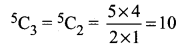
  • Tobacco chewing causes oral cancer (mouth cancer).

Prevention: Adolescents and old people need to avoid these habits. Proper counselling and medical assistance can help an addict to give up the habit of smoking.

XI. Higher Order Thinking Skills (HOTS) Questions

Question 1.
What do the following symbols represent?
Samacheerkalvi.Guru Science 10th Solutions Chapter 21 Health And Diseases
Answer:
(a) 1. No Smoking
2. No Alcohol
3. No Psychotropic drugs
(b) 4. No – International Tobacco day
5. Inflammation of Lung Alveoli and decreased surface area.

Question 2.
Some human diseases are transmitted only through blood in one of such diseases, there is a progressive decrease in the number of lymphocytes of the patient.
(a) Name the disease and its causative agent.
(b) Write any two symptoms of it.
Answer:
(a) Name the disease is the AIDS caused by Human Immuno Deficiency Virus.
(b) Weight loss and lack of appetite are the symptoms of AIDS.

Question 3.
Which is the desirable blood cholesterol level for Indians?
Answer:
200 mg / dl.

Question 4.
Which cholesterol lowers the risk of heart disease and which cholesterol increases the risk of heart diseases?
Answer:

  • HDL (High – Density Lipoprotein) or good cholesterol lowers the risk of heart disease.
  • LDL (Low – Density Lipoprotein) or bad cholesterol increases the risk of heart diseases.

Question 5.
What are the two types of tumours?
Answer:

  • Benign tumours or Non – malignant tumours: Remain confined in the organ affected and do not spread to other parts of the body.
  • Malignant tumours: Mass of proliferating cells, which grow very rapidly invading and damaging the surrounding normal tissues.

Question 6.
Name some foods which help to reduce blood sugar levels.
Answer:
Flax seeds containing insoluble fibre, Guava, Tomatoes and spinach are the foods, which helps to reduce blood sugar levels.

Believing that the Tamilnadu State Board Solutions for Class 21th Science Chapter 21 Health and Diseases Questions and Answers learning resource will definitely guide you at the time of preparation. For more details about Tamilnadu State Board Class 21th Science Chapter 21 textbook solutions, ask us in the below comments and we’ll revert back to you asap.

Samacheer Kalvi 11th Maths Solutions Chapter 4 Combinatorics and Mathematical Induction Ex 4.4

You can Download Samacheer Kalvi 11th Maths Book Solutions Guide Pdf, Tamilnadu State Board help you to revise the complete Syllabus and score more marks in your examinations.

Tamilnadu Samacheer Kalvi 11th Maths Solutions Chapter 4 Combinatorics and Mathematical Induction Ex 4.4

11th Maths Exercise 4.4 Question 1.
By the principle of mathematical induction, prove that, for n ≥ 1
11th Maths Exercise 4.4 Solutions Chapter 4 Combinatorics And Mathematical Induction Samacheer Kalvi
Solution:
11th Maths Chapter 4 Exercise 4.4 Combinatorics And Mathematical Induction Samacheer Kalvi
∴ P(k+ 1) is true.
Thus P(K) is true ⇒ (k + 1) is true.
Hence by principle of mathematical induction, P(n) is true for all n ∈ N.

11th Maths Chapter 4 Exercise 4.4 Question 2.
By the principle of mathematical induction, prove that, for n > 1
Exercise 4.4 Class 11 Maths Solutions Chapter 4 Combinatorics And Mathematical Induction Samacheer Kalvi
Solution:
Ex 4.4 Class 11 Maths Solutions Chapter 4 Combinatorics And Mathematical Induction Samacheer Kalvi
∴ P(1) is true
Let P(n) be true for n = k
Exercise 4.4 Maths Class 11 Solutions Chapter 4 Combinatorics And Mathematical Induction Samacheer Kalvi
∴ P(k + 1) is true
Thus P(k) is true ⇒ P(k + 1) is true. Hence by principle of mathematical induction, P(k) is true for all n ∈ N.

Exercise 4.4 Class 11 Question 3.
Prove that the sum of the first n non-zero even numbers is n2 + n.
Solution:
Let P(n) : 2 + 4 + 6 +…+2n = n2 + n, ∀ n ∈ N

Step 1:
P( 1) : 2 = 12 + 1 = 2 which is true for P( 1)

Step 2:
P(k): 2 + 4 + 6+ …+ 2k = k2 + k. Let it be true.

Step 3:
P(k + 1) : 2 + 4 + 6 + … + 2k + (2k + 2)
= k2+ k + (2k + 2) = k2 + 3k + 2
= k2 + 2k + k + 1 + 1
= (k+ 1)2+ (k + 1)
Which is true for P(k + 1)
So, P(k + 1) is true whenever P(k) is true.

Ex 4.4 Class 11 Question 4.
By the principle of Mathematical induction, prove that, for n ≥ 1.
Exercise 4.4 Maths Class 11 Solutions Chapter 4 Combinatorics And Mathematical Induction Samacheer Kalvi
Solution:
Ex 4.4 Class 11 Maths Solutions Chapter 4 Combinatorics And Mathematical Induction Samacheer Kalvi
4.4 Maths Class 11 Solutions Chapter 4 Combinatorics And Mathematical Induction Samacheer Kalvi
∴ P(k + 1) is true
Thus P(k) is true ⇒ P(k + 1) is true
Hence by principle of mathematical induction, P(n) is true for all n ∈ N

Exercise 4.4 Maths Class 11 Solutions Question 5.
Using the Mathematical induction, show that for any natural number n ≥ 2,
Exercise 4.4 Class 11 Pdf Maths Solutions Chapter 4 Combinatorics And Mathematical Induction Samacheer Kalvi
Solution:
Combinatorics And Mathematical Induction Ex 4.4 Samacheer Kalvi 11th Maths Solutions Chapter 4
Chapter 4 Class 11 Maths Solutions Combinatorics And Mathematical Induction Ex 4.4 Samacheer Kalvi
⇒ P(k + 1) is true when P(k) is true so by the principle of mathematical induction P(n) is true.

Exercise 4.4 Maths Class 11 Question 6.
Using the Mathematical induction, show that for any natural number n ≥ 2,
Chapter 4 Maths Class 11 Solutions Combinatorics And Mathematical Induction Ex 4.4 Samacheer Kalvi
Solution:
10th Maths Exercise 4.4 11th Sum Combinatorics And Mathematical Induction Samacheer Kalvi
Samacheer Kalvi 11th Maths Solutions Chapter 4 Combinatorics And Mathematical Induction Ex 4.4
⇒ P(k + 1) is true when P(k) is true so by the principle of mathematical induction P(n) is true for n ≥ 2.

Ex 4.4 Class 11 Maths Question 7.
Using the Mathematical induction, show that for any natural number n
Samacheer Kalvi 11th Maths Solutions Chapter 4 Combinatorics and Mathematical Induction Ex 4.4 16
Solution:
Samacheer Kalvi 11th Maths Solutions Chapter 4 Combinatorics and Mathematical Induction Ex 4.4 17
Samacheer Kalvi 11th Maths Solutions Chapter 4 Combinatorics and Mathematical Induction Ex 4.4 18
∴ P(k + 1) is true
Thus p(k) is true ⇒ P(k + 1) is true
Hence by principle of mathematical induction,
p(n) is true for all n ∈ z

4.4 Maths Class 11 Question 8.
Using the Mathematical induction, show that for any natural number n,
Samacheer Kalvi 11th Maths Solutions Chapter 4 Combinatorics and Mathematical Induction Ex 4.4 19
Solution:
Samacheer Kalvi 11th Maths Solutions Chapter 4 Combinatorics and Mathematical Induction Ex 4.4 20
Samacheer Kalvi 11th Maths Solutions Chapter 4 Combinatorics and Mathematical Induction Ex 4.4 200
∴ P(k + 1) is true
Thus P(k) is true ⇒ P(k + 1) is true. Hence by principle of mathematical induction, P(n) is true for all n ∈ N.

Exercise 4.4 Class 11 Pdf Question 9.
Prove by Mathematical Induction that
1! + (2 × 2!) + (3 × 3!) + … + (n × n!) = (n + 1)! – 1
Solution:
P(n) is the statement
1! + (2 × 2!) + (3 × 3!) + ….. + (n × n!) = (n + 1)! – 1
To prove for n = 1
LHS = 1! = 1
RHS = (1 + 1)! – 1 = 2! – 1 = 2 – 1 = 1
LHS = RHS ⇒ P(1) is true
Assume that the given statement is true for n = k
(i.e.) 1! + (2 × 2!) + (3 × 3!) + … + (k × k!) = (k + 1)! – 1 is true
To prove P(k + 1) is true
p(k + 1) = p(k) + t(k + 1)
P(k + 1) = (k + 1)! – 1 + (k + 1) × (k + 1)!
= (k + 1)! + (k + 1) (k + 1)! – 1
= (k + 1)! [1 + k + 1] – 1
= (k + 1)! (k + 2) – 1
= (k + 2)! – 1
= (k + 1 + 1)! – 1
∴ P(k + 1) is true ⇒ P(k) is true, So by the principle of mathematical induction P(n) is true.

Combinatorics And Mathematical Induction Question 10.
Using the Mathematical induction, show that for any natural number n, x2n – y2n is divisible by x +y.
Solution:
Let P(n) = x2n – y2n is divisible by (x + y)
For n = 1
P(1) = x2 × 1 – y2 × 1 is divisible by (x + y)
⇒ (x + y) (x – y) is divisible by (x + y)
∴ P(1) is true
Let P(n) be true for n = k
∴ P(k) = x2k – y2k is divisible by (x + y)
⇒ x2k – y2k = λ(x + y) …… (i)
For n = k + 1
⇒ P(k + 1) = x2(k + 1) – y2(k + 1) is divisible by (x + y)
Now x2(k + 2) – y2(k + 2)
= x2k + 2 – x2ky2 + x2ky2 – y2k + 2
= x2k.x2 – x2ky2 + x2ky2 – y2ky2
= x2k (x2 – y2) + y2λ (x + y) [Using (i)]
⇒ x2k + 2 – y2k + 2 is divisible by (x + y)
∴ P(k + 1) is true.
Thus P(k) is true ⇒ P(k + 1) is true. Hence by principle of mathematical induction, P(n) is true for all n ∈ N

Chapter 4 Class 11 Maths Question 11.
By the principle of mathematical induction, prove that, for n ≥ 1,
Samacheer Kalvi 11th Maths Solutions Chapter 4 Combinatorics and Mathematical Induction Ex 4.4 80
Solution:
Samacheer Kalvi 11th Maths Solutions Chapter 4 Combinatorics and Mathematical Induction Ex 4.4 90
Samacheer Kalvi 11th Maths Solutions Chapter 4 Combinatorics and Mathematical Induction Ex 4.4 91

Chapter 4 Maths Class 11 Question 12.
Use induction to prove that n3 – 7n + 3, is divisible by 3, for all natural numbers n.
Solution:
Let P(n) : n3 – 7n + 3
Step 1:
P(1) = (1)3 – 7(1) + 3
= 1 – 7 + 3 = -3 which is divisible by 3
So, it is true for P(1).

Step 2:
P(k) : k3 – 7k + 3 = 3λ. Let it be true
⇒ k3 = 3λ + 7k – 3

Step 3:
P(k + 1) = (k + 1)3 – 7(k + 1) + 3
= k3 + 1 + 3k2 + 3k – 7k – 7 + 3
= k3 + 3k2 – 4k – 3
= (3λ + 7k – 3) + 3k2 – 4k – 3 (from Step 2)
= 3k2 + 3k + 3λ – 6
= 3(k2 + k + λ – 2) which is divisible by 3.
So it is true for P(k + 1).
Hence, P(k + 1) is true whenever it is true for P(k).

10th Maths Exercise 4.4 11th Sum Question 13.
Use induction to prove that 5n + 1 + 4 × 6n when divided by 20 leaves a remainder 9, for all natural numbers n.
Solution:
P(n) is the statement 5n + 1 + 4 × 6n – 9 is ÷ by 20
P(1) = 51 + 1 + 4 × 61 – 9 = 52 + 24 – 9
= 25 + 24 – 9 = 40 ÷ by 20
So P(1) is true
Assume that the given statement is true for n = k
(i.e) 5k + 1 + 4 × 6n – 9 is ÷ by 20
P(1) = 51 + 1 + 4 × 61 – 9
= 25 + 24 – 9
So P(1) is true
To prove P(k + 1) is true
P(k + 1) = 5k + 1 + 1 + 4 × 6k + 1 + 1 – 9
= 5 × 5 k + 1 + 4 × 6 × 6k – 9
= 5[20C + 9 – 4 × 6k] + 24 × 6k – 9 [from(1)]
= 100C + 45 – 206k + 246k – 9
= 100C + 46k + 36
= 100C + 4(9 + 6k)
Now for k = 1 ⇒ 4(9 + 6k) = 4(9 + 6)
= 4 × 15 = 60 ÷ by 20 .
for k = 2 = 4(9 + 62) = 4 × 45 = 180 ÷ 20
So by the principle of mathematical induction 4(9 + 6k) is ÷ by 20
Now 100C is ÷ by 20.
So 100C + 4(9 + 6k) is ÷ by 20
⇒ P(k + 1) is true whenever P(k) is true. So by the principle of mathematical induction P(n) is true.

Samacheer Kalvi 11th Maths Question 14.
Use induction to prove that 10n + 3 × 4n + 2 + 5, is divisible by 9, for all natural numbers n.
Solution:
P(n) is the statement 10n + 3 × 4n + 2 + 5 is ÷ by 9
P(1) = 101 + 3 × 42 + 5 = 10 + 3 × 16 + 5
= 10 + 48 + 5 = 63 ÷ by 9
So P(1) is true. Assume that P(k) is true
(i.e.) 10k + 3 × 4k + 2 + 5 is ÷ by 9
(i.e.) 10k + 3 × 4k + 2 + 5 = 9C (where C is an integer)
⇒ 10k = 9C – 5 – 3 × 4k + 2 ……(1)
To prove P(k + 1) is true.
Now P(k + 1) = 10k + 1 + 3 × 4k + 3 + 5
= 10 × 10k + 3 × 4k + 2 × 4 + 5
= 10[9C – 5 – 3 × 4k + 2] + 3 × 4k + 2 × 4 + 5
= 10[9C – 5 – 3 × 4k + 2] + 12 × 4k + 2 + 5
= 90C – 50 – 30 × 4k + 2 + 12 × 4k + 2 + 5
= 90C – 45 – 18 × 4k + 2
= 9[10C – 5 – 2 × 4k + 2] which is ÷ by 9
So P(k + 1) is true whenever P(K) is true. So by the principle of mathematical induction P(n) is true.

Question 15.
Prove that using the Mathematical induction
Samacheer Kalvi 11th Maths Solutions Chapter 4 Combinatorics and Mathematical Induction Ex 4.4 111
Solution:
Samacheer Kalvi 11th Maths Solutions Chapter 4 Combinatorics and Mathematical Induction Ex 4.4 112
Samacheer Kalvi 11th Maths Solutions Chapter 4 Combinatorics and Mathematical Induction Ex 4.4 113
Samacheer Kalvi 11th Maths Solutions Chapter 4 Combinatorics and Mathematical Induction Ex 4.4 114
Samacheer Kalvi 11th Maths Solutions Chapter 4 Combinatorics and Mathematical Induction Ex 4.4 115

Samacheer Kalvi 11th Maths Solutions Chapter 4 Combinatorics and Mathematical Induction Ex 4.4 Additional Questions

Question 1.
Prove by induction the inequality (1 + x)n ≥ 1 + nx, whenever x is positive and n is a positive integer.
Solution:
P(n) : (1 +x)n ≥ 1 +nx
P(1): (1 + x)1 ≥ 1 + x
⇒ 1 + x ≥ 1 + x, which is true.
Hence, P(1) is true.
Let P(k) be true
(i.e.) (1 + x)k ≥ 1 + kx
We have to prove that P(k + 1) is true.
(i.e.) (1 + x)k + 1 ≥ 1 + (k + 1)x
Now, (1 + x)k + 1 ≥ 1 + kx [∵ p(k) is true]
Multiplying both sides by (1 + x), we get
(1 + x)k(1 + x) ≥ (1 + kx)(1 + x)
⇒ (1 + x)k + 1 ≥ 1 + kx + x + kx2
⇒ (1 + x)k + 1 ≥ 1 + (k + 1)x + kx2 ….. (1)
Now, 1 + (k + 1) x + kx2 ≥ 1 + (k + 1)x …… (2)
[∵ kx2 > 0]
From (1) and (2), we get
(1 + x)k + 1 ≥ 1 + (k + 1)x
∴ P(k + 1) is true if P(k) is true.
Hence, by the principle of mathematical induction, P(n) is true for all values, of n.

Question 2.
32n – 1 is divisible by 8.
Solution:
P(n) = 32n – 1 is divisible by 8
For n = 1, we get
P(1) = 32.1 – 1 = 9 – 1 = 8
P(1) = 8, which is divisible by 8.
Let P(n) be true for n = k
P(k) = 32k – 1 is divisible by 8 ….. (1)
Now, P(k + 1) = 3(2k + 2) – 1 = 32k.32 – 1
= 32(32k – 1) + 8
Now, 32k – 1 is divisible by 9. [Using (1)]
∴ 32 (32k – 1) + 8 is also divisible by 8.
Hence, 32n – 1 is divisible by 8 ∀ n E N

Question 3.
Prove by the principle of mathematical induction if x and y are any two distinct integers, then xn – yn is divisible by x – y. [OR]
xn – yn is divisible by x – y, where x – y ≠ 0.
Solution:
Let the given statement be P(n).
(i.e.) P(n): xn – yn = M(x – y), x – y ≠ 0

Step I.
When n = 1,
xn – yn = x – y = M(x – y) ….(1)
⇒ P(1) is true.

Step II.
Assume that P(k) is true.
(i.e.) xk – yk = M(x – y), x – y ≠ 0
We shall now show that P(k + 1) is true
Now, xk + 1 – yk + 1 = xk + 1 – xky + xk + 1y – yk + 1
= xk(x – y) + y(xk – yk)
= xk(x – y) + yM(x – y) [Usng ….. (1)]
= (x – y)(xk – yM)
∴ By the principle of mathematical induction, P(n) is true for all n ∈ N

Question 4.
Prove by the principle of mathematical induction that for every natural number n, 32n + 2 – 8n – 9 is divisible by 8.
Solution:
Let P(n): 32n + 2 – 8n – 9 is divisible by 8.
Then, P(1): 32.1 + 2 – 8.1 – 9 is divisible by 8.
(i.e.) 34 – 8 – 9 is divisible by 8 or 81 – 8 – 9 is divisible by 8
(or) 64 is divisible by 8, which is true.
Suppose P(k) is true, then
P(k) : 32k + 2 – 8k – 9 is divisible by 8
(i.e.) 32k + 2 – 8k – 9 = 8m, where m ∈ N (or)
32k + 2 = 8m + 8k + 9
P(k + 1) is the statement given by, …(1)
P(k + 1) : 32(k + 1) + 2 – 8(k + 1) – 9
Samacheer Kalvi 11th Maths Solutions Chapter 4 Combinatorics and Mathematical Induction Ex 4.4 25
∴ P(k + 1) is true
Hence, by the principle of mathematical induction, P(n) is true for all n ∈ N

Question 5.
Use the principle of mathematical induction to prove that for every natural number n.
Samacheer Kalvi 11th Maths Solutions Chapter 4 Combinatorics and Mathematical Induction Ex 4.4 26
Solution:
Let P(n) be the given statement, i.e.
Samacheer Kalvi 11th Maths Solutions Chapter 4 Combinatorics and Mathematical Induction Ex 4.4 27
⇒ P(1) is true.
We note than P(n) is true for n = 1.
Assume that P(k) is true
Samacheer Kalvi 11th Maths Solutions Chapter 4 Combinatorics and Mathematical Induction Ex 4.4 288
Now, we shall prove that P(k + 1) is true whenever P(k) is true. We have,
Samacheer Kalvi 11th Maths Solutions Chapter 4 Combinatorics and Mathematical Induction Ex 4.4 277
∴ P(k + 1) is also true whenever P(k) is true
Hence, by the principle of mathematical induction, P(n) is also true for all n ∈ N.

Question 6.
n3 – n is divisible by 6, for each natural number n ≥ 2.
Solution:
Let P(n) : n3 – n

Step 1 :
P(2): 23 – 2 = 6 which is divisible by 6. So it is true for P(2).

Step 2 :
P(A): k3 – k = 6λ. Let it is be true for k ≥ 2
⇒ k3 = 6λ + k …(i)

Step 3 :
P(k + 1) = (k + 1)3 – (k + 1)
= k3 + 1 + 3k2 + 3k – k – 1 = k3 – k + 3(k2 + k)
= k3 – k + 3(k2 + k) = 6λ + k – k + 3(k2 + k)
= 6λ + 3(k2 + k) [from (i)]
We know that 3(k2 + k) is divisible by 6 for every value of k ∈ N.
Hence P(k + 1) is true whenever P(k) is true.

Question 7.
For any natural number n, 7n – 2n is divisible by 5.
Solution:
Let P(n) : 7n – 2n

Step 1 :
P(1) : 71 – 21 = 5λ which is divisible by 5. So it is true for P(1).

Step 2 :
P(k): 7k – 2k = 5λ. Let it be true for P(k)

Step 3 :
P(k + 1) = 7k + 1 – 2k + 1
Samacheer Kalvi 11th Maths Solutions Chapter 4 Combinatorics and Mathematical Induction Ex 4.4 50

So, it is true for P(k + 1)
Hence, P(k + 1) is true whenever P(k) is true.

Question 8.
n2 < 2n, for all natural numbers n ≥ 5.
Solution:
Let P(n) : n2 < 2n for all natural numbers, n ≥ 5

Step 1 :
P(5) : 15 < 25 ⇒ 1 < 32 which is true for P(5)

Step 2 :
P(k): k2 < 2k. Let it be true for k ∈ N

Step 3 :
P(k + 1): (k + 1)2 < 2k + 1
From Step 2, we get k2 < 2k
⇒ k2 < 2k + 1 < 2k + 2k + 1
Samacheer Kalvi 11th Maths Solutions Chapter 4 Combinatorics and Mathematical Induction Ex 4.4 55
Samacheer Kalvi 11th Maths Solutions Chapter 4 Combinatorics and Mathematical Induction Ex 4.4 56
From eqn. (i) and (ii), we get (k + 1)2 < 2k + 1
Hence, P(k + 1) is true whenever P(k) is true for k ∈ N, n ≥ 5.

Question 9.
In 2n < (n + 2)! for all natural number n.
Solution:
Let P(n) : 2n < (n + 2)! for all k ∈ N.
Samacheer Kalvi 11th Maths Solutions Chapter 4 Combinatorics and Mathematical Induction Ex 4.4 566
Hence, P(k + 1) is true whenever P(k) is true.

Question 10.
1 + 5 + 9 + … + (4n – 3) = n(2n – 1), ∀ n ∈ N.
Solution:
Let P(n) : 1 + 5 + 9 + … + (4n – 3) = n(2n – 1), ∀ n ∈ N

Step 1:
P(1) : 1 = 1(2.1 – 1) = 1 which is true for P(1)

Step 2:
P(k) : 1 + 5 + 9 + … + (4k – 3) = k(2k – 1). Let it be true.

Step 3:
P(k + 1) : 1 + 5 + 9 + … + (4k – 3) = k(4k + 1)
= k(2k – 1) + (4k + 1) = 2k2 – k + 4k + 1
= 2k2 + 3k + 1 = 2k2 + 2k + k + 1
= 2k(k + 1) + 1 (k + 1) = (2k + 1)(k + 1)
= (k+ 1) (2k + 2 – 1) = (k + 1) [2(k + 1) – 1]
Which is true for P(k + 1).
Hence, P(k + 1) is true whenever P(k) is true.

Samacheer Kalvi 11th Physics Solutions Chapter 5 Motion of System of Particles and Rigid Bodies

For those looking for help on 11th Physics can use the Tamilnadu State Board Solutions for 11th Physics Chapter 5 Motion of System of Particles and Rigid Bodies prevailing for free of cost.

Download the Samacheer Kalvi 11th Physics Book Solutions Questions and Answers Notes Pdf, for all Chapter Wise through the direct links available and take your preparation to the next level. The Tamilnadu State Board Solutions for 11th Physics Chapter 5 Motion of System of Particles and Rigid Bodies Questions and Answers covers all the topics and subtopics within it. Practice using these Samacheer Kalvi 11th Physics Book Solutions Questions and Answers for Chapter 5 Motion of System of Particles and Rigid Bodies PDF and test your preparation level and bridge the knowledge gap accordingly.

Tamilnadu Samacheer Kalvi 11th Physics Solutions Chapter 5 Motion of System of Particles and Rigid Bodies

If you have any queries take the help of the Tamilnadu State Board Solutions for 11th Physics Chapter 5 Motion of System of Particles and Rigid Bodies Questions and Answers learn all the topics in it effectively. We have everything covered and you can Practice them often to score better grades in your exam. By going through the Samacheer Kalvi 11th Physics Book Solutions Questions and Answers you can attempt the actual exam with utmost confidence.

Samacheer Kalvi 11th Physics Motion of System of Particles and Rigid Bodies Textual Questions Solved

Samacheer Kalvi 11th Physics Motion of System of Particles and Rigid Bodies Multiple Choice Questions

11th Physics Chapter 5 Book Back Answers Question 1.
The center of mass of a system of particles does not depend upon,
(a) position of particles
(b) relative distance between particles
(c) masses of particles
(d) force acting on particle
Answer:
(d) force acting on particle

11th Physics 5th Chapter Book Back Answers Question 2.
A couple produces, [AIPMT 1997, AIEEE 2004]
(a) pure rotation
(b) pure translation
(c) rotation and translation
(d) no motion [AIPMT 1997]
Answer:
(a) pure rotation

11th Physics Lesson 5 Book Back Answers Question 3.
A particle is moving with a constant velocity along a line parallel to positive X – axis. The magnitude of its angular momentum with respect to the origin is –
(a) zero
(b) increasing with x
(c) decreasing with x
(d) remaining constant [IIT 2002]
Answer:
(d) remaining constant

Samacheer Kalvi 11th Physics Question 4.
A rope is wound around a hollow cylinder of mass 3 kg and radius 40 cm. What is the angular acceleration of the cylinder if the rope is pulled with a force 30 N?
(a) 0.25 rad s-2
(b) 25 rad s-2
(c) 5 m s-2
(d) 25 m s-2
[NEET 2017]
Answer:
(b) 25 rad s-2

11th Physics Samacheer Kalvi Question 5.
A closed cylindrical container is partially filled with water. As the container rotates in a horizontal plane about a perpendicular bisector, its moment of inertia,
(a) increases
(b) decreases
(c) remains constant
(d) depends on direction of rotation. [IIT 1998]
Answer:
(a) increases

Samacheer Kalvi Guru 11th Physics Question 6.
A rigid body rotates with an angular momentum L. If its kinetic energy is halved, the angular momentum becomes,
(a) L
(b) L / 2
(c) 2 L
(d) L / 2 [AFMC 1998, AIPMT 2015]
Answer:
(d) L / 2

Samacheer Kalvi Physics 11th Question 7.
A particle undergoes uniform circular motion. The angular momentum of the particle remain conserved about –
(a) the center point of the circle.
(b) the point on the circumference of the circle
(c) any point inside the circle.
(d) any point outside the circle. [IIT 2003]
Answer:
(a) the center point of the circle.

Samacheer Kalvi 11th Physics Solution Book Question 8.
When a mass is rotating in a plane about a fixed point, its angular momentum is directed along –
(a) a line perpendicular to the plane of rotation
(b) the line making an angle of 45° to the plane of rotation
(c) the radius
(d) tangent to the path [AIPMT 2012]
Answer:
(a) a line perpendicular to the plane of rotation

Samacheerkalvi.Guru 11th Physics Question 9.
Two discs of same moment of inertia rotating about their regular axis passing through center and perpendicular to the plane of disc with angular velocities ω1 and ω1. They are brought in to contact face to face coinciding the axis of rotation. The expression for loss of energy during this process is-
(a) \(\frac {1}{4}\) I(ω1 – ω22
(b) I(ω1 – ω22
(c) \(\frac {1}{8}\) I(ω1 – ω22
(d) \(\frac {1}{2}\) I(ω1 – ω22
Answer:
(a) \(\frac {1}{4}\) I(ω1 – ω22

11 Physics Samacheer Solutions Question 10.
A disc of moment of inertia Ia is rotating in a horizontal plane about its symmetry axis with a constant angular speed to. Another disc initially at rest of moment of inertia Ib is dropped coaxially on to the rotating disc. Then, both the discs rotate with same constant angular speed. The loss of kinetic energy due to friction in this process is-
11th Physics Chapter 5 Book Back Answers Motion Of System Of Particles And Rigid Bodies Samacheer Kalvi
Answer:
11th Physics 5th Chapter Book Back Answers Motion Of System Of Particles And Rigid Bodies Samacheer Kalvi

Samacheer Kalvi Class 11 Physics Solutions Question 11.
The ratio of the acceleration for a solid sphere (mass m and radius R) rolling down an incline of angle 0 without slipping and slipping down the incline without rolling is –
(a) 5 : 7
(b) 2 : 3
(c) 2 : 5
(d) 7 : 5
[AIPMT 2014]
Answer:
(a) 5 : 7

Samacheer Kalvi Guru 11 Physics Question 12.
From a disc of radius R a mass M, a circular hole of diameter R, whose rim passes through the center is cut. What is the moment of inertia of the remaining part of the disc about a perpendicular axis passing through it?
(a) 15MR2/32
(b) 13MR2/32
(c) 11MR2/32
(d) 9MR2/32 [NEET 2016]
Answer:
(b) 13MR2/32

Samacheer Kalvi 11 Physics Question 13.
The speed of a solid sphere after rolling down from rest without sliding on an inclined plane of vertical height h is,
(a) \(\sqrt{\frac{4}{3} g h}\)
(b) \(\sqrt{\frac{10}{7} g h}\)
(c) \(\sqrt{2gh}\)
(d) \(\sqrt{\frac{1}{2} g h}\)
Answer:
(a) \(\sqrt{\frac{4}{3} g h}\)

Physics Class 11 Samacheer Kalvi Question 14.
The speed of the center of a wheel rolling on a horizontal surface is vQ. A point on the rim in level with the center will be moving at a speed of speed of,
(a) zero
(b) v0
(c) \(\sqrt{2}\)v0
(d) 2 v0
[PMT 1992, PMT 2003, IIT 2004]
Answer:
(c) \(\sqrt{2}\)v0

Samacheer Kalvi 11th Physics Solution Question 15.
A round object of mass m and radius r rolls down without slipping along an inclined plane. The fractional force,
(a) dissipates kinetic energy as heat.
(b) decreases the rotational motion.
(c) decreases the rotational and transnational motion ,
(d) converts transnational energy into rotational energy [PMT 2005]
Answer:
(d) converts transnational energy into rotational energy

Samacheer Kalvi 11th Physics Motion of System of Particles and Rigid Bodies Short Answer Questions

Samacheer Kalvi.Guru 11th Physics Question 1.
Define center of mass.
Answer:
The center of mass of a body is defined as a point where the entire mass of the body appears to be concentrated.

11th Physics Samacheer Kalvi Solution Question 2.
Find out the center of mass for the given geometrical structures.
(a) Equilateral triangle
(b) Cylinder
(c) Square
Answer:
11th Physics Lesson 5 Book Back Answers Motion Of System Of Particles And Rigid Bodies Samacheer Kalvi
(a) For equilateral triangle, center of mass lies at its centro-id.
(b) For cylinder, center of mass lies at its geometrical center.
(c) For square, center of mass lies at the point where the diagonals meet.

11 Samacheer Physics Solutions Question 3.
Define torque and mention its unit.
Answer:
Torque is defined as the moment of the external applied force about a point or axis of rotation. The expression for torque is,
\(\vec{\tau}\) = \(\vec{r}\) x \(\vec{F}\)

11th Physics Samacheer Solutions Question 4.
What are the conditions in which force cannot produce torque?
Answer:
The forces intersect (or) passing through the axis of rotation cannot produce torque as the perpendicular distance between the forces is 0 i.e. r = 0.
∴ \(\vec{\tau}\) = \(\vec{r}\) x \(\vec{F}\) = 0

Question 5.
Give any two examples of torque in day – to – day life.
Answer:

  • The opening and closing of a door about the hinges.
  • Turning of a nut using a wrench.

Question 6.
What is the relation between torque and angular momentum?
Answer:
We have the expression for magnitude of angular momentum of a rigid body as, L = I ω. The expression for magnitude of torque on a rigid body is, τ = I α.
We can further write the expression for torque as,
τ = I\(\frac {dω}{dt}\) (∴ α = \(\frac {dω}{dt}\))
Where, ω is angular velocity and α is angular acceleration. We can also write equation,
τ = \(\frac {d(Iω)}{dt}\)
τ = \(\frac {dL}{dt}\)

Question 7.
What is equilibrium?
Answer:
A rigid body is said to be in mechanical equilibrium where both its linear momentum and angular momentum remain constant.

Question 8.
How do you distinguish between stable and unstable equilibrium?
Answer:
Stable Kquilibrium:

  • The body tries to come back to equilibrium if slightly disturbed and released.
  • The center of mass of the body shifts slightly higher if disturbed from equilibrium.
  • Potential energy of the body is minimum and it increases if disturbed.

Unstable Equilibrium:

  • The body cannot come back to equilibrium if slightly disturbed and released.
  • The center of mass of the body shifts slightly lower if disturbed from equilibrium.
  • Potential energy of the body is not minimum and it decreases if disturbed.

Question 9.
Define couple.
Answer:
A pair of forces which are equal in magnitude but opposite in direction and separated by a perpendicular distance so that their lines of action do not coincide that causes a turning effect is called a couple.

Question 10.
State principle of moments.
Answer:
Principle of moment states that when an object is in equilibrium the sum of the anticlockwise moments about a point is equal to the sum of the clockwise moments.

Question 11.
Define center of gravity.
Answer:
The center of gravity of a body is the point at which the entire weight of the body acts, irrespective of the position and orientation of the body.

Question 12.
Mention any two physical significance of moment of inertia
Answer:
Moment of inertia for point mass,
I = \(m_{i} r_{i}^{2}\)
Moment of inertia for bulk object,
I = ∑\(m_{i} r_{i}^{2}\)

Question 13.
What is radius of gyration?
Answer:
The radius of gyration of an object is the perpendicular distance from the axis of rotation to an equivalent point mass, which would have the same mass as well as the same moment of inertia of the object.

Question 14.
State conservation of angular momentum.
Answer:
The law of conservation of angular momentum states that when no external torque acts on the body the net angular momentum of a rotating rigid body remains constant.

Question 15.
What are the rotational equivalents for the physical quantities, (i) mass and (ii) force?
Answer:
The rotational equivalents for (i) mass and (ii) force are moment of inertia and torque respectively.

Question 16.
What is the condition for pure rolling?
Answer:
In pure rolling, there is no relative motion of the point of contact with the surface when the rolling object speeds up or shows down. It must accelerate or decelerate respectively.

Question 17.
What is the difference between sliding and slipping?
Sliding:

  • Velocity of center of mass is greater than Rω i.e. VCM > Rω.
  • Velocity of transnational motion is greater than velocity of rotational motion.
  • Resultant velocity acts in the forward direction.

Slipping:

  • Velocity of center of mass is lesser than Rω. i.e. VCM < Rω
  • Velocity of translation motion is lesser than velocity of rotational motion.
  • Resultant velocity acts in the backward direction.

Samacheer Kalvi 11th Physics Motion of System of Particles and Rigid Bodies Long Answer Questions

Question 1.
Explain the types of equilibrium with suitable examples.
Answer:

  • Transnational motion – A book resting on a table.
  • Rotational equilibrium – A body moves in a circular path with constant velocity.
  • Static equilibrium – A wall – hanging, hanging on the wall.
  • Dynamic equilibrium – A ball decends down in a fluid with its terminal velocity.
  • Stable equilibrium – A table on the floor
  • Unstable equilibrium – A pencil standing on its tip.
  • Neutral equilibrium – A dice rolling on a game board.

Question 2.
Explain the method to find the center of gravity of a irregularly shaped lamina.
Answer:
There is also another way to determine the center of gravity of an irregular lamina. If we suspend the lamina from different points like P, Q, R as shown in figure, the vertical lines I PP’, QQ’, RR’ all pass through the center of gravity. Here, reaction force acting at the point of suspension and the gravitational force acting at the center of gravity cancel each other and the torques caused by them also cancel each other.
Samacheer Kalvi 11th Physics Solutions Chapter 5 Motion Of System Of Particles And Rigid Bodies
Determination of center of gravity of plane lamina by suspending

Question 3.
Explain why a cyclist bends while negotiating a curve road? Arrive at the expression for angle of bending for a given velocity.
Answer:
Let us consider a cyclist negotiating a circular level road (not banked) of radius r with a speed v. The cycle and the cyclist are considered as one system with mass m. The center gravity of the system is C and it goes in a circle of radius r with center at O. Let us choose the line OC as X – axis and the vertical line through O as Z – axis as shown in Figure.

11th Physics Samacheer Kalvi Solutions Chapter 5 Motion Of System Of Particles And Rigid Bodies

The system as a frame is rotating about Z – axis. The system is at rest in this rotating frame. To solve problems in rotating frame of reference, we have to apply a centrifugal force (pseudo force) on the system which will be \(\frac{m v^{2}}{r}\) This force will act through the center of gravity. The forces acting on the system are,

  • gravitational force (mg)
  • normal force (N)
  • frictional force (f)
  • centrifugal force (\(\frac{m v^{2}}{r}\)).

As the system is in equilibrium in the rotational frame of reference, the net external force and net external torque must be zero. Let us consider all torques about the point A in Figure.
For rotational equilibrium,
τnet = 0
The torque due to the gravitational force about point A is (mg AB) which causes a clockwise turn that is taken as negative. The torque due to the centripetal force is I BC which causes an (\(\frac{m v^{2}}{r}\) BC) Which causes an anticlockwise turn that is taken as positive.
Samacheer Kalvi Guru 11th Physics Solutions Chapter 5 Motion Of System Of Particles And Rigid Bodies
Samacheer Kalvi Physics 11th Solutions Chapter 5 Motion Of System Of Particles And Rigid Bodies
While negotiating a circular level road of radius r at velocity v, a cyclist has to bend by an angle 0 from vertical given by the above expression to stay in equilibrium (i.e. to avoid a fall).

Question 4.
Derive the expression for moment of inertia of a rod about its center and perpendicular to the rod.
Answer:
Let us consider a uniform rod of mass (M) and length (l) as shown in figure. Let us find an expression for moment of inertia of this rod about an axis that passes through the center of mass and perpendicular to the rod. First an origin is to be fixed for the coordinate system so that it coincides with the center of mass, which is also the geometric center of the rod. The rod is now along the x axis. We take an infinitesimally small mass (dm) at a distance (x) from the origin. The moment of inertia (dI) of this mass (dm) about the axis is, dI = (dm) x2
Samacheer Kalvi 11th Physics Solution Book Chapter 5 Motion Of System Of Particles And Rigid Bodies

As the mass is uniformly distributed, the mass per unit length (λ) of the rod is, λ = \(\frac {M}{l}\)
The (dm) mass of the infinitesimally small length as, dm = λ dx = \(\frac {M}{l}\) dx
The moment of inertia (I) of the entire rod can be found by integrating dl,
Samacheerkalvi.Guru 11th Physics Solutions Chapter 5 Motion Of System Of Particles And Rigid Bodies
As the mass is distributed on either side of the origin, the limits for integration are taken from to – l/2 to l/2.
11 Physics Samacheer Solutions Chapter 5 Motion Of System Of Particles And Rigid Bodies

Question 5.
Derive the expression for moment of inertia of a uniform ring about an axis passing through the center and perpendicular to the plane.
Answer:
Let us consider a uniform ring of mass M and radius R. To find the moment of inertia of the ring about an axis passing through its center and perpendicular to the plane, let us take an infinitesimally small mass (dm) of length (dx) of the ring. This (dm) is located at a distance R, which is the radius of the ring from the axis as shown in figure.
The moment of inertia (dl) of this small mass (dm) is,
dI = (dm)R2
The length of the ring is its circumference (2πR). As the mass is uniformly distributed, the mass per unit length (λ) is,
λ = \(\frac {mass}{lengh}\) = \(\frac {M}{2πR}\)
The mass (dm) of the infinitesimally small length is,
dm = λ dx = \(\frac {M}{2πR}\) dx
Now, the moment of inertia (I) of the entire ring is,
Samacheer Kalvi Class 11 Physics Solutions Chapter 5 Motion Of System Of Particles And Rigid BodiesTo cover the entire length of the ring, the limits of integration are taken from 0 to 2πR.
Samacheer Kalvi Guru 11 Physics Solutions Chapter 5 Motion Of System Of Particles And Rigid Bodies

Question 6.
Derive the expression for moment of inertia of a uniform disc about an axis passing through the center and perpendicular to the plane.
Answer:
Consider a disc of mass M and radius R. This disc is made up of many infinitesimally small rings as shown in figure. Consider one such ring of mass (dm) and thickness (dr) and radius (r). The moment of inertia (dl) of this small ring is,
dI = (dm)R2
As the mass is uniformly distributed, the mass per unit area (σ) is σ = \(\frac {mass}{area}\) = \(\frac{M}{\pi R^{2}}\)
The mass of the infinitesimally small ring is,
dm = σ 2πr dr = \(\frac{\mathrm{M}}{\pi \mathrm{R}^{2}}\) 2πr dr
where, the term (2πr dr) is the area of this elemental ring (2πr is the length and dr is the thickness), dm = \(\frac{2 \mathrm{M}}{\mathrm{R}^{2}}\) r dr
dI = \(\frac{2 \mathrm{M}}{\mathrm{R}^{2}}\) r3 dr
Samacheer Kalvi 11 Physics Solutions Chapter 5 Motion Of System Of Particles And Rigid BodiesThe moment of inertia (I) of the entire disc is,
Physics Class 11 Samacheer Kalvi Solutions Chapter 5 Motion Of System Of Particles And Rigid Bodies

Question 7.
Discuss conservation of angular momentum with example.
Answer:
When no external torque acts on the body, the net angular momentum of a rotating rigid body remains constant. This is known as law of conservation of angular momentum.
τ = \(\frac {dL}{dt}\)
If τ = 0 then, L = constant.
As the angular momentum is L = Iω, the conservation of angular momentum could further be written for initial and final situations as,
Iiωi = Iiωi (or) Iω = constant
The above equations say that if I increases ω will decrease and vice – versa to keep the angular momentum constant.
Samacheer Kalvi 11th Physics Solution Chapter 5 Motion Of System Of Particles And Rigid Bodies
There are several situations where the principle of conservation of angular momentum is applicable. One striking example is an ice dancer as shown in Figure A. The dancer spins slowly when the hands are stretched out and spins faster when the hands are brought close to the body.

Stretching of hands away from body increases moment of inertia, thus the angular velocity decreases resulting in slower spin. When the hands are brought close to the body, the moment of inertia decreases, and thus the angular velocity increases resulting in faster spin. A diver while in air as in Figure B curls the body close to decrease the moment of inertia, which in turn helps to increase the number of somersaults in air.
Samacheer Kalvi.Guru 11th Physics Solutions Chapter 5 Motion Of System Of Particles And Rigid Bodies

Question 8.
State and prove parallel axis theorem.
Answer:
Parallel axis theorem:
Parallel axis theorem states that the moment of inertia of a body about any axis is equal to the sum of its moment of inertia about a parallel axis through its center of mass and the product of the mass of the body and the square of the perpendicular distance between the two axes.

If IC is the moment of inertia of the body of mass M about an axis passing through the center of mass, then the moment of inertia I about a parallel axis at a distance d from it is – given by the relation,
I = IC + M d2
Let us consider a rigid body as shown in figure. Its moment of inertia about an axis AB passing through the center of mass is IC. DE is another axis parallel to AB at a perpendicular distance d from AB. The moment of inertia of the body about DE is I. We attempt to get an expression for I in terms of IC. For this, let us consider a point mass m on the body at position x from its center of mass.

11th Physics Samacheer Kalvi Solution Chapter 5 Motion Of System Of Particles And Rigid Bodies
The moment of inertia of the point mass about the axis DE is, m (x + d)2. The moment of inertia I of the whole body about DE is the summation of the above expression.
I = ∑ m (x + d)2
This equation could further be written as,
I = ∑ m(x2 + d2 + 2xd)
1= ∑ (mx2 + md2 + 2 dmx)
l = ∑ mx2 + md2 + 2d ∑ mx
Here, ∑ mx2 is the moment of inertia of the body about the center of mass. Hence,IC = ∑ mx2
The term, ∑ mx = 0 because, x can take positive and negative values with respect to the axis AB. The summation (∑ mx) will be zero.
Thus, I = IC + ∑ m d2 = IC + (∑m) d2
Here, ∑ m is the entire mass M of the object (∑ m = M).
I = IC + Md2

Question 9.
State and prove perpendicular axis theorem.
Answer:
Perpendicular axis theorem:
This perpendicular axis theorem holds good only for plane laminar objects. The theorem states that the moment of inertia of a plane laminar body about an axis perpendicular to its plane is equal to the sum of moments of inertia about two perpendicular axes lying in the plane of the body such that all the three axes are mutually perpendicular and have a common point.

Let the X and Y – axes lie in the plane and Z – axis perpendicular to the plane of the laminar object. If the moments of inertia of the body about X and Y-axes are IX and IY respectively – and IZ is the moment of inertia about Z-axis, then the perpendicular axis theorem could be expressed as,
IZ = IX + IY

To prove this theorem, let us consider a plane laminar object of negligible thickness on which lies the origin (O). The X and Y – axes lie on the plane and Z – axis is perpendicular to it as shown in figure. The lamina is considered to be made up of a large number of particles of mass m. Let us choose one such particle at a point P which has coordinates (x, y) at a distance r from O.
11 Samacheer Physics Solutions Chapter 5 Motion Of System Of Particles And Rigid Bodies
The moment of inertia of the particle about Z – axis is, mr2.
The summation of the above expression gives the moment of inertia of the entire lamina about Z – axis as, IZ = ∑ mr2
Here, r2 = x2 + y2
Then, IZ = ∑ m (x2 + y2)
IZ = ∑ m x2 + ∑ m y2
In the above expression, the term ∑ m x2 is the moment of inertia of the body about the Y-axis and similarly the term ∑ m y2is the moment of inertia about X- axis. Thus,
IX = ∑ m y2 and IY = ∑ m x2
Substituting in the equation for Iz gives,
IZ = IX + IY
Thus, the perpendicular axis theorem is proved.

Question 10.
Discuss rolling on inclined plane and arrive at the expression for the acceleration.
Answer:
Let us assume a round object of mass m and radius R is rolling down an inclined plane without slipping as shown in figure. There are two forces acting on the object along the inclined plane. One is the component of gravitational force (mg sin θ) and the other is the static frictional force (f). The other component of gravitation force (mg cos θ) is cancelled by the normal force (N) exerted by the plane. As the motion is happening along the incline, we shall write the equation for motion from the free body diagram (FBP) of the object.

11th Physics Samacheer Solutions Chapter 5 Motion Of System Of Particles And Rigid Bodies
For transnational motion, mg sin θ is the supporting force and f is the opposing force, mg sin θ f = ma
For rotational motion, let us take the torque with respect to the center of the object. Then mg sin 0 cannot cause torque as it passes through it but the frictional force f can set torque of Rf = Iα
By using the relation, a = rα, and moment of inertia I = mK2 we get,
Rf = mK2 \(\frac {a}{R}\); f = ma \(\left(\frac{\mathrm{K}^{2}}{\mathrm{R}^{2}}\right)\)
Now equation becomes,
mg sin θ – ma \(\left(\frac{\mathrm{K}^{2}}{\mathrm{R}^{2}}\right)\) = ma
mg sin θ = ma + ma \(\left(\frac{\mathrm{K}^{2}}{\mathrm{R}^{2}}\right)\)
a \(\left(1+\frac{\mathrm{K}^{2}}{\mathrm{R}^{2}}\right)\) = g sin θ
After rewriting it for acceleration, we get,
a = \(\frac{g \sin \theta}{\left(1+\frac{K^{2}}{R^{2}}\right)}\)
We can also find the expression for final velocity of the rolling object by using third equation of motion for the inclined plane.
v2 = u2 + 2as. If the body starts rolling from rest, u = 0. When h is the vertical height of the incline, the length of the incline s is, s = \(\frac {h}{sin θ}\)
Samacheer Kalvi 11th Physics Solution Chapter 5 Motion of System of Particles and Rigid Bodies By taking square root,
Samacheer Kalvi 11th Physics Solution Chapter 5 Motion of System of Particles and Rigid Bodies
The time taken for rolling down the incline could also be written from first equation of motion as, v = u + at. For the object which starts rolling from rest, u = 0. Then,
t = \(\frac {v}{a}\)
Samacheer Kalvi 11th Physics Solution Chapter 5 Motion of System of Particles and Rigid Bodies
The equation suggests that for a given incline, the object with the least value of radius of gyration K will reach the bottom of the incline first.

Samacheer Kalvi 11th Physics Motion of System of Particles and Rigid Bodies Conceptual Questions

Question 1.
When a tree is cut, the cut is made on the side facing the direction in which the tree is required to fall. Why?
Answer:
A cut on the tree is made on the side facing the direction in which the tree is required to fall because that side will no longer be supported by the normal force from the bottom, therefore the gravitational force tries to rotate it. So the torque given by the gravity to the tree makes the tree fall on the side as anticipated.

Question 2.
Why does a porter bend forward while carrying a sack of rice on his back?
Answer:
When a porter carries a sack of rice, the line of action of his center of gravity will go away from the body. It affects the balance, to avoid this he bends. By which center of gravity will realign within the body again. So balance is maintained.

Question 3.
Why is it much easier to balance a meter scale on your finger tip than balancing on a match stick?
Answer:
A meter scale is larger then a match stick. So the center of gravity for meter scale is higher than a matchstick when we keep it vertically. It is easier to balance the object whose center of gravity is higher than the object whose centro of gravity is lower. So, it is hard to balance a match stick than a meter scale.

Question 4.
Two identical water bottles one empty and the other filled with water are allowed to roll down an inclined plane. Which one of them reaches the bottom first? Explain your answer.
Answer:
Mass of the empty water bottle mostly concentrated on its surface. So moment of inertia of empty water bottle is more than the bottle filled with water. As we know, moment of inertia is inversely proportional to angular velocity. Therefore, the bottle filled with water whirls with greater speed and reaches the ground first.

Question 5.
Write the relation between angular momentum and rotational kinetic energy. Draw a graph for the same. For two objects of same angular momentum, compare the moment of inertia using the graph.
Answer:
Let a rigid body of moment of inertia I rotate with angular velocity ω.
The angular momentum of a rigid body is, L = Iω
The rotational kinetic energy of the rigid body is, KE = \(\frac { 1 }{ 2 }\) Iω2.
By multiplying the numerator and denominator of the above equation with I, we get a relation between L and KE as,
Samacheer Kalvi 11th Physics Solution Chapter 5 Motion of System of Particles and Rigid Bodies
It resembles with y = Kx2. If angular momentum is same for two objects, kinetic energy is inversely proportional to moment of inertia.
Moment of inertia of the object whose kinetic energy is lesser will have greater magnitude.

Question 6.
Three identical solid spheres move down through three inclined planes A, B and C all same dimensions. A is without friction, B is undergoing pure rolling and C is rolling with slipping. Compare the kinetic energies EA, EB and EC at the bottom.
Answer:
Even though, the three identical solid spheres of same dimensions move down through three different inclined plane, according to the law of conservation of energy, the potential energy possessed by these three solid spheres will be converted into kinetic energies. So the kinetic energies EA, EB and EC are equal at the bottom.

Question 7.
Give an example to show that the following statement is false. Any two forces acting on a body can be combined into single force that would have same effect.
Answer:
A single force i.e. resultant of two forces acting on a body depends upon the angle between them also. The simple example for this is if two forces 5 N and 5 N acting on the object in the opposite direction, the single resultant force acting on the body is zero. But, if two forces acting on the object along the same direction, then the resultant i.e. the single force is 5 + 5 = 10 N. Hence the given statement “any two forces acting on a body can be combined into single force that would leave same effect” is wrong.

Samacheer Kalvi 11th Physics Motion of System of Particles and Rigid Bodies Numerical Problems

Question 1.
A uniform disc of mass 100 g has a diameter of 10 cm. Calculate the total energy of the disc when rolling along a horizontal table with a velocity of 20 cm s-2.
Answer:
Given,
Mass of the disc = 100 g = 100 x 10-3 kg = \(\frac { 1 }{ 10 }\)kg
Velocity of disc = 20 cm s-1 = 20 x 10-2 ms-1 = 0.2 ms-1
Samacheer Kalvi 11th Physics Solution Chapter 5 Motion of System of Particles and Rigid Bodies
Question 2.
A particle of mass 5 units is moving with a uniform speed of v = \(3 \sqrt{2}\) units in the XOY plane along the line y = x + 4. Find the magnitude of angular momentum.
Answer:
Given,
Mass = 5 units
Speed = v = \(3 \sqrt{2}\) units
Y = X + 4
Angular momentum = L = m(\(\bar{r} \times \bar{v}\))
= m(x\(\hat{i}\) +y\(\hat{j}\))x(v\(\hat{i}\) + v\(\hat{j}\)) = m[xv\(\hat{k}\)-vy\(\hat{k}\)] = m[xv\(\hat{k}\)– v(x + 4)\(\hat{k}\)]
L = -mv\(\hat{k}\) = -4 x 5 x \(3 \sqrt{2}\)\(\hat{k}\) = – 60\(\sqrt{2}\)\(\hat{k}\)
L = 60\(\sqrt{2}\) units.

Question 3.
A fly wheel rotates with a uniform angular acceleration. If its angular velocity increases from 20π rad/s to 40π rad/s in 10 seconds, find the number of rotations in that period.
Answer:
Given,
Initial angular velocity ω0 = 20 π rad/s
Final angular velocity ω = 40 π rad/s
Time t = 10 s
Solution:
Angular acceleration α = \(\frac{\omega-\omega_{0}}{t}\) = \(\frac {40π – 20π }{ 10 }\)
α = 2π rad/s2
According to equation of motion for rotational motion
Samacheer Kalvi 11th Physics Solution Chapter 5 Motion of System of Particles and Rigid Bodies
The number of rotations = n = \(\frac {θ}{ 2π }\)
n = \(\frac {300π}{ 2π }\) = 150 rotations.

Question 4.
A uniform rod of mass m and length / makes a constant angle 0 with an axis of rotation which passes through one end of the rod. Find the moment of inertia about this gravity is.
Answer:
Moment of inertia of the rod about the axis which is passing through its center of gravity is
Samacheer Kalvi 11th Physics Solution Chapter 5 Motion of System of Particles and Rigid Bodies
Moment of inertia of a uniform rod of mass m and length l about one axis which passes through one end of the rod
Samacheer Kalvi 11th Physics Solution Chapter 5 Motion of System of Particles and Rigid Bodies

Question 5.
Two particles P and Q of mass 1 kg and 3 kg respectively start moving towards each other from rest under mutual attraction. What is the velocity of their center of mass?
Answer:
Given,
Mass of particle P = 1 kg Mass of particle Q = 3 kg
Solution:
Particles P and Q forms a system. Here no external force is acting on the system,

Samacheer Kalvi 11th Physics Solution Chapter 5 Motion of System of Particles and Rigid Bodies
We know that M = \(\frac {d}{dt}\) (VCM ) = f
It means that, C.M. of an isolated system remains at rest when no external force is acting and internal forces do not change its center of mass.

Question 6.
Find the moment of inertia of a hydrogen molecule about an axis passing through its center of mass and perpendicular to the inter-atomic axis.
Given: mass of hydrogen atom 1.7 x 1027kg and inter atomic distance is equal to 4 x 10⁻¹⁰m.
Answer:
Given,
Inter-atomic distance : 4 x 10⁻¹⁰ m
Mass of H2 atom : 1.7 x 10⁻²⁷ kg
Moment of inertia of H2 =
Samacheer Kalvi 11th Physics Solution Chapter 5 Motion of System of Particles and Rigid Bodies

Question 7.
On the edge of a wall, we build a brick tower that only holds because of the bricks’ own weight. Our goal is to build a stable tower whose overhang d is greater than the length l of a single brick. What is the minimum number of bricks you need?
(Hint: Find the center of mass for each brick and add.)
Answer:
Given:
Samacheer Kalvi 11th Physics Solution Chapter 5 Motion of System of Particles and Rigid Bodies
Length of the brick = l
Length of the overhang = d
The mono of bricks can be decided only by using the concept of position of center of gravity. The first brick is in contact with the ground and it will not fall over.
Let one end of brick 2 is coinciding with the center of brick 1 i.e. x = 0.
∴ The position of n brick is
xn = (n – 1) \(\frac {L}{4}\)
The center of gravity is in the midway between the center of brick 2 and the center of brick n.
position of G =
Samacheer Kalvi 11th Physics Solution Chapter 5 Motion of System of Particles and Rigid Bodies
brick tower will fall when G >\(\frac {L}{4}\) it shows that n > 4.

Question 8.
The 747 boing plane is landing at a speed of 70 m s-1. Before touching the ground, the wheels are not rotating. How long a skid mark do the wing wheels leave (assume their mass is 100 kg which is distributed uniformly, radius is 0.7 m, and the coefficient of friction with the ground is 0.5)?
Answer:
The types of the plane will leave a skid mark if the speed of the types in contact with ground is lesser than the velocity of the plane. The condition for this is –
v > ω
(When the type attained an angular velocity of V/R)
The types will stop the skidding and starts the rolling.
The forces acting on the wheel after the plane touches down are,
N – P Normal force W – weight
The wheel is not accelerating means
N = ω
The torque about the center of the wheel is
τ = RF = µωR
The angular acceleration is
Samacheer Kalvi 11th Physics Solution Chapter 5 Motion of System of Particles and Rigid Bodies
According to equation of motion, time taken to stop the skidding by the wheel is,
Samacheer Kalvi 11th Physics Solution Chapter 5 Motion of System of Particles and Rigid Bodies Q8
The six mark will have a length of
l = vt = 70 x 0.03 = 2.1 m
Note:
The 747 is resting on the runway, supported by 16 wheels under the wing, and 2 under the nose total length is 68.63 m. The normal force experienced by plane through its 16 wheels is ω = 232 KN.

Samacheer Kalvi 11th Physics Motion of System of Particles and Rigid Bodies Additional Questions Solved

Samacheer Kalvi 11th Physics Motion of System of Particles and Rigid Bodies Multiple Choice Questions

Question 1.
The changes produced by the deforming forces in a rigid body are –
(a) very large
(b) infinity
(c) negligibly small
(d) small
Answer:
(c) negligibly small

Question 2.
When a rigid body moves all particles that constitute the body follows-
(a) same path
(b) different paths
(c) either same or different path
(d) circular path
Answer:
(b) different path

Question 3.
For bodies of regular shape and uniform mass distribution, the center of mass is at –
(a) the comers
(b) inside the objects
(c) the point where the diagonals meet
(d) the geometric center
Answer:
(d) the geometric center

Question 4.
For square and rectangular objects center of mass lies at –
(a) the point where the diagonals meet
(b) at the comers
(c) on the center surface
(d) any point
Answer:
(a) the point where the diagonals meet

Question 5.
Center of mass may lie –
(a) within the body
(b) outside the body
(c) both (a) and (b)
(d) only at the center
Answer:
(c) both (a) and (b)

Question 6.
The dimension of point mass is –
(a) positive
(b) negative
(c) zero
(d) infinity
Answer:
(c) zero

Question 7.
The motion of center of mass of a system of two particles is unaffected by their internal forces –
(a) irrespective of the actual directions of the internal forces
(b) only if they are along the line joining the particles
(c) only if acts perpendicular to each other
(d) only if acting opposite
Answer:
(a) irrespective of the actual directions of the internal forces

Question 8.
A circular plate of diameter 10 cm is kept in contact with a square plate of side 10 cm. The density of the material and the thickness are same everywhere. The center of mass of the system will be
(a) inside the circular plate
(b) inside the square plate
(c) At the point of contact
(d) outside the system
Answer:
(6) inside the square plate

Question 9.
The center of mass of a system of particles does not depend on
(a) masses of particles
(b) position of the particles
(c) distribution of masses
(d) forces acting on the particles
Answer:
(d) forces acting on the particles

Question 10.
The center of mass of a solid cone along the line from the center of the base to the vertex is at –
(a) \(\frac { 1 }{ 2 }\) th of its height
(b) \(\frac { 1 }{ 3 }\) of its height
(c) \(\frac { 1 }{ 4 }\) th of its height
(d) \(\frac { 1 }{ 5 }\) th of its height
Answer:
(d) \(\frac { 1 }{ 5 }\) th of its height

Question 11.
All the particles of a body are situated at a distance of X from origin. The distance of the center of mass from the origin is –
(a) ≥ r
(b) ≤ r
(c) = r
(d) > r

Question
A free falling body breaks into three parts of unequal masses. The center of mass of the three parts taken together shifts horizontally towards –
(a) heavier piece
(b) lighter piece
(c) does not shift horizontally
(d) depends on vertical velocity
Answer:
(c) does not shift horizontally

Question 13.
The distance between the center of carbon and oxygen atoms in the gas molecule is 1.13 A. The center of mass of the molecule relative to oxygen atom is –
(a) 0.602 Å
(b) 0.527 Å
(c) 1.13 Å
(d) 0.565 Å
Answer:
(b) 0.527 Å
Given,
Inter atomic distance = 1.13 Å
Mass of carbon atom = 14
Mass of oxygen atom = 16
Let C.M. of molecule lies at a distance of X from oxygen atom-
i.e. m1r1 = m2r2
16 X = 14(1.13 – X)
30 X = 15.82
X = 0.527 Å

Question 14.
The unit of position vector of center of mass is-
(a) kg
(b) kg m2
(c) m
(d) m2
Answer:
(c) m

Question 15.
The sum of moments of masses of all the particles in a system about the center of mass is-
(a) minimum
(b) maximum
(c) zero
(d) infinity
Answer:
(c) zero

Question 16.
The motion of center of mass depends on-
(a) external forces acting on it
(b) internal forces acting within it
(c) both (a) and (b)
(d) neither (a) nor (b)
Answer:
(a) external forces acting on it

Question 17.
Two particles P and Q move towards with each other from rest with the velocities of 10 ms-1 and 20 ms-1 under the mutual force of attraction. The velocity of center of mass is-
(a) 15 ms-1
(b) 20 ms-1
(c) 30 ms-1
(d) zero
Answer:
(d) zero

Question 18.
The reduced mass of the system of two particles of masses 2 m and 4 m will be –
(a) 2 m
(b) \(\frac {2 }{ 3 }\)y m
(c) \(\frac {3}{ 2 }\)y m
(d) \(\frac { 4 }{ 3 }\)m
Answer:
(d) \(\frac { 4 }{ 3 }\)m

Question 19.
The motion of the center of mass of a system consists of many particles describes its –
(a) rotational motion
(b) vibratory motion
(c) oscillatory motion
(d) translator y motion
Answer:
(c) oscillatory motion

Question 20.
The position of center of mass can be written in the vector form as –
Samacheer Kalvi 11th Physics Solution Chapter 5 Motion of System of Particles and Rigid Bodies
Answer:
Samacheer Kalvi 11th Physics Solution Chapter 5 Motion of System of Particles and Rigid Bodies

Question 21.
The positions of two masses m1 and m2 are x1 and x2. The position of center of mass is –
Samacheer Kalvi 11th Physics Solution Chapter 5 Motion of System of Particles and Rigid Bodies
Answer:
Samacheer Kalvi 11th Physics Solution Chapter 5 Motion of System of Particles and Rigid Bodies

Question 22.
In a two particle system, one particle lies at origin another one lies at a distance of X. Then the position of center of mass of these particles of equal mass is –
Samacheer Kalvi 11th Physics Solution Chapter 5 Motion of System of Particles and Rigid Bodies
Answer:
(a) \(\frac {X}{2}\)

Question 23.
Principle of moments is –
Samacheer Kalvi 11th Physics Solution Chapter 5 Motion of System of Particles and Rigid Bodies
Answer:
Samacheer Kalvi 11th Physics Solution Chapter 5 Motion of System of Particles and Rigid Bodies

Question 24.
Infinitesimal quantity means –
(a) collective particles
(b) extremely small
(c) nothing
(d) extremely larger
Answer:
(b) extremely small

Question 25.
In the absence of external forces the center of mass will be in a state of –
(a) rest
(b) uniform motion
(c) may be at rest or in uniform motion
(d) vibration
Answer:
(c) may be at rest or in uniform motion

Question 26.
The activity of the force to produce rotational motion in a body is called as –
(a) angular momentum
(b) torque
(c) spinning
(d) drive force
Answer:
(b) torque

Question 27.
The moment of the external applied force about a point or axis of rotation is known as –
(a) angular momentum
(b) torque
(c) spinning
(d) drive force
Answer:
(b) torque

Question 28.
Torque is given as –
(a) \(\vec{r}\) . \(\vec{F}\)
(b) \(\vec{r}\) x \(\vec{F}\)
(c) \(\vec{F}\) x \(\vec{r}\)
(d) r F cos θ
Answer:
(b) \(\vec{r}\) x \(\vec{F}\)

Question 29.
The magnitude of torque is –
(a) rF sin θ
(b) rF cos θ
(c) rF tan θ
(d) rF
Answer:
(a) rF sin θ

Question 30.
The direction of torque ácts –
(a) along \(\vec{F}\)
(b) along \(\vec{r}\) & \(\vec{F}\)
(c) Perpendicular to \(\vec{r}\)
(d) Perpendicular to both \(\vec{r}\) & \(\vec{F}\)
Answer:
(d) Perpendicular to both \(\vec{r}\) & \(\vec{F}\)

Question 31.
The unit of torque is –
(a) is
(b) Nm-2
(c) Nm
(d) Js-1
Answer:
(c) Nm

Question 32.
The direction of torque is found using –
(a) left hand rule
(b) right hand rule
(c) palm rule
(d) screw rule
Answer:
(b) right hand rule

Question 33.
if the direction of torque is out of the paper then the rotation produced by the torque is –
(a) clockwise
(b) anticlockwise
(c) straight line
(d) random direction
Answer:
(a) clockwise

Question 34.
If the direction of the torque is inward the paper then the rotation is –
(a) clockwise
(b) anticlockwise
(c) straight line
(d) random direction
Answer:
(a) clockwise

Question 35.
if \(\vec{r}\) and \(\vec{F}\) are parallel or anti parallel, then the torque is –
(a) zero
(b) minimum
(c) maximum
(d) infinity
Answer:
(a) zero

Question 36.
The maximum possible value of torque is –
(a) zero
(b) infinity
(c) \(\vec{r}\) + \(\vec{F}\)
(d) rF
Answer:
(d) rF

Question 37.
The relation between torque and angular acceleration is –
(a) \(\vec{τ}\) = \(\frac{1}{\alpha}\)
(b) \(\vec{α}\) = \(\frac{\vec{\tau}}{\mathrm{I}}\)
(c) \(\vec{α}\) = I \(\vec{τ}\)
(d) \(\vec{τ}\) = \(\frac{\vec{\alpha}}{\mathrm{I}}\)
Answer:
(b) \(\vec{α}\) = \(\frac{\vec{\tau}}{\mathrm{I}}\)

Question 38.
Angular momentum is –
(a) \(\vec{P}\) x \(\vec{r}\)
(b) \(\vec{r}\) x \(\vec{P}\)
(c) \(\overrightarrow{\frac{r}{\vec{p}}}\)
(d) \(\vec{r}\) . \(\vec{P}\)
Answer:
(b) \(\vec{r}\) x \(\vec{P}\)

Question 39.
The magnitude of angular momentum is given by –
(a) rp
(b) rp sin θ
(c) rp cos θ
(d) rp tan θ
Answer:
(b) rp sin θ

Question 40.
Angular momentum is associated with –
(a) rotational motion
(b) linear motion
(c) both (a) and (b)
(d) circular motion only
Answer:
(c) both (a) and (b)

Question 41.
Angular momentum acts perpendicular to –
(a) \(\vec{r}\)
(b) \(\vec{P}\)
(c) both \(\vec{r}\) and \(\vec{P}\)
(d) plane of the paper
Answer:
(c) both \(\vec{r}\) and \(\vec{P}\)

Question 42.
Angular momentum is given by –
(a) \(\frac {I}{ω}\)
(b) τω
(c) Iω
(d) \(\frac {ωI}{2}\)
Answer:
(c) Iω

Question 43.
The rate of change of angular momentum is –
(a) Torque
(b) angular velocity
(c) centripetal force
(d) centrifugal force
Answer:
(a) Torque

Question 44.
The forces acting on a body when it is at rest –
(a) is gravitational force
(b) Normal force
(c) both gravitational as well as normal force
(d) No force is acting
Answer:
(c) both gravitational as well as normal force

Question 45.
The net force acting on a body when it is at rest is –
(a) gravitational force
(b) Normal force
(c) Sum of gravitational and normal force
(d) zero
Answer:
(d) zero

Question 46.
If net force acting on a body is zero, then the body is in –
(a) transnational equilibrium
(b) rotational equilibrium
(c) both (a) and (b)
(d) none
Answer:
(a) transnational equilibrium

Question 47.
If the net torque acting on the body is zero, then the body is in –
(a) transnational equilibrium
(b) rotational equilibrium
(c) mechanical equilibrium
(d) none
Answer:
(b) rotational equilibrium

Question 48.
when the net force and net torque acts on the body is zero then the body is in –
(a) transnational equilibrium
(b) rotational equilibrium
(c) mechanical equilibrium
(d) none
Answer:
(d) none

Question 49.
When the net force and net torque acts on the body is zero then the body is in –
(a) static equilibrium
(b) Dynamic equilibrium
(c) both (a) and (b)
(d) transnational equilibrium
Answer:
(c) both (a) and (b)

Question 50.
When two equal and opposite forces acting on the body at two different points, it may give –
(a) net force
(b) torque
(c) stable equilibrium
(d) none
Answer:
(b) torque

Question 51.
The torque in rotational motion is analogous to in transnational motion –
(a) linear momentum
(b) mass
(c) couple
(d) force
Answer:
(d) force

Question 52.
Which of the following example does not constitute a couple?
(a) steering a car
(b) turning a pen cap
(c) ball rolls on the floor
(d) closing the door
Answer:
(c) ball rolls on the floor

Questioner 53.
If the linear momentum and angular momentum are zero, then the object is said to be in –
(a) stable equilibrium
(b) unstable equilibrium
(c) neutral equilibrium
(d) all the above
Answer:
(d) all the above

Question 54.
When the body is disturbed, the potential energy remains same, then the body is in –
(a) stable equilibrium
(b) unstable equilibrium
(c) neutral equilibrium
(d) all the above
Answer:
(c) neutral equilibrium

Question 55
The point where the entire weight of the body acts is called as –
(a) center of mass
(b) center of gravity
(c) both (a) and (b)
(d) pivot
Answer:
(b) center of gravity

Question 56.
The forces acting on a cyclist negotiating a circular Level road is /are –
(a) gravitational force
(b) centrifugal force
(c) frictional force
(d) all the above
Answer:
(d) all the above

Question 57.
While negotiating a circular level road a cyclist has to bend by an angle θ from vertical to stay in an equilibrium is-
(a) \(\tan \theta=\frac{r g}{r^{2}}\)
(b) θ = \(\tan ^{-1}\left(\frac{v^{2}}{r g}\right)\)
(c) θ = \(\sin ^{-1}\left(\frac{r g}{r^{2}}\right)\)
(d) zero
Answer:
(b) θ = \(\tan ^{-1}\left(\frac{v^{2}}{r g}\right)\)

Question 58.
Moment of inertia for point masses –
(a) m2r
(b) rw2
(c) mr2
(d) zero
Answer:
(c) mr2

Question 59.
Moment of inertia for bulk object –
(a) rm2
(b) rw2
(c) \(m_{i} r_{i}^{2}\)
(d) \(\Sigma m_{i} r_{i}^{2}\)
Answer:
(d) \(\Sigma m_{i} r_{i}^{2}\)

Question 60.
For rotational motion, moment of inertia is a measure of –
(a) transnational inertia
(b) mass
(c) rotational inertia
(d) invariable quantity
Answer:
(c) rotational inertia

Question 61.
Unit of moment of inertia –
(a) kgm
(b) mkg-2
(c) kgm2
(d) kgm-1
Answer:
(c) kgm2

Question 62.
Dimensional formula for moment of inertia is –
(a) [ML-2]
(b) [M2L-1]
(c) [M-2]
(d) [ML2]
Answer:
(d) [ML2]

Question 63.
Moment of inertia of a body is a –
(a) variable quantity
(b) invariable quantity
(c) constant quantity
(d) measure of torque
Answer:
(a) variable quantity

Question 64.
Moment of inertia of a thin uniform rod about an axis passing through the center of mass and perpendicular to the length is –
(a) \(\frac { 1 }{ 3 }\)Ml2
(b) \(\frac { 1 }{ 12 }\)Ml2
(c) \(\frac { 1 }{ 2 }\)M(l2 + b2 )
(d) Ml2
Answer:
(b) \(\frac { 1 }{ 12 }\)Ml2

Question 65.
Moment of inertia ofa thin uniform rod about an axis passing through one end and perpendicular to the length is-
(a) \(\frac { 1 }{ 3 }\)Ml2
(b) \(\frac { 1 }{ 12 }\)Ml2
(c) \(\frac { 1 }{ 2 }\)M(l2 + b2 )
(d) Ml2
Answer:
(a) \(\frac { 1 }{ 3 }\)Ml2

Question 66.
Moment of inertia of a thin uniform rectangular sheet about an axis passing through the center of mass and perpendicular to the plane of the sheet is-
(a) \(\frac { 1 }{ 3 }\)Ml2
(b) \(\frac { 1 }{ 12 }\)Ml2
(c) \(\frac { 1 }{ 2 }\)M(l2 + b2 )
(d) Ml2
Answer:
(c) \(\frac { 1 }{ 2 }\)M(l2 + b2 )

Question 67.
Moment of inertia of a thin uniform ring about an axis passing through the center of gravity and perpendicular to the plane is –
(a) MR2
(b) 2 MR2
(c) \(\frac { 1 }{ 2 }\)MR2
(d) \(\frac { 3 }{ 2 }\)MR2
Answer:
(a) MR2

Question 68.
Moment of inertia of a thin uniform ring about an axis passing through the center and lying on the plane (along diameter) is –
(a) MR2
(b) 2 MR2
(c) \(\frac { 1 }{ 2 }\) MR2
(d) \(\frac { 2 }{ 3 }\)MR2
Answer:
(c) \(\frac { 1 }{ 2 }\) MR2

Question 69.
Moment of inertia of a thin uniform disc about an axis passing through the center and perpendicular to the plane is –
(a) MR2
(b) 2 MR2
(c) \(\frac { 1 }{ 2 }\) MR2
(d) \(\frac { 2 }{ 3 }\)MR2
Answer:
(c) \(\frac { 1 }{ 2 }\) MR2

Question 70.
Moment of inertia of a thin uniform disc about an axis passing through the center lying on the plane (along diameter is)
(a) MR2
(b) \(\frac { 1 }{ 2 }\) MR2
(c) \(\frac { 3 }{ 2 }\) MR2
(d) \(\frac { 1 }{ 4 }\) MR2
Answer:
(d) \(\frac { 1 }{ 4 }\) MR2

Question 71.
Moment of inertia of a thin uniform hollow cylinder about an axis of the cylinder is –
(a) MR2
(b) \(\frac { 1 }{ 2 }\) MR2
(c) \(\frac { 3 }{ 2 }\) MR2
(d) \(\frac { 1 }{ 4 }\) MR2
Answer:
(a) MR2

Question 72.
Moment of inertia of a thin uniform hollow cylinder about an axis of the cylinder is –
(a) MR2
(b) M\(\left(\frac{\mathrm{R}^{2}}{2}+\frac{l^{2}}{12}\right)\)
(c) \(\frac { 1 }{ 2 }\) MR2
(d) M\(\left(\frac{\mathrm{R}^{2}}{4}+\frac{l^{2}}{12}\right)\)
Answer:
(b) M\(\left(\frac{\mathrm{R}^{2}}{2}+\frac{l^{2}}{12}\right)\)

Question 73.
Moment of inertia of a uniform solid cylinder about an axis passing through the center and along the axis of the cylinder is –
(a) MR2
(b) M\(\left(\frac{\mathrm{R}^{2}}{2}+\frac{l^{2}}{12}\right)\)
(c) \(\frac { 1 }{ 2 }\) MR2
(d) M\(\left(\frac{\mathrm{R}^{2}}{4}+\frac{l^{2}}{12}\right)\)
Answer:
(c) \(\frac { 1 }{ 2 }\) MR2

Question 74.
Moment of inertia of a uniform solid cylinder about as axis passing perpendicular to the length and passing through the center is –
(a) MR2
(b) M\(\left(\frac{\mathrm{R}^{2}}{2}+\frac{l^{2}}{12}\right)\)
(c) \(\frac { 1 }{ 2 }\) MR2
(d) M\(\left(\frac{\mathrm{R}^{2}}{4}+\frac{l^{2}}{12}\right)\)
Answer:
(d) M\(\left(\frac{\mathrm{R}^{2}}{4}+\frac{l^{2}}{12}\right)\)

Question 75.
Moment of inertia of a thin hollow sphere about an axis passing through the center along its diameter is
(a) \(\frac { 2 }{ 3 }\)MR2
(b) \(\frac { 5 }{ 3 }\)MR2
(c) \(\frac { 7 }{ 5 }\)MR2
(d) \(\frac { 2 }{ 5 }\)MR2
Answer:
(a) \(\frac { 2 }{ 3 }\)MR2

Question 76.
Moment of inertia of a thin hollow sphere about an axis passing through the edge along its tangent is –
(a) \(\frac { 2 }{ 3 }\)MR2
(b) \(\frac { 5 }{ 3 }\)MR2
(c) \(\frac { 7 }{ 5 }\)MR2
(d) \(\frac { 2 }{ 5 }\)MR2
Answer:
(b) \(\frac { 5 }{ 3 }\)MR2

Question 77.
torment of inertia of a uniform solid sphere about an axis passing through the center along its diameter is –
(a) \(\frac { 2 }{ 3 }\)MR2
(b) \(\frac { 5 }{ 3 }\)MR2
(c) \(\frac { 7 }{ 5 }\)MR2
(d) \(\frac { 2 }{ 5 }\)MR2
Answer:
(d) \(\frac { 2 }{ 5 }\)MR2

Question 78.
Moment of inertia of a uniform solid sphere about an axis passing through the edge along its tangent is –
(a) \(\frac { 2 }{ 3 }\)MR2
(b) \(\frac { 5 }{ 3 }\)MR2
(c) \(\frac { 7 }{ 5 }\)MR2
(d) \(\frac { 2 }{ 5 }\)MR2
Answer:
(c) \(\frac { 7 }{ 5 }\)MR2

Question 79.
The ratio of K2/R2 of a thin uniform ring about an axis passing through the center and perpendicular to the plane is-
(a) 1
(b) 2
(c) \(\frac { 7 }{ 5 }\)
(d) \(\frac { 3 }{ 2 }\)
Answer:
(a) 1

Question 80.
The ratio of K2/ R2 of a thin uniform disc about an axis passing through the center and perpendicular to the plane is –
(a) 1
(b) 2
(c) \(\frac {1}{ 2 }\)
(d) \(\frac { 3 }{ 2 }\)
Answer:
(c) \(\frac {1}{ 2 }\)

Question 81.
When no external torque acts on the body, the net angular momentum of a rotating body.
(a) increases
(b) decreases
(c) increases or decreases
(d) remains constant
Answer:
(d) remains constant

Question 82.
Moment of inertia of a body is proportional to –
(a) ω
(b) \(\frac { 1 }{ ω }\)
(c) ω2
(d) \(\frac{1}{\omega^{2}}\)
Answer:
(b) \(\frac { 1 }{ ω }\)

Question 83.
When the hands are brought closer to the body, the angular velocity of the ice dancer –
(a) decreases
(b) increases
(c) constant
(d) may decrease or increase
Answer:
(b) increases

Question 84.
When the hands are stretched out from the body, the moment of inertia of the ice dancer –
(a) decreases
(b) increases
(c) constant
(d) may decrease or increase
Answer:
(b) increases

Question 85.
The work done by the torque is –
(a) F. ds
(b) F. dθ
(c) τ dθ
(d) r.dθ
Answer:
(c) τ dθ

Question 86.
Rotational Kinetic energy of a body is –
(a) \(\frac { 1 }{ 2 }\)mr
(b) \(\frac { 1 }{ 2 }\) Iω2
(c) \(\frac { 1 }{ 2 }\)Iv2
(d) \(\frac { 1 }{ 2 }\)mω2
Answer:
(b) \(\frac { 1 }{ 2 }\) Iω2

Question 87.
Rotational kinetic energy is given by –
(a) \(\frac { 1 }{ 2 }\)mr
(b) \(\frac { 1 }{ 2 }\)Iv2
(c) \(\frac{\mathrm{L}^{2}}{2 \mathrm{I}}\)
(d) \(\frac{2 \mathrm{I}}{\mathrm{L}^{2}}\)
Answer:
(c) \(\frac{\mathrm{L}^{2}}{2 \mathrm{I}}\)

Question 88.
If E is a rotational kinetic energy then angular momentum is-
(a) \(\sqrt{2 \mathrm{IE}}\)
(b) \(\frac{\mathrm{E}^{2}}{2 \mathrm{I}}\)
(c) \(\frac{2 \mathrm{I}}{\mathrm{E}^{2}}\)
(d) \(\frac{E}{I^{2} \omega^{2}}\)
Answer:
(a) \(\sqrt{2 \mathrm{IE}}\)

Question 89.
The product of torque acting on a body and angular velocity is –
(a) Energy
(b) power
(c) work done
(d) kinetic energy
Answer:
(b) power

Question 90.
The work done per unit time in rotational motion is given by –
(a) \(\vec{F}\) .v
(b) \(\frac {dθ}{dt}\)
(c) τ ω
(d) I ω
Answer:
(c) τ ω

Question 91.
While rolling, the path of center of mass of an object is –
(a) straight line
(b) parabola
(c) hyperbola
(d) circle
Answer:
(a) straight line

Question 92.
In pure rolling, the velocity of the point of the rolling object which comes in contact with the surface is –
(a) maximum
(b) minimum
(c) zero
(d) 2 VCM
Answer:
(c) zero

Question 93.
In pure rolling velocity of center of mass is equal to –
(a) zero
(b) Rω
(c) \(\frac { ω }{ R }\)
(d) \(\frac { R }{ ω }\)
Answer:
(b) Rω

Question 94.
In pure rolling, rotational velocity of points at its edges is equal to-
(a) Rω
(b) velocity of center of mass
(c) transnational velocity
(d) all the above
Answer:
(a) Rω

Question 95.
Sliding of the object occurs when –
(a) Vtrans < Vrot
(b) Vtrans = Vrot
(c) Vtrans > Vrot
(d) Vtrans = 0
Answer:
(c) Vtrans > Vrot

Question 96.
Sliding of the object occurs while –
(a) Vtrans = Vrot
(b) VCM = Rω
(c) VCM < Rω
(d) VCM > Rω
Answer:
(d) VCM > Rω

Question 97.
Slipping of the object occurs when –
(a) Vtrans < Vrot
(b) Vtrans = Vrot
(c) Vtrans > Vrot
(d) Vtrans = 0
Answer:
(a) Vtrans < Vrot

Question 98.
Slipping of the object occurs when –
(a) Vtrans = Vrot
(b) VCM = Rω
(c) VCM < Rω
(d) VCM > Rω
Answer:
(c) VCM < Rω

Question 99.
In sliding, the resultant velocity of a point of contact acts along –
(a) forward direction
(b) backward direction
(c) either (a) or (b)
(d) tangential direction
Answer:
(a) forward direction

Question 100.
In slipping, the resultant velocity of a point of contact acts along –
(a) forward direction
(b) backward direction
(c) either (a) or (b)
(d) tangential direction
Answer:
(b) backward direction

Question 101.
When a solid sphere is undergoing pure rolling, the ratio of transnational kinetic energy to rotational kinetic – energy is –
(a) 2 : 5
(b) 5 : 2
(c) 1 : 5
(d) 5 : 1
Answer:
(b) 5 : 2

Question 102.
Time taken by the rolling object in inclined plane to reach its bottom is –
Samacheer Kalvi 11th Physics Solution Chapter 5 Motion of System of Particles and Rigid Bodies
Answer:
Samacheer Kalvi 11th Physics Solution Chapter 5 Motion of System of Particles and Rigid Bodies

Question 103.
The velocity of the rolling object on inclined plane at the bottom of inclined plane is –
Samacheer Kalvi 11th Physics Solution Chapter 5 Motion of System of Particles and Rigid Bodies
Answer:
Samacheer Kalvi 11th Physics Solution Chapter 5 Motion of System of Particles and Rigid Bodies

Question 104.
Moment of inertia of an annular disc about an axis passing through the centre and perpendicular to the plane of disc is –
Samacheer Kalvi 11th Physics Solution Chapter 5 Motion of System of Particles and Rigid Bodies
Answer:
Samacheer Kalvi 11th Physics Solution Chapter 5 Motion of System of Particles and Rigid Bodies

Question 105.
Moment of inertia of a cube about an axis passing through the center of mass and perpendicular to face is –
(a) \(\frac{\mathrm{Ma}^{2}}{6}\)
(b) \(\frac {1}{3}\) Ma2
(c) \(\frac {Ma}{6}\)
(d) \(\frac{\mathrm{Ma}^{2}}{12}\)
Answer:
(a) \(\frac{\mathrm{Ma}^{2}}{6}\)

Question 106.
Moment of inertia of a rectangular plane sheet about an axis passing through center of mass and perpendicular to side b in its plane is –
(a) \(\frac{\mathrm{Ml}^{2}}{12}\)
(b) \(\frac{\mathrm{Ma}^{2}}{12}\)
(c) \(\frac{\mathrm{Mb}^{2}}{12}\)
(d) \(\frac{\mathrm{Ml}^{2}}{6}\)
Answer:
(c) \(\frac{\mathrm{Mb}^{2}}{12}\)

Question 107.
Rotational kinetic energy can be calculated by using –
(a) \(\frac{1}{2}\) I ω2
(b) \(\frac{\mathrm{L}^{2}}{2I}\)
(c) \(\frac{1}{2}\) Lω
(d) all the above
Answer:
(b) \(\frac{\mathrm{L}^{2}}{2I}\) )

Question 108.
The radius of gyration of a solid sphere of radius r about a certain axis is r. The distance of that axis from the center of the sphere is –
(a) \(\frac{2}{5}\)r
(b) \(\sqrt{\frac{2}{5}}\)r
(c) \(\sqrt{0.6r}\)
(d) \(\sqrt{\frac{5}{3}}\)
Answer:
(c) \(\sqrt{0.6r}\)
From parallel axis theorem
I = IG + Md2
mr2 = \(\frac{2}{5}\) mr2 + md2
d = \(\sqrt{\frac{3}{5}}\)r = \(\sqrt{0.6r}\)

Question 109.
A wheel is rotating with angular velocity 2 rad/s. It is subjected to a uniform angular acceleration 2 rad/s2 then the angular velocity after 10 s is
(a) 12 rad/s
(b) 20 rad/s
(c) 22 rad/s
(d) 120 rad/s
Answer:
(c) 22 rad/s
ω = ω0 + αt
Here ω0 = 2 rad/s,
α = 2 rad/s2
ω = 10 s
ω = 2 + 2 x 10 = 22 rad/s

Question 110.
Two rotating bodies A and B of masses m and 2m with moments of inertia IA and IB (Ib > IA) have equal kinetic energy of rotation. If LA and LB be their angular momenta respectively,
then,
(a) LB > LA
(b) LA > LB
(c) LA = \(\frac{L_{B}}{2}\)
(d) LA = 2LB
Answer:
(a) LB > LA

Question 111.
Three identical particles lie in x, y plane. The (x, y) coordinates of their positions are (3, 2), (1, 1), (5, 3) respectively. The (x, y) coordinates of the center of mass are –
(a) (a, b)
(b) (1, 2)
(c) (3, 2)
(d) (2, 1)
Answer:
(c) The X and Y coordinates of the center of mass are
Samacheer Kalvi 11th Physics Solution Chapter 5 Motion of System of Particles and Rigid Bodies

Question 112.
A solid cylinder of mass 3 kg and radius 10 cm is rotating about its axis with a frequency of 20/π. The rotational kinetic energy of the cylinder
(a) 10 π J
(b) 12 J
(c) \(\frac{6 \times 10^{2}}{\pi}\) J
(d) 3 J
Answer:
(b) 12 J
Given,
M = 3 kg
R = 0.1 m
v = 20 / π
Angular frequency ω = 2πv = \(\frac{2π x 20}{π}\) = 40 rad/s-1
Moment of inertia of the cylinder about its axis = I = \(\frac{1}{2}\) mR2 = \(\frac{1}{2}\) x 3 x (0.1)2 = 0.015 kg m2
K.E. = \(\frac{1}{2}\) Iω2 = \(\frac{1}{2}\) x 0.015 x (40)2 = 12 J

Question 113.
A circular disc is rolling down in an inclined plane without slipping. The percentage of rotational energy in its total energy is
(a) 66.61%
(b) 33.33%
(c) 22.22%
(d) 50%
Answer:
(b) 33.33%
Rotational K.E. = \(\frac{1}{2}\)Iω2 \(\frac{1}{2}\)(\(\frac{1}{2}\)MR22 = \(\frac{1}{4}\) MR2ω2
Transnational K.E. = \(\frac{1}{2}\)MV2 = \(\frac{1}{2}\)M(Rω)2 = \(\frac{1}{2}\) MR2ω2
Total kinetic energy = Erot + Etrans = \(\frac{1}{4}\) MR2ω2\(\frac{1}{2}\)M(Rω)2 = \(\frac{3}{4}\) MR2ω2
% of Erot = \(\frac{E_{\text {rot }}}{E_{\text {Tot }}}\) x 100% = 33.33%

Question 114.
A sphere rolls down in an inclined plane without slipping. The percentage of transnational energy in its total energy is
(a) 29.6%
(b) 33.4%
(c) 71.4%
(d) 50%
Answer:
(c) 71.4%
Rotational K.e. Erot =
Samacheer Kalvi 11th Physics Solution Chapter 5 Motion of System of Particles and Rigid Bodies

Question 115.
Two blocks of masses 10 kg and 4 kg are connected by a spring of negligible mass and placed on a frictionless horizontal surface. An impulse gives a velocity of 14 m/s to the heavier block in the direction of the lighter block. The velocity of the center of mass is –
(a) 30 m/s
(b) 20 m/s
(c) 10 m/s
(d) 5 m/s
Answer:
(c) According to law of conservation of linear momentum
MV = (M + M) VCM
VCM = \(\frac{MV}{M + M}\) = \(\frac{10 × 10}{10 + 4}\) = 10 ms-1

Question 116.
A mass is whirled in a circular path with constant angular velocity and its angular momentum is L. If the string is now halved keeping the angular velocity the same, the angular momentum is –
(a) \(\frac{L}{4}\)
(b) \(\frac{L}{2}\)
(c) L
(d) 2L
Answer:
(a) \(\frac{L}{4}\)
We know that
angular momentum L = Mr2
Here, m and co are constants L α r2
If r becomes \(\frac{r}{2}\) angular momentum becomes \(\frac{1}{4}\) th of its initial value.

Question 117.
The moment of inertia of a thin uniform ring of mass 1 kg and radius 20 cm rotating about the axis passing through the center and perpendicular to the plane of the ring is –
(a) 4 x 10⁻² kg m2
(b) 1 x 10⁻² kg m2
(c) 20 x 10-2 kg m2
(d) 10 x 10-2 kg m2
Answer:
(b) Moment of inertia I = MR2 = 1 x (10 x 10-2)2 = 1 x 10⁻² kg m2.

Question 118.
A solid sphere is rolling down in the inclined plane, from rest without slipping. The angle of inclination with horizontal is 30°. The linear acceleration of the sphere is –
(a) 28 ms-2
(b) 3.9 ms-2
(c) \(\frac{25}{7}\)ms-2
(d) \(\frac{1}{20}\)ms-2
Answer:
(c) \(\frac{25}{7}\)ms-2
We know that,a =
Samacheer Kalvi 11th Physics Solution Chapter 5 Motion of System of Particles and Rigid Bodies

Question 119.
An electron is revolving in an orbit of radius 2 A with a speed of 4 x 10⁵ m /s. The angular momentum of the electron is [Me = 9 x 10-31 kg]
(a) 2 x 10-35 kg m2 s-1
(b) 72 x 10-36 kg m2 s-1
(c) 7.2 x 10⁻³⁴ kg m2 s-1
(d) 0.72 x 10-37 kg m2 s-1
Answer:
(b) Angular momentum L = mV x r = 9 x 10-31 x 4 x 105 x 2 x 10-10 = 72 x 10-36kg m2 s-1

Question 120.
A raw egg and hard boiled egg are made to spin on a table with the same angular speed about the same axis. The ratio of the time taken by the eggs to stop is –
(a) =1
(b) < 1
(c) > 1
(d) none of these
Answer:
(d) When a raw egg spins, the fluid inside comes towards its side.
∴ “1” will increase in – turn it decreases ω. Therefore it takes lesser time than boiled egg.
∴\(\frac {time fìr raw egg}{time for boiled egg}\) < 1

Samacheer Kalvi 11th Physics Motion of System of Particles and Rigid Bodies Short Answer Questions (1 Mark)

Question 1.
What is a rigid body?
Answer:
A rigid body is the one which maintains its definite and fixed shape even when an external force acts on it.

Question 2.
When an object will have procession? Give one example.
Answer:
The torque about the axis will rotate the object about it and the torque perpendicular to the axis will turn the axis of rotation when both exist simultaneously on a rigid body the body will have a procession.
Example:
The spinning top when it is about to come to rest.

Question 3.
Define angular momentum. Give an expression for it.
Answer:
The angular momentum of a point mass is defined as the moment of its linear momentum.
\(\vec{L}\) = \(\vec{r}\) x \(\vec{p}\) or L = rp sin θ

Question 4.
When an angular momentum of the object will be zero?
Answer:
If the straight path of the particle passes through the origin, then the angular momentum is zero, which is also a constant.

Question 5.
When an object be in-mechanical equilibrium?
Answer:
A rigid body is said to be in mechanical equilibrium when both its linear momentum and angular momentum remain constant.

Question 6.
Derive an expression for the power delivered by torque.
Answer:
Power delivered is the work done per unit time. IF we differentiate the expression for work done with respect to time, we get the instantaneous
power (P).
p = \(\frac{dw}{dt}\) = τ \(\frac{dθ}{dt}\)
p = τ dω

Question 7.
A boy sits near the edge of revolving circular disc

  1. What will be the change in the motion of a disc?
  2. If the boy starts moving from edge to the center of the disc, what will happen?

Answer:

  1. As we know L = Iω = constant if the boy sits on the edge of revolving disc, its I will be increased in turn it reduces angular velocity.
  2. If the boy starts moving towards the center of the disc, its I will decrease in turn that increases its angular velocity.

Question 8.
Are moment of inertia and radius of gyration of a body constant quantities?
Answer:
No, moment of inertia and radius of gyration depends on axis of rotation and also on the distribution of mass of the body about its axis..

Question 9.
A cat is able to land on its feet after a fall. Which principle of physics is being used? Explain.
Answer:
A cat is able to land on its feet after a fall. This is based on law of conservation of angular ~ momentum. When the cat is about to fall, it curls its body to decrease the moment of inertia and increase its angular velocity. When it lands it stretches out its limbs. By which it increases its moment of inertia and inturn it decreases its angular velocity. Hence, the cat lands safety.

Question 10.
About which axis a uniform cube will have minimum moment of inertia ?
Answer:
It will be about an axis passing through the center of the cube and connecting the opposite comers.
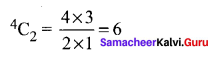
Question 11.
State the principle of moments of rotational equilibrium.
Answer:
∑ =\(\bar{\tau}\) = 0

Question 12.
Write down the moment of inertia of a disc of radius R and mass m about an axis in its plane at a distance R / 2 from its center.
Answer:
\(\frac { 1 }{ 2 }\) MR2

Question 13.
Can the couple acting on a rigid body produce translator motion ?
Answer:
No. It can produce only rotatory motion.

Question 14.
Which component of linear momentum does not contribute to angular momentum?
Answer:
Radial Component.

Question 15.
A system is in stable equilibrium. What can we say about its potential energy ?
Answer:
PE. is minimum.

Question 16.
Is radius of gyration a constant quantity ?
Answer:
No, it changes with the position of axis of rotation.

Question 17.
Two solid spheres of the same mass are made of metals of different densities. Which of them has a large moment of inertia about the diameter?

Answer:
Sphere of smaller density will have larger moment of inertia.

Question 18.
The moment of inertia of two rotating bodies A and B are IA and IB (IA > IB) and their angular momenta are equal. Which one has a greater kinetic energy ?
Answer:
K = \(\frac{\mathrm{L}^{2}}{2 \mathrm{I}}\) ⇒ KA > KA

Question 19.
A particle moves on a circular path with decreasing speed. What happens to its angular momentum?
Answer:
As \(\vec{L}\) = \(\vec{r}\) x m\(\vec{v}\) i.e., \(\vec{L}\) magnitude decreases but direction remains constant.

Question 20.
What is the value of instantaneous speed of the point of contact during pure rolling ?
Answer:
Zero.

Question 21.
Which physical quantity is conserved when a planet revolves around the sun ?
Answer:
Angular momentum of planet.

Question 22.
What is the value of torque on the planet due to the gravitational force of sun ?
Answer:
Zero.

Question 23.
If no external torque acts on a body, will its angular velocity be constant ?
Answer:
No.

Question 24.
Why there are two propellers in a helicopter ?
Answer:
Due to conservation of angular momentum.

Question 25.
A child sits stationary at one end of a long trolley moving uniformly with speed V on a smooth horizontal floor. If the child gets up and runs about on the trolley in any manner, then what is the effect of the speed of the centre of mass of the (trolley + child) system ?
Answer:
No change in speed of system as no external force is working.

Samacheer Kalvi 11th Physics Motion of System of Particles and Rigid Bodies Short Answer Questions (2 Marks)

Question 26.
State the factors on which the moment of inertia of a body depends.
Answer:

  • Mass of body
  • Size and shape of body
  • Mass distribution w.r.t. axis of rotation
  • Position and orientation of rotational axis

Question 27.
On what factors does radius of gyration of body depend?
Answer:
Mass distribution.

Question 28.
Why the speed of whirl wind in a Tornado is alarmingly high?
Answer:
In this, air from nearly regions get concentrated in a small space, so I decreases considerably. Since Iω = constant so ω increases so high.

Question 29.
Can a body be in equilibrium while in motion? If yes, give an example.
Answer:
Yes, if body has no linear and angular acceleration then a body in uniform straight line of motion will be in equilibrium.

Question 30.
There is a stick half of which is wooden and half is of steel, (i) it is pivoted at the wooden end and a force is applied at the steel end at right angle to its length (ii) it is pivoted at the steel end and the same force is applied at the wooden end. In which case is the angular acceleration more and why?
Answer:
I (first case) > 1 (Second case)
∴ τ r = l α
⇒ α (first case) < α (second case)

SamacheerKalvi.Guru

Question 31.
If earth contracts to half of its present radius what would be the length of the day at equator?
Answer:
Samacheer Kalvi 11th Physics Solution Chapter 5 Motion of System of Particles and Rigid Bodies

Question 32.
An internal force cannot change the state of motion of center of mass of a body. Flow does the internal force of the brakes bring a vehicle to rest?
Answer:
In this case the force which bring the vehicle to rest is friction, and it is an external force.

Question 33.
When does a rigid body said to be in equilibrium? State the necessary condition for a body to be in equilibrium.
Answer:
For translation equilibrium
∑ Fext  = 0
For rotational equilibrium
∑ \(\overline{\mathrm{τ}}\)ext  = 0

Question 34.
How will you distinguish between a hard boiled egg and a raw egg by spinning it on a table top’
Answer:
For same external torque, angular acceleration of raw egg will be small than that of Hard boiled egg.

Question 35.
Equal torques are applied on a cylinder and a sphere. Both have same mass and radius. Cylinder rotates about its axis and sphere rotates about one of its diameter. Which will acquire greater speed and why?
Answer:
τ = I α α = \(\frac { τ }{ I }\)
α in cylinder, αC = \(\frac{\tau}{I_{C}}\)
α in sphere, αS = \(\frac{\tau}{I_{S}}\)
Samacheer Kalvi 11th Physics Solution Chapter 5 Motion of System of Particles and Rigid Bodies

Question 36.
In which condition a body lying in gravitational field is in stable equilibrium?
Answer:
When vertical line through center of gravity passes through the base of the body.

Question 37.
Give the physical significance of moment of inertia. Explain the need of fly wheel in Engine.
Answer:
It plays the same role in rotatory motion as the mass does in translator y motion.

Samacheer Kalvi 11th Physics Motion of System of Particles and Rigid Bodies Short Answer Questions (3 Marks)

Question 38.
Three mass point m1, m2, m3 are located at the vertices of equilateral A of side ‘a’. What is the moment of inertia of system about an axis along the altitude of A passing through mi?
Answer:
Samacheer Kalvi 11th Physics Solution Chapter 5 Motion of System of Particles and Rigid Bodies

Question 39.
A disc rotating about its axis with angular speed ω0 is placed lightly (without any linear push) on a perfectly friction less table. The radius of the disc is R. What are the linear velocities of the points A, B and C on the disc shown in figure. Will the disc roll?
Answer:

Samacheer Kalvi 11th Physics Solution Chapter 5 Motion of System of Particles and Rigid Bodies
For A VA = R ω0 in forward direction
For B = VB = R ω0 in backward direction R
For C, VC = \(\frac {R}{2}\) ω0 in forward direction disc will not roll.

Question 40.
Find the torque of a force 7\(\hat{i}\) – 3\(\hat{j}\) – 5\(\hat{k}\) about the origin which acts on a particle whose position vector is \(\hat{j}\) +\(\hat{j}\) – \(\hat{j}\)
Answer:
Samacheer Kalvi 11th Physics Solution Chapter 5 Motion of System of Particles and Rigid Bodies

Samacheer Kalvi 11th Physics Motion of System of Particles and Rigid Bodies Numericals

Question 41.
Three masses 3 kg, 4 kg and 5 kg are located at the comers of an equilateral triangle of side 1 m. Locate the center of mass of the system.
Answer:
(x,y) = (0.54 m, 0.36 m)

Question 42.
Two particles mass 100 g and 300 g at a given time have velocities 10\(\hat{j}\) – 7\(\hat{j}\) – 3\(\hat{j}\) and 7\(\hat{i}\) – 9 \(\hat{j}\) + 6\(\hat{k}\) ms-1 respectively. Determine velocity of center of mass.
Answer:
Velocity of center of mass = \(\frac{31 \hat{i}-34 \hat{j}+15 \hat{k}}{2}\) ms-1

Question 43.
From a uniform disc of radius R, a circular disc of radius R / 2 is cut out. The center of the hole is at R / 2 from the center of original disc. Locate the center of gravity of the resultant flat body.
Answer:
Center of mass of resulting portion lies at R/6 from the center of the original disc in a direction opposite to the center of the cut out portion.

Question 44.
The angular speed of a motor wheel is increased from 1200 rpm to 3120 rpm in 16 seconds,

  1. What is its angular acceleration (assume the acceleration to be uniform)
  2. How many revolutions does the wheel make during this time ?

Answer:
a = 4π rad s-2
n = 576

Question 45.
A meter stick is balanced on a knife edge at its center. When two coins, each of mass 5 g are put one on top of the other at the 12.0 cm mark, the stick is found to be balanced at 45.0 cm, what is the mass of the meter stick?
Answer:
m = 66.0 gm.

Question 46.
A solid sphere is rolling op a friction less plane surface about its axis of symmetry. Find ratio of its rotational energy to its total energy.
Answer:
Samacheer Kalvi 11th Physics Solution Chapter 5 Motion of System of Particles and Rigid Bodies

Question 47.
Calculate the ratio of radii of gyration of a circular ring and a disc of the same radius with respect to the axis passing through their centers and perpendicular to their planes.
Answer:
2 : 1

Question 48.
Two discs of moments of inertia I1 and I2 about their respective axes (normal to the disc and passing through the center), and rotating with angular speed col and ω2 are brought into contact face to face with their axes of rotation coincident,

  1. What is the angular speed of the two – disc system ?
  2. Show that the kinetic energy of the combined system is less than the sum of the initial kinetic energies of the two discs. How do you account for this loss in energy ? Take ω1 ≠ ω2.

Answer:

  1. Let co be the angular speed of the two-disc system. Then by conservation of angular momentum
    Samacheer Kalvi 11th Physics Solution Chapter 5 Motion of System of Particles and Rigid Bodies
  2. Initial K.E. of the two discs.
    Samacheer Kalvi 11th Physics Solution Chapter 5 Motion of System of Particles and Rigid Bodies

Hence there is a loss of rotational K.E. which appears as heat.
When the two discs are brought together, work is done against friction between the two discs.

Question 49.
In the HCL molecule, the separating between the nuclei of the two atoms is about 1.27 Å (1Å = 10-10m). Find the approximate location of the CM of the molecule, given that the chlorine atom is about 35.5 times as massive as a hydrogen atom and nearly all the mass of an atom is concentrated in all its nucleus.
Answer:
As shown in Fig. suppose the H nucleus is located at the origin. Then,
x1 = 0, x2 = 1.27 Å, m1 = 1, m2 = 35.5
The position of the CM of HCl molecule is
Samacheer Kalvi 11th Physics Solution Chapter 5 Motion of System of Particles and Rigid Bodies
Thus the CM of HCl is located on the line joining H and Cl nuclei at a distance of 1.235 Å from the H nucleus.

Question 50.
A child stands at the center of turn table with his two arms out stretched. The turn table is set rotating with an angular speed of 40 rpm. How much is the angular speed of the child if he folds his hands back and thereby reduces his moment of inertia to 2/3 times the initial value?

  1. Assume that the turn table rotates without friction
  2. Show that the child’s new kinetic energy of rotation is more than the initial kinetic energy of rotation.

How do you account for this increase in kinetic energy ?
Answer:
Here ω = 40 rpm, I2 = \(\frac { 1 }{ 2 }\) I1
By the principle of conservation of angular momentum,
I1ω1 = I2ω2 or I1 x 4o = \(\frac {2}{5}\) I1 ω1 or ω2 = 100 rpm
(ii) Initial kinetic energy of rotation –
Samacheer Kalvi 11th Physics Solution Chapter 5 Motion of System of Particles and Rigid Bodies
new kinetic energy of rotation –
Samacheer Kalvi 11th Physics Solution Chapter 5 Motion of System of Particles and Rigid Bodies
Thus the child’s new kinetic energy of rotation is 2.5 times its initial kinetic energy of rotation. This increase in kinetic energy is due to the internal energy of the child which he uses in folding his hands back from the out stretched position.

Question 51.
To maintain a rotor at a uniform angular speed of 200 rad s-1 an engine needs to transmit a torque of 180 N m. What is the power required by the engine? Assume that the engine is 100% efficient.
Here ω = 200 rad s-1, τ = 180 N m
Power, P = τω = 180 x 200 = 36,000 W = 36 kW.

Question 52.
A car weighs 1800 kg. The distance between its front and back axles is 1.8 m. Its center of gravity is 1.05 m behind the front axle. Determine the force exerted by the level ground on each front and back wheel.
Answer:
Samacheer Kalvi 11th Physics Solution Chapter 5 Motion of System of Particles and Rigid Bodies
For transnational equilibrium of car
NF + NB = W = 1800 x 9.8 = 17640 N
For rotational equilibrium of car
1.05 NF = 0.75 NB
1.05 NF = 0.75(17640 – NF )
1.8 NF = 13230
NF = 13230 / 1.8 = 7350 N
NB = 17640 – 7350 = 10290 N
Force on each front wheel = \(\frac {7350}{ 2 }\) = 3675 N
Force on each back wheel = \(\frac {10290}{ 2 }\) = 5145 N

Samacheer Kalvi 11th Physics Motion of System of Particles and Rigid Bodies Long Answer Questions (5 Marks)

Question 1.
Derive an expression for center of mass for distributed point masses.
Answer:
A point mass is a hypothetical point particle which has nonzero mass and no size or shape. To find the center of mass for a collection of n point masses, say,m1 , m2, m3 ….. mwe have to first choose an origin and an appropriate coordinate system as shown in Figure. Let, x1, x2, x3 …….. xn be the X – coordinates of the positions of these point masses in the X direction from the origin.
The equation for the X coordinate of the center of mass is,
Samacheer Kalvi 11th Physics Solution Chapter 5 Motion of System of Particles and Rigid Bodies
where, ∑ mi ¡s the total mass M of all the particles. ( ∑ mi = M).Hence,
Samacheer Kalvi 11th Physics Solution Chapter 5 Motion of System of Particles and Rigid Bodies

Samacheer Kalvi 11th Physics Solution Chapter 5 Motion of System of Particles and Rigid Bodies

Similarly, we can also find y and z coordinates of the center of mass for these distributed point masses as indicated in figure.
Samacheer Kalvi 11th Physics Solution Chapter 5 Motion of System of Particles and Rigid Bodies
Hence, the position of center of mass of these point masses in a Cartesian coordinate system is (xCM, yCM zCM). in general, the position of center of mass can be written in a vector form as,
Samacheer Kalvi 11th Physics Solution Chapter 5 Motion of System of Particles and Rigid Bodies
where, is the position vector of the center of mass and \(\vec{r}_{i}\) = xi \(\hat{j}\) + yi\(\hat{j}\) + zi\(\hat{k}\) is the position vector of the distributed point mass; where, \(\hat{i}\), \(\hat{j}\), and \(\hat{j}\) are the unit vectors along X, Y and Z-axis respectively.

Question 2.
Discuss the center of mass of two point masses with pictorial representation.
Answer:
With the equations for center of mass, let us find the center of mass of two point masses m1 and m2, which are at positions x1 and x2 respectively on the X – axis. For this case, we can express the position of center of mass in the following three ways based on the choice of the coordinate system.

(1) When the masses are on positive X-axis:
The origin is taken arbitrarily so that the masses m1 and m2 are at positions x1 and x2 on the positive X-axis as shown in figure (a). The center of mass will also be on the positive X- axis at xCM as given by the equation,
\(x_{\mathrm{CM}}=\frac{m_{1} x_{1}+m_{2} x_{2}}{m_{1}+m_{2}}\)

(2) When the origin coincides with any one of the masses:
The calculation could be minimized if the origin of the coordinate system is made to coincide with any one of the masses as shown in figure (b). When the origin coincides with the point
mass m1, its position x1 is zero, (i.e. x1 = 0). Then,
\(x_{\mathrm{CM}}=\frac{m_{1}(0)+m_{2} x_{2}}{m_{1}+m_{2}}\)
The equation further simplifies as,
xCM = \(\frac{m_{2} x_{2}}{m_{1}+m_{2}}\)

(3) When the origin coincides with the center of mass itself:
If the origin of the coordinate system is made to coincide with the center of mass, then, xCM = O and the mass rn1 is found to be on the negative X- axis as shown in figure (c). Hence, its position x1 is negative, (i.e. – x1).
Samacheer Kalvi 11th Physics Solution Chapter 5 Motion of System of Particles and Rigid Bodies
The equation given above is known as principle of moments.
Samacheer Kalvi 11th Physics Solution Chapter 5 Motion of System of Particles and Rigid Bodies

Samacheer Kalvi 11th Physics Solution Chapter 5 Motion of System of Particles and Rigid Bodies

Question 3.
Derive an expression for kinetic energy in rotation and establish the relation between rotational kinetic energy and angular momentum.
Answer:
Let us consider a rigid body rotating with angular velocity ω about an axis as shown in figure. Every particle of the body will have the same angular velocity ω and different tangential velocities v based on its positions from the axis of rotation. Let us choose a particle of mass mi situated at distance ri from the axis of rotation. It has a tangential velocity vi given by the relation, vi = ri ω. The kinetic energy KEi. of the particle is,
KEi = \(\frac{1}{2} m_{i} v_{i}^{2}\)
Writing the expression with the angular velocity,
KE = \(\frac{1}{2}\) mi(riω)2 = \(\frac{1}{2} m_{i} r_{i}^{2}\)ω2

For the kinetic energy of the whole body, which is made up of large number of such particles, the equation is written with summation as,
KE = \(\frac{1}{2}\left(\sum m_{i} r_{i}^{2}\right)\)ω2
where, the term ∑ mirir is the moment of inertia I of the whole body. ∑ mirir
Hence, the expression for KE of the rigid body in rotational motion is –
KE = \(\frac{1}{2}\) Iω2
This is analogous to the expression for kinetic energy in transnational motion.
KE = \(\frac{1}{2}\) Mv2

Samacheer Kalvi 11th Physics Solution Chapter 5 Motion of System of Particles and Rigid Bodies

Relation between rotational kinetic energy and angular momentum
Let a rigid body of moment of inertia I rotate with angular velocity ω.
The angular momentum of a rigid body is, L = Iω
The rotational kinetic energy of the rigid body is, KE = \(\frac{1}{2}\) Iω2
By multiplying the numerator and denominator of the above equation with I, we get a relation between L and KE as,
Samacheer Kalvi 11th Physics Solution Chapter 5 Motion of System of Particles and Rigid Bodies

Question 4.
Discuss how the rolling is the combination of transnational and rotational and also be possibilities of velocity of different points in pure rolling.
Answer:
The rolling motion is the most commonly observed motion in daily life. The motion of wheel is an example of rolling motion. Round objects like ring, disc, sphere etc. are most suitable for rolling. Let us study the rolling of a disc on a horizontal surface. Consider a point P on the edge of the disc. While rolling, the point undergoes transnational motion along with its center of mass and rotational motion with respect to its center of mass.

Combination of Translation and Rotation:
We will now see how these transnational and rotational motions arc related in rolling. If the radius of the rolling object is R, in one full rotation, the center of mass is displaced by 2πR (its circumference). One would agree that not only the center of mass. but all the points Of l the disc are displaced by the same 2πR after one full rotation. The only difference is that the center of mass takes a straight path; but, all the other points undergo a path which has a combination of the transnational and rotational motion. Especially the point on the edge undergoes a path of a cyclonic as shown in the figure.
Samacheer Kalvi 11th Physics Solution Chapter 5 Motion of System of Particles and Rigid Bodies

As the center of mass takes only a straight line path. its velocity vCM is only transnational velocity vTRANS (vCM = vTRANS). All the other points have two velocities. One is the transnational velocity vTRANS (which is also the velocity of center of mass) and the other is the rotational velocity vROT (vROT = rω). Here, r ¡s the distance of the point from the center of mass and o is the angular velocity. The rotational velocity vROT is perpendicular to the instantaneous position vector from the center of mass as shown in figure (a). The resultant of these two velocities is v. This resultant velocity y is perpendicular to the position vector from the point of contact of the rolling object with the surface on which it is rolling as shown in figure (b).
Samacheer Kalvi 11th Physics Solution Chapter 5 Motion of System of Particles and Rigid Bodies

Samacheer Kalvi 11th Physics Solution Chapter 5 Motion of System of Particles and Rigid Bodies

We shall now give importance to the point of contact. In pure rolling, the point of the rolling object which comes in contact with the surface is at momentary rest. This is the case with every point that is on the edge of the rolling object. As the rolling proceeds, all’the points on the edge, one by one come in contact with the surface; remain at momentary rest at the time of contact and then take the path of the cycloid as already mentioned.
Hence, we can consider the pure rolling in two different ways.
(i) The combination of transnational motion and rotational motion about the center of mass.
(or)
(ii) The momentary rotational motion about the point of contact.
As the point of contact is at momentary rest in pure rolling, its resultant velocity v is zero (v = o). For example, in figure, at the point of contact, vTRANS is forward (to right) and vROT is backwards (to the left).
Samacheer Kalvi 11th Physics Solution Chapter 5 Motion of System of Particles and Rigid Bodies

That implies that, vTRANS and vROT are equal in magnitude and opposite in direction (v = vTRANS – vROT = 0). Hence, we conclude that in pure rolling, for all the points on the edge, the magnitudes of vTRANS and vROT are equal (vTRANS = vROT) As vTRANS = vCM and vROT = Rω, in pure rolling we have,
vCM = Rω

We should remember the special feature of the above equation. In rotational motion, as per the relation v = rω, the center point will not have any velocity as r is zero. But in rolling motion, it suggests that the center point has a velocity vCM given by above equation vCM – Rω. For the topmost point, the two velocities vTRANS and vROT are equal in magnitude and in the same direction (to the right). Thus, the resultant velocity v is the sum of these two velocities, v = vTRANS + vROT In other form, v = 2 vCM as shown in figure below.

Question 5.
Derive an expression for kinetic energy in pure rolling.
Answer:
As pure is the combination of transnational and rotational motion, we can write the total kinetic energy (KE) as the sum of kinetic energy due to transnational motion (KETRANS) and kinetic energy due to rotational motion (KEROT).
KE = KETRANS + KEROT ………(i)
If the mass of the rolling object is M, the velocity of center of mass is vCM, its moment of inertia about center of mass is ICM and angular velocity is ω, then
Samacheer Kalvi 11th Physics Solution Chapter 5 Motion of System of Particles and Rigid Bodies
With center of mass as reference:
The moment of inertia (ICM) of a rolling object about the center of mass is, ICM = MK2 and vCM = Rω. Here, K is radius of gyration.
Samacheer Kalvi 11th Physics Solution Chapter 5 Motion of System of Particles and Rigid Bodies

With point of contact as reference:
We can also arrive at the same expression by taking the momentary rotation happening with respect to the point of contact (another approach to rolling). If we take the point of contact as o, then,
KE = \(\frac {1}{2}\) I0ω2

Here, I0 is the moment of inertia of the object about the point of contact. By parallel axis
theorem, I0 = ICM + MK2 Further we can write, I0 MK2 + MR2. With vCM = Rω or ω = \(\frac{v_{\mathrm{CM}}}{\mathrm{R}}\)
Samacheer Kalvi 11th Physics Solution Chapter 5 Motion of System of Particles and Rigid Bodies

As the two equations (v) and (vi) are the same, it ¡s once again confirmed that the pure tolling problems could be solved by considering the motion as any one of the following two cases.
(i) The combination of transnational motion and rotational motion about the center of mass.
(or)
(ii) The momentary rotational motion about the point of contact.

Question 6.

  1. Can a body in translator y motion have angular momentum? Explain.
  2. Why is it more difficult to revolve a stone by tying it to a longer string than by tying it to a shorter string?

Answer:
(1) Yes, a body in translatory motion shall have angular momentum unless fixed point about which angular momentum is taken lies on the line of motion of body
\(|\overrightarrow{\mathrm{L}}|\) = rp sin θ
= 0 only when θ = O° or 180°

(2) MI of stone I = ml2 (l – length of string) l is large, a is very small
τ = Iα
α = \(\frac {τ}{I}\) = \(\frac{\tau}{m l^{2}}\)
if l is large a is very small.
∴ more difficult to revolve.

We as a team believe the knowledge shared on our page regarding the Samacheer Kalvi 11th Physics Book Solutions Questions and Answers for Chapter 5 Motion of System of Particles and Rigid Bodies has cleared all your queries. For any other help don’t hesitate and leave us a comment so that we will get back to you at the soonest. Stay connected to our page to avail the latest updates regarding the Tamilnadu State Board Solutions for various subjects in a matter of seconds.

Samacheer Kalvi 10th Science Solutions Chapter 20 Breeding and Biotechnology

Students who are preparing for the Science exam can download this Tamilnadu State Board Solutions for Class 10th Science Chapter 20 from here for free of cost. These Tamilnadu State Board Textbook Solutions PDF cover all 10th Science Breeding and Biotechnology Book Back Questions and Answers.
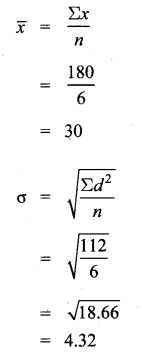
All these concepts of Chapter 20 Breeding and Biotechnology are explained very conceptually by the subject teachers in Tamilnadu State Board Solutions PDF as per the prescribed Syllabus & guidelines. You can download Samacheer Kalvi 10th Science Book Solutions Chapter 20 Breeding and Biotechnology State Board Pdf for free from the available links. Go ahead and get Tamilnadu State Board Class 10th Science Solutions of Chapter 20 Breeding and Biotechnology.

Tamilnadu Samacheer Kalvi 10th Science Solutions Chapter 20 Breeding and Biotechnology

Kickstart your preparation by using this Tamilnadu State Board Solutions for Class 20th Science Chapter 20 Breeding and Biotechnology Questions and Answers and get the max score in the exams. You can cover all the topics of Chapter 20 easily after studying the Tamilnadu State Board Class 20th Science Textbook solutions pdf. Download the Tamilnadu State Board Science Chapter 20 Breeding and Biotechnology solutions of Class 20th by accessing the links provided here and ace up your preparation.

Samacheer Kalvi 10th Science Breeding and Biotechnology Textual Evaluation Solved

I. Choose the Correct Answer.

Breeding And Biotechnology Class 10 Question 1.
Which method of crop improvement can be practised by a farmer if he is inexperienced?
(a) clonal selection
(b) mass selection
(c) pure line selection
(d) hybridisation.
Answer:
(a) clonal selection

Breeding And Biotechnology In Tamil Question 2.
Pusa Komai is a disease resistant variety of:
(a) sugarcane
(b) rice
(c) cow pea
(d) maize
Answer:
(c) cow pea

Samacheerkalvi.Guru Science Question 3.
Himgiri developed by hybridisation and selection for disease resistance against rust pathogens is a variety of ______.
(a) chilli
(b) maize
(c) sugarcane
(d) wheat.
Answer:
(d) wheat.

Question 4.
The miracle rice which saved millions of lives and celebrated its 50th birthday is:
(a) IR 8
(b) IR 24
(c) Atomita 2
(d) Ponni
Answer:
(a) IR 8

Question 5.
Which of the following is used to produce products useful to humans by biotechnology techniques?
(a) enzyme from organism
(b) live organism
(c) vitamins
(d) both (a) and (b).
Answer:
(d) both (a) and (b).

Question 6.
We can cut the DNA with the help of:
(a) scissors
(b) restriction endonucleases
(c) knife
(d) RNAase
Answer:
(b) restriction endonucleases

Question 7.
rDNA is a ______.
(a) vector DNA
(b) circular DNA
(c) recombinant of vector DNA and desired DNA
(d) satellite DNA.
Answer:
(c) recombinant of vector DNA and desired DNA

Question 8.
DNA fingerprinting is based on the principle of identifying sequences of DNA:
(a) single-stranded
(b) mutated
(c) polymorphic
(d) repetitive
Answer:
(d) repetitive

Question 9.
Organisms with a modified endogenous gene or a foreign gene are also known as ______.
(a) transgenic organisms
(b) genetically modified
(c) mutated
(d) both (a) and (b).
Answer:
(a) transgenic organisms

Question 10.
In hexaploid wheat (2n = 6x = 42) the haploid (n) and the basic(x) number of chromosomes are:
(a) n = 7 and x = 21
(b) n = 21 and x = 21
(c) n = 1 and x = 1
(d) n = 21 and x = 7
Answer:
(d) n = 21 and x = 7

II Fill in the blanks.

Question 1.
Economically important crop plants with superior quality are raised by ______.
Answer:
Breeding.

Question 2.
A protein rich wheat variety is ______.
Answer:
Atlas 66.

Question 3.
_______ is the chemical used for doubling the chromosomes.
Answer:
Colchicine.

Question 4.
The scientific process which produces crop plants enriched with desirable nutrients is called ______.
Answer:
Biofortification.

Question 5.
Rice normally grows well in alluvial soil, but _____ is a rice variety produced by mutation breeding that grows well in saline soil.
Answer:
Atomita – 2 rice

Question 6.
_____ technique made it possible to genetically engineer living organism.
Answer:
Recombinant DNA.

Question 7.
Restriction endonucleases cut the DNA molecule at specific positions known as ______.
Answer:
Molecular scissors.
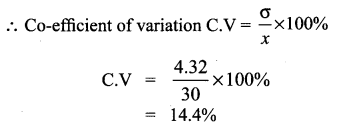
Question 8.
Similar DNA fingerprinting is obtained for ______.
Answer:
Identical twins.
Question 9.
______ cells are undifferentiated mass of cells.
Answer:
Pleuripotent.

Question 10.
In gene cloning, the DNA of interest is integrated in a ______.
Answer:
Vector [plasmid].

III. State whether true or false. If false, write the correct statement.

Question 1.
Raphano brassica is a man – made tetraploid produced by colchicine treatment.
Answer:
True.

Question 2.
The process of producing an organism with more than two sets of chromosome is called mutation.
Answer:
False.
Correct statement: The process of producing an organism with more than two sets of chromosome is called polyploidy.

Question 3.
A group of plants produced from a single plant through vegetative or asexual reproduction are called a pureline.
Answer:
False.
Correct statement: A group of plants produced from a single plant through vegetative or asexual reproduction are called clones.

Question 4.
Iron fortified rice variety determines the protein quality of the cultivated plant.
Answer:
False.
Correct statement: Iron fortified rice variety determines the iron quality of the cultivated plant.

Question 5.
Golden rice is a hybrid.
Answer:
False.
Correct statement: Golden rice is a genetically modified plant.

Question 6.
Bt gene from bacteria can kill insects.
Answer:
True.

Question 7.
In vitro fertilisation means the fertilisation done inside the body.
Answer:
False.
Correct statement: In vitro fertilisation means the fertilisation done outside the body.

Question 8.
DNA fingerprinting technique was developed by Alec Jeffrey.
Answer:
True.

Question 9.
Molecular scissors refers to DNA ligases.
Answer:
False.
Correct statement: Molecular scissors refers to Restriction Enzymes.

IV. Match the following:

Question 1.

Column AColumn B
1. Sonalika(a) Phaseolus mungo
2. IR-8(b) Sugarcane
3. Saccharum(c) Semi-dwarf wheat
4. Mung No. 1(d) Groundnut
5. TMV-2(e) Semi-dwarf Rice
6. Insulin(f) Bacillus thuringienesis
7. Bt toxin(g) Beta carotene
8. Golden rice(h) the first hormone produced using rDNA technique

Answer:

  1. (c) Semi – dwarf wheat
  2. (e) Semi – dwarf Rice
  3. (b) Sugarcane
  4. (a) Phaseolus mungo
  5. (d) Groundnut
  6. (h) the first hormone produced using rDNA technique
  7. (f) Bacillus thuringienesis
  8. (g) Beta carotene.

V. Understand the assertion statement, justify the reason given and choose the correct choice:

(a) The assertion is correct and the reason is wrong.
(b) Reason is correct and the assertion is wrong.
(c) Both assertion and reason are correct.
(d) Both assertion and reason are wrong.

Question 1.
Assertion: Hybrid is superior to either of its parents.
Reason: Hybrid vigour is lost upon inbreeding.
Answer:
(a) The assertion is correct and the reason is wrong.

Question 2.
Assertion: Colchicine reduces the chromosome number.
Reason: It promotes the movement of sister chromatids to the opposite poles.
Answer:
(d) Both assertion and reason are wrong.

Question 3.
Assertion: rDNA is superior over hybridisation techniques.
Reason: Desired genes are inserted without introducing the undesirable genes in target organisms.
Answer:
(c) Both assertion and reason are correct.

VI. Answer in a Sentence

Question 1.
Give the name of the wheat variety having higher dietary fibre and protein.
Answer:
Atlas 66, a protein-rich variety, having higher dietary fibre and protein.

Question 2.
Semi-dwarf varieties were introduced in rice. This was made possible by the presence of dwarfing gene in rice. Name this dwarfing gene.
Answer:
Dee-geo-woo-gen a dwarf variety from China.

Question 3.
Define genetic engineering.
Answer:
Genetic engineering is the manipulation and transfer of genes from one organism to another organism to create a new DNA called recombinant DNA (rDNA). Genetic engineering is also called recombinant DNA technology.

Question 4.
Name the types of stem cells.
Answer:
Embryonic stem cells and somatic stem cells are the types of stem cells.

Question 5.
What are transgenic organisms?
Answer:
Plants or animals expressing a modified endogenous gene or a foreign gene are called transgenic organisms.

Question 6.
State the importance of biofertiliser.
Answer:
Biofertilizer adds nutrients through the natural process of nitrogen fixation, stimulate the plant growth through the synthesis of growth-promoting substance.

VII. Short Answer Questions

Question 1.
Discuss the method of breeding for disease resistance.
Answer:
Plant diseases are caused by pathogens like viruses, bacteria and fungi. This affects crop yield. To develop disease-resistant varieties of crops, that would increase the yield and reduce the use of fungicides and bactericides are important. Some disease-resistant varieties are as follows:

CropVarietyResistance to diseases
WheatHimgiriLeaf and stripe rust, hill bunt
CauliflowerPusa Shubhra, Pusa Snowball K-1Black rot
CowpeaPusa KomalBacterial blight

Question 2.
Name three improved characteristics of wheat that helped India to achieve high productivity.
Answer:
Sonalika, kalyan and sona are the three improved characteristic of wheat that helped India to achieve high productivity.

Question 3.
Name two maize hybrids rich in amino acid lysine.
Answer:
Protina, Shakti and Rathna are lysine – rich maize hybrids, which are developed in India.

Question 4.
Distinguish between
(a) Somatic gene therapy and germline gene therapy.
(b) Undifferentiated cells and differentiated cells.
Answer:
(a) Somatic gene therapy and germline gene therapy.

Somatic gene therapyGermline gene therapy
Somatic gene therapy is the replacement of the defective gene in somatic cells.Germline gene therapy is the replacement of the defective gene in the germ cell (egg and sperm).

(b) Undifferentiated cells and differentiated cells.

Undifferentiated cellsDifferentiated cells
Our body is composed of over 200 specialised cell types, that can carry out specific functions, eg. Neurons or nerve cells that can transmit signals. Pancreatic cells to secrete insulin. These specialised cells are called as differentiated cells.The cells which are variable potency, undifferentiated or unspecialised mass of cells are called stem cells. The stem cells are undifferentiated or unspecialised mass of cells.

Question 5.
State the applications of DNA fingerprinting technique.
Answer:
Applications of DNA Fingerprinting:
(i) DNA fingerprinting technique is widely used in forensic applications like crime investigation such as identifying the culprit. It is also used for paternity testing in case of disputes.
(ii) It also helps in the study of genetic diversity of population, evolution and speciation.

Question 6.
How are stem cells useful in the regenerative process?
Answer:
Sometimes cells, tissues and organs in the body may be permanently damaged or lost due to genetic condition or disease or injury. In such situations, stem cells are used for the treatment of diseases, which is called stem – cell therapy. In treating neurodegenerative disorders like Parkinson’s disease and Alzheimer’s disease neuronal stem cells can be used to replace the damaged or lost neurons.

Question 7.
Differentiate between outbreeding and inbreeding.
Answer:
Inbreeding:
When breeding or mating takes place between animals of the same breed, for about 4 – 6 generations, then it is called inbreeding. Superior males and superior females of the same breed are identified and mated in pairs. It helps in the accumulation of superior genes and the elimination of undesirable genes. Inbreeding depression is the continued inbreeding, which reduces fertility and productivity. Inbreeding exposes harmful recessive genes that are eliminated by selection.
Breeding And Biotechnology Class 10 Samacheer Kalvi Science Solutions Chapter 20
Outbreeding:
The breeding of unrelated animals is outbreeding. The offsprings formed are called hybrids. The hybrids are stronger and vigorous than their parents. Cross between two different species with desirable features of economic value is mated. Mule is superior to the horse in strength, intelligence, ability to work and resistance to diseases, but they are sterile.

VIII. Long Answer Questions

Question 1.
What are the effects of hybrid vigour in animals.
Answer:

  1. Increased production of milk by cattle.
  2. Increased production of egg by poultry.
  3. High quality of meat is produced.
  4. Increased growth rate in domesticated animals.

Question 2.
Describe mutation breeding with an example.
Answer:
The mutation is defined as the sudden heritable change in the nucleotide sequence of DNA in an organism. The genetic variations brings out changes in an organism. The organism which undergoes mutation is called a mutant.
The factors which induce mutations are known as mutagens or mutagenic agents. The mutagens are of two types:
(a) Physical mutagens: Radiations like X – rays, a, P and Y – rays, UV rays and temperature, etc, which induce, maturations are called physical mutagens.

(b) Chemical mutagens: Chemical substances that induce mutations are called chemical mutagens, eg. Mustard gas and nitrous acid. The utilization of induced mutation in crop improvement is called mutation inbreeding.
Achievements of mutation breeding:

  • Sharbati Sonora wheat produced from Sonora – 64 by using gamma rays.
  • Atomica – 2 rice with saline tolerance and pest resistance.
  • Groundnuts with thick shells.

Question 3.
Biofortification may help in removing hidden hunger. How?
Answer:
Biofortification: Biofortification is the scientific process of developing crop plants enriched with high levels of desirable nutrients like vitamins, proteins and minerals. Some examples of crop varieties developed as a result of biofortification are given below:

  1. Protina, Shakti and Rathna are lysine rich maize hybrids (developed in India).
  2. Atlas 66, a protein rich wheat variety.
  3. Iron rich fortified rice variety’.
  4. Vitamin A enriched carrots, pumpkin and spinach.

Question 4.
With a neat labelled diagram explain the techniques involved in gene cloning.
Answer:
The carbon copy or more appropriately, a clone means to make a genetically exact copy of an organism. ‘Dolly’ is the cloned sheep.
Breeding And Biotechnology In Tamil Samacheer Kalvi 10th Science Solutions Chapter 20
In gene cloning, a gene or a piece of DNA fragment is inserted into a bacterial cell, where DNA will be multiplied (copied) as the cell divides.
The basic steps involved in gene cloning are:

  • Isolation of desired DNA fragment by using restriction enzymes.
  • Insertion of the DNA fragment into a suitable vector (plasmid) to make rDNA.
  • Transfer of rDNA into the bacterial host cell (Transformation).
  • Selection and multiplication of the recombinant host cell to get a clone.
  • Expression of the cloned gene in the host cell.

Using this strategy several enzymes, hormones and vaccines can be produced.

Question 5.
Discuss the importance of biotechnology in the field of medicine.
Answer:
Using genetic engineering techniques medicinally important valuable proteins or polypeptides that form the potential pharmaceutical products for the treatment of various diseases have been developed on a commercial scale.
Pharmaceutical products developed by rDNA technique:

  1. Insulin used in the treatment of diabetes.
  2. Human growth hormone used for treating children with growth deficiencies.
  3. Blood clotting factors are developed to treat haemophilia.
  4. Tissue plasminogen activator is used to dissolve blood clots and prevent heart attack.
  5. Development of vaccines against various diseases like Hepatitis B and rabies.

IX. Higher Order Thinking Skills (HOTS) Questions

Question 1.
A breeder wishes to incorporate desirable characters into the crop plants. Prepare a list of characters he will incorporate.
Answer:
The list of character he will incorporate are:

  1. High yielding and better quantity
  2. Disease resistance
  3. Insects pest resistance
  4. Improved nutritional quality
  5. Short duration

Question 2.
Organic farming is better than Green Revolution. Give reasons.
Answer:

  • Dwarfness is desired in cereals, so fewer nutrients are consumed by the crops.
  • Fertilizer is responsive.
  • Disease resistant varieties.
  • Insect and pest resistant crop varieties.
  • High levels of desirable nutrients like vitamins, proteins and minerals.

Question 3.
Polyploids are characterised by gigantism. Justify your answer.
Answer:
An organism having more than two set of chromosome is called polyploidy. It can be induced by physical agents such as heat or cold treatment, X-rays and chemical agents like colchicine. As organisms produced by polyploidy have more than two set of chromosomes they are gigantic.

Question 4.
‘P’ is a gene required for the synthesis of vitamin A. It is integrated with the genome of ‘Q’ to produce genetically modified plant ‘R’.
(i) What is P, Q and R?
(ii) State the importance of ‘R’ in India.
Answer:
(i)  The P, Q and R:

  • P – Beta – carotene gene.
  • Q – Prevent vitamin A deficiency.
  • R – Golden rice.

(ii) Importance of rice in India:

  • Rice is the most important staple food for millions of people in developing countries like India.
  • Beta – carotene is produced in the endosperm of the grain. It could control the chronic health problems caused by vitamin A deficiency, especially among the poor in developing countries like India.

Samacheer Kalvi 10th Science Breeding and Biotechnology Additional Questions Solved

I. Fill in the blanks.

Question 1.
Plant ______ is the art of developing economically important plants.
Answer:
Breeding.

Question 2.
Plant diseases are caused by ______ like viruses, bacteria and fungi.
Answer:
Pathogen.

Question 3.
______ is the first man – made cereal hybrid.
Answer:
Triticale.

Question 4.
The superiority of the hybrid obtained by cross-breeding is called _____ or ______.
Answer:
Heterosis
or
Hybrid vigour.

Question 5.
The other name for genetic engineering is ______.
Answer:
Recombinant DNA technology.

Question 6.
The organism which undergoes mutation is called a ______ and the factors which induce mutations are ______.
Answer:
Mutant; mutagenic agents.

Question 7.
The replacement of the defective gene in a germ cell (egg or sperm) is called ______.
Answer:
Germline gene therapy.

Question 8.
Blood clotting factors are developed to treat ______.
Answer:
Haemophilia.

Question 9.
Stem cells, which are undifferentiated or unspecialised mass of cells can be used for the treatment is called ______.
Answer:
Stem cell therapy.

Question 10.
_______ is used in the treatment of diabetes.
Answer:
Insulin.

II. Match the following:

Question 1.

1. Cowpea(a) Joining the DNA fragments
2. UV rays(b) New breed of sheep
3. Lady’s finger(c) Bacterial blight
4. DNA ligase(d) Flat bean
5. Pusasem 3(e) Pusa Sawani
6. Hissardale(f) Induce mutation

Answer:
1. (c) Bacterial blight
2. (f) Induce mutation
3. (e) Pusa Sawani
4. (a) Joining the DNA fragments
5. (d) Flat bean
6. (b) New breed of sheep.

III. Write “True or False” statements. Correct the false statements:

Question 1.
Modem Agricultural practices are activities carried out to improve the plants.
Answer:
True.

Question 2.
When breeding takes place between animals of the same breed, it is called outbreeding.
Answer:
False.
Correct statement: When breeding takes place between animals of the same breed, it is called inbreeding.

Question 3.
The process of introducing high yielding varieties of plants from one place to another is called a selection.
Answer:
False.
Correct statement: The process of introducing high yielding varieties of plants from one place to another is called Exotic species.

Question 4.
The mutation is a sudden inheritable change in the nucleus sequence of DNA in an organism.
Answer:
False.
Correct statement: Mutation is a sudden heritable change in the nucleotide sequence of DNA in an organism.

Question 5.
A breed is a group of animals of common origin within a species, which has certain characters, that are not found in other members of the same species.
Answer:
True.

IV. Choose the correct answer.

Question 1.
The high yielding rice variety from Indonesia and China are ______.
(a) Peta and DGWG
(b) IR-8 and Gold rice
(c) Hexaploid Triticale and Triticum durum
(d) Sonalika and Kalyan Sona.
Answer:
(a) Peta and DGWG

Question 2.
First artificially synthesized hormone is:
(a) Secretin
(b) Insulin
(c) Glucagon
(d) Renin
Answer:
(b) Insulin

Question 3.
The presence of this substance in bacteria can undergo replication independently along with chromosomal DNA ______.
(a) heritable
(b) colchicine
(c) mutation
(d) plasmid.
Answer:
(d) plasmid.

Question 4.
Bacillus thuringiensis (Bt) stains have been used for designing novel.
(a) Bio-metallogical techniques
(b) Bio-insecticidal plants
(c) Bio-mineralization
(d) Bio-fertilizer
Answer:
(b) Bio-insecticidal plants

Question 5.
A group of plants produced from a single plant through vegetative or asexual reproduction is called ______.
(a) Transgenic
(b) Hexaploid
(c) clones
(d) mutation.
Answer:
(b) Hexaploid

V. Answer the following briefly:

Question 1.
What is the green revolution? Who is the “Father of Green Revolution”?
Answer:
Green Revolution is the process of increasing food production through high yielding crop varieties and modem agricultural techniques in underdeveloped and developing nations. Dr Norman. E. Borlaug, an American agronomist is the “Father of Green Revolution”.

Question 2.
Write the role of polyploidy in crop improvement.
Answer:
The role of polyploidy in crop improvement are production of:

  1. Seedless watermelons (3n) and bananas (3n).
  2. TV-29 (triploid variety of tea) with larger shoots and drought tolerance.
  3. Triticale (6n) is a hybrid of wheat and rye. To make this plant fertile polyploidy is induced. It has higher dietary fibre and protein.
  4. Raphanobrassica is an allotetraploid by colchicine treatment.

Question 3.
What is Bio – fortification? Give any two examples.
Answer:
Bio – fortification is the scientific process of developing crop plants enriched with high levels of desirable nutrients like vitamins, proteins and minerals.
Examples of crop varieties developed as a result of bio – fortification are:

  • Protina, Shakti and Rathna are lysine – rich maize hybrids.
  • Atlas 66, A protein – rich wheat variety.

Question 4.
Give two examples of cross-breeding in animals.
Answer:
Cross breed of fowls: White Leghorn X Plymouth Rock

Hybrid fowl – yield more eggs

Cross breed of cows : Developed by mating the bulls of exotic breeds and cows of indigenous breeds.
Brown Swiss X Sahiwal

Karan Swiss – yield 2-3 times more milk than indigenous cows.

Question 5.
What is hybridization? Explain the hybridization experiment.
Answer:
The process of crossing two or more types of plants for bringing their desired characters together into one progeny hybrid is called hybridization. Hybridization is creating a genetic variation to get improved varieties.

Hybridization Experiment:
Triticale is the first man-made cereal hybrid. It is obtained by crossing wheat (Triticum durum, 2n = 28) and rye (Secale cereal, 2n = 14). The F, a hybrid is sterile (2n = 21). Then the chromosome number is doubled using colchicine and it becomes hexaploid triticale (2n = 42). The cycle of crop raising and selection continues until the plants with the desired characters are finally obtained.

Question 6.
Name the methods of plant breeding for crop improvement.
Answer:
The methods of plant breeding to develop high yielding varieties, for crop improvement, are as follows:

  • Introduction of new varieties of plants
  • Selection
  • Polyploid breeding
  • Mutation breeding
  • Hybridization.

Question 7.
Explain briefly about gene therapy.
Answer:
The replacement of a defective gene by the direct transfer of functional genes into humans to treat genetic disease or disorder is referred to as gene therapy.
The recombinant DNA technology is used for gene therapy:

  • Somatic gene therapy is the replacement of the defective gene in somatic cells.
  • Gene line gene therapy is the replacement of the defective gene in the germ cell (egg or sperm).

Question 8.
What were the important discoveries that led to the stepping stones of recombinant DNA technology?
Answer:

  1. Presence of plasmid in bacteria that can undergo replication independently along with chromosomal DNA.
  2. Restriction enzymes cuts or break DNA at specific sites and are also called as molecular scissors.
  3. DNA ligases are the enzymes which help in ligating (joining) the broken DNA fragments.

Question 9.
What does modern agriculture include?
Answer:
Modem agricultural practices are activities carried out to improve the cultivation of plants. It includes:

  1. Preparation of soil
  2. Sowing
  3. Application of manures and fertilizers
  4. Proper irrigation
  5. Protection from weeds and pests
  6. Harvesting and threshing
  7. Storage

Question 10.
What is the aim of crop improvement?
Answer:
The aim of crop improvement is to develop improved crop varieties possessing higher yield, better quality, resistance to diseases and shorter duration.

Question 11.
(a) What are the two important properties of stem cells?
(b) Write a short note on two types of stem cells.
Answer:
(a) Properties of stem cells:
It’s the ability to divide and give rise to more stem cells by self-renewal.
It’s the ability to give rise to specialised cells with specific functions by the process of differentiation.

(b) Types of cells:

  • Embryonic stem cells: Embryonic stem cells are derived from the inner cell mass of the blastocyst, which can be extracted from the early embryos. These cells can be developed into any cell in the body.
  • Adult stem cell or somatic stem cell: These cells are found in the newborn and adults. They have the ability to divide and give rise to specific cell types. Sources of adult stem cells are amniotic fluid, umbilical cord and bone marrow.

Question 12.
What are bulk genomic DNA and satellite DNA?
Answer:
In human beings, 99 % of the DNA base sequences are the same and this is called a bulk genomic DNA. The remaining 1 % of the DNA sequence differs from one individual to another. This 1 % DNA sequence is present as a small stretch of repeated sequences, which is called satellite DNA.

VI. Answer the following in detail.

Question 1.
What are stem cells? Explain its types.
Answer:
Stem cells are undifferentiated or unspecialised mass of cells. The stem cells are the cells of variable potency. The two important properties of stem cells that differentiate them from other cells are:

  1. Its ability to divide and give rise to more stem cells by self-renewal.
  2. Its ability to give rise to specialised cells with specific functions by the process of differentiation.

Types of stem cells Embryonic stem cells can be extracted and cultured from the early embryos. These cells are derived from the inner cell mass of the blastocyst. These cells can be developed into air, cell in the body.

Adult stem cell or somatic stem cell are found in the neonatal (new bom) and adults. They have tne ability to divide and give rise to specific cell types. Sources of adult stem cells are amniotic fluid, umbilical cord and bone marrow.

Question 2.
Explain with examples the inbreeding and outbreeding of animal breeding.
Answer:
Animal breeding aims at the genotypes of domesticated animals to increase their yield and improve the desirable qualities to produce milk, egg and meat. When breeding takes place between animals of the same breed, it is called inbreeding.
The cross between different – breeds is called outbreeding.
Samacheerkalvi.Guru Science 10th Solutions Chapter 20 Breeding And Biotechnology
1. Inbreeding:
Inbreeding refers to the mating of closely related animals within the same breed for about 4 – 6 generations. Superior males and superior females of the same breed are identified and mated in pairs. It helps in the accumulation of superior genes and elimination of genes, which are undesirable. Hissardale is a new breed of sheep developed in Punjab by crossing Bikaneri (Magra) ewes and Australian Marino rams.

2. Inbreeding depression:
Continued inbreeding reduces fertility and productivity. Inbreeding exposes harmful recessive genes that are eliminated by selection.

3. Outbreeding:
It is the breeding of unrelated animals. The offsprings formed are called hybrids. The hybrids are stronger and vigorous than their parents. Cross between two different species with desirable features of economic value are mated. Let’s see what cross produce a mule. Mule is superior to a horse in strength, intelligence, ability to work and resistance to diseases but they are sterile
Samacheer Kalvi 10th Science Solutions Chapter 20 Breeding and Biotechnology 4

Question 3.
Explain the DNA fingerprinting technology with an illustration.
Answer:
The DNA pattern of two individuals cannot be the same except for identical twins. Each persons DNA sequence is unique, due to the small difference in the base pairs. DNA fingerprinting is the easier and quicker method, to compare the genetic difference among the two individuals. This technique was developed by Alec Jeffrey.

Each individual’s unique DNA sequences provides distinct characteristics of an individual, which helps in identification. A variable number of tandem repeat sequences [VNTRs] serve as molecular markers for identification.
Samacheer Kalvi 10th Science Solutions Chapter 20 Breeding and Biotechnology 5
In human beings, 99 % of DNA base sequences are the same and this is called as bulk genomic DNA. The remaining 1 % DNA sequence differs from one individual to another. This 1 % DNA sequence is present as a small stretch of repeated sequences which is called as satellite DNA. The number of copies of the repeat sequence also called VNTRs differs from one individual to another and results in variation in the size of the DNA segment.

As shown in the illustration, the sequence AGCT is repeated six times in the first person, five times in the second person and seven times in the third person. Because of this, the DNA segment of the third person will be larger in size followed by a DNA segment of first – person and then the second person. Thus it is clear that satellite DNA brings about variation within the population. Variation in the DNA banding pattern reveals differences among the individuals.

Question 4.
Write a detailed account of stem cells, types of stem cells and stem cell therapy?
Answer:
Our body is composed of over 200 specialised cell types, that can carry out specific functions, eg. Neurons or nerve cell that can transmit signals or heart cells which contract to pump blood or pancreatic cells to secrete insulin. These specialised cells are called differentiated cells. These specialised cells are called as differentiated cells. In contrast to differentiated cells, stem cells are the undifferentiated or unspecialised mass of cells. The stem cells are the cells of variable potency.
The two important properties of stem cells are:

  • its ability to divide and give rise to more stem cells by self-renewal,
  • its ability to give rise to specialised cells with specific functions by the process of differentiation.

Types of stem cells:

  1. Embryonic stem cells: These cells are extracted and cultured from the early embryos. These cells are derived from the inner cell mass of the blastocyst. These cells can be developed into any cell in the body.
  2. Adult stem cell or somatic stem cell: They are found in the neonatal (newborn) and adults. They have the ability to divide and give rise to specific cell types. The sources of adult stem cells are amniotic fluid, umbilical cord and bone marrow.
  3. Stem – cell therapy: Sometimes cells, tissues and organs in the body may be permanently damaged or lost due to genetic condition or disease or injury. In such situations, stem cells are used for the treatment of diseases, which is called stem cell therapy. In treating neurodegenerative disorders like Parkinson’s disease and Alzheimer’s disease neuronal stem cells can be used to replace the damaged or lost neurons.

Question 5.
(a) Explain genetically modified organisms |GMOs|.
(b) With the help of a tabular column tabulate the genetically modified plants and animals, with the objectives, gene inserted and achievement.
Answer:
(a) Genetic modification is the alteration or manipulation of genes in the organisms using rDNA techniques in order to produce the desired characteristics. The DNA fragment inserted is called transgene. Plants or animals expressing a modified endogenous gene or a foreign gene are also known as transgenic organisms.

The transgenic plants are much stable, with improved nutritional quality, resistant to diseases and tolerant to various environmental conditions. Similarly, transgenic animals are used to produce proteins of medicinal importance at low cost and improve livestock quality.

(b) Genetically modified plants and animals:
1. Genetically Modified Plants:

ObjectiveGene InsertedAchievement
Improved nutritional quality in RiceBeta carotene gene (In humans, Beta carotene is required for the synthesis of Vitamin A)Golden Rice (Genetically modified rice can produce beta carotene, that can prevent Vitamin A deficiency)
Increased crop productionBt gene from bacteria Bacillus thuringiensis. (Bt gene produces a protein that is toxic to insects)Insect resistant plants (These plants can produce the toxin protein that kills the insects which attack them)

2. Genetically Modified Animals:

ObjectiveGene insertedAchievement
The improved wool quality and productionGenes for synthesis of amino acid, cysteineTransgenic sheep (gene expressed)
Increased growth in fishesSalmon or Rainbow trout or Tilapia growth hormone geneTransgenic fish (gene expressed)

VII. Higher Order Thinking Skills (HOTS) Questions

Question 1.
Name the Indian scientist who is known for his leading role in India’s green revolution.
Answer:
Dr M. S. Swaminathan.

Question 2.
The application of biotechnology ‘A’ to treat a person born with a hereditary disease.
(a) What does ‘A’ mean?
(b) Mention its types.
Answer:
(a) Gene therapy refers to the replacement of defective gene.
(b) The two type of gene therapy are Somatic and Germline.

Question 3.
Write the crossbreeds of the following:
(a) Crossbreed of fowls
(b) Crossbreed of cows
Answer:
(a) A crossbreed of fowls:

  • White Leghorn × Plymouth Rock

    Hybrid fowl – yield more eggs

(b) A crossbreed of cows:

  • Brown Swiss × Sahiwal

    Karan Swiss [yield 2 – 3 times more milk than indigenous cows]

Believing that the Tamilnadu State Board Solutions for Class 20th Science Chapter 20 Breeding and Biotechnology Questions and Answers learning resource will definitely guide you at the time of preparation. For more details about Tamilnadu State Board Class 20th Science Chapter 20 textbook solutions, ask us in the below comments and we’ll revert back to you asap.

Samacheer Kalvi 11th Maths Solutions Chapter 4 Combinatorics and Mathematical Induction Ex 4.2

You can Download Samacheer Kalvi 11th Maths Book Solutions Guide Pdf, Tamilnadu State Board help you to revise the complete Syllabus and score more marks in your examinations.

Tamilnadu Samacheer Kalvi 11th Maths Solutions Chapter 4 Combinatorics and Mathematical Induction Ex 4.2

11th Maths Exercise 4.2 Question 1.
If (n – 1) P3 : nP4, find n:
Solution:
11th Maths Exercise 4.2 Solutions Chapter 4 Combinatorics And Mathematical Induction Samacheer Kalvi

Class 11 Maths Ex 4.2 Solutions Question 2.
If 10Pr – 1 = 2 × 6Pr, find r.
Solution:
Class 11 Maths Ex 4.2 Solutions Chapter 4 Combinatorics And Mathematical Induction Samacheer Kalvi

11th Maths Chapter 4 Exercise 4.2 Question 3.

(i) Suppose 8 people enter an event in a swimming meet. In how many ways could the gold, silver and bronze prizes be awarded?
Solution:
From 8 persons we have to select and arrange 3 which can be done in 8P3 ways So the prizes can be awarded in 8P3 = 8 × 7 × 6 = 336 ways

(ii) Three men have 4 coats, 5 waist coats and 6 caps. In how many ways can they wear them?
Solution:
Selecting and arranging 3 coats from 4 can be done in 4P3 ways
Selecting and arranging 3 waist coats from 5 can be done in 5P3 ways Selecting and arranging 3 caps from 6 can be done in 6P3 ways
∴ Total number of ways = 4P3 × 5P3 × 6P3 = 172800 ways

Combinatorics And Mathematical Induction Question 4.
Determine the number of permutations of the letters of the word SIMPLE if all are taken at a time?
Solution:
SIMPLE
Total Number of letters = 6
They can be arranged in 6! ways
∴ Number of words = 6!
= 6 × 5 × 4 × 3 × 2 × 1 = 720

Ex 4.2 Class 11 Maths Question 5.
A test consists of 10 multiple choice questions. In how many ways can the test be answered if

(i) Each question has four choices?
Solution:
Each question has 4 choices. So each questions can be answered in 4 ways.
Number of Questions = 10
So they can be answered in 410 ways

(ii) The first four questions have three choices and the remaining have five choices?
Solution:
The first four questions have 3 choices. So they can be answered in 34 ways. Remaining 6 questions have 5 choices. So they can be answered in 56 ways.
So all 10 questions can be answered in 34 × 56 ways.

(iii) Question number n has n + 1 choices?
Solution:
Given question n has n + 1 choices
question 1 has 1 + 1 = 2 choices
question 2 has 2 + 1 = 3 choices
question 3 has 3 + 1 = 4 choices
question 4 has 4 + 1 = 5 choices
question 5 has 5 + 1 = 6 choices
question 6 has 6 + 1 = 7 choices
question 7 has 7 + 1 = 8 choices
question 8 has 8 + 1 = 9 choices
question 9 has 9 + 1 = 10 choices
So the number of ways of answering all the 10 questions
= 2 × 3 × 4 ×…. × 11 = 11! ways

Exercise 4.2 Class 11 Question 6.
A student appears in an objective test which contain 5 multiple choice questions. Each question has four choices out of which one correct answer.

(i) What is the maximum number of different answers can the students give?
Solution:
Selecting a correct answer from the 4 answers can be done in 4 ways.
Total number of questions = 5 So they can be answered in 45 ways

(ii) How will the answer change if each question may have more than one correct answers?
Solution:
When each question has more than 1 correct answer. Selecting the correct choice from the 4 choice can be done is 4C1 or 4C2 or 4C3 or 4C4 ways.
11th Maths Chapter 4 Exercise 4.2 Combinatorics And Mathematical Induction Samacheer Kalvi
Each question can be answered in 15 ways.
Number of questions = 5
∴ Total number of ways = 155

Class 11 Maths Chapter 4 Exercise 4.2 Solution Question 7.
How many strings can be formed from the letters of the word ARTICLE, so that vowels occupy the even places?
Solution:
ARTICLE
Vowels A, I, E = 3
Total number of places = 7
1 2 3 4 5 6 7
Number of even places = 3
3 Vowels can occupy 3 places in 3! = 3 × 2 × 1 = 6 ways
Then the remaining 4 letters can be arranged in 4! ways
So total number of arrangement = 3! × 4! = 6 × 24 = 144 ways

Exercise 4.2 Maths Class 11 Solutions Question 8.
8 women and 6 men are standing in a line.

(i) How many arrangements are possible if any individual can stand in any position?
Solution:
Total number of persons = 8 + 6 = 14
They can be arranged in 14! ways

(ii) In how many arrangements will all 6 men be standing next to one another?
Solution:
There are 6 men and 8 women. To make all 6 men together treat them as 1 unit. Now there are 1 + 8 = 9 persons.
They can be arranged in 9! ways. After this arrangement the 6 men can be arranged in 6! ways. So total number of arrangement = 9! × 6!

(iii) In how many arrangements will no two men be standing next to one another?
Solution:
Since no two men be together they have to be placed between 8 women and before and after the women.
w | w | w | w | w | w | w | w
There are 9 places so the 6 men can be arranged in the 9 places in 9P6 ways.
After this arrangement, the 8 women can be arranged in 8! ways.
∴ Total number of arrangements = (9P6) × 8!

Ex 4.2 Class 11 Question 9.
Find the distinct permutations of the letters of the word MISSISSIPPI?
Solution:
MISSISSIPPI
Number of letters = 11
Here M – 1 time
I – 4 times
S – 4 times
P – 2 times
Combinatorics And Mathematical Induction Samacheer Kalvi 11th Maths Solutions Chapter 4 Ex 4.2

4.2 Maths Class 11 Question 10.
How many ways can the product a2b3c4 be expressed without exponents?
Solution:
a2b3c4 = aabbbcccc
Number of letters = 9
a = 2 times,
b = 3 times,
c = 4 times,
Ex 4.2 Class 11 Maths Samacheer Kalvi Solutions Chapter 4 Combinatorics And Mathematical Induction

Class 11 Maths Chapter 4 Exercise 4.2 Question 11.
In how many ways 4 mathematics books, 3 physics books, 2 chemistry books and 1 biology book can be arranged on a shelf so that all books of the same subjects are together.
Solution:
Number of maths book = 4
Number of physics books = 3
Number of chemistry books = 2
Number of biology books = 1
Since we want books of the same subjects together, we have to treat all maths books as 1 unit, all physics books as 1 unit, all chemistry books as 1 unit and all biology books as 1 unit. Now total number of units = 4
They can be arranged in 4! ways. After this arrangement.
4 maths book can be arranged in 4! ways
3 physics book can be arranged in 3! ways
2 chemistry book can be arranged in 2! ways and 1 biology book can be arranged in 1! way
∴ Total Number of arrangements 4! 4! 3! 2! = 6912

11th Maths 4th Chapter Solutions Question 12.
In how many ways can the letters of the word SUCCESS be arranged so that all Ss are together?
Solution:
SUCCESS
Number of letters = 7
Number of ‘S’ = 3
Since we want all ‘S’ together treat all 3 S’s as 1 unit.
Now the remaining letters = 4
∴ Total number of unit = 5
They can be arranged in 5! ways of them C repeats two times.
So total number of arrangements = \(\frac{5 !}{2 !}\) = 60

Exercise 4.2 Class 11 Maths Question 13.
A coin is tossed 8 times,

(i) How many different sequences of heads and tails are possible?
Solution:
Number of coins tossed = 8
Number of out come for each toss = 2
Total number of out comes = 28

(ii) How many different sequences containing six heads and two tails are possible?
Solution:
Getting 6 heads and 2 tails can be done in 8P6 or 8P2 ways
Exercise 4.2 Class 11 Samacheer Kalvi Maths Solutions Chapter 4 Combinatorics And Mathematical Induction

10th Maths Exercise 4.2 11th Sum Question 14.
How many strings are there using the letters of the word INTERMEDIATE, if

(i) The vowels and consonants are alternative
Solution:
INTERMEDIATE
Class 11 Maths Chapter 4 Exercise 4.2 Solution Combinatorics And Mathematical Induction Samacheer Kalvi
The number of ways in which vowels and consonants are alternative = \(\frac{6 ! 6 !}{3 ! 2 !}=\) 43200

(ii) All the vowels are together
Solution:
The number of arrangements:
Keeping all the vowels as a single unit. Now we have 6 + 1 = 7 units which can be arranged in 7! ways.
Now the 6 consonants can be arranged in \(\frac{6 !}{2 !}\) (T occurs twice) ways
in vowels I – repeats thrice
and E – repeats twice
Exercise 4.2 Maths Class 11 Solutions Chapter 4 Combinatorics And Mathematical Induction Samacheer Kalvi

(iii) Vowels are never together (and) (iv) No two vowels are together.
Solution:
Vowels should not be together = No. of all arrangements – No. of all vowels together
Ex 4.2 Class 11 Samacheer Kalvi Maths Solutions Chapter 4 Combinatorics And Mathematical Induction
So number of ways in which No two vowels are together = 19958400 – Number of ways in which vowels are together = 19958400 – 151200 = 19807200

Tn Class 11 Maths Solutions Question 15.
Each of the digits 1,1, 2, 3, 3 and 4 is written on a separate card. The seven cards are then laid out in a row to form a 6-digit number.

(i) How many distinct 6-digit numbers are there?
Solution:
The given digits are 1, 1, 2, 3, 3, 4
The 6 digits can be arranged in 6! ways
In which 1 and 3 are repeated twice.
4.2 Maths Class 11 Samacheer Kalvi Solutions Chapter 4 Combinatorics And Mathematical Induction

(ii) How many of these 6-digit numbers are even?
Solution:
To find the number even numbers
The digit in unit place is 2 or 4 which can be filled in 2 ways
Class 11 Maths Chapter 4 Exercise 4.2 Combinatorics And Mathematical Induction Samacheer Kalvi

(iii) How many of these 6-digit numbers are divisible by 4?
Solution:
To get a number -f- by 4 the last 2 digits should be -r- by 4 So the last two digits will be 12 or 24 or 32.
When the last 2 digits are 1 and 2.
11th Maths 4th Chapter Solutions Combinatorics And Mathematical Induction Ex 4.2 Samacheer Kalvi
When the last 2 digit are 3 and number of 6 digit numbers (remaining number 1, 1, 3, 4)
So there of 6 digit numbers ÷ by 4 = 12 + 6 + 12 = 30

Exercise 4.2 Class 11 Pdf Question 16.
If the letters of the word GARDEN are permuted in all possible ways and the strings thus formed are arranged in the dictionary order, then find the ranks of the words
(i) GARDEN
(ii) DANGER.
Solution:
The given letters are GARDEN.
To find the rank of GARDEN:
The given letters in alphabetical order are A D E G N R
Exercise 4.2 Class 11 Maths Samacheer Kalvi Chapter 4 Combinatorics And Mathematical Induction
The rank of GARDEN is 379
To find the rank of DANGER

(ii) The No. of words starting with A = 5! =120
Exercise 4.2 Class 11 Pdf Samacheer Kalvi Maths Solutions Chapter 4 Combinatorics And Mathematical Induction

Samacheer Kalvi 11th Maths Answers Question 17.
Find the number of strings that can be made using all letters of the word THING. If these words are written as in a dictionary, what will be the 85th string?
Solution:
(i) Number of words formed = 5! = 120
(ii) The given word is THING
Taking the letters in alphabetical order G H I N T
To find the 85th word
Samacheer Kalvi 11th Maths Answers Solutions Chapter 4 Combinatorics And Mathematical Induction Ex 4.2

Question 18.
If the letters of the word FUNNY are permuted in all possible ways and the strings thus formed are arranged in the dictionary order, find the rank of the word FUNNY.
Solution:
The given word is FUNNY
Samacheer Kalvi 11th Maths Solutions Chapter 4 Combinatorics and Mathematical Induction Ex 4.2 39

Question 19.
Find the sum of all 4-digit numbers that can be formed using digits 1, 2, 3, 4, and 5 repetitions not allowed?
Solution:
The given digits are 1, 2, 3, 4, 5
The no. of 4 digit numbers
Samacheer Kalvi 11th Maths Solutions Chapter 4 Combinatorics and Mathematical Induction Ex 4.2 40
Sum of the digits = 1 + 2 + 3 + 4 + 5 = 15
Sum of number’s in each place = 24 × 15 = 360
Samacheer Kalvi 11th Maths Solutions Chapter 4 Combinatorics and Mathematical Induction Ex 4.2 41

Question 20.
Find the sum of all 4-digit numbers that can be formed using digits 0, 2, 5, 7, 8 without repetition?
Solution:
The given digits are 0, 2, 5, 7, 8
To get the number of 4 digit numbers
1000’s place can be filled in 4 ways (excluding 0)
100’s place can be filled in 4 ways (excluding one number and including 0)
10’s place can be filled in (4 – 1) = 3 ways
and unit place can be filled in (3 – 1) = 2 ways
So the number of 4 digit numbers = 4 × 4 × 3 × 2 = 96

To find the sum of 96 numbers:

In 1000’s place we have the digits 2, 5, 7, 8. So each number occurs \(\frac{96}{4}\) = 24 times.
Now in 100’s place 0 come 24 times. So the remaining digits 2, 5, 7, 8 occurs 96 – 24 = \(\frac{72}{4}\) = 18 times
Similarly in 10’s place and in unit place 0 occurs 24 times and the remaining digits 2, 5, 7, 8 occurs 18 times.
Now sum of the digits = 2 + 5 + 7 + 8 = 22
Sum in 1000’s place = 22 × 24 = 528
Sum in 100’s, 10’s and in unit place = 22 × 18 = 396
∴ Sum of the 4 digit numbers is
Samacheer Kalvi 11th Maths Solutions Chapter 4 Combinatorics and Mathematical Induction Ex 4.2 45

Samacheer Kalvi 11th Maths Solutions Chapter 4 Combinatorics and Mathematical Induction Ex 4.2 Additional Questions

Question 1.
Samacheer Kalvi 11th Maths Solutions Chapter 4 Combinatorics and Mathematical Induction Ex 4.2 55
Solution:
Samacheer Kalvi 11th Maths Solutions Chapter 4 Combinatorics and Mathematical Induction Ex 4.2 56

Question 2.
How many 3-digit even numbers can be made using the digits 1, 2, 3, 4, 6, 7 if no digit is repeated?
Solution:
Here total number of digits = 6
The unit place can be filled with any one of the digits 2, 4, 6.
Samacheer Kalvi 11th Maths Solutions Chapter 4 Combinatorics and Mathematical Induction Ex 4.2 57

Question 3.
Find n if n – 1P3 : nP4 = 1 : 9
Solution:
Samacheer Kalvi 11th Maths Solutions Chapter 4 Combinatorics and Mathematical Induction Ex 4.2 58

Question 4.
How many words can be formed by using the letters of the word ORIENTAL so that A and E always occupy the odd places?
Solution:
[Hint: There are 4 odd places in the word]
Samacheer Kalvi 11th Maths Solutions Chapter 4 Combinatorics and Mathematical Induction Ex 4.2 59
Now the remaining 6 places filled with remaining 6 letters
Samacheer Kalvi 11th Maths Solutions Chapter 4 Combinatorics and Mathematical Induction Ex 4.2 60
Hence the total number of permutations = 12 × 720 = 8640

Question 5.
Out of 18 points in a plane, no three are in the same line except five points which are collinear. Find the number of lines that can be formed joining the points.
Solution:
Total number of points = 18
Out of 18 numbers, 5 are collinear and we get a straight line by joining any two points.
∴ Total number of straight line formed by joining 2 points out of 18 points = 18C2
Number of straight lines formed by joining 2 points out of 5 points = 5C2
But 5 points are collinear and we get only one line when they are joined pairwise.
So, the required number of straight lines are
Samacheer Kalvi 11th Maths Solutions Chapter 4 Combinatorics and Mathematical Induction Ex 4.2 61
Hence, the total number of straight lines = 144

Question 6.
We wish to select 6 person from 8 but, if the person A is choosen, then B must be choosen. In how many ways can selections be made?
Solution:
Total number of persons = 8
Number of persons to be selected = 6
Condition is that if A is choosen, B must be choosen

Case I: When A is choosen, B must be choosen
Number of ways = 6C4
[∴ A and B are set to be choosen]

Case II: When A is not choosen, then B may be choosen
∴ Number of ways = 7C6
Samacheer Kalvi 11th Maths Solutions Chapter 4 Combinatorics and Mathematical Induction Ex 4.2 62
Hence, the required number of ways = 22

Question 7.
How many 3-digit even numbers can be made using the digits 1, 2, 3, 4, 6, 7, if no digit is repeated?
Solution:
For 3-digit even numbers, the unit’s place can be occupied by one of the 3 digits 2, 4 or 6. The remaining 5 digits can be arranged in the remaining 2 places in 5P2 ways.
Samacheer Kalvi 11th Maths Solutions Chapter 4 Combinatorics and Mathematical Induction Ex 4.2 63
∴ By the multiplication rule, the required number of 3-digit even numbers is 3 × 5P2 = 3 × 5 × 4 = 60.

Question 8.
Find the number of 4-digit numbers that can be formed using the digits 1, 2, 3, 4, 5 if no digit is repeated. How many of these will be even?
Solution:
For 4 digit numbers, we have to arrange the given 5 digits in 4 vacant places. This can be done in 5P4 = 5 × 4 × 3 × 2 = 120 ways.
Samacheer Kalvi 11th Maths Solutions Chapter 4 Combinatorics and Mathematical Induction Ex 4.2 64
For 4-digit even numbers, the unit’s place can be occupied by one of the 2 digits 2 or 4. The remaining 4 digits can be arranged in the remaining 3 places in 4P3 ways.
∴ By the multiplication rule, the required number of 4-digit even numbers is 2 × 4P3 = 2 × 4 × 3 × 2 = 48.

Question 9.
Find r if

(i) 5Pr = 2 6Pr – 1 4
Solution:
Samacheer Kalvi 11th Maths Solutions Chapter 4 Combinatorics and Mathematical Induction Ex 4.2 65

(ii) 5Pr = 6Pr – 1
Samacheer Kalvi 11th Maths Solutions Chapter 4 Combinatorics and Mathematical Induction Ex 4.2 66
⇒ 42 – 13r + r2 = 6 ⇒ r2 – 13r + 36 = 0
⇒ (r – 4)(r – 9) = 0 ⇒ r = 4, 9
Now, we know that nPr is meaningful only when r ≤ n.
5Pr and 6Pr – 1 are meaningless when r ≤ 9.
∴ Rejecting r = 9, we have r = 4

Question 10.
How many words, with or without meaning, can be made from the letters of the word MONDAY, assuming that no letter is repeated, if
Samacheer Kalvi 11th Maths Solutions Chapter 4 Combinatorics and Mathematical Induction Ex 4.2 67
(i) 4 letters are used at a time
(ii) all letters are used at a time
(iii) all letters are used but first letter is a vowel?
Solution:
The word MONDAY has 6 distinct letters.

(i) 4 letters out of 6 can be arranged in 6P4 ways.
∴ The required number of words = 6P4 = 6 × 5 × 4 × 3 = 360

(ii) 6 letters can be arranged among themselves in 6P6 ways.
∴ The required number of words = 6P6 = 6!
= 1 × 2 × 3 × 4 × 5 × 6 = 720.

(iii) The first place can be filled by anyone Of the two vowels O or A in 2 ways. The remaining 5 letters can be arranged in the remaining 5 places II to VI in 5P5 = 5! ways.
∴ By the multiplication rule, the required number of words = 2 × 5! = 2 × 1 × 2 × 3 × 4 × 5 = 240