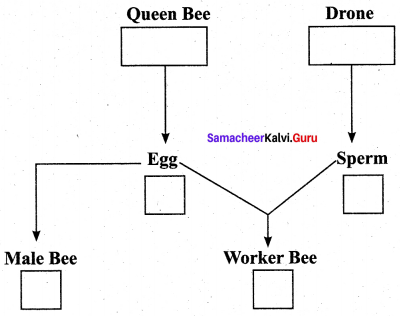
Samacheer Kalvi 12th Bio Zoology Solutions Chapter 8 Microbes in Human Welfare

Get Tamilnadu Board Class 12 Bio Zoology Solutions Chapter wise Study Material to score good marks in the exam. Various chapters with subtopics are explained clearly in Samacheer Kalvi Class 12 Bio Zoology Solutions Material. All the Samacheer Kalvi Class 12 Bio Zoology Book Solutions Chapter 8 Microbes in Human Welfare Questions, answers, Notes, Guide, Pdf along with the explanations are provided by the subject experts. Students can easily learn Tamilnadu Board Class 12 Chapter wise Bio Zoology with the help of the step by step guide provided on our site. Learn all the Samacheer Kalvi Class 12 Bio Zoology concepts to attempt the exam with more confidence. Read all the concepts of Tamilnadu Board Solutions for Class 12 Bio Zoology Chapter 8 Microbes in Human Welfare.

Tamilnadu Samacheer Kalvi 12th Bio Zoology Solutions Chapter 8 Microbes in Human Welfare

Whether you want to become an expert in Bio Zoology or to get good marks in the exam, you have one and only solution is practicing with Samacheer Kalvi 12th Bio Zoology Chapter wise Solutions. Strengthen your weakness by learning the Samacheer Kalvi 12th Bio Zoology Chapter 8 Microbes in Human Welfare Questions and Answers on our site. You can learn directly online on our website or learn offline by downloading Samacheer Kalvi 12th Bio Zoology Chapter wise material. Save your time and read Samacheer Kalvi 12th Bio Zoology Subject at your comfort level.

Samacheer Kalvi 12th Bio Zoology Microbes in Human Welfare Text Book Back Questions and Answers

Question 1.
Which of the following microorganism is used for production of citric acid in industries?
(a) Lactobacillus bulgaris
(b) Penicillium citrinum
(c) Aspergillus niger
(d) Rhizopus nigricans
Answer:
(c) Aspergillus niger

Question 2.
Which of the following pair is correctly matched for the product produced by them?
(a) Acetobacter aceti – Antibiotics
(b) Methanobacterium – Lactic acid
(c) Penicilium notatum – Acetic acid
(d) Saccharomyces cerevisiae – Ethanol
Answer:
(d) Saccharomyces cerevisiae – Ethanol

Question 3.
The most common substrate used in distilleries for the production of ethanol is __________
(a) Soyameal
(b) Groundgram
(c) Molasses
(d) Commeal
Answer:
(c) Molasses

Question 4.
Cry toxins obtained from Bacillus thuringiensis are effective against for __________
(a) Mosquitoes
(b) Flies
(c) Nematodes
(d) Bollworms
Answer:
(d) Bollworms

Question 5.
Cyclosporin – A is an immunosuppressive drug produced from __________
(a) Aspergillus niger
(b) Manascus purpureus
(c) Penicillium notatum
(d) Trichoderma polysporum
Answer:
(d) Trichoderma polysporum

Question 6.
Which of the following bacteria is used extensively as a bio-pesticide?
(a) Bacillus thurigiensis
(b) Bacillus subtilis
(c) Lactobacillus acidophilus
(d) Streptococcus lactis
Answer:
(a) Bacillus thurigiensis

Question 7.
Which of the following is not involved in nitrogen fixation?
(a) Pseudomonas
(b) Azotobacter
(c) Anabaena
(d) Nostac
Answer:
(a) Pseudomonas

Question 8.
CO2 is not released during __________
(a) Alcoholic fermentation
(b) Lactate fermentation
(c) Aerobic respiration in animals
(d) Aerobic respiration in plants
Answer:
(b) Lactate fermentation

Question 9.
The purpose of biological treatment of waste water is to __________
(a) Reduce BOD
(b) Increase BOD
(c) Reduce sedimentation
(d) Increase sedimentation
Answer:
(a) Reduce BOD

Question 10.
The gases produced in anaerobic sludge digesters are __________
(a) Methane, oxygen and hydrogen sulphide.
(b) Methane, hydrogen sulphide and CO2
(c) Hydrogen sulphide, nitrogen
(d) Methane, hydrogen sulphide and CO2
Answer:
(d) Methane, hydrogen sulphide and CO2

Question 11.
How is milk converted into curd? Explain the process of curd formation?
Answer:
The LAB bacteria grows in milk and convert it into curd, thereby digesting the milk protein casein. A small amount of curd added to fresh milk as a starter or inoculum contains millions of Lactobacilli, which under suitable temperature (< 40°C) multiply and convert milk into curd. Curd is more nutritious than milk as it contains a number of organic acids and vitamins.

Question 12.
Give any two bioactive molecules produced by microbes and state their uses.
Answer:
Samacheer Kalvi 12th Bio Zoology Solutions Chapter 8 Microbes in Human Welfare

Question 13.
What is biological oxygen demand?
Answer:
The BOD (Biochemical oxygen demand or Biological oxygen demand). BOD refers to the amount of the oxygen that would be consumed, if all the organic matter in one litre of water were oxidized by bacteria. The sewage water is treated till the BOD is reduced. The greater the BOD of the waste water more is its polluting potential.

Question 14.
Explain the role of cry-genes in genetically modified crops.
Answer:
Bacillus thuringiensis is a soil dwelling bacterium which is commonly used as a biopesticide and contains a toxin called cry toxin. Scientists have introduced this toxin producing genes into cotton and have raised genetically engineered insect resistant cotton plants.

During sporulation Bacillus thuringiensis produces crystal proteins called Delta-endotoxin which is encoded by cry genes. Delta-endotoxins have specific activities against the insects of the orders Lepidoptera, Diptera, Coleoptera and Hymenoptera. When the insects ingest the toxin crystals their alkaline digestive tract denatures the insoluble crystals making them soluble. The cry toxin then gets inserted into the gut cell membrance and paralyzes the digestive tract. The insect then stops eating and starves to death.

Question 15.
Write the key features of organic farming.
Answer:

  1. Protecting soil quality using organic materials and encouraging biological activity.
  2. Indirect provision of crop nutrients using soil microorganisms.
  3. Nitrogen fixation in soils using legumes.
  4. Weed and pest control based on methods like crop rotation, biological diversity, natural predators, organic manures and suitable chemical, thermal and biological interventions.

Question 16.
Justify the role of microbes as a bio-fertilizer.
Answer:
Biofertilisers are formulation of living microorganisms that enrich the nutrient quality of the soil. They increase physico – chemical properties of soils such as soil structure, texture, water holding capacity, cation exchange capacity and pH by providing several nutrients and sufficient organic matter. The main sources of biofertilisers are bacteria, fungi and cyanobacteria. Rhizobium is a classical example for symbiotic nitrogen fixing bacteria. This bacterium infects the root nodules of leguminous plants and fixes atmospheric nitrogen into organic forms. Azospirillum and Azotobacter are free living bacteria that fix atmospheric nitrogen and enrich the nitrogen content of soil.

A symbiotic association between a fungus and the roots of the plants is called mycorrhiza. The fungal symbiont in these associations absorbs the phosphorus from soil and transfers to the plant. Plants having such association show other benefits such as resistance to rootbome pathogens, tolerance to salinity, drought, enhances plant growth and developments. For example, many members of the genus Glomus form mycorrhiza.

Cyanobacteria (or) blue green algae (BGA) are prokaryotic free-living organisms which can fix nitrogen. Oscillatoria, Nostoc, Anabaena, Tolypothrix are well known nitrogen fixing cyanobacteria. Their importance is realized in the water logged paddy fields where Cyanobacteria multiply and fix molecular nitrogen. Cyanobacteria secrete growth promoting substances like indole-3-acetic acid, indole-3-butyric acid, naphthalene acetic acid, amino acids, proteins, vitamins which promotes plant growth and production.

Biofertilisers are commonly used in organic farming methods. Organic farming is a technique, which involves cultivation of plants and rearing of animals in natural ways. This process involves the use of biological materials, avoiding synthetic substances to maintain soil fertility and ecological balance thereby minimizing pollution and wastage.
Key features of organic farming

  1. Protecting soil quality using organic materials and encouraging biological activity.
  2. Indirect provision of crop nutrients using soil microorganisms.
  3. Nitrogen fixation in soils using legumes.
  4. Weed and pest control based on methods like crop rotation, biological diversity, natural predators, organic manures and suitable chemical, thermal and biological interventions.

Question 17.
Write short notes on the following.
(a) Brewer’s yeast
(b) Ideonella sakaiensis
(c) Microbial fuel cells
Answer:
(a) Brewer’s yeast – Saccharomyces cerevisiae is a widely used fungal species in preparation & softening of bakery products like dough.

(b) Ideonella sakaiensis is a bacterium is used to recycle PET plastics. The enzyme PETase and MHETase in the bacterium breakdown the PET plastics into terephthalic acid & ethylene glycol.

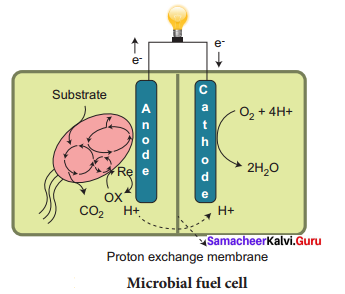
(c) A microbial fuel cell is a bio-electrochemical system that drives an electric current by using bacteria and mimicking bacterial interaction found in nature. Microbial fuel cells work by allowing bacteria to oxidize and reduce organic molecules. Bacterial respiration is basically one big redox reaction in which electrons are being moved around. A MFC consists of an anode and a cathode separated by a proton exchange membrane. Microbes at the anode oxidize the organic fuel generating protons which pass through the membrane to the cathode and the electrons pass through the anode to the external circuit to generate current.
Samacheer Kalvi 12th Bio Zoology Solutions Chapter 8 Microbes in Human Welfare

Question 18.
List the advantages of biogas plants in rural areas.
Answer:
Biogas is used for cooking and lighting. The technology of biogas production was developed in India mainly due to the efforts of Indian Agricultural Research Institute (IARI) and Khadi and Village Industries Commission (KVIC).

Question 19.
When does antibiotic resistance develop?
Answer:
Antibiotic resistance occurs when bacteria develop the ability to defeat the drug designed to kill or inhibit their growth. It is one of the most acute threat to public health. Antibiotic resistance is accelerated by the misuse and over use of antibiotics, as well as poor infection prevention control. Antibiotics should be used only when prescribed by a certified health professional. When the bacteria become resistant, antibiotics cannot fight against them and the bacteria multiply. Narrow spectrum antibiotics are preferred over broad spectrum antibiotics. They effectively and accurately target specific pathogenic organisms and are less likely to cause resistance.

Question 20.
What is the key difference between primary and secondary sewage treatment?
Answer:
Primary Treatment:

  1. Physical foam
  2. Solid materials and particulate organic and inorganic materials are remove from sewage.
  3. Principles involved are setting, sedimentation and filtration.

Secondary Treatment:

  1. Biological foam
  2. Organic matters are removed by using microbes.
  3. Principles involved in aeration and aerobic microbial degradation.

Samacheer Kalvi 12th Bio Zoology Microbes in Human Welfare Additional Questions and Answers

1 – Mark Questions

Question 1.
The leavering of the dough during fermentation is due to _______
(a) Formation of ethyl alchohol
(b) Formation of CO2
(c) Formation of oxygen
(d) Action of zymase enzyme
Answer:
(b) Formation of CO2

Question 2.
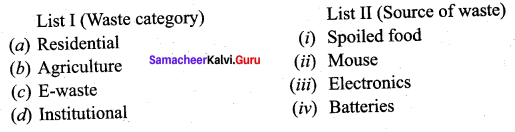
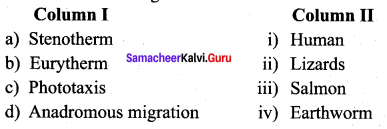
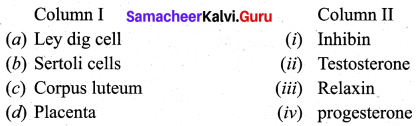
Match List I with list II
Samacheer Kalvi 12th Bio Zoology Solutions Chapter 8 Microbes in Human Welfare
Answer:
a – iv, b – ii, c – ii, d – i

Question 3.
Name the person who was the first to use the term antibiotic.
(a) Selman Waksman
(b) Alexander Flemming
(c) Earnest Chain
(d) Howard Florey
Answer:
(a) Selman Waksman

Question 4
__________ is commonly referred as the Queen of drugs.
Answer:
Penicillin

Question 5.
Tetracycline is a __________
(i) bactericidal antibiotic
(ii) bacteriastatic antibiotic
(iii) narrow spectrum antibiotic
(iv) Broad spectrum antibiotic
(a) i and iii
(b) ii and iii
(c) i and iv
(d) ii and iv
Answer:
(d) ii and iv

Question 6.
Chlortetracycline was isolated from the culture __________
(a) Streptomyces aureofaciens
(b) Streptomyces griseus
(c) Streptococcus lactis
(d) Aspergillus niger
Answer:
(a) Streptomyces aureofaciens

Question 7.
Identify the name and the formula of industrial alcohol.
(a) Butanol, C4H9OH
(b) Propanol, C3H7OH
(c) Ethanol, C2H5OH
(d) Methanol, CH3OH
Answer:
(c) Ethanol, C2H5OH

Question 8.
Pick the bacterial species which is not used in ethanol formation.
(a) Zymomonas mobilis
(b) Sarcina ventriculi
(c) Saccharomyces cerevisiae
(d) Streptomyces aureofaciens
Answer:
(d) Streptomyces aureofaciens

Question 9.
Match the Microbes with the respective organic acids
Microbes Organic acids
(a) Aspergillus species (i) Acetic acid
(b) Acetobatem species (ii) Citric acid
(e) Rhizopus species (iii) Butyric acid
(d) Clostridium species (iv) Fumaric acid
Answer:
a – ii, b – i, c – iv, d – iii

Question 10.
Human insulin is being commercially produced from a transgenic species of ___________
(a) Escherichia
(b) Mycobacterium
(c) Streptococcus
(d) Penicillin
Answer:
(a) Escherichia

Question 11.
Select the correct statement from the following.
(a) Primary treatment of sewage involves biological oxidation
(b) Excreta of cattle is commonly called Gobur
(c) Delta endotoxin of Bacillus thuringiensis is encoded by pen-genes.
(d) Trichoderma is a free-timing bacteria very common in root ecosystem.
Answer:
(a) Escherichia

Question 12.
Oil strains in laundry can be removed using ___________
(a) Peptidane
(b) Protease
(c) Amylase
(d) Lipase
Answer:
(d) Lipase

Question 13.
Find the odd sentence out.
(i) Biogas primarily consists of methane with CO2 and hydrogen
(ii) The greater the BOD of waste water the more its polluting potential
(iii) World biofuel day is observed on 10th August
(iv) Cyclosporin A is obtained from Trichoderma polysporum.
(a) i and iii
(b) ii and iv
(c) i and iv
(d) none of the above
Answer:
(d) none of the above

Question 14.
Match with correct pair
(a) Biofertilizer (i) Bacillus thuringiensis
(b) Bioremediation (ii) Rhizobium
(c) Biopesticide (iii) Pseudomonas
(d) Bioherbicide (iv) Phytophthora palmivora
Answer:
a – ii, b – iii, c – i, d – iv

Question 15.
Name the genus of virus which are used as effective Biocontrol agent.
Answer:
Nucleopolyhedrovirus

Question 16.
Statement 1: Prebiotics are the compounds in food that induce the growth of beneficial microbes
Statement 2: LAB is a probiotic
(a) Statement 1 is correct. Statement 2 is incorrect.
(b) Statement 1 is incorrect. Statement 2 is correct.
(c) Both the statements 1 and 2 are incorrect.
(d) Both the statements 1 and 2 are correct.
Answer:
(d) Both the statements 1 and 2 are correct.

Question 17.
Statement 1: Saccharomyces cerevisiae is commonly called as Baker’s yeast.
Statement 2: Yogurt is produced by the fermentation of milk by saccharomyces cerevisiae
(a) Statement 1 is correct. Statement 2 is incorrect.
(b) Statement 1 is incorrect. Statement 2 is correct.
(c) Both the statements 1 and 2 are incorrect.
(d) Both the statements 1 and 2 are correct.
Answer:
(a) Statement 1 is correct. Statement 2 is incorrect.

Question 18.
The flavour in the yogurt is due to ___________
(a) Formal dehyde
(b) Lactate
(c) Acetaldehyde
(d) Caesin
Answer:
(c) Acetaldehyde

Question 19.
Assertion (A): Streptomycin is an antibiotic.
Reason (R): Antibiotic are microbial chemicals inhibits the growth of pathogenic microbe.
(a) A is right R is wrong.
(b) R explains A.
(c) A and R are wrong.
(d) A and R are right. R cannot explain A.
Answer:
(b) R explains A

Question 20.
Assertion (A): Oenology deals with study of wine and its preparation.
Reason (R): Zymology deals with biochemical process of fermentation and its uses.
(a) A is right R is wrong.
(b) R explains A.
(c) A and R are wrong.
(d) A and R are right. R cannot explain A.
Answer:
(d) A and R are right. R cannot explain A.

Question 21.
In primary sewage treatment, the floating debris are removed by ___________
(a) Distillation
(b) Sedimentation
(c) Sequential filtration
(d) Biological oxidation
Answer:
(c) Sequential filtration

Question 22.
Yamuna Action Plan was a bilateral project signed between ___________
(a) India and Pakistan Government
(b) India and Japan Government
(c) India and China Government
(d) India and Srilanka Government
Answer:
(b) India and Japan Government

Question 23.
Select the correct option denoting the proper sequence of sewage tratment.
(a) Filtration, Sedimentation, Aeration, Biological oxidation and UV radiation
(b) Sedimentation, Filtration, Biological oxidation, Aeration and UV radiation.
(c) Filtration, Aeration, Biological oxidation, Sedimentation and UV radiation.
(d) UV radiation, Sedimentation, Filtration, Biological oxidation and Aeration.
Answer:
(a) Filtration, Sedimentation, Aeration, Biological oxidation and UV radiation.

Question 24.
The Ganga action plan was launched on ___________
Answer:
14th January 1986.

Question 25.
Which of the following plant species is the most suitable oilseed for biodirect production?
(a) Ground nut
(b) Areca nut
(c) Jatropha curcas
(d) Phyllanthus anarus
Answer:
(c) Jatropha curcas

Question 26.
Match the following medicinal products with their microbial source.
(a) Humulin (i) Streptococcus
(b) Statins (ii) Trichoderma polysporum
(c) Cyclosporin (iii) Monascus purpureus
(d) Streptokinase (iv) E-coli
Answer:
a – iv, b – iii, c – ii, d-i

2 – Mark Questions

Question 1.
What does LAB stands for? Give two examples.
Answer:

  • LAB stands for Lactic Acid Bacteria
  • Examples for LAB: Lactobacillus lactis, Streptococcus lactis.

Question 2.
Define LAB.
Answer:
Lactic Acid bacteria (LAB) are the probiotics that check the growth of pathogenic microbes in the stomach and other digestive parts.

Question 3.
Given below are the food products obtained by microbial action. Name the respective organism responsible for their production,

  1. Swiss Cheese
  2. Bread dough

Answer:

  1. Swiss Cheese – Propionibacterium shermanii
  2. Bread dough – Saccharomyces cerevisiae

Question 4.
What is SCP?
Answer
Single cell protein refers to edible unicellular microorganisms like Spirulina. Protein extracts from pure or mixed cultures of algae, yeasts, fungi or bacteria may be used as ingredient or as a substitute for protein rich foods and is suitable for human consumption or as animal feed.

Question 5.
What is fermentor?
Answer:
A fermentor (bioreactor) is a closed vessel with adequate arrangement for aeration, agitation, temperature, pH control and drain or overflow vent to remove the waste biomass of cultured microorganisms along-with their products.

Question 6.
What are antibiotics?
Answer:
Antibiotics are chemical substances produced by microorganisms which can kill or retard the growth of other disease causing microbes even in low concentration. Antibiotic means “against life”.

Question 7.
Give reason

  1. Flavour in Yogurt
  2. Large holes in Swiss Cheese

Answer:

  1. The flavour in yogurt is due to acetaldehyde formation.
  2. Large holes in Swiss Cheese is due to more CO2 production bypropionibacterium shermanii.

Question 8.
Name few industrial microbial products.
Answer:
Beverages, antibiotics, organic acids, amino acids, vitamins, bio fuels, single cell protein, enzymes, steroids, vaccines, pharmaceutical drugs.

Question 9.
Name few home-made micorbial products.
Answer:
Yogurt, Paneer, Curd, Idli batter, Bread dough.

Question 10.
Who derived the term antibiotic? Name the antibiotic which he discovered.
Answer:
The term antibiotic was used first by Selman Waksman in 1943. He discovered Streptomycin.

Question 11.
The first antibiotic was extracted from fungus. Who had done it? And also mention the fungal species used.
Answer:
Alexander Flemming, discovered the first antibiotic from the fungus Penicillium notatum and Pencillium Chrysogenum.

Question 12.
Write as example for

  1. Bacteriostatic antibiotic
  2. Bactericidal antibiotic

Answer:

  1. Bacteriostatic antibiotic – Eg: Tetracycline.
  2. Bactericidal antibiotic – Eg: Streptomycin.

Question 13.
Name any four antibiotics.
Answer:
Erythromycin, Chloromycetin, Neomycin, Kenamycin.

Question 14.
Compare Broad spectrum antibiotics with narrow spectrum antibiotics.
Answer:
Broad-spectrum antibiotics act against a wide range of disease-causing bacteria. Narrow-spectrum antibiotics are active against a selected group of bacterial types.

Question 15.
Define

  1. Antibiosis
  2. Superbugs

Answer:

  1. Antibiosis: Property of antibiotics to kill microbes.
  2. Superbugs: Bacterial strains gained resistance against antibiotics.

Question 16.
What is studied under zymology and oenology?
Answer:

  1. Zymology deals with biochemical process of fermentation and its application.
  2. Oenology deals with study of wine and wine making.

Question 17.
Saccharomyces cerevisiae is called as brewer’s yeast. Justify.
Answer:
Saccharomyces cerevisiae commonly called brewer’s yeast is used for fermenting malted cereals and fruit juices to produce various alcoholic beverages. Wine and beer are produced without distillation, whereas whisky, brandy and rum are obtained by fermentation and distillation.

Question 18.
How wine is made? Which organism is involved in the process.
Answer:

  1. Wine is made by the fermentation of grape juice.
  2. Grape juice is fermented by different strains of Saccharomyces cerevisiae into alcohol.

Question 19.
Name the 2 types of grape wine. How they differ from one another?
Answer:
Grape wine is of two types, red wine and white wine. For red wine, black grapes are used including skins and sometimes the stems also are used. In contrast white wine is produced only from the juice of either white or red grapes without their skin and stems.

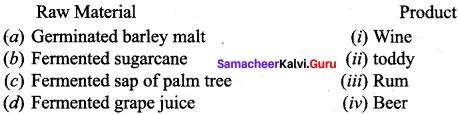
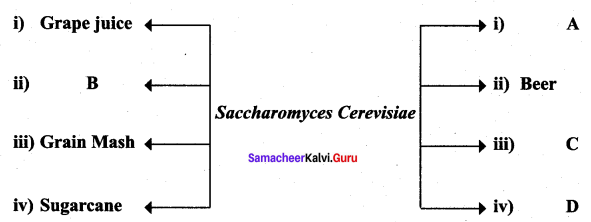
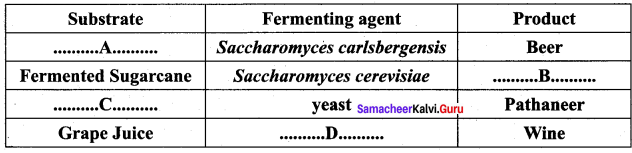
Question 20.
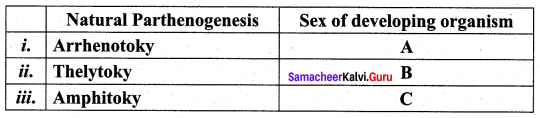
Saccharomyces Cerevisiae is a widely used fungus in making beverages. Considering this complete the table by mentioning the raw material and respective product.
Answer:
Samacheer Kalvi 12th Bio Zoology Solutions Chapter 8 Microbes in Human Welfare
Answer:
A – Wine
B – Germinated barley
C – Whisky
D – Rum

Question 21.
Ethanol is a industrial alcohol – Justify.
Answer:
Saccharomyces cerevisiae is the major producer of ethanol (C2H5OH). It is used for industrial, laboratory and fuel purposes. So ethanol is referred to as industrial alcohol.

Question 22.
Name the bacterial species involved in ethanol production.
Answer:
Zymomonas mobilis and Sarcina ventriculi.

Question 23.
What are the substrates used in producing industrial alcohol.
Answer:
Molasses, Com, Potatoes, Wood wastes.

Question 24.
Write the equation for alcoholic fermentation.
Answer:
Samacheer Kalvi 12th Bio Zoology Solutions Chapter 8 Microbes in Human Welfare

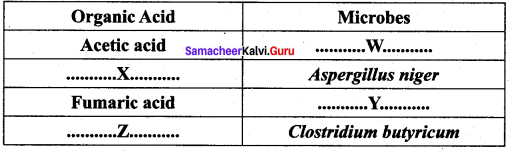
Question 25.
Complete the table by filling with respective organic acid and microbes.
Answer:
Samacheer Kalvi 12th Bio Zoology Solutions Chapter 8 Microbes in Human Welfare

Question 26.
Genetically engineered Streptococci is used in medicine. How?
Answer:
Genetically engineered Streptococci are used as “clot buster” for, removing clots from the blood vessels of patients who have undergone myocardial infarction.

Question 27.
Write a brief note on Cyclosporin A.
Answer:
Cyclosporin A, an immunosuppressant used in organ transplantation is produced from the fungus Trichoderma polysporum. It is also used for its anti-inflammatory, anti-fungal and anti-parasitic properties.

Question 28.
State the source of statins and its medical role.
Answer:

  1. Statins is obtained from Monascus Purpureus (yeast fungus).
  2. It competitively inhibits the enzyme responsible for cholesterol synthesis there by reducing the blood cholesterol level.

Question 29.
Expand and define BOD.
Answer:

  1. BOD – Biological Oxygen Demand (or) Biochemical Oxygen Demand
  2. BOD refers to the amount of the oxygen that would be consumed, if all the organic matter in one litre of water were oxidized by bacteria.

Question 30.
Define activated sludge.
Answer:
Once the BOD of sewage water is reduced significantly, the effluent is then passed into a settling tank where the bacterial “floes” are allowed to sediment. This sediment is called activated sludge.

Question 31.
Give a brief account on Ganga action plan.
Answer:
The Ganga action plan was launched on 14th January 1986. The main objective of the programme is to improve the water quality of River Ganges by interception, diversion and treatment of domestic sewage and to identify grossly polluting units to prevent pollution.

Question 32.
Name the biocontrol agents used to get rid of Aphids & mosquito larvae.
Answer:
Lady bird beetle & Dragon flies.

Question 33.
How insect resistant plants are developed using Bacillus thuringiensisl
Answer:
Bacillus thuringiensis is a soil dwelling bacterium which is commonly used as a biopesticide and contains a toxin called cry toxin. Scientists have introduced this toxin producing genes into cotton and have raised genetically engineered insect resistant cotton plants.

Question 34.
Which group of insects can be controlled by using delta-endotoxins of Bt-crops?
Answer:
Lepidoptera, Diptera, Coleoptera and Hymenoptera.

Question 35.
Name the two viruses that acts as biocontrol agents.
Answer:
Buculoviruses and Nucleopolyhedrovirus

Question 36.
Rhizobium is a bacteria but acts as bio-fertilization. How?
Answer:
Rhizobium is a symbiotic nitrogen fixing bacteria which infects the root nodules of leguminous plants and fixes free atmospheric nitrogen into organic forms.

Question 37.
Give any two examples for free-living nitrogen fixing bacteria.
Answer:
Azospirillum and Azotobacter

Question 38.
Name few blue green algae (BGA).
Answer:
Oscillatoria, Nostoc, Anabaena, Tolypothrix

Question 39.
Define organic farming.
Answer:
Organic farming is a technique, which involves cultivation of plants and rearing of animals in natural ways. This process involves the use of biological materials, avoiding synthetic substances to maintain soil fertility and ecological balance thereby minimizing pollution and wastage.

Question 40.
Pseudomonas putida and pollution abatement – comment.
Answer:
Pseudomonas putida is a genetically engineered, multi plasmid hydrocarbon – degrading bacterium. These bacteria can digest the hydrocarbons in the oil spills helps to over come water pollution.

Question 41.
Complete the following equation by identifying the microbes involved in bio remediation.
PET Plastics\(\overset { A }{ \longrightarrow } \)terephthalic acid, Ethylene glycol
Trichloro ethane\(\overset { B }{ \longrightarrow } \)Non-toxic ethane
Answer:
A – Ideonella sakaiensis
B – Dehalococcoides species.

3 – Mark Questions

Question 1.
Differentiate between Prebiotics and Probiotics.
Answer:

  1. Prebiotics: Prebiotics are compounds in food (fibers) that induce the growth or activity of beneficial microorganisms.
  2. Probiotics: Probiotics are live microorganisms intended to provide health benefits when consumed, generally by improving or restoring the gut flora.

Question 2.
How yogurt is produced?
Yogurt is produced by bacterial fermentation of milk, and lactic acid is produced as a byproduct. Microorganisms such as Streptococcus thermophilus and Lactobacillus bulgaricus coagulate the milk protein and convert the lactose in the milk to lactic acid. The flavour in yogurt is due to acetaldehyde.

Question 3.
Name the scientists who were awarded Nobel Prize in 1945 for discovering the penicillin drug & its role as a antibiotic.
Answer:

  1. Alexander Fleming
  2. Earnest Chain
  3. Howard Florey

Question 4.
Both Tetracycline and Streptomycin are broad spectrum antibiotics yet functionally discriminates. How?
Answer:
Though Tetracycline & Streptomycin are broad spectrum antibiotics, Tetracycline acts as a bacteriostatic antibiotic whereas streptomycin acts as bactericidal antibiotic against both gram positive and gram negative bacteria.

Question 5.
Under which condition does a microbe gains resistance against antibiotic?
Answer:
Antibiotic resistance occurs when bacteria develop the ability to defeat the drug designed to kill or inhibit their growth. It is one of the most acute threat to public health. Antibiotic resistance is accelerated by the misuse and over use of antibiotics, as well as poor infection prevention control. Antibiotics should be used only when prescribed by a certified health professional. When the bacteria become resistant, antibiotics cannot fight against them and the bacteria multiply. Narrow spectrum antibiotics are preferred over broad spectrum antibiotics. They effectively and accurately target specific pathogenic organisms and are less likely to cause resistance.

Question 6.
Write a short on “Pathaneer”.
Answer:
In some parts of South India, a traditional drink called pathaneer is obtained from fermenting sap of palms and coconut trees. A common source is tapping of unopened spadices of coconut. It is a refreshing drink, which on boiling produces jaggery or palm sugar. When pathaneer is left undisturbed for few hours it gets fermented to form toddy with the help of naturally occurring yeast, to form a beverage that contains 4 percent alcohol. After 24 hours toddy becomes unpalatable and is used for the production of vinegar.

Question 7.
Explain in simple abouth the production process of industrial alcohol.
Answer:
The process of ethanol production starts by milling a feed stock followed by the addition of dilute or fungal amylase (enzyme) from Aspergillus to break down the starch into fermentable sugars. Yeast is then added to convert the sugars to ethanol which is then distilled off to obtain ethanol which is upto 96 percent in concentration. Ethanol and biodiesel, represents the first generation of biofuel technology. Ethanol is often used as a fuel, mainly as a biofuel additive for gasoline

Question 8.
Write the percent of alcohol in Beer, Wine and Distilled spirits
Answer:
Beer – 3 to 5 % alcohol; Wine – 9 to 14% alcohol; Distilled spirits – 35 to 50% alcohol.

Question 9.
Complete the table.
Samacheer Kalvi 12th Bio Zoology Solutions Chapter 8 Microbes in Human Welfare
Answer:
A – Germinatd Barley
B – Rum
C – Fermented sap of palm and coconut tree
D – Saccharomyces cereviave

Question 10.
Name the enzymes used as clarifier for Bottled juices.
Answer:

  1. Pectinase
  2. Protease
  3. Cellulase.

Question 11.
Write a short note on bio diesel.
Answer:
Biodiesel is a fuel made from vegetable oils, fats or greases. Biodiesel fuel can be used in diesel engines without altering the engine. Pure biodiesel is non-toxic, biodegradable and produces lower level of air pollutants than petroleum-based diesel fuel. The Government of India approved the National Policy on Biofuels in December 2009 and identified Jatropha curcas as the most suitable oilseed for biodiesel production. Pongamia species is also a suitable choice for production of biodiesel.

Question 12.
Name the act enforced by government to conserve water bodies. Also mention its objectives.
Answer:
National river conservation plan (NRCP) was enacted in 1995 to improve the water quality of the rivers, which are the major fresh water resources in our country. This important assignment taken up under the NRCP includes,

  1. To capture the raw sewage flowing into the river through open drains and divert them for treatment.
  2. Setting up sewage treatment plants for treating the diverted sewage.
  3. Construction of low cost sanitation toilets to prevent open defecation on river banks.

Question 13.
Give an account on MFC.
Answer:
A microbial fuel cell is a bio-electrochemical system that drives an electric current by using bacteria and mimicking bacterial interaction found in nature. Microbial fuel cells work by allowing bacteria to oxidize and reduce organic molecules. Bacterial respiration is basically one big redox reaction in which electrons are being moved around. A MFC consists of an anode and a cathode separated by a proton exchange membrane. Microbes at the anode oxidize the organic fuel generating protons which pass through the membrane to the cathode and the electrons pass through the anode to the external circuit to generate current.

Question 14.
How Bacillus thuringiensis provides insect resistance?
Answer:
During sporulation Bacillus thuringiensis produces crystal proteins called Delta-endotoxin which is encoded by cry genes. Delta-endotoxins have specific activities against the insects of the orders Lepidoptera, Diptera, Coleoptera and Hymenoptera. When the insects ingest the toxin crystals their alkaline digestive tract denatures the insoluble crystals making them soluble. The cry toxin then gets inserted into the gut cell membrance and paralyzes the digestive tract. The insect then stops eating and starves to death.

Question 15.
Give an account on Weedicides.
Answer:
Weedicides are substances, which destroy weeds without harming the useful plants. Bioweedicides are compounds and secondary metabolites derived from microbes such as fungi, bacteria or protozoa. The first bioherbicide developed in 1981 was a Mycoheribicide derived from the fungus Phytophthora palmivora. It controls the growth of strangler vine in citrus crops.

Question 16.
What are the Bio-fertilizers? Mention their role in agriculture?
Answer:
Biofertilisers are formulation of living microorganisms that enrich the nutrient quality of the soil. They increase physico – chemical properties of soils such as soil structure, texture, water holding capacity, cation exchange capacity and pH by providing several nutrients and sufficient organic matter.

Question 17.
What is mycorrhiza? How does it benefits the plants?
Answer:
A symbiotic association between a fungus and the roots of the plants is called mycorrhiza. The fungal symbiont in these associations absorbs the phosphorus from soil and transfers to the plant. Plants having such association show other benefits such as resistance to rootbome pathogens, tolerance to salinity, drought, enhances plant growth and developments. For example, many members of the genus Glomus form mycorrhiza.

Question 18.
Write a brief note on Cyanobacteria & its significances.
Answer:
Cyanobacteria (or) blue green algae (BGA) are prokaryotic free-living organisms which can fix nitrogen. Oscillatoria, Nostoc, Anabaena, Tolypothrix are well known nitrogen fixing cyanobacteria. Their importance is realized in the water logged paddy fields where Cyanobacteria multiply and fix molecular nitrogen. Cyanobacteria secrete growth promoting substances like indole-3-acetic acid, indole-3- butyric acid, naphthalene acetic acid, amino acids, proteins, vitamins which promotes plant growth and production.

Question 19.
Define bio-remediation and its types.
Answer:
The use of naturally occurring or genetically engineered microorganisms to reduce or degrade pollutants is called bioremediation. Bioremediation is less expensive and more sustainable than other remediations available. It is grouped into in-situ bioremediation (treatment of contaminated soil or water in the site) and ex-situ bioremediation (treatment of contaminated soil or water that is removed from the site and treated).

5 – Mark Questions

Question 1.
Explain the role of microbes in the production of enzymes & bio-active molecules?
Answer:
Microbes used for production of chemicals like organic acids and enzymes. Examples of organic acid producers are Aspergillus niger for citric acid, Acetobacter aceti for acetic acid, Rhizopus oryzae for fumaric acid, Clostridium butyricum for butyric acid and Lactobacillus for lactic acid.

Yeast (Saccharomyces cerevisiae) and bacteria are used for commercial production of enzymes. Lipases are used in detergent formulations and are used for removing oily stains from the laundry. Bottled juices are clarified by the use of pectinase, protease and cellulase. Rennet can also be used to separate milk into solid curds for cheese making. Streptokinase produced by the bacterium Streptococcus and genetically engineered Streptococci are used as “clot buster” for removing clots from the blood vessels of patients who have undergone myocardial infarction.

Cyclosporin A, an immunosuppressant used in organ transplantation is produced from the fungus Trichoderma polysporum. It is also used for its anti-inflammatory, anti-fungal and anti-parasitic properties. Statins produced by the yeast Monascus purpureus have been used to lower blood cholesterol levels. It acts by competitively inhibiting the enzyme responsible for the synthesis of cholesterol. Recombinant human insulin has been produced predominantly using E. coli and Saccharomyces cerevisiae for therapeutic use in human.

Question 2.
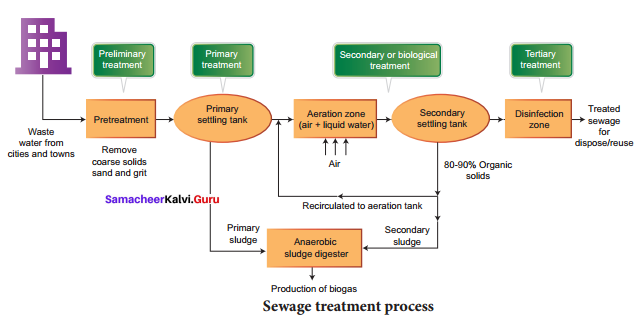
Describe the stages of Sewage treatment process.
Answer:
Sewage treatment is usually performed in the following three stages
Samacheer Kalvi 12th Bio Zoology Solutions Chapter 8 Microbes in Human Welfare

Primary treatment: Primary treatment involves the physical removal of solid and particulate organic and inorganic materials from the sewage through filtration and sedimentation. Floating debris is removed by sequential filtration. Then the grit (soil and small pebbles) are removed by sedimentation. All solids that settle form the primary sludge and the supernatant forms the effluent. The effluent from the primary settling tank is taken for secondary treatment.

Secondary treatment or biological treatment: The primary effluent is passed into large aeration tanks where it is constantly agitated mechanically and air is pumped into it. This allows vigorous growth of useful aerobic microbes into floe (masses of bacteria associated with fungal filaments to form mesh like structures). While growing, these microbes consume the major part of the organic matter in the effluent. This significantly reduces the BOD (Biochemical oxygen demand or Biological oxygen demand). BOD refers to the amount of the oxygen that would be consumed, if all the organic matter in one litre of water were oxidized by bacteria. The sewage water is treated till the BOD is reduced.

The greater the BOD of the waste water more is its polluting potential. Once the BOD of sewage water is reduced significantly, the effluent is then passed into a settling tank where the bacterial “floes” are allowed to sediment. This sediment is called activated sludge. A small part of activated sludge is pumped back into the aeration tank to serve as the inoculum. The remaining major part of the sludge is pumped into large tanks called anaerobic sludge digesters. Here, the bacteria which grow anaerobically, digest – the bacteria and the fungi in the sludge. During this digestion, bacteria produce a mixture of gases such as methane, hydrogen sulphide and CO2. These gases form biogas and can be used as a source of energy.

Tertiary treatment: Tertiary treatment is the final process that improves the quality of the waste water before it is reused, recycled or released into natural water bodies. This treatment removes the remaining inorganic compounds and substances, such as nitrogen and phosphorus. UV is an ideal disinfectant for wastewater since it does not alter the water quality – except for inactivating microorganisms. UV is a chemicalffee process that can completely replace the existing chlorination system and also inactivates chlorine-resistant microorganisms like Cryptosporidium and Giardia.

Question 3.
How microbes are used in Gobar gas production?
Answer:
Biogas is a mixture of different gases produced by the breakdown of organic matter in the absence of oxygen. Biogas can be produced from raw materials such as agricultural wastes, manure, municipal wastes, plant material, sewage, food waste, etc., Biogas is produced under anaerobic condition, when the organic materials are converted through microbiological reactions into gas and organic fertilizer. Biogas primarily consists of methane (63 percent), along with CO2 and hydrogen. Methane producing bacteria are called methanogens and one such common bacterium is Methanobacterium. Biogas is devoid of smell and bums with a blue flame without smoke.

The Methanogens are also present in anaerobic sludge and rumen of cattle. In rumen, these bacteria help in the breakdown of cellulose. The excreta of cattle called dung is commonly called “Gobar”. Gobar gas is generated by the anaerobic decomposition of cattle dung. It consists of methane, CO2 with some hydrogen, nitrogen and other gases in trace amounts.

In a biogas plant, anaerobic digestion is carried out in an air tight cylindrical tank known as digester. It is made up of concrete bricks and cement or steel. Bio-wastes are collected and slurry of dung is fed into this digester. It has a side opening into which organic materials for digestion are incorporated for microbial activity. Anaerobic digestion is accomplished in three stages: solubilisation, acidogenesis and methanogenisis. The outlet is connected to a pipe to supply biogas. The slurry is drained through another outlet and is used as fertilizer. Biogas is used for cooking and lighting. The technology of biogas production was developed in India mainly due to the efforts of Indian Agricultural Research Institute (IARI) and Khadi and Village Industries Commission (KVIC).

Question 4.
Bioremediation & microbes – Discuss.
Answer:
Aerobic microbes degrade the pollutants in the presence of oxygen. They mainly degrade pesticides and hydrocarbons. Pseudomonas putida is a genetically engineered microorganism (GEM). Ananda Mohan Chakrabarty obtained patent for this recombinant bacterial strain. It is multiplasmid hydrocarbon-degrading bacterium which can digest the hydrocarbons in the oil spills.

Nitrosomonas europaea is also capable of degrading benzene and a variety of halogenated organic compounds including trichloroethylene and vinyl chloride. Ideonella sakaiensis is currently tried for recycling of PET plastics. These bacteria use PETase and MHETase enzymes to breakdown PET plastic into terephthalic acid and ethylene glycol.

Anaerobic microbes degrade the pollutants in the absence of oxygen. Dechloromonas aromatica has the ability to degrade benzene anaerobically and to oxidize toluene and xylene. Phanerochaete chrysosporium an anaerobic fungus exhibits strong potential for bioremediation of pesticides, polyaromatic hydrocarbons, dyes, trinitrotoluene, cyanides, carbon tetrachloride, etc., Dehalococcoides specie are responsible for anaerobic bioremediation of toxic trichloroethene to nontoxic ethane.

Pestalotiopsis microspora is a species of endophytic fungus capable of breaking down and digesting polyurethane. This makes the fungus a potential candidate for bioremediation projects involving large quantities of plastics.

Higher Order Thinking Skills (HOTs) Questions

Question 1.
One can notice large holes in Swiss cheese. Which bacterium is responsible for these holes. What are these holes due to?
Answer:
Propionibacterium shermanii.
The holes are due to the formation of large amount of carbon-di-oxide during fermentation.

Question 2.
Name the resource agent of statins. How does this bioactive molecule functions in our body?
Answer:
Monascus purpureus (Yeast).
Statins acts effectively to reduce the blood cholestrol level.

Question 3.
Cyclosporin-A is an immuno supprenant. Suggest any one area where it can be used efficiently? Explan.
Answer:
Being an immuno-suppresant, cyclosporin-A can be used in organ transplant surgeries/pattent to overcome graft rejection.

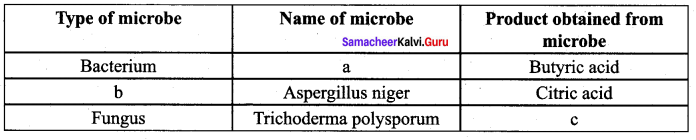
Question 4.
Name the blank spaces a, b, and c of the given table:
Samacheer Kalvi 12th Bio Zoology Solutions Chapter 8 Microbes in Human Welfare
Answer:
(a) Clostridium butyricum
(b) Fungus
(c) Cyclosporin A

Samacheer Kalvi 12th Bio Zoology Chapter Wise Solutions PDF will help you to clear all doubts. Learn perfectly by using Samacheer Kalvi 12th Chapter 8 Microbes in Human Welfare Questions and Answers Bio Zoology Solutions PDF. Leave us a comment to clear your queries. Get instant updates by bookmarking our site. Get the best learning with the effective and excellent step by step Samacheer Kalvi 12th Bio Zoology Guide.
Samacheer Kalvi 12th Commerce Solutions Chapter 5 Capital Market

Enhance your subject knowledge with Tamilnadu State Board Solutions for 11th Commerce Chapter 5 Capital Market Questions and Answers and learn all the underlying concepts easily. Make sure to learn the subject from Tamilnadu State Board Solutions Chapter 5 Capital Market Questions and Answers PDF on a day to day basis and score well in your exams. You can Download Samacheer Kalvi 11th Commerce Book Solutions Questions and Answers are given after enormous research by people having high subject knowledge and for better scoring grade. You can rely on them and prepare any topic of Commerce as per your convenience easily.

Tamilnadu Samacheer Kalvi 12th Commerce Solutions Chapter 5 Capital Market

Students those who are looking for Tamilnadu State Board Solutions Chapter 5 Capital Market Questions and Answers Concepts can find them all in one place from our site Tamilnadu State Board Solutions. Simply click on the links available to prepare the corresponding topics of Samacheer Kalvi 11th Commerce Book Solutions Questions and Answers easily. Clarify all your queries from chapter wise different questions to be familiar with the kind of questions appearing in the exam. Thus, you can increase your score and get higher grade in the final exam.

Samacheer Kalvi 12th Commerce Capital Market Textbook Exercise Questions and Answers

I. Choose the Correct Answer

Question 1.
Capital market do not provide __________
(a) Short term Funds
(b) Debenture Funds
(c) Equity Funds
(d) Long term Funds
Answer:
(a) Short term Funds

Question 2.
When the NSEI was established?
(a) 1990
(b) 1992
(c) 1998
(d) 1997
Answer:
(b) 1992

Question 3.
Primary market is a Market where securities are traded for the __________
(a) First Time
(b) Second Time
(c) Third Time
(d) Several Times
Answer:
(a) First Time

Question 4.
Participants in the capital market includes __________
(a) Individuals
(b) Corporate
(c) Financial Institutions
(d) All of the above
Answer:
(d) All of the above

Question 5.
How many times a security can be sold in a secondary market?
(a) Only one time
(b) Two times
(c) Three times
(d) Multiple times
Answer:
(d) Multiple times

II. Very Short Answer Questions

Question 1.
What is Capital Market?
Answer:
Capital market is a market where buyers and sellers engage in trade of financial securities like bonds, and stocks. The buying/selling is undertaken by participants such as individuals and institutions.

Question 2.
Write a note on OTCEI.
Answer:
The OTCEI was set up by a premier financial institution to allow the trading of securities across the electronic counters throughout the country.

Question 3.
What is Mutual Fund?
Answer:
Financial institutions that provide facilities for channeling savings of Small investors into avenues of productive investments are called ‘Mutual Funds’. A mutual fund company invests the funds pooled from shareholders and gives them the benefit of diversified investment portfolio and a reasonable return.

Question 4.
Who are the participants in a Capital Market?
Answer:
There are many players in the capital market. The participants of the capital market include individuals, corporate sectors, Govt., banks and other financial institutions.

Question 5.
How is price determined in a Capital Market?
Answer:
The price of the securities is determined based on the demand and supply prevailing in the capital market for securities.

III. Short Answer Questions

Question 1.
What are the various kinds of Capital Market? Explain.
Answer:
The capital market is divided into two i.e., primary market and secondary market.

  1. Primary Market: Primary market is a market for new issues or new financial claims.
  2. Secondary Market: Secondary Market may be defined as the market for old securities, in the sense that securities which are previously issued in the primary market are traded here.

Question 2.
Explain any two functions of Capital Market.
Answer:

  1. Savings and Capital Formation: In capital market, various types of securities help to mobilize savings from various sectors of population (Individuals, Corporate, Govt., etc.). The twin features of reasonable return and liquidity in stock exchange are definite incentives to the people to invest in securities. This accelerates the capital formation in the country.
  2. Permanent Capital: The existence of a capital market/stock exchange enables companies to raise permanent capital. The investors cannot commit their funds for a permanent period but companies require funds permanently. The stock exchange resolves this clash of interests by offering an opportunity to investors to buy or sell their securities, while permanent capital with the company remains unaffected.

Question 3.
Write a note on National Clearance and Depository System (NCDS).
Answer:
Under the scripless trading system, settlement of transactions relating to securities takes place through a book entry. The entire scripless trading system comprises the following three segments:

  1. National Trade Comparison and Reporting System which prescribes the terms and conditions of contract for the securities market.
  2. National Clearing System which aims at determining the net cash and stock liability of each broker on a settlement date.
  3. National Depository System which arranges to provide for the transfer of ownership of securities in exchange on payment by book entry on electronic ledgers without any physical movement of transfer deed.

Question 4.
Discuss about evolution and growth of Indian Capital Market.
Answer:
The period between 1947 and 1973 marked the development of infrastructure for capital market. During this period, a network of development financial institutions such as IFCI, ICICI, IDBI and UTI, SFCs and SIDCs were established. These financial institutions strengthened the capital market. During the period between 1980 and 1992, debenture emerged as a powerful instrument of resource mobilization in the primary market.

Question 5.
Explain about Factoring and Venture Capital Institutions.
Answer:
“Factoring” is an arrangement whereby a financial institution provides financial accommodation on the basis of assignment/sale of account receivables. The factoring institutions collect the book debts for and on behalf of its clients. Some of the factoring institutions operating in India are SBI Factors and Commercial Services Private Limited, a subsidiary of State Bank of India and Canbank Factors Limited, a subsidiary of Canara Bank.

Venture capital financing is a form of equity financing designed especially for funding new and innovative project ideas. Venture capital funds bring into force the hi-technology projects which are converted into commercial production.

IV. Long Answer Questions

Question 1.
Discuss the characters of a Capital Market.
Answer:
Following are the nature/characteristic of a capital market:

  1. Securities Market: The dealings in a capital market are done through the securities like
    shares, debentures, etc. The capital market is thus called securities market.
  2. Price: The price of the securities is determined based on the demand and supply prevailing in the capital market for securities.
  3. Participants: There are many players in the capital market. The participants of the capital market include individuals, corporate sectors, Govt., banks and other financial institutions.
  4. Location: Capital market is not confined to certain specific locations, although it is true that parts of the market are concentrated in certain well-known centers known as Stock Exchanges. It has its impact in the overall economy, wherever suppliers and users of capital get together and do business.
  5. Market for Financial Assets: Capital market provides a transaction platform for long term financial assets.

Question 2.
Briefly explain the functions of capital market.
Answer:

  1. Savings and Capital Formation: In capital market, various types of securities help to mobilize savings from various sectors of population (Individuals, Corporate, Govt., etc.). The twin features of reasonable return and liquidity in stock exchange are definite incentives to the people to invest in securities. This accelerates the capital formation in the country.
  2. Permanent Capital: The existence of a capital market/stock exchange enables companies to raise permanent capital. The investors cannot commit their funds for a permanent period but companies require funds permanently.
  3. Industrial Growth: The stock exchange is a central market through which resources are transferred to the industrial sector of the economy.
  4. Beady and Continuous Market: The stock exchange provides a central convenient place where buyers and sellers can easily purchase and sell securities.
  5. Reliable Guide to Performance: The capital market serves as a reliable guide to the
    performance and financial position of corporate, and thereby promotes efficiency.
  6. Proper Channelization of Funds: The prevailing market price of a security and relative yield are the guiding factors for the people to channelize their funds in a particular company.
  7. Provision of Variety of Services: The financial institutions functioning in the capital market provide a variety of services such as grant of long term and medium term loans to entrepreneurs.
  8. Development of Backward Areas: Capital Markets provide funds for projects in backward areas. This facilitates economic development of backward areas.
  9. Foreign Capital: Capital markets make possible to generate foreign capital. Indian firms are able to generate capital funds from overseas markets by way of bonds and other securities.
  10. Easy Liquidity: With the help of secondary market investors can sell off their holdings and convert them into liquid cash.

Question 3.
Explain the various types of New Financial Institutions.
Answer:

  1. Venture Fund Institutions: Venture capital financing is a form of equity financing designed especially for funding new and innovative project ideas. Venture capital funds bring into force the hi-technology projects which are converted into commercial production.
  2. Mutual Funds: Financial institutions that provide facilities for channeling savings of small investors into avenues of productive investments are called ‘Mutual Funds’.
  3. Factoring Institutions: “Factoring” is an arrangement whereby a financial institution provides financial accommodation on the basis of assignment/sale of account receivables.
  4. Over the Counter Exchange of India (OTCEI): The OTCEI was set up by a premier financial institution to allow the trading of securities across the electronic counters throughout the country.
  5. National Stock Exchange of India Limited (NSEI): NSEI was established in 1992 to function as a model stock exchange. The Exchange aims at providing the advantage of nation-wide electronic screen based “scripless” and “floorless” trading system in securities.
  6. National Clearance and Depository System (NCDS): Under the scripless trading system, settlement of transactions relating to securities takes place through a book entry.
  7. National Securities Depositories Limited: The NSDL was set up in the year 1996 for achieving a time bound dematerialization as well as rematerialization of shares.
  8. Stock Holding Corporation of India Limited (SHCIL): Stock Holding Corporation of India Limited (SHCIL) aims at serving as a central securities depository in respect of transactions on stock exchanges. The Corporation also takes up the administration of clearing functions at a national level.

Samacheer Kalvi 12th Commerce Capital Market Additional Questions and Answers

A. Choose the Correct Answer

Question 1.
The term _________ market refers to the facilities and institutional arrangement through long-term funds.
(a) Capital
(b) Asset
(c) Buyers
(d) Sellers
Answer:
(a) Capital

Question 2.
Capital market otherwise called as _________
(a) Securities market
(b) Share market
(c) Debenture market
(d) Money market
Answer:
(a) Securities market

Question 3.
Which one is matched correctly?

(a)Public issue(i)The most common issue method
(b)Right Issue(ii)Private placement
(c)Secondary market(iii)New issues
(d)Primary market(iv)The market for old securities

Answer:
(a) Public issue (i) The most common issue method

Question 4.
NSEI was established in
(a) 1992
(b) 1991
(c) 1994
(d) 1995
Answer:
(a) 1992

Question 5.
Which one is not matched correctly?

(a)NSDL1996
(b)NSEI1992
(c)Factoring InstitutionsCanbank
(d)Function of Capital marketRight issue

Answer:
(d) Function of Capital market – Right issue

Question 6.
Primary market is also called as
(a) Secondary market
(b) Commodity market
(c) Mutual funds
(d) New issues market
Answer:
(d) New issues market

B. Fill in the blanks

1. The expansion of the term FDI is _______
2. Gilt-Edged Market is also known as _______
Answers:
1. Foreign Direct Investment
2. Government Securities Market

II. Very Short Answer Questions

Question 1.
Give examples for Hard commodities?
Answer:
Gold, Oil, Rubber, Iron.

Question 2.
What is the Derivatives market?
Answer:
Derivatives market facilitates the trading in financial instruments such as future contracts and options used to help control financial risk.

Question 3.
What is Commodity market?
Answer:
The commodity market manages the trading in primary products which takes place in about 50 major commodity markets where financial transactions increasingly outstrip physical purchases which are to be delivered.

Question 4.
What are the methods of raising capital in a primary market by a company?
Answer:
There are three ways by which a company may raise capital in a primary market. They are:

  1. Public Issue
  2. Rights Issue
  3. Private Placement

Question 5.
Write a note on Secondary Market.
Answer:
Secondary Market may be defined as the market for old securities. It means that the securities which are previously issued in the primary market are traded here. It is also called as Stock Exchange.

III. Short Answer Questions

Question 1.
Write a note on Foreign Exchange Market.
Answer:
The foreign exchange market abets the foreign exchange trading. It is the largest, most liquid market in the world with an average traded value of more than $5 trillion per day. It includes all of the currencies in the world and any individual, company or country can participate in it.

Question 2.
Explain the term NSEI.
Answer:
NSEI (National Stock Exchange of India Limited) was established in 1992 to function as a model stock exchange. The Exchange aims at providing the advantage of nation-wide electronic screen based “scripless” and “floorless” trading system in securities.

We as a team believe the information prevailing regarding the Tamilnadu State Board Solutions for 11th Commerce Chapter 5 Capital Market Questions and Answers has been helpful in clearing your doubts to the fullest. For any other help do leave us your suggestions and we will look into them. Stay in touch to get the latest updates on Tamilnadu State Board Solutions for different subjects in the blink of an eye.

Samacheer Kalvi 12th Commerce Solutions Chapter 3 Management By Objectives (MBO) Management By Exception (MBE)

Enhance your subject knowledge with Tamilnadu State Board Solutions for 11th Commerce Chapter 3 Management By Objectives (MBO) Management By Exception (MBE) Questions and Answers and learn all the underlying concepts easily. Make sure to learn the subject from Tamilnadu State Board Solutions Chapter 3 Management By Objectives (MBO) Management By Exception (MBE) Questions and Answers PDF on a day to day basis and score well in your exams. You can Download Samacheer Kalvi 11th Commerce Book Solutions Questions and Answers are given after enormous research by people having high subject knowledge and for better scoring grade. You can rely on them and prepare any topic of Commerce as per your convenience easily.

Tamilnadu Samacheer Kalvi 12th Commerce Solutions Chapter 3 Management By Objectives (MBO) Management By Exception (MBE)

Students those who are looking for Tamilnadu State Board Solutions Chapter 3 Management By Objectives (MBO) Management By Exception (MBE) Questions and Answers Concepts can find them all in one place from our site Tamilnadu State Board Solutions. Simply click on the links available to prepare the corresponding topics of Samacheer Kalvi 11th Commerce Book Solutions Questions and Answers easily. Clarify all your queries from chapter wise different questions to be familiar with the kind of questions appearing in the exam. Thus, you can increase your score and get higher grade in the final exam.

Samacheer Kalvi 12th Commerce Management By Objectives (MBO) Management By Exception (MBE) Textbook Exercise Questions and Answers

I. Choose the Correct Answer

Question 1
_________ System gives full Scope to the Individual Strength and Responsibility.
(a) MBO
(b) MBE
(c) MBM
(d) MBA
Answer:
(a) MBO

Question 2.
Which is the First step in Process of MBO?
(a) Fixing Key Result Area
(b) Appraisal of Activities
(c) Matching Resources with Activities
(d) Defining Organisational Objectives
Answer:
(d) Defining Organisational Objectives

Question 3.
_________ keeps Management Alert to Opportunities and Threats by Identifying Critical Problems.
(a) MBA
(b) MBE
(c) MBM
(d) MBO
Answer:
(b) MBE

Question 4.
Delegation of Authority is Easily Done with the Help of _________
(a) MBM
(b) MBE
(c) MBO
(d) MBA
Answer:
(c) MBO

II. Very Short Answer Questions

Question 1.
Define-MBO
Answer:
MBO is popularised in the USA by George Odiome. According to him, “MBO is a system wherein the superior and the sub-ordinate managers of an organisation jointly identify its common goals, define each individual’s major area of responsibility in terms of the result expected of him and use these measures as guides for operating the unit and assessing the contribution of each of its members”.

Question 2.
What are the objectives of MBO?
Answer:
Management by objectives is intended primarily:

  1. to measure and judge performance.
  2. to relate individual performance to organisational goals.
  3. to clarify both the job to be done and the expectations of accomplishment.
  4. to foster the increasing competence and growth of the subordinates.

Question 3.
Bring out the meaning of MBE.
Answer:
Management By Exception is an important principle of managerial control suggested by the classical writers on management. It is based on the belief that an attempt to control everything results in controlling nothing. Management by exception is a style of business management that focuses on identifying and handling cases that deviate from the norm.

Question 4.
Mention any two advantages of MBO.
Answer:

  1. Managers are involved in objectives setting at various levels of management under MBO and this commitment ensures hard work to achieve them.
  2. MBO process helps the managers to understand their role in the total organisation.

Question 5.
Write any two importance of MBE.
Answer:

  1. It saves the time of managers because they deal only with exceptional matters. Routine problems are left to subordinates.
  2. It focuses managerial attention on major problems. As a result, there is better utilisation of managerial talents and energy.

Question 6.
What is known as KRA?
Answer:
Key Result Areas (KRA) are fixed on the basis of organisational objectives premises. KRA are arranged on a priority basis. KRA indicates the strength of an organisation.

III. Short Answer Questions

Question 1.
Write the features of MBO.
Answer:

  1. An attempt is made by the management to integrate the goals of an organisation and individuals. This will lead to effective management.
  2. MBO tries to combine the long run goals of organisation with short run goals.
  3. Management tries to relate the organisation goals with society goals.

Question 2.
What are the process involved in MBO?
Answer:

  1. Defining Organisational Objectives
  2. Goals of Each Section
  3. Fixing Key Result Areas
  4. Setting subordinate objectives or targets
  5. Matching Resources with objective
  6. Periodical Review meetings
  7. Appraisal of Activities
  8. Reappraisal of objectives

Question 3.
What are the Process of MBE?
Answer:

  1. Primarily, it is necessary to set objectives or norms with predictable or estimated results,
  2. These performances are assessed and get equated to the actual performance.
  3. Next, the deviation gets analysed. With an insignificant or no deviation, no action is – required and senior managers can concentrate on other matters.

Question 4.
List out any Four process of MBO.
Answer:

  1. Defining Organisational Objectives
  2. Goals of Each Section
  3. Fixing Key Result Areas
  4. Setting subordinate objectives or targets

IV. Long Answer Questions

Question 1.
What are the major advantages of MBO?
Answer:
The advantages of MBO are explained below :

  1. Managers are involved in objectives setting at various levels of management under MBO and this commitment ensures hard work to achieve them.
  2. MBO process helps the managers to understand their role in the total organisation.
  3. Manager recognises the need for planning and appreciates the planning.
  4. MBO provides a foundation for participative management. Sub-ordinates are also involved in goal setting.
  5. A department does not work at cross purpose with another department. In other words, each department’s objectives are consistent with the objectives of the whole organisation.
  6. Systematic evaluation of performance is made with the help of MBO.
  7. MBO gives the criteria of performance. It helps to take corrective action.
  8. Delegation of authority is easily done with the help of MBO.
  9. MBO motivates the workers by job enrichment and makes the jobs meaningful.
  10. The responsibility of a worker is fixed through MBO.

Question 2.
What are the advantages of MBE?
Answer:
Management by exception provides the following advantages:

  1. It saves the time of managers because they deal only with exceptional matters. Routine problems are left to subordinates.
  2. It focuses managerial attention on major problems. As a result, there is better utilisation of managerial talents and energy.
  3. It facilitates delegation of authority. Top management concentrates on strategic decisions
    and operational decisions are left to the lower levels. There is increase in span of control. This leads to motivation and development of subordinates.
  4. It is a technique of separating important information from unimportant one. It forces managers to review past history and study related business data for identifying deviations. There is better use of knowledge of trends, history and available business data.
  5. MBE keeps management alert to opportunities and threats by identifying critical problems. It can avoid uninformed and impulsive action.
  6. Management by exception provides better yardsticks for judging results. It is helpful in objective performance appraisal.

Question 3.
Explain the various disadvantages of MBO.
Answer:

  1. MBO fails to explain the philosophy; most of the executives do not know how MBO
    works? what is MBO? and why is MBO necessary? and how participants can benefit by MBO.
  2. MBO is a time consuming process. Much time is needed by senior people for framing the MBO. Next,it leads to heavy expenditure and also requires heavy paper work.
  3. MBO emphasises only on short-term objectives and does not consider the long-term objectives.
  4. The status of subordinates is necessary for proper objectives setting. But, this is not possible in the process of MBO.
  5. MBO is rigid one. Objectives should be changed according to the changed circumstances, external or internal. If it is not done, the planned results cannot be obtained.

Question 4.
Discuss the disadvantages of MBE.
Answer:

  1. The main disadvantage of MBE is, only managers have the power over really important decisions, which can be demotivating for employees at a lower level.
  2. Furthermore, it takes time to pass the issues to managers. Managing employees who deviate from the normal procedures. Because of compliance failures are considered difficult to manage and typically find themselves with limited job duties and ultimately dismissed/ terminated.

Samacheer Kalvi 12th Commerce Management By Objectives (MBO) Management By Exception (MBE) Additional Questions and Answers

I. A. Choose the Correct Answer

Question 1.
Which one is the wrongly matched?

(a)Process of MBO(i)KRA
(b)Management by Exception(ii)MBE
(c)To stimulate the subordinates motivation(iii)Objectives of MBE
(d)Goals of Each Section(iv)MBO

Answer:
(c) To stimulate the subordinates motivation (iii) Objectives of MBE

Question 2.
_______ harmonises the goal of an individual with the organisation’s goal.
(a) MBO
(b) MBE
(c) MBA
(d) MBM
Answer:
(a) MBO

Question 3.
Which establishes the effective standards for managerial positions?
(a) MBO
(b) MBE
(c) MBM
(d) MBA
Answer:
(a) MBO

Question 4.
Assertion (A): Key Result Areas are fixed on the basis of organisational objectives premises.
Reason (R): KRA indicates the strength of an organisation.
(a) (A) true
(b) (R) True
(c) Both are true
(d) Both are false
Answer:
(c) Both are true

Question 5.
“Exception has occured”
(a) MBO
(b) MBE
(c) MBM
(c) Appraisal
Answer:
(b) MBE

Question 6.
Choose the odd one out:
The examples of KRA are _______
(a) profitability
(b) loss
(c) market standing
(d) innovation
Answer:
(b) loss

B. Fill in the blanks

  1. MBO is popularised in the USA by ______
  2. Initially, organisational objectives are framed by the _______ employees of an organisation.

Answers:

  1. George Odiome
  2. top level

II. Very Short Answer Questions

Question 1.
What is Appraisal of Activities?
Answer:
At the end of the fixed period for achieving the objectives, there should be a discussion between the superior and subordinates. The discussion is related with subordinates performance against I the specified standards. The superior should take corrective action.

Case Study

Question 1.
The company gets 30% of marginal profit for every year, but not increasing the salary of the employees for last three years. The employees conduct the indefinite strike against the company. Assume you are the manager of the company. How to solve the problem by ’using MBO or MBE?
Solution:

By MBO – The strike may be stopped because this system gives full scope to the individual strength and responsibility. MBO harmonises the goal of an individual with the organisation’s goal.

By MBE – MBE keeps management alert to opportunities and threats by identifying critical problems. It can avoid uninformed and impulsive action.

By these two, the union leader can be called to discuss the issue. The workers can be promised that their financial problems will be solved.

We as a team believe the information prevailing regarding the Tamilnadu State Board Solutions for 11th Commerce Chapter 3 Management By Objectives (MBO) Management By Exception (MBE) Questions and Answers has been helpful in clearing your doubts to the fullest. For any other help do leave us your suggestions and we will look into them. Stay in touch to get the latest updates on Tamilnadu State Board Solutions for different subjects in the blink of an eye.

Samacheer Kalvi 12th Commerce Solutions Chapter 2 Functions of Management

Enhance your subject knowledge with Tamilnadu State Board Solutions for 11th Commerce Chapter 2 Functions of Management Questions and Answers and learn all the underlying concepts easily. Make sure to learn the subject from Tamilnadu State Board Solutions Chapter 2 Functions of Management Questions and Answers PDF on a day to day basis and score well in your exams. You can Download Samacheer Kalvi 11th Commerce Book Solutions Questions and Answers are given after enormous research by people having high subject knowledge and for better scoring grade. You can rely on them and prepare any topic of Commerce as per your convenience easily.

Tamilnadu Samacheer Kalvi 12th Commerce Solutions Chapter 2 Functions of Management

Students those who are looking for Tamilnadu State Board Solutions Chapter 2 Functions of Management Questions and Answers Concepts can find them all in one place from our site Tamilnadu State Board Solutions. Simply click on the links available to prepare the corresponding topics of Samacheer Kalvi 11th Commerce Book Solutions Questions and Answers easily. Clarify all your queries from chapter wise different questions to be familiar with the kind of questions appearing in the exam. Thus, you can increase your score and get higher grade in the final exam.

Samacheer Kalvi 12th Commerce Functions of Management Textbook Exercise Questions and Answers

I. Choose the Correct Answer

Question 1.
Which is the primary function of management?
(a) Innovating
(b) Controlling
(c) Planning
(d) Decision-making
Answer:
(c) Planning

Question 2.
Which of the following is not a main function?
(a) Decision-making
(b) Planning
(c) Organising
(d) staffing
Answer:
(a) Decision-making

Question 3.
Distribution of work in groupwise or sectionwise is called as ________
(a) Co-ordinating
(b) Controlling
(c) Staffing
(d) Organising
Answer:
(d) Organising

Question 4.
Which of the following is verification function?
(a) Planning
(b) Organising
(c) Staffing
(d) Controlling
Answers
(d) Controlling

II. Very Short Answer Questions

Question 1.
Write a short note about Planning.
Answer:
Planning is the primary function of management. Nothing can be performed without planning. Planning is a constructive reviewing of future needs so that present actions can be adjusted in view of the established goal.

Question 2.
What is meant by Motivation?
Answer:
The goals are achieved with the help of motivation. Motivation includes increasing the speed of performance of a work and developing a willingness on the part of workers. This is done by a resourceful leader.

Question 3.
What is meant by Controlling?
Answer:
Controlling is performed to evaluate the performance of employees and deciding increments and promotion decisions. The control function helps in identifying under performers and arranging remedial training for them. It is the control function which facilitates synchronization of actual performance with predetermined standards.

Question 4.
How do you coordinate your classroom with peace?
Answer:
All the activities are divided groupwise or sectionwise under organising function. Now, such grouped activities are co-ordinated towards the accomplishment of objectives of a classroom. With the function of co-ordination the classroom must be peaceful and calm.

Question 5.
What is meant by Innovation?
Answer:
Innovation refers to the preparation of personnel and organisation to face the changes made in the business world. Continuous changes are being made in the business. Innovation includes developing new material, new products, new techniques in production, new package, new design of a product and cost reduction.

III. Short Answer Questions

Question 1.
List out the main functions of management.
Answer:
Main functions of management are listed below:

  1. Planning
  2. Organising
  3. Staffing
  4. Directing
  5. Motivating
  6. Controlling and
  7. Co-ordination

Question 2.
State the importance of staffing.
Answer:
Staffing refers to placement of right persons in the right jobs. Staffing includes selection of right persons, training to those needy persons, promotion of best persons, retirement of old persons, performance appraisal of all the personnel, and adequate remuneration of personnel. The success of any enterprise depends upon the successful performance of staffing function.

Question 3.
Bring out the subsidiary functions of management.
Answer:

  1. Innovation
  2. Representation
  3. Decision-making
  4. Communication

Question 4.
State the importance of Motivation.
Answer:
The goals are achieved with the help of motivation. Motivation includes increasing the speed of performance of a work and developing a
willingness on the part of workers. This is done by a resourceful leader. The workers expect, favourable climate conditions to work, fair treatment, monetary or non-monetary incentive, effective communication and gentleman approach.

Question 5.
What are the main duties of a manager?
Answer:

  1. A manager has to act as representative of a company.
  2. Manager has dealings with customers, suppliers, government officials, banks, financial institutions, trade unions and the like.
  3. It is the duty of every manager to have good relation with others.

IV. Long Answer Questions

Question 1.
Explain the various functions of management.
Main Functions:

  1. Planning:- Planning is the primary function of management. Planning is a constructive reviewing of future needs so that present actions can be adjusted in view of the established goal.
  2. Organising:- Organising is the process of establishing harmonious relationship among the members of an organisation and the creation of network of relationship among them.
  3. Staffing:- Staffing function comprises the activities of selection and placement of competent personnel.
  4. Directing:- Directing denotes motivating, leading, guiding and communicating with subordinates on an ongoing basis in order to accomplish pre-set goals.
  5. Controlling:- Controlling is performed to evaluate the performance of employees and deciding increments and promotion decisions.
  6. Co-ordination:- Co-ordination is the synchronization of the actions of all individuals, working in the enterprise in different capacities.
  7. Motivating:- The goals are achieved with the help of motivation. Motivation includes increasing the speed of performance of a work and developing a willingness on the part of workers.

Subsidiary Functions:

  1. Innovation:- Innovation includes developing new material, new products, new techniques in production, new package, new design of a product and cost reduction.
  2. Representation:- A manager has to act as representative of a company. It is the duty of every manager to have good relation with others.
  3. Decision-making:- Every employee of an organisation has to take a number of decisions every day. Decision-making helps in the smooth functioning of an organisation.
  4. Communication:- Communication is the transmission of human thoughts, views or opinions from one person to another person. Communication helps the regulation of job and co-ordinates the activities.

Samacheer Kalvi 12th Commerce Functions of Management Additional Questions and Answers

A. Choose the Correct Answer

Question 1.
Match the following:

(a)Management process(i)Two categories
(b)Management functions can be classified(ii)Primary function
(c)Planning(iii)Subsidiary function
(d)Innovation(iv)Management function
(a)(b)(c)(d)
(A)4123
(B)1234
(C)4321
(D)2143

Answer:
(a) 4,1,2,3

Question 2
______ is the subsidiary function of management.
(a) Planning
(b) Co-ordination
(c) Innovation
(d) Controlling
Answer:
(c) Innovation

Question 3.
Choose the odd one out.
(a) Directing
(b) Motivating
(c) Staffing
(d) Decision-making
Answer:
(d) Decision-making

Question 4.
Which one is not the main function of management?
(a) Communication
(b) Co-ordination
(c) Directing
(d) Motivating
Answer:
(a) Communication

Question 5.
Assertion (A): Co-ordination is the synchronization of the actions of all individuals.
Reason (R): Co-ordination is one of the subsidiary functions of management.
(a) Both are true
(b) (A) true but (R) is not correct
(c) (A) only true
(d) (R) only correct
Answer:
(b) (A) true but (R) is not correct

Question 6.
There are ______ subsidiary functions of management.
(a) Four
(b) Three
(c) Seven
(d) Six
Answer:
(a) Four

Question 7
______ function comprises the activities of selection and placement of competent personnel.
(a) Organising
(b) Planning
(c) Staffing
(d) Controlling
Answer:
(c) Staffing

B. Fill in the blanks

  1. Management functions are called as ______
  2. A manager has to act as a ______ of a company.
  3. ______ helps the regulation of job and co-ordinates the activities.

Answers:

  1. managerial process
  2. representative
  3. Communication

II. Very Short Answer Questions

Question 1.
How the functions of management can be classified?
Answer:
The functions of management can be classified into two categories. They are as follows:
(a) Main functions of Management
(b) Subsidiary functions of Management

III. Short Answer Questions

Question 1.
What do you mean by communication?
Answer:
Communication is the transmission of human thoughts, views or opinions from one person to another person. Workers are informed about what should be done, where it is to be done, how it is do be done and when it is to be done. Communication helps the regulation of job and co-ordinates the activities.

We as a team believe the information prevailing regarding the Tamilnadu State Board Solutions for 11th Commerce Chapter 2 Functions of Management Questions and Answers has been helpful in clearing your doubts to the fullest. For any other help do leave us your suggestions and we will look into them. Stay in touch to get the latest updates on Tamilnadu State Board Solutions for different subjects in the blink of an eye.

Samacheer Kalvi 12th Bio Zoology Solutions Chapter 2 Human Reproduction

Get Tamilnadu Board Class 12 Bio Zoology Solutions Chapter wise Study Material to score good marks in the exam. Various chapters with subtopics are explained clearly in Samacheer Kalvi Class 12 Bio Zoology Solutions Material. All the Samacheer Kalvi Class 12 Bio Zoology Book Solutions Chapter 2 Human Reproduction Questions, answers, Notes, Guide, Pdf along with the explanations are provided by the subject experts. Students can easily learn Tamilnadu Board Class 12 Chapter wise Bio Zoology with the help of the step by step guide provided on our site. Learn all the Samacheer Kalvi Class 12 Bio Zoology concepts to attempt the exam with more confidence. Read all the concepts of Tamilnadu Board Solutions for Class 12 Bio Zoology Chapter 2 Human Reproduction.

Tamilnadu Samacheer Kalvi 12th Bio Zoology Solutions Chapter 2 Human Reproduction

Whether you want to become an expert in Bio Zoology or to get good marks in the exam, you have one and only solution is practicing with Samacheer Kalvi 12th Bio Zoology Chapter wise Solutions. Strengthen your weakness by learning the Samacheer Kalvi 12th Bio Zoology Chapter 2 Human Reproduction Questions and Answers on our site. You can learn directly online on our website or learn offline by downloading Samacheer Kalvi 12th Bio Zoology Chapter wise material. Save your time and read Samacheer Kalvi 12th Bio Zoology Subject at your comfort level.

Samacheer Kalvi 12th Bio Zoology Human Reproduction Text Book Back Questions and Answers

Question 1.
The mature sperms are stored in the ________
(a) Seminiferous tubules
(b) Vas deferens
(c) Epididymis
(d) Seminal vesicle
Answer:
(c) Epididymis

Question 2.
The male sex hormone testosterone is secreted from ________
(a) Sertoli cells
(b) Leydig cell
(c) Epididymis
(d) Prostate gland
Answer:
(b) Leydig cell

Question 3.
The glandular accessory organ which produces the largest proportion of semen is ________
(a) Seminal vesicle
(b) Bulbourethral gland
(c) Prostate gland
(d) Mucous gland
Answer:
(a) Seminal vesicle

Question 4.
The male homologue of the female clitoris is ________
(a) Scrotum
(b) Penis
(c) Urethra
(d) Testis
Answer:
(b) Penis

Question 5.
The site of embryo implantation is the ________
(a) Uterus
(b) Peritoneal cavity
(c) Vagina
(d) Fallopian tube
Answer:
(a) Uterus

Question 6.
The foetal membrane that forms the basis of the umbilical cord is ________
(a) Allantois
(b) Amnion
(c) Chorion
(d) Yolk sac
Answer:
(a) Allantois

Question 7.
The most important hormone in initiating and maintaining lactation after birth is ________
(a) Oestrogen
(b) FSH
(c) Prolactin
(d) Oxytocin
Answer:
(c) Prolactin

Question 8.
Mammalian egg is ________
(a) Mesolecithal and non-cleidoic
(b) Microlecithal and non-cleidoic
(c) Alecithal and non-cleidoic
(d) Alecithal and cleidoic
Answer:
(c) Alecithal and non-cleidoic

Question 9.
The process which the sperm undergoes before penetrating the ovum is ________
(a) Spermiation
(b) Cortical reaction
(c) Spermiogenesis
(d) Capacitation
Answer:
(d) Capacitation

Question 10.
The milk secreted by the mammary glands soon after child birth is called ________
(a) Mucous
(b) Colostrum
(c) Lactose
(d) Lactose
Answer:
(b) Colostrum

Question 11.
Colostrum is rich in ________
(a) IgE
(b) IgA
(c) IgD
(d) Ig M
Answer:
(b) IgA

Question 12.
The Androgen Binding Protein (ABP) is produced by ________
(a) Leydig cells
(b) Hypothalamus
(c) Sertoli cells
(d) Pituitary gland
Answer:
(c) Sertoli cells

Question 13.
Which one of the following menstrual irregularities is correctly matched?
(a) Menorrhagia – excessive menstruation
(b) Amenorrhoea – absence of menstruation
(c) Dysmenorrhoea – irregularity of menstruation
(d) Oligomenorrhoea – painful menstruation
Answer:
(b) Amenorrhoea – absence of menstruation

Question 14.
Find the wrongly matched pair:
(a) Bleeding phase – fall in oestrogen and progesterone
(b) Follicular phase – rise in oestrogen
(c) Luteal phase – rise in FSH level
(d) Ovulatory phase – LH surge
Answer:
(c) Luteal phase – rise in FSH level

Question 15.
A – In human male, testes are extra abdominal and lie in scrotal sacs.
R – Scrotum acts as thermoregulator and keeps temperature lower by 2°C for normal sperm production.
Assertion (A) and Reason (R)
(a) A and R are true, R is the correct explanation of A
(b) A and R are true, R is not the correct explanation of A
(c) A is true, R is false
(d) Both A and R are false
Answer:
(a) A and R are true, R is the correct explanation of A

Question 16.
A – Ovulation is the release of ovum from the Graafian follicle.
R – It occurs during the follicular phase of the menstrual cycle.
Assertion (A) and Reason (R)
(a) A and R are true, R is the correct explanation of A
(b) A and R are true, R is not the correct explanation of A
(c) A is true, R is false
(d) Both A and R are false
Answer:
(c) A is true, R is false

Question 17.
A – Head of the sperm consists of acrosome and mitochondria.
R – Acrosome contains spiral rows of mitochondria.
(d) Both A and R are false
Assertion (A) and Reason (R)
(a) A and R are true, R is the correct explanation of A
(b) A and R are true, R is not the correct explanation of A
(c) A is true, R is false
(d) Both A and R are false
Answer:
(d) Both A and R are false

Question 18.
Mention the differences between spermiogenesis and spermatogenesis
Answer:

  1. Spermiogenesis: Transformation of spermatids into mature sperm.
  2. Spermatogenesis: Spermatogenesis is the sequence of events in the seminiferous tubules of testes that produces male gametes, the sperms.

Question 19.
At what stage of development are the gametes formed in new born male and female?
Answer:
In males, at puberty the spermatogonia (sperm mother cells) begin to undergo meiotic division and produces sperms through out life, whereas in females during the stage of foetal development, the germinal epithelial cells undergo mitosis and produce oogonia (egg mother cells) and they further enter prophase-I of meiosis-I forming primary oocytes and get arrested. No more oogonia is formed further. At puberty, out of million eggs (prime oocytes) produced at birth only 300-400 will ovulate till menopause.

Question 20.
Expand the acronyms

  1. FSH
  2. LH
  3. hCG
  4. hPL

Answer:

  1. FSH – Follicle Stimulating Hormone
  2. LH – Luteinizing Hormone
  3. hCG – human Chorionic Gonadotropin
  4. hPL – human Placental Lactogen

Question 21.
How is polyspermy avoided in humans?
Answer:
Once fertilization is accomplished, cortical granules from the cytoplasm of the ovum form a barrier called the fertilization membrane around the ovum preventing further penetration of other sperms. Thus polyspermy is prevented.

Question 22.
What is colostrum? Write its significance.
Answer:
The mammary glands secrete a yellowish fluid called colostrum during the initial few days after parturition. It has less lactose than milk and almost no fat, but it contains more proteins, vitamin A and minerals. Colostrum is also rich in  antibodies. This helps to protect the infant’s digestive tract against bacterial infection.

Question 23.
Placenta is an endocrine tissue. Justify.
Answer:
During pregnancy, the placenta acts as a temporary endocrine gland and produces large quantities of human Chorionic Gonadotropin (hCG), human Chorionic Somatomammotropin (hCS) or human Placental Lactogen (hPL), oestrogens and progesterone which are essential For a normal pregnancy. A hormone called relaxin is also secreted during the later phase of pregnancy which helps in relaxation of the pelvic ligaments at the time of parturition.

Question 24.
Draw a labeled sketch of a spermatozoan.
Answer:
Samacheer Kalvi 12th Bio Zoology Solutions Chapter 2 Human Reproduction img 1
Question 25.
What is inhibin? State its functions.
Answer:
inhibin is a hormone secreted by Sertoli cells of testes which is involved in the negative feedback control of sperm production.

Question 26.
Mention the importance of the position of the testes in humans.
Answer:
The testes are positioned in such a way hanging out from the body in scrotal sac that provides optimal temperature 2°C to 3°C lower than internal body temperature for effective sperm production.

Question 27.
What is the composition of semen?
Answer:
Semen or seminal fluid is a milky white fluid which contains sperms and the seminal plasma, which is secreted from the seminal vesicles, prostate gland and the bulbourethral glands.

Question 28.
Name the hormones produced from the placenta during pregnancy, human Chorionic Gonadotropin (hCG)
Answer:

  1. human Placental Lactogen (hPL)
  2. Relaxin.

Question 29.
Define gametogenesis.
Answer:
Gametogenesis is the process of formation of gametes i.e., sperms and ovary from the primary sex organs in all sexually reproducing organisms. Meiosis plays the most significant role in the process of gametogenesis.

Question 30.
Describe the structure of the human ovum with a neat labelled diagram.
Answer:
Samacheer Kalvi 12th Bio Zoology Solutions Chapter 2 Human Reproduction img 2
Human ovum is non-cleidoic, alecithal and microscopic in nature. Its cytoplasm called ooplasm contains a large nucleus called the germinal vesicle. The ovum is surrounded by three coverings namely an inner thin transparent vitelline membrane, middle thick zona pellucida and outer thick coat of follicular cells called corona radiata. Between the vitelline membrane and zona pellucida is a narrow perivitelline space.

Question 31.
Give a schematic representation of spermatogenesis and oogenesis in humans
Answer:
Samacheer Kalvi 12th Bio Zoology Solutions Chapter 2 Human Reproduction img 3

Question 32.
Explain the various phases of the menstrual cycle.
Answer:
Menstrual cycle: The menstrual or ovarian cycle occurs approximately once in every 28/29 days during the reproductive life of the female from menarche (puberty) to menopause except during pregnancy. The cycle of events starting from one menstrual period till the next one is called the menstrual cycle during which cyclic changes occurs in the endometrium every month. Cyclic menstruation is an indicator of normal reproductive phase.

Menstrual cycle comprises of the following phases:

  1. Menstrual phase
  2. Follicular or proliferative phase
  3. Ovulatory phase
  4. Luteal or secretory phase

1. Menstrual phase: The cycle starts with the menstrual phase when menstrual flow occurs and lasts for 3-5 days. Menstrual flow is due to the breakdown of endometrial lining of the uterus, and its blood vessels due to decline in the level of progesterone and oestrogen. Menstruation occurs only if the released ovum is not fertilized. Absence of menstruation may be an indicator of pregnancy. However it could also be due to stress, hormonal disorder and anaemia.

2. Follicular or proliferative phase: The follicular phase extends from the 5th day of the cycle until the time of ovulation. During this phase, the primary follicle in the ovary grows to become a fully mature Graafian follicle and simultaneously, the endometrium regenerates through proliferation. These changes in the ovary and the uterus are induced by the secretion of gonadotropins like FSH and LH, which increase gradually during the follicular phase. It stimulates follicular development and secretion of oestrogen by the follicle cells.

3. Ovulatory phase: Both LH and FSH attain peak level in the middle of the cycle (about the 14th day). Maximum secretion of LH during the mid cycle called LH surge induces the rupture of the Graafian follicle and the release of the ovum (secondary oocyte) from the ovary wall into the peritoneal cavity. This process is called as ovulation.

4. Luteal or secretory phase: During luteal phase, the remaining part of the Graafian follicle is transformed into a transitory endocrine gland called corpus luteum. The corpus luteum secretes large amount of progesterone which is essential for the maintenance of the endometrium. If fertilization takes place, it paves way for the implantation of the fertilized ovum.

The uterine wall secretes nutritious fluid in the uterus for the foetus. So, this phase is also called as secretory phase. During pregnancy all events of menstrual cycle stop and there is no menstruation. In the absence of fertilization, the corpus luteum degenerates completely and leaves a scar tissue called corpus albicans. It also initiates the disintegration of the endometrium leading to menstruation, marking the next cycle.

Question 33.
Explain the role of oxytocin and relaxin in parturition and lactation.
Answer:

  1. Relaxin is the hormone secreted by placenta that cause the contraction of pelvic joints and promotes parturition (child birth).
  2. Oxytocin causes the Let-down reflex – the actual ejection of milk from the alveoli of mammary glands. Oxytocin also stimulates the uterus to regain its pre-pregnancy size after child birth.

Question 34.
Identify the given image and label its parts marked as a, b, c and d.
Samacheer Kalvi 12th Bio Zoology Solutions Chapter 2 Human Reproduction img 4
Answer:
The given image is the diagram of human egg cell or ovum
a – vitelline membrane
b – Nucleus
c – Zona pellucida
d – Corona radiata

Question 35.
The following is the illustration of the sequence of ovarian events (a-i) in a human female.
Samacheer Kalvi 12th Bio Zoology Solutions Chapter 2 Human Reproduction img 5
(a) Identify the figure that illustrates ovulation and mention the stage of oogenesis it represents.
(b) Name the ovarian hormone and the pituitary hormone that have caused the above- mentioned events.
(c) Explain the changes that occurs in the uterus simultaneously in anticipation.
(d) Write the difference between C and H.
Answer:
(a) name of types:
A- Primordial follicle
B- Primary follicle
C- Secondary follicle
D-Tertiary follicle
E- Mature graafian follicle
F- Ovulation (release of egg)
G- Empty Graafian follicle
H- Corpus luteum
I – Corpus albicans.

(b) Pituitary hormones: Follicle Stimulating Hormones (FSH) and Lutenizing Hormone (LH). Ovarian hormones: Estrogen and Progesterone.

(c) At the start of menstrual cycle, the endometrium of uterus starts regenerating through proliferation of cells induced by FSH and CH. After ovulation, the progesterone secreted by corpus luteum prepares the endometrium (uterine wall) to receive the egg if it is fertilized.

(d) C- Secondary follicle H – Corpus luteum During development of ovum, the primary follicle gets surrounded by many layers of granular Cells and forms a new layer called secondary follicle. Corpus luteum is the empty graafian follicle that remains after ovulation. It acts as a transitory endocrine gland secreting progesterone to maintain pregnancy.

Samacheer Kalvi 12th Bio Zoology Human Reproduction Additional Questions and Answers

1 – Mark Questions

Question 1.
The developing spermatoza are nourished by _________
(a) Leydig cells
(b) Sertoli cells
(c) Follicular cells
(d) Epididymis
Answer:
(b) Sertoli cells

Question 2.
Identify the correct sequence of reproductive events in human beings.
(a) Insemination, Implantation, Fertilization, Parturition and Placentation.
(b) Implantation, Fertilization, Insemination, Placentation and Parturition.
(c) Implantation, Insemination, Fertilization, Parturition and Placentation.
(d) Insemination, Fertilization, Implantation, Placentation and Parturition.
Answer:
(d) Insemination, Fertilization, Implantation, Placentation and Parturition.

Question 3.
Expulsion of baby from the mother’s womb is referred as _________
Answer:
(a) Ejection
(b) Relaxation
(c) Parturition
(d) Implantation
Answer:
(c) Parturition

Question 4.
Match the Column I with Column II
Samacheer Kalvi 12th Bio Zoology Solutions Chapter 2 Human Reproduction img 6
Answer:
(a) a – ii, b – i, c – iv, d – iii

Question 5.
Which of the following statement is not correct?
(i) Interstitial cells are seen surrounding the seminiferous tubule.
(ii) Nurse cells secrete inhibin.
(iii)Males have single prostate gland which encircles the urethra.
(iv) Insemination, Fertilization, Implantation, Placentation and Parturition.
(a) i and ii
(b) iii only
(c) iii and iv
(d) iv only
(d) iv only
Answer:
(d) iv only

Question 6.
Assertion (A): In scrotum, the temperature is maintained 2 – 3°C lower than body temperature.
Reason (R): Reduced temperature results in efficient sperm production.
(a) R explains A.
(b) A is right R is wrong.
(c) A and R are right. R does not explains A.
(d) Both A and R are wrong.
Answer:
(a) R explains A.

Question 7.
Assertion (A): The acrosome of the sperm cell contains sperm lysin.
Reason (R): Sperm lysin destroys the deformed sperm cells.
(a) R explains A.
(b) A is right, R is wrong.
(c) A and R are right. R does not explains A.
(d) Both A and R are wrong.
Answer:
(A) A is right, R is wrong.

Question 8.
Assertion (A): Human ovum is non – cieidoic
Reason (R): Human does not contain yolk.
(a) R explains A.
(b) A is right, R is wrong.
(c) A and R are right. R does not explains A.
(d) Both A and R are wrong.
Answer:
(c) A and R are right. R does not explains A.

Question 9.
Assertion (A): Menopause refers to the absence of menstruation during pregnancy.
Reason (R): Ovulation occurs during menstrual phase.
(a) R explains A.
(b) A is right, R is wrong.
(c) A and R are right. R does not explains A.
(d) Both A and R are wrong.
Answer:
(d) Both A and R are wrong.

Question 10.
Assertion (A): Cervix is common site of ectopic pregnancies
Reason (R): Implantation of fertilized ovum outside uterus.
(a) A is wrong, R is right.
(b) A is right, R is wrong.
(c) A and R are right. R does not explains A.
(d) Both A and R are wrong.
Answer:
(a) A is wrong, R is right.

Question 11.
Which of the following contributes to the seminal plasma?
(i) Cowper’s gland
(ii) Seminal vesicles
(iii) Prostate gland
(iv) Bulbourethral gland
(a) ii, iii and ii
(b) i, ii, and iii
(c) i, iii and iv
(d) all the above
Answer:
(d) all the above

Question 12.
Organ of copulation in human female is _________
(a) Cevix
(b) Fundus
(c) Vagina
(d) Uterus
Answer:
(c) Vagina

Question 13.
Identify the gland which is homologous to the Cowper’s glands of male.
(a) Bartholin’s gland
(b) Bulbourethral gland
(c) Prostate gland
(d) Skene’s gland
Answer:
(a) Bartholin’s gland

Question 14.
Find out the proper sequence representing the parts of female reproductive system.
(a) Vagina → Ovary → Uterus → Cervix → Infundibulum → Oviduct
(b) Vagina → Ovary → Oviduct → Infundibulum → Cervix → Uterus
(c) Ovary → Infundibulum → Oviduct → Uterus → Cervix → Vagina
(d) Oviduct → Ovary → Uterus → Infundibulum Vagina → Cervix
Answer:
(c) Ovary- Infundibulum → Oviduct → Uterus → Cervix → Vagina

Question 15.
Spermatid → spermatozoa. What does ‘A’ stands for?
(a) Spermatogenesis
(b) Spermiation
(c) Spermiogenesis
(d) Gametogenesis
Answer:
(c) Spermiogenesis

Question 16.
An adult male produces an average of…………….. sperms per day
(a) 200 million
(b) 300 million
(c) 300 billion
(d) 120 million
Answer:
(a) 200 million

Question 17.
Statement (1): During spermiation, the sperms are released into the cavity of I seminiferous tubule.
Statement (2): During spermiogenesis, the spermatids get mature into sperms.
(a) Statement 1 is correct; statement 2 is incorrect.
(b) Statement 1 is incorrect; statement 2 is correct.
(c) Both the statements 1 and 2 are correct.
(d) Both the statements 1 and 2 are incorrect.
Answer:
(c) Both the statements 1 and 2 are correct.

Question 18.
Statement (1): Siamese twins are conjoined twins who are joined during birth.
Statement (2): Dizygotic twins will be of same sex.
(a) Statement 1 is correct; statement 2 is incorrect.
(b) Statement 1 is incorrect; statement 2 is correct.
(c) Both the statements 1 and 2 are correct.
(d) Both the statements 1 and 2 are incorrect.
Answer:
(a) Statment 1 is correct; statement 2 is incorrect.

Question 19.
Statement (1): The endometrium acts as transitory endocrine gland secreting
progesterone
Statement (2): Progesterone maintain pregnancy
(а) Statement 1 is correct; statement 2 is incorrect.
(b) Statement 1 is incorrect; statement 2 is correct.
(c) Both the statements 1 and 2 are correct.
(d) Both the statements 1 and 2 are incorrect.
Answer:
(b) Statement 1 is incorrect; statement 2 is correct

Question 20.
Statement (1): Human pregnancy lasts for 35 weeks.
Statement (2): During gestation, embryo’s heat develops during 12th week.
(a) Statement 1 is correct; statement 2 is incorrect.
(b) Statement 1 is incorrect; statement 2 is correct.
(c) Both the statements 1 and 2 are correct.
(d) Both the statements 1 and 2 are incorrect.
Answer:
(d) Both the statements 1 and 2 are incorrect.

Question 21.
Statement (1): Menstrual cycle occurs once in every 29 days.
Statement (2): The average age of menopause is 45-50 years.
(a) Statement 1 is correct; statement 2 is incorrect.
(b) Statement 1 is incorrect; statement 2 is correct.
(c) Both the statements 1 and 2 are correct.
(d) Both the statements 1 and 2 are incorrect.
Answer:
(c) Both the statements 1 and 2 are correct.

Question 22.
The first ejaculation of the semen in male is called as ___________
Answer:
Spermarche

Question 23.
Identify the mismatched pair.
(a) Castration – Orchidectomy
(b) Spermiogenesis – Release of sperms into the cavity of seminiferous tubule
(c) Ovulation – Release of egg from ovary
(d) Capacitation – Process enabling the sperm to penetrate the egg.
Answer:
(b) Spermiogenesis – Release of sperms into the cavity of seminiferous tuble.

Question 24.
Given below are the extra embryonic membranes of which identify the outermost membrane
(a) Amnion
(b) Chorion
(c) Yolk sac
(d) Allantois
Answer:
(b) Chorion

Question 25.
Identify the given figure and select the correct option representing X, Y and Z.
Samacheer Kalvi 12th Bio Zoology Solutions Chapter 2 Human Reproduction img 7

Samacheer Kalvi 12th Bio Zoology Solutions Chapter 2 Human Reproduction img 8
Answer:
(b) Acrosome, Nucleus and Mitochondria

Question 26.
The entire process of spermatogenesis takes about ________ days
(a) 60 days
(b) 44 days
(c) 64 days
(d) 50 days
Answer:
(c) 64 days

Question 27.
Observe the diagram and select the correct option denoting the proper sequence of parts.
Samacheer Kalvi 12th Bio Zoology Solutions Chapter 2 Human Reproduction img 9

Samacheer Kalvi 12th Bio Zoology Solutions Chapter 2 Human Reproduction img 10
Answer:
(b) Fimbriae, Infundibulum, Uterus and Isthmus

Question 28.
Pick out the incorrect statements.
(a) The upper rounded portion of uterus is fundus.
(b) Uterus open into vagina through narrow cervix.
(c) Cervix is the organ of copulation in female.
(d) Vagina extends from the cervix and opens to exterior.
Answer:
(c) Cervix is the organ of copulation in female.

Question 29.
What is the role of fimbriae?
(a) Secretion of oestrogen and prolactin.
(b) Helps in the collection of the ovum after ovulation.
(c) Attaches the ovary to the abdominal cavity.
(d) Connects oviduct with ovary.
Answer:
(b) Helps in the collection of the ovum after ovulation.

Question 30.
Name the enzyme found in the acrosomal tip of sperm cell.
Answer:
Hyaluronidase

Question 31.
Which is not a correct statement regarding Oogenesis?
Answer:
(i) During foetal development, cells in germinal epithelium of foetal ovary undergo , mitosis and produce oogonia.
(ii) Oogonial cell divide and enter into prophase I of meiosis I and from primary oocytes.
(iii)Primary oocytes later develop into primary follicles.
(iv) No oogonia is formed or added after the foetal birth.
(a) Only i
(b) ii and iii
(c) iv only
(d) None of the above
Answer:
(d) None of the above

Question 32.
In embryo development of human beings, how long does it takes for a zygote to convert into morula?
(a) 24hrs
(b) 36hrs
(c)48hrs
(d) 72hrs
Answer:
(d) 72 hrs

Question 33.
Identify the hormone which is produced only during the time of pregnancy
(a) Relaxin
(b) Oxytocin
(c) Progesterone
(d) Cortisol
Answer:
(a) Relaxin

Question 34.
The type of antibodies present in colostrum.
(a) IgE
(b) IgM
(c) IgA
(d) IgB
Answer:
(c) IgA

2 – Mark Questions

Question 1.
Enumerate the functions of reproductive system.
Answer:
The reproductive system has four main functions namely,

  1. to produce the gametes namely sperms and ova
  2. to transport and sustain these gametes
  3. to nurture the developing offspring
  4. to produce hormones

Question 2.
Define the terms

  1. Insemination
  2. Fertilization.

Answer:

  1. Insemination: Transfer of sperms by the male into the female genital tract.
  2. Fertilization: Fusion of male and female gametes to form zygote, called fertilization.

Question 3.
What are seminiferous tubules? Mention its role.
Answer:
Seminiferous tubules are highly coiled tubules seen in the lobules of testis. They occupy 80% – of testicular substance. They are the site for sperm production.

Question 4.
Name the cells noticed in the epithelial layer of seminiferous tubule.
Answer:

  1. Sertoli cells or Nurse cells
  2. Spermatogonic cells or male germ cells.

Question 5.
Mention the role epididymis.
Answer:

  1. Epididymis is a temporary store house for sperms.
  2. Sperms undergo physiological maturation, increased motility and fertilizing capacity inside epididymis.

Question 6.
Seminal plasma is acidic or alkaline. Write its composition.
Answer:

  1. Seminal plasma is alkaline in nature.
  2. It contains fructose, ascorbic acid, prostaglandins and a coagulating enzyme called „ vesiculase.

Question 7.
Define Semen.
Answer:
Semen or seminal fluid is a milky white fluid which contains sperms and the seminal plasma, which is secreted from the seminal vesicles, prostate gland and the bulbourethral glands.

Question 8.
Why do males have Penis?
Answer:

  1. Penis is the male external genitalia.
  2. It functions as both excretory and copulatory organ.
  3. It is made of special tissue that erects the penis to facilitate insemination.

Question 9.
Point out the female accessory organs.
Answer:
Fallopian tubes, Uterus and Vagina.

Question 10.
Define the nature of uterus.
Answer:
The uterus or womb is a hollow, thick-walled, muscular, highly vascular and inverted pear shaped structure lying in the pelvic cavity between the urinary bladder and rectum.

Question 11.
What are the components that make up external genitalia female?
Answer:
Labia Majora, Labia Minora, Hymen and Clitoris.

Question 12.
Name the accessory reproductive glands in female which are homologous to (a) Cowper’s gland and (b) Prostate gland.
Answer:
In female, Bartholin’s gland is homologous to Cowper’s gland and Skene’s gland is homologous to prostate gland.

Question 13.
Define Gametogenesis.
Answer:
Gametogenesis is the process of formation of gametes i.e., sperms and ovary from the primary ,sex organs in all sexually reproducing organisms. Meiosis plays the most significant role in the process of gametogenesis.

Question 14.
Define the terms

  1. Spermiogenesis
  2. Spermiation

Answer:

  1. Spermiogenesis : Transformation of spermatids into mature sperm.
  2. Spermiation : Release of mature sperm into the lumen of seminiferous tubule.

Question 15.
What do you mean by ‘Sperm lysin’? Mention its function.
Answer:

  1. Sperm lysin is a proteolytic enzyme secreted in the acrosome of sperm.
  2. It helps to penetrate the ovum during fertilization.
  3. It is also called as hyaluronidase.

Question 16.
Name the four phases of menstrual cycle.
Answer:

  1. Menstrual phase
  2. Follicular or proliferative phase
  3. Ovulatory phase
  4. Luteal or secretory phase

Question 17.
What is corpus albicans?
Answer:
In the absence of fertilization, the corpus luteum degenerates completely and leaves a scar tissue called corpus albicans. It also initiates the disintegration of the endometrium leading to menstruation, marking the next cycle.

Question 18.
Define menopause.
Answer:
Menopause is the phase in a women’s life when ovulation and menstruation stops. The average age of menopause is 45-50 years. It indicates the permanent cessation of the primary functions of the ovaries.

Question 19.
When does capacitation occurs? Define it.
Answer:
The sperms deposited in the female reproductive tract undergo capacitation. It is a bio chemical event that makes the sperm to penetrate and fertilize the egg.

Question 20.
Write a brief note on ectopic pregnancy?
Answer:
If the fertilized ovum is implanted outside the uterus it results in ectopic pregnancy. About 95 percent of ectopic pregnancies occur in the fallopian tube. The growth of the embryo may cause internal bleeding, infection and in some cases even death due to rupture of the fallopian tube.

Question 21.
Point out the extra embryonic membranes of human embryo.
Answer:

  1. amnion
  2. Chorion
  3. allantois
  4. Yolk nac

Question 22.
What is placenta?
Answer:
Placenta is a temporary endocrine organ formed during pregnancy and it connects the foetus to the uterine wall through the umbilical cord. It is the organ by which the nutritive, respiratory and excretory functions are fulfilled.

Question 23.
Name the organs developed from embryonic ectoderm.
Answer:
Brain and spinal cord (CNS), peripheral nervous system (PNS), epidermis and its derivatives and mammary glands.

Question 24.
Mention the hormones secreted by the placenta during pregnancy.
Answer:

  1. human Chorionic Gonadotropin (hCG)
  2. human Chorionic Somatomammotropin (hCS)
  3. human Placental Lactogen (hPL)
  4. Oestrogen and progesterone and relaxin.

Question 25.
Name the hormones that are secreted in human only during pregnancy.
Answer:

  1. human Chorionic Gonadotropin (hCG)
  2. human Chorionic Somatomammotropin (hCS)
  3. relaxin

Question 26.
State the role of relaxin.
Answer:
Relaxin is an hormone secreted by the placenta during the later phase of pregnancy. It helps in relaxation of pelvis during child birth.

Question 27.
Define parturition and labour.
Answer:
Parturition is the completion of pregnancy and giving birth to the baby. The series of events that expels the infant from the uterus is collectively called “labour”.

Question 28.
What do you mean by ‘false labour’?
Answer:
Throughout pregnancy the uterus undergoes periodic episodes of weak and strong contractions, fhese contractions called Braxter-Hick’s contractions lead to false labour.

Question 29.
Explain the term C-section.
Answer:
When normal vaginal delivery is not possible due to factors like position of the baby and nature of the placenta, the baby is delivered through a surgical incision in the woman’s abdomen and uterus. It is also termed as abdominal delivery or Caesarean Section or ‘C’ Section.

3 – Mark Questions

Question 1.
Compare gametogenesis with organogenesis.
Answer:
Gametogenesis:

  1. Formation of gametes i.e., Sperm and Ova.
  2. It takes place in gonads.

Organogenesis:

  1. Formation of tissues, organs and organ system.
  2. It takes place in the embryonic germ layers.

Question 2.
What are primary reproductive organs? What role does they play in organisms?
Answer:
The primary reproductive organs namely the ovary and testis are responsible for producing the ova and sperms respectively. Hormones secreted by the pituitary gland and the gonads help in the development of the secondary sexual characteristics, maturation of the reproductive system and regulation of normal functioning of the reproductive system.

Question 3.
Scrotum acts as a thermoregulator – Justify.
Answer:
The scrotum is a sac of skin that hangs outside the abdominal cavity. Since viable sperms cannot be produced at normal body temperature, the scrotum is placed outside the abdominal cavity to provide a temperature 2-3°C lower than the normal internal body temperature. Thus, the scrotum acts as a thermoregulator for spermatogenesis.

Question 4.
Write any three statements on Sertoli cells.
Answer:

  1. Sertoli cells are elongated and pyramidal cells.
  2. They provide nourishment to sperm till maturation.
  3. They secrete a hormone called inhibin which is involved in negative feedback control of sperm production.

Question 5.
Give a brief account on leydig cells.
Answer:

  1. Interstitial cells of Leydig are seen embedded in the soft connective tissue surrounding the seminiferous tubules.
  2. These cells are endocrine natured and produce testosterone (androgen).
  3. These cells are characteristic to mammalian testes.

Question 6.
Name the accessory glands of male reproductive system.
Answer:

  1. A pair of seminal vesicles.
  2. A pair of bulbourethral gland (Cowper’s gland).
  3. A single prostate gland.

Question 7.
State the location and secretion of prostate gland.
Answer:
The prostate encircles the urethra and is just below the urinary bladder and secretes a slightly acidic fluid that contains citrate, several enzymes and prostate specific antigens.

Question 8.
Write a note on hymen.
Answer:
The external opening of the vagina is partially closed by a thin ring of tissue called the hymen. The hymen is often tom during the first coitus (physical union). However in some women it remains intact. It can be stretched or tom due to a sudden fall or jolt and also during strenuous physical activities such as cycling and horseback riding, etc., and therefore cannot be considered as an indicator of a woman’s virginity.

Question 9.
“Role of hormones in spermatogenesis” – comment on the statement.
Answer:
Spermatogenesis starts at the age of puberty and is initiated due to the increase in the release of Gonadotropin Releasing Hormone (GnRH) by the hypothalamus. GnRH acts on the anterior pituitary gland and stimulates the secretion of two gonadotropins namely Follicle Stimulating Hormone (FSH) and Lutenizing Hormone (LH). FSH stimulates testicular growth and enhances the production of Androgen Binding Protein (ABP) by the Sertoli cells and helps in the process of spermiogenesis. LH acts on the Leydig cells and stimulates the synthesis of testosterone which in turn stimulates the process of spermatogenesis.

Question 10.
Define menstrual cycle.
Answer:
The menstrual or ovarian cycle occurs approximately once in every 28/29 days during the reproductive life of the female from menarche (puberty) to menopause except during pregnancy. The cycle of events starting from one menstrual period till the next one is called the menstrual cycle during which cyclic changes occurs in the endometrium every month. Cyclic menstruation is an indicator of normal reproductive phase.

Question 11.
Luteal phase of menstrual cycle is also called as secretory phase. Why?
Answer:
After ovulation, the graafian follicle turns into corpus luteum (a transistory endocrine gland) which secrets progesterone. Progesterone maintain endometrium for implantation of fertilized ovum, the endometrium of uterus also secretes nutritious fluid for the foetus. Hence this phase is also referred as secretory phase.

Question 12.
Menstrual hygiene is essential for women. Why?
Answer:
Menstrual hygiene is vital for good health, well-being, dignity, empowerment and productivity of women. The impact of poor menstrual hygiene on girls is increased stress levels, fear and embarrassment during menstruation. This can keep girls inactive during such periods leading to absenteeism from school.

Question 13.
Name the absorbents or materials used to manage menstruation.
Answer:
Clean and safe absorbable clothing materials, sanitary napkins, pads, tampons and menstrual cups have been identified as materials used to manage menstruation.

Question 14.
Explain acrosomal reaction.
Answer:
The follicular cells of egg are held together by an adhesive cementing substance called hyaluronic acid. The acrosomal membrane disintegrates releasing the proteolytic enzyme, hyaluronidase during sperm entry through the corona radiata and zona pellucida. This is called
acrosomal reaction.

Question 15.
Differentiate between monozygotic and Dizygotic twins.
Answer:
Monozygotic twins:

  1. Monozygotic (Identical) twins are produced when a single fertilized egg splits into two during the first cleavage.
  2. They are of the same sex, look alike and share the same genes.

Dizygotic twins:

  1. Dizygotic (Fraternal) twins are produced when two separate eggs are fertilized by two separate sperms.
  2. The twins may be of the same sex or different sex and are non-identical.

Question 16.
What is morula?
Answer:
The first cleavage in zygote produces two identical cells called blastomeres. These produce 4 cells, then 8 and so on. After 72 hours of fertilization, a loose collection of cells forms a berry shaped cluster of 16 or more cells called the morula.

Question 17.
Explain gastrulation.
Answer:
The inner cell mass in the blastula is differentiated into epiblast and hypoblast immediately after implantation. The hypoblast is the embryonic endoderm and the epiblast is the ectoderm. The cells remaining in between the epiblast and the endoderm form the mesoderm. Thus the transformation of the blastocyst into a gastrula with the primary germ layers by the movement of the blastomeres is called gastrulation.

Question 18.
Name the three primary germ layers of embryo. Also mention any three organs or ortgan systems developing from each layer.
Answer:
Samacheer Kalvi 12th Bio Zoology Solutions Chapter 2 Human Reproduction img 11

Question 19.
Define lactation and explain its hormonal background.
Answer:
Lactation is the production of milk by mammary glands. The mammary glands show changes during every menstrual cycle, during pregnancy and lactation. Increased level of oestrogens, progesterone and human Placental Lactogen (hPL) towards the end of pregnancy stimulate the hypothalamus towards prolactin – releasing factors. The anterior pituitary responds by secreting prolactin which plays a major role in lactogenesis.

Question 20.
What is “let-down reflex”?
Answer:
Oxytocin causes the “Let-Down” reflex the actual ejection of milk from the alveoli of the mammary glands. During lactation, oxytocin also stimulates the recently emptied uterus to contract, helping it to return to pre – pregnancy size.

Question 21.
Explain Foetal-ejection reflex.
Answer:
As the pregnancy progresses, increase in the oestrogen concentration promotes uterine contractions. These uterine contractions facilitate moulding of the foetus and downward movement of the foetus. The descent of the foetus causes dilation of cervix of the uterus and vaginal canal resulting in a neurohumoral reflex called Foetal ejection reflex or Ferguson reflex. This initiates the secretion of oxytocin from the neurohypophysis which in turn brings about the powerful contraction of the uterine muscles and leads to the expulsion of the baby through the birth canal.

Question 22.
Give an account on uterine wall layers.
Answer:
The wall of the uterus has three layers of tissues. The outermost thin membranous serous layer called the perimetrium, the middle thick muscular layer called myometrium and the inner glandular layer called endometrium. The endometrium undergoes cyclic changes during the menstrual cycle while myometrium exhibits strong contractions during parturition

5 – Mark Questions

Question 1.
Describe the structure of human ovary.
Answer:

  1. Ovaries are the primary female sex organ producing eggs (ovum).
  2. They are located one on each side of lower abdomen (pelvis).
  3. The ovary is attached in pelvic wall uterus by an ovarian ligament called mesovarium.
  4. It is an elliptical structure of 2-4 cm long
  5. Each ovary is covered by thin cuboidal germinal epithelium encloses ovarian stroma.
  6. Below germinal epithelium is a dense connective tissue called tunica albuginea.
  7. The stroma is differentiated into outer cortex and inner medulla.
  8. The cortex is dense and granular due to follicular cells at varying development stages.
  9. The medulla is a loose connective tissue with blood vessels, lymph vessels and nerve

Question 2.
Explain the structure and function of mammary glands.
Answer:
The mammary glands are modified sweat glands present in both sexes. It is rudimentary in the males and functional in the females. A pair of mammary glands is located in the thoracic region. It contains glandular tissue and variable quantities of fat with a median nipple surrounded by a pigmented area called the areola. Several sebaceous glands called the areolar glands are found on the surface and they reduce cracking of the skin of the nipple. Internally each mammary gland consists of 2-25 lobes, separated by fat and connective tissues.

Each lobe is made up of lobules which contain acini or alveoli lined by epithelial cells. Cells of the alveoli secrete milk. The alveoli open into mammary tubules. The tubules of each lobe join to form a mammary duct. Several mammary ducts join to form wider mammary ampulla which is connected to the lactiferous duct in the nipple. Under the nipple, each lactiferous duct expands to form the lactiferous sinus which serves as a reservoir of milk. Each lactiferous duct opens separately by a minute pore on the surface of the nipple.

Normal development of the breast begins at puberty and progresses with changes during each menstrual cycle. In non-pregnant women, the glandular structure is largely underdeveloped and the breast size is largely due to amount of fat deposits. The size of the breast does not have an influence on the efficiency of lactation.

Question 3.
Describe the spermatogenesis with diagram.
Answer:
Spermatogenesis is the sequence of events in the seminiferous tubules of the testes that produce the male gametes, the sperms.
During development, the primordial germ cells migrate into the testes and become immature germ cells called sperm mother cells or spermatogonia in the inner surfaces of the seminiferous tubules. The spermatogonia begin to undergo mitotic division at puberty and continue throughout life.

In the first stage of spermatogenesis, the spermatogonia migrate among sertoli cells towards the central lumen of the seminiferous tubule and become modified and enlarged to form primary spermatocytes which are diploid with 23 pairs i.e., 46 chromosomes. Some of the primary spermatocytes undergo first meiotic division to form two secondary spermatocytes which are haploid with 23 chromosomes each.
Samacheer Kalvi 12th Bio Zoology Solutions Chapter 2 Human Reproduction img 12
The secondary spermatocytes undergo second meiotic division to produce four haploid spermatids. The spermatids are transformed into mature spermatozoa (sperms) by the process called spermiogenesis. Sperms are finally released into the cavity of seminiferous tubules by a process called spermiation The whole process of spermatogenesis takes about 64 days. At any given time, different regions of the seminiferous tubules contain spermatocytes in different stages of development.

The sperm production remains nearly constant at a rate of about 200 million sperms per day. Spermatogenesis starts at the age of puberty and is initiated due to the increase in the – release of Gonadotropin Releasing Hormone (GnRH) by the hypothalamus. GnRH acts on the anterior pituitary gland and stimulates the secretion of two gonadotropins namely Follicle Stimulating Hormone (FSH) and Lutenizing Hormone (LH). FSH stimulates testicular growth and enhances the production of Androgen Binding Protein (ABP) by the sertoli cells and helps in the process of spermiogenesis. LH acts on the Leydig cells and stimulates the synthesis of testosterone which in turn stimulates the process of spermatogenesis.

Question 4.
Describe the structure of human spermatozoan.
Answer:
The human sperm is a microscopic, flagellated and motile gamete. The whole body of the sperm is enveloped by P plasma membrane and is composed of a head, neck and a tail. The head comprises of two parts namely acrosome and nucleus. Acrosome is a small cap like pointed structure present at the tip of the nucleus and is formed mainly from the Golgi body of the spermatid. It contains hyaluronidase, a proteolytic enzyme, popularly known as sperm lysin which I helps to penetrate the ovum during fertilization. The nucleus is flat and oval. The neck is very short and is present between the head and the middle piece. It contains the proximal centriole towards the nucleus which plays a role in the first
Samacheer Kalvi 12th Bio Zoology Solutions Chapter 2 Human Reproduction img 13
division of the zygote and the distal centriole gives rise to I the axial filament of the sperm. The middle piece possesses mitochondria spirally twisted around the axial filament called mitochondrial spiral or nebenkem. It produces energy in the form of ATP molecules for the movement of sperms.The tail is the longest part of the sperm and is slender and tapering. It is formed of a central ! axial filament or axoneme and an outer protoplasmic sheath. The lashing movements of the tail, push the sperm forward.

Question 5.
Explain the process of oogenesis.
Answer:
Oogenesis is the process of development of the female gamete or ovum or egg in the ovaries. During foetal development, certain cells in the germinal epithelium of the foetal ovary divide by mitosis and produce millions of egg mother cells or oogonia. No more oogonia are formed or added after birth.

The oogonial cells start dividing and enter into Prophase-I of meiotic division-I to form the primary oocytes which are temporarily arrested at this stage. The primary oocytes then get surrounded by a single layer of granulosa cells to form the primordial or primary follicles. A large number of follicles degenerate during the period from birth to puberty, so at puberty only 60,000 to 80,000 follicles are left in each ovary.
Samacheer Kalvi 12th Bio Zoology Solutions Chapter 2 Human Reproduction img 14
The primary follicle gets surrounded by many layers of granulosa cells and a new theca layer to form the secondary follicle. A fluid filled Oogenesis space, the antrum develops in the follicle and gets transformed into a tertiary follicle. The theca layer gets organized into an inner theca interna and an outer theca externa. At this time, the primary oocyte within the tertiary follicle grows in size and completes its first meiotic division and forms the secondary oocyte.

It is an unequal division resulting in the formation of a large haploid secondary oocyte and a first polar body. The first polar body disintegrates. During fertilization, the secondary oocyte undergoes second meiotic division and produces a large cell, the ovum and a second polar body. The second polar body also degenerates. The tertiary follicle eventually becomes a mature follicle or Graafian follicle. If fertilisation does not take place, second meiotic division is never completed and the egg disintegrates. At the end of gametogenesis in females, each primary oocyte gives rise to only one haploid ovum.

Question 6.
Write a note on embryonic membranes
Answer:
The extra embryonic membranes include amnion, yolk sac, allantois and chorion. They protect the embryo from dessication, mechanical shock, absorption of nutrients, gaseous exchange and placental formatio
Answer:
Samacheer Kalvi 12th Bio Zoology Solutions Chapter 2 Human Reproduction img 15

Question 7.
Name the three primary germ layers of embryo. Also mention any three organs or organ systems developing from each layer.
Answer:
Samacheer Kalvi 12th Bio Zoology Solutions Chapter 2 Human Reproduction img 16

Higher Order Thinking Skills (HOTs) Questions

Questio 1.
Give the alternate terminologies for

  1. Spermatogonia
  2. Embryonic ectoderm

Answer:

  1. Spermatogonia = Sperm mother cell
  2. Embryonic ectoderm = hypoblast

Question 2.
Mention the production site and action site of following hormones.
(a) GnRH
(b) Relaxin
Answer:
Samacheer Kalvi 12th Bio Zoology Solutions Chapter 2 Human Reproduction img 17

Questio 3.
May 28th is celebrated as annual Menstrual Hygiene Day (MHD). State its importance.
Answer:
MHgD aims to create awareness of importance for women and girls to hygienically manage their menstruation. Menstrual hygiene is vital for good health, well-being, dignity, empowerment and productivity of women.

Questio 4.
Suggest few hygiene tips to face healthy and happy menses.
Answer:

  1. Change the napkins periodically for 4 to 6 hours.
  2. Wash your genitals properly using clean lukewarm water.
  3. Avoid using soaps and vaginal hygiene products.
  4. Discard the sanitary napkins by incinerating.
  5. Wear clean and comfortable underwear. Avoid tight clothing.
  6. Have healthy diet rich in Iron content and vitamins.

Samacheer Kalvi 12th Bio Zoology Chapter Wise Solutions PDF will help you to clear all doubts. Learn perfectly by using Samacheer Kalvi 12th Chapter 2 Human Reproduction Questions and Answers Bio Zoology Solutions PDF. Leave us a comment to clear your queries. Get instant updates by bookmarking our site. Get the best learning with the effective and excellent step by step Samacheer Kalvi 12th Bio Zoology Guide.
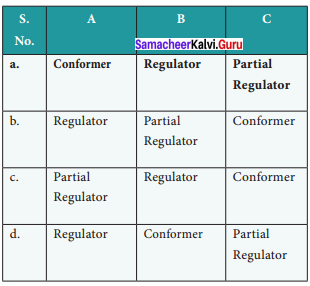
Samacheer Kalvi 12th Bio Zoology Solutions Chapter 1 Reproduction in Organisms

Get Tamilnadu Board Class 12 Bio Zoology Solutions Chapter wise Study Material to score good marks in the exam. Various chapters with subtopics are explained clearly in Samacheer Kalvi Class 12 Bio Zoology Solutions Material. All the Samacheer Kalvi Class 12 Bio Zoology Book Solutions Chapter 1 Reproduction in Organisms Questions, answers, Notes, Guide, Pdf along with the explanations are provided by the subject experts. Students can easily learn Tamilnadu Board Class 12 Chapter wise Bio Zoology with the help of the step by step guide provided on our site. Learn all the Samacheer Kalvi Class 12 Bio Zoology concepts to attempt the exam with more confidence. Read all the concepts of Tamilnadu Board Solutions for Class 12 Bio Zoology Chapter 1 Reproduction in Organisms.

Tamilnadu Samacheer Kalvi 12th Bio Zoology Solutions Chapter 1 Reproduction in Organisms

Whether you want to become an expert in Bio Zoology or to get good marks in the exam, you have one and only solution is practicing with Samacheer Kalvi 12th Bio Zoology Chapter wise Solutions. Strengthen your weakness by learning the Samacheer Kalvi 12th Bio Zoology Chapter 1 Reproduction in Organisms Questions and Answers on our site. You can learn directly online on our website or learn offline by downloading Samacheer Kalvi 12th Bio Zoology Chapter wise material. Save your time and read Samacheer Kalvi 12th Bio Zoology Subject at your comfort level.

Samacheer Kalvi 12th Bio Zoology Reproduction in Organisms Text Book Back Questions and Answers

Question 1.
In which type of parthenogenesis are only males produced?
(a) Arrhenotoky
(b) Thelytoky
(c) Amphitoky
(d) Both a and b
Answer:
(a) Arrhenotoky

Question 2.
Animals giving birth to young ones:
(a) Oviparous
(b) Ovoviviparous
(c) Viviparous
(d) Both a and b
Answer:
(c) Viviparous

Question 3.
The mode of reproduction in bacteria is by ___________
(a) Formation of gametes
(b) Endospore formation
(c) Conjugation
(d) Zoospore formation
Answer:
(c) Conjugation

Question 4.
In which mode of reproduction variations are seen?
(a) Asexual
(b) Parthenogenesis
(c) Sexual
(d) Both a and b
Answer:
(c) Sexual

Question 5.
Assertion and reasoning questions:
In each of the following questions there are two statements. One is assertion (A) and other is reasoning (R). Mark the correct answer as
(a) If both A and R are true and R is correct explanation for A
(b) If both A and R are true but R is not the correct explanation for A
(c) If A is true but R is false
(d) If both A and R are false
I. Assertion: In bee society, all the members are diploid except drones.
Reason: Drones are produced by parthenogenesis.
A B C D
II. Assertion: Off springs produced by asexual reproduction are genetically identical to the parent.
Reason: Asexual reproduction involves only mitosis and no meiosis.
A B C D
III. Assertion: Viviparous animals give better protection to their off springs.
Reason: They lay their eggs in the safe places of the environment.
A B C D
Answer:
(I) A (II) A (III) C

Question 6.
Name an organism where cell division is itself a mode of reproduction.
Answer:
Amoeba

Question 7.
Name the phenomenon where the female gamete directly develops into a new organism with an avian example.
Answer:
Parthenogenesis is the phenomenon where the unfertilized female gamete (egg) develops into a new individual,
e.g. Turkey

Question 8.
What is parthenogenesis? Give two examples from animals.
Answer:
Development of an egg into a complete individual without fertilization is known as parthenogenesis. It was first discovered by Charles Bonnet in 1745.
E.g. Honey bees, Aphis.

Question 9.
Which type of reproduction is effective – Asexual or sexual and why?
Answer:
Sexual reproduction is highly effective than asexual reproduction since the off springs produced are genetically different from parents causing variations. Variation leads to evolution.

Question 10.
The unicellular organisms which reproduce by binary fission are considered immortal. Justify.
Answer:
In unicellular organisms during binary fission, the entire cell (organism) divides completely to form two daughter cells which later on develop into adult and the process goes on repeatedly during each division leading to immortality of cell (organism). Hence unicellular organisms like amoeba are ‘biologically immortal’.

Question 11.
Why is the offspring formed by asexual reproduction referred as a clone?
Answer:
Off springs developed by asexual reproduction are referred as clones since they are genetically & morphologically similar to this parent.

Question 12.
Why are the off springs of oviparous animal at a greater risk as compared to off springs of viviparous organisms?
Answer:
Oviparous animals are egg-layers. The eggs containing embryo are laid out of their body and are highly susceptible to environmental factors (temperature, moisture etc.) and predators. Whereas, in viviparous animals, the embryo develops inside the body of female and comes out as young ones. Hence off springs of oviparous animals are at risk compared to viviparous animal.

Question 13.
Give reasons for the following:

  1. Some organisms like honey bees are called parthenogenetic animals
  2. A male honey bee has 16 chromosomes whereas its female has 32 chromosomes

Answer:

  1. Among honey bees, the queen bee and worker bees develop from fertilized eggs whereas the drones develop from unfertilized eggs. Hence the honey bees are parthenogenetic animals showing incomplete parthenogenesis.
  2. Female honey bees (Queen or worker bees) are diploid having 32 chromosomes since they develop from the fertilized egg. On the other hand, the male honey bees (drones) develop from unfertilized egg possessing only 16 chromosomes (i.e., Haploid)

Question 14.
Differentiate between the following:
(a) Binary fission in amoeba and multiple fission in Plasmodium
(b) Budding in yeast and budding in Hydra
(c) Regeneration in lizard and Planaria
Answer:
(a) Binary fission in amoeba and multiple fission in Plasmodium

  1. Binary fission in amoeba: In binary fission of amoeba, the plane of division is hard to observe. The nucleoli disintegrates. The nucleus divides mitotically forming two nucleus. The cell constricts in middle, so the cytoplasm divides forming two daughter cells.
  2. Multiple fission: In Multiple fission of plasmodium, the oocyte or schizont divides into many similar daughter cells simultaneously. Nucleus undergoes repeated mitosis producing many nuclei without the division of cytoplasm. Later the cytoplasm divides & encircles each nucleus forming many daughter cells oocyte undergoes sporogony forming sporozoites. Schizont undergoes schizogony forming merozoites.

(b) Budding in yeast and budding in Hydra:

  1. Budding in Yeast: Yeast is xxxx cellular organism in which the bud develops as a small protuberance following the nuclear division and finally detached to new individual.
  2. Budding in Hydra: Hydra is a multicellular organism where the bud xxxxxx from the parents body, grows gradually and finally gets detached.

(c) Regeneration in lizard and Planaria:

  1. Regeneration of Lizard: If the tail of the lizard is cut and removed, a new tail will regenerate in damaged part. In lizard only the new tail is regenerated.
  2. Regeneration of Planaria: If a planarian worm get cut then each half regenerates the lost part resulting in two worms.
    In planaria, the cut removed part developed into an entire worm.

Question 15.
How is juvenile phase different from reproductive phase?
Answer:

  1. Juvenile phase: Juvenile phase is the period of growth between the brith of an organism and before its reproductive maturity.
  2. Reproduction phase: Reproductive phase is the period of growth after juvenile phase when an individual attain reproductive maturity and reproduces.

Question 16.
What is the difference between syngamy and fertilization?
Answer:
Syngamy & fertilization both are more similar terms with a difference that syngamy refers to the process of fusion of two gametes forming zygote while fertilization refers to the process of being fertile.

Samacheer Kalvi 12th Bio Zoology Reproduction in Organisms Additional Questions and Answers

1 – Mark Questions

I. Choose the Correct Answer

Question 1.
Transverse binary fission is noticed in ___________
(a) Amoeba
(b) Planaria
(c) Ceratium
(d) Vorticella
Answer:
(b) Planaria

Question 2.
Multiple fission occurring in the oocyte of plasmodium is called ___________
(a) Schizogony
(b) Merogamy
(c) Syngamy
(d) Sporogony
Answer:
(d) Sporogony

Question 3.
Taenia solium requires ___________ as a secondary host to complete its life cycle.
(a) Mosquito
(b) pig
(c) dog
(d) human
Answer:
(b) pig

Question 4.
Which type of parthenogenesis only females are produced?
(a) Arrhenotoky
(b) Amphitoky
(c) Thelytoky
(d) Both (a) and (b)
Answer:
(c) Thelytoky

Question 5.
Which among the following animal is not a continuous breeder?
(a) Hen
(b) Rabbit
(c) Honey bees
(d) Frogs
Answer:
(d) Frogs

Question 6.
Match the following.
Samacheer Kalvi 12th Bio Zoology Solutions Chapter 1 Reproduction in Organisms
Answer:
a – iii, b – iv, c – ii, d – i

Question 7.
Identify the incorrect statement regarding parthenogenesis.
(a) Development of sperm without fertilization.
(b) It was first discovered by Charles Bonnet.
(c) Honey bees exhibit incomplete parthenogenesis.
(d) Amphitoky is a type of natural parthenogenesis.
Answer:
(a) Development of sperm without fertilization.

Question 8.
Oblique binary fission is seen in ___________
Answer:
Dinoflagellates

Question 9.
The process by which gravid proglottids of tapeworm gets cut off is called ___________
Answer:
apolysis

Question 10.
The concept of regeneration was first noticed in ___________
Answer:
Hydra

Question 11.
Fusion of small sized, morphologically different gametes is called ___________
Answer:
merogamy

Question 12.
Identify the wrong statement.
(a) Oviparous animals lays eggs.
(b) Viviparous animals give rise to young ones.
(c) Ovoviviparous animals lays eggs and then hatch it to young ones.
(d) Amphibians are oviparous animals.
Answer:
(c) Ovoviviparous animals lays eggs and then hatch it to young ones.

Question 13.
Assertion (A): Organisms show three phases in their life cycle.
Reason (R): Juvenile phase is a degenerative phase.
(a) A is correct R but is incorrect.
(b) Both A and R are correct
(c) R is the correct explanation for A
(d) A is not correct but R is correct
Answer:
(a) A is correct R but is incorrect.

Question 14
Match the statements.
Samacheer Kalvi 12th Bio Zoology Solutions Chapter 1 Reproduction in Organisms
Answer:
a – iii, b – iv, c-i, d- ii.

Question 15.
The ploidy of males produced by arrhenotoky parthenogenesis is
Answer:
haploid

Question 16.
Identify the mismatched pair.
(a) Paedogenesis – Liver fluke
(b) Strobilation – Aurelia
(c) Amphitoky – Honey bee
(d) Encystment – Amoeba
Answer:
(c) Amphitoky – Honey bee

Question 17.
Identify the proper sequence.
(a) juvenile phase, senescent phase, vegetative phase
(b) juvenile phase, maturity phase, senescent phase
(c) vegetative phase, maturity phase, juvenile phase
(d) senescent phase, juvenile phase, vegetative phase
Answer:
(b) juvenile phase, maturity phase, senescent phase

Question 18.
Match the following:
Samacheer Kalvi 12th Bio Zoology Solutions Chapter 1 Reproduction in Organisms
Answer:
a – iv, b – iii, c – ii, d – i

Question 19.
Which of the following types of asexual reproduction is noticed in Amoeba?
(a) Sporulation
(b) Encystment
(c) Binary fission
(d) All the above
Answer:
(d) All the above

Question 20.
Pick out the organism whose fertilization occurs internally.
(a) reptiles
(b) sponges
(c) pisces
(d) amphibians
Answer:
(a) reptiles

Question 21.
Assertion (A): Asexual reproduction is called blastogenic reproduction.
Reason (R): It is accomplished by mitotic and meiotic divisions.
(a) A and R are correct
(b) A is correct but R is incorrect
(c) Both A and R are incorrect
(d) R is the correct explanation for A
Answer:
(6) A is correct but R is incorrect

Question 22.
Egg laying hen is an example for ___________
(a) Thelytoky
(b) Ovovivipary
(c) Vivipary
(d) Ovipary
Answer:
(d) Ovipary

Question 23.
Assertion (A): Syngamy refers to the fusion of two haploid gametes.
Reason (R): Syngamy leads to zygote formation.
(a) A and R are correct.
(b) A and R are incorrect.
(c) R is not the right explanation for A
(d) A is correct but R is incorrect.
Answer:
(a) A and R are correct.

Question 24.
Human beings are an example for ___________ breeders.
Answer:
continuous

2 – Mark Questions

Question 1.
Why asexual reproduction is called as somatogenic reproduction?
Answer:
Asexual reproduction is usually by amitotic or mitotic division of the somatic (body) cells, – hence is also known as somatogenic or blastogenic reproduction.

Question 2.
Name the four types of fission seen in animals.
Answer:
Binary fission, Multiple fission, Sporulation and Strobilation.

Question 3.
Define fission.
Answer:
Fission is the division of the parent body into two or more identical daughter individuals.

Question 4.
Differentiate between transverse binary fission and longitudinal binary fission.
Answer:
Transverse binary fission:

  1. Plane of division runs along the transverse axis of the organism
  2. Example: Paramecium

Longitudinal binary fission:

  1. Plane of division runs along the longitudinal axis of the organism.
  2. Example: Euglena

Question 5.
Define Plasmotomy with example.
Answer:
Plasmotomy is the division of multinucleated parent into many multinucleate daughter individuals with the division of nuclei. Nuclear division occurs later to maintain normal number of nuclei. Plasmotomy occurs in Opalina and Pelomyxa (Giant Amoeba).

Question 6.
What do you mean by regeneration in living organisms? Mention its types.
Answer:
Regeneration is the regrowth of injured region.
It is of two types:

  1. Morphallaxis
  2. Epimorphosis.

Question 7.
How is the fertilization of amphibians differs from aves based on site?
Answer:
In amphibians the fertilization is external (taking place outside the body of female organism) whereas internal fertilization takes place in aves.

Question 8.
What is Paedogamy?
Answer:
Paedogamy is the sexual union of young individuals produced immediately after the division of the adult parent cell by mitosis.

Question 9.
Write a brief note on conjugation.
Answer:
Conjugation is the temporary union of the two individuals of the same species. During their union both individuals, called the conjugants exchange certain amount of nuclear material (DNA) and then get separated. Conjugation is common among ciliates,
e.g. Paramecium, Vorticella and bacteria (Prokaryotes).

Question 10.
Classify animal breeding based on time.
Answer:
On the basis of time, breeding animals are of two types: seasonal breeders and continuous breeders. Seasonal breeders reproduce at particular period of the year such as frogs, lizards, most birds, deers etc., Continuous breeders continue to breed throughout their sexual maturity
e.g. honey bees, poultry, rabbit etc.

Question 11.
Define Vivipary.
Answer:
Vivipary is a condition in which animals give rise to live young ones after being nourished in the uterus though the placenta.
E.g. human.

Question 12.
List out the four types of binary fission.
Answer:

  1. Simple irregular binary fission
  2. Transverse binary fission
  3. Longitudinal binary fission
  4. Oblique binary fission

Question 13.
Repeated fission is a type of multiple fission. Yes or No? Why?
Answer:
Yes. If multiple fission produces four or many daughter individuals by equal cell division and the young ones do not separate until the process is complete, then this division is called repeated fission
e.g. Vorticella.

Question 14.
Define apolysis.
Answer:
The detachment of gravid proglottids either singly or in groups from the body of tapeworm is called apolysis.

3 – Mark Questions

Question 15.
Compare schizogony with sporogony of plasmodium.
Answer:
Schizogony:

  1. In schizogony, the multiple fission occurs in the schizont.
  2. It results in the formation of merozoites.

Sporogony:

  1. In sporogony, the multiple fission occurs in the oocyte.
  2. It results in the formation of sporozoites.

Question 16.
Write a short note on encystment in amoeba.
Answer:
During unfavorable conditions (increase or decrease in temperature, scarcity of food) Amoeba withdraws its pseudopodia and secretes a three-layered, protective, chitinous cyst wall around it and becomes inactive. This phenomenon is called encystment. When conditions become favourable, the encysted Amoeba divides by multiple fission and produces many minute amoebae called pseudopodiospore or amoebulae.

The cyst wall absorbs water and breaks off liberating the young pseudopodiospores, each with a fine pseudopodia. They feed and grow rapidly to lead an independent life.

Question 17.
How exogenous buds are developed by Hydra?
Answer:
When buds are formed on the outer surface of the parent body, it is known as exogenous budding e.g. Hydra. In Hydra when food is plenty, the ectoderm cells increase and form a small elevation on the body surface. Ectoderm and endoderm are pushed out to form the bud. The bud contains an interior lumen in continuation with parent’s gastrovascular cavity. The bud enlarges, develops a mouth and a circle of tentacles at its free end. When fully grown, the bud constricts at the base and finally separates from the parent body and leads an independent life.

Question 18.
Apolysis favours Taenia solium. How?
Answer:
In the tapeworm, Taenia solium the gravid (ripe) proglottids are the oldest at the posterior end of the strobila. The gravid proglottids are regularly cut off either singly or in groups from the posterior end by a process called apolysis. This is very significant since it helps in transferring the developed embryos from the primary host (man) to find a secondary host (pig).

Question 19.
What is autogamy?
Answer:
In autogamy, the male and female gametes are produced by the same cell or same organism and both the gametes fuse together to form a zygote
e.g. Actinosphaerium and Paramecium.

Question 20.
What is exogamy?
Answer:
In exogamy, the male and female gametes are produced by different parents and they fuse to form a zygote. So it is biparental. e.g. Human – dioecious or unisexual animal.

Question 21.
Give the definition for

  1. Arrhenotoky
  2. Thelytoky
  3. Amphitoky

Answer:

  1. Arrhenotoky: In this type only males are produced by parthenogenesis
    eg: honey bees
  2. Thelytoky: In this type of parthenogenesis only females are produced by parthenogenesis.
    e.g: Solenobia
  3. Amphitoky: In this type parthenogenetic egg may develop into individuals of any sex.
    e.g: Aphis.

Question 22.
What is Incomplete parthenogenesis? Explain with example.
Answer:
Incomplete parthenogenesis is a type of reproduction in which both sexual reproduction and parthenogenesis occurs. Example: In honey bees, the fertilized eggs develop into queen bee and worker bees, whereas the unfertilized eggs develop into drones (male).

Question 23.
Explain briefly on the nature of Ovovivipary.
In Ovoviviparous animals, the embryo develops inside the egg and remains in the mother’s body until they are ready to hatch. This method of reproduction is similar to viviparity but the embryos have no placental connection with the mother and receive their nourishment from the egg yolk. Ovoviviparity is seen in fishes like shark.

Question 24.
Point out any six modes of asexual reproduction seen in animals.
Answer:

  1. fission
  2.  budding
  3. fragmentation
  4. sporulation
  5. regeneration
  6. gemmule formation.

Question 25.
Enumerate the types of syngamy.
Answer:

  1. Autogamy
  2. Exogamy
  3. Hologamy
  4. Paedogamy
  5. Merogamy
  6. Isogamy
  7. Anisogamy
  8. Conjugation

Question 26.
Name the types of animals based on embryonic development with an example for each.
Answer:

  1. Oviparous animals
    e.g. Birds
  2. Viviparous animals
    e.g. Human beings
  3. Ovoviviparous animals
    e.g. Shark

Question 27.
Write a short note on phases of life cycle.
Answer:

  1. Juvenile phase – Period of growth between birth of an individual and reproductive maturity.
  2. Reproductive phase – Period of growth when an organism attain reproductive maturity and produces new off springs.
  3. Senescent plane – Period of growth when the structure and functioning of body starts degenerating.

Question 28.
What is a Paedogenesis?
Answer:
In paedogenetic parthenogenesis (paedogenesis) the larvae produce a new generation of larvae ” by parthenogenesis. It occurs in the sporocysts and Redia larvae of liver fluke. It is also seen in the larvae of some insects,
e.g. Gall fly.

Question 29.
Draw and label a gemmule of sponge.
Answer:
Samacheer Kalvi 12th Bio Zoology Solutions Chapter 1 Reproduction in Organisms

Question 30.
Differentiate between asexual and sexual reproduction.
Answer:
Asexual Reproduction:

  1.  Involves only one parent
  2. Only mitotic cell division takes place.
  3. Off springs are genetically identical to parent.
  4. Gametes are not produced

Sexual Reproduction:

  1. Involves two parents (male & female)
  2. Both mitosis & meiosis takes place.
  3. Off springs genetically differ from the parents.
  4. Gametes are produced.

5 – mark Questions

Question 31.
Describe the regeneration process noticed in living organism.
Answer:
Regeneration is regrowth in the injured region. Regeneration was first studied in Hydra by Abraham Trembley in 1740. Regeneration is of two types, morphallaxis and epimorphosis. In morphallaxis the whole body grows from a small fragment e.g. Hydra and Planaria. When Hydra is accidentally cut into several pieces, each piece can regenerate the lost parts and develop into a whole new individual. The parts usually retain their original polarity, with oral ends, by developing tentacles and aboral ends, by producing basal discs.

Epimorphosis is the replacement of lost body parts. It is of two types, namely reparative and restorative regeneration. In reparative regeneration, only certain damaged tissue can be regenerated, whereas in restorative regeneration severed body parts can develop
e.g. star fish, tail of wall lizard.

Question 32.
Given an account on following terms.

  1. Hologamy
  2. Isogamy
  3. Anisogamy
  4. Merogamy
  5. Paedogamy

Answer:

  1. Hologamy: In Hologamy, the adult individuals do not produce gametes, but they themselves act as gametes and fuse to form new individuals.
    E.g : Trichonympha
  2. Isogamy : Fusion of morphologically & physiologically similar gametes.
    E.g : Monocystis.
  3. Anisogamy : Fusion of morphologically & physiologically dissimilar gametes.
    Eg: Vertebrates.
  4. Merogamy : Fusion of small sized morphologically different gametes (merogametes)
  5. Paedogamy : Fusion of young individuals produced immediately after the mitotic division of adult parent cell.

Higher Order Thinking Skills (HOTs) Question

Question 1.
Under threat or attack, garden lizard loses a part of its tail which trembles and avert the attention of predators, so that the lizard escapes later the tail regrown for lizard. The same phenomenon can also be noticed in organisms like starfish etc. What do you call this phenomenon? Define it.
Answer:
Regeneration is the regrowth in the injured region.

Question 2.
Complete the table.
Samacheer Kalvi 12th Bio Zoology Solutions Chapter 1 Reproduction in Organisms
Answer:
A – Only males
B – Only Females
C – Both Males & Females

Question 3.
In Vivipary, how the developing embryoes are nourished?
Answer:
In Vivipary, the embryo develops inside the womb of females body, hence they are nourished by the mother through placenta.

Question 4.
How Charles Bonnet and Abraham Trembley contributed to Biological filed?
Answer:
Charles Bonnet discovered the process of parthenogenesis. Abraham Trembley was the first to study the concept of Regeneration in the Hydra

Question 5.
‘A’ and ‘B’ are the male & female sex cells respectively which look alike and performs similar functions. ‘A’ and ‘B’ fuse to form a new individual ‘D’ Which type of gametic fusion does this represent? Give an example.
Answer:
Isogamy Eg: Monocystis

Question 6.
Complete the flow chart by mentioning the ploidy of cells in boxes.
Answer:
Samacheer Kalvi 12th Bio Zoology Solutions Chapter 1 Reproduction in Organisms

  1. Queen Bee Worker Bee – Diploid (2n)
  2. Drones (Male Bee), Egg, sperm – Haploid (n)

Question 7.
Meiosis is a type of cell division where the chromosomal number is reduced to half the number daughter cells. Which type of cellular division occurs in the drones to produces spermatozoa? Why?
Answer:
The gonadal cells of drones undergo mitosis to form sperms. Because the drones are haploid in nature since they develop from unfertilized eggs. To avoid further reduction in chromosome no. and maintain the chromosomal constancy, (instead of undergoing meiosis), mitosis will take place leading to formation of haploid gametes.

Samacheer Kalvi 12th Bio Zoology Chapter Wise Solutions PDF will help you to clear all doubts. Learn perfectly by using Samacheer Kalvi 12th Chapter 1 Reproduction in Organisms Questions and Answers Bio Zoology Solutions PDF. Leave us a comment to clear your queries. Get instant updates by bookmarking our site. Get the best learning with the effective and excellent step by step Samacheer Kalvi 12th Bio Zoology Guide.
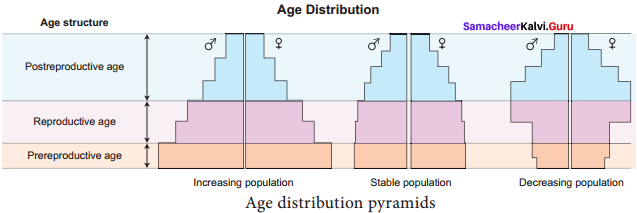
Samacheer Kalvi 11th Commerce Solutions Chapter 33 Indirect Taxation

Students can find the most related topics which helps them to analyse the concepts if they practice according to the chapter-wise page. It is necessary for the students to practice more Questions and Answers for Tamilnadu State Board Solutions of 11th Commerce are given in the pdf format in chapter 33 Indirect Taxation Questions and Answers so that students can prepare in both online and offline modes. So, Download Samacheer Kalvi 11th Commerce Book Solutions Questions and Answers, Notes Pdf, to score good marks.
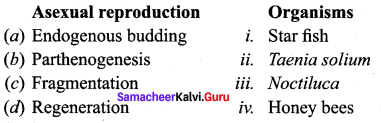
Samacheer Kalvi 11th Commerce Solutions Chapter 33 Indirect Taxation

Get the Questions and Answers, in Tamilnadu State Board 11th Commerce Solutions for Chapter 33 Indirect Taxation. Learn the concepts of 11th Commerce Chapter-Wise by referring to the Tamilnadu State Board Solutions for Chapter 33 Indirect Taxation Questions and Answers. Hence we suggest the students to Download Samacheer Kalvi 11th Commerce Book Solutions Questions and Answers pdf to enhance your knowledge.

Samacheer Kalvi 11th Commerce Indirect Taxation Textbook Exercise Questions and Answers

I. Choose the Correct Answer

Question 1.
Who is the chairman of the GST council?
(a) RBI Governor
(b) Finance Minister
(c) Prime Minister
(d) President of India
Answer:
(b) Finance Minister

Question 2.
GST Stands for …………….
(a) Goods and Supply Tax
(b) Government sales Tax
(c) Goods and Services Tax
(d) General Sales Tax
Answer:
(c) Goods and Services Tax

Question 3.
What kind of Tax the GST is?
(a) Direct Tax
(b) Indirect Tax
(c) Dependence on the Type of Goods and Services
(d) All Business Organisations
Answer:
(b) Indirect Tax

Question 4.
What is IGST?
(a) Integrated Goods and Service Tax
(b) India Goods and Service Tax
(c) Initial Goods and Service Tax
(d) All the above
Answer:
(a) Integrated Goods and Service Tax

Question 5.
In India GST became effective from?
(a) 1st April, 2017
(b) 1st January, 2017
(c) 1st July, 2017
(d) 1st March, 2017
Answer:
(d) 1st March, 2017

II. Very Short Answer Questions

Question 1.
Define Indirect tax.
Answer:
Indirect Tax is levied on the goods and services. It is collected from the buyers by the sellers and paid by the sellers to the Government. Since it is indirectly imposed on the buyers it is called indirect tax.

Question 2.
List out any four types of indirect taxes levied in India.
Answer:

  1. CGST
  2. SGST
  3. UGST
  4. IGST

Question 3.
What do you mean by Goods and Services Taxes?
Answer:
Goods and Services Tax (GST) is the tax imposed on the supply (consumption) of goods and services. It is a destination based consumption tax and collected on those value added items at each stage of the supply chain.

Question 4.
Write a note on SGST.
Answer:
SGST – State Goods and Services Tax – is imposed and collected by the State Governments under State GST Act. (Tamil Nadu GST Act 2017 passed by Tamil Nadu Govt.)

Question 5.
What is CGST?
Answer:
CGST – Central Goods and Services Tax – is imposed and collected by the Central Government on all supply of goods within a state (intra – state) under CGST Act 2017.

III. Short Answer Questions

Question 1.
Write any two differences between direct taxes and indirect taxes?
Answer:

BasisDirect TaxesIndirect Taxes
1. MeaningIf a tax levied on the income or wealth of a person is paid by that person (or his office) directly to the Government, it is called direct tax.If tax is levied on the goods or services of a person is collected from he buyers by another person (seller) and paid by him to the Government it is called indirect tax.
2. Incidence and ImpactFalls on the same person. Imposed on the income of a person and paid by the same person.Falls on different persons. Imposed on the sellers but collected from the consumers and paid by sellers.

Question 2.
What are the objectives of GST?
Answer:

  1. To create a common market with uniform tax rate in India. (One Nation, One Tax, One Market)
  2. To eliminate the cascading effect of taxes, GST allows set-off of prior taxes for the same transactions as input tax credit.
  3. To boost Indian exports, the GST already collected on the inputs will be refunded and thus there will be no tax on all exports.
  4. To increase the tax base by bringing more number of tax payers and increase tax revenue.
  5. To simplify tax return procedures through common forms and avoidance of visiting tax departments.
  6. To provide online facilities for payment of taxes and submission of forms.

Question 3.
Briefly explain the functions of GST council.
Answer:

  1. The GST Council will oversee the implementation of the GST. But the Central Board of Excise and Customs is responsible for administration of the CGST and IGST Acts.
  2. The Council makes recommendations on rate of GST, apportionment of IGST, exemptions, model GST laws, etc.
  3. The Minister of State in the Finance Ministry and all Finance Ministers of the State Governments shall be its members.
  4. All decisions of the Council can be passed only with Atb of the total votes. Each state has one vote, irrespective of its size or population.

Question 4.
Explain IGST with an example.
Answer:
IGST – Inter-State Goods and Services Tax is imposed and collected by the Central Government and the revenue is shared with States under IGST Act 2017.

Question 5.
Write any three demerits of UGST.
Answer:

  1. Several Economists says that GST in India would impact negatively on the real estate market. It would add up to 8 percent to the cost of new homes and reduce demand by about 12 percent.
  2. Another criticism is that CGST, SGST are nothing but new names for Central Excise/ Service Tax, VAT and CST. Hence, there is no major reduction in the number of tax layers.
  3. A number of retail products currently have only four percent tax on them. After GST, garments and clothes could become more expensive.

IV. Long Answer Questions

Question 1.
Distinguish between direct taxes and indirect taxes.
Answer:
Samacheer Kalvi 11th Commerce Solutions Chapter 33 Indirect Taxation

Question 2.
Discuss the different kinds of GST.
Answer:
GST is of three kinds: CGST, SGST/UGST, and IGST.
1. CGST – Central Goods and Services Tax – imposed and collected by the Central Government on all supply of goods within a state (intra-state) under CGST Act 2017.

2. SGST – State Goods and Services Tax – imposed and collected by the State Governments under State GST Act. (Tamil Nadu GST Act 2017 passed by Tamil Nadu Govt.)

3. UGST – Union Territory Goods and Services Tax – imposed and collected by the five Union Territory Administrations in India under UGST Act 2017.

4. IGST – Inter-State Goods and Services Tax – imposed and collected by the Central Government and the revenue shared with States under IGST Act 2017.

5. IGST on exports – All exports are treated as Inter-State supply under GST. Since exports are zero rated, GST is not imposed on all goods and services exported from India. Any input credit paid already on exports will be refunded.

Question 3.
Elucidate the merits of GST.
Answer:
A. To the Society and country:

  1. Unified common national market will attract more foreign investment. GST has integrated the economy of all States and Union Territories.
  2. It brings parity in taxation among imported goods and Indian manufactured goods. All imported goods will be charged with IGST which will be more or less equivalent to the total of CGST and SGST levied on manufactured goods. Removal of several taxes will make the price of Indian products more competitive at world market.
  3. It will boost manufacturing, export, GDP leading to economic growth through increase in economic activity.
  4. Creation of more employment opportunities which will result in poverty eradication.
  5. It will bring more tax compliance (more tax payers) and increase revenue to the Governments.
  6. It is transparent and will improve India’s ranking in the Ease of Doing Business in the world.
  7. Uniform rates of tax will reduce tax evasion and rate arbitrage between States.

B. To Business Community:

  1. Simpler Tax System with fewer exemptions. 17 taxes were abolished and one tax exists today.
  2. Input tax credit will reduce cascading effect of taxes. Reduction in average tax burden will encourage manufacturers and help “Make in India” campaign and make India as a manufacturing hub.
  3. Common procedures, common classification of goods and services and timelines will lend greater certainty to taxation system.
  4. GSTN facility will reduce multiple record keeping, lesser investment in manpower and resources and improve efficiency.
  5. All interactions will be through common GSTN portal and will ensure corruption free administration
  6. Uniform prices throughout the country. Expansion of business to all states is made easy.

C. To Consumers:

  1. Input tax credit allowed will lower the prices to the consumers.
  2. All small retailers will get exemption and purchases from them will cost less for the consumers.

Question 4.
Compare CGST, SGST and IGST.
Answer:
Samacheer Kalvi 11th Commerce Solutions Chapter 33 Indirect Taxation

Share this Tamilnadu State Board Solutions for 11th Commerce Chapter 33 Indirect Taxation Questions and Answers with your friends to help them to overcome the issues in exams. Keep visiting this site Tamilnadu State Board Solutions frequently to get the latest information on different subjects. Clarify your doubts by posting the comments and get the answers in an easy manner.

Samacheer Kalvi 11th Commerce Solutions Chapter 32 Direct Taxes

Students can find the most related topics which helps them to analyse the concepts if they practice according to the chapter-wise page. It is necessary for the students to practice more Questions and Answers for Tamilnadu State Board Solutions of 11th Commerce are given in the pdf format in chapter 32 Direct Taxes Questions and Answers so that students can prepare in both online and offline modes. So, Download Samacheer Kalvi 11th Commerce Book Solutions Questions and Answers, Notes Pdf, to score good marks.

Samacheer Kalvi 11th Commerce Solutions Chapter 32 Direct Taxes

Get the Questions and Answers, in Tamilnadu State Board 11th Commerce Solutions for Chapter 32 Direct Taxes. Learn the concepts of 11th Commerce Chapter-Wise by referring to the Tamilnadu State Board Solutions for Chapter 32 Direct Taxes Questions and Answers. Hence we suggest the students to Download Samacheer Kalvi 11th Commerce Book Solutions Questions and Answers pdf to enhance your knowledge.

Samacheer Kalvi 11th Commerce Direct Taxes Textbook Exercise Questions and Answers

I. Choose the Correct Answer

Question 1.
Income Tax is ……………
(a) a business tax
(b) a direct tax
(c) an indirect tax
(d) none of these
Answer:
(b) a direct tax

Question 2.
Period of assessment year is ……………
(a) 1st April to 31st March
(b) 1st March to 28st Feb
(c) 1st July to 30st June
(d) 1st Jan to 31st Dec
Answer:
(a) 1st April to 31st March

Question 3.
The year in which income is earned is known as ……………
(a) Assessment Year
(b) Previous Year
(c) Light Year
(d) Calendar Year
Answer:
(b) Previous Year

Question 4.
The aggregate income under five heads is termed as ……………
(a) Gross Total Income
(b) Total Income
(c) Salary Income
(d) Business Income
Answer:
(b) Total Income

Question 5.
Agricultural income earned in India is ……………
(a) Fully Taxable
(b) Fully Exempted
(c) Not Considered for Income
(d) None of the above
Answer:
(b) Fully Exempted

II. Very Short Answer Questions

Question 1.
What is Income tax?
Answer:
Income tax is a direct tax under which tax is calculated on the income, gains or profits earned by a person such as individuals and. other artificial entities (a partnership firm, company, etc.).

Question 2.
What is meant by previous year?
Answer:
The year in which income is earned is called previous year. It is also normally consisting of a period of 12 months commencing on 1st April every year and ending on 31st March of the following year. It is also called as financial year immediately following the assessment year.

Question 3.
Define the term person?
Answer:
The term ‘person’ has been defined under the Income tax Act. It includes individual, Hindu, Undivided Family, Firm, Company, local authority, Association of person or body of Individual or any other artificial juridical persons.

Question 4.
Define the term assessee?
Answer:
Assessee means a person by whom any tax or any other sum of money is payable under this Act. It includes every person in respect of whom any proceeding has been taken for the assessment of his income or assessment of fringe benefits.

Question 5.
What is an assessment year?
Answer:
The term has been defined under section 2(9). The year in which tax is paid is called the assessment year. It normally consists of a period of 12 months commencing on 1st April every year and ending on 31st March of the following year.

III. Short Answer Questions

Question 1.
What is Gross Total Income?
Answer:
Income from the five heads, namely – Salaries, House Property, Profits and Gains of Business or Profession, Capital Gains, and Other Sources – is computed separately according to the provisions given in the Act. Income computed under these heads shall be aggregated after adjusting past and present losses and the total so arrived at is known as ‘Gross Total Income’.

Question 2.
List out the five heads of income.
Answer:
The five heads of income are:

  1. Income from‘Salaries’ [Sections 15 – 17];
  2. Income from ‘House Property’ [Sections 22 – 27];
  3. Income from ‘Profits and Gains of Business or Profession’ [Sections 28 – 44];
  4. Income from ‘Capital Gains’ [Sections 45 – 55]; and
  5. Income from‘Other Sources’ [Sections 56 – 59].

Question 3.
Write a note on Agricultural Income.
Answer:
Any rent or revenue derived from land which is situated in India and is used for agriculture purposes. Agricultural income is fully exempted from tax u/s 10(1) and as such does not form part of total income.

Question 4.
What do you mean by Total Income.
Answer:
Out of Gross Total Income, Income Tax Act 1961 allows certain deductions under section 80. After allowing these deductions the figure which we arrive at is called ‘Total Income’ and on this figure tax liability is computed at the prescribed rates.

  1. Gross Total Income ****
  2. Less: Deductions (Sec. 80C to 80U) ****
  3. Total Income (T.I.) ****

Question 5.
Write short notes on:

  1. Direct Tax
  2. Indirect Tax

Answer:
1. Direct Tax:
If a tax levied on the income or wealth of a person and is paid by that person (or his office) directly to the Government, , it is called direct tax, example Income – Tax, Wealth Tax, Capital Gains Tax, Securities Transaction Tax, Fringe Benefits Tax (from 2005), Banking Cash Transaction Tax (for Rs,50,000 and above – from 2005), etc. In India all direct taxes are levied and administered by Central Board of Direct Taxes.

2. Indirect Tax:
If tax is levied on the goods or services of a person (seller). It is collected from, the buyers and is paid by seller to the Government. It is called indirect tax example GST.

IV. Long Answer Questions

Question 1.
Elucidate any five features of Income Tax.
Features of Income Tax in India:
1. Levied as Per the Constitution Income tax is levied in India by virtue of entry No. 82 of list I (Union List) of Seventh Schedule to the Article 246 of the Constitution of India.

2. Levied by Central Government Income tax is charged by the Central Government on all incomes other than agricultural income. However, the power to charge income tax on agricultural income has been vested with the State Government as per entry 46 of list II, i.e., State List.

3. Direct Tax Income tax is direct tax. It is because the liability to deposit and ultimate burden are on same person. The person earning income is liable to pay income tax out of his own pocket and cannot pass on the burden of tax to another person.

4. Annual Tax Income tax is an annual tax because it is the income of a particular year which is chargeable to tax.

5. Tax on Person It is a tax on income earned by a person. The term ‘person’ has been defined under the Income tax Act. It includes individual, Hindu Undivided Family, Firm, Company, local authority, Association of person or body of Individual or any other artificial juridical persons. The persons who are covered under Income tax Act are called ‘assessees’.

Question 2.
Define Tax. Explain the term direct tax and indirect tax with an example.
Answer:
Tax is a compulsory contribution to state revenue by the Government. It is levied on the income or profits from business of individuals and institutions. It may be added to the price of goods, services or transactions. Tax is the basic source of revenue to the Government. This revenue is utilised for the expenses of civil administration, internal and external security, building infrastructure, etc.

There are two types of taxes – direct taxes and indirect, taxes.

1. Direct Tax:
If a tax levied on the income or wealth of a person and is paid by that person (or his office) directly to the Government, it is called direct tax, e.g., Income – Tax, Wealth Tax, Capital Gains Tax, Securities Transaction Tax, Fringe Benefits Tax (from 2005), Banking Cash Transaction Tax (for Rs.50,000 and above – from 2005), etc. In India all direct taxes are levied and administered by Central Board of Direct Taxes.

2. Indirect Tax:
If tax is levied on the goods or services of a person (seller). It is collected from the buyers and is paid by seller to the Government. It is called indirect tax. example GST.

Question 3.
List out any ten kinds of incomes chargeable under the head income tax.
Answer:

  1. Profits and gains of business or profession.
  2. Dividend
  3. Voluntary contribution received by a charitable / religious trust or university/education institution or hospital/electoral trust[ w.e.f. 01.04.2010]
  4. Value of perquisite or profit in lieu of salary taxable u/s 17 and social allowance or benefit specifically granted either to meet personal expenses or for performance Of duties of an office or an employment of profit.
  5. Export incentives, like duty drawback, cash compensatory support, sale of licenses, etc.
  6. Interest, salary, bonus, commission or remuneration earned by a partner of a firm from such firm.
  7. Capital gain chargeable u/s 45.
  8. Profits and gains from the business of banking carried on by a co – operative society with its members.
  9. Winning from lotteries, crossword puzzles, races including horse races, card games and other games of any sort or from gambling or betting of any form or nature whatsoever.
  10. Deemed income u/s 41 or 59.

Question 4.
Discuss the various kinds of assesses.
Answer:
Assessee means a person by whom any tax or any other sum of money is payable under this Act. It includes every person in respect of whom any proceeding has been taken for the assessment of his income or assessment of fringe benefits. The term ‘person’ includes the following:

  1. an individual
  2. a Hindu Undivided Family (HUE)
  3. a company
  4. a firm
  5. an Association Of Persons or a Body Of Individual, whether incorporated or not
  6. a local authority, and
  7. every artificial juridical person example an idol or deity.

Share this Tamilnadu State Board Solutions for 11th Commerce Chapter 32 Direct Taxes Questions and Answers with your friends to help them to overcome the issues in exams. Keep visiting this site Tamilnadu State Board Solutions frequently to get the latest information on different subjects. Clarify your doubts by posting the comments and get the answers in an easy manner.

Samacheer Kalvi 11th Commerce Solutions Chapter 31 Discharge and Breach of a Contract

Students can find the most related topics which helps them to analyse the concepts if they practice according to the chapter-wise page. It is necessary for the students to practice more Questions and Answers for Tamilnadu State Board Solutions of 11th Commerce are given in the pdf format in chapter 31 Discharge and Breach of a Contract Questions and Answers so that students can prepare in both online and offline modes. So, Download Samacheer Kalvi 11th Commerce Book Solutions Questions and Answers, Notes Pdf, to score good marks.

Samacheer Kalvi 11th Commerce Solutions Chapter 31 Discharge and Breach of a Contract

Get the Questions and Answers, in Tamilnadu State Board 11th Commerce Solutions for Chapter 31 Discharge and Breach of a Contract. Learn the concepts of 11th Commerce Chapter-Wise by referring to the Tamilnadu State Board Solutions for Chapter 31 Discharge and Breach of a Contract Questions and Answers. Hence we suggest the students to Download Samacheer Kalvi 11th Commerce Book Solutions Questions and Answers pdf to enhance your knowledge.

Samacheer Kalvi 11th Commerce Discharge and Breach of a Contract Textbook Exercise Questions and Answers

I. Choose the Correct Answer

Question 1.
On the valid performance of the contractual obligation by the parties, the contract ……………….
(a) Is discharged
(b) Becomes enforceable
(c) Becomes void
(d) None of these
Answer:
(a) Is discharged

Question 2.
An agreement to do an act impossible in itself under Section 56 is ……………….
(a) Void
(b) Valid
(c) Voidable
(d) Unenforceable
Answer:
(a) Void

Question 3.
Any agreement which becomes impossible to perform under various circumstances.
(a) Voidable
(b) Void
(c) Valid
(d) None of these
Answer:
(b) Void

Question 4.
Discharge by mutual agreement may involve ……………….
(a) Novation
(b) Rescission
(c) Alteration
(d) All of the above
Answer:
(d) All of the above

Question 5.
The compensation given for breach of contract is ……………….
(a) Damage
(b) Remuneration
(c) Money
(d) Cheque
Answer:
(a) Damage

II. Very Short Answer Questions

Question 1.
What are the kinds of consent?
Answer:
The consent may be of the following types:

  1. Express
  2. Implied

Question 2.
What are the types of Impossibility of Performance?
Answer:
There are two types of impossibility of performance, such as –

  1. Impossibility existing at the time of agreement.
  2. Impossibility arising subsequent to the formation of contract.

Question 3.
What is Quantum merit?
Answer:
The meaning of the phrase quantum merit is ‘as much as earned’.

III. Short Answer Questions

Question 1.
What are the different modes of discharge by implied consent?
Answer:
Different modes of discharge by implied consent are:

  1. Novation
  2. Alteration
  3. Recession
  4. Remission
  5. Accord and Satisfaction
  6. Waiver
  7. Merger

Question 2.
Define discharge by Performance.
Answer:
Performance implies carrying out the obligation of the contract. Performance must be completed according to the real intentions of the agreement. Performance must be done according to time and manner prescribed.

Question 3.
What are reasons for impossibility arising after the formation of contract?
Answer:
Impossibility arising subsequent to the formation of a contract or supervening impossibility may be:

  1. By some event beyond the control of the parties; or
  2. By some act either of the promisor or of the promisee.

Question 4.
What are the various rules regarding damages?
Answer:
Generally in the following cases, the court grants specific performance:

  1. When the act agreed to be done is such that compensation in money for its non – performance is not sufficient.
  2. When it is probable that compensation in money cannot be received for the non – performance of the act agreed to be done.
  3. When there is no standard for ascertaining the actual damage caused by the non – performance of the act agreed to be done.

IV. Long Answer Questions

Question 1.
Explain the ways of discharge of Contract?
Answer:
Different modes of discharge of contract have been provided under different sections of the Act:
1. Discharge by Performance : Performance implies carrying out the obligation of the contract. Performance must be completed according to the real intentions of the agreement. Performance must be done according to time and manner prescribed. Performance of contract may be of two types namely:

  • Actual performance
  • Attempted performance

2. By Agreement on Consent : Agreement between the parties comes to an end by mutually agreeing for it. Any contract is created by an agreement, hence in the same way, it can be discharged by an agreement. The consent may be of the following types:

  • Express consent
  • Implied consent

3. By Impossibility of Performance : A contract may be discharged if its performance becomes impossible. There are two types of impossibility of performance, such as –

  • Impossibility existing at the time of agreement.
  • Impossibility arising subsequent to the formation of contract.

4. By Lapse of Time : According to the Limitation Act, 1963 a contract must be performed within a specified time. If it is not performed within this specified time limit and against which if no action is taken by the promisee in the Court of Law within specified time, then the promisee is deprived of his remedy at law. In such cases, the contract is discharged.

5. By Operation of Law : A contract can be discharged by the operation of law. The operation of law by which contract can be discharged are as follows:

  • By Death
  • By Merger
  • By Insolvency
  • Unauthorized Alteration of the Terms of a Contract
  • Rights and liabilities vesting in the same person

Question 2.
Write about the various remedies for breach of contract.
Answer:
There are various types of remedies for the injured parties listed as follows:

1. Recission of Contract – In case of breach of contract by one party, then the other parties may rescind the contract and thereby the party is absolved from his all obligations under the contract.

2. Claim for Specific Performance – In some specific cases if the damages are not the adequate remedy, then the court can direct the party in breach for the specific performance of the contract. In such case, the promise is carried out as per terms and conditions of the contract.

3. Claim for Injunction – Injunction is an order passed by a competent Court restraining a person from doing some act. Injunction can be defined as a mode of securing the specific performance of the negative terms of a contract.

4. Claim for Quantum Merit – The claim for quantum merit may arise if a contract performed by one party has become discharged by breach of the other party. The meaning of the phrase quantum merit is as much as earned’.

5. Claim for Damages – The claim for quantum merit may arise if a contract performed by one party has become discharged by breach of the other party. The meaning of the phrase quantum merit is as much as earned.

Question 3.
Discuss the different types of damages awarded to the injured party.
Answer:
Damages are a monetary compensation awarded by the court to the injured party for the loss or injury suffered by him. As per contract, one party can claim damages if other party breach the contract. The main purpose of awarding the damages is to make good the loss suffered by him. It is known as doctrine of restitution. The Section 73 of the Indian Contract Act, 1872 deals with the compensation for loss or damages caused by a party for breach of contract. There are mainly four types of damages, such as

  1. Ordinary damages
  2. Special damages
  3. Vindictive or exemplary damages; and
  4. Nominal damages

Share this Tamilnadu State Board Solutions for 11th Commerce Chapter 31 Discharge and Breach of a Contract Questions and Answers with your friends to help them to overcome the issues in exams. Keep visiting this site Tamilnadu State Board Solutions frequently to get the latest information on different subjects. Clarify your doubts by posting the comments and get the answers in an easy manner.

Samacheer Kalvi 11th Commerce Solutions Chapter 30 Performance of Contract

Students can find the most related topics which helps them to analyse the concepts if they practice according to the chapter-wise page. It is necessary for the students to practice more Questions and Answers for Tamilnadu State Board Solutions of 11th Commerce are given in the pdf format in chapter 30 Performance of Contract Questions and Answers so that students can prepare in both online and offline modes. So, Download Samacheer Kalvi 11th Commerce Book Solutions Questions and Answers, Notes Pdf, to score good marks.

Samacheer Kalvi 11th Commerce Solutions Chapter 30 Performance of Contract

Get the Questions and Answers, in Tamilnadu State Board 11th Commerce Solutions for Chapter 30 Performance of Contract. Learn the concepts of 11th Commerce Chapter-Wise by referring to the Tamilnadu State Board Solutions for Chapter 30 Performance of Contract Questions and Answers. Hence we suggest the students to Download Samacheer Kalvi 11th Commerce Book Solutions Questions and Answers pdf to enhance your knowledge.

Samacheer Kalvi 11th Commerce Performance of Contract Textbook Exercise Questions and Answers

I. Choose the Correct Answer

Question 1.
On the valid performance of the contractual obligations by the parties, the contract ………………..
(a) Is discharged
(b) Become enforceable
(c) Becomes void
(d) Becomes legal
Answer:
(a) Is discharged

Question 2.
Which of the following persons can perform the contract?
(a) Promisor alone
(b) Legal representatives of promisor
(c) Agent of the promisor
(d) All the above
Answer:
(d) All the above

Question 3.
A, B, C jointly promised to pay Rs.50,000 to D. Before performance of the contract, C dies. Here, the contract ………………..
(a) Becomes void on C’s death
(b) Should be performed by A and B along with C’s legal representatives.
(c) Should be performed by A and B alone.
(d) Should be renewed between A, B and D.
Answer:
(b) Should be performed by A and B along with C’s legal representatives.

Question 4.
Which of these parties cannot demand performance of promise?
(a) Promisee
(b) Any of the Joint Promisees
(c) On the death of a Promisee, his Legal Representative.
(d) Stranger to the Contract
Answer:
(d) Stranger to the Contract

Question 5.
A person is said to be a third person if he is not a ………………..
(a) promisor
(b) promise
(c) agent
(d) Legal Representative
Answer:
(c) agent

II. Very Short Answer Questions

Question 1.
State the ways of Performing a Contract.
Answer:
There are mainly two ways of performing a contract such as:

  1. Actual Performance
  2. Attempted Performance

Question 2.
Who is a Legal Representative?
Answer:
Legal representative can demand Exception performance. Contrary intention appears from the contract. Contract is of a personal nature.

Question 3.
Who is an agent?
Answer:
According to Para 2 of Section 40, the promisor may employ a competent person such as agent to perform the promise, if the contract is not formed on personal condition.

Question 4.
Define Reciprocal Promise.
Answer:
Promises which form consideration or part of consideration for each other are called ‘reciprocal promise’.

Question 5.
By whom must contracts be performed?
Answer:

  1. Promisor himself
  2. Agent
  3. Representations
  4. Third person
  5. Joint Promisors

III. Short Answer Questions

Question 1.
What is a Valid tender?
Answer:
A valid tender of performance is considered to be the performance of a promise.

Question 2.
Who can execute and Perform a Contract?
Answer:
Promisor himself – Under Para 1 to Section 40, it is laid down that where it appears from the nature of the contract, the intention of the parties that any promise contained in it must be performed by the promisor himself or by his legal representatives or by any other competent person employed by him.

Question 3.
Who can demand performance?
Answer:

  1. Promisee – only a promisee can demand performance and not a stranger demand performance of the contract.
  2. Legal Representative – legal representative can demand Exception performance. Contrary intention appears from the contract. Contract is of a personal nature.
  3. Third party – Exception to “stranger to a contract”.

Question 4.
Write a note on the benefits of Reciprocal Promise.
Answer:
Promises which form consideration or part of consideration for each other are called ‘reciprocal promise’. For example X promises to sell his house to Y for Rs.5,00,000. The promises are reciprocal. X is the promisor to give the house and a promise to receive Rs.5,00,000. Y is the promise to receive the house and a promisor to pay Rs. 5,00,000.

Question 5.
Who is a Joint Promisors?
Answer:
Joint Promisors:
(a) Devolution of Joint Liabilities (Section 42)
Section 42 of Indian Contract Act lays down that “When two or more persons have made a joint promise, then unless a contrary intention appears in the contract, all such persons, during their joint lives and after the death of the last survivor, representatives of all, jointly must fulfil the promise”

(b) Devolution of Joint Rights (Section 45)
“When a person has made a promise to two or more persons jointly, then unless there is a contract to the contrary, the right to claim performance rests as between him and them, with them during their joint lives and after the death of them with representatives of such deceased person jointly with survivors, and after the death of last survivor, with the representatives of all jointly”.

IV. Long Answer Questions

Question 1.
Explain rules relating to place of performance of promise.
Answer:
Time and place of Performance of Promise:
It is only the promisee for whom the contract is performed. Only the promisee can demand the performance of the promise under a contract.

For Example:
X promises Y to pay Z ₹ 10,000/-. X does not pay the sum to Z. Here Z cannot bind X for the payment. It is only promisee Y who can enforce the promise against the promisor X. Of course, there are certain special cases, where a third party can enforce a promise though he is not a party to the contract For example in respect of trust, marriage settlement etc. In case of death of promisee, the representative appointed by him can ask for the performance of the promise under a contract.

Question 2.
Elucidate the provision regarding time as factor in performance.
Answer:
1. Under Section 46, performance within a reasonable time:
According to Section 46, a promisor is to perform his promise within a reasonable time. On the other hand, reasonable time will depend upon the circumstance of the case, the usage of trade or on the intention of the parties entering into the contract.
Example : A has given an order of supply of books in July which should be performed within 4 to 5 days of the month of July.

2. Under Section 47, specified time and place for performance:
If the promise is to be performed on a certain day, the promisor may undertake to perform it without application of the promisee. According to the Section 47, In such a case the promisor may perform the promise at any time during the usual hours of business on such day and at the place at which the promise ought to be performed.

Question 3.
How do you think appropriation of payments takes place?
Answer:
Appropriation means application of payments – The question of appropriation of payments arises when a debtor owes several debts to the same creditor and makes a payment that is not sufficient to discharge the whole indebtedness.

Appropriation of Payments : Sometimes, a debtor owes several distinct debts to the same creditor and he makes a payment which is insufficient to satisfy all the debts. In such a case, a question arises as to which particular debt the payment is to be appropriated. Section 59 to 61 of the Act lay down following rules as to appropriation of payments which provide an answer to this question.

Share this Tamilnadu State Board Solutions for 11th Commerce Chapter 30 Performance of Contract Questions and Answers with your friends to help them to overcome the issues in exams. Keep visiting this site Tamilnadu State Board Solutions frequently to get the latest information on different subjects. Clarify your doubts by posting the comments and get the answers in an easy manner.