Samacheer Kalvi 12th Commerce Solutions Chapter 18 Grievance Redressal Mechanism

Enhance your subject knowledge with Tamilnadu State Board Solutions for 18th Commerce Chapter 18 Grievance Redressal Mechanism Questions and Answers and learn all the underlying concepts easily. Make sure to learn the subject from Tamilnadu State Board Solutions Chapter 18 Grievance Redressal Mechanism Questions and Answers PDF on a day to day basis and score well in your exams. You can Download Samacheer Kalvi 18th Commerce Book Solutions Questions and Answers are given after enormous research by people having high subject knowledge and for better scoring grade. You can rely on them and prepare any topic of Commerce as per your convenience easily.

Tamilnadu Samacheer Kalvi 12th Commerce Solutions Chapter 18 Grievance Redressal Mechanism

Students those who are looking for Tamilnadu State Board Solutions Chapter 18 Grievance Redressal Mechanism Questions and Answers Concepts can find them all in one place from our site Tamilnadu State Board Solutions. Simply click on the links available to prepare the corresponding topics of Samacheer Kalvi 18th Commerce Book Solutions Questions and Answers easily. Clarify all your queries from chapter wise different questions to be familiar with the kind of questions appearing in the exam. Thus, you can increase your score and get higher grade in the final exam.

Samacheer Kalvi 12th Commerce Grievance Redressal Mechanism Textbook Exercise Questions and Answers

I. Choose the Correct Answer

Question 1.
The Chairman of the National Consumer Disputes Redressal Council is ________
(a) Serving or Retired Judge of the Supreme Court of India
(b) Prime Minister
(c) President of India
(d) None of the above
Answer:
(a) Serving or Retired Judge of the Supreme Court of India

Question 2.
The Chairman of the State Consumer Protection Council is ________
(a) Judge of a High Court
(b) Chief Minister
(c) Finance Minister
(d) None of the above
Answer:
(a) Judge of a High Court

Question 3.
The Chairman of the District Forum is ________
(a) District Judge
(b) High Court Judge
(c) Supreme Court Judge
(d) None of the above
Answer:
(a) District Judge

Question 4.
The State Commission can entertain complaints where the value of the goods or services and the compensation, if any claimed exceed ________
(a) ₹ 2 lakhs but does not exceed ₹ 5 lakhs
(b) ₹ 20 lakhs but does not exceed ₹ 1 crore
(c) ₹ 3 lakhs but does not exceed ₹ 5 lakhs
(d) ₹ 4 lakhs but does not exceed ₹ 20 lakhs
Answer:
(b) ₹ 20 lakhs but does not exceed ₹ 1 crore

Question 5.
The National Consumer Disputes Redressal Commission has jurisdiction to entertain complaints where the value of goods/services complained against and the compensation, if any claimed is ________
(a) Exceeding ₹ 1 crore
(b) Exceeding ₹ 10 lakhs
(c) Exceeding ₹ 5 lakhs
(d) Exceeding ₹ 12 lakhs
Answer:
(a) Exceeding ₹ 1 crore

Question 6.
The District Forum can entertain complaints where the value of goods or services and the compensation if any claimed is less than ________
(a) Below ₹ 10,00,000
(b) Below ₹ 20,00,000
(c) Below ₹ 40,00,000
(d) Below ₹ 50,00,000
Answer:
(b) Below ₹ 20,00,000

Question 7.
The International Organisation of Consumers Unions (IOCU) was first established in ________
(a) 1960
(b) 1965
(c) 1967
(d) 1987
Answer:
(a) 1960

Question 8.
Consumer awareness covers the following:
(а) Consumer awareness about Maximum Retail Price (MRP)
(b) Consumer awareness about Fair Price Shop
(c) Consumer awareness about price, quality, and expiry date of the product
(d) All of the above
Answer:
(d) All of the above

Question 9.
Complaints can also be filed by the ________
(a) Central Government
(b) State Government
(c) A group of consumers
(d) All of the above
Answer:
(d) All of the above

Question 10.
A consumer has to be protected against ________
(a) Defects of product
(b) Deficiencies of product
(c) Unfair and restrictive trade practices
(d) All of the above
Answer:
(d) All of the above

II. Very Short Answer Questions

Question 1.
What do you meant by Redressal Mechanism?
Answer:
Exploitation is common where consumers are unaware of their rights and privileges. Government has also taken necessary steps to save the Consumers. It is in this context grievance redressal mechanism becomes important.

Question 2.
What do you know about National Commission?
Answer:
The National Consumer Disputes Redressal Commission (NCDRC), India is a quasi-judicial commission in India which was set up in 1988 under the Consumer Protection Act of 1986. The National Consumer Disputes Redressal Commission (NCDRC) is also called as National Commission.

Question 3.
State the meaning of the term State Commission.
Answer:
The State Commission is to be appointed by the State Government in consultation with the Centre. The State Consumer Protection Council is also called State Commission.

Question 4.
What is an term District Forum?
Answer:
As per the Consumer Protection Act of 1986 and Section 9 thereof the establishment of a District Forum by the State Government in each district is necessary today to protect the interest of aggrieved consumers in that district. Complaints can be filed with the forum by a consumer.

Question 5.
How to register the complaints?
Answer:
A complaint can be filed by a complainant against the seller, manufacturer, or dealer of goods which are defective or against the provider of services.

III. Short Answer Questions

Question 1.
Is Consumer Protection necessary?
Answer:
Consumer is supposed to be the king in the business. Consumer satisfaction is compulsorily necessary. Because the business depends upon the consumer. If there is no consumer, no need of production or sales. So the consumer is to be fully satisfied and respected in the market.

Question 2.
Who are the members of the National Commission?
Answer:
Members: The National Consumer Disputes Redressal Commission has been constituted by a Notification.

  1. The National Commission should have five members.
  2. One should be from judiciary.
  3. Four other members of ability, knowledge and experience from any other fields.
  4. It should include a woman.

Question 3.
What is the Pecuniary Jurisdiction of the State Commission?
Answer:
The Jurisdiction of the State Commission is as follows:

  1. The State Commission can entertain complaints within the territory of entire state and the compensation, if any claimed exceed Rs. 20 lakhs and below Rupees One Crore.
  2. The State Commission also has the jurisdiction to entertain appeals against the orders of any District Forum within the State.

Question 4.
Does District Forum exceeds the claim limit of Rs 20 Fakhs? Explain the condition.
Answer:
If the value of the complaint exceeds this limit of Rs 20 Lakhs the complaint should be made direct to the State Commission. Further the District Forum also may pass orders against traders indulging in unfair trade practices, sales of defective goods or rendering deficient services, where the turnover of goods or value of services does not exceed Rs 20 Lakhs.

Question 5.
Write a note on the Voluntary Consumer Organisation.
Answer:
Voluntary consumer organisations refer to the organisation formed voluntarily by the consumers to protect their rights and interests.

IV. Long Answer Questions

Question 1.
What are the Functions of the National Commission?
Answer:
The National Consumer Disputes Redressal Commission is also called as National commision. Its head office is New Delhi.
Functions:

  1. Compensation can be given foe the complaints to the value more than Rupees one crore.
  2. The orders passed in the state commission can be appealed.
  3. To call for the records and pass appropriate orders from the state commission and district
    forum.

Question 2.
Explain the overall performance of State Commission.
Answer:
The State Commission is to be appointed by the State Government. The person who is a judge or retired judge of high court is the president of the state commission.
Performances:

  1. The compensation of the value should not exceed Rs.20 lakhs and below Rs. 1 crore.
  2. The state commission has the power to call for the records and pass orders in the district forum
  3. To furnish the information which is required for the purpose of the Act to any officer.

Question 3.
Explain the term District Forum and explain the functions of District Forum.
Answer:
As per the Consumer Protection Act 1986, a district forum is established in each and every district to solve the problems in the concerned district.
Present or Retired district judge is the president of District forum.
Functions:

  1. The complaints relating to the district can be solved by district forum.
  2. Compensation that can be claimed is less than Rs. 20 lakhs.
  3. Sometimes the district forum also may pass orders against traders.

Question 4.
What is Voluntary Consumer Organisations? Explain its Functions.
Answer:
Voluntary consumer organisations refer to the organisation formed voluntarily by the consumers to protect their rights and interests.
Functions:

  1. Collecting Data on Different Products: These organizations collect samples of different products from time to time and test them.
  2. Filing Suit on Behalf of Consumers: If a consumer is not able to protest regarding his complaints, these organisations file case in the court, on behalf of a consumer.
  3. Protests against Adulteration: The consumer organisations play a significant role in eliminating the evil of adulteration, hoarding, black-marketing.
  4. Helping Educational Institutions: These organizations advice the educational institutions the way to prepare courses of study.
  5. Extending Support to Government: Consumer organisations keep informing the government agencies about adulteration, artificial scarcity, inferior quality products.

Question 5.
How to create consumer awareness?
Answer:
The first priority of a consumer organisation is to increase consumer awareness towards their rights.
The following are the points for awareness:

  1. To publish brochures, journals and monographs.
  2. To arrange conferences, seminars and workshops.
  3. To educate consumers to help themselves.
  4. To provide special education to women about consumerism.

Samacheer Kalvi 12th Commerce Grievance Redressal Mechanism Additional Questions and Answers

I. Choose the Correct Answer

Question 1.
The State consumer protection council is also called as
(a) State Commission
(b) National commission
(c) District commission
(d) City commission
Answer:
(a) State Commission

Question 2.
The National commission should have members.
(a) 3
(b) 4
(c) 5
(d) 6
Answer:
(c) 5

II. Very Short Answer Questions

Question 1.
What did Mahatma Gandhi tell about the Customer?
Answer:
“A customer is the most important visitor on our premises. He is not dependent on us. We are dependent on him. He is not an interruption of our work. He is the purpose of it. He is not an outsider of our business.”

III. Short Answer Questions

Question 1.
Who can make complaint?
Answer:
There are certain persons eligible to make complaint.
They are as follows:

  1. A consumer as defined under Consumer Protection Act, 1986.
  2. A registered Voluntary Consumer Association.
  3. Central Government.
  4. State Govemment / Union Territory.
  5. Consumers having the common problem.

We as a team believe the information prevailing regarding the Tamilnadu State Board Solutions for 18th Commerce Chapter 18 Grievance Redressal Mechanism Questions and Answers has been helpful in clearing your doubts to the fullest. For any other help do leave us your suggestions and we will look into them. Stay in touch to get the latest updates on Tamilnadu State Board Solutions for different subjects in the blink of an eye.

Samacheer Kalvi 12th Commerce Solutions Chapter 17 Consumer Protection

Enhance your subject knowledge with Tamilnadu State Board Solutions for 17th Commerce Chapter 17 Consumer Protection Questions and Answers and learn all the underlying concepts easily. Make sure to learn the subject from Tamilnadu State Board Solutions Chapter 17 Consumer Protection Questions and Answers PDF on a day to day basis and score well in your exams. You can Download Samacheer Kalvi 17th Commerce Book Solutions Questions and Answers are given after enormous research by people having high subject knowledge and for better scoring grade. You can rely on them and prepare any topic of Commerce as per your convenience easily.

Tamilnadu Samacheer Kalvi 12th Commerce Solutions Chapter 17 Consumer Protection

Students those who are looking for Tamilnadu State Board Solutions Chapter 17 Consumer Protection Questions and Answers Concepts can find them all in one place from our site Tamilnadu State Board Solutions. Simply click on the links available to prepare the corresponding topics of Samacheer Kalvi 17th Commerce Book Solutions Questions and Answers easily. Clarify all your queries from chapter wise different questions to be familiar with the kind of questions appearing in the exam. Thus, you can increase your score and get higher grade in the final exam.

Samacheer Kalvi 12th Commerce Consumer Protection Textbook Exercise Questions and Answers

I. Choose the Correct Answer

Question 1.
The final aim of modem marketing is _________
(a) Maximum profit
(b) Minimum profit
(c) Consumer satisfaction
(d) Service to the society
Answer:
(c) Consumer satisfaction

Question 2
_________  is the king of modem marketing.
(a) Consumer
(b) Wholesaler
(c) Producer
(d) Retailer
Answer:
(a) Consumer

Question 3.
As the consumer is having the rights, they are also having _________
(a) Measures
(b) Promotion
(c) Responsibilities
(d) Duties
Answer:
(c) Responsibilities

Question 4.
Which of the following is not a consumer right summed up by John F. Kennedy?
(a) Right to safety
(b) Right to choose
(c) Right to consume
(d) Right to be informed
Answer:
(a) Right to safety

Question 5.
It is the responsibility of a consumer that he must obtain _________  as a proof for the purchase of goods.
(a) Cash receipt
(b) Warranty card
(c) Invoice
(d) All of these
Answer:
(c) Invoice

II. Very Short Answer Questions

Question 1.
Write short notes on “Right to be informed.”
Answer:
Consumers should be given all the relevant facts about the product. This implies that manufacturer and the dealer are expected to disclose all the material facts relevant and relating to the product.

Question 2.
What do you understand about “Right to Safety”?
Answer:
There may be few products that are more likely to cause physical danger to consumers health, lives and property. The health hazards which are likely to arise have to be eradicated or reduced altogether. In case of food items and drugs both life saving and life sustaining safety is to be guaranteed.

Question 3.
What are the rights of consumer according to John F. Kennedy?
Answer:
The former president of U.S.A Mr. John F. Kennedy defined the basic consumer rights as “The Right of Safety“ the Right to be informed, the Right to choose and the Right to be heard.”

Question 4.
Which is the supreme objective of business?
Answer:
The modem marketing concept recognises that the consumer is the pivotal point around which the business moves. Satisfaction of consumer needs / requirements is stated to be supreme objective of a business.

Question 5.
What are the important aspects to be kept in mind by consumer while purchasing goods related to the quality of goods?
Answer:
The consumer has to have the knowledge about the quality from his own experiences or from the experiences of other persons who used the product or by browsing the website.

III. Short Answer Questions

Question 1.
What do you understand by “Right to redressal”?
Answer:
The complaints and protests are not just to be heard: but the aggrieved party is to be granted compensation within a reasonable time period . There should be prompt settlement of complaints and claims lodged by the aggrieved customers.

Question 2.
Define “Consumer Rights”.
Answer:
Consumer Right is interpreted as “the right to have information about the quality, potency, quantity, purity, price, and standard of goods or services”.

Question 3.
What do you understand about “Right to protection of health and safety”?
Answer:
A few products may contain potentially harmful substances which are dangerous from the consumer welfare point of view. The best examples of this kind are food additives, colours, emulsifiers, preservatives. In case of food items and drugs both life saving and life sustaining safety is to be guaranteed.

IV. Long Answer Questions

Question 1.
What are the rights of consumers?
Answer:
As a consumer, everyone should know the basic rights as well as about the counts and procedures to be followed.
The rights of consumers as per Consumer Protection Act are given below:

  1. Right to Protection of Health and Right of Safety: There may be products that cause physical danger to consumers health, lives and property. The health hazards which are likely to arise have to be eradicated or reduced altogether.
  2. Right to be Informed: Consumers should be given all the relevant facts about the products. The manufacturer and the dealer should disclose all the material facts relating to the product.
  3. Right to choose: Consumer satisfaction can be increased by giving the consumer the widest choice. From the widest range of products in quality and brand as well as price, the consumer can choose the goods.
  4. Right to be Heard: Consumers have every right to ventilate and register the dissatisfaction, disagreements and get the complaint heard and aired.
  5. Right to Seek Redressal: The aggrieved party is to be granted compensation within a reasonable time.
  6. Right to Consumer Education: The consumer has a right to acquire knowledge and stay well-informed all through his life.

Question 2.
Explain the duties of consumers.
Answer:
Apart from rights, there are certain duties imposed on the consumer. The following are the duties of consumers

  1. Buying Quality Products at Reasonable Price: It is the duty of a consumer to purchase a product after gaining a thorough knowledge of its price, quality and other terms and conditions.
  2. Ensure the Weights and Measurement before Purchase: The consumer should ensure that he/she is getting the product of exact weight and measure.
  3. Reading the Label Carefully: It is the duty of the consumer to read the label of the product thoroughly.
  4. Beware of False and Attractive Advertisements: It is the prime duty of the consumer about the genuineness of the advertisement, before purchasing the product.
  5. Ensuring the Receipt of Cash Bill: It is a legitimate duty of consumers to get the cash receipt and warranty card supplied along with the bill.

Question 3.
What are the responsibilities of consumers?
Answer:
Rights and responsibilities are two sides of the same coin.
The responsibilities of consumers are listed below:

  1. The consumer must pay the price of the goods according to the terms and conditions.
  2. The consumer has the responsibility to make the seller to deliver the goods in time.
  3. The consumer has to bear any loss, which may arise to the seller, due to delay in taking delivery.
  4. The consumer has to follow the instructions and precautions while using the product.
  5. The consumer must collect the cash receipt as a proof of goods purchased from the seller.
  6. The consumer must file a complaint with the seller about the defects in products or deficiency in service.

Samacheer Kalvi 12th Commerce Consumer Protection Additional Questions and Answers

I. Choose the Correct Answer

Question 1.
The consumer is to be protected against any __________
(a) unfair practices of trade
(b) family functions
(c) profit making firm
(d) loss in business
Answer:
(a) unfair practices of trade

Question 2.
The consumer is the __________ of the modem marketing.
(a) Manager
(b) Director
(c) King
(d) None of these
Answer:
(c) King

II. Very Short Answer Questions

Question 1.
Write a note on Right to consumer education.
Answer:
The consumer has a right to acquire knowledge and stay well-informed all through his life. He should be aware of the availability of the products.

Question 2.
How the consumer got the basic needs, as per right of the consumer?
Answer:
Every consumer has a right to get basic necessities of life such as food, clothing and water, and right to pine and healthy environment. It is the latest addition to consumer bill of rights.

We as a team believe the information prevailing regarding the Tamilnadu State Board Solutions for 17th Commerce Chapter 17 Consumer Protection Questions and Answers has been helpful in clearing your doubts to the fullest. For any other help do leave us your suggestions and we will look into them. Stay in touch to get the latest updates on Tamilnadu State Board Solutions for different subjects in the blink of an eye.

Samacheer Kalvi 12th Commerce Solutions Chapter 16 Consumerism

Enhance your subject knowledge with Tamilnadu State Board Solutions for 16th Commerce Chapter 16 Consumerism Questions and Answers and learn all the underlying concepts easily. Make sure to learn the subject from Tamilnadu State Board Solutions Chapter 16 Consumerism Questions and Answers PDF on a day to day basis and score well in your exams. You can Download Samacheer Kalvi 16th Commerce Book Solutions Questions and Answers are given after enormous research by people having high subject knowledge and for better scoring grade. You can rely on them and prepare any topic of Commerce as per your convenience easily.

Tamilnadu Samacheer Kalvi 12th Commerce Solutions Chapter 16 Consumerism

Students those who are looking for Tamilnadu State Board Solutions Chapter 16 Consumerism Questions and Answers Concepts can find them all in one place from our site Tamilnadu State Board Solutions. Simply click on the links available to prepare the corresponding topics of Samacheer Kalvi 16th Commerce Book Solutions Questions and Answers easily. Clarify all your queries from chapter wise different questions to be familiar with the kind of questions appearing in the exam. Thus, you can increase your score and get higher grade in the final exam.

Samacheer Kalvi 12th Commerce Consumerism Textbook Exercise Questions and Answers

I. Choose the Correct Answer

Question 1.
The term ‘consumerism’ came into existence in the year ________
(a) 1960
(b) 1957
(c) 1954
(d) 1958
Answer:
(a) 1960

Question 2.
Who is the father of Consumer Movement?
(a) Mahatma Gandhi
(b) Mr. John F. Kennedy
(c) Ralph Nader
(d) Jawaharlal Nehru
Answer:
(c) Ralph Nader

Question 3.
Sale of Goods Act was passed in the year?
(a) 1962
(b) 1972
(c) 1982
(d) 1985
Answer:
(c) 1982

Question 4.
The main objective of all business enterprises is ________
(a) Providing service
(b) Providing better standard of life
(c) Providing necessities to the society
(d) Earn profit
Answer:
(d) Earn profit

Question 5.
The Consumer Protection Act came into force with effect from ________
(a) 1.1.1986
(6) 1.4.1986
(c) 15.4.1987
(d) 15.4.1990
Answer:
(c) 15.4.1987

Question 6.
________ of every year is declared as a Consumer Protection Day to educate the public about their rights and responsibilities.
(a) August 15
(b) April 15
(c) March 15
(d) September 15
Answer:
(c) March 15

Question 7.
Any person who buys any goods or avails services for personal use, for a consideration is called as ________
(a) Customer
(b) Consumer
(c) Buyer
(d) User
Answer:
(b) Consumer

Question 8.
The General Assembly of United Nations passed resolution of consumer protection guide lines on ________
(a) 1985
(b) 1958
(c) 1986
(d) 1988
Answer:
(a) 1985

II. Very Short Answer Questions

Question 1.
Who is a consumer?
Answer:
A consumer is one who consumes goods manufactured and sold by others or created (air, water, natural resources) by nature and sold by others.

Question 2.
Define Consumerism.
Answer:
“Consumerism is an attempt to enhance the rights and powers by buyers in relation to sellers”

Question 3.
Give two examples of adulteration.
Answer:

  1. Powdered rice / wheat is adulterated with starch.
  2. Coffee powder is adulterated with tamarind seed.

Question 4.
What is Caveat Emptor?
Answer:
‘Caveat emptor’ is a Latin term that means “let the buyer beware.” Similar to the phrase”sold as is” this term means that the buyer assumes the risk that a product fails to meet expectations or have defects.

Question 5.
What is Caveat Venditor?
Answer:
Today, most sales in the U.S. fall under the principle of caveat venditor, which means “let the seller beware” by which goods are covered by an implied warranty of merchantability.

Question 6.
Write a short notes on Consumer Protection Act, 1986.
Answer:
The Central Government enacted a comprehensive law called the Consumer Protection Act in 1986. This Act came into force with effect from 15.04.1987. This Act was further amended in 1993. The Act is referred in short as ‘COPRA’.

III. Short Answer Questions

Question 1.
Which are the three constituent elements of business?
Answer:
The producer, the consumer and the government are the three constituent elements of business. The consumer is the most exploited constituent in the business world.

Question 2.
What are the important legislations related to consumerism in India?
Answer:
Consumer Legislation:

  1. The Indian Contract Act, 1982
  2. The Sale of Goods Act, 1982
  3. The Essential Commodities Act, 1955
  4. The Agricultural Products Grading and Marketing Act, 1937
  5. The Prevention of Food Adulteration Act, 1954
  6. Weights and Measures Act, 1958
  7. The Trademark Act, 1999

Question 3.
What is meant by artificial scarcity?
Answer:
There are certain situations where the shop-keepers put up the board “No Stock” in front of their shops, even though there is plenty of stock in the store. In such situations consumers who are desperate to buy such goods have to pay hefty price to buy those goods and thus earning more profit unconscientiously.

Question 4.
Write the importance of consumerism.
Answer:
Importance of consumerism lies in:

  1. Awakening and uniting consumers
  2. Discouraging unfair trade practices
  3. Protecting against exploitation
  4. Awakening the government
  5. Effective implementation of consumer protection laws
  6. Providing complete and latest information
  7. Discouraging anti-social activities

Question 5.
What is the role of Government in consumer protection?
Answer:
Since most of consumers including academically educated are illiterate about their rights and hence passive. Government should assure an active role in safeguarding the consumers. Government both the central and the state have brought out a number of legislations to protect the interest of consumers across the country. Law enforcement authorities should see that penal clause is not mere paper jaws-they should sting the offenders mercilessly.

IV. Long Answer Questions

Question 1.
How consumers are exploited?
Consumer is one who consumes the goods manufactured or created. Consumers are exploited in many’ways in the business.
They are as follows:

  1. Selling at Higher Price: The price charged by the seller for a product or service may not be higher compared to the quality.
  2. Adulteration: It refers to mixing or substituting undesirable material in food. This leads to heavy loss to the consumer, (e.g.) Mixing of stones with grains.
  3. Duplicate or Spurious goods: Duplicate products of popular products are illegally produced and sold
  4. Artificial Scarcity: There are certain situations where the shop-keepers put up the board “No Stock” in front of their shops, even though there is plenty of stock in the store.
  5. Sub-standard: On opening a packet or sealed container one may find the content to be of poor quality.

Question 2.
Explain the role of business in consumer protection.
Answer:
Business enterprises should do the following towards protecting consumers.

  1. Avoidance of Price Hike: Business enterprises should desist from hiking the price in the context of acute shortage of goods.
  2. Avoidance of Hoarding: Business enterprises should not indulge in hoarding and black marketing to earn maximum profit.
  3. Guarantees for Good Quality: Business enterprises should not give false warranty for the products.
  4. Product Information: Business enterprises should disclose correct, complete and accurate information about the product viz. size, quality, quantity, weight etc.
  5. The in advertising: Business enterprises should not convey false, untrue, bogus information relating to the product through the advertisement.
  6. Money Refund Guarantee: Where the product becomes defective, business enterprises should replace it with new one or refund the purchase price.

Question 3.
What are the needs for consumer protection?
Answer:
Consumer is to be protected from the cheating business people. Though the consumer is said to be the king, his interests are neglected. Consumer protection is applicable to public sector, financial and co-operative enterprises. Recently even medical services have been brought under consumer-movement. Satisfaction and well being of the consumer should be the main objective of business. But in real practice consumer is not protected and safeguarded. Thus there is a need for consumer protection or movement.

Question 4.
Explain the role of consumers in Consumer Protection.
Answer:
Consumers have to be vigilant and organize themselves into a movement for concerned action.
Activation of Consumer Action Councils:

  1. Consumer action councils established at village levels should educate consumers.
  2. Consumer protection agencies should take necessary steps to investigate consumer complaints and grievances.
  3. Voluntary consumer groups should provide information so as to educate consumers.
  4. Consumer cooperatives need to be strengthened.
  5. Consumer groups should contact the legislators to raise the consumer issue in Assembly and Parliament.
  6. There should be testing laboratories at each district to test the purity of goods.

Question 5.
What are the objectives of Consumer Protection Act, 1986?
Answer:
The Central Government enacted a comprehensive law called the Consumer Protection Act in 1986. This Act came into force with effect from 15.04.1987. It is in short, called as ‘COPRA’.
Objectives:

  1. Consumer protection Act protects the interests of the consumers.
  2. This Act provides safeguards against defective goods and deficient services, untrade practices.
  3. It also gives settlement of consumer disputes.
  4. It is applicable to public sector, financial and co-operative enterprises.

Question 6.
Write about five important consumer legislations.
Answer:
To protect the consumers from the unfair traders, the government passed various legislative Acts.
They are follows:

  1. The Indian Contract Act, 1982 was passed to bind the people on the promise made in the contract.
  2. The Essential Commodities Act, 1955 protects the consumers against artificial shortages created by the sellers by hoarding the goods.
  3. The Prevention of Food Adulteration Act, 1954 checks the adulteration of food articles and ensures purity of goods supplied.
  4. Weights and Measures Act, 1958 protects the consumer against malpractices of underweight or under measurement.

Question 7.
What are the salient features of the Consumer Protection Act, 1986?
Answer:
Salient Features of The Indian Consumer Protection Act, 1986:

  1. Protecting consumers against products and services which are harmful to the health of the consumers.
  2. Ensuring consumers, with supply of goods at fair quality.
  3. Ensuring the availability of goods in correct quantity and right size.
  4. Protecting the consumers against pollution of various kinds.
  5. Ensuring that consumers are charged fair price.
  6. Protecting the consumers against unfair trade practices of unscrupulous trader.

Question 8.
What are the objectives of United Nations guidelines for consumer protection?
Answer:
The General Assembly of the United Nations passed a Resolution on April 9,1985 adopting a set of guidelines for consumer protection to persuade the member countries.

Objectives of United Nations Guidelines for Consumer Protection:

  1. To assist countries in achieving or maintaining protection to consumers.
  2. To facilitate production and distribution patterns responsive to the needs and desires of consumers.
  3. To encourage high levels of ethical conduct for production and distribution of goods and services to consumers.
  4. To facilitate the developing of independent consumer groups.
  5. To encourage the development of market conditions which provide consumers with greater choice at lower prices.

Samacheer Kalvi 12th Commerce Consumerism Additional Questions and Answers

I. Choosy the Correct Answer

Question 1.
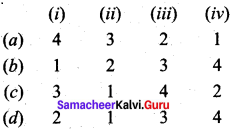
Match List I with List II and select the correct answer using the codes given below:

(a)Prevention of Food Adulteration Act(i)1958
(b)Weight and Measurement Act(ii)1982
(c)Essential commodities Act(iii)1954
(d)Sale of goods Act(iv)1955

Codes:
Samacheer Kalvi 12th Commerce Solutions Chapter 16 Consumerism
Answer:
(c) (i) 3, (ii) 1, (iii) 4, (iv) 2.

Question 2.
The term ‘Caveat emptor’ is a Latin term, which means _________
(a) Let the seller beware.
(b) Let the buyer beware
(c) Consumer
(d) Marketer
Answer:
(b) Let the buyer beware

II. Very Short Answer Questions

Question 1.
What is meant by sub-standard according to the Consumer Protection Act?
Answer:
On opening a packet or sealed container one may find the content to be of poor quality. If defective or damaged items are found in a pack, a consumer finds it difficult to exchange the defective one for good one.

Question 2.
What is meant by consumer protection?
Answer:
Consumer protection is a form of social action which is designed to attain the wellbeing of the society namely consumers. A consumer is said to be a king in a free market economy.

III. Short Answer Questions

Question 1.
Write a short note on False Advertisements.
Answer:
The main motive of advertisements is to educate the consumers regarding various aspects of the products and services. Sometimes it makes false representation about the quality, price, grade, composition and utility of products. Often the products are not as attractive as shown in the advertisement by the sellers. Consumers who buy the products on the faith of claims made in advertisements are cheated.

Case Study

Mr. Narasimachary bought a refrigerator of a familiar brand with a warranty for seven years. He uses the fridge as per the guidelines given by the manufacturer. After the completion of two years the fridge went out of order. He was shocked, and approached the dealer. But the dealer refused to service the fridge at free of cost.

Question 1.
What is your suggestion to Mr. Narasimachary to this grievance?
Answer:
Each and every consumer should know the rights and duties of consumers, according to the consumer protection Act – 1986. In this case, the manufacturer refused to repair and service the fridge, though there is a warranty period. So my suggestion is that the consumer Mr. Narasimachary can contact the manufacturer again to repair the fridge. If he refuses, Mr. Narasimachary can file a case in the consumer court according to the Act 1986. For proceeding to the case, the consumer has to make ready the cash bill, invoice and warranty card of the fridge.

We as a team believe the information prevailing regarding the Tamilnadu State Board Solutions for 16th Commerce Chapter 16 Consumerism Questions and Answers has been helpful in clearing your doubts to the fullest. For any other help do leave us your suggestions and we will look into them. Stay in touch to get the latest updates on Tamilnadu State Board Solutions for different subjects in the blink of an eye.

Samacheer Kalvi 12th Commerce Solutions Chapter 15 Recent Trends in Marketing

Enhance your subject knowledge with Tamilnadu State Board Solutions for 15th Commerce Chapter 15 Recent Trends in Marketing Questions and Answers and learn all the underlying concepts easily. Make sure to learn the subject from Tamilnadu State Board Solutions Chapter 15 Recent Trends in Marketing Questions and Answers PDF on a day to day basis and score well in your exams. You can Download Samacheer Kalvi 15th Commerce Book Solutions Questions and Answers are given after enormous research by people having high subject knowledge and for better scoring grade. You can rely on them and prepare any topic of Commerce as per your convenience easily.

Tamilnadu Samacheer Kalvi 12th Commerce Solutions Chapter 15 Recent Trends in Marketing

Students those who are looking for Tamilnadu State Board Solutions Chapter 15 Recent Trends in Marketing Questions and Answers Concepts can find them all in one place from our site Tamilnadu State Board Solutions. Simply click on the links available to prepare the corresponding topics of Samacheer Kalvi 15th Commerce Book Solutions Questions and Answers easily. Clarify all your queries from chapter wise different questions to be familiar with the kind of questions appearing in the exam. Thus, you can increase your score and get higher grade in the final exam.

Samacheer Kalvi 12th Commerce Recent Trends in Marketing Textbook Exercise Questions and Answers

I. Choose the Correct Answer

Question 1.
Selling goods / services through internet is ________
(a) Green marketing
(b) E-business
(c) Social marketing
(d) Meta marketing
Answer:
(b) E-business

Question 2.
Which is gateway to internet?
(a) Portal
(b) CPU
(c) Modem
(d) Webnaire
Answer:
(c) Modem

Question 3.
Which one represents a cluster of manufacturers, content providers and online retailers organised around an activity?
(a) Virtual mall
(b) Association
(c) Metomediary
(d) Portal
Answer:
(c) Metomediary

Question 4.
Social marketing deals with:
(a) Society
(b) Social Class
(c) Social change
(d) Social evil
Answer:
(c) Social change

Question 5.
Effective use of Social media marketing increase conversion rates of ________
(a) Customer to buyers
(b) Retailer to customers
(c) One buyer to another buyers
(d) Direct contact of marketer
Answer:
(a) Customer to buyers

Question 6.
A company’s products and prices is visually represented by ________
(a) Shopping cart
(b) Web portal
(c) Electronic catalogue
(d) Revenue model
Answer:
(c) Electronic catalogue

Question 7.
Green Shelter concept was introduced by group:
(a) ACME
(b) Tata
(c) Reliance
(d) ICI
Answer:
(a) ACME

Question 8.
Pure play retailers are called ________
(a) Market creators
(b) Transaction brokers
(c) Merchants
(d) Agents
Answer:
(b) Transaction brokers

II. Very Short Answer Questions

Question 1.
What is E-business?
Answer:
If all the business transactions are carried out through internet and other online tools, it is called E-business.

Question 2.
What is green marketing?
Answer:
Green marketing involves developing and promoting products and services which satisfy customers wants and needs for quality, performance, affordable pricing and convenience – all without causing a detrimental impact on the environment.

Question 3.
What is service marketing?
Answer:
Service marketing denotes the processing of selling service goods like telecommunication, banking, insurance, car rentals, healthcare, tourism, professional services, repairs etc.

Question 4.
Define E-Marketing,
Answer:
“E-Marketing is achieving marketing Objectives through use of digital technologies like Internet, world wide web, e-mail, wireless media, and management of digital customer data and electronic customer management systems.

Question 5.
What is E-Tailing?
Answer:
E-tailing or electronic retailing refers to selling of goods and services through a shopping website (internet) or through virtual Store to the ultimate consumer.

Question 6.
What is Social marketing?
Answer:
Social marketing is a new marketing tool. It is the systematic application of marketing philosophy and techniques to achieve specific behavioural goals which ensure social good. For example- not to smoke in public areas.

III. Short Answer Questions

Question 1.
What is B2B and B2C type of E-Commerce?
Answer:
B2B is an online business model that facilitates online sales transactions between two businesses. E-tailing is a business to consumer (B2C) transaction model. E-tailing is also called online retailing.

Question 2.
Explain the importance of social marketing.
Answer:
The primary aim of social marketing is ‘social good’ such as anti-tobacco, anti-drug, anti-pollution, anti-dowry, road safety, protection of girl child, against the use of plastic bags. Social marketing promotes the consumption of socially desirable products and develops health consciousness. It helps to eradicate social evils that affect the society and quality of life.

Question 3.
Discuss the objectives E-Marketing.
Answer:
The following are the objectives of E-Marketing:

  1. Expansion of market share
  2. Reduction of distribution and promotional expenses
  3. Achieving higher brand awareness
  4. Strengthening database

Question 4.
Elucidate how E-Commerce differs from E-Business.
Answer:
E-commerce simply refers to the buying and selling of products and services through online but E-business goes a way beyond the simple buying and selling, of goods and service and much wider range of business processes, such as supply chain management, electronic order processing and customer relationship management.

Question 5.
Explain in detail about Niche marketing.
Answer:
It is found by company, by identifying the need of customers which are not served or under served by the competitors. The company which identified niche market develops solution to satisfy the needs of niche market. A niche market does not mean a small market, but it involves specific target audience with a specialized offering.

IV. Long Answer Questions

Question 1.
Explain in detail how traditional marketing differ from E-marketing.
Answer:
Differences between E-marketing and traditional marketing:

S.No.E-MarketingTraditional Marketing
1.Electronic marketing or E-marketing is the process of marketing of products and services over internet and tele networks.Goods and services are directly purchased and sold in the market is known as traditional marketing.
2.It is very economical and faster way to promote the products.It is very expensive and takes more time to promote the product.
3.It is quiet easier for promoting product globally in the short time.It is very expensive and time consuming to promote the product in traditional marketing.
4.E-Business enterprises can expand their operation with minimum manpower.It needs more man power.
5.In this marketing product can be sold and bought 24 x 7, round the year.That is not possible in traditional marketing.

Question 2.
Explain advantages and disadvantages of E-tailing.
Answer:
E-tailing or electronic retailing refers to selling of goods and services through a shopping website:
Advantages:

  1. Customer can buy the product at anytime from anywhere.
  2. Direct contact of end consumer by the manufacturer cuts down the cost.
  3. Customer can buy whatever they want by browsing the various sites.

Disadvantages:

  1. E-tailing needs a strong advertisement and for which it has to spend large amount.
  2. It is not suitable for small size business.

Question 3.
Describe the various strategies pursued in recent day’s marketers.
Answer:
The market scenario in the world today is changing very rapidly.
Strategies of Recent Marketers:

  1. Due to the development in information technology, transportation, liberalisation, their buying habits are varying.
  2. In the globalised business environment, the marketer must move goods faster and quicker to satisfy the needs of the customer.
  3. It is possible to carryout all the business transactions over an electronic network.
  4. They use a variety of tools like computers, laptops, tablet or android phone devices to access different websites.

Question 4.
Compare the concept of social marketing with service marketing.
Answer:
1. Social marketing:
Social marketing is a new marketing tool. It is the systematic application of marketing philosophy to achieve social good. The primary aim of social marketing is ‘social good’ such as anti-tobacco, anti-drug, anti pollution, anti-dowry, road safety, protection of girl child.

2. Service marketing:
A service is any activity or benefit that one party can offer to another which is essentially intangible. Service marketing is a specialized branch of marketing. Service marketing denotes the process of selling service goods like telecommunication, banking, insurance, car rentals, healthcare, tourism and repairs.

Question 5.
Discuss any two new methods of marketing with its advantages.
Answer:
1. Rural Marketing:
Rural marketing is a process of developing pricing, promoting and distributing rural specific goods and services leading to exchange with rural customers. There is inflow of goods into rural markets for production and consumption and there is also outflow of products to urban areas. the rural to urban flow consists of agricultural products like rice, wheat and sugar etc.

2. Service Marketing:
Service marketing is a special branch of marketing. It denotes the processing of selling service goods like telecommunication, banking, insurance, healthcare, tourism and professional services. The service products are mostly intangible. The unique feature of services marketing warrant different strategies compared with the marketing of physical goods.

Samacheer Kalvi 12th Commerce Recent Trends in Marketing Additional Questions and Answers

I. Choose the Correct Answer

Question 1.
Which one of the following is not correctly matched ?

(a)E-tailing(i)Electronic Retailing
(b)Green Marketing(ii)Environmental marketing
(c)Service Marketing(iii)Insurance
(d)Social Marketing(iv)Online retailing

Answer:
(d) Social Marketing (iv) Online retailing

Question 2.
Find out which is not suitable? The products marketed in commodity exchange are ______
(a) Crude oil
(b) Rice
(c) Copper
(d) Gold
Answer:
(b) Rice

We as a team believe the information prevailing regarding the Tamilnadu State Board Solutions for 15th Commerce Chapter 15 Recent Trends in Marketing Questions and Answers has been helpful in clearing your doubts to the fullest. For any other help do leave us your suggestions and we will look into them. Stay in touch to get the latest updates on Tamilnadu State Board Solutions for different subjects in the blink of an eye.

Samacheer Kalvi 12th Commerce Solutions Chapter 14 Marketing and Marketing Mix

Enhance your subject knowledge with Tamilnadu State Board Solutions for 14th Commerce Chapter 14 Marketing and Marketing Mix Questions and Answers and learn all the underlying concepts easily. Make sure to learn the subject from Tamilnadu State Board Solutions Chapter 14 Marketing and Marketing Mix Questions and Answers PDF on a day to day basis and score well in your exams. You can Download Samacheer Kalvi 14th Commerce Book Solutions Questions and Answers are given after enormous research by people having high subject knowledge and for better scoring grade. You can rely on them and prepare any topic of Commerce as per your convenience easily.

Tamilnadu Samacheer Kalvi 12th Commerce Solutions Chapter 14 Marketing and Marketing Mix

Students those who are looking for Tamilnadu State Board Solutions Chapter 14 Marketing and Marketing Mix Questions and Answers Concepts can find them all in one place from our site Tamilnadu State Board Solutions. Simply click on the links available to prepare the corresponding topics of Samacheer Kalvi 14th Commerce Book Solutions Questions and Answers easily. Clarify all your queries from chapter wise different questions to be familiar with the kind of questions appearing in the exam. Thus, you can increase your score and get higher grade in the final exam.

Samacheer Kalvi 12th Commerce Marketing and Marketing Mix Textbook Exercise Questions and Answers

I. Choose the Correct Answer

Question 1.
The initial stage of Marketing system is _________
(a) Monopoly system
(b) Exchange to Money
(c) Barter system
(d) Self producing
Answer:
(c) Barter system

Question 2.
Who is supreme in the Market?
(a) Customer
(b) Seller
(c) Wholesaler
(d) Retailer
Answer:
(a) Customer

Question 3.
In the following variables which one is not the variable of marketing mix?
(a) Place Variable
(b) Product Variable
(c) Program Variable
(d) Price Variable
Answer:
(c) Program Variable

Question 4.
Marketing mix means a marketing program that is offered by a firm to its target _________  to earn profits through satisfaction of their wants.
(a) Wholesaler
(b) Retailer
(c) Consumer
(d) Seller
Answer:
(c) Consumer

Question 5.
Which one is the example of Intangible product?
(a) Education
(b) Mobiles
(c) Garments
(d) Vehicles
Answer:
(a) Education

II. Very Short Answer Questions

Question 1.
Define Marketing Mix.
Answer:
“Marketing mix is a pack of four sets of variables namely product variable, price variable, promotion variable, and place variable”

Question 2.
Give any two internal factors affecting the price of product / service.
Answer:
Factors affecting Price of product / service
(a) Internal Factors:

  1. Marketing Objectives
  2. Marketing Mix Strategy
  3. Organizational considerations

Question 3.
Define Product.
Answer:
“A product is anything that can be offered to a market for attention, acquisition, use or consumption that might satisfy a want or a need”, says Philip Kotler.

III. Short Answer Questions

Question 1.
What are the objectives of marketing?
Answer:
Baker and Anshen say, “The end of all the marketing activities is the satisfaction of human wants”. The following are the objectives of marketing:

  1. Intelligent and capable application of modem marketing policies.
  2. To develop the marketing field.
  3. To develop guiding policies and their implementation for a good result.

Question 2.
What is need for market and’explain the concept of marketing?
Answer:
Market is needed for the producers and consumers. For this there are various concepts:

  1. The products produced are to be marketed in the market for sales.
  2. First create a consumer and then create products.
  3. Keep respect and love customers than the products.
  4. Customer is the king of the business.

Question 3.
What are the factors affecting Price of Product?
Answer:
Factors affecting Price of product/service:
(a) Internal Factors:

  1. Marketing Objectives
  2. Marketing Mix Strategy
  3. Organizational considerations
  4. Costs
  5. Organization Objectives

(b) External Factors:

  1. The market after demand
  2. Competition
  3. Customers
  4. Suppliers
  5. Legal factors
  6. Regulatory factors.

Question 4.
What do you mean by Marketing mix? Describe any two elements.
Answer:

  1. A list of important elements or ingredients that make up the marketing programme
  2. The list of forces having bearing on marketing operations.

Elements of Marketing of Mix:

  1. Product is the main element of marketing. Without a product, there can be no marketing.
  2. Price is the value of a product expressed in monetary terms. It is the amount charged for the product.

IV. Long Answer Questions

Question 1.
Discuss about the evolution of marketing.
Answer:
Marketing is one of the business functions. The development of marketing is evolutionary rather than revolutionary.
Evolution of Marketing:

  1. Barter System: The goods are exchanged against goods, without money.
  2. Production Orientation: This was a stage where producers, instead of being concerned with the consumer preferences, concentrated on the mass production of goods.
  3. Sales Orientation: The selling became the dominant factor, without any efforts for the satisfaction of the consumer needs.
  4. Marketing Orientation: Customers importance was realised but only as a means of disposing of goods produced.
  5. Consumer Orientation: Under this stage only such products are brought forward to the markets which are capable of satisfying the tastes and preferences of consumers.

Question 2.
Why the marketing is important to the society and individual firm? Explain. Importance of Marketing:
To the Society:
Answer:

  1. Marketing is a connecting link between the consumer and the producer.
  2. Marketing helps in increasing the living standard of people,
  3. Marketing helps to increase the nation’s income.
  4. Marketing process increases employment opportunities.
  5. Marketing helps to maintain economic stability and rapid development in various countries. To the Individual

Firms:

  1. Marketing generates revenue to firms.
  2. Marketing gives information to the top management for taking overall decisions on production.
  3. Marketing and innovation are the two basic functions of all businesses.

Question 3.
Narrate the Elements of Marketing mix.
Answer:
Marketing mix means a marketing programme that is offered by a firm for the satisfaction of human wants. There are four Elements of Marketing mix:

  1. Product: A Product is the main element of marketing. Without a product, there can be no marketing.
  2. Price: Price is the value of a product expressed in monetary terms. It is the amount charged for the product.
  3. Place (Physical Distribution): An excellent quality product, with a good price, will be waste, if it is not transferred from the production place to consumption place.
  4. Promotion: An excellent product with competitive price cannot achieve a desired success and acceptance in market, with special features are conveyed to the consumers.

Question 4.
What is Marketing?
Answer:
Marketing is the performance of buying activities that facilitate to more flow of goods and services. It is one of the oldest profession in the world.
Objective: The traditional objective of marketing had been to make the goods available at places where they are needed.
“Later on this idea was changed from ‘exchange’ to “Satisfaction of human wants” Marketing is linking the consumer and the producer. Also marketing helds to maintain economic stability and economic development.

Question 5.
State the advantages of warehousing.
Answer:

  1. Goods produced may be stored till the time of demand. Hence the goods are stored in warehouses.
  2. Also the goods are stored till the goods have good quality.
  3. Warehouses create time utility by storing the goods throughout the year and release them as and when they are needed.

Several types of warehouses are used for storing of goods.
They are as follows:

  1. Public warehouse
  2. Private warehouse
  3. Bonded warehouse

Question 6.
How market information is helpful to invention of new product in the market?
Answer:
According to Clark and Clark, market information means “all the facts, estimates, opinions and other information used in marketing of goods”.
From the above definition the details about the market may be obtained from conducting market research and other inventory methods. Market research is solely concerned with the collection of information about the market. The following information may be collected:

  1. Goods needed by the customers.
  2. Time and want of the goods
  3. Quality wanted
  4. Size of the market
  5. Means of transport

Use to Invent New product: Adequate and accurate information help in the formulation of policies. Based on the taste and preferences, demand and supply of the products, the company can introduce new product. Also the company has to increase the quality and number of products depending upon the information available.

We as a team believe the information prevailing regarding the Tamilnadu State Board Solutions for 14th Commerce Chapter 14 Marketing and Marketing Mix Questions and Answers has been helpful in clearing your doubts to the fullest. For any other help do leave us your suggestions and we will look into them. Stay in touch to get the latest updates on Tamilnadu State Board Solutions for different subjects in the blink of an eye.

Samacheer Kalvi 12th Commerce Solutions Chapter 13 Concept of Marketing and Marketer

Enhance your subject knowledge with Tamilnadu State Board Solutions for 13th Commerce Chapter 13 Concept of Marketing and Marketer Questions and Answers and learn all the underlying concepts easily. Make sure to learn the subject from Tamilnadu State Board Solutions Chapter 13 Concept of Marketing and Marketer Questions and Answers PDF on a day to day basis and score well in your exams. You can Download Samacheer Kalvi 13th Commerce Book Solutions Questions and Answers are given after enormous research by people having high subject knowledge and for better scoring grade. You can rely on them and prepare any topic of Commerce as per your convenience easily.

Tamilnadu Samacheer Kalvi 12th Commerce Solutions Chapter 13 Concept of Marketing and Marketer

Students those who are looking for Tamilnadu State Board Solutions Chapter 13 Concept of Marketing and Marketer Questions and Answers Concepts can find them all in one place from our site Tamilnadu State Board Solutions. Simply click on the links available to prepare the corresponding topics of Samacheer Kalvi 13th Commerce Book Solutions Questions and Answers easily. Clarify all your queries from chapter wise different questions to be familiar with the kind of questions appearing in the exam. Thus, you can increase your score and get higher grade in the final exam.

Samacheer Kalvi 12th Commerce Concept of Marketing and Marketer Textbook Exercise Questions and Answers

I. Choose the Correct Answer

Question 1.
One who promotes (or) Exchange of goods or services for money is called as _____
(a) Seller
(b) Marketer
(c) Customer
(d) Manager
Answer:
(b) Marketer

Question 2.
The marketer initially wants to know in the marketing is _____
(a) Qualification of the customer
(b) Quality of the product
(c) Background of the customers
(d) Needs of the customers
Answer:
(d) Needs of the customers

Question 3.
The Spot market is classified on the basis of _____
(a) Commodity
(b) Transaction
(c) Regulation
(d) Time
Answer:
(b) Transaction

Question 4.
Which one of the market deals in the purchase and sale of shares and debentures?
(a) Stock Exchange Market
(b) Manufactured Goods Market
(c) Local Market
(d) Family Market
Answer:
(a) Stock Exchange Market

Question 5.
Stock Exchange Market is also called _____
(a) Spot Market
(b) Local Market
(c) Security Market
(d) National Market
Answer:
(d) National Market

II. Very Short Answer Questions

Question 1.
What is Market?
Answer:
The word market is derived from the Latin word ‘Marcatus’ which means trade, commerce,* merchandise, a place where business is transacted.

Question 2.
Define Marketer.
Answer:
“A person whose duties include the identification of the goods and services desired by a set of consumers, as well as the marketing of those goods and services on behalf of a company”.

Question 3.
What is meant by Regulated Market?
Answer:
Very Short Period Market: Markets which deal in perishable goods like, fruits, milk, vegetables etc., are called as very short period market.

Question 4.
Mention any four differences between Wholesale Market and Retail Market.
Answer:

S.No.Wholesale MarketRetail Market
1.Goods are supplied in bulk quantity.Goods are sold to customers in small quantities.
2.Goods are supplied to dealers and retailers.Goods are sold to the public.
3.Goods are purchased directly from manufacturer.Goods are purchased from the wholesaler.
4.The price of the goods are lesser.The price of the goods are costlier.

Question 5.
What is meant by Commodity Market?
Answer:
A commodity market is a place where produced goods or consumption goods are bought and sold.

III. Short Answer Questions

Question 1.
What can be marketed in the Market?
Answer:
The dynamic items that can be marketed are listed below:

  1. Goods
  2. Services
  3. Experiences
  4. Events
  5. Persons
  6. Places
  7. Properties
  8. Organisations
  9. Information
  10. Ideas

Question 2.
Mention any three Role of Marketer.
Answer:

  1. Instigator: As an instigator, marketer keenly watches the developments taking place in the market and identifies marketing opportunities emerging in the ever changing market.
  2. Integrator: Marketer plays a role of integrator in the sense that he collects feedback or vital inputs from channel members and consumers.
  3. Implementer: Marketer plays a role of implementer when he/she actually converts marketing opportunities into marketable product.

Question 3.
Marketer is an innovator? Do you agree?
Answer:
Marketer seeks to distinguish his products/services by adding additional features or functionalities to the existing product, modifying the pricing structure, introducing new delivery pattern, creating new business models, introducing change in production process and so on.

Question 4.
Why Customer support is needed to Market?
Answer:
Customer or the consumer is the king and is considered to be a guest to your shop. Without the customer there is no business. To develop the market the number of customer is to be increased. So customer support is necessary to increase the sales and gain more profit.

Question 5.
Explain the types of market on the basis of time.
Answer:

  1. Very Short Period Market: Markets which deal in perishable goods like, fruits, milk, vegetables, etc., are called as very short period market. There is no change in the supply of goods.
  2. Short Period Market: In certain goods, supply is adjusted to meet the demand. The demand is greater than supply. Such markets are known as Short Period Market.
  3. Long Period Market: This type of market deals in durable goods, where the goods and services are dealt for longer period usages

Question 6.
List down the functions of Marketer.
Answer:

  1. Gathering and Analysing market information
  2. Market planning
  3. Product Designing and development
  4. Standardisation and Grading
  5. Packaging and Labelling
  6. Branding
  7. Customer Support Services
  8. Pricing of Products
  9. Promotion and Selling
  10. Physical Distribution
  11. Transportation
  12. Storage and Warehousing

IV. Long Answer Questions

Question 1.
How the market can be classified?
Answer:
On the basis of different approaches markets can be classified as follows:
I. On the basis of Geographical Area:
(a) Family Market
(b) Local Market
(c) National Market
(d) International Market or World Market

II. On the Basis of Commodities / Goods:
(a) Commodity Market

  1. Produce Exchange Market
  2. Manufactured Goods Market
  3. Bullion Market

(b) Capital Market:

  1. Money Market
  2. Foreign Exchange Market
  3. The Stock Market

III. On the Basis of Economics:
(a) Perfect Market
(b) Imperfect Market

IV. On the basis of transaction:
(a) Spot Market
(b) Future market

V. On the Basis of Regulation:
(a) Regulated Market
(b) Unregulated Market

VI. On the Basis of Time:
(a) Very Short Period Market
(b) Short Period Market
(c) Long Period Market

VII. On the Basis of Volume of Business:
(a) Wholesale Market
(b) Retail Market

VIII. On the Basis of Importance:
(a) Primary Market
(b) Secondary Market
(c) Terminal Market

Question 2.
How the market can be classified on the basis of Economics?
Answer:
The Market can be classified on the basis of Economics as follows:
(a) Perfect Market: A market is said to be a perfect market, if it satisfies the following conditions:

  1. Large number of buyers and sellers are there.
  2. Prices should be uniform throughout the market.
  3. Buyers and sellers have a perfect knowledge of market.
  4. Goods can be moved from one place to another without restrictions.

(b) Imperfect Market: A market is said to be imperfect when

  1. Products are similar but not identical.
  2. Prices are not uniform.
  3. There is lack of communication.

Question 3.
What is your contribution to promote the market in the modern society?
Answer:
Market is a place where buyers and sellers gather for purchase and sale. Market may be of Local market, national market and international or Global market.To develop and promote the market the following are needed:

  1. Eligible and satisfied and customer is needed.
  2. Quality and durable goods are to be marketed.
  3. Recent trends like E-marketing, online marketing are to be encouraged.
  4. After sales service are to be provided to durable goods.
  5. Customers are to be financed for buying costly articles.
  6. New Innovations and marketing research are to be introduced to develop the market.

We as a team believe the information prevailing regarding the Tamilnadu State Board Solutions for 13th Commerce Chapter 13 Concept of Marketing and Marketer Questions and Answers has been helpful in clearing your doubts to the fullest. For any other help do leave us your suggestions and we will look into them. Stay in touch to get the latest updates on Tamilnadu State Board Solutions for different subjects in the blink of an eye.

Samacheer Kalvi 12th Commerce Solutions Chapter 12 Employee Training Method

Enhance your subject knowledge with Tamilnadu State Board Solutions for 12th Commerce Chapter 12 Employee Training Method Questions and Answers and learn all the underlying concepts easily. Make sure to learn the subject from Tamilnadu State Board Solutions Chapter 12 Employee Training Method Questions and Answers PDF on a day to day basis and score well in your exams. You can Download Samacheer Kalvi 12th Commerce Book Solutions Questions and Answers are given after enormous research by people having high subject knowledge and for better scoring grade. You can rely on them and prepare any topic of Commerce as per your convenience easily.

Tamilnadu Samacheer Kalvi 12th Commerce Solutions Chapter 12 Employee Training Method

Students those who are looking for Tamilnadu State Board Solutions Chapter 12 Employee Training Method Questions and Answers Concepts can find them all in one place from our site Tamilnadu State Board Solutions. Simply click on the links available to prepare the corresponding topics of Samacheer Kalvi 12th Commerce Book Solutions Questions and Answers easily. Clarify all your queries from chapter wise different questions to be familiar with the kind of questions appearing in the exam. Thus, you can increase your score and get higher grade in the final exam.

Samacheer Kalvi 12th Commerce Employee Training Method Textbook Exercise Questions and Answers

I. Choose the Correct Answer

Question 1.
Off the Job training is given.
(a) In the class room
(b) On off days
(c) Outside the factory
(d) In the playground
Answer:
(c) Outside the factory

Question 2.
Vestibule training is provided.
(a) On the job
(b) In the class room
(c) In a situation similar to actual working environment
(d) By the committee
Answer:
(c) In a situation similar to actual working environment

Question 3.
Improves Skill Levels of employees to ensure better job performance!
(a) Training
(b) Selection
(c) Recruitment
(d) Performance appraisal
Answer:
(a) Training

Question 4.
When trainees are trained by supervisor or by superior at the job is called.
(a) Vestibule training
(b) Refresher training
(c) Role play
(d) Apprenticeship training
Answer:
(d) Apprenticeship training

Question 5
is useful to prevent skill obsolescence of employees
(a) Training
(b) Job analysis
(c) Selection
(d) Recruitment
Answer:
(a) Training

Question 6.
Training methods can be classified into training.
(a) Job rotation and Job enrichment
(b) On the Job and Off the Job
(c) Job analysis and Job design
(d) Physical and mental
Answer:
(b) On the Job and Off the Job

Question 7.
Case study method is type of trainee
(a) Only theoretical training
(b) Both theory and practical training
(c) Hands on training
(d) Observation Training
Answer:
(b) Both theory and practical training

Question 8.
Elaborate discussion on specific topic comes under method of training.
(a) Under study
(b) Coaching
(c) Conferences
(d) Counseling
Answers:
(c) Conferences

II. Very Short Answer Questions

Question 1.
What is meant by training?
Answer:
Training is the act of increasing / enhancing the new skill of problem solving activity and technical knowledge of an employee for doing the jobs themselves.

Question 2.
What is Mentoring training method?
Answer:
Mentoring is the process of sharing knowledge and experience of an employee. The focus in this training is on the development of attitude of trainees. It is mostly used for managerial employees.

Question 3.
What is Role play?
Answer:
Under this method trainees are explained the situation and assigned roles. They have to act out the roles assigned to them without any rehearsal.

Question 4.
State e-learning method?
Answer:
E-leaming is the use of technological process to access of a traditional classroom or office.

III. Short Answer Questions

Question 1.
What is vestibule training?
Answer:
Vestibule training is training of employees in an environment similar to actual work environment. This type of training is given to avoid any damage or loss to machinery in the actual place by trainees. .

Question 2.
What do you mean by on the job training?
Answer:
On the job training refers to the training which is given to the employee at the work place. In other words the employee learns the job in the actual work environment. On the job training is suitable for imparting skills.

Question 3.
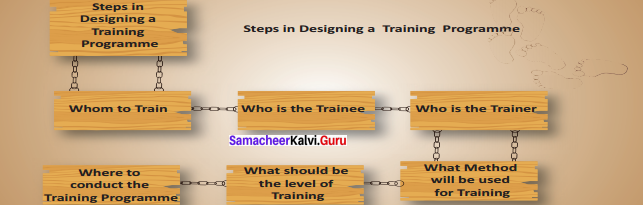
Write down various steps in a training programme.
Answer:
Training is one of the planned activities to transfer or modify knowledge, skills and attitude. Every training programme must address certain vital issues listed below.

Samacheer Kalvi 12th Commerce Solutions Chapter 12 Employee Training Method

Question 4.
Write short note on trainer and trainee.
Answer:
A person who is learning and practising the skills of particular job is called trainee. Trainees should be selected on the basis of self-interest and recommendation by the supervisor.

Trainer is a person who teaches skills to employee and prepare them for a job activity. Trainers may be supervisor, co-workers, HR staffs, specialists in the other parts of the company, outside consultants.

IV. Long Answer Questions

Question 1.
Define training. Discuss various types of training.
Answer:
According to Edwin B. Flippo” Training is the act of increasing the Knowledge and skills of an employee for doing particular jobs”. Training may be mainly divided into:
(a) On the job training:
(b) Off the job training:

(a) On the Job Training: On the job training refers to the training which is given to the employee at the work place. The following are the on the job training methods.

  1. Coaching Method: In this method of training, the superior teaches or guides the new employee about the knowledge and skills.
  2. Mentoring Method: Mentoring is the process of sharing knowledge and experience of an employee.
  3. Internship Training Method: A superior gives training to a subordinates or understudy like an assistant to a manager.

(b) Off the Job Training: It is the training method wherein the workers learn the job role away from the actual work place. The following are types of off the job training:

  1. Lecture Method: Under this method trainees are educated about concepts, theories, principles in any particular area.
  2. E-learning Method: E-learning is the use of technological process to access of a traditional classroom or office.

Question 2.
What are the differences between on the job training and off the job training?
Answer:

Basis for comparisonOn the Job TrainingOff the Job Training
1.MeaningThe employee learns the job in the actual work environment.The training of employees is done outside the actual work place.
2.CostIt is cheapest to carry out.It is costly due to the expenses like separate training room, specialist, etc.
3.Suitable forSuitable for manufacturing related jobs.It is suitable for managerial jobs.
4.ApproachPractical approachTheoretical approach
5.Carried outProvided by the experienced employeeProvided by the experts
6.MethodsCoaching, mentoring, apprenticeship, job rotationSeminar, lectures, vestibule, field trip, e-leaning

Question 3.
Explain the benefits of training.
Answer:
(i) Benefits to the Organization:
(a) It improves the skill of employees and increase the productivity.
(b) It reduces wastages of materials and idle time.
(c) It minimizes the time for supervision.
(d) It reduces the frequent accidents at workplace and consequent payment of compensation.

(ii) Benefits to the Employees:
(a) It increases the knowledge, skill of the employees.
(b) It enables him to gain promotion in shorter time.
(c) It improves the employees productivity.
(d) Employees get higher earnings through incentives and rewards.

(iii) Benefits of Customer:
(a) Customers get better quality of product and service.
(b) Customers get innovative products or value added or feature rich products.

Samacheer Kalvi 12th Commerce Employee Training Method Additional Questions and Answers

I. A. Choose the Correct Answer

Question 1.
On the job training is given to the employee at the ____________
(a) college
(b) home
(c) workplace
(d) none of the above
Answer:
(c) workplace

B. Fill in the blanks

  1. Mentoring method of training is always used for ____________employees
  2. ____________is a person who teaches skills to the employees.

Answers:

  1. Managerial
  2. Trainer

II. Very Short Answer Questions

Question 1.
What is meant by off the job training?
Answer:
Off the job training is the training method where the workers/employees learn the job role away from the actual workplace.

Question 2.
Write a note on internship training.
Answer:
When a superior gives training to subordinates, it is called internship training. The subordinates learn through experience and observation by participating in handling day to day problems.

III. Short Answer Questions

Question 1.
Explain any three purposes of training.
Answer:
The purposes of training are as follows:

  1. Improved Quality of Work- Training helps to focus on specific area and enables the employees to increase the quality of work carried out by them.
  2. Prevention of obsolescence- Training helps to learn more knowledge regarding the latest techniques and trends.
  3. Improved Safety Measures- Employees gain awareness about the risks involved in job and safety measure to be adopted through a proper training program.

Case Study

Hemalatha is the MD of Aravindh Textile manufacturing company. Her company produces textiles which has a good sales record in Indian market as well as foreign market. Hemalatha plans to buy new tech machineries for her company. But she first decides to give a training program to her employees about the new machineries.

Question (i)
What kind of training program should she provide to his employees?
Answer:
She should provide on the job training program to her employees, at the workplace itself.

Question (ii)
What kind of benefits do the employees gain from that training program?
Answer:
The employees leam the techniques to operate the machineries. It will increase the production.

We as a team believe the information prevailing regarding the Tamilnadu State Board Solutions for 12th Commerce Chapter 12 Employee Training Method Questions and Answers has been helpful in clearing your doubts to the fullest. For any other help do leave us your suggestions and we will look into them. Stay in touch to get the latest updates on Tamilnadu State Board Solutions for different subjects in the blink of an eye.

Samacheer Kalvi 12th Commerce Solutions Chapter 11 Employee Selection Process

Enhance your subject knowledge with Tamilnadu State Board Solutions for 11th Commerce Chapter 11 Employee Selection Process Questions and Answers and learn all the underlying concepts easily. Make sure to learn the subject from Tamilnadu State Board Solutions Chapter 11 Employee Selection Process Questions and Answers PDF on a day to day basis and score well in your exams. You can Download Samacheer Kalvi 11th Commerce Book Solutions Questions and Answers are given after enormous research by people having high subject knowledge and for better scoring grade. You can rely on them and prepare any topic of Commerce as per your convenience easily.

Tamilnadu Samacheer Kalvi 12th Commerce Solutions Chapter 11 Employee Selection Process

Students those who are looking for Tamilnadu State Board Solutions Chapter 11 Employee Selection Process Questions and Answers Concepts can find them all in one place from our site Tamilnadu State Board Solutions. Simply click on the links available to prepare the corresponding topics of Samacheer Kalvi 11th Commerce Book Solutions Questions and Answers easily. Clarify all your queries from chapter wise different questions to be familiar with the kind of questions appearing in the exam. Thus, you can increase your score and get higher grade in the final exam.

Samacheer Kalvi 12th Commerce Employee Selection Process Textbook Exercise Questions and Answers

I. Choose the Correct Answer

Question 1.
The recruitment and Selection Process aimed at right kind of people.
(a) At right people
(b) At right time
(c) To do right things
(d) All of the above
Answer:
(d) All of the above

Question 2.
The poor quality of selection will mean extra cost on _________ and supervision.
(a) Training
(b) Recruitment
(c) work quality
(d) None of these
Answer:
(a) Training

Question 3.
_________ refers to the process of identifying and attracting job seekers so as to build a pool of qualified job applicants.
(a) Selection
(b) Training
(c) Recruitment
(d) Induction
Answer:
(c) Recruitment

Question 4.
Selection is usually considered as a _________ process.
(a) Positive
(b) Negative
(c) Natural
(d) None of these
Answer:
(b) Negative

Question 5.
Which of the following test is used to measure the various characteristics of the candidate?
(a) physical Test
(b) Psychological Test
(c) attitude Test
(d) Proficiency tests
Answer:
(b) Psychological Test

Question 6.
Wfifich of the following orders is followed in a typical selection process? .
(a) application form test and or interview, reference check and physical examination
(b) Application form test and or interview, reference check, and physical examination
(c) Reference check, application form, test and interview and physical examination
(d) physical examination test and on interview application term and reference check.
Answer:
(b) Application form test and or interview, reference check, and physical examination

Question 7.
The purpose of an application blank is to gather information about the
(a) Company
(b) Candidate
(c) Questionnaire or Interview Schedule
(d) Competitors
Answer:
(b) Candidate

Question 8.
Identify the test that acts as an instrument to discover the inherent ability of a candidate.
(a) Aptitude Test
(b) Attitude Test
(c) Proficiency Test
(d) Physical Test
Answer:
(a) Aptitude Test

Question 9.
The process of eliminating unsuitable candidate is called _________
(a) Selection
(b) Recruitment
(c) Interview
(d) Induction
Answer:
(a) Selection

Question 10.
Scrutiny of application process is the _________
(a) Last step in Selection process
(b) First step in Selection process
(c) Third step in Selection Process Selection process
(d) None of the above
Answer:
(b) First step in Selection process

Question 11.
Scrutiny of application process is the
(a) Locating candidates
(b) Determinining the suitable of the candidates
(c) preparing employees for training
(d) None of the above
Answer:
(b) Determinining the suitable of the candidates

Question 12.
The process of placing the right man on the right job is called _________
(a) Training
(b) Placement
(c) Promotion
(d) Transfer
Answer:
(b) Placement

Question 13.
Probation/Trial period signifies _________
(a) one year to two years
(b) One year to three years
(c) Two years to four years
(d) None of the above
Answer:
(a) one year to two years

Question 14.
Job first man next is one of the principles of _________
(a) Test
(b) Interview
(c) Training
(d) placement
Answer:
(d) placement

II. Very Short Answer Questions

Question 1.
What is selection?
Answer:
Selection is the process of choosing the most suitable person for the vacant position in the organization.

Question 2.
What is an interview?
Answer:
According to Scott and others “an interview is a purpose full exchange of ideas, the answering of questions and communication between two or more persons.”

Question 3.
What is intelligence test?
Answer:
Intelligence tests are one of the psychological tests, that is designed to measure a variety of mental ability, individual capacity of a candidate.

Question 4.
What do you mean by test?
Answer:
Several tests are conducted in the selection process to ensure whether the candidate possesses the necessary qualification to fit into various positions in the organization.

Question 5.
What do you understand about bio data?
Answer:
Most of the Public sector undertakings Recruitment boards supply applications forms for selection of jobs. In this form, the candidate fill the details about family background, educational qualifications, experience, co-curricular activities.

Question 6.
What do you mean by placement?
Answer:
Placement is a process of assigning a specific job to each and every candidate selected. It includes initial assignment of new employees and promotion, transfer or demotion of present employees.

III. Short Answer Questions

Question 1.
What is stress interview?
This type of interview is conducted to test the temperament and emotional balance of the candidate interviewed. Interviewer deliberately creates stressful situation and tries to assess the suitability of the candidate by observing his reaction and response to the stressful situations.

Question 2.
What is structured interview?
Answer:
Under this method, a series of questions to be asked by the interviewer are pre-prepared by the interviewer and only these questions are asked in the interview.

Question 3.
Name the types of selection test?
Answer:
Selection tests are of two types: Ability Tests and Personality Tests. Ability tests can further be divided into: aptitude test, achievement test, intelligence test, and judgement test. Personality tests can further be divided into: interest test, personality inventory test, projective test or thematic appreciation test, and attitude test.

Question 4.
What do you mean by achievement test?
Answer:
This test measures a candidate’s capacity to achieve in a particular field. In other words this test measures a candidate’s level of skill in certain areas, accomplishment and knowledge in a particular subject. It is also called proficiency test.

Question 5.
Why do you think the medical examinations of a candidate is necessary?
Answer:
The last technique used in selection process is medical examination. This is the most important step in the selection because a person of poor health cannot work competently and any investment on him may go waste, if he/she is unable to discharge duties efficiently on medical grounds.

Question 6.
What is aptitude test?
Answer:
Aptitude test is a test to measure suitability of the candidates for the post/role. It actually measures whether the candidate possess a set of skills required to perform a given job. It helps in predicting the ability and future performance of the candidate.

Question 7.
How is panel interview conducted?
Answer:
Where a group of people interview the candidate, it is called panel interview. Usually panel comprises chair person, subject expert, psychological experts, representatives of minorities/ underprivileged groups, nominees of higher bodies and so on. All panel members ask different types of questions on general areas of specialization of the candidate.

Question 8.
List out the various selection interviews.
Answer:
Interview represents a face to face interaction between the interviewer and interviewee

  1. Preliminary Interview
  2. Structured Interview
  3. Unstructured Interview
  4. In-depth Interview
  5. Panel Interview
  6. Stress Interview
  7. Telephone Interview
  8. Online Interview
  9. Group interview
  10. Video Conference Interview

Question 9.
List out the significance of placement.
Answer:
The significance of the placement is as follows:

  1. It improves employee morale.
  2. It helps in reducing employee turnover.
  3. It helps in reducing conflict rates or accidents.
  4. It avoids misfit between the candidates and the job.
  5. It helps the candidate to work as per the predetermined objectives of the organization.

IV. Long Answer Questions

Question 1.
Briefly explain the various types of tests.
Answer:
Several tests are conducted in the selection process to ensure whether the candidate possesses the necessary qualifications.

A. Ability Test: Ability test may be divided into:

  • Aptitude Test: Aptitude test is a test to measure suitability of the candidates for the post.
  • Achievement Test: This test measures a candidate’s capacity to achieve in a particular field.
  • Intelligence Test: Intelligence test is designed to measure a variety of mental ability, individual capacity of a candidate.
  • Judgment Test: This test is conducted to test the presence of mind and reasoning capacity of the candidates.

B. Personality Test: It refers to the test conducted to find out the non-intellectual traits of a candidate. It can be further divided into:

  • Interest Test: Interest test measures a candidate’s extent of interest in a particular area.
  • Projective Test: This test measures the candidate’s values, personality of the candidate.
  • Attitude Test: measures candidate’s tendencies towards the people, situation, action and related things.

Question 2.
Explain the important methods of interview.
Interview means a face to face interaction between the interviewer and interviewee. Interview may be of various types:-

  1. Preliminary Interview: It is conducted to know the general suitability of the candidates who have applied for the job.
  2. Structured Interview: In this method, a series of questions is to be asked by the interviewer. The questions may be pre-prepared.
  3. In depth Interview: This interview is conducted to test the level of knowledge of the interviewee in a particular field.
  4. Panel Interview: Where a group of people interview the candidate. The panel usually comprises the chair person, subject expert, psychological experts and so on.
  5. Stress Interview: This type of interview is conducted to test the temperament and emotional balance of the candidate.
  6. Online Interview: Due to tremendous growth in information and communication technology, interviews are conducted by means of internet via Skype, Google duo, Whatsapp.

Question 3.
Explain the principles of placement.
Answer:
The following are the principles of placement:

  1. Job First, Man Next: Man should be placed on the job according to the requirements of the job.
  2. Job Offer: The job should be offered to the man based on his qualification..
  3. Terms and conditions: The employee should be informed about the terms and conditiqns of the organisation.
  4. Aware about the Penalties: The employee should also be made aware of the penalties if he / she commits a mistake.
  5. Loyalty and Co-operation: When placing a person in a new job, an effort should be made to develop a sense of loyalty and co-operation in him.

Samacheer Kalvi 12th Commerce Employee Selection Process Additional Questions and Answers

I. Choose the Correct Answer

Question 1.
The types of Aptitude Test are
(i) Numerical Reasoning Test
(ii) Attitude Test
(iii) Vocabulary Test
(iv) Interest Test
(a) (i) and (ii)
(b) (i) and (iii)
(c) (i) and (iv)
(d) (ii) and (iii)
Answer:
(b) (i) and (iii)

Question 2.
Which one of the following is not correctly matched?

(a)In-depth interviewSkype
(b)Online interviewGroup of people interview the candidate
(c)Video conferencing interviewLevel of knowledge
(d)Telephone interviewFace to face interview

Answer:
(d) Telephone interview – Face to face interview

II. Very Short Answer Questions

Question 1.
What is meant by personality test?
Answer:
Personality test refers to the test conducted to find out the non-intellectual traits of a candidate namely temperament, emotional response, capability and stability.

Question 2.
Write a note on attitude test.
Answer:
Attitude test measures candidate’s tendencies towards the people, situation, action and related things. For example: morale study, values study, etc.

III. Short Answer Questions

Question 1.
What do you mean by online interview?
Answer:
Due to tremendous growth in information and communication technology, these days interviews are conducted by means of internet via Skype. We chat, Google duo, Viber, Whatsapp or Video chat applications. This enables the interviewers to conduct interview with the candidates living in faraway places.

We as a team believe the information prevailing regarding the Tamilnadu State Board Solutions for 11th Commerce Chapter 11 Employee Selection Process Questions and Answers has been helpful in clearing your doubts to the fullest. For any other help do leave us your suggestions and we will look into them. Stay in touch to get the latest updates on Tamilnadu State Board Solutions for different subjects in the blink of an eye.

Samacheer Kalvi 12th Commerce Solutions Chapter 10 Recruitment Methods

Enhance your subject knowledge with Tamilnadu State Board Solutions for 11th Commerce Chapter 10 Recruitment Methods Questions and Answers and learn all the underlying concepts easily. Make sure to learn the subject from Tamilnadu State Board Solutions Chapter 10 Recruitment Methods Questions and Answers PDF on a day to day basis and score well in your exams. You can Download Samacheer Kalvi 11th Commerce Book Solutions Questions and Answers are given after enormous research by people having high subject knowledge and for better scoring grade. You can rely on them and prepare any topic of Commerce as per your convenience easily.

Tamilnadu Samacheer Kalvi 12th Commerce Solutions Chapter 10 Recruitment Methods

Students those who are looking for Tamilnadu State Board Solutions Chapter 10 Recruitment Methods Questions and Answers Concepts can find them all in one place from our site Tamilnadu State Board Solutions. Simply click on the links available to prepare the corresponding topics of Samacheer Kalvi 11th Commerce Book Solutions Questions and Answers easily. Clarify all your queries from chapter wise different questions to be familiar with the kind of questions appearing in the exam. Thus, you can increase your score and get higher grade in the final exam.

Samacheer Kalvi 12th Commerce Recruitment Methods Textbook Exercise Questions and Answers

I. Choose the Correct Answer

Question 1.
Recruitment is the process of identifying _______
(a) right man for right job
(b) good performer
(c) right job
(d) all of the above
Answer:
(a) right man for right job

Question 2.
Recruitment bridges gap between _______ and _______
(a) job seeker and job provider
(b) job seeker and agent
(c) job provider and owner
(d) owner and servant
Answer:
(a) job seeker and job provider

Question 3.
Advertisement is a _______ source of recruitment.
(a) internal
(b) external
(c) agent
(d) outsourcing
Answer:
(b) external

Question 4.
Transfer is an _______ source of recruitment.
(a) internal
(b) external
(c) outsourcing
(d) none of the above
Answer:
(a) internal

Question 5.
e-Recruitment is possible only through _______ facility.
(a) computer
(b) internet
(c) broadband
(d) 4G
Answer:
(b) internet

II. Very Short Answer Questions

Question 1.
Give the meaning of Recruitment.
Answer:
Recruitment is the process of finding suitable candidates for the various posts in an organisation.

Question 2.
What is promotion?
Answer:
Based on seniority and merits of the employees they are given opportunity to move up in the organisational hierarchy. This is called promotion.

Question 3.
State two benefits of internal source of recruitment.
Answer:
Benefits of internal source of recruitment:

  1. Internal source will reduce the cost and expenses of recruitment.
  2. It is very useful, by way of selecting from the existing and retiring employees.

Question 4.
Mention any two features of campus recruitment.
Answer:
Campus recruitment is one of the external sources of recruitment. Its features are:

  1. The organisations visit the educational institutions to identify and recruit suitable candidates.
  2. They have to conduct the test and other interview methods to find out the suitable persons.

Question 5.
List the benefits of external source of recruitment.
Answer:
Benefits of external source of recruitment:

  1. The advancement in technology and communication has made it possible to reach out prospective applicants globally online.
  2. The existing employees of the organisation may recommend some of their relatives or known people who will be suitable for the existing vacancies.

III. Short Answer Questions

Question 1.
Define the term Recruitment.
According to Edwin B. Flippo, “It is a process of searching for prospective employees and stimulating and encouraging them to apply for jobs in an organisation.”

Question 2.
What are the features of internal source of recruitment?
Answer:
The main features of internal source of recruitment are:

  1. Quick process
  2. Cheaper than the external recruitment process.
  3. Works as a tool of motivation for the staff.
  4. The company’s choice is limited to existing employees of the company.

Question 3.
Give two points of differences between advertisement and unsolicited application.
Answer:
Advertisement and unsolicited applicants are external sources of recruitment. There are a few differences between them. They are:
Advertisement:

  1. It is an expensive method for the employer because advertising incurs a heavy cost.
  2. The employer can advertise in dailies, journals, magazines, etc., about the vacancies in the organisation.

Unsolicited Application:

  1. It does not involve any expense for the employer.
  2. Job seekers voluntarily apply for the vacancies that are not yet notified by the organisations.

Question 4.
What is the importance of job portals?
Answer:
The organisations can screen for the prospective candidates through internet job portals and fill up their vacancies. It is less expensive. Also the people who are well versed in technology can apply for ajoboftheir choice through this method.

Question 5.
State the steps in Recruitment process.
Answer:
Recruitment process includes the following steps:

  1. Planning recruitment
  2. Determining vacancies
  3. Identifying the sources
  4. Drafting information for advertisement
  5. Selecting the suitable mode of advertisement
  6. Facilitating selection process
  7. Evaluation and control

IV. Long Answer Questions

Question 1.
Explain the different methods of recruitment.
Answer:
Recruitment means selecting the right person for the right job. There are basically two ways by which an organisation can recruit its employees – Internal and External sources. External sources can further be classified into Direct and Indirect sources.

Internal Sources – Transfer, Upgrading, Promotion, Demotion, Recommendation by existing Employees, Job rotation, Retired employees, Dependants, Previous applicants, Acquisitions , and Mergers.

External Sources:

  1. Direct – Advertisements, Unsolicited applicants, Walk-ins, Campus Recruitment, Recruitment at Factory gate, Rival firms, e-Recruitment.
  2. Indirect – Employee referral, Govemment/Public Employment Exchanges, Employment Agencies, Employment Consultancies, Professional Associations, Deputation, Word of mouth, Labour Contractors, Job Portals, Outsourcing, Poaching.

Question 2.
Describe the significance of External source of recruitment.
Answer:
External sources of recruitment include sources that lie outside the organisation. This provides a wider collection of potential employees with the necessary skill set, especially for managerial and technical positions. Existing employees can recommend suitable candidates, which may lead to a higher level of teamwork and synchronisation among employees.

Hiring new employees can lead to the introduction of new blood and thus the introduction of a new set of skills and ideas. External sources of recruitment offer jobs to unskilled, semi-skilled and skilled workers.

Question 3.
Elaborate on the factors affecting recruitment.
Answer:
Some of the factors that affect recruitment are:

  1. (a) Size of the Organisation: Bigger organisations find recruitment less problematic than organisations that are smaller in size.
  2. (b) Recruiting Policy: Most organisations prefer recruiting through internal sources, because own employees know the organisation and they can well fit into the organisation’s culture.
  3. (c) Nature of Post: The recruitment process varies according to type of personnel to be recruited. For example, recruitment process of a bank officer will differ from that of an IPS officer.
  4. (d) Demographic factors: Like the details of possible employees- age, religion, literacy level, gender, occupation, economic status, etc.
  5. (e) Unemployment rate: If the unemployment rate is high, the number of applicants will be more, making it easy for the recruiters to select from a wide range.
  6. (f) Labour Laws: These cover working conditions, compensation, retirement benefits, and safety and health of employees in industrial undertakings.
  7. (g) Competitors: Time to time the organisations have to change their recruitment policies and manuals according to the policies being followed by the competitors.

Question 4.
Differentiate Recruitment and Selection.
Answer:

Basis for comparisonRecruitmentSelection
1. MeaningIt means searching candidates for the right job.It refers to the process of selecting the suitable candidates and offering them job.
2. ObjectiveInviting large number of candidates to apply for the vacant post.Picking up the most suitable candidates.
3. MethodIt is an economical method.It is an expensive method.
4. Contractual relationIt involves the communication of vacancies. There is no contractual relation.It creates contractual relation between employer and employee.
5. ProcessRecruitment process is very simple.Selection process is very complex and complicated.
6. TimeRequires less time since it involves merely identifying vacancies and advertising them.It is more time-consuming because each and every candidate has to be tested on various aspects before finally being selected.

Question 5.
Discuss the importance of Recruitment.
Answer:
Recruitment is the process of having the right person, in the right place, at the right time. It is crucial to organisational performance. Recruitment is the first step in an organisation’s Human Resource Planning. It fulfills the organisation’s need of a set of competitive, motivated arid flexible employees who work towards achieving the organisation’s objectives. Competent Human Resources at the right positions are crucial for the organisation and constitute core competency. Recruitment helps in creating a pool of prospective employees for the organisation, so that the right candidates for the right jobs can be selected from this pool.

It establishes a link between the job seekers and employers. Proper recruitment enables the organization to appoint talented persons for various activities, thereby leading to improved productivity and profitability of the organisation. Unless a company adopts a suitable recruitment policy, it may not be possible for a company to have right candidates for right job.

Samacheer Kalvi 12th Commerce Recruitment Methods Additional Questions and Answers

I. A. Choose the Correct Answer

Question 1.
The internal source of recruitment are _________
(i) promotion
(ii) e-recruitment
(iii) retention
(iv) advertisements
(a) (i) and (ii)
(b) (i) and (iii)
(c) (ii) and (iii)
(d) (iii) and (iv)
Answer:
(b) (i) and (iii)

B. Fill in the blanks

  1. Recruitment acts as a link between _______ and _______
  2. Poaching is also called as _______

Answers:

  1. job provider, job seeker
  2. raiding

II. Very Short Answer Questions

Question 1.
What is meant by retention?
Answer:
Retention is a method of internal source of recruitment. The retiring employees can be used to meet the requirement after superannuation as per management discretion.

Question 2.
Write a note on Demotion.
Answer:
Demotion is a kind of activity done by the company. It means movement of employee from a higher position to a lower position due to poor performance.

III. Short Answer Questions

Question 1.
Explain the term e-Recruitment?
Answer:
e-Recruitment means to carry out the recruitment by online methods. The advancement in technology and communication has made it easy to find out the applicants globally online. It is an inevitable external source of recruitment.

Question 2.
What do you mean by poaching?
Answer:
Poaching means that the company can hire employees from other companies by paying them more. So the company can reduce the expense of giving training and developing their own employees. It is also called as raiding.

We as a team believe the information prevailing regarding the Tamilnadu State Board Solutions for 11th Commerce Chapter 10 Recruitment Methods Questions and Answers has been helpful in clearing your doubts to the fullest. For any other help do leave us your suggestions and we will look into them. Stay in touch to get the latest updates on Tamilnadu State Board Solutions for different subjects in the blink of an eye.

Samacheer Kalvi 12th Commerce Solutions Chapter 9 Fundamentals of Human Resource Management

Enhance your subject knowledge with Tamilnadu State Board Solutions for 11th Commerce Chapter 9 Fundamentals of Human Resource Management Questions and Answers and learn all the underlying concepts easily. Make sure to learn the subject from Tamilnadu State Board Solutions Chapter 9 Fundamentals of Human Resource Management Questions and Answers PDF on a day to day basis and score well in your exams. You can Download Samacheer Kalvi 11th Commerce Book Solutions Questions and Answers are given after enormous research by people having high subject knowledge and for better scoring grade. You can rely on them and prepare any topic of Commerce as per your convenience easily.

Tamilnadu Samacheer Kalvi 12th Commerce Solutions Chapter 9 Fundamentals of Human Resource Management

Students those who are looking for Tamilnadu State Board Solutions Chapter 9 Fundamentals of Human Resource Management Questions and Answers Concepts can find them all in one place from our site Tamilnadu State Board Solutions. Simply click on the links available to prepare the corresponding topics of Samacheer Kalvi 11th Commerce Book Solutions Questions and Answers easily. Clarify all your queries from chapter wise different questions to be familiar with the kind of questions appearing in the exam. Thus, you can increase your score and get higher grade in the final exam.

Samacheer Kalvi 12th Commerce Fundamentals of Human Resource Management Textbook Exercise Questions and Answers

I. Choose the Correct Answer

Question 1.
Human resource is a ______ asset.
(a) Tangible
(b) Intangible
(c) Fixed
(d) Current
Answer:
(b) Intangible

Question 2.
Human Resource management is both ______ and ______
(a) Science and art
(b) Theory and practice
(c) History and Geography
(d) None of the above
Answer:
(a) Science and art

Question 3.
Planning is a ______ function
(a) selective
(b) pervasive
(c) both (a) and (b)
(d) none of the above
Answer:
(b) pervasive

Question 4.
Human resource management determines the ______ relationship.
(a) internal, external
(b) employer, employee
(c) owner, servant
(d) principle, agent
Answer:
(b) employer, employee

Question 5.
Labour turnover is the rate at which employees ______ the organisation.
(a) enter
(b) leave
(c) salary
(d) none of the above
Answer:
(b) leave

II. Very Short Answer Questions

Question 1.
Give the meaning of Human Resource.
Answer:
In an organisation, the human resource are the employees who are inevitable for the survival and success of the enterprise.

Question 2.
What is Human Resource Management ?
Answer:
Human Resource Management is a function of management concerned with hiring, motivating and maintaining people in an organisation. It focuses on people in an organisation.

Question 3.
State two features of HRM.
Answer:
Features of Human Resource Management.
Universally relevant: Human Resource Management has universal relevance.
Goal oriented: The accomplishment of organisational goals is made possible through best utilisation of human resource in an organisation.

Question 4.
Mention two characteristics of Human Resource.
Answer:
The unique, peculiar and distinctive features of human resources are as under:

  1. Human resource is the only factor of production that lives.
  2. Human resource created all other resources.

Question 5.
List the functions of HRM.
Answer:
The functions of human resource management may be classified as under: I Managerial function – Planning, Organising, Directing, Controlling.
II Operative function – Procurement, Development, Compensation, Retention, Integration, Maintenance.

III. Short Answer Questions

Question 1.
Define the term Human Resource Management.
Answer:
According to Dale Yoder, Human Resource Management is “the effective process of planning . and directing the application, development and utilisation of human resources in employment”.

Question 2.
What are the features of Human resources ?
Answer:

  1. Human resource exhibits innovation and creativity.
  2. Human resource alone can think, act, analyse and interpret.
  3. Human resources are emotional beings.
  4. Human resources can be motivated either financially or non-financially.
  5. The behaviour of human resources are unpredictable.
  6. Over years human resources gains value and appreciates.
  7. Human resources are movable.
  8. Human resource can work as a team.

Question 3.
Give two points of differences between HR and HRM.
Answer:
Human Resource (HR):

  1. To obtain personal and organisational objectives, human resource is needed.
  2. Human resource are the individuals who acquired the required skills, talents and knowledge to run the organisation.

Human Resource Management (HRM):

  1. Human resource management is a function of management relating to hiring, motivating people in an organisation.
  2. Human resource management relies on experiments and observations to handle manpower.

Question 4.
What is the importance of Human resource?
Answer:
The vital resource namely human resource is significant because of the following reasons:

  1. It is only through human resource all other resources are effectively used.
  2. The sustainable growth of an organisation depends on the important resource human resource.
  3. Industrial relations depend on human resource.
  4. Human relations is possible only through human resource.
  5. Human resource manages all other factors of production.

Question 5.
State the functions of Human Resource Management.
Answer:
The functions of human resource management may be classified as under: I Managerial function – Planning, Organising, Directing, Controlling.
II Operative function – Procurement, Development, Compensation, Retention, Integration, Maintenance.

  1. Planning: Planning is deciding in advance what to do, how to do and who is to do it. It bridges the gap between where we are and where we want to go.
  2. Organising: It includes division of work among employees by assigning each employee their duties, delegation of authority as required.
  3. Procurement: Acquisition deals with job analysis, human resource planning, recruitment, selection, placement, transfer and promotion.
  4. Development: Development includes performance appraisal, training, executive development, career planning and development, organisational development.
  5. Compensation: It deals with job evaluation, wage and salary administration, incentives, bonus, fringe benefits and social security schemes.

IV. Long Answer Questions

Question 1.
Explain the unique features of Human Resource.
The unique, peculiar features of human resources are given below.
Answer:

  1. Human resource created all other resources.
  2. Human resources can be motivated either financially or non-financially.
  3. Human resources are movable.
  4. Human resource alone can think, act, analyze and interpret.
  5. Human resource exhibits innovation and creativity.
  6. Human resource can work as a team.
  7. Over years human resources gains value and appreciates

Question 2.
Describe the significance of Human Resource Management.
Answer:
The role of human resource management is the process of acquiring, training, appraising, and compensating employees. The significance of human resource management is given below:

  1. To identify manpower needs: Determination of manpower needs in an organisation is very important as it is a form of investment.
  2. To ensure the correct requirement of manpower: At any time the organisation should
    not suffer from shortage or surplus manpower which is made possible through human resource management
  3. To select right man for right job: Human resource management ensures the right talent to select the right employee for the right job.
  4. To update the skill and knowledge: Human resource management enables employees to remain up-to-date through training and development programmes.
  5. To appraise the performance of employees: Periodical appraisal of performance of employees through human resource management activities boosts up good performers and motivates slow performers..

Question 3.
Elaborate on the Managerial functions of Human Resource Management.
Answer:
Managerial Functions of Human Resource Management:

  1. Planning: Planning is deciding in advance what to do, how to do and who is to do it.
  2. Organising: It includes division of work among employees by assigning each employee
    their duties, delegation of authority required.
  3. Directing: It involves issue of orders and instructions along with guidance and motivation to get the best employees.
  4. Controlling: The control process includes fixing of standards, measuring actual performance, comparing actual with standard laid down, measuring deviations and taking corrective actions

Question 4.
Differentiate HR from HRM.
Answer:
Human Resource (HR):

  1. Meaning: Human resource, i.e., the employees create other sources.
  2. Human resource exhibits innovation and creativity.
  3. Human resource alone can think, act and analyse.
  4. Human resources are movable.
  5. Human resource can work as team.

Human Resource Management (HRM):

  1. Managing the human resource is known as human resource management.
  2. Human resource management has universal relevance.
  3. The accomplishment of organisational goal is made possible through human resource in an organisation.
  4. Human resource management is intangible function.
  5. Human resource management focuses on the development of manpower through training and development programmes.

Question 5.
Discuss the Operating functions of HRM.
Answer:
Operating functions of HRM:

  1. Procurement: Acquisition deals with job analysis, human resource planning, recruitment, selection, placement and promotion.
  2. Development: It includes performance appraisal, training, executive development, and organisational development.
  3. Compensation: It deals with job evaluation, wage and salary administration, incentives, bonus schemes.
  4. Retention: This is made possible through health and safety, social security, job satisfaction and quality of work life.
  5. Maintenance: This encourages employees to work with job satisfaction, reducing labour turnover, for human resource.

We as a team believe the information prevailing regarding the Tamilnadu State Board Solutions for 11th Commerce Chapter 9 Fundamentals of Human Resource Management Questions and Answers has been helpful in clearing your doubts to the fullest. For any other help do leave us your suggestions and we will look into them. Stay in touch to get the latest updates on Tamilnadu State Board Solutions for different subjects in the blink of an eye.