Samacheer Kalvi 10th English Solutions Supplementary Chapter 2 Zigzag

Looking to improve English skills and gain more subject knowledge then the best resources that you can use here is Samacheer Kalvi 10th English Solutions for Supplementary Chapter 2 Zigzag Questions and Answers.

In the Samacheer Kalvi 10th English Guide for Chapter 2 Zigzag textbook solutions, subject experts covered all types of questions and answers related to the topics, quick notes, summary, solved & unsolved exercises, etc. If you are planning to prepare Chapter 2 Zigzag via textbook, then you’re suggested to go with this Samacheer Kalvi 10th English Book Solutions Questions and Answers PDF for better understanding and preparation.

Tamilnadu Samacheer Kalvi 10th English Solutions Supplementary Chapter 2 Zigzag

English Subject experts who are having max years of experience prepared this Tamilnadu State Board Solutions for 10th English Supplementary Chapter 2 Zigzag Questions and Answers. They have explained all the topics covered in the board prescribed latest syllabus in a simple way to understand easily. So, students can prepare Chapter 2 English from this Samacheer Kalvi 10th English Book Questions and Answers PDF. Download the Tamilnadu State Board 10th English Chapter 2 Zigzag Workbook Solutions PDF by accessing the below links and learn properly for the final exams to score well.

Zigzag Textual Questions

A. Identify the speaker/character.

1. ‘Even though I clearly said no!’
Answer:
Dr. Krishnan

2. ‘The one that spits deadly poison straight into its opponent’s eyes’
Answer:
Maya

3. ‘Remember the. tiny penknife the gave me last year’.
Answer:
Maya

4. ‘It’s Somu’s thoughtless ways that reduce me to tears’.
Answer:
Mrs. Krishnan

5. ‘Gome in, Zigzag, come in dear!’
Answer:
Visu, the old cook

Additional Questions

Zigzag Supplementary Summary Question 1.
‘Find Visu! I will not keep Zigzag here another minute!’
Answer:
Dr. Ashok T Krishnan

10th Zigzag Supplementary Paragraph Question 2.
‘Don’t you dare sleep!’
Answer:
Dr. Krishnan

Zigzag Supplementary Summary In English Question 3.
‘May I take Zigzag to school, Papa?’
Answer:
Arvind

Zigzag Paragraph Question 4.
We’ve been truly blessed!
Answer:
Lakshmi

Zigzag Supplementary Paragraph Question 5.
Just wait till Zigzag settles down in this new home.
Answer:
Visu

Zigzag Summary Question 6.
‘And what about the aboriginal boomerang?
Answer:
Arvind

10th English Zigzag Paragraph Question 7.
Then you can have a great time listening to him.
Answer:
Visu

Zig Zag 10th Supplementary Question 8.
It’s raining papayas and bananas in this room!’
Answer:
Lakshmi

Zigzag 10th Supplementary Question 9.
‘But Zigzag is different. Somu says we are sure to love Zigzag.’
Answer:
Dr. Krishnan

Zigzag Questions And Answers Question 10.
Most of these so called “favourite” possessions that he has given us were absolute nuisances!’
Answer:
Mrs. Krishnan

Zigzag Supplementary Characters Question 11.
‘Remember the rare insect-eating plant he brought back from the rainforest!
Answer:
Mrs. Krishnan

Zig Zag Supplementary Question 12.
I thought it was scientific fact that birds couldn’t snore.’
Answer:
Maya

Zig Zag Summary Question 13.
That wretched plant requires a room heater to keep it alive.
Answer:
Mrs. Krishnan

Zigzag Short Summary Question 14.
‘Ma! Uncle Somu’s given us some really fabulous gifts.’
Answer:
Arvind

B. Read the story again and write how these characters reacted in these situations:

1. You’re both quite mistaken.
Answer:
Dr. Krishnan hastened to explain.
Mrs. Krishnan was horrified on hearing about Zigzag.

2. It’s Somu’s thoughtless ways that reduce me to tears.
Answer:
Mrs. Krishnan spoke irritably.
Dr. Krishnan was hurrying to his clinic.

3. Just wait till zigzag settles down in this new home.
Answer:
Visu comforted everyone.
Arvind and Maya excited to listen to the bird’s talk.

4. Zigzag hardly never sleeps.
Answer:
Somu sent an e-mail to Dr.Krishnan about Zigzag.
Dr.Krishnan predicted it as ridiculously simple.

5. You are an absolute treasure……….
Answer:
Dr.Krishnan sighed and spoke to Zigzag
Zigzag didn’t bother to reply.

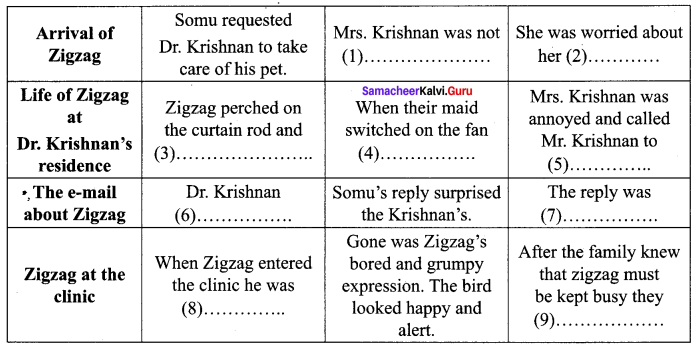
C. Complete the given tabular column.
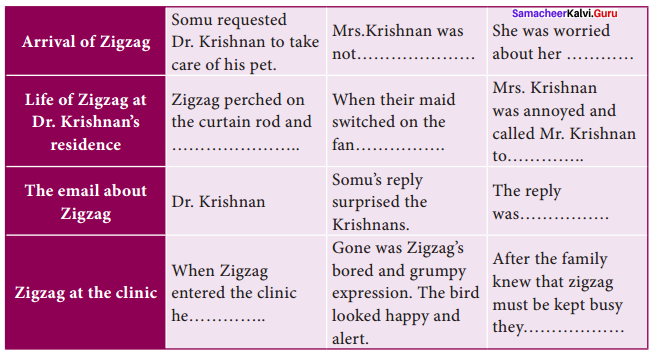
Zigzag Supplementary Summary Samacheer Kalvi 10th English Chapter 2

10th Zigzag Supplementary Paragraph Samacheer Kalvi Chapter 2
Answers:

  1. liking the new nuisance.
  2. painting exhibition to be held the next week.
  3. dropped one wizened eyelid in another solemn wink as he sank his beak into a plump guava.
  4. it rained papayas and bananas.
  5. ask him to find out what they should do.
  6. predicted the reply to be ridiculously simple.
  7. I have never heard Zigzag snore.
  8. not accustomed to being kept waiting and was already making his way to the clinic where he perched himself on the nurse’s reception table.
  9. realised what an absolute treasure he was!

D. Answer the following question in one or two sentences:

Zigzag Supplementary Theme Question 1.
Why did Dr. Asholds cousin call him?
Answer:
Dr. Ashok Krishnans cousin Somu called him to shelter Zigzag, his pet bird, when he left for Alaska.

Zigzag 10th Supplementary In Tamil Question 2.
Mention at least two expressions which show that Mrs. Krishnan was not willing to have Zigzag at home?
Answer:
The following two expressions show that Mrs. Krishnan was not willing to have Zigzag at home.
(i) “I am going crazy with the sound of Zigzag snoring, plus all these angry telephone calls.”
(ii) “And my beautiful painting…”

Zigzag Lesson In 10th Class Question 3.
What other various pets did Somu have?
Answer:
Somu had a giant green and gold fighting beetle and an African snake.

10th English Unit 2 Supplementary Question 4.
What was Mrs. Krishnan busy with?
Answer:
Mrs. Krishnan was busy with her paintings to be displayed for sale the following week.

10th Zigzag Supplementary Question 5.
What commotion did the boomerang cause in the neighborhood?
Answer:
Boomerang sliced through all the TV aerials in the neighborhood. It caused permanent damage to several cars in the parking lot. It also knocked out their watchman cold with the force thrown by Arvind.

Zigzag Lesson Summary Question 6.
What happened when Somu left Zigzag with the Krishnan’s?
Answer:
Zigzag transferred all the walnuts and the fruits to the Chandelier and on the blades of the ceiling fan. Then it perched on the curtain rod, went off to sleep.

Zigzag Supplementary Story In English Question 7.
How did Zigzag communicate with the Krishnan’s?
Answer:
Zigzag did not communicate with the Krishnan’s although everyone tried several times and in several languages to speak to him, he only slept and snored.

Zigzag Lesson Question 8.
What was the e-mail message sent to Somu by Dr.Krishnan?
Answer:
Krishnan sent an e-mail to Somu, asking for instructions on how to stop Zigzag from snoring.

Moral Of The Story Zigzag Question 9.
What did Aravind confess?
Answer:
Arvind confessed that for the first time in his life, he was actually looking forward to go to school. The school was as calm as a monastery compared to their house.

Question 10.
Why did Mrs. Jhunjhunwalla buy the painting?
Answer:
Mrs. Jhunjhunwalla bought the painting because she liked the new technique of painting.

E. Answer the following questions in about 100 -150 words:

Question 1.
Write in your own words the various commotions caused by Zigzag at Dr. Krishnan’s residence.
Answer:
When Visu, the old cook of Dr. Somu brought Zigzag to Dr. Krishnan’s house, all were surprised to see such a strange and a weird bird. It was a foot and a half tall. It was a multilingual talking- singing bird. It could talk and sing in twenty-one languages.

When it refused to say a word, Arvind brought some juicy fruits and nuts for the bird. It did not eat them, but transferred one ‘ by one to the chandelier and on to the blades of the ceiling fan. Then it perched on a curtain rod, it sank his beak into a plumpy guava and then went off to sleep. Then he began to snore. The snore became louder and very louder.

His snoring pounded their eardrums till their heads ached. When the fan was switched on by their maid, the painting of Mrs. Krishnan got spoilt by streaks of orange pulp spreading on it. His snoring troubled all the neighbours and they were complaining about it.

Question 2.
What was the turn of events when Zigzag was taken to the clinic?
Answer:
When Zigzag was taken into the clinic, he was asked to wait in the car by Dr. Krishnan. He warned him not to sleep and snore. But Zigzag was not accustomed to being kept waiting. So he made his way to the reception and perched himself on the nurse’s reception table.

Krishnan had hardly walked through the swinging half-door that separated his clinic from the waiting room when he heard a voice. The voice was from Zigzag. It was clear and commanding. There was pin-drop silence in the room as everyone waited, open-mouthed, for Zigzag s next sentence. Dr. Krishnan was amazed. Zigzags bored and grumpy expressions were gone. Instead, the bird ‘ looked happy and alert as it went about the job.

It had been trained for this job with the doctors. Thus Dr. Krishnan’s clinic, which was usually a noisy sea of tears and outbursts, was transformed into a calm, orderly place. He efficiently soothed the patients and naughty ones.

Question 3.
Narrate the story Zigzag in your own words.
Answer:
This story is about a multilingual weird bird, named Zigzag. Dr. Krishnan’s clinic usually sounded noisy because of the shouting and crying of children. His friend Dr. Somu requested him to shelter Zigzag, his pet as he was about to leave for Alaska.

When Zigzag was brought to his house, it did not speak to anyone. It could sing and talk in 21 different languages. But it did not speak any word to them. Instead, he transferred the fruits and nuts given to him to a Chandelier and to the blades of the ceiling fan. It perched on a curtain rod and went off to sleep. When the fan was switched on, all the fruits and nuts fell down.

The papaya slice splattered on the painting of Mrs. Krishnan and spoiled it. Mrs. Krishnan was irritated and persuaded Dr. Krishnan to send the bird away to Visu s house. So Dr. Krishnan took the bird to his clinic. There it commanded everyone in an orderly way. He brought peace, calmness and a disciplined atmosphere in the clinic. The painting which had been spoilt by Zigzag was sold out for ₹ 5,000. It was bought because the new technique in painting was liked by the buyer. Thus Mr. Krishnan’s family invited Zigzag to stay with them for another week.

Additional:

Question 1.
Describe the entry of ZigZag and his behaviour thereafter as soon as he entered the residence of Krishnan.
Answer:
Into Krishnan’s residence tottered the strangest, weirdest-looking bird, ZigZag. He was brought in by Somu’s cook, Visu. About a foot and a half tall, its bald head was fringed with a crown of shocking pink feathers while the rest of its plumage was in various shades of the muddiest and sludgiest brown. Its curved beak was sunflower-yellow and its eyes were the qolour of cola held to sunlight.

Visu introduced ZigZag as Ziggy-Zagga-king-of-the-Tonga añd that he talks very beautifully. He even added that he could recite French Poetry! In spite of all the praise showered on him, he stood cool and unmoved, with an expression of almost- human grumpiness in bis cola-coloured eyes.

Arvind, tried his best to make ZigZag speak. He dashed into the kitchen and brought a plate with juicy fruit slices and some nuts. Bored eyes brightened as Zigzag picked up a walnut. It refused to speak., dropped one wrinkled eyelid in a solemn wink and flew clumsily to deposit the nut on the enormous chandelier hanging from the ceiling. Silently and slowly, all the fruit on the plate was transferred to the chandelier and the blades of the ceiling fan. As soon as the cook Visu left, Zigzag, still perched on the curtain rod, went off to sleep.
“Zigzag is Queer and Weird.”

Additional:

A. Rearrange the following sentences in coherent order.

1. a. Their nine-year-old daughter Maya was excited about Zigzag’s arrival.
b. Mrs.Ashok was busy getting ready for the painting exhibition.
c. Zigzag is an unusual bird that speaks in 21 different languages.
d. Due to the commotion Somu mistook Ashok’s commitment to keep zigzag.
e. Dr. Ashok’s clinic usually sounded like an ancient Chinese torture chamber.
Answers:
e, d, b, a, c
e. Dr. Ashok’s clinic usually sounded like an ancient Chinese torture chamber.
d. Due to the commotion Somu mistook Ashok’s commitment to keep zigzag.
b. Mrs. Ashok was busy getting ready for the painting exhibition.
a. Their nine-year-old daughter Maya was excited about Zigzag’s arrival.
c. Zigzag is an unusual bird that speaks in 21 different languages.

2. a. Apparently, Zigzag was bred by a genuine African witch doctor.
b. But most of his possessions were absolute nuisances!
c. Isn’t that Uncle Somu’s prized giant green-and -gold fighting beetle?
d. Somu says the bird is an absolute treasure and a real help.
e. Somu had cured the witch doctor’s son last month.
Answers:
c, a, e, d, b
c. Isn’t that Uncle Somu’s prized giant green-and -gold fighting beetle?
a. Apparently, Zigzag was bred by a genuine African witch doctor,
e. Somu had cured the witch doctor’s son last month.
d. Somu says the bird is an absolute treasure and a real help.
b. But most of his possessions were absolute nuisances!

B. Fill in the blanks with the appropriate phrases given below to form a complete meaningful paragraph.

1. (crying so loudly / for your exhibition next week / who were his patients / to ask whether /more like an)

Dr. Ashok T. Krishnan’s clinic usually sounded (i) ……………….. ancient Chinese torture chamber than a child specialist’s clinic. This was because the tiny children (ii) ……………….. left out a variety of blood-curdling yells and ear-splitting sobs. ‘It’s all because my patients were making so much noise and (iii) ……………. He rang me in the clinic (iv) …………… we could keep zigzag with us when he leaves for Alaska. I know you are busy getting your painting ready (v) ……………… .
Answers:
(i) more like an
(ii) who were his patients
(iii) crying so loudly
(iv) to ask whether
(v) for your exhibition next week

2. (went off to sleep / fell asleep,/ when Zigzag stubbornly refused / Even though they tried / perched comfortably)

Zigzag (i) …………………. on a curtain rod and dropped one wizened eyelid in another solemn wink. Visu comforted the children, noticing how disappointed they looked (ii) ……………….. to say a single word to them, (iii) …………………. speaking to him in English, Hindi, Tamil and French, Zigzag spoke no word. As soon as Visu left, Zigzag, still perched on the curtain rod, (iv) …………… And the moment he (v) ………………….., he began to SNORE!
Answers:
(i) perched comfortably
(ii) when Zigzag stubbornly refused
(iii) Even though they tried
(iv) went off to sleep
(v) fell asleep

C. Choose the correct answer.

1. Somu was leaving for ………………….. .
(a) Alaska
(b) Antarctica
(c) Africa
(d) Amazon
Answer:
(a) Alaska

2. Maya mistook Zigzag to be ………………… .
(a) snake
(b) beetle
(c) cat
(d) insect
Answer:
(b) beetle

3. Zigzag was bred by a genuine African ………………………….. .
(a) Witch doctor
(b) witch
(c) tribe
(d) Witch surgeon
Answer:
(d) Witch surgeon

4. Mrs. Krishnan applied a dab of yellow-ochre paint on Sunset at ………………………… .
(a) Bengal
(b) Kanyakumari
(c) Besant
(d) Marina
Answer:
(d) Marina

5. The rare insect-eating plant came from Amazonian ……………………………. .
(a) Rainforest
(b) Black forest
(c) White forest
(d) Jungle
Answer:
(a) Rainforest

6. That wretched plant required a ………………. to keep it alive in Chennai!
(a) water heater
(b) room heater
(c) air cooler
(d) hair conditioner
Answer:
(b) room heater

7. The aboriginal boomerang was a gift from …………………….. .
(a) Africa
(b) Amazon
(c) Australia
(d) America
Answer:
(c) Australia

8. Zigzag could speak in ……………………. different languages.
(a) twenty-four
(b) twelve
(c) seven
(d) twenty-one
Answer:
(d) twenty-one

9. When Zigzag sings, it moves the listeners to ……………………. .
(a) tears
(b) laughter
(c) sighs
(d) boredom
Answer:
(a) tears

10. Arvind wants to display Zigzag in the ………………………… exhibition.
(a) Tradefair
(b) Children’s
(c) Science
(d) Arts
Answer:
(c) Science

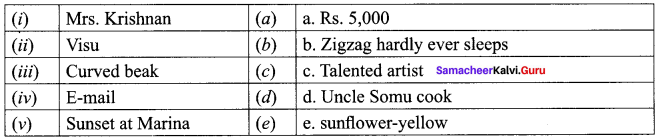
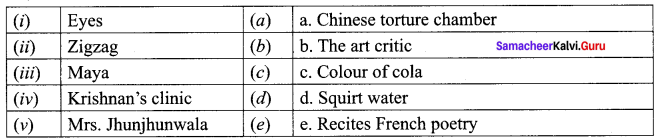
D. Match the following appropriately:

1. Zigzag Supplementary Summary In English Samacheer Kalvi 10th Chapter 2
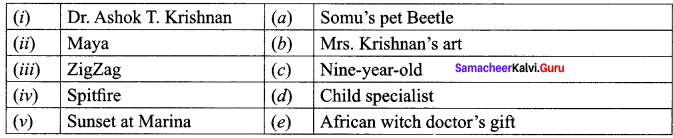
Answer:
2. Zigzag Paragraph Samacheer Kalvi 10th English Solutions Supplementary Chapter 2
Answer:

3. Zigzag Supplementary Paragraph Samacheer Kalvi 10th English Solutions Supplementary Chapter 2
Answer:

E. Read the passage given below and answer the questions that follow:

1. Dr. Ashok T. Krishnan’s clinic usually sounded more like an ancient Chinese torture chamber than a child specialist’s clinic. This was because the tiny children who were his patients left out a variety of blood -curdling yells and ear-splitting sobs. ‘It’s all because my patients were making so much noise and crying so loudly, ‘ he apologized to his wife one evening, ‘that Somu couldn’t hear me properly. He rang me in the clinic to ask whether we could keep zigzag with us when he leaves for Alaska. And now Somu thinks I said “yes”, even though I clearly said “no”! I know you are busy getting your painting ready for your exhibition next week. ’

(a) What was Dr.Ashok T.Krishnan’s specialisation in the medical field?
Answer:
Dr. Ashok T. Krishnan specialised in children’s health and so he was a Paediatrician or a child specialist.

(b) How did Dr. Krishnan’s clinic generally sound?
Answer:
Dr.Krishnan’s clinic generally sounded like an ancient Chinese torture chamber.

(c) Why couldn’t Somu hear the telephonic conversation with Ashok clearly?
Answer:
Somu couldn’t hear Ashok clearly over the telephone because the children in the clinic were making so much noise and crying loudly.

(d) Where was Somu going to?
Answer:
Somu was going on an official trip to Alaska.

(e) What did Ashok say was the reason to deny Somu’s request?
Answer:
Ashok said that he denied Somu’s request since he knew about his wife’s painting exhibition next week.

2. ‘Zigzag! ’ interrupted their nine-year-old daughter Maya.
Isn’t that Uncle Somu’s prized giant green-and -gold fighting beetle. The one that spits deadly poison straight into its opponent’s eye?’
‘No, no,’ corrected her older brother Arvind, eyes shining in pure delight. ‘The beetle is called Spitfire. Zigzag must be Uncle Somu’s pet snake. The African sidewinder! You know, the one that slithers zigzag all over his house!’
‘You’re both quite mistaken,’ their father hastened to explain, seeing his wife’s horrified expression. ‘Zigzag is a most harmless, unusual and lovable bird. Apparently, it was bred by a genuine African witch doctor, who gifted it to Somu when he being a child specialist like me cured the witch doctor’s son while he was touring the deepest jungles of equatorial Africa last month. Somu says the bird is an absolute treasure and a real help. It’s his favourite pet, you know’.

(а) Who is Maya?
Answer:
Maya is Dr. Krishnan’s nine year old daughter.

(b) What did Maya mistake Zigzag to be?
Answer:
Maya mistook Zigzag to be Uncle Somu’s prized giant and gold fighting beetle, Spitfire.

(c) According to Maya’s brother, who was Zigzag? Why?
Answer:
According to Maya’s brother Arvind, Zigzag was Uncle Somu’s pet snake, the African sidewinder that slithers zigzag all over his house.

(d) Why did Ashok hasten to explain to his children the mistaken identity?
Answer:
Ashok observed his wife’s horrified expression and hastened to explain to his children.

(e) Who was Zigzag according to Ashok?
Answer:
Zigzag was a harmless, unusual and lovable bird bred by a genuine African doctor who gifted it to Somu as a gift for treating his son while touring the jungles of equatorial Africa.

F. Study the given mind map and fill in the incomplete details:
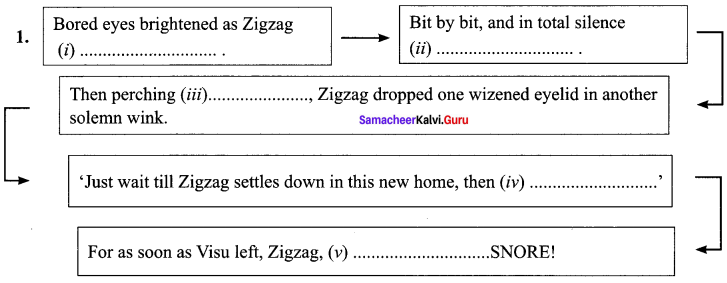
Zigzag Summary Samacheer Kalvi 10th English Solutions Supplementary Chapter 2
Answers:
(i) picked up a walnut.
(ii) all the fruit on the plate was transferred to the chandelier.
[iii) comfortably on a curtain rod.
(iv) great time listening to him.
(v) went off to sleep and began to
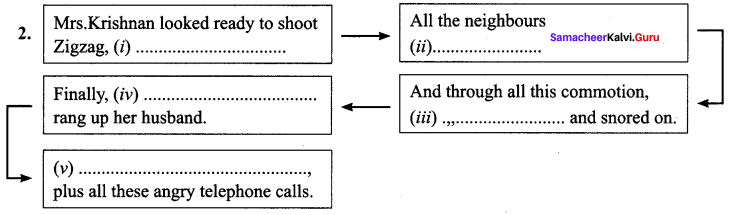
10th English Zigzag Paragraph Samacheer Kalvi Chapter 2
Answers:
(i) but he was saved by the telephone bell.
(ii) rang up to demand some peace
(iii) Zigzag slept on unconcerned
(iv) an exhausted Mrs.Krishnan
(v) I am going crazy with the sound of Zigzag snoring

Zigzag by Asha Nehemiah About the Author:

Asha Nehemiah bom in 1958 at Chennai has lived, studied and worked in eight different cities and small towns and is now a resident of Bangalore. She has always been interested in writing. Her love for reading, led her to study Literature in college. If she had not been a writer, she would have been a teacher. Humour, fantasy mystery and adventure are the strong elements in her work. She loves baking, walking, reading and travelling.

Zigzag Summary:
Zig Zag 10th Supplementary Samacheer Kalvi Chapter 2

Introduction:
Author Asha Nehemiah unfolds the delicate love a bird can exhibit to the astonishment of the inmates. Interesting facts about plants and animals will draw the attention of students. Let us read the family’s reaction towards the wonder bird Zigzag.
Zigzag 10th Supplementary Samacheer Kalvi English Solutions Chapter 2

Zigzag finds new home:
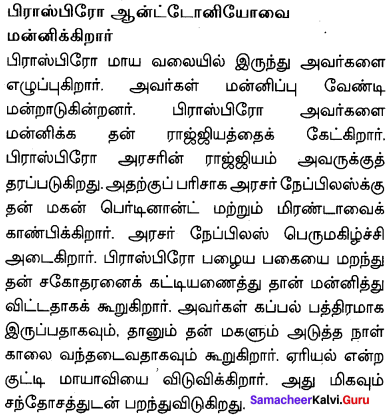
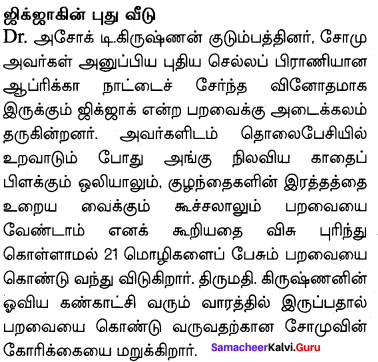
Dr. Ashok T Krishnan’s family shelters Somu’s new pet, ZigZag, a queer-looking African bird, who is known for talking and singing in twenty-one different languages brought in by Visu after a telephonic conversation which wasn’t audible due to the variety of blood-curdling yells and ear-splitting sobs. Mr. Krishnan knows about Mrs. Krishnan’s painting exhibition the next week and denies the plea of Somu to shelter the pet.
Zigzag Questions And Answers Samacheer Kalvi 10th English Solutions Supplementary Chapter 2

An Unusual Bird:
Zigzag is the most harmless, unusual and lovable bird bred by a genuine African witch doctor, who gifted it to Somu when he, being a child specialist like Dr. Krishnan cured the witch doctor’s son, while he was touring the deepest jungles of Africa a month ago.

Zigzag Supplementary Characters Samacheer Kalvi 10th English Solutions Chapter 2

Mistaken conversation:
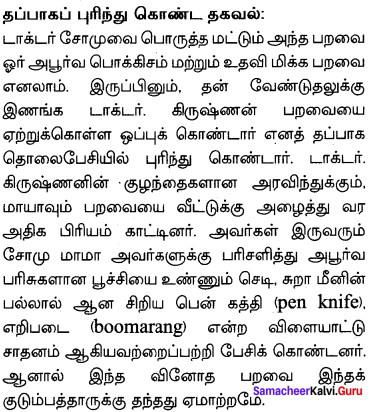
To Somu, the bird is an absolute treasure and a real help. However, Somu mistakes Krishnan to have agreed to the request. Their son Arvind and daughter Maya are keen in bringing the pet home. They both discuss about the unique gifts given by Uncle Somu such as the insect-eating plant, tiny pen knife with the genuine shark’s tooth blade, the aboriginal boomerang and so on. But this strange guest turns out to be a disappointment for the Krishnan family.
Zig Zag Supplementary Samacheer Kalvi 10th English Solutions Chapter 2

A sleeping bird:
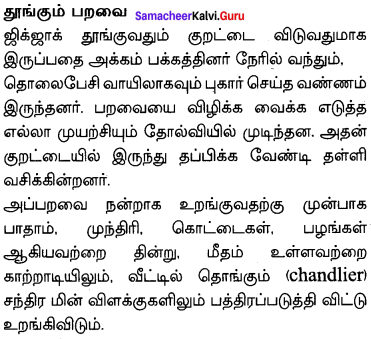
Zigzag does nothing but sleeps and snores all the time at home that even the neighbours complain about the noise in person and over the phone. All attempts to awaken the bird goes in vain. They finally feel a big escape to leave home and stay far away from the sound of snoring. The bird at first before resorting to a steadfast sleep eats the nuts and fruits, keeps them safe in the chandelier and the fan blades.
Zig Zag Summary Samacheer Kalvi 10th English Solutions Chapter 2

Maid makes a mess:
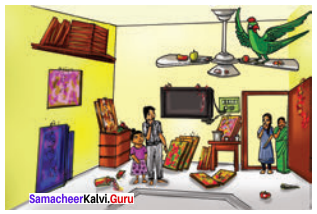
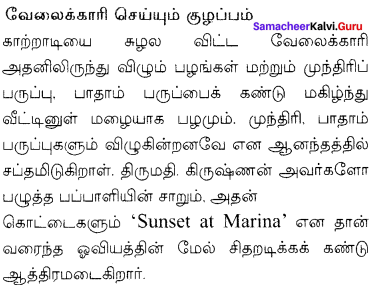
The maid Lakshmi shrieks when she switches on the fan in an excited manner thinking she is blessed with papayas and bananas raining inside the room not knowing the bird’s play. Mbs. Krishnan is annoyed at the slice of overripe? papaya whizzing off the fan and splattering all over her unfinished masterpiece – sunset at Marina spreading streaks of gooey orange pulp and shiny black seeds all over it.
Zigzag Short Summary Samacheer Kalvi 10th English Solutions Chapter 2

Six Frantic Days:
Dr. Krishnan leaves an e-mail message for Somu, asking him for clear instructions on how to stop Zigzag from snoring. Six frantic days of checking their e-mail day and night make them dumbstruck by the reply from Somu on the seventh day that the bird never sleeps nor snores. Mrs. Krishnan wants it to be sent to Visu as her friends and experts will come home and choose her paintings for the exhibition.
Zigzag Supplementary Theme Samacheer Kalvi 10th English Solutions Chapter 2

Dr. Krishnan takes it to clinic:
Krishnan takes Zigzag in the car and hopes to find Visu so that Zigzag’s snore doesn’t add to the din of the sobs and shrieks produced by the tiny patients waiting for him. However, Ziggy-Zagga, King-of-the- Tonga was not familiar to being kept waiting and was already making his way to the clinic where he perched himself on the nurse’s reception table. Dr. Krishnan warned Zigzag fiercely as he went towards his room.
Zigzag 10th Supplementary In Tamil Chapter 2

Zigzag Speaks:
Dr. Krishnan had barely walked through the door that separated his clinic from the waiting room when he heard a strange voice say, ‘You there in the blue T-shirt, don’t jump on the sofa and you in the red dress, don’t swing on the curtain.’ It was Zigzag’s voice, clear and commanding. There was pin-drop silence in the room as everyone waited for Zigzag’s next sentence. Dr. Krishnan was amazed!
Zigzag Lesson In 10th Class Samacheer Kalvi Supplementary Chapter 2

Cheerful Zigzag:
Gone was Zigzag’s bored and grumpy expression. Instead, the bird looked happy and alert as it went about the job it had been trained for, first with the African witch doctor and then with Dr.Somu. To top it all, Zigzag never slept nor snored. ZigZag was an absolute treasure and Dr. Krishnan never wanted Visu to take away ZigZag.
10th English Unit 2 Supplementary Samacheer Kalvi Zigzag

Mrs. Krishnan rewarded for the art:
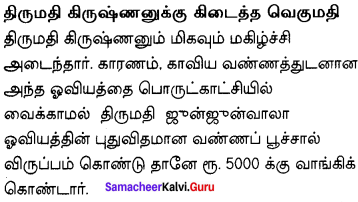
Mrs. Krishnan too calls at the same time sounding very pleased with herself. She said that ‘Mrs. Jhunjhunwula, the art critic did not want to exhibit ‘Sunset at Marina’ since she would buy it for herself, for Rs. 5,000/- for she loved my new technique of painting! She simply adored those streaky orangey bits!
10th Zigzag Supplementary Samacheer Kalvi English Solutions Chapter 2

Dr. Krishnan rewards the bird:
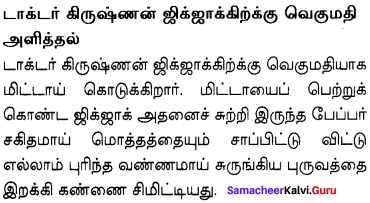
Dr. Krishnan gave the bird a toffee from his desk as a compliment, but he just ate the toffee, paper wrapper and all, and then lowered one crinkly eyelid in a knowing wink.
Zigzag Lesson Summary Samacheer Kalvi 10th English Solutions Chapter 2

Conclusion:
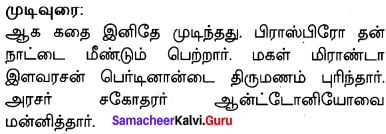
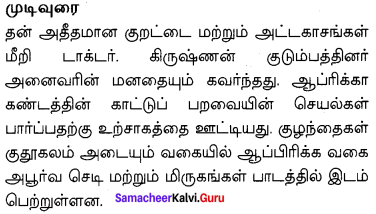
Zigzag attracts Rnshnan’s family after all the mess and irritating snores. It is interesting to watch the activities of a wild bird that belongs to the deepest jungles of Africa. The lesson has amazing facts about African animals and plants adding to the students delight.
Zigzag Supplementary Story In English Samacheer Kalvi 10th English Chapter 2

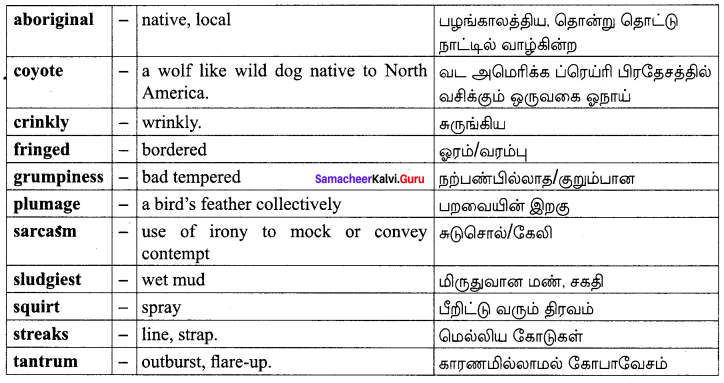
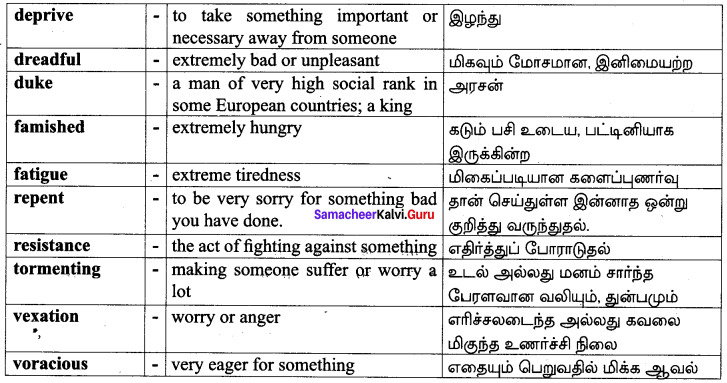
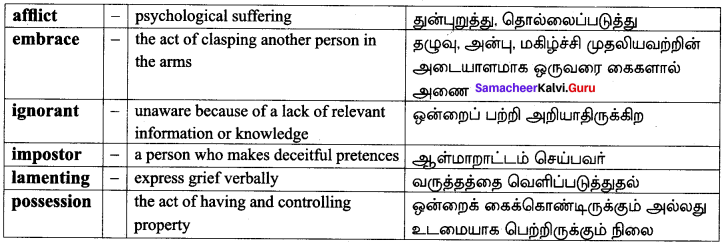
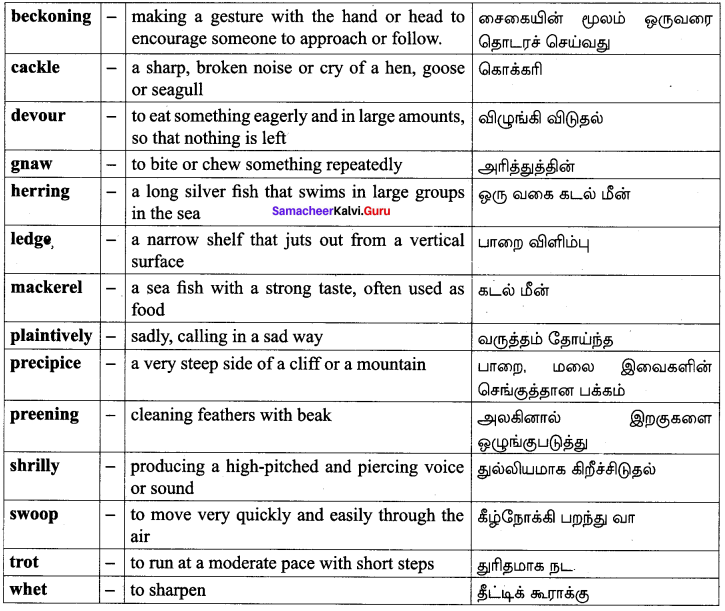
Zigzag Glossary:

Textual:
 Zigzag Lesson Samacheer Kalvi 10th English Solutions Supplementary Chapter 2

Additional:
Moral Of The Story Zigzag Samacheer Kalvi 10th English Solutions Supplementary Chapter 2

We hope the data given here will benefit you to the fullest extent at the time of preparation. For better understanding of English subject this Samacheer Kalvi 10th English Solutions for Class 10th English Supplementary Chapter 2 Zigzag PDF is the best resource. Download & ace up your preparation. Keep in touch with us and get the latest information on Tamilnadu State board Textbook Solutions PDF.
Samacheer Kalvi 10th English Solutions Supplementary Chapter 1 The Tempest

Looking to improve English skills and gain more subject knowledge then the best resources that you can use here is Samacheer Kalvi 10th English Solutions for Supplementary Chapter 1 The Tempest Questions and Answers.

In the Samacheer Kalvi 10th English Guide for Chapter 1 The Tempest textbook solutions, subject experts covered all types of questions and answers related to the topics, quick notes, summary, solved & unsolved exercises, etc. If you are planning to prepare Chapter 1 The Tempest via textbook, then you’re suggested to go with this Samacheer Kalvi 10th English Book Solutions Questions and Answers PDF for better understanding and preparation.

Tamilnadu Samacheer Kalvi 10th English Solutions Supplementary Chapter 1 The Tempest

English Subject experts who are having max years of experience prepared this Tamilnadu State Board Solutions for 10th English Supplementary Chapter 1 The Tempest Questions and Answers. They have explained all the topics covered in the board prescribed latest syllabus in a simple way to understand easily. So, students can prepare Chapter 1 English from this Samacheer Kalvi 10th English Book Questions and Answers PDF. Download the Tamilnadu State Board 10th English Chapter 1 The Tempest Workbook Solutions PDF by accessing the below links and learn properly for the final exams to score well.

The Tempest Textual Questions

A. Choose the correct answer.

1. ………………. was the chief of all spirits.
(a) Sycorax
(b) Caliban
(c) Ariel
(d) Prospero
Answer:
(c) Ariel

2. ……………….. raised a dreadful storm.
(a) Ariel
(b) Prospero
(c) Miranda
(d) Sycorax
Answer:
(b) Prospero

3. Miranda was brought to the island …………… years ago.
(a) fourteen
(b) ten
(c) twelve
(d) five
Answer:
(c) twelve

4. Prospero ordered Ariel to bring ………………… to his place.
(a) Gonzalo
(b) Ferdinand
(c) King of Naples
(d) Antonio
Answer:
(b) Ferdinand

5. …………….. had provided Prospero formerly with books and provisions.
(a) Antonio
(b) Ferdinand
(c) Gonzalo
(d) Antonio
Answer:
(c) Gonzalo

6. The second human being that Miranda saw on the island was …………. .
(a) Ariel
(b) Prospero
(c) Ferdinand
(d) Gonzalo
Answer:
(c) Ferdinand

Additional Questions

1. Prospero and Miranda lived in a cave divided into several ………….. .
(a) compartments
(b) apartments
(c) vestibules
(d) partitions
Answer:
(b) apartments

2. Prospero released many good spirits like …………….. .
(a) Sycorax
(b) Ariel
(c) Caliban
(d) Ferdinand
Answer:
(a) Sycorax

3. Sycorax, a good spirit imprisoned many in the bodies of large ……………. .
(a) animals
(b) bottles
(c) barrels
(d) trees
Answer:
(d) trees

4. Ariel tormented an ugly monster called …………………….. .
(a) Miranda
(b) Sycorax
(c) Caliban
(d) Prospero
Answer:
(c) Caliban

5. ……………… was the son of Sycorax.
(a) Caliban
(b) smooth
(c) bumpy
(d) blunt
Answer:
(a) Caliban

6. Mirnda was just ………………. years old when she came to this cell.
(a) five
(b) three
(c) seven
(d) twelve
Answer:
(b) three

7. Prospero was the Duke of ……………… .
(a) Naples
(b) Milan
(c) Mulan
(d) Maples
Answer:
(b) Milan

8. Prospero had a younger brother by name …………….. .
(a) Antonio
(b) Caliban
(c) Shylock
(d) Ferdinand
Answer:
(a) Antonio

9. Antonio joined hands with the king of ……………… and betrayed his brother.
(a) Maples
(b) Naples
(c) Milan
(d) Mulan
Answer:
(b) Naples

10. ………………. was a kind lord of Prospero’s court.
(a) Gonzalo
(b) Ferdinand
(c) Ariel
(d) Milan
Answer:
(a) Gonzalo

B. Identify the’character or speaker.

10th English The Tempest Paragraph Question 1.
He imprisoned the spirits in the bodies of large trees.
Answer:
Sycorax

10th English Supplementary The Tempest Summary Question 2.
He was the chief of all spirits.
Answer:
Ariel

The Tempest Hints Development Question 3.
It seems to me like the recollection of a dream.
Answer:
Miranda to Prospero (Not in the textual passage)

10th Std The Tempest Summary Question 4.
I was Duke of Milan, and you were a princess.
Answer:
Prospero to Miranda

The Tempest 10th Supplementary In English Question 5.
What a trouble must I have been to you then!
Answer:
Miranda to Prospero

The Tempest Book Back Answers Question 6.
Now pray tell me, sir, your reason for raising this sea-storm?
Answer:
Miranda to Prospero

The Tempest Questions And Answers Question 7.
I will soon move you.
Answer:
Ariel to Ferdinand

10th English Unit 1 Supplementary Question 8.
I will tie your neck and feet together.
Answer:
Prospero to Ferdinand

The Tempest Questions And Answers Pdf Question 9.
I must finish my task before I take my rest.
Answer:
Ferdinand to Miranda

10th English Supplementary Story In English Question 10.
He repented and implored his brother’s forgiveness.
Answer:
Antonio to Prospero

Additional Questions

The Tempest 10th Supplementary In Tamil Question 1.
She came to this island so young, that she had no memory other than her father.
Answer:
Miranda

10th English The Tempest In Tamil Question 2.
They lived in a cave made out of a rock.
Answer:
Prospero and Miranda

The Tempest Supplementary Question 3.
He kept his books to chiefly create magic.
Answer:
Prospero

10th English Supplementary The Tempest Question 4.
This spirit imprisoned many in the bodies of large trees.
Answer:
Sycorax

10th English Supplementary Paragraph Pdf Question 5.
He was the chief of all the gentle spirits.
Answer:
Ariel

Tempest Questions And Answers Question 6.
He took too much pleasure in tormenting an ugly monster.
Answer:
Ariel

10th English The Tempest Summary Question 7.
He was the son of Sycorax.
Answer:
Caliban

The Tempest Paragraph Question 8.
He was employed like a slave, to fetch wood, and do the most laborious offices.
Answer:
Caliban

10th Supplementary The Tempest Question 9.
He had the charge of compelling Caliban to these services.
Answer:
Ariel

10th English Supplementary Story In Tamil Question 10.
With the help of spirits, he could command the winds, and the waves of the sea.
Answer:
Prospero

10th English Character/Speaker Pdf Question 11.
“Have pity on their sad distress. See! the vessel will be dashed to pieces.
Answer:
Miranda to Prospero

10th English The Tempest Question 12.
Be not so amazed, there is no harm done.
Answer:
Prospero to Miranda

Question 13.
No person in the ship shall receive any hurt.
Answer:
Prospero to Miranda

Question 14.
What I have done has been in care of you.
Answer:
Prospero to Miranda

Question 15.
Can you remember a time before you came to this cell?
Answer:
Prospero to Miranda

Question 16.
You were not then three years of age.
Answer:
Prospero to Miranda

Question 17.
I was Duke of Milan, and you were a princess, and my only heir.
Answer:
Prospero to Miranda

Question 18.
Prospero had a younger brother.
Answer:
Antonio

Question 19.
He began to think himself the duke indeed.
Answer:
Antonio

Question 20.
Wherefore, did they not that hour destroy us?
Answer:
Miranda to Prospero

Question 21.
He forced us into a small boat, without either tackle, sail, or mast.
Answer:
Prospero to Miranda

Question 22.
A kind lord of my court placed water, provisions, apparel, and some books.
Answer:
Gonzalo

Question 23.
What a trouble must I have been!
Answer:
Miranda to Prospero

Question 24.
You were a little angel.
Answer:
Prospero to Miranda

Question 25.
“Well, my brave spirit,” “how have you performed your task?”
Answer:
Prospero to Ariel

Question 26.
Where is the king, and my brother?
Answer:
Prospero to Ariel

Question 27.
Tell me what you are looking at yonder?
Answer:
Prospero to Miranda

Question 28.
Believe me, it is a beautiful creature. Is it not a spirit?
Answer:
Miranda to Prospero

Question 29.
“It eats, and sleeps, and has senses such as we have”.
Answer:
Prospero to Miranda

Question 30.
This young man you see was altered by grief.
Answer:
Prospero about Ferdinand

Question 31.
He has lost his companions, and is wandering about to find them.
Answer:
Prospero about Ferdinand

Question 32.
She was the goddess of the place.
Answer:
Ferdinand about Miranda

Question 33.
He resolved to throw some difficulties to check on Ferdinand’s constancy.
Answer:
Prospero

Question 34.
I will tie your neck and feet together.
Answer:
Prospero to Ferdinand

Question 35.
You shall drink sea-water; shell-fish and withered roots.
Answer:
Prospero to Ferdinand

Question 36.
I will resist this and drew his sword.
Answer:
Ferdinand to Prospero

Question 37.
He fixed Ferdinand to the spot where he stood, so that he had no power to move.
Answer:
Prospero

Question 38.
Why are you so ungentle?
Answer:
Miranda to Prospero

Question 39.
Have pity, sir; I will be his surety.
Answer:
Miranda to Prospero about Ferdinand

Question 40.
This is the second man I ever saw, and to me he seems a true one.
Answer:
Miranda to Prospero about Ferdinand

Question 41.
Silence, one word more will make me chide you!
Answer:
Prospero to Miranda

Question 42.
What! An advocate for an impostor!
Answer:
Prospero to Miranda

Question 43.
My affections are most humble. I have no wish to see a goodlier man.
Answer:
Miranda to Prospero

Question 44.
You have no power to disobey me.
Answer:
Prospero to Ferdinand

Question 45.
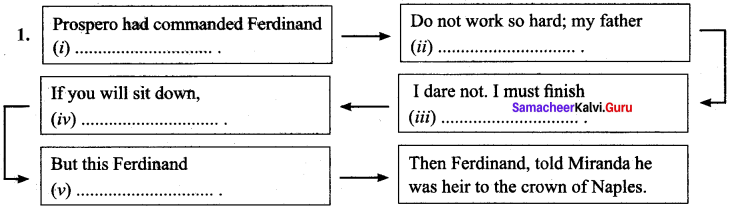
“Alas! Do not work so hard; my father is at his studies.”
Answer:
Miranda to Ferdinand

Question 46.
Pray rest yourself.
Answer:
Miranda to Ferdinand

Question 47.
I dare not. I must finish my task before I – take my rest.
Answer:
Ferdinand to Miranda.

Question 48.
I will carry your logs.
Answer:
Miranda to Ferdinand

Question 49.
Fear nothing, I have overheard, and approve of all you have said.
Answer:
Prospero to Ferdinand and Miranda

Question 50.
He soon returned with the king, Antonio, and old Gonzalo.
Answer:
Ariel

Question 51.
Who is this maid?
Answer:
King of Naples about Miranda to Ferdinand

Question 52.
He has made himself to me a second father, giving me this dear lady.
Answer:
Ferdinand about Prospero to the King of Naples.

Question 53.
Let us not remember our troubles past, since they so happily have ended.
Answer:
Prospero

Question 54.
And then Prospero embraced his brother, and again assured him of his forgiveness.
Answer:
Antonio

Question 55.
He dismissed Ariel from his service, to the great joy of that lively little spirit.
Answer:
Prospero

C. Answer the following questions in one or two sentences.

Question 1.
Who were the inhabitants of the island?
Answer:
The inhabitants of the island were an old man named Prospero and his daughter Miranda.

Question 2.
What powers did Prospero possess?
Answer:
Prospero possessed magical powers.

Question 3.
Who was Caliban? What was he employed for?
Answer:
Caliban was the son of a witch named Sycorax. He was employed like a slave to fetch wood and do the most laborious work.

Question 4.
Who were on the ship? How were they related to Prospero?
Answer:
Prospero’s brother Antonio, the King of Naples, the king’s son Ferdinand and an old lord Gonzalo were on the ship. Antonio, with the help of the King of Naples, deprived Prospero of his dukedom.

Question 5.
Why had Prospero raised a violent storm in the sea?
Answer:
Prospero raised a violent storm in the sea to make his enemies repent for the injustice done to him and his daughter.

Question 6.
How did Miranda feel when her father raised the storm to destroy the ship?
Answer:
Miranda felt extremely sad for the distress of the members in the ship. She wanted Prospero to have pity on the poor souls.

Question 7.
What was Ariel ordered to do with the people on the ship?
Answer:
Prospero ordered Ariel to torment the inmates of the ship by raising a violent storm. He also instructed Ariel to bring Ferdinand, the Prince of Naples to his cave.

Question 8.
Give two reasons why Miranda was so concerned about Ferdinand.
Answer:
Ferdinand was the second human whom Miranda had seen after her father. She was attracted by him and had more concern towards him.

Question 9.
Why did Prospero set Ferdinand a severe task to perform?
Answer:
Prospero set Ferdinand a severe task to perform to try his constancy. He resolved to throw some difficulties in his way.

Question 10.
How was Gonzalo helpful to Prospero when he left Milan?
Answer:
Gonzalo had privately placed water, provisions, clothes and some books, which Prospero loved the most in the boat.

D. Answer the questions in a paragraph of about 100 – 150 words.

Question 1.
Write a detailed character sketch of Prospero.
Answer:
Prospero was skilled magically and used his powers to create storms, provide entertainment, manipulate others, exercise power and control over the lives of others. He enjoyed knowledge and learning of spells. He became so entranced by his magic that he did not notice his brother trying to take his title and kill him. Prospero controlled all those who were around him. In the beginning of the play, he got the help of Ariel, the chief of gentle spirits, to create a violent and windy storm to punish his enemies who harmed him and his daughter. Ariel worked for Prospero in exchange for his freedom from a witch, Sycorax. But Caliban was the son of Prospero’s old enemy Sycorax. So, Prospero employed Caliban like a slave, to fetch wood and do the most laborious work.

Question 2.
Narrate how Prospero made his enemies repent to restore his dukedom.
Answer:
Prospero, the Duke of Milan, was more interested in reading books and in the art of magic. He trusted his brother Antonio and asked him to look after his affairs in his kingdom. But Antonio overthrew Prospero out of the kingdom, with the help of the king of Naples.

Prospero reached an island with his daughter and stayed there for twelve years. He released many good spirits from the clutches of the witch Sycorax. With the help of Ariel, he created a violent storm in the sea. He made his enemies travelling in the ship, to suffer for their mistakes done to him. He asked Ariel to bring Ferdinand to the cave. There, Miranda and Ferdinand were attracted to each other.

But Prospero tested Ferdinand to try his constancy. At last, he forgave all of them, as they realized their mistakes and repented. Everyone left the island and Prospero restored his dukedom.

E. Rearrange the following sentences in coherent order.

10th English The Tempest Paragraph Samacheer Kalvi

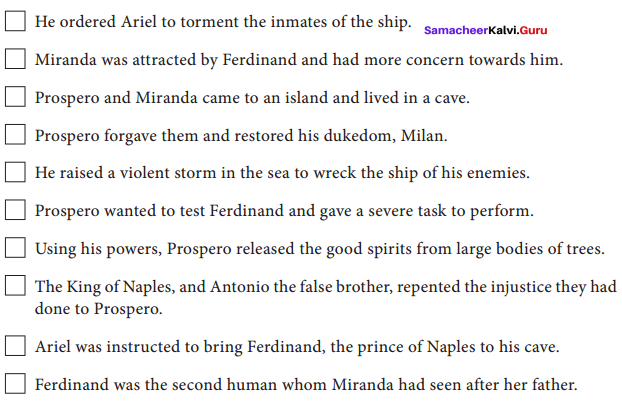
1. He ordered Ariel to torment the inmates of the ship.
2. Miranda was attracted by Ferdinand and had more concern towards him.
3. Prospero and Miranda came to an island and lived in a cave.
4. Prospero forgave them and restored his dukedom, Milan.
5. He raised a violent storm in the sea to wreck the ship of his enemies.
6. Prospero wanted to test Ferdinand and gave a severe task to perform.
Using his powers, Prospero released the good spirits from large bodies of trees.
8. The King of Naples, and Antonio the false brother, repented the injustice they had done to Prospero.
9. Ariel was instructed to bring Ferdinand, the prince of Naples to his cave.
10. Ferdinand was the second human whom Miranda had seen after her father.
Answer:
3, 7, 5, 1, 9, 10, 2, 6, 8, 4
3. Prospero and Miranda came to an island and lived in a cave.
7. Using his powers, Prospero released the good spirits from large bodies of trees.
5. He raised a violent storm in the sea to wreck the ship of his enemies.
1. He ordered Ariel to torment the inmates of the ship.
9. Ariel was instructed to bring Ferdinand, the prince of Naples to his cave.
10. Ferdinand was the second human whom Miranda had seen after her father.
2. Miranda was attracted by Ferdinand and had more concern towards him.
6. Prospero wanted to test Ferdinand and gave a severe task to perform.
8. The King of Naples, and Antonio the false brother, repented the injustice they had done to Prospero.
4. Prospero forgave them and restored his dukedom, Milan.

Additional Questions:

A. Rearrange the following sentences in coherent order.

1. a. Of these Ariel was the chief.
b. By virtue of his art, he had released many good spirits from a witch called Sycorax.
c. Prospero and his daughter Miranda were the only inhabitants in an island.
d. Ariel took pleasure in tormenting an ugly monster called Caliban.
e. These gentle spirits were ever after obedient to the will of Prospero.
Answers:
c, b, e, a, d
c. Prospero and his daughter Miranda were the only inhabitants in an island.
b. By virtue of his art, he had released many good spirits from a witch called Sycorax.
e. These gentle spirits were ever after obedient to the will of Prospero.
a. Of these Ariel was the chief.
d. Ariel took pleasure in tormenting an ugly monster called Caliban.

2. a. Ariel had the charge of compelling Caliban to these services.
b. Caliban was employed like a slave, to fetch wood, and do the most laborious offices.
c. Miranda was worried about the inmates of a fine large ship which could be shipwrecked.
d. Prospero assured his daughter about the safety of all those who were in the ship.
e. At Prospero’s Commands they raised a violent storm.
Answers:
b, a, e, c, d
b. Caliban was employed like a slave, to fetch wood, and do the most laborious offices.
a. Ariel had the charge of compelling Caliban to these services.
e. At Prospero’s Commands they raised a violent storm.
c. Miranda was worried about the inmates of a fine large ship which could be shipwrecked.
d. Prospero assured his daughter about the safety of all those who were in the ship.

B. Fill in the blanks with the appropriate phrases given below to form a complete meaningful paragraph.

1. (in the bodies of large trees / in the sea / treated of magic / with no memory of / made out of a rock.)
There was an island (i) ………………………. where an old man, named Prospero, and his daughter Miranda lived. She came to this island (ii) ………………. seeing any other human face than her father’s. They lived in a cave (iii) ………………. In his study, Prospero kept his books, which chiefly (iv) ………………… By virtue of his art, he had released many good spirits from a witch called Sycorax who had them imprisoned (v) …………………… .
Answers:
(i) in the sea
(ii) with no memory of
(iii) made out of a rock
(iv) treated of magic
(v) in the bodies of large trees

2. (who was my enemy/1 was Duke of Milan /to think himself / whose name was Antonio / of my dukedom)
“Twelve years ago, Miranda,” continued Prospero,” (i) ………………………., and you were a princess and my only heir. I had a younger brother, (ii) …………………, to whom I trusted everything; My brother Antonio began (iii) ………………. the duke indeed. The opportunity I gave him deprived me (iv) ………………. this he soon effected with the aid of the King of Naples, (v) ……………… .
Answers:
(i) I was Duke of Milan
(ii) whose name was Antonio
(iii) to think himself
(iv) of my dukedom
(v) who was my enemy

C. Match the following appropriately:

1. 10th English Supplementary The Tempest Summary Samacheer Kalvi
Answer:
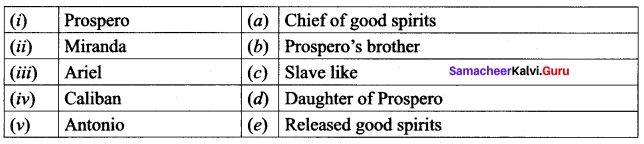
(i)(e), (ii)(d), (iii) (a), (iv)(c), (v)(b).

2. The Tempest Hints Development Samacheer Kalvi 10th English Solutions Supplementary Chapter 1
Answer:
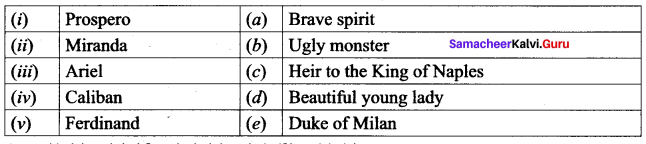
(i)(e), (ii)(d), (iii)(a), (iv)(b), (v)(c).

3. 10th Std The Tempest Summary Samacheer Kalvi 10th English Solutions Supplementary Chapter 1
Answer:
(i)(b), (ii)(d), (iii)(c), (iv)(a), (v)(c).

D. Read the passage given below and answer the questions that follow:

1. There was an island in the sea, the only inhabitants of which were an old man, named Prospero, and his daughter Miranda, a very beautiful young lady. She came to this island so young, that she had no memory of having seen any other human face than her father’s.

They lived in a cave made out of a rock; it was divided into several apartments, one of which Prospero called his study; there he kept his books, which chiefly treated of magic. By virtue of his art, he had released many good spirits from a witch called Sycorax who had them imprisoned in the bodies of large trees.

These gentle spirits were ever after obedient to the will of Prospero. Of these Ariel was the chief. Ariel took rather too much pleasure in tormenting an ugly monster called Caliban, because he was the son of his old enemy Sycorax.

(а) Who were the only inhabitants of the island in the sea?
Answer:
Prospero an old man and his daughter Miranda were the only inhabitants of the island in the sea.

(b) Where did Prospero and Miranda live?
Answer:
Prospero and Miranda lived in a cave made out of a rock.

(c) Who is Sycorax?
Answer:
Sycorax is a witch who had imprisoned many good spirits in the bodies of large trees.

(d) Who was the chief of all the gentle spirits?
Answer:
Ariel was the chief of all the gentle spirits.

(e) Why did Ariel find pleasure in tormenting Caliban?
Answer:
Ariel found pleasure in tormenting Caliban an ugly monster because he was the son of his old enemy Sycorax.

2. Ariel took rather too much pleasure in tormenting an ugly monster called Caliban, because he was the son of his old enemy Sycorax. Caliban was employed like a slave, to fetch wood, and do the most laborious offices; and Ariel had the charge of compelling him to these services. With the help of these spirits, Prospero could command the winds, and the waves of the sea.

By his orders they raised a violent storm, in the midst of which, he showed his daughter a fine large ship, which he told her was full of living beings like themselves. “Oh my dear father,” said she, “if by your art you have raised this dreadful storm, have pity on their sad distress. See! The vessel will be dashed to pieces. Poor souls! They will all perish.”

“Be not so amazed, daughter Miranda,” said Prospero; “there is no harm done. I have so ordered it, that no person in the ship shall receive any hurt.

(a) Who was Caliban?
Answer:
Caliban, an ugly monster was the son of Ariel’s old enemy Sycorax, the witch.

(b) What was the work given to Caliban by Ariel?
Answer:
Ariel made Caliban fetch wood and do most of the laborious offices.

(c) How did Prospero use the spirits?
Answer:
Prospero with the help of the spirits commanded the winds and the waves of the sea.

(d) What did Prospero show his daughter?
Answer:
Prospero showed a fine large ship in the midst of a violent storm that he had created.

(e) What was the fear of Miranda?
Answer:
Miranda feared that the vessel would be dashed to pieces and that the people in the ship may perish.

E. Study the given mind map and fill in the incomplete details:

The Tempest 10th Supplementary In English Samacheer Kalvi Chapter 1

Answers:
(i) to pfle up some heavy logs of wood.
(ii) is at his studies, pray rest yourself.
(iii) my task before I take my rest.
(iv) I will carry your logs the while.
(v) would by no means agree to.

The Tempest Book Back Answers Samacheer Kalvi 10th English Solutions Supplementary Chapter 1
Answers:
(i) the beauty of young Miranda.
(ii) who is the famous Duke of Milan.
(iii) a second father.
(iv) our troubles past, since they so happily have ended.
(v) embraced his brother.

The Tempest by William Shakespeare About the Author:
William Shakespeare (1564-1616) was born in Stratford-upon-Avon, England. He was an English poet, playwright and actor, widely regarded as the greatest writer in the English language and the world’s greatest dramatist. He is often called England’s national poet and the “Bard of Avon”. His surviving body of work includes 37 plays, 154 sonnets and two narrative poems, the majority of which he penned between 1589 and 1613.

The Tempest Summary:

The Tempest Questions And Answers Samacheer Kalvi 10th English Solutions Supplementary Chapter 1

Introduction:
The Tempest was considered as one of Shakespeare’s well-written plays. It is believed that the play was based on an actual wreck of a ship called the Sea Venture of Bermuda that was headed to Virginia. There is strong evidence that Shakespeare used elements of the story of the wreck.
10th English Unit 1 Supplementary Samacheer Kalvi The Tempest

Tragedy that surrounded Prospero
When the play, The Tempest by William Shakespeare begins, Prospero, the overthrown Duke of Milan, and his teenage daughter, Miranda, live on an isolated island where they have been marooned for the past twelve years. Their only companions are Ariel, a magical spirit and Caliban, enslaved by Prospero. Prospero was originally Duke of Milan, but his position was appropriated by his brother Antonio, possibly with the approval of King of Naples.
The Tempest Questions And Answers Pdf Samacheer Kalvi 10th English Solutions Supplementary Chapter 1

Ariel’s violent storm
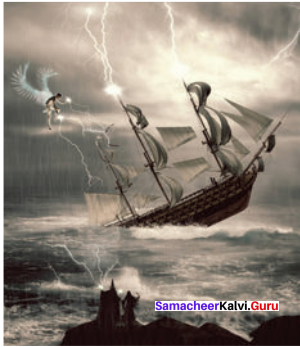
A ship with King of Naples, his son Ferdinand, Antonio, and other nobles, is wrecked in a sea storm created by the spirit Ariel, under the magic art of Prospero. Ariel explains that he has carried out Prospero’s orders: He admits that be had destroyed the ship and dispersed its passengers across the island. Prospero instructs Ariel to be invisible and spy on them. Prospero explains to his daughter that the crew members in the ship are all safe and sound when he sees her glum. He puts Miranda to sleep as Ariel comes there to report that the lords are on the island as he had commanded, with Ferdinand separated from the others. Caliban, a vicious native of the island who is also controlled by Prospero, expresses his hatred to Prospero, but is forced to do his command.
10th English Supplementary Story In English Samacheer Kalvi Chapter 1 The Tempest

Ferdinand meets Miranda
Prospero gets Ariel to lead Ferdinand across the island so that he meets Miranda, and fall in love. As planned, Ferdinand stumbles across Miranda and they fall in love and decide to marry. Prospero warns Miranda off and decides to test Ferdinand’s loyalty. To test his worth, Prospero makes Ferdinand carry out menial tasks. Ferdinand finds his labour pleasant because of Miranda. Miranda, thinking that her father is asleep, tells Ferdinand to take a break. They propose marriage and they accept each other. Prospero who has been on stage invisible to Ferdinand and Miranda is pleased with this development.
The Tempest 10th Supplementary In Tamil Samacheer Kalvi Chapter 1

Grieving ship wrecked crew
The rest of the shipwrecked crew are grieving for their lost, loved ones. The search for Ferdinand goes in vain and Antonio and the King of Naples fear him drowned. Gonzalo and the others think that the spellbound men are suffering from the guilt of their past actions and promise to ensure their safety.
10th English The Tempest In Tamil Samacheer Kalvi Chapter 1

King of Naples punished for disloyalty
Ariel places a magical delicious banquet before the lords which vanishes when they crave to eat. Ariel leads the lords to Prospero, and they stand in a trance before him.
The Tempest Supplementary Samacheer Kalvi 10th English Solutions Chapter 1

Prospero pardons Antonio
Ariel rouses them, and they beg forgiveness, which Prospero grants, and he is restored to his dukedom. Ferdinand and Miranda are then revealed to them to their happiness. At the end of the play, Ariel is told to provide good weather to guide the king’s ship back to the royal fleet and then to Naples, where Ferdinand and Miranda will be married.
10th English Supplementary The Tempest Samacheer Kalvi Chapter 1

Conclusion:
Thus the story ends happily. Prospero pardons Antonio for his disloyalty. The Duke regains his Dukedom. His daughter is married to Ferdinand.
10th English Supplementary Paragraph Pdf Samacheer Kalvi Chapter 1 The Tempest

William Shakespeare Glossary:

Textual:
Tempest Questions And Answers Samacheer Kalvi 10th English Solutions Supplementary Chapter 1

Additional:
10th English The Tempest Summary Samacheer Kalvi Chapter 1

We hope the data given here will benefit you to the fullest extent at the time of preparation. For better understanding of English subject this Samacheer Kalvi 10th English Solutions for Class 10th English Supplementary Chapter 1 The Tempest PDF is the best resource. Download & ace up your preparation. Keep in touch with us and get the latest information on Tamilnadu State board Textbook Solutions PDF.
Samacheer Kalvi 10th Maths Solutions Chapter 7 Mensuration Ex 7.1

You can Download Samacheer Kalvi 10th Maths Book Solutions Guide Pdf, Tamilnadu State Board help you to revise the complete Syllabus and score more marks in your examinations.

Tamilnadu Samacheer Kalvi 10th Maths Solutions Chapter 7 Mensuration Ex 7.1

10th Maths Exercise 7.1 Samacheer Kalvi Question 1.
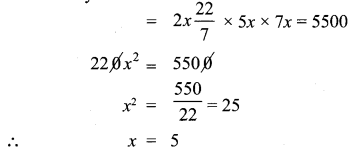
The radius and height of a cylinder are in the ratio 5:7 and its curved surface area is 5500 sq.cm. Find its radius and height.
Solution:
r = 5x
h = 7x
CSA of a cylinder = 2πrh
10th Maths Exercise 7.1 Samacheer Kalvi Chapter 7 Mensuration
∴ Radius = 5 × 5 = 25 cm
height = 7 × 5 = 35 cm

Ex 7.1 Class 10 Samacheer Question 2.
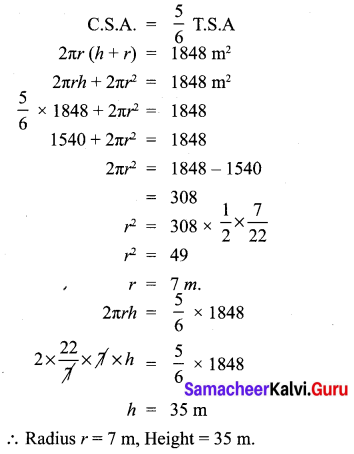
A solid iron cylinder has total surface area of 1848 sq.m. Its curved surface area is five – sixth of its total surface area. Find the radius and height of the iron cylinder.
The external radius and the length of a hollow
Solution:
Ex 7.1 Class 10 Samacheer Kalvi Chapter 7 Mensuration

Exercise 7.1 Class 10 Samacheer Kalvi Question 3.
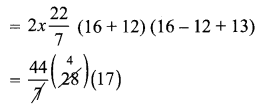
The external radius and the length of a hollow wooden log are 16 cm and 13 cm respectively. If its thickness is 4 cm then find its T.S.A.
Solution:
R = 16 cm
r = R – thickness
r = 12 cm
= 16 – 4 = 12 cm
h = 13 cm
Total surface area of hollow cylinder = 2π(R + r) (R – r + h) sq. units.
Exercise 7.1 Class 10 Samacheer Kalvi Chapter 7 Mensuration
∴ T.S.A = 2992 cm2

10th Maths Mensuration Exercise 7.1 Question 4.
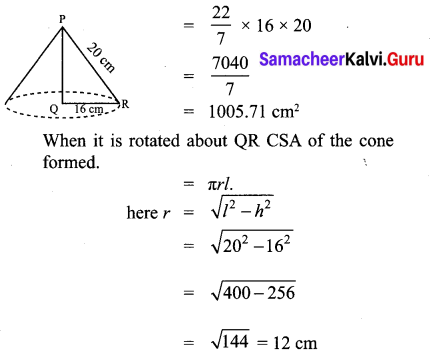
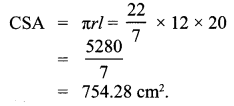
A right angled triangle PQR where ∠Q = 90° is rotated about QR and PQ. If QR = 16 cm and PR = 20 cm, compare the curved surface areas of the right circular cones so formed by the triangle.
Solution:
When it is rotated about PQ the C.S.A of the cone formed = πrl.
10th Maths Mensuration Exercise 7.1 Samacheer Kalvi Chapter 7
10th Maths Exercise 7.1 Samacheer Kalvi Chapter 7 Mensuration
1005.71 > 754.28
∴ CSA of the cone rotated about its PQ is larger than the CSA of the cone rotated about QR.

10th Maths Exercise 7.1 Question 5.
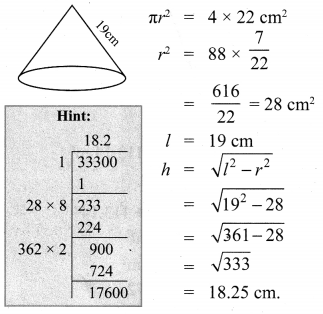
4 persons live in a conical tent whose slant height is 19 cm. If each person require 22 cm2 of the floor area, then find the height of the tent.
Solution:
Base area of the cone = πr2 = sq units.
10th Maths Exercise 7.1 In Tamil Samacheer Kalvi Chapter 7 Mensuration

10th Maths Exercise 7.1 In Tamil Question 6.
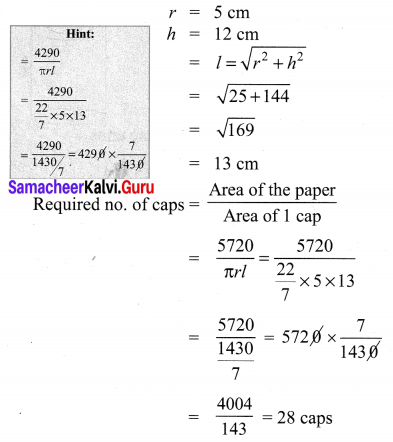
A girl wishes to prepare birthday caps in the form of right circular cones for her birthday party, using a sheet of paper whose area is 5720 cm2, how many caps can be made with radius 5 cm and height 12 cm.
Solution:
10th Maths 7.1 Samacheer Kalvi Chapter 7 Mensuration Ex 7.1

10th Maths 7.1 Question 7.
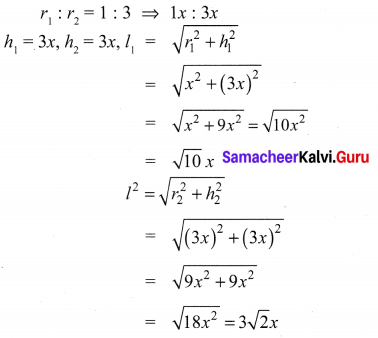
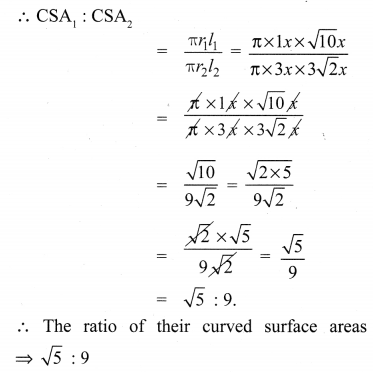
The ratio of the radii of two right circular cones of same height is 1 : 3. Find the ratio of their curved surface area when the height of each cone is 3 times the radius of the smaller cone.
Solution:
10th Mensuration Solutions Samacheer Kalvi Chapter 7 Ex 7.1
10th Maths Ex 7.1 Samacheer Kalvi Chapter 7 Mensuration

10th Mensuration Solutions Question 8.
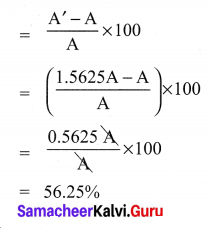
The radius of a sphere increases by 25%. Find the percentage increase in its surface area.
Solution:
Surface area of sphere A = 4πr2
New radius = r’ = 1.25r,
[∵ r + 0.25r] (25% = 0.25)
New surface area = A’ = 4π(r’)2
= 4π(1.25 r)2
10th Maths 7.1 Exercise Samacheer Kalvi Chapter 7 Mensuration
10th Maths Mensuration Samacheer Kalvi Chapter 7 Ex 7.1

10th Maths Ex 7.1 Question 9.
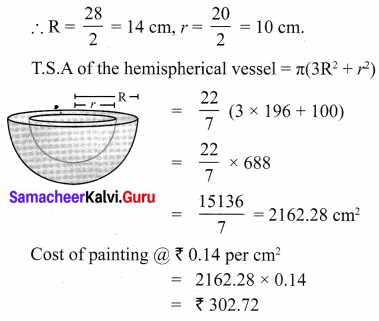
The internal and external diameters of a hollow hemispherical vessel are 20 cm and 28 cm respectively. Find the cost to paint the vessel all over at ₹ 0.14 per cm2.
Solution:
External diameter D = 28 cm
Internal diameter d = 20 cm
Mensuration 10th Samacheer Kalvi Chapter 7 Ex 7.1

10th Maths 7.1 Exercise Question 10.
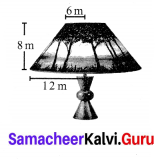
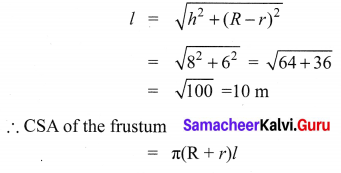
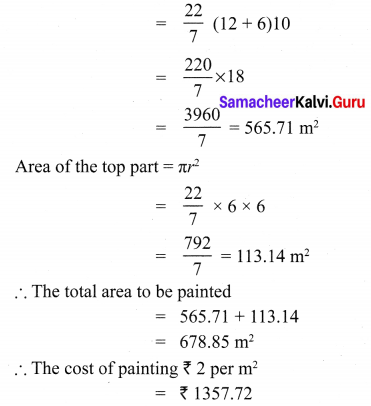
The frustum shaped outer portion of the table lamp has to be painted including the top part. Find the total cost of painting the lamp if the cost of painting 1 sq.cm is ₹ 2.
Samacheer Kalvi 10th Maths Mensuration Chapter 7 Ex 7.1
Solution:
Here given that R = 12 m
r = 6 m
h = 8 m
Samacheer Kalvi Guru 10th Maths Chapter 7 Mensuration Ex 7.1
Mensuration Exercise 7.1 Samacheer Kalvi 10th Maths Solutions Chapter 7

Samacheer Kalvi 10th Social Science History Solutions Chapter 1 Outbreak of World War I and Its Aftermath

Guys who are planning to learn and understand the topics of 10th Social Science History can grab this Tamilnadu State board solutions for Chapter 1 Outbreak of World War I and Its Aftermath Questions and Answers from this page for free of cost. Make sure you use them as reference material at the time of preparation & score good grades in the final exams.

Students who feel tough to learn concepts can take help from this Samacheer Kalvi 10th Social Science Book Solutions Guide Pdf, all the Questions and Answers can easily refer in the exams. Go to the below sections and get 10th Social Science History Chapter 1 Outbreak of World War I and Its Aftermath Tamilnadu State Board Solutions PDF.

Tamilnadu Samacheer Kalvi 10th Social Science History Solutions Chapter 1 Outbreak of World War I and Its Aftermath

Do you feel scoring more marks in the 10th Social Science History Grammar sections and passage sections are so difficult? Then, you have the simplest way to understand the question from each concept & answer it in the examination. This can be only possible by reading the passages and topics involved in the 10th Social Science History Board solutions for Chapter 1 Outbreak of World War I and Its Aftermath Questions and Answers. All the Solutions are covered as per the latest syllabus guidelines. Check out the links available here and download 10th Social Science History Chapter 1 textbook solutions for Tamilnadu State Board.

Outbreak of World War I and Its Aftermath Textual Exercise

I. Choose the correct answer.

Outbreak Of World War 1 And Its Aftermath Questions And Answers Question 1.
What were the three major empires shattered by the end of First World War?
(a) Germany, Austria Hungary, and the Ottomans
(b) Germany, Austria-Hungary, and Russia
(c) Spain, Portugal and Italy
(d) Germany, Austria-Hungary, Italy
Answer:
(a) Germany, Austria Hungary, and the Ottomans

Outbreak Of World War 1 And Its Aftermath Question 2.
Where did the Ethiopian army defeat the Italian army?
(a) Delville
(b) Orange State
(c) Adowa
(d) Algiers
Answer:
(c) Adowa

10th Social History 1st Lesson Question 3.
Which country emerged as the strongest in East Asia towards the close of nineteenth century?
(a) China
(b) Japan
(c) Korea
(d) Mongolia
Answer:
(b) Japan

10th Social History 1st Lesson Question Answer Question 4.
Who said “imperialism is the highest stage of capitalism”?
(a) Lenin
(b) Marx
(c) Sun Yat-sen
(d) Mao Tsetung
Answer:
(a) Lenin

10th Social Outbreak Of World War 1 And Its Aftermath Question 5.
What is the Battle of Marne remembered for?
(a) air warfare
(b) trench warfare
(c) submarine warfare
(d) ship warfare
Answer:
(b) trench warfare

Outbreak Of World War I And Its Aftermath Question 6.
Which country after World War I took to a policy of isolation?
(a) Britain
(b) France
(c) Germany
(d) USA
Answer:
(d) USA

Outbreak Of World War 1 And Its Aftermath In Tamil Question 7.
To which country did the first Secretary-General of League of Nations belong?
(a) Britain
(b) France
(c) Dutch
(d) USA
Answer:
(a) Britain

10th History Timeline Chart In English Question 8.
Which country was expelled from the League of Nations for attacking Finland?
(a) Germany
(b) Russia
(c) Italy
(d) France
Answer:
(b) Russia

II. Fill in the blanks

1. Japan forced a war on China in the year …….
2. The new state of Albania was created according to the Treaty of ……. signed in May 1913.
3. Japan entered into an alliance with England in the year ……….
4. In the Balkans ……… had mixed population.
5. In the battle of Tannenberg …….. suffered heavy losses.
6. ……… as Prime Minister represented France in Paris Peace Conference.
7. ……… became Prime Minister leading a new coalition of liberals and moderate Socialists before Lenin established the Bolshevik government.
8. Locarno Treaty was signed in the year ……….
Answers:
1. 1894
2. London
3. 1902
4. Macedonia
5. Russia
6. Clemenceau
7. Kerensky
8. 1925

III. Choose the correct statement

10th Social 1st Lesson Question Answer Question 1.
(i) Italy remained a neutral country when the World War broke out.
(ii) Italy was much disappointed over the peace settlement at Versailles.
(iii) The Treaty of Sevres was signed with Italy.
(iv) Italy was denied even small places such as Trieste, Istria and the south Tyrol.
(a) (i) and (ii) are correct
(b) (iii) is correct
(c) (iv) is correct
(d) (i), (iii) and (iv) are correct
Answer:
(a) (i) and (ii) are correct

Outbreak Of World War 1 And Its Aftermath Pdf Question 2.
(i) The Turkish Empire contained many non-Turkish people in the Balkans
(ii) Turkey fought on the side of the central powers
(iii) Britain attacked Turkey and captured Constantinople
(iv) Turkey’s attempt to attack Suez Canal but were repulsed.
(a) (i) and (ii) are correct
(b) (i) and (iii) are correct
(c) (iv) is correct
(d) (i), (ii) and (iv) are correct.
Answer:
(d) (i), (ii) and (iv) are correct.

10th Social History Question 3.
Assertion: Germany and the United States were producing cheaper manufactured goods and capturing England’s markets.
Reason: Both the countries produced required raw material for their industries.
(a) Both A and R are correct
(b) A is right but R is not the correct reason
(c) Both A and R are wrong
(d) R is right but it has no relevance to A.
Answer:
(c) Both A and R are wrong

10th Social Science 1st Lesson Question 4.
Assertion: The first European attempts to carve out colonies in Africa resulted in bloody battles.
Reason: There was stiff resistance from the native population.
(a) Both A and R are correct
(b) A is right but R is not the correct reason
(c) Both A and R are wrong
(d) R is right but it has no relevance to A.
Answer:
(b) A is right but R is not the correct reason

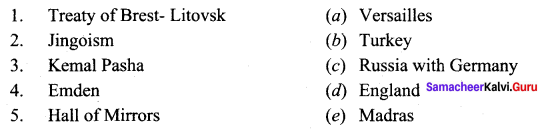
IV. Match the following.

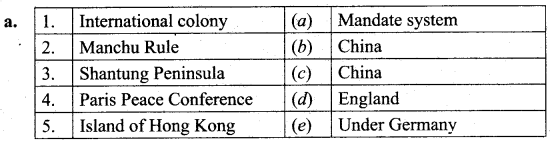
Outbreak Of World War 1 And Its Aftermath Questions And Answers Samacheer Kalvi 10th Social Science Chapter 1
Answers
1. (c)
2. (d)
3. (b)
4. (e)
5. (a)

V. Answer briefly.

Outbreak Of World War 1 And Its Aftermath Class 10 Question 1.
How do you assess the importance of the Sino-Japanese War?
Answer:
The Sino-Japanese War proved that Japan was the strongest nation of the East Asia.

Class 10 Social Science History Chapter 1 Questions And Answers Question 2.
Name the countries in the Triple Entente.
Answer:
The countries of Triple-Entente were Britain, France and Russia.

Samacheer Kalvi 10th Social Question 3.
What were the three militant forms of nationalism in Europe?
Answer:
England’s jingoism, France’s chauvinism and Germany’s Kultur were militant forms of nationalism in Europe.

Question 4.
What do you know of trench warfare?
Answer:
Trenches or ditches dug by troops enabled soldiers to safely stand and protect themselves from enemy fire. During the first world war the battle of Mame (between French and Germans) is a memorable one for trench warfare.

Question 5.
What was the role of Mustafa Kemal Pasha?
Answer:
It was Mustafa Kemal Pasha whose efforts caused Turkey’s rebirth as a nation. Not only did Kemal Pasha win freedom for the country but he modernised it and changed it out of all recognition. He put an end to the Sultanate and the Caliphate.

Question 6.
Highlight the global influence of Russian Revolution?
Answer:
In many countries, communist government were formed. Debates over issues like land reforms, social welfare, workers rights and gender equality started taking place in the global context.

Question 7.
List out any two causes for the failure of the League of Nations.
Answer:
Here are the two causes for the failure of the League of Nations:
a. The League appeared to be an organisation of those who were victorious in the First World War. Though it had a world-wide membership. It became very much the centre of European diplomacy.
b. The unanimity of members was required for all its decisions on political issues. Since it lacked the military power of its own, it could not enforce its decisions

VI. Answer all the questions given under each caption.

Question 1.
Imperialism

(а) What do you know of monopoly capitalism?
Answer:
Monopoly capitalism is a capitalist system typified by tread monopolies in the hands of a few people. After 1870, the capitalism of free competition (based on the principle of free trade without any control or regulation by the state) became the capitalism of monopolies.

(b) How did Japan emerge as an imperial power?
Answer:
Japan took to Western education and machinery with a modem army and navy had emerged as an advanced industrialised power. It also followed the imperialistic aggression policy of the European powers faithfully. It surprised the world by giving a crashing defeat to China in the Sino-Japanese War during the period of 1894-95. Japan also defeated Russia in Russo-Japanese War in 1904 and got back Port Arthur from it. In this way it emerged as an imperial power.

(c) Why did the industrial countries need colonies in the nineteenth century?
Answer:
An ever-growing demand for markets and raw materials made the industrial countries hungry for colonies in the nineteenth century.

(d) What were the contrasts capitalism produced?
Answer:
Capitalism produced huge contrasts. Those contrasts were: extreme poverty and extreme wealth, slum and skyscraper, empire-state and dependent exploited colony.

Question 2.
German Emperor
(a) What was the nature of Emperor Kaiser Wilhelm II of Germany?
(b) What was the violent form of Germany called?
(c) Why did Kaiser Wilhelm intervene in the Morocco affair?
(d) What happened to Germany’s colonies in Africa?
Answer:
(a) He was ruthlessly assertive and aggressive. He proclaimed that Germany would be the leader of the world.
(b) The violent form of Germany is called Kultur.
(c) The British agreement with France to occupy Morocco was not consented by Germany.
(d) The colonies of Germany in Africa were attacked by the allies and therefore had to surrender to them.

Question 3.
Balkan Wars

(а) Why was Balkan League formed?
Answer:
Balkan League was formed to attack and defeat Turkish forces in the first Balkan War in 1912-13.

(b) What was the outcome of the first Balkan War?
Answer:
The new state of Albania was created and the other Balkan states divided up Macedonia , between them. Turkey was reduced the area around Constantinople.

(c) Who were defeated in this war?
Answer:
The Turkish forces were defeated in the first Balkan War.

(d) What was the name of the Treaty signed at the end of this second Balkan War?
Answer:
The name of the Treaty signed at the end of the second Balkan War was the Treaty of Bucharest

VII. Answer the following in detail.

Question 1.
Discuss the main causes of the First World War.
Answer:

  1. European great powers were divided into two armed camps.
  2. One camp consisted of central powers namely Germany, Austria-Hungary Bulgaria and Turkey which was called Triple Alliance formed in 1882.
  3. Another camp consisted of Ally powers namely Britain, France, and . Russia which was called Entente cordiale formed in 1904.
  4. The aggressive nature of German Emperor Kaiser Wilhelm II who proclaimed that Germany would be the leader of the world.
  5. The emergence of militant forms of nationalism like England’s Jingoism, France’s Chauvinism and Germany’s Kulthur contributed to the outbreak of the war.
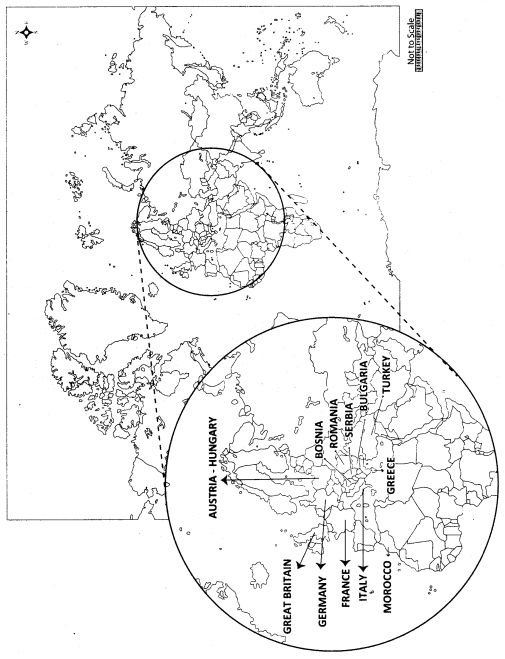
  6. Kaiser Wilhelm II of Germany wanted declare Morocco an International ‘ colony instead of France occupying it with the support of Britain. Thus France was hostile under German.
  7. Balkan countries like Greece, Serbia, Bulgaria and Montenegro was succeeding each other in occupying Balkan regions from Turks. So, to control them Balkan League was formed.
  8. The Balkan League defeated the Turks in the first Balkan war in 1912.
  9. When dispute arose in sharing the spoils of the war with Bulgaria, the second Balkan war broke out in 1913 against it and Bulgaria was defeated. Turks and Bulgaria approached Germany for help.
  10. Austrian crown prince Ferdinand was killed by Princip a Serbian lad of Bosnia.
  11. Austria could get support from Germany while Serbia from Russia.
  12. Germany therefore declared war on Russia on 1 August 1914.
  13. The Franco – Russian Alliance forced Germany to wage war against France when Britain also Supported them.
  14. Thus, the first world war broke out between central powers and Allies in 1914.

Question 2.
Highlight the provisions of the Treaty of Versailles relating to Germany.
Answer:

  1. Germany was found guilty of starting the War and therefore was to pay reparations for the losses suffered. The Reparation Commission set up for deciding the compensation decided on 6,600 million pounds to be paid in installments. All Central Powers were directed to pay war indemnity.
  2. The German army was to be limited to 100,000 men. A small navy was allowed, but there were to be no submarines and no air force.
  3. The union of Austria and Germany was forbidden and Germany was to acknowledge and respect the Independence of Austria.
  4. Germany was forced to give up all the rights and titles over her overseas possessions to the allies. All German colonies became mandated territories under the League of Nations.
  5. Germany was forced to revoke the Treaty of Brest-Litovsk (with Russia) and Bucharest (Bulgaria).

Question 3.
Explain the course of the Russian Revolution under the leadership of Lenin.
Answer:

  1. Lenin gained the support of a small majority known as Bolsheviks which became the Bolshevik party. His opponents were called as Mensheviks.
  2. In October, Lenin persuaded the Bolshevik central committee to decide on immediate revolution.
  3. The revolutionary troops and armed factory workers seized the government buildings including the winter palace, the Prime Minister’s headquarters on 7th November 1917.
  4. The next day, 8th November, the new communist government was formed headed by Lenin.
  5. He renamed, the Bolshevik party into Russian communist party.
  6. The Russian communist party developed agriculture and Industry, and eliminated Illiteracy and poverty within a record time.
  7. Women were given equal rights and right to vote.
  8. Land was distributed to poor peasants.
  9. Lenin appealed for peace and opted for withdrawing from the war and concentrated on the formation of new government.
  10. Therefore, In March 1918, the Treaty of Brest-Litovsk was signed.
  11. The communist government encouraged the colonies to fight for their freedom.
  12. It led to debates over key issues, land reforms, social welfare, worker’s rights and gender equality started taking place in a global context.

Question 4.
Estimate the work done by the League of Nations, pointing out the reasons for its failure?
Answer:
Reasons for the failure of the League of Nations:

  1. The League had been successful until signing of the Locarno Treaty in 1925. It was the year when European powers were confronted with a problem—how to achieve disarmament. The Council of the League set up a commission to hold a Disarmament Conference to sort out the problem.
  2. The proposed conference materialised only in February 1932. In this conference, Germany’s demand of equality of arms with France was rejected. In October Hitler withdrew Germany from the conference and the League.
  3. In September 1931, Japan attacked Manchuria and the League condemned its action. So Japan resigned from the League.
  4.  Italy also resigned from the League in 1937. Thereafter the League was a passive witness to events, taking no part in the crises over the Rhineland. Austria, Czechoslovakia and Poland.
  5. The last decisive action it took was in December 1939 when Russia was expelled for her attack on Finland. The Assembly did not meet again and the League of Nations was finally dissolved in 1946.

VIII. Activity

Question 1.
Students can be taught to mark the places of battles and the capital cities of the countries that were engaged in the War.
Outbreak Of World War 1 And Its Aftermath Samacheer Kalvi 10th Social Science Chapter 1

Question 2.
An assignment or a project work on the role of Indian soldiers in different battle fields across the globe and the casualties they suffered during the War be attempted by the students.
Answer:
British Indian Army: A Military department was created within the government of the East India company at Kolkata in the year 1776.
The British Indian Army was a critical force for the primacy of the British empire both in India and across the world.

Participation:

  1. Maintaining the internal security of the British Raj
  2. Anglo-Burmese war
  3. First and second Anglo-Sikh war
  4. First, Second and Third Anglo Afghan war
  5. First and Second Opium wars in China
  6. Boxer Rebellion in China

World War I (1914-1918): Indian soldiers 1.3 million Indian soldiers served with Allies in which, 74,187 Indian troops were killed. Indian Army fought against German empire in western front.

World War II (1939-1945): Indian soldiers 1,30,000 men along with 44,000 men in British units in India . Some 87,000 Indian soldiers died in the war.

First Kashmir war (1947): Tensions between Indian and Pakistan largely over Kashmir have never been entirely eliminated.

Indo-Pakistani war (1965): India lost a total of 150-190 tanks during the conflict. Over 3,000 soldiers were killed.

Sino-Indian conflict (1967): Conflict between Indian troops and members of the Chinese People’s Liberation Army on 1st Oct 1967. Indian losses were 88 killed and 163 wounded.

Indo-Pakistani war (1971): The war began with aerial strikes on eleven Indian air stations. Indian forces captured around 5,795 sq.miles land in the west but returned in 1972 Simla agreement.

Kargil war (1999): The war broke out at the Himalayan heights in the Kargil district of India. There was heavy casualties in India.

UN peace keeping mission: In 2014, India is the third largest troop contributor with 7,860 personnel deployed. Nearly 157 Indians have been killed during such operations. The Indian army provided paramedical units to help the sick and the wounded.

IX. Map Work

Mark the following countries on the world map.

1. Great Britain
2. Germany
3. France
4. Italy
5. Morocco
6. Turkey
7. Serbia
8. Bosnia
9. Greece
10. Austria-Hungary
11. Bulgaria
12. Rumania
10th Social History 1st Lesson Samacheer Kalvi Outbreak Of World War I And Its Aftermath

Outbreak of World War I and Its Aftermath Additional Questions

I. Choose the correct answer.

Question 1.
……. was in competition with Germany and United States.
(a) Japan
(b) England
(c) Africa
Answer:
(b) England

Question 2.
The outcome of the first world war is the:
(a) French
(b) Russian
(c) American
(d) None of the above
Answer:
(b) Russian

Question 3.
China was politically independent under the ……..
(a) Chin rule
(b) Chou rule
(c) Manchu rule
Answer:
(c) Manchu rule

Question 4.
Chauvinism means:
(a) extreme patriotism
(b) thinking high
(c) blind patriotism
(d) quality of the state
Answer:
(a) extreme patriotism

Question 5.
In 1876, barely 10% of Africa was under rule.
(a) Austria
(b) European
(c) China
Answer:
(b) European

Question 6.
The International court of Justice was set up at ……………. with ……………. judges.
(a) Greece, 10
(b) Hague, 15
(c) Austria,20
(d) America
Answer:
(b) Hague, 15

Question 7.
The term ………. denotes control or rule by a country over the Political and Economical life of another country.
(a) Imperialism
(b) Capitalism
(c) Socialism
Answer:
(a) Imperialism

Question 8.
The event of police and soldiers fired on th peaceful processions against Tsar in Russia was called:
(a) Bloody Sunday
(b) Petrograd problem
(c) Worst incident
(d) Militant action
Answer:
(a) Bloody Sunday

Question 9.
The industrial revolution created a need for …….
(a) Peace
(b) War
(c) Raw materials
Answer:
(c) Raw materials

Question 10.
The years of the first world war is:
(a) 1914-1918
(b) 1914-1916
(c) 1914-1917
(d) 1914-1920
Answer:
(a) 1914-1918

Question 11.
“Germany alone was competent to rule the whole world”, was said by
(a) Bismark
(b) Kaiser Wilhelm II
(c) Hitler
Answer:
(b) Kaiser Wilhelm II

Question 12.
France wanted to get back
(a) Alsace and Lorraine
(b) Bosnia and Herzegovina
(c) Estonia and Latvia
Answer:
(a) Alsace and Lorraine

Question 13.
Austria declared war on Serbia on
(a) 28th July 1914
(6) 28th June 1914
(c) 28th August 1914
Answer:
(a) 28th July 1914

Question 14.
Germany invaded France by crossing
(a) Luxemburg
(b) Rhineland
(c) Belgium
Answer:
(c) Belgium

II. Fill in the blanks :

1. The First World War started in ……….
2. Turkey extended her support to the ……….
3. ……… expedition was an utter failure for the British.
4. …….. an American ship was torpedoed by a German submarine.
5. In Russia, the Tsarist government was overthrown by ……..
6. Germany was sued for peace on November ………
7. The League of Nations was officially founded in January ……..
8. Japan captured Manchuria in …………
9. The turning point of the First World War was the ……….
10. The Bolshevik Party was renamed as ……….
11. The Treaty of Versailles abolished ……… in Germany, Austria and Russia.
12. The League had its headquarters in ……….
13. In March 1918, the …… was signed.
Answers:
1. 1914
2. Central Powers
3. Dardanelles
4. Lusitania
5. Lenin
6. 11,1918
7. 20,1920
8. 1931
9. entry of America
10. Russian Communist Party
11. Monarchy
12. Geneva
13. Treaty of Brest- Litovsk

III. Match the following

10th Social History 1st Lesson Question Answer Chapter 1 Outbreak Of World War I And Its Aftermath
Answers:
1. (b)
2. (e)
3. (c)
4. (a)
5. (d)

10th Social Outbreak Of World War 1 And Its Aftermath Samacheer Kalvi Chapter 1
Answers:
1. (c)
2. (e)
3. (a)
4. (b)
5. (d)

Outbreak Of World War I And Its Aftermath Samacheer Kalvi 10th Social Science History Solutions Chapter 1
Answers:
1. (c)
2. (a)
3. (e)
4. (d)
5. (b)

IV. Answer briefly:

Question 1.
Define Imperialism.
Answer:
The word‘imperialism’is defined in three ways:

  1. The term imperialism refers to the policy of extending a country’s rule over the others.
  2. It is a policy of aggressive behaviour of one state against another.
  3. It also refers to a country’s domination over the political and economic interest of another nation to exploit its natural resources.

Question 2.
Name the countries of Triple Alliance? When was it formed?
Answer:
Germany, Austria-Hungary and Bulgaria and Turkey were the countries of Triple Alliance. It was formed under the guidance of Bismarck in 1882.

Question 3.
Industrial Revolution is an important cause for the rise of Imperialism – Explain it.
Answer:

  1. Industrial Revolution in European countries resulted in a great increase in production. So there was a need for raw materials and new markets.
  2. It also instructed a great progress in the means of transport and communication.
  3. Due to the “Protective trade policy” of Europe, they could not sell their finished goods in their local markets.
  4. These causes forced the Europeans to find new markets in Asian and African continents which led to the rise of Imperialism.

Question 4.
Write a note on Balkan League.
Answer:
Balkan is a region in South-eastern Europe between the Mediterranean sea and the Black sea.

Turkey extended her empire over the Balkans. Taking advantage of the political instability of the Turkish empire, Greece, Serbia, Bulgaria and later Montenegro tried control over it and formed the Balkan League in March 1912.

Question 5.
Why did Germany needed colonies?
Answer:

  1. Germany needed colonies as a sign of her world importance.
  2. She needed colonies for her growing population.
  3. To get raw materials and markets for its finished products.

Question 6.
What do you mean by Pravada.
Answer:
Pravada is a Russian word meaning ‘Truth’. It was the official newspaper of the communist party of the soviet union from 1918 to 1991.

Question 7.
Why did America enter into First World War?
Answer:

  1. In 1917, Germany drowned four merchant ships of America including Lusitania with her submarines.
  2. More than hundred Americans died in this incident.
  3. This incident made the American President Woodrow Wilson angry and he declared war on Germany on the 6th April of 1917.

Question 8.
What is the significance of the Treaty of Portsmouth?
Answer:
In the Russo-Japanese war, of 1904, Japan defeated Russia. By the Treaty of Portsmouth, got back Port Arthur, also entered the circle of great powers.

Question 9.
What are the organs of the League of Nations?
Answer:
The League of Nations consisted of: The General Assembly, The Council, The Secretariat, The International Court of Justice, and The International Labour Organisation.

Question 10.
Write any two incidents of violations by the member countries of the League.
Answer:

  1. Japan attacked Manchuria in September 1931 and when the League condemned Japan, it resigned from the League.
  2. Russia attacked Finland in 1939.

Question 11.
Name the prominent industrial areas in the Russian Empire?
Answer:
St. Petersburg and Moscow.

Question 12.
Who led the procession of workers to the event “Bloody Sunday” in Russia?
Answer:
Father Gapon

Question 13.
Write a note on Trusts and Cartels.
Answer:

  1. A Trust is an Industrial organization in USA engaged in production, distribution of a commodity and control over its supply and price.
  2. A Cartel was an association in Germany which was based upon a contractual agreement between people doing same type of business.

V. Answer all the questions given under each caption:

Question 1.
Causes for the rise of Imperialism

(a) What became the fashion of the later part of the 19th century?
Answer:
Imperialism became the fashion of the later part of the 19th century.

(b) What was the “White man’s burden”?
Answer:
To civilise the backward and uncivilised native people of Africa and Asia.

(c) Why were the European nations forced to acquire new colonies?
Answer:
The European nations were forced to acquire new colonies to get the Balance of power with their neighbours and competitors.

(d) What promoted the spirit of imperialism?
Answer:
The discovery of new routes to African and Asian continents.

Question 2.
Rise of Japan

(a) Which incident of Japan surprised the whole world?
Answer:
The crushing defeat of China by little Japan in the Sino-Japanese war of (1894-95) surprised the world.

(b) Why did Japan entered an alliance with England?
Answer:
Japan developed hostile towards Russia because Franch was the ally of Russia. Therefore, it entered into an alliance with Britain.

(c) What was the result of the Russo-Japanese war?
Answer:
In the Russo-Japanese war of 1904, Japan defeated Russia and the Treaty of Portsmouth was signed thereby got back Port Arthur.

(d) What was the position of Japan after this war?
Answer:
Japan after this war, entered the charmed circle of the great powers.

Question 3.
Balkan Problem

(a) Name the Balkan countries.
Answer:
Serbia, Bulgaria, Albania, Greece and Montenegro.

(b) How did the First Balkan War come to an end?
Answer:
The First Balkan War came to an end by the “Treaty of London”.

(c) Why did the other Balkan countries declare war on Bulgaria?
Answer:
Dispute arose between Serbia and Bulgaria in sharing the spoils of the war.

(d) What was the result of the Second Balkan war?
Answer:
Bulgaria was defeated and Serbia gained more territories.

Question 4.
Violent Form Of Nationalism

(a) What was the attitude developed with the growth of Nationalism?
Answer:
The attitude of “ My country right or wrong, I support it” developed.

(b) What is meant by Jingoism, Chauvinism, Kulthur.
Answer:
Jingoism – England – Blind patriotism.
Chauvinism – France – Extreme Patriotism.
Kulthur – Germany – Thinking high.

(c) Why did hatred developed towards other countries?
Answer:
The love for one country demanded hatred for another country.

(d) What did the newspapers do?
Answer:
Newspapers whipped up nationalist feelings by twisting the situation obtained in other countries.

Question 5.
War in the Near East front

(a) When did Turkey enter the war?
Answer:
In October 1914.

(b) Why was it considered a terrible blow?
Answer:
Because communications between Russia and the Allies were cut off.

(c) Why did Britain wanted to capture Gallipoli Peninsula?
Answer:
To control the Dardanelles and to capture Constantinople.

(d) What was the result of Dardanelles expedition?
Answer:
It was an utter failure to Britain.

Question 6.
League of nations

(a) When was the covenant of the League of nations formed?
Answer:
The Covenant of the League was formed at the Paris peace conference in 1919.

(b) Who helped in its formation?
Answer:
President ofU.S.A Woodrow Wilson.

(c) What was the structure of the League?
Answer:
The League consisted of Assembly,, the council, the Secretariat, Court of Justice and the International Labour organization.

(d) What were the privileges Enjoyed by the member countries?
Answer:
Each member had one vote and even the small nations possessed the right of Veto (The vote that blocks a decision).

Question 7.
League of Nations:

(a) Name the organisations which were found before the League of Nation.
Answer:

  1. The League of Nations society 1915.
  2. The World League for Peace 1917
  3. The League of Free Nations Association 1918.

(b) Where was the League of Nation’s headquarters situated?
Answer:
The League of Nation’s headquarters was situated at Geneva in Switzerland.

(c) How should the member nations solve the problems?
Answer:
The member nations should solve the problems only through the League of Nations.

(d) When did Japan capture Manchuria?
Answer:
Japan captured Manchuria in 1931.

VI. Answer the following in detail.

Question 1.
What were the effects of Imperialism?
Answer:
Positive effects:

  1. The powerful nations developed the transport and communication facilities in the weaker nations.
  2. The formers gave the latter education, medical care and better methods of sanitation.
  3. They introduced new farming methods to get increased food production.
  4. These changes meant less death in the colonies and overall improvement in the standard of living.
  5. It promoted order, discipline and unity in countries.
  6. Clemenceau of trance, Orlando of Italy, Lloyd George of Britain and Woodrow Wilson of America were the main personalities of the conference.

The Treaty of Versailles:

  1. The peace treaty with Germany was signed and it was called the Treaty of Versailles.
  2. A huge war indemnity was imposed or Germany and German army was reduced.
  3. The overseas possessions of Germany were divided among the victorious nations.
  4. Germany surrendered Alsace and Lorraine to France.
  5. The saar coal field was to be occupied by France for 15 years.

Other important treaties:

  1. The Treaty of Germaine was concluded in Austria.
  2. The Treaty of Trianon was concluded with Hungary.
  3. The Treaty of Nevilly was concluded with Bulgaria.
  4. The Treaty of Severes was concluded with Turkey.

New Nations created:

  1. In many countries, monarchies gave place to Democracies.
  2. New Republics of Czechoslovakia and Poland were born.
  3. The Republic of Austria and Hungary was recognized.

Negative effects:

  1. The colonies had no freedom. They were exploited and treated as slaves.
  2. Imperialism led to the exploitation of the natural resources of the colonies.
  3. The colonies were used as the suppliers of raw materials and markets for finished products.
  4. The colonies plunged into poverty and unemployment due to the disappearance of indigenous industries.
  5. The traditional pattern of agriculture was completely changed as the natives were forced to cultivate raw materials rather than food crops.
  6. The introduction of western culture and education led to the loss of traditional culture, of the colonies.
  7. It also led to the extinction of some native races of Africa due to slave trade.
  8. The policy of racial discrimination was practiced in some colonies.

Question 2.
What were the criticisms raised against the peace settlement?
Answer:

  1. The defeated powers were absent from the negotiations.
  2. Self-determination was the principle for restoring peace among nations, but Germany alone did not follow it.
  3. Austria was not allowed to unite with Germany.
  4. Germany was thus left with total injustice.
  5. Germany had to pay 6,600 million pounds for reparation which was beyond her capacity.
  6. Germany was newly bordered by small weak states.
  7. In 1920, the United States took a policy of Isolation.
  8. Italy was given merely small places like Trieste, Istria and the south Tyrol.
  9. The peace settlement created many national minorities and countries gave promises to respect the rights of minorities.
  10. Separate treaties were drawn up and signed by the allies with Austria, Hungary, Bulgaria and Turkey.
  11. Though, it was largely due to the pressure from President of USA, Woodrow Wilson, League was formed but could not become the member of the League.

Question 3.
What were the achievements of League of Nations?
Answer:
The League of Nations succeeded in solving many problems during its existence for about 20 years.

  1. It settled the dispute between Sweden and Finland regarding the ownership of Aaland island.
  2. It solved a boundary dispute in Silesia between Poland and Germany.
  3. It solved a dispute between Greece and Italy over the Island of Corfu.
  4. It avoided a war between Greece and Bulgaria over the border disputes.
  5. In 1926, Germany was admitted as a member of the League of Nations. In 1934, Russia was also admitted in the League.
  6. It solved a border issue between Peru and Columbia.
  7. Through its other organs, the League prevented the spread of many diseases.
  8. It extended its helping hand in solving the problems of refugees and lepers.
  9. It whole heartedly promoted cultural co-operation among the nations.
  10. It attempted to raise the standard of education in various states.
  11. The International Court of Justice handled more than thirty cases. It delivered judgement in some cases and in some others gave advisory opinions.

Outbreak Of World War 1 And Its Aftermath In Tamil Samacheer Kalvi 10th Social Science History Solutions Chapter 1

We think the data given here clarify all your queries of Chapter 1 and make you feel confident to attempt all questions in the examination. So, practice more & more from Tamilnadu State Board solutions for 10th Social Science History Chapter 1 Outbreak of World War I and Its Aftermath Questions and Answers & score well. Need any information regarding this then ask us through comments & we’ll give the best possible answers very soon.

Samacheer Kalvi 10th Maths Solutions Chapter 2 Numbers and Sequences Ex 2.5

You can Download Samacheer Kalvi 10th Maths Book Solutions Guide Pdf, Tamilnadu State Board help you to revise the complete Syllabus and score more marks in your examinations.

Tamilnadu Samacheer Kalvi 10th Maths Solutions Chapter 2 Numbers and Sequences Ex 2.5

10th Maths Exercise 2.5 Samacheer Kalvi Question 1.
Check whether the following sequences are in A.P.
(i) a – 3, a – 5, a – 7, ………
(ii) \(\frac { 1 }{ 2 } \),\(\frac { 1 }{ 3 } \),\(\frac { 1 }{ 4 } \),\(\frac { 1 }{ 4 } \), ………..
(iii) 9, 13, 17, 21, 25, ………
(iv) \(\frac { -1 }{ 3 } \),0,\(\frac { 1 }{ 3 } \),\(\frac { 2 }{ 3 } \),………..
(v) 1,-1, 1,-1, 1,-1,…
Solution:
To prove it is an A.P, we have to show d = t2 – t1 = t3 – t2.
(i) a – 3, a – 5, a – 7………
t1,t2,t3
d = t2 – t1 = a – 5 – (a – 3) = a – 5 – a + 3 = -2
∴ d = -2    ∴ It is an A.P.
d = t3 – t2 = a – 7 – (a – 5) = a – 7 – a + 5 = -2

(ii) \(\frac { 1 }{ 2 } \),\(\frac { 1 }{ 3 } \),\(\frac { 1 }{ 4 } \),\(\frac { 1 }{ 4 } \), ………..
10th Maths Exercise 2.5 Samacheer Kalvi Chapter 2 Numbers And Sequences
(v) 1,-1, 1,-1, 1,-1,…
d = t2 – t1 = -1 -1 = -2
d = t3 – t2 = 1 – (-1) = 2
-2 ≠ 2 ∴ It is not an A.P.

Ex 2.5 Class 10 Samacheer Question 2.
First term a and common difference d are given below. Find the corresponding A.P.
(i) a = 5, d = 6
(ii) a = 7, d = 5
(iii) a = \(\frac { 3 }{ 4 } \), d = \(\frac { 1 }{ 2 } \)
Solution:
(i) a = 5, d = 6
A.P a, a + d, a + 2d, ………
= 5, 5 + 6, 5 + 2 × 6, ………
= 5, 11, 17,…
(ii) a = 7,d = -5
A.P. = a,a + d,a + 2d,…
= 7,7 + (-5), 7 + 2(-5), ……….
= 7, 2, -3, …….,…
(iii) a = \(\frac { 3 }{ 4 } \), d = \(\frac { 1 }{ 2 } \)
Ex 2.5 Class 10 Samacheer Chapter 2 Numbers And Sequences

Exercise 2.5 Class 10 Maths Solution Question 3.
Find the first term and common difference of the Arithmetic Progressions whose nthterms are given below

(i) tn = -3 + 2n
Answer:
tn = -3 + 2 n
t1 = -3 + 2(1) = -3 + 2
= -1
t2 = -3 + 2(2) = -3 + 4
= 1
First term (a) = -1 and
Common difference
(d) = 1 – (-1) = 1 + 1 = 2

(ii) tn = 4 – 7n
Answer:
tn = 4 – 7n
t1 = 4 – 7(1)
= 4 – 7 = -3
t2 = 4 – 7(2)
= 4 – 14 = -10
First term (a) = – 3 and
Common difference (d) = 10 – (-3)
= – 10 + 3
= – 7

10th Maths Exercise 2.5 Question 4.
Find the 19th term of an A.P. -11, -15, -19, ………..
Solution:
A.P = -11, -15, -19, ……..
a = -11
d = t2 – t1 =-15-(-11)
= -15 + 11
= -4
n = 19
∴ tn = a + (n – 1)d
t19 = -11 + (19 – 1)(-4)
= -11 + 18 × -4
= -11 – 72
= -83

Class 10 Maths Exercise 2.5 Solution Question 5.
Which term of an A.P. 16, 11, 6, 1,… is -54?
Answer:
First term (a) = 16
Common difference (d) = 11 – 16 = -5
tn = – 54
a + (n – 1) d = -54
16 + (n – 1) (-5) = -54
54 + 21 = -54
54 + 21 = 5n
75 = 5n
n = \(\frac { 75 }{ 5 } \) = 15
The 15th term is – 54

Samacheer Kalvi 10th Maths Exercise 2.5 Question 6.
Find the middle term(s) of an A.P. 9, 15, 21, 27, ……. ,183.
Solution:
A.P = 9, 15, 21, 27,…, 183
No. of terms in an A.P. is
n = \(\frac { l-a }{ d } \) + 1
a = 9, l = 183, d = 15 – 9 = 6
∴ n = \(\frac { 183-9 }{ 6 } \) + 1
= \(\frac { 174 }{ 6 } \) + 1
= 29 + 1 = 30
∴ No. of terms = 30. The middle must be 15th term and 16th term.
∴ t15 = a + (n – 1)d
= 9 + 14 × 6
=9 + 84
= 93
t16 = a + 15 d
= 9 + 15 × 6
= 9 + 90 = 99
∴ The middle terms are 93, 99.

10th Maths Exercise 2.5 In Tamil Question 7.
If nine times the ninth term is equal to the fifteen times fifteenth term, Show that six times twenty fourth term is zero.
Answer:
tn = a + (n – 1)d
9 times 9th term = 15 times 15th term
9t9 = 15 t15
9[a + 8d] = 15[a + 14d]
9a + 72d = 15a + 210d
9a – 15a + 72 d – 210 d = 0
-6a – 138 d = 0
6a + 138 d = 0
6 [a + 23 d] = 0
6 [a + (24 – 1)d] = 0
6 t24 = 0
∴ Six times 24th terms is 0.

Ex 2.5 Class 10 Question 8.
If 3 + k, 18 – k, 5k + 1 are in A.P. then find k.
Solution:
3 + k, 18 – k, 5k + 1 are in A.P
⇒ 2b = a + c if a, b, c are in A.P
Exercise 2.5 Class 10 Maths Solution Samacheer Kalvi Chapter 2 Numbers And Sequences

10th Maths 2.5 Exercise Question 9.
Find x,y and z gave that the numbers x,
10, y, 24, z are in A.P.
Answer:
x, 10, y, 24, z are in A.P
t2 – t1 = 10 – x
d = 10 – x …..(1)
t3 – t2 = y – 10
d = y – 10 ……(2)
t4 – t3 = 24 – y
d = 24 – y …..(3)
t5 – t4 = z – 24
d = z – 24 …..(4)
From (2) and (3) we get
y – 10 = 24 – y
2y = 24 + 10
2y = 34
y = 17
From (1) and (2) we get
10 – x = y – 10
– x – y = -10 -10
-x -y = -20
x + y = 20
x + 17 = 20(y = 17)
x = 20 – 17 = 3
From (1) and (4) we get
z – 24 = 10 – x
z – 24 = 10 – 3 (x = 3)
z – 24 = 7
z = 7 + 24
z = 31
The value of x = 3, y = 17 and z = 31

10th Maths 2.5 Question 10.
In a theatre, there are 20 seats in the front row and 30 rows were allotted. Each successive row contains two additional seats than its front row. How many seats are there in the last row?
Solution:
t1 = a = 20
t2 = a + 2 = 22
t3 = a + 2 + 2 = 24 ⇒ d = 2
∴ There are 30 rows.
t30 = a + 29d
= 20 + 29 × 2
= 20 + 58
= 78
∴ There will be 78 seats in the last row.

Exercise 2.5 Class 10 Question 11.
The Sum of three consecutive terms that are in A.P. is 27 and their product is 288. Find the three terms.
Answer:
Let the three consecutive terms be a – d, a and a + d
By the given first condition
a – d + a + a + d = 27
3a = 27
a = \(\frac { 27 }{ 3 } \) = 9
Again by the second condition
(a – d) (a) (a + d) = 288
a (a2 – d2) = 288
9(81 – d2) = 288 (a = 9)
81 – d2 = \(\frac { 288 }{ 9 } \)
81 – d2 = 32
∴ d2 = 81 – 32
= 49
d = \(\sqrt { 49 }\) = ± 7
When a = 9, d = 7
a + d = 9 + 7 = 16
a = 9
a – d = 9 – 7 = 2
When a = 9, d = -7
a + d = 9 – 7 = 2
a = 9
a – d = 9 – (-7) = 9 + 7 = 16
The three terms are 2, 9, 16 (or) 16, 9, 2

Maths Exercise 2.5 Class 10 Question 12.
The ratio of 6th and 8th term of an A.P is 7:9. Find the ratio of 9th term to 13th term.
Solution:
\(\frac{t_{6}}{t_{8}}=\frac{7}{9}\)
\(\frac { a+5d }{ a+7d } \) = \(\frac { 7 }{ 9 } \)
9a + 45d = 7a + 49d
9 a + 45 – 7d = 7a + 49 d
9a + 45d – 7a – 49d = 0
2a – 4d = 0 ⇒ 2a = 4d
a = 2d
Substitue a = 2d in
10th Maths Exercise 2.5 Samacheer Kalvi Chapter 2 Numbers And Sequences

Exercise 2.5 Class 10 Maths Samacheer Question 13.
In a winter season let us take the temperature of Ooty from Monday to Friday to be in A.P. The sum of temperatures from Monday to Wednesday is 0° C and the sum of the temperatures from Wednesday to Friday is 18° C. Find the temperature on each of the five days.
Solution:
Let the five days temperature be (a – d), a, a + d, a + 2d, a + 3d.
The three days sum = a – d + a + a + d = 0
⇒ 3a = 0 ⇒ a = 0. (given)
a + d + a + 2d + a + 3d = 18
3a + 6d = 18
3(0) + 6 d = 18
6d = 18
d = \(\frac { 18 }{ 6 } \) = 3
∴ The temperature of each five days is a – d, a, a + d, a + 2d, a + 3d
0 – 3, 0, 0 + 3, 0 + 2(3), 0 + 3(3) = -3°C, 0°C, 3°C, 6°C, 9°C

2.5 Exercise Class 10 Question 14.
Priya earned ₹ 15,000 in the first month. Thereafter her salary increased by ₹1500 per year. Her expenses are ₹13,000 during the first year and the expenses increases by ₹900 per year. How long will it take for her to save ₹20,000 per month.
Solution:
Class 10 Maths Exercise 2.5 Solution Samacheer Kalvi Chapter 2 Numbers And Sequences
We find that the yearly savings is in A.P with a1 = 2000 and d = 600.
We are required to find how many years are required to save 20,000 a year …………..
an = 20,000
an = a + (n – 1)d
20000 = 2000 + (n – 1)600
(n – 1)600 = 18000
n – 1 = \(\frac { 18000 }{ 600 } \) = 30
n = 31 years

Samacheer Kalvi 10th Maths Solutions Chapter 4 Geometry Ex 4.4

You can Download Samacheer Kalvi 10th Maths Book Solutions Guide Pdf, Tamilnadu State Board help you to revise the complete Syllabus and score more marks in your examinations.

Tamilnadu Samacheer Kalvi 10th Maths Solutions Chapter 4 Geometry Ex 4.4

10th Maths Exercise 4.4 Samacheer Kalvi Question 1.
The length of the tangent to a circle from a point P, which is 25 cm away from the centre is 24 cm. What is the radius of the circle?
Solution:
242 + r2 = 252
576 + r2 = 625
r2 = 625 – 576
= 49
10th Maths Exercise 4.4 Samacheer Kalvi Chapter 4 Geometry

Ex 4.4 Class 10 Samacheer Question 2.
∆LMN is a right angled triangle with ∠L = 90°. A circle is inscribed in it. The lengths of the sides containing the right angle are 6 cm and 8 cm. Find the radius of the circle.
Solution:
∆LMN,
By Pythagoras theorem,
Ex 4.4 Class 10 Samacheer Kalvi Chapter 4 Geometry

Exercise 4.4 Class 10 Samacheer Kalvi Question 3.
A circle is inscribed in ∆ABC having sides 8 cm, 10 cm and 12 cm as shown in figure, Find AD, BE and CF.
Exercise 4.4 Class 10 Samacheer Kalvi Chapter 4 Geometry
Solution:
We know that the tangents drawn from are external point to a circle are equal.
Therefore AD = AF = x say.
BD = BE = y say and
CE = CF = z say
Now, AB = 12 cm, BC = 8 cm, and CA= 10 cm.
x + y = 12, y + z = 8 and z + x = 10
(x + y) + (y + z) + (z + x) = 12 + 8 + 10
2(x + y + z) = 30
x + y + z = 15
Now, x + y = 12 and x + y + z = 15
12 + z = 15 ⇒ z = 3
y + z = 8 and x + y + z = 15
x + 8 = 15 ⇒ x = 7
and z + x = 10 and x + y + z = 15
10 + y = 15 ⇒ y = 5
Hence, AD = x = 7 cm, BE = y = 5 cm
and CF = z = 3 cm.

10th Maths Exercise 4.4 Question 4.
PQ is a tangent drawn from a point P to a circle with centre O and QOR is a diameter of the circle such that ∠POR = 120° . Find ∠OPQ.
Solution:
∠POR + ∠POQ = 180° (straight angle = 180°)
∴ 120 +∠POQ = 180°
∠POQ = 60°
∠OQP = 90° (∵ radius is ⊥r to the tangent at the point of contact)
10th Maths Exercise 4.4 Samacheer Kalvi Chapter 4 Geometry
∴ ∠POQ + ∠PQO + ∠OPQ = 180° (∵ sum of the 3 angles of a triangle is 180°)
∴ 60 + 90 + ∠OPQ = 80°
∠OPQ = 180° – 150° = 30°

10th Maths Geometry Question 5.
A tangent ST to a circle touches it at B. AB is a chord such that ∠ABT = 65°. Find ∠AOB , where “O” is the centre of the circle.
Solution:
In the figure,
∠OBT = 90° (∵OB-radius, BT – Tangent)
= 115°
∴ ∠OBA = 90° – 65°
∠OAB = 25° (OA = OB)
∴ ∠AOB = 180° – 50°
= 130°
10th Maths Geometry Samacheer Kalvi Chapter 4 Geometry

10th Maths Practical Geometry Guide Pdf Question 6.
In figure, O is the centre of the circle with radius 5 cm. T is a point such that OT = 13 cm and OT intersects the circle E, if AB is the tangent to the circle at E, find the length of AB.
10th Maths Practical Geometry Guide Pdf Samacheer Kalvi Chapter 4
Solution:
In ∆OPT, OP = r = 5 cm
OT = 13 cm
PT = 12 cm
In ∆OPA, OA2 = OP2 + AP2 ………….. (1)
In ∆OAE, OA2 = OE2 + AE2 …………. (2)
Equating (1) and (2),
OP2 + AP2 = OE2 + AE2 (∵ OP = OE = r)
∴ AP = AE
Parallel BQ = EB
In ∆AET, AT2 = AE2 + ET2
∴ ET2 = AT2 – AE2 = (AT + AE) (AT – AE)
∴ ET2 = (AT + AP) (AT – AE) (∵ AE = AP)
∴ 8 × 8 = 12 × (AT – AE)
10th Geometry Samacheer Kalvi Chapter 4 Ex 4.4

10th Geometry Question 7.
In two concentric circles, a chord of length 16 cm of larger circle becomes a tangent to the smaller circle whose radius is 6 cm. Find the radius of the larger circle.
Solution:
AB = 16 cm given
CA = CB(∵ OC ⊥r AB)
10th Geometry Exercise 4.4 Samacheer Kalvi Chapter 4
OB2 = OC2 + BC2
= 62 + 82
= 36 + 64 = 100
OB = Radius of the larger circle = \(\sqrt{100}\) = 10 cm.

10th Geometry Exercise 4.4 Question 8.
Two circles with centres O and O’ of radii 3 cm and 4 cm respectively intersect at two points P and Q, such that OP and O’P are tangents to the two circles. Find the length of the common chord PQ.
Solution:
Given: OP = OQ = 4
O’P = O’Q = 3
10th Maths Geometry Exercise 4.4 Samacheer Kalvi Chapter 4
OO’ is the perpendicular bisector of chord PQ.
Let R be the point of intersection of PQ and OO’.
Assume PR = QR = x and OR = y
In OPO’, OP2 + O’P2 = (OO’)2 ⇒ OO’
= \(\sqrt{4^{2}+3^{2}}\) = 5
OR = y ⇒ OR = 5 – y
In ∆OPR, PR2 + OR2 = OP2 ⇒ x2 + y = 42 ……….. (1)
In ∆O’PR, PR2 + O’R2 = O’P2 ⇒ x2 + (5 – y)2 = 9 ………….(2)
(1) – (2)=> y2 – (25 + y2 – 10y) = 16 – 9
⇒ y2 – 25 – y2 + 10y = 7 .
⇒ 10y = 25 + 7 ⇒ 10y =32
⇒ y =3.2
Substituting y = 3.2 in (1), we get x = \(\sqrt{4^{2}-3.2^{2}}\)
x = 2.4
PQ = 2x ⇒ PQ = 4.8 cm

10th Maths Geometry Exercise 4.4 Question 9.
Show that the angle bisectors of a triangle are concurrent.
Solution:
Samacheer Kalvi 10th Maths Practical Geometry Chapter 4 Ex 4.4
In ∆ABC, let AD, BE are two angle bisectors.
They meet at the point ‘O’
We have to prove that = \(\frac{A C}{C D}=\frac{A O}{O D}\)
Construct CO to meet the interesecting point O from C.
10th Maths Guide Geometry Samacheer Kalvi Chapter 4 Ex 4.4
Hence proved.

Samacheer Kalvi 10th Maths Practical Geometry Question 10.
In ∆ABC , with ∠B = 90° , BC = 6 cm and AB = 8 cm, D is a point on AC such that AD = 2 cm and E is the midpoint of AB. Join D to E and extend it to meet at F. Find BF.
In the figure ∆ABC, ∆EBF are similar triangles.
Solution:
Consider DABC, Then D, E, F are respective points on the sides CA, AB and BC. By constrution D, E, F are collinear.
 10th Maths Practical Geometry Samacheer Kalvi Chapter 4 Ex 4.4

10th Maths Guide Geometry Question 11.
An artist has created a triangular stained glass window and has one strip of small length left before completing the window. She needs to figure out the length of left out portion based on the lengths of the other sides as shown in the figure.
10th Maths Geometry Guide Samacheer Kalvi Chapter 4 Ex 4.4
Solution:
In the figure, let O be the concurrent point of the angle bisectors of the three angles.
10th Maths New Syllabus Exercise 4.4 Samacheer Kalvi Chapter 4 Geometry

10th Maths Practical Geometry Question 12.
Draw a tangent at any point R on the circle of radius 3.4 cm and centre at P ?
Solution:
Radius = 3.4 cm
Centre = P
Tangent at any point R.
10th Maths 4.4 Samacheer Kalvi Chapter 4 Geometry
Construction:
Steps:
(1) Draw a circle with centre P of radius 3.4 cm.
(2) Take a point R on the circle. Join PR.
(3) Draw ⊥r line TT1 to PR. Which passes through R.
(4) TT1 is the required tangent.

10th Maths Geometry Guide Question 13.
Draw a circle of radius 4.5 cm. Take a point on the circle. Draw the tangent at that point using the alternate segment theorem.
Solution:
Construction:
Steps:
(1) With O as the centre, draw a circle of radius 4.5 cm.
(2) Take a point R on the circle. Through R draw any chord PR.
(3) Take a point Q distinct from P and R on the circle, so that P, Q, R are in anti-clockwise direction. Join PQ and QR.
(4) Through R drawn a tangent TT1 such that ∠TRP = ∠PQR.
(5) TT1 is the required tangent.
10th Maths Book Geometry Samacheer Kalvi Chapter 4

Maths Geometry 10th Question 14.
Draw the two tangents from a point which is 10 cm away from the centre of a circle of radius 5 cm. Also, measure the lengths of the tangents.
Solution:
Radius = 5 cm
The distance between the point from the centre is 10 cm.
10th Maths Ex 4.4 Samacheer Kalvi Chapter 4 Geometry
Construction:
Steps:
(1) With O as centre, draw a circle of radius 5 cm.
(2) Draw a line OP =10 cm.
(3) Draw a perpendicular bisector of OP which cuts OP at M.
(4) With M as centre and MO as radius, draw a circle which cuts previous circle at A and B.
(5) Join AP and BP. AP and BP are the required tangents. Thus length of the tangents are PA and PB = 8.7 cm.
Verification:
In the right triangle ∠POA;
10th Practical Geometry Samacheer Kalvi Chapter 4 Ex 4.4

10th Maths New Syllabus Exercise 4.4 Question 15.
Take a point which is 11 cm away from the centre of a circle of radius 4 cm and draw the two tangents to the circle from that point.
Solution:
Radius = 4 cm
The distance of a point from the center =11 cm.
10th Standard Maths Geometry Samacheer Kalvi Chapter 4 Ex 4.4

Construction:
Steps:
(1) With centre O, draw a circle of radius 4 cm.
(2) Draw a line OP = 11 cm.
(3) Draw a ⊥r bisector of OP, which cuts atM.
(4) With M as centre and MO as radius, draw a circle which cuts previous circle at A and B.
(5) Join AP and BP. AP and BP are the required tangents. Thus length of the tangents are PA = PB = 10.2 cm.
Verification:
In the right triangle
Samacheer Kalvi 10th Maths Chapter 4 Geometry Ex 4.4 21

10th Maths 4.4 Question 16.
Draw the two tangents from a point which is 5 cm away from the centre of a circle of diameter 6 cm. Also, measure the lengths of the tangents.
Solution:
Diameter = 6 cm
Radius = \(\frac{6}{2}\) = 3 cm.
The distance between the centre and the point is 5 cm.
Samacheer Kalvi 10th Maths Chapter 4 Geometry Ex 4.4 22
Construction:
Steps:
(1) With centre O, draw a circle of radius , 3cm.
(2) Draw a line OP = 5 cm.
(3) Draw a bisector of OP, which cuts OP and M.
(4) With M as centre and MO as radius draw a circle which cuts previous circle at A and B.
(5) Join AP and BP. AP and BP are the required tangents. Thus length of the tangents are PA = PB = 4 cm
Verification:
In the right triangle ∆OPA,
Samacheer Kalvi 10th Maths Chapter 4 Geometry Ex 4.4 23

10th Maths Book Geometry Question 17.
Draw a tangent to the circle from the point P having radius 3.6 cm, and centre at O. Point P is at a distance 7.2 cm from the centre.
Radius 3.6 cm.
Solution:
Distance from the centre to the point is 7.2 cm.
Samacheer Kalvi 10th Maths Chapter 4 Geometry Ex 4.4 24
Construction:
Steps:
(1) Draw a circle of radius 3.6 cm with centre O.
(2) Draw a line OP = 7.2 cm.
(3) Draw a perpendicular bisector of OP, which cuts OP at M.
(4) With M as centre and MO as radius, draw a circle which cuts previous circle at A and B.
(5) Join AP and BP. AP and BP are the required tangents. Thus length of the tangents are PA = PB = 6.2 cm.
Verification:
In the right triangle.
Samacheer Kalvi 10th Maths Chapter 4 Geometry Ex 4.4 25

Samacheer Kalvi 10th Maths Solutions Chapter 3 Algebra Ex 3.16

You can Download Samacheer Kalvi 10th Maths Book Solutions Guide Pdf, Tamilnadu State Board help you to revise the complete Syllabus and score more marks in your examinations.

Tamilnadu Samacheer Kalvi 10th Maths Solutions Chapter 3 Algebra Ex 3.16

10th Maths Exercise 3.16 Solution Question 1.
In the matrix A = \(\left[\begin{array}{cccc}{8} & {9} & {4} & {3} \\ {-1} & {\sqrt{7}} & {\frac{\sqrt{3}}{2}} & {5} \\ {1} & {4} & {3} & {0} \\ {6} & {8} & {-11} & {1}\end{array}\right]\)
(i) The number of elements
(ii) The order of the matrix
(iii) Write the elements a22, a23, a24, a34, a43, a44
Solution:
(i) 16
(ii) 4 × 4
(iii) \(\sqrt{7}, \frac{\sqrt{3}}{2}\), 5, 0, -11, 1

10th Maths Exercise 3.16 Solutions Question 2.
If a matrix has 18 elements, what are the possible orders it can have? What if it has 6 elements?
Solution:
1 × 18, 2 × 9, 3 × 6, 6 × 3, 9 × 2, 18 × 1 and 1 × 6, 2 × 3, 3 × 2, 6 × 1

10th Maths Exercise 3.16 Answers Question 3.
Construct a 3 × 3 matrix whose elements are given by then find the transpose of A.
(i) aij = |i – 2j|
(ii) aij = \(\frac{(i+j)^{3}}{3}\)
Solution:
(i) aij = |i – 2j|
a11 = |1 – 2 × 1| = |1 – 2| = |-1| = 1
a12 = |1 – 2 × 2| = |1 – 4| = |-3| = 3
a13 = |1 – 2 × 3| = |1 – 6| = |-5| = 5
a21 = |2 – 2 × 1| = |2 – 2| = 0
a22 = |2 – 2 × 2| = |2 – 4| = |-2| = 2
a23 = |2 – 2 × 3| = |2 – 6| = |-4| = 4
a31 = |3 – 2 × 1| = |3 – 2| = |1| = 1
a32 = |3 – 2 × 2| = |3 – 4| = |-1| = 1
a33 = |3 – 2 × 3| = |3 – 6| = |-3| = 3
∴ \(\left[\begin{array}{lll}{1} & {3} & {5} \\ {0} & {2} & {4} \\ {1} & {1} & {3}\end{array}\right]\) is the required 3 × 3 matrix

10th Maths Exercise 3.16 Solution Samacheer Kalvi Chapter 3 Algebra
 10th Maths Exercise 3.16 Solutions Samacheer Kalvi Chapter 3 Algebra

Ex 3.16 Class 10 Samacheer Question 4.
10th Maths Exercise 3.16 Answers Samacheer Kalvi Chapter 3 Algebra
Solution:
10th Maths Exercise 3.16 Samacheer Kalvi Chapter 3 Algebra

10th Maths Exercise 3.16 Question 5.
Ex 3.16 Class 10 Samacheer Chapter 3 Algebra
Solution:
10th Maths 3.16 Samacheer Kalvi Chapter 3 Algebra

10th Maths 3.16 Question 6.
Exercise 3.16 Class 10 Samacheer Kalvi Chapter 3 Algebra
Solution:
10th Maths Exercise 3.16 Samacheer Kalvi Chapter 3 Algebra

Exercise 3.16 Class 10 Question 7.
Find the values of x,y and z from the following equations
Samacheer Kalvi 10th Maths Exercise 3.16 Chapter 3 Algebra
Solution:
10th Maths Graph 3.16 Answers Chapter 3 Algebra
10th Maths Exercise 3.16 Graph Samacheer Kalvi Chapter 3 Algebra

Samacheer Kalvi 10th Maths Solutions Chapter 2 Numbers and Sequences Ex 2.1

You can Download Samacheer Kalvi 10th Maths Book Solutions Guide Pdf, Tamilnadu State Board help you to revise the complete Syllabus and score more marks in your examinations.

Tamilnadu Samacheer Kalvi 10th Maths Solutions Chapter 2 Numbers and Sequences Ex 2.1

Exercise 2.1 Class 10 Maths Samacheer Question 1.
Find all positive integers which when divided by 3 leaves remainder 2.
Answer:
The positive integers when divided by 3 leaves remainder 2.
By Euclid’s division lemma a = bq + r, 0 ≤ r < b.
Here a = 3q + 2, where 0 ≤ q < 3, a leaves remainder 2 when divided by 3.
∴ 2, 5, 8, 11 ……………..

10th Maths Exercise 2.1 Samacheer Kalvi Question 2.
A man has 532 flower pots. He wants to arrange them in rows such that each row contains 21 flower pots. Find the number of completed rows and how many flower pots are left over?
Answer:
Here a = 532, b = 21
Using Euclid’s division algorithm
a = bq + r
532 = 21 × 25 + 7
Number of completed rows = 21
Number of flower pots left over = 7

Get Samacheer Kalvi 10th Maths Guide Pdf Download help you to revise the complete Syllabus and score more marks in your examinations.

Ex 2.1 Class 10 Samacheer Question 3.
Prove that the product of two consecutive positive integers is divisible by 2.
Solution:
Let n – 1 and n be two consecutive positive integers. Then their product is (n – 1)n.
(n – 1)(n) = n2 – n.
We know that any positive integer is of the form 2q or 2q + 1 for some integer q. So, following cases arise.
Case I. When n = 2q.
In this case, we have
n2 – n = (2q)2 – 2q = 4q2 – 2q = 2q(2q – 1)
⇒ n2 – n = 2r, where r = q(2q – 1)
⇒ n2 – n is divisible by 2.

Case II. When n = 2q + 1
In this case, we have
n2 – n = (2q + 1)2 – (2q + 1)
= (2q + 1)(2q + 1 – 1) = 2q(2q + 1)
⇒ n2 – n = 2r, where r = q (2q + 1).
⇒ n2 – n is divisible by 2.
Hence, n2 – n is divisible by 2 for every positive integer n.
Hence it is Proved

10th Maths Exercise 2.1 Question 4.
When the positive integers a, b and c are divided by 13, the respective remainders are 9,7 and 10. Show that a + b + c is divisible by 13.
Answer:
Let the positive integer be a, b, and c
We know that by Euclid’s division lemma
a = bq + r
a = 13q + 9 ….(1)
b = 13q + 7 ….(2)
c = 13q + 10 ….(3)
Add (1) (2) and (3)
a + b + c = 13q + 9 + 13q + 7 + 13q + 10
= 39q + 26
a + b + c = 13 (3q + 2)
This expansion will be divisible by 13
∴ a + b + c is divisible by 13

10th Maths 2.1 Exercise Question 5.
Prove that square of any integer leaves the remainder either 0 or 1 when divided by 4.
Solution:
Let x be any integer.
The square of x is x2.
Let x be an even integer.
x = 2q + 0
then x2 = 4q2 + 0
When x be an odd integer
When x = 2k + 1 for some interger k.
x2 = (2k + 1 )2
= 4k2 + 4k + 1
= 4k (k + 1) + 1
= 4q + 1
where q = k(k + 1) is some integer.
Hence it is proved.

10th Maths Exercise 2.1 In Tamil Question 6.
Use Euclid’s Division Algorithm to find the Highest Common Factor (H.C.F) of
(i) 340 and 412
Answer:
To find the HCF of 340 and 412 using Euclid’s division algorithm. We get
412 = 340 × 1 + 72
The remainder 72 ≠ 0
Again applying Euclid’s division algorithm to the division of 340
340 = 72 × 4 + 52
The remainder 52 ≠ 0
Again applying Euclid’s division algorithm to the division 72 and remainder 52 we get
72 = 52 × 1 + 20
The remainder 20 ≠ 0
Again applying Euclid’s division algorithm
52 = 20 × 2 + 12
The remainder 12 ≠ 0
Again applying Euclid’s division algorithm
20 = 12 × 1 + 8
The remainder 8 ≠ 0
Again applying Euclid’s division algorithm
12 = 8 × 1 + 4
The remainder 4 ≠ 0
Again applying Euclid’s division algorithm
8 = 4 × 2 + 0
The remainder is zero
∴ HCF of 340 and 412 is 4

(ii) 867 and 255
Answer:
To find the HCF of 867 and 255 using
Euclid’s division algorithm. We get
867 = 255 × 3 + 102
The remainder 102 ≠ 0
Using Euclid’s division algorithm
255 = 102 × 2 + 51
The remainder 51 ≠ 0
Again using Euclid’s division algorithm
102 = 51 × 2 + 0
The remainder is zero
∴ HCF = 51
∴ HCF of 867 and 255 is 51

(iii) 10224 and 9648
Answer:
Find the HCF of 10224 and 9648 using Euclid’s division algorithm. We get
10224 = 9648 × 1 + 576
The remainder 576 ≠ 0
Again using Euclid’s division algorithm
9648 = 576 × 16 + 432
The remainder 432 ≠ 0
Using Euclid’s division algorithm
576 = 432 × 1 + 144
The remainder 144 ≠ 0
Again using Euclid’s division algorithm
432 = 144 × 3 + 0
The remainder is 0
∴ HCF = 144
The HCF of 10224 and 9648 is 144

(iv) 84,90 and 120
Answer:
Find the HCF of 84, 90 and 120 using Euclid’s division algorithm
90 = 84 × 1 + 6
The remainder 6 ≠ 0
Using Euclid’s division algorithm
4 = 14 × 6 + 0
The remainder is 0
∴ HCF = 6
The HCF of 84 and 90 is 6
Find the HCF of 6 and 120
120 = 6 × 20 + 0
The remainder is 0
∴ HCF of 120 and 6 is 6
∴ HCF of 84, 90 and 120 is 6

Numbers And Sequences 10th Class Question 7.
Find the largest number which divides 1230 and 1926 leaving remainder 12 in each case.
Solution:
The required number is the H.C.F. of the numbers.
1230 – 12 = 1218,
1926 – 12 = 1914
First we find the H.C.F. of 1218 & 1914 by Euclid’s division algorithm.
1914 = 1218 × 1 + 696
The remainder 696 ≠ 0.
Again using Euclid’s algorithm
1218 = 696 × 1 + 522
The remainder 522 ≠ 0.
Again using Euclid’s algorithm.
696 = 522 × 1 + 174
The remainder 174 ≠ 0.
Again by Euclid’s algorithm
522 = 174 × 3 + 0
The remainder is zero.
∴ The H.C.F. of 1218 and 1914 is 174.
∴ The required number is 174.

10th Maths Ex 2.1 Question 8.
If d is the Highest Common Factor of 32 and 60, find x and y satisfying d = 32x + 60y.
Answer:
Find the HCF of 32 and 60
60 = 32 × 1 + 28 ….(1)
The remainder 28 ≠ 0
By applying Euclid’s division lemma
32 = 28 × 1 + 4 ….(2)
The remainder 4 ≠ 0
Again by applying Euclid’s division lemma
28 = 4 × 7 + 0….(3)
The remainder is 0
HCF of 32 and 60 is 4
From (2) we get
32 = 28 × 1 + 4
4 = 32 – 28
= 32 – (60 – 32)
4 = 32 – 60 + 32
4 = 32 × 2 -60
4 = 32 x 2 + (-1) 60
When compare with d = 32x + 60 y
x = 2 and y = -1
The value of x = 2 and y = -1

10th Samacheer Maths Exercise 2.1 Question 9.
A positive integer when divided by 88 gives the remainder 61. What will be the remainder when the same number is divided by 11?
Solution:
Let a (+ve) integer be x.
x = 88 × y + 61
61 = 11 × 5 + 6 (∵ 88 is multiple of 11)
∴ 6 is the remainder. (When the number is divided by 88 giving the remainder 61 and when divided by 11 giving the remainder 6).

10th Maths 2.1 Question 10.
Prove that two consecutive positive integers are always coprime.
Answer:

  1. Let the consecutive positive integers be x and x + 1.
  2. The two number are co – prime both the numbers are divided by 1.
  3. If the two terms are x and x + 1 one is odd and the other one is even.
  4. HCF of two consecutive number is always 1.
  5. Two consecutive positive integer are always coprime.

Fundamental Theorem of Arithmetic
Every composite number can be written uniquely as the product of power of prime is called fundamental theorem of Arithmetic.

Samacheer Kalvi 10th English Solutions Prose Chapter 1 His First Flight

Looking to improve English skills and gain more subject knowledge then the best resources that you can use here is Samacheer Kalvi 10th English Solutions for Prose Chapter 1 His First Flight Questions and Answers.

In the Samacheer Kalvi 10th English Guide for Chapter 1 His First Flight textbook solutions, subject experts covered all types of questions and answers related to the topics, quick notes, summary, solved & unsolved exercises, etc. If you are planning to prepare Chapter 1 His First Flight via textbook, then you’re suggested to go with this Samacheer Kalvi 10th English Book Solutions Questions and Answers PDF for better understanding and preparation.

Tamilnadu Samacheer Kalvi 10th English Solutions Prose Chapter 1 His First Flight

English Subject experts who are having max years of experience prepared this Tamilnadu State Board Solutions for 10th English Prose Chapter 1 His First Flight Questions and Answers. They have explained all the topics covered in the board prescribed latest syllabus in a simple way to understand easily. So, students can prepare Chapter 1 English from this Samacheer Kalvi 10th English Book Questions and Answers PDF. Download the Tamilnadu State Board 10th English Chapter 1 His First Flight Workbook Solutions PDF by accessing the below links and learn properly for the final exams to score well.

His first flight Warm up:

1. Marco Polo. Christopher Columbus, Ibis Battuta, Amerigo Vespucci, Xuanzang. Ferdinand Magellan. Bartolomeu Dias, Herodotus. Captain James Cook. Vasco DeGama What is common among these individuals? Browse Internet or refer books and share some information about them.
Answer:
Marco Polo was an Italian merchant, explorer, and writer, bom in the Republic of Venice. Christopher Columbus was an Italian explorer, navigator and colonist, who completed four voyages across the Atlantic Ocean under the auspices of the Catholic Monarchs of Spain. Ibn Battuta was a Muslim Moroccan scholar and explorer, who widely travelled the medieval world.

Amerigo Vespucci was a Florentine merchant and navigator, who made at least two transatlantic trips to the New World, voyages that inspired cartographer Martin Wardseemiiller to label the new continent “America” in 1507. Xuanzang was a Chinese Buddhist monk, scholar, traveller and translator, who travelled to India in the seventh century and described the interaction between Chinese Buddhism and Indian Buddhism during the early Tang Dynasty.

Portuguese explorer Ferdinand Magellan set out from Spain in 1519 to discover a western sea route to the Spice Islands. En route he discovered what is now known as the Strait of Magellan and became the first European to cross the Pacific Ocean. Bartolomeu Dias was a Portugese navigator whose 1487-88 Atlantic voyage around the southern tip of Africa opened sea routes between Europe and Asia.

Herodotus is the ancient writer and reporter called “The Father of History.” He was a colorful writer and commentator; his most famous work, The Histories, remains a widely-read account of ancient facts and legends of the Persian invasion of ancient Greece.

Captain James Cook was an English naval explorer whose expeditions in the 1770s charted much of the lands of the Pacific, including New Zealand, Australia and Hawaii. Naval commander Vasco da Gama’s 1497 expedition from Lisbon opened a route to India and led to Portugese dominance of the Eastern spice trade.

2. Discuss, why it was considered as an adventurous and dangerous thing to travel in those days?
Answer:
Those days it was considered as an adventurous and dangerous thing to travel because there wasn’t any means of instantaneous communication while travelling

3. Mahatma Gandhi. Che Guevera. Guru Nanak and Gauthama Buddha are some of the famous personalities and thinkers who made extensive journeYs to understand life. Do you think journeys can be life changing?
Answer:
Yes, Journeys can be life changing since you gain a lot of experience while travelling and meeting different people who follow different traditions, religious practices, food habits and culture.

4. Share a memorable trip from your life.
Answer:
One of my memorable trip is to Matheran near Navi Mumbai. It is a pollution-free hillstation and you travel up the mountain top either by walk or on horses and ponies. No vehicles are allowed and even your daily needs are brought by wheelbarrows. It is this part that really pains your heart to see men pulling and pushing wheelbarrows. It is a rare sight to see the sunset and the sunrise at different points. The mountain train is also a treat to our eyes apart from the scenic beauty we experience every moment.

5. Have you ever been on an adventurous journey? 1f yes. Share your experience
Answer:
My adventurous journey is to Darjeeling when the sun plays truant most of the time and you are at the mercy of nature. Many a times, the tour plan turned topsy-turvy and we had to pitch tent in the thick forest and pray to stay safe.

6. That’s one small step for a man, one giant leap for mankind Neil Armstrong – Discuss
Answer:
Armstrong personally meant that for being just one man, all that was required was “one small step” from the lowest stair of his spaceship’s ladder, and suddenly he was standing on the Moon. But for humanity as a whole, Armstrong served as a representative: when he stepped onto the Moon, at the same time it was humanity touching the Moon. It was a total advancement for human technology, ambition, and wonder.

7. Have you ever seen a bird making it’s first ever attempt to fly?
Answer:
No, I have not seen it but I surely can imagine the number of failed attempts before it succeeds.

His First Flight InText Questions

10th English His First Flight Question Answer Question (a).
Why did the seagull fail to fly?
Answer:
The young seagull hesitated and feared to fly. He thought that his wings would not support him. Hence the sea gull failed to fly.

10th English Guide Question (b).
What did the parents do, when the young seagull failed to fly?
Answer:
The young sea gull’s parents regularly taunted him for his cowardice and threatened to leave him alone starving at the ledge unless he flew away.

10th English Unit 1 Prose Question Answer Question (c).
What was the first catch of the young seagull’s older brother?
Answer:
The first catch of the young seagull’s older brother was herring, a type of fish.

His First Flight Book Back Answers Question (d).
What did the young seagull manage to find in his search for food on the ledge?
Answer:
The young seagull managed to find a dried piece of mackerel’s tail at the far end of his ledge.

His First Flight Book Back Question And Answer Question (e).
What did the young bird do to seek the attention of his parents?
Answer:
The young bird stepped slowly out to the brink of the ledge and standing on one leg with the other leg hidden under his wing, he closed one eye, then the other, and pretended to be falling asleep. He would trot back and forth from one end of the ledge to the other, his long gray legs stepping daintily to seek the attention of his parents.

His First Flight Samacheer Kalvi Question (f).
What made the young seagull go mad?
Answer:
The young sea gull’s mother tore at a piece of fish that lay at her feet, and then scraped each side of her beak on the rock. The sight of the food on the mother’s beak maddened the young seagull.

His First Flight Questions Answers For Class 10 Samacheer Question (g).
Why did the young bird utter a joyful scream?
Answer:
The seagull was quite hungry and yearned for food. When he saw a piece of fish in the beak of his mother, the sight was quite tempting and suddenly dived at the fish forgetting that he didn’t know how to fly and uttered a joyful scream falling outwards and downwards into space.

10th English Guide Pdf Question (h).
Did the mother bird offer any food to the young bird?
Answer:
Yes, the mother bird offered a piece of fish to the young bird.

10th English His First Flight Paragraph Question (i).
How did the bird feel when it started flying for the first time?
Answer:
The bird was seized with fear for a moment and could feel the tips of his wings cut through the air. The next moment he was fearless, though felt a bit dizzy, flapped his wings to soar up and down with a joyous scream.

10th English 1st Lesson Question (j).
What did the young bird’s family do when he started flying?
Answer:
The family saw the young seagull making his first flight and floating on the ocean. They flew and landed on the water just ahead of him. They were beckoning to him with a shrill voice. They were praising and rewarding him by offering scraps of fish to him.

His First Flight Textual Questions

A. Answer the following questions in a sentence or two.

His First Flight Paragraph Answers Question 1.
How was the young seagull’s first attempt to fly?
Answer:
The young seagull was very hungry. So he dived at the fish that was in his mother’s beak. But he fell into space and became terribly afraid. His heart stood still. He could hear nothing for just a minute. The next moment he felt his wings spread outwards and began to fly up and down fearless into the sky.

English Guide For Class 10 Question 2.
How did the parents support and encourage the young seagull’s brothers and sister?
Answer:
The young seagull’s parents flew about with his brothers and sister perfecting them in the art of flight. They taught them how to skim the waves and how to dive for fish. When his older brother caught his first herring and devoured it, his parents circled around raising a proud cackle.

10th English Book Back Answers Question 3.
Give an instance that shows the pathetic condition of the young bird.
Answer:
The young bird, starving for a day, finds a dried piece of mackerel’s tail at the far end of his ledge. He searches in vain the area where he was hatched and gnaws at the dried pieces of eggshell. He is in a pathetic state calling plaintively when he isn’t unable to reach his mother tearing at a piece of fish.

10th English His First Flight Question 4.
How did the bird try to reach its parents without having to fly?
Answer:
The young bird trotted back and forth from one end of the ledge to the other with his long grey legs stepping daintily, trying to find some means of reaching his parents without having to fly.

10th English Guide Pdf Download Question 5.
Do you think that the young seagull’s parents were harsh to him? Why?
Answer:
No, the young seagull’s parents weren’t harsh to him. They were just teaching him a lifetime learning experience which is vital for his survival.

Samacheer Kalvi 10th English Book Answers Question 6.
What prompted the young seagull to fly finally?
Answer:
The young seagull was extremely hungry and felt the heat because of starvation. His mother was standing on a little high hump on the plateau on the other side and tore at a piece of fish that lay at her feet, and then scraped each side of her beak on the rock and even flew across to him with it. He leaned out eagerly, tapping the rock with his feet, trying to get nearer to her as she flew across. The mother was very near to him with the fish in her beak. Maddened by hunger, he dived at the fish and managed to fly up and down into space with a loud scream.

10th Standard English Guide Question 7.
What happened to the young seagull when it landed on the green sea?
Answer:
When the young seagull landed on the green sea, he completely forgot that he had not always been able to fly and shrieked shrilly, turning his beak sideways and crowed amusedly. He screamed with fright when he dropped his legs to stand on the green sea and sank into it.

Additional Questions

10 Std English Guide Question 1.
Why was the young seagull afraid to fly?
Answer:
The young seagull hesitated and feared to fly. He thought that his wings would not support him.

Question 2.
Do you think all young birds are afraid to make their first flight, or are some birds more timid than others? Do you think a human baby also finds it a challenge to take its first steps?
Answer:
Yes, all young birds are afraid to make their first flight. It is quite possible that some of them may be more timid than the others. A human baby also finds it a challenge to take the first step. Only after trials and errors of many months, the baby learns to take its first step.

Question 3.
“The sight of the food maddened him…” What does this suggest? What compelled the young seagull to finally fly?
Answer:
The seagull was quite hungry and yearned for food. When he saw a piece of fish in the beak of his mother, the sight was quite tempting for him. He was maddened at the sight of the food and suddenly dived at the fish forgetting that he didn’t know how to fly. It compelled the young seagull to finally fly into space.

Question 4.
“They were beckoning to him, calling shrilly.” Why did the seagull’s father and mother threaten him and cajole him to fly?
Answer:
His parents, two brothers and his sister regularly taunted him for his cowardice. The seagull’s father and mother threatened that they would leave him alone starving at the ledge unless he flew away. In this way, they tried to cajole him to fly.

Question 5.
Have you ever had a similar experience, where your parents encouraged you to do something that you were too scared to try? Discuss this in pairs or groups.
Answer:
Everyone has such experience at some time. I too had such an experience when my parents encouraged me when I was learning cycling. I hesitated and feared. I thought that I would not be able to hold and balance it properly. One day, my father made me sit on the bicycle and gave a push from behind. I cried but soon handled it properly and completed a circle without falling down. I learnt how to ride a bicycle on that very day.

Question 6.
In the case of a bird flying, it seems a natural act, and a foregone conclusion that it should succeed. In the examples you have given as answer to the previous question, was your success guaranteed or was it important for you to try, regardless of a possibility of failure?
Answer:
In the case of a bird flying, it seems a natural act. Actually, it is not so. Every young bird has to learn how to fly. After constant efforts, he becomes perfect in flying. Even in my case, success was not a foregone conclusion. Constant encouragement by my parents and my own practice made me a perfect cyclist.

Question 7.
Where did the young seagull sit alone? What did he watch from there?
Answer:
The young seagull was alone on his ledge. In the whole family, he was the only one who didn’t know how to fly. Only the day before, his two brothers and his sister had flown away with their parents. When he tried to flap his wings, he was seized with fear. Hence, he sat alone on the ledge watching his family flying over the sea.

Question 8.
Why didn’t the young seagull take the plunge? What stopped him from doing so?
Answer:
The young seagull was the only one in the family who couldn’t fly in the air. His brothers and sister had far shorter wings than his wings but they had already learnt the art of flying. He felt certain that his wings would never support him. So he was hesitant and afraid of flapping his wings and go deep in the air.

Question 9.
Did upbraiding and threatening of his parents help him in flying?
Answer:
The parents of the young seagull did try to teach his young one the art of flying. He wouldn’t simply move from his ledge. They would fly around him encouraging and challenging him to follow them. When he wouldn’t budge, his parents would fly around calling to him shrilly. They would upbraid and threaten to let him starve unless he flew away.

Question 10.
How were his two brothers and sister different from the young seagull?
Answer:
His two brothers and. his sister had far shorter wings than he had. But still they had flown away only the day before. He would watch his parents perfecting them in the art of flying. They were taught how to skim the waves and dive for the fish. The young seagull had seen his older brother catch his first herring and devour it.

Question 11.
How did the hungry seagull try to pretend to attract his mother’s attraction?
Answer:
The whole family had flown away. Only the young seagull sat alone on the ledge. He had not eaten anything since the previous nightfall. He stepped slowly out to the brink of the ledge. He stood on one leg. He closed his eyes pretending to be falling asleep. But all his tactics failed. Only his mother took notice of him. All others ignored him.

Question 12.
What was the mother doing standing on a little high hump on the plateau?
Answer:
All others ignored the hungry young seagull. Only his mother was looking at him. She was standing on a little high hump. Now and again, she tore a piece of fish. The fish lay at her feet. Then she scrapped each side of her beak on the rock. She loved to tear the food that way.

Question 13.
Why did the young seagull cry “Ga, ga, ga”? Did her mother oblige him?
Answer:
When he saw his mother holding a piece of a fish in her beak, the young seagull became almost mad with hunger. He cried “Ga, ga, ga”. He begged her mother to bring him some food. When he saw his mother flying across to him with a piece of fish, he uttered a joyful scream. He started tapping the rock with his feet impatiently. He was almost within the reach of the fish but failed to get at it.

Question 14.
What did the young seagull do when he was maddened by hunger? Did hunger motivate him to dive at the fish in the air?
Answer:
The young seagull saw his mother flying around him with a piece of fish in her beak. Maddened by hunger, he dived at the fish. With a loud scream, he fell outwards and downwards into space. Then he was seized with fear and his heart stood still. But the fear lasted only for a minute. The very next moment he felt his wings spread outwards. Truly, hunger motivated him to dive at the fish and flap his wings into the space.

Question 15.
How did the young seagull overcome his fear and soared gradually towards the sea during his first flight?
Answer:
The young seagull had taken the final plunge. Maddened by hunger, he dived at the fish which his mother was carrying in her beak. With a loud scream he fell outwards and downwards. He was seized with fear and his heart stood still. But the fear lasted only for a minute. He overcame it. The next moment he felt his wings spread outwards. Now he was soaring downwards over the blue sea.

Question 16.
Describe the seagull’s first flight.
Answer:
The young seagull was very hungry. So he dived at the fish that was in his mother’s beak. But he fell into space and became terribly afraid. His heart stood still. He could hear nothing. But it only lasted for a minute. The next moment he felt his wings spread outwards. He began to fly and was no longer afraid.

Question 17.
How did his parents, two brothers and sister celebrate the first flight of the young seagull?
Answer:
The family saw the young seagull making his first flight. When they saw him floating on the ocean, they flew and landed on the water just ahead of him. They were beckoning to him calling shrilly. They were praising and rewarding him by offering scraps of fish to him.

Question 18.
What is the message that Liam O’ Flaherty wants to give to the readers through the lesson, ‘His first Flight’?
Answer:
Success can’t be taken for granted. One has to struggle to see success. The story of the young seagull is the story of overcoming hesitations, doubts and fears that stand between us and our success. Hunger makes him take the final plunge. This leads him to make his first flight and soar into the space.

B. Answer each of the following questions in a paragraph of about 100 – 150 words.

Question 1.
Describe the struggles underwent by the young seagull to overcome its fear of flying.
Answer:
The Young Seagull was afraid to fly and was alone on his ledge. He was more frightened than his siblings. His attempts failed. He had taken a little run forward and tried to flap his wings. But that was all he could do. He felt that his wings would not support him. He failed to muster up the courage and fly. His parents taunted, scolded and threatened him to leave him starving at the ledge unless he flew away.

But nothing could make him fly. The seagull helplessly watched his parents flying with his brothers and sisters. The whole family went on taunting him for his cowardice. Only his mother was looking at him. She had picked a piece of fish and was flying across to him with it. He leaned out eagerly. The mother was very near to him with the fish in her beak. Maddened by hunger, he dived at the fish. With a loud scream, he fell outwards and downwards into space. A terror seized him.

His heart stood still. His mother swooped past him. He answered her with another scream. He saw his two brothers and sister flying around him. The seagull completely forgot that he was not able to fly. He let himself free to dive, soar and curve at will. He was shrieking shrilly. He saw a green sea beneath him.

He was tired and weak with hunger. His feet sank into the green sea and his belly touched it. He sank no farther. Now, his family was praising him and their beaks were offering him scraps of fish. He had made his first flight.
“Flying is learning how to throw yourself to the ground and miss.”

Question 2.
Your parents sometimes behave like the young bird’s parents. They may seem cruel and unrelenting. Does it mean that they do not care for you? Explain your views about it with reference from the story.
Answer:
There is no doubt that sometimes parents do behave the same way like the young bird’s parents. ‘However all parental acts are for the betterment of the children though they may seem cruel and unrelenting. It doesn’t mean they do not care for us. It is the ardent wish of every parent that they may teach all skills to their young ones so that they may succeed in life. If the young ones don’t act then they also indulge in scolding, taunting and humiliating them to shed off their hesitations and fears.

This is exactly what the parents of the young seagull did when he failed to fly. They were successful in teaching the art of flying to his two brothers and sister. They also tried their best to embolden him to take the plunge. Particularly, the mother-seagull went on flying around him with a piece of fish in her beak. It was her attempt to tempt her starving son to dive at the fish and succeeded in her aim.
“At the end of the day, the most overwhelming key to a child’s success is the positive involvement of parents.”

Additional Questions

Question 1.
Yes the young seagull same at the beginning and at the end of the lesson? Compare and contrast the two kinds of the same seagull in the lesson.
Answer:
No, the young seagull was not the same bird at the beginning and at the end of the lesson. In the beginning, the young seagull used to be all alone on his ledge. His two brothers and his sister had flown away the day before. He had been afraid of flying with them. Whenever he tried to flap his wings, he was seized with fear. He felt certain that his wings would never support him. His father and mother flew around calling to him shrilly. They were constantly scolding and taunting him.

They were threatening to let him starve on his ledge unless he flew away. However, the young seagull was more confident and sure of his success in the end. Maddened by hunger, he dived at the fish. After trials and errors, his wings spread outwards. He was soaring gradually downwards forgetting all his hesitations and fears. He could float on the ocean now. His success was welcomed by his family. They were praising him now and their beaks were offering him their scraps of dog-fish.
“Positivity, confidence and persistence are key in life – so never give up in life.”

Question 2.
‘All parental acts are for the betterment of the children.’ It is true. However, one has to make efforts through trials and errors shedding off one’s early hesitations and fears to succeed in any enterprise. Justify this statement by taking points from the lesson, ‘His First Flight’.
Answer:
There is no doubt about it. All parental acts are for the betterment of the children. It is the ardent wish of every parent that they may teach all skills to their young ones so that they may succeed in life. First of all, they can learn all things which their parents have taught in life. If the young ones don’t act then they also indulge in scolding, taunting and humiliating them to shed off their hesitations and fears. This is exactly what the parents of the young seagull did.

They were successful in teaching the art of flying to his two brothers and sister. They also tried their best to embolden him to take the plunge. Particularly, the mother- seagull went on flying around him with a piece of fish in her beak. It was her attempt – to tempt her starving son to dive at the fish. And she succeeded in her aim. The young seagull did dive at the fish and it led to his success in the end.
“Parenting is not about meeting the needs of the offspring – but preparing them to stand on their own legs”

Question 3.
‘Maddened by hunger, he dived at the fish,’ says the narrator about the young seagull. Do you feel hunger was the main motivating force that made the young seagull take the plunge that taught him how to fly in the air?
Answer:
Food is the most essential ingredient that sustains all life – of humans, animals as well as birds. Hunger motivates many of their actions. The young seagull used to sit all alone on his ledge. Whenever he tried to flap his wings to fly, he was seized with fear. He felt certain that his wings would never support him. He had seen his older brother catch his first herring and devour it. It compounded his helplessness even more. He uttered a joyful scream when he saw his mother holding a piece of fish in her beak and flying quite near him.

He wondered why she didn’t come to him and offer that piece of fish to him. Maddened by hunger, he dived at the fish. With a loud scream he fell outwards and downwards into space. Then a monstrous terror seized him but only for a minute. The next moment he felt his wings spread outwards. He began to soar downwards towards the sea. The fear left him. He began to float on the sea. admiring family offered him pieces of fish flying around him.
“ Your hunger must be absolutely compelling in order to overcome the obstacles that will invariably come your way.”

Question 4.
Describe the humiliation and taunting that the young seagull faced from his family when he used to sit alone on his ledge without mustering his courage to fly in the air.
Answer:
The young seagull used to sit on ledge all alone. He used to see his two brothers and sister flying around him. They had learnt flying only the day before. Not that he didn’t try before. He had come to the edge of the ledge and tried to flap his wings. But he became afraid soon. He felt certain that his wings would never support him. So he bent his head and ran away to the little hole under the ledge. His brothers and sister had far shorter wings than his own. But they succeeded flapping their wings and flew away.

He failed to muster his courage to take the plunge. His father and mother flew around him scolding and taunting him. They also threatened to let him starve on his ledge unless he flew away. The thing that compounded his agony was that his elder brother had caught his first herring and devoured it. His parents circled around his brother raising a proud cackle. On the other hand, the family had walked down the opposite cliff taunting him with his cowardice.
“There is no humiliation more abusive than hunger.”

Question 5.
Hesitations and fears play necessary parts in human life but we get success in any enterprise only when we overcome our doubts, hesitations and fears. Justify this statement in the light of the young seagull’s efforts to muster courage to fly in the air.
Answer:
Nothing in life can be taken for granted. Skills have to be learnt in life with our own efforts. Parents can only help in teaching and encouraging us to learn things. But we have to learn them through our own efforts of trials and errors. Who doesn’t suffer from hesitations and fears in the beginning? It takes time to take the final plunge. So it happened with the young seagull. In spite of constant encouragements and motivations, he couldn’t muster the courage to fly.

He was certain that his wings would not support him. He faced regular taunting and humiliations of his family. They even threatened to let him starve at the ledge unless he flew away. But they say that necessity is the mother of invention. Maddened by hunger, he dived at the fish which his mother was carrying in her beak. He felt his wings spreading outwards. Finally, he soared to come down over the sea. When he floated on the sea, his family celebrated his success by offering pieces of fish to him.
“Life is a balance of fear and overcoming it.”

Vocabulary:

C. Change the parts of speech of the given words in the chart.

10th English His First Flight Paragraph Samacheer Kalvi Chapter 1
Answer:
10th English 1st Lesson Samacheer Kalvi Chapter 1 His First Flight

D. Read the following sentences and change the form of the underlined words as directed.

1. His family was screaming and offering him food, (to adjective)
The screaming family offered him food.

2. ‘The young seagull gave out a loud call, (to adverb)
The young sea gull called out loudly.

3. The bird cackled amusedly while flying, (to noun)
The bird cackled with amusement while flying.

4. The depth of the sea from the ledge scared the seagull, (to adjective)
The deep sea scared the seagull on the ledge.

5. The successful flight of the bird was a proud moment for the seagull’s family, (to verb)
It was a proud moment for the seagull’s family when the bird flew successfully.

E. Use the following words to construct meaningful sentences on your own.

  1. coward – I hate to be a coward for I have always been a bold person.
  2. gradual – There is a gradual increase in the water level at Mettur dam.
  3. praise – Sylvia is worthy of all the praise and honour.
  4. courageous – I hope to be courageous at all circumstances.
  5. starvation – People in Somalia die of starvation almost every day.

Listening Activity:

F. Here is a travelogue by the students of Government Girls Higher Secondary School, Pattukkottai after their trip to Darjeeling. Listen to the travelogue and answer the following questions.

A Trip to Remember Forever:
Our trip to this wonderful city, Darjeeling started with a breath-taking view. We parted the curtains of our hotel room and there it was, Kanchenjunga, the third highest mountain in the world! The entire range was in front of us in lull view, snow-capped and dazzling in the sun. Our trip started early in the morning the next day. We woke up at 4 a.m. and reached Tiger hill at 5 a.m. to view the sunrise as the place has earned international fame for the best sunrise view.

Tiger hill is situated at an altitude of 2590 meters and is 13 kilometers away from the city. Although Kanchenjunga was visible from the window of our hotel room, viewing it from tiger hill was a different experience altogether. It was not a very cloudy day so we were lucky enough to get a glimpse of the Mount Everest. After Tiger hill, we visited Senchal Lake which is another picnic spot nearby. We were told that the lake supplies drinking water to the city.

The next spot on our list was Batasia Loop, a spiral railway near Ghum. The loop is situated 5 kilometer from the city and is a gigantic railway loop where the toy train runs and takes a 360 degree turn. It is a beautiful place with manicured garden, streams and waterfalls. While travelling on the toy train, one gets a breath-taking view of Darjeeling’s scenic beauty.

We would suggest the toy train only for people with lot of patience as the train travels at a speed of 15 kilometers per hour and covers 14 kilometers in three hours which might be an utter disappointment for some. Altogether we had a memorable and enjoyable school trip with our friends and it will linger in our thoughts forever.

(i) Fill in the blanks with suitable words.

1. The students visited …………… city.
2. …………. is the third highest mountain in the world.
3. ………….. hill is 13 km away from Darjeeling.
4. The drinking water is supplied by …………… lake to the city.
5. After Senchal lake, they visited …………… .
Answers:

  1. Darjeeling
  2. Kanchenjunga
  3. Tiger
  4. Senchal
  5. Batasia Loop

(ii) Do you think they had a memorable and enjoyable school trip?
Yes, I am sure they had a memorable and enjoyable school trip.

(iii) Name a few places that you wish to visit with your classmates as a school trip.
I wish to visit Andaman islands, Kashmir and Kathmandu with my classmates as a school trip.

(iv) State whether the following statements are True or False.

  1. As the sky was cloudy, they could get the glimpse of the Mount Everest.
    False
  2. The toy train covers 14 km in three hours.
    True
  3. Tiger hill has earned international fame for the best sunset view.
    True

Speaking Activity:

G. Here is a dialogue between a father and his daughter. Continue the dialogue with at least five utterances and use all the clues given above.

Father: Hi Mary, it has been a very long time since we went on a trip. Let’s plan one.
Mary : Yes, dad. I am also longing to go. Why don’t we plan one for this weekend?
Father: Sure. Tell me, where shall we go?
Mary : Some place nearby but for at least two days.
Father: Hmm… I think we should go to the reserved forest nearby.
Mary : Yeah. I’ve never been to a forest. I have seen a forest only on the TV and movies. The forest is a good choice!
Father : OK. If we are going to the forest, we must list out what we should carry with us for two days.
Mary : I think we should carry suitable clothes like (1) ………………………………………………….. .
Father: What about the food? Do you have any idea, Mary?
Mary : Yeah. For food, I suggest (2) ……………………………………………………… .
Father: (3) ……………………………………………………………………….. .
Mary : (4) ……………………………………………………………………. .
Answers:

  1. moisture wicking garments covering our hands and legs, hand gloves, gaiters, and head wear.
  2. we take dehydrated foods. A packet of instant coffee packets and tea bags, energy bars, chocolates, nuts, sandwich making materials, kaakaras (dry chappathi), cheese and cup noodles will be of great help.
  3. I think we need to wear proper trekking shoes and take our sleeping bags too. Do you think we need to take anything else?
  4. Yes dad, a torch light and mosquito repellent is a must. I think we are all set to go on our journey.

Reading:

H. Read the following passage and answer the questions that follow.

Bungee – Jumping
Bungee jumping is an activity that involves jumping from a tall structure while connected to a long elastic cord. The tall structure is usually a fixed object, such as a building, bridge or crane; but it is also possible to jump from a movable object, such as a hot-air-balloon or helicopter, that has the ability to hover above the ground. The thrill comes from the free- falling and the rebound. When the person jumps, the cord stretches and the jumper flies upwards again as the cord recoils, and continues to oscillate up and down until all the kinetic energy is dissipated.

Jumping Heights, located in Mohan Chatti village, in Rishikesh has been rated as one of the most preferred bungee jumping destinations in India at a height of 83 meters. It is the only place in India where bungee jumping can be done from a fixed platform. This is also India’s only fixed platform Bungee- performed from a professional cantilever, to separate it from entertainment parks, and create instead, an extreme adventure zone. The Bungee has been designed by David Allardice of New Zealand.

The Cantilever platform is built over a rocky cliff over-looking the river Hall, a tributary of River Ganges. Bungee-ing amidst the vastness of nature lends the experience an absolutely breathtaking quality. Jumping heights is well known for its safety measures and experienced staff. It costs around Rs 2500 per jump, a bit expensive, but totally worth the experience. The Bungee jumping experience has been set amidst the astoundingly stunning landscape of Rishikesh. To Bungee jump, one must be at least 12 years and should weigh between 40-110 kg.

Question 1.
What is Bungee Jumping?
Answer:
Bungee jumping is an activity that involves jumping from a tall structure while connected to a long elastic cord.

Question 2.
Can Bungee be performed from a movable object? How?
Answer:
Bungee can be performed from a movable object, such as a hot-air-balloon or helicopter, that has the ability to hover above the ground.

Question 3.
When do you think Bungee becomes thrilling?
Answer:
When the person jumps, the cord stretches and the jumper flies upwards again as the cord recoils, and continues to oscillate up and down until all the kinetic energy is dissipated. Now, Bungee becomes thrilling from the free-falling and the rebound.

Question 4.
What is the experience when one falls off the platform?
Answer:
It is extremely astounding, adventurous, stunning and thrilling.

Question 5.
Where is the Bungee jumping point located in India?
Answer:
Bungee jumping point is located in Mohan Chatti village, in Rishikesh, India at a height of 83 meters.

Question 6.
What is the minimum age to Bungee jump?
Answer:
The minimum age to Bungee jump is 12 years.

Writing:

I. Prepare attractive advertisements using the hints given below.

1. Home appliances – Aadi Sale – 20-50% – Special Combo Offers – Muthusamy & Co., Raja Street, Gingee.
His First Flight Paragraph Answers Samacheer Kalvi 10th English Chapter 1

2. Mobile Galaxy – Smart phones – accessories – SIM cards – Recharge – Free Power banks on Mobile purchase – No.l, Toll gate, Trichy
English Guide For Class 10 Samacheer Kalvi Chapter 1 His First Flight

J. Write a report of the following events in about 100-120 words.

1. ‘Educational Development Day’ was organized in your school on 15th July. The District Collector was the Chief Guest of the event. As part of the event, many competitions were Jield and the prizes were distributed to the winners and participants. It was a grand and successful event. Now, as the member of the organizing committee, write a report on the event in about 120 words.
Answer:
Jawahar Higher Secondary School, Karuvalipat, celebrated the Educational Development Day on the 15th of July, 2019 in the school premises. As part of the event, many competitions were held from the morning for students. Primary School children actively participated in the Drawing Competition depicting Education Development Day. Oratorical contest on the topic, ‘The importance of education’ was held for students of Std VI to VIII.

A Debate on the topic, ‘Development is vivid only with an educated society’ was conducted for Std IX to XII Students. At 2 p.m., The District Collector, Ms. Yasmin Begum presided over the Valedictory function and addressed the students on the importance of being a literate. She encouraged students to pursue higher education and reach great heights. The Chief Guest distributed the trophies to the winners and all the participants were given certificates. It was a grand and successful event and a day to be remembered for ever.
Member Of The Organising Committee
Shanmathy Velayudham

Question 2.
You are the School Pupil Leader. You have been asked to write a report on the Inaugural Ceremony of English Literary Association of your school which was held recently. Write a report on the same in not more than 120 words.
Answer:
Inauguration Of English Literary Association
English Literary Association was inaugurated in the Fathima Hall of St. Joseph’s convent on 19th June, 2019. Mrs. Thomas, the Choir Mistress led the choir to sing a prayer song. Sister Joan, Principal lighted the traditional lamp along with the Head of the English Department Mrs. Judy Enoch, the School Pupil Leader Beverley Shunker and the Secretary of the English Literary Association Vinnie Varghese. The Secretary welcomed the gathering and highlighted the aims and objectives of the association.

Sr.Joan advised the students to improve their communicative skills in English and motivated the students to refrain from using vernacular language in the school campus. The Special Guest for the inaugural ceremony was Mrs. Swamamala, a noted journalist. She was felicitated with a shawl and memento by the Vice Principal Mrs.Shyla Augustine. The keynote address by the special guest insisted in learning English as the universal and official language for communication in any country. The vote of thanks was given by Shanthini, a student of Std X. The event was compeered by Parvathi, a student of Std XL

School Pupil Leader
Beverley Shunker

Question 3.
You are the Coordinator of the Science Forum of your school. An event had been organized on account of National Science Day for the members of the forum. Now, write a report on the observation of “National Science Day” at your school.
Answer:
National Science Day
National Science Day was observed by the students of Violet Matriculation Higher Secondary School on 28th February, 2019 to mark the discovery of the Raman effect in 1928 by Indian physicist Sir C. V. Raman. The Director of the District Science Museum, Mr.Shanthakumar presided over the function. This event, organized on account of National Science Day for the members of the forum was led by Mrs.Leema, Physics teacher of our school.

The celebration included public speeches, watching the night sky, live projects, debates and many more activities. Every year, NSD is celebrated to widely spread a message about the Importance of science used in the daily life of the people. It is also celebrated to discuss all the issues and implement new technologies for the development in the field of science. The theme of the year 2019, “Science for the People, and the People for Science” was extensively discussed.
Coordinator Of The Science Forum
Rajalakshmi Venkataraman

Grammar Modals:

A. Complete these sentences using appropriate modals. The clues in the brackets will help you.

  1. When I was a child, I climb trees easily but now I can’t, (ability in the past)
  2. I …………….. win this singing contest, (determination)
  3. You ……………. buy this book. It is worth buying, (advice or suggestion)
  4. Poongothai ………………. speak several languages, (ability in the present)
  5. I swear I ……………. tell lies again, (promise)
  6. My father …………….. play badminton in the evenings when he was at college, (past habit)
  7. You ……………. do as I say! (command)
  8. ……………….. I have another glass of water? (request)
  9. Sibi has not practised hard but he ……………… win the race, (possibility)
  10. We ………….. preserve our natural resources, (duty)

Answers:

  1. used to/could
  2. will
  3. shall
  4. can
  5. shall
  6. used to
  7. shall/ought to
  8. Could
  9. can/will
  10. should

B. Rewrite the following sentences by rectifying the errors in the use of modals.

1. Would I have your autograph?
Could I have your autograph?

2. I can be fifteen next April.
I will be fifteen next April.

3. Take an umbrella. It should rain later.
Take an umbrella. It may rain later.

4. The magistrate ordered that he might pay the fine.
The magistrate ordered that he must pay the fine.

5. Make me a cup of tea, shall you?
Make me a cup of tea, will you?

6. You may speak politely to the elders.
You must speak politely to the elders.

7. You will get your teeth cleaned at least once a year.
You should get your teeth cleaned at least once a year.

8. We could grow vegetables in our kitchen garden but we don’t do it now.
We used to grow vegetables in our kitchen garden but we don’t do it now.

9. Must I get your jacket? The weather is cold.
Should I get your jacket? The weather is cold.

10. Could the train be on time?
Will the train be on time?

C. Read the dialogue and fill in the blanks with suitable modals.

Dad : ……………. (1) …………. we go out for dinner tonight?
Charan : Yes, Dad. We ……………. (2) ……………….. go to a restaurant where I …………… (3) …………… have some ice cream.
Dad : OK. Then, I (4) be home by 7 p.m. Mom and you …………… (5) ………………… be ready by then.
Charan : Sure. We …………… (6) …………… My friend told me that there is a magic show nearby. …………….. (7) …………….. you please take us there?
Dad : We ……………….. (8) …………….. not have time to go for the magic show, I suppose. If we have enough time left, we ………….. (9) ………….. plan.
Charan : By the way …………….(10) ………….. we inform our gate keeper about our outing?
Dad : Yes, we ……………… (11) …………… so that he …………….. (12) ……………… be aware we aren’t at home.
Charan : ………….. (13) …………… I call up Mom and tell her about our plan today?
Dad : You ………….. (14) ………………. to. Otherwise, we might be in trouble when she returns home.
Charan : Hmm… by the time you come home in the evening, we ……………… (15) …………….. be waiting for you. Hope you ……………. (16) ……………… be late. Bye.
Answers:

  1. Shall
  2. should
  3. can
  4. will
  5. should
  6. will
  7. Could
  8. may
  9. can
  10. should
  11.  should
  12. will
  13.  Shall
  14. ught
  15. will
  16. won’t

D. Read the following dialogues and supply appropriate modals.

10th English Book Back Answers Chapter 1 His First Flight Samacheer Kalvi

Student : Can we leave our bags in the class during the break?
Teacher : Yes, you ………….. (1) ……………. but arrange them neatly.
Passenger : My child is 6 years old. Do I have to buy him a ticket?
Conductor : Yes, you ……………… (2) …………… It costs half of the price of an adult ticket.
Vani : Can we go for coffee after the meeting?
Yoga : No, I ……………… (3) ……………… I have to go home.
Salesman : When ……………. (4) ………….. I receive my order?
Customer : I ……………. (5) …………… assure you sir, the order …………….. (6) …………….. be delivered tomorrow.
Neela : Do you think I should write about my education background in the resume?
Preethi : Yes, you ……………… (7) …………….. You ………….. (8) …………….. get a better job.
Answers:

  1. can
  2. should
  3. can’t
  4. can
  5. can
  6. will
  7. should
  8. will/may

Imagine you have been to Thanjavur recently. Based on your experience and the data given below about Thanjavur, suggest and guide your friend who wishes to visit Thanjavur and places nearby, using modals in your sentences.

10th English His First Flight Samacheer Kalvi Chapter 1

E. Here are a few sentences already done for you. The clues given would be helpful to \make more sentences on your own.

1. I would suggest that you take the Uzhavan Express to Thanjavur from Chennai.
2. You will be more comfortable if you could book 3 tier A/C.
3. You could enjoy …………………………………………………. .
4. You should visit …………………………………………………. .
5. You mustn’t miss ………………………………………………. .
6. You can buy ……………………………………………………….. .
7. …………………………………………………………………………….. .
8. …………………………………………………………………………….. .
9. …………………………………………………………………………….. .
10. …………………………………………………………………………… .
Answers:
3. the Kallanai Dam near Thanjavur
4. the Big Temple
5. the Museum in Thanjavur
6. Art Plates and Dancing dolls
7. Saraswathi Mahal, a library is a must to visit in Thanjavur.
8. You may take the Madurai Express to go to Thanjavur.
9. You should visit the church at Poondi near Thanjavur.
10. Don’t miss Thiruvaiyaru. You ought to experience its grandeur.

Active And Passive:

F. Change the following sentences to the other voice.

1. The manager appointed many office assistants.
Many office assistants were appointed by the manager.

2. You are making a cake now.
Now, a cake is being made by you.

3. That portrait was painted by my grandmother.
My grandmother painted that portrait.

4. Malini had bought a colourful hat for her daughter.
A colourful hat had been bought by Malini for her daughter.

5. They have asked me to pay the fine.
I have been asked to pay the fine by them.

6. The militants were being taken to prison by the police.
The police were taking the militants to prison.

7. His behaviour vexes me.
I am vexed by his behaviour.

8. Rosy will solve the problem.
The problem will be solved by Rosy, v

9. Our army has defeated the enemy.
The enemy has been defeated by our army.

10. The salesman answered all the questions patiently.
All the questions were answered patiently by the salesman.

G. Change the following into Passive voice.

1. Please call him at once.
Request him to be called at once.

2. How did you cross the river?
How was the river crossed by you?

3. No one is borrowing the novels from the library.
The novels from the library are not being borrowed by any one.

4. Will you help me?
Will I be helped by you?

5. Go for a jog early in the morning.
You are advised to go for a jog early in the morning.

6. Why have you left your brother at home?
Why has your brother been left at home by you?

7. Nobody should violate the rules.
Let the rules not be violated by anyone.

8. Someone has to initiate it immediately.
It has to be initiated by someone immediately.

9. Have you invited Raman to the party?
Has Raman been invited by you to the party?

10. Please do not walk on the grass.
You are requested not to walk on the grass.

11. Cross the busy roads carefully.
You are instructed to cross the busy roads carefully.
Let the busy roads be crossed by you carefully.

12. When will you book the tickets to Bengaluru?
When will the tickets to Bengaluru be booked by you?

H. In the following sentences the verbs have two objects namely Direct and Indirect objects. Change each of the following sentences into two passives using direct object as the subject in one and indirect in the other.

1. John gave a bar of chocolate to Jill.
(a): Jill was given ……………………………………………………………………………….. .
(b): A bar of chocolate was given ………………………………………………………. .

2. Pragathi lent a pencil to Keerthana.
(a): ………………………………………………………………………………………………………. .
(b): ………………………………………………………………………………………………………. .

3. Sudha told the truth to her friend.
(a): ……………………………………………………………………………………………………….. .
(b): ……………………………………………………………………………………………………….. .

4. They offered the job to Venkat.
(a): ………………………………………………………………………………………………………… .
(b): ………………………………………………………………………………………………………… .

5. The boss showed the new computer to Kaviya.
(a): …………………………………………………………………………………………………………. .
(b): …………………………………………………………………………………………………………. .
Answers:
1. (a) a bar of chocolate by John
(b) by John to Jill

2. (a) Keerthana was lent a pencil by Pragathi
(b) A pencil was lent by Pragathi to Keerthana

3. (a) Sudha’s friend was told the truth by Sudha
(b) The truth was told by Sudha to her friend

4. (a) Venkat was offered the job by them
(b) The job was offered by them to Venkat

5. (a) Kaviya was shown the new computer by the boss
(b) The new computer was shown by the boss to Kaviya

I. Rewrite the following passage in Passive Voice.

A few days ago, someone stole Ambrose’s motorbike. Ambrose had left it outside his house. He reported the theft to the police. The police told him that they would try to find his motorbike. This morning, they found his motorbike. The police called Ambrose to the police station. The thieves had painted it and then sold it to someone else. The new owner had parked the motorbike outside a mall when the police found it. After an enquiry, the police arrested the thieves.

Ambrose’s motorbike was stolen by someone a few days ago. It had been left outside his house by Ambrose. The theft was reported to the police by him. He was told by the police that they would try to find his motorbike. This morning, his motorbike was found. Ambrose was called to the police station by the police. It had been painted by the thieves and then it was sold to someone else. The motorbike had been parked by the new owner outside a mall when it was found by the police. After an enquiry, the thieves were arrested by the police.

J. Write a recipe of your favorite dish in passive voice. Remember to list out the ingredients . of the dish you have chosen and their quantity. Use Simple Present tense to write your recipe.

Ingredients: A bottle of Mixed Fruit jam, A packet of Cheese slices, A loaf of Sandwich bread A box of sweetened Butter, A nonstick pan
Recipe

  1. A pan with one teaspoon of sweetened butter is taken.
  2. Two slices of sandwich bread is taken and roasted slightly on both sides.
  3. A tablespoon each of Mixed Fruit Jam is spread evenly on one side of the sandwich bread.
  4. A slice of cheese is placed in between the two slices of bread.
  5. The comers of the bread slices are sliced and the bread slice is slit diagonally into two.
  6. The sandwich is ready to be served.

K. Write a report of an event held at your school using Passive voice. Use Simple Past Tense to’narrate the event.

The Annual day was celebrated by Glenmark Global School, on July 17, 2019 at the school premises with pomp and grandeur. The school was decorated elegantly by the staff and students. A stage was set up with a beautiful backdrop depicting the theme of the year. The welcome address was given by the School Pupil Leader.

The Chief Guest Mrs. Indira Janardhanan, CEO was introduced and felicitated by the Principal Mrs. Jeyanthi Radhakrishnan. Many cultural programs viz western dance, traditional dance, English Play, Tamil Pattimandram were all a treat to the eyes of the audience.

The Annual report was presented by the Principal. Prizes were given away to the toppers and many students who had brought laurels to the school in various competitions and contests. The Vote of Thanks was delivered by the Assistant School Pupil Leader.

His First Flight by Liam O’Flaherty About the Author: 

Liam O’Flaherty, born on August 28, 1896, at Aran Islands, Ireland died on September 7, 1984 at Dublin. He is an Irish novelist and short-story writer. He became a popular literary figure with his best-selling novel, The Informer. The next novel Return of the Brute was also a great success. O’ Flaherty will be remembered as a major voice in the Irish literary renaissance and a founding member of the Communist Party of Ireland. He spent most of his time in travelling and lived comfortably and quietly outside the spotlight.

His First Flight Summary:

10th English Guide Pdf Download Samacheer Kalvi Chapter 1 His First Flight Introduction:
‘His First Flight’ is a story of hesitation, trial and error and ultimately succeeding the task. It is an interesting story of a hesitant and timid seagull learning the art of flying. While his two brothers and sistej master the art of flying, his fear and hesitation prevent him from doing so. His diving at the fish due to hunger, proves a blessing in disguise. After a shaky start, he spreads out his wings and starts flying upwards and downwards. That’s his first flight. Thus the message is conveyed by O’Flaherty that no one attains success instantly. Perseverance and continuous striving help one to succeed.
Samacheer Kalvi 10th English Book Answers Chapter 1 His First Flight

Fear to fly
The young seagull was alone on his ledge. His two brothers and his sister had already learnt the art of flying just a day before. He tried in vain because of his fear. He had taken a little run forward and tried to flap his wings but that was all he could do. He feared that his wings would not support him. So he bent his head and ran back to the little hole where he slept the previous night.
10th Standard English Guide Chapter 1 His First Flight Samacheer Kalvi

Threatened by Parents His brothers and his sister had wings far shorter than his own wings. But he failed to muster up courage and fly. His parents criticized, admonished and threatened him to leave him starving at the ledge. However, nothing could make him fly.
10 Std English Guide Chapter 1 His First Flight Samacheer Kalvi

Parents perfected siblings The seagull helplessly watched his parents flying with his brothers and sister. They were perfecting them in the art of flying. They were teaching them how to skim the waves and how to dive for fish. The whole family went on taunting him for his cowardice.
Samacheer Kalvi 10th English Solutions Prose Chapter 1 His First Flight 11

Mother’s trick works His mother was looking at him. She had picked a piece of fish. She was flying across tp him with it. He leaned out eagerly. The mother was very near to him with the fish in her beak. Maddened by hunger, he dived at the fish. With a loud scream he fell outwards and downwards into the space. A terror seized him. His heart stood still. His mother plunged past him. He answered her with another scream. He saw his two brothers and sister flying around him.
Samacheer Kalvi 10th English Solutions Prose Chapter 1 His First Flight 12

Seagull flies!
The seagull completely forgot that he was not able to fly. He let himself free to dive, soar and curve at will. He was squealing shrilly. He saw a green sea beneath him. His parents, his brothers and sister were signaling to him with a shrill voice. He was tired and weak with hunger. His feet sank into the green sea and his belly touched it. He sank no farther. His family were praising him and their beaks were offering him scraps of fish. He had at last made it and it was his first flight.
Samacheer Kalvi 10th English Solutions Prose Chapter 1 His First Flight 13
Samacheer Kalvi 10th English Solutions Prose Chapter 1 His First Flight 14

Conclusion:
The story arrives at a conclusion that nothing is impossible. Fear is the impediment to success. Shed the fears and succeed in whatsoever you desire.
Samacheer Kalvi 10th English Solutions Prose Chapter 1 His First Flight 15

His First Flight Glossary:
Textual:
Samacheer Kalvi 10th English Solutions Prose Chapter 1 His First Flight 16

Additional:
Samacheer Kalvi 10th English Solutions Prose Chapter 1 His First Flight 17

Synonyms:

Choose the most appropriate synonym of the underlined word.

1. The young seagull was alone on his ledge.
(a) sill
(b) window
(c) nest
(d) lift
Answer:
(a) sill

2. The great expanse of sea stretched a long way down.
(a) express
(b) expense
(c) stretch
(d) vision
Answer:
(c) stretch

3. He felt certain that his wings would never support him.
(a) curtain
(b) screen
(c) sure
(d) unsure
Answer:
(c) sure

4. His brothers and his little sister ran to the brink.
(a) bark
(b) sea
(c) water
(d) edge
Answer:
(d) edge

5. He failed to muster up courage to take that plunge.
(a) dust
(b) gather
(c) strength
(d) marvel
Answer:
(b) gather

6. He saw his brothers and sister perfecting in the art of flight.
(a) achieving
(b) trying
(c) finishing
(d) balancing
Answer:
(a) achieving

7. He saw his older brother devour his first catch.
(a) consume
(b) devein
(c) divide
(d) smell
Answer:
(a) consume

8. His parents circled around raising a proud cackle.
(d) cough
(b) screech
(c) walk
(d) tackle
Answer:
(b) screech

9. The whole family walked about on the big plateau.
(a) highland
(b) pinnacle
(c) lake
(d) valley
Answer:
(a) highland

10. All his siblings laughed at his cowardice.
(a) weakness
(b) craze
(c) cooperation
(d) awkwardness
Answer:
(a) weakness

11. He even gnawed at the dried pieces of eggshell.
(a) gasped
(b) annoyed
(c) chewed
(d) devoured
Answer:
(c) chewed

12. He then trotted back and forth from one end of the ledge to the other.
(a) trailed
(b) scurried
(c) jolted
(d) rolled
Answer:
(b) scurried

13. His long gray legs stepped daintily to reach his parents.
(a) elegantly
(b) drearily
(c) dancing
(d) lethargically
Answer:
(a) elegantly

14. The ledge ended in a sheer fall of precipice with the sea beneath.
(a) steep
(b) gentle
(c) clean
(d) distant
Answer:
(a) steep

15. The precipice was sheer.
(a) cliff
(b) precipitation
(c) effervescence
(d) recap
Answer:
(a) cliff

16. His father was preening the feathers on his white back.
(a) picking
(b) cleaning
(c) screening
(d) wilting
Answer:
(b) cleaning

17. She was standing on a little high hump on the plateau.
(a) mound
(b) dip
(c) hollow
(d) table
Answer:
(a) mound

18. Her white breast thrust forward.
(a) shove
(b) burst
(c) backward
(d) thirsted
Answer:
(a) shove

19. The sight of the food maddened him.
(a) light
(b) bring
(c) blight
(d) view
Answer:
(d) view

20. He scraped his beak now and again to whet it!
(a) rubbed
(b) screened
(c) wet
(d) sharpened
Answer:
(a) rubbed

21. He uttered a low cackle.
(a) expressed
(b) screamed
(c) mocked
(d) udder
Answer:
(a) expressed

22. She screamed back mockingly.
(a) admiringly
(b) scornfully
(e) meekly
(d) brightly
Answer:
(b) scornfully

23. He kept calling plaintively.
(a) plainly
(b) blatantly
(c) sadly
(d) palpably
Answer:
(c) sadly

24. She was just opposite to him, abreast of the ledge.
(a) well-informed
(b) tuned
(c) approved
(d) disapproved
Answer:
(a) well-informed

25. His mother had swooped upwards.
(a) swung
(b) leapt
(c) fell
(d) danced
Answer:
(b) leapt

Antonyms

Choose the most appropriate antonym of the underlined word.

1. The sun was now ascending the sky.
(a) soaring
(b) rising
(c) mounting
(d) downhill
Answer:
(d) downhill

2. He ran a little forward to the brink of the ledge.
(a) centre
(b) brim
(c) threshold
(d) bridge
Answer:
(a) centre

3. He waited a moment in surprise.
(a) weighted
(b) sat
(c) began
(d) astonished
Answer:
(c) began

4. He felt the heat because he had not eaten since the previous nightfall.
(a) warmness
(b) coldness
(c) seat
(d) hearth
Answer:
(b) coldness

5. He searched among the rough, dirt-caked straw nest.
(a) coarse
(b) smooth
(c) bumpy
(d) blunt
Answer:
(b) smooth

6. He failed to muster up courage to take that plunge.
(a) dive
(b) climb
(c) fall
(d) plume
Answer:
(b) climb

7. Between them, there was a deep, wide crack.
(a) cavernous
(b) dip
(c) narrow
(d) shallow
Answer:
(d) shallow

8. Maddened by hunger, he dived at the fish.
(a) surfeit
(b) famine
(c) appetite
(d) heat
Answer:
(a) surfeit

9. He even gnawed at the dried pieces of eggshell.
(a) parched
(b) dehydrated
(c) fresh
(d) new other.
Answer:
(c) fresh

10. He then trotted back and forth from one end of the ledge to the
(a) scurried
(b) sauntered
(c) tracked
(d) rolled
Answer:
(b) sauntered

11. As he passed beneath her, he heard the swish of her wings.
(a) underneath
(b) below
(c) above
(d) finite
Answer:
(c) above

12. The next moment, he felt his wings spread outwards.
(a) centrifugally
(b) inwards
(c) beautifully
(d) aloft
Answer:
(b) inwards

13. He flapped his wings and soared upwards.
(a) downwards
(b) inwards
(c) outwards
(d) lethargically
Answer:
(a) downwards

14. The precipice was sheer.
(a) steep
(b) gentle
(c) effervescence
(d) recap
Answer:
(b) gentle

15. The wind rushed against his breast feathers.
(a) gushed
(b) relaxed
(c) flushed
(d) plumes
Answer:
(b) relaxed

16. He completely forgot his inability to fly.
(a) overlooked
(b) remembered
(c) ignored
(d) disregarded
Answer:
(b) remembered

17. His parents had landed in front of him.
(a) visible
(b) detectable
(c) behind
(d) anterior
Answer:
(c) behind

18. They were beckoning to him, calling shrilly.
(a) summoning
(b) signaling
(c) dismissing
(d) requesting
Answer:
(c) dismissing

19. He was tired and weak with hunger.
(a) scrawny
(b) puny
(c) week
(d) view
Answer:
(d) view

20. Hqwas floating on it.
(a) flowing
(b) fluctuating
(c) flinging
(d) strong
Answer:
(d) strong

21. His family was screaming and praising him.
(a) diluting
(b) adulation
(c) exaltation
(d) fixed
Answer:
(d) fixed

22. She was standing on a little high hump on the plateau.
(a) mountain
(b) dip
(c) hollow
(d) highland
Answer:
(c) hollow

23. He scraped his beak now and again to whet it!
(a) rubbed
(b) blunt
(c) wet
(d) sharpened
Answer:
(b) blunt

24. The great expanse of sea stretched down a long way down.
(a) short
(b) lengthy
(c) straight
(d) vision
Answer:
(a) short

25. He felt certain that his wings would never support him.
(a) nearer
(b) forever
(c) surely
(d) always
Answer:
(d) always

We hope the data given here will benefit you to the fullest extent at the time of preparation. For better understanding of English subject this Samacheer Kalvi 10th English Solutions for Class 10th English Prose Chapter 1 His First Flight PDF is the best resource. Download & ace up your preparation. Keep in touch with us and get the latest information on Tamilnadu State board Textbook Solutions PDF.
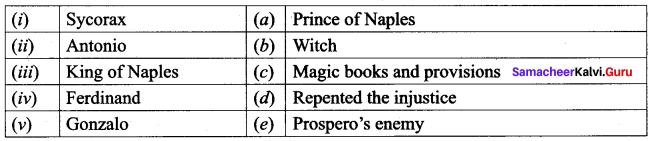
Samacheer Kalvi 10th Science Solutions Chapter 1 Laws of Motion

Students who are preparing for the Science exam can download this Tamilnadu State Board Solutions for Class 10th Science Chapter 1 from here for free of cost. These Tamilnadu State Board Textbook Solutions PDF cover all 10th Science Laws of Motion Book Back Questions and Answers.

All these concepts of Chapter 1 Laws of Motion are explained very conceptually by the subject teachers in Tamilnadu State Board Solutions PDF as per the prescribed Syllabus & guidelines. You can download Samacheer Kalvi 10th Science Book Solutions Chapter 1 Laws of Motion State Board Pdf for free from the available links. Go ahead and get Tamilnadu State Board Class 10th Science Solutions of Chapter 1 Laws of Motion.

Tamilnadu Samacheer Kalvi 10th Science Solutions Chapter 1 Laws of Motion

Kickstart your preparation by using this Tamilnadu State Board Solutions for Class 10th Science Chapter 1 Laws of Motion Questions and Answers and get the max score in the exams. You can cover all the topics of Chapter 1 easily after studying the Tamilnadu State Board Class 10th Science Textbook solutions pdf. Download the Tamilnadu State Board Science Chapter 1 Laws of Motion solutions of Class 10th by accessing the links provided here and ace up your preparation.

Samacheer Kalvi 10th Science Laws of Motion Textual Solved Problems

10th Science Laws Of Motion Book Back Answers Question 1.
Calculate the velocity of a moving body of mass 5 kg whose linear momentum is 2.5 kg ms-1.
Solution:
Linear momentum = mass × velocity
Velocity = \(\frac { linear momentum }{ mass }\)
V = \(\frac { 2.5 }{ 0.5 }\) = 0.5 ms-1.

Laws Of Motion Class 10 Questions And Answers Question 2.
A door is pushed, at a point, whose distance from the hinges is 90 cm, with a force of 40 N. Calculate the moment of the force about the hinges.
Solution:
Formula: The moment of a force M = F × d
Given: F = 40 N and d = 90 cm = 0.9 m.
Hence, moment of the force = 40 × 0.9 = 36 Nm.

Laws Of Motion Class 10 Samacheer Question 3.
At what height from the centre of the Earth the acceleration due to gravity will be \(\frac { 1 }{ 4 }\)th of its value as at the Earth.
Solution:
Data: Height from the centre of the Earth, R’ = R + h
The acceleration due to gravity at that height, g’ = \(\frac { g }{ 4 }\)
Formula:
10th Science Laws Of Motion Book Back Answers Samacheer Kalvi
From the centre of the Earth, the object is placed at twice the radius of the earth.

Samacheer Kalvi 10th Science Laws of Motion Textbook Evaluation

I. Choose the correct answer.

Laws Of Motion Class 10 Book Back Answers 1.
The inertia of a body depends on _____ .
(a) weight of the object
(b) acceleration due to gravity of the planet
(c) mass of the object
(d) Both a & b.
Answer:
(c) mass of the object

10th Science Unit 1 Question 2.
Impulse is equals to:
(a) rate of change of momentum
(b) rate of force and time
(c) change of momentum
(d) rate of change of mass
Answer:
(c) change of momentum

10th Science Laws Of Motion Question 3.
Newton’s III law is applicable to ______ .
(a) for a body is at rest
(b) for a body in motion
(c) both a & b
(d) only for bodies with equal masses.
Answer:
(c) both a & b

10th Law Of Motion Question 4.
Plotting a graph for momentum on the X-axis and time on Y-axis. The slope of the momentum-time graph gives:
(a) Impulsive force
(b) Acceleration
(c) Force
(d) Rate of force
Answer:
(c) Force

Laws Of Motion – Class 10 New Syllabus Question 5.
In which of the following sport the turning of the effect of force used?
(a) swimming
(b) tennis
(c) cycling
(d) hockey.
Answer:
(c) cycling

10th Physics Laws Of Motion Question 6.
The unit of ‘g’ is ms-2. It can be also expressed as _____ .
(a) cm s-1
(b) N kg-1
(c) Nm2 kg-1
(d) cm2 s-2
Answer:
(b) N kg-1

Laws Of Motion 10th Science Question 7.
One kilogram force equals to:
(a) 9.8 dyne
(b) 9.8 × 10⁴ N
(c) 98 × 104 dyne
(d) 980 dyne
Answer:
(c) 98 × 104 dyne

10th Standard Science Laws Of Motion Question 8.
The mass of a body is measured on planet Earth as M kg. When it is taken to a planet of radius half that of the Earth then its value will be ____ kg.
(a) 4M
(b) 2M
(c) \(\frac { M }{ 4 }\)
(d) M.
Answer:
(c) \(\frac { M }{ 4 }\)

10th Science Law Of Motion Question 9.
If the Earth shrinks to 50% of its real radius its mass remaining the same, the weight of a body on the Earth will _____ .
(a) decrease by 50%
(b) increase by 50%
(c) decrease by 25%
(d) increase by 300%.
Answer:
(c) decrease by 25%

Laws Of Motion Class 10 In Tamil Question 10.
To project the rockets which of the following
principle(s) is /(are) required?
(a) Newton’s third law of motion
(b) Newton’s law of gravitation
(c) Law of conservation of linear momentum
(d) Both (a) and (c)
Answer:
(d) Both (a) and (c)

II. Fill in the blanks.

10th Science Lesson 1 Question 1.
To produce a displacement _____ is required.
Answer:
force.

10th Science Solution Samacheer Kalvi Question 2.
Passengers lean forward when the sudden brake is applied in a moving vehicle. This can be explained by ____.
Answer:
the inertia of motion.

Samacheer Kalvi Guru 10th Science Question 3.
By convention, the clockwise moments are taken as _____ and the anticlockwise moments are taken as _____.
Answer:
negative, positive.

10th Science Solutions Samacheer Kalvi Question 4.
______ is used to change the speed of the car.
Answer:
Acceleration.

10th Science Solutions Samacheer Question 5.
A man of mass 100 kg has a weight of _____ at the surface of the Earth.
Answer:
980 N.

III. State whether the following statements are true or false. Correct the statement if it is false:

Class 10 Samacheer Kalvi Science Solutions Question 1.
The linear momentum of a system of particles is always conserved.
Answer:
False.
Correct Statement: The linear momentum of a system of particles is always conserved if no external force acts.

10th Samacheer Kalvi Science Solutions Question 2.
The apparent weight of a person is always equal to his actual weight.
Answer:
True.

Question 3.
Weight of a body is greater at the equator and less at the polar region.
Answer:
False.
Correct Statement: Weight of a body is lesser at the equator and greater at the polar region.

Question 4.
Turning a nut with a spanner having a short handle is so easy than one with a long handle.
Answer:
False.
Correct Statement: Turning a nut with a spanner having a short handle is so harder than one with a long handle.

Question 5.
There is no gravity in the orbiting space station around the Earth. So the astronauts feel weightlessness.
Answer:
False.
Correct Statement: There is a gravity in the orbiting space station around the earth. Since space station and astronauts have equal acceleration. Both the astronauts and space station are in the state of weightlessness.

IV. Match the following.

Question 1.

Column IColumn II
1. Newton’s I law(a) Propulsion of a rocket
2. Newton’s II law(b) Stable equilibrium of a body
3. Newton’s III law(c) Law of force
4. Law of conservation of linear momentum(d) Flying nature of a bird

Answer:
1. (b) Stable equilibrium of a body
2. (c) Law of force
3. (d) Flying nature of a bird
4. (a) Propulsion of a rocket

V. Assertion & Reasoning

Mark the correct choice as
(a) If both the assertion and the reason are true and the reason is the correct explanation of assertion.
(b) If both the assertion and the reason are true, but the reason is not the correct explanation of the assertion.
(c) Assertion is true, but the reason is false.
(d) Assertion is false, but the reason is true.

Question 1.
Assertion: The sum of the clockwise moments is equal to the sum of the anticlockwise moments.
Reason: The principle of conservation of momentum is valid if the external force on the system is zero.
Answer:
(b) If both the assertion and the reason are true, but the reason is not the correct explanation of the assertion.

Question 2.

  1. Assertion: The value of ‘g’ decreases as height and depth increase from the surface of the Earth.
  2. Reason: ‘g’ depends on the mass of the object and the Earth.

Answer:
(c) The assertion is true, but the reason is false.

VI. Answer briefly.

Question 1.
Define inertia. Give its classification.
Answer:
Inertia: The inherent property of a body to resist any change in its state of rest or the state of uniform motion, unless it is influenced upon by an external unbalanced force, is known as ‘inertia’.
Types of Inertia

  • Inertia of rest
  • Inertia of motion
  • Inertia of direction

Question 2.
Classify the types of force based on their application.
Answer:

  1. Like parallel forces
  2. Unlike parallel forces

Question 3.
If a 5 N and a 15 N forces are acting opposite to one another. Find the resultant force and the direction of action of the resultant force.
Solution:
The two forces are unlike parallel forces
Laws Of Motion Class 10 Questions And Answers Samacheer Kalvi Chapter 1
Let P = 5N, Q = 15N
Resultant force (R) = P – Q = 5 + (-15) = -10N
R = -10N.
The resultant force acting along the direction of “Q”.

Question 4.
Differentiate mass and weight.
Answer:

MassWeight
The quantity of matter contained in the bodyThe gravitation force exerted on it due to the Earth’s gravity alone.
Scalar quantityVector quantity
Unit: KgUnit: N
Constant at all the placesVariable with respect to gravity.

Question 5.
Define moment of a couple.
Answer:
Rotating effect of a couple is known as moment of a couple.
Moment of a couple = Force × perpendicular distance between the line of action of forces
M = F × S

Question 6.
State the principle of moments.
Answer:
When a number of like or unlike parallel forces act on a rigid body and the body is in equilibrium, then the algebraic sum of the moments in the clockwise direction is equal to the algebraic sum of the moments in the anticlockwise direction.

Question 7.
State Newton’s second law.
Answer:
“The force acting on a body is directly proportional to the rate of change of linear momentum of the body and the change in momentum takes place in the direction of the force”.

Question 8.
Why a spanner with a long handle is preferred to tighten screws in heavy vehicles?
Answer:
This is because turning effect to tighten the screws depends upon the perpendicular distance of the applied force from the axis of rotation is power arm. Larger the power armless is the force required to turn the screws. So spanner is provided with a long handle.

Question 9.
While catching a cricket ball the fielder lowers his hands backwards. Why?
Answer:
(i) When the fielder lowers his hands backwards, he increases the value of time of collision and so retardation is decreased.
(ii) Hence retarding force becomes lesser than before and the palm of the fielder is not hurt very much.

Question 10.
How does an astronaut float in a space shuttle?
Answer:
An astronaut float in a space shuttle because both are in the state of weightlessness. Both are experiencing equal acceleration towards earth as free fall bodies. Astronauts are not floating but falling freely.

VII. Solve the given problems.

Question 1.
Two bodies have a mass ratio of 3 : 4. The force applied to the bigger mass produces an acceleration of 12 ms-2. What could be the acceleration of the other body, if the same force acts on it?
Solution:
Mass ratio of the bodies = 3 : 4 and same force is (m1 : m2) acting on the body and a2 = 12 ms-2
∴ m1a1 = m2a2
\(\frac{m_{1}}{m_{2}}=\frac{a_{2}}{a_{1}} \Rightarrow \frac{3}{4}=\frac{a_{2}}{a_{1}}\)
\(a_{1}=\frac{4}{3} \times 12=16 \mathrm{ms}^{-2}\)

Question 2.
A ball of mass 1 kg moving with a speed of 10 ms-1 rebounds after a perfectly elastic collision with the floor. Calculate the change in linear momentum of the ball.
Solution:
Mass of a ball = 1 kg
Velocity of the bail before collision,
u = 10 m/s
Velocity of the ball after collision,
v = – u
= -10 m/s
Change in momentum,
P = m(v – u)
P = 1(-10 – 10)
= -20 kg m/s.

Question 3.
A mechanic unscrews a nut by applying a force of 140 N with a spanner of length 40 cm. What should be the length of the spanner if a force of 40 N is applied to unscrew the same nut?
Solution:
Given F1 = 140 N, d1 = 40 cm, F2 = 40 N, d2 = ?
In, both the cases, moment of forces applied are equal
F1d1 = F2d2
\(\begin{array}{l}{d_{2}=\left(\frac{F_{1}}{F_{2}}\right) d_{1}} \\ {d_{2}=40 \times \frac{140}{40}=140 \mathrm{cm}}\end{array}\)

Question 4.
The ratio of masses of two planets is 2 : 3 and the ratio of their radii are 4 : 7 Find the ratio of their accelerations due to gravity.
Solution:
The ratio of masses of two planets m1 : m2 = 2 : 3
The ratio of radii of two planets R1 : R2 = 4 : 7
Formula:
Laws Of Motion Class 10 Samacheer Kalvi Chapter 1

VIII. Answer in detail.

Question 1.
What are the types of inertia? Give an example for each type.
Answer:
Types of Inertia:
(i) Inertia of rest: The resistance of a body to change its state of rest is called inertia of rest. Eg: When you vigorously shake the branches of a tree, some of the leaves and fruits are detached and they fall down.

(ii) Inertia of motion: The resistance of a body to change its state of motion is called inertia of motion. Eg: An athlete runs some distance before jumping. Because, this will help him jump longer and higher.

(iii) Inertia of direction: The resistance of a body to change its direction of motion is called inertia of direction. Eg: When you make a sharp turn while driving a car, you tend to lean sideways.

Question 2.
State Newton’s laws of motion.
Answer:
Newton’s First Law: Everybody continues to be in its state of rest or the state of uniform motion along a straight line unless it is acted upon by some external force.

Newtons Second law: The force acting on a body is directly proportional to the rate of change of linear momentum of the body and the change in momentum takes place in the direction of the force.

Newtons Third Law: For every action, there is an equal and opposite reaction. They always act on two different bodies.

Question 3.
Deduce the equation of a force using Newton’s second law of motion.
Answer:
“The force acting on a body is directly proportional to the rate of change of linear momentum of the body and the change in momentum takes place in the direction of the force”.
Let, ‘m’ be the mass of a moving body, moving along a straight line with an initial speed ‘u’ After a time interval of ‘t’, the velocity of the body changes to ‘v’ due to the impact of an unbalanced external force F.
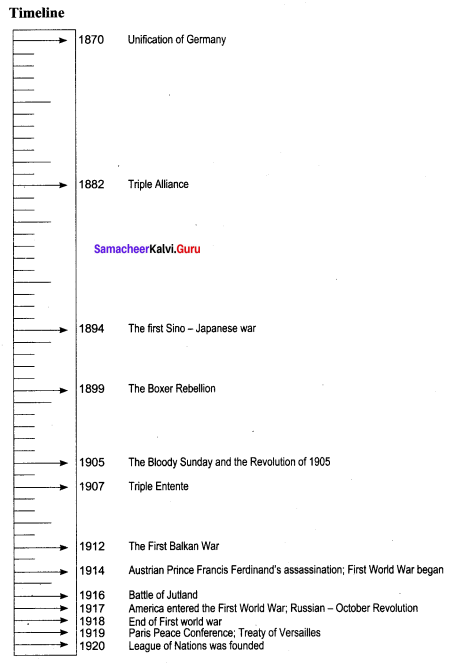
Initial momentum of the body (Pi) = mu
Final momentum of the body (Pf) = mv
Change in momentum ∆p = Pf – Pi = mv – mu
By Newton’s second law of motion,
Force, F ∝ rate of change of momentum
F ∝ change in momentum / time
\(\begin{array}{l}{\mathrm{F} \propto \frac{m v-m u}{t}} \\ {\mathrm{F}=\frac{k m(v-u)}{t}}\end{array}\)
Here, k is the proportionality constant, k = 1 in all systems of units.
Hence, \(\mathrm{F}=\frac{m(v-u)}{t}\)
Since, acceleration = change in velocity / time,
a = (v – u)/t.
Hence, we have F = m × a
Force = mass × acceleration

  • No external force is required to maintain the motion of a body moving with uniform velocity.
  • When the net force acting on a body is not equal to zero, then definitely the velocity of the body will change.
  • Thus, change in momentum takes place in the direction of the force. The change may take place either in magnitude or in direction or in both.

Question 4.
State and prove the law of conservation of linear momentum.
Answer:
(i) There is no change in the linear momentum of a system of bodies as long as no net external force acts on them.
(ii) Let us prove the law of conservation of linear momentum with the following illustration:
Laws Of Motion Class 10 Book Back Answers Samacheer Kalvi Chapter 1
(iii) Let two bodies A and B having masses m1 and m2 move with initial velocity u1 and u2 in a straight line.
(iv) Let the velocity of the first body be higher than that of the second body. i.e., u1 > u2.
(v) During an interval of time t second, they tend to have a collision. After the impact, both of them move along the same straight line with a velocity v1 and v2 respectively.
Force on body B due to A,
\(\mathrm{F}_{\mathrm{B}}=\frac{m_{2}\left[v_{2}-u_{2}\right]}{t}\)
Force on body A due to B,
\(\mathrm{F}_{\mathrm{A}}=\frac{m_{1}\left[v_{1}-u_{1}\right]}{t}\)
By Newton’s III law of motion, Action force = Reaction force
FA = -FB
\(\begin{aligned} \frac{m_{1}\left[v_{1}-u_{1}\right]}{t} &=\frac{m_{2}\left[v_{2}-u_{2}\right]}{t} \\ m_{1} v_{1}+m_{2} v_{2} &=m_{1} u_{1}+m_{2} u_{2} \end{aligned}\)
The above equation confirms in the absence of an external force, the algebraic sum of the momentum after collision is numerically equal to the algebraic sum of the momentum before collision.
Hence the law of conservation linear momentum is proved.

Question 5.
Describe rocket propulsion.
Answer:
Propulsion of rockets is based on the law of conservation of linear momentum as well as Newton’s III law of motion. Rockets are filled with a fuel (either liquid or solid) in the propellant tank. When the rocket is fired, this fuel is burnt and a hot gas is ejected with a high speed from the nozzle of the rocket, producing a huge momentum. To balance this momentum, an equal and opposite reaction force is produced in the combustion chamber, which makes the rocket project forward.

While in motion, the mass of the rocket gradually decreases, until the fuel is completely burnt out. Since, there is no net external force acting on it, the linear momentum of the system is conserved. The mass of the rocket decreases with altitude, which results in the gradual increase in velocity of the rocket. At one stage, it reaches a velocity, which is sufficient to just escape from the gravitational pull of the Earth. This velocity is called escape velocity.

Question 6.
State the universal law of gravitation and derive its mathematical expression.
Answer:
This law states that every particle of matter in this universe attracts every other particle with a force. This force is directly proportional to the product of their masses and inversely proportional to the square of the distance between the centres of these masses. The direction of the force acts along the line joining the masses.
10th Science Unit 1 Samacheer Kalvi Laws Of Motion
The force between the masses is always attractive and it does not depend on the medium where they are placed.
Let, m1 and m2 be the masses of two bodies A and B placed r metre apart in space.
Force F ∝ m1 × m2
F ∝ \(1 / r^{2}\)
On combining the above two expressions
\(\begin{array}{l}{\mathrm{F} \propto \frac{m_{1} \times m_{2}}{r^{2}}} \\ {\mathrm{F}=\frac{\mathrm{G} m_{1} m_{2}}{r^{2}}}\end{array}\)
Where G is the universal gravitational constant.
Its value in SI unit is 6.674 × 10⁻¹¹ Nm2 kg-2.

Question 7.
Give the applications of the universal law of gravitation.
Answer:
Application of Newton’s law of gravitation are:
(i) Dimensions of the heavenly bodies can be measured using the gravitation law. Mass of the Earth, radius of the Earth, acceleration due to gravity, etc., can be calculated with a higher accuracy.
(ii) Helps in discovering new stars and planets.
(Hi) Helps to explain germination of roots is due to the property of geotropism which is the property of a root responding to the gravity.
(iv) One of the irregularities in the motion of stars is called ‘Wobble’ lead to the disturbance in the motion of a planet nearby. In this condition the mass of the star can be calculated using the law of gravitation.
(v) Helps to predict the path of the astronomical bodies.

IX. HOT Questions.

Question 1.
Two blocks of masses 8 kg and 2 kg respectively, lie on a smooth horizontal surface in contact with one other. They are pushed by a horizontally applied force of 15 N. Calculate the force exerted on the 2 kg mass.
Solution:
10th Science Laws Of Motion Samacheer Kalvi Chapter 1
Given: m1 = 8 kg, m2 = 2 kg, F = 15 N
F = mtotal, F = (m1 + m2) a = (8 + 2) a = 10 a
15 = 10 a
⇒ a = \(\frac{15}{10}=\frac{3}{2}\) ms-2
Force exerted by mass of 8 kg
F = m1 a = \(8 \times \frac{3}{2}\) = 12 N.

Question 2.
A heavy truck and bike are moving with the same kinetic energy. If the mass of the truck is four times that of the bike, then calculate the ratio of their momenta. (Ratio of momenta = 1 : 2)
Solution:
Given: Let m1, m2 are the masses of truck and bike.
m1 = 4m2
Here kinetic energies of both truck and bike are same
\(\begin{aligned} m_{1} v_{1}^{2} &=m_{2} v_{2}^{2} \\ 4 m_{2} v_{1}^{2} &=m_{2} v_{2}^{2} \\ \frac{v_{1}}{v_{2}} &=\frac{1}{2} \\ v_{2} &=2 v_{1} \end{aligned}\)
Ratio of momenta: \(\frac{p_{1}}{p_{2}}=\frac{m_{1} v_{1}}{m_{2} v_{2}}=\frac{4 m_{2}}{m_{2}} \cdot \frac{v_{1}}{2 v_{1}}\) = 2
P1 : P2 = 2 : 1.

Question 3.
“Wearing a helmet and fastening the seat belt is highly recommended for the safe journey”.Justify your answer using Newton’s laws of motion.
Answer:
During the motion of car and two wheelers, when the brakes are applied, the vehicles slow down but our body tends to continue in the same state of motion due to inertia. So this may cause injury to passengers. Hence they are advised to wear a helmet and seat belt.

Samacheer Kalvi 10th Science Laws of Motion Additional Questions

I. Choose the correct answer.

Question 1.
A cricketer catches a ball of mass 150 gm in 0.1s and which is moving with a speed of 20 ms-1, then he experiences the force of ____ _.
(a) 300 N
(b) 30 N
(c) 3 N
(d) 0.3 N.
Answer:
(b) 30 N
Hint: Impulse = change in momentum
F.∆t = mv – mu
\(\mathrm{F}=\frac{m v-m u}{\Delta t}\)
\(=\frac{150 \times 10^{-3} \times 20}{0.1}=30 \mathrm{N}\)

Question 2.
SI unit of force is:
(a) Dyne
(b) newton
(c) kgms-1
(d) Joule
Answer:
(b) newton

Question 3.
A coin is dropped in a lift. It takes time t1 to reach the floor, when the lift is stationary, it takes time t2, when the lift is moving up with constant acceleration, then ____ _.
(a) t1 > t2
(b) t1 < t2
(c) t1 = t2
(d) None.
Answer:
(a) t1 > t2

Question 4.
An unbalanced force acts on a body, the body:
(a) must remain at rest
(b) must be accelerated
(c) must move with uniform velocity
(d) move with uniform motion
Answer:
(b) must be accelerated

Question 5.
A satellite in its orbit around the earth is weightless on account of its _____.
(a) velocity
(b) momentum
(c) angular momentum
(d) acceleration.
Answer:
(c) angular momentum

Question 6.
When two or more forces acting on a body and the body does not change its position, then the forces are:
(a) imbalanced
(b) mechanical force
(c) balanced forces
(d) none
Answer:
(c) balanced forces

Question 7.
What would be the acceleration due to gravity at another planet, whose mass and radius core twice that of earth?
(a) g
(b) \(\frac{g}{2}\)
(c) \(\frac{g}{4}\)
Answer:
(b) \(\frac{g}{2}\)
Hint: We know that \(\mathrm{g}=\frac{\mathrm{GM}}{\mathrm{R}^{2}}\)
\(\frac{g_{1}}{g_{2}}=\frac{\left(\frac{\mathrm{GM}}{\mathrm{R}^{2}}\right)}{\left(\frac{\mathrm{G} .2 \mathrm{M}}{4 \mathrm{R}^{2}}\right)}\)
\(\frac{g_{1}}{g_{2}}=2 \quad \Rightarrow \quad g_{2}=\frac{1}{2} g_{1}\)

Question 8.
At sea level, the value of “g” is maximum at _____.
(a) the poles
(b) the equator
(c) 45° south latitude
(d) 45° north of longitude.
Answer:
(a) the poles

Question 9.
An object cannot change the state of rest or motion, until a force is applied. This inability of the object is called:
(a) inertia
(b) mass
(c) weight
(d) acceleration
Answer:
(a) inertia

Question 10.
The ability of a body to maintain its state of rest or motion is called ______.
(a) mechanics
(b) kinematics
(c) kinetics
(d) Inertia.
Answer:
(d) Inertia.

Question 11.
_____ deals with the bodies, which are at rest under the action of forces.
(a) Statics
(b) Dynamics
(c) Kinematics
(d) Kinetics.
Answer:
(a) Statics

Question 12.
A motor car starts from rest and moves after 5 seconds. If its velocity is 200 m/s then its acceleration is:
(a) 100 m/s²
(b) 40 m/s²
(c) 20 m/s²
(d) 80 m/s²
Answer:
(b) 40 m/s²

Question 13.
_____ deals with the motion of bodies considering the cause of motion.
(a) Force
(b) Dynamics
(c) Statics
(d) Kinetics.
Answer:
(d) Kinetics

Question 14.
Linear momentum = _____
(a) mass × velocity
(b) mass × distance
(c) distance × time
(d) \(\frac{\text { mass }}{\text { velocity }}\).
Answer:
(a) mass × velocity

Question 15.
The inability of the body to change its state is:
(a) force
(b) momentum
(c) acceleration
(d) inertia
Answer:
(d) inertia

Question 16.
Two or more forces of equal or unequal magnitude acting along the same direction, parallel to each other are called _____.
(a) like parallel forces
(b) unlike parallel forces
(c) resultant force
(d) balanced force.
Answer:
(a) like parallel forces

Question 17.
The axis of the fixed edge about which the thing is rotated is called as _____ .
(a) axis of rotation
(b) fixed axis rotation
(c) point of rotation
(d) Fixed point.
Answer:
(a) axis of rotation

Question 18.
When a net force acts on an object, the object will be accelerated in the direction of force with an acceleration proportional to:
(a) force on the object
(b) velocity
(c) mass
(d) inertia
Answer:
(a) force on the object

Question 19.
Rotating effect of a couple is known as ______ .
(a) product of forces
(b) the momentum of a couple
(c) mass
(d) momentum.
Answer:
(b) momentum of a couple

Question 20.
The amount of force required to produce an acceleration of 1 ms-2 in a body of mass _____ is called unit force.
(a) 10 kg
(b) 100 kg
(c) 1 kg
(d) 0 kg.
Answer:
(c) 1 kg

Question 21.
The acceleration of a body is due to:
(a) balance force
(b) electrostatic force
(c) unbalanced force
(d) conservative force
Answer:
(c) unbalanced force

Question 22.
Universal gravitational constant ______ .
(a) G = 6.684 × 10⁻¹⁰ Nm2 kg-1
(b) G = 7.4 × 10¹⁰ Nm2
(c) G = 6.623 × 10¹¹ Nm2 kg-1
(d) G = 6.674 × 10⁻¹¹ Nm2 kg-2
Answer:
(d) G = 6.674 × 10⁻¹¹ Nm2 kg-2

Question 23.
Mean value of the acceleration due to gravity is ______ .
(a) 10.1 ms-2
(b) 8.8 ms-2
(c) 9.8 ms-2
(d) 9.8 ms.
Answer:
(c) 9.8 ms-2

Question 24.
The unit of weight is:
(a) kg
(b) g
(c) Newton
(d) ms-1
Answer:
(c) Newton

Question 25.
The value of accelaration due to gravity on the surface of the moon is _____ .
(a) 1.75 ms-1
(b) 3.8 ms-2
(c) 1.625 ms-2
(d) 1.625 ms-1
Answer:
(c) 1.625 ms-2

Question 26.
The unit of weight is _____ .
(a) kg m
(b) kg
(c) newton
(d) kg m-1
Answer:
(c) newton

Question 27.
The weight of a body is _____ poles than at the equatorial region.
(a) more
(b) less
(c) zero
(d) one.
Answer:
(a) more

Question 28.
In a collision between a heavier body and a lighter body, which body experiences greater force?
(a) heavier body
(b) lighter body
(c) both the body experience same force
(d) both body exchange acceleration
Answer:
(c) both the body experience same force

II. Fill in the blanks.

Question 1.
Turning a tap is an example of ____
Answer:
couple.

Question 2.
Torque is a _______ quantity.
Answer:
vector.

Question 3.
1 gf is equal to _____ dyne.
Answer:
980.

Question 4.
The resultant force acting on a body is equal to zero then the body will be in ______
Answer:
equilibrium.

Question 5.
The force equal to resultant but opposite in direction is ______
Answer:
equilibrate.

Question 6.
The product of force and time is ______
Answer:
impulse.

Question 7.
The force between the masses is always ______
Answer:
attractive.

Question 8.
The quantity of matter contained in the object is known as _____
Answer:
mass.

Question 9.
The magnitude of the universal gravitational constant is _____.
Answer:
6.674 × 10⁻¹¹ Nm2 kg-2

Question 10.
Propulsion of rockets is based on the ____ and ____
Answer:
Law of conservation of linear momentum & Newton’s third law.

Question 11.
Parallel unequal forces are acting in ______ directions.
Answer:
Opposite.

Question 12.
Torque and force are the ____ quantities.
Answer:
vector.

Question 13.
The unit of moment of a couple is _____ .
Answer:
newton metre (Nm).

Question 14.
A _____ enables you to manoeuvre a car easily by transferring a _______ to the wheels with less effort.
Answer:
steering wheel, torque.

Question 15.
_____ is required to produce the acceleration of a body.
Answer:
Force.

Question 16.
The acceleration is produced along the radius is called ______
Answer:
centripetal acceleration.

Question 17.
______ is equal to the magnitude of change in momentum.
Answer:
impulse.

Question 18.
A large force acting for a very short interval of time is called as ______ .
Answer:
impulse Force.

Question 19.
Mass of the earth _____
Answer:
5.972 × 1024 kg.

Question 20.
The relation between acceleration due to gravity (g) and the universal gravitational constant (G) is _____ .
Answer:
\(g=\frac{G M}{R^{2}}\).

III. State whether the following statements are true or false, correct the statement if it is false.

Question 1.
Rest and motion are interrelated terms.
Answer:
True.

Question 2.
In the C.G.S. system, the unit of linear momentum is kg ms-1.
Answer:
False.
Correct Statement: In the C.G.S. system, the unit of linear momentum is g cms-1.

Question 3.
An external force is required to maintain the motion of a body moving with uniform velocity.
Answer:
False.
Correct Statement: No external force is required to maintain the motion of a body moving with uniform velocity.

Question 4.
The amount of force required for a body of mass 1 gram produces an acceleration of 1 cm s-2
Answer:
True.

Question 5.
By Newton’s III – law of motion, the action force is not equal to the reaction force.
Answer:
False.
Correct Statement: By Newton’s III – law of motion, the action force is equal to the reaction force.

Question 6.
The value of acceleration due to gravity (g) is not the same at all the points on the surface of the earth.
Answer:
True.

Question 7.
The value of acceleration due to gravity on the surface of the moon is 1.625 ms-2.
Answer:
True.

Question 8.
The regularities in the motion of stars are called ‘wobble’.
Answer:
False.
Correct Statement: The irregularities in the motion of stars is called ‘wobble’.

Question 9.
Mechanics is divided into kinematics and kinetics.
Answer:
False.
Correct Statement: Mechanics is divided into statics and dynamics.

Question 10.
Application of Newton’s law of gravitation helps to predict the path of the astronomical bodies.
Answer:
True.

IV. Match the following.

Question 1.

1. Linear momentum(a) Mass and acceleration
2. Force(b) Change in momentum
3. Moment of force(c) GM/R2
4. Impulse(d) Mass and velocity
5. Acceleration due to gravity(e) Force and perpendicular distance

Answer:
1. (d) Mass and velocity
2. (a) Mass and acceleration
3. (e) Force and perpendicular distance
4. (b) Change in momentum
5. (c) GM/R2

Question 2.

1. Kinetics(a) Causes the motion
2. Kinematics(b) In equilibrium
3. Balanced force(c) The motion of bodies without cause
4. Unbalanced force(d) The motion of bodies with cause

Answer:
1. (d) The Motion of bodies with cause
2. (c) The Motion of bodies without cause
3. (b) In equilibrium
4. (a) Causes the motion

V. Assertion & Reasoning

Mark the correct choice as
(a) If both the assertion and the reason are true and the reason is the correct explanation of assertion.
(b) If both the assertion and the reason are true, but the reason is not the correct explanation of the assertion.
(c) Assertion is true, but the reason is false.
(d) Assertion is false, but the reason is true.

Question 1.
Assertion: At poles value of acceleration due to gravity (g) is greater than that of the equator.
Reason: Earth rotates on its axis in addition to revolving around the sun.
Answer:
(a) If both the assertion and the reason are true and the reason is the correct explanation of assertion.

Question 2.
Assertion: The force exerted by the earth on an apple is more than that exerted by apple on the earth.
Reason: The force on apple exerts on the earth is determined by the mass of the apple only.
Answer:
(d) The assertion is false but the reason is true

Question 3.
Assertion: A freely falling body is in the state of weightlessness
Reason: A body becomes conscious of its weight only when it is opposed
Answer:
(a) If both the assertion and the reason are true and the reason is the correct explanation of assertion.

Question 4.
Assertion: Newton’s third law of motion is applicable only when bodies are in motion.
Reason: Newton’s third law applies to all types of forces, e.g. gravitational, electric or magnetic forces.
Answer:
(d) The assertion is false but the reason is true.

Question 5.
Assertion: The apparent weight of the person is zero, in which condition or state is known as weightless.
Reason: When the person in a lift moves down with an acceleration (a) is equal to the acceleration due to gravity (g)
Answer:
(a) If both the assertion and the reason are true and the reason is the correct explanation of assertion.

Question 6.
Assertion: A gear is a circular wheel with teeth around its rim.
Reason: It helps to change the speed of rotation of a wheel by changing the force and helps to transmit power.
Answer:
(c) The assertion is true, but the reason is false.

Question 7.
Assertion: Mass of a body is defined as the gravitational force exerted on it due to earth’s gravity alone
Reason: Weight = mass × acceleration due to gravity.
Answer:
(d) The assertion is false, but the reason is true.

Question 8.
Assertion: Weight is a vector quantity.
Reason: Direction of weight is always towards the centre of the earth.
Answer:
(a) If both the assertion and the reason are true and the reason is the correct explanation of assertion.

Question 9.
Assertion: Resultant force is equal to the vector sum of all the forces.
Reason: A system cannot be brought to equilibrium by applying another force.
Answer:
(b) If both the assertion and the reason are true, but the reason is not the correct explanation of the assertion.

VI. Answer briefly

Question 1.
Define Linear momentum.
Answer:
The product of mass and velocity of a moving body gives the magnitude of linear momentum. It acts in the direction of the velocity of the object. Linear momentum is a vector quantity.
Linear Momentum = mass × velocity.
Unit of momentum in SI system is Kg ms-1 and in C.G.S system its unit is g cm s-1

Question 2.
What is the resultant force?
Answer:
When several forces act simultaneously on the same body, then the combined effect of the multiple forces can be represented by a single force, which is termed as ‘resultant force’.

Question 3.
What is meant by equilibrant?
Answer:
A system can be brought to equilibrium by applying another force, which is equal to the resultant force in magnitude, but opposite in direction. Such force is called as ‘Equilibrant’.

Question 4.
Explain the Newton third law of motion with examples.
Answer:
‘For every action, there is an equal and opposite reaction. They always act in two different bodies’.
Example: When you fire a bullet, the gun recoils backwards and the bullet is moving forward (Action) and the gun equalises this forward action by moving backwards (Reaction).

Question 5.
How did the change in momentum achieve?
Answer:
Change in momentum can be achieved in two ways. They are:

  • A large force acting for a short period of time and
  • A smaller force acting for a longer period of time.

Question 6.
Define impulse.
Answer:
A large force acting for a very short interval of time is called as ‘Impulsive force’.When a force F acts on a body for a period of time t, then the product of force and time is known as ‘impulse’ represented by ‘J’
Impulse, J = F × t …….. (1)
By Newton’s second law
F = ∆p / t (A refers to change)
∆p = F × t ………. (2)
From (1) and (2)
J = ∆p
Impulse is also equal to the magnitude of change in momentum.
Its unit is kg ms-1 or Ns.

Question 7.
What is meant by free fall?
Answer:

  1. When the person in a lift moves down with an acceleration (a) equal to the acceleration due to gravity (g), i.e., when a = g, this motion is called as ‘free fall’.
  2. The apparent weight (R = m (g – g) = 0) of the person is zero. This condition or state refers to the state of weightlessness.

Question 8.
Define weightlessness.
Answer:
Whenever a body or a person falls freely under the action of Earth’s gravitational force alone, it appears to have zero weight. This state is referred to as ‘weightlessness’.

Question 9.
Explain the various causes of the apparent weight of a person in a moving lift.
Answer:

Case 1: Lift is moving upward with an acceleration ‘a’Case 2: Lift is moving downward with an acceleration ‘a’Case 3: Lift is at rest.Case 4: Lift is falling down freely
R – W = Fnet = ma
⇒ R = W + ma
⇒ R = mg + ma
⇒ R = m(g + a)
W – R = Fnet = ma
⇒ R = W – ma
⇒ R = mg – ma
⇒ R = m(g – a)
Here,the acceleration is zero
a = 0
R = W
R = mg
Here,the acceleration is equal to g
a = g
R = m(g – g) = 0
R > WR < WR = WR = 0
Apparent weight is greater than the actual weight.Apparent weight is lesser than the actual weight.Apparent weight is equal to the actual weight.Apparent weight is equal to zero.

Question 10.
Explain the variation of acceleration due to gravity.
Answer:
Variation of acceleration due to gravity (g):

  1. Since, g depends on the geometric radius of the Earth, (g ∝ 1 / R2), its value changes from one place to another on the surface of the Earth.
  2. The geometric radius of the Earth is maximum in the equatorial region and minimum in the polar region, the value of g is maximum in the polar region and minimum at the equatorial region.
  3. When you move to a higher altitude from the surface of the Earth, the value of g reduces.
  4. when you move deep below the surface of the Earth, the value of g reduces. Value of g is zero at the centre of the Earth.

Question 11.
Define one newton and one dyne.
Answer:
Definition of 1 newton (N): The amount of force required for a body of mass 1 kg produces an acceleration of 1 ms-2, 1 N = 1 kg ms-2
Definition of 1 dyne: The amount of force required for a body of mass 1 gram produces an acceleration of 1 cms-2, 1 dyne = 1 g cms-2; also 1 N = 105 dyne.

Question 12.
How can you measure the moment of the couple?
Answer:
(i) Rotating effect of a couple is known as the moment of a couple.
(ii) Moment of a couple is measured by the product of any one of the forces and the perpendicular distance between the line of action of two forces. The turning effect of a couple is measured by the magnitude of its moment.
(iii) Moment of a couple = Force × perpendicular distance between the line of action of forces
M = F × S
(iv) The unit of moment of a couple is newton metre (N m) in SI system and dyne cm in the CGS system.
(v) By convention, the direction of moment of a force or couple is taken as positive if the body is rotated in the anti-clockwise direction and negative if it is rotating in the clockwise direction.
They are shown in Figures.
10th Law Of Motion Samacheer Kalvi Chapter 1

Question 13.
Define Torque.
Answer:
(i) The rotating or turning effect of a force about a fixed point or fixed axis is called the moment of the force about that point or torque (τ).
(ii) τ = F × d
(iii) Torque is a vector quantity.
(iv) Its SI unit is Nm.

VII. Answ er in detail.

Question 1.
Explain any three application of Torque.
Answer:
Application of Torque:
(i) Gears: A gear is a circular wheel with teeth around its rim. It helps to change the speed of rotation of a wheel by changing the torque and helps to transmit power.

(ii) Seasaw: Most of you have played on the seesaw. Since there is a difference in the weight of the persons sitting on it, the heavier person lifts the lighter person. When the heavier person comes closer to the pivot point (fulcrum) the distance of the line of action of the force decreases. It causes less amount of torque to act on it. This enables the lighter person to lift the heavier person.

(iii) Steering Wheel: A small steering wheel enables you to manoeuvre a car easily by transferring torque to the wheels with less effort.

Question 2.
State Newton’s third law. Explain it with three examples.
Answer:
Newton’s third law of motion: Newton’s third law states that ‘for every action, there is an equal and opposite reaction. They always act in two different bodies’.
If a body A applies a force FA on a body B, then the body B reacts with force FB on the body A, which is equal to FA in magnitude, but opposite in direction.
FB = -FA
Examples:

  • When birds fly they push the air downwards with their wings (Action) and the air pushes the bird upwards (Reaction).
  • When a person swims he pushes the water using the hands backwards (Action), and the water pushes the swimmer in the forward direction (Reaction).
  • When you fire a bullet, the gun recoils backwards and the bullet is moving forward (Action) and the gun equalises this forward action by moving backwards (Reaction).

Question 3.
Derive the relation between ‘g’ and G. Explain how to determine the mass of earth.
Answer:
(i) Let us compute the magnitude of this force in two ways. Let, M be the mass of the Earth and m be the mass of the body.
(ii) The entire mass of the Earth is assumed to be concentrated at its centre.
(iii) The radius of the Earth is R = 6378 km (= 6400 km approximately). By Newton’s law of gravitation, the force acting on the body is given by
\(\mathrm{F}=\frac{\mathrm{GM} m}{\mathrm{R}^{2}}\) ….(1)
Laws Of Motion - Class 10 New Syllabus Samacheer Kalvi Chapter 1
(iv) The radius of the body considered is negligible when compared with the Earth’s radius. Now, the same force can be obtained from Newton’s second law of motion.
(v) According to this law, the force acting on the body is given by the product of its mass and acceleration (called weight). Here, acceleration of the body is under the action of gravity hence a = g
F = ma = mg
F = weight = mg ……. (2)
Comparing equations J = F × t and ΔP = F × t, we get
\(m g=\frac{G M m}{R^{2}}\) …….. (3)
Acceleration due to gravity
\(g=\frac{\mathrm{GMm}}{\mathrm{R}^{2}}\) ……. (4)
Mass of the Earth (M):
Rearranging the equation (4), the mass of the Earth is obtained as follows:
Mass of the Earth M = g R2 / G
Substituting the known values of g, R and G, you can calculate the mass of the Earth as M = 5.972 × 1024 kg.

VIII. Problems.

Question 1.
A cricket ball of mass 0.5 kg strikes a bat normally with a velocity of 30 ms-1 and rebounds with a velocity of 20 ms-1 in the opposite direction, calculate the impulse of the force exerted by the ball on the bat.
Solution:
Impulse = change in momentum = mu – (-mv)
= m (u + v)
= 0.5 (30 + 20)
= 25 Ns

Question 2.
A force exerted on a body of mass 100 g changes its speed by 0.2 ms-1 in each second. Calculate the magnitude of the force.
Given, mass m = 100 g = 0.1 kg and acceleration a = 200 cms-2 = 0.2 ms-2.
Solution:
F = ma = 0.1 × 0.2 = 0.02 N.

Believing that the Tamilnadu State Board Solutions for Class 10th Science Chapter 1 Laws of Motion Questions and Answers learning resource will definitely guide you at the time of preparation. For more details about Tamilnadu State Board Class 10th Science Chapter 1 textbook solutions, ask us in the below comments and we’ll revert back to you asap.