Samacheer Kalvi 9th Maths Solutions Chapter 4 Geometry Ex 4.3

You can Download Samacheer Kalvi 9th Maths Book Solutions Guide Pdf, Tamilnadu State Board help you to revise the complete Syllabus and score more marks in your examinations.

Tamilnadu Samacheer Kalvi 9th Maths Solutions Chapter 4 Geometry Ex 4.3

Question 1.
The diameter of the circle is 52 cm and the length of one of its chord is 20 cm. Find the distance of the chord from the centre.
Solution:
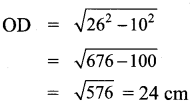
The distance of the chord from the centre O
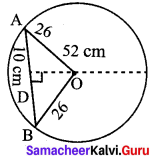
Samacheer Kalvi 9th Maths Chapter 4 Geometry Ex 4.3 1
Samacheer Kalvi 9th Maths Chapter 4 Geometry Ex 4.3 2

Question 2.
The chord of length 30 cm is drawn at the distance of 8cm from the centre of the circle. Find the radius of the circle.
Solution:
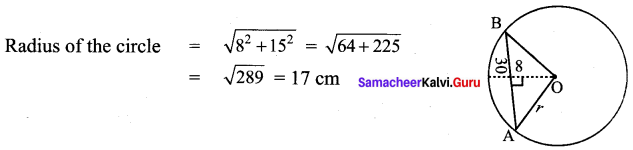
Samacheer Kalvi 9th Maths Chapter 4 Geometry Ex 4.3 50

Question 3.
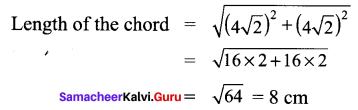
Find the length of the chord AC where AB and CD are the two diameters perpendicular to each other of a circle with radius 4 \(\sqrt{2}\) cm and also find ∠OAC and ∠OCA.
Solution:
∆OAC is an isoceles triangle with one angle 90°
∴ ∠OAC + ∠OCA = 180° – 90°
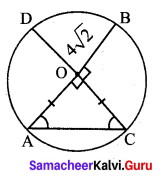
Samacheer Kalvi 9th Maths Chapter 4 Geometry Ex 4.3 3
2∠OAC = 90°
∠OAC = 45°
∴ ∠OCA = 45°
Samacheer Kalvi 9th Maths Chapter 4 Geometry Ex 4.3 4

Question 4.
A chord is 12cm away from the centre of the circle of radius 15 cm. Find the length of the chord.
Solution:
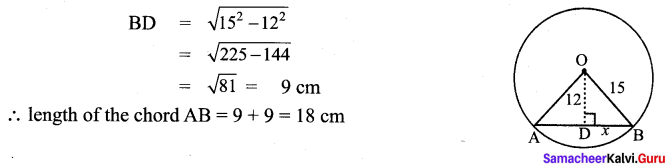
Samacheer Kalvi 9th Maths Chapter 4 Geometry Ex 4.3 5

Question 5.
In a circle, AB and CD are two parallel chords with centre O and radius 10 cm such that AB = 16 cm and CD = 12 cm determine the distance between the two chords?
Samacheer Kalvi 9th Maths Chapter 4 Geometry Ex 4.3 6
Solution:
The distance between the two chord FE = OE + OF
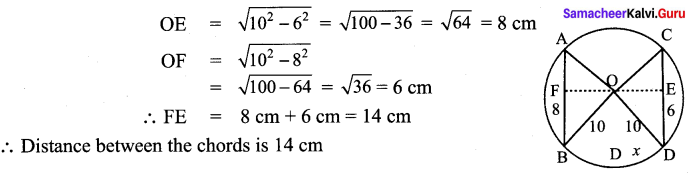
Samacheer Kalvi 9th Maths Chapter 4 Geometry Ex 4.3 7
∴ Distance between the chords is 14 cm

Question 6.
Two circles of radii 5 cm and 3 cm intersect at two points and the distance between their centres is 4 cm. Find the length of the common chord.
Solution:
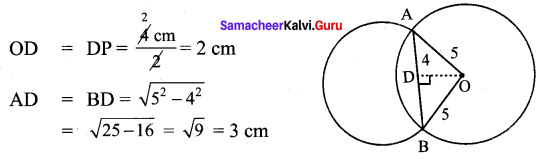
Samacheer Kalvi 9th Maths Chapter 4 Geometry Ex 4.3 9
The length of the common chord AB = AD + BD = (3 + 3) cm = 6 cm

Question 7.
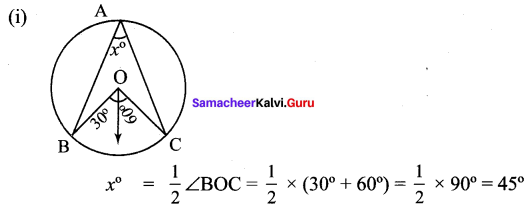
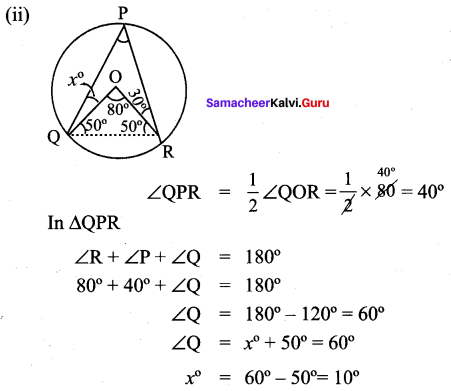
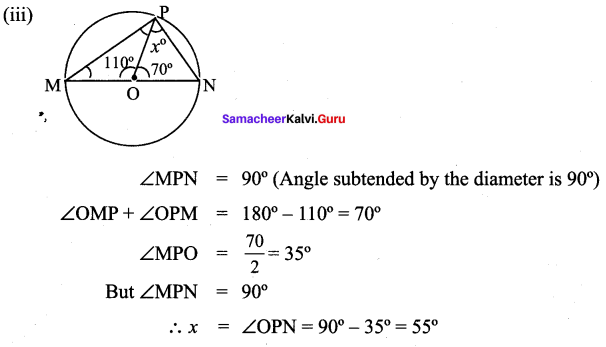
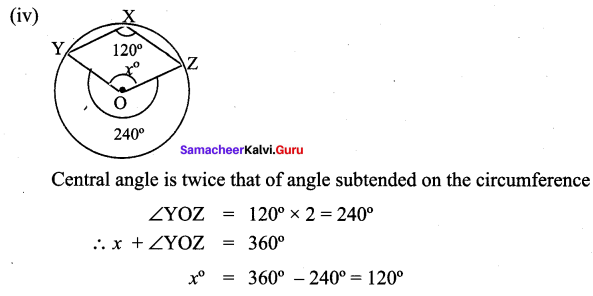
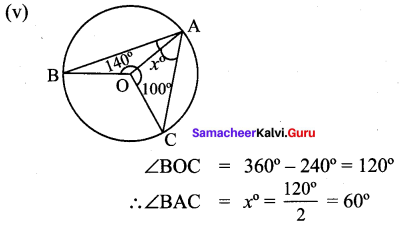
Find the value of x° in the following
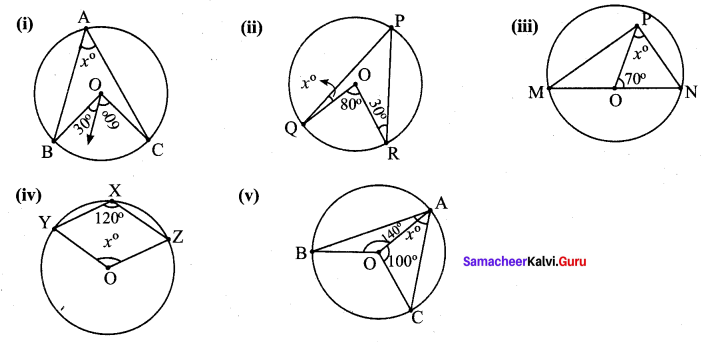
Samacheer Kalvi 9th Maths Chapter 4 Geometry Ex 4.3 10
Solution:
Samacheer Kalvi 9th Maths Chapter 4 Geometry Ex 4.3 11
Samacheer Kalvi 9th Maths Chapter 4 Geometry Ex 4.3 12
Samacheer Kalvi 9th Maths Chapter 4 Geometry Ex 4.3 13
Samacheer Kalvi 9th Maths Chapter 4 Geometry Ex 4.3 14
Samacheer Kalvi 9th Maths Chapter 4 Geometry Ex 4.3 60

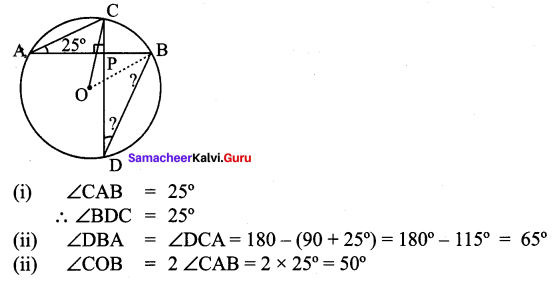
Question 8.
In the given figure, ∠CAB = 25°, find ∠BDC, ∠DBA and ∠COB
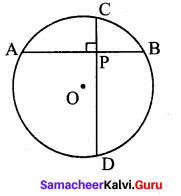
Samacheer Kalvi 9th Maths Chapter 4 Geometry Ex 4.3 15
Solution:
Samacheer Kalvi 9th Maths Chapter 4 Geometry Ex 4.3 16

Samacheer Kalvi 6th Maths Solutions Term 1 Chapter 4 Geometry Additional Questions

You can Download Samacheer Kalvi 6th Maths Book Solutions Guide Pdf, Tamilnadu State Board help you to revise the complete Syllabus and score more marks in your examinations.
Samacheer Kalvi 6th Maths Solutions Term 1 Chapter 4 Additional Questions

Tamilnadu Samacheer Kalvi 6th Maths Solutions Term 1 Chapter 4 Geometry Additional Questions

Question 1.
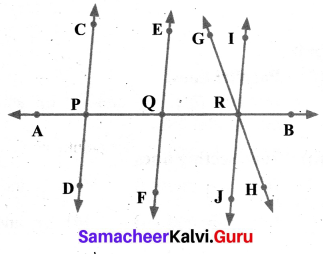
From the given figure, name the parallel lines
Samacheer Kalvi 6th Maths Term 1 Chapter 4 Geometry Additional Questions 1 Q1
Solution:
(i) Parallel Lines:
\(\overrightarrow{\mathrm{CD}}\) and \(\overrightarrow{\mathrm{EF}}\) ; \(\overrightarrow{\mathrm{CD}}\) and \(\overrightarrow{\mathrm{IJ}}\) ; \(\overrightarrow{\mathrm{EF}}\) and \(\overrightarrow{\mathrm{IJ}}\) are parallel lines.
(ii) Intersecting lines:
(a) \(\overrightarrow{\mathrm{AB}} \text { and } \overrightarrow{\mathrm{CD}}\)
(b) \(\overrightarrow{\mathrm{AB}} \text { and } \overrightarrow{\mathrm{EF}}\)
(c) \(\overrightarrow{\mathrm{AB}} \text { and } \overrightarrow{\mathrm{GH}}\)
(d) \(\overrightarrow{\mathrm{AB}} \text { and } \overrightarrow{\mathrm{IJ}}\)
(e) \(\overrightarrow{\mathrm{GH}} \text { and } \overrightarrow{\mathrm{IJ}}\)
(iii) Points of Intersection:
P, Q and R are the points of intersection.

Question 2.
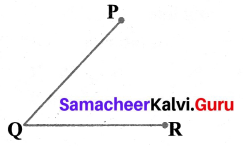
(a) Name the line segments in the figure.
(b) Is Q, the endpoint of each line segment?
Samacheer Kalvi 6th Maths Term 1 Chapter 4 Geometry Additional Questions 1 Q2
Solution:

(a) \(\overline{\mathrm{QP}} \text { and } \overline{\mathrm{QR}}\) are the line segments
(b) Yes, Q is the end point of each line segment

Question 3.
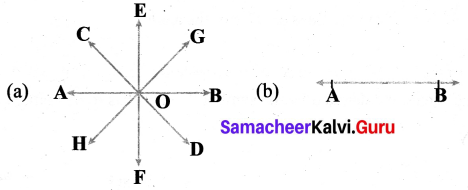
How many lines can pass through
(a) one given point
(b) two given points.
Solution:
Samacheer Kalvi 6th Maths Term 1 Chapter 4 Geometry Additional Questions 1 Q3
(a) An infinite number of lines can pass through one given point.
(b) Exactly one and only one line can pass through two given points.

Question 4.
A line contains how many points?
(a) minimum?
(b) maximum?
Solution:
(a) A line contains a minimum of two points.
(b) A line contain a maximum of infinitely many points.

Samacheer Kalvi 6th Maths Solutions Term 1 Chapter 4 Additional Questions

Question 5.
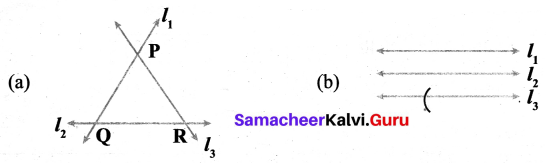
Write the (a) maximum and (b) the minimum number of point of intersection of three lines.
Solution:
Samacheer Kalvi 6th Maths Term 1 Chapter 4 Geometry Additional Questions 1 Q5
Maximum – 3 points of intersection
Minimum – No point of intersection

Fill in the blanks.

Question 6.
Complementary angle of 20° is _____
Solution:
70°

Question 7.
The supplementary angle of 90° is _____
Solution:
90°

Question 8.
78°, 12°, ______
Solution:
Complementary angle

Answer the following question.

Question 9.
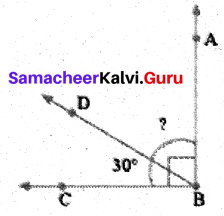
∠ABD =?
Samacheer Kalvi 6th Maths Term 1 Chapter 4 Geometry Additional Questions 2 Q1
Solution:
On Sum of complementary angles = 90°
∠ABC = 90°
∠CBD = 30°
∠ABD = ∠ABC – ∠DBC = 90° – 30° = 60°
∠ABD = 60°
Complementary angle of 30° = 60°

Question 10.
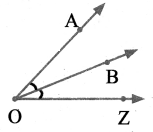
In the following figure, name the angles.
Samacheer Kalvi 6th Maths Term 1 Chapter 4 Geometry Additional Questions 2 Q2
Solution:
∠AOB, ∠BOZ, ∠AOZ

Question 11.
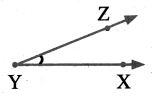
Write the alternate name of the angle ∠XYZ in the given figure.
Samacheer Kalvi 6th Maths Term 1 Chapter 4 Geometry Additional Questions 2 Q3
Solution:

∠Y or ∠ZYX

Samacheer Kalvi 6th Maths Solutions Term 1 Chapter 4 Additional Questions

Question 12.
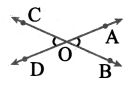
Draw the diagram of two angles having only one common point.
Samacheer Kalvi 6th Maths Term 1 Chapter 4 Geometry Additional Questions 2 Q4
Solution:
∠COD and ∠AOB have the point ‘O’ in common

Question 13.
What are the supplementary and complementary angles of 60°?
Solution:
Supplementary angle is 120°
Complementary angle is 30°

Question 14.
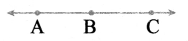
How many lines can you draw passing through three collinear points? Draw the figure also.
Solution:
Only one.
Samacheer Kalvi 6th Maths Term 1 Chapter 4 Geometry Additional Questions 3 Q1

Question 15.
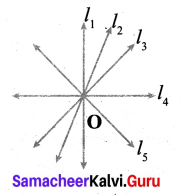
Write the maximum number of lines that can pass through a single point.
Solution:
Infinite.
Samacheer Kalvi 6th Maths Term 1 Chapter 4 Geometry Additional Questions 3 Q2

Question 16.
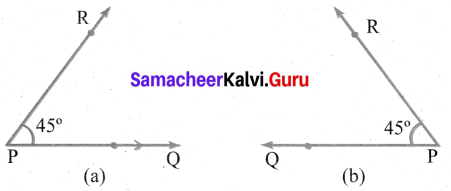
Use a protractor to draw an angle 45°.
Solution:
Samacheer Kalvi 6th Maths Term 1 Chapter 4 Geometry Additional Questions 3 Q3
Construction:
1. Drawn the base ray PQ.
2. Placed the centre of the protractor at the vertex P. Lined up the ray \(\overrightarrow{\mathrm{PQ}}\) with the 0° line. Then drawn and labelled a pointed (R) at the 45° mark on the inner scale (a) anticlockwise and (b) outer scale (clockwise)
3. Removed the protractor and drawn at \(\overrightarrow{\mathrm{PR}}\) to complete the angle
Now ∠P = ∠QPR = ∠RPQ = 45°.

Samacheer Kalvi 6th Maths Solutions Term 1 Chapter 4 Additional Questions

Samacheer Kalvi 9th Maths Solutions Chapter 4 Geometry Ex 4.2

You can Download Samacheer Kalvi 9th Maths Book Solutions Guide Pdf, Tamilnadu State Board help you to revise the complete Syllabus and score more marks in your examinations.

Tamilnadu Samacheer Kalvi 9th Maths Solutions Chapter 4 Geometry Ex 4.2

Question 1.
The angles of a quadrilateral are in the ratio 2 : 4 : 5 : 7. Find all the angles.
Solution:
In a quadrilateral the angles add upto 360°.
Let’s call the angles 2x, 4x, 5x, 7x
2x + 4x + 5x + 7x = 360°
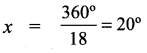
18x = 360°
Samacheer Kalvi 9th Maths Chapter 4 Geometry Ex 4.2 1
A = 2x = 2 × 20° = 40°
B = 4x = 4 × 20° = 80°
C = 5x = 5 × 20° = 100°
D = 7x = 7 × 20° = 140°

Question 2.
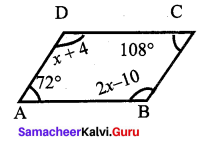
In a quadrilateral ABCD, ∠A = 12° and ∠C is the supplementary of ∠A. The other two angles are 2x – 10 and x + 4. Find the value of x and the measure of all the angles.
Solution:
∠A = 72°
∠C = 180° – 72° (∵ Supplementary at ∠A) = 108°
The other two angles are 2x – 10 and x + 4.
2x – 10 + x + 4 + 108° + 12° = 360°
Samacheer Kalvi 9th Maths Chapter 4 Geometry Ex 4.2 2
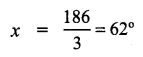
3x + 174° = 360°
3x = 360° – 174°
Samacheer Kalvi 9th Maths Chapter 4 Geometry Ex 4.2 3
∴ ∠A = 72°
∠B = 2x – 10 = 2(62)- 10 = 124 – 10 = 114°
∠C = 108°
∠D = x + 4 = 62 + 4 = 66°

Question 3.
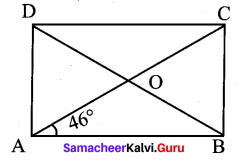
ABCD is a rectangle whose diagonals AC and BD intersect at O. If ∠OAB = 46°, find ∠OBC.
Solution:
∠ABC = 90°
Samacheer Kalvi 9th Maths Chapter 4 Geometry Ex 4.2 4
∠OAB + ∠OBC = 90°
46° + ∠OAB = 90°
∠OBC = 90° – 46° = 44°

Question 4.
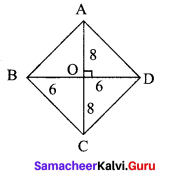
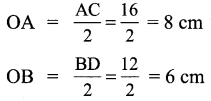
The lengths of the diagonals of a Rhombus are 12 cm and 16 cm. Find the side of the rhombus.
Solution:
Let ABCD be a rhombus with AC and BD as its diagonals.
We know that the diagonals of a rhombus bisect each other at right angles.
Let O be the intersecting point of both the diagonals
Let AC = 16 cm and BD = 12 cm
Samacheer Kalvi 9th Maths Chapter 4 Geometry Ex 4.2 5
Samacheer Kalvi 9th Maths Chapter 4 Geometry Ex 4.2 6
use Pythagoras theorem, we have
AB2 = OA2 + OB2
AB2 = 100
∴ AB = 10 cm

Question 5.
Show that the bisectors of angles of a parallelogram form a rectangle.
Solution:
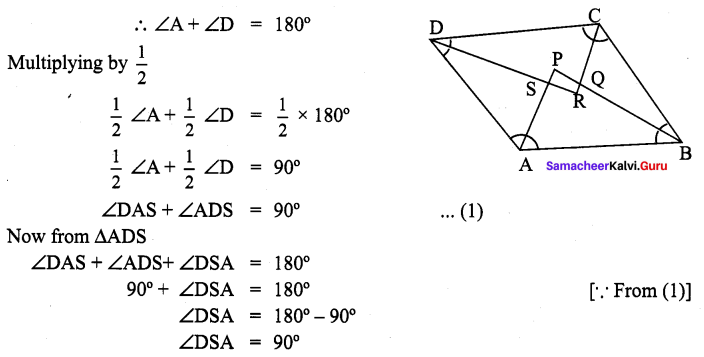
Given ABCD is a parallelogram. Draw the angular bisectors AP, BP, CR and DR of the angles ∠A, ∠B, ∠C and ∠D respectively.
Now to prove : PQRS is a rectangle.
Proof: A rectangle is a parallelogram with one angle 90°.
First we will prove PQRS is a parallelogram.
Now AB || CD and AD is transversal. [ ∴ Interior angles on the same side of transversal are supplementary]
[Opposite sides of a parallelogram are parallel]
Samacheer Kalvi 9th Maths Chapter 4 Geometry Ex 4.2 7
Also lines AP and DR intersects
So ∠PSR = ∠DS A
∴ ∠PSR = 90° [∵ Vertically opposite angles]
Similarly we can prove that ∠SPQ = 90°, ∠PQR = 90° and ∠SRQ = 90°
∴ ∠PSR = ∠PQR and ∠SPQ = ∠SRQ
∴ Both pair of opposite angles of PQRS is a parallelogram.
Also ∠PSR = ∠PQR = ∠SPQ = ∠SRQ = 90°
∴ PQRS is a parallelogram with one angle 90°.
∴ PQRS is a rectangle. Hence proved.

Question 6.
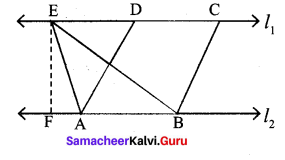
If a triangle and a parallelogram lie on the same base and between the same parallels, then prove that the area of the triangle is equal to half of the area of parallelogram.
Solution:
Given: ∆ABE and parallelogram ABCD have the same base and are between the same parallel lines (i.e) l1 || l2.
Samacheer Kalvi 9th Maths Chapter 4 Geometry Ex 4.2 8
Perpendicular distance between l1 and l2 = P (say).
Prove that: area of (∆ABE) = \(\frac{1}{2}\) × area of the parallelogram ABCD
Proof: Area of ∆ABE = \(\frac{1}{2}\) × base × height
= \(\frac{1}{2}\) × AB × (Perpendicular distance between l1
= \(\frac{1}{2}\) × AB × P ….(1)
Area of parallelogram ABCD = base × height.
∴ Area of parallelogram ABCD = AB × P …. (2)
From (1) and (2),
Area of ∆ABE = \(\frac{1}{2}\) × Area of parallelogram ABCD.
Hence proved.

Question 7.
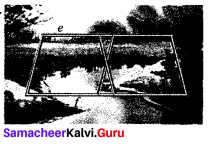
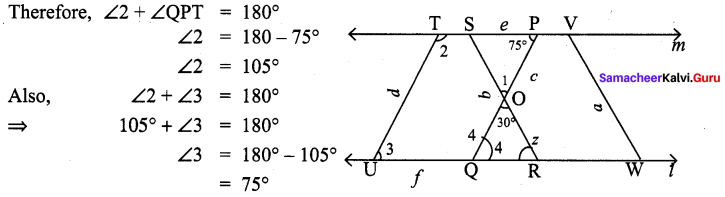
Iron rods a, b, c, d, e, and f are making a design in a bridge as shown in the figure. If a || b, c || d, e || f, find the marked angles between
(i) b and c
(ii) d and e
(iii) d and f
(iv) c and f.
Samacheer Kalvi 9th Maths Chapter 4 Geometry Ex 4.2 9
Solution:
Since l, m are two parallel lines and PQ, RS, TU, VW are transversal.
Then ∠1 = ∠QOR [vertically opposite angles]
∠1 = 30° [∴ ∠QOR = 30°]
Also, PQ and TU are parallel and m and l are transversal.
Samacheer Kalvi 9th Maths Chapter 4 Geometry Ex 4.2 10
Also ∠3 + ∠4 = 180°
⇒ 75° + ∠4 = 180°
∠4 = 180° – 75° = 105°
Hence,
(i) 30°
(ii) 105°
(iii) 75°
(iv) 105°

Question 8.
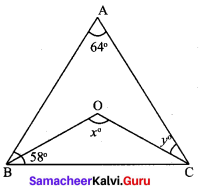
In the given figure ∠A = 64° , ∠ABC = 58°. If BO and CO are the bisectors of ∠ABC and ∠ACB respectively of ∆ABC, find x° and y°.
Solution:
In ∆ABC, ∠A + ∠B + ∠C = 180°
⇒ 64° + 58° + ∠C = 180°
⇒ 122°+ ∠C = 180°
⇒ ∠C = 180°- 122° = 58°
Samacheer Kalvi 9th Maths Chapter 4 Geometry Ex 4.2 11
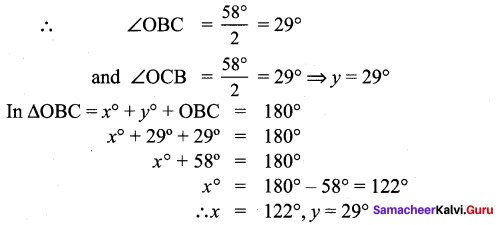
Also BO and CO are the bisectors of ∠ABC and ∠ACB respectively
Samacheer Kalvi 9th Maths Chapter 4 Geometry Ex 4.2 12

Question 9.
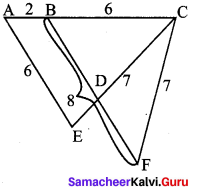
In the given Fig. if AB = 2, BC = 6, AE = 6, BF = 8, CE = 7, and CF = 7, compute the ratio of the area of quadrilateral ABDE to the area of ACDF.
Samacheer Kalvi 9th Maths Chapter 4 Geometry Ex 4.2 50
Solution:
Given: AB = 2,
BC = 6,
AE = 6,
BF = 8,
CE = 7 and
CF = 7
Consider ∆AEC and ∆BCF,
In ∆AEC,
AC = 8,
AE = 6,
CE = 7
In ∆BCF,
BF = 8,
BC = 6,
CF = 7
∴ ∆AEC ≅ ∆BCF
∴ Area of ∆AEC = Area of ∆BCF
Subtract.area of ∆BDC both sides, we get
Area of ∆AEC – Area of ∆BDC = Area of ∆BCF – Area of ∆BDC
⇒ Area of quadrilateral ABDE = Area of ∆CDF
∴ The required ratio is 1 : 1

Question 10.
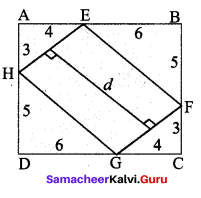
In the figure, ABCD is a rectangle and EFGH is a parallelogram. Using the measurements given in the figure, what is the length d of the segment that is perpendicular to \(\overline{\mathbf{H E}}\) and \(\overline{\mathbf{F G}}\) ?
Samacheer Kalvi 9th Maths Chapter 4 Geometry Ex 4.2 51
Solution:
Area of ABCD = length × breadth.
= DC × BC = 10 × 8 = 80.
Area of ∆AEH = Area of ∆CGF [since they are congruent by RHS rule]
Similarly, Area of ∆BEF = Area of ∆DGH
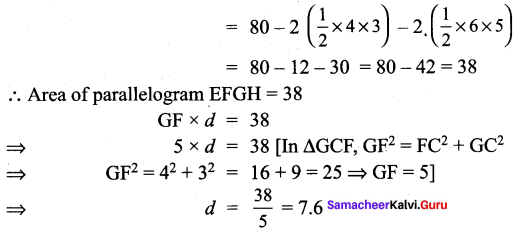
∴ Area of parallelogram = EFGH = Area of rectangle ABCD – 2(area of ∆AEH) – 2(area of ∆BEF)
Samacheer Kalvi 9th Maths Chapter 4 Geometry Ex 4.2 52

Question 11.
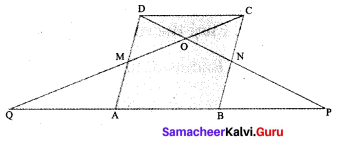
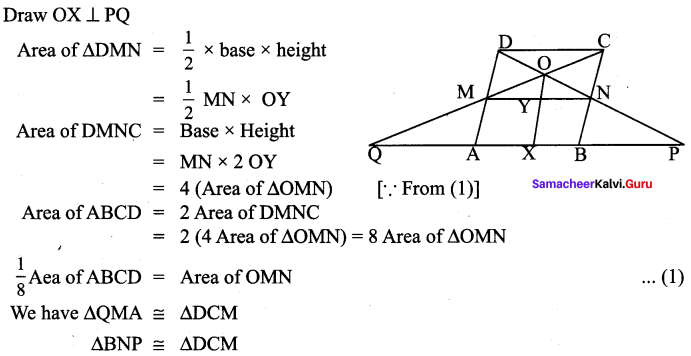
In parallelogram ABCD of the accompanying diagram, line DP is drawn bisecting BC at N and meeting AB (extended) at P. From vertex C, line CQ is drawn bisecting side AD at M and meeting AB (extended) at Q. Lines DP and CQ meet at O. Show that the area of triangle QPO is \(\frac{9}{8}\) of the area of the parallelogram ABCD.
Samacheer Kalvi 9th Maths Chapter 4 Geometry Ex 4.2 53
Solution:
Samacheer Kalvi 9th Maths Chapter 4 Geometry Ex 4.2 54
Area of ∆QDP = Area of ∆QMA + Area of ∆MNO + Area of MNBS + Area of ∆MAB
= Area of ∆DCM + Area of ∆MNO + Area of MNBA + Area of ∆NDC
= 2Area of ∆OMN + Area of ∆MNO + 4 Area of ∆OMN + 2 Area of ∆OMN
Samacheer Kalvi 9th Maths Chapter 4 Geometry Ex 4.2 55

Samacheer Kalvi 9th Maths Solutions Chapter 4 Geometry Ex 4.1

You can Download Samacheer Kalvi 9th Maths Book Solutions Guide Pdf, Tamilnadu State Board help you to revise the complete Syllabus and score more marks in your examinations.

Tamilnadu Samacheer Kalvi 9th Maths Solutions Chapter 4 Geometry Ex 4.1

Question 1.
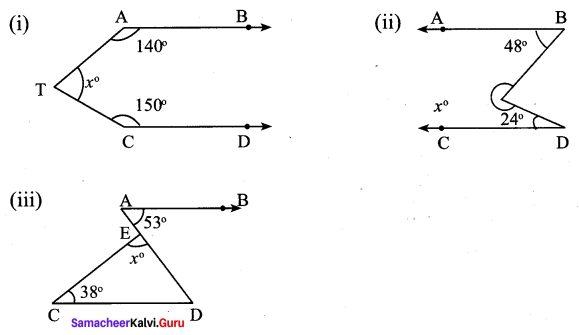
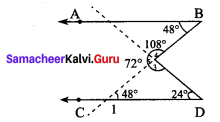
In the figure, AB is parallel to CD, find x
Samacheer Kalvi 9th Maths Chapter 4 Geometry Ex 4.1 1
Solution:
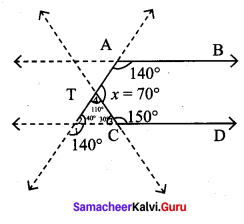
(i) From the figure
∠1 = 140° (∴ corresponding angles are equal)
∠2 = 40° (∴ ∠1 + ∠2= 180°)
∠3 = 30° (∵ ∠3 + 150= 180°)
∠4 = 110° (∵ ∠2 + ∠3 + ∠4 = 180°)
∴ ∠x = 70° (∵ ∠4 + ∠x = 180°)
Samacheer Kalvi 9th Maths Chapter 4 Geometry Ex 4.1 2

(ii) From the figure
∠1 = 48°
∠3 = 108° (∠1 +24° + ∠3 = 180°)
∠4 = 108° (If two lines are intersect, then the vertically the opposite angles are equal)
∠5 = 72° (∵ ∠3 + ∠5 = 180°)
∴ ∠3 + ∠4 + ∠5 = 108° + 108° + 72°
x = 288°
Samacheer Kalvi 9th Maths Chapter 4 Geometry Ex 4.1 3

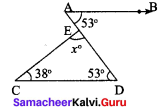
(iii) From the figure
∠D = 53° ( ∵ ∠B and ∠D are alternate interior angles)
Sum of the three angles of a triangle is 180°
∠x° = 180°- (38°+ 53°)
= 180°- 91° = 89°
Samacheer Kalvi 9th Maths Chapter 4 Geometry Ex 4.1 50

Question 2.
The angles of a triangle are in the ratio 1 : 2 : 3, find the measure of each angle of the triangle.
Solution:
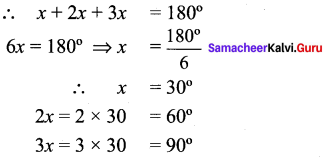
Let the angles be x, 2x and 3x respectively.
Sum of the three angles of a triangle = 180°
Samacheer Kalvi 9th Maths Chapter 4 Geometry Ex 4.1 4
The 3 angles of the triangle are 30°, 60°, 90°.

Question 3.
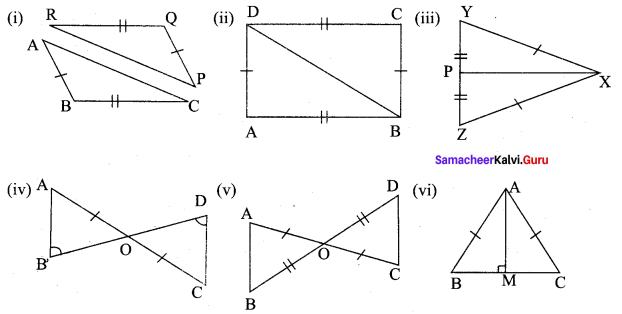
Consider the given pairs of triangles and say whether each pair is that of congruent triangles. If the triangles are congruent, say ‘how’; if they are not congruent say ‘why’ and also say if a small modification would make them congruent:
Samacheer Kalvi 9th Maths Chapter 4 Geometry Ex 4.1 52
Solution:
(i) Consider ∆PQR and ∆ABC
Given, RQ = BC
PQ = AB
∆ABC is not congruent to ∆PQR
If PR = AC, then ∆ABC ≅ ∆PQR
Samacheer Kalvi 9th Maths Chapter 4 Geometry Ex 4.1 51

(ii) Consider ∆ABD and ∆BCD for the triangles to be congruent.
Given, AB = DC
AD = BC and AB is common side.
∴ By SSS rule ∆ABD ≅ ∆BCD.
Samacheer Kalvi 9th Maths Chapter 4 Geometry Ex 4.1 54

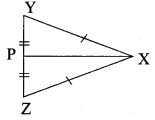
(iii) Consider ∆PXY and ∆PXz,
Given, XY = XZ
PY = PZ and PX is common
∴ By SSS rule ∆PXY ≅ ∆PXZ.
Samacheer Kalvi 9th Maths Chapter 4 Geometry Ex 4.1 55

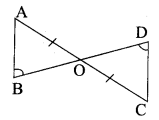
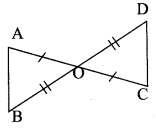
(iv) Consider ∆OAB and ∆ODC,
Given, OA = OC
Samacheer Kalvi 9th Maths Chapter 4 Geometry Ex 4.1 56
∠ABO = ∠ODC and ∠AOB = ∠DOC (vertically opposite angles)
∴ By AAS rule, AOAB = AODC.

(v) Consider ∆AOB and ∆DOC,
Given, AO = OC
OB = OD
Samacheer Kalvi 9th Maths Chapter 4 Geometry Ex 4.1 57
Samacheer Kalvi 9th Maths Solutions Chapter Geometry Ex 4.1
and ∠AOB = ∠DOC [vertically opposite angles]
∴ By SAS rule, ∆AOB = ∆DOC.

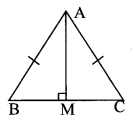
(vi) Consider ∆AMB and ∆AMC,
Given, AB = AC
Samacheer Kalvi 9th Maths Chapter 4 Geometry Ex 4.1 58
∠AMB = ∠AMC = 90°
∴ AM is common.
∴ By RHS rule
∆AMB ≅ ∆AMC.

Question 4.
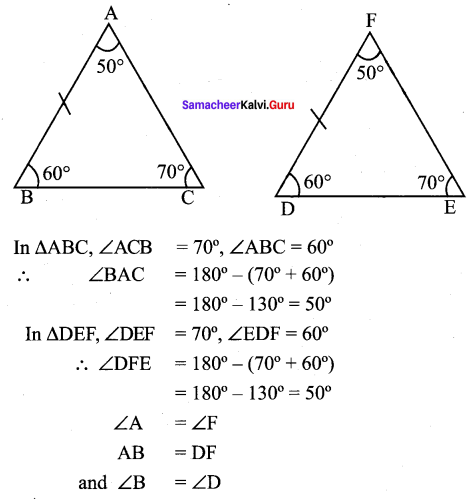
∆ABC and ∆DEF are two triangles in which AB = DF, ∠ACB = 70°, ∠ABC = 60°; ∠DEF = 70° and ∠EDF = 60°. Prove that the triangles are congruent.
Solution:
Samacheer Kalvi 9th Maths Chapter 4 Geometry Ex 4.1 60
∴ By ASA rule ∆ABC ≅ ∆FDE

Question 5.
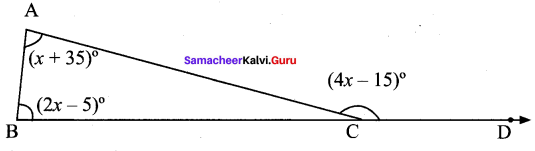
Find all the three angles of the ∆ABC
Samacheer Kalvi 9th Maths Chapter 4 Geometry Ex 4.1 59
Solution:
Exterior angle = Sum of the two opposite interior angles.
Samacheer Kalvi 9th Maths Chapter 4 Geometry Ex 4.1 61

Samacheer Kalvi 9th Maths Solutions Chapter 3 Algebra Ex 3.12

You can Download Samacheer Kalvi 9th Maths Book Solutions Guide Pdf, Tamilnadu State Board help you to revise the complete Syllabus and score more marks in your examinations.

Tamilnadu Samacheer Kalvi 9th Maths Solutions Chapter 3 Algebra Ex 3.12

Question 1.
Solve by the method of elimination
(i) 2x – y = 3; 3x + y = 7
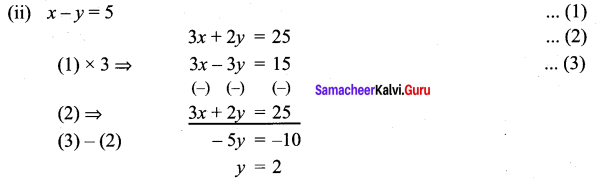
(ii) x – y = 5; 3x + 2y = 25
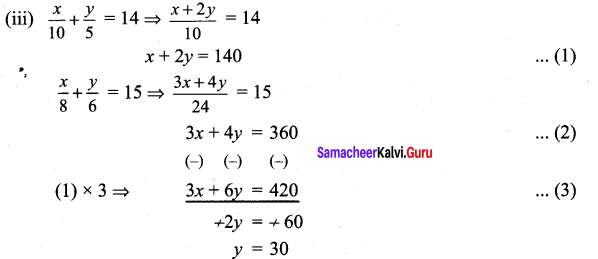
(iii) \(\frac{x}{10}+\frac{y}{5}\) = 14; \(\frac{x}{8}+\frac{y}{6}\) = 15
(iv) 3(2x + y) = 7xy; 3(x + 3y) = 11xy
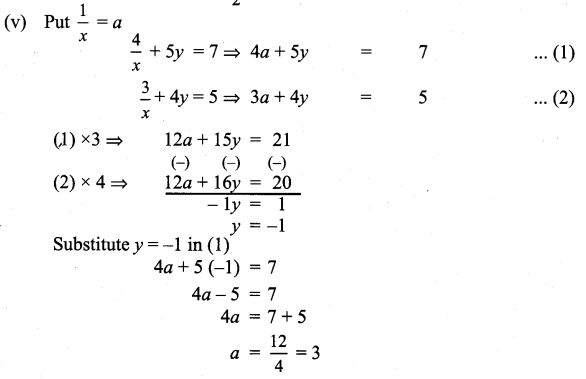
(v) \(\frac{4}{x}\) + 5y = 7; \(\frac{3}{x}\) + 4y = 5
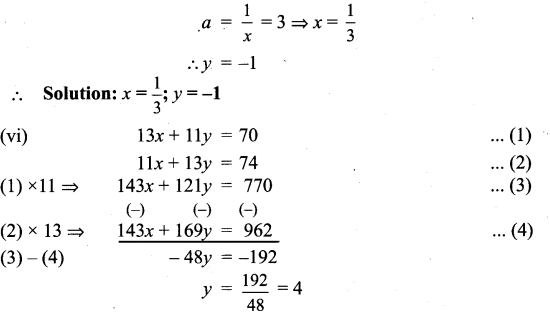
(vi) 13x + 11y = 70; 11x + 13y = 74
Solution:
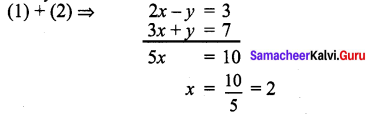
(i) 2x – y = 3 ………….. (1)
3x + y = 7 ………… (2)
Samacheer Kalvi 9th Maths Chapter 3 Algebra Ex 3.12 1
Substitute x = 2 in (1)
2(2) – y = 3
4 – y = 3
-y = 3 – 4
-y = -1
∴ Solution: x = 2; y = 1
Verification:
Substitute x = 2, y = 1 in (2)
3(2) + 1 = 7 = RHS
∴ Verified.

Samacheer Kalvi 9th Maths Chapter 3 Algebra Ex 3.12 2
Substitute y = 2 in (1)
x – 2 = 5
x = 5 + 2
x = 7
∴ Solution: x = 7, y = 2
Verification:
Substitute x = 7, y = 2 in (2)
3(7) + 2(2) = 21 + 4 = 25 = RHS
∴ Verified.

Samacheer Kalvi 9th Maths Chapter 3 Algebra Ex 3.12 3
Substitute y = 30 in (1)
x + 2 (30) = 140
x + 60 = 140
x = 140 – 60
x = 80
∴ Solution: x = 80; y = 30
Verification:
Substitute x = 80, y = 30 in (2)
3(80) + 4(30) = 240 + 120 = 360 = RHS
∴ Verified.

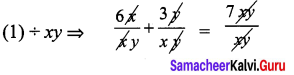
(iv) 3(2x +y) = 7xy ⇒ 6x + 3y = 7xy ………. (1)
3(x + 3y) = 11xy ⇒ 3x + 9y = 11xy ………….. (2)
Samacheer Kalvi 9th Maths Chapter 3 Algebra Ex 3.12 4
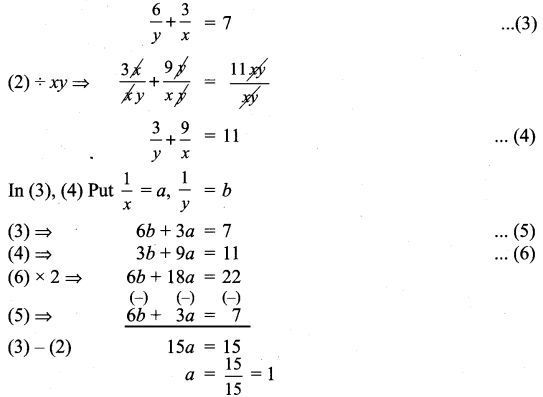
Samacheer Kalvi 9th Maths Chapter 3 Algebra Ex 3.12 5
Substitute a = 1 in (5)
6b + 3(1) = 7
6b + 3 = 7
6b = 7 – 3
b = \(\frac{4}{6}=\frac{2}{3}\)
∴a = \(\frac{1}{x}\) = 1 ⇒ x = 1
b = \(\frac{1}{y}=\frac{2}{3}\) ⇒ y = \(\frac{3}{2}\)
∴ Solution: x = 1; y = \(\frac{3}{2}\)

Samacheer Kalvi 9th Maths Chapter 3 Algebra Ex 3.12 6
Samacheer Kalvi 9th Maths Chapter 3 Algebra Ex 3.12 7
Substitute y = 4 in (1)
13x + 11 (4) = 70
13x + 44 = 70
13x = 70 – 44 = 26
x = \(\frac{26}{13}\) = 2
∴ Solution: x = 2; y = 4

Samacheer Kalvi 9th Maths Solutions Chapter 3 Algebra Ex 3.12

Question 2.
The monthly income of A and B are in the ratio 3:4 and their monthly expenditures are in the ratio 5 : 7. If each saves ₹ 5,000 per month, find the monthly income of each.
Solution:
Let the monthly income of A and B be 3x and 4x respectively.
Let the monthly expenditure of A and B be 5y and 7y respectively.
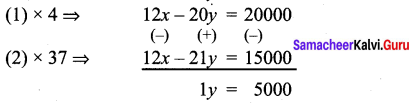
∴ 3x – 5y = 5000 ……… (1)
4x – 7y = 5000 ……….. (2)
Samacheer Kalvi 9th Maths Chapter 3 Algebra Ex 3.12 8
Substitute y = 5000 in (1)
3x – 5 (5000) = 5000
3x – 25000 = 5000
3x = 5000 + 25000
3x = 30000
x = 10000
∴ Monthly income of A is 3x = 3 × 10000 = ₹ 30000
Monthly income of B is 4x = 4 × 10000 = ₹ 40000

Question 3.
Five years ago, a man was seven times as old as his son, while five year hence, the man will be four times as old as his son. Find their present age.
Solution:
Let the man’s present age = x
Five years ago his age is = x – 5
Let his son’s age be = y
5 years ago his son’s age = y – 5
∴ x – 5 = 7(y – 5)
x – 5 = 7y – 35
x – 7y = -35 + 5
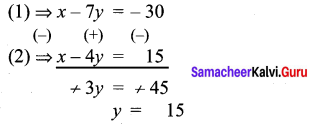
x – 7y = – 30 ……….. (1)
After 5 years, man’s age will be = x + 5
His son’s age will be = y + 5
∴ x + 5 = 4(y + 5)
x + 5 = 4y + 20
x – 4y = 20 – 5
⇒ x – 4y = 15 ………….. (2)
Samacheer Kalvi 9th Maths Chapter 3 Algebra Ex 3.12 9
Substitute y = 15 in (1)
x – 7 (15) = -30
x – 105 – 30
x = – 30 + 105
x = 75
∴ Man’s Age = 75, His son’s Age =15

Samacheer Kalvi 9th Maths Solutions Chapter 5 Coordinate Geometry Additional Questions

You can Download Samacheer Kalvi 9th Maths Book Solutions Guide Pdf, Tamilnadu State Board help you to revise the complete Syllabus and score more marks in your examinations.

Tamilnadu Samacheer Kalvi 9th Maths Solutions Chapter 5 Coordinate Geometry Additional Questions

Exercise 5.1

Question 1.
State whether the following statements are true/false.
(i) (5, 7) is a point in the IV quadrant.
(ii) (-2, -7) is a point in the III quadrant.
(iii) (8, -7) lies below the x-axis.
(iv) (-2, 3) lies in the II quadrant.
(v) For any point on the x-axis its y-coordinate is zero.
Solution:
(i) False
(ii) True
(iii) True
(iv) True
(v) True

Question 2.
Locate the points
(i) (3, 5) and (5, 3)
(ii) (-2, -5) and (-5, -2) in the rectangular coordinate system.
Solution:
Samacheer Kalvi 9th Maths Chapter 5 Coordinate Geometry Additional Questions 1

Question 3.
In which quadrant does the following points lie?
(i) (5, 2)
(ii) (-5, -8)
(iii) (-7, 1)
(iv) (8, -3)
Solution:
(i) I quadrant
(ii) III quadrant
(iii) II quadrant
(iv) IV quadrant.

Question 4.
Write down the ordinate of the following points.
(i) (7, 5)
(ii) (2, 9)
(iii) (-5, 8)
(iv) (7, -4)
Solution:
(i) 5
(ii) 9
(iii) 8
(iv) -4 (ordinate is the y-coordinate)

Exercise 5.2

Question 1.
Find the distance between the following pairs of points.
(i) (-4, 0) and (3, 0)
(ii) (-7, 2) and (5, 2)
Solution:
(i) The points (-4, 0) and (3, 0) lie on the x-axis. Hence,
Samacheer Kalvi 9th Maths Chapter 5 Coordinate Geometry Additional Questions 2
(ii) The points (5,2) and (-7,2) lie on a line parallel to the x-axis. Hence the distance
Samacheer Kalvi 9th Maths Chapter 5 Coordinate Geometry Additional Questions 60

Question 2.
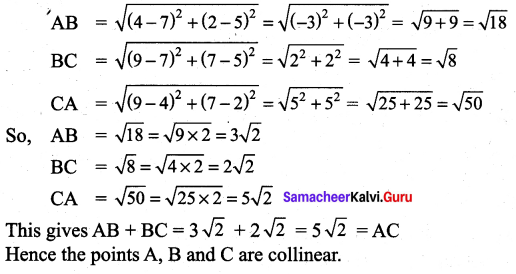
Show that the three points (4, 2), (7, 5) and (9, 7) lie on a straight line.
Solution:
Let the points be A(4, 2), B(7, 5) and C(9, 7). By the distance formula.
Samacheer Kalvi 9th Maths Chapter 5 Coordinate Geometry Additional Questions 61
Hence the points A, B and C are collinear.

Question 3.
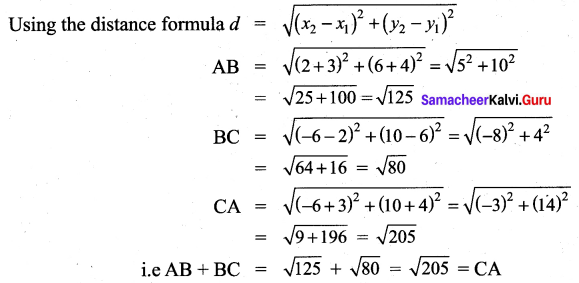
Determine whether the points are vertices of a right triangle A(-3, -4), B(2, 6) and C (-6, 10).
Solution:
Samacheer Kalvi 9th Maths Chapter 5 Coordinate Geometry Additional Questions 62
Hence ABC is a right angled triangle since the square of one side is equal to sum of the squares of the other two sides.

Question 4.
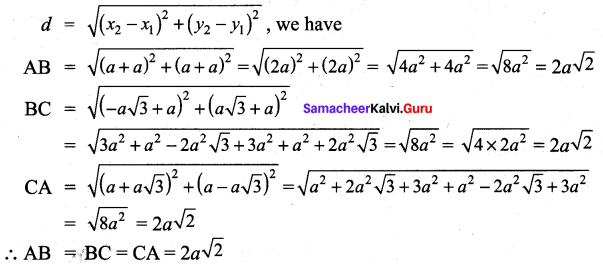
Show that the points (a, a), (-a, -a) and (\(-a \sqrt{3}, a \sqrt{3}\)) form an equilateral triangle.
Solution:
Let the points be represented by A (a, a), B(-a, -a) and C(\(-a \sqrt{3}, a \sqrt{3}\)) using the distance formula.
Samacheer Kalvi 9th Maths Chapter 5 Coordinate Geometry Additional Questions 63
Since all the sides are equal the points form an equilateral triangle.

Question 5.
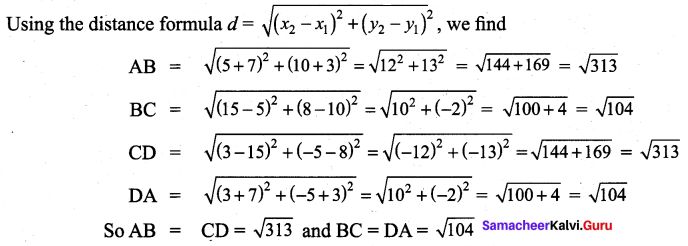
Prove that the points (-7, -3), (5, 10), (15, 8) and (3, -5) taken in order are the corners of a parallelogram.
Solution:
Let A, B, C and D represent the points (-7, -3), (5, 10), (15, 8) and (3, -5) respectively.
Samacheer Kalvi 9th Maths Chapter 5 Coordinate Geometry Additional Questions 64
i.e. The opposite sides are equal. Hence ABCD is a parallelogram.

Question 6.
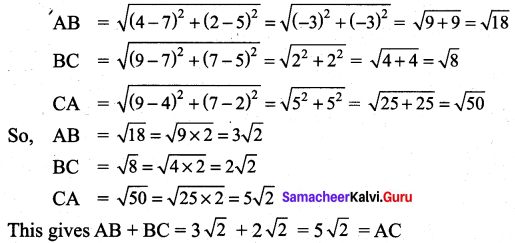
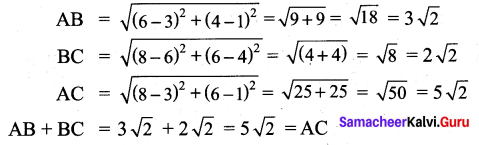
Show that the following points A (3, 1) B(6, 4) and C(8, 6) lies on a straight line. Samacheer Kalvi 9th Maths Chapter 5 Coordinate Geometry Additional Questions 65
Solution:
Using the distance formula, we have
Samacheer Kalvi 9th Maths Chapter 5 Coordinate Geometry Additional Questions 66
Therefore the points lie on a straight line.

Question 7.
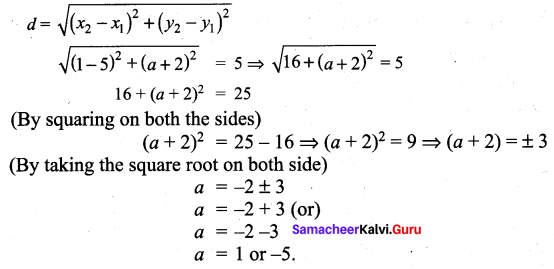
If the distance between the points (5, -2), (1, a) is 5 units. Find the value of a.
Samacheer Kalvi 9th Maths Chapter 5 Coordinate Geometry Additional Questions 67
Solution:
Samacheer Kalvi 9th Maths Chapter 5 Coordinate Geometry Additional Questions 68

Exercise 5.3

Question 1.
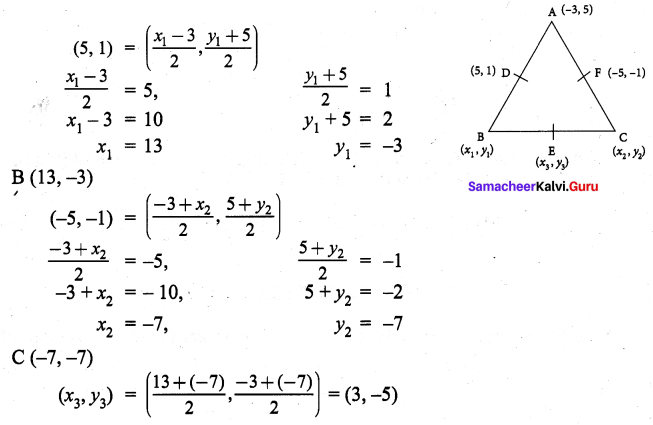
A, B and C are vertices of ∆ ABC. D, E and F are mid points of sides AB, BC and AC respectively. If the coordinates of A, D and F are (-3, 5), (5, 1) and (-5, -1) respectively. Find the coordinates of B, C and E.
Solution:
Samacheer Kalvi 9th Maths Chapter 5 Coordinate Geometry Additional Questions 70

Question 2.
If A(10, 11) and B(2, 3) are the coordinates of end points of diameter of circle. Then find the centre of the circle.
Solution:
Samacheer Kalvi 9th Maths Chapter 5 Coordinate Geometry Additional Questions 80

Question 3.
Find the coordinates of the point which divides the line segment joining the points (3, 1) and (5, 13) internally in the ratio 3 : 5.
Solution:
Samacheer Kalvi 9th Maths Chapter 5 Coordinate Geometry Additional Questions 90

Exercise 5.4

Question 1.
Using section formula, show that the points A(7, -5), B(9, -3) and C(13, 1) are collinear.
Solution:
Samacheer Kalvi 9th Maths Chapter 5 Coordinate Geometry Additional Questions 91

Question 2.
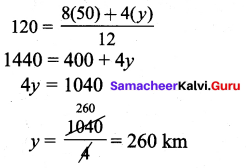
A car travels at an uniform speed. At 2pm it is at a distance of 5 km at 6 pm it is at a distance of 120 km. Using section formula, find at what distance it will reach 2 mid night.
Solution:
Samacheer Kalvi 9th Maths Chapter 5 Coordinate Geometry Additional Questions 92

Question 3.
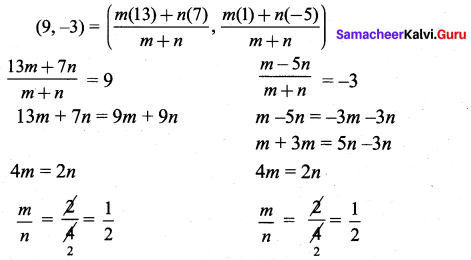
Find the coordinates of the point which divides the line segment joining the point A(3, 7) and B(-11, -2) in the ratio 5 : 1.
Solution:
Samacheer Kalvi 9th Maths Chapter 5 Coordinate Geometry Additional Questions 93

Exercise 5.5

Question 1.
Find the centroid of the triangle whose vertices are (2, -5), (5, 11) and (9, 9)
Solution:
Samacheer Kalvi 9th Maths Chapter 5 Coordinate Geometry Additional Questions 94

Question 2.
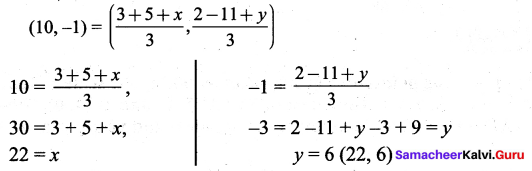
If the centroid of a triangle is at (10, -1) and two of its vertices are (3, 2) and (5, -11). Find the third vertex of the triangle.
Solution:
Samacheer Kalvi 9th Maths Chapter 5 Coordinate Geometry Additional Questions 95

Exercise 5.6

Multiple Choice Questions :

Question 1.
The point (-2, 7) lies is the quadrant
(1) I
(2) II
(3) III
(4) IV
Hint:
(-, +) lies in IInd quadrant
Solution:
(2) II

Question 2.
The point (x, 0) where x < 0 lies on
(1) OX
(2) OY
(3) OX’
(4) OY’
Hint:
(-, 0) lies on OX’
Solution:
(3) OX’

Question 3.
For a point A(a, b) lying in quadrant III.
(1) a > 0, b < 0
(2) a < 0, b < 0
(3) a > 0, b > 0
(4) a < 0, b > 0
Hint:
(-, -) lies in IIIrd quadrant
Solution:
(2) a < 0, b < 0

Question 4.
The diagonal of a square formed by the points (1, 0) (0, 1) and (-1, 0) is
(1) 2
(2) 4
(3) \(\sqrt{2}\)
(4) 8
Hint:
Samacheer Kalvi 9th Maths Chapter 5 Coordinate Geometry Additional Questions 50
Solution:
(1) 2

Samacheer Kalvi 9th Maths Solutions Chapter 5 Coordinate Geometry Additional questions

Question 5.
The triangle obtained by joining the points A(-5, 0) B(5, 0) and C(0, 6) is
(1) an isosceles triangle
(2) right triangle
(3) scalene triangle
(4) an equilateral triangle
Hint:
Triangles having two sides equal are called isosceles.
Solution:
(a) an isosceles triangle

Text Book Activities

Activity 1.
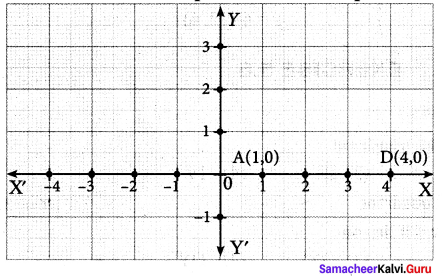
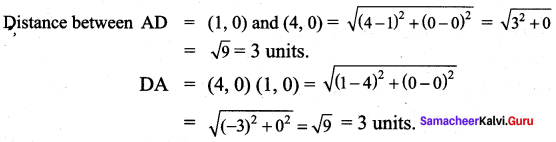
Plot the following points on a graph sheet by taking the scale as 1cm = 1 unit. Find how far the points are from each other? A (1, 0) and D (4, 0). Find AD and also DA. Is AD = DA? You plot another set of points and verify your result.
Samacheer Kalvi 9th Maths Chapter 5 Coordinate Geometry Additional Questions 99
Solution:
AD = DA is correct.
Samacheer Kalvi 9th Maths Chapter 5 Coordinate Geometry Additional Questions 100

Samacheer Kalvi 9th Maths Solutions Chapter 3 Algebra Ex 3.11

You can Download Samacheer Kalvi 9th Maths Book Solutions Guide Pdf, Tamilnadu State Board help you to revise the complete Syllabus and score more marks in your examinations.

Tamilnadu Samacheer Kalvi 9th Maths Solutions Chapter 3 Algebra Ex 3.11

Question 1.
Solve, using the method of substitution
(i) 2x – 3y = 7; 5x + y = 9
(ii) 1.5x + 0.1y = 6.2; 3x – 0.4y = 11.2
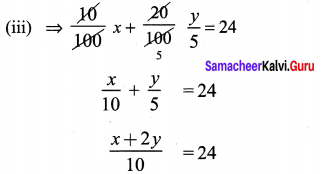
(iii) 10% of x + 20% of y = 24; 3x – y = 20
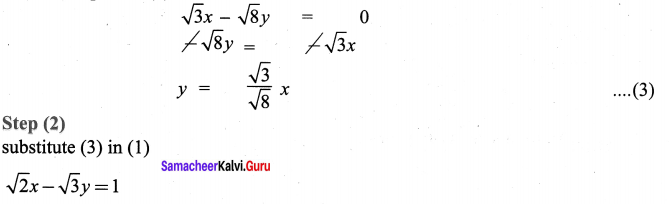
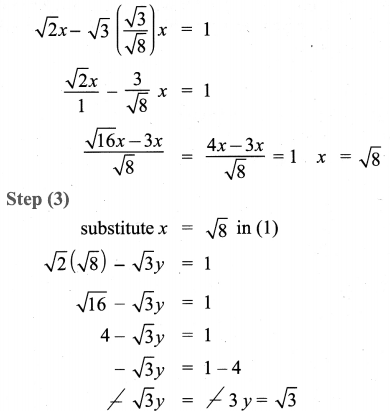
(iv) \(\sqrt{2} x-\sqrt{3} y=1 ; \sqrt{3} x-\sqrt{8} y=0\)
Solution:
(i) 2x – 3y = 7 ………….. (1)
5x + y = 9 ………….. (2)
Step (1)
From the equation (2)
5x+ y = 9
y = -5x + 9
Step (2)
substitute (3) in (1)
2x – 3(-5x + 9) = 7
2x + 15x – 27 = 7
17x = 7 + 27
17x = 34
x = \(\frac{34}{17}\) = 2; x = 2
Step (3)
substitute x = 2 in (3)
y = – 5(2) + 9 = -10 + 9 = -1
Solution: x = 2; y = -1

(ii) 1.5x + 0.1y = 6.2 …………. (1)
3x – 0.1y = 11.2 ………….. (2)
Multiply (1 ) x 10 15x + y = 62 ……….(1)
(2) × 10 ⇒ 30x – 4y = 112 …………. (4)
Step (1)
From equation (3)
15x + y = 62
y = -15x + 62 …………. (5)
Step (2)
substitute (5) in (4)
30x – 4 (-15x + 62) = 112
30x + 60x – 248 = 112
90x = 112 + 248
90x = 360
x = \(\frac{360}{90}\)
x = 4
Step (3)
substitute x = 4 in (5)
y = -15(4) + 62
= -60 + 62
y = 2
Solution: x = 4; y = 2

Samacheer Kalvi 9th Maths Chapter 3 Algebra Ex 3.11 1
x + 2y = 240 ………. (1)
3 x – y =20 ……….. (2)
Step (1)
From equation (2)
3x – y = 20
-y = 20 – 3x
y = 3x – 20 — (3)
Step (2)
substitute (3) in (1)
x + 2(3x – 20) = 240
x + 6x – 40 = 240
7x = 240 + 40
x = \(\frac{280}{7}\)
x = 40
Step (3)
substitute x = 40 in (3)
y = 3 (40) – 20
= 120 – 20 = 100
Solution : x = 40 and y = 100

(iv) \(\sqrt{2} x-\sqrt{3} y\) = 1 ………… (1)
\(\sqrt{3} x-\sqrt{8} y\) = 0 ……….. (2)
Step (1)
From the equation (2)
Samacheer Kalvi 9th Maths Chapter 3 Algebra Ex 3.11 2
Samacheer Kalvi 9th Maths Chapter 3 Algebra Ex 3.11 3
Solution: x = \(\sqrt{8}\) and y = \(\sqrt{3}\)

Question 2.
Raman’s age is three times the sum of the ages of his two sons. After 5 years his age will be twice the sum of the ages of his two sons. Find the age of Raman.
Solution:
Let Raman’s age = x
Let the sum of his two sons age = y
now x = 3y ⇒ x – 3y = 0 ……… (1)
After 5 years,
Step (3)
x + 5 = 2(y + 10)
x + 5 = 2y + 20
x – 2y = 20 – 5
x – 2y = 15
Step (1)
From equation (1) x = 3y
Step (2)
Substitute x = 3y in (2)
3y – 2y = 15
y = 15
Step (3)
Substitute y = 15 in (1)
x = 3y = 3 × 15
x = 45
∴ Raman’s age is 45 years.

Samacheer Kalvi 9th Maths Solutions Chapter 3 Algebra Ex 3.11

Question 3.
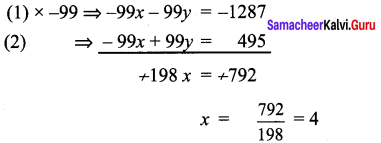
The middle digit of a number between 100 and 1000 is zero and the sum of the other digit is 13. If the digits are reversed, the number so formed exceeds the original number by 495. Find the number.
Solution:
Let the number be x0y
x + y = 13 …………….. (1)
If the digits are reversed the number so formed is y0x
x0y = 100x + 10 × 0 + 1 × y
y0x = 100y + 10 × 0 + 1 × x
100y + x – (100x + y) = 495
100y + x – 100x – y = 495
-99x + 99y = 495 ………….. (2)
Samacheer Kalvi 9th Maths Chapter 3 Algebra Ex 3.11 4
Substitute x = 4 in (1)
4 + y = 13 = 13 – 4 = 9
The number is 409.

Samacheer Kalvi 9th Maths Solutions Chapter 4 Geometry Ex 4.7

You can Download Samacheer Kalvi 9th Maths Book Solutions Guide Pdf, Tamilnadu State Board help you to revise the complete Syllabus and score more marks in your examinations.

Tamilnadu Samacheer Kalvi 9th Maths Solutions Chapter 4 Geometry Ex 4.7

Multiple Choice Questions :

Question 1.
The exterior angle of a triangle is equal to the sum of two
Samacheer Kalvi 9th Maths Chapter 4 Geometry Ex 4.7 1
(1) Exterior angles
(2) Interior opposite angles
(3) Alternate angles
(4) Interior angles
Hint: Exterior angle = 180°- Interior angle = sum of interior opposite angle
Solution:
(2) Interior opposite angles

Question 2.
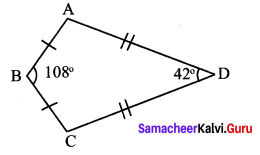
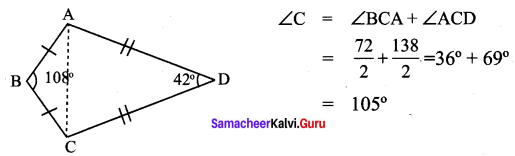
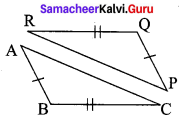
In the quadrilateral ABCD, AB = BC and AD = DC Measure of ∠BCD is
Samacheer Kalvi 9th Maths Chapter 4 Geometry Ex 4.7 2
(1) 150°
(2) 30°
(3) 105°
(4) 72°
Hint:
Samacheer Kalvi 9th Maths Chapter 4 Geometry Ex 4.7 3
Solution:
(3) 105°

Question 3.
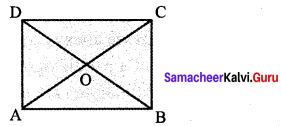
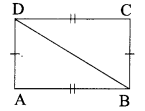
ABCD is a square, diagonals AC and BD meet at O. The number of pairs of congruent triangles are
Samacheer Kalvi 9th Maths Chapter 4 Geometry Ex 4.7 4
(1) 6
(2) 8
(3) 4
(4) 12
Solution:
(1) 6

Question 4.
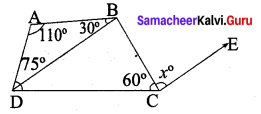
In the given figure CE || DB then the value of x° is
Samacheer Kalvi 9th Maths Chapter 4 Geometry Ex 4.7 5
(1) 45°
(2) 30°
(3) 75°
(4) 85°
Hint: 35° + x°+ 60° = 180° ⇒ x = 85°
Solution:
(4) 85°

Question 5.
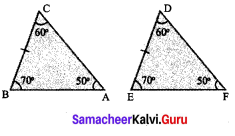
The correct statement out of the following is
Samacheer Kalvi 9th Maths Chapter 4 Geometry Ex 4.7 6
(1) ∆ABC ≅ ∆DEF
(2) ∆ABC ≅ ∆DFE
(3) ∆ABC ≅ ∆FDE
(4) ∆ABC ≅ ∆FED
Hint: ∠C = ∠D; ∠B = E; ∠A = ∠F
Solution:
(4) ∆ABC = ∆FED

Question 6.
If the diagonal of a rhombus are equal, then the rhombus is a
(1) Parallelogram but not a rectangle
(2) Rectangle but not a square
(3) Square
(4) Parallelogram but not a square
Solution:
(3) Square

Question 7.
If bisectors of ∠A and ∠B of a quadrilateral ABCD meet at O, then ∠AOB is
Samacheer Kalvi 9th Maths Chapter 4 Geometry Ex 4.7 7
Hint:
Samacheer Kalvi 9th Maths Chapter 4 Geometry Ex 4.7 8
Solution:
(2) \(\frac{1}{2}(\angle \mathbf{C}+\angle \mathbf{D})\)

Question 8.
The interior angle made by the side in a parallelogram is 90° then the parallelogram
is a Samacheer Kalvi 9th Maths Chapter 4 Geometry Ex 4.7 9
(1) rhombus
(2) rectangle
(3) trapezium
(4) Kite
Hint:
If one angle of a parallelogram is 90°, then it is a rectangle
Solution:
(2) rectangle

Question 9.
Which of the following statement is correct?
(1) Opposite angles of a parallelogram are not equal.
(2) Adjacent angles of a parallelogram are complementary.
(3) Diagonals of a parallelogram are always equal.
(4) Both pairs of opposite side of a parallelogram are always equal.
Hint:
Opposite sides of a parallelogram are equal.
Solution:
(4) Both pairs of opposite side of a parallelogram are always equal

Question 10.
The angles of the triangle are 3x – 40, x + 20 and 2x – 10 then the value of x is
(1) 40°
(2) 35°
(3) 50°
(4) 45°
Hint: 3x – 40 + x + 20 + 2x- 10 – 180° ⇒ 6x = 210 ⇒ x = 35°
Solution:
(2) 35

Question 11.
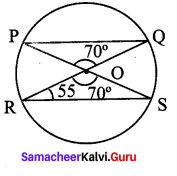
PQ and RS are two equal chords of a circle with centre O such that ∠POQ = 70°, then ORS =
(1) 60°
(2) 70°
(3) 55°
(4) 80°
Solution:
(3) 55°
Hint:
Samacheer Kalvi 9th Maths Chapter 4 Geometry Ex 4.7 50

Question 12.
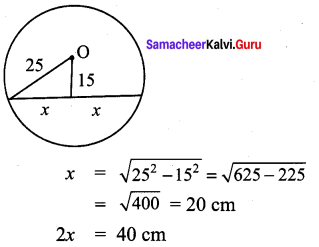
A chord is at a distance of 15cm from the centre of the circle of radius 25cm. The length of the chord is
(1) 25 cm
(2) 20 cm
(3) 40 cm
(4) 18 cm
Hint:
Samacheer Kalvi 9th Maths Chapter 4 Geometry Ex 4.7 51
Solution:
(3) 40 cm

Question 13.
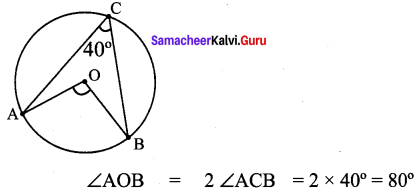
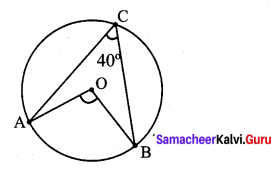
In the figure, O is the centre of the circle and ∠ACB = 40° then ∠AOB =
(1) 80°
(2) 85°
(3) 70°
(4) 65°
Samacheer Kalvi 9th Maths Chapter 4 Geometry Ex 4.7 52
Hint:
Samacheer Kalvi 9th Maths Chapter 4 Geometry Ex 4.7 53
Solution:
(1) 80°

Question 14.
In a cyclic quadrilaterals ABCD, ∠A = 4x, ∠C = 2x the value of x is
Samacheer Kalvi 9th Maths Chapter 4 Geometry Ex 4.7 54
(1) 30°
(2) 20°
(3) 15°
(4) 25°
Hint:
Samacheer Kalvi 9th Maths Chapter 4 Geometry Ex 4.7 55
Solution:
(1) 30°

Question 15.
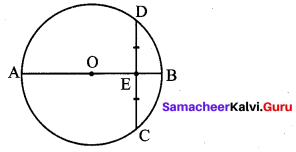
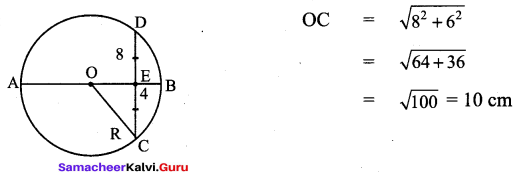
In the figure, O is the centre of a circle and diameter AB bisects the chord CD at a point E such that CE = ED = 8 cm and EB = 4 cm. The radius of the circle is
(1) 8 cm
(2) 4 cm
(3) 6 cm
(4) 10 cm
Hint:
Samacheer Kalvi 9th Maths Chapter 4 Geometry Ex 4.7 56
Solution:
(4) 10 cm

Question 16.
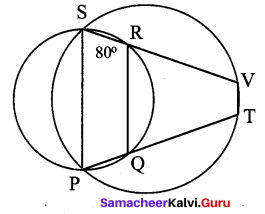
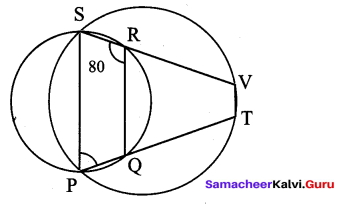
In the figure, PQRS and PTVS are two cyclic quadrilaterals, if ∠QRS = 80°, then ∠TVS =
(1) 80°
(2) 100°
(3) 70°
(4) 90°
Samacheer Kalvi 9th Maths Chapter 4 Geometry Ex 4.7 57
Hint:
Samacheer Kalvi 9th Maths Chapter 4 Geometry Ex 4.7 58
Solution:
(1) 80°

Question 17.
If one angle of a cyclic quadrilateral is 75°, then the opposite angle is
(1) 100°
(2) 105°
(3) 85°
(4) 90°
Hint: 180° – 75° =105°
Solution:
(2) 105°

Question 18.
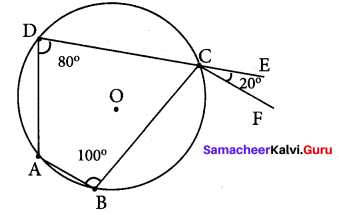
In the figure, ABCD is a cyclic quadrilateral in which DC produced to E and CF is drawn parallel to AB such that ∠ADC = 80° and ∠ECF = 20°, then ∠BAD = ?
(1) 100°
(2) 20°
(3) 120°
(4) 110°
Samacheer Kalvi 9th Maths Chapter 4 Geometry Ex 4.7 59
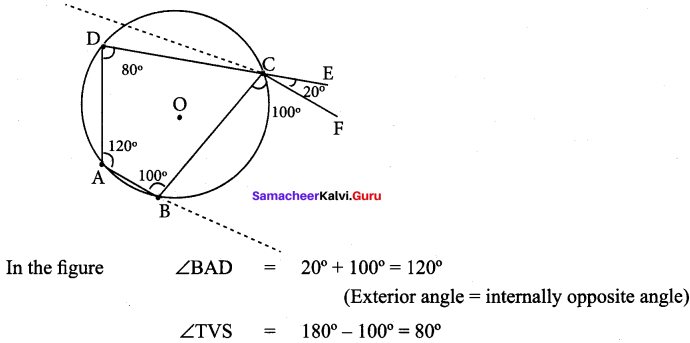
Hint:
Samacheer Kalvi 9th Maths Chapter 4 Geometry Ex 4.7 81
Solution:
(3) 120°

Question 19.
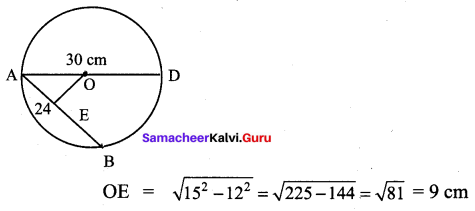
AD is a diameter of a circle and AB is a chord. If AD = 30 cm and AB = 24 cm then the distance of AB from the centre of the circle is
(1) 10 cm
(2) 9 cm
(3) 8 cm
(4) 6 cm
Hint:
Samacheer Kalvi 9th Maths Chapter 4 Geometry Ex 4.7 61

Question 20.
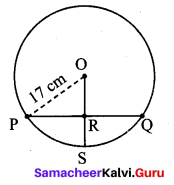
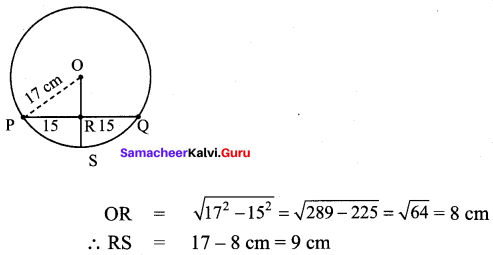
In the given figure, If OP = 17cm PQ = 30 cm and OS is perpendicular to PQ, then RS is
(1) 10 cm
(2) 6 cm
(3) 7 cm
(4) 9 cm
Samacheer Kalvi 9th Maths Chapter 4 Geometry Ex 4.7 63
Hint:
Samacheer Kalvi 9th Maths Chapter 4 Geometry Ex 4.7 64
Solution:
(4) 9 cm

Samacheer Kalvi 6th Maths Solutions Term 1 Chapter 1 Numbers Additional Questions

You can Download Samacheer Kalvi 6th Maths Book Solutions Guide Pdf, Tamilnadu State Board help you to revise the complete Syllabus and score more marks in your examinations.

Tamilnadu Samacheer Kalvi 6th Maths Solutions Term 1 Chapter 1 Numbers Additional Questions

Answer the following questions.
Samacheer Kalvi 6th Maths Solutions Term 1 Chapter 1 Numbers Additional Questions
Question 1.
How many thousands are there in 1 lakhs?
Solution:
\(\frac{1,00,0000}{1000}\) = 100 Thousands

Question 2.
The difference between successor and predecessor of any number is 2. Is it true? Justify your answer.
Solution:
It is true that the difference between successor and predecessor of any number is 2.
Because the difference between any number and its predecessor is 1.
Also the difference between the number and its successor is 1.
The total difference is 2.

Question 3.
The expanded form of the number 6,00,001 is given as 6 × 100000 + 1 × 1. Can you write like this Comment.
Solution:
Yes. We can write the expansion of the number 600001 as 6 × 100000 + 1 × 1.
Because 6 × 100000 + 1 × 1 = 600000 + 1 = 600001

Question 4.
Write the greatest five digit number using the digits 2, 3, 4, 0 and 7.
Solution:
Greatest five digit number = 74320

Question 5.
Can you write the least five digit number using the digits 2,3,4,0 and 7 as 02347. Why? What will be the correct number?
Solution:
No, we cannot write the least five digit number using the digits 2, 3, 4, 0 and 7 as 02347. If it is 02347, the left most zero has no value. It becomes 4 digit number 2347.
The correct number will be 20347.

Samacheer Kalvi 6th Maths Solutions Term 1 Chapter 1 Numbers Additional Questions

Question 6.
Write the relation between Largest two digit number and Smallest three digit number.
Solution:
Largest two digit number + 1 = Smallest three digit number.
99 + 1 = 100

Question 7.
Name the property being illustrated in each of the cases.

  1. (30 + 20) + 10 = 30 + (20 + 10)
  2. 10 × 35 = (10 × 30) + (10 × 5)

Solution:

  1. Associativity
  2. Distribution of multiplication over addition.

Question 8.
10 crore = ____
Solution:
100 million

Question 9.
The heights of five boys in class VI are 135, 141, 129, 132, 145 (in centimetres) in height. Arrange their heights as how they stand in the assembly?
Solution:
129 cm < 132 cm < 135 cm < 141 cm < 145 cm

Question 10.
The number lock has the password number with 3 digits. The number is the least even number and less than 200. Middle digit has no value separately. Find the password. The digits are used only once.
Solution:
102

Question 11.
Arrange in ascending order. 123456, 123546, 123623, 123511
Solution:
123456 < 123511 < 123546 < 123623 Question 12. Arrange in descending order. 8461, 7535, 2943, 6214 Solution: 8461 > 7535 > 6214 > 2943

Samacheer Kalvi 6th Maths Solutions Term 1 Chapter 1 Numbers Additional Questions

Question 13.
Find the numbers between 572634 and 562634 which is approximated to ten thousand place.
Solution:
562634 < 570000 < 572634

Question 14.
Evaluate the following:
(a) 44 ÷ 2 + (7 + 80 ÷ 10) – 14 + 23
(b) 17 × 6 – 4 – 2 + 20 – (22 + 18)
(c) 16 × 144 ÷ 16 ÷ 9 + 16 + 15 – 20
(d) 12 × 36 ÷ 12 ÷ 3 + 5 + 6 – 2
(e) 15 – [17 + 30 ÷ 6 – (6 + 6) + 7]
Solution:
(a) 44 ÷ 2 + (7 + 80 ÷ 10) – 14 + 23 (Given)
= 44 ÷ 2 + (7 + 8) – 14 + 23 (To complete the bracket ÷ done first)
= 44 ÷ 2 + 15 – 14 + 23 (Bracket completed second)
= 22 + 15 – 14 + 23 (÷ completed third)
= 37 – 37 (+ completed fourth)
= 0 (- completed last)
∴ 44 ÷ 2 + (7 + 80 ÷ 10) – 14+ 23 = 0.

(b) 17 × 6 – 4 – 2 + 20 – (22 + 18) (Given)
= 17 × 6 – 4 – 2 + 20 – 40 (Bracket completed first)
= 102 – 4 – 2 + 20 – 40 (× completed second)
= 102 – 4 – 22 – 40 (+ completed third)
= 98 – 22 – 40 (÷ completed one by one)
= 76 – 40
= 36
∴ 17 × 6 – 4 – 2+ 20 – (22 + 18) = 36

(c) 16 × 144 ÷ 16 ÷ 9 + 16 + 15 – 20 (Given)
= 16 × 9 ÷ 9+16 + 15 – 20 (÷ completed first)
= 16 × 1 + 16 + 15 – 20 (÷ completed second)
= 16 + 16 + 15 – 20 (× completed third)
= 32 + 15 – 20 (+ completed fourth)
= 47 – 20 (+ completed fifth)
= 27 (- completed last)
∴ 16 × 144 ÷ 16 ÷ 9 + 16 + 15 – 20 = 27

(d) 12 × 36 ÷ 12 ÷ 3 + 5 + 6 – 2 (Given)
= 12 × 3 ÷ 3 + 5 + 6 – 2 (÷ completed first)
= 12 × 1 + 5 + 6 – 2 (÷ completed second)
= 12 + 5 + 6 – 2 (× completed third)
= 17 + 6 – 2 (+ completed forth)
= 23 – 2 (+ completed fifth)
= 21 (- completed last)
∴ 12 × 36 ÷ 12 ÷ 3 + 5 + 6 – 2 = 21

(e) 15 – [17 + 30 ÷ 6 – (6 + 6) + 7] (Given)
= 15 – [17 + 30 ÷ 6 – 12 + 7] (Inner bracket completed first)
= 15 – [17 + 5 – 12 + 7] (÷ completed second)
= 15 – [22 – 19] (+ completed third)
= 15 – 3 (bracket completed forth)
= 12 (- completed last)
∴ 15 – [17 + 30 ÷ 6 – (6 + 6) + 7] = 12.

Samacheer Kalvi 6th Maths Solutions Term 1 Chapter 1 Numbers Additional Questions

Question 15.
An export company produced 235219 shirts, 158342 trousers and 11704 jackets in a year. What is the total production of all the three items in that year?
Solution:
Number of shirts produced = 235219
Number of trousers produced = 158342
Number of jackets produced = 11704
Total production of all items = 405265
Total production of all items in that year = 4,05,265

Question 16.
India’s population has been steadily increasing from 439 million in 1961 to 1028 million in 2001. Find the total increase in population from 1961 to 2001. Write the increase in population in the Indian system of Numeration using commas suitably.
Solution:
Population of India in 1961 = 439 millions = 439,000,000
Population of India in 2001 = 1028 millions = 1,028,000,000
Increase in population from 1961 to 2001 = Population in 2001 – Population in 1961
= 1028000000 – 439000000
= 589000000
= 589 million.
Increase in population in Indian System = 58,90,00,000

Question 17.
A person had ₹ 10,00,000 with him. He purchased a flat for ₹ 8,70,000. With the remaining money, he has to buy a T.V. for 1 lakh. How much money was left with him to buy a T.V?
Solution:
Total money the person had = ₹ 10,00,000
Cost of flat = ₹ 8,70,000
Remaining money = ₹ 1,30,000
Now he has ₹ 1,30,000. So it is enough to buy a TV for ₹ 1,00,000.

Question 18.
A box contains 50 packets of biscuits, each weighing 120g. How many such boxes can be loaded in a van, which cannot carry more than 900 kg?
Solution:
Given: Total number of packets = 50.
Weight of each packet = 120 g
Weight of a box = 50 × 120 g = 6000 g = 6 kg [∵ 1000 g = 1 kg]
Required number of boxes = \(\frac{900}{6}\) = 150.
150 boxes are required.

Question 19.
How much money was collected from 5342 students for a charity show, if each student contributed ₹ 670?
Solution:
Total number of students = 5342
Contribution of each student = ₹ 670
Total money collected = 5342 × 670 = ₹ 35,79,140
Total money collected = ₹ 35,79,140

Question 20.
Estimate the following to the nearest hundreds
(a) 439 + 334 + 4317
(b) 1,08,734 – 47,599
(c) 8325 – 491
(d) 4,89,348 – 48,365
Solution:
(a) 439 + 334 + 4317
439 ⇒ 400
334 ⇒ 300
4317 ⇒ 4300
Sum = 5,000

(b) 1,08,734 – 47,599
1,08,734 ⇒ 1,08,700
47,599 ⇒ 47,600
Difference = 61,100

(c) 8325 – 491
8325 ⇒ 8300
491 ⇒ 500
Differences = 7,800

(d) 4,89,348 – 48,365
4,89,348 ⇒ 4,89,300
48,365 ⇒ 48,400
Difference = 4,40,900

Samacheer Kalvi 6th Maths Solutions Term 1 Chapter 1 Numbers Additional Questions

Question 21.
Estimate the following products:
(a) 578 × 161
(b) 5281 × 3491
(c) 1291 × 592
(d) 9250 × 29
Solution:
(a) 578 × 161
578 ⇒ 600
161 ⇒ 200
Estimated product is 600 × 200 = 1,20,000

(b) 5281 × 3491
5281 ⇒ 5000
3491 ⇒ 3500
Estimated Product = 5000 × 3500 = 1,75,00,000

(c) 1291 × 592
1291 ⇒ 1300
592 ⇒ 600
Estimated Product is = 1300 × 600 = 7,80,000

(d) 9250 × 29
9250 ⇒ 9000
29 ⇒ 30
Estimated Product is 9000 × 30 = 2,70,000

Question 22.
Are all whole numbers are natural numbers? Justify your answer?
Solution:
No, all whole numbers are not natural numbers.
Because ‘0’ belongs to the whole number system. But it is not in a natural number system.
All whole numbers except ‘0’ are natural numbers.

Question 23.
Use associative property of addition to add 847 + 306 + 453
Solution:
847 + 306 + 453
= (847 + 453) + 306
= 1300 + 306
= 1606
∴ 847 + 306 + 453 = 1606

Question 24.
Find the value of (1063 × 127) – (1063 × 27)
Solution:
(1063 × 127) – (1063 × 27)
= 1063 (127 – 27) [Taking 1063 as common]
= 1063 × 100
= 106300.
i.e (1063 × 127) – (1063 × 27) = 106300

Question 25.
Find the product using suitable properties
(a) 738 × 103
(b) 1005 × 168
Solution:
(a) We have 738 × 103
= 738 × (100 + 3)
= 738 × 100 + 738 × 3 [By distributive property of multiplication over addition]
= 73800 + 2214
= 76014

(b) 1005 × 168
= (1000 + 5) × 168
= (168 × (1000 + 5) (By commutative property)
= (168 × 1000) + (168 × 5)
= 1,68,000 + 840
= 1,68,840

Samacheer Kalvi 6th Maths Solutions Term 1 Chapter 1 Numbers Additional Questions

Question 26.
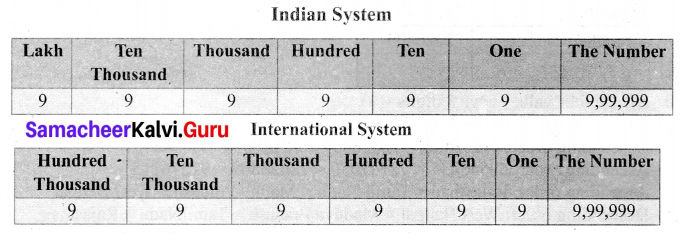
Write the largest six-digit number and write the number names in words using the Indian and International system.
Solution:
The largest six-digit number is 999999
Number names are nine lakh ninety-nine thousand nine hundred and ninety-nine
Samacheer Kalvi 6th Maths Term 1 Chapter 1 Numbers Additional Questions Q5

Question 27.
In a mobile store, the number of mobiles sold during a month is 1250, Assuming that the same number of mobiles are sold every month, find the number of mobiles sold in 2 years.
Solution:
Number of mobiles sold in 1 month = 1250
1 year = 12 months
2 years = 2 × 12 = 24 months
Number of mobiles sold in 24 months = 1250 × 24= 30,000
Number of mobiles sold in 2 years = 30,000

Question 28.
Simplify 24 + 2 × 8 ÷ 2 – 1
Solution:
24 + 2 × 8 ÷ 2 – 1
= 24 + 2 × 4 – 1
= 24 + 8 – 1
= 32 – 1
= 31

Samacheer Kalvi 6th Maths Solutions Term 1 Chapter 1 Numbers Additional Questions

Samacheer Kalvi 6th Maths Solutions Term 1 Chapter 2 Introduction to Algebra Additional Questions

You can Download Samacheer Kalvi 6th Maths Book Solutions Guide Pdf, Tamilnadu State Board help you to revise the complete Syllabus and score more marks in your examinations.

Tamilnadu Samacheer Kalvi 6th Maths Solutions Term 1 Chapter 2 Introduction to Algebra Additional
Samacheer Kalvi 6th Maths Solutions Term 1 Chapter 2 Introduction to Algebra Additional questions
Questions

Question 1.
Additive identity ____
Solution:
0

Question 2.
Multiplicative identity ____
Solution:
1

Question 3.
Express to an algebraic statement.
(i) ‘t’ is added to 100
(ii) 4 less to 9 times of y.
Solution:
(i) t + 100
(ii) 9y – 4

Question 4.
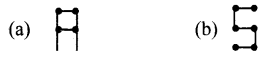
Find the rule which gives the number of sticks in the following pattern.
Samacheer Kalvi 6th Maths Term 1 Chapter 2 Introduction to Algebra Additional Questions Q1
Solution:
Let ‘x’ be the no. of R’s formed.
Samacheer Kalvi 6th Maths Term 1 Chapter 2 Introduction to Algebra Additional Questions Q2
The rule is 6x.
Let y ’ be the no. of S’s formed.
Samacheer Kalvi 6th Maths Term 1 Chapter 2 Introduction to Algebra Additional Questions Q2.1
The rule is 5y.

Samacheer Kalvi 6th Maths Solutions Term 1 Chapter 2 Introduction to Algebra Additional questions

Question 5.
How old was Suja 6 years from now?
Solution:
Let Suja’s present age be ‘a’ years.
6 years from now Suja will be (a + 6) years old.

Question 6.
Price of Apple per kg is ₹ 50 more than price of orange per kg. What is the cost of Apple per kg?
Solution:
Let the price of orange be ₹ b
Price of Apple will be ₹ (b + 50)

Question 7.
Given ‘n’ students like ice cream. What may 2n show?
Solution:
2n shows double the number of students who like ice cream.

Question 8.
Price of oil per litre is ₹ 5 more than three times the price of cool drinks ₹ ‘p’ Express algebraically.
Solution:
Price of cool drinks per kg = ₹ p
Three times = 3p
5 Rs. more = 3p + 5
Price of oil per kg = ₹ (3p + 5)

Question 9.
Complete the table and by inspection of the table find the value of m when m + 10 = 16.
Samacheer Kalvi 6th Maths Term 1 Chapter 2 Introduction to Algebra Additional Questions Q3
Solution:
Samacheer Kalvi 6th Maths Term 1 Chapter 2 Introduction to Algebra Additional Questions Q3.1
From the table m+ 10 = 16 when m = 6.

Samacheer Kalvi 6th Maths Solutions Term 1 Chapter 2 Introduction to Algebra Additional questions

Question 10.
Express algebraically (a) y divided by r (b) double times x is subtracted from 10
Solution:
(a) \(\frac{y}{r}\)
(b) 10 – 2x

Question 11.
Give verbal expression of
(a) 7x + 18
(b) \(\frac{4 x}{3}\)
Solution:
(a) 18 added to 7 times x
(b) 4 times x divided by 3.

Question 12.
Rajini’s Father’s age is 5 years more than 3 times Rajini’s age. What is her father’s age?
Solution:
3x + 5

Question 13.
Samacheer Kalvi 6th Maths Term 1 Chapter 2 Introduction to Algebra Additional Questions Q7
Find the rule for the above pattern.
Solution:
2p

Question 14.
Prepare a table for 3x + 10. From the table find the value of x when 3x + 10 = 25.
Solution:
5

Question 15.
Complete the table and find the solution of the equation \(\frac{z}{3}=4\) using the table.
Samacheer Kalvi 6th Maths Term 1 Chapter 2 Introduction to Algebra Additional Questions Q9
Solution:
Samacheer Kalvi 6th Maths Term 1 Chapter 2 Introduction to Algebra Additional Questions Q9.1

Question 16.
Form the expression for which Ramu is 3 years younger than Mathu.
Solution:
m – 3

Samacheer Kalvi 6th Maths Solutions Term 1 Chapter 2 Introduction to Algebra Additional questions

Question 17.
A tap is to be pasted along the edges of a square shaped gift box. Its length is 4 cm. What is the length of tap needed for one side.
Solution:
\(\frac{4 p}{4}=p\)

Question 18.
The value of y in 7y – 20 = 99.
Solution:
y = 17

Question 19.
Nine added to two times x gives 301. Find the value of x.
Solution:
x = 146

Question 20.
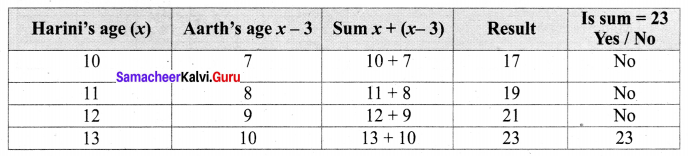
Aarthi is 3 years younger to Harini. If the sum of their ages is 23, how old is Harini?
Solution:
Let Harini’s age be x years
Aarthi’s age is x – 3 years
Given sum of their ages is 23.
i.e., x + (x – 3) = 23
Samacheer Kalvi 6th Maths Term 1 Chapter 2 Introduction to Algebra Additional Questions Q14

Samacheer Kalvi 6th Maths Solutions Term 1 Chapter 2 Introduction to Algebra Additional questions