Samacheer Kalvi 7th Maths Solutions Term 1 Chapter 6 Information Processing Additional Questions

Students can Download Maths Chapter 6 Information Processing Additional Questions and Answers, Notes Pdf, Samacheer Kalvi 7th Maths Book Solutions Guide Pdf helps you to revise the complete Tamilnadu State Board New Syllabus and score more marks in your examinations.

Tamilnadu Samacheer Kalvi 7th Maths Solutions Term 1 Chapter 6 Information Processing Additional Questions

Question 1.
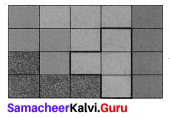
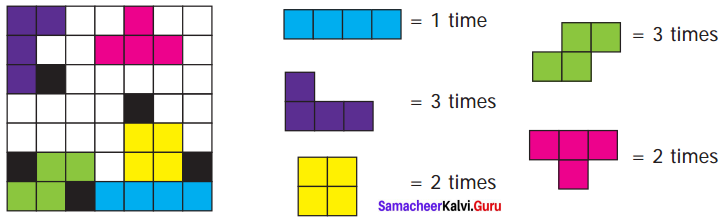
Form a 5 × 4 square shade the square completely by tetromino shapes.

Samacheer Kalvi 7th Maths Term 1 Chapter 6 Information Processing Additional Questions 1
Solution:
Samacheer Kalvi 7th Maths Term 1 Chapter 6 Information Processing Additional Questions 2

SamacheerKalvi.Guru

Question 2.
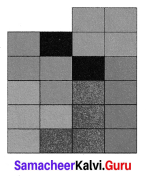
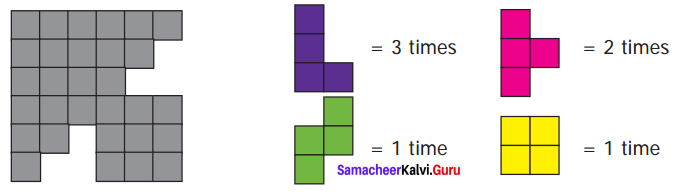
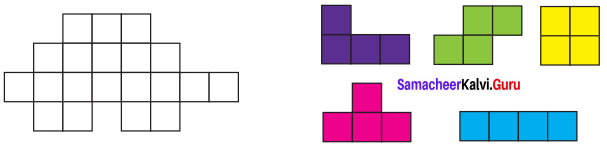
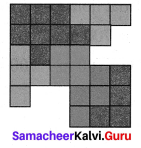
Shade the following figure using the five tetrominoes exactly once.
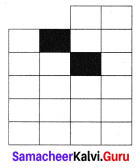
Samacheer Kalvi 7th Maths Term 1 Chapter 6 Information Processing Additional Questions 3
Solution:
Samacheer Kalvi 7th Maths Term 1 Chapter 6 Information Processing Additional Questions 4

Question 3.
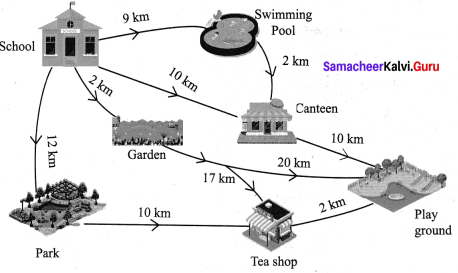
Find the Shortest distance to reach the play ground from school.
Samacheer Kalvi 7th Maths Term 1 Chapter 6 Information Processing Additional Questions 5
Also find out all possible routes.
Solution:
Route 1: School ➝ Swimming pool ➝ canteen ➝ playground
Distance 9km + 2km + 10km = 21 km.
Route 2 : School ➝ canteen ➝ playground
Distance : 10 km + 10 km = 20 km.
Route 3 : School ➝ garden ➝ playground
Distance : 2 km + 20 km = 22 km.
Route 4 : School ➝ garden ➝ teashop ➝ playground
Distance : 2km + 17km + 2km = 21 km.
Route 5 : School ➝ Park ➝ teashop ➝ playground
Distance : 12 km + 12 km + 2 km = 24 km.
∴ Route 2 is the shortest distance.

Samacheer Kalvi 8th Maths Solutions Term 1 Chapter 3 Algebra Additional Questions

Students can Download Maths Chapter 3 Algebra Additional Questions and Answers, Notes Pdf, Samacheer Kalvi 8th Maths Book Solutions Guide Pdf helps you to revise the complete Tamilnadu State Board New Syllabus and score more marks in your examinations.
Samacheer Kalvi 8th Maths Solutions Term 1 Chapter 3 Algebra Additional Questions

Tamilnadu Samacheer Kalvi 8th Maths Solutions Term 1 Chapter 3 Algebra Additional Questions

Additional Questions And Answers

Exercise 3.1

Very Short Answers [2 Marks]

Question 1.
Find the product of the following.
(i) (x, y)
(ii) (10x, 5y)
(iii) (2x2, 5y2)
Solution:
(i) x × y = xy
(ii) 10x × 5y = (10 × 5) x × xy
= 50 xy
(iii) 2x2 x 5y2 = (2 x 5) x (x2 + y2)
= 10x2y2

Short Answers [3 Marks]

Question 1.
Find the product of the following.
(i) 3ab2 c3 by 5a3b2c
(ii) 4x2yz by \(\frac{3}{2}\) x2yz2
Solution:
(i) (3ab3c3) × (5a3b2c)
= (3 × 5)(a × a3 × b2 × b2 × c2 × c)
= 15a1+3.b2+2.c3+1 = 15a4b4c4

(ii) 4x2yz by \(\frac{3}{2}\) x2yz2
= (4 × \(\frac{3}{2}\)) × (x2 × x2 × y × y × z × z2)
= -6x2+2 y1+1 x1+2 = -6x4y2z3

Long Answers [5 Marks]

Question 1.
Simplify (3x – 2) (x – 1) (3x + 5).
Solution:
(3x – 2) (x – 1) (3x + 5)
= {(3x – 2) (x – 1)} × (3x + 5) [∴Multiplication in associative]
= {3x (x – 1) – 2 x – 1)} × (3x + 5)
= (3x2 – 3x – 2x + 2) × (3x + 5)
= (3x2 – 5x + 2) (3x + 5)
= 3x2 × (3x + 5) – 5x (3x + 5) + 2 (3x + 5)
= (9x3 + 15x2) + (-15x2 – 25x) + (6x + 10)
= 9x3 + 15x2 – 15x2 – 25x + 6x + 10
= 9x3 – 19x + 10

Samacheer Kalvi 8th Maths Solutions Term 1 Chapter 3 Algebra Additional Questions

Question 2.
Simplify (5 – x) (3 – 2x) (4 – 3x).
Solution:
(5 – x) (3 – 2x) (4 – 3x)
= {(5 – x)(3 – 2x)} × (4 – 3x) [∴ Multiplication in association]
= {5 (3 – 2x) -x (3 – 2x)} × (4 – 3x)
= (15 – 10x – 3x + 2x2) × (4 – 3x)
= (2x2 – 13x + 15) (4 – 3x)
= 2x2 × (4 – 3x) – 13x (4 – 3x) + 15 (4 – 3x)
= 8x3 – 63 – 52x + 39x2 + 60 – 45x
= -6x3 + 47x2 – 97x + 60

Exercise 3.2

Very Short Answers [2 Marks]

Question 1.
Divide.
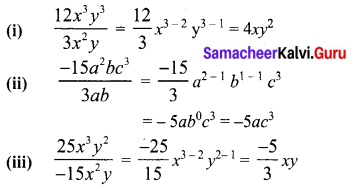
(i) 12x3y3 by 3x2y
(ii) -15a2 bc3 by 3ab
(iii) 25x3y2 by – 15x2y
Solution:
Samacheer Kalvi 8th Maths Term 1 Chapter 3 Algebra Additional Questions 1

Short Answers [3 Marks]

Question 1.
Divide
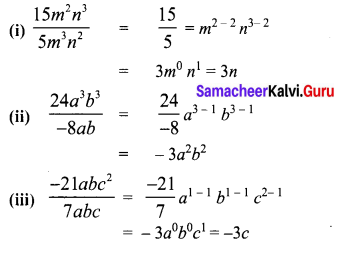
(i) 15m2n3 by 5m2n2
(ii) 24a3b3 by -8ab
(iii) -21 abc2 by 7 abc
Solution:
Samacheer Kalvi 8th Maths Term 1 Chapter 3 Algebra Additional Questions 2

Question 2.
Divide
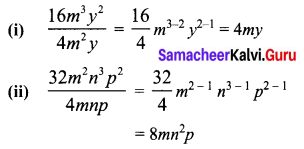
(i) 16m3y2 by 4m2y
(ii) 32m2 n3p2 by 4mnp
Solution:
Samacheer Kalvi 8th Maths Term 1 Chapter 3 Algebra Additional Questions 3

Long Answers [5 Marks]

Question 1.
Divide.
(i) 9m5 + 12m4 – 6m2 by 3m2
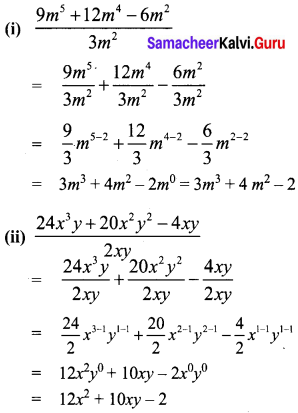
(ii) 24x3y + 20x2y2 – 4xy by 2xy
Solution:
Samacheer Kalvi 8th Maths Term 1 Chapter 3 Algebra Additional Questions 4

Exercise 3.3

Question 1.
Evaluate:
(i) (2x + 3y)2
(ii) (2x – 3y)2
Solution:
(i) (2x + 3y)2
= (2x)2 + 2 × (2x) × (3y) + (3y)2
[using (a + b)2 = a2 + 2ab + b2]
= 4x2 + 12xy + 9y2

(ii) (2x – 3y)2
= (2x)2 – 2(2x) (3y) + (3y)2
[∵ using (a – b)2 = a2 – 2ab + b2]
= 4x2 – 12xy + 9y2

Short Answers [3 Marks]

Question 1.
Evaluate the following
(i) (2x – 3) (2x + 5)
(ii) (y – 7) (y + 3)
(iii) 107 × 103
Solution:
(i) (2x – 3) (2x + 5)
= (2x)2 + (-3 + 5) (2x) + (-3) (5)
[∵ (x + a) (x + b) = x2 + (a + b)x + ab]
= 22x2 + 2 × 2x + (-15)
= 4x2 + 4x – 15

(ii) (y – 7) (y + 3)
= y2 + (-7 + 3)y + (-7) (3)
[∵ (x + a)(x + b) = x2 + (a + b)x + ab]
= y2 – 4y + (-21) = y2 – 4y – 21

(iii) 107 × 103
= (100 + 7) × (100+ 3)
= 1002 + (7 + 3) × 100 +(7 × 3)
= 10000 + 10 × 100 + 21 = 10000 + 1000 + 21 = 11021

Samacheer Kalvi 8th Maths Solutions Term 1 Chapter 3 Algebra Additional Questions

Long Answers [5 Marks]

Question 1.
If x + y = 12 and xy = 14 find x2 + y2.
Solution:
(x + y)2 = x2 + y2 + 2xy
122 = x2 + y2 + 2 × 14
144 = x2 + y2 + 28
x2 + y2 = 144 – 28
x2 + y2 = 116

Question 2.
If 3x + 2y = 12 and xy = 6 find the value of 9x2 + 4y2.
Solution:
(3x + 2y)2 = (3x)2 + (2y)2 + 2 (3x) (2y)
= 9x2 + 4y2 + 12xy
122 = 9x2 + 4y2 + 12 × 6
144 = 9x2 + 4y2 + 72
144 – 72 = 9x2 + 4y2
∴ 9x2 + 4y2 = 72

Exercise 3.4

Question 1.
Factorize:
(i) 7(2x + 5) + 3 (2x + 5)
(ii) 12x3y4 + 16x2y5 – 4x5y2
Solution:
(i) 7(2x + 5) + 3 (2x + 5)
= (2x + 5) (7 + 3)
(ii) 12x3y4 + 16x2y5 – 4x5y2
= 4x2y2 (3xy2 + 4y3 – x3)

Short Answers [3 Marks]

1. Factorize
(i) 81a2 – 121b2
(ii) x2 + 8x + 16
Solution:
(i) 81a2 – 121b2
= (9a)2 – (11b)2
[∵ using a2 – b2 = (a + b)2]
= (9a + 11b) (9a – 11b)

(ii) x2 + 8x + 16 = x2 + 2 × x × 4 + 42
[∵ using a2 + 2ab + b2 = (a + b)2]
= (x + 4)2 = (x + 4)(x + 4)

Long Answers [5 Marks]

Question 1.
Factorize
(i) x2 + 2xy + y2 – a2 + 2ab – b2
(ii) 9 – a6 + 2a3 – b6
Solution:
(i) x2 + 2xy + y2 – a2 + 2ab – b2.
= (x2 + 2xy + y2) – (a2 – 2ab + b2)
= (x + y)2 – (a – b)2
= {(x + y) + (a – b)} {(x + y) – (a – b)}
= (x + y + a – b) (x + y – a + b)

(ii) a – a6 + 2a3b3 – b6
= 9 – (a6 – 2a3b3 + b6)
= 32 -{(a3)2 – 2 × a3 × b3 + (b3)2}
= 32 – (a3 – 63)2
= {3 + (a3 – b3)} {3 – (a3 – b3)}
= (3 + a3 – b3) (3 – a3 + b3)
= (a3 – b3 + 1){-a3 + b3 + 3)

Question 2.
Factorize
(i) 100 (x + y )2 – 81 (a + b)2
(ii)(x + 1)2 – (x – 2)2
Solution:
(i) 100 (x + y)2 – 81 (a + b)2
= {10 (x + y)}2 – {(a (a + b)}2
= {10 (x + y) + 9 (a + b)}
{10 (x + y) – 9(a + b)}
= (10x + 10y + 9a – 9b)}
(10x + 10y – 9a – 9b)

(ii) (x – 1)2 – (x – 2)2
= {(x – 1 +(x – 2)}
{(x – 1) – (x – 2)}
= (2x – 3) – (x – 1 – x + 2)
= (2x – 3) × 1 = 2x – 3

Samacheer Kalvi 8th Maths Solutions Term 1 Chapter 3 Algebra Ex 3.5

Students can Download Maths Chapter 3 Algebra Ex 3.5 Questions and Answers, Notes Pdf, Samacheer Kalvi 8th Maths Book Solutions Guide Pdf helps you to revise the complete Tamilnadu State Board New Syllabus and score more marks in your examinations.
Samacheer Kalvi 8th Maths Solutions Term 1 Chapter 3 Algebra Ex 3.5

Tamilnadu Samacheer Kalvi 8th Maths Solutions Term 1 Chapter 3 Algebra Ex 3.5

Miscellaneous Practice Problems

Question 1.
Subtract: -2(xy)2 (y3 + 7x2y + 5) from 5y2 (x2y3 – 2x4y + 10x2)
Solution:
5y2 (x2y3 – 2x4y + 10x2) – [(-2)(xy)2 (y3 + 7x2y + 5)]
= [5y2 (x2y3) – 5y2 (2x4y) + 5y2 (10x2)] – [(-2)x2y2 (y3 + 7x2y + 5)]
= (5y55x2 – 10x4y3 + 50x2y2)
= 5x2y5 – 10x4y3 + 50x2y2 – [(-2x2y5) – 14x4y3 – 10x2y2]
= 5x2y5 – 10x4y3 + 50x2)y2 + 2x2 y5 + 14x4)y3 + 10x2)y2
= (5 + 2)x2y5 + (-10 + 14)x4y3 + (+50 + 10)x2y2
= 7x2y5 + 4x4y3 + 60x2y2

Question 2.
Multiply (4x2 + 9) and (3x – 2).
Solution:
(4x2 + 9) (3x – 2) = 4x2(3x – 2) + 9(3x – 2)
= (4x2)(3x) – (4x2)(2) + 9(3x) – 9(2) = (4 × 3 × x × x2) – (4 × 2 × x2) + (9 × 3 × x) – 18
= 12x3 – 8x2 + 27x – 18 (4x3 + 9) (3x – 2) = 12x3 – 8x2 + 27x – 18

Samacheer Kalvi 8th Maths Solutions Term 1 Chapter 3 Algebra Ex 3.5

Question 3.
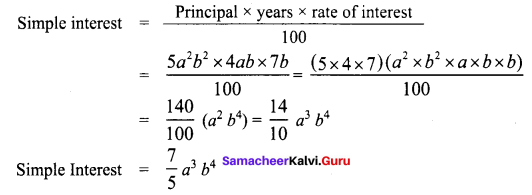
Find the simple interest on Rs. 5a2b2 for 4ab years at 7b% per annum.
Solution:
Samacheer Kalvi 8th Maths Term 1 Chapter 3 Algebra Ex 3.5 1

Question 4.
The cost of a note book is Rs. 10ab. If Babu has Rs. (5a2b + 20ab2 + 40ab). Then how many note hooks can he buy?
Solution:
For ₹ 10 ab the number of note books can buy = 1.
Samacheer Kalvi 8th Maths Term 1 Chapter 3 Algebra Ex 3.5 65
Samacheer Kalvi 8th Maths Term 1 Chapter 3 Algebra Ex 3.5 66

Samacheer Kalvi 8th Maths Solutions Term 1 Chapter 3 Algebra Ex 3.5

Question 5.
Factorise : (7y2 – 19y – 6)
Solution:
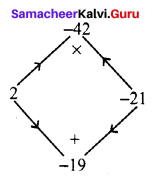
7y2 – 19y – 6 is of the form ax2 + bx + c where a = 7; b = -19; c = – 6
Samacheer Kalvi 8th Maths Term 1 Chapter 3 Algebra Ex 3.5 67
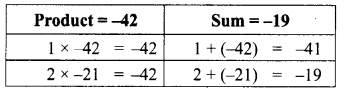
The product a × c = 7 × -6 = -42
sum b = – 19
Samacheer Kalvi 8th Maths Term 1 Chapter 3 Algebra Ex 3.5 80
The middle term – 19y can be written as – 21y + 2y
7y2 – 19y – 6 = 7y2 – 21y + 2y – 6
= 7y(y – 3) + 2(y – 3) = (y – 3)(7y + 2)
7y2 – 19y – 6 = (y – 3)(7y + 2)

Challenging Problems

Question 6.
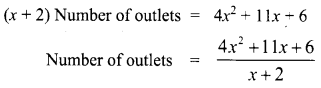
A contractor uses the expression 4x2 + 11x + 6 to determine the amount of wire to order when wiring a house. If the expression comes from multiplying the number of rooms times the number of outlets and he knows the number of rooms to be (x + 2), find the number of outlets in terms of ‘x’ [Hint: factorise 4x2 + 11x + 6]
Solution:
Given Number of rooms = x + 2
Number of rooms × Number of outlets = amount of wire.
Samacheer Kalvi 8th Maths Term 1 Chapter 3 Algebra Ex 3.5 81
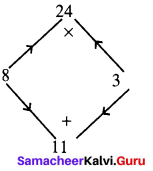
Now factorising 4x2 + 11x + 6 which is of the form ax2 + bx + c with a = 4 b = 11 c = 6.
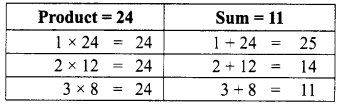
The product a × c = 4 × 6 = 24
sum b = 11
Samacheer Kalvi 8th Maths Term 1 Chapter 3 Algebra Ex 3.5 85
Samacheer Kalvi 8th Maths Term 1 Chapter 3 Algebra Ex 3.5 86
The middle term 11x can be written as 8x + 3x
∴ 4x2 + 11x + 6 = 4x2 + 8x + 3x + 6 = 4x (x + 2) + 3 (x + 2)
4x2 + 11x + 6 = (x + 2) (4x + 3)
Now from (1) the number of outlets
Samacheer Kalvi 8th Maths Term 1 Chapter 3 Algebra Ex 3.5 96
∴ Number of outlets = 4x + 3

Samacheer Kalvi 8th Maths Solutions Term 1 Chapter 3 Algebra Ex 3.5

Question 7.
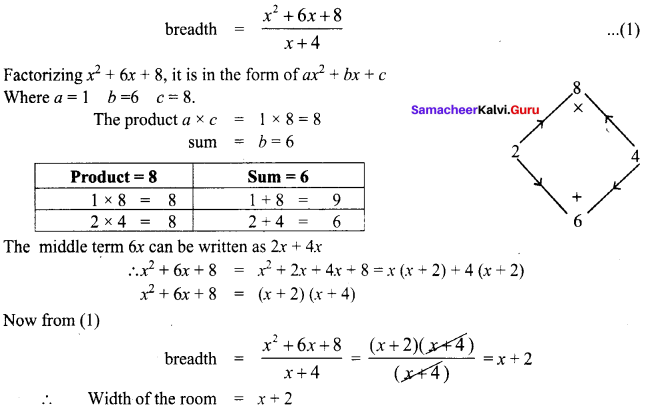
A mason uses the expression x2 + 6x + 8 to represent the area of the floor of a room. If the decides that the length of the room will be represented by (x + 4), what will the width of the room be in terms of x ?
Solution:
Given length of the room = x + 4
Area of the room = x2 + 6x + 8
Length × breadth = x2 + 6x + 8
Samacheer Kalvi 8th Maths Term 1 Chapter 3 Algebra Ex 3.5 88

Samacheer Kalvi 8th Maths Solutions Term 1 Chapter 3 Algebra Ex 3.5

Question 8.
Find the missing term: y2 + (-) x + 56 = (y + 7)(y + -)
Solution:
We have (x + a) (x + b) = x2 + (a + b)x + ab
56 = 7 × 8 .
∴ y2 + (7 + 8)x + 56 = (y + 7)(y + 8)

Question 9.
Factorise: 16p4 – 1
Solution:
16p4 – 1 = 24p4 – 1 = (22)2(p2)2 – 12
Comparing with a2 – b2 = (a + b)(a – b) where a = 22p2 and b = 1
∴ (22p2)2 – 12 = (22p2 + 1) (22p2 – 1) = (4p2 + 1) (4p2 – 1)
∴ 16p4 – 1 = (4p2 + 1)(4p2 – 1)(4p2 + 1)(22p2 – 12)
= (4p2 + 1) [(2p)2– 12] = (4p2 + 1) (2p + 1)(2p – 1)
[∵ using a2 – b2 = (a + b) (a – b)]
∴ 16p4 – 1 = (4psup>2 + 1)(2p + 1)(2p – 1)

Samacheer Kalvi 8th Maths Solutions Term 1 Chapter 3 Algebra Ex 3.5

Question 10.
Factorise : x6 – 64y3
Solution:
x6 – 64y3 = (x2)3 – 43y3 = (x2)3 – (4y)3
This is of the form a3 – b3 with a = x2, b = 4y
a3 – b3 = (a – b)(a2 + ab + b2)
(x2)3 – (4y)3 = (x2 – 4y) [(x2)2 + (x2)(4y) + (4y)2]
= (x2 – 4y) [x4 + 4x2y + 16y2]
∴ x6 – 64y3 = (x2 – 4y) [x4 + 4x2y + 16y2]

Samacheer Kalvi 7th Maths Solutions Term 1 Chapter 1 Number System Ex 1.3

Students can Download Maths Chapter 1 Number System Ex 1.3 Questions and Answers, Notes Pdf, Samacheer Kalvi 7th Maths Book Solutions Guide Pdf helps you to revise the complete Tamilnadu State Board New Syllabus and score more marks in your examinations.

Tamilnadu Samacheer Kalvi 7th Maths Solutions Term 1 Chapter 1 Number System Ex 1.3

Question 1.
Fill in the blanks.
(i) -80 × ____ = -80
(ii) (-10) × ____ = 20
(iii) 100 × ___ = -500
(iv) ____ × (-9) = -45
(v) ___ × 75 = 0
Solution:
(i) 1
(ii) -2
(iii) -5
(iv) 5
(v) 0

Question 2.
Say True or False:
(i) (-15) × 5 = 75
(ii) (-100) × 0 × 20 = 0
(iii) 8 × (-4) = 32
Solution:
(i) False
(ii) True
(iii) False

Question 3.
What will be the sign of the product of the following:
(i) 16 times of negative integers.
(ii) 29 times of negative integers.
Solution:
(i) 16 is an even interger.
If negative integers are multiplied even number of times, the product is a positive integer.
∴ 16 times a negative integer is a positive integer.

(ii) 29 times negative integer.
If negative integers are multiplied odd number of times, the product is a negative integer. 29 is odd.
∴ 29 times negative integers is a negative integer.

SamacheerKalvi.Guru

Question 4.
Find the product of
(i) (-35) × 22
(ii) (-10) × 12 × (-9)
(iii) (-9) × (-8) × (-7) × (-6)
(iv) (-25) × 0 × 45 × 90
(v) (-2) × (+50) × (-25) × 4
Solution:
(i) 35 × 22 = -770
(ii) (-10) × 12 × (-9) = (-120) × (-9) = +1080
(iii) (-9) × (-8) × (-7) × (-6) = (+72) × (-7) × (-6) = (-504) × (-6) = +3024
(iv) (-25) × 0 × 45 × 90 = 0 × 45 × 90 = 0 × 90 = 0
(v) (-2) × (+50) × (-25) × 4 = (-100) × -25 × 4 = 2500 × 4 = 10,000

Question 5.
Check the following for equality and if they are equal, mention the property.
(i) (8 – 13) × 7 and 8 – (13 × 7)
Solution:
Consider (8 – 13) × 7 = (-5) × 7 = -35
Now 8 – (13 × 7) = 8 – 91 = -83
∴ (8 – 13) × 7 ≠ 8 – (13 × 7)

(ii) [(-6) – (+8)] × (-4) and (-6) – [8 × (-4)]
Solution:
[(-6) – (+8)] × (-4) = [(-6) + (-8)] × (-4) = (-14) × (-4) = +56
Now (-6) – [8 × (-4)] = (-6) – (-32)
= (-6) + (+32) = +26
∴ [(-6) – (+8)] × (-4) ≠ (-6) – [8 × (-4)]

(iii) 3 × [(-4) + (-10)] and [3 × (-4) + 3 × (-10)]
Solution:
Consider 3 × [(-4) + (-10)] = 3 × -14 = -42
Now [3 × (-4) + 3 × (-10)] = (-12) + (-30) = -42
Here 3 × [(-4) + (-10)] = [3 × (-4) + 3 × (-10)]
It is the distributive property of multiplication over addition.

Question 6.
During summer, the level of the water in a pond decreases by 2 inches every week due to evaporation. What is the change in the level of the water over a period of 6 weeks?
Solution:
Level of water decreases a week = 2 inches.
Level of water decreases in 6 weeks = 6 × 2 = 12 inches

SamacheerKalvi.Guru

Question 7.
Find all possible pairs of integers that give a product of -50.
Solution:
Factor of 50 are 1, 2, 5, 10, 25, 50.
Possible pairs of integers that gives product -50:
(-1 × 50), (1 × (-50)), (-2 × 25), (2 × (-25)), (-5 × 10), (5 × (-10))

Objective Type Questions

Question 8.
Which of the following expressions is equal to -30.
(i) -20 – (-5 × 2)
(ii) (6 × 10) – (6× 5)
(iii) (2 × 5)+ (4 × 5)
(iv) (-6) × (+5)
Solution:
(iv) (-6) × (+5)
Hint:
(i) -20 + (10) = -10
(ii) 60 – 30 = 30
(iii) 10 + 20 = 30
(iv) (-6) × (+5) = – 30

Question 9.
Which property is illustrated by the equation: (5 × 2) + (5 × 5) = 5 × (2 + 5)
(i) commutative
(ii) closure
(iii) distributive
(iv) associative
Solution:
(iii) distributive

SamacheerKalvi.Guru

Question 10.
11 × (-1) = _____
(i) -1
(ii) 0
(iii) +1
(iv) -11
Solution:
(iv) -11

Question 11.
(-12) × (-9) =
(i) 108
(ii) -108
(iii) +1
(iv) -1
Solution:
(i) 108

Samacheer Kalvi 6th Maths Solutions Term 1 Chapter 5 Statistics Ex 5.4

You can Download Samacheer Kalvi 6th Maths Book Solutions Guide Pdf, Tamilnadu State Board help you to revise the complete Syllabus and score more marks in your examinations.
Samacheer Kalvi 6th Maths Solutions Term 1 Chapter 5 Statistics Ex 5.4

Tamilnadu Samacheer Kalvi 6th Maths Solutions Term 1 Chapter 5 Statistics Ex 5.4

Miscellaneous Practice Problems

Question 1.
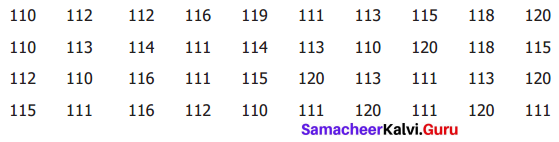
The heights (in centimetres) of 40 children are
Samacheer Kalvi 6th Maths Term 1 Chapter 5 Statistics Ex 5.4 Q1
Prepare a tally mark table.
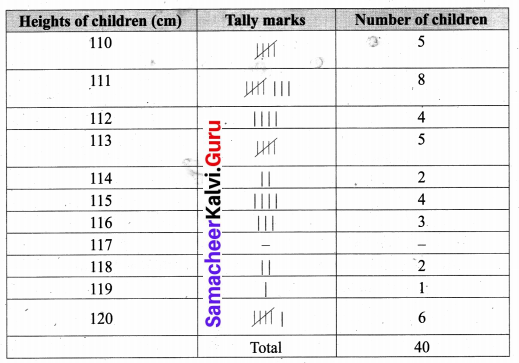
Solution:
Samacheer Kalvi 6th Maths Term 1 Chapter 5 Statistics Ex 5.4 Q1.1

Question 2.
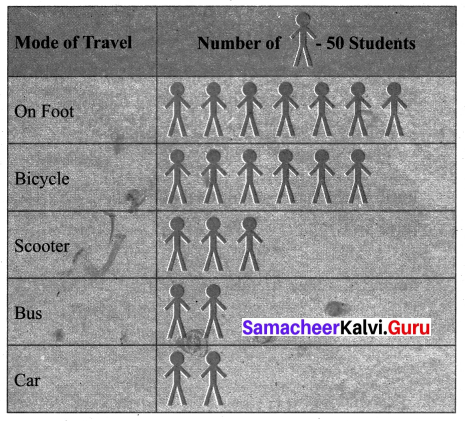
There are 1000 students in a school. Data regarding the mode of transport of the students as given below. Draw a pictograph to represent the data.
Samacheer Kalvi 6th Maths Term 1 Chapter 5 Statistics Ex 5.4 Q2
Solution:
The pictograph for the mode of transport of students.
Samacheer Kalvi 6th Maths Term 1 Chapter 5 Statistics Ex 5.4 Q2.1

Samacheer Kalvi 6th Maths Solutions Term 1 Chapter 5 Statistics Ex 5.4

Question 3.
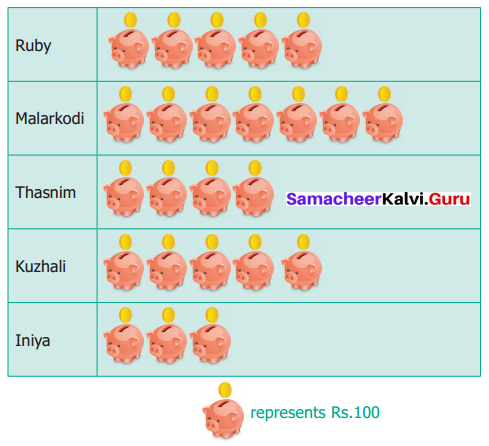
The following pictograph shows the total savings of a group of friends in a year. Each picture represents a saving of Rs. 100. Answer the following questions.
Samacheer Kalvi 6th Maths Term 1 Chapter 5 Statistics Ex 5.4 Q3
(i) What is the ratio of Ruby’s saving to that of Thasnim’s?
(ii) What is the ratio of Kuzhali’s savings to that of others?
(iii) How much is Iniya’s savings?
(iv) Find the total amount of savings of all your friends?
(v) Ruby and Kuzhali save the same amount. Say True or False.
Solution:
(i) Ratio of Ruby’s saving to that of Thasnim’s
\(=\frac{\text { Ruby’s saving }}{\text { Thasnim’s saving }}=\frac{5 \times 100}{4 \times 100}=\frac{5}{4}=5: 4\)
Ratio of Ruby’s saving to that of Thasnims = 5 : 4
(ii) Ratio of Kuzhali’s savings to that of others
\(=\frac{\text { kuzhali’s saving }}{\text { others saving }}=\frac{5 \times 100}{19 \times 100}=\frac{5}{19}=5: 19\)
Ratio of Kuzhali’s saving to that of others = 5 : 19
(iii) Iniya’s saving = 3 × 100 = ₹ 300
(iv) Saving of all the friends = (5 + 7 + 4 + 5 + 3) × 100 = 24 × 100 = ₹ 2400.
Total savings = ₹ 2400
(v) True.

Challenging Problems

Question 4.
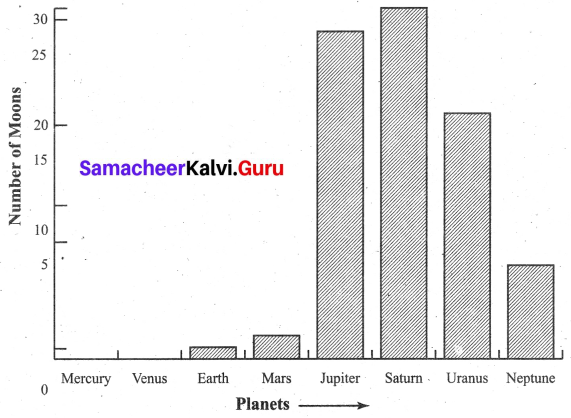
The table shows the number of moons that orbit each of the planets in our solar system.
Samacheer Kalvi 6th Maths Term 1 Chapter 5 Statistics Ex 5.4 Q4
Make a Bar graph for the above data.
Solution:
Samacheer Kalvi 6th Maths Term 1 Chapter 5 Statistics Ex 5.4 Q4.1

Question 5.
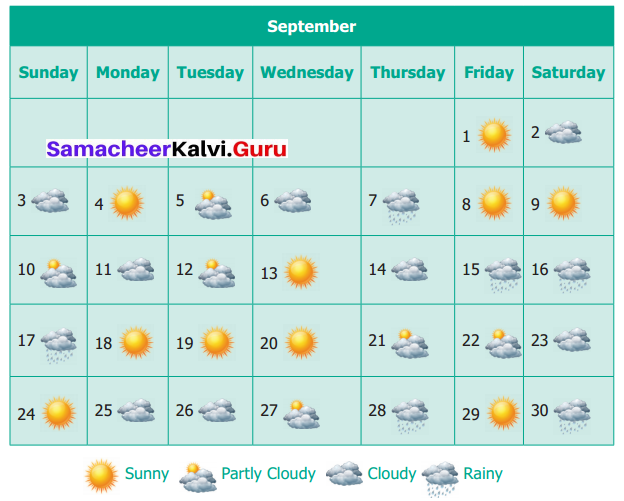
The predictions of Weather in the month of September is given below:
Samacheer Kalvi 6th Maths Term 1 Chapter 5 Statistics Ex 5.4 Q5
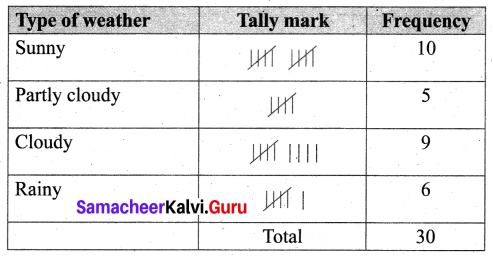
(i) Make a frequency table of the types of weather by reading the calender.
(ii) How many days are either cloudy or partly cloudy
(iii) How many days do not have rain? Give two ways to find the answer?
(iv) Find the ratio of the number of sunny days to Rainy days.
Solution:
Frequency Table for the Type of weather for the month of September
Samacheer Kalvi 6th Maths Term 1 Chapter 5 Statistics Ex 5.4 Q5.1
(ii) 14 days.
(iii) For 24 days there is no rain.
(a) From the total 30 days, we subtract the rainy days i.e 30 – 6 = 24 days (from the frequency table)
(b) From the picture, we can count the non-rainy days.
(iv) Ratio of number of Sunny day to Rainy days
\(=\frac{\text { Number of Sunny days }}{\text { Number of Rainy days }}=\frac{10}{6}=\frac{5}{3}=5: 3\)
The ratio of a number of Sunny days to Rainy days = 5 : 3.

Samacheer Kalvi 6th Maths Solutions Term 1 Chapter 5 Statistics Ex 5.4

Question 6.
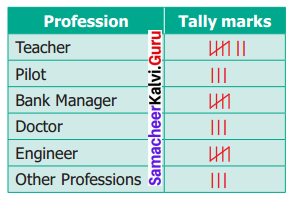
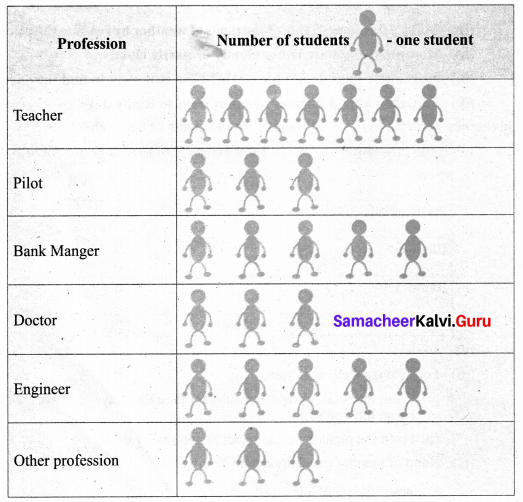
26 students were interviewed to find out what they want to become in future. Their responses are given in the following table.
Samacheer Kalvi 6th Maths Term 1 Chapter 5 Statistics Ex 5.4 Q6
Represent this data using the pictograph
Solution:
Samacheer Kalvi 6th Maths Term 1 Chapter 5 Statistics Ex 5.4 Q6.1

Question 7.
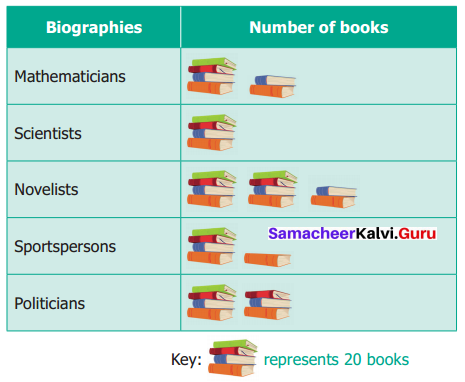
Yasmin of class VI was given a task to count the number of books which are biographies, in her school library. The information collected by her is represented as follows.
Samacheer Kalvi 6th Maths Term 1 Chapter 5 Statistics Ex 5.4 Q7
Observe the pictograph and answer the following questions.
(i) Which title has the maximum number of biographies?
(ii) Which title has the minimum number of biographies?
(iii) Which title has exactly half the number of biographies as Novelists?
(iv) How many biographies are there on the title of Sportspersons?
(v) What is the total number of biographies in the library?
Solution:
(i) ‘The title Novelists’ have the maximum number of biographies
(ii) ‘The title Scientists’ have the minimum number of biographies.
(iii) ‘Sportspersons’ title has exactly half the number of biographies as Novelist.
(iv) \((1 \times 20)+\frac{20}{4}=20+5=25\) biographies are there in the title sportsperson.
(v) 8 × 20 = 160 biographies are there in the library.

Question 8.
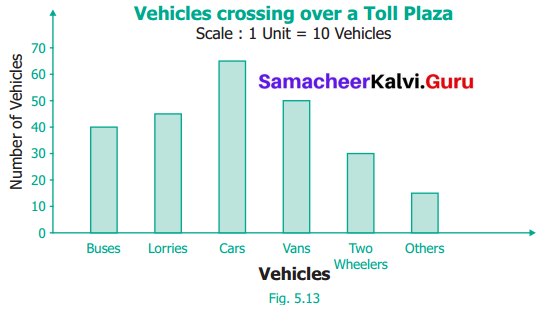
The bar graph illustrates the results of a survey conducted on vehicles crossing over a Toll Plaza in on hour.
Samacheer Kalvi 6th Maths Term 1 Chapter 5 Statistics Ex 5.4 Q8
Observe the bar graph carefully and fill up the following table.
Samacheer Kalvi 6th Maths Term 1 Chapter 5 Statistics Ex 5.4 Q8.1
Solution:
Samacheer Kalvi 6th Maths Term 1 Chapter 5 Statistics Ex 5.4 Q8.2

Question 9.
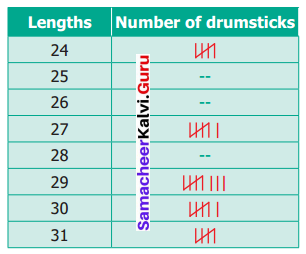
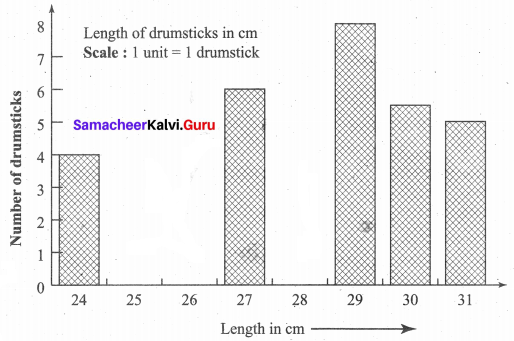
The lengths (in the nearest centimetre) of 30 drumsticks are given as follows.
Samacheer Kalvi 6th Maths Term 1 Chapter 5 Statistics Ex 5.4 Q9
Draw the bar graph showing the same information.
Solution:
The bar graph showing the same information is given below:
Samacheer Kalvi 6th Maths Term 1 Chapter 5 Statistics Ex 5.4 Q9.1

Samacheer Kalvi 6th Maths Solutions Term 1 Chapter 5 Statistics Ex 5.4

Question 10.
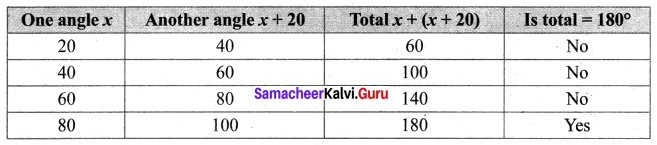
Given two angles are supplementary i.e. their sum = 180°.
Solution:
Let the angle be x.
Then anothcf angle = x + 20 (given)
Samacheer Kalvi 6th Maths Term 1 Chapter 5 Statistics Ex 5.4 Q10
The two angles are 80° and 100°

Samacheer Kalvi 7th Maths Solutions Term 1 Chapter 1 Number System Ex 1.2

Students can Download Maths Chapter 1 Number System Ex 1.2 Questions and Answers, Notes Pdf, Samacheer Kalvi 7th Maths Book Solutions Guide Pdf helps you to revise the complete Tamilnadu State Board New Syllabus and score more marks in your examinations.

Tamilnadu Samacheer Kalvi 7th Maths Solutions Term 1 Chapter 1 Number System Ex 1.2

Question 1.
Fill in the blanks
(i) -44 + ____ = -88
(ii) ___ – 75 = -45
(iii) ___ – (+50) = -80
Solution:
(i) -44
(ii) 30
(iii) -30

Question 2.
Say True or False.
(i) (-675) – (-400) = -1075
(ii) 15 – (-18) is the same as 15 + 18
(iii) (-45) – (-8) = (-8) – (-45)
Solution:
(i) False
(ii) True
(iii) False

Question 3.
Find the value of the following.
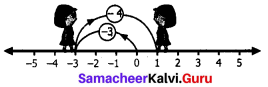
(i) -3 – (-4) using number line.
Solution:
We start at zero facing positive direction. Move 3 units backward to represent (-3). Then turn towards the negative side and move 4 units backwards. We reach+1.
Samacheer Kalvi 7th Maths Term 1 Chapter 1 Number System Ex 1.2 1
∴ (-3) – (-4) = +1

(ii) 7 – (-10) using number line
Solution:
Samacheer Kalvi 7th Maths Term 1 Chapter 1 Number System Ex 1.2 2
We start at zero facing positive direction. Move 7 units forward to represent (+7). Then turn towards the negative side and move 10 units backwards.
We reach +17
∴ 1 – (-10) = +17

(iii) 35 – (-64)
Solution:
35 – (-64) = 35+ (Additive inverse of-64) = 35 + (+64) = 99
∴ 35 – (-64) = 99

(iv) -200 – (+100)
Solution:
-200 – (+100) = -200 + (Additive inverse of+100) = -200 + (-100) = -300
-200 – (+100) = -300

SamacheerKalvi.Guru

Question 4.
Kabilan was having 10 pencils with him. He gave 2 pencils to senthil and 3 to Karthick. Next day his father gave him 6 more pencils, from that he gave 8 to his sister. How many pencils are left with him?
Solution:
Total pencils Kabilan had = 10
No. of pencils given to Senthil = 2
No. of pencils given to Karthick = 3.
Now number of pencils left with Kabilan = 10 – 2 – 3 = 8 – 3 = 5
Number of pencils got from his father = 6
No. total pencils Kabilan had = 5 + 6 = 11
Number of pencils given to his sister = 8
Number of pencils left with Kabilan = 11 – 8 = 3

Question 5.
A lift is on the ground floor. If it goes 5 floors down and then moves up to 10 floors from there, then in which floor will the lift be?
Solution:
Initially the lift will be in the ground floor representing ‘0’
It goes to 5 floors down ⇒ -5
Then it moves 10 floors up +10.
Now the lift will be = 0 – 5 + 10 = -5 + 10
= 5th floor (above the ground floor)

Question 6.
When Kala woke up, her body temperature was 102°F. She took medicine for fever. After 2 hours it was 2°F lower. What was her temperature then?
Solution:
Kala’s temperature initially = 102°F
After two hours the temperature decreased = -2°F
Now the final temperature = 102°F – 2°F = 100°F

Question 7.
What number should be added to (-17) to get -19?
Solution:
According to the problem = -17 + A number = -19
The number = -19 + 17 = -2
∴ -2 should be added to -17 to get -19

SamacheerKalvi.Guru

Question 8.
A student was asked to subtract (-12) from -47. He got -30. Is he correct? Justify.
Solution:
Subtracting -12 from -47, we get
-47 – (-12) = -47 + (Additive inverse of-12)
= -47 + (+12) = -35
But the students answer is -30.
So he is not correct.

Objective Type Questions

Question 9.
(-5) – (-18)
(i) 23
(ii) -13
(iii) 13
(iv) -23
Solution:
(iii) 131

Question 10.
(-100) – 0 + 100 =
(i) 200
(ii) 0
(iii) 100
(iv)-200
Solution:
(ii) 0

Samacheer Kalvi 7th Maths Solutions Term 1 Chapter 1 Number System Ex 1.4

Students can Download Maths Chapter 1 Number System Ex 1.4 Questions and Answers, Notes Pdf, Samacheer Kalvi 7th Maths Book Solutions Guide Pdf helps you to revise the complete Tamilnadu State Board New Syllabus and score more marks in your examinations.

Tamilnadu Samacheer Kalvi 7th Maths Solutions Term 1 Chapter 1 Number System Ex 1.4

Question 1.
Fill in the blanks.
(i) (-40) ÷ ___ =40
(ii) 25 ÷ ____ = -5
(iii) ____ ÷ (-4) = 9
(iv) (-62) ÷ (-62) = ____
Solution:
(i) -1
(ii) -5
(iii) -36
(iv) 1

Question 2.
Say True or False:
(i) (-30) ÷ (-6) = -6
(ii) (-64) ÷ (-64) is 0
Solution:
(i) False
(ii) False

Question 3.
Find the values of the following.
(i) (-75) ÷ 5
(ii) (-100) ÷ (-20)
(iii) 45 ÷ (-9)
(iv) (-82) ÷ 82
Solution:
(i) \(\frac{-75}{5}\) = -15
(ii) \(\frac{-100}{-20}\) = 5
(iii) \(\frac{45}{-9}\) = -5
(iv) \(\frac{-82}{82}\) = -1

Question 4.
The product of two integers is -135. If one number is -15. Find the other integer.
Solution:
Given the product of two integers = -135
One of them = -15
∴ -15 × Another number = -135
Other number = \(\frac{-135}{-15}\) = 9
∴ The other number = 9.

Samacheer Kalvi 7th Maths Solutions Term 2 Chapter 1 Number System Ex 1.4

Question 5.
In 8 hours duration, with uniform decrease in temperature, the temperature dropped 24°C. How many degrees did the temperature drop each hour?
Solution:
In 8 hours the drop in temperature = 24
In 1 hour the drop in temperature = \(\frac{24}{8}\) = 3°
The temperature dropped 3°C every hour.

Question 6.
An elevator descends into a mine shaft at the rate of 5 m/min. If the descent starts from 15 m above the ground level, how long will it take to reach -250 m?
Solution:
The elevator’s position = 15 m above ground level = +15 m
It should reach = -250 m
The distance to be travelled = 15 – (-250) m = 15 + (+250) m 265 m
Time taken to descend 5 m = 1 min
∴ Time required to descend 265 m = \(\frac{24}{8}\) = 53 min

Question 7.
A person lost 4800 calories in 30 days. If the calory loss is uniform, calculate the loss of calory per day.
Solution:
Loss of calory in 30 days = 4800
∴ Loss of calory in 1 day = \(\frac{4800}{30}\) = 160 calories
∴ 160 calories lost per day.

Question 8.
Given 168 × 32 = 5376 then fined (-5376) ÷ (-32).
Solution:
Given 168 × 32 = 5376
∴ \(\frac{5376}{32}\) = 168
Also, \(\frac{-5376}{-32}\) = 168

Samacheer Kalvi 7th Maths Solutions Term 2 Chapter 1 Number System Ex 1.4

Question 9.
How many -4’s are there is (-20)?
Solution:
Number of -4’s in (-20) = \(\frac{-20}{-4}\) = 5

Question 10.
(-400) divided into 10 equal parts gives ____
Solution:
\(\frac{-400}{10}\) = -4

Objective Type Questions

Question 11.
Which of the following does not represent an integer?
(i) 0 ÷ (-7)
(ii) 20 ÷ (-4)
(iii) (-9) ÷ 3
(iv) 12 ÷ 5
Solution:
(iv) 12 ÷ 5

Question 12.
(-16) ÷ 4 is the same as
(i) -(-16 ÷ -4)
(ii) -(16) ÷ (-4)
(iii) 16 ÷ (-4)
(iv) -4 ÷ -16
Solution:
(iii) 16 ÷ (-4)

Samacheer Kalvi 7th Maths Solutions Term 2 Chapter 1 Number System Ex 1.4

Question 13.
(-200) ÷ 10 is
(i) 20
(ii) -20
(iii) -190
(iv) 210
Solution:
(ii) 20

Question 14.
The set of integers is not closed under
(i) Addition
(ii) Subtraction
(iii) Multiplication
(iv) Division
Solution:
(iv) Division

Samacheer Kalvi 7th Maths Solutions Term 1 Chapter 6 Information Processing Ex 6.2

Students can Download Maths Chapter 6 Information Processing Ex 6.2 Questions and Answers, Notes Pdf, Samacheer Kalvi 7th Maths Book Solutions Guide Pdf helps you to revise the complete Tamilnadu State Board New Syllabus and score more marks in your examinations.

Tamilnadu Samacheer Kalvi 7th Maths Solutions Term 1 Chapter 6 Information Processing Ex 6.2

Miscellaneous Practice Problems

Question 1.
Make a model of a fish using the given tetromino shapes
Samacheer Kalvi 7th Maths Term 1 Chapter 6 Information Processing Ex 6.2 1
Complete the given rectangle using the given tetromino shapes.
Solution:
Samacheer Kalvi 7th Maths Term 1 Chapter 6 Information Processing Ex 6.2 2

Question 2.
Complete the given rectangle using the given tetromino shapes.
Samacheer Kalvi 7th Maths Term 1 Chapter 6 Information Processing Ex 6.2 3
Solution:
Samacheer Kalvi 7th Maths Term 1 Chapter 6 Information Processing Ex 6.2 4

Question 3.
Shade the figure completely, by using five Tetromino shapes only once.
Samacheer Kalvi 7th Maths Term 1 Chapter 6 Information Processing Ex 6.2 7
Solution:
Samacheer Kalvi 7th Maths Term 1 Chapter 6 Information Processing Ex 6.2 8

Question 4.
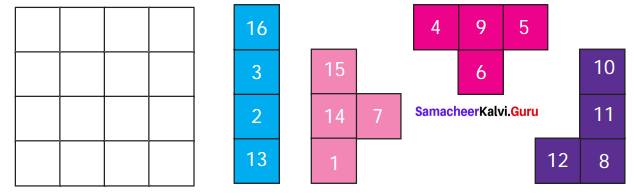
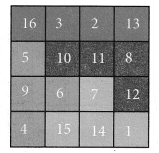
Using the given tetrominoes with numbers on it complete the 4 × 4 magic square?
Samacheer Kalvi 7th Maths Term 1 Chapter 6 Information Processing Ex 6.2 9
Solution:
Samacheer Kalvi 7th Maths Term 1 Chapter 6 Information Processing Ex 6.2 10

Question 5.
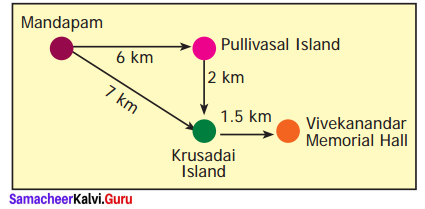
Find the shortest route to Vivekanandar Memorial Hall from the Mandapam using the given map.
Samacheer Kalvi 7th Maths Term 1 Chapter 6 Information Processing Ex 6.2 11
Solution:
Possible routes from Mandapam to Vivekandar Memorial are

route 1:
(a) Mandapam ➝ Pullivasal Island ➝ Krusadai Island ➝ Vivekanandar Memorial Hall.
Distance = 6 Km + 2 Km + 1.5 Km = 9.5 Km

route 2:
(b) Mandapam ➝ Krusadai Island ➝ Vivekanandar Memorial Hall.
Distance = 7 Km + 1.5 Km = 8.5 Km
8.5 km < 9.5 km
∴ Shortest route : Mandapam ➝ Krusadai Island ➝ Vivekanandar Memorial Hall.

Challenge Problems

Question 6.
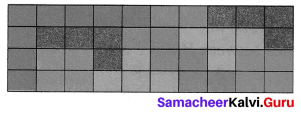
Fill in 4 × 10 rectangle completely, using all the five tetrominoes twice.
Solution:
Samacheer Kalvi 7th Maths Term 1 Chapter 6 Information Processing Ex 6.2 50

(more possible ways are there)

Question 7.
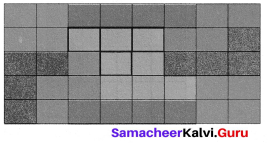
Fill in 8 × 5 rectangle completely, using all the five tetrominoes twice.
Solution:
Samacheer Kalvi 7th Maths Term 1 Chapter 6 Information Processing Ex 6.2 51
(more possible way are there)

Question 8.
Observe the picture and answer the following.
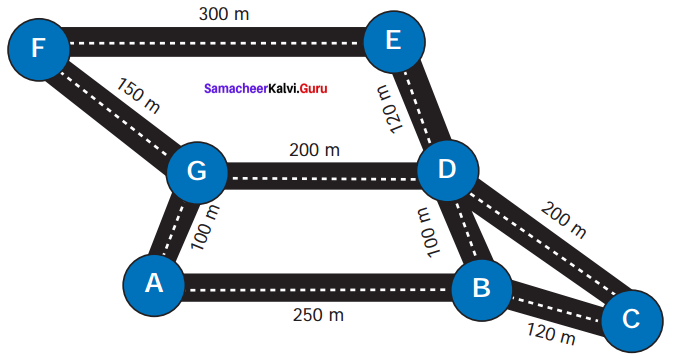
(i) Find all the possible routes from A to D.
(ii) Find the shortest distance between E and C.
(iii) Find all the possible routes between B and F with distance. Mention the shortest route.

Samacheer Kalvi 7th Maths Term 1 Chapter 6 Information Processing Ex 6.2 52
Solution:
(i) All possible routes from A to D are :
(a) A ➝ G ➝ F ➝ E ➝ D
(b) A ➝ G ➝ D
(c) A ➝ B ➝ C ➝ D
(d) A ➝ B ➝ D

(ii) Distance between E and C are
(a) Route 1: E ➝ D ➝ C
Distance: 120 m + 200 m = 320 m.
(b) Route 2: E ➝ D ➝ B ➝ C
Distance = 120 + 100 m + 120 m
= 340 m.
∴ Shortest distance is 320 m.

(iii) All possible routes between B and F are :
(a) Route 1: B ➝ A ➝ G ➝ F
Distance = 250 m + 100 m + 150 m = 600 m.

(b) Route 2: 2 ➝ D ➝ E ➝ F
Distance = 100 m + 120 m + 300 m
= 520 m.

(c) Route 3: B ➝ D ➝ G ➝ F
Distance = 100 m + 200 m + 150 m
= 450 m.

(d) Route 4: B ➝ C ➝ D ➝ E ➝ F
Distance = 120 m + 200 m + 120 m + 300 m
= 740 m.
We find that Route 3 is shortest.
ie B ➝ D ➝ G ➝ F is the shortest route.

Samacheer Kalvi 6th Maths Solutions Term 1 Chapter 5 Statistics Additional Questions

You can Download Samacheer Kalvi 6th Maths Book Solutions Guide Pdf, Tamilnadu State Board help you to revise the complete Syllabus and score more marks in your examinations.
Samacheer Kalvi 6th Maths Solutions Term 1 Chapter 5 Statistics Additional Questions

Tamilnadu Samacheer Kalvi 6th Maths Solutions Term 1 Chapter 5 Statistics Additional Questions

Question 1.
A _____ is a collection of numbers gathered to give some meaningful information.
Solution:
Data

Question 2.
The data can be arranged in a tabular form using ____ marks
Solution:
Tally

Question 3.
A observation occurring 8 times in a data is represented as _____ using tally marks.
Solution:
Samacheer Kalvi 6th Maths Term 1 Chapter 5 Statistics Additional Questions 1 Q3

Question 4.
Tally marks Samacheer Kalvi 6th Maths Term 1 Chapter 5 Statistics Additional Questions 1 Q4 represents _____
Solution:
6

Question 5.
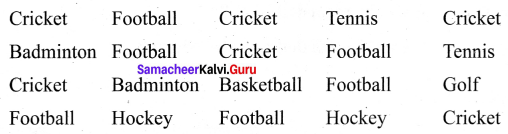
Following are the choice of sports for 20 students of class VI.
Samacheer Kalvi 6th Maths Term 1 Chapter 5 Statistics Additional Questions 1 Q5
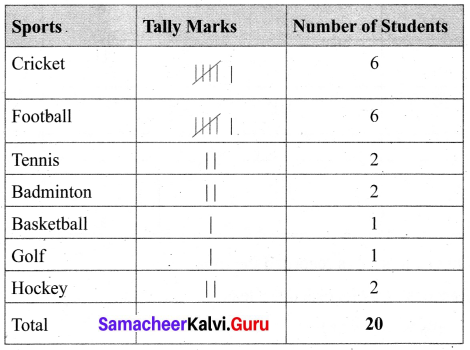
Arrange the names of sports in a table using tally marks.
Solution:
Samacheer Kalvi 6th Maths Term 1 Chapter 5 Statistics Additional Questions 1 Q5.1

Samacheer Kalvi 6th Maths Solutions Term 1 Chapter 5 Statistics Additional Questions

Question 6.
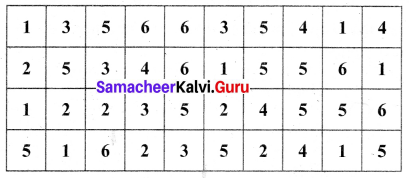
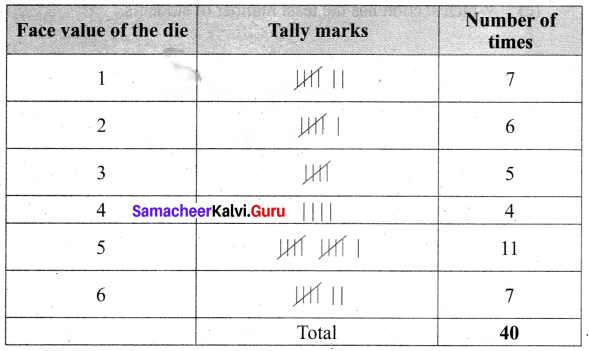
Mariana threw a die 40 times and noted the number appearing each time as shown below.
Samacheer Kalvi 6th Maths Term 1 Chapter 5 Statistics Additional Questions 1 Q6
Make a table and enter the data using tally marks.
Find the number that appeared
(a) the minimum number of times
(b) the maximum number of times
(c) Find those numbers that appear an equal number of times.
Solution:
Table using Tally Marks
Samacheer Kalvi 6th Maths Term 1 Chapter 5 Statistics Additional Questions 1 Q6.1
(a) The number ‘4’ appeared the minimum number of times
(b) The number ‘5’ appeared the maximum number of times
(c) Numbers ‘1’ and ‘6’ appeared the equal number of times.

Question 7.
What is the advantage of using pictograph?
Solution:
The data can be analyzed and interpreted. The pictures and symbols help us to understand better.

Question 8.
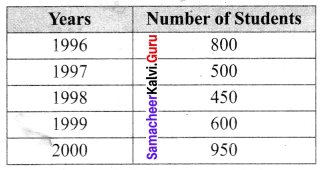
Total number of students of a school in different years is shown in the following table
Samacheer Kalvi 6th Maths Term 1 Chapter 5 Statistics Additional Questions 2 Q1
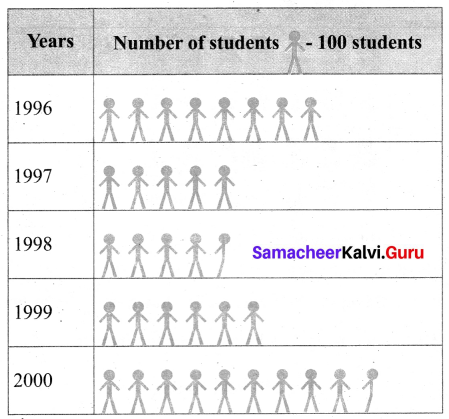
(A) Prepare a pictograph of students using one symbol to represent 100 students and answer the following questions
(a) How many symbols represent the total number of students in the year 2000?
(b) How many symbols represent the total number of students in the year 1997?
Solution:
(A) The pictograph is given by
Samacheer Kalvi 6th Maths Term 1 Chapter 5 Statistics Additional Questions 2 Q1.1
(a) 9 Full pictures and a half picture represent the number of students in the year 2000
(b) 5 symbols.

Samacheer Kalvi 6th Maths Solutions Term 1 Chapter 5 Statistics Additional Questions

Question 9.
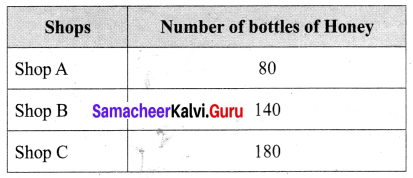
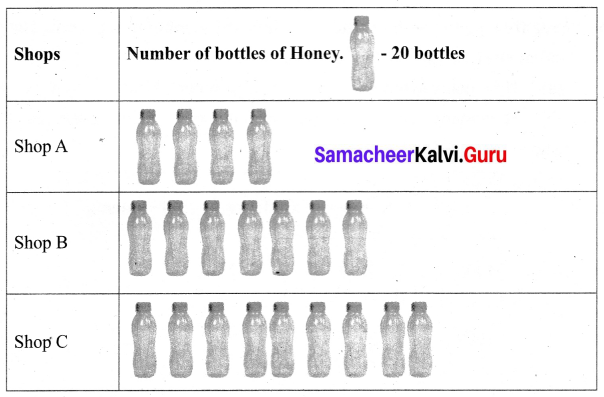
The number of bottles of honey sold by three different shops are given below.
Samacheer Kalvi 6th Maths Term 1 Chapter 5 Statistics Additional Questions 2 Q2
(A) Draw a pictograph and answer the following questions (use the scale – 20 bottles)
(a) What is the total profit of shop A, if the profit gained on each bottle is ‘E’150?
(b) If the total number of bottles sold is 400 how many figures must be drawn to shops?
(c) Find the difference between the number of bottles sold by shop B and the number of bottles sold by shop ‘C’.
Solution:
(A) Pictograph of number of bottles sold
Samacheer Kalvi 6th Maths Term 1 Chapter 5 Statistics Additional Questions 2 Q2.1
(a) Profit per bottle = ₹ 150
Shop A’s total profit = 80 × 150 = ₹ 12,000
(b) For 400 bottles, the figures to be drawn is \(\frac{400}{20}\) = 20 bottles for shop ‘C ’
(c) Difference = No. of bottles sold by shop ‘C’ – No. of bottles sold by shop ‘B’ = 180 – 140 = 40 bottles

Question 10.
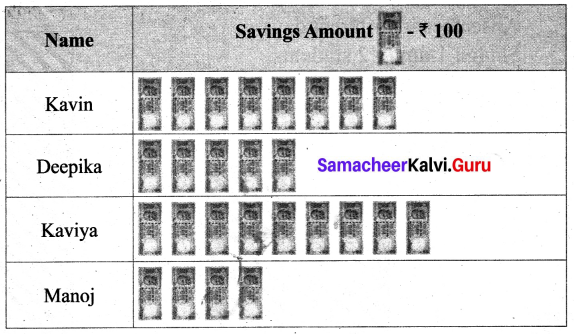
The following data is the total savings of a group of 5 friends in a year.
Samacheer Kalvi 6th Maths Term 1 Chapter 5 Statistics Additional Questions 3 Q1
Draw a pictograph to represent the data.
Solution:
Samacheer Kalvi 6th Maths Term 1 Chapter 5 Statistics Additional Questions 3 Q1.1

Question 11.
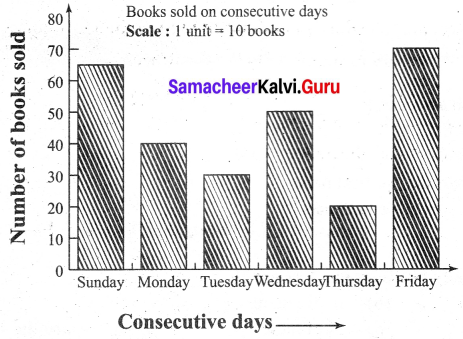
The number of mathematics books sold by a shopkeeper on six consecutive days is shown below.
Samacheer Kalvi 6th Maths Term 1 Chapter 5 Statistics Additional Questions 3 Q2
Draw a bar graph to represent the above information choosing the scale of your choice.
Solution:
Samacheer Kalvi 6th Maths Term 1 Chapter 5 Statistics Additional Questions 3 Q2.1

Samacheer Kalvi 6th Maths Solutions Term 1 Chapter 5 Statistics Additional Questions

Question 12.
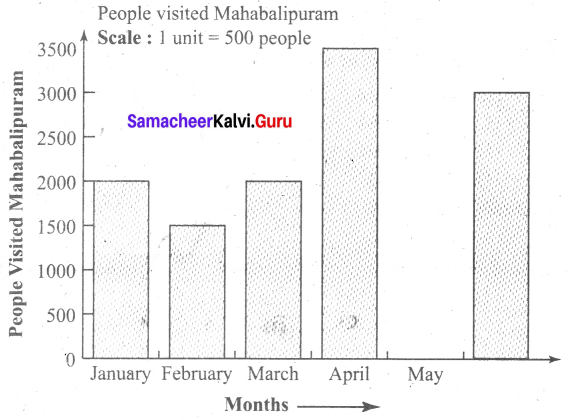
The following bar graph shows the number of people visited Mahabalipuram over a period of 5 months.
Samacheer Kalvi 6th Maths Term 1 Chapter 5 Statistics Additional Questions 3 Q3
Use the graph to answer the following questions
(a) How many people visited Mahabalipuram in April?
(b) How many more people visited Mahabalipuram in May than in January?
(c) In which month, were there as many visitors as in March?
(d) In which month was there 1500 more visitors than in January?
(e) How many visitors were there in 5 months?
Solution:
(a) 3500 people visited Mahabalipuram in April
(b) 500 more people
(c) January
(d) April
(e) 11,500 people

Samacheer Kalvi 6th Maths Solutions Term 1 Chapter 5 Statistics Additional Questions

Samacheer Kalvi 8th Maths Solutions Term 1 Chapter 4 Geometry Additional Questions

Students can Download Maths Chapter 4 Geometry Additional Questions and Answers, Notes Pdf, Samacheer Kalvi 8th Maths Book Solutions Guide Pdf helps you to revise the complete Tamilnadu State Board New Syllabus and score more marks in your examinations.
Samacheer Kalvi 8th Maths Solutions Term 1 Chapter 4 Geometry Additional Questions

Tamilnadu Samacheer Kalvi 8th Maths Solutions Term 1 Chapter 4 Geometry Additional Questions

Additional Questions And Answers

Very Short Answers [2 Marks]

Question 1.
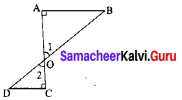
In the given figure if ∠A = ∠C then prove that ∆AOB ~ ∆COD.
Samacheer Kalvi 8th Maths Term 1 Chapter 4 Geometry Additional Questions 1
Solution:
In triangles ∆AOB and ∆COD
∠A = ∠C (Y given)
∠AOB = ∠COD [∵ Vertically opposite angles]
∠ABO = ∠CDO [Remaining angles of ∆AOB and ∆COD]
∴ ∆AOB ~ ∆COD [∵ AAA similarity]
∵ ∆AOB ~ ∆COD [∵ AAA similarity]

Question 2.
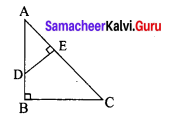
In the figure AB ⊥ BC and DE ⊥ AC prove that ∆ABC ~ ∆AED.
Samacheer Kalvi 8th Maths Term 1 Chapter 4 Geometry Additional Questions 40
Solution:
In triangles ∆ABC and ∆AED
∠ABC = ∠AED = 90°
∠BAC = ∠EAD [Each equal to A]
∠ADE = ∠ACB [∵ Remaining angles]
∴ By AAA criteria of similarity ∆ABC ~ ∆AED

Samacheer Kalvi 8th Maths Solutions Term 1 Chapter 4 Geometry Additional Questions

Short Answers [3 Marks]

Question 1.
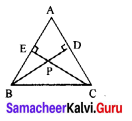
In the figure with respect to ABEP and CPD prove that BP × PD = EP × PC.
Samacheer Kalvi 8th Maths Term 1 Chapter 4 Geometry Additional Questions 51
Solution:
Proof:
In ∆EPB and ∆DPC
∠PEB = ∠PDC = 90° [given]
∠EPB = ∠DPC [Vertically opposite angles]
∠EPB = ∠PCD [∵ Remaining angles]
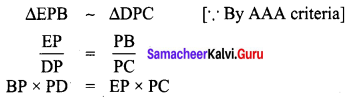
Thus,
Samacheer Kalvi 8th Maths Term 1 Chapter 4 Geometry Additional Questions 50

Long Answers [5 Marks]

Question 1.
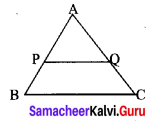
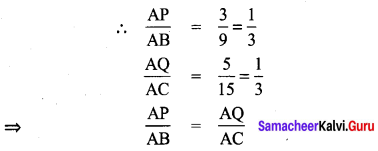
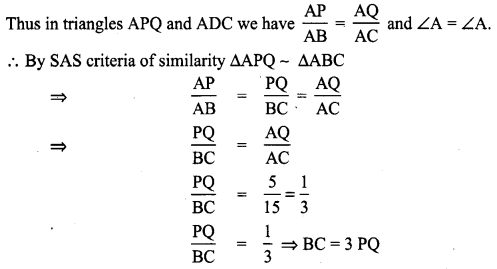
P and Q are points on sides AB and AC respectively of ∆ABC. If AP = 3 cm PB = 6cm, AQ = 5 cm and QC = 10 cm, show that BC = 3 PQ.
Solution:
Samacheer Kalvi 8th Maths Term 1 Chapter 4 Geometry Additional Questions 52
AB = AP + PB
= 3 + 6 cm = 9 cm
AC = AQ + QC = 510 cm = 15
Samacheer Kalvi 8th Maths Term 1 Chapter 4 Geometry Additional Questions 53
Samacheer Kalvi 8th Maths Term 1 Chapter 4 Geometry Additional Questions 54