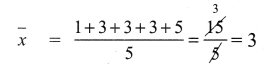
Samacheer Kalvi 9th Maths Solutions Chapter 2 Real Numbers Ex 2.9

You can Download Samacheer Kalvi 9th Maths Book Solutions Guide Pdf, Tamilnadu State Board help you to revise the complete Syllabus and score more marks in your examinations.

Tamilnadu Samacheer Kalvi 9th Maths Solutions Chapter 2 Real Numbers Ex 2.9

Multiple Choice Questions :
Question 1.
If n is a natural number then \(\sqrt{n}\) is
(1) always a natural number
(2) always an irrational number
(3) always a rational number
(4) may be rational or irrational
Solution:
(4) may be rational or irrational

Question 2.
Which of the following is not true?
(1) Every rational number is a real number.
(2) Every integer is a rational number.
(3) Every real number is an irrational number.
(4) Every natural number is a whole number.
Solution:
(3) Every real number is an irrational number
Hint:
Real numbers contain rationals and irrationals.

Question 3.
Which one of the following, regarding sum of two irrational numbers, is true?
(1) always an irrational number
(2) may be a rational or irrational number.
(3) always a rational number
(4) always an integer.
Solution:
(2) may be a rational or irrational number

Question 4.
Which one of the following has a terminating decimal expansion?

Samacheer Kalvi 9th Maths Chapter 2 Real Numbers Ex 2.9 1
Solution:
(1) \(\frac { 5 }{ 64 }\)
Hint:
\(\frac { 5 }{ 64 }\) = \(\frac{5}{2^{6}}\)

Samacheer Kalvi 9th Maths Solutions Chapter 2 Real Numbers Ex 2.9

Question 5.
Which one of the following is an irrational number?
(1) \(\sqrt { 25 }\)
(2) \(\sqrt { \frac { 9 }{ 4 } }\)
(3) \(\frac { 7 }{ 11 }\)
(4) π
Solution:
(4) π
Hint:
π represents a irrational number

Question 6.
An irrational number between 2 and 2.5 is
(1) \(\sqrt { 11 }\)
(2) \(\sqrt { 5 }\)
(3) \(\sqrt { 2.5 }\)
(4) \(\sqrt { 8 }\)
Solution:
(2) \(\sqrt { 5 }\)
Hint:
22 = 4 and 2.52 = 6.25

Question 7.
The smallest rational number by which – should be multiplied so that its decimal expansion terminates after one place of decimal is
(1) \(\frac { 1 }{ 10 }\)
(2) \(\frac { 3 }{ 10 }\)
(3) 3
(4) 30
Solution:
(2) \(\frac { 3 }{ 10 }\)
Hint:
\(\frac { 3 }{ 10 }\) is the small number.

Question 8.
If \(\frac { 1 }{ 7 }\) = \(0.\overline { 142857 }\) then the value of \(\frac { 5 }{ 7 }\) is
(1) \(0.\overline { 142857 }\)
(2) \(0.\overline { 714285 }\)
(3) \(1.\overline { 571428 }\)
(4) 0.714285
Solution:
(2) \(0.\overline { 714285 }\)
Hint:
5 × \(\frac { 1 }{ 7 }\) = 5 × \(0.\overline { 142857 }\) = \(0.\overline { 714285 }\)

Samacheer Kalvi 9th Maths Solutions Chapter 2 Real Numbers Ex 2.9

Question 9.
Find the odd one out of the following.

Samacheer Kalvi 9th Maths Chapter 2 Real Numbers Ex 2.9 2
Solution:
(4) \(\frac{\sqrt{54}}{\sqrt{18}}\)
Hint:
\(\sqrt { 72 }\) × \(\sqrt { 8 }\) = \(\sqrt { 9\times8 }\) × \(\sqrt { 8 }\) = 3 × 8 = 24

Question 10.
\(0.\overline { 34 }\) + \(0.3\overline { 4 }\) =
(1) \(0.6\overline { 87 }\)
(2) \(0.\overline { 68 }\)
(3) \(0.6\overline { 8 }\)
(4) \(0.68\overline { 7 }\)
Solution:
(1) \(0.6\overline { 87 }\)
Hint:
0.343434 … + 0.344444 … = \(0.6\overline { 87 }\)

Question 11.
Which of the following statement is false?
(1) The square root of 25 is 5 or -5
(2) \(\sqrt { 25 }\) = 5
(3) –\(\sqrt { 25 }\) = -5
(4) \(\sqrt { 25 }\)= ±5
Solution:
(4) \(\sqrt { 25 }\) = ±5

Question 12.
Which one of the following is not a rational number?
(1) \(\sqrt { \frac { 8 }{ 18 } }\)
(2) \(\frac { 7 }{ 3 }\)
(3) \(\sqrt { 0.01 }\)
(4) \(\sqrt { 13 }\)
Solution:
(4) \(\sqrt { 13 }\)
Hint:
(1) \(\sqrt { \frac { 8 }{ 18 } }\) = \(\sqrt { \frac { 4 }{ 9 } }\) = \(\frac { 2 }{ 3 }\) is a arational number
(2) \(\frac { 7 }{ 3 }\) is a rational number
(3) \(\sqrt { 0.01 }\) = \(\sqrt { \frac { 1 }{ 100 } }\) = \(\frac { 2 }{ 3 }\) is a rational number
(4) \(\sqrt { 13 }\) is a rational number

Samacheer Kalvi 9th Maths Solutions Chapter 2 Real Numbers Ex 2.9

Question 13.
\(\sqrt { 27 }\) + \(\sqrt { 12 }\) =
(1) \(\sqrt { 39 }\)
(2) \(5\sqrt { 6 }\)
(3) \(5\sqrt { 3 }\)
(4) \(3\sqrt { 5 }\)
Solution:
(3) \(5\sqrt { 3 }\)
Hint:
\(\sqrt { 27 }\) + \(\sqrt { 12 }\) = \(\sqrt{9 \times 3}+\sqrt{4 \times 3}=3 \sqrt{3}+2 \sqrt{3}=5 \sqrt{3}\)

Question 14.
if \(\sqrt { 80 }\) = k\(\sqrt { 5 }\), then k =
(1) 2
(2) 4
(3) 8
(4) 16
Solution:
(2) 4
Hint: \(\sqrt { 80 }\) = \(\sqrt{16 \times 5}=4 \sqrt{5}=k \sqrt{5}\) ⇒ k = 4

Question 15.
\(4 \sqrt{7} \times 2 \sqrt{3}\) =
(1) 6\(\sqrt{10}\)
(2) 8\(\sqrt{21}\)
(3) 8\(\sqrt{10}\)
(4) 6\(\sqrt{21}\)
Solution:
(2) 8\(\sqrt{21}\)
Hint:
\(4 \sqrt{7} \times 2 \sqrt{3}\) = \(8\times\sqrt{7 \times 3}\) = 8\(\sqrt{21}\)

Question 16.
When written with a rational denominator, the expression \(\frac{2 \sqrt{3}}{3 \sqrt{2}}\) can be simplified as

Samacheer Kalvi 9th Maths Chapter 2 Real Numbers Ex 2.9 3
Solution:
(3) \(\frac{\sqrt{6}}{3}\)
Hint:
\(\frac{2 \sqrt{3}}{3 \sqrt{2}}=\frac{2 \sqrt{3}}{3 \sqrt{2}} \times \frac{\sqrt{2}}{\sqrt{2}}=\frac{2 \sqrt{6}}{3 \times 2}=\frac{2 \sqrt{6}}{63}\)

Question 17.
When (2\(\sqrt{5}\) – \(\sqrt{2}\))2 is simplified, we get
(1) 4\(\sqrt{5}\) + 2\(\sqrt{2}\)
(2) 22 – 4\(\sqrt{10}\)
(3) 8 – 4\(\sqrt{10}\)
(4) 2\(\sqrt{10}\) – 2
Solution:
(2) 22 – 4\(\sqrt{10}\)
Hint:
(2\(\sqrt{5}\) – \(\sqrt{2}\))2 = (2\(\sqrt{5}\))2 – 2 × 2\(\sqrt{5}\) × \(\sqrt{2}\) + \(\sqrt{2^{2}}\)
= 4 × 5 – 4\(\sqrt{10}\) + 2 = 22 – 4\(\sqrt{10}\)

Samacheer Kalvi 9th Maths Solutions Chapter 2 Real Numbers Ex 2.9

Question 18.
(0.000729)\(\frac{-3}{4}\) × (0.09)\(\frac{-3}{4}\) = ____.

Samacheer Kalvi 9th Maths Chapter 2 Real Numbers Ex 2.9 4
Solution:
(4) \(\frac{10^{6}}{3^{6}}\)
Hint :
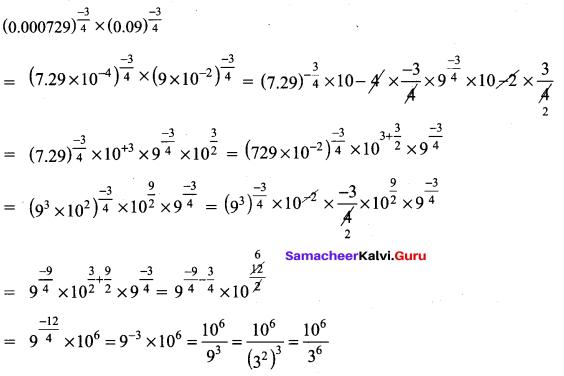
Samacheer Kalvi 9th Maths Chapter 2 Real Numbers Ex 2.9 5

Question 19.
If \( \sqrt{9^{x}}=\sqrt[3]{9^{2}}\) , than x = ___

Samacheer Kalvi 9th Maths Chapter 2 Real Numbers Ex 2.9 6
Solution:
(2) \(\frac { 4 }{ 3 }\)
Hint:
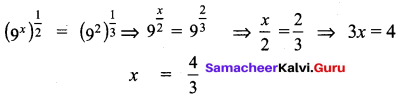
Samacheer Kalvi 9th Maths Chapter 2 Real Numbers Ex 2.9 7

Question 20.
The length and breadth of a rectangular plot are 5 x 10⁵ and 4 x 10⁴ metres respectively. Its area is .
(1) 9 × 101 m2
(2) 9 × 10⁹ m2
(3) 2 × 10¹⁰ m2
(4) 20 × 1020 m2
Solution:
(3) 2 × 10¹⁰ m2
Hint:
l = 5 × 10⁵ metres; b = 4 × 10⁴ metres
∴ Area = l × b = 5 x 105 × 4 × 104
= 20 × 105+4= 20 × 109= 2.0 × 101 × 109 = 2 × 10¹⁰m2

Samacheer Kalvi 9th Maths Solutions Chapter 2 Real Numbers Ex 2.8

You can Download Samacheer Kalvi 9th Maths Book Solutions Guide Pdf, Tamilnadu State Board help you to revise the complete Syllabus and score more marks in your examinations.

Tamilnadu Samacheer Kalvi 9th Maths Solutions Chapter 2 Real Numbers Ex 2.8

Question 1.
Represent the following numbers in the scientific notation:
(i) 569430000000
(ii) 2000.57
(iii) 0.0000006000
(iv) 0.0009000002
Solution:
(i) 569430000000 = 5.6943 × 10¹¹
(ii) 2000.57 = 2.00057 × 10¹³
(iii) 0.0000006000 = 6.0 × 10⁻⁷
(iv) 0.0009000002 = 9.000002 × 10⁻⁴

Question 2.
Write the following numbers in decimal form:
(i) 3.459 × 10⁶
(ii) 5.678 × 10⁴
(iii) 1.00005 × 10⁻⁵
(iv) 2.530009 × 10⁻⁷
Solution:
(i) 3.459 × 106 = 3459000
(ii) 5.678 × 104 = 56780
(iii) 1.00005 × 10-5 = 0.0000100005
(iv) 2.530009 × 10-7 = 0.0000002530009

Samacheer Kalvi 9th Maths Solutions Chapter 2 Real Numbers Ex 2.8

Question 3.
Represent the following numbers in scientific notation:
(i) (300000)2 × (20000)4
(ii) (0.000001)11 ÷ (0. 005)3
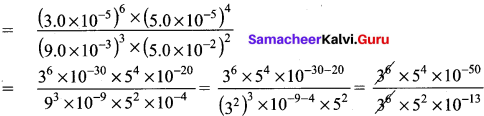
(iii) {(0.00003)6 × (0.00005)4 } ÷ {(0. 009)3 × (0.05)2 }
Solution:
(i) (300000)2 x (20000)4 = (3.0 x 10⁵)2 x (2.0 x 104)4
= 32 × 1010 × 24 × 1016
= 9 × 16 × 1010+16
= 144 × 1026 = 1.44 × 1028

(ii) (0.000001)11 ÷ (0. 005)3
Samacheer Kalvi 9th Maths Chapter 2 Real Numbers Ex 2.8 1
= 1 x× 10-66+9 × 53
= 125 × 10-57
= 1.25 × 102 × 10-57
= 1.25 × 10(-57+2)
= 1.25 × 10-55

(iii) {(0.00003)6 x (0.00005)4} ÷ {(0. 009)3x (0.05)2}
Samacheer Kalvi 9th Maths Chapter 2 Real Numbers Ex 2.8 2
= 54-2 × 10-50+13
= 52 × 10-37 = 25 × 10-37 = 2.5 × 101 × 10-37 = 2.5 × 10-36

Samacheer Kalvi 9th Maths Solutions Chapter 2 Real Numbers Ex 2.8

Question 4.
Represent the following information in scientific notation:
(i) The world population is nearly 7000,000,000.
(ii) One light year means the distance 9460528400000000 km.
(iii) Mass of an electron is 0.000 000 000 000 000 000 000 000 000 00091093822 kg.
Solution:
(i) The world population is nearly 7000,000,000 = 7.0 × 10⁹
(ii) One light year means the distance 9460528400000000 km = 9.4605284 × 10¹⁵ km
(iii) Mass of an electron is 0.000 000 000 000 000 000 000 000 000 00091093822 kg. = 9.1093822 × 10⁻³¹ kg

Question 5.
Simplify:
(i) (2.75 × 10⁷) + (1.23 × 10⁸)
(ii) (1.598 × 10¹⁷) – (4.58 × 10¹⁵)
(iii) (1.02 × 1010) × (1.20 × 10-3)
(iv) (8.41 × 10⁴) ÷ (4.3 × 10⁵)
Solution:
(i) 2.75 x 107 = 27500000
1.23 x 10⁸ – 123000000
Samacheer Kalvi 9th Maths Chapter 2 Real Numbers Ex 2.8 3

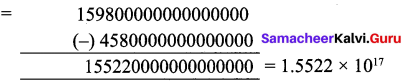
(ii) (1.598 × 10¹⁷) – (4.58 × 10¹⁵)
1.598 × 1017 = 159800000000000000
4.58 × 1015= 4580000000000000
(1.598 × 10¹⁷) – (4.58 × 10¹⁵)
Samacheer Kalvi 9th Maths Chapter 2 Real Numbers Ex 2.8 4

(iii) (1.02 × 1010) x (1.20 × 10-3) = 1.02 × 1010 × 1.20 × 10-3
= 1.02 × 1.20 × 1010-3 = 1.224 × 10⁷

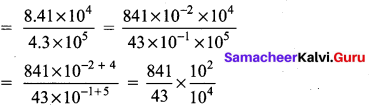
(iv) (8.41 x 10⁴) ÷ (4.3 x 10⁵)
Samacheer Kalvi 9th Maths Chapter 2 Real Numbers Ex 2.8 5
= 1.95581395 × 101 × 102-4
= 1.95581395 × 101 × 10-2
= 1.95581395 × 10-1
= 0. 195581395

Samacheer Kalvi 9th Maths Solutions Chapter 2 Real Numbers Ex 2.7

You can Download Samacheer Kalvi 9th Maths Book Solutions Guide Pdf, Tamilnadu State Board help you to revise the complete Syllabus and score more marks in your examinations.

Tamilnadu Samacheer Kalvi 9th Maths Solutions Chapter 2 Real Numbers Ex 2.7

Question 1.
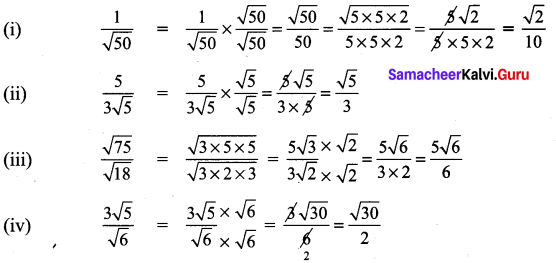
Rationalise the denominator
Samacheer Kalvi 9th Maths Chapter 2 Real Numbers Ex 2.7 1
Solution:
Samacheer Kalvi 9th Maths Chapter 2 Real Numbers Ex 2.7 2

Question 2.
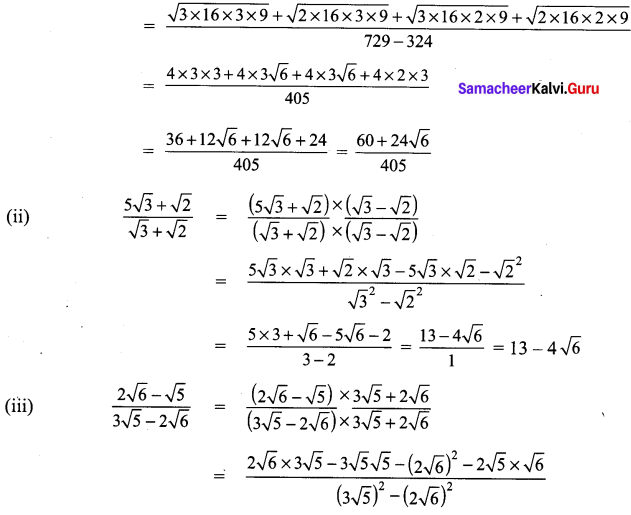
Rationalise the denominator and simplify
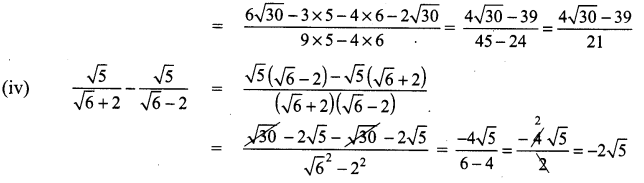
Samacheer Kalvi 9th Maths Chapter 2 Real Numbers Ex 2.7 3
Solution:
Samacheer Kalvi 9th Maths Chapter 2 Real Numbers Ex 2.7 4
Multiply the numerator and denominator by the rationatising factor (\(\sqrt{27}\) + \(\sqrt{18}\))
Samacheer Kalvi 9th Maths Chapter 2 Real Numbers Ex 2.7 5
Samacheer Kalvi 9th Maths Chapter 2 Real Numbers Ex 2.7 6
Samacheer Kalvi 9th Maths Chapter 2 Real Numbers Ex 2.7 7

Question 3.
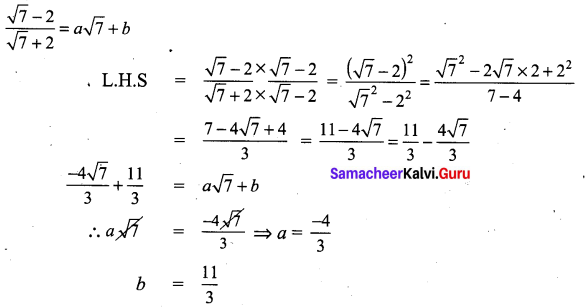
Find the value of a and b if \(\frac{\sqrt{7}-2}{\sqrt{7}+2}=a \sqrt{7}+b\).
Solution:
Samacheer Kalvi 9th Maths Chapter 2 Real Numbers Ex 2.7 8

Samacheer Kalvi 9th Maths Solutions Chapter 2 Real Numbers Ex 2.7

Question 4.
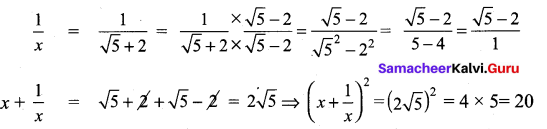
If x = \(\sqrt{5}\) + 2 , then find the value of \(x^{2}+\frac{1}{x^{2}}\) .
Solution:
If x = \(\sqrt{5}\) + 2
Samacheer Kalvi 9th Maths Chapter 2 Real Numbers Ex 2.7 9

Question 5.
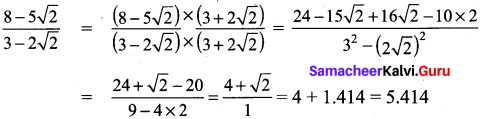
Given \(\sqrt{2}\) = 1.414, find the value of \(\frac{8-5 \sqrt{2}}{3-2 \sqrt{2}}\) (to 3 places of decimals).
Solution:
Samacheer Kalvi 9th Maths Chapter 2 Real Numbers Ex 2.7 10

Samacheer Kalvi 9th Maths Solutions Chapter 8 Statistics Additional Questions

You can Download Samacheer Kalvi 9th Maths Book Solutions Guide Pdf, Tamilnadu State Board help you to revise the complete Syllabus and score more marks in your examinations.

Tamilnadu Samacheer Kalvi 9th Maths Solutions Chapter 8 Statistics Additional Questions

Exercise 8.1

Question 1.
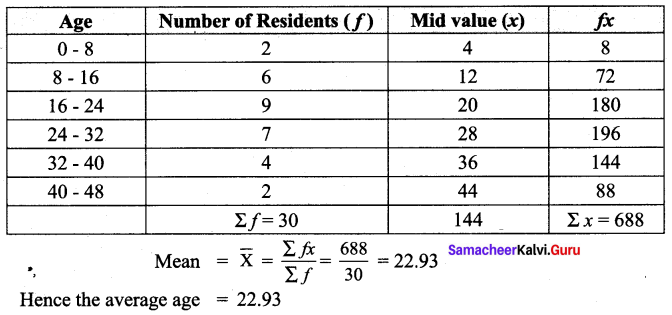
The following data gives the number of residents in an area based on their age. Find the average age of the residents.
Samacheer Kalvi 9th Maths Chapter 8 Statistics Additional Questions 1
Solution:
Samacheer Kalvi 9th Maths Chapter 8 Statistics Additional Questions 2
Samacheer Kalvi 9th Maths Solutions Chapter 8 Statistics Additional Questions
Question 2.
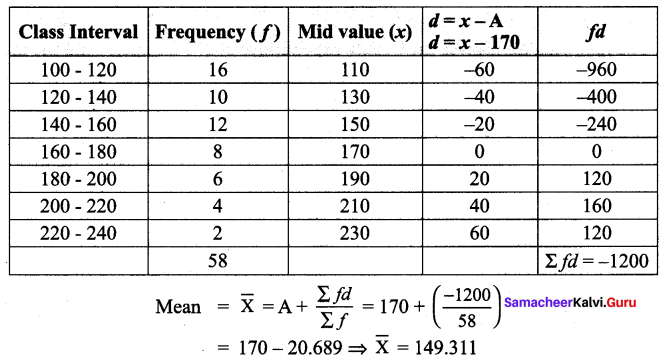
Find the mean for the following frequency table :
Samacheer Kalvi 9th Maths Chapter 8 Statistics Additional Questions 3
Solution:
Let Assumed mean A = 170
Samacheer Kalvi 9th Maths Chapter 8 Statistics Additional Questions 4

Question 3.
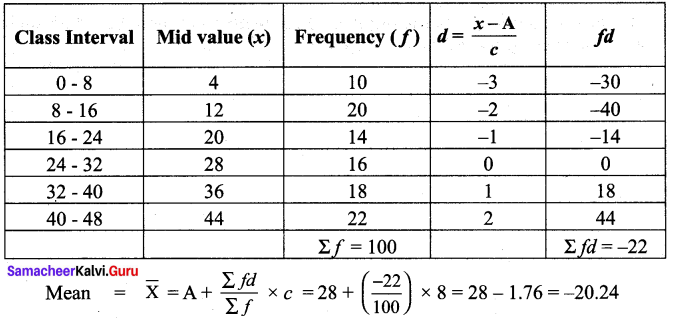
Find the mean for the following distribution using step Deviation Method.
Samacheer Kalvi 9th Maths Chapter 8 Statistics Additional Questions 5
Solution:
Let Assumed mean A = 28, Class width C = 8
Samacheer Kalvi 9th Maths Chapter 8 Statistics Additional Questions 6

Exercise 8.2

Question 1.
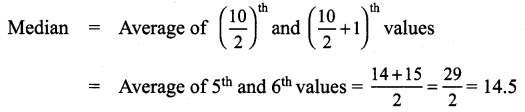
For the following up grouped data 8, 15, 14, 19, 11, 16, 10, 8, 17, 20. Find the median.
Solution:
Arrange the values in ascending order 8, 8, 10, 11, 14, 15, 16, 17, 19, 20
The number of values = 10
Samacheer Kalvi 9th Maths Chapter 8 Statistics Additional Questions 7

Question 2.
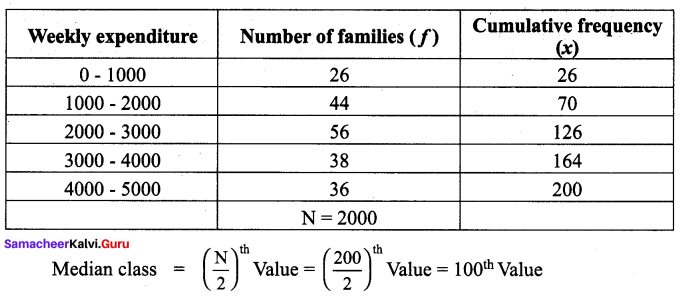
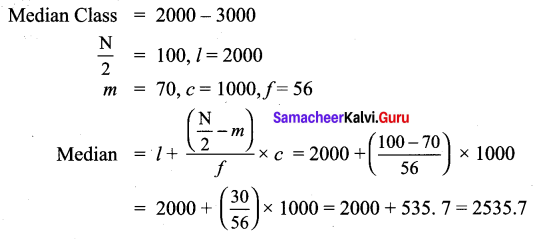
The following table gives the weekly expenditure of 200 families. Find the median of the weekly expenditure.
Samacheer Kalvi 9th Maths Chapter 8 Statistics Additional Questions 8
Solution:
Samacheer Kalvi 9th Maths Chapter 8 Statistics Additional Questions 9
Samacheer Kalvi 9th Maths Chapter 8 Statistics Additional Questions 10
Question 3.
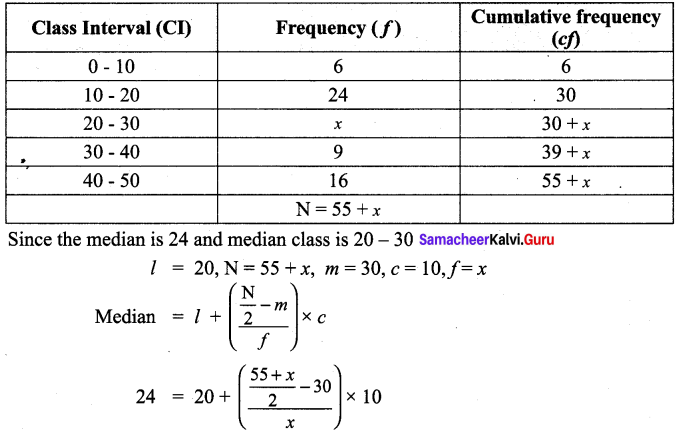
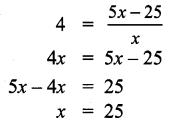
The median of the following data is 24. Find the value of x.
Samacheer Kalvi 9th Maths Chapter 8 Statistics Additional Questions 11
Solution:
Samacheer Kalvi 9th Maths Chapter 8 Statistics Additional Questions 12
Samacheer Kalvi 9th Maths Chapter 8 Statistics Additional Questions 13

Question 4.
The following are the scores obtained by 11 players in a cricket match 7, 21, 45, 12, 56, 35, 25, 0, 58, 66, 29. Find the median score.
Solution:
Let us arrange the values in ascending order 0, 7, 12, 21, 25, 29, 35, 45, 56, 58, 66
The number of values = 11 which is odd.
Samacheer Kalvi 9th Maths Chapter 8 Statistics Additional Questions 60

Exercise 8.3
Samacheer Kalvi 9th Maths Solutions Chapter 8 Statistics Additional Questions
Question 1.
Find the mode of the given data : 65, 65, 71, 71, 72, 75, 82, 72, 47, 72.
Solution:
In the given data 72 occurs thrice. Hence the mode is 72.

Question 2.
Find the mode:
Samacheer Kalvi 9th Maths Chapter 8 Statistics Additional Questions 61
Solution:
7 has the maximum frequency 21. Therefore 7 is the mode.

Question 3.
Find the mode for the following data.
Samacheer Kalvi 9th Maths Chapter 8 Statistics Additional Questions 62
Solution:
Samacheer Kalvi 9th Maths Chapter 8 Statistics Additional Questions 63

Question 4.
In a distribution, the mean and mode are 46 and 40 respectively. Calculate the median.
Solution:
Given, Mean = 46 and mode = 40
Using mode ≈ 3 median – 2 mean ,
40 ≈ 3 Median – 2 (46)
3 Median ≈ 40 + 92
Therefore, Median ≈ \(\frac{132}{3}\) = 44

Exercise 8.4
Samacheer Kalvi 9th Maths Solutions Chapter 8 Statistics Additional Questions
Multiple Choice Questions :

Question 1.
The mean of first 10 natural numbers.
(1) 25
(2) 55
(3) 5.5
(4) 2.5
Samacheer Kalvi 9th Maths Chapter 8 Statistics Additional Questions 71
Solution:
(3) 5.5

Question 2.
The mean of a distribution is 23, the median is 24 and the mode is 25.5. It is most likely that this distribution is :
(1) Positively skewed
(2) Symmetrical
(3) Asymptotic
(4) Negatively skewed
Hint: For Negatively skewed means is likely to be less than mode and median
Solution:
(4) Negatively skewed

Question 3.
The middle value of an ordered array of numbers is the
(1) Mode
(2) Mean
(3) Median
(4) Mid point
Solution:
(3) Median

Question 4.
The weights of students in a school is a :
(1) Discrete variable
(2) Continuous variable
(3) Qualitative variable
(4) None of these
Solution:
(2) Continuous variable
Samacheer Kalvi 9th Maths Solutions Chapter 8 Statistics Additional Questions
Question 5.
The first hand and unorganized form data is called
(1) Secondary data
(2) Organised data
(3) Primary data
(4) None of these
Solution:
(3) Primary data

Samacheer Kalvi 9th Maths Solutions Chapter 2 Real Numbers Ex 2.5

You can Download Samacheer Kalvi 9th Maths Book Solutions Guide Pdf, Tamilnadu State Board help you to revise the complete Syllabus and score more marks in your examinations.

Tamilnadu Samacheer Kalvi 9th Maths Solutions Chapter 2 Real Numbers Ex 2.5

Question 1.
Write the following in the form of 5n:
(i) 625
(ii) \(\frac { 1 }{ 5 }\)
(iii) \(\sqrt { 5 }\)
(iv) \(\sqrt { 125 }\)
Solution:
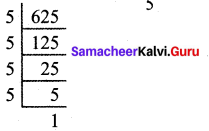
(i) 625 = 54
Samacheer Kalvi 9th Maths Chapter 2 Real Numbers Ex 2.5 1

(ii) \(\frac { 1 }{ 5 }\) = 5-1

(iii) \(\sqrt { 5 }\) = 5\(\frac { 1 }{ 2 }\)

(iv) \(\sqrt { 125 }\)
\(=\sqrt{5^{3}}=\left(5^{3}\right)^{\frac{1}{2}}=5^{\frac{3}{2}}\)
Samacheer Kalvi 9th Maths Chapter 2 Real Numbers Ex 2.5 2

Question 2.
Write the following in the form of 4n:
(i) 16
(ii) 8
(iii) 32
Solution:
(i) 16 = 42
(ii) 8 = \(4^{1} \times 4^{\frac{1}{2}}=4^{1+\frac{1}{2}}=4^{\frac{3}{2}}\)
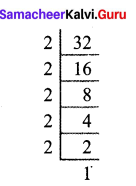
(iii) 32 = \(4 \times 4 \times 4^{\frac{1}{2}}=4^{2+\frac{1}{2}}=4^{\frac{5}{2}}\)
Samacheer Kalvi 9th Maths Chapter 2 Real Numbers Ex 2.5 3

Question 3.
Find the value of
Samacheer Kalvi 9th Maths Chapter 2 Real Numbers Ex 2.5 4
Solution:
Samacheer Kalvi 9th Maths Chapter 2 Real Numbers Ex 2.5 5
Samacheer Kalvi 9th Maths Chapter 2 Real Numbers Ex 2.5 6
Samacheer Kalvi 9th Maths Chapter 2 Real Numbers Ex 2.5 7

Samacheer Kalvi 9th Maths Solutions Chapter 2 Real Numbers Ex 2.5

Question 4.
Use a fractional index to write:
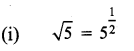
(i) \(\sqrt { 5 }\)
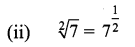
(ii) \(\sqrt[2]{7}\)
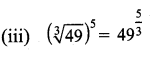
(iii) (\(\sqrt[3]{49}\))5
((iv) \(\left(\frac{1}{\sqrt[3]{100}}\right)^{7}\)
Solution:
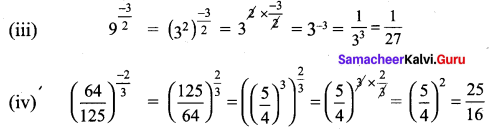
Samacheer Kalvi 9th Maths Chapter 2 Real Numbers Ex 2.5 8
Samacheer Kalvi 9th Maths Chapter 2 Real Numbers Ex 2.5 9
Samacheer Kalvi 9th Maths Chapter 2 Real Numbers Ex 2.5 10
Samacheer Kalvi 9th Maths Chapter 2 Real Numbers Ex 2.5 11

Question 5.
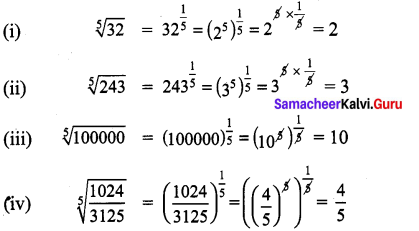
Find the 5th root of
(i) 32
(ii) 243
(iii) 100000
(iv) \(\frac{1024}{3125}\)
Solution:
Samacheer Kalvi 9th Maths Chapter 2 Real Numbers Ex 2.5 12

Samacheer Kalvi 9th Maths Solutions Chapter 2 Real Numbers Ex 2.4

You can Download Samacheer Kalvi 9th Maths Book Solutions Guide Pdf, Tamilnadu State Board help you to revise the complete Syllabus and score more marks in your examinations.

Tamilnadu Samacheer Kalvi 9th Maths Solutions Chapter 2 Real Numbers Ex 2.4

Question 1.
Represent the following numbers on the number line.
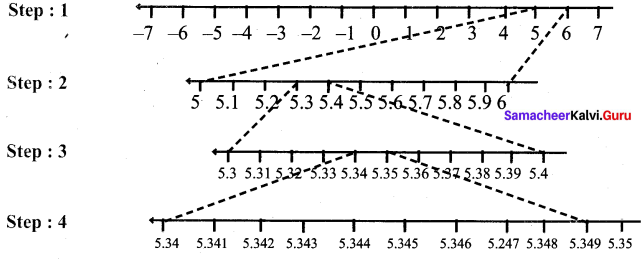
(i) 5.348
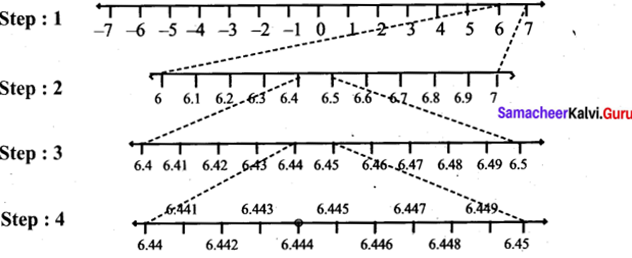
(ii) \(6.\overline { 4 }\) upto 3 decimal places.
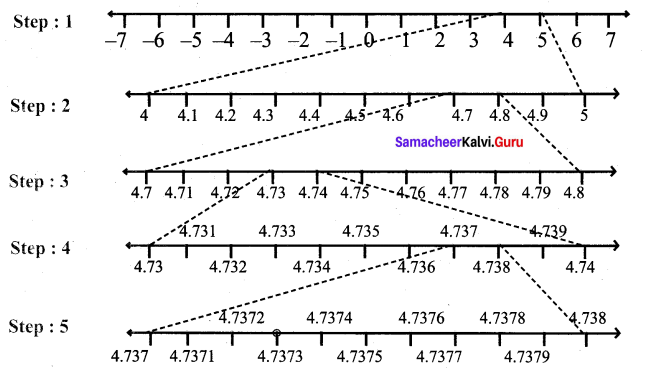
(iii) \(4.\overline { 73 }\) upto 4 decimal places.
Solution:
(i) 5.348
Samacheer Kalvi 9th Maths Chapter 2 Real Numbers Ex 2.4 1
Step 1 : First we note that 5.348 lies between 5 and 6.
Step 2 : Divide the portion between 5 and 6 into 10 equal parts and use a magnifying glass to visualise that 5.348 lies between 5.3 and 5.4.
Step 3 : Divide the portion between 5.3 and 5.4 into 10 equal parts and use a magnifying glass to visualise that 5.348 lies between 5.34 and 5.35.
Step 4 : Divide the portion between 5.34 and 5.35 into 10 equal parts and use a magnifying glass to visualise that 5.348 lies between 5.348 and 5.349.
Step 5 : Divide the portion between 5.348 and 5.349 into 10 equal parts and use a magnifying glass to visualise that 5.348 lies between 5.349 and 5.348.
We note that 5,349 is visualised closed to 5.349 than to 5.348.

(ii) \(6.\overline { 4 }\) upto 3 decimal places.
\(6.\overline { 4 }\) = 6.444
= 6.444 (upto 3 decimal places).
The number lies between 6 and 7.
Samacheer Kalvi 9th Maths Chapter 2 Real Numbers Ex 2.4 2
Step 1 : First we note that 6.444 lies between 6 and 7.
Step 2 : Divide the portion between 6 and 7 into 10 equal parts and use a magnifying glass to visualise that 6.4 lies between 6.4 and 6.5.
Step 3 : Divide the portion between 6.4 and 6.5 into 10 equal parts and use a magnifying glass to visualise that 6.4 lies between 6.44 and 6.45.
Step 4 : Divide the portion between 6.44 and 6.45 into 10 equal parts and use a magnifying glass to visualise that 6.444 lies between 6.445 and 6.444. We note that \(6.\overline { 4 }\) is visualised closed to 6.444 than to 6.445.

(iii) \(4.\overline { 73 }\) upto 4 decimal places
\(4.\overline { 73 }\) = 4.73737373
= 4.7373 (correct 4 decimal places).
The number lies between 4 and 5
Samacheer Kalvi 9th Maths Chapter 2 Real Numbers Ex 2.4 3
Step 1 : First we note that \(4.7\overline { 3 }\) lies between 4 and 5.
Step 2 : Divide the portion between 4 and 5 into 10 equal parts and use a magnifying glass to visualise that \(4.7\overline { 3 }\) lies between 4.7 and 4.8.
Step 3 : Divide the portion between 4.7 and 4.8 into 10 equal parts and use a magnifying glass to visualise that \(4.7\overline { 3 }\) lies between 4.73 and 4.74.
Step 4 : Divide the portion between 4.73 and 4.74 into 10 equal parts and use a magnifying glass to visualise that \(4.7\overline { 3 }\) lies between 4.733 and 4.734.
Step 5 : Divide the portion between 4.733 and 4.734 into 10 equal parts and use a magnifying glass to visualise that \(4.7\overline { 3 }\) lies between 4.7332 and 4.7334.
We note that \(4.7\overline { 3 }\) is visualised closed to 4.7332 than to 4.7334

Samacheer Kalvi 9th Maths Solutions Chapter 2 Real Numbers Ex 2.4

Samacheer Kalvi 9th Maths Solutions Chapter 7 Mensuration Additional Questions

You can Download Samacheer Kalvi 9th Maths Book Solutions Guide Pdf, Tamilnadu State Board help you to revise the complete Syllabus and score more marks in your examinations.

Tamilnadu Samacheer Kalvi 9th Maths Solutions Chapter 7 Mensuration Additional Questions

Exercise 7.1

Question 1.
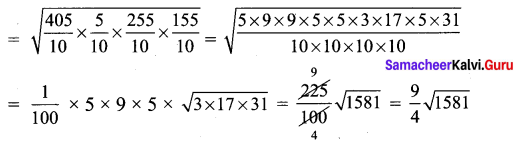
Using Heron’s formula, find the area of a triangle whose sides are 41 m, 15 m, 25 m.
Solution:
Samacheer Kalvi 9th Maths Chapter 7 Mensuration Additional Questions 1
Samacheer Kalvi 9th Maths Chapter 7 Mensuration Additional Questions 2
Samacheer Kalvi 9th Maths Solutions Chapter 7 Mensuration Additional questions
Question 2.
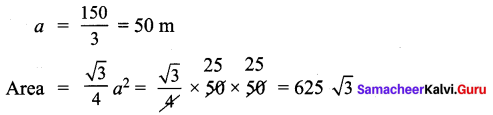
Find the area of an equilateral triangle whose perimeter is 150 m.
Solution:
3a = 150
Samacheer Kalvi 9th Maths Chapter 7 Mensuration Additional Questions 3

Question 3.
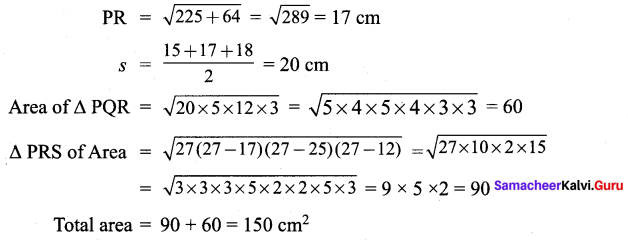
Find the area of a quadrilateral whose sides are PQ = 15 cm, QR = 8 cm, RS = 25 cm, PS = 12 cm and LQ = 90°
Solution:
Samacheer Kalvi 9th Maths Chapter 7 Mensuration Additional Questions 4

Exercise 7.2

Question 1.
Find the TSA and LSA of a cuboid whose length, breadth and height are 10 cm, 12 cm and 14 cm respectively.
Solution:
TSA = 2 (lb + bh + Ih)
= 2 (10 × 12 + 12 × 14 + 10 × 14) = 2 (120 + 168 + 140) = 856 cm2
LSA = 2 (bh + Ih) = 2 (12 × 14 + 10 × 14) = 2 (168 + 140) =2 (308) = 616 cm2
Question 2.
A cuboid has total surface area of 40 m2 and its lateral surface area is 26 m2. Find the area of its base.
Solution:
Samacheer Kalvi 9th Maths Chapter 7 Mensuration Additional Questions 5

Question 3.
Find the surface area of a cube whose edge is
(i) 27 cm
(ii) 3 cm
(iii) 6 cm
(iv) 2.1 cm
Solution:
(i) TSA = 6a2 = 6 × 272 = 6 × 729 = 4374 cm2
(ii) TSA = 6a2 = 6 × 32 = 54 cm2
(iii) TSA = 6a2 = 6 × 62 = 6 × 36 = 216 cm2
(iv) TSA = 6a2 = 6 × 2.12 = 6 × 4.41 = 26.46 cm2

Exercise 7.3
Samacheer Kalvi 9th Maths Solutions Chapter 7 Mensuration Additional questions
Question 1.
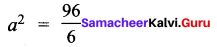
Find the volume of a cube whose surface area is a 96 cm2.
Solution:
6a2 = 96 cm2
Samacheer Kalvi 9th Maths Chapter 7 Mensuration Additional Questions 6
a = 6
Volume = a3 = 63 = 36 × 6 = 216 cm3

Question 2.
The volume of a cuboid is 440 cm3 and the area of its base is 88 cm2, find its height.
Solution:
l × b × h = 440 cm3
Samacheer Kalvi 9th Maths Chapter 7 Mensuration Additional Questions 7

Question 3.
How many 3 metre cubes can be cut from a cuboid measuring 18 m × 12 m × 9 m?
Solution:
Samacheer Kalvi 9th Maths Chapter 7 Mensuration Additional Questions 8

Question 4.
The outer dimensions of a closed wooden box are 10 cm by 8 cm by 7 cm. Thickness
of the wood is 1 cm3. Find the total cost of wood required to make box if 1 cm3 of wood costs ₹ 2.00?
Solution:
Volume of wood = 12 × 10 × 9 – 10 × 8 × 7 = 1080 – 560 = 520 cm3 × 2.00 = ₹ 1040
Samacheer Kalvi 9th Maths Solutions Chapter 7 Mensuration Additional questions

Samacheer Kalvi 9th Maths Solutions Chapter 7 Mensuration Ex 7.4

You can Download Samacheer Kalvi 9th Maths Book Solutions Guide Pdf, Tamilnadu State Board help you to revise the complete Syllabus and score more marks in your examinations.

Tamilnadu Samacheer Kalvi 9th Maths Solutions Chapter 7 Mensuration Ex 7.4

Multiple Choice Questions:

Question 1.
The semi-perimeter of a triangle having sides 15 cm, 20 cm and 25 cm is
(1) 60 cm
(2) 45 cm
(3) 30 cm
(4) 15 cm
Solution:
(3) 30 cm
Samacheer Kalvi 9th Maths Chapter 7 Mensuration Ex 7.4 1
Samacheer Kalvi 9th Maths Solutions Chapter 7 Mensuration Ex 7.4
Question 2.
If the sides of a triangle are 3 cm, 4 cm and 5 cm, then the area is
(1) 3 cm2
(2) 6 cm2
(3) 9 cm2
(4) 12 cm2

Samacheer Kalvi 9th Maths Chapter 7 Mensuration Ex 7.4 80
Solution:
(2) 6 cm2

Question 3.
The perimeter of an equilateral triangle is 30 cm. The area is
(1) \(10 \sqrt{3}\) cm2
(2) \(12 \sqrt{3}\) cm2
(3) \(15 \sqrt{3}\) cm2
(4) \(25 \sqrt{3}\) cm2
Solution:
3a = 30
a = 10 cm

Solution:
(4) \(25 \sqrt{3}\) cm2

Question 4.
The lateral surface area of a cube of side 12 cm is
(1) 144 cm2
(2) 196 cm2
(3) 576 cm2
(4) 664 cm2
Hint: 4a2 = 4 × 12 × 12 = 4 × 144 = 576 cm2
Solution:
(3) 576 cm2

Question 5.
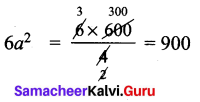
If the lateral surface area of a cube is 600 cm2, then the total surface area is
(1) 150 cm2
(2) 400 cm2
(3) 900 cm2
(4) 1350 cm2
Hint:
4a2 = 600 cm2
Samacheer Kalvi 9th Maths Chapter 7 Mensuration Ex 7.4 3
Solution:
(3) 900 cm2
Samacheer Kalvi 9th Maths Solutions Chapter 7 Mensuration Ex 7.4
Question 6.
The total surface area of a cuboid with dimension 10 cm × 6 cm × 5 cm is
(1) 280 cm2
(2) 300 cm2
(3) 360 cm2
(4) 600 cm2
Hint:
TSA = 2 (lb + bh + hl)
= 2 (10 × 6 + 6 × 5 + 5 × 10) = 2 (60 + 30 + 50) = 2 (140) = 280 cm2
Solution:
(1) 280 cm2

Question 7.
If the ratio of the sides of two cubes are 2 : 3, then ratio of their surface areas will be
(1) 4 : 6
(2) 4 : 9
(3) 6 : 9
(4) 16 : 36
Hint:
a : b = 2 : 3
4a2 : 4b2 = 4 × 22 : 4 : 32
⇒ 16 : 36
⇒ 4 : 9
Solution:
(2) 4 : 9

Question 8.
The volume of a cuboid is 660 cm3 and the area of the base is 33 cm2. Its height is
(1) 10 cm
(2) 12 cm
(3) 20 cm
(4) 22 cm
Hint:
V = 660 cm3
lb = 33 cm2
h = ?
lbh = 660
Samacheer Kalvi 9th Maths Chapter 7 Mensuration Ex 7.4 4
Solution:
(3) 20 cm

Question 9.
The capacity of a water tank of dimensions 10 m × 5 m × 1.5 m is
(1) 75 litres
(2) 750 litres
(3) 7500 litres
(4) 75000 litres
Hint: Volume of cuboid = l × b × h
Solution:
(4) 75000 litres
Samacheer Kalvi 9th Maths Solutions Chapter 7 Mensuration Ex 7.4
Question 10.
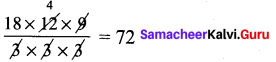
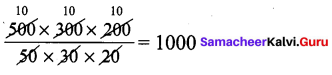
The number of bricks each measuring 50 cm × 30 cm × 20 cm that will be required to build a wall whose dimensions are 5m × 3m × 2m is
(1) 1000
(2) 2000
(3) 3000
(4) 5000
Hint:

Solution:
(1) 1000

Samacheer Kalvi 9th Maths Solutions Chapter 2 Real Numbers Ex 2.3

You can Download Samacheer Kalvi 9th Maths Book Solutions Guide Pdf, Tamilnadu State Board help you to revise the complete Syllabus and score more marks in your examinations.

Tamilnadu Samacheer Kalvi 9th Maths Solutions Chapter 2 Real Numbers Ex 2.3

Question 1.
Represent the following irrational numbers on the number line.
(i) \(\sqrt { 3}\)
(ii) \(\sqrt { 4.7 }\)
(iii) \(\sqrt { 6.5 }\)
Solution:
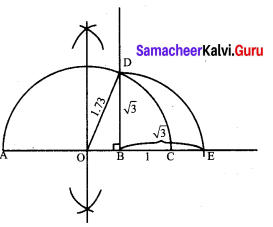
(i) \(\sqrt { 3}\)
Samacheer Kalvi 9th Maths Chapter 2 Real Numbers Ex 2.3 1
(i) Draw a line and mark a point A on it.
(ii) Mark a point B such that AB = 3 cm.
(iii) Mark a point C on this line such that BC = 1 unit.
(iv) Find the midpoint of AC by drawing perpendicular bisector of AC and let it be O.
(v) With O as center and OC = OA as radius, draw a semicircle.
(vi) Draw a line BD, which is perpendicular to AB at B.
(vii) Now BD = \(\sqrt { 3}\), which can be marked in the number line as the value of BE = BD = \(\sqrt { 3}\)

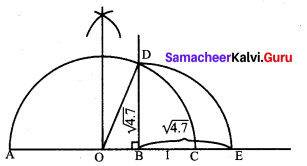
(ii) \(\sqrt { 4.7 }\)
Samacheer Kalvi 9th Maths Chapter 2 Real Numbers Ex 2.3 2
(i) Draw a line and mark a point A on it.
(ii) Mark a point B such that AB = 4.7 cm.
(iii) Mark a point C on this line such that BC = 1 unit.
(iv) Find the midpoint of AC by drawing perpendicular bisector of AC and let it be O.
(v) With O as center and OC = OA as radius, draw a semicircle.
(vi) Draw a line BD, which is perpendicular to AB at B.
(vii) Now BD = \(\sqrt { 4.7 }\), which can be marked in the number line as the value of BE = BD = \(\sqrt { 4.7 }\)

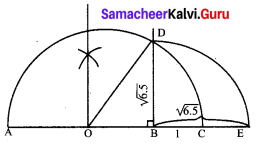
(iii) \(\sqrt { 6.5 }\)
Samacheer Kalvi 9th Maths Chapter 2 Real Numbers Ex 2.3 3
(i) Draw a line and mark a point A on it.
(ii) Mark a point B such that AB = 6.5 cm.
(iii) Mark a point C on this line such that BC = 1 unit.
(iv) Find the midpoint of AC by drawing perpendicular bisector of AC and let it be O.
(v) With O as center and OC = OA as radius, draw a semicircle.
(vi) Draw a line BD, which is perpendicular to AB at B.
(vii) Now BD = \(\sqrt { 6.5 }\), which can be marked in the number line as the value of BE = BD = \(\sqrt { 6.5 }\).

Question 2.
Find any two irrational numbers between
(i) 0.3010011000111…. and 0.3020020002….
(ii) \(\frac { 6 }{ 7 }\) and \(\frac { 12 }{ 13 }\)
(iii) \(\sqrt { 2}\) and \(\sqrt { 3}\)
Solution:
(i) 0.3010011000111…. and 0.3020020002….
Two irrational numbers 0.301202200222 …., 0.301303300333…..

(ii) \(\frac { 6 }{ 7 }\) and \(\frac { 12 }{ 13 }\)
\(\frac { 6 }{ 7 }\) = 0.857142…
\(\frac { 12 }{ 13 }\) = 0.923076
Two irrational numbers between 0.8616611666111……, 0.8717711777111…..

(iii) \(\sqrt { 2}\) and \(\sqrt { 3}\)
Samacheer Kalvi 9th Maths Chapter 2 Real Numbers Ex 2.3 4
\(\sqrt { 2 }\)= 1.414……
Samacheer Kalvi 9th Maths Chapter 2 Real Numbers Ex 2.3 5
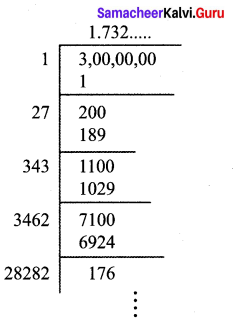
\(\sqrt { 3}\) = 1.732….
∴ Two irrational numbers between 1.5155…., 1.6166…….

Samacheer Kalvi 9th Maths Solutions Chapter 2 Real Numbers Ex 2.3

Question 3.
Find any two rational numbers between 2.2360679….. and 2.236505500….
Solution:
Any two rational numbers are 2.2362, 2.2363

Samacheer Kalvi 9th Maths Solutions Chapter 8 Statistics Ex 8.4

You can Download Samacheer Kalvi 9th Maths Book Solutions Guide Pdf, Tamilnadu State Board help you to revise the complete Syllabus and score more marks in your examinations.

Tamilnadu Samacheer Kalvi 9th Maths Solutions Chapter 8 Statistics Ex 8.4

Multiple Choice Questions

Question 1.
Let m be the mid point and b be the upper limit of a class in a continuous frequency distribution. The lower limit of the class is
(1) 2 m – b
(2) 2m + b
(3) m – b
(4) m – 2b
Solution:
(1) 2m – b
Samacheer Kalvi 9th Maths Solutions Chapter 8 Statistics Ex 8.4
Question 2.
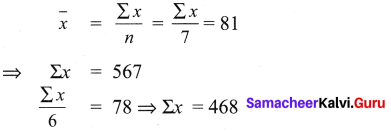
The mean of a set of seven numbers is 81. If one of the numbers is discarded, the mean of the remaining numbers is 78 . The value of discarded number is
(1) 101
(2) 100
(3) 99
(4) 98
Solution:
Hint:
Samacheer Kalvi 9th Maths Chapter 8 Statistics Ex 8.4 1
∴ The discarded number = 567 – 41 = 99
Solution:
(3) 99

Question 3.
A particular observation which occurs maximum number of times in a given data is called its
Samacheer Kalvi 9th Maths Chapter 8 Statistics Ex 8.4 2
(1) Frequency
(2) range
(3) mode
(4) Median
Solution:
(3) mode

Question 4.
For which set of numbers do the mean, median and mode all have the same values?
(1) 2, 2, 2, 4
(2) 1, 3, 3, 3, 5
(3) 1, 1, 2, 5, 6
(4) 1, 1, 2, 1, 5
Hint:
Samacheer Kalvi 9th Maths Chapter 8 Statistics Ex 8.4 3
Median = 3
Mode = 3
Solution:
(2) 1, 3, 3, 3, 5
Samacheer Kalvi 9th Maths Solutions Chapter 8 Statistics Ex 8.4
Question 5.
The algebraic sum of the deviations of a set of n values from their mean is
(1) 0
(2) n – 1
(3) n
(4) n + 1
Solution:
(1) 0

Question 6.
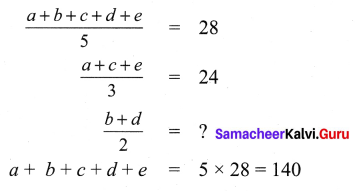
The mean of a, b, c, d and e is 28 . If the mean of a, c and e is 24, then mean of b and d is
(1) 24
(2) 36
(3) 26
(4) 34
Hint:
Samacheer Kalvi 9th Maths Chapter 8 Statistics Ex 8.4 4