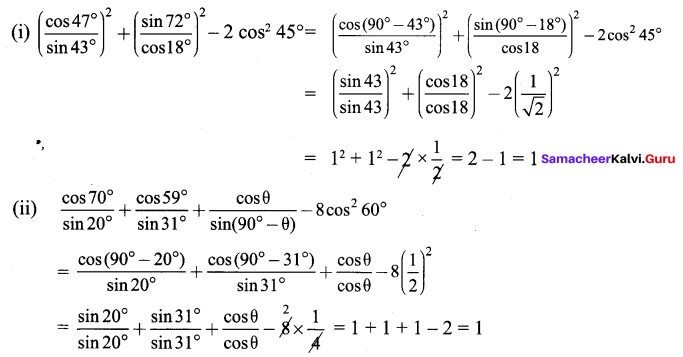
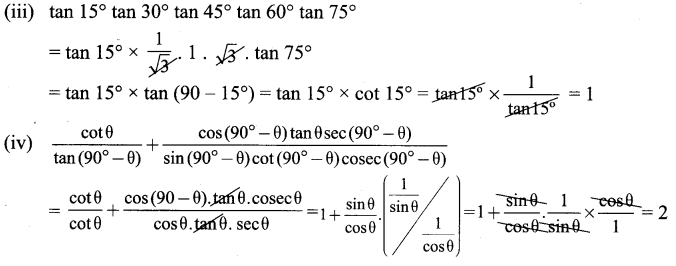
Samacheer Kalvi 9th Maths Solutions Chapter 5 Coordinate Geometry Ex 5.4

You can Download Samacheer Kalvi 9th Maths Book Solutions Guide Pdf, Tamilnadu State Board help you to revise the complete Syllabus and score more marks in your examinations.

Tamilnadu Samacheer Kalvi 9th Maths Solutions Chapter 5 Coordinate Geometry Ex 5.4

Question 1.
Find the coordinates of the point which divides the line segment joining the points
A (4, -3) and B (9, 7) in the ratio 3 : 2.
Solution:
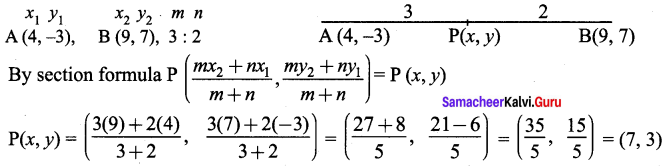
Samacheer Kalvi 9th Maths Chapter 5 Coordinate Geometry Ex 5.4 1

Question 2.
In what ratio does the point P (2, -5) divide the line segment joining A (-3, 5) and B (4, -9).
Solution:
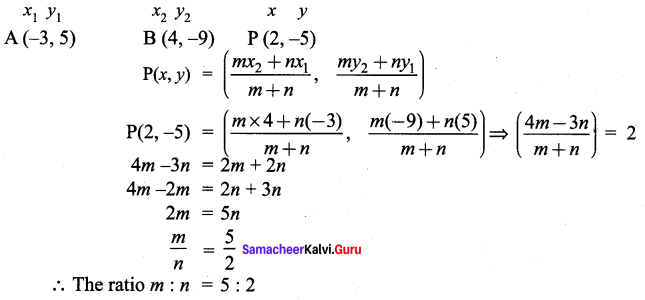
Samacheer Kalvi 9th Maths Chapter 5 Coordinate Geometry Ex 5.4 2

Question 3.
Find the coordinates of a point P on the line segment joining A(1, 2) and B (6, 7) in such a way that AP = \(\frac{2}{5}\)AB.
Solution:
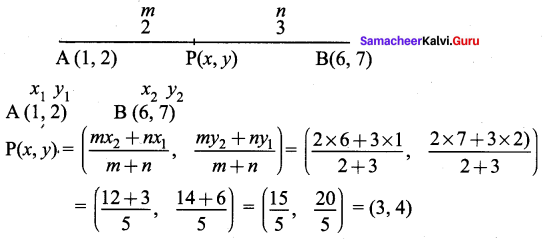
Samacheer Kalvi 9th Maths Chapter 5 Coordinate Geometry Ex 5.4 3

Question 4.
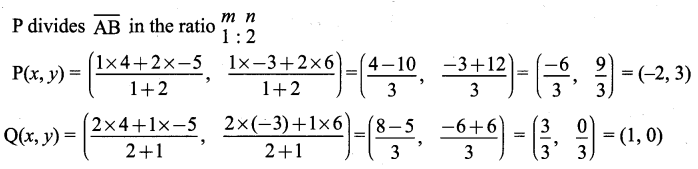
Find the coordinates of the points of trisection of the line segment joining the points A (-5, 6) and B (4, -3).
Solution:

Samacheer Kalvi 9th Maths Chapter 5 Coordinate Geometry Ex 5.4 4
Samacheer Kalvi 9th Maths Chapter 5 Coordinate Geometry Ex 5.4 5

Samacheer Kalvi 9th Maths Solutions Chapter 5 Coordinate Geometry Ex 5.4

Question 5.
The line segment joining A(6, 3) and B(-1, -4) is doubled in length by adding half of AB to each end. Find the coordinates of the new end points.
Solution:
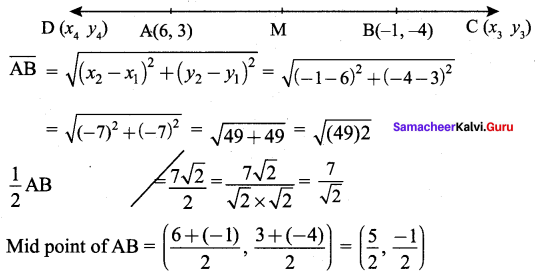
Samacheer Kalvi 9th Maths Chapter 5 Coordinate Geometry Ex 5.4 6
Samacheer Kalvi 9th Maths Chapter 5 Coordinate Geometry Ex 5.4 7
Similarly by Mid point of DM = A(6, 3)
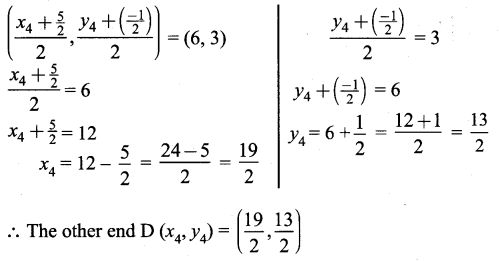
Samacheer Kalvi 9th Maths Chapter 5 Coordinate Geometry Ex 5.4 50

Question 6.
Using section formula, show that the points A(7, -5), B(9, -3) and C(13, 1) are collinear.
Solution:
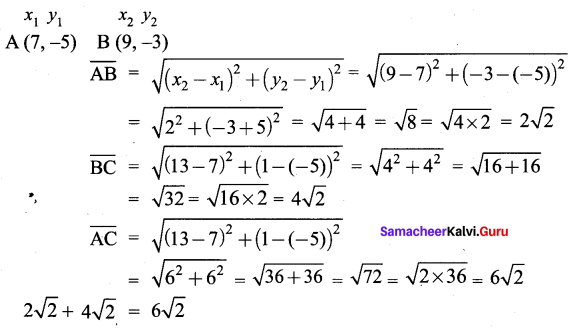
Samacheer Kalvi 9th Maths Chapter 5 Coordinate Geometry Ex 5.4 9∴ AB + BC = AC, Here B is the common Point. ∴ A, B, C are collinear

Samacheer Kalvi 9th Maths Solutions Chapter 5 Coordinate Geometry Ex 5.4

Question 7.
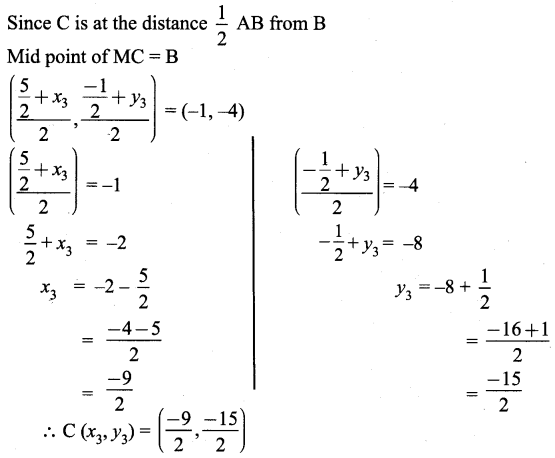
A line segment AB is increased along its length by 25% by producing it to C on the side of B. If A and B have the coordinates(-2, -3) and (2, 1) respectively, then find the coordinates of C.
Solution:
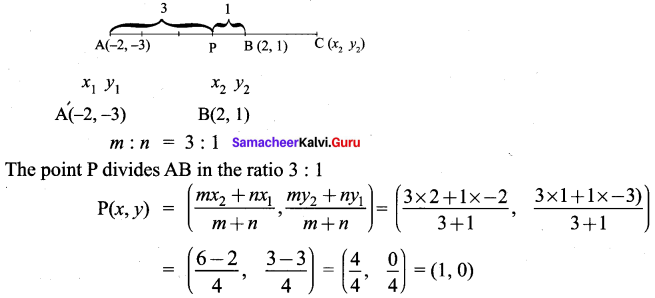
Samacheer Kalvi 9th Maths Chapter 5 Coordinate Geometry Ex 5.4 10
P is at 25% distance from B on its left and C is at 25% distance from B on its right.
∴ B is the mid point of PC
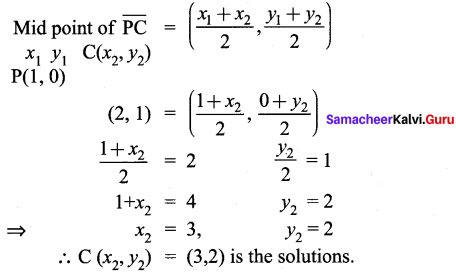
Samacheer Kalvi 9th Maths Chapter 5 Coordinate Geometry Ex 5.4 11

Samacheer Kalvi 9th Maths Solutions Chapter 5 Coordinate Geometry Ex 5.1

You can Download Samacheer Kalvi 9th Maths Book Solutions Guide Pdf, Tamilnadu State Board help you to revise the complete Syllabus and score more marks in your examinations.

Tamilnadu Samacheer Kalvi 9th Maths Solutions Chapter 5 Coordinate Geometry Ex 5.1

Question 1.
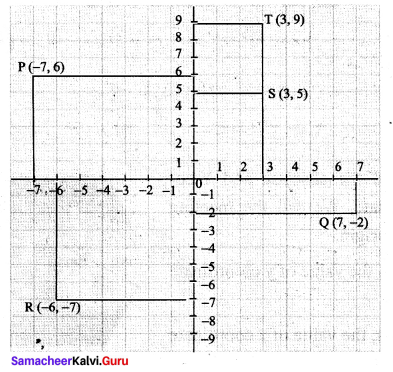
Plot the following points in the coordinate system and identify the quadrants P(-7, 6), Q(7, -2), R(-6, -7), S(3, 5) and T(3, 9)
Solution:
Samacheer Kalvi 9th Maths Chapter 5 Coordinate Geometry Ex 5.1 1
(i) P(-7, 6) = II Quadrant
(ii) Q(7, -2) = IV Quadrant
(iii) R(-6, -7) = III Quadrant
(iv) S(3, 5) = I Quadrant
(v) T(3, 9) = I Quadrant

Samacheer Kalvi 9th Maths Solutions Chapter 5 Coordinate Geometry Ex 5.1

Question 2.
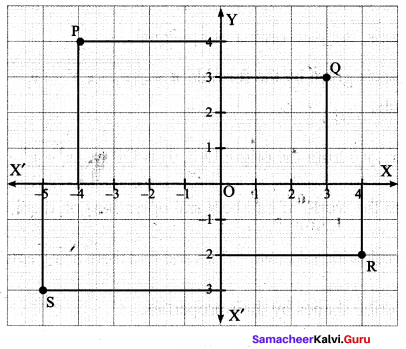
Write down the abscissa and ordinate of the following
(i) P
(ii) Q
(iii) R
(iv) S
Samacheer Kalvi 9th Maths Chapter 5 Coordinate Geometry Ex 5.1 2
Solution:
(i) P(-4, 4)
Abscissa is -4
Ordinate is 4.

(ii) Q(3, 3)
Abscissa is 3
Ordinate is 3

(iii) R(4, -2)
Abscissa is 4
Ordinate is -2

(iv) S(-5, -3)
Abscissa is -5
Ordinate is -3

Samacheer Kalvi 9th Maths Solutions Chapter 5 Coordinate Geometry Ex 5.1

Question 3.
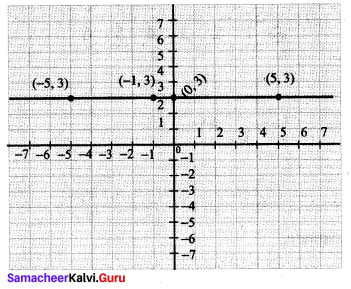
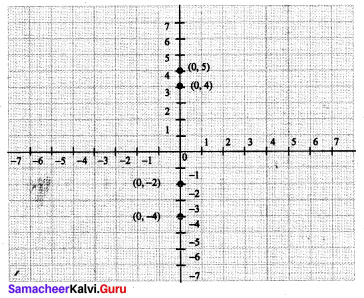
Plot the following points in the coordinate plane and join them. What is your conclusion about the resulting figure?
(i) (-5, 3) (-1, 3) (0, 3) (5, 3)
(ii) (0, -4) (0, -2) (0, 4) (0, 5)
Solution:
(i)
Samacheer Kalvi 9th Maths Chapter 5 Coordinate Geometry Ex 5.1 3
When we join the points, we see that they lie on a line which is parallel to x-axis.

(ii)
Samacheer Kalvi 9th Maths Chapter 5 Coordinate Geometry Ex 5.1 4
When we join the points, we see that they lie on a straight line which is y-axis.

Question 4.
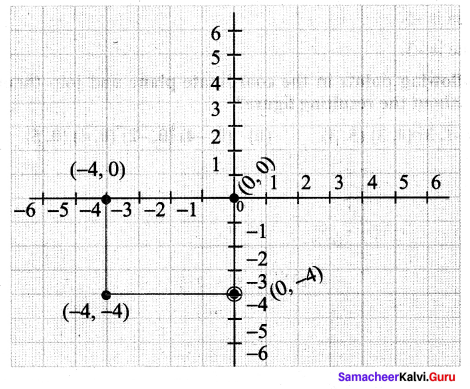
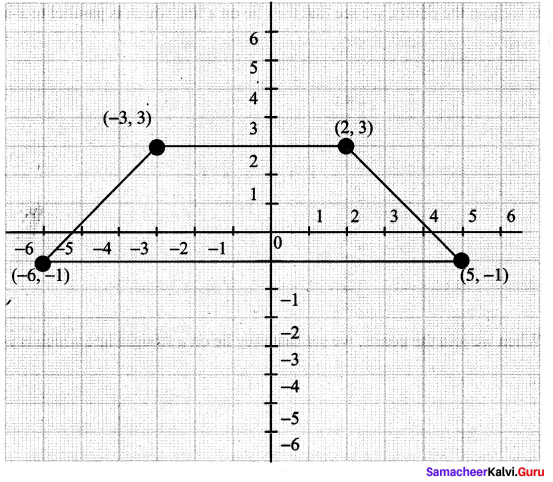
Plot the following points in the coordinate plane. Join them in order. What type of geometrical shape is formed?
(i) (0, 0) (-4, 0) (-4, -4) (0, -4)
(ii) (-3, 3) (2, 3) (-6, -1) (5, -1)
Solution:
(i) (0, 0) (-4, 0) (-4, -4) (0, -4)
Samacheer Kalvi 9th Maths Chapter 5 Coordinate Geometry Ex 5.1 5
The type of geometrical shape is square.

(ii) (-3, 3) (2, 3) (-6, -1) (5, -1)
Samacheer Kalvi 9th Maths Chapter 5 Coordinate Geometry Ex 5.1 6
The type of geometrical shape is Trapezium.

Samacheer Kalvi 9th Maths Solutions Chapter 5 Coordinate Geometry Ex 5.1

Samacheer Kalvi 9th Maths Solutions Chapter 6 Trigonometry Additional Questions

You can Download Samacheer Kalvi 9th Maths Book Solutions Guide Pdf, Tamilnadu State Board help you to revise the complete Syllabus and score more marks in your examinations.

Tamilnadu Samacheer Kalvi 9th Maths Solutions Chapter 6 Trigonometry Additional Questions

Exercise 6.1

Question 1.
Find the six trigonometric ratios of the angle 6 using the diagram
Solution:
Samacheer Kalvi 9th Maths Chapter 6 Trigonometry Additional Questions 1

Question 2.
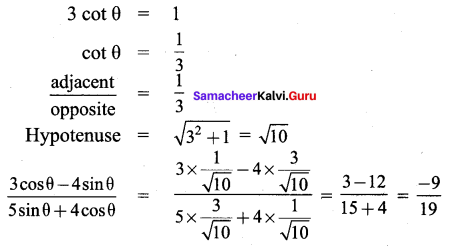
If 3 cot θ = 1, then find the value of \(\frac{3 \cos \theta-4 \sin \theta}{5 \sin \theta+4 \cos \theta}\)
Solution:
Samacheer Kalvi 9th Maths Chapter 6 Trigonometry Additional Questions 2

Samacheer Kalvi 9th Maths Solutions Chapter 6 Trigonometry Additional questions

Question 3.
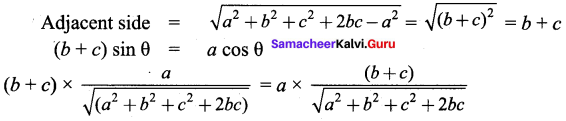
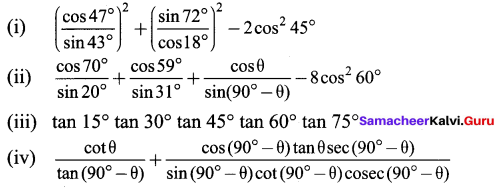
Samacheer Kalvi 9th Maths Chapter 6 Trigonometry Additional Questions 3
Solution:
Samacheer Kalvi 9th Maths Chapter 6 Trigonometry Additional Questions 4
Hence proved

Question 4.
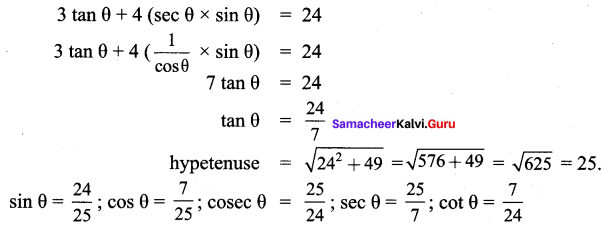
If 3 (tan θ) + 4 (sec θ × sin θ) = 24. Then find all the trigonometric ratios of the angle θ.
Solution:
Samacheer Kalvi 9th Maths Chapter 6 Trigonometry Additional Questions 5

Question 5.
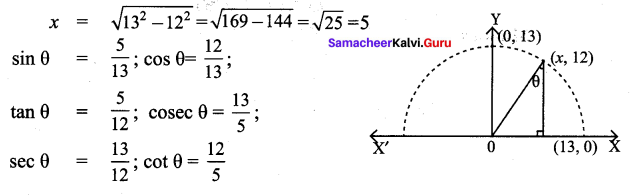
From the given figure, find all the trigonometric ratios of angle θ.
Solution:
Samacheer Kalvi 9th Maths Chapter 6 Trigonometry Additional Questions 6

Exercise 6.2

Question 1.
Find the value of sin 3x. sin 6x. sin 9x when x = 10°
Solution:
Samacheer Kalvi 9th Maths Chapter 6 Trigonometry Additional Questions 50

Question 2.
Find the value of cot 15°. cot 30°. cot 45°. cot 60°. cot 75°
Solution:
cot (90° – 75) cot (90° – 60°) cot 45° cot 60° cot 75°
= tan 75° tan 60° (1) cot 60° cot 75° = 1

Exercise 6.3

Samacheer Kalvi 9th Maths Solutions Chapter 6 Trigonometry Additional questions

Question 3.
Find the value of cos 19° 59′ + tan 12° 12′ + sin 49° 20′.
Solution:
cos 19° 59′ + tan 12° 12′ + sin 49° 20′ = 0

Question 4.
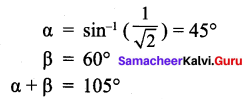
Given that sin α = \(\frac{1}{\sqrt{2}}\) and tan β = \(\sqrt{3}\) . Find the value of α + β.
Solution:
Samacheer Kalvi 9th Maths Chapter 6 Trigonometry Additional Questions 60

Question 5.
Find the value of \(\frac{\cos 63^{\circ} 20^{\prime}}{\sin 26^{\circ} 40^{\prime}}\)
Solution:
Samacheer Kalvi 9th Maths Chapter 6 Trigonometry Additional Questions 61
Samacheer Kalvi 9th Maths Solutions Chapter 6 Trigonometry Additional questions

Samacheer Kalvi 9th Maths Solutions Chapter 6 Trigonometry Ex 6.5

You can Download Samacheer Kalvi 9th Maths Book Solutions Guide Pdf, Tamilnadu State Board help you to revise the complete Syllabus and score more marks in your examinations.

Tamilnadu Samacheer Kalvi 9th Maths Solutions Chapter 6 Trigonometry Ex 6.5

Multiple Choice Questions :

Question 1.
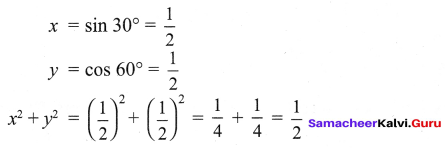
If sin 30° = x and cos 60° = y, then x2 + y2 is
(1) \(\frac{1}{2}\)
(2) 0
(3) sin 90°
(4) cos 90°
Hint:
Samacheer Kalvi 9th Maths Chapter 6 Trigonometry Ex 6.5 1
Solution:
(1) \(\frac{1}{2}\)

Question 2.
If tan θ = cot 37°, then the value of θ is
(1) 37°
(2) 53°
(3) 90°
(4) 1°
Hint:
tan θ = cot 37°
tan (90° – 37°) = cot 37°
θ = 90°- 37° = 53°
Solution:
(2) 53°

Question 3.
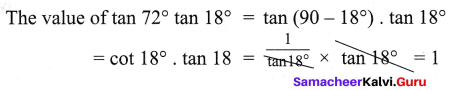
The value of tan 72° tan 18° is
(1) 0
(2) 1
(3) 18°
(4) 72°
Hint:
Samacheer Kalvi 9th Maths Chapter 6 Trigonometry Ex 6.5 2
Solution:
(2) 1

Samacheer Kalvi 9th Maths Solutions Chapter 6 Trigonometry Ex 6.5

Question 4.
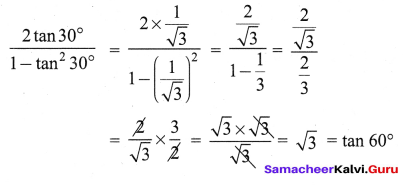
The value of \(\frac{2 \tan 30^{\circ}}{1-\tan ^{2} 30^{\circ}}\) is equal to
(1) cos 60°
(2) sin 60°
(3) tan 60°
(4) sin 30°
Hint:
Samacheer Kalvi 9th Maths Chapter 6 Trigonometry Ex 6.5 3
Solution:
(3) tan 60°

Question 5.
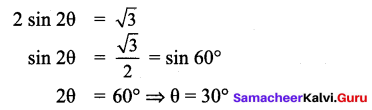
If 2 sin 2θ = \(\sqrt{3}\), then the value of θ is
(1) 90°
(2) 30°
(3) 45°
(4) 60°
Hint:
Samacheer Kalvi 9th Maths Chapter 6 Trigonometry Ex 6.5 4
Solution:
(2) 30°

Question 6.
The value of 3 sin 70° sec 20° + 2 sin 49° sec 51° is
(1) 2
(2) 3
(3) 5
(4) 60°
Hint:
Samacheer Kalvi 9th Maths Chapter 6 Trigonometry Ex 6.5 5
Solution:
(3) 5
Samacheer Kalvi 9th Maths Solutions Chapter 6 Trigonometry Ex 6.5
Question 7.
The value of \(\frac{1-\tan ^{2} 45^{\circ}}{1+\tan ^{2} 45^{\circ}}\) is
(1) 2
(2) 1
(3) 0
(4) \(\frac{1}{2}\)
Hint:
Samacheer Kalvi 9th Maths Chapter 6 Trigonometry Ex 6.5 6
Solution:
(3) 0

Question 8.
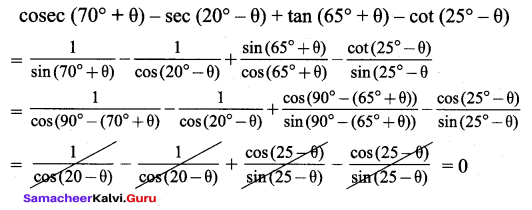
The value of cosec (70° + θ) – sec(20° – θ) + tan (65° + θ) – cot(25° – θ) is
(1) 0
(2) 1
(3) 2
(4) 3
Hint: cosec (70° + θ) – sec (20° – θ) + tan (65° + θ) – cot (25° – θ)
Samacheer Kalvi 9th Maths Chapter 6 Trigonometry Ex 6.5 7
Solution:
(1) 0

Question 9.
The value of tan 1°tan 2° tan 3° … tan 89° is
(1) 0
(2) 1
(3) 2
(4) \(\frac{\sqrt{3}}{2}\)
Hint: tan (90° – 89°) tan (90° – 88°) …tan (90° -46°) tan 45° tan 46°… tan 88 tan 89° = cot 89° cot 88°… cot 46° (1) tan 46°… tan 88° tan 89° = 1
Solution:
(2) 1

Question 10.
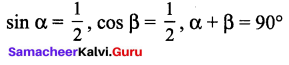
Given that sin α = \(\frac{1}{2}\) and cos β = \(\frac{1}{2}\) , then the value of α + β is
(1) 0°
(2) 90°
(3) 30°
(4) 60°
Hint:
Samacheer Kalvi 9th Maths Chapter 6 Trigonometry Ex 6.5 8
Solution:
(2) 90°
Samacheer Kalvi 9th Maths Solutions Chapter 6 Trigonometry Ex 6.5

Samacheer Kalvi 9th Maths Solutions Chapter 6 Trigonometry Ex 6.4

You can Download Samacheer Kalvi 9th Maths Book Solutions Guide Pdf, Tamilnadu State Board help you to revise the complete Syllabus and score more marks in your examinations.

Tamilnadu Samacheer Kalvi 9th Maths Solutions Chapter 6 Trigonometry Ex 6.4

Question 1.
Find the value of the following :
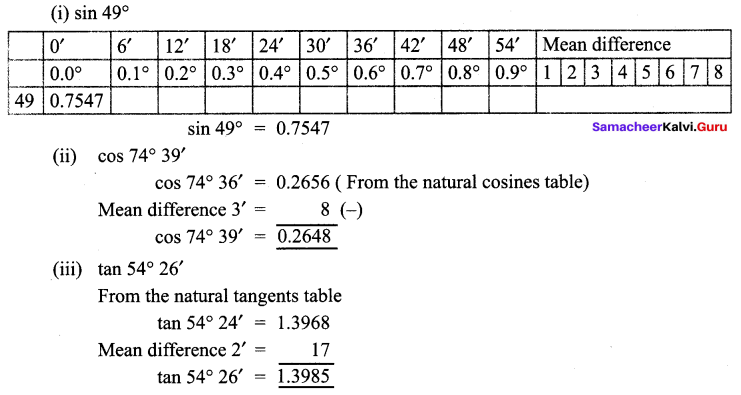
(i) sin 49°
(ii) cos 74° 39′
(iii) tan 54° 26′
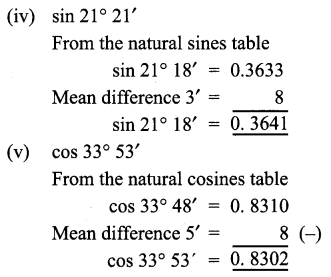
(iv) sin 21° 21′
(v) cos 33° 53′
(vi) tan 70° 17′
Solution:
Samacheer Kalvi 9th Maths Chapter 6 Trigonometry Ex 6.4 1
Samacheer Kalvi 9th Maths Chapter 6 Trigonometry Ex 6.4 2
Samacheer Kalvi 9th Maths Solutions Chapter 6 Trigonometry Ex 6.4

Question 2.
Find the value of θ if
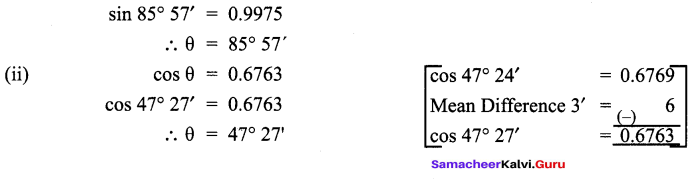
(i) sin θ = 0.9975
(ii) cos θ = 0.6763
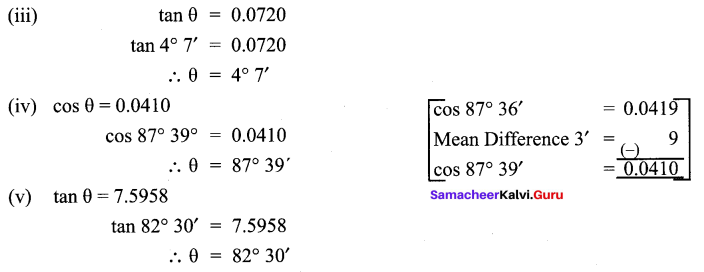
(iii) tan θ = 0.0720
(iv) cos θ = 0.0410
(v) tan θ = 7.5958
Solution:
(i) From the natural sines table
Samacheer Kalvi 9th Maths Chapter 6 Trigonometry Ex 6.4 3
Samacheer Kalvi 9th Maths Chapter 6 Trigonometry Ex 6.4 4

Question 3.
Find the value of the following :
(i) sin 65° 39′ + cos 24° 57′
(ii) tan 70° 58′ + cos 15° 26′ – sin 84° 59′
Solution:
(i) = 0.9111 + 0.9066 + 0.1793 = 1.9970
(ii) = 2.8982 + 0.9639 – 0.9962 = 3.8621 – 0.9962 = 2.8659

Question 4.
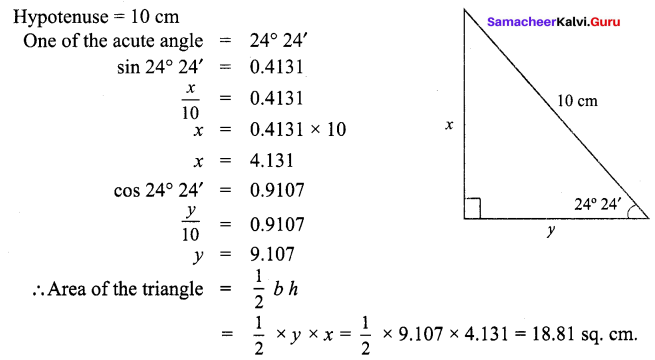
Find the area of a right triangle whose hypotenuse is 10cm and one of the acute angle is 24° 24′
Solution:
Samacheer Kalvi 9th Maths Chapter 6 Trigonometry Ex 6.4 5

Samacheer Kalvi 9th Maths Solutions Chapter 6 Trigonometry Ex 6.4

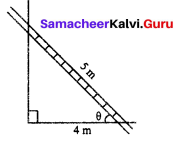
Question 5.
Find the angle made by a ladder of length 5m with the ground, if one of its end is
4m away from the wall and the other end is on the wall.
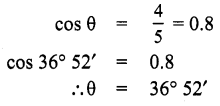
Solution:
Samacheer Kalvi 9th Maths Chapter 6 Trigonometry Ex 6.4 6
Samacheer Kalvi 9th Maths Chapter 6 Trigonometry Ex 6.4 50

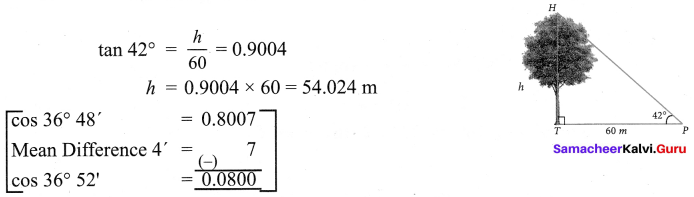
Question 6.
In the given figure, HT shows the height of a tree standing vertically. From a point P, the angle of elevation of the top of the tree (that is ∠P) measures 42° and the distance to the tree is 60 metres. Find the height of the tree.
Solution:
Samacheer Kalvi 9th Maths Chapter 6 Trigonometry Ex 6.4 7

Samacheer Kalvi 9th Maths Solutions Chapter 6 Trigonometry Ex 6.4

Samacheer Kalvi 9th Maths Solutions Chapter 5 Coordinate Geometry Ex 5.6

You can Download Samacheer Kalvi 9th Maths Book Solutions Guide Pdf, Tamilnadu State Board help you to revise the complete Syllabus and score more marks in your examinations.

Tamilnadu Samacheer Kalvi 9th Maths Solutions Chapter 5 Coordinate Geometry Ex 5.6

Multiple Choice Questions :

Question 1.
If the y-coordinate of a point is zero, then the point always lies
(1) in the I quadrant
(2) in the II quadrant
(3) on x-axis
(4) on y-axis
Solution:
(3) on x-axis

Question 2.
The points (-5, 2) and (2, -5) lie in the ___.
(1) same quadrant
(2) II and III quadrant respectively
(3) II and IV quadrant respectively
(4) IV and II quadrant respectively
Hint: (-, +) lies IInd quadrant and (+, -) lies in IVth quadrant
Solution:
(3) II and IV quadrant respectively

Question 3.
On plotting the points 0(0, 0), A(3, – 4), B(3, 4) and C(0, 4) and joining OA, AB, BC and CO, which of the following figure is obtained?
(1) Square
(2) Rectangle
(3) Trapezium
(4) Rhombus
Hint: In trapezium one pair of opposite side is parallel.
Solution:
(3) Trapezium

Samacheer Kalvi 9th Maths Solutions Chapter 5 Coordinate Geometry Ex 5.6

Question 4.
If P(-1, 1), Q(3, -4), R(1, -1), S(-2, -3) and T(-4, 4) are plotted on a graph paper, then the points in the fourth quadrant are ____.
(1) P and T
(2) Q and R
(3) only S
(4) P and Q
Hint: Points in IVth quadrant are (+, -)
Solution:
(2) Q and R

Question 5.
The point whose ordinate is 4 and which lies on they-axis is
(1) (4, 0)
(2) (0, 4)
(3) (1, 4)
(4) (4, 2)
Hint: Points in y-axis have abscissa a zero
Solution:
(2) (0, 4)

Question 6.
The distance between the two points (2, 3) and (1, 4) is ___ .
(1) 2
(2) \(\sqrt{56}\)
(3) \(\sqrt{10}\)
(4) \(\sqrt{2}\)
Hint: Distance = \(\sqrt{\left(x_{2}-x_{1}\right)^{2}+\left(y_{2}-y_{1}\right)^{2}}\)
Solution:
(4) \(\sqrt{2}\)

Question 7.
If the points A (2, 0), B (-6, 0), C (3, a – 3) lie on the x-axis then the value of a is ___.
(1) 0
(2) 2
(3) 3
(4) -6
Hint: Points in y-axis have ordinate zero. ∴ a – 3 = 0 ⇒ a = 3
Solution:
(3) 3

Question 8.
If ( x + 2, 4) = (5, y – 2), then the coordinates (x, y) are ___.
(1) (7, 12)
(2) (6, 3)
(3) (3, 6)
(4) (2, 1)
Hint: x + 2 = 5 ⇒ x = 3; y – 2 = 4 ⇒ y = 6
Solution:
(3) (3, 6)

Samacheer Kalvi 9th Maths Solutions Chapter 5 Coordinate Geometry Ex 5.6

Question 9.
If Q1, Q2, Q3, Q4 are the quadrants in a Cartesian plane then Q2 ∩ Q3 is
(1) Q1 ∪ Q2
(2) Q2 ∪ Q3
(3) Null set
(4) Negative x-axis
Hint: Quadrants do not contain the axis.
Solution:
(3) Null set

Question 10.
The distance between the point (5, -1) and the origin is
(1) \(\sqrt{24}\)
(2) \(\sqrt{37}\)
(3) \(\sqrt{26}\)
(4) \(\sqrt{17}\)
Hint:
Samacheer Kalvi 9th Maths Chapter 5 Coordinate Geometry Ex 5.6 1
Solution:
(3) \(\sqrt{26}\)

Question 11.
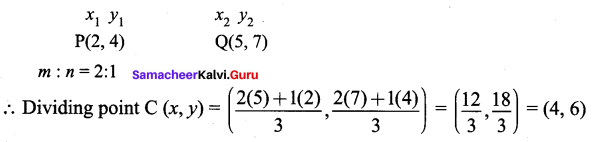
The coordinates of the point C dividing the line segment joining the points P(2, 4) and Q(5, 7) internally in the ratio 2 : 1 is
(1) \(\left(\frac{7}{2}, \frac{11}{2}\right)\)
(2) (3, 5)
(3) (4, 4)
(4) (4, 6)
Hint:
Samacheer Kalvi 9th Maths Chapter 5 Coordinate Geometry Ex 5.6 51

Question 12.
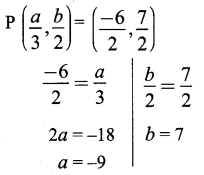
If P\(\left(\frac{a}{3}, \frac{b}{2}\right)\) is the mid-point of the line segment joining A(-4, 3) and B(-2, 4) then (a, b)
(1) (-9, 7)
(2) \(\left(-3, \frac{7}{2}\right)\)
(3) (9, -7)
(4) \(\left(3-\frac{7}{2}\right)\)
Hint:
Samacheer Kalvi 9th Maths Chapter 5 Coordinate Geometry Ex 5.6 52
Samacheer Kalvi 9th Maths Chapter 5 Coordinate Geometry Ex 5.6 53
Solution:
(1) (-9, 7)

Question 13.
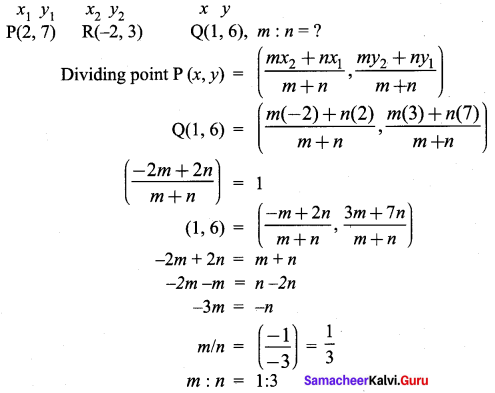
In what ratio does the point Q(1, 6) divide the line segment joining the points P(2, 7) and R(-2, 3)
(1) 1 : 2
(2) 2 : 1
(3) 1 : 3
(4) 3 : 1.
Hint:
Samacheer Kalvi 9th Maths Chapter 5 Coordinate Geometry Ex 5.6 54

Question 14.
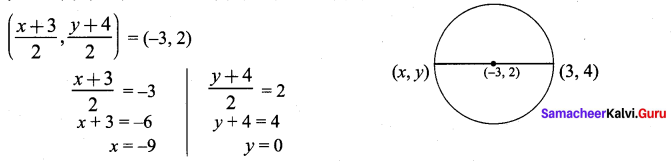
If the coordinates of one end of a diameter of a circle is (3, 4) and the coordinates of its center is (-3, 2), then the coordinate of the other end of the diameter is
(1) (0, -3)
(2) (0, 9)
(3) (3, 0)
(4) (-9, 0)
Samacheer Kalvi 9th Maths Chapter 5 Coordinate Geometry Ex 5.6 55
Solution:
(4) (-9, 0)

Question 15.
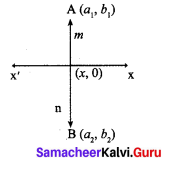
The ratio in which the x-axis divides the line segment joining the points A(a1, b1) and B(a2, b2) is
(1) b1 : b2
(2 ) -b1 : b2
(3 ) a1 : a2
(4 ) -a1 : a2
Hint:
Samacheer Kalvi 9th Maths Chapter 5 Coordinate Geometry Ex 5.6 56
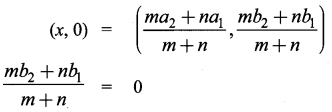
Samacheer Kalvi 9th Maths Chapter 5 Coordinate Geometry Ex 5.6 57
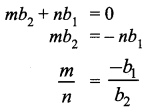
Samacheer Kalvi 9th Maths Chapter 5 Coordinate Geometry Ex 5.6 58
Solution:
(2 ) -b1 : b2

Question 16.
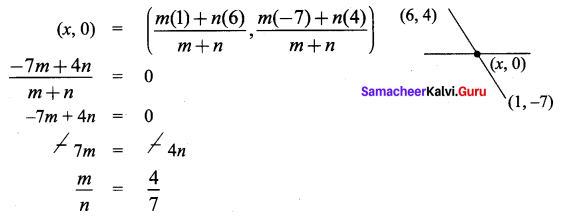
The ratio in which the x-axis divides the line segment joining the points (6, 4) and (1, -7) is
(1) 2 : 3
(2) 3 : 4
(3) 4 : 7
(4) 4 : 3
Hint:
Samacheer Kalvi 9th Maths Chapter 5 Coordinate Geometry Ex 5.6 59
Solution:
(3) 4 : 7

Question 17.
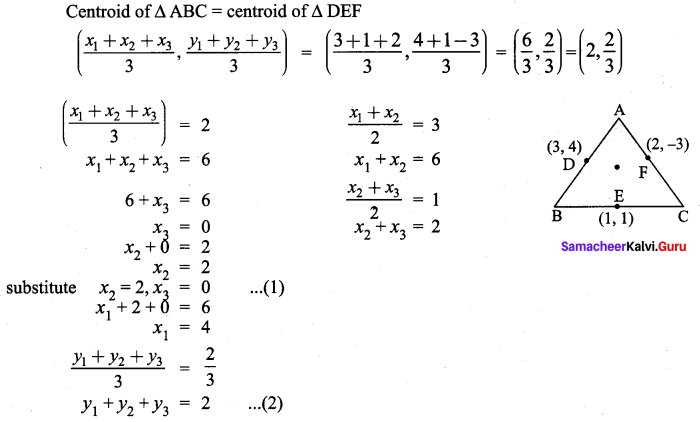
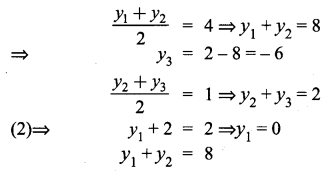
If the coordinates of the mid-points of the sides AB, BC and CA of a triangle are (3, 4), (1, 1) and (2, -3) respectively, then the vertices A and B of the triangle are
(1) (3, 2), (2, 4)
(2) (4, 0), (2, 8)
(3) (3, 4), (2, 0)
(4) (4, 3), (2, 4)
Hint:
Samacheer Kalvi 9th Maths Chapter 5 Coordinate Geometry Ex 5.6 60
Samacheer Kalvi 9th Maths Chapter 5 Coordinate Geometry Ex 5.6 61
0 + y2 = 8 ⇒ y2 = 8
(x1, y1) = (4, 0) ; (x2, y2) = (2, 8)
Solution:
(2) (4, 0), (2, 8)

Question 18.
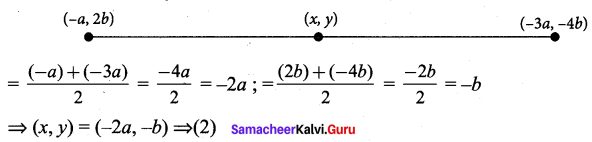
The mid-point of the line joining (-a, 2b) and (-3a, -4b) is
(1) (2a, 3b)
(2) (-2a, -b)
(3) (2a, b)
(4) (-2a, -3b)
Hint:
Samacheer Kalvi 9th Maths Chapter 5 Coordinate Geometry Ex 5.6 62
Solution:
(2) (-2a, -b)

Question 19.
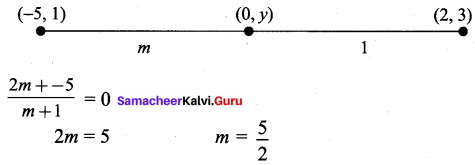
In what ratio does the j-axis divides the line joining the points (-5, 1) and (2, 3) internally
(1) 1 : 3
(2) 2 : 5
(3) 3 : 1
(4) 5 : 2
Hint:
Samacheer Kalvi 9th Maths Chapter 5 Coordinate Geometry Ex 5.6 64
Solution:
(4) 5 : 2

Question 20.
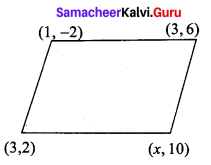
If (1, -2), (3, 6), (x, 10) and (3, 2) are the vertices of the parallelogram taken in order, then the value of x is
(1) 6
(2) 5
(3) 4
(4) 3
Hint:
In parallelogram diagonals bisect each other.
Mid point of AC = Mid point of BD
Samacheer Kalvi 9th Maths Chapter 5 Coordinate Geometry Ex 5.6 66
Samacheer Kalvi 9th Maths Chapter 5 Coordinate Geometry Ex 5.6 67
Solution:
(2) 5

Samacheer Kalvi 9th Maths Solutions Chapter 2 Real Numbers Additional Questions

You can Download Samacheer Kalvi 9th Maths Book Solutions Guide Pdf, Tamilnadu State Board help you to revise the complete Syllabus and score more marks in your examinations.

Tamilnadu Samacheer Kalvi 9th Maths Solutions Chapter 2 Real Numbers Additional Questions

Exercise 2.1

Question 1.
Find only two rational numbers between \(\frac { 1 }{ 4 }\) and \(\frac { 3 }{ 4 }\).
Solution:
A rational number between \(\frac { 1 }{ 4 }\) and \(\frac { 3 }{ 4 }\) = \(\frac { 1 }{ 2 }\) ( \(\frac { 1 }{ 4 }\) + \(\frac { 3 }{ 4 }\)) = \(\frac { 1 }{ 2 }\) (1) = \(\frac { 1 }{ 2 }\)
Another rational number between \(\frac { 1 }{ 2 }\) and \(\frac { 3 }{ 4 }\) = \(\frac { 1 }{ 2 }\) ( \(\frac { 1 }{ 2 }\) + \(\frac { 3 }{ 4 }\)) = \(\frac { 1 }{ 2 }\) ( \(\frac { 2+3 }{ 4 }\) = \(\frac { 31}{ 2 }\) × \(\frac { 5 }{ 4 }\)) = \(\frac { 5 }{ 8 }\)
The rational numbers \(\frac { 1 }{ 2 }\) and \(\frac { 5 }{ 8 }\) lies between \(\frac { 1 }{ 4 }\) and \(\frac { 3 }{ 2 }\) .

Question 2.
Is zero a rational numbers? Give reasons for your answer.
Solution:
Yes, since \(\frac { 0 }{ 2 }\) = 0, (i.e) it can be written in the form \(\frac { p }{ q }\) where q ≠ 0

Samacheer Kalvi 9th Maths Solutions Chapter 2 Real Numbers Additional Questions

Exercise 2.2

Question 1.
Express the following decimal expansion is the form \(\frac { p }{ q }\) , where p and q are integers and q ≠ 0.
(i) 0.75
(ii) 0.625
(iii) 0.5625
(iv) 0.28
Solution:
Samacheer Kalvi 9th Maths Chapter 2 Real Numbers Additional Questions 1

Question 2.
Convert \(\overline { 0.9 }\) to a rational number.
Solution:
(i) Let x = \(0.\overline { 9 }\). Then x = 0.99999….
Multiplying by 10 on both sides, we get
10x = 9.99999….. = 9 + 0.9999….. = 9 + x
9x = 9
x = 1. That is, \(0.\overline { 9 }\) = 1 (∵ 1 is rational number).

Exercise 2.3

Question 1.
Classify the following number as rational or irrational.
(i) \(\sqrt { 11 }\)
(ii) \(\sqrt { 81 }\)
(iii) 0.0625
(iv) \(0.8\overline { 3 }\)
Solution:
(i) \(\sqrt { 11 }\) is an irrational number. (11 is not a perfect square number)
(ii) \(\sqrt { 81 }\) = 9 = \(\frac { 9 }{ 1 }\) , a rational number.
(iii) 0.0625 is a terminating decimal
∴ 0. 0625 is a rational number.
(iv) \(0.8\overline { 3 }\) = 0.8333
The decimal expansion is non-terminating and recurring.
∴ \(0.8\overline { 3 }\) is a rational number.

Question 2.
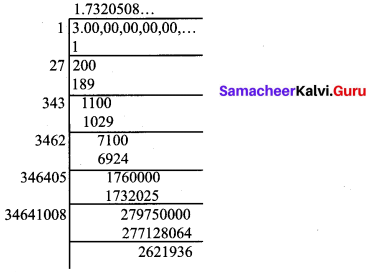
Find the decimal expansion of \(\sqrt { 3 }\).
Solution:
Samacheer Kalvi 9th Maths Chapter 2 Real Numbers Additional Questions 2

Question 3.
Find any 4 irrational numbers between \(\frac { 1 }{ 4 }\) and \(\frac { 1 }{ 3 }\).
Solution:
\(\frac { 1 }{ 4 }\) = 0.25 and \(\frac { 1 }{ 3 }\) = 0.3333 = \(0.\overline { 3 }\)
In between 0.25 and \(0.\overline { 3 }\) there are infinitely many irrational numbers .
Four irrational numbers between 0.25 and \(0.\overline { 3 }\) are
0.2601001000100001 ……
0.2701001000100001 ……
0.2801001000100001 …..
0.3101001000100001 ……

Samacheer Kalvi 9th Maths Solutions Chapter 2 Real Numbers Additional Questions

Exercise 2.4

Question 1.
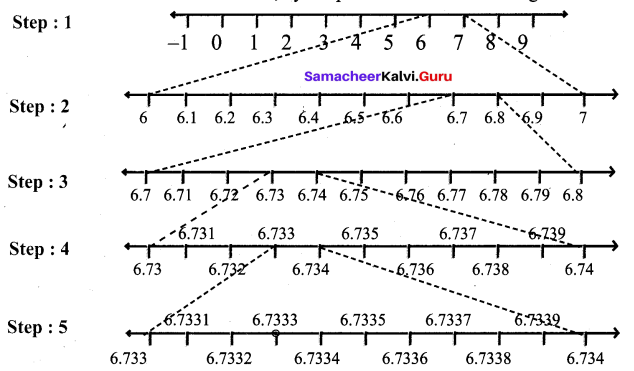
Visualise \(6.7\overline { 3 }\) on the number line, upto 4 decimal places.
Solution:
We locate 6.73 on the number line, by the process of successive magnification.
Samacheer Kalvi 9th Maths Chapter 2 Real Numbers Additional Questions 3
Step 1 : First we note that \(6.7\overline { 3 }\) lies between 6 and 7.
Step 2 : Divide the portion between 6 and 7 into 10 equal parts and use a magnifying glass to visualise that \(6.7\overline { 3 }\) lies between 6.7 and 6.8.
Step 3 : Divide the portion between 6.7 and 6.8 into 10 equal parts and use a magnifying glass to visualise that \(6.7\overline { 3 }\) lies between 6.73 and 6.74.
Step 4 : Divide the portion between 6.73 and 6.74 into 10 equal parts and use a magnifying glass to visualise that \(6.7\overline { 3 }\) lies between 6.733 and 6.734.
Step 5 : Divide the portion between 6.733 and 6.734 into 10 equal parts and use a magnifying glass to visualise that \(6.7\overline { 3 }\) lies between 6.7332 and 6.7334.
We note that \(6.7\overline { 3 }\) is visualised closed to 6.7332 than to 6.7334.

Question 2.
Find whether x and y are rational or irrational in the following:
(i) a = 2 + \(\sqrt{3}\), b = 2 – \(\sqrt{3}\); x = a + b, y = a – b
(ii) a = \(\sqrt{2}\) + 7, b = x = a + b, y = a – b
Solution:
(i) Given that a = 2 + \(\sqrt{3}\), b = 2 – \(\sqrt{3}\)
x = a + b = (2+ \(\sqrt{3}\)) +(2 – \(\sqrt{3}\)) = 4, a rational number.
y = a – b = {2 + \(\sqrt{3}\)) – (2 – \(\sqrt{3}\)) = 2\(\sqrt{3}\) , an irrational number.

(ii) Given that a = \(\sqrt{2}\) + 7,b = \(\sqrt{2}\) – 7
x = a + b = (\(\sqrt{2}\) + 7)+ (\(\sqrt{2}\) – 7) = 2\(\sqrt{2}\), an irrational number.
y = a – b = (\(\sqrt{2}\) + 7 ) – (\(\sqrt{2}\) – 7) = 14, a rational number.

Exercise 2.5

Question 1.
Evaluate :
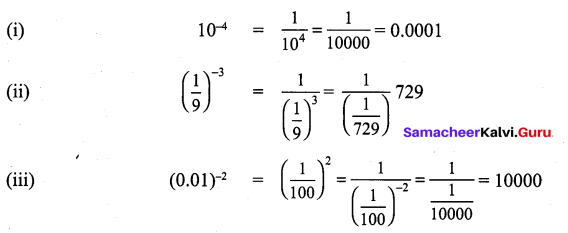
(i) 10-4
(ii) (\(\frac { 1 }{ 9 }\))-3
(iii) (0.01)-2
Solution:
Samacheer Kalvi 9th Maths Chapter 2 Real Numbers Additional Questions 4

Question 2.
Find the value of 625\(\frac { 3 }{ 4 }\) :
Solution:
Samacheer Kalvi 9th Maths Chapter 2 Real Numbers Additional Questions 5

Question 3.
Find the value of 729\(\frac { -5 }{ 6 }\) :
Solution:
Samacheer Kalvi 9th Maths Chapter 2 Real Numbers Additional Questions 6

Question 4.
Use a fractional index to write :
(i) (5\(\sqrt { 125 }\))7
(ii) \(\sqrt [ 3 ]{ 7 }\)
Solution:
(i) (5\(\sqrt { 125 }\))7 = 125\(\frac { 7 }{ 5 }\)
(ii) \(\sqrt [ 3 ]{ 7 }\) = 7\(\frac { 1 }{ 3 }\)

Samacheer Kalvi 9th Maths Solutions Chapter 2 Real Numbers Additional Questions

Exercise 2.6

Question 1.
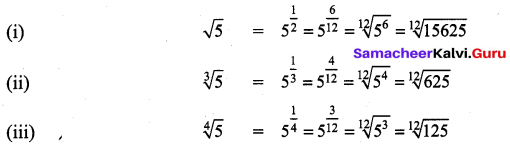
Can you reduce the following numbers to surds of same order.
(i) \(\sqrt{ 5 }\)
(ii) \(\sqrt [ 3 ]{ 5 }\)
(iii) \(\sqrt [ 4 ]{ 5 }\)
Solution:
Samacheer Kalvi 9th Maths Chapter 2 Real Numbers Additional Questions 7
Now the surds have same order

Question 2.
Express the following surds in its simplest form
(i) \(\sqrt { 27 }\)
(ii) \(\sqrt [ 3 ]{ 128 }\)
Solution:
Samacheer Kalvi 9th Maths Chapter 2 Real Numbers Additional Questions 8

Question 3.
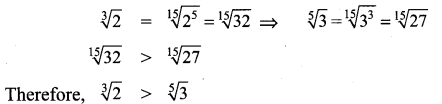
Show that \(\sqrt [ 3 ]{ 2 }\) > \(\sqrt [ 5 ]{ 3 }\).
Solution:
Samacheer Kalvi 9th Maths Chapter 2 Real Numbers Additional Questions 9

Question 4.
Express the following surds in its simplest form \(\sqrt [ 4 ]{ 324 }\).
Solution:
Samacheer Kalvi 9th Maths Chapter 2 Real Numbers Additional Questions 10
order = 4 ; radicand = 4; Coefficient = 3

Samacheer Kalvi 9th Maths Solutions Chapter 2 Real Numbers Additional Questions

Question 5.
Simplify \(\sqrt { 63 }\) – \(\sqrt { 175 }\) + \(\sqrt { 28 }\)
Solution:
Samacheer Kalvi 9th Maths Chapter 2 Real Numbers Additional Questions 11

Question 6.
Arrange in ascending order: \(\sqrt [ 3 ]{ 2 }\), \(\sqrt [ 2 ]{ 4 }\), \(\sqrt [ 4 ]{ 3 }\)
Solution:
The order of the surds \(\sqrt [ 3 ]{ 2 }\), \(\sqrt [ 2 ]{ 4 }\), \(\sqrt [ 4 ]{ 3 }\) are 3, 2, 4
L.CM. of 3, 2, 4 = 12.
Samacheer Kalvi 9th Maths Chapter 2 Real Numbers Additional Questions 12

Exercise 2.7

Question 1.
Subtract 6\(\sqrt { 7 }\) from 9\(\sqrt { 7 }\). Is the answer rational or irrational?
Solution:
9\(\sqrt { 7 }\) – 6\(\sqrt { 7 }\) = (9 – 6) \(\sqrt { 7 }\) = 3\(\sqrt { 7 }\)
The answer is irrational.

Question 2.
Simplify,: \(\sqrt { 44 }\) + \(\sqrt { 99 }\) – \(\sqrt { 275 }\).
Solution:
Samacheer Kalvi 9th Maths Chapter 2 Real Numbers Additional Questions 13

Question 3.
Compute and give the answer in the simplest form : 3 \(\sqrt { 162 }\) x 7 \(\sqrt { 50 }\) x 6 \(\sqrt { 98 }\)
Solution:
3 \(\sqrt { 162 }\) × 7 \(\sqrt { 50 }\) × 6 \(\sqrt { 98 }\) = \((3 \times 9 \sqrt{2} \times 7 \times 5 \sqrt{2} \times 6 \times 7 \sqrt{2})\)
= \(3 \times 7 \times 6 \times 9 \times 5 \times 7 \times \sqrt{2} \times \sqrt{2} \times \sqrt{2}=79380 \sqrt{2}\)

Exercise 2.8

Question 1.
Write in scientific notation : (60000000)3
Solution:
(60000000)3 = (6.0 × 10⁷)4 = (6.0)4 × (107)4
= 1296 × 1028
= 1.296 × 103 × 1028 = 1.296 × 1031

Question 2.
Write in scientific notation : (0.00000004)3
Solution:
(0.00000004)3 = (4.0 × 10⁻⁸)3 = (4.0)3 × (10-8)3
= 64 × 10-24 = 6.4 × 10 × 10-24 = 6.4 × 10⁻²³

Question 3.
Write in scientific notation : (500000)5 × (3000)3
Solution:
(500000)5 × (3000)3 = (5.0 × 10⁵)3 × (3.0 × 103)3
= (5.0)2 × (105)2 × (3.0)3 × (103)3
= 25 × 1010 × 27 × 109 = 675 × 1019
= 675.0 × 1019 = 6.75 × 102 × 1019= 6.75 × 10²¹

Question 4.
Write in scientific notation : (6000000)3 ÷ (0.00003)2
Solution:
(6000000)3 + (0.00003)2 = (6.0 × 10⁶)3 + (3.0 × 10⁻⁵)2
= (6.0 × 10⁶)3 ÷ (3.0 × 10⁻⁵)2 = 216 × 1018 ÷ 9 × 10-10
= \(\frac{216 \times 10^{9}}{9 \times 10^{-10}}\)
= 24 × 1018 × 1010 = 24 × 1028
= 24.0 × 1028 = 2.4 × 10 × 1028 = 2.4 × 1029

Samacheer Kalvi 9th Maths Solutions Chapter 2 Real Numbers Additional Questions

Exercise 2.9

Multiple Choice Questions :
Question 1.
A number having non-terminating and recurring decimal expansion is
(1) an integer
(2) a rational number
(3) an irrational number
(4) a whole number
Solution:
(2) a rational number
Hint:
Irrational number have nonterminating and non recurring decimal expansion.

Question 2.
If a number has a non-terminating and non-recurring decimal expansion, then it is
(1) a rational number
(2) a natural number
(3) an irrational number
(4) an integer
Solution:
(3) an irrational number
Hint: Rational number gave terminating or recurring and non-terminating decimal expansion.

Question 3.
Decimal form of \(\frac { -3 }{ 4 }\) is
(1) -0.75
(2) -0.50
(3) -0.25
(4) -0.125
Solution:
(1) -0.75
Hint:
\(\frac { 1 }{ 4 }\) = 0.25; \(\frac {1 }{ 2 }\) = 0.5; \(\frac { 3 }{ 4 }\) = 0.75

Samacheer Kalvi 9th Maths Solutions Chapter 2 Real Numbers Additional Questions

Question 4.
Which one of the following has a terminating decimal expansion?
Samacheer Kalvi 9th Maths Chapter 2 Real Numbers Additional Questions 14
Solution:
(1) \(\frac { 5 }{ 32 }\)
Hint:
32 = 25 ⇒ \(\frac { 5 }{ 32 }\) has terminating decimal expansion

Question 5.
Which one of the following is an irrational number?
(1) π
(2) √9
(3) \(\frac { 1 }{ 4 }\)
(4) \(\frac { 1 }{ 5 }\)
Solution:
(1) π

Question 6.
Which one of the following are irrational numbers?
Samacheer Kalvi 9th Maths Chapter 2 Real Numbers Additional Questions 15
(a) (ii), (iii) and (iv)
(b) (i), (ii) and (iv)
(c) (i), (ii) and (iii)
(d) (i), (iii) and (iv)
Solution:
(d) (i), (iii) and (iv)
Hint:
\(\sqrt{4+\sqrt{25}}=\sqrt{9}=3 ; \sqrt{8-\sqrt[3]{8}}=\sqrt{8-2}=\sqrt{6}\)

Question 7.
Which of the following is not an irrational number?
(1) \(\sqrt {2}\)
(2) \(\sqrt {5}\)
(3) \(\sqrt {3}\)
(4) \(\sqrt {25}\)
Solution:
(4) \(\sqrt {25}\)

Question 8.
In simple form, \(\sqrt [ 3 ]{ 54 }\) is?
(1) 3 \(\sqrt [ 3 ]{ 2 }\)
(2) 3 \(\sqrt [ 3 ]{ 27 }\)
(3) 3 \(\sqrt [ 3 ]{ 2 }\)
(4) \(\sqrt { 3 }\)
Solution:
(1) 3 \(\sqrt [ 3 ]{ 2 }\)

Question 9.
\(\sqrt [ 3 ]{ 192 }\) + \(\sqrt [ 3 ]{ 24 }\)
(1) 3\(\sqrt [ 3 ]{ 6 }\)
(2) 6\(\sqrt [ 3 ]{ 3 }\)
(3) 3\(\sqrt [ 3 ]{ 216 }\)
(4) 3\(\sqrt [ 6 ]{ 216 }\)
Solution:
(2) 6\(\sqrt [ 3 ]{ 3 }\)

Samacheer Kalvi 9th Maths Solutions Chapter 2 Real Numbers Additional Questions

Question 10.
5\(\sqrt { 21 }\) × 6\(\sqrt { 10 }\)
(1) 30\(\sqrt { 210 }\)
(2) 30
(3) \(\sqrt { 210 }\)
(4) 210\(\sqrt { 30 }\)
Solution:
(1) 30\(\sqrt { 210 }\)

Text Book Activities

Activity – 1
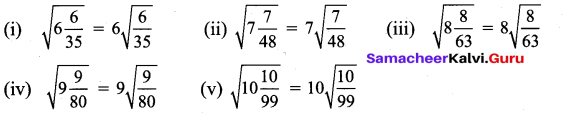
Is it interesting to see this pattern? \(\sqrt{4 \frac{4}{15}}=4 \sqrt{\frac{4}{15}} \text { and } \sqrt{5 \frac{5}{24}}=5 \sqrt{\frac{5}{24}}\) Verify it. Can you frame 4 such new surds?
Solution:
Samacheer Kalvi 9th Maths Chapter 2 Real Numbers Additional Questions 16

Activity – 2
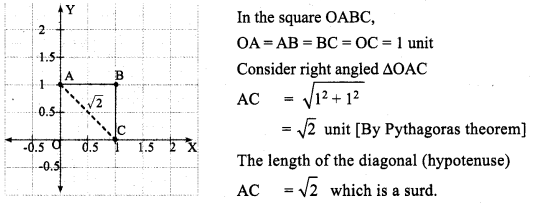
Take a graph sheet and mark O, A, B, C as follows:
Samacheer Kalvi 9th Maths Chapter 2 Real Numbers Additional Questions 17
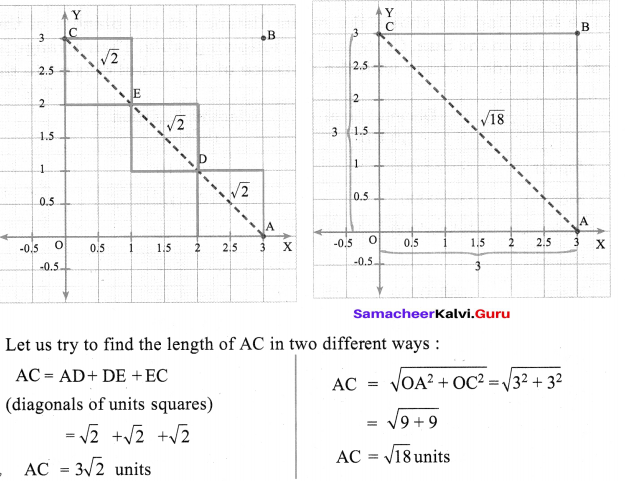
Consider the following graphs:
Samacheer Kalvi 9th Maths Chapter 2 Real Numbers Additional Questions 18
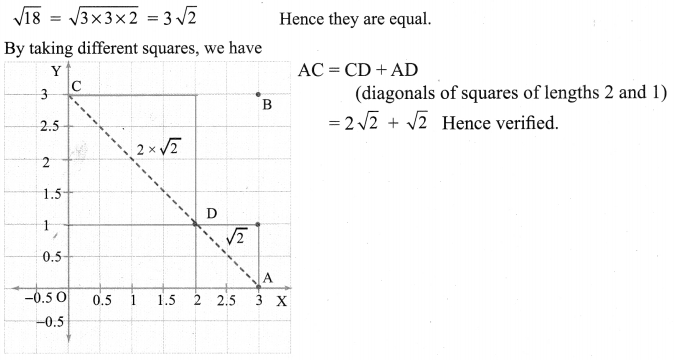
Are they equal? Discuss. Can you verify the same by taking different squares of different lengths?
Solution:
Samacheer Kalvi 9th Maths Chapter 2 Real Numbers Additional Questions 19

Activity – 3
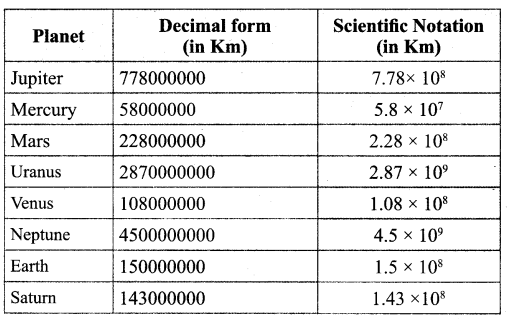
The following list shows the mean distance of the planets of the solar system from the Sun. Complete the following table. Then arrange in order of magnitude starting with the distance of the planet closest to the Sun.
Solution:
Samacheer Kalvi 9th Maths Chapter 2 Real Numbers Additional Questions 20
Arrange the planets in order of distance from the sun.
Mercury, Venus, Earth, Mars, Jupiter, Saturn, Uranus, Neptune and Pluto.

Samacheer Kalvi 8th Maths Solutions Term 1 Chapter 5 Information Processing Ex 5.1

Students can Download Maths Chapter 5 Information Processing Ex 5.1 Questions and Answers, Notes Pdf, Samacheer Kalvi 8th Maths Book Solutions Guide Pdf helps you to revise the complete Tamilnadu State Board New Syllabus and score more marks in your examinations.
Samacheer Kalvi 8th Maths Solutions Term 1 Chapter 5 Information Processing Ex 5.1

Tamilnadu Samacheer Kalvi 8th Maths Solutions Term 1 Chapter 5 Information Processing Ex 5.1

I. Choose the best answer.

Question 1.
How many outcomes can you get when you toss three coins once?
(A) 6
(B) 8
(C) 3
(D) 2
Solution:
(B) 8

Question 2.
In how many ways can you answer 3 multiple choice questions, with the choices A, B, C and D ?
(1) 4
(2) 3
(3) 12
(4) 64
Solution:
(4) 64

Question 3.
How many 2 digit numbers contain the number 7 ?
(A) 10
(B) 18
(C) 19
(D) 20
Solution:
(B) 18

Samacheer Kalvi 8th Maths Solutions Term 1 Chapter 5 Information Processing Ex 5.1

II. Answer the following.

Question 1.
You are going to have an ice cream or a cake. There are three flavours (chocolate, strawberry , vanilla) in ice creams, and two flavours (orange or red velvet) in the cake. In how many possible ways can you choose an ice cream or the cake?
Samacheer Kalvi 8th Maths Term 1 Chapter 5 Information Processing Ex 5.1 1
Solution:
We are going to have either a ice cream or a cake.
Ice cream can be selected from 3 flavors and cake from two flavors. Both the events cannot occur simultaneously selecting ice cream and cake.
∴ Number of possible ways = 3 + 2
= 5 ways

Question 2.
In how many ways, can the teacher choose 3 students, in all one each from 10 students in VI std, 15 students in VII std and 20 students in VIII std to go to an excursion?
Solution:
The teacher is going to selected one student from class VI out of 10 students in 10 ways from
class VII out of 15 students in 15 ways and from class VIII out of 20 students in 20 ways.
∴ Number of ways 3 students can be selected
= 10 + 15 + 20 = 45 ways

Question 3.
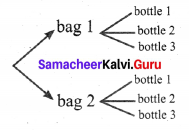
If you have 2 school bags and 3 water bottles then, in how many different ways can you carry a school bag and a water bottle, while going to school?
Solution:
We can select one school bag from 2 and one bottle from 3 as follows.
Samacheer Kalvi 8th Maths Term 1 Chapter 5 Information Processing Ex 5.1 3
∴ A bag and a water bottle can be selected in 2 × 3 = 6 ways.

Samacheer Kalvi 8th Maths Solutions Term 1 Chapter 5 Information Processing Ex 5.1

Question 4.
Roll numbers are created with a letter followed by 3 digits in it. From the letter A, B, C, D, E and any 3 digits from 0 to 9. Then, in how many possible ways can the roll numbers be generated?
Solution:
We have a letter followed by 3 digits in the roll number.
The letter is selected from A, B, C, D, E.
For these 5 letters we have to select a 3 digit number using the digits 0 to 9.
Once place can be formed using any one of the 10 number 0 to 9 in 10 ways.
Tens place can be formed in 10 ways.
∴ A two digit number can be formed in 10 × 10 = 100 ways.
Thousands place can be formed in 10 ways
∴ A 3 digit number can be formed in 10 × 10 × 10 = 1000 ways.
∴ 5 letters can be attached in 5 × 1000 = 5000 ways.
∴ The roll number can be formed in 5000 ways.

Question 5.
A safety locker in a jewel shop requires a 4 digit unique code. The code has the digits from 0 to 9. How many unique codes are possible ?
Samacheer Kalvi 8th Maths Term 1 Chapter 5 Information Processing Ex 5.1 4
Solution:
The unique code has 4 digits.
Each digit is formed using any of the 10 numbers from 0 to 9.
∴ Single digit number can be formed in 10 ways.
A double digit number can be formed in 10 × 10 ways.
A three digit number can be formed in 10 × 10 × 10 ways.
A four digit number can be formed in 10 × 10 × 10 × 10 ways. = 10,000 ways

Samacheer Kalvi 9th Maths Solutions Chapter 7 Mensuration Ex 7.3

You can Download Samacheer Kalvi 9th Maths Book Solutions Guide Pdf, Tamilnadu State Board help you to revise the complete Syllabus and score more marks in your examinations.

Tamilnadu Samacheer Kalvi 9th Maths Solutions Chapter 7 Mensuration Ex 7.3

Question 1.
Find the volume of a cuboid whose dimensions are
(i) length = 12 cm, breadth = 8 cm, height = 6 cm
(ii) length = 60 m, breadth = 25 m, height = 1.5 m
Solution:
(i) l = 12 cm
b = 8 cm
h = 6 cm
Volume of the cuboid = lbh
= 12 × 8 × 6 cm3 = 576 cm3

(ii) l = 60 m
b = 25 m
h = 1.5 m
Volume of the cuboid = lbh = 60 × 25 × 1.5m3 = 2250 m3
Samacheer Kalvi 9th Maths Solutions Chapter 7 Mensuration Ex 7.3
Question 2.
The dimensions of a match box are 6 cm × 3.5 cm × 2.5 cm. Find the volume of a packet containing 12 such match boxes.
Solution:
Dimensions of a match box = 6 cm × 3.5 cm × 2.5 cm
V = (6 × 3.5 × 2.5) cm3 = 52.5 cm3
Volume of 12 such boxes = 12 × 52.5 cm3 = 630 cm3

Question 3.
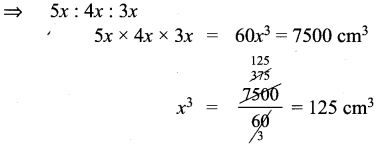
The length, breadth and height of a chocolate box are in the ratio 5 : 4 : 3. If its volume is 7500 cm3, then find its dimensions.
Solution:
Let 1 ratio = x then 5 : 4 : 3
Samacheer Kalvi 9th Maths Chapter 7 Mensuration Ex 7.3 1
x = 5 cm
∴ 5x = 5 × 5 = 25 cm
4x = 4 × 5 = 20 cm
3x = 3 × 5 = 15 cm
∴ Dimensions of a chocolate box are 25 cm × 20 cm × 15 cm

Question 4.
The length, breadth and depth of a pond are 20.5 m, 16 m and 8 m respectively. Find the capacity of the pond in litres.
Solution:
l = 20.5 m
b = 16 m
h = 8 m
∴ Capacity = Volume = lb h = (20.5 × 16 × 8) m3 = 2624 m3
1 m3 = 1000 litres
∴ 2624 m3 = 2624000 litres
Samacheer Kalvi 9th Maths Solutions Chapter 7 Mensuration Ex 7.3
Question 5.
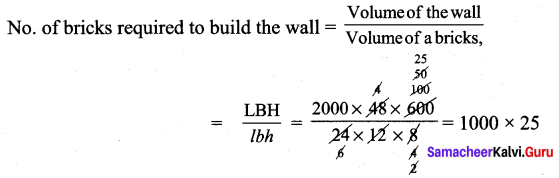
The dimensions of a brick are 24 cm × 12 cm × 8 cm. How many such bricks will be required to build a wall of 20 m length, 48 cm breadth and 6 m height?
Solution:
l = 24 cm
b = 12 cm
h = 8 cm
Volume of the brick = lbh = (24 × 12 × 8) cm3 = 2304 cm3
Wall dimensions are :
L = 20 m = 2000 cm
B = 48 cm
H = 6 m = 600 cm
Samacheer Kalvi 9th Maths Chapter 7 Mensuration Ex 7.3 20
No. of bricks required = 25000

Question 6.
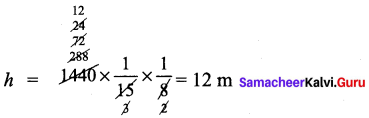
The volume of container is 1440 m3. The length and breadth of the container are 15 m and 8 m respectively. Find its height.
Solution:
V = l × b × h = 1440 m3
15 × 8 × h = 1440
Samacheer Kalvi 9th Maths Chapter 7 Mensuration Ex 7.3 30

Question 7.
Find the volume of a cube each of whose side is
(i) 5 cm
(ii) 3.5 m
(iii) 21 cm
Solution:
(i) side of a cube (a) = 5 cm
Volume of a cube V = a3 = 5 × 5 × 5 = 125 cm3

(ii) a = 3.5 m
V = a3 = 3.5 × 3.5 × 3.5 m3 = 42.875 m3

(iii) a = 21 cm 23 = 21 × 21 × 21 cm3 = 9261 cm3

Question 8.
A cubical milk tank holds 125000 litres of milk. Find the length of its side in metres.
Solution:
V = a3 = 125000 litres = 125 m3
Samacheer Kalvi 9th Maths Chapter 7 Mensuration Ex 7.3 31
∴ length of its side = 5 m.

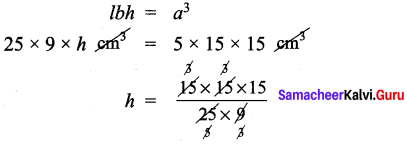
Question 9.
A metallic cube with side 15 cm is melted and formed into a cuboid. If the length and height of the cuboid is 25 cm and 9 cm respectively then find the breadth of the cuboid.
Solution:
The volume of the cuboid formed = The volume of the cube melted.
Samacheer Kalvi 9th Maths Chapter 7 Mensuration Ex 7.3 32
height of the cuboid = 15 cm