Samacheer Kalvi 11th English Grammar Framing Sentences

Students who are interested in learning of 11th English Grammar Framing Sentences Questions and Answers can use Tamilnadu State Board Solutions of 11th English Chapter Wise Pdf. First check in which chapter you are lagging and then Download Samacheer Kalvi 11th English Book Solutions Questions and Answers Summary, Activity, Notes Chapter Wise. Students can build self confidence by solving the solutions with the help of Tamilnadu State Board English Solutions. English is the scoring subject if you improve your grammar skills. Because most of the students will lose marks by Grammar grammar mistakes. So, we suggest you to Download Tamilnadu State Board 11th English Solutions according to the chapters.

Tamilnadu Samacheer Kalvi 11th English Grammar Framing Sentences

Check out the topics covered in Grammar Framing Sentences Questions and Answers before you start your preparation. Improve your grammar skills with the help of Samacheer Kalvi 11th English Book Solutions Questions and Answers pdf links. The solutions for Tamilnadu State Board 11th English Textbook are prepared by the English experts. So, if you follow Tamilnadu State Board Solutions 11th English Textbook Solutions you can cover all the topics in Grammar Framing Sentences Questons and Answers. This helps to improve your communication skills.

Question 1.
Use the word “equal” as a noun, adjective, verb and adverb in your own sentences.
Answer:

  • Sangeetha treated Tarun and Kavin as equals, (noun)
  • Father gave equal share of his property to his sons and daughters, (adj)
  • One plus one equals two. (verb)
  • We decided to divide the amount equally, (adverb)

Question 2.
Use the word ‘tear’ as a noun, verb, adjective and adverb in your own sentences.
Answer:

  • Don’t shed tears over loss of money, (noun)
  • Don’t tear the book, (verb)
  • She was given a tearful farewell, (adj)
  • Sheela tearfully left the hall, (adverb)

Question 3.
Use the word ‘like’ as a noun, verb, adjective and preposition in your own sentences.
Answer:

  • Great gurus are above likes and dislikes, (noun)
  • You need to carry out your duties whether you like it or not. (verb)
  • You must befriend like-minded persons, (adj)
  • Raj an looks like his father, (preposition)


Question 4.
Use the word ‘well’ as a noun, verb and an adjective in your own sentences.
Answer:

  • There is an unused well behind my house, (noun)
  • Tears welled up in her eyes on hearing her father’s death, (verb)
  • Sangeetha is well qualified for the Professor post, (adj)

Question 5.
Use the word “fine” as an adjective, a noun and a verb.
Answer:

  • She wore a fine jewel which caught everyone’s eyes, (adj)
  • The driver was asked to pay fine for skipping the red signal, (noun)
  • I was fined for over-speeding, (verb)


Question 6.
Use the word “after” as an adverb, a preposition and conjunction.
Answer:

  • Jill came tumbling after, (adv)
  • He returned after the accident, (prep)
  • After Martin finished his studies, he returned to India, (conjunction)

Question 7.
Use the word “wrong” as an adjective, adverb and a noun.
Answer:

  • You have taken the wrong road, (adj)
  • Hari was wrongly arrested, (adv)
  • We must differentiate the right and wrong, (noun)


Question 8.
Use the word “each” as an adjective and a pronoun.
Answer:

  • Each day brings its opportunity, (adj)
  • I received a rupee from each, (pronoun)

Question 9.
Use the word “as” as an adverb and a conjunction.
Answer:

  • We walked as fast as we could, (adv)
  • As he was late, we went without him. (conj)

Question 10.
Use the word “fast” as a noun, an adjective and adverb.
Answer:

  • He didn’t take anything during the fast, (noun)
  • I missed the fast train, (adj)
  • She speaks fast, (adv)


The main aim is to share the knowledge and help the students of 11th English to secure the best score in their final exams. Use the concepts of Samacheer Kalvi 11th English Book Solutions Grammar Framing Sentences Questions and Answers in Real time to enhance your skills. If you have any doubts you can post your comments in the comment section, We will clarify your doubts as soon as possible without any delay.
Samacheer Kalvi 11th Economics Solutions Chapter 12 Mathematical Methods for Economics

Immediately get Chapter Wise Tamilnadu State Board Solutions for 12th Economics to gain more marks and start Quick Revision of all Chapters. All Chapters Pdf is provided along with the Questions and Answers. You Can Dowload Samacheer Kalvi 12th Economics Book Solutions Questions and Answers for Chapter wise are given with a clear explanation. Tamilnadu State Board Solutions for 12th Economics Chapter 12 Mathematical Methods for Economics Questions and Answers is for free of cost.

Tamilnadu Samacheer Kalvi 11th Economics Solutions Chapter 12 Mathematical Methods for Economics

Tamilnadu State Board Solutions for 12th Economics Chapter 12 Mathematical Methods for Economics Questions and Answers PDF has all given in Chapter Wise Section. Check Out daily basis with Tamilnadu State Board Solutions 12th Economics PDF will help to improve your score. Improve your level of accuracy to answer a question by reading with Samacheer Kalvi 12th Economics Book Solutions Questions and Answers PDF.

Samacheer Kalvi 11th Economics Mathematical Methods for Economic Text Book Back Questions and Answers

Part – A
Multiple Choice Questions

Question 1.
Mathematical Economics is the integration of ____________
(a) Mathematics and Economics
(b) Economics and Statistics
(c) Economics and Equations
(d) Graphs and Economics
Answer:
(a) Mathematics and Economics

Question 2.
The construction of demand line or supply line is the result of using ____________
(a) Matrices
(b) Calculus
(c) Algebra
(d) Analytical Geometry
Answer:
(d) Analytical Geometry

Question 3.
The first person used the mathematics in Economics is ____________
(a) Sir William Petty
(b) Giovanni Ceva
(c) Adam Smith
(d) Irving Fisher
Answer:
(a) Sir William Petty

Question 4.
Function with single independent variable is known as ____________
(a) Multivariate Function
(b) Bivariate Function
(c) Univariate Function
(d) Polvnomial Function
Answer:
(c) Univariate Function

Question 5.
A statement of equality between two quantities is called ____________
(a) Inequality
(b) Equality
(c) Equations
(d) Functions
Answer:
(c) Equations

Question 6.
An incremental change in dependent variable with respect to change in independent variable is known as ____________
(a) Slope
(b) Intercept
(c) Variant
(d) Constant
Answer:
(a) Slope

Question 7.
(y – y1) = m (x – x1) gives the ____________
(a) Slope
(b) Straight line
(c) Constant
(d) Curve
Answer:
(b) Straight line

Question 8.
Suppose D = 50 – 5P. When D is zero then ____________
(a) P is 10
(b) P is 20
(c) P is 5
(d) Pis-10
Answer:
(a) Pis 10

Question 9.
Suppose D = 150 – 50P. Then, the slope is
(a) -5
(b) 50
(c) 5
(d) – 50
Answer:
(d) – 50

Question 10.
Suppose determinant of a matrix A = 0, then the solution ____________
(a) Exists
(b) Does not exist
(c) Is infinity
(d) Is zero
Answer:
(b) Does not exist

Question 11.
State of rest is a point termed as ____________
(a) Equilibrium
(b) Non – Equilibrium
(c) Minimum Point
(d) Maximum Point
Answer:
(a) Equilibrium

Question 12.
Differentiation of constant term gives ____________
(a) one
(b) zero
(c) infinity
(d) non – infinity
Answer:
(b) zero

Question 13.
Differentiation of xn is ____________
(a) nx (n – 1)
(b) nx (n + 1)
(c) zero
(d) one
Answer:
(a) nx (n – 1)

Question 14.
Fixed Cost is the ____________ term in cost function represented in mathematical form.
(a) Middle
(b) Price
(c) Quantity
(d) Constant
Answer:
(d) Constant

Question 15.
The first differentiation of Total Revenue function gives ____________
(a) Average Revenue
(b) Profit
(c) Marginal Revenue
(d) Zero
Answer:
(c) Marginal Revenue

Question 16.
The elasticity of demand is the ratio of ____________
(a) Marginal demand function and Revenue function
(b) Marginal demand function to Average demand function
(c) Fixed and variable revenues
(d) Marginal Demand function and Total demand function
Answer:
(b) Marginal demand function to Average demand function

Question 17.
If x + y = 5 and x – y = 3 then, Value of x ____________
(a) 4
(b) 3
(c) 16
(d) 8
Answer:
(a) 4

Question 18.
Integration is the reverse process of
(a) Difference
(b) Mixing
(c) Amalgamation
(d) Differentiation
Answer:
(d) Differentiation

Question 19.
Data processing is done by ____________
(a) PC alone
(b) Calculator alone
(c) Both PC and Calculator
(d) Pen drive
Answer:
(c) Both PC and Calculator

Question 20.
The command Ctrl + M is applied for ____________
(a) Saving
(b) Copying
(c) getting new slide
(d) deleting a slide
Answer:
(c) getting new slide

Part – B
Answer the following questions in one or two sentences

Question 21.
If 62 = 34 + 4x  what is x?
solution:
If 62 = 34 + 4x what is x
Given:
62 = 34 + 4x
34 + 4x = 62
4x = 62-34
4x = 28
x = \(\frac { 28 }{ 4 }\)
x = 7

Question 22.
Given the demand function q = 150 – 3p, derive a function for MR.
Solution:
Given:
q = 150 – 3p
\(\frac { dq }{ dq }\) = 0 – 3 (1)
\(\frac { dq }{ dq }\) = – 3
Revenue = price × quantity = p (150 – 3p)
= p (150 – 3p)
= 150p – 3p2
MR = \(\frac { dq }{ dq }\) = 150 \(\frac { dq }{ dq }\) -6p \(\frac { dq }{ dq }\)
= 150 (\(\frac { – 1 }{ 3 }\)) – 6p (\(\frac { – 1 }{ 3 }\))
= – 50 + 2p
= – 50 = 2 (\(\frac { 150 – q }{ 3 }\))
= 50 + 100 + \(\frac { – 2 q }{ 3 }\)
= 50 – \(\frac { 2 q }{ 3 }\)
= 50 – \(\frac { 2 }{ 3 }\) (150 – 3p)
MR = 2p – 50

Question 23.
Find the average cost function where TC = 60 + 10x +15x2
Solution:
Given:
TC = 60 + 10x +15x2
Average Cost = \(\frac { TC }{ x }\)
= \(\frac{60+10 x+15 x^{2}}{x}\)
= \(\frac { 60 }{ x }\) + \(\frac { 10x }{ x }\) + \(\frac{15 x^{2}}{x}\)
AC = \(\frac { 60 }{ x }\) + 10 + 15x

Question 24.
The demand function is given by x = 20 – 2p – p2 where p and x are the price and the quantity respectively. Find the elasticity of demand for p = 2.5.
Solution:
Given:
x = 20 – 2p – p2
p = 2.5
ed = (\(\frac { p }{ x }\)) (\(\frac { dx }{ dp }\))
If p = 2.5 then x,
x = 20 – 2 (2.5) – (2.5)2
= 20 – 5 – (6.25)
= 15 – 6.25
x = 8.75
Here x = 20 – 2p – p2
\(\frac { dx }{ dp }\) = 0 – 2 (1) – 2p
= -2 – 2p
If P = 2.5 then
\(\frac { dx }{ dp }\) = -2 – 2 (2.5)
= -2 – 5
\(\frac { dx }{ dp }\) = – 7
ed = \(\frac { -2.5 }{ 8.75 }\) × – 7
= 0.2857 × – 7
ed = 2

Question 25.
Suppose the price p and quantity q of a commodity are related by the equation q = 30 – 4p – p2
find :

  1. ed at p = 2
  2. MR

Solution:
Given:
q = 30 – 4p – p2
1. ed = (\(\frac { p }{ x }\))(\(\frac { dx }{ dp }\))
If P = 2 then
x = 30 – 4 (2) – 22
= 30 – 8 – 4
=20 – 12
x = 18
\(\frac { dx }{ dp }\) =30 – 4p – p2
= 0 – 4 – 2p
= 0 – 4 – 2 (2)
= -4 -4
= -8
ed = \(\frac { 2 }{ 18 }\) (-8)
x = – \(\frac { 16 }{ 18 }\)
ed = – 0.88

2. MR
TR = p ×q
TR = p (30 – 4p – p2)
= 30p – 4p2 – p3
MR = \(\frac { d(TR) }{ dp }\)
= 30 – 8p – 3p2
If p = 2
MR = 30 – 8 (2) – 3 (2)2
= 30 – 16 12
MR = 2

Question 26.
What is the formula for elasticity of supply if you know the supply function?
Solution:
Elasticity of supply = (\(\frac { p }{ q }\)) (\(\frac { dq }{ dp }\))

Question 27.
What are the Main menus of MS Word?
Answer:

  1. Home menu
  2. Insert
  3. Page layout
  4. Reference
  5. Review
  6. View
  7. Print layout
  8. Outline
  9. Task pane
  10. Tool bars
  11. Header and footer
  12. Foot notes

Part – C
Answer the following questions in one Paragraph

Question 28.
Illustrate the uses of Mathematical Methods in Economics.
Answer:

  1. Mathematical methods help to present the economic problems in a more precise form.
  2. Mathematical methods help to explain economic concepts.
  3. Mathematical methods help to use a large number of variables in economic analyses.
  4. Mathematical methods help to quantify the impact or effect of any economic activity implemented by government or anybody.

Question 29.
Solve for A: quantity demanded if 16x – 4 = 68 + 7x.
Solution:
Given:
16x  – 4 = 68 + 1x
16x – 7x = 68 + 4
9x = 72
x = (\(\frac { 72 }{ 9 }\))
x = 8

Question 30.
A firm has the revenue function R = 600q – 0.03q2 and the cost function is C = 150q + 60,000, where q is the number of units produced. Find AR, AC, MR and MC.
Solution:
Given:
R = 600q – 0.03q2
C = 150q + 60000

(i) AR = \(\frac { R }{ q }\)
= \(\frac{600 q-0.03 q^{2}}{q}\)
= \(\frac { 600q }{ q }\) – \(\frac{0.03 \mathrm{q}^{2}}{\mathrm{q}}\)
= AR = 600 – 0.0.q

(ii) AC = \(\frac { c }{ q }\)
= \(\frac { 150q + 60000 }{ q }\)
= \(\frac { 150q }{ q }\) + \(\frac { 60000 }{ q }\)
AC = 150 + (\(\frac { 60000 }{ q }\))

(iii) MR = \(\frac { dr }{ dq }\)
R = 600q – 0.03q
\(\frac { dR }{ dq }\) = 600 (1) – 0.03 (2q)
MR = 600 – 0.06q

(iv) MC = \(\frac { dc }{ dq }\)
C = 150q + 60000
\(\frac { dc }{ dq }\) = 150 (1) + 0
MC = 150

Question 31.
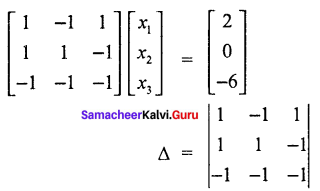
Solve the following linear equations by using Cramer’s rule.
x1 – x2 + x3 = 2
– x1 – x2 – x3 = 0
– x1 – x2 – x3 = – 6
Solution:
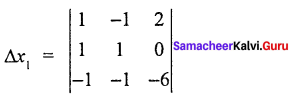
Samacheer Kalvi 11th Economics Solutions Chapter 12 Mathematical Methods for Economics
= 1 (- 1 – 1) + 1 (- 1 – 1) + 1 (- 1 + 1)
= 1(- 2) + 1 (0)
∆ = – 2 – 2
∆ = – 2 – 2
∆ = – 4

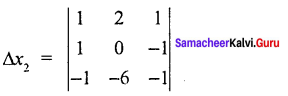
Samacheer Kalvi 11th Economics Solutions Chapter 12 Mathematical Methods for Economics
= 2 (- 1 – 1) + 1 (0 + 6) + 1 (0 – 6)
= 2 (- 2) + 1(6) + 1 (- 6)
= – 4 + 6 – 6
∆ = – 4

Samacheer Kalvi 11th Economics Solutions Chapter 12 Mathematical Methods for Economics
= 1 (0 – 6) – 2 (- 1 – 1)+1(- 6 + 0)
= 1 (- 6) – 2 (- 2) + 1 (- 6)
= – 6 + 4 – 6
= – 12 + 4
∆x3 = -8

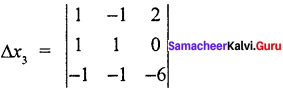
Samacheer Kalvi 11th Economics Solutions Chapter 12 Mathematical Methods for Economics
1 (- 6 + 0) + 1 (- 6 + 0) + 2 (- 1 + 1)
= 1 (- 6) + 1 (- 6) + 2 (0)
= – 6 – 6
∆x3 = – 12
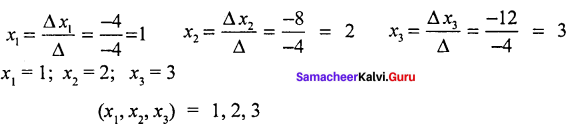
Samacheer Kalvi 11th Economics Solutions Chapter 12 Mathematical Methods for Economics

Question 32.
If a firm faces the total cost function TC = 5+ x2 where x is output, what is TC when x is 10?
Solution:
Given:
TC = 5 + x2
If x = 10
TC = 5 + 102
= 5 + 100
TC = 105

Question 33.
If TC = 2.5q3 – 13q2 + 50q + 12 derive the MC function and AC function.
solution:
Given:
TC= 2.5q3 – 13q2 + 50q + 12
Marginal cost function
MC = \(\frac { d(TC) }{ dQ }\)
= \(\frac { d }{ dq }\) [2.5q3 – 13q2 + 50q + 12]
= 2.5 (3q2) – 13 (2q) + 50 (1) + 0
MC = 7.5q – 26q + 50
Average cost AC =\(\frac { TC }{ q }\)
= \(\frac{2.5 q^{3}-13 q^{2}+50 q+12}{q}\)
= \(\frac{2.5 q^{3}}{q}\) – \(\frac{13 q^{2}}{q}\) + \(\frac { 50q }{ q }\) + \(\frac { 12 }{ q }\)
AC = 2.5q – 13q + 50 + \(\frac { 12 }{ q }\)

Question 34.
What are the steps involved in executing a MS Excel Sheet?
Answer:
MS excel is used in data analysis by using formula. A spread sheet is a large sheet of paper which contains rows and columns.
To start a excel there are various options.
Click Start → Program → Microsoft Excel
Double click the MS Excel Icon from the Desktop.

Part – D
Answer the following questions in about a page

Question 35.
A Research scholar researching the market for fresh cow milk assumes that Qt = f (Pt, Y, A, N, Pc) where Qt is the quantity of milk demanded, Pt is the price of fresh cow milk, Y is average household income, A is advertising expenditure on processed pocket milk, N is population and Pc is the price of processed pocket milk.

  1. What does Qt= f (Pt, Y,A,N, Pc) mean in words?
  2. Identify the independent variables.
  3. Make up a specific form for this function. (Use your knowledge of Economics to deduce whether the coefficients of the different independent variables should be positive or negative.)

Solution:
1. Qt is the function of Pt, Y, A, N, Pc
The determinants of demand are
Pt = Price of fresh cow milk.
Y = Average household income
A = Advertising expenditure on processed pocket milk
N = Population
Pc = Price of processed pocket milk.

2. Y and N are independent variables

3. Average household income and population are directly proportional to quantity demanded of cow’s milk (ie if Y and N increases Qt also increase)
Price of fresh cow milk, advertising expenditure on pocket milk and price of processed pocket milk are inversely proportional to Qt.
There
Qt = – aPt + by – CA + dN – ePc

Question 36.
Calculate the elasticity of demand for the demand schedule by using differential calculus method P = 60 – 0.2 Q where price is

  1. zero
  2. Rs.20
  3. Rs.40

Solution:
P = 60 – 0.2 Q
0.2 Q = 60 – P
(0.2 Q) 10 = (60 – p) 10
2 Q = 600 – 10p
Q = 300 – 5p
Given demand function Q = 300 – 5p
1. If P = 0 then Q = 300 – 5 (0)
= 300
\(\frac { dq }{ dp }\) = 300 – 5p
= 0 – 5
\(\frac { dq }{ dp }\) = – 5
ed = \(\frac { p }{ p }\)(\(\frac { dq }{ dp }\))
= \(\frac { 0 }{ 300 }\)(-5)
ed = 0

2. If p = 20 then Q = 300 = 5 (20)
= 200
ed = \(\frac { 20 }{ 200 }\) (-5)
= – \(\frac { 100 }{ 200 }\)
ed = – 0.5

3. If = 40 then Q = 300 – 5 (40)
= 300 – 200
Q = 100
ed = \(\frac { p }{ q }\)(\(\frac { dq }{ dp }\))
= \(\frac { 40 }{ 100 }\) (-5)
ed = – \(\frac { 200 }{ 100 }\)
ed = -2

Question 37.
The demand and supply functions are pd=1600 – x2 and ps = 2x2 + 400 respectively. Find the consumer’s surplus and producer’s surplus at equilibrium point.
Answer:
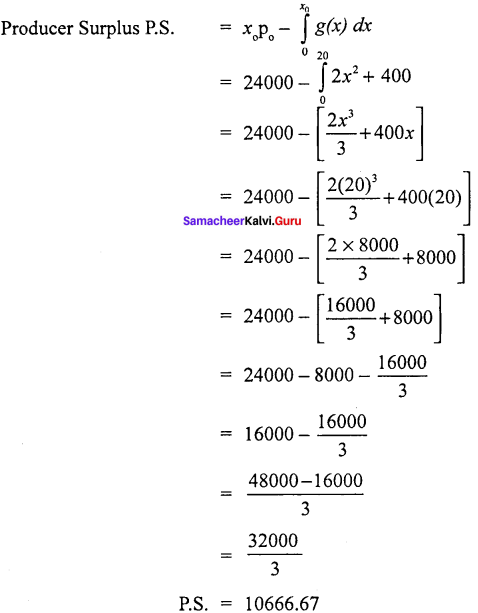
At equilibrium pd = ps
1600 – x2 = 2x2 + 400
– x2 – 2x2 = 400 – 1600
– 3x2 = – 1200
x2 = \(\frac { 1200 }{ 3 }\)
x2 = 400
x = 20
If x = 20 po = 1600 – (20)2
= 1600 – 400
po = 1200
po xo = 1200 × 20
= 24000

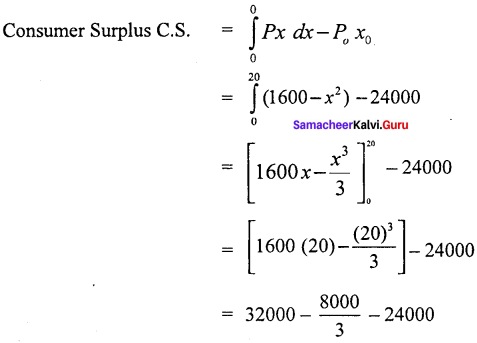
Samacheer Kalvi 11th Economics Solutions Chapter 12 Mathematical Methods for Economics
= 8000 – \(\frac { 8000 }{ 3 }\)
= \(\frac { 24000 – 8000 }{ 3 }\)
= \(\frac { 16000 }{ 3 }\)
C.S = 5333.3
Samacheer Kalvi 11th Economics Solutions Chapter 12 Mathematical Methods for Economics

Question 4.
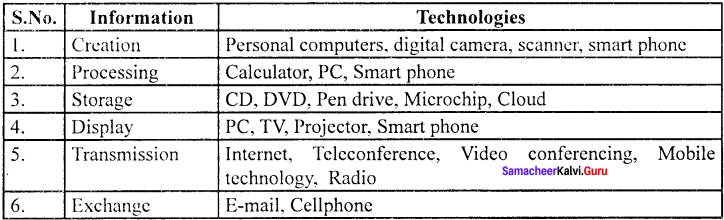
What are the ideas of information and communication technology used in economics?
Answer:
Information and Communication Technology (ICT) is the infrastructure that enables computing faster and accurate
Samacheer Kalvi 11th Economics Solutions Chapter 12 Mathematical Methods for Economics
In economics the uses of mathematical and statistical tools need the support of ICT for data compiling, editing, manipulating and presenting the results.

Samacheer Kalvi 11th Economics Introduction To Micro-Economics Additional Questions and Answers

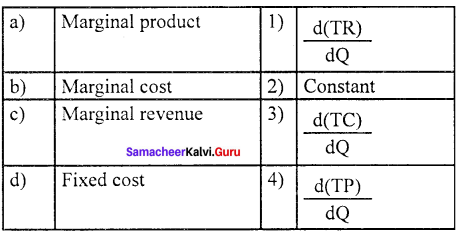
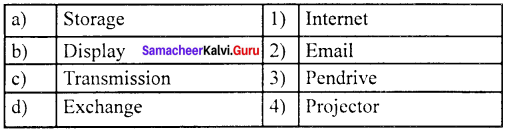
Match the following and choose the answer using the codes given below

Question 1.
Samacheer Kalvi 11th Economics Solutions Chapter 12 Mathematical Methods for Economics
(a) 1 2 3 4
(b) 2 3 4 1
(c) 3 4 2 1
(d) 4 3 1 2
Answer:
(c) 3 4 2 1

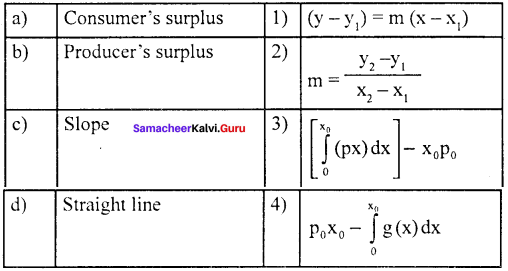
Question 2.
Samacheer Kalvi 11th Economics Solutions Chapter 12 Mathematical Methods for Economics
(a) 4 3 1 2
(b) 2 3 4 1
(c) 1 2 3 4
(d) 3 2 1 4
Answer:
(a) 4 3 1 2

Question 3.
Samacheer Kalvi 11th Economics Solutions Chapter 12 Mathematical Methods for Economics
(a) 1 2 3 4
(b) 3 4 1 2
(c) 4 3 1 2
(d) 2 3 4 1
Answer:
(b) 3 4 1 2

Choose the incorrect statement

Question 4.
(a) Differentiation of constant is zero
(b) Differentiation of xn is x
(c) Constant value is known as fixed cost
(d) x° = 1 when x = 0
Answer:
(d) x° = 1 when x = 0

Question 5.
(a) The population density of T.N is 480 as per 2011 census.
(b) There are 30 national highways in Tamil Nadu.
(c) Tamil Nadu has the highest installed wind energy capacity in India.
(d) The headquarters of southern railway is at Trichy
Answer:
(b) There are 30 national highways in Tamil Nadu.

Pick the odd one out

Question 6.
(a) Arithmetic
(b) Comparison
(c) Text concatenation
(d) Foot note
Answer:
(d) Foot note

Question 7.
(a) X = independent variable
(b) Y = dependent variable
(c) X = f (y)
(d) M – slope
Answer:
(c) X = f (y)

Choose the correct statement

Question 8.
(a) X + Y = 6 and X – Y = 2 then X = 4
(b) If D = 60 – 6P when D is 0 then P is 20
(c) In the equation 0.1 X2 + 1 OX + 100 constant = 10
(d) If Y = 6X3 then slope is 9X:
Answer:
(a) X + Y = 6 and X – Y = 2 then X = 4

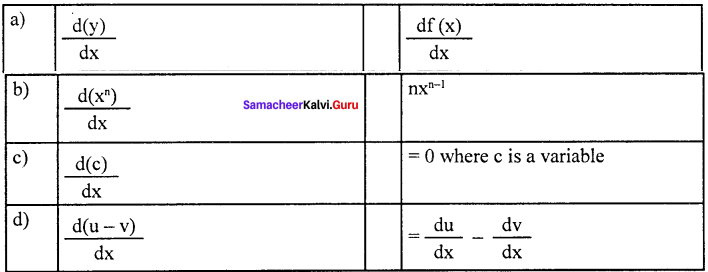
Choose the incorrect pair

Question 9.
Samacheer Kalvi 11th Economics Solutions Chapter 12 Mathematical Methods for Economics
Answer:
(c) \(\frac { d(c) }{ dx }\) = 0 where c is a variable

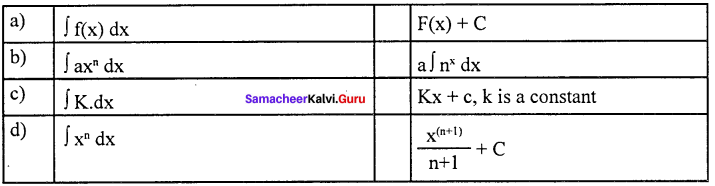
Question 10.
Samacheer Kalvi 11th Economics Solutions Chapter 12 Mathematical Methods for Economics
Answer:
(a) ∫f(x) dx – (i) F (x) + C

Fill in the blanks with suitable option given below

Question 11.
__________ is the first to use mathematics in economics.
(a) Giovanni Ceva
(b) William petty
(c) J.M.Keynes
(d) None
Answer:
(b) William petty

Question 12.
The formula for constructing a straight line is __________
(a) \(\mathrm{m}=\frac{\mathrm{y}_{2}-\mathrm{y}_{1}}{\mathrm{x}_{2}-\mathrm{x}_{1}}\)
(b) y = mx
(c) \(\frac { Change in x }{ Change in y }\)
(d) (y -y1) = m (x – x1)
Answer:
(d) (y -y1) = m (x – x1)

Question 13.
If the determinant ∆ = ?, then solution does not exist
(a) 1
(b) 0
(c) 2
(d) -1
Answer:
(b) 0

Question 14.
Power rule ∫xdx ______
(a) \(\frac{x^{2}}{n+1}\) + C
(b) \(\frac { pq }{ n + 1 }\) + C
(c) \(\frac{\mathrm{x}^{(\mathrm{n}+1)}}{\mathrm{n}+1}\) + C
(d) None
Answer:
(c) \(\frac{\mathrm{x}^{(\mathrm{n}+1)}}{\mathrm{n}+1}\) + C

Question 15.
______ is a rectangular array of numbers systematically arranged in rows and columns within brackets.
(a) Matrix
(b) Determinants
(c) Function
(d) None
Answer:
(a) Matrix

Choose the best option

Question 16.
__________ provides the solution of a system of linear equations with ‘n’ variables and ‘n’ equations
(a) Demand function
(b) Consumer’s surplus
(c) Equilibrium
(d) Cramer’s rule
Answer:
(d) Cramer’s rule

Question 17.
The first known writer to apply mathematical method to economic problems was __________
(a) Giovanni ceva
(b) William petty
(c) Keynes
(d) None
Answer:
(a) Giovanni ceva

Question 18.
In y = f (x) which is the independent variable
(a) f
(b) y
(c) x
(d) None
Answer:
(c) x

Question 19.
Formula for marginal cost is
(a) MC = \(\frac { d(TC) }{ dQ }\)
(b) MC = \(\frac { d(TC) }{ dP }\)
(c) MC = \(\frac { d(TC) }{ dQ }\)
(d) None
Answer:
(a) MC = \(\frac { d(TC) }{ dQ }\)

Question 20.
Function with a single independent variable are called _____
(a) Multivariate function
(b) Consumption function
(c) Simple univariate function
(d) None
Answer:
(c) Simple univariate function

Part – B
Answer the following questions in one or two sentences

Question 1.
What is economic analysis?
Answer:
Economic analysis is a systematic approach to determine the optimum use of scare resources and choose available alternatives and select the best alternative to achieve a particular objective.

Question 2.
What is the slope of a straight line ?
Answer:
Slope or gradient of the line represents the ratio of the changes in vertical and horizontal lines

Question 3.
State the phases of evolution of ICT?
Answer:

  1. Computer
  2. PC
  3. Micro Processor
  4. Internet and
  5. Wireless links.

Question 4.
What are determinants ?
Answer:
The determinant is an arrangement of same elements of the corresponding matrix into rows and columns by enclosing vertical lines.

Question 5.
State the application of differential calculus.
Answer:

  1. To find the rate of change in demand with respect to price.
  2. To find the rate of change in income with respect to the investment.

Question 6.
What is ICT?
Answer:
Information and Communication Technology (ICT) is the infrastructure that enables computing faster and accurate.

Question 7.
What is a work sheet?
Answer:
A worksheet is a table like document containing rows and columns with data and formula

Part – C
Answer the following questions in one Paragraph

Question 1.
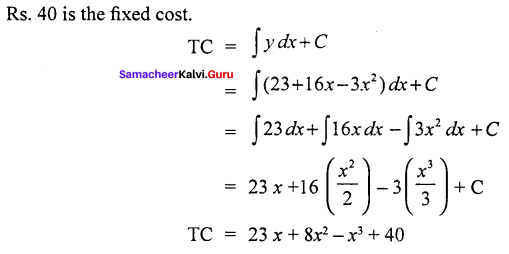
The marginal cost function for producing x units is y = 23 + 16.x – 3.x2 and the total cost for producing zero unit is Rs. 40. Obtain the total cost function and the average cost function.
Solution:
Given Marginal cost functions
y = 23 + 16x – 3x2
C = 40
Samacheer Kalvi 11th Economics Solutions Chapter 12 Mathematical Methods for Economics
Average cost function = \(\frac { TC }{ x }\)
= \(\frac{23 x+8 x^{2}-x^{3}+40}{x}\)
AC = 23 + 8x – x + \(\frac { 40 }{ x }\)

Question 2.
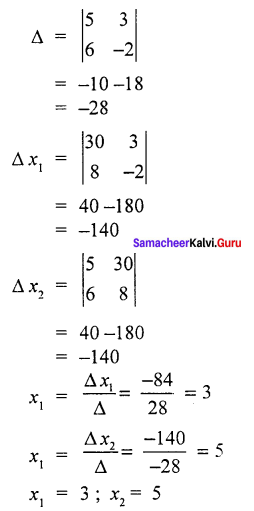
Find the solution of the system of equations
5x1 + 3x2 = 30
6x1 – 2X2 = 8
Solution :
Samacheer Kalvi 11th Economics Solutions Chapter 12 Mathematical Methods for Economics

Question 3.
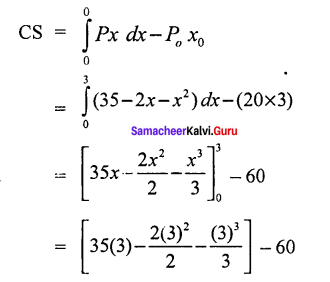
If the demand function is p = 35 – 2x – x2 and the demand xo is 3, what will be the consmer’s surplus
Solution:
Given:
p = 35 – 2x – x2
If x = 3 then
p = 35-2 (3) – 32
= 35 – 6 – 9
p = 20
Samacheer Kalvi 11th Economics Solutions Chapter 12 Mathematical Methods for Economics
= 35 (3) – 9 – 9 – 60
= 105 – 9 – 9 – 60
CS = 27 units

Question 4.
Given the total cost function TC = 15 + 3Q2 + 7Q3 drive the marginal cost function.
Solution:
Given:
TC = 15 + 3Q2 + 7Q2
MC = \(\frac { d(15) }{ dQ }\) + \(\frac{\mathrm{d}\left(3 \mathrm{Q}^{2}\right)}{\mathrm{d} \mathrm{Q}}\) + \(\frac{\mathrm{d}\left(7 \mathrm{Q}^{3}\right)}{\mathrm{d} \mathrm{Q}}\)
= 0+ 3 (2) Q + 7 (3) Q + (3) Q2
MC = 6Q + 21 Q2

Question 5.
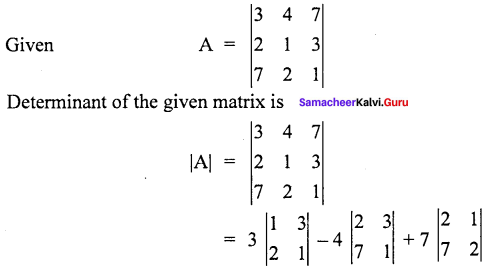
Find the value of the determinant of the matrix
Solution:
Given:
Samacheer Kalvi 11th Economics Solutions Chapter 12 Mathematical Methods for Economics
= 3 (-5) -4 (-19) +7 (-3)
= -15 + 76 – 21
A = 40

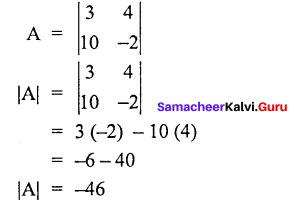
Question 6.
Find the value of the determinant of the matrix A =.
Solution:
Given:
Samacheer Kalvi 11th Economics Solutions Chapter 12 Mathematical Methods for Economics

Part – D
Answer the following questions in about a page

Question 1.
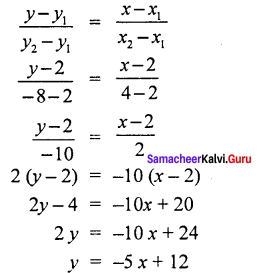
Find the equation of a straight line which passes through two points (2,2) and (4, -8) which are (x1, y1) and (x2, y2) respectively.
Note : For drawing a straight line, at least two points are required. Many straight lines can pass through a single point.
Solution:
Here x1 = 2 y1- = 2 and x2 = 4 y2 = – 8
Formula for constructing a straight line.
Samacheer Kalvi 11th Economics Solutions Chapter 12 Mathematical Methods for Economics
Slope (m) = – 5
y intercept = 12
Constant = C
This is of this from y = mx + C
y = 12 – 5x
When x = 0
y = 12
When y = 0
x = \(\frac { 12 }{ 5 }\) = 2.4

Question 2.
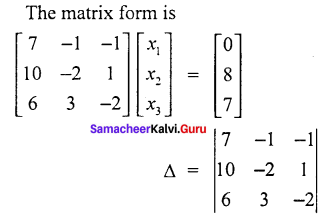
Find the solution of the equation system
Solution:
7x1 – x2 – x3 = 0
10x1 – 2x2 + x3 = 8
6x1 + 3x2 – 2x3 = 7

Samacheer Kalvi 11th Economics Solutions Chapter 12 Mathematical Methods for Economics

= 7 (4 – 3) + 1 (-20 -6) -1 (30 + 12)
= 7 (1) + 1 (-26) -1 (42)
+ 7 -26 – 42
∆ = – 61
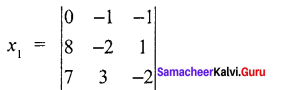
Samacheer Kalvi 11th Economics Solutions Chapter 12 Mathematical Methods for Economics
= 0 (4 -3) + 1 (-16 -7) – 1 (24+14)
= 0 + 1 (-23) – 1 (38)
= -23 – 38
= -61
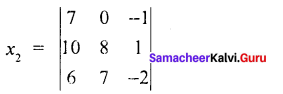
Samacheer Kalvi 11th Economics Solutions Chapter 12 Mathematical Methods for Economics
= 7 (-16 – 7) – 0 (- 20 – 6) – 1 (70 – 48)
= 7 ( -23) + 0 (-20 – 6) – 1(70 – 48)
= – 161 – 22
= – 183
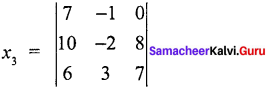
Samacheer Kalvi 11th Economics Solutions Chapter 12 Mathematical Methods for Economics
= 7(-14 -24) + 1 (70 – 48) + 1 (30 + 12)
= 7 (-38) + 1 (22) + 0
= – 266 + 22
= – 244
Samacheer Kalvi 11th Economics Solutions Chapter 12 Mathematical Methods for Economics

If you need some more information about Tamilnadu State Board Solutions for 12th Economics Chapter 12 Mathematical Methods for Economics Questions and Answers then visit our site frequently and get all the resources that you look for. Also, share this page with your friends and make them learn all the concepts thoroughly before the exams.

Samacheer Kalvi 11th Economics Solutions Chapter 11 Tamil Nadu Economy

Immediately get Chapter Wise Tamilnadu State Board Solutions for 11th Economics to gain more marks and start Quick Revision of all Chapters. All Chapters Pdf is provided along with the Questions and Answers. You Can Dowload Samacheer Kalvi 11th Economics Book Solutions Questions and Answers for Chapter wise are given with a clear explanation. Tamilnadu State Board Solutions for 11th Economics Chapter 11 Tamil Nadu Economy Questions and Answers is for free of cost.

Tamilnadu Samacheer Kalvi 11th Economics Solutions Chapter 11 Tamil Nadu Economy

Tamilnadu State Board Solutions for 11th Economics Chapter 11 Tamil Nadu Economy Questions and Answers PDF has all given in Chapter Wise Section. Check Out daily basis with Tamilnadu State Board Solutions 11th Economics PDF will help to improve your score. Improve your level of accuracy to answer a question by reading with Samacheer Kalvi 11th Economics Book Solutions Questions and Answers PDF.

Samacheer Kalvi 11th Economics Tamil Nadu Economy Text Book Back Questions and Answers

Part – A
Multiple Choice Questions

Question 1.
In health index, Tamil Nadu is ahead of
(a) Kerala
(b) Punjab
(c) Gujarat
(d) all the above
Answer:
(c) Gujarat

Question 2.
In sex ratio, Tamil Nadu ranks
(a) first
(b) second
(c) third
(d) fourth
Answer:
(c) third

Question 3.
Tamil Nadu is rich in
(a) Forest resource
(b) human resource
(c) mineral resource
(d) all the above
Answer:
(b) human resource

Question 4.
The main source of irrigation in Tamil Nadu is
(a) river
(b) tank
(c) well
(d) canals
Answer:
(c) well

Question 5.
Knitted garment production is concentrated in
(a) Coimbatore
(b) Tiruppur
(c) Erode
(d) Karur
Answer:
(b) Tiruppur

Question 6.
Which of the following is wrongly matched?
(a) Gateway of Tamil Nadu – Thoothukudi
(b) Home textile city – Erode
(c) Steel city – Salem
(d) Pump city – Coimbatore
Answer:
(b) Home textile city – Erode

Question 7.
Which of the following cities does not have international airport?
(a) Madurai
(b) Tiruchirappalli
(c) Paramakudi
(d) Coimbatore
Answer:
(c) Paramakudi

Question 8.
TN tops in the production of the following crops except
(a) Banana
(b) Coconut
(c) plantation crops
(d) cardamom
Answer:
(d) cardamom

Question 9.
Largest area of land is used in the cultivation of
(a) Paddy
(b) sugarcane
(c) Groundnut
(d) Coconut
Answer:
(a) Paddy

Question 10.
In literacy rate, TN ranks
(a) second
(b) fourth
(c) sixth
(d) eighth
Answer:
(d) eighth

Question 11.
In investment proposals filed by MSMEs, TN ranks
(a) I
(b) II
(c) III
(d) IV
Answer:
(a) I

Question 12.
Which district in TN has the highest sex ratio?
(a) Nagapattinam
(b) Nilgiris
(c) Tiruchirapalli
(d) Thanjavur
Answer:
(b) Nilgiris

Question 13.
Which district has the lowest child sex ratio?
(a) Madurai
(b) Theni
(c) Ariyalur
(d) Cuddalore
Answer:
(c) Ariyalur

Question 14.
Which Union Territory has the highest sex ratio?
(a) Chandigarh
(b) Pondicherry
(c) Lakshadeep
(d) Andaman Nicobar
Answer:
(b) Pondicherry

Question 15.
The largest contribution to GSDP in Tamil Nadu comes from
(a) agriculture
(b) industry
(c) mining
(d) services
Answer:
(d) services

Question 16.
In human development index, TN is ranked
(a) Second
(b) fourth
(c) sixth
(d) third
Answer:
(d) third

Question 17.
SPIC is located in
(a) Chennai
(b) Madurai
(c) Tuticorin
(d) Pudukottai
Answer:
(c) Tuticorin

Question 18.
The TICEL park is
(a) Rubber Park
(b) Textile park
(c) Food park
(d) Bio
Answer:
(d) Bio

Question 19.
In India’s total cement production, Tamil Nadu ranks
(a) third
(b) fourth
(c) first
(d) second
Answer:
(a) third

Question 20.
The Headquarters of Southern Railway is at
(a) Tiruchirappalli
(b) Chennai
(c) Madurai
(d) Coimbatore
Answer:
(b) Chennai

Part – B
Answer the following questions in one or two sentences

Question 21.
State any two districts with favourable sex ratio. Indicate the ratios.
Answer:

  1. The Nilgiris (1041 females)
  2. Thanjavur (1031 females)

Question 22.
Define GSDP.
Answer:
The Gross State Domestic Product refers to the total money value of all the goods and services produced annually in the state.

Question 23.
Mention any four food crops which are favourable to Tamil Nadu.
Answer:

  1. Rice
  2. Maize
  3. Groundnut
  4. Oil seeds

Question 24.
What are major ports in Tamil Nadu?
Answer:
Major ports at Chennai, Ennore and Tuticorin Intermediate port in Nagapattinam.

Question 25.
What is heritage tourism?
Answer:
Heritage tourism is travelling to experience the places and activities that authentically represent the stories and people of the past.

Question 26.
What are the nuclear power plants in Tamil Nadu?
Answer:
The Kalpakkam Nuclear power plant and the Koodankulam Nuclear power plant.

Question 27.
Define Micro industry.
Answer:
The enterprises with a capital investment not exceeding 25 lakhs.

Part – C
Answer the following questions in one Paragraph

Question 28.
Write a note on mineral resources in Tamil Nadu.
Answer:
Mineral resources in Tamil Nadu:

  1. Tamil Nadu has a few mining projects based on Titanium, Lignite, Magnesite, Graphite, Limestone, Granite and Bauxite.
  2. The first one is the Neyveli Lignite Corporation that has led development of large industrial complex around Neyveli in Cuddalore district with Thermal Power Plants, Fertilizer and carbonisation plants.
  3. Magnesite mining is at Salem from which mining of Bauxite ores are carried out at Yercaud and this region is also rich in Iron ore at Kanjamalai.
  4. Molybdenum is found in Karadikuttam in Madurai district.

Question 29.
Explain GSDP in Tamil Nadu.
Answer:
GSDP in Tamil Nadu:

  1. GSDP refers to the total money value of all the goods and services produced annually in the state.
  2. According to Tamil Nadu’s directorate of Economics and Statistics, Tamil Nadu is the second largest economy in India with a GSDP of $207.8 billion in 2016 -17
  3. The GSDP of Tamil Nadu is equal to the GDP of Kuwait on nominal terms and GDP of UAE on PPP terms.
  4. Sectoral contribution of GSDP of Tamil Nadu
    • Tertiary sector – 63. 70%
    • Secondary sector – 28.5%
    • Primary sector – 7.76%

Question 30.
Describe development of textile industry in Tamil Nadu.
Answer:
Development of textile industry in Tamil Nadu:

  1. Tamil Nadu is the largest textile hub of India. Tamil Nadu is known as the “Yam Bowl” of the country.
  2. Tamil Nadu accounts for 41% of India’s cotton yam production.
  3. It produce direct employment to 35 million people.
  4. It contributes 4% of GDP and 35% of gross export earnings.
  5. The textile sector contributes to 14% of the manufacturing sector.

Question 31.
Compare productivity of any two food crops between Tamil Nadu and India.
Answer:

  1. Asia result of Government’s efforts Tamil Nadu tops in productivity, in food crops as well as non-food crops, among the states in India.
  2. Among Indian states Tamil Nadu ranks first in maize, Kambu, Groundnut, Oil seeds and Cotton.
  3. Second in rice and coconut.
  4. Third in Sugarcane, Sunflower and Jowar.

Question 32.
Explain the prospect for development of tourism.
Answer:
Prospect for development of tourism:

  1. Tamil Nadu has emerged as one of the leading tourist destinations for both domestic and foreign tourists.
  2. Tourism in Tamil Nadu is promoted by Tamil Nadu Tourism Development Corporation (TTDC), a Government of Tamil Nadu undertaking.
  3. The state currently ranks the highest among Indian states with about 25 crore arrivals.
  4. The annual growth rate of this industry stood at 16 percent.
  5. Approximately 28 lakh foreign and 11 crore domestic tourists visit the state.

Question 33.
What are the renewable sources of power in Tamil Nadu?
Answer:
Renewable sources of power in Tamil Nadu:

  1. Tamil Nadu is the fore front of all other Indian States in installed capacity.
  2. Muppandal wind farm is a renewable energy source, supplying the villagers with electricity for work.
  3. Wind farms were built in Nagercoil and Tuticorin apart from already existing ones around Coimbatore, Pollachi, Dharapuram and Udumalaipettai.
  4. Wind energy contributes 2% of the total power output of India.
  5. Tamil Nadu tops in solar power generation in India.
  6. There are about 20 hydro electric units in Tamil Nadu.

Question 34.
Describe the performance of Tamil Nadu economy in health.
Answer:
Performance of Tamil Nadu economy in health:

  1. Tamil Nadu has a three – tier health infrastructure comprising hospitals, primary health centres, health units, community health centres and sub-centres.
  2. Tamil Nadu has placed third in health index as per the NITIAAYOG report.
  3. The neo natal mortality rate is 14 which is lower than many other states.
  4. The under 5 mortality has dropped from 21 in 2014 to 20 in 2015.

Part – D
Answer the following questions in about a page

Question 35.
Describe the qualitative aspects of population.
Answer:

  1. Population : Tamil Nadu stands sixth in population with 7.21 crore.
  2. Density : Tamil Nadu ranks 12th in density with 555 people per sq.km.
  3. Urban population : Tamil Nadu is one of the most urbanized state with 48.4% of urban population.
  4. Sex ratio : Balanced sex ratio implies improvement in quality of life of female population. The sex ratio of Tamil Nadu is nearing balance with 995 which stands third next to Kerala and Puducherry.
  5. Infant mortality rate : According to NITI AAYOG, the IMR is 17 for Tamil Nadu which is just half of national average of 34 as on 2016.
  6. Maternal mortality rate : Tamil Nadu has a good record of controlling MMR, ranking third with 79 against national average of 159.
  7. Literacy :
    • The literacy rate of Tamil Nadu is higher than in many states.
    • Tamil Nadu has a highest Gross Enrollment Ratio in higher education.

Question 36
Explain the various sources of energy in Tamil Nadu.
Answer:
Tamil Nadu tops in power generation among the southern states. Tamil Nadu is in the forefront of all other Indian states in installed capacity.
Muppandal wind farm is a renewable energy source, Supplying the villagers with electricity for work.

1. Nuclear energy : The Kalpakkam and the Koddankulam Nuclear Power Plants are the major nuclear energy plants for the energy grid.

2. Thermal power: In Tamil Nadu the share of thermal power in total energy sources is very high and the thermal power plants are at Athippattu, Ennore, Mettur, Neyveli and Thoothukudi.

3. Hydel energy : There are about 20 hydro electric units in Tamil Nadu. The prominent units are Hundah, Mettur, Periyar, Maravakandy, Parson valley etc.

4. Solar energy : Tamil Nadu tops in solar power generation in India. Southern Tamil Nadu is considered as one of the most suitable regions the country for developing solar power projects.

5. Wind energy : Tamil Nadu has the highest installed wind energy capacity in India.
The state has very high quality of off shore wind energy potential off the Tirunelveli coast and Southern Thoothukudi and Rameswaram coast.

Question 37.
Explain the public transport system in Tamil Nadu.
Answer:
Tamil Nadu has a well established transportation system that connects all parts of the state. This is partly responsible for the investment in the state.

Road transport :

  • There are 28 national highways in the state, covering a total distance of 5,036 km.
  • The state has a total road length of 1,67,000 km.
  • It ranks second in India with a share of over 20% in total road projects.

Rail transport :

  • Tamil Nadu has a well – developed rail network as part of Southern Railway, Head quartered at Chennai.
  • Tamil Nadu has a total railway track length of 6,693 KM and there are 690 railway stations in the state.
  • The system connects it with most major cities in India.
  • Chennai developed a metro system, which came into operation since May 2017.

Air transport :

  • Tamil Nadu has four major international airports.
  • Chennai, Coimbatore, Tiruchirapalli and Madurai International airports.
  • It also has domestic airports at Tuticorin, Salem and Madurai.

Samacheer Kalvi 11th Economics Tamil Nadu Economy Additional Questions and Answers

Part-A
Choose the best options

Question 1.
Molybdenum is found in _____ district of Tamil Nadu.
(a) Chennai
(b) Madurai
(c) Tirunelveli
(d) Vellore
Answer:
(b) Madurai

Question 2.
Tamil Nadu has _____ Population as against 121 crore of India.
(a) 7.12 crore
(b) 1.72 crore
(c) 7.21 crore
(d) 1.27 crore
Answer:
(c) 7.21 crore

Question 3.
Tamil Nadu’s per capital income is _____
(a) 1100 dollar
(b) 2200 dollar
(c) 3360 dollar
(d) 4400 dollar
Answer:
(d) 4400 dollar

Question 4.
Gross state domestic product is
(a) GSDP
(b) MMR
(c) GDP
(d) IMF
Answer:
(a) GSDP

Question 5.
The detroit of Asia is _____
(a) Bengaluru
(b) Madurai
(c) Coimbatore
(d) Chennai
Answer:
(d) Chennai

Question 6.
_____ is Tamil Nadu’s steel city
(a) Chennai
(b) Karur
(c) Salem
(d) Namakkal
Answer:
(c) Salem

Question 7.
_____ is famous for bus body building.
(a) Karur
(b) Trichy
(c) Vellore
(d) Chennai
Answer:
(a) Karur

Question 8.
_____ is the yarn bowl of India.
(a) Orissa
(b) Kerala
(c) Andhra
(d) Tamil Nadu
Answer:
(d) Tamil Nadu

Question 9.
Gateway of Tamil Nadu is _____
(a) Thoothukudi
(b) Chennai
(c) Coimbatore
(d) Ranipet
Answer:
(a) Thoothukudi

Question 10.
_____ is the knitting city.
(a) Erode
(b) Karur
(c) Namakkal
(d) Tirupur
Answer:
(d) Tirupur

Question 11.
Which of the following is wrongly matched ?
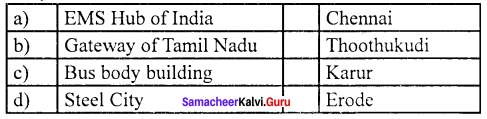
(a) SAIL – Salem
(b) The Pumpcity – Coimbatore
(c) BHEL – Trichy
(d) Knitting City – Karur
Answer:
(d) Knitting City – Karur

Match the following and choose the answer using the codes given below

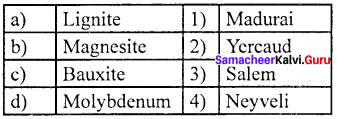
Question 1.
Samacheer Kalvi 11th Economics Solutions Chapter 11 Tamil Nadu Economy
(a) 4 3 2 1
(b) 1 2 3 4
(c) 4 1 2 3
(d) 3 4 2 1
Answer:
(a) 4 3 2 1

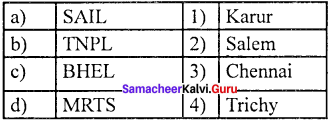
Question 2.
Samacheer Kalvi 11th Economics Solutions Chapter 11 Tamil Nadu Economy
(a) 4 3 2 1
(b) 2 1 4 3
(c) 1 2 3 4
(d) 2 1 3 4
Answer:
(b) 2 1 4 3

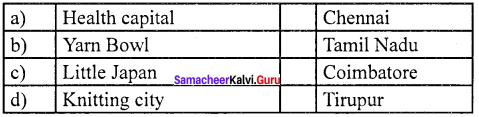
Choose the incorrect pair

Question 3.
Samacheer Kalvi 11th Economics Solutions Chapter 11 Tamil Nadu Economy
Answer:
(c) Little japan (iii) Coimbatore

Question 4.
Samacheer Kalvi 11th Economics Solutions Chapter 11 Tamil Nadu Economy
Answer:
(d) Steel City (iv) Erode

Choose the correct statement

Question 5.
(a) Tamil Nadu is the third largest contributor to India’s GDP
(b) Tamil Nadu ranks second in coconut production.
(c) Tamil Nadu ranks first in cement production
(d) Chennai is called as Detroit of Asia.
Answer:
(d) Chennai is called as Detroit of Asia.

Question 6.
(a) The population density of T.N is 480 as per 2011 census,
(b) There are 30 national highways in Tamil Nadu.
(c) Tamil Nadu has the highest installed wind energy capacity in India
(d) The headquarters of southern railway is at Trichy.
Answer:
(c) Tamil Nadu has the highest installed wind energy capacity in India

Choose the incorrect pair

Question 7.
Samacheer Kalvi 11th Economics Solutions Chapter 11 Tamil Nadu
Answer:
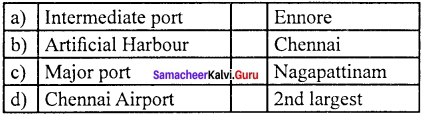
(b) Artificial Harbour (ii) Chennai

Question 8.
Samacheer Kalvi 11th Economics Solutions Chapter 11 Tamil Nadu Economy
Answer:
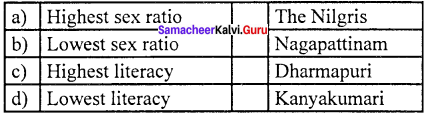
(a) Highest sex ratio (i) The Nilgris

Question 9.
Samacheer Kalvi 11th Economics Solutions Chapter 11 Tamil Nadu Economy
Answer:
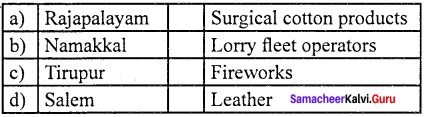
(a) Rajapalayam (i) Surgical cotton product

Pick the odd one out

Question 10.
(a) Coimbatore
(b) Erode
(c) Madurai
(d) Trichy
Answer:
(b) Erode

Question 11.
(a) Coconut
(b) Groundnut
(c) Rice
(d) Sugarcane
Answer:
(c) Rice

Choose the incorrect statement

Question 12.
(a) Chennai is referred as banking capital of India.
(b) Tamil Nadu ranks first in maize production.
(c) Tamil Nadu ranks 3rd in human development Index.
(d) Tamil Nadu is the third largest contributor to India’s GDP
Answer:
(d) Tamil Nadu is the third largest contributor to India’s GDP

Question 13.
(a) Tamil Nadu has eight agro climatic zones
(b) There are 17 river basins in Tamil Nadu.
(c) The tertiary sector is the major contributor to Tamil Nadu’s GSDP.
(d) Tamil Nadu is the second largest economy in India.
Answer:
(d) Tamil Nadu is the second largest economy in India.

Fill in the blanks with suitable option given below

Question 14.
Tamilnadu has _______ population as against 121 crore of India
(a) 7.12 crore
(b) 1.72 crore
(c) 7.21 crore
(d) 1.27 crore
Answer:
(c) 7.21 crore

Question 15.
Tamil Nadu’s per capita income is ______
(a) 1100 dollar
(b) 2200 dollar
(c) 3360 dollar
(d) 4400 dollar
Answer:
(b) 2200 dollar

Question 16.
Gross state domestic product is ______
(a) GSDP
(b) MMR
(c) GDP
(d) IMF
Answer:
(a) GSDP

Question 17.
IMR is the number of mortality before completing
(a) 1 year of age
(b) 5 years of age
(c) 3 years of age
(d) 10 years of age
Answer:
(a) 1 year of age

Question 18.
The world’s biggest bagasse based paper mill is at ______
(a) Trichy
(b) Karur
(c) Coimbatore
(d) Erode
Answer:
(b) Karur

Question 19.
Every year India international leather fair is hosted at ______
(a) Coimbatore
(b) Madurai
(c) Chennai
(d) Mumbai
Answer:
(c) Chennai

Question 20.
______ wind farm is a renewable energy source
(a) Nagapattinam
(b) Valapandal
(c) Nagercoil
(d) Muppandal
Answer:
(d) Muppandal

Part – B
Answer the following questions in one or two sentences

Question 1.
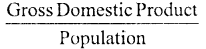
How can you calculate per capita income?
Answer:
Percapita income = Samacheer Kalvi 11th Economics Solutions Chapter 11 Tamil Nadu Economy

Question 2.
Define infant mortality rate
Answer:
IMR is the number of mortality before completing 1 year of age.

Question 3.
What is cash – deposit ratio?
Answer:
C-D ratio is the ratio of bank advances to deposits.

Question 4.
What is the position of Tamil Nadu in automotives ?
Answer:
Tamil Nadu has 28% share each in automotive and auto components industries, 19% in the trucks segment and 18% each in passenger cars and two wheelers.

Question 5.
Why is Sivakasi called as Little Japan ?
Answer:
Sivakasi is a leader in the areas of printing, fireworks, and safety matches. It contributes 80% of India’s fireworks production and 60% of India’s total offset printing solution. As there are too many industries in Sivakasi it is called as Little Japan.

Question 6.
Name the cement manufacturing places of Tamil Nadu?
Answer:
Ariyalur, Virudhunagar, Coimbatore and Tirunelveli.

Question 7.
What is the measure of unemployment in Tamil Nadu?
Answer:
Tamil Nadu ranks 22nd with unemployment rate of 42 per 1000.

Part – C
Answer the following questions in one Paragraph

Question 1.
Explain about unemployment and poverty in Tamil Nadu?
Answer:
Unemployment: Tamil Nadu ranks 22nd with unemployment rate of 42 per 1000 as against national average of 50.

Poverty :

  1. Tamil Nadu is one of the India’s richest states.
  2. Since 1994, the state has seen a steady decline in poverty.
  3. Tamil Nadu has lower levels of poverty than most other states in the country.

Question 2.
Explain about water resources of Tamil Nadu.
Answer:
Water resources of Tamil Nadu:

  1. Tamil Nadu is not endowed with rich natural resources compared to other states.
  2. It accounts for three percent of water sources, four percent of land area against six percent of population.
  3. North east monsoon is the major source of rainfall followed by south west monsoon.
  4. There are 17 river basins in Tamil Nadu. The main rivers are Palar, Cheyyar, Ponnaiyar, Cauvery, Bhavani, Vaigai, Chittar, Tamiraparani, Vellar, Noyyal, Siruvani, Gundar, Vaipar etc.
  5. Wells are the largest source of irrigation in Tamil Nadu.

Question 3.
Name the water resources of Tamil Nadu.
Answer:
Water resources of Tamil Nadu:

  1. Ranipet, Ambur, Vaniyambadi – Leather
  2. Salem . – Powerlooms, Home textiles, Steel, Sago
  3. Sankagiri – Lorry fleet operators
  4. Tiruchengode – Borewell drilling services
  5. Naakkal – Transportation Poultry
  6. Karur – Coach-building, Powerlooms
  7. Erode – Powerlooms, Turmeric
  8. Coimbatore – Spinning mills, Engineering industries
  9. Tirupur – Knitwear, Readymade garments
  10. Rajapalayam – Surgical cotton products
  11. Sivakasi – Safety matches, Fireworks, Printing

Part – D
Answer the following questions in about a page

Question 1.
Elaborate the highlights of Tamil Nadu economy.
Answer:
Highlights of Tamil Nadu economy:

  1. Growth of GSDP in Tamil Nadu has been among the fastest in India since 2005.
  2. Poverty reduction is faster than that in many other states.
  3. It contains a smaller proportion of India’s poor population.
  4. Second largest contributor to India’s GDP.
  5. 3rd in Human Development Index.
  6. Ranks 3rd in terms of invested capital and value of total industrial output.
  7. Ranks first among the states in terms of invested capital and value of total industrial output.
  8. Third in health index
  9. Has highest Gross Enrollment Ratio in higher education.
  10. Has the largest number of engineering colleges.
  11. Has emerged as a major hub for renewable energy.
  12. Has highest credit deposit ratio in commercial and cooperative banks.
  13. Ranks first on investment proposals filled by MSMES.

Question 2.
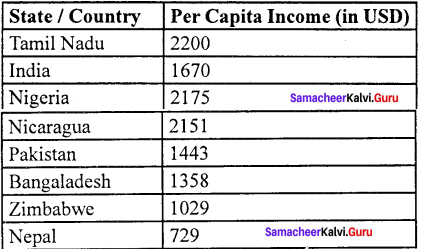
Compare the percapital income of Tamil Nadu with other countries.
Answer:

  1. The percapital GSDP of Tamil Nadu is $ 2200 which is higher than that of many other states in India.
  2. Per capital GSDP of Tamil Nadu is nearly 1.75 times higher than the national average, as per 2018 data.
  3. In term of the per capital income in Tamil Nadu was Rs. 1,03,600 in 2010-11 and it has increased to Rs. 1,88,492 in 2017-18 as per the budget figures 2018.

Samacheer Kalvi 11th Economics Solutions Chapter 11 Tamil Nadu Economy

Question 3.
Explain the role of MSMEs in Tamil Nadu.
Answer:
Role of MSMEs in Tamil Nadu:

  1. The MSME enterprises are classified as manufacturing and service enterprises based on the investment in plant, machinery and equipment MSMED act 2006.
  2. Tamil Nadu accounts of 15,07% micro, small and medium enterpriser which is highest in the country.
  3. There are 6.89 lakhs registered MSMEs producing over 8000 varieties of product for investment more than Rs. 32,008 crore.
  4. The prominent products of MSMEs are the engineering, electrical, chemicals, plastics, steel paper, matches, textiles, hosiery and garments sector.
  5. Around 15.61 lakh entrepreneurs have registered, providing employment opportunities to about 99.7 lakhs persons with total investment of Rs. 1,68,331 crore.

Question 4.
Explain about banks in Tamil Nadu.
Answer:
1. In Tamil Nadu, Nationalised banks account for 52% with 5,337 branches, private commercial banks 30% (3060) branches, state bank of India and its associates 13% (1,364) RRBs 5% (537) branches and the remaining 22 foreign bank branches.

Deposits of the banks :

  1. Total deposits of the banks in Tamil Nadu increased by 14.32% by March 2017 and touched Rs. 6,65,068.59 crores.
  2. Total credits of the banks increased by 13.50% by March 2017 and touched
    Rs. 6,95,500.31 crores.

Advances of the banks :

  1. The share of priority sector advances stands at 45.54% as against the national average of 40%
  2. Primary sector advances stands at 45.54%
  3. Agricultural advances stands at 19.81% on March 2017.
  4. Banks in Tamil Nadu has the highest credit deposit ratio of 119.15% in the country.

If you need some more information about Tamilnadu State Board Solutions for 11th Economics Chapter 11 Tamil Nadu Economy Questions and Answers then visit our site frequently and get all the resources that you look for. Also, share this page with your friends and make them learn all the concepts thoroughly before the exams.

Samacheer Kalvi 11th Bio Botany Solutions Chapter 14 Respiration

Students who are in search of 11th Bio Botany exam can download this Tamilnadu State Board Solutions for 11th Bio Botany Chapter 14 Respiration from here for free of cost. These cover all Chapter 14 Respiration Questions and Answers, PDF, Notes, Summary. Download the Samacheer Kalvi 11th Biology Book Solutions Questions and Answers by accessing the links provided here and ace up your preparation.

Tamilnadu Samacheer Kalvi 11th Bio Botany Solutions Chapter 14 Respiration

Kickstart your preparation by using this Tamilnadu State Board Solutions for 11th Bio Botany Chapter 14 Respiration Questions and Answers get the max score in the exams. You can cover all the topics of Chapter 14 Respiration Questions and Answers easily after studying the Tamilnadu State Board 11th Bio Botany Textbook solutions pdf.

Samacheer Kalvi 11th Bio Botany Respiration Text Book Back Questions and Answers

Question 1.
The number of ATP molecules formed by complete oxidation of one molecule of pyruvic acid is:
(a) 12
(b) 13
(c) 14
(d) 15
Answer:
(a) 12

Question 2.
During oxidation of two molecules of cytosolic NADH + H+, number of ATP molecules produced in plants are:
(a) 3
(b) 4
(c) 6
(d) 8
Answer:
(c) 6

Question 3.
The compound which links glycolysis and Krebs cycle is:
(a) succinic acid
(b) pyruvic acid
(c) acetyl CoA
(d) citric acid
Answer:
(c) acetyl CoA

Question 4.
Assertion (A): Oxidative phosphorylation takes place during the electron transport chain in mitochondria.
Reason (R): Succinyl CoA is phosphorylated into succinic acid by substrate phosphorylation.
(a) A and R is correct. R is correct explanation of A
(b) A and R is correct but R is not the correct explanation of A
(c) A is correct but R is wrong
(d) A and R is wrong.
Answer:
(a) A and R is correct. R is correct explanation of A

Question 5.
Which of the following reaction is not . involved in Krebs cycle.
(a) Shifting of phosphate from 3C to 2C
(b) Splitting of Fructose 1,6 bisphosphate of into two molecules 3C compounds.
(c) Dephosphorylation from the substrates
(d) All of these
Answer:
(d) All of these

Question 6.
What are enzymes involved in phosphorylation and dephosphorylation reactions in EMP pathway?
Answer:
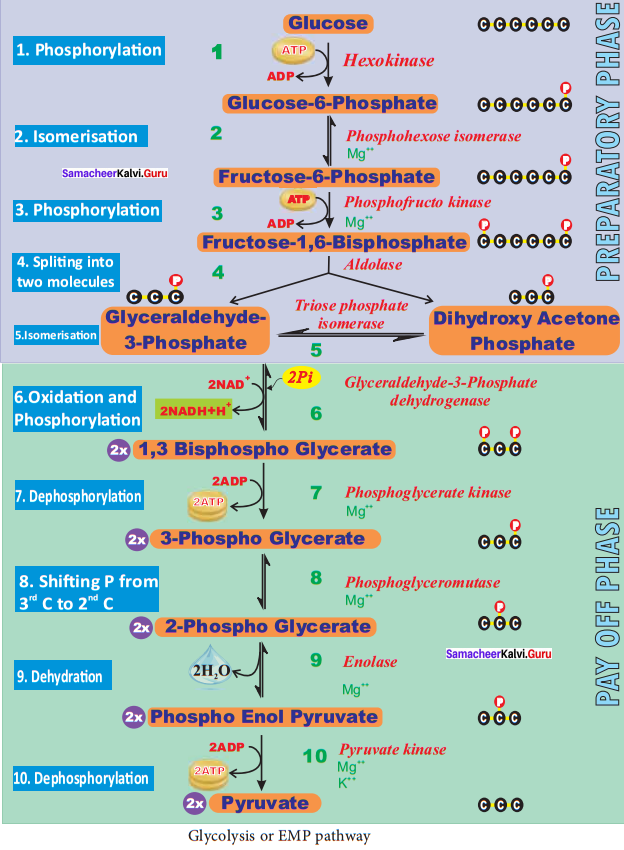
(i) Enzymes involved phosphorylation in EMP pathway:

  • Hexokinase
  • Phospho – fructokinase
  • Glyceraldehyde – 3 – phosphate dehydrogenase

(ii) Enzymes involved in dephosphorylation in EMP pathway:

  • Phospho glycerate kinase,
  • Pyruvate kinase

Question 7.
Respiratory quotient is zero in succulent plants. Why?
Answer:
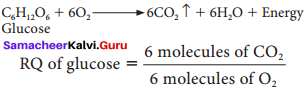
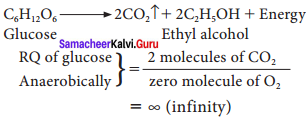
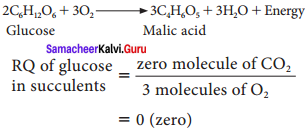
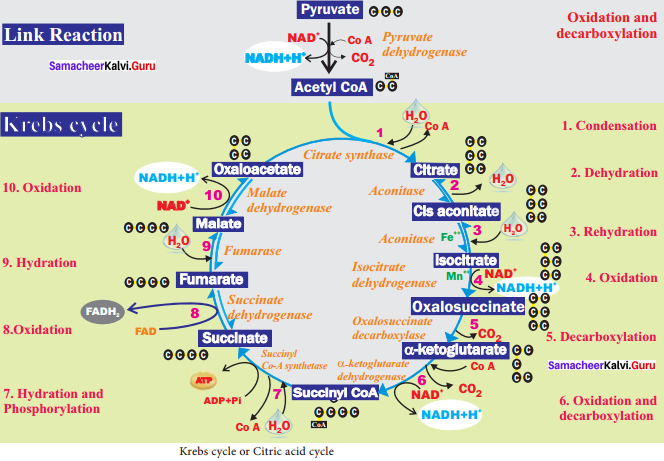
In some succulent plants like Opuntia, Bryophyllum carbohydrates are partially oxidised to organic acid, particularly malic acid without corresponding release of CO2 but O2 is consumed hence the RQ value will be zero.

Question 8.
Explain the reactions taking place in mitochondrial inner membrane.
Answer:
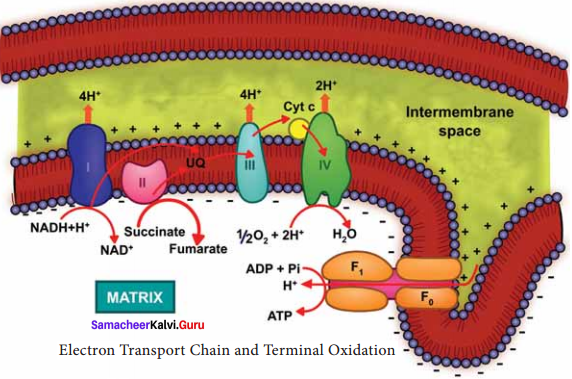
In plants, an additional NADH dehydrogenase (External) complex is present on the outer surface of inner membrane of mitochondria which can oxidise cytosolic NADH + H+. Ubiquinone (UQ) or Coenzyme Quinone (Co Q) is a small, lipid soluble electron, proton carrier located within the inner membrane of mitochondria.

Question 9.
What is the name of alternate way of glucose breakdown? Explain the process involved in it?
Answer:
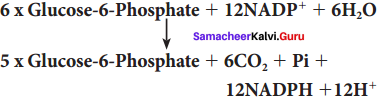
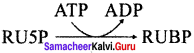
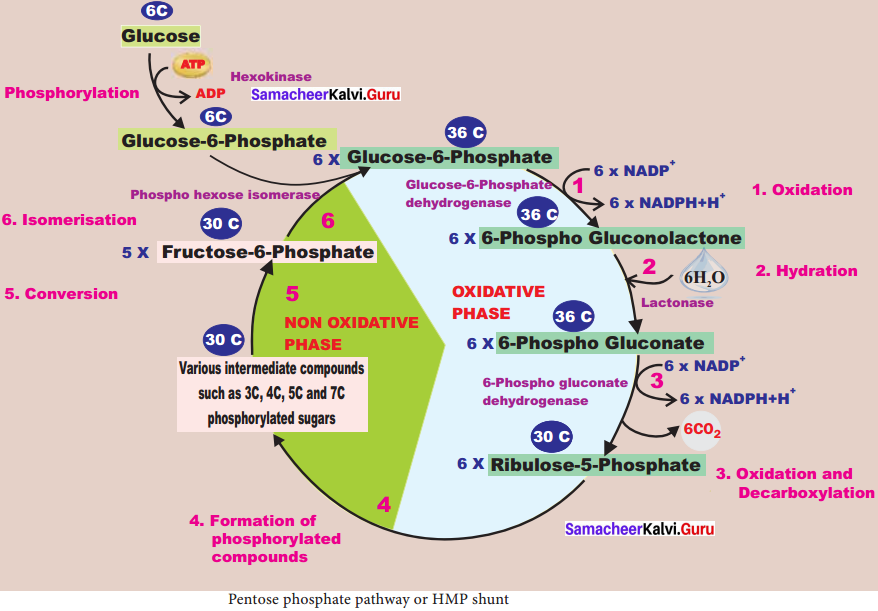
During respiration breakdown of glucose in cytosol occurs both by glycolysis (about 2 / 3) as well as by oxidative pentose phosphate pathway (about 1 / 3). Pentose phosphate pathway was described by Warburg, Dickens and Lipmann (1938). Hence, it is also called Warburg – Dickens – Lipmann pathway. It takes place in cytoplasm of mature plant cells. It is an alternate way for breakdown of glucose.
It is also known as Hexose monophosphate shunt (HMP Shunt) or Direct Oxidative Pathway. It consists of two phases, oxidative phase and non – oxidative phase. The oxidative events convert six molecules of six carbon Glucose – 6 – phosphate to 6 molecules of five carbon sugar Ribulose – 5 phosphate with loss of 6CO2 molecules and generation of 12 NADPH + H+ (not NADH). The remaining reactions known as non – oxidative pathway, convert Ribulose – 5 – phosphate molecules to various intermediates such as Ribose – 5 – phosphate(5C), Xylulose – 5 – phosphate(5C), Glyceraldehyde – 3 – phosphate(3C), Sedoheptulose – 7 – Phosphate (7C), and Erythrose – 4 – phosphate (4C). Finally, five molecules of glucose – 6 – phosphate is regenerated. The overall reaction is:
Samacheer Kalvi 11th Bio Botany Solutions Chapter 14 Respiration 1
The net result of complete oxidation of one glucose – 6 – phosphate yield 6CO2 and 12 NADPH + H+. The oxidative pentose phosphate pathway is controlled by glucose – 6 – phosphate dehydrogenase enzyme which is inhibited by high ratio of NADPH to NADP+.

Question 10.
How will you calculate net products of one sucrose molecule upon complete oxidation during aerobic respiration as per recent view?
Answer:
When the cost of transport of ATPs from matrix into the cytosol is considered, the number will be 2.5 ATPs for each NADH + H+ and 1.5 ATPs for each FADH2 oxidised during electron transport system. Therefore, in plant cells net yield of 30 ATP molecules for complete aerobic oxidation of one molecule of glucose. But in those animal cells (showing malate shuttle mechanism) net yield will be 32 ATP molecules. Since sucrose molecule gives, two molecules of glucose and net ATP in plant cell will be 30 × 2 = 60. In animal cell it will be 32 × 2 = 64.

Samacheer Kalvi 11th Bio Botany Respiration Additional Questions & Answers

I. Choose the correct answer (1 Mark)
Question 1.
The term respiration was coined by:
(a) Lamark
(b) Kerb
(c) Pepys
(d) Blackman
Answer:
(c) Pepys

Question 2.
In floating respiration the substrates are:
(a) carbohydrate or protein
(b) carbohydrate or fat
(c) protein or fat
(d) none of the above
Answer:
(b) carbohydrate or fat

Question 3.
The discovery of ATP was made by:
(a) Lipman
(b) Hans Adolt
(c) Warburg
(d) Karl Lohman
Answer:
(d) Karl Lohman

Question 4.
The end product of glycolysis is:
(a) pyruvate
(b) ethanol
(c) malate
(d) succinate
Answer:
(a) pyruvate

Question 5.
On hydrolysis, one molecule of ATP releases energy of:
(a) 8.2 K cal
(b) 32.3 kJ
(c) 7.3 K cal
(d) 7.8 K cal
Answer:
(c) 7.3 K cal

Question 6.
Which of the following is known as terminal oxidation:
(a) glycolysis
(b) electron transport chain
(c) Kreb’s cycle
(d) pyruvate oxidation
Answer:
(b) electron transport chain

Question 7.
Identify the link reaction:
(a) conversion of glucose into pyruvic acid
(b) conversion of glucose into ethanol
(c) conversion of acetyl CoA into CO2 and water
(d) conversion of pyruvic acid into acetyl coenzyme – A
Answer:
(d) conversion of pyruvic acid into acetyl coenzyme – A

Question 8.
Who was awarded Nobel prize in 1953 for the discovery of TCA cycle?
(a) Lipmann
(b) Hans Adolf Kreb
(c) Petermitchell
(d) Dickens
Answer:
(b) Hans Adolf Kreb

Question 9.
Kreb’s cycle is a:
(a) catabolic pathway
(b) anabolic pathway
(c) amphibolic pathway
(d) hydrolytic pathway
Answer:
(c) amphibolic pathway

Question 10.
Electron transport system during aerobic respiration takes place in:
(a) cytoplasm
(b) mitochondria
(c) chloroplast
(d) golgi apparatus
Answer:
(b) mitochondria

Question 11.
The oxidation of one molecule of NADH + H+ gives rise to:
(a) 2 ATP
(b) 3 ATP
(c) 4 ATP
(d) 2.5 ATP
Answer:
(b) 3 ATP

Question 12.
In aerobic prokaryotes each molecule of glucose produces:
(a) 36 ATP
(b) 32 ATP
(c) 34 ATP
(d) 38 ATP
Answer:
(d) 38 ATP

Question 13.
Cyanide acts as electron transport chain inhibitor by preventing:
(a) synthesis of ATP from ADP
(b) flow of electrons from NADH + H+
(c) flow of electrons from cytochrome a3 to O2
(d) oxidative phosphorylation
Answer:
(c) flow of electrons from cytochrome a3 to O2

Question 14.
Respiratory quotient for oleic acid is:
(a) 0.69
(b) 0.71
(c) 0.80
(d) 0.36
Answer:
(b) 0.71

Question 15.
End products of fermentation in yeast is:
(a) pyruvic acid and CO2
(b) lactic acid qnd CO2
(c) ethyl alcohol and CO2
(d) mixed acid and CO2
Answer:
(c) ethyl alcohol and CO2

Question 16.
The end products of mixed acid fermentation in enterobacteriaceae are:
(a) lactic acid, ethanol, formic acid, CO2 and H2
(b) lactic acid, formic acid and CO2
(c) lactic acid, ethanol, CO2 and O2
(d) ethanol, formic acid, CO2 and H2
Answer:
(a) lactic acid, ethanol, formic acid, CO2 and H2

Question 17.
The external factors that affect the respiration are:
(a) temperature, insufficient O2 and amount of protoplasm
(b) temperature, insufficient O2 and high concentration of CO2
(c) temperature, high concentration of CO2 and respiratory substrate
(d) temperature, high concentration of CO2 and amount of protoplasm
Answer:
(b) temperature, insufficient O2 and high concentration of CO2

Question 18.
Pentose phosphate pathway was described by:
(a) Pepys and Black man
(b) Kreb and Embden
(c) Warburg, Dickens and Lipmann
(d) Warburg and Pamas
Answer:
(c) Warburg, Dickens and Lipmann

Question 19.
The oxidative pentose phosphate pathway is controlled by the enzyme:
(a) glucose, 1, 6 diphosphate dehydrogenase
(b) glucose 6 phosphate dehydrogenase
(c) fructose – 6 – phosphate dehydrogenase
(d) none of the above
Answer:
(b) glucose 6 phosphate dehydrogenase

Question 20.
In pentose phosphate pathway the glucose – 6 – phosphate dehydrogenase enzyme is inhibited by high ratio of:
(a) FADH to FAD
(b) glucose to glucose – 6 – phosphate
(c) NADPH to NADP
(d) GTPH to GTP
Answer:
(c) NADPH to NADP

Question 21.
In plant tissue erythrose is used for the synthesis of:
(a) Erythromycin
(b) Xanthophill
(c) Erythrocin
(d) Arithocyanin
Answer:
(d) Arithocyanin

Question 22.
As per the recent view, when a glucose molecule is completely aerobically oxidised, the net yield of ATP in plant cell is:
(a) 38
(b) 36
(c) 30
(d) 32
Answer:
(c) 30

Question 23.
Identify the electron transport inhibitor:
(a) phosphophenol
(b) dinitrophenol
(c) xylene
(d) indol acetic acid
Answer:
(b) dinitrophenol

Question 24.
The phenomenon of climacteric is present in:
(a) banana
(b) coconut
(c) cauli flower
(d) brinjal
Answer:
(a) banana

Question 25.
Cyanide resistant respiration is known to generate heat in thermogenic tissues as high as:
(a) 35° C
(b) 38° C
(c) 40° C
(d) 51° C
Answer:
(d) 51° C

Question 26.
Match the following:

Substrate

RQ

A. Palmitic acid(i) 1.6
B. Oleic acid(ii) 4.0
C. Tartaric acid(iii) 0.36
D. Oxalic acid(iv) 0.71

(a) A – (ii), B – (iii); C – (i); D – (iv)
(b) A – (iii), B – (iv); C – (i); D – (ii)
(c) A – (ii); B – (iv); C – (i); D – (iii)
(d) A – (iii); B – (i); C – (iv); D – (ii)
Answer:
(b) A – (iii), B – (iv); C – (i); D – (ii)

Question 27.
Indicate the correct statement:
(a) In Bryophyllum, carbohydrates are partially oxidised to organic acid
(b) In opuntia, the Respiratory Quotient value is 0.5
(c) Alcoholic fermentation takes place in enterobacteriaceae
(d) Muscles of vertebrate does not have lactate dehydrogenase enzyme
Answer:
(a) In Bryophyllum, carbohydrates are partially oxidised to organic acid

Question 28.
The order of aerobic respiration in plant cell is:
(a) glycolysis, Kreb’s cycle, pyruvate oxidation and electron transport chain
(b) glycolysis, pyruvate oxidate, Kreb’s cycle, electron transport chain
(c) pyruvate oxidation, glycolysis, Kreb’s cycle, electron transport chain
(d) none of the above order
Answer:
(b) glycolysis, pyruvate oxidate, Kreb’s cycle, electron transport chain

Question 29.
The complete reactions of glycolysis take place in:
(a) mitochondria
(b) cristae
(c) cytoplasm
(d) outer membrane of mitochondria
Answer:
(c) cytoplasm

Question 30.
The Co – enzyme quinone is a proton carrier located within:
(a) outer membrane of mitochondria
(b) cytoplasm
(c) inner membrane of mitochondria
(d) matrix of mitochondria
Answer:
(c) inner membrane of mitochondria

Question 31.
How many molecules of CO2 are produced during link reaction:
(a) 1
(b) 6
(c) 4
(d) 2
Answer:
(d) 2

Question 32.
In the case of ground nut, during seed germination they use:
(a) carbohydrate as respiratory substrate
(b) fat alone as respiratory substrate
(c) fat and protein as respiratory substrate
(d) protein alone as respiratory substrate
Answer:
(c) fat and protein as respiratory substrate

Question 33.
Lactic acid fermentation takes place in:
(a) yeast
(b) bacillus
(c) enterobacteriaceae
(d) none of the above
Answer:
(b) bacillus

Question 34.
The net result of complete oxidation of one glucose-6-phosphate in pentose phosphate pathway yield:
(a) 6 CO2 and 12 NADPH + H+
(b) 6 CO2 and 10 NADPH + H+
(c) 8 CO2 and 16 NADPH + H+
(d) 8 CO2 and 14 NADPH + H
Answer:
(a) 6 CO2 and 12 NADPH + H+

Question 35.
Ribose – 5 – phosphate and its derivatives are used in the synthesis of:
(a) lignin
(b) coenzyme A
(c) anthocyanin
(d) xanthophyll
Answer:
(b) coenzyme A

II. Answer the following (2 Marks)

Question 1.
Define respiration?
Answer:
Respiration is a biological process in which oxidation of various food substances like carbohydrates, proteins and fats take place and as a result of this, energy is produced where O2 is taken in and CO2 is liberated.

Question 2.
What is meant by protoplasmic respiration?
Answer:
Respiration utilizing protein as a respiratory substrate, it is called protoplasmic respiration. Protoplasmic respiration is rare and it depletes structural and functional proteins of protoplasm and liberates toxic ammonia.

Question 3.
What do you understand by compensation of point?
Answer:
The point at which CO2 released in respiration is exactly compensated by CO2 fixed in photosynthesis that means no net gaseous exchange takes place, it is called compensation point.

Question 4.
Explain briefly about aerobic respiration.
Answer:
Respiration occurring in the presence of oxygen is called aerobic respiration. During aerobic respiration, food materials like carbohydrates, fats and proteins are completely oxidised into CO2, H2O and energy is released.

Question 5.
What is anaerobic respiration?
Answer:
In the absence of molecular oxygen glucose is incompletely degraded into either ethyl alcohol or lactic acid. It includes two steps:

  1. Glycolysis
  2. Fermentation

Question 6.
What do you know about transition reaction?
Answer:
In aerobic respiration the pyruvate with coenzyme A is oxidatively decarboxylated into acetyl CoA by pyruvate dehydrogenase complex. This reaction is irreversible and produces two molecules of NADH + H+ and 2CO2. It is also called transition reaction or Link reaction.

Question 7.
Who is Sir Hans Adolf Krebs?
Answer:
Sir Hans Adolf Krebs was born in Germany on 25th August 1900. He was awarded Nobel Prize for his discovery of Citric acid cycle in Physiology in 1953.

Question 8.
Explain briefly about amphibolic pathway.
Answer:
Krebs cycle is primarily a catabolic pathway, but it provides precursors for various biosynthetic pathways thereby an anabolic pathway too. Hence, it is called amphibolic pathway.
Question 9.
Mention the role of NADH dehydrogenase enzyme in electron transport system.
Answer:
NADH dehydrogenase contains a flavoprotein (FMN) and associated with non – heme iron Sulphur protein (Fe – S). This complex is responsible for passing electrons and protons from mitochondrial NADH (Internal) to Ubiquinone (UQ).

Question 10.
What is oxidative phosphorylation?
Answer:
The transfer of electrons from reduced coenzyme NADH to oxygen via complexes I to IV is coupled to the synthesis of ATP from ADP and inorganic phosphate (Pi) which is called Oxidative phosphorylation.

Question 11.
Mention any two electron transport chain inhibitors.
Answer:
Two electron transport chain inhibitors:

  1. 2, 4 DNP (Dinitrophenol) – It prevents synthesis of ATP from ADP, as it directs electrons from Co Q to O2.
  2. Cyanide – It prevents flow of electrons from Cytochrome a3 to O2.

Question 12.
Define respiratory quotient.
Answer:
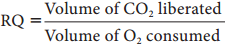
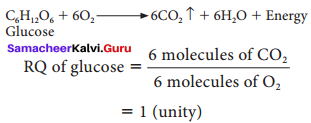
The ratio of volume of carbon dioxide given out and volume of oxygen taken in during respiration is called Respiratory Quotient.

Question 13.
What are the significances of Respiratory Quotient?
Answer:
The significances of Respiratory Quotient:

  1. RQ value indicates which type of respiration occurs in living cells, either aerobic or anaerobic.
  2. It also helps to know which type of respiratory substrate is involved.

Question 14.
Explain the term alcoholic fermentation.
Answer:
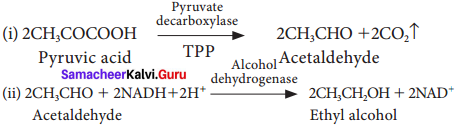
The cells of roots in water logged soil respire by alcoholic fermentation because of lack of oxygen by converting pyruvic acid into ethyl alcohol and CO2. Many species of yeast (Saccharomyces) also respire anaerobically. This process takes place in two steps:
Samacheer Kalvi 11th Bio Botany Solutions Chapter 14 Respiration 2

Question 15.
Mention any two industrial uses of alcoholic fermentation.
Answer:
Two industrial uses of alcoholic fermentation:

  1. In bakeries, it is used for preparing bread, cakes, biscuits.
  2. In beverage industries for preparing wine and alcoholic drinks.

Question 16.
What do you understand by the term mixed acid fermentation?
Answer:
This type of fermentation is a characteristic feature of Enterobacteriaceae and results in the formation of lactic acid, ethanol, formic acid and gases like CO2 and H2.

Question 17.
Mention any two internal factors, that affect the rate of respiration in plants.
Answer:
Two internal factors, that affect the rate of respiration in plants:

  1. The amount of protoplasm and its state of activity influence the rate of respiration.
  2. Concentration of respiratory substrate is proportional to the rate of respiration.

Question 18.
What is the control mechanism of pentose phosphate pathway?
Answer:
The oxidative pentose phosphate pathway is controlled by glucose-6-phosphate dehydrogenase enzyme which is inhibited by high ratio of NADPH to NADP+.

Question 19.
Write down any two significance of pentose phosphate pathway.
Answer:
Two significance of pentose phosphate pathway:

  1. HMP shunt is associated with the generation of two important products,
  2. Coenzyme NADPH generated is used for reductive biosynthesis and counter damaging the effects of oxygen free radicals.

III. Answer the following (3 Marks)

Question 1.
In biosphere how do plants and animals are complementary systems, which are integrated to sustain life?
Answer:
In plants, oxygen enters through the stomata and it is transported to cells, where oxygen is utilized for energy production. Plants require carbon dioxide to survive, to produce carbohydrates and to release oxygen through photosynthesis, these oxygen molecules are inhaled by human through the nose, which reaches the lungs where oxygen is transported through the blood and it reaches cells. Cellular respiration takes place inside or the cell for obtaining energy.

Question 2.
What will happen, when you sleep under a tree during night time?
Answer:
If you are sleeping under a tree during night time you will feel difficulty in breathing. During night, plants take up oxygen and release carbon dioxide and as a result carbon dioxide will be abundant around the tree

Question 3.
What are the factors associated with compensation point in respiration?
Answer:
The two common factors associated with compensation point are CO2 and light. Based on this there are two types of compensation point. They are CO2 compensation point and light compensation point. C3 plants have compensation points ranging from 40 – 60 ppm (parts per million) CO2 while those of C4 plants ranges from 1 – 5 ppm CO2.

Question 4.
Why do you call ATP as universal energy currency of cell?
Answer:
ATP is a nucleotide consisting of a base- adenine, a pentose sugar – ribose and three phosphate groups. Out of three phosphate groups the last two are attached by high energy rich bonds. On hydrolysis, it releases energy (7.3 K cal or 30.6 KJ / ATP) and it is found in all living cells and hence it is called universal energy currency of the cell.

Question 5.
What is a redox reaction?
Answer:
NAD+ + 2e + 2H+ → NADH + H+
FAD + 2e + 2H+ → FADH2
When NAD+ (Nicotinamide Adenine Dinucleotide – oxidised form) and FAD (Flavin Adenine Dinucleotide) pick up electrons and one or two hydrogen ions (protons), they get reduced to NADH + H+ and FADH2 respectively. When they drop electrons and hydrogen off they go back to their original form. The reaction in which NAD+ and FAD gain (reduction) or f lose (oxidation) electrons are called redox reaction (Oxidation reduction reaction). These reactions are important in cellular respiration.

Question 6.
Write down any three differences between aerobic and anaerobic respiration.
Answer:
Aerobic respiration:

  • It occurs in all living cells of higher organisms.
  • It requires oxygen for breaking the respiratory substrate.
  • The end products are CO2 and H2O.

Anaerobic Respiration:

  • It occurs yeast and some bacteria.
  • Oxygen is not required for breaking the respiratory substrate.
  • The end products are alcohol, and CO2 (or) lactic acid.

Question 7.
Mention the significance of Kreb’s cycle.
Answer:
The significance of Kreb’s cycle:

  1. TCA cycle is to provide energy in the form of ATP for metabolism in plants.
  2. It provides carbon skeleton or raw material for various anabolic processes.
  3. Many intermediates of TCA cycle are further metabolised to produce amino acids, proteins and nucleic acids.
  4. Succinyl CoA is raw material for formation of chlorophylls, cytochrome, phytochrome and other pyrrole substances.
  5. α – ketoglutarate and oxaloacetate undergo reductive amination and produce amino acids.
  6. It acts as metabolic sink which plays a central role in intermediary metabolism.

Question 8.
Derive the respiratory quotient for carbohydrate as substrate in oxidative metabolism.
Answer:
The respiratory substrate is a carbohydrate, it will be completely oxidised in aerobic respiration and the value of the RQ will be equal to unity.
Samacheer Kalvi 11th Bio Botany Solutions Chapter 14 Respiration 3

Question 9.
Write down the characteristic of Anaerobic respiration.
Answer:
The characteristic of Anaerobic respiration:

  1. Anaerobic respiration is less efficient than the aerobic respiration.
  2. Limited number of ATP molecules is generated per glucose molecule.
  3. It is characterized by the production of CO2 and it is used for Carbon fixation in photosynthesis.

Question 10.
Distinguish between glycolysis and fermentation.
Answer:
Glycolysis:

  1. Glucose is converted into pyruvic acid.
  2. It takes place in the presence or absence of oxygen.
  3. Net gain is 2ATR
  4. 2 NADH + H+ molecules are produced.

Fermentation:

  1. Starts from pyruvic acid and is converted into alcohol or lactic acid.
  2. It takes place in the absence of oxygen.
  3. No net gain of ATP molecules.
  4. 2 NADH + H+ molecules are utilised.

Question 11.
Write down any three external factors, that affect respiration in plants.
Answer:
Three external factors, that affect respiration in plants:

  1. Optimum temperature for respiration is 30°C. At low temperatures and very high temperatures rate of respiration decreases.
  2. When sufficient amount of O2 is available the rate of aerobic respiration will be optimum and anaerobic respiration is completely stopped. This is called Extinction point.
  3. High concentration of CO2 reduces the rate of respiration

Question 12.
How alcoholic beverages like beer and wine is made?
Answer:
The conversion of pyruvate to ethanol takes place in malted barley and grapes through fermentation. Yeasts carryout this process under anaerobic conditions and this Conversion increases ethanol concentration. If the concentration increases, it’s toxic effect kills yeast cells .and the left out is called beer and wine respectively.

IV. Answer the following (5 Marks)

Question 1.
Give the schematic representation of glycolysis or EMP pathway.
Answer:
The schematic representation of glycolysis or EMP pathway:
Samacheer Kalvi 11th Bio Botany Solutions Chapter 14 Respiration 4

Question 2.
Write down the biochemical events in Kreb’s cycle.
Answer:
The biochemical events in Kreb’s cycle:
Samacheer Kalvi 11th Bio Botany Solutions Chapter 14 Respiration 5

Question 3.
Mention the schematic diagram of the various steps involved in pentose phosphate pathway.
Answer:
The schematic diagram of the various steps involved in pentose phosphate pathway:
Samacheer Kalvi 11th Bio Botany Solutions Chapter 14 Respiration 6

Question 4.
Describe the events in electron transport chain in plant cell.
Answer:
During glycolysis, link reaction and Krebs cycle the respiratory substrates are oxidised at several steps and as a result many reduced coenzymes NADH + H+ and FADH2 are produced. These reduced coenzymes are transported to inner membrane of mitochondria and are converted back to their oxidised forms produce electrons and protons. In mitochondria, the inner membrane is folded in the form of finger projections towards the matrix called cristae.
Samacheer Kalvi 11th Bio Botany Solutions Chapter 14 Respiration 14
In cristae many oxysomes (F1 particles) are present which have election transport carriers are present. According to Peter Mitchell’s Chemiosmotic theory this electron transport is coupled to ATP synthesis. Electron and hydrogen (proton) transport takes place across four multiprotein complexes (I – IV). They are

(i) Complex – I (NADH dehydrogenase: It contains a flavoprotein (FMN) and associated with non – heme iron Sulphur protein (Fe – S). This complex is responsible for passing electrons and protons from mitochondrial NADH (Internal) to Ubiquinone (UQ).
NADH + H+ + UQ ⇌ NAD+ + UQH2
In plants, an additional NADH dehydrogenase (External) complex is present on the outer surface of inner membrane of mitochondria which can oxidise cytosolic NADH + H+ Ubiquinone (UQ) or Coenzyme Quinone (Co Q) is a small, lipid soluble electron, proton carrier located within the inner membrane of mitochondria.

(ii) Complex – II (Succinic dehydrogenase): It contains FAD flavoprotein is associated with non – heme iron Sulphur (Fe – S) protein. This complex receives electrons and protons from succinate in Krebs cycle and is converted into fumarate and passes to ubiquinone.
Succinate + UQ → Fumarate + UQH2

(iii) Complex – III (Cytochrome bc1 complex): This complex oxidises reduced ubiquinone (ubiquinol) and transfers the electrons through Cytochrome bc1 Complex (Iron Sulphur center bc1 complex) to cytochrome c. Cytochrome c is a small protein attached to the outer surface of inner membrane and act as a. mobile carrier to transfer electrons between complex III to complex IV.
UQH2 + 2Cyt coxidised  ⇌  UQ + 2Cyt creduced  + 2H+

(iv) Complex IV (Cytochrome c oxidase): This complex contains two copper centers (A and B) and cytochromes a and as. Complex IV is the terminal oxidase and brings about the reduction of 1/2 O2 to H2O. Two protons are needed to form a molecule of H2O (terminal oxidation).
2Cyt coxidised + 2H+ + 1/2 O⇌  2Cyt creduced + H2O

The transfer of electrons from reduced coenzyme NADH to oxygen via complexes I to IV is coupled to the synthesis of ATP from ADP and inorganic phosphate (Pi) which is called Oxidative phosphorylation. The F0F1 – ATP synthase (also called complex V) consists of F0 and F1. F1 converts ADP and Pi to ATP and is attached to the matrix side of the inner membrane. F0 is present in inner membrane and acts as a channel through which protons come into matrix.

Oxidation of one molecule of NADH + H+ gives rise to 3 molecules of ATP and oxidation of one molecule FADH2 produces 2 molecules of ATP within a mitochondrion. But cytoplasmic NADH + H+ yields only two ATPs through external NADH dehydrogenase. Therefore, two reduced coenzyme (NADH + H+) molecules from glycolysis being extra mitochondrial will yield 2 × 2 = 4 ATP molecules instead of 6 ATPs. The Mechanism of mitochondrial ATP synthesis is based on Chemiosmotic hypothesis.

According to this theory electron carriers present in the inner mitochondrial membrane allow for the transfer of protons (H+). For the production of single ATP, 3 protons (H+) are needed. The terminal oxidation of external NADH bypasses the first phosphorylation site and hence only two ATP molecules are produced per external NADH oxidised through However, in those animal tissues in which malate shuttle mechanism is present, the oxidation of external NADH will yield almost 3 ATP molecules.

Complete oxidation of a glucose molecule in aerobic respiration results in the net gain of 36 ATP molecules in plants. Since huge amount of energy is generated in mitochondria in the form of ATP molecules they are called ‘power house of the cell’. In the case of aerobic prokaryotes due to lack of mitochondria each molecule of glucose produces 38 ATP molecules.

Question 5.
Define respiratory quotient. Explain the derivation of respiratory quotient for various substrates oxidised :
Answer:
The ratio of volume of carbon dioxide given out and volume of oxygen taken in during respiration is called Respiratory Quotient or Respiratory ratio. RQ value depends, upon respiratory substrates and their oxidation.
Samacheer Kalvi 11th Bio Botany Solutions Chapter 14 Respiration 13
(i) The respiratory substrate is a carbohydrate, it will be completely oxidised in aerobic respiration and the value of the RQ will be equal to unity.
Samacheer Kalvi 11th Bio Botany Solutions Chapter 14 Respiration 7
(ii) If the respiratory substrate is . a carbohydrate it will be incompletely oxidised when it goes through anaerobic respiration and the RQ value will be infinity.
Samacheer Kalvi 11th Bio Botany Solutions Chapter 14 Respiration 8
(iii) In some succulent plants like Opuntia, Bryophyllum carbohydrates are partially oxidised to organic acid, particularly malic acid without corresponding release of CO2 but O2 is consumed hence the RQ value will be zero.
Samacheer Kalvi 11th Bio Botany Solutions Chapter 14 Respiration 9
(iv) When respiratory substrate is protein or fat, then RQ will be less than unity.
Samacheer Kalvi 11th Bio Botany Solutions Chapter 14 Respiration 10
(v) When respiratory substrate is an organic acid the value of RQ will be more than unity.
Samacheer Kalvi 11th Bio Botany Solutions Chapter 14 Respiration 11

Question 6.
Describe an experiment to demonstrate the production of CO2 in aerobic respiration.
Answer:
Take small quantity of any seed (groundnut or bean seeds) and allow them to germinate by imbibing them. While they are germinating place them in a conical flask. A small glass tube containing 4 ml of freshly prepared Potassium hydroxide (KOH) solution is hung into the conical flask with the help of a thread and tightly close the one holed cork. Take a bent glass tube, the shorter end of which is inserted into the conical flask through the hole in the cork, while the longer end is dipped in a beaker containing water.
Samacheer Kalvi 11th Bio Botany Solutions Chapter 14 Respiration 12
Observe the position of initial water level in bent glass tube. This experimental setup is kept for two hours and the seeds were allowed to germinate. After two hours, the level of water rises in the glass tube. It is because, the CO2 evolved during aerobic respiration by germinating seeds will be absorbed by KOH solution and the level of water will rise in the glass tube.
CO2 + 2KOH → K2CO3 + H2O
In the case of groundnut or bean seeds, the rise of water is relatively lesser because these seeds use fat and proteins as respiratory substrate and release a very small amount of CO2. But in the case of wheat grains, the rise in water level is greater because they use carbohydrate as respiratory substrate. When carbohydrates are used as substrate, equal amounts of CO2 and O2 are evolved and consumed.

Textbook Page No. 145

Question 1.
How many ATP molecules are produced from one sucrose molecule?
Answer:
One sucrose molecules gives rise to two glucose molecules. The net production of ATP during complete oxidation of one glucose molecule in plant cell is 36 ATP. Therefore one sucrose molecule yields 36 x 2 = 72 ATP molecules.
As per recent view in plants cells, one molecules of glucose, after complete aerobic oxidation yields only 30 ATP molecules and hence one sucrose molecule yield only 30 x 2 = 60 ATP molecules.

Textbook Page No. 156

Question 1.
Why Microorganisms respire anaerobically?
Answer:
Some of the microorganism live in environments devoid of oxygen and they have to adopt themselves in anoxic condition. Hence they respire anaerobically and they are called anaerobic microbes.

Question 2.
Does anaerobic respiration take place in higher plants?
Answer:
Anaerobic respiration some time occur in the root of some water – logged plants.

Believing that the Samacheer Kalvi 11th Biology Book Solutions Questions and Answers learning resource will definitely guide you at the time of preparation. For more details about Tamilnadu State 11th Bio Botany Chapter 14 Respiration textbook solutions, ask us in the below comments and we’ll revert back to you asap.

Samacheer Kalvi 11th Bio Zoology Solutions Chapter 8 Excretion

Students who are in search of 11th Bio Zoology exam can download this Tamilnadu State Board Solutions for 11th Bio Zoology Chapter 8 Excretion from here for free of cost. These cover all Chapter 8 Excretion Questions and Answers, PDF, Notes, Summary. Download the Samacheer Kalvi 11th Biology Book Solutions Questions and Answers by accessing the links provided here and ace up your preparation.

Tamilnadu Samacheer Kalvi 11th Bio Zoology Solutions Chapter 8 Excretion

Kickstart your preparation by using this Tamilnadu State Board Solutions for 11th Bio Zoology Chapter 8 Excretion Questions and Answers get the max score in the exams. You can cover all the topics of Chapter 8 Excretion Questions and Answers easily after studying the Tamilnadu State Board 11th Bio Zoology Textbook solutions pdf.

Samacheer Kalvi 11th Bio Zoology Excretion Text Book Back Questions and Answers

Textbook Evulation Solved 
Question 1.
Arrange the following structures in the order that a drop of water entering the nephron would encounter them?

  1. (a) Afferent arteriole
  2. (b) Bowman’s capsule
  3. (c) Collecting duct
  4. (d) Distal tubule
  5. (e) Glomerulus
  6. (f) Loop of Henle
  7. (g) Proximal tubule
  8. (h) Renal pelvis

Answer:

  1. (a) Afferent arteriole
  2. (b) Bowman’s capsule
  3. (e) Glomerulus
  4. (g) Proximal tubule
  5. (j) Loop of Henle
  6. (d) Distal tubule
  7. (c) Collecting duct
  8. (h) Renal pelvis

Question 2.
Name the three filtration barriers that solutes must come across as they move from plasma to the lumen of Bowman’s capsule. What components of the blood are usually excluded by these layers?
Answer:
The three filtration barriers that solutes must come across as they move from plasma to the lumen of Bowman’s capsule are,

  1. Glomerular capillary endothelium
  2. Basal lamina or basement membrane
  3. Epithelium of Bowman’s capsule. Blood corpuscles and plasma protein are excluded by these layers.

Question 3.
What forces promote glomerular filtration? What forces opposes them? What is meant by net filtration pressure?
Answer:
Glomerular hydrostatic pressure (55 mm Hg) is the force that promotes filtration. The colloidal osmotic pressure (30 mm Hg) and the capsular hydrostatic pressure (15 mm Hg) are the two opposing forces.

The difference between the force promoting and opposing filtration is the net filtration pressure. It is responsible for filtration. Net filtration pressure = Glomerular hydrostatic pressure – (Colloidal osmotic pressure + Capsular hydrostatic pressure).

Question 4.
Identify the following structures and explain their significance in renal physiology?

  1. Juxtaglomerular apparatus
  2. Podocytes
  3. Sphincters in the bladder
  4. Renal cortex

Answer:
1. Juxtaglomerular apparatus:
Juxtaglomerular apparatus is a specialized tissue in the afferent arteriole of the nephron that consists of macula densa and granular cells. The macula densa cells sense distal tubular flow and affect afferent arteriole diameter. The granular cells secrete an enzyme called renin. It plays an important role in reabsorption of water, Na+ and excretion of K+.

2. Podocytes:
The visceral layer of the Bowman’s capsule is made up of epithelial cells called podocytes. The podocytes end in foot processes which cling to the basement membrane of the glomerulus. The openings between the foot processes are called filtration slits. It is important for glomerular filtration.

3. Sphincters in the bladders:
Sphincter muscles in the bladder controls the flow of urine from the bladder. When urinary bladder is filled with urine, it stretches and stimulates the central nervous system through the sensory neurons of the parasympathetic nervous system and brings about contraction of the bladder.

Simultaneously, somatic motor neurons induce the sphincters to close. Smooth muscles contracts resulting in the opening of the internal sphincters passively and relaxing the external sphincter. When the stimulatory and inhibitory controls exceed the threshold, the sphincter opens and the urine is expelled out.

4. Renal cortex:
The outer portion of the kidney is the renal cortex. It contains renal corpuscles and the proximal and distal tubules. It is thin and fibrous.

Question 5.
In which segment of the nephron most of the re-absorption of substances takes place?
Answer:
In proximal convoluted tubule cells, Glucose, lactate, amino acids, Na+ and water, are reabsorbed. In the descending limb of Henle’s loop, water is reabsorbed. In the ascending limb, Na+, Cl and K+ are reabsorbed. In the distal convoluted tubule, water is reabsorbed.

Question 6.
When a molecule or ion is reabsorbed from the lumen of the nephron, where does it go? If a solute is filtered and not reabsorbed from the tubule, where does it go?
Answer:
When a molecule or ion is reabsorbed from the lumen of the nephron, it goes to the blood stream through efferent arteriole which carries blood away from the glomerulus. If a solute is filtered and not reabsorbed from the tubule, it goes along with urine.

Question 7.
Match each of the following substances with its mode of transportation in proximal tubular reabsorption?
(a) Na+ – 1. indirect active transport
(b) Glucose – 2. endocytosis
(c) Urea – 3. paracellular movement
(d) Plasma – 4. facilitated diffusion
(e) Water – 5. primary active transport
Answer:
(a) 5
(b) 1
(c) 4
(d) 2
(e) 3

Question 8.
Which segment is the site of secretion and regulated reabsorption of ions and pH homeostasis?
Answer:
Distal convoluted tubule.

Question 9.
What solute is normally present in the body to estimate GFR in humans?
Answer:
Creatinine.

Question 10.
Which part of the autonomic nervous system is involved in micturition process?
Answer:
Parasympathetic nervous system.

Question 11.
Match the following terms.
(a) a- adrenoceptor – 1. afferent arteriole
(b) Autoregulation – 2. basal lamina
(c) Bowman’s capsule – 3. capillary blood pressure
(d) Capsule fluid – 4. colloid osmotic pressure
(e) Glomerulus – 5. GFR
(f) Podocyte – 6. JG cells
(g) Vasoconstriction – 7. plasma proteins Norepinepherine
Answer:
(a) 7
(b) 6
(c) 5
(d) 3
(e) 1
(f) 2
(g) 4

Question 12.
If the afferent arteriole of the nephron constricts, what happens to the GFR in that nephron? If the efferent arteriole constricts what happens to the GFR in that nephron? Assume that no auto regulation takes place?
Answer:
If the afferent arteriole of the nephron constricts, GFR is reduced. If the efferent arteriole constricts, GFR is increased.

Question 13.
How is the process of micturition altered by toilet training?
Answer:
The process of release of urine from the bladder is called micturition or urination. It is controlled by central nervous system and smooth muscles of sphincter. In young children, micturition cannot be controlled. By toilet training, one can temporarily postpone the signal reaching from the central nervous system to the motor neurons carrying stimuli to the urinary bladder.

Question 14.
Concentration of urine depends upon which part of the nephron?
a. Bowman’s capsule
b. Length of Henle’s loop
c. P.C.T.
d. Network of capillaries arising from glomerulus
Answer:
b. length of Henle’s loop

Question 15.
If Henle’s loop were absent from mammalian nephron, which one of the following is to be expected?
a. There will be no urine formation.
b. There will be hardly any change in the quality and quantity of urine formed.
c. The urine will be more concentrated.
d. The urine will be more dilute.
Answer:
d. The urine will be more dilute.

Question 16.
A person who is on a long hunger strike and is surviving only on water, will have
a. Less amino acids in his urine
b. Macula densa cells
c. Less urea in his urine
d. More sodium in his urine
Answer:
d. More sodium in his urine

Question 17.
What will happen if the stretch receptors of the urinary bladder wall are totally removed?
a. Micturition will continue
b. Urine will continue to collect normally in the bladder
c. There will be no micturition
d. Orine will not collect in the bladder
Answer:
c. There will be no micturition

Question 18.
The end product of Ornithine cycle is
a. Carbon dioxide
b. Uric acid
c. Urea
d. Ammonia
Answer:
c. Urea

Question 19.
Identify the wrong match
a. Bowman’s capsule – Glomerular Alteration
b. DCT – Absorption of glucose
c. Henle’s loop – Concentration of urine
d. PCT – Absorption of Na+ and K+ ions
Answer:
b. DCT – Absorption of glucose

Question 20.
Podocytes are the cells present on the
a. Outer wall of Bowman’s capsule
b. Inner wall of Bowman’s capsule
c. Neck of nephron
d. Wall glomerular capillaries
Answer:
b. Inner wall of Bowman’s capsule

Question 21.
Glomerular filtrate contains
a. Blood without blood cells and proteins
b. Plasma without sugar
c. Blood with proteins but without cells
d. Blood without urea
Answer:
a. Blood without blood cells and proteins

Question 22.
Kidney stones are produced due to deposition of uric acid and
a. Silicates
b. Minerals
c. Calcium carbonate
d. Calcium oxalate
Answer:
d. calcium oxalate

Question 23.
Animal requiring minimum amount of water to produce urine are
a. Ureotelic
b. Ammonotelic
c. Uricotelic
d. Chemotelic
Answer:
c. Uricotelic

Question 24.
Aldosterone acts at the distal convoluted tubule and collecting duct resulting in the absorption of water through
a. Aquaporins
b. Spectrins
c. GLUT
d. Chloride channels
Answer:
a. Aquaporins

Question 25.
The hormone which helps in the reabsorption of water in kidney tubules is ………..
a. Cholecystokinin
b. Angiotensin II
c. Antidiuretic hormone
d. Pancreozymin
Answer:
b. Angiotensin II

Question 26.
Malphigian tubules remove excretory products from ………….
a. Mouth
b. Oesophagus
c. Haemolymph
d. Alimentary canal
Answer:
d. Alimentary canal

Question 27.
Indentify the biological term Homeostasis, excretion, glomerulus, urea, glomerular filtration, ureters, urine, Bowman’s capsule, urinary system, reabsorption, micturition, osmosis, glomerular capillaries via efferent arteriole, proteins?

  1. A liquid which gathers in the bladder?
  2. Produced when blood is filtered in a Bowman’s capsule?
  3. Temporary storage of urine?
  4. A ball of inter twined capillaries?
  5. A process that changes glomerular filtrate into urine?
  6. Removal of unwanted substances from the body?
  7. Each contains a glomerulus?
  8. Carry urine from the kidneys to the bladder?
  9. Contains urea and many useful substances?
  10. Blood is filtered through its walls into the Bowman’s capsule?
  11. Scientific term for urination?
  12. Regulation of water and dissolved substances in blood and tissue fluid?
  13. Carry urine from the kidneys to the bladder?
  14.  Consists of the kidneys, ureters and bladder?
  15. Removal of useful substances from glomerular filtrate?
  16. The process by which water is transported in the proximal convoluted tubule?
  17. Where has the blood in the capillaries surrounding the proximal convoluted tubule come from?
  18. What solute the blood contains that are not present in the glomerular filtrate?

Answer:

  1. Urine
  2. Glomerular filterate
  3. Urinary bladder
  4. Glomerulus
  5. Reabsorption
  6. Excretion
  7. Bowman’s capsule
  8. Ureters
  9. Glomerular filterate
  10. Glomerulus
  11. Micturition
  12. Homeostatic
  13. Ureters
  14. Urinary system
  15. Reabsorption
  16. Osmosis
  17. Glomerular capillaries via efferent arteriole
  18. Proteins

Question 28.
With regards to toxicity and the need for dilution in water, how’ different are ureotelic and uricotelic excretions? Give examples of animals that use these types of excretion?
Answer:
Ureotelic animals excrete urea with minimum loss of water, e.g., Mammals and terrestrial amphibians. Uricotelic animals excrete uric acid with the least loss of water, e.g., Birds and reptiles.

Question 29.
Differentiate protonephridia from metanephridia?
Answer:

ProtonephridiaMetanephridia     
1. Primitive kidneys are protonephridia1. Tubular excretory structures are
2. These are found in flatworms.2. These are found in annelids and molluscs

Question 30.
What is the nitrogenous waste produced by amphibian larvae and by the adult animal?
Answer:
Amphibian larvae produce ammonia and the adult produces urea.

Question 31.
How is urea formed in the human body?
Answer:
More toxic ammonia produced as a result of breakdown of amino acids is converted into less toxic urea in the liver by a cyclic process called Ornithine cycle.

Question 32.
Differentiate cortical from medullary nephrons?
Answer:

Cortical nephronsMedullary nephrons
1. These are found in the cortex.1. These are found in the medulla.
2. These have short Henle’s loop.2. These have long Henle’s loop.

Question 33.
What vessels carry blood to the kidneys? Is this blood arterial or venous?
Answer:
Renal artery carries oxygenated (arterial) blood to the kidney.

Question 34.
Which vessels drain filtered blood from the kidneys?
Answer:
Renal veins carry deoxygenated blood from the kidney.

Question 35.
What is tubular secretion? Name the substances secreted through the renal tubules?
Answer:
The movement of substances such as H+, K+, NH4+, creatinine and organic acids from the peritubular capillaries into the tubular fluid, the filtrate is called Tubular secretion.

Question 36.
How are the kidneys involved in controlling blood volume? How is the volume of blood in the body related to arterial pressure?
Answer:
Renin- Angiotensin stimulates Na+ reabsorption from the glomerular filtrate. This stimulates Adrenal cortex to secrete aldosterone that causes reabsorption of Na+, K+ excretion and absorption of water.

This reduces loss of water into the urine. This maintains the volume of blood. An increase in blood volume increases central venous pressure. This increases right atrial pressure, right ventricular end – diastolic pressure and volume. This increases ventricular stroke volume and cardiac output and arterial blood pressure.

Question 37.
Name the three main hormones that are involved in the regulation of the renal function?
Answer:
Antidiuretic hormone, aldosterone and atrial natriuretic peptide factor.

Question 38.
What is the function of antidiuretic hormone? Where is it produced and what stimuli increases or decreases its secretion?
Answer:
Antidiuretic hormone increases reabsorption of water in the kidney tubules. It is produced in the posterior lobe of the pituitary gland. When there is excess loss of fluid from the body or increase in the blood pressure, ADH is secreted more. When there is no loss of fluid from the body, it is secreted less.

Question 39.
What is the effect of aldosterone on kidneys and where is it produced?
Answer:
Aldosterone is produced by the Adrenal cortex. It increases reabsorption of sodium and water by distal convoluted tubule and increased secretion of potassium. Hence, it maintains blood volume, blood pressure and urine output.

Question 40.
What evolutionary hypothesis could explain the heart’s role in secreting a hormone that regulates renal function? What hormone is this?
Answer:
The cardiac atrial cells secrete atrial natriuretic peptide or factor. It travels to the kidney and increases blood flow to the glomerulus. It acts as vasodilator on the afferent arteriole and vasoconstrictor on efferent arteriole. It decreases aldosterone release for the adrenal cortex and decreases the release of renin Angiotensin-II. Health of the heart depends on the normal blood pressure and hence evolution might have preserved atrial natriuretic factor which acts upon the renal function.

In – Text Questions Solved

Question 1.
What is the importance of having a long loop of Henle and short loop of Henle in a nephron?
Answer:
The major function of Henle’s loop is to concentrate Na+ and Cl. The longer the Henle’s loop, the more concentrated is the urine that is above the osmotic concentration of plasma.

Question 2.
A person with cirrhosis of the liver has lower than normal levels of plasma proteins and higher than normal GFR. Explain why a decrease in plasma protein would increase GFR?
Answer:
The net filtration pressure of 10 mmHg is responsible for the renal filtration. Net filtration Pressure = Glomerular hydrostatic pressure – (Colloidal osmotic pressure + Capsular hydrostatic pressure). Therefore, when there is decrease in plasma proteins, the value of Colloidal osmotic pressure + Capsular hydrostatic pressure decreases. This contributes to the increased net filtration pressure resulting in increase of GFR.

Question 3.
List various pathways involved in the homeostatic compensation in the case of severe dehydration?
Answer:
The below flowchart shows the pathways involved in the homeostatic compensation in case of severe dehydration.
Samacheer Kalvi 11th Bio Zoology Solutions Chapter 8 Excretion img 1

  1. If there is decreased extracellular fluid volume, it increases sympathetic stimulation and decreases blood pressure and decreases fluid and sodium delivery to the distal tubule.
  2. This enhances secretion of renin.
  3. It converts angiotensinogen to angiotensen 1 and angiotensen 1 to angiotehsen 2.
  4. This increase in the angiotensen 1 increases the secretion of aldosterone which increases the reabsorption of sodium by distal tubule and increased secretion of potassium.
  5. The increase in angiotensen 2 increases thirst and reabsorption of sodium in the PCT.

Question 4.
Angiotensin Converting Enzyme inhibitors (ACE inhibitors) are used to treat high blood pressure. Using a flow chart, explain why these drugs are helpful in treating hypertension?
Answer:
Samacheer Kalvi 11th Bio Zoology Solutions Chapter 8 Excretion img 2
Angiotensin Converting Enzyme inhibitors (ACE inhibitors) prevent the conversion of angiotensinogen into angiotensen I and angiotensen I into angiotensen II. This decreases the reabsorption of sodium by proximal convoluted tubule and secretion of aldosterones. This prevents the increased secretion of potassium. All these reactions help in treating hypertension.

Question 5.
Consider how different foods affect water and salt balance, and how the excretory system must respond to maintain homeostasis?
Answer:
The excessive intake of sodium chloride„i.e. common salt increases osmolarity. This increases thirst and secretion of vasopressin. The vasopressin increases reabsorption of water in the renal tubule. Kidneys prevent the loss of water. Due to intake of water due to thirst, extracellular fluid volume increases.

This stimulates kidneys to excrete salt and water to bring osmolarity to normal. When there is an increase in the blood pressure due to increase in the extracellular fluid volume, cardiovascular reflexes occur to reduce the blood pressure. This brings the volume and blood pressure to normal. Thus, the excessive intake of sodium affects the water and salt balance. The excretory system responds to those changes and maintains homeostasis.
Samacheer Kalvi 11th Bio Zoology Solutions Chapter 8 Excretion img 3

Text Book Activties Solved

Question 1.
Visit a nearby health center to observe the analysis of urine. Dip strips can be used to test urine for a range of different factors such as pH, glucose, ketones and proteins. Dip sticks for detecting glucose contain two enzymes namely, glucose oxidase and peroxidase? These two enzymes are immobilized on a small pad at one end of the stick. The pad is immersed in urine. If the urine contains glucose, a brown coloured compound is produced. The resulting colour pad is matched against a colour chart. The colour does not indicate the current blood glucose concentrations?
Answer:
Students can visit near by health centre under the guidance of the teacher.

Samacheer Kalvi 11th Bio Zoology Excretion Additional Questions & Answers

I. Multiple Choice Questions
Choose The Correct Answer

Question 1.
The elimination of ……………………….. requires large amount of water.
(a) Urea
(b) Uric acid
(c) Ammonia
(d) creatinine
Answer:
(c) ammonia

Question 2.
Reptiles, birds, land snails and insects excrete ……………..
(a) Ammonia
(b) Urea
(c) Uric
(d) purines
Answer:
(c) uric acid

Question 3.
Solenocytes are the specialized cells for excretion in
(a) Flatworms
(b) Molluscs
(c) Insects
(d) Amphioxus
Answer:
(d) amphioxus

Question 4.
Insects have for excretion.
(a) Flame cells
(b) Malphigian tubules
(c) Solenocytes
(d) Green glands
Answer:
(b) Malphigian tubules

Question 5.
…………………… have antennal glands or green glands which perform excretory function.
(a) Insects
(b) Annelids
(c) Crustaceans
(d) Flatworms
Answer:
(c) Crustaceans

Question 6.
Reptiles produce very little ……………….. urine
(a) Hypotonic
(b) Hypertonic
(c) Isotonic
(d) None of the above
Answer:
(a) Hypotonic

Question 7.
Mammals have long Henle’s loop, hence they produce ……………………… urine.
(a) Hypotonic
(b) Hyperosmotic
(c) Isotonic
(d) None of the above
Answer:
(b) Hyperosmotic

Question 8.
Aglomerlar kidneys of marine fishes produce little urine that is ………………………. to the body fluid.
(a) Hypotonic
(b) Hyperosmotic
(c) Isoosmotic
(d) None of the above
Answer:
(c) Isoosmotic

Question 9.
The external parietal layer of the Bowman’s capsule is made up of simple ……………………. epithelium.
(a) Columnar
(b) Ciliated
(c) Squamous
(d) Glandular
Answer:
(c) Squamous

Question 10.
The nitrogenous wastes are formed as a result of catabolism of …………..
(a) Carbohydrates
(b) Proteins
(c) Fats
(d) Minerals
Answer:
(b) proteins

Question 11.
The net filtration pressure ………………………. of is responsible for renal filtration.
(a) 15mmHg
(b) 30 mmHg
(c) 55 mmHg
(d) 10 mmHg
Answer:
(d) 10 mmHg

Question 12.
Glucose, amino acids, Na+ and water in the filtrate are reabsorbed in the
(a) descending limb of Henle’s loop
(b) ascending limb of Henle’s loop
(c) proximal convoluted tubule
(d) distal convoluted tubule
Answer:
(c) Proximal convoluted tubule

Question 13.
Defects in ADH receptors or inability to secrete ADH leads to a condition called ……………….
(a) diabetes mellitus
(b) diabetes insipidus
(c) Cushing’s syndrome
(d) renal failure
Answer:
(b) diabetes insipidus

Question 14.
The process of release of urine from the bladder is called …………….
(a) Ultra filtration
(b) Reabsorption
(c) Micturition
(d) Secretion
Answer:
(c) Micturition

Question 15.
The pH value of human urine is ……………
(a) 7.5
(b) 6.0
(c) 4.3
(d) 9.5
Answer:
(a) 6.0

Question 16.
On an average, …………………… gm of urea is excreted per day.
(a) 10 – 15
(b) 15-20
(c) 40 – 50
Answer:
(d) 25 – 30

Question 17.
…………………….. is characterised by increase in urea and other non-protein nitrogenous substances like uric acid and creatinine.
(a) Renal calculi
(b) Uremia
(c) Glomerulonephritis
(d) Renal failure
Answer:
(b) Uremia

Question 18.
The formation of hard stone like masses in the renal tubules of renal pelvis is called ……………
(a) Uremia
(b) Micturition
(c) Renal calculi
(d) Renal failure
Answer:
(c) Renal calculi

Question 19.
The inflammation of the glomeruli of kidneys due to Streptococcus bacteria is called …………..
(a) Renal failure
(b) Uremia
(c) Glomerulonephritis
(d) Renal calculi
Answer:
(c) Glomerulonephritis

Question 20.
Through haemodialysis, ……………………….. can be removed from the blood.
(a) Ketone bodies
(b) Glucose
(c) Amino acids
(d) Urea
Answer:
(d) Urea

Question 21.
The transfer of healthy kidney from one person to another person with kidney failure is called ……………
(a) Kidney failure
(b) Haemodialysis
(c) Kidney transplantation
(d) Uremia
Answer:
(c) Kidney transplantation

II. Fill in the Blanks

Question 1.
……………………………. regulation is the control of tissues osmotic pressure which acts as a driving force for movement of water across biological membranes.
Answer:
Osmotic

Question 2.
……………………. regulation is the control of the ionic composition of body fluids.
Answer:
Ionic

Question 3.
……………………. is the toxic nitrogenous end product of protein catabolism.
Answer:
Ammonia

Question 4.
…………………….. are able to change their internal osmotic concentration with change in external environment.
Answer:
Osmoconformers

Question 5.
…………………….. maintain their internal osmotic concentration irrespective of their external osmotic environment.
Answer:
Osmoregulators

Question 6.
The …………………. animals can tolerate only narrow fluctuations in the salt concentration.
Answer:
stenohaline

Question 7.
The ……………………. animals are able to tolerate wide fluctuations in the salt concentrations.
Answer:
euryhaline

Question 8.
…………………….. is the waste product of protein metabolism in spiders.
Answer:
Guanine

Question 9.
…………………….. requires large amount of water for its elimination.
Answer:
Ammonia

Question 10.
…………………. is the least toxic waste product of protein metabolism.
Answer:
Uric acid

Question 11.
Animals that excrete ammonia are called …………
Answer:
Ammonoteles

Question 12.
The animals that excrete uric acid crystals are called ……………………..
Answer:
Uricoteles

Question 13.
The animals that excrete urea are called ……………………..
Answer:
Ureoteles

Question 14.
…………………….. are the excretory structures in flatworms.
Answer:
Flame cells

Question 15.
Solenocytes are the excretory cells present in ……………………..
Answer:
Amphioxus

Question 16.
…………………….. are the excretory structures in insects.
Answer:
Malphigian tubules

Question 17.
…………………….. function excretory function in prawns.
Answer:
Antennal glands/ Green glands

Question 18.
…………………….. are the structural and functional unit of kidneys.
Answer:
Nephrons

Question 19.
The right kidney is placed slightly lower than the left kidney due to the presence of ……………………..
Answer:
liver

Question 20.
The medulla of kidney is divided into a few conical tissue masses called ……………………..
Answer:
Renal pyramids

Question 21.
The urinary bladder opens into ……………………..
Answer:
Urethra

Question 22.
The Bowman’s capsule and the glomerulus together constitute the ……………………..
Answer:
Renal corpuscle

Question 23.
Some nephron have very long loop of Henle that run deep into the medulla and are called ……………………..
Answer:
Juxta medullary nephrons

Question 24.
The nitrogenous waste formed as a result of breakdown of amino acids is converted to urea in the …………………….. Ornithine cycle.
Answer:
Liver

Question 25.
The filtration of blood that takes place in the ……………………..
Answer:
Glomerulus.

Question 26.
The fluid that leaves the glomerular capillaries and enters the Bowman’s capsule is called the ……………………..
Answer:
Glomerular filtrate

Question 27.
Sodium is reabsorbed by …………………….. in the proximal convoluted Tubule.
Answer:
Active transport

Question 28.
Descending limb of Henle’s loop is permeable to water due the presence of ……………………..
Answer:
Aquaporins

Question 29.
Reabsorption of …………………….. ions regulates the pH of blood
Answer:
Bicarbonate

Question 30.
…………………….. Is the hormone that facilitates reabsorption of water by increasing the number of aquaporins on the DCT and collecting duct.
Answer:
Antidiuretic hormone/ vasopressin

Question 31.
The under secretion of ADH leads to ……………………..
Answer:
Diabetes insipidus

Question 32.
The granular cells of afferent arteriole secrete an enzyme called ……………………..
Answer:
Renin

Question 33.
Renin converts …………………….. into angiotensin.
Answer:
Angiotensinogen

Question 34.
Atrial Natriuretic Peptide or factor decreases release of …………………….. , thereby decreasing angiotensin II.
Answer:
Renin

Question 35.
The process of release of urine from the bladder is called ……………………..
Answer:
Micturition

Question 36.
The yellow colour of the urine is due to the presence of a pigment, ……………………..
Answer:
Urochrome

Question 37.
The presence of ketone bodies in the urine is called ……………………..
Answer:
Ketonuria

Question 38.
…………………….. is characterized by increase in urea and other non-protein nitrogenous substances like uric acid and creatinine in blood.
Answer:
Uremia

Question 39.
The formation of hard stone like masses in the renal tubules of renal pelvis is called ……………………..
Answer:
Renal calculi

Question 40.
Renal calculi is due to accumulation of soluble crystals of …………………….. and certain phosphates.
Answer:
Sodium oxalates

Question 41.
Renal stones can be removed by techniques like …………………….. or lithotripsy.
Answer:
Pyleothotomy

Question 42.
Inflammation of the glomeruli of both kidneys is known as ……………………..
Answer:
Glomerulonephritis/ Bright’s disease

Question 43.
haematuria, proteinuria, salt and water retention, oligouria, hypertension and pulmonary oedema are symptoms of ……………………..
Answer:
Glomerulonephritis/ Bright’s disease

Question 44.
The process of removing toxic urea from the person with kidney failure is called ……………………..
Answer:
Haemodialysis

Question 45.
…………………….. drugs are administered to the patient after kidney transplantation to avoid tissue rejection.
Answer:
Immunosuppressive

III. Answer The Following Questions

Question 1.
What is osmotic regulation?
Answer:
Osmotic regulation is the control of tissue osmotic pressure which acts as a driving force for movement of water across biological membranes.

Question 2.
What is ionic regulation?
Answer:
Ionic regulation is the control of the ionic composition of body fluids.

Question 3.
Define excretion?
Answer:
The process by which the body gets rid of the nitrogenous waste products of protein metabolism is called excretion.

Question 4.
Distinguish between Osmoconformers and Osmoregulators?
Answer:

OsmoconformersOsmoregulators
1. These animals are able to change their internal osmotic concentration with change in external environment.1. These animals maintain their internal osmotic concentration irrespective of their external osmotic environment.
2. e.g. Marine molluscs and Sharks2. e.g. Otters

Question 5.
Distinguish between Stenohaline and Euryhaline animals?
Answer:

StenohalineEuryhaline
1. These animals can tolerate only

narrow fluctuations in the salt concentration.

1. These animals are able to tolerate wide fluctuations in the salt concentrations.
2. e.g. Gold fish2. e.g. Artemia, Tilapia and Salmon.

Samacheer Kalvi 11th Bio Zoology Solutions Chapter 8 Excretion

Question 6.
Name some nitrogenous waste product produced by various animals?
Answer:
Some of the nitrogenous wastes produced by various animals other than ammonia, urea and uric acid are:
Jrimethyl amine oxide (TMO) in marine teleosts, guanine in spiders, hippuric acid in mammals, reptiles and other nitrogenous wastes include allantonin, allantoic acid, omithuric acid, creatinine, creatine, purines, pyramidines and pterines.

Question 7.
What are ammonotelic animals?
Answer:
Animals that excrete ammonia with excess of water are called ammonoteles. e.g., fishes, aquatic amphibians and aquatic insects.

Question 8.
What are the excretory organs of crustaceans?
Answer:
Antennal glands or green glands.

Question 9.
What is the difference between nephron present in reptiles and mammals?
Answer:
Reptiles have reduced glomerulus or lack glomerulus and Henle’s loop. Mammals have a long Henle’s loop. Reptiles produce hypotonic urine whereas mammals produce hypertonic urine.

Question 10.
Explain the structure of human excretory system?
Answer:
1. Excretory system in human consists of a pair of kidneys, a pair of ureters, urinary bladder and urethra. Kidneys are reddish brown, bean shaped structures that lie in the lumbar region between the last thoracic and third lumber vertebra.

2. The right kidney is slightly lower than the left kidney. Each kidney weighs about 120-170 grams. The outer layer of the kidney is covered by three layers of supportive tissues namely, renal fascia, perirenal fat capsule and fibrous capsule.

3. The longitudinal section of kidney shows an outer cortex, inner medulla and pelvis. The medulla is divided into a few conical tissue masses called medullary pyramids or renal pyramids.

4. The part of cortex that extends in between the medullary pyramids is the renal columns of Bertini. The centre of the inner concave surface of the kidney has a notch called the renal hilum.

5. Through this ureter, blood vessels and nerves innervate. There is a broad funnel shaped space called the renal pelvis with projection called calyces.

6. The walls of the calyces, pelvis and ureter have smooth muscles. The calyces collect the urine and empties into the ureter. It is stored in the urinary bladder temporarily. The urinary bladder opens into the urethra through which urine is expelled out.

Samacheer Kalvi 11th Bio Zoology Solutions Chapter 8 Excretion img 4

Question 11.
Explain the structure of Nephron?
Answer:
Each kidney has nearly one million tubular structures called nephrons. Each nephron consists of a filtering corpuscle called renal corpuscle or malphigian body and a renal tubule. The renal tubule opens into a longer tubule called the collecting duct. The renal corpuscle has a double walled cup shaped structure called the Bowman’s capsule. It encloses a ball of capillaries called the glomerulus.

The Bowman’s capsule and the Glomerulus together constitute the renal corpuscle. The endothelium of glomerulus has many pores called fenestrae.

The external parietal layer of the Bowman’s capsule is made up of simple squamous epithelium. The visceral layer is made of epithelial cells called podocytes. The podocytes end in foot processes which cling to the basement membrane of the glomerulus. The openings between the foot processes are called filtration slits.

The renal tubule continues further to form the proximal convoluted tubule, Henle’s loop and the distal convoluted tubule. The Henle’s loop has a thin descending limb and a thick ascending limb.

The distal convoluted tubule of many nephrons open into a collecting duct. The proximal and the distal convoluted tubule are situated in the cortical region whereas the Henle’s loop is situated in the medullary region of the kidney.
Samacheer Kalvi 11th Bio Zoology Solutions Chapter 8 Excretion img 5

Question 12.
Explain the mechanism of urine formation in human?
Answer:
The nitrogenous waste formed as a result of breakdown of amino acids is converted to urea in the liver by the Ornithine cycle or urea cycle. Urine formation involves three main processes:

  1. Glomerular filtration
  2. Tubular reabsorption
  3. Tubular secretion

1. Glomerular Filtration:
Blood enters the kidney from the renal artery, into the glomerulus. The glomerular membrane has a large surface area and is more permeable to water and small molecules present in the blood plasma.

Blood enters the glomerulus faster with greater force through the afferent arteriole and leaves the glomerulus through the efferent arterioles, much slower. This is because of the wider afferent arteriole and glomerular hydrostatic pressure which is around 55 mm Hg.

This is the chief force that pushes water and solutes out of the blood and across the filtration membrane. The pressure is much higher than in other capillary beds. The colloidal osmotic pressure (30 mm Hg) and the capsular hydrostatic pressure (15 mm Hg) are the opposing forces.

The net filtration pressure of 10 mm Hg is responsible for the renal filtration.
Net filtration pressure = Glomerular hydrostatic pressure – (Colloidal osmotic pressure + Capsular hydrostatic pressure) = 55 mm Hg – (30 mm Hg + 15 mm Hg) = 10 mm Hg.

The effective glomerular pressure of 10 mm Hg results in ultrafiltration. The fluid that leaves the glomerular capillaries and enters the Bowman’s capsule is called the glomerular filtrate.

It is similar to blood plasma except that there are no plasma proteins. Kidneys produce about 180L of glomerular filtrate in 24 hours. It has water, glucose, amino acids and minerals along with urea and other nitrogenous waste.

2. Tubular Reabsorption:
The substances of glomerular filtrate are reabsorbed by the renal tubules as they are needed by the body. This process is called selective reabsorption.

In the Proximal Convoluted Tubule, glucose, lactate, amino acids, Na+ and water are reabsorbed. Sodium is reabsorbed by active transport through sodium-potassium pump. The descending limb of Henle’s loop is permeable to water due to the presence of aquaporins, but impermeable to salts.

Water is lost in this region and hence Na+ and Cl gets concentrated in the filtrate. In the ascending limb of Henle’s loop, Na+, Cl and K+ are reabsorbed. This region is impermeable to water. The distal convoluted tubule reabsorbs water and secretes potassium into the tubule. Na+, Cl and water remains in the filtrate. In the collecting duct, water and Na+ are reabsorbed and K+ is secreted.

3. Tubular secretion:
In this process, substances such as H+, K+, NH4+, creatinine and organic acids move into the filtrate from the peritubular capillaries into the tubular fluid. Human produces 1.5 L of urine per day.
Samacheer Kalvi 11th Bio Zoology Solutions Chapter 8 Excretion img 6Samacheer Kalvi 11th Bio Zoology Solutions Chapter 8 Excretion img 6a
Samacheer Kalvi 11th Bio Zoology Solutions Chapter 8 Excretion img 7Samacheer Kalvi 11th Bio Zoology Solutions Chapter 8 Excretion img 7a

Question 13.
What is Diabetes insipidus?
Answer:
The defect in the production of ADH results in the excretion of large quantities of dilute urine, this is called Diabetes insipidus. This results in the dehydration and fall in blood pressure.

Question 14.
What is Micturition?
Answer:
The process of release of urine from the bladder is called micturition or urination.

Question 15.
What is the nature of urine of human being?
Answer:
The urine formed is a yellow coloured watery fluid which is slightly acidic in nature (pH 6.0).

Question 16.
What is glucosuria and ketonuria?
Answer:
The presence of glucose in the urine is called glucosuria. The presence of ketone bodies in the urine is called ketonuria. These are the indications of Diabetes Mellitus.

Question 17.
Name the pigment present in the urine?
Answer:
The yellow colour of the urine is due to the presence of pigment urochrome.

Question 18.
Explain the excretory role of other organs?
Answer:

  • Lungs: Lungs remove large quantities of carbon dioxide (18 L /day) and significant quantities of water.
  • Liver: Liver secretes bile which contain bilirubin, biliverdin, cholesterol, steroid hormones, vitamins and drugs. These are excreted out along with the digestive wastes. .
  • Skin: Sweat glands eliminate certain wastes like urea and lactate. Sebaceous glands eliminate sterols, hydrocarbons and waxes through serum.
  • Saliva: Small quantities of nitrogenous wastes are excreted through saliva.

Question 19.
Explain the hormones regulating the kidney function?
Answer:
Antidiuretic hormone or Vasopressin, juxtaglomerular apparatus and atrial natriuretic factor regulate the kidney function. Antidiuretic hormone or Vasopressin When there is excessive loss of fluid from the body or when there is an increase in the blood pressure, the osmoreceptors of the hypothalamus stimulates the neurohypophysis to secrete the antidiuretic hormone or vasopressin.

It facilitates reabsorption of water by increasing the number of aquaporins on the cell surface membrane of the distal convoluted tubule and collecting duct.

When the water loss from the body is less or when you drink excess amount of juice, osmoreceptors stop secreting ADH and the aquaporins of the collecting ducts move into the cytoplasm. Hence dilute urine is produced to maintain the blood volume.

Renin angiotensin:
Juxtaglomerular apparatus (JGA) is a specialized tissue in the afferent arteriole of the nephron. It consists of macula densa and granular cells. The macula densa cells sense distal tubular flow and affect afferent arteriole diameter.

The granular cells secrete an enzyme called renin. A fall in glomerular blood flow, glomerular blood pressure and glomerular filtration rate, can activate JG cells to release renin.

This converts angiotensinogen into angiotensin-I. Angiotensin converting enzyme converts angiotensin-I to angiotensin- II. Angiotensin-II stimulates Na+ reabsorption in the proximal convoluted tubule by vasoconstriction of the blood vessels and increases the glomerular blood pressure.

Angiotensin- II stimulate adrenal cortex to secrete aldosterone that causes reabsorption of Na+, K+ excretion and absorption of water from the distal convoluted tubule and collecting duct. This increases the glomerular blood pressure and glomerular filtration rate. This complex mechanism is generally known as Renin-Angiotensin-Aldosterone System (RAAS).
Samacheer Kalvi 11th Bio Zoology Solutions Chapter 8 Excretion img 8

Atrial natriuretic factor:
Excessive stretch of cardiac atrial cells cause an increase in blood flow to the atria of the heart and release Atrial Natriuretic Peptide or Factor (ANF). It travels to the kidney where it increases Na+ excretion and increases the blood flow to the glomerulus, acting as vasodilator on the afferent glomerular arterioles and as a vasoconstrictor on efferent arterioles.

It decreases aldosterone release from the adrenal cortex and decreases release of renin, thereby decreasing angiotensin-II. ANF acts antagonistically to the renin-angiotensin system, aldosterone and vasopressin.

Question 20.
Write a short note on urinary tract infection?
Answer:
Female’s urethra is very short and its external opening is close to the anal opening, hence improper toilet habits can easily carry faecal bacteria into the urethra. The urethral mucosa is continuous with the urinary tract and the inflammation of the urethra (urethritis) can ascend the tract to cause bladder inflammation (cystitis) or even renal inflammation (pyelitis or pyelonephritis).

Symptoms include dysuria (painful urination), urinary urgency, fever and sometimes cloudy or blood tinged urine. When the kidneys are inflammed, back pain and severe headache often occur. Most urinary tract infections can be treated by antibiotics.

Question 21.
Write a short note on Renal Failure or Kidney Failure?
Answer:
Failure of the kidneys to excrete wastes may lead to accumulation of urea with marked reduction in the urine output. Renal failure are of two types, acute and chronic renal failure.

In acute renal failure the kidney stops its function abruptly, but there are chances for recovery of kidney functions. In chronic renal failure there is a progressive loss of function of the nephrons which gradually decreases the function of kidneys.

Question 22.
Write a short note on Uremia?
Answer:
Uremia is characterized by increase in urea and other non-protein nitrogenous substances like uric acid and creatinine in blood. Normal urea level in human blood is about 17-30 mg/100 mL of blood. The urea concentration rises as 10 times of normal levels during chronic renal failure.

Question 23.
Write a short note on Renal calculi?
Answer:
Renal calculi, also called renal stone or nephrolithiasis, is the formation of hard stone like masses in the renal tubules of renal pelvis. It is mainly due to the accumulation of soluble crystals of salts of sodium oxalates and certain phosphates. This result in severe pain called “renal colic pain” and can cause scars in the kidneys. Renal stones can be removed by techniques like pyleothotomy or lithotripsy.

Question 24.
Write a short note on Glomerulonephritis?
Answer:
Glomerulonephritis is also called Bright’s disease and is characterized by inflammation of the glomeruli of both kidneys and is usually due to post-streptococcal infection that occurs in children. Symptoms are haematuria, proteinuria, salt and water retention, oligouria, hypertension and pulmonary oedema.

Question 25.
Write a short note on Haemodialysis?
Answer:
Malfunction of the kidneys can lead to accumulation of urea and other toxic substances, leading to kidney failure. In such patients toxic urea can be removed from the blood by a process called haemodialysis. A dialyzing machine or an artificial kidney is connected to the patient’s body. A dialyzing machine consists of a long cellulose tube surrounded by the dialysing fluid in a water bath.

The patient’s blood is drawn from a convenient artery and pumped into the dialysing unit after adding an anticoagulant like heparin. The tiny pores in the dialysis tube allows small molecules such as glucose, salts and urea to enter into the water bath, whereas blood cells and protein molecules do not enter these pores.

This stage is similar to the filtration process in the glomerulus. The dialysing liquid in the water bath consists of solution of salt and sugar in correct proportion in order to prevent loss of glucose and essential salts from the blood. The cleared blood is then pumped back to the body through a vein.

Question 26.
Write a short note on Kidney Transplantation?
Answer:
Kidney Transplantation is the ultimate method for correction of acute renal failures. This involves transfer of healthy kidney from one person (donor) to another person with kidney failure.

The donated kidney may be taken from a healthy person who is declared brain dead or from sibling or close relatives to minimise the chances of rejection by the immune system of the host. Immunosuppressive drugs are usually administered to the patient to avoid tissue rejection.

Believing that the Samacheer Kalvi 11th Biology Book Solutions Questions and Answers learning resource will definitely guide you at the time of preparation. For more details about Tamilnadu State 11th Bio Zoology Chapter 8 Excretion textbook solutions, ask us in the below comments and we’ll revert back to you asap.

Samacheer Kalvi 11th Bio Botany Solutions Chapter 13 Photosynthesis

Students who are in search of 11th Bio Botany exam can download this Tamilnadu State Board Solutions for 11th Bio Botany Chapter 13 Mineral Nutrition from here for free of cost. These cover all Chapter 13 Mineral Nutrition Questions and Answers, PDF, Notes, Summary. Download the Samacheer Kalvi 11th Biology Book Solutions Questions and Answers by accessing the links provided here and ace up your preparation.

Tamilnadu Samacheer Kalvi 11th Bio Botany Solutions Chapter 13 Photosynthesis

Kickstart your preparation by using this Tamilnadu State Board Solutions for 11th Bio Botany Chapter 13 Mineral Nutrition Questions and Answers get the max score in the exams. You can cover all the topics of Chapter 13 Mineral Nutrition Questions and Answers easily after studying the Tamilnadu State Board 11th Bio Botany Textbook solutions pdf.

Samacheer Kalvi 11th Bio Botany Photosynthesis Text Book Back Questions and Answers

Questions 1.
Assertion (A): Increase in Proton gradient inside lumen responsible for ATP synthesis.
Reason (R): Oxygen evolving complex of PS I located on thylakoid membrane facing Stroma, releases H+ ions.
(a) Both Assertion and Reason are True.
(b) Assertion is True and Reason is False.
(c) Reason is True and Assertion is False.
(d) Both Assertion and Reason are False.
Answer:
(a) Both Assertion and Reason are True.

Question 2.
Which chlorophyll molecule does not have a phytol tail?
(a) Chl – a
(b) Chl – b
(c) Chl – c
(d) Chl – d
Answer:
(c) Chl – c

Question 3.
The correct sequence of flow of electrons in the light reaction is:
(a) PS II, plastoquinone, cytochrome, PS I, ferredoxin.
(b) PS I, plastoquinone, cytochrome, PS II ferredoxin.
(c) PS II, ferredoxin, plastoquinone, cytochrome, PS I.
(d) PS I, plastoquinone, cytochrome, PS II, ferredoxin.
Answer:
(a) PS II, plastoquinone, cytochrome, PS I, ferredoxin.

Question 4.
For every CO2 molecule entering the C3 cycle, the number of ATP & NADPH required:
(a) 2 ATP + 2 NADPH
(b) 2 ATP + 3 NADPH
(c) 3 ATP + 2 NADPH
(d) 3 ATP + 3 NADPH
Answer:
(c) 3 ATP + 2 NADPH.

Question 5.
Identify true statement regarding light reaction of photosynthesis?
(a) Splitting of water molecule is associate with PS I.
(b) PS I and PS II involved in the formation of NDPH + H+.
(c) The reaction center of PS I is Chlorophyll a with absorption peak at 680 nm.
(d) The reaction center of PS II is Chlorophyll a with absorption peak at 700 nm.
Answer:
(b) PS I and PS II involved in the formation of NDPH + H+.

Question 6.
Two groups (A & B) of bean plants of similar size and same leaf area were placed in identical conditions. Group A was exposed to light of wavelength 400 – 450 nm and Group B to light of wavelength of 500 – 550 nm. Compare the photosynthetic rate of the 2 groups giving reasons.
Answer:
The rate of photosynthesis in group A bean plants is more than what is found in Group B plants because the rate of absorption of light is more at the wavelength is less beyond the wavelength of 500 – 550 nm.

Question 7.
A tree is believed to be releasing oxygen during night time. Do you believe the truthfulness of this statement? Justify your answer by giving reasons?
Answer:
Yes, a tree is believed to be releasing O2 during night time because at night CAM plants fix CO2 with the help of phospho Enol Pyruvic acid and produce oxala acetic acid, which is converted into malic acid like C4 cycle.

Question 8.
Grasses have an adaptive mechanism to compensate. photorespiratory losses – Name and describe the mechanism.
Answer:
Rate of respiration is more in light than in dark. Photorespiration is the excess respiration taking place in photosynthetic cells due to absence of CO2 and increase of O2. This condition changes the carboxylase role of RUBISCO into oxygenase. C2 Cycle takes place in chloroplast, peroxisome and mitochondria. RUBP is converted into PGA and a 2C – compound phosphoglycolate by Rubisco enzyme in chloroplast. Since the first product is a 2C – compound, this cycle is known as C2 Cycle. Phosphoglycolate by loss of phosphate becomes glycolate.

Glycolate formed in chloroplast enters into peroxisome to form glyoxylate and hydrogen peroxide. Glyoxylate is converted into glycine and transferred into mitochondria. In mitochondria, two molecules of glycine combine to form serine. Serine enters into peroxisome to form hydroxy pyruvate. Hydroxy pyruvate with help of NADH + H+ becomes glyceric acid. Glyceric acid is cycled back to chloroplast utilising ATP and becomes Phosphoglyceric acid (PGA) and v enters into the Calvin cycle (PCR cycle). Photorespiration does not yield any free energy in the form of ATP. Under certain conditions 50% of the photosynthetic potential is lost because of Photorespiration

Question 9.
In Botany class, teacher explains, Synthesis of one glucose requires 30 ATPs in C4 plants and only 18 ATPs in C3 plants. The same teacher explains C4 plants are more advantageous than C3 plants. Can you identify the reason for this contradiction?
Answer:
C4 plants requires 30 ATPs and 12 NADPH + H+ to synthesize one glucose, but C3 plants require only 18 ATPs and 12 NADPH + H+ to synthesize one glucose molecule. If then, how can you say C4 plants are more advantageous? C4 plants are more advantageous than C3 plants because C4 photosynthesis is advantages over C3 plant, because C4 photosynthesis avoids photorespiration and is thus potentially more efficient than C3 plants. Due to the absense of photorespiration, carbon di oxide compensation point for C4 is lower than that of C3 plants.

Question 10.
When there is plenty of light and higher concentration of O2, what kind of pathway does the plant undergo? Analyse the reasons.
Answer:
The rate of photosynthesis decreases when there is an increase of oxygen concentration. This Inhibitory effect of oxygen was first discovered by Warburg (1920) using green algae, Chlorella.

Samacheer Kalvi 11th Bio Botany Photosynthesis Additional Questions & Answers

I. Choose the correct answer (1 Mark)
Question 1.
Photosynthesis is the major:
(a) endothermic reaction
(b) exothermic reaction
(c) endergonic reaction
(d) exergonic reaction
Answer:
(c) endergonic reaction

Question 2.
Who has first explained the importance chlorophyll in photosynthesis:
(a) Joseph Priestly
(b) Dutrochet
(c) Stephen Hales
(d) Lovoisier
Answer:
(b) Dutrochet

Question 3.
How many million tonnes of dry matter produced annually by photosynthesis?
(a) 1700 million tonnes
(b) 1900 million tonnes
(c) 1400 million tonnes
(d) 2000 million tonnes
Answer:
(a) 1700 million tonnes

Question 4.
Who received 1988 Nobel prize for his work on photosynthesis in Rhodobacter:
(a) Emerson and Arnold
(b) Ruben and Kamem
(c) Arnon, Allen and Whatley
(d) Huber, Michael and Dissenhofer
Answer:
(d) Huber, Michael and Dissenhofer

Question 5.
Thylakoid disc diameter is:
(a) 0.35 to 0.75 microns
(b) 0.25 to 0.8 microns
(c) 0.45 to 0.8 microns
(d) 0.50 to 0.9 microns
Answer:
(b) 0.25 to 0.8 microns

Question 6.
Indicate the correct statement:
(a) Grana lamellae have only PS I
(b) Stroma lamellae have only PS II
(c) Grana lamellae have both PS I and PS II
(d) Stroma lamellae have both PS I and PS II
Answer:
(c) Grana lamellae have both PS I and PS II

Question 7.
Match the following:

A. Cyanobacteria(i) Chlorophyll D
B. Green algae(ii) Chlorophyll C
C. Brown algae(iii) Chlorophyll A
D. Red algae(iv) Chlorophyll B

(a) A – (iii); B – (i); C – (iv); D – (ii)
(b) A – (ii); B – (iii); C – (iv); D – (i)
(c) A – (iii); B – (iv); C – (i); D – (ii)
(d) A – (iii); B – (iv); C – (ii); D – (i)
Answer:
(d) A – (iii); B – (iv); C – (ii); D – (i)

Question 8.
Each pyrrole ring comprises of:
(a) six carbons and one nitrogen atom
(b) three carbons and one nitrogen atom
(c) four carbons and one nitrogen atom
(d) four carbons and two nitrogen atom
Answer:
(c) four carbons and one nitrogen atom

Question 9.
Biosynthesis of chlorophyll ‘a’ requires:
(a) Mg, Fe, Cu, Zn, Mn, K and nitrogen
(b) Mg, Fe, Cu, Mo, Mn, K and nitrogen
(c) Mg, Cu, Zn, Mo, Mn, K and nitrogen
(d) Mg, Fe, Cu, Zn, Mo, K and nitrogen
Answer:
(a) Mg, Fe, Cu, Zn, Mn, K and nitrogen

Question 10.
Pheophytin resembles chlorophyll ‘a’ except that it lacks:
(a) Fe atom
(b) Mn atom
(c) Mg atom
(d) Cu atom
Answer:
(c) Mg atom

Question 11.
Almost all carotenoid pigments have:
(a) 50 carbon atoms
(b) 40 carbon atoms
(c) 30 carbon atoms
(d) 60 carbon atoms
Answer:
(b) 40 carbon atoms

Question 12.
Which one of the photosynthetic pigments is called shield pigment:
(a) carotenes
(b) chlorophyll ‘b’
(c) pheophytin
(d) carotenoids
Answer:
(d) carotenoids

Question 13.
The visible spectrum of light ranges between:
(a) 200 to 2800 nm
(b) 300 to 2600 nm
(c) 200 to 800 nm
(d) 300 to 2400 nm
Answer:
(b) 300 to 2600 nm

Question 14.
Photosynthetic rate of red light (650 nm) is equal to:
(a) 42.5
(b) 10.0
(c) 43.5
(d) 40.8
Answer:
(c) 43.5

Question 15.
Indicate the correct statement in respect to Hill’s reaction:
(i) During photosynthesis oxygen is evolved from water
(ii) Electrons for the reduction of CO2 are obtained from H2S.
(iii) During photosynthesis oxygen is evolved from CO2
(iv) Electrons for the reduction of CO2 are obtained from water

(a) (i) and (ii)
(b) (ii) and (iii)
(c) (i) and (iv)
(d) (ii) and (iv)
Answer:
(c) (i) and (iv)

Question 16.
Phosphorylation taking place during respiration is called as:
(a) Photophorylation
(b) Oxidative phosphorylation
(c) Reductive phosphorylation
(d) None of the above
Answer:
(b) Oxidative phosphorylation

Question 17.
Find out the odd one:
(a) Ferredoxin
(b) Succinate
(c) Cytochrome b6 – f
(d) Plastocyanin
Answer:
(b) Succinate

Question 18.
In bio – energetics of light reaction, to release one electron from pigment system it requires:
(a) two quanta of light
(b) four quanta of light
(c) one quanta of light
(d) eight quanta of light
Answer:
(a) two quanta of light

Question 19.
Chemiosmatic theory was proposed by:
(a) S. Michael
(b) R. Hill
(c) P. Mitchell
(d) G. Root
Answer:
(c) P. Mitchell

Question 20.
In C4 plants, how many ATPs and NADPH + H+ are utilised for the release of one oxygen molecule:
(a) 3 ATPs and 2 NADPH + H+
(b) 4 ATPs and 3 NADPH + H+
(c) 2 ATPs and 2 NADPH + H+
(d) 5 ATPs and 2 NADPH + H+
Answer:
(d) 5 ATPs and 2 NADPH + H+

Question 21.
The key enzyme in the carboxylation reaction is:
(a) Ribulose dehydrogenase
(b) Carboxylase
(c) Carboxylase oxygenase
(d) Carboxyl anhydrase
Answer:
(c) Carboxylase oxygenase

Question 22.
In sugarcane plant, the dicarboxylic acid pathway was first discovered by:
(a) Hatch and Slack
(b) Kortschak, Hart and Burr
(c) Calvin and Benson
(d) Mitchell and Root
Answer:
(b) Kortschak, Hart and Burr

Question 23.
In bundle sheath cells, malic acid undergoes dicarboxylation and produces 3 carbon compound:
(a) Glyceric acid and CO2
(b) Glyceraldehyde and CO2
(c) Pyruvic acid and CO2
(d) None of the above
Answer:
(c) Pyruvic acid and CO2

Question 24.
Indicate the correct answer:
(a) C4 plants are adapted to only rainy conditions
(b) C4 plants are partially adapted to drought condition
(c) C4 plants are exclusively adapted to desert condition
(d) C4 plants are adapted to aquatic condition
Answer:
(b) C4 plants are partially adapted to drought condition

Question 25.
Crassulacean acid metabolism or CAM cycle was first observed in:
(a) sugarcane
(b) bryophyllum
(c) mango
(d) banana
Answer:
(b) bryophyllum

Question 26.
Glycolate protects plant cells from:
(a) Photophosphorylation
(b) Photo reduction
(c) Photo oxidation
(d) Photolysis
Answer:
(c) Photo oxidation

Question 27.
The important external factors affecting photosynthesis are:
(a) light, chlorophyll, temperature
(b) light, stomatal opening, oxygen
(c) light, protoplasmic factor, oxygen
(d) light, CO2 and oxygen
Answer:
(d) light, CO2 and oxygen

Question 28.
Hormones like gibberellin:
(a) increases the rate of photosynthesis
(b) increase respiration
(c) decrease the rate of photosynthesis
(d) decrease the rate of transpiration
Answer:
(a) increases the rate of photosynthesis

Question 29.
Bacterial photosynthesis differs from higher plant photosynthesis in:
(a) utilizing water as electron donar
(b) releasing O2
(c) releasing sulphur instead of oxygen
(d) utilizing SO2 as electron donar
Answer:
(c) releasing sulphur instead of oxygen

Question 30.
Splitting of water molecule (photolysis) produces:
(a) hydrogen and oxygen
(b) electrons, protons and oxygen
(c) electrons and oxygen
(d) hydrogen, carbon di oxide and oxygen
Answer:
(b) electrons, protons and oxygen

II. Answer the following (2 Marks)

Question 1.
What is the function of plant in the universe?
Answer:
Plants are the major machinery which produce organic compounds like carbohydrates,lipids, proteins, nucleic acids and other biomolecules.

Question 2.
Define photosynthesis.
Answer:
Photosynthesis is referred as photochemical oxidation and reduction reactions carried out with help of light, converting solar energy into Chemical energy.

Question 3.
What is the site of photosynthesis?
Answer:
Chloroplasts are the main site of photosynthesis and both energy yielding process (Light reaction) and fixation of carbon dioxide (Dark reaction) that takes place in chloroplast.

Question 4.
What is thylakoid? Explain how they are arranged?
Answer:
A sac like membranous system called thylakoid or lamellae is present in stroma and they are arranged one above the other forming a stack of coin like structure called granum (plural grana).

Question 5.
Endosymbiotic hypothesis says that chloroplasts evolved from bacteria. Substantiate the statement.
Answer:
Presence of 70S ribosome and DNA gives them status of semi-autonomy and proves endosymbiotic hypothesis which says chloroplast evolved from bacteria.

Question 6.
Define photosynthetic pigment.
Answer:
A photosynthetic pigment is a pigment that is present in chloroplasts or photosynthetic bacteria which captures the light energy necessary for photosynthesis.

Question 7.
Match the following:

A. Xanthophyll(i) Lycopene
B. Phycocyanin(ii) Red algae
C. Carotene(iii) Brown algae
D. Phycoerythin(iv) Cyanobacteria

Answer:
A – (iii), B – (iv), C – (i), D – (ii).

Question 8.
What are Xanthophylls?
Answer:
Yellow (C40H56O2) pigments are like carotenes but contain oxygen. Lutein is responsible for yellow colour change of leaves during autumn season. Examples: Lutein, Violaxanthin and Fueoxanthin.

Question 9.
Write down any two properties of light.
Answer:
Two properties of light:

  1. Light is a transverse electromagnetic wave.
  2. It consists of oscillating electric and magnetic fields that are perpendicular to each other and perpendicular to the direction of propagation of the light.

Question 10.
Define absorption spectrum.
Answer:
Pigments absorb different wavelengths of light. A curve obtained by plotting the amount of absorption of different wavelengths of light by a pigment is called its absorption spectrum.

Question 11.
Define the term fluorescence.
Answer:
The electron from first singlet state (SI) returns to ground state (SO) by releasing energy in the form of radiation energy (light) in the red region and this is known as fluorescence.

Question 12.
What is known as substrate level phosphorylation?
Answer:
Phosphorylation taking place during respiration is called as oxidative phosphorylation and ATP produced by the breakdown of substrate is known as substrate level phosphorylation.

Question 13.
Define photophosphorylation.
Answer:
Phosphorylation is the process of synthesis of ATP by the addition of inorganic phosphate to ADP. The addition of phosphate here takes place with the help of light generated electron and so it is called as photophosphorylation.

Question 14.
What are the phases of dark reaction?
Answer:
Dark reaction consists of three phases:

  • Carboxylation (fixation)
  • Reduction (Glycolytic Reversal)
  • Regeneration

Question 15.
What are significance of photo respiration?
Answer:
Significance of photo respiration:

  1. Glycine and Serine synthesised during this process are precursors of many biomolecules like chlorophyll, proteins, nucleotides.
  2. It consumes excess NADH + H+ generated.
  3. Glycolate protects cells from Photo oxidation.

Question 16.
What is meant by carbon dioxide compensation point?
Answer:
When the rate of photosynthesis equals the rate of respiration, there is no exchange of oxygen and carbon dioxide and this is called as carbon dioxide compensation point.

Question 17.
What, are the internal factors, that affect photosynthesis?
Answer:
Pigments, protoplasmic factor, accumulation of carbohydrates, anatomy of leaf and hormones.

Question 18.
What are the air pollutants, that affect rate of photosynthesis?
Answer:
Pollutants like SO2, NO2, O3 (Ozone) and Smog affect rate of photosynthesis.

Question 19.
How does water affect the rate of photosynthesis?
Answer:
Photolysis of water provides electrons and protons for the reduction of NADP, directly. Indirect roles are stomatal movement and hydration of protoplasm. During water stress, supply of NADPH + H+ is affected.

Question 20.
Name any three photosynthetic bacteria.
Answer:
Three photosynthetic bacteria:

  1. Chlorobacterium
  2. Thiospirillum
  3. Rodhospirillum

III. Answer the following. (3 Marks)

Question 1.
Mention any three significance of photosynthesis.
Answer:
Three significance of photosynthesis:

  1. Photosynthetic organisms provide food for all living organisms on earth either directly or indirectly.
  2. It is the only natural process that liberates oxygen in the atmosphere and balances the oxygen level.
  3. Photosynthesis balances the oxygen and carbon cycle in nature.

Question 2.
How is the chlorophyll synthesized?
Answer:
Chlorophyll is synthesized from intermediates of respiration and photosynthesis. Succinic acid an intermediate of Krebs cycle is activated by the addition of coenzyme A and it reacts with a simple amino acid glycine and the reaction goes on to produce chlorophyll ‘a’. Biosynthesis of chlorophyll ‘a’ requires Mg, Fe, Cu, Zn, Mn, K and nitrogen. The absence of any one of these minerals leads to chlorosis.

Question 3.
What are phycobilins?
Answer:
They are proteinaceous pigments, soluble in water, and do not contain Mg and Phytol tail. They exist in two forms such as:

  1. Phycocyanin found in cyanobacteria.
  2. Phycoerythin found in rhodophycean algae (Red algae).

Question 4.
What are the conclusions of Hill’s reaction?
Answer:
The conclusions of Hill’s reaction:

  1. During photosynthesis oxygen is evolved from water.
  2. Electrons for the reduction of CO2 are obtained from water.
  3. Reduced substance produced, later helps to reduce CO2.

Question 5.
What is meant by ground state?
Answer:
The action of photon plays a vital role in excitation of pigment molecules to release an electron. When the molecules absorb a photon, it is in excited state. When the light source turned off, the high energy electrons return to their normal low energy orbitals as the excited molecule goes back to its original stable condition known as ground state.

Question 6.
Explain the term phosphorescence.
Answer:
Electron from Second Singlet State (S2) may return to next higher energy level (S1) by losing some of its extra energy in the form of heat. From first singlet state (S1) electron further drops to first triplet state (T1). Triplet State is unstable having half life time of 10-3 seconds and electrons returns to ground state with emission of light in red region called as phosphorescence. Phosphorescence is the delayed emission of absorbed radiations. Pathway of electron during Phosphorescence:
S2 → S1 → T1 → S0

Question 7.
Describe the method of carboxylation.
Answer:
The acceptor molecule Ribulose 1,5 Bisphosphate (RUBP) a 5 carbon compound with the help of RUBP carboxylase oxygenase (RUBISCO) enzyme accepts one molecule of carbon dioxide to form an unstable 6 carbon compound. This 6C compound is broken down into two molecules of 3 – carbon compound phospho glyceric acid (PGA).
Samacheer Kalvi 11th Bio Botany Solutions Chapter 13 Photosynthesis 7

Question 8.
Explain the phase – 3 of dark reaction.
Answer:
Regeneration of RUBP involves the formation of several intermediate compounds of 6 – carbon, 5 – carbon, 4 – carbon and 7 – carbon skeleton. Fixation of one carbon dioxide requires 3 ATPs and 2 NADPH + H+, and for the fixation of 6 CO2 requires 18 ATPs and 12 NADPH + H+ during C3 cycle. One 6 carbon compound is the net gain to form hexose sugar.
Samacheer Kalvi 11th Bio Botany Solutions Chapter 13 Photosynthesis 1
Overall equation for dark reaction:
6CO2 + 18 ATP + 12 NADPH + H+ → C6H12O6 + 6H2O + 18 ADP + 18 Pi + 12 NADP+

Question 9.
What is meant by dicarfioxylic acid pathway?
Answer:
C4 pathway is completed in two phases, first phase takes place in stroma of mesophyll cells, where the CO2 acceptor mblecule is 3 – Carbon compound, phospho enol pyruvate (PEP) to form 4 – carbon Oxalo acetic acid (OAA). The first product is a 4 – carbon and so it is named as C4 cycle. Oxalo acetic acid is a dicarbokylic acid and hence this cycle is also known as dicarboxylic acid pathway.

Question 10.
Mention the significances of C4 cycle.
Answer:
The significances of C4 cycle:

  1. Plants having C4 cycle are mainly of tropical and sub – tropical regions and are able to survive in environment with low CO2 concentration.
  2. C4 plants are partially adapted to drought conditions.
  3. Oxygen has no inhibitory effect on C4 cycle since PEP carboxylase is insensitive to O2.
  4. Due to absence of photorespiration, CO2 Compensation Point for C4 is lower than that of C3 plants.

Question 11.
What is the type of carbon pathway in xerophytic plants?
Answer:
Crassulacean Acid Metabolism or CAM cycle is one of the carbon pathways identified in succulent plants growing in semi – arid or xerophytic condition. This was first observed in crassulaceae family plants like Bryophyllum, Sedum, Kalanchoe and is the reason behind the name of this cycle. It is also noticed in plants from other families eg: Agave, Opuntia, Pineapple and Orchids.

Question 12.
what are the significance of CAM cycle?
Answer:
The significance of CAM cycle:

  1. It is advantageous for succulent plants to obtain CO2 from malic acid when stomata are closed.
  2. During day time stomata are closed and CO2 is not taken but continue their photosynthesis.
  3. Stomata are closed during the day time and help the plants to avoid transpiration and water loss.

IV. Answer the following (5 Marks)

Question 1.
Explain in detail about absorption spectrum and action spectrum of light.
Answer:
1. Absorption spectrum: The term absorption refers to complete retention of light, without reflection or transmission. Pigments absorb different Wavelengths of light. A curve obtained by plotting the amount of absorption of different wavelengths of light by a pigment is called its absorption spectrum.

  • Chlorophyll ‘a’ and chlorophyll ‘b’ absorb quanta from blue and red region.
  • Maximum absorption peak for different forms of chlorophyll ‘a’ is 670 to 673, 680 to 683 and 695 to 705 nm.
  • Chlorophyll ‘a’ 680 (P680) and Chlorophyll ‘a’ 700 (P700) function as trap centre for PS II and PS I respectively.

2. Action Spectrum: The effectiveness of different wavelength of light on photosynthesis is measured by plotting against quantum yield. The curve showing the rate of photosynthesis at different wavelengths of light is called action spectrum. From the graph showing action spectrum, it can be concluded that maximum photosynthesis takes place in blue and red region of the spectrum. This wavelength of the spectrum is the absorption maxima for Chlorophyll (a) and Chlorophyll (b). The Action Spectrum is instrumental in the discovery of the existence of two photosystems in O2 evolving photosynthesis.
Samacheer Kalvi 11th Bio Botany Solutions Chapter 13 Photosynthesis 2

Question 2.
Distinguish between Photo system – I and photo system – II
Answer:
Photo system – I:

  1. The reaction centre is P700.
  2. PS I is involved in both cyclic and non – cyclic.
  3. Not involved in photolysis of water and evolution of oxygen.
  4. It receives electrons from PS II during non – cyclic photophosphorylation.
  5. Located in unstacked region granum facing chloroplast stroma.
  6. Chlorophyll and Carotenoid ratio is 20 to 30 : 1.

Photo system – II:

  1. Reaction centre is P680.
  2. PS II participates in Non – cyclic pathway.
  3. Photolysis of water and evolution of oxygen take place.
  4. It receives electrons by photolysis of water.
  5. Located in stacked region of thylakoid membrane facing lumen of thylakoid.
  6. Chlorophyll and Carotenoid ratio is 3 to 7 : 1.

Question 3.
Explain the process of photolysis of photolysis water with suitable diagram.
Answer:
The process of Photolysis is associated with Oxygen Evolving Complex (OEC) or water splitting complex in pigment system II and is catalysed by the presence of Mn++ and Cl. When the pigment system II is active it receives light and the water molecule splits into OH ions and H+ ions. The OHions unite to form water molecules again and release O2 and electrons. Photolysis of water is due to strong oxidant which is yet unknown and designated as Z or Yz.
Samacheer Kalvi 11th Bio Botany Solutions Chapter 13 Photosynthesis 3
Widely accepted theory proposed by Kok et al., (1970) explaining photo – oxidation of water is water oxidizing clock (or) S’ State Mechanism. It consists of a series of 5 states called as S0, S1, S2, S3 and S4. Each state acquires positive charge by a photon (hv) and after the S4 state it acquires 4 positive charges, four electrons and evolution of oxygen. Two molecules of water go back to the S0. At the end of photolysis 4H+, 4e and O2 are evolved from water.

Question 4.
Describe the process of non – cyclic photophosphorylation.
Answer:
When photons are activated reaction centre of pigment system II (P680), electrons are moved to the high energy level. Electrons from high energy state passes through series of electron carriers like pheophytin, plastoquinone, cytochrome complex, plastocyanin and finally accepted by PS I (P700). During this movement of electrons from PS II to PS I ATP is generated. PS I (P700) is activated by light, electrons are moved to high energy state and accepted by electron acceptor molecule ferredoxin reducing Substance (FRS). During the downhill movement through ferredoxin, electrons are transferred to NADP+ and reduced into NADPH + H+ (H+ formed from splitting of water by light).
Samacheer Kalvi 11th Bio Botany Solutions Chapter 13 Photosynthesis 4
Electrons released from the photosystem II are not cycled back. It is used for the reduction of NADP+ in to NADPH + H+. During the electron transport it generates ATP and hence this type of photophosphorylation is called non – cyclic photophosphorylation. The electron flow looks like the appearance of letter ‘Z’ and so known as Z scheme.

When there is availability of NADP+ for reduction and when there is splitting of water molecules both PS I and PS II are activated. Non-cyclic electron transport PS I and PS II both are involved co – operatively to transport electrons from water to MADP+. In oxygenic species non – cyclic electron transport takes place in three stages.

  1. Electron transport from water to P680: Splitting of water molecule produce electrons, protons and oxygen. Electrons lost by the PS II (P680) are replaced by electrons from splitting of water molecule.
  2. Electron transport from P680 to P700: Electron flow starts from P680 through a series of electron carrier molecules like pheophytin, plastoquinone (PQ), cytochrome b6 – f complex, plastocyanin (PC) and finally reaches P700 (PS I).
  3. Electron transport from P700 to NADP: PS I (P700) is excited now and the electrons pass to high energy level. When electron travels downhill through ferredoxin, NADP+ is reduced to NADPH + H+.

Question 5.
Explain chemiosmotic theory with suitable I diagram.
Answer:
Chemiosmotic theory was proposed by P. Mitchell (1966). According to this theory electrons are transported along the membrane through PS I and PS II and connected by Cytochrome b6 – f complex. The flow of electrical current is due to difference in electrochemical potential of protons across the membrane. Splitting of water molecule takes place inside the membrane. Protons or H+ ions accumulate within the lumen of the thylakoid (H+ increase 1000 to 2000 times). As a result, proton concentration is increased inside the thylakoid lumen.

These protons move across the membrane because the primary acceptor of electron is located outside the membrane. Protons in stroma less in number and creates a proton gradient. This gradient is broken down due to the movement of proton across the membrane to the stroma through CFo of the ATP synthase enzyme. The proton motive force created inside the lumen of thylakoid or chemical gradient of H+ ion across the membrane stimulates ATP generation.
Samacheer Kalvi 11th Bio Botany Solutions Chapter 13 Photosynthesis 5
The evolution of one oxygen molecule (4 electrons required) requires 8 quanta of light. C3 plants utilise 3 ATPs and 2 NADPH + H+ to evolve one Oxygen molecule. To evolve 6 molecules of Oxygen 18 ATPs and 12 NADPH + H+ are utilised. C4 plants utilise 5 ATPs and 2 NADPH + H+ to evolve one oxygen molecule. To evolve 6 molecules of Oxygen 30 ATPs and 12 NADPH + H+ are utilised.

Question 6.
Compare and contrast the photosynthetic processes in C3 and C4 plants.
Answer:
Contrast the photosynthetic processes in C3 and C4 plants:
C3 Plants:

  • CO2 fixation takes place in mesophyll cells only.
  • CO2 acceptor is RUBP only.
  • First product is 3C – PGA.
  • Kranz anatomy is not present.
  • Granum is present in mesophyll cells.
  • Normal Chloroplast.
  • Optimum temperature 20° to 25° C.
  • Fixation of CO2 at 50 ppm.
  • Less efficient due to higher photorespiration.
  • RUBP carboxylase enzyme used for fixation.
  • 18 ATPs used to synthesize one glucose.
  • Efficient at low CO2.
  • eg: Paddy, Wheat, Potato and so on.

C4 Plants:

  • CO2 fixation takes place mesophyll and bundle sheath.
  • PEP in mesophyll and RUBP in bundle sheath cells.
  • First product is 4C – OAA.
  • Kranz anatomy is present.
  • Granum present in mesophyll cells and absent in bundle sheath.
  • Dimorphic chloroplast.
  • Optimum temperature 30° to 45° C.
  • Fixation of CO2 even less than 10 ppm.
  • More efficient due to less photorespiration.
  • PEP carboxylase and RUBP carboxylase used.
  • 30 ATPs to produce one glucose.
  • Efficient at higher CO2.
  • eg: Sugar cane, Maize, Sorghum, Amaranthus and so on.

Question 7.
Give the schematic diagram of photorespiration.
Answer:
The schematic diagram of photorespiration:
Samacheer Kalvi 11th Bio Botany Solutions Chapter 13 Photosynthesis 6

Question 8.
Distinguish between photorespiration and dark respiration.
Answer:
Photo respiration:

  • It takes place in photosynthetic green cells.
  • It takes place only in the presence of light.
  • It involves chloroplast, peroxisome and mitochondria.
  • It does not involve Glycolysis, Kreb’s Cycle, and ETS.
  • Substrate is glycolic acid.
  • It is not essential for survival.
  • No phosphorylation and yield of ATP.
  • NADH2 is oxidised to NAD+.
  • Hydrogen peroxide is produced.
  • End products are CO2 and PGA.

Dark respiration:

  • It takes place in all living cells.
  • It takes place all the time.
  • It involves only mitochondria.
  • It involves glycolysis, Kreb’s Cycle and ETS.
  • Substrate is carbohydrates, protein or fats.
  • Essential for survival.
  • Phosphorylation produces ATP energy.
  • NAD+ is reduced to NADH2.
  • Hydrogen peroxide is not produced.
  • End products are CO2 and water.

CHECK YOUR GRASP
Textbook Page No: 123

Question 1.
(i) Name the products produced from Non – Cyclic photophosphorylation?
(ii) Why does PS II require electrons from water?
(iii) Can you find the difference in the Pathway of electrons during PS I and PS II?
Answer:
(i) The products of non-cyclic phosphorylation are NADPH + H+ and ATP.
(ii) The electrons received from water are responsible for the production of ATP and NADPH + H+ through electron transport system in PS I and PS II.
(iii) Yes. Electron flow starts from P680 through a series of electron carrier molecules and finally reaches P700 (PSI). From PS I the electrons travels downhill through ferredoxin, NADP+ is recorded to NADPH + H+.

Believing that the Samacheer Kalvi 11th Biology Book Solutions Questions and Answers learning resource will definitely guide you at the time of preparation. For more details about Tamilnadu State 11th Bio Botany Chapter 13 Mineral Nutrition textbook solutions, ask us in the below comments and we’ll revert back to you asap.

Samacheer Kalvi 11th Bio Botany Solutions Chapter 12 Mineral Nutrition

Students who are in search of 11th Bio Botany exam can download this Tamilnadu State Board Solutions for 11th Bio Botany Chapter 12 Mineral Nutrition from here for free of cost. These cover all Chapter 12 Mineral Nutrition Questions and Answers, PDF, Notes, Summary. Download the Samacheer Kalvi 11th Biology Book Solutions Questions and Answers by accessing the links provided here and ace up your preparation.

Tamilnadu Samacheer Kalvi 11th Bio Botany Solutions Chapter 12 Mineral Nutrition

Kickstart your preparation by using this Tamilnadu State Board Solutions for 11th Bio Botany Chapter 12 Mineral Nutrition Questions and Answers get the max score in the exams. You can cover all the topics of Chapter 12 Mineral Nutrition Questions and Answers easily after studying the Tamilnadu State Board 11th Bio Botany Textbook solutions pdf.

Samacheer Kalvi 11th Bio Botany Mineral Nutrition Text Book Back Questions and Answers

Question 1.
Identify correct match.

1. Die back disease of citrus(i) Mo
2. Whip tail disease(ii) Zn
3. Brown heart of turnip(iii) Cu
4. Little leaf(iv) B

(a) 1. (iii), 2. (ii), 3. (iv), 4. (i).
(b) 1. (iii), 2. (i), 3. (iv), 4. (ii).
(c) 1. (i), 2. (iii), 3. (ii), 4. (iv).
(d) 1. (iii), 2. (iv), 3. (ii), 4. (i).
Answer:
(b) 1. (iii), 2. (i), 3. (iv), 4. (ii).

Question 2.
If a plant is provided with all mineral nutrients but, Mn concentration is increased, what will be the deficiency?
(a) Mn prevent the uptake of Fe, Mg but not Ca
(b) Mn increase the uptake of Fe, Mg and Ca
(c) Only increase the uptake of Ca
(d) Prevent the uptake Fe, Mg, and Ca
Answer:
(a) Mn prevent the uptake of Fe, Mg but not Ca

Question 3.
The element which is not remobilized?
(a) Phosphorus
(b) Potassium
(c) Calcium
(d) Nitrogen
Answer:
(c) Calcium

Question 4.
Match the correct combination.

Minerals

Role

(a) Molybdenum1. Chlorophyll
(b) Zinc2. Methionine
(c) Magnesium3. Auxin
(d) Sulphur4. Nitrogenase

(a) A – 1, B – 3, C – 4, D – 2
(b) A – 2, B – 1, C – 3, D – 4
(c) A – 4, B – 3, C – 1, D – 2
(d) A – 4, B – 2, C – 1, D – 3
Answer:
(c) A – 4, B – 3, C – 1, D – 2

Question 5.
Identify the correct statement:
(i) Sulphur is essential for amino acids Cystine and Methionine
(ii) Low level of N, K, S and Mo affect the cell division
(iii) Non – leguminous plant Alnus which contain bacterium Frankia
(iv) Denitrification carried out by nitrosomonas and nitrobacter.

(a) (i), (ii) are correct
(b) (i), (ii), (iii) are correct
(c) I only correct
(d) all are correct
Answer:
(b) (i), (ii), (iii) are correct

Question 6.
The nitrogen is present in the atmosphere in huge amount but higher plants fail to utilize it. Why?
Answer:
The higher plants do not have the association of bacteria or fungi, which are able to fix atmospheric nitrogen.

Question 7.
Why is that in certain plants deficiency symptoms appear first in younger parts of the plants while in others, they do so in mature organs?
Answer:
In certain plants, the deficiency symptom appears first in the younger part of the plant, due to the immobile nature of certain minerals like calcium, sulphur, iron, boron and copper.

Question 8.
Plant A in a nutrient medium shows whiptail disease plant B in a nutrient medium shows a little leaf disease. Identify mineral deficiency of plant A and B?
Answer:
Mineral deficiency of plant A and B:

  1. Plant A is deficient of the mineral molybdenum (Mo).
  2. Plant B is deficient of the mineral zinc (Zn).

Question 9.
Write the role of nitrogenase enzyme in nitrogen fixation?
Answer:
The role of nitrogenase enzyme in nitrogen fixation:
Samacheer Kalvi 11th Bio Botany Solutions Chapter 12 Mineral Nutrition 2

Question 10.
Explain the insectivorous mode of nutrition in angiosperms?
Answer:
Plants which are growing in nitrogen deficient areas develop insectivorous habit to resolve nitrogen deficiency.
(i) Nepenthes (Pitcher plant): Pitcher is a modified leaf and contains digestive enzymes. Rim of the pitcher is provided with nectar glands and acts as an attractive lid. When insect is trapped, proteolytic enzymes will digest the insect.
Samacheer Kalvi 11th Bio Botany Solutions Chapter 12 Mineral Nutrition 3

(ii) Drosera (Sundew): It consists of long club shaped tentacles which secrete sticky digestive fluid which looks like a sundew.
Samacheer Kalvi 11th Bio Botany Solutions Chapter 12 Mineral Nutrition 4

(iii) Utricularia (Bladder wort): Submerged plant in which leaf is modified into a bladder to collect insect in water.
Samacheer Kalvi 11th Bio Botany Solutions Chapter 12 Mineral Nutrition 5

(iv) Dionaea (Venus fly trap): Leaf of this plant modified into a colourful trap. Two folds of lamina consist of sensitive trigger hairs and when insects touch the hairs it will close.
Samacheer Kalvi 11th Bio Botany Solutions Chapter 12 Mineral Nutrition 6

Samacheer Kalvi 11th Bio Botany Mineral Nutrition Additional Questions & Answers

I. Choose the correct answer (1 Mark)
Question 1.
Plants naturally obtain nutrients from:
(a) atmosphere
(b) water
(c) soil
(d) all of these
Answer:
(d) all of these

Question 2.
Which of the following are included under micro nutrients:
(a) sodium, carbon and hydrogen
(b) magnesium, nitrogen and silicon
(c) sodium, cobalt and selenium
(d) calcium, sulphur and potassium
Answer:
(c) sodium, cobalt and selenium

Question 3.
Who coined the term ‘Hydroponics’:
(a) Julius Von Sachs
(b) William Frederick Goerick
(c) Liebig
(d) Wood word
Answer:
(b) William Frederick Goerick

Question 4.
Selenium is essential for plants:
(a) to prevent water lodging
(b) to enhance growth
(c) to resist drought
(d) to prevent transpiration
Answer:
(a) to prevent water lodging

Question 5.
Actively mobile minerals are:
(a) nitrogen and phosphorus
(b) iron and manganese
(c) sodium and cobalt
(d) silicon and selenium
Answer:
(a) nitrogen and phosphorus

Question 6.
Copper shows deficiency symptoms first that appear in young leaves due to:
(a) less active movement of minerals to younger leaves
(b) active movement of minerals
(c) the immobile nature of mineral
(d) none of the above
Answer:
(c) the immobile nature of mineral

Question 7.
Molybdenum is essential for the reaction of:
(a) hydrolase enzyme
(b) nitrogenase enzyme
(c) carboxylase enzyme
(d) dehydrogenase enzyme
Answer:
(b) nitrogenase enzyme

Question 8.
Match the following:

A. Magnesium(i) dehydrogenase
B. Nickel(ii) ion exchange
C. Zinc(iii) chlorophyll
D. Potassium(iv) urease

(a) A – (ii); B – (i); C – (iv); D – (iii)
(b) A – (iii); B – (ii); C – (i); D – (iv)
(c) A – (ii); B – (iv); C – (i); D – (iii)
(d) A – (iii); B – (iv); C – (i); D – (ii)
Answer:
(d) A – (iii); B – (iv); C – (i); D – (ii)

Question 9.
Nitrogen is the essential component of:
(a) carbohydrate
(b) fatty acids
(c) protein
(d) none of these
Answer:
(c) protein

Question 10.
Which of the element is involved in the synthesis of DNA and RNA:
(a) calcium
(b) magnesium
(c) sulphuric
(d) potassium
Answer:
(b) magnesium

Question 11.
The deficiency of magnesium is the plant, causes:
(a) necrosis
(b) interveinal chlorosis
(c) sand drown of tobacco
(d) all the above
Answer:
(d) all the above

Question 12.
Sulphur is an essential components of amino acids like:
(a) histidine, leucine and aspartic acid
(b) valene, alkaline and glycine
(c) cystine, cysteine and methionine
(d) none of the above
Answer:
(c) cystine, cysteine and methionine

Question 13.
Indicate the correct statements:
(i) Iron is the essential element for the synthesis of chlorophyll and carotenoid
(ii) Iron is the activator of carboxylene enzyme
(iii) Iton is the component of cytochrome
(iv) lvon is the component of plastocyanin

(a) (i) and (ii)
(b) (ii) and (iv)
(c) (ii) and (iii)
(d) (i) and (iii)
Answer:
(d) (i) and (iii)

Question 14.
Khaira disease of rice is caused by:
(a) deficiency of boron
(b) deficiency of zinc
(c) deficiency of iron
(d) deficiency of all the three
Answer:
(b) deficiency of zinc

Question 15.
Match the following:

A. Marginal chlorosis(i) nitrogen
B. Anthocyanin formation(ii) zinc
C. Hooked leaf tip(iii) potassium
D. Little leaf(iv) calcium

(a) A – (ii); B – (iii); C – (i); D – (iv)
(b) A – (iii), B – (ii); C – (iv); D – (i)
(c) A – (iii); B – (i); C – (iv); D – (ii)
(d) A – (iv); B – (iii); C – (i); D – (ii)
Answer:
(c) A – (iii); B – (i); C – (iv); D – (ii)

Question 16.
Increased concentration of manganese in plants will prevent the uptake of:
(a) calcium and potassium
(b) sodium and potassium
(c) boron and silicon
(d) iron and magnesium
Answer:
(d) iron and magnesium

Question 17.
Which of the statement is not correct?
(a) Aluminium toxicity causes the appearance of brown spots in the leaves.
(b) Aluminium toxicity causes the precipitation of nucleic acid.
(c) Aluminium toxicity inhibits ATPase activity
(d) Aluminium toxicity inhibits cell division.
Answer:
(a) Aluminium toxicity causes the appearance of brown spots in the leaves.

Question 18.
The techniques of Aeroponics was developed by:
(a) Goerick
(b) Amon and Hoagland
(c) Soifer Hillel and David Durger
(d) Von Sachs
Answer:
(c) Soifer Hillel and David Durger

Question 19.
Nitrogen occurs in atmosphere in the form of N2, two nitrogen atoms joined together by strong:
(a) di – covalent bond
(b) triple covalent bond
(c) non – valent bond
(d) none of these
Answer:
(b) triple covalent bond

Question 20.
The process of converting atmospheric nitrogen (N2) into ammonia is termed as:
(a) nitrogen cycle
(b) nitrification
(c) nitrogen fixation
(d) ammonification
Answer:
(c) nitrogen fixation

Question 21.
Find out the odd organism:
(a) Rhizobium
(b) Cyanobacteria
(c) Azolla
(d) Pistia
Answer:
(d) Pistia

Question 22.
The legume plants secretes phenolics to attract:
(a) Azolla
(b) Rhizobium
(c) Nitrosomonas
(d) Streptococcus
Answer:
(b) Rhizobium

Question 23.
Which are the organisms help in nitrogen fixation of lichens:
(a) Anabaena and Nostoc
(b) Anabaena alone
(c) Nostoc alone
(d) Anabaena azollae
Answer:
(a) Anabaena and Nostoc

Question 24.
Nitrogenase enzyme is active:
(a) only in aerobic condition
(b) only in anaerobic condition
(c) both in aerobic and anaerobic condition
(d) only in toxic condition
Answer:
(b) only in anaerobic condition

Question 25.
Ammonia (NH3+) is converted into nitrite (NO2) by a bacterium called:
(a) Nitrobacter bacterium
(b) Rhizobium
(c) Anabaena azollae
(d) Nitrosomonas
Answer:
(d) Nitrosomonas

Question 26.
Decomposition of organic nitrogen (proteins and amino acids) from dead plants and animals into ammonia is called:
(a) nitrification
(b) ammonification
(c) nitrogen fixation
(d) denitrification
Answer:
(b) ammonification

Question 27.
The bacteria involved in the denitrification process are:
(a) E.coli and Anabaena
(b) Streptococcus and Bacillus vulgaris
(c) Pseudomonas and Thiobacillus
(d) none of the above
Answer:
(c) Pseudomonas and Thiobacillus

Question 28.
In the process of ammonium assimilation:
(a) Ammonia is converted into nitrites
(b) Ammonia is converted into atmospheric nitrogen
(c) Ammonia is converted into ammonium ions
(d) Ammonia is converted into amino acids
Answer:
(d) Ammonia is converted into amino acids

Question 29.
The transfer of amino group (NH2) from glutamic acid to keto group of keto acid is termed as:
(a) Transamination
(b) Hydrogenation
(c) Nitrification
(d) Denitrification
Answer:
(a) Transamination

Question 30.
Monotrapa (Indian pipe) absorbs nutrients through:
(a) Rhizobium association
(b) mycorrhizal association
(c) microbial association
(d) animal association
Answer:
(b) mycorrhizal association

Question 31.
Cuscuta is a:
(a) partial parasite
(b) total root parasite
(c) obligate stem parasite
(d) partial stem parasite
Answer:
(c) obligate stem parasite

Question 32.
Indicate the correct statement:
(a) Loranthus grows on banana and coconut
(b) Loranthus grows on fig and mango trees
(c) Balanophora is a stem parasite
(d) Viscum is a root parasite
Answer:
(b) Loranthus grows on fig and mango trees

Question 33.
The association of mycorrhizae with higher plants is termed as:
(a) Parasitism
(b) Mutualism
(c) Symbiosis
(d) Saprophytic
Answer:
(c) Symbiosis

Question 34.
In Utricularia, the bladder is a modified form of:
(a) leaf
(b) stem
(c) tentacle
(d) lamina
Answer:
(a) leaf

Question 35.
Lichens are the indicators of:
(a) carbon monoxide
(b) nitrogen oxide
(c) sulphur di oxide
(d) hydrogen sulphide
Answer:
(c) sulphur di oxide

II. Answer the following (2 Marks)

Question 1.
Define micro nutrients of plants.
Answer:
Essential minerals which are required in less concentration called are as Micro nutrients.

Question 2.
Mention any two actively mobile minerals.
Answer:
Nitrogen and Phosphorus.

Question 3.
What is the role of molybdenum in the conversion of nitrogen into ammonia?
Answer:
Molybdenum (Mo) is essential for nitrogenase enzyme during reduction of atmospheric nitrogen into ammonia.

Question 4.
What is the role of potassium on osmotic potential of the cell?
Answer:
Potassium (K) plays a key role in maintaining osmotic potential of the cell. The absorption of water, movement of stomata and turgidity are due to osmotic potential.

Question 5.
What are the deficiency symptoms of nitrogen?
Answer:
Chlorosis, stunted growth, anthocyanin formation.

Question 6.
Explain the role of sulphur in plant biochemistry.
Answer:
Essential component of amino acids like cystine, cysteine and methionine, constituent of coenzyme A, Vitamins like biotin and thiamine, constituent of proteins and ferredoxin plants utilise sulphur as sulphate (SO4) ions.

Question 7.
Define the term Siderophores.
Answer:
Siderophores (iron carriers) are iron chelating agents produced by bacteria. They are used to chelate ferric iron (Fe3+) from environment and host.

Question 8.
List out any two iron deficiency symptoms in plants.
Answer:
Interveinal chlorosis, formation of short and slender stalk and inhibition of chlorophyll formation.

Question 9.
What is the role of Boron in plant physiology.
Answer:
Translocation of carbohydrates, uptake and utilisation of Ca++, pollen germination, nitrogen metabolism, fat metabolism, cell elongation and differentiation. It is absorbed as borate BO3-  ions.

Question 10.
Write down the deficiency symptoms of molybdenum in plants.
Answer:
Chlorosis, necrosis, delayed flowering, retarded growth and whip tail disease of cauliflower.

Question 11.
Explain briefly about aluminium toxicity on plants.
Answer:
Aluminium toxicity causes precipitation of nucleic acid, inhibition of ATPase, inhibition of cell division and binding of plasma membrane with Calmodulin.

Question 12.
Define Aeroponics.
Answer:
It is a system where roots are suspended in air and nutrients are sprayed over the roots by a motor driven rotor.

Question 13.
Define nitrogen fixation.
Answer:
The process of converting atmospheric nitrogen (N2) into ammonia is termed as nitrogen fixation. Nitrogen fixation can occur by two methods:

  1. Biological
  2. Non – Biological.

Question 14.
Mention any two ways of non – biological nitrogen fixation.
Answer:
Two ways of non – biological nitrogen fixation:

  1. Nitrogen fixation by chemical process in industry.
  2. Natural electrical discharge during lightening fixes atmospheric nitrogen.

Question 15.
Match the following.

A. Lichens(i) Anabaena Azolla
B. Anthoceros(ii) Frankia
C. Azolla(iii) Anabaena and Nostoc
D. Casuarina(iv) Nostoc

Answer:
A – (iii), B – (iv), C – (i), D – (ii).

Question 16.
Define the term Nitrate assimilation.
Answer:
The process by which nitrate is reduced to – ammonia is called nitrate assimilation and occurs during nitrogen cycle.

Question 17.
Explain.the term Transamination.
Answer:
Transfer of amino group (NH3+) from glutamic acid glutamate to keto group of keto acid. Glutamic acid is the main amino acid from which other amino acids are synthesised by transamination.

Question 18.
Explain briefly about total stem parasite.
Answer:
The leafless stem twine around the host and produce haustoria. eg: Cuscuta (Dodder), a rootless plant growing on Zizyphus, Citrus and so on.

Question 19.
Give two examples of symbiotic mode of nutrition.
Answer:
Two examples of symbiotic mode of nutrition:

  1. Lichens: It is a mutual association of Algae and Fungi. Algae prepares food and fungi absorbs water and provides thallus structure.
  2. Mycorrhizae: Fungi associated with roots of higher plants including Gymriosperms. eg: Pinus.

Question 20.
Explain briefly about insectivorous mode of nutrition.
Answer:
Plants which are growing in nitrogen deficient areas develop insectivorous habit to resolve nitrogen deficiency.

III. Answer the following (3 Marks)

Question 1.
What are the criteria required for essential minerals in plants?
Answer:
The criteria required for essential minerals in plants:

  1. Elements necessary for growth and development.
  2. They should have direct role in the metabolism of the plant.
  3. It cannot be replaced by other elements.
  4. Deficiency makes the plants impossible to complete their vegetative and reproductive phase.

Question 2.
Explain the unclassified minerals required for plants.
Answer:
Minerals like Sodium,Silicon, Cobalt and Selenium are not included in the list of essential nutrients but are required by some plants, these minerals are placed in the list of unclassified minerals. These minerals play specific roles for example, Silicon is essential for pest resistance, prevent water lodging and aids cell wall formation in Equisetaceae (Equisetum), Cyperaceae and Gramineae.

Question 3.
Distinguish between macro and micro nutrients?
Answer:
Macro nutrients:

  • Excess than 10 mmole Kg-1 in tissue concentration or 0.1 to 10 mg per gram of dry weight.
  • eg: C, H, O, N, P, K, Ca, Mg and S.

Micro nutrients:

  • Less than 10 mmole Kg-1 in tissue concentration or equal or less than 0.1 mg per gram of dry weight.
  •  eg: Fe, Mn, Cu, Mo, Zn, B, Cl and Ni.

Question 4.
Explain briefly the functions and deficiency symptoms of potassium.
Answer:
Functions: Maintains turgidity and osmotic potential of the cell, opening and closure of stomata, phloem translocation, stimulate activity of enzymes, anion and cation balance by ion – exchange. It is absorbed as K+ ions. Deficiency symptoms: Marginal chlorosis, necrosis, low cambial activity, loss of apical dominance, lodging in cereals and curled leaf margin.

Question 5.
What is meant by Chelating agents? Explain the role of EDTA as chemical chelating agent.
Answer:
Plants which are growing in alkaline soil when supplied with all nutrients including iron will show iron deficiency. To rectify this, we have to make iron into a soluble complex by adding a chelating agent like EDTA (Ethylene Diamine Tetra Acetic acid) to form Fe – EDTA.

Question 6.
Explain the term critical concentration of minerals.
Answer:
To increase the productivity and also to avoid mineral toxicity knowledge of critical concentration is essential. Mineral nutrients lesser than . critical concentration cause deficiency symptoms. Increase of mineral nutrients more than the normal concentration causes toxicity. A concentration, at which 10% of the dry weight of tissue is reduced, is considered as toxic critical concentration.

Question 7.
Describe the competitive behaviour of iron and manganese.
Answer:
Iron and Manganese exhibit competitive behaviour. Deficiency of Fe and Mn shows similar symptoms. Iron toxicity will affect absorption of manganese. The possible reason for iron toxicity is excess usage of chelated iron in addition with increased acidity of soil (pH less than 5.8) Iron and manganese toxicity will be solved by using fertilizer with balanced ratio of Fe and Mn.

Question 8.
Who are people responsible for developing hydroponics?
Answer:
Hydroponics or Soil less culture: Von Sachs developed a method of growing plants in nutrient solution. The commonly used nutrient solutions are Knop solution (1865) and Amon and Hoagland Solution (1940). Later the term Hydroponics was coined by Goerick (1940) and he also introduced commercial techniques for hydroponics. In hydroponics roots are immersed in the solution containing nutrients and air is supplied with help of tube.

Question 9.
List out the free living bacteria and fungi responsible for non-symbiotic nitrogen fixation.
Answer:
Free living bacteria and fungi also fix atmospheric nitrogen.

AerobicAzotobacter, Beijerneckia and Derxia
AnaerobicClostridium
PhotosyntheticChlorobium and Rhodospirillum
ChemosyntheticDisulfovibrio
Free living fungiYeast and Pullularia
CyanobacteriaNostoc, Anabaena and Oscillatoria.

Question 10.
Define the term Ammonification.
Answer:
Decomposition of organic nitrogen (proteins and amino acids) from dead plants and animals into ammonia is called ammonification. Organisim involved in this process are Bacillus ramosus and Bacillus vulgaris.

Question 11.
Explain briefly Catalytic amination.
Answer:
Glutamate amino acid combines with ammonia to form the amide glutamine.
Samacheer Kalvi 11th Bio Botany Solutions Chapter 12 Mineral Nutrition 8
Glutamine reacts with a ketoglutaric acid to form two molecules of glutamate.
Samacheer Kalvi 11th Bio Botany Solutions Chapter 12 Mineral Nutrition 9
(GOGAT – Glutamine – 2 – Oxoglutarate aminotransferase)

Question 12.
Compare the partial stem parasite and partial root parasite.
Answer:
The partial stem parasite and partial root parasite:

  1. Partial Stem Parasite: eg: Loranthus and Viscum (Mistletoe) Loranthus grows on fig and mango trees and absorb water and minerals from xylem.
  2. Partial root parasite: eg: Santalum album (Sandal wood tree) in its juvenile stage produces haustoria which grows on roots of many plants.

Question 13.
Explain the mode of nutrition in pitcher plant.
Answer:
Pitcher is a modified leaf and contains digestive enzymes. Rim of the pitcher is provided with nectar glands and acts as an attractive lid. When insect is trapped proteolytic enzymes will digest the insect.

Question 14.
What is meant by saprophytic mode of nutrition?
Answer:
Saprophytes derive nutrients from dead and decaying matter. Bacteria and fungus are main saprophytic organisms. Some angiosperms also follow saprophytic mode of nutrition. eg: Neottia. Roots of Neottia (Bird’s Nest Orchid) associate with mycorrhizae and absorb nutrients as a saprophyte. Monotropa (Indian Pipe) grow on humus rich soil found in thick forests. It absorbs nutrient through mycorrhizal association.

Question 15.
Describe briefly the method of nitrogen fixation in leguminous plants.
Answer:
Rhizobium bacterium is found in leguminous plants and fix atmospheric nitrogen. This kind of symbiotic association is beneficial for both the bacterium and plant. Root nodules are formed due to bacterial infection. Rhizobium enters into the-host cell and proliferates, it remains separated from the host cytoplasm by a membrane.

IV. Answer the following (5 Marks)

Question 1.
Write an essay on the functions and deficiency symptoms of macro nutrients.
Answer:
Macronutrients, their functions, their mode of absorption, deficiency symptoms and deficiency diseases are discussed here:
(i) Nitrogen (N): It is required by the plants in greatest amount. It is an essential component of proteins, nucleic acids, amino acids, vitamins, hormones, alkaloids, chlorophyll and cytochrome. It is absorbed by the plants as nitrates (NO3).

Deficiency symptoms: Chlorosis, stunted growth, anthocyanin formation.

(ii) Phosphorus (P): Constituent of cell membrane, proteins, nucleic acids, ATP, NADP, phytin and sugar phosphate. It is absorbed as H2PO4+ and HPO4 ions.

Deficiency symptoms: Stunted growth, anthocyanin formation, necrosis, inhibition of cambial activity, affect root growth and fruit ripening.

(iii) Potassium (K): Maintains turgidity and osmotic potential of the cell, opening and closure of stomata, phloem translocation, stimulate activity of enzymes, anion and cation balance by ion – exchange. It is absorbed as K+ ions.

Deficiency symptoms: Marginal chlorosis, necrosis, low cambial activity, loss of apical dominance, lodging in cereals and curled leaf margin.

(iv) Calcium (Ca): It is involved in synthesis of calcium pectate in middle lamella, mitotic spindle formation, mitotic cell division, permeability of cell membrane, lipid metabolism, activation of phospholipase, ATPase, amylase and activator of adenyl kinase. It is absorbed as Ca2+ exchangeable ions.

Deficiency symptoms: Chlorosis, necrosis, stunted growth, premature fall of leaves and flowers, inhibit seed formation, Black heart of Celery, Hooked leaf tip in Sugar beet, Musa and Tomato.

(v) Magnesium (Mg): It is a constituent of chlorophyll, activator of enzymes of carbohydrate metabolism (RUBP Carboxylase and PEP Carboxylase) and involved in the synthesis of DNA and RNA. It is essential for binding of ribosomal sub units. It is absorbed as Mg2+ ions.

Deficiency symptoms: litter veinal chlorosis, necrosis, anthocyanin (purple) formation and Sand drown of tobacco.

(vi) Sulphur (S): Essential component of amino acids like cystine, cysteine and methionine, constituent of coenzyme A, Vitamins like biotin and thiamine, constituent of proteins and ferredoxin. plants utilise sulphur as sulphate (SO4) ions.

Deficiency symptoms: Chlorosis, anthocyanin formation, stunted growth, rolling of leaf tip and reduced nodulation in legumes.

Question 2.
Describe the role of micro nutrients on plant health and function.
Answer:
Micronutrients even though required in trace amounts are essential for the metabolism of plants. They play key roles in many plants. eg: Boron is essential for translocation of sugars, molybdenum is involved in nitrogen metabolism and zinc is needed for biosynthesis of auxin. Here, we will study about the role of micro nutrients, their functions, their mode of absorption, deficiency symptoms and deficiency diseases.

(i) Iron (Fe): Iron is required lesser than macronutrient and larger than micronutrients, hence, it can be placed in any one of the groups. Iron is an essential element for the synthesis of chlorophyll and carotenoids. It is the component of cytochrome, ferredoxin, flavoprotein, formation of chlorophyll, porphyrin, activation of catalase, peroxidase enzymes. It is absorbed as ferrous (Fe2+) and ferric (Fe3+) ions. Mostly fruit trees are sensitive to iron.

Deficiency: Interveinal Chlorosis, formation of short and slender stalk and inhibition of chlorophyll formation.

(ii) Manganese (Mn): Activator of Carboxylases, oxidases, dehydrogenases and kinases, involved in splitting of water to liberate oxygen (photolysis). It is absorbed as manganous (Mn2+) ions.

Deficiency: Interveinal chlorosis, grey spot on oats leaves and poor root system.

(iii) Copper (Cu): Constituent of plastocyanin, component of phenolases, tyrosinase, enzymes involved in redox reactions, synthesis of ascorbic acid, maintains carbohydrate and nitrogen balance, part of oxidase and cytochrome oxidase. It is absorbed as cupric (Cu2+) ions,

Deficiency: Die back of citrus, Reclamation disease of cereals and legumes, chlorosis, necrosis and Exanthema in Citrus.

(iv) Zinc (Zn): Essential for the synthesis of Indole acetic acid (Auxin) activator of carboxylases, alcohol dehydrogenase, lactic dehydrogenase, glutamic acid dehydrogenase, carboxy peptidases and tryptophan synthetase. It is absorbed as Zn2+ ions.

Deficiency: Little leaf and mottle leaf due to deficiency of auxin, Inter veinal chlorosis, stunted growth, necrosis and Khaira disease of rice.

(v) Boron (B): Translocation of carbohydrates, uptake and utilisation of Ca++, pollen germination, nitrogen metabolism, fat metabolism, cell elongation and differentiation. It is absorbed as borate BO3- ions.

Deficiency: Death of root and shoot tips, premature fall of flowers and fruits, brown heart of beet root, internal cork of apple and fruit cracks.

(vi) Molybdenum (Mo): Component of nitrogenase, nitrate reductase, involved in nitrogen metabolism, and nitrogen fixation. It is absorbed as molybdate (Mo2+) ions.

Deficiency: Chlorosis, necrosis, delayed flowering, retarded growth and whip tail disease of cauliflower.

(vii) Chlorine (Cl): It is involved in Anion – Cation balance, cell division, photolysis of water. It is absorbed as Cl ions.
Deficiency: Wilting of leaf tips.

(viii) Nickel (Ni): Cofactor for enzyme urease and hydrogenase.

Deficiency: Necrosis of leaf tips.

Question 3.
Give the details of minerals and their deficiency symptoms.
Answer:
Name of the deficiency disease and symptoms:

  1. Chlorosis (Overall)
    • (a) Interveinal chlorosis
    • (b) Marginal chlorosis
  2. Necrosis (Death of the tissue)
  3. Stunted growth
  4. Anthocyanin formation
  5. Delayed flowering
  6. Die back of shoot, Reclamation disease, Exanthema in citrus (gums on bark)
  7. Hooked leaf tip
  8. Little Leaf
  9. Brown heart of turnip and Internal cork of apple
  10. Whiptail of cauliflower and cabbage
  11. Curled leaf margin

Deficiency minerals:

  1. Nitrogen, Potassium, Magnesium, Sulphur, Iron, Manganese, Zinc and Molybdenum. Magnesium, Iron, Manganese and Zinc Potassium
  2. Magnesium, Potassium, Calcium, Zinc, Molybdenum and Copper.
  3. Nitrogen, Phosphorus, Calcium, Potassium and Sulphur.
  4. Nitrogen, Phosphorus, Magnesium and Sulphur
  5. Nitrogen, Sulphur and Molybdenum
  6. Copper
  7. Calcium
  8. Zinc
  9. Boron
  10. Molybdenum
  11. Potassium

Question 4.
Give the schematic diagram of nitrogen cycle.
Answer:
The schematic diagram of nitrogen cycle:
Samacheer Kalvi 11th Bio Botany Solutions Chapter 12 Mineral Nutrition 7

Question 5.
Describe the modes of biological nitrogen fixation.
Answer:
Symbiotic bacterium like Rhizobium fixes atmospheric nitrogen. Cyanobacteria found in Lichens, Anthoceros, Azolla and coralloid roots of Cycas also fix nitrogen. Non – symbiotic (free living bacteria) like Clostridium also fix nitrogen. Symbiotic nitrogen fixation:
1. Nitrogen fixation with nodulation: Rhizobium bacterium is found in leguminous plants and fix atmospheric nitrogen. This kind of symbiotic association is beneficial for both the bacterium and plant. Root nodules are formed due to bacterial infection. Rhizobium enters into the host cell and proliferates, it remains separated from the host cytoplasm by a membrane.

2. Stages of Root nodule formation:

  • Legume plants secretes phenolics which attracts Rhizobium.
  • Rhizobium reaches the rhizosphere and enters into the root hair, infects the root hair and leads to curling of root hairs.
  • Infection thread grows inwards and separates the infected tissue from normal tissue.
  • A membrane bound bacterium is formed inside the nodule and is called bacteroid.
  • Cytokinin from bacteria and auxin from host plant promotes cell division and leads to nodule formation

3. Non – Legume: Alnus and Casuarina contain the bacterium Frankia Psychotria contains the bacterium Klebsiella.
Nitrogen fixation without nodulation. The following plants and prokaryotes are involved in nitrogen fixation:

  • Lichens – Anabaena and Nostoc
  • Anthoceros – Nostoc
  • Azolla – Anabaena azollae
  • Cycas – Anabaena and Nostoc.

Solution To Activity
Textbook Page No: 95

Question 1.
Collect leaves showing mineral deficiency. Tabulate the symptoms like Marginal Chlorosis, Interveinal Chlorosis, Necrotic leaves, Anthocyanin formation in leaf, Little leaf and Hooked leaf. (Discuss with your teacher about the deficiency of minerals)
Answer:
Symptoms:

  1. Marginal Chlorosis
  2. interveinal Chlorosis
  3. Necrotic leaves
  4. Anthocyanin formation in leaves
  5. Little leaf
  6. Hooked leaf

Minerals:

  1. Potassium (K)
  2. Magnesium (Mg)
  3. Nickel (Ni)
  4. Phosphorus (P)
  5. Zinc (Zn)
  6. Calcium (Ca)

Textbook Page No: 98

Question 1.
Preparation of Solution Culture to find out Mineral Deficiency
1. Take a glass jar or polythene bottle and cover with black paper (to prevent algal growth and roots reacting with light).
2. Add nutrient solution.
3. Fix a plant with the help of split cork.
4. Fix a tube for aeration.
5. Observe the growth by adding specific minerals.
Answer:
The deficiency of minerals like nitrogen, phosphorus, calcium, potassium and sulphur cause stunted growth in plants.

Textbook Page No: 99

Question 1.
Collect roots of legumes with root nodules.
• Take cross section of the root nodule.
• Observe under microscope. Discuss your observations with your teacher.
Answer:
Samacheer Kalvi 11th Bio Botany Solutions Chapter 12 Mineral Nutrition 1

Believing that the Samacheer Kalvi 11th Biology Book Solutions Questions and Answers learning resource will definitely guide you at the time of preparation. For more details about Tamilnadu State 11th Bio Botany Chapter 12 Mineral Nutrition textbook solutions, ask us in the below comments and we’ll revert back to you asap.

Samacheer Kalvi 11th Bio Botany Solutions Chapter 11 Transport in Plants

Students who are in search of 11th Bio Botany exam can download this Tamilnadu State Board Solutions for 11th Bio Botany Chapter 11 Transport in Plants from here for free of cost. These cover all Chapter 11 Transport in Plants Questions and Answers, PDF, Notes, Summary. Download the Samacheer Kalvi 11th Biology Book Solutions Questions and Answers by accessing the links provided here and ace up your preparation.

Tamilnadu Samacheer Kalvi 11th Bio Botany Solutions Chapter 11 Transport in Plants

Kickstart your preparation by using this Tamilnadu State Board Solutions for 11th Bio Botany Chapter 11 Transport in Plants Questions and Answers get the max score in the exams. You can cover all the topics of Chapter 11 Transport in Plants Questions and Answers easily after studying the Tamilnadu State Board 11th Bio Botany Textbook solutions pdf.

Samacheer Kalvi 11th Bio Botany Transport in Plants Text Book Back Questions and Answers

I. Choose the correct answers.
Question 1.
In a fully turgid cell:
(a) DPD = 10 atm; OP = 5 atm; TP = 10 atm
(b) DPD = 0 atm; OP =10 atm; TP = 10 atm
(c) DPD = 0 atm; OP = 5 atm; TP = 10 atm
(d) DPD = 20 atm; OP = 20 atm; TP = 10 atm
Answer:
(b) DPD = 0 atm; OP =10 atm; TP = 10 atm

Question 2.
Which among the following is correct?
(i) Apoplast is fastest and operate in nonliving part
(ii) Trahsmembrane route includes vacuole
(iii) Symplast interconnect the nearby cell through plasmadesmata
(iv) Symplast and transmembrane route are in living part of the cell

(a) (i) and (ii) only
(b) (ii) and (iii) only
(c) (iii) and (iv) only
(d) All of these
Answer:
(c) (iii) and (iv) only

Question 3.
What type of transpiration is possible in the xerophyte Opuntia?
(a) Stomatal
(b) Lenticular
(c) Cuticular
(d) All the above
Answer:
(b) Lenticular

Question 4.
Stomata of a plant open due to:
(a) Influx of K+
(b) Efflux of K+
(c) Influx of Cl
(d) Influx of OH
Answer:
(a) Influx of K+

Question 5.
Munch hypothesis is based on:
(a) translocation of food due to TP gradient and imbibition force
(b) ranslocation of food due to TP
(c) translocation of food due to imbibition force
(d) None of the above
Answer:
(b) ranslocation of food due to TP

Question 6.
If the concentration of salt in the soil is too high and the plants may wilt even if the field is thoroughly irrigated. Explain.
Answer:
The salts present in the soil dissolve in the irrigated water and form hypertonic solution outside the root hairs of the plant and the root hairs cannot absorb water from hypertonic solution, since water molecules cannot move from hypertonic solution to hypotonic solution in the cells of root hair. Hence the plants become wilt even the field is irrigated.

Question 7.
How phosphorylase enzyme open the stomata in starch sugar interconversion theory?
Answer:
The discovery of enzyme phosphorylase in guard cells by Hanes (1940) greatly supports the starch – sugar interconversion theory. The enzyme phosphorylase hydrolyses starch into sugar and high pH followed by endosmosis and the opening of stomata during light. The vice versa takes place during the night.

Question 8.
List out the non photosynthetic parts of a plant that need a supply of sucrose?
Answer:
The non photosynthetic parts of a plant that need a supply of sucrose:

  1. Roots
  2. Tubers
  3. Developing fruits and
  4. Immature leaves.

Question 9.
What are the parameters which control water potential?
Answer:
Water potential (Ψ) can be controlled by,

  1. Solute concentration or Solute potential (Ψs)
  2. Pressure potential (Ψp).

By correlating two factors, water potential is written as, Ψw = Ψs + Ψp.
Water Potential = Solute potential + Pressure potential.

Question 10.
An artificial cell made of selectively permeable membrane immersed in a beaker (in the figure). Read the values ans answer the following questions?
Samacheer Kalvi 11th Bio Botany Solutions Chapter 11 Transport in Plants 14
Ψw = 0, Ψs = 2, Ψp = 0.
(a) Draw an arrow to indicate the direction of water movement.
(b) Is the solution outside the cell isotonic, hypotonic or hypertonic?
(c) Is the cell isotonic, hypotonic or hypertonic?
(d) Will the cell become more flaccid, more turgid or stay in original size?
(e) With reference to artificial cell state, the process is endosmosis or exosmosis? Give reasons.
Answer:
(a) An arrow to indicate the direction of water movement:
Samacheer Kalvi 11th Bio Botany Solutions Chapter 11 Transport in Plants 1
(b) Outside solution in hypotonic.
(c) The cell is hypertonic.
(d) The cell become more turgid.
(e) The process is endo – osmosis because the solvent (water) moves inside the cell.

Samacheer Kalvi 11th Bio Botany Transport in Plants Additional Questions & Answers

I. Choose the correct answer (1 Mark)
Question 1 .
In plants, cell to cell transport is aided by:
(a) diffusion alone
(b) osmosis alone
(c) imbibition alone
(d) all the three above
Answer:
(d) all the three above

Question 2.
In passive transport:
(a) no energy expenditure is required
(b) energy expenditure is required
(c) no involvement of physical forces like gravity
(d) no involvement of osmosis
Answer:
(a) no energy expenditure is required

Question 3.
Which of the following statements are correct?
(i) Cell membranes allow water and non polar molecules to permeate by simple diffusion.
(ii) Polar molecules like amino acids can also diffuse through membrane.
(iii) Smaller molecules diffuse faster than larger molecules.
(iv) Larger molecules diffuse faster than smaller molecules.

(a) (i) and (iv) only
(b) (i) and (iii) only
(c) (i) and (ii) only
(d) (ii) and (iv) only
Answer:
(b) (i) and (iii) only

Question 4.
In co – transport across membrane:
(a) two different molecules are transported in opposite direction.
(b) two types of molecules are transported the same direction.
(c) three types of molecules are transported in opposite direction.
(d) two types of molecules are transported in all directions.
Answer:
(b) two types of molecules are transported the same direction.

Question 5.
The swelling of dry seeds is due to phenomenon called:
(a) osmosis
(b) transpiration
(c) imbibition
(d) none of the above
Answer:
(c) imbibition

Question 6.
The concept of water potential was introduced by:
(a) Slatyer and Mosses
(b) Slatyer and Taylor
(c) Armusten and Taylor
(d) Mosses and Robert
Answer:
(b) Slatyer and Taylor

Question 7.
At standard temperature the water potential pure water is:
(a) 1.0
(b) -1.0
(c) 0.5
(d) zero
Answer:
(d) zero

Question 8.
Addition of solute to pure water:
(a) increases water potential
(b) does not change water potential
(c) decreases water potential
(d) does not change the gradient of water potential
Answer:
(b) does not change water potential

Question 9.
Osmotic pressure is increased with:
(a) decrease of dissolved solutes in the solution
(b) increase of dissolved solutes in the solution.
(c) increase of solvent in a solution
(d) isotonic condition of the solution
Answer:
(b) increase of dissolved solutes in the solution.

Question 10.
Diffusion Pressure Deficit (DPD) was termed by Meyer in:
(a) 1928
(b) 1828
(c) 1936
(d) 1938
Answer:
(d) 1938

Question 11.
The root hairs are:
(a) unicellular extensions of epidermal cells with cuticle
(b) Unicellular extensions of xylem parenchyma cells without cuticle
(c) Unicellular extensions of epidermal cells without cuticle
(d) None of the above
Answer:
(c) Unicellular extensions of epidermal cells without cuticle

Question 12.
Kramer (1949) recognised two distinct mechanisms, which independently operate in the absorption of water in plants are:
(a) osmosis and diffusion
(b) imbibition and diffusion
(c) diffusion and absorption
(d) active absorption and passive absorption
Answer:
(d) active absorption and passive absorption

Question 13.
Indicate the correct statements:
(i) the cell sap concentration in xylem is always high.
(ii) the cell sap concentration in xylem is not always high.
(iii) root pressure is not universal in all plants.
(iv) root pressure is universal in all plants.

(a) (i) and (iv) only
(b) (ii) and (iii) only
(c) (i) and (iii) only
(d) (ii) and (iv) only
Answer:
(b) (ii) and (iii) only

Question 14.
When respiratory inhibitors like KCN, chloroform are applied:
(a) there is a decrease in the rate of respiration and increase in the rate of absorption of water.
(b) there is an increase in the rate of respiration and decrease in the rate of absorption of water.
(c) there is a decrease in the rate of respiration and also decrease in the rate of absorption of water.
(d) there is an increase in the rate of respiration and also in the rate of absorption of water.
Answer:
(c) there is a decrease in the rate of respiration and also decrease in the rate of absorption of water.

Question 15.
Relay pump theory was proposed by:
(a) J.C. Bose
(b) Godlewski
(c) Stoking
(d) Strasburger
Answer:
(b) Godlewski

Question 16.
Pulsation theory was proposed by:
(a) Strasburger
(b) Godsey
(c) J.C. Bose
(d) C.V. Raman
Answer:
(c) J.C. Bose

Question 17.
The term ‘root pressure’ was coined by:
(a) Strasburger
(b) Stephen Hales
(c) Amstrong
(d) Overton
Answer:
(b) Stephen Hales

Question 18.
Indicate the correct statements:
(i) Root pressure is absent in gymnosperms.
(ii) Root pressure in totally absent in angiosperms.
(iii) There is a relationship between the ascent of sap and root pressure.
(iv) There is no relationship between the ascent of sap and root pressure.

(a) (i) and (ii)
(b) (ii) and (iii)
(c) (ii) and (iv)
(d) (i) and (iv)
Answer:
(d) (i) and (iv)

Question 19.
The capillary theory was suggested by:
(a) Unger
(b) J.C. Bose
(c) Boehm
(d) Sachs
Answer:
(c) Boehm

Question 20.
Cohesion and transpiration pull theory was originally proposed by:
(a) Unger and Sachs
(b) Xavier and Dixon
(c) Boehm and Jolly
(d) Dixon and Jolly
Answer:
(d) Dixon and Jolly

Question 21.
Loss of water from mesophyll cells causes:
(a) increase in water potential
(b) decrease in water potential
(c) does not change in water potential
(d) hone of the above events
Answer:
(b) decrease in water potential

Question 22.
The water may move through the xylem at the rate as fast as:
(a) 65 cm / min
(b) 85 cm / min
(c) 75 cm / min
(d) 45 cm / min
Answer:
(c) 75 cm / min

Question 23.
The length and breadth of stomata is:
(a) about 10 – 30μ and 2 – 10μ respectively
(b) about 10 – 14μ and 3 – 10μ respectively
(c) about 10 – 40μ and 3 – 10μ respectively
(d) about 5 – 30μ and 5 – 10μ respectively
Answer:
(c) about 10 – 40μ and 3 – 10μ respectively

Question 24.
The opening and closing of stomata depends upon the change in pH of guard cells. This is observed by:
(a) Loftfield
(b) Sayre
(c) Von Mohl
(d) Amstrong
Answer:
(b) Sayre

Question 25.
Who did observe that stomata open in light and close in the night:
(a) Unger
(b) Sachs
(c) Boehm
(d) Von Mohl
Answer:
(d) Von Mohl

Question 26.
The phosphorylase enzyme in guard cells supports the starch – sugar inter conversion theory. The above reaction is:
(a) oxidation reaction
(b) hydrolyses reaction
(c) reduction reaction
(d) none of the above
Answer:
(b) hydrolyses reaction

Question 27.
Low pH and a shortage of water in the guard cell activate the stress hormone namely:
(a) Ascorbic acid
(b) Malic acid
(c) Abscisic acid
(d) Salisilic acid
Answer:
(c) Abscisic acid

Question 28.
Accumulation of CO2 in plant cell during dark:
(a) increases the pH level
(b) decreases the pH level
(c) does not alter pH
(d) decreases in H+ ion concentration
Answer:
(b) decreases the pH level

Question 29.
Phenyl Mercuric Acetate (PMA), when applied as a foliar spray to plants:
(a) induces partial stomatal closure for two weeks.
(b) induces partial stomatal opening for two weeks.
(c) induces partial stomatal closure for four weeks.
(d) induces stomatal closure permanently
Answer:
(a) induces partial stomatal closure for two weeks.

Question 30.
The transpiration in plants is a “necessary evil” as stated by:
(a) Steward
(b) Sayre
(c) Curtis
(d) Meyer
Answer:
(c) Curtis

Question 31.
Sink in plants, which receives food from source is:
(a) tubers
(b) developing fruits
(c) roots
(d) all the three above
Answer:
(d) all the three above

Question 32.
Activated diffusion theory was first proposed by:
(a) Fenson and Spanner
(b) Mason and Masked
(c) Crafts and Munch
(d) Hanes and Robert
Answer:
(b) Mason and Masked

Question 33.
From sieve elements sucrose is translocated into sink organs such as root, tubers etc and this process is termed as:
(a) Xylem unloading
(b) Xylem uploading
(c) Phloem unloading
(d) Phloem uploading
Answer:
(c) Phloem unloading

Question 34.
In which plant, the petioles are flattened and widened, to become phyllode:
(a) Asparagus
(b) Acacia melanoxylon
(c) Vinca rosea
(d) Delonix regia
Answer:
(b) Acacia melanoxylon

Question 35.
Match the following:

(i) Opuntia(a) Cladode
(ii) Acacia(b) Guttation
(iii) Asparagus(c) Phyllode
(iv) Alocasia(d) Phylloclade

(a) i – b; ii – d; iii – a; iv – c
(b) i – b; ii – c; iii – d; iv – a
(c) i – d; ii – c; iii – a; iv – b
(d) i – c; ii – b; iii – d; iv – a
Answer:
(c) i – d; ii – c; iii – a; iv – b

Question 36.
Hydathodes are generally present in plants that grow in:
(a) dry places
(b) moist and shady places
(c) sunny places
(d) deserts
Answer:
(b) moist and shady places

Question 37.
Ganongs potometer is used to measure:
(a) the rate of photosynthesis
(b) the rate of gaseous exchange
(c) the rate of water transport
(d) the rate of transpiration
Answer:
(d) the rate of transpiration

Question 38.
Indicate the correct statement:
(a) Anti – transpirants increases the loss of water by transpiration.
(b) Anti – transpirants do not alter the rate of transpiration.
(c) Anti – transpirants do not decrease the loss water by transpiration in cross plants.
(d) Anti – transpirants reduce the enormous loss of wafer by transpiration in crop plants.
Answer:
(d) Anti – transpirants reduce the enormous loss of wafer by transpiration in crop plants.

Question 39.
The liquid coming out of hydathode of grasses is:
(a) pure water
(b) not pure water
(c) a solution containing a number of dissolved substances
(d) salt water
Answer:
(c) a solution containing a number of dissolved substances

Question 40.
A dry cobalt chloride strip, when hydrated, turns:
(a) white
(b) red
(c) green
(d) pink
Answer:
(d) pink

II. Answer the following (2 Marks)

Question 1.
What is the need for transport of materials in plants?
Answer:
Water absorbed from roots must travel up to leaves by xylem for food preparation by photosynthesis. Likewise, food prepared from leaves has to travel to all parts of the plant including roots.

Question 2.
What are the types of transport based on the distance travelled by the materials?
Answer:
Based on the distance travelled by water (sap) or food (solute) they are classified as

  1. Short distance (cell to cell transport)
  2. Long distance transport.

Question 3.
Define the term diffusion.
Answer:
The net movement of molecules from a region of their higher concentration to a region of their lower concentration along a concentration gradient until an equilibrium is attained.

Question 4.
Define the term semipermeable.
Answer:
Semipermeable allow diffusion of solvent molecules but do not allow the passage of solute molecule. eg: Parchment paper.

Question 5.
What is meant by Porin?
Answer:
Porin is a large transporter protein found in the outermembrane of plastids, mitochondria and bacteria which facilitates smaller molecules to pass through the membrane.

Question 6.
Define symport or co – transport?
Answer:
The term symport is used to denote an integral membrane protein that simultaneously transports two types of molecules across the membrane in the same direction.

Question 7.
Explain the term counter transport.
Answer:
An antiport is an integral membrane transport protein that simultaneously transports two different molecules, in opposite directions, across the membrane.

Question 8.
What is the difference between co – transport and counter transport?
Answer:
In co – transport, two molecules are transported together whereas, in counter transport two molecules are transported in opposite direction to each other.

Question 9.
Define the term Imbibition.
Answer:
Colloidal systems such as gum, starch, proteins, cellulose, agar, gelatin when placed in water, will absorb a large volume of water and swell up. These substances are called imbibants and the phenomenon is imbibition.

Question 10.
Give two examples for the phenomenon of Imbibition.
Answer:
two examples for the phenomenon of Imbibition:

  1. The swelling of dry seeds.
  2. The swelling of wooden windows, tables, doors due to high humidity during the rainy season.

Question 11.
Define the term osmotic potential.
Answer:
Osmotic potential is defined as the ratio between the number of solute particles and the number of solvent particles in a solution.

Question 12.
What is transpiration?
Answer:
The loss of excess of water in the form of vapour from various aerial parts of the plant is called transpiration.

Question 13.
What is meant by osmotic pressure?
Answer:
When a solution and its solvent (pure water) are separated by a semipermeable membrane, a pressure is developed in the solution, due to the presence of dissolved solutes. This is called osmotic pressure (OP).

Question 14.
Explain the term wall pressure exerted by the cell wall.
Answer:
The cell wall reacts to this turgor pressure with equal and opposite force, and the counter – pressure exerted by the cell wall towards cell membrane is wall pressure (WP).

Question 15.
Define the term osmosis.
Answer:
Osmosis (Latin: Osmos – impulse, urge) is a special type of diffusion. It represents the movement of water or solvent molecules through a selectively permeable membrane from the place of its higher concentration (high water potential) to the place of its lower concentration (low water potential).

Question 16.
What is meant by isotonic solution?
Answer:
Isotonic (Iso = identical; tonic = soute): It refers to two solutions having same concentration. In this condition the net movement of water molecule will be zero.

Question 17.
What are the three types of plasmolysis?
Answer:
Three types of plasmolysis occur in plants:

  1. Incipient plasmolysis
  2. Evident plasmolysis
  3. Final plasmolysis.

Question 18.
Explain briefly about root hairs.
Answer:
Root hairs are unicellular extensions of epidermal cells without cuticle. Root hairs are extremely thin and numerous and they provide a large surface area for absorption.

Question 19.
Define active absorption of water.
Answer:
The mechanism of water absorption due to forces generated in the root itself is called active absorption. Active absorption may be osmotic or non – osmotic.

Question 20.
Explain briefly the term stomatal transpiration.
Answer:
Stomata are microscopic structures present in high number on the lower epidermis of leaves. This is the most dominant form of transpiration and being responsible for most of the water loss (90 – 95%) in plants.

Question 21.
Give any two objections to starch – sugar inter conversion theory.
Answer:
Two objections to starch – sugar inter conversion theory:

  1. In monocots, guard cell does not have starch.
  2. There is no evidence to show the presence of sugar at a time when starch disappears and stomata open.

Question 22.
Briefly explain plant anti – transpirants.
Answer:
The term anti – transpirant is used to designate any Material applied to plants for the purpose of retarding transpiration. An ideal anti – transpirant checks the transpiration process without disturbing the process of gaseous exchange.

Question 23.
Mention any two uses of anti – transpirants.
Answer:
Two uses of anti – transpirants:

  1. Anti – transpirants reduce the enormous loss of water by transpiration in crop plants.
  2. Useful for seedling transplantations in nurseries.

Question 24.
What is meant by translocation of organic solutes.
Answer:
The phenomenon of food transportation from the site of synthesis to the site of utilization is known as translocation of organic solutes. The term solute denotes food material that moves in a solution.

Question 25.
Define the term Ion – Exchange.
Answer:
Ions of external soil solution are exchanged with same charged (anion for anion or cation for cation) ions of the root cells.

III. Answer the following (3 Marks)

Question 1.
Briefly explain the term aquaporin.
Answer:
Aquaporin Is a water channel protein embedded in the plasma membrane. It regulates the massive amount of water transport across the membrane. Plants contain a variety of aquaporins. Over 30 types of aquaporins are known from maize.
Samacheer Kalvi 11th Bio Botany Solutions Chapter 11 Transport in Plants 2
Currently, they are also recognised to transport substrates like glycerol, urea, CO2, NH3, rhetalloids, and reactive oxygen species (ROS) in addition to water. They increase the permeabi lity of the membrane to water. They confer drought and salt stress tolerance.

Question 2.
What is carrier protein? Mention the. three types of carrier proteins?
Answer:
Carrier protein acts as a vehicle to carry molecules from outside of the membrane to inside the cell and vice versa. Due to association with molecules to be transported, the structure of carrier protein gets modified until the dissociation of the molecules.
Samacheer Kalvi 11th Bio Botany Solutions Chapter 11 Transport in Plants 3
There are three types of carrier proteins classified on the basis of handling of molecules and direction of transport. They are:

  1. Uniport
  2. Symport
  3. Antiport.

Question 3.
Explain osmotic potential.
Answer:
Solute potential, otherwise known as osmotic potential denotes the effect of dissolved solute on water potential. In pure water, the addition of solute reduces its free energy and lowers the water potential value from zero to negative. Thus the value of solute potential is always negative. In a solution at standard atmospheric pressure, water potential is always equal to solute potential (Ψw = Ψs).

Question 4.
What are the types of osmosis based on the direction of the movement of water? Explain briefly.
Answer:
Based on the direction of movement of water or solvent in an osmotic system, two types of osmosis can occur, they are Endosmosis and Exosmosis:

  1. Endosmosis: Endosmosis is defined as the osmotic entry of solvent into a cell or a system when it is placed in a pure water or hypotonic solution. eg: dry raisins (high solute and low solvent) placed in the water, it swells up due to turgidity.
  2. Exosmosis: Exosmosis is defined as the osmotic withdrawal of water from a cell or system when it is placed in a hypertonic solution. Exosmosis in a plant cell leads to plasmolysis.

Question 5.
Describe the method of demonstration of endo – osmosis by potato Osmoseope.
Answer:
The method of demonstration of endo – osmosis by potato Osmoscope:

  1. Take a peeled potato tuber and make a cavity inside with the help of a knife.
  2. Fill the cavity with concentrated sugar solution and mark the initial level.
  3. Place this setup in a beaker of pure water.
  4. After 10 minutes observe the sugar solution level and record your findings.
  5. With the help of your teacher discuss the results.
    Samacheer Kalvi 11th Bio Botany Solutions Chapter 11 Transport in Plants 4

Instead of potato use beetroot or bottleguard and repeat the above experiment. Compare and discuss the results.

Question 6.
Explain the term reverse osmosis.
Answer:
Reverse Osmosis follows the same principles of osmosis, but in the reverse direction. In this process movement of water is reversed by applying pressure to force the water against a concentration gradient of the solution.
Samacheer Kalvi 11th Bio Botany Solutions Chapter 11 Transport in Plants 5
In regular osmosis, the water molecules move from the higher concentration (pure water = hypotonic) to lower concentration (salt water = hypertonic). But in reverse osmosis, the water molecules move from the lower concentration (salt water = hypertonic) to higher concentration (pure water = hypotonic) through a selectively permeable membrane.

Uses:  Reverse osmosis is used for purification of drinking water and desalination of seawater.

Question 7.
Give details of symplast route of water movement.
Answer:
The symplast (Greek: sym = within; plast = cell) consists of the entire mass of cytosol of all the living cells in a plant, as well as the plasmodesmata, the cytoplasmic channel that interconnects them. In the symplastic route, water has to cross plasma membrane to enter the cytoplasm of outer root cell; then it will move within adjoining cytoplasm through plasmodesmata around the vacuoles without the necessity to cross more membrane, till it reaches xylem.

Question 8.
Describe the non – osmotic active absorption theory proposed by Bennet – Clark in 1936.
Answer:
Bennet – Clark (1936), Thimann (1951) and Kramer (1959) observed absorption of water even if the concentration of cell sap in the root hair is lower than that of the soil water. Such a movement requires an expenditure of energy released by respiration (ATP). Thus, there is a link between water absorption and respiration. It is evident from the fact that when respiratory inhibitors like KCN, Chloroform are applied there is a decrease in the rate of respiration and also the rate of absorption of water.

Question 9.
Mention the objections to vital force theory of Ascent of sap.
Answer:
The objections to vital force theory of Ascent of sap:

  1. Strasburger (1889) and Overton (1911) experimentally proved that living cells are not mandatory for the ascent of sap. For this, he selected an old oak tree trunk which when immersed in picric acid and subjected to excessive heat killed all the living cells of the trunk. The trunk when dipped in water, the ascent of sap took place.
  2. Pumping action of living cells should be in between two xylem elements (vertically) and not on lateral sides.

Question 10.
Explain the capillary theory of Boehm (1809).
Answer:
Capillary theory: Boehm (1809) suggested that the xylem vessels work like a capillary tube. This capillarity of the vessels under normal atmospheric pressure is responsible for the ascent of sap. This theory was rejected because the magnitude of capillary force can raise water level only up to a certain height. Further, the xylem vessels are broader than the tracheid which actually conducts more water and against the capillary theory.

Question 11.
Give a brief account of Lenticular transpiration.
Answer:
In stems of woody plants and trees, the epidermis is replaced by periderm because of secondary growth. In order to provide gaseous exchange between the living cells and outer atmosphere, some pores which looks like lens – shaped raised spots are present on the surface of the stem called Lenticels. The loss of water from lenticels is very insignificant as it amounts to only 0.1% of the total.

Question 12.
Explain the theory of photosynthesis in guard cells observed by Von Mohl with its demerits.
Answer:
Von Mohl (1856) observed that stomata open in light and close in the night. According to him, chloroplasts present in the guard cells photosynthesize in the presence of light resulting in the production of carbohydrate (Sugar) which increases osmotic pressure in guard cells. It leads to the entry of water from other cell and stomatal aperture opens. The above process vice versa in night leads to closure of stomata.

Demerits:

  1. Chloroplast of guard cells is poorly developed and incapable of performing photosynthesis.
  2. The guard cells already possess much amount of stored sugars.

Question 13.
What are the three types of wilting in plants? Explain them briefly.
Answer:
In general, there are three types of wilting as follows:

  1. Incipient wilting: Water content of plant cell decreases but the symptoms are not visible.
  2. Temporary wilting: On hot summer days, the freshness of herbaceous plants reduces turgor pressure at the day time and regains it at night.
  3. Permanent wilting: The absorption of water virtually ceases because the plant cell does not get water from any source and the plant cell passes into a state of permanent wilting.

Question 14.
Define guttation. Explain it with examples.
Answer:
During high humidity in the atmosphere, the rate of transpiration is much reduced. When plants absorb water in such a condition root pressure is developed due to excess water within the plant. Thus excess water exudates as liquid from the edges of the leaves and is called guttation. eg: Grasses, tomato, potato, brinjal and Alocasia.
Samacheer Kalvi 11th Bio Botany Solutions Chapter 11 Transport in Plants 6
Guttation occurs through stomata like pores called hydathodes generally present in plants that grow in moist and shady places. Pores are present over a mass of loosely arranged cells with large intercellular spaces called epithem. This mass of tissue lies near vein endings (xylem and Phloem). The liquid coming out of hydathode is not pure water but a solution containing a number of dissolved substances.

Question 15.
What is the significance of transpiration in plants?
Answer:
Transpiration leads to loss of water, as 95% of absorbed water is lost in transpiration. It seems to be an evil process to plants. However, number of process like absorption of water, ascent of sap and mineral absorption – directly relay on the transpiration. Moreover plants withstand against scorching sunlight due to transpiration. Hence the transpiration is a “necessary evil” as stated by Curtis.

Question 16.
What do you understand by the source and sink organ of plant?
Answer:
The source organ: Source is defined as any organ in plants which are capable of exporting food materials to the areas of metabolism or to the areas of storage. eg: Mature leaves, germinating seeds.
Samacheer Kalvi 11th Bio Botany Solutions Chapter 11 Transport in Plants 7
Sink organ: Sink is defined as any organ in plants which receives food from source. eg: Roots, tubers, developing fruits and immature leaves.

Question 17.
Why plants transport sugars as sucrose and not as starch or glucose or fructose?
Answer:
Glucose and Fructose are simple monosaccharides, whereas, Sucrose is a disaccharide composed of glucose and fructose. Starch is a polysaccharide of glucose. Sucrose and starch are more efficient in energy storage when compared to glucose and fructose, but starch is insoluble in water. So it cannot be transported via phloem and the next choice is sucrose, being water soluble and energy efficient, sucrose is chosen as the carrier of energy from leaves to different parts of the plant.

Sucrose has low viscosity even at high concentrations and has no reducing ends which makes it inert than glucose or fructose. During photosynthesis, starch is synthesized and stored in the chloroplast stroma and sucrose is synthesized in the leaf cytosol from which it diffuses to the rest of the plant.

Question 18.
What is meant by phloem unloading?
Answer:
From sieve elements sucrose is translocated into sink organs such as roots, tubers, flowers and fruits and this process is termed as phloem unloading. It consists of three steps:

  1. Sieve element unloading: Sucrose leave from sieve elements.
  2. Short distance transport: Movement of sucrose to sink cells.
  3. Storage and metabolism: The final step when sugars are stored or metabolized in sink cells.

Question 19.
Explain the term Donnam equilibrium.
Answer:
Within the cell, some of the ions never diffuse out through the membrane. They are trapped within the cell and are called fixed ions. But they must be balanced by the ions of opposite charge. Assuming that a concentration of fixed anions is present inside the membrane, more cations would be absorbed in addition to the normal exchange to maintain the equilibrium. Therefore, the cation concentration would be greater in the internal than in the external solution. This electrical balance or equilibrium controlled by electrical as well as diffusion phenomenon is known as the Donnan equilibrium.

IV. Answer the following (5 Marks)

Question 1.
Define the term osmosis. Give details of the types of osmosis in plants.
Answer:
1. Osmosis (Latin: Osmos – impulse, urge) is a special type of diffusion. It represents the movement of water or solvent molecules through a selectively permeable membrane from the place of its higher concentration (high water potential) to the place of its lower concentration (low water potential). Types of Solutions based on concentration:

  • Hypertonic (Hyper = High; tonic = solute): This is a strong solution (low solvent / high solute / low Ψ) which attracts solvent from other solutions.
  •  Hypotonic (Hypo – low; tonic = solute): This is a weak solution (high sol vent / low or zero solute/ high Ψ) and it diffuses water out to other solutions.
  • Isotonic (Iso = identical; tonic = soute): It refers to two solutions having same concentration. In this condition the net movement of water molecule will be zero.

The term hyper, hypo and isotonic are relative terms which can be used only in comparison with another solution.

2. Types of osmosis: Based on the direction of movement of water or solvent in an osmotic system, two types of osmosis can occur, they are Endosmosis and Exosmosis.

  • Endosmosis: Endosmosis is defined as the osmotic entry of solvent into a cell or a system when it is placed in a pure water or hypotonic solution. eg: dry raisins . (high solute and low solvent) placed in the water, it swells up due to turgidity.
  • Exosmosis: Exosmosis is defined as the osmotic withdrawal of water from a cell or system when it is placed in a hypertonic solution. Exosmosis in a plant cell leads to plasmolysis.

Question 2.
Give an account of active absorption theories with their demerits.
Answer:
The mechanism of water absorption due to forces generated in the root itself is called active absorption. Active absorption may be osmotic or non – osmotic.
1. Osmotic active absorption: The theory of osmotic active absorption was postulated by Atkins (1916) and Preistley (1923). According to this theory, the first step in the absorption is soil water imbibed by cell wall of the root hair followed by osmosis. The soil water is hypotonic and cell sap is hypertonic. Therefore, soil water diffuses into root hair along the concentration gradient (endosmosis).

When the root hair becomes fully turgid, it becomes hypotonic and water moves osmotically to the outer most cortical cell. In the same way, water enters into inner cortex, endodermis, pericycle and finally reaches protoxylem. As the sap reaches the protoxylem a pressure is developed known as root pressure. This theory involves the symplastic movement of water.

2. Objections to osmotic theory:

  • The cell sap concentration in xylem is not always high
  • Root pressure is not universal in all plants especially in trees.

3. Non – Osmotic active absorption: Bennet – Clark (1936), Thimann (1951) and Kramer (1959) observed absorption of water even if the concentration of cell sap in the root hair is lower than that of the soil water. Such a movement requires an expehditure of energy released by respiration (ATP). Thus, there is a link between water absorption and respiration. It is evident from the fact that when respiratory inhibitors like KCN, Chloroform are applied there is a decrease in the rate of respiration and also the rate of absorption of water.

Question 3.
Explain in detail about the cohesion tension theory proposed by Dixon and Jolly (1894).
Answer:
(i) Strong cohesive force or tensile strength of water: Water molecules have the strong mutual force of attraction called cohesive mutual force of attraction called cohesive force due to which they cannot be easily separated from one another. Further, the attraction between a water molecule and the wall of the xylem element is called adhesion. These cohesive and adhesive force works together to form an unbroken continuous water column in the xylem. The magnitude of the cohesive force is much high (350 atm) and is more than enough to ascent sap in the tallest trees.

(ii) Continuity of the water column in the plant: An important factor which can break the water column is the introduction of air bubbles in the xylem. Gas bubbles expanding and displacing water within the xylem element is called cavitation or embolism. However, the overall continuity of the water column remains undisturbed since water diffuses into the adjacent xylem elements for continuing ascent of sap.

(iii) Transpiration pull or Tension in the unbroken water column: The unbroken water column from leaf to root is just like a rope. If the rope is pulled from the top, the entire rope will move upward. In plants, such a pull is generated by the process of transpiration which is known as transpiration pull. Water vapour evaporates from mesophyll cells to the intercellular spaces near stomata as a result of active transpiration.

The water vapours are then transpired through the stomatal pores. Loss of water from mesophyll cells causes a decrease in water potential. So, water moves as a pull from cell to cell along the water potential gradient. This tension, generated at the top (leaf) of the unbroken water column, is transmitted downwards from petiole, stem and finally reaches the roots. The cohesion theory is the most accepted among the plant physiologists today.

Question 4.
Describe the theory of K+ transport theory of stomatal opening.
Answer:
Samacheer Kalvi 11th Bio Botany Solutions Chapter 11 Transport in Plants 10
This theory was proposed by Levit (1974) and elaborated by Raschke (1975). According to this theory, the following steps are involved in the stomatal opening:
In light:

  1. In guard cell, starch is converted into organic acid (malic acid).
  2. Malic acid in guard cell dissociates to malate anion and proton (H+).
  3. Protons are transported through the membrane into nearby subsidiary cells with the exchange of K+ (Potassium ions) from subsidiary cells to guard cells. This process involves an electrical gradient and is called ion exchange.
  4. This ion exchange is an active process and consumes ATP for energy.
  5. Increased K+ ions in the guard cell are balanced by Cl ions. Increase in solute concentration decreases the water potential in the guard cell.
  6. Guard cell becomes hypertonic and favours the entry of water from surrounding cells.
  7. Increased turgor pressure due to the entry of water opens the stomatal pore.

In Dark:
Samacheer Kalvi 11th Bio Botany Solutions Chapter 11 Transport in Plants 9

  1. In dark photosynthesis stops and respiration continues with accumulation of CO2 in the sub-stomatal cavity.
  2. Accumulation of CO2 in cell lowers the pH level.
  3. Low pH and a shortage of water in the guard cell activate the stress hormone Abscisic acid (ABA).
  4. ABA stops further entry of K+ ions and also induce K+ ions to leak out to subsidiary cells from guard cell.
  5. Loss of water from guard cell reduces turgor pressure and causes closure of stomata.

Question 5.
Give an account of external factors, which affect the rate of transpiration.
Answer:
External or Environmental factors:
1. Atmospheric humidity: The rate of transpiration is greatly reduced when the atmosphere is very humid. As the air becomes dry, the rate of transpiration is also increased proportionately.

2. Temperature: With the increase in atmospheric temperature, the rate of transpiration also increases. However, at very high – temperatures stomata closes because of flaccidity and transpiration stop.

3. Light: Light intensity increases the temperature. As in temperature, transpiration is increased in high light intensity and is decreased in low light intensity. Light also increases the permeability of the cell membrane, making it easy for water molecules to move out of the cell.

4. Wind velocity: In still air, the surface above the stomata get saturated with water vapours and there is no need for more water vapour to come out. If the wind is breezy, water vapour gets carried away near leaf surface and DPD is created to draw more vapour from the leaf cells enhancing transpiration. However, high wind velocity creates an extreme increase in water loss and leads to a reduced rate of transpiration and stomata remain closed.

5. Atmospheric pressure: In low atmospheric pressure, the rate of transpiration increases. Hills favour high transpiration rate due to low atmospheric pressure. However, it is neutralized by low temperature prevailing in the hills.

6. Water: Adequate amount of water in the soil is a pre – requisite for optimum plant growth. Excessive loss of water through transpiration leads to wilting.

Question 6.
Describe the method of Ganongs potometer to measure the rate of transpiration.
Answer:
Ganongs potometer is used to measure the rate of transpiration indirectly. In this, the amount of water absorbed is measured and assumed that this amount is equal to the amount of water transpired. Apparatus consists of a horizontal graduated tube which is bent in opposite directions at the ends. One bent end is wide and the other is narrow. A reservoir is fixed to the horizontal tube near the wider end. The reservoir has a stopcock to regulate water flow. The apparatus is filled with water from reservoir.
Samacheer Kalvi 11th Bio Botany Solutions Chapter 11 Transport in Plants 8
A twig or a small plant is fixed to the wider arm through a split cock. The other bent end of the horizontal tube is dipped into a beaker containing coloured water. An air bubble is introduced into the graduated tube at the narrow end. Keep this apparatus in bright sunlight and observe. As transpiration takes place, the air bubble will move towards the twig. The loss is compensated by water absorption through the xylem portion of the twig. Thus, the rate of water absorption is equal to the rate of transpiration.

Question 7.
Explain Munch Mass Flow Hypothesis with its merits and objections.
Answer:
Mass flow theory was first proposed by Munch (1930) and elaborated by Crafts (1938). According to this hypothesis, organic substances or solutes move from the region of high osmotic pressure (from mesophyll) to the region of low osmotic pressure along the turgor pressure gradient. The principle involved in this hypothesis can be explained by a simple physical system as shown in figure.

Two chambers “A” and “B” made up of semipermeable membranes are connected by tube “T” immersed in a reservoir of water. Chamber “A” contains highly concentrated sugar solution while chamber “B” contains dilute sugar solution. The following changes were observed in the system.

  1. The high concentration sugar solution of chamber “A” is in a hypertonic state which draws water from the reservoir by endosmosis.
  2. Due to the continuous entry of water into chamber “A”, turgor pressure is increased.
  3. Increase in turgor pressure in chamber “A” force, the mass flow of sugar solution to chamber “B” through the tube “T” along turgor pressure gradient.
  4. The movement of solute will continue till the solution in both the chambers attains the state of isotonic condition and the system becomes inactive.
  5. However, if new sugar solution is added in chamber “A”, the system will start to run again.

A similar analogous system as given in the experiment exists in plants:
Chamber “A” is analogous to mesophyll cells of the leaves which contain a higher concentration of food material in soluble form. In short “A” is the production point called “source”. Chamber “B” is analogous to cells of stem and roots where the food material is utilized. In short “B” is consumption end called “sink”. Tube “T” is analogous to the sieve tube of phloem.

Mesophyll cells draw water from the xylem (reservoir of the experiment) of the leaf by endosmosis leading to increase in the turgor pressure of mesophyll cell. The turgor pressure in the cells of stem and the roots are comparatively low and hence, the soluble organic solutes begin to flow en masse from mesophyll through the phloem to the cells of stem and roots along the gradient turgor pressure.

In the cells of stem and roots, the organic solutes are either consumed or converted into insoluble form and the excess water is released into xylem (by turgor pressure gradient) through cambium.
Samacheer Kalvi 11th Bio Botany Solutions Chapter 11 Transport in Plants 12
Merits:

  1. When a woody or herbaceous plant is girdled, the sap contains high sugar containing exudates from cut end.
  2. Positive concentration gradient disappears when plants are defoliated.

Objections:

  1. This hypothesis explains the unidirectional movement of solute only. However, bidirectional movement of solute is commonly observed in plants.
  2. Osmotic pressure of mesophyll cells and that of root hair do not confirm the requirements.
  3. This theory gives passive role to sieve tube and protoplasm, while some workers demonstrated the involvement of ATP.

Question 8.
Write an essay on Lunde – gardh’s cytochrome pump theory of mineral transport.
Answer:
Lundegardh and Burstrom (1933) observed a correlation between respiration and anion absorption. When a plant is transferred from water to a salt solution the rate of respiration increases which is called,as anion respiration or salt respiration. Based on this observation Lundegardh (1950 and 1954) proposed cytochrome pump theory which is based on the following assumptions:

  1. The mechanism of anion and cation absorption are different.
  2. Anions are absorbed through cytochrome chain by an active process, cations are absorbed passively.
  3. An oxygen gradient responsible for oxidation at the outer surface of the membrane and reduction at the inner surface.

According to this theory, the enzyme dehydrogenase on inner surface is responsible for the formation of protons (H+) and electrons (e). As electrons pass outward through electron transport chain there is a corresponding inward passage of anions.

Anions are picked up by oxidized cytochrome oxidase and are transferred to other members of chain as they transfer the electron to the next component. The theory assumes that cations (C+) move passively along the electrical gradient created by the accumulation of anions (A) at the inner surface of the membrane.
Samacheer Kalvi 11th Bio Botany Solutions Chapter 11 Transport in Plants 13
Main defects of the above theory are:

  1. Cations also induce respiration.
  2. Fails to explain the selective uptake of ions.
  3. It explains absorption of anions only.

Solution To Activity
Textbook Page No: 63

Question 1.
Imbibition experiment: Collect 5 gm of gum from Drumstick tree or Babool tree or Almond tree. Immerse in 100 ml of water. After 24 hours observe the changes and discuss the results with your teacher.
Answer:
Samacheer Kalvi 11th Bio Botany Solutions Chapter 11 Transport in Plants 11
The gum will absorb large amount of water and swells. The phenomenon is called imbibition.

Textbook Page No: 65

Question 1.
Find the role of turgor pressure in sudden closing of leaves when we touch the ‘touch me not’ plant.
Answer:
When touched, this sensitive leaf reacts to stimulus as there is a higher pressure at that point and water in the vacuoles of the cells of the leaf lose water to the adjacent cell. This causes the leaves to close. If the leaves are left undisturbed for a few seconds, they slowly open up again and regain turgidity.

Textbook Page No: 75

Question 1.
Select a leafy twig of fully grown plant in your school campus. Cover the twig with a transparent polythene bag and tie the mouth of the bag at the base of the twig. Observe the changes after two hours and discuss with your teacher.
Answer:
Two hours and discuss with your teacher:

  1. Select a leafy twig of a fully grown plant.
  2. Cover the twig in a transparent polythene bag.
  3. Tie the mouth of the bag.
  4. Observe the bag after two hours.
  5. Observation: Moisture will be observed inside the plastic bag because of transpiration of water from the plant twig.

Textbook Page No: 79

Question 1.
What will happen if an indoor plant is placed under fan and AC?
Answer:
When an indoor plant is placed under fan and AC, the transpiration of water from the plant may increase, because the wind from fan and the humidity from AC will increase transpiration of water from the plant.

Believing that the Samacheer Kalvi 11th Biology Book Solutions Questions and Answers learning resource will definitely guide you at the time of preparation. For more details about Tamilnadu State 11th Bio Botany Chapter 11 Transport in Plants textbook solutions, ask us in the below comments and we’ll revert back to you asap.

Samacheer Kalvi 11th Bio Botany Solutions Chapter 10 Secondary Growth

Students who are in search of 11th Bio Botany exam can download this Tamilnadu State Board Solutions for 11th Bio Botany Chapter 10 Secondary Growth from here for free of cost. These cover all Chapter 10 Secondary Growth Questions and Answers, PDF, Notes, Summary. Download the Samacheer Kalvi 11th Biology Book Solutions Questions and Answers by accessing the links provided here and ace up your preparation.

Tamilnadu Samacheer Kalvi 11th Bio Botany Solutions Chapter 10 Secondary Growth

Kickstart your preparation by using this Tamilnadu State Board Solutions for 11th Bio Botany Chapter 10 Secondary Growth Questions and Answers get the max score in the exams. You can cover all the topics of Chapter 10 Secondary Growth Questions and Answers easily after studying the Tamilnadu State Board 11th Bio Botany Textbook solutions pdf.

Samacheer Kalvi 11th Bio Botany Secondary Growth Text Book Back Questions and Answers

Question 1.
Consider the following statements In spring season vascular cambium:
(i) is less active
(ii) produces a large number of xylary elements
(iii) forms vessels with wide cavities of these

(a) (i) is correct but (ii) and (iii) are not correct
(b) (i) is not correct but (ii) and (iii) are correct
(c) (i) and (ii) are correct but (iii) is not correct
(d) (i) and (ii) are not correct but (iii) is correct
Answer:
(b) (i) is not correct but (ii) and (iii) are correct

Question 2.
Usually, the monocotyledons do not increase their girth, because:
(a) They possess actively dividing cambium
(b) They do not possess actively dividing cambium
(c) Ceases activity of cambium
(d) All are correct
Answer:
(b) They do not possess actively dividing cambium

Question 3.
In the diagram of lenticel identify the parts marked as A,B,C,D.
Samacheer Kalvi 11th Bio Botany Solutions Chapter 10 Secondary Growth 1
(a) A. Phellem, B. Complementary tissue, C. Phelloderm, D. Phellogen.
(b) A. Complementary tissue, B. Phellem, C. Phellogen, D. Phelloderm.
(c) A. Phellogen, B. Phellem, C. Pheiloderm, D. complementary tissue
(d) A. Phelloderm, B. Phellem, C. Complementary tissue, D. Phellogen
Answer:
(a) A. Phellem, B. Complementary tissue, C. Phelloderm, D. Phellogen.

Question 4.
The common bottle cork is a product of:
(a) Dermatogen
(b) Phellogen
(c) Xylem
(d) Vascular cambium
Answer:
(b) Phellogen

Question 5.
What is the fate of primary xylem in a dicot root showing extensive secondary growth?
(a) It is retained in the center of the axis
(b) It gets crushed
(c) May or may not get crushed
(d) It gets surrounded by primary phloem
Answer:
(b) It gets crushed

Question 6.
In a forest, if the bark of a tree is damaged by the horn of a deer, How will the plant overcome the damage?
Answer:
When the bark is damaged, the phellogem forms a complete cylinder around the stem and it gives rise to ring barks.

Question 7.
In which season the vessels of angiosperms are larger in size, why?
Answer:
In spring season the vessels are larger in size, because the cambium cells are very active during spring season.

Question 8.
Continuous state of dividing tissue is called meristem. In connection to this, what is the role of lateral meristem?
Answer:
Apical meristems produce the primary plant body. In some plants, the lateral meristem increase the girth of a plant. This type of growth is secondary because the lateral meristem are not directly produced by apical meristems. Woody plants have two types of lateral meristems: a vascular cambium that produces xylem, phloem tissues and cork cambium that produces the bark of a tree.

Question 9.
A timber merchant bought 2 logs of wood from a forest & named them A & B, The log A was 50 year old & B was 20 years old. Which log of wood will last longer for the merchant? Why?
Answer:
The wood of 50 years old will last longer than 20 years old wood, because timber from hard wood is more durable and more resistant to the attack of micro organisms and insect than the timber from sap wood.

Question 10.
A transverse section of the trunk of a tree shows concentric rings which are known as growth rings. How are these rings formed? What are the significance of these rings?
Answer:
The annual ring denotes the combination of early wood and late wood and the ring becomes evident to our eye due to the high density of late wood. Sometimes annual rings are called growth rings but it should be remembered all the growth rings are not annual. In some trees more than one growth ring is formed with in a year due to climatic changes. Additional growth rings are developed within a year due to adverse natural calamities like drought, frost, defoliation, flood, mechanical injury and biotic factors during the middle of a growing season, which results in the formation of more than one annual ring.

Such rings are called pseudo – or false – annual rings. Each annual ring corresponds to one year’s growth and on the basis of these rings, the age of a particular plant can easily be calculated. The determination of the age of a tree by counting the annual rings is called dendrochronology.

Samacheer Kalvi 11th Bio Botany Secondary Growth Other Important Questions & Answers

I. Choose the correct answer. (I Marks)
Question 1.
The roots and stems grow in length with the help of:
(a) cambium
(b) secondary growth
(c) apical meristem
(d) vascular parenchyma
Answer:
(c) apical meristem

Question 2.
The increase in the girth of plant is called:
(a) primary growth
(b) tertiary growth
(c) longitudinal growth
(d) secondary growth
Answer:
(d) secondary growth

Question 3.
The secondary vascular tissues include:
(a) secondary xylem and secondary phloem
(b) secondary xylem, cambium strip and secondary phloem
(c) secondary phloem and fascicular cambium
(d) secondary xylem and primary phloem
Answer:
(a) secondary xylem and secondary phloem

Question 4.
Choose the correct statements.
(i) A strip of vascular cambium is present between xylem and phloem of the vascular bundle.
(ii) Vascular cambium is believed originate from fusiform initials.
(iii) The vascular cambium is originated from procambium of vascular bundle
(iv) Vascular cambium is present between fusiform initials and ray initials

(a) (i) and (iv)
(b) (i) and (iii)
(c) (ii) and (iii)
(d) (ii) and (iv)
Answer:
(b) (i) and (iii)

Question 5.
Match the following:

A. Xylem(i) Treachery elements
B. Secondary xylem(ii) Water transport
C. Phloem(iii) Sieve elements
D. Secondary phloem(iv) Food transport

(a) B – (i); A – (ii); C – (iii); D – (iv)
(b) B – (ii); A – (iii); C – (i); D – (iv)
(c) A – (ii); B – (i); C – (iv); D – (iii)
(d) A – (i); B – (ii); C – (iii); D – (iv)
Answer:
(c) A – (ii); B – (i); C – (iv); D – (iii)

Question 6.
The axial system of the secondary xylem includes:
(a) treachery elements, sieve elements, fibers and axial parenchyma
(b) treachery elements, fibers and axial parenchyma
(c) treachery elements and fibers
(d) sieve elements and axial parenchyma
Answer:
(b) treachery elements, fibers and axial parenchyma

Question 7.
The study of wood by preparing sections for microscopic observation is termed as:
(a) histology
(b) xylotomy
(c) phoemtomy
(d) anatomy
Answer:
(b) xylotomy

Question 8.
Ray cells are present between:
(a) primary xylem and phloem
(b) primary xylem and secondary xylem
(c) secondary xylem and phloem
(d) secondary phloem and cambium
Answer:
(c) secondary xylem and phloem

Question 9.
The axial system Consists of vertical files of:
(a) treachery elements and sieve elements
(b) treachery elements and apical parenchyma
(c) sieve elements are fibers
(d) treachery elements, fibers and wood parenchyma
Answer:
(d) treachery elements, fibers and wood parenchyma

Question 10.
Morus rubra has:
(a) porous wood
(b) soft wood
(c) spring wood
(d) sap wood
Answer:
(a) porous wood

Question 11.
Which of the statement is not correct?
(a) In temperate regions, the cambium is very active in winter season.
(b) In temperate regions, the cambium is very active in spring season.
(c) In temperate regions, cambium is less active in winter season.
(d) In temperate regions early wood is formed in spring season.
Answer:
(a) In temperate regions, the cambium is very active in winter season.

Question 12.
Usually more distinct annual rings are formed:
(a) in tropical plants
(b) in seashore plants
(c) in temperate plants
(d) in desert plants
Answer:
(c) in temperate plants

Question 13.
False annual rings are formed due to:
(a) rain
(b) adverse natural calamities
(c) severe cold
(d) none of the above
Answer:
(b) adverse natural calamities

Question 14.
determination of the age of a tree by counting the annual rings is called:
(a) chronology
(b) dendrochronology
(c) palaeology
(d) histology
Answer:
(c) palaeology

Question 15.
The age of American sequoiadendron tree is about:
(a) 350 years
(b) 3,000 years
(c) 3400 years
(d) 3500 years
Answer:
(d) 3500 years

Question 16.
The wood of Acer plant has:
(a) ring porous
(b) diffuse porous
(c) central porous
(d) none of the above
Answer:
(b) diffuse porous

Question 17.
In fully developed tyloses:
(a) only starchy crystals are present
(b) resin and gums only are present
(c) oil and tannins are present
(d) starchy crystals, resins, gums, oils, tannins or colored substances are present
Answer:
(d) starchy crystals, resins, gums, oils, tannins or colored substances are present

Question 18.
In bombax:
(a) the sieve tubes are blocked by tylose like outgrowths
(b) the resin ducts are blocked by tylose like outgrowths
(c) the phloem tube is blocked by tylose like out growths
(d) none of the above
Answer:
(a) the sieve tubes are blocked by tylose like outgrowths

Question 19.
Which of the statement is not correct?
(a) Sap wood and heart wood can be distinguished in the secondary xylem
(b) Sap wood is paler in colour
(c) Heart wood is darker in colour
(d) The sap wood conducts minerals, while the heart wood conduct water
Answer:
(d) The sap wood conducts minerals, while the heart wood conduct water

Question 20.
Timber from heart wood is:
(a) more fragile and resistant to the attack of insects
(b) more durable and more resistant to the attack of micro organism and insects
(c) more hard and less resistant to the attack of micro organism
(d) less durable and more resistant to the attack of micro organism and insects
Answer:
(b) more durable and more resistant to the attack of micro organism and insects

Question 21.
The dye, haematoxylin is obtained from:
(a) the heart wood of haematoxylum campechianum
(b) the sap wood of haematoxylum campechianum
(c) cambium cells of haematoxylum campechianum
(d) the seeds of haematoxylum campechianum
Answer:
(a) the heart wood of haematoxylum campechianum

Question 22.
Canada balsam is produced from:
(a) Pisum sativum
(b) resin of Arjuna plant
(c) Abies balsamea
(d) the root of Vinca rosea
Answer:
(c) Abies balsamea

Question 23.
Some commercially important phloem or bast fibres are obtained from:
(a) banana
(b) bamboo
(c) vinca rosea
(d) cannabis sativa
Answer:
(d) cannabis sativa

Question 24.
Phellogen comprises:
(a) homogeneous sclerenchyma cells
(b)homogeneous meristamatic cells
(c) homogeneous collenchyma cells
(d) none of the above cells
Answer:
(b)homogeneous meristamatic cells

Question 25.
Phelloderm is otherwise called as:
(a) primary cortex
(b) cork wood
(c) secondary cortex
(d) rhytidome
Answer:
(c) secondary cortex

Question 26.
Lenticel is helpful in:
(a) transportation of food
(b) photosynthesis
(c) exchanges of gases and transpiration
(d) transportation of water
Answer:
(c) exchanges of gases and transpiration

Question 27.
The antimalarial compound quinine is, extracted from:
(a) seeds of cinchona
(b) bark of cinchona
(c) leaves of cinchona
(d) flowers of cinchona
Answer:
(b) bark of cinchona

Question 28.
Gum Arabic is obtained from:
(a) Hevea brasiliensis
(b) Acacia Senegal
(c) Pinus
(d) Dilonix regia
Answer:
(b) Acacia Senegal

Question 29.
Turpentine used as thinner of paints is obtained from:
(a) Acacia Senegal
(b) Vinca rosea
(c) Hevea brasiliensis
(d) Pinus
Answer:
(d) Pinus

Question 30.
Rubber is obtained from:
(a) Bombax mori
(b) Hevea brasiliensis
(c) Quercus suber
(d) Morus rubra
Answer:
(b) Hevea brasiliensis

II. Answer the following. (2 Marks)

Question 1.
Define primary growth?
Answer:
The roots and stems grow in length with the help of apical meristems. This is called primary growth or longitudinal growth.

Question 2.
Mention the two lateral meristem responsible for secondary growth.
Answer:
The secondary growth in dicots and gymnosperms is brought about by two lateral meristems.

  1. Vascular Cambium and
  2. Cork Cambium

Question 3.
What is meant by vascular cambium?
Answer:
The vascular cambium is the lateral meristem that produces the secondary vascular tissues. i.e., secondary xylem and secondary phloem.

Question 4.
Define intrafascicular or fascicular cambium?
Answer:
A strip of vascular cambium that is believed to originate from the procambium is present between xylem and phloem of the vascular bundle. This cambial strip is known as intrafascicular or fascicular cambium.

Question 5.
Define interfascicular cambium?
Answer:
In between the vascular bundles, a few parenchymatous cells of the medullary rays that are in line with the fascicular cambium become meristematic and form strips of vascular cambium. It is called interfascicular cambium.

Question 6.
What is vascular cambial ring?
Answer:
This interfascicular cambium joins with the intrafascicular cambium on both sides to form a continuous ring. It is called a vascular cambial ring.

Question 7.
What is meant by stratified cambium?
Answer:
If the fusiform initials are arranged in horizontal tiers, with the end of the cells of one tier appearing at approximately the same level, as seen in Tangential Longitudinal Section (TLS), it is called storied (stratified) cambium.

Question 8.
Explain non – stratified cambium.
Answer:
In plants with long fusiform initials, they strongly overlap at the ends, and this type of cambium is called non – storied (non – startified) cambium.

Question 9.
Give a brief note on ray initials.
Answer:
These are horizontally elongated cells. They give rise to the ray cells and form the elements of the radial system of secondary xylem and phloem.

Question 10.
How does secondary xylem or wood form?
Answer:
The secondary xylem, also called wood, is formed by a relatively complex meristem, the vascular cambium, consisting of vertically (axial) elongated fusiform initials and horizontally (radially) elongated ray initials.

Question 11.
What is meant by spring wood?
Answer:
In the spring season, cambium is very active and produces a large number of xylary elements having vessels / tracheids with wide lumen. The wood formed during this season is called spring wood or early wood.

Question 12.
How does the autumn wood form?
Answer:
In winter, the cambium is less active and forms fewer xylary elements that have narrow vessels /  tracheids and this wood is called autumn wood or late wood.

Question 13.
Define growth rings?
Answer:
The annual ring denotes the combination of early wood and late wood and the ring becomes evident to our eye due to the high density of late wood. Sometimes annual rings are called growth rings.

Question 14.
Define dendroclimatology?
Answer:
It is a branch of dendrochronology concerned with constructing records of past climates and climatic events by analysis of tree growth characteristics, especially growth rings.

Question 15.
Explain diffuse porous woods with an example.
Answer:
Diffuse porous woods are woods in which the vessels or pores are rather uniform in size and distribution throughout an annual ring. eg: Acer

Question 16.
What is meant by ring porous woods?
Answer:
The pores of the early wood are distinctly larger than those of the late wood. Thus rings of wide and narrow vessels occur.

Question 17.
Define tyloses?
Answer:
In many dicot plants, the lumen of the xylem vessels is blocked by many balloon like ingrowths from the neighbouring parenchymatous cells. These balloons like structure are called tyloses.

Question 18.
Mention two plants from which bast fibres are obtained.
Answer:
Two plants from which bast fibres are obtained:

  1. Flax – Linum ustitaissimum
  2. Hemp – Cannabis sativa

Question 19.
Define Rhytidome?
Answer:
Rhytidome is a technical term used for the outer dead bark which consists of periderm and isolated cortical or phloem tissues ? formed during successive secondary growth, eg: Quercus.

Question 20.
What is polyderm? Explain briefly.
Answer:
Polyderm is found in the roots and underground stems. eg: Rosaceae. It refers to a special type of protective tissues consisting of uniseriate suberized layer alternating with multiseriate nonsuberized cells in periderm.

Question 21.
Define’bark’?
Answer:
The term ‘bark’ is commonly applied to all the tissues outside the vascular cambium of stem (i.e., periderm, cortex, primary phloem and secondary phloem).

Question 22.
What are the functions of lenticel?
Answer:
Lenticel is helpful in exchange of gases and transpiration called lenticular transpiration.

Question 23.
Explain briefly phelloderm.
Answer:
It is a tissue resembling cortical living parenchyma produced centripetally (inward) from the phellogen as a part of the periderm of stems and roots in seed plants.

Question 24.
What is the function of secondary phloem?
Answer:
Secondary phloem is a living tissue that transports soluble organic compounds made during photosynthesis to various parts of plant.

Question 25.
what is periderm?
Answer:
Whenever stems and roots increase in thickness by secondary growth, the periderm, a protective tissue of secondary origin replaces the epidermis and Often primary cortex. The periderm consists of phellem, phellogen, and phelloderm.

III. Answer the following. (3 Marks)

Question 1.
Distinguish between primary and secondary growth.
Answer:
1. Primary growth: The plant organs originating from the apical meristems pass through a period of expansion in length and width. The roots and stems grow in length with the help of apical meristems. This is tailed primary growth or longitudinal growth.

2. Secondary growth: The gymnosperms and most angiosperms, including some monocots, show an increase in thickness of stems and roots by means of secondary growth or latitudinal growth.

Question 2.
Explain fusiform initials.
Answer:
These are vertically elongated cells. They give rise to the longitudinal or axial system of the secondary xylem (treachery elements, fibers, and axial parenchyma) and phloem (sieve elements, fibers, and axial parenchyma).

Question 3.
Explain briefly about false annual rings.
Answer:
Additional growth rings are developed within a year due to adverse natural calamities like drought, frost, defoliation, flood, mechanical injury and biotic factors during the middle of a growing season, which results in the formation of more than one annual ring. Such rings are called pseudo – or false – annual rings.

Question 4.
Write down the differences between spring wood and autumn wood.
Answer:
The differences between spring wood and autumn wood:

Spring wood or Early wood

Autumn wood or Late wood

1. The activity of cambium is faster.1. Activity of cambium is slower.
2. Produces large number of xylem elements.2. Produces fewer xylem elements.
3. Xylem vessels /  trachieds have wider lumen.3. Xylem vessels / trachieds have narrow lumen.
4. Wood is lighter in colour and has lower density.4. Wood is darker in colour and has a higher density.

Question 5.
How do you distinguish between sap wood and heart wood?
Answer:

Sap wood (Alburnum)

Heart wood (Duramen)

1. Living part of the wood.1. Dead part of the wood.
2. It is situated on the outer side of wood.2.It is situated in the certre part of wood.
3. It is less in coloured.3. It is dark in coloured.
4. Very soft in nature.4. Hard in nature.
Tyloses are absent. Tyloses are present.
5. It is not durable and not resistant to microorganisms.5. It is more durable and resists microorganisms.

Question 6.
What are fossil resins? Explain with an example.
Answer:
Plants secrete resins for their protective benefits. Amber is a fossilized tree resinespecially from the wood, which has been appreciated for its colour and natural beauty since neolithic times. Much valued from antiquity to the present as a gemstone, amber is made into a variety of decorative objects. Amber is used in jewellery. It has also been used as a healing agent in folk medicine.

Question 7.
Write briefly about Cork cambium.
Answer:
It is a secondary lateral meristem. It comprises homogenous meristematic cells unlike vascular cambium. It arises from epidermis, cortex, phloem or pericycle (extrastelar in origin). Its cells divide periclinally and produce radially arranged files of cells. The cells towards the outer side differentiate into phellem (cork) and those towards the inside as phelloderm (secondary cortex).

Question 8.
Explain the term lenticel.
Answer:
Lenticel is raised opening or pore on the epidermis or bark of stems and roots. It is formed during secondary growth in stems. When phellogen is more active in the region of lenticels, a mass of loosely arranged thin – walled parenchyma cells are formed. It is called complementary tissue or filling tissue. Lenticel is helpful in exchange of gases and transpiration called lenticular transpiration.

Question 9.
Mention the benefits of bark in a tree.
Answer:
Bark protects the plant from parasitic fungi and insects, prevents water loss by evaporation and guards against variations of external temperature. It is an insect repellent, decay proof, fireproof and is used in obtaining drugs or spices. The phloem cells of the bark are involved in conduction of food while secondary cortical cells involved in storage.

Question 10.
Distinguish between Intrafascicular Interfascicular cambium.
Answer:
Between Intrafascicular Interfascicular cambium:

Intrafascicular cambium

Interfascicular cambium

1. Present inside the vascular bundles1. Present in between the vascular bundles.
2. Originates from the procambium.2. Originates from the medullary rays.
3. Initially it forms a part of the primary meristem.3. From the beginning it forms a part of the secondary meristem.

IV. Answer In detail
Question 1.
Describe the activity of vascular with the help of diagram.
Answer:
Activity of Vascular Cambium:
The vascular cambial ring, when active, cuts off new cells both towards the inner and outer side. The cells which are produced outward form secondary phloem and inward secondary xylem. At places, cambium forms some narrow horizontal bands of parenchyma which passes through secondary phloem and xylem. These are the rays. Due to the continued formation of secondary xylem and phloem through vascular cambial activity, both the primary xylem and phloem get gradually crushed.
Samacheer Kalvi 11th Bio Botany Solutions Chapter 10 Secondary Growth 6

Question 2.
Describe the formation of sap wood and heart wood with suitabie diagram.
Answer:
Sap wood and heart wood can be distinguished in the secondary xylem. In any tree the outer part of the wood, which is paler in colour, is called sap wood are alburnum. The centre part of the wood, which is darker in colour is called heart wood or duramen. The sap wood conducts water while the heart wood stops conducting water. As vessels of the heart wood are blocked by tyloses, water is not conducted through them.

Due to the presence of tyloses and their contents the heart wood becomes coloured, dead and the hardest part of the wood. From the economic point of view, generally the heartwood is more useful than the sapwood. The timber form the heartwood is more durable and more resistant to the attack of microorganisms and insects than the timber from sapwood.
Samacheer Kalvi 11th Bio Botany Solutions Chapter 10 Secondary Growth 4

Question 3.
Draw and label the transverse section of dicot stem showing the secondary growth.

Answer:
The transverse section of dicot stem showing the secondary growth:
Samacheer Kalvi 11th Bio Botany Solutions Chapter 10 Secondary Growth 5

Question 4.
Distinguish between Phellem and Phelloderm.
Answer:
Phellem (Cork):

  1. It is formed on the outer side of phellogen.
  2. Cells are compactly arranged in regular tires and rows without intercellular spaces.
  3. Protective in function.
  4. Consists of nonliving cells with suberized walls.
  5. Lenticels are present.

Phelloderm (Secondary cortex):

  1. It is formed on the inner side of phellogen.
  2. Cells are loosely arranged with intercellular spaces.
  3. As it contains chloroplast, it synthesises and stores food.
  4. Consists of living cells, parenchymatous in nature and does not have suberin.
  5. Lenticels are absent.

Question 5.
Write down the economic importance of tree bark.
Answer:
The economic importance of tree bark:
Samacheer Kalvi 11th Bio Botany Solutions Chapter 10 Secondary Growth 3

Question 5.
Draw the different stages of secondary growth in a dicot root and label the parts.
Answer:
Stages of secondary growth in a dicot root and label the parts:
Samacheer Kalvi 11th Bio Botany Solutions Chapter 10 Secondary Growth 2

Solution To Activity
Textbook Page No: 38
Question 1.
Generally monocots do not have secondary growth, but palms and bamboos have woody stems. Find the reason.
Answer:
Some of the monocots like palm and bamboos show an increase in thickness of stems by means of secondary growth or latitudinal growth.

Textbook Page No: 48
Question 2.
Be friendly with your environment (Eco friendly) Why should not we use the natural products which are made by plant fibres like rope, fancy bags, mobile pouch, mat and gunny bags etc., instead of using plastics or nylon?
Answer:
We should not use the natural products, which are made by plants fibres, because, if we use more of plant products the greedy people will exploit the plant resources for making plant products and thereby depleting the tree cover, which in turn causes reduction in rain fall.

Believing that the Samacheer Kalvi 11th Biology Book Solutions Questions and Answers learning resource will definitely guide you at the time of preparation. For more details about Tamilnadu State 11th Bio Botany Chapter 10 Secondary Growth textbook solutions, ask us in the below comments and we’ll revert back to you asap.

Samacheer Kalvi 11th Bio Zoology Solutions Chapter 7 Body Fluids and Circulation

Students who are in search of 11th Bio Zoology exam can download this Tamilnadu State Board Solutions for 11th Bio Zoology Chapter 7 Body Fluids and Circulation from here for free of cost. These cover all Chapter 7 Body Fluids and Circulation Questions and Answers, PDF, Notes, Summary. Download the Samacheer Kalvi 11th Biology Book Solutions Questions and Answers by accessing the links provided here and ace up your preparation.

Tamilnadu Samacheer Kalvi 11th Bio Zoology Solutions Chapter 7 Body Fluids and Circulation

Kickstart your preparation by using this Tamilnadu State Board Solutions for 11th Bio Zoology Chapter 7 Body Fluids and Circulation Questions and Answers get the max score in the exams. You can cover all the topics of Chapter 7 Body Fluids and Circulation Questions and Answers easily after studying the Tamilnadu State Board 11th Bio Zoology Textbook solutions pdf.

Samacheer Kalvi 11th Bio Zoology Body Fluids and Circulation Text Book Back Questions and Answers

I. Multiple Choice Questions
Question 1.
What is the function of lymph?
(a) Transport of O2 into brain
(b) Transport of CO2 into lungs
(c) Bring interstitial fluid in blood
(d) Bring RBC and WBC in lymph node
Answer:
(c) Bring interstitial fluid in blood

Question 2.
Which one of the following plasma proteins is involved in the coagulation of blood?
(a) Globulin
(b) Fibrinogen
(c) Albumin
(d) Serum amylase
Answer:
(b) Fibrinogen

Question 3.
Which of the following WBCs are found in more numbers?
(a) Eosinophil
(b) Neutrophil
(c) Basophil
(d) Monocyte
Answer:
(b) Neutrophil

Question 4.
Which of the following is not involved in blood clotting?
(a) Fibrin
(b) Calcium
(c) Platelets
(d) Bilirubin
Answer:
(d) Bilirubin

Question 5.
Lymph is colourless because ………….
(a) WBC are absent
(b) WBC are present
(c) Haemoglobin is absent
(d) RBC are absent
Answer:
(c) Haemoglobin is absent

Question 6.
Blood group is due to the presence or absence of surface
(a) Antigens on the surface of WBC
(b) Antibodies on the surface of RBC
(c) Antigens on the surface of RBC
(d) Antibodies on the surface of WBC
Answer:
(c) Antigens on the surface of RBC

Question 7.
A person having both antigen A and antigen B on the surface of RBCs belongs to blood group
(a) A
(b) B
(c) AB
(d) O
Answer:
(c) AB

Question 8.
Erythroblastosis foetalis is due to the destruction of …………..
(a) Foetal RBCs
(b) Foetus suffers from atherosclerosis
(c) Foetal WBCs
(d) Foetus suffers from mianmata
Answer:
(a) Foetal RBCs

Question 9.
Dub sound of heart is caused by
(a) Closure of atrio-ventricular valves
(b) Opening of semi-lunar valves
(c) Closure of semi-lunar valves
(d) Opening of atrio-ventricular valves
Answer:
(c) Closure of semi-lunar values

Question 10.
Why is the velocity of blood flow the lowest in the capillaries?
(a) The systemic capillaries are supplied by the left ventricle, which has a lower cardiac output than the right ventricle.
(b) Capillaries are far from the heart, and blood flow slows as distance from the heart increases.
(c) The total surface area of the capillaries is larger than the total surface area of the arterioles.
(d) The capillary walls are not thin enough to- allow oxygen to exchange with the cells.
(e) The diastolic blood pressure is too low to deliver blood to the capillaries at a high flow rate.
Answer:
(c) The total surface area of the capillaries is larger than the total surface area of the arterioles.

Question 11.
An unconscious patient is rushed into the emergency room and needs a fast blood transfusion. Because there is no time to check her medical history or determine her blood type, which type of blood should you as her doctor, give her?
(a) A+
(b) AB
(c) O+
(d) O
Answer:
(c) O+

Question 12.
Which of these functions could or could not be carried out by a red blood cell?
(a) Protein synthesis
(b) Cell division
(c) Lipid synthesis
(d) Active transport
Answer:
(a) Protein synthesis: RBCs do not have ribosomes which are important for protein synthesis, They are concerned with transport of respiratory gases alone. Hence protein synthesis
could not take place in RBCs.

(b) Cells division: RBCs do not have numbers. They are produced in the bone marrow. They do not involve in cell division.

(c) Lipid Synthesis: Lipid synthesis occurs in endoplasmic reticulum (ER) and golgi complex. The ER is absent in RBCs. Hence lipid synthesis does not take place in RBCs.

(d) Active transport: Transport of respiratory gases between the alveoli to the blood vessels, blood vessel to the cells and vice versa take place due to difference in the partial pressure of O2 and CO2., Active transport of materials against concentration gradient does not take place in RBCs.

Question 13.
At the venous end of the capillary bed, the osmotic pressure is …………….
(a) Greater than the hydrostatic pressure
(b) Result in net outflow of fluids
(c) Results in net absorption of fluids
(d) No change occurs
Answer:
(a) Greater than the hydrostatic pressure

Question 14.
A patient’s chart reveals that he has a cardiac output of 7500mL per minute and a stroke volume of 50 mL. What is his pulse rate (in beats / min)
(a) 50
(b) 100
(c) 150
(d) 400
Answer:
(c) 150

Question 15.
At any given time there is more blood in the venous system than that of the arterial system. Which of the following features of the veins allows this?
(a) relative lack of smooth muscles
(b) presence of valves
(c) proximity of the veins to lymphatic’s
(d) thin endothelial lining
Answer:
(a) relative lack of smooth muscles

II. Short Answer Questions

Question 16.
Distinguish between arteries and veins?
Answer:

ArteriesVeins
1. Arteries are the blood vessels that carry blood away from the heart.1. Veins are the blood vessels that carry blood to the heart.
2. Arteries carry oxygenated blood except pulmonary artery.2. Veins carry deoxygenated blood except pulmonary veins.
3. Arteries usually lie deep inside the body.3. Veins are usually located superficially.
4.  These are thick walled.4. These are thin walled.
5. These do not have valves.5. These have semilunar valves.
6. Blood pressure is high.6.  Blood pressure is low.

Samacheer Kalvi 11th Bio Zoology Solutions Chapter 7 Body Fluids and Circulation

Question 17.
Distinguish between open and closed circulation?
Answer:

Open circulationClosed circulation
1. Open circulation, haemolymph is pumped by the heart which flows through blood vessels into the haemocoel.1.In closed circulation, blood is pumped by the heart and flows through blood vessels
2. It is seen in arthropods and most molluscs.2. It is seen in annelids, cephalopods and vertebrates

Question 18.
Distinguish between mitral valve and semi lunar valve?
Answer:

Mitral valve

Semilunar vales

1. The valve present between the left atrium left ventricle is called mitral valve.1. The valves present at the openings of right and left ventricles into the pulmonary artery and aorta are semilunar valves.
2. It is made of two flaps.2. These are of three half moon shaped cusps.

Samacheer Kalvi 11th Bio Zoology Solutions Chapter 7 Body Fluids and Circulation

Question 19.
Right ventricular wall is thinner than the left ventricular wall. Why?
Answer:
The right ventricle pumps deoxygenated blood, to the lungs through pulmonary artery. The left ventricle pumps the oxygenated blood to all parts of the body through the aorta. Hence, left ventricle has to exert more pressure. Hence right ventricular wall is thinner but the left ventricular walls is thicker.

Question 20.
What might be the effect on a person whose diet has less iron content?
Answer:
A person whose diet has less iron content will become anaemic. The haemoglobin content of the blood will be less. The volume of oxygen carried by RBCs gets reduced. He/she may experience tiredness, weakness, fatigue etc. In order to overcome this deficiency one has to take iron rich diet.

Question 21.
Describe the mechanism by which the human heart beat is initiated and controlled?
Answer:
The rhythmic contraction and expansion of heart is called heart beat. The contraction of the heart is called systole and the relaxation of the heart is called diastole. The human heart is myogenic. The pacemaker cells are located in the right sinoatrial (SA) node.

On the left side of the right atrium, there is a mode called auriculo ventricular node (AV). Two special cardiac muscle fibres which originate from the AV node are called the bundle of His. It runs down into the interventricular spectrum and the fibres spread into the ventricle as the Purkinje fibres.

The pacemaker cells produce excitation through depolarization of their cell membrane. Early depolarization is slow and takes place by sodium influx and reduction in potassium efflux. Minimum potential is required to activate voltage gated calcium (Ca+) channels that cause rapid depolarization which results in action potential. The pace maker cells repolarise slowly via K+ efflux.

Question 22.
What is lymph? Write its function?
Answer:
About 90% of fluid that leaks from capillaries eventually seeps back into the capillaries and the remaining 10% is collected and returned to blood system by me of a series of tubules known as lymph vessels or lymphatics.

The fluid inside the lymphatics is called lymph. The lymphatic system consists of a complex network of thin walled ducts (lymphatic vessels), filtering bodies (lymph nodes) and a large number of lymphocytic cell concentrations in various lymphoid organism.

The lymphatic vessels have smooth walls that run parallel to the blood vessels, in the skin, along the respiratory and digestive tracts. These vessels serve as return ducts for the fluids that are continually diffusing out of the blood capillaries into the body tissues.

Lymph fluid must pass through the lymph nodes before it is returned to the blood. The lymph nodes that filter the fluid from the lymphatic vessels of the skin are highly concentrated in the neck, inguinal, axillaries, respiratory and digestive tracts.

The lymph fluid flowing out of the lymph nodes flow into large collecting duct which finally drains into larger veins that runs beneath the collar bone, the subclavian vein and is emptied into the blood stream. The narrow passages in the lymph nodes are the sinusoids that are lined with macrophages.

The lymph nodes successfully prevent the invading microorganisms from reaching the blood stream. Cells found in the lymphatics are the lymphocytes. Lymphocytes collected in the lymphatic fluid are carried via the arterial blood and are recycled back to the lymph. Fats are absorbed through lymph in the lacteals present in the villi of the intestinal wall.

Question 23.
What are the heart sounds? When and how are these sounds produced?
Answer:
Rhythmic contraction and expansion of heart is called heart beat. The contraction of the heart is called systole and the relaxation of the heart is called diastole. The heart normally beats 70-72 times per minute in a human adult. During each cardiac cycle two sounds are produced that can be heard through a stethoscope.

The first heart sound (lub) is associated with the closure of the tricuspid and bicuspid valves whereas Second heart sound (dub) is associated with the closure of the semilunar valves. These sounds are of clinical diagnostic significance. An increased heart rate is called tachycardia and decreased heart rate is called bradycardia.

Question 24.
Select the correct biological term. Lymphocytes, red cells, leucocytes, plasma, erythrocytes, white cells, haemoglobin, phagocyte, platelets, blood clot?

Question (a)
Disc shaped cells which are concave on both sides?
Answer:
Red blood cells

Question (b)
Most of these have a large, bilobed nucleus?
Answer:
Leucocytes

Question (c)
Enable red cells to transport blood?
Answer:
Haemoglobin

Question (d)
The liquid part of the blood?
Answer:
plasma

Question (e)
Most of them move and change shape like an amoeba?
Answer:
phagocyte

Question (f)
Consists of water and important dissolved substances?
Answer:
plasma

Question (g)
Destroyed in the liver and spleen after circulating in the blood for four months?
Answer:
RBCs

Question (h)
The substances which gives red colour to their cells?
Answer:
haemoglobin

Question (i)
Another name for red blood cells?
Answer:
Erythrocytes

Question (j)
Blood that has been changed to a jelly?
Answer:
Blood clot

Question (k)
A word that me cell eater?
Answer:
Phagocyte

Question (l)
Cells without nucleus?
Answer:
Red blood cells

Question (m)
White cells made in the lymphatic tissue?
Answer:
Lymphocytes

Question (n)
Blocks wound and prevent excessive bleeding?
Answer:
Platelets

Question (o)
Fragment of cells which are made in the bone marrow?
Answer:
Erythrocytes

Question (p)
Another name for white blood cells?
Answer:
Leucocytes

Question (q)
Slowly releases oxygen to blood cells?
Answer:
Red cells

Question (r)
Their function is to help blood clot in wounds?
Answer:
Platelets

Question 25.
Select the correct biological term?
Answer:
Cardiac muscle, atria, tricuspid valve, systole, auricles, arteries, diastole, ventricles, bicuspid valve, pulmonary artery, cardiac cycle, semi lunar valve, veins, pulmonary vein, capillaries, vena cava, aorta?

Question (a)
The main artery of the blood?
Answer:
Aorta

Question (b)
Valves between the left atrium and ventricle?
Answer:
Bicuspid valve

Question (c)
Technical name for relaxation of the heart?
Answer:
Diastole

Question (d)
Another name for atria?
Answer:
Arteries

Question (e)
The main vein?
Answer:
Vena cava

Question (f)
Vessels which carry blood away from the heart?
Answer:
Arteries

Question (g)
Two names for the upper chambers of the heart?
Answer:
Atria

Question (h)
Thick walled chambers of the heart?
Answer:
Atria

Question (i)
Carries blood from the heart to the lungs?
Answer:
Pulmonary Artery

Question (j)
Takes about 0.8 sec to complete?
Answer:
Cardiac cycle

Question (k)
Valves situated at the point where blood flows out of the heart?
Answer:
Semilunar values

Question (l)
Vessels which carry blood towards the heart?
Answer:
Veins

Question (m)
Carries blood from the lungs to the heart?
Answer:
Pulmonary veins

Question (n)
The two lower chambers of the heart?
Answer:
Ventricles

Question (o)
Prevent blood from re-entering the ventricles after entering the aorta?
Answer:
Semilunar valves

Question (p)
Technical name for one heart beat?
Answer:
Cardiac cycle

Question (q)
Valves between right atrium and ventricles?
Answer:
Tricuspid valve

Question (r)
Technical name for contraction of the heart?
Answer:
Systole

Question (s)
Very narrow blood vessels?
Answer:
Capillaries

Question 26.
Name and label the given diagram to show A, B, C, D, E, F, and G?
(A) Aorta
(B) Pulmonary trunk
(C) Left pulmonary veins
(D) Blocking the action of vasoconstrictor lowers the blood pressure. Give reasons.
(E) What is the role of ACH inhibitor in reducing blood pressure?
(F) What conditions one might expect if the blood pressure is not controlled?
Answer:
(A) Aortic arch
(B) Left pulmonary artery
(C) Left pulmonary veins
(D) Pulmonary trunk
(E) Left ventricle
(F) Right ventricle
(G) Inferior vena cava
Samacheer Kalvi 11th Bio Zoology Solutions Chapter 7 Body Fluids and Circulation img 1-1

Samacheer Kalvi 11th Bio Zoology Solutions Chapter 7 Body Fluids and Circulation img 2

Samacheer Kalvi 11th Bio Zoology Body Fluids and Circulation Additional Questions & Answers

I. Multiple Choice Questions
Choose The Correct Answer

Question 1.
Which of the following is not the function of circulatory system?
(a) Transport of respiratory gases
(b) Carrying of digested food materials
(c) Transport of hormones to target organism
(d) Removal of nitrogenous wastes from the body
Answer:
(d) Removal of nitrogenous wastes from the body

Question 2.
Which is known as liquid connective tissue?
(a) Plasma
(b) Blood
(c) Serum
(d) lymph
Answer:
(b) blood

Question 3.
What is the function of albumin?
(a) Transport of hormones
(b) Blood clothing
(c) Maintenance of osmotic pressure
(d) Immunity
Answer:
(c) Maintenance of osmotic pressure

Question 4.
Fibrinogen is concerned with ………….
(a) Transport of ions
(b) Tranport of liquids
(c) Transport of hormones
(d) Coagulaltion of blood
Answer:
(d) Coagulation of blood

Question 5.
The red colour of the RBC is due to the presence of a respiratory pigment ……………
(a) Haemoerythrin
(b) Haemoglobin
(c) Haemocyanin
(d) Chlorocronin
Answer:
(b) Haemoglobin

Question 6.
Which of the following are non-nucleated cells?
(a) WBCs
(b) Nerve cell
(c) RBCs
(d) Muscle cell
Answer:
(c) RBCs

Question 7.
What is haematocrit/packed cells volume?
(a) The ratio of WBCs to blood plasma
(b) The ratio of RBCs to blood plasma
(c) The ratio of platelets to blood plasma
(d) The ratio of plasma and blood cells
Answer:
(b) The ratio of RBCs to blood plasma

Question 8.
Which of the following is abundant in blood?
(a) Neutrophils
(b) Eosinophils
(c) Basophils
(d) Lymphocytes
Answer:
(a) Neutrophils

Question 9.
…………… are the blood cells which have two lobes which are joined by thin strands.
(a) Neutrophils
(b) Basophils
(c) Eosinophils
(d) Lymphocytes
Answer:
(c) Eosinophils

Question 10.
What is the percentage of lymphocytes among WBCs?
(a) 0.5 to 1.0%
(b) 1-3%
(c) 65%
(d) 28%
Answer:
(d) 28%

Question 11.
The macrophages in the sinusoids of the liver are called ………….
(a) Microglia
(b) Kupffer cells
(c) Alveolar macrophages
(d) Lymphocytes
Answer:
(b) Kupffer cells

Question 12.
‘A’ blood group has ………………….. antigen and …………………. antibody
(a) A, anti B
(b) AB, no antibodies
(c) No antigen, anti A, Anti B
(d) B, Anti A
Answer:
(d) B, Anti A

Question 13.
Erythroblastosis foetalis is a condition of incompatibility related to ……………..
(a) Rh antigen and Rh antibodies
(b) Anti A and antigen B
(c) Anti B and antigen A
(d) Antigens A and B
Answer:
(a) Rh antigen and Rh antibodies

Question 14.
The conversion of prothrombin into thrombin occurs in the presence of ……………..
(a) Potassium and vitamin D
(b) Sodium and vitamin B,2
(c) Calcium and vitamin K
(d) Iodine and vitamin E
Answer:
(c) Calcium and vitamin K

Question 15.
………………….. is the exceptional artery which carries deoxygenated blood.
(a) Pulmonary artery
(b) Corotid artery
(c) Coronary artery
(d) Femoral artery
Answer:
(a) Pulmonary artery

Question 16.
Pulmonary veins carry ………………. blood from lungs to ……………….
(a) Oxygenated, right auricle
(b) Deoxygenated, right auricle
(c) Deoxygenated, left auricle
(d) Oxygenated, left auricle
Answer:
(c) Deoxygenated, left auricle

Question 17.
The blood vessels that supply blood to the cardiac muscles with all nutrients are
(a) Coronary arteries
(b) Cerebral arteries
(c) Aorta
(d) Pulmonary veins
Answer:
(a) Coronary arteries

Question 18.
The opening between the left atrium and left ventricle is guarded by …………….
(a) Semilunar valves
(b) Mitral valve
(c) Tricuspid valve
(d) Flaps
Answer:
(b) Mitral valve

Question 19.
The heart normally beats times …………………. per minute in a human adult.
(a) 60-62
(b) 50-52
(c) 70-72
(d) 90-92
Answer:
(c) 70-72

Question 20.
Which wave shape occurs from the start of depolarisation of the atria to the beginning of ventricular depolarisation?
(a) P wave
(b) ST segment
(c) QRS complex
(d) PQ interval
Answer:
(d) PQ interval

Question 21.
In systemic circulation, blood from the …………………. ventricle is carried by a network of arteries, arterioles and capillaries to the tissues.
(a) Deoxygenated right
(b) Oxygenated left
(c) Oxygenated right
(d) Deoxygenated left
Answer:
(b) Oxygenated, left

Question 22.
Which hormone increases the heart beat?
(a) Acetylcholine
(b) Gastrin
(d) Epinephrine
(d) Oxytocin
Answer:
(c) Epinephrine

Question 23.
Thrombus in a coronary artery results in ………….
(a) Heart attack
(b) Stroke
(c) Hypertension
(d) Heart failure
Answer:
(a) Heart attack

Question 24.
Cerebral infarction is called ……….
(a) Heart attack
(b) Hypertension
(c) Heart failure
(d) Stroke
Answer:
(d) Stroke

Question 25.
The failure of the heart to pump out the normal stroke volume is a condition called ………….
(a) Cerebral thrombosis
(b) Hypertension
(c) Myocardial infarction
(d) Rheumatoid heart disease
Answer:
(c) Myocardial infarction

Question 26.
In which condition the heart muscles do not get oxygen supply?
(a) Stroke
(b) Ischemic heart disease
(c) Hypertension
(d) Heart attack
Answer:
(b) Ischemic heart disease

Question 27.
Which of the following is the autoimmune disease that damages the heart?
(a) Ischemic heart disease
(b) Myocardial infarction
(c) Cerebral thrombosis
(d) Rheumatic fever
Answer:
(d) Rheumatic fever

Question 28.
The life saving procedure, CPR was first used by ……………
(a) William Harvey
(b) Carl Landsteiner
(c) James Elam and Peter Safar
(d) Raymond de Viessens
Answer:
(c) James Elam and Peter Safar

II. Fill in the Blanks

Question 1.
The tissue fluid that surrounds the cell is ………..
Answer:
Interstitial fluid.

Question 2.
The fluid component of the blood is …………
Answer:
Plasma

Question 3.
The blood flowing into the capillary from an arteriole has a high …………. pressure.
Answer:
Hydrostatic

Question 4.
………….. is the plasma protein that facilitates the transport of ions, hormones, lipids and assists in immune function.
Answer:
Globulin

Question 5.
………….. is the respiratory pigment that facilitates the transport of gases.
Answer:
Haemoglobin

Question 6.
The RBCs are destroyed in the liver and ………….
Answer:
Spleen

Question 7.
………….. is the hormone that helps in differentiation of stem cells of bone marrow into erythrocytes.
Answer:
Erythropoietin

Question 8.
The ratio of red blood cells to blood plasma is expressed is …………
Answer:
Haematocrit

Question 9.
The granulocytes have in the cytoplasm.
Answer:
Granules

Question 10.
Neutrophils are also called …………
Answer:
Heterophils/polymorpho nuclear cells

Question 11.
…………… have distinctly dilobed nucleus and the lobes are joined by thin strands.
Answer:
Eosinophils

Question 12.
Basophils secrete substances such as ……………… serotonin and histones.
Answer:
Heparin

Question 13.
The macrophages of the central nervous system are the ………….
Answer:
Microglia

Question 14.
Platelets are produced from ………….
Answer:
Megakaryocytes

Question 15.
Surface antigens of RBCs are called …………..
Answer:
Agglutinogens

Question 16.
The ………………… acting on agglutinogen B is called anti B.
Answer:
Agglutinin

Question 17.
The condition called erythroblastosis foetalis can be avoided by administration of anti D antibodies called …………..
Answer:
Rhocum.

Question 18.
………………….. helps in the conversion of fibrinogen to fibrin threads.
Answer:
Thrombin

Question 19.
The plasma without fibrinogen is called …………
Answer:
Serum

Question 20.
The fluid inside lymphatics is called ………….
Answer:
Lymph

Question 21.
Lymphocytes collected in the lymphatic fluid are carried via the arterial blood and are recycled back to the ………….
Answer:
Lymph

Question 22.
Fats are absorbed through lymph in the present in the villi of the intestinal wall.
Answer:
Lacteals

Question 23.
The middle layer of the artery is composed of smooth muscles and an extra cellular matrix which contains a protein ……………
Answer:
Elastin

Question 24.
The tunica adventitia of the artery is composed of ………………………. fibres.
Answer:
Collagen

Question 25.
The blood vessels that carry blood away from the heart are called …………..
Answer:
Arteries

Question 26.
All arteries carry oxygenated blood except …………..
Answer:
Pulmonary artery

Question 27.
……………………….. are small, narrow, and thin walled which are connected to the capillaries.
Answer:
Arterioles.

Question 28.
The …………………….. are the site for exchange of materials between blood and tissues.
Answer:
Capillaries

Question 29.
The unidirectional flow of blood in veins is due to the presence of that prevents back flow of blood.
Answer:
Semi lunar valves

Question 30.
Blood vessels that supply blood to the cardiac muscles are …………..
Answer:
Coronary arteries

Question 31.
…………………….. circulatory system is seen in Arthropoda and most molluscs.
Answer:
Open

Question 32.
The right atrium receives blood.
Answer:
Oxygenated.

Question 33.
The left atrium receives ………………….. blood.
Answer:
Deoxygenated

Question 34.
The crocodile has a ……………………. chambered heart.
Answer:
Four

Question 35.
…………………….. guards the opening between the left atrium and left ventricle.
Answer:
Bicuspid valve/mitral valve

Question 36.
The myocardium of the ventricle is thrown into irregular muscular ridges called ……………
Answer:
Trabeculae cornea

Question 37.
The heart wall is made up of outer epicardium, middle myocardium and the inner …………..
Answer:
Endocardium

Question 38.
The heart is covered by a double membrane called ……………
Answer:
Pericardium

Question 39.
On the left side of the right atrium there is a node called ………….
Answer:
Auriculo ventricular node

Question 40.
The rhythmic contraction and expansion of heart is called ……………
Answer:
Heart beat

Question 41.
The contraction of the chambers of the heart is called ……………
Answer:
Systole

Question 42.
The relaxation of the chambers of the heart is called …………..
Answer:
Diastole

Question 43.
The ‘lub’ sound is associated with the closure of the ………………….. valves.
Answer:
Tricuspid and bicuspid

Question 44.
The ‘dub’ sound is associated with the closure of ……………………… valves.
Answer:
Semilunar

Question 45.
An increased heart beat is called ………….
Answer:
Tachycardia

Question 46.
The decreased heart beat is called ………….
Answer:
Bradycardia

Question 47.
The phase I of the cardiac cycle is called …………..
Answer:
Ventricular diastole

Question 48.
The ventricular systole is the …………………….. phase of the cardiac cycle.
Answer:
Third

Question 49.
The amount of blood pumped out by each ventricle per minute is called …………
Answer:
Cardiac output

Question 50.
……………………. is the number of beats of the heart per minute.
Answer:
Heart rate/pulse rate

Question 51.
………………………. is the volume of blood pumped out by one ventricle with each beat.
Answer:
Stroke volume

Question 52.
If the right side of the heart fails, it results in …………………… congestion.
Answer:
Peripheral

Question 53.
Frank-Startling effect protects the heart from abnormal increase in …………..
Answer:
Blood volume

Question 54.
………………………. is the pressure exerted on the surface of blood vessels by the blood.
Answer:
Blood pressure

Question 55.
……………………. is the pressure in the arteries as the chambers of the heart contracts.
Answer:
Systolic pressure

Question 56.
……………………… is the pressure in the arteries when the heart chambers relax.
Answer:
Diastolic pressure

Question 57.
Blood pressure is measured using a ………………………… and a stethoscope.
Answer:
Sphygmomanometer

Question 58.
The decrease in blood pressure upon standing is known as ……………………….. hypertension.
Answer:
Orthostatic

Question 59.
Orthostatic reflex triggers baroreceptor reflex and increases the mean …………
Answer:
Arterial pressure

Question 60.
Circulation of the blood was first described by …………..
Answer:
William Harvey

Question 61.
In …………………….. circulation, the blood from heart is taken to the lungs by pulmonary artery and the oxygenated blood from the lungs is emptied into the left auricle by the pulmonary vein.
Answer:
Pulmonary

Question 62.
Vasopressin and ………………………… are involved in the regulation of the kidneys results in vasoconstriction.
Answer:
Angiotensin II

Question 63.
Coronary heart disease occurs when the arteries are lined by …………..
Answer:
Atheroma

Question 64.
Uncontrolled hypertension may damage the heart, brain and ………….
Answer:
Kidneys

Question 65.
The cholesterol rich atheroma forms …………………… in the inner lining of the arteries making them less elastic.
Answer:
Plaques

Question 66.
………………………. in a caronary artery results in heart attack.
Answer:
Thrombus

Question 67.
Brain haemorrhage is a condition known as ………….
Answer:
Stroke.

Question 68.
The condition in which the part of the brain tissue that is supplied by damaged artery dies due to lack of oxygen is …………….
Answer:
Cerebral infarction

Question 69.
Ischemic pain in the heart muscles is called ………….
Answer:
Angina pectoris

Question 70.
Atheroma may partially block the ……………………….. and reduce the blood supply to the heart.
Answer:
Coronary artery

Question 71.
The common sites of varicose veins are legs, rectal-anal regions, oesophagus and the …………
Answer:
Spermatic cord

Question 72.
The prime defect in heart failure is a decrease in cardiac muscle …………..
Answer:
Contractility

Question 73.
Prolonged angina leads to death of the heart muscle resulting in …………
Answer:
Heart failure

Question 74.
The death of the muscle fibres of the heart due to reduced blood supply to the heart muscle is called …………..
Answer:
Myocardial infarction

Question 75.
……………………… is an autoimmune disease which occurs 2-4 weeks after streptococcal throat infection.
Answer:
Rheumatic heart disease

Question 76.
………………….. me a brief electric shock given to the heart to recover the function of the heart.
Answer:
Defibrillation

III. Answer The Following Questions

Question 1.
What are the two types of body fluids?
Answer:
The intra-cellular fluid present inside the cells and the extracellular fluid present outside the cells are the two types of body fluids.

Question 2.
What are the three types of extra-cellular fluids?
Answer:
The three types of extra-cellular fluids are the interstitial fluid, the plasma and lymph.

Question 3.
Explain the composition of blood?
Answer:
Blood is the most common body fluid that transports substances from one part of the body to the other. Blood is a connective tissue consisting of plasma (fluid matrix) and formed elements.

The plasma constitutes 55% of the total blood volume. The remaining 45% is the formed elements that consist of blood cells. The average blood volume is about 5000 ml (5L) in an adult weighing 70 Kg.

Plasma:
Plasma mainly consists of water (80 – 92%) in which the plasma proteins, inorganic constituents (0.9%), organic constituents (0.1%) and respiratory gases are dissolved.

The four main types of plasma proteins synthesized in the liver are albumin, globulin, prothrombin and fibrinogen. Albumin maintains the osmotic pressure of the blood. Globulin facilitates the transport of ions, hormones, lipids and assists in immune function.

Both Prothrombin and Fibrinogen are involved in blood clotting. Organic constituents include urea, amino acids, glucose, fats and vitamins; and the inorganic constituents include chlorides, carbonates and phosphates of potassium, sodium, calcium and magnesium.

The composition of plasma is always constant Immediately after a. meal, the blood in the hepatic portal vein has a very high concentration of glucose as it is transporting glucose from the intestine to the liver where it is stored.

The concentration of the glucose in the blood gradually falls after sometime as most of the glucose is absorbed. If too much of protein is consumed, the body cannot store the excess amino acids formed from the digestion of proteins.

The liver breaks down the excess amino acids and produces urea. Blood in the hepatic vein has a high concentration of urea than the blood in other vessels namely, hepatic portal vein and hepatic artery.

Formed elements:
Red blood cells/corpuscles (erythrocytes), white blood cells/corpuscles (Leucocytes) and platelets are collectively called formed elements.

Red blood cells:
Red blood cells are abundant than the other blood cells. There are about 5 million to 5.5 millions of RBC mnr3 of blood in a healthy man and 4.5-5.0 millions of RBC mm ° in healthy women.

The RBCs are very small with the diameter of about 7 pm (micrometer). The structure of RBC is shown in Figure. The red colour of the RBC is due to the presence of a respiratory pigment, haemoglobin dissolved in the cytoplasm.

Flaemoglobin plays an important role in the transport of respiratory gases and facilitates the exchange of gases with the fluid outside the cell (tissue fluid). The biconcave shaped RBCs increases the surface area to volume ratio, hence oxygen diffuses quickly in and out of the cell.

The RBCs are devoid of nucleus, mitochondria, ribosomes and endoplasmic reticulum. The absence of these organelles accommodates more haemoglobin thereby maximising the oxygen carrying capacity of the cell.

The average life span of RBCs in a healthy individual is about 120 days after which they are destroyed in the spleen (graveyard/cemetery of RBCs) and the iron component returns to the bone marrow for reuse.

Erythropoietin is a hormone secreted by the kidneys in response to low oxygen and helps in differentiation of stem cells of the bone marrow’ to erythrocytes (erythropoiesis) in adults. The ratio of red blood cells to blood plasma is expressed as Haematocrit (packed cell volume).
Samacheer Kalvi 11th Bio Zoology Solutions Chapter 7 Body Fluids and Circulation img 3-3

White blood cells:
(leucocytes) are colourless, amoeboid, nucleated cells devoid of haemoglobin and other pigments. Approximately 6000 to 8000 per cubic mm of WBCs are seen in the blood of an average healthy individual.

Depending on the presence or absence of granules, WBCs are divided into two types, granulocytes and agranulocytes. Granulocytes are characterised by the presence of granules in the cytoplasm and are differentiated in the bone marrow. The granulocytes include neutrophils, eosinophils and basophils.
Samacheer Kalvi 11th Bio Zoology Solutions Chapter 7 Body Fluids and Circulation img 4

Neutrophils are also called heterophils or polymorphonuclear (cells with 3-4 lobes of nucleus connected with delicate threads) cells which constitute about 60%-65% of the total WBCs. They are phagocytic in nature and appear in large numbers in and around the infected tissues.

Eosinophils have distinctly bilobed nucleus and the lobes are joined by thin strands. They are non-phagocytic and constitute about 2-3% of the total WBCs. Eosinophils increase during certain types of parasitic infections and allergic reactions.

Basophils are less numerous than any other type of WBCs constituting 0.5%-1.0% of the total number of leucocytes. The cytoplasmic granules are large sized, but fewer than eosinophils.

Nucleus is large sized and constricted into several lobes but not joined by delicate threads. Basophils secrete substances such as heparin, serotonin and histamines. They are also involved in inflammatory reactions.

Agranulocvtes are characterised by the absence of granules in the cytoplasm and are differentiated in the lymph glands and spleen. These are of two types, lymphocytes and monocytes. Lymphocytes constitute 28% of WBCs. These have large round nucleus and small amount of cytoplasm.

The two types of lymphocytes are B and T cells. Both B and T cells are responsible for the immune responses of the body. B cells produce antibodies to neutralize the harmful effects of foreign substances and T cells are involved in cell mediated immunity.

Monocytes (Macrophages) are phagocytic cells that are similar to mast cells and have kidney shaped nucleus. They constitute 1-3% of the total WBCs. The macrophages of the central nervous system are the ‘microglia’, in the sinusoids of the liver they are called ‘Kupffer cells’ and in the pulmonary region they are the ‘alveolar macrophages’.

Platelets are also called thrombocytes that are produced from megakaryocytes (special cells in bone marrow) and lack nuclei. Blood normally contains 1,50,000 – 3,50,000 platelets mm-3 of blood. They secrete substances involved in coagulation or clotting of blood. The reduction in platelet number can lead to clotting disorders that result in excessive loss of blood from the body.

Question 4.
Explain the ABO blood groups?
Answer:
Depending on the presence or absence of surface antigens on the RBCs, blood group in individual belongs to four different types namely, A, B, AB and O. The plasma of A, B and O individuals have natural antibodies (agglutinins) in them.

Surface antigens are called agglutinogens. The antibodies (agglutinin) acting on agglutinogen A is called anti A and the agglutinin acting on agglutinogen B is called anti B.

Agglutinogens are absent in O blood group. Agglutinogens A and B are present in AB blood group and do not contain anti A and anti B in them. A, B and O are major allelic genes in ABO systems.

All agglutinogens contain sucrose, D-galactose, N-acetyl glucosamine and 11 terminal amino acids. The attachments of the terminal amino acids are dependent on the gene products of A and B. The reaction is catalysed by glycosyl transferanse.

Question 5.
Tabulate the distribution of antigens and antibodies is different blood groups?
Answer:
Distribution of antigens and antibodies in different blood groups:
Samacheer Kalvi 11th Bio Zoology Solutions Chapter 7 Body Fluids and Circulation img 5

Question 6.
Explain the role of Rh factor?
Answer:
Rh factor is a protein (D antigen) present on the surface of the red blood cells in majority (80%) of hum. This protein is similar to the protein present in Rhesus monkey, hence the term Rh. Individuals who carry the antigen D on the surface of the red blood cells are Rh+ (Rh positive) and the individuals who do not carry antigen D, are Rh (Rh negative). Rh factor compatibility is also checked before blood transfusion.

When a pregnant women is Rh+ and the foetus is Rh+ incompatibility (mismatch) is observed. During the first pregnancy, the Rh antigens of the foetus does not get exposed to the mother’s blood as both their blood are separated by placenta. However, small amount of the foetal antigen becomes exposed to the mother’s blood during the birth of the first child.

The mother’s blood starts to synthesize D antibodies. But during subsequent pregnancies the Rh antibodies from the mother (Rh) enters the foetal circulation and destroys the foetal RBCs. This becomes fatal to the foetus because the child suffers from anaemia and jaundice. This condition is called erythroblastosis foetalis. This condition can be avoided by administration of anti D antibodies (Rhocum) to the mother immediately after the first child birth.

Question 7.
Explain the process of coagulation of blood?
Answer:
If you cut your finger or when you get yourself hurt, your wound bleeds for some time after which it stops to bleed. This is because the blood clots or coagulates in response to trauma.

The mechanism by which excessive blood loss is prevented by the formation of clot is called blood coagulation or clotting of blood. The clotting process begins when the endothelium of the blood vessel is damaged and the connective tissue in its wall is exposed to the blood.

Platelets adhere to collagen fibres in the connective tissue and release substances that form the platelet plug which provides emergency protection against blood loss.

Clotting factors released from the clumped platelets or damaged cells mix with clotting factors in the plasma. The protein called prothrombin is converted to its active form called thrombin in the presence of calcium and vitamin K.

Thrombin helps in the conversion of fibrinogen to fibrin threads. The threads of fibrins become interlinked into a patch that traps blood cell and seals the injured vessel until the wound is healed.

After sometime fibrin fibrils contract, squeezing out a straw-coloured fluid through a meshwork called serum (Plasma without fibrinogen is called serum). Heparin is an anticoagulant produced in small quantities by mast cells of connective tissue which prevents coagulation in small blood vessels.
Samacheer Kalvi 11th Bio Zoology Solutions Chapter 7 Body Fluids and Circulation img 8

Question 8.
Explain the structure of blood vessels?
Answer:
The vessels carrying the blood are of three types; they are the arteries, veins and capillaries. These vessels are hollow structures and have complex walls surrounding the lumen. The blood vessels in hum are composed of three layers, tunica intima, tunica media and tunica externa.

The inner layer, tunica intima or tunica interna supports the vascular endothelium, the middle layer, tunica media is composed of smooth muscles and an extra cellular matrix which contains a protein, elastin. The contraction and relaxation of the smooth muscles results in vasoconstriction and vasodilation. The outer layer, tunica externa or tunica adventitia is composed of collagen fibres.

Arteries:
The blood vessels that carry blood away from the heart are called arteries. The arteries usually lie deep inside the body. The walls of the arteries are thick, non-collapsible to withstand high pressure. Valves are absent and have a narrow lumen. All arteries carry oxygenated blood, except the pulmonary artery.

The largest artery, the aorta (2.5 cm in diameter and 2 mm thick) branch into smaller arteries and culminates into the tissues as feed arteries. In the tissues the arteries branches into arterioles. As blood enters an arteriole it may have a pressure of 85 mm Hg (11.3 KPa) but as it leaves and flows into the capillary, the pressure drops to 35 mm Hg (4.7 KPa). (Note 1 mm Hg = 0.13 KPa.

SI unit of mm Hg is KiloPascal (KPa)). Arterioles are small, narrow, and thin walled which are connected to the capillaries. A small sphincter lies at the junction between the arterioles and capillaries to regulate the blood supply. Arteries do not always branch into arterioles, they can also form anastomoses.
Samacheer Kalvi 11th Bio Zoology Solutions Chapter 7 Body Fluids and Circulation img 9

Capillaries:
Capillary beds are made up of fine networks of capillaries. The capillaries are thin walled and consist of single layer of squamous epithelium. Tunica media and elastin fibres are absent. The capillary beds are the site for exchange of materials between blood and tissues.

The walls of the capillaries are guarded by semilunar valves. The blood volume in the capillaries is high but the flow of blood is slow. Mixed blood (oxygenated and deoxygenated) is present in the capillaries. The capillary bed may be flooded with blood or may be completely bypassed depending on the body conditions in a particular organ.

Veins:
Veins have thinner walls and a larger lumen and hence can be easily stretched. They carry deoxygenated blood except, the pulmonary vein. The blood pressure is low and the lumen has a wide wall which is collapsible.

Tunica media is thinner in veins than in arteries. Unidirectional flow of blood in veins is due to the presence of semilunar valves that prevents backflow of blood. Blood samples are usually taken from the veins rather than artery because of low pressure in the veins.

Question 9.
Write a short note on coronary blood vessels?
Answer:
Blood vessels that supply blood to the cardiac muscles with all nutrients and removes wastes are the coronary arteries and veins. Heart muscle is supplied by two arteries namely right and left coronary arteries.

These arteries are the first branch of the aorta. Arteries usually surround the heart in the manner of a crown, hence called coronary artery (L. Corona – crown). Right ventricle and posterior portion of left ventricle are supplied by the right coronary artery. Anterior and lateral part of the left ventricle is supplied by the left coronary arteries.

Question 10.
Compare the chambers of heart and the methods of circulation in fishes, amphibians, reptiles, crocodiles, birds and mammals?
Answer:
All vertebrates have muscular chambered heart. Fishes have two chambered heart. The heart in fishes consists of sinus venosus, an atrium, one ventricle and bulbus arteriosus or conus arteriosus.

Single circulation is seen in fishes. Amphibian have two auricles and one ventricle and no inter ventricular septum whereas reptiles except crocodiles have two auricles and one ventricle and an incomplete inter ventricular septum.

Thus mixing of oxygenated and deoxygenated blood takes place in the ventricles. This type of circulation is called incomplete double circulation. The left atrium receives oxygenated blood and the right atrium receives deoxygenated blood. Pulmonary and systemic circuits are seen in Amphibianand Reptiles.

The Crocodiles, Birds and Mammals have two auricles or atrial chambers and two ventricles, the auricles and ventricles are separated by inter auricular septum and inter ventricular septum. Hence there is complete separation of oxygenated blood from the deoxygenated blood. Pulmonary and systemic circuits are evident. This type of circulation is called complete double circulation.

Question 11.
Explain the structure of human heart?
Answer:
The structure of the heart was described by Raymond de Viessens, in 1706. Human heart is made of special type of muscle called the cardiac muscle. It is situated in the thoracic cavity and its apex portion is slightly tilted towards left. It weighs about 300g in an adult.

The size of our heart is roughly equal to a closed fist. Heart is divided into four chambers, upper two small auricles or atrium and lower two large ventricles.

The walls of the ventricles are thicker than the auricles due to the presence of papillary muscles. The heart wall is made up of three layers, the outer epicardium, middle myocardium and inner endocardium. The space present between the membranes is called pericardial space and is filled with pericardial fluid.

The two auricles are separated by inter auricular septum and the two ventricles are separated by inter ventricular septum. The separation of chambers avoids mixing of oxygenated and deoxygenated blood. The auricle communicates with the ventricle through an opening called auriculo ventricular aperture which is guarded by the auriculo ventricular valves.

The opening between the right atrium and the right ventricle is guarded by the tricuspid valve (three flaps or cusps), whereas a bicuspid (two flaps or cusps) or mitral valve guards the opening between the left atrium and left ventricle. The valves of the heart allows the blood to flow only in one direction, i.e., from the atria to the ventricles and from the ventricles to the pulmonary’ artery or the aorta. These valves prevent backward flow of blood.
Samacheer Kalvi 11th Bio Zoology Solutions Chapter 7 Body Fluids and Circulation img 10
Samacheer Kalvi 11th Bio Zoology Solutions Chapter 7 Body Fluids and Circulation img 11

The opening of right and left ventricles into the pulmonary artery and aorta are guarded by aortic and pulmonary valves and are called semilunar valves. Each semilunar valve is made of three half-moon shaped cusps. The myocardium of the ventricle is thrown into irregular muscular ridges called trabeculae comeae. The trabeculae comeae are modified into chordae tendinae. The opening and closing of the semilunar valves are achieved by the chordae tendinae.

The chordae tendinae are attached to the lower end of the heart by papillary muscles. Heart receives deoxygenated blood from various parts of the body through the inferior venacava and superior venacava which open into the right auricle. Oxygenated blood from lungs is drained into the left auricle through four pulmonary veins.

Question 12.
Explain the cardiac cycle?
Answer:
The events that occur at the beginning of heart beat and lasts until the beginning of next beat is called cardiac cycle. It lasts for 0.8 seconds. The series of events that takes place in a cardiac cycle.

PHASE 1:
Ventricular diastole- The pressure in the auricles increases than that of the ventricular pressure. AV valves are open while the semi lunar valves are closed. Blood flows from the auricles into the ventricles passively.

PHASE 2:
Atrial systole – The atria contracts while the ventricles are still relaxed. The contraction of the auricles pushes maximum volume of blood to the ventricles until they reach the end diastolic volume (EDV). EDV is related to the length of the cardiac muscle fibre. More the muscle is stretched, greater the EDV and the stroke volume.

PHASE 3:
Ventricular systole (isovolumetric contraction) – The ventricular contraction forces the AV valves to close and increases the pressure inside the ventricles. The blood is then pumped from the ventricles into the aorta without change in the size of the muscle fibre length and ventricular chamber volume (isovolumetric contraction).

PHASE 4:
Ventricular systole (ventricular ejection) – Increased ventricular pressure forces the semilunar valves to open and blood is ejected out of the ventricles without backflow of blood. This point is the end of systolic volume (ESV).

PHASE 5:
(Ventricular diastole) -The ventricles begins to relax, pressure in the arteries exceeds ventricular pressure, resulting in the closure of the semilunar valves. The heart returns to phase 1 of the cardiac cycle.

Question 13.
Explain cardiac output in man?
Answer:
The amount of blood pumped out by each ventricle per minute is called cardiac output (CO). It is a product of heart rate (HR) and stroke volume (SV). Heart rate or pulse is the number of beats per minute. Pulse pressure = systolic pressure – diastolic pressure. Stroke volume (SV) is the volume of blood pumped out by one ventricle with each beat. SV depends on ventricular contraction.

CO = HR x SV. SV represents the difference between EDV (amount of blood that collects in a ventricle during diastole) and ESV (volume of blood remaining in the ventricle after contraction). SV = EDV – ESV. According to Frank – Starling law of the heart, the critical factor controlling SV is the degree to which the cardiac muscle cells are stretched just before they contract.

The most important factor stretching cardiac muscle is the amount of blood returning to the heart and distending its ventricles, venous return.
During vigorous exercise, SV may double as a result of venous return.

Heart’s pumping action normally maintains a balance between cardiac output and venous return. Because the heart is a double pump, each side can fail independently of the other. If the left side of the heart fails, it results in pulmonary congestion and if the right side fails, it results in peripheral congestion. Frank – Starling effect protects the heart from abnormal increase in blood volume.

Question 14.
Explain the importance of blood pressure?
Answer:
Blood pressure is the pressure exerted on the surface of blood vessels by the blood. This pressure circulates the blood through arteries, veins and capillaries.

There are two types of pressure, the systolic pressure and the diastolic pressure. Systolic pressure is the pressure in the arteries as the chambers of the heart contracts. Diastolic pressure is the pressure in the arteries when the heart chambers relax.

Blood pressure is measured using a sphygmomanometer (BP apparatus). It is expressed as systolic pressure / diastolic pressure. Normal blood pressure in man is about 120/80mm Hg. Mean arterial pressure is a function of cardiac output and resistance in the arterioles. The primary reflex pathway for homeostatic control of mean arterial pressure is the baroreceptor reflex.

The baroreceptor reflex functions every morning when you get out of bed. When you are lying flat the gravitational force is evenly distributed. When you stand up, gravity causes blood to pool in the lower extremities.

The decrease in blood pressure upon standing is known as orthostatic hypotension. Orthostatic reflex normally triggers baroreceptor reflex. This results in increased cardiac output and increased peripheral resistance which together increase the mean arterial pressure.

Question 15.
Explain the recording of electrocardiogram?
Answer:
An electrocardiogram (ECG) records the electrical activity of the heart over a period of time using electrodes placed on the skin, arms, legs and chest. It records the changes in electrical potential across the heart during one cardiac cycle. The special flap of muscle which initiates the heart beat is called as sinu-auricular node or SA node in the right atrium.

It spreads as a wave of contraction in the heart. The waves of the ECG are due to depolarization and not due to contraction of the heart. This wave of depolarisation occurs before the beginning of contraction of the cardiac muscle. A normal ECG shows 3 waves designated as P wave, QRS complex and T wave.

P Wave (atrial depolarisation): It is a small upward wave and indicates the depolarisation of the atria. This is the time taken for the excitation to spread through atria from SA node. Contraction of both atria lasts for around 0.8-1.0 sec.

PQ Interval (AV node delay): It is the onset of P wave to the onset of QRS complex. This is from the start of depolarisation of the atria to the beginning of ventricular depolarisation. It is the time taken for the impulse to travel from the atria to the ventricles (0.12-0.21 sec). It is the measure of AV conduction time.

QRS Complex: (ventricular depolarisation) No separate wave for atrial depolarisation in the ECG is visible. Atrial depolarisation occurs simultaneously with the ventricular depolarisation.

The normal QRS complex lasts for 0.06-0.09 sec. QRS complex is shorter than the P wave, because depolarisation spreads through the Purkinjie fibres. Prolonged QRS wave indicates delayed conduction through the ventricle, often caused due to ventricular hypertrophy or due to a block in the branches of the bundle of His.
Samacheer Kalvi 11th Bio Zoology Solutions Chapter 7 Body Fluids and Circulation img 12
repolarisation. In the heart muscle, the prolonged depolarisation is due to retardation of K+ efflux and is responsible for the plateau.

Samacheer Kalvi 11th Bio Zoology Solutions Chapter 7 Body Fluids and Circulation img 13

The ST segment lasts for 0.09 sec. T wave (ventricular depolarisation): It represents ventricular depolarisation. The duration of the T wave is longer than QRS complex because repolarisation takes place simultaneously throughout the ventricular depolarisation.

Question 16.
Explain the regulation of cardiac activity?
Answer:
The type of heart in human is myogenic because the heart beat originates from the muscles of the heart. The nervous and endocrine systems work together with paracrine signals (metabolic activity) to influence the diameter of the arterioles and alter the blood flow.

The neuronal control is achieved through autonomic nervous system (sympathetic and parasympathetic). Sympathetic neurons release nor-epinephrine and adrenal medulla releases epinephrine.

The two hormones bind to p – adrenergic receptors and increase the heart rate. The parasympathetic neurons secrete acetylcholine that binds to muscarinic receptors and decreases the heart beat.

Vasopressin and angiotensin II, involved in the regulation of the kidneys, results in vasoconstriction while natriuretic peptide promotes vasodilation. Vagus nerve is a parasympathetic nerve that supplies the atrium especially the SA and the AV nodes.

Question 17.
What is hypertension?
Answer:
Hypertension is the most common circulatory disease. The normal blood pressure in man is 120/80 mmHg. In cases when the diastolic pressure exceeds 90 mm Hg and the systolic pressure exceeds 150 mm Hg persistently, the condition is called hypertension. Uncontrolled hypertension may damage the heart, brain and kidneys.

Question 18.
Explain the disorder of coronary heart disease?
Answer:
Coronary heart disease occurs when the arteries are lined by atheroma. The build-up of atheroma contains cholesterol, fibres, dead muscle and platelets and is termed Atherosclerosis.

The cholesterol rich atheroma forms plaques in the inner lining of the arteries making them less elastic and reduces the blood flow. Plaque grows within the artery and tends to form blood clots, forming coronary thrombus. Thrombus in a coronary artery results in heart attack.

Question 19.
Explain the disorder stroke?
Answer:
Stroke is a condition when the blood vessels in the brain bursts (Brain haemorrhage) or, when there is a block in the artery that supplies the brain, (atherosclerosis) or thrombus. The part of the brain tissue that is supplied by this damaged artery dies due to lack of oxygen (cerebral infarction).

Angina pectoris (ischemic pain in the heart muscles) is experienced during early stages of coronary heart disease. Atheroma may partially block the coronary artery and reduce the blood supply to the heart. As a result, there is tightness or choking with difficulty in breathing. This leads to angina or chest pain. Usually it lasts for a short duration of time.

Question 20.
Explain the disorder of myocardial infarction?
Answer:
The prime defect in heart failure is a decrease in cardiac muscle contractility. The Frank – Starling curve shifts downwards and towards the right such that for a given EDV, a failing heart pumps out a smaller stroke volume than a normal healthy heart. When the blood supply to the heart muscle or myocardium is remarkably reduced it leads to death of the muscle fibres.

This condition is called heart attack or myocardial infarction. The blood clot or thrombosis blocks the blood supply to the heart and weakens the muscle fibres. It is also called Ischemic heart disease due to lack of oxygen supply to the heart muscles. If this persists it leads to chest pain or angina. Prolonged angina leads to death of the heart muscle resulting in heart failure.

Question 21.
Explain the disorder of rheumatoid heart disease?
Answer:
Rheumatic fever is an autoimmune disease which occurs 2-4 weeks after throat infection usually a streptococcal infection. The antibodies developed to combat the infection cause damage to the heart. Effects include fibrous nodules on the mitral valve, fibrosis of the connective tissue and accumulation of fluid in the pericardial cavity.

Question 22.
Explain Cardio Pulmonary Resuscitation (CPR)?
Answer:
In 1956, James Elam and Peter Safar were the first to use mouth to mouth resuscitation. CPR is a life saving procedure that is done at the time of emergency conditions such as when a person’s breath or heart beat has stopped abruptly in case of drowning, electric shock or heart attack.

CPR includes rescue of breath, which is achieved by mouth to mouth breathing, to deliver oxygen to the victim’s lungs by external chest compressions which helps to circulate blood to the vital organiser.

CPR must be performed within 4 to 6 minutes after cessation of breath to prevent brain damage or death. Along with CPR, defibrillation is also done. Defibrillation me a brief electric shock is given to the heart to recover the function of the heart.

Believing that the Samacheer Kalvi 11th Biology Book Solutions Questions and Answers learning resource will definitely guide you at the time of preparation. For more details about Tamilnadu State 11th Bio Zoology Chapter 7 Body Fluids and Circulation textbook solutions, ask us in the below comments and we’ll revert back to you asap.