Samacheer Kalvi 3rd Standard Science Guide Term 2 Chapter 3 Plants

Samacheer Kalvi 3rd Standard Science Book Solutions Term 2 Chapter 3 Plants

I. Choose the correct answer.

Question 1.
The function of leaf is to ________.
(a) Give Support
(b) Fix the plant firmly
(c) Produce food
(d) None of the above
Answer:
(c) Produce food

Samacheer Kalvi 3rd Standard Science Guide Term 2 Chapter 3 Plants

Question 2.
An example for taproot is _______.
(a) Paddy
(b) Grass
(c) Mango
(d) Ragi
Answer:
(c) Mango

Question 3.
________ supports the plant.
(a) Root
(b) Leaf
(c) Flower
(d) Stem
Answer:
(d) Stem

Question 4.
Most plants grow from the ________.
(a) root
(b) leaf
(c) flower
(d) seed
Answer:
(d) seed

Question 5.
Roots are poorly developed in _________.
(a) agaya thamarai
(b) neem
(c) teak
(d) date palm
Answer:
(a) agaya thamarai

Samacheer Kalvi 3rd Standard Science Guide Term 2 Chapter 3 Plants

Question 6.
If part X will be absent in a plant, new plants will not be produced. X is _________.
(a) stem
(b) root
(c) flower
(d) leaves
Answer:
(c) flower

Question 7.
The plant is adapted to grow in deserts as it has ________.
(a) fleshy stem
(b) needle like roots
(c) leaves changed to spine
(d) both a and c
Answer:
(d) both a and c

Question 8.
An example of many seeded fruit is ________.
(a) pomegranate
(b) mango
(c) apricot
(d) peach
Answer:
(a) pomegranate

Question 9.
Which of the following plant parts take part in absorption of water and exchange of gases respectively?
(a) P and R
(b) R and S
(c) S and Q
(d) T and P
Answer:
(d) T and P

Samacheer Kalvi 3rd Standard Science Guide Term 2 Chapter 3 Plants

II. Find the odd one.

Question 1.
(a) Carrot
(b) Radish
(c) Tomato
(d) Beetroot
Answer:
(c) Tomato

Question 2.
(a) Cabbage
(b) Greens
(c) Turmeric
(d) Spinach
Answer:
(c) Turmeric

Question 3.
(a) Neem
(b) Aloe vera
(c) Datepalm
(d) Opuntia
Answer:
(a) Neem

Question 4.
(a) Coconut
(b) Mango
(c) Apricot
(d) Orange
Answer:
(d) Orange

Question 5.
(a) Hydrilla
(b) Opuntia
(c) Water hyacinth
(d) Vallisneria
Answer:
(b) Opuntia

Samacheer Kalvi 3rd Standard Science Guide Term 2 Chapter 3 Plants

III. Short answers.

Question 1.
Name the parts of a plant.
Answer:
The basic parts of a plant are root, stem, leaf, flower, fruit and seed.

Question 2.
Name the types of roots.
Answer:
They are of two main types:

  1. tap root and
  2. fibrous root.

Question 3.
Write any two functions of the leaves.
Answer:

  • Leaf prepares food for the plant with the help of water, carbondioxide and in the presence of sunlight and chlorophyll.
  • The loss of water in the form of gas (water vapour) happens through the tiny pores in the leaves.

Samacheer Kalvi 3rd Standard Science Guide Term 2 Chapter 3 Plants

Question 4.
Write the parts of a flower.
Answer:

  • Stamen,
  • Pistil,
  • Petal,
  • Sepal

Question 5.
Name the types of plants based on thier habitat
Answer:

  • Land (Terrestrial) plants
  • Water (aquatic) plants

Question 6.
Write any two adaptations of desert plants.
Answer:

  • Leaves are changed to spines to reduce the loss of water.
  • The stem is green and fleshy. They store water and produce food.

Question 7.
Write the names of some water plants.
Answer:

  • Water hyacinth (Agaya thamarai),
  • Pistia.

Samacheer Kalvi 3rd Standard Science Guide Term 2 Chapter 3 Plants

IV. Answer the following questions.

Question 1.
Write any two functions of each:
(a) Stem _________, _________
Answer:
Supports, Transports

(b) Root _________, _________
Answer:
Fixation, Absorption

(c) Flower _________, _________
Answer:
Develops, Reproduce

Question 2.
Why is leaf called food factory of the plant?
Answer:
Leaf prepares food for the plant with the help of water, carbon dioxide and in the presence of sunlight and chlorophyll. This process is called photo synthesis. Hence, it is called the food factory of the plant.

Samacheer Kalvi 3rd Standard Science Guide Term 2 Chapter 3 Plants

Question 3.
Differentiate between taproot and fibrous root.
Answer:

S.NoTaprootFibrous root
1.Thick main root that goes deep into the soil.No main root and the roots do not go deep into the soil.
2.Side roots are developed from the main root.Roots are developed from the base of the stem.
3.Looks like a long tap E.g., Tamarind, Guava.Looks like a bunch. E.g., Corn, Sugarcane.

Question 4.
Give two examples of :
(a) Fruit having only one seed
(b) Fruit having many seeds
Answer:
(a) Some fruits have only one seed.
E.g., Apricot, Mango, Coconut and Peach.

(b) Some fruits have many seeds.
E.g., Papaya, Watermelon and Orange.

Question 5.
Name two free floating plants.
Answer:

  1. Water hyacinth (Agaya thamarai)
  2. Pistia.

Question 6.
Look at the picture of a water lily.
(a) Which parts of the plant can you see?
(b) Where are the plant’s roots and stem?
Answer:
(a) Flower, Leaf
(b) The plant’s roots and stem are in the bottom of the water bodies.

Samacheer Kalvi 3rd Standard Science Guide Term 2 Chapter 3 Plants

In-Text Activity:

Warm-up (Text Book Page No. 58):

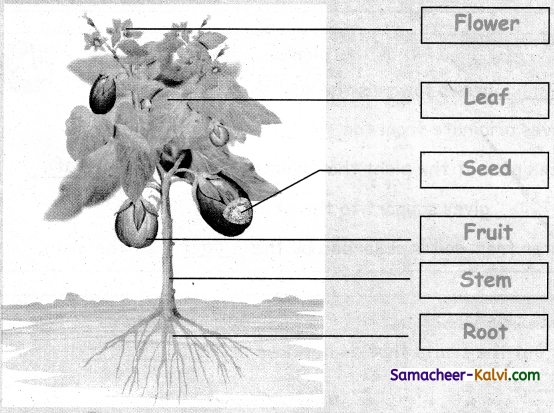
Unscramble the words and label the parts of the plant.
(ETSM, TORO, ELFA, FURTI, LOFEWR, SDEE)
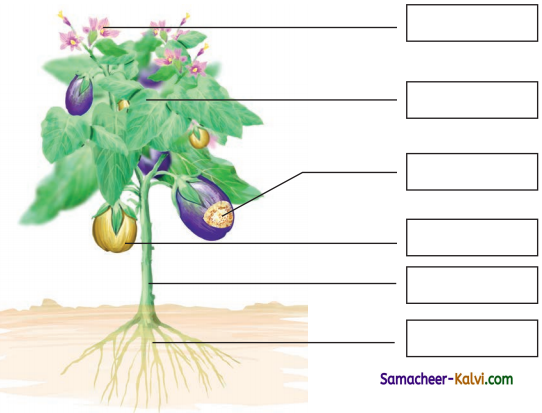
Samacheer Kalvi 3rd Standard Science Guide Term 2 Chapter 3 Plants 1

Answer:

Samacheer Kalvi 3rd Standard Science Guide Term 2 Chapter 3 Plants 2

Samacheer Kalvi 3rd Standard Science Guide Term 2 Chapter 3 Plants

Let us Do (Text Book Page No. 60):

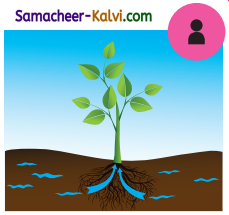
Take two small potted plants. Cut the root of one of the plants and fix ¡t in the pot. Now water the plants for two to three days. You will observe that the plant without roots will wilt and die. In the absence of roots, plants die.

This activity proves that the function of the roots is to absorb ________ and _______ from the soil.
Answer:
Water, Minerals

Let us Write (Text Book Page No. 60):

True or False
Samacheer Kalvi 3rd Standard Science Guide Term 2 Chapter 3 Plants 3

Question 1.
The roots grow into the soil.
Answer:
True

Question 2.
Fibrous root has a main root.
Answer:
False

Question 3.
Root absorbs water from soil.
Answer:
True

Question 4.
Potato stores food in its root.
Answer:
False

Question 5.
Grass has fibrous roots.
Answer:
True

Samacheer Kalvi 3rd Standard Science Guide Term 2 Chapter 3 Plants

Fill in the blanks.

Question 1.
_____________ grows towards the sunlight.
Answer:
Stem

Question 2.
Leaves originate from the _____________ .
Answer:
surface of the stem

Question 3.
Green part of the plant that makes food is called _____________ .
Answer:
leaf

Question 4.
_____________ gives support to the whole plant.
Answer:
Stem

Question 5.
Water from soil is absorbed by the _____________ of the plant.
Answer:
root

Samacheer Kalvi 3rd Standard Science Guide Term 2 Chapter 3 Plants

Think and Write

Question 1.
List out the fruits that do not have seeds. _____________ .
Answer:
Pineapple, Banana

Question 2.
Write down the names of the fruit trees that you have never seen0 but have tasted their fruits. ___________________ .
Answer:
Strawnerry tree, Plum tree, Pear tree

Samacheer Kalvi 3rd Standard Science Guide Term 2 Chapter 3 Plants

Let us Do

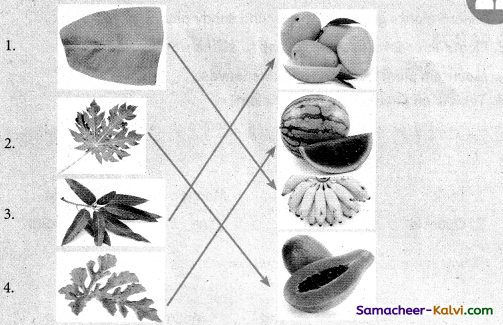
Connect the leaf with its fruit.
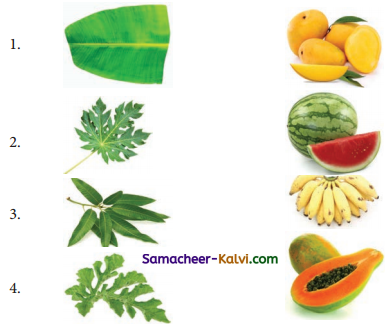
Samacheer Kalvi 3rd Standard Science Guide Term 2 Chapter 3 Plants 4
Answer:
Samacheer Kalvi 3rd Standard Science Guide Term 2 Chapter 3 Plants 5

Let us Connect

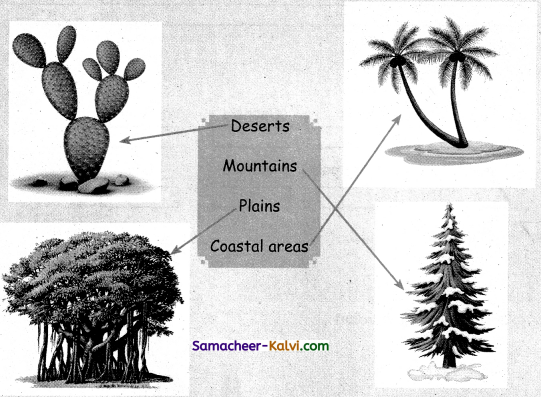
Match the plants with their living places.
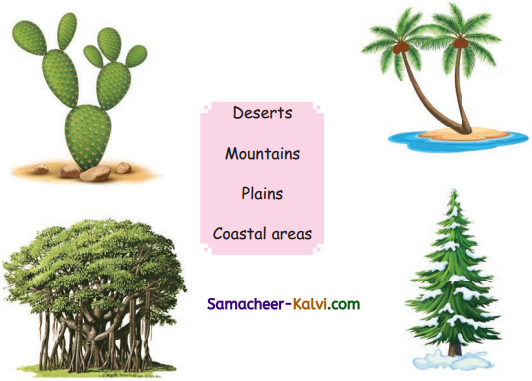
Samacheer Kalvi 3rd Standard Science Guide Term 2 Chapter 3 Plants 6
Answer:
Samacheer Kalvi 3rd Standard Science Guide Term 2 Chapter 3 Plants 7

Samacheer Kalvi 3rd Standard Science Guide Term 2 Chapter 3 Plants

Let us Try

A. Select the ‘INCORRECT’ statement from the following.

1. Desert plants grow in hot, dry and sandy places.
2. Plants in coastal areas tolerant to saline water.
3. Mountain plants have needle like leaves.
4. Teak is an example of desert plant.
Answer:
4. Teak is an example of desert plant.

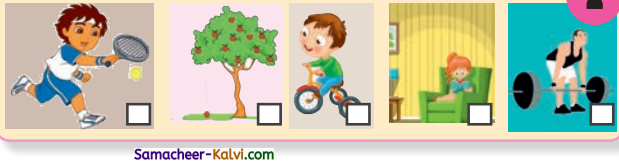
B. Tick (✓) the odd one.

Samacheer Kalvi 3rd Standard Science Guide Term 2 Chapter 3 Plants 8
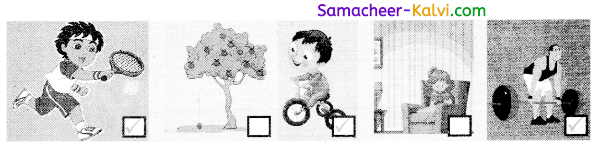
Answer:
Samacheer Kalvi 3rd Standard Science Guide Term 2 Chapter 3 Plants 9

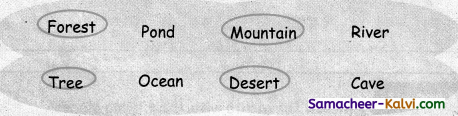
C. Circle the places which are land habitats.
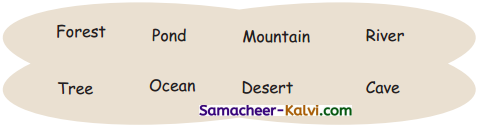
Samacheer Kalvi 3rd Standard Science Guide Term 2 Chapter 3 Plants 10
Answer:
Samacheer Kalvi 3rd Standard Science Guide Term 2 Chapter 3 Plants 11

Samacheer Kalvi 3rd Standard Science Guide Term 2 Chapter 3 Plants

Let us Try

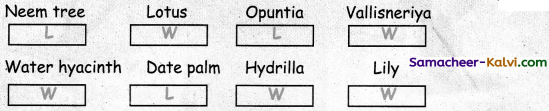
A. Mark “L” for land plants and W’ for water plants.
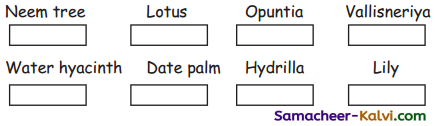
Samacheer Kalvi 3rd Standard Science Guide Term 2 Chapter 3 Plants 12
Answer:
Samacheer Kalvi 3rd Standard Science Guide Term 2 Chapter 3 Plants 13

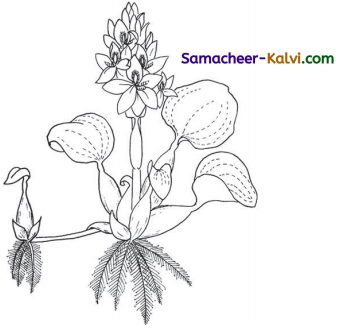
B. Colour the water hyacinth plant.

Samacheer Kalvi 3rd Standard Science Guide Term 2 Chapter 3 Plants 14
Answer:
Activity to be done by the students

Samacheer Kalvi 3rd Standard Science Guide Term 2 Chapter 3 Plants

C. Write true or false.

Question 1.
Fixed rooted plants are present in water bodies.
Answer:
True

Question 2.
Leaves of lotus are submerged in the water.
Answer:
False

Question 3.
Lotus plants are found in many ponds.
Answer:
True

Question 4.
Water hyacinth freely float with the help of a spongy body filled with air.
Answer:
True
Samacheer Kalvi 3rd Standard Science Guide

Samacheer Kalvi 3rd Standard Science Guide Term 2 Chapter 2 Water

Samacheer Kalvi 3rd Standard Science Book Solutions Term 2 Chapter 2 Water

I. Choose the correct answer.

Question 1.
Which is the main source of water? :
(a) Lake
(b) Sea
(c) Rain
Answer:
(c) Rain

Question 2.
_______ of the water in the entire Earth is freshwater.
(a) 3%
(b) 0.3%
(c) 30%
Answer:
(a) 3%

Question 3.
By ________ water, we can kill the germs.
(a) boiling
(b) cooling
(c) filtering
Answer:
(a) boiling

Question 4.
Which of these is not true?
(a) Plants and animals need water too
(b) We should always wastewater
(c) We should use water carefully
(d) Water is precious
Answer:
(b) We should always wastewater

Question 5.
Where does the rainwater go after falling on the ground?
1. Seeps into the ground
2. Plants absorb the water
3. Mingles with sea and ocean
4. Mixes with lake and pond
(a) 1 and 2
(b) 1, 3 and 4
(c) 1, 2, 3 and 4
Answer:
(c) 1, 2, 3 and 4

Samacheer Kalvi 3rd Standard Science Guide Term 2 Chapter 2 Water

II. Fill in the blanks.

Question 1.
Drinking water is known as _________. (pot water / potable water)
Answer:
potable water

Question 2.
Water that collects in the low lying areas is called ________. (sea / lake)
Answer:
lake

Question 3.
It is our ________ to keep the public water resources clean. (responsibility / work)
Answer:
responsibility

Question 4.
The largest source of water on the earth is __________. (river / sea)
Answer:
sea

Samacheer Kalvi 3rd Standard Science Guide Term 2 Chapter 2 Water

III. Circle the odd one.

Question 1.
a) Lake
b) Hill
c) Pond
d) Sea
Answer:
b) Hill

Question 2.
a) Lily
b) Lotus
c) Rose
d) Water Hyacinth
Answer:
c) Rose

Question 3.
a) Fish
b) Horse
c) Tiger
d) Cow
Answer:
a) Fish

Question 4.
a) Bathing
b) Combing
c) Swimming
d) Washing
Answer:
b) Combing

Samacheer Kalvi 3rd Standard Science Guide Term 2 Chapter 2 Water

IV. Write true or false.

Question 1.
Living things do not need water.
Answer:
False

Question 2.
Saving water is our duty.
Answer:
True

Question 3.
Always close the water tap while brushing teeth.
Answer:
True

Question 4.
A tank is a large area to store water compared to reservoirs.
Answer:
False

Samacheer Kalvi 3rd Standard Science Guide Term 2 Chapter 2 Water

V. Answer in one or two sentences:

Question 1.
Write any three different sources of water.
Answer:

  1. Rain
  2. Well
  3. River

Question 2.
Write the symptoms of dengue.
Answer:

  1. Severe headache
  2. Rashes on the arms and the legs
  3. Extreme tiredness
  4. Sudden onset of fever that lasts 3 – 7 days

Question 3.
Write any two diseases that ¡s spread by mosquitoes.
Answer:

  1. Malaria
  2. Dengue Fever

Samacheer Kalvi 3rd Standard Science Guide Term 2 Chapter 2 Water

VI. Answer the following.

Question 1.
Why is water known as primary source of life?
Answer:

  • All living things like small organisms, plants, and animals need water to survive.
  • People use water for various purposes. So, water is known as a primary source of life.

Question 2.
Suggest some ways to save water at home.
Answer:
Some methods to prevent wastage of water.

  1. Never allow water to overflow from buckets.
  2. Wash fruits and vegetables in a bowl of water and not under running tap water.
  3. Always close the taps while brushing the teeth.
  4. Use left over water in your water bottle to water a potted plant.
  5. Turn off the tap after each use.
  6. Use a sprinkler to water the garden.

Question 3.
List out the ways to conserve water bodies.
Answer:
Methods to Conserve Water Bodies

  • Deepening of ponds and lakes
  • Plant trees at the bank of the lake and pond
  • Reduce water pollution
  • Avoid digging too many wells in a region.

Samacheer Kalvi 3rd Standard Science Guide Term 2 Chapter 2 Water

VII. Think and answer.

Question 1.
How will you avoid wastage of water in your school?
Answer:

  1. We have to turn off the tap as soon as we wash our hands.
  2. Leakages from the taps have to be repaired immediately.
  3. Avoid flushing the toilet unnecessarily.
  4. Use a refillable water bottle.
  5.  Pour leftover water onto the garden.
  6. Wash the tiffin boxes in a bowl of water.
  7.  Raise awareness of the importance of water by creating colorful posters on water saving.

Question 2.
Write some slogans to save water.
Answer:

  1. Save water and it will save you.
  2. Life starts with water.
  3. Water is more precious than Gold.
  4. Put a Stop to the Water Drop.
  5. Life is impossible without water.
  6. Save water secure the future.
  7. Conserve water, every drop counts!
  8. Saving water can save the world.
  9. Imagine one day without water.
  10. Do your share to care water.

Samacheer Kalvi 3rd Standard Science Guide Term 2 Chapter 2 Water

In-Text Activity:

Let us Write (Text Book Page No. 49):

Observe the picture and fill in the blanks.

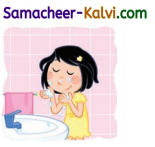
Question 1.

Samacheer Kalvi 3rd Standard Science Guide Term 2 Chapter 2 water 1

We need water to _______ our face.
Answer:
wash

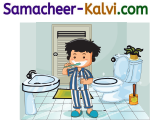
Question 2.

Samacheer Kalvi 3rd Standard Science Guide Term 2 Chapter 2 water 2

We need water to ______ our teeth.
Answer:
brush

Question 3.

Samacheer Kalvi 3rd Standard Science Guide Term 2 Chapter 2 water 3

We need water to ______ our food.
Answer:
cook

Question 4.

Samacheer Kalvi 3rd Standard Science Guide Term 2 Chapter 2 water 4

We need water to ________ our vessels.
Answer:
wash

Question 5.

Samacheer Kalvi 3rd Standard Science Guide Term 2 Chapter 2 water 5

We need water to _______.
Answer:
drink

Samacheer Kalvi 3rd Standard Science Guide Term 2 Chapter 2 Water

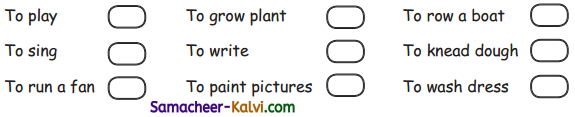
Let us Do (Text Book Page No. 49):

Samacheer Kalvi 3rd Standard Science Guide Term 2 Chapter 2 water 6

Answer:

Samacheer Kalvi 3rd Standard Science Guide Term 2 Chapter 2 water 7

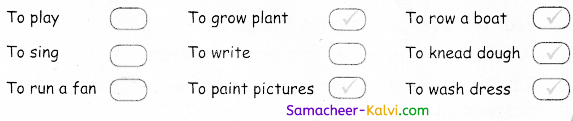
B. Name any four activities which you can do without water.

Samacheer Kalvi 3rd Standard Science Guide Term 2 Chapter 2 water 8

Answer:

  • reading
  • singing
  • dancing
  • walking

Samacheer Kalvi 3rd Standard Science Guide Term 2 Chapter 2 Water

Let us Discuss (Text Book Page No. 50):

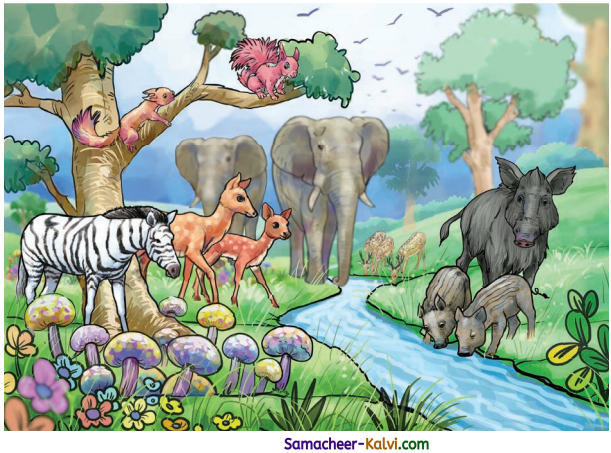
We find animals in the picture near a water source. Why they are gathered here?

Samacheer Kalvi 3rd Standard Science Guide Term 2 Chapter 2 water 9

Answer:
They are gathered near the water source to drink water.

Write few lines about the picture.
Answer:
There are elephants, zebra, deer, squirrel, porcupine, pig in this picture. When they are thirsty, they come to a stream to drink water. Wild animals need water. Hence, they come to water bodies in the forests, Just like us, animals too drink water when they are thirsty.

Samacheer Kalvi 3rd Standard Science Guide Term 2 Chapter 2 water 10

Answer:
Wild animals are entering into human habitat because they are losing their natural habitat. People have occupied the forest lands by cutting trees.

Animals get disturbed due to deforestation and urbanization around the forest area. So, the wild animals are coming out of their natural habitat. Usually they come out to the residential areas in search of food and water in summer.

Samacheer Kalvi 3rd Standard Science Guide Term 2 Chapter 2 Water

Let us write (Text Book Page No. 51):

Rearrange the jumbled letters to find out the different sources of water.
E.g. Rain (anir)

Question 1.
_______ ( a l k e )
Answer:
Lake

Question 2.
_______ (o p d n )
Answer:
Pond

Question 3.
_______ (m e r a t s)
Answer:
Stream

Question 4.
_______ (e l l w)
Answer:
Well

Question 5.
_______ ( e a s )
Answer:
Sea

Question 6.
_______ ( o n a e c )
Answer:
Ocean

Samacheer Kalvi 3rd Standard Science Guide Term 2 Chapter 2 Water

Let us Discuss (Text Book Page No. 51):

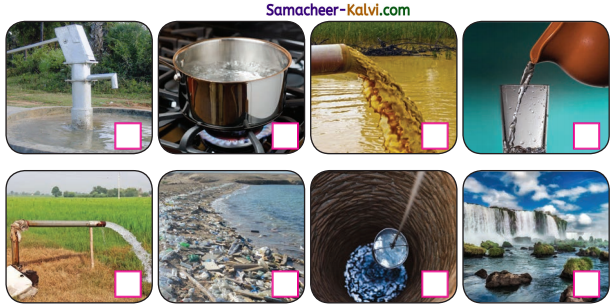
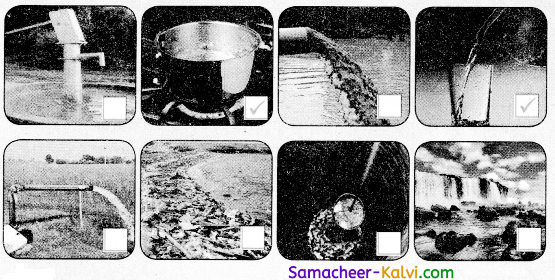
Samacheer Kalvi 3rd Standard Science Guide Term 2 Chapter 2 water 11

Answer:

Samacheer Kalvi 3rd Standard Science Guide Term 2 Chapter 2 water 12

1. Water from Hand Water Pump:
We have to boil the water and use for drinking.

2. Boiled water:
Good for drinking.

3. Sewage water is disposed of directly into the river:
In this way, the river water is polluted.

4. Pure water kept in jugs:
Good for drinking.

5. Water for irrigation purpose:
If we want to drink it, it should be boiled.

6. Water at riverside:
It is polluted and contaminated by plastic and other waste materials.

7. Well water:
Though it is good, it is advised to boil it and use for drinking purposes.

8. Water from the waterfall :
It is not good for drinking. Any outdoor water source, except rain/snow, is likely to be contaminated with parasites.

Samacheer Kalvi 3rd Standard Science Guide Term 2 Chapter 2 Water

Try to Answer (Text Book Page No. 51):

I freeze when I am cold and
I fall softly as snow,
I melt in the sun and down the mountain I flow.
Who am I? _________
Answer:
Water

Samacheer Kalvi 3rd Standard Science Guide Term 2 Chapter 2 Water

Try to Answer (Text Book Page No. 53):

Question 1.
Write some activities through which we can save water.
Answer:

  1. Check taps and pipes for leaks.
  2. Turn off the water while brushing your teeth.
  3. Clean the vegetables in a bowl or sink full of clean water instead of cleaning directly under the tap.
  4. Use a broom to clean verandah, and steps instead of cleaning with a water hose.
  5. Rainwater harvesting is a good way to save water.

Samacheer Kalvi 3rd Standard Science Guide Term 2 Chapter 2 Water

Let us Do (Text Book Page No. 53):

Answer the following questions by putting a tick (✓) If your answer is different from all of the given Pictures, write its name in the empty box.

Question 1.
Which one do you use to drink water?

Samacheer Kalvi 3rd Standard Science Guide Term 2 Chapter 2 water 13

Answer:

Samacheer Kalvi 3rd Standard Science Guide Term 2 Chapter 2 water 14

Question 2.
Which of these is used to store drinking water at your home?

Samacheer Kalvi 3rd Standard Science Guide Term 2 Chapter 2 water 15

Answer:

Samacheer Kalvi 3rd Standard Science Guide Term 2 Chapter 2 water 16

Question 3.
Where do you get your drinking water from?

Samacheer Kalvi 3rd Standard Science Guide Term 2 Chapter 2 water 17

Answer:

Samacheer Kalvi 3rd Standard Science Guide Term 2 Chapter 2 water 18

Samacheer Kalvi 3rd Standard Science Guide Term 2 Chapter 2 Water

Discuss with your friends and write. What will happen, if you drink unclean water? (Text Book Page No. 56):
Answer:
If we drink uncleaned, polluted, contaminated water, we will suffer due to several kinds of waterborne diseases, such as-

  • Cholera
  • Diarrhea
  • Typhoid
  • Hepatitis A
  • Jaundice

Microorganisms such as virus, bacteria, etc. are present in impure water.
These diseases can be life-taking as they are harmful to our immune system also.

Samacheer Kalvi 3rd Standard Science Guide Term 2 Chapter 2 Water

Let us Do (Text Book Page No. 53):

A. What are the activities to save water? If true put (✓). if false put (✗).

Question 1.
We should wash our vehicles everyday.
Answer:

Question 2.
Planting more trees leads to rain fall.
Answer:

Question 3.
We can bathe in shower to save water.
Answer:

Question 4.
It is necessary to collect rain water.
Answer:

Samacheer Kalvi 3rd Standard Science Guide Term 2 Chapter 2 Water

B. Look at the pictures and answer the following.

Samacheer Kalvi 3rd Standard Science Guide Term 2 Chapter 2 water 19

If we fill them with water

Question 1.
Which will contain less water?
Answer:
B

Question 2.
Which will contain more water?
Answer:
A

Question 3.
How could you tell?
Answer:
I could tell after seeing the size of the container.

Samacheer Kalvi 3rd Standard Science Guide

Samacheer Kalvi 3rd Standard Science Guide Term 2 Chapter 1 Food

Samacheer Kalvi 3rd Standard Science Book Solutions Term 2 Chapter 1 Food

I. Choose and write the correct answer:

Question 1.
Bread, wheat and potato are rich in __________.
(a) fats
(b) carbohydrate
(c) protein
(d) roughage
Answer:
(b) carbohydrate

Question 2.
A balanced diet contains _________.
(a) Carbohydrates and vitamins
(b) Proteins, fats and minerals
(c) Fibre and water
(d) All the above
Answer:
(d) All the above

Question 3.
The Vitamin present in carrot is _________
(a) Vitamin-K
(b) Vitamin-A
(c) Vitamin-D
(d) Vitamin-E
Answer:
(b) Vitamin-A

Question 4.
Which of these things are BAD for you?
(a) Eating green vegetables
(b) Washing vegetables before cutting them
(c) Eating lot of fat food items
(d) Eating lot of pulses
Answer:
(c) Eating lot of fat food items

Question 5.
The given picture shows that Raman is most likely eating his a) Breakfast b) Lunch c) Dinner
(a) Breakfast
(b) Lunch
(c) Dinner
Answer:
(b) Lunch

Samacheer Kalvi 3rd Standard Science Guide Term 2 Chapter 1 Food

II. Fill in the blanks.

Question 1.
Food rich in ________ are called body-building food.
Answer:
Proteins

Question 2.
________ helps in proper functioning of our body.
Answer:
Vitamins

Question 3.
A ________ is necessary for the proper growth and development of our body.
Answer:
Balanced diet

Question 4.
Sprouted seeds contain more _______.
Answer:
Proteins

Question 5.
________ is the second meal of a day.
Answer:
Lunch

Samacheer Kalvi 3rd Standard Science Guide Term 2 Chapter 1 Food

III. Match the following:

1. Carbohydrates and fatsa. Supports body growth
2. Vitaminsb. Regulates body functions
3. Proteinsc. Energy-giving food
4. Mineralsd. Fights diseases

Answer:

1. Carbohydrates and fatsa. Energy-giving food
2. Vitaminsb. Fights diseases
3. Proteinsc. Supports body growth
4. Mineralsd. Regulates body functions

Samacheer Kalvi 3rd Standard Science Guide Term 2 Chapter 1 Food

IV. Answer the following questions.

Question 1.
How many nutrients are there? What are they?
Answer:
There are five main nutrients that our body requires. They are carbohydrates, proteins, fats, vitamins and minerals.

Question 2.
Siva is 6 years old. He needs to have good amount of proteins. Give reason.
Answer:
Growing kids need protein to help them build, maintain and replace the tissues in our body. Protein foods also help to form new blood cells and body tissues, and they help the nervous system function properly. So protein are known as body-building foods.

Question 3.
What is a balanced diet?
Answer:
A balanced diet contains all nutrients in the right amounts. It also includes fibre and water. It helps in the growth and development of our body.

Samacheer Kalvi 3rd Standard Science Guide Term 2 Chapter 1 Food

Question 4.
What are the meals in a day?
Answer:
A meal is what we eat during a particular time of the day. Breakfast, Lunch and Dinner are the three main meals we eat every day.

Question 5.
What are some traditional food items?
Answer:
Traditional Foods are Ragi, Thinai, Samai, Kuthiraivaali, Varagu and Kambu.

Question 6.
Write any three advantages of a Home Garden.
Answer:

  1. It is the easiest method.
  2. Waste water can be reused.
  3. We get vegetables which are fresh and high in nutritive value.

Samacheer Kalvi 3rd Standard Science Guide Term 2 Chapter 1 Food

In-Text Activity:

Warm-up (Text Book Page No. 37):

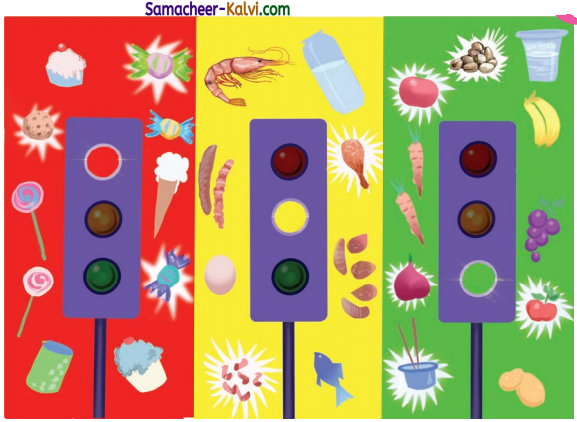
Samacheer Kalvi 3rd Standard Science Guide Term 2 Chapter 1 Food 1

a. The food items which should be avoided are indicated by ________ colour.
Answer:
Red

b. The food items which are healthy are indicated by ________ colour.
Answer:
Green

c. The food items which can be eaten in small quantities are indicated by ________ colour.
Answer:
Yellow

Samacheer Kalvi 3rd Standard Science Guide Term 2 Chapter 1 Food

Let us Write (Text Book Page No. 39):

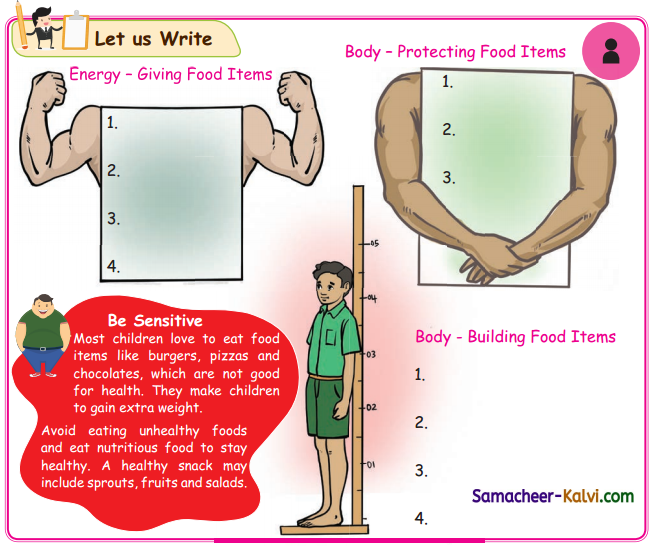
Samacheer Kalvi 3rd Standard Science Guide Term 2 Chapter 1 Food 2

Answer:

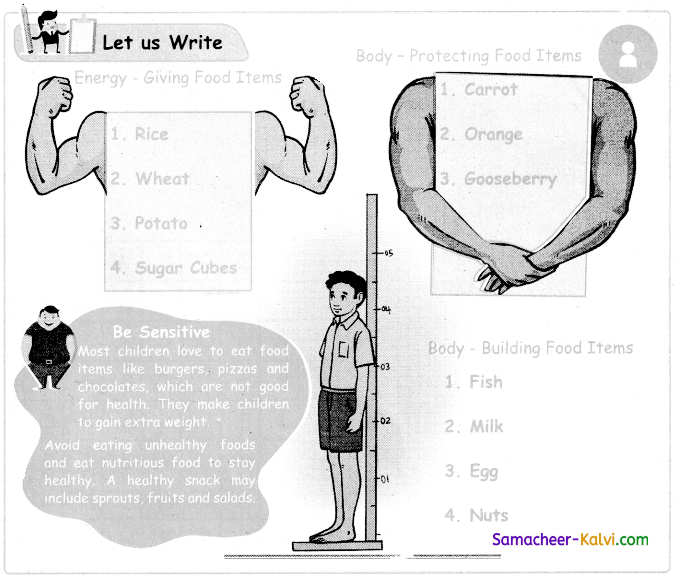
Samacheer Kalvi 3rd Standard Science Guide Term 2 Chapter 1 Food 3

Samacheer Kalvi 3rd Standard Science Guide Term 2 Chapter 1 Food

Let us Write (Text Book Page No. 40):

A. What are the nutrients present in the following food items?

Question 1.
Rice contains _______.
Answer:
Carbohydrates

Question 2.
Coconut oil contains _______.
Answer:
Fats

Question 3.
Egg contains _______.
Answer:
Protein

Question 4.
Fig contains _______.
Answer:
Minerals

Question 5.
Carrot contains _______.
Answer:
Vitamins

Samacheer Kalvi 3rd Standard Science Guide Term 2 Chapter 1 Food

B. Fill in the table given below:

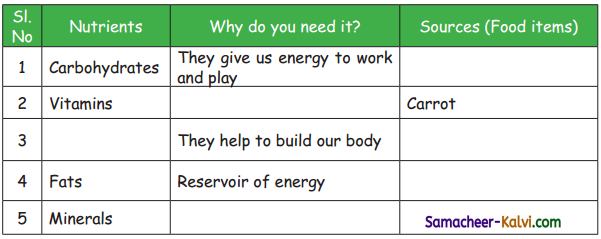
Samacheer Kalvi 3rd Standard Science Guide Term 2 Chapter 1 Food 4

Answer:

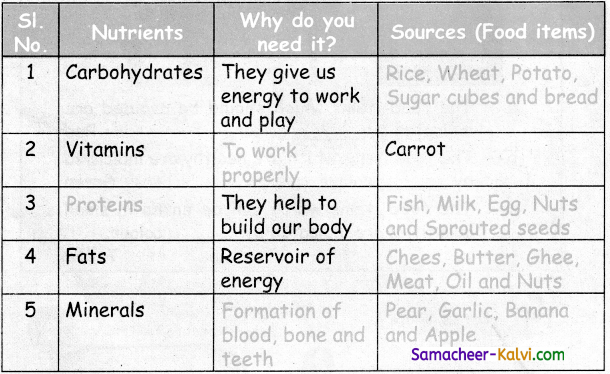
Samacheer Kalvi 3rd Standard Science Guide Term 2 Chapter 1 Food 5

Samacheer Kalvi 3rd Standard Science Guide Term 2 Chapter 1 Food

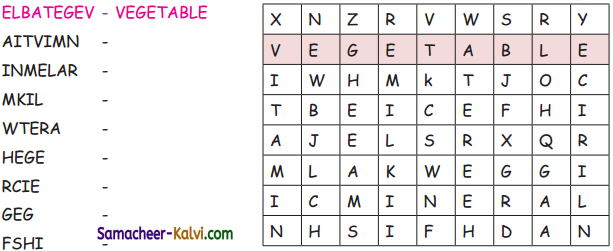
Let us Find (Text Book Page No. 41):

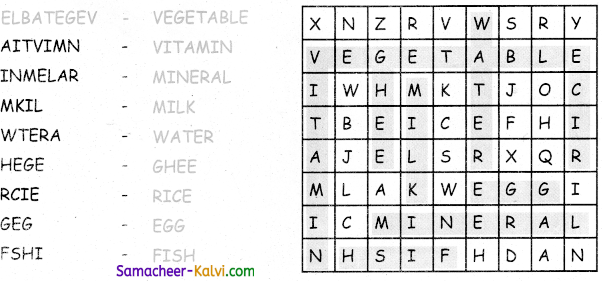
Unscramble the following worlds and search them in the ven grid (One is done for you).

Samacheer Kalvi 3rd Standard Science Guide Term 2 Chapter 1 Food 6

Answer:

Samacheer Kalvi 3rd Standard Science Guide Term 2 Chapter 1 Food 7

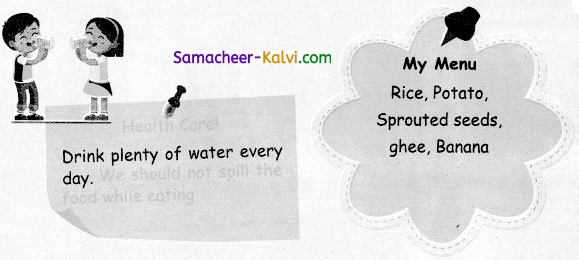
Let us Do (Text Book Page No. 41):

Samacheer Kalvi 3rd Standard Science Guide Term 2 Chapter 1 Food 8

Answer:

Samacheer Kalvi 3rd Standard Science Guide Term 2 Chapter 1 Food 9

Samacheer Kalvi 3rd Standard Science Guide Term 2 Chapter 1 Food

To check whether it is a balanced diet, split your meal according to the nutrients.

Samacheer Kalvi 3rd Standard Science Guide Term 2 Chapter 1 Food 10

Answer:

ProteinsCarbohydratesVitamins and MineralsFats
Sprouted seeds, Egg, MilkRice, PotatoCarrot, Orange, Banana, AppleButter, Ghee, Meat

Think & Answer:

Question 1.
Why do you eat every day? What happens if you don’t eat sometimes?
Answer:

  • Every day we feel hungry, and so we eat something.
  • If we don’t eat sometimes, we will be tired.

Question 2.
Why do we need food?
Answer:

  • Food gives us the energy to work and play.
  • Food builds our body.
  • Food keeps us healthy. So, we need food.

Question 3.
What do you usually eat for breakfast?
Answer:
I usually eat any one of the items of idly, dosa, bread omelet, idiyappam, poori, aappam, and Pongal.

Samacheer Kalvi 3rd Standard Science Guide Term 2 Chapter 1 Food

Question 4.
Which of the food items that are brought by your friends for lunch?
Answer:
My friends bring curd rice, lemon rice, tomato rice, tamarind rice, rice along with sambar, biriyani, fruit salad, greens, vegetable salad, cereals, etc. for lunch.

Question 5.
At what time you go to bed every day? At what time you have your dinner?
Answer:

  • I go to bed at 9.00 p.m.every day.
  • I have my dinner at 8.00 p.m.

Samacheer Kalvi 3rd Standard Science Guide Term 2 Chapter 1 Food

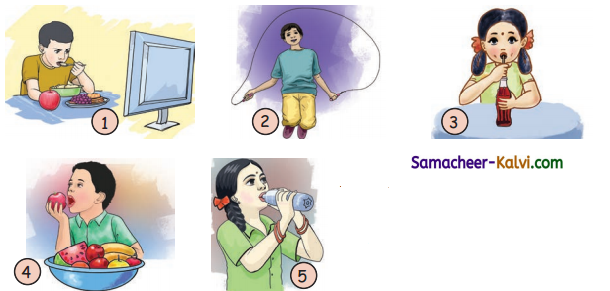
Try to Answer (Text Book Page No. 43):

Samacheer Kalvi 3rd Standard Science Guide Term 2 Chapter 1 Food 11

Question 1.
Which activities are healthy?
Answer:
2, 4, 5

Question 2.
Which activities are not so healthy?
Answer:
1, 3

Samacheer Kalvi 3rd Standard Science Guide Term 2 Chapter 1 Food

Try to answer (Text Book Page No. 44):

Some of the famous food items of Tamil Nadu are given below. Write the food items of the particular place.
(halwa, murukku, jackfruit, spices, kadalai mittai, mango, tea)

Question 1.
Manapparai is famous for ________
Answer:
Murukku

Question 2.
The nilgiris is famous for ________
Answer:
Tea

Question 3.
Panruti is famous for ________
Answer:
Jackfruit

Question 4.
Kollimalai is famous for ________
Answer:
Spices

Question 5.
Tirunelveli is famous for ________
Answer:
Halwa

Question 6.
Kovilpatti is famous for ________
Answer:
Kadalai Mittai

Question 7.
Salem is famous for ________
Answer:
Mango

Samacheer Kalvi 3rd Standard Science Guide Term 2 Chapter 1 Food

Let us Discuss (Text Book Page No. 45):

Observe the pictures. Who needs more nutritious food? Why?

Samacheer Kalvi 3rd Standard Science Guide Term 2 Chapter 1 Food 12

Samacheer Kalvi 3rd Standard Science Guide Term 2 Chapter 1 Food 13

Answer:
Manual laborers are some of the hardest working people out there and it’s very important that they keep their energy high for the day, not only to be able to complete the work, but also to keep their brains alert to avoid mistakes or accidents. So they need more nutritious food.

Samacheer Kalvi 3rd Standard Science Guide Term 2 Chapter 1 Food

Try to Answer (Text Book Page No. 45):

Do your parents prepare the same food items for all festivals? If not, write the name of special food items prepared at different festivals.

Samacheer Kalvi 3rd Standard Science Guide Term 2 Chapter 1 Food 14

Answer:

S. NoName of the festivalsFood items prepared
1DeepavaliMurukku, Athirasam
2PongalJaggery Pongal
3RamzanBiryani
4ChristmasCake
5Vinayaka ChaturthiKozhukattai

Let us Do (Text Book Page No. 46):

A. Colour the circle in GREEN for traditional food and ‘RED’ for modern food.

Samacheer Kalvi 3rd Standard Science Guide Term 2 Chapter 1 Food 15

Answer:

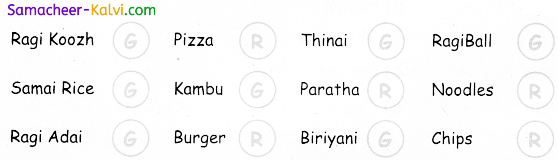
Samacheer Kalvi 3rd Standard Science Guide Term 2 Chapter 1 Food 16

B. Using watercan / coconut shells, make a mini garden in your classrooms
Answer:
Activity to be done by students.

Samacheer Kalvi 3rd Standard Science Guide Term 2 Chapter 1 Food

3rd Standard Science Guide Food Additional Questions and Answers

I. Choose and write the correct answer:

Question 1.
_________ is included ¡n our ancestor’s food.
a) Pizza
b) Chips
c) Thinal
d) Burger
Answer:
c) Thinal

Question 2.
The number of main nutrients required by our body is ________
a) three
b) four
c) five
d) six
Answer:
c) five

Question 3.
_________ act as the body’s energy reservoir.
a) Proteins
b) Fats
c) Minerals
d) vitamins
Answer:
b) Fats

Question 4.
_________ is a complete balanced diet.
a) Milk
b) Carrot
c) Rice
d) Orange
Answer:
a) Milk

Question 5.
The amount of food a person needs depends on his _______.
a) wish
b) height
c) weight
d) age
Answer:
d) age

Samacheer Kalvi 3rd Standard Science Guide Term 2 Chapter 1 Food

II. Fill in the blanks.

Question 1.
World Food day is observed on _______.
Arts:
October – 16.

Question 2.
Cabbage contains Vitamin- ________.
Answer:
K.

Question 3.
In _______ areas, people eat a lot of seafood.
Answer:
coastal

Question 4.
We should spend _______ for washing our hands before eating.
Answer:
20 seconds.

Samacheer Kalvi 3rd Standard Science Guide Term 2 Chapter 1 Food

III. Match the following.

1. Kollimalaia. Halwa
2. The Nilgirisb. Murukku
3. ManapparaiC. Spices
4. Tirunelvelid. Tea

Answer:

1. Kollimalaia. Spices
2. The Nilgirisb. Tea
3. ManapparaiC. Murukku
4. Tirunelvelid. Halwa

Samacheer Kalvi 3rd Standard Science Guide Term 2 Chapter 1 Food

IV. Write True or False.

Question 1.
We should not spill the food while eating.
Answer:
True

Question 2.
Burgers, pizzas, and chocolates are good for health.
Answer:
False

Question 3.
Roughage, also known as fiber, is an indigestible food.
Answer:
True

Question 4.
Salem is famous for Jackfruit.
Answer:
False

Question 5.
Athletes may need less amount of energy during training.
Answer:
False

Samacheer Kalvi 3rd Standard Science Guide Term 2 Chapter 1 Food

V. Answer the following questions.

Question 1.
What is the significance of ‘Ragi’?
Answer:
Of all the cereals, ragi is the best bodybuilder and the disease fighter.

Question 2.
What are the food items that can be eaten by Children?
Answer:
Milk, honey, fruits, vegetables, whole grains, egg, sprouted seeds, and fish.

Question 3.
Write the names of the food items that can be eaten by Young Adults?
Answer:
All vegetables, fruits, seafood, greens, milk, and milk products.

Question 4.
Write the names of the food items that can be eaten by Old adults?
Answer:
Fibrous food, low-fat dairy products, food with less salt, ragi, thinai, and pearl millet (kambu).

Samacheer Kalvi 3rd Standard Science Guide Term 2 Chapter 1 Food

Question 5.
Write the different varieties of’Ragi’food.
Answer:
Ragi ball, Ragi dosa, Ragi adai, Ragi vermicelli and Ragi biscuits.

Question 6.
What is meant by ‘Home Garden’?
Answer:
Cultivation of crops in a small available place in households is known as a Home garden or Kitchen garden or Nutrition garden.

Question 7.
Differentiate South Indian Food and North Indian Food.
Answer:
South Indian Food:

  • South Indians depend on rice, dhal, coconut, jaggery for their food.
  • They make food like Idly, Sambar, Kozhukkattai and Payasam.

North Indian Food:

  • North Indians depend on wheat, onions, milk and curd.
  • They make foods like Chappathi, Paratha and Lassi.

Question 8.
Write a note on ‘Fats’.
Answer:

  1. Fats provide energy for us.
  2. They act as the body’s energy reservoir.
  3. Fats also help to keep the body warm during very cold weather.
  4. Too much fat in the body may lead to obesity or overweight.
  5. Cheese, butter, ghee, meat, oil, and nuts are some food items that contain fat.

Samacheer Kalvi 3rd Standard Science Guide

Samacheer Kalvi 3rd Standard Science Guide Term 1 Chapter 4 Science in Everyday Life

Samacheer Kalvi 3rd Standard Science Book Solutions Term 1 Chapter 4 Science in Everyday Life

I. Say whether the following statements are true or False:

Question 1.
When we boil water, bacteria are destroyed.
Answer:
True

Question 2.
Idli is cooked by the process called steaming.
Answer:
True

Question 3.
Thermometer is used to measure pressure.
Answer:
False

Question 4.
Refrigerator helps to keep things cold.
Answer:
True

Question 5.
Garlic relieves hiccups and nausea.
Answer:
False

Question 6.
Boiling point of water is 100°C.
Answer:
True

Samacheer Kalvi 3rd Standard Science Guide Term 1 Chapter 4 Science in Everyday Life

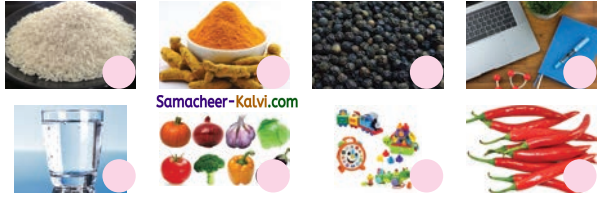
II. Circle the name of the things from which idli is made:

Samacheer Kalvi 3rd Standard Science Guide Term 1 Chapter 4 Science in Everyday Life 1

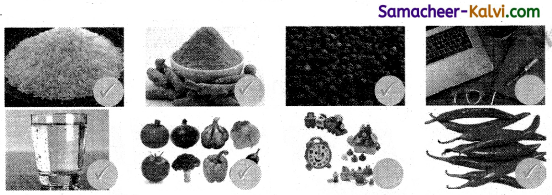
Answer:

Samacheer Kalvi 3rd Standard Science Guide Term 1 Chapter 4 Science in Everyday Life 2

Samacheer Kalvi 3rd Standard Science Guide Term 1 Chapter 4 Science in Everyday Life

III. Match the home appliances and their functions:

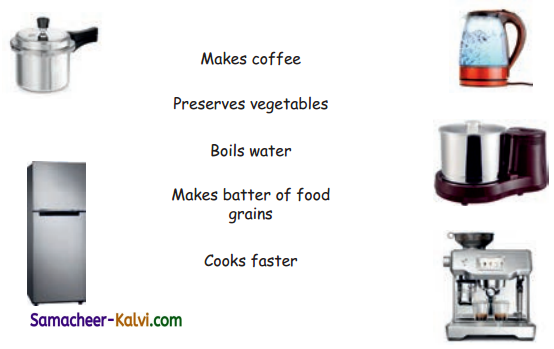
Samacheer Kalvi 3rd Standard Science Guide Term 1 Chapter 4 Science in Everyday Life 3

Answer:

Samacheer Kalvi 3rd Standard Science Guide Term 1 Chapter 4 Science in Everyday Life 4

Samacheer Kalvi 3rd Standard Science Guide Term 1 Chapter 4 Science in Everyday Life

IV. Which of these are safe to do at home? Put (✓) or cross (✗) in the box.

Question 1.
Touching electrical appliances
Answer:

Question 2.
Playing with sharp objects
Answer:

Question 3.
Playing in kitchen
Answer:

Question 4.
Keep safe distance from the gas stove and cylinder
Answer:

Samacheer Kalvi 3rd Standard Science Guide Term 1 Chapter 4 Science in Everyday Life

V. Answer in a word or sentence:

Question 1.
How do you store fruits and vegetables for a longer period?
Answer:
We store fruits and vegetables for a longer time by preserving them in a refrigerator.

Question 2.
Name the instrument used to measure temperature.
Answer:
Thermometer is used to measure temperature.

Question 3.
How is idli prepared?
Answer:
Idli is a natural fermentation process. It is prepared by steaming of fermented better prepared from soaked rice and black gram dal.

Question 4.
What is the use of black pepper?
Answer:
Black pepper is a great remedy for cold and cough.

Question 5.
Which kitchen medicine is called the poor man’s antibiotic?
Answer:
Garlic is called the poor man’s antibiotic.

Samacheer Kalvi 3rd Standard Science Guide Term 1 Chapter 4 Science in Everyday Life

VI. Answer the following:

Question 1.
Write the uses of boiled water.
Answer:
Uses of boiled water:

  • Destroys germs.
  • Healthier digestion.
  • Prevents us from the infection of water borne diseases.

Question 2.
Write the advantages of pressure cooker.
Answer:
Advantages of pressure cooker:

  • It cooks food much faster,
  • It saves energy.
  • It retains more nutrients,
  • Preserves the appearance of food.

Samacheer Kalvi 3rd Standard Science Guide Term 1 Chapter 4 Science in Everyday Life

Let us Think (Text Book Page No. 126):

Question 1.
The doctor advices patients to have idli or idiyappam. Can you guess why?
Answer:

  • Idli or idiyappam is cooked by steaming.
  • Steamed food is easily digested.

Tick (✓) the item which you see in your kitchen (Text Book Page No. 126):

Samacheer Kalvi 3rd Standard Science Guide Term 1 Chapter 4 Science in Everyday Life 5

Answer:

Samacheer Kalvi 3rd Standard Science Guide Term 1 Chapter 4 Science in Everyday Life 6

Samacheer Kalvi 3rd Standard Science Guide Term 1 Chapter 4 Science in Everyday Life

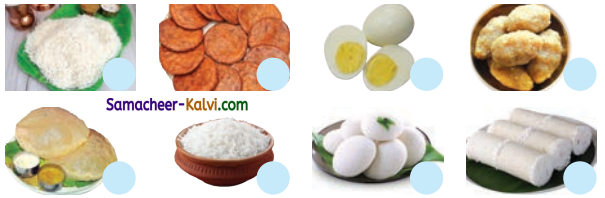
Tick (✓) the food item which are made by steaming (Text Book Page No. 126):

Samacheer Kalvi 3rd Standard Science Guide Term 1 Chapter 4 Science in Everyday Life 7

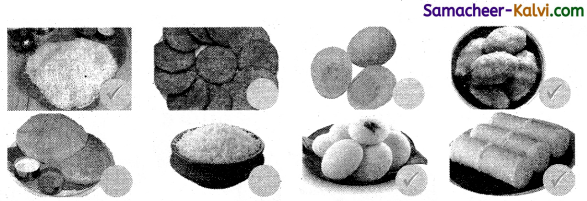
Answer:

Samacheer Kalvi 3rd Standard Science Guide Term 1 Chapter 4 Science in Everyday Life 8

Samacheer Kalvi 3rd Standard Science Guide Term 1 Chapter 4 Science in Everyday Life

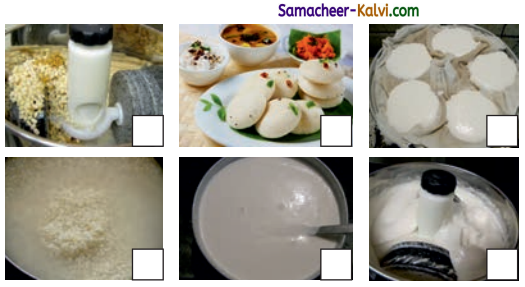
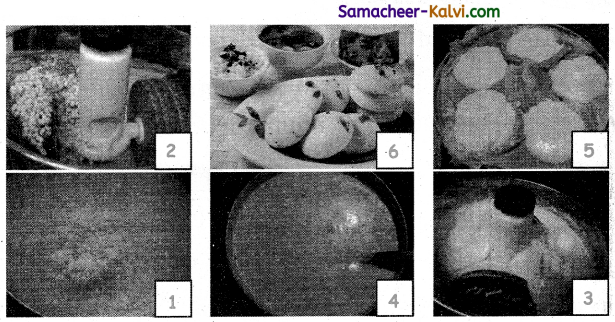
Arrange the pictures in correct order (Text Book Page No. 127):

Samacheer Kalvi 3rd Standard Science Guide Term 1 Chapter 4 Science in Everyday Life 9

Answer:

Samacheer Kalvi 3rd Standard Science Guide Term 1 Chapter 4 Science in Everyday Life 10

Samacheer Kalvi 3rd Standard Science Guide Term 1 Chapter 4 Science in Everyday Life

Let us Discuss (Text Book Page No. 128):

Question 1.
Which one takes less time to cook pulses?
a. pressure cooker
b. mud pot
Answer:
a. Pressure cooker

Question 2.
List out the food items prepared by pressure cooker Discuss with your friends.
Answer:
Pulses, Rice, Idli, Briyani.

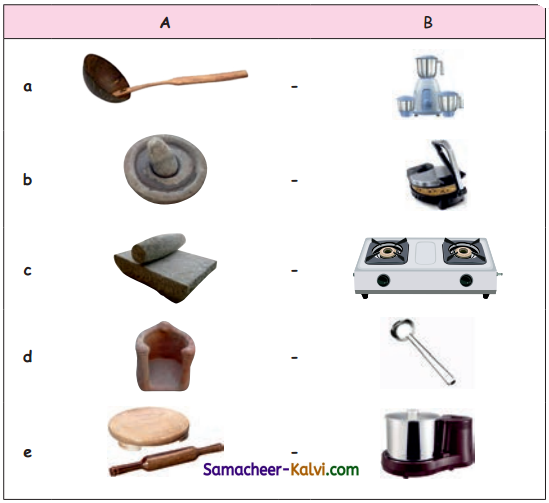
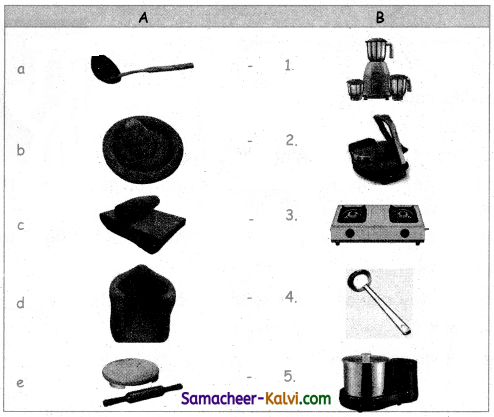
Match Column A and Column B (Text Book Page No. 129):

Samacheer Kalvi 3rd Standard Science Guide Term 1 Chapter 4 Science in Everyday Life 11

Samacheer Kalvi 3rd Standard Science Guide Term 1 Chapter 4 Science in Everyday Life 20

Answer:

a. (4)
b. (5)
c. (1)
d. (3)
e. (2)

Samacheer Kalvi 3rd Standard Science Guide Term 1 Chapter 4 Science in Everyday Life

Count and colour the objects (Text Book Page No. 130):

Samacheer Kalvi 3rd Standard Science Guide Term 1 Chapter 4 Science in Everyday Life 21

Answer:

Samacheer Kalvi 3rd Standard Science Guide Term 1 Chapter 4 Science in Everyday Life 13

Samacheer Kalvi 3rd Standard Science Guide Term 1 Chapter 4 Science in Everyday Life

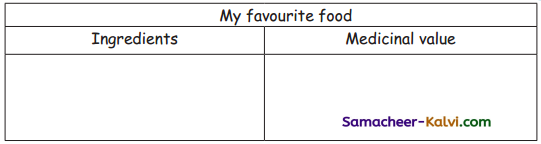
What are your favourite food items? Do you know the ingredients of them? Do they have any medicinal If so, fill in the table. (Text Book Page No. 131):

Samacheer Kalvi 3rd Standard Science Guide Term 1 Chapter 4 Science in Everyday Life 14

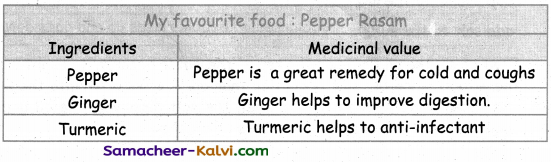
Answer:

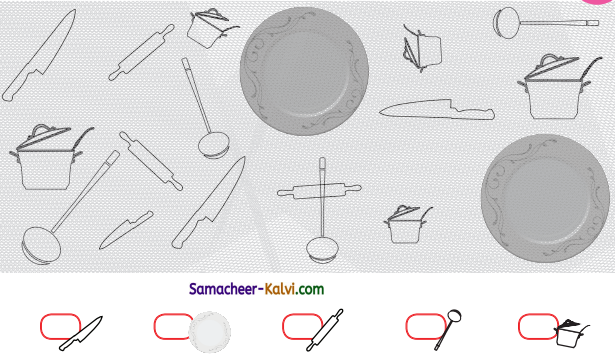
Samacheer Kalvi 3rd Standard Science Guide Term 1 Chapter 4 Science in Everyday Life 15

Real and Shadow (Text Book Page No. 132):

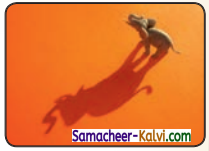
Samacheer Kalvi 3rd Standard Science Guide Term 1 Chapter 4 Science in Everyday Life 16

For what?
To learn how the shadows are formed.

How?

  1. Make the classroom dark.
  2. Light a candle.
  3. Place a toy near the candle. What do you see?
  4. Move the toy away from the candle. What do you see? Move the toy closer to the candle. What do you look at?
  5. Experiment and see what happens to the shadow if the light source is dim?

Complete the sentence:

Question 1.
Moving the toy closer to the candle made its shadow ________.
Answer:
Short

Question 2.
While moving the object away made its shadow ______.
Answer:
Long

Question 3.
The big candle is bright and gives ________ shadow.
Answer:
dark, clear

Question 4.
The small is dim and gives ________ shadow.
Answer:
dim

Samacheer Kalvi 3rd Standard Science Guide Term 1 Chapter 4 Science in Everyday Life

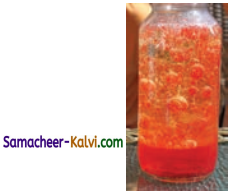
Lava in a cup (Text Book Page No. 132):

What to do?

Samacheer Kalvi 3rd Standard Science Guide Term 1 Chapter 4 Science in Everyday Life 17

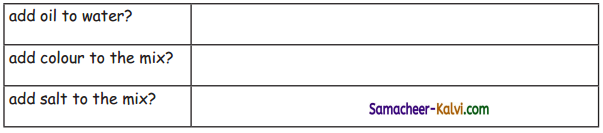
What happens when you (Text Book Page No. 133):

Samacheer Kalvi 3rd Standard Science Guide Term 1 Chapter 4 Science in Everyday Life 18

Answer:

Samacheer Kalvi 3rd Standard Science Guide Term 1 Chapter 4 Science in Everyday Life 19

First of all, the oil floats on the top of the water because it is lighter than the water. Since the salt is heavier than oil, it sinks down into the water and takes some oil with it, but when the salt dissolves, the oil goes up again. Is it not interesting?
Answer:
Yes, It is interesting.

Samacheer Kalvi 3rd Standard Science Guide Term 1 Chapter 4 Science in Everyday Life

3rd Standard Science Guide Science in Everyday Life Additional Questions and Answers

I. Choose the correct answer:

Question 1.
_________ is a common and usual breakfast of Tamil Nadu.
a) Idli
b) Poori
c) Pongal
Answer:
(a) Idli

Question 2.
_______ helps to reduce chest congestion.
a) Turmeric
b) Cloves
c) Coriander leaves
Answer:
(c) Coriander leaves

Question 3.
The best remedy for cold and caught is ________
a) cloves
b) ginger
c) black pepper
Answer:
(c) black pepper

Question 4.
Thermometer was invented in the year _________.
a) 1640
b) 1703
c) 1714
Answer:
(c) 1714

Samacheer Kalvi 3rd Standard Science Guide Term 1 Chapter 4 Science in Everyday Life

II. Fill in the blanks:

Question 1.
Idli is cooked by the method called
Answer:
steaming

Question 2.
_________ is a popular home appliance for preserving food.
Answer:
Fridge

Question 3.
_________ is invented by Thermometer.
Answer:
Daniel Fahrenheit

Question 4.
Boiling point of water is _______.
Answer:
100°C

Samacheer Kalvi 3rd Standard Science Guide Term 1 Chapter 4 Science in Everyday Life

III. Write True or False:

Question 1.
Science is the study of the natural world around us.
Answer:
True

Question 2.
Idiyappam is prepared from rice.
Answer:
True

Question 3.
Idli batter is fermented for 18 hours before use.
Answer:
False

Question 4.
Turmeric is a common anti-infectant.
Answer:
True

Samacheer Kalvi 3rd Standard Science Guide Term 1 Chapter 4 Science in Everyday Life

IV. Answer in a word or two:

Question 1.
How Science is involved in daily life?
Answer:

  • Even in our sleep our body is working continuously.
  • When we eat food, our digestive system is at work.

Question 2.
What is boiling?
Answer:
Heating a liquid until it becomes gas is called boiling.

Question 3.
Mention some safety measures in the kitchen.
Answer:

  • Never play with kitchen utensils.
  • Use a cloth to hold hot pans.
  • Inform an adult in case you smell cooking gas leakage.

Samacheer Kalvi 3rd Standard Science Guide

Samacheer Kalvi 3rd Standard Science Guide Term 1 Chapter 3 Force

Samacheer Kalvi 3rd Standard Science Book Solutions Term 1 Chapter 3 Force

I. Fill in the blanks with suitable words:
(Push, force, pull, speed, gravitational force, direction, Muscular)

Question 1.
A __________ is needed to make a stationary object move.
Answer:
Force

Question 2.
The force applied with the help of muscle is called _________ force.
Answer:
muscular

Question 3.
__________ and __________ are known as forces.
Answer:
Push and pull

Question 4.
The reason for the fruits to fall from the tree is ________.
Answer:
gravitational force

Question 5.
Force changes the _________ and ________.
Answer:
speed and direction

Samacheer Kalvi 3rd Standard Science Guide Term 1 Chapter 3 Force

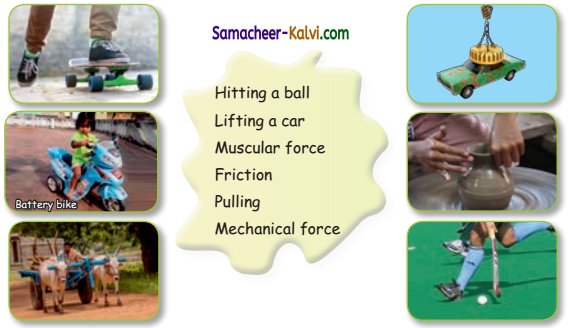
II. Match the words with their pictures:

Samacheer Kalvi 3rd Standard Science Guide Term 1 Chapter 3 Force 1

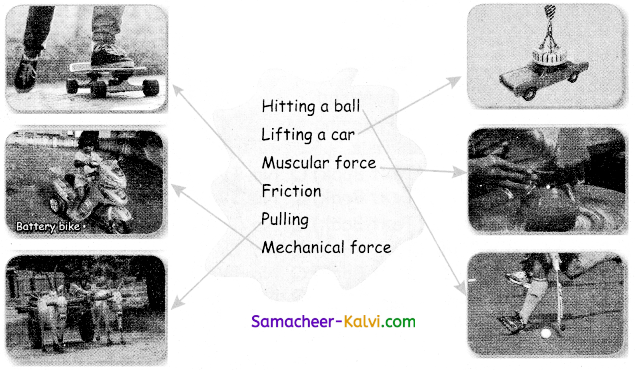
Answer:

Samacheer Kalvi 3rd Standard Science Guide Term 1 Chapter 3 Force 2

Samacheer Kalvi 3rd Standard Science Guide Term 1 Chapter 3 Force

III. Answer the following questions:

Question 1.
How do you open the door?
Answer:
I open the door by pushing or pulling.

Question 2.
Name the types of force.
Answer:
i) There are two types of forces.

  1. Contact force
  2. Non-contact force.

ii) Contact force is classified into three

  1. Muscular force
  2. Mechanical force
  3. Frictional force

iii) Non-Contact force is classified into two.

  1. Gravitational force
  2. Magnetic force.

Samacheer Kalvi 3rd Standard Science Guide Term 1 Chapter 3 Force

Question 3.
Which force is involved in collecting water from well?
Answer:
Muscular force is involved in collecting water from well.

Question 4.
What is push?
Answer:
When a force is applied in the direction of an object, it is called push.

Question 5.
What kind of force is used to make clay pot?
Answer:
Muscular force is used to make clay pot.

Samacheer Kalvi 3rd Standard Science Guide Term 1 Chapter 3 Force

IV. Sujatha places a magnet near some objects. What are the objects that will be attracted from the list given below?
(note, pin, coin, rubber, shirt, comb, steel tumbler, nail)
Answer:
pin, coin, steel tumbler, nail.

V. Think and answer:
Raja throws a ball, a stone, a paper, and a leaf up in the air? What kind of force is involved here? What will happen to them?
Answer:
i) Gravitational force is involved here.
ii) So the ball, the stone, the paper, and the leaf will fall down. The earth pulls all the objects towards itself.

Samacheer Kalvi 3rd Standard Science Guide Term 1 Chapter 3 Force

Intext Activity:

Let us look at the pictures below to understand movement and action better (Text Book Page No. 114):

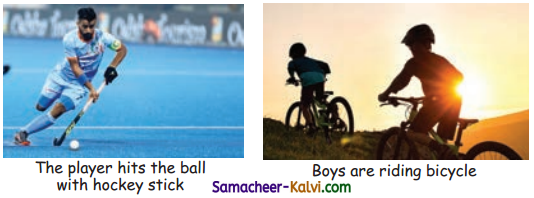
Samacheer Kalvi 3rd Standard Science Guide Term 1 Chapter 3 Force 3

In the above pictures.

Question 1.
What moves? _______, ________
Answer:
The ball, The cycle.

Question 2.
What is the action? _______, ________
Answer:
Hitting the ball, Riding the bicycle.

Samacheer Kalvi 3rd Standard Science Guide Term 1 Chapter 3 Force

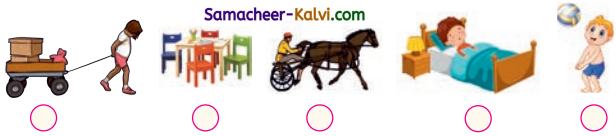
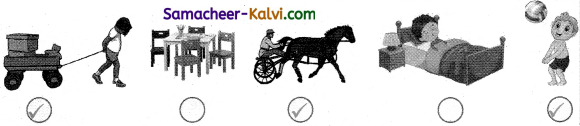
Put a tick (✓) mark for the pictures of motion (Text Book Page No. 116):

Samacheer Kalvi 3rd Standard Science Guide Term 1 Chapter 3 Force 4

Answer:

Samacheer Kalvi 3rd Standard Science Guide Term 1 Chapter 3 Force 5

Samacheer Kalvi 3rd Standard Science Guide Term 1 Chapter 3 Force

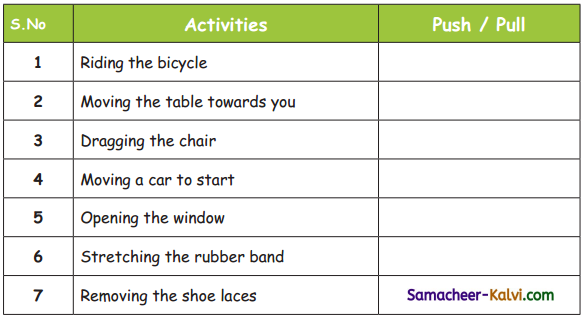
Classify the following – Push or Pull (Text Book Page No. 116):

Samacheer Kalvi 3rd Standard Science Guide Term 1 Chapter 3 Force 6

Answer:

S.NoActivitiesPush / Pull
1Riding the bicyclePush
2Moving the table towards youPull
3Dragging the chairPull
4Moving a car to startPush
5Opening the windowPush
6Stretching the rubber bandPull
7Removing the shoe lacesPull

Samacheer Kalvi 3rd Standard Science Guide Term 1 Chapter 3 Force

Match the following (Text Book Page No. 118):

Samacheer Kalvi 3rd Standard Science Guide Term 1 Chapter 3 Force 7

Answer:

Samacheer Kalvi 3rd Standard Science Guide Term 1 Chapter 3 Force 8

Samacheer Kalvi 3rd Standard Science Guide Term 1 Chapter 3 Force

Observe the picture and write the kind of force involved here (Text Book Page No. 120):

Question 1.

Samacheer Kalvi 3rd Standard Science Guide Term 1 Chapter 3 Force 9

Answer:
Muscular force

Question 2.

Samacheer Kalvi 3rd Standard Science Guide Term 1 Chapter 3 Force 10

Answer:
Mechanical force

Question 3.

Samacheer Kalvi 3rd Standard Science Guide Term 1 Chapter 3 Force 11

Answer:
Gravitational force

Question 4.

Samacheer Kalvi 3rd Standard Science Guide Term 1 Chapter 3 Force 12

Answer:
Magnetic force

Samacheer Kalvi 3rd Standard Science Guide Term 1 Chapter 3 Force

Tick (✓) the muscular force (Text Book Page No. 120):

Samacheer Kalvi 3rd Standard Science Guide Term 1 Chapter 3 Force 13

Answer:

Samacheer Kalvi 3rd Standard Science Guide Term 1 Chapter 3 Force 14

Samacheer Kalvi 3rd Standard Science Guide Term 1 Chapter 3 Force

Think (Text Book Page No. 121):

Question 1.
Why do we sprinkle the powder on the carrom board before playing carrom?
Answer:
We sprinkle the powder on the carrom board to make the surface of the board smooth. This reduces the friction between the surface of the carrom board, the striker, and the coins. As a result, the coins and the striker can move easily on the carrom board.

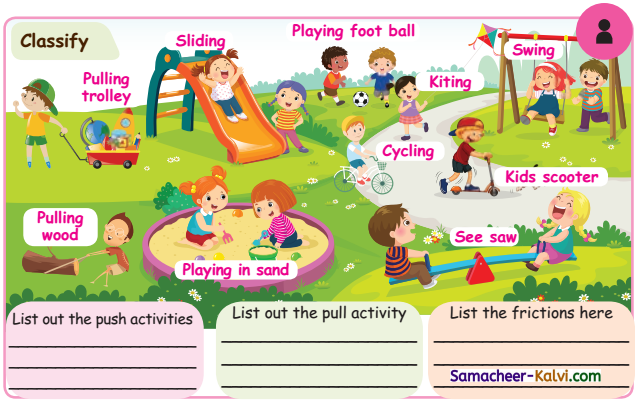
Classify (Text Book Page No. 121):

Samacheer Kalvi 3rd Standard Science Guide Term 1 Chapter 3 Force 15

Answer:

List out the push activitiesList out the pull activityList the frictions here
SwingPulling woodSliding
Playing foot ballPulling trolleyPlaying in sand
Kids scooter, cyclingKitingSee saw

Samacheer Kalvi 3rd Standard Science Guide Term 1 Chapter 3 Force

3rd Standard Science Guide Force Additional Questions and Answers

I. Choose the correct answer:

Question 1.
________ is the motion which gives the required result.
(a) Action
(b) Direction
(c) Shape
Answer:
(a) Action

Question 2.
________ involves an interaction between two or more objects.
(a) Matter
(b) Force
(c) Action
Answer:
(b) Force

Question 3.
When a force is applied without touching an object, it is called force.
(a) contact
(b) mechanical
(c) non-contact
Answer:
(c) non-contact

Samacheer Kalvi 3rd Standard Science Guide Term 1 Chapter 3 Force

II. Fill in the blanks:

Question 1.
Change in position of an object is called _________.
Ahs :
movement

Question 2.
_________ is required in pulling than in pushing.
Answer:
Less force

Question 3.
The force applied by using the parts of our body is called _________ force.
Answer:
muscular

Question 4.
_________ is a force actions between two surfaces in contact.
Answer:
Friction

Samacheer Kalvi 3rd Standard Science Guide Term 1 Chapter 3 Force

III. Write True or False:

Question 1.
Force can lift or drop an object.
Answer:
True

Question 2.
The force applied by a machine is called magnetic force.
Answer:
False

Question 3.
The force between two stones created a spark is called frictional force.
Answer:
True

Question 4.
Muscular force is a non-contact force.
Answer:
False

Samacheer Kalvi 3rd Standard Science Guide Term 1 Chapter 3 Force

IV. Answer in a word or two:

Question 1.
Define Motion.
Answer:
When an object or a thing moves from one place to another, it is said to be in motion.

Question 2.
What is force?
Answer:
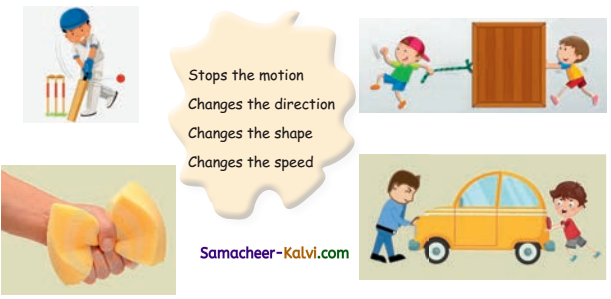
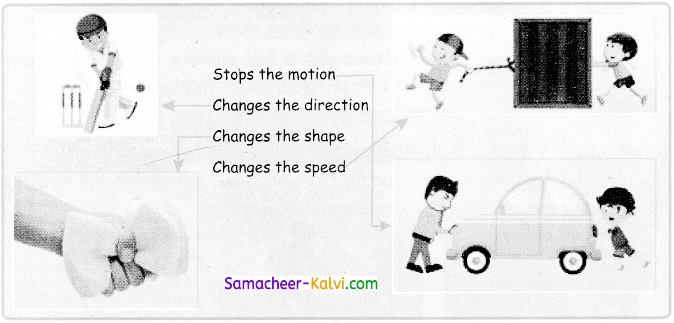
Force is a push or a pull on an object which makes it move, changes its shape, or stops it from moving.

Question 3.
What is pull?
Answer:
When a force is applied in the direction opposite to the direction of an object, it is called pull.

Samacheer Kalvi 3rd Standard Science Guide

Samacheer Kalvi 3rd Standard Science Guide Term 1 Chapter 2 States of Matter

Samacheer Kalvi 3rd Standard Science Book Solutions Term 1 Chapter 2 States of Matter

I. Indicate whether the following statements are true or False:

Question 1.
Solids have a definite volume.
Answer:
True

Question 2.
Liquids can not flow.
Answer:
False

Question 3.
We can melt any substance by cooling it.
Answer:
False

Question 4.
Liquids can take the shape of a container.
Answer:
True
Question 5.
Gases have a definite shape or volume.
Answer:
False

Question 6.
Matter changes its state when heat is added or removed.
Answer:
True
Question 7.
A fuel is a substance which gives heat energy on burning.
Answer:
True
Samacheer Kalvi 3rd Standard Science Guide Term 1 Chapter 2 States of Matter

II. Fill in the blanks:
(Evaporation, Mass, Water, Solid, Stone, Freezing)

Question 1.
The measure of matter ¡n an object is _________.
Answer:
Mass

Question 2.
Change of liquid into vapour on heating is called _______.
Answer:
Evaporation

Question 3.
An example for liquid is _______
Answer:
Water

Question 4.
The change of liquid into solid on cooling is known as _______.
Answer:
Freezing

Question 5.
An example for solid is _______.
Answer:
Stone

Samacheer Kalvi 3rd Standard Science Guide Term 1 Chapter 2 States of Matter

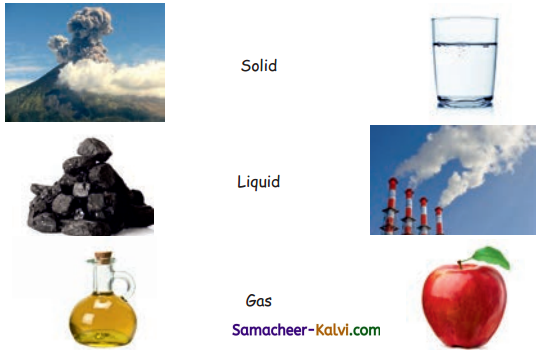
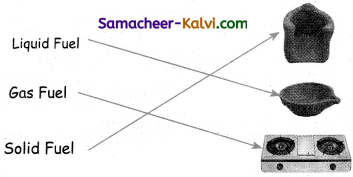
III. Draw a line to match the objects and their state of matter:

Samacheer Kalvi 3rd Standard Science Guide Term 1 Chapter 2 States of Matter 1

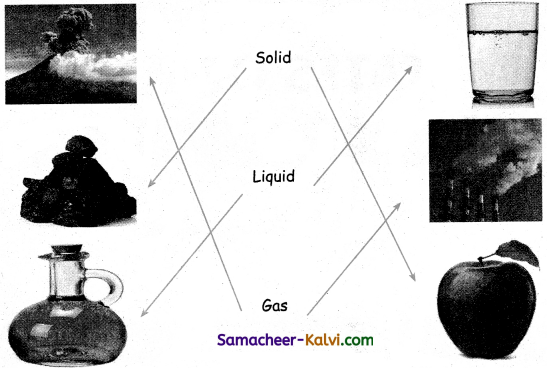
Answer:

Samacheer Kalvi 3rd Standard Science Guide Term 1 Chapter 2 States of Matter 2

Samacheer Kalvi 3rd Standard Science Guide Term 1 Chapter 2 States of Matter

IV. Answer in a word or two:

Question 1.
Which of these is a solid: wood or juice? ______
Answer:
Wood.

Question 2.
Which of these is hard : a sponge or a glass or a cloth? ______
Answer:
a glass.

Question 3.
What are three states of matter? _______
Answer:
Solid, Liquid, Gas.

Question 4.
Name three substances which can change to liquid when they are heated?
Answer:
Ice, Cheese, Jaggery.

Samacheer Kalvi 3rd Standard Science Guide Term 1 Chapter 2 States of Matter

Question 5.
In which state of matter the particles are very close to each other?
Answer:
Solid State.

Question 6.
What state of matter is rain?
Answer:
Liquid State.

Question 7.
Which among the state of matter has definite size but no definite shape?
Answer:
Liquid State.

Question 8.
What would cause a liquid to turn into a solid?
a) Pouring it into a container
b) Heating it until it boils
c) Cooling it until it freezes
d) Keeping its temperature the same
Answer:
c) Cooling it until it freezes

Question 9.
What are some properties of pencil?
Answer:

  • Pencil is rigid.
  • It has definite shape and volume.
  • It occupies a fixed space.
  • They cannot move freely.

Samacheer Kalvi 3rd Standard Science Guide Term 1 Chapter 2 States of Matter

V. Find me: (Liquid, Water, Wood)

Question 1.
I am a five letter word. I am an essential need for your life. I remain in all the three states of matter. Who am I
Answer:
I am water.

Question 2.
I am a solid. I am obtained from the trees. I am useful for heating. Who am I?
Answer:
I am wood.

Question 3.
I am one among the three states. I have loosely arranged particles. I become vapour on heating. Who am I?
Answer:
I am liquid.

Samacheer Kalvi 3rd Standard Science Guide Term 1 Chapter 2 States of Matter

VI. Describe the word in one sentence:

Question 1.
Solid :
Answer:
Solids are things that have a definite shape and volume.

Question 2.
Liquid:
Answer:
Liquids are things that do not have a definite shape but occupies space.

Question 3.
Melting:
Answer:
Change of solid into liquid on heating is called melting.

Question 4.
Evaporation:
Answer:
Change of liquid into vapour on heating is called evaporation.

Question 5.
Freezing:
Answer:
Change of liquid into solid on cooling is known as freezing.

Samacheer Kalvi 3rd Standard Science Guide Term 1 Chapter 2 States of Matter

VII. Which change of state is taking place in each description below?

Samacheer Kalvi 3rd Standard Science Guide Term 1 Chapter 2 States of Matter 3

a. An ice cube turning to water _________
Answer:
Melting

b. Water turning to ice in a freezer _________
Answer:
Freezing

c. Change of liquid into vapour on heating _________
Answer:
Evaporation

d. A bathroom mirror misting up _________
Answer:
Condensation

Samacheer Kalvi 3rd Standard Science Guide Term 1 Chapter 2 States of Matter

Intext Activity:

Let us Do (Text Book Page No. 103):

Samacheer Kalvi 3rd Standard Science Guide Term 1 Chapter 2 States of Matter 4

Answer:

  1. House
  2. Chair
  3. Board
  4. Car

Samacheer Kalvi 3rd Standard Science Guide Term 1 Chapter 2 States of Matter

Let us Do (Text Book Page No. 105):

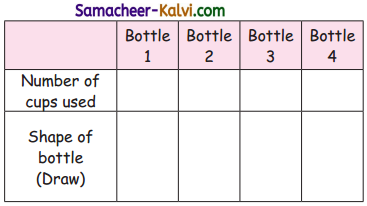
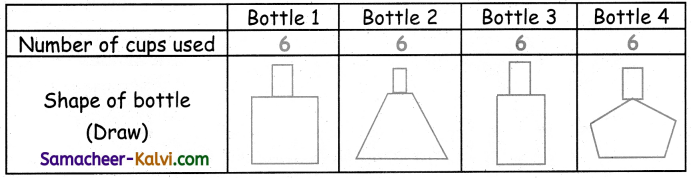
  1. Place four 1L bottles of different shapes on the table.
  2. Take a bucket with water.
  3. Call one child to hold the empty bottles and the other to fill water into them using a paper cup.
  4. Ask the other children to fill the table as given below.

Samacheer Kalvi 3rd Standard Science Guide Term 1 Chapter 2 States of Matter 5

Did each bottle need the same number of cups to get filled?
We can see that water takes up the same space in each bottle and the shape of the water is same as the shape of the bottle.
Answer:

Samacheer Kalvi 3rd Standard Science Guide Term 1 Chapter 2 States of Matter 6

Samacheer Kalvi 3rd Standard Science Guide Term 1 Chapter 2 States of Matter

Think Zone (Text Book Page No. 105):

Question 1.
What is the shape of water in your bottle?
Answer:
The water takes up the shape of my bottle.

Question 2.
What happens if you pour water on the floor or table?
Answer:
Spread from one place to another place.

Think Zone (Text Book Page No. 106):

Question 1.
Cooking gas in gas cylinder has a smell. Why?
Answer:
Because Ethyl mercaptan is added with LP& to find the leakage.

Samacheer Kalvi 3rd Standard Science Guide Term 1 Chapter 2 States of Matter

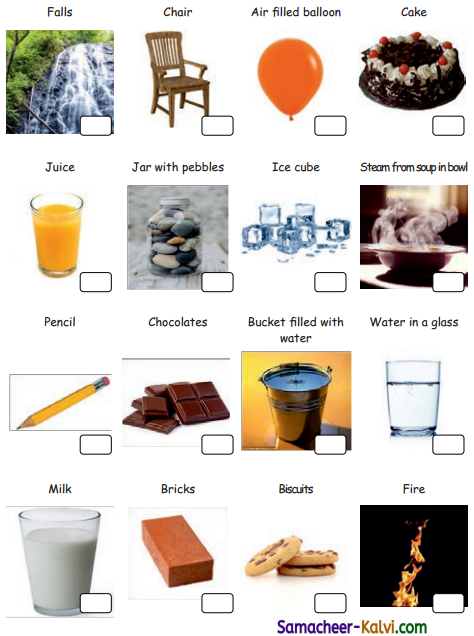
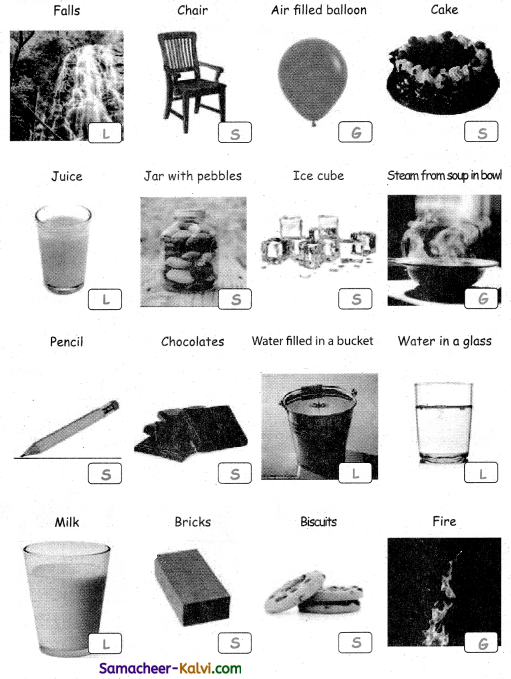
Let us Do (Text Book Page No. 107):

Say whether it is Solid or Liquid or Gas (Put ‘S’ for Solid, .’L‘ for Liquid and ‘G’ for Gas).

Samacheer Kalvi 3rd Standard Science Guide Term 1 Chapter 2 States of Matter 7

Answer:

Samacheer Kalvi 3rd Standard Science Guide Term 1 Chapter 2 States of Matter 8

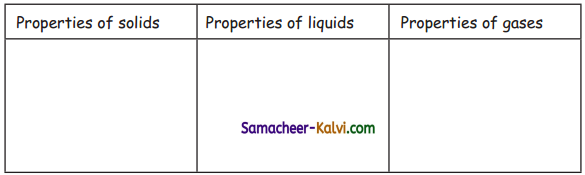
Let us Read and Complete the table (Text Book Page No. 108):

Here are some properties of matter:

Samacheer Kalvi 3rd Standard Science Guide Term 1 Chapter 2 States of Matter 9

Copy the following table. Write each property in the correct column of the table. Some properties may belong to more than one column.

Samacheer Kalvi 3rd Standard Science Guide Term 1 Chapter 2 States of Matter 10

Answer:

Properties of solidsProperties of liquidsProperties of gases
Fixed Shape

Rigid

Fixed volume

No fixed shape

Flow all sides

Fixed volume

No fixed shape

Flow all sides

No fixed volume

Samacheer Kalvi 3rd Standard Science Guide Term 1 Chapter 2 States of Matter

Let us Do (Text Book Page No. 108):

Question 1.
Take some ice cubes in a container. Heat the container and observe the changes.
Answer:
Ice cubes melt.

Question 2.
Take some cheese in a container.. Heat the container and observe the changes.
Answer:
Cheese melts.

Question 3.
Take some jaggery in a pan. Heat the pan and observe the changes.
Answer:
Jaggery melts.

Samacheer Kalvi 3rd Standard Science Guide Term 1 Chapter 2 States of Matter

Let us think (Text Book Page No. 109):

Question 1.
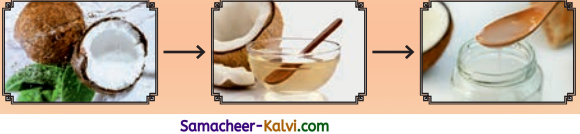
What makes the coconut oil freeze in winter season?

Samacheer Kalvi 3rd Standard Science Guide Term 1 Chapter 2 States of Matter 11

Answer:
In winter season room temperature will drop down almost below 20°C which is less than the freezing point of coconut oil. So it freeze in winter season.

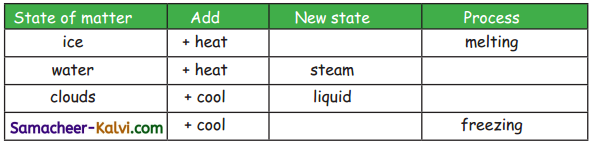
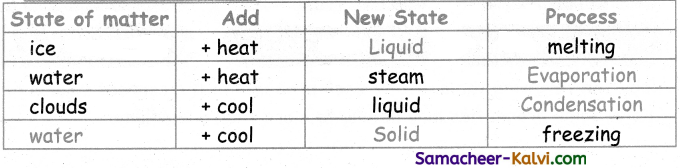
Complete the table (Text Book Page No. 109):

Samacheer Kalvi 3rd Standard Science Guide Term 1 Chapter 2 States of Matter 12

Answer:

Samacheer Kalvi 3rd Standard Science Guide Term 1 Chapter 2 States of Matter 13

Samacheer Kalvi 3rd Standard Science Guide Term 1 Chapter 2 States of Matter

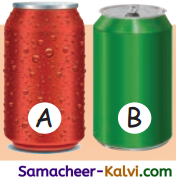
Think and answer (Text Book Page No. 109):

Samacheer Kalvi 3rd Standard Science Guide Term 1 Chapter 2 States of Matter 14

a. Which can was taken from the fridge?
Answer:
Can A.

b. How do you know?
Answer:
Water droplets appear on the can A.

c. How did water droplets appear on the can A?
Answer:
Because of condensation.

d. Why are there no water droplets on can B?
Answer:
Can B is not kept in the fridge.

Samacheer Kalvi 3rd Standard Science Guide Term 1 Chapter 2 States of Matter

Let us Understand (Text Book Page No. 109):

Question 1.
Keep a stone on the floor. Does it move by itself?
Answer:
No.

Question 2.
Pour a mug of water on the floor. Does the water flow? Does it flow in one direction?
Answer:
Yes, the water flows in all direction.

Question 3.
Take an air filled balloon. Prick it with a needle. Does the air rush out?
Answer:
Yes.

Question 4.
Fill an open vessel with water. Press the surface of the water with your hands. How do you feel?
Answer:
Water overflows.

Samacheer Kalvi 3rd Standard Science Guide Term 1 Chapter 2 States of Matter

Look at the pictures. Write down what you see. (Text Book Page No. 110):
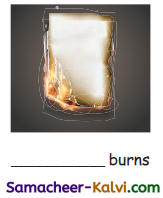
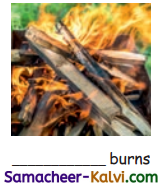
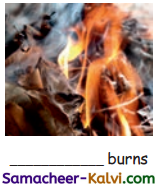
(Wood, Leaves, Paper)

Question 1.

Samacheer Kalvi 3rd Standard Science Guide Term 1 Chapter 2 States of Matter 15

Answer:
Paper burns

Question 2.

Samacheer Kalvi 3rd Standard Science Guide Term 1 Chapter 2 States of Matter 16

Answer:
Wood burns

Question 3.

Samacheer Kalvi 3rd Standard Science Guide Term 1 Chapter 2 States of Matter 17

Answer:
Leaves burns\

Samacheer Kalvi 3rd Standard Science Guide Term 1 Chapter 2 States of Matter

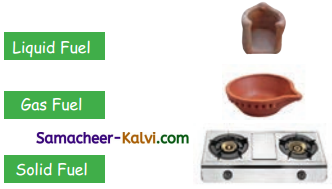
Match the following:

Samacheer Kalvi 3rd Standard Science Guide Term 1 Chapter 2 States of Matter 18

Answer:

Samacheer Kalvi 3rd Standard Science Guide Term 1 Chapter 2 States of Matter 19

3rd Standard Science Guide States of Matter Additional Questions and Answers

I. Choose the correct answer:

Question 1.
_______ becomes liquid and liquid becomes solid on colling.
(a) Matter
(b) Mass
(c) Gas
Answer:
(c) Gas

Question 2.
Change of liquid into solid on cooling is known as __________
(a) freezing
(b) condensation
(c) evaporation
Answer:
(a)freezing

Question 3.
Which one of the following is a solid fuel?
(a) Petroleum
(b) Wood
(c) Diesel
Answer:
(b) Wood

Question 4.
________ has a definite shape.
(a) Solid
(b) Liquid
(c) Gas
Answer:
(a) Solid

Samacheer Kalvi 3rd Standard Science Guide Term 1 Chapter 2 States of Matter

II. Write True or False:

Question 1.
Everything you can see and touch is made up of matter.
Answer:
True
Question 2.
The change of solid into liquid on heating is called evaporation.
Answer:
False

Question 3.
Electrical energy is also used as fuel for cooking and transporting.
Answer:
True

Question 4.
Substances when burnt give out heat.
Answer:
True
Samacheer Kalvi 3rd Standard Science Guide Term 1 Chapter 2 States of Matter

III. Fill in the blanks:

Question 1.
_______ take the shape of the container.
Answer:
Liquids

Question 2.
_______ is a mixture of gases.
Answer:
Air

Question 3.
The space occupied by an object is called ________.
Answer:
Volume

Question 4.
Everything around us is made up of _________.
Answer:
matter

Samacheer Kalvi 3rd Standard Science Guide Term 1 Chapter 2 States of Matter

IV. Answer in a word or two:

Question 1.
What is matter?
Answer:
Anything that occupies space and has mass is called matter.

Question 2.
What is mass?
Answer:
Mass is a measure of how much matter is in an object.

Question 3.
List out the examples of gases?
Answer:

  1. Cloud
  2. Smoke
  3. Wind
  4. Spray
  5. Water vapour

Samacheer Kalvi 3rd Standard Science Guide

Samacheer Kalvi 3rd Standard Science Guide Term 1 Chapter 1 My Body

Samacheer Kalvi 3rd Standard Science Book Solutions Term 1 Chapter 1 My Body

I. Fill in the blanks.

Question 1.
We should wash our hands _______ playing out. (before/after)
Answer:
after

Question 2.
Intestinal worms cause ________(anaemia/cold)
Answer:
anaemia

Question 3.
Eating ________ is good for health, (fruits/ packed snacks)
Answer:
fruits

Question 4.
_______ improves our brain functions, (eating junk food/doing exercises)
Answer:
Doing exercises

Question 5.
If someone’s touch hurts you, then it is a _______(good touch/bad touch)
Answer:
bad touch

Question 6.
_________ is the word used to refer to the disabled persons, (handicapped/
differently-abled)
Answer:
Differently-abled

Samacheer Kalvi 3rd Standard Science Guide Term 1 Chapter 1 My Body

II. Say ’TRUE’ or’FALSE’.

Question 1.
Use soap to wash your hands.
Answer:
True

Question 2.
Open defecation causes cholera
Answer:
True
Question 3.
Bathing reduces blood circulation.
Answer:
False

Question 4.
Show pity on physically, challenged people.
Answer:
False

Question 5.
Always use ear buds to clean your ears.
Answer:
False

Samacheer Kalvi 3rd Standard Science Guide Term 1 Chapter 1 My Body

III. Answer the following questions in a few words.

Question 1.
What are the effects of open defecation?
Answer:
Effects of open defecation are :

  • Waterborne diseases.
  • Diseases caused by insect carrier.
  • Pollution.

Question 2.
Write the benefits of bathing.
Answer:
Benefits of bathing are:

  • Cleanses the body.
  • Removes dirt and odour.
  • Protects from infection.
  • Improves blood circulation.

Samacheer Kalvi 3rd Standard Science Guide Term 1 Chapter 1 My Body

Question 3.
List out the types of touches.
Answer:
The two types of touches are good touch and bad touch.

Question 4.
Who are the persons in your safe circle?
Answer:
The persons in my safe circle are father, mother, grandpa, grandma, brother, sister and teacher.

Question 5.
Name the sensory organs of our body.
Answer:
The sensory organs of our body are eyes, nose, ears, tongue and skin.

Samacheer Kalvi 3rd Standard Science Guide Term 1 Chapter 1 My Body

IV. Arrange in correct order. (First and last steps are in correct sequence)

Question 1.
Wet your hands and apply enough soap.
Answer:
1

Question 2.
Rub the tips of your finger.
Answer:
6

Question 3.
Rub both hands by interlocking your fingers.
Answer:
4

Question 4.
Rub the back of each hand.
Answer:
3

Question 5.
Rub the palm together.
Answer:
2

Question 6.
Rub the back of each fingers.
Answer:
5

Question 7.
Rub the thumb and end of your wrist and rinse both hand with water.
Answer:
7

Samacheer Kalvi 3rd Standard Science Guide Term 1 Chapter 1 My Body

V. Answer the following questions.

Question 1.
When do we wash our hands?
Answer:
We should wash our hands

  • Before and after eating.
  • After using the toilet.
  • After playing outside.
  • After touching an animal.

Question 2.
What will you do when somebody who are not in your ‘safe circle* touches you?
Answer:

  • I will shout “Don’t touch”.
  • I will leave the place immediately.
  • I will ask help from my parent or from my teacher.

Question 3.
How can we protect our skin?
Answer:

  • Always use a mild soap.
  • Keep your skin dry and clean.
  • Dry your skin by rubbing gently with a clean cloth.
  • Consult a doctor when you feel any itching, skin, injury or infection.

Samacheer Kalvi 3rd Standard Science Guide Term 1 Chapter 1 My Body

Question 4.
How do we get intestinal worms?
Answer:
We get intestinal worms by
i) Not washing hands after using toilets,
ii) Using open defecation.

Question 5.
How do you help differently-abled people?
Answer:
I will help the differently-abled people by

  • Bring them to cross the road,
  • Making way for them.
  • Opening doors for the disabled,
  • Treatthemasnormal people.

Samacheer Kalvi 3rd Standard Science Guide Term 1 Chapter 1 My Body

VI. Project work.

Question 1.
Collect proverbs related to self-hygiene, health and sanitation.
Answer:
Self-hygiene proverbs :

  • A healthy man is a successf ul man
  • A broken hand works, but not a broken heart.
  • Hygiene is two thirds of health

Health proverbs:

  • Work is half of health
  • A healthy soul cannot live in a dry body
  • Health is better than wealth.

Sanitation proverbs:

  • Cleanliness is next to godliness
  • Cleanliness is a state of purity, clarity, and precision
  • Cleanliness and good sanitation in schools is a matter of high importance

Samacheer Kalvi 3rd Standard Science Guide Term 1 Chapter 1 My Body

InText Activity:

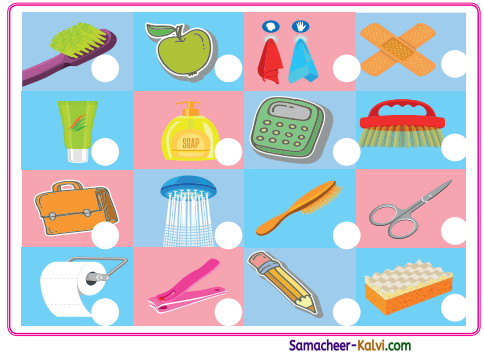
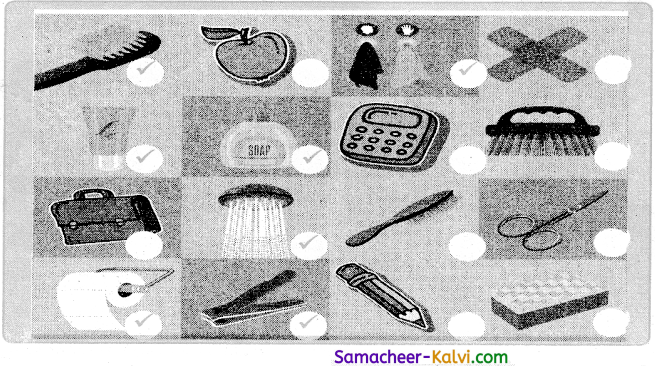
Tick(✓) the items used for personal hygiene (Text Book Page No. 86):

Question 1.

Samacheer Kalvi 3rd Standard Science Guide Term 1 Chapter 1 My Body 1

Answer:

Samacheer Kalvi 3rd Standard Science Guide Term 1 Chapter 1 My Body 2

Samacheer Kalvi 3rd Standard Science Guide Term 1 Chapter 1 My Body

Let us Write (Text Book Page No. 89):

Complete the Worksheet:

Samacheer Kalvi 3rd Standard Science Guide Term 1 Chapter 1 My Body 3 Germs

Question 1.
Do germs make people sick?

Samacheer Kalvi 3rd Standard Science Guide Term 1 Chapter 1 My Body 4

Answer:

Samacheer Kalvi 3rd Standard Science Guide Term 1 Chapter 1 My Body 5

Question 2.
Can you see germs?

Samacheer Kalvi 3rd Standard Science Guide Term 1 Chapter 1 My Body 4

Answer:

Samacheer Kalvi 3rd Standard Science Guide Term 1 Chapter 1 My Body 6

Question 3.
Where are the germs found?
Answer:

  1. Germs are found in air and water.
  2. Germs are found in our hands, nails and in the ridges.

Question 4.
What can I do to avoid the spreading of germs?
Answer:

  1. We should wash our hands properly.
  2. When we cough or sneeze, we should use handkerchief.

Samacheer Kalvi 3rd Standard Science Guide Term 1 Chapter 1 My Body

Think Zone (Text Book Page No. 89):

Question 1.
Preethi often bites her nails. Is it a good habit? Give reason.
Answer:
No, it is not a good habit.
Because germs are found under the nails, in the ridges.

Think and Discuss (Text Book Page No. 89):

Question 1.
Arun usually eats food or snacks without washing hands properly. Is it correct? Give reason.
Answer:
No, It is not correct. Because germs are found in dirty hands.

Samacheer Kalvi 3rd Standard Science Guide Term 1 Chapter 1 My Body

Put a tick (✓) for correct action and cross (✗) for the wrong action (Text Book Page No. 91):

Question 1.

Samacheer Kalvi 3rd Standard Science Guide Term 1 Chapter 1 My Body 7

Answer:

Samacheer Kalvi 3rd Standard Science Guide Term 1 Chapter 1 My Body 8

Samacheer Kalvi 3rd Standard Science Guide Term 1 Chapter 1 My Body

Let us Answer (Text Book Page No. 92):

Read the statements given below. Identify whether it is Right (✓) or Wrong (✗) and put the suitable symbol.

Samacheer Kalvi 3rd Standard Science Guide Term 1 Chapter 1 My Body 9

Answer:

Samacheer Kalvi 3rd Standard Science Guide Term 1 Chapter 1 My Body 10

Samacheer Kalvi 3rd Standard Science Guide Term 1 Chapter 1 My Body

Let us find (Text Book Page No. 92):

Question 1.

Samacheer Kalvi 3rd Standard Science Guide Term 1 Chapter 1 My Body 11

Answer:

Samacheer Kalvi 3rd Standard Science Guide Term 1 Chapter 1 My Body 12

Samacheer Kalvi 3rd Standard Science Guide Term 1 Chapter 1 My Body

Think Zone (Text Book Page No. 93):

Question 1.
Anu plays with her baby brother. As he cries, she gives him a pencil. On seeing this, Anu’s mom was shocked. She quickly takes the pencil back. Do you know why?
Answer:
The pencil has a sharp end. It may hurt the baby’s eye or ear.

Let us do (Text Book Page No. 95):

Read the given statements carefully. Write ‘T’ if it is True and ‘F’ if it is False.

Question 1.
Avoid playing video games or watching TV for a long time.
Answer:
T

Question 2.
Avoid loud noise.
Answer:
T

Question 3.
Do not clean your nose by inserting any object into it.
Answer:
T

Question 4.
A dirty tongue may cause disease and bad breath.
Answer:
T

Question 5.
Dry your skin by rubbing gently with a dirty cloth.
Answer:
F

Samacheer Kalvi 3rd Standard Science Guide Term 1 Chapter 1 My Body

Let us discuss (Text Book Page No. 98):

Question 1.
You are playing in the park. Someone gives you eatable things/toys. What will you, do?
Answer:
I won’t buy any things.

Question 2.
If someone touches you, you feel uncomfortable. What will you do immediately? To whom you will inform this?
Answer:

  • I will leave that place immediately.
  • I will inform to my parents or teachers.

Samacheer Kalvi 3rd Standard Science Guide Term 1 Chapter 1 My Body

Match (Text Book Page No. 99):

Question 1.

Samacheer Kalvi 3rd Standard Science Guide Term 1 Chapter 1 My Body 13

Answer:

Samacheer Kalvi 3rd Standard Science Guide Term 1 Chapter 1 My Body 14

Samacheer Kalvi 3rd Standard Science Guide Term 1 Chapter 1 My Body

Find and circle the words related to fitness (Text Book Page No. 101):
(SLEEP, ENERGY, HEALTHY, RUN, JUMP, PLAY, YOGA)

Samacheer Kalvi 3rd Standard Science Guide Term 1 Chapter 1 My Body 15

Answer:

Samacheer Kalvi 3rd Standard Science Guide Term 1 Chapter 1 My Body 16

Samacheer Kalvi 3rd Standard Science Guide Term 1 Chapter 1 My Body

3rd Standard Science Guide My Body Additional Questions and Answers

Choose the correct answer:

Question 1.
National De-worming day is observed on ________.
(a) April 7
(b) February 10
(c) October 15
Ans :
(b) February 1

Question 2.
Noise levels are measured in ________.
(a) decibels
(b) m/s2
(c) kg
Answer:
(a) decibels

Question 3.
_______ is a reading and writing method for visually challenged person.
(a) Abacus
(b) Braille
(c) Teaching
Answer:
(b) Braille

Samacheer Kalvi 3rd Standard Science Guide Term 1 Chapter 1 My Body

II. Match the following:

1. Global Hand Washing Daya. February 10
2. National De-worming Dayb. April 7
3. World Health Dayc. November 19
4. World Toilet Dayd. October 15

Answer:

1. Global Hand Washing Daya. October 15
2. National De-worming Dayb. February 10
3. World Health Dayc. April 7
4. World Toilet Dayd. November 19

Samacheer Kalvi 3rd Standard Science Guide Term 1 Chapter 1 My Body

III. Write True or False:

Question 1.
Do not clean your nose by inserting any object into it.
Answer:
True
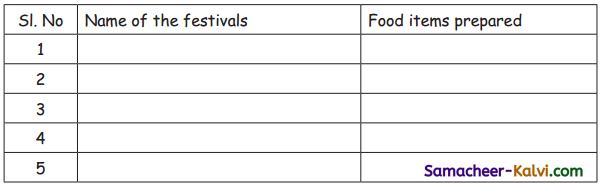
Question 2.
Do not pick your nose.
Answer:
True
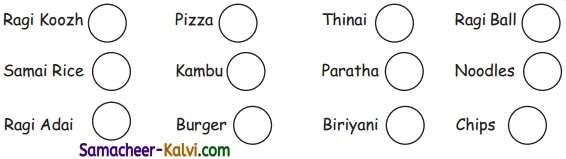
Question 3.
Rub your eyes with your fist.
Answer:
False
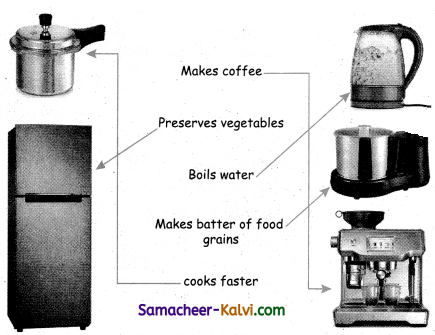
Samacheer Kalvi 3rd Standard Science Guide

Samacheer Kalvi 3rd Standard Maths Guide Term 3 Chapter 7 Information Processing

Samacheer Kalvi 3rd Standard Maths Book Solutions Term 3 Chapter 7 Information Processing

Quick ways of adding (Text Book Page No. 49):

Samacheer Kalvi 3rd Standard Maths Guide Term 3 Chapter 7 Information Processing 1

Answer:

Samacheer Kalvi 3rd Standard Maths Guide Term 3 Chapter 7 Information Processing 2

Samacheer Kalvi 3rd Standard Maths Guide Term 3 Chapter 7 Information Processing

Exercise (Text Book Page No. 50):

Find the sum of

i) 5 + 1 + 5 + 9
Answer:
Samacheer Kalvi 3rd Standard Maths Guide Term 3 Chapter 7 Information Processing 3
5 + 5 = 10
9 + 1 = 10
Hence the sum = 10 + 10 = 20

ii) 2 + 5 + 5 + 7 + 1
Answer:
Samacheer Kalvi 3rd Standard Maths Guide Term 3 Chapter 7 Information Processing 4
2 + 7 + 1 = 10
5 + 5 = 10
Hence the sum = 10 + 10 = 20

iii) 3 + 6 + 1 + 2 + 8
Answer:
Samacheer Kalvi 3rd Standard Maths Guide Term 3 Chapter 7 Information Processing 5
3 + 6 + 1 = 10
8 + 2 = 10
Hence the sum = 10 + 10 = 20

Samacheer Kalvi 3rd Standard Maths Guide Term 3 Chapter 7 Information Processing

Add the given big numbers using the above method (Text Book Page No. 51):

Question 1.

Samacheer Kalvi 3rd Standard Maths Guide Term 3 Chapter 7 Information Processing 7

Answer:
543 = 500 + 40 + 3
210 = 200 + 10

Samacheer Kalvi 3rd Standard Maths Guide Term 3 Chapter 7 Information Processing 6

Question 2.

Samacheer Kalvi 3rd Standard Maths Guide Term 3 Chapter 7 Information Processing 8

Answer:
298 = 200 + 90 + 8
501 = 500 + 1

Samacheer Kalvi 3rd Standard Maths Guide Term 3 Chapter 7 Information Processing 9

Question 3.

Samacheer Kalvi 3rd Standard Maths Guide Term 3 Chapter 7 Information Processing 10

Answer:
798 = 700 + 90 + 8
654 = 600 + 50 + 4

Samacheer Kalvi 3rd Standard Maths Guide Term 3 Chapter 7 Information Processing 11

Samacheer Kalvi 3rd Standard Maths Guide Term 3 Chapter 7 Information Processing

Question 4.

Samacheer Kalvi 3rd Standard Maths Guide Term 3 Chapter 7 Information Processing 12

Answer:
348 = 300 + 40 + 8
681 = 600 + 80 + 1

Samacheer Kalvi 3rd Standard Maths Guide Term 3 Chapter 7 Information Processing 13

Question 5.

Samacheer Kalvi 3rd Standard Maths Guide Term 3 Chapter 7 Information Processing 14

Answer:
543 = 500 + 40 + 3
218 = 200 + 10 + 8

Samacheer Kalvi 3rd Standard Maths Guide Term 3 Chapter 7 Information Processing 15

Question 6.

Samacheer Kalvi 3rd Standard Maths Guide Term 3 Chapter 7 Information Processing 16

Answer:
716 = 700 + 10 + 6
540 = 500 + 40 + 0

Samacheer Kalvi 3rd Standard Maths Guide Term 3 Chapter 7 Information Processing 17

Samacheer Kalvi 3rd Standard Maths Guide Term 3 Chapter 7 Information Processing

Quick ways of subtracting (Text Book Page No. 52):

Samacheer Kalvi 3rd Standard Maths Guide Term 3 Chapter 7 Information Processing 18

Answer:

Samacheer Kalvi 3rd Standard Maths Guide Term 3 Chapter 7 Information Processing 19

Samacheer Kalvi 3rd Standard Maths Guide Term 3 Chapter 7 Information Processing

Subtract the given numbers using the above method (Text Book Page No. 53):

Question 1.

Samacheer Kalvi 3rd Standard Maths Guide Term 3 Chapter 7 Information Processing 20

Answer:

Samacheer Kalvi 3rd Standard Maths Guide Term 3 Chapter 7 Information Processing 21

Question 2.

Samacheer Kalvi 3rd Standard Maths Guide Term 3 Chapter 7 Information Processing 22

Answer:

Samacheer Kalvi 3rd Standard Maths Guide Term 3 Chapter 7 Information Processing 23

Question 3.

Samacheer Kalvi 3rd Standard Maths Guide Term 3 Chapter 7 Information Processing 24

Answer:

Samacheer Kalvi 3rd Standard Maths Guide Term 3 Chapter 7 Information Processing 25

Samacheer Kalvi 3rd Standard Maths Guide Term 3 Chapter 7 Information Processing

Question 4.

Samacheer Kalvi 3rd Standard Maths Guide Term 3 Chapter 7 Information Processing 26

Answer:

Samacheer Kalvi 3rd Standard Maths Guide Term 3 Chapter 7 Information Processing 27

Question 5.

Samacheer Kalvi 3rd Standard Maths Guide Term 3 Chapter 7 Information Processing 28

Answer:

Samacheer Kalvi 3rd Standard Maths Guide Term 3 Chapter 7 Information Processing 29

Question 6.

Samacheer Kalvi 3rd Standard Maths Guide Term 3 Chapter 7 Information Processing 30

Answer:

Samacheer Kalvi 3rd Standard Maths Guide Term 3 Chapter 7 Information Processing 31

Samacheer Kalvi 3rd Standard Maths Guide Term 3 Chapter 7 Information Processing

Question 7.

Samacheer Kalvi 3rd Standard Maths Guide Term 3 Chapter 7 Information Processing 32

Answer:

Samacheer Kalvi 3rd Standard Maths Guide Term 3 Chapter 7 Information Processing 33

Question 8.

Samacheer Kalvi 3rd Standard Maths Guide Term 3 Chapter 7 Information Processing 34

Answer:

Samacheer Kalvi 3rd Standard Maths Guide Term 3 Chapter 7 Information Processing 35

Question 9.

Samacheer Kalvi 3rd Standard Maths Guide Term 3 Chapter 7 Information Processing 36

Answer:

Samacheer Kalvi 3rd Standard Maths Guide Term 3 Chapter 7 Information Processing 37

Samacheer Kalvi 3rd Standard Maths Guide Term 3 Chapter 7 Information Processing

Mental Arithmetic (Text Book Page No. 54):

Able to add and subtract single digit numbers and two digit numbers mentally:

Question 1.
In a tree planting ceremony, 6 coconut saplings and 5 neem saplings are planted. Find the total number of saplings planted.
Answer:
6 + 5 = 11

Question 2.
There are 5 tender coconuts in a tree. If they pick 3 tender coconuts, then find the remaining tender coconuts?
Answer:
5 – 3 = 2

Question 3.
46 boys and 27 girls visited a park on Sunday. Find the total number of boys and girls who visited the park?
Answer:
46 + 27 = 73

Samacheer Kalvi 3rd Standard Maths Guide Term 3 Chapter 7 Information Processing

Question 4.
50 pens are in a box. Out of which, 34 pens are given to the students. Find the number of pens left?
Answer:
50 – 34 = 16

Question 5.
70 balls are given to 7 persons. How many balls are given to each person?
Answer:
70 ÷ 7 = 10 [10 × 7 = 70]

Question 6.
8 books can be arranged in a row. In how many rows can 48 books be arranged?
Answer:
48 ÷ 8 = 6 [8 × 6 = 48]

Question 7.
10 pens can be kept in a box. How many boxes are needed to keep 100 pens?
Answer:
100 ÷ 10 = 10

Samacheer Kalvi 3rd Standard Maths Guide Term 3 Chapter 7 Information Processing

3rd Standard Maths Guide Information Processing Additional Questions and Answers

Question 1.
Find the sum of

(i) 7 + 7 + 3 + 3
Answer:
Samacheer Kalvi 3rd Standard Maths Guide Term 3 Chapter 7 Information Processing 38
7 + 3 = 10 and
7 + 3 = 10
Hence the sum of the number = 10 + 10 = 20

(ii) 6 + 4 + 4 + 6
Answer:
Samacheer Kalvi 3rd Standard Maths Guide Term 3 Chapter 7 Information Processing 39
6 + 4 = 10 and
4 + 6 = 10
Hence the sum of the number = 10 + 10 = 20

Samacheer Kalvi 3rd Standard Maths Guide Term 3 Chapter 7 Information Processing

Question 2.
Add

Samacheer Kalvi 3rd Standard Maths Guide Term 3 Chapter 7 Information Processing 40

Answer:

Samacheer Kalvi 3rd Standard Maths Guide Term 3 Chapter 7 Information Processing 41

Question 3.
Add

Samacheer Kalvi 3rd Standard Maths Guide Term 3 Chapter 7 Information Processing 42

Answer:

Samacheer Kalvi 3rd Standard Maths Guide Term 3 Chapter 7 Information Processing 43

Samacheer Kalvi 3rd Standard Maths Guide Term 3 Chapter 7 Information Processing

Question 4.
Subtract

Samacheer Kalvi 3rd Standard Maths Guide Term 3 Chapter 7 Information Processing 44

Answer:

Samacheer Kalvi 3rd Standard Maths Guide Term 3 Chapter 7 Information Processing 45

Question 5.
Subtract

Samacheer Kalvi 3rd Standard Maths Guide Term 3 Chapter 7 Information Processing 46

Answer:

Samacheer Kalvi 3rd Standard Maths Guide Term 3 Chapter 7 Information Processing 47

Samacheer Kalvi 3rd Standard Maths Guide

Samacheer Kalvi 3rd Standard Maths Guide Term 3 Chapter 6 Time

Samacheer Kalvi 3rd Standard Maths Book Solutions Term 3 Chapter 6 Time

Times of a Day (Text Book Page No. 43):

Question 1.
Sort the events according to the time of happening
1. Sunrise
2. Sunset
3. Coming to school
4. Returning home from school
5. Breakfast
6. Dinner
7. Darkness outside
8. Say Good Morning
9. Say Good Evening

Samacheer Kalvi 3rd Standard Maths Guide Term 3 Chapter 6 Time 2

Answer:

Samacheer Kalvi 3rd Standard Maths Guide Term 3 Chapter 6 Time 1

Samacheer Kalvi 3rd Standard Maths Guide Term 3 Chapter 6 Time

Chronological order (Text Book Page No. 44):

Question 1.
Write ‘F’ for the event which comes first and ’N’ for the event which happens next.

Samacheer Kalvi 3rd Standard Maths Guide Term 3 Chapter 6 Time 3

Answer:

Samacheer Kalvi 3rd Standard Maths Guide Term 3 Chapter 6 Time 4

Samacheer Kalvi 3rd Standard Maths Guide Term 3 Chapter 6 Time

Question 2.
Arrange the following events in chronological order. (Text Book Page No. 45):

i. Started walking, birth, started schooling in class 1, studying in Class 3, studying in Class 2.
(i) Birth
(ii) Started walking .
(iii) Started schooling in class 1
(iv) Studying class 2
(v) Studying class 3

ii. Sowing seeds, plucking fruits, growing fruit, flowering in plant, watering plants.
Answer:
(i) Sowing seeds
(ii) Watering plants
(iii) flowering in plants
(iv Growing fruit
(v) Plucking fruits.

Samacheer Kalvi 3rd Standard Maths Guide Term 3 Chapter 6 Time

Time cyclic events in a year (Text Book Page No. 46):

Question 1.
List the events that form a cycle and that do not form a cycle.
i. Coming to school
ii. Rotation of a clock
iii. bays of a week
iv. Growth of your pet
v. Building your house
vi. Making of idly
Samacheer Kalvi 3rd Standard Maths Guide Term 3 Chapter 6 Time 5

Answer:

Samacheer Kalvi 3rd Standard Maths Guide Term 3 Chapter 6 Time 6

Samacheer Kalvi 3rd Standard Maths Guide Term 3 Chapter 6 Time

Question 2.
Complete the events of given cycle.

Samacheer Kalvi 3rd Standard Maths Guide Term 3 Chapter 6 Time 7

Samacheer Kalvi 3rd Standard Maths Guide Term 3 Chapter 6 Time 8

Answer:

Samacheer Kalvi 3rd Standard Maths Guide Term 3 Chapter 6 Time 9

Samacheer Kalvi 3rd Standard Maths Guide Term 3 Chapter 6 Time 10

Samacheer Kalvi 3rd Standard Maths Guide Term 3 Chapter 6 Time

3rd Standard Maths Guide Time Additional Questions and Answers

Question 1.
Arrange the following events in chronological order.
(i) Brushing teeth, going to school, waking up, having breakfast, taking bath
Answer:
Waking up, Brushing teeth, taking bath, breakfast, going to school.

(ii) Pongal, New year. Republic day, Christmas, Independence day.
Answer:
New year, Pongal, Republic day, Independence day, Christmas.

Samacheer Kalvi 3rd Standard Maths Guide Term 3 Chapter 6 Time

Question 2.
Write ‘F’ for the event which comes first and ‘N’ for the event which happens next.

Samacheer Kalvi 3rd Standard Maths Guide Term 3 Chapter 6 Time 11

Answer:

Samacheer Kalvi 3rd Standard Maths Guide Term 3 Chapter 6 Time 12

Samacheer Kalvi 3rd Standard Maths Guide Term 3 Chapter 6 Time

Question 3.
List the events that form a cycle and that do not form a cycle.
i. Months of a year
ii. Elections
iii. Growth of a plant
iv. Construction of a house
v. Olympics
Answer:

Samacheer Kalvi 3rd Standard Maths Guide Term 3 Chapter 6 Time 13

Samacheer Kalvi 3rd Standard Maths Guide Term 3 Chapter 6 Time

Question 4.
Arrange the following dates in chronological order.
17/11/2019, 18/08/2019
05/08/2018, 04/01/2017
Answer:

Samacheer Kalvi 3rd Standard Maths Guide Term 3 Chapter 6 Time 14

Samacheer Kalvi 3rd Standard Maths Guide Term 3 Chapter 6 Time

Question 5.
Arrange the following time in chronological order.
Morning 7.00 clock, Night 8:00 clock
Afternoon 2:00 clock, Evening : 5:00 clock
Answer:

Samacheer Kalvi 3rd Standard Maths Guide Term 3 Chapter 6 Time 15

Samacheer Kalvi 3rd Standard Maths Guide

Samacheer Kalvi 3rd Standard Maths Guide Term 3 Chapter 5 Money

Samacheer Kalvi 3rd Standard Maths Book Solutions Term 3 Chapter 5 Money

Rupees and Paise (Text Book Page No. 36):

Question 1.
Convert the following rupees into paise.

Samacheer Kalvi 3rd Standard Maths Guide Term 3 Chapter 5 Money 1

Answer:

Samacheer Kalvi 3rd Standard Maths Guide Term 3 Chapter 5 Money 2

Samacheer Kalvi 3rd Standard Maths Guide Term 3 Chapter 5 Money

Add the following (Text Book Page No. 37):

Question 1.

Samacheer Kalvi 3rd Standard Maths Guide Term 3 Chapter 5 Money 3

Answer:

Samacheer Kalvi 3rd Standard Maths Guide Term 3 Chapter 5 Money 4

Question 2.

Samacheer Kalvi 3rd Standard Maths Guide Term 3 Chapter 5 Money 5

Answer:

Samacheer Kalvi 3rd Standard Maths Guide Term 3 Chapter 5 Money 6

Question 3.

Samacheer Kalvi 3rd Standard Maths Guide Term 3 Chapter 5 Money 7

Answer:

Samacheer Kalvi 3rd Standard Maths Guide Term 3 Chapter 5 Money 8

Samacheer Kalvi 3rd Standard Maths Guide Term 3 Chapter 5 Money

Question 4.

Samacheer Kalvi 3rd Standard Maths Guide Term 3 Chapter 5 Money 9

Answer:

Samacheer Kalvi 3rd Standard Maths Guide Term 3 Chapter 5 Money 10

Question 5.

Samacheer Kalvi 3rd Standard Maths Guide Term 3 Chapter 5 Money 11

Answer:

Samacheer Kalvi 3rd Standard Maths Guide Term 3 Chapter 5 Money 12

Question 6.

Samacheer Kalvi 3rd Standard Maths Guide Term 3 Chapter 5 Money 13

Answer:

Samacheer Kalvi 3rd Standard Maths Guide Term 3 Chapter 5 Money 14

Samacheer Kalvi 3rd Standard Maths Guide Term 3 Chapter 5 Money

Subtract the following (Text Book Page No. 37):

Question 1.

Samacheer Kalvi 3rd Standard Maths Guide Term 3 Chapter 5 Money 15

Answer:

Samacheer Kalvi 3rd Standard Maths Guide Term 3 Chapter 5 Money 16

Question 2.

Samacheer Kalvi 3rd Standard Maths Guide Term 3 Chapter 5 Money 17

Answer:

Samacheer Kalvi 3rd Standard Maths Guide Term 3 Chapter 5 Money 18

Question 3.

Samacheer Kalvi 3rd Standard Maths Guide Term 3 Chapter 5 Money 19

Answer:

Samacheer Kalvi 3rd Standard Maths Guide Term 3 Chapter 5 Money 20

Samacheer Kalvi 3rd Standard Maths Guide Term 3 Chapter 5 Money

Question 4.

Samacheer Kalvi 3rd Standard Maths Guide Term 3 Chapter 5 Money 21

Answer:

Samacheer Kalvi 3rd Standard Maths Guide Term 3 Chapter 5 Money 22

Question 5.

Samacheer Kalvi 3rd Standard Maths Guide Term 3 Chapter 5 Money 23

Answer:

Samacheer Kalvi 3rd Standard Maths Guide Term 3 Chapter 5 Money 24

Question 6.

Samacheer Kalvi 3rd Standard Maths Guide Term 3 Chapter 5 Money 25

Answer:

Samacheer Kalvi 3rd Standard Maths Guide Term 3 Chapter 5 Money 26

Samacheer Kalvi 3rd Standard Maths Guide Term 3 Chapter 5 Money

Exercise (Text Book Page No. 38):

Question 1.
Sengothai bought a school bag for ₹ 210.30 and a sports shoe for ₹ 260.20 find the amount to be returned by the shopkeeper if she has paid five hundred rupees to the shopkeeper.
Answer:
Adding rupees:

School bag = 210.30 (+)
Sports shoe = 260.20
Total cost = 470.50

Samacheer Kalvi 3rd Standard Maths Guide Term 3 Chapter 5 Money 27

Subtracting rupees:

Sengothai paid = 500.00
Total cost = (-) 470.50
Shopkeeper has to return = 29.50

Samacheer Kalvi 3rd Standard Maths Guide Term 3 Chapter 5 Money 28

Samacheer Kalvi 3rd Standard Maths Guide Term 3 Chapter 5 Money

Question 2.
Kumaran’s father asked him to get a change for ₹ 200 from his uncle. If his uncle gave him a hundred rupee note and a fifty rupees note. How much more his uncle has to give him?
Answer:
Adding rupees:

1 hundred rupees = 100.00
1 fifty rupees = (+) 50.00
Total = 150.00

Samacheer Kalvi 3rd Standard Maths Guide Term 3 Chapter 5 Money 29

Subtracting rupees:

Father gave = 200.00
Uncle returned = 150.00
More uncle need to give him = 50.00

Samacheer Kalvi 3rd Standard Maths Guide Term 3 Chapter 5 Money 30

Samacheer Kalvi 3rd Standard Maths Guide Term 3 Chapter 5 Money

Rate Charts and Simple Bills:

Question 1.
The following are the items eaten by Raju and his family. Fill in the blanks using the given bill.
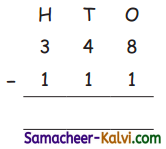
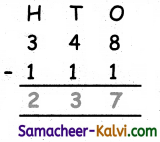
Samacheer Kalvi 3rd Standard Maths Guide Term 3 Chapter 5 Money 31

i. Name of the Restaurant _________
Answer:
Hotel foods

ii. Bill number _________
Answer:
32

iii. bate of the bill ________
Answer:
30.10.2019

Samacheer Kalvi 3rd Standard Maths Guide Term 3 Chapter 5 Money

iv. Total number of items eaten _________
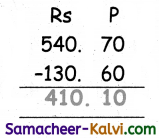
Answer:
3

v. Total amount of money to be paid _________
Answer:
310

Question 2.
Complete the given bill and find the total amount to be paid.

a. Samacheer Kalvi 3rd Standard Maths Guide Term 3 Chapter 5 Money 32

Answer:

Samacheer Kalvi 3rd Standard Maths Guide Term 3 Chapter 5 Money 33

Samacheer Kalvi 3rd Standard Maths Guide Term 3 Chapter 5 Money

b. Samacheer Kalvi 3rd Standard Maths Guide Term 3 Chapter 5 Money 34

Answer:

Samacheer Kalvi 3rd Standard Maths Guide Term 3 Chapter 5 Money 35

c. Samacheer Kalvi 3rd Standard Maths Guide Term 3 Chapter 5 Money 36

Answer:

Samacheer Kalvi 3rd Standard Maths Guide Term 3 Chapter 5 Money 37

Samacheer Kalvi 3rd Standard Maths Guide Term 3 Chapter 5 Money

Question 3.
Prepare Bills for the items purchased using the given rate chart.

Samacheer Kalvi 3rd Standard Maths Guide Term 3 Chapter 5 Money 38

i. Ramya bought two pens three erasers and a sketch packets. Prepare a bill for her purchase.
Answer:

Samacheer Kalvi 3rd Standard Maths Guide Term 3 Chapter 5 Money 39

ii. Ravi bought an eraser a sharpener and two pens. Prepare a bill for his purchase.
Answer:

Samacheer Kalvi 3rd Standard Maths Guide Term 3 Chapter 5 Money 40

Samacheer Kalvi 3rd Standard Maths Guide Term 3 Chapter 5 Money

3rd Standard Maths Guide Money Additional Questions and Answers

Add:

Question 1.

Samacheer Kalvi 3rd Standard Maths Guide Term 3 Chapter 5 Money 41

Answer:

Samacheer Kalvi 3rd Standard Maths Guide Term 3 Chapter 5 Money 42

Question 2.

Samacheer Kalvi 3rd Standard Maths Guide Term 3 Chapter 5 Money 43

Answer:

Samacheer Kalvi 3rd Standard Maths Guide Term 3 Chapter 5 Money 44

Samacheer Kalvi 3rd Standard Maths Guide Term 3 Chapter 5 Money

Subtract:

Question 3.

Samacheer Kalvi 3rd Standard Maths Guide Term 3 Chapter 5 Money 45

Answer:

Samacheer Kalvi 3rd Standard Maths Guide Term 3 Chapter 5 Money 46

Question 4.

Samacheer Kalvi 3rd Standard Maths Guide Term 3 Chapter 5 Money 47

Answer:

Samacheer Kalvi 3rd Standard Maths Guide Term 3 Chapter 5 Money 48

Samacheer Kalvi 3rd Standard Maths Guide Term 3 Chapter 5 Money

Question 5.
Complete the given table and find the total amount to be paid.
Answer:

Samacheer Kalvi 3rd Standard Maths Guide Term 3 Chapter 5 Money 49

Samacheer Kalvi 3rd Standard Maths Guide