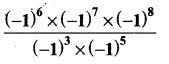
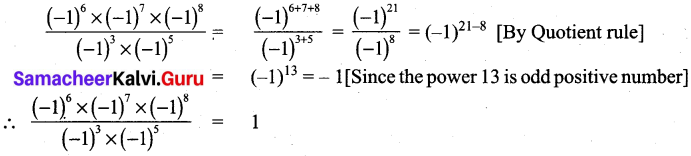
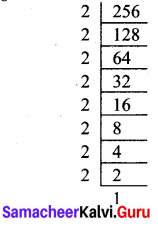
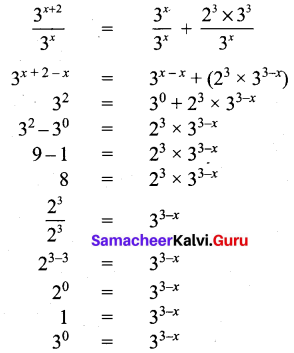
Samacheer Kalvi 7th Maths Solutions Term 2 Chapter 3 Algebra Ex 3.3

Students can Download Maths Chapter 3 Algebra Ex 3.3 Questions and Answers, Notes Pdf, Samacheer Kalvi 7th Maths Book Solutions Guide Pdf helps you to revise the complete Tamilnadu State Board New Syllabus and score more marks in your examinations.

Tamilnadu Samacheer Kalvi 7th Maths Solutions Term 2 Chapter 3 Algebra Ex 3.3

Question 1.
Fill in the blanks.

(i) The degree of the term a3b2c4d2 is _______
(ii) Degree of the constant term is _______
(iii) The coefficient of leading term of the expression 3z2y + 2x – 3 is _______
Answers:
(i) 11
(ii) 0
(iii) 3

Question 2.
Say True or False.

(i) The degree of m2 n and mn2 are equal.
(ii) 7a2b and -7ab2 are like terms.
(iii) The degree of the expression -4x2 yz is -4
(iv) Any integer can be the degree of the expression.
Answers:
(i) True
(ii) False
(iii) False
(iv) True

Samacheer Kalvi 7th Maths Solutions Term 2 Chapter 3 Algebra Ex 3.3

Question 3.
Find the degree of the following terms.
(i) 5x2
(ii) -7 ab
(iii) 12pq2 r2
(iv) -125
(v) 3z
Solution:
(i) 5x2
In 5x2, the exponent is 2. Thus the degree of the expression is 2.

(ii) -7ab
In -7ab, the sum of powers of a and b is 2. (That is 1 + 1 = 2).
Thus the degree of the expression is 2.

(iii) 12pq2 r2
In 12pq2 r2, the sum of powers of p, q and r is 5. (That is 1 +2 + 2 = 5).
Thus the degree of the expression is 5.

(iv) -125
Here – 125 is the constant term. Degree of constant term is 0.
∴ Degree of -125 is 0.

(v) 3z
The exponent is 3z is 1.
Thus the degree of the expression is 1.

Samacheer Kalvi 7th Maths Solutions Term 2 Chapter 3 Algebra Ex 3.3

Question 4.
Find the degree of the following expressions.
(i) x3 – 1
(ii) 3x2 + 2x + 1
(iii) 3t4 – 5st2 + 7s2t2
(iv) 5 – 9y + 15y2 – 6y3
(v) u5 + u4v + u3v2 + u2v3 + uv4
Solution:
(i) x3 – 1
The terms of the given expression are x3, -1
Degree of each of the terms: 3,0
Terms with highest degree: x3.
Therefore, degree of the expression is 3.

(ii) 3x2 + 2x + 1
The terms of the given expression are 3x2, 2x, 1
Degree of each of the terms: 2, 1, 0
Terms with highest degree: 3x2
Therefore, degree of the expression is 2.

(iii) 3t4 – 5st2 + 7s2t2
The terms of the given expression are 3t4, – 5st2, 7s3t2
Degree of each of the terms: 4, 3, 5
Terms with highest degree: 7s2t2
Therefore, degree of the expression is 5.

(iv) 5 – 9y + 15y2 – 6y3
The terms of the given expression are 5, – 9y , 15y2, – 6y3
Degree of each of the terms: 0, 1, 2, 3
Terms with highest degree: – 6y3
Therefore, degree of the expression is 3.

(v) u5 + u4v + u3v2 + u2v3 + uv4
The terms of the given expression are u5, u4v , u3v2, u2v3, uv4
Degree of each of the terms: 5, 5, 5, 5, 5
Terms with highest degree: u5, u4v , u3v2, u2v3, uv4
Therefore, degree of the expression is 5.

Samacheer Kalvi 7th Maths Solutions Term 2 Chapter 3 Algebra Ex 3.3

Question 5.
Identify the like terms : 12x3y2z, – y3x2z, 4z3y2x, 6x3z2y, -5y3x2z
Solution:
-y3 x2z and -5y3x2z are like terms.

Question 6.
Add and find the degree of the following expressions.
(i) (9x + 3y) and (10x – 9y)
(ii) (k2 – 25k + 46) and (23 – 2k2 + 21 k)
(iii) (3m2n + 4pq2) and (5nm2 – 2q2p)
Solution:
(i) (9x + 3y) and (10x – 9y)
This can be written as (9x + 3y) + (10x – 9y)
Grouping the like terms, we get
(9x + 10x) + (3y – 9y) = x(9 + 10) + y(3 – 0) = 19x + y(-6) = 19x – 6y
Thus degree of the expression is 1.

(ii) (k2 – 25k + 46) and (23 – 2k2 + 21k)
This can be written as (k2 – 25k + 46) + (23 – 2k2 + 21k)
Grouping the like terms, we get
(k2 – 2k2) + (-25 k + 21 k) + (46 + 23)
= k2 (1 – 2) + k(-25 + 21) + 69 = – 1k2 – 4k + 69
Thus degree of the expression is 2.

(iii) (3m2n + 4pq2) and (5nm2 – 2q2p)
This can be written as (3m2n + 4pq2) + (5nm2 – 2q2p)
Grouping the like terms, we get
(3m2n + 5m2n) + (4pq2 – 2pq2)
= m2n(3 + 5) + pq2(4 – 2) = 8m2n + 2pq2
Thus degree of the expression is 3.

Samacheer Kalvi 7th Maths Solutions Term 2 Chapter 3 Algebra Ex 3.3

Question 7.
Simplify and find the degree of the following expressions.
(i) 10x2 – 3xy + 9y2 – (3x2 – 6xy – 3y2)
(ii) 9a4 – 6a3 – 6a4 – 3a2 + 7a3 + 5a2
(iii) 4x2 – 3x – [8x – (5x2 – 8)]
Solution:
(i) 10x2 – 3xy + 9y2 – (3x2 – 6xy – 3y2)
= 10x2 – 3xy + 9y2 + (-3x2 + 6xy + 3y2)
= 10x2 – 3xy + 9y2 – 3x2 + 6xy + 3y2
= (10x2 – 3x2) + (- 3xy + 6xy) + (9y2 + 3y2)
= x2(10 – 3) + xy(-3 + 6) + y2(9 + 3)
= x2(7) + xy(3) + y2(12)
Hence, the degree of the expression is 2.

(ii) 9a4 – 6a3 – 6a4 – 3a2 + 7a3 + 5a2
= (9a4 – 6a4) + (- 6a3 + 7a3) + (- 3a2 + 5a2)
= a4(9-6) + a3 (- 6 + 7) + a2(-3 + 5)
= 3a4 + a3 + 2a2
Hence, the degree of the expression is 4.

(iii) 4x2 – 3x – [8x – (5x2 – 8)]
= 4x2 – 3x – [8x + -5x2 + 8)]
= 4x2 – 3x – [8x – 5x2 – 8]
= 4x2 – 3x – 8x + 5x2 – 8
(4x2 + 5x2) + (- 3x – 8x) – 8
= x2(4+ 5) + x(-3-8) – 8
= x2(9) + x(- 11) – 8
= 9x2 – 11x – 8
Hence, the degree of the expression is 2.

Objective Type Question

Question 8.
3p2 – 5pq + 2q2 + 6pq – q2 +pq is a
(i) Monomial
(ii) Binomial
(iii) Trinomial
(iv) Quadrinomial
Answer:
(iii) Trinomial

Question 9.
The degree of 6x7 – 7x3 + 4 is
(i) 7
(ii) 3
(iii) 6
(iv) 4
Answer:
(i) 7

Samacheer Kalvi 7th Maths Solutions Term 2 Chapter 3 Algebra Ex 3.3

Question 10.
If p(x) and q(x) are two expressions of degree 3, then the degree of p(x) + q(x) is
(i) 6
(ii) 0
(iii) 3
(iv) Undefined
Answer:
(iii) 3

Samacheer Kalvi 8th Maths Solutions Term 2 Chapter 1 Life Mathematics Additional Questions

Students can Download Maths Chapter 1 Life Mathematics Additional Questions and Answers, Notes Pdf, Samacheer Kalvi 8th Maths Book Solutions Guide Pdf helps you to revise the complete Tamilnadu State Board New Syllabus and score more marks in your examinations.

Samacheer Kalvi 8th Maths Solutions Term 2 Chapter 1 Life Mathematics Additional Questions

Additional Questions and Answers

Question 1.
Fill in the blanks

Question (a)
Percent means ……….
Answer:
Per hundred or out of hundred.

Question (b)
Percent is useful in ………
Answer:
Comparing quantities easily

Samacheer Kalvi 8th Maths Solutions Term 2 Chapter 1 Life Mathematics Additional Questions

Question (c)
The formula to find the increased quantity ………
Answer:
I = (1 + \(\frac{x}{100}\))

Question (d)
The formula to find the decreased quantity ………
Answer:
D = (1 + \(\frac{x}{100}\))

Question (e)
Gain or profit % ……..
Answer:
(\(\frac{Profit}{C.P}\) x 100)%

Question (f)
Loss % = ………..
Answer:
(\(\frac{Loss}{C.P}\) x 100)%

Question (g)
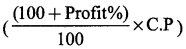
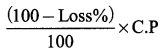
S.P = ………. (if gain % is given)
Answer:
Samacheer Kalvi 8th Maths Solutions Term 2 Chapter 1 Life Mathematics Additional Questions 1

Question (h)
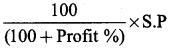
C.P = ……… (if gain % is given)
Answer:
Samacheer Kalvi 8th Maths Solutions Term 2 Chapter 1 Life Mathematics Additional Questions 2

Question (f)
S.P = ………. (if loss % is given)
Answer:
Samacheer Kalvi 8th Maths Solutions Term 2 Chapter 1 Life Mathematics Additional Questions 3

Question (h)
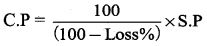
C.P = ………. (if loss % is given)
Answer:
Samacheer Kalvi 8th Maths Solutions Term 2 Chapter 1 Life Mathematics Additional Questions 4

Question (k)
Selling price = Marked price – …………
Answer:
Discount

Samacheer Kalvi 8th Maths Solutions Term 2 Chapter 1 Life Mathematics Additional Questions

Question (l)
Cost price = Cost price + ……….
Answer:
Over head expenses

Question 2.
If y% of ₹ 1000 is 600, find the value ofy.
Solution:
y% of 1000 = 600
\(\frac{y}{100}\) x 1000 = 600
y = \(\frac{600}{10}\)
y = 60

Question 3.
A number when decreased by 10% becomes 900. Then find the number.
Solution:
Let the number be ‘x’
Given x – \(\frac{10}{100}\)x = 900
\(\frac{100x-10x}{100}\) = 900
\(\frac{90x}{100}\) = 900
x = \(\frac{900×100}{90}\) = 1000

Question 4.
If the population in a city has increased from 5,00,000 to 7,00,000 in a year, find the percentage increase in population.
Solution:
Increase in population = 7,00,000 – 5,00,000 = 2,00,000
Percentage increase in population = \(\frac{2,00,000}{5,00,000}\) x 100 = 40%

Samacheer Kalvi 8th Maths Solutions Term 2 Chapter 1 Life Mathematics Additional Questions

Question 5.
If the selling price of a refrigerator is equal to \(\frac{10}{8}\) of its cost price, then find the gain/ profit percent.
Solution:
Let the C.P of the refrigerator be x
S.P = \(\frac{10}{8}\)x
Profit = S.P – C.P = \(\frac{10}{8}\)x – x = \(\frac{10x-8x}{8}\) = \(\frac{2x}{8}\)
Samacheer Kalvi 8th Maths Solutions Term 2 Chapter 1 Life Mathematics Additional Questions 5

Question 6.
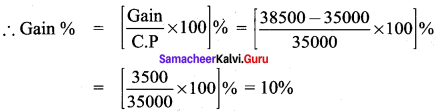
Karnan bought a dishwasher for ₹ 32,300 and paid ₹ 2700 for its transportation. Then he sold it for X 38,500. Find his gain or loss percent.
Solution:
Total C.P of the dishwasher = C.P + Overhead expenses.
= ₹ 32300 + ₹ 2700 = ₹ 35000
S.P = ₹ 38500
Therefore, we find S.P > C.P
Samacheer Kalvi 8th Maths Solutions Term 2 Chapter 1 Life Mathematics Additional Questions 6

Question 7.
The value of a car 2 years ago was ₹ 1,40,000. It depreciates at the rate of 4% p.a. Find its present value.
Solution:
Depreciated value = P(1 + \(\frac{r}{100}\))n = 1,40,000(1 – \(\frac{4}{100}\))2
= 1,40,000(\(\frac{96}{100}\)) x (\(\frac{96}{100}\)) = ₹ 1,29,024

Samacheer Kalvi 8th Maths Solutions Term 2 Chapter 1 Life Mathematics Additional Questions

Question 8.
Find the difference in C.I and S.I for P = ₹ 10,000, r = 4% p.a, n = 2 years.
Solution:
C.I – S.I = P(\(\frac{r}{100}\))2 = 10,000(\(\frac{4}{100}\))2
= 10,000 x \(\frac{4}{100}\) x \(\frac{4}{100}\) = ₹ 16

Question 9.
Find the C.I for the given Principal = ₹ 8,000, r = 5% p.a, n = 2 years
Amount A = P(1 + \(\frac{r}{100}\))n = 8000(1 + \(\frac{5}{100}\))2
= 8000 x \(\frac{105}{100}\) x \(\frac{105}{100}\)
= 8000 x \(\frac{21}{20}\) x \(\frac{21}{20}\)
A = ₹ 8820
Cl = A – P = 8820 – 8000 = 820

Question 10.
Find the S.I for the principal P = ₹ 16,000, r = 5% p.a, n = 3 years
Solution:
P = ₹ 16,000, n= 3 years, r = 5%
S.I = \(\frac{Pnr}{100}\) = \(\frac{16000x3x5}{100}\) = ₹ 2400

Samacheer Kalvi 7th Maths Solutions Term 2 Chapter 3 Algebra Ex 3.1

Students can Download Maths Chapter 3 Algebra Ex 3.1 Questions and Answers, Notes Pdf, Samacheer Kalvi 7th Maths Book Solutions Guide Pdf helps you to revise the complete Tamilnadu State Board New Syllabus and score more marks in your examinations.

Tamilnadu Samacheer Kalvi 7th Maths Solutions Term 2 Chapter 3 Algebra Ex 3.1

Question 1.
Fill in the blanks.

  1. The exponential form 149 should be read as ______
  2. The expanded form of p3 q2 is ______
  3. When base is 12 and exponent is 17, its e×ponential form is _____
  4. The value of (14 × 21)0 is _____

Answers:

  1. 14 Power 9
  2. p × p × p × q × q
  3. 1217
  4. 1

Question 2.
Say True or False.

  1. 23 × 32 = 65
  2. 29 × 32 = (2 × 3)9×2
  3. 34 × 37= 311
  4. 20 × 10000
  5. 23 < 32

Answers:

  1. False
  2. False
  3. True
  4. True
  5. True

Samacheer Kalvi 7th Maths Solutions Term 2 Chapter 3 Algebra Ex 3.1

Question 3.
Find the value of the following.

  1. 26
  2. 112
  3. 54
  4. 93

Solution:

  1. 26 = 2 × 2 × 2 × 2 × 2 × 2 = 64
  2. 112 = 11 × 11 = 121
  3. 54 = 5 × 5 × 5 × 5 = 625
  4. 93 = 9 × 9 × 9 = 729

Question 4.
Express the following in e×ponential form.

  1. 6 × 6 × 6 × 6
  2. t × t
  3. 5 × 5 × 7 × 7 × 7
  4. 2 × 2 × a × a

Solution:

  1. 6 × 6 × 6 × 6 = 61+1+1+1 = 64 [Since am × an = am+n]
  2. t × t = t1+1 = t2
  3. 5 × 5 × 7 × 7 × 7 = 51+1 × 71+1+1 = 52 × 73
  4. 2 × 2 × a × a = 21+1 × a1+1 = 22 × a2 = (2a)2

Samacheer Kalvi 7th Maths Solutions Term 2 Chapter 3 Algebra Ex 3.1

Question 5.
E×press each of the following numbers using e×ponential form,
(i) 512
(ii) 343
(iii) 729
(iv) 3125
Solution:
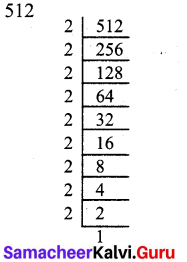
(i) 512
Samacheer Kalvi 7th Maths Solutions Term 2 Chapter 3 Algebra Ex 3.1 1
512 = 2 × 2 × 2 × 2 × 2 × 2 × 2 × 2 × 2 × 2
= 29 [Using product rule]

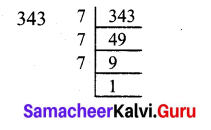
(ii) 343
Samacheer Kalvi 7th Maths Solutions Term 2 Chapter 3 Algebra Ex 3.1 2
343 = 7 × 7 × 7 = 71+1+1
= 73 [Using product rule]

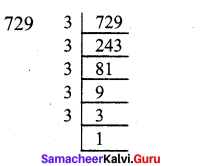
(iii) 729
Samacheer Kalvi 7th Maths Solutions Term 2 Chapter 3 Algebra Ex 3.1 3
729 = 3 × 3 × 3 × 3 × 3 × 3
= 36 [Using product rule]

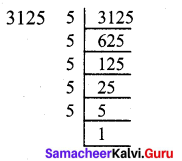
(iv) 3125
Samacheer Kalvi 7th Maths Solutions Term 2 Chapter 3 Algebra Ex 3.1 4
3125 = 5 × 5 × 5 × 5 × 5
= 55 [Using product rule]

Samacheer Kalvi 7th Maths Solutions Term 2 Chapter 3 Algebra Ex 3.1

Question 6.
Identify the greater number in each of the following.
(i) 63 or 36
(ii) 53 or 35
(iii) 28 or 82
Solution:
(i) 63 or 36
63 = 6 × 6 × 6 = 36 × 6 = 216
36 = 3 × 3 × 3 × 3 × 3 × 3 = 729
729 > 216 gives 36 > 63
∴ 36 is greater.

(ii) 53 or 35
53 = 5 × 5 × 5 = 125
35 = 3 × 3 × 3 × 3 × 3 = 243
243 > 125 gives 35 > 53
∴ 35 is greater.

(iii) 28 or 82
28 = 2 × 2 × 2 × 2 × 2 × 2 × 2 × 2 = 256
82 = 8 × 8 = 64
256 > 64 gives 28 > 82
∴ 28 is greater.

Samacheer Kalvi 7th Maths Solutions Term 2 Chapter 3 Algebra Ex 3.1

Question 7.
Simplify the following
(i) 72 × 34
(ii) 32 × 24
(iii) 52 × 104
Solution:
(i) 72 × 34 = (7 × 7) × (3 × 3 × 3 × 3)
= 49 × 81 = 3969

(ii) 32 × 24 = (3 × 3) × (2 × 2 × 2 × 2)
= 9 × 16 = 144

(iii) 52 × 104 = (5 × 5) × (10 × 10 × 10 × 10)
= 25 × 10000 = 2,50,000

Question 8.
Find the value of the following.
(i) (-4)2
(ii) (-3) × (-2)3
(iii) (-2)3 × (-10)3
Solution:
(i) (-4)2 = (-1)2 × (4)2 [since am × bm = (a × b)m]
= 1 × 16 = 16 [since (-1)n = 1 if n is even]

(ii) (-3) × (-2)3 = (-1) × (-3) × (-1)3 × (-2)3
= (-1)4 × 24 [Grouping the terms of same base]
= 24

(iii) (-2)3 × (-10)3 = (-1)3 × (-2)3 × (-1)3 × (-10)3
= (-1)3+3 × 23 × 103 [Grouping the terms of same base]
= (-1)6 × (2 × 10)3
[∵ am × bm = (a × b)m]
= 1 × 203 [since (-1)n = 1 if n is even]
= 8000

Samacheer Kalvi 7th Maths Solutions Term 2 Chapter 3 Algebra Ex 3.1

Question 9.
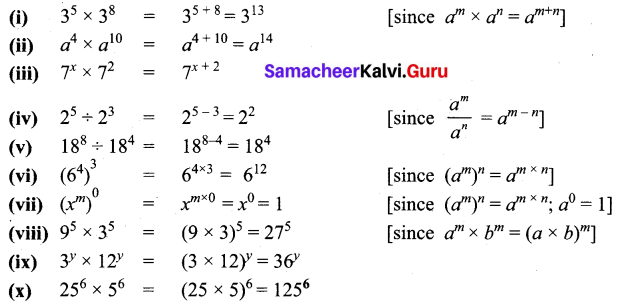
Simplify using laws of exponents.
(i) 35 × 38
(ii) a4 × a10
(iii) 7x × 72
(iv) 25 ÷ 23
(v) 188 ÷ 184
(vi) (64)3
(vii) (xm)0
(viii) 95 × 35
(ix) 3y × 12y
(x) 256 × 56
Solution:
Samacheer Kalvi 7th Maths Solutions Term 2 Chapter 3 Algebra Ex 3.1 5

Samacheer Kalvi 7th Maths Solutions Term 2 Chapter 3 Algebra Ex 3.1

Question 10.
If a = 3 and b = 2, then find the value of the following.
(i) ab + ba
(ii) aa – bb
(iii) (a + b)b
(iv) (a – b)a
Solution:
(i) ab + ba
a = 3 and b = 2
we get 32 + 23 = (3 × 3) + (2 × 2 × 2) = 9 + 8 = 17

(ii) (aa – bb)
Substituting a = 3 and b = 2
we get 32 – 22 = (3 × 3 × 3) – (2 × 2) = 27 – 4 = 23

(iii) (a + b)b
Substituting a = 3 and b = 2
we get (3 + 2)2 = 52 = 5 × 5 = 25

(iv) (a – b)a
Substituting a = 3 and b = 2
we get (3 – 2)3 = 13 = 1 × 1 × 1 = 1

Samacheer Kalvi 7th Maths Solutions Term 2 Chapter 3 Algebra Ex 3.1

Question 11.
Simplify and express each of the following in exponential form:
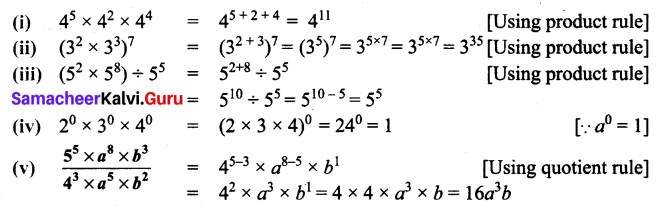
(i) 45 × 42 × 44
(ii) (32 × 33)7
(iii) (52 × 58) ÷ 5s
(iv) 20 × 30 × 40
(v) \(\frac{5^{5} \times a^{8} \times b^{3}}{4^{3} \times a^{5} \times b^{2}}\)
Solution:
Samacheer Kalvi 7th Maths Solutions Term 2 Chapter 3 Algebra Ex 3.1 6

Objective Type Questions

Question 12.
a × a × a × a × a equal to
(i) a5
(ii) 5 a
(iii) 5a
(iv) a + 5
Answer:
(i) a5

Question 13.
The exponential form of 72 is
(i) 72
(ii) 27
(iii) 22 × 33
(iv) 23 × 32
Answer:
(iv) 23 × 32

Question 14.
The value of x in the equation a13 = x3 × a10 is
(i) a
(ii) 13
(iii) 3
(iv) 10
Answer:
(i) a

Question 15.
How many zeros are there in 10010 ?
(i) 2
(ii) 3
(iii) 100
(iv) 20
Answer:
(iv) 20

Question 16.
240 + 240 is equal to
(i) 440
(ii) 280
(iii) 241
(iv) 480
Answer:
(iii) 241

Samacheer Kalvi 8th Maths Solutions Term 2 Chapter 1 Life Mathematics Ex 1.4

Students can Download Maths Chapter 1 Life Mathematics Ex 1.4 Questions and Answers, Notes Pdf, Samacheer Kalvi 8th Maths Book Solutions Guide Pdf helps you to revise the complete Tamilnadu State Board New Syllabus and score more marks in your examinations.

Tamilnadu Samacheer Kalvi 8th Maths Solutions Term 2 Chapter 1 Life Mathematics Ex 1.4

Miscellaneous Practise Problems

Question 1.
Nanda’s marks in 3 Math tests Tl, T2 and T3 were 38 out of 40,27 out of 30 and 48 out of 50. In which test did he do well? Find his overall percentage in all the 3 tests.
Solution:
Nanda’s marks are as follows
In Test 1 → T1 \(\frac{38}{40}\)
Test 2 → T2 \(\frac{27}{30}\)
Test 3 → T3 \(\frac{48}{50}\)
For percentage, multiply by 100
T1 = \(\frac{38}{40}\) x 100 = 95%
T2 = \(\frac{27}{30}\) x 100 = 90%
T3 = \(\frac{48}{50}\) x 100 = 96%
Hence, he has scored highest percentage in test 3
∴ He is done well in T3
Overall percentage is the average of the 3 percentages.
i.e \(\frac{90+95+96}{3}\) = \(\frac{281}{50}\) = 93\(\frac{2}{3}\)%

Samacheer Kalvi 8th Maths Solutions Term 2 Chapter 1 Life Mathematics Ex 1.4

Question 2.
Sultana bought the following things from a general store. Calculate the total bill amount to be paid by her.
(i) Medicines costing ₹ 800 with GST @ 5% ………..
Samacheer Kalvi 8th Maths Solutions Term 2 Chapter 1 Life Mathematics Ex 1.4 1
(ii) Cosmetics costing ₹ 650 with GST @ 12% ………….
Samacheer Kalvi 8th Maths Solutions Term 2 Chapter 1 Life Mathematics Ex 1.4 2
(iii) Cereals costing ₹ 900 with GST @ 0% …………
Samacheer Kalvi 8th Maths Solutions Term 2 Chapter 1 Life Mathematics Ex 1.4 3
(iv) Sunglass costing ₹ 1750 with GST @ 18 % ………..
Samacheer Kalvi 8th Maths Solutions Term 2 Chapter 1 Life Mathematics Ex 1.4 4
(v) Air Conditioner costing ₹ 28500 with GST @ 28% ………..
Samacheer Kalvi 8th Maths Solutions Term 2 Chapter 1 Life Mathematics Ex 1.4 5
Solution:
Samacheer Kalvi 8th Maths Solutions Term 2 Chapter 1 Life Mathematics Ex 1.4 6
(i) Medicine : bill amount is 800(1 + \(\frac{5}{100}\)) = 800 x \(\frac{105}{100}\) = 840
(ii) Cosmetics: Bill amount is 650(1 + \(\frac{12}{100}\)) = 650 x \(\frac{112}{100}\) = 728
(iii) Cereals : Bill amount is 900(1 + \(\frac{0}{100}\)) = 900
(iv) Sunglass: bill amount is 1750(1 + \(\frac{18}{100}\)) = 1750 x \(\frac{118}{100}\) = 2065
(v) AC : Bill amount is 28500(1 + \(\frac{28}{100}\)) = 28500 x \(\frac{128}{100}\) = 36480
∴ Total bill amount = 840 + 728 + 900 + 2065 + 36480
= ₹ 41,013 (total bill amount)

Question 3.
P’s income is 25% more than that of Q. By what percentage is Q’s income less than P’s?
Solution:
Let Q’s income be 100.
P’s income is 25% more than that of Q
∴ P’s income = 100 + \(\frac{25}{100}\) x 100 = 125
Q’s income is 25 less than that of P
In percentage terms, Q’s income is less than P’s with respect to P’s income is
\(\frac{P-Q}{P}\) x 100 = \(\frac{125-100}{125}\) x 100 = \(\frac{25}{100}\) x 100 = 20%

Question 4.
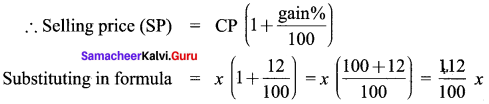
Gopi sold a laptop at 12% gain. If it had been sold for ₹ 1200 more, the gain would have been 20%. Find the cost price of the laptop.
Samacheer Kalvi 8th Maths Solutions Term 2 Chapter 1 Life Mathematics Ex 1.4 7
Solution:
Let the cost price of the laptop be ‘x’
Gain = 12%
Samacheer Kalvi 8th Maths Solutions Term 2 Chapter 1 Life Mathematics Ex 1.4 8
If the selling price was 1200 more
i.e \(\frac{112}{100}\)x +1200, the gain is 20%
i.e new selling price = x(1 + \(\frac{2}{100}\))
= \(\frac{112}{100}\)x + 1200 = x(100 + \(\frac{20}{100}\)) = \(\frac{112}{100}\)x
∴ 1200 = \(\frac{120}{100}\)x = \(\frac{112}{100}\)x = \(\frac{8}{100}\)x
∴ x = \(\frac{120×100}{8}\) = 15000
Cost price of the laptop is ₹ 15000

Question 5.
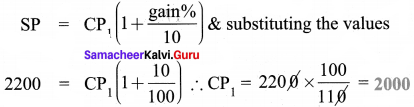
Vaidegi sold two sarees for ₹ 2200 each. On one she gains 10% and on the other she loses 12%. Calculate her gain or loss percentage in the sales.
Samacheer Kalvi 8th Maths Solutions Term 2 Chapter 1 Life Mathematics Ex 1.4 9
Solution:
Saree 1:
The selling price is ₹ 2200, let cost price be CP1, gain is 10%
Cost price ₹ Using the formula
Samacheer Kalvi 8th Maths Solutions Term 2 Chapter 1 Life Mathematics Ex 1.4 10
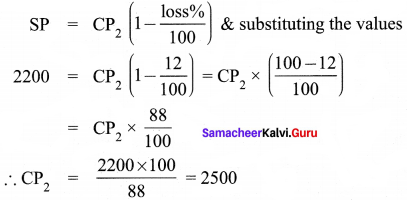
Saree 2:
The selling price is 2200, let cost price be CP2, loss is given as 12%. We need to find CP2 using the formula as before,
Samacheer Kalvi 8th Maths Solutions Term 2 Chapter 1 Life Mathematics Ex 1.4 11
Cost price of both together is CP1 + CP2
= 2000 + 2500 = 4500 ……(1)
Selling price of both together is 2 x 2200 = 4400 …….(2)
Since net selling price is less than net cost price, there is a loss.
loss% = \(\frac{loss}{cost price}\) x 100
Loss = Net cost price – Net selling price
(1) – (2) = 4500 – 4400 = 100
∴ loss% = \(\frac{100}{4500}\) x 100 = \(\frac{100}{45}\) = \(\frac{20}{9}\) = 2\(\frac{2}{9}\)%
= 2\(\frac{2}{9}\)% loss

Samacheer Kalvi 8th Maths Solutions Term 2 Chapter 1 Life Mathematics Ex 1.4

Question 6.
A sum of money becomes ₹ 18000 in 2 years and ₹ 40500 in 4 years on compound interest. Find the sum.
Solution:
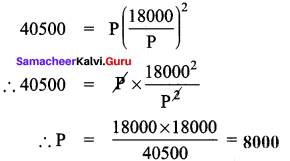
Let the sum of money be ‘P’
Given that sum ‘P’ becomes 18000 in 2yrs.
i.e Amount (A) = P(1 + \(\frac{r}{100}\))n
18000 = P(1 + \(\frac{r}{100}\))2
(1 + \(\frac{r}{100}\))2 = \(\frac{18000}{P}\) ⇒ (1 + \(\frac{r}{100}\))4 = (\(\frac{18000}{P}\))2 ……(1)
Also given that sum ‘P’ becomes46500 in 4 yrs.
i.e Amount (A) = P(1 + \(\frac{r}{100}\))n
40500 = P(1 + \(\frac{r}{100}\))4
Substituting (1) in (2), we get
Samacheer Kalvi 8th Maths Solutions Term 2 Chapter 1 Life Mathematics Ex 1.4 12

Question 7.
Find the difference in the compound interest on ₹ 62500 for 1\(\frac{1}{2}\) years at 8% p.a compounded annually and when compounded half-yearly.
Solution:
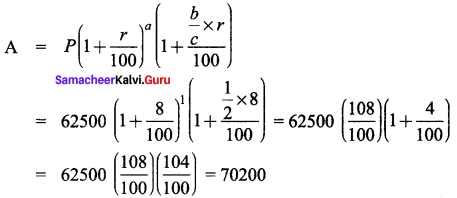
Case 1:
P = ₹ 62500
n = 1\(\frac{1}{2}\)yrs. (a\(\frac{b}{c}\)) formula
r = 8% Compound annully
CI = A – P
Samacheer Kalvi 8th Maths Solutions Term 2 Chapter 1 Life Mathematics Ex 1.4 13
CI = A – P = 70200 – 62500 = 7700 ……(1)
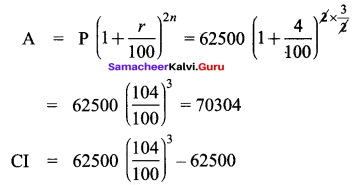
CAse 2:
P = ₹ 62500
n = 1\(\frac{1}{2}\)yrs.
r = 8% p.a when compound half yearly
r = 4% compound half yearly
Samacheer Kalvi 8th Maths Solutions Term 2 Chapter 1 Life Mathematics Ex 1.4 14
= 70304 – 62500 = ₹ 7804
Difference between case 1 & case 2 is (2) – (1)
∴ (2) – (1) = 7804 – 7700 = ₹ 104

Challenging Problems

Question 8.
If the first number is 20% less than the second number and the second number is 25% more than 100, then find the first number.
Solution:
Second number is 25% more than 100
∴ 2nd number is 100 + \(\frac{25}{100}\) x 100= 125
First number is 20% less than second no.
Samacheer Kalvi 8th Maths Solutions Term 2 Chapter 1 Life Mathematics Ex 1.4 15
1st number is 100

Question 9.
A shopkeeper gives two successive discounts on an article whose marked price is ? 180 and selling price is ? 108. Find the first discount percent if the second discount is 25%.
Solution:
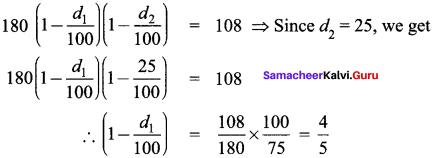
Marked price is given as ? 180
Let 1st discount be d1% = ? (to find)
2nd discount be d2% = 25%
Selling price is 108 (given)
Price after 1st discount = 180(1 – \(\frac { d_{ 1 } }{ 100 } \)) = P1
Price after 2nd discount = P1(1 – \(\frac { d_{ 2 } }{ 100 } \)) = 108
Substituting for P1 from (1), we get
Samacheer Kalvi 8th Maths Solutions Term 2 Chapter 1 Life Mathematics Ex 1.4 16
∴ 1 – \(\frac { d_{ 1 } }{ 100 } \) = \(\frac{4}{5}\)
∴ \(\frac { d_{ 1 } }{ 100 } \) = 1 – \(\frac{4}{5}\) = \(\frac{1}{5}\)
∴ d1 = \(\frac{1}{5}\) x 100 = 20%

Samacheer Kalvi 8th Maths Solutions Term 2 Chapter 1 Life Mathematics Ex 1.4

Question 10.
A man bought an article on 30% discount and sold it at 40% more than the marked price. Find the profit made by him.
Solution:
Let marked price be ‘P’
Discounted price = P(1 – \(\frac{d}{100}\)) where d is the discount %
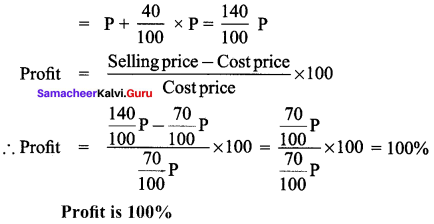
∴ Discounted price = P(1 – \(\frac{30}{100}\)) = \(\frac{70}{100}\)P → this is the cost price.
Selling price = 40% more than marked price
Samacheer Kalvi 8th Maths Solutions Term 2 Chapter 1 Life Mathematics Ex 1.4 17

Question 11.
Find the rate of compound interest at which a principal becomes 1.69 times itself in 2 years.
Solution:
Let principal be ‘P’
Amount is given to be 1.69 times principal
i.e 1.69 P
Time period is 2yrs. = (n)
Rate of interest = r = ? (required)
Applying the formula,
Amount = Principal (1 + \(\frac{r}{100}\))n
Substituting, 1.69 P = P (1 + \(\frac{r}{100}\))2
∴ (1 + \(\frac{r}{100}\))2 = \(\frac{1.69P}{P}\)
Taking square root on both sides, we get
\(\sqrt{1.69}\) = 1 + \(\frac{r}{100}\)
∴ 1 + \(\frac{r}{100}\) = 1.3
∴ \(\frac{r}{100}\) = 1.3
r = 30%
∴ rate of compound interst is 30%

Samacheer Kalvi 8th Maths Solutions Term 2 Chapter 1 Life Mathematics Ex 1.4

Question 12.
The simple interest on a certain principal for 3 years at 10% p.a is ₹ 300. Find the compound interest accrued in 3 years.
Solution:
Let principal be ‘P’
Rate of interest is 10% p.a (r)
Time period (n) = 3 yrs.
Formula for simple interest
∴ P = \(\frac{300×100}{10×3}\) = 1000
Compound Interest = CI = A – P
Amount (A) = P (1 + \(\frac{r}{100}\))n
= 1000(1 + \(\frac{10}{100}\))3 = 1000 x (\(\frac{10o+10}{100}\))3
= 1000 x \(\frac{110}{100}\) x \(\frac{110}{100}\) x \(\frac{110}{100}\) = 1331
Compound Interest (Cl) = Amount – Principal
= 1331 – 1000 = 331
Compound Interest = ₹ 331

Samacheer Kalvi 7th Maths Solutions Term 2 Chapter 2 Measurements Additional Questions

Students can Download Maths Chapter 2 Measurements Additional Questions and Answers, Notes Pdf, Samacheer Kalvi 7th Maths Book Solutions Guide Pdf helps you to revise the complete Tamilnadu State Board New Syllabus and score more marks in your examinations.

Tamilnadu Samacheer Kalvi 7th Maths Solutions Term 2 Chapter 2 Measurements Additional Questions

Additional Questions and Answers

Exercise 2.1

Question 1.
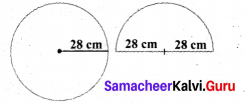
A circular disc of radius 28 cm is divided into two equal parts. What is the perimeter of each semicircular shape disc? Also find the perimeter of the circular disc.
Answer:
Radius of the circular disc = 28 cm
∴ circumference of the circle = 2 π r units
Samacheer Kalvi 7th Maths Solutions Term 2 Chapter 1 Number System add 1
= 2 × \(\frac { 22 }{ 7 } \) × 28 cm
= 2 × 22 × 4 = 44 × 4 = 176 cm
Perimeter of the circular disc = 176 cm
Now circumference of the semicircular disc = \(\frac { 1 }{ 2 } \) × (2 π r) = π r units
Perimeter of the semicircular disk = π r + r + r = \(\frac { 22 }{ 7 } \) × 28 + 28 + 28
= 22 × 4 + 28 + 28 = 88 + 28 + 28 = 144
Perimeter of each semicircular disc = 144 cm

Samacheer Kalvi 7th Maths Solutions Term 2 Chapter 2 Measurements Additional Questions

Question 2.
A gardener wants to fence a circular garden of diameter 14m. Find the length of the rope he needs to purchase if he makes 3 rounds of fence. Also find the cost of the rope, if it costs ₹ 4 per metre.
Solution:
Diameter of the circular garden (d) = 14 m
Circumference = π d = \(\frac { 22 }{ 7 } \) × 14 = 44 m
Since the rope makes 3 rounds of fence,
length of the rope needed = 3 × circumference of the garden
= 3 × 44 m = 132 m
Cost of rope per meter = ₹ 4 × 132 = ₹ 528

Question 3.
Latha wants to put a lace on the edge of a circular table cover of diameter 3 m. Find the length of the lace required and also find the cost if one metre of the lace costs ₹ 30 (Take π = 3.15 )
Solution:
Diameter of the circular table cover = 3m
Circumference C = π d units = 3.15 × 3 m = 9.45 m
Length of the lace required = 9.45 m
Cost of lace per meter = ₹ 30
∴ Cost of 9.45m lace = ₹ 30 × 9.45 = ₹ 283.50

Samacheer Kalvi 7th Maths Solutions Term 2 Chapter 2 Measurements Additional Questions

Exercise 2.2

Question 1.
The circumference of two circles are on the ratio 5 : 6. Find the ratio of their areas.
Solution:
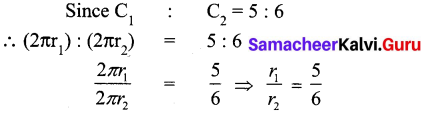
Let the radii of the given circles be r1 and r2
Let their circumference be C1 and C2 respectively
C1 = 2πr1 and C2 = 2πr2
Samacheer Kalvi 7th Maths Solutions Term 2 Chapter 1 Number System add 2
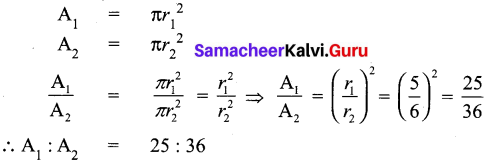
Now let the area of the given circles the A1 and A2
Samacheer Kalvi 7th Maths Solutions Term 2 Chapter 1 Number System add 3
∴ The areas of two circles are in the ratio 25 : 36.

Question 2.
Find the area of the circle whose circumference is 88 cm.
Solution:
The circumference of the circle = 88 cm
2πr = 88 cm
2 × \(\frac { 22 }{ 7 } \) × r = 88 cm
r = \(\frac{88 \times 7}{2 \times 22}\) = 14 cm
r = 14 cm
Area of the circle A = πr2
= \(\frac { 22 }{ 7 } \) × 14 × 14 cm2
= 22 × 2 × 14 cm2
= 616 cm2

Samacheer Kalvi 7th Maths Solutions Term 2 Chapter 2 Measurements Additional Questions

Question 3.
Find the cost of polishing a circular table top of diameter 16 dm if the rate of polishing is ₹ 15 per dm2.
Solution:
Diameter of the circular table top = 16 dm
Radius (r) = \(\frac { 16 }{ 2 } \) = 8cm
Area of the circular table top
= πr2 sq.units
= \(\frac { 22 }{ 7 } \) × 8 × 8 dm2 = \(\frac { 1408 }{ 7 } \) dm2
= 201.14 dm2
Rate of the polishing per dm2 = ₹ 15
∴ Rate of the polishing 201.14 dm2
= ₹ 15 × 201.14
= ₹ 3,017

Samacheer Kalvi 7th Maths Solutions Term 2 Chapter 2 Measurements Additional Questions

Exercise 2.3

Question 1.
From a circular sheet of radius 5 cm a circle of radius 3 cm is removed. Find the area of the remaining sheet.
Solution:
Radius of the outer circle R = 5 cm
Radius of the inner circle r = 3 cm
Area of the remaining sheet = Area of the outer circle
– Area of the inner circle
= πR2 – πr2 sq. units = π(R2 – r2) sq. units
= \(\frac { 22 }{ 7 } \) (52 – 32) cm2 = \(\frac { 22 }{ 7 } \) (52 – 32) cm2
= \(\frac { 22 }{ 7 } \) × (5 + 3) (5 – 3) = \(\frac { 22 }{ 7 } \) × (8) (2)
= \(\frac { 352 }{ 7 } \) = 50.28 cm2

Samacheer Kalvi 7th Maths Solutions Term 2 Chapter 2 Measurements Additional Questions

Question 2.
A picture is painted on a cardborad 8 cm long and 5 cm wide such that there is a margin of 1.5 cm along each of its sides. Find the total area of the margin.
Solution:
Length of the outer rectangle L = 8 cm
Breadth of the outer rectangle B = 5 cm
Area of the outer rectangle = L × B sq. units = 8 × 5 cm2 = 40 cm2
Length of the inner rectangle l = L – 2W = 8 – 2(1.5)cm = 8 – 3cm
l = 5cm
Breadth of thqnner rectangle b = B – 2W = 5 – 2(1.5) cm
= 5 – 3cm = 2cm
∴ Area of the margin = Area of the outer rectangle
– Area of the inner rectangle
= (40 – 10) cm2 = 30cm2

Samacheer Kalvi 7th Maths Solutions Term 2 Chapter 2 Measurements Additional Questions

Question 3.
A circular piece of radius 2 cm is cut from a rectangle sheet of length 5 cm and breadth 3 cm. Find the area left in the sheet.
Solution:
Radius of the portion removed r = 2 cm
Area of the circular sheet = πr2 sq.units
= \(\frac { 22 }{ 7 } \) × 2 × 2 cm2 = \(\frac { 88 }{ 7 } \) cm2 = 12.57 cm2
Length of the rectangular sheet L = 5 cm
Breadth of the rectangular sheet B = 3 cm
Area of the rectangle = L × B sq. units = 5 × 3 cm2 = 15 cm2
Area of the sheet left over = Area of the rectangle – Area of the circle
= 15 cm2 – 12.57 cm2 = 2.43 cm2

Samacheer Kalvi 9th Science Solutions Chapter 8 Sound

You can Download Samacheer Kalvi 9th Science Book Solutions Guide Pdf, Tamilnadu State Board help you to revise the complete Syllabus and score more marks in your examinations.

Tamilnadu Samacheer Kalvi 9th Science Solutions Chapter 8 Sound

Samacheer Kalvi 9th Science Sound Textbook Exercises

I. Choose the correct answer:

Question 1.
Which of the following vibrates when a musical note is produced by the cymbals in a orchestra?
(a) stretched strings
(b) stretched membranes
(c) air columns
(d) metal plates
Answer:
(a) stretched strings

Question 2.
Sound travels in air:
(a) if there is no moisture in the atmosphere.
(b) if particles of medium travel from one place to another.
(c) if both particles as well as disturbance move from one place to another.
(d) if disturbance moves.
Answer:
(b) if particles of medium travel from one place to another.

Samacheer Kalvi 9th Science Solutions Chapter 8 Sound

Question 3.
A musical instrument is producing continuous note. This note cannot be heard by a person having a normal hearing range. This note must then be passing through ………….
(a) wax
(b) vacuum
(c) water
(d) empty vessel
Answer:
(d) empty vessel

Question 4.
The maximum speed of vibrations which produces audible sound will be in ……………..
(a) seawater
(b) ground glass
(c) dry air
(d) Human blood
Answer:
(a) seawater

Samacheer Kalvi 9th Science Solutions Chapter 8 Sound

Question 5.
The sound waves travel faster
(a) in liquids
(b) in gases
(c) in solids
(d) in vacuum
Answer:
(c) in solids

II. Fill in the blanks.

  1. Sound is a ………… wave and needs a material medium to travel.
  2. Number of vibrations produced in one second is …………..
  3. The velocity of sound in solid is …………. than the velocity of sound in air.
  4. Vibration of object produces …………..
  5. Loudness is proportional to the square of the …………..
  6. …………… is a medical instrument used for listening to sounds produced in the body.
  7. The repeated reflection that results in persistence of sound is called ……………..

Answer:

  1. longitudinal
  2. frequency of wave
  3. faster
  4. Sound
  5. amplitude
  6. ECG
  7. reverberation

III. Match the following.

Column – IColumn – II
(a) Tuning fork(i) The point where density of air is maximum
(b) Sound(ii) Maximum displacement from the equilibrium position
(c) Compressions(iii) The sound whose frequency is greater than 20,000 Hz
(d) Amplitude(iv) Longitudinal wave
(e) Ultrasonics(v) Production of sound

Answer:
(a) (v)
(b) (i)
(c) (iv)
(d) (ii)
(e) (iii)

IV. Answer in brief.

Question 1.
Through which medium sound travels faster, iron or water? Give reason.
Answer:
Sound travels faster through iron as solids are packed together tighter than liquids and gases.

Samacheer Kalvi 9th Science Solutions Chapter 8 Sound

Question 2.
Name the physical quantity whose SI unit is ‘hertz’. Define.
Answer:
The SI unit of frequency is hertz (Hz). The number of vibrations (complete waves or cycles) produced in one second is called frequency of the wave.

Question 3.
What is meant by supersonic speed?
Answer:
When the speed of any object exceeds the speed of sound in air (330 m s-1) it is said to be travelling at supersonic speed.

Question 4.
How does the sound produced by a vibrating object in a medium reach your ears?
Answer:
When an object vibrates, it forces the neighbouring particles of the medium to vibrate. These vibrating particles then force the particles adjacent to them to vibrate. In this way vibrations produced by an object are transferred till it reaches the ear.

Question 5.
You and your friend are on the moon. Will you be able to hear any sound produced by your friend?
Answer:
No, as there is no medium on moon for the sound to travel.

V. Answer in detail.

Question 1.
Describe with diagram, how compressions and rarefactions are produced.
Answer:
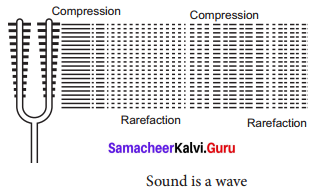
Sound is also a longitudinal wave. Sound can travel only when there are particles which can be compressed and rarefied. Compressions are the regions where particles are crowded together. Rarefactions are the regions of low pressure where particles are spread apart. A sound wave is an example of a longitudinal mechanical wave. Below figure represents the longitudinal nature of sound wave in the medium.
Samacheer Kalvi 9th Science Solutions Chapter 8 Sound 1

Question 2.
Verify experimentally the laws of reflection of sound.
Answer:
The laws of reflection are:

  • The angle in which the sound is incident is equal to the angle in which sound is reflected.
  • Direction of incident sound, direction of the reflected sound and the normal are in the same plane.

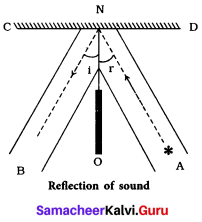
Samacheer Kalvi 9th Science Solutions Chapter 8 Sound 2
Take two metal tubes A and B. Keep one end of each tube on a metal plate as shown in figure. Place a wrist watch c at the open end of the tube A and interpose a cardboard between A and B. Now at a particular inclination of the tube B with the cardboard, ticking of the watch is clearly heard. The angle of reflection made by the tube B with the cardboard is equal to the angle of incidence made by the tube A with the cardboard.
For example, if the angle of incidence is 20° on the left side of a protractor (see figure arrangement), the angle of reflection at which we are able to hear the sound clearly will also be at 20° on the right side of the protractor.
∴ ∠ i = ∠ r    ➝ verifying Law I
We will also further observe that pipe 1, pipe 2 i.e, the incident ray, reflected ray and the normal lie on the same plane, verifying law II.

Samacheer Kalvi 9th Science Solutions Chapter 8 Sound

Question 3.
List the applications of sound.
Applications of ultrasound
Answer:

  • Ultra sound can be used in cleaning technology. Minute foreign particles can be removed from objects placed in a liquid bath through which ultrasound is passed.
  • Ultrasounds can also be use d to detect cracks and flaws in metal blocks.
  • Ultrasonic waves are made to reflect from various parts of the heart and form the image of the heart. This technique is called ‘echo cardiography’.
  • Ultrasound may be employed to break small ‘stones’ formed in the kidney into fine grains. These grains later get flushed out with urine.

Question 4.
Explain how does SONAR work?
Answer:
SONAR stands for Sound Navigation And Ranging. Sonar is a device that uses ultrasonic waves to measure the distance, direction and speed of underwater objects. Sonar consists of Science – 9 (Physics)
a transmitter and a detector and is installed at the bottom of boats and ships. The transmitter produces and transmits ultrasonic waves. These waves travel through water and after striking the object on the seabed, get reflected back and are sensed by the detector.

The detector converts the ultrasonic waves into electrical signals which are appropriately interpreted. The distance of the object that reflected the sound wave can be calculated by knowing the speed of sound in water and the time interval between transmission and reception of the ultrasound. Sonar technique is used to determine the depth of the sea and to locate underwater hills, valleys, submarine, icebergs etc.

VI. Numerical problem.

Question 1.
The frequency of a source of sound is 600 Hz. How many times does it vibrate in a minute?
Answer:
The number of vibrations (complete waves or cycles) produced in one second is called frequency of the wave.
Hence, in one minute 600 x 60 vibrations are produced = 36000 (Need clarification)

Samacheer Kalvi 9th Science Solutions Chapter 8 Sound

Question 2.
A stone is dropped from the top of a tower 750 m high into a pond of water at the base of the tower. When is the splash heard at the top?
(Given g = 10 m s– 2 and speed of sound = 340 ms– 1)
Height = 750m
h = ut + 0.5 gt2
The initial velocity is 0
750 = 0.5 × 10 × t2
t = 10sec
Speed of sound is 340m/sec
So, time taken to travel 750m upwards is,
\(\frac { 750 }{ 340 }\) = 2.20s
time taken = 10 + 2.20 = 12.2 sec.

Samacheer Kalvi 9th Science Sound In Text Problems

Question 1.
A sound wave has a frequency of 2 kHz and wavelength of 15 cm. How much time will it take to travel 1.5 km?
Solution:
v = nλ
n = 2 kHz = 2000Hz
λ = 15 cm = 0.15 m
0.15 × 2000 = 300ms– 1
Time(t) = \(\frac{\text { Distance (d) }}{\text { Velocity (v) }}\)
The sound will take 5 s to travel a distance of 1.5 km.

Samacheer Kalvi 9th Science Solutions Chapter 8 Sound

Question 2.
What is the wavelength of a sound wave in air at 20° C with a frequency of 22 MHz?
Solution:
λ = v/n
Here, v = 344 m s– 1
n = 22 MHz = 22 × 106 Hz
λ = \(\frac { 344 }{ 22 }\) × 106 = 15.64 × 10⁶ m = 15.64 µm.

Question 3.
A man fires a gun and hears its echo after 5 s. The man then moves 310 m towards the hill and fires his gun again. If he hears the echo after 3 s, calculate the speed of sound.
Solution:
Distance (d) = velocity (v) × time (t)
Distance travelled by sound when gun fires first time, 2d = v × 5 …………. (1)
Distance travelled by sound when gun fires second time, 2d – 620 = v × 3 …………… (2)
Rewriting equation (2) as,
2d = (v × 3) + 620 ……………. (3)
Equating (1) and (3), 5v = 3v + 620
2v = 620 .
Velocity of sound, v = 310 m s– 1

Question 4.
A ship sends out ultrasound that returns from the seabed and is detected after 3.42 s.
If the speed of ultrasound through sea water is 1531m s– 1, what is the distance of the seabed from the ship?
Solution:
We know, distance = speed × time
2d = speed of ultrasound × *time
2d = 1531 × 3.42
∴ d = \(\frac{5236}{2}\) = 2618 m
Thus, the distance of the seabed from the ship is 2618 m or 2.618 km.

Samacheer Kalvi 9th Science Sound Additional Questions

I. Answer the following questions.

Question 1.
“Sound needs a medium for propagation”. Justify with an experiment.
Answer:
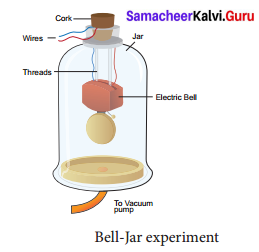
Samacheer Kalvi 9th Science Solutions Chapter 8 Sound 3
Sound needs a material like air, water, steel, etc. for its propagation. It cannot travel through vacuum. This can be demonstrated by the Bell-Jar experiment.

An electric bell and an airtight glass jar are taken. The electric bell is suspended inside the airtight jar. The jar is connected to a vacuum pump. If the bell is made to ring, we will be able to hear the sound of the bell. Now when the jar is evacuated with the vacuum pump, the air in the jar is pumped out gradually and the sound becomes feebler and feebler. We will not hear any sound, if the air is fully removed (if the jar has vacuum).

Samacheer Kalvi 9th Science Solutions Chapter 8 Sound

Question 2.
Name the characteristics that describe a sound.
Answer:
A sound wave can be described completely by five characteristics viz – amplitude, frequency, time period, wavelength and velocity or speed.

Question 3.
What does the intensity of sound heard at a place depend on?
Answer:
The intensity of sound heard at a place depends on the following factors;

  1. Amplitude of the source
  2. Distance of the observer
  3. Surface area of the source
  4. Density of the medium
  5. Frequency of the source.

Question 4.
Why is sound wave called longitudinal wave?
Answer:
As the vibration of the particles of the medium are along the direction of wave propagation, sound waves are longitudinal waves.

Question 5.
What is sound and how is it produced?
Answer:
Sound is a form of energy which produces the sensation of hearing. It is produced due to vibrations of different objects, eg. stretched vibrating wires and vibrating drums, etc.

Samacheer Kalvi 9th Science Solutions Chapter 8 Sound

Question 6.
How can two whales in the sea, hundreds of kilometers apart, communicate?
Answer:
Sound travels about 5 times faster in water than in air. Therefore, two whales in the sea, hundreds of kilometers apart can communicate easily.

Question 7.
What is a stethescope? What is the principle on which it works?
Answer:
Stethescope is a medical instrument used for listening to sounds produced in the body. In stethescopes, the sounds reach doctor’s ears by multiple reflections that happen in the connecting tube.

Question 8.
What is an ECG? How does it help in the field of medicine?
Answer:
The electrocardiogram (ECG) is one of the simplest and oldest cardiac investigations available. In ECG, the sound variations produced by heart is converted into electric signals. Thus an ECG is simply a representation of the electrical activity of the heart muscle as it changes with time. Usually it is printed on paper for easy analysis. The sum of this electrical activity, when amplified and recorded for just a few seconds is known as an ECG.

Samacheer Kalvi 7th Maths Solutions Term 2 Chapter 2 Measurements Ex 2.4

Students can Download Maths Chapter 2 Measurements Ex 2.4 Questions and Answers, Notes Pdf, Samacheer Kalvi 7th Maths Book Solutions Guide Pdf helps you to revise the complete Tamilnadu State Board New Syllabus and score more marks in your examinations.

Tamilnadu Samacheer Kalvi 7th Maths Solutions Term 2 Chapter 2 Measurements Ex 2.4

Miscellaneous Practice Problems

Question 1.
A wheel of a car covers a distance of 3520 cm in 20 rotations. Find the radius of the wheel?
Solutions:
Distance covered by circular wheel in 20 rotation = 3520 cm
∴ Distance covered ini rotation = \(\frac { 3520 }{ 20 } \) cm = 176 cm
∴ Circumference of the wheel = 176 cm
∴ 2πr = 176
2 × \(\frac { -2 }{ 6 } \) × r = 176
r = \(\frac{176 \times 7}{2 \times 22}\)
r = 28 cm
Radius of the wheel = 28 cm

Question 2.
The cost of fencing a circular race course at the rate of ₹ 8 per metre is ₹2112. Find the diameter of the race course.
Solution:
Cost of fencing the circumference = ₹ 2112
Cost of fencing one meter = ₹ 8
∴ Circumference of the circle = \(\frac { 2112 }{ 8 } \) = 264 m
πd = 264 m
\(\frac { 22 }{ 7 } \) × d = 264
d = \(\frac{264 \times 7}{22}\) = 12 × 7 m = 84 m
∴ Diameter of the race cource = 84 m

Question 3.
A path 2 m long and 1 m broad is constructed around a rectangular ground of dimensions 120 m and 90 m respectively. Find the area of the path.
Solution:
Length of the rectangular ground l = 120 m
Breadth b = 90 m
Length of the path W1 = 2m
Length of the path W2 = 1m
Length of the ground with path L = 1 + 2 (W2) = 120 + 2(1) m
= 120 + 2 = 122 m
Breadth of the ground with path B = l + 2(W1) units
= 90 + 2(2) m = 90 + 4 m = 94 m
∴ Area of the path = (L × B) – (1 × b) sq. units
= (122 × 94) – (122 × 94) m2 = 668 m2
∴ Area of the path = 668 m2

Samacheer Kalvi 7th Maths Solutions Term 2 Chapter 2 Measurements Ex 2.4

Question 4.
The cost of decorating the circumference of a circular lawn of a house at the rate of ₹55 per metre is ₹16940. What is the radius of the lawn?
Solution:
Cost of decorating the circumference = ₹ 16,940
Cost of decorating per meter = ₹ 55
∴ Length of the circumference = \(\frac { 16940 }{ 55 } \) m = 308 m
Circumference of the circular lawn = 308 m
2 × πr = 308 m
2 × \(\frac { 22 }{ 7 } \) × r = 308 m
r = \(\frac{308 \times 7}{2 \times 22}\)
r = 49 m
Radius of the lawn = 49 m

Question 5.
Four circles are drawn side by side in a line and enclosed by a rectangle as shown below.
If the radius of each of the circles is 3 cm, then calculate:
(i) The area of the rectangle.
(ii) The area of each circle.
(iii) The shaded area inside the rectangle.
Samacheer Kalvi 7th Maths Solutions Term 2 Chapter 1 Number System 2.4 1
Solution:
Given radius of a circle r = 3 cm
Diameter of the circle = 2r = 2 × 3 = 6 cm
Breadth of the rectangle = Diamter of the circle
B = 6cm
Length of the rectangle L = 4 × diameter of a circle

L = 4 × 6

L = 24cm

(i) Area of the rectangle = L × B sq. units
= 24 × 6 cm2
Area of the rectangle = 144 cm2

(ii) Area of the circle = πr2 sq. units
= \(\frac { 22 }{ 7 } \) × 3 × 3 cm2
= \(\frac { 198 }{ 7 } \) cm2
= 28.28 cm2

(iii) Area of the shaded area = Area of the rectangle – Area of the 4 circles

= 144 – (4 × \(\frac { 198 }{ 7 } \)) cm2 = 144 – \(\frac { 792 }{ 7 } \) cm2

= 144 – 113.14 cm2 = 30.85 cm2

Samacheer Kalvi 7th Maths Solutions Term 2 Chapter 2 Measurements Ex 2.4

Challenge Problems

Question 6.
A circular path has to be constructed around a circular lawn. If the outer and inner circumferences of the path are 88 cm and 44 cm respectively, find the width and area of the path.
Solution:
Outer circumference of the circular lawn = 88 cm
2πR = 88 cm
Inner circumference of the lawn 2πr = 44 cm
2πR – 2πr = 88 – 44
2 × \(\frac { 22 }{ 7 } \) (R – r) = 44
(R – r) = \(\frac{44 \times 7}{2 \times 22}\)
Outer radius – Inner radius = 7 cm
∴ Width of the lawn = 7 cm
Also 2πR + 2πr = 88 + 44
2π (R + r) = 132
π (R + r) = \(\frac { 132 }{ 2 } \) = 66 cm
Area of the path = πR2 – πr2 sq. units
= π (R + r) (R – r) = 66 × 7
Area of the path = 462cm2

Question 7.
A cow is tethered with a rope of length 35 m at the centre of the rectangular field of length 76 m and breadth 60 m. Find the area of the land that the cow cannot graze?
Solution:
Length of the field l = 76 m
Breadth of the field b = 60m
Area of the field A = l × b sq. units = 76 × 60 m2
Area of the field A = 4560 m2
Length of the rope = 35m
Radius of the land that the cow can graze = 35m
Area of the land tha the cow can graze = circle of radius 35 m = πr2 sq.units
π × 35 × 35 m2 = \(\frac { 22 }{ 7 } \) × 35 × 35 m2
= 3850 m2
Area of the land the cow cannot graze = Area of the field – Area that the cow can graze
= 4560 – 3860 m2 = 710 m2
Area of the land that the cow cannot graze = 710 m2

Samacheer Kalvi 7th Maths Solutions Term 2 Chapter 2 Measurements Ex 2.4

Question 8.
A path 5 m wide runs along the inside of the rectangular field. The length of the rectangular field is three times the breadth.of the field. If the area of the path is 500 m2 then find the length and breadth of the field.
Solution:
Let the length of the rectangular field = ‘L’ m
Breadth of the rectangular field = = ‘B’ m
Area of the rectangular field = (L × B) m2
Also given length = 3 × Breadth
L = 3B
Width of the path (W) = 5m
Lenth of the inner rectangle = L – 2W = l – 2(5)
= 3B – 10m
Breadth of the inner rectangle = B – 2W
= B – 2(5)
= B – 10 m
Area of the inner rectangle = (3B – 10) (B – 10)
= 3B2 – 10B – 30B + 100
Area of the path = Area of outer rectangle
– Area of inner rectangle
= (L × B) – (3B2 – 10B – 30B + 100)
3B × B – (3B2 – 40B + 100)
= 3B2 – 3B2 + 40B – 100
Area of the path = 40B – 100
Given area of the path = 500 m2
40B – 100 = 500
40B = 500 + 100 = 600
B = \(\frac { 600 }{ 40 } \)
B = 15m
Length of the field = 45 m; Breadth of the field = 15 m

Question 9.
A circular path has to be constructed around a circular ground. 1f the areas of the outer and inner circles are 1386 m2 and 616 m2 respectively, find the width and area of the path.
Solution:
Area of the outer circle = 1386 m2
πR2 = 1386m2
Area of the inner circle = 616 m2
πr2 = 616m2
Area of the path = Area of outer circle – Area of the inner circle
1386 m2 – 616 m2
Area of the path = 770m2
Also πR2 = 1386
R2 = \(\frac{1386 \times 7}{22}\)
R2 = 63 × 7
R2 = 9 × 7 × 7
R2 = 32 × 72
R = 3 × 7
Outer Radius R = 21 m
Again πr2 = 616
\(\frac { 22 }{ 7 } \) × r2 = 616
r2 = 28 × 7
r2 = 4 × 7 × 7
r2 = 22 × 72
r = 2 × 7
Inner radius r = 14m
Width of the path = Outer radius – Inner radius = 21 – 14
Width of the path = 7m

Question 10.
A goat is tethered with a rope of length 45 m at the centre of the circular grass land whose radius is 52 m. Find the area of the grass land that the goat cannot graze.
Solution:
Length of the rope = 45 m = Radius of the inner circle
∴ Area of the circular area that the goat graze = πr2 sq. units
= \(\frac { 22 }{ 7 } \) × 45 × 45 m2 = 6364.28 m2
Radius of the gross land = 52 m
Area of the grass land = \(\frac { 22 }{ 7 } \) × 52 × 52 = 8,498.28 m2
Area that the goat cannot graze
= Area of the outer circle – Area of the inner circle
= 8498.28 – 6364.28 = 2134 m2
Area of the goat cannot grass = 2134 m2

Samacheer Kalvi 7th Maths Solutions Term 2 Chapter 2 Measurements Ex 2.4

Question 11.
A strip of 4 cm wide is cut and removed from all the sides of the rectangular cardboard with dimensions 30 cm × 20 cm. Find the area of the removed portion and area of the remaining cardboard.
Solution:
Area of the outer rectangular cardboard
= L × B sq.units = 30 × 20 cm2 = 600 cm2
Width of the stip = 4 cm
Length of the inner rectangle = L – 2W
l = 30 – 2(4) = 30 – 8
l = 22cm
Breadth of the inner rectangle B = 2W = 20 – 2(4) = 20 – 8
b = 12cm
Area of the inner rectangle = l × b sq.units = 22 × 12 cm2 = 264 cm2
Area of the remaining cardboard = 264 cm2
Area of the removed portion = Area of outer rectangle
– Area of the inner rectangle
= 600 – 264 cm2
Area of the removed portion = 336 cm2

Question 12.
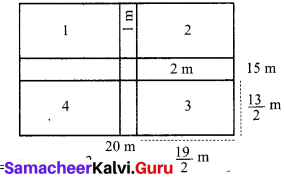
A rectangular field is of dimension 20 m × 15 m. Two paths run parallel to the sides of the rectangle through the centre of the field. The width of the longer path is 2m and that of the shorter path is 1 m. Find (i) the area of the paths (ii) the area of the remaining portion of the field (iii) the cost of constructing the roads at the rate of ₹ 10 per sq.m.
Solution:
Length of the rectangular field L = 20 m
Breadth B = 15m
Area = L × B
20 × 15 m2
Area of outer rectangle = 300 m2
Samacheer Kalvi 7th Maths Solutions Term 2 Chapter 1 Number System 2.4 2
Area of inner small rectangle = \(\frac { 19 }{ 2 } \) × \(\frac { 13 }{ 2 } \) = 61.75 cm2

(i) Area of the path = Area of the outer rectangle
– Area of 4 inner small rectangles
= 300 – 4(61.75) = 300 – 247 = 53 m2
Area of the paths = 53 m2

(ii) Area of the remaining portion of the field
= Area of the outer rectangle – Area of the paths
= 300 – 53 m2 = 247 m2
Area of the remaining portion = 247 m2

(iii) Cost of constructing 1 m2 road = ₹10
∴ Cost of constructing 53 m2 road = ₹10 × 53 = ₹530
∴ Cost of constructing road = ₹530

Samacheer Kalvi 9th Science Solutions Chapter 9 Universe

You can Download Samacheer Kalvi 9th Science Book Solutions Guide Pdf, Tamilnadu State Board help you to revise the complete Syllabus and score more marks in your examinations.

Tamilnadu Samacheer Kalvi 9th Science Solutions Chapter 9 Universe

Samacheer Kalvi 9th Science Universe Textbook Exercises

I. Choose the correct answer.

Question 1.
Who proposed the heliocentric model of the universe?
(a) Tycho Brahe
(b) Nicolaus Copernicus
(c) Ptolemy
(d) Archimedes
Answer:
(b) Nicolaus Copernicus

Question 2.
Which of the following is not a part of outer solar system?
(a) Mercury
(b) Saturn
(c) Uranus
(d) Neptune
Answer:
(a) Mercury

Samacheer Kalvi 9th Science Solutions Chapter 9 Universe

Question 3.
Ceres is a …………..
(a) Meteor
(b) Star
(c) Planet
(d) Astroid
Answer:

Question 4.
The period of revolution of planet A around the Sun is 8 times that of planet B. How many
times is the distance of planet A as great as that of planet B?
(a) 4
(b) 5
(c) 2
(d) 3
Answer:
(c) 2

Question 5.
The Big Bang occurred years ago.
(a) 13.7 billion
(b) 15 million
(c) 15 billion
(d) 20 million
Answer:
(a) 13.7 billion

II. Fill in the blanks.

  1. The speed of Sun in km/s is ……………..
  2. The rotational period of the Sun near its poles is ………………..
  3. India’s first satellite is …………….
  4. The third law of Kepler is also known as the Law of ………………
  5. The number of planets in our Solar System is ………………

Answer:

  1. 250
  2. 36 days
  3. Aryabhatta
  4. Harmonies 5.8

III. True or False.

  1. ISS is a proof for international cooperation – True.
  2. Halley’s comet appears after nearly 67 hours -False.
    Correct statement: Halley’s comet appears after nearly every 76 years.
  3. Satellites nearer to the Earth should have lesser orbital velocity – False.
    Correct statement: Nearer the object to the Earth, the faster is the required orbital velocity.
  4. Mars is called the red planet – True

IV. Answer very briefly.

Question 1.
What is solar system?
Answer:
The Sun and celestial bodies which revolve around it form the solar system. It consists of large number of bodies such as planets, comets, asteroids and meteors.

Samacheer Kalvi 9th Science Solutions Chapter 9 Universe

Question 2.
Define orbital velocity.
Answer:
The horizontal velocity that has to be imparted to a satellite at the determined height so that it makes a circular orbit around the planet is called orbital velocity.

Question 3.
Define time period of a satellite.
Answer:
Time taken by the satellite to complete one revolution round the Earth is called time period.
Time period, T = Distance covered/Orbital velocity
T = 2πr/v

Question 4.
What is a satellite? What are the two types of satellites?
Answer:
A body moving in an orbit around a planet is called satellite. The two types of satellites are natural and artificial. Earth’s natural satellite is the moon.

Question 5.
Write a note on the inner planets.
Answer:
The planets are spaced unevenly. The first four planets are relatively close together and close to the Sun. They form the inner solar system. The four planets grouped together in the inner solar system are Mercury, Venus, Earth and Mars. They are called inner planets.
They have a surface of solid rock crust and so are called terrestrial or rocky planets. Their insides, surfaces and atmospheres are formed in a similar way and form similar pattern. Our planet, Earth can be taken as a model of the other three planets.

Samacheer Kalvi 9th Science Solutions Chapter 9 Universe

Question 6.
Write about comets in brief.
Answer:
Comets are lumps of dust and ice that revolve around the Sun in highly elliptical orbits. Their period of revolution is very long. When approaching the Sun, a comet vaporizes and forms a head and tail. Some of the biggest comets even seen had tails 160 million (16 crores) km long. Many comets are known to appear periodically. One such comet is Halley’s Comet, which appears after nearly every 76 years. It was last seen in 1986. It will next be seen in 2062.

Question 7.
State Kepler’s laws.
Answer:
In the early 1600s, Johannes Kepler proposed three laws of planetary motion.
First Law – The Law of Ellipses
The path of the planets about the Sun is elliptical in shape, with the center of the Sun being located at one of the foci.

Second Law – The Law of Equal Areas
An imaginary line drawn from the center of the Sun to the center of the planet will sweep out equal areas in equal intervals of time.

Third Law – The Law of Harmonies
The ratio of the squares of the periods of any two planets is equal to the ratio of the cubes of their semi major axis from the Sun.

Question 8.
What factors have made life on Earth possible?
Answer:
The Earth where we live is the only planet in the solar system which supports life. Due to its right distance from the Sun it has the right temperature, the presence of water and suitable atmosphere and a blanket of ozone. All these have made continuation of life possible on the Earth. The axis of rotation of the Earth is not perpendicular to the plane of its orbit. The tilt is responsible for the change of seasons on the Earth.

V. Answer in detail.

Question 1.
Give an account of all the planets in the solar system.
Answer:
The planets are spaced unevenly. The first four planets are relatively close together and close to the Sun. They form the inner solar system. Farther from the Sun is the outer solar system, where the planets are much more spread out. Thus the distance between Saturn and Uranus is much greater (about 20 times) than between the Earth and the Mars.

The four planets grouped together in the inner solar system are Mercury, Venus, Earth and Mars. They are called inner planets. They have a surface of solid rock crust and so are called terrestrial or rocky planets. Their insides, surfaces and atmospheres are formed in a similar way and form similar pattern. Our planet, Earth can be taken as a model of the other three planets.

The four large planets Jupiter, Saturn, Uranus and Neptune spread out in the outer solar system that slowly orbit the Sun are called outer planets. They are made of hydrogen, helium and other gases in huge amounts and have very dense atmosphere. They are known as gas giants and are called gaseous planets. The four outer planets Jupiter, Saturn, Uranus and Neptune have rings whereas the four inner planets do not have any rings. The rings are actually tiny pieces of rock covered with ice.

Samacheer Kalvi 9th Science Solutions Chapter 9 Universe

Question 2.
Discuss the benefits of ISS.
Answer:
International Space Station (ISS), is a large spacecraft which can house astronauts. It goes around in low Earth orbit at approximately 400 km distance. It is also a science laboratory. Its very first part was placed in orbit in 1998 and its core construction was completed by 2011. It is the largest man-made object in space which can also be seen from the Earth through the naked eye. The first human crew went to the ISS in 2000. Ever since that, it has never been unoccupied by humans. At any given instant, at least six humans will be present in the ISS. According to the current plan ISS will be operated until 2024, with a possible extension until 2028. After that, it could be deorbited, or recycled for future space stations.

The ISS is intended to act as a scientific laboratory and observatory. Its main purpose is to provide an international lab for conducting experiments in space, as the space environment is nearly impossible to reproduce here on Earth. The microgravity environment present in the ISS provides ideal conditions for doing many scientific researches especially in biology, human biology, physics, astronomy and meteorology.

Question 3.
Write a note on orbital velocity.
Answer:
Nowadays many artificial satellites are launched into the Earth’s orbit. The first artificial satellite Sputnik was launched in 1956. India launched its first satellite Aryabhatta on April 19, 1975. Artificial satellites are made to revolve in an orbit at a height of few hundred kilometres. At this altitude, the friction due to air is negligible. The satellite is carried by a rocket to the desired height and released horizontally with a high velocity, so that it remains moving in a nearly circular orbit. The horizontal velocity that has to be imparted to a satellite at the determined height so that it makes a circular orbit around the planet is called orbital velocity.

The orbital velocity of the satellite depends on its altitude above Earth. Nearer the object to the Earth, the faster is the required orbital velocity. At an altitude of 200 kilometres, the required orbital velocity is little more than 27,400 kph. That orbital speed and distance permit the satellite to make one revolution in 24 hours. Since Earth also rotates once in 24 hours, a satellite stays in a fixed position relative to a point on Earth’s surface. Because the satellite stays over the same spot all the time, this kind of orbit is called ‘geostationary’.

Orbital velocity can be calculated using the following formula.
v = \(\sqrt{\frac{\mathrm{GM}}{(\mathrm{R}+\mathrm{h})}}\)
where; G = Gravitational constant (6.673 × 10– 11Nm2kg– 2)
M = Mass of the Earth (5.972 × 1024kg)
R = Radius of the Earth (6371 km)
h = Height of the satellite from the surface of the Earth.

VI. Conceptual questions.

Question 1.
Why do some stars appear blue and some red?
Answer:
Stars are the fundamental building blocks of galaxies. Stars were formed when the galaxies were formed during the Big Bang. Stars produce heat, light, ultraviolet rays, x-rays, and other forms of radiation. They are largely composed of gas and plasma (a superheated state of matter).

The brightness of a star depends on their intensity and the distance from the Earth. Stars also appear to be in different colours depending on their temperature. Hot stars are white or blue, whereas cooler stars are orange or red in colour.

Samacheer Kalvi 9th Science Solutions Chapter 9 Universe

Question 2.
How is a satellite maintained in nearly circular orbit?
Answer:
Artificial satellites are made to revolve in an orbit at a height of few hundred kilometres. At this altitude, the friction due to air is negligible. The satellite is carried by a rocket to the desired height and released horizontally with a high velocity, so that it remains moving in a nearly circular orbit.

Question 3.
Why are some satellites called geostationary?
Answer:
Since Earth also rotates once in 24 hours, a satellite stays in a fixed position relative to a point on Eqrth’s surface. Because the satellite stays over the same spot all the time, this kind of orbit is called ‘geostationary’.

Question 4.
A man weighing 60 kg in the Earth will weigh 1680 kg in the Sun. Why?
Answer:
Mass of the man = 60Kg
w = m × g
m = 60Kg, g = 274.13m/s2
The sun’s gravtiational acceleration is 30 times more than that of the earth. So the person would weigh 16,447N on the surface of sun.

VII. Numerical problems.

Question 1.
Calculate the speed with which a satellite moves if it is at a height of 36,000 km from the Earth’s surface and has an orbital period of 24 hr (Take R = 6370 km). [Hint: Convert hr into seconds before doing calculation]
Answer:
T = 2π(R+h)/v
86400 = 2 × 3.14 × (6370 + 36000)/v
v = 6.28 × 42370
266083.6 km/sec
S = d/t
= 266083/24
= 11086.79 km/h

Samacheer Kalvi 9th Science Solutions Chapter 9 Universe

Question 2.
At an orbital height of 400 km, find the orbital period of the satellite.
Answer:
h = 400 × 103m, R = 6371 × 103m,
v = 7616 × 103 kms– 1.
Substituting the values,
T = 2π(R+h)/v
T = 6.28 × \(\frac { 6771 }{ 7616 }\)
T = 5.583 × 10³s = 5583 .
T ≈ 93 min

Activity

Question 1.
Watch the sky in the early morning. Do you see any planet? What is its name? Find out with the help of your teachers.
Answer:
The planet that can be observed in the early morning is ‘Venus’.

Samacheer Kalvi 9th Science Solutions Chapter 9 Universe

Question 2.
Prepare a list of Indian satellites from Aryabhatta to the latest along with their purposes.
Answer:

SatelliteLaunch DatePurpose
Aryabhatta19 April 1975India’s first satellite.
Bhaskara-I7 June 1979First experimental remote sensing satellite. Carried TV and microwave cameras.
Rohini Technology Payload10 August 1979Intended for measuring in-flight performance of first experimental flight of SLV-3, the first Indian launch vehicle. Did not achieve orbit.
Ariane Passenger Payload Experiment19 June 1981First experimental communication satellite. Provided experience in building and operating a payload experiment three-axis stabilised communication satellite.
INSAT-1A10 April 1982First operational multipurpose communication and meteorology satellite. Procured from USA. Worked for only six months.
IRS-1A17 March 1988Earth observation satellite. First operational remote sensing satellite.
INSAT-2A10 July 1992First satellite in the second-generation Indian- built INSAT-2 series. Has enhanced capability over INSAT-1 series. Still in service.
INSAT-2E3 April 1999Multipurpose communication and meteorological satellite.
GSAT-118 April 2001Experimental satellite for the first developmental flight of Geosynchronous Satellite Launch Vehicle, GSLV-D1.
CARTOSAT-210 January 2007Advanced remote sensing satellite carrying a panchromatic camera capable of providing scene-specific spot images.
RISAT-220 April 2009Radar imaging satellite used to monitor India’s borders and as part of anti-infiltration and anti-terrorist operations. Launched as a co-passenger with ANUS AT.
Oceansat-2 (IRS-P4)23 September 2009Gathers data for oceanographic, coastal and atmospheric applications. Continues mission of Oceansat-1.
StudSatPSLV-C15First Indian pico-satellite (weighing less than 1 kg). Developed by a team from seven engineering colleges from Karnataka and Andhra Pradesh.              .
Jugnu12 October 2011Nano-satellite weighing 3 kg developed by IIT Kanpur
INSAT-3D26 July 2013INSAT-3D is the meteorological Satellite with advanced weather monitoring payloads.
GSAT-730 August 2013GSAT-7 is the advanced multi-band communication satellite dedicated for military use.
SCATSAT-126 September 2016Miniature satellite to provide weather forecasting, cyclone prediction, and tracking services to India.

Samacheer Kalvi 9th Science Universe In Text Problems

Question 1.
Can you calculate the orbital velocity of a satellite orbiting at an altitude of 500 km?
Data: G = 6.673 × 10– 11 SI units;
M = 5.972 × 1024 kg; R = 6371000 m;
h = 500000 m.
Solution:
v = \(\sqrt{\frac{6.67 \times 10^{-11} \times 5.972 \times 10^{24}}{(6371000+500000)}}\)
∴ v = 7613 ms– 1 or 7.613 kms– 1

Samacheer Kalvi 9th Science Solutions Chapter 9 Universe

Question 2.
At an orbital height of 500 km, find the orbital period of the satellite.
Solution:
h = 500 × 103m, R = 6371 × 103m,
v = 7616 × 103 kms– 1.
T = \(\frac{2 \pi(\mathrm{R}+\mathrm{h})}{\mathrm{v}}=2 \times \frac{22}{7} \times \frac{(6371+500)}{7616}\)
= 5.6677 × 10³s = 5667 s.
This is T ≈ 95 min

Samacheer Kalvi 9th Science Universe Additional Questions

I. Answer the following questions.

Question 1.
What is the composition of sun? How was it formed?
Answer:
Three quarters of the sun has hydrogen gas and one quarter has helium gas. It is over a million times as big as earth. Hydrogen atoms combine or fuse together to form helium under enormous pressure. This process is called nuclear fusion which releases enormous amount of energy as light and heat. It is this energy which makes sunshine and provide heat. The sun is situated at the centre of the solar system.

At the time of the Big Bang, hydrogen gas condensed to form huge clouds, which later concentrated and found numerous galaxies. Some hydrogen gas was left free in our galaxy. With time some changes occured due to which this free floating hydrogen gas concentrated and paved the way for formation of sun and the solar system.

Question 2.
What is a star? What is its composition and how was it formed?
Answer:
Stars are the fundamental building blocks of galaxies. Stars were formed when the galaxies were formed during the big bang. Stars produce heat, light, ultra violet rays and other forms of radiation. They are largely composed of gas and plasma. Stars are built by hydrogen gases. Hydrogen atom fuse together to form helium atoms and in the process they produce large amount of heat.

Samacheer Kalvi 9th Science Solutions Chapter 9 Universe

Question 3.
How is the pole star distinguished from other stars? Explain.
Answer:
Pole star was one of the most familiar stars for travellers in earlier times when there were no instruments or devices to find directions at night. It appears stationary because it is situated in the northern direction along the axis of rotation of the Earth.

Question 4.
What is the difference between a meteor and a meteorite?
Answer:
Meteors are stony or rocky bodies scattered throughout the solar system and are very small in size. The meteors are also called shooting stars. They travel at a high speed, these pieces come closer to the Earth’s atmosphere and are attracted by the gravitational force of Earth. Some are dust particles left behind by comets and other are pieces of asteroids which have collided. These are quite small, some may be as small as a sand grain.

Meteors while travelling across the Earth’s atmosphere are fast moving and get heated up to a very high temperature by air friction. The heat produced is so high, that the meteor starts glowing and then burnt and lost. The path of the meteor appears as a streak of light in the night sky. Very large meteors are able to survive from such heat destruction and actually reach the Earth’s surface. These meteors are called meteorites.

Samacheer Kalvi 9th Science Solutions Chapter 9 Universe

Question 5.
What is microgravity?
Answer:
It is a condition in which people or objects appear to be weightless. The effects of microgravity can be seen when astronauts and objects float in space. ‘Micro’ means small, so microgravity refers to a condition where gravity is so small. Many things seem to act differently in microgravity. Fire bums differently. Without the pull of gravity, flames are mere sound.

Samacheer Kalvi 7th Maths Solutions Term 2 Chapter 2 Measurements Intext Questions

Students can Download Maths Chapter 2 Measurements Intext Questions and Answers, Notes Pdf, Samacheer Kalvi 7th Maths Book Solutions Guide Pdf helps you to revise the complete Tamilnadu State Board New Syllabus and score more marks in your examinations.

Tamilnadu Samacheer Kalvi 7th Maths Solutions Term 2 Chapter 2 Measurements Intext Questions

Exercise 2.1

Try These (Text book Page No. 23)

Question 1.
A few real life examples of circular shapes are given below.
Samacheer Kalvi 7th Maths Solutions Term 2 Chapter 2 Measurements Intext Questions 1
Can you give three more examples.
Solution:

  1. One and Two rupee coins
  2. Bangles
  3. Mouth of Bottle

Question 2.
Find the diameter of your bicycle wheel?
Solution:
Diameter of my bicycle wheel is 700 mm

Question 3.
If the diameter of the circle is 14cm, what will be it’s radius?
Solution:
diameter d = 14 cm
radius = \(\frac { d }{ 2 } \) = \(\frac { 14 }{ 2 } \) = 7cm

Question 4.
If the radius of a bangle is 2 inches then find the diameter.
Solution:
Given radius of the bangle = 2 inches
Diameter = 2 × radius = 2 × 2 = 4 inches

Samacheer Kalvi 7th Maths Solutions Term 2 Chapter 2 Measurements Intext Questions

Exercise 2.2

Try These (Text book Page No. 33)

Question 1.
Draw circles of different radii on a graph paper. Find the area by counting the number of squares covered by the circle. Also find the area by using the formula.
(i) Find the area of the circle, if the radius is 4.2 cm.
(ii) Find the area of the circle if the diameter is 28 cm.
Solution:
(i) Radius of the circle r = 4.2 cm
Area of the circle A = π r2 sq.units
= \(\frac { 22 }{ 7 } \) × 4.2 × 4.2 cm2 = 5.44 cm2

(ii) Diameter of the circle d = 28 cm
radius r = \(\frac { d }{ 2 } \) = \(\frac { 28 }{ 2 } \) = 14 cm
Area of the circle A = π r2 sq.units
= \(\frac { 22 }{ 7 } \) × 14 × 14 cm2 = 616 cm2

Samacheer Kalvi 7th Maths Solutions Term 2 Chapter 2 Measurements Intext Questions

Exercise 2.3

Try These (Text book Page No. 35)

Question 1.
If the outer radius and inner radius of the circles are respectively 9 cm and 6 cm, find the width of the circular pathway.
Solution:
Radius of the outer circle R = 9 cm
Radius of the inner circle r = 6 cm
Width of the circular pathway = Radius of the outer circle
– Radius of the inner circle
= (9 – 6) cm = 3 cm
Width of the circular pathway = 3 cm

Samacheer Kalvi 7th Maths Solutions Term 2 Chapter 2 Measurements Intext Questions

Question 2.
If the area of the circular pathway is 352 sq.cm and the outer radius is 16 cm, find the inner radius.
Solution:
Given outer radius R = 16 cm
Area of the circular pathway = πR2 = πr2
Area of the circular pathway = 352 sq. cm
πR2 – πr2 = 352 cm2
π(R2 – r2) = 352
162 – r2 = \(\frac{352 \times 7}{22}\)
162 – r2 = 16 × 7
162 – r2 = 112
162 – 112 = r2
r2 = 256 – 112
r2 = 144
r = 12 cm
Inner radius r = 12 cm

Question 3.
If the area of the inner rectangular region is 15 sq.cm and the area covered by the outer rectangular region is 48 sq.cm, find the area of the rectangular pathway. Area of the outer rectangle Area of the inner rectangle Area of the rectangular pathway
Solution:
Area of the outer rectangle = 48 sq.cm
Area of the inner rectangle = 15 sq.cm
Area of the rectangular pathway = Area of the outer rectangle
– Area of the inner rectangle
= 48 – 15 = 33 cm2

Samacheer Kalvi 8th Maths Solutions Term 2 Chapter 1 Life Mathematics Ex 1.3

Students can Download Maths Chapter 1 Life Mathematics Ex 1.3 Questions and Answers, Notes Pdf, Samacheer Kalvi 8th Maths Book Solutions Guide Pdf helps you to revise the complete Tamilnadu State Board New Syllabus and score more marks in your examinations.

Tamilnadu Samacheer Kalvi 8th Maths Solutions Term 2 Chapter 1 Life Mathematics Ex 1.3

Question 1.
Fill in the blanks

Question (i)
The compound interest on ₹ 5000 at 12% p.a for 2 years compounded annually is ………..
Answer:
₹ 1272
Hint:
Compound Interest (Cl) formula is
Cl = Amount – Principal
Amount = A (1 + \(\frac{r}{100}\))n = 5000 (1 + \(\frac{12}{100}\))2
= 5000 (1 + \(\frac{112}{100}\))2 = 6272
∴ Cl = 6272 – 5000 = ₹ 1272

Samacheer Kalvi 8th Maths Solutions Term 2 Chapter 1 Life Mathematics Ex 1.3

Question (ii)
The compound interest on ₹ 8000 at 10% p.a for 1 year, compounded half yearly is …………
Answer:
₹ 820
Hint:
Compound interest (CI) = Amount – Principal
∴ Amount = P (1 + \(\frac{r}{100}\))2n [2n as it is compounded half yearly]
r = 10% p.a, for half yearly r = 1 + \(\frac{10}{2}\) = 5
A = 8000 (1 + \(\frac{5}{100}\))2×1 = 8000 x (\(\frac{105}{100}\))2 = 8820
CI = Amount – principal
= 8820 – 8000 = ₹ 820

Question (iii)
The annual rate of growth in population of a town is 10%. If its present population is 26620, the population 3 years ago was ………..
Answer:
₹ 20,000
Hint:
Rate of growth of population r = 10%; Present population = 26620
Let population 3 years ago be x
∴ Applying the formula for population growth which is similar to compound interest,
26620 = x (1 + \(\frac{r}{100}\))3
∴ 26620 = x (1 + \(\frac{10}{100}\))3 = x (\(\frac{110}{100}\))3
∴ x = 26620 x (\(\frac{110}{100}\))3
= ₹ 20,000
The population 3 years ago was ₹ 20,000

Questions (iv)
The amount if the compound interest is calculated quarterly, is found using the formula ………….
Answer:
A = P (1 + \(\frac{r}{400}\))4n
Hint:
Quarterly means 4 times in a year.
∴ The formula for compound interest is
A = P (1 + \(\frac{r}{400}\))4n

Question (v)
The difference between the S.I and C.I for 2 years for a principal of ₹ 5000 at the rate of interest 8% p.a is …….
Answer:
₹ 32
Hint:
Difference between S.I & C.I is given by the formula
CI – SI = P (\(\frac{r}{100}\))2
Principal (P) = 5000, r = 8% p.a
∴ CI – SI = 5000 (\(\frac{8}{100}\))2 = 5000 x \(\frac{8}{100}\) x \(\frac{8}{100}\) = ₹ 32

Samacheer Kalvi 8th Maths Solutions Term 2 Chapter 1 Life Mathematics Ex 1.3

Question 2.
Say True or False

Question (i)
Depreciation value is calculated by the formula P (1 – \(\frac{r}{100}\))n
Answer:
True
Hint:
Depreciation formula is P (1 – \(\frac{r}{100}\))n

Question (ii)
If the present population of a city is P and it increases at the rate of r % p.a, then the population n years ago would be P (1 + \(\frac{r}{100}\))n.
Answer:
False
Hint:
Let the population ‘n’ yrs ago be ‘x’
Present population (P) = x × (1 + \(\frac{r}{100}\))n
x = \(\frac { P }{ (1+\frac { r }{ 100 } )^{ n } } \)

Question (iii)
The present value of a machine is ₹ 16800. It depreciates @25% p.a. Its worth after 2 years is ₹ 9450.
Answer:
True
Hint:
Present value of machine = ₹ 16800
Depreciation rate (n) = 25%
Value after 2 years = P (1 – \(\frac{r}{100}\))n = 16800 (1 – \(\frac{25}{100}\))2
= 16800 x (1 – \(\frac{1}{4}\))2 = 16800 x \(\frac{3}{4}\) x \(\frac{3}{4}\) = 9450

Question (iv)
The time taken for ₹ 1000 to become ₹ 1331 @20% p.a compounded annually is 3 years.
Answer:
False
Principal money = 1000
rate of interest Amount = 20%
Amount = 1331, applying in formula we get
A = (1 + \(\frac{r}{100}\))n
1331 = 1000(1 + \(\frac{r}{100}\))n
∴ \(\frac{1331}{1000}\) = (1 – \(\frac{1}{5}\))n
\(\frac{1331}{1000}\) = (\(\frac{6}{5}\))n
∴ n ≠ 3 (False)

Samacheer Kalvi 8th Maths Solutions Term 2 Chapter 1 Life Mathematics Ex 1.3

Question (v)
The compound interest on ₹ 16000 for 9 months @20% p.a, compounded quarterly is ₹ 2522.
Answer:
True
Hint:
Principal (P) = 16000
n = 9 months = \(\frac{9}{12}\) years
r = 20% p.a
For compounding quarterly, we have to use below formula.
Amount (A) = P x (1 + \(\frac{r}{100}\))4n
Since quarterly we have to divide r by 4
r = \(\frac{20}{4}\)
Samacheer Kalvi 8th Maths Solutions Term 2 Chapter 1 Life Mathematics Ex 1.3 1
∴ Interest = A – P = 18522 – 16000 = 2522 (True)

Question 3.
Find the compound interest on ₹ 3200 at 2.5% p.a for 2 years, compounded annually.
Solution:
Principal (P) = ₹ 3200
r = 2.5% p.a
n = 2 years comp, annually
∴ Amount (A) = (1 + \(\frac{r}{100}\))n = (1 + \(\frac{2.5}{100}\))2
= 3200 x (1.025)2 = 3362
Compound interest (Cl) = Amount – Principal = 3362 – 3200 = ₹ 162

Question 4.
Find the compound interest for 2\(\frac{1}{2}\) years on ₹ 4000 at 10% p.a if the interest is compounded yearly.
Solution:
Principal (P) = ₹ 4000
r = 10% p.a
Compounded yearly n = 2\(\frac{1}{2}\) years. Since it is of the form a\(\frac{b}{c}\) years
Samacheer Kalvi 8th Maths Solutions Term 2 Chapter 1 Life Mathematics Ex 1.3 2
= 4000x 1.1 x 1.1 x 1.05 = 5082
∴ Cl = Amount – Principal = 5082 – 4000 = 1082

Question 5.
Magesh invested ₹ 5000 at 12% p.a for one year. If the interest is compounded half yearly, find the amount he gets at the end of the year.
Solution:
Principal (P) = ₹ 5000
Interest compounded half yearly
r = 12% p.a = \(\frac{12}{2}\) = 6% for half yearly
t = 1 yr.
Since compounded half yearly, the formula to be used is
Amount A = P (1 + \(\frac{r}{100}\))2n
A = 5000 (1 + \(\frac{6}{100}\))2×1 = 5000 x (\(\frac{106}{100}\))2 = ₹ 5618

Question 6.
At what time will a sum of ₹ 3000 will amount to ₹ 3993 at 10% p.a compounded annually?
Solution:
Amount A = ₹ 3993
Principal = ₹ 3000
r = 10% p.a
n = ?
Samacheer Kalvi 8th Maths Solutions Term 2 Chapter 1 Life Mathematics Ex 1.3 3

Question 7.
A principal becomes ₹ 2028 in 2 years at 4% p.a compound interest. Find the Principal.
Solution:
n = 2 years
r = rate of interest = 4% p.a
Amount A = ₹ 2028
Amount (A) = P (1 + \(\frac{r}{100}\))n
2028 = P (1 + \(\frac{4}{100}\))n
2028 = P (\(\frac{r}{100}\))2
∴ P = \(\frac{2028x100x100}{104×104}\) = ₹ 1875

Samacheer Kalvi 8th Maths Solutions Term 2 Chapter 1 Life Mathematics Ex 1.3

Question 8.
At what rate percentage p.a will ₹ 5625 amount to ₹ 6084 in 2 years at compound interest?
Solution:
Principal (P) = ₹ 5625
Amount (A) = ₹ 6084
n = 2 years
r = ?
Amount (A) = P (1 + \(\frac{r}{100}\))n [Applying in formula]
6084 = 5625 (1 + \(\frac{r}{100}\))2
(1 + \(\frac{r}{100}\))2 = \(\frac{6084}{5625}\)
Taking square root on both sides, we get
1 + \(\frac{r}{100}\) = \(\frac{78}{75}\)
\(\frac{r}{100}\) = \(\frac{78}{75}\) – 1 = \(\frac{3}{75}\) = \(\frac{1}{25}\)
∴ r = \(\frac{1}{25}\) x 100 = 4%

Question 9.
In how many years will ₹ 3375 amount to ₹ 4096 at 13\(\frac{1}{3}\)% p.a where interest is compounded half-yearly?
Solution:
Principal = ₹ 3375
Amount = ₹ 4096
r = 13\(\frac{1}{3}\)% p.a = \(\frac{40}{3}\)% p.a
Compounded half yearly r = \(\frac { \frac { 40 }{ 3 } }{ 2 } \) = \(\frac{2}{3}\)
Let no. of years be n
for compounding half yearly, formula is
Samacheer Kalvi 8th Maths Solutions Term 2 Chapter 1 Life Mathematics Ex 1.3 4

Question 10.
Find the C.I on ₹ 15000 for 3 years if the rates of interest is 15%, 20% and 25% for I, II and III years respectively.
Solution:
Principal (P) = ₹ 15000
rate of interest 1 (a) = 15% for year I
rate of interest 2 (b) = 20% for year II
rate of interest 3 (c) = 25% for year III
Formula for amount when rate of interest is different for different years is
Samacheer Kalvi 8th Maths Solutions Term 2 Chapter 1 Life Mathematics Ex 1.3 5
Compound Interest (Cl) = A – P = 25,875 – 15,000 = 10,875
Cl = ₹ 10,875

Question 11.
The present height of a tree is 847 cm. Find its height two years ago, if it increases at 10 % p.a.
Samacheer Kalvi 8th Maths Solutions Term 2 Chapter 1 Life Mathematics Ex 1.3 6
Solution:
Present height of tree = 847 cm
Present height = ‘h’
n = 2 yrs
rate of growth = 10% p.a
Applying in formula, we get
Samacheer Kalvi 8th Maths Solutions Term 2 Chapter 1 Life Mathematics Ex 1.3 7
∴ Original height of tree = 70 cm

Question 12.
Find the difference between the C.I and the S.I on ₹ 5000 for 1 year at 2% p.a, if the interest is compounded half yearly.
Solution:
Principal (P) = ₹ 5000
time period (n) = 1 yr.
Rate of interest (r) = 2% p.a
for half yearly r = 1%
Difference between Cl & SI is given by the formula
CI – SI = P (\(\frac{r}{100}\))2n [for half yearly compounding]
CI – SI = P (\(\frac{1}{100}\))2×1
= 5000 x \(\frac{1}{100}\) x \(\frac{1}{100}\) = ₹ 0.50

Samacheer Kalvi 8th Maths Solutions Term 2 Chapter 1 Life Mathematics Ex 1.3

Question 13.
What is the difference in simple interest and compound interest on 115000 for 2 years at 6% p.a compounded annually.
Solution:
Principal (P) = ₹ 15,000
Time period (n) = 2 yrs.
Rate of interest (r) = 6% p.a compounded annually
Difference between CI and SI given by
CI – SI = P (\(\frac{r}{100}\))n = 15000 (\(\frac{6}{100}\))2
= 15000 x \(\frac{6}{100}\) x \(\frac{6}{100}\)
= ₹ 54

Question 14.
Find the rate of interest if the difference between the C.I and S.I on ₹ 8000 compounded annually for 2 years is ₹ 20.
Solution:
Principal (P) = ₹ 8000
time period (n) = 2 yrs.
rate of interest (r) = ?
Difference between Cl & SI is given by the formula
CI – SI = P (1 + \(\frac{r}{100}\))n
Difference between Cl & SI is given as 20
∴ 20 = 8000 x (\(\frac{r}{100}\))2
∴ (\(\frac{r}{100}\))2 = \(\frac{20}{8000}\) = \(\frac{1}{400}\)
Taking square root on both sides
\(\frac{r}{100}\) = \(\sqrt { \frac { 1 }{ 400 } } \) = \(\frac{1}{20}\)
∴ r = \(\frac{100}{20}\)

Question 15.
Find the principal if the difference between C.I and S.I on it at 15% p.a for 3 years is ₹ 1134.
Solution:
Rate of interest (r) = 15% p.a
time period (n) = 3 years
Difference between Cl & SI is given as 1134
Principal = ? → required to find
Simple Interest SI = \(\frac{Pnr}{100}\)
Compound Interest CI = P (1 + i)n – P
Cl – SI = P [(1 + i)n – 1 – \(\frac{nr}{100}\)]
Samacheer Kalvi 8th Maths Solutions Term 2 Chapter 1 Life Mathematics Ex 1.3 8

Objective Type Questions

Question 16.
The number of conversion periods, if the interest on a principal is compounded every two months is ……………
(a) 2
(b) 4
(c) 6
(d) 12
Answer:
(c) 6
Hint:
Conversion period is the time period after which the interest is added to the principal. If principal is compounded every two months then in a year, there will be 6\(\frac{12}{2}\) conversation periods.

Question 17.
The time taken for ₹ 4400 to become ₹ 4851 at 10%, compounded half yearly is
(a) 6 months
(b) 1 year
(c) 1\(\frac{1}{2}\) years
(d) 2years
Answer:
(b) 1 year
Hint:
Principal = ₹ 4400
Amount = ₹ 4851
Rate of interest = 10% p.a
for half yearly, divide by 2,
r = \(\frac{10}{2}\) = 5 %
Compounded half yearly, so the formula is
A = P (1 + \(\frac{r}{100}\))2n
Substuting in the above formula, we get
Samacheer Kalvi 8th Maths Solutions Term 2 Chapter 1 Life Mathematics Ex 1.3 9
Taking square root on both sides, we get
(\(\frac{21}{20}\))2n = (\(\frac{21}{20}\))2
Equating power on both sides
∴ 2n = 2,
n = 1

Samacheer Kalvi 8th Maths Solutions Term 2 Chapter 1 Life Mathematics Ex 1.3

Question 18.
The cost of a machine is ₹ 18000 and it depreciates at 16\(\frac{2}{3}\)% annually. Its value after 2 years will be ………..
(a) ₹ 12000
(b) ₹ 12500
(c) ₹ 15000
(d) ₹ 16500
Answer:
(b) ₹ 12500
Hint:
Cost of machine = ₹ 18000
Depreciation rate = 16\(\frac{2}{3}\)% = \(\frac{50}{3}\)% p.a
time period = 2 years
∴ As per depreciation formula,
Depriciated value = Original value (1 – \(\frac{r}{100}\))n
Substituting in above formula, we get
Samacheer Kalvi 8th Maths Solutions Term 2 Chapter 1 Life Mathematics Ex 1.3 10

Question 19.
The sum which amounts to ₹ 2662 at 10% p.a in 3 years compounded yearly is ………..
(a) ₹ 2000
(b) ₹ 1800
(c) ₹ 1500
(d) ₹ 2500
Answer:
(a) ₹ 2000
Hint:
Amount = ₹ 2662
rate of interest = 10% p.a
Time period = 3 yrs. Compounded yearly
Principal (P) → required to find?
Applying formula A = P (1 + \(\frac{r}{100}\))n
Samacheer Kalvi 8th Maths Solutions Term 2 Chapter 1 Life Mathematics Ex 1.3 11

Question 20.
The difference between simple and compound interest on a certain sum of money for 2 years at 2% p.a is ₹ 1 the sum of money is ……….
(a) ₹ 2000
(b) ₹ 1500
(c) ₹ 3000
(d) ₹ 2500
Answer:
(d) ₹ 2500
Difference between Cl and SI is given as Re 1
Time period (n) = 2 yrs.
Rate of interest (r) = 2% p.a
Formula for difference is
CI – SI = P x (1 + \(\frac{r}{100}\))n
Substituting the values in above formula, we get
1 = P x (\(\frac{2}{100}\))2
∴ P = 1 x (\(\frac{100}{2}\))2
= 1 x (50)2 = ₹ 2500