Samacheer Kalvi 12th Economics Solutions Chapter 2 National Income

Students of 12th can get the pdf links of Tamilnadu State Board Economics Solutions here. You can Download Samacheer Kalvi 12th Economics Book Solutions Chapter 2 National Income Questions and Answers, Notes Pdf, Guide Pdf helps you to revise the complete Tamilnadu State Board New Syllabus and score more marks in your examinations.

Tamilnadu Samacheer Kalvi 12th Economics Solutions Chapter 2 National Income

It is very important to put the textbook aside while preparing for the exams. So, if you follow Samacheer Kalvi 12th Economics Textbook Solutions you can cover all the topics in Chapter 2 National Income Questions and Answers. This helps to improve your communication skills.

Samacheer Kalvi 12th Economics National Income Text Book Back Questions and Answers

Part – A

Multiple Choice Questions.

Question 1.
Net National product at factor cost is also known as –
(a) National Income
(b) Domestic Income
(c) Per capita Income
(d) Salary
Answer:
(a) National Income

Question 2.
Primary sector is –
(a) Industry
(b) Trade
(c) Agriculture
(d) Construction
Answer:
(c) Agriculture

Question 3.
National income is measured by using ………………. methods.
(a) Two
(b) Three
(c) Five
(d) Four
Answer:
(b) Three

Question 4.
Income method is measured by summing up of all forms of –
(a) Revenue
(b) Taxes
(c) Expenditure
(d) Income
Answer:
(d) Income

Question 5.
Which is the largest figure?
(a) Disposable income
(b) Personal Income
(c) NNP
(d) GNP
Answer:
(d) GNP

Question 6.
Expenditure method is used to estimate national income in –
(a) Construction sector
(b) Agricultural Sector
(c) Service sector
(d) Banking sector
Answer:
(a) Construction sector

Question 7.
Tertiary sector is also called as ……………………….. sector.
(a) Service
(b) Income
(c) Industrial
(d) Production
Answer:
(a) Service

Question 8.
National income is a measure of the performance of an economy.
(a) Industrial
(b) Agricultural
(c) Economic
(d) Consumption
Answer:
(c) Economic

Question 9.
Per capita income is obtained by dividing the National income by –
(a) Production
(b) Population of a country
(c) Expenditure
(d) GNP
Answer:
(b) Population of a country

Question 10.
GNP = ……………………… + Net factor income from abroad.
(a) NNP
(b) NDP
(c) GDP
(d) Personal income
Answer:
(c) GDP

Question 11.
NNP stands for ………………………
(a) Net National Product
(b) National Net product
(c) National Net Provident
(d) Net National Provident
Answer:
(a) Net National Product

Question 12.
…………………… is deducted from gross value to get the net value.
(a) Income
(b) Depreciation
(c) Expenditure
(d) Value of final goods
Answer:
(b) Depreciation

Question 13.
The financial year in India is –
(a) April 1 to March 31
(b) March 1 to April 30
(c) March 1 to March 16
(d) January 1 to December 31
Answer:
(a) April 1 to March 31

Question 14.
When net factor income from abroad is deducted from NNP, the net value is –
(a) Gross National Product
(b) Disposable Income
(c) Net Domestic Product
(d) Personal Income
Answer:
(c) Net Domestic Product

Question 15.
The value of NNP at production point is called –
(a) NNP at factor cost
(b) NNP at market cost
(c) GNP at factor cost
(d) Per capita income
Answer:
(a) NNP at factor cost

Question 16.
The average income of the country is –
(a) Personal Income
(b) Per capita income
(c) Inflation Rate
(d) Disposal Income
Answer:
(b) Per capita income

Question 17.
The value of national income adjusted for inflation is called –
(a) Inflation Rate
(b) Disposal Income
(c) GNP
(d) Real national income
Answer:
(d) Real national income

Question 18.
Which is a flow concept?
(a) Number of shirts
(b) Total wealth
(c) Monthly income
(d) Money supply
Answer:
(c) Monthly income

Question 19.
PQLI is the indicator of –
(a) Economic growth
(b) Economic welfare
(c) Economic progress
(d) Economic development
Answer:
(b) Economic welfare

Question 20.
The largest proportion of national income comes from –
(a) Private sector
(b) Local sector
(c) Public sector
(d) None of the above
Answer:
(a) Private sector

Part – B
Answer The Following Questions In One or Two Sentences.

Question 21.
Define National Income?
Answer:
National Income means the total money value of all final goods and services produced in a country during a particular period of time (one year).

Question 22.
Write the formula for calculating GNP?
Answer:
GNP at market prices means the gross value of final goods and services produced annually in a country plus net factor income from abroad
(C + I + G + (X – M) + (R – P)).

Question 23.
What is the difference between NNP and NDP?
Answer:
NNP:

  1. NNP refers to the market value of output.
  2. NNP at factor cost is the total of income payment made to factors of production.

NDP:

  1. NDP is the value of net output of the economy during the year
  2. The country’s capital equipment wears out of becomes outdated each year during the production process.

Question 24.
Trace the relationship between GNP and NNP?
Answer:
GNP:
1. Total money value of final goods and services produced in a country during a particular year (one year).

NNP:
1. Total money value of final goos and services produced in a country in a country during a particular year (one year).

Question 25.
What do you mean by the term ‘Personal Income’?
Answer:
Personal income is the total income received by the individuals of a country from all sources before payment of direct taxes in a year.

Question 26.
Define GDP deflator?
Answer:
GDP is the total market value of final goods and services produced within the country during a year. This is calculated at market prices and is known as GDP at market prices. Thus GDP by expenditure method at market prices = C + I + G + (X – M)
Where C – consumption goods;
I – Investment goods;
G – Government purchases;
(X – M) is net export which can be positive or negative.

Question 27.
Why is self consumption difficult in measuring national income?
Answer:

  1. Farmers keep a large portion of food and other goods produced on the farm for self consumption.
  2. The problem is whether that part of the produce which is not sold in the market can be included in national income or not.

Part – C
Answer The Following Questions In One Paragraph.

Question 28.
Write a short note on per capita income?
Answer:
Per Capita Income:

  1. The average income of a person of a country in a particular year is called Per Capita Income.
  2. Per capita income is obtained by dividing national income by population.

Samacheer Kalvi 12th Economics Chapter 2 National Income

Question 29.
Differentiate between personal and disposable income?
Answer:
Personal income:
Personal income is the total income received by the individuals of a country from all sources before payment of direct taxes in a year.

Disposable income:
Disposable Income is also known as Disposable personal income. It is the individuals income after the payment of income tax. This is the amount available for households for consumption.

Question 30.
Explain briefly NNP at factor cost?
Answer:
Net National Product refers to the value of the net output of the economy during the year. NNP is obtained by deducting the value of depreciation, or replacement allowance of the capital assets from the GNP. It is expressed as, NNP = GNP – depreciation allowance.

Question 31.
Give short note on Expenditure method?
The Expenditure Method (Outlay method):
Answer:

  1. The total expenditure incurred by the society in a particular year is added together.
  2. To calculate the expenditure of a society, it includes personal consumption expenditure, net domestic investment, government expenditure on consumption as well as capital goods and net exports.

Question 32.
What is the solution to the problem of double counting in the estimation of national income?
Answer:

  1. The value obtained is actually the GNP at market prices. Care must be taken to avoid double counting.
  2. The value of the final product is derived by the summation of all the values added in the productive process.
  3. To avoid double counting, either the value of the final output should be taken into the estimate of GNP or the sum of values added should be taken.
  4. Double counting is to be avoided under value added method.
  5. Any commodity which is either raw material or intermediate good for the final production should not be included.
  6. For example, value of cotton enters value of yam as cost, and value of yam in cloth and
    that of cloth in garments.
  7. At every stage value added only should be calculated.

Question 33.
Write briefly about national income and welfare?
Answer:
National Income and Welfare:
National Income is considered as an indicator of the economic wellbeing of a country. The per capita income as an index of economic welfare suffers from limitations which are stated below:

  1. The economic welfare depends upon the composition of goods and services provided. The greater the proportion of capital goods over consumer goods, the improvement in economic welfare will be lesser.
  2. Higher GDP with greater environmental hazards such as air, water and soil pollution will be little economic welfare.
  3. The production of war goods will show the increase in national output but not welfare.
  4. An increase in per capita income may be due to employment of women and children or forcing workers to work for long hours. But it will not promote economic welfare.

Question 34.
List out the uses of national income?
Answer:
The following are some of the concepts used in measuring national income?
GDP:

  1. GDP is the total market value of final goods and services produced within the country during a year.
  2. This is calculated at market prices and is known as GDP at market prices. Thus GDP by expenditure method at market

prices = C + I + G + (X-M)
Where C – Consumption goods;
I – Investment goods;
G – Government purchases;
(X – M) is net export which can be positive or negative.

Net National Product (NNP) (at Market price):

  1. Net National Product refers to the value of the net output of the economy during the year.
  2. NNP is obtained by deducting the value of depreciation, or replacement allowance of the capital assets from the GNP. It is expressed as,
  3. NNP = GNP – depreciation allowance.

NNP at Factor cost:

  1. NNP refers to the market value of output.
  2. NNP at factor cost is the total of income payment made to factors of production.

Personal Income:

  1. Personal income is the total income received by the individuals of a country’ from all sources before payment of direct taxes in a year.

Per Capita Income:

  1. The average income of a person of a country in a particular year is called Per Capita Income.
  2. Per capita income is obtained by dividing national income by population.

Samacheer Kalvi 12th Economics Solutions Chapter 2 National Income

Disposable Income:

  1. Disposable Income is also known as Disposable personal income.
  2. It is the individuals income after the payment of income tax.
  3. This is the amount available for households for consumption.

Real Income:

  1. Nominal income is national income expressed in terms of a general price level of a particular year in other words, real income is the buying power of nominal income.

GDP deflator:

  1. GDP deflator is an index of price changes of goods and services included in GDP.
  2. It is a price index which is calculated by dividing the nominal GDP in a given year by the real GDP for the same year and multiplying it by 100.

Part – D
Answer The Following Questions In One Page.

Question 35.
Explain the importance of national income
Importance of National Income Analysis
Answer:
National income is of great importance for the economy of a country. Nowadays the national income is regarded as accounts of the economy, which are known as social accounts. It enables us:
1. To know the relative importance of the various sectors of the economy and their contribution towards national income; from the calculation of national income, we could find how income is produced, how it is distributed, how much is spent, saved or taxed.

2. To formulate the national policies such as monetary policy, fiscal policy and other policies; the proper measures can be adopted to bring the economy to the right path with the help of collecting national income data.

3. To formulate planning and evaluate plan progress; it is essential that the data pertaining to a country’s gross income, output, saving and consumption from different sources should be available for economic planning.

4. To build economic models both in short – run and long – run.

5. To make international comparison, inter – regional comparison and inter – temporal comparison of growth of the economy during different periods.

6. To know a country’s per capita income which reflects the economic welfare of the country (Provided income is equally distributed)

7. To know the distribution of income for various factors of production in the country.

8. To arrive at many macro economic variables namely, Tax – GDP ratio, Current Account Deficit – GDP ratio, Fiscal Deficit – GDP ratio, Debt – GDP ratio etc.

Question 36.
Discuss the various methods of estimating the national income of a country?
Answer:
There are three methods that are used to measure national income.

  1. Production or value added method
  2. Income method or factor earning method
  3. Expenditure method

And if these methods are done correctly, the following equation must hold
Output = Income = Expenditure
This is because the three methods are circular in nature. It begins as production, through recruitments of factors of production, generating income and going as incomes to factors of production.

Product Method:
Product method measures the output of the country. It is also called inventory method. Under this method, the gross value of output from different sectors like agriculture, industry, trade and commerce, etc., is obtained for the entire economy during a year. The value obtained is actually the GNP at market prices. Care must be taken to avoid double counting.

Income Method (Factor Earning Method):
This method approaches national income from the distribution side. Under this method, national income is calculated by adding up all the incomes generated in the course of producing national product.
National income is calculated as domestic factor income plus net factor incomes from abroad. In short,
Y = w + r + i + π + (R – P)
w = wages, r = rent, i = interest, n = profits,
This method is adopted for estimating the contributions of the remaining sectors, viz., small enterprises, banking and insurance, commerce and transport, professions, liberal arts and domestic service, public authorities, house property and foreign sector transaction.

The Expenditure Method (Outlay method): \
The total expenditure incurred by the society in a particular year is added together. To calculate the expenditure of a society, it includes personal consumption expenditure, net domestic investment, government expenditure on • consumption as well as capital goods and net exports. Symbolically,
GNP = C + I + G + (X – M)
C – Private consumption expenditure
I – Private Investment Expenditure
G – Government expenditure
X – M = Net exports

Question 37.
What are the difficulties involved in the measurement of national income?
Answer:
Difficulties in Measuring National Income:

  1. In India, a special conceptual problem is posed by the existence of a large, unorganised and non-monetised subsistence sector where the barter system still prevails for transacting goods and services.
  2. Here, a proper valuation of output is very difficult.

Transfer payments:

  1. Government makes payments in the form of pensions, unemployment allowance, subsidies, etc. These are government expenditure.
  2. But they are not included in the national income.
  3. Because they are paid without adding anything to the production processes.
  4. During a year, Interest on national debt is also considered transfer payments because it is paid by the government to individuals and firms on their past savings without any productive work.

Difficulties in assessing depreciation allowance:

  1. The deduction of depreciation allowances, accidental damages, repair and replacement charges from the national income is not an easy task.
  2. It requires high degree of judgment to assess the depreciation allowance and other charges.
    Unpaid services:
  3. A housewife renders a number of useful services like preparation of meals, serving, tailoring, mending, washing, cleaning, bringing up children, etc.
  4. She is not paid for them and her services are not directly included in national income.

Income from illegal activities:

  1. Income earned through illegal activities like gambling, smuggling, illicit extraction of liquor, etc., is not included in national income.
  2. Such activities have value and satisfy the wants of the people but they are not considered as productive from the point of view of society.

Production for self-consumption and changing price:

  1. Farmers keep a large portion of food and other goods produced on the farm for self consumption.
  2. The problem is whether that part of the produce which is not sold in the market can be included in national income or not.

Capital Gains:

  1. The problem also arises with regard to capital gains.
  2. Capital gains arise when a capital asset such as a house, other property, stocks or shares, etc. is sold at higher price than was paid for it at the time of purchase.
  3. Capital gains are excluded from national income.

Statistical problems:

  1. There are statistical problems, too. Great care is required to avoid double counting. Statistical data may not be perfectly reliable, when they are compiled from numerous sources.
  2. Skill and efficiency of the statistical staff and cooperation of people at large are also equally important in estimating national income.

Question 38.
Discuss the importance of social accounting in economic analysis?
Answer:
National Income and Social Accounting:

  1. National income is also being measured by the social accounting method.
  2. Under this method, the transactions among various sectors such as firms, households, government, etc., are recorded and their interrelationships traced.
  3. The social accounting framework is useful for economists as well as policy makers, because it represents the major economic flows and statistical relationships among various sectors of the economic system.
  4. It becomes possible to forecast the trends of economy more accurately.

Social Accounting and Sector:

  1. Under this method, the economy is divided into several sectors.
  2. A sector is a group of individuals or institutions having common interrelated economic transactions.
  3. The economy is divided into the following sectors:
    1. Firms
    2. Households
    3. Government
    4. Rest of the world and
    5. Capital sector.
  4. “Firms” undertake productive activities. Thus, they are all organizations which employ the factors of production to produce goods and services.
  5. “Households” are consuming entities and represent the factors of production, who receive payment for services rendered by them to firms. Households consume the goods and services that are produced by the firms.
  6. “The Government sector” refers to the economic transactions of public bodies at all levels, centre, state and local.
  7. The main function of the government is to provide social goods like defence, public health, education, etc.
  8. “Rest of the world sector” relates to international economic transactions of the country. It contains income, export and import transactions, external loan transaction, and allied overseas investment income and payments.
  9. “Capital sector” refers to saving and investment activities. It includes the transactions of banks, insurance corporations, financial houses, and other agencies of the money market.

Samacheer Kalvi 12th Economics National Income Additional Questions

Part – A
I. Multiple Choice Questions.

Question 1.
Who first introduced the concept of national Income?
Answer:
(a) Simon Kuznets
(b) Karl Marx
(c) Marshall
(d) Adam Smith
Answer:
(a) Simon Kuznets

Question 2.
………………. is the total market value of final goods and services produced with in the country during a year?
(a) GNP
(b) NDP
(c) GDP
(d) NNP
Answer:
(c) GDP

Question 3.
……………………. is also known as Disposable Personal Income?
(a) Personal Income
(b) Disposable Income
(c) Consumer Income
(d) Product Income
Answer:
(b) Disposable Income

Question 4.
………………………. is great importance for the economy of a country?
(a) Personal Income
(b) National Income
(c) Industry Income
(d) Village Income
Answer:
(b) National Income

Question 5.
…………………….. helps to build economic models both in short run and long run?
(a) National Income
(b) Personal Income
(c) Per Capita Income
(d) State Income
Answer:
(a) National Income

Question 6.
……………….. Sector refer to Saving and Investment activities?
(a) Government
(b) World
(c) Capital
(d) Accounting
Answer:
(c) Capital

Question 7.
The Economy is divided into the ………………….. sectors?
(a) two
(b) three
(c) four
(d) five
Answer:
(d) five

Question 8.
…………………….. is considered as a better Indicator of economic welfare?
(a) PQLI
(b) NNP
(c) GDP
(d) NNP
Answer:
(a) PQLI

Question 9.
……………………. means the total money value of all final goods and services produced in a country?
(a) Personal Income
(b) Disposable Income
(c) National Income
(d) Per Capita Income
Answer:
(c) National Income

Question 10.
While assessing sectoral contribution to GDP, the economy is Sectors?
(a) two
(b) three
(c) four
(d) five
Answer:
(b) three

Question 11.
The growth of an economy is indicated by an –
(a) increase in general price level
(b) increase in National Income
(c) increase in contribution of agriculture
(d) increase in Investment
Answer:
(b) increase in National Income

Question 12.
Per Capital Income of an economy can be established by –
(a) Dividing GDP by population
(b) dividing GNP by population
(c) multiplying GNP by population
(d) Multiplying GDP by population
Answer:
(b) dividing GNP by population

Question 13.
Write the Four Sector Model of National Income?
(а) Y = C + I + G + (X – M)
(b) Y = C + I + G + X
(c) Y = C + I + G + M
(d) Y – C + I + G (M – X)
Answer:
(а) Y = C + I + G + (X – M)

Question 14.
Which includes profits earned from Capital Invested abroad?
(a) GNP
(b) GDP
(c) NNP
(d) NDP
Answer:
(a) GNP

Question 15.
Write two components of National Income?
(a) Consumers and producers
(b) Consumers and Industries
(c) Consumers and agricultures
(d) Agricultures and Industries
Answer:
(a) Consumers and producers

Question 16.
The country’s economic performance has been measured by Indicators of –
(a) per Capita Income
(b) national Income
(c) per People’s Income
(d) state Income
Answer:
(b) national Income

Question 17.
NNP is arrived by deducting value of depreciation from –
(a) NDP
(b) GDP
(c) GNP
(d) NNP
Answer:
(c) GNP

Question 18.
Income Method of National Income is the side of our National Income?
(a) Production
(b) Agriculture
(c) Income
(d) Distribution
Answer:
(d) Distribution

Question 19.
The difference between NNP and NDP is –
(a) net Factor Income from abroad
(b) depreciation
(c) current transfer
(d) direct taxes
Answer:
(a) net Factor Income from abroad

Question 20.
In …………………… method, the measures of GDP?
(a) Income
(b) Expenditure
(c) Product
(d) Capital
Answer:
(c) Product

Question 21.
………………… is measure of Income flow from production.
(a) Per Capita Income
(b) National Income
(c) Personal Income
(d) Income method
Answer:
(b) National Income

Question 22.
In estimating national Income, Net value added method is also known as –
(a) income Method
(b) expenditure Method
(c) product Method
(d) investment Method
Answer:
(c) product Method

Question 23.
National Income as commonly understood by everyone refers to –
(a) GNP
(b) GDP
(c) NDP
(d) NNP
Answer:
(d) NNP

Question 24.
Economic growth is determined by changes in ……………………… National income of the country.
(a) Real
(b) Total
(c) True
(d) GDP
Answer:
(c) True

Question 25.
GDP is measure of an economy’s total ………………………..
(a) inflation
(b) deflation
(c) product
(d) output
Answer:
(d) output

II. Match the following and choose the correct answer by using codes given below:

Question 1.
A. Nominal Income – (i) Facrtor earninig method
B. Production – (ii) National Income
C. Income Method – (iii) Final value of goods
D. Expenditure Method – (iv) Value added method
Codes:
(a) A (ii) B (iv) C (i) D (iii)
(b) A (iii) B(ii) C (iv) D (i)
(c) A (ii) B (iv) C (iii) D (i)
(d) A (iv) B (iii) C (i) D (ii)
Answer:
(a) A (ii) B (iv) C (i) D (iii)

Question 2.
A. GDP – (i) NNP
B. Net Income Abroad – (ii) Foreign trade excluded
C. GNP – Depreciation – (iii) X – M
D. Net National Product – (iv) GNP – Depreciation
Codes:
(a) A (i) B (ii) C (iii) D (iv)
(b) A (ii) B (iii) C (i) D (iv)
(c) A (iv) B (i) C (ii) D (iii)
(d) A (iii) B (ii) C (iv) D (i)
Answer:
(b) A (ii) B (iii) C (i) D (iv)

Question 3.
A. Per Capita Income – (i) Half of our National Income
B. Purchasing power of Income – (ii) C + I + G + (X – M)
C. Service Sector – (iii) Standard of Living
D. Expenditure method – (iv) National Income
Codes:
(a) A (i) B (ii) C (iii) D (iv)
(b) A (iv) B (iii) C (i) D (ii)
(c) A (ii) B (i) C (iii) D (iv)
(d) A (iii) B (iv) C (i) D (ii)
Answer:
(d) A (iii) B (iv) C (i) D (ii)

Question 4.
A. Labour Income – (i) Profit and Interest
B. Capital Income – (ii) Domestic Factor Income
C. Mixed Income – (iii) Wages and Salaries
D. National Income – (iv) Farming, Sole proprietorship
Codes:
(a) A (i) B (ii) C (iv) D (iv)
(b) A (i) B (iii) C (ii) D (i)
(c) A (iii) B (i) C (iv) D (ii)
(d) A (iv) B (ii) C (ii) D (iii)
Answer:
(c) A (iii) B (i) C (iv) D (ii)

Question 5.
A. Income Method – (i) Outlay Method
B. Expenditure Method – (ii) Y = w + r + π + 7t + (R – P)
C. Income Method – (iii) GNP = C + I + G + (X-M)
D. Expenditure Method – (iv) Factor Earning Method
Codes:
(a) A (ii) B (i) C (iv) D (iii)
(b) A (i) B (ii) C (iii) D (iv)
(c) A (iii) B (ii) C (i) D (iv)
(d) A (i) B (iv) C (iii) D (ii)
Answer:
(a) A (ii) B (i) C (iv) D (iii)

III. State whether the statements are true or false.

Question 1.
(i) Net Factor Income earned abroad is always positive.
(ii) Per Capita Income is influenced vastly by population growth.

(a) Both (i) and (ii) are true
(b) Both (i) and (ii) are false
(c) (i) is true but (ii) is false
(d) (i) is false but (ii) is true
Answer:
(d) (i) is false but (ii) is true

Question 2.
(i) Income Method estimates National Income from the production side.
(ii) The value added method is also known as output method.

(a) Both (i) and (ii) are true
(b) Both (0 and (ii) are false
(c) (i) is true but (ii) is false
(d) (i) is false but (ii) is true
Answer:
(d) (i) is false but (ii) is true

Question 3.
(i) National Income at current prices is vastly influenced by a rise in general price levels.
(ii) Percentage share of agriculture sector in the national income is increasing.

(a) Both (i) and (ii) are true
(b) Both (i) and (ii) are false
(c) (i) is true but (ii) is false
(d) (i) is false but (ii) is true
Answer:
(c) (i) is true but (ii) is false

Question 4.
(i) GNP is Crude Indicator for living standard.
(ii) The non – resident Indian income will be added to GDP to arrive at our GNP.

(a) Both (i) and (ii) are true
(b) Both (i) and (ii) are false
(c) (i) is true but (ii) is false
(d) (i) is false but (ii) is true
Answer:
(a) Both (i) and (ii) are true

Question 5.
(i) Secondary Sector is Agriculture.
(ii) Tertiary Sector is Industry.
(a) Both (i) and (ii) are true
(b) Both (i) and (ii) are false
(c) (i) is true but (ii) is false
(d) (i) is false but (ii) is true
Answer:
(b) Both (i) and (ii) are false

IV. Which of the following is correctly matched:

Question 1.
(a) Disposable Income – Gross National Product
(b) Three Method – Domestic Income
(c) Parallel Economy – Industries
(d) Transfer Earnings – Medical payments
Answer:
(a) Disposable Income – Gross National Product

Question 2.
(a) National Income – Employment
(b) GDP Indicates – Productive capacity
(c) Output = Income = – Price
(d) Primary Sector – Banking
Answer:
(b) GDP Indicates – Productive capacity

Question 3.
(a) Expenditure Method – Per Capita Income
(b) Product Method – Self consumption
(c) Income Method – Factor Earning Method
(d) Revenue Method – Outlay Method
Answer:
(c) Income Method – Factor Earning Method

Question 4.
(a) Labour Income – Farming, Sole proprietorship
(b) Capital Income – Profit, Interest, Dividend & Royalty
(c) Mixed Income – Domestic Factor Income
(d) National Income – Wages and Salaries
Answer:
(b) Capital Income – Profit, Interest, Dividend & Royalty

Question 5.
(a) PQLI – Physical Quantity of Life Index
(b) PQLI – Personal Quantity of Life Index
(c) PQLI – Personal Quality of Life Index
(d) PQLI – Physical Quality of Life Index
Answer:
(d) PQLI – Physical Quality of Life Index

V. Which of the following is not correctly matched:

Question 1.
(a) Simon Kuznets introduced – National Income
(b) Illegal activities are – Gambling and Smuggling
(c) Product Method, the measures – GDP
(d) Income Method – Expenditure Method
Answer:
(a) Income Method – Expenditure Method

Question 2.
(a) Disposable Income – Disposable Personal Income
(b) Per Capita Income – The average income of a person
(c) Real Income – Production
(d) Nominal Income – National Income
Answer:
(c) Real Income – Production

Question 3.
(a) Product Method – Inventory Method
(b) Income Method – Factor Earning Method
(c) Expenditure Method – Outlay Method
(d) Value added Method – Transfer Payments
Answer:
(d) Value added Method – Transfer Payments

Question 4.
(a) Two Sector Model – Households, firms
(b) Four Sector Economy – Foreign Earning Method
(c) Four Sector Model – outlay Method
(d) Major Problem – Transfer Payments
Answer:
(a) Two Sector Model – Households, firms

Question 5.
(a) Transfer payments – Pensions, unemployement
(b) Unpaid services – House Wife
(c) Illegal activities – Smuggling
(d) The Government Sector – Private Enterprises
Answer:
(d) The Government Sector – Private Enterprises

VI. Pick the odd one out.

Question 1.
The concepts used in Measuring National Income?
(a) GDP
(b) NNP
(c) NNP at factor cost
(d) Personal Expenditure
Answer:
(d) Personal Expenditure

Question 2.
GNP – Includes these types of final goods and services?
(a) Consumption
(b) Investment
(c) Government
(d) Capital
Answer:
(d) Capital

Question 3.
The Expenditure Method precautions are –
(a) Second hand goods should not be included
(b) Purchase of shares and bonds are not be included
(c) Transfer payments of old age pension added
(d) Avoid double counting
Answer:
(c) Transfer payments of old age pension added

Question 4.
The Economy is divided into the following sectors –
(a) Investment Sector
(b) Firms
(c) Households
(d) Government Sector
Answer:
(a) Investment Sector

Question 5.
Dispsoable Income is the individuals Income after the payment of Income tax?
(a) Disposable Income = Personal Income – Direct tax
(b) Disposable Income = Consumption + Saving
(c) Disposable Income = Agriculture + Industry
(d) Disposable Income = Individual Income + Income Tax
Answer:
(c) Disposable Income = Agriculture + Industry

VII. Assertion and Reason.

Question 1.
Assertion (A): National Income is a measure of the total value of the goods and services produced in an economy for a year.
Reason (R): GNP – is the total value of output produced and income received in a year by domestic residence of a country.

(a) Both ‘A’ and ‘R’ are true and ‘R’ is the correct explanation to ‘A’
(b) Both ‘A’ and ‘R’ are true but ‘R’ is not the correct explanation to ‘A’
(c) ‘A’ is true but ‘R’ is false (id) ‘A’ is false but ‘R’ is true
(d) ‘A’ is false but ‘R’ is true
Answer:
(a) Both ‘A’ and ‘R’ are true and ‘R’ is the correct explanation to ‘A’

Question 2.
Assertion (A): Product method measures the output of the country.
Reason (R): Product method measures the agriculture field only.

(a) Both ‘A’ and ‘R’ are true and ‘R’ is the correct explanation to ‘A’
(b) Both ‘A’ and ‘R’ are true but ‘R’ is not the correct explanation to ‘A’
(c) ‘A’ is true but ‘R’ is false
(d) ‘A’ is false but ‘R’ is true
Answer:
(c) ‘A’ is – true but ‘R’ is false

Question 3.
Assertion (A): Deflation is the common feature in almost all the economies.
Reason (R): Inflation is the common feature in almost all the economies.

(a) Both ‘A’ and ‘R’ are true and ‘R’ is the correct explanation to ‘A’
(b) Both ‘A’ and ‘R’ are true but ‘R’ is not the correct explanation to ‘A’
(c) ‘A’ is true but ‘R’ is false
(d) ‘A’ is false but ‘R’ is true
Answer:
(d) ‘A’ is false but ‘R’ is true

Question 4.
Assertion (A): The Income method is called Factor Earning Method.
Reason (R): This method approaches National Income from the distribution side.

(a) Both ‘A’ and ‘R’ are true and ‘R’ is the correct explanation to ‘A’
(b) Both ‘A’ and ‘R’ are true but ‘R’ is not the correct explanation to ‘A’
(c) ‘A’ is true but ‘R’ is false
(d) ‘A’ is false but ‘R’ is true
Answer:
(a) Both ‘A’ and ‘R’ are true and ‘R’ is the correct explanation to ‘A’

Question 5.
Assertion (A): The Expenditure method is called outlay method.
Reason (R): This method is used only private sector.

(a) Both ‘A’ and ‘R’ are true and ‘R’ is the correct explanation to ‘A’
(b) Both ‘A’ and ‘R’ are true but ‘R’ is not the correct explanation to ‘A’
(c) ‘A’ is true but ‘R’ is false
(d) ‘A’ is false but ‘R’ is true
Answer:
(c) ‘A’ is true but ‘R’ is false

Part – B
Answer The Following Questions In One or Two Sentences.

Question 1.
Write the Factor Incomes group?
Answer:
Factor incomes are grouped under labour income, capital income and mixed income.

  1. Labour income – Wages and salaries, fringe benefits, employer’s contribution to social security.
  2. Capital income – Profit, interest, dividend and royalty
  3. Mixed income – Farming, sole proprietorship and other professions.

Question 2.
Write the headlines of difficulties in Measuring National Income?
Answer:
Difficulties in Measuring National Income:

  1. Transfer payments:
  2. Difficulties in assessing depreciation allowance:
  3. Unpaid services:
  4. Income from illegal activities:
  5. Production for self-consumption and changing price:
  6. Capital Gains:
  7. Statistical problems

Question 3.
Define “Capital Gains”?
Answer:
The problem also arises with regard to capital gains. Capital gains arise when a capital asset such as a house, other property, stocks or shares, etc. is sold at higher price than was paid for it at the time of purchase. Capital gains are excluded from national income.

Question 4.
Define “Social and Environmental Cost”?
Answer:
Social and Environmental Cost: While producing economic goods, many environmental and social bads are also generated. Hence, they also must be considered while enumerating National income.

Question 5.
Define “National Income & Erosion of National Wealth”?
Answer:
For achieving higher GDP, larger natural resources are being depleted or damaged. This means reduction of potential for future growth. Hence, it is suggested that while assessing national income, loss of natural resources should be subtracted from national income.

Part – C
Answer The Following Questions In One Paragraph.

Question 1.
Write the statistical problems?
Answer:
The following are the some of the statistical problems:

  1. Accurate and reliable data are not adequate, as farm output in the subsistence sector is not completely informed. In animal husbandry, there are no authentic production data available.
  2. Different languages, customs, etc., also create problems in computing estimates.
  3. People in India are indifferent to the official inquiries. They are in most cases non – cooperative also.
  4. Most of the statistical staff are untrained and inefficient.

Question 2.
Discuss the estimating the national income through the Income Method precautions?
Answer:

  1. Transfer payments are not to be included in estimation of national income as these payments are not received for any services provided in the current year such as pension, social insurance etc.
  2. The receipts from the sale of second hand goods should not be treated as part of national income as they do not create new flow of goods or services in the current year.
  3. Windfall gains such as lotteries are also not to be included as they do not represent receipts from any current productive activity.
  4. Corporate profit tax should not be separately included as it has been already included as a part of company profit.

Question 3.
What is Market price and Equations?
Answer:
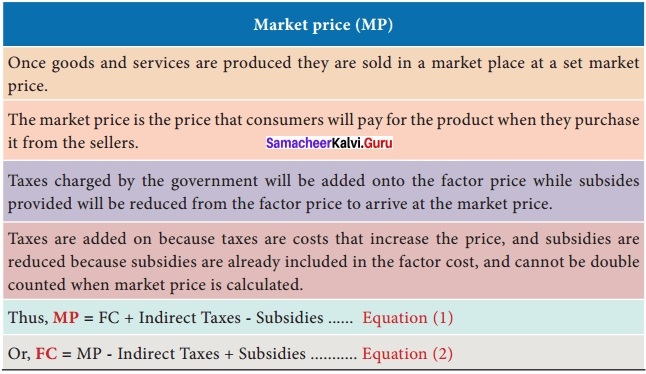
Samacheer Kalvi 12th Economics Solutions Chapter 2 National Income

Part – D
Answer The Following Questions In One Page.

Question 1.
Write the gross value of the farm output in India?
Answer:
In India, the gross value of the farm output is obtained as follows:

  1. Total production of 64 agriculture commodities is estimated. The output of each crop is measured by multiplying the area sown by the average yield per hectare.
  2. The total output of each commodity is valued at market prices.
  3. The aggregate value of total output of these 64 commodities is taken to measure the gross value of agricultural output.
  4. The net value of the agricultural output is measured by making deductions for the cost of seed, manures and fertilisers, market charges, repairs and depreciation from the gross value.

Question 2.
Explain the Expenditure Method (Outlay Method) precautions?
Answer:
Precautions:

  1. Second hand goods:
    The expenditure made on second hand goods should not be included.
  2. Purchase of shares and bonds:
    Expenditures on purchase of old shares and bonds in the secondary market should not be included.
  3. Transfer payments:
    Expenditures towards payment incurred by the government like old age pension should not be included.
  4. Expenditure on intermediate goods:
    Expenditure on seeds and fertilizers by farmers, cotton and yam by textile industries are not to be included to avoid double counting. That is only expenditure on final products are to be included.

Question 3.
Explain the Importance of Factor Cost?
Answer:
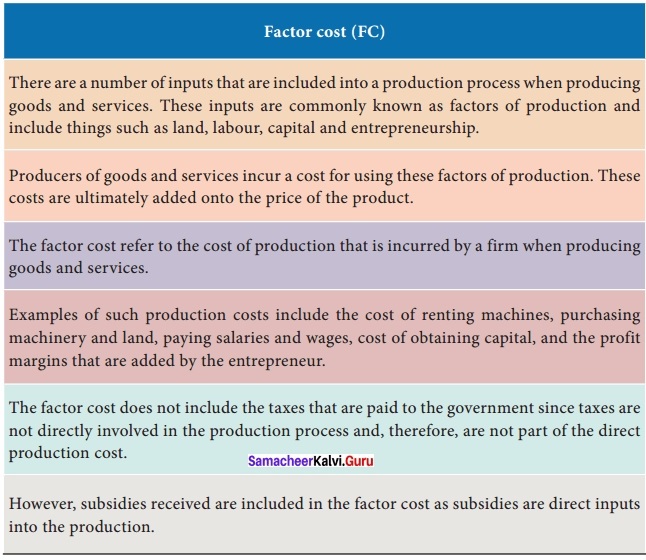
Samacheer Kalvi 12th Economics Solutions Chapter 2 National Income

Share this Tamilnadu State Board 12th Economics Solutions Chapter 2 National Income Questions and Answers with your friends to help them to overcome the grammar issues in exams. Keep visiting this site frequently to get the latest information on different subjects. Clarify your doubts by posting the comments and get the answers in an easy manner.

Samacheer Kalvi 12th Economics Solutions Chapter 5 Monetary Economics

Students of 12th can get the pdf links of Tamilnadu State Board Economics Solutions here. You can Download Samacheer Kalvi 12th Economics Book Solutions Chapter 5 Monetary Economics Questions and Answers, Notes Pdf, Guide Pdf helps you to revise the complete Tamilnadu State Board New Syllabus and score more marks in your examinations.

Tamilnadu Samacheer Kalvi 12th Economics Solutions Chapter 5 Monetary Economics

It is very important to put the textbook aside while preparing for the exams. So, if you follow Samacheer Kalvi 12th Economics Textbook Solutions you can cover all the topics in Chapter 5 Monetary Economics Questions and Answers. This helps to improve your communication skills.

Samacheer Kalvi 12th Economics Monetary Economics Text Book Back Questions and Answers

Part – A
Multiple Choice Questions.

Question 1.
The RBI Headquarters is located at ………………………
(a) Delhi
(b) Chennai
(c) Mumbai
(d) Bengalore
Answer:
(c) Mumbai

Question 2.
Money is ………………………
(a) Acceptable only when it has intrinsic value
(b) Constant in purchasing power
(c) The most liquid of all assets
(d) Needed for allocation of resources
Answer:
(c) The most liquid of all assets

Question 3.
Paper currency system is managed by the ………………………
(a) Central Monetary authority
(b) State Government
(c) Central Government
(d) Banks
Answer:
(a) Central Monetary authority

Question 4.
The basic distinction between M1 and M2 is with regard to ………………………
(a) Post office deposits
(b) Time deposits of banks
(c) Saving deposits of banks
(d) Currency
Answer:
(b) Time deposits of banks

Question 5.
Irving Fisher’s Quantity Theory of Money was popularized in ………………………
(a) 1908
(b) 1910
(c) 1911
(d) 1914
Answer:
(c) 1911

Question 6.
MV stands for ………………………
(a) Demand for money
(b) Supply of legal tender money
(c) Supply of bank money
(d) Total supply of money
Answer:
(b) Supply of legal tender money

Question 7.
Inflation means ………………………
(a) Prices are rising
(b) Prices are falling
(c) Value of money is increasing
(d) Prices are remaining the same
Answer:
(a) Prices are rising

Question 8.
………………………. inflation results in a serious depreciation of the value of money.
(a) Creeping
(b) Walking
(c) Running
(d) Hyper
Answer:
(d) Hyper

Question 9.
…………………… inflation occurs when general prices of commodities increases due to increase in production costs such as wages and raw materials.
(a) Cost – push
(b) Demand pull
(c) Running
(d) Galloping
Answer:
(a) Cost – push

Question 10.
During inflation, who are the gainers?
(a) Debtors
(b) Creditors
(c) Wage and salary earners
(d) Government
Answer:
(a) Debtors

Question 11.
…………………… is a decrease in the rate of inflation.
(a) Disinflation
(b) Deflation
(c) Stagflation
(d) Depression
Answer:
(a) Disinflation

Question 12.
Stagflation combines the rate of inflation with ……………………
(a) Stagnation
(b) Employment
(c) Output
(d) Price
Answer:
(a) Stagnation

Question 13.
The study of alternating fluctuations in business activity is referred to in Economics as ……………………
(a) Boom
(b) Recession
(c) Recovery
(d) Trade cycle
Answer:
(d) Trade cycle

Question 14.
During depression the level of economic activity becomes extremely ……………………
(a) High
(b) Bad
(c) Low
(d) Good
Answer:
(c) Low

Question 15.
“Money can be anything that is generally acceptable as a means of exchange and that the same time acts as a measure and a store of value”, This definition was given by ……………………
(a) Crowther
(b) A.C.Pigou
(c) F.A.Walker
(d) Francis Bacon
Answer:
(a) Crowther

Question 16.
Debit card is an example of ……………………
(a) Currency
(b) Paper currency
(c) Plastic money
(d) Money
Answer:
(c) Plastic money

Question 17.
Fisher’s Quantity Theory of money is based on the essential function of money as ……………………
(a) Measure of value
(b) Store of value
(c) Medium of exchange
(d) Standard of deferred payment
Answer:
(c) Medium of exchange

Question 18.
V in MV = PT equation stands for ……………………
(a) Volume of trade
(b) Velocity of circulation of money
(c) Volume of transaction
(d) Volume of bank and credit money
Answer:
(b) Velocity of circulation of money

Question 19.
When prices rise slowly, we call it ……………………
(a) Galloping inflation
(b) Mild inflation
(c) Hyper inflation
(d) Deflation
Answer:
(b) Mild inflation

Question 20.
…………………… inflation is in no way dangerous to the economy.
(a) Walking
(b) Running
(c) Creeping
(d) Galloping
Answer:
(c) Creeping

Part – B
Answer The Following Questions In One or Two Sentences.

Question 21.
Define Money?
Answer:

  1. Many economists developed definition for money. Among these, definitions of Walker and Crowther are given below:
    “Money is, what money does ” – Walker.
  2. “Money can be anything that is generally acceptable as a means of exchange and at the same time acts as a measure and a store of value”. – Crowther
  3. Money is anything that is generally accepted as payment for goods and services and repayment of debts and that serves as a medium of exchange.
  4. A medium of exchange is anything that is widely accepted as a means of payments.

Question 22.
What is barter?
Answer:

  1. Before money was invented, exchange took place by Barter, that is, commodities and services were directly exchanged for other commodities and services.
  2. Such exchange of goods for goods was known as “Barter Exchange” or “Barter System”.

Question 23.
What is commodity money?
Answer:

  1. After the barter system and commodity money system, modem money systems evolved.
  2. Among these, metallic standard is the premier one. ,
  3. Under metallic standard, some kind of metal either gold or silver is used to determine the standard value of the money and currency.
  4. Standard coins made out of the metal are the principal coins used under the metallic standard.
  5. These standard coins are full bodied or full weighted legal tender.
  6. Their face value is equal to their intrinsic metal value.

Question 24.
What is gold standard?
Answer:

  1. Gold Standard is a system in which the value of the monetary unit or the standard currency is directly linked with gold.
  2. The monetary unit is defined in terms of a certain weight of gold.
  3. The purchasing power of a unit of money is maintained equal to the value of a fixed weight of gold.

Question 25.
What is plastic money? Give example?
Answer:

  1. The latest type of money is plastic money.
  2. Plastic money is one of the most evolved forms of financial products.
  3. Plastic money is an alternative to the cash or the standard “money”.
  4. Plastic money is a term that is used predominantly in reference to the hard plastic cards used every day in place of actual bank notes.
  5. Plastic money can come in many different forms such as Cash cards, Credit cards, Debit cards, Pre-paid Cash cards, Store cards, Forex cards and Smart cards.
  6. They aim at removing the need for carrying cash to make transactions.

Question 26.
Define inflation?
Answer:

  1. Inflation is a consistent and appreciable rise in the general price level.
  2. In other words, inflation is the rate at which the general level of prices for goods and services is rising and consequently the purchasing power of currency is falling.
  3. “Too much of Money chasing too few goods” – Coulbourn
  4. “A state of abnormal increase in the quantity of purchasing power” – Gregorye

Question 27.
What is Stagflation?
Answer:
Stagflation is a combination of stagnant economic growth, high unemployment and high inflation.

Part – C
Answer The Following Questions In One Paragraph.

Question 28.
Write a note on metallic money?
Answer:

  1. After the barter system and commodity money system, modem money systems evolved.
  2. Among these, metallic standard is the premier one.
  3. Under metallic standard, some kind of metal either gold or silver is used to determine the standard value of the money and currency.
  4. Standard coins made out of the metal are the principal coins used under the metallic standard. Monetary Economics 93
  5. These standard coins are full bodied or Ml weighted legal tender.
  6. Their face value is equal to their intrinsic metal value.

Question 29.
What is money supply?
Answer:

  1. Money supply means the total amount of money in an economy.
  2. It refers to the amount of money which is in circulation in an economy at any given time.
  3. Money supply plays a crucial role in the determination of price level and interest rates.
  4. Money supply viewed at a given point of time is a stock and over a period of time it is a flow.

Question 30.
What are the determinants of money supply?
Answer:
Determinants of Money Supply:

  1. Currency Deposit Ratio (CDR); It is the ratio of money held by the public in currency to that they hold in bank deposits.
  2. Reserve deposit Ratio (RDR); Reserve Money consists of two things (a) vault cash in banks and (b) deposits of commercial banks with RBI.
  3. Cash Reserve Ratio (CRR); It is the fraction of the deposits the banks must keep with RBI. (z’v) Statutory Liquidity Ratio (SLR); It is the fraction of the total demand and time deposits of the commercial banks is the form of specified liquid assests.

Question 31.
Write the types of inflation?
Answer:
The four types of inflation are –
1. Creeping Inflation:
Creeping inflation is slow-moving and very mild. The rise in prices will not be perceptible but spread over a long period. This type of inflation is in no way dangerous to the economy. This is also known as mild inflation or moderate inflation.

2. Walking Inflation:
When prices rise moderately and the annual inflation rate is a single digit . (3% – 9%), it is called walking or trolling inflation.

3. Running Inflation:
When prices rise rapidly like the running of a horse at a rate of speed of 10% – 20% per annum, it is called running inflation.

4. Galloping inflation:
Galloping inflation or hyper inflation points out to unmanageably high inflation rates that run into two or three digits. By high inflation the percentage of the same is almost 20%
to 100% from an overall perspective.

Other types of inflation (on the basis of inducement):

1. Currency inflation:
The excess supply of money in circulation causes rise in price level.

2. Credit inflation:
When banks are liberal in lending credit, the money supply increases and thereby rising prices. .

3. Deficit induced inflation:
The deficit budget is generally financed through printing of currency by the Central Bank. As a result, prices rise.

4. Profit induced inflation:
When the firms aim at higher profit, they fix the price with higher margin. So prices go up.

5. Scarcity induced inflation:
Scarcity of goods happens either due to fall in production (e.g. farm goods) or due to hoarding and black marketing. This also pushes up the price. (This has happened is Venezula in the year 2018).

6. Tax induced inflation:
Increase in indirect taxes like excise duty, custom duty and sales tax may lead to rise in price (e.g. petrol and diesel). This is also called taxflation.

Question 32.
Explain Demand-pull and Cost push inflation?
Answer:
Demand – Pull Vs Cost – Push inflation:

1. Demand – Pull Inflation:
Demand and supply play a crucial role in deciding the inflation levels in the society at all points of time. For instance, if the demand is high for a product and supply is low, the price of the products increases.

2. Cost – Push Inflation:
When the cost of raw materials and other inputsrises inflation results. Increase in wages paid to labour also leads to inflation.

Question 33.
State Cambridge equations of value of money?
Answer:
Cambridge Approach (Cash Balances Approach):

1. Marshall’s Equation:
The Marshall equation is expressed as:
M = KPY
Where
M is the quantity of money Y is the aggregate real income of the community . P is Purchasing Power of money
K represents the fraction of the real income which the public desires to hold in the form of money.
Thus, the price level P = M/KY or the value of money (The reciprocal of price level) is 1/P = KY/M
The value of money in terms of this equation can be found out by dividing the total quantity of goods which the public desires to holdout of the total income by the total supply of money. According to Marshall’s equation, the value of money is influenced not only by changes in M, but also by changes in K.

2. Keynes’Equation
Keynes equation is expressed as:
n = pk (or) p = n / k
Where
n is the total supply of money p is the general price level of consumption goods
k is the total quantity of consumption units the people decide to keep in the form of cash, Keynes indicates that K is a real balance, because it is measured in terms of consumer goods. According to Keynes, peoples’ desire to hold money is unaltered by monetary authority. So, price level and value of money can be stabilized through regulating quantity of money (n) by the monetary authority.
Later, Keynes extended his equation in the following form:
n = p (k + rk’) or p = n / (k + rk’)
Where,
n = total money supply p = price level of consumer goods
k = peoples’ desire to hold money in hand (in terms of consumer goods) in the total income of them
r = cash reserve ratio
k’ = community’s total money deposit in banks, in terms of consumers goods.
In this extended equation also, Keynes assumes that, k, k’ and r are constant. In this situation, price level (P) is changed directly and proportionately changing in money volume (n).

Question 34.
Explain disinflation?
Answer:
Disinflation:
Disinflation is the slowing down the rate of inflation by controlling the amount of credit (bank loan, hire purchase) available to consumers without causing more unemployment. Disinflation may be defined as the process of reversing inflation without creating unemployment or reducing output in the economy.

Part – D
Answer the following questions in one page.

Question 35.
Illustrate Fisher’s Quantity theory of money?
Answer:
(a) Fisher’s Quantity Theory of Money:
The quantity theory of money is a very old the¬ory. It was first propounded in 1588 by an Italian economist, Davanzatti. But, the credit for popularizing this theory in recent years rightly belongs to the well-known American economist, Irving Fisher who published his book, ‘The Purchasing Power of Money” in 1911. He gave it a quantitative form in terms of his famous “Equation of Exchange”.
The general form of equation given by Fisher is –
MV = PT

1. Fisher points out that in a country during any given period of time, the total quantity of money (MV) will be equal to the total value of all goods and services bought and sold (PT). MV = PT
Supply of Money = Demand for Money

2. This equation is referred to as “Cash Transaction Equation”.
Where M = Money Supply/quantity of Money
V = Velocity of Money
P = Price level
T = Volume of Transaction.
It is expressed as P = MV / T which implies that the quantity of money determines the price level and the price level in its turn varies directly with the quantity of money, provided ‘V’ and ‘T’ remain constant.

3. According to Marshall, peoples desire to hold money (the coefficient, K) is more powerful in determination of money, rather than quantity of money (M). So, peoples’ desire to hold money is a determinant of value of money.

4. The above equation considers only currency money. But, in a modem economy, bank’s demand deposits or credit money and its velocity play a vital part in business. Therefore, Fisher extended his original equation of exchange to include bank deposits M, and its velocity Vr The revised equation was:
PT = MV + M1V1
P = \(\frac { MV+M_{ 1 }V_{ 1 } }{ T } \)

5. From the revised equation, it is evident, that the price level is determined by (a) the quantity of money in circulation ‘M’ (b) the velocity of circulation of money ‘V’ (c) the volume of bank credit money M1 (d) the velocity of circulation of credit money V1, and the volume of trade (T)

Diagramatic Illustration:
Samacheer Kalvi 12th Economics Chapter 5 Monetary Economics

Quantity of Money

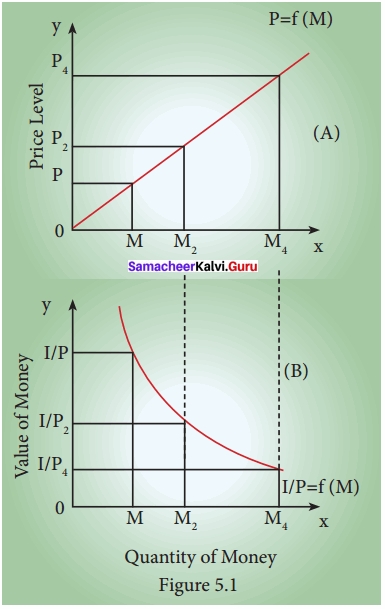
1. Figure (A) shows the effect of changes in the quantity of money on the price level. When the quantity of money is OM, the price level is OP. When the quantity of money is doubled to OM2, the price level is also doubled to OP2. Further, when the quantity of money is increased four – fold to OM4, the price level also increases by four times to OP4. This relationship is expressed by the curve OP = f (M) from the origin at 45°.

2. Figure (B), shows the inverse relation between the quantity of money and the value of money, where the value of money is taken on the vertical axis. When the quantity of money is OM1, the value of money is 01 / P1. But with the doubling of the quantity of money to OM2, the value of money becomes one – half of what it was before, (01 / P2). But, with the quantity of money increasing by four – fold to OM4, the value of money is reduced by 01 / P4. This inverse relationship between the quantity of money and the value of money is shown by downward sloping curve 1 / OP = f (M).

Question 36.
Explain the functions of money?
Answer:
Samacheer Kalvi 12th Economics Solutions Chapter 5 Monetary Economics

1. Primary Functions:

(I) Money as a medium of exchange:
This is considered as the basic function of money. Money has the quality of general acceptability, and all exchanges take place in terms of money.

(II) Money as a measure of value:
The second important function of money is that it measures the value of goods and services. In other words, the prices of all goods and services are expressed in terms of money. Money is thus looked upon as a collective measure of value.

2. Secondary Functions:

(I) Money as a Store of value:
Savings done in terms of commodities were not permanent. But, with the invention of money, this difficulty has now disappeared and savings are now done in terms of money. Money also serves as an excellent store of wealth, as it can be easily converted into other marketable assets, such as, land, machinery, plant etc.

(II) Money as a Standard of Deferred Payments:
Borrowing and lending were difficult problems under the barter system. In the absence of money, the borrowed amount could be returned only in terms of goods and services. But the modem money – economy has greatly facilitated the borrowing and lending processes.

(III) Money as a Means of Transferring Purchasing Power:
The field of exchange also went on extending with growing economic development. The exchange of goods is now extended to distant lands.

3. Contingent Functions:

(I) Basis of the Credit System:
Money is the basis of the Credit System. Business transactions are either in cash or on credit.

(II) Money facilitates distribution of National Income:
The task of distribution of national income was exceedingly complex under the barter system.

(III) Money helps to Equalize Marginal Utilities and Marginal Productivities:
Consumer can obtain maximum utility only if he incurs expenditure on various commodities in such a manner as to equalize marginal utilities accruing from them. Now in equalizing these marginal utilities, money plays an important role, because the prices of all commodities are expressed in money.

(IV) Money Increases Productivity of Capital:
Money is the most liquid form of capital. In other words, capital in the form of money can be put to any use.

4. Other Functions:

(I) Money helps to maintain Repayment Capacity:
Money possesses the quality of general acceptability. To maintain its repayment capacity, every firm has to keep assets in the form of liquid cash. The firm ensures its repayment capacity with money.

(II) Money represents Generalized Purchasing Power:
Purchasing power kept in terms of money can be put to any use. It is not necessary that money should be used only for the purpose for which it has been served.

(III) Money gives liquidity to Capital:
Money is the most liquid form of capital. It can be put to any use.

Question 37.
What are the causes and effects of inflation on the economy?
Answer:
Causes of Inflation:
The main causes of inflation in India are as follows:

1. Increase in Money Supply:
Inflation is caused by an increase in the supply of money which leads to increase in aggregate demand. The higher the growth rate of the nominal money supply, the higher is the rate of inflation.

2. Increase in Disposable Income:
When the disposable income of the people increases, it raises their demand for goods and services. Disposable income may increase with the rise in national income or reduction in taxes or reduction in the saving of the people.

3. Increase in Pubiic Expenditure:
Government activities have been expanding due to developmental activities and social welfare programmes. This is also a cause for price rise.

4. Increase in Consumer Spending:
The demand for goods and services increases when they are given credit to buy goods on hire-purchase and installment basis.

5. Cheap Monetary Policy:
Cheap monetary policy or the policy of credit expansion also leads to increase in the money supply which raises the demand for goods and services in the economy.

6. Deficit Financing:
In order to meet its mounting expenses, the government resorts to deficit financing by borrowing from the public and even by printing more notes.

7. Black Assests, Activities and Money:
The existence of black money and black assests due to corruption, tax evasion etc., increase the aggregate demand. People spend such money, lavishly. Black marketing and hoarding reduces the supply of goods.

8. Repayment of Public Debt:
Whenever the government repays its past internal debt to the public, it leads to increase in the money supply with the public.

9. Increase in Exports:
When exports are encouraged, domestic supply of goods decline. So prices rise.

Effects of Inflation:
The effects of inflation can be classified into two heads:

  1. Effects on Production and
  2. Effects on Distribution.

1. Effects on Production:
When the inflation is very moderate, it acts as an incentive to traders and producers. This is particularly prior to full employment when resources are not fully utilized. The profit due to rising prices encourages and induces business class to increase their investments in production, leading to generation of employment and income.

(I) However, hyper – inflation results in a serious depreciation of the value of money.

(II) When the value of money undergoes considerable depreciation, this may even drain out the foreign capital already invested in the country.

(III) With reduced capital accumulation, the investment will suffer a serious set-back which may have an adverse effect on the volume of production in the country.

(IV) Inflation also leads to hoarding of essential goods both by the traders as well as the consumers and thus leading to still hiher inflation rate.

(V) Inflation encourages investment in speculative activities rather than productive purposes.

2. Effects on Distribution:

1. Debtors and Creditors:
During inflation, debtors are the gainers while the creditors are losers.

2. Fixed – income Groups:
The fixed income groups are the worst hit during inflation because their incomes being fixed do not bear any relationship with the rising cost of living.

3. Entrepreneurs:
Inflation is the boon to the entrepreneurs whether they are manufacturers, traders, merchants or businessmen, because it serves as a tonic for business enterprise.

4. Investors:
The investors, who generally invest in fixed interest yielding bonds and securities have much to lose during inflation.

Question 38.
Describe the phases of Trade cycle?
Answer:
Phases of Trade Cycle
The four different phases of trade cycle is referred to as

  1. Boom
  2. Recession
  3. Depression and
  4. Recovery. These are illustrated in the figure:

Phases of Trade Cycle:

1. Boom or Prosperity Phase:
The full employment and the movement of the economy beyond full employment is characterized as boom period.

  1. During this period, there is hectic activity in economy.
  2. Money wages rise, profits increase and interest rates go up.
  3. The demand for bank credit increases and there is all – round optimism.

Samacheer Kalvi 12th Economics Solutions Chapter 5 Monetary Economics

2. Recession:

  1. The turning point from boom condition is called recession.
  2. This happens at higher rate, than what was earlier.
  3. Generally, the failure of a company or bank bursts the boom and brings a phase of recession.
  4. Investments are drastically reduced, production comes down and income and profits decline.
  5. There is panic in the stock market and business activities show signs of dullness.
  6. Liquidity preference of the people rises and money market becomes tight.

3. Depression:

  1. During depression the level of economic activity becomes extremely low.
  2. Firms incur losses and closure of business becomes a common feature and the ultimate result is unemployment.
  3. Interest prices, profits and wages are low. The agricultural class and wage earners would be worst hit.
  4. Banking institutions will be reluctant to advance loans to businessmen.
  5. Depression is the worst phase of the business cycle.
  6. Extreme point of depression is called as “trough”, because it is a deep point in business cycle.

4. Recovery:

  1. After a period of depression, recovery sets in.
  2. This is the turning point from depression to revival towards upswing.
  3. It begins with the revival of demand for capital goods.
  4. Autonomous investments boost the activity.
  5. The demand slowly picks up and in due course the activity is directed towards the upswing with more production, profit, income, wages and employment.
  6. Recovery may be initiated by innovation or investment or by government expenditure (autonomous investment).

Samacheer Kalvi 12th Economics Consumption and Investment Functions Additional Questions

Part – A
I. Multiple Choice Questions.

Question 1.
During Inflation?
(a) Business men gain
(b) Wage earners gain
(c) Salary gain
(d) Renters gain
Answer:
(a) Business men gain

Question 2.
Galloping Inflation is also known as –
(a) Deflation
(b) Persistent Inflation
(c) Stagflation
(d) Cost – push Inflation
Answer:
(b) Persistent Inflation

Question 3.
The modem economy is described as –
(a) Demand Economy
(b) Supply Economy
(c) Money Economy
(d) Wage Economy
Answer:
(c) Money Economy

Question 4.
The term ………………………… refers to a phase or policy when interest rates are high.
(a) Purchasing money
(b) Power money
(c) Fiat money
(d) Dear money
Answer:
(d) Dear money

Question 5.
Currency notes in circulation are referred to as –
(b) Fiat money
(c) Value of money
(d) Cheap money
Answer:
(b) Fiat money

Question 6.
What is the name of inflation without a rise in price level?
(a) Repressed Inflation
(b) Hyper Inflation
(c) Galloping Inflation
(d) Cost – Push Inflation
Answer:
(a) Repressed Inflation

Question 7.
Give the example of a country that experienced hyper Inflation?
(a) India
(b) China
(c) Germany
(d) Africa
Answer:
(c) Germany

Question 8.
Which is the most important function of money?
(a) Measure of value
(b) Store of value
(c) Medium of exchange
(d) Standard of deferred payments
Answer:
(c) Medium of exchange

Question 9.
What is the other name for “Equation of Exchange”?
(a) Fisher’s Equation
(b) Keynes Equation
(c) Marshall’s Equation
(d) Equation of Exchange
Answer:
(a) Fisher’s Equation

Question 10.
What is the cheap money policy?
(a) High rates of Interest
(b) Low rates of Interest
(c) Medium rates of Interest
(d) Very high rates of Interest
Answer:
(b) Low rates of Interest

Question 11.
Monetary policy is controlled by –
(a) Central bank
(b) State Government
(c) Private sector
(d) Central Government
Answer:
(d) Central Government

Question 12.
………………………… is usually effective for controlling inflation.
(a) Monetary policy
(b) RBI
(c) State Government
(d) Central government
Answer:
(a) Monetary policy

Question 13.
Monetary policy is usually effective in controlling –
(a) Bank
(b) Inflation
(c) Deflation
(d) Stagflation
Answer:
(b) Inflation

Question 14.
Money acts as a common measure of –
(a) Reserve money
(b) Fiat money
(c) Value
(d) Broad money
Answer:
(c) Value

Question 15.
Bank rate is lowered during –
(a) Inflation
(b) Price
(c) Employment
(d) Deflation
Answer:
(d) Deflation

Question 16.
Under dear money policy is –
(a) Rate of Interest is low
(b) Rate of interest is high
(c) Bank rate is high
(d) Money supply is more
Answer:
(b) Rate of interest is high

Question 17.
M3 is called –
(a) Narrow money
(b) Reserve money
(c) Broad money
(d) Fiat money
Answer:
(c) Broad money

Question 18.
Price mechanism plays a vital role in –
(a) Capitalism
(b) Socialism
(c) Mixed economy
(d) Traditional economy
Answer:
(a) Capitalism

Question 19.
“Money is what money does” ………………………… this definition was given by –
(a) Crowther
(b) Fisher
(c) Grasham
(d) Walker
Answer:
(d) Walker

Question 20.
Currency with the public is known as –
(a) M1
(b) M2
(C) M3
(d) M4
Answer:
(a) M1

Question 21.
Cost – push inflation is induced by rising –
(a) Costs
(b) Money
(c) Broad money
(d) Inflation
Answer:
(b) Money

Question 22.
The direct exchange of goods for goods is known as –
(a) Money exchange
(b) Money transfer
(c) Barter System
(d) Barter goods
Answer:
(c) Barter System

Question 23.
Money is a matter of functions –
(a) One
(b) Two
(c) Three
(d) Four
Answer:
(d) Four

Question 24.
Deflation is a period marked by ………………………… prices.
(a) Increasing
(b) Falling
(c) Constant
(d) High
Answer:
(d) High

Question 25.
Dear money refers to ………………………… rate being high.
(a) Money
(b) Finance
(c) Interest
(d) Cost
Answer:
(c) Interest

II. Match the following and choose the correct answer by using codes given below

A. Deficit financing – (i) Monetary policy objectives
B. Store of value – (ii) Currency notes
C. Price stability – (iii) Causes inflation
D. Fiat money – (iv) Function of money
Codes:
(a) A (iii) B (iv) C (i) D (ii)
(b) A (ii) B (iii) C (iv) D (i)
(c) A (iv) B (ii) C (iii) D (i)
(d) A (i) B (iv) C (ii) D (iii)
Answer:
(a) A (iii) B (iv) C (i) D (ii)

Question 2.
A. Falling prices – (i) Black money
B. Government securities – (ii) Business loss
C. Bank rate – (iii) Open Market operation
D. Unaccounted money – (iv) Credit control
Codes:
(a) A (i) B (ii) C (iii) D (iv)
(b) A (ii) B (iii) C (iv) D (i)
(c) A (iii) B (iv) C (i) D (ii)
(d) A (iv) B (i) C (ii) D (iii)
Answer:
(b) A (ii) B (iii) C (iv) D (i)

Question 3.
A. Checking Inflation – (i) Irving Fisher
B. Great Depression – (ii) Narrow money
C. Quantity theory of money – (iii) Wage freeze
D. M1 – 1930
Codes:
(a) A (i) B (ii) C (iii) D (iv)
(b) A (iii) B (iv) C(i) D (ii)
(c) A (ii) B (iii) C (iv) D (i)
(d) A (iv) B (i) C (ii) D (iii)
Answer:
(b) A (iii) B (iv) C(i) D (ii)

Question 4.
A. Cheap money policy – (i) Purchasing money
B. Prices pushed – (ii) Creeping inflation
C. Value of money – (iii) Low rate of interest
D. Selective credit control – (iv) Moral suasion
Codes:
(a) A (iii) B (ii) C (i) D (iv)
(b) A (ii) B (i) C (iv) D (iii)
(c) A (iv) B (iii) C (ii) D (i)
(d) A (i) B (iv) C (iii) D (ii)
Answer:
(a) A (iii) B (ii) C (i) D (iv)

Question 5.
A. Galloping Inflation – (i) Money Act
B. M3is called – (ii) Hyperinflation
C. Measure of value – (iii) Broad money
D. Deflation Codes – (iv) Bank rate
Codes:
(a) A (i) B (ii) C (iv) D (iii)
(b) A (iv) B (i) C (iii) D (ii)
(c) A (iii) B (iv) C (ii) D (i)
(d) A (ii) B (iii) C (i) D (iv)
Answer:
(d) A (ii) B (iii) C (i) D (iv)

III. State whether the statements are true or false.

Question 1.
(i) Inflation is taxation without legislation was said by Milton Friedman.
(ii) Money is the most liquid form of capital.

(a) Both (i) and (ii) are true
(b) Both (i) and (ii) are false
(c) (i) is true but (ii) is false
(d) (i) is false but (ii) is true
Answer:
(a) Both (i) and (ii) are true

Question 2.
(i) “The purchasing power of money” was a book published by Irving Fisher in 1911.
(ii) The general form of equation given by Fisher is M = KPY.

(a) Both (i) and (ii) are true
(b) Both (i) and (ii) are false
(c) (i) is true but (ii) is false
(d) (i) is false but (ii) is true
Answer:
(c) (i) is true but (ii) is false

Question 3.
(i) The study of alternating fluctuations in business activity is referred to in Economics as Trade cycle.
(ii) During depression the level of economic activity becomes extremely high.

(a) Both (i) and (ii) are true
(b) Both (i) and (ii) are false
(c) (i) is true but (ii) is false
(d) (i) is false but (ii) is true
Answer:
(c) (i) is true but (ii) is false

Question 4.
(i) Creeping Inflation is in no way dangerous to the economy.
(ii) Debit card is an example of paper currency.

(a) Both (i) and (ii) are true
(b) Both (i) and (ii) are false
(c) (i) is true but (ii) is false
(d) (i) is false but (ii) is true
Answer:
(c) (i) is true but (ii) is false

Question 5.
(i) MV = PT equation stands for volume of Trade.
(ii) Fisher’s Quantity Theory of money is based on the essential function of money as measure of value.

(a) Both (i) and (ii) are true
(b) Both (i) and (ii) are false
(c) (i) is true but (ii) is false
(d) (i) is false but (ii) is true
Answer:
(b) Both (i) and (ii) are false

IV. Which of the following is correctly matched:

Question 1.
(a) Medium of exchange – CRR
(b) Cash Reserve Ratio – Gold standard
(c) Goods exchange for goods – Barter system
(d) Full weighted legal tender – Plastic money
Answer:
(c) Goods exchange for goods – Barter system

Question 2.
(a) Depression – Starting stage
(b) Recession – Turning point from boom
(c) Boom – Economic activities
(d) Inflation – Hectic activity
Answer:
(b) Recession – Turning point from boom

Question 3.
(a) Store of value – Liquidity cash
(b) Deflation – Rise in price
(c) Trade cycle – Narrow money
(d) Quantity theory of money – J.M. Keynes
Answer:
(d) Quantity theory of money – J.M. Keynes

Question 4.
(a) The purchasing power of currency – Falling
(b) Monetary measures are adopted by – State bank
(c) The turning point from boom is – Inflation
(d) Money supply means the total – Inflation amount of money in – World
Answer:
(a) The purchasing power of currency – Falling

Question 5.
(a) The Marshall’s equation – MV = PT
(b) Cash Reserve Ratio – CRR
(c) Statutory Liquidity cash – SLC
(d) Functions of money – Money supply
Answer:
(b) Cash Reserve Ratio – CRR

Question 6.
(a) Barter System – Technology
(b) Gold Standard – Standard currency is directly linked with gold
(c) Plastic money – Money value
(d) Paper money – Smart card
Answer:
(b) Gold Standard – Standard currency is directly linked with gold

V. Which of the following is not correctly matched:

Question 1.
(a) Inflation – Rise in price
(b) Deflation – Fall in price
(c) Hyper Inflation – India
(d) Hyper deflation – Phases of Trade cycle
Answer:
(c) Hyper Inflation – India

Question 2.
(a) Currency Deposit Ratio – CDR
(b) Reserve Deposit Ratio – RDR
(c) Cash Reserve Ratio – CRR
(d) Statutory Liquidity Ratio – SRL
Answer:
(d) Statutory Liquidity Ratio – SRL

Question 3.
(a) M – Money supply / Quantity of money –
(b) V – Velocitu of money
(c) P – Price level
(d) T – Price rise slow moving
Answer:
(d) T – Price rise slow moving

Question 4.
(a) Creeping Inflation – Price rise slow moving
(b) Walking Inflation – Price rise moderately
(c) Running Inflation – Price rise rapidly running
(d) Galloping Inflation – Price rise very slow
Answer:
(d) Galloping Inflation – Price rise very slow

Question 5.
(a) Money supply – Central Bank
(b) Dear money policy – During Inflation
(c) Value of money – Purchasing power
(d) Black money – Narrow money
Answer:
(d) Black money – Narrow money

VI. Pick the odd one out.

Question 1.
The main functions of money can be classified
(a) Primary functions
(b) Secondary functions
(c) Contingent functions
(d) Territory functions
Answer:
(d) Territory functions

Question 2.
Money secondary functions are
(a) Money as a store of value
(b) Money as a standard of Deferred payments
(c) Money as a means of Transferring purchasing power
(d) Money as a modem exchange system
Answer:
(d) Money as a modem exchange system

Question 3.
Contingent functions are called
(a) Basis of the credit system
(b) Money facilitates distribution of state income
(c) Money’helps to equalize marginal utility
(d) Money increases productivity of capital
Answer:
(b) Money facilitates distribution of state income

Question 4.
RBI publishes information of money supply are
(a) M2 = Currency coins and demand deposits
(b) M2 = M1 + Saving deposits with post office savings banks and Total Deposits
(c) M3 = M2 + Time deposits of all commercial and co – operative banks
(d) M4 = M3 + Total deposits with post offices
Answer:
(b) M2 = M1 + Saving deposits with post office savings banks and Total Deposits

Question 5.
Determinants of money supply are
(a) Consumer Deposit Ratio (CDR)
(b) Reserve Deposit Ratio (RDR)
(c) Cash Reserve Ratio (CRR)
(d) Statutory Liquidity Ratio (SLR)
Answer:
(a) Consumer Deposit Ratio (CDR)

Question 6.
Types of Inflation are
(a) Currency Inflation
(b) Credit Inflation
(c) Demand Induced Inflation
(d) Profit Induced Inflation
Answer:
(c) Demand Induced Inflation

Question 7.
The four different phases of trade cycle is referred to as
(a) Regression
(b) Recession
(c) Depression
(d) Recovery
Answer:
(a) Regression

VII. Assertion and Reason.

Question 1.
Assertion (A): Stagflation is a combination of stagnant economic growth, high unemployment and high inflation.
Reason (R): Stagflation is the slowing down the rate of inflation by controlling the amount of credit.

(a) Both ‘A’ and ‘R’ are true and ‘R’ is the correct explanation to ‘A’
(b) Both ‘A’ and ‘R’ are true but ‘R’ is not the correct explanation to ‘A’
(c) ‘A’ is true but ‘R’ is false
(d) ‘A’ is false but ‘R’ is true
Answer:
(c) ‘A’ is true but ‘R’ is false

Question 2.
Assertion (A): Keynes and Milton Friedman together suggested Monetary measures, Fiscal measures and other measures to prevent and control of inflation.
Reason (R): Keynes and Milton Friedman together suggested other measures are Short term and Long – term measures.

(a) Both ‘A’ and ‘R’ are true and ‘R’ is the correct explanation to ‘A’
(b) Both ‘A’ and ‘R’ are true but ‘R’ is not the correct explanation to ‘A’
(c) ‘A’ is true but ‘R’ is false
(d) ‘A’ is false but ‘R’ is true
Answer:
(a) Both ‘A’ and ‘R’ are true and ‘R’ is the correct explanation to ‘A’

Question 3.
Assertion (A): A trade cycle refers to oscillations in aggregate economic activity particularly in employment, output, income, etc.
Reason (R): The four different phases of trade cycle is referred to Boom, Recession, Depression and Recovery.

(a) Both ‘A’ and ‘R’ are true and ‘R’ is the correct explanation to ‘A’
(b) Both ‘A’ and ‘R’ are true but ‘R’ is not the correct explanation to ‘A’
(c) ‘A’ is true but ‘R’ is false
(d) ‘A’ is false but ‘R’ is true
Answer:
(a) Both ‘A’ and ‘R’ are true and ‘R’ is the correct explanation to ‘A’

Question 4.
Assertion (A): Fiscal policy is now recognized as an important instrument to tackle an inflationary situation.
Reason (R): Monetary measures are adopted by the central bank.

(a) Both ‘A’ and ‘R’ are true and ‘R’ is the correct explanation to ‘A’
(b) Both ‘A’ and ‘R’ are true but ‘R’ is not the correct explanation to ‘A’
(c) ‘A’ is true but ‘R’ is false
(d) ‘A’ is false but ‘R’ is true
Answer:
(a) Both ‘A’ and ‘R’ are true and ‘R’ is the correct explanation to ‘A’

Question 5.
Assertion (A): Currency is created by the RBI and Union Government.
Reason (R): Bank deposits are created by commercial banks and co-operative banks.

(a) Both ‘A’ and ‘R’ are true and ‘R’ is the correct explanation to ‘A’
(b) Both ‘A’ and ‘R’ are true but ‘R’ is not the correct explanation to ‘A’
(c) ‘A’ is true but ‘R’ is false
(d) ‘A’ is false but ‘R’ is true
Answer:
(a) Both ‘A’ and ‘R’ are true and ‘R’ is the correct explanation to ‘A’

Question 6.
Assertion (A): Recovery may be initiated by Money balance.
Reason (R): Recovery may be government expenditure.

(a) Both ‘A’ and ‘R’ are true and ‘R’ is the correct explanation to ‘A’
(b) Both ‘A’ and ‘R’ are true but ‘R’ is not the correct explanation to ‘A’
(c) ‘A’ is true but ‘R’ is false
(d) ‘A’ is false but ‘R’ is true
Answer:
(d) ‘A’ is false but ‘R’ is true

Part – B
Answer The Following Questions In One or Two Sentences.

Question 1.
Define “Silver Standard”?
Answer:
Silver Standard: The silver standard is a monetary system in which the standard economic unit of account is a fixed weight of silver. The silver standard is a monetary arrangement in which a country’s Government allows conversion of its currency into fixed amount of silver.

Question 2.
What is paper currency?
Answer:

  1. The paper currency standard refers to the monetary system in which the paper currency notes issued by the Treasury or the Central Bank or both circulate as unlimited legal tender.
  2. The paper standard is also known as managed currency standard.
  3. The quantity of money in circulation is controlled by the monetary authority to maintain price stability.

Question 3.
Name the main functions of money?
Answer:
Samacheer Kalvi 12th Economics Chapter 5 Monetary Economics

Question 4.
Write RBI publishes information alternative measures of money supply?
Answer:
RBI publishes information for four alternative measures of Money supply, namely M2 , M2 and M3 and M4
M1 = Currency, coins and demand deposits
M2 = M1 + Savings deposits with post office savings banks
M3 = M2 + Time deposits of all commercial and cooperative banks.
M4 = M3 + Total deposits with Post offices.

Question 5.
Define “Currency symbol”?
Answer:
Currency Symbol ₹
The new symbol designed by D.Udaya Kumar, a post graduate of IIT Bombay was finally selected by the Union cabinet on 15th July, 2010. The new symbol, is an amalgamation of Devanagri ‘Ra’ and the Roman ‘R’ without the stem. The symbol of India rupee came into use on 15th July, 2010. After America, Britain, Japan, Europe Union. India is the 5th country to accept a unique currency symbol.

Question 6.
Write Fisher’s Quantity Theory of money equation?
Answer:

  1. The general form of equation given by Fisher is MV = PT.
  2. Fisher points out that in a country during any given period of time, the total quantity of money (MV) will be equal to the total value of all goods and services bought and sold (PT).
  3. MV = PT

Question 7.
Define “Trade cycle”?
Answer:
“A trade cycle is composed of periods of good trade characterised by rising prices and low unemployment percentages altering with periods of bad trade characterised by falling prices and high unemployment percentages”.

Part – C
Answer The Following Questions In One Paragraph.

Question 1.
Write the meaning of Money supply?
Answer:
Meaning of Money Supply

  1. In India, currency notes are issued by the Reserve Bank of India (RBI) and coins are issued by the Ministry of Finance, Government of India (GOI).
  2. Besides these, the balance is savings, or current account deposits, held by the public in commercial banks is also considered money.
  3. The currency notes are also called fiat money and legal tenders.

Question 2.
Explain the Deflation?
Answer:
Deflation:

  1. The essential feature of deflation is falling prices, reduced money supply and unemployment.
  2. Though falling prices are desirable at the time of inflation, such a fall should not lead to the fall in the level of production and employment.
  3. But if prices fall from the level of full employment both income and employment will be adversely affected.

Question 3.
What is the meaning of trade cycle?
Answer:
Meaning of Trade Cycle:

  1. A Trade cycle refers to oscillations in aggregate economic activity particularly in employment, output, income, etc.
  2. It is due to the inherent contraction and expansion of the elements which energize the economic activities of the nation.
  3. The fluctuations are periodical, differing in intensity and changing in its coverage.

Question 4.
Explain the Evolution of money?
Answer:
Barter System:

  1. The introduction of money as a medium of exchange was orje of the greatest inventions of mankind.
  2. Before money was invented, exchange took place by Barter, that is, commodities and services were directly exchanged for other commodities and services.
  3. Under the barter system, buyers and sellers of commodities had to face a number of difficulties.
  4. Surplus goods were exchanged for money which in turn was exchanged for other needed goods.
  5. Goods like furs, skins, salt, rice, wheat, utensils, weapons, etc. were commonly used as money.
  6. Such exchange of goods for goods was known as “Barter Exchange” or “Barter System”.

Question 5.
What is the meaning of Crypto currency?
Answer:
Crypto Currency:

  1. A digital currency in which encryption techniques are used to regulate the generation of units of currency and verify the transfer of funds, operating independently of a Central Bank.
  2. Decentralised crypto currencies such as Bitcoin now provide an outlet for Personal Wealth that is beyond restriction and confiscation.

Question 6.
Explain the Trade cycle Depression?
Answer:
Depression:

  1. During depression the level of economic activity becomes extremely low.
  2. Firms incur losses and closure of business becomes a common feature and the ultimate result is unemployment.
  3. Interest prices, profits and wages are low.
  4. The agricultural class and wage earners would be worst hit.
  5. Banking institutions will be reluctant to advance loans to businessmen.
  6. Depression is the worst phase of the business cycle.
  7. Extreme point of depression is called as “trough”, because it is a deep point in business cycle.
  8. Any person fell down in deeps could not come out from that without other’s help.
  9. Similarly, an economy fell down in trough could not come out from this without external help.
  10. Keynes advocated that autonomous investment of the government alone can help the economy to come out from the depression.

Part – D
Answer The Following Questions In One Page.

Question 1.
Explain the Measures of control inflation?
Answer:
Measures to Control Inflation:
Keynes and Milton Friedman together suggested three measures to prevent and control of inflation.

  1. Monetary measures
  2. Fiscal measures (J.M. Keynes) and
  3. Other measures.

1. Monetary Measures:

  1. These measures are adopted by the Central Bank of the country.
  2. They are
    • Increase in Bankrate
    • Sale of Government Securities in the Open Market
    • Higher Cash Reserve Ratio (CRR) and Statutory Liquidity Ratio (SLR)
    • Consumer Credit Control and
    • Higher margin requirements
    • Higher Repo Rate and Reverse Repo Rate.

2. Fiscal Measures:

  1. Fiscal policy is now recognized as an important instrument to tackle an inflationary situation.
  2. The major anti – inflationary fiscal measures are the following:
    Reduction of Government Expenditure and Public Borrowing and Enhancing taxation.

3. Other Measures:
These measures can be divided broadly into short – term and long – term measures.

(a) Short – term measures can be in regard to public distribution of scarce essential commodities through fair price shops (Rationing). In India whenever shortage of basic goods has been felt, the government has resorted to import so that inflation may not get triggered.

(b) Long – term measures will require accelerating economic growth especially of the wage goods which have a direct bearing on the general price and the cost of living. Some restrictions on present consumption may help in improving saving and investment which may be necessary for accelerating the rate of economic growth in the long run.

Question 2.
Briefly explain the Monetary Economics and money?
Answer:

  1. Monetary Economics is a branch of economics that provides a framework for analyzing money and its functions as a medium of exchange, store of value and unit of account.
  2. It examines the effects of monetary systems including regulation of money and associated financial institutions.
    Meaning
  3. Money is anything that is generally accepted as payment for goods and services and repayment of debts and that serves as a medium of exchange.
  4. A medium of exchange is anything that is widely accepted as a means of payments.
  5. In recent years, the importance of credit has increased in all the countries of the world.
  6. Credit instruments are used on an extensive scale.
  7. The use of cheques, bills of exchange, etc. has gone up.
  8. It should however, be remembered that money is the basis of credit.

Question 3.
Explain the Inflation Effects of production?
Answer:
Effects on Production: When the inflation is very moderate, it acts as an incentive to traders and producers. This is particularly prior to full employment when resources are not fully utilized. The profit due to rising prices encourages and induces business class to increase their investments in production, leading to generation of employment and income.

1. However, hyper – inflation results in a serious depreciation of the value of money and it discourages savings on the part of the public.

2. When the value of money undergoes considerable depreciation, this may even drain out the foreign capital already invested in the country.

3. With reduced capital accumulation, the investment will suffer a serious set – back which may have an adverse effect on the volume of production in the country. This may discourage entrepreneurs and business men from taking business risk.

4. Inflation also leads to hoarding of essential goods both by the traders as well as the consumers and thus leading to still higher inflation rate.

5. Inflation encourages investment in speculative activities rather than productive purposes.

Share this Tamilnadu State Board 12th Economics Solutions Chapter 5 Monetary Economics Questions and Answers with your friends to help them to overcome the grammar issues in exams. Keep visiting this site frequently to get the latest information on different subjects. Clarify your doubts by posting the comments and get the answers in an easy manner.
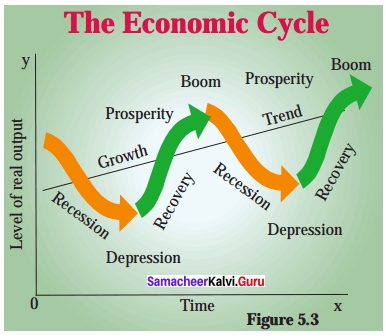
Samacheer Kalvi 12th Economics Solutions Chapter 11 Economics of Development and Planning

Students of 12th can get the pdf links of Tamilnadu State Board Economics Solutions here. You can Download Samacheer Kalvi 12th Economics Book Solutions Chapter 11 Economics of Development and Planning Questions and Answers, Notes Pdf, Guide Pdf helps you to revise the complete Tamilnadu State Board New Syllabus and score more marks in your examinations.

Tamilnadu Samacheer Kalvi 12th Economics Solutions Chapter 11 Economics of Development and Planning

It is very important to put the textbook aside while preparing for the exams. So, if you follow Samacheer Kalvi 12th Economics Textbook Solutions you can cover all the topics in Chapter 11 Economics of Development and Planning Questions and Answers. This helps to improve your communication skills.

Samacheer Kalvi 12th Economics Economics of Development and Planning Text Book Back Questions and Answers

Part – A
Multiple Choice Questions.

Question 1.
“Redistribution with Growth” became popular slogan under which approach?
(a) Traditional approach
(b) New welfare oriented approach
(c) Industrial approach
(d) None of the above
Answer:
(b) New welfare oriented approach

Question 2.
Which is not the feature of economic growth?
(a) Concerned with developed nations
(b) Gradual change
(c) Concerned with quantitative aspect
(d) Wider concept
Answer:
(d) Wider concept

Samacheer Kalvi 12th Economics Solutions Chapter 11 Economics of Development and Planning

Question 3.
Which among the following is a characteristic of underdevelopment?
(a) Vicious circle of poverty
(b) Rising mass consumption
(c) Growth of Industries
(d) High rate of urbanization
Answer:
(a) Vicious circle of poverty

Question 4.
The non – economic determinant of economic development ………………………..
(a) Natural resources
(b) Human resource
(c) Capital formation
(d) Foreign trade
Answer:
(b) Human resource

Question 5.
Economic growth measures the ………………………..
(a) Growth of productivity
(b) Increase in nominal income
(c) Increase in output
(d) None of the above
Answer:
(c) Increase in output

Samacheer Kalvi 12th Economics Solutions Chapter 11 Economics of Development and Planning

Question 6.
The supply side vicious circle of poverty suggests that poor nations remain poor because
(a) Saving remains low
(b) Investment remains low
(c) There is a lack of effective government
(d) a and b above
Answer:
(d) a and b above

Question 7.
Which of the following plan has focused on the agriculture and rural economy?
(a) People’s Plan
(b) Bombay Plan
(c) Gandhian Plan
(d) Vishveshwarya Plan
Answer:
(c) Gandhian Plan

Samacheer Kalvi 12th Economics Solutions Chapter 11 Economics of Development and Planning

Question 8.
Arrange following plans in correct chronological order ………………………..
(a) People’s Plan
(b) Bombay Plan
(c) Jawaharlal Nehru Plan
(d) Vishveshwarya Plan
Answer choices
(a) (i) (ii) (iii) (iv)
(b) (iv) (iii) (ii) (i)
(c) (i) (ii) (iv) (iii)
(d) (ii) (i) (iv) (iii)
Answer:
(b) (iv) (iii) (ii) (i)

Question 9.
M.N. Roy was associated with ………………………..
(a) Congress Plan
(b) People’s Plan
(c) Bombay Plan
(d) None of the above
(b) People’s Plan

Question 10.
Which of the following country adopts indicative planning?
(a) France
(b) Germany
(c) Italy
(d) Russia
Answer:
(b) Germany

Samacheer Kalvi 12th Economics Solutions Chapter 11 Economics of Development and Planning

Question 11.
Short – term plan is also known as ………………………..
(a) Controlling Plans
(b) De – controlling Plans
(c) Rolling Plans
(d) De – rolling Plans
Answer:
(a) Controlling Plans

Question 12.
Long – term plan is also known as ………………………..
(a) Progressive Plans
(b) Non – progressive Plans
(c) Perspective Plans
(d) Non – perspective Plans
Answer:
(c) Perspective Plans

Question 13.
The basic philosophy behind long – term planning is to bring ……………………….. changes in the economy?
(a) Financial
(b) Agricultural
(c) Industrial
(d) Structural
Answer:
(c) Industrial

Samacheer Kalvi 12th Economics Solutions Chapter 11 Economics of Development and Planning

Question 14.
Sarvodaya Plan was advocated by ………………………..
(a) Mahatma Gandhi
(b) J.P. Narayan
(c) S. N Agarwal
(d) Structural
Answer:
(b) J.P. Narayan

Question 15.
Planning Commission was set up in the year ………………………..
(a) 1950
(b) 1951
(c) 1947
(d) 1948
Answer:
(a) 1950

Samacheer Kalvi 12th Economics Solutions Chapter 11 Economics of Development and Planning

Question 16.
Who wrote the book ‘The Road to Serfdom’?
(a) Friedrich Hayek
(b) H.R. Hicks
(c) David Ricardo
(d) Thomas Robert Malthus
Answer:
(a) Friedrich Hayek

Question 17.
Perspective plan is also known as ………………………..
(a) Short – term plan
(b) Medium – term plan
(c) Long – term plan
(d) None of the above
Answer:
(c) Long – term plan

Samacheer Kalvi 12th Economics Solutions Chapter 11 Economics of Development and Planning

Question 18.
NITI Aayog is formed through ………………………..
(a) Presidential Ordinance
(b) Allocation of business rules by President of India
(c) Cabinet resolution
(d) None of the above
Answer:
(c) Cabinet resolution

Question 19.
Expansion of NITI Aayog?
(a) National Institute to Transform India
(b) National Institute for Transforming India
(c) National Institution to Transform India
(d) National Institution for Transforming India
Answer:
(d) National Institution for Transforming India

Samacheer Kalvi 12th Economics Solutions Chapter 11 Economics of Development and Planning

Question 20.
The Chair Person of NITI Aayog is ………………………..
(a) Prime Minister
(b) President
(c) Vice – President
(d) Finance Minister
Answer:
(a) Prime Minister

Part – B
Answer The Following Questions In One or Two Sentences.

Question 21.
Define economic development?
Answer:

  1. Economic development refers to the problems of underdeveloped countries and economic growth to those of developed countries.
  2. Economic development deals with the problems of UDCs. Change is discontinuous and spontaneous.
  3. Economic development is not determined by any single factor. Economic development depends on Economic, Social, Political and Religious factors.

Samacheer Kalvi 12th Economics Solutions Chapter 11 Economics of Development and Planning

Question 22.
Mention the indicators of development?
Answer:

  1. Economic development is regarded as a process whereby there is an increase in the consumption of goods and services by individuals.
  2. From the welfare perspective, economic development is defined as a sustained improvement in health, literacy and standard of living.

Question 23.
Distinguish between economic growth and development?
Answer:
Economic Growth:

  1. Deals with the problems of Developed countries
  2. Change is gradual and steady
  3. Means more output
  4. Concerns Quantitative aspects i.e. increase in per capita income
  5. Narrow

Economic Development:

  1. Deals with the problems of UDCs
  2. Change is discontinuous and spontaneous
  3. Means not only more output but also its composition
  4. Quantitative as well as Qualitative
  5. Wider concept Development = Growth + Change

Samacheer Kalvi 12th Economics Solutions Chapter 11 Economics of Development and Planning

Question 24.
What is GNP?
Answer:
Gross National Product (GNP):

  1. GNP is the total market value of all final goods and services produced within a nation in a particular year, plus income earned by its citizens (including income of those located abroad), minus income of non – residents located in that country.
  2. GNP is one measure of the economic condition of a country, under the assumption that a higher GNP leads to a higher quality of living, all other things being equal.

Question 25.
Define economic planning?
Answer:

  1. Economic Planning is “collective control or suppression of private activities of production and exchange”. – Robbins
  2. “Economic Planning in the widest sense is the deliberate direction by persons in – charge of large resources of economic activity towards chosen ends”. – Dalton

Question 26.
What are the social indicators of economic development?
Answer:
Social Indicators:

  1. Social indicators are normally referred to as basic and collective needs of the people.
  2. The direct provision of basic needs such as health, education, food, water, sanitation and housing facilities check social backwardness.

Question 27.
Write a short note on NITI Aayog?
Answer:

  1. NITI Aayog (National Institution for Transforming India) was formed on January 1, 2015 through a Union Cabinet resolution.
  2. NITI Aayog is a policy think-tank of the Government of India. It replaced the Planning Commission from 13th August, 2014.
  3. The Prime Minister is the Chairperson of NITI Aayog and Union Ministers will be Ex – officio members.
  4. The Vice – Chairman of the NITI Aayog is the functional head and the first Vice – Chairman was Arvind Panangariya.

Part – C
Answer The Following Questions In One Paragraph.

Question 28.
Elucidate major causes of vicious circle of poverty with diagram?
Answer:
Samacheer Kalvi 12th Economics Solutions Chapter 11 Economics of Development and Planning

  • There are circular relationships known as the ‘vicious circles of poverty’ that tend to perpetuate the low level of development in Less Developed Countries (LDCs).
  • Nurkse explains the idea in these words: “It implies a circular constellation of forces tending to act and react upon one another in such a way as to keep a poor country in a state of poverty.
  • For example, a poor man may not have enough to eat; being underfed, his health may be weak; being physically weak, his working capacity is low, which means that he is poor, which in turn means that he will not have enough to eat and so on.
  • A situation of this sort relating to a country as a whole can be summed up in the proposition: “A county is poor because the country is poor”.
  • The vicious circle of poverty operates both on the demand side and the supply side.
  • On the supply side, the low level of real income means low savings.
  • The low level of saving leads to low investment and to deficiency of capital.
  • The deficiency of capital, in turn, leads to low levels of productivity and back to low income. Thus the vicious circle is complete from the supply side.
  • The demand-side of the vicious circle is that the low level of real income leads to a low level of demand which, in turn, leads to a low rate of investment and hence back to deficiency of capital, low productivity and low income.

Question 29.
What are the non – economic factors determining development?
Answer:

  1. Human Resource
  2. Technical Know – how
  3. Political Freedom
  4. Social Organization
  5. Corruption free administration
  6. Desire for Development
  7. Moral, ethical and social values (viii) Casino Capitalism
  8. Patrimonial Capitalism

Non – Economic Factors:
‘Economic Development has much to do with human endowments, social attitudes, political conditions and historical accidents. Capital is a necessary but not a sufficient condition of progress.’

(I) Human Resources:

  1. Human resource is named as human capital because of its power to increase productivity and thereby national income.
  2. There is a circular relationship between human development and economic growth.
  3. A healthy, educated and skilled labour force is the most important productive asset.
  4. Human capital formation is the process of increasing knowledge, skills and the productive capacity of people.

(II) Technical Know – how:
As the scientific and technological knowledge advances, more and more sophisticated techniques steadily raise the productivity levels in all sectors.

(III) Political Freedom:
The process of development is linked with the political freedom.

(IV) Social Organization:
People show interest in the development activity only when they feel that the fruits of development will be fairly distributed.

(V) Corruption free administration:

  1. Corruption is a negative factor in the growth process.
  2. Unless the countries root-out corruption in their administrative system, the crony capitalists and traders will continue to exploit national resources.

(VI) Desire for development:
The pace of economic growth in any country depends to a great extent on people’s desire for development.

(VII) Moral, ethical and social values:

  1. These determine the efficiency of the market, according to Douglas C. North.
  2. If people are not honest, market cannot function.

(VIII) Casino Capitalism:
If People spend larger propotion of their income and time on entertainment liquor and other illegal activities, productive activities may suffer, according to Thomas Piketty.

(IX) Patrimonial Capitalism:
If the assets are simply passed on to children from their parents, the children would not work hard, because the children do not know the value of the assets.

Question 30.
How would you break the vicious circle of poverty?
Answer:
Breaking the Vicious Circle of Poverty:

  • The vicious circle of poverty is associated with low rate of saving and investment on the supply side.
  • In UDCs the rate of investment and capital formation can be stepped up without reduction in consumption. For this, the marginal rate of savings is to be greater than average rate of savings.
  • To break the vicious circle on the demand side, Nurkse suggested the strategy of balanced growth.
  • If investment is made in several industries simultaneously the workers employed in various industries will become consumers of each other’s products and will create demand for one another.
  • The balanced growth i.e. simultaneous investment in large number of industries creates mutual demand. Thus, through the strategy of balanced growth, vicious circle of poverty operating on the demand side of capital formation can be broken.

Question 31.
Trace the evolution of economic planning in India?
Answer:
The evolution of planning in India is stated below:

(I) Sir M. Vishveshwarya (1934):
A prominent engineer and politician made his first attempt in laying foundation for economic planning in India in 1934 through his book, “Planned Economy of India”. It was a 10 year plan.

(II) Jawaharlal Nehru (1938):
Set – up “National Planning Commission” by a committee but due to the changes in the political era and second World War, it did not materialize.

(III) Bombay Plan (1940):
The 8 leading industrialists of Bombay presented “Bombay Plan”. It was a 15 Year Investment Plan.

(IV) S.N Agarwal (1944):
Gave the “Gandhian Plan” focusing on the agricultural and rural economy.

(V) M.N. Roy (1945):
Drafted ‘People’s Plan”. It was aiming at mechanization of agricultural production and distribution by the state only.

(VI) J.P. Narayan (1950):
Advocated, “Sarvodaya Plan” which was inspired by Gandhian Plan and with the idea of Vinoba Bhave. It gave importance not only for agriculture, but encouraged small and cottage industries in the plan.

Question 32.
Describe the case for planning?
Answer:
The economic planning is justified on the following grounds.
(I) To accelerate and strengthen market mechanism:
The market mechanism works imperfectly in underdeveloped countries because of the ignorance and unfamiliarity with it. A large part of the economy comprises the non-monetized sector.

(II) To remove unemployment:
Capital being scarce and labour being abundant, the problem of providing gainful employment opportunities to an ever-increasing labour force is a difficult task.

(III) To achieve balanced development:
In the absence of sufficient enterprise and initiative, the planning authority is the only institution for planning the balanced development of the economy.

(a) Development of Agriculture and Industrial Sectors:
The need for developing the agriculture sector along with the industrial sector arises from the fact that agriculture and industry are interdependent.

(b) Development of Infrastructure:
The agriculture and industrial sectors cannot develop in the absence of economic and social overheads. The building of canals, roads, railways, power stations, etc., is indispensable for agricultural and industrial development.

(c) Development of Money and Capital Markets:
The expansion of the domestic and foreign trade requires not only the development of agricultural and industrial sectors along with social and economic overheads but also the existence of financial institutions.

(IV) To remove poverty and inequalities:
Planning is the only path open to underdeveloped countries, for raising national and per capita income, reducing inequalities and poverty and increasing employment opportunities.

Question 33.
Distinguish between functional and structural planning?
Answer:
Functional planning:
Functional planning refers to that planning which seeks to remove economic difficulties by directing all the planning activities within the existing economic and social structure.

Structural planning:
The structural planning refers to a good deal of changes in the socio-economic framework of the country. This type of planning is adopted mostly in under developed countries.

Question 34.
What are the functions of NITI Aayog?
Answer:
Functions of NITI Aayog:
(I) Cooperative and Competitive Federalism:
To enable the States to have active participation in the formulation of national policy.

(II) Shared National Agenda:
To evolve a shared vision of national development priorities and strategies with the active involvement of States.

(III) Decentralized Planning:
To restructure the planning process into a bottom-up model.

(IV) Vision and Scenario Planning:
To design medium and long – term strategic frameworks towards India’s future.

(V) Network of Expertise:
To mainstream external ideas and expertise into government policies and programmes through a collective participation.

(VI) Harmonization:
To facilitate harmonization of actions across different layers of government, especially when involving cross-cutting and overlapping issues across multiple sectors; through communication, coordination,
collaboration and convergence amongst all the stakeholders.

(VII) Conflict Resolution:
To provide platform for mutual consensus to inter – sectoral, interdepartmental, inter – state as well as centre-state issues for all speedy execution of the government programmes.

(VIII) Coordinating Interface with the World:
It will act nodal point to harness global expertise and resources coming from International organizations for India’s developmental process.

(IX) Internal Consultancy:
It provides internal consultancy to Central and State governments on policy and programmes.

(X) Capacity Building:
It enables to provide capacity building and technology up – gradation across government, benchmarking with latest global trends and providing managerial and technical know-how.

(XI) Monitoring and Evaluation:
It will monitor the implementation of policies and progammes and evaluate the impacts.

Part – D
Answer The Following Questions In About A Page.

Question 35.
Discuss the economic determinants of economic development?
Answer:
Determinants of Economic Development:
Economic development is not determined by any,single factor. Economic development depends on Economic, Social, Political and Religious factors.
Economic and Non – Economic Factors:

Samacheer Kalvi 12th Economics Solutions Chapter 11 Economics of Development and Planning

Economic Factors:

1. Natural Resource:
The principal factor affecting the development of an economy is the availability of natural resources. The existence of natural resources in abundance is essential for development.

2. Capital Formation:
Capital formation is the main key to economic growth. Capital formation refers to the net addition to the existing stock of capital goods which are either tangible like plants and machinery or intangible like health, education and research.

3. Size of the Market:
Large size of the market would stimulate production, increase employment and raise the National per capita income. That is why developed countries expand their market to other countries through WTO.

4. Structural Change:
Structural change refers to change in the occupational structure of the economy. Any economy of the country is generally divided into three basic sectors: Primary sector such as agricultural, animal husbandry, forestry, etc; Secondary sector such as industrial production, constructions and Tertiary sector such as trade, banking and commerce.

5. Financial System:
Financial system implies the existence of an efficient and organized banking system in the country.

6. Marketable Surplus:
Marketable surplus refers to the total amount of farm output cultivated by farmers over and above their family consumption needs. This is a surplus that can be sold in the market for earning income.

7. Foreign Trade:
The country which enjoys favorable balance of trade and terms of trade is always developed. It has huge forex reserves and stable exchange rate.

8. Economic System:
The countries which adopt free market mechanism (laissez faire) enjoy better growth rate compared to controlled economies.

Non – Economic Factors:
‘Economic Development has much to do with human endowments, social attitudes, political conditions and historical accidents. Capital is a necessary but not a sufficient condition of progress.’

1. Human Resources:
Human resource is named as human capital because of its power to increase productivity and thereby national income. There is a circular relationship between human development and economic growth. A healthy, educated and skilled labour force is the most important productive asset. Human capital formation is the process of increasing knowledge, skills and the productive capacity of people.

2. Technical Know-how:
As the scientific and technological knowledge advances, more and more sophisticated techniques steadily raise the productivity levels in all sectors.

3. Political Freedom:
The process of development is linked with the political freedom.

4. Social Organization:
People show interest in the development activity only when they feel that the fruits of development will be fairly distributed.

5. Corruption free administration:
Corruption is a negative factor in the growth process. Unless the countries root-out corruption in their administrative system, the crony capitalists and traders will continue to exploit national resources.

6. Desire for development:
The pace of economic growth in any country depends to a great extent on people’s desire for development.

7. Moral, ethical and social values:
These determine the efficiency of the market, according to Douglas C. North. If people are not honest, market cannot function.

8. Casino Capitalism:
If People spend larger propotion of their income and time on entertainment liquor and other illegal activities, productive activities may suffer, according to Thomas Piketty.

9. Patrimonial Capitalism:
If the assets are simply passed on to children from their parents, the children would not work hard, because the children do not know the value of the assets.

Question 36.
Describe different types of Planning?
Answer:
Samacheer Kalvi 12th Economics Solutions Chapter 11 Economics of Development and Planning

(I) Democratic Vs Totalitarian:
A form of rule in which the government attempts to maintain ‘total’ control over society, including all aspects of the public and private lives of its citizens.

(II) Centralized Vs Decentralized:

  1. Under centralized planning, the entire planning process in a country is under a central planning authority.
  2. This authority formulates a central plan, fixes objectives, targets and priorities for every sector of the economy.
  3. In other words, it is called ‘planning from above’.

(III) Planning by Direction Vs Inducement:
Under planning by direction, there is a central authority which plans, directs and orders the execution of the plan in accordance with pre-determined targets and priorities.

(IV) Indicative Vs Imperative Planning:

  1. Indicative planning is peculiar to the mixed economies. It has been in practice in France since the Monnet Plan of 1947-50.
  2. In a mixed economy, the private sector and the public sector work together.
  3. Under this plan, the outline of plan is prepared by the Government.
  4. Then it is discussed with the representatives of private management, trade unions, consumer groups, finance institutions and other experts.

(V) Short, Medium and Long term Planning:

  1. Short-term plans are also known as ‘controlling plans’.
  2. They encompass the period of one year, therefore, they are also known as ‘annual plans’

(VI) Financial Vs Physical Planning:
Financial planning refers to the technique of planning in which resources are allocated in terms of money while physical planning pertains to the allocation of resources in terms of men, materials and machinery.

(VII) Functional Vs Structural Planning:
Functional planning refers to that planning which seeks to remove economic difficulties by directing all the planning activities within the existing economic and social structure.

(VIII) Comprehensive Vs Partial Planning:
General planning which concerns itself with the major issues for the whole economy is known as comprehensive planning whereas partial planning is to consider only the few important sectors of the economy.

Question 37.
Bring out the arguments against planning?
Answer:
The arguments against planning are discussed below.
(I) Loss of freedom:

  1. The absence of freedom in decision making may act as an obstacle for economic growth.
  2. Regulations and restrictions are the backbone of a planned economy.
  3. The economic freedom comprises freedom of consumption, freedom of choice of occupation, freedom to produce and the freedom to fix prices for the products.
  4. Under planning, the crucial decisions are made by the Central Planning Authority.

(II) Elimination of Initiative:
Under centralized planning, there will be no incentive for initiatives and innovations.

(a) The absence of private ownership and profit motive discourages entrepreneurs from taking bold decisions and risk taking. Attractive profit is the incentive for searching new ideas, new lines and new, methods.

(b) As all enjoy equal reward under planned economy irrespective of their effort, efficiency and productivity.

(c) The bureaucracy and red tapism which are the features of planned economy, cripple the initiative as they cause procedural delay and time loss.

(III) High cost of Management:

  1. No doubt the fruits of planning such as industrialization, social justice and regional balance are good.
  2. But the cost of management of the economic affairs outweighs the benefits of planning.
  3. Plan formulation and implementation involve engagement of an army of staff for data collection and administration.

(IV) Difficulty in advance calculations:

  1. Price mechanism provides for the automatic adjustment among price, demand and supply in a Laissez Faire economy.
  2. The producers and consumers adjust their supply and demand based on price changes.
  3. The arguments against planning are mostly concerned with centralized and totalitarian planning.
  4. The democratic planning, planning by inducement and decentralized planning especially under mixed economies give equal role for private sector and public sector.

Samacheer Kalvi 12th Economics Economics of Development and Planning Additional Questions and Answers

Part – A
I. Multiple Choice Questions.

Question 1.
………………………. defines development strictly in Economic terms.
(a) Traditional approach
(b) New welfare oriented approach
(c) Development approach
(d) Under development approach
Answer:
(a) Traditional approach

Question 2.
New welfare oriented approach is called ……………………….
(a) Economic growth
(b) Economic Development
(c) Redistribution with growth
(d) New Welfare Development
Answer:
(c) Redistribution with growth

Question 3.
Under development refers to that state of an economy is very low levels of Per Capita Income and ……………………….
(a) Low level of productivity
(b) Low level of people
(c) Low level of distribution
(d) Low level of unemployment
Answer:
(a) Low level of productivity

Question 4.
………………………. leads to a higher quality of living all other thing being equal.
(a) GNP
(b) NNP
(c) GDP
(d) NDP
Answer:
(a) GNP

Question 5.
GNP relates to increase in the ………………………. of the Economy.
(a) Per Capita Real Income
(b) Per Capita Finance
(c) Per Capita Economy
(d) Per Capita Natural Resource
Answer:
(a) Per Capita Real Income

Question 6.
………………………. is defined as a sustained improvement in health, literacy and standard of living.
(a) Economic level
(b) Economic welfare
(c) Economic development
(d) Economic goods
Answer:
(c) Economic development

Question 7.
………………………. is called basic needs such as health, education, food, water, sanitation and housing facilities and social backwardness.
(a) Economic Indicators
(b) Social Indicators
(c) Welfare Indicators
(d) State Indicators
Answer:
(b) Social Indicators

Question 8.
Economic development depends on Economic, Soical, Political and ………………………. factors.
(a) Real
(b) Religion
(c) Religious
(d) Welfare
Answer:
(c) Religious

Question 9.
Low level of Development is called ……………………….
(a) Developed countries
(b) Less developed countries
(c) Developed nation
(d) Under developed nation
Answer:
(b) Less developed countries

Question 10.
Price mechanism provides for the automatic adjustment among price, demand and supply in a ………………………. Economy.
(a) Laissez Faire
(b) Developed
(c) Under developed
(d) Planned
Answer:
(a) Laissez Faire

Question 11.
Centralised planning the entire planning process in a country is under a ………………………. authority.
(a) Imperative planning
(b) Planning by direction
(c) Central planning
(d) Long term planning
Answer:
(c) Central planning

Question 12.
………………………. planning by Inducement the people are induced to act in a certain way through various monetary and fiscal measures.
(a) Centralized planning
(b) Planning by direction
(c) Imperative planning
(d) Short term planning
Answer:
(b) Planning by direction

Question 13.
Short term plans are also known as ……………………….
(a) Long term plans
(b) Planning by direction
(c) Centralised planning
(d) Controlling plans
Answer:
(d) Controlling plans

Question 14.
………………………. planning is peculiar to the mixed economies.
(a) Centralised planning
(b) Indicative planning
(c) Planing by direction
(d) Imperative short term planning
Answer:
(b) Indicative planning

Question 15.
………………………. the state is all powerful in preparation and implementation of the plan.
(a) Centralized planning
(b) Planning by direction
(c) Indicative planning
(d) Imperative planning
Answer:
(d) Imperative planning

Question 16.
………………………. planning refers to the technique of planning in which resources are allocated in terms of money.
(a) Financial
(b) Physical
(c) Structural
(d) Functional
Answer:
(a) Financial

Question 17.
………………………. planning pertains to the allocation of resources in terms of men, materials and machinery.
(a) Financial
(b) Physical
(c) Functional
(d) Structural
Answer:
(b) Physical

Question 18.
………………………. planning refers to a good deal of changes in the socio economic framework of the country.
(a) Financial
(b) Physical
(c) Functional
(d) Structural
Answer:
(d) Structural

Question 19.
General planning concerns itself with the major issues for the whole economy is known as ………………………. planning.
(a) comprehensive
(b) Partial
(c) Functional
(d) Structural
Answer:
(a) comprehensive

Question 20.
NITI Aayog was formed on through a ……………………….
(a) Financial resolution
(b) Functional resolution
(c) Comprehensive resolution
(d) Union cabinet
Answer:
(d) Union cabinet

Question 21.
……………………… is a policy think tank of the Government of India.
(a) Comprehensive planning
(b) Partial planning
(c) NITI Aayog
(d) Functional planning
Answer:
(c) NITI Aayog

Question 22.
……………………… to central and state governments on policy and programmes.
(a) Internal consultancy
(b) Interface consultancy
(c) Conflict consultancy
(d) Monitoring consultancy
Answer:
(a) Internal consultancy

Question 23.
A shared vision of national development priorities and strategies with the active involvement of states is called ………………………
(a) Competitive federalism
(b) Shared national agenda
(c) Scenario planning
(d) Network of expertise
Answer:
(b) Shared national agenda

Question 24.
To restructure the planning process into a bottom – up model is called ………………………
(a) Decentralized planning
(b) Scenario planning
(c) Partial planning
(d) Comprehensive planning
Answer:
(a) Decentralized planning

Question 25.
To enable the states to have active participation in the formulation of national policy is called co – operative and ………………………
(a) Competitive federalism
(b) Comprehensive federalism
(c) Partial federalism
(d) Comprehensive federalism
Answer:
(a) Competitive federalism

II. Match The Following And Choose The Correct Answer By Using Codes Given Below.

Question 1.
A. UDC – (i) Economic terms
B. Traditional approach – (ii) Low Per Capita Income
C. Economic Development – (iii) Higher level of living
D. GNP – (iv) Economic growth
Codes:
(a) A (ii) B (i) C (iv) D (iii)
(b) A (i) B (ii) C (i) D (ii)
(c) A (iii) B (iv) C (ii) D (i)
(d) A (iv) B (iii) C (i) D (ii)
Answer:
(a) A (ii) B (i) C (iv) D (iii)

Question 2.
A. Capital formation – (i) Organised banking system
B. Size of the market – (ii) Economic growth
C. Occupational structure – (iii) Increase employment
D. Financial system – (iv) Structural change
Codes:
(a) A (i) B (ii) C (iii) D (iv)
(b) A (iii) B (iv) C (i) D (ii)
(c) A (iv) B (i) C (ii) D (iii)
(d) A (ii) B (iii) C (iv) D (i)
Codes:
Answer:
(d) A (ii) B (iii) C (iv) D (i)

Question 3.
A. Human resource – (i) Technical knowledge
B. Technical know-how – (ii) Crony capitalism
C. Political freedom – (iii) Increase productivity
D. Social organization – (iv) Development linked
Codes:
(a) A (i) B (ii) C (iii) D (iv)
(b) A (iii) B (i) C (iv) D (ii)
(c) A (iv) B (iii) C (ii) D (i)
(d) A (ii) B (iii) C (iv) D (i)
Answer:
(b) A (iii) B (i) C (iv) D (ii)

Question 4.
A. Casino capitalism – (i) 1948
B. First five year plan – (ii) 1950
C. Industrial policy – (iii) 1951 – 1956
D. Plan era – (iv) Illegal activities
Codes:
(a) A (i) B (ii) C (iii) D (iv)
(b) A (ii) B (iv) C (iii) D (i)
(c) A (iii) B (iv) C (ii) D (i)
(d) A (iv) B (iii) C (i) D (ii)
Answer:
(d) A (iv) B (iii) C (i) D (ii)

Question 5.
A. Patrimonial capitalism – (i) Collective control
B. Vicious circle of poverty – (ii) LDC
C. Economic planning – (iii) Solved union econokic planning
D. Industrial super power – (iv) Children would not work hard
Codes:
(a) A (i) B (iii) C (ii) D (i)
(b) A (ii) B (iv) C (iii) D (i)
(c) A (iv) B (ii) C (i) D (iii)
(d) A (iii) B (i) C (iv) D (ii)
Answer:
(d) A (iii) B (i) C (iv) D (ii)

III. State Whether The Statements Are True or False.

Question 1.
(i) There are two main approaches to the concept of development viz
(1) The traditional approach
(2) The new welfare oriented approach.
(ii) The traditional approach defines development strictly in economic terms.

(a) Both (i) and (ii) are true
(b) Both (i) and (ii) are false
(c) (i) is true but (ii) is false
(d) (i) is false but (ii) is true
Answer:
(a) Both (i) and (ii) are true

Question 2.
(i) Economic development was redefined in terms of reduction of poverty, inequality and unemployment with in the context of a growing economy.
(ii) New welfare oriented approach is “Redistribution with growth”.

(a) Both (i) and (ii) are true
(b) Both (i) and (ii) are false
(c) (i) is true but (ii) is false
(d) (i) is false but (ii) is true
Answer:
(a) Both (i) and (ii) are true

Question 3.
(i) GNP is the total market value of all final goods and services.
(ii) GNP leads low level of living.

(a) Both (i) and (ii) are true
(b) (i) is true but (ii) is false
(c) Both (i) and (ii) are false
(d) (i) is false but (ii) is true
Answer:
(b) (i) is true but (ii) is false

Question 4.
(i) Social Indicators are basic and collective needs of the people.
(ii) The basic needs are agriculture and Industry.

(a) Both (i) and (ii) are true
(b) (i) is true but (ii) is false
(c) Both (i) and (ii) are false
(d) (i) is false but (ii) is true
Answer:
(b) (i) is true but (ii) is false

Question 5.
(i) Capital formation is the main key to economic growth.
(ii) Capital formation helps to increase the population.

(a) (i) is true but (ii) is false
(b) Both (i) and (ii) are false
(c) Both (i) and (ii) are true
(d) (i) is false but (ii) is true
Answer:
(a) (i) is true but (ii) is false

IV. Which of The Following Is Correctly Matched.

Question 1.
(a) Sir M. Vishveshwarya – 1940
(b) Jawaharlal Nehru – 1934
(c) Bombay plan – 1938
(d) S.N. Agarwal – 1944
Answer:
(d) S.N. Agarwal – 1944

Question 2.
(a) Planned Economy of India – S.N. Agarwal
(b) National planning commission – Jawaharlal Nehru
(c) Bombay plan – Sir M. Vishveshwarya
(d) Gandhianplan – Investment plan
Answer:
(c) Bombay plan – Sir M. Vishveshwarya

Question 3.
(a) NITI Aayog – Union cabinet resolution
(b) Financial planning – Controlling plans
(c) Short term plans – Technique planning
(d) Indicative planning – Capitalist economy
Answer:
(a) NITI Aayog – Union cabinet resolution

Question 4.
(a) UDC – Vicious circle of poverty
(b) Rural economy – Peoples plan
(c) Redistribution with growth – Industrial approach
(d) Controlling plans – Polling plans
Answer:
(a) UDC – Vicious circle of poverty

Question 5.
(a) H.R. Hicks – The road to serfdom
(b) Sarvodaya plan – M.N. Roy
(c) Perspective plan – Long term plan
(d) Modernisation – Industrialization
Answer:
(c) Perspective plan – Long term plan

V. Which of The Following Is Not Correctly Matched.

Question 1.
(a) Structural changes – Modernization
(b) Functional planning – Remove Economic difficulties
(c) Capitalist economy – Partial planning
(d) People’s plan – N.S.C. Bose
Answer:
(d) People’s plan – N.S.C. Bose

Question 2.
(a) Market economy – Capitalist economy
(b) Industry – Socialist economy
(c) J.P. Narayan – Bombay plan
(d) S.N. Agarwal – Gandhian plan
Answer:
(c) J.P. Narayan – Bombay plan

Question 3.
(a) 1934 – Jawaharlal Nehru
(b) 1950 – J.P. Narayan
(c) 1945 – M.N. Roy
(d) 1944 – S.N. Agarwal
Answer:
(a) 1934 – Jawaharlal Nehru

Question 4.
(a) Centralized planning – Planning from above
(b) Indicative planning – Mixed economies
(c) Imperative planning – China and Russia
(d) Totalitarian planning – Inducement planning
Answer:
(d) Totalitarian planning – Inducement planning

Question 5.
(a) Financial planning – Technique of planning
(b) NITI Aayog – Union cabinet resolution
(c) Seven pillars of effective governance – NITT
(d) Physical planning – Techniques of planning
Answer:
(c) Seven pillars of effective governance – NITT

VI. Pick The Odd One Out.

Question 1.
Economic development
(a) State of development
(b) Nature and level of change
(c) Scope of change
(d) Growth change
Answer:
(d) Growth change

Question 2.
Economic factors
(a) Natural resource
(b) Capital formation
(c) Size of the market
(d) Social change
Answer:
(d) Social change

Question 3.
Non – Economic factors
(a) Human resource
(b) Technical know-how
(c) Foreign trade
(d) Political freedom
Answer:
(c) Foreign trade

Question 4.
UDC characteristics are
(a) Low Per Capita Income
(b) Widespread poverty
(c) Low population
(d) Low rate of capital formation
Answer:
(c) Low population

Question 5.
The economic planning is justified on the following grounds.
(a) To accelerate and strengthen market mechanism
(b) To remove unemployment
(c) To remove agriculture
(d) To achieve balanced development
Answer:
(c) To remove agriculture

VII. Assertion And Reason.

Question 1.
Assertion (A): The traditional approach defines development strictly in economic terms.
Reason (R): The increase in GNP is accompanied by decline in share of agriculture in output and employment.

(a) Both ‘A’ and ‘R’ are true and ‘R’ is the correct explanation to ‘A’
(b) Both ‘A’ and ‘R’ are true but ‘R’ is not the correct explanation to ‘A’
(c) ‘A’ is true but ‘R’ is false
(d) ‘A’ is false but ‘R’ is true
Answer:
(a) Both ‘A’ and ‘R’ are true and ‘R’ is the correct explanation to ‘A’

Question 2.
Assertion (A): Economic development depends on economic, social, political and religious factors.
Reason (R): Economic development is determined by single factor.

(a) Both ‘A’ and ‘R’ are true and ‘R’ is the correct explanation to ‘A’
(b) Both ‘A’ and ‘R’ are true but ‘R’ is not the correct explanation to ‘A’
(c) ‘A’ is true but ‘R’ is false
(d) ‘A’ is false but ‘R’ is true
Answer:
(c) ‘A’ is true but ‘R’ is false

Question 3.
Assertion (A): Social Indicators are normally referred to as basic and collective needs of the people.
Reason (R): The basic needs such as health, education, food, water, sanitation and housing facilities check social backwardness.

(a) Both ‘A’ and ‘R’ are true and ‘R’ is the correct explanation to ‘A’
(b) Both ‘A’ and ‘R’ are true but ‘R’ is not the correct explanation to ‘A’
(c) ‘A’ is true but ‘R’ is false
(d) ‘A’ is false but ‘R’ is true
Answer:
(a) Both ‘A’ and ‘R’ are true and ‘R’ is the correct explanation to ‘A’

Question 4.
Assertion (A): Capital is a neccessary but a sufficient condition of progress.
Reason (R): Economic development has much to do with human endowments, social attitudes, political conditions and historical accidents.

(a) Both ‘A’ and ‘R’ are true and ‘R’ is the correct explanation to ‘A’
(b) Both ‘A’ and ‘R’ are true but ‘R’ is not the correct explanation to ‘A’
(c) ‘A’ is true but ‘R’ is false
(d) ‘A’ is false but ‘R’ is true
Answer:
(d) ‘A’ is false but ‘R’ is true

Question 5.
Assertion (A): The countries which adopt free market mechanism [Laissez faire] enjoy better growth rate compared to controlled economies.
Reason (R): It may be true for some countries but not every country.

(a) Both ‘A’ and ‘R’ are true and ‘R’ is the correct explanation to ‘A’
(b) Both ‘A’ and ‘R’ are true but ‘R’ is not the correct explanation to ‘A’
(c) ‘A’ is true but ‘R’ is false
(d) ‘A’ is false but ‘R’ is true
Answer:
(a) Both ‘A’ and ‘R’ are true and ‘R’ is the correct explanation to ‘A’

Part – B
Answer The Following Questions In One or Two Sentences.

Question 1.
Define “Traditional Approach”?
Answer:
Traditional Approach:

  1. The traditional approach defines development strictly in economic terms.
  2. The increase in GNP is accompanied by decline in share of agriculture in output and employment while those of manufacturing and service sectors increase.

Question 2.
What is the meaning of New Welfare oriented Approach?
Answer:
New Welfare oriented Approach:

  1. During 1970s, economic development was redefined in terms of reduction of poverty, ‘inequality’ and unemployment within the context of a growing economy.
  2. In this phase, ‘Redistribution with Growth’ became the popular slogan.

Question 3.
Write “UDC” characteristics?
Answer:
The UDCs are characterized by predominance of primary sector i.e. agriculture, low per capita income, widespread poverty, wide inequality in distribution of income and wealth, over population, low rate of capital formation, high rate of unemployment, technological backwardness, dualism etc.

Question 4.
What is the meaning of underdevelopment?
Answer:
Meaning of Underdevelopment:
The term underdevelopment refers to that state of an economy where levels of living of masses are extremely low due to very low levels of Percapita income, resulting from low levels of productivity and high growth rate of population.

Question 5.
Define “Financial system.”?
Answer:
Financial System:

  1. Financial system implies the existence of an efficient and organized banking system in the country.
  2. There should be an organized money market to facilitate easy availability of capital.

Question 6.
Define “FOREX”?
Answer:
Foreign Trade:

  1. The country which enjoys favorable balance of trade and terms of trade is always developed.
  2. It has huge forex reserves and stable exchange rate.

Question 7.
Write casino capitalism?
Answer:
Casino Capitalism:
If People spend larger propotion of their income and time on entertainment liquor and other illegal activities, productive activities may suffer, according to Thomas Piketty.

Question 8.
Define “Planning”?
Answer:

  1. Planning is a technique, a means to an end being the realization of certain pre-determined and well-defined aims and objectives laid down by a central planning authority.
  2. The end may be to achieve economic, social, political or military objectives.

Question 9.
Define “Sarvodaya plan”?
Answer:
“Sarvodaya Plan” which was inspired by Gandhian Plan and with the idea of Vinoba Bhave.
It gave importance not only for agriculture, but encouraged small and cottage industries in the plan.

Question 10.
Write Gandhian plan and Bombay plan?
Answer:

  1. S.N Agarwal (1944) gave the “Gandhian Plan” focusing on the agricultural and rural economy.
  2. Bombay Plan (1940): The 8 leading industrialists of Bombay presented “Bombay Plan”. It was a 15 Year Investment Plan.

Part – C
Answer The Following Questions In One Paragraph.

Question 1.
Briefly explain Measurement of Economic Development?
Answer:
Measurement of Economic Development:
Economic development is measured on the basis of four criteria

(I) Gross National Product (GNP):
1. GNP is the total market value of all final goods and services produced within a nation in a particular year, plus income earned by its citizens (including income of those located abroad), minus income of non-residents located in that country.

2. GNP is one measure of the economic condition of a country, under the assumption that a higher GNP leads to a higher quality of living, all other things being equal.

(II) GNP per capita:

  1. This relates to increase in the per capita real income of the economy over the long period.
  2. This indicator of economic growth emphasizes that for economic development the rate of increase in real per capita income should be higher than the growth rate of population.

(III) Welfare:

  1. Economic development is regarded as a process whereby there is an increase in the consumption of goods and services by individuals.
  2. From the welfare perspective, economic development is defined as a sustained improvement in health, literacy and standard of living.

(IV) Social Indicators:

  1. Social indicators are normally referred to as basic and collective needs of the people.
  2. The direct provision of basic needs such as health, education, food, water, sanitation and housing facilities check social backwardness.

Question 2.
Explain Economic growth changes?
Answer:
(I) State of Development:
Generally speaking, economic development refers to the problems of underdeveloped countries and economic growth to those of developed countries.

(II) Nature and Level of Change:
Development is a discontinuous and spontaneous change while growth is a gradual and steady change in the long run.

(III) Scope of Change:

  1. Growth simply means more output.
  2. But development refers to efficiency in production i.e. output per unit of input.
  3. It also implies changes in composition of output and in allocation of resources, reduction of poverty, inequality and unemployment.

(IV) Extent of change:
Economic development (wider concept than economic growth) is taken to mean growth plus structural change.

Question 3.
Explain economic factors capital formation?
Answer:
Capital Formation:

  1. Capital formation is the main key to economic growth.
  2. Capital formation refers to the net addition to the existing stock of capital goods which are either tangible like plants and machinery or intangible like health, education and research.
  3. Capital formation helps to increase productivity of labour and thereby production and income.
  4. It facilitates adoption of advanced techniques of production.
  5. It leads to better utilization of natural resources, industrialization and expansion of markets which are essential for economic progress.

Question 4.
What is Crony capitalism?
Answer:
Social Organization:

  1. People show interest in the development activity only when they feel that the fruits of development will be fairly distributed.
  2. Mass participation in development programs is a pre-condition for accelerating the development process.
  3. Whenever the defective social organization allows some groups to appropriate the benefits of growth.
  4. Majority of the poor people do not participate in the process of development.
  5. This is called crony capitalism.

Question 5.
Write Development of Infrastructure?
Answer:
Development of Infrastructure:

  1. The agriculture and industrial sectors cannot develop in the absence of economic and social overheads.
  2. The building of canals, roads, railways, power stations, etc., is indispensable for agricultural and industrial development.
  3. Infrastructure involves huge capital investment long gestation period and low rate of return.
  4. The state alone can provide strong infrastructural bases through planning.

Question 6.
Explain Price mechanism?
Answer:

  1. Price mechanism provides for the automatic adjustment among price, demand and supply in a Laissez Faire economy.
  2. The producers and consumers adjust their supply and demand based on price changes.
  3. There is no such mechanism in a planned economy.
  4. Advance calculations in a precise manner are impossible to make decisions regarding the consumption and production.
  5. It is also very difficult to put the calculations into practice under planning.
  6. Excess supply and excess demand can also happen in the market oriented economy.
  7. Infact it has happened in many expitalistic economies, including the US.

Part – D
Answer The Following Questions In About A Page.

Question 1.
Explain the Economic planning in India?
Answer:
Economic Planning in India:

  • Consists of economic decisions, schemes formed to meet certain pre-determined economic objectives and a road map of directions to achieve specific goals within specific period of time.
  • The idea of economic planning was strengthened during the Great Depression in 1930s.
  • The outbreak of the World War II also required adequate and suitable planning of economic resources for the effective management after the effects of post war economy.
  • After Independence, in 1948, a declaration of industrial policy was announced.
  • The policy suggested the creation of a National Planning Commission and the elaboration of the policy of a mixed economic system.
  • On January 26, 1950, the Constitution came into force.
  • In logical order, the Planning Commission was created on March 15, 1950 and the plan era began on April 1, 1951 with the launch of the first five year plan (1951-56). The evolution of planning in India.

Question 2.
Explain the Human Resource of Economic Development?
Answer:
Human Resources:

  1. Human resource is named as human capital because of its power to increase productivity and thereby national income.
  2. There is a circular relationship between human development and economic growth.
  3. A healthy, educated and skilled labour force is the most important productive asset.
  4. Human capital formation is the process of increasing knowledge, skills and the productive capacity of people.
  5. It includes expenditure on health, education and social services.
  6. If labour is efficient and skilled, its capacity to contribute to growth will be high. For example Japan and China.

Question 3.
Discuss the Economic planning of Democratic planning and Totalitarian planning?
Answer:
Democratic Vs Totalitarian:
Samacheer Kalvi 12th Economics Solutions Chapter 11 Economics of Development and Planning

  1. Democratic planning implies planning within democracy.
  2. People are associated at every step in the formulation and implementation of the plan.
  3. A democratic plan is characterized by the widest possible consultations with the various state governments and private enterprises at the stage of preparation.
  4. The plan prepared by the Planning Commission is not accepted as such.
  5. It can be accepted, rejected or modified by the Parliament of the country.
  6. Under totalitarian planning, there is central control and direction of all economic activities in accordance with a single plan.
  7. Consumption, production, exchange, and distribution are all controlled by the state. In authoritarian planning, the planning authority is the supreme body.
  8. It decides about the targets, schemes, allocations, methods and procedures of implementation of the plan.

Question 4.
Briefly explain Indicative and Imperative planning?
Answer:
Indicative Vs Imperative Planning:

  1. Indicative planning is peculiar to the mixed economies.
  2. It has been in practice in France since the Monnet Plan of 1947-50.
  3. In a mixed economy, the private sector and the public sector work together.
  4. Under this plan, the outline of plan is prepared by the Government.
  5. Then it is discussed with the representatives of private management, trade unions, consumer groups, finance institutions and other experts.
  6. The essential function of planning is coordination of different economic units.
  7. The state provides all types of facilities to the private sector.
  8. The private sector is expected to fulfill the targets and priorities.
  9. The state does not force the private sector but just indicate the areas of operation and targets to be fulfilled.
  10. In short, the planning procedure is soft and flexible.
  11. Under imperative planning, the state is all powerful in preparation and implementation of the plan.
  12. Once a plan is drawn up, its implementation is a matter of enforcement.
  13. The USSR President Stalin used to say, ‘Our plans are our instructions’.
  14. There is complete control over the entire resources by the state.
  15. There is no consumer sovereignty.
  16. The Government policies and procedures are rigid.
  17. China and Russia follow imperative planning.

Share this Tamilnadu State Board 12th Economics Solutions Chapter 11 Economics of Development and Planning Questions and Answers with your friends to help them to overcome the grammar issues in exams. Keep visiting this site frequently to get the latest information on different subjects. Clarify your doubts by posting the comments and get the answers in an easy manner.
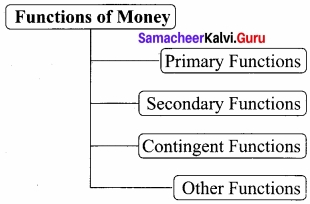
Samacheer Kalvi 12th Physics Solutions Chapter 11 Recent Developments in Physics

Students those who are preparing for the 12th Physics exam can download this Samacheer Kalvi 12th Physics Book Solutions Questions and Answers for Chapter 11 Recent Developments in Physics from here free of cost. These Tamilnadu State Board Solutions for Class 12th Physics PDF cover all Chapter 11 Recent Developments in Physics Questions and Answers. All these concepts of Samacheer Kalvi 12th Physics Book Solutions Questions and Answers are explained very conceptually as per the board prescribed Syllabus & guidelines.

Tamilnadu Samacheer Kalvi 12th Physics Solutions Chapter 11 Recent Developments in Physics

Kickstart your preparation by using this Tamilnadu State Board Solutions for 12th Physics Chapter 11 Recent Developments in Physics Questions and Answers and get the max score in the exams. You can cover all the topics of Chapter 11 Recent Developments in Physics Questions and Answers pdf. Download the Tamilnadu State Board Solutions by accessing the links provided here and ace up your preparation.

Samacheer Kalvi 12th Physics Recent Developments in Physics Textual Evaluation Solved

Samacheer Kalvi 12th Physics Recent Developments in Physics Multiple Choice Questions

Question 1.
The particle size of ZnO material is 30 nm. Based on the dimension it is classified as –
(a) Bulk material
(b) Nanomaterial
(c) Soft material
(d) Magnetic material.
Answer:
(b) Nanomaterial

Question 2.
Which one of the following is the natural nanomaterial?
(a) Peacock feather
(b) Peacock beak
(c) Grain of sand
(d) Skin of the Whale.
Answer:
(a) Peacock feather

Question 3.
The blue print for making ultra durable synthetic material is mimicked from-
(a) Lotus leaf
(b) Morpho butterfly
(c) Parrot fish
(d) Peacock feather.
Answer:
(c) Parrot fish

Question 4.
The method of making nanomaterial by assembling the atoms is called-
(a) Top down approach
(h) Bottom up approach
(c) Cross down approach
(d) Diagonal approach.
Answer:
(b) Bottom up approach

Question 5.
“Sky wax” is an application of nano product in the field of-
(a) Medicine
(b) Textile
(c) Sports
(d) Automotive industry.
Answer:
(c) Sports

Question 6.
The materials used in Robotics are-
(a) Aluminium and silver
(b) Silver and gold
(c) Copper and gold
(d) Steel and aluminium.
Answer:
(d) Steel and aluminum.

Question 7.
The alloys used for muscle wires in Robots are-
(a) Shape memory alloys
(b) Gold copper alloys
(c) Gold silver alloys
(d) Two dimensional alloys.
Answer:
(a) Shape memory alloys

Question 8.
The technology used for stopping the brain from processing pain is-
(a) Precision medicine
(b) Wireless brain sensor
(c) Virtual reality
(d) Radiology.
Answer:
(c) Virtual reality

Question 9.
The particle which gives mass to protons and neutrons are-
(a) Higgs particle
(b) Einstein particle
(c) Nanoparticle
(d) Bulk particle.
Answer:
(a) Higgs particle

Question 10.
The gravitational waves were theoretically proposed by-
(a) Conrad Rontgen
(b) Marie Curie
(c) Albert Einstein
(d) Edward Purcell.
Answer:
(c) Albert Einstein

Samacheer Kalvi 12th Physics Recent Developments in Physics Short Answer Questions

Question 1.
Distinguish between Nanoscience and Nanotechnology?
Answer:
1. Nanoscience:

  • Nanoscience is the science of objects with typical sizes of 1 – 100 nm. Nano means one – billionth of a metre that is 10-9 m.
  • If matter is divided into such small objects the mechanical, electrical, optical, magnetic and other properties change.

2. Nanotechnology:

  • Nanotechnology is a technology involving the design, production, characterization, and applications of nano structured materials.

Question 2.
What is the difference between Nano materials and Bulk materials?
Answer:

  1. The solids are made up of particles. Each of the particle has a definite number of atoms, which might differ from material to material. If the particle of a solid is of size less than 100 nm, it is said to be a ‘nano solid’.
  2. When the particle size exceeds 100 nm, it is a ‘bulk solid’. It is to be noted that nano and bulk solids may be of the same chemical composition.
  3. For example, ZnO can be both in bulk and nano form.
  4. Though chemical composition is the same, nano form of the material shows strikingly different properties when compared to its bulk counterpart.

Question 3.
Give any two examples for “Nano” in nature.
Answer:
1.  Single strand DNA:
A single strand of DNA, the building block of all living things, is about three nanometers wide.

2. Morpho Butterfly:
The scales on the wings of a morpho butterfly contain nanostructures that change the way light waves interact with each other, giving the wings brilliant metallic blue and green hues. Mimic in laboratories – Manipulation of colours by adjusting the size of nano particles with which the materials are made.

Question 4.
Mention any two advantages and disadvantages of Robotics.
Answer:

  1. Advantages of Robotics:
    • The robots are much cheaper than humans.
    • Robots never get tired like humans. It can work for 24 x 7. Hence absenteeism in work place can be reduced.
    • Robots are more precise and error free in performing the task.
  2. Disadvantages of Robotics:
    • Robots have no sense of emotions or conscience.
    • They lack empathy and hence create an emotionless workplace.
    • If ultimately robots would do all the work, and the humans will just sit and monitor them, health hazards will increase rapidly.

Question 5.
Why steel is preferred in making Robots?
Answer:
Steel is several time stronger. In any case, because of the inherent strength of metal, robot bodies are made using sheet, bar, rod, channel, and other shapes.

Question 6.
What are black holes?
Answer:
Black holes are end stage of stars which are highly dense massive object. Its mass ranges from 20 times mass of the sun to 1 million times mass of the sun. It has very strong gravitational force such that no particle or even light can escape from it. The existence of black holes is studied when the stars orbiting the black hole behave differently from the other starts. Every galaxy has black hole at its center. Sagittarius A* is the black hole at the center of the Milky Way galaxy.

Question 7.
What are sub atomic particles?
Answer:

  1. The three main subatomic particles that form an atom are protons, neutrons and electrons.
  2. Subatomic particles are particles that are smaller than the atom, proton and neutron are made up of quarks which is interact through gluons.
  3. Subatomic particle having two types of particles, they are elementary particle and composite particle.

Samacheer Kalvi 12th Physics Recent Developments in Physics Long Answer Questions

Question 1.
Discuss the applications of Nanomaterials in various fields?
Answer:
(i) Automotive industry:

  • Lightweight construction
  • Painting (fillers, base coat, clear coat)
  • Catalysts
  • Tires (fillers)
  • Sensors
  • Coatings for window screen and car bodies

(ii) Chemical industry:

  • Fillers for paint systems
  • Coating systems based on nanocomposites
  • Impregnation of papers
  • Switchable adhesives
  • Magnetic fluids

(iii) Engineering

  • Wear protection for tools and machines (anti blocking coatings, scratch resistant coatings on plastic parts, etc.)
  • Lubricant – free bearings

(iv) Electronic industry

  • Data memory
  • Displays
  • Laser diodes
  • Glass fibres
  • Optical switches
  • Filters (IR-blocking)
  • Conductive, antistatic coatings

(v) Construction:

  • Construction materials
  • Thermal insulation
  • Flame retardants
  • Surface – functionalised building materials for wood, floors, stone, facades, tiles, roof tiles, etc.
  • Facade coatings
  • Groove mortar

(vi) Medicine:

  • Drug delivery systems
  • Contrast medium
  • Prostheses and implants
  • Agents in cancer therapy
  • Active agents
  • Medical rapid tests
  • Antimicrobial agents and coatings

(vii) Textile / fabrics / non – wovens:

  • Surface – processed textiles
  • Smart clothes

(viii) Energy:

  • Fuel cells
  • Solar cells
  • Batteries
  • Capacitors

(ix) Cosmetics:

  • Sun protection
  • Lipsticks
  • Skin creams
  • Tooth paste

(x) Food and drinks:

  • Package materials
  • Additives
  • Storage life sensors
  • Clarification of fruit juices

(xi) Household:

  • Ceramic coatings for irons
  • Odors catalyst
  • Cleaner for glass, ceramic, floor, windows

(xii) Sports / outdoor:

  • Ski wax
  • Antifogging of glasses / goggles
  • Antifouling coatings for ships / boats
  • Reinforced tennis rackets and balls.

Question 2.
What are the possible harmful effects of usage of Nanoparticles? Why?
Answer:
Possible harmful effects of usage of Nanoparticles:

1. The research on the harmful impact of application of nanotechnology is also equally important and fast developing. The major concern here is that the nanoparticles have the dimensions same as that of the biological molecules such as proteins. They may easily get absorbed onto the surface of living organisms and they might enter the tissues and fluids of the body.

2. The adsorbing nature depends on the surface of the nanoparticle. Indeed, it is possible to deliver a drug directly to a specific cell in the body by designing the surface of a nanoparticle so that it adsorbs specifically onto the surface of the target cell.

3. The interaction with living systems is also affected by the dimensions of the nanoparticles. For instance, nanoparticles of a few nanometers size may reach well inside biomolecules, which is not possible for larger nanoparticles.

4. Nanoparticles can also cross cell membranes. It is also possible for the inhaled nanoparticles to reach the blood, to reach other sites such as the liver, heart or blood cells.

5. Researchers are trying to understand the response of living organisms to the presence of nanoparticles of varying size, shape, chemical composition and surface characteristics.

Question 3.
Discuss the functions of key components in Robots?
Answer:
The robotic system mainly consists of sensors, power supplies, control systems, manipulators and necessary software. Most robots are composed of 3 main parts:

    1. The Controller: Also known as the “brain” which is run by a computer program. It gives commands for the moving parts to perform the job.
    2. Mechanical parts: Motors, pistons, grippers, wheels, and gears that make the robot move, grab, turn, and lift.
    3. Sensors: To tell the robot about its surroundings. It helps to determine the sizes and shapes of the objects around, distance between the objects, and directions as well.
      Samacheer Kalvi 12th Physics Solutions Chapter 11 Recent Developments in Physics Q3

Question 4.
Elaborate any two types of Robots with relevant examples?
Answer:
(i) Human Robot: Certain robots are made to resemble humans in appearance and replicate the human activities like walking, lifting, and sensing, etc.

  1. Power conversion unit:
    Robots are powered by batteries, solar power, and hydraulics.
  2. Actuators:
    Converts energy into movement. The majority of the actuators produce rotational or linear motion.
  3. Electric motors:
    They are used to actuate the parts of the robots like wheels, arms, fingers,
    legs, sensors, camera, weapon systems etc. Different types of electric motors are used. The most often used ones are AC motor, Brushed DC motor, Brushless DC motor, Geared DC motor, etc.
  4. Pneumatic Air Muscles:
    They are devices that can contract and expand when air is pumped inside. It can replicate the function of a human muscle. They contract almost 40% when the air is sucked inside them.
  5. Muscle wires:
    They are thin strands of wire made of shape memory alloys. They can contract by 5% when electric current is passed through them.
  6. Piezo Motors and Ultrasonic Motors:
    Basically, we use it for industrial robots.
  7. Sensors:
    Generally used in task environments as it provides information of real – time knowledge.
  8. Robot locomotion:
    Provides the types of movements to a robot. The different types are:

    • Legged
    • Wheeled
    • Combination of Legged and Wheeled Locomotion
    • Tracked slip / skid.

(ii) Industrial Robots:
Six main types of industrial robots:

  1. Cartesian
  2. SCARA (Selective Compliance Assembly Robot Arm)
  3. Cylindrical
  4. Delta
  5.  Polar
  6. Vertically articulated

Six – axis robots are ideal for:

  1. Arc Welding
  2. Spot Welding
  3. Material Handling
  4. Machine Tending
  5. Other Applications

Question 5.
Comment on the recent advancement in medical diagnosis and therapy.
Answer:
The recent advancement in medical diagnosis and therapy:

  1. Virtual reality
  2. Precision medicine
  3. Health wearables
  4. Artificial organs
  5.  3 – D printing
  6. Wireless brain sensors
  7. Robotic surgery
  8. Smart inhalers

1. Virtual reality:
Medical virtual reality is effectively used to stop the brain from processing pain and cure soreness in the hospitalized patients. Virtual reality has enhanced surgeries by the use of 3D models by surgeons to plan operations. It helps in the treatment of Autism, Memory loss, and Mental illness.

2. Precision medicine:
Precision medicine is an emerging approach for disease treatment and prevention that takes into account individual variability in genes, environment, and lifestyle for each person. In this medical model it is possible to customise healthcare, with medical decisions, treatments, practices, or products which are tailored to the individual patient.

3. Health wearables:
A health wearable is a device used for tracking a wearer’s vital signs or health and fitness related data, location, etc. Medical wearables with artificial intelligence and big data provide an added value to healthcare with a focus on diagnosis, treatment, patient monitoring and prevention.

Note: Big Data:Extremely large data sets that may be analysed computationally to reveal patterns, trends, and associations, especially relating to human behaviour and interactions.

4. Artificial organs:
An artificial organ is an engineered device or tissue that is implanted or integrated into a human. It is possible to interface it with living tissue or to replace a natural organ. It duplicates or augments a specific function or functions of human organs so that the patient may return to a normal life as soon as possible.

5. 3D printing:
Advanced 3D printer systems and materials assist physicians in a range of operations in the medical field from audiology, dentistry, orthopedics and other applications.

6. Wireless brain sensors:
Wireless brain sensors monitor intracranial pressure and temperature and then are
absorbed by the body. Hence there is no need for surgery to remove these devices.

7. Robotic surgery:
Robotic surgery is a type of surgical procedure that is done using robotic systems. Robotically – assisted surgery helps to overcome the limitations of pre – existing minimally invasive surgical procedures and to enhance the capabilities of surgeons performing open
surgery.

8. Smart inhalers:
Inhalers are the main treatment option for asthma. Smart inhalers are designed with health systems and patients in mind so that they can offer maximum benefit. Smart inhalers use bluetooth technology to detect inhaler use, remind patients when to take their medication and gather data to help guide care.

Samacheer Kalvi 12th Physics Recent Developments in Physics Additional Questions

Samacheer Kalvi 12th Physics Recent Developments in Physics Multiple Choice Questions

Question 1.
An automatic apparatus or device that performs functions ordinarily ascribed to human or
operate with what appears to be almost human intelligence is called ……………. .
(a) Robot
(b) Human
(c) Animals
(d) Reptiles.
Answer:
(a) Robot.

Question 2.
The laws of Robotics are ……………. .
(a) a robot may not injure a human being
(b) a robot must obey the order given by human
(c) a robot must protect its own existence
(d) both b and c.
Answer:
(d) both b and c.
Hint:
A robot may not injure a human being or through in action, allow human being to be harmed.

Question 3.
The basic components of robot are ……………. .
(a) mechanical linkage
(b) sensors and controllers
(c) user interface and power conversion unit
(d) All the above.
Answer:
(d) All the above.

Question 4.
What is the name for information sent from robot sensors to robot controllers ……………. .
(a) temperature
(b) pressure
(c) feedback
(d) signal.
Answer:
(c) feedback

Question 5.
Which of the following uses radio frequency to produce nano – particles ……………. .
(a) Plasma arching
(b) Chemical vapour deposition
(c) Sol-gel technique
(d) Electro deposition.
Answer:
(a) Plasma arching

Question 6.
Which of the following the atoms do not move from each other ……………. .
(a) Shape memory alloys
(b) Nano materials
(c) Dielectrics
(d) Static materials.
Answer:
(b) Nano materials

Question 7.
The diameter of the nano wire is about ……………. .
(a) 10-6 m
(b) 10-3 m
(c) 10-8 m
(d) 10-9 m.
Answer:
(d) 10-9 m.

Question 8.
A suspended nano wire is a wire that is produced in ……………. .
(a) Air medium
(b) Vaccum
(c) Low vaccum chamber
(d) High vaccum chamber.
Answer:
(d) High vaccum chamber.

Question 9.
For nano metres whose diameters less than …………….are used as welding purposes.
(a) 10 nm
(b) 20 nm
(c) 30 nm
(d) 40 nm.
Answer:
(a) 10 nm

Question 10.
Nano wires are used in ……………. .
(a) 10 nm
(b) Resistors
(c) Capacitors
(d) Transducers.
Answer:
(a) 10 nm

Question 11.
Generally what is the material of needle electrodes ……………. .
(a) Stainless steel
(b) Copper
(c) Lead
(d) Iron.
Answer:
(a) Stainless steel

Question 12.
……………. introduced is used to hold patients head and guide the placements of electrodes.
(a) Monotaxic
(b) Stereotonic
(c) Stereotaxic
(d) Monotonic.
Answer:
(c) Stereotaxic

Question 13.
Who is the father of the modem robotics industry formed the world’s first robotic company in 1956 ……………. .
(a) Joliot
(b) Cormark
(c) Engelberger
(d) Edward purcell.
Answer:
(c) Engelberger

Question 14.
In 1954, ……………. invented the first digitally operated programmable robot called unimate.
(a) Edward purcell
(b) George Devol
(c) Engel berger
(d) Joliot.
Answer:
(b) George Devol

Question 15.
The phenomenon of artificial radioactivity was invented by ……………. .
(a) Joliot and Irene curie
(b) Felix Bloch and Edward purcell
(c ) Connack and Hounsfield
(d) Wilhelm conrad – Rontgen.
Answer:
(a) Joliot and Irene curie

Samacheer Kalvi 12th Physics Recent Developments in Physics Short Answer Question

Question 1.
What is physics?
Answer:
Physics is the basic building block for Science, Engineering, Technology and Medicine.

Question 2.
Write down the applications of Nano technology?
Answer:

  • Energy storage
  • Metallurgy and materials
  • Optical engineering and communication
  • Agriculture and food
  • Biotechnology
  • Defense and security Electronics
  • Biomedical and drug delivery
  • Cosmetics and paints
  • Textile.

Question 3.
What is robotics?
Answer:
Robotics is an integrated study of mechanical engineering, electronic engineering, computer engineering, and science.

Question 4.
What is meant by ‘Robot’? Write its uses?
Answer:
Robot is a mechanical device designed with electronic circuitry and programmed to perform a specific task. These automated machines are highly significant in this robotic era where they can take up the role of humans in certain dangerous environments that are hazardous to people like defusing bombs, finding survivors in unstable ruins, and exploring mines and shipwrecks.

Question 5.
What is the meaning of particle physics?
Answer:
Particle physics deals with the theory of fundamental particles of nature and it is one of the active research areas in physics. Initially it was thought that atom is the fundamental entity of matter.

Question 6.
Define cosmology?
Answer:
Cosmology is the branch that involves the origin and evolution of the universe. It deals with formation of stars, galaxy etc.

We believe that the shared knowledge about Tamilnadu State Board Solutions for 12th Physics Chapter 11 Recent Developments in Physics Questions and Answers learning resource will definitely guide you at the time of preparation. For more details visit Tamilnadu State Board Solutions for 12th Physics Solutions and for more information ask us in the below comments and we’ll revert back to you asap.

Samacheer Kalvi 12th Physics Solutions Chapter 9 Semiconductor Electronics

Students those who are preparing for the 12th Physics exam can download this Samacheer Kalvi 12th Physics Book Solutions Questions and Answers for Chapter 9 Semiconductor Electronics from here free of cost. These Tamilnadu State Board Solutions for Class 12th Physics PDF cover all Chapter 9 Semiconductor Electronics Questions and Answers. All these concepts of Samacheer Kalvi 12th Physics Book Solutions Questions and Answers are explained very conceptually as per the board prescribed Syllabus & guidelines.

Tamilnadu Samacheer Kalvi 12th Physics Solutions Chapter 9 Semiconductor Electronics

Kickstart your preparation by using this Tamilnadu State Board Solutions for 12th Physics Chapter 9 Semiconductor Electronics Questions and Answers and get the max score in the exams. You can cover all the topics of Chapter 9 Semiconductor Electronics Questions and Answers pdf. Download the Tamilnadu State Board Solutions by accessing the links provided here and ace up your preparation.

Samacheer Kalvi 12th Physics Semiconductor Electronics Textual Evaluation Solved

Samacheer Kalvi 12th Physics Semiconductor Electronics Multiple Choice Questions

Question 1.
The barrier potential of a silicon diode is approximately,
(a) 0.7 V
(b) 0.3 V
(c) 2.0 V
(d) 2.2 V.
Answer:
(a) 0.7 V

Question 2.
Doping a semiconductor results in
(a) The decrease in mobile charge carriers
(b) The change in chemical properties
(c) The change in the crystal structure
(d) The breaking of the covalent bond.
Answer:
(c) The change in the crystal structure

Question 3.
A forward biased diode is treated as-
(a) An open switch with infinite resistance
(b) A closed switch with a voltage drop of 0V
(c) A closed switch in series with a battery voltage of 0.7V
(d) A closed switch in series with a small resistance and a battery.
Answer:
(d) A closed switch in series with a small resistance and a battery.

Question 4.
If a half – wave rectified voltage is fed to a load resistor, which part of a cycle the load current will flow?
(a) 0° – 90°
(b) 90° – 180°
(c) 0° – 180°
(d) 0° – 360°
Answer:
(c) 0° – 180°

Question 5.
The primary use of a zener diode is-
(a) Rectifier
(b) Amplifier
(c) Oscillator
(d) Voltage regulator.
Answer:
(d) Voltage regulator.

Question 6.
The principle in which a solar cell operates-
(a) Diffusion
(b) Recombination
(c) Photovoltaic action
(d) Carrier flow.
Answer:
(c) Photovoltaic action

Question 7.
The light emitted in an LED is due to-
(a) Recombination of charge carriers
(b) Reflection of light due to lens action
(c) Amplification of light falling at the junction.
Answer:
(a) Recombination of charge carriers

Question 8.
When a transistor is fully switched on, it is said to be-
(a) Shorted
(b) Saturated
(c) Cut – off
(d) Open.
Answer:
(b) Saturated

Question 9.
The specific characteristic of a common emitter amplifier is-
(a) High input resistance
(b) Low power gain
(c) Signal phase reversal
(d) Low current gain.
Answer:
(c) Signal phase reversal

Question 10.
To obtain sustained oscillation in an oscillator,
(a) Feedback should be positive
(b) Feedback factor must be unity
(c) Phase shift must be 0 or 2π
(d) All the above.
Answer:
(d) All the above.

Question 11.
If the input to the NOT gate is A = 1011, its output is?
(a) 0100
(b) 1000
(c) 1100
(d) 0011.
Answer:
(a) 0100

Question 12.
The electrical series circuit in digital form is-
(a) AND
(b) OR
(c) NOR
(d) NAND.
Answer:
(a) AND

Question 13.
Which one of the following represents forward bias diode? (NEET)
Samacheer Kalvi 12th Physics Solutions Chapter 9 Semiconductor Electronics-1
Answer:
Samacheer Kalvi 12th Physics Solutions Chapter 9 Semiconductor Electronics-2

Question 14.
The given electrical network is equivalent to (NEET)
Samacheer Kalvi 12th Physics Solutions Chapter 9 Semiconductor Electronics-3
(a) AND gate
(b) OR gate
(c) NOR gate 1
(d) NOT gate.
Answer:
(c) NOR gate

Question 15.
The output of the following circuit is 1 when the input ABC is (NEET 2016)
Samacheer Kalvi 12th Physics Solutions Chapter 9 Semiconductor Electronics-4
(a) 101
(b) 100
(c) 110
(d) 010.
Answer:
(a) 101

Samacheer Kalvi 12th Physics Semiconductor Electronics Short Answer Questions

Question 1.
Define electron motion in a semiconductor?
Answer:
To move the hole in a given direction, the valence electrons move in the opposite direction. Electron flow in an N – type semiconductor is similar to electrons moving in a metallic wire. The N – type dopant atoms will yield electron available for conduction.

Question 2.
Distinguish between intrinsic and extrinsic semiconductors.
Answer:
1. Intrinsic:

  • These are pure semiconducting tetravalent crystals.
  • Their electrical conductivity is low.
  • There is no permitted energy state between valence and conduction band.
  • Their electrical conductivity depends on temperature.

2. Extrinsic:

  • These are semiconducting tetravalent crystals doped with impurity atoms group III (or) V.
  • Their electrical conductivity is high.
  • There is no permitted energy state of the impurity atom between valence and conduction band.
  • Their electrical conductivity depends on temperature as well as dopant concentration.

Question 3.
What do you mean by doping?
Answer:
The process of adding impurities to the intrinsic semiconductor is called doping.

Question 4.
How electron-hole pairs are created in a semiconductor material?
Answer:
The free electrons from electron hole pairs, enable current to flow in the semiconductor when an external voltage is applied. The holes in the valence band also allow electron movement within the valence band itself and this also contributes to current flow. This process is called electron – hole pair generation.

Question 5.
A diode is called as a unidirectional device. Explain?
Answer:
Diode is called as a unidirectional device, i.e., current flows in only one direction (anode to cathode internally) when a forward voltage is applied, the diode conducts and when reverse voltage is applied, there is no conduction. A mechanical analogy is a rat chat, which allows motion in one direction only.

Question 6.
What do you mean by leakage current in a diode?
Answer:
The leakage current in a diode is the current that the diode will leak when a reverse voltage is applied to it. Under the reverse bias, a very small current in μA, flows across the junction. This is due to the flow of the minority charge carriers called the leakage current or reverse saturation current.

Question 7.
Draw the output waveform of a full wave rectifier.
Answer :
Samacheer Kalvi 12th Physics Solutions Chapter 9 Semiconductor Electronics-5

Question 8.
Distinguish between avalanche and zener breakdown.
Answer:
1. Avalanche Breakdown:

  • It occurs in junctions which are lightly and have wide depletion widths.
  • It occurs at higher reverse voltages when thermally generated electrons get enough kinetic energy to produce more electrons by collision.
  • At reverse voltage above 6 V breakdown is due to avalanche effect.
  • Electric field produced is weak in nature.
  • Charge carriers obtain energy from the applied potential.

2. Zener Breakdown:

  • It occurs in junctions which are heavily doped and have narrow depletion widths.
  • It occurs due to rupture of covalent bonds by strong electric fields set up in depletion region by the reverse voltage.
  • At reverse voltage below 6V breakdown is due to zener effect.
  • A strong electric field is produced
  • Zener current is independent of applied voltage.

Question 9.
Discuss the biasing polarities in an NPN and PNP transistors.
Answer:
In a PNP transistor, base and collector will be negative with respect to emitter indicated by the middle letter N whereas base and collector will be positive in an NPN transistor [indicated by the middle letter P]

Question 10.
Explain the current flow in a NPN transistor?
Answer:

  1. The conventional flow of current is based on the direction of the motion of holes
  2. In NPN transistor, current enters from the base into the emitter.

Question 11.
What is the phase relationship between the AC input and output voltages in a common emitter amplifier? What is the reason for the phase reversal?
Answer:
In a common emitter amplifier, the input and output voltages are 180° out of phase or in, opposite phases. The reason for this can be seen from the fact that as the input voltage rises, so the current increases through the base circuit.

Question 12.
Explain the need for a feedback circuit in a transistor oscillator.
Answer:
The circuit used to feedback a portion of the output to the input is called the feedback network. If the portion of the output fed to the input is in phase with the input, then the magnitude of the input signal increases. It is necessary for sustained oscillations.

Question 13.
Give circuit symbol, logical operation, truth table, and Boolean expression of-

  1. AND
  2. OR
  3. NOT
  4. NAND
  5. NOR
  6. EX – OR gates.

Answer:
1. AND gate Circuit symbol:
A and B are inputs and Y is the output.
Samacheer Kalvi 12th Physics Solutions Chapter 9 Semiconductor Electronics-6
It is a logic gate and hence A, B, and Y can have the (a) Two input AND gate value of either 1 or 0.
Samacheer Kalvi 12th Physics Solutions Chapter 9 Semiconductor Electronics-7
Boolean equation:
Y = A.B
It performs logical multiplication and is
different from arithmetic multiplication.
Logic operation:
The output of AND gate is high (1) only when all the inputs are high (1). The rest of the cases the output is low. Hence the output of AND gate is high (1) only when all the inputs are high.

2. OR gate:
Circuit Symbol
A and B are inputs and Y is the output.
Samacheer Kalvi 12th Physics Solutions Chapter 9 Semiconductor Electronics-8
Boolean equation:
A + B = Y
It performs logical addition and is different from arithmetic addition.
Samacheer Kalvi 12th Physics Solutions Chapter 9 Semiconductor Electronics-9
Logic operation:
The output of OR gate is high (logic 1 state) when either of the inputs or both are high.

3. NOT gate:
Circuit symbol
A is the input and Y is the output.
Samacheer Kalvi 12th Physics Solutions Chapter 9 Semiconductor Electronics-10
Boolean equation:
Y = \(\overline { A } \)

Logic operation:
The output is the complement of the input.
Samacheer Kalvi 12th Physics Solutions Chapter 9 Semiconductor Electronics-11
It is represented with an overbar. It is also called as inverter. The truth table infers that the output Y is 1 when input A is 0 and vice versa. The truth table of NOT.

4. NAND gate:
A and B are inputs and Y is the output.
Samacheer Kalvi 12th Physics Solutions Chapter 9 Semiconductor Electronics-12-13

Boolean equation:
Y = Y= \(\overline { AB } \)
Logic operation:
The output Y equals the complement of AND operation. The circuit is an AND gate followed by a NOT gate. Therefore, it is summarized as NAND. The output is at logic zero only when all the inputs are high. The rest of the cases, the output is high (Logic 1 state).

5. NOR gate:
Circuit symbol: A and B are inputs and Y is the output.
Samacheer Kalvi 12th Physics Solutions Chapter 9 Semiconductor Electronics-14-15
Boolean equation:
Y= A + B
Logic operation:
Y equals the complement of OR operation (A OR B). The circuit is an OR gate followed by a NOT gate and is summarized as NOR. The output is high when all the inputs are low. The output is low for all other combinations of inputs.

6. Ex – OR gate:
Circuit symbol
A and B are inputs and Y is the output. The Ex-OR operation is denoted as ⊕.
Boolean equation:
Y = A. \(\overline { B } \) + \(\overline { A } \) .B
Y = A ⊕ B
Logic operation:
The output is high only when either of the two inputs is high. In the case of an Ex-OR gate with more than two inputs, the output will be high when odd number of inputs are high.
Samacheer Kalvi 12th Physics Solutions Chapter 9 Semiconductor Electronics-16-17

Question 14.
State De Morgan’s first and second theorems De Morgan’s First Theorem?
Answer:
The first theorem states that the complement of the sum of two logical inputs is equal to the product of its complements.
\(\overline { A+B } \) = \(\overline { A } \).\(\overline { B } \)
De Morgan’s Second Theorem:
The second theorem states that the complement of the product of two inputs is equal to the sum of its complements.
\(\overline { A.B } \) = \(\overline { A+B } \)

Samacheer Kalvi 12th Physics Semiconductor Electronics Long Answer Questions

Question 1.
Elucidate the formation of a N – type and P – type semiconductors.
Answer:
1. N – type semiconductor:
A n-type semiconductor is obtained by doping a pure Germanium (or Silicon) crystal with a dopant from group V pentavalent elements like Phosphorus, Arsenic, and Antimony. The dopant has five valence electrons while the Germanium atom has four valence electrons.

During the process of doping, a few of the Germanium atoms are replaced by the group V dopants. Four of the five valence electrons of the impurity atom are bound with the 4 valence electrons of the neighbouring replaced Germanium atom. The fifth valence electron of the impurity atom will be loosely attached with the nucleus as it has not formed the covalent bond.
Samacheer Kalvi 12th Physics Solutions Chapter 9 Semiconductor Electronics-18
The energy level of the loosely attached fifth electron from the dopant is found just below the conduction band edge and is called the donor energy level. At room temperature, these electrons can easily move to the conduction band with the absorption of thermal energy. It is shown in the figure (c). Besides, an external electric field also can set free the loosely bound electrons and lead to conduction.

It is important to note that the energy required for an electron to jump from the valence band to the conduction band (Eg) in an intrinsic semiconductor is 0.7 eV for Ge and 1.1 eV for Si, while the energy required to set free a donor electron is only 0.01 eV for Ge and 0.05 eV for Si.

The group V pentavalent impurity atoms donate electrons to the conduction band and are called donor impurities. Therefore, each impurity atom provides one extra electron to the conduction band in addition to the thermally generated electrons. These thermally generated electrons leave holes in valence band. Hence, the majority carriers of current in an n-type Semiconductor are electrons and the minority carriers are holes. Such a semiconductor doped with a pentavalent impurity is called an n-type semiconductor.
Samacheer Kalvi 12th Physics Solutions Chapter 9 Semiconductor Electronics-19

2. P – type semiconductor:
Here, a trivalent atom from group III elements such as Boron, Aluminium, Gallium and Indium is added to the Germanium or Silicon substrate. The dopant with three valence electrons are bound with the neighbouring Germanium atom as shown in Figure (a). As Germanium atom has four valence electrons, one electron position of the dopant in the Germanium crystal lattice will remain vacant. The missing electron position in the covalent bond is denoted as a hole.
Samacheer Kalvi 12th Physics Solutions Chapter 9 Semiconductor Electronics-20
To make complete covalent bonding with all four neighbouring atoms, the dopant is in need of one more electron. These dopants can accept electrons from the neighbouring atoms. Therefore, this impurity is called an acceptor impurity. The energy level of the hole created by each impurity atom is just above the valence band and is called the acceptor-energy level, as shown in Figure (b).
Samacheer Kalvi 12th Physics Solutions Chapter 9 Semiconductor Electronics-21
For each acceptor atom, there will be a hole in the valence band in addition to the thermally generated holes. In such an extrinsic semiconductor, holes are the majority carriers and thermally generated electrons are minority carriers. The semiconductor thus formed is called a p – type semiconductor.

Question 2.
Explain the formation of PN junction diode. Discuss its V-I characteristics.
Answer:
Formation of depletion layer:
A p – n junction is formed by joining n-type and p-type semiconductor materials as shown in figure.

(a) Since the n-region has a high electron concentration and the p-region a high hole concentration, electrons diffuse from the n-side to the p-side. This causes diffusion current which exists due to the concentration difference of electrons. The electrons diffusing into the p-region may occupy holes in that region and make it negative.

The holes left behind by these electrons in the n-side are equivalent to the diffusion of holes from the p-side to the n-side. If the electrons and holes were not charged, this diffusion process would continue until the concentration of electrons and holes on the two sides were the same, as happens if two gasses come into contact with each other.
Samacheer Kalvi 12th Physics Solutions Chapter 9 Semiconductor Electronics-22
But, in a p – n junction, when the electrons and holes move to the other side of the junction, they leave behind exposed charges on dopant atom sites, which are fixed in the crystal lattice and are unable to move. On the n-side, positive ion cores are exposed and on the p-side, negative ion cores are exposed as shown in Figure

(b) An electric field E forms between the positive ion cores in the n – type material and negative ion cores in the p-type material. The electric field sweeps free carriers out of this region and hence it is called depletion region as it is depleted of free carriers. A barrier potential Vb due to the electric field E is formed at the junction as shown in Figure.

(c) As this diffusion of charge carriers from both sides continues, the negative ions form a layer of negative space charge region along the p-side. Similarly, a positive space charge region is formed by positive ions on the n-side. The positive space charge region attracts electrons from p-side to n-side and the negative space charge region attracts holes from n-side to p-side.

This moment of earners happen in this region due to the formed electric field and it constitutes a current called drift current. The diffusion current and drift current flow in the opposite direction and at one instant they both become equal. Thus, a p – n junction is formed.

V-I characteristics of a junction diode:
Forward characteristics:
It is the study of the variation in current through the diode with respect to the applied voltage across the diode when it is forward biased. An external resistance (R) is used to limit the flow of current through the diode. The voltage across the diode is varied by varying the biasing voltage across the dc power supply.

The forward bias voltage and the corresponding forward bias current are noted. A graph is plotted by taking the forward bias voltage (V) along the X – axis and the current (I) through the diode along the Y – axis. This graph is called the forward V-I characteristics of the p – n junction diode. Three inferences can be brought out from the graph:
Samacheer Kalvi 12th Physics Solutions Chapter 9 Semiconductor Electronics-23
(i) At room temperature, a potential difference equal to the barrier potential is required before a reasonable forward current starts flowing across the diode. This voltage is known as threshold voltage or cut-in voltage or knee voltage (Vth). It is approximately 0.3 V for Germanium and 0.7 V for Silicon. The current flow is negligible when the applied voltage is less than the threshold voltage. Beyond the threshold voltage, increase in current is significant even for a small increase in voltage.

(ii) The graph clearly infers that the current flow is not linear and is exponential. Hence it does not obey Ohm’s law.

(iii) The forward resistance (rf) of the diode is the ratio of the small change in voltage (∆V)to the small change in current(∆I), rf = \(\frac { ∆V }{ ∆I }\)
Samacheer Kalvi 12th Physics Solutions Chapter 9 Semiconductor Electronics-24
However, if the applied voltage is increased beyond a rated value, it will produce an extremely large current which may destroy the junction due to overheating. This is called as the breakdown of the diode and the voltage at which the diode breaks down is called the breakdown voltage. Thus, it is safe to operate a diode well within the threshold voltage and the breakdown voltage.

Reverse characteristics:
In the reverse bias, the p-region of the diode is connected to the negative terminal and n-region to the positive terminal of the dc power supply. A graph is drawn between the reverse bias voltage and the current across the junction, which is called the reverse characteristics of a p-n junction diode.

Samacheer Kalvi 12th Physics Solutions Chapter 9 Semiconductor Electronics-25
Under this bias, a very small current in μA, flows across the junction. This is due to the flow of the minority charge carriers called the leakage current or reverse saturation current. Besides, the current is almost independent of the voltage. The reverse bias voltage can be increased only up to the rated value otherwise the diode will enter into the breakdown region.

Question 3.
Draw the circuit diagram of a half wave rectifier and explain its working Half wave rectifier circuit:
Answer:
The half wave rectifier circuit. The circuit consists of a transformer, a p-n junction diode and a resistor. In a half wave rectifier circuit, either a positive half or the negative half of the AC input is passed through while the other half is blocked. Only one half of the input wave reaches the output. Therefore, it is called half wave rectifier. Here, a p-n junction diode acts as a rectifying diode.
Samacheer Kalvi 12th Physics Solutions Chapter 9 Semiconductor Electronics-26

During the positive half cycle:
When the positive half cycle of the ac input signal passes through the circuit, terminal A becomes positive with respect to terminal B. The diode is forward biased and hence it conducts. The current flows through the load resistor RL and the AC voltage developed across RL constitutes the output voltage V0 and the waveform of the diode current.

During the negative half cycle:
When the negative half cycle of the ac input signal passes through the circuit, terminal A is negative with respect to terminal B. Now the diode is reverse biased and does not conduct and hence no current passes through RL. The reverse saturation current in a diode is negligible. Since there is no voltage drop across RL, the negative half cycle of ac supply is suppressed at the output.

The output of the half wave rectifier is not a steady dc voltage but a pulsating wave. This pulsating voltage is not sufficient for electronic equipments. A constant or a steady voltage is required which can be obtained with the help of filter circuits and voltage regulator circuits. Efficiency (η) is the ratio of the output dc power to the ac input power supplied to the circuit. Its value for half wave rectifier is 40.6 %.

Question 4.
Explain the construction and working of a full w ave rectifier.
Answer:
Full wave rectifier:
The positive and negative half cycles of the AC input signal pass through the full wave rectifier circuit and hence it is called the full wave rectifier. It consists of two p-n junction diodes, a center tapped transformer, and a load resistor (RL). The centre is usually taken as the ground or zero voltage reference point. Due to the centre tap transformer, the output voltage rectified by each diode is only one half of the total secondary voltage.
Samacheer Kalvi 12th Physics Solutions Chapter 9 Semiconductor Electronics-27

During positive half cycle:
When the positive half cycle of the ac input signal passes through the circuit, terminal M is positive, G is at zero potential and N is at negative potential. This forward biases diode D1 and reverse biases diode D2. Hence, being forward biased, diode D1 conducts and current flows along the path MD1 AGC. As a resul t, positive half cycle of the voltage appears across RL in the direction G to C.

During negative half cycle:
When the negative half cycle of the ac input signal passes through the circuit, terminal N is positive, G is at zero potential and M is at negative potential. This forward biases diode D2 and reverse biases diode D1. Hence, being forward biased, diode D2 conducts and current flows along the path ND2 BGC . As a result, negative half cycle of the voltage appears across RL in the same direction from G to C.

Hence in a full wave rectifier both positive and negative half cycles of the input signal pass through the circuit in the same direction as shown in figure (b). Though both positive and negative half cycles of ac input are rectified, the output is still pulsating in nature. The efficiency (η) of full wave rectifier is twice that of a half wave rectifier and is found to be 81.2 %. It is because both the positive and negative half cycles of the ac input source are rectified.

Question 5.
What is an LED? Give the principle of operation with a diagram.
Answer:
Light Emitting Diode (LED):
LED is a p – n junction diode which emits visible or invisible light when it is forward biased. Since, electrical energy is converted into light energy, this process is also called electroluminescence. The cross-sectional view of a commercial LED is shown in figure (b). it consists of a p-layer, n-layer and a substrate. A transparent window is used to allow light to travel in the desired direction. An external resistance in series with the biasing source is required to limit the forward current through the LED. In addition, it has two leads; anode and cathode:
Samacheer Kalvi 12th Physics Solutions Chapter 9 Semiconductor Electronics-28
When the p – n junction is forward biased, the conduction band electrons on n-side and valence band holes on p-side diffuse across the junction. When they cross the junction, they become excess minority carriers (electrons in p-side and holes in n-side).

These excess minority carriers recombine with oppositely charged majority carriers in the respective regions, i.e. the electrons in the conduction band recombine with holes in the valence band as shown in the figure (c). During recombination process, energy is released in the form of light (radiative) or heat (non-radiative). For radiative recombination, a photon of energy hυ is emitted.

For non-radiative recombination, energy is liberated in the form of heat. The colour of the light is determined by the energy band gap of the material. Therefore, LEDs are available in a wide range of colours such as blue (SiC), green (AlGaP) and red (GaAsP). Now a days, LED which emits white light (GalnN) is also available.

Question 6.
Write notes on Photodiode?
Answer:
Photodiodes:
A p-n junction diode which converts an optical signal into electric current is known as photodiode. Thus, the operation of photodiode is exactly opposite to that of an LED. Photo diode words in reverse bias. Its circuit symbol is shown in figure (a). The direction of arrows indicates that the light is incident on the photo diode.

The device consists of a p – n junction semiconductor made of photosensitive material kept safely inside a plastic case. It has a small transparent window that allows light to be incident on the p – n junction. Photodiodes can generate current when the p – n junction is exposed to light and hence are called as light sensors.
Samacheer Kalvi 12th Physics Solutions Chapter 9 Semiconductor Electronics-29
When a photon of sufficient energy (hυ) strikes the depletion region of the diode, some of the valence band electrons are elevated into conduction band, in turn holes are developed in the valence band. This creates electron – hole pairs. The amount of electron – hole pairs generated depends on the intensity of light incident on the p-n junction. These electrons and holes are swept across the p-n junction by the electric field created by reverse voltage before recombination takes place. Thus, holes move towards the n-side and electrons towards the p-side.

When the external circuit is made, the electrons flow through the external circuit and constitute the photocurrent. When the incident light is zero, there exists a reverse current which is negligible. This reverse current in the absence of any incident light is called dark current and is due to the thermally generated minority carriers.

Question 7.
Explain the working principle of a solar cell. Mention its applications.
Answer:
Solar cell:
A solar cell, also known as photovoltaic cell, converts light energy directly into electricity or electric potential difference by photovoltaic effect. It is basically a p – n junction which generates emf when solar radiation falls on the p – n junction. A solar cell is of two types: p-type and n-type. Both types use a combination of p-type and n-type Silicon which together forms the p-n junction of the solar cell.

The difference is that p-type solar cells use p-type Silicon as the base with an ultra-thin layer of n-type Silicon as shown in Figure, while n-type solar cell uses the opposite combination. The other side of the p-Silicon is coated with metal which forms the back electrical contact. On top of the n-type Silicon, metal grid is deposited which acts as the front electrical contact. The top of the solar cell is coated with anti-reflection coating and toughened glass.
Samacheer Kalvi 12th Physics Solutions Chapter 9 Semiconductor Electronics-30
In a solar cell, electron-hole pairs are generated due to the absorption of light near the junction. Then the charge carriers are separated due to the electric field of the depletion region. Electrons move towards n-type Silicon and holes move towards p-type Silicon layer. The electrons reaching the n-side are collected by the front contact and holes reaching p-side are collected by the back electrical contact.

Thus a potential difference is developed across solar cell. When an external load is connected to the solar cell, photocurrent flows through the load. Many solar cells are connected together either in series or in parallel combination to form solar panel or module. Many solar panels are connected with each other to form solar arrays. For high power applications, solar panels and solar arrays are used.
Applications:

  • Solar cells are widely used in calculators, watches, toys, portable power supplies, etc.
  • Solar cells are used in satellites and space applications
  • Solar panels are used to generate electricity.

Question 8.
Sketch the static characteristics of a common emitter transistor and bring out the essence of input and output characteristics.
Answer:
Static Characteristics of Transistor in Common Emitter Mode:
The know-how of certain parameters like the input resistance, output resistance, and current gain of a transistor are very important for the effective use of transistors in circuits. The circuit to study the static characteristics of an NPN transistor in the common emitter mode is given in figure.

The bias supply voltages VBB and VCC bias the base-emitter junction and collector- emitter junction respectively. The junction potential at the base-emitter is represented as VBE and the collector-emitter as VCE. The rheostats R1 and R2, are used to vary the base and collector currents respectively.
The static characteristics of the BJT are:

  1. Input characteristics
  2. Output characteristics
  3. Transfer characteristics

Samacheer Kalvi 12th Physics Solutions Chapter 9 Semiconductor Electronics-31

1. Input Characteristics:
Input Characteristics curves give the relationship between the base current (IB) and base to emitter voltage (VBE) at constant collector to emitter voltage (VCE) and are shown in figure. Initially, the collector to emitter voltage (VCE) is set to a particular voltage (above 0.7 V to reverse bias the junction). Then the base-emitter voltage (VBE) is increased in suitable steps and the corresponding base-current (IB) is recorded. A graph is plotted with VBE along the x-axis and IB along the y-axis. The procedure is repeated for different values of VCE.
Samacheer Kalvi 12th Physics Solutions Chapter 9 Semiconductor Electronics-img
The following observations are made from the graph:

1. The curve looks like the forward characteristics of an ordinary p-n junction diode.

2. There exists a threshold voltage or knee voltage (Vk) below which the base current is very small. The value is 0.7 V for Silicon and 0.3 V for Germanium transistors. Beyond the knee voltage, the base current increases with the increase in base-emitter voltage.

3. It is also noted that the increase in the collector-emitter voltage decreases the base current. This shifts the curve outward. This is because the increase in collector-emitter voltage increases the width of the depletion region in turn, reduces the effective base width and thereby the base current.

Input resistance:
The ratio of the change in base-emitter voltage (∆VBE) to the change in base current (∆IB) at a constant collector-emitter voltage (VCE) is called the input resistance (Ri). The input resistance is not linear in the lower region of the curve.
Ri =\(\left(\frac{\Delta \mathrm{V}_{\mathrm{BE}}}{\Delta \mathrm{I}_{\mathrm{B}}}\right)_{\mathrm{V}_{\mathrm{CB}}}\)

The input resistance is high for a transistor in common emitter configuration. Output Characteristics:
The output characteristics give the relationship between the variation in the collector current (∆IC) with respect to the variation in collector- emitter voltage (∆ VCE) at constant input current (IB) as shown in figure.
Samacheer Kalvi 12th Physics Solutions Chapter 9 Semiconductor Electronics q8
Initially, the base current (IB) is set to a particular value. Then collector- emitter voltage (VCE) is increased in suitable steps and the corresponding collector current (IC) is recorded. A graph is plotted with the VCE along the x-axis and IC along the y-axis.


This procedure is repeated for different values of IB, The four regions in are:
(i) Saturation region:
When VCE is increased above 0 V, the Ic increases rapidly to a saturation value almost independent of IB (Ohmic region, OA) called knee voltage. Transistors are always operated above this knee voltage.

(ii) Cut-off region:
A small collector current (IC) exists even after the base current (IB) is reduced to zero. This current is due to the presence of minority carriers across the collector-base junction and the surface leakage current (ICEO). This region is called as the cut-off region, because the main collector current is cut-off.

(iii) Active region:
In this region, the emitter-base junction is forward biased and the collector-base junction is reverse biased. The transistor in this region can be used for voltage, current and power amplification.

(iv) Breakdown region:
If the collector-emitter voltage (VCE) is increased beyond the rated value given by the manufacturer, the collector current (IC) increases enormously leading to the junction breakdown of the transistor. This avalanche breakdown can damage the transistor.

Output Resistance:
The ratio of the change in the collector-emitter voltage (∆VCE) to the corresponding change in the collector current (∆IC) at constant base current (IB ) is called output resistance (RO).
R0 =\(\left(\frac{\Delta \mathrm{V}_{\mathrm{CE}}}{\Delta \mathrm{I}_{\mathrm{C}}}\right)_{\mathrm{I}_{\mathrm{B}}}\)
The output resistance for transistor in common emitter configuration is very low.

Question 9.
Describe the function of a transistor as an amplifier with the neat circuit diagram. Sketch the input and output wave form.
Answer:
Transistor as an amplifier:
A transistor operating in the active region has the capability to amplify weak signals. Amplification is the process of increasing the signal strength (increase in the amplitude). If a large amplification is required, the transistors are cascaded with coupling elements like resistors, capacitors, and transformers which is called as multistage amplifiers.

Here, the amplification of an electrical signal is explained with a single stage transistor amplifier as shown in figure (a). Single stage indicates that the circuit consists of one transistor with the allied components. An NPN transistor is connected in the common emitter Configuration.
Samacheer Kalvi 12th Physics Solutions Chapter 9 Semiconductor Electronics-32
To start with, the Q point or the operating point of the transistor is fixed so as to get the maximum signal swing at the output (neither towards saturation point nor towards cut-off). A load resistance, RC is connected in series with the collector circuit to measure the output voltage. The capacitor C1 allows only the ac signal to pass through. The emitter bypass capacitor CE provides a low reactance path to the amplified ac signal. The coupling capacitor CC is used to couple one stage of the amplifier with the next stage while constructing multistage amplifiers. VS is the sinusoidal input signal source applied across the base-emitter.
Collector currrent ,Ic = IβB = [∴β=\(\frac { { I }_{ C } }{ { I }_{ B } } \)]
Applying Kirchhoff’s voltage law in the output loop, the collector-emitter voltage is given by
VCE = VCC – ICRC

Working of the amplifier:
1. During the positive half cycle:
Input signal (VS) increases the forward voltage across the emitter-base. As a result, the base current (IB) increases. Consequently, the collector current (IC) increases β times. This increases the voltage drop across RC which in turn decreases the collector-emitter voltage (VCE). Therefore, the input signal in the positive direction produces an amplified signal in the negative direction at the output. Hence, the output signal is reversed by 180° as shown in figure (b).

2. During the negative half cycle:
Input signal (Vs ) decreases the forward voltage across the emitter-base. As a result, base current (IB) decreases and in turn increases the collector current (IC). The increase in collector current (IC) decreases the potential drop across Rc and increases the collector-emitter voltage (VCE). Thus, the input signal in the negative direction produces an amplified signal in the positive direction at the output. Therefore, 180° phase reversal is observed during the negative half cycle of the input signal.

Question 10.
Transistor functions as a switch. Explain.
Answer:
The transistor in saturation and cut – off regions functions like an electronic switch that helps to turn ON or OFF a given circuit by a small control signal.
Samacheer Kalvi 12th Physics Solutions Chapter 9 Semiconductor Electronics-33
1. Presence of dc source at the input (saturation region):
When a high input voltage (Vin = +5V) is applied, the base current (IB) increases and in turn increases the collector current. The transistor will move into the saturation region (turned ON). The increase in collector current (IC) increases the voltage drop across Rc, thereby lowering the output voltage, close to zero. The transistor acts like a closed switch and is equivalent to ON condition.

2. Absence of dc source at the input (cut-off region):
A low input voltage (Vin = 0V), decreases the base current (IB) and in turn decreases the collector current (Ic). The transistor will move into the cut-off region (turned OFF). The decrease in collector current (Ic) decreases the drop across Rc, thereby increasing the output voltage, close to +5 V.

The transistor acts as an open switch which is considered as the OFF condition. It is manifested that, a high input gives a low output and a low input gives a high output. In addition, we can say that the output voltage is opposite to the applied input voltage. Therefore, a transistor can be used as an inverter in computer logic circuitry.

Question 11.
State Boolean laws. Elucidate how they are used to simplify Boolean expressions with suitable example.
Answer:
Law’s of Boolean Algebra: The NOT, OR and AND operations are \(\overline { A } \), A + B, A . B are the Boolean operations. The results of these operations can be summarised as:
Complement law
Samacheer Kalvi 12th Physics Solutions Chapter 9 Semiconductor Electronics-34
The complement law can be realised as Samacheer Kalvi 12th Physics Solutions Chapter 9 Semiconductor Electronics
OR laws:
Samacheer Kalvi 12th Physics Solutions Chapter 9 Semiconductor Electronics-35

AND laws:
Samacheer Kalvi 12th Physics Solutions Chapter 9 Semiconductor Electronics-36
The Boolean operations obey the following laws.
Commutative laws
A+ B = B + A
A. B = B . A
Associative laws
A + (B + C) = (A + B) + C
A . (B . C) = (A .B) . C
Distributive laws
A( B + C) = AB + AC
A + BC = (A + B) (A + C)
The above laws are used to simplify complicated expressions and to simplify the logic circuitry.

Question 12.
State and prove De Morgan’s First and Second theorems.
Answer:
De Morgan’s First Theorem:
The first theorem states that the complement of the sum of two logical inputs is equal to the product of its complements.
Proof:
The Boolean equation for NOR gate is Y = \(\overline { A+B } \). The Boolean equation for a bubbled AND gate is Y = \(\overline { A } \). \(\overline { B } \) . Both cases generate same outputs for same inputs. It can be verified using the following truth table.
Samacheer Kalvi 12th Physics Solutions Chapter 9 Semiconductor Electronics-37
From the above truth table, we can conclude \(\overline { A+B } \) = \(\overline { A } \). \(\overline { B } \) . Thus De Morgan’s First Theorem is proved. It also says that a NOR gate is equal to a bubbled AND gate. The corresponding logic circuit diagram is shown in figure.
Samacheer Kalvi 12th Physics Solutions Chapter 9 Semiconductor Electronics-38

De Morgan’s Second Theorem:
The second theorem states that the complement of the product of two inputs is equal to the sum of its complements.
Proof:
The Boolean equation for NAND gate is Y = \(\overline { AB } \)
The Boolean equation for bubbled OR gate is Y = \(\overline { A } \) + \(\overline { B } \) . A and B are the inputs and Y is the output. The above two equations produces the same output for the same inputs. It can be verified by using the truth table.
Samacheer Kalvi 12th Physics Solutions Chapter 9 Semiconductor Electronics-39
From the above truth table we can conclude \(\overline { A.B } \) = \(\overline { A } \) + \(\overline { B } \). Thus De Morgan’s Second Theorem is proved. It also says, a NAND gate is equal to a bubbled OR gate. The corresponding logic circuit diagram is shown in figure.
Samacheer Kalvi 12th Physics Solutions Chapter 9 Semiconductor Electronics-40

Samacheer Kalvi 12th Physics Semiconductor Electronics Numerical Problems

Question 1.
The given circuit has two ideal diodes connected as shown in figure below. Calculate the current flowing through the resistance R1.
Answer:
Diode D1 is reverse biased so, it will block the current and Diode D2 is forward biased, so it will pass the current.
Current in the circuit is
I = \(\frac { V }{ { R }_{ s } } \) = \(\frac { 10 }{ 2+2 }\) = \(\frac { 10 }{ 4 }\) = 2.5 a
I = 2.5 A

Question 2.
Four silicon diodes and a 10 resistor are connected as shown in figure below. Each diode has a resistance of 1Ω Find the current flows through the 18Ω resistor.
Answer:
Diodes D2 and D4 are forward biased while diodes D1 and D3 are reverse biased. Only current flowing through the closed loop is EADCBFE. Consider the applied voltage is 4V. For silicon diode, Barrier Voltage is 0.7V.
Samacheer Kalvi 12th Physics Solutions Chapter 9 Semiconductor Electronics-41
Net circuit Voltages = 4 – (0.7 + 0.7) = 4 1.4
V = 2.6 V
Total circuit resistance = 1 + 18 + 1
R = 20 Ω
∴ Circuit Current I = \(\frac { V }{ R }\) = \(\frac { 2.6 }{ 20 }\)

Question 3.
Assuming VCEsat = 0.2 V and β = 50, find the minimum base current (IB) required to drive the transistor given in the figure to saturation.
Solution:
Samacheer Kalvi 12th Physics Solutions Chapter 9 Semiconductor Electronics q3

Question 4.
A transistor having α =0.99 and VBE = 0.7V, is given in the circuit. Find the value of the collector current.
Solution:
Samacheer Kalvi 12th Physics Solutions Chapter 9 Semiconductor Electronics-43

Question 5.
In the circuit shown in the figure, the BJT has a current gain (β) of 50. For an emitter – base voltage VEB = 600 mV, calculate the emitter – collector voltage VEC (in volts).
Solution:
Samacheer Kalvi 12th Physics Solutions Chapter 9 Semiconductor Electronics q3
Samacheer Kalvi 12th Physics Solutions Chapter 9 Semiconductor Electronics-45

Samacheer Kalvi 12th Physics Semiconductor Electronics Additional Questions

Samacheer Kalvi 12th Physics Semiconductor Electronics Multiple Choice Questions

Question 1.
The probability of electrons to be found in the conduction band of an intrinsic semiconductor at a finite temperature
(a) increase exponentially with increasing band gap
(b) decrease exponentially with increasing band gap
(c) decreases with increasing temperature
(d) is independent of the temperature and the band gap.
Answer:
(b) decrease exponentially with increasing band gap
Hint:
At a finite temperature, the probability of jumping an electron from valence band to conduction band decreases exponentially with the increasing band gap (Eg )
n = n0 e-Eg/kBT

Question 2.
The electrical conductivity of a semiconductor increase when electromagnetic radiation of wavelength shorter than 2480 nm is incident on it. The band gap (in eV) for the semiconductor is-
(a) 0.9
(b) 0.7
(c) 0.5
(d) 1.1.
Answer:
(c) 0.5
Hint:
Samacheer Kalvi 12th Physics Solutions Chapter 9 Semiconductor Electronics-46

Question 3.
Which of the following statements is not true?
(a) The resistance of intrinsic semiconductor decreases with increase of temperature.
(b) Doping pure Si with trivalent impurities gives p-type semiconductors.
(c) The majority carriers in n-type semiconductors and holes
(d) Ap-n junction can act as a semiconductor diode.
Answer:
(c) The majority carriers in n-type semiconductors and holes
Hint:
The majority charge carriers in n-type semiconductors are electrons not holes. Only option (c) is not true.

Question 4.
Holes are charge carrier in
(a) intrinsic semiconductors
(b) ionic solids
(c) p-type semiconductor
(d) metals.
Answer:
(a) intrinsic semiconductors
Hint:
(a) In intrinsic semiconductor, nh = ne
(b) In P-type semiconductor, nh >> ne

Question 5.
A transistor is used in the common emitter mode as an amplifier. Then
(a) the base – emitter junction is forward – biased
(b) the base – emitter junction is reverse – biased
(c) the input signal is connected in series with the voltage applied to bias the base – emitter junction
(d) the input signal is connected in series with the voltage applied to bias the base – collector junction.
Answer:
(c) the input signal is connected in series with the voltage applied to bias the base – emitter junction
Hint:
In CE – transistor amplifier, the base – emitter junction is forward bias and the input signal is connected in series with the base – emitter battery.

Question 6.
The energy band gap is maximum in-
(a) metals
(b) superconductors
(c) insulators
(d) semiconductors.
Answer:
(c) insulators
Hint:
The band gap is maximum in insulators.

Question 7.
At absolute zero, Si acts as-
(a) non – metal
(b) metal
(c) insulator
(d) none of these.
Answer:
(c) insulator
Hint:
At absolute zero, Si acts as an insulator due to the absence of free electrons in the conduction band.

Question 8.
Apiece of copper and another of germanium are cooled from room temperature to 77 K. The resistance of
(a) each of these decreases
(b) copper strip increases and that of germanium decreases
(c) copper strip decreases and that of germanium increases
(d) each of these increases.
Answer:
(c) copper strip decreases and that of germanium increases
Hint:
With the decrease of temperature, the resistance of copper (a metallic conductor) decreased while that of germanium (a semiconductor) increases.

Question 9.
In the middle of the depletion layer of reverse biased p – n junction, the-
(a) electric field is zero
(b) potential is zero
(c) potential is maximum
(d) electric field is maximum.
Answer:
(a) electric field is zero
Hint:
When a p – n junction is reverse biased, the width of the depletion layer becomes large and so the electric field (E = v/d) becomes very small, nearly zero.

Question 10.
In a full wave rectifier circuit operating from 50 Hz mains, frequency, the fundamental frequency in the ripple would be-
(a) 50 Hz
(b) 25 Hz
(c) 100 Hz
(d) 70.7 Hz.
Answer:
(c) 100 Hz
Hint:
The frequency of the ripple in the output of a fullwave rectifier is twice the frequency of the a.c. input. Hence, it is 100 Hz.

Question 11.
The part of a transistor, which is heavily doped to produce a large number of majority carriers is called?
(a) emitter
(b) base
(c) collector
(d) any one out of emitter, base and collector.
Answer:
(a) emitter
Hint:
Emitter of a transistor is heavily doped so as to act as source of majority charge carriers.

Question 12.
When n – p – n transistor is used as an amplifier, then-
(a) electrons move from base to collector
(b) holes move from emitter to base
(c) electrons move from collector to base
(d) holes move from base to emitter.
Answer:
(a) electrons move from base to collector
Hint:
When n – p – n transistor is in operation, the majority charge carriers, i.e., electrons move from emitter to base and then to collector.

Question 13.
In a common – base amplifier, the phase difference between the input signal voltage and the output voltage (across collector and base) is
(a) 0
(b) π/4
(c) π/2
(d) π.
Answer:
(a) 0
Hint:
In a common – base amplifier, the input and output voltages are in the same phase.

Question 14.
In a common – base mode of a transistor, the collector current is 5.488 mA for an emitter current of 5.60 A. The value of the base current amplification factor (β) will be-
(a) 49
(b) 50
(c) 51
(d) 48.
Answer:
(a) 49
Hint:
β = \(\frac { { I }_{ C } }{ { I }_{ B } } \) = \(\frac { 5.488 }{ 0.112 }\) = 49.

Question 15.
In the circuit below, A and B represent two inputs and C represents the output. The circuit represents
Samacheer Kalvi 12th Physics Solutions Chapter 9 Semiconductor Electronics-47
(a) OR gate
(b) NOR gate
(c) AND gate
(d) NAND gate.
Answer:
(a) OR gate
Hint:
The given circuit represents an OR gate, when either A or B or both inputs are high, the output C is high.

Question 16.
In a fee lattice structure, what is the effective number of atoms?
(a) 4
(b) 3
(c) 2
(d) 1.
Answer:
(a) 4
Hint:
N = \(\frac { { N }_{ C } }{ 8 } \) + \(\frac { { N }_{ F } }{ 2 } \) = \(\frac { 8 }{ 8 }\) + \(\frac { 6 }{ 2 }\) = 4.

Question 17.
Monoclinic crystal lattice has dimensions-
(a) α = β = γ
(b) α = β = 90°, γ ≠ 90°
(e) α ≠ β ≠ γ
(d) none of these.
Answer:
(b) α = β = 90°, γ ≠ 90°
Hint:
For a monoclinic crystal, α ≠ β ≠ c and α = β = 90°≠ γ.

Question 18.
In insulators?
(a) valence band is partially filled
(b) conduction band is partially filled with electrons
(c) conduction band is filled with electrons and valence band is empty
(d) conduction band is empty and valence band is completely filled with electrons.
Answer:
(d) conduction band is empty and valence band is completely filled with electrons.
Hint:
In insulators, the conduction band is empty and valence band is completely filled with electrons.

Question 19.
The valence band and conduction band of a solid overlap at low temperature, the solid may be-
(a) a metal
(b) a semiconductor
(c) an insulator
(d) none of these.
Answer:
(a) a metal
Hint:
In metals, the valence band and conduction band may overlap at low temperature.

Question 20.
If germanium is dopped with arsenic, that will result in-
(a) n-type semiconductor
(b) p-type semiconductor
(c) intrinsic semiconductor
(d) none of these.
Answer:
(a) n-type semiconductor
Hint:
Arsenic is pentavalent. Its doping with germanium results in n-type semiconductor.

Question 21.
n-type semiconductor is
(a) positive charged
(b) negatively charged
(c) neutral
(d) positive or negative depending upon doping material.
Answer:
(c) neutral
Hint:
Semiconductors maintain their electrical neutrality even after doping.

Question 22.
To a germanium ciystal equal number of aluminium and indium atoms are added. Then
(a) it remains an intrinsic semiconductor
(b) it becomes an n-type semiconductor
(c) it becomes a p-type semiconductor
(d) it becomes an insulator.
Answer:
(c) it becomes a p-type semiconductor
Hint:
Both A1 and In are trivalent atoms. Their doping in germanium results in a p-type semiconductor.

Question 23.
The dominant contribution to current comes from holes in case of-
(a) metals
(b) intrinsic semiconductors
(c) p-type extrinsic semiconductors
(d) n-type extrinsic semiconductors.
Answer:
(c) p-type extrinsic semiconductors
Hint:
Holes are the majority charge carriers in p-type extrinsic semiconductors.

Question 24.
For a heavily doped n-type semiconductor, fermi – level lies-
(a) a little below the conduction band
(b) a little above the valence band
(c) a little inside the valence band
(d) at the centre of the band gap.
Answer:
(a) a little below the conduction band
Hint:
For a heavily doped n-type semiconductor, the fermi level lies slightly below the bottom of the conduction band.

Question 25.
The coordination number for a bcc crystal is-
(a) 4
(b) 8
(c) 12
(d) 6.
Answer:
(b) 8
Hint:
The eight comer atoms of the unit cell are close neighbourers of the atom at the body centre.

Question 26.
If the forward voltage in a diode is increased the width of the depletion region-
(a) increases
(b) decreases
(c) fluctuates
(d) no change.
Answer:
(b) decreases
Hint:
If the forward voltage in a diode is increased, the width of depletion region decreases.

Question 27.
In order to rectify an alternating current one uses a-
(a) thermocouple
(b) diode
(c) triode
(d) transistor.
Answer:
(b) diode
Hint:
A diode is used to rectify an alternating current.

Question 28.
Why is there sudden increase in current in zener diode?
(a) due to rupture of bonds
(b) resistance of depletion layer becomes less
(c) due to high doping
(d) none of the above.
Answer:
(a) due to rupture of bonds
Hint:
The sudden increase in current in a zener diode is due to the rupture of many covalent bonds.

Question 29.
In a transistor
(a) there is 1 p – n junction
(b) there are 2 p – n junction
(c) there are 3 p – n junction
(d) none of the above.
Answer:
(b) there are 2 p – n junction
Hint:
A transistor is like a combination of two p-n junctions placed back to back.

Question 30.
Let ie, ic and ib represent emitter current, collector current and the base current of a transistor, then
(a) ic > ie
(b) ib > ic
(c) ib < ic
(d) ie > ic
Answer:
(d) ie > ic
Hint:
As ie = ic + ib
∴ ii >c

Question 31.
In common – emitter amplifier the ratio \(\frac { { I }_{ C } }{ { I }_{ E } } \) is 0.98. The current gain will be
(a) 4.9
(b) 7.8
(c) 49
(d) 78.
Answer:
(c) 49
Hint:
\(\frac { α }{ 1-α } \) = \(\frac { 0.98 }{ 1-0.98 } \) = \(\frac { 0.98 }{ 0.02 } \) = 49

Question 32.
The gate for which output is high, if atleast one input is low?
(a) NAND
(b) NOR
(c) AND
(d) OR.
Answer:
(a) NAND
Hint:
The output of a NAND gate is high, if atleast one input is low.

Question 33.
An oscillator is nothing but an amplifier with-
(a) positive feedback
(b) large gain
(c) no feedback
(d) negative feedback.
Answer:
(a) positive feedback
Hint:
When a transistor is used as an amplifier with positive feedback, it works as an oscillator.

Question 34.
Crystalline solid are?
(a) anisotropic
(b) isotropic
(c) amporphus
(d) none of these.
Answer:
(a) anisotropic
Hint:
Crystalline solids are anisotropic as they show different physical properties along different directions.

Question 35.
Which of the following is an amorphous solid?
(a) Glass
(b) Diamond
(c) Salt
(d) Sugar.
Answer:
(a) Glass

Question 36.
Energy required to break one band in DNA is
(a) ≈ 1 eV
(b) ≈ 0.1 eV
(c) ≈ 0.01 eV
(d) ≈ 2.1 eV.
Answer:
(a) ≈ 1 eV
Hint:
The bond strength in DNA is nearly 1 eV.

Question 37.
An intrinsic semiconductor, at the absolute zero temperature, behaves like a/an?
(a) insulator
(b) superconductor
(c) n-type semiconductor
(d) p-type semiconductor.
Answer:
(a) insulator
Hint:
At the absolute zero temperature, an intrinsic semiconductor behaves like an insulator.

Question 38.
In a semiconducting material the mobilities of electrons and holes are µe and µh respectively. Which of the following is true?
(a) µe > µh
(b)µe < µh
(c) µe = µh
(d)µe < 0 ; µh > 0.
Answer:
(a) µe > µh
Hint:
The mobility of an electron in the conduction is more than the mobility of a hole in the valence band.

Question 39.
In a pure semiconductor crystal, if current flows due to breakage of crystal bonds, then the semiconductor is called
(a) acceptor
(b) donor
(c) intrinsic semiconductor
(d) extrinsic semiconductor.
Answer:
(c) intrinsic semiconductor
Hint:
Pure semiconductors are called intrinsic semiconductors.

Question 40.
Which of the following, when added as an impurity into the silicon, produces n-type semiconductor?
(a) phosphorous
(b) aluminium
(c) magnesium
(d) both (b) and (c).
Answer:
(a) phosphorous
Hint:
As phosphorous is pentavalent, it produces n-type semiconductor when added to silicon.

Question 41.
In n-type semiconductors, majority charge carriers are
(a) holes
(b) protons
(c) neutrons
(d) electrons.
Answer:
(d) electrons

Question 42.
In p-type semiconductor,
(a) major current carrier are electrons
(b) major carrier are mobile negative ions
(c) major carrier are mobile holes
(d) the number of mobile holes exceeds the number of acceptor atoms.
Answer:
(c) major carrier are mobile holes
Hint:
In p-type semiconductors, holes are the majority charge carriers.

Question 43.
The potential barrier in the depletion layer is due to-
(a) ions
(b) holes
(c) electrons
(d) forbidden band.
Answer:
(a) ions
Hint:
The potential barrier in the depletion layer is due to the presence of immobile ions.

Question 44.
When a p-n diode is reverse biased, then
(a) no current flows
(b) the depletion region is increased
(c) the depletion region is reduced
(d) the height of the potential barrier is reduced.
Answer:
(b) the depletion region is increased
Hint:
When a p-n junction is reverse biased, its depletion region is widened.

Question 45.
If a p-n diode is reverse biased, then the resistance measured by an ohm meter, will be
(a) zero
(b) low
(c) high
(d) infinite.
Answer:
(c) high
Hint:
When a p-n diode is reverse biased, it offers a high resistance.

Question 46.
Diode is used as an/a?
(a) oscillator
(b) amplifier
(c) rectifier
(d) modulator.
Answer:
(c) rectifier

Question 47.
In the half wave rectifier circuit operating from 50 Hz main frequency, the fundamental frequency in the ripple would be-
(a) 25 Hz
(b) 50 Hz
(c) 70.7 Hz
(d) 100 Hz
Answer:
(b) 50 Hz.
Hint:
In a half wave rectifier, fundamental frequency in the ripple = Input frequency = 50 Hz.

Question 48.
Zener diode acts as a/an?
(a) oscillator
(b) regulator
(c) rectifier
(d) filter.
Answer:
(b) regulator

Question 49.
A transistor is a/an?
(a) chip
(b) insulator
(c) semiconductor
(d) metal.
Answer:
(c) semiconductor

Question 50.
The minimum potential difference between the base and emitter required to switch a silicon transistor ON is approximately.
(a) IV
(b) 3V
(c) 5V
(d) 4.2 V.
Answer:
(a) IV
Hint:
For switching on a silicon transistor, (VBE)min ≈ 1V.

Question 51.
When n-p-n transistor is used as an amplifier, then
(a) holes moves from emitter
(b) electrons move from base to collector
(c) holes move from base to emitter
(d) electrons move from collector to base.
Answer:
(b) electrons move from base to collector

Question 52.
The current gain for a transistor working as common base amplifier is 0.96. If the emitter current is 7.2 mA, then the base current is-
(a) 0.29 mA
(b) 0.35 mA
(c) 0.39 mA
(d) 0.43 mA.
Answer:
(a) 0.29 mA
Hint:
α = \(\frac { { I }_{ C } }{ { I }_{ E } } \) (or) 0.96 = \(\frac { { I }_{ C } }{ 7.2mA} \)
IC = 0.96 x 7.2 = 6.91 mA
IB = IC – IE = 7.2 – 6.91 =0.29 mA.

Question 53.
Consider an n-p-n transistor amplifier in common – emitter configuration. The current gain of the transistor is 100. If the collector current changes by 1 mA, what will be the change in emitter current?
(a) 1.1 mA
(b) 1.01 mA
(c) 0.01 mA
(d) 10 mA.
Answer:
(b) 1.01 mA
Hint:
β = \(\frac { { \triangle I }_{ C } }{ { \triangle I }_{ E } } \) ∴ ∆IB = \(\frac { { \triangle I }_{ C } }{ β } \) = \(\frac { 1mA }{ β }\) = 0.01 mA
∆IE= ∆IB + ∆IC = 0.01 + 1 = 1.01 mA.

Question 54.
An amplifier has voltage gain = 1000. The voltage gain (in dB) is-
(a) 30 dB
(b) 60 dB
(c) 3 dB
(d) 20 dB.
Answer:
(b) 60 dB
Hint:
Voltage gain in dB = 20 log10 Av= 20 log10 (1000) = 20 x 3 = 60 dB.

Question 55.
Boolean algebra is essentially based on-
(a) logic
(b) truth
(c) numbers
(d) symbol.
Answer:
(a) logic

Question 56.
The number (0) zero is required for-
(a) transistor
(b) abacus
(c) computer
(d) calculator.
Answer:
(c) computer
Hint:
A computer work on binary digits 0 and 1.

Question 57.
Which of the following logic gates in a universal gate?
(a) OR
(b) NOT
(c) AND
(d) NAND.
Answer:
(d) NAND.
Hint:
NAND gate is a universal gate because its repeated use can give all basic gates like OR, AND and NOT gates.

Question 58.
Which of the following is the weakest kind of the bonding in solids?
(a) Ionic
(b) Metallic
(c) Van der waals
(d) Covalent.
Answer:
(c) Van der waals

Question 59.
The cations and anions are arranged in alternate form in-
(a) metallic crystal
(b) ionic crystal semi – conductor
(c) covalent crystal
(d) crystal.
Answer:
(b) ionic crystal semi – conductor

Question 60.
Diamond is very hard because-
(a) it is covalent solid
(b) it has large cohesive energy
(c) high melting point
(d) insoluble in all solvents.
Answer:
(b) it has large cohesive energy

Question 61.
Number of atoms per unit cell in bcc lattice is-
(a) 9
(b) 4
(c) 2
(d) 1.
Answer:
(c) 2
Hint:
N = NB + \(\frac { { N }_{ C } }{ 8 } \) = 1 + \(\frac { 8 }{ 8 }\) = 2.

Question 62.
At absolute zero, Si acts as?
(a) non metal
(b) metal
(c) 2
(d) 1.
Answer:
(c) 2
Hint:
At absolute zero, Si acts as an insulator because it has no free electrons in the conduction band.

Question 63.
Which of the following, when added as an impurity into the silicon produces n-type semi – conductor?
(a) B
(b) AL
(c) P
(d) Mg.
Answer:
(c) P
Hint:
Only P is a pentavalent impurity atom,its doping with germanium produces a p-types semi – conductor.

Question 64.
To obtain a p-type germanium semiconductor, it must be doped with-
(a) indium
(b) phosphorus
(c) arsenic
(d) antimony.
Answer:
(a) indium
Hint:
Only In is a trivalent impurity atom, its doping with germanium produces a p-type semi-conductor.

Question 65.
When arsenic is added as an impurity to silicon, the resulting material is-
(a) n-type conductor
(b) n-type semiconductor
(c) P – type semiconductor
(d) none of these.
Answer:
(b) n-type semiconductor
Hint:
When pentavalent arsenic is doped to silicon, it forms n-type semi – conductor.

Question 66.
In a p-type semiconductor, the majority carriers of current are-
(a) protons
(b) electrons
(c) holes
(d) neutrons.
Answer:
(c) holes

Question 67.
The depletion layer in the p – n junction region is caused by-
(a) drift of holes
(b) diffusion of charge carriers
(c) migration of impurity ions
(d) drift of electrons.
Answer:
(b) diffusion of charge carriers
Hint:
The depletion layer in the p-n junction region is caused by diffusion of charge carriers.

Question 68.
In the depletion region of an unbiased p – n junction diode, there are-
(a) holes
(b) mobile ions
(c) electrons
(d) immobile ions.
Answer:
(d) immobile ions.
Hint:
The depletion layer consists of immobile ions.

Question 69.
In forward bias, the width of potential barrier in a p – n junction adiode.
(a) remain constant
(b) decreases
(c) increases
(d) first (a) then (b).
Answer:
(b) decreases

Question 70.
Reverse bias applied to a junction diode-
(a) lowers the potential barrier
(b) raises the potential barrier
(c) increases the majority carrier current
(d) increases the minority carrier current.
Answer:
(b) raises the potential barrier

Question 71.
Barrier potential of a p – n junction diode does not depend on-
(a) diode design
(b) temperature
(c) forward bias
(d) doping density.
Answer:
(a) diode design
Hint:
Barrier potential depends upon temperature, doping density and forward biasing.

Question 72.
The peak voltage in the output of a half wave diode rectifier fed with a sinusoidal signal without filter is 10 V. The d.c component of the output voltage is-
(a) \(\frac { 10 }{ \sqrt { 2V } } \)
(b) \(\frac { 10 }{ πV }\)
(c) 10v
(d) \(\frac { 20 }{ πV }\).
Answer:
(b) \(\frac { 10 }{ πV }\)
Hint:
Vdc = Vm = \(\frac { { V }_{ 0 } }{ π } \) = \(\frac { 10 }{ π }\) V.

Question 73.
A p-n junction diode can be used as-
(a) condenser
(b) regulator
(c) amplifier
(d) rectifier.
Answer:
(d) rectifier.

Question 74.
Zener diode is used for-
(a) amplification
(b) rectification
(c) stabilisation
(d) producing oscillations in an oscillator.
Answer:
(d) producing oscillations in an oscillator.
Hint:
Zener diode can be used for stabilisation of voltage.

Question 75.
When n-p-n transistor is used as an amplifier, then
(a) electrons move from collector to base
(b) holes move from base to emitter
(c) electrons move from base to collector
(d) electrons move from emitter to base
Answer:
(c) electrons move from base to collector
Hint:
When n-p-n transistor is used an amplifier, the majority carrier electrons move from base to collector.

Question 76.
The correct relationship between the two current gains a and P in a transistor is-
(a) α = \(\frac { β }{ 1+β }\)
(b) α = \(\frac { 1+β }{ β }\)
(c) β = \(\frac { α }{ 1+α }\)
(d) β = \(\frac { α }{ α-1 }\).
Answer:
(a) α = \(\frac { β }{ 1+β }\)
Hint:
β = \(\frac { α }{ 1+α }\) (or) β – βα = α ; α = \(\frac { β }{ 1+β }\).

Question 77.
The correct relation for a, P for a transistor is-
(a) β = \(\frac { 1-α }{ α }\)
(b) β = \(\frac { α }{ 1-α }\)
(c) α = \(\frac { β-1 }{ β }\)
(d) αβ = 1.
Answer:
(b) β = \(\frac { α }{ 1-α }\)

Question 78.
For a common base circuit if \(\frac {{ I }_{C}}{ { I }_{E} }\) = 0.98, then current gain for common emitter circuit will be-
(a) 49
(b) 98
(c) 4.9
(d) 25.5.
Answer:
(a) 49
Hint:
Here \(\frac {{ I }_{C}}{ { I }_{E} }\) = α = 0.98 ; β = \(\frac { α }{ 1-α }\) = \(\frac { 0.98 }{ 1-0.98 }\) = 49.

Question 79.
Radio waves of constant amplitude can be generated with-
(a) FET
(b) filter
(c) rectifier
(d) oscillator.
Answer:
(d) oscillator.

Question 80.
An oscillator is an amplifier with-
(a) a large gain
(b) negative feedback
(c) positive feedback
(d) no feedback.
Answer:
(c) positive feedback

Question 81.
The output of OR gate is 1
(a) if both inputs are zero
(b) if either or both inputs are 1
(c) only if both inputs are 1
(d) if either input is zero.
Answer:
(b) if either or both inputs are 1

Question 82.
The device that can act as a complete electronic circuit is-
(a) junction diode
(b) integrated circuit
(c) junction transistor
(d) zener diode.
Answer:
(b) integrated circuit

Question 83.
At absolute zero temperature, a semiconductor acts as a/an.
(a) dielectric
(b) conductor
(c) insulator
(d) none of these.
Answer:
(c) insulator

Question 84.
At which temperature, a pure semiconductor behave slightly as a conductor?
(a) low temperature
(b) room temperature
(c) high temperature
(d) both (a) and (b).
Answer:
(b) room temperature

Question 85.
In germanium crystal, the forbidden energy gap in joule is.
(a) 1.6 x 10⁻¹⁹
(b) zero
(c) 1.12 x 10⁻¹⁹
(d) 1.76 x 10⁻¹⁹
Answer:
(c) 1.12 x 10⁻¹⁹
Hint:
For a germanium crystal,
Eg = 0.7 eV = 0.7 x 1.6 x 10-19 J = 1.12 x 10⁻¹⁹ J.

Question 86.
In a p-type semiconductor, germanium is doped with.
(a) gallium
(b) boron
(c) aluminium
(d) all of these
Answer:
(d) all of these
Hint:
Ga, B and A1 are all trivalent atoms, they produce p-type semiconductor.

Question 87.
The major carrier of current in a p-type semiconductor will be.
(a) neutrons
(b) protons
(c) electrons
(d) holes.
Answer:
(d) holes.
Hint:
Holes are the major carriers of current in a p-type semiconductor.

Question 88.
Rectification is the process of conversion of
(a) a.c into d.c
(b) low a.c into high a.c
(c) d.c into a.c
(d) low d.c into high d.c
Answer:
(a) a.c into d.c

Question 89.
Which type of gate is represented by the given figure?
Samacheer Kalvi 12th Physics Solutions Chapter 9 Semiconductor Electronics-48
(a) NAND
(b) NOT
(c) AND
(d) OR.
Answer:
(b) NOT
Hint:
When both the inputs of a NAND gate are joined, it functions as a NOT gate.

Question 90.
Which of the following gates can be served as a building block for any digital circuit?
(a) OR
(b) NOT
(c) AND
(d) NAND.
Answer:
(d) NAND.
Hint:
A NAND gate is a universal gate.

Samacheer Kalvi 12th Physics Semiconductor Electronics Short Answer Questions

Question 1.
What are passive and active components.
Answer:
Passive components:
Components that cannot generate power in a circuit.
Active components:
components that can generate power in a circuit.

Question 2.
What are energy band?
Answer:
The band of very large number of closely spaced energy levels in a very small energy range is known as energy band.

Question 3.
What are valence band, conduction band and forbidden energy gap.
Answer:
The energy band formed due to the valence orbitals is called valence band and that formed due to the unoccupied orbitals is called the conduction band. The energy gap between the valence band and the conduction band is called forbidden energy gap.

Question 4.
What are intrinsic semiconductor?
Answer:
A semiconductor in its pure form without impurity is called an intrinsic semiconductor. In intrinsic semiconductors, the number of electrons in the conduction band is equal to the number of holes in the valence band.

Question 5.
What are extrinsic semiconductor?
Answer:
An extrinsic semiconductor is a semiconductor doped by a specific impurity which is able to deeply modify its electrical properties, making it suitable for electronic applications (diodes, transistors etc.) or optoelectronic applications (light emitters and detectors).

Question 6.
What are holes?
Answer:
The vacancy or absense of an electron in the bond of a covalently bonded crystal is called a hole.

Question 7.
What is meant by biasing and bias voltage?
Answer:
Biasing means providing external energy to charge carriers to overcome the barrier potential and make them move in a particular direction. The external voltage applied to the p-n junction is called bias voltage.

Question 8.
What are called forward bias and reverse bias?
Answer:

  • If the positive terminal of the external voltage source is connected to the p-side and the negative terminal to the n-side, it is called forward bias.
  • If the positive terminal of the battery is connected to the n-side and the negative potential to the p-side, the junction is said to be reverse biased.

Question 9.
Define knee voltage or threshold voltage or cut-in voltage.
Answer:
At room temperature, a potential difference equal to the barrier potential is required before a reasonable forward current starts flowing across the diode. This voltage is known as threshold voltage or cut-in voltage or knee voltage (Vth).

Question 10.
What is a Rectification?
Answer:
Rectification is the process of converting alternating current into direct current is called rectification.

Question 11.
Define – Efficiency of rectifier.
Answer:
Efficiency (η) is the ratio of the output dc power to the ac input power supplied to the circuit.

Question 12.
What is meant by zener effect?
Answer:
The electric field is strong enough to break or rupture the covalent bonds in the lattice and thereby generating electron-hole pairs. This effect is called Zener effect.

Question 13.
What is a zener diode?
Answer:
A junction diode specially designed to operate only in the reverse breakdown region continuously (without getting damaged) is called a zener diode.

Question 14.
Write down the applications of zener diode.
Answer:
The zener diode can be used as:

  1. Voltage regulators
  2. Peak clippers
  3. Calibrating voltages
  4. Provide fixed reference voltage in a network for biasing
  5. Meter protection against damage from accidental application of excessive voltage.

Question 15.
What is peak inverse voltage (PIV)?
Answer:
The maximum reverse bias that can be applied before entering into the Zener region is called the Peak inverse voltage.

Question 16.
What is Optoelectronic devices?
Answer:
Optoelectronics deals with devices which convert electrical energy into light and light into electrical energy through semiconductors.

Question 17.
Write down the applications of LED’s?
Answer:

  • Indicator lamps on the front panel of the scientific and laboratory equipments.
  • Seven-segment displays.
  • Traffic signals, exit signs, emergency vehicle lighting etc.
  • Industrial process control, position encoders, bar graph readers.

Question 18.
Write down the applications of photodiodes?
Answer:

  • Alarm system
  • Count items on a conveyer belt
  • Photoconductors
  • Compact disc players, smoke detectors
  • Medical applications such as detectors for computed tomography etc.

Question 19.
Write down the applications of solar cell.
Answer:

  • Solar cells are widely used in calculators, watches, toys, portable power supplies, etc.
  • Solar cells are used in satellites and space applications
  • Solar panels are used to generate electricity.

Question 20.
What is a solar cell.
Answer:
A solar cell, also known as photovoltaic cell, converts light energy directly into electricity or electric potential difference by photovoltaic effect.

Question 21.
Write down the applications of Oscillators.
Answer:
Applications of oscillators:

  • to generate a periodic sinusoidal or non sinusoidal wave forms.
  • to generate RF carriers.
  • to generate audio tones
  • to generate clock signal in digital circuits.
  • as sweep circuits in TV sets and CRO.

Question 22.
Write down concept of Barkhausen conditions for sustained oscillations.
Answer:
Barkhausen conditions for sustained oscillations
The following condition called Barkhausen conditions should be satisfied for sustained oscillations in the oscillator.

  • The loop phase shift must be 0° or integral multiples of 2π.
  • The loop gain must be unity. |Aβ| = 1
    Here; A → Voltage gain of the amplifier,
    b → feedback ratio; (fraction of the output that is fed back to the input)

Samacheer Kalvi 12th Physics Semiconductor Electronics Long Answer Questions

Question 1.
Explain the classification of materials.
Answer:
Insulators:
The valence band and the conduction band are separated by a large energy gap. The forbidden energy gap is approximately 6 eV in insulators. The gap is very large that electrons from valence band cannot move into conduction band even on the application of strong external electric field or the increase in temperature. Therefore, the electrical conduction is not possible as the free electrons are almost nil and hence these materials are called insulators. Its resistivity is in the range of 1011 – 1019 Ωm.

Metals:
In metals, the valence band and conduction band overlap. Hence, electrons can move freely into the conduction band which results in a large number of free electrons in the conduction band. Therefore, conduction becomes possible even at low temperatures. The application of electric field provides sufficient energy to the electrons to drift in a particular direction to constitute a current. For metals, the resistivity value lies between 10-2 and 10-8 Ωm.

Semiconductors:
In semiconductors, there exists a narrow forbidden energy gap (Eg < 3 eV ) between the valence band and the conduction band. At a finite temperature, thermal agitations in the solid can break the covalent bond between the atoms (covalent bond is formed due to the sharing of electrons to attain stable electronic configuration). This releases some electrons from valence band to conduction band. Since free electrons are small in number, the conductivity of the semiconductors is not as high as that of the conductors. The resistivity value of semiconductors is from 10-5 to 106 Ωm.

Question 2.
Explain zener diode as a voltage regulator.
Answer:
Zener diode as a voltage regulator:
A Zener diode working in the breakdown region can serve as a voltage regulator. It maintains a constant output voltage even when input voltage Vi or load current IL varies. Here, in this circuit the input voltage Vi is regulated at a constant voltage, Vz (Zener voltage) at the output represented as V0 using a Zener diode. The output voltage is maintained constant as long as the input voltage does not fall belowVz.
Samacheer Kalvi 12th Physics Solutions Chapter 9 Semiconductor Electronics-49
When the potential developed across the diode is greater than Vz ,the diode moves into the Zener breakdown region. It conducts and draws relatively large current through the series resistance Ri. The total current I passing through Ri equals the sum of diode current Iz and load current IL (I = Iz + IL) It is to be noted that the total current is always less than the maximum Zener diode current.
Under all conditions V0 = Vz Thus, output voltage is regulated.

Question 3.
Write down the concept in details of Integrated Chips (IC’s) Integrated Chips
Answer:
An integrated circuit is also referred as an IC or a chip or a microchip. It consists of thousands to millions of transistors, resistors, capacitors, etc. integrated on a small flat piece of semiconductor material that is normally Silicon. Integrated circuits (ICs) are the keystone of modem electronics. With the advancement in technology and the emergence of Very Large Scale Integration (VLSI) era it is possible to fit more aind more transistors on chips of same piece.

ICs have two main advantages over ordinary circuits: cost and performance. The size, speed, and capacity of chips have progressed enormously with the advancement in technology. Computers, mobile phones, and other digital home appliances are now made possible by the small size and low cost of ICs. ICs can function as an amplifier, oscillator, timer, microprocessor and computer memory.

These extremely small ICs can perform calculations and store data using either digital or analog technology. Digital ICs use logic gates, which work only with values of ones and zeros. A low signal sent to a component on a digital IC will result in a value of 0, while a high signal creates a value of 1.

Samacheer Kalvi 12th Physics Semiconductor Electronics Numerical Problems

Question 1.
If the energy of a photon of sodium light (λ = 589 nm) equals the band gap of a semiconductor, calculate the minimum energy required to create hole-electron pair.
Solution:
Samacheer Kalvi 12th Physics Solutions Chapter 9 Semiconductor Electronics-50

Question 2.
In PNP transistor circuit, the collector current is 10 mA. If 90% of the holes reach the collector, find emitter and base currents.
Solution:
Here, IE = 10 mA
As 90% of the holes reach the collector, so the collector current.
IC = 90% of IE
IC = \(\frac { 90 }{ 100 }\) IE
IE = \(\frac { 100 }{ 90 }\) IC = \(\frac { 100 }{ 90 }\) x 10
IE ≃ 11mA
Base current, IB = IE – IC = 11 – 10
IB = 1 mA.

Question 3.
In the circuit, the value of β is 100. Find IB, VCE, VBE and VBC, when IC = 1.5 mA. The transistor is in active, cut off or saturation state?
Solution:
β = 100; IC = 1.5 mA= 1.5 x 10⁻³ A, VCC = 24 V
β = \(\frac {{ I }_{ C }}{{ I }_{ B }}\)
IB = \(\frac {{ I }_{ C }}{β}\) = \(\frac { 1.5\times { 10 }^{ -3 } }{ 100 } \) = 15 μA
To calculate VCE, We apply Kirchhoff’s rule to loop CEFDC, therefore
VCC = IC x 4.7 kΩ + VCE
24 = 1.5 x 10-3 x 4.7 10-3 + VCE
VCE = 24 – 7.05 = 16.95 V
Samacheer Kalvi 12th Physics Solutions Chapter 9 Semiconductor Electronics-51
Again, applying Kirchhoff’s rule to loop ABEFDCA, We get,
VCC = IB x 220 kΩ + VBE
VCC = 15 x 10-6 x 220 x 10-3 + VBE
VBE  = 24 -3.3
VBE = 20.7 V
Going along loop ABCA, we get
IB x 220 kΩ + VBC = Ic x 4.7 kΩ
15 x 10-6 x 220 x 103 + VBc = 1.5 x 10-3 x 4.7 x 103
VBC = 7.05 -3.3 = 3.75 V
As VCE < VBE, both the junctions are forward biased. So, the transistor is in the saturation state.

Question 4.
A transistor has α = 0.95. If the emitter current is 10 mA, what is (a) the collector current, (b) the base current and (c) gain β?
Solution:
Here, α = 0.95, IE = 10 mA
(a) α = \(\frac {{ I }_{ C }}{{ I }_{ E }}\) ⇒ IC = αIE = 0.95 x 10 = 9.5 mA
(b) IB = IE – IC = 10 – 9.5 = 0.5 mA
(c) β = \(\frac { α }{ 1-α }\) = \(\frac { 0.95 }{ 0.05 }\) = 19.

Question 5.
For a BJT, the common-base current gain α = 0.98 and the collector base junction reverse bias saturation current IC0= 0.6 μA. This BJT is connected in the common emitter mode and operated in the active region with a base drive current IB = 20 μA. Find the collector current IC for this mode of operation.
Solution:
α = 0.98 and IC0= 0.6 μA
Collector current,
β = \(\frac { α }{ 1-α }\) = \(\frac { 0.98 }{ 1-0.98 }\) = 49
Thus,
IC = (49 x 20) + (50 x 0.6) = 980 + 30 = 1010 μA
IC = 1.01 μA.

Question 6.
An NPN BJT having reverse saturation current IS = 10-15 A is biased in the forward active region with VBE = 700 mV and the current gain (β) may vary from 50 to 150 due to manufacturing variations. What is the maximum emitter current (in μA)
Solution:
IS = 10-15 A
VBE = 700
VT = 25 mV
β range from 50 to 150
IC = I0 e(VBE/VT)
IE = \(\frac { β+1 }{ β }\) IC
IE = \(\frac { β+1 }{ β }\) IS eVBE/VT
IE will be maximum when β is 50
= 1.02 × 10⁻¹⁵ × e700 × 10-3/25 × 10-3
IE = 1475 μA

We believe that the shared knowledge about Tamilnadu State Board Solutions for 12th Physics Chapter 9 Semiconductor Electronics Questions and Answers learning resource will definitely guide you at the time of preparation. For more details visit Tamilnadu State Board Solutions for 12th Physics Solutions and for more information ask us in the below comments and we’ll revert back to you asap.

Samacheer Kalvi 12th Physics Solutions Chapter 8 Atomic and Nuclear Physics

Students those who are preparing for the 12th Physics exam can download this Samacheer Kalvi 12th Physics Book Solutions Questions and Answers for Chapter 8 Atomic and Nuclear Physics from here free of cost. These Tamilnadu State Board Solutions for Class 12th Physics PDF cover all Chapter 8 Atomic and Nuclear Physics Questions and Answers. All these concepts of Samacheer Kalvi 12th Physics Book Solutions Questions and Answers are explained very conceptually as per the board prescribed Syllabus & guidelines.

Tamilnadu Samacheer Kalvi 12th Physics Solutions Chapter 8 Atomic and Nuclear Physics

Kickstart your preparation by using this Tamilnadu State Board Solutions for 12th Physics Chapter 8 Atomic and Nuclear Physics Questions and Answers and get the max score in the exams. You can cover all the topics of Chapter 8 Atomic and Nuclear Physics Questions and Answers pdf. Download the Tamilnadu State Board Solutions by accessing the links provided here and ace up your preparation.

Samacheer Kalvi 12th Physics Atomic and Nuclear Physics Textual Evaluation Solved

Samacheer Kalvi 12th Physics Atomic and Nuclear Physics Multiple Choice Questions

Question 1.
Suppose an alpha particle accelerated by a potential of V volt is allowed to collide with a nucleus whose atomic number is Z, then the distance of closest approach of alpha particle to the nucleus is
(a) 14.4\(\frac { Z }{ V }\) Å
(b) 14.4\(\frac { V }{ Z }\) Å
(c) 1.44\(\frac { Z }{ V }\) Å
(d) 14.4\(\frac { V }{ Z }\) Å
Answer:
(c) 1.44\(\frac { Z }{ V }\) Å

Question 2.
In a hydrogen atom, the electron revolving in the fourth orbit, has angular momentum equal to
(a) h
(b) \(\frac { h }{ π }\)
(c) \(\frac { 4h }{ π }\)
(d) \(\frac { 2h }{ π }\)
Answer:
(d) \(\frac { 2h }{ π }\)
Hint:
Angular momentum of an electron is an integral multiple of \(\frac { h }{ 2π }\)
According to Bohr atom model,
Angular momentum of an electron mvr = \(\frac { nh }{ 2π }\)
n = 4th orbit = \(\frac { 4h }{ 2π }\)
mvr = \(\frac { 2h }{ π }\)

Question 3.
Atomic number of H-like atom with ionization potential 122.4 V for n = 1 is
(a) 1
(b) 2
(c) 3
(d) 4
Answer:
(c) 3
Hint:
The ionisation energy of a hydrogen atom is, IE = \(\frac {{ 13.6z }^{2}}{{ n }^{2}}\)
∴ z2 = \(\frac{I E \times n^{2}}{13.6}\) = \(\frac{122.4 \times(1)^{2}}{13.6}\) = 9

Question 4.
The ratio between the first three orbits of hydrogen atom is
(a) 1 : 2 : 3
(b) 2 : 4 : 6
(c) 1 : 4 : 9
(d) 1 : 3 : 5
Answer:
(c) 1 : 4 : 9
Hint:
En = \(\frac {{ -13.6×z }^{2}}{{ n }^{2}}\) eV / atom
n = 1; E1 = 13.6 eV / atom
n = 2; E2 = 3.4 eV / atom
n = 3; E3 = 151 eV / atom
The ratio of theree orbits
E1 : E2 : E3 = 13.6 : 3.4 : 1.51
= 1 : 4 : 9

Question 5.
The charge of cathode rays is
(a) positive
(b) negative
(c) neutral
(d) not defined
Answer:
(b) negative

Question 6.
In J.J. Thomson e/m experiment, a beam of electron is replaced by that of muons (particle with same charge as that of electrons but mass 208 times that of electrons). No deflection condition is achieved only if
(a) B is increased by 208 times
(b) B is decreased by 208 times
(c) B is increased by 14.4 times
(d) B is decreased by 14.4 times
Answer:
(c) B is increased by 14.4 times
Hint:
In the condition of no deflection \(\frac { e }{ m }\) = \(\frac {{ E }^{2}}{{ 2vB }^{2}}\)
If m is increased by 208 times then B should be increased \(\sqrt { 208 } \) = 14.4 times

Question 7.
The ratio of the wavelengths for the transition from n =2 to n = 1 in Li++, He+ and H is
(a) 1 : 2 : 3
(b) 1 : 4 : 9
(c) 3 : 2 : 1
(d) 4 : 9 : 36
Answer:
(d) 4 : 9 : 36
Hint:
According to Rydberg formula, the wavelength
Samacheer Kalvi 12th Physics Solutions Chapter 8 Atomic and Nuclear Physics-1

Question 8.
The electric potential between a proton and an electron is given by V = V0 In \(\left( \frac { r }{ { r }_{ 0 } } \right) \), where r0 is a constant. Assume that Bohr atom model is applicable to potential, then variation of radius of nth orbit rn with the principal quantum number n is
(a) rn ∝\(\frac { 1 }{ n }\)
(b) rn ∝ n
(c) rn ∝ \(\frac { 1 }{{ n }^{2}}\)
(d) rn ∝ n2
Answer:
(b) rn ∝ n
Hint:
Electric potential between proton and electron in nth orbit is given as,
V = V0 In \(\left( \frac { { r }_{ n } }{ { r }_{ 0 } } \right) \)
Thus the coulomb force |Fc| = e \(\left( \frac { { dv } }{ dr } \right) \) = e \(\left( \frac { { V }_{ 0 } }{ { r }_{ n } } \right) \)
This coulomb force is balance by the centripetal force
\(\frac {{ mv }^{2}}{{r}_{n}}\) = e \(\left( \frac { { V }_{ 0 } }{ { r }_{ n } } \right) \left( \frac { { dv } }{ dr } \right) \) ⇒ V = \(\sqrt { \frac { e{ V }_{ 0 } }{ m } } \)
Now from
mvrn = \(\frac { nh }{2π}\)
rn ∝ n

Question 9.
If the nuclear radius of 27 Al is 3.6 fermi, the approximate unclear radius of64 Cu is
(a) 2.4
(b) 1.2
(c) 4.8
(d) 3.6
Answer:
(c) 4.8
Hint:
\(\frac {{ R }_{Al}}{{ R }_{Cu}}\) = \(\frac{(27)^{1 / 3}}{(64)^{1 / 3}}\) = \(\frac { 3 }{ 4}\)
Rcu = \(\frac { 4 }{ 3}\) RAl = \(\frac { 4 }{ 3}\) x 3.6 fermi
Rcu = 4.8 fermi

Question 10.
The nucleus is approximately spherical in shape. Then the surface area of nucleus having mass number A varies as
(a) A2/3
(b) A4/3
(c) A1/3
(d) A5/3
Answer:
(a) A2/3
Hint:
Volume of nucleus is proportional to mass number 4
\(\frac { 4 }{ 3 }\) πR3 ∝ A = R0 A1/3
So, πR2 = RR0 A2/3 ⇒ 4πR2 ∝ A2/3
Surface area is proportional to (mass number)2/3

Question 11.
The mass of a \(_{ 3 }^{ 7 }{ Li }\) nucleus is 0.042 u less than the sum of the masses of all its nucleons. The binding energy per nucleon of \(_{ 3 }^{ 7 }{ Li }\) nucleus is nearly
(a) 46 MeV
(b) 5.6 MeV
(c) 3.9 MeV
(d) 23 MeV
Answer:
(b) 5.6 MeV
Hint:
If w = 1 u, C = 3 x 10⁸ ms-1 then, E = 931 MeV
1 u = 931 Mev
Binding energy = 0. 042 x 931
= 39. 10 MeV
∴ B.E 39.10
Binding energy per nucleon = \(\frac { B.E }{ A }\) = \(\frac { 39.10 }{ 7 }\) = 5.58 = 5.6 MeV

Question 12.
denotes the mass of the proton and Mn denotes mass of a neutron. A given nucleus of binding energy B, contains Z protons and N neutrons. The mass M (N, Z) of the nucleus is given by(where c is the speed of light)
(a) M (N, Z) = NMn + ZMp – Bc2
(b) M (N, Z) = NMn + ZMp + Bc2
(c) M (N, Z) = NMn + ZMp – B / c2
(d) M (N, Z) = NMn + ZMp + B / c2
Answer:
(c) M (N, Z) = NMn + ZMp – B / c2
Hint:
Binding energy, B = [ZMp + NMn – M (N, Z)] C2
M(N,Z) = ZMp + NMn – \(\frac { B }{{ C }^{ 2 }}\)

Question 13.
A radioactive nucleus (initial mass number A and atomic number Z) emits 2α and 2 positrons. The ratio of number of neutrons to that of proton in the final nucleus will be
(a) \(\frac { A-Z-4 }{ Z-2 }\)
(b) \(\frac { A-Z-2 }{ Z 6 }\)
(c) \(\frac { A-Z-4 }{ Z-6 }\)
(d) \(\frac { A-Z-12 }{ Z-4 }\)
Answer:
(b) \(\frac { A-Z-2 }{ Z 6 }\)

Question 14.
The half-life period of a radioactive element A is same as the mean life time of another radioactive element B. Initially both have the same number of atoms. Then
(a) A and B have the same decay rate initially
(b) A and B decay at the same rate always
(c) B will decay at faster rate than A
(d) A will decay at faster rate than B.
Answer:
(c) B will decay at faster rate than A
Hint:
(t1/2)A = (tmean )B
\(\frac { 0.6931 }{{ λ }_{A}}\) = \(\frac { 1 }{{ λ }_{B}}\)
λA = 0.6931 λB
λA < λB

Question 15
A system consists of N0 nucleus at t = 0. The number of nuclei remaining after half of a half-life (that is, at time t =\(\frac { 1 }{ 2 }\) T\(\frac { 1 }{ 2 }\))
(a) \(\frac {{ N }_{0}}{ 2 }\)
(b) \(\frac {{ N }_{0}}{ √2 }\)
(c) \(\frac {{ N }_{0}}{ 4 }\)
(d) \(\frac {{ N }_{0}}{ 8 }\)
Answer:
(b) \(\frac {{ N }_{0}}{ √2 }\)
Hint:
Samacheer Kalvi 12th Physics Solutions Chapter 8 Atomic and Nuclear Physics-2

Samacheer Kalvi 12th Physics Atomic and Nuclear Physics Short Answer Questions

Question 1.
What are cathode rays?
Answer:
A cathode ray is a stream of electrons that are seen in vaccum tubes. It is called a “cathode ray” because the electrons are being emitted from the negative charged element in the vaccum tube called the cathode.

Question 2.
Write the properties of cathode rays.
Answer:

  • Cathode rays possess energy and momentum and travel in a straight line with high speed of the order of 107 m s-1
  • It can be deflected by application of electric and magnetic fields.
  • When the cathode rays are allowed” to fall on matter, they produce heat.
  • They affect the photographic plates and also produce fluorescence when they fall on certain crystals and minerals.
  • When the cathode rays fall on a material of high atomic weight, x-rays are produced.
  • Cathode rays ionize the gas through which they pass.
  • The speed of cathode rays is up to( \(\frac { 1 }{ 10 }\))th

Question 3.
Give the results of Rutherford alpha scattering experiment.
Answer:

  • Most of the alpha particles are undeflected through the gold foil and went straight.
  • Some of the alpha particles are deflected through a small angle.
  • A few alpha particles (one in thousand) are deflected through the angle more than 90°.
  •  Very few alpha particles returned back (back scattered) -that is, deflected back by 180°.

Question 4.
Write down the postulates of Bohr atom model.
Answer:
Postulates of Bohr atom model:

  1. The electron in an atom moves around nucleus in circular orbits under the influence of Coulomb electrostatic force of attraction. This Coulomb force gives necessary centripetal force for the electron to undergo circular motion.
  2. Electrons in an atom revolve around the nucleus only in certain discrete orbits called stationary orbits where it does not radiate electromagnetic energy. Only those discrete orbits allowed are stable orbits.

Question 5.
What is meant by excitation energy?
Answer:
The energy required to excite an electron from lower energy state to any higher energy state is known as excitation energy.

Question 6.
Define the ionization energy and ionization potential.
Answer:
The ionization energy and ionization potential are:

  1. Ionization energy: The minimum energy required to remove an electron from an atom in the ground state is known as binding energy or ionization energy.
  2. Ionization potential: Ionization potential is defined as ionization energy per unit charge.

Question 7.
Write down the draw backs of Bohr atom model.
Answer:
Limitations of Bohr atom model:
The following are the drawbacks of Bohr atom model:

  1. Bohr atom model is valid only for hydrogen atom or hydrogen like-atoms but not for complex atoms.
  2. When the spectral lines are closely examined, individual lines of hydrogen spectrum is accompanied by a number of faint lines. These are often called fine structure. This is not explained by Bohr atom model.
  3. Bohr atom model fails to explain the intensity variations in the spectral lines.
  4. The distribution of electrons in atoms is not completely explained by Bohr atom model.

Question 8.
What is distance of closest approach?
Answer:
The minimum distance between the centre of the nucleus and the alpha particle just before it gets reflected back through 180° is defined as the distance of closest approach r0 (also known as contact distance).

Question 9.
Define impact parameter.
Answer:
The impact parameter is defined as the perpendicular distance between the centre of the gold nucleus and the direction of velocity vector of alpha particle when it is at a large distance.

Question 10.
Write a general notation of nucleus of element X. What each term denotes?
Answer:
The nucleus of any element, we use the following general notation \(_{ Z }^{ A }X\)
where X is the chemical symbol of the element, A is the mass number and Z is the atomic number.

Question 11.
What is isotope? Give an example.
Answer:
Isotopes are atoms of the same element having same atomic number Z, but different mass number A. For example, hydrogen has three isotopes and they are represented as \(_{ 1 }^{ 1 }H\) (hydrogen), \(_{ 1 }^{ 2 }H\) (deuterium),and \(_{ 1 }^{ 3 }H\) (tritium).

Question 12.
What is isotone? Give an example.
Answer:
Isotones are the atoms of different elements having same number of neutrons. \(_{ 5 }^{ 12 }B\) and \(_{ 6 }^{ 13 }B\) are examples of isotones which 7 neutrons.

Question 13.
What is isobar? Give an example.
Answer:
1. Isobar: Isobars are the atoms of different elements having the same mass number A, but different atomic number Z.
2. For example \(_{ 16 }^{ 40 }S\), \(_{ 17 }^{ 40 }Cl\), \(_{ 18 }^{ 40 }Ar\),\(_{ 19 }^{ 40 }K \) and \(_{ 20 }^{ 40 }Ca\) are isobars having same mass number 40 and different atomic number.

Question 14.
Define atomic mass unit u.
Answer:
One atomic mass unit (u) is defined as the 1/12th of the mass of the isotope of carbon \(_{ 6 }^{ 12 }C\).

Question 15.
Show that nuclear density is almost constant for nuclei with Z > 10.
Answer:
Nuclear density,
Samacheer Kalvi 12th Physics Solutions Chapter 8 Atomic and Nuclear Physics-3
The expression shows that the nuclear density is independent of the mass number A. In other words, all the nuclei (Z > 10) have the same density and it is an important characteristics of the nuclei.

Question 16.
What is mass defect?
Answer:
The mass of any nucleus is always less than the sum of the mass of its individual constituents. The difference in mass Am is called mass defect.
∆m = (Zmp + Nmn) – M.

Question 17.
What is binding energy of a nucleus? Give its expression.
Answer:
when Z protons and N neutrons combine to form a nucleus, mass equal to mass defect disappears and the corresponding energy is released. This is called the binding energy of the nucleus (BE) and is equal to (∆m) c2.
BE = (Zmp + Nmn – M ) c2

Question 18.
Calculate the energy equivalent of 1 atomic mass unit.
Answer:
We take, m = 1 amu = 1.66 x 10⁻²⁷ kg
c = 3 x 10⁸ms-1
Then, E = mc2 = 1.66 x 10-27 x (3 x 108)2 J
\(\frac{1.66 \times 10^{-27} \times\left(3 \times 10^{8}\right)^{2}}{1.6 \times 10^{-19}} e \mathrm{V}\)
E ≈ 981 MeV
∴ 1 amu = 931 MeV.

Question 19.
Give the physical meaning of binding energy per nucleon.
Answer:
The average binding energy per nucleon is the energy required to separate single nucleon from the particular nucleus.

Question 20.
What is meant by radioactivity?
Answer:
The phenomenon of spontaneous emission of highly penetrating radiations such as α, β and γ rays by an element is called radioactivity.

Question 21.
Give the symbolic representation of alpha decay, beta decay and gamma decay.
Answer:
1. Alpha decay:
The alpha decay process symbolically in the following way
\(_{ Z }^{ A }X\) → \(_{ Z-2 }^{ A-4 }Y\) + \(_{ 2 }^{ 4 }He\)

2. Beta decay:
β decay is represented by \(_{ Z }^{ A }X\) → \(_{ Z-1 }^{ A }Y\) +e+ + v

3. Gamma decay:
The gamma decay is given by \(_{ Z }^{ A }{{ X }^{ * }}\) → \(_{ Z }^{ A }X\) + gamma (γ ) rays

Question 22.
In alpha decay, why the unstable nucleus emits \(_{ 2 }^{ 4 }He\) He nucleus? Why it does not emit four separate nucleons?
Answer:
After all \(_{ 2 }^{ 4 }He\) He consists of two protons and two neutrons. For example, if \(_{ 92 }^{ 238 }U\) nucleus decays into \(_{ 90 }^{ 234 }U\) Th by emitting four separate nucleons (two protons and two neutrons), then the disintegration energy Q for this process turns out to be negative. It implies that the total mass of products is greater than that of parent (\(_{ 92 }^{ 238 }U\)) nucleus. This kind of process cannot occur in nature because it would violate conservation of energy. In any decay process, the conservation of energy, conservation of linear momentum and conservation of angular momentum must be obeyed.

Question 23.
What is mean life of nucleus? Give the expression.
Answer:
The mean life time of the nucleus is the ratio of sum or integration of life times of all nuclei to the total number nuclei present initially.
The expression for mean life time, τ = \(\frac { 1 }{ λ }\).

Question 24.
What is half-life of nucleus? Give the expression.
Answer:
The half-life T1/2 is defined as the time required for the number of atoms initially present to reduce to one half of the initial amount.
T1/2 = \(\frac { In 2 }{ λ }\) = \(\frac { 0.6931 }{ λ }\).

Question 25.
What is meant by activity or decay rate? Give its unit.
Answer:
The activity (R) or decay rate is defined as the number of nuclei decayed per second and it is denoted as R = \(\left| \frac { dN }{ dt } \right| \)
The SI unit of activity R is Becquerel.

Question 26.
Define curie.
Answer:
One curie was defined as number of decays per second in 1 g of radium and it is equal to 3.7 x 10¹⁰ decays/s.

Question 27.
What are the constituent particles of neutron and proton?
Answer:
Protons and neutrons are Baryon which are made up of three Quarks. According to quark model, proton is made up of two up quarks and one down quark and neutron is made up of one up quark and two down quarks.

Samacheer Kalvi 12th Physics Atomic and Nuclear Physics Long Answer Questions

Question 1.
Explain the J.J. Thomson experiment to determine the specific charge of electron.
Answer:
In 1887, J. J. Thomson made remarkable improvement in the scope of study of gases in discharge tubes. In the presence of electric and magnetic fields, the cathode rays are deflected. By the variation of electric and magnetic fields, mass normalized charge or the specific charge (charge per unit mass) of the cathode rays is measured.
Samacheer Kalvi 12th Physics Solutions Chapter 8 Atomic and Nuclear Physics-4
A highly evacuated discharge tube is used and cathode rays (electron beam) produced at cathode are attracted towards anode disc A. Anode disc is made with pin hole in order to allow only a narrow beam of cathode rays. These cathode rays are now allowed to pass through the parallel metal plates, maintained at high voltage.

Further, this gas discharge tube is kept in between pole pieces of magnet such that both electric and magnetic fields are perpendicular to each other. When the cathode rays strike the screen, they produce scintillation and hence bright spot is observed. This is achieved by coating the screen with zinc sulphide.

(i) Determination of velocity of cathode rays:
For a fixed electric field between the plates, the magnetic field is adjusted such that the cathode rays (electron beam) strike at the original position O.
Samacheer Kalvi 12th Physics Solutions Chapter 8 Atomic and Nuclear Physics-5
This means that the magnitude of electric force is balanced by the magnitude of force due to magnetic field. Let e be the charge of the cathode rays, then
eE = eBv
⇒ v = \(\frac { E }{ B }\) ….. (1)

(ii) Determination of specific charge:
Since the cathode rays (electron beam) are accelerated from cathode to anode, the potential energy of the electron beam at the cathode is converted into kinetic energy of the electron beam at the anode. Let V be the potential difference between anode and cathode, then the potential energy is eV. Then from law of conservation of energy,
eV = \(\frac { 1 }{ 2 }\) mv2 ⇒ \(\frac { e }{ m }\) = \(\frac {{ v }^{ 2 }}{ 2V }\)
Substituting the value of velocity from equation (1), we get
\(\frac { e }{ m }\) = \(\frac { 1 }{ 2V }\) = \(\frac {{ E }^{ 2 }}{{ B }^{ 2 }}\) …… (2)
Substituting the values of E, B and V, the specific charge can be determined as
\(\frac { e }{ m }\) = 1.7 x 10¹¹ C kg-1

(iii) Deflection of charge only due to uniform electric field:
When the magnetic field is turned off, the deflection is only due to electric field. The deflection in vertical direction is due to the electric force.
Fe = eE ….. (3)
Let m be the mass of the electron and by applying Newton’s second law of motion, acceleration of the electron is
ae = \(\frac { 1 }{ m }\) Fe …. (4)
Substituting equation (4) in equation (3),
Samacheer Kalvi 12th Physics Solutions Chapter 8 Atomic and Nuclear Physics-6
ae = \(\frac { 1 }{ m }\) eE = \(\frac { e }{ m }\) E
Lety be the deviation produced from original position on the screen. Let the initial upward velocity of cathode ray be u = 0 before entering the parallel electric plates. Let t be the time taken by the cathode rays to travel in electric field. Let t be the length of one of the plates, then the time taken is
t = \(\frac { 1 }{ v }\) ….. (5)
Hence, the deflection y’ of cathode rays is (note : u = 0 and ae = \(\frac { e }{ m }\) E)
Samacheer Kalvi 12th Physics Solutions Chapter 8 Atomic and Nuclear Physics-7
Therefore, the deflection y on the screen is
y ∝ y’ ⇒ y = Cy’
where C is proportionality constant which depends on the geometry of the discharge tube and substituting y’ value in equation (6), we get
y = C\(\frac { 1 }{ 2 }\) \(\frac { e }{ m }\) \(\frac{l^{2} B^{2}}{E}\) …… (7)
Rerranging equation (7) as
\(\frac { e }{ m }\) = \(\frac{2 y E}{C l^{2} B^{2}}\) ……. (8)
Substituting the values on RHS, the value of specific charge is calculated as
\(\frac { e }{ m }\) = 1.7 x 10¹¹ Ckg-1

(iv) Deflection of charge only due to uniform magnetic field:
Suppose that the electric field is switched off and only the magnetic field is switched on. Now the deflection occurs only due to magnetic field. The force experienced by the electron in uniform magnetic field applied perpendicular to its path is
Fm = evB (in magnitude)
Since this force provides the centripetal force, the electron beam undergoes a semicircular path. Therefore, we can equate Fm to centripetal force
\(\frac {{ mv }^{2}}{ R }\)
Fm = evB = m \(\frac {{ v }^{2}}{ R }\)
where v is the velocity of electron beam at the point where it enters the magnetic field and R is the radius of the circular path traversed by the electron beam.
eB = m \(\frac { v }{ R }\) ⇒ \(\frac { e }{ m }\) = \(\frac { v }{ BR }\) …… (9)
Further, substituting equation (1) in equation (9), we get
\(\frac { e }{ m }\) = \(\frac{E}{B^{2} R}\) ……. (10)
By knowing the values of electric field, magnetic field and the radius of circular path, the value of specific charge\(\left( \frac { e }{ m } \right) \) can be calculated.

Question 2.
Discuss the Millikan’s oil drop experiment to determine the charge of an electron.
Answer:
Millikan’s oil drop experiment is another important experiment in modem physics which is used to determine one of the fundamental constants of nature known as charge of an electron. By adjusting electric field suitably, the motion of oil drop inside the chamber can be controlled – that is, it can be made to move up or down or even kept balanced in the field of view for sufficiently long time.
Samacheer Kalvi 12th Physics Solutions Chapter 8 Atomic and Nuclear Physics-8
1. The apparatus consists of two horizontal circular metal plates A and B each with diameter around 20 cm and are separated by a small distance 1.5 cm. These two parallel plates are enclosed in a chamber with glass walls. Further, plates A and B are given a high potential difference around 10 kV such that electric field acts vertically downward.

2. A small hole is made at the centre of the upper plate A and atomizer is kept exactly above the hole to spray the liquid. When a fine droplet of highly viscous liquid (like glycerine) is sprayed using atomizer, it falls freely downward through the hole of the top plate only under the influence of gravity.

3. Few oil drops in the chamber can acquire electric charge (negative charge) because of friction with air or passage of x-rays in between the parallel plates. Further the chamber is illuminated by light which is passed horizontally and oil drops can be seen clearly using microscope placed perpendicular to the light beam. These drops can move either upwards or downward.

4. Let m be the mass of the oil drop and q be its charge. Then the forces acting on the droplet are
(a) gravitational force Fg = mg
(b) electric force Fe = qE
(c) buoyant force Fb

(a) Determination of radius of the droplet: When the electric field is switched off, the oil drop accelerates downwards. Due to the presence of air drag forces, the oil drops easily attain its terminal velocity and moves with constant velocity. This velocity can be carefully measured by nothing down the time taken by the oil drop to fall through a predetermined distance. The free body diagram of the oil drop), we note that viscous force and buoyant force balance the gravitational force.
Let the gravitational force acting on the oil drop (downward) be Fg = mg.
Samacheer Kalvi 12th Physics Solutions Chapter 8 Atomic and Nuclear Physics-9
Let us assume that oil drop to be spherical in shape. Let ρ be the density of the oil drop, and r be the radius of the oil drop, then the mass of the oil drop can be expressed in terms of its density as
Samacheer Kalvi 12th Physics Solutions Chapter 8 Atomic and Nuclear Physics-10
The gravitational force can be written in terms of density as
Fg = mg ⇒ Fg = ρ \(\left( \frac { 4 }{ 3 } \pi { r }^{ 3 } \right) \)g
Let σ be the density of the air, the upthrust force experienced by the oil drop due to displaced air is
Fb = σ \(\left( \frac { 4 }{ 3 } \pi { r }^{ 3 } \right) \)g
Once the oil drop attains a terminal velocity υ, the net downward force acting on the oil drop is equal to the viscous force acting opposite to the direction of motion of the oil drop. From Stokes law, the viscous force on the oil drop is
Fr = 6πr vη
From the free body diagram as shown in Figure (a), the force balancing equation is Fg = Fb + Fv
Samacheer Kalvi 12th Physics Solutions Chapter 8 Atomic and Nuclear Physics-11
Thus, equation (1) gives the radius of the oil drop.

(b) Determination of electric charge: When the electric field is switched on, charged oil drops experience an upward electric force (qE). Among many drops, one particular drop can be chosen in the field of view of microscope and strength of the electric field is adjusted to make that particular drop to be stationary. Under these circumstances, there will be no viscous force acting on the oil drop. Then, from the free body diagram, the net force acting on the oil droplet is
Fe = Fb + Fg
Samacheer Kalvi 12th Physics Solutions Chapter 8 Atomic and Nuclear Physics-12
Substituting equation (1) in equation (2), we get
Samacheer Kalvi 12th Physics Solutions Chapter 8 Atomic and Nuclear Physics-13
Millikan repeated this experiment several times and computed the charges on oil drops. He found that the charge of any oil drop can be written as integral multiple of a basic value, -1.6 x 10⁻¹⁹C, which is nothing but the charge of an electron.

Question 3.
Derive the energy expression for hydrogen atom using Bohr atom model.
Answer:
The energy of an electron in the nth orbit
Since the electrostatic force is a conservative force, the potential energy for the nth orbit is
Samacheer Kalvi 12th Physics Solutions Chapter 8 Atomic and Nuclear Physics-14
The kinetic energy for the nth orbit is
KEn = \(\frac { 1 }{ 2 }\) \({ mv }_{ n }^{ 2 }\) \(\frac{m e^{4}}{8 \varepsilon_{0}^{2} h^{2}}\) \(\frac{Z^{2}}{n^{2}}\)This implies that Un = -2 KEn. Total energy in the nth orbit is
En = kEn + Un = KEn – 2KEn = – KEn
En = \(\frac{m e^{4}}{8 \varepsilon_{0}^{2} h^{2}}\) \(\frac{Z^{2}}{n^{2}}\)
For hydrogen (Z = 1),
En = \(\frac{m e^{4}}{8 \varepsilon_{0}^{2} h^{2}}\) \(\frac { 1 }{{ n }^{ 2 }}\) joule ….. (1)
where n stands for principal quantum number. The negative sign in equation (1) indicates that the electron is bound to the nucleus.

Substituting the values of mass and charge of an electron (m and e), permittivity’ of free space ε0and Planck’s constant h and expressing in terms of eV, we get
En = -13.6 \(\frac { 1 }{{ n }^{ 2 }}\) eV
For the first orbit (ground state), the total energy of electron is E1 = – 13.6 eV. For the second orbit (first excited state), the total energy of electron is E2 = -3.4 eV. For the third orbit (second excited state), the total energy of electron is E3 = -1.51 eV and so on.

Notice that the energy of the first excited state is greater than the ground state, second excited state is greater than the first excited state and so on. Thus, the orbit which is closest to the nucleus (r1) has lowest energy (minimum energy compared with other orbits). So, it is often called ground state energy (lowest energy state). The ground state energy of hydrogen (-13.6 eV ) is used as a unit of energy called Rydberg (1 Rydberg = -13.6 eV). The negative value of this energy is because of the way the zero of the potential energy is defined. When the electron is taken away to an infinite distance (very far distance) from nucleus, both the potential energy and kinetic energy terms vanish and hence the total energy also vanishes.

Question 4.
Discuss the spectral series of hydrogen atom.
Answer:
The spectral lines of hydrogen are grouped in separate series. In each series, the distance of separation between the consecutive wavelengths decreases from higher wavelength to the lower wavelength, and also wavelength in each series approach a limiting value known as the series limit. These series are named as Lyman series, Balmer series, Paschen series, Brackett series, Pfund series, etc. The wavelengths of these spectral lines perfectly agree with the equation derived from Bohr atom model.
\(\frac { 1 }{ λ }\) R \(\left(\frac{1}{n^{2}}-\frac{1}{m^{2}}\right)\) = \(\bar { v } \) … (1)
where \(\bar { v } \) is known as wave number which is inverse of wavelength, R is known as Rydberg constant whose value is 1.09737 x 10⁷ m-1 and m and n are positive integers such that m > n. The various spectral series are discussed below:

(a) Lyman series:
Put n = 1 and m = 2, 3, 4 …..in equation (1). The wave number or wavelength of spectral lines of Lyman series which lies in ultra-violet region is
\(\bar { v } \) \(\frac { 1 }{ λ }\) R \(\left(\frac{1}{n^{2}}-\frac{1}{m^{2}}\right)\) = \(\bar { v } \)

(b) Balmer series:
Put n = 2 and m = 3, 4, 5 …. in equation (1). The wave number or wavelength of spectral lines of Balmer series which lies in visible region is
\(\bar { v } \) \(\frac { 1 }{ λ }\) R \(\left(\frac{2}{n^{2}}-\frac{1}{m^{2}}\right)\) = \(\bar { v } \)

(c) Paschen series:
Put n = 3 and m = 4, 5, 6…. in equation (1). The wave number or wavelength of spectral lines of Paschen series which lies in infra-red region (near IR) is
\(\bar { v } \) \(\frac { 1 }{ λ }\) R \(\left(\frac{3}{n^{2}}-\frac{1}{m^{2}}\right)\) = \(\bar { v } \)

(d) Brackett series:
Put n = 4 and m = 5, 6, 7 ….in equation (1). The wave number or wavelength of spectral lines of Brackett series which lies in infra-red region (middle IR) is
\(\bar { v } \) \(\frac { 1 }{ λ }\) R \(\left(\frac{4}{n^{2}}-\frac{1}{m^{2}}\right)\) = \(\bar { v } \)

(e) Pfund series:
Put n = 5 and m = 6, 7, 8 …. in equation (1). The wave number or wavelength of spectral lines of Pfund series which lies in infra-red region (far IR) is
\(\bar { v } \) \(\frac { 1 }{ λ }\) R \(\left(\frac{5}{n^{2}}-\frac{1}{m^{2}}\right)\) = \(\bar { v } \)

Question 5.
Explain the variation of average binding energy with the mass number by graph and discuss its features.
Answer:
We can find the average binding energy per nucleon \(\overline { BE } \). It is given by
\(\overline { BE } \) = \(\frac{\left[Z m_{H}+N m_{n}-M_{\mathrm{A}}\right] c^{2}}{\mathrm{A}}\)
The average binding energy per nucleon is the energy required to separate single nucleon from the particular nucleus. \(\overline { BE } \) is plotted against A of all known nuclei.
Samacheer Kalvi 12th Physics Solutions Chapter 8 Atomic and Nuclear Physics-15
Important inferences from of the average binding energy curve:

(i) The value of \(\overline { BE } \) rises as the mass number increases until it reaches a maximum value of 8.8 MeV for A = 56 (iron) and then it slowly decreases.

(ii) The average binding energy per nucleon is about 8.5 MeV for nuclei having mass number between A = 40 and 120. These elements are comparatively more stable and not radioactive.

(iii) For higher mass numbers, the curve reduces slowly and BE for uranium is about 7.6 MeV. They are unstable and radioactive.
If two light nuclei with A < 28 combine with a nucleus with A < 56, the binding energy per nucleon is more for final nucleus than initial nuclei. Thus, if the lighter elements combine to produce a nucleus of medium value A, a large amount of energy will be released. This is the basis of nuclear fusion and is the principle of the hydrogen bomb.

(iv) If a nucleus of heavy element is split (fission) into two or more nuclei of medium value A, the energy released would again be large. The atom bomb is based on this principle and huge energy of atom bombs comes from this fission when it is uncontrolled.

Question 6.
Explain in detail the nuclear force.
Answer:
Nucleus contains protons and neutrons. From electrostatics, we leamt that like charges repel each other. In the nucleus, the protons are separated by a distance of about a few Fermi (1 0-15 m), they must exert on each other a very strong repulsive force. For example, the electrostatic repulsive force between two protons separated by a distance 10-15 m
Samacheer Kalvi 12th Physics Solutions Chapter 8 Atomic and Nuclear Physics-16
The acceleration experienced by a proton due to the force of 230 N is
Samacheer Kalvi 12th Physics Solutions Chapter 8 Atomic and Nuclear Physics-17
This is nearly 1028 times greater than the acceleration due to gravity. So if the protons in the nucleus experience only the electrostatic force, then the nucleus would fly apart in an instant. From this observation, it was concluded that there must be a strong attractive force between protons to overcome the repulsive Coulomb’s force. This attractive force which holds the nucleus together is called strong nuclear force. A few properties of strong nuclear force are

(i) The strong nuclear force is of very short range, acting only up to a distance of a few Fermi. But inside the nucleus, the repulsive Coulomb force or attractive gravitational forces between two protons are much weaker than the strong nuclear force between two protons. Similarly, the gravitational force between two neutrons is also much weaker than strong nuclear force between the neutrons. So nuclear force is the strongest force in nature.

(ii) The strong nuclear force is attractive and acts with an equal strength between proton-proton, proton-neutron, and neutron – neutron.

(iii) Strong nuclear force does not act on the electrons. So it does not alter the chemical properties of the atom.

Question 7.
Discuss the alpha decay process with example.
Answer:
When unstable nuclei decay by emitting an α-particle (\(_{ 2 }^{ 4 }{ He }\) nucleus), it loses two protons and two neutrons. As a result, its atomic number Z decreases by 2, the mass number decreases by 4. We write the alpha decay process symbolically in the following way
\(_{ Z }^{ A }{ X }\) → \(_{ Z-2 }^{ A-4 }{ Y}\) +\(_{ 2 }^{ 4 }{ He }\)
Here X is called the parent nucleus and Y is called the daughter nucleus.

Example:
Decay of Uranium \(_{ 92 }^{ 238 }{ U }\) to thorium \(_{ 92 }^{ 234 }{ Th }\)with the emission of \(_{ 2 }^{ 4 }{ He }\) nucleus (α-particle)
\(_{ 92 }^{ 238 }{ U }\) → \(_{ 92 }^{ 234 }{ Th }\) + \(_{ 2 }^{ 4 }{ He }\)
As already mentioned, the total mass of the daughter nucleus and \(_{ 2 }^{ 4 }{ He }\) nucleus is always less than that of the parent nucleus. The difference in mass Q = (∆mx – my – mα) is released as energy called disintegration energy Q and is given by Q = (∆mx – my – mα) c2

Note that for spontaneous decay (natural radioactivity) Q > 0. In alpha decay process, the disintegration energy is certainly positive (Q > 0). In fact, the disintegration energy Q is also the net kinetic energy gained in the decay process or if the parent nucleus is at rest, Q is the total kinetic energy of daughter nucleus and the 2 He nucleus. Suppose Q < 0, then the decay process cannot occur spontaneously and energy must be supplied to induce the decay.

Question 8.
Discuss the beta decay process with examples.
Answer:
In beta decay, a radioactive nucleus emits either electron or positron. If electron (e) is emitted, it is called β decay and if positron (e+) is emitted, it is called p+ decay. The positron is an anti-particle of an electron whose mass is same as that of electron and charge is opposite to that of electron – that is, +e. Both positron and electron are referred to as beta particles.

1. β decay:
In β decay, the atomic number of the nucleus increases by one but mass number remains the same. This decay is represented by
\(_{ Z }^{ A }{ X }\) → \(_{ Z+12 }^{ A }{ Y}\) + e + \(\bar { v } \) …(1)
It implies that the element X becomes Y by giving out an electron and antineutrino (\(\bar { v } \)). In otherwords, in each β decay, one neutron in the nucleus of X is converted into a proton by emitting an electron (e) and antineutrino. It is given by
n → p + e + \(\bar { v } \)
Where p -proton, \(\bar { v } \) -antineutrino. Example: Carbon (\(_{ 6 }^{ 14 }{ C }\)) is converted into nitrogen (\(_{ 7 }^{ 14 }{ N }\)) through β- decay.
\(_{ 6 }^{ 14 }{ C }\) → \(_{ 7 }^{ 14 }{ N }\) + e + \(\bar { v } \)

2. β+ decay:
In p+ decay, the atomic number is decreased by one and the mass number remains the same. This decay is represented by
\(_{ Z }^{ A }{ X }\) → \(_{ Z-12 }^{ A }{ Y}\) + e+ + v
It implies that the element X becomes Y by giving out an positron and neutrino (v). In otherwords, for each β+ decay, a proton in the nucleus of X is converted into a neutron by emitting a positron (e+) and a neutrino. It is given by
p → n + e+ + v

However a single proton (not inside any nucleus) cannot have β+ decay due to energy conservation, because neutron mass is larger than proton mass. But a single neutron (not inside any nucleus) can have β decay.
Example: Sodium (\(_{ 11 }^{ 23 }{ Na }\)) is converted into neon (\(_{ 10 }^{ 22 }{ Ne }\)) decay.
\(_{ 11 }^{ 23 }{ Na }\) → \(_{ 10 }^{ 22 }{ Ne }\) + e+ + v

Question 9.
Discuss the gamma decay process with example.
Answer:
In a and p decay, the daughter nucleus is in the excited state most of the time. The typical life time of excited state is approximately 10-11 s. So this excited state nucleus immediately returns to the ground state or lower energy state by emitting highly energetic photons called 7 rays. In fact, when the atom is in the excited state, it returns to the ground state by emitting photons of energy in the order of few eV. But when the excited state nucleus returns to its ground state, it emits a highly energetic photon (γ rays) of energy in the order of MeV. The gamma decay is given by
\(_{ Z }^{ A }{ { X }^{ * } }\) → \(_{ Z }^{ A }{ X}\) + gamma (γ) rays
Here the asterisk (*) means excited state nucleus. In gamma decay, there is no change in the mass number or atomic number of the nucleus.
Boron (\(_{ 5 }^{ 12 }{ B }\)) has two beta decay modes:

(i) it undergoes beta decay directly into ground state carbon by emitting an electron of maximum of energy 13.4 MeV.

(ii) it undergoes beta decay to an excited state of carbon (\(_{ 6 }^{ 12 }{{ C}^{ * }}\)) by emitting an electron of maximum energy 9.0 MeV followed by gamma decay to ground state by emitting a photon of energy 4.4 MeV.
It is represented by
\(_{ 5 }^{ 12 }{ B }\) → \(_{ 6 }^{ 12 }{ C }\) + e+ + \(\bar { v } \)
\(_{ 6 }^{ 12 }{{ C }^{ * }}\) → \(_{ 6 }^{ 12 }{ C }\) + γ

Question 10.
Obtain the law of radioactivity.
Answer:
Law of radioactive decay:
At any instant t, the number of decays per unit time, called rate of decay \(\left( \frac { dN }{ dt } \right) \) is proportional to the number of nuclei (N) at the same instant.
\(\frac { dN }{ dt } \) ∝ N
By introducing a proportionality constant, the relation can be written as
\(\frac { dN }{ dt } \) = -λN …… (1)
Here proportionality constant λ is called decay constant which is different for different radioactive sample and the negative sign in the equation implies that the N is decreasing with time. By rewriting the equation (1), we get
dN = -λNdt …… (2)
Here dN represents the number of nuclei decaying in the time interval dt. Let us assume that at time t =0 s, the number of nuclei present in the radioactive sample is N0. By integrating the equation (2), we can calculate the number of undecayed nuclei N at any time t. From equation (2), we get
Samacheer Kalvi 12th Physics Solutions Chapter 8 Atomic and Nuclear Physics-18
Taking exponentials on both sides, we get
N = N0 e-λt ….. (4)
[Note: eInx = ey ⇒ x = ey]
Equation (4) is called the law of radioactive decay. Here N denotes the number of undecayed nuclei present at any time t and N0 denotes the number of nuclei at initial time t = 0. Note that the number of atoms is decreasing exponentially over the time. This implies that the time taken for all the radioactive nuclei to decay will be infinite. Equation (4) is plotted.
We can also define another useful quantity called activity (R) or decay rate which is the number of nuclei decayed per second and it is denoted as R = \(\left| \frac { dN }{ dt } \right| \).
Note: that activity R is a positive quantity. From equation (4), we get
R = \(\left| \frac { dN }{ dt } \right| \) = λ N0 e-λt ….. (5)
R = R0 e-λt ….. (6)
Where R = λ N0
The equation (6) is also equivalent to radioactive law of decay. Here R0 is the activity of the sample at t = 0 and R is the activity of the sample at any time t. From equation (6), activity also shows exponential decay behavior. The activity R also can be expressed in terms of number of undecayed atoms present at any time t. From equation (6), since N = N0 e-λtwe write
R = λ N …… (7)
Equation (4) implies that the activity at any time t is equal to the product of decay constant and number of undecayed nuclei at the same time t. Since N decreases over time, R also decreases.

Question 11.
Discuss the properties of neutrino and its role in beta decay.
Answer:
Neutrino:
Initially, it was thought that during beta decay, a neutron in the parent nucleus is converted to the daughter nuclei by emitting only electron as given by
\(_{ Z }^{ A }{ X }\) → \(_{ Z+1 }^{ A }{ X}\) Y+e

1. But the kinetic energy of electron coming out of the nucleus did not match with the experimental results. In alpha decay, the alpha particle takes only certain allowed discrete energies whereas in beta decay, it was found that the beta particle (i.e, electron) have a continuous range of energies.

2. But the conservation of energy and momentum gives specific single values for electron energy and the recoiling nucleus Y. It seems that the conservation of energy, momentum are violated and could not be explained why energy of beta particle have continuous range of values. So beta decay remained as a puzzle for several years.

3. After a detailed theoretical and experimental study, in 1931 W. Pauli proposed a third particle which must be present in beta decay to carry away missing energy and momentum. Fermi later named this particle the neutrino (little neutral one) since it has no charge, have very little mass.

4. For many years, the neutrino (symbol v , Greek nu) was hypothetical and could not be verified experimentally. Finally, the neutrino was detected experimentally in 1956 by Fredrick Reines and Clyde Cowan. Later Reines received Nobel prize in physics in the year 1995 for his discovery.
The neutrino has the following properties

  • It has zero charge
  • It has an antiparticle called anti-neutrino.
  • Recent experiments showed that the neutrino has very tiny mass.
  • It interacts very weakly with the matter. Therefore, it is very difficult to detect. In fact, in every second, trillions of neutrinos coming from the sun are passing through our body without any interaction.

Question 12.
Explain the idea of carbon dating.
Answer:
Carbon dating:
1. The interesting application of beta decay is radioactive dating or carbon dating. Using this technique, the age of an ancient object can be calculated. All living organisms absorb carbon dioxide (CO2) from air to synthesize organic molecules. In this absorbed CO2, the major part is \(_{ 6 }^{ 12 }{ C }\) and very small fraction (1.3 x 10⁻¹²) is radioactive \(_{ 6 }^{ 14 }{ C }\) whose half-life is 5730 years.
Carbon-14 in the atmosphere is always decaying but at the same time, cosmic rays from outer space are continuously bombarding the atoms in the atmosphere which produces \(_{ 6 }^{ 14 }{ C }\). So the continuous production and decay of \(_{ 6 }^{ 14 }{ C }\) in the atmosphere keep the ratio of
\(_{ 6 }^{ 14 }{ C }\) to \(_{ 6 }^{ 12 }{ C }\) always constant.

2. Since our human body, tree or any living organism continuously absorb CO2 from the atmosphere, the ratio of \(_{ 6 }^{ 14 }{ C }\) to \(_{ 6 }^{ 12 }{ C }\) in the living organism is also nearly constant. But when the organism dies, it stops absorbing C2.

3. Since \(_{ 6 }^{ 14 }{ C }\) starts to decay, the ratio of \(_{ 6 }^{ 14 }{ C }\) to \(_{ 6 }^{ 12 }{ C }\) in a dead organism or specimen decreases over the years. Suppose the ratio of \(_{ 6 }^{ 14 }{ C }\) to \(_{ 6 }^{ 14 }{ C }\) in the ancient tree pieces excavated is known, then the age of the tree pieces can be calculated.

Question 13.
Discuss the process of nuclear fission and its properties.
Answer:
1. When uranium nucleus is bombarded with a neutron, it breaks up into two smaller nuclei of comparable masses with the release of energy.
Samacheer Kalvi 12th Physics Solutions Chapter 8 Atomic and Nuclear Physics-19

2. The process of breaking up of the nucleus of a heavier atom into two smaller nuclei with the release of a large amount of energy is called nuclear fission.

3. The fission is accompanied by the release of neutrons. The energy that is released in the nuclear fission is of many orders of magnitude greater than the energy released in chemical reactions.

4. Uranium undergoes fission reaction in 90 different Neutrons ways. The most common fission reactions of \(_{ 92 }^{ 235 }{ U }\) nuclei are shown here.
Samacheer Kalvi 12th Physics Solutions Chapter 8 Atomic and Nuclear Physics-20

5. Here Q is energy released during the decay of each uranium nuclei. When the slow neutron is absorbed by the uranium nuclei, the mass number increases by one and goes to an excited state \(_{ 92 }^{ 236 }{{ U}^{ * }}\). But this excited state does not last longer than 10-12s and decay into two daughter nuclei along with 2 or 3 neutrons. From each reaction, on an average, 2.5 neutrons are emitted.

Question 14.
Discuss the process of nuclear fusion and how energy is generated in stars.
Answer:
Nuclear Fusion:
1. When two or more light nuclei (A < 20) combine to form a heavier nucleus, then it is called nuclear fusion.

2. In the nuclear fusion, the mass of the resultant nucleus is less than the sum of the masses of original light nuclei. The mass difference appears as energy. The nuclear fusion never occurs at room temperature unlike nuclear fission. It is because when two light nuclei come closer to combine, it is strongly repelled by the coulomb repulsive force.

3. To overcome this repulsion, the two light nuclei must have enough kinetic energy to move closer to each other such that the nuclear force becomes effective. This can be achieved if the temperature is very much greater than the value 107 K. When the surrounding temperature reaches around 107 K, lighter nuclei start fusing to form heavier nuclei and this resulting reaction is called thermonuclear fusion reaction.

Energy generation in stars:
1. The natural place where nuclear fusion occurs is the core of the stars, since its temperature is of the order of 107 K. In fact, the energy generation in every star is only through thermonuclear fusion. Most of the stars including our Sun fuse hydrogen into helium and some stars even fuse helium into heavier elements.

2. The early stage of a star is in the form of cloud and dust. Due to their own gravitational pull, these clouds fall inward. As a result, its gravitational potential energy is converted to kinetic energy and finally into heat.

3. When the temperature is high enough to initiate the thermonuclear fusion, they start to release enormous energy which tends to stabilize the star and prevents it from further collapse.

4. The sun’s interior temperature is around 1.5 x 10⁷ K. The sun is converting 6 x 10¹¹ kg hydrogen into helium every second and it has enough hydrogen such that these fusion lasts for another 5 billion years.

5. When the hydrogen is burnt out, the sun will enter into new phase called red giant where helium will fuse to become carbon. During this stage, sun will expand greatly in size and all its planets will be engulfed in it.

6. According to Hans Bethe, the sun is powered by proton-proton cycle of fusion reaction. This cycle consists of three steps and the first two steps are as follows:
\(_{ 1 }^{ 1 }{ H }\) + \(_{ 1 }^{ 1 }{ H }\) → \(_{ 1 }^{ 2 }{ H }\) + e+ + v …… (1)
\(_{ 1 }^{ 1 }{ H }\) + \(_{ 1 }^{ 2 }{ H }\) → \(_{ 2 }^{ 3 }{ H }\) + γ …… (2)
A number of reactions are possible in the third step. But the dominant one is
\(_{ 2 }^{ 3 }{ H }\) + \(_{ 12}^{ 3 }{ H }\) → \(_{ 2 }^{ 4}{ H }\) + \(_{ 1 }^{ 1 }{ H }\) + \(_{ 1 }^{ 1 }{ H }\)…… (3)
The overall energy production in the above reactions is about 27 MeV. The radiation energy we received from the sun is due to these fusion reactions.

Question 15.
Describe the working of nuclear reactor with a block diagram.
Answer:
Nuclear reactor:
1. Nuclear reactor is a system in which the nuclear fission takes place in a self-sustained controlled manner and the energy produced is used either for research purpose or for power generation.

2. The main parts of a nuclear reactor are fuel, moderator and control rods. In addition to this, there is a cooling system which is connected with power generation set up.

Fuel:
1. The fuel is fissionable material, usually uranium or plutonium. Naturally occurring uranium contains only 0.7% of \(_{ 92 }^{ 235 }{ U }\) and 99.3% are only If \(_{ 92 }^{ 238 }{ U }\). So the \(_{ 92 }^{ 238 }{ U }\) must be enriched such that it contains at least 2 to 4% of \(_{ 92 }^{ 235 }{ U }\).

2. In addition to this, a neutron source is required to initiate the chain reaction for the first time. A mixture of beryllium with plutonium or polonium is used as the neutron source. During fission of \(_{ 92 }^{ 235 }{ U }\), only fast neutrons are emitted but the probability of initiating fission by it in another nucleus is very low. Therefore, slow neutrons are preferred for sustained nuclear reactions.

Moderators:
1. The moderator is a material used to convert fast neutrons into slow neutrons. Usually the moderators are chosen in such a way that it must be very light nucleus having mass comparable to that of neutrons. Hence, these light nuclei undergo collision with fast neutrons and the speed of the neutron is reduced

2. Most of the reactors use water, heavy water (D2O) and graphite as moderators. The blocks of uranium stacked together with blocks of graphite (the moderator) to form a large pile.
Samacheer Kalvi 12th Physics Solutions Chapter 8 Atomic and Nuclear Physics-21

Control rods:
1. The control rods are used to adjust the reaction rate. During each fission, on an average 2.5 neutrons are emitted and in order to have the controlled chain reactions, only one neutron is allowed to cause another fission and the remaining neutrons are absorbed by the control rods.

2. Usually cadmium or boron acts as control rod material and these rods are inserted into the uranium blocks. Depending on the insertion depth of control rod into the uranium, the average number of neutrons produced per fission is set to be equal to one or greater than one.

3. If the average number of neutrons produced per fission is equal to one, then reactor is said to be in critical state. In fact, all the nuclear reactors are maintained in critical state by suitable adjustment of control rods. If it is greater than one, then reactor is said to be in super-critical and it may explode sooner or may cause massive destruction.

Shielding:
1. For a protection against harmful radiations, the nuclear reactor is surrounded by a concrete wall of thickness of about 2 to 2.5 m.
Cooling system:

2. The cooling system removes the heat generated in the reactor core. Ordinary water, heavy water and liquid sodium are used as coolant since they have very high specific heat capacity and have large boiling point under high pressure.

3. This coolant passes through the fuel block and carries away the heat to the steam generator through heat exchanger. The steam runs the turbines which produces electricity in power reactors.

Question 16.
Explain in detail the four fundamental forces.
Answer:
Fundamental forces of nature:

  1. It is known that there exists gravitational force between two masses and it is universal in nature. Our planets are bound to the sun through gravitational force of the sun.
  2. The force between two charges there exists electromagnetic force and it plays major role in most of our day-today events.
  3. The force between two nucleons, there exists a strong nuclear force and this force is responsible for stability of the nucleus.
  4. In addition to these three forces, there exists another fundamental force of nature called the weak force. This weak force is even shorter in range than nuclear force. This force plays an important role in beta decay and energy production of stars.
  5. During the fusion of hydrogen into helium in sun, neutrinos and enormous radiations are produced through weak force.
  6. Gravitational, electromagnetic, strong and weak forces are called fundamental forces of nature.

Question 17.
Briefly explain the elementary particles of nature.
Answer:
Elementary particles:
1. An atom has a nucleus surrounded by electrons and nuclei is made up of protons and neutrons. Till 1960s, it was thought that protons, neutrons and electrons are fundamental building blocks of matter.

2. In 1964, physicist Murray Gellman and George Zweig theoretically proposed that protons and neutrons are not fundamental particles; in fact they are made up of quarks. These quarks are now considered elementary particles of nature. Electrons are fundamental or elementary particles because they are not made up of anything.
Samacheer Kalvi 12th Physics Solutions Chapter 8 Atomic and Nuclear Physics-22
In the year 1968, the quarks were discovered experimentally by Stanford Linear Accelerator Center (SLAC), USA. There are six quarks namely, up, down, charm, strange, top and bottom and their antiparticles. All these quarks have fractional charges.
For example, charge of up quark is +\(\frac { 2 }{ 3 }\)e and that of down quark is –\(\frac { 1 }{ 3 }\)e.

3. According to quark model, proton is made up of two up quarks and one down quark and neutron is made up of one up quark and two down quarks.

4. The study of elementary particles is called particle physics.

Samacheer Kalvi 12th Physics Atomic and Nuclear Physics Exercises

Question 1.
Consider two hydrogen atoms HA and HB in ground state. Assume that hydrogen atom HA is at rest and hydrogen atom HB is moving with a speed and make head-on collide on the stationary hydrogen atom HA. After the strike, both of them move together. What is minimum value of the kinetic energy of the moving hydrogen atom HB, such that any one of the hydrogen atoms reaches one of the excitation state.
Solution:
Collision between hydrogen HA and hydrogen HB atom will be inelastic if a part of kinetic energy is used to excite atom.
If u1 and u2 are speed of HA and HB atom after collision, then
mu = mu1 + mu2 …… (1)
\(\frac { 1 }{ 2 }\) mu2 = \(\frac { 1 }{ 2 }\) \({ mu }_{ 1 }^{ 2 }\) + \(\frac { 1 }{ 2 }\) \({ mu }_{ 2 }^{ 2 }\) + ∆ E …… (2)
Samacheer Kalvi 12th Physics Solutions Chapter 8 Atomic and Nuclear Physics-23
The minimum K.E of the moving hydrogen atom HB is 20.4 eV.

Question 2.
In the Bohr atom model, the frequency of transitions is given by the following expression υ = Rc \(\left(\frac{1}{n^{2}}-\frac{1}{m^{2}}\right)\), Where n < m,
Consider the following transitions:
Samacheer Kalvi 12th Physics Solutions Chapter 8 Atomic and Nuclear Physics-24
Show that the frequency of these transitions obey sum rule (which is known as Ritz combination principle)
Solution:
In the Bohr atom model, the frequency of transition
Samacheer Kalvi 12th Physics Solutions Chapter 8 Atomic and Nuclear Physics-25
IIIrd transition, m = 3 and n = 1
Samacheer Kalvi 12th Physics Solutions Chapter 8 Atomic and Nuclear Physics-26
According to Ritz combination principle, the frequency transition of single step is the sum of frequency transition in two steps
Samacheer Kalvi 12th Physics Solutions Chapter 8 Atomic and Nuclear Physics-27

Question 3.
(a) A hydrogen atom is excited by radiation of wavelength 97.5 nm. Find the principal quantum number of the excited state.
(b) Show that the total number of lines in emission spectrum is \(\frac { n(n-1) }{ 2 }\) and compute the total number of possible lines in emission spectrum.
Solution:
(a) Wavelength, λ = 97.5 nm = 97.5 x 10⁻⁹ m
Principle quantum number n = ?
According to Bohr atom model,
Samacheer Kalvi 12th Physics Solutions Chapter 8 Atomic and Nuclear Physics-28

(b) A hydrogen atom initially in the ground level absorbs a photon, which excites it to the n = 4 level
So total number of lines in emission spectrum is \(\frac { n(n-1) }{ 2 }\)
= \(\frac { (4(4-1) }{ 2 }\) = \(\frac { 4×3) }{ 2 }\) = 6
So the total number of possible lines in emission spectrum is 6.

Question 4.
Calculate the radius of the earth if the density of the earth is equal to the density of the nucleus. [mass of earth 5.97 x 1024 kg].
Solution:
The density of the nucleus of an atom
ρN = 2.3 x 10¹⁷ kg m-3
ρN = ρE = 2.3 x 10¹⁷ kg m-3
Mass of the earth ME = 5.97 x 1024 kg
Density of the earth,
Samacheer Kalvi 12th Physics Solutions Chapter 8 Atomic and Nuclear Physics-29
r3 = 0.62155 x 10⁷ m3
r3 = 183.85 m
r ≈ 180 m.

Question 5.
Calculate the mass defect and the binding energy per nucleon of the \(_{ 47 }^{ 108 }{ Ag }\) nucleus, [atomic mass of Ag = 107.905949]
Solution:
Mass of proton, mp = 1.007825 amu
Mass of neutron, mn = 1.008665 amu
Mass defect, ∆m = Zmp + Z mN – MN
= 47 x 1.007825 + 61 x 1.008665 – 107.905949
= 108.89634- 107.905949
∆m = 0.990391 u
Binding energy per nucleon of the \(_{ 47 }^{ 108 }{ Ag }\) nucleus
Samacheer Kalvi 12th Physics Solutions Chapter 8 Atomic and Nuclear Physics-30

Question 6.
Half lives of two radioactive elements A and B are 20 minutes and 40 minutes respectively. Initially, the samples have equal number of nuclei. Calculate the ratio of decayed numbers of A and B nuclei after 80 minutes.
Solution:
80 minutes = 4 half lives of A = 2 half live of B
Let the initial number of nuclei in each sample be N.
NN after 80 minutes = \(\frac { N }{{ 2 }^{ 4 }}\)
Number of A nuclides decayed = \(\frac { 15 }{16}\)N
NB after 80 minutes = \(\frac { N }{{ 2 }^{ 4 }}\)
Number of B nuclides decayed = \(\frac { 3 }{4}\)N
Required ratio = \(\frac { 15 }{16}\) x \(\frac { 4 }{3}\) = \(\frac { 5 }{4}\)
NN : NB = 5 : 4.

Question 7.
On your birthday, you measure the activity of the sample 210Bi which has a half-life of 5.01 days. The initial activity that you measure is lμCi . (a) What is the approximate activity of the sample on your next birthday? Calculate (b) the decay constant (c) the mean life (d) initial number of atoms.
Solution:
(a) A year of 365 days is equivalent to 365 d/5.01 d ≈ 73 half-lives. Thus, the activity will be reduced after one year to approximately (1/2)73 (1.000 μCi) ~ 10-22 μCi.

(b) Initial measure R0 = 1.000 μCi
= 10-6 x 3.7 x 1010
= 3.7 x 10⁴ Bq
After 1 year, the measure R = 10-22 μCi.
= 10-22 x 10-6 x 3.7 x 1010
= 3.7 x 10⁻¹⁸ Bq
decay constant,
Samacheer Kalvi 12th Physics Solutions Chapter 8 Atomic and Nuclear Physics-31

(c) Mean life
Samacheer Kalvi 12th Physics Solutions Chapter 8 Atomic and Nuclear Physics-32

(d) Initial number of atoms
R0 = λN ; N = \(\frac {{ R }_{ 0 }}{ λ }\)
= \(\frac{3.7 \times 10^{4}}{1.6 \times 10^{-6}}\) ; N = 2.31 x 10¹⁰

Question 8.
Calculate the time required for 60% of a sample of radon undergo decay. Given T1/2 of radon = 3.8 days.
Solution:
Here consider Rn – 222 with a half life of 3.823 days.
From decay equation,
Current amount = Initial amount x (2)-n
N = N0 (2)-n
Samacheer Kalvi 12th Physics Solutions Chapter 8 Atomic and Nuclear Physics-33

Question 9.
Assuming that energy released by the fission of a single \(_{ 92 }^{ 235 }{ U }\) nucleus is 200MeV, calculate the number of fissions per second required to produce 1 watt power.
Solution:
The fission of a single \(_{ 92 }^{ 235 }{ U }\) nucleus releases 200 MeV of energy
Energy released in the fission is given by the formula,
E = \(\frac { Pt }{ n }\) ⇒ \(\frac { n }{ t }\) = \(\frac { P }{ E }\)
E = 200 MeV = 200 x 106 x 1.6 x 10-19
E = 3.2 x 10⁻¹¹ J
\(\frac { n }{ t }\) = \(\frac { P }{ E }\) = \(\frac{1}{3.2 \times 10^{-11}}\) = 0.3125 x 1011 = 3.125 x 10¹⁰
\(\frac { n }{ t }\) = 3.125 x 10¹⁰

Question 10.
Show that the mass of radium (\(_{ 88 }^{ 226 }{ Ra }\)) with an activity of 1 curie is almost a gram. Given T1/2 = 1600 years.
Solution:
The activity of the sample at any time t
R = λN
Here, λ = \(\frac{0.6931}{\mathrm{T}_{1 / 2}}\)
R = 1 Ci = 3.7 x 10¹⁰ dis s-1
T1/2 = 1600 year = 1600 x 3.16 x 107 dis
∴ The amount of radium,
Samacheer Kalvi 12th Physics Solutions Chapter 8 Atomic and Nuclear Physics-34
= 26990.62 x 1017
N = 2.7 x 10²¹ atoms
As 226 g of radium contains 6.023 x 10²³ atoms so the amount of required strength.
= \(\frac{226 \times 2.7 \times 10^{21}}{6.023 \times 10^{23}}\)
= 101.311 x 10-2
= 1.013 g ≈ 1 g.

Question 11.
Characol pieces of tree is found from an archeological site. The carbon-14 content of this characol is only 17.5% that of equivalent sample of carbon from a living tree. What is the age of tree?
Solution:
R0 = 100%
R = 17.5%
λ = \(\frac{0.6931}{\mathrm{T}_{1 / 2}}\)
T1/2 = 5730 years
According to radioactive law
R = R0 e-λt
e-λt = \(\frac {{ R }_{ 0 }}{ R }\)
Talking log on both sides
t = \(\frac {1}{ λ }\) in \(\left( \frac { { R }_{ 0 } }{ R } \right) \)
Half life of carbon, T1/2 = 5730 years
t = \(\frac{\mathrm{T}_{1 / 2}}{0.6931}\) In \(\left(\frac{1}{0.175}\right)\)
= \(\frac { 5730 years }{ 0.6931 }\) x 1.74297
= 14409.49 years
t = 1.44 x 10⁴ years.

Samacheer Kalvi 12th Physics Atomic and Nuclear Physics Additional Questions

Samacheer Kalvi 12th Physics Atomic and Nuclear Physics Multiple Choice Questions

Question 1.
The potential difference applied to an X-ray tube is 5 kV and the current through it is 3.2 mA. Then the number of electrons striking the target per second is
(a) 2 x 10¹⁶
(b) 5 x 10¹⁸
(c) 1 x 10¹⁷
(d) 4 x 10⁵
Answer:
(a) 2 x 10¹⁶
Hint:
n = \(\frac { It }{ e }\) = \(\frac{3.2 \times 10^{-3} \times 1}{1.6 \times 10^{-19}}\) = 2 x 10¹⁶.

Question 2.
The allowed energy for the particle for a particular value of n is proportional to
(a) a-2
(b) a-3/2
(c) a-1
(d) a2
Answer:
(a) a-2
Hint:
For the standing wave, a = n \(\frac { λ }{ 2 }\) or λ= \(\frac { 2a }{ n }\)
P = \(\frac {h}{ λ }\) = \(\frac { nh }{ 2a }\) ; E = \(\frac {{ p }^{2}}{ 2m}\) = \(\frac{n^{2} h^{2}}{2 a^{2} m}\) ; E ∝ a-2.

Question 3.
A diatomic molecular has moment of inertia I. By Bohr’s quantization condition its rotational energy in the nth level (n = 0 is not allowed) is
Samacheer Kalvi 12th Physics Solutions Chapter 8 Atomic and Nuclear Physics-35
Answer:
Samacheer Kalvi 12th Physics Solutions Chapter 8 Atomic and Nuclear Physics-36
Hint:
Angular momentum, L = \(\frac { nh }{ 2π }\)
Rotation K.E = \(\frac {{ L }^{2}}{ 2I}\) = \(\frac{n^{2} h^{2}}{8 \pi^{2} I}\).

Question 4.
The speed of the particle, that can take discrete values is proportional to
(a) n-3/2
(b) n-1
(c) n1/2
(d) n
Answer:
(d) n
Hint:
P = mv = \(\frac { nh }{ 2a }\) ; V ∝ n.

Question 5.
If 13.6 eV energy is required to 10 is the hydrogen atom, then energy required to remove an electron from n = 2 is
(a) 10.2 eV
(b) 0 eV
(c) 3.4 eV
(d) 6.8 eV
Answer:
(c) 3.4 eV
Hint:
En = \(\frac { 13.6 }{ n }^{2}\)eV
∴ ∆E = E – E2 = 0 + \(\frac { 13.6 }{ n }^{2}\) = 3.4 eV.

Question 6.
Which of the following transitions in hydrogen atoms emits photon of highest frequency?
(a) n = 1 to n = 2
(b) n = 2 to n = 6
(c) n = 6 to n = 2
(d) n = 2 to n = 1
Answer:
(d) n = 2 to n = 1
Hint:
The energy difference E2 – E1 is maximum as calculated in the above problem.

Question 7.
The wavelengths involved in the spectrum of deuterium \(_{ 1 }^{ 2 }{ H }\) are slightly different from that of hydrogen spectrum because
(a) sizes of the two nuclei are different
(b) masses of the two nuclei are different
(c) attraction between the electron and the nucleus is different in the two cases
(d) nuclear forces are different in the two cases
Answer:
(b) masses of the two nuclei are different
Hint:
It is because the masses of the two nuclei are different.

Question 8.
Energy required for the electron excitation in Li++ from the first to the third Bohr orbit is
(a) 12.1 eV
(b) 36.3 eV
(b) 36.3 eV
(c) 108.8 eV
Answer:
(c) 108.8 eV
Hint:
En = – 13.6 \(\frac { { Z }^{ 2 } }{ { n }^{ 2 } } \)
∆E = E3 – E2 = 13.6 (3)2 \(\left[ \frac { 1 }{ { 1 }^{ 2 } } -\frac { 1 }{ { 3 }^{ 2 } } \right] \)
= \(\frac { 13.6×9×8 }{ 9 } \) = 108.8 eV.

Question 9.
Minimum energy required to take out the only one electron from ground state of He+ is
(a) 13.6 eV
(b) 54.4 eV
(c) 27.2 eV
(d) 6.8 eV
Answer:
(b) 54.4 eV
Hint:
Ionisation energy, E = 13.6 Z2 eV
Fe He+, Z = 2
∴ E= 13.6 x (2)2 = 13.6 x 4 = 54.4 eV.

Question 10.
Energy of characteristic X-ray is a consequence of
(a) energy of projectile electron
(b) thermal energy of target
(c) transition in target atoms
(d) none of the above
Answer:
(c) transition in target atoms.

Question 11.
How much energy is needed to excite an electron in H-atom from ground state to first excited state?
(a) – 13.6 eV
(b) – 10.2 eV
(c) + 10.2 eV
(d) + 13.6 eV
Answer:
(c) + 10.2 eV
Hint:
E1 = – 13.6 eV,
E2 = – 13.6/222 = – 3.4 eV
Required excitation energy
= E2 – E2 = – 3.4 + 13.6 = + 10.2 eV.

Question 12.
For an electron in the second orbit of hydrogen, what is the moment of momentum as per the Bohr’s model?
(a) 2πh
(b) πh
(c) h / π
(d) 2h / π
Answer:
(c) h / π
Hint:
In second orbit of hydrogen, L = 2 \(\left( \frac { h }{ 2\pi } \right) \) = \(\frac { h }{ π }\).

Question 13.
The total energy of an electron in the first excited state of hydrogen atom is about -3.4 eV. Its kinetic energy in this state is
(a) 3.4 eV
(b) 6.8 eV
(c) – 3.4 eV
(d) – 6.8 eV
Answer:
(a) 3.4 eV
Hint:
K.E = – Total energy = +3.4 eV.

Question 14.
The energy of the ground electronic state of hydrogen atom is 13.6 eV. The energy of the first excited state will be
(a) – 27.2 eV
(b) – 52.4 eV
(c) – 3.4 eV
(d) – 6.8 eV
Answer:
(c) – 3.4 eV
Hint:
For the first excited state, n = 2
∴ E2 = \(\frac {{ E }_{ 1 }}{{ E }_{ 2 }}\) = \(\frac {-13.6 eV}{4}\) = -3.4 eV.

Question 15.
The total energy of electron in the ground state of hydrogen atom is – 13.6 eV. The kinetic energy of an electron in the first excited state is
(a) 6.8 eV
(b) 13.6 eV
(c) 1.7 eV
(d) 3.4 eV
Answer:
(d) 3.4 eV
Hint:
Total energy in the first excited state,
E2 = \(\frac {{ E }_{ 1 }}{{ E }_{ 2 }}\) = \(\frac {{ E }_{ 1 }}{{ 2 }^{ 2 }}\) = \(\frac {-13.6 }{4}\) = -3.4 eV
K.E = -E2 = 3.4 eV.

Question 16.
Bohr’s theory of hydrogen atom did not explain fully
(a) diameter of H-atom
(b) emission spectra
(c) ionisation energy
(d) the fine structure of even hydrogen spectrum
Answer:
(d) the fine structure of even hydrogen spectrum
Hint:
Bohr theory could not explain the five structure of hydrogen spectrum.

Question 17.
In Bohr’s model of an atom, which of the following is an integral multiple of \(\frac { h }{ 2\pi } \) ?
(a) Kinetic energy
(b) Radius of an atom
(c) Potential energy
(d) Angular momentum
Answer:
(d) Angular momentum
Hint:
L = mvr = \(\frac { nh }{ 2\pi } \).

Question 18.
According to Bohr’s theory, relation between n and radius of orbit is:
(a) r ∝ \(\frac { 1 }{ n } \)
(b) r ∝ n
(c) r ∝ n2
(d) r ∝ \(\frac { 1 }{{ n }^{2}} \)
Answer:
(c) r ∝ n2
Hint:
r = \(\frac{n^{2} h^{2}}{4 \pi^{2} m K Z e^{2}}\) i.e., r ∝ n2.

Question 19.
In Bohr’s model of hydrogen atom, the radius of the first electron orbit is 0.53 Å. What will be the radius of the third orbit?
(a) 4.77 Å
(b) 47.7 Å
(c) 9 Å
(d) 0.09 Å
Answer:
(a) 4.77 Å
Hint:
r3 = (3)2 r1 = 9 x 0.53 = 4.77 Å.

Question 20.
In Bohr model of hydrogen atom, which of the following is quantised?
(a) linear velocity of electron
(b) angular velocity of electron
(c) linear momentum of electron
(d) angular momentum of electron
Answer:
(d) angular momentum of electron.

Question 21.
In Bohr’s model, the atomic radius of the first orbit is r0. Then, the radius of the third orbit is
(a) r0/9
(b) r0
(c) 9r0
(d) 3r0
Answer:
(c) 9r0
Hint:
rn = r1 n2, where r1 = r0
∴ v3 = r0 (3)2 9r0

Question 22.
What is ratio of Bohr magneton to the nuclear magneton?
(a) \(\frac {{ m }_{ p }}{{ m }_{ e }}\)
(b) \(\frac{m_{p}^{2}}{m_{e}^{2}}\)
(c) 1
(d) \(\frac {{ m }_{ e }}{{ m }_{ p }}\)
Answer:
(a) \(\frac {{ m }_{ p }}{{ m }_{ e }}\)
Hint:
Bohr magneton, μB = \(\frac {eh}{{ 2m }_{ e }}\)
Nuclear magneton, μN = \(\frac {eh}{{ 2m }_{ p }}\)
∴ \(\frac {{ μ }_{ B }}{{ μ }_{ N }}\) = \(\frac {{ m }_{ p }}{{ m }_{ e }}\).

Question 23.
In terms of Bohr radius a0, the radius of the second Bohr orbit of a hydrogen atom is given by
(a) 4a0
(b) 8a0
(c) √2a0
(d) 2a0
Answer:
(a) 4a0
Hint:
rn = r1 n2
r2 = a0 (2)2 =4a0

Question 24.
If an a-particle collides head on with a nucleus, what is impact parameter?
(a) zero
(b) infinite
(c) 10-10 m
(d) 1010 m
Answer:
(a) zero

Question 25.
One femtometre is equivalent to
(a) 1015 m
(b) 10-15 m
(c) 10-12 m
(d) 1011 m
Answer:
(b) 10-15 m

Question 26.
Wavelength of Kα line of X-ray spectra varies with atomic number as
(a) λ ∝ Z
(b) λ ∝ √Z
(c) λ ∝ \(\frac { 1 }{{ Z }^{2}}\)
(d) λ ∝ \(\frac { 1 }{ √Z }\)
Answer:
(c) λ ∝ \(\frac { 1 }{{ Z }^{2}}\)
Hint:
ccording to moseley’s law, √V = a(Z – b) or V = \(\frac { c }{ λ }\) = a2 (Z – b)2
∴ (c) λ ∝ \(\frac { 1 }{{ Z }^{2}}\).

Question 27.
The shortest wavelength of X-rays, emitted from a X-ray tube, depend upon
(a) current in the tube
(b) voltage applied to the tube
(c) nature of glass material in the tube
(d) atomic number of the target material
Answer:
(b) voltage applied to the tube
Hint:
λmin = \(\frac { 12375 }{V (volt)}\) Å ; λmin ∝ \(\frac { 1 }{ V }\).

Question 28.
During X-ray formation, if voltage is increased
(a) minimum wavelength decreases
(b) minimum wavelength increases
(c) intensity decreases
(d) intensity increases
Answer:
(a) minimum wavelength decreases
Hint:
As λmin ∝ \(\frac { 1 }{ V }\) if voltage is increased, the minimum wavelength of X-rays emitted decreases.

Question 29.
What would be the radius of second orbit of He+ ions?
(a) 1.058 Å
(b) 3.023 Å
(c) 2.068 Å
(d) 4.458 Å
Answer:
1.058 Å
Hint:
rn = \(\frac {{ n }^{2}}{ Z }\) r1
For He+ ion, n = 2, Z = 2
∴ r2 = \(\frac {4}{ 2 }\) x 0.59 Å = 1.058 Å.

Question 30.
The minimum wavelength of the X-rays produced by electrons accelerated through a potential difference of V volts is directly proportional to
(a) \(\frac { 1 }{ √V }\)
(b) \(\frac { 1 }{ V }\)
(c) √V
(d) V2
Answer:
(b) \(\frac { 1 }{ V }\)
Hint:
\(\frac { hc }{ λ }\) =eV or λ = \(\frac { hc }{ eV }\), i.e., λ ∝ \(\frac { 1 }{ V }\).

Question 31.
Which source is associated with a line emission spectrum?
(a) Electric fire
(b) Neon street sign
(c) Red traffic light
(d) Sun
Answer:
(b) Neon street sign

Question 32.
Which one of the relation is correct between time period and number of orbits while an electron is revolving in a orbit?
(a) T ∝ \(\frac { 1 }{{ n }^{2}}\)
(b) T ∝ n2
(c) T ∝ n3
(d) T ∝ \(\frac { 1 }{{ n }^{2}}\)
Answer:
(c) T ∝ n3
Hint:
In Bohr’s atomic model, T ∝ n3.

Question 33.
The size of atom is proportional to
(a) A
(b) A1/3
(c) A2/3
(d) A-1/3
Answer:
(b) A1/3

Question 34.
If an electron jumps from 1st orbit to 3rd orbit, then it will
(a) not lose energy
(b) not given energy
(c) release energy
(d) absorb energy
Answer:
(d) absorb energy
Hint:
Only by absorbing energy, an electron jumps from first orbit to third orbit.

Question 35.
According to uncertainty principle for an electron, time measurement will become uncertain if following is measured with high certainty
(a) energy
(b) momentum
(c) location
(d) velocity
Answer:
(a) energy
Hint:
According to uncertainty principle, ∆E.∆t ≥ \(\frac { h }{ 2π }\).

Question 36.
According to Rutherford’s atomic model, the electrons inside an atom are
(a) stationary
(b) centralized
(c) non-stationary
(d) none of these
Answer:
(c) non-stationary
Hint:
According to Rutherford model, the electron inside an atom cannot be stationary.

Question 37.
Wavelength of a light emitted from second orbit to first orbit in a hydrogen atom is
(a) 1.215 x 10⁻⁷ m
(b) 1.215 x 10⁻⁵ m
(c) 1.215 x 10⁻⁴ m
(d) 1.215 x 10⁻³ m
Answer:
(a) 1.215 x 10⁻⁷ m
Hint:
Samacheer Kalvi 12th Physics Solutions Chapter 8 Atomic and Nuclear Physics-37

Question 38.
In terms of Rydberg constant R, the wave number of the first Balmer line is
(a) R
(b) 3R
(c) \(\frac { 5R }{ 36 }\)
(d) \(\frac { 8R }{ 9 }\)
Answer:
(c) \(\frac { 5R }{ 36 }\)
Hint:
For the first Balmer line, \(\bar { v } \) =\(\frac { 1 }{ λ }\) = R\(\left(\frac{1}{2^{2}}-\frac{1}{3^{2}}\right)\) =\(\frac { 5R }{ 36 }\).

Question 39.
The K X-ray emission line of tungsten occurs at λ = 0.021 nm. The energy difference between K and L levels in this atom is about
(a) 0.51 MeV
(b)1.2MeV
(c) 59 keV
(d) 136
Answer:
(c) 59 keV
Hint:
E = \(\frac { hc }{ λ }\) = \(\frac{6.6 \times 10^{-34} \times 3 \times 10^{8}}{0.021 \times 10^{-9}}\) eV = 589.3 x 10² eV ≈ 59 KeV.

Question 40.
The radius of an electron orbit in a hydrogen atom is of the order of
(a) 10-8 m
(b) 10-9 m
(c) 10-11 m
(d) 10-13 m
Answer:
(c) 10-11 m

Question 41.
Which of the following atoms has the lowest ionisation potential?
(a) \(_{ 7 }^{ 14 }{ N }\)
(b) \(_{ 55 }^{ 133 }{ Cs }\)
(c) \(_{ 18 }^{ 40 }{ Ar }\)
(d) \(_{ 8 }^{ 16 }{ O }\)
Answer:
(b) \(_{ 55 }^{ 133 }{ Cs }\)
Hint:
In \(_{ 55 }^{ 133 }{ Cs }\), the outermost electron is farthest from the nucleus and so minimum energy is required to remove this electron from the atom. Hence \(_{ 55 }^{ 133 }{ Cs }\) has lowest concision potential.

Question 42.
The transition from the state n = 4 to n = 3 in a hydrogen like atom result in ultraviolet radiation. Infrared radiation will be obtained in the transition from
(a) 2 → 1
(b) 3 → 2
(c) 4 → 2
(d) 5 → 4
Answer:
(d) 5 → 4
Hint:
The energy gap between 4th and 3rd states is more than the gap between 5th and 4th states.

Question 43.
The number of waves, contained in unit length of the medium, is called
(a) elastic wave
(b) wave number
(c) wave pulse
(d) electromagnetic wave
Answer:
(b) wave number
Hint:
The number of waves contained in a unit length of the medium is called a wave number.

Question 44.
When hydrogen atom is in its first excited level, its radius is
(a) sarhe
(b) half
(c) twice
(d) four times
Answer:
(d) four times
Hint:
r2 = r1 (2)2 = 4r1

Question 45.
The ground state energy of hydrogen atom is -13.6 eV. What is the potential energy of the electron in this state?
(a) 0 eV
(b) -27.2 eV
(c) 1 eV
(d) 2 eV
Answer:
(b) -27.2 eV
Hint:
PE = 2 x Total energy = 2 x (-13.6) = – 27.2 eV.

Question 46.
For ionising an excited hydrogen atom, the energy required (in eV) will be
(a) a little less than 13.6
(b) 13.6
(c) more than 13.6 eV
(d) 3.4 or less
Answer:
(d) 3.4 or less
Hint:
The energy of the electron is – 3.4 eV in first excited state and the its magnitude is less for higher excited state.

Question 47.
What is the energy of He+ electron in first order?
(a) 40.8 eV
(b) -27.2 eV
(c) -54.4 eV
(d)-13.6eV
Answer:
(c) -54.4 eV
Hint:
For hydrogen like atoms or ions, En = \(\frac{-13.6 Z^{2}}{n^{2}}\) eV
For He+, Z = 2 and n = 1
E1 = \(\frac{-13.6 \times 2^{2}}{12}\) 54.4 eV.

Question 48.
If voltage across on X-ray tube is doubled, then energy of X-ray emitted by
(a) be doubled
(b) be quadrupled
(c) become half
(d) remain the same
Answer:
(d) remain the same
Hint:
The energy of the X-rays depends on the nature of the target material. Thus the energy of the X-rays remain the same.

Question 49.
When hydrogen atom is in its first excited level, its radius is of the Bohr radius.
(a) twice
(b) 4 times
(c) same
(d) half
Answer:
(b) 4 times
Hint:
For first excited level, n = 2
r2 = (2)2 r0 = 4r0

Question 50.
The ionisation energy of hydrogen atom is 13.6 eV, the ionisation energy of a singly ionsed helium atom would be
(a) 13.6 eV
(b) 27.2 eV
(c) 6.8 eV
(d) 54.4 eV
Answer:
(d) 54.4 eV
Hint:
\({ E }_{ 2 }^{ 1 }\) = (2)2 E1 = 4 x 13.6 = 54.4 eV.

Question 51.
When an electron makes transition from n = 4 to n = 2, then emitted line spectrum will be
(a) first line of lyman series
(b) second line of Balmer series
(c) first line of paschen series
(d) second line of paschen series
Answer:
(b) second line of Balmer series
Hint:
The transition from n = 4 to n = 2 emits second line of Balmer series.

Question 52.
Maximum frequency of emission is obtained for the transition
(a) n = 2 to n = 1
(b) n = 6 to n = 2
(c) n = 1 to n = 2
(d) n = 2 to n = 6
Answer:
(a) n = 2 to n = 1
Hint:
The energy difference E2 – E1 is maximum, so photon of maximum frequency is emitted in transition n = 2 to n = 1.

Question 53.
Hydrogen atoms are excited from ground state to the state of principle quantum number 4. Then the number of spectral lines observed will be
(a) 3
(b) 6
(c) 5
(d) 2
Answer:
(b) 6
Hint:
Here n = 4
∴ The number of spectral lines emitted \(\frac { n(n-1) }{ 2 }\) = \(\frac { 4×3 }{ 2 }\) = 6

Question 54.
The radius of hydrogen atom, in the ground state is of the order of
(a) 10-18 cm
(b) 10-7 cm
(c) 10-6 cm
(d) 10-4 cm
Answer:
(a) 10-18 cm
Hint:
Radius of first orbit of H-atom = 0.53 Å ≈ 10-8 cm.

Question 56.
According to Bohr’s theory of the hydrogen atom, the speed vn of the electron in a stationary orbit is related to the principal quantum number n as (c is a constant)
(a) vn = c/n2
(b) vn = c/n
(c) vn = c x n
(d) vn = c x n2
Answer:
(b) vn = c/n
Hint:
Speed of electron in nth orbit, υn= c/n.

Question 57.
Out of the following which one is not possible energy for a photon to be emitted by hydrogen atom according to Bohr’s atomic model?
(a) 13.6 eV
(b) 0.65 eV
(c) 1.9 eV
(d) 11.1 eV
Answer:
(d) 11.1 eV
Hint:
For no two energy levels of hydrogen atom, E2 – E1 = 11.1 eV.

Samacheer Kalvi 12th Physics Atomic and Nuclear Physics Short Answer Questions

Question 1.
Write down the drawbacks of Rutherford model.
Answer:
1. Drawbacks of Rutherford model:
Rutherford atom model helps in the calculation of the diameter of the nucleus and also the

2. Size of the atom but has the following limitations:
(a) This model fails to explain the distribution of electrons around the nucleus and also the stability of the atom. According to classical electrodynamics, any accelerated charge emits electromagnetic radiations. Due to emission of radiations, it loses its energy.

Hence, it can no longer sustain the circular motion. The radius of the orbit, therefore, becomes smaller and smaller (undergoes spiral motion) and finally the electron should fall into the nucleus and the atoms should disintegrate. But this does not happen. Hence, Rutherford model could not account for the stability of atoms.

(b) According to this model, emission of radiation must be continuous and must give continuous emission spectrum but experimentally we observe only line (discrete) emission spectrum for atoms.

Question 2.
Define excitation potential.
Answer:
Excitation potential is defined as excitation energy per unit charge.

Question 3.
What is meant by atomic number?
Answer:
The number of protons in the nucleus is called the atomic number and it is denoted by Z.

Question 4.
What is meant by neutron number?
Answer:
The number of neutrons in the nucleus is called neutron number (N).

Question 5.
What is meant by mass number?
Answer:
The total number of neutrons and protons in the nucleus is called the mass number and it is denoted by A. Hence, A = Z + N.

Question 6.
Write down the properties of neutrino.
Answer:
The neutrino has the following properties:

  1. It has zero charge
  2. It has an antiparticle called anti-neutrino.
  3. Recent experiments showed that the neutrino has very tiny mass.
  4. It interacts very weakly with the matter. Therefore, it is very difficult to detect. In fact, in every second, trillions of neutrinos coming from the sun are passing through our body without any interaction.

Samacheer Kalvi 12th Physics Atomic and Nuclear Physics Numerical Problems

Question 1.
What is the distance of closest approach when a 5 MeV proton approaches a gold nucleus.
Solution:
q1 = ze
q2 = e
At the distance r0 of closest approach,
K.E of a Proton = P.E. of proton and the gold nucleus
Samacheer Kalvi 12th Physics Solutions Chapter 8 Atomic and Nuclear Physics-38

Question 2.
Calculate the impact parameter of a 5 MeV particle scattered by 90° when it approaches.
Solution:
KE = 5 MeV = 5 x 106 x 1.6 x 10-19 J
θ = 90°
For gold, Z = 79
Samacheer Kalvi 12th Physics Solutions Chapter 8 Atomic and Nuclear Physics-39

Question 3.
What is the angular momentum of an electron in the third orbit of an atom?
Solution:
Here n = 3; h = 6.6 x 10⁻³⁴ Js
Angular momentum,
Samacheer Kalvi 12th Physics Solutions Chapter 8 Atomic and Nuclear Physics-40

Question 4.
Write down the expression for the radii of orbits of hydrogen atom. Calculate the radius of the smallest orbit.
Solution:
The radius of the nth orbit of a hydrogen atom is given by
r = \(\frac{n^{2} h^{2}}{4 \pi^{2} m K e^{2}}\)
Radius of innermost orbit, called Bohr’s radius, is obtained by putting n = 1. It is denoted by r0
Samacheer Kalvi 12th Physics Solutions Chapter 8 Atomic and Nuclear Physics-41
r0 = 0.53 x 10⁻¹⁰ m = 0.53 A°.

Question 5.
Calculate the frequency of the photon, which can excite the electron to – 3.4 eV from -13.6 eV.
Solution:
Energy of photon, hυ = E2 – E1
Samacheer Kalvi 12th Physics Solutions Chapter 8 Atomic and Nuclear Physics-42
υ = 2.47 x 10¹⁵ Hz

Question 6.
The ground state energy of hydrogen atom is -13.6 eV. If an electron makes a transition from an energy level -0.85 eV to -1.51 eV, Calculate the wavelenth of the spectral line emitted. To which series of hydrogen spectrum does this wavelenth belong?
Solution:
Here ∆E = E2 – E1 = -0.85-(-1.51).
= 0.66 eV
∆E = 0.66 x 1.6 x 10-19 J
λ = \(\frac { hc }{ ∆E }\) = \(\frac{6.63 \times 10^{-34} \times 3 \times 10^{8}}{0.66 \times 1.6 \times 10^{-19}}\)
= 18.84 x 10⁻⁷
λ = 18840 Å
This wavelength belongs to the Pachen series of the hydrogen spectrum.

Question 7.
Express 16 rag mass into equivalant energy in eV.
Solution:
Here m = 16 mg = 16 x 10-16 kg, C = 3 x 10⁸ ms-1
Equivalent energy, E = mc2
= 16 x 10-16 x (3 x 108)2 J
= \(\frac{16 \times 10^{-6} \times\left(3 \times 10^{8}\right)^{2}}{1.6 \times 10^{-19}} \mathrm{eV}\)
E = 9 x 1030 eV.

Question 8.
The nuclear mass of \(_{ 26 }^{ 56 }{ Fe }\) is 55.85 amu. Calculate its nuclear density.
Solution:
Here MFe = 55.85 amu = 55.85 x 1.66 x 10-27 kg
= 9.27 x 10⁻²⁶ kg
Nuclear Mass = R0 A1/3 = 1.1 x 10-15 x (56)1/3 m
Samacheer Kalvi 12th Physics Solutions Chapter 8 Atomic and Nuclear Physics-43
ρnu = 2.9 x 10¹⁷ kg m-3.

Question 9.
Calculate the density of hydrogen nuclear in SI units. Given R0 = 1.1 fermi and mp = 1.007825 amu.
Solution:
Samacheer Kalvi 12th Physics Solutions Chapter 8 Atomic and Nuclear Physics-44
ρ = 2.98 x 10¹⁷ kg m-3.

Question 10.
Express one atomic mass unit in energy units, first in Joules and then in MeV. Using this, express the mass defect of \(_{ 8 }^{ 16 }{ O }\) in MeV.
Solution:
We have, m = 1 amu = 1.66 x 10⁻²⁷ kg, c = 3 x 10⁸ ms-1
E = mc2 = 1.66 x 10-27 x (3 x 108)2
= 14.94 x10⁻¹¹ J
= \(\frac{1.494 \times 10^{-10}}{1.6 \times 10^{-13}} \mathrm{MeV}\) [ 1 MeV = 1.6 x 10⁻¹³]
= 931.5 MeV
The \(_{ 8 }^{ 16 }{ O }\) nucleus contains 8 protons and 8 neutrons
Mass of 8 protons = 8 x 1.00727 = 8. 05816 amu
Mass of 8 neutrons = 8 x 1.00866 = 8. 06928 amu
Total Mass = 16.12744 amu
Mass of \(_{ 8 }^{ 16 }{ O }\) nucleus = 15.99053 amu
Mass defect = 0.13691 amu
∆Eb = 0.13691 x 931.5 Mev
∆Eb = 127.5 Mev

Question 11.
The decay constant, for a given redioactive sample is 0.3465 / day. What percentage of this sample will get decayed in a period of 4 years?
Solution:
Here λ, = 0.3465/day; t = 4 years
Samacheer Kalvi 12th Physics Solutions Chapter 8 Atomic and Nuclear Physics-45
Hence sample left undecayed after a period of 4 years,
Samacheer Kalvi 12th Physics Solutions Chapter 8 Atomic and Nuclear Physics-46

Question 12.
If 200 MeV energy is released in the fission of a single nucleus of \(_{ 92 }^{ 235 }{ U }\), how many fissions must occur to produce a power of 1 kW?
Solution:
Let the number of fissions per second be n.
Then, Energy released per second = n x 200 MeV
= n x 200 x 1.6 x 10-13 J
Energy required per second = Power x Time
= 1kW x 1 s = 1000 J
Energy released = Energy required
n x 200 x 1.6 x 10-13 = 1000
n = 3.125 x 10⁻¹³

We believe that the shared knowledge about Tamilnadu State Board Solutions for 12th Physics Chapter 8 Atomic and Nuclear Physics Questions and Answers learning resource will definitely guide you at the time of preparation. For more details visit Tamilnadu State Board Solutions for 12th Physics Solutions and for more information ask us in the below comments and we’ll revert back to you asap.

Samacheer Kalvi 12th Physics Solutions Chapter 7 Dual Nature of Radiation and Matter

Students those who are preparing for the 12th Physics exam can download this Samacheer Kalvi 12th Physics Book Solutions Questions and Answers for Chapter 7 Dual Nature of Radiation and Matter from here free of cost. These Tamilnadu State Board Solutions for Class 12th Physics PDF cover all Chapter 7 Dual Nature of Radiation and Matter Questions and Answers. All these concepts of Samacheer Kalvi 12th Physics Book Solutions Questions and Answers are explained very conceptually as per the board prescribed Syllabus & guidelines.

Tamilnadu Samacheer Kalvi 12th Physics Solutions Chapter 7 Dual Nature of Radiation and Matter

Kickstart your preparation by using this Tamilnadu State Board Solutions for 12th Physics Chapter 7 Dual Nature of Radiation and Matter Questions and Answers and get the max score in the exams. You can cover all the topics of Chapter 7 Dual Nature of Radiation and Matter Questions and Answers pdf. Download the Tamilnadu State Board Solutions by accessing the links provided here and ace up your preparation.

Samacheer Kalvi 12th Physics Dual Nature of Radiation and Matter Textual Evaluation Solved

Samacheer Kalvi 12th Physics Dual Nature of Radiation and Matter Multiple Choice Questions

Question 1.
The wavelength λe of an electron and λp of a photon of same energy E are related by …….. .
(a) λp ∝ λe
(b) λp ∝ \(\sqrt { { \lambda }_{ e } } \)
(c) λp ∝ \(\frac { 1 }{ \sqrt { { \lambda }_{ e } } } \)
(d) λp ∝ \({ \lambda }_{ e }^{ 2 }\)
Answer:
(d) λp ∝ \({ \lambda }_{ e }^{ 2 }\)
Hint:
de broglie wavelength of electron, λe = \(\frac { h }{ \sqrt { 2mE } } \)
∴ ie λe ∝ \(\frac { 1 }{ \sqrt { E } } \) ⇒ \({ \lambda }_{ e }^{ 2 }\) ∝ \(\frac { 1 }{ E } \) …… (1)
de-Broglie wavelength of proton
λp = \(\frac { hc }{ E } \)
λp ∝ \(\frac { 1 }{ E } \) …… (2)
From (1) and (2)
\({ \lambda }_{ e }^{ 2 }\) ∝ λp i.e., λp ∝ \({ \lambda }_{ e }^{ 2 }\)

Question 2.
In an electron microscope, the electrons are accelerated by a voltage of 14 kV. If the voltage is changed to 224 kV, then the de Broglie wavelength associated with the electrons would …….. .
(a) increase by 2 times
(b) decrease by 2 times
(c) decrease by 4 times
(d) increase by 4 times
Answer:
(c) decrease by 4 times
Hint:
At Voltage, V = 14 kV
de-Broglie wavelength of electron,
Samacheer Kalvi 12th Physics Solutions Chapter 7 Dual Nature of Radiation and Matter-1
de-Broglie wavelength of electron is decreased by 4 times

Question 3.
A particle of mass 3 x 10⁻⁶ g has the same wavelength as an electron moving with a velocity
6 x 10⁶ ms-1 The velocity of the particle is …….. .
(a) 1.82 x 10⁻¹⁸ ms-1
(b) 9 x 10⁻² ms-1
(c) 3 x 10-31 ms-1
(d)1.82 x 10⁻¹⁵ ms-1
Answer:
(d)1.82 x 10⁻¹⁵ ms-1
Hint:
Samacheer Kalvi 12th Physics Solutions Chapter 7 Dual Nature of Radiation and Matter-2
Velocity of the particle
Samacheer Kalvi 12th Physics Solutions Chapter 7 Dual Nature of Radiation and Matter-3

Question 4.
When a metallic surface is illuminated with radiation of wavelength λ, the stopping potential is V. If the same surface is illuminated with radiation of wavelength 2λ, the stopping potential is \(\frac { V }{ 4 }\). The threshold wavelength for the metallic surface is ………. .
(a) 4λ
(b) 5λ
(c) \(\frac { 5 }{ 2 }\) λ
(d) 3λ
Answer:
(d) 3λ
Hint:
Samacheer Kalvi 12th Physics Solutions Chapter 7 Dual Nature of Radiation and Matter-4
On solving we get, λ0 = 3λ

Question 5.
If a light of wavelength 330 nm is incident on a metal with work function 3.55 eV, the electrons are emitted. Then the wavelength of the emitted electron is (Take h = 6.6 x 10⁻³⁴ Js) ……… .
(a) < 2.75 x 10⁻⁹ m
(b) ≥ 2.75 x 10⁻⁹ m
(c) < 2.75 x 10⁻¹²um
(d) ≤ 2.75 x 10⁻¹⁰um
Answer:
(a) < 2.75 x 10⁻⁹ m
Hint:
Maximum KE of emitted electron is
Samacheer Kalvi 12th Physics Solutions Chapter 7 Dual Nature of Radiation and Matter-5
de-Broglie wavelength of emitted electron
Samacheer Kalvi 12th Physics Solutions Chapter 7 Dual Nature of Radiation and Matter-6
The Two wavelength of the emitted electron is < 2.75 x 10⁻⁹ m

Question 6.
A photoelectric surface is illuminated successively by monochromatic light of wavelength λ and \(\frac { λ }{ 2 }\) . If the maximum kinetic energy of the emitted photoelectrons in the second case is 3 times that in the first case, the work function at the surface of material is …….. .
(a) \(\frac { hc }{ λ }\)
(b) \(\frac { 2hc }{ λ }\)
(c) \(\frac { hc }{ 3λ }\)
(d) \(\frac { hc }{ 2λ }\)
Answer:
(d) \(\frac { hc }{ 2λ }\)
Hint:
KE1 = \(\frac { hc }{ λ }\) – Φ ……. (2)
3KE1 = \(\frac { 2hc }{ λ }\) – Φ
KE1 = \(\frac { 2hc }{ 3λ }\) – \(\frac { Φ }{ 3λ}\) ….. (2)
Equating (1) and (2)
\(\frac { hc }{ λ }\) – Φ = \(\frac { 2hc }{ 3λ }\) – \(\frac { Φ }{ 3λ}\)
\(\frac { hc }{ 3λ }\) = \(\frac { 2Φ }{ 3λ}\) ⇒ Φ = \(\frac { hc }{ 2λ }\)

Question 7.
In photoelectric emission, a radiation whose frequency is 4 times threshold frequency of a certain metal is incident on the metal. Th en the maximum possible velocity of the emitted electron will be ……….. .
Samacheer Kalvi 12th Physics Solutions Chapter 7 Dual Nature of Radiation and Matter-7
Answer:
Samacheer Kalvi 12th Physics Solutions Chapter 7 Dual Nature of Radiation and Matter-8
Hint:
From Einstein’s photoelectric equation
Samacheer Kalvi 12th Physics Solutions Chapter 7 Dual Nature of Radiation and Matter-9

Question 8.
Two radiations with photon energies 0.9 eV and 3.3 eV respectively are falling on a metallic surface successively. If the work function of the metal is 0.6 eV, then the ratio of maximum speeds of emitted electrons will be ………..
(a) 1 : 4
(b) 1 : 3
(c) 1 : 1
(d) 1 : 9
Answer:
(b) 1 : 3
Hint:
Samacheer Kalvi 12th Physics Solutions Chapter 7 Dual Nature of Radiation and Matter-10
Samacheer Kalvi 12th Physics Solutions Chapter 7 Dual Nature of Radiation and Matter-11

Question 9.
A light source of wavelength 520 nm emits 1.04 x 10¹⁵ photons per second while the second source of 460 nm produces 1.38 x 10¹⁵ photons per second. Then the ratio of power of second source to that of first source is ……… .
(a) 1.00
(b) 1.02
(c) 1.5
(d) 0.98
Answer:
(c) 1.5
Hint:
Power:
Samacheer Kalvi 12th Physics Solutions Chapter 7 Dual Nature of Radiation and Matter-12

Question 10.
The mean wavelength of light from sun is taken to be 550 nm and its mean power is 3.8 x 1026 W. The number of photons received by the human eye per second on the average from sunlight is of the order of ………. .
(a) 1045
(b) 1042
(c) 1054
(d) 1051
Answer:
(a) 1045
Hint:
Samacheer Kalvi 12th Physics Solutions Chapter 7 Dual Nature of Radiation and Matter-13

Question 11.
The threshold wavelength for a metal surface whose photoelectric work function is 3.313 eV is
(a) 4125 Å
(b) 3750 Å
(c) 6000 Å
(d) 2062.5 Å
Answer:
(b) 3750 Å
Hint:
Samacheer Kalvi 12th Physics Solutions Chapter 7 Dual Nature of Radiation and Matter-14

Question 12.
A light of wavelength 500 nm is incident on a sensitive plate of photoelectric work function 1.235 eV. The kinetic energy of the photo electrons emitted is be (Take h = 6.6 x 10⁻³⁴ Js)
(a) 0.58 eV
(b) 2.48 eV
(c) 1.24 eV
(d) 1.16 eV
Answer:
(c) 1.24 eV
Hint:
Samacheer Kalvi 12th Physics Solutions Chapter 7 Dual Nature of Radiation and Matter-15

Question 13.
Photons of wavelength λ are incident on a metal. The most energetic electrons ejected from the metal are bent into a circular arc of radius R by a perpendicular magnetic field having magnitude B. The work function of the metal is ……… .
Samacheer Kalvi 12th Physics Solutions Chapter 7 Dual Nature of Radiation and Matter-16
Answer:
Samacheer Kalvi 12th Physics Solutions Chapter 7 Dual Nature of Radiation and Matter-17
Hint:
Magnetic lorentz force = Centripetal force
Samacheer Kalvi 12th Physics Solutions Chapter 7 Dual Nature of Radiation and Matter-18
From Einstein’s photo electric equation
Samacheer Kalvi 12th Physics Solutions Chapter 7 Dual Nature of Radiation and Matter-19

Question 14.
The work functions for metals A, B and C are 1.92 eV, 2.0 eV and 5.0 eV respectively. The metals which will emit photoelectrons for a radiation of wavelength 4100 Å is/are ………. .
(a) A only
(b) both A and B
(c) all these metals
(d) none
Answer:
(b) both A and B
Hint:
Energy of radiation
Samacheer Kalvi 12th Physics Solutions Chapter 7 Dual Nature of Radiation and Matter-20
E = 3.04 eV
Since energy of incident radiation is greater than the work function of metals A and B. So metal A and B will emit photoelectrons.

Question 15.
Emission of electrons by the absorption of heat energy is called ……… emission.
(a) photoelectric
(b) field
(c) thermionic
(d) secondary
Answer:
(c) thermionic

Samacheer Kalvi 12th Physics Dual Nature of Radiation and Matter Short Answer Questions

Question 1.
Why do metals have a large number of free electrons?
Answer:
In metals, the electrons in the outer most shells are loosely bound to the nucleus. Even at room temperature, there are a large number of free electrons which are moving inside the metal in a random manner.
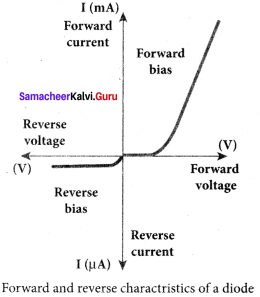
Question 2.
Define work function of a metal. Give its unit.
Answer:
The minimum energy needed for an electron to escape from the metal surface is called work function of that metal. It’s unit is electron volt (eV).

Question 3.
What is photoelectric effect?
Answer:
The ejection of electrons from a metal plate when illuminated by light or any other electromagnetic radiation of suitable wavelength (or frequency) is called photoelectric effect.

Question 4.
How does photocurrent vary with the intensity of the incident light?
Answer:
Photocurrent – the number of electrons emitted per second is directly proportional to the intensity of the incident light.

Question 5.
Give the definition of intensity of light and its unit.
Answer:
Intensity of light refer to the strength or brightness or amount of light produced by a specific source. It’s unit is candela (cd)

Question 6.
How will you define threshold frequency?
Answer:
For a given surface, the emission of photoelectrons takes place only if the frequency of incident light is greater than a certain minimum frequency called the threshold frequency.

Question 7.
What is a photo cell? Mention the different types of photocells.
Answer:
photocells: Photo electric cell or photo cell is a device which converts light energy into electrical energy. It works on the principle of photo electric effect.
Types:

  • Photo emissive cell
  • Photo voltaic cell
  • Photo conductive cell

Question 8.
Write the expression for the de Broglie wavelength associated with a charged particle of charge q and mass m, when it is accelerated through a potential V.
Answer:
An electron of mass m is accelerated through a potential difference of V volt. The kinetic energy acquired by the electron is given by
\(\frac { 1 }{ 2 }\) mv2 = eV
Therefore, the speed v of the electron is v = \(\sqrt { \frac { 2ev }{ m } } \)
Hence, the de Broglie wavelength of the electron is λ = \(\frac { h }{ mv }\) = \(\frac { h }{ \sqrt { 2emV } } \)

Question 9.
State de Broglie hypothesis.
Answer:
De Broglie hypothesis, all matter particles like electrons, protons, neutrons in motion are associated with waves.

Question 10.
Why we do not see the wave properties of a baseball?
Answer:
Due to the large mass of a baseball, the de Broglie wavelength
[λ = \(\frac { h }{ mv }\)] associated with a moving baseball is very small. Hence its wave nature is not visible.

Question 11.
A proton and an electron have same kinetic energy. Which one has greater de Broglie wavelength. Justify.
Answer:
de-Broglie wavelength of the particle is λ = \(\frac { h }{ p }\) = \(\frac { h }{ \sqrt { 2mK } } \)
i.e. λ ∝ \(\frac { h }{ \sqrt { m } } \)
As me << mp, so λe >> λp
Hence protons have greater de-Broglie wavelength.

Question 12.
Write the relationship of de Broglie wavelength λ associated with a particle of mass m in terms of its kinetic energy K.
Answer:
Kinetic energy of the particle, K = \(\frac { 1 }{ 2 }\) mv2 = \(\frac { { P }^{ 2 } }{ 2m } \)
p = \(\sqrt { 2mK } \)
de-Broglie wavelength of the particle λ = \(\frac { h }{ p }\) = \(\frac { h }{ \sqrt { 2mK } } \)

Question 13.
Name an experiment which shows wave nature of the electron. Which phenomenon was observed in this experiment using an electron beam?
Answer:

  • Davisson – Germer experiment confirmed the wave nature of electrons.
  • They demonstrated that electron beams are diffracted when they fall on crystalline solids.

Question 14.
An electron and an alpha particle have same kinetic energy. How are the de Broglie wavelengths associated with them related?
Answer:
[λ = \(\frac { h }{ p }\)]
Kinetic energy of the particle K = \(\frac { 1 }{ 2 }\) mv2 = \(\frac { { P }^{ 2 } }{ 2m } \) = \(\frac { { h }^{ 2 } }{ 2m{ \lambda }^{ 2 } } \)
i.e. λ = \(\frac { h }{ \sqrt { 2mK } } \) ; λ ∝ \(\frac { 1 }{ \sqrt { m} } \)
\(\frac { { \lambda }_{ e } }{ { \lambda }_{ \alpha } } \) = \(\sqrt { \frac { { m }_{ \alpha } }{ { m }_{ e } } } \)

Samacheer Kalvi 12th Physics Dual Nature of Radiation and Matter Long Answer Questions

Question 1.
What do you mean by electron emission? Explain briefly various methods of electron emission.
Answer:
Electron emission:
1. Free electrons possess some kinetic energy and this energy is different for different electrons. The kinetic energy of the free electrons is not sufficient to overcome the surface barrier.
2. Whenever an additional energy is given to the free electrons, they will have sufficient energy to cross the surface barrier. And they escape from the metallic surface.
3. The liberation of electrons from any surface of a substance is called electron emission.

There are mainly four types of electron emission which are given below.
(i) Thermionic emission:
When a metal is heated to a high temperature, the free electrons on the surface of the metal get sufficient energy in the form of thermal energy so that they are emitted from the metallic surface. This type of emission is known as thermionic emission.
Samacheer Kalvi 12th Physics Solutions Chapter 7 Dual Nature of Radiation and Matter-21
The intensity of the thermionic emission (the number of electrons emitted) depends on the metal used and its temperature.
Samacheer Kalvi 12th Physics Solutions Chapter 7 Dual Nature of Radiation and Matter-22
Examples: cathode ray tubes, electron microscopes, X-ray tubes etc.

(ii) Field emission:
Electric field emission occurs when a very strong electric field is applied across the metal. This strong field pulls the free electrons and helps them to overcome the surface barrier of the metal.
Samacheer Kalvi 12th Physics Solutions Chapter 7 Dual Nature of Radiation and Matter-23
Examples: Field emission scanning electron microscopes, Field-emission display etc.

(iii) Photo electric emission:
When an electromagnetic radiation of suitable frequency is incident on the surface of the metal, the energy is transferred from the radiation to the free electrons. Hence, the free electrons get sufficient energy to cross the surface barrier and the photo electric emission takes place. The number of electrons emitted depends on the intensity of the incident radiation.
Samacheer Kalvi 12th Physics Solutions Chapter 7 Dual Nature of Radiation and Matter-24
Examples: Photo diodes, photo electric cells etc.

(iv) Secondary emission:
When a beam of fast moving electrons strikes the surface of the metal, the kinetic energy of the striking electrons is transferred to the free electrons on the metal surface. Thus the free electrons get sufficient kinetic energy so that the secondary emission of , electron occurs.
Samacheer Kalvi 12th Physics Solutions Chapter 7 Dual Nature of Radiation and Matter-25
Examples: Image intensifies, photo multiplier tubes etc.

Question 2.
Briefly discuss the observations of Hertz, Hallwachs and Lenard.
Answer:
Hertz observation:
1. In 1887, Heinrich Hertz first became successful in generating and detecting electromagnetic wave with his high voltage induction coil to cause a spark discharge between two metallic spheres.

2. When a spark is formed, the charges will oscillate back and forth rapidly and the electromagnetic waves are produced.

3. The electromagnetic waves thus produced were detected by a detector that has a copper wire bent in the shape of a circle. Although the detection of waves is successful, there is a problem in observing the tiny spark produced in the detector.

4. In order to improve the visibility of the spark, Hertz made many attempts and finally noticed an important thing that small detector spark became more vigorous when it was exposed to ultraviolet light.

5. The reason for this behaviour of the spark was not known at that time. Later it was found that it is due to the photoelectric emission.

6. Whenever ultraviolet light is incident on the metallic sphere, the electrons on the outer surface are emitted which caused the spark to be more vigorous.

Hallwachs’ observation:
Samacheer Kalvi 12th Physics Solutions Chapter 7 Dual Nature of Radiation and Matter-26

8. In 1888, Wilhelm Hallwachs, a German physicist, confirmed that the strange behaviour of the spark is due to the action of ultraviolet light with his simple experiment.

9. A clean circular plate of zinc is mounted on an insulating stand and is attached to a gold leaf electroscope by a wire. When the uncharged zinc plate is irradiated by ultraviolet light from an arc lamp, it becomes positively charged and the leaves will open.

10. Further, if the negatively charged zinc plate is exposed to ultraviolet light, the leaves will close as the charges leaked away quickly. If the plate is positively charged, it becomes more positive upon UV rays irradiation and the leaves will open further.
11. From these observations, it was concluded that negatively charged electrons were emitted from the zinc plate under the action of ultraviolet light.

Lenard’s observation:
1. In 1902, Lenard studied this electron emission phenomenon in detail. The apparatus consists of two metallic plates A and C placed in an evacuated quartz bulb. The galvanometer G and battery B are connected in the circuit.

2. When ultraviolet light is incident on the negative plate C, an electric current flows in the circuit that is indicated by the deflection in the galvanometer. On other hand, if the positive plate is irradiated by the ultraviolet light, no current is observed in the circuit.
3. From these observations, it is concluded that when ultraviolet light falls on the negative plate, electrons are ejected from it which are attracted by the positive plate A. On reaching the positive plate through the evacuated bulb, the circuit is completed and the current flows in it.

4. Thus, the ultraviolet light falling on the negative plate causes the electron emission from the surface of the plate.

Question 3.
Explain the effect of potential difference on photoelectric current.
Answer:
Effect of potential difference on photoelectric current:
1.  To study the effect of potential difference V between the electrodes on photoelectric current, the frequency and intensity of the incident light are kept constant. Initially the potential of A is kept positive with respect to C and the cathode is irradiated with the given light.

2. Now, the potential of A is increased and the corresponding photocurrent is noted. As the potential of A is increased, photocurrent is also increased. However a stage is reached where photocurrent reaches a saturation value (saturation current) at which all the photoelectrons from C are collected by A. This is represented by the flat portion of the graph between potential of A and photocurrent.

3. When a negative (retarding) potential is applied to A with respect to C, the current does not immediately drop to zero because the photoelectrons are emitted with some definite and different kinetic energies.

4. The kinetic energy of some of the photoelectrons is such that they could overcome the retarding electric field and reach the electrode A.

5. When the negative (retarding) potential of A is gradually increased, the photocurrent starts to decrease because more and more photoelectrons are being repelled away from reaching the electrode A. The photocurrent becomes zero at a particular negative potential V0, called stopping or cut-off potential.
Samacheer Kalvi 12th Physics Solutions Chapter 7 Dual Nature of Radiation and Matter-27

6. Stopping potential is that the value of the negative (retarding) potential given to the collecting electrode A which is just sufficient to stop the most energetic photoelectrons emitted and make the photocurrent zero.

7. At the stopping potential, even the most energetic electron is brought to rest. Therefore, the initial kinetic energy of the fastest electron (Kmax ) is equal to the work done by the stopping potential to stop it (eV0 ).
Kmax = \(\frac { 1 }{ 2 }\) \({ mv }_{ max }^{ 2 }\) = eV0 …. (1)
Where vmax is the maximun speed of the emitted photoelectron.
Samacheer Kalvi 12th Physics Solutions Chapter 7 Dual Nature of Radiation and Matter-28
= 5.93 x 10⁵ \(\sqrt { { V }_{ 0 } } \) …. (2)
From equation (1),
Kmax = eVo (in joule) (or) Kmax = (V0 ) (in eV)

8. From the graph, when the intensity of the incident light alone is increased, the saturation current also increases but the value of V0 remains constant.

9. Thus, for a given frequency of the incident light, the stopping potential is independent of intensity of the incident light. This also implies that the maximum kinetic energy of the photoelectrons is independent of intensity of the incident light.

Question 4.
Explain how frequency of incident light varies with stopping potential.
Answer:
Effect of frequency of incident light on stopping potential:
1. To study the effect of frequency of incident light on stopping potential, the intensity of the incident light is kept constant. The variation of photocurrent with the collector electrode potential is studied for radiations of different frequencies and a graph drawn between them. From the graph, it is clear that stopping potential vary over different frequencies of incident light.
Samacheer Kalvi 12th Physics Solutions Chapter 7 Dual Nature of Radiation and Matter-29

2. Greater the frequency of the incident radiation, larger is the corresponding stopping potential. This implies that as the frequency is increased, the photoelectrons are emitted with greater kinetic energies so that the retarding potential needed to stop the photoelectrons is also greater.
Samacheer Kalvi 12th Physics Solutions Chapter 7 Dual Nature of Radiation and Matter-30

3. Now a graph is drawn between frequency and the stopping potential for different metals. From this graph, it is found that stopping potential varies linearly with frequency. Below a certain frequency called threshold frequency, no electrons are emitted; hence stopping potential is zero for that reason. But as the frequency is increased above threshold value, the stopping potential varies linearly with the frequency of incident light.

Question 5.
List out the laws of photoelectric effect.
Answer:
Laws of photoelectric effect:
1. For a given frequency of incident light, the number of photoelectrons emitted is directly proportional to the intensity of the incident light. The saturation current is also directly proportional to the intensity of incident light.

2. Maximum kinetic energy of the photo electrons is independent of intensity of the incident light.

3. Maximum kinetic energy of the photo electrons from a given metal is directly proportional to the frequency of incident light.

4. For a given surface, the emission of photoelectrons takes place only if the frequency of incident light is greater than a certain minimum frequency called the threshold frequency.

5. There is no time lag between incidence of light and ejection of photoelectrons.

Question 6.
Explain why photoelectric effect cannot be explained on the basis of wave nature of light.
Answer:
Failures of classical wave theory:
From Maxwell’s theory, light is an electromagnetic wave consisting of coupled electric and magnetic oscillations that move with the speed of light and exhibit typical wave behaviour. Let us try to explain the experimental observations of photoelectric effect using wave picture of light.

1. When light is incident on the target, there is a continuous supply of energy to the electrons. According to wave theory, light of greater intensity should impart greater kinetic energy to the liberated electrons (Here, Intensity of light is the energy delivered per unit area per unit time). But this does not happen. The experiments show that maximum kinetic energy of the photoelectrons does not depend on the intensity of the incident light.

2. According to wave theory, if a sufficiently intense beam of light is incident on the surface, electrons will be liberated from the surface of the target, however low the frequency of the radiation is. From the experiments, we know that photoelectric emission is not possible below a certain minimum frequency. Therefore, the wave theory fails to explain the existence of threshold frequency.

3. Since the energy of light is spread across the wavefront, the electrons which receive energy from it are large in number. Each electron needs considerable amount of time (a few hours) to get energy sufficient to overcome the work function and to get liberated from the surface. But experiments show that photoelectric emission is almost instantaneous process (the time lag is less than 10“9 s after the surface is illuminated) which could not be explained by wave theory.

Question 7.
Explain the quantum concept of light.
Answer:
Concept of quantization of energy:
Max Planck proposed quantum concept in 1900 in order to explain the thermal radiations emitted by a black body and the shape of its radiation curves. According to Planck, matter is composed of a large number of oscillating particles (atoms) which vibrate with different frequencies. Each atomic oscillator – which vibrates with its characteristic frequency – emits or absorbs electromagnetic radiation of the same frequency. It also says that

1. If an oscillator vibrates with frequency v, its energy can have only certain discrete values, given by the equation.
En = nhυ n = 1, 2, 3 ………..
where A is a constant, called Planck’s constant.

2. The oscillators emit or absorb energy in small packets or quanta and the energy of each quantum is E = hυ.
This implies that the energy of the oscillator is quantized – that is, energy is not continuous as believed in the wave picture. This is called quantization of energy.

Question 8.
Obtain Einstein’s photoelectric equation with necessary explanation. Einstein’s explanation of photoelectric equation:
Answer:
1.  When a photon of energy hv is incident on a metal surface, it is completely absorbed by a single electron and the electron is ejected.

2.  In this process, a part of the photon energy is used for the ejection of the electrons from the metal surface (photoelectric work function Φ0) and the remaining energy as the kinetic energy of the ejected electron. From the law of conservation of energy,
hυ = Φ0 + \(\frac { 1 }{ 2 }\) mv2 …… (1)
where m is the mass of the electron and u its velocity
Samacheer Kalvi 12th Physics Solutions Chapter 7 Dual Nature of Radiation and Matter-31

3. If we reduce the frequency of the incident light, the speed or kinetic energy of photo electrons is also reduced. At some frequency V0 of incident radiation, the photo electrons are ejected with almost zero kinetic energy. Then the equation (1) becomes
0 = Φ0
where vQ is the threshold frequency. By rewriting the equation (1), we get
hυ = hυ0 + \(\frac { 1 }{ 2 }\) mv2 …… (2)
The equation (2) is known as Einstein’s Photoelectric equation.
If the electron does not lose energy by internal collisions, then it is emitted with maximum kinetic energy Kmax. Then
Kmax = \(\frac { 1 }{ 2 }\) \({ mv }_{ max }^{ 2 }\)
where nmax is the maximum velocity of the electron ejected. The equation (1) is rearranged as follows:
Kmax = hυ – Φ0

Question 9.
Explain experimentally observed facts of photoelectric effect with the help of Einstein’s explanation.
Answer:
Explanation for the photoelectric effect:
The experimentally observed facts of photoelectric effect can be explained with the help of . Einstein’s photoelectric equation.

1. As each incident photon liberates one electron, then the increase of intensity of the light (the number of photons per unit area per unit time) increases the number of electrons emitted thereby increasing the photocurrent. The same has been experimentally observed.

2. From Kmax = hυ – Φ0, it is evident that Kmax is proportional to the frequency of the light and is independent of intensity of the light.

3.  As given in Einstein’s photoelectric equation, there must be minimum energy (equal to the work function of the metal) for incident photons to liberate electrons from the metal surface. Below which, emission of electrons is not possible. Correspondingly, there exists minimum frequency called threshold frequency below which there is no photoelectric emission.

4. According to quantum concept, the transfer of photon energy to the electrons is instantaneous so that there is no time lag between incidence of photons and ejection of electrons.

Question 10.
Give the construction and working of photo emissive cell.
Answer:
Photo emissive cell:
Its working depends on the electron emission from a metal cathode due to irradiation of light or other radiations.
Construction:
1. It consists of an evacuated glass or quartz bulb in which two metallic electrodes – that is, a cathode and an anode are fixed.

2. The cathode C is semi-cylindrical in shape and is coated with a photo sensitive material. The anode A is a thin rod or wire kept along the axis of the semi-cylindrical cathode.

3. A potential difference is applied between the anode and the cathode through a galvanometer G.
Samacheer Kalvi 12th Physics Solutions Chapter 7 Dual Nature of Radiation and Matter-32

Working:
4.  When cathode is illuminated, electrons are emitted from it. These electrons are attracted by anode and hence a current is produced which is measured by the galvanometer.

5. For a given cathode, the magnitude of the current depends on
(i) the intensity to incident radiation and (ii) the potential difference between anode and cathode.

Question 11.
Derive an expression for de Broglie wavelength of electrons.
Answer:
An electron of mass m is accelerated through a potential difference of V volt. The kinetic
energy acquired by the electron is given by
\(\frac { 1 }{ 2 }\) mv2 = evacuated
Therefore, the speed v of the electron is v = \(\sqrt { \frac { 2eV }{ m } } \)
Hence, the de Broglie wavelength of the electron is λ = \(\frac { h }{ mv }\) = \(\frac { h }{ \sqrt { 2emV } } \)
Substituting the known values in the above equation, we get
Samacheer Kalvi 12th Physics Solutions Chapter 7 Dual Nature of Radiation and Matter-33
For example, if an electron is accelerated through a potential difference of 100V, then its de Broglie wavelength is 1.227 A. Since the kinetic energy of the electron, K = eV, then the de Broglie wavelength associated with electron can be also written as
λ = \(\frac { h }{ \sqrt { 2mK } } \)

Question 12.
Briefly explain the principle and working of electron microscope.
Answer:
Electron Microscope:
Principle:
1. This is the direct application of wave nature of particles. The wave nature of the electron is used in the construction of microscope called electron microscope.

2. The resolving power of a microscope is inversely proportional to the wavelength of the radiation used for illuminating the object under study. Higher magnification as well as higher resolving power can be obtained by employing the waves of shorter wavelengths.

3. De Broglie wavelength of electron is very much less than (a few thousands less) that of the visible light being used in optical microscopes.

4. As a result, the microscopes employing de Broglie waves of electrons have very much higher resolving power than optical microscope.

5. Electron microscopes giving magnification more than 2,00.000 times are common in research laboratories.
Samacheer Kalvi 12th Physics Solutions Chapter 7 Dual Nature of Radiation and Matter-34
Working:
1. The electron beam passing across a suitably arranged either electric or magnetic fields undergoes divergence or convergence thereby focussing of the beam is done.

2. The electrons emitted from the source are accelerated by high potentials. The beam is made parallel by magnetic condenser lens. When the beam passes through the sample whose magnified image is needed, the beam carries the image of the sample.

3. With the help of magnetic objective lens and magnetic projector lens system, the magnified image is obtained on the screen. These electron microscopes are being used in almost all branches of science.

Question 13.
Describe briefly Davisson – Germer experiment which demonstrated the wave nature of electrons.
Answer:
Davisson – Germer experiment:
1. De Broglie hypothesis of matter waves was experimentally confirmed by Clinton Davisson and Lester Germer in 1927. They demonstrated that electron beams are diffracted when they fall on crystalline solids.

2. Since ciystal can act as a three-dimensional diffraction grating for matter waves, the electron waves incident on crystals are diffracted off in certain specific directions.
Samacheer Kalvi 12th Physics Solutions Chapter 7 Dual Nature of Radiation and Matter-35

3. The filament F is heated by a low tension (L.T.) battery. Electrons are emitted from the hot filament by thermionic emission. They are then accelerated due to the potential difference between the filament and the anode aluminium cylinder by a high tension (H.T.) battery.

4. Electron beam is collimated by using two thin aluminium diaphragms and is allowed to strike a single crystal of Nickel.

5. The electrons scattered by Ni atoms in different directions are received by the electron detector which measures the intensity of scattered electron beam.

6. The detector is rotatable in the plane of the paper so that the angle Φ between the incident
beam and the scattered beam can be changed at our will.

7. The intensity of the scattered electron beam is measured as a function of the angle θ.
Samacheer Kalvi 12th Physics Solutions Chapter 7 Dual Nature of Radiation and Matter-36

8. From the graph shows the variation of intensity of the scattered electrons with the angle 0 for the accelerating voltage of 54V. For a given accelerating voltage V, the scattered wave shows a peak or maximum at an angle of 50° to the incident electron beam.

This peak in intensity is attributed to the constructive interference of electrons diffracted from various atomic layers of the target material.

9. From the known value of interplanar spacing of Nickel, the wavelength of the electron wave has been experimentally calculated as 1.65 Å.

10. The wavelength can also be calculated from de Broglie relation for V = 54 V from equation.
λ = \(\frac { 12.27 }{ \sqrt { V } } \) Å = \(\frac { 12.27 }{ \sqrt { 54 } } \)
λ = 1.67 Å

11. This value agrees well with the experimentally observed wavelength of 1.65 Å. Thus this experiment directly verifies de Broglie’s hypothesis of the wave nature of moving particles.

Samacheer Kalvi 12th Physics Dual Nature of Radiation and Matter Numerical problems

Question 1.
How many photons per second emanate from a 50 mW laser of 640 nm?
Answer:
P = 50 mW
λ = 640 nm
h = 6.6 x 10⁻³⁴ Js
c = 3 x 10⁸ ms-1
Number of photons emanate per second np = \(\frac { P }{ E }\) =\(\frac { Pλ }{ hc }\)
= \(\frac { 50\times { 10 }^{ 3 }\times 640\times { 10 }^{ -9 } }{ 6.6\times { 10 }^{ -34 }3\times { 10 }^{ 8 } } \) = \(\frac { 32000\times { 10 }^{ -6 } }{ 19.8\times { 10 }^{ -26 } } \) = 1616.16 x 10-6
np = 1.61 x 101017 s-1

Question 2.
Calculate the maximum kinetic energy and maximum velocity of the photoelectrons emitted when the stopping potential is 81 V for the photoelectric emission experiment.
Answer:
V0 = 81 V
e= 1.6 x 10⁻¹⁹ C
m = 9.1 x 10⁻³¹ kg
Maximum kinetic energy of electron,
Kmax = eVo
= 1.6 x 10-19 x 81
= 129.6 x 10-19
= 1.29 x 10⁻¹⁷
Kmax = 1.3 x 10⁻¹⁷ J
aximum velocity of photoelectron,
Samacheer Kalvi 12th Physics Solutions Chapter 7 Dual Nature of Radiation and Matter-37

Question 3.
Calculate the energies of the photons associated with the following radiation:
(i) violet light of 413 nm
(ii) X-rays of 0.1 nm
(iii) radio waves of 10 m.
Answer:
h = 6.6 x 10⁻³⁴ Js
c = 3 x 10⁸ ms-1
Energy of photon, E = hυ
E = \(\frac { hc }{ λ }\)
Samacheer Kalvi 12th Physics Solutions Chapter 7 Dual Nature of Radiation and Matter-38
Samacheer Kalvi 12th Physics Solutions Chapter 7 Dual Nature of Radiation and Matter-39

Question 4.
A 150 W lamp emits light of mean wavelength of 5500 Å . If the efficiency is 12%, find out the number of photons emitted by the lamp in one second.
Answer:
P= 150W
λ = 5500 Å
h = 6.6 x 10⁻³⁴ Js
c = 3 x 10⁸ ms-1
Number of photons emitted per second n = \(\frac { pλ }{ hc }\)
If the efficiency is 12%, η = \(\frac { 12 }{ 100 }\) = 0.12
n = \(\frac { pηλ }{ hc }\)
Samacheer Kalvi 12th Physics Solutions Chapter 7 Dual Nature of Radiation and Matter-40
n = 5 x 10¹⁹

Question 5.
How many photons of frequency 1014 Hz will make up 19.86 J of energy?
Answer:
Total energy emitted per second = Power x time
19.86 J = Power x is
∴ Power = 19.86 W
Number of photons, n = \(\frac { p }{ E }\) = \(\frac { p }{ hυ }\)
= \(\frac { 19.86 }{ 6.6\times { 10 }^{ -34 }\times { 10 }^{ 14 } } \) = 3.009 x 10²⁰
n = 3 x 10²⁰
np = 3 x 10²⁰

Question 6.
What should be the velocity of the electron so that its momentum equals that of 4000 Å wavelength photon.
Answer:
de-Broglie wavelength of electron
λ = \(\frac { h }{ p }\)
v = \(\frac { h }{ mλ }\)
Samacheer Kalvi 12th Physics Solutions Chapter 7 Dual Nature of Radiation and Matter-41
v = 1811 ms-1

Question 7.
When a light of frequency 9 x 10¹⁴ Hz is incident on a metal surface, photoelectrons are emitted with a maximum speed of 8 x 10⁵ms-1. Determine the threshold frequency of the surface.
Answer:
According to Einstein’s photoelectric equation
\(\frac { 1 }{ 2 }\) \({ mv }_{ max }^{ 2 }\) = h (υ-υ0)
Samacheer Kalvi 12th Physics Solutions Chapter 7 Dual Nature of Radiation and Matter-42
= 9 x 014-4.4 x 10¹⁴
υ0 = 4.6 x 10¹⁴ Hz

Question 8.
When a 6000 Å light falls on the cathode of a photo cell and produced photoemission. If a stopping potential of 0.8 V is required to stop emission of electron, then determine the:

  1. frequency of the light
  2. energy of the incident photon
  3. work function of the cathode material
  4. threshold frequency
  5. net energy of the electron after it leaves the surface.

Answer:
Wavelength, λ = 6000 Å= 6000 x 10-10 m
stopping potential, V0 = 0.8 V
1. Frequency of the light, υ = \(\frac { c }{ λ }\)
= \(\frac { 3\times { 10 }^{ 8 } }{ 600\times { 10 }^{ -10 } } \) = 5 x 104 x 10-18
υ = 5 x 10¹⁴ Hz

2. Energy of the incident photon,
E = hυ = 6.6 x 10-34 x 5 x 1014
= 33 x 10-20 J
= \(\frac { 33\times { 10 }^{ -20 } }{ 1.6\times { 10 }^{ -19 } } \) = 20.625 x 10⁻¹
E = 2.06 eV

3. Work function of the cathode material.
W0 = hυ – eV0
= \(\left(\frac{6.6 \times 10^{-34} \times 5 \times 10^{14}}{1.6 \times 10^{-19}}\right)\) – \(\left(\frac{1.6 \times 10^{-19} \times 0.8}{1.6 \times 10^{-19}}\right)\) = 2.06-0.8
W0 = 1.26 eV

4. Threshold frequency, W0 = hυ0
υ0 = \(\frac{W_{0}}{h}\) = \(\frac{1.26 \times 1.6 \times 10^{-19}}{6.6 \times 10^{-34}}\) = 0.3055 x 10¹⁵
υ0 = 3.05 x 10¹⁴ Hz

5. Net energy of the electron after it leaves the surface
E = (υ – υ0)
= 6.6 x 10⁻³⁴ (5 x10¹⁴ – 3.06 x 1014
= 6.6 x 10-34 x 1.94 x 1014
E = 12.804 x 10⁻²⁰ J
= \(\frac{1.2804 \times 10^{-19}}{1.6 \times 10^{-19}}\)
E = 0.8 e V

Question 9.
A 3310 Å photon liberates an electron from a material with energy 3 x 10-19 J while another 5000 Å photon ejects an electron with energy 0.972×10⁻¹⁹ J from the same material. Determine the value of Planck’s constant and the threshold wavelength of the material.
Answer:
They energy of ejected electron is given by E = \(\frac { hc }{ λ }\) – \(\frac { hc }{ { \lambda }_{ 0 } } \)
Samacheer Kalvi 12th Physics Solutions Chapter 7 Dual Nature of Radiation and Matter-43
Subtracting (2) from (1), we get
Samacheer Kalvi 12th Physics Solutions Chapter 7 Dual Nature of Radiation and Matter-43.1
Threshold Wavelength,
Samacheer Kalvi 12th Physics Solutions Chapter 7 Dual Nature of Radiation and Matter-44

Question 10.
At the given point of time, the earth receives energy from Sun at 4 cal cm-2 min-1. Determine the number of photons received on the surface of the Earth per cm2 per minute. (Given : Mean wavelength of Sun light = 5500 Å)
Answer:
E= 4 calorie
= 4 x 4.184 J
λ = 5500 Å
Number of photons received on the surface of the earth, from E = nhυ
n = \(\frac { E λ}{ hc }\)
= \(\frac{4 \times 4.184 \times 5500 \times 10^{-10}}{6.6 \times 10^{-34} \times 3 \times 10^{8}}\) = \(\frac{9.2048 \times 10^{-10}}{19.8 \times 10^{-26}}\) = 4648 x 1016
= 4.648 x 10¹⁹
n = 4.65 x 10¹⁹

Question 11.
UV light of wavelength 1800 Å is incident on a lithium surface whose threshold wavelength 4965 Å. Determine the maximum energy of the electron emitted.
Answer:
λ = 1800 x 10-10 m
λ0 = 4965 x 10-10m
h = 6.6 x 10⁻³⁴ Js
c = 3 x 10⁸ ms-1
Maximum kinetic energy of electron,
Samacheer Kalvi 12th Physics Solutions Chapter 7 Dual Nature of Radiation and Matter-45

Question 12.
Calculate the de Broglie wavelength of a proton whose kinetic energy is equal to 81.9 x 10⁻¹⁵ J. (Given: mass of proton is 1836 times that of electron).
Answer:
mp = 1.67 x 10⁻²⁷ kg
K.E = 81.9 x 10⁻¹⁵ J
de-Broglie wavelength of proton, λ = \(\frac { h }{ \sqrt { 2mK } } \)
Samacheer Kalvi 12th Physics Solutions Chapter 7 Dual Nature of Radiation and Matter-46
λ = 4 x 10-14 m

Question 13.
A deuteron and an alpha particle are accelerated with the same potential. Which one of the two has (i) greater value of de Broglie wavelength associated with it and (ii) less kinetic energy? Explain.
Answer:
(i) Using de-Broglie wavelength formula, the dueteron and alpha particle are accelerated with same potential. So, both their velocities are same.
Samacheer Kalvi 12th Physics Solutions Chapter 7 Dual Nature of Radiation and Matter-47
(ii) For same potential of acceleration, KE is directly proportional to the ‘q’
Charge of duetron is +e
Charge of alpha is +2e
So, Kd = \(\frac {{ K }_{α}}{ 2 }\)
Charge of alpha particle is more than the duetron.

Question 14.
An electron is accelerated through a potential difference of 81V. What is the de Broglie wavelength associated with it? To which part of electromagnetic spectrum does this wavelength correspond?
Answer:
de-Broglie wavelength of an electron beam accelerated through a potential difference of V volts is
λ = \(\frac { h }{ \sqrt { 2meV } } \) = \(\frac { 1.23 }{ \sqrt { V } } \) nm
V = 81 V, so λ = \(\frac { 1.23 }{ \sqrt { 81 } } \) x 10-9 m
λ = 1.36 Å
X-ray is the part of electromagnetic spectrum does this wavelength corresponds. X-ray has the wavelengths ranging from about 108 to 10-12 m.

Question 15.
The ratio between the de Broglie wavelengths associated with protons, accelerated through a potential of 512 V and that of alpha particles accelerated through a potential of X volts is found to be one. Find the value of X.
Answer:
de-Broglie wavelength of accelerated charge particle
λ = \(\frac { h }{ \sqrt { 2mqV } } \)
λ ∝ \(\frac { h }{ \sqrt { mqV } } \)
Ratio of wavelength of proton and a-particle.
Samacheer Kalvi 12th Physics Solutions Chapter 7 Dual Nature of Radiation and Matter-48

Samacheer Kalvi 12th Physics Dual Nature of Radiation and Matter Additional Questions

Samacheer Kalvi 12th Physics Dual Nature of Radiation and Matter Multiple Choice Questions

Question 1.
The maximum kinetic energy of photoelectrons emitted from a surface when photons of
energy 3 eV fall on it is 4 eV. The stopping potential, in volt, is
(a) 2
(b) 4
(c) 6
(d) 10
Answer:
(b) 4
Hint:
Stopping potential, V0 = \(\frac { { K }_{ max } }{ e } \) = \(\frac { 4eV }{ e }\) = 4v

Question 2.
If an electron and proton are propagating in the form of waves having the same λ, it implies that they have the same-
(a) energy
(b) momentum
(c) velocity
(d) angular momentum
Answer:
(b) momentum
Hint: Momentum, p = \(\frac { h }{ λ }\)
As both electron and proton have same λ, so they have the same momentum

Question 3.
An electron of mass m and charge e is accelerated from rest through a potential difference V in vacuum. Its final velocity will be-
(a) \(\sqrt { \frac { 2eV }{ m } } \)
(b) \(\sqrt { \frac { eV }{ m } } \)
(c) \(\frac { ev }{ 2m }\)
(d) \(\frac { ev }{ m }\)
Answer:
(a) \(\sqrt { \frac { 2eV }{ m } } \)
Hint:
K.E. gained by an electron when accelerated through a potential difference V,
\(\frac { 1 }{ 2 }\) mv2 = eV or v = \(\sqrt { \frac { 2eV }{ m } } \)

Question 4.
The work function of a substance is 4.0 eV. The longest wavelength of light that can cause photoelectron emission from this substance is approximately
(a) 540 nm
(b) 400 nm
(c) 310 nm
(d) 220 nm
Answer:
(c) 310 nm
Hint:
λ0 = \(\frac { hc }{ W }\) = \(\frac{6.63 \times 10^{-34} \times 3 \times 10^{8}}{4.0 \times 1.6 \times 10^{-19}}\) = m = 310 x 10-9 m = 310 nm

Question 5.
Sodium and copper have work function 2.3 eV and 4.5 eV respectively. Then, the ratio of their threshold wavelength is nearest to-
(a) 1 : 2
(b) 4 : 1
(c) 2 : 1
(d) 1 : 4
Answer:
(c) 2 : 1
Hint:
\(\frac{\lambda_{0}(\mathrm{Na})}{\lambda_{0}(\mathrm{Cu})}\) = \(\frac{\mathrm{W}_{0}(\mathrm{Cu})}{\mathrm{W}_{0}(\mathrm{Na})}\)

Question 6.
The surface of a metal is illuminated with the light of 400 nm. The kinetic energy of the ejected photoelectrons was found to be 1.68 eV. The work function of the metal is (hc = 1240 eV nm)
(a) 3.09 eV
(b) 1.41 eV
(c) 1.51 eV
(d) 1.68 eV
Anwer:
(b) 1.41 eV
Hint:
Kmax = \(\frac { hc }{ λ }\) W0 or W0 = \(\frac { hc }{ λ }\) – Kmax
= \(\frac { 1240 }{ 400 }\)-1.68 = 3.10-1.68 = 1.42ev

Question 7.
4 eV is the energy of the incident photon and the work function is 2 eV. The stopping potential will be
(a) 2V
(b) 4V
(c) 6V
(d) 2√2V
Answer:
(d) 2√2V
Hint:
eV0= hv- W0 = 4eV – 2eV = 2eV
∴ V0= \(\frac { 2ev }{ e }\) = 2v

Question 8.
A light having wavelength 300 nm falls on a metal surface work function of metal is 2.54 eV. What is stopping potential?
(a) 1.4 V
(b) 2.59 V
(c) 1.60 V
(d) 1.29 V
Answer:
(a) 1.4 V
Hint:
eV0 = hu – W0 = 2eV – 0.6 eV = 1.4 eV
∴ V0= \(\frac { 1.4eV }{ e }\) = 1.4eV

Question 9.
If the kinetic energy of a free electron doubles, its de-Broglie wavelength changes by the factor
(a) \(\frac { 1 }{ 2 }\)
(b) 2
(c) \(\frac { 1 }{ √2 }\)
(d) √2
Answer:
(c) \(\frac { 1 }{ √2 }\)
Hint:
λ = \(\frac{h}{\sqrt{2 m \mathrm{K}}}\)
When kinetic energy is doubled, λ’ = \(\frac{h}{\sqrt{2 m \times 2 K}}\) = \(\frac { 1 }{ √2 }\)λ

Question 10.
If the kinetic energy of a particle is increased by 16 times, the percentage change in the de-Broglie wavelength of the particle is
(a) 25%
(b) 75%
(c) 60%
(d) 50%
Answer:
(b) 75%
Hint:
λ = \(\frac{h}{\sqrt{2 m \mathrm{K}}}\) ; \(\frac{h}{\sqrt{2 m \times 16 K}}\) = \(\frac { λ }{ 4 }\)
% change in de-Broglie wavelength, \(\frac { λ-λ’ }{ λ }\) = [1-\(\frac { λ }{ λ’ }\)] x 100 [1-\(\frac { 1 }{ 4 }\)] x 100 = 75%

Question 11.
When a proton is accelerated through IV, then its kinetic energy will be
(a) 1 eV
(b) 13.6 eV
(c) 1840 eV
(d) 0.54 eV
Answer:
(a) 1 eV
Hint:
K = qV = e x 1V= 1 eV

Question 12.
The kinetic energy of an electron, which is accelerated in the potential difference of 100 volts, is
(a) 416.6 cal
(b) 6.636 cal
(c) 1.602 x 10⁻¹⁷ J
(d) 1.6 x 10⁴ J
Answer:
(c) 1.602 x 10⁻¹⁷ J
Hint:
K = eV = 1.602 x 10(c) 1.602 x 10-19 x 100 J
= 1.602 x 10(c) 1.602 x 10⁻¹⁷ J

Question 13.
Kinetic energy of emitted electron depends upon
(a) frequency
(b) intensity
(c) nature of atmosphere surrounding the electron
(d) none of these
Answer:
(a) frequency
Hint:
Kinetic energy of emitted electron depends on the frequency of incident radiation.

Question 14.
The work function of photometal is 6.626 eV. What is the threshold wavelength?
(a) 3921 Å
(b) 1875 Å
(c) 1867 Å
(d) 4433 Å
Answer:
(b) 1875 Å
Hint:
λ0 = \(\frac { hc }{{ W }_{ 0 }}\) = \(\frac{6.63 \times 10^{-34} \times 3 \times 10^{8} \times 10^{10}}{6.626 \times 1.6 \times 10^{-19}}\) Å = 1875 Å

Question 15.
The number of photo-electrons emitted for light of a frequency υ (higher than the threshold frequency υ0) is proportional to
(a) Threshold frequency (υ0)
(b) Intensity of light
(c) Frequency of light (υ)
(d) υ – υ0
Answer:
(b) Intensity of light
Hint:
Photoelectric current oc Intensity of incident light

Question 16.
The speed of an electron having a wavelength of 10-10 m is
(a) 7.25 x 10⁶ ms-1
(b) 6.26 x 10⁶ ms-1
(c) 5.25 x 10⁶ ms-1
(d) 4.24 x 10⁶ ms-1
Answer:
(a) 7.25 x 10⁶ ms-1
Hint:
As λ = \(\frac { h }{ mv }\)
∴ v = \(\frac { h }{ mλ }\) = \(\frac{6.6 \times 10^{-34}}{9.1 \times 10^{-31} \times 10^{-10}}\) = 7.25 x 10⁶ ms-1

Question 17.
If an electron and a photon propagate in the form of waves having the same wavelength, it implies that they have the same
(a) energy
(b) momentum
(c) angular momentum
(d) velocity
Answer:
(b) momentum
Hint:
As both electron and photon have same de-Broglie wavelength (λ = h /p), so they have the same momentum P.

Question 18.
Electron volt is a unit of
(a) Energy
(b) potential
(c) current
(d) charge
Answer:
(a) Energy
Hint:
Electron volt is a unit of energy

Question 19.
Photon of frequency u has a momentum associated with it. If c is the velocity of radiation, then the momentum is
(a) \(\frac { hυ }{ c }\)
(b) \(\frac { υ }{ c }\)
(c) hυc
(d) \(\frac { h }{ { c }^{ 2 } } \)
Answer:
(a) \(\frac { hυ }{ c }\)
Hint:
P = \(\frac { E }{ { c }^{ 2 } } \) = \(\frac { hυ }{ c }\)

Question 20.
The time taken by a photoelectron to come out after photon strikes is approximately
(a) 10-14 s
(b) 10-10 s
(c) 10-16 s
(d) 10-1 s
Answer:
(b) 10-10 s
Hint:
The time lag between the incident of photon and the emission of photoelectrons is 10-10 s approximately.

Question 21.
Cathode rays consist of
(a) photons
(b) electrons
(c) protons
(d) α-particles
Answer:
(b) electrons

Question 22.
The momentum of photon whose frequency is f is
(a) \(\frac { hf }{ c }\)
(b) \(\frac { hc }{ f }\)
(c) \(\frac { h }{ f }\)
(d) \(\frac { c }{ hf }\)
Answer:
(a) \(\frac { hf }{ c }\)
Hint:
p = mc = \(\frac { { mc }^{ 2 } }{ { c } } \) = \(\frac { hf }{ c }\)

Question 23.
The energy of photon of wavelength λ is
(a) \(\frac { hc }{ λ }\)
(b) hλc
(c) \(\frac { λ }{ hc }\)
(d) \(\frac { hλ }{ c }\)
Answer:
(a) \(\frac { hc }{ λ }\)
Hint:
E = hυ = \(\frac { hc }{ λ }\)

Question 24.
The ratio of the energy of a photon with λ = 150 nm to that with λ = 300 nm is
(a) 2
(b) \(\frac { 1 }{ 4 }\)
(c) 2
(d) \(\frac { 1 }{ 2 }\)
Answer:
(a) 2
Hint:
\(\frac {{ E }_{ 1 }}{ { E }_{ 2 } }\) = \(\frac {{ λ }_{ 2 }}{ { λ }_{ 1 } }\) = \(\frac { 300 }{ 150 }\) = 2

Question 25.
Photons of 5.5 eV energy fall on the surface of the metal emitting photoelectrons of maximum kinetic energy 4.0 eV. The stopping voltage required for these electrons is
(a) 5.5 V
(b) 1.5 V
(c) 9.5 V
(d) 4.0 V
Answer:
(d) 4.0 V
Hint:
Stopping potential = \(\frac { { K }_{ max } }{ e } \) = \(\frac { 4.0ev }{ e }\) = 4.0V

Question 26.
The wavelength of photon is proportional to (where υ = frequency)
(a) υ
(b) √υ
(c) \(\frac { 1 }{ √υ }\)
(d) \(\frac { 1 }{ υ }\)
Answer:
(d) \(\frac { 1 }{ υ }\)
Hint:
λ = \(\frac { c }{ υ }\) i.e., λ ∝ \(\frac { 1 }{ υ }\)

Question 27.
What is the energy of a photon whose wavelength is 6840 Å?
(a) 1.81 eV
(b) 3.6 eV
(c) – 13.6 eV
(d) 12.1 eV
Answer:
(a) 1.81 eV
Hint:
E = hυ = \(\frac { hc }{ λ }\) = \(\frac { 12400ev Å }{ 8840 Å }\) = 1.81 eV

Question 28.
Momentum of photon of wavelength λ is
(a) \(\frac { hυ }{ c }\)
(b) zero
(c) \(\frac { hλ }{{ c }^{ 2 }}\)
(d) \(\frac { hλ }{c}\)
Answer:
(a) \(\frac { hυ }{ c }\)
Hint:
p = mc = \(\frac {{ mc }^{ 2 }}{c}\) = \(\frac { hυ }{ c }\)

Question 29.
The momentum of a photon of energy 1 MeV in kg m/s will be
(a) 5 x 10-22
(b) 0.33 x 10⁶
(c) 7 x 10-24
(d) 10-22
Answer:
(a) 5 x 10-22
Hint:
P = \(\frac { E }{ c }\) = \(\frac{1 \mathrm{MeV}}{3 \times 10^{8} \mathrm{ms}^{-1}}\) = \(\frac{1.6 \times 10^{-13} \mathrm{J}}{3 \times 10^{8} \mathrm{ms}^{-1}}\) = 5.33 x 10⁻²² Kg ms-1

Question 30.
If we consider electrons and photons of same wavelength then will have same
(a) momentum
(b) angular momentum
(c) energy
(d) velocity
Answer:
(a) momentum
Hint:
As p = h/λ, so electrons and photons having the same wavelength λ will have the same momentum p.

Question 31.
Photoelectric effect can be explained by
(a) corpusular theory of light
(b) wave nature of light
(c) Bohr’s theory
(d) quantum theory of light
Answer:
(d) quantum theory of light

Question 32.
Which of the following waves can produce photoelectric effect?
(a) ultrasound
(b) infrared
(c) radiowaves
(d) X-rays
Answer:
(d) X-rays
Hint:
Electromagnetic radiation, being of high frequency such as X-rays can produce photoelectric effect.

Question 33.
Which light when falls on a metal will emit photoelectrons?
(a) uv radiation
(b) infrared radiation
(c) radio waves
(d) microwaves
Answer:
(a) uv radiation
Hint:
Ultraviolet radiation, being of high frequency, can emit photoelectrons from metals.

Question 34.
In photoelectric effect, the KE of electrons emitted from the metal surface depends upon
(a) intensity of light
(b) frequency of incident light
(c) velocity of incident light
(d) both intensity and velocity of light
Answer:
(b) frequency of incident light
Hint:
The kinetic energy of photoelectrons depends upon the frequency of incident light.

Question 35.
In photoelectric effect, electrons are ejected from metals, if the incident light has a certain minimum
(a) wavelength
(b) frequency
(c) amplitude
(d) angle of incidence
Answer:
(b) frequency
Hint:
For photoelectric emission, the incident light must have a certain minimum frequency, called threshold frequency.

Question 36.
Number of ejected photoelectrons increases with increases
(a) in intensity of light
(b) in wavelength of light
(c) in frequency of light
(d) never
Answer:
(a) in intensity of light
Hint:
Number of ejected photoelectrons increases with the increase in intensity of light.

Question 37.
By photoelectric effect, Einstein proved
(a) E = hυ
(b) K.E. = \(\frac { 1 }{ 2 }\)mv2
(c) E = mc2
(d) E = \(\frac {{ -Rhc }^{ 2 }}{{ n }^{ 2 }}\)
Answer:
(a) E = hυ
Hint:
Einstein explained photoelectric effect on the basis of planck’s quantum theory of radiation and hence supported the relation : E = hυ

Question 38.
A photocell employs photoelectric effect to convert
(a) change in the frequency of light into a change in the electric current
(b) Change in the frequency of light into a change in electric voltage
(c) Change in the intensity of illumination into a change in photoelectric current
(d) Change in the intensity of illumination into a change in the work function of the photo cathode
Answer:
(c) Change in the intensity of illumination into a change in photoelectric current
Hint:
It indicates that threshold frequency is greater than that of ultraviolet light. As X-rays have greater frequency than uv rays, so they can cause photoelectric effect.

Question 39.
When ultraviolet rays incident on metal plate there photoelectric effect does not occur, it occurs by incident of
(a) infrared rays
(b) X-rays
(c) radio waves
(d) microwave
Answer:
(b) X-rays
Hint:
It indicates that threshold frequency is greater than that of ultraviolet light. As X-rays have greater frequency than UV rays, so they can cause photoelectric effect.

Question 40.
The threshold frequency for photoelectric effect on sodiune corresponds to a wavelength of 5000 Å. Its function is
(a) 4 x 10-19 J
(b) 1J
(c) 2 x 10-19 J
(d) 3 x 10-19 J
Answer:
(a) 4 x 10-19 J
Hint:
W0 = \(\frac { hc }{{ λ }_{ 0 }}\) = \(\frac{6.63 \times 10^{-34} \times 3 \times 10^{8}}{5000 \times 10^{-10}}\) J = 4 x 10-19 J

Question 41.
The photoelectric work function for a metal surface is 4.125 eV. The cut off wavelength for this surface is
(a) 3000 Å
(b) 2062.5 Å
(c) 4125 Å
(d) 6000 Å
Answer:
(a) 3000 Å
Hint:
λ0 = \(\frac { hc }{{ W }_{ 0 }}\) = \(\frac{6.63 \times 10^{-34} \times 3 \times 10^{8}}{4.125 \times 1.6 \times 10^{-19}}\) m = 3 x 10⁻⁷ m = 3000 Å

Question 42.
Ultraviolet radiations of 6.2 eV falls on an aluminium surface. Kinetic energy of fastest electrons emitted is (work function = 4.2 eV)
(a) 3.2 x 10⁻²¹ J
(b) 3.2 x 10⁻¹⁹ J
(c) 7 x 10-25 J
(d) 9 x 10-32 J
Answer:
(b) 3.2 x 10⁻¹⁹ J
Hint:
Kmax = hυ- W0 = 6.2 eV – 4.2 eV
= 2.0 eV = 2.0 x 1.6 x 10-19 J =3.2 x 10⁻¹⁹ J

Question 43.
The de-Broglie wavelength of a tennis ball of mass 60g moving with a velocity of 10 ms-1 is approximately (planck’s constant, h = 6.63 x 10⁻³⁴ Js)
(a) 10-33 m
(b) 10-31 m
(c) 10-16 m
(d) 10-25 m
Answer:
(a) 10-33 m
Hint:
λ = \(\frac { h }{ mv }\) = \(\frac{6.63 \times 10^{-34}}{60 \times 10^{-3} \times 10}\) ≈ 10-33 m

Question 44.
The wavelength of de-Broglie wave is 2 μm, then its momentum (h = 6.63 x 10⁻³⁴ Js) is
(a) 3.315 x 10⁻²⁸ kg ms-1
(b) 1.66 x 10⁻²⁸ kg ms-1
(c) 4.97 x 10⁻²⁸ kg ms-1
(d) 9.9 x 10⁻²⁸ kg ms-1
Answer:
(a) 3.315 x 10⁻²⁸ kg ms-1
Hint:
p = \(\frac { h }{ λ }\) = \(\frac{6.03 \times 10^{-34} \mathrm{Js}}{2 \times 10^{-6} \mathrm{m}}\) = 3.315 x 10⁻²⁸ kg ms-1

Question 45.
What is de-Broglie wavelength of electron having energy 10 KeV?
(a) 0.12 Å
(b) 1.2 Å
(c) 12.2 Å
(d) none of these
Answer:
(a) 0.12 Å
Hint:
λ = \(\frac { 12.3 }{ √v }\) Å = \(\frac { 12.3 }{ \sqrt { 10\times { 10 }^{ 3 } } } \) = 0.12Å

Question 46.
Which one of the following property does not support wave theory of light?
(a) Light obeys laws of reflection and refraction
(b) Light waves get polarised
(c) Light shows photoelectric effect
(d) Light shows interference
Answer:
(c) Light shows photoelectric effect
Hint:
Photoelectric effect cannot be explained on the basis of wave theory of light.

Question 47.
de-Broglie wavelength λ associated with neutrons is related with absolute temperature T as
(a) λ ∝ T
(b) λ ∝ \(\frac { 1 }{ T }\)
(c) λ ∝ \(\frac { 1 }{ √T }\)
(d) λ ∝ T2
Answer:
(c) λ ∝ \(\frac { 1 }{ √T }\)
Hint:
λ = \(\frac { h }{ \sqrt { 2mK } } \) = \(\frac { h }{ \sqrt { 3mKT } } \) ⇒ λ ∝ \(\frac { 1 }{ √T }\)

Question 48.
As the intensity of incident light increases
(a) kinetic energy of emitted photoelectrons increases
(b) photoelectric current decreases
(c) photoelectric current increases
(d) kinetic energy of emitted photoelectrons decreases
Answer:
(c) photoelectric current increases
Hint:
As the intensity of incident light increases, photoelectric current increases.

Question 49.
The de Broglie wave corresponding to a particle of mass m and velocity u has a wavelength associated with it
(a) \(\frac { h }{ mυ }\)
(b) hmυ
(c) \(\frac { mh }{ υ }\)
(d) \(\frac { m }{ hυ }\)
Answer:
(a) \(\frac { h }{ mυ }\)
Hint:
de-Broglie wavelength, λ = \(\frac { h }{ p }\) = \(\frac { h }{ mυ }\)

Question 50.
If particles are moving with same velocity, then which has maximum de-broglie wavelength?
(a) Proton
(b) α-particle
(c) Nevtron
(d) β-particle
Answer:
(d) β-particle
Hint:
As λ = h/mv, of the given particles β – particle is the lightest, so it will have maximum de-Broglie wavelength.

Question 51.
The dual nature of light is exhibited by
(a) diffraction and photoelectric effect
(b) photoelectric effect
(c) refraction and interference
(d) diffraction and reflection
Answer:
(a) diffraction and photoelectric effect
Hint:
Diffraction exhibits wave nature while photoelectric effect exhibits particle nature. Hence these two phenomena exhibit dual nature of light.

Question 52.
If the momentum of a particle is doubled, then its de-Broglie wavelength will-
(a) remain unchanged
(b) become four time
(c) become two times
(d) become half
Answer:
(d) become half
Hint:
As λ = \(\frac { h }{ p }\) when momentum p is doubled, wavelength will become half the initial value.

Question 53.
Moving with the same velocity, which of the following has the longest de-Broglie wavelength?
(a) β – particle
(b) α – particle
(c) proton
(d) neutron
Answer:
(a) β – particle
Hint:
λ = \(\frac { h }{ mv }\) λ ∝ \(\frac { 1 }{ m}\)
As β – particle (an electron) has the smallest mass, so it has the longest de-Broglie wavelength.

Question 54.
What is the de-Broglie wavelength of the a-particle accelerated through a potential difference of V volt? (mass of a-particle = 6.6455 x 10⁻²⁷ kg)
(a) \(\frac { 0.287 }{ √V }\) Å
(b) \(\frac { 12.27 }{ √V }\) Å
(c) \(\frac { 0.101 }{ √V }\) Å
(d) \(\frac { 0.202 }{ √V }\) Å
Answer:
(c) \(\frac { 0.101 }{ √V }\) Å
Hint:
K = qV = 2eV
λ = \(\frac { h }{ \sqrt { 2mK } } \) = \(\frac { h }{ \sqrt { 2m\times 2eV\quad } } \) = \(\frac { h }{ \sqrt { 4meV } } \)
Samacheer Kalvi 12th Physics Solutions Chapter 7 Dual Nature of Radiation and Matter-49

Question 55.
A proton and an a – particle are accelerated through the same potential difference. The ratio of de-Broglie wavelength of proton to the de-Broglie wavelength of alpha particle will be
(a) 1 : 2
(b) 2√2 :1
(c) 2 : 1
(d) 1:1
Answer:
(b) 2√2 :1
Hint:
Samacheer Kalvi 12th Physics Solutions Chapter 7 Dual Nature of Radiation and Matter-50

Question 56.
Proton and α – particle have the same de-Broglie wavelength. What is same for both of them?
(a) Time period
(b) Energy
(c) Frequency
(d) Momentum
Answer:
(d) Momentum
Hint:
λ = h/p, when wavelength λ is same, momentump is also same.

Question 57.
The shortest wavelength of X-ray emitted from an X-ray tube depends upon.
(a) the current in the tube
(b) the voltage applied to the tube
(c) the nature of the gas in the tube
(d) the atomic number of the target material
Answer:
(b) the voltage applied to the tube
Hint:
λmin = \(\frac { hc }{ eV }\) i.e.,λmin ∝ \(\frac { 1 }{ V }\)

Question 58.
An X-ray tube operates on 30 kV. The minimum wavelength emitted is h = 6.6 x 10⁻³⁴ Js, c = 3 x 10⁸ m/s, e = 1.6 x 10⁻¹⁹C.
(a) 6.6 Å
(b) 0.133 Å
(c) 1.2 Å
(d) 0.4 Å
Answer:
(d) 0.4 Å
Hint:
λmin = \(\frac { hc }{ eV }\) = \(\frac{6.6 \times 10^{-34} \times 3 \times 10^{8}}{1.6 \times 10^{-19} \times 30 \times 10^{3}}\) m = 0.4 Å

Question 59.
The potential difference between the cathode and the target in a coolidge tube is 120 kV. What can be the minimum wavelength (in Å) of the X-rays emitted by this tube?
(a) 0.4 Å
(b) 0.3 Å
(c) 0.2 Å
(d) 0.1 Å
Answer:
(d) 0.1 Å
Hint:
λmin = \(\frac { 12375 }{ V }\) = Å = \(\frac { 12375 }{{ 120×10 }^{3}}\) Å = 0.1Å

Question 60.
The work function for Al, K and Pt is 4.28 eV, 2.30 eV and 5.65 eV respectively. Their respective threshold frequencies would be
(a) pt > AL > K
(b) Al > pt > K
(c) K > AL > pt
(d) Al > K > pt
Answer:
(a) pt > AL > K
Hint:
As W0 = hv0 i.e., W0 ∝ V0
V0 (pt) >0 (AL) >V0 (K)

Question 61.
Among the following four spectral regions, the photons has the highest energy in
(a) Infrared
(b) Violet
(c) Red
(d) Blue
Answer:
(b) Violet
Hint:
E = \(\frac { hc }{ λ }\) Photon in violet region has least λ and hence highest energy.

Samacheer Kalvi 12th Physics Dual Nature of Radiation and Matter Short Answer Questions

Question 1.
Define electron volt. Express it value in joule.
Answer:
It is the kinetic energy gained by an electron when it is accelerated through a potential difference of 1 volt.
1 eV = 1.6 x 10⁻¹⁹ J
1 MeV = 1.6 x 10⁻¹³J

Question 2.
What are photoelectrons?
Answer:
These are the electrons emitted from a metal surface when it is exposed to electro magnetic radiations of a suitable frequency.

Question 3.
Define the term ‘stopping potential’ in relation to photoelectric effect.
Answer:
The minimum negative potential given to the anode of a photo-cell for which the photoelectric current becomes zero is called stopping potential.

Question 4.
Give some important uses of photo-cells.
Answer:
Applications of photo cells:

  1. Photo cells have many applications, especially as switches and sensors.
  2. Automatic lights that turn on when it gets dark use photocells, as well as street lights that switch on and off according to whether it is night or day.
  3. Photo cells are used for reproduction of sound in motion pictures and are used as timers to measure the speeds of athletes during a race.

Question 5.
Why is a photo-cell also called an electric eye?
Answer:
Like an eye, a photo-cell can distinguish between a weak and an intense light. But a photocell gives a measure of light intensity in terms of photoelectric current. So it is also called an electric eye.

Question 6.
On what principle is an electron microscope based?
Answer:
As electron microscope exploits the wave nature of an accelerated beam of electrons (having a very small wavelength) to provide high magnifying and resolving powers.

Question 7.
What are X-ray spectra?
Answer:
X-rays are produced when fast moving electrons strike the metal target. The intensity of the X-rays when plotted against its wavelength gives a curve called X-ray spectrum.

Samacheer Kalvi 12th Physics Dual Nature of Radiation and Matter Long Answer Questions

Question 1.
Describe an experimental arrangement to study photoelectric effect.
Answer:
Experimental setup:
1.  The apparatus is employed to study the phenomenon of photoelectric effect in detail .

2.  S is a source of electromagnetic waves of known and variable frequency v and intensity I. C is the cathode (negative electrode) made up of photosensitive material and is used to emit electrons.
Samacheer Kalvi 12th Physics Solutions Chapter 7 Dual Nature of Radiation and Matter-51

3. The anode (positive electrode) A collects the electrons emitted from C. These electrodes are taken in an evacuated glass envelope with a quartz window that permits the passage of ultraviolet and visible light.

4. The necessary potential difference between C and A is provided by high tension battery B which is connected across a potential divider arrangement PQ through a key K. C is connected to the centre terminal while A to the sliding contact J of the potential divider.

5. The plate A can be maintained at a desired positive or negative potential with respect to C. To measure both positive and negative potential of A with respect to C, the voltmeter is designed to have its zero marking at the centre and is connected between A and C. The current is measured by a micro ammeter μA in series.

6. If there is no light falling on the cathode C, no photoelectrons are emitted and the microammeter reads zero. When ultraviolet or visible light is allowed to fall on C, the photoelectrons are liberated and are attracted towards anode.

7. As a result, the photoelectric current is setup in the circuit which is measured using micro ammeter.

8.  The variation of photocurrent with respect to-

  1.  intensity of incident light
  2. the potential difference between the electrodes
  3. the nature of the material and
  4. frequency of incident light can be studied with the help of this apparatus.

Question 2.
Write down the characteristics of photons.
Answer:
Characteristics of photons:
According to particle nature of light, photons are the basic constituents of any radiation and possess the following characteristic properties:
(i) The photons of light of frequency v and wavelength λ will have energy, given by
E = hυ = \(\frac { hc }{ λ }\).

(ii) The energy of a photon is determined by the frequency of the radiation and not by its intensity and the intensity has no relation with the energy of the individual photons in the beam.

(iii) The photons travel with the velocity of light and its momentum is given by p

(iv) Since photons are electrically neutral, they are unaffected by electric and magnetic fields.

(v) When a photon interacts with matter (photon-electron collision), the total energy, total linear momentum and angular momentum are conserved. Since photon may be absorbed or a new photon may be produced in such interactions, the number of photons may not be conserved

Question 3.
Briefly explain the nature of light, (wave-particle duality)
Answer:
The nature of light: wave – particle duality
We have learnt that wave nature of light explains phenomena such as interference, diffraction and polarization. Certain phenomena like black body radiation, photoelectric effect can be explained by assigning particle nature to light. Therefore, both theories have enough experimental evidences.

In the past, many scientific theories have been either revised or discarded when they contradicted with new experimental results. Here, two different theories are needed to answer the question: what is nature of light?
It is therefore concluded that light possesses dual nature, that of both particle and wave. It behaves like a wave at some circumstances and it behaves like a particle at some other circumstances.

In other words, light behaves as a wave during its propagation and behaves as a particle during its interaction with matter. Both theories are necessary for complete description of physical phenomena. Hence, the wave nature and quantum nature complement each other.

Question 4.
Derive de-Broglie wave equation (wavelength) for a material particle.
Answer:
De Broglie wave length:
The momentum of photon of frequency v is given by
p = \(\frac { hυ }{ c }\) = \(\frac { h }{ λ }\) since c = υλ
The wavelength of a photon in terms of its momentum is
λ = \(\frac { h }{ p }\) …(1)
According to de Broglie, the above equation is completely a general one and this is applicable to material particles as well. Therefore, for a particle of mass m travelling with speed v , the wavelength is given by
λ = \(\frac { h }{ mv }\) = \(\frac { h }{ p }\) ….. (2)
This wavelength of the matter waves is known as de Broglie wavelength. This equation relates the wave character (the wave length λ) and the particle character (the momentum p) through Planck’s constant.

Question 5.
Explain the production of X-rays.
Answer:
Production of x-rays:
X-rays are produced in x-ray tube which is essentially a discharge tube. A tungsten filament F is heated to incandescence by a battery. As a result, electrons are emitted from it by thermionic emission.
Samacheer Kalvi 12th Physics Solutions Chapter 7 Dual Nature of Radiation and Matter-52
The electrons are accelerated to high speeds by the voltage applied between the filament F and the anode. The target materials like tungsten, molybdenum are embedded in the face of the solid copper anode. The face of the target is inclined at an angle with respect to the electron beam so that x-rays can leave the tube through its side.

When high-speed electrons strike the target, they are decelerated suddenly and lose their kinetic energy. As a result, x-ray photons are produced. Since most of the kinetic energy of the bombarding electrons gets converted into heat, targets made of high-meltmg-point metals and a cooling system are usually employed.

Question 6.
Briefly explain the concept of continuous X-ray spectra.
Answer:
Continuous x-ray spectra:
When a fast moving electron penetrates and approaches a target nucleus, the interaction between the electron and the nucleus either accelerates or decelerates it which results in a change of path of the electron. The radiation produced from such decelerating electron is called Bremsstrahlung or braking radiation
Samacheer Kalvi 12th Physics Solutions Chapter 7 Dual Nature of Radiation and Matter-53

The energy of the photon emitted is equal to the loss of kinetic energy of the electron. Since an electron may lose part or all of its energy to the photon, the photons are emitted with all possible energies (or frequencies). The continuous x-ray spectrum is due to such radiations.

When an electron gives up all its energy, then the photon is emitted with highest frequency υ0 (or lowest wavelength λ0 ). The initial kinetic energy of an electron is given by eV where V is the accelerating voltage. Therefore, we have
0 = eV (or) \(\frac { hc }{{ λ }_{0}}\) = ev
λ0 = \(\frac { hc }{eV}\)
where λ0 is the cut-off wavelength. Substituting the known values in the above equation, we get
λ0 = \(\frac { 122400 }{V}\) Å
The relation given by equation is known as the Duane – Hunt formula.
The value of λ0 depends only on the accelerating potential and is same for all targets. This is in good agreement with the experimental results. Thus, the production of continuous x-ray spectrum and the origin of cut – off wavelength can be explained on the basis of photon theory of radiation.

Question 7.
Write down the applications of X-rays.
Answer:
Applications of x-rays:
X-rays are being used in many fields. Let us list a few of them.
1. Medical diagnosis:
X-rays can pass through flesh more easily than through bones. Thus an x-ray radiograph containing a deep shadow of the bones and a light shadow of the flesh may be obtained. X-ray radiographs are used to detect fractures, foreign bodies, diseased organs etc.

2. Medical therapy:
Since x-rays can kill diseased tissues, they are employed to cure skin diseases, malignant tumours etc.

3. Industry:
X-rays are used to check for flaws in welded joints, motor tyres, tennis balls and wood. At the custom post, they are used for detection of contraband goods.

4. Scientific research:
X-ray diffraction is important tool to study the structure of the crystalline materials – that is, the arrangement of atoms and molecules in crystals.

Samacheer Kalvi 12th Physics Dual Nature of Radiation and Matter Additional Numerical Problems

Question 1.
If a light of wavelength 4950 Å is viewed as a continuous flow of photons, what is the energy of each photon in eV? (Given h = 6.6 x 10⁻³⁴ Js, c = 3 x 10⁸ ms-1)
Solution:
Here λ = 4950 Å = 4950 x 10-10 m
Energy of each photon,
E = \(\frac { hc }{λ}\) = \(\frac{6.6 \times 10^{-34} \times 3 \times 10^{8}}{4950 \times 10^{-10}}\) = 4 x 10-19 J
= \(\frac{4 \times 10^{-19}}{1.6 \times 10^{-19}}\)eV
E = 2.5 eV

Question 2.
Monochromatic light of frequency 6 x 10¹⁴ Hz is produced by a laser. The power emitted is 2 x 10⁻³w.
(i) What is the energy of each photon in the light?
(ii) How many photons per second, on the average, are emitted by the source?
Solution:
(i) Energy of each photon,
E = hυ = 6.6 x 10-34 x 6 x 1014
E = 3.98 x 10⁻¹⁹J
(ii) If N is the number of photons emitted per second by the source, then
Power transmitted in the beam = N x energy of each photon
P = N
N = \(\frac { P }{ E }\) = \(\frac{2 \times 10^{-3}}{3.98 \times 10^{-19}}\)
N = 5 x 10¹⁵ Photons per second.

Question 3.
Light of wavelength 5000 Å falls on a metal surface of work function 1.9 eV. Find:
(i) the energy of photons in eV
(ii) the K.E of photoelectrons and
(iii) the stopping potential.
Solution:
Here λ = 5000 Å = 5 x 10⁻⁷ m
W0 = 1.9 ev
(i) Energy of a photon,
E = \(\frac { hc }{λ}\) = \(\frac{6.6 \times 10^{-34} \times 3 \times 10^{8}}{5 \times 10^{-7}}\) J = \(\frac{6.6 \times 10^{-34} \times 3 \times 10^{8}}{5 \times 10^{-7} \times 1.6 \times 10^{-19}} e V\) eV
E = 2.475 eV
(ii) K.E of a photoelectron,
K.E = hυ – W0 = 2.475 – 1.9 = 0.575 eV
(iii) Let V0 be the stopping potential. Then
eV0 = \(\frac { 1 }{ 2 }\) mv2 = K.E of a photoelectron
V0 = \(\frac { 0.575 }{ e }\) eV
V0 = 0.575 V

Question 4.
If photoelectrons are to be emitted from a potassium surface with a speed 6 x 10⁶ ms-1, what frequency of radiation must be used? (Threshold frequency for potassium is 4.22 x 10¹⁴ Hz, h = 6.6 x 10⁻³⁴ Js, me = 9.1 x 10⁻³¹ kg)
Solution:
Here, v = 6 x 10⁶ ms-1
V0 = 4.22 x 10¹⁴ Hz
From Einstein’s photoelectric equation,
k.E = \(\frac { 1 }{ 2 }\) mv2 = h (υ – υ0)
υ = \(\frac { 1 }{ 2 }\) \(\frac {{ mv }^{2}}{ h }\) + υ0
= \(\frac { 1 }{ 2 }\) x \(\frac{9.1 \times 10^{-31}+\left(6 \times 10^{6}\right)^{2}}{6.6 \times 10^{-34}}\) + 4. 22 x 10-14
= (2.48 x 10¹⁴) + (4. 22 x 1014)
υ = 6.7 x10¹⁴ Hz

Question 5.
The photoelectric cut-off voltage in a certain experiment 1.5 V. What is the maximum kinetic energy of photoelectrons emitted?
Solution:
Here V0 = 1.5 V
Kmax = eV0 = 1.5 eV
= 1.5 x 1.6 x 10-19 J
Kmax = 24 x 10-19 J

Question 6.
What is the (a) momentum, (b) speed, and (c) de-Broglie wavelength of an electron with kinetic energy of 120 eV.
Solution:
Kinetic energy, K.E = 120 eV = 120 x 1.6 x 10-19
K = K.E = 1.92 x 10⁻¹⁷ J
(a) Momentum of an electron, P = \(\sqrt { 2mK } \)
P = \(\sqrt{2 \times 9.1 \times 10^{-31} \times 1.92 \times 10^{-17}}\)
P = 5.91 x 10⁻²⁴ kg ms-1
(b) Speed of an electron,
v = \(\frac { p }{ m }\) = \(\frac{5.91 \times 10^{-24}}{9.1 \times 10^{-31}}\) = 6.5 x 10⁶ kg ms-1
(c) de-Broglie wavelength,
λ = \(\frac { h }{ p }\) = \(\frac{6.6 \times 10^{-34}}{5.91 \times 10^{-24}}\) = 1.117 x 10-10 = 0.112 x 10⁻⁹ m
λ = 0.112 nm

Question 7.
An electron and a photon each have a wavelength of 1 nm. Find, (a) their momenta (b) the energy of the photon, and (c) kinetic energy of electron.
Solution:
(a) Both electron and photon have same wavelength. so, they have same momentum also,
P = \(\frac { h }{ λ }\) = \(\frac{6.6 \times 10^{-34}}{1 \times 10^{-9}}\) = 6.6 x 10⁻²⁵ kg ms-1
(b) Energy of a photon,
Samacheer Kalvi 12th Physics Solutions Chapter 7 Dual Nature of Radiation and Matter-54
(c) Kinetic energy of electron,
K = \(\frac {{ p }^{2}}{ 2m }\)
Samacheer Kalvi 12th Physics Solutions Chapter 7 Dual Nature of Radiation and Matter-55
K = 1.49 eV

Question 8.
Find the ratio of de-broglie wavelengths associated with two electron beams accelerated through 25 V and 36 V respectively.
Solution:
de-Broglie wavelength associate with potential difference λ ∝ \(\frac { 1 }{ √V }\)
\(\frac {{ λ }_{1}}{ { λ }_{2} }\) = \(\sqrt { \frac { { V }_{ 2 } }{ { V }_{ 1 } } } \) = \(\sqrt { \frac { 36 }{ 25 } } \) = \(\frac { 6 }{ 5 }\) ⇒ λ1 : λ2 = 6 : 5

Question 9.
A proton and an alpha particle, both initially at rest, are accelerated so as to have the same kinetic energy. What is the ratio of their de-Broglie wavelength?
Solution:
de-Broglie wavelength,
λ = \(\frac { h }{ p }\) = \(\frac { h }{ \sqrt { 2mK } } \)
i.e.
λ ∝ \(\frac { 1 }{ √m}\) [mα = 4mp]
\(\frac {{ λ }_{p}}{ { λ }_{α} }\) = \(\sqrt { \frac { { m }_{ α } }{ { m }_{ p } } } \) = \(\sqrt { \frac { { 4m }_{ p } }{ { m }_{ p } } } \) = \(\sqrt { \frac { 4 }{ 1 } } \) = \(\frac { 2 }{ 1 }\)
λp : λα = 2: 1

Question 10.
Light of two different frequencies whose photons have energies 1 eV and 2.5 eV respectively illuminate a metallic surface whose work function is 0.5 eV successively. Find the ratio of maximum speeds of emitted electrons.
Solution:
Samacheer Kalvi 12th Physics Solutions Chapter 7 Dual Nature of Radiation and Matter-56

We believe that the shared knowledge about Tamilnadu State Board Solutions for 12th Physics Chapter 7 Dual Nature of Radiation and Matter Questions and Answers learning resource will definitely guide you at the time of preparation. For more details visit Tamilnadu State Board Solutions for 12th Physics Solutions and for more information ask us in the below comments and we’ll revert back to you asap.

Samacheer Kalvi 11th Bio Botany Solutions Chapter 14 Respiration

Students who are in search of 11th Bio Botany exam can download this Tamilnadu State Board Solutions for 11th Bio Botany Chapter 14 Respiration from here for free of cost. These cover all Chapter 14 Respiration Questions and Answers, PDF, Notes, Summary. Download the Samacheer Kalvi 11th Biology Book Solutions Questions and Answers by accessing the links provided here and ace up your preparation.

Tamilnadu Samacheer Kalvi 11th Bio Botany Solutions Chapter 14 Respiration

Kickstart your preparation by using this Tamilnadu State Board Solutions for 11th Bio Botany Chapter 14 Respiration Questions and Answers get the max score in the exams. You can cover all the topics of Chapter 14 Respiration Questions and Answers easily after studying the Tamilnadu State Board 11th Bio Botany Textbook solutions pdf.

Samacheer Kalvi 11th Bio Botany Respiration Text Book Back Questions and Answers

Question 1.
The number of ATP molecules formed by complete oxidation of one molecule of pyruvic acid is:
(a) 12
(b) 13
(c) 14
(d) 15
Answer:
(a) 12

Question 2.
During oxidation of two molecules of cytosolic NADH + H+, number of ATP molecules produced in plants are:
(a) 3
(b) 4
(c) 6
(d) 8
Answer:
(c) 6

Question 3.
The compound which links glycolysis and Krebs cycle is:
(a) succinic acid
(b) pyruvic acid
(c) acetyl CoA
(d) citric acid
Answer:
(c) acetyl CoA

Question 4.
Assertion (A): Oxidative phosphorylation takes place during the electron transport chain in mitochondria.
Reason (R): Succinyl CoA is phosphorylated into succinic acid by substrate phosphorylation.
(a) A and R is correct. R is correct explanation of A
(b) A and R is correct but R is not the correct explanation of A
(c) A is correct but R is wrong
(d) A and R is wrong.
Answer:
(a) A and R is correct. R is correct explanation of A

Question 5.
Which of the following reaction is not . involved in Krebs cycle.
(a) Shifting of phosphate from 3C to 2C
(b) Splitting of Fructose 1,6 bisphosphate of into two molecules 3C compounds.
(c) Dephosphorylation from the substrates
(d) All of these
Answer:
(d) All of these

Question 6.
What are enzymes involved in phosphorylation and dephosphorylation reactions in EMP pathway?
Answer:
(i) Enzymes involved phosphorylation in EMP pathway:

  • Hexokinase
  • Phospho – fructokinase
  • Glyceraldehyde – 3 – phosphate dehydrogenase

(ii) Enzymes involved in dephosphorylation in EMP pathway:

  • Phospho glycerate kinase,
  • Pyruvate kinase

Question 7.
Respiratory quotient is zero in succulent plants. Why?
Answer:
In some succulent plants like Opuntia, Bryophyllum carbohydrates are partially oxidised to organic acid, particularly malic acid without corresponding release of CO2 but O2 is consumed hence the RQ value will be zero.

Question 8.
Explain the reactions taking place in mitochondrial inner membrane.
Answer:
In plants, an additional NADH dehydrogenase (External) complex is present on the outer surface of inner membrane of mitochondria which can oxidise cytosolic NADH + H+. Ubiquinone (UQ) or Coenzyme Quinone (Co Q) is a small, lipid soluble electron, proton carrier located within the inner membrane of mitochondria.

Question 9.
What is the name of alternate way of glucose breakdown? Explain the process involved in it?
Answer:
During respiration breakdown of glucose in cytosol occurs both by glycolysis (about 2 / 3) as well as by oxidative pentose phosphate pathway (about 1 / 3). Pentose phosphate pathway was described by Warburg, Dickens and Lipmann (1938). Hence, it is also called Warburg – Dickens – Lipmann pathway. It takes place in cytoplasm of mature plant cells. It is an alternate way for breakdown of glucose.

It is also known as Hexose monophosphate shunt (HMP Shunt) or Direct Oxidative Pathway. It consists of two phases, oxidative phase and non – oxidative phase. The oxidative events convert six molecules of six carbon Glucose – 6 – phosphate to 6 molecules of five carbon sugar Ribulose – 5 phosphate with loss of 6CO2 molecules and generation of 12 NADPH + H+ (not NADH). The remaining reactions known as non – oxidative pathway, convert Ribulose – 5 – phosphate molecules to various intermediates such as Ribose – 5 – phosphate(5C), Xylulose – 5 – phosphate(5C), Glyceraldehyde – 3 – phosphate(3C), Sedoheptulose – 7 – Phosphate (7C), and Erythrose – 4 – phosphate (4C). Finally, five molecules of glucose – 6 – phosphate is regenerated. The overall reaction is:
Samacheer Kalvi 11th Bio Botany Solutions Chapter 14 Respiration 1
The net result of complete oxidation of one glucose – 6 – phosphate yield 6CO2 and 12 NADPH + H+. The oxidative pentose phosphate pathway is controlled by glucose – 6 – phosphate dehydrogenase enzyme which is inhibited by high ratio of NADPH to NADP+.

Question 10.
How will you calculate net products of one sucrose molecule upon complete oxidation during aerobic respiration as per recent view?
Answer:
When the cost of transport of ATPs from matrix into the cytosol is considered, the number will be 2.5 ATPs for each NADH + H+ and 1.5 ATPs for each FADH2 oxidised during electron transport system. Therefore, in plant cells net yield of 30 ATP molecules for complete aerobic oxidation of one molecule of glucose. But in those animal cells (showing malate shuttle mechanism) net yield will be 32 ATP molecules. Since sucrose molecule gives, two molecules of glucose and net ATP in plant cell will be 30 × 2 = 60. In animal cell it will be 32 × 2 = 64.

Samacheer Kalvi 11th Bio Botany Respiration Additional Questions & Answers

I. Choose the correct answer (1 Mark)
Question 1.
The term respiration was coined by:
(a) Lamark
(b) Kerb
(c) Pepys
(d) Blackman
Answer:
(c) Pepys

Question 2.
In floating respiration the substrates are:
(a) carbohydrate or protein
(b) carbohydrate or fat
(c) protein or fat
(d) none of the above
Answer:
(b) carbohydrate or fat

Question 3.
The discovery of ATP was made by:
(a) Lipman
(b) Hans Adolt
(c) Warburg
(d) Karl Lohman
Answer:
(d) Karl Lohman

Question 4.
The end product of glycolysis is:
(a) pyruvate
(b) ethanol
(c) malate
(d) succinate
Answer:
(a) pyruvate

Question 5.
On hydrolysis, one molecule of ATP releases energy of:
(a) 8.2 K cal
(b) 32.3 kJ
(c) 7.3 K cal
(d) 7.8 K cal
Answer:
(c) 7.3 K cal

Question 6.
Which of the following is known as terminal oxidation:
(a) glycolysis
(b) electron transport chain
(c) Kreb’s cycle
(d) pyruvate oxidation
Answer:
(b) electron transport chain

Question 7.
Identify the link reaction:
(a) conversion of glucose into pyruvic acid
(b) conversion of glucose into ethanol
(c) conversion of acetyl CoA into CO2 and water
(d) conversion of pyruvic acid into acetyl coenzyme – A
Answer:
(d) conversion of pyruvic acid into acetyl coenzyme – A

Question 8.
Who was awarded Nobel prize in 1953 for the discovery of TCA cycle?
(a) Lipmann
(b) Hans Adolf Kreb
(c) Petermitchell
(d) Dickens
Answer:
(b) Hans Adolf Kreb

Question 9.
Kreb’s cycle is a:
(a) catabolic pathway
(b) anabolic pathway
(c) amphibolic pathway
(d) hydrolytic pathway
Answer:
(c) amphibolic pathway

Question 10.
Electron transport system during aerobic respiration takes place in:
(a) cytoplasm
(b) mitochondria
(c) chloroplast
(d) golgi apparatus
Answer:
(b) mitochondria

Question 11.
The oxidation of one molecule of NADH + H+ gives rise to:
(a) 2 ATP
(b) 3 ATP
(c) 4 ATP
(d) 2.5 ATP
Answer:
(b) 3 ATP

Question 12.
In aerobic prokaryotes each molecule of glucose produces:
(a) 36 ATP
(b) 32 ATP
(c) 34 ATP
(d) 38 ATP
Answer:
(d) 38 ATP

Question 13.
Cyanide acts as electron transport chain inhibitor by preventing:
(a) synthesis of ATP from ADP
(b) flow of electrons from NADH + H+
(c) flow of electrons from cytochrome a3 to O2
(d) oxidative phosphorylation
Answer:
(c) flow of electrons from cytochrome a3 to O2

Question 14.
Respiratory quotient for oleic acid is:
(a) 0.69
(b) 0.71
(c) 0.80
(d) 0.36
Answer:
(b) 0.71

Question 15.
End products of fermentation in yeast is:
(a) pyruvic acid and CO2
(b) lactic acid qnd CO2
(c) ethyl alcohol and CO2
(d) mixed acid and CO2
Answer:
(c) ethyl alcohol and CO2

Question 16.
The end products of mixed acid fermentation in enterobacteriaceae are:
(a) lactic acid, ethanol, formic acid, CO2 and H2
(b) lactic acid, formic acid and CO2
(c) lactic acid, ethanol, CO2 and O2
(d) ethanol, formic acid, CO2 and H2
Answer:
(a) lactic acid, ethanol, formic acid, CO2 and H2

Question 17.
The external factors that affect the respiration are:
(a) temperature, insufficient O2 and amount of protoplasm
(b) temperature, insufficient O2 and high concentration of CO2
(c) temperature, high concentration of CO2 and respiratory substrate
(d) temperature, high concentration of CO2 and amount of protoplasm
Answer:
(b) temperature, insufficient O2 and high concentration of CO2

Question 18.
Pentose phosphate pathway was described by:
(a) Pepys and Black man
(b) Kreb and Embden
(c) Warburg, Dickens and Lipmann
(d) Warburg and Pamas
Answer:
(c) Warburg, Dickens and Lipmann

Question 19.
The oxidative pentose phosphate pathway is controlled by the enzyme:
(a) glucose, 1, 6 diphosphate dehydrogenase
(b) glucose 6 phosphate dehydrogenase
(c) fructose – 6 – phosphate dehydrogenase
(d) none of the above
Answer:
(b) glucose 6 phosphate dehydrogenase

Question 20.
In pentose phosphate pathway the glucose – 6 – phosphate dehydrogenase enzyme is inhibited by high ratio of:
(a) FADH to FAD
(b) glucose to glucose – 6 – phosphate
(c) NADPH to NADP
(d) GTPH to GTP
Answer:
(c) NADPH to NADP

Question 21.
In plant tissue erythrose is used for the synthesis of:
(a) Erythromycin
(b) Xanthophill
(c) Erythrocin
(d) Arithocyanin
Answer:
(d) Arithocyanin

Question 22.
As per the recent view, when a glucose molecule is completely aerobically oxidised, the net yield of ATP in plant cell is:
(a) 38
(b) 36
(c) 30
(d) 32
Answer:
(c) 30

Question 23.
Identify the electron transport inhibitor:
(a) phosphophenol
(b) dinitrophenol
(c) xylene
(d) indol acetic acid
Answer:
(b) dinitrophenol

Question 24.
The phenomenon of climacteric is present in:
(a) banana
(b) coconut
(c) cauli flower
(d) brinjal
Answer:
(a) banana

Question 25.
Cyanide resistant respiration is known to generate heat in thermogenic tissues as high as:
(a) 35° C
(b) 38° C
(c) 40° C
(d) 51° C
Answer:
(d) 51° C

Question 26.
Match the following:

Substrate

RQ

A. Palmitic acid(i) 1.6
B. Oleic acid(ii) 4.0
C. Tartaric acid(iii) 0.36
D. Oxalic acid(iv) 0.71

(a) A – (ii), B – (iii); C – (i); D – (iv)
(b) A – (iii), B – (iv); C – (i); D – (ii)
(c) A – (ii); B – (iv); C – (i); D – (iii)
(d) A – (iii); B – (i); C – (iv); D – (ii)
Answer:
(b) A – (iii), B – (iv); C – (i); D – (ii)

Question 27.
Indicate the correct statement:
(a) In Bryophyllum, carbohydrates are partially oxidised to organic acid
(b) In opuntia, the Respiratory Quotient value is 0.5
(c) Alcoholic fermentation takes place in enterobacteriaceae
(d) Muscles of vertebrate does not have lactate dehydrogenase enzyme
Answer:
(a) In Bryophyllum, carbohydrates are partially oxidised to organic acid

Question 28.
The order of aerobic respiration in plant cell is:
(a) glycolysis, Kreb’s cycle, pyruvate oxidation and electron transport chain
(b) glycolysis, pyruvate oxidate, Kreb’s cycle, electron transport chain
(c) pyruvate oxidation, glycolysis, Kreb’s cycle, electron transport chain
(d) none of the above order
Answer:
(b) glycolysis, pyruvate oxidate, Kreb’s cycle, electron transport chain

Question 29.
The complete reactions of glycolysis take place in:
(a) mitochondria
(b) cristae
(c) cytoplasm
(d) outer membrane of mitochondria
Answer:
(c) cytoplasm

Question 30.
The Co – enzyme quinone is a proton carrier located within:
(a) outer membrane of mitochondria
(b) cytoplasm
(c) inner membrane of mitochondria
(d) matrix of mitochondria
Answer:
(c) inner membrane of mitochondria

Question 31.
How many molecules of CO2 are produced during link reaction:
(a) 1
(b) 6
(c) 4
(d) 2
Answer:
(d) 2

Question 32.
In the case of ground nut, during seed germination they use:
(a) carbohydrate as respiratory substrate
(b) fat alone as respiratory substrate
(c) fat and protein as respiratory substrate
(d) protein alone as respiratory substrate
Answer:
(c) fat and protein as respiratory substrate

Question 33.
Lactic acid fermentation takes place in:
(a) yeast
(b) bacillus
(c) enterobacteriaceae
(d) none of the above
Answer:
(b) bacillus

Question 34.
The net result of complete oxidation of one glucose-6-phosphate in pentose phosphate pathway yield:
(a) 6 CO2 and 12 NADPH + H+
(b) 6 CO2 and 10 NADPH + H+
(c) 8 CO2 and 16 NADPH + H+
(d) 8 CO2 and 14 NADPH + H
Answer:
(a) 6 CO2 and 12 NADPH + H+

Question 35.
Ribose – 5 – phosphate and its derivatives are used in the synthesis of:
(a) lignin
(b) coenzyme A
(c) anthocyanin
(d) xanthophyll
Answer:
(b) coenzyme A

II. Answer the following (2 Marks)

Question 1.
Define respiration?
Answer:
Respiration is a biological process in which oxidation of various food substances like carbohydrates, proteins and fats take place and as a result of this, energy is produced where O2 is taken in and CO2 is liberated.

Question 2.
What is meant by protoplasmic respiration?
Answer:
Respiration utilizing protein as a respiratory substrate, it is called protoplasmic respiration. Protoplasmic respiration is rare and it depletes structural and functional proteins of protoplasm and liberates toxic ammonia.

Question 3.
What do you understand by compensation of point?
Answer:
The point at which CO2 released in respiration is exactly compensated by CO2 fixed in photosynthesis that means no net gaseous exchange takes place, it is called compensation point.

Question 4.
Explain briefly about aerobic respiration.
Answer:
Respiration occurring in the presence of oxygen is called aerobic respiration. During aerobic respiration, food materials like carbohydrates, fats and proteins are completely oxidised into CO2, H2O and energy is released.

Question 5.
What is anaerobic respiration?
Answer:
In the absence of molecular oxygen glucose is incompletely degraded into either ethyl alcohol or lactic acid. It includes two steps:

  1. Glycolysis
  2. Fermentation

Question 6.
What do you know about transition reaction?
Answer:
In aerobic respiration the pyruvate with coenzyme A is oxidatively decarboxylated into acetyl CoA by pyruvate dehydrogenase complex. This reaction is irreversible and produces two molecules of NADH + H+ and 2CO2. It is also called transition reaction or Link reaction.

Question 7.
Who is Sir Hans Adolf Krebs?
Answer:
Sir Hans Adolf Krebs was born in Germany on 25th August 1900. He was awarded Nobel Prize for his discovery of Citric acid cycle in Physiology in 1953.

Question 8.
Explain briefly about amphibolic pathway.
Answer:
Krebs cycle is primarily a catabolic pathway, but it provides precursors for various biosynthetic pathways thereby an anabolic pathway too. Hence, it is called amphibolic pathway.

Question 9.
Mention the role of NADH dehydrogenase enzyme in electron transport system.
Answer:
NADH dehydrogenase contains a flavoprotein (FMN) and associated with non – heme iron Sulphur protein (Fe – S). This complex is responsible for passing electrons and protons from mitochondrial NADH (Internal) to Ubiquinone (UQ).

Question 10.
What is oxidative phosphorylation?
Answer:
The transfer of electrons from reduced coenzyme NADH to oxygen via complexes I to IV is coupled to the synthesis of ATP from ADP and inorganic phosphate (Pi) which is called Oxidative phosphorylation.

Question 11.
Mention any two electron transport chain inhibitors.
Answer:
Two electron transport chain inhibitors:

  1. 2, 4 DNP (Dinitrophenol) – It prevents synthesis of ATP from ADP, as it directs electrons from Co Q to O2.
  2. Cyanide – It prevents flow of electrons from Cytochrome a3 to O2.

Question 12.
Define respiratory quotient.
Answer:
The ratio of volume of carbon dioxide given out and volume of oxygen taken in during respiration is called Respiratory Quotient.

Question 13.
What are the significances of Respiratory Quotient?
Answer:
The significances of Respiratory Quotient:

  1. RQ value indicates which type of respiration occurs in living cells, either aerobic or anaerobic.
  2. It also helps to know which type of respiratory substrate is involved.

Question 14.
Explain the term alcoholic fermentation.
Answer:
The cells of roots in water logged soil respire by alcoholic fermentation because of lack of oxygen by converting pyruvic acid into ethyl alcohol and CO2. Many species of yeast (Saccharomyces) also respire anaerobically. This process takes place in two steps:
Samacheer Kalvi 11th Bio Botany Solutions Chapter 14 Respiration 2

Question 15.
Mention any two industrial uses of alcoholic fermentation.
Answer:
Two industrial uses of alcoholic fermentation:

  1. In bakeries, it is used for preparing bread, cakes, biscuits.
  2. In beverage industries for preparing wine and alcoholic drinks.

Question 16.
What do you understand by the term mixed acid fermentation?
Answer:
This type of fermentation is a characteristic feature of Enterobacteriaceae and results in the formation of lactic acid, ethanol, formic acid and gases like CO2 and H2.

Question 17.
Mention any two internal factors, that affect the rate of respiration in plants.
Answer:
Two internal factors, that affect the rate of respiration in plants:

  1. The amount of protoplasm and its state of activity influence the rate of respiration.
  2. Concentration of respiratory substrate is proportional to the rate of respiration.

Question 18.
What is the control mechanism of pentose phosphate pathway?
Answer:
The oxidative pentose phosphate pathway is controlled by glucose-6-phosphate dehydrogenase enzyme which is inhibited by high ratio of NADPH to NADP+.

Question 19.
Write down any two significance of pentose phosphate pathway.
Answer:
Two significance of pentose phosphate pathway:

  1. HMP shunt is associated with the generation of two important products,
  2. Coenzyme NADPH generated is used for reductive biosynthesis and counter damaging the effects of oxygen free radicals.

III. Answer the following (3 Marks)

Question 1.
In biosphere how do plants and animals are complementary systems, which are integrated to sustain life?
Answer:
In plants, oxygen enters through the stomata and it is transported to cells, where oxygen is utilized for energy production. Plants require carbon dioxide to survive, to produce carbohydrates and to release oxygen through photosynthesis, these oxygen molecules are inhaled by human through the nose, which reaches the lungs where oxygen is transported through the blood and it reaches cells. Cellular respiration takes place inside or the cell for obtaining energy.

Question 2.
What will happen, when you sleep under a tree during night time?
Answer:
If you are sleeping under a tree during night time you will feel difficulty in breathing. During night, plants take up oxygen and release carbon dioxide and as a result carbon dioxide will be abundant around the tree

Question 3.
What are the factors associated with compensation point in respiration?
Answer:
The two common factors associated with compensation point are CO2 and light. Based on this there are two types of compensation point. They are CO2 compensation point and light compensation point. C3 plants have compensation points ranging from 40 – 60 ppm (parts per million) CO2 while those of C4 plants ranges from 1 – 5 ppm CO2.

Question 4.
Why do you call ATP as universal energy currency of cell?
Answer:
ATP is a nucleotide consisting of a base- adenine, a pentose sugar – ribose and three phosphate groups. Out of three phosphate groups the last two are attached by high energy rich bonds. On hydrolysis, it releases energy (7.3 K cal or 30.6 KJ / ATP) and it is found in all living cells and hence it is called universal energy currency of the cell.

Question 5.
What is a redox reaction?
Answer:
NAD+ + 2e + 2H+ → NADH + H+
FAD + 2e + 2H+ → FADH2
When NAD+ (Nicotinamide Adenine Dinucleotide – oxidised form) and FAD (Flavin Adenine Dinucleotide) pick up electrons and one or two hydrogen ions (protons), they get reduced to NADH + H+ and FADH2 respectively. When they drop electrons and hydrogen off they go back to their original form. The reaction in which NAD+ and FAD gain (reduction) or f lose (oxidation) electrons are called redox reaction (Oxidation reduction reaction). These reactions are important in cellular respiration.

Question 6.
Write down any three differences between aerobic and anaerobic respiration.
Answer:
Aerobic respiration:

  • It occurs in all living cells of higher organisms.
  • It requires oxygen for breaking the respiratory substrate.
  • The end products are CO2 and H2O.

Anaerobic Respiration:

  • It occurs yeast and some bacteria.
  • Oxygen is not required for breaking the respiratory substrate.
  • The end products are alcohol, and CO2 (or) lactic acid.

Question 7.
Mention the significance of Kreb’s cycle.
Answer:
The significance of Kreb’s cycle:

  1. TCA cycle is to provide energy in the form of ATP for metabolism in plants.
  2. It provides carbon skeleton or raw material for various anabolic processes.
  3. Many intermediates of TCA cycle are further metabolised to produce amino acids, proteins and nucleic acids.
  4. Succinyl CoA is raw material for formation of chlorophylls, cytochrome, phytochrome and other pyrrole substances.
  5. α – ketoglutarate and oxaloacetate undergo reductive amination and produce amino acids.
  6. It acts as metabolic sink which plays a central role in intermediary metabolism.

Question 8.
Derive the respiratory quotient for carbohydrate as substrate in oxidative metabolism.
Answer:
The respiratory substrate is a carbohydrate, it will be completely oxidised in aerobic respiration and the value of the RQ will be equal to unity.
Samacheer Kalvi 11th Bio Botany Solutions Chapter 14 Respiration 3

Question 9.
Write down the characteristic of Anaerobic respiration.
Answer:
The characteristic of Anaerobic respiration:

  1. Anaerobic respiration is less efficient than the aerobic respiration.
  2. Limited number of ATP molecules is generated per glucose molecule.
  3. It is characterized by the production of CO2 and it is used for Carbon fixation in photosynthesis.

Question 10.
Distinguish between glycolysis and fermentation.
Answer:
Glycolysis:

  1. Glucose is converted into pyruvic acid.
  2. It takes place in the presence or absence of oxygen.
  3. Net gain is 2ATR
  4. 2 NADH + H+ molecules are produced.

Fermentation:

  1. Starts from pyruvic acid and is converted into alcohol or lactic acid.
  2. It takes place in the absence of oxygen.
  3. No net gain of ATP molecules.
  4. 2 NADH + H+ molecules are utilised.

Question 11.
Write down any three external factors, that affect respiration in plants.
Answer:
Three external factors, that affect respiration in plants:

  1. Optimum temperature for respiration is 30°C. At low temperatures and very high temperatures rate of respiration decreases.
  2. When sufficient amount of O2 is available the rate of aerobic respiration will be optimum and anaerobic respiration is completely stopped. This is called Extinction point.
  3. High concentration of CO2 reduces the rate of respiration

Question 12.
How alcoholic beverages like beer and wine is made?
Answer:
The conversion of pyruvate to ethanol takes place in malted barley and grapes through fermentation. Yeasts carryout this process under anaerobic conditions and this Conversion increases ethanol concentration. If the concentration increases, it’s toxic effect kills yeast cells .and the left out is called beer and wine respectively.

IV. Answer the following (5 Marks)

Question 1.
Give the schematic representation of glycolysis or EMP pathway.
Answer:
The schematic representation of glycolysis or EMP pathway:
Samacheer Kalvi 11th Bio Botany Solutions Chapter 14 Respiration 4

Question 2.
Write down the biochemical events in Kreb’s cycle.
Answer:
The biochemical events in Kreb’s cycle:
Samacheer Kalvi 11th Bio Botany Solutions Chapter 14 Respiration 5

Question 3.
Mention the schematic diagram of the various steps involved in pentose phosphate pathway.
Answer:
The schematic diagram of the various steps involved in pentose phosphate pathway:
Samacheer Kalvi 11th Bio Botany Solutions Chapter 14 Respiration 6

Question 4.
Describe the events in electron transport chain in plant cell.
Answer:
During glycolysis, link reaction and Krebs cycle the respiratory substrates are oxidised at several steps and as a result many reduced coenzymes NADH + H+ and FADH2 are produced. These reduced coenzymes are transported to inner membrane of mitochondria and are converted back to their oxidised forms produce electrons and protons. In mitochondria, the inner membrane is folded in the form of finger projections towards the matrix called cristae.
Samacheer Kalvi 11th Bio Botany Solutions Chapter 14 Respiration 14
In cristae many oxysomes (F1 particles) are present which have election transport carriers are present. According to Peter Mitchell’s Chemiosmotic theory this electron transport is coupled to ATP synthesis. Electron and hydrogen (proton) transport takes place across four multiprotein complexes (I – IV). They are

(i) Complex – I (NADH dehydrogenase: It contains a flavoprotein (FMN) and associated with non – heme iron Sulphur protein (Fe – S). This complex is responsible for passing electrons and protons from mitochondrial NADH (Internal) to Ubiquinone (UQ).
NADH + H+ + UQ ⇌ NAD+ + UQH2
In plants, an additional NADH dehydrogenase (External) complex is present on the outer surface of inner membrane of mitochondria which can oxidise cytosolic NADH + H+ Ubiquinone (UQ) or Coenzyme Quinone (Co Q) is a small, lipid soluble electron, proton carrier located within the inner membrane of mitochondria.

(ii) Complex – II (Succinic dehydrogenase): It contains FAD flavoprotein is associated with non – heme iron Sulphur (Fe – S) protein. This complex receives electrons and protons from succinate in Krebs cycle and is converted into fumarate and passes to ubiquinone.
Succinate + UQ → Fumarate + UQH2

(iii) Complex – III (Cytochrome bc1 complex): This complex oxidises reduced ubiquinone (ubiquinol) and transfers the electrons through Cytochrome bc1 Complex (Iron Sulphur center bc1 complex) to cytochrome c. Cytochrome c is a small protein attached to the outer surface of inner membrane and act as a. mobile carrier to transfer electrons between complex III to complex IV.
UQH2 + 2Cyt coxidised  ⇌  UQ + 2Cyt creduced  + 2H+

(iv) Complex IV (Cytochrome c oxidase): This complex contains two copper centers (A and B) and cytochromes a and as. Complex IV is the terminal oxidase and brings about the reduction of 1/2 O2 to H2O. Two protons are needed to form a molecule of H2O (terminal oxidation).
2Cyt coxidised + 2H+ + 1/2 O⇌  2Cyt creduced + H2O

The transfer of electrons from reduced coenzyme NADH to oxygen via complexes I to IV is coupled to the synthesis of ATP from ADP and inorganic phosphate (Pi) which is called Oxidative phosphorylation. The F0F1 – ATP synthase (also called complex V) consists of F0 and F1. F1 converts ADP and Pi to ATP and is attached to the matrix side of the inner membrane. F0 is present in inner membrane and acts as a channel through which protons come into matrix.

Oxidation of one molecule of NADH + H+ gives rise to 3 molecules of ATP and oxidation of one molecule FADH2 produces 2 molecules of ATP within a mitochondrion. But cytoplasmic NADH + H+ yields only two ATPs through external NADH dehydrogenase. Therefore, two reduced coenzyme (NADH + H+) molecules from glycolysis being extra mitochondrial will yield 2 × 2 = 4 ATP molecules instead of 6 ATPs. The Mechanism of mitochondrial ATP synthesis is based on Chemiosmotic hypothesis.

According to this theory electron carriers present in the inner mitochondrial membrane allow for the transfer of protons (H+). For the production of single ATP, 3 protons (H+) are needed. The terminal oxidation of external NADH bypasses the first phosphorylation site and hence only two ATP molecules are produced per external NADH oxidised through However, in those animal tissues in which malate shuttle mechanism is present, the oxidation of external NADH will yield almost 3 ATP molecules.

Complete oxidation of a glucose molecule in aerobic respiration results in the net gain of 36 ATP molecules in plants. Since huge amount of energy is generated in mitochondria in the form of ATP molecules they are called ‘power house of the cell’. In the case of aerobic prokaryotes due to lack of mitochondria each molecule of glucose produces 38 ATP molecules.

Question 5.
Define respiratory quotient. Explain the derivation of respiratory quotient for various substrates oxidised :
Answer:
The ratio of volume of carbon dioxide given out and volume of oxygen taken in during respiration is called Respiratory Quotient or Respiratory ratio. RQ value depends, upon respiratory substrates and their oxidation.
Samacheer Kalvi 11th Bio Botany Solutions Chapter 14 Respiration 13
(i) The respiratory substrate is a carbohydrate, it will be completely oxidised in aerobic respiration and the value of the RQ will be equal to unity.
Samacheer Kalvi 11th Bio Botany Solutions Chapter 14 Respiration 7
(ii) If the respiratory substrate is . a carbohydrate it will be incompletely oxidised when it goes through anaerobic respiration and the RQ value will be infinity.
Samacheer Kalvi 11th Bio Botany Solutions Chapter 14 Respiration 8
(iii) In some succulent plants like Opuntia, Bryophyllum carbohydrates are partially oxidised to organic acid, particularly malic acid without corresponding release of CO2 but O2 is consumed hence the RQ value will be zero.
Samacheer Kalvi 11th Bio Botany Solutions Chapter 14 Respiration 9
(iv) When respiratory substrate is protein or fat, then RQ will be less than unity.
Samacheer Kalvi 11th Bio Botany Solutions Chapter 14 Respiration 10
(v) When respiratory substrate is an organic acid the value of RQ will be more than unity.
Samacheer Kalvi 11th Bio Botany Solutions Chapter 14 Respiration 11

Question 6.
Describe an experiment to demonstrate the production of CO2 in aerobic respiration.
Answer:
Take small quantity of any seed (groundnut or bean seeds) and allow them to germinate by imbibing them. While they are germinating place them in a conical flask. A small glass tube containing 4 ml of freshly prepared Potassium hydroxide (KOH) solution is hung into the conical flask with the help of a thread and tightly close the one holed cork. Take a bent glass tube, the shorter end of which is inserted into the conical flask through the hole in the cork, while the longer end is dipped in a beaker containing water.
Samacheer Kalvi 11th Bio Botany Solutions Chapter 14 Respiration 12
Observe the position of initial water level in bent glass tube. This experimental setup is kept for two hours and the seeds were allowed to germinate. After two hours, the level of water rises in the glass tube. It is because, the CO2 evolved during aerobic respiration by germinating seeds will be absorbed by KOH solution and the level of water will rise in the glass tube.
CO2 + 2KOH → K2CO3 + H2O
In the case of groundnut or bean seeds, the rise of water is relatively lesser because these seeds use fat and proteins as respiratory substrate and release a very small amount of CO2. But in the case of wheat grains, the rise in water level is greater because they use carbohydrate as respiratory substrate. When carbohydrates are used as substrate, equal amounts of CO2 and O2 are evolved and consumed.

Textbook Page No. 145

Question 1.
How many ATP molecules are produced from one sucrose molecule?
Answer:
One sucrose molecules gives rise to two glucose molecules. The net production of ATP during complete oxidation of one glucose molecule in plant cell is 36 ATP. Therefore one sucrose molecule yields 36 x 2 = 72 ATP molecules.
As per recent view in plants cells, one molecules of glucose, after complete aerobic oxidation yields only 30 ATP molecules and hence one sucrose molecule yield only 30 x 2 = 60 ATP molecules.

Textbook Page No. 156

Question 1.
Why Microorganisms respire anaerobically?
Answer:
Some of the microorganism live in environments devoid of oxygen and they have to adopt themselves in anoxic condition. Hence they respire anaerobically and they are called anaerobic microbes.

Question 2.
Does anaerobic respiration take place in higher plants?
Answer:
Anaerobic respiration some time occur in the root of some water – logged plants.

Believing that the Samacheer Kalvi 11th Biology Book Solutions Questions and Answers learning resource will definitely guide you at the time of preparation. For more details about Tamilnadu State 11th Bio Botany Chapter 14 Respiration textbook solutions, ask us in the below comments and we’ll revert back to you asap.

Samacheer Kalvi 11th Bio Zoology Solutions Chapter 8 Excretion

Students who are in search of 11th Bio Zoology exam can download this Tamilnadu State Board Solutions for 11th Bio Zoology Chapter 8 Excretion from here for free of cost. These cover all Chapter 8 Excretion Questions and Answers, PDF, Notes, Summary. Download the Samacheer Kalvi 11th Biology Book Solutions Questions and Answers by accessing the links provided here and ace up your preparation.

Tamilnadu Samacheer Kalvi 11th Bio Zoology Solutions Chapter 8 Excretion

Kickstart your preparation by using this Tamilnadu State Board Solutions for 11th Bio Zoology Chapter 8 Excretion Questions and Answers get the max score in the exams. You can cover all the topics of Chapter 8 Excretion Questions and Answers easily after studying the Tamilnadu State Board 11th Bio Zoology Textbook solutions pdf.

Samacheer Kalvi 11th Bio Zoology Excretion Text Book Back Questions and Answers

Textbook Evulation Solved 
Question 1.
Arrange the following structures in the order that a drop of water entering the nephron would encounter them?

  1. (a) Afferent arteriole
  2. (b) Bowman’s capsule
  3. (c) Collecting duct
  4. (d) Distal tubule
  5. (e) Glomerulus
  6. (f) Loop of Henle
  7. (g) Proximal tubule
  8. (h) Renal pelvis

Answer:

  1. (a) Afferent arteriole
  2. (b) Bowman’s capsule
  3. (e) Glomerulus
  4. (g) Proximal tubule
  5. (j) Loop of Henle
  6. (d) Distal tubule
  7. (c) Collecting duct
  8. (h) Renal pelvis

Question 2.
Name the three filtration barriers that solutes must come across as they move from plasma to the lumen of Bowman’s capsule. What components of the blood are usually excluded by these layers?
Answer:
The three filtration barriers that solutes must come across as they move from plasma to the lumen of Bowman’s capsule are,

  1. Glomerular capillary endothelium
  2. Basal lamina or basement membrane
  3. Epithelium of Bowman’s capsule. Blood corpuscles and plasma protein are excluded by these layers.

Question 3.
What forces promote glomerular filtration? What forces opposes them? What is meant by net filtration pressure?
Answer:
Glomerular hydrostatic pressure (55 mm Hg) is the force that promotes filtration. The colloidal osmotic pressure (30 mm Hg) and the capsular hydrostatic pressure (15 mm Hg) are the two opposing forces.

The difference between the force promoting and opposing filtration is the net filtration pressure. It is responsible for filtration. Net filtration pressure = Glomerular hydrostatic pressure – (Colloidal osmotic pressure + Capsular hydrostatic pressure).

Question 4.
Identify the following structures and explain their significance in renal physiology?

  1. Juxtaglomerular apparatus
  2. Podocytes
  3. Sphincters in the bladder
  4. Renal cortex

Answer:
1. Juxtaglomerular apparatus:
Juxtaglomerular apparatus is a specialized tissue in the afferent arteriole of the nephron that consists of macula densa and granular cells. The macula densa cells sense distal tubular flow and affect afferent arteriole diameter. The granular cells secrete an enzyme called renin. It plays an important role in reabsorption of water, Na+ and excretion of K+.

2. Podocytes:
The visceral layer of the Bowman’s capsule is made up of epithelial cells called podocytes. The podocytes end in foot processes which cling to the basement membrane of the glomerulus. The openings between the foot processes are called filtration slits. It is important for glomerular filtration.

3. Sphincters in the bladders:
Sphincter muscles in the bladder controls the flow of urine from the bladder. When urinary bladder is filled with urine, it stretches and stimulates the central nervous system through the sensory neurons of the parasympathetic nervous system and brings about contraction of the bladder.

Simultaneously, somatic motor neurons induce the sphincters to close. Smooth muscles contracts resulting in the opening of the internal sphincters passively and relaxing the external sphincter. When the stimulatory and inhibitory controls exceed the threshold, the sphincter opens and the urine is expelled out.

4. Renal cortex:
The outer portion of the kidney is the renal cortex. It contains renal corpuscles and the proximal and distal tubules. It is thin and fibrous.

Question 5.
In which segment of the nephron most of the re-absorption of substances takes place?
Answer:
In proximal convoluted tubule cells, Glucose, lactate, amino acids, Na+ and water, are reabsorbed. In the descending limb of Henle’s loop, water is reabsorbed. In the ascending limb, Na+, Cl and K+ are reabsorbed. In the distal convoluted tubule, water is reabsorbed.

Question 6.
When a molecule or ion is reabsorbed from the lumen of the nephron, where does it go? If a solute is filtered and not reabsorbed from the tubule, where does it go?
Answer:
When a molecule or ion is reabsorbed from the lumen of the nephron, it goes to the blood stream through efferent arteriole which carries blood away from the glomerulus. If a solute is filtered and not reabsorbed from the tubule, it goes along with urine.

Question 7.
Match each of the following substances with its mode of transportation in proximal tubular reabsorption?
(a) Na+ – 1. indirect active transport
(b) Glucose – 2. endocytosis
(c) Urea – 3. paracellular movement
(d) Plasma – 4. facilitated diffusion
(e) Water – 5. primary active transport
Answer:
(a) 5
(b) 1
(c) 4
(d) 2
(e) 3

Question 8.
Which segment is the site of secretion and regulated reabsorption of ions and pH homeostasis?
Answer:
Distal convoluted tubule.

Question 9.
What solute is normally present in the body to estimate GFR in humans?
Answer:
Creatinine.

Question 10.
Which part of the autonomic nervous system is involved in micturition process?
Answer:
Parasympathetic nervous system.

Question 11.
Match the following terms.
(a) a- adrenoceptor – 1. afferent arteriole
(b) Autoregulation – 2. basal lamina
(c) Bowman’s capsule – 3. capillary blood pressure
(d) Capsule fluid – 4. colloid osmotic pressure
(e) Glomerulus – 5. GFR
(f) Podocyte – 6. JG cells
(g) Vasoconstriction – 7. plasma proteins Norepinepherine
Answer:
(a) 7
(b) 6
(c) 5
(d) 3
(e) 1
(f) 2
(g) 4

Question 12.
If the afferent arteriole of the nephron constricts, what happens to the GFR in that nephron? If the efferent arteriole constricts what happens to the GFR in that nephron? Assume that no auto regulation takes place?
Answer:
If the afferent arteriole of the nephron constricts, GFR is reduced. If the efferent arteriole constricts, GFR is increased.

Question 13.
How is the process of micturition altered by toilet training?
Answer:
The process of release of urine from the bladder is called micturition or urination. It is controlled by central nervous system and smooth muscles of sphincter. In young children, micturition cannot be controlled. By toilet training, one can temporarily postpone the signal reaching from the central nervous system to the motor neurons carrying stimuli to the urinary bladder.

Question 14.
Concentration of urine depends upon which part of the nephron?
a. Bowman’s capsule
b. Length of Henle’s loop
c. P.C.T.
d. Network of capillaries arising from glomerulus
Answer:
b. length of Henle’s loop

Question 15.
If Henle’s loop were absent from mammalian nephron, which one of the following is to be expected?
a. There will be no urine formation.
b. There will be hardly any change in the quality and quantity of urine formed.
c. The urine will be more concentrated.
d. The urine will be more dilute.
Answer:
d. The urine will be more dilute.

Question 16.
A person who is on a long hunger strike and is surviving only on water, will have
a. Less amino acids in his urine
b. Macula densa cells
c. Less urea in his urine
d. More sodium in his urine
Answer:
d. More sodium in his urine

Question 17.
What will happen if the stretch receptors of the urinary bladder wall are totally removed?
a. Micturition will continue
b. Urine will continue to collect normally in the bladder
c. There will be no micturition
d. Orine will not collect in the bladder
Answer:
c. There will be no micturition

Question 18.
The end product of Ornithine cycle is
a. Carbon dioxide
b. Uric acid
c. Urea
d. Ammonia
Answer:
c. Urea

Question 19.
Identify the wrong match
a. Bowman’s capsule – Glomerular Alteration
b. DCT – Absorption of glucose
c. Henle’s loop – Concentration of urine
d. PCT – Absorption of Na+ and K+ ions
Answer:
b. DCT – Absorption of glucose

Question 20.
Podocytes are the cells present on the
a. Outer wall of Bowman’s capsule
b. Inner wall of Bowman’s capsule
c. Neck of nephron
d. Wall glomerular capillaries
Answer:
b. Inner wall of Bowman’s capsule

Question 21.
Glomerular filtrate contains
a. Blood without blood cells and proteins
b. Plasma without sugar
c. Blood with proteins but without cells
d. Blood without urea
Answer:
a. Blood without blood cells and proteins

Question 22.
Kidney stones are produced due to deposition of uric acid and
a. Silicates
b. Minerals
c. Calcium carbonate
d. Calcium oxalate
Answer:
d. calcium oxalate

Question 23.
Animal requiring minimum amount of water to produce urine are
a. Ureotelic
b. Ammonotelic
c. Uricotelic
d. Chemotelic
Answer:
c. Uricotelic

Question 24.
Aldosterone acts at the distal convoluted tubule and collecting duct resulting in the absorption of water through
a. Aquaporins
b. Spectrins
c. GLUT
d. Chloride channels
Answer:
a. Aquaporins

Question 25.
The hormone which helps in the reabsorption of water in kidney tubules is ………..
a. Cholecystokinin
b. Angiotensin II
c. Antidiuretic hormone
d. Pancreozymin
Answer:
b. Angiotensin II

Question 26.
Malphigian tubules remove excretory products from ………….
a. Mouth
b. Oesophagus
c. Haemolymph
d. Alimentary canal
Answer:
d. Alimentary canal

Question 27.
Indentify the biological term Homeostasis, excretion, glomerulus, urea, glomerular filtration, ureters, urine, Bowman’s capsule, urinary system, reabsorption, micturition, osmosis, glomerular capillaries via efferent arteriole, proteins?

  1. A liquid which gathers in the bladder?
  2. Produced when blood is filtered in a Bowman’s capsule?
  3. Temporary storage of urine?
  4. A ball of inter twined capillaries?
  5. A process that changes glomerular filtrate into urine?
  6. Removal of unwanted substances from the body?
  7. Each contains a glomerulus?
  8. Carry urine from the kidneys to the bladder?
  9. Contains urea and many useful substances?
  10. Blood is filtered through its walls into the Bowman’s capsule?
  11. Scientific term for urination?
  12. Regulation of water and dissolved substances in blood and tissue fluid?
  13. Carry urine from the kidneys to the bladder?
  14.  Consists of the kidneys, ureters and bladder?
  15. Removal of useful substances from glomerular filtrate?
  16. The process by which water is transported in the proximal convoluted tubule?
  17. Where has the blood in the capillaries surrounding the proximal convoluted tubule come from?
  18. What solute the blood contains that are not present in the glomerular filtrate?

Answer:

  1. Urine
  2. Glomerular filterate
  3. Urinary bladder
  4. Glomerulus
  5. Reabsorption
  6. Excretion
  7. Bowman’s capsule
  8. Ureters
  9. Glomerular filterate
  10. Glomerulus
  11. Micturition
  12. Homeostatic
  13. Ureters
  14. Urinary system
  15. Reabsorption
  16. Osmosis
  17. Glomerular capillaries via efferent arteriole
  18. Proteins

Question 28.
With regards to toxicity and the need for dilution in water, how’ different are ureotelic and uricotelic excretions? Give examples of animals that use these types of excretion?
Answer:
Ureotelic animals excrete urea with minimum loss of water, e.g., Mammals and terrestrial amphibians. Uricotelic animals excrete uric acid with the least loss of water, e.g., Birds and reptiles.

Question 29.
Differentiate protonephridia from metanephridia?
Answer:

ProtonephridiaMetanephridia     
1. Primitive kidneys are protonephridia1. Tubular excretory structures are
2. These are found in flatworms.2. These are found in annelids and molluscs

Question 30.
What is the nitrogenous waste produced by amphibian larvae and by the adult animal?
Answer:
Amphibian larvae produce ammonia and the adult produces urea.

Question 31.
How is urea formed in the human body?
Answer:
More toxic ammonia produced as a result of breakdown of amino acids is converted into less toxic urea in the liver by a cyclic process called Ornithine cycle.

Question 32.
Differentiate cortical from medullary nephrons?
Answer:

Cortical nephronsMedullary nephrons
1. These are found in the cortex.1. These are found in the medulla.
2. These have short Henle’s loop.2. These have long Henle’s loop.

Question 33.
What vessels carry blood to the kidneys? Is this blood arterial or venous?
Answer:
Renal artery carries oxygenated (arterial) blood to the kidney.

Question 34.
Which vessels drain filtered blood from the kidneys?
Answer:
Renal veins carry deoxygenated blood from the kidney.

Question 35.
What is tubular secretion? Name the substances secreted through the renal tubules?
Answer:
The movement of substances such as H+, K+, NH4+, creatinine and organic acids from the peritubular capillaries into the tubular fluid, the filtrate is called Tubular secretion.

Question 36.
How are the kidneys involved in controlling blood volume? How is the volume of blood in the body related to arterial pressure?
Answer:
Renin- Angiotensin stimulates Na+ reabsorption from the glomerular filtrate. This stimulates Adrenal cortex to secrete aldosterone that causes reabsorption of Na+, K+ excretion and absorption of water.

This reduces loss of water into the urine. This maintains the volume of blood. An increase in blood volume increases central venous pressure. This increases right atrial pressure, right ventricular end – diastolic pressure and volume. This increases ventricular stroke volume and cardiac output and arterial blood pressure.

Question 37.
Name the three main hormones that are involved in the regulation of the renal function?
Answer:
Antidiuretic hormone, aldosterone and atrial natriuretic peptide factor.

Question 38.
What is the function of antidiuretic hormone? Where is it produced and what stimuli increases or decreases its secretion?
Answer:
Antidiuretic hormone increases reabsorption of water in the kidney tubules. It is produced in the posterior lobe of the pituitary gland. When there is excess loss of fluid from the body or increase in the blood pressure, ADH is secreted more. When there is no loss of fluid from the body, it is secreted less.

Question 39.
What is the effect of aldosterone on kidneys and where is it produced?
Answer:
Aldosterone is produced by the Adrenal cortex. It increases reabsorption of sodium and water by distal convoluted tubule and increased secretion of potassium. Hence, it maintains blood volume, blood pressure and urine output.

Question 40.
What evolutionary hypothesis could explain the heart’s role in secreting a hormone that regulates renal function? What hormone is this?
Answer:
The cardiac atrial cells secrete atrial natriuretic peptide or factor. It travels to the kidney and increases blood flow to the glomerulus. It acts as vasodilator on the afferent arteriole and vasoconstrictor on efferent arteriole. It decreases aldosterone release for the adrenal cortex and decreases the release of renin Angiotensin-II. Health of the heart depends on the normal blood pressure and hence evolution might have preserved atrial natriuretic factor which acts upon the renal function.

In – Text Questions Solved

Question 1.
What is the importance of having a long loop of Henle and short loop of Henle in a nephron?
Answer:
The major function of Henle’s loop is to concentrate Na+ and Cl. The longer the Henle’s loop, the more concentrated is the urine that is above the osmotic concentration of plasma.

Question 2.
A person with cirrhosis of the liver has lower than normal levels of plasma proteins and higher than normal GFR. Explain why a decrease in plasma protein would increase GFR?
Answer:
The net filtration pressure of 10 mmHg is responsible for the renal filtration. Net filtration Pressure = Glomerular hydrostatic pressure – (Colloidal osmotic pressure + Capsular hydrostatic pressure). Therefore, when there is decrease in plasma proteins, the value of Colloidal osmotic pressure + Capsular hydrostatic pressure decreases. This contributes to the increased net filtration pressure resulting in increase of GFR.

Question 3.
List various pathways involved in the homeostatic compensation in the case of severe dehydration?
Answer:
The below flowchart shows the pathways involved in the homeostatic compensation in case of severe dehydration.
Samacheer Kalvi 11th Bio Zoology Solutions Chapter 8 Excretion img 1

  1. If there is decreased extracellular fluid volume, it increases sympathetic stimulation and decreases blood pressure and decreases fluid and sodium delivery to the distal tubule.
  2. This enhances secretion of renin.
  3. It converts angiotensinogen to angiotensen 1 and angiotensen 1 to angiotehsen 2.
  4. This increase in the angiotensen 1 increases the secretion of aldosterone which increases the reabsorption of sodium by distal tubule and increased secretion of potassium.
  5. The increase in angiotensen 2 increases thirst and reabsorption of sodium in the PCT.

Question 4.
Angiotensin Converting Enzyme inhibitors (ACE inhibitors) are used to treat high blood pressure. Using a flow chart, explain why these drugs are helpful in treating hypertension?
Answer:
Samacheer Kalvi 11th Bio Zoology Solutions Chapter 8 Excretion img 2
Angiotensin Converting Enzyme inhibitors (ACE inhibitors) prevent the conversion of angiotensinogen into angiotensen I and angiotensen I into angiotensen II. This decreases the reabsorption of sodium by proximal convoluted tubule and secretion of aldosterones. This prevents the increased secretion of potassium. All these reactions help in treating hypertension.

Question 5.
Consider how different foods affect water and salt balance, and how the excretory system must respond to maintain homeostasis?
Answer:
The excessive intake of sodium chloride„i.e. common salt increases osmolarity. This increases thirst and secretion of vasopressin. The vasopressin increases reabsorption of water in the renal tubule. Kidneys prevent the loss of water. Due to intake of water due to thirst, extracellular fluid volume increases.

This stimulates kidneys to excrete salt and water to bring osmolarity to normal. When there is an increase in the blood pressure due to increase in the extracellular fluid volume, cardiovascular reflexes occur to reduce the blood pressure. This brings the volume and blood pressure to normal. Thus, the excessive intake of sodium affects the water and salt balance. The excretory system responds to those changes and maintains homeostasis.
Samacheer Kalvi 11th Bio Zoology Solutions Chapter 8 Excretion img 3

Text Book Activties Solved

Question 1.
Visit a nearby health center to observe the analysis of urine. Dip strips can be used to test urine for a range of different factors such as pH, glucose, ketones and proteins. Dip sticks for detecting glucose contain two enzymes namely, glucose oxidase and peroxidase? These two enzymes are immobilized on a small pad at one end of the stick. The pad is immersed in urine. If the urine contains glucose, a brown coloured compound is produced. The resulting colour pad is matched against a colour chart. The colour does not indicate the current blood glucose concentrations?
Answer:
Students can visit near by health centre under the guidance of the teacher.

Samacheer Kalvi 11th Bio Zoology Excretion Additional Questions & Answers

I. Multiple Choice Questions
Choose The Correct Answer

Question 1.
The elimination of ……………………….. requires large amount of water.
(a) Urea
(b) Uric acid
(c) Ammonia
(d) creatinine
Answer:
(c) ammonia

Question 2.
Reptiles, birds, land snails and insects excrete ……………..
(a) Ammonia
(b) Urea
(c) Uric
(d) purines
Answer:
(c) uric acid

Question 3.
Solenocytes are the specialized cells for excretion in
(a) Flatworms
(b) Molluscs
(c) Insects
(d) Amphioxus
Answer:
(d) amphioxus

Question 4.
Insects have for excretion.
(a) Flame cells
(b) Malphigian tubules
(c) Solenocytes
(d) Green glands
Answer:
(b) Malphigian tubules

Question 5.
…………………… have antennal glands or green glands which perform excretory function.
(a) Insects
(b) Annelids
(c) Crustaceans
(d) Flatworms
Answer:
(c) Crustaceans

Question 6.
Reptiles produce very little ……………….. urine
(a) Hypotonic
(b) Hypertonic
(c) Isotonic
(d) None of the above
Answer:
(a) Hypotonic

Question 7.
Mammals have long Henle’s loop, hence they produce ……………………… urine.
(a) Hypotonic
(b) Hyperosmotic
(c) Isotonic
(d) None of the above
Answer:
(b) Hyperosmotic

Question 8.
Aglomerlar kidneys of marine fishes produce little urine that is ………………………. to the body fluid.
(a) Hypotonic
(b) Hyperosmotic
(c) Isoosmotic
(d) None of the above
Answer:
(c) Isoosmotic

Question 9.
The external parietal layer of the Bowman’s capsule is made up of simple ……………………. epithelium.
(a) Columnar
(b) Ciliated
(c) Squamous
(d) Glandular
Answer:
(c) Squamous

Question 10.
The nitrogenous wastes are formed as a result of catabolism of …………..
(a) Carbohydrates
(b) Proteins
(c) Fats
(d) Minerals
Answer:
(b) proteins

Question 11.
The net filtration pressure ………………………. of is responsible for renal filtration.
(a) 15mmHg
(b) 30 mmHg
(c) 55 mmHg
(d) 10 mmHg
Answer:
(d) 10 mmHg

Question 12.
Glucose, amino acids, Na+ and water in the filtrate are reabsorbed in the
(a) descending limb of Henle’s loop
(b) ascending limb of Henle’s loop
(c) proximal convoluted tubule
(d) distal convoluted tubule
Answer:
(c) Proximal convoluted tubule

Question 13.
Defects in ADH receptors or inability to secrete ADH leads to a condition called ……………….
(a) diabetes mellitus
(b) diabetes insipidus
(c) Cushing’s syndrome
(d) renal failure
Answer:
(b) diabetes insipidus

Question 14.
The process of release of urine from the bladder is called …………….
(a) Ultra filtration
(b) Reabsorption
(c) Micturition
(d) Secretion
Answer:
(c) Micturition

Question 15.
The pH value of human urine is ……………
(a) 7.5
(b) 6.0
(c) 4.3
(d) 9.5
Answer:
(a) 6.0

Question 16.
On an average, …………………… gm of urea is excreted per day.
(a) 10 – 15
(b) 15-20
(c) 40 – 50
Answer:
(d) 25 – 30

Question 17.
…………………….. is characterised by increase in urea and other non-protein nitrogenous substances like uric acid and creatinine.
(a) Renal calculi
(b) Uremia
(c) Glomerulonephritis
(d) Renal failure
Answer:
(b) Uremia

Question 18.
The formation of hard stone like masses in the renal tubules of renal pelvis is called ……………
(a) Uremia
(b) Micturition
(c) Renal calculi
(d) Renal failure
Answer:
(c) Renal calculi

Question 19.
The inflammation of the glomeruli of kidneys due to Streptococcus bacteria is called …………..
(a) Renal failure
(b) Uremia
(c) Glomerulonephritis
(d) Renal calculi
Answer:
(c) Glomerulonephritis

Question 20.
Through haemodialysis, ……………………….. can be removed from the blood.
(a) Ketone bodies
(b) Glucose
(c) Amino acids
(d) Urea
Answer:
(d) Urea

Question 21.
The transfer of healthy kidney from one person to another person with kidney failure is called ……………
(a) Kidney failure
(b) Haemodialysis
(c) Kidney transplantation
(d) Uremia
Answer:
(c) Kidney transplantation

II. Fill in the Blanks

Question 1.
……………………………. regulation is the control of tissues osmotic pressure which acts as a driving force for movement of water across biological membranes.
Answer:
Osmotic

Question 2.
……………………. regulation is the control of the ionic composition of body fluids.
Answer:
Ionic

Question 3.
……………………. is the toxic nitrogenous end product of protein catabolism.
Answer:
Ammonia

Question 4.
…………………….. are able to change their internal osmotic concentration with change in external environment.
Answer:
Osmoconformers

Question 5.
…………………….. maintain their internal osmotic concentration irrespective of their external osmotic environment.
Answer:
Osmoregulators

Question 6.
The …………………. animals can tolerate only narrow fluctuations in the salt concentration.
Answer:
stenohaline

Question 7.
The ……………………. animals are able to tolerate wide fluctuations in the salt concentrations.
Answer:
euryhaline

Question 8.
…………………….. is the waste product of protein metabolism in spiders.
Answer:
Guanine

Question 9.
…………………….. requires large amount of water for its elimination.
Answer:
Ammonia

Question 10.
…………………. is the least toxic waste product of protein metabolism.
Answer:
Uric acid

Question 11.
Animals that excrete ammonia are called …………
Answer:
Ammonoteles

Question 12.
The animals that excrete uric acid crystals are called ……………………..
Answer:
Uricoteles

Question 13.
The animals that excrete urea are called ……………………..
Answer:
Ureoteles

Question 14.
…………………….. are the excretory structures in flatworms.
Answer:
Flame cells

Question 15.
Solenocytes are the excretory cells present in ……………………..
Answer:
Amphioxus

Question 16.
…………………….. are the excretory structures in insects.
Answer:
Malphigian tubules

Question 17.
…………………….. function excretory function in prawns.
Answer:
Antennal glands/ Green glands

Question 18.
…………………….. are the structural and functional unit of kidneys.
Answer:
Nephrons

Question 19.
The right kidney is placed slightly lower than the left kidney due to the presence of ……………………..
Answer:
liver

Question 20.
The medulla of kidney is divided into a few conical tissue masses called ……………………..
Answer:
Renal pyramids

Question 21.
The urinary bladder opens into ……………………..
Answer:
Urethra

Question 22.
The Bowman’s capsule and the glomerulus together constitute the ……………………..
Answer:
Renal corpuscle

Question 23.
Some nephron have very long loop of Henle that run deep into the medulla and are called ……………………..
Answer:
Juxta medullary nephrons

Question 24.
The nitrogenous waste formed as a result of breakdown of amino acids is converted to urea in the …………………….. Ornithine cycle.
Answer:
Liver

Question 25.
The filtration of blood that takes place in the ……………………..
Answer:
Glomerulus.

Question 26.
The fluid that leaves the glomerular capillaries and enters the Bowman’s capsule is called the ……………………..
Answer:
Glomerular filtrate

Question 27.
Sodium is reabsorbed by …………………….. in the proximal convoluted Tubule.
Answer:
Active transport

Question 28.
Descending limb of Henle’s loop is permeable to water due the presence of ……………………..
Answer:
Aquaporins

Question 29.
Reabsorption of …………………….. ions regulates the pH of blood
Answer:
Bicarbonate

Question 30.
…………………….. Is the hormone that facilitates reabsorption of water by increasing the number of aquaporins on the DCT and collecting duct.
Answer:
Antidiuretic hormone/ vasopressin

Question 31.
The under secretion of ADH leads to ……………………..
Answer:
Diabetes insipidus

Question 32.
The granular cells of afferent arteriole secrete an enzyme called ……………………..
Answer:
Renin

Question 33.
Renin converts …………………….. into angiotensin.
Answer:
Angiotensinogen

Question 34.
Atrial Natriuretic Peptide or factor decreases release of …………………….. , thereby decreasing angiotensin II.
Answer:
Renin

Question 35.
The process of release of urine from the bladder is called ……………………..
Answer:
Micturition

Question 36.
The yellow colour of the urine is due to the presence of a pigment, ……………………..
Answer:
Urochrome

Question 37.
The presence of ketone bodies in the urine is called ……………………..
Answer:
Ketonuria

Question 38.
…………………….. is characterized by increase in urea and other non-protein nitrogenous substances like uric acid and creatinine in blood.
Answer:
Uremia

Question 39.
The formation of hard stone like masses in the renal tubules of renal pelvis is called ……………………..
Answer:
Renal calculi

Question 40.
Renal calculi is due to accumulation of soluble crystals of …………………….. and certain phosphates.
Answer:
Sodium oxalates

Question 41.
Renal stones can be removed by techniques like …………………….. or lithotripsy.
Answer:
Pyleothotomy

Question 42.
Inflammation of the glomeruli of both kidneys is known as ……………………..
Answer:
Glomerulonephritis/ Bright’s disease

Question 43.
haematuria, proteinuria, salt and water retention, oligouria, hypertension and pulmonary oedema are symptoms of ……………………..
Answer:
Glomerulonephritis/ Bright’s disease

Question 44.
The process of removing toxic urea from the person with kidney failure is called ……………………..
Answer:
Haemodialysis

Question 45.
…………………….. drugs are administered to the patient after kidney transplantation to avoid tissue rejection.
Answer:
Immunosuppressive

III. Answer The Following Questions

Question 1.
What is osmotic regulation?
Answer:
Osmotic regulation is the control of tissue osmotic pressure which acts as a driving force for movement of water across biological membranes.

Question 2.
What is ionic regulation?
Answer:
Ionic regulation is the control of the ionic composition of body fluids.

Question 3.
Define excretion?
Answer:
The process by which the body gets rid of the nitrogenous waste products of protein metabolism is called excretion.

Question 4.
Distinguish between Osmoconformers and Osmoregulators?
Answer:

OsmoconformersOsmoregulators
1. These animals are able to change their internal osmotic concentration with change in external environment.1. These animals maintain their internal osmotic concentration irrespective of their external osmotic environment.
2. e.g. Marine molluscs and Sharks2. e.g. Otters

Question 5.
Distinguish between Stenohaline and Euryhaline animals?
Answer:

StenohalineEuryhaline
1. These animals can tolerate only

narrow fluctuations in the salt concentration.

1. These animals are able to tolerate wide fluctuations in the salt concentrations.
2. e.g. Gold fish2. e.g. Artemia, Tilapia and Salmon.

Samacheer Kalvi 11th Bio Zoology Solutions Chapter 8 Excretion

Question 6.
Name some nitrogenous waste product produced by various animals?
Answer:
Some of the nitrogenous wastes produced by various animals other than ammonia, urea and uric acid are:
Jrimethyl amine oxide (TMO) in marine teleosts, guanine in spiders, hippuric acid in mammals, reptiles and other nitrogenous wastes include allantonin, allantoic acid, omithuric acid, creatinine, creatine, purines, pyramidines and pterines.

Question 7.
What are ammonotelic animals?
Answer:
Animals that excrete ammonia with excess of water are called ammonoteles. e.g., fishes, aquatic amphibians and aquatic insects.

Question 8.
What are the excretory organs of crustaceans?
Answer:
Antennal glands or green glands.

Question 9.
What is the difference between nephron present in reptiles and mammals?
Answer:
Reptiles have reduced glomerulus or lack glomerulus and Henle’s loop. Mammals have a long Henle’s loop. Reptiles produce hypotonic urine whereas mammals produce hypertonic urine.

Question 10.
Explain the structure of human excretory system?
Answer:
1. Excretory system in human consists of a pair of kidneys, a pair of ureters, urinary bladder and urethra. Kidneys are reddish brown, bean shaped structures that lie in the lumbar region between the last thoracic and third lumber vertebra.

2. The right kidney is slightly lower than the left kidney. Each kidney weighs about 120-170 grams. The outer layer of the kidney is covered by three layers of supportive tissues namely, renal fascia, perirenal fat capsule and fibrous capsule.

3. The longitudinal section of kidney shows an outer cortex, inner medulla and pelvis. The medulla is divided into a few conical tissue masses called medullary pyramids or renal pyramids.

4. The part of cortex that extends in between the medullary pyramids is the renal columns of Bertini. The centre of the inner concave surface of the kidney has a notch called the renal hilum.

5. Through this ureter, blood vessels and nerves innervate. There is a broad funnel shaped space called the renal pelvis with projection called calyces.

6. The walls of the calyces, pelvis and ureter have smooth muscles. The calyces collect the urine and empties into the ureter. It is stored in the urinary bladder temporarily. The urinary bladder opens into the urethra through which urine is expelled out.

Samacheer Kalvi 11th Bio Zoology Solutions Chapter 8 Excretion img 4

Question 11.
Explain the structure of Nephron?
Answer:
Each kidney has nearly one million tubular structures called nephrons. Each nephron consists of a filtering corpuscle called renal corpuscle or malphigian body and a renal tubule. The renal tubule opens into a longer tubule called the collecting duct. The renal corpuscle has a double walled cup shaped structure called the Bowman’s capsule. It encloses a ball of capillaries called the glomerulus.

The Bowman’s capsule and the Glomerulus together constitute the renal corpuscle. The endothelium of glomerulus has many pores called fenestrae.

The external parietal layer of the Bowman’s capsule is made up of simple squamous epithelium. The visceral layer is made of epithelial cells called podocytes. The podocytes end in foot processes which cling to the basement membrane of the glomerulus. The openings between the foot processes are called filtration slits.

The renal tubule continues further to form the proximal convoluted tubule, Henle’s loop and the distal convoluted tubule. The Henle’s loop has a thin descending limb and a thick ascending limb.

The distal convoluted tubule of many nephrons open into a collecting duct. The proximal and the distal convoluted tubule are situated in the cortical region whereas the Henle’s loop is situated in the medullary region of the kidney.
Samacheer Kalvi 11th Bio Zoology Solutions Chapter 8 Excretion img 5

Question 12.
Explain the mechanism of urine formation in human?
Answer:
The nitrogenous waste formed as a result of breakdown of amino acids is converted to urea in the liver by the Ornithine cycle or urea cycle. Urine formation involves three main processes:

  1. Glomerular filtration
  2. Tubular reabsorption
  3. Tubular secretion

1. Glomerular Filtration:
Blood enters the kidney from the renal artery, into the glomerulus. The glomerular membrane has a large surface area and is more permeable to water and small molecules present in the blood plasma.

Blood enters the glomerulus faster with greater force through the afferent arteriole and leaves the glomerulus through the efferent arterioles, much slower. This is because of the wider afferent arteriole and glomerular hydrostatic pressure which is around 55 mm Hg.

This is the chief force that pushes water and solutes out of the blood and across the filtration membrane. The pressure is much higher than in other capillary beds. The colloidal osmotic pressure (30 mm Hg) and the capsular hydrostatic pressure (15 mm Hg) are the opposing forces.

The net filtration pressure of 10 mm Hg is responsible for the renal filtration.
Net filtration pressure = Glomerular hydrostatic pressure – (Colloidal osmotic pressure + Capsular hydrostatic pressure) = 55 mm Hg – (30 mm Hg + 15 mm Hg) = 10 mm Hg.

The effective glomerular pressure of 10 mm Hg results in ultrafiltration. The fluid that leaves the glomerular capillaries and enters the Bowman’s capsule is called the glomerular filtrate.

It is similar to blood plasma except that there are no plasma proteins. Kidneys produce about 180L of glomerular filtrate in 24 hours. It has water, glucose, amino acids and minerals along with urea and other nitrogenous waste.

2. Tubular Reabsorption:
The substances of glomerular filtrate are reabsorbed by the renal tubules as they are needed by the body. This process is called selective reabsorption.

In the Proximal Convoluted Tubule, glucose, lactate, amino acids, Na+ and water are reabsorbed. Sodium is reabsorbed by active transport through sodium-potassium pump. The descending limb of Henle’s loop is permeable to water due to the presence of aquaporins, but impermeable to salts.

Water is lost in this region and hence Na+ and Cl gets concentrated in the filtrate. In the ascending limb of Henle’s loop, Na+, Cl and K+ are reabsorbed. This region is impermeable to water. The distal convoluted tubule reabsorbs water and secretes potassium into the tubule. Na+, Cl and water remains in the filtrate. In the collecting duct, water and Na+ are reabsorbed and K+ is secreted.

3. Tubular secretion:
In this process, substances such as H+, K+, NH4+, creatinine and organic acids move into the filtrate from the peritubular capillaries into the tubular fluid. Human produces 1.5 L of urine per day.
Samacheer Kalvi 11th Bio Zoology Solutions Chapter 8 Excretion img 6Samacheer Kalvi 11th Bio Zoology Solutions Chapter 8 Excretion img 6a
Samacheer Kalvi 11th Bio Zoology Solutions Chapter 8 Excretion img 7Samacheer Kalvi 11th Bio Zoology Solutions Chapter 8 Excretion img 7a

Question 13.
What is Diabetes insipidus?
Answer:
The defect in the production of ADH results in the excretion of large quantities of dilute urine, this is called Diabetes insipidus. This results in the dehydration and fall in blood pressure.

Question 14.
What is Micturition?
Answer:
The process of release of urine from the bladder is called micturition or urination.

Question 15.
What is the nature of urine of human being?
Answer:
The urine formed is a yellow coloured watery fluid which is slightly acidic in nature (pH 6.0).

Question 16.
What is glucosuria and ketonuria?
Answer:
The presence of glucose in the urine is called glucosuria. The presence of ketone bodies in the urine is called ketonuria. These are the indications of Diabetes Mellitus.

Question 17.
Name the pigment present in the urine?
Answer:
The yellow colour of the urine is due to the presence of pigment urochrome.

Question 18.
Explain the excretory role of other organs?
Answer:

  • Lungs: Lungs remove large quantities of carbon dioxide (18 L /day) and significant quantities of water.
  • Liver: Liver secretes bile which contain bilirubin, biliverdin, cholesterol, steroid hormones, vitamins and drugs. These are excreted out along with the digestive wastes. .
  • Skin: Sweat glands eliminate certain wastes like urea and lactate. Sebaceous glands eliminate sterols, hydrocarbons and waxes through serum.
  • Saliva: Small quantities of nitrogenous wastes are excreted through saliva.

Question 19.
Explain the hormones regulating the kidney function?
Answer:
Antidiuretic hormone or Vasopressin, juxtaglomerular apparatus and atrial natriuretic factor regulate the kidney function. Antidiuretic hormone or Vasopressin When there is excessive loss of fluid from the body or when there is an increase in the blood pressure, the osmoreceptors of the hypothalamus stimulates the neurohypophysis to secrete the antidiuretic hormone or vasopressin.

It facilitates reabsorption of water by increasing the number of aquaporins on the cell surface membrane of the distal convoluted tubule and collecting duct.

When the water loss from the body is less or when you drink excess amount of juice, osmoreceptors stop secreting ADH and the aquaporins of the collecting ducts move into the cytoplasm. Hence dilute urine is produced to maintain the blood volume.

Renin angiotensin:
Juxtaglomerular apparatus (JGA) is a specialized tissue in the afferent arteriole of the nephron. It consists of macula densa and granular cells. The macula densa cells sense distal tubular flow and affect afferent arteriole diameter.

The granular cells secrete an enzyme called renin. A fall in glomerular blood flow, glomerular blood pressure and glomerular filtration rate, can activate JG cells to release renin.

This converts angiotensinogen into angiotensin-I. Angiotensin converting enzyme converts angiotensin-I to angiotensin- II. Angiotensin-II stimulates Na+ reabsorption in the proximal convoluted tubule by vasoconstriction of the blood vessels and increases the glomerular blood pressure.

Angiotensin- II stimulate adrenal cortex to secrete aldosterone that causes reabsorption of Na+, K+ excretion and absorption of water from the distal convoluted tubule and collecting duct. This increases the glomerular blood pressure and glomerular filtration rate. This complex mechanism is generally known as Renin-Angiotensin-Aldosterone System (RAAS).
Samacheer Kalvi 11th Bio Zoology Solutions Chapter 8 Excretion img 8

Atrial natriuretic factor:
Excessive stretch of cardiac atrial cells cause an increase in blood flow to the atria of the heart and release Atrial Natriuretic Peptide or Factor (ANF). It travels to the kidney where it increases Na+ excretion and increases the blood flow to the glomerulus, acting as vasodilator on the afferent glomerular arterioles and as a vasoconstrictor on efferent arterioles.

It decreases aldosterone release from the adrenal cortex and decreases release of renin, thereby decreasing angiotensin-II. ANF acts antagonistically to the renin-angiotensin system, aldosterone and vasopressin.

Question 20.
Write a short note on urinary tract infection?
Answer:
Female’s urethra is very short and its external opening is close to the anal opening, hence improper toilet habits can easily carry faecal bacteria into the urethra. The urethral mucosa is continuous with the urinary tract and the inflammation of the urethra (urethritis) can ascend the tract to cause bladder inflammation (cystitis) or even renal inflammation (pyelitis or pyelonephritis).

Symptoms include dysuria (painful urination), urinary urgency, fever and sometimes cloudy or blood tinged urine. When the kidneys are inflammed, back pain and severe headache often occur. Most urinary tract infections can be treated by antibiotics.

Question 21.
Write a short note on Renal Failure or Kidney Failure?
Answer:
Failure of the kidneys to excrete wastes may lead to accumulation of urea with marked reduction in the urine output. Renal failure are of two types, acute and chronic renal failure.

In acute renal failure the kidney stops its function abruptly, but there are chances for recovery of kidney functions. In chronic renal failure there is a progressive loss of function of the nephrons which gradually decreases the function of kidneys.

Question 22.
Write a short note on Uremia?
Answer:
Uremia is characterized by increase in urea and other non-protein nitrogenous substances like uric acid and creatinine in blood. Normal urea level in human blood is about 17-30 mg/100 mL of blood. The urea concentration rises as 10 times of normal levels during chronic renal failure.

Question 23.
Write a short note on Renal calculi?
Answer:
Renal calculi, also called renal stone or nephrolithiasis, is the formation of hard stone like masses in the renal tubules of renal pelvis. It is mainly due to the accumulation of soluble crystals of salts of sodium oxalates and certain phosphates. This result in severe pain called “renal colic pain” and can cause scars in the kidneys. Renal stones can be removed by techniques like pyleothotomy or lithotripsy.

Question 24.
Write a short note on Glomerulonephritis?
Answer:
Glomerulonephritis is also called Bright’s disease and is characterized by inflammation of the glomeruli of both kidneys and is usually due to post-streptococcal infection that occurs in children. Symptoms are haematuria, proteinuria, salt and water retention, oligouria, hypertension and pulmonary oedema.

Question 25.
Write a short note on Haemodialysis?
Answer:
Malfunction of the kidneys can lead to accumulation of urea and other toxic substances, leading to kidney failure. In such patients toxic urea can be removed from the blood by a process called haemodialysis. A dialyzing machine or an artificial kidney is connected to the patient’s body. A dialyzing machine consists of a long cellulose tube surrounded by the dialysing fluid in a water bath.

The patient’s blood is drawn from a convenient artery and pumped into the dialysing unit after adding an anticoagulant like heparin. The tiny pores in the dialysis tube allows small molecules such as glucose, salts and urea to enter into the water bath, whereas blood cells and protein molecules do not enter these pores.

This stage is similar to the filtration process in the glomerulus. The dialysing liquid in the water bath consists of solution of salt and sugar in correct proportion in order to prevent loss of glucose and essential salts from the blood. The cleared blood is then pumped back to the body through a vein.

Question 26.
Write a short note on Kidney Transplantation?
Answer:
Kidney Transplantation is the ultimate method for correction of acute renal failures. This involves transfer of healthy kidney from one person (donor) to another person with kidney failure.

The donated kidney may be taken from a healthy person who is declared brain dead or from sibling or close relatives to minimise the chances of rejection by the immune system of the host. Immunosuppressive drugs are usually administered to the patient to avoid tissue rejection.

Believing that the Samacheer Kalvi 11th Biology Book Solutions Questions and Answers learning resource will definitely guide you at the time of preparation. For more details about Tamilnadu State 11th Bio Zoology Chapter 8 Excretion textbook solutions, ask us in the below comments and we’ll revert back to you asap.

Samacheer Kalvi 11th Bio Botany Solutions Chapter 13 Photosynthesis

Students who are in search of 11th Bio Botany exam can download this Tamilnadu State Board Solutions for 11th Bio Botany Chapter 13 Mineral Nutrition from here for free of cost. These cover all Chapter 13 Mineral Nutrition Questions and Answers, PDF, Notes, Summary. Download the Samacheer Kalvi 11th Biology Book Solutions Questions and Answers by accessing the links provided here and ace up your preparation.

Tamilnadu Samacheer Kalvi 11th Bio Botany Solutions Chapter 13 Photosynthesis

Kickstart your preparation by using this Tamilnadu State Board Solutions for 11th Bio Botany Chapter 13 Mineral Nutrition Questions and Answers get the max score in the exams. You can cover all the topics of Chapter 13 Mineral Nutrition Questions and Answers easily after studying the Tamilnadu State Board 11th Bio Botany Textbook solutions pdf.

Samacheer Kalvi 11th Bio Botany Photosynthesis Text Book Back Questions and Answers

Questions 1.
Assertion (A): Increase in Proton gradient inside lumen responsible for ATP synthesis.
Reason (R): Oxygen evolving complex of PS I located on thylakoid membrane facing Stroma, releases H+ ions.
(a) Both Assertion and Reason are True.
(b) Assertion is True and Reason is False.
(c) Reason is True and Assertion is False.
(d) Both Assertion and Reason are False.
Answer:
(a) Both Assertion and Reason are True.

Question 2.
Which chlorophyll molecule does not have a phytol tail?
(a) Chl – a
(b) Chl – b
(c) Chl – c
(d) Chl – d
Answer:
(c) Chl – c

Question 3.
The correct sequence of flow of electrons in the light reaction is:
(a) PS II, plastoquinone, cytochrome, PS I, ferredoxin.
(b) PS I, plastoquinone, cytochrome, PS II ferredoxin.
(c) PS II, ferredoxin, plastoquinone, cytochrome, PS I.
(d) PS I, plastoquinone, cytochrome, PS II, ferredoxin.
Answer:
(a) PS II, plastoquinone, cytochrome, PS I, ferredoxin.

Question 4.
For every CO2 molecule entering the C3 cycle, the number of ATP & NADPH required:
(a) 2 ATP + 2 NADPH
(b) 2 ATP + 3 NADPH
(c) 3 ATP + 2 NADPH
(d) 3 ATP + 3 NADPH
Answer:
(c) 3 ATP + 2 NADPH.

Question 5.
Identify true statement regarding light reaction of photosynthesis?
(a) Splitting of water molecule is associate with PS I.
(b) PS I and PS II involved in the formation of NDPH + H+.
(c) The reaction center of PS I is Chlorophyll a with absorption peak at 680 nm.
(d) The reaction center of PS II is Chlorophyll a with absorption peak at 700 nm.
Answer:
(b) PS I and PS II involved in the formation of NDPH + H+.

Question 6.
Two groups (A & B) of bean plants of similar size and same leaf area were placed in identical conditions. Group A was exposed to light of wavelength 400 – 450 nm and Group B to light of wavelength of 500 – 550 nm. Compare the photosynthetic rate of the 2 groups giving reasons.
Answer:
The rate of photosynthesis in group A bean plants is more than what is found in Group B plants because the rate of absorption of light is more at the wavelength is less beyond the wavelength of 500 – 550 nm.

Question 7.
A tree is believed to be releasing oxygen during night time. Do you believe the truthfulness of this statement? Justify your answer by giving reasons?
Answer:
Yes, a tree is believed to be releasing O2 during night time because at night CAM plants fix CO2 with the help of phospho Enol Pyruvic acid and produce oxala acetic acid, which is converted into malic acid like C4 cycle.

Question 8.
Grasses have an adaptive mechanism to compensate. photorespiratory losses – Name and describe the mechanism.
Answer:
Rate of respiration is more in light than in dark. Photorespiration is the excess respiration taking place in photosynthetic cells due to absence of CO2 and increase of O2. This condition changes the carboxylase role of RUBISCO into oxygenase. C2 Cycle takes place in chloroplast, peroxisome and mitochondria. RUBP is converted into PGA and a 2C – compound phosphoglycolate by Rubisco enzyme in chloroplast. Since the first product is a 2C – compound, this cycle is known as C2 Cycle. Phosphoglycolate by loss of phosphate becomes glycolate.

Glycolate formed in chloroplast enters into peroxisome to form glyoxylate and hydrogen peroxide. Glyoxylate is converted into glycine and transferred into mitochondria. In mitochondria, two molecules of glycine combine to form serine. Serine enters into peroxisome to form hydroxy pyruvate. Hydroxy pyruvate with help of NADH + H+ becomes glyceric acid. Glyceric acid is cycled back to chloroplast utilising ATP and becomes Phosphoglyceric acid (PGA) and v enters into the Calvin cycle (PCR cycle). Photorespiration does not yield any free energy in the form of ATP. Under certain conditions 50% of the photosynthetic potential is lost because of Photorespiration

Question 9.
In Botany class, teacher explains, Synthesis of one glucose requires 30 ATPs in C4 plants and only 18 ATPs in C3 plants. The same teacher explains C4 plants are more advantageous than C3 plants. Can you identify the reason for this contradiction?
Answer:
C4 plants requires 30 ATPs and 12 NADPH + H+ to synthesize one glucose, but C3 plants require only 18 ATPs and 12 NADPH + H+ to synthesize one glucose molecule. If then, how can you say C4 plants are more advantageous? C4 plants are more advantageous than C3 plants because C4 photosynthesis is advantages over C3 plant, because C4 photosynthesis avoids photorespiration and is thus potentially more efficient than C3 plants. Due to the absense of photorespiration, carbon di oxide compensation point for C4 is lower than that of C3 plants.

Question 10.
When there is plenty of light and higher concentration of O2, what kind of pathway does the plant undergo? Analyse the reasons.
Answer:
The rate of photosynthesis decreases when there is an increase of oxygen concentration. This Inhibitory effect of oxygen was first discovered by Warburg (1920) using green algae, Chlorella.

Samacheer Kalvi 11th Bio Botany Photosynthesis Additional Questions & Answers

I. Choose the correct answer (1 Mark)
Question 1.
Photosynthesis is the major:
(a) endothermic reaction
(b) exothermic reaction
(c) endergonic reaction
(d) exergonic reaction
Answer:
(c) endergonic reaction

Question 2.
Who has first explained the importance chlorophyll in photosynthesis:
(a) Joseph Priestly
(b) Dutrochet
(c) Stephen Hales
(d) Lovoisier
Answer:
(b) Dutrochet

Question 3.
How many million tonnes of dry matter produced annually by photosynthesis?
(a) 1700 million tonnes
(b) 1900 million tonnes
(c) 1400 million tonnes
(d) 2000 million tonnes
Answer:
(a) 1700 million tonnes

Question 4.
Who received 1988 Nobel prize for his work on photosynthesis in Rhodobacter:
(a) Emerson and Arnold
(b) Ruben and Kamem
(c) Arnon, Allen and Whatley
(d) Huber, Michael and Dissenhofer
Answer:
(d) Huber, Michael and Dissenhofer

Question 5.
Thylakoid disc diameter is:
(a) 0.35 to 0.75 microns
(b) 0.25 to 0.8 microns
(c) 0.45 to 0.8 microns
(d) 0.50 to 0.9 microns
Answer:
(b) 0.25 to 0.8 microns

Question 6.
Indicate the correct statement:
(a) Grana lamellae have only PS I
(b) Stroma lamellae have only PS II
(c) Grana lamellae have both PS I and PS II
(d) Stroma lamellae have both PS I and PS II
Answer:
(c) Grana lamellae have both PS I and PS II

Question 7.
Match the following:

A. Cyanobacteria(i) Chlorophyll D
B. Green algae(ii) Chlorophyll C
C. Brown algae(iii) Chlorophyll A
D. Red algae(iv) Chlorophyll B

(a) A – (iii); B – (i); C – (iv); D – (ii)
(b) A – (ii); B – (iii); C – (iv); D – (i)
(c) A – (iii); B – (iv); C – (i); D – (ii)
(d) A – (iii); B – (iv); C – (ii); D – (i)
Answer:
(d) A – (iii); B – (iv); C – (ii); D – (i)

Question 8.
Each pyrrole ring comprises of:
(a) six carbons and one nitrogen atom
(b) three carbons and one nitrogen atom
(c) four carbons and one nitrogen atom
(d) four carbons and two nitrogen atom
Answer:
(c) four carbons and one nitrogen atom

Question 9.
Biosynthesis of chlorophyll ‘a’ requires:
(a) Mg, Fe, Cu, Zn, Mn, K and nitrogen
(b) Mg, Fe, Cu, Mo, Mn, K and nitrogen
(c) Mg, Cu, Zn, Mo, Mn, K and nitrogen
(d) Mg, Fe, Cu, Zn, Mo, K and nitrogen
Answer:
(a) Mg, Fe, Cu, Zn, Mn, K and nitrogen

Question 10.
Pheophytin resembles chlorophyll ‘a’ except that it lacks:
(a) Fe atom
(b) Mn atom
(c) Mg atom
(d) Cu atom
Answer:
(c) Mg atom

Question 11.
Almost all carotenoid pigments have:
(a) 50 carbon atoms
(b) 40 carbon atoms
(c) 30 carbon atoms
(d) 60 carbon atoms
Answer:
(b) 40 carbon atoms

Question 12.
Which one of the photosynthetic pigments is called shield pigment:
(a) carotenes
(b) chlorophyll ‘b’
(c) pheophytin
(d) carotenoids
Answer:
(d) carotenoids

Question 13.
The visible spectrum of light ranges between:
(a) 200 to 2800 nm
(b) 300 to 2600 nm
(c) 200 to 800 nm
(d) 300 to 2400 nm
Answer:
(b) 300 to 2600 nm

Question 14.
Photosynthetic rate of red light (650 nm) is equal to:
(a) 42.5
(b) 10.0
(c) 43.5
(d) 40.8
Answer:
(c) 43.5

Question 15.
Indicate the correct statement in respect to Hill’s reaction:
(i) During photosynthesis oxygen is evolved from water
(ii) Electrons for the reduction of CO2 are obtained from H2S.
(iii) During photosynthesis oxygen is evolved from CO2
(iv) Electrons for the reduction of CO2 are obtained from water

(a) (i) and (ii)
(b) (ii) and (iii)
(c) (i) and (iv)
(d) (ii) and (iv)
Answer:
(c) (i) and (iv)

Question 16.
Phosphorylation taking place during respiration is called as:
(a) Photophorylation
(b) Oxidative phosphorylation
(c) Reductive phosphorylation
(d) None of the above
Answer:
(b) Oxidative phosphorylation

Question 17.
Find out the odd one:
(a) Ferredoxin
(b) Succinate
(c) Cytochrome b6 – f
(d) Plastocyanin
Answer:
(b) Succinate

Question 18.
In bio – energetics of light reaction, to release one electron from pigment system it requires:
(a) two quanta of light
(b) four quanta of light
(c) one quanta of light
(d) eight quanta of light
Answer:
(a) two quanta of light

Question 19.
Chemiosmatic theory was proposed by:
(a) S. Michael
(b) R. Hill
(c) P. Mitchell
(d) G. Root
Answer:
(c) P. Mitchell

Question 20.
In C4 plants, how many ATPs and NADPH + H+ are utilised for the release of one oxygen molecule:
(a) 3 ATPs and 2 NADPH + H+
(b) 4 ATPs and 3 NADPH + H+
(c) 2 ATPs and 2 NADPH + H+
(d) 5 ATPs and 2 NADPH + H+
Answer:
(d) 5 ATPs and 2 NADPH + H+

Question 21.
The key enzyme in the carboxylation reaction is:
(a) Ribulose dehydrogenase
(b) Carboxylase
(c) Carboxylase oxygenase
(d) Carboxyl anhydrase
Answer:
(c) Carboxylase oxygenase

Question 22.
In sugarcane plant, the dicarboxylic acid pathway was first discovered by:
(a) Hatch and Slack
(b) Kortschak, Hart and Burr
(c) Calvin and Benson
(d) Mitchell and Root
Answer:
(b) Kortschak, Hart and Burr

Question 23.
In bundle sheath cells, malic acid undergoes dicarboxylation and produces 3 carbon compound:
(a) Glyceric acid and CO2
(b) Glyceraldehyde and CO2
(c) Pyruvic acid and CO2
(d) None of the above
Answer:
(c) Pyruvic acid and CO2

Question 24.
Indicate the correct answer:
(a) C4 plants are adapted to only rainy conditions
(b) C4 plants are partially adapted to drought condition
(c) C4 plants are exclusively adapted to desert condition
(d) C4 plants are adapted to aquatic condition
Answer:
(b) C4 plants are partially adapted to drought condition

Question 25.
Crassulacean acid metabolism or CAM cycle was first observed in:
(a) sugarcane
(b) bryophyllum
(c) mango
(d) banana
Answer:
(b) bryophyllum

Question 26.
Glycolate protects plant cells from:
(a) Photophosphorylation
(b) Photo reduction
(c) Photo oxidation
(d) Photolysis
Answer:
(c) Photo oxidation

Question 27.
The important external factors affecting photosynthesis are:
(a) light, chlorophyll, temperature
(b) light, stomatal opening, oxygen
(c) light, protoplasmic factor, oxygen
(d) light, CO2 and oxygen
Answer:
(d) light, CO2 and oxygen

Question 28.
Hormones like gibberellin:
(a) increases the rate of photosynthesis
(b) increase respiration
(c) decrease the rate of photosynthesis
(d) decrease the rate of transpiration
Answer:
(a) increases the rate of photosynthesis

Question 29.
Bacterial photosynthesis differs from higher plant photosynthesis in:
(a) utilizing water as electron donar
(b) releasing O2
(c) releasing sulphur instead of oxygen
(d) utilizing SO2 as electron donar
Answer:
(c) releasing sulphur instead of oxygen

Question 30.
Splitting of water molecule (photolysis) produces:
(a) hydrogen and oxygen
(b) electrons, protons and oxygen
(c) electrons and oxygen
(d) hydrogen, carbon di oxide and oxygen
Answer:
(b) electrons, protons and oxygen

II. Answer the following (2 Marks)

Question 1.
What is the function of plant in the universe?
Answer:
Plants are the major machinery which produce organic compounds like carbohydrates,lipids, proteins, nucleic acids and other biomolecules.

Question 2.
Define photosynthesis.
Answer:
Photosynthesis is referred as photochemical oxidation and reduction reactions carried out with help of light, converting solar energy into Chemical energy.

Question 3.
What is the site of photosynthesis?
Answer:
Chloroplasts are the main site of photosynthesis and both energy yielding process (Light reaction) and fixation of carbon dioxide (Dark reaction) that takes place in chloroplast.

Question 4.
What is thylakoid? Explain how they are arranged?
Answer:
A sac like membranous system called thylakoid or lamellae is present in stroma and they are arranged one above the other forming a stack of coin like structure called granum (plural grana).

Question 5.
Endosymbiotic hypothesis says that chloroplasts evolved from bacteria. Substantiate the statement.
Answer:
Presence of 70S ribosome and DNA gives them status of semi-autonomy and proves endosymbiotic hypothesis which says chloroplast evolved from bacteria.

Question 6.
Define photosynthetic pigment.
Answer:
A photosynthetic pigment is a pigment that is present in chloroplasts or photosynthetic bacteria which captures the light energy necessary for photosynthesis.

Question 7.
Match the following:

A. Xanthophyll(i) Lycopene
B. Phycocyanin(ii) Red algae
C. Carotene(iii) Brown algae
D. Phycoerythin(iv) Cyanobacteria

Answer:
A – (iii), B – (iv), C – (i), D – (ii).

Question 8.
What are Xanthophylls?
Answer:
Yellow (C40H56O2) pigments are like carotenes but contain oxygen. Lutein is responsible for yellow colour change of leaves during autumn season. Examples: Lutein, Violaxanthin and Fueoxanthin.

Question 9.
Write down any two properties of light.
Answer:
Two properties of light:

  1. Light is a transverse electromagnetic wave.
  2. It consists of oscillating electric and magnetic fields that are perpendicular to each other and perpendicular to the direction of propagation of the light.

Question 10.
Define absorption spectrum.
Answer:
Pigments absorb different wavelengths of light. A curve obtained by plotting the amount of absorption of different wavelengths of light by a pigment is called its absorption spectrum.

Question 11.
Define the term fluorescence.
Answer:
The electron from first singlet state (SI) returns to ground state (SO) by releasing energy in the form of radiation energy (light) in the red region and this is known as fluorescence.

Question 12.
What is known as substrate level phosphorylation?
Answer:
Phosphorylation taking place during respiration is called as oxidative phosphorylation and ATP produced by the breakdown of substrate is known as substrate level phosphorylation.

Question 13.
Define photophosphorylation.
Answer:
Phosphorylation is the process of synthesis of ATP by the addition of inorganic phosphate to ADP. The addition of phosphate here takes place with the help of light generated electron and so it is called as photophosphorylation.

Question 14.
What are the phases of dark reaction?
Answer:
Dark reaction consists of three phases:

  • Carboxylation (fixation)
  • Reduction (Glycolytic Reversal)
  • Regeneration

Question 15.
What are significance of photo respiration?
Answer:
Significance of photo respiration:

  1. Glycine and Serine synthesised during this process are precursors of many biomolecules like chlorophyll, proteins, nucleotides.
  2. It consumes excess NADH + H+ generated.
  3. Glycolate protects cells from Photo oxidation.

Question 16.
What is meant by carbon dioxide compensation point?
Answer:
When the rate of photosynthesis equals the rate of respiration, there is no exchange of oxygen and carbon dioxide and this is called as carbon dioxide compensation point.

Question 17.
What, are the internal factors, that affect photosynthesis?
Answer:
Pigments, protoplasmic factor, accumulation of carbohydrates, anatomy of leaf and hormones.

Question 18.
What are the air pollutants, that affect rate of photosynthesis?
Answer:
Pollutants like SO2, NO2, O3 (Ozone) and Smog affect rate of photosynthesis.

Question 19.
How does water affect the rate of photosynthesis?
Answer:
Photolysis of water provides electrons and protons for the reduction of NADP, directly. Indirect roles are stomatal movement and hydration of protoplasm. During water stress, supply of NADPH + H+ is affected.

Question 20.
Name any three photosynthetic bacteria.
Answer:
Three photosynthetic bacteria:

  1. Chlorobacterium
  2. Thiospirillum
  3. Rodhospirillum

III. Answer the following. (3 Marks)

Question 1.
Mention any three significance of photosynthesis.
Answer:
Three significance of photosynthesis:

  1. Photosynthetic organisms provide food for all living organisms on earth either directly or indirectly.
  2. It is the only natural process that liberates oxygen in the atmosphere and balances the oxygen level.
  3. Photosynthesis balances the oxygen and carbon cycle in nature.

Question 2.
How is the chlorophyll synthesized?
Answer:
Chlorophyll is synthesized from intermediates of respiration and photosynthesis. Succinic acid an intermediate of Krebs cycle is activated by the addition of coenzyme A and it reacts with a simple amino acid glycine and the reaction goes on to produce chlorophyll ‘a’. Biosynthesis of chlorophyll ‘a’ requires Mg, Fe, Cu, Zn, Mn, K and nitrogen. The absence of any one of these minerals leads to chlorosis.

Question 3.
What are phycobilins?
Answer:
They are proteinaceous pigments, soluble in water, and do not contain Mg and Phytol tail. They exist in two forms such as:

  1. Phycocyanin found in cyanobacteria.
  2. Phycoerythin found in rhodophycean algae (Red algae).

Question 4.
What are the conclusions of Hill’s reaction?
Answer:
The conclusions of Hill’s reaction:

  1. During photosynthesis oxygen is evolved from water.
  2. Electrons for the reduction of CO2 are obtained from water.
  3. Reduced substance produced, later helps to reduce CO2.

Question 5.
What is meant by ground state?
Answer:
The action of photon plays a vital role in excitation of pigment molecules to release an electron. When the molecules absorb a photon, it is in excited state. When the light source turned off, the high energy electrons return to their normal low energy orbitals as the excited molecule goes back to its original stable condition known as ground state.

Question 6.
Explain the term phosphorescence.
Answer:
Electron from Second Singlet State (S2) may return to next higher energy level (S1) by losing some of its extra energy in the form of heat. From first singlet state (S1) electron further drops to first triplet state (T1). Triplet State is unstable having half life time of 10-3 seconds and electrons returns to ground state with emission of light in red region called as phosphorescence. Phosphorescence is the delayed emission of absorbed radiations. Pathway of electron during Phosphorescence:
S2 → S1 → T1 → S0

Question 7.
Describe the method of carboxylation.
Answer:
The acceptor molecule Ribulose 1,5 Bisphosphate (RUBP) a 5 carbon compound with the help of RUBP carboxylase oxygenase (RUBISCO) enzyme accepts one molecule of carbon dioxide to form an unstable 6 carbon compound. This 6C compound is broken down into two molecules of 3 – carbon compound phospho glyceric acid (PGA).
Samacheer Kalvi 11th Bio Botany Solutions Chapter 13 Photosynthesis 7

Question 8.
Explain the phase – 3 of dark reaction.
Answer:
Regeneration of RUBP involves the formation of several intermediate compounds of 6 – carbon, 5 – carbon, 4 – carbon and 7 – carbon skeleton. Fixation of one carbon dioxide requires 3 ATPs and 2 NADPH + H+, and for the fixation of 6 CO2 requires 18 ATPs and 12 NADPH + H+ during C3 cycle. One 6 carbon compound is the net gain to form hexose sugar.
Samacheer Kalvi 11th Bio Botany Solutions Chapter 13 Photosynthesis 1
Overall equation for dark reaction:
6CO2 + 18 ATP + 12 NADPH + H+ → C6H12O6 + 6H2O + 18 ADP + 18 Pi + 12 NADP+

Question 9.
What is meant by dicarfioxylic acid pathway?
Answer:
C4 pathway is completed in two phases, first phase takes place in stroma of mesophyll cells, where the CO2 acceptor mblecule is 3 – Carbon compound, phospho enol pyruvate (PEP) to form 4 – carbon Oxalo acetic acid (OAA). The first product is a 4 – carbon and so it is named as C4 cycle. Oxalo acetic acid is a dicarbokylic acid and hence this cycle is also known as dicarboxylic acid pathway.

Question 10.
Mention the significances of C4 cycle.
Answer:
The significances of C4 cycle:

  1. Plants having C4 cycle are mainly of tropical and sub – tropical regions and are able to survive in environment with low CO2 concentration.
  2. C4 plants are partially adapted to drought conditions.
  3. Oxygen has no inhibitory effect on C4 cycle since PEP carboxylase is insensitive to O2.
  4. Due to absence of photorespiration, CO2 Compensation Point for C4 is lower than that of C3 plants.

Question 11.
What is the type of carbon pathway in xerophytic plants?
Answer:
Crassulacean Acid Metabolism or CAM cycle is one of the carbon pathways identified in succulent plants growing in semi – arid or xerophytic condition. This was first observed in crassulaceae family plants like Bryophyllum, Sedum, Kalanchoe and is the reason behind the name of this cycle. It is also noticed in plants from other families eg: Agave, Opuntia, Pineapple and Orchids.

Question 12.
what are the significance of CAM cycle?
Answer:
The significance of CAM cycle:

  1. It is advantageous for succulent plants to obtain CO2 from malic acid when stomata are closed.
  2. During day time stomata are closed and CO2 is not taken but continue their photosynthesis.
  3. Stomata are closed during the day time and help the plants to avoid transpiration and water loss.

IV. Answer the following (5 Marks)

Question 1.
Explain in detail about absorption spectrum and action spectrum of light.
Answer:
1. Absorption spectrum: The term absorption refers to complete retention of light, without reflection or transmission. Pigments absorb different Wavelengths of light. A curve obtained by plotting the amount of absorption of different wavelengths of light by a pigment is called its absorption spectrum.

  • Chlorophyll ‘a’ and chlorophyll ‘b’ absorb quanta from blue and red region.
  • Maximum absorption peak for different forms of chlorophyll ‘a’ is 670 to 673, 680 to 683 and 695 to 705 nm.
  • Chlorophyll ‘a’ 680 (P680) and Chlorophyll ‘a’ 700 (P700) function as trap centre for PS II and PS I respectively.

2. Action Spectrum: The effectiveness of different wavelength of light on photosynthesis is measured by plotting against quantum yield. The curve showing the rate of photosynthesis at different wavelengths of light is called action spectrum. From the graph showing action spectrum, it can be concluded that maximum photosynthesis takes place in blue and red region of the spectrum. This wavelength of the spectrum is the absorption maxima for Chlorophyll (a) and Chlorophyll (b). The Action Spectrum is instrumental in the discovery of the existence of two photosystems in O2 evolving photosynthesis.
Samacheer Kalvi 11th Bio Botany Solutions Chapter 13 Photosynthesis 2

Question 2.
Distinguish between Photo system – I and photo system – II
Answer:
Photo system – I:

  1. The reaction centre is P700.
  2. PS I is involved in both cyclic and non – cyclic.
  3. Not involved in photolysis of water and evolution of oxygen.
  4. It receives electrons from PS II during non – cyclic photophosphorylation.
  5. Located in unstacked region granum facing chloroplast stroma.
  6. Chlorophyll and Carotenoid ratio is 20 to 30 : 1.

Photo system – II:

  1. Reaction centre is P680.
  2. PS II participates in Non – cyclic pathway.
  3. Photolysis of water and evolution of oxygen take place.
  4. It receives electrons by photolysis of water.
  5. Located in stacked region of thylakoid membrane facing lumen of thylakoid.
  6. Chlorophyll and Carotenoid ratio is 3 to 7 : 1.

Question 3.
Explain the process of photolysis of photolysis water with suitable diagram.
Answer:
The process of Photolysis is associated with Oxygen Evolving Complex (OEC) or water splitting complex in pigment system II and is catalysed by the presence of Mn++ and Cl. When the pigment system II is active it receives light and the water molecule splits into OH ions and H+ ions. The OHions unite to form water molecules again and release O2 and electrons. Photolysis of water is due to strong oxidant which is yet unknown and designated as Z or Yz.
Samacheer Kalvi 11th Bio Botany Solutions Chapter 13 Photosynthesis 3
Widely accepted theory proposed by Kok et al., (1970) explaining photo – oxidation of water is water oxidizing clock (or) S’ State Mechanism. It consists of a series of 5 states called as S0, S1, S2, S3 and S4. Each state acquires positive charge by a photon (hv) and after the S4 state it acquires 4 positive charges, four electrons and evolution of oxygen. Two molecules of water go back to the S0. At the end of photolysis 4H+, 4e and O2 are evolved from water.

Question 4.
Describe the process of non – cyclic photophosphorylation.
Answer:
When photons are activated reaction centre of pigment system II (P680), electrons are moved to the high energy level. Electrons from high energy state passes through series of electron carriers like pheophytin, plastoquinone, cytochrome complex, plastocyanin and finally accepted by PS I (P700). During this movement of electrons from PS II to PS I ATP is generated. PS I (P700) is activated by light, electrons are moved to high energy state and accepted by electron acceptor molecule ferredoxin reducing Substance (FRS). During the downhill movement through ferredoxin, electrons are transferred to NADP+ and reduced into NADPH + H+ (H+ formed from splitting of water by light).
Samacheer Kalvi 11th Bio Botany Solutions Chapter 13 Photosynthesis 4
Electrons released from the photosystem II are not cycled back. It is used for the reduction of NADP+ in to NADPH + H+. During the electron transport it generates ATP and hence this type of photophosphorylation is called non – cyclic photophosphorylation. The electron flow looks like the appearance of letter ‘Z’ and so known as Z scheme.

When there is availability of NADP+ for reduction and when there is splitting of water molecules both PS I and PS II are activated. Non-cyclic electron transport PS I and PS II both are involved co – operatively to transport electrons from water to MADP+. In oxygenic species non – cyclic electron transport takes place in three stages.

  1. Electron transport from water to P680: Splitting of water molecule produce electrons, protons and oxygen. Electrons lost by the PS II (P680) are replaced by electrons from splitting of water molecule.
  2. Electron transport from P680 to P700: Electron flow starts from P680 through a series of electron carrier molecules like pheophytin, plastoquinone (PQ), cytochrome b6 – f complex, plastocyanin (PC) and finally reaches P700 (PS I).
  3. Electron transport from P700 to NADP: PS I (P700) is excited now and the electrons pass to high energy level. When electron travels downhill through ferredoxin, NADP+ is reduced to NADPH + H+.

Question 5.
Explain chemiosmotic theory with suitable I diagram.
Answer:
Chemiosmotic theory was proposed by P. Mitchell (1966). According to this theory electrons are transported along the membrane through PS I and PS II and connected by Cytochrome b6 – f complex. The flow of electrical current is due to difference in electrochemical potential of protons across the membrane. Splitting of water molecule takes place inside the membrane. Protons or H+ ions accumulate within the lumen of the thylakoid (H+ increase 1000 to 2000 times). As a result, proton concentration is increased inside the thylakoid lumen.

These protons move across the membrane because the primary acceptor of electron is located outside the membrane. Protons in stroma less in number and creates a proton gradient. This gradient is broken down due to the movement of proton across the membrane to the stroma through CFo of the ATP synthase enzyme. The proton motive force created inside the lumen of thylakoid or chemical gradient of H+ ion across the membrane stimulates ATP generation.
Samacheer Kalvi 11th Bio Botany Solutions Chapter 13 Photosynthesis 5
The evolution of one oxygen molecule (4 electrons required) requires 8 quanta of light. C3 plants utilise 3 ATPs and 2 NADPH + H+ to evolve one Oxygen molecule. To evolve 6 molecules of Oxygen 18 ATPs and 12 NADPH + H+ are utilised. C4 plants utilise 5 ATPs and 2 NADPH + H+ to evolve one oxygen molecule. To evolve 6 molecules of Oxygen 30 ATPs and 12 NADPH + H+ are utilised.

Question 6.
Compare and contrast the photosynthetic processes in C3 and C4 plants.
Answer:
Contrast the photosynthetic processes in C3 and C4 plants:
C3 Plants:

  • CO2 fixation takes place in mesophyll cells only.
  • CO2 acceptor is RUBP only.
  • First product is 3C – PGA.
  • Kranz anatomy is not present.
  • Granum is present in mesophyll cells.
  • Normal Chloroplast.
  • Optimum temperature 20° to 25° C.
  • Fixation of CO2 at 50 ppm.
  • Less efficient due to higher photorespiration.
  • RUBP carboxylase enzyme used for fixation.
  • 18 ATPs used to synthesize one glucose.
  • Efficient at low CO2.
  • eg: Paddy, Wheat, Potato and so on.

C4 Plants:

  • CO2 fixation takes place mesophyll and bundle sheath.
  • PEP in mesophyll and RUBP in bundle sheath cells.
  • First product is 4C – OAA.
  • Kranz anatomy is present.
  • Granum present in mesophyll cells and absent in bundle sheath.
  • Dimorphic chloroplast.
  • Optimum temperature 30° to 45° C.
  • Fixation of CO2 even less than 10 ppm.
  • More efficient due to less photorespiration.
  • PEP carboxylase and RUBP carboxylase used.
  • 30 ATPs to produce one glucose.
  • Efficient at higher CO2.
  • eg: Sugar cane, Maize, Sorghum, Amaranthus and so on.

Question 7.
Give the schematic diagram of photorespiration.
Answer:
The schematic diagram of photorespiration:
Samacheer Kalvi 11th Bio Botany Solutions Chapter 13 Photosynthesis 6

Question 8.
Distinguish between photorespiration and dark respiration.
Answer:
Photo respiration:

  • It takes place in photosynthetic green cells.
  • It takes place only in the presence of light.
  • It involves chloroplast, peroxisome and mitochondria.
  • It does not involve Glycolysis, Kreb’s Cycle, and ETS.
  • Substrate is glycolic acid.
  • It is not essential for survival.
  • No phosphorylation and yield of ATP.
  • NADH2 is oxidised to NAD+.
  • Hydrogen peroxide is produced.
  • End products are CO2 and PGA.

Dark respiration:

  • It takes place in all living cells.
  • It takes place all the time.
  • It involves only mitochondria.
  • It involves glycolysis, Kreb’s Cycle and ETS.
  • Substrate is carbohydrates, protein or fats.
  • Essential for survival.
  • Phosphorylation produces ATP energy.
  • NAD+ is reduced to NADH2.
  • Hydrogen peroxide is not produced.
  • End products are CO2 and water.

CHECK YOUR GRASP
Textbook Page No: 123

Question 1.
(i) Name the products produced from Non – Cyclic photophosphorylation?
(ii) Why does PS II require electrons from water?
(iii) Can you find the difference in the Pathway of electrons during PS I and PS II?
Answer:
(i) The products of non-cyclic phosphorylation are NADPH + H+ and ATP.
(ii) The electrons received from water are responsible for the production of ATP and NADPH + H+ through electron transport system in PS I and PS II.
(iii) Yes. Electron flow starts from P680 through a series of electron carrier molecules and finally reaches P700 (PSI). From PS I the electrons travels downhill through ferredoxin, NADP+ is recorded to NADPH + H+.

Believing that the Samacheer Kalvi 11th Biology Book Solutions Questions and Answers learning resource will definitely guide you at the time of preparation. For more details about Tamilnadu State 11th Bio Botany Chapter 13 Mineral Nutrition textbook solutions, ask us in the below comments and we’ll revert back to you asap.